EP4184268A1 - Training prediction models for predicting undesired events during execution of a process - Google Patents
Training prediction models for predicting undesired events during execution of a process Download PDFInfo
- Publication number
- EP4184268A1 EP4184268A1 EP21209620.0A EP21209620A EP4184268A1 EP 4184268 A1 EP4184268 A1 EP 4184268A1 EP 21209620 A EP21209620 A EP 21209620A EP 4184268 A1 EP4184268 A1 EP 4184268A1
- Authority
- EP
- European Patent Office
- Prior art keywords
- likelihood
- undesired event
- samples
- state
- prediction
- Prior art date
- Legal status (The legal status is an assumption and is not a legal conclusion. Google has not performed a legal analysis and makes no representation as to the accuracy of the status listed.)
- Granted
Links
Images

Classifications
-
- G—PHYSICS
- G05—CONTROLLING; REGULATING
- G05B—CONTROL OR REGULATING SYSTEMS IN GENERAL; FUNCTIONAL ELEMENTS OF SUCH SYSTEMS; MONITORING OR TESTING ARRANGEMENTS FOR SUCH SYSTEMS OR ELEMENTS
- G05B23/00—Testing or monitoring of control systems or parts thereof
- G05B23/02—Electric testing or monitoring
- G05B23/0205—Electric testing or monitoring by means of a monitoring system capable of detecting and responding to faults
- G05B23/0218—Electric testing or monitoring by means of a monitoring system capable of detecting and responding to faults characterised by the fault detection method dealing with either existing or incipient faults
- G05B23/0243—Electric testing or monitoring by means of a monitoring system capable of detecting and responding to faults characterised by the fault detection method dealing with either existing or incipient faults model based detection method, e.g. first-principles knowledge model
- G05B23/0254—Electric testing or monitoring by means of a monitoring system capable of detecting and responding to faults characterised by the fault detection method dealing with either existing or incipient faults model based detection method, e.g. first-principles knowledge model based on a quantitative model, e.g. mathematical relationships between inputs and outputs; functions: observer, Kalman filter, residual calculation, Neural Networks
-
- G—PHYSICS
- G05—CONTROLLING; REGULATING
- G05B—CONTROL OR REGULATING SYSTEMS IN GENERAL; FUNCTIONAL ELEMENTS OF SUCH SYSTEMS; MONITORING OR TESTING ARRANGEMENTS FOR SUCH SYSTEMS OR ELEMENTS
- G05B23/00—Testing or monitoring of control systems or parts thereof
- G05B23/02—Electric testing or monitoring
- G05B23/0205—Electric testing or monitoring by means of a monitoring system capable of detecting and responding to faults
- G05B23/0259—Electric testing or monitoring by means of a monitoring system capable of detecting and responding to faults characterized by the response to fault detection
- G05B23/0267—Fault communication, e.g. human machine interface [HMI]
- G05B23/027—Alarm generation, e.g. communication protocol; Forms of alarm
-
- G—PHYSICS
- G05—CONTROLLING; REGULATING
- G05B—CONTROL OR REGULATING SYSTEMS IN GENERAL; FUNCTIONAL ELEMENTS OF SUCH SYSTEMS; MONITORING OR TESTING ARRANGEMENTS FOR SUCH SYSTEMS OR ELEMENTS
- G05B23/00—Testing or monitoring of control systems or parts thereof
- G05B23/02—Electric testing or monitoring
- G05B23/0205—Electric testing or monitoring by means of a monitoring system capable of detecting and responding to faults
- G05B23/0259—Electric testing or monitoring by means of a monitoring system capable of detecting and responding to faults characterized by the response to fault detection
- G05B23/0283—Predictive maintenance, e.g. involving the monitoring of a system and, based on the monitoring results, taking decisions on the maintenance schedule of the monitored system; Estimating remaining useful life [RUL]
-
- G—PHYSICS
- G05—CONTROLLING; REGULATING
- G05B—CONTROL OR REGULATING SYSTEMS IN GENERAL; FUNCTIONAL ELEMENTS OF SUCH SYSTEMS; MONITORING OR TESTING ARRANGEMENTS FOR SUCH SYSTEMS OR ELEMENTS
- G05B23/00—Testing or monitoring of control systems or parts thereof
- G05B23/02—Electric testing or monitoring
- G05B23/0205—Electric testing or monitoring by means of a monitoring system capable of detecting and responding to faults
- G05B23/0259—Electric testing or monitoring by means of a monitoring system capable of detecting and responding to faults characterized by the response to fault detection
- G05B23/0286—Modifications to the monitored process, e.g. stopping operation or adapting control
-
- G—PHYSICS
- G06—COMPUTING OR CALCULATING; COUNTING
- G06N—COMPUTING ARRANGEMENTS BASED ON SPECIFIC COMPUTATIONAL MODELS
- G06N3/00—Computing arrangements based on biological models
- G06N3/02—Neural networks
- G06N3/08—Learning methods
- G06N3/09—Supervised learning
-
- G—PHYSICS
- G06—COMPUTING OR CALCULATING; COUNTING
- G06N—COMPUTING ARRANGEMENTS BASED ON SPECIFIC COMPUTATIONAL MODELS
- G06N3/00—Computing arrangements based on biological models
- G06N3/02—Neural networks
- G06N3/04—Architecture, e.g. interconnection topology
- G06N3/044—Recurrent networks, e.g. Hopfield networks
-
- G—PHYSICS
- G06—COMPUTING OR CALCULATING; COUNTING
- G06N—COMPUTING ARRANGEMENTS BASED ON SPECIFIC COMPUTATIONAL MODELS
- G06N3/00—Computing arrangements based on biological models
- G06N3/02—Neural networks
- G06N3/04—Architecture, e.g. interconnection topology
- G06N3/045—Combinations of networks
- G06N3/0455—Auto-encoder networks; Encoder-decoder networks
Definitions
- the invention relates to improving the execution of processes on industrial plants and/or electric networks, so as to reduce the likelihood of at least one undesired event occurring.
- Interlock conditions are very frequently used on equipment to guard against operator errors, like grounding an electric circuit while it is at the same time energized by the power source (thereby shorting out the power source to ground).
- interlock rules that enforce certain limits on state variables or other variables of the plant. For example, if a pressure gauge of a vacuum chamber that houses a materials processing equipment registers an increase in the pressure beyond what is acceptable for the system, the equipment may be turned off, so as to prevent damage to the system.
- Safety interlock rules frequently dictate drastic countermeasures against an unsafe state. For example, the plant or a part thereof may be brutally cut off from the power supply, irrespective of how tedious or difficult it then becomes to get the process up and running again. For example, turning off the heat in a chemical reaction vessel may cause its liquid contents to cool down and solidify. Using the reaction vessel again then requires a laborious manual removal using hammers and chisels at best, and is impossible at worst. The triggering of a safety interlock event may therefore be a major setback.
- the invention provides a method for training a prediction model for predicting the likelihood that at least one predetermined undesired event will occur during execution of a process.
- the process may be an industrial process that is executed in an industrial plant, such as a chemical process that converts one or more educts into one or more products by at least one chemical reaction.
- the process may also be an electrical process in an electric network, such as operation of an electric power grid. This method uses training samples with data that characterizes a state of the industrial process.
- training samples representing states of the process that do not cause the undesired event are obtained. Operation without undesired events occurring is the normal operating state of the plant or network; therefore, such training samples are in plentiful supply.
- the training samples are labelled with a pre-set low likelihood of the undesired event occurring, depending on the scale on which this likelihood is measured. For example, if the likelihood is measured as a probability, it may be set to a very low non-zero value, rather than to zero, to avoid any divide-by-zero errors at runtime.
- the process model may be a monolithic model of the process as a whole, but it may also be composed of sub-models at any desired level of granularity. For example, different sub-models may predict the future development of different aspects of the state of the process, which may correspond to different sub-units of the plant or network. For the sake of clarity, reference will be made to just one process model in the following.
- the process model may be specifically configured to predict a future evolution of the state of the process based on at least one current and/or past state of the process.
- the so-predicted future states may then, for example, be checked against the predetermined rules for the occurrence of the undesired event. If the predicted evolution of the process leads to a state that, according to the predetermined rules, will cause the undesired event, then the current and/or past state from which this predicted evolution is determined may be deemed to be causal for the undesired event.
- the process model may comprise
- Simulation models can predict the future evolution of the process with a high fidelity. However, this comes at the price that a simulation model may be expensive to compute. The complex computations may take several hours or even more. For avoiding undesired events during the real-time execution of the process, however, being able to obtain results faster is more important than the highest level of fidelity.'
- the previously scarce set of training samples for states that may trigger the undesired event may be augmented to an arbitrary extent, so as to arrive at a more balanced set of training samples.
- This in turn allows for a supervised training of the prediction model.
- exploiting the predetermined set of rules yields the further advantage that these rules provide some level of abstraction from the exact internal behavior of the real process. This exact internal behavior is not always known. For example, in an industrial plant, some equipment may be bought and used as a "black box" with abstract technical specifications without access to its inner workings. A large-scale electricity grid is composed of many sub-networks that are run by different operators, and the inner complexity of these sub-networks is hidden behind abstract specifications. Just like the Earth can be abstracted to a point mass for some astronomical calculations, a power station may boil down to a handful of quantities, such as a maximum power output and a slew rate of the power output.
- training samples are provided to be to-be-trained prediction model.
- the prediction model then outputs a prediction of the likelihood for occurrence of the undesired event in a state of the process represented by the respective sample.
- a difference between the so-obtained prediction on the one hand, and the label of the respective sample on the other hand, is rated by means of a predetermined loss function (or "cost function"). Examples of such loss functions are the cross-entropy and the log-likelihood.
- Parameters that characterize the behavior of the prediction model are optimized such that, when predictions on further samples are made, the rating by the loss function is likely to improve.
- the training may stop in response to any suitable stopping criterion, such as the achieving of a certain prediction accuracy on the training samples, a number of training epochs, or convergence (i.e., failure of the parameters to change further).
- the parameters comprise weights with which inputs to each neuron are summed to an activation of that neuron.
- the predetermined rules may, for example, comprise safety interlock rules that specify under which circumstances a safety interlock event is to be triggered. Many such safety interlock rules trigger a safety interlock event in response to certain alarms being raised in the plant, and/or in response to certain state variables of the plant and/or process crossing certain pre-set thresholds.
- safety interlock rules trigger a safety interlock event in response to certain alarms being raised in the plant, and/or in response to certain state variables of the plant and/or process crossing certain pre-set thresholds.
- sub-networks are usually set to disconnect from each other if currents between them climb above hard limits. If the respective condition is met, this invariably leads to the event occurring. That is, the likelihood of the event occurring is then maximal (i.e., 1 on a scale of probabilities).
- the undesired event comprises a safety interlock event that forces an at least partial stop and/or shutdown of the process, and/or of the industrial plant or electric network that is executing the process.
- a safety interlock event that forces an at least partial stop and/or shutdown of the process, and/or of the industrial plant or electric network that is executing the process.
- the rules that connect states of the process to an increased likelihood of the event occurring may be softer.
- each rule may carry a certain amount of "penalty points", and if the state of the process meets multiple rules at once, these "penalty points" accrue.
- the undesired event may then, for example, be coupled to the condition that at least a threshold amount of "penalty points" has accrued.
- no rule stipulates on its own that the event shall occur under a certain condition, but each rule that is met increases the likelihood for the event.
- the likelihood of the undesired event occurring may be measured on any suitable scale.
- the likelihood may be measured on a scale of a probability that this event occurs. This is an easily interpretable scale.
- Safety requirements for example, may stipulate that the probability for certain events needs to be below a certain threshold.
- the likelihood may be measured on a scale of closeness of the state of the process to a state that causes the undesired event to occur. This gives a direct guidance as to what may be done in order to reduce the likelihood of undesired events. This is somewhat akin to the risks of drone operations being measured in terms of closeness to the operations to critical airspaces or installations on the ground.
- the method further comprises determining, based at least in part on the predetermined rules, which of the variables that characterize the state of the process have an impact on the likelihood of the undesired event occurring. These variables, and/or processing results obtained from these variables, may then be included in the training samples. That is, the state variables may be pre-filtered to reduce the complexity of the prediction model.
- the training samples may, for example, comprise any sort of state variables of the process.
- the state variables may comprise temperatures, concentrations or other physical properties of substances, pressures, or mass flows.
- the state variables may comprise voltages, currents, power amounts, temperatures, or switching states of switchable connections.
- At least one statistical moment, and/or a time series, of at least one state variable of the process is included in the training samples.
- some kinds of prediction models such as recurrent neural networks and transformer networks, are specifically adapted to process samples comprising time series, so as to directly learn from trends evident in such time series.
- Statistical moments of state variables may be included in the training samples to compress the information in the state variables.
- the prediction model obtains a prediction of the likelihood for occurrence of the undesired event at the end of a predetermined time window based on samples within this time window. In this manner, a temporal horizon for causality may be set. Also, it is then clear how much time is remaining for any remedial actions for the purpose of avoiding the undesired event.
- the behavior of the trained prediction model is approximated by means of a surrogate model that is computationally cheaper to evaluate than the trained prediction model. In this manner, some of the accuracy of the prediction is traded in for obtaining the prediction faster.
- a surrogate model that is computationally cheaper to evaluate than the trained prediction model.
- the ultimate purpose of the trained prediction model is to improve the execution of processes and pro-actively react to impending occurrences of undesired events, so as to avoid them.
- the invention also provides a method for executing a process on at least one industrial plant or in at least one electric network.
- one or more samples representing a state of the process are provided to a trained prediction model, and/or to a surrogate approximation thereof, so as to obtain a prediction of the likelihood for occurrence of the undesired event in a state of the process represented by the one or more samples.
- this prediction is tested against at least one predetermined criterion.
- this criterion may comprise a threshold value for the probability of the undesired event occurring, or for the closeness in parameter space of the current state of the process to a state that will trigger the undesired event.
- an alarm is outputted to an operator of the process, and/or the execution of the process is modified with the goal of reducing the likelihood for occurrence of the undesired event.
- modification may entail a degradation of the execution. For example, the production rate of a product may be reduced or halted altogether, or some loads may be shed from the electric network.
- a degradation is usually a lot more graceful than the occurrence of a safety interlocking event.
- temporarily getting less product out of a chemical process is a far lesser evil than having to clean out solidified substance from a reactor vessel by hammer and chisel, and shedding some loads from the electric network is a lot better than losing power in the network altogether.
- samples representing multiple candidate states of the process that are different from the current state of the process are provided to the prediction model. This yields likelihoods for occurrence of the undesired event for the candidate states. That is, options for states towards which the process might be moved may be explored in a "what-if" manner. Execution of the process may then be steered towards a candidate state with the least likelihood of the undesired event as a target state.
- Steering the process may, for example, comprise altering set-point values provided to low-level controllers of the industrial plant or electric network executing the process, and/or enabling or disabling pieces of equipment or interconnections in the plant or network.
- loT On many sites where an industrial plant or an electric installation is working to execute a process, many Internet of Things, loT, devices are participating in this work. These devices are communicating with an loT edge system for the purpose of process control. This edge system has some processing power for evaluating a prediction model, but not enough processing power for training such a prediction model. But the edge system can delegate this work to a cloud platform with more processing power.
- samples representing states of the process are collected by an edge system of an industrial plant or other site that participates in executing the process.
- the samples are provided to a cloud platform by the edge system.
- the prediction model is trained and/or updated on the cloud platform.
- the cloud platform also creates a surrogate approximation for the trained and/or updated prediction model, and/or an update to such an already existing approximation.
- the surrogate approximation, and/or the update thereto, is provided back to the edge system.
- the surrogate approximation is evaluated, so as to obtain the prediction of the likelihood for occurrence of the undesired event.
- the methods may be wholly or partially computer-implemented.
- the invention therefore also relates to one or more computer programs with machine-readable instructions that, when executed on one or more computers and/or compute instances, cause the one or more computers to perform one of the methods described above.
- a virtualization platform a hardware controller, network infrastructure devices (such as switches, bridges, routers or wireless access points), as well as end devices in the network (such as sensors, actuators or other industrial field devices) that are able to execute machine readable instructions are to be regarded as computers as well.
- the invention therefore also relates to a non-transitory storage medium, and/or to a download product, with the one or more computer programs.
- a download product is a product that may be sold in an online shop for immediate fulfillment by download.
- the invention also provides one or more computers and/or compute instances with the one or more computer programs, and/or with the one or more non-transitory machine-readable storage media and/or download products.
- Figure 1 is a schematic flow chart of an exemplary embodiment of the method 100 for training a prediction model 1.
- the prediction model 1 is to predict a likelihood that at least one predetermined undesired event will occur during execution of a process 2.
- training samples 3 are obtained. These training samples 3 represent states of the process 2 that do not cause the undesired event. They are labelled with a pre-set low likelihood of the undesired event occurring.
- step 120 based at least in part on a process model 2a and a set of predetermined rules 2b that stipulate in which states of the process 2 there is an increased likelihood of the undesired event occurring, further training samples 4 are obtained. These further training samples 4 represent states of the process with an increased likelihood to cause the undesired event. They are therefore labelled with this increased likelihood.
- step 130 the training samples 3, 4 are provided to the to-be-trained prediction model 1.
- the prediction model 1 then outputs a prediction 5 of the likelihood for occurrence of the undesired event in a state of the process 2 that is represented by the respective sample 3, 4.
- step 140 a difference between the prediction 5 and the label of the respective sample 3, 4 is rated by means of a predetermined loss function 6.
- the loss function 6 yields a rating 6a.
- step 150 parameters 1a that characterize the behavior of the prediction model 1 are optimized such that, when predictions 5 on further samples 3, 4 are made, the rating 6a by the loss function 6 is likely to improve.
- the finally trained state of the parameters 1a is labelled with the reference sign 1a*.
- These finally optimized parameters 1a* characterize the behavior of the fully trained prediction model that is labelled with the reference sign 1 * .
- step 160 the behavior of the trained prediction model 1 * is approximated by means of a surrogate model 1 ** that is computationally cheaper to evaluate than the trained prediction model 1 * .
- block 111 it may be determined, based at least in part on the predetermined rules 2b, which of the variables that characterize the state of the process 2 have an impact on the likelihood of the undesired event occurring. These variables, and/or processing results obtained from these variables, may then be included in the training samples 3 according to block 112, and in the training samples 4 according to block 123.
- At least one statistical moment, and/or a time series, of at least one state variable of the process 2 may be included in the training samples 3, respectively 4.
- the process model 2a may be specifically configured to predict a future evolution of the state of the process 2 based on at least one current and/or past state of the process 2.
- the process model 2a may comprise:
- the prediction model 1 may produce a prediction 5 of the likelihood for occurrence of the undesired event at the end of a predetermined time window based on samples 3, 4 within this time window.
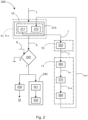
- Figure 2 is a schematic flow chart of an exemplary embodiment of the method 200 for executing a process 2 on at least one industrial plant or in at least one electric network.
- step 210 one or more samples 7 representing a state of the process 2 are provided to a trained prediction model 1 * , and/or to a surrogate approximation 1** thereof.
- the trained prediction model 1 * respectively the surrogate approximation 1 ** , then outputs a prediction 5 of the likelihood for occurrence of the undesired event in a state of the process 2 represented by the one or more samples.
- step 220 the prediction 5 is tested against at least one predetermined criterion 8.
- step 230 an alarm may be outputted to an operator 16 of the process 2.
- step 240 the execution of the process 2 may be modified with the goal of reducing the likelihood for occurrence of the undesired event.
- samples representing states of the process 2 may be collected by an edge system 10 of an industrial plant or other site that participates in executing the process 2.
- the edge system 10 may then provide the samples to a cloud platform 11.
- the cloud platform 11 may then train and/or update the prediction model 1 based on the samples 7 received from the edge system 10.
- the cloud platform 11 may then create, in step 270, a surrogate approximation 1 ** for the trained and/or updated prediction model 1 * , and/or an update to such an approximation 1 ** .
- This surrogate approximation 1 ** may then be provided back to the edge system 10 in step 280.
- this new and/or updated surrogate approximation 1 ** may then be evaluated to obtain the prediction 5, according to block 212.
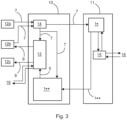
- Figure 3 shows an exemplary arrangement of an edge system 10 and a cloud platform 11 that may be used for performing the method 200.
- the industrial plant executing the process 2 comprises sensors 12a, actuators 12b and controllers 12c.
- Sensors 12a and actuators 12b produce samples 7 of data that is indicative of the state of the process 2. These samples are ingested and pre-processed by an edge data manager 14 of the edge system 10. They are passed on to the process control system 13, which in turn supplies control actions 9 to actuators 12b and controllers 12c to react to the state of the process 2 reflected in the samples 7.
- the process control system 13 When determining the control actions 9, the process control system 13 also considers a prediction 5 outputted by the surrogate approximation 1 ** as to the likelihood for occurrence of an undesired event. That is, the process control system 13 may steer, by means of the control actions 9, the process 2 in a manner that occurrence of the undesired event is avoided. Also, the process control system 13 is in communication with an operator 16 of the industrial plant.
- the samples 7 are passed on to the cloud platform 11 where the trained prediction model 1 * resides. They are used to further train this model 1*. After an update to the prediction model 1 * , the cloud platform 11 also generates a corresponding update to the surrogate approximation 1 ** . This update is passed back to the edge system 10.
- the cloud platform 11 also comprises an operational safety interface 15 by which it is in communication with the operator 16 of the plant.
Landscapes
- Engineering & Computer Science (AREA)
- Physics & Mathematics (AREA)
- General Physics & Mathematics (AREA)
- Automation & Control Theory (AREA)
- Mathematical Physics (AREA)
- Artificial Intelligence (AREA)
- Evolutionary Computation (AREA)
- Theoretical Computer Science (AREA)
- Human Computer Interaction (AREA)
- Computational Linguistics (AREA)
- Biophysics (AREA)
- Data Mining & Analysis (AREA)
- Biomedical Technology (AREA)
- General Health & Medical Sciences (AREA)
- Molecular Biology (AREA)
- Computing Systems (AREA)
- General Engineering & Computer Science (AREA)
- Life Sciences & Earth Sciences (AREA)
- Software Systems (AREA)
- Health & Medical Sciences (AREA)
- Testing And Monitoring For Control Systems (AREA)
- Management, Administration, Business Operations System, And Electronic Commerce (AREA)
Abstract
Description
- The invention relates to improving the execution of processes on industrial plants and/or electric networks, so as to reduce the likelihood of at least one undesired event occurring.
- Industrial plants for the execution of industrial processes, as well as electric networks, are protected by interlock conditions. Such interlock conditions are very frequently used on equipment to guard against operator errors, like grounding an electric circuit while it is at the same time energized by the power source (thereby shorting out the power source to ground). For the execution of processes in the plant or network, there are more safety interlock rules that enforce certain limits on state variables or other variables of the plant. For example, if a pressure gauge of a vacuum chamber that houses a materials processing equipment registers an increase in the pressure beyond what is acceptable for the system, the equipment may be turned off, so as to prevent damage to the system.
- Safety interlock rules frequently dictate drastic countermeasures against an unsafe state. For example, the plant or a part thereof may be brutally cut off from the power supply, irrespective of how tedious or difficult it then becomes to get the process up and running again. For example, turning off the heat in a chemical reaction vessel may cause its liquid contents to cool down and solidify. Using the reaction vessel again then requires a laborious manual removal using hammers and chisels at best, and is impossible at worst. The triggering of a safety interlock event may therefore be a major setback.
- It is therefore the objective of the invention to reduce the occurrence of safety interlock events by allowing to predict the occurrence of such events, and/or by actively avoiding those events based on such a prediction.
- The invention provides a method for training a prediction model for predicting the likelihood that at least one predetermined undesired event will occur during execution of a process. The process may be an industrial process that is executed in an industrial plant, such as a chemical process that converts one or more educts into one or more products by at least one chemical reaction. The process may also be an electrical process in an electric network, such as operation of an electric power grid. This method uses training samples with data that characterizes a state of the industrial process.
- In the course of the method, training samples representing states of the process that do not cause the undesired event are obtained. Operation without undesired events occurring is the normal operating state of the plant or network; therefore, such training samples are in plentiful supply. The training samples are labelled with a pre-set low likelihood of the undesired event occurring, depending on the scale on which this likelihood is measured. For example, if the likelihood is measured as a probability, it may be set to a very low non-zero value, rather than to zero, to avoid any divide-by-zero errors at runtime.
- That undesired events are fortunately rare, or do not occur at all, during normal operation of the plant or network is tied to the misfortune that very little (if any) training samples for states of the process that trigger such an undesired event are available. That is, the set of training samples is strongly imbalanced towards training samples representing normal operation. In order to train a prediction model to reliably predict the likelihood of an undesired event, a more balanced set of training samples is needed.
- To this end, based at least in part on a process model and a set of predetermined rules that stipulate in which states of the process there is an increased likelihood of the undesired event occurring, further training samples are obtained. These further training samples represent states of the process with an increased likelihood to cause the undesired event, and are consequently labelled with this increased likelihood.
- The process model may be a monolithic model of the process as a whole, but it may also be composed of sub-models at any desired level of granularity. For example, different sub-models may predict the future development of different aspects of the state of the process, which may correspond to different sub-units of the plant or network. For the sake of clarity, reference will be made to just one process model in the following.
- In particular, the process model may be specifically configured to predict a future evolution of the state of the process based on at least one current and/or past state of the process. The so-predicted future states may then, for example, be checked against the predetermined rules for the occurrence of the undesired event. If the predicted evolution of the process leads to a state that, according to the predetermined rules, will cause the undesired event, then the current and/or past state from which this predicted evolution is determined may be deemed to be causal for the undesired event.
- Preferably, the process model may comprise
- a machine learning model; and/or
- a simulation model; and/or
- a surrogate approximation of this simulation model.
- Simulation models can predict the future evolution of the process with a high fidelity. However, this comes at the price that a simulation model may be expensive to compute. The complex computations may take several hours or even more. For avoiding undesired events during the real-time execution of the process, however, being able to obtain results faster is more important than the highest level of fidelity.'
- This is where a surrogate approximation of the simulation model may save large amounts of computation time. In return for a small sacrifice in fidelity, the computation may be speeded up so much that it can be even much faster than real-time. This in turn allows to compute multiple scenarios and explore multiple possible paths on which the process may evolve, depending on the action taken now. This is somewhat akin to the lossy compression of audio and video data that takes away some of the quality but reduces the bandwidth requirement so much that the data may be streamed in real-time.
- Using the process model and the set of rules, the previously scarce set of training samples for states that may trigger the undesired event may be augmented to an arbitrary extent, so as to arrive at a more balanced set of training samples. This in turn allows for a supervised training of the prediction model. In this context, exploiting the predetermined set of rules yields the further advantage that these rules provide some level of abstraction from the exact internal behavior of the real process. This exact internal behavior is not always known. For example, in an industrial plant, some equipment may be bought and used as a "black box" with abstract technical specifications without access to its inner workings. A large-scale electricity grid is composed of many sub-networks that are run by different operators, and the inner complexity of these sub-networks is hidden behind abstract specifications. Just like the Earth can be abstracted to a point mass for some astronomical calculations, a power station may boil down to a handful of quantities, such as a maximum power output and a slew rate of the power output.
- In the course of the supervised training, training samples are provided to be to-be-trained prediction model. The prediction model then outputs a prediction of the likelihood for occurrence of the undesired event in a state of the process represented by the respective sample. A difference between the so-obtained prediction on the one hand, and the label of the respective sample on the other hand, is rated by means of a predetermined loss function (or "cost function"). Examples of such loss functions are the cross-entropy and the log-likelihood.
- Parameters that characterize the behavior of the prediction model are optimized such that, when predictions on further samples are made, the rating by the loss function is likely to improve. The training may stop in response to any suitable stopping criterion, such as the achieving of a certain prediction accuracy on the training samples, a number of training epochs, or convergence (i.e., failure of the parameters to change further). For example, in a neural network prediction model, the parameters comprise weights with which inputs to each neuron are summed to an activation of that neuron.
- The predetermined rules may, for example, comprise safety interlock rules that specify under which circumstances a safety interlock event is to be triggered. Many such safety interlock rules trigger a safety interlock event in response to certain alarms being raised in the plant, and/or in response to certain state variables of the plant and/or process crossing certain pre-set thresholds. In an electric network, sub-networks are usually set to disconnect from each other if currents between them climb above hard limits. If the respective condition is met, this invariably leads to the event occurring. That is, the likelihood of the event occurring is then maximal (i.e., 1 on a scale of probabilities).
- Thus, in a particularly advantageous embodiment, the undesired event comprises a safety interlock event that forces an at least partial stop and/or shutdown of the process, and/or of the industrial plant or electric network that is executing the process. Being able to predict these events, which were previously handled in a reactive manner, allows to handle them in a pro-active manner before they actually occur. For example, occurrence of these events may be avoided, and/or the consequences may be mitigated.
- For other types of undesired events, the rules that connect states of the process to an increased likelihood of the event occurring may be softer. For example, each rule may carry a certain amount of "penalty points", and if the state of the process meets multiple rules at once, these "penalty points" accrue. The undesired event may then, for example, be coupled to the condition that at least a threshold amount of "penalty points" has accrued. In such a situation, no rule stipulates on its own that the event shall occur under a certain condition, but each rule that is met increases the likelihood for the event.
- The likelihood of the undesired event occurring may be measured on any suitable scale. For example, the likelihood may be measured on a scale of a probability that this event occurs. This is an easily interpretable scale. Safety requirements, for example, may stipulate that the probability for certain events needs to be below a certain threshold.
- For avoiding the occurrence of undesired events in real-time process execution, another notion of the likelihood may also be advantageous: The likelihood may be measured on a scale of closeness of the state of the process to a state that causes the undesired event to occur. This gives a direct guidance as to what may be done in order to reduce the likelihood of undesired events. This is somewhat akin to the risks of drone operations being measured in terms of closeness to the operations to critical airspaces or installations on the ground.
- In a further advantageous embodiment, the method further comprises determining, based at least in part on the predetermined rules, which of the variables that characterize the state of the process have an impact on the likelihood of the undesired event occurring. These variables, and/or processing results obtained from these variables, may then be included in the training samples. That is, the state variables may be pre-filtered to reduce the complexity of the prediction model.
- The training samples may, for example, comprise any sort of state variables of the process. For example, in a chemical process, the state variables may comprise temperatures, concentrations or other physical properties of substances, pressures, or mass flows. In an electrical process, the state variables may comprise voltages, currents, power amounts, temperatures, or switching states of switchable connections.
- In a further advantageous embodiment, at least one statistical moment, and/or a time series, of at least one state variable of the process is included in the training samples. In particular, some kinds of prediction models, such as recurrent neural networks and transformer networks, are specifically adapted to process samples comprising time series, so as to directly learn from trends evident in such time series. Statistical moments of state variables may be included in the training samples to compress the information in the state variables.
- In a further particularly advantageous embodiment, the prediction model obtains a prediction of the likelihood for occurrence of the undesired event at the end of a predetermined time window based on samples within this time window. In this manner, a temporal horizon for causality may be set. Also, it is then clear how much time is remaining for any remedial actions for the purpose of avoiding the undesired event.
- In a further particularly advantageous embodiment, the behavior of the trained prediction model is approximated by means of a surrogate model that is computationally cheaper to evaluate than the trained prediction model. In this manner, some of the accuracy of the prediction is traded in for obtaining the prediction faster. In particular, as discussed before, if the prediction can be obtained faster than in real-time, multiple candidate actions for avoiding the occurrence of the undesired event may be tested using the prediction model. That is, "what-if" scenarios may be analyzed, and the best action may then be implemented on the process.
- The ultimate purpose of the trained prediction model is to improve the execution of processes and pro-actively react to impending occurrences of undesired events, so as to avoid them. The invention also provides a method for executing a process on at least one industrial plant or in at least one electric network.
- In the course of this method, one or more samples representing a state of the process are provided to a trained prediction model, and/or to a surrogate approximation thereof, so as to obtain a prediction of the likelihood for occurrence of the undesired event in a state of the process represented by the one or more samples.
- This prediction is tested against at least one predetermined criterion. For example, this criterion may comprise a threshold value for the probability of the undesired event occurring, or for the closeness in parameter space of the current state of the process to a state that will trigger the undesired event.
- In response to the criterion being met, an alarm is outputted to an operator of the process, and/or the execution of the process is modified with the goal of reducing the likelihood for occurrence of the undesired event. Such modification may entail a degradation of the execution. For example, the production rate of a product may be reduced or halted altogether, or some loads may be shed from the electric network.
- While it is of course most desirable to run the process without any degradation, a degradation is usually a lot more graceful than the occurrence of a safety interlocking event. For example, temporarily getting less product out of a chemical process is a far lesser evil than having to clean out solidified substance from a reactor vessel by hammer and chisel, and shedding some loads from the electric network is a lot better than losing power in the network altogether.
- In a further particularly advantageous embodiment, in order to modify the execution of the process, samples representing multiple candidate states of the process that are different from the current state of the process are provided to the prediction model. This yields likelihoods for occurrence of the undesired event for the candidate states. That is, options for states towards which the process might be moved may be explored in a "what-if" manner. Execution of the process may then be steered towards a candidate state with the least likelihood of the undesired event as a target state.
- Steering the process may, for example, comprise altering set-point values provided to low-level controllers of the industrial plant or electric network executing the process, and/or enabling or disabling pieces of equipment or interconnections in the plant or network.
- On many sites where an industrial plant or an electric installation is working to execute a process, many Internet of Things, loT, devices are participating in this work. These devices are communicating with an loT edge system for the purpose of process control. This edge system has some processing power for evaluating a prediction model, but not enough processing power for training such a prediction model. But the edge system can delegate this work to a cloud platform with more processing power.
- Therefore, in a further particularly advantageous embodiment, samples representing states of the process are collected by an edge system of an industrial plant or other site that participates in executing the process. The samples are provided to a cloud platform by the edge system. Based on these samples, the prediction model is trained and/or updated on the cloud platform. The cloud platform also creates a surrogate approximation for the trained and/or updated prediction model, and/or an update to such an already existing approximation. The surrogate approximation, and/or the update thereto, is provided back to the edge system. On the edge system, the surrogate approximation is evaluated, so as to obtain the prediction of the likelihood for occurrence of the undesired event.
- The methods may be wholly or partially computer-implemented. The invention therefore also relates to one or more computer programs with machine-readable instructions that, when executed on one or more computers and/or compute instances, cause the one or more computers to perform one of the methods described above. In this context, a virtualization platform, a hardware controller, network infrastructure devices (such as switches, bridges, routers or wireless access points), as well as end devices in the network (such as sensors, actuators or other industrial field devices) that are able to execute machine readable instructions are to be regarded as computers as well.
- The invention therefore also relates to a non-transitory storage medium, and/or to a download product, with the one or more computer programs. A download product is a product that may be sold in an online shop for immediate fulfillment by download. The invention also provides one or more computers and/or compute instances with the one or more computer programs, and/or with the one or more non-transitory machine-readable storage media and/or download products.
- In the following, the invention is illustrated using Figures without any intention to limit the scope of the invention. The Figures show:
-
Figure 1 : Exemplary embodiment of themethod 100 for training a prediction model; -
Figure 2 : Exemplary embodiment of themethod 200 for executing a process; -
Figure 3 : Exemplary arrangement of an edge system and a cloud platform for keeping a surrogate approximation of a prediction model updated. -
Figure 1 is a schematic flow chart of an exemplary embodiment of themethod 100 for training aprediction model 1. Theprediction model 1 is to predict a likelihood that at least one predetermined undesired event will occur during execution of aprocess 2. - In
step 110,training samples 3 are obtained. Thesetraining samples 3 represent states of theprocess 2 that do not cause the undesired event. They are labelled with a pre-set low likelihood of the undesired event occurring. - In
step 120, based at least in part on aprocess model 2a and a set ofpredetermined rules 2b that stipulate in which states of theprocess 2 there is an increased likelihood of the undesired event occurring,further training samples 4 are obtained. Thesefurther training samples 4 represent states of the process with an increased likelihood to cause the undesired event. They are therefore labelled with this increased likelihood. - In
step 130, thetraining samples be-trained prediction model 1. Theprediction model 1 then outputs aprediction 5 of the likelihood for occurrence of the undesired event in a state of theprocess 2 that is represented by therespective sample - In
step 140, a difference between theprediction 5 and the label of therespective sample predetermined loss function 6. Theloss function 6 yields arating 6a. - In
step 150,parameters 1a that characterize the behavior of theprediction model 1 are optimized such that, whenpredictions 5 onfurther samples rating 6a by theloss function 6 is likely to improve. The finally trained state of theparameters 1a is labelled with thereference sign 1a*. These finally optimizedparameters 1a* characterize the behavior of the fully trained prediction model that is labelled with thereference sign 1*. - In
step 160, the behavior of the trainedprediction model 1* is approximated by means of asurrogate model 1** that is computationally cheaper to evaluate than the trainedprediction model 1*. - According to block 111, it may be determined, based at least in part on the
predetermined rules 2b, which of the variables that characterize the state of theprocess 2 have an impact on the likelihood of the undesired event occurring. These variables, and/or processing results obtained from these variables, may then be included in thetraining samples 3 according to block 112, and in thetraining samples 4 according to block 123. - According to block 113, respectively 124, at least one statistical moment, and/or a time series, of at least one state variable of the
process 2, may be included in thetraining samples 3, respectively 4. - According to block 121, the
process model 2a may be specifically configured to predict a future evolution of the state of theprocess 2 based on at least one current and/or past state of theprocess 2. - According to block 122, the
process model 2a may comprise: - a machine learning model; and/or
- a simulation model; and/or
- a surrogate approximation of this simulation model.
- According to block 131, the
prediction model 1 may produce aprediction 5 of the likelihood for occurrence of the undesired event at the end of a predetermined time window based onsamples -
Figure 2 is a schematic flow chart of an exemplary embodiment of themethod 200 for executing aprocess 2 on at least one industrial plant or in at least one electric network. - In
step 210, one ormore samples 7 representing a state of theprocess 2 are provided to a trainedprediction model 1*, and/or to asurrogate approximation 1** thereof. The trainedprediction model 1*, respectively thesurrogate approximation 1**, then outputs aprediction 5 of the likelihood for occurrence of the undesired event in a state of theprocess 2 represented by the one or more samples. - In
step 220, theprediction 5 is tested against at least onepredetermined criterion 8. - If the
criterion 8 is met (truth value 1), instep 230, an alarm may be outputted to anoperator 16 of theprocess 2. Alternatively or in combination to this, instep 240, the execution of theprocess 2 may be modified with the goal of reducing the likelihood for occurrence of the undesired event. - According to block 211, samples representing states of the
process 2 may be collected by anedge system 10 of an industrial plant or other site that participates in executing theprocess 2. Instep 250, theedge system 10 may then provide the samples to acloud platform 11. - In
step 260, thecloud platform 11 may then train and/or update theprediction model 1 based on thesamples 7 received from theedge system 10. Thecloud platform 11 may then create, instep 270, asurrogate approximation 1** for the trained and/or updatedprediction model 1*, and/or an update to such anapproximation 1**. - This
surrogate approximation 1**, and/or the update thereto, may then be provided back to theedge system 10 instep 280. On theedge system 10, this new and/or updatedsurrogate approximation 1** may then be evaluated to obtain theprediction 5, according to block 212. -
Figure 3 shows an exemplary arrangement of anedge system 10 and acloud platform 11 that may be used for performing themethod 200. - In the example shown in
Figure 3 , the industrial plant executing theprocess 2 comprisessensors 12a,actuators 12b andcontrollers 12c.Sensors 12a andactuators 12b produce samples 7 of data that is indicative of the state of theprocess 2. These samples are ingested and pre-processed by anedge data manager 14 of theedge system 10. They are passed on to theprocess control system 13, which in turn supplies controlactions 9 toactuators 12b andcontrollers 12c to react to the state of theprocess 2 reflected in thesamples 7. - When determining the
control actions 9, theprocess control system 13 also considers aprediction 5 outputted by thesurrogate approximation 1** as to the likelihood for occurrence of an undesired event. That is, theprocess control system 13 may steer, by means of thecontrol actions 9, theprocess 2 in a manner that occurrence of the undesired event is avoided. Also, theprocess control system 13 is in communication with anoperator 16 of the industrial plant. - The
samples 7 are passed on to thecloud platform 11 where the trainedprediction model 1* resides. They are used to further train thismodel 1*. After an update to theprediction model 1*, thecloud platform 11 also generates a corresponding update to thesurrogate approximation 1**. This update is passed back to theedge system 10. - The
cloud platform 11 also comprises anoperational safety interface 15 by which it is in communication with theoperator 16 of the plant. -
- 1
- prediction model
- 1*
- fully trained state of
model 1 - 1**
- surrogate approximation of trained
model 1* - 1a
- parameters that characterize behavior of
prediction model 1 - 1a*
- fully optimized state of
parameters 1a - 2
- process
- 2a
- process model
- 2b
- rules for increased likelihood of undesired events
- 3
- training samples without increased likelihood of undesired event
- 4
- training samples with increased likelihood of undesired event
- 5
- prediction for likelihood of undesired event
- 6
- loss function
- 6a
- rating by loss function
- 7
- samples acquired during execution of
process 2 - 8
- criterion for
prediction 5 - 9
- control action
- 10
- edge system
- 11
- cloud platform
- 12a
- sensors
- 12b
- actuators
- 12c
- controllers
- 13
- process control system for
process 2 - 14
- edge data manager
- 15
- operational safety interface
- 16
- operator of industrial plant
- 100
- method for
training prediction model 1 - 110
- obtaining
training samples 3 - 111
- determining variables with impact on likelihood of undesired event
- 112
- including variables with impact in
training samples 3 - 113
- including statistical moment in
training samples 3 - 120
- obtaining
further training samples 4 - 121
- choosing
process model 2a that predicts future state - 122
- choosing particular kinds of
process models 2a - 123
- including variables with impact in
further training samples 4 - 124
- including statistical moments in
further training samples 4 - 130
- providing
training samples prediction model 1 - 131
- obtaining prediction at end of time frame
- 140
- rating difference between
prediction 5 and label ofsample - 150
- optimizing
parameters 1a - 160
- creating
surrogate approximation 1** for trainedmodel 1* - 200
- method for executing
process 2 - 210
- providing
samples 7 to trainedprediction model 1* - 211
- collecting samples by
edge system 10 - 212
- evaluating
surrogate approximation 1** onedge system 10 - 220
- testing prediction against
criterion 8 - 230
- outputting alarm to
operator 16 - 240
- modifying execution of process
- 241
- providing samples for candidate states to
prediction model 1 - 242
- steering process to avoid undesired event
- 250
- providing
samples 7 tocloud platform 11 - 260
- training and/or updating
prediction model 1 - 270
- creating
surrogate approximation 1** - 280
- providing update to edge
system 10
Claims (15)
- A method (100) for training a prediction model (1) for predicting the likelihood that at least one predetermined undesired event will occur during execution of a process (2) using training samples (3), wherein each training sample (3) comprises data that characterizes a state of the process (2), and the method (100) comprises the steps of:• obtaining (110) training samples (3) representing states of the process (2) that do not cause the undesired event, and labelling these training samples with a pre-set low likelihood of the undesired event occurring;• obtaining (120), based at least in part on a process model (2a) and a set of predetermined rules (2b) that stipulate in which states of the process (2) there is an increased likelihood of the undesired event occurring, further training samples (4) representing states of the process (2) with an increased likelihood to cause the undesired event, and labelling these training samples (4) with said increased likelihood;• providing (130) training samples (3, 4) to the to-be-trained prediction model (1), so as to obtain, from the prediction model (1), a prediction (5) of the likelihood for occurrence of the undesired event in a state of the process (2) represented by the respective sample (3, 4);• rating (140) a difference between the prediction (5) and the label of the respective sample (3, 4) by means of a predetermined loss function (6); and• optimizing (150) parameters (1a) that characterize the behavior of the prediction model (1), such that, when predictions (5) on further samples (3, 4) are made, the rating (6a) by the loss function (6) is likely to improve.
- The method (100) of claim 1, wherein the undesired event comprises a safety interlock event that forces an at least partial stop and/or shutdown of the process (2), and/or of the industrial plant or electric network that is executing the process (2).
- The method (100) of any one of claims 1 to 2, wherein the likelihood of the undesired event occurring is measured• on a scale of a probability that the undesired event occurs; and/or• on a scale of closeness of the state of the process (2) to a state that causes the undesired event to occur.
- The method (100) of any one of claims 1 to 3, wherein the process model (2a) is specifically configured (121) to predict a future evolution of the state of the process (2) based on at least one current and/or past state of the process (2).
- The method (100) of any one of claims 1 to 4, wherein the process model (2a) comprises (122):• a machine learning model; and/or• a simulation model; and/or• a surrogate approximation of this simulation model.
- The method (100) of any one of claims 1 to 5, further comprising:• determining (111), based at least in part on the predetermined rules (2b), which of the variables that characterize the state of the process (2) have an impact on the likelihood of the undesired event occurring; and• including (112, 123) these variables, and/or processing results obtained from these variables, in the training samples (3, 4).
- The method (100) of any one of claims 1 to 6, further comprising: including (113, 124), in the training samples (3, 4), at least one statistical moment, and/or a time series, of at least one state variable of the process (2).
- The method (100) of any one of claims 1 to 7, further comprising: obtaining (131), by the prediction model (1), a prediction (5) of the likelihood for occurrence of the undesired event at the end of a predetermined time window based on samples (3, 4) within this time window.
- The method (100) of any one of claims 1 to 8, further comprising: approximating (160) the behavior of the trained prediction model (1*) by means of a surrogate model (1**) that is computationally cheaper to evaluate than the trained prediction model (1*).
- A method (200) for executing a process (2) on at least one industrial plant or in at least one electric network, comprising the steps of:• providing (210) one or more samples (7) representing a state of the process (2) to a trained prediction model (1*), and/or to a surrogate approximation (1**) thereof, so as to obtain a prediction (5) of the likelihood for occurrence of the undesired event in a state of the process (2) represented by the one or more samples;• testing (220) the prediction (5) against at least one predetermined criterion (8); and• in response to the criterion (8) being met, outputting (230) an alarm to an operator (16) of the process (2), and/or modifying (240) the execution of the process (2) with the goal of reducing the likelihood for occurrence of the undesired event.
- The method (100) of claim 10, wherein the modifying (240) the execution of the process comprises:• providing (241) samples (7) representing multiple candidate states of the process (2) that are different from the current state of the process (2) to the prediction model (1), thereby obtaining likelihoods for occurrence of the undesired event for the candidate states; and• steering (242) execution of the process (2) towards a candidate state with the least likelihood for occurrence of the undesired event as a target state.
- The method (100) of claim 11, further comprising:• collecting (211), by an edge system (10) of an industrial plant or other site that participates in executing the process (2), samples (7) representing states of the process (2);• providing (250), by the edge system (10), the samples (7) to a cloud platform (11);• training, and/or updating (260), on the cloud platform (11), based on the samples (7) obtained from the edge system (10), the prediction model (1);• creating (270), by the cloud platform (11), a surrogate approximation (1**) for the trained and/or updated prediction model (1*), and/or an update to such an approximation (1**);• providing (280), by the cloud platform (11), the surrogate approximation (1**), and/or the update thereto, to the edge system (10); and• evaluating (212), on the edge system (10), the surrogate approximation (1**), so as to obtain the prediction (5) of the likelihood for occurrence of the undesired event.
- A computer program, comprising machine-readable instructions that, when executed by one or more computers, cause the one or more computers to perform a method (100, 200) of any one of claims 1 to 12.
- A non-transitory machine-readable storage medium, and/or a download product, with the computer program of claim 13.
- One or more computers with the computer program of claim 13, and/or with the non-transitory machine-readable storage medium and/or download product of claim 14.
Priority Applications (5)
| Application Number | Priority Date | Filing Date | Title |
|---|---|---|---|
| EP21209620.0A EP4184268B1 (en) | 2021-11-22 | 2021-11-22 | Training prediction models for predicting undesired events during execution of a process |
| CN202280077083.7A CN118284861A (en) | 2021-11-22 | 2022-10-28 | Train predictive models to predict unexpected events during the execution of a process |
| JP2024530025A JP7785941B2 (en) | 2021-11-22 | 2022-10-28 | Training a predictive model to predict undesired events during process execution |
| PCT/EP2022/080267 WO2023088665A1 (en) | 2021-11-22 | 2022-10-28 | Training prediction models for predicting undesired events during execution of a process |
| US18/668,370 US20240302832A1 (en) | 2021-11-22 | 2024-05-20 | Training Prediction Models for Predicting Undesired Events During Execution of a Process |
Applications Claiming Priority (1)
| Application Number | Priority Date | Filing Date | Title |
|---|---|---|---|
| EP21209620.0A EP4184268B1 (en) | 2021-11-22 | 2021-11-22 | Training prediction models for predicting undesired events during execution of a process |
Publications (3)
| Publication Number | Publication Date |
|---|---|
| EP4184268A1 true EP4184268A1 (en) | 2023-05-24 |
| EP4184268B1 EP4184268B1 (en) | 2025-07-16 |
| EP4184268C0 EP4184268C0 (en) | 2025-07-16 |
Family
ID=78770371
Family Applications (1)
| Application Number | Title | Priority Date | Filing Date |
|---|---|---|---|
| EP21209620.0A Active EP4184268B1 (en) | 2021-11-22 | 2021-11-22 | Training prediction models for predicting undesired events during execution of a process |
Country Status (5)
| Country | Link |
|---|---|
| US (1) | US20240302832A1 (en) |
| EP (1) | EP4184268B1 (en) |
| JP (1) | JP7785941B2 (en) |
| CN (1) | CN118284861A (en) |
| WO (1) | WO2023088665A1 (en) |
Citations (2)
| Publication number | Priority date | Publication date | Assignee | Title |
|---|---|---|---|---|
| US20190235484A1 (en) * | 2018-01-31 | 2019-08-01 | Hitachi, Ltd. | Deep learning architecture for maintenance predictions with multiple modes |
| US20210016786A1 (en) * | 2018-03-27 | 2021-01-21 | We Predict Limited | Predictive Vehicle Diagnostics Method |
Family Cites Families (9)
| Publication number | Priority date | Publication date | Assignee | Title |
|---|---|---|---|---|
| JP2014202190A (en) * | 2013-04-09 | 2014-10-27 | 株式会社リアムコンパクト | Control device, control method and program |
| CN105868770B (en) * | 2016-03-23 | 2019-09-10 | 国网山东省电力公司电力科学研究院 | A kind of Fault Diagnosis for HV Circuit Breakers method based on unsupervised learning model |
| JP6662830B2 (en) * | 2017-09-19 | 2020-03-11 | ファナック株式会社 | Prediction device, machine learning device, control device, and production system |
| JP7143148B2 (en) * | 2018-08-23 | 2022-09-28 | 三菱重工業株式会社 | Prediction device, prediction method, and program |
| JP2020042519A (en) * | 2018-09-10 | 2020-03-19 | 沖電気工業株式会社 | Abnormality detection device, abnormality detection method, and abnormality detection program |
| JP2020092569A (en) * | 2018-12-07 | 2020-06-11 | パナソニックIpマネジメント株式会社 | Abnormal current sign detection system and abnormal current sign detection method |
| WO2021098634A1 (en) * | 2019-11-19 | 2021-05-27 | Electrical And Mechanical Services Department, The Government Of Hong Kong Special Administrative Region | Non-intrusive data analytics system for adaptive intelligent condition monitoring of lifts |
| JP6924973B1 (en) * | 2020-01-31 | 2021-08-25 | パナソニックIpマネジメント株式会社 | Electrical equipment, equipment management system, equipment management method and program |
| JP7500980B2 (en) * | 2020-02-04 | 2024-06-18 | 富士電機株式会社 | Information processing device, information processing method, and information processing program |
-
2021
- 2021-11-22 EP EP21209620.0A patent/EP4184268B1/en active Active
-
2022
- 2022-10-28 JP JP2024530025A patent/JP7785941B2/en active Active
- 2022-10-28 CN CN202280077083.7A patent/CN118284861A/en active Pending
- 2022-10-28 WO PCT/EP2022/080267 patent/WO2023088665A1/en not_active Ceased
-
2024
- 2024-05-20 US US18/668,370 patent/US20240302832A1/en active Pending
Patent Citations (2)
| Publication number | Priority date | Publication date | Assignee | Title |
|---|---|---|---|---|
| US20190235484A1 (en) * | 2018-01-31 | 2019-08-01 | Hitachi, Ltd. | Deep learning architecture for maintenance predictions with multiple modes |
| US20210016786A1 (en) * | 2018-03-27 | 2021-01-21 | We Predict Limited | Predictive Vehicle Diagnostics Method |
Also Published As
| Publication number | Publication date |
|---|---|
| EP4184268B1 (en) | 2025-07-16 |
| WO2023088665A1 (en) | 2023-05-25 |
| US20240302832A1 (en) | 2024-09-12 |
| JP7785941B2 (en) | 2025-12-15 |
| EP4184268C0 (en) | 2025-07-16 |
| CN118284861A (en) | 2024-07-02 |
| JP2024540624A (en) | 2024-10-31 |
Similar Documents
| Publication | Publication Date | Title |
|---|---|---|
| Li et al. | Detecting cyberattacks in industrial control systems using online learning algorithms | |
| CN113505458B (en) | Method, system, equipment and storage medium for predicting critical trigger branch of cascading failure | |
| US10594712B2 (en) | Systems and methods for cyber-attack detection at sample speed | |
| EP3515038A1 (en) | Autonomous reconfigurable virtual sensing system for cyber-attack neutralization | |
| EP3515041A1 (en) | System and method for abstracting characteristics of cyber-physical systems | |
| US20180137277A1 (en) | Dynamic normalization of monitoring node data for threat detection in industrial asset control system | |
| JP7257455B2 (en) | Method and monitoring system for monitoring controller decision logic performance | |
| CN113640659A (en) | Method, device, processor and power distribution equipment for determining switch fault type | |
| CN119108992B (en) | Dynamic current limiting and overload adaptive protection method and system for circuit breaker | |
| Castellanos et al. | A modular hybrid learning approach for black-box security testing of CPS | |
| CN118157084A (en) | A method and system for automatically checking the safety boundary of main transformer protection setting value | |
| Ji et al. | Cloud-based ai systems: Leveraging large language models for intelligent fault detection and autonomous self-healing | |
| CN111934903A (en) | Docker container fault intelligent prediction method based on time sequence evolution genes | |
| CN118316744A (en) | Monitoring method, device, equipment and storage medium for distribution network | |
| Vasan et al. | An AutoML-based security defender for industrial control systems | |
| EP4184268B1 (en) | Training prediction models for predicting undesired events during execution of a process | |
| WO2020231334A1 (en) | Modelling and black-box security testing of cyber-physical systems | |
| EP4109187B1 (en) | Predicting process variables by simulation based on an only partially measurable initial state | |
| Zhu et al. | Prediction method of turbine engine RUL based on GA-SVR | |
| Jin et al. | Event-triggered fault detection and diagnosis for networked systems with sensor and actuator faults | |
| Li et al. | Remaining useful life prediction of a small sample of aero-engine based on an improved gray Markov model | |
| Escobet et al. | A fault/anomaly system prognosis using a data-driven approach considering uncertainty | |
| US20240201678A1 (en) | Smart controller for industrial asset health monitoring | |
| Xia et al. | HMM based modeling and health condition assessment for degradation process | |
| CN119397400B (en) | Electromagnetic transient fault analysis method, device and equipment based on large model |
Legal Events
| Date | Code | Title | Description |
|---|---|---|---|
| PUAI | Public reference made under article 153(3) epc to a published international application that has entered the european phase |
Free format text: ORIGINAL CODE: 0009012 |
|
| STAA | Information on the status of an ep patent application or granted ep patent |
Free format text: STATUS: THE APPLICATION HAS BEEN PUBLISHED |
|
| AK | Designated contracting states |
Kind code of ref document: A1 Designated state(s): AL AT BE BG CH CY CZ DE DK EE ES FI FR GB GR HR HU IE IS IT LI LT LU LV MC MK MT NL NO PL PT RO RS SE SI SK SM TR |
|
| STAA | Information on the status of an ep patent application or granted ep patent |
Free format text: STATUS: REQUEST FOR EXAMINATION WAS MADE |
|
| 17P | Request for examination filed |
Effective date: 20231023 |
|
| RBV | Designated contracting states (corrected) |
Designated state(s): AL AT BE BG CH CY CZ DE DK EE ES FI FR GB GR HR HU IE IS IT LI LT LU LV MC MK MT NL NO PL PT RO RS SE SI SK SM TR |
|
| RIC1 | Information provided on ipc code assigned before grant |
Ipc: G06N 3/08 20230101ALI20241211BHEP Ipc: G05B 23/02 20060101AFI20241211BHEP |
|
| GRAP | Despatch of communication of intention to grant a patent |
Free format text: ORIGINAL CODE: EPIDOSNIGR1 |
|
| STAA | Information on the status of an ep patent application or granted ep patent |
Free format text: STATUS: GRANT OF PATENT IS INTENDED |
|
| INTG | Intention to grant announced |
Effective date: 20250121 |
|
| GRAS | Grant fee paid |
Free format text: ORIGINAL CODE: EPIDOSNIGR3 |
|
| RIN1 | Information on inventor provided before grant (corrected) |
Inventor name: TAN, RUOMU Inventor name: SCHMIDT, BENEDIKT Inventor name: RODRIGUEZ, PABLO Inventor name: KOTRIWALA, ARZAM MUZAFFAR Inventor name: KLOEPPER, BENJAMIN Inventor name: SHARMA, DIVYASHEEL Inventor name: ABUKWAIK, HADIL Inventor name: DOPPELHAMER, JENS Inventor name: DIX, MARCEL Inventor name: BORRISON, REUBEN Inventor name: K R, CHANDRIKA |
|
| GRAA | (expected) grant |
Free format text: ORIGINAL CODE: 0009210 |
|
| STAA | Information on the status of an ep patent application or granted ep patent |
Free format text: STATUS: THE PATENT HAS BEEN GRANTED |
|
| AK | Designated contracting states |
Kind code of ref document: B1 Designated state(s): AL AT BE BG CH CY CZ DE DK EE ES FI FR GB GR HR HU IE IS IT LI LT LU LV MC MK MT NL NO PL PT RO RS SE SI SK SM TR |
|
| REG | Reference to a national code |
Ref country code: GB Ref legal event code: FG4D |
|
| REG | Reference to a national code |
Ref country code: CH Ref legal event code: EP |
|
| REG | Reference to a national code |
Ref country code: IE Ref legal event code: FG4D |
|
| U01 | Request for unitary effect filed |
Effective date: 20250723 |
|
| U07 | Unitary effect registered |
Designated state(s): AT BE BG DE DK EE FI FR IT LT LU LV MT NL PT RO SE SI Effective date: 20250729 |
|
| U20 | Renewal fee for the european patent with unitary effect paid |
Year of fee payment: 5 Effective date: 20251127 |
|
| PG25 | Lapsed in a contracting state [announced via postgrant information from national office to epo] |
Ref country code: IS Free format text: LAPSE BECAUSE OF FAILURE TO SUBMIT A TRANSLATION OF THE DESCRIPTION OR TO PAY THE FEE WITHIN THE PRESCRIBED TIME-LIMIT Effective date: 20251116 |
|
| PGFP | Annual fee paid to national office [announced via postgrant information from national office to epo] |
Ref country code: GB Payment date: 20251121 Year of fee payment: 5 |
|
| PGFP | Annual fee paid to national office [announced via postgrant information from national office to epo] |
Ref country code: NO Payment date: 20251125 Year of fee payment: 5 |
|
| PG25 | Lapsed in a contracting state [announced via postgrant information from national office to epo] |
Ref country code: HR Free format text: LAPSE BECAUSE OF FAILURE TO SUBMIT A TRANSLATION OF THE DESCRIPTION OR TO PAY THE FEE WITHIN THE PRESCRIBED TIME-LIMIT Effective date: 20250716 |
|
| PG25 | Lapsed in a contracting state [announced via postgrant information from national office to epo] |
Ref country code: GR Free format text: LAPSE BECAUSE OF FAILURE TO SUBMIT A TRANSLATION OF THE DESCRIPTION OR TO PAY THE FEE WITHIN THE PRESCRIBED TIME-LIMIT Effective date: 20251017 |
|
| PG25 | Lapsed in a contracting state [announced via postgrant information from national office to epo] |
Ref country code: PL Free format text: LAPSE BECAUSE OF FAILURE TO SUBMIT A TRANSLATION OF THE DESCRIPTION OR TO PAY THE FEE WITHIN THE PRESCRIBED TIME-LIMIT Effective date: 20250716 |
|
| PG25 | Lapsed in a contracting state [announced via postgrant information from national office to epo] |
Ref country code: RS Free format text: LAPSE BECAUSE OF FAILURE TO SUBMIT A TRANSLATION OF THE DESCRIPTION OR TO PAY THE FEE WITHIN THE PRESCRIBED TIME-LIMIT Effective date: 20251016 |
|
| PG25 | Lapsed in a contracting state [announced via postgrant information from national office to epo] |
Ref country code: ES Free format text: LAPSE BECAUSE OF FAILURE TO SUBMIT A TRANSLATION OF THE DESCRIPTION OR TO PAY THE FEE WITHIN THE PRESCRIBED TIME-LIMIT Effective date: 20250716 |
|
| PG25 | Lapsed in a contracting state [announced via postgrant information from national office to epo] |
Ref country code: SM Free format text: LAPSE BECAUSE OF FAILURE TO SUBMIT A TRANSLATION OF THE DESCRIPTION OR TO PAY THE FEE WITHIN THE PRESCRIBED TIME-LIMIT Effective date: 20250716 |
|
| PG25 | Lapsed in a contracting state [announced via postgrant information from national office to epo] |
Ref country code: CZ Free format text: LAPSE BECAUSE OF FAILURE TO SUBMIT A TRANSLATION OF THE DESCRIPTION OR TO PAY THE FEE WITHIN THE PRESCRIBED TIME-LIMIT Effective date: 20250716 |
|
| PG25 | Lapsed in a contracting state [announced via postgrant information from national office to epo] |
Ref country code: SK Free format text: LAPSE BECAUSE OF FAILURE TO SUBMIT A TRANSLATION OF THE DESCRIPTION OR TO PAY THE FEE WITHIN THE PRESCRIBED TIME-LIMIT Effective date: 20250716 |