EP4184261A1 - Determining appropriate sequences of actions to take upon operating states of industrial plants - Google Patents
Determining appropriate sequences of actions to take upon operating states of industrial plants Download PDFInfo
- Publication number
- EP4184261A1 EP4184261A1 EP21209772.9A EP21209772A EP4184261A1 EP 4184261 A1 EP4184261 A1 EP 4184261A1 EP 21209772 A EP21209772 A EP 21209772A EP 4184261 A1 EP4184261 A1 EP 4184261A1
- Authority
- EP
- European Patent Office
- Prior art keywords
- network
- state
- actions
- sequence
- representation
- Prior art date
- Legal status (The legal status is an assumption and is not a legal conclusion. Google has not performed a legal analysis and makes no representation as to the accuracy of the status listed.)
- Pending
Links
Images


Classifications
-
- G—PHYSICS
- G05—CONTROLLING; REGULATING
- G05B—CONTROL OR REGULATING SYSTEMS IN GENERAL; FUNCTIONAL ELEMENTS OF SUCH SYSTEMS; MONITORING OR TESTING ARRANGEMENTS FOR SUCH SYSTEMS OR ELEMENTS
- G05B23/00—Testing or monitoring of control systems or parts thereof
- G05B23/02—Electric testing or monitoring
- G05B23/0205—Electric testing or monitoring by means of a monitoring system capable of detecting and responding to faults
- G05B23/0259—Electric testing or monitoring by means of a monitoring system capable of detecting and responding to faults characterized by the response to fault detection
-
- G—PHYSICS
- G05—CONTROLLING; REGULATING
- G05B—CONTROL OR REGULATING SYSTEMS IN GENERAL; FUNCTIONAL ELEMENTS OF SUCH SYSTEMS; MONITORING OR TESTING ARRANGEMENTS FOR SUCH SYSTEMS OR ELEMENTS
- G05B13/00—Adaptive control systems, i.e. systems automatically adjusting themselves to have a performance which is optimum according to some preassigned criterion
- G05B13/02—Adaptive control systems, i.e. systems automatically adjusting themselves to have a performance which is optimum according to some preassigned criterion electric
- G05B13/0265—Adaptive control systems, i.e. systems automatically adjusting themselves to have a performance which is optimum according to some preassigned criterion electric the criterion being a learning criterion
- G05B13/027—Adaptive control systems, i.e. systems automatically adjusting themselves to have a performance which is optimum according to some preassigned criterion electric the criterion being a learning criterion using neural networks only
-
- G—PHYSICS
- G05—CONTROLLING; REGULATING
- G05B—CONTROL OR REGULATING SYSTEMS IN GENERAL; FUNCTIONAL ELEMENTS OF SUCH SYSTEMS; MONITORING OR TESTING ARRANGEMENTS FOR SUCH SYSTEMS OR ELEMENTS
- G05B19/00—Program-control systems
- G05B19/02—Program-control systems electric
- G05B19/04—Program control other than numerical control, i.e. in sequence controllers or logic controllers
- G05B19/042—Program control other than numerical control, i.e. in sequence controllers or logic controllers using digital processors
- G05B19/0428—Safety, monitoring
-
- G—PHYSICS
- G06—COMPUTING OR CALCULATING; COUNTING
- G06F—ELECTRIC DIGITAL DATA PROCESSING
- G06F9/00—Arrangements for program control, e.g. control units
- G06F9/06—Arrangements for program control, e.g. control units using stored programs, i.e. using an internal store of processing equipment to receive or retain programs
- G06F9/44—Arrangements for executing specific programs
- G06F9/451—Execution arrangements for user interfaces
- G06F9/453—Help systems
Definitions
- the invention relates to the monitoring of industrial plants and to the determining of actions to take in response to particular operating states, in particular in response to abnormal operating states.
- DCS distributed control systems
- KPI key performance indicators
- the intended operation of many industrial plants is controlled by distributed control systems, DCS, that adjust set-points of low-level controllers in order to optimize one or more key performance indicators, KPI.
- the plant is also continuously monitored for any abnormal conditions, such as equipment failure or malfunction. This monitoring may be at least partially integrated with control by the DCS.
- WO 2019/104 296 A1 discloses an alarm management system that assists an operator with identifying high priority alarms. However, the outputting of the alarm to the operator is only the first step towards remedying the abnormal condition. It is also necessary that the operator executes the correct sequence of actions.
- the invention provides a computer-implemented method for determining an appropriate sequence of actions to take during operation of an industrial plant or part thereof.
- values of a plurality of state variables that characterize an operational state of the plant or part thereof are obtained. For example, these values may be combined in a vector or tensor.
- the concrete set of state variables that is needed to characterize the state of a plant or part thereof is plant-specific. Examples of such state variables include a pressure, a temperature, a mass flow, a voltage, an electrical current, a fill level, and a concentration of a substance in a mixture of substances.
- the plurality of state variables (e.g., the vector or tensor comprising the values of the state variables) is encoded, by at least one trained state encoder network, into a representation of the operating state of the plant or part thereof.
- a representation may have a much lower dimensionality than the original plurality of state variables. I.e., the representation may depend on a much smaller number of variables than the original vector with the values of state variables.
- state variables include, but are not limited to:
- the state encoder network may be a combined state encoder network that takes both process variables and events as inputs simultaneously. But a combination of two state encoder networks, wherein the one encodes the process variables and the other encodes the events, may also be used.
- the representation of the operating state is mapped to a representation of a sequence of actions to take in response to the operating state.
- a small number of variables may encode a complex operating state of the plant that depends on very many state variables
- a small number of variables may also encode a complex sequence of actions comprising many different actions.
- the representation of the sequence of actions is decoded to the sought sequence of actions to take by a trained action decoder network.
- the so-determined sequence of actions may then be used in any possible manner in order to remedy an abnormal situation. For example, to the extent that the actions in the sequence can be performed automatically, the automatic performing of these actions may be triggered. For actions that can only be performed by an operator, the operator may be notified in any suitable manner to perform them. Also, any suitable actions may be taken to aid the operator in performing such action. For example, if the operator needs to operate some particular control element in a human-machine interface of the DCS, this may be highlighted.
- an action requires the operation of a physical control (such as a button, switch or knob) and this is control guarded by a cover to prevent accidental or inadvertent operation, the cover may unlock and/or open.
- a physical control such as a button, switch or knob
- the cover may unlock and/or open.
- access doors to the location of the equipment may be unlocked, and/or the location of the equipment may be rendered safe for the operator to enter, such as by stopping equipment that might harm the operator.
- Hybrid solutions in the sense that actions available in the HMI of a DCS are executed automatically, without human intervention or optionally at least under human supervision (i.e., the human observes as the sequence of actions proposed by the system is executed automatically) are also possible.
- the main evaluation of the operating state of the plant happens when the representation of this operating state is mapped to a representation of a sequence of actions. Since the representations usually have a much lower dimensionality than the operating state, respectively the sequence of actions, this means that the evaluation merely comprises a mapping between two low-dimensional spaces.
- that the state-to-action network is easier to train comprises that the training requires a lesser quantity of training samples.
- the state encoder network is chosen to be an encoder part of an encoder-decoder arrangement that first maps a plurality of state variables to a representation of the operating state of the plant or part thereof and then reconstructs a plurality of state variables from this representation.
- an encoder-decoder arrangement may be trained in a self-supervised manner. That is, a training sample may be inputted into the arrangement, and the outcome of the arrangement may be evaluated as to how well it is in agreement with the original input. For this training to work, the training samples do not need to be labelled with "ground truth”. In machine learning applications, obtaining "ground truth" is the most expensive part of the training.
- training for a reconstruction in this manner trains the encoder-decoder arrangement to force the part of the input that is most salient for the reconstruction through the "information bottleneck" of the low-dimensional representation. This eliminates less important portions of the input, such as noise. Therefore, the encoder also gets some de-noising functionality by virtue of the training.
- the action decoder network is chosen to be a decoder part of an encoder-decoder arrangement that first maps a sequence of actions, and/or a processing result derived from this sequence of actions, to a representation, and then reconstructs a sequence of actions, and/or a processing result derived therefrom, from this representation.
- Reconstructing a "processing result" means that, for example, the encoder-decoder arrangement may be trained to predict, based on a part of a sequence of actions, the next action in this sequence of actions.
- Examples of networks that may be used as encoder networks and/or decoder networks for operating states, and/or for sequences of actions include recurrent neural networks, RNNs, and transformer networks.
- a recurrent neural network the output is fed back as input, and the network is executed for a predetermined number of iterations.
- a transformer neural network comprises a sequence of multiple coding units, each of which comprises an attention head that computes correlations between different parts of the input. Both architectures are particularly useful for processing sequences as inputs.
- the state-to-action network may, for example, comprise a convolutional neural network.
- the state-to-action network comprises a fully connected neural network.
- This architecture provides the greatest flexibility for training, at the price that it contains many parameters per size of the input and output.
- the dimensionality of the representation of the operating state, as well as the dimensionality of the representation of the sequence of actions is rather low. Therefore, the higher number of parameters that a fully connected neural network has may be accommodated.
- Exemplary plants where the method is particularly advantageous, especially to remedy abnormal situations include continuous or process plants that are configured to emit alarms and events data.
- the method may be used to remedy abnormal situations in:
- the invention also provides a method for training an arrangement of networks for use in the method described above.
- a pre-trained first encoder-decoder arrangement of an action encoder network and an action decoder network is obtained. Also, a pre-trained second encoder-decoder arrangement of a state encoder network and a state decoder network is obtained.
- Samples of training data are obtained. Each such sample comprises values of a plurality of state variables that characterize the operating state of the plant or part thereof. These state variables are input data for the to-be-trained arrangement. Each sample also comprises sequence of actions taken in response to this operating state. This sequence is the "ground truth" label attached to the operating state of the sample.
- the values of the state variables in each sample are encoded into a representation of the respective operating state by the pre-trained state encoder network.
- the resulting representation of the operating state is mapped to a representation of a sequence of actions.
- the sequence of actions encoded in this representation is the sequence of actions that the arrangement of networks is proposing given the operating state characterized by the state variables.
- Correspondence of this sequence of actions to the "ground truth" that is attached to the sample is measured by means of a cost function.
- a cost function measures to which extent the representation of the sequence of actions is in agreement with a representation obtained by encoding, by the pre-trained action encoder network, the sequence of actions in the training sample;
- the loss function measures to which extent a sequence of actions obtained by decoding, by the pre-trained action decoder network, the representation of the sequence of actions is in agreement with the sequence of actions in the training sample.
- parameters that characterize the behavior of the to-be-trained state-to-action network are optimized such that, when further training samples are processed, the rating by the loss function is likely to improve.
- the state variables may be obtained during a real execution of a process on the plant, or after such execution from a plant historian, or from execution of simulation with a process simulator producing the same state-variables as the process on the plant.
- the usage of a process simulator is particular beneficial for newly commissioned plants with little historical data and when the model is first trained on simulated data capturing the general process dynamics and later with the limited amount of data from the real process execution.
- the sequences of actions may be monitored during execution of the process, or it may be obtained after such execution from an action log, or for initial training be obtained from simulation experiments with real plant operators or predefined actions sequences. Since both the state variables in the plant historian and the actions in the action log are timestamped, they can be correlated to each other.
- the training may thus be understood to "mine” a workflow with which the plant operator reacts to a particular situation and teach the network arrangement to propose this workflow when this, or a substantially similar, situation occurs again. In this manner, even knowledge that is present in the operator's mind but hard to put in words, or to communicate to another operator, may be put to use.
- the obtaining of a first pre-trained encoder-decoder arrangement of an action encoder network and an action decoder network comprises:
- the training samples used for this pre-training may have training samples in common with the main training discussed above, but it may also be performed on a set of training samples disjoint from the one used for the main training.
- the pre-training may be performed in a generic manner once for a particular type of plant. For each instance of the plant that is subsequently installed, the pre-trained encoder-decoder arrangement may then be used in the training of the state-to-sequence network.
- the pre-training of the encoder-decoder arrangement may be refined using further training samples that have been acquired from this instance of the plant.
- Pre-training might be done with a variety of tasks for which "ground truth labels" can be easily produced from the available process state data and the actions sequences. Examples of such tasks are reconstruction of the input (plant state variables or action sequences), predicting the next n elements of the sequences (plant state variables or action sequences), identifying the correct next sequence segments among a number of presented sequence segments, identifying the correct previous sequence segments among a number of presented sequence segments, identifying whether presented sequence are neighbors in the overall sequence, etc. Such tasks might also be combined in parallel or in sequence which is beneficial because it further increases the amount of training data for pretraining and also prevents overfitting the pre-trained model to a single task.
- obtaining of a second pre-trained encoder-decoder arrangement of a state encoder network and a state decoder network comprises:
- the to-be-trained action encoder network and the to-be-trained state encoder network are combined in one single network architecture.
- This single network architecture may depend on fewer parameters than a combination of two individual architectures, resulting in an easier training. Also, since the tasks performed by both networks have something in common, the two trainings may benefit from each other to some degree by "sharing" knowledge in the one single network architecture.
- the obtaining of training samples for the training of the first encoder-decoder arrangement, and/or the second encoder-decoder arrangement, and/or the state-to-action network comprises aggregating training samples obtained in multiple industrial plants. This improves the overall variability in the set of training samples, resulting in a better performance of the final arrangement of networks in terms of accuracy.
- abnormal situations that pose safety risks tend to occur very rarely in any given plant. Because of the safety risks, it is usually not practical to provoke such a situation just for the purpose of acquiring training samples. But in a larger fleet of plants, there will be enough instances of the abnormal situations occurring on their own that a reasonable amount of training samples may be gathered.
- the invention therefore also relates to one or more computer programs with machine-readable instructions that, when executed on one or more computers and/or compute instances, cause the one or more computers to perform a method described above.
- a virtualization platform a hardware controller, network infrastructure devices (such as switches, bridges, routers or wireless access points), as well as end devices in the network (such as sensors, actuators or other industrial field devices) that are able to execute machine readable instructions are to be regarded as computers as well.
- the invention therefore also relates to a non-transitory storage medium, and/or to a download product, with the one or more computer programs.
- a download product is a product that may be sold in an online shop for immediate fulfillment by download.
- the invention also provides one or more computers and/or compute instances with the one or more computer programs, and/or with the one or more non-transitory machine-readable storage media and/or download products.
- Figure 1 is a schematic flow chart of an embodiment of the method 100 for determining an appropriate sequence of actions to take during operation of an industrial plant 1.
- step 110 values of a plurality of state variables 2 that characterize an operational state of the plant 1 or part thereof are obtained.
- step 120 the plurality of state variables 2 are encoded into a representation 2a of the operating state of the plant 1 or part thereof by at least one trained state encoder network 3.
- the state encoder network 3 may be chosen to be an encoder part of an encoder-decoder arrangement that first maps a plurality of state variables 2 to a representation 2a of the operating state of the plant 1 or part thereof and then reconstructs a plurality of state variables 2 from this representation 2a.
- step 130 the representation 2a of the operating state is mapped to a representation 6a of a sequence 6 of actions to take in response to the operating state by a trained state-to-action network 4.
- step 140 the representation 6a of the sequence 6 of actions is decoded to the sought sequence 6 of actions to take by a trained action decoder network 5.
- the action decoder network 5 may be chosen to be a decoder part of an encoder-decoder arrangement that first maps a sequence 6 of actions, and/or a processing result derived from this sequence 6 of actions, to a representation 6a, and then reconstructs a sequence 6 of actions, and/or a processing result derived therefrom, from this representation 6a.
- Figure 2 is a schematic flow chart of an embodiment of the method 200 for training an arrangement of networks 3, 4, 5 for use in the method 100 described above.
- step 210 a pre-trained first encoder-decoder arrangement of an action encoder network 5# and an action decoder network 5 is obtained.
- this obtaining comprises the additional steps of:
- step 220 a pre-trained second encoder-decoder arrangement of a state encoder network 3 and a state decoder network 3# is obtained.
- this obtaining comprises the additional steps of:
- samples 7 of training data are obtained.
- Each sample 7 comprises values of a plurality of state variables 2 that characterize the operating state of the plant 1 or part thereof, and a sequence 6* of actions taken in response to this operating state.
- the obtaining 230 of training samples 7 for the training of the first encoder-decoder arrangement, and/or the second encoder-decoder arrangement, and/or the state-to-action network 4 comprises aggregating training samples 7 obtained in multiple industrial plants 1.
- step 240 the values of the state variables 2 in each sample 7 are encoded into a representation 2a of the respective operating state by the pre-trained state encoder network 3.
- step 250 the representation 2a of the operating state is mapped to a representation 6a of a sequence 6 of actions.
- step 260 it is measured, by means of a predetermined loss function 8, to which extent
- step 270 parameters 4a that characterize the behavior of the to-be-trained state-to-action network 4 are optimized such that, when further training samples 7 are processed, the rating 8a by the loss function 8 is likely to improve.
- the finally optimized state of the parameters 4a is labelled with the reference sign 4a*.
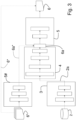
- Figure 3 illustrates the two manners in which the state-to-action network 4 may be trained.
- Values of one or more state variables 2 from a training sample 7 are encoded to a representation 2a of the operating state of the plant 1.
- this representation 2a is mapped to a representation 6a of a sequence 6 of actions.
- This representation 6a needs to be compared with a "ground truth" sequence of actions 6* in the training sample 7, so as to measure to which extent the representation 6a outputted by the state-to-action network 4 is correct.
- the "ground truth" sequence 6* of actions is encoded, by the pre-trained action encoder network 5#, into a "ground truth” representation 6a*.
- the loss function 8 measures to which extent the representation 6a outputted by the state-to-action network 4 is in agreement with o the "ground truth” representation 6a*.
- the representation 6a outputted by the state-to-action network 4 is decoded by the pre-trained action decoder network 5, so as to obtain a sequence 6' of actions.
- the loss function 8 measures to which extent this sequence 6 of actions is in agreement with the "ground truth" sequence 6* of actions.
Landscapes
- Engineering & Computer Science (AREA)
- Artificial Intelligence (AREA)
- Physics & Mathematics (AREA)
- General Physics & Mathematics (AREA)
- Automation & Control Theory (AREA)
- Evolutionary Computation (AREA)
- Health & Medical Sciences (AREA)
- Computer Vision & Pattern Recognition (AREA)
- Medical Informatics (AREA)
- Software Systems (AREA)
- Testing And Monitoring For Control Systems (AREA)
- Programmable Controllers (AREA)
Abstract
• obtaining (110) values of a plurality of state variables (2) that characterize an operational state of the plant (1) or part thereof;
• encoding (120), by at least one trained state encoder network (3), the plurality of state variables (2) into a representation (2a) of the operating state of the plant (1) or part thereof;
• mapping (130), by a trained state-to-action network (4), the representation (2a) of the operating state to a representation (6a) of a sequence (6) of actions to take in response to the operating state; and
• decoding (140), by a trained action decoder network (5), the representation (6a) of the sequence (6) of actions to the sought sequence (6) of actions to take.
Description
- The invention relates to the monitoring of industrial plants and to the determining of actions to take in response to particular operating states, in particular in response to abnormal operating states.
- The intended operation of many industrial plants is controlled by distributed control systems, DCS, that adjust set-points of low-level controllers in order to optimize one or more key performance indicators, KPI. The plant is also continuously monitored for any abnormal conditions, such as equipment failure or malfunction. This monitoring may be at least partially integrated with control by the DCS.
- If an abnormal condition is detected, it is not always possible to remedy it automatically by means of the DCS. In every plant, there are abnormal situations that need to be remedied by an operator executing a certain sequence of actions.
WO 2019/104 296 A1 discloses an alarm management system that assists an operator with identifying high priority alarms. However, the outputting of the alarm to the operator is only the first step towards remedying the abnormal condition. It is also necessary that the operator executes the correct sequence of actions. - It is therefore an objective of the invention to aid a plant operator in remedying an abnormal situation by computing, from information gained during the monitoring of an industrial plant or a part thereof, a sequence of actions to take.
- This objective is achieved by a first method for determining an appropriate sequence of events according to a first independent claim, and by a second method according to a second independent claim for training the machine-learning networks that are used in the first method. Further advantageous embodiments are detailed in the respective dependent claims.
- The invention provides a computer-implemented method for determining an appropriate sequence of actions to take during operation of an industrial plant or part thereof.
- In the course of this method, values of a plurality of state variables that characterize an operational state of the plant or part thereof are obtained. For example, these values may be combined in a vector or tensor. The concrete set of state variables that is needed to characterize the state of a plant or part thereof is plant-specific. Examples of such state variables include a pressure, a temperature, a mass flow, a voltage, an electrical current, a fill level, and a concentration of a substance in a mixture of substances.
- The plurality of state variables (e.g., the vector or tensor comprising the values of the state variables) is encoded, by at least one trained state encoder network, into a representation of the operating state of the plant or part thereof. In particular, such a representation may have a much lower dimensionality than the original plurality of state variables. I.e., the representation may depend on a much smaller number of variables than the original vector with the values of state variables.
- Examples for state variables include, but are not limited to:
- variables that are at least indicative of process variables, such as pressures, mass flows, voltages or currents;
- events that denote discrete changes in the plant, such as the switching on or off of a motor, a signal crossing an alarm limit, the opening or closing of a valve; and
- a combination of process variables and events.
- If the state variables include both process variables and events, the state encoder network may be a combined state encoder network that takes both process variables and events as inputs simultaneously. But a combination of two state encoder networks, wherein the one encodes the process variables and the other encodes the events, may also be used.
- By means of a trained state-to-action network, the representation of the operating state is mapped to a representation of a sequence of actions to take in response to the operating state. In particular, just like a small number of variables may encode a complex operating state of the plant that depends on very many state variables, a small number of variables may also encode a complex sequence of actions comprising many different actions.
- The representation of the sequence of actions is decoded to the sought sequence of actions to take by a trained action decoder network. The so-determined sequence of actions may then be used in any possible manner in order to remedy an abnormal situation. For example, to the extent that the actions in the sequence can be performed automatically, the automatic performing of these actions may be triggered. For actions that can only be performed by an operator, the operator may be notified in any suitable manner to perform them. Also, any suitable actions may be taken to aid the operator in performing such action. For example, if the operator needs to operate some particular control element in a human-machine interface of the DCS, this may be highlighted. If an action requires the operation of a physical control (such as a button, switch or knob) and this is control guarded by a cover to prevent accidental or inadvertent operation, the cover may unlock and/or open. Likewise, if the action requires physical access to certain equipment, access doors to the location of the equipment may be unlocked, and/or the location of the equipment may be rendered safe for the operator to enter, such as by stopping equipment that might harm the operator. Hybrid solutions in the sense that actions available in the HMI of a DCS are executed automatically, without human intervention or optionally at least under human supervision (i.e., the human observes as the sequence of actions proposed by the system is executed automatically) are also possible.
- Examples for actions in the sequence of actions include:
- enabling or disabling a piece of equipment in the plant or part thereof;
- opening or closing a valve in the plant or part thereof; and
- changing a set-point value of at least one low-level controller in the plant or part thereof.
- The main evaluation of the operating state of the plant happens when the representation of this operating state is mapped to a representation of a sequence of actions. Since the representations usually have a much lower dimensionality than the operating state, respectively the sequence of actions, this means that the evaluation merely comprises a mapping between two low-dimensional spaces. This makes the state-to-action network a lot easier to train than a network that directly gets high-dimensional operating states and directly outputs high-dimensional action sequences. In particular, that the state-to-action network is easier to train comprises that the training requires a lesser quantity of training samples.
- Moreover, distinct tasks in the overall processing chain, namely
- going from a high-dimensional input to a low-dimensional representation,
- processing this representation into another representation in another low-dimensional space, and
- going from that second low-dimensional representation space into a second high-dimensional output space,
- In a particularly advantageous embodiment, the state encoder network is chosen to be an encoder part of an encoder-decoder arrangement that first maps a plurality of state variables to a representation of the operating state of the plant or part thereof and then reconstructs a plurality of state variables from this representation. Such an encoder-decoder arrangement may be trained in a self-supervised manner. That is, a training sample may be inputted into the arrangement, and the outcome of the arrangement may be evaluated as to how well it is in agreement with the original input. For this training to work, the training samples do not need to be labelled with "ground truth". In machine learning applications, obtaining "ground truth" is the most expensive part of the training.
- Moreover, training for a reconstruction in this manner trains the encoder-decoder arrangement to force the part of the input that is most salient for the reconstruction through the "information bottleneck" of the low-dimensional representation. This eliminates less important portions of the input, such as noise. Therefore, the encoder also gets some de-noising functionality by virtue of the training.
- Alternatively or in combination to this, in another particularly advantageous embodiment, the action decoder network is chosen to be a decoder part of an encoder-decoder arrangement that first maps a sequence of actions, and/or a processing result derived from this sequence of actions, to a representation, and then reconstructs a sequence of actions, and/or a processing result derived therefrom, from this representation. The advantages are the same.
- Reconstructing a "processing result" means that, for example, the encoder-decoder arrangement may be trained to predict, based on a part of a sequence of actions, the next action in this sequence of actions.
- Examples of networks that may be used as encoder networks and/or decoder networks for operating states, and/or for sequences of actions, include recurrent neural networks, RNNs, and transformer networks. In a recurrent neural network, the output is fed back as input, and the network is executed for a predetermined number of iterations. A transformer neural network comprises a sequence of multiple coding units, each of which comprises an attention head that computes correlations between different parts of the input. Both architectures are particularly useful for processing sequences as inputs.
- The state-to-action network may, for example, comprise a convolutional neural network. In a particularly advantageous embodiment, the state-to-action network comprises a fully connected neural network. This architecture provides the greatest flexibility for training, at the price that it contains many parameters per size of the input and output. As discussed before, the dimensionality of the representation of the operating state, as well as the dimensionality of the representation of the sequence of actions, is rather low. Therefore, the higher number of parameters that a fully connected neural network has may be accommodated.
- Exemplary plants where the method is particularly advantageous, especially to remedy abnormal situations, include continuous or process plants that are configured to emit alarms and events data. For example, the method may be used to remedy abnormal situations in:
- a waste incineration plant;
- a hydrocarbon separation plant;
- a reinjection system for injecting water into a hydrocarbon well;
- a hydrocarbon exploitation facility; and/or
- a deglycol regeneration plant.
- These plants have in common that abnormal situations frequently pose safety issues. In case of a high priority alarm, if a wrong sequence of actions is commenced, or if errors are made when executing the correct sequence (such as omitting a step or swapping the order of two steps), this may make the abnormal situation worse, possibly forgoing the last opportunity to get the plant under control again. Also, because safety-critical abnormal situations are fortunately rare, there is only little training data for these situations available. It is therefore advantageous that the method can work with lesser training data because the main reasoning is, as discussed before, done between two spaces of rather low dimensionality.
- The invention also provides a method for training an arrangement of networks for use in the method described above.
- In the course of this method, a pre-trained first encoder-decoder arrangement of an action encoder network and an action decoder network is obtained. Also, a pre-trained second encoder-decoder arrangement of a state encoder network and a state decoder network is obtained.
- Samples of training data are obtained. Each such sample comprises values of a plurality of state variables that characterize the operating state of the plant or part thereof. These state variables are input data for the to-be-trained arrangement. Each sample also comprises sequence of actions taken in response to this operating state. This sequence is the "ground truth" label attached to the operating state of the sample.
- The values of the state variables in each sample are encoded into a representation of the respective operating state by the pre-trained state encoder network. The resulting representation of the operating state is mapped to a representation of a sequence of actions. The sequence of actions encoded in this representation is the sequence of actions that the arrangement of networks is proposing given the operating state characterized by the state variables.
- Correspondence of this sequence of actions to the "ground truth" that is attached to the sample is measured by means of a cost function. This can be accomplished by any one, or a combination, of the following two manners:
According to the first manner, the loss function measures to which extent the representation of the sequence of actions is in agreement with a representation obtained by encoding, by the pre-trained action encoder network, the sequence of actions in the training sample; - According to the second manner, the loss function measures to which extent a sequence of actions obtained by decoding, by the pre-trained action decoder network, the representation of the sequence of actions is in agreement with the sequence of actions in the training sample.
- In the course of the training, parameters that characterize the behavior of the to-be-trained state-to-action network are optimized such that, when further training samples are processed, the rating by the loss function is likely to improve.
- The state variables may be obtained during a real execution of a process on the plant, or after such execution from a plant historian, or from execution of simulation with a process simulator producing the same state-variables as the process on the plant. The usage of a process simulator is particular beneficial for newly commissioned plants with little historical data and when the model is first trained on simulated data capturing the general process dynamics and later with the limited amount of data from the real process execution. Likewise, the sequences of actions may be monitored during execution of the process, or it may be obtained after such execution from an action log, or for initial training be obtained from simulation experiments with real plant operators or predefined actions sequences. Since both the state variables in the plant historian and the actions in the action log are timestamped, they can be correlated to each other. The training may thus be understood to "mine" a workflow with which the plant operator reacts to a particular situation and teach the network arrangement to propose this workflow when this, or a substantially similar, situation occurs again. In this manner, even knowledge that is present in the operator's mind but hard to put in words, or to communicate to another operator, may be put to use.
- For example, if an operator has learned to "open a valve slowly if the flame turns bluish", each operator may perceive the moment at which the flame turns bluish slightly differently. Also, different operators may have different notions of opening a valve "slowly". The present training method allows to capture knowledge in an automated manner that leaves no room for interpretation.
- In a particularly advantageous embodiment, the obtaining of a first pre-trained encoder-decoder arrangement of an action encoder network and an action decoder network comprises:
- obtaining training samples of sequences of actions;
- providing the sequence of actions in each training sample, and/or a processing result derived therefrom, to the to-be-trained action encoder network, thereby obtaining a representation;
- providing this representation to the to-be-trained action decoder network, thereby obtaining a sequence of actions, and/or a processing result derived therefrom;
- measuring, by means of a predetermined loss function, to which extent this sequence of actions, and/or this processing result, is in agreement with the sequence of actions, and/or the processing result, in the training sample; and
- optimizing parameters that characterize the behavior of the to-be-trained action encoder network and the to-be-trained action decoder network such that, when further training samples are processed, the rating by the loss function is likely to improve.
- The training samples used for this pre-training may have training samples in common with the main training discussed above, but it may also be performed on a set of training samples disjoint from the one used for the main training. For example, the pre-training may be performed in a generic manner once for a particular type of plant. For each instance of the plant that is subsequently installed, the pre-trained encoder-decoder arrangement may then be used in the training of the state-to-sequence network. Optionally, when moving from the generic training to a concrete instance of the plant, the pre-training of the encoder-decoder arrangement may be refined using further training samples that have been acquired from this instance of the plant.
- Pre-training might be done with a variety of tasks for which "ground truth labels" can be easily produced from the available process state data and the actions sequences. Examples of such tasks are reconstruction of the input (plant state variables or action sequences), predicting the next n elements of the sequences (plant state variables or action sequences), identifying the correct next sequence segments among a number of presented sequence segments, identifying the correct previous sequence segments among a number of presented sequence segments, identifying whether presented sequence are neighbors in the overall sequence, etc. Such tasks might also be combined in parallel or in sequence which is beneficial because it further increases the amount of training data for pretraining and also prevents overfitting the pre-trained model to a single task.
- The same advantages apply, in an analogous manner, to a further particularly advantageous embodiment where the obtaining of a second pre-trained encoder-decoder arrangement of a state encoder network and a state decoder network comprises:
- obtaining training samples comprising values of a plurality of state variables that characterize an operating state of the plant or part thereof;
- providing the values of state variables in each training sample to the to-be-trained state encoder network, thereby obtaining a representation;
- providing this representation to the to-be-trained state decoder network, thereby obtaining values of state variables;
- measuring, by means of a predetermined loss function, to which extent these values are in agreement with the values in the training sample; and
- optimizing parameters that characterize the behavior of the to-be-trained state encoder network and the to-be-trained state decoder network such that, when further training samples are processed, the rating by the loss function is likely to improve.
- In a further particularly advantageous embodiment, the to-be-trained action encoder network and the to-be-trained state encoder network are combined in one single network architecture. This single network architecture may depend on fewer parameters than a combination of two individual architectures, resulting in an easier training. Also, since the tasks performed by both networks have something in common, the two trainings may benefit from each other to some degree by "sharing" knowledge in the one single network architecture.
- In a further particularly advantageous embodiment, the obtaining of training samples for the training of the first encoder-decoder arrangement, and/or the second encoder-decoder arrangement, and/or the state-to-action network, comprises aggregating training samples obtained in multiple industrial plants. This improves the overall variability in the set of training samples, resulting in a better performance of the final arrangement of networks in terms of accuracy. As discussed before, abnormal situations that pose safety risks tend to occur very rarely in any given plant. Because of the safety risks, it is usually not practical to provoke such a situation just for the purpose of acquiring training samples. But in a larger fleet of plants, there will be enough instances of the abnormal situations occurring on their own that a reasonable amount of training samples may be gathered.
- As discussed before, the methods are computer-implemented. The invention therefore also relates to one or more computer programs with machine-readable instructions that, when executed on one or more computers and/or compute instances, cause the one or more computers to perform a method described above. In this context, a virtualization platform, a hardware controller, network infrastructure devices (such as switches, bridges, routers or wireless access points), as well as end devices in the network (such as sensors, actuators or other industrial field devices) that are able to execute machine readable instructions are to be regarded as computers as well.
- The invention therefore also relates to a non-transitory storage medium, and/or to a download product, with the one or more computer programs. A download product is a product that may be sold in an online shop for immediate fulfillment by download. The invention also provides one or more computers and/or compute instances with the one or more computer programs, and/or with the one or more non-transitory machine-readable storage media and/or download products.
- In the following, the invention is illustrated using Figures without any intention to limit the scope of the invention. The Figures show:
-
Figure 1 : Exemplary embodiment of themethod 100 for determining an appropriate sequence of actions to take during operation of an industrial plant; -
Figure 2 : Exemplary embodiment of themethod 200 for training an arrangement of networks for use in themethod 100; -
Figure 3 : Illustration of the two manners in which the state-to-action network 4 may be trained. -
Figure 1 is a schematic flow chart of an embodiment of themethod 100 for determining an appropriate sequence of actions to take during operation of an industrial plant 1. - In
step 110, values of a plurality ofstate variables 2 that characterize an operational state of the plant 1 or part thereof are obtained. - In
step 120, the plurality ofstate variables 2 are encoded into arepresentation 2a of the operating state of the plant 1 or part thereof by at least one trainedstate encoder network 3. - According to block 121, the
state encoder network 3 may be chosen to be an encoder part of an encoder-decoder arrangement that first maps a plurality ofstate variables 2 to arepresentation 2a of the operating state of the plant 1 or part thereof and then reconstructs a plurality ofstate variables 2 from thisrepresentation 2a. - In
step 130, therepresentation 2a of the operating state is mapped to arepresentation 6a of asequence 6 of actions to take in response to the operating state by a trained state-to-action network 4. - In
step 140, therepresentation 6a of thesequence 6 of actions is decoded to the soughtsequence 6 of actions to take by a trainedaction decoder network 5. - According to block 141, the
action decoder network 5 may be chosen to be a decoder part of an encoder-decoder arrangement that first maps asequence 6 of actions, and/or a processing result derived from thissequence 6 of actions, to arepresentation 6a, and then reconstructs asequence 6 of actions, and/or a processing result derived therefrom, from thisrepresentation 6a. -
Figure 2 is a schematic flow chart of an embodiment of themethod 200 for training an arrangement ofnetworks method 100 described above. - In
step 210, a pre-trained first encoder-decoder arrangement of anaction encoder network 5# and anaction decoder network 5 is obtained. In the example shown inFigure 2 , this obtaining comprises the additional steps of: - obtaining, according to block 211, training samples of
sequences 6 of actions; - providing, according to block 212, the
sequence 6 of actions in each training sample, and/or a processing result derived therefrom, to the to-be-trainedaction encoder network 5#, thereby obtaining arepresentation 6a; - providing, according to block 213, this
representation 6a to the to-be-trainedaction decoder network 5, thereby obtaining a sequence 6' of actions, and/or a processing result derived therefrom; - measuring, according to block 214, by means of a
predetermined loss function 9, to which extent this sequence 6' of actions, and/or this processing result, is in agreement with thesequence 6 of actions, and/or the processing result, in the training sample; and - optimizing, according to block 215,
parameters 5a#, 5a that characterize the behavior of the to-be-trainedaction encoder network 5# and the to-be-trainedaction decoder network 5 such that, when further training samples are processed, therating 9a by theloss function 9 is likely to improve. The finally optimized state of theparameters 5a#, 5a Is labelled with thereference sign 5a#*, 5a*. - In
step 220, a pre-trained second encoder-decoder arrangement of astate encoder network 3 and astate decoder network 3# is obtained. In the example shown inFigure 2 , this obtaining comprises the additional steps of: - obtaining, according to block 221, training samples comprising values of a plurality of
state variables 2 that characterize an operating state of the plant 1 or part thereof; - providing, according to block 222, the values of
state variables 2 in each training sample to the to-be-trained state encoder network), thereby obtaining arepresentation 2a; - providing, according to block 223, this
representation 2a to the to-be-trainedstate decoder network 3#, thereby obtaining values 2' of state variables; - measuring, according to block 224, by means of a
predetermined loss function 10, to which extent these values 2' are in agreement with thevalues 2 in the training sample; and - optimizing, according to block 225,
parameters state encoder network 3 and the to-be-trainedstate decoder network 3 such that, when further training samples are processed, therating 10a by theloss function 10 is likely to improve. The finally optimized state of theparameters reference sign 3a*, 3a#*. - In
step 230,samples 7 of training data are obtained. Eachsample 7 comprises values of a plurality ofstate variables 2 that characterize the operating state of the plant 1 or part thereof, and asequence 6* of actions taken in response to this operating state. According to block 231,the obtaining 230 oftraining samples 7 for the training of the first encoder-decoder arrangement, and/or the second encoder-decoder arrangement, and/or the state-to-action network 4, comprises aggregatingtraining samples 7 obtained in multiple industrial plants 1. - In
step 240, the values of thestate variables 2 in eachsample 7 are encoded into arepresentation 2a of the respective operating state by the pre-trainedstate encoder network 3. - In
step 250, therepresentation 2a of the operating state is mapped to arepresentation 6a of asequence 6 of actions. - In
step 260, it is measured, by means of a predetermined loss function 8, to which extent - the
representation 6a of the sequence of actions is in agreement with arepresentation 6a* obtained by encoding, by the pre-trainedaction encoder network 5#, thesequence 6 of actions in thetraining sample 7; and/or - a sequence of
actions 6* obtained by decoding, by the pre-trainedaction decoder network 5, therepresentation 6a of thesequence 6 of actions is in agreement with thesequence 6* of actions in thetraining sample 7; - In
step 270,parameters 4a that characterize the behavior of the to-be-trained state-to-action network 4 are optimized such that, whenfurther training samples 7 are processed, the rating 8a by the loss function 8 is likely to improve. The finally optimized state of theparameters 4a is labelled with thereference sign 4a*. -
Figure 3 illustrates the two manners in which the state-to-action network 4 may be trained. - Values of one or
more state variables 2 from atraining sample 7 are encoded to arepresentation 2a of the operating state of the plant 1. By means of the state-to-action network 4, thisrepresentation 2a is mapped to arepresentation 6a of asequence 6 of actions. Thisrepresentation 6a needs to be compared with a "ground truth" sequence ofactions 6* in thetraining sample 7, so as to measure to which extent therepresentation 6a outputted by the state-to-action network 4 is correct. - In a first manner, the "ground truth"
sequence 6* of actions is encoded, by the pre-trainedaction encoder network 5#, into a "ground truth"representation 6a*. The loss function 8 measures to which extent therepresentation 6a outputted by the state-to-action network 4 is in agreement with o the "ground truth"representation 6a*. - In a second manner, the
representation 6a outputted by the state-to-action network 4 is decoded by the pre-trainedaction decoder network 5, so as to obtain a sequence 6' of actions. The loss function 8 then measures to which extent thissequence 6 of actions is in agreement with the "ground truth"sequence 6* of actions. -
- 1
- industrial plant
- 2
- state variables characterizing operational state of plant 1
- 2'
- state variables decoded during encoder-decoder training
- 2a
- representation of operational state of plant 1
- 3
- state encoder network
- 3a
- parameters, characterize behavior of
network 3 - 3a*
- finally optimized state of
parameters 3a - 3#
- state decoder network
- 3a#
- parameters, characterize behavior of
network 3# - 3a#*
- finally optimized state of
parameters 3a# - 4
- state-to-action network
- 4a
- parameters, characterize behavior of
network 4 - 4a*
- finally optimized state of
parameters 4a - 5
- action decoder network
- 5a
- parameters, characterize behavior of
network 5 - 5a*
- finally optimized state of
parameters 5a - 5#
- action encoder network
- 5a#
- parameters, characterize behavior of
network 5# - 5a#*
- finally optimized state of
parameters 5a# - 6
- sequence of actions
- 6'
- sequence decoded during encoder-decoder training
- 6*
- sequence of actions in
training sample 7 - 6a
- representation of
sequence 6 of actions - 6a*
- representation encoded from
sequence 6* - 7
- training samples for training state-to-
action network 4 - 8
- loss function for training state-to-
action network 4 - 8a
- rating by loss function 8
- 9
- loss function for action encoder-
decoder arrangement 5#, 5 - 9a
- rating by
loss function 9 - 10
- loss function for state encoder-
decoder arrangement - 10a
- rating by
loss function 10 - 100
- method for determining
appropriate sequence 6 of actions - 110
- obtaining
state variables 2 - 120
- encoding state variables into
representation 120 - 121
- choosing
state encoder 3 from encoder-decoder arrangement - 130
-
mapping representation 2a to sequencerepresentation 6a - 140
- decoding
representation 6a to soughtsequence 6 - 141
- choosing
action decoder 5 from encoder-decoder arrangement - 200
- method for training arrangement of
networks - 210
- obtaining pre-trained first encoder-
decoder arrangement 5#, 5 - 211
- obtaining training samples of
sequences 6 - 212
- providing
training sequence 6 toaction encoder network 5# - 213
- providing
representation 6a toaction decoder network 5 - 214
- rating decoded sequence 6' with
loss function 9 - 215
- optimizing
parameters 5a#, 5# ofnetworks - 220
- obtaining pre-trained second encoder-
decoder arrangement - 221
- obtaining training samples of
state variables 2 - 222
- providing
state variables 2 tostate encoder network 3 - 223
- providing
representation 2a tostate decoder network 3# - 224
- rating values 2' with
loss function 10# - 225
- optimizing
parameters networks - 230
- obtaining
samples 7 of training data - 231
- aggregating
training samples 7 across plants - 240
- encoding
training state variables 2 intorepresentation 2a - 250
-
mapping state representation 2a to sequencerepresentation 6a - 260
-
rating sequence representation 6a/sequence 6 with loss function 8 - 270
- optimizing
parameters 4a of state-to-action network 4
Claims (17)
- A computer-implemented method (100) for determining an appropriate sequence (6) of actions to take during operation of an industrial plant (1) or part thereof, comprising the steps of:• obtaining (110) values of a plurality of state variables (2) that characterize an operational state of the plant (1) or part thereof;• encoding (120), by at least one trained state encoder network (3), the plurality of state variables (2) into a representation (2a) of the operating state of the plant (1) or part thereof;• mapping (130), by a trained state-to-action network (4), the representation (2a) of the operating state to a representation (6a) of a sequence (6) of actions to take in response to the operating state; and• decoding (140), by a trained action decoder network (5), the representation (6a) of the sequence (6) of actions to the sought sequence (6) of actions to take.
- The method (100) of claim 1, wherein the state encoder network (3) is chosen (121) to be an encoder part of an encoder-decoder arrangement that first maps a plurality of state variables (2) to a representation (2a) of the operating state of the plant (1) or part thereof and then reconstructs a plurality of state variables (2) from this representation (2a).
- The method (100) of any one of claim 1 or 2, wherein the action decoder network (5) is chosen (141) to be a decoder part of an encoder-decoder arrangement that first maps a sequence (6) of actions, and/or a processing result derived from this sequence (6) of actions, to a representation (6a), and then reconstructs a sequence (6) of actions, and/or a processing result derived therefrom, from this representation (6a).
- The method (100) of any one of claims 1 to 3, wherein the state encoder network (3), and/or the action decoder network (5), comprises a recurrent neural network, RNN, and/or a transformer neural network.
- The method (100) of any one of claims 1 to 4, wherein the state-to-action network (4) comprises a convolutional neural network, and/or a fully connected neural network.
- The method (100) of any one of claims 1 to 5, wherein the state variables (2) comprise one or more of: a pressure, a temperature, a mass flow, a voltage, an electrical current, a fill level, and/or a concentration of a substance in a mixture of substances.
- The method (100) of any one of claims 1 to 6, wherein the actions comprise one or more of:• enabling or disabling a piece of equipment in the plant (1) or part thereof;• opening or closing a valve in the plant (1) or part thereof; and• changing a set-point value of at least one low-level controller in the plant (1) or part thereof.
- The method (100) of any one of claims 1 to 7, wherein the plant (1) or part thereof is a continuous or process plant that is configured to emit alarms and events data.
- The method (100) of any one of claims 1 to 8, wherein the plant (1) or part thereof comprises one or more of:• a waste incineration plant;• a hydrocarbon separation plant;• a reinjection system for injecting water into a hydrocarbon well;• a hydrocarbon exploitation facility; and/or• a deglycol regeneration plant.
- A computer-implemented method (200) for training an arrangement of networks (3, 4, 5) for use in the method (100) of any one of claims 1 to 9, comprising the steps of:• obtaining (210) a pre-trained first encoder-decoder arrangement of an action encoder network (5#) and an action decoder network (5);• obtaining (220) a pre-trained second encoder-decoder arrangement of a state encoder network (3) and a state decoder network (3#);• obtaining (230) samples (7) of training data, wherein each sample (7) comprises values of a plurality of state variables (2) that characterize the operating state of the plant (1) or part thereof, and a sequence (6*) of actions taken in response to this operating state;• encoding (240), by the pre-trained state encoder network (3), the values of the state variables (2) in each sample (7) into a representation (2a) of the respective operating state;• mapping (250), by the to-be-trained state-to-action network (4), the representation (2a) of the operating state to a representation (6a) of a sequence (6) of actions;• measuring (260), by means of a predetermined loss function (8), to which extent∘ the representation (6a) of the sequence of actions is in agreement with a representation (6a*) obtained by encoding, by the pre-trained action encoder network (5#), the sequence (6*) of actions in the training sample (7); and/or∘ a sequence of actions (6) obtained by decoding, by the pre-trained action decoder network (5), the representation (6a) of the sequence (6) of actions is in agreement with the sequence (6*) of actions in the training sample (7);
and• optimizing (270) parameters (4a) that characterize the behavior of the to-be-trained state-to-action network (4) such that, when further training samples (7) are processed, the rating (8a) by the loss function (8) is likely to improve. - The method (200) of claim 10, wherein the obtaining (210) of a first pre-trained encoder-decoder arrangement of an action encoder network (5#) and an action decoder network (5) comprises:• obtaining (211) training samples of sequences (6) of actions;• providing (212) the sequence (6) of actions in each training sample, and/or a processing result derived therefrom, to the to-be-trained action encoder network (5#), thereby obtaining a representation (6a);• providing (213) this representation (6a) to the to-be-trained action decoder network (5), thereby obtaining a sequence (6') of actions, and/or a processing result derived therefrom;• measuring (214), by means of a predetermined loss function (9), to which extent this sequence (6') of actions, and/or this processing result, is in agreement with the sequence (6) of actions, and/or the processing result, in the training sample; and• optimizing (215) parameters (5a#, 5a) that characterize the behavior of the to-be-trained action encoder network (5#) and the to-be-trained action decoder network (5) such that, when further training samples are processed, the rating (9a) by the loss function (9) is likely to improve.
- The method (200) of any one of claims 10 to 11, wherein the obtaining (220) of a second pre-trained encoder-decoder arrangement of a state encoder network (3) and a state decoder network (3#) comprises:• obtaining (221) training samples comprising values of a plurality of state variables (2) that characterize an operating state of the plant (1) or part thereof;• providing (222) the values of state variables (2) in each training sample to the to-be-trained state encoder network (3), thereby obtaining a representation (2a);• providing (223) this representation (2a) to the to-be-trained state decoder network (3#), thereby obtaining values (2') of state variables;• measuring (224), by means of a predetermined loss function (10), to which extent these values (2') are in agreement with the values (2) in the training sample; and• optimizing (225) parameters (3a, 3a#) that characterize the behavior of the to-be-trained state encoder network (3) and the to-be-trained state decoder network (3#) such that, when further training samples are processed, the rating (10a) by the loss function (10) is likely to improve.
- The method (200) of claims 11 and 12, wherein the to-be-trained action encoder network (5#) and the to-be-trained state encoder network (3) are combined in one single network architecture.
- The method (200) of any one of claims 10 to 13, wherein the obtaining (230) of training samples (7) for the training of the first encoder-decoder arrangement, and/or the second encoder-decoder arrangement, and/or the state-to-action network (4), comprises aggregating (231) training samples (7) obtained in multiple industrial plants (1).
- One or more computer programs, containing machine-readable instructions that, when executed on one or more computers, cause the one or more computers to perform a method (100, 200) of any one of claims 1 to 14.
- A non-transitory storage medium and/or a download product with the computer program of claim 15.
- One or more computers with the computer program of claim 15, and/or with the non-transitory storage medium and/or download product of claim 16.
Priority Applications (6)
| Application Number | Priority Date | Filing Date | Title |
|---|---|---|---|
| EP21209772.9A EP4184261A1 (en) | 2021-11-23 | 2021-11-23 | Determining appropriate sequences of actions to take upon operating states of industrial plants |
| PCT/EP2022/080269 WO2023094112A1 (en) | 2021-11-23 | 2022-10-28 | Determining appropriate sequences of actions to take upon operating states of industrial plants |
| CN202280077379.9A CN118302724B (en) | 2021-11-23 | 2022-10-28 | Determine the appropriate sequence of actions to be taken based on the operating status of the industrial plant. |
| JP2024530471A JP7676668B2 (en) | 2021-11-23 | 2022-10-28 | Determining the appropriate sequence of actions to be taken during operational states of an industrial plant |
| CA3238855A CA3238855C (en) | 2021-11-23 | 2022-10-28 | DETERMINATION OF APPROPRIATE ACTION SEQUENCES BASED ON THE OPERATING STATUS OF INDUSTRIAL FACILITIES |
| US18/672,276 US12399468B2 (en) | 2021-11-23 | 2024-05-23 | Determining appropriate sequences of actions to take upon operating states of industrial plants |
Applications Claiming Priority (1)
| Application Number | Priority Date | Filing Date | Title |
|---|---|---|---|
| EP21209772.9A EP4184261A1 (en) | 2021-11-23 | 2021-11-23 | Determining appropriate sequences of actions to take upon operating states of industrial plants |
Publications (1)
| Publication Number | Publication Date |
|---|---|
| EP4184261A1 true EP4184261A1 (en) | 2023-05-24 |
Family
ID=78821387
Family Applications (1)
| Application Number | Title | Priority Date | Filing Date |
|---|---|---|---|
| EP21209772.9A Pending EP4184261A1 (en) | 2021-11-23 | 2021-11-23 | Determining appropriate sequences of actions to take upon operating states of industrial plants |
Country Status (6)
| Country | Link |
|---|---|
| US (1) | US12399468B2 (en) |
| EP (1) | EP4184261A1 (en) |
| JP (1) | JP7676668B2 (en) |
| CN (1) | CN118302724B (en) |
| CA (1) | CA3238855C (en) |
| WO (1) | WO2023094112A1 (en) |
Cited By (1)
| Publication number | Priority date | Publication date | Assignee | Title |
|---|---|---|---|---|
| CN116911186A (en) * | 2023-07-13 | 2023-10-20 | 上海频准激光科技有限公司 | Intelligent design system for single-frequency fiber lasers |
Citations (4)
| Publication number | Priority date | Publication date | Assignee | Title |
|---|---|---|---|---|
| US20140237487A1 (en) * | 2013-02-15 | 2014-08-21 | University Of Southern California | Complex event processing for dynamic data |
| WO2019104296A1 (en) | 2017-11-27 | 2019-05-31 | Abb Schweiz Ag | Industrial plant alarm management |
| US20200026976A1 (en) * | 2018-07-17 | 2020-01-23 | iT SpeeX LLC | Method, System, and Computer Program Product for Harmonizing Industrial Machines with an Intelligent Industrial Assistant Having a Set of Predefined Commands |
| US20210097401A1 (en) * | 2018-02-09 | 2021-04-01 | Deepmind Technologies Limited | Neural network systems implementing conditional neural processes for efficient learning |
Family Cites Families (13)
| Publication number | Priority date | Publication date | Assignee | Title |
|---|---|---|---|---|
| JPH03166601A (en) * | 1989-11-27 | 1991-07-18 | Hitachi Ltd | Control support device |
| DE102012216574A1 (en) | 2012-09-17 | 2014-03-20 | Siemens Aktiengesellschaft | Method for computer-aided control and / or regulation of a technical system |
| US10902368B2 (en) | 2014-03-12 | 2021-01-26 | Dt360 Inc. | Intelligent decision synchronization in real time for both discrete and continuous process industries |
| KR102211012B1 (en) * | 2016-09-15 | 2021-02-03 | 구글 엘엘씨 | Deep reinforcement learning for robot operation |
| DK3535705T3 (en) * | 2016-11-04 | 2022-05-30 | Deepmind Tech Ltd | REINFORCEMENT LEARNING WITH ASSISTANT TASKS |
| US20180357465A1 (en) | 2017-06-07 | 2018-12-13 | Honeywell International Inc. | System and method for automatic logging of events in industrial process control and automation system using change point analysis |
| EP3667439A1 (en) * | 2018-12-13 | 2020-06-17 | ABB Schweiz AG | Predictions for a process in an industrial plant |
| JP7472628B2 (en) | 2020-04-28 | 2024-04-23 | 日本電信電話株式会社 | Fault recovery device, fault recovery method and program |
| CN111633467B (en) * | 2020-05-15 | 2021-07-16 | 大连理工大学 | A tool wear state monitoring method based on one-dimensional depthwise convolutional autoencoder |
| CN111832703B (en) * | 2020-06-29 | 2022-05-13 | 中南大学 | A Dynamic Sequence Modeling Method for Irregular Sampling in Process Manufacturing Industry |
| US20220044110A1 (en) * | 2020-08-06 | 2022-02-10 | Google Llc | Controlling agents using reinforcement learning with mixed-integer programming |
| CN113408721B (en) * | 2020-12-25 | 2025-05-16 | 中国科学院信息工程研究所 | Neural network structure search method, device, computer equipment and storage medium |
| US20220274251A1 (en) * | 2021-11-12 | 2022-09-01 | Intel Corporation | Apparatus and methods for industrial robot code recommendation |
-
2021
- 2021-11-23 EP EP21209772.9A patent/EP4184261A1/en active Pending
-
2022
- 2022-10-28 WO PCT/EP2022/080269 patent/WO2023094112A1/en not_active Ceased
- 2022-10-28 CN CN202280077379.9A patent/CN118302724B/en active Active
- 2022-10-28 CA CA3238855A patent/CA3238855C/en active Active
- 2022-10-28 JP JP2024530471A patent/JP7676668B2/en active Active
-
2024
- 2024-05-23 US US18/672,276 patent/US12399468B2/en active Active
Patent Citations (4)
| Publication number | Priority date | Publication date | Assignee | Title |
|---|---|---|---|---|
| US20140237487A1 (en) * | 2013-02-15 | 2014-08-21 | University Of Southern California | Complex event processing for dynamic data |
| WO2019104296A1 (en) | 2017-11-27 | 2019-05-31 | Abb Schweiz Ag | Industrial plant alarm management |
| US20210097401A1 (en) * | 2018-02-09 | 2021-04-01 | Deepmind Technologies Limited | Neural network systems implementing conditional neural processes for efficient learning |
| US20200026976A1 (en) * | 2018-07-17 | 2020-01-23 | iT SpeeX LLC | Method, System, and Computer Program Product for Harmonizing Industrial Machines with an Intelligent Industrial Assistant Having a Set of Predefined Commands |
Cited By (2)
| Publication number | Priority date | Publication date | Assignee | Title |
|---|---|---|---|---|
| CN116911186A (en) * | 2023-07-13 | 2023-10-20 | 上海频准激光科技有限公司 | Intelligent design system for single-frequency fiber lasers |
| CN116911186B (en) * | 2023-07-13 | 2024-02-02 | 上海频准激光科技有限公司 | Intelligent design system for single-frequency fiber lasers |
Also Published As
| Publication number | Publication date |
|---|---|
| US20240310797A1 (en) | 2024-09-19 |
| CN118302724B (en) | 2026-02-13 |
| JP7676668B2 (en) | 2025-05-14 |
| WO2023094112A1 (en) | 2023-06-01 |
| CA3238855A1 (en) | 2023-06-01 |
| CN118302724A (en) | 2024-07-05 |
| US12399468B2 (en) | 2025-08-26 |
| JP2024542255A (en) | 2024-11-13 |
| CA3238855C (en) | 2025-05-27 |
Similar Documents
| Publication | Publication Date | Title |
|---|---|---|
| US10809704B2 (en) | Process performance issues and alarm notification using data analytics | |
| CN101776862B (en) | System and method for advanced condition monitoring of an asset system | |
| EP3403152B1 (en) | Smart embedded control system for a field device of an automation system | |
| CN116235121A (en) | Apparatus and method for identifying anomalies in an industrial facility for performing a production process | |
| Wong et al. | Classification of abnormal plant operation using multiple process variable trends | |
| US10139788B2 (en) | Remote data analytics to predict system components or device failure | |
| US12399468B2 (en) | Determining appropriate sequences of actions to take upon operating states of industrial plants | |
| WO2021209432A1 (en) | Method for an intelligent alarm management in industrial processes | |
| Patriarca et al. | A system-theoretic fuzzy analysis (STheFA) for systemic safety assessment | |
| Ming et al. | Feature selection for chemical process fault diagnosis by artificial immune systems | |
| JP7517286B2 (en) | Information processing device, evaluation method, and evaluation program | |
| CN120673561A (en) | Safe operation early warning method and system for thermal power plant | |
| KR20250141012A (en) | Various plc remote diagnosis systems and plc remote diagnosis servers | |
| Smarsly et al. | Artificial intelligence in structural health monitoring | |
| EP3971800B1 (en) | Safety interlock recommendation system | |
| EP4738037A1 (en) | Improving the explainability of alarms in industrial plants | |
| Folmer et al. | Diagnosis of automation devices based on engineering and historical data | |
| Abbas | A Hierarchical Framework for Interpretable, Safe, and Specialised Deep Reinforcement Learning | |
| WO2026093091A2 (en) | Improving the explainability of alarms in industrial plants | |
| Doremus | SAMSON: severe accident management system online network | |
| CN121500936A (en) | Intelligent Fault Diagnosis Methods and Devices | |
| JP2025522434A (en) | Method for recommending operating commands for industrial plants - Patents.com | |
| Heermann | A Link Between Anomaly Detection and Runtime Verification | |
| WO2024254259A2 (en) | Probabilistic determination of alarm priorities for shelving | |
| CN121641516A (en) | A method and device for intelligent accident diagnosis and prediction in nuclear power plants |
Legal Events
| Date | Code | Title | Description |
|---|---|---|---|
| PUAI | Public reference made under article 153(3) epc to a published international application that has entered the european phase |
Free format text: ORIGINAL CODE: 0009012 |
|
| STAA | Information on the status of an ep patent application or granted ep patent |
Free format text: STATUS: THE APPLICATION HAS BEEN PUBLISHED |
|
| AK | Designated contracting states |
Kind code of ref document: A1 Designated state(s): AL AT BE BG CH CY CZ DE DK EE ES FI FR GB GR HR HU IE IS IT LI LT LU LV MC MK MT NL NO PL PT RO RS SE SI SK SM TR |
|
| STAA | Information on the status of an ep patent application or granted ep patent |
Free format text: STATUS: REQUEST FOR EXAMINATION WAS MADE |
|
| 17P | Request for examination filed |
Effective date: 20231023 |
|
| RBV | Designated contracting states (corrected) |
Designated state(s): AL AT BE BG CH CY CZ DE DK EE ES FI FR GB GR HR HU IE IS IT LI LT LU LV MC MK MT NL NO PL PT RO RS SE SI SK SM TR |
|
| STAA | Information on the status of an ep patent application or granted ep patent |
Free format text: STATUS: EXAMINATION IS IN PROGRESS |
|
| 17Q | First examination report despatched |
Effective date: 20240812 |