EP4184222A1 - Precipitable water estimation model learning system, precipitable water estimation system, method, and program - Google Patents
Precipitable water estimation model learning system, precipitable water estimation system, method, and program Download PDFInfo
- Publication number
- EP4184222A1 EP4184222A1 EP21843435.5A EP21843435A EP4184222A1 EP 4184222 A1 EP4184222 A1 EP 4184222A1 EP 21843435 A EP21843435 A EP 21843435A EP 4184222 A1 EP4184222 A1 EP 4184222A1
- Authority
- EP
- European Patent Office
- Prior art keywords
- radio wave
- frequencies
- precipitable water
- wave intensities
- dimension reduction
- Prior art date
- Legal status (The legal status is an assumption and is not a legal conclusion. Google has not performed a legal analysis and makes no representation as to the accuracy of the status listed.)
- Granted
Links
Images


Classifications
-
- G—PHYSICS
- G01—MEASURING; TESTING
- G01S—RADIO DIRECTION-FINDING; RADIO NAVIGATION; DETERMINING DISTANCE OR VELOCITY BY USE OF RADIO WAVES; LOCATING OR PRESENCE-DETECTING BY USE OF THE REFLECTION OR RERADIATION OF RADIO WAVES; ANALOGOUS ARRANGEMENTS USING OTHER WAVES
- G01S19/00—Satellite radio beacon positioning systems; Determining position, velocity or attitude using signals transmitted by such systems
- G01S19/01—Satellite radio beacon positioning systems transmitting time-stamped messages, e.g. GPS [Global Positioning System], GLONASS [Global Orbiting Navigation Satellite System] or GALILEO
- G01S19/13—Receivers
- G01S19/14—Receivers specially adapted for specific applications
-
- G—PHYSICS
- G01—MEASURING; TESTING
- G01N—INVESTIGATING OR ANALYSING MATERIALS BY DETERMINING THEIR CHEMICAL OR PHYSICAL PROPERTIES
- G01N22/00—Investigating or analysing materials by the use of microwaves or radio waves, i.e. electromagnetic waves with a wavelength of one millimetre or more
- G01N22/04—Investigating moisture content
-
- G—PHYSICS
- G01—MEASURING; TESTING
- G01W—METEOROLOGY
- G01W1/00—Meteorology
-
- G—PHYSICS
- G01—MEASURING; TESTING
- G01W—METEOROLOGY
- G01W1/00—Meteorology
- G01W1/14—Rainfall or precipitation gauges
-
- G—PHYSICS
- G01—MEASURING; TESTING
- G01S—RADIO DIRECTION-FINDING; RADIO NAVIGATION; DETERMINING DISTANCE OR VELOCITY BY USE OF RADIO WAVES; LOCATING OR PRESENCE-DETECTING BY USE OF THE REFLECTION OR RERADIATION OF RADIO WAVES; ANALOGOUS ARRANGEMENTS USING OTHER WAVES
- G01S19/00—Satellite radio beacon positioning systems; Determining position, velocity or attitude using signals transmitted by such systems
- G01S19/01—Satellite radio beacon positioning systems transmitting time-stamped messages, e.g. GPS [Global Positioning System], GLONASS [Global Orbiting Navigation Satellite System] or GALILEO
- G01S19/03—Cooperating elements; Interaction or communication between different cooperating elements or between cooperating elements and receivers
- G01S19/07—Cooperating elements; Interaction or communication between different cooperating elements or between cooperating elements and receivers providing data for correcting measured positioning data, e.g. DGPS [differential GPS] or ionosphere corrections
-
- G—PHYSICS
- G06—COMPUTING OR CALCULATING; COUNTING
- G06N—COMPUTING ARRANGEMENTS BASED ON SPECIFIC COMPUTATIONAL MODELS
- G06N20/00—Machine learning
-
- Y—GENERAL TAGGING OF NEW TECHNOLOGICAL DEVELOPMENTS; GENERAL TAGGING OF CROSS-SECTIONAL TECHNOLOGIES SPANNING OVER SEVERAL SECTIONS OF THE IPC; TECHNICAL SUBJECTS COVERED BY FORMER USPC CROSS-REFERENCE ART COLLECTIONS [XRACs] AND DIGESTS
- Y02—TECHNOLOGIES OR APPLICATIONS FOR MITIGATION OR ADAPTATION AGAINST CLIMATE CHANGE
- Y02A—TECHNOLOGIES FOR ADAPTATION TO CLIMATE CHANGE
- Y02A90/00—Technologies having an indirect contribution to adaptation to climate change
- Y02A90/10—Information and communication technologies [ICT] supporting adaptation to climate change, e.g. for weather forecasting or climate simulation
Definitions
- the disclosure relates to a learning system of a precipitable water estimation model, a precipitable water estimation system, a method, and a program.
- Water vapor observation based on a GNSS receiver utilizes multi-frequency radio waves emitted from satellites. If radio waves of two or more different frequencies emitted from four or more satellites can be received, an amount of delay in the radio waves can be detected. The amount of delay in radio waves corresponds to the water vapor amount, making it possible to observe the water vapor amount.
- Water vapor observation using a global navigation satellite system (GNSS) can provide stable measurement without calibration. As GNSS involves satellites distributed all over the sky, it is possible to obtain an average value of water vapor over a wide range of the sky, but water vapor in a local range cannot be observed.
- Patent Document 1 describes water vapor observation based on GNSS.
- Water vapor observation based on a microwave radiometer exploits the radiation of radio waves from water vapor in the atmosphere and measures radio waves from water vapor and cloud. With the directivity of an antenna or a horn of a receiver, it is possible to measure water vapor in a local range of the sky compared to water vapor observation based on GNSS.
- regular calibration with liquid nitrogen is required to prevent equipment drift and to measure the correct brightness temperature. Nonetheless, liquid nitrogen is difficult to transport and handle.
- Patent Document 2 describes a microwave radiometer.
- the disclosure provides techniques to make it possible to observe a precipitable water in a local range without calibration using liquid nitrogen.
- a learning system of a precipitable water estimation model includes a radio wave intensity acquisition part, a precipitable water acquisition part, and a learning part.
- the radio wave intensity acquisition part acquires radio wave intensities of a plurality of frequencies among radio waves received by a microwave radiometer.
- the precipitable water acquisition part acquires a precipitable water calculated based on an atmospheric delay of a GNSS signal received by a GNSS receiver.
- the learning part subjects an estimation model to machine learning such that an input data based on the radio wave intensities of the plurality of frequencies is taken as an input to output the precipitable water.
- FIG. 1 is a view showing a configuration of a learning system 4 of a precipitable water estimation model and a precipitable water estimation system 5 according to this embodiment.
- the learning system 4 of the precipitable water estimation model and the precipitable water estimation system 5 are built on a same computer system, but they may be operated independently. That is, it is possible that only the learning system 4 is installed, or only the precipitable water estimation system 5 is installed.
- the learning system 4 shown in FIG. 1 includes a radio wave intensity acquisition part 40, a precipitable water acquisition part 41, and a learning part 43.
- the radio wave intensity acquisition part 40 shown in FIG. 1 acquires radio wave intensities of a plurality of frequencies among radio waves received by a microwave radiometer 3.
- the radio wave intensity acquisition part 40 acquires radio wave intensities [p(f1), p(f2), ..., p(f29), p(f30)] of 30 different frequencies (f1, f2, ..., f29, f30).
- the radio wave intensity is indicated as p(f), where f indicates the frequency.
- the radio wave intensities of a plurality of frequencies acquired by the radio wave intensity acquisition part 40 are stored to a storage part 42 as time-series data D2 of radio wave intensities.
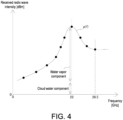
- the peak of intensity of radio waves radiated from water vapor and cloud water in the sky is at 22 GHz.
- the received intensity p(f) of the microwave radiometer 3 is shown, where f indicates the frequency.
- a radio wave of 22 GHz contains a precipitable water, that is, a water vapor component, and a cloud water component.
- the cloud water component is calculated based on radio wave intensities of frequencies other than 22 GHz.
- radio wave intensities of a plurality of mutually different frequencies are required.
- the frequency range may include 22 GHz or 22 GHz ⁇ 1 GHz.
- N 30 in this embodiment, it is not limited thereto.
- N may be a natural number of 3 or more to improve the accuracy of specifying the water vapor component and the cloud water component.
- a black body is periodically passed through a receiving range of an antenna of the microwave radiometer 3 by an actuator, and the radio wave from the black body whose intensity is known and the radio wave from the sky are received.
- the received intensity p(f) of the microwave radiometer 3 is a radio wave intensity ps(f) from the sky minus a radio wave intensity pb(f) from the black body.
- the microwave radiometer 3 is not limited thereto, and a mirror may be periodically moved to receive radio waves from the black body.
- the precipitable water acquisition part 41 shown in FIG. 1 acquires a precipitable water calculated based on an atmospheric delay (strictly speaking, a tropospheric delay) of a GNSS signal received by a GNSS receiver 2. It is known that a precipitable water (precipitable water vapor; PWV) according to GNSS may be calculated based on a GNSS signal, a coordinate value such as an altitude, an atmospheric temperature, and an atmospheric pressure.
- the precipitable water acquisition part 41 acquires a GNSS precipitable water using a GNSS signal and altitude information obtained from the GNSS receiver 2, and an atmospheric temperature and an atmospheric pressure obtained from a weather sensor 1.
- the GNSS precipitable water acquired by the precipitable water acquisition part 41 is stored to the storage part 42 as time-series data D1 of precipitable water of GNSS.
- the learning part 43 shown in FIG. 1 subjects an estimation model 43a to machine learning based on the time-series data D1 of precipitable water and the time-series data D2 of radio wave intensity. Specifically, based on the radio wave intensities of the plurality of frequencies and the precipitable water at a plurality of time points in a particular period, the learning part 43 subjects the estimation model 43a to machine learning such that an input data based on the radio wave intensities of the plurality of frequencies is taken as an input to output the precipitable water.
- a teacher data set used by the learning part 43 is data in which a precipitable water at a time point t is associated with an input data based on radio wave intensities [p(f1), p(f2), ..., p(f29), p(f30)] of a plurality of frequencies at the same time point t.
- the input data may be the radio wave intensities themselves of the plurality of frequencies, or may be a data obtained by reducing the dimension of the radio wave intensities of the plurality of frequencies.
- the estimation model 43a is a supervised machine learning model, various models such as linear regression, regression trees, random forests, support vector machines, neural networks, ensemble, etc. may be used. In this embodiment, although will be described in detail later, a polynomial regression using terms of second order or higher, which is a multiple regression with multiple types of variables, is adopted, but the embodiment is not limited thereto.
- the learning system 4 may include a dimension reduction part 44 which performs a dimension reduction process on radio wave intensities of a plurality of frequencies and calculates a dimensionally reduced input data representing the radio wave intensities of the plurality of frequencies.
- a dimension reduction part 44 which performs a dimension reduction process on radio wave intensities of a plurality of frequencies and calculates a dimensionally reduced input data representing the radio wave intensities of the plurality of frequencies.
- PCA principal component analysis
- the dimension reduction method of this embodiment is principal component analysis (PCA), but the dimension reduction method is not limited thereto, and other algorithms such as factor analysis, multiple factor analysis, Autoencoder, independent component analysis, non-negative matrix factorization, etc. may also be used.
- the dimension reduction part 44 selects a first principal component, a second principal component, and a third principal component as the input data.
- the input data may be the first principal component only of the principal component analysis, or may be the first principal component and the second principal component. That is, a particular number (an arbitrary natural number of 1 or more) of principal components from the first order onward are selected as the input data. The particular number may be appropriately set according to the required accuracy. The reason why the first principal component is always included is that the reproducibility of the original feature of the first principal component is the highest.
- a standardization processing part 45 shown in FIG. 1 performs a standardization process on radio wave intensities [p(f1), p(f2), ..., p(f29), p(f30)] of a plurality of frequencies at a plurality of time points before the dimension reduction process according to principal component analysis is performed.
- the standardization processing part 45 performs a standardization process on the time-series data D2 of radio wave intensity stored in the storage part 42, and stores time-series data D3 of standardized radio wave intensity to the storage part 42.
- the standardization process is a process for performing centering to set the mean to 0 and performing scaling to set the standard deviation to 1.
- each original radio wave intensity is converted into a standardized radio wave intensity.
- the calculated mean and standard deviation are stored to the storage part 42 as standardization parameters for use in a standardization process of the precipitable water estimation system 5 to be described later (see FIG. 1 ).
- the learning system 4 of this embodiment includes the dimension reduction part 44 and the standardization processing part 45, but these parts may also be omitted.
- the learning part 43 shown in FIG. 1 constructs an estimation model 43a for calculating a precipitable water (PWV).
- the estimation model 43a is a conversion formula using multiple regression and is expressed by Formula (1) below.
- the following unknown coefficients Si to S 10 are calculated to construct the estimation model 43a.
- the precipitable water estimation system 5 shown in FIG. 1 includes the radio wave intensity acquisition part 40 and an estimation part 50.
- the estimation part 50 receives an input data based on radio wave intensities of a plurality of frequencies acquired by the radio wave intensity acquisition part 40 and outputs a corresponding precipitable water.
- the radio wave intensities [p(f1), p(f2), ..., p(f29), p(f30)] of a plurality of frequencies at an estimation time point may be inputted to the estimation part 50, to improve accuracy, a standardization processing part 51 and a dimension reduction part 52 may be provided.
- the standardization processing part 51 shown in FIG. 1 performs a standardization process on the radio wave intensities of the plurality of frequencies before a dimension reduction process is performed by the dimension reduction part 52.
- the standardization parameters are parameters (mean, standard deviation) calculated by the standardization processing part 45 of the learning system 4.
- the standardization processing part 51 does not calculate the parameters (mean, standard deviation), but the rest of the process is the same as that of the standardization processing part 45 of the learning system 4.
- the dimension reduction part 52 shown in FIG. 1 performs a dimension reduction process on the radio wave intensities of the plurality of frequencies and calculates a dimensionally reduced input data representing the radio wave intensities of the plurality of frequencies.
- the dimension reduction part 52 uses the same parameters as the parameters calculated by the dimension reduction part 44 of the learning system 4.
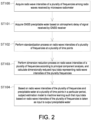
- step ST100 the radio wave intensity acquisition part 40 acquires radio wave intensities of a plurality of frequencies among radio waves received by the microwave radiometer.
- step ST101 the precipitable water acquisition part 41 acquires a precipitable water calculated based on an atmospheric delay of a GNSS signal received by the GNSS receiver.
- the order of steps ST100 and ST101 is not particularly specified.
- next step ST102 the standardization processing part 45 performs a standardization process on the radio wave intensities of the plurality of frequencies at a plurality of time points.
- the dimension reduction part 44 performs a dimension reduction process on the radio wave intensities of the plurality of frequencies according to principal component analysis, and calculates a dimensionally reduced input data representing the radio wave intensities of the plurality of frequencies.
- the learning part 43 subjects an estimation model to machine learning such that the input data based on the radio wave intensities of the plurality of frequencies are taken as an input to output the precipitable water.
- the radio wave intensity acquisition part 40 acquires radio wave intensities of a plurality of frequencies among radio waves received by the microwave radiometer.
- the standardization processing part 51 performs a standardization process on the radio wave intensities of the plurality of frequencies.
- the dimension reduction part 52 performs a dimension reduction process on the radio wave intensities of the plurality of frequencies according to principal component analysis, and calculates a dimensionally reduced input data representing the radio wave intensities of the plurality of frequencies.
- next step ST204 using the estimation model 43a which has been subjected to machine learning such that the input data based on the radio wave intensities of the plurality of frequencies is taken as an input to output the precipitable water, the estimation part 50 outputs the precipitable water corresponding to the input data based on the acquired radio wave intensities of the plurality of frequencies.
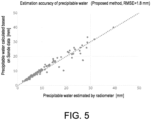
- FIG. 5 is a diagram showing comparison between a precipitable water in a period estimated by an estimation model constructed by the learning system 4 and the precipitable water estimation system 5 and a precipitable water in the same period based on Sonde data.
- the Sonde data are data published by the Japan Meteorological Agency and are actual meteorological observation values measured by flying real balloons equipped with sensors to the sky.
- the root mean square error (RMSE) is 1.8 mm, indicating that a certain degree of accuracy is obtained.
- the present method since radio wave intensities of a plurality of frequencies are acquired, even if noise is contained in the radio wave intensities of some frequencies due to adoption of a general-purpose amplifier with a high noise temperature, as a plurality of frequencies are used, the influence of noise can be suppressed. Thus, for example, compared to the case of estimating a precipitable water according to a particular arithmetic expression using two specific frequencies, the present method is considered to be robust against noise. Conversely, even if some noise is contained, since it can be covered with the plurality of frequencies, the equipment used does not necessarily need to have high performance, and it is possible to reduce the cost of the system.
- the learning system 4 of the precipitable water estimation model of this embodiment includes the radio wave intensity acquisition part 40, the precipitable water acquisition part 41, and the learning part 43.
- the radio wave intensity acquisition part 40 acquires radio wave intensities of a plurality of frequencies among radio waves received by the microwave radiometer 3.
- the precipitable water acquisition part 41 acquires a precipitable water calculated based on an atmospheric delay of a GNSS signal received by the GNSS receiver 2.
- the learning part 43 subjects the estimation model 43a to machine learning such that an input data based on the radio wave intensities of the plurality of frequencies is taken as an input to output the precipitable water.
- the learning method of the precipitable water estimation model of this embodiment includes steps below. Radio wave intensities of a plurality of frequencies are acquired among radio waves received by the microwave radiometer 3. A precipitable water calculated based on an atmospheric delay of a GNSS signal received by the GNSS receiver 2 is acquired. Based on the radio wave intensities of the plurality of frequencies and the precipitable water at a plurality of time points in a particular period, the estimation model 43a is subjected to machine learning such that an input data based on the radio wave intensities of the plurality of frequencies is taken as an input to output the precipitable water.
- the precipitable water estimation system of this embodiment includes the radio wave intensity acquisition part 40 and the estimation part 50.
- the radio wave intensity acquisition part 40 acquires radio wave intensities of a plurality of frequencies among radio waves received by the microwave radiometer 3.
- the estimation model 43a which has been subjected to machine learning such that an input data based on radio wave intensities of the plurality of frequencies is taken as an input to output a precipitable water
- the estimation part 50 outputs the precipitable water corresponding to an input data based on the acquired radio wave intensities of the plurality of frequencies.
- the precipitable water estimation method of this embodiment includes steps below. Radio wave intensities of a plurality of frequencies are acquired among radio waves received by the microwave radiometer 3. Using the estimation model 43a which has been subjected to machine learning such that an input data based on radio wave intensities of the plurality of frequencies is taken as an input to output a precipitable water, the precipitable water corresponding to an input data based on the acquired radio wave intensities of the plurality of frequencies is outputted.
- machine learning since machine learning is performed using an input data based on radio wave intensities of a plurality of frequencies, machine learning can clarify the correlation between the radio wave intensities and the precipitable water, which could not be clarified with a single frequency because the radio wave intensity contains both water vapor content and cloud water, and it becomes possible to estimate the water vapor content (precipitable water). Further, since the radio wave intensities and the GNSS-based precipitable water at a plurality of time points in a particular period are used, microwave radiometer-based local water vapor data with non-matching absolute values can be converted into reliable local water vapor data with matching absolute values. Highly reliable data can be acquired even without calibrating the microwave radiometer with liquid nitrogen.
- the dimension reduction parts 44 and 52 may be included to perform a dimension reduction process on the radio wave intensities of the plurality of frequencies and calculate a dimensionally reduced input data representing the radio wave intensities of the plurality of frequencies.
- the dimension reduction parts 44 and 52 may perform dimension reduction according to principal component analysis and select a particular number of principal components from the first order onward as the input data.
- principal component analysis may be used for dimension reduction.
- the standardization processing part 45 may be included to perform a standardization process on the radio wave intensities of the plurality of frequencies at a plurality of time points before the dimension reduction process is performed by the dimension reduction part 44.
- the standardization processing part 51 may be included to perform a standardization process on the radio wave intensities of the plurality of frequencies using a predetermined standardization parameter before the dimension reduction process is performed by the dimension reduction part 52.
- the radio wave intensity acquisition part 40 may acquire radio wave intensities of N different frequencies, where n is a natural number of 3 or more, and the dimension reduction parts 44 and 52 may dimensionally reduce the radio wave intensities of the N frequencies to the input data having a number smaller than N.
- the dimension reduction parts 44 and 52 may dimensionally reduce the radio wave intensities of the N frequencies to the input data having a number smaller than N.
- a program of this embodiment is a program which causes a computer (one or more processors) to execute the above method. Further, a computer-readable transitory recording medium according to this embodiment stores the above program.
Landscapes
- Engineering & Computer Science (AREA)
- Environmental & Geological Engineering (AREA)
- Life Sciences & Earth Sciences (AREA)
- Physics & Mathematics (AREA)
- General Physics & Mathematics (AREA)
- Atmospheric Sciences (AREA)
- Biodiversity & Conservation Biology (AREA)
- Ecology (AREA)
- Environmental Sciences (AREA)
- Remote Sensing (AREA)
- Radar, Positioning & Navigation (AREA)
- Chemical & Material Sciences (AREA)
- Biochemistry (AREA)
- General Health & Medical Sciences (AREA)
- Analytical Chemistry (AREA)
- Immunology (AREA)
- Pathology (AREA)
- Health & Medical Sciences (AREA)
- Electromagnetism (AREA)
- Computer Networks & Wireless Communication (AREA)
- Hydrology & Water Resources (AREA)
- Radar Systems Or Details Thereof (AREA)
Abstract
Description
- The disclosure relates to a learning system of a precipitable water estimation model, a precipitable water estimation system, a method, and a program.
- It has been known to use a GNSS receiver, a microwave radiometer, etc. for the observation of a precipitable water, that is, the observation of water vapor.
- Water vapor observation based on a GNSS receiver utilizes multi-frequency radio waves emitted from satellites. If radio waves of two or more different frequencies emitted from four or more satellites can be received, an amount of delay in the radio waves can be detected. The amount of delay in radio waves corresponds to the water vapor amount, making it possible to observe the water vapor amount. Water vapor observation using a global navigation satellite system (GNSS) can provide stable measurement without calibration. As GNSS involves satellites distributed all over the sky, it is possible to obtain an average value of water vapor over a wide range of the sky, but water vapor in a local range cannot be observed. Patent Document 1 describes water vapor observation based on GNSS.
- Water vapor observation based on a microwave radiometer exploits the radiation of radio waves from water vapor in the atmosphere and measures radio waves from water vapor and cloud. With the directivity of an antenna or a horn of a receiver, it is possible to measure water vapor in a local range of the sky compared to water vapor observation based on GNSS. However, regular calibration with liquid nitrogen is required to prevent equipment drift and to measure the correct brightness temperature. Nonetheless, liquid nitrogen is difficult to transport and handle.
Patent Document 2 describes a microwave radiometer. -
- Patent Document 1:
Japanese Patent Application Laid-Open No. 2010-60444 - Patent Document 2:
US Patent Application Laid-Open No. 2014/0035779 - The disclosure provides techniques to make it possible to observe a precipitable water in a local range without calibration using liquid nitrogen.
- A learning system of a precipitable water estimation model according to the disclosure includes a radio wave intensity acquisition part, a precipitable water acquisition part, and a learning part. The radio wave intensity acquisition part acquires radio wave intensities of a plurality of frequencies among radio waves received by a microwave radiometer. The precipitable water acquisition part acquires a precipitable water calculated based on an atmospheric delay of a GNSS signal received by a GNSS receiver. Based on the radio wave intensities of the plurality of frequencies and the precipitable water at a plurality of time points in a particular period, the learning part subjects an estimation model to machine learning such that an input data based on the radio wave intensities of the plurality of frequencies is taken as an input to output the precipitable water.
-
-
FIG. 1 is a block diagram showing a configuration of a learning system of a precipitable water estimation model and a precipitable water estimation system according to an embodiment. -
FIG. 2 is a flowchart showing a process executed by the learning system. -
FIG. 3 is a flowchart showing a process executed by the precipitable water estimation system. -
FIG. 4 is a diagram showing a frequency spectrum of radio wave intensity received by a microwave radiometer. -
FIG. 5 is a diagram showing comparison between a precipitable water in a period estimated by the precipitable water estimation system and a precipitable water in the same period based on Sonde data. - An embodiment of the disclosure will be described below with reference to the drawings.
-
FIG. 1 is a view showing a configuration of a learning system 4 of a precipitable water estimation model and a precipitable water estimation system 5 according to this embodiment. - As shown in
FIG. 1 , in this embodiment, the learning system 4 of the precipitable water estimation model and the precipitable water estimation system 5 are built on a same computer system, but they may be operated independently. That is, it is possible that only the learning system 4 is installed, or only the precipitable water estimation system 5 is installed. - The learning system 4 shown in
FIG. 1 includes a radio waveintensity acquisition part 40, a precipitablewater acquisition part 41, and alearning part 43. - The radio wave
intensity acquisition part 40 shown inFIG. 1 acquires radio wave intensities of a plurality of frequencies among radio waves received by amicrowave radiometer 3. In this embodiment, radio wave intensities of N (N=30) different frequencies of 18 GHz or more and within 26.5 GHz are acquired. The radio waveintensity acquisition part 40 acquires radio wave intensities [p(f1), p(f2), ..., p(f29), p(f30)] of 30 different frequencies (f1, f2, ..., f29, f30). Herein, the radio wave intensity is indicated as p(f), where f indicates the frequency. The radio wave intensities of a plurality of frequencies acquired by the radio waveintensity acquisition part 40 are stored to astorage part 42 as time-series data D2 of radio wave intensities. - As shown in
FIG. 3 , the peak of intensity of radio waves radiated from water vapor and cloud water in the sky is at 22 GHz. InFIG. 3 , the received intensity p(f) of themicrowave radiometer 3 is shown, where f indicates the frequency. For example, a radio wave of 22 GHz contains a precipitable water, that is, a water vapor component, and a cloud water component. To remove the cloud water amount contained in the radio wave of 22 GHz, the cloud water component is calculated based on radio wave intensities of frequencies other than 22 GHz. Thus, radio wave intensities of a plurality of mutually different frequencies are required. Although 22 GHz has been shown as an example, since the water vapor component and the cloud water component are also contained in frequencies other than 22 GHz, the combination of frequencies is not limited to a combination of 22 GHz and frequencies other than 22 GHz. In this embodiment, "N=30" has been set, but the number of N may be changed as appropriate. The frequency range may include 22 GHz or 22 GHz ± 1 GHz. Although N=30 in this embodiment, it is not limited thereto. N may be a natural number of 3 or more to improve the accuracy of specifying the water vapor component and the cloud water component. - In addition, in this embodiment, a black body is periodically passed through a receiving range of an antenna of the
microwave radiometer 3 by an actuator, and the radio wave from the black body whose intensity is known and the radio wave from the sky are received. The received intensity p(f) of themicrowave radiometer 3 is a radio wave intensity ps(f) from the sky minus a radio wave intensity pb(f) from the black body. Of course, themicrowave radiometer 3 is not limited thereto, and a mirror may be periodically moved to receive radio waves from the black body. - The precipitable
water acquisition part 41 shown inFIG. 1 acquires a precipitable water calculated based on an atmospheric delay (strictly speaking, a tropospheric delay) of a GNSS signal received by aGNSS receiver 2. It is known that a precipitable water (precipitable water vapor; PWV) according to GNSS may be calculated based on a GNSS signal, a coordinate value such as an altitude, an atmospheric temperature, and an atmospheric pressure. The precipitablewater acquisition part 41 acquires a GNSS precipitable water using a GNSS signal and altitude information obtained from theGNSS receiver 2, and an atmospheric temperature and an atmospheric pressure obtained from a weather sensor 1. The GNSS precipitable water acquired by the precipitablewater acquisition part 41 is stored to thestorage part 42 as time-series data D1 of precipitable water of GNSS. - The
learning part 43 shown inFIG. 1 subjects anestimation model 43a to machine learning based on the time-series data D1 of precipitable water and the time-series data D2 of radio wave intensity. Specifically, based on the radio wave intensities of the plurality of frequencies and the precipitable water at a plurality of time points in a particular period, thelearning part 43 subjects theestimation model 43a to machine learning such that an input data based on the radio wave intensities of the plurality of frequencies is taken as an input to output the precipitable water. A teacher data set used by thelearning part 43 is data in which a precipitable water at a time point t is associated with an input data based on radio wave intensities [p(f1), p(f2), ..., p(f29), p(f30)] of a plurality of frequencies at the same time point t. As long as the input data is a data based on radio wave intensities of a plurality of frequencies, the input data may be the radio wave intensities themselves of the plurality of frequencies, or may be a data obtained by reducing the dimension of the radio wave intensities of the plurality of frequencies. If theestimation model 43a is a supervised machine learning model, various models such as linear regression, regression trees, random forests, support vector machines, neural networks, ensemble, etc. may be used. In this embodiment, although will be described in detail later, a polynomial regression using terms of second order or higher, which is a multiple regression with multiple types of variables, is adopted, but the embodiment is not limited thereto. - As shown in
FIG. 1 , the learning system 4 may include adimension reduction part 44 which performs a dimension reduction process on radio wave intensities of a plurality of frequencies and calculates a dimensionally reduced input data representing the radio wave intensities of the plurality of frequencies. By reducing the dimension, it is possible to reduce the number of dimensions while reproducing the original features that are present in the radio wave intensities of the plurality of frequencies, making it possible to reduce the calculation cost and avoid the curse of dimensionality (overlearning). The dimension reduction method of this embodiment is principal component analysis (PCA), but the dimension reduction method is not limited thereto, and other algorithms such as factor analysis, multiple factor analysis, Autoencoder, independent component analysis, non-negative matrix factorization, etc. may also be used. - In this embodiment, using principal component analysis, the
dimension reduction part 44 selects a first principal component, a second principal component, and a third principal component as the input data. Of course, the embodiment is not limited thereto, and various modifications are possible. For example, the input data may be the first principal component only of the principal component analysis, or may be the first principal component and the second principal component. That is, a particular number (an arbitrary natural number of 1 or more) of principal components from the first order onward are selected as the input data. The particular number may be appropriately set according to the required accuracy. The reason why the first principal component is always included is that the reproducibility of the original feature of the first principal component is the highest. - A
standardization processing part 45 shown inFIG. 1 performs a standardization process on radio wave intensities [p(f1), p(f2), ..., p(f29), p(f30)] of a plurality of frequencies at a plurality of time points before the dimension reduction process according to principal component analysis is performed. Thestandardization processing part 45 performs a standardization process on the time-series data D2 of radio wave intensity stored in thestorage part 42, and stores time-series data D3 of standardized radio wave intensity to thestorage part 42. The standardization process is a process for performing centering to set the mean to 0 and performing scaling to set the standard deviation to 1. In the standardization process, by calculating a mean and a standard deviation for respective radio wave intensities at a plurality of time points and dividing, by the standard deviation, a value obtained by subtracting the mean from the original data, each original radio wave intensity is converted into a standardized radio wave intensity. The calculated mean and standard deviation are stored to thestorage part 42 as standardization parameters for use in a standardization process of the precipitable water estimation system 5 to be described later (seeFIG. 1 ). - The learning system 4 of this embodiment includes the
dimension reduction part 44 and thestandardization processing part 45, but these parts may also be omitted. - Taking a first principal component PC1, a second principal component PC2, and a third principal component PC3 as an input data, the learning
part 43 shown inFIG. 1 constructs anestimation model 43a for calculating a precipitable water (PWV). Theestimation model 43a is a conversion formula using multiple regression and is expressed by Formula (1) below. By performing fitting using the least squares method, the following unknown coefficients Si to S10 are calculated to construct theestimation model 43a.
[Math 1]
- The precipitable water estimation system 5 shown in
FIG. 1 includes the radio waveintensity acquisition part 40 and anestimation part 50. Using theestimation model 43a constructed by the learningpart 43, theestimation part 50 receives an input data based on radio wave intensities of a plurality of frequencies acquired by the radio waveintensity acquisition part 40 and outputs a corresponding precipitable water. Although the radio wave intensities [p(f1), p(f2), ..., p(f29), p(f30)] of a plurality of frequencies at an estimation time point may be inputted to theestimation part 50, to improve accuracy, astandardization processing part 51 and adimension reduction part 52 may be provided. - Using predetermined parameters, the
standardization processing part 51 shown inFIG. 1 performs a standardization process on the radio wave intensities of the plurality of frequencies before a dimension reduction process is performed by thedimension reduction part 52. The standardization parameters are parameters (mean, standard deviation) calculated by thestandardization processing part 45 of the learning system 4. Thestandardization processing part 51 does not calculate the parameters (mean, standard deviation), but the rest of the process is the same as that of thestandardization processing part 45 of the learning system 4. - The
dimension reduction part 52 shown inFIG. 1 performs a dimension reduction process on the radio wave intensities of the plurality of frequencies and calculates a dimensionally reduced input data representing the radio wave intensities of the plurality of frequencies. Thedimension reduction part 52 uses the same parameters as the parameters calculated by thedimension reduction part 44 of the learning system 4. - A learning method of the precipitable water estimation model will be described with reference to
FIG. 2 . As shown inFIG. 2 , in step ST100, the radio waveintensity acquisition part 40 acquires radio wave intensities of a plurality of frequencies among radio waves received by the microwave radiometer. In step ST101, the precipitablewater acquisition part 41 acquires a precipitable water calculated based on an atmospheric delay of a GNSS signal received by the GNSS receiver. The order of steps ST100 and ST101 is not particularly specified. - In next step ST102, the
standardization processing part 45 performs a standardization process on the radio wave intensities of the plurality of frequencies at a plurality of time points. In next step ST103, thedimension reduction part 44 performs a dimension reduction process on the radio wave intensities of the plurality of frequencies according to principal component analysis, and calculates a dimensionally reduced input data representing the radio wave intensities of the plurality of frequencies. In next step ST104, based on the radio wave intensities of the plurality of frequencies and the precipitable water at a plurality of time points in a particular period, the learningpart 43 subjects an estimation model to machine learning such that the input data based on the radio wave intensities of the plurality of frequencies are taken as an input to output the precipitable water. - A precipitable water estimation method will be described with reference to
FIG. 3 . As shown inFIG. 3 , in step ST201, the radio waveintensity acquisition part 40 acquires radio wave intensities of a plurality of frequencies among radio waves received by the microwave radiometer. In next step ST202, thestandardization processing part 51 performs a standardization process on the radio wave intensities of the plurality of frequencies. In next step ST203, thedimension reduction part 52 performs a dimension reduction process on the radio wave intensities of the plurality of frequencies according to principal component analysis, and calculates a dimensionally reduced input data representing the radio wave intensities of the plurality of frequencies. In next step ST204, using theestimation model 43a which has been subjected to machine learning such that the input data based on the radio wave intensities of the plurality of frequencies is taken as an input to output the precipitable water, theestimation part 50 outputs the precipitable water corresponding to the input data based on the acquired radio wave intensities of the plurality of frequencies. -
FIG. 5 is a diagram showing comparison between a precipitable water in a period estimated by an estimation model constructed by the learning system 4 and the precipitable water estimation system 5 and a precipitable water in the same period based on Sonde data. The Sonde data are data published by the Japan Meteorological Agency and are actual meteorological observation values measured by flying real balloons equipped with sensors to the sky. As shown inFIG. 5 , the root mean square error (RMSE) is 1.8 mm, indicating that a certain degree of accuracy is obtained. - In addition, in the present method, since radio wave intensities of a plurality of frequencies are acquired, even if noise is contained in the radio wave intensities of some frequencies due to adoption of a general-purpose amplifier with a high noise temperature, as a plurality of frequencies are used, the influence of noise can be suppressed. Thus, for example, compared to the case of estimating a precipitable water according to a particular arithmetic expression using two specific frequencies, the present method is considered to be robust against noise. Conversely, even if some noise is contained, since it can be covered with the plurality of frequencies, the equipment used does not necessarily need to have high performance, and it is possible to reduce the cost of the system.
- As described above, the learning system 4 of the precipitable water estimation model of this embodiment includes the radio wave
intensity acquisition part 40, the precipitablewater acquisition part 41, and the learningpart 43. The radio waveintensity acquisition part 40 acquires radio wave intensities of a plurality of frequencies among radio waves received by themicrowave radiometer 3. The precipitablewater acquisition part 41 acquires a precipitable water calculated based on an atmospheric delay of a GNSS signal received by theGNSS receiver 2. Based on the radio wave intensities of the plurality of frequencies and the precipitable water at a plurality of time points in a particular period, the learningpart 43 subjects theestimation model 43a to machine learning such that an input data based on the radio wave intensities of the plurality of frequencies is taken as an input to output the precipitable water. - The learning method of the precipitable water estimation model of this embodiment includes steps below. Radio wave intensities of a plurality of frequencies are acquired among radio waves received by the
microwave radiometer 3. A precipitable water calculated based on an atmospheric delay of a GNSS signal received by theGNSS receiver 2 is acquired. Based on the radio wave intensities of the plurality of frequencies and the precipitable water at a plurality of time points in a particular period, theestimation model 43a is subjected to machine learning such that an input data based on the radio wave intensities of the plurality of frequencies is taken as an input to output the precipitable water. - The precipitable water estimation system of this embodiment includes the radio wave
intensity acquisition part 40 and theestimation part 50. The radio waveintensity acquisition part 40 acquires radio wave intensities of a plurality of frequencies among radio waves received by themicrowave radiometer 3. Using theestimation model 43a which has been subjected to machine learning such that an input data based on radio wave intensities of the plurality of frequencies is taken as an input to output a precipitable water, theestimation part 50 outputs the precipitable water corresponding to an input data based on the acquired radio wave intensities of the plurality of frequencies. - The precipitable water estimation method of this embodiment includes steps below. Radio wave intensities of a plurality of frequencies are acquired among radio waves received by the
microwave radiometer 3. Using theestimation model 43a which has been subjected to machine learning such that an input data based on radio wave intensities of the plurality of frequencies is taken as an input to output a precipitable water, the precipitable water corresponding to an input data based on the acquired radio wave intensities of the plurality of frequencies is outputted. - According to the learning method, the estimation method, and the system described above, since machine learning is performed using an input data based on radio wave intensities of a plurality of frequencies, machine learning can clarify the correlation between the radio wave intensities and the precipitable water, which could not be clarified with a single frequency because the radio wave intensity contains both water vapor content and cloud water, and it becomes possible to estimate the water vapor content (precipitable water). Further, since the radio wave intensities and the GNSS-based precipitable water at a plurality of time points in a particular period are used, microwave radiometer-based local water vapor data with non-matching absolute values can be converted into reliable local water vapor data with matching absolute values. Highly reliable data can be acquired even without calibrating the microwave radiometer with liquid nitrogen.
- As described in this embodiment, the
dimension reduction parts - As described in this embodiment, the
dimension reduction parts - As in the learning system 4 of this embodiment, the
standardization processing part 45 may be included to perform a standardization process on the radio wave intensities of the plurality of frequencies at a plurality of time points before the dimension reduction process is performed by thedimension reduction part 44. As in the precipitable water estimation system 5 of this embodiment, thestandardization processing part 51 may be included to perform a standardization process on the radio wave intensities of the plurality of frequencies using a predetermined standardization parameter before the dimension reduction process is performed by thedimension reduction part 52. Thus, it is possible to appropriately reduce the dimension and improve the estimation accuracy. - As described in this embodiment, the radio wave
intensity acquisition part 40 may acquire radio wave intensities of N different frequencies, where n is a natural number of 3 or more, and thedimension reduction parts - A program of this embodiment is a program which causes a computer (one or more processors) to execute the above method. Further, a computer-readable transitory recording medium according to this embodiment stores the above program.
- Although the embodiments of the disclosure have been described above based on the drawings, it should be considered that the specific configurations are not limited to these embodiments. The scope of the disclosure is indicated not only by the description of the above embodiments but also by the scope of claims, and includes all modifications within the meaning and scope equivalent to the scope of claims.
- It is possible to apply the structure adopted in each of the above embodiments to any other embodiments.
- The specific configuration of each part is not limited to the above-described embodiments, and various modifications are possible without departing from the scope of the disclosure.
-
- 4
- Learning system
- 40
- Radio wave intensity acquisition part
- 41
- Precipitable water acquisition part
- 43
- Learning part
- 44
- Dimension reduction part
- 45
- Standardization processing part
- 5
- Precipitable water estimation system
- 50
- Estimation part
- 51
- Standardization processing part
- 52
- Dimension reduction part
Claims (13)
- A learning system of a precipitable water estimation model, comprising:a radio wave intensity acquisition part which acquires radio wave intensities of a plurality of frequencies among radio waves received by a microwave radiometer;a precipitable water acquisition part which acquires a precipitable water calculated based on an atmospheric delay of a GNSS signal received by a GNSS receiver; anda learning part which, based on the radio wave intensities of the plurality of frequencies and the precipitable water at a plurality of time points in a particular period, subjects an estimation model to machine learning such that an input data based on the radio wave intensities of the plurality of frequencies is taken as an input to output the precipitable water.
- The learning system of a precipitable water estimation model according to claim 1, comprising:
a dimension reduction part which performs a dimension reduction process on the radio wave intensities of the plurality of frequencies and calculates the input data that is dimensionally reduced and represents the radio wave intensities of the plurality of frequencies. - The learning system of a precipitable water estimation model according to claim 2, wherein
the dimension reduction part performs the dimension reduction according to principal component analysis, and selects a particular number of principal components from a first order onward as the input data. - The learning system of a precipitable water estimation model according to claim 2 or 3, comprising:
a standardization processing part which performs a standardization process on the radio wave intensities of the plurality of frequencies at the plurality of time points before the dimension reduction process is performed by the dimension reduction part. - The learning system of a precipitable water estimation model according to any one of claims 2 to 4, whereinthe radio wave intensity acquisition part acquires radio wave intensities of N different frequencies, where N is a natural number of 3 or more, andthe dimension reduction part dimensionally reduces the radio wave intensities of the N frequencies to the input data having a number smaller than N.
- A precipitable water estimation system comprising:a radio wave intensity acquisition part which acquires radio wave intensities of a plurality of frequencies among radio waves received by a microwave radiometer; andan estimation part which outputs a precipitable water corresponding to an input data based on the acquired radio wave intensities of the plurality of frequencies, by using an estimation model that has been subjected to machine learning such that an input data based on radio wave intensities of the plurality of frequencies is taken as an input to output the precipitable water.
- The precipitable water estimation system according to claim 6, comprising:
a dimension reduction part which performs a dimension reduction process on the radio wave intensities of the plurality of frequencies and calculates the input data that is dimensionally reduced and represents the radio wave intensities of the plurality of frequencies. - The precipitable water estimation system according to claim 7, wherein
the dimension reduction part performs the dimension reduction according to principal component analysis, and selects a particular number of principal components from a first order onward as the input data. - The precipitable water estimation system according to claim 7 or 8, comprising:
a standardization processing part which performs a standardization process on the radio wave intensities of the plurality of frequencies using a predetermined standardization parameter before the dimension reduction process is performed by the dimension reduction part. - The precipitable water estimation system according to any one of claims 7 to 9, whereinthe radio wave intensity acquisition part acquires radio wave intensities of N different frequencies, where N is a natural number of 3 or more, andthe dimension reduction part dimensionally reduces the radio wave intensities of the N frequencies to the input data having a number smaller than N.
- A learning method of a precipitable water estimation model, comprising:acquiring radio wave intensities of a plurality of frequencies among radio waves received by a microwave radiometer;acquiring a precipitable water calculated based on an atmospheric delay of a GNSS signal received by a GNSS receiver; andbased on the radio wave intensities of the plurality of frequencies and the precipitable water at a plurality of time points in a particular period, subjecting an estimation model to machine learning such that an input data based on the radio wave intensities of the plurality of frequencies is taken as an input to output the precipitable water.
- A precipitable water estimation method comprising:acquiring radio wave intensities of a plurality of frequencies among radio waves received by a microwave radiometer; andoutputting a precipitable water corresponding to an input data based on the acquired radio wave intensities of the plurality of frequencies, by using an estimation model that has been subjected to machine learning such that an input data based on radio wave intensities of the plurality of frequencies is taken as an input to output the precipitable water.
- A program which causes one or more processors to execute the method according to claim 11 or 12.
Applications Claiming Priority (2)
| Application Number | Priority Date | Filing Date | Title |
|---|---|---|---|
| JP2020120319 | 2020-07-14 | ||
| PCT/JP2021/022472 WO2022014229A1 (en) | 2020-07-14 | 2021-06-14 | Precipitable water estimation model learning system, precipitable water estimation system, method, and program |
Publications (3)
| Publication Number | Publication Date |
|---|---|
| EP4184222A1 true EP4184222A1 (en) | 2023-05-24 |
| EP4184222A4 EP4184222A4 (en) | 2024-07-17 |
| EP4184222B1 EP4184222B1 (en) | 2025-03-26 |
Family
ID=79555451
Family Applications (1)
| Application Number | Title | Priority Date | Filing Date |
|---|---|---|---|
| EP21843435.5A Active EP4184222B1 (en) | 2020-07-14 | 2021-06-14 | Precipitable water estimation model learning system, precipitable water estimation system, method, and program |
Country Status (5)
| Country | Link |
|---|---|
| US (1) | US20230117091A1 (en) |
| EP (1) | EP4184222B1 (en) |
| JP (1) | JP7706453B2 (en) |
| CN (1) | CN115812166A (en) |
| WO (1) | WO2022014229A1 (en) |
Families Citing this family (2)
| Publication number | Priority date | Publication date | Assignee | Title |
|---|---|---|---|---|
| JPWO2022239417A1 (en) * | 2021-05-11 | 2022-11-17 | ||
| EP4339655B1 (en) * | 2021-05-11 | 2026-02-04 | Furuno Electric Co., Ltd. | Generation method for learning model, computer program, estimation method, and estimation device |
Family Cites Families (21)
| Publication number | Priority date | Publication date | Assignee | Title |
|---|---|---|---|---|
| US4873481A (en) * | 1988-02-16 | 1989-10-10 | Radiometrics Corporation | Microwave radiometer and methods for sensing atmospheric moisture and temperature |
| JPH07146375A (en) * | 1993-11-25 | 1995-06-06 | Nissin Electric Co Ltd | Rainfall estimating system |
| FI114662B (en) * | 1995-03-28 | 2004-11-30 | Pentti Salonen | Method and plant for detecting a change in water content |
| JPH09257951A (en) * | 1996-03-22 | 1997-10-03 | Nippon Telegr & Teleph Corp <Ntt> | Weather forecasting device |
| US6067852A (en) * | 1997-08-26 | 2000-05-30 | University Corporation For Atmospheric Research | Method and apparatus using slant-path water delay estimates to correct global positioning satellite survey error |
| JP2008014939A (en) * | 2006-06-07 | 2008-01-24 | Eko Instruments Trading Co Ltd | Solar radiation measurement system, and program for measuring solar radiation |
| JP5203104B2 (en) | 2008-09-04 | 2013-06-05 | 一般財団法人日本気象協会 | Precipitation prediction system, method and program |
| US20110218734A1 (en) * | 2010-03-08 | 2011-09-08 | Radiometrics Corporation | Methods and apparatus for passive tropospheric measurments utilizing a single band of frequencies adjacent to a selected millimeter wave water vapor line |
| US20140035779A1 (en) * | 2012-07-31 | 2014-02-06 | Radiometrics Corporation | Highly accurate calibration of microwave radiometry devices |
| CN104951847A (en) * | 2014-12-31 | 2015-09-30 | 广西师范学院 | Rainfall forecast method based on kernel principal component analysis and gene expression programming |
| WO2017018061A1 (en) * | 2015-07-28 | 2017-02-02 | 古野電気株式会社 | Water vapor observation system |
| JP2017207459A (en) * | 2016-05-22 | 2017-11-24 | 淳一 古本 | Atmosphere related quantity derivation device, atmosphere related quantity derivation program, and atmosphere related quantity derivation method |
| KR20180044537A (en) * | 2016-10-24 | 2018-05-03 | 대한민국(기상청장) | System and method for integrated observation of aerosols, clouds and rainfall |
| JP2018197734A (en) * | 2017-05-22 | 2018-12-13 | 安田電機暖房株式会社 | Rainfall measurement apparatus |
| US11294096B2 (en) * | 2017-11-03 | 2022-04-05 | The Tomorrow Companies Inc. | Real-time data pipeline techniques for improving a fast weather forecasting system |
| CN108387169B (en) * | 2018-02-11 | 2020-09-22 | 羲和时空(武汉)网络科技有限公司 | GNSS deformation monitoring system based on real-time atmospheric product |
| CN109322655B (en) * | 2018-09-05 | 2024-04-09 | 深圳市联恒星科技有限公司 | A microwave moisture content detection device and method based on neural network and dual-frequency difference model |
| CN109001382B (en) * | 2018-09-20 | 2020-05-29 | 武汉大学 | Regional atmosphere water vapor real-time monitoring method and system based on CORS |
| CN109917494A (en) * | 2019-02-13 | 2019-06-21 | 上海华测导航技术股份有限公司 | Rainfall forecasting method, device, equipment and storage medium |
| CN113811795A (en) * | 2019-05-13 | 2021-12-17 | 古野电气株式会社 | Water vapor observation system and water vapor observation method |
| CN111291903A (en) * | 2020-01-20 | 2020-06-16 | 上海眼控科技股份有限公司 | Precipitation prediction method, device, computer equipment and readable storage medium |
-
2021
- 2021-06-14 WO PCT/JP2021/022472 patent/WO2022014229A1/en not_active Ceased
- 2021-06-14 CN CN202180042479.3A patent/CN115812166A/en active Pending
- 2021-06-14 EP EP21843435.5A patent/EP4184222B1/en active Active
- 2021-06-14 JP JP2022536180A patent/JP7706453B2/en active Active
-
2022
- 2022-12-20 US US18/085,496 patent/US20230117091A1/en active Pending
Also Published As
| Publication number | Publication date |
|---|---|
| US20230117091A1 (en) | 2023-04-20 |
| JPWO2022014229A1 (en) | 2022-01-20 |
| EP4184222A4 (en) | 2024-07-17 |
| CN115812166A (en) | 2023-03-17 |
| EP4184222B1 (en) | 2025-03-26 |
| WO2022014229A1 (en) | 2022-01-20 |
| JP7706453B2 (en) | 2025-07-11 |
Similar Documents
| Publication | Publication Date | Title |
|---|---|---|
| EP3971618B1 (en) | Water vapor observation system and water vapor observation method | |
| Aires et al. | A new neural network approach including first guess for retrieval of atmospheric water vapor, cloud liquid water path, surface temperature, and emissivities over land from satellite microwave observations | |
| US9466122B1 (en) | Independent covariance estimation and decontamination | |
| EP4184222A1 (en) | Precipitable water estimation model learning system, precipitable water estimation system, method, and program | |
| US7558673B1 (en) | Method and system for determining atmospheric profiles using a physical retrieval algorithm | |
| US20240027649A1 (en) | Non-transitory computer readable medium, estimation method, and estimation device | |
| Smith et al. | Hyperspectral satellite radiance atmospheric profile information content and its dependence on spectrometer technology | |
| Hocking et al. | A new gas absorption optical depth parameterisation for RTTOV version 13 | |
| CN118518202B (en) | Cross-radiation calibration method, device, equipment and medium for spaceborne hyperspectral remote sensor | |
| Gabarró et al. | Toward an optimal SMOS ocean salinity inversion algorithm | |
| CN118688796B (en) | Deep learning SAR-based one-dimensional sea wave spectrum inversion method, device and medium | |
| Li et al. | A study on retrieving atmospheric profiles from EOS/AIRS observations | |
| Uspensky et al. | Development of methods and instruments for remote temperature and humidity sensing of the Earth’s atmosphere | |
| Jiménez et al. | The role of spatial information in disentangling the irradiance–reflectance–transmittance ambiguity | |
| Maddy et al. | A computationally efficient retrieval algorithm for hyperspectral sounders incorporating a priori information | |
| US12591078B2 (en) | Information processing apparatus, radar apparatus, method, and storage medium | |
| CN102057261B (en) | Method and apparatus for automatic calibration of spectrometers in chemometry by means of a bayes iterative estimation method | |
| CN117805725A (en) | Broadband signal direction estimation method, device, equipment and medium | |
| Mironov et al. | A method for continues calibration of a rotating antenna scatterometer in application to CFOSAT measurements | |
| Hu et al. | The Spatial Resolution Enhancement of FY-4 Satellite MMSI Beam Scanning Measurements | |
| Van der Vorst et al. | Propagation of uncertainty in the MUSIC algorithm using polynomial chaos expansions | |
| Hotta et al. | What limits the number of observations that can be effectively assimilated by EnKF? | |
| Jurado et al. | IASI-NG system: An overview of the current design and performances | |
| Farouk et al. | Homogeneity criteria from AVHRR information within IASI pixels in a numerical weather prediction context | |
| Gödeke et al. | Hourly surface nitrogen dioxide retrieval from GEMS tropospheric vertical column densities: Benefit of using time-contiguous input features for machine learning models |
Legal Events
| Date | Code | Title | Description |
|---|---|---|---|
| STAA | Information on the status of an ep patent application or granted ep patent |
Free format text: STATUS: THE INTERNATIONAL PUBLICATION HAS BEEN MADE |
|
| PUAI | Public reference made under article 153(3) epc to a published international application that has entered the european phase |
Free format text: ORIGINAL CODE: 0009012 |
|
| STAA | Information on the status of an ep patent application or granted ep patent |
Free format text: STATUS: REQUEST FOR EXAMINATION WAS MADE |
|
| 17P | Request for examination filed |
Effective date: 20230127 |
|
| AK | Designated contracting states |
Kind code of ref document: A1 Designated state(s): AL AT BE BG CH CY CZ DE DK EE ES FI FR GB GR HR HU IE IS IT LI LT LU LV MC MK MT NL NO PL PT RO RS SE SI SK SM TR |
|
| DAV | Request for validation of the european patent (deleted) | ||
| DAX | Request for extension of the european patent (deleted) | ||
| REG | Reference to a national code |
Ref country code: DE Ref legal event code: R079 Free format text: PREVIOUS MAIN CLASS: G01W0001000000 Ipc: G01W0001140000 Ref document number: 602021028271 Country of ref document: DE |
|
| A4 | Supplementary search report drawn up and despatched |
Effective date: 20240613 |
|
| RIC1 | Information provided on ipc code assigned before grant |
Ipc: G01S 19/07 20100101ALN20240607BHEP Ipc: G06N 20/00 20190101ALI20240607BHEP Ipc: G01S 19/14 20100101ALI20240607BHEP Ipc: G01W 1/14 20060101AFI20240607BHEP |
|
| RIC1 | Information provided on ipc code assigned before grant |
Ipc: G06N 20/00 20190101ALN20241017BHEP Ipc: G01S 19/07 20100101ALN20241017BHEP Ipc: G01S 19/14 20100101ALI20241017BHEP Ipc: G01W 1/14 20060101AFI20241017BHEP |
|
| GRAP | Despatch of communication of intention to grant a patent |
Free format text: ORIGINAL CODE: EPIDOSNIGR1 |
|
| STAA | Information on the status of an ep patent application or granted ep patent |
Free format text: STATUS: GRANT OF PATENT IS INTENDED |
|
| RIC1 | Information provided on ipc code assigned before grant |
Ipc: G06N 20/00 20190101ALN20241126BHEP Ipc: G01S 19/07 20100101ALN20241126BHEP Ipc: G01S 19/14 20100101ALI20241126BHEP Ipc: G01W 1/14 20060101AFI20241126BHEP |
|
| INTG | Intention to grant announced |
Effective date: 20241205 |
|
| GRAS | Grant fee paid |
Free format text: ORIGINAL CODE: EPIDOSNIGR3 |
|
| GRAA | (expected) grant |
Free format text: ORIGINAL CODE: 0009210 |
|
| STAA | Information on the status of an ep patent application or granted ep patent |
Free format text: STATUS: THE PATENT HAS BEEN GRANTED |
|
| AK | Designated contracting states |
Kind code of ref document: B1 Designated state(s): AL AT BE BG CH CY CZ DE DK EE ES FI FR GB GR HR HU IE IS IT LI LT LU LV MC MK MT NL NO PL PT RO RS SE SI SK SM TR |
|
| REG | Reference to a national code |
Ref country code: GB Ref legal event code: FG4D |
|
| REG | Reference to a national code |
Ref country code: CH Ref legal event code: EP |
|
| REG | Reference to a national code |
Ref country code: DE Ref legal event code: R096 Ref document number: 602021028271 Country of ref document: DE |
|
| REG | Reference to a national code |
Ref country code: IE Ref legal event code: FG4D |
|
| PG25 | Lapsed in a contracting state [announced via postgrant information from national office to epo] |
Ref country code: RS Free format text: LAPSE BECAUSE OF FAILURE TO SUBMIT A TRANSLATION OF THE DESCRIPTION OR TO PAY THE FEE WITHIN THE PRESCRIBED TIME-LIMIT Effective date: 20250626 |
|
| PG25 | Lapsed in a contracting state [announced via postgrant information from national office to epo] |
Ref country code: FI Free format text: LAPSE BECAUSE OF FAILURE TO SUBMIT A TRANSLATION OF THE DESCRIPTION OR TO PAY THE FEE WITHIN THE PRESCRIBED TIME-LIMIT Effective date: 20250326 |
|
| PGFP | Annual fee paid to national office [announced via postgrant information from national office to epo] |
Ref country code: DE Payment date: 20250623 Year of fee payment: 5 |
|
| PGFP | Annual fee paid to national office [announced via postgrant information from national office to epo] |
Ref country code: GB Payment date: 20250625 Year of fee payment: 5 |
|
| REG | Reference to a national code |
Ref country code: LT Ref legal event code: MG9D |
|
| PG25 | Lapsed in a contracting state [announced via postgrant information from national office to epo] |
Ref country code: NO Free format text: LAPSE BECAUSE OF FAILURE TO SUBMIT A TRANSLATION OF THE DESCRIPTION OR TO PAY THE FEE WITHIN THE PRESCRIBED TIME-LIMIT Effective date: 20250626 |
|
| PG25 | Lapsed in a contracting state [announced via postgrant information from national office to epo] |
Ref country code: HR Free format text: LAPSE BECAUSE OF FAILURE TO SUBMIT A TRANSLATION OF THE DESCRIPTION OR TO PAY THE FEE WITHIN THE PRESCRIBED TIME-LIMIT Effective date: 20250326 |
|
| PG25 | Lapsed in a contracting state [announced via postgrant information from national office to epo] |
Ref country code: LV Free format text: LAPSE BECAUSE OF FAILURE TO SUBMIT A TRANSLATION OF THE DESCRIPTION OR TO PAY THE FEE WITHIN THE PRESCRIBED TIME-LIMIT Effective date: 20250326 |
|
| PG25 | Lapsed in a contracting state [announced via postgrant information from national office to epo] |
Ref country code: BG Free format text: LAPSE BECAUSE OF FAILURE TO SUBMIT A TRANSLATION OF THE DESCRIPTION OR TO PAY THE FEE WITHIN THE PRESCRIBED TIME-LIMIT Effective date: 20250326 Ref country code: GR Free format text: LAPSE BECAUSE OF FAILURE TO SUBMIT A TRANSLATION OF THE DESCRIPTION OR TO PAY THE FEE WITHIN THE PRESCRIBED TIME-LIMIT Effective date: 20250627 |
|
| PGFP | Annual fee paid to national office [announced via postgrant information from national office to epo] |
Ref country code: AT Payment date: 20250721 Year of fee payment: 5 |
|
| REG | Reference to a national code |
Ref country code: NL Ref legal event code: MP Effective date: 20250326 |
|
| PG25 | Lapsed in a contracting state [announced via postgrant information from national office to epo] |
Ref country code: NL Free format text: LAPSE BECAUSE OF FAILURE TO SUBMIT A TRANSLATION OF THE DESCRIPTION OR TO PAY THE FEE WITHIN THE PRESCRIBED TIME-LIMIT Effective date: 20250326 |
|
| PG25 | Lapsed in a contracting state [announced via postgrant information from national office to epo] |
Ref country code: SE Free format text: LAPSE BECAUSE OF FAILURE TO SUBMIT A TRANSLATION OF THE DESCRIPTION OR TO PAY THE FEE WITHIN THE PRESCRIBED TIME-LIMIT Effective date: 20250326 |
|
| REG | Reference to a national code |
Ref country code: AT Ref legal event code: MK05 Ref document number: 1779473 Country of ref document: AT Kind code of ref document: T Effective date: 20250326 |
|
| PG25 | Lapsed in a contracting state [announced via postgrant information from national office to epo] |
Ref country code: SM Free format text: LAPSE BECAUSE OF FAILURE TO SUBMIT A TRANSLATION OF THE DESCRIPTION OR TO PAY THE FEE WITHIN THE PRESCRIBED TIME-LIMIT Effective date: 20250326 |
|
| PG25 | Lapsed in a contracting state [announced via postgrant information from national office to epo] |
Ref country code: ES Free format text: LAPSE BECAUSE OF FAILURE TO SUBMIT A TRANSLATION OF THE DESCRIPTION OR TO PAY THE FEE WITHIN THE PRESCRIBED TIME-LIMIT Effective date: 20250326 Ref country code: PT Free format text: LAPSE BECAUSE OF FAILURE TO SUBMIT A TRANSLATION OF THE DESCRIPTION OR TO PAY THE FEE WITHIN THE PRESCRIBED TIME-LIMIT Effective date: 20250728 |
|
| PG25 | Lapsed in a contracting state [announced via postgrant information from national office to epo] |
Ref country code: PL Free format text: LAPSE BECAUSE OF FAILURE TO SUBMIT A TRANSLATION OF THE DESCRIPTION OR TO PAY THE FEE WITHIN THE PRESCRIBED TIME-LIMIT Effective date: 20250326 Ref country code: IT Free format text: LAPSE BECAUSE OF FAILURE TO SUBMIT A TRANSLATION OF THE DESCRIPTION OR TO PAY THE FEE WITHIN THE PRESCRIBED TIME-LIMIT Effective date: 20250326 |
|
| PG25 | Lapsed in a contracting state [announced via postgrant information from national office to epo] |
Ref country code: AT Free format text: LAPSE BECAUSE OF FAILURE TO SUBMIT A TRANSLATION OF THE DESCRIPTION OR TO PAY THE FEE WITHIN THE PRESCRIBED TIME-LIMIT Effective date: 20250326 |
|
| PG25 | Lapsed in a contracting state [announced via postgrant information from national office to epo] |
Ref country code: EE Free format text: LAPSE BECAUSE OF FAILURE TO SUBMIT A TRANSLATION OF THE DESCRIPTION OR TO PAY THE FEE WITHIN THE PRESCRIBED TIME-LIMIT Effective date: 20250326 |
|
| PG25 | Lapsed in a contracting state [announced via postgrant information from national office to epo] |
Ref country code: RO Free format text: LAPSE BECAUSE OF FAILURE TO SUBMIT A TRANSLATION OF THE DESCRIPTION OR TO PAY THE FEE WITHIN THE PRESCRIBED TIME-LIMIT Effective date: 20250326 |
|
| PG25 | Lapsed in a contracting state [announced via postgrant information from national office to epo] |
Ref country code: SK Free format text: LAPSE BECAUSE OF FAILURE TO SUBMIT A TRANSLATION OF THE DESCRIPTION OR TO PAY THE FEE WITHIN THE PRESCRIBED TIME-LIMIT Effective date: 20250326 |
|
| PG25 | Lapsed in a contracting state [announced via postgrant information from national office to epo] |
Ref country code: IS Free format text: LAPSE BECAUSE OF FAILURE TO SUBMIT A TRANSLATION OF THE DESCRIPTION OR TO PAY THE FEE WITHIN THE PRESCRIBED TIME-LIMIT Effective date: 20250726 |
|
| REG | Reference to a national code |
Ref country code: DE Ref legal event code: R097 Ref document number: 602021028271 Country of ref document: DE |
|
| PG25 | Lapsed in a contracting state [announced via postgrant information from national office to epo] |
Ref country code: DK Free format text: LAPSE BECAUSE OF FAILURE TO SUBMIT A TRANSLATION OF THE DESCRIPTION OR TO PAY THE FEE WITHIN THE PRESCRIBED TIME-LIMIT Effective date: 20250326 |
|
| PG25 | Lapsed in a contracting state [announced via postgrant information from national office to epo] |
Ref country code: CZ Free format text: LAPSE BECAUSE OF FAILURE TO SUBMIT A TRANSLATION OF THE DESCRIPTION OR TO PAY THE FEE WITHIN THE PRESCRIBED TIME-LIMIT Effective date: 20250326 |
|
| REG | Reference to a national code |
Ref country code: CH Ref legal event code: H13 Free format text: ST27 STATUS EVENT CODE: U-0-0-H10-H13 (AS PROVIDED BY THE NATIONAL OFFICE) Effective date: 20260127 |
|
| PG25 | Lapsed in a contracting state [announced via postgrant information from national office to epo] |
Ref country code: MC Free format text: LAPSE BECAUSE OF FAILURE TO SUBMIT A TRANSLATION OF THE DESCRIPTION OR TO PAY THE FEE WITHIN THE PRESCRIBED TIME-LIMIT Effective date: 20250326 |
|
| PLBE | No opposition filed within time limit |
Free format text: ORIGINAL CODE: 0009261 |
|
| STAA | Information on the status of an ep patent application or granted ep patent |
Free format text: STATUS: NO OPPOSITION FILED WITHIN TIME LIMIT |
|
| REG | Reference to a national code |
Ref country code: CH Ref legal event code: L10 Free format text: ST27 STATUS EVENT CODE: U-0-0-L10-L00 (AS PROVIDED BY THE NATIONAL OFFICE) Effective date: 20260211 |
|
| PG25 | Lapsed in a contracting state [announced via postgrant information from national office to epo] |
Ref country code: LU Free format text: LAPSE BECAUSE OF NON-PAYMENT OF DUE FEES Effective date: 20250614 |
|
| REG | Reference to a national code |
Ref country code: BE Ref legal event code: MM Effective date: 20250630 |
|
| 26N | No opposition filed |
Effective date: 20260105 |
|
| PG25 | Lapsed in a contracting state [announced via postgrant information from national office to epo] |
Ref country code: IE Free format text: LAPSE BECAUSE OF NON-PAYMENT OF DUE FEES Effective date: 20250614 |
|
| PG25 | Lapsed in a contracting state [announced via postgrant information from national office to epo] |
Ref country code: BE Free format text: LAPSE BECAUSE OF NON-PAYMENT OF DUE FEES Effective date: 20250630 |
|
| PG25 | Lapsed in a contracting state [announced via postgrant information from national office to epo] |
Ref country code: FR Free format text: LAPSE BECAUSE OF NON-PAYMENT OF DUE FEES Effective date: 20250630 |
|
| PG25 | Lapsed in a contracting state [announced via postgrant information from national office to epo] |
Ref country code: CH Free format text: LAPSE BECAUSE OF NON-PAYMENT OF DUE FEES Effective date: 20250630 |