EP4184082B1 - Dilution refrigerator - Google Patents
Dilution refrigerator Download PDFInfo
- Publication number
- EP4184082B1 EP4184082B1 EP23150372.3A EP23150372A EP4184082B1 EP 4184082 B1 EP4184082 B1 EP 4184082B1 EP 23150372 A EP23150372 A EP 23150372A EP 4184082 B1 EP4184082 B1 EP 4184082B1
- Authority
- EP
- European Patent Office
- Prior art keywords
- chamber
- heat exchanger
- conduit
- fluid
- region
- Prior art date
- Legal status (The legal status is an assumption and is not a legal conclusion. Google has not performed a legal analysis and makes no representation as to the accuracy of the status listed.)
- Active
Links
Images




Classifications
-
- F—MECHANICAL ENGINEERING; LIGHTING; HEATING; WEAPONS; BLASTING
- F25—REFRIGERATION OR COOLING; COMBINED HEATING AND REFRIGERATION SYSTEMS; HEAT PUMP SYSTEMS; MANUFACTURE OR STORAGE OF ICE; LIQUEFACTION SOLIDIFICATION OF GASES
- F25B—REFRIGERATION MACHINES, PLANTS OR SYSTEMS; COMBINED HEATING AND REFRIGERATION SYSTEMS; HEAT PUMP SYSTEMS
- F25B40/00—Subcoolers, desuperheaters or superheaters
- F25B40/02—Subcoolers
-
- F—MECHANICAL ENGINEERING; LIGHTING; HEATING; WEAPONS; BLASTING
- F28—HEAT EXCHANGE IN GENERAL
- F28D—HEAT-EXCHANGE APPARATUS, NOT PROVIDED FOR IN ANOTHER SUBCLASS, IN WHICH THE HEAT-EXCHANGE MEDIA DO NOT COME INTO DIRECT CONTACT
- F28D21/00—Heat-exchange apparatus not covered by any of the groups F28D1/00 - F28D20/00
-
- F—MECHANICAL ENGINEERING; LIGHTING; HEATING; WEAPONS; BLASTING
- F25—REFRIGERATION OR COOLING; COMBINED HEATING AND REFRIGERATION SYSTEMS; HEAT PUMP SYSTEMS; MANUFACTURE OR STORAGE OF ICE; LIQUEFACTION SOLIDIFICATION OF GASES
- F25B—REFRIGERATION MACHINES, PLANTS OR SYSTEMS; COMBINED HEATING AND REFRIGERATION SYSTEMS; HEAT PUMP SYSTEMS
- F25B9/00—Compression machines, plants or systems, in which the refrigerant is air or other gas of low boiling point
- F25B9/12—Compression machines, plants or systems, in which the refrigerant is air or other gas of low boiling point using 3He-4He dilution
-
- F—MECHANICAL ENGINEERING; LIGHTING; HEATING; WEAPONS; BLASTING
- F25—REFRIGERATION OR COOLING; COMBINED HEATING AND REFRIGERATION SYSTEMS; HEAT PUMP SYSTEMS; MANUFACTURE OR STORAGE OF ICE; LIQUEFACTION SOLIDIFICATION OF GASES
- F25B—REFRIGERATION MACHINES, PLANTS OR SYSTEMS; COMBINED HEATING AND REFRIGERATION SYSTEMS; HEAT PUMP SYSTEMS
- F25B9/00—Compression machines, plants or systems, in which the refrigerant is air or other gas of low boiling point
- F25B9/10—Compression machines, plants or systems, in which the refrigerant is air or other gas of low boiling point with several cooling stages
-
- F—MECHANICAL ENGINEERING; LIGHTING; HEATING; WEAPONS; BLASTING
- F25—REFRIGERATION OR COOLING; COMBINED HEATING AND REFRIGERATION SYSTEMS; HEAT PUMP SYSTEMS; MANUFACTURE OR STORAGE OF ICE; LIQUEFACTION SOLIDIFICATION OF GASES
- F25B—REFRIGERATION MACHINES, PLANTS OR SYSTEMS; COMBINED HEATING AND REFRIGERATION SYSTEMS; HEAT PUMP SYSTEMS
- F25B9/00—Compression machines, plants or systems, in which the refrigerant is air or other gas of low boiling point
- F25B9/14—Compression machines, plants or systems, in which the refrigerant is air or other gas of low boiling point characterised by the cycle used, e.g. Stirling cycle
-
- F—MECHANICAL ENGINEERING; LIGHTING; HEATING; WEAPONS; BLASTING
- F25—REFRIGERATION OR COOLING; COMBINED HEATING AND REFRIGERATION SYSTEMS; HEAT PUMP SYSTEMS; MANUFACTURE OR STORAGE OF ICE; LIQUEFACTION SOLIDIFICATION OF GASES
- F25B—REFRIGERATION MACHINES, PLANTS OR SYSTEMS; COMBINED HEATING AND REFRIGERATION SYSTEMS; HEAT PUMP SYSTEMS
- F25B9/00—Compression machines, plants or systems, in which the refrigerant is air or other gas of low boiling point
- F25B9/14—Compression machines, plants or systems, in which the refrigerant is air or other gas of low boiling point characterised by the cycle used, e.g. Stirling cycle
- F25B9/145—Compression machines, plants or systems, in which the refrigerant is air or other gas of low boiling point characterised by the cycle used, e.g. Stirling cycle pulse-tube cycle
-
- F—MECHANICAL ENGINEERING; LIGHTING; HEATING; WEAPONS; BLASTING
- F25—REFRIGERATION OR COOLING; COMBINED HEATING AND REFRIGERATION SYSTEMS; HEAT PUMP SYSTEMS; MANUFACTURE OR STORAGE OF ICE; LIQUEFACTION SOLIDIFICATION OF GASES
- F25D—REFRIGERATORS; COLD ROOMS; ICE-BOXES; COOLING OR FREEZING APPARATUS NOT OTHERWISE PROVIDED FOR
- F25D19/00—Arrangement or mounting of refrigeration units with respect to devices or objects to be refrigerated, e.g. infrared detectors
- F25D19/006—Thermal coupling structure or interface
-
- F—MECHANICAL ENGINEERING; LIGHTING; HEATING; WEAPONS; BLASTING
- F25—REFRIGERATION OR COOLING; COMBINED HEATING AND REFRIGERATION SYSTEMS; HEAT PUMP SYSTEMS; MANUFACTURE OR STORAGE OF ICE; LIQUEFACTION SOLIDIFICATION OF GASES
- F25B—REFRIGERATION MACHINES, PLANTS OR SYSTEMS; COMBINED HEATING AND REFRIGERATION SYSTEMS; HEAT PUMP SYSTEMS
- F25B2309/00—Gas cycle refrigeration machines
- F25B2309/14—Compression machines, plants or systems characterised by the cycle used
- F25B2309/1412—Pulse-tube cycles characterised by heat exchanger details
-
- F—MECHANICAL ENGINEERING; LIGHTING; HEATING; WEAPONS; BLASTING
- F28—HEAT EXCHANGE IN GENERAL
- F28D—HEAT-EXCHANGE APPARATUS, NOT PROVIDED FOR IN ANOTHER SUBCLASS, IN WHICH THE HEAT-EXCHANGE MEDIA DO NOT COME INTO DIRECT CONTACT
- F28D21/00—Heat-exchange apparatus not covered by any of the groups F28D1/00 - F28D20/00
- F28D2021/0019—Other heat exchangers for particular applications; Heat exchange systems not otherwise provided for
- F28D2021/0033—Other heat exchangers for particular applications; Heat exchange systems not otherwise provided for for cryogenic applications
Definitions
- the invention relates to a dilution refrigerator.
- a dilution unit will form part of the dilution refrigerator, the dilution unit comprising a still and a mixing chamber, connected by a set of heat exchangers.
- An operational fluid formed of a helium-3/helium-4 mixture is circulated around the dilution unit during operation. Cooling is obtained at the mixing chamber from the enthalpy of mixing as helium-3 is diluted into helium-4.
- the mixing chamber is thereby operable so as to obtain the lowest temperature of any part of the dilution refrigerator.
- Helium-3 is boiled at the still, which removes energy due to the latent heat of vaporisation.
- a cold plate is arranged between the still and the mixing chamber and generally obtains a temperature between these two components during use.
- the heat exchangers are an important aspect of dilution refrigerator design and are used to couple 'cold' helium-3 leaving the mixing chamber to the 'warm' helium-3 returning to it.
- the quality of this exchange determines, for example, the minimum temperature attainable.
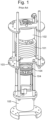
- FIG. 1 An example of a prior art dilution unit is shown by Figure 1 .
- Operational fluid flows between the still 102 and the mixing chamber 105 through two counter-flow paths in a heat exchanging unit.
- the heat exchanging unit comprises a continuous heat exchanger 101 arranged between the still 102 and a cold plate 103.
- the continuous heat exchanger 101 comprises a coaxial unit arranged in a spiral, through which the two paths proceed in opposite directions, with the inner path surrounded by the outer path in a coiled arrangement (not shown).
- Continuous heat exchangers can generally be used to obtain temperatures down to around 30 millikelvin.
- Dilution refrigerators with only continuous heat exchangers are limited to operate at around 30 millikelvin due to the increasing Kapitza (thermal boundary) resistance between liquid helium and metals at low temperatures. At lower temperatures continuous heat exchangers do not provide sufficient surface area to defeat the increasing thermal boundary resistance. Step heat exchangers may be used to obtain yet lower temperatures by using large-surface-area sinters to overcome the Kapitza resistance.
- Two step heat exchangers 104 are arranged in a stack between the cold plate 103 and the mixing chamber 105. Each step heat exchanger forms a substantially disc-like structure, in which the two paths are separated by a foil. The number of step heat exchangers provided may be selected to suit the application.
- step heat exchanger In common use there are effectively two geometries of step heat exchanger, the 'counterflow block' and the 'semi-continuous'.
- the counterflow block there are two counterflowing streams of helium-3, thermally coupled by sinters through a supporting medium, which can be a thin membrane.
- Semi-continuous heat exchangers generally have a coiled geometry similar to that of a continuous heat exchangers.
- the inner conduit is constructed from a set of discrete sintered elements that are jointed together and enclosed within an outer tube. If the outer tube is exposed then the semi-continuous heat exchanger may provide the appearance of a continuous heat exchanger. Alternatively, the outer tube may be housed within welded boxes that provide the appearance of a step heat exchanger.
- EP 3 742 076 A1 discloses a dilution refrigerator according to the preamble of claim 1. It is desirable to reduce the standard deviation between the performance of heat exchangers and dilution refrigerators manufactured according to a particular process. It is also desirable to provide a simpler method of constructing these devices that is more amenable to automation.
- the invention is set in the context of solving these problems.
- a first example which is not part of the invention provides a heat exchanger for a cryogenic cooling apparatus, comprising: a first conduit, a second conduit and a chamber, wherein the chamber is arranged to receive a fluid from the first conduit, and wherein second conduit is thermally coupled to the outside of the chamber, the chamber having a first region and a second region, the first region separated from the second region by a plate extending through the chamber, the plate comprising one or more apertures for allowing a flow of the fluid from the first region to the second region.
- the configuration of the heat exchanger lends itself to simpler assembly processes that can be semi or fully automated. The repeatability of the performance of the heat exchanger is therefore improved in comparison with some prior art heat exchangers.
- the plate is preferably arranged to obstruct a flow of fluid through the chamber.
- the apertures may hence be arranged with respect to the first conduit so that the fluid follows a non-linear path through the chamber.
- the second conduit is thermally coupled to the outside of the chamber and so the non-linear path increases the thermal coupling between the fluid from the first conduit that is in the chamber and the fluid in the second conduit.
- the chamber may be arranged along the first conduit.
- the chamber may be arranged to receive fluid directly from a first portion of the first conduit, and a second portion of the first conduit may be arranged to receive fluid directly from the chamber.
- the first conduit is typically fluidly coupled to the inside of the chamber at a first position within the first region and a second position within the second region, wherein the one or more apertures are laterally offset from the first position and/or the second position in a direction along the plate. This improves the thermal coupling between the fluid in the chamber and any fluid in the second conduit.
- the heat exchanger typically comprises a central axis extending through the centre of the chamber, wherein the first conduit is coupled to the chamber at two positions arranged along the central axis.
- the one or more apertures may therefore be radially dispersed from the central axis. Extending the first conduit along the central axis ensures that the heat exchanger is properly supported and facilitates simpler assembly.
- the heat exchanger is preferably rotationally symmetric about the central axis. This further simplifies the method of assembly because, for example, if any joints need to be made using a welding process, it may be possible to rotate the heat exchanger about the central axis during this welding process.
- the purpose of the heat exchanger is to thermally couple fluid in the first conduit with fluid in the second conduit in use.
- the first conduit is preferably arranged inside the second conduit.
- the chamber is preferably arranged inside the second conduit. A fluid inside the second conduit would then be in direct contact with the outside of the first conduit and the chamber.
- the chamber preferably comprises a first end piece and a second end piece forming opposing sides of the chamber respectively, the first end piece coupled to the second end piece by a flow deflector, the flow deflector comprising a collar separating the first end piece from the second end piece, wherein the plate extends across the collar to form part of the flow deflector.
- the first end piece and the second end piece comprises a first face arranged inside the chamber, a second face arranged outside the chamber and a foil member arranged between the first face and the second face, wherein the first face and the second face each comprise a sintered material applied to the foil member.
- the sintered material may be a metal powder such as silver, copper or titanium and is typically the metal as used in the foil member.
- the sintered body is porous and increases the effective surface area for adequate heat exchange between the fluid in the chamber and the fluid in the second conduit.
- sintered material is generally not compatible with high temperatures, such as can result from welding or fusing processes.
- a peripheral support member is therefore preferably arranged around the perimeter of each said foil member, the peripheral support member being fused to the collar, for example by a localised heating process such as laser or electron beam welding.
- the first face and/or the second face may be profiled so that the thickness of the sinter on the foil member increases with the radial separation from the central axis.
- the heat exchanger comprises a central axis extending through the centre of the chamber, and wherein the first conduit is coupled to the chamber at two positions arranged along the central axis.
- Profiling the sinter in this way typically reduces the viscous heating within the heat exchanger.
- both of the first and second end pieces are profiled in a similar manner. Any shape or profile that can be machined into a press tool can be used to apply the profiled sinter.
- the sinter on the first and second end pieces may be profiled so that the separation between the first faces and the plate decreases, , with the radial offset from the central axis, typically in a linear manner.
- the sinter on the first and second end pieces may be profiled so that the separation between the second faces and the second conduit decreases, with the radial offset from the central axis, typically in a linear manner.
- the thickness of sinter applied to the foil members will typically range from 0.1 - 3.0 mm, preferably 0.2 - 2.0 mm thickness at any position along the first and second faces on which sinter is applied.
- the sinter thickness may vary from a minimum of 0.5 mm near the centre of the foil member to 1 mm near the edge.
- the specific values may be chosen depending on the operational temperature for the heat exchanger.
- the maximum separation between the sinter on the first faces and the plate is typically from 0.1 - 5.0 mm, preferably 0.1 - 3.0 mm, preferably still 0.2 - 1.50 mm (as measured along the central axis of the chamber). This corresponds to the "depth of the chamber" or the "flow channel depth" inside the chamber.
- the same material is typically used for forming the collar and the peripheral support member(s).
- the collar and the peripheral support member(s) may each be formed of stainless steel.
- the sintered material and the foil member are preferably formed of the same material, for example silver, copper or titanium.
- the thermal conductivity of the foil member and/or the sintered material is preferably substantially higher than that of the peripheral support member and/or the collar.
- thermal conductivity of the foil member and/or the sintered material may be at least twenty times larger than that of the peripheral support member and/or the collar when at a temperature of 300 K.
- the thermal conductivity of a material is generally dependent on its temperature however in this case the manufacturing processes are typically carried out at a notional 'room temperature'.
- the thermal conductivity of copper is around 392 W / m / K compared with around 15 W / m / K for stainless steel.
- the lower thermal conductivity of the peripheral support member(s) ensures that the heat input from fusing the end piece(s) to the collar is not effectively conducted to the sintered material so as to cause unwanted liquefaction of the sinter.
- the first end piece may be constructed similarly to the second end piece and fused to the collar to form the chamber to form a simple and effective heat exchanger suitable for low-temperature applications.
- the chamber may define a flow channel for conveying the fluid through the first region and the second region.
- the fluid may flow from an inlet of the chamber to an outlet of the chamber through an internal volume defined by a separation between the first face of the end pieces and the plate.
- the flow channel may be partially or fully formed within a sinter applied to the first end piece and the second end piece, and in particular within the sinter applied to the respective "first faces" of the end pieces (facing the plate).
- the flow channel may comprise one or more flow paths through the chamber, the one or more flow paths shaped by the sinter applied to the first end piece and the second end piece.
- the flow channel may therefore be imprinted onto the sintered material to define one or more pathways for the fluid to flow through the first region and the second region.
- One or more flow channels may also be imprinted to the sinter applied to the "second faces" of the end pieces forming part of the second conduit. This improves the thermal coupling across the heat exchanger.
- the depth of the flow channel(s) may decrease with the radial separation from the central axis in order to balance the impact of viscous heating against helium-3 requirement.
- a second example which is not part of the invention provides a cryogenic cooling apparatus comprising: a target refrigerator; and a heat exchanger according to the first example , wherein the first conduit is arranged to convey an operational fluid to the target refrigerator and the second conduit arranged to convey the operational fluid from the target refrigerator.
- the operational fluid conveyed along the first conduit is typically in a different state from the operational fluid conveyed along the second conduit and typically also at a different temperature.
- the invention provides a dilution refrigerator as defined in claim 1.
- the mixing chamber typically comprises a mass of sinter
- the first conduit comprises an end portion that is open and extends around a portion of the mass of sinter so as to bring said portion of the mass of sinter into contact with the operational fluid
- the second conduit extending around the end portion and the mass of sinter so as to convey the operational fluid in a direction away from the mass of sinter.
- the dilution refrigerator is preferably configured such that operation of the dilution refrigerator causes a phase boundary to arise in the operational fluid at a position inside the end portion of the first conduit. This phase boundary refers to the boundary between the concentrated and dilute phases of helium-3 that typically arises within the mixing chamber of a dilution refrigerator.
- the incoming concentrated phase is typically conveyed by the first conduit from the position of the still to the mixing chamber such that it is in thermal contact with the outgoing dilute phase conveyed by the second conduit at the still and along the first conduit. It will be understood that the concentrated and dilute phases do not typically mix at the still.
- the heat exchanger is typically simpler to construct than prior art step heat exchangers and so is well suited for low-temperature applications. A particular benefit is therefore achieved when the heat exchanger is arranged to obtain a temperature below 30mK during operation of the dilution refrigerator.
- the total fluid flow rate through all the chambers will be equal.
- the temperature of the fluid from the first conduit will typically lower as it progresses further through the heat exchanger assembly into the lower temperature region.
- the viscosity of a fluid may increase as the temperature is reduced and the flow of a viscous fluid can lead to unwanted heating, reducing the efficiency of the heat exchanger.
- so called 'flow channels' can be introduced to provide a low-impedance path through which the fluid can flow.
- the size of these flow channels is generally controlled to provide the required fluid flow rates whilst reducing the total amount of fluid in the chamber (thereby lowering the amount of helium-3 required for operation, which is a scarce and expensive resource).
- each said chamber comprises one or more flow channels for conveying the fluid through the respective first region and the respective second region, wherein each said flow channel is formed within a sinter, wherein the heat exchanger assembly is arranged along a thermal gradient during operation of the dilution refrigerator so that a first said chamber is arranged to obtain a higher base temperature than a second said chamber, and wherein the diameter of the one or more flow channels in the first chamber is lower than the diameter of the one or more flow channels in the second chamber.
- the diameter of any flow channels may thereby be controlled to achieve a desired balance between flow rates and total fluid volume.
- the second conduit may also comprise flow channels that are formed within a sinter on the outside of the chamber to further improve the thermal performance of the heat exchanger. Imprinting the flow channels into the sinter also allows the flow channels to be mass produced in an efficient and repeatable manner.
- the heat exchanger assembly may form a step heat exchanger, with each heat exchanger corresponding to a respective step and configured to obtain a respective temperature during operation of the dilution refrigerator.
- the heat exchanger assembly may comprise a first said heat exchanger and a second said heat exchanger, the first said heat exchanger being arranged between the cold plate and the second heat exchanger chamber, wherein the depth of the chamber for the second said heat exchanger and/or the number/size of apertures through the plate of the second said heat exchanger is higher than that of the first said heat exchanger. This optimises the flow of the fluid through the heat exchanger assembly to improve performance of the system, as previously described.
- the heat exchanger assembly and the mixing chamber are preferably rotationally symmetric about an axis extending through the first conduit.
- the second conduit preferably forms the exterior of the heat exchanger and comprises a plurality of modules that are fused together.
- the first conduit is preferably formed from a plurality of modules that are fused together. This fusing process can be formed by electron-beam welding or laser beam welding and produces reliable joints without the need for intricate and time-consuming manual processes.
- a further example which is not part of the invention is a method of forming a heat exchanger for a cryogenic refrigerator, the method comprising: providing a first conduit, a second conduit, a first end piece, a second end piece and a flow deflector, the flow deflector comprising a collar and a plate, the plate extending across the collar; wherein providing the first end piece comprises: fusing a first peripheral support member around the perimeter of a first foil member, and then applying a sintered material to opposing faces of the first foil member, the thermal conductivity of the first peripheral support member being at least twenty times lower than that of the first foil member when at a temperature of 300 K; fusing the first peripheral support member to the collar so as to form a chamber, the chamber having a first region separated from a second region by the plate, the plate arranged between the first end piece and the second end piece; wherein the first conduit is arranged to convey a fluid into the first region and out from the second region, and wherein the plate comprises one or more apertures for allowing
- the method is practically easier to perform than the intricate jointing processes typically required for assembling prior art step heat exchangers.
- the method is also more amenable for automation. Consequently, the heat exchanger takes less time to assemble and the standard deviation in the performance of different heat exchangers produced according to the same technique is reduced.
- Sintered material typically formed from a metal powder such as silver or copper
- the sintered material is liable to melt if exposed to high temperatures.
- the peripheral support member is therefore fused to the foil member prior to applying the sintered material.
- the peripheral support member is selected to have a lower thermal conductivity than the sintered material and preferably also the foil member. Once the sintered material is applied, the peripheral support member can then be fused to the collar to form the chamber without risk of melting the sintered material.
- a first portion of the first conduit is preferably fused to the first foil member so as to facilitate a flow of the fluid through the first foil member. This typically occurs prior to applying the sintered material and may occur at the same time as when the first peripheral support member is fused to the first foil member.
- the first portion of the first conduit, and preferably also the first peripheral support member, are preferably fused to the first foil member by welding or vacuum brazing. For example, the parts may be assembled together and then baked in a vacuum chamber to fuse. A similar process may then be followed for forming the second end piece.
- providing the second end piece may comprise: fusing a second peripheral support member around the perimeter of a second foil member, and then applying a sintered material to opposing faces of the second foil member, the thermal conductivity of the second peripheral support member being at least twenty times lower than that of the second foil member when at a temperature of 300 K, wherein forming the chamber further comprises fusing the second peripheral support member to the collar.
- the method may further comprise: fusing a second portion of the first conduit to the second foil member so as to facilitate a flow of the fluid through the second foil member, wherein the second portion of the first conduit is preferably fused to the second foil member by welding or vacuum brazing.
- the second portion of the first conduit is fused to the second foil member before the sintered material is applied to the second foil member and preferably at the same time as the second peripheral support member is fused to the second foil member.
- the second portion of the first conduit, and preferably also the second peripheral support member are preferably fused to the second foil member by welding or vacuum brazing.
- the second peripheral support member is preferably fused to the collar at the same time as the first peripheral support member.
- Each said peripheral support member is preferably fused to the respective foil member by vacuum brazing.
- each said support member is preferably fused to the collar by a localised heat source, such as laser or electron beam welding. A localised heating process is preferable because the sintered material has already been applied to the foil member at this stage and so it is desirable to reduce the amount of heat conducted to the sinter.
- a further example which is not part of the invention is a method of forming a dilution refrigerator, comprising: providing a still and a mixing chamber, and forming a heat exchanger according to any of the preceding examples, wherein the first conduit is arranged to flow an operational fluid from the still to the mixing chamber, and wherein the second conduit is arranged to flow the operational fluid from the mixing chamber to the still.
- the first conduit preferably comprises an end portion arranged to receive the operational fluid from the chamber, and providing the mixing chamber then comprises: arranging the end portion around a portion of a mass of sinter so as to bring said portion of the mass of sinter into contact with the operational fluid; and arranging the second conduit around the end portion and the mass of sinter so as to convey the operational fluid in a direction away from the mass of sinter.
- the mass of sinter may be formed of a sintered material or from several smaller sintered masses, and is shaped to be received by the end portion of the first conduit.
- the method may then further comprise sealing the second conduit to a support on which the sintered mass is mounted. This closes a distal end of the second conduit on the support, which may be the lowest-temperature thermal stage for the dilution refrigerator.
- a particular benefit may be achieved when the first conduit and the second conduit are formed from a plurality of modules for assembly, the method further comprising fusing a first module of the first conduit together with a second module of the first conduit at a position between the chamber and the end portion, and/or fusing a first module of the second conduit together with a second module of the second conduit at a position between the chamber and the end portion.
- the resulting assembly has a fully welded construction, which ensures that the joints are reliably formed according to a fast and highly repeatable process.
- the heat exchange of the first example is particularly well suited for use in low temperatures, including those below 30 millikelvin.
- the cold plate of a dilution refrigerator typically has an base temperature from 40 to 150 millikelvin, more preferably from 40 to 60 millikelvin, whereas the mixing chamber typically has a base temperature that is less than 25 millikelvin, and preferably less than 10 millikelvin in use.
- the method may therefore further comprise: arranging a cold plate between the still and the mixing chamber so as to obtain a base temperature between that of the still and the mixing during operation of the dilution refrigerator; providing a plurality of said chambers arranged along a portion of the first conduit extending between the cold plate and the mixing chamber, each said chamber arranged to receive the operational fluid from the first conduit, and wherein second conduit is thermally coupled to the outside of each said chamber.
- the first conduit and the second conduit are preferably formed from a plurality of modules for assembly, the method further comprising fusing a first module of the first conduit together with a second module of the first conduit at a position between two said chambers, and/or fusing a first module of the second conduit together with a second module of the second conduit at a position between two said chambers.
- These chambers will typically be similarly formed and comprise the features discussed in connection with the first example.
- the modules are preferably fused together using a localised heat source, and preferably by electron beam welding, which reduces the heat input to the sinters.
- a portion of the first conduit extending from the cold plate to the mixing chamber is preferably arranged inside the second conduit.
- the chambers are also preferably arranged substantially inside the second conduit.
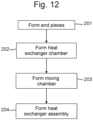
- a method for assembling a heat exchanger which is not part of the invention and a dilution refrigerator according to a first embodiment of the invention begins at step 201 ( Figure 12 ), at which point first and second end pieces are produced for forming part of a heat exchanger.
- a first foil member 10 ( Figure 2 ) is provided that is formed from a high thermal conductivity material such as silver or copper, typically with a thermal conductivity greater than 300 W / m / K at 300 K.
- the first foil member 10 is a substantially planar silver disc having a central aperture for receiving an inlet tube 12 forming a first portion of a first conduit (to be discussed) that conveys an operational fluid in use.
- the first foil member 10 has diameter of around 45 mm but more generally is usually between 20-100 mm depending on the application.
- a first peripheral support member 14 ( Figure 4 ) is provided, formed from a relatively low thermal conductivity material such as stainless steel, typically with a thermal conductivity below 15 W / m / K at 300 K.
- the first peripheral support member 14 is ringshaped and configured to support the first foil member 10.
- the first peripheral support member 14 extends around the outside of the first foil member 10, contacting the perimeter of the first foil member 10 and an outer portion of one of the opposing faces of the first foil member 10.
- the first foil member 10, inlet tube 12 and peripheral support member are assembled, as shown in Figure 5 , and then fused together, for example by welding or vacuum brazing.
- a material to be sintered is next applied as a powder to the major faces of the first foil member 10.
- the sinter material is a high thermal conductivity material and typically the same material as used as the first foil member 10. Pressure is applied to form a sinter 15 on the two opposing faces of the first foil member 10. In the case of a silver powder pressure alone is sufficient for this operation, however copper powders typically also need to be baked during this operation. With the appropriate tooling, the powder can be pressed onto both sides of the first foil member 10 in one operation.
- the sinter 15 is typically applied to the entire surface of the two major faces of the first foil member 10 but not to the peripheral support member 14. A first end piece 22 for a heat exchanger is thereby produced. This process is then repeated with a second foil member 11, second peripheral support member and an outlet tube 32 to form a second end piece 24.
- the first end piece 22 and the second end piece 24 are configured to fit against opposing ends of a flow deflector 16, which is shown by Figure 6 .
- the flow deflector 16 comprises a collar 17, which is an annular element having approximately the same circumference as the peripheral support members.
- a plate 18 extends across the flow deflector 16 in a radial direction.
- the plate 18 is arranged approximately centrally within the collar 17, subdividing the flow deflector 16 into an upper portion and a lower portion that are provided on opposite sides of the plate 18, inside the collar 17.
- the plate 18 comprises a plurality of apertures 20 to fluidly couple the upper and lower portions. In Figure 6 these apertures are dispersed at a constant radius around the plate 18, with approximately a constant separation kept between each neighbouring aperture.
- the flow deflector 16 is formed as a unitary member.
- the flow deflector 16 is a "machined body" and the apertures may be added by a process such as electrical discharge machining.
- the flow deflector 16 can be formed from a foil element with apertures formed in the foil element, for example by etching. This foil element would then be welded between two annular supports to form the flow deflector 16.
- the method proceeds to step 202, at which point the heat exchanger chamber 30 is formed.
- the first and second end pieces 22, 24 are arranged against opposing ends of the flow deflector 16, as shown in Figure 7 , with the sinter material 15 applied to the distal face of each end piece arranged inside the collar 17, and the peripheral support members contacting opposing ends of the collar 17.
- a highly controlled, localised heating process such as electron-beam welding, laser beam welding or Tungsten Inert Gas (TIG) welding, is then used to fuse the peripheral support members to the respective ends of the collar 17 and thereby form a chamber 30.
- the location of the electron-beam welds for the present embodiment are indicated in Figure 7 , however it will be appreciated that the weld is typically made around the circumference of the peripheral support members. It is advantageous therefore that the inlet tube 12 and the outlet tube 32 extend along the central axis for the flow defector 16 and the chamber 30 because the assembly can then be rotated about the inlet tube 12 and the outlet tube 32 when performing the welding procedure, without needing to move the heating element. This process is amenable to automation and ensures that a reliable joint is welded.
- the chamber 30 formed has a first region 26 separated from a second region 28 by the plate 18, with the inlet tube 12 arranged to flow a fluid into the first region, and the outlet tube 32 arranged to flow a fluid out of the second region.
- the inlet tube 12 and the outlet tube 32 form first and second portions of a first conduit 46 respectively, the first conduit 46 being arranged to flow a fluid through the chamber 30.
- the first conduit 46 and the chamber 30 will accommodate the flow of helium-3 rich phase of operational fluid during steady state operation from a still (including from the outside of the still) to a mixing chamber 45 of the dilution refrigerator.
- the first conduit 46 is also commonly referred to as the 'concentrated phase flow channel' in a dilution refrigerator.
- Figure 8 which is not to scale
- the arrangement of the apertures 20, which are radially dispersed from the central axis along which the inlet and outlet tubes 12, 32 are arranged ensures that the fluid follows a non-linear flow path inside the chamber 30.
- This, combined with the use of the sintered material 15 on the first and second end pieces 22, 24, ensures that a large effective surface area is provided for heat exchange between a fluid inside the chamber 30 and another fluid in contact with the outside of the chamber 30.
- the origin and flow of this surrounding fluid will be now discussed with reference to steps 203 and 204 from Figure 12 .
- step 203 at which point a mixing chamber 45 for the dilution refrigerator is formed.
- a mass of sinter 36 is formed directly onto, or mounted to a high thermal conductivity support 8, which forms the lowest temperature stage of the dilution refrigerator.
- the material forming the mass of sinter 36 is typically the same material as was applied to the first and second foil members 10, 11 (e.g. silver and/or copper).
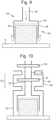
- An end portion 40 of the first conduit 46 is provided, the end portion 40 having a first region 42 and a second region 44, the second region 44 having a larger diameter than the first region 42.
- the end portion 40 is arranged so that the first region 42 is configured to receive a flow of the fluid from the outlet tube 32 and the second region 44 is arranged so that a proximal portion of the mass of sinter is arranged inside the second region 44 and a distal portion of the mass of sinter is outside the end portion 40.
- the end portion 40 is thus arranged relative to the mass of sinter 36 so that a phase boundary of the operational fluid between a helium-3 rich phase and a helium-3 poor phase exists inside the end portion 40 and preferably inside the second region 44, as shown by the broken line in Figure 9 .
- Figure 10 shows a second conduit 48 formed surrounding the first conduit 46.
- the second conduit 48 is also referred to as the 'dilute phase flow channel' that is arranged to return the fluid from the mixing chamber 45 to the still.
- the second conduit 48 is co-axially arranged around the outside of the first conduit 46.
- the first conduit 46 and the second conduit 48 are each formed from a series of modules that are welded together at step 204 to form the heat exchanger assembly. With the end portion 40 arranged over the mass of sinter 36 (as discussed with reference to Figure 9 ), a first portion 50 of the second conduit 48 is arranged over and around the end portion 40 and mounted to the support 8.
- first portion 50 of the second conduit 48 is sealed to the support 8 by an indium seal, alternatively though a ConFlat (CF) flange may be used to achieve this mounting.
- the first portion 50 of the second conduit 48 is thereby arranged to receive a flow of operational fluid from the end of the first conduit 46.
- a distal end of the outlet tube 32 is then welded to a proximal end of the first region 42 of the end portion 40. This fluidly couples the inlet tube 12 with the mixing chamber 45 and the second conduit 48. A distal end of a second portion 52 of the second conduit 48 is then fused to a proximal end of the first portion 50 of the second conduit 48. This joint is made around the central axis of the assembly and at a position between the chamber 30 and the mass of sinter 36, typically along the first region 42 of the end portion 40 of the first conduit 46.
- Figures 7-10 are schematic illustrations and thus not to scale, however, an approximate constant separation is maintained between the inner walls of the second conduit 48 and the outer walls of the first conduit 46.
- the second conduit 48 conforms around the shape of the chamber 30 to form a step in a step heat exchanger 53.
- helium-3 is evaporated from the still and removed by a pumping system. This drives a flow of helum-3 atoms to cross the phase boundary at the mixing chamber 45 (from the concentrated to dilute phases) to replenish the helium-3 in the still.
- the dilution of helium-3 into the dilute phase causes cooling at the mixing chamber 45.
- the dilute phase of helium that flows along the second conduit 48 will therefore be cooler than the incoming concentrated phase of helium-3 conveyed along the first conduit 46.
- the relatively large surface area of the chamber 30 forms an effective heat exchanger so that the fluid in the first conduit 34 and chamber 30 is further cooled prior to arriving at the mixing chamber 45.
- the heat exchanger assembly may comprise a plurality of step heat exchangers 53 or "steps", each step formed of a chamber (as described with reference to Figures 7 and 8 ) arranged along the first conduit 46, and being surrounded by a portion of the second conduit 48.
- Figure 10 shows a second such chamber 130 together with corresponding portions of the first conduit 46 arranged above the proximal end of the inlet tube 12. The respective portions of the first and second conduits would be fused together about the central axis, as discussed above, in a step-wise manner to form the completed assembly.
- a cryostat 1 comprising a large hollow cylinder, typically formed from stainless steel or aluminium, which comprises an outer vacuum vessel 5.
- a plurality of spatially dispersed stages is provided within the cryostat 1, comprising a first stage 6, a second stage 7 and a third stage 8.
- Each stage provides a platform formed from high conductivity material (e.g. copper) and is spaced apart from the remaining stages by low thermal conductivity rods (not shown).
- the second stage 7 is commonly referred to as the "cold plate” and provides an intermediary heat sink between the first stage 6 and the third stage 8.
- a sample holder 55 is shown mounted to the third stage 8, which forms the lowest temperature stage during steady state operation of the system.
- the cryostat 1 in the present example is substantially cryogen-free (also referred to in the art as "dry") in that it is not principally cooled by contact with a reservoir of cryogenic fluid.
- the cooling of the cryostat is instead achieved by use of a mechanical refrigerator, which may be a Stirling refrigerator, a Gifford-McMahon (GM) refrigerator, or a pulse-tube refrigerator (PTR).
- GM Gifford-McMahon
- PTR pulse-tube refrigerator
- the main cooling power of cryostat 1 is provided in this embodiment by a PTR 2.
- PTRs generate cooling by controlling the compression and expansion of a working fluid which is supplied at high pressure from an external compressor.
- the first PTR stage will typically have a relatively high cooling power in comparison with the second PTR stage.
- the PTR 2 cools a first PTR stage 3 to about 50 to 70 kelvin and a second PTR stage 4 to about 3 to 5 kelvin.
- the second PTR stage 4 therefore forms the lowest temperature stage of the PTR 2.
- each shield encloses each of the remaining lower base-temperature components.
- the first PTR stage 3 is thermally coupled to a first radiation shield 19 and the second PTR stage 4 is thermally coupled to a second radiation shield 54.
- the first radiation shield 19 surrounds the second radiation shield 54 and the second radiation shield 54 surrounds each of the first, second and third stages 6-8.
- the first and second stages 6 and 7 could in theory be connected to respective heat radiation shields, in order to reduce any unwanted thermal communication between the stages.
- the still 9 of the dilution refrigerator is operable to cool the first stage 6 to a base temperature of 0.5-2 kelvin.
- the mixing chamber 45 is mounted to the third stage 8 and is operable to cool the third stage 8 to a base temperature below 10 millikelvin.
- the second stage 7 obtains a base temperature between that of the first stage 6 and the third stage 8, typically of 40-150 millikelvin.
- the still 9 is fluidly coupled to a storage vessel 50 by a cooling circuit 37.
- the storage vessel 50 is arranged outside the cryostat 1 and contains an operational fluid in the form of a mixture of helium-3 and helium-4 isotopes.
- Various pumps 17, 39 are also arranged outside the cryostat 1, along conduits of the cooling circuit 37 for controlling a flow of the operational fluids around the circuit, as indicated by the solid arrowheads.
- the cooling circuit 37 comprises a supply line 41 which provides a conduit to facilitate a flow of operational fluid from the storage vessel 50 to a condensing line 46'. This fluid may then be conveyed along the condensing line 46' to the still 9 whereupon it is in thermal contact with the dilute phase of helium inside the still 9.
- the condensing line 46' then continues into a concentrated phase flow channel 46 from the still 9 to the mixing chamber 45.
- the condensing line 46' and the concentrated phase flow channel 46 further comprise one or more impedances (not shown) for reducing the temperature of the operational fluid due to the Joule-Thomson effect as it flows towards the mixing chamber 45.
- a compressor pump 13 is arranged along the condensing line 46' for providing this flow at a pressure of 0.5-2 bar.
- a dilute phase flow channel 48 is arranged to convey the operational fluid from the mixing chamber 45 through the still 9, whereupon this fluid is conveyed to a position exterior to the cryostat 1 by a still pumping line 48'. The operational fluid may then be circulated from this position back into the condensing line 46'.
- a turbomolecular pump 39 is arranged along the still pumping line 48' for providing a high vacuum on the low pressure side of the circuit (for example less than 0.1 mbar), and so enables the flow of the operational fluid away from the
- the concentrated phase flow channel 46 and dilute phase flow channel 48 form the first and second conduits respectively of the heat exchanger, as earlier discussed. These conduits are not explicitly shown between the first stage 6 and the third stage 8 in the schematic illustration of Figure 11 for sake of clarity.
- the first and second conduits 46, 48 are arranged to form a continuous heat exchanger 26 positioned between the first stage 6 and the second stage or 'cold plate' 7. Within the continuous heat exchanger 26, the first conduit 46 is arranged in a coil and the second conduit 48 is wrapped around the first conduit 46. This ensures that the helium-3 concentrated phase of fluid flowing along the first conduit 46 is cooled by the helium-3 dilute phase of fluid flowing along the second conduit 48.
- Continuous heat exchangers are only are only typically effective at temperatures above 30 millikelvin.
- a step heat exchanger assembly comprising a plurality of step heat exchangers 53, 53', 53" (as earlier discussed with reference to Figures 2-10 ) is arranged at the lower temperature region between the second stage 7 and the third stage 8.
- the fluid in the first conduit 46 flows from the second stage 7 to the mixing chamber 45 via a plurality of chambers comprising flow deflectors.
- the helium-3 dilute phase of fluid flows from the mixing chamber 45 back along the second conduit that encloses the chambers.
- the outgoing fluid in the second conduit is directly in contact with the outer walls of the first conduit and the chambers to further cool the incoming fluid in the first conduit.
- the viscosity of a fluid may increase as the temperature is reduced and the flow of a viscous fluid can lead to unwanted heating, reducing the efficiency of the heat exchanger.
- the depth of the chambers and/or the number or size of apertures inside the chamber may increase for chambers that are arranged at lower temperatures.
- the depth of the chamber (along the central axis of the assembly) may be smallest for the uppermost step heat exchanger (to reduce the total volume of helium-3 required for operation) and largest for the lowermost step heat exchanger (to reduce viscous heating). It has been found that this increases thermal performance of the system by optimising the balance between viscous heating and total fluid volume.
- the height of the first region 26 and the second region 28 is depicted as being relatively large in Figures 7 and 8 for ease of explanation but, in particular where used within a dilution refrigerator, is preferably of the order of 0.1-5.0 mm, preferably still 0.2-1.5 mm. This height may vary depending on the operating temperature of the heat exchanger, as determined by its position along the first conduit 46 (as described above).
- the shape and dimensions of the first region 26 and second region 28 are selected to promote circulation of the helium-3, reduce viscous heating, allow for an osmotic pressure to develop in the still 9 and mixing chamber 45, reduce the amount of helium-3 used and reduce hydrodynamic instabilities and convection. Similar considerations apply for the surrounding second conduit 48.
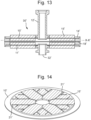
- Figures 13 and 14 illustrate parts of a heat exchanger of a dilution refrigerator according to a second embodiment of the invention.
- Figure 13 is a cross-sectional illustration equivalent of that of Figure 7 in which primed reference numerals have been used to show like features.
- the plate 18' for the flow deflector is a foil element welded between two annular supports.
- the chamber 30' is otherwise formed essentially as described in the first embodiment with reference to Figures 2-8 but in this case dedicated flow channels 21' are formed within the sinter 15' for conveying the helium-3 concentrated phase of fluid from the inlet tube 12' through the apertures and returning it to the outlet tube 32' (where it is understood that similar features could also be applied to the sinters 15' on the opposite sides of the foil members 10', 11' for conveying the dilute phase fluid).
- Sinter 15' is applied to both faces of the first and second foil members 10', 11', however the first and second foil members 10', 11' are arranged within the chamber 30' so that the sinter 15' applied to a first face of the first foil member 10' and a first face of the second foil member 11' is separated from the opposing faces of the flow deflector plate 18' by a small gap, typically of 0.1-1.0 mm, preferably 0.2-0.6 mm (depending on the configuration).
- a small gap typically of 0.1-1.0 mm, preferably 0.2-0.6 mm (depending on the configuration).
- opposite sides of the flow deflector plate 18' instead abut against the sinter 15' on the first face of the first and second foil members 10', 11' to leave no such separation.
- the flow channels 21' are typically imprinted into the sinter during step 201 and can take a variety of different patterns for controlling the direction of flow of the operational fluid.
- One or more channels may be provided inside the chamber 30' for conveying the concentrated phase of fluid through the first region to the apertures of the plate 18' and then through the second region of the chamber 30' to the outlet tube 32'.
- One or more channels may further be provided for conveying the dilute phase of fluid through the second conduit on the outside of the chamber 30'. Any number of different patterns could be applied including radial or spiralling.
- Figure 14 is a perspective view of the sinter 15' taken through the plane X-X' from Figure 13 . In Figure 14 the flow channels 21' bifurcate to bring a greater portion of the sinter 15' into close contact with the operational fluid and so enhance the performance of the heat exchanger.
- the profile of the flow channel 21' may be limited by what can be machined into the press tool, but could be semi-circular, elliptical, triangular, rectangular etc.
- the flow channel 21' will typically have a width in the range of 0.5-1.0 mm.
- the velocity of the fluid flow will (at a given total flow rate) depend on the number and width of the flow channels 21'.
- the width of the flow channel may therefore vary depending on the relative placement of the heat exchanger chamber 30' within a step heat exchanger assembly, with the width increasing at lower temperatures to optimise the balance between viscous heating and fluid volume within the assembly. This further increases the thermal performance of the system.
- the first and second regions within the chamber generally have a constant height in the direction across the plate (generally between 0.5 to 4 mm). Consequently, the fluid flow rate typically decreases as the fluid spreads radially outwards over a wider area. This may mean more viscous heating occurs towards the central axis, which can limit the performance of the cryogenic system in which the heat exchanger is installed.
- Figure 15 illustrates parts of a heat exchanger of a dilution refrigerator according to a third embodiment of the invention. Double primed reference numerals are used to depict like components.
- the embodiment is similar to the first and second embodiments except that the sinter 15" on the inside of the chamber 30" is profiled so that the height of the first region 26" and second region 28" continually decreases at larger radiuses from the central axis.
- This profiling is achieved by pressing the sinter with a shaped tool in step 201 ( Figure 12 ).
- a 'deeper' flow channel is provided at smaller radiuses, which compensates the above effect and reduces any viscous heating.
- the maximum depth of the first region 26" and second region 28" is typically around 1.5 mm and the minimum depth is typically around 0.2 mm.
- the specific parameters may be varied, however, according to the operating temperature of the heat exchanger, for example as determined by its position in a stack of such heat exchangers.
- the sinter 15" applied to the opposing first major faces of the first and second foil members 10", 11" is profiled so that the thickness of sinter 15" linearly increases with the radius.
- the thickness of the sinter 15" applied to the opposite second major faces of the first and second foil members 10", 11" remains generally constant. It should be remembered, however, that the sinter 15" on the outside of the chamber 30" is in contact with fluid conveyed along the second conduit surrounding the chamber (as shown by Figure 10 ). In the context of a dilution refrigerator, this is typically the dilute phase of helium-3.
- FIG. 16 illustrates part of a heat exchanger of a dilution refrigerator according to a fourth embodiment in which both surfaces of the first and second foil are profiled to reduce any viscous heating and so improve the performance of the cryogenic cooling system in which the heat exchanger is installed.
- Figures 13-16 are not to scale but show examples of different shapes that can be pressed into the sinter to control the flow of the fluids through the heat exchanger.
- a dilution refrigerator with an effective heat exchanger is thereby provided, operable at low temperatures and which ensures reliable operation of a cryogenic cooling system.
- the design of the heat exchanger has a relatively simple construction, which lends itself well to welding and automated manufacturing processes that can guarantee a high degree of repeatability in terms of thermal performance. Lower temperatures may therefore be obtained in cryogenic cooling systems such as dilution refrigerators incorporating the heat exchanger, where the lowest obtainable temperature is dependent on the performance of the heat exchanger. Such processes may also be used to speed up the time required to manufacture the cryogenic cooling systems.
Landscapes
- Engineering & Computer Science (AREA)
- Physics & Mathematics (AREA)
- Mechanical Engineering (AREA)
- Thermal Sciences (AREA)
- General Engineering & Computer Science (AREA)
- Chemical & Material Sciences (AREA)
- Combustion & Propulsion (AREA)
- Heat-Exchange Devices With Radiators And Conduit Assemblies (AREA)
- Separation By Low-Temperature Treatments (AREA)
Description
- The invention relates to a dilution refrigerator.
- There are a number of applications that require cooling to millikelvin temperatures. Such temperatures can be obtained by operation of a dilution refrigerator. A dilution unit will form part of the dilution refrigerator, the dilution unit comprising a still and a mixing chamber, connected by a set of heat exchangers. An operational fluid formed of a helium-3/helium-4 mixture is circulated around the dilution unit during operation. Cooling is obtained at the mixing chamber from the enthalpy of mixing as helium-3 is diluted into helium-4. The mixing chamber is thereby operable so as to obtain the lowest temperature of any part of the dilution refrigerator. Helium-3 is boiled at the still, which removes energy due to the latent heat of vaporisation. A cold plate is arranged between the still and the mixing chamber and generally obtains a temperature between these two components during use.
- The heat exchangers are an important aspect of dilution refrigerator design and are used to couple 'cold' helium-3 leaving the mixing chamber to the 'warm' helium-3 returning to it. The quality of this exchange determines, for example, the minimum temperature attainable. There are essentially two types of heat exchanger in use (on all dilution refrigerators) today, the so called 'continuous' exchanger and the `step' exchangers.
- An example of a prior art dilution unit is shown by
Figure 1 . Operational fluid flows between the still 102 and themixing chamber 105 through two counter-flow paths in a heat exchanging unit. The heat exchanging unit comprises acontinuous heat exchanger 101 arranged between the still 102 and acold plate 103. Thecontinuous heat exchanger 101 comprises a coaxial unit arranged in a spiral, through which the two paths proceed in opposite directions, with the inner path surrounded by the outer path in a coiled arrangement (not shown). Continuous heat exchangers can generally be used to obtain temperatures down to around 30 millikelvin. Dilution refrigerators with only continuous heat exchangers are limited to operate at around 30 millikelvin due to the increasing Kapitza (thermal boundary) resistance between liquid helium and metals at low temperatures. At lower temperatures continuous heat exchangers do not provide sufficient surface area to defeat the increasing thermal boundary resistance. Step heat exchangers may be used to obtain yet lower temperatures by using large-surface-area sinters to overcome the Kapitza resistance. Twostep heat exchangers 104 are arranged in a stack between thecold plate 103 and themixing chamber 105. Each step heat exchanger forms a substantially disc-like structure, in which the two paths are separated by a foil. The number of step heat exchangers provided may be selected to suit the application. - In common use there are effectively two geometries of step heat exchanger, the 'counterflow block' and the 'semi-continuous'. For the counterflow block, there are two counterflowing streams of helium-3, thermally coupled by sinters through a supporting medium, which can be a thin membrane. Semi-continuous heat exchangers generally have a coiled geometry similar to that of a continuous heat exchangers. However, the inner conduit is constructed from a set of discrete sintered elements that are jointed together and enclosed within an outer tube. If the outer tube is exposed then the semi-continuous heat exchanger may provide the appearance of a continuous heat exchanger. Alternatively, the outer tube may be housed within welded boxes that provide the appearance of a step heat exchanger.
- The assembly of a dilution unit, and in particular the step heat exchangers described above, is typically an intricate and labour-intensive procedure that takes highly trained technicians hundreds of hours to complete. The performance of the dilution refrigerator is sensitive to minor differences in the assembly process, and the high reliance on manual assembly techniques means that the final performance of the dilution refrigerator cannot always be precisely guaranteed in advance.
EP 3 742 076 A1claim 1. It is desirable to reduce the standard deviation between the performance of heat exchangers and dilution refrigerators manufactured according to a particular process. It is also desirable to provide a simpler method of constructing these devices that is more amenable to automation. The invention is set in the context of solving these problems. - A first example which is not part of the invention provides a heat exchanger for a cryogenic cooling apparatus, comprising: a first conduit, a second conduit and a chamber, wherein the chamber is arranged to receive a fluid from the first conduit, and wherein second conduit is thermally coupled to the outside of the chamber, the chamber having a first region and a second region, the first region separated from the second region by a plate extending through the chamber, the plate comprising one or more apertures for allowing a flow of the fluid from the first region to the second region.
- The configuration of the heat exchanger lends itself to simpler assembly processes that can be semi or fully automated. The repeatability of the performance of the heat exchanger is therefore improved in comparison with some prior art heat exchangers. The plate is preferably arranged to obstruct a flow of fluid through the chamber. The apertures may hence be arranged with respect to the first conduit so that the fluid follows a non-linear path through the chamber. The second conduit is thermally coupled to the outside of the chamber and so the non-linear path increases the thermal coupling between the fluid from the first conduit that is in the chamber and the fluid in the second conduit.
- The chamber may be arranged along the first conduit. In other words, the chamber may be arranged to receive fluid directly from a first portion of the first conduit, and a second portion of the first conduit may be arranged to receive fluid directly from the chamber. The first conduit is typically fluidly coupled to the inside of the chamber at a first position within the first region and a second position within the second region, wherein the one or more apertures are laterally offset from the first position and/or the second position in a direction along the plate. This improves the thermal coupling between the fluid in the chamber and any fluid in the second conduit. The heat exchanger typically comprises a central axis extending through the centre of the chamber, wherein the first conduit is coupled to the chamber at two positions arranged along the central axis. The one or more apertures may therefore be radially dispersed from the central axis. Extending the first conduit along the central axis ensures that the heat exchanger is properly supported and facilitates simpler assembly. The heat exchanger is preferably rotationally symmetric about the central axis. This further simplifies the method of assembly because, for example, if any joints need to be made using a welding process, it may be possible to rotate the heat exchanger about the central axis during this welding process.
- The purpose of the heat exchanger is to thermally couple fluid in the first conduit with fluid in the second conduit in use. In order to ensure these two conduits are effectively thermally engaged, the first conduit is preferably arranged inside the second conduit. Similarly, the chamber is preferably arranged inside the second conduit. A fluid inside the second conduit would then be in direct contact with the outside of the first conduit and the chamber.
- The chamber preferably comprises a first end piece and a second end piece forming opposing sides of the chamber respectively, the first end piece coupled to the second end piece by a flow deflector, the flow deflector comprising a collar separating the first end piece from the second end piece, wherein the plate extends across the collar to form part of the flow deflector. These components may be fused together, as will be described. Typically, one or both of the first end piece and the second end piece comprises a first face arranged inside the chamber, a second face arranged outside the chamber and a foil member arranged between the first face and the second face, wherein the first face and the second face each comprise a sintered material applied to the foil member. The sintered material may be a metal powder such as silver, copper or titanium and is typically the metal as used in the foil member. The sintered body is porous and increases the effective surface area for adequate heat exchange between the fluid in the chamber and the fluid in the second conduit. However, sintered material is generally not compatible with high temperatures, such as can result from welding or fusing processes. A peripheral support member is therefore preferably arranged around the perimeter of each said foil member, the peripheral support member being fused to the collar, for example by a localised heating process such as laser or electron beam welding.
- The first face and/or the second face may be profiled so that the thickness of the sinter on the foil member increases with the radial separation from the central axis. This is particularly advantageous wherein the heat exchanger comprises a central axis extending through the centre of the chamber, and wherein the first conduit is coupled to the chamber at two positions arranged along the central axis. Profiling the sinter in this way typically reduces the viscous heating within the heat exchanger. Typically both of the first and second end pieces are profiled in a similar manner. Any shape or profile that can be machined into a press tool can be used to apply the profiled sinter. For example, the sinter on the first and second end pieces may be profiled so that the separation between the first faces and the plate decreases, , with the radial offset from the central axis, typically in a linear manner. Similarly, the sinter on the first and second end pieces may be profiled so that the separation between the second faces and the second conduit decreases, with the radial offset from the central axis, typically in a linear manner. The thickness of sinter applied to the foil members will typically range from 0.1 - 3.0 mm, preferably 0.2 - 2.0 mm thickness at any position along the first and second faces on which sinter is applied. For example, the sinter thickness may vary from a minimum of 0.5 mm near the centre of the foil member to 1 mm near the edge. The specific values may be chosen depending on the operational temperature for the heat exchanger. The maximum separation between the sinter on the first faces and the plate is typically from 0.1 - 5.0 mm, preferably 0.1 - 3.0 mm, preferably still 0.2 - 1.50 mm (as measured along the central axis of the chamber). This corresponds to the "depth of the chamber" or the "flow channel depth" inside the chamber.
- The same material is typically used for forming the collar and the peripheral support member(s). For example, the collar and the peripheral support member(s) may each be formed of stainless steel. The sintered material and the foil member are preferably formed of the same material, for example silver, copper or titanium. The thermal conductivity of the foil member and/or the sintered material is preferably substantially higher than that of the peripheral support member and/or the collar. For example, thermal conductivity of the foil member and/or the sintered material may be at least twenty times larger than that of the peripheral support member and/or the collar when at a temperature of 300 K. The thermal conductivity of a material is generally dependent on its temperature however in this case the manufacturing processes are typically carried out at a notional 'room temperature'. At 300 K, the thermal conductivity of copper is around 392 W / m / K compared with around 15 W / m / K for stainless steel. The lower thermal conductivity of the peripheral support member(s) ensures that the heat input from fusing the end piece(s) to the collar is not effectively conducted to the sintered material so as to cause unwanted liquefaction of the sinter. The first end piece may be constructed similarly to the second end piece and fused to the collar to form the chamber to form a simple and effective heat exchanger suitable for low-temperature applications.
- The chamber may define a flow channel for conveying the fluid through the first region and the second region. For example, the fluid may flow from an inlet of the chamber to an outlet of the chamber through an internal volume defined by a separation between the first face of the end pieces and the plate. Alternatively, the flow channel may be partially or fully formed within a sinter applied to the first end piece and the second end piece, and in particular within the sinter applied to the respective "first faces" of the end pieces (facing the plate). The flow channel may comprise one or more flow paths through the chamber, the one or more flow paths shaped by the sinter applied to the first end piece and the second end piece. The flow channel may therefore be imprinted onto the sintered material to define one or more pathways for the fluid to flow through the first region and the second region. The direction of flow of the operational fluid is thereby controlled, which can enable better heat dispersion through the chamber and improved thermal performance of the heat exchanger. One or more flow channels may also be imprinted to the sinter applied to the "second faces" of the end pieces forming part of the second conduit. This improves the thermal coupling across the heat exchanger. The depth of the flow channel(s) may decrease with the radial separation from the central axis in order to balance the impact of viscous heating against helium-3 requirement.
- Further examples will now be described that share similar advantages as discussed above. Any feature described in connection with one example is equally applicable to the remaining examples.
- Although the heat exchanger of the first example is particularly well suited to replacing prior art step heat exchanger using liquid helium, it may have applications in a variety of different cryogenic cooling systems. A second example which is not part of the invention provides a cryogenic cooling apparatus comprising: a target refrigerator; and a heat exchanger according to the first example , wherein the first conduit is arranged to convey an operational fluid to the target refrigerator and the second conduit arranged to convey the operational fluid from the target refrigerator. The operational fluid conveyed along the first conduit is typically in a different state from the operational fluid conveyed along the second conduit and typically also at a different temperature.
- The invention provides a dilution refrigerator as defined in
claim 1. - The mixing chamber typically comprises a mass of sinter, and the first conduit comprises an end portion that is open and extends around a portion of the mass of sinter so as to bring said portion of the mass of sinter into contact with the operational fluid, the second conduit extending around the end portion and the mass of sinter so as to convey the operational fluid in a direction away from the mass of sinter. The dilution refrigerator is preferably configured such that operation of the dilution refrigerator causes a phase boundary to arise in the operational fluid at a position inside the end portion of the first conduit. This phase boundary refers to the boundary between the concentrated and dilute phases of helium-3 that typically arises within the mixing chamber of a dilution refrigerator. The incoming concentrated phase is typically conveyed by the first conduit from the position of the still to the mixing chamber such that it is in thermal contact with the outgoing dilute phase conveyed by the second conduit at the still and along the first conduit. It will be understood that the concentrated and dilute phases do not typically mix at the still.
- The heat exchanger is typically simpler to construct than prior art step heat exchangers and so is well suited for low-temperature applications. A particular benefit is therefore achieved when the heat exchanger is arranged to obtain a temperature below 30mK during operation of the dilution refrigerator.
- In steady state operation, the total fluid flow rate through all the chambers will be equal. The temperature of the fluid from the first conduit will typically lower as it progresses further through the heat exchanger assembly into the lower temperature region. In many cases, the viscosity of a fluid may increase as the temperature is reduced and the flow of a viscous fluid can lead to unwanted heating, reducing the efficiency of the heat exchanger. To mitigate against this, so called 'flow channels' can be introduced to provide a low-impedance path through which the fluid can flow. The size of these flow channels is generally controlled to provide the required fluid flow rates whilst reducing the total amount of fluid in the chamber (thereby lowering the amount of helium-3 required for operation, which is a scarce and expensive resource). Many existing dilution refrigerators are reliant on custom-built, unique sized or shaped parts however volume manufacture and automation favours part commonality. Preferably, therefore, each said chamber comprises one or more flow channels for conveying the fluid through the respective first region and the respective second region, wherein each said flow channel is formed within a sinter, wherein the heat exchanger assembly is arranged along a thermal gradient during operation of the dilution refrigerator so that a first said chamber is arranged to obtain a higher base temperature than a second said chamber, and wherein the diameter of the one or more flow channels in the first chamber is lower than the diameter of the one or more flow channels in the second chamber. The diameter of any flow channels may thereby be controlled to achieve a desired balance between flow rates and total fluid volume. This improves the thermal performance of the heat exchanger. The second conduit may also comprise flow channels that are formed within a sinter on the outside of the chamber to further improve the thermal performance of the heat exchanger. Imprinting the flow channels into the sinter also allows the flow channels to be mass produced in an efficient and repeatable manner.
- The heat exchanger assembly may form a step heat exchanger, with each heat exchanger corresponding to a respective step and configured to obtain a respective temperature during operation of the dilution refrigerator. The heat exchanger assembly may comprise a first said heat exchanger and a second said heat exchanger, the first said heat exchanger being arranged between the cold plate and the second heat exchanger chamber, wherein the depth of the chamber for the second said heat exchanger and/or the number/size of apertures through the plate of the second said heat exchanger is higher than that of the first said heat exchanger. This optimises the flow of the fluid through the heat exchanger assembly to improve performance of the system, as previously described.
- In order to further simplify the method of assembly, the heat exchanger assembly and the mixing chamber are preferably rotationally symmetric about an axis extending through the first conduit. Furthermore, the second conduit preferably forms the exterior of the heat exchanger and comprises a plurality of modules that are fused together. Similarly, the first conduit is preferably formed from a plurality of modules that are fused together. This fusing process can be formed by electron-beam welding or laser beam welding and produces reliable joints without the need for intricate and time-consuming manual processes.
- A further example which is not part of the invention is a method of forming a heat exchanger for a cryogenic refrigerator, the method comprising: providing a first conduit, a second conduit, a first end piece, a second end piece and a flow deflector, the flow deflector comprising a collar and a plate, the plate extending across the collar; wherein providing the first end piece comprises: fusing a first peripheral support member around the perimeter of a first foil member, and then applying a sintered material to opposing faces of the first foil member, the thermal conductivity of the first peripheral support member being at least twenty times lower than that of the first foil member when at a temperature of 300 K; fusing the first peripheral support member to the collar so as to form a chamber, the chamber having a first region separated from a second region by the plate, the plate arranged between the first end piece and the second end piece; wherein the first conduit is arranged to convey a fluid into the first region and out from the second region, and wherein the plate comprises one or more apertures for allowing a flow of the fluid from the first region to the second region; and wherein second conduit is thermally coupled to the outside of the chamber.
- The method is practically easier to perform than the intricate jointing processes typically required for assembling prior art step heat exchangers. The method is also more amenable for automation. Consequently, the heat exchanger takes less time to assemble and the standard deviation in the performance of different heat exchangers produced according to the same technique is reduced. Sintered material (typically formed from a metal powder such as silver or copper) is applied to the foil member for increasing the surface area for heat exchange between the fluid in the chamber and any fluid in the second conduit in use. The sintered material is liable to melt if exposed to high temperatures. The peripheral support member is therefore fused to the foil member prior to applying the sintered material. Furthermore, the peripheral support member is selected to have a lower thermal conductivity than the sintered material and preferably also the foil member. Once the sintered material is applied, the peripheral support member can then be fused to the collar to form the chamber without risk of melting the sintered material.
- A first portion of the first conduit is preferably fused to the first foil member so as to facilitate a flow of the fluid through the first foil member. This typically occurs prior to applying the sintered material and may occur at the same time as when the first peripheral support member is fused to the first foil member. The first portion of the first conduit, and preferably also the first peripheral support member, are preferably fused to the first foil member by welding or vacuum brazing. For example, the parts may be assembled together and then baked in a vacuum chamber to fuse. A similar process may then be followed for forming the second end piece. For example, providing the second end piece may comprise: fusing a second peripheral support member around the perimeter of a second foil member, and then applying a sintered material to opposing faces of the second foil member, the thermal conductivity of the second peripheral support member being at least twenty times lower than that of the second foil member when at a temperature of 300 K, wherein forming the chamber further comprises fusing the second peripheral support member to the collar. The method may further comprise: fusing a second portion of the first conduit to the second foil member so as to facilitate a flow of the fluid through the second foil member, wherein the second portion of the first conduit is preferably fused to the second foil member by welding or vacuum brazing. Typically, the second portion of the first conduit is fused to the second foil member before the sintered material is applied to the second foil member and preferably at the same time as the second peripheral support member is fused to the second foil member. The second portion of the first conduit, and preferably also the second peripheral support member, are preferably fused to the second foil member by welding or vacuum brazing. The second peripheral support member is preferably fused to the collar at the same time as the first peripheral support member. Each said peripheral support member is preferably fused to the respective foil member by vacuum brazing. In contrast, each said support member is preferably fused to the collar by a localised heat source, such as laser or electron beam welding. A localised heating process is preferable because the sintered material has already been applied to the foil member at this stage and so it is desirable to reduce the amount of heat conducted to the sinter.
- A further example which is not part of the invention is a method of forming a dilution refrigerator, comprising: providing a still and a mixing chamber, and forming a heat exchanger according to any of the preceding examples, wherein the first conduit is arranged to flow an operational fluid from the still to the mixing chamber, and wherein the second conduit is arranged to flow the operational fluid from the mixing chamber to the still.
- The first conduit preferably comprises an end portion arranged to receive the operational fluid from the chamber, and providing the mixing chamber then comprises: arranging the end portion around a portion of a mass of sinter so as to bring said portion of the mass of sinter into contact with the operational fluid; and arranging the second conduit around the end portion and the mass of sinter so as to convey the operational fluid in a direction away from the mass of sinter. The mass of sinter may be formed of a sintered material or from several smaller sintered masses, and is shaped to be received by the end portion of the first conduit. The method may then further comprise sealing the second conduit to a support on which the sintered mass is mounted. This closes a distal end of the second conduit on the support, which may be the lowest-temperature thermal stage for the dilution refrigerator.
- A particular benefit may be achieved when the first conduit and the second conduit are formed from a plurality of modules for assembly, the method further comprising fusing a first module of the first conduit together with a second module of the first conduit at a position between the chamber and the end portion, and/or fusing a first module of the second conduit together with a second module of the second conduit at a position between the chamber and the end portion. The resulting assembly has a fully welded construction, which ensures that the joints are reliably formed according to a fast and highly repeatable process.
- The heat exchange of the first example is particularly well suited for use in low temperatures, including those below 30 millikelvin. The cold plate of a dilution refrigerator typically has an base temperature from 40 to 150 millikelvin, more preferably from 40 to 60 millikelvin, whereas the mixing chamber typically has a base temperature that is less than 25 millikelvin, and preferably less than 10 millikelvin in use. The method may therefore further comprise: arranging a cold plate between the still and the mixing chamber so as to obtain a base temperature between that of the still and the mixing during operation of the dilution refrigerator; providing a plurality of said chambers arranged along a portion of the first conduit extending between the cold plate and the mixing chamber, each said chamber arranged to receive the operational fluid from the first conduit, and wherein second conduit is thermally coupled to the outside of each said chamber. As before, the first conduit and the second conduit are preferably formed from a plurality of modules for assembly, the method further comprising fusing a first module of the first conduit together with a second module of the first conduit at a position between two said chambers, and/or fusing a first module of the second conduit together with a second module of the second conduit at a position between two said chambers. These chambers will typically be similarly formed and comprise the features discussed in connection with the first example. The modules are preferably fused together using a localised heat source, and preferably by electron beam welding, which reduces the heat input to the sinters. Furthermore, in order to ensure effective heat transfer between the operational fluid in the first conduit and the second conduit, a portion of the first conduit extending from the cold plate to the mixing chamber is preferably arranged inside the second conduit. The chambers are also preferably arranged substantially inside the second conduit.
- Embodiments of the invention will now be discussed with reference to the accompanying drawings in which:
-
Figure 1 is an illustration of a prior art dilution unit; -
Figure 2 is an illustration of a perspective view of a foil member forming part of a first embodiment of the invention; -
Figure 3 is an illustration of a perspective view of a first portion of a first conduit forming part of the first embodiment of the invention; -
Figure 4 is an illustration of a perspective view of a peripheral support member forming part of the first embodiment of the invention; -
Figure 5 is an illustration of a perspective view of a first end piece forming part of the first embodiment of the invention prior to applying a sintered material; -
Figure 6 is an illustration of a perspective view of a flow deflector forming part of the first embodiment of the invention; -
Figure 7 is a first cross-sectional illustration of a chamber forming part of the first embodiment of the invention; -
Figure 8 is a second cross-sectional illustration of a chamber forming part of the first embodiment of the invention; -
Figure 9 is a first cross-sectional illustration of a mixing chamber forming part of the first embodiment of the invention; -
Figure 10 is a second cross-sectional illustration of a mixing chamber forming part of the first embodiment of the invention; -
Figure 11 is a schematic illustration of a dilution refrigerator according to the first embodiment; -
Figure 12 is a flow chart illustrating a method according to an example not forming part of the invention; -
Figure 13 is a cross-sectional illustration of a chamber forming part of a second embodiment of the invention; -
Figure 14 is an illustration of a foil member forming part of the second embodiment; -
Figure 15 is a cross-sectional illustration of a chamber forming part of a third embodiment of the invention; and -
Figure 16 is a cross-sectional illustration of a chamber forming part of a fourth embodiment of the invention. - A method for assembling a heat exchanger which is not part of the invention and a dilution refrigerator according to a first embodiment of the invention will now be discussed. The method begins at step 201 (
Figure 12 ), at which point first and second end pieces are produced for forming part of a heat exchanger. A first foil member 10 (Figure 2 ) is provided that is formed from a high thermal conductivity material such as silver or copper, typically with a thermal conductivity greater than 300 W / m / K at 300 K. In this case, thefirst foil member 10 is a substantially planar silver disc having a central aperture for receiving aninlet tube 12 forming a first portion of a first conduit (to be discussed) that conveys an operational fluid in use. Thefirst foil member 10 has diameter of around 45 mm but more generally is usually between 20-100 mm depending on the application. A first peripheral support member 14 (Figure 4 ) is provided, formed from a relatively low thermal conductivity material such as stainless steel, typically with a thermal conductivity below 15 W / m / K at 300 K. The firstperipheral support member 14 is ringshaped and configured to support thefirst foil member 10. The firstperipheral support member 14 extends around the outside of thefirst foil member 10, contacting the perimeter of thefirst foil member 10 and an outer portion of one of the opposing faces of thefirst foil member 10. Thefirst foil member 10,inlet tube 12 and peripheral support member are assembled, as shown inFigure 5 , and then fused together, for example by welding or vacuum brazing. - A material to be sintered is next applied as a powder to the major faces of the
first foil member 10. The sinter material is a high thermal conductivity material and typically the same material as used as thefirst foil member 10. Pressure is applied to form asinter 15 on the two opposing faces of thefirst foil member 10. In the case of a silver powder pressure alone is sufficient for this operation, however copper powders typically also need to be baked during this operation. With the appropriate tooling, the powder can be pressed onto both sides of thefirst foil member 10 in one operation. Thesinter 15 is typically applied to the entire surface of the two major faces of thefirst foil member 10 but not to theperipheral support member 14. Afirst end piece 22 for a heat exchanger is thereby produced. This process is then repeated with asecond foil member 11, second peripheral support member and anoutlet tube 32 to form asecond end piece 24. - The
first end piece 22 and thesecond end piece 24 are configured to fit against opposing ends of aflow deflector 16, which is shown byFigure 6 . Theflow deflector 16 comprises acollar 17, which is an annular element having approximately the same circumference as the peripheral support members. Aplate 18 extends across theflow deflector 16 in a radial direction. Theplate 18 is arranged approximately centrally within thecollar 17, subdividing theflow deflector 16 into an upper portion and a lower portion that are provided on opposite sides of theplate 18, inside thecollar 17. Theplate 18 comprises a plurality ofapertures 20 to fluidly couple the upper and lower portions. InFigure 6 these apertures are dispersed at a constant radius around theplate 18, with approximately a constant separation kept between each neighbouring aperture. In the present embodiment theflow deflector 16 is formed as a unitary member. In particular, theflow deflector 16 is a "machined body" and the apertures may be added by a process such as electrical discharge machining. Alternatively, theflow deflector 16 can be formed from a foil element with apertures formed in the foil element, for example by etching. This foil element would then be welded between two annular supports to form theflow deflector 16. - The method proceeds to step 202, at which point the
heat exchanger chamber 30 is formed. The first andsecond end pieces flow deflector 16, as shown inFigure 7 , with thesinter material 15 applied to the distal face of each end piece arranged inside thecollar 17, and the peripheral support members contacting opposing ends of thecollar 17. A highly controlled, localised heating process, such as electron-beam welding, laser beam welding or Tungsten Inert Gas (TIG) welding, is then used to fuse the peripheral support members to the respective ends of thecollar 17 and thereby form achamber 30. The localised heating process used to fuse the first andsecond end pieces collar 17, combined with the relatively low thermal conductivity of the stainless steel peripheral support members, protects thesinter 15 from the heat of the welding process. The location of the electron-beam welds for the present embodiment are indicated inFigure 7 , however it will be appreciated that the weld is typically made around the circumference of the peripheral support members. It is advantageous therefore that theinlet tube 12 and theoutlet tube 32 extend along the central axis for theflow defector 16 and thechamber 30 because the assembly can then be rotated about theinlet tube 12 and theoutlet tube 32 when performing the welding procedure, without needing to move the heating element. This process is amenable to automation and ensures that a reliable joint is welded. - The
chamber 30 formed has afirst region 26 separated from asecond region 28 by theplate 18, with theinlet tube 12 arranged to flow a fluid into the first region, and theoutlet tube 32 arranged to flow a fluid out of the second region. Theinlet tube 12 and theoutlet tube 32 form first and second portions of afirst conduit 46 respectively, thefirst conduit 46 being arranged to flow a fluid through thechamber 30. When used within a dilution refrigerator thefirst conduit 46 and thechamber 30 will accommodate the flow of helium-3 rich phase of operational fluid during steady state operation from a still (including from the outside of the still) to a mixingchamber 45 of the dilution refrigerator. Thefirst conduit 46 is also commonly referred to as the 'concentrated phase flow channel' in a dilution refrigerator. Arrows are included toFigure 8 (which is not to scale) to indicate the direction of flow of the fluid through the inside of thechamber 30. As shown, the arrangement of theapertures 20, which are radially dispersed from the central axis along which the inlet andoutlet tubes chamber 30. This, combined with the use of thesintered material 15 on the first andsecond end pieces chamber 30 and another fluid in contact with the outside of thechamber 30. The origin and flow of this surrounding fluid will be now discussed with reference tosteps Figure 12 . - The method proceeds to step 203, at which point a mixing
chamber 45 for the dilution refrigerator is formed. A mass ofsinter 36 is formed directly onto, or mounted to a highthermal conductivity support 8, which forms the lowest temperature stage of the dilution refrigerator. The material forming the mass ofsinter 36 is typically the same material as was applied to the first andsecond foil members 10, 11 (e.g. silver and/or copper). Anend portion 40 of thefirst conduit 46 is provided, theend portion 40 having afirst region 42 and asecond region 44, thesecond region 44 having a larger diameter than thefirst region 42. Theend portion 40 is arranged so that thefirst region 42 is configured to receive a flow of the fluid from theoutlet tube 32 and thesecond region 44 is arranged so that a proximal portion of the mass of sinter is arranged inside thesecond region 44 and a distal portion of the mass of sinter is outside theend portion 40. Theend portion 40 is thus arranged relative to the mass ofsinter 36 so that a phase boundary of the operational fluid between a helium-3 rich phase and a helium-3 poor phase exists inside theend portion 40 and preferably inside thesecond region 44, as shown by the broken line inFigure 9 . Arrows are provided inFigure 9 to show the direction of flow of the fluid from along thefirst region 42 of theend portion 40 and around the mass ofsinter 36 into a region surrounding the mixingchamber 45. Of course, this direction of flow is only possible when the dilution refrigerator is fully assembled and operational. In use, the concentrated steam is typically contained inside theend portion 40 and so theend portion 40 may also be referred to as a 'concentrated steam cap'. -
Figure 10 shows asecond conduit 48 formed surrounding thefirst conduit 46. Thesecond conduit 48 is also referred to as the 'dilute phase flow channel' that is arranged to return the fluid from the mixingchamber 45 to the still. Thesecond conduit 48 is co-axially arranged around the outside of thefirst conduit 46. Thefirst conduit 46 and thesecond conduit 48 are each formed from a series of modules that are welded together atstep 204 to form the heat exchanger assembly. With theend portion 40 arranged over the mass of sinter 36 (as discussed with reference toFigure 9 ), afirst portion 50 of thesecond conduit 48 is arranged over and around theend portion 40 and mounted to thesupport 8. Typically, thefirst portion 50 of thesecond conduit 48 is sealed to thesupport 8 by an indium seal, alternatively though a ConFlat (CF) flange may be used to achieve this mounting. Thefirst portion 50 of thesecond conduit 48 is thereby arranged to receive a flow of operational fluid from the end of thefirst conduit 46. - A distal end of the
outlet tube 32 is then welded to a proximal end of thefirst region 42 of theend portion 40. This fluidly couples theinlet tube 12 with the mixingchamber 45 and thesecond conduit 48. A distal end of asecond portion 52 of thesecond conduit 48 is then fused to a proximal end of thefirst portion 50 of thesecond conduit 48. This joint is made around the central axis of the assembly and at a position between thechamber 30 and the mass ofsinter 36, typically along thefirst region 42 of theend portion 40 of thefirst conduit 46.Figures 7-10 are schematic illustrations and thus not to scale, however, an approximate constant separation is maintained between the inner walls of thesecond conduit 48 and the outer walls of thefirst conduit 46. Thesecond conduit 48 conforms around the shape of thechamber 30 to form a step in astep heat exchanger 53. In normal operation of a dilution refrigerator helium-3 is evaporated from the still and removed by a pumping system. This drives a flow of helum-3 atoms to cross the phase boundary at the mixing chamber 45 (from the concentrated to dilute phases) to replenish the helium-3 in the still. The dilution of helium-3 into the dilute phase causes cooling at the mixingchamber 45. The dilute phase of helium that flows along thesecond conduit 48 will therefore be cooler than the incoming concentrated phase of helium-3 conveyed along thefirst conduit 46. The relatively large surface area of thechamber 30 forms an effective heat exchanger so that the fluid in the first conduit 34 andchamber 30 is further cooled prior to arriving at the mixingchamber 45. - The heat exchanger assembly may comprise a plurality of
step heat exchangers 53 or "steps", each step formed of a chamber (as described with reference toFigures 7 and 8 ) arranged along thefirst conduit 46, and being surrounded by a portion of thesecond conduit 48.Figure 10 shows a secondsuch chamber 130 together with corresponding portions of thefirst conduit 46 arranged above the proximal end of theinlet tube 12. The respective portions of the first and second conduits would be fused together about the central axis, as discussed above, in a step-wise manner to form the completed assembly. - The arrangement of the heat exchanger assembly within a dilution refrigerator is shown by the schematic illustration in
Figure 11 , which will now be discussed. Acryostat 1 is provided comprising a large hollow cylinder, typically formed from stainless steel or aluminium, which comprises anouter vacuum vessel 5. A plurality of spatially dispersed stages is provided within thecryostat 1, comprising afirst stage 6, asecond stage 7 and athird stage 8. Each stage provides a platform formed from high conductivity material (e.g. copper) and is spaced apart from the remaining stages by low thermal conductivity rods (not shown). Thesecond stage 7 is commonly referred to as the "cold plate" and provides an intermediary heat sink between thefirst stage 6 and thethird stage 8. Asample holder 55 is shown mounted to thethird stage 8, which forms the lowest temperature stage during steady state operation of the system. - The
cryostat 1 in the present example is substantially cryogen-free (also referred to in the art as "dry") in that it is not principally cooled by contact with a reservoir of cryogenic fluid. The cooling of the cryostat is instead achieved by use of a mechanical refrigerator, which may be a Stirling refrigerator, a Gifford-McMahon (GM) refrigerator, or a pulse-tube refrigerator (PTR). However, despite being substantially cryogen free, some cryogenic fluid is typically present within the cryostat when in use to facilitate normal operation of the dilution unit. The main cooling power ofcryostat 1 is provided in this embodiment by aPTR 2. PTRs generate cooling by controlling the compression and expansion of a working fluid which is supplied at high pressure from an external compressor. The first PTR stage will typically have a relatively high cooling power in comparison with the second PTR stage. In the present case, thePTR 2 cools afirst PTR stage 3 to about 50 to 70 kelvin and asecond PTR stage 4 to about 3 to 5 kelvin. Thesecond PTR stage 4 therefore forms the lowest temperature stage of thePTR 2. - Various heat radiation shields are provided inside the
outer vacuum vessel 5, wherein each shield encloses each of the remaining lower base-temperature components. Thefirst PTR stage 3 is thermally coupled to afirst radiation shield 19 and thesecond PTR stage 4 is thermally coupled to asecond radiation shield 54. Thefirst radiation shield 19 surrounds thesecond radiation shield 54 and thesecond radiation shield 54 surrounds each of the first, second and third stages 6-8. Additionally, the first andsecond stages - The still 9 of the dilution refrigerator is operable to cool the
first stage 6 to a base temperature of 0.5-2 kelvin. The mixingchamber 45 is mounted to thethird stage 8 and is operable to cool thethird stage 8 to a base temperature below 10 millikelvin. In use, thesecond stage 7 obtains a base temperature between that of thefirst stage 6 and thethird stage 8, typically of 40-150 millikelvin. - The still 9 is fluidly coupled to a
storage vessel 50 by acooling circuit 37. Thestorage vessel 50 is arranged outside thecryostat 1 and contains an operational fluid in the form of a mixture of helium-3 and helium-4 isotopes.Various pumps cryostat 1, along conduits of thecooling circuit 37 for controlling a flow of the operational fluids around the circuit, as indicated by the solid arrowheads. Thecooling circuit 37 comprises asupply line 41 which provides a conduit to facilitate a flow of operational fluid from thestorage vessel 50 to a condensing line 46'. This fluid may then be conveyed along the condensing line 46' to the still 9 whereupon it is in thermal contact with the dilute phase of helium inside the still 9. The condensing line 46' then continues into a concentratedphase flow channel 46 from the still 9 to the mixingchamber 45. The condensing line 46' and the concentratedphase flow channel 46 further comprise one or more impedances (not shown) for reducing the temperature of the operational fluid due to the Joule-Thomson effect as it flows towards the mixingchamber 45. Acompressor pump 13 is arranged along the condensing line 46' for providing this flow at a pressure of 0.5-2 bar. A dilutephase flow channel 48 is arranged to convey the operational fluid from the mixingchamber 45 through the still 9, whereupon this fluid is conveyed to a position exterior to thecryostat 1 by a still pumping line 48'. The operational fluid may then be circulated from this position back into the condensing line 46'. Aturbomolecular pump 39 is arranged along the still pumping line 48' for providing a high vacuum on the low pressure side of the circuit (for example less than 0.1 mbar), and so enables the flow of the operational fluid away from the still 9. - The concentrated
phase flow channel 46 and dilutephase flow channel 48 form the first and second conduits respectively of the heat exchanger, as earlier discussed. These conduits are not explicitly shown between thefirst stage 6 and thethird stage 8 in the schematic illustration ofFigure 11 for sake of clarity. The first andsecond conduits continuous heat exchanger 26 positioned between thefirst stage 6 and the second stage or 'cold plate' 7. Within thecontinuous heat exchanger 26, thefirst conduit 46 is arranged in a coil and thesecond conduit 48 is wrapped around thefirst conduit 46. This ensures that the helium-3 concentrated phase of fluid flowing along thefirst conduit 46 is cooled by the helium-3 dilute phase of fluid flowing along thesecond conduit 48. Continuous heat exchangers are only are only typically effective at temperatures above 30 millikelvin. Therefore a step heat exchanger assembly comprising a plurality ofstep heat exchangers Figures 2-10 ) is arranged at the lower temperature region between thesecond stage 7 and thethird stage 8. The fluid in thefirst conduit 46 flows from thesecond stage 7 to the mixingchamber 45 via a plurality of chambers comprising flow deflectors. The helium-3 dilute phase of fluid flows from the mixingchamber 45 back along the second conduit that encloses the chambers. The outgoing fluid in the second conduit is directly in contact with the outer walls of the first conduit and the chambers to further cool the incoming fluid in the first conduit. - The viscosity of a fluid may increase as the temperature is reduced and the flow of a viscous fluid can lead to unwanted heating, reducing the efficiency of the heat exchanger. To mitigate against this, the depth of the chambers and/or the number or size of apertures inside the chamber may increase for chambers that are arranged at lower temperatures. For example, the depth of the chamber (along the central axis of the assembly) may be smallest for the uppermost step heat exchanger (to reduce the total volume of helium-3 required for operation) and largest for the lowermost step heat exchanger (to reduce viscous heating). It has been found that this increases thermal performance of the system by optimising the balance between viscous heating and total fluid volume.
- The height of the
first region 26 and thesecond region 28 is depicted as being relatively large inFigures 7 and 8 for ease of explanation but, in particular where used within a dilution refrigerator, is preferably of the order of 0.1-5.0 mm, preferably still 0.2-1.5 mm. This height may vary depending on the operating temperature of the heat exchanger, as determined by its position along the first conduit 46 (as described above). In general the shape and dimensions of thefirst region 26 andsecond region 28 are selected to promote circulation of the helium-3, reduce viscous heating, allow for an osmotic pressure to develop in the still 9 and mixingchamber 45, reduce the amount of helium-3 used and reduce hydrodynamic instabilities and convection. Similar considerations apply for the surroundingsecond conduit 48. -
Figures 13 and 14 illustrate parts of a heat exchanger of a dilution refrigerator according to a second embodiment of the invention.Figure 13 is a cross-sectional illustration equivalent of that ofFigure 7 in which primed reference numerals have been used to show like features. In this embodiment the plate 18' for the flow deflector is a foil element welded between two annular supports. The chamber 30' is otherwise formed essentially as described in the first embodiment with reference toFigures 2-8 but in this case dedicated flow channels 21' are formed within the sinter 15' for conveying the helium-3 concentrated phase of fluid from the inlet tube 12' through the apertures and returning it to the outlet tube 32' (where it is understood that similar features could also be applied to the sinters 15' on the opposite sides of the foil members 10', 11' for conveying the dilute phase fluid). Sinter 15' is applied to both faces of the first and second foil members 10', 11', however the first and second foil members 10', 11' are arranged within the chamber 30' so that the sinter 15' applied to a first face of the first foil member 10' and a first face of the second foil member 11' is separated from the opposing faces of the flow deflector plate 18' by a small gap, typically of 0.1-1.0 mm, preferably 0.2-0.6 mm (depending on the configuration). Optionally opposite sides of the flow deflector plate 18' instead abut against the sinter 15' on the first face of the first and second foil members 10', 11' to leave no such separation. The flow channels 21' are typically imprinted into the sinter duringstep 201 and can take a variety of different patterns for controlling the direction of flow of the operational fluid. One or more channels may be provided inside the chamber 30' for conveying the concentrated phase of fluid through the first region to the apertures of the plate 18' and then through the second region of the chamber 30' to the outlet tube 32'. One or more channels may further be provided for conveying the dilute phase of fluid through the second conduit on the outside of the chamber 30'. Any number of different patterns could be applied including radial or spiralling.Figure 14 is a perspective view of the sinter 15' taken through the plane X-X' fromFigure 13 . InFigure 14 the flow channels 21' bifurcate to bring a greater portion of the sinter 15' into close contact with the operational fluid and so enhance the performance of the heat exchanger. - The profile of the flow channel 21' may be limited by what can be machined into the press tool, but could be semi-circular, elliptical, triangular, rectangular etc. The flow channel 21' will typically have a width in the range of 0.5-1.0 mm. The velocity of the fluid flow will (at a given total flow rate) depend on the number and width of the flow channels 21'. The width of the flow channel may therefore vary depending on the relative placement of the heat exchanger chamber 30' within a step heat exchanger assembly, with the width increasing at lower temperatures to optimise the balance between viscous heating and fluid volume within the assembly. This further increases the thermal performance of the system.
- In the first and second embodiments, the first and second regions within the chamber generally have a constant height in the direction across the plate (generally between 0.5 to 4 mm). Consequently, the fluid flow rate typically decreases as the fluid spreads radially outwards over a wider area. This may mean more viscous heating occurs towards the central axis, which can limit the performance of the cryogenic system in which the heat exchanger is installed.
Figure 15 illustrates parts of a heat exchanger of a dilution refrigerator according to a third embodiment of the invention. Double primed reference numerals are used to depict like components. The embodiment is similar to the first and second embodiments except that thesinter 15" on the inside of thechamber 30" is profiled so that the height of thefirst region 26" andsecond region 28" continually decreases at larger radiuses from the central axis. This profiling is achieved by pressing the sinter with a shaped tool in step 201 (Figure 12 ). By profiling the sinter in this way, a 'deeper' flow channel is provided at smaller radiuses, which compensates the above effect and reduces any viscous heating. The maximum depth of thefirst region 26" andsecond region 28" is typically around 1.5 mm and the minimum depth is typically around 0.2 mm. The specific parameters may be varied, however, according to the operating temperature of the heat exchanger, for example as determined by its position in a stack of such heat exchangers. - In the example of
Figure 15 thesinter 15" applied to the opposing first major faces of the first andsecond foil members 10", 11" is profiled so that the thickness ofsinter 15" linearly increases with the radius. In contrast, the thickness of thesinter 15" applied to the opposite second major faces of the first andsecond foil members 10", 11" remains generally constant. It should be remembered, however, that thesinter 15" on the outside of thechamber 30" is in contact with fluid conveyed along the second conduit surrounding the chamber (as shown byFigure 10 ). In the context of a dilution refrigerator, this is typically the dilute phase of helium-3. Additional unwanted viscous heating can arise within the second conduit that may be mitigated by profiling the sinter applied to the second major faces of the first andsecond foil members 10", 11". This profiling is typically again performed so that the thickness of the sinter applied to the first andsecond foil members 10", 11" linearly increases with the radius. In practice one or both major surfaces of the first and second foil members may be profiled to control any viscous heating within the heat exchanger.Figure 16 illustrates part of a heat exchanger of a dilution refrigerator according to a fourth embodiment in which both surfaces of the first and second foil are profiled to reduce any viscous heating and so improve the performance of the cryogenic cooling system in which the heat exchanger is installed.Figures 13-16 are not to scale but show examples of different shapes that can be pressed into the sinter to control the flow of the fluids through the heat exchanger. - A dilution refrigerator with an effective heat exchanger is thereby provided, operable at low temperatures and which ensures reliable operation of a cryogenic cooling system. The design of the heat exchanger has a relatively simple construction, which lends itself well to welding and automated manufacturing processes that can guarantee a high degree of repeatability in terms of thermal performance. Lower temperatures may therefore be obtained in cryogenic cooling systems such as dilution refrigerators incorporating the heat exchanger, where the lowest obtainable temperature is dependent on the performance of the heat exchanger. Such processes may also be used to speed up the time required to manufacture the cryogenic cooling systems.
Claims (15)
- A dilution refrigerator comprising:a still (9);a mixing chamber (45);a cold plate (7) arranged between the still (9) and the mixing chamber (45), the cold plate arranged to obtain a base temperature between that of the still and the mixing during operation of the dilution refrigerator;a first conduit (46) arranged to flow an operational fluid from the still (9) to the mixing chamber (45);a second conduit (48) is arranged to flow the operational fluid from the mixing chamber (45) to the still (9);a heat exchanger assembly comprising one or more heat exchangers (53, 53', 53") arranged along a portion of the first conduit extending between the cold plate and the mixing chamber, characterised in that each said heat exchanger comprises:
a chamber (30) arranged to receive the operational fluid from the first conduit (46), wherein the second conduit (48) is thermally coupled to the outside of the chamber, the chamber having a first region (26) and a second region (28), the first region separated from the second region by a plate (18) extending through the chamber, the plate (18) comprising one or more apertures (20) for allowing a flow of the fluid from the first region (26) to the second region (28), the heat exchanger configured to thermally couple the operational fluid in the first conduit (46) with the operational fluid in the second conduit (48). - A dilution refrigerator according to claim 1, wherein the mixing chamber (45) comprises a mass of sinter (36), and the first conduit (46) comprises an end portion (40) that is open and extends around a portion of the mass of sinter so as to bring said portion of the mass of sinter into contact with the operational fluid, the second conduit extending around the end portion and the mass of sinter so as to convey the operational fluid in a direction away from the mass of sinter.
- A dilution refrigerator according to claims 1 or 2, wherein a said heat exchanger (53) is arranged to obtain a temperature below 30mK in use.
- A dilution refrigerator according to any of the preceding claims, wherein the heat exchanger assembly comprises a first said heat exchanger (53") and a second said heat exchanger (53'), the first said heat exchanger (53") being arranged between the cold plate (7) and the second said heat exchanger (53'), wherein the depth of the chamber (30) of the second said heat exchanger (53') and/or the number of apertures (20) through the plate (18) of the second said heat exchanger (53') or the size of the apertures through the plate of the second said heat exchanger (53') is higher than that of the first said heat exchanger (53").
- A dilution refrigerator according to any of the preceding claims, wherein each said chamber (30) comprises one or more flow channels (21') for conveying the fluid through the respective first region (26) and the respective second region (28), wherein each said flow channel is formed within a sinter (15'), wherein the heat exchanger assembly is arranged along a thermal gradient during operation of the dilution refrigerator so that a first said heat exchanger (53") is arranged to obtain a higher base temperature than a second said heat exchanger (53'), and wherein the diameter of the one or more flow channels in the first heat exchanger is lower than the diameter of the one or more flow channels in the second heat exchanger.
- A dilution refrigerator according to any of the preceding claims, wherein the second conduit (48) forms the exterior of the heat exchanger assembly, and the second conduit is formed from a plurality of modules that are fused together, and wherein the first conduit (46) is preferably formed from a plurality of modules that are fused together.
- A dilution refrigerator according to any of the preceding claims, wherein each said chamber (30) comprises a first end piece (22) and a second end piece (24) forming opposing sides of the chamber respectively, the first end piece coupled to the second end piece by a flow deflector (16), the flow deflector comprising a collar (17) separating the first end piece (22) from the second end piece (24), wherein the plate (18) extends across the collar (17) to form part of the flow deflector (16).
- A dilution refrigerator according to claim 7, wherein one or both of the first end piece (22) and the second end piece (24) comprises a first face arranged inside the chamber, a second face arranged outside the chamber and a foil member (10, 11) arranged between the first face and the second face, wherein the first face and the second face each comprise a sintered material (15) applied to the foil member.
- A dilution refrigerator according to claim 8, wherein a peripheral support member (14) is arranged around the perimeter of each said foil member (10, 11), the peripheral support member being fused to the collar (17).
- A dilution refrigerator according to claim 9, wherein the thermal conductivity of the foil member (10, 11) and/or the sintered material (15) is at least twenty times larger than that of the peripheral support member (14) and/or the collar (17) when at a temperature of 300 K.
- A dilution refrigerator according to any of claims 7 to 10, wherein the heat exchanger comprises a central axis extending through the centre of the chamber (30"), and wherein the first conduit is coupled to the chamber at two positions arranged along the central axis, and wherein the first face and/or the second face is profiled so that the thickness of the sinter (15") on the foil member (10", 11") increases with the radial distance from the central axis.
- A dilution refrigerator according to any of claims 7 to 11, wherein the chamber defines a flow channel (21') for conveying the fluid through the first region and the second region, wherein the flow channel is formed within a sinter (15') applied to the first end piece (22) and the second end piece (24).
- A dilution refrigerator according to claim 12, wherein the flow channel comprises (21') one or more flow paths through the chamber (30), the one or more flow paths shaped by the sinter (15') applied to the first end piece (22) and the second end piece (24).
- A dilution refrigerator according to any of claims 1 to 11, wherein the chamber (30) defines a flow channel for conveying the fluid through the first region (26) and the second region (28).
- A dilution refrigerator according to claim 14, wherein each said heat exchanger (53, 53', 53") comprises a central axis extending through the centre of the chamber (30), and wherein the first conduit (46) is coupled to the chamber at two positions arranged along the central axis, and wherein the depth of the flow channel decreases with the radial distance from the central axis.
Applications Claiming Priority (3)
| Application Number | Priority Date | Filing Date | Title |
|---|---|---|---|
| GB2104240.3A GB2605183B (en) | 2021-03-25 | 2021-03-25 | Heat exchanger for cryogenic cooling apparatus |
| PCT/GB2022/050501 WO2022200761A1 (en) | 2021-03-25 | 2022-02-23 | Heat exchanger for cryogenic cooling apparatus |
| EP22707495.2A EP4085225B1 (en) | 2021-03-25 | 2022-02-23 | Heat exchanger for cryogenic cooling apparatus |
Related Parent Applications (2)
| Application Number | Title | Priority Date | Filing Date |
|---|---|---|---|
| EP22707495.2A Division-Into EP4085225B1 (en) | 2021-03-25 | 2022-02-23 | Heat exchanger for cryogenic cooling apparatus |
| EP22707495.2A Division EP4085225B1 (en) | 2021-03-25 | 2022-02-23 | Heat exchanger for cryogenic cooling apparatus |
Publications (3)
| Publication Number | Publication Date |
|---|---|
| EP4184082A1 EP4184082A1 (en) | 2023-05-24 |
| EP4184082B1 true EP4184082B1 (en) | 2024-06-05 |
| EP4184082C0 EP4184082C0 (en) | 2024-06-05 |
Family
ID=75783643
Family Applications (2)
| Application Number | Title | Priority Date | Filing Date |
|---|---|---|---|
| EP23150372.3A Active EP4184082B1 (en) | 2021-03-25 | 2022-02-23 | Dilution refrigerator |
| EP22707495.2A Active EP4085225B1 (en) | 2021-03-25 | 2022-02-23 | Heat exchanger for cryogenic cooling apparatus |
Family Applications After (1)
| Application Number | Title | Priority Date | Filing Date |
|---|---|---|---|
| EP22707495.2A Active EP4085225B1 (en) | 2021-03-25 | 2022-02-23 | Heat exchanger for cryogenic cooling apparatus |
Country Status (6)
| Country | Link |
|---|---|
| EP (2) | EP4184082B1 (en) |
| JP (1) | JP7779926B2 (en) |
| CN (1) | CN117063026B (en) |
| FI (1) | FI4085225T3 (en) |
| GB (1) | GB2605183B (en) |
| WO (1) | WO2022200761A1 (en) |
Families Citing this family (3)
| Publication number | Priority date | Publication date | Assignee | Title |
|---|---|---|---|---|
| US12313320B2 (en) | 2021-07-08 | 2025-05-27 | Maybell Quantum Industries, Inc. | Integrated dilution refrigerators |
| CN115802874B (en) * | 2022-11-25 | 2024-08-13 | 本源量子计算科技(合肥)股份有限公司 | A heat conduction structure, cold plate and dilution refrigerator |
| EP4677289A2 (en) * | 2023-03-03 | 2026-01-14 | Maybell Quantum Industries, Inc. | Cryogenic system including integrated cryocooler and dilution refrigerator |
Citations (5)
| Publication number | Priority date | Publication date | Assignee | Title |
|---|---|---|---|---|
| GB1596194A (en) | 1977-01-25 | 1981-08-19 | Kovacs A L | Heat exchanger |
| US5189880A (en) | 1990-08-02 | 1993-03-02 | Giorgio Frossati | Dilution refrigerators |
| US5582245A (en) | 1994-05-17 | 1996-12-10 | Kankyokagakukogyo Kabushiki Kaisha | Heat exchanger |
| JP2009074774A (en) | 2007-09-25 | 2009-04-09 | Kyushu Univ | Refrigerant-free refrigerator and functional thermal assembly |
| EP3910276A1 (en) | 2020-05-13 | 2021-11-17 | Bluefors Oy | Heat exchanger material and heat exchanger for cryogenic cooling systems, and a system |
Family Cites Families (10)
| Publication number | Priority date | Publication date | Assignee | Title |
|---|---|---|---|---|
| US5101894A (en) * | 1989-07-05 | 1992-04-07 | Alabama Cryogenic Engineering, Inc. | Perforated plate heat exchanger and method of fabrication |
| US6014864A (en) * | 1998-03-16 | 2000-01-18 | Life Science Holdings, Inc. | Cryogenic fluid heat exchanger method and apparatus |
| JP2004301367A (en) * | 2003-03-28 | 2004-10-28 | Aisin Seiki Co Ltd | Cryogenic generator |
| JP2008267635A (en) * | 2007-04-17 | 2008-11-06 | Toshiba Corp | Cryogenic cooling device and cryogenic cooling method |
| US20100170666A1 (en) * | 2009-01-07 | 2010-07-08 | Zess Inc. | Heat Exchanger and Method of Making and Using the Same |
| US20150300719A1 (en) * | 2014-04-16 | 2015-10-22 | Victoria Link Ltd | Cryogenic gas circulation and heat exchanger |
| JP6983406B2 (en) * | 2017-11-20 | 2021-12-17 | 国立研究開発法人産業技術総合研究所 | Heat exchanger, its manufacturing method, and cooling device |
| JP7128544B2 (en) * | 2018-02-26 | 2022-08-31 | 国立大学法人東海国立大学機構 | heat exchangers, refrigerators and sintered bodies |
| GB2584135A (en) * | 2019-05-23 | 2020-11-25 | Oxford Instruments Nanotechnology Tools Ltd | Cryogenic cooling system |
| CN112325498B (en) * | 2020-11-06 | 2022-03-29 | 格物致寒(苏州)科学仪器有限公司 | Dilution refrigeration system and method |
-
2021
- 2021-03-25 GB GB2104240.3A patent/GB2605183B/en active Active
-
2022
- 2022-02-23 WO PCT/GB2022/050501 patent/WO2022200761A1/en not_active Ceased
- 2022-02-23 FI FIEP22707495.2T patent/FI4085225T3/en active
- 2022-02-23 CN CN202280024398.5A patent/CN117063026B/en active Active
- 2022-02-23 EP EP23150372.3A patent/EP4184082B1/en active Active
- 2022-02-23 JP JP2023558891A patent/JP7779926B2/en active Active
- 2022-02-23 EP EP22707495.2A patent/EP4085225B1/en active Active
Patent Citations (5)
| Publication number | Priority date | Publication date | Assignee | Title |
|---|---|---|---|---|
| GB1596194A (en) | 1977-01-25 | 1981-08-19 | Kovacs A L | Heat exchanger |
| US5189880A (en) | 1990-08-02 | 1993-03-02 | Giorgio Frossati | Dilution refrigerators |
| US5582245A (en) | 1994-05-17 | 1996-12-10 | Kankyokagakukogyo Kabushiki Kaisha | Heat exchanger |
| JP2009074774A (en) | 2007-09-25 | 2009-04-09 | Kyushu Univ | Refrigerant-free refrigerator and functional thermal assembly |
| EP3910276A1 (en) | 2020-05-13 | 2021-11-17 | Bluefors Oy | Heat exchanger material and heat exchanger for cryogenic cooling systems, and a system |
Non-Patent Citations (15)
| Title |
|---|
| "Matter and methods at low temperatures", 8 February 2007, BERLIN [ETC.] : SPRINGER , ISBN: 3-540-46356-9, article FRANK POBELL: "Chapter 7 The 3He–4He Dilution Refrigerator", pages: 149 - 189, XP009560398, DOI: 10.1007/978-3-540-46360-3_7 |
| ANONYMOUS: "Low Temperature Laboratory ", RESEARCH INFRASTRUCTURE BOOKING SYSTEM, AALTO UNIVERSITY, 1 April 2025 (2025-04-01), pages 1 - 2, XP093265753, Retrieved from the Internet <URL:https://infrabooking.aalto.fi/onlinekalenteri/ltl/guest.php> |
| ANONYMOUS: "Prototype", RESEARCH INFRASTRUCTURE BOOKING SYSTEM, AALTO UNIVERSITY, 1 April 2025 (2025-04-01), pages 1 - 1, XP093265759, Retrieved from the Internet <URL:https://infrabooking.aalto.fi/onlinekalenteri/ltl/guest.php?kt=tila&laji=*&sijainti=DR> |
| ANONYMOUS: "Research Infrastructure Booking System", RESEARCH INFRASTRUCTURE BOOKING SYSTEM, AALTO UNIVERSITY, 1 April 2025 (2025-04-01), pages 1 - 6, XP093265756, Retrieved from the Internet <URL:https://infrabooking.aalto.fi/onlinekalenteri/ltl/guest.php?kt=tila&laji=*&sijainti=DR> |
| ANONYMOUS: "Website Low Temperature Laboratory", LOW TEMPERATURE LABORATORY, AALTO UNIVERSITY, FINLAND, 21 August 2015 (2015-08-21), Finland, pages 1 - 8, XP093265873, Retrieved from the Internet <URL:https://web.archive.org/web/20150821000951/http://ltl.aalto.fi:80/en/> |
| BATEY GRAHAM, GUSTAV TELEBERG: "Principles of dilution refrigeration", OXFORD INSTRUMENTS NANOSCIENCE, TUBNEY WOODS, ABINGDON, OXON, OX13 5QX, UNITED KINGDOM, 31 December 2015 (2015-12-31), Tubney Woods, Abingdon, Oxon, OX13 5QX, United Kingdom, XP055910071, Retrieved from the Internet <URL:https://nanoscience.oxinst.com/assets/uploads/NanoScience/Brochures/Principles%20of%20dilution%20refrigeration_Sept15.pdf> [retrieved on 20220406] |
| D23 - Photographs of the PROTOTYPE device |
| D25 - WITNESS STATEMENT OF PROF. DR. PERTTI HAKONEN |
| D26 - WITNESS STATEMENT OF DR. ALEXANDER SAVIN |
| D27 - EXAMINATION REPORT WO-01085413 OF KIWA INSPECTA |
| D29 - WITNESS STATEMENT OF PROF. DR.-ING. WOLFGANG WERNSDORFER |
| D30 - WITNESS STATEMENT OF DR. PASI LÄHTEENMÄKI |
| D31 - WITNESS STATEMENT OF M.SC.(TECH) KAUR JAAKMA |
| D32 - WITNESS STATEMENT OF M.SC.(TECH) PIETER VORSELMAN |
| D33 - WITNESS STATEMENT OF DR. DAVID GUNNARSSON |
Also Published As
| Publication number | Publication date |
|---|---|
| EP4085225B1 (en) | 2023-06-21 |
| GB2605183B (en) | 2023-03-29 |
| JP2024513182A (en) | 2024-03-22 |
| CN117063026B (en) | 2024-06-04 |
| GB2605183A (en) | 2022-09-28 |
| EP4085225A1 (en) | 2022-11-09 |
| FI4085225T3 (en) | 2023-09-11 |
| US20240167739A1 (en) | 2024-05-23 |
| WO2022200761A1 (en) | 2022-09-29 |
| EP4184082C0 (en) | 2024-06-05 |
| JP7779926B2 (en) | 2025-12-03 |
| GB202104240D0 (en) | 2021-05-12 |
| CN117063026A (en) | 2023-11-14 |
| EP4184082A1 (en) | 2023-05-24 |
Similar Documents
| Publication | Publication Date | Title |
|---|---|---|
| EP4085225B1 (en) | Heat exchanger for cryogenic cooling apparatus | |
| US7306027B2 (en) | Fluid-containing cooling plate for an electronic component | |
| US7661460B1 (en) | Heat exchangers for fluid media | |
| EP3368851B1 (en) | Pin fin heat exchanger | |
| US20070266714A1 (en) | Heat exchanger assembly | |
| US10240873B2 (en) | Joint assembly of vapor chambers | |
| CA2632725C (en) | Evaporator for use in a heat transfer system | |
| USRE33528E (en) | Microtube-strip heat exchanger | |
| EP1208343B1 (en) | Heat exchanger | |
| US12631375B2 (en) | Heat exchanger for cryogenic cooling apparatus | |
| JP2024513182A5 (en) | ||
| CN100457379C (en) | Manufacturing of heat transfer systems | |
| US20230397369A1 (en) | Cooling system for the liquid immersion cooling of electronic components | |
| KR20240032870A (en) | Highly reliable microchannel heat pipe array for improved efficiency, simplified charge/discharge, and low-cost manufacturing | |
| CN111936802A (en) | Thermal station for cooling circulating refrigerant | |
| CN121335069A (en) | A three-dimensional vacuum cavity heat sink | |
| EP4384768A1 (en) | Integrated circuit for circulating fluids for gas-absorption heat pumps | |
| CN116075118A (en) | Mechanically expanding micro-finned tube liquid cooling radiator | |
| JPH09329366A (en) | Heat exchanger of external combustion type heat gas engine | |
| EP3655651A1 (en) | Temperature control of a pumped gas flow | |
| HK1118894A (en) | Fluid-containing cooling plate for an electronic component | |
| JPS63173834A (en) | Head of heater for stirling engine |
Legal Events
| Date | Code | Title | Description |
|---|---|---|---|
| PUAI | Public reference made under article 153(3) epc to a published international application that has entered the european phase |
Free format text: ORIGINAL CODE: 0009012 |
|
| STAA | Information on the status of an ep patent application or granted ep patent |
Free format text: STATUS: THE APPLICATION HAS BEEN PUBLISHED |
|
| STAA | Information on the status of an ep patent application or granted ep patent |
Free format text: STATUS: REQUEST FOR EXAMINATION WAS MADE |
|
| AC | Divisional application: reference to earlier application |
Ref document number: 4085225 Country of ref document: EP Kind code of ref document: P |
|
| AK | Designated contracting states |
Kind code of ref document: A1 Designated state(s): AL AT BE BG CH CY CZ DE DK EE ES FI FR GB GR HR HU IE IS IT LI LT LU LV MC MK MT NL NO PL PT RO RS SE SI SK SM TR |
|
| 17P | Request for examination filed |
Effective date: 20230426 |
|
| RBV | Designated contracting states (corrected) |
Designated state(s): AL AT BE BG CH CY CZ DE DK EE ES FI FR GB GR HR HU IE IS IT LI LT LU LV MC MK MT NL NO PL PT RO RS SE SI SK SM TR |
|
| GRAP | Despatch of communication of intention to grant a patent |
Free format text: ORIGINAL CODE: EPIDOSNIGR1 |
|
| STAA | Information on the status of an ep patent application or granted ep patent |
Free format text: STATUS: GRANT OF PATENT IS INTENDED |
|
| GRAJ | Information related to disapproval of communication of intention to grant by the applicant or resumption of examination proceedings by the epo deleted |
Free format text: ORIGINAL CODE: EPIDOSDIGR1 |
|
| STAA | Information on the status of an ep patent application or granted ep patent |
Free format text: STATUS: REQUEST FOR EXAMINATION WAS MADE |
|
| INTG | Intention to grant announced |
Effective date: 20231103 |
|
| RAP3 | Party data changed (applicant data changed or rights of an application transferred) |
Owner name: OXFORD INSTRUMENTS NANOTECHNOLOGY TOOLS LIMITED |
|
| INTC | Intention to grant announced (deleted) | ||
| GRAP | Despatch of communication of intention to grant a patent |
Free format text: ORIGINAL CODE: EPIDOSNIGR1 |
|
| STAA | Information on the status of an ep patent application or granted ep patent |
Free format text: STATUS: GRANT OF PATENT IS INTENDED |
|
| INTG | Intention to grant announced |
Effective date: 20240102 |
|
| GRAS | Grant fee paid |
Free format text: ORIGINAL CODE: EPIDOSNIGR3 |
|
| GRAA | (expected) grant |
Free format text: ORIGINAL CODE: 0009210 |
|
| STAA | Information on the status of an ep patent application or granted ep patent |
Free format text: STATUS: THE PATENT HAS BEEN GRANTED |
|
| REG | Reference to a national code |
Ref country code: DE Ref legal event code: R081 Ref document number: 602022003831 Country of ref document: DE Owner name: OXFORD INSTRUMENTS NANOTECHNOLOGY TOOLS LIMITE, GB Free format text: FORMER OWNER: OXFORD INSTRUMENTS NANOTECHNOLOGY TOOLS LTD., ABINGDON, OXFORDSHIRE, GB |
|
| AC | Divisional application: reference to earlier application |
Ref document number: 4085225 Country of ref document: EP Kind code of ref document: P |
|
| AK | Designated contracting states |
Kind code of ref document: B1 Designated state(s): AL AT BE BG CH CY CZ DE DK EE ES FI FR GB GR HR HU IE IS IT LI LT LU LV MC MK MT NL NO PL PT RO RS SE SI SK SM TR |
|
| REG | Reference to a national code |
Ref country code: CH Ref legal event code: EP |
|
| REG | Reference to a national code |
Ref country code: DE Ref legal event code: R096 Ref document number: 602022003831 Country of ref document: DE |
|
| REG | Reference to a national code |
Ref country code: IE Ref legal event code: FG4D |
|
| U01 | Request for unitary effect filed |
Effective date: 20240613 |
|
| U07 | Unitary effect registered |
Designated state(s): AT BE BG DE DK EE FI FR IT LT LU LV MT NL PT SE SI Effective date: 20240625 |
|
| PG25 | Lapsed in a contracting state [announced via postgrant information from national office to epo] |
Ref country code: HR Free format text: LAPSE BECAUSE OF FAILURE TO SUBMIT A TRANSLATION OF THE DESCRIPTION OR TO PAY THE FEE WITHIN THE PRESCRIBED TIME-LIMIT Effective date: 20240605 |
|
| PG25 | Lapsed in a contracting state [announced via postgrant information from national office to epo] |
Ref country code: GR Free format text: LAPSE BECAUSE OF FAILURE TO SUBMIT A TRANSLATION OF THE DESCRIPTION OR TO PAY THE FEE WITHIN THE PRESCRIBED TIME-LIMIT Effective date: 20240906 |
|
| PG25 | Lapsed in a contracting state [announced via postgrant information from national office to epo] |
Ref country code: ES Free format text: LAPSE BECAUSE OF FAILURE TO SUBMIT A TRANSLATION OF THE DESCRIPTION OR TO PAY THE FEE WITHIN THE PRESCRIBED TIME-LIMIT Effective date: 20240605 |
|
| PG25 | Lapsed in a contracting state [announced via postgrant information from national office to epo] |
Ref country code: NO Free format text: LAPSE BECAUSE OF FAILURE TO SUBMIT A TRANSLATION OF THE DESCRIPTION OR TO PAY THE FEE WITHIN THE PRESCRIBED TIME-LIMIT Effective date: 20240905 Ref country code: HR Free format text: LAPSE BECAUSE OF FAILURE TO SUBMIT A TRANSLATION OF THE DESCRIPTION OR TO PAY THE FEE WITHIN THE PRESCRIBED TIME-LIMIT Effective date: 20240605 Ref country code: GR Free format text: LAPSE BECAUSE OF FAILURE TO SUBMIT A TRANSLATION OF THE DESCRIPTION OR TO PAY THE FEE WITHIN THE PRESCRIBED TIME-LIMIT Effective date: 20240906 Ref country code: ES Free format text: LAPSE BECAUSE OF FAILURE TO SUBMIT A TRANSLATION OF THE DESCRIPTION OR TO PAY THE FEE WITHIN THE PRESCRIBED TIME-LIMIT Effective date: 20240605 Ref country code: RS Free format text: LAPSE BECAUSE OF FAILURE TO SUBMIT A TRANSLATION OF THE DESCRIPTION OR TO PAY THE FEE WITHIN THE PRESCRIBED TIME-LIMIT Effective date: 20240905 |
|
| PG25 | Lapsed in a contracting state [announced via postgrant information from national office to epo] |
Ref country code: PL Free format text: LAPSE BECAUSE OF FAILURE TO SUBMIT A TRANSLATION OF THE DESCRIPTION OR TO PAY THE FEE WITHIN THE PRESCRIBED TIME-LIMIT Effective date: 20240605 |
|
| PG25 | Lapsed in a contracting state [announced via postgrant information from national office to epo] |
Ref country code: IS Free format text: LAPSE BECAUSE OF FAILURE TO SUBMIT A TRANSLATION OF THE DESCRIPTION OR TO PAY THE FEE WITHIN THE PRESCRIBED TIME-LIMIT Effective date: 20241005 |
|
| PG25 | Lapsed in a contracting state [announced via postgrant information from national office to epo] |
Ref country code: CZ Free format text: LAPSE BECAUSE OF FAILURE TO SUBMIT A TRANSLATION OF THE DESCRIPTION OR TO PAY THE FEE WITHIN THE PRESCRIBED TIME-LIMIT Effective date: 20240605 |
|
| PG25 | Lapsed in a contracting state [announced via postgrant information from national office to epo] |
Ref country code: RO Free format text: LAPSE BECAUSE OF FAILURE TO SUBMIT A TRANSLATION OF THE DESCRIPTION OR TO PAY THE FEE WITHIN THE PRESCRIBED TIME-LIMIT Effective date: 20240605 Ref country code: SK Free format text: LAPSE BECAUSE OF FAILURE TO SUBMIT A TRANSLATION OF THE DESCRIPTION OR TO PAY THE FEE WITHIN THE PRESCRIBED TIME-LIMIT Effective date: 20240605 |
|
| PG25 | Lapsed in a contracting state [announced via postgrant information from national office to epo] |
Ref country code: SM Free format text: LAPSE BECAUSE OF FAILURE TO SUBMIT A TRANSLATION OF THE DESCRIPTION OR TO PAY THE FEE WITHIN THE PRESCRIBED TIME-LIMIT Effective date: 20240605 |
|
| PG25 | Lapsed in a contracting state [announced via postgrant information from national office to epo] |
Ref country code: SM Free format text: LAPSE BECAUSE OF FAILURE TO SUBMIT A TRANSLATION OF THE DESCRIPTION OR TO PAY THE FEE WITHIN THE PRESCRIBED TIME-LIMIT Effective date: 20240605 Ref country code: SK Free format text: LAPSE BECAUSE OF FAILURE TO SUBMIT A TRANSLATION OF THE DESCRIPTION OR TO PAY THE FEE WITHIN THE PRESCRIBED TIME-LIMIT Effective date: 20240605 Ref country code: RO Free format text: LAPSE BECAUSE OF FAILURE TO SUBMIT A TRANSLATION OF THE DESCRIPTION OR TO PAY THE FEE WITHIN THE PRESCRIBED TIME-LIMIT Effective date: 20240605 Ref country code: PL Free format text: LAPSE BECAUSE OF FAILURE TO SUBMIT A TRANSLATION OF THE DESCRIPTION OR TO PAY THE FEE WITHIN THE PRESCRIBED TIME-LIMIT Effective date: 20240605 Ref country code: IS Free format text: LAPSE BECAUSE OF FAILURE TO SUBMIT A TRANSLATION OF THE DESCRIPTION OR TO PAY THE FEE WITHIN THE PRESCRIBED TIME-LIMIT Effective date: 20241005 Ref country code: CZ Free format text: LAPSE BECAUSE OF FAILURE TO SUBMIT A TRANSLATION OF THE DESCRIPTION OR TO PAY THE FEE WITHIN THE PRESCRIBED TIME-LIMIT Effective date: 20240605 |
|
| REG | Reference to a national code |
Ref country code: DE Ref legal event code: R026 Ref document number: 602022003831 Country of ref document: DE |
|
| PLBI | Opposition filed |
Free format text: ORIGINAL CODE: 0009260 |
|
| 26 | Opposition filed |
Opponent name: BLUEFORS OY Effective date: 20250305 |
|
| PLAX | Notice of opposition and request to file observation + time limit sent |
Free format text: ORIGINAL CODE: EPIDOSNOBS2 |
|
| U21 | Renewal fee for the european patent with unitary effect paid with additional fee |
Year of fee payment: 4 Effective date: 20250424 |
|
| PLBB | Reply of patent proprietor to notice(s) of opposition received |
Free format text: ORIGINAL CODE: EPIDOSNOBS3 |
|
| PG25 | Lapsed in a contracting state [announced via postgrant information from national office to epo] |
Ref country code: MC Free format text: LAPSE BECAUSE OF FAILURE TO SUBMIT A TRANSLATION OF THE DESCRIPTION OR TO PAY THE FEE WITHIN THE PRESCRIBED TIME-LIMIT Effective date: 20240605 |
|
| REG | Reference to a national code |
Ref country code: GB Ref legal event code: 732E Free format text: REGISTERED BETWEEN 20250828 AND 20250903 |
|
| REG | Reference to a national code |
Ref country code: CH Ref legal event code: PL |
|
| RAP2 | Party data changed (patent owner data changed or rights of a patent transferred) |
Owner name: OXFORD NANOSCIENCE LIMITED |
|
| U1K | Transfer of rights of the unitary patent after the registration of the unitary effect |
Owner name: OXFORD NANOSCIENCE LIMITED; GB |
|
| PG25 | Lapsed in a contracting state [announced via postgrant information from national office to epo] |
Ref country code: CH Free format text: LAPSE BECAUSE OF NON-PAYMENT OF DUE FEES Effective date: 20250228 |
|
| PG25 | Lapsed in a contracting state [announced via postgrant information from national office to epo] |
Ref country code: IE Free format text: LAPSE BECAUSE OF NON-PAYMENT OF DUE FEES Effective date: 20250223 |
|
| U20 | Renewal fee for the european patent with unitary effect paid |
Year of fee payment: 5 Effective date: 20260119 |
|
| PGFP | Annual fee paid to national office [announced via postgrant information from national office to epo] |
Ref country code: GB Payment date: 20260128 Year of fee payment: 5 |