EP4184061A1 - Control unit and method for controlling a gas-based cooking appliance - Google Patents
Control unit and method for controlling a gas-based cooking appliance Download PDFInfo
- Publication number
- EP4184061A1 EP4184061A1 EP21209288.6A EP21209288A EP4184061A1 EP 4184061 A1 EP4184061 A1 EP 4184061A1 EP 21209288 A EP21209288 A EP 21209288A EP 4184061 A1 EP4184061 A1 EP 4184061A1
- Authority
- EP
- European Patent Office
- Prior art keywords
- cooking appliance
- user
- control unit
- user device
- gas
- Prior art date
- Legal status (The legal status is an assumption and is not a legal conclusion. Google has not performed a legal analysis and makes no representation as to the accuracy of the status listed.)
- Pending
Links
- 238000010411 cooking Methods 0.000 title claims abstract description 173
- 238000000034 method Methods 0.000 title claims description 19
- 238000004891 communication Methods 0.000 claims description 20
- 238000005259 measurement Methods 0.000 claims description 15
- 208000003443 Unconsciousness Diseases 0.000 claims description 4
- 230000001419 dependent effect Effects 0.000 claims description 3
- 230000004913 activation Effects 0.000 description 7
- 238000012790 confirmation Methods 0.000 description 2
- 230000002159 abnormal effect Effects 0.000 description 1
- 230000036772 blood pressure Effects 0.000 description 1
- 238000009835 boiling Methods 0.000 description 1
- 208000010125 myocardial infarction Diseases 0.000 description 1
- XLYOFNOQVPJJNP-UHFFFAOYSA-N water Substances O XLYOFNOQVPJJNP-UHFFFAOYSA-N 0.000 description 1
Images

Classifications
-
- F—MECHANICAL ENGINEERING; LIGHTING; HEATING; WEAPONS; BLASTING
- F24—HEATING; RANGES; VENTILATING
- F24C—DOMESTIC STOVES OR RANGES ; DETAILS OF DOMESTIC STOVES OR RANGES, OF GENERAL APPLICATION
- F24C3/00—Stoves or ranges for gaseous fuels
- F24C3/12—Arrangement or mounting of control or safety devices
- F24C3/126—Arrangement or mounting of control or safety devices on ranges
-
- F—MECHANICAL ENGINEERING; LIGHTING; HEATING; WEAPONS; BLASTING
- F24—HEATING; RANGES; VENTILATING
- F24C—DOMESTIC STOVES OR RANGES ; DETAILS OF DOMESTIC STOVES OR RANGES, OF GENERAL APPLICATION
- F24C7/00—Stoves or ranges heated by electric energy
- F24C7/08—Arrangement or mounting of control or safety devices
- F24C7/082—Arrangement or mounting of control or safety devices on ranges, e.g. control panels, illumination
- F24C7/083—Arrangement or mounting of control or safety devices on ranges, e.g. control panels, illumination on tops, hot plates
Definitions
- the present document relates to a gas-based cooking appliance, such as a gas hob and/or a gas oven.
- a gas-based cooking appliance such as a gas hob and/or a gas oven.
- the present document relates to a method and a control unit for controlling a gas-based cooking appliance.
- a gas-based cooking appliance may be used within a household for cooking and/or for baking.
- the use of gas within a household may lead to safety issues, notably if the gas-based cooking appliance is left unattended.
- the present document addresses the technical problem of increasing the safety and/or the comfort-of-use of a gas-based cooking appliance.
- the technical problem is solved by each of the independent claims. Preferred examples are described in the dependent claims.
- a control unit for controlling a gas-based cooking appliance (such as a gas hob and/or a gas oven) is described.
- the control unit may at least partially be a control module of the cooking appliance.
- the control unit may at least partially be external to and/or separate from the cooking appliance.
- the control unit is a central unit (e.g., a server) which is separate from the cooking appliance.
- the central unit may be located within a data cloud.
- the control unit is configured to determine user information regarding a user of the cooking appliance using an (e.g., using data provided by an) electronic user device (e.g., a smartphone and/or a smart wearable such as a smart watch) of the user.
- the user device may be configured to be carried around by the user.
- the user device may be configured to provide data regarding the user (notably the state and/or the position of the user).
- the user information may be determined based on the data which is provided by the user device.
- the user device may comprise one or more sensors (such as a position sensor and/or an inertial measurement unit and/or a health sensor (for capturing e.g., the blood pressure and/or the heat beat)), which are configured to sense measurement data.
- the measurement data and/or data derived therefrom may be provided by the user device to the control unit.
- the user information may be indicative of the state (notably the state of health) and/or the position of the user.
- control unit may be configured to control the cooking appliance in dependence of the user information.
- control unit may be configured to turn off the cooking appliance and/or to turn off the gas supply to the cooking appliance in dependence of the user information.
- control unit may be configured to turn off a gas burner of the cooking appliance in dependence of the user information.
- control unit may be configured to open or close a gas supply valve of the cooking appliance in dependence of the user information.
- a control unit which is configured to (remote) control a gas-based cooking appliance based on user information that has been determined using the user device of the user (in particular using one or more sensors of the user device).
- the safety and/or the comfort-of-use of the cooking appliance may be increased in an efficient and reliable manner.
- the control unit may be configured to determine the state, in particular the state of health, of the user of the cooking appliance based on the user information. The cooking appliance may then be controlled in dependence of the state of the user. In particular, the control unit may be configured to determine or detect, based on the user information, that the user is unconscious. In reaction to this, the cooking appliance and/or the gas supply to the cooking appliance may be turned off, thereby further increasing the safety of the cooking appliance.
- the user device may comprise one or more sensors configured to capture measurement data regarding the user, in particular regarding the state of health (e.g., the heartbeat, the blook pressure, etc.) of the user and/or the position of the user.
- the user device may comprise a smart wearable, in particular a smart watch, carried by the user.
- the user information may be dependent on the measurement data captured by the one or more sensors of the user device.
- the control unit may be configured to determine the user information based on the measurement data captured by the one or more sensors of the user device. As a result of this, the user information may be determined in an efficient and precise manner.
- the control unit may be configured to determine distance information regarding the distance between the cooking appliance and the user device based on the user information.
- the distance information may be determined based on position data of a position sensor, in particular a global navigation satellite system (GNSS) sensor, of the user device.
- GNSS global navigation satellite system
- the distance information may be determined based on radio data regarding the signal strength of a radio signal (e.g., a Bluetooth signal) emitted and/or captured by a wireless communication module of the user device.
- a radio signal e.g., a Bluetooth signal
- the control unit may be configured to control the cooking appliance based on the distance information.
- the control unit may be configured to determine, based on the distance information, whether the distance between the cooking appliance and the user device is greater than a pre-determined distance threshold.
- the distance threshold may e.g., be in the range between 5 to 20 meters.
- the control unit may be configured to turn off the cooking appliance and/or to turn off the gas supply to the cooking appliance, if it is determined that the distance between the cooking appliance and the user device is greater than the pre-determined distance threshold. By doing this, the safety of the cooking appliance may be further increased.
- control unit may be configured to send a notification to the user device, if it is determined that the distance between the cooking appliance and the user device is greater than the pre-determined distance threshold. Furthermore, the control unit may be configured to determine whether or not the notification is acknowledged by the user at the user device (within a predetermined time interval, of e.g., 10 seconds). The cooking appliance and/or the gas supply to the cooking appliance may be turned off, if it is determined that the notification is not acknowledged by the user. By doing this, the safety of the cooking appliance may be increased in a particularly comfortable manner.
- control unit may be a central unit (e.g., a server) which is separate from the cooking appliance and from the user device.
- the central unit may be configured to communicate with the user device via a wireless and/or wireline communication link (such as a LAN, WLAN, 3G, 4G or 5G communication link).
- the central unit may be configured to control the cooking appliance via a wireless and/or wireline communication link (such as a LAN, WLAN, 3G, 4G or 5G communication link).
- the control unit may be configured to determine that a control element (e.g., knob) of the cooking appliance has been actuated to turn on a burner of the cooking appliance. Furthermore, the control unit may be configured to determine whether or not the actuation of the control element has been confirmed by the user via the user device (within a predetermined time interval). For this purpose, a confirmation request may be sent to the user device. The user may then reply to the confirmation request in order to confirm the actuation of the control element.
- a control element e.g., knob
- the control unit may be configured to turn on the burner, if it is determined that the actuation of the control element has been confirmed by the user via the user device.
- the control unit may be configured to prevent gas from being supplied to the burner (e.g., by maintain the supply valve closed), if it is determined that the actuation of the control element has not been confirmed by the user via the user device.
- the safety of the cooking appliance may be further increased.
- the control unit may be configured to determine status information regarding the status of the cooking appliance.
- Example status information is the fact that a burner of the cooking appliance is being operated, the duration of the operation of the burner and/or the temperature of the flame which is produced by the burner.
- the control unit may be configured to provide the status information to the user device, thereby increasing the comfort-of-use of the cooking appliance.
- a method for controlling a gas-based cooking appliance comprises determining user information regarding a user of the cooking appliance using an electronic user device of the user (in particular, using data provided by the user device of the user). Furthermore, the method comprises controlling the cooking appliance in dependence of the user information.
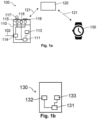
- Fig. 1a shows an example system 100 comprising a gas-based cooking appliance 10 which is communicatively coupled with a central unit 112, such as a server within a data cloud.
- the cooking appliance 10 and the central unit 112 may be configured to communicate via a wireless and/or a wireline data communication link 120, such as a local area network (LAN), a wireless local area network (WLAN), 3G, 4G and/or 5G.
- the cooking appliance 10 may comprise a communication unit 113.
- the cooking appliance 10 comprises one or more burners 116 which are configured to burn gas which is provided via a supply line 102 to the cooking appliance 10.
- a flame 117 is illustrated at one of the burners 116.
- the cooking appliance 10 may comprise one or more (mechanical) control elements 115 which allow a user of the cooking appliance 10 to turn on or off and/or to adjust the gas supply to a burner 116.
- the cooking appliance 10 comprises a control module 111 which is configured to control one or more components of the cooking appliance 10, in particular, in dependence of data received via the communication unit 113.
- the control module 111 may be configured to enable a remote control of the cooking appliance 10.
- the control module 111 may e.g., be configured to control a supply valve 114 of the cooking appliance 10, wherein the supply valve 114 may be closed to shut off the supply line 102 or may be opened to couple the cooking appliance 10 with the supply line 102.
- the supply valve 114 may be used to put the cooking appliance 10 into a safe state by closing the supply valve 114 in order to cut off the gas supply to the cooking appliance 10.
- the system 100 may further comprise an electronic user device 130 which may be a smart watch as illustrated in Fig. 1a .
- the user device 130 may be carried by the user of the cooking appliance 10.
- the user device 130 may be configured to exchange data with the central unit 112 via a wireline and/or wireless communication link 121.
- the user device 130 may comprise a communication module 133 for this purpose.
- the user device 130 may comprise one or more sensors 132 which are configured to sense measurement data regarding the user of the user device 130. The measurement data may be indicative of
- the central unit 112 may be configured to determine user information regarding the user of the cooking appliance 10.
- the user information may be provided by the user device 130 via the communication link 120.
- the user information may be based on the measurement data of the one or more sensors 132 of the user device 130.
- the measurement data may have been processed by a control element 131 of the user device 130 to determine the user information and/or to determine data which is derived from the measurement data.
- the user information and/or the derived data and/or the measurement data may be provided by the user device 130 to the central unit 112 via the communication link 120 (using the communication module 133 of the user device 130).
- the central unit 112 may be configured to control the cooking appliance 10 in dependence of the user information.
- the central unit 112 may be configured to put the cooking appliance 10 into a safe state, if the user information indicates that the user does not supervise the cooking appliance 10 and/or if the user information indicates that the user is not conscious (e.g., because the user is sleeping or because the user has a medical issue).
- the central unit 112 may send a control command to the control module 111 of the cooking appliance 10 via the communication link 120.
- the control module 111 of the cooking appliance 10 may then put the cooking appliance 10 into a safe state, e.g., by closing the supply valve 114.
- a system 100 which allows a gas-based cooking appliance 10 to be coupled with a (mobile) user device 130 via a central unit 112, thereby allowing the cooking appliance 10 to be remote controlled.
- a gas-based cooking appliance 10 to be coupled with a (mobile) user device 130 via a central unit 112, thereby allowing the cooking appliance 10 to be remote controlled.
- the safety and/or the comfort-of-use of the cooking appliance 10 may be increased.
- the cooking appliance 10 may comprise one or more sensing elements 118 which are configured to measure appliance data regarding the cooking appliance 10.
- a sensing element 118 (such as a thermocouple sensor) may be configured to measure appliance data regarding a flame 117 which is produced by a burner 116 of the cooking appliance 10. In particular, the temperature of the flame 117 may be measured.
- the control module 111 of the cooking appliance 10 may be configured to determine, based on the data measured by the one or more sensing element 118, that a flame 117 is produced by a burner 116 of the cooking appliance 10. If this the case, the supply valve 114 may be kept open. On the other hand, if it is determined that the control element 115 of the burner 116 has been turned to release gas, but that no flame 117 is being generated, the supply valve 114 may be closed to cut off the gas supply. The fact that no flame 117 is being generated may be determined based on the measured temperature.
- Information regarding the operation of the cooking appliance 10 may be sent to the central unit 112.
- the starting time of the operation of a burner 116 and/or the temperature of the flame 117 may be provided to and may possibly be stored by the central unit 112.
- the temperature of the flame 117 may be updated repeatedly during the operation of the burner 116.
- the duration of the operation of the burner 116 may be tracked by the central unit 112. If it is detected that the control element 115 is actuated for turning off the burner 116, the supply valve 114 may be closed to cut off the gas supply.
- the user may be informed on the user device 130 about the status of the cooking appliance 10.
- the user may be informed on whether a burner 116 of the cooking appliance 10 is turned on or off.
- a notification may be sent to the user device 130 in order to inform the user that a burner 116 of the cooking appliance 10 has been activated and/or is being operated. Such notifications may be sent repeatedly during operation of the burner 116.
- the user may be informed about the temperature of the flame 117 of the burner 116.
- the control module 111 of the cooking appliance 10 and/or the central unit 112 may be configured to send a notification to the user device 130, if the activation and/or the use of the cooking appliance 10 is detected. As a result of this, an unexpected use of the cooking appliance 10 (e.g., by a child or by an elderly person may be detected).
- the control module 111 of the cooking appliance 10 and/or the central unit 112 may be configured to send a notification to the user device 130, if it is detected that the flame 117 of a burner 116 has been blown out (e.g., by an external factor such as wind or boiling water).
- control module 111 of the cooking appliance 10 and/or the central unit 112 may be configured to send information regarding the ambient temperature of the cooking appliance 10 and/or the flame temperature to the user device 130. As a result of this, the user may be informed about an abnormal situation within the vicinity of the cooking appliance 10, such as a fire or an open window.
- control module 111 of the cooking appliance 10 and/or the central unit 112 may be configured to send information regarding the starting time and/or the duration of operation of a burner 116 of the cooking appliance 10 to the user device 130. This information may be sent to the user device 130 repeatedly in regular intervals. The time interval (e.g., every 15 or 30 minutes) between successive notifications may be set by the user.
- the control module 111 of the cooking appliance 10 and/or the central unit 112 may be configured to determine whether or not the user has responded to a notification which has been provided to the user device 130. If it is determined that the user has not responded to a notification, the cooking appliance 10 may be turned off automatically, thereby increasing the safety of the cooking appliance 10.
- the control module 111 of the cooking appliance 10 and/or the central unit 112 may be configured to receive a control command for controlling the cooking appliance 10 from the user device 130.
- the control command may be directed at turning off a burner 116 of the cooking appliance 10.
- the control module 111 of the cooking appliance 10 and/or the central unit 112 may be configured to control the cooking appliance 10 in dependence of the received control command, thereby enabling a remote control of the cooking appliance 10 using the user device 130, e.g., using a software appliance on the user device 130.
- the user may be enabled to set a time for turning off the cooking appliance 10, e.g., a burner 116 of the cooking appliance 10, using the user device 130.
- the control module 111 of the cooking appliance 10 and/or the central unit 112 may be configured to automatically turn off the cooking appliance 10 at the time set by the user.
- the time may be set using a countdown or timer.
- a maximum working time of the cooking appliance 10 may be set. Regardless of the use of the cooking appliance 10, the cooking appliance 10 may then be turned off automatically after the maximum working time has elapsed.
- the control module 111 of the cooking appliance 10 and/or the central unit 112 may be configured to determine the distance between the user (i.e., the user device 130) and the cooking appliance 10, while the cooking appliance 10 is being operated.
- the location of the cooking appliance 10 may be stored within a database of the central unit 112. If the distance between the user and the cooking appliance 10 is equal to or greater than a predetermined threshold distance, the user may be informed via the user device 130 that the cooking appliance 10 is being operated. Alternatively, or in addition, the cooking appliance 10 may be turned off automatically.
- the user may be enabled to set one or more specific time intervals during a day, during which the cooking appliance 10 may be operated and/or may not be operated.
- the use of the cooking appliance 10 may be blocked during night time. As a result of this, the safety of the cooking appliance 10 may be increased further.
- the control module 111 of the cooking appliance 10 and/or the central unit 112 may be configured to verify whether or not the user has confirmed the activation of the cooking appliance 10, e.g., the activation of a burner 116 of the cooking appliance 10, on the user device 130. After turning on a burner 116 of the cooking appliance 10 using the control element 115, the control module 111 of the cooking appliance 10 and/or the central unit 112 may verify whether this activation at the cooking appliance 10 has been confirmed using the user device 130. There may be a maximum time (e.g., 10 seconds) for confirming an activation. If the activation is not confirmed, the gas supply may be blocked. Otherwise, the burner 116 may be activated. As a result of this, the safety of the cooking appliance 10 may be increased further.
- a maximum time e.g. 10 seconds
- the control module 111 of the cooking appliance 10 and/or the central unit 112 may be configured to log the usage of the cooking appliance 10 (e.g., the operation times and/or durations) within a database.
- the database may be accessible using the user device 130, thereby allowing the user to track the usage of the cooking appliance 10.
- the control module 111 of the cooking appliance 10 and/or the central unit 112 may be configured to determine based on the data provided by the user device 130 (e.g., a smart watch) that the user is unconscious (e.g., due to a heart attack). In reaction to this, the cooking appliance 10 may be turned off automatically.
- the user device 130 e.g., a smart watch
- the cooking appliance 10 may be turned off automatically.
- Fig. 2 shows a flow chart of an example (possibly computer-implemented) method 200 for controlling a gas-based cooking appliance 10.
- the method 200 may be executed by a central unit 112 which is separate from the cooking appliance 10 and/or from the electronic user device 130 of the user of the cooking appliance 10.
- the method 200 may be executed by a control module 111 of the cooking appliance 10.
- the method 200 comprises determining 201 user information regarding the user of the cooking appliance 10.
- the user information is determined using the electronic user device 130 (in particular, a smart wearable) of the user.
- the user information may be indicative of the state and/or of the position of the user.
- the user information may be determined based on data, in particular measurement data captured by one or more sensors 132, that has been provided by the user device 130.
- the method 200 comprises controlling 202 the cooking appliance 10 in dependence of the user information, notably in dependence of the state of the user and/or of the position of the user.
- the cooking appliance 10 may be turned off automatically in dependence of the user information, in particular if the user information indicates that the user is unconscious and/or if the user information indicates that the user is too far away from the cooking appliance 10.
- the measures which are described in the present document allow the safety and/or the comfort-of-use of a gas-based cooking appliance 10 to be increased.
Landscapes
- Engineering & Computer Science (AREA)
- Chemical & Material Sciences (AREA)
- Combustion & Propulsion (AREA)
- Mechanical Engineering (AREA)
- General Engineering & Computer Science (AREA)
- Regulation And Control Of Combustion (AREA)
Abstract
Description
- The present document relates to a gas-based cooking appliance, such as a gas hob and/or a gas oven. In particular, the present document relates to a method and a control unit for controlling a gas-based cooking appliance.
- A gas-based cooking appliance may be used within a household for cooking and/or for baking. The use of gas within a household may lead to safety issues, notably if the gas-based cooking appliance is left unattended.
- The present document addresses the technical problem of increasing the safety and/or the comfort-of-use of a gas-based cooking appliance. The technical problem is solved by each of the independent claims. Preferred examples are described in the dependent claims.
- According to an aspect, a control unit for controlling a gas-based cooking appliance (such as a gas hob and/or a gas oven) is described. The control unit may at least partially be a control module of the cooking appliance. Alternatively, or in addition, the control unit may at least partially be external to and/or separate from the cooking appliance. In a preferred example, the control unit is a central unit (e.g., a server) which is separate from the cooking appliance. The central unit may be located within a data cloud.
- The control unit is configured to determine user information regarding a user of the cooking appliance using an (e.g., using data provided by an) electronic user device (e.g., a smartphone and/or a smart wearable such as a smart watch) of the user. The user device may be configured to be carried around by the user. Furthermore, the user device may be configured to provide data regarding the user (notably the state and/or the position of the user). The user information may be determined based on the data which is provided by the user device. In particular, the user device may comprise one or more sensors (such as a position sensor and/or an inertial measurement unit and/or a health sensor (for capturing e.g., the blood pressure and/or the heat beat)), which are configured to sense measurement data. The measurement data and/or data derived therefrom may be provided by the user device to the control unit. The user information may be indicative of the state (notably the state of health) and/or the position of the user.
- Furthermore, the control unit may be configured to control the cooking appliance in dependence of the user information. In particular, the control unit may be configured to turn off the cooking appliance and/or to turn off the gas supply to the cooking appliance in dependence of the user information. Alternatively, or in addition, the control unit may be configured to turn off a gas burner of the cooking appliance in dependence of the user information. Alternatively, or in addition, the control unit may be configured to open or close a gas supply valve of the cooking appliance in dependence of the user information.
- Hence, a control unit is described, which is configured to (remote) control a gas-based cooking appliance based on user information that has been determined using the user device of the user (in particular using one or more sensors of the user device). By doing this, the safety and/or the comfort-of-use of the cooking appliance may be increased in an efficient and reliable manner.
- The control unit may be configured to determine the state, in particular the state of health, of the user of the cooking appliance based on the user information. The cooking appliance may then be controlled in dependence of the state of the user. In particular, the control unit may be configured to determine or detect, based on the user information, that the user is unconscious. In reaction to this, the cooking appliance and/or the gas supply to the cooking appliance may be turned off, thereby further increasing the safety of the cooking appliance.
- The user device may comprise one or more sensors configured to capture measurement data regarding the user, in particular regarding the state of health (e.g., the heartbeat, the blook pressure, etc.) of the user and/or the position of the user. As indicated above, the user device may comprise a smart wearable, in particular a smart watch, carried by the user.
- The user information may be dependent on the measurement data captured by the one or more sensors of the user device. In particular, the control unit may be configured to determine the user information based on the measurement data captured by the one or more sensors of the user device. As a result of this, the user information may be determined in an efficient and precise manner.
- The control unit may be configured to determine distance information regarding the distance between the cooking appliance and the user device based on the user information. In particular, the distance information may be determined based on position data of a position sensor, in particular a global navigation satellite system (GNSS) sensor, of the user device. Alternatively, or in addition, the distance information may be determined based on radio data regarding the signal strength of a radio signal (e.g., a Bluetooth signal) emitted and/or captured by a wireless communication module of the user device.
- The control unit may be configured to control the cooking appliance based on the distance information. In particular, the control unit may be configured to determine, based on the distance information, whether the distance between the cooking appliance and the user device is greater than a pre-determined distance threshold. The distance threshold may e.g., be in the range between 5 to 20 meters.
- The control unit may be configured to turn off the cooking appliance and/or to turn off the gas supply to the cooking appliance, if it is determined that the distance between the cooking appliance and the user device is greater than the pre-determined distance threshold. By doing this, the safety of the cooking appliance may be further increased.
- In particular, the control unit may be configured to send a notification to the user device, if it is determined that the distance between the cooking appliance and the user device is greater than the pre-determined distance threshold. Furthermore, the control unit may be configured to determine whether or not the notification is acknowledged by the user at the user device (within a predetermined time interval, of e.g., 10 seconds). The cooking appliance and/or the gas supply to the cooking appliance may be turned off, if it is determined that the notification is not acknowledged by the user. By doing this, the safety of the cooking appliance may be increased in a particularly comfortable manner.
- As indicated above, the control unit may be a central unit (e.g., a server) which is separate from the cooking appliance and from the user device. The central unit may be configured to communicate with the user device via a wireless and/or wireline communication link (such as a LAN, WLAN, 3G, 4G or 5G communication link). Furthermore, the central unit may be configured to control the cooking appliance via a wireless and/or wireline communication link (such as a LAN, WLAN, 3G, 4G or 5G communication link). By making use of a central unit, the safety and/or the comfort-of-use of the cooking appliance may be increased in a particularly reliable manner.
- The control unit may be configured to determine that a control element (e.g., knob) of the cooking appliance has been actuated to turn on a burner of the cooking appliance. Furthermore, the control unit may be configured to determine whether or not the actuation of the control element has been confirmed by the user via the user device (within a predetermined time interval). For this purpose, a confirmation request may be sent to the user device. The user may then reply to the confirmation request in order to confirm the actuation of the control element.
- The control unit may be configured to turn on the burner, if it is determined that the actuation of the control element has been confirmed by the user via the user device. On the other hand, the control unit may be configured to prevent gas from being supplied to the burner (e.g., by maintain the supply valve closed), if it is determined that the actuation of the control element has not been confirmed by the user via the user device.
- By allowing the user to confirm the activation of a burner of the cooking appliance via the electronic user device, the safety of the cooking appliance may be further increased.
- The control unit may be configured to determine status information regarding the status of the cooking appliance. Example status information is the fact that a burner of the cooking appliance is being operated, the duration of the operation of the burner and/or the temperature of the flame which is produced by the burner. Furthermore, the control unit may be configured to provide the status information to the user device, thereby increasing the comfort-of-use of the cooking appliance.
- According to another aspect, a method for controlling a gas-based cooking appliance (notably a gas hob) is described. The method comprises determining user information regarding a user of the cooking appliance using an electronic user device of the user (in particular, using data provided by the user device of the user). Furthermore, the method comprises controlling the cooking appliance in dependence of the user information.
- It should be noted that the methods and systems including its preferred embodiments as outlined in the present document may be used stand-alone or in combination with the other methods and systems disclosed in this document. In addition, the features outlined in the context of a system are also applicable to a corresponding method. Furthermore, all aspects of the methods and systems outlined in the present document may be arbitrarily combined. In particular, the features of the claims may be combined with one another in an arbitrary manner.
- The invention is explained below in an exemplary manner with reference to the accompanying drawings, wherein
-
Figure 1a shows an example system for controlling a gas-based cooking appliance; -
Figure 1b shows an example user device; and -
Figure 2 shows a flow chart of an example method for controlling a gas-based cooking appliance. - As outlined above, the present document is directed at increasing the safety and the comfort-of-use of a gas-based cooking appliance, such as a gas hob or a gas oven.
Fig. 1a shows anexample system 100 comprising a gas-based cooking appliance 10 which is communicatively coupled with a central unit 112, such as a server within a data cloud. The cooking appliance 10 and the central unit 112 may be configured to communicate via a wireless and/or a wirelinedata communication link 120, such as a local area network (LAN), a wireless local area network (WLAN), 3G, 4G and/or 5G. For this purpose, the cooking appliance 10 may comprise acommunication unit 113. - The cooking appliance 10 comprises one or
more burners 116 which are configured to burn gas which is provided via asupply line 102 to the cooking appliance 10. InFig. 1a aflame 117 is illustrated at one of theburners 116. The cooking appliance 10 may comprise one or more (mechanical)control elements 115 which allow a user of the cooking appliance 10 to turn on or off and/or to adjust the gas supply to aburner 116. - The cooking appliance 10 comprises a
control module 111 which is configured to control one or more components of the cooking appliance 10, in particular, in dependence of data received via thecommunication unit 113. Hence, thecontrol module 111 may be configured to enable a remote control of the cooking appliance 10. Thecontrol module 111 may e.g., be configured to control asupply valve 114 of the cooking appliance 10, wherein thesupply valve 114 may be closed to shut off thesupply line 102 or may be opened to couple the cooking appliance 10 with thesupply line 102. Hence, thesupply valve 114 may be used to put the cooking appliance 10 into a safe state by closing thesupply valve 114 in order to cut off the gas supply to the cooking appliance 10. - The
system 100 may further comprise anelectronic user device 130 which may be a smart watch as illustrated inFig. 1a . Theuser device 130 may be carried by the user of the cooking appliance 10. Theuser device 130 may be configured to exchange data with the central unit 112 via a wireline and/orwireless communication link 121. As shown inFig. 1b , theuser device 130 may comprise acommunication module 133 for this purpose. Furthermore, theuser device 130 may comprise one ormore sensors 132 which are configured to sense measurement data regarding the user of theuser device 130. The measurement data may be indicative of - the position of the
user device 130 and of the user carrying theuser device 130; and/or - the state of the user, notably with regards to the consciousness of the user.
- The central unit 112 may be configured to determine user information regarding the user of the cooking appliance 10. The user information may be provided by the
user device 130 via thecommunication link 120. The user information may be based on the measurement data of the one ormore sensors 132 of theuser device 130. In particular, the measurement data may have been processed by acontrol element 131 of theuser device 130 to determine the user information and/or to determine data which is derived from the measurement data. The user information and/or the derived data and/or the measurement data may be provided by theuser device 130 to the central unit 112 via the communication link 120 (using thecommunication module 133 of the user device 130). - Furthermore, the central unit 112 may be configured to control the cooking appliance 10 in dependence of the user information. In particular, the central unit 112 may be configured to put the cooking appliance 10 into a safe state, if the user information indicates that the user does not supervise the cooking appliance 10 and/or if the user information indicates that the user is not conscious (e.g., because the user is sleeping or because the user has a medical issue). For this purpose, the central unit 112 may send a control command to the
control module 111 of the cooking appliance 10 via thecommunication link 120. Thecontrol module 111 of the cooking appliance 10 may then put the cooking appliance 10 into a safe state, e.g., by closing thesupply valve 114. - Hence, a
system 100 is described which allows a gas-based cooking appliance 10 to be coupled with a (mobile)user device 130 via a central unit 112, thereby allowing the cooking appliance 10 to be remote controlled. As a result of this, the safety and/or the comfort-of-use of the cooking appliance 10 may be increased. - The cooking appliance 10 may comprise one or
more sensing elements 118 which are configured to measure appliance data regarding the cooking appliance 10. In particular, a sensing element 118 (such as a thermocouple sensor) may be configured to measure appliance data regarding aflame 117 which is produced by aburner 116 of the cooking appliance 10. In particular, the temperature of theflame 117 may be measured. - The
control module 111 of the cooking appliance 10 may be configured to determine, based on the data measured by the one ormore sensing element 118, that aflame 117 is produced by aburner 116 of the cooking appliance 10. If this the case, thesupply valve 114 may be kept open. On the other hand, if it is determined that thecontrol element 115 of theburner 116 has been turned to release gas, but that noflame 117 is being generated, thesupply valve 114 may be closed to cut off the gas supply. The fact that noflame 117 is being generated may be determined based on the measured temperature. - Information regarding the operation of the cooking appliance 10 may be sent to the central unit 112. By way of example, the starting time of the operation of a
burner 116 and/or the temperature of theflame 117 may be provided to and may possibly be stored by the central unit 112. The temperature of theflame 117 may be updated repeatedly during the operation of theburner 116. Furthermore, the duration of the operation of theburner 116 may be tracked by the central unit 112. If it is detected that thecontrol element 115 is actuated for turning off theburner 116, thesupply valve 114 may be closed to cut off the gas supply. - The user may be informed on the
user device 130 about the status of the cooking appliance 10. In particular, the user may be informed on whether aburner 116 of the cooking appliance 10 is turned on or off. By way of example, a notification may be sent to theuser device 130 in order to inform the user that aburner 116 of the cooking appliance 10 has been activated and/or is being operated. Such notifications may be sent repeatedly during operation of theburner 116. Furthermore, the user may be informed about the temperature of theflame 117 of theburner 116. - The
control module 111 of the cooking appliance 10 and/or the central unit 112 may be configured to send a notification to theuser device 130, if the activation and/or the use of the cooking appliance 10 is detected. As a result of this, an unexpected use of the cooking appliance 10 (e.g., by a child or by an elderly person may be detected). Alternatively, or in addition, thecontrol module 111 of the cooking appliance 10 and/or the central unit 112 may be configured to send a notification to theuser device 130, if it is detected that theflame 117 of aburner 116 has been blown out (e.g., by an external factor such as wind or boiling water). - Alternatively, or in addition, the
control module 111 of the cooking appliance 10 and/or the central unit 112 may be configured to send information regarding the ambient temperature of the cooking appliance 10 and/or the flame temperature to theuser device 130. As a result of this, the user may be informed about an abnormal situation within the vicinity of the cooking appliance 10, such as a fire or an open window. - Alternatively, or in addition, the
control module 111 of the cooking appliance 10 and/or the central unit 112 may be configured to send information regarding the starting time and/or the duration of operation of aburner 116 of the cooking appliance 10 to theuser device 130. This information may be sent to theuser device 130 repeatedly in regular intervals. The time interval (e.g., every 15 or 30 minutes) between successive notifications may be set by the user. - The
control module 111 of the cooking appliance 10 and/or the central unit 112 may be configured to determine whether or not the user has responded to a notification which has been provided to theuser device 130. If it is determined that the user has not responded to a notification, the cooking appliance 10 may be turned off automatically, thereby increasing the safety of the cooking appliance 10. - The
control module 111 of the cooking appliance 10 and/or the central unit 112 may be configured to receive a control command for controlling the cooking appliance 10 from theuser device 130. The control command may be directed at turning off aburner 116 of the cooking appliance 10. Thecontrol module 111 of the cooking appliance 10 and/or the central unit 112 may be configured to control the cooking appliance 10 in dependence of the received control command, thereby enabling a remote control of the cooking appliance 10 using theuser device 130, e.g., using a software appliance on theuser device 130. - The user may be enabled to set a time for turning off the cooking appliance 10, e.g., a
burner 116 of the cooking appliance 10, using theuser device 130. Thecontrol module 111 of the cooking appliance 10 and/or the central unit 112 may be configured to automatically turn off the cooking appliance 10 at the time set by the user. The time may be set using a countdown or timer. Alternatively, or in addition, a maximum working time of the cooking appliance 10 may be set. Regardless of the use of the cooking appliance 10, the cooking appliance 10 may then be turned off automatically after the maximum working time has elapsed. - The
control module 111 of the cooking appliance 10 and/or the central unit 112 may be configured to determine the distance between the user (i.e., the user device 130) and the cooking appliance 10, while the cooking appliance 10 is being operated. The location of the cooking appliance 10 may be stored within a database of the central unit 112. If the distance between the user and the cooking appliance 10 is equal to or greater than a predetermined threshold distance, the user may be informed via theuser device 130 that the cooking appliance 10 is being operated. Alternatively, or in addition, the cooking appliance 10 may be turned off automatically. - The user may be enabled to set one or more specific time intervals during a day, during which the cooking appliance 10 may be operated and/or may not be operated. By way of example, the use of the cooking appliance 10 may be blocked during night time. As a result of this, the safety of the cooking appliance 10 may be increased further.
- The
control module 111 of the cooking appliance 10 and/or the central unit 112 may be configured to verify whether or not the user has confirmed the activation of the cooking appliance 10, e.g., the activation of aburner 116 of the cooking appliance 10, on theuser device 130. After turning on aburner 116 of the cooking appliance 10 using thecontrol element 115, thecontrol module 111 of the cooking appliance 10 and/or the central unit 112 may verify whether this activation at the cooking appliance 10 has been confirmed using theuser device 130. There may be a maximum time (e.g., 10 seconds) for confirming an activation. If the activation is not confirmed, the gas supply may be blocked. Otherwise, theburner 116 may be activated. As a result of this, the safety of the cooking appliance 10 may be increased further. - The
control module 111 of the cooking appliance 10 and/or the central unit 112 may be configured to log the usage of the cooking appliance 10 (e.g., the operation times and/or durations) within a database. The database may be accessible using theuser device 130, thereby allowing the user to track the usage of the cooking appliance 10. - The
control module 111 of the cooking appliance 10 and/or the central unit 112 may be configured to determine based on the data provided by the user device 130 (e.g., a smart watch) that the user is unconscious (e.g., due to a heart attack). In reaction to this, the cooking appliance 10 may be turned off automatically. -
Fig. 2 shows a flow chart of an example (possibly computer-implemented)method 200 for controlling a gas-based cooking appliance 10. Themethod 200 may be executed by a central unit 112 which is separate from the cooking appliance 10 and/or from theelectronic user device 130 of the user of the cooking appliance 10. Alternatively, or in addition, themethod 200 may be executed by acontrol module 111 of the cooking appliance 10. - The
method 200 comprises determining 201 user information regarding the user of the cooking appliance 10. The user information is determined using the electronic user device 130 (in particular, a smart wearable) of the user. The user information may be indicative of the state and/or of the position of the user. The user information may be determined based on data, in particular measurement data captured by one ormore sensors 132, that has been provided by theuser device 130. - Furthermore, the
method 200 comprises controlling 202 the cooking appliance 10 in dependence of the user information, notably in dependence of the state of the user and/or of the position of the user. In particular, the cooking appliance 10 may be turned off automatically in dependence of the user information, in particular if the user information indicates that the user is unconscious and/or if the user information indicates that the user is too far away from the cooking appliance 10. - The measures which are described in the present document allow the safety and/or the comfort-of-use of a gas-based cooking appliance 10 to be increased.
- It should be noted that the description and drawings merely illustrate the principles of the proposed methods and systems. Those skilled in the art will be able to implement various arrangements that, although not explicitly described or shown herein, embody the principles of the invention and are included within its spirit and scope. Furthermore, all examples and embodiment outlined in the present document are principally intended expressly to be only for explanatory purposes to help the reader in understanding the principles of the proposed methods and systems. Furthermore, all statements herein providing principles, aspects, and embodiments of the invention, as well as specific examples thereof, are intended to encompass equivalents thereof.
-
- 10
- cooking appliance
- 100
- system
- 102
- supply line
- 110
- control unit
- 111
- control module
- 112
- central unit
- 113
- communication unit
- 114
- supply valve
- 115
- control element
- 116
- burner
- 117
- flame
- 118
- sensing element
- 120
- communication link
- 130
- user device
- 131
- control element
- 132
- sensor
- 133
- communication module
Claims (15)
- A control unit (110) for controlling a gas-based cooking appliance (110), wherein the control unit (110) is configured to- determine user information regarding a user of the cooking appliance (110) using an electronic user device (130) of the user; and- control the cooking appliance (110) in dependence of the user information.
- The control unit (110) according to claim 1, wherein the control unit (110) is configured to- determine a state of the user of the cooking appliance (110) based on the user information; and- control the cooking appliance (110) in dependence of the state of the user.
- The control unit (110) according to any previous claim, wherein the control unit (110) is configured to- determine, based on the user information, that the user is unconscious; and- in reaction to this, turn off the cooking appliance (110) and/or turn off a gas supply to the cooking appliance (110).
- The control unit (110) according to any previous claim, wherein- the user device (130) comprises one or more sensors (132) configured to capture measurement data regarding the user, in particular regarding a state of health of the user; and- the user information is dependent on the measurement data captured by the one or more sensors (132) of the user device (130).
- The control unit (110) according to any previous claim, wherein the user device (130) comprises a smart wearable, in particular a smart watch, carried by the user.
- The control unit (110) according to any previous claim, wherein the control unit (110) is configured to- determine distance information regarding a distance between the cooking appliance (110) and the user device (130) based on the user information; and- control the cooking appliance (110) based on the distance information.
- The control unit (110) according to claim 6, wherein the control unit (110) is configured to- determine, based on the distance information, whether the distance between the cooking appliance (110) and the user device (130) is greater than a pre-determined distance threshold; and- in reaction to this, turn off the cooking appliance (110) and/or turn off a gas supply to the cooking appliance (110).
- The control unit (110) according to claim 7, wherein the control unit (110) is configured to- send a notification to the user device (130), if it is determined that the distance between the cooking appliance (110) and the user device (130) is greater than the pre-determined distance threshold;- determine whether or not the notification is acknowledged by the user at the user device (130); and- turn off the cooking appliance (110) and/or turn off the gas supply to the cooking appliance (110), if it is determined that the notification is not acknowledged by the user.
- The control unit (110) according to any of claims 6 to 8, wherein the distance information is determined based on- position data of a position sensor, in particular a global navigation satellite system sensor, of the user device (130); and/or- radio data regarding a signal strength of a radio signal emitted and/or captured by a wireless communication module (133) of the user device (130).
- The control unit (110) according to any previous claim, wherein the control unit (110) is configured to- turn off the cooking appliance (110) and/or turn off a gas supply to the cooking appliance (110) in dependence of the user information; and/or- turn off a burner (116) of the cooking appliance (110) in dependence of the user information; and/or- open or close a supply valve (114) of the cooking appliance (110) in dependence of the user information.
- The control unit (110) according to any previous claim, wherein- the control unit (110) is a central unit (120) which is separate from the cooking appliance (110) and from the user device (130);- the central unit (120) is configured to communicate with the user device (130) via a wireless and/or wireline communication link (120); and- the central unit (120) is configured to control the cooking appliance (100) via a wireless and/or wireline communication link (120).
- The control unit (110) according to any previous claim, wherein the control unit (110) is configured to- determine that a control element (115) of the cooking appliance (110) has been actuated to turn on a burner (116) of the cooking appliance (110);- determine whether or not the actuation of the control element (115) has been confirmed by the user via the user device (130); and- turn on the burner (116), if it is determined that the actuation of the control element (115) has been confirmed by the user via the user device (130); and/or- prevent gas from being supplied to the burner (116), if it is determined that the actuation of the control element (115) has not been confirmed by the user via the user device (130).
- The control unit (110) according to any previous claim, wherein the control unit (110) is configured to- determine status information regarding a status of the cooking appliance (110); and- provide the status information to the user device (130).
- The control unit (110) according to any previous claim, wherein the gas-based cooking appliance (110) comprises a gas hob and/or a gas oven.
- A method for controlling a gas-based cooking appliance (110), wherein the method comprises,- determining user information regarding a user of the cooking appliance (110) using an electronic user device (130) of the user; and- controlling the cooking appliance (110) in dependence of the user information.
Applications Claiming Priority (1)
| Application Number | Priority Date | Filing Date | Title |
|---|---|---|---|
| TR202117877 | 2021-11-17 |
Publications (1)
| Publication Number | Publication Date |
|---|---|
| EP4184061A1 true EP4184061A1 (en) | 2023-05-24 |
Family
ID=78709309
Family Applications (1)
| Application Number | Title | Priority Date | Filing Date |
|---|---|---|---|
| EP21209288.6A Pending EP4184061A1 (en) | 2021-11-17 | 2021-11-19 | Control unit and method for controlling a gas-based cooking appliance |
Country Status (1)
| Country | Link |
|---|---|
| EP (1) | EP4184061A1 (en) |
Citations (4)
| Publication number | Priority date | Publication date | Assignee | Title |
|---|---|---|---|---|
| US20140251987A1 (en) * | 2013-03-06 | 2014-09-11 | Haier America Trading, Llc | Appliance monitoring system and method with connectivity and communication protocols |
| WO2015172881A1 (en) * | 2014-05-15 | 2015-11-19 | Diehl Ako Stiftung & Co. Kg | System for controlling at least one household appliance |
| DE102017112855A1 (en) * | 2017-06-12 | 2018-12-13 | Vorwerk & Co. Interholding Gmbh | Kitchen appliance and method for utilizing information about health properties when operating a kitchen appliance |
| US20200370754A1 (en) * | 2019-05-20 | 2020-11-26 | Bsh Home Appliances Corporation | Cooktop having electrically controlled gas flow |
-
2021
- 2021-11-19 EP EP21209288.6A patent/EP4184061A1/en active Pending
Patent Citations (4)
| Publication number | Priority date | Publication date | Assignee | Title |
|---|---|---|---|---|
| US20140251987A1 (en) * | 2013-03-06 | 2014-09-11 | Haier America Trading, Llc | Appliance monitoring system and method with connectivity and communication protocols |
| WO2015172881A1 (en) * | 2014-05-15 | 2015-11-19 | Diehl Ako Stiftung & Co. Kg | System for controlling at least one household appliance |
| DE102017112855A1 (en) * | 2017-06-12 | 2018-12-13 | Vorwerk & Co. Interholding Gmbh | Kitchen appliance and method for utilizing information about health properties when operating a kitchen appliance |
| US20200370754A1 (en) * | 2019-05-20 | 2020-11-26 | Bsh Home Appliances Corporation | Cooktop having electrically controlled gas flow |
Similar Documents
| Publication | Publication Date | Title |
|---|---|---|
| USRE49618E1 (en) | Controlling heat capability of appliance according to user proximity and notifying remote users via internet for increased safety | |
| US9536413B2 (en) | Verifying and monitoring stove operation | |
| US9739489B2 (en) | Monitoring system and method for monitoring a room | |
| US8921743B2 (en) | Device and method for monitoring a heating appliance | |
| EP3147880B1 (en) | Supervision and control method for preventing poor air quality and fire as well as issuing an alarm of a dangerous condition | |
| KR102183329B1 (en) | Iot-based biometrics type gas safety cut-off system | |
| US20180125296A1 (en) | Geo-fence enabled system, apparatus, and method for outdoor cooking and smoking | |
| KR102228284B1 (en) | Iot-based voice recognition gas safety cut-off system | |
| CN110782630B (en) | Household gas alarm method, system and device | |
| US12243405B2 (en) | Smart temperature detection and alarm system | |
| CN109237543A (en) | The control method and anti-dry system of anti-dry | |
| US20230151968A1 (en) | Control unit and method for controlling a gas-based cooking appliance | |
| JP2018035986A (en) | Heater and remote controller for heater | |
| CN108234250A (en) | The method of kitchen range system, kitchen range and mobile terminal control kitchen range | |
| KR20170019092A (en) | Safety apparatus of gas range | |
| CN204806479U (en) | A safe control system for electronic heating ware | |
| CN106594989A (en) | Air conditioner | |
| JP2014120820A (en) | In-residence energy apparatus control system | |
| CN109237546A (en) | The control method and anti-dry system of anti-dry | |
| GB2520088A (en) | Gas burner safety system, sensor unit and method | |
| JP7084209B2 (en) | Thermo-hygrometer and thermo-humidity control system | |
| KR101478117B1 (en) | System for mornitoring cooking apparatus | |
| JP2005309488A (en) | Security device and program | |
| JP2007241503A (en) | Sleep support system and sleep support device | |
| CN109654548B (en) | Gas stove and control method for gas stove |
Legal Events
| Date | Code | Title | Description |
|---|---|---|---|
| PUAI | Public reference made under article 153(3) epc to a published international application that has entered the european phase |
Free format text: ORIGINAL CODE: 0009012 |
|
| STAA | Information on the status of an ep patent application or granted ep patent |
Free format text: STATUS: THE APPLICATION HAS BEEN PUBLISHED |
|
| AK | Designated contracting states |
Kind code of ref document: A1 Designated state(s): AL AT BE BG CH CY CZ DE DK EE ES FI FR GB GR HR HU IE IS IT LI LT LU LV MC MK MT NL NO PL PT RO RS SE SI SK SM TR |
|
| STAA | Information on the status of an ep patent application or granted ep patent |
Free format text: STATUS: REQUEST FOR EXAMINATION WAS MADE |
|
| 17P | Request for examination filed |
Effective date: 20231124 |
|
| RBV | Designated contracting states (corrected) |
Designated state(s): AL AT BE BG CH CY CZ DE DK EE ES FI FR GB GR HR HU IE IS IT LI LT LU LV MC MK MT NL NO PL PT RO RS SE SI SK SM TR |
|
| STAA | Information on the status of an ep patent application or granted ep patent |
Free format text: STATUS: EXAMINATION IS IN PROGRESS |
|
| 17Q | First examination report despatched |
Effective date: 20250305 |