EP4183849A1 - Adhesive agent composition and adhesive sheet - Google Patents
Adhesive agent composition and adhesive sheet Download PDFInfo
- Publication number
- EP4183849A1 EP4183849A1 EP21841435.7A EP21841435A EP4183849A1 EP 4183849 A1 EP4183849 A1 EP 4183849A1 EP 21841435 A EP21841435 A EP 21841435A EP 4183849 A1 EP4183849 A1 EP 4183849A1
- Authority
- EP
- European Patent Office
- Prior art keywords
- meth
- adhesive
- adhesive composition
- mass
- containing monomer
- Prior art date
- Legal status (The legal status is an assumption and is not a legal conclusion. Google has not performed a legal analysis and makes no representation as to the accuracy of the status listed.)
- Granted
Links
Classifications
-
- C—CHEMISTRY; METALLURGY
- C09—DYES; PAINTS; POLISHES; NATURAL RESINS; ADHESIVES; COMPOSITIONS NOT OTHERWISE PROVIDED FOR; APPLICATIONS OF MATERIALS NOT OTHERWISE PROVIDED FOR
- C09J—ADHESIVES; NON-MECHANICAL ASPECTS OF ADHESIVE PROCESSES IN GENERAL; ADHESIVE PROCESSES NOT PROVIDED FOR ELSEWHERE; USE OF MATERIALS AS ADHESIVES
- C09J133/00—Adhesives based on homopolymers or copolymers of compounds having one or more unsaturated aliphatic radicals, each having only one carbon-to-carbon double bond, and at least one being terminated by only one carboxyl radical, or of salts, anhydrides, esters, amides, imides, or nitriles thereof; Adhesives based on derivatives of such polymers
- C09J133/04—Homopolymers or copolymers of esters
- C09J133/06—Homopolymers or copolymers of esters of esters containing only carbon, hydrogen and oxygen, the oxygen atom being present only as part of the carboxyl radical
- C09J133/08—Homopolymers or copolymers of acrylic acid esters
-
- C—CHEMISTRY; METALLURGY
- C09—DYES; PAINTS; POLISHES; NATURAL RESINS; ADHESIVES; COMPOSITIONS NOT OTHERWISE PROVIDED FOR; APPLICATIONS OF MATERIALS NOT OTHERWISE PROVIDED FOR
- C09J—ADHESIVES; NON-MECHANICAL ASPECTS OF ADHESIVE PROCESSES IN GENERAL; ADHESIVE PROCESSES NOT PROVIDED FOR ELSEWHERE; USE OF MATERIALS AS ADHESIVES
- C09J7/00—Adhesives in the form of films or foils
- C09J7/30—Adhesives in the form of films or foils characterised by the adhesive composition
- C09J7/38—Pressure-sensitive adhesives [PSA]
-
- C—CHEMISTRY; METALLURGY
- C08—ORGANIC MACROMOLECULAR COMPOUNDS; THEIR PREPARATION OR CHEMICAL WORKING-UP; COMPOSITIONS BASED THEREON
- C08F—MACROMOLECULAR COMPOUNDS OBTAINED BY REACTIONS ONLY INVOLVING CARBON-TO-CARBON UNSATURATED BONDS
- C08F220/00—Copolymers of compounds having one or more unsaturated aliphatic radicals, each having only one carbon-to-carbon double bond, and only one being terminated by only one carboxyl radical or a salt, anhydride ester, amide, imide or nitrile thereof
- C08F220/02—Monocarboxylic acids having less than ten carbon atoms; Derivatives thereof
- C08F220/10—Esters
- C08F220/12—Esters of monohydric alcohols or phenols
- C08F220/16—Esters of monohydric alcohols or phenols of phenols or of alcohols containing two or more carbon atoms
- C08F220/18—Esters of monohydric alcohols or phenols of phenols or of alcohols containing two or more carbon atoms with acrylic or methacrylic acids
- C08F220/1804—C4-(meth)acrylate, e.g. butyl (meth)acrylate, isobutyl (meth)acrylate or tert-butyl (meth)acrylate
-
- C—CHEMISTRY; METALLURGY
- C08—ORGANIC MACROMOLECULAR COMPOUNDS; THEIR PREPARATION OR CHEMICAL WORKING-UP; COMPOSITIONS BASED THEREON
- C08F—MACROMOLECULAR COMPOUNDS OBTAINED BY REACTIONS ONLY INVOLVING CARBON-TO-CARBON UNSATURATED BONDS
- C08F220/00—Copolymers of compounds having one or more unsaturated aliphatic radicals, each having only one carbon-to-carbon double bond, and only one being terminated by only one carboxyl radical or a salt, anhydride ester, amide, imide or nitrile thereof
- C08F220/02—Monocarboxylic acids having less than ten carbon atoms; Derivatives thereof
- C08F220/10—Esters
- C08F220/26—Esters containing oxygen in addition to the carboxy oxygen
- C08F220/28—Esters containing oxygen in addition to the carboxy oxygen containing no aromatic rings in the alcohol moiety
- C08F220/281—Esters containing oxygen in addition to the carboxy oxygen containing no aromatic rings in the alcohol moiety and containing only one oxygen, e.g. furfuryl (meth)acrylate or 2-methoxyethyl (meth)acrylate
-
- C—CHEMISTRY; METALLURGY
- C09—DYES; PAINTS; POLISHES; NATURAL RESINS; ADHESIVES; COMPOSITIONS NOT OTHERWISE PROVIDED FOR; APPLICATIONS OF MATERIALS NOT OTHERWISE PROVIDED FOR
- C09J—ADHESIVES; NON-MECHANICAL ASPECTS OF ADHESIVE PROCESSES IN GENERAL; ADHESIVE PROCESSES NOT PROVIDED FOR ELSEWHERE; USE OF MATERIALS AS ADHESIVES
- C09J133/00—Adhesives based on homopolymers or copolymers of compounds having one or more unsaturated aliphatic radicals, each having only one carbon-to-carbon double bond, and at least one being terminated by only one carboxyl radical, or of salts, anhydrides, esters, amides, imides, or nitriles thereof; Adhesives based on derivatives of such polymers
- C09J133/04—Homopolymers or copolymers of esters
- C09J133/14—Homopolymers or copolymers of esters of esters containing halogen, nitrogen, sulfur or oxygen atoms in addition to the carboxy oxygen
-
- C—CHEMISTRY; METALLURGY
- C09—DYES; PAINTS; POLISHES; NATURAL RESINS; ADHESIVES; COMPOSITIONS NOT OTHERWISE PROVIDED FOR; APPLICATIONS OF MATERIALS NOT OTHERWISE PROVIDED FOR
- C09J—ADHESIVES; NON-MECHANICAL ASPECTS OF ADHESIVE PROCESSES IN GENERAL; ADHESIVE PROCESSES NOT PROVIDED FOR ELSEWHERE; USE OF MATERIALS AS ADHESIVES
- C09J2203/00—Applications of adhesives in processes or use of adhesives in the form of films or foils
- C09J2203/354—Applications of adhesives in processes or use of adhesives in the form of films or foils for automotive applications
-
- C—CHEMISTRY; METALLURGY
- C09—DYES; PAINTS; POLISHES; NATURAL RESINS; ADHESIVES; COMPOSITIONS NOT OTHERWISE PROVIDED FOR; APPLICATIONS OF MATERIALS NOT OTHERWISE PROVIDED FOR
- C09J—ADHESIVES; NON-MECHANICAL ASPECTS OF ADHESIVE PROCESSES IN GENERAL; ADHESIVE PROCESSES NOT PROVIDED FOR ELSEWHERE; USE OF MATERIALS AS ADHESIVES
- C09J2301/00—Additional features of adhesives in the form of films or foils
- C09J2301/30—Additional features of adhesives in the form of films or foils characterized by the chemical, physicochemical or physical properties of the adhesive or the carrier
- C09J2301/312—Additional features of adhesives in the form of films or foils characterized by the chemical, physicochemical or physical properties of the adhesive or the carrier parameters being the characterizing feature
-
- C—CHEMISTRY; METALLURGY
- C09—DYES; PAINTS; POLISHES; NATURAL RESINS; ADHESIVES; COMPOSITIONS NOT OTHERWISE PROVIDED FOR; APPLICATIONS OF MATERIALS NOT OTHERWISE PROVIDED FOR
- C09J—ADHESIVES; NON-MECHANICAL ASPECTS OF ADHESIVE PROCESSES IN GENERAL; ADHESIVE PROCESSES NOT PROVIDED FOR ELSEWHERE; USE OF MATERIALS AS ADHESIVES
- C09J2423/00—Presence of polyolefin
-
- C—CHEMISTRY; METALLURGY
- C09—DYES; PAINTS; POLISHES; NATURAL RESINS; ADHESIVES; COMPOSITIONS NOT OTHERWISE PROVIDED FOR; APPLICATIONS OF MATERIALS NOT OTHERWISE PROVIDED FOR
- C09J—ADHESIVES; NON-MECHANICAL ASPECTS OF ADHESIVE PROCESSES IN GENERAL; ADHESIVE PROCESSES NOT PROVIDED FOR ELSEWHERE; USE OF MATERIALS AS ADHESIVES
- C09J2433/00—Presence of (meth)acrylic polymer
Definitions
- An aspect of the present invention relates to an adhesive composition or an adhesive sheet.
- the plastic material is generally a difficult-to-adhere adherend compared to the metal material.
- inexpensive and versatile polyolefins such as polypropylene and polyethylene are known as difficult-to-adhere adherends.
- members for automobiles are also required to have high heat resistance.
- the bonding may be performed while applying heat, so it is also required to exhibit favorable adhesive strength even after the adhesive is exposed to a thermal environment.
- Patent Literature 1 a pressure sensitive adhesive composition containing a polyisobutylene polymer having a first functional group and an acrylic polymer having a second functional group present in the backbone of the acrylic polymer, in which the first functional group and the second functional group form a hydrogen bond. It is disclosed that the pressure sensitive adhesive composition disclosed in Patent Literature 1 has favorable adhesiveness with respect to various substrates such as a low-surface-energy substrate.
- Patent Literature 1 JP 2013-511594 A
- An aspect of the present invention provides an adhesive composition capable of forming an adhesive layer that maintains a sufficient adhesive strength even when exposed to a thermal environment at the time of bonding or after bonding.
- the present inventors have conducted intensive studies in order to solve the above problems. As a result, the present inventors have found that the above problems can be solved by an adhesive composition having the following configuration, thereby completing the present invention.
- an adhesive composition capable of forming an adhesive layer that maintains a sufficient adhesive strength even when exposed to a thermal environment at the time of bonding or after bonding.
- acryl and methacryl are also collectively referred to as "(meth)acryl”
- acrylate and methacrylate are also collectively referred to as “(meth)acrylate”.
- An adhesive composition according to an aspect of the present invention contains a (meth)acrylic polymer (A), an acid-modified polyolefin (B), a tackifier resin (C), and a crosslinking agent (D), and satisfies the following requirements (I) to (III).
- physical properties related to the above (I) to (III) can be measured as follows: after defoaming, the adhesive composition is applied onto a polyethylene terephthalate (PET) film having a thickness of 25 um to have a dried thickness of 50 ⁇ m, the adhesive composition is dried at 90°C for 3 minutes to remove a solvent, thereby forming a coating film, a release-treated PET film is then bonded to a surface of the coating film (adhesive layer) on a side opposite to a surface in contact with the PET film, the resulting laminate is left to stand still for 7 days under the condition of 23°C/50% RH and aged to produce an adhesive sheet having the adhesive layer having a thickness of 50 um (layer configuration: the PET film/the adhesive layer/the release-treated PET film), the release-treated PET film is peeled off from the adhesive sheet to expose the adhesive layer, and the exposed adhesive layer is used as an adhesive surface.
- the haze described below can be measured by peeling the release-treated
- a value of a ball tack test performed by a J. Dow method using an adhesive layer having a thickness of 50 um obtained from the adhesive composition is 5 or less, preferably 4 or less, and more preferably 3 or less.
- an adhesive force in measurement after an adhesive surface of an adhesive layer having a thickness of 50 um obtained from the adhesive composition is bonded to a polypropylene plate and left to stand for 20 minutes in an environment at 80°C is 10.0 N/25 mm or more, preferably 13.0 N/25 mm or more, and more preferably 15.0 N/25 mm or more. Within the above range, a favorable adhesive force is exhibited after heat bonding, which is preferable.
- the adhesive force is preferably high, and the upper limit thereof is not particularly limited, but is usually 50.0 N/25 mm or less.
- a peeling amount of the adhesive layer after 1 hour from the start of application of a load is 30 mm or less, preferably 28 mm or less, and more preferably 25 mm or less.
- the peeling amount is preferably small, and the lower limit thereof is not particularly limited.
- the adhesive composition according to an aspect of the present invention can satisfy the above (I) to (III) by using a combination of a (meth)acrylic polymer (A) that is a polymer of specific monomer components and an acid-modified polyolefin (B) and containing a specific tackifier resin (C) and a crosslinking agent (D), and an adhesive layer formed from the adhesive composition can maintain a sufficient adhesive strength even when exposed to a thermal environment at the time of bonding or after bonding.
- A a (meth)acrylic polymer
- B acid-modified polyolefin
- C specific tackifier resin
- D crosslinking agent
- the adhesive composition according to an aspect of the present invention has such properties, the adhesive composition can be suitably used for use application of being bonded under a thermal environment, for example, for forming an adhesive layer of a decorative film.
- the haze of the adhesive layer having a thickness of 50 um obtained from the adhesive composition is preferably less than 35% and more preferably 25% or less.
- the respective components in the adhesive composition tend to be uniformly mixed, which is preferable.
- the haze is preferably as low as possible, and the lower limit thereof is not particularly limited, but is usually 0.5% or more.
- the measurement of the haze can be performed by the method described in Examples.
- the (meth)acrylic polymer (A) contained in the adhesive composition is a polymer of monomer components including 55 to 99 mass% of at least one (meth)acrylic acid ester selected from an alkoxyalkyl (meth)acrylate ester and an alkyl (meth)acrylate ester having an alkyl group having 4 to 12 carbon atoms, 0.5 to 15 mass% of a crosslinkable functional group-containing monomer (excluding an amino group-containing monomer), and 0.01 to 5 mass% of an amino group-containing monomer.
- the amount (mass%) of each monomer represents the amount in 100 mass% of the monomer components.
- the weight average molecular weight (Mw) of the (meth)acrylic polymer (A) is usually 150000 to 1800000, preferably 200000 to 1500000, and more preferably 400000 to 1300000.
- the weight average molecular weight is a molecular weight determined in terms of standard polystyrene by a gel permeation chromatographic (GPC) method, and can be measured by the method described in Examples. In the above range, the coatability of the adhesive composition and the durability of an adhesive layer to be obtained are excellent, which is preferable.
- alkyl (meth)acrylate ester having an alkyl group having 4 to 12 carbon atoms examples include n-butyl (meth)acrylate, iso-butyl (meth)acrylate, tert-butyl (meth)acrylate, pentyl (meth)acrylate, hexyl (meth)acrylate, heptyl (meth)acrylate, 2-ethylhexyl (meth)acrylate, octyl (meth)acrylate, nonyl (meth)acrylate, decyl (meth)acrylate, undecyl (meth)acrylate, and lauryl (meth)acrylate.
- the number of carbon atoms of the alkyl group and the alkoxy group in the alkoxyalkyl (meth)acrylate ester is not particularly limited, but is preferably 1 to 12.
- alkoxyalkyl (meth)acrylate ester examples include methoxymethyl (meth)acrylate, 2-methoxyethyl (meth)acrylate, 2-ethoxyethyl (meth)acrylate, 3-methoxypropyl (meth)acrylate, 3-ethoxypropyl (meth)acrylate, 4-methoxybutyl (meth)acrylate, and 4-ethoxybutyl (meth)acrylate.
- At least one (meth)acrylic acid ester selected from an alkoxyalkyl (meth)acrylate ester and an alkyl (meth)acrylate ester having an alkyl group having 4 to 12 carbon atoms n-butyl (meth)acrylate, 2-methoxyethyl (meth)acrylate, and 2-ethylhexyl acrylate are preferable, and n-butyl acrylate (BA) and 2-methoxyethyl acrylate (MEA) are more preferable.
- the at least one (meth)acrylic acid ester selected from an alkoxyalkyl (meth)acrylate ester and an alkyl (meth)acrylate ester having an alkyl group having 4 to 12 carbon atoms may be used singly, or two or more kinds thereof may be used.
- the monomer components include the at least one (meth)acrylic acid ester selected from an alkoxyalkyl (meth)acrylate ester and an alkyl (meth)acrylate ester having an alkyl group having 4 to 12 carbon atoms in an amount of 55 to 99 mass%, preferably 60 to 94 mass%, and more preferably 65 to 90 mass%, in 100 mass% of the monomer components.
- crosslinkable functional group-containing monomer examples include a carboxy group-containing monomer and a hydroxyl group-containing monomer.
- an amino group-containing monomer is not included in the crosslinkable functional group-containing monomer.
- carboxy group-containing monomer examples include carboxy group-containing (meth)acrylates such as (meth)acrylic acid, ⁇ -carboxyethyl (meth)acrylate, 5-carboxypentyl (meth)acrylate, succinic acid mono(meth)acryloyloxyethyl ester, and ⁇ -carboxypolycaprolactone mono(meth)acrylate; itaconic acid, crotonic acid, fumaric acid, and maleic acid.
- carboxy group-containing (meth)acrylates such as (meth)acrylic acid, ⁇ -carboxyethyl (meth)acrylate, 5-carboxypentyl (meth)acrylate, succinic acid mono(meth)acryloyloxyethyl ester, and ⁇ -carboxypolycaprolactone mono(meth)acrylate
- itaconic acid crotonic acid
- fumaric acid and maleic acid.
- hydroxyl group-containing monomer examples include 2-hydroxyethyl (meth)acrylate, 2-hydroxypropyl (meth)acrylate, 4-hydroxybutyl (meth)acrylate, 6-hydroxyhexyl (meth)acrylate, and 8-hydroxyoctyl (meth)acrylate.
- the crosslinkable functional group-containing monomer may be used singly, or two or more kinds thereof may be used.
- crosslinkable functional group-containing monomer is (meth)acrylic acid
- heat resistance after bonding the adherend and the adhesive layer tends to be more excellent, which is preferable.
- the monomer components include the crosslinkable functional group-containing monomer in an amount of 0.5 to 15 mass%, preferably 0.8 to 15 mass%, and more preferably 1 to 13 mass%, in 100 mass% of the monomer components.
- the content of the crosslinkable functional group-containing monomer is in the above range, an adhesive sheet which does not cause curing failure and is excellent in balance of adhesive properties is obtained.
- the amino group-containing monomer is a monomer having an amino group in the molecule.
- the amino group-containing monomer may be a monomer having one amino group in one molecule, or may be a monomer having two or more amino groups in one molecule.
- the amino group-containing monomer is preferably a monomer having one to three amino groups in one molecule, and more preferably a monomer having one amino group in one molecule.
- the amino group of the amino group-containing monomer is a primary or secondary amino group, since there is a possibility that the amino group chemically reacts with the acid-modified site of the acid-modified polyolefin and the (meth)acrylic polymer component and the modified polyolefin component are crosslinked to cause, for example, gelation, the amino group is preferably a tertiary amino group.
- amino group-containing monomer examples include N,N-dialkylaminoalkyl (meth)acrylates such as N,N-dimethylaminoethyl (meth)acrylate and N,N-diethylaminoethyl (meth)acrylate.
- N,N-dimethylaminoethyl methacrylate (DM) and N,N-diethylaminoethyl methacrylate (DE) are preferable.
- the amino group-containing monomer may be used singly, or two or more kinds thereof may be used.
- the monomer components include the amino group-containing monomer in an amount of 0.01 to 5 mass%, and preferably 0.01 to 3 mass%, in 100 mass% of the monomer components.
- an adhesive composition excellent in compatibility with the acid-modified polyolefin (B) described below and excellent in coatability is obtained.
- the at least one (meth)acrylic acid ester selected from an alkoxyalkyl (meth)acrylate ester and an alkyl (meth)acrylate ester having an alkyl group having 4 to 12 carbon atoms, the crosslinkable functional group-containing monomer (excluding the amino group-containing monomer), the amino group-containing monomer, and monomers other than these monomers (hereinafter, also referred to as "other monomers") may be included.
- Examples of the other monomers include an alkyl (meth)acrylate ester having an alkyl group having 1 to 3 carbon atoms, an alicyclic hydrocarbon group-containing (meth)acrylate, and an aromatic hydrocarbon group-containing (meth)acrylate.
- the other monomers may be used singly or two or more kinds thereof may be used.
- alkyl (meth)acrylate ester having an alkyl group having 1 to 3 carbon atoms examples include methyl (meth)acrylate, ethyl (meth)acrylate, n-propyl (meth)acrylate, and iso-propyl (meth)acrylate.
- the alkyl (meth)acrylate ester having an alkyl group having 1 to 3 carbon atoms is preferably methyl acrylate (MA).
- the alkyl (meth)acrylate ester having an alkyl group having 1 to 3 carbon atoms may be used singly, or two or more kinds thereof may be used.
- the monomer components include an alkyl (meth)acrylate ester having an alkyl group having 1 to 3 carbon atoms, heat resistance and durability of an adhesive sheet to be obtained are improved, which is preferable.
- Examples of the alicyclic hydrocarbon group-containing (meth)acrylate include cyclohexyl (meth)acrylate, isobornyl (meth)acrylate, and adamantyl (meth)acrylate.
- aromatic hydrocarbon group-containing (meth)acrylate examples include benzyl (meth)acrylate, phenyl (meth)acrylate, and phenoxyethyl (meth)acrylate.
- the monomer components are preferably monomer components including 60 to 94 mass% of an alkyl (meth)acrylate ester having an alkyl group having 4 to 12 carbon atoms, 0.5 to 15 mass% of a crosslinkable functional group-containing monomer (excluding an amino group-containing monomer), 0.01 to 5 mass% of an amino group-containing monomer, and 5 to 30 mass% of an alkyl (meth)acrylate ester having an alkyl group having 1 to 3 carbon atoms, and more preferably monomer components including 65 to 90 mass% of an alkyl (meth)acrylate ester having an alkyl group having 4 to 12 carbon atoms, 0.8 to 15 mass% of a crosslinkable functional group-containing monomer (excluding an amino group-containing monomer), 0.01 to 3 mass% of an amino group-containing monomer, and 8 to 25 mass% of an alkyl (meth)acrylate ester having an alkyl group having 1 to 3 carbon atoms.
- the total content thereof is preferably 0.5 to 15 mass% with respect to 100 mass% of the monomer components.
- the (meth)acrylic polymer (A) is obtained by copolymerizing the monomer components.
- the (meth)acrylic polymer (A) can be produced by a conventionally known polymerization method such as a solution polymerization method, a bulk polymerization method, an emulsion polymerization method, or a suspension polymerization method, and among these, a solution polymerization method is preferable.
- the (meth)acrylic polymer (A) can be obtained by charging a polymerization solvent and the monomer components into a reaction vessel, adding a polymerization initiator in an inert gas atmosphere such as nitrogen gas, setting the reaction initiation temperature to usually 40 to 100°C and preferably 50 to 90°C, and performing the reaction for 3 to 20 hours while maintaining the reaction system at usually 50 to 90°C and preferably 60 to 90°C.
- a polymerization initiator in an inert gas atmosphere such as nitrogen gas
- polymerization initiator examples include a peroxide polymerization initiator and an azo initiator.
- peroxide polymerization initiator examples include t-butyl hydroperoxide, cumene hydroperoxide, dicumyl peroxide, benzoyl peroxide, lauroyl peroxide, caproyl peroxide, di-iso-propyl peroxydicarbonate, di-2-ethylhexyl peroxydicarbonate, tert-butyl peroxypivalate, 2,2-bis(4,4-di-tert-butylperoxycyclohexyl)propane, 2,2-bis(4,4-di-tert-amylperoxycyclohexyl)propane, 2,2-bis(4,4-di-tert-octylperoxycyclohexyl)propane, 2,2-bis(4,4-di- ⁇ -cumyl peroxycyclohexyl)propane, 2,2-bis(4,4-di-tert-butylperoxycyclohexyl)butane, and
- azo initiator examples include azo compounds such as 2,2'-azobisisobutyronitrile, 2,2'-azobis(4-methoxy-2,4-dimethylvaleronitrile), 2,2'-azobis(2-cyclopropylpropionitrile), 2,2'-azobis(2,4-dimethylvaleronitrile), 2,2'-azobis(2-methylbutyronitrile), 1,1'-azobis(cyclohexane-1-carbonitrile), 2-(carbamoylazo)isobutyronitrile, 2-phenylazo-4-methoxy-2,4-dimethylvaleronitrile, 2,2'-azobis(2-amidinopropane)dihydrochloride, 2,2'-azobis(N,N'-dimethylene isobutyramidine), 2,2'-azobis[2-methyl-N-(2-hydroxyethyl)-propionamide], 2,2'-azobis(isobutyramide)dihydrate, 4,4'--
- the polymerization initiator may be used singly or two or more kinds thereof may be used. It is not limited that the polymerization initiator is added a plurality of times during the polymerization.
- the polymerization initiator is used in an amount within a range of usually 0.001 to 5 parts by mass and preferably 0.005 to 3 parts by mass, with respect to 100 parts by mass of the monomer components forming the (meth)acrylic polymer (A).
- a polymerization initiator, a chain transfer agent, a polymerizable monomer, and a polymerization solvent may be appropriately added during the polymerization reaction.
- polymerization solvent used for solution polymerization examples include aromatic hydrocarbons such as benzene, toluene, and xylene; aliphatic hydrocarbons such as n-pentane, n-hexane, n-heptane, and n-octane; alicyclic hydrocarbons such as cyclopentane, cyclohexane, cycloheptane, and cyclooctane; ethers such as diethyl ether, diisopropyl ether, 1,2-dimethoxyethane, dibutyl ether, tetrahydrofuran, dioxane, anisole, phenylethyl ether, and diphenyl ether; halogenated hydrocarbons such as chloroform, carbon tetrachloride, 1,2-dichloroethane, and chlorobenzene; esters such as ethyl acetate, propyl acetate,
- the polymerization solvent may be used singly or two or more kinds thereof may be used.
- the acid-modified polyolefin (B) contained in the adhesive composition is not particularly limited as long as it is a polymer obtained by modifying a polyolefin using an acid.
- the acidic group of the acid-modified polyolefin (B) and the amino group of the (meth)acrylic polymer (A) interact with each other, whereby the phase separation between the (meth)acrylic polymer (A) and the acid-modified polyolefin (B) is suppressed even after these components are mixed. It is considered that the acid-modified polyolefin (B) is unevenly distributed on the surface of an adhesive sheet to be obtained from the adhesive composition containing the acid-modified polyolefin (B) to form islands of a sea-island structure, and it is considered that such unevenness can make the ball tack of the adhesive layer 5 or less.
- Examples of the acid-modified polyolefin (B) include carboxylic anhydride-modified polyolefins.
- Examples of the carboxylic anhydride-modified polyolefins include maleic anhydride-modified polyolefin, itaconic anhydride-modified polyolefin, and aconitic anhydride-modified polyolefin.
- maleic anhydride-modified polyolefin using maleic anhydride as a carboxylic anhydride is preferable from the viewpoint of ease of availability as an industrial product.
- the polyolefin before modification is preferably a polymer of an olefin having 2 to 4 carbon atoms, and may be a homopolymer or a copolymer.
- the polyolefin is preferably polyethylene (including an ethylene homopolymer and a copolymer containing ethylene as a main component), or polypropylene (including a propylene homopolymer and a copolymer containing propylene as a main component).
- the weight average molecular weight (Mw) of the acid-modified polyolefin (B) measured by a GPC method is usually within a range of 10,000 to 300,000, preferably within a range of 20,000 to 200,000, and more preferably within a range of 50,000 to 100,000.
- the acid-modified polyolefin (B) may be used singly or two or more kinds thereof may be used.
- the blending amount of the acid-modified polyolefin (B) in the adhesive composition is usually 5 to 20 parts by mass, preferably 6 to 18 parts by mass, and more preferably 7 to 16 parts by mass, with respect to 100 parts by mass of the (meth)acrylic polymer (A).
- the blending amount of the acid-modified polyolefin (B) is in the above range, an adhesive force sheet exhibiting high adhesiveness even after heating tends to be obtained, which is preferable.
- the tackifier resin (C) contained in the adhesive composition is at least one tackifier resin (C) selected from a rosin tackifier resin (C1) and a terpene phenol tackifier resin (C2).
- the weight average molecular weight (Mw) of the tackifier resin (C) is usually 500 to 5000, preferably 600 to 5000, and more preferably 1000 to 4500.
- the weight average molecular weight is a molecular weight determined in terms of standard polystyrene by a gel permeation chromatographic (GPC) method, and can be measured by the method described in Examples.
- the hydroxyl value of the tackifier resin (C) is usually 10 to 200 mgKOH/g, preferably 15 to 150 mgKOH/g, and more preferably 20 to 150 mgKOH/g.
- the hydroxyl value can be measured by the method described in Examples.
- the Mw and the hydroxyl value of the tackifier resin (C) in the above ranges are preferable from the viewpoint that the compatibility with the (meth)acrylic polymer (A) is excellent, and a decrease in adhesive force after bonding and aging of an adhesive sheet to be obtained can be suppressed.
- the rosin tackifier resin (C1) is not particularly limited as long as it is a rosin tackifier resin, but a rosin tackifier resin having a softening point of 100°C or higher is preferably used.
- the softening point is preferably 100 to 200°C and more preferably 120 to 160°C, from the viewpoint of imparting stress relaxation in a high-temperature environment.
- Examples of the rosin tackifier resin (C1) include PENSEL C (softening point: 120°C), PENSEL D-125 (softening point: 125°C), PENSEL D-135 (softening point: 135°C), PENSEL D-160 (softening point: 160°C), SUPER ESTER A-100 (SEA-100) (softening point: 100°C), SUPER ESTER A-115 (softening point: 115°C), and SUPER ESTER A-125 (softening point: 125°C) manufactured by ARAKAWA CHEMICAL INDUSTRIES, LTD., and HARITACK PCJ (softening point: 123°C), HARITACK DP-2669 (softening point: 135°C), and HARITACK FK125 (softening point: 125°C) manufactured by Harima Chemicals Group, Inc.
- the terpene phenol tackifier resin (C2) is not particularly limited, but for example, a resin obtained by polymerizing terpene in the presence of phenol is used, and a terpene phenol tackifier resin having a softening point of 100°C or higher is preferably used.
- the softening point is preferably 100 to 200°C and more preferably 120 to 160°C, from the viewpoint of imparting stress relaxation in a high-temperature environment.
- Examples of the terpene phenol tackifier resin (C2) include YS POLYSTER G150 (softening point: 150°C), YS POLYSTER T100 (softening point: 100°C), YS POLYSTER G125 (softening point: 125°C), YS POLYSTER T115 (softening point: 115°C), YS POLYSTER T145 (softening point: 145°C), YS POLYSTER T130 (softening point: 130°C), and YS POLYSTER U130 (softening point: 130°C).
- the above products are manufactured by YASUHARA CHEMICAL CO., LTD.
- the tackifier resin (C) may be used singly, or two or more kinds thereof may be used.
- the blending amount of the tackifier resin (C) in the adhesive composition is usually 5 to 50 parts by mass, preferably 6 to 40 parts by mass, and more preferably 7 to 30 parts by mass, with respect to 100 parts by mass of the (meth)acrylic polymer (A).
- the blending amount of the tackifier resin (C) is in the above range, an adhesive sheet excellent in heat resistance is obtained without losing the balance of adhesive properties, which is preferable.
- the crosslinking agent (D) contained in the adhesive composition is not particularly limited as long as it can crosslink the (meth)acrylic polymer (A).
- a crosslinking agent capable of reacting with a crosslinkable functional group of the polymer such as an isocyanate compound (D1), an epoxy compound (D2), or a metal chelate compound (D3), can be used.
- the adhesive composition contains the crosslinking agent (D), a crosslinked body is formed in the adhesive layer bonded to an adherend by, for example, pressure bonding or thermoforming, and the adhesive composition is excellent in adhesive force and heat resistance.
- the crosslinking agent (D) may be used singly, or two or more kinds thereof may be used.
- an isocyanate compound having the number of isocyanate groups of 2 or more in one molecule is usually used, and the number of isocyanate groups in one molecule is preferably 2 to 8 and more preferably 3 to 6.
- the number of isocyanate groups in the above range is preferable from the viewpoint of the efficiency of the crosslinking reaction between the (meth)acrylic polymer (A) or the acid-modified polyolefin (B) and the isocyanate compound and the viewpoint of maintaining the flexibility of the adhesive layer.
- diisocyanate compound having the number of isocyanate groups of 2 or more in one molecule examples include aliphatic diisocyanates, alicyclic diisocyanates, and aromatic diisocyanates.
- aliphatic diisocyanates examples include aliphatic diisocyanates having 4 to 30 carbon atoms such as ethylene diisocyanate, tetramethylene diisocyanate, pentamethylene diisocyanate, hexamethylene diisocyanate, 2-methyl-1,5-pentane diisocyanate, 3-methyl-1,5-pentane diisocyanate, and 2,2,4-trimethyl-1,6-hexamethylene diisocyanate.
- alicyclic diisocyanates examples include alicyclic diisocyanates having 7 to 30 carbon atoms such as isophorone diisocyanate, cyclopentyl diisocyanate, cyclohexyl diisocyanate, hydrogenated xylylene diisocyanate, hydrogenated tolylene diisocyanate, hydrogenated diphenylmethane diisocyanate, and hydrogenated tetramethylxylene diisocyanate.
- aromatic diisocyanates examples include aromatic diisocyanates having 8 to 30 carbon atoms such as phenylene diisocyanate, tolylene diisocyanate, xylylene diisocyanate, naphthalene diisocyanate, diphenyl ether diisocyanate, diphenylmethane diisocyanate, and diphenylpropane diisocyanate.
- isocyanate compound having the number of isocyanate groups of 3 or more in one molecule examples include aromatic polyisocyanates, aliphatic polyisocyanates, and alicyclic polyisocyanates. Specific examples thereof include 2,4,6-triisocyanate toluene, 1,3,5-triisocyanate benzene, and 4,4',4"-triphenylmethane triisocyanate.
- the isocyanate compound examples include a multimer (e.g.: a dimer or trimer, a biuret, or an isocyanurate), a derivative (e.g.: an addition reaction product of a polyhydric alcohol and two or more molecules of a diisocyanate compound), and a polymer of the isocyanate compound having the number of isocyanate groups of 2 or 3.
- a multimer e.g.: a dimer or trimer, a biuret, or an isocyanurate
- a derivative e.g.: an addition reaction product of a polyhydric alcohol and two or more molecules of a diisocyanate compound
- a polymer of the isocyanate compound having the number of isocyanate groups of 2 or 3.
- polyhydric alcohol in the derivative examples include, as low-molecular-weight polyhydric alcohols, trihydric or higher alcohols such as trimethylolpropane, glycerin, and pentaerythritol, and, as high-molecular-weight polyhydric alcohols, polyether polyol, polyester polyol, acryl polyol, polybutadiene polyol, and polyisoprene polyol.
- Examples of such an isocyanate compound include a trimer of diphenylmethane diisocyanate, a biuret or isocyanurate of polymethylene polyphenyl polyisocyanate, hexamethylene diisocyanate, or tolylene diisocyanate, a reaction product of trimethylolpropane and tolylene diisocyanate or xylylene diisocyanate (e.g.: a trimolecular adduct of tolylene diisocyanate or xylylene diisocyanate), a reaction product of trimethylolpropane and hexamethylene diisocyanate (e.g.: a trimolecular adduct of hexamethylene diisocyanate), polyether polyisocyanate, and polyester polyisocyanate.
- a trimer of diphenylmethane diisocyanate a biuret or isocyanurate of polymethylene polyphenyl polyisocyanate,
- xylylene diisocyanate crosslinking agents and hexamethylene diisocyanate crosslinking agents are preferable, and from the viewpoint of stress relaxation, a tolylene diisocyanate crosslinking agent is preferable.
- Examples of the xylylene diisocyanate crosslinking agent include xylylene diisocyanate and a multimer, a derivative, and a polymer thereof
- examples of the hexamethylene diisocyanate crosslinking agent include hexamethylene diisocyanate and a multimer, a derivative, and a polymer thereof
- examples of the tolylene diisocyanate crosslinking agent include tolylene diisocyanate and a multimer, a derivative, and a polymer thereof.
- Examples of the epoxy compound include compounds having two or more epoxy groups in the molecule, and examples thereof include ethylene glycol diglycidyl ether, polyethylene glycol diglycidyl ether, glycerin diglycidyl ether, glycerin triglycidyl ether, 1,6-hexanediol diglycidyl ether, trimethylolpropane triglycidyl ether, diglycidyl aniline, diamineglycidylamine, N,N,N',N'-tetraglycidyl-m-xylylenediamine, and 1,3-bis(N,N'-diamineglycidylaminomethyl) .
- the metal chelate compound examples include compounds in which, for example, alkoxide, acetylacetone, or ethyl acetoacetate is coordinated to a polyvalent metal such as aluminum, iron, copper, zinc, tin, titanium, nickel, antimony, magnesium, vanadium, chromium, or zirconium. Specific examples thereof include aluminum isopropylate, aluminum secondary butyrate, aluminum ethyl acetoacetate diisopropylate, aluminum trisethyl acetoacetate, and aluminum trisacetylacetonate.
- the blending amount of the crosslinking agent (D) in the adhesive composition is usually 0.01 to 5 parts by mass, preferably 0.02 to 4 parts by mass, and more preferably 0.03 to 3 parts by mass, with respect to 100 parts by mass of the (meth)acrylic polymer (A).
- the adhesive composition may contain an organic solvent (E) in order to adjust the coatability.
- E organic solvent
- Examples of the organic solvent (E) include the same organic solvent as the polymerization solvent described in the section of (Production Condition of (Meth)Acrylic Polymer (A)) described above.
- the polymerization solvent used at the time of producing the (meth)acrylic polymer (A) and the organic solvent contained in the adhesive composition may be the same kind of organic solvent or may be different kinds of organic solvents.
- the organic solvent may be used singly, or two or more kinds thereof may be used.
- the content of the organic solvent (E) is usually 30 to 90 mass% and preferably 40 to 90 mass%, with respect to 100 mass% of the adhesive composition.
- the adhesive composition may contain an additive (F) as long as the effect of the present invention is not impaired, in addition to the components (A) to (E).
- Examples of the additive (F) include a (meth)acrylic polymer other than the (meth)acrylic polymer (A), a tackifier resin other than the tackifier resin (C), a silane coupling agent, an antistatic agent, an antioxidant, a light stabilizer, a metal corrosion inhibitor, a plasticizer, a crosslinking accelerator, a surfactant, and a rework agent.
- the respective additives (F) may be used singly, or two or more kinds thereof may be used.
- the content of the additive (F) when the adhesive composition contains the additive (F) also varies depending on the type of the additive (F) and is not particularly limited, but is usually 0.01 to 20 mass% and preferably 0.01 to 15 mass%, with respect to 100 mass% of the adhesive composition.
- the adhesive composition can be prepared, for example, by mixing the respective components by a conventionally known method.
- the adhesive composition can be prepared by mixing a solution containing the (meth)acrylic polymer (A), the acid-modified polyolefin (B), the tackifier resin (C), the crosslinking agent (D), and other components such as an additive to be used as necessary.
- An adhesive sheet according to an aspect of the present invention includes a substrate and an adhesive layer provided on the substrate, the adhesive layer being obtained from the above-described adhesive composition.
- the adhesive sheet examples include a double-sided adhesive sheet which includes a substrate and adhesive layers formed on both surfaces of the substrate and in which at least one of the adhesive layers is an adhesive layer formed from the adhesive composition according to an aspect of the present invention, a single-sided adhesive sheet which includes a substrate and an adhesive layer formed from the adhesive composition according to an aspect of the present invention on one surface of the substrate, and an adhesive sheet in which substrates are disposed on both surfaces of an adhesive layer formed from the adhesive composition according to an aspect of the present invention.
- the substrate is not particularly limited, and examples thereof include a plastic substrate, a nonwoven fabric, a woven fabric, paper, a metal, glass, and ceramics.
- the thickness of the substrate varies depending on, for example, the use application of the substrate and is not particularly limited, but is usually 10 to 500 ⁇ m.
- plastic substrate examples include a plastic substrate selected from polyethylene terephthalate (PET), polyvinyl chloride, a polyolefin (polypropylene, polyethylene, or TPO (olefinic thermoplastic elastomer)), polymethyl methacrylate, polycarbonate, polyimide, and ABS.
- PET polyethylene terephthalate
- polyvinyl chloride a polyvinyl chloride
- a polyolefin polypropylene, polyethylene, or TPO (olefinic thermoplastic elastomer)
- polymethyl methacrylate polycarbonate
- polyimide polyimide
- the substrate may be a release-treated substrate.
- the adhesive sheet is an adhesive sheet in which substrates are disposed on both surfaces of an adhesive layer formed from the adhesive composition according to an aspect of the present invention, at least one of the substrates is a release-treated substrate, and the release-treated substrate is removed at the time of adhesion to an adherend.
- the thickness of the adhesive layer is usually 5 to 200 um and preferably 10 to 100 um, from the viewpoint of maintaining adhesive performance.
- At least a part of the adhesive layer may be crosslinked by reaction of the (meth)acrylic polymer (A) and the crosslinking agent (D) in the adhesive composition during the production process.
- a method for producing an adhesive sheet is not particularly limited, and is, for example, as follows.
- the above-described adhesive composition is applied onto a substrate.
- the adhesive composition contains a solvent
- the adhesive composition is dried at usually 50 to 150°C and preferably 60 to 100°C, for usually 1 to 10 minutes and preferably 2 to 7 minutes to remove the solvent, thereby forming a coating film.
- another substrate is bonded to the surface of the coating film (adhesive layer) on which the substrate is not provided.
- the resulting laminate is cured for 1 day or longer and preferably 3 to 10 days in an environment of usually 5 to 60°C and preferably 15 to 40°C and usually 30 to 70% RH and preferably 40 to 70% RH to produce an adhesive sheet.
- the curing is also referred to as aging. When the aging is performed under the above conditions, crosslinking proceeds during aging, and a crosslinked body can be efficiently formed.
- methods for applying the adhesive composition to have a predetermined thickness by a known method, for example, a spin coating method, a knife coating method, a roll coating method, a bar coating method, a blade coating method, a die coating method, a gravure coating method, or a doctor blade method, can be used.
- the present inventors consider that, in the adhesive layer obtained from the adhesive composition, the acid-modified polyolefin (B) is unevenly distributed in the vicinity of the interface and the surface of the adhesive layer has fine irregularities. It is considered that the surface of the adhesive layer is excellent in reworkability after bonding to the adherend because of the fine irregularities. It is considered that, by bonding the adhesive layer by pressure bonding or thermoforming, fine irregularities are eliminated, and the adhesive layer can be firmly bonded to the adherend.
- the adhesive sheet can maintain a sufficient adhesive strength even when exposed to a thermal environment at the time of bonding or after bonding, the adhesive sheet can be used for various use applications.
- the adhesive sheet can be suitably used, for example, as a decorative film to be bonded under a thermal environment.
- n-butyl acrylate (BA) n-butyl acrylate
- DM N,N-dimethylaminoethyl methacrylate
- AA acrylic acid
- ethyl acetate 100 parts by mass of ethyl acetate
- the temperature was raised to 80°C while a nitrogen gas was introduced.
- 0.1 parts by mass of 2,2'-azobisisobutyronitrile was added, and a polymerization reaction was performed at 80°C for 6 hours under a nitrogen gas atmosphere, thereby obtaining an acrylic polymer (A-1).
- the mixture was diluted with ethyl acetate to prepare a polymer solution having a solid content concentration of 30 mass%.
- An acrylic polymer (A-2) was produced by the same method as in Production Example 1, except that the monomer components to be used were changed to those shown in Table 1, and a polymer solution having a solid content concentration of 30 mass% was prepared.
- MEA means 2-methoxyethyl acrylate.
- a reaction apparatus including a stirrer, a reflux condenser, a thermometer, and a nitrogen inlet tube, 69.9 parts by mass of n-butyl acrylate (BA), 20 parts by mass of methacrylate (MA), 0.1 parts by mass of N,N-dimethylaminoethyl methacrylate (DM), 10 parts by mass of acrylic acid (AA), and 100 parts by mass of ethyl acetate were charged, and the temperature was raised to 80°C while a nitrogen gas was introduced.
- BA n-butyl acrylate
- MA methacrylate
- DM N,N-dimethylaminoethyl methacrylate
- AA acrylic acid
- ethyl acetate 100 parts by mass of ethyl acetate
- Acrylic polymer (A-4) to (A-10) and (A'-1) to (A'-3) were produced by the same method as in Production Example 3, except that the monomer components to be used were changed as shown in Table 1, and polymer solutions having a solid content concentration of 30 mass% were prepared.
- 2HEA means 2-hydroxyethyl acrylate.
- the weight average molecular weights (Mw) of the acrylic polymers (A-1) to (A-10) and (A'-1) to (A'-3) were determined as Mw in terms of standard polystyrene by a gel permeation chromatographic (GPC) method under the following conditions.
- the Mw of each polymer is shown in Table 1.
- the polymer solutions containing the acrylic polymer (A-1) to (A-10) and (A'-1) to (A'-3) obtained in Production Examples 1 to 13, the acid-modified polyolefin (B), the tackifier resin (C), and the crosslinking agent (D) were mixed in the amounts (parts by mass) shown in Tables 3 and 4 below to obtain adhesive compositions.
- the numerical values shown in Tables 3 and 4 are solid content ratios, and the amount of the acrylic polymer shown in Tables 3 and 4 is not the amount of the polymer solution but the amount of the acrylic polymer.
- an isocyanate crosslinking agent L-45 (manufactured by Soken Chemical & Engineering Co., Ltd.) was used as the crosslinking agent (D) .
- the acid-modified polyolefin (B), the tackifier resin (C), and the tackifier resin other than the tackifier resin (C) (in the table, simply described as "tackifier resin") used in Examples and Comparative Examples are shown in Table 2.
- the weight average molecular weight (Mw) in Table 2 was measured under the same conditions as the method for measuring the Mw of the acrylic polymers obtained in Production Examples 1 to 13.
- the hydroxyl value was determined in accordance with JIS K 0070 by acetylating a polymer molecule or a hydroxyl group of a (meth)acrylic polymer with acetic anhydride, and then neutralizing and titrating excess acetic acid with potassium hydroxide. [Table 2] No.
- the obtained adhesive composition was applied onto a polyethylene terephthalate (PET) film (Lumirror #25-T60, manufactured by Toray Industries, Inc., haze: about 0.8%) having a thickness of 25 ⁇ m using a doctor blade to have a dried thickness of 50 ⁇ m, and the adhesive composition was dried at 90°C for 3 minutes to remove the solvent, thereby forming a coating film.
- PET polyethylene terephthalate
- a release-treated PET film was bonded to a surface of the coating film (adhesive layer) on a side opposite to a surface in contact with the PET film. Thereafter, the resulting laminate was left to stand still for 7 days under the condition of 23°C/50% RH and aged to produce an adhesive sheet (1) having the adhesive layer having a thickness of 50 ⁇ m.
- the release-treated PET film was peeled off from the adhesive sheet (1), and the haze value of a laminate including the PET film/the adhesive layer was measured as the haze value of the adhesive layer.
- the haze was measured in accordance with JIS K 7105 using a haze meter (model name: HM-150, manufactured by Murakami Color Research Laboratory). The results are shown in Tables 3 and 4.
- the release-treated PET film was peeled off from the adhesive sheet (1) and the adhesive sheet (1) was attached to an inclined surface having an inclination angle of 30 degrees so that the adhesive layer was exposed.
- a steel ball was allowed to approach from the upper side of the inclined surface in an environment of 23°C/50% RH, and then slid on the adhesive surface (approach distance: 10 cm, sliding distance: 10 cm).
- a sliding test was performed while changing the diameter of the steel ball, and the maximum diameter of the steel ball stopped sliding in the surface of the adhesive layer was measured.
- the diameter of the steel balls used is X/32 inches (X is an integer in a range of 2 to 32).
- the X at the maximum diameter of the steel ball is shown in Tables 3 and 4 as a result of the ball tack test. Examples and Comparative Examples in which the steel ball did not stopped even when X is 2 were described as "Not stopped" in Tables 3 and 4.
- the adhesive sheet (1) was cut into a size of 25 mm ⁇ 100 mm to obtain a test piece.
- the release-treated PET film was peeled off from the obtained test piece, the exposed adhesive layer was bonded to a polypropylene (PP) plate (PP-N-BN (dimension: 70 mm ⁇ 150 mm ⁇ 2 mm (thickness)), manufactured by Showa Denko Materials Co., Ltd.), and press-bonded by moving a 2 kg roller three times back and forth, and then the test piece was left to stand for 20 minutes in an environment of 23°C/50% RH.
- PP polypropylene
- the adhesive sheet (1) was cut into a size of 25 mm ⁇ 100 mm to obtain a test piece.
- the release-treated PET film was peeled off from the obtained test piece, the exposed adhesive layer was bonded to a polypropylene (PP) plate, and press-bonded by moving a 2 kg roller three times back and forth, and then the test piece was left to stand for 20 minutes in an 80°C/dry environment. Thereafter, the test piece was left to stand for 20 minutes in an environment of 23°C/50% RH, and then the adhesive force when the test piece end portion was pulled at a speed of 300 mm/min in the 180° direction with respect to the PP plate surface was measured.
- the adhesive force (N/25 mm) at this time was described as "adhesive force to PP after heating" in Tables 3 and 4.
- the adhesive sheet (1) was cut into a size of 25 mm ⁇ 100 mm to obtain a test piece.
- the release-treated PET film was peeled off from the obtained test piece, the exposed adhesive layer was bonded to a polypropylene (PP) plate (PP-N-BN), and press-bonded by moving a 2 kg roller three times back and forth, and then the test piece was left to stand for 500 hours an environment at 80°C. Thereafter, the test piece was left to stand for 20 minutes in an environment of 50% RH, and then the adhesive force when the test piece end portion was pulled at a speed of 300 mm/min in the 180° direction with respect to the PP plate surface was measured.
- PP polypropylene
- the adhesive sheet (1) was cut into a size of 80 mm ⁇ 20 mm.
- the release-treated PET film was peeled off from the cut adhesive sheet (1), the exposed adhesive layer was bonded to a polypropylene (PP) plate (PP-N-BN) to have a bonding area of 50 mm ⁇ 20 mm, and press-bonded by moving a 2 kg roller three times back and forth, thereby obtaining a test piece.
- PP polypropylene
- the obtained test piece was disposed so that the main surface thereof was substantially perpendicular to the gravity and the adhesive layer was positioned on the lower side of the PP plate with respect to the gravity, the test piece was left to stand still for 20 minutes in an 80°C/dry environment, a load of 200 g was applied to the end portion on one end side in the longitudinal direction of the test piece (the end portion on one end side in the longitudinal direction of the laminate including the PET film/the adhesive layer bonded to the test piece) in the same environment, and the peeling amount (mm) of the adhesive layer from the PP plate after 1 hour from the start of application of the load [the length from the end portion to which the load was applied to the place where the adhesive layer was peeled off from the PP plate] was measured.
- the results are described in Tables 3 and 4.
- the acrylic polymers (A-1) to (A-10) and (A'-1) to (A'-3), the acid-modified polyolefin (B), and the tackifier resin (C) were charged in a container in amounts (parts by mass) shown in Tables 3 and 4, and then ethyl acetate was further added to have a solid content concentration of 30 mass% and mixed. After mixing, the mixture was left to stand for 24 hours, and compatibility was evaluated according to the following criteria. In the evaluation of compatibility, a crosslinking agent was not used.
- the adhesive sheets obtained from the adhesive compositions described in Examples 1 to 16 have a low ball tack value, an adhesive force to polypropylene after heating (adhesive force to PP after heating) of 10.0 N/25 mm or more, and a constant load peeling to polypropylene of 30 mm or less.
- the evaluation of the constant load peeling test was poor, and the evaluation result of compatibility among the acrylic polymer, the acid-modified polyolefin (B), and the tackifier resin (C) was poor.
Landscapes
- Chemical & Material Sciences (AREA)
- Organic Chemistry (AREA)
- Chemical Kinetics & Catalysis (AREA)
- Health & Medical Sciences (AREA)
- Medicinal Chemistry (AREA)
- Polymers & Plastics (AREA)
- Adhesives Or Adhesive Processes (AREA)
- Adhesive Tapes (AREA)
- Oil, Petroleum & Natural Gas (AREA)
- General Chemical & Material Sciences (AREA)
Abstract
Description
- An aspect of the present invention relates to an adhesive composition or an adhesive sheet.
- Materials used for, for example, automobiles are being replaced from metal materials to plastic materials. This is because of the demand for a decrease in weight of automobiles and the progress of an increase in the strength of plastic materials.
- However, the plastic material is generally a difficult-to-adhere adherend compared to the metal material. In particular, inexpensive and versatile polyolefins such as polypropylene and polyethylene are known as difficult-to-adhere adherends.
- Recently, members for automobiles are also required to have high heat resistance. In addition, when the members are bonded using an adhesive, the bonding may be performed while applying heat, so it is also required to exhibit favorable adhesive strength even after the adhesive is exposed to a thermal environment.
- Incidentally, there has been proposed a pressure sensitive adhesive composition containing a polyisobutylene polymer having a first functional group and an acrylic polymer having a second functional group present in the backbone of the acrylic polymer, in which the first functional group and the second functional group form a hydrogen bond (see, for example, Patent Literature 1). It is disclosed that the pressure sensitive adhesive composition disclosed in Patent Literature 1 has favorable adhesiveness with respect to various substrates such as a low-surface-energy substrate.
- Patent Literature 1:
JP 2013-511594 A - According to the studies of the present inventors, it has been found that, in a conventionally proposed adhesive composition, an adhesive layer exposed to a thermal environment does not have a sufficient adhesive strength.
- An aspect of the present invention provides an adhesive composition capable of forming an adhesive layer that maintains a sufficient adhesive strength even when exposed to a thermal environment at the time of bonding or after bonding.
- The present inventors have conducted intensive studies in order to solve the above problems. As a result, the present inventors have found that the above problems can be solved by an adhesive composition having the following configuration, thereby completing the present invention.
- Examples of aspects of the present invention are, for example, the following [1] to [7].
- [1] An adhesive composition containing:
- a (meth)acrylic polymer (A) which is a polymer of monomer components including 55 to 99 mass% of at least one (meth)acrylic acid ester selected from an alkoxyalkyl (meth)acrylate ester and an alkyl (meth)acrylate ester having an alkyl group having 4 to 12 carbon atoms, 0.5 to 15 mass% of a crosslinkable functional group-containing monomer (excluding an amino group-containing monomer), and 0.01 to 5 mass% of an amino group-containing monomer;
- an acid-modified polyolefin (B);
- at least one tackifier resin (C) selected from a rosin tackifier resin (C1) and a terpene phenol tackifier resin (C2); and
- a crosslinking agent (D),
- the adhesive composition satisfying the following requirements (I) to (III):
- (I) a value of a ball tack test performed by a J. Dow method using an adhesive layer having a thickness of 50 um obtained from the adhesive composition is 5 or less,
- (II) an adhesive force in measurement after an adhesive surface of an adhesive layer having a thickness of 50 um obtained from the adhesive composition is bonded to a polypropylene plate and left to stand for 20 minutes in an environment at 80°C is 10.0 N/25 mm or more, and
- (III) when a test piece in which an adhesive surface of an adhesive layer having a thickness of 50 um obtained from the adhesive composition is bonded to a polypropylene plate in an area of 50 mm × 20 mm is left to stand for 20 minutes in an environment at 80°C and then a load of 200 g is applied to an end portion on one end side in a longitudinal direction of the test piece in an environment at 80°C, a peeling amount of the adhesive layer after 1 hour from the start of application of a load is 30 mm or less.
- [2] The adhesive composition described in [1], in which the amino group of the amino group-containing monomer is a tertiary amino group.
- [3] The adhesive composition described in [1] or [2], in which the (meth)acrylic polymer (A) is a polymer of monomer components including 60 to 94 mass% of an alkyl (meth)acrylate ester having an alkyl group having 4 to 12 carbon atoms, 0.5 to 15 mass% of a crosslinkable functional group-containing monomer (excluding the amino group-containing monomer), 0.01 to 5 mass% of the amino group-containing monomer, and 5 to 30 mass% of an alkyl (meth)acrylate ester having an alkyl group having 1 to 3 carbon atoms.
- [4] The adhesive composition described in any one of [1] to [3], in which the crosslinkable functional group-containing monomer (excluding the amino group-containing monomer) is (meth)acrylic acid.
- [5] The adhesive composition described in any one of [1] to [4], in which the adhesive composition contains 5 to 20 parts by mass of the acid-modified polyolefin (B) and 5 to 50 parts by mass of the tackifier resin (C) with respect to 100 parts by mass of the (meth)acrylic polymer (A).
- [6] The adhesive composition described in any one of [1] to [5], in which a haze of an adhesive layer having a thickness of 50 um obtained from the adhesive composition is less than 35%.
- [7] An adhesive sheet including: a substrate; and an adhesive layer provided on the substrate, the adhesive layer being obtained from the adhesive composition described in any one of [1] to [6].
- According to an aspect of the present invention, it is possible to provide an adhesive composition capable of forming an adhesive layer that maintains a sufficient adhesive strength even when exposed to a thermal environment at the time of bonding or after bonding.
- Hereinafter, the present invention will be specifically described. In the following description, acryl and methacryl are also collectively referred to as "(meth)acryl", and acrylate and methacrylate are also collectively referred to as "(meth)acrylate".
- An adhesive composition according to an aspect of the present invention contains a (meth)acrylic polymer (A), an acid-modified polyolefin (B), a tackifier resin (C), and a crosslinking agent (D), and satisfies the following requirements (I) to (III).
- (I) a value of a ball tack test performed by a J. Dow method using an adhesive layer having a thickness of 50 um obtained from the adhesive composition is 5 or less,
- (II) an adhesive force in measurement after an adhesive surface of an adhesive layer having a thickness of 50 um obtained from the adhesive composition is bonded to a polypropylene plate and left to stand for 20 minutes in an environment at 80°C is 10.0 N/25 mm or more, and
- (III) when a test piece in which an adhesive surface of an adhesive layer having a thickness of 50 um obtained from the adhesive composition is bonded to a polypropylene plate in an area of 50 mm × 20 mm is left to stand for 20 minutes in an environment at 80°C and then a load of 200 g is applied to an end portion on one end side in a longitudinal direction of the test piece in an environment at 80°C, a peeling amount of the adhesive layer after 1 hour from the start of application of a load is 30 mm or less.
- Regarding the above (I) to (III), physical properties related to the above (I) to (III) can be measured as follows: after defoaming, the adhesive composition is applied onto a polyethylene terephthalate (PET) film having a thickness of 25 um to have a dried thickness of 50 µm, the adhesive composition is dried at 90°C for 3 minutes to remove a solvent, thereby forming a coating film, a release-treated PET film is then bonded to a surface of the coating film (adhesive layer) on a side opposite to a surface in contact with the PET film, the resulting laminate is left to stand still for 7 days under the condition of 23°C/50% RH and aged to produce an adhesive sheet having the adhesive layer having a thickness of 50 um (layer configuration: the PET film/the adhesive layer/the release-treated PET film), the release-treated PET film is peeled off from the adhesive sheet to expose the adhesive layer, and the exposed adhesive layer is used as an adhesive surface. The haze described below can be measured by peeling the release-treated PET film off from the adhesive sheet obtained by the above method and using a laminate including the PET film/the adhesive layer.
- The measurement of each physical property related to the above (I) to (III) can be performed by the method described in Examples.
- In the adhesive composition, (I) a value of a ball tack test performed by a J. Dow method using an adhesive layer having a thickness of 50 um obtained from the adhesive composition is 5 or less, preferably 4 or less, and more preferably 3 or less. Within the above range, when the adhesive sheet is bonded to an adherend, even in a case where the adhesive sheet is bonded to a wrong position, the adhesive sheet can be easily peeled off and can be bonded to a predetermined position again, which is preferable.
- In the adhesive composition, (II) an adhesive force in measurement after an adhesive surface of an adhesive layer having a thickness of 50 um obtained from the adhesive composition is bonded to a polypropylene plate and left to stand for 20 minutes in an environment at 80°C is 10.0 N/25 mm or more, preferably 13.0 N/25 mm or more, and more preferably 15.0 N/25 mm or more. Within the above range, a favorable adhesive force is exhibited after heat bonding, which is preferable. The adhesive force is preferably high, and the upper limit thereof is not particularly limited, but is usually 50.0 N/25 mm or less.
- In the adhesive composition, (III) when a test piece in which an adhesive surface of an adhesive layer having a thickness of 50 um obtained from the adhesive composition is bonded to a polypropylene plate in an area of 50 mm × 20 mm is left to stand for 20 minutes in an environment at 80°C and then a load of 200 g is applied to an end portion on one end side in a longitudinal direction of the test piece in an environment at 80°C, a peeling amount of the adhesive layer after 1 hour from the start of application of a load is 30 mm or less, preferably 28 mm or less, and more preferably 25 mm or less. Within the above range, it can be said that a sufficient adhesive strength is exhibited even under a thermal environment, which is preferable. The peeling amount is preferably small, and the lower limit thereof is not particularly limited.
- The adhesive composition according to an aspect of the present invention can satisfy the above (I) to (III) by using a combination of a (meth)acrylic polymer (A) that is a polymer of specific monomer components and an acid-modified polyolefin (B) and containing a specific tackifier resin (C) and a crosslinking agent (D), and an adhesive layer formed from the adhesive composition can maintain a sufficient adhesive strength even when exposed to a thermal environment at the time of bonding or after bonding.
- Since the adhesive composition according to an aspect of the present invention has such properties, the adhesive composition can be suitably used for use application of being bonded under a thermal environment, for example, for forming an adhesive layer of a decorative film.
- In the adhesive composition according to an aspect of the present invention, the haze of the adhesive layer having a thickness of 50 um obtained from the adhesive composition is preferably less than 35% and more preferably 25% or less. When the haze is within the above range, the respective components in the adhesive composition tend to be uniformly mixed, which is preferable. The haze is preferably as low as possible, and the lower limit thereof is not particularly limited, but is usually 0.5% or more. The measurement of the haze can be performed by the method described in Examples.
- The (meth)acrylic polymer (A) contained in the adhesive composition is a polymer of monomer components including 55 to 99 mass% of at least one (meth)acrylic acid ester selected from an alkoxyalkyl (meth)acrylate ester and an alkyl (meth)acrylate ester having an alkyl group having 4 to 12 carbon atoms, 0.5 to 15 mass% of a crosslinkable functional group-containing monomer (excluding an amino group-containing monomer), and 0.01 to 5 mass% of an amino group-containing monomer. The amount (mass%) of each monomer represents the amount in 100 mass% of the monomer components.
- The weight average molecular weight (Mw) of the (meth)acrylic polymer (A) is usually 150000 to 1800000, preferably 200000 to 1500000, and more preferably 400000 to 1300000. The weight average molecular weight is a molecular weight determined in terms of standard polystyrene by a gel permeation chromatographic (GPC) method, and can be measured by the method described in Examples. In the above range, the coatability of the adhesive composition and the durability of an adhesive layer to be obtained are excellent, which is preferable.
- Examples of the alkyl (meth)acrylate ester having an alkyl group having 4 to 12 carbon atoms include n-butyl (meth)acrylate, iso-butyl (meth)acrylate, tert-butyl (meth)acrylate, pentyl (meth)acrylate, hexyl (meth)acrylate, heptyl (meth)acrylate, 2-ethylhexyl (meth)acrylate, octyl (meth)acrylate, nonyl (meth)acrylate, decyl (meth)acrylate, undecyl (meth)acrylate, and lauryl (meth)acrylate.
- The number of carbon atoms of the alkyl group and the alkoxy group in the alkoxyalkyl (meth)acrylate ester is not particularly limited, but is preferably 1 to 12.
- Examples of the alkoxyalkyl (meth)acrylate ester include methoxymethyl (meth)acrylate, 2-methoxyethyl (meth)acrylate, 2-ethoxyethyl (meth)acrylate, 3-methoxypropyl (meth)acrylate, 3-ethoxypropyl (meth)acrylate, 4-methoxybutyl (meth)acrylate, and 4-ethoxybutyl (meth)acrylate.
- As the at least one (meth)acrylic acid ester selected from an alkoxyalkyl (meth)acrylate ester and an alkyl (meth)acrylate ester having an alkyl group having 4 to 12 carbon atoms, n-butyl (meth)acrylate, 2-methoxyethyl (meth)acrylate, and 2-ethylhexyl acrylate are preferable, and n-butyl acrylate (BA) and 2-methoxyethyl acrylate (MEA) are more preferable. The at least one (meth)acrylic acid ester selected from an alkoxyalkyl (meth)acrylate ester and an alkyl (meth)acrylate ester having an alkyl group having 4 to 12 carbon atoms may be used singly, or two or more kinds thereof may be used.
- The monomer components include the at least one (meth)acrylic acid ester selected from an alkoxyalkyl (meth)acrylate ester and an alkyl (meth)acrylate ester having an alkyl group having 4 to 12 carbon atoms in an amount of 55 to 99 mass%, preferably 60 to 94 mass%, and more preferably 65 to 90 mass%, in 100 mass% of the monomer components.
- Examples of the crosslinkable functional group-containing monomer include a carboxy group-containing monomer and a hydroxyl group-containing monomer. In the present invention, an amino group-containing monomer is not included in the crosslinkable functional group-containing monomer.
- Examples of the carboxy group-containing monomer include carboxy group-containing (meth)acrylates such as (meth)acrylic acid, β-carboxyethyl (meth)acrylate, 5-carboxypentyl (meth)acrylate, succinic acid mono(meth)acryloyloxyethyl ester, and ω-carboxypolycaprolactone mono(meth)acrylate; itaconic acid, crotonic acid, fumaric acid, and maleic acid.
- Examples of the hydroxyl group-containing monomer include 2-hydroxyethyl (meth)acrylate, 2-hydroxypropyl (meth)acrylate, 4-hydroxybutyl (meth)acrylate, 6-hydroxyhexyl (meth)acrylate, and 8-hydroxyoctyl (meth)acrylate.
- The crosslinkable functional group-containing monomer may be used singly, or two or more kinds thereof may be used.
- When the crosslinkable functional group-containing monomer is (meth)acrylic acid, heat resistance after bonding the adherend and the adhesive layer tends to be more excellent, which is preferable.
- The monomer components include the crosslinkable functional group-containing monomer in an amount of 0.5 to 15 mass%, preferably 0.8 to 15 mass%, and more preferably 1 to 13 mass%, in 100 mass% of the monomer components. When the content of the crosslinkable functional group-containing monomer is in the above range, an adhesive sheet which does not cause curing failure and is excellent in balance of adhesive properties is obtained.
- The amino group-containing monomer is a monomer having an amino group in the molecule. The amino group-containing monomer may be a monomer having one amino group in one molecule, or may be a monomer having two or more amino groups in one molecule. The amino group-containing monomer is preferably a monomer having one to three amino groups in one molecule, and more preferably a monomer having one amino group in one molecule.
- When the amino group of the amino group-containing monomer is a primary or secondary amino group, since there is a possibility that the amino group chemically reacts with the acid-modified site of the acid-modified polyolefin and the (meth)acrylic polymer component and the modified polyolefin component are crosslinked to cause, for example, gelation, the amino group is preferably a tertiary amino group.
- Examples of the amino group-containing monomer include N,N-dialkylaminoalkyl (meth)acrylates such as N,N-dimethylaminoethyl (meth)acrylate and N,N-diethylaminoethyl (meth)acrylate. As the amino group-containing monomer, N,N-dimethylaminoethyl methacrylate (DM) and N,N-diethylaminoethyl methacrylate (DE) are preferable. The amino group-containing monomer may be used singly, or two or more kinds thereof may be used.
- The monomer components include the amino group-containing monomer in an amount of 0.01 to 5 mass%, and preferably 0.01 to 3 mass%, in 100 mass% of the monomer components. When the content of the amino group-containing monomer is in the above range, an adhesive composition excellent in compatibility with the acid-modified polyolefin (B) described below and excellent in coatability is obtained.
- As the monomer components, the at least one (meth)acrylic acid ester selected from an alkoxyalkyl (meth)acrylate ester and an alkyl (meth)acrylate ester having an alkyl group having 4 to 12 carbon atoms, the crosslinkable functional group-containing monomer (excluding the amino group-containing monomer), the amino group-containing monomer, and monomers other than these monomers (hereinafter, also referred to as "other monomers") may be included.
- Examples of the other monomers include an alkyl (meth)acrylate ester having an alkyl group having 1 to 3 carbon atoms, an alicyclic hydrocarbon group-containing (meth)acrylate, and an aromatic hydrocarbon group-containing (meth)acrylate.
- The other monomers may be used singly or two or more kinds thereof may be used.
- Examples of the alkyl (meth)acrylate ester having an alkyl group having 1 to 3 carbon atoms include methyl (meth)acrylate, ethyl (meth)acrylate, n-propyl (meth)acrylate, and iso-propyl (meth)acrylate. The alkyl (meth)acrylate ester having an alkyl group having 1 to 3 carbon atoms is preferably methyl acrylate (MA). The alkyl (meth)acrylate ester having an alkyl group having 1 to 3 carbon atoms may be used singly, or two or more kinds thereof may be used. When the monomer components include an alkyl (meth)acrylate ester having an alkyl group having 1 to 3 carbon atoms, heat resistance and durability of an adhesive sheet to be obtained are improved, which is preferable.
- Examples of the alicyclic hydrocarbon group-containing (meth)acrylate include cyclohexyl (meth)acrylate, isobornyl (meth)acrylate, and adamantyl (meth)acrylate.
- Examples of the aromatic hydrocarbon group-containing (meth)acrylate include benzyl (meth)acrylate, phenyl (meth)acrylate, and phenoxyethyl (meth)acrylate.
- The monomer components are preferably monomer components including 60 to 94 mass% of an alkyl (meth)acrylate ester having an alkyl group having 4 to 12 carbon atoms, 0.5 to 15 mass% of a crosslinkable functional group-containing monomer (excluding an amino group-containing monomer), 0.01 to 5 mass% of an amino group-containing monomer, and 5 to 30 mass% of an alkyl (meth)acrylate ester having an alkyl group having 1 to 3 carbon atoms, and more preferably monomer components including 65 to 90 mass% of an alkyl (meth)acrylate ester having an alkyl group having 4 to 12 carbon atoms, 0.8 to 15 mass% of a crosslinkable functional group-containing monomer (excluding an amino group-containing monomer), 0.01 to 3 mass% of an amino group-containing monomer, and 8 to 25 mass% of an alkyl (meth)acrylate ester having an alkyl group having 1 to 3 carbon atoms.
- When the alicyclic hydrocarbon group-containing (meth)acrylate and the aromatic hydrocarbon group-containing (meth)acrylate are used as the other monomers, the total content thereof is preferably 0.5 to 15 mass% with respect to 100 mass% of the monomer components.
- (Production Condition of (Meth)Acrylic Polymer (A)) The (meth)acrylic polymer (A) is obtained by copolymerizing the monomer components.
- As the copolymerization method, for example, the (meth)acrylic polymer (A) can be produced by a conventionally known polymerization method such as a solution polymerization method, a bulk polymerization method, an emulsion polymerization method, or a suspension polymerization method, and among these, a solution polymerization method is preferable.
- For example, the (meth)acrylic polymer (A) can be obtained by charging a polymerization solvent and the monomer components into a reaction vessel, adding a polymerization initiator in an inert gas atmosphere such as nitrogen gas, setting the reaction initiation temperature to usually 40 to 100°C and preferably 50 to 90°C, and performing the reaction for 3 to 20 hours while maintaining the reaction system at usually 50 to 90°C and preferably 60 to 90°C.
- Examples of the polymerization initiator include a peroxide polymerization initiator and an azo initiator.
- Examples of the peroxide polymerization initiator include t-butyl hydroperoxide, cumene hydroperoxide, dicumyl peroxide, benzoyl peroxide, lauroyl peroxide, caproyl peroxide, di-iso-propyl peroxydicarbonate, di-2-ethylhexyl peroxydicarbonate, tert-butyl peroxypivalate, 2,2-bis(4,4-di-tert-butylperoxycyclohexyl)propane, 2,2-bis(4,4-di-tert-amylperoxycyclohexyl)propane, 2,2-bis(4,4-di-tert-octylperoxycyclohexyl)propane, 2,2-bis(4,4-di-α-cumyl peroxycyclohexyl)propane, 2,2-bis(4,4-di-tert-butylperoxycyclohexyl)butane, and 2,2-bis(4,4-di-tert-octylperoxycyclohexyl)butane.
- Examples of the azo initiator include azo compounds such as 2,2'-azobisisobutyronitrile, 2,2'-azobis(4-methoxy-2,4-dimethylvaleronitrile), 2,2'-azobis(2-cyclopropylpropionitrile), 2,2'-azobis(2,4-dimethylvaleronitrile), 2,2'-azobis(2-methylbutyronitrile), 1,1'-azobis(cyclohexane-1-carbonitrile), 2-(carbamoylazo)isobutyronitrile, 2-phenylazo-4-methoxy-2,4-dimethylvaleronitrile, 2,2'-azobis(2-amidinopropane)dihydrochloride, 2,2'-azobis(N,N'-dimethylene isobutyramidine), 2,2'-azobis[2-methyl-N-(2-hydroxyethyl)-propionamide], 2,2'-azobis(isobutyramide)dihydrate, 4,4'-azobis(4-cyanopentanoic acid), 2,2'-azobis(2-cyanopropanol), dimethyl-2,2'-azobis(2-methylpropionate), and 2,2'-azobis(2-methyl-N-(2-hydroxyethyl)propionamide) .
- The polymerization initiator may be used singly or two or more kinds thereof may be used. It is not limited that the polymerization initiator is added a plurality of times during the polymerization.
- The polymerization initiator is used in an amount within a range of usually 0.001 to 5 parts by mass and preferably 0.005 to 3 parts by mass, with respect to 100 parts by mass of the monomer components forming the (meth)acrylic polymer (A). A polymerization initiator, a chain transfer agent, a polymerizable monomer, and a polymerization solvent may be appropriately added during the polymerization reaction.
- Examples of the polymerization solvent used for solution polymerization include aromatic hydrocarbons such as benzene, toluene, and xylene; aliphatic hydrocarbons such as n-pentane, n-hexane, n-heptane, and n-octane; alicyclic hydrocarbons such as cyclopentane, cyclohexane, cycloheptane, and cyclooctane; ethers such as diethyl ether, diisopropyl ether, 1,2-dimethoxyethane, dibutyl ether, tetrahydrofuran, dioxane, anisole, phenylethyl ether, and diphenyl ether; halogenated hydrocarbons such as chloroform, carbon tetrachloride, 1,2-dichloroethane, and chlorobenzene; esters such as ethyl acetate, propyl acetate, butyl acetate, and methyl propionate; ketones such as acetone, methyl ethyl ketone, diethyl ketone, methyl isobutyl ketone, and cyclohexanone; amides such as N,N-dimethylformamide, N,N-dimethylacetamide, and N-methylpyrrolidone; nitriles such as acetonitrile and benzonitrile; and sulfoxides such as dimethyl sulfoxide and sulfolane.
- The polymerization solvent may be used singly or two or more kinds thereof may be used.
- The acid-modified polyolefin (B) contained in the adhesive composition is not particularly limited as long as it is a polymer obtained by modifying a polyolefin using an acid.
- The acidic group of the acid-modified polyolefin (B) and the amino group of the (meth)acrylic polymer (A) interact with each other, whereby the phase separation between the (meth)acrylic polymer (A) and the acid-modified polyolefin (B) is suppressed even after these components are mixed. It is considered that the acid-modified polyolefin (B) is unevenly distributed on the surface of an adhesive sheet to be obtained from the adhesive composition containing the acid-modified polyolefin (B) to form islands of a sea-island structure, and it is considered that such unevenness can make the ball tack of the adhesive layer 5 or less.
- Examples of the acid-modified polyolefin (B) include carboxylic anhydride-modified polyolefins. Examples of the carboxylic anhydride-modified polyolefins include maleic anhydride-modified polyolefin, itaconic anhydride-modified polyolefin, and aconitic anhydride-modified polyolefin. Among these, maleic anhydride-modified polyolefin using maleic anhydride as a carboxylic anhydride is preferable from the viewpoint of ease of availability as an industrial product.
- The polyolefin before modification is preferably a polymer of an olefin having 2 to 4 carbon atoms, and may be a homopolymer or a copolymer. The polyolefin is preferably polyethylene (including an ethylene homopolymer and a copolymer containing ethylene as a main component), or polypropylene (including a propylene homopolymer and a copolymer containing propylene as a main component).
- The weight average molecular weight (Mw) of the acid-modified polyolefin (B) measured by a GPC method is usually within a range of 10,000 to 300,000, preferably within a range of 20,000 to 200,000, and more preferably within a range of 50,000 to 100,000.
- The acid-modified polyolefin (B) may be used singly or two or more kinds thereof may be used.
- The blending amount of the acid-modified polyolefin (B) in the adhesive composition is usually 5 to 20 parts by mass, preferably 6 to 18 parts by mass, and more preferably 7 to 16 parts by mass, with respect to 100 parts by mass of the (meth)acrylic polymer (A). When the blending amount of the acid-modified polyolefin (B) is in the above range, an adhesive force sheet exhibiting high adhesiveness even after heating tends to be obtained, which is preferable.
- The tackifier resin (C) contained in the adhesive composition is at least one tackifier resin (C) selected from a rosin tackifier resin (C1) and a terpene phenol tackifier resin (C2).
- The weight average molecular weight (Mw) of the tackifier resin (C) is usually 500 to 5000, preferably 600 to 5000, and more preferably 1000 to 4500. The weight average molecular weight is a molecular weight determined in terms of standard polystyrene by a gel permeation chromatographic (GPC) method, and can be measured by the method described in Examples.
- The hydroxyl value of the tackifier resin (C) is usually 10 to 200 mgKOH/g, preferably 15 to 150 mgKOH/g, and more preferably 20 to 150 mgKOH/g. The hydroxyl value can be measured by the method described in Examples.
- The Mw and the hydroxyl value of the tackifier resin (C) in the above ranges are preferable from the viewpoint that the compatibility with the (meth)acrylic polymer (A) is excellent, and a decrease in adhesive force after bonding and aging of an adhesive sheet to be obtained can be suppressed.
- The rosin tackifier resin (C1) is not particularly limited as long as it is a rosin tackifier resin, but a rosin tackifier resin having a softening point of 100°C or higher is preferably used. The softening point is preferably 100 to 200°C and more preferably 120 to 160°C, from the viewpoint of imparting stress relaxation in a high-temperature environment.
- Examples of the rosin tackifier resin (C1) include PENSEL C (softening point: 120°C), PENSEL D-125 (softening point: 125°C), PENSEL D-135 (softening point: 135°C), PENSEL D-160 (softening point: 160°C), SUPER ESTER A-100 (SEA-100) (softening point: 100°C), SUPER ESTER A-115 (softening point: 115°C), and SUPER ESTER A-125 (softening point: 125°C) manufactured by ARAKAWA CHEMICAL INDUSTRIES, LTD., and HARITACK PCJ (softening point: 123°C), HARITACK DP-2669 (softening point: 135°C), and HARITACK FK125 (softening point: 125°C) manufactured by Harima Chemicals Group, Inc.
- The terpene phenol tackifier resin (C2) is not particularly limited, but for example, a resin obtained by polymerizing terpene in the presence of phenol is used, and a terpene phenol tackifier resin having a softening point of 100°C or higher is preferably used. The softening point is preferably 100 to 200°C and more preferably 120 to 160°C, from the viewpoint of imparting stress relaxation in a high-temperature environment.
- Examples of the terpene phenol tackifier resin (C2) include YS POLYSTER G150 (softening point: 150°C), YS POLYSTER T100 (softening point: 100°C), YS POLYSTER G125 (softening point: 125°C), YS POLYSTER T115 (softening point: 115°C), YS POLYSTER T145 (softening point: 145°C), YS POLYSTER T130 (softening point: 130°C), and YS POLYSTER U130 (softening point: 130°C). The above products are manufactured by YASUHARA CHEMICAL CO., LTD.
- The tackifier resin (C) may be used singly, or two or more kinds thereof may be used.
- The blending amount of the tackifier resin (C) in the adhesive composition is usually 5 to 50 parts by mass, preferably 6 to 40 parts by mass, and more preferably 7 to 30 parts by mass, with respect to 100 parts by mass of the (meth)acrylic polymer (A). When the blending amount of the tackifier resin (C) is in the above range, an adhesive sheet excellent in heat resistance is obtained without losing the balance of adhesive properties, which is preferable.
- The crosslinking agent (D) contained in the adhesive composition is not particularly limited as long as it can crosslink the (meth)acrylic polymer (A). As the crosslinking agent (D), for example, a crosslinking agent capable of reacting with a crosslinkable functional group of the polymer, such as an isocyanate compound (D1), an epoxy compound (D2), or a metal chelate compound (D3), can be used.
- Since the adhesive composition contains the crosslinking agent (D), a crosslinked body is formed in the adhesive layer bonded to an adherend by, for example, pressure bonding or thermoforming, and the adhesive composition is excellent in adhesive force and heat resistance.
- The crosslinking agent (D) may be used singly, or two or more kinds thereof may be used.
- As the isocyanate compound, for example, an isocyanate compound having the number of isocyanate groups of 2 or more in one molecule is usually used, and the number of isocyanate groups in one molecule is preferably 2 to 8 and more preferably 3 to 6. The number of isocyanate groups in the above range is preferable from the viewpoint of the efficiency of the crosslinking reaction between the (meth)acrylic polymer (A) or the acid-modified polyolefin (B) and the isocyanate compound and the viewpoint of maintaining the flexibility of the adhesive layer.
- Examples of the diisocyanate compound having the number of isocyanate groups of 2 or more in one molecule include aliphatic diisocyanates, alicyclic diisocyanates, and aromatic diisocyanates.
- Examples of the aliphatic diisocyanates include aliphatic diisocyanates having 4 to 30 carbon atoms such as ethylene diisocyanate, tetramethylene diisocyanate, pentamethylene diisocyanate, hexamethylene diisocyanate, 2-methyl-1,5-pentane diisocyanate, 3-methyl-1,5-pentane diisocyanate, and 2,2,4-trimethyl-1,6-hexamethylene diisocyanate.
- Examples of the alicyclic diisocyanates include alicyclic diisocyanates having 7 to 30 carbon atoms such as isophorone diisocyanate, cyclopentyl diisocyanate, cyclohexyl diisocyanate, hydrogenated xylylene diisocyanate, hydrogenated tolylene diisocyanate, hydrogenated diphenylmethane diisocyanate, and hydrogenated tetramethylxylene diisocyanate.
- Examples of the aromatic diisocyanates include aromatic diisocyanates having 8 to 30 carbon atoms such as phenylene diisocyanate, tolylene diisocyanate, xylylene diisocyanate, naphthalene diisocyanate, diphenyl ether diisocyanate, diphenylmethane diisocyanate, and diphenylpropane diisocyanate.
- Examples of the isocyanate compound having the number of isocyanate groups of 3 or more in one molecule include aromatic polyisocyanates, aliphatic polyisocyanates, and alicyclic polyisocyanates. Specific examples thereof include 2,4,6-triisocyanate toluene, 1,3,5-triisocyanate benzene, and 4,4',4"-triphenylmethane triisocyanate.
- Examples of the isocyanate compound include a multimer (e.g.: a dimer or trimer, a biuret, or an isocyanurate), a derivative (e.g.: an addition reaction product of a polyhydric alcohol and two or more molecules of a diisocyanate compound), and a polymer of the isocyanate compound having the number of isocyanate groups of 2 or 3. Examples of the polyhydric alcohol in the derivative include, as low-molecular-weight polyhydric alcohols, trihydric or higher alcohols such as trimethylolpropane, glycerin, and pentaerythritol, and, as high-molecular-weight polyhydric alcohols, polyether polyol, polyester polyol, acryl polyol, polybutadiene polyol, and polyisoprene polyol.
- Examples of such an isocyanate compound include a trimer of diphenylmethane diisocyanate, a biuret or isocyanurate of polymethylene polyphenyl polyisocyanate, hexamethylene diisocyanate, or tolylene diisocyanate, a reaction product of trimethylolpropane and tolylene diisocyanate or xylylene diisocyanate (e.g.: a trimolecular adduct of tolylene diisocyanate or xylylene diisocyanate), a reaction product of trimethylolpropane and hexamethylene diisocyanate (e.g.: a trimolecular adduct of hexamethylene diisocyanate), polyether polyisocyanate, and polyester polyisocyanate.
- Among the isocyanate compounds, from the viewpoint of hardly yellowing, xylylene diisocyanate crosslinking agents and hexamethylene diisocyanate crosslinking agents are preferable, and from the viewpoint of stress relaxation, a tolylene diisocyanate crosslinking agent is preferable. Examples of the xylylene diisocyanate crosslinking agent include xylylene diisocyanate and a multimer, a derivative, and a polymer thereof, examples of the hexamethylene diisocyanate crosslinking agent include hexamethylene diisocyanate and a multimer, a derivative, and a polymer thereof, and examples of the tolylene diisocyanate crosslinking agent include tolylene diisocyanate and a multimer, a derivative, and a polymer thereof.
- Examples of the epoxy compound include compounds having two or more epoxy groups in the molecule, and examples thereof include ethylene glycol diglycidyl ether, polyethylene glycol diglycidyl ether, glycerin diglycidyl ether, glycerin triglycidyl ether, 1,6-hexanediol diglycidyl ether, trimethylolpropane triglycidyl ether, diglycidyl aniline, diamineglycidylamine, N,N,N',N'-tetraglycidyl-m-xylylenediamine, and 1,3-bis(N,N'-diamineglycidylaminomethyl) .
- Examples of the metal chelate compound include compounds in which, for example, alkoxide, acetylacetone, or ethyl acetoacetate is coordinated to a polyvalent metal such as aluminum, iron, copper, zinc, tin, titanium, nickel, antimony, magnesium, vanadium, chromium, or zirconium. Specific examples thereof include aluminum isopropylate, aluminum secondary butyrate, aluminum ethyl acetoacetate diisopropylate, aluminum trisethyl acetoacetate, and aluminum trisacetylacetonate.
- The blending amount of the crosslinking agent (D) in the adhesive composition is usually 0.01 to 5 parts by mass, preferably 0.02 to 4 parts by mass, and more preferably 0.03 to 3 parts by mass, with respect to 100 parts by mass of the (meth)acrylic polymer (A).
- The adhesive composition may contain an organic solvent (E) in order to adjust the coatability.
- Examples of the organic solvent (E) include the same organic solvent as the polymerization solvent described in the section of (Production Condition of (Meth)Acrylic Polymer (A)) described above. The polymerization solvent used at the time of producing the (meth)acrylic polymer (A) and the organic solvent contained in the adhesive composition may be the same kind of organic solvent or may be different kinds of organic solvents. The organic solvent may be used singly, or two or more kinds thereof may be used.
- When the adhesive composition contains the organic solvent (E), the content of the organic solvent (E) is usually 30 to 90 mass% and preferably 40 to 90 mass%, with respect to 100 mass% of the adhesive composition.
- The adhesive composition may contain an additive (F) as long as the effect of the present invention is not impaired, in addition to the components (A) to (E).
- Examples of the additive (F) include a (meth)acrylic polymer other than the (meth)acrylic polymer (A), a tackifier resin other than the tackifier resin (C), a silane coupling agent, an antistatic agent, an antioxidant, a light stabilizer, a metal corrosion inhibitor, a plasticizer, a crosslinking accelerator, a surfactant, and a rework agent. The respective additives (F) may be used singly, or two or more kinds thereof may be used. The content of the additive (F) when the adhesive composition contains the additive (F) also varies depending on the type of the additive (F) and is not particularly limited, but is usually 0.01 to 20 mass% and preferably 0.01 to 15 mass%, with respect to 100 mass% of the adhesive composition.
- The adhesive composition can be prepared, for example, by mixing the respective components by a conventionally known method. For example, the adhesive composition can be prepared by mixing a solution containing the (meth)acrylic polymer (A), the acid-modified polyolefin (B), the tackifier resin (C), the crosslinking agent (D), and other components such as an additive to be used as necessary.
- An adhesive sheet according to an aspect of the present invention includes a substrate and an adhesive layer provided on the substrate, the adhesive layer being obtained from the above-described adhesive composition.
- Examples of the adhesive sheet include a double-sided adhesive sheet which includes a substrate and adhesive layers formed on both surfaces of the substrate and in which at least one of the adhesive layers is an adhesive layer formed from the adhesive composition according to an aspect of the present invention, a single-sided adhesive sheet which includes a substrate and an adhesive layer formed from the adhesive composition according to an aspect of the present invention on one surface of the substrate, and an adhesive sheet in which substrates are disposed on both surfaces of an adhesive layer formed from the adhesive composition according to an aspect of the present invention.
- The substrate is not particularly limited, and examples thereof include a plastic substrate, a nonwoven fabric, a woven fabric, paper, a metal, glass, and ceramics. The thickness of the substrate varies depending on, for example, the use application of the substrate and is not particularly limited, but is usually 10 to 500 µm.
- Examples of the plastic substrate include a plastic substrate selected from polyethylene terephthalate (PET), polyvinyl chloride, a polyolefin (polypropylene, polyethylene, or TPO (olefinic thermoplastic elastomer)), polymethyl methacrylate, polycarbonate, polyimide, and ABS.
- The substrate may be a release-treated substrate. When the adhesive sheet is an adhesive sheet in which substrates are disposed on both surfaces of an adhesive layer formed from the adhesive composition according to an aspect of the present invention, at least one of the substrates is a release-treated substrate, and the release-treated substrate is removed at the time of adhesion to an adherend.
- The thickness of the adhesive layer is usually 5 to 200 um and preferably 10 to 100 um, from the viewpoint of maintaining adhesive performance.
- At least a part of the adhesive layer may be crosslinked by reaction of the (meth)acrylic polymer (A) and the crosslinking agent (D) in the adhesive composition during the production process.
- A method for producing an adhesive sheet is not particularly limited, and is, for example, as follows. The above-described adhesive composition is applied onto a substrate. When the adhesive composition contains a solvent, the adhesive composition is dried at usually 50 to 150°C and preferably 60 to 100°C, for usually 1 to 10 minutes and preferably 2 to 7 minutes to remove the solvent, thereby forming a coating film. Subsequently, another substrate is bonded to the surface of the coating film (adhesive layer) on which the substrate is not provided. Subsequently, the resulting laminate is cured for 1 day or longer and preferably 3 to 10 days in an environment of usually 5 to 60°C and preferably 15 to 40°C and usually 30 to 70% RH and preferably 40 to 70% RH to produce an adhesive sheet. The curing is also referred to as aging. When the aging is performed under the above conditions, crosslinking proceeds during aging, and a crosslinked body can be efficiently formed.
- As the method for applying the adhesive composition, methods for applying the adhesive composition to have a predetermined thickness by a known method, for example, a spin coating method, a knife coating method, a roll coating method, a bar coating method, a blade coating method, a die coating method, a gravure coating method, or a doctor blade method, can be used.
- The present inventors consider that, in the adhesive layer obtained from the adhesive composition, the acid-modified polyolefin (B) is unevenly distributed in the vicinity of the interface and the surface of the adhesive layer has fine irregularities. It is considered that the surface of the adhesive layer is excellent in reworkability after bonding to the adherend because of the fine irregularities. It is considered that, by bonding the adhesive layer by pressure bonding or thermoforming, fine irregularities are eliminated, and the adhesive layer can be firmly bonded to the adherend.
- Since the adhesive sheet can maintain a sufficient adhesive strength even when exposed to a thermal environment at the time of bonding or after bonding, the adhesive sheet can be used for various use applications. The adhesive sheet can be suitably used, for example, as a decorative film to be bonded under a thermal environment.
- Next, an aspect of the present invention will be more specifically described with reference to Examples; however, the present invention is not limited thereto.
- Into a reaction apparatus including a stirrer, a reflux condenser, a thermometer, and a nitrogen inlet tube, 89.9 parts by mass of n-butyl acrylate (BA), 0.1 parts by mass of N,N-dimethylaminoethyl methacrylate (DM), 10 parts by mass of acrylic acid (AA), and 100 parts by mass of ethyl acetate were charged, and the temperature was raised to 80°C while a nitrogen gas was introduced. Subsequently, 0.1 parts by mass of 2,2'-azobisisobutyronitrile was added, and a polymerization reaction was performed at 80°C for 6 hours under a nitrogen gas atmosphere, thereby obtaining an acrylic polymer (A-1). After completion of the reaction, the mixture was diluted with ethyl acetate to prepare a polymer solution having a solid content concentration of 30 mass%.
- An acrylic polymer (A-2) was produced by the same method as in Production Example 1, except that the monomer components to be used were changed to those shown in Table 1, and a polymer solution having a solid content concentration of 30 mass% was prepared.
- In Table 1, MEA means 2-methoxyethyl acrylate.
- Into a reaction apparatus including a stirrer, a reflux condenser, a thermometer, and a nitrogen inlet tube, 69.9 parts by mass of n-butyl acrylate (BA), 20 parts by mass of methacrylate (MA), 0.1 parts by mass of N,N-dimethylaminoethyl methacrylate (DM), 10 parts by mass of acrylic acid (AA), and 100 parts by mass of ethyl acetate were charged, and the temperature was raised to 80°C while a nitrogen gas was introduced. Subsequently, 0.1 parts by mass of 2,2'-azobisisobutyronitrile was added, and a polymerization reaction was performed at 80°C for 6 hours under a nitrogen gas atmosphere, thereby obtaining an acrylic polymer (A-3). After completion of the reaction, the mixture was diluted with ethyl acetate to prepare a polymer solution having a solid content concentration of 30 mass%.
- Acrylic polymer (A-4) to (A-10) and (A'-1) to (A'-3) were produced by the same method as in Production Example 3, except that the monomer components to be used were changed as shown in Table 1, and polymer solutions having a solid content concentration of 30 mass% were prepared.
- In Table 1, 2HEA means 2-hydroxyethyl acrylate.
- In Production Examples 6 to 8, acrylic polymers each having a different molecular weight were produced by adjusting the solvent amount (ethyl acetate amount) in Production Example 3.
- The weight average molecular weights (Mw) of the acrylic polymers (A-1) to (A-10) and (A'-1) to (A'-3) were determined as Mw in terms of standard polystyrene by a gel permeation chromatographic (GPC) method under the following conditions. The Mw of each polymer is shown in Table 1.
- · Measuring device: HLC-8120GPC (manufactured by Tosoh Corporation)
- · GPC column configuration: following 5 columns (all manufactured by Tosoh Corporation)
- (1) TSK-GEL HXL-H (guard column)
- (2) TSK-GEL G7000HXL
- (3) TSK-GEL GMHXL
- (4) TSK-GEL GMHXL
- (5) TSK-GEL G2500HXL
- • Sample concentration: diluted with tetrahydrofuran to have a concentration of 1.0 mg/cm3
- • Mobile phase solvent: tetrahydrofuran
- · Flow rate: 1.0 cm3/min
- • Column temperature: 40°C
- The polymer solutions containing the acrylic polymer (A-1) to (A-10) and (A'-1) to (A'-3) obtained in Production Examples 1 to 13, the acid-modified polyolefin (B), the tackifier resin (C), and the crosslinking agent (D) were mixed in the amounts (parts by mass) shown in Tables 3 and 4 below to obtain adhesive compositions. The numerical values shown in Tables 3 and 4 are solid content ratios, and the amount of the acrylic polymer shown in Tables 3 and 4 is not the amount of the polymer solution but the amount of the acrylic polymer.
- In Examples and Comparative Examples, an isocyanate crosslinking agent L-45 (manufactured by Soken Chemical & Engineering Co., Ltd.) was used as the crosslinking agent (D) .
- The acid-modified polyolefin (B), the tackifier resin (C), and the tackifier resin other than the tackifier resin (C) (in the table, simply described as "tackifier resin") used in Examples and Comparative Examples are shown in Table 2. The weight average molecular weight (Mw) in Table 2 was measured under the same conditions as the method for measuring the Mw of the acrylic polymers obtained in Production Examples 1 to 13. The hydroxyl value was determined in accordance with JIS K 0070 by acetylating a polymer molecule or a hydroxyl group of a (meth)acrylic polymer with acetic anhydride, and then neutralizing and titrating excess acetic acid with potassium hydroxide.
[Table 2] No. Manufacturer Product No. Molecular weight (Mw) Melting point (°C) Acid-modified polyolefin (B) B-1 TOYOBO CO., LTD. PMA-L 75000 70 B-2 TOYOBO CO., LTD. PMA-LE 55000 70 B-3 TOYOBO CO., LTD. PMA-KE 60000 80 No. Manufacturer Product No. Type Softening point (°C) Molecular weight (Mw) Hydroxyl value (mgKOH/g) Tackifier resin (C) C-1 ARAKAWA CHEMICAL INDUSTRIES, LTD. PENSEL D-135 Polymerized rosin ester 135 3068 48.2 C-2 ARAKAWA CHEMICAL INDUSTRIES, LTD. SEA-100 Special rosin ester 100 820 19.1 C-3 YASUHARA CHEMICAL CO., LTD. YS POLYSTER T130 Terpene phenol resin 130 1232 33.4 C-4 YASUHARA CHEMICAL CO., LTD. YS POLYSTER U130 Terpene phenol resin 130 1184 20.9 C-5 YASUHARA CHEMICAL CO., LTD. YS POLYSTER G125 Terpene phenol resin 125 1116 93.8 Tackifier resin M-100 ARAKAWA CHEMICAL INDUSTRIES, LTD. ARKON M-100 Aliphatic saturated hydrocarbon resin 100 1193 4.2 - After defoaming, the obtained adhesive composition was applied onto a polyethylene terephthalate (PET) film (Lumirror #25-T60, manufactured by Toray Industries, Inc., haze: about 0.8%) having a thickness of 25 µm using a doctor blade to have a dried thickness of 50 µm, and the adhesive composition was dried at 90°C for 3 minutes to remove the solvent, thereby forming a coating film.
- A release-treated PET film was bonded to a surface of the coating film (adhesive layer) on a side opposite to a surface in contact with the PET film. Thereafter, the resulting laminate was left to stand still for 7 days under the condition of 23°C/50% RH and aged to produce an adhesive sheet (1) having the adhesive layer having a thickness of 50 µm.
- The release-treated PET film was peeled off from the adhesive sheet (1), and the haze value of a laminate including the PET film/the adhesive layer was measured as the haze value of the adhesive layer.
- The haze was measured in accordance with JIS K 7105 using a haze meter (model name: HM-150, manufactured by Murakami Color Research Laboratory). The results are shown in Tables 3 and 4.
- The release-treated PET film was peeled off from the adhesive sheet (1) and the adhesive sheet (1) was attached to an inclined surface having an inclination angle of 30 degrees so that the adhesive layer was exposed. Next, a steel ball was allowed to approach from the upper side of the inclined surface in an environment of 23°C/50% RH, and then slid on the adhesive surface (approach distance: 10 cm, sliding distance: 10 cm).
- A sliding test was performed while changing the diameter of the steel ball, and the maximum diameter of the steel ball stopped sliding in the surface of the adhesive layer was measured. The diameter of the steel balls used is X/32 inches (X is an integer in a range of 2 to 32). The X at the maximum diameter of the steel ball is shown in Tables 3 and 4 as a result of the ball tack test. Examples and Comparative Examples in which the steel ball did not stopped even when X is 2 were described as "Not stopped" in Tables 3 and 4.
- The adhesive sheet (1) was cut into a size of 25 mm × 100 mm to obtain a test piece. The release-treated PET film was peeled off from the obtained test piece, the exposed adhesive layer was bonded to a polypropylene (PP) plate (PP-N-BN (dimension: 70 mm × 150 mm × 2 mm (thickness)), manufactured by Showa Denko Materials Co., Ltd.), and press-bonded by moving a 2 kg roller three times back and forth, and then the test piece was left to stand for 20 minutes in an environment of 23°C/50% RH. Thereafter, the adhesive force (N/25 mm) when the test piece end portion was pulled at a speed of 300 mm/min in the 180° direction with respect to the PP plate surface in an environment of 23°C/50% RH was measured. The adhesive force at this time was described as "adhesive force to PP initial stage" in Tables 3 and 4.
- The adhesive sheet (1) was cut into a size of 25 mm × 100 mm to obtain a test piece. The release-treated PET film was peeled off from the obtained test piece, the exposed adhesive layer was bonded to a polypropylene (PP) plate, and press-bonded by moving a 2 kg roller three times back and forth, and then the test piece was left to stand for 20 minutes in an 80°C/dry environment. Thereafter, the test piece was left to stand for 20 minutes in an environment of 23°C/50% RH, and then the adhesive force when the test piece end portion was pulled at a speed of 300 mm/min in the 180° direction with respect to the PP plate surface was measured. The adhesive force (N/25 mm) at this time was described as "adhesive force to PP after heating" in Tables 3 and 4.
- The adhesive sheet (1) was cut into a size of 25 mm × 100 mm to obtain a test piece. The release-treated PET film was peeled off from the obtained test piece, the exposed adhesive layer was bonded to a polypropylene (PP) plate (PP-N-BN), and press-bonded by moving a 2 kg roller three times back and forth, and then the test piece was left to stand for 500 hours an environment at 80°C. Thereafter, the test piece was left to stand for 20 minutes in an environment of 50% RH, and then the adhesive force when the test piece end portion was pulled at a speed of 300 mm/min in the 180° direction with respect to the PP plate surface was measured.
- The adhesive sheet (1) was cut into a size of 80 mm × 20 mm. The release-treated PET film was peeled off from the cut adhesive sheet (1), the exposed adhesive layer was bonded to a polypropylene (PP) plate (PP-N-BN) to have a bonding area of 50 mm × 20 mm, and press-bonded by moving a 2 kg roller three times back and forth, thereby obtaining a test piece. Thereafter, the obtained test piece was disposed so that the main surface thereof was substantially perpendicular to the gravity and the adhesive layer was positioned on the lower side of the PP plate with respect to the gravity, the test piece was left to stand still for 20 minutes in an 80°C/dry environment, a load of 200 g was applied to the end portion on one end side in the longitudinal direction of the test piece (the end portion on one end side in the longitudinal direction of the laminate including the PET film/the adhesive layer bonded to the test piece) in the same environment, and the peeling amount (mm) of the adhesive layer from the PP plate after 1 hour from the start of application of the load [the length from the end portion to which the load was applied to the place where the adhesive layer was peeled off from the PP plate] was measured. The results are described in Tables 3 and 4.
- The description "-minutes dropped" shown in Table 4 indicates that the adhesive layer was completely peeled off from the PP plate and dropped after -minutes from the start of application of the load.
- The acrylic polymers (A-1) to (A-10) and (A'-1) to (A'-3), the acid-modified polyolefin (B), and the tackifier resin (C) were charged in a container in amounts (parts by mass) shown in Tables 3 and 4, and then ethyl acetate was further added to have a solid content concentration of 30 mass% and mixed. After mixing, the mixture was left to stand for 24 hours, and compatibility was evaluated according to the following criteria. In the evaluation of compatibility, a crosslinking agent was not used.
- AA: The phase separation was not confirmed.
- BB: The phase separation was confirmed.
- From Tables 3 and 4, it was shown that the adhesive sheets obtained from the adhesive compositions described in Examples 1 to 16 have a low ball tack value, an adhesive force to polypropylene after heating (adhesive force to PP after heating) of 10.0 N/25 mm or more, and a constant load peeling to polypropylene of 30 mm or less. In Comparative Example 1 using the acrylic polymer (A'-1) in which the amino group-containing monomer was not copolymerized, the evaluation of the constant load peeling test was poor, and the evaluation result of compatibility among the acrylic polymer, the acid-modified polyolefin (B), and the tackifier resin (C) was poor.
- In Comparative Example 4 using the acrylic polymer (A'-2) in which a predetermined amount or more of the crosslinkable functional group-containing monomer was copolymerized and Comparative Example 5 using the acrylic polymer (A'-3) in which the crosslinkable functional group-containing monomer was not copolymerized, the evaluation result of the constant load peeling test was poor.
- In the adhesive sheet (Comparative Example 2) obtained from the adhesive composition not containing the acid-modified polyolefin (B), the ball tack value was high, and the evaluation result of the adhesive force after heating was low.
- In the adhesive sheet (Comparative Example 3) obtained from the adhesive composition not containing the tackifier resin (C), the evaluation of the constant load peeling test was poor, and in the adhesive sheet (Comparative Example 6) obtained from the adhesive composition not containing (C1) or (C2) and containing the tackifier resin other than (C1) and (C2), the evaluation result of the adhesive force after bonding and aging was poor as compared with the adhesive sheets (Examples 3, 4, and 14 to 16) obtained from the adhesive composition having the same composition as that of Comparative Example 6 except for the type of the tackifier resin.
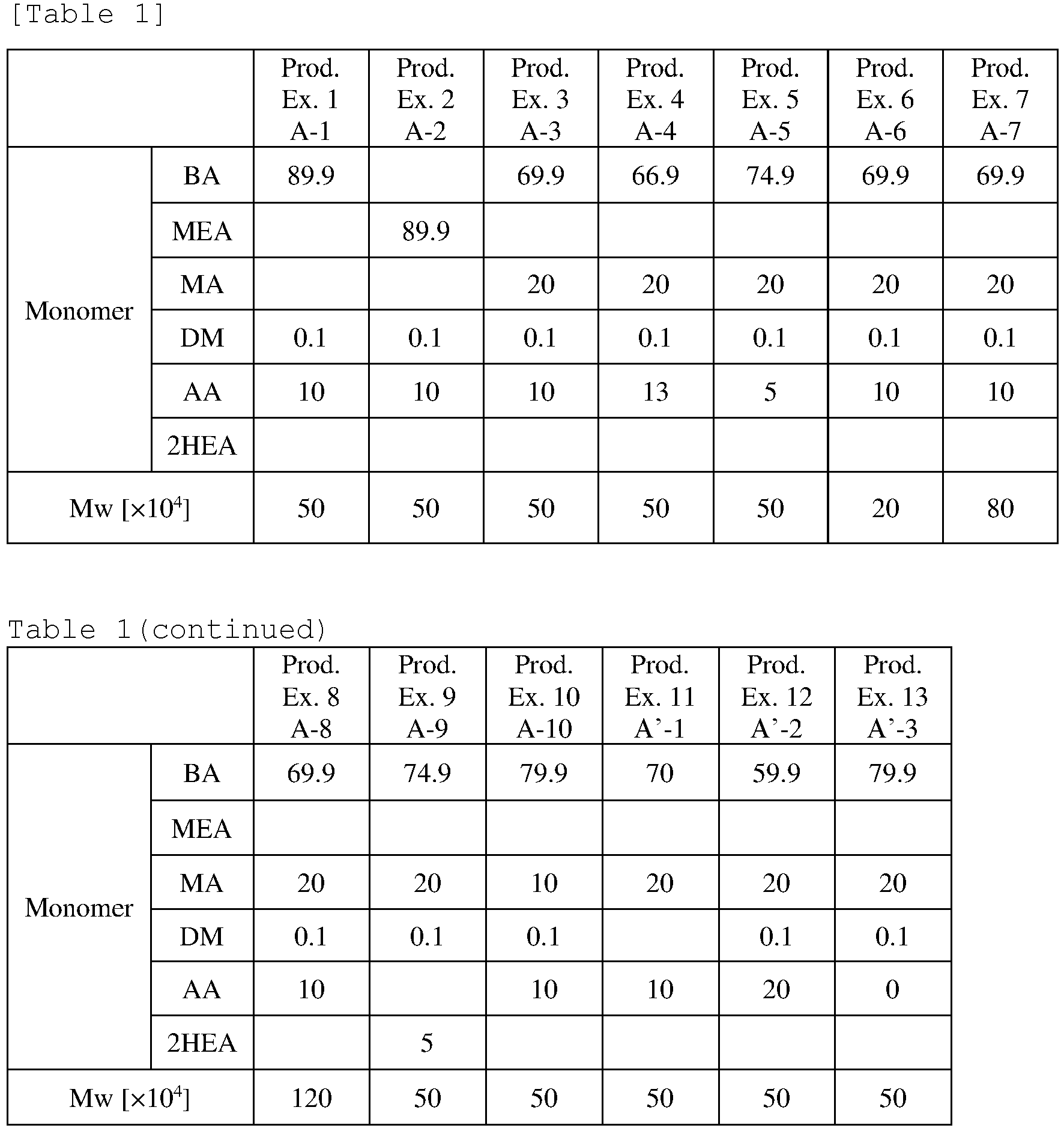


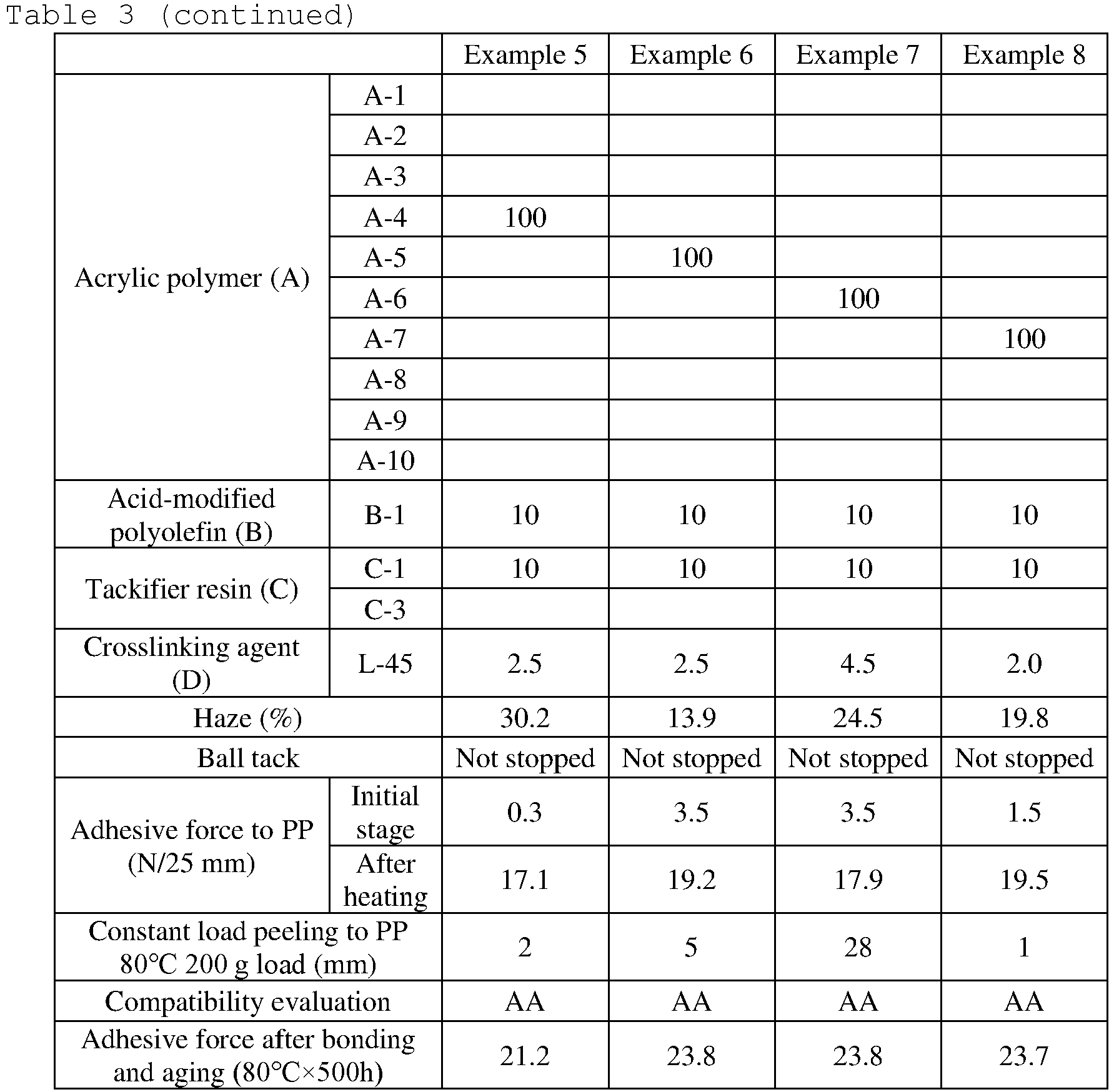


Claims (7)
- An adhesive composition comprising:a (meth)acrylic polymer (A) which is a polymer of monomer components comprising 55 to 99 mass% of at least one (meth)acrylic acid ester selected from an alkoxyalkyl (meth)acrylate ester and an alkyl (meth)acrylate ester having an alkyl group having 4 to 12 carbon atoms, 0.5 to 15 mass% of a crosslinkable functional group-containing monomer other than an amino group-containing monomer, and 0.01 to 5 mass% of an amino group-containing monomer;an acid-modified polyolefin (B);at least one tackifier resin (C) selected from a rosin tackifier resin (C1) and a terpene phenol tackifier resin (C2); anda crosslinking agent (D),the adhesive composition satisfying the following requirements (I) to (III):(I) a value of a ball tack test performed by a J. Dow method using an adhesive layer having a thickness of 50 um obtained from the adhesive composition is 5 or less,(II) an adhesive force in measurement after an adhesive surface of an adhesive layer having a thickness of 50 um obtained from the adhesive composition is bonded to a polypropylene plate and left to stand for 20 minutes in an environment at 80°C is 10.0 N/25 mm or more, and(III) when a test piece in which an adhesive surface of an adhesive layer having a thickness of 50 um obtained from the adhesive composition is bonded to a polypropylene plate in an area of 50 mm × 20 mm is left to stand for 20 minutes in an environment at 80°C and then a load of 200 g is applied to an end portion on one end side in a longitudinal direction of the test piece in an environment at 80°C, a peeling amount of the adhesive layer after 1 hour from the start of application of a load is 30 mm or less.
- The adhesive composition according to claim 1, wherein the amino group of the amino group-containing monomer is a tertiary amino group.
- The adhesive composition according to claim 1 or 2, wherein the (meth)acrylic polymer (A) is a polymer of monomer components comprising 60 to 94 mass% of an alkyl (meth)acrylate ester having an alkyl group having 4 to 12 carbon atoms, 0.5 to 15 mass% of a crosslinkable functional group-containing monomer other than the amino group-containing monomer, 0.01 to 5 mass% of the amino group-containing monomer, and 5 to 30 mass% of an alkyl (meth)acrylate ester having an alkyl group having 1 to 3 carbon atoms.
- The adhesive composition according to any one of claims 1 to 3, wherein the crosslinkable functional group-containing monomer other than the amino group-containing monomer is (meth)acrylic acid.
- The adhesive composition according to any one of claims 1 to 4, wherein the adhesive composition comprises 5 to 20 parts by mass of the acid-modified polyolefin (B) and 5 to 50 parts by mass of the tackifier resin (C) with respect to 100 parts by mass of the (meth)acrylic polymer (A).
- The adhesive composition according to any one of claims 1 to 5, wherein a haze of an adhesive layer having a thickness of 50 um obtained from the adhesive composition is less than 35%.
- An adhesive sheet comprising:a substrate; andan adhesive layer provided on the substrate, the adhesive layer being obtained from the adhesive composition according to any one of claims 1 to 6.
Applications Claiming Priority (2)
| Application Number | Priority Date | Filing Date | Title |
|---|---|---|---|
| JP2020122157 | 2020-07-16 | ||
| PCT/JP2021/024447 WO2022014313A1 (en) | 2020-07-16 | 2021-06-29 | Adhesive agent composition and adhesive sheet |
Publications (3)
| Publication Number | Publication Date |
|---|---|
| EP4183849A1 true EP4183849A1 (en) | 2023-05-24 |
| EP4183849A4 EP4183849A4 (en) | 2024-08-14 |
| EP4183849B1 EP4183849B1 (en) | 2025-05-07 |
Family
ID=79555272
Family Applications (1)
| Application Number | Title | Priority Date | Filing Date |
|---|---|---|---|
| EP21841435.7A Active EP4183849B1 (en) | 2020-07-16 | 2021-06-29 | Adhesive agent composition and adhesive sheet |
Country Status (6)
| Country | Link |
|---|---|
| US (1) | US20230265319A1 (en) |
| EP (1) | EP4183849B1 (en) |
| JP (1) | JP7499335B2 (en) |
| KR (1) | KR20230039613A (en) |
| CN (1) | CN116194545B (en) |
| WO (1) | WO2022014313A1 (en) |
Families Citing this family (2)
| Publication number | Priority date | Publication date | Assignee | Title |
|---|---|---|---|---|
| JP7385795B1 (en) * | 2022-10-19 | 2023-11-24 | 東洋インキScホールディングス株式会社 | Adhesives, adhesive sheets, laminates, and displays |
| WO2024204149A1 (en) * | 2023-03-31 | 2024-10-03 | 三井化学株式会社 | Adhesive composition and method for producing same, and adhesive sheet |
Family Cites Families (14)
| Publication number | Priority date | Publication date | Assignee | Title |
|---|---|---|---|---|
| JP5028767B2 (en) * | 2005-08-24 | 2012-09-19 | 荒川化学工業株式会社 | Tackifying resin emulsion, method for producing the same, and aqueous adhesive composition |
| JP5116226B2 (en) * | 2005-09-07 | 2013-01-09 | 三洋化成工業株式会社 | Antistatic adhesive |
| JP2008024755A (en) * | 2006-07-18 | 2008-02-07 | Chuo Rika Kogyo Corp | Thermoplastic resin aqueous dispersion |
| JP2008266596A (en) | 2007-03-23 | 2008-11-06 | Arakawa Chem Ind Co Ltd | Polymeric rosin ester, hydrogenated polymeric rosin ester, production method of these esters, as well as adhesion imparted resin, adhesion imparted resin emulsion and viscous adhesive composition using these esters |
| JP2008260903A (en) | 2007-04-13 | 2008-10-30 | Unitika Ltd | Water-based adhesive |
| JP2010084068A (en) * | 2008-10-01 | 2010-04-15 | Kaneka Corp | Adhesive |
| US20120088111A1 (en) * | 2009-06-11 | 2012-04-12 | Sumitomo Chemical Company, Limited | Aqueous emulsion |
| CN102666764B (en) | 2009-11-19 | 2015-09-30 | 3M创新有限公司 | Comprise the pressure sensitive adhesive with the functionalized polyisobutylene of acrylic polymers hydrogen bonded |
| JP6150536B2 (en) * | 2012-01-31 | 2017-06-21 | 日本合成化学工業株式会社 | Masking adhesive film and method of using the adhesive film |
| EP3294783A1 (en) * | 2015-05-11 | 2018-03-21 | 3M Innovative Properties Company | High performance (meth)acrylate adhesive composition |
| CN111247222B (en) * | 2017-11-06 | 2022-08-05 | 综研化学株式会社 | Adhesive composition, adhesive and adhesive sheet |
| JP7528419B2 (en) | 2018-06-28 | 2024-08-06 | 東亞合成株式会社 | Adhesive sheet |
| WO2020004355A1 (en) * | 2018-06-28 | 2020-01-02 | 東亞合成株式会社 | Adhesive sheet |
| JP2020063376A (en) * | 2018-10-18 | 2020-04-23 | 東洋インキScホールディングス株式会社 | Adhesive, adhesive sheet, and method for producing adhesive |
-
2021
- 2021-06-29 JP JP2022536228A patent/JP7499335B2/en active Active
- 2021-06-29 WO PCT/JP2021/024447 patent/WO2022014313A1/en not_active Ceased
- 2021-06-29 EP EP21841435.7A patent/EP4183849B1/en active Active
- 2021-06-29 US US18/005,363 patent/US20230265319A1/en active Pending
- 2021-06-29 KR KR1020227044494A patent/KR20230039613A/en active Pending
- 2021-06-29 CN CN202180061054.7A patent/CN116194545B/en active Active
Also Published As
| Publication number | Publication date |
|---|---|
| CN116194545B (en) | 2025-08-26 |
| EP4183849A4 (en) | 2024-08-14 |
| US20230265319A1 (en) | 2023-08-24 |
| JPWO2022014313A1 (en) | 2022-01-20 |
| CN116194545A (en) | 2023-05-30 |
| JP7499335B2 (en) | 2024-06-13 |
| EP4183849B1 (en) | 2025-05-07 |
| WO2022014313A1 (en) | 2022-01-20 |
| KR20230039613A (en) | 2023-03-21 |
Similar Documents
| Publication | Publication Date | Title |
|---|---|---|
| KR102275848B1 (en) | Adhesive composition and adhesive sheet | |
| JP7089346B2 (en) | Image display device | |
| JP7007100B2 (en) | Adhesive composition and adhesive sheet | |
| CN113999633B (en) | Adhesive compositions and adhesive sheets | |
| US20160222255A1 (en) | Pressure-sensitive adhesive sheet for mobile electronic devices | |
| KR20200081397A (en) | Adhesive composition, adhesive, and adhesive sheet | |
| EP4183849B1 (en) | Adhesive agent composition and adhesive sheet | |
| CN103571358A (en) | Protective film | |
| EP3048151B1 (en) | Water-dispersed pressure-sensitive adhesive composition and pressure-sensitive adhesive sheet | |
| KR20170127402A (en) | Adhesive composition, adhesive agent, and adhesive sheet | |
| EP4389844A1 (en) | Adhesive sheet | |
| JP7390281B2 (en) | Double-sided adhesive sheet and its uses | |
| JPH08120248A (en) | Acrylic adhesive composition | |
| JP7256809B2 (en) | Adhesive composition and adhesive tape | |
| KR102371911B1 (en) | (meth)acrylic copolymer and manufacturing method thereof, pressure-sensitive adhesive composition, and pressure-sensitive adhesive sheet | |
| JP6839495B2 (en) | Adhesive composition and adhesive sheet | |
| JP7570928B2 (en) | Reinforcement laminate film | |
| JPWO2018025808A1 (en) | (Meth) acrylic triblock copolymer, method for producing the same, pressure-sensitive adhesive composition and pressure-sensitive adhesive sheet | |
| JP7820357B2 (en) | Pressure-sensitive adhesive composition and pressure-sensitive adhesive sheet | |
| EP3492543A1 (en) | Pressure-sensitive adhesive sheet | |
| JP2023137396A (en) | Optically clear adhesive sheet | |
| US20230159793A1 (en) | Crosslinking adhesive composition and adhesive tape | |
| JP7611745B2 (en) | Adhesive composition and adhesive sheet | |
| KR20250040502A (en) | Pressure-sensitive adhesive composition for surface protection and surface protection film | |
| WO2024190594A1 (en) | Pressure-sensitive adhesive composition, and method for producing pressure-sensitive adhesive layer |
Legal Events
| Date | Code | Title | Description |
|---|---|---|---|
| STAA | Information on the status of an ep patent application or granted ep patent |
Free format text: STATUS: THE INTERNATIONAL PUBLICATION HAS BEEN MADE |
|
| PUAI | Public reference made under article 153(3) epc to a published international application that has entered the european phase |
Free format text: ORIGINAL CODE: 0009012 |
|
| STAA | Information on the status of an ep patent application or granted ep patent |
Free format text: STATUS: REQUEST FOR EXAMINATION WAS MADE |
|
| 17P | Request for examination filed |
Effective date: 20230215 |
|
| AK | Designated contracting states |
Kind code of ref document: A1 Designated state(s): AL AT BE BG CH CY CZ DE DK EE ES FI FR GB GR HR HU IE IS IT LI LT LU LV MC MK MT NL NO PL PT RO RS SE SI SK SM TR |
|
| DAV | Request for validation of the european patent (deleted) | ||
| DAX | Request for extension of the european patent (deleted) | ||
| A4 | Supplementary search report drawn up and despatched |
Effective date: 20240715 |
|
| RIC1 | Information provided on ipc code assigned before grant |
Ipc: C09J 7/38 20180101ALI20240709BHEP Ipc: C09J 7/24 20180101ALI20240709BHEP Ipc: C09J 133/04 20060101ALI20240709BHEP Ipc: C09J 123/26 20060101ALI20240709BHEP Ipc: C09J 11/08 20060101ALI20240709BHEP Ipc: C09J 11/06 20060101AFI20240709BHEP |
|
| GRAP | Despatch of communication of intention to grant a patent |
Free format text: ORIGINAL CODE: EPIDOSNIGR1 |
|
| STAA | Information on the status of an ep patent application or granted ep patent |
Free format text: STATUS: GRANT OF PATENT IS INTENDED |
|
| INTG | Intention to grant announced |
Effective date: 20250129 |
|
| GRAS | Grant fee paid |
Free format text: ORIGINAL CODE: EPIDOSNIGR3 |
|
| GRAA | (expected) grant |
Free format text: ORIGINAL CODE: 0009210 |
|
| STAA | Information on the status of an ep patent application or granted ep patent |
Free format text: STATUS: THE PATENT HAS BEEN GRANTED |
|
| AK | Designated contracting states |
Kind code of ref document: B1 Designated state(s): AL AT BE BG CH CY CZ DE DK EE ES FI FR GB GR HR HU IE IS IT LI LT LU LV MC MK MT NL NO PL PT RO RS SE SI SK SM TR |
|
| REG | Reference to a national code |
Ref country code: GB Ref legal event code: FG4D |
|
| REG | Reference to a national code |
Ref country code: CH Ref legal event code: EP |
|
| REG | Reference to a national code |
Ref country code: DE Ref legal event code: R096 Ref document number: 602021030581 Country of ref document: DE |
|
| REG | Reference to a national code |
Ref country code: IE Ref legal event code: FG4D |
|
| PGFP | Annual fee paid to national office [announced via postgrant information from national office to epo] |
Ref country code: DE Payment date: 20250618 Year of fee payment: 5 |
|
| PGFP | Annual fee paid to national office [announced via postgrant information from national office to epo] |
Ref country code: AT Payment date: 20250721 Year of fee payment: 5 |
|
| REG | Reference to a national code |
Ref country code: NL Ref legal event code: MP Effective date: 20250507 |
|
| PG25 | Lapsed in a contracting state [announced via postgrant information from national office to epo] |
Ref country code: FI Free format text: LAPSE BECAUSE OF FAILURE TO SUBMIT A TRANSLATION OF THE DESCRIPTION OR TO PAY THE FEE WITHIN THE PRESCRIBED TIME-LIMIT Effective date: 20250507 Ref country code: PT Free format text: LAPSE BECAUSE OF FAILURE TO SUBMIT A TRANSLATION OF THE DESCRIPTION OR TO PAY THE FEE WITHIN THE PRESCRIBED TIME-LIMIT Effective date: 20250908 Ref country code: ES Free format text: LAPSE BECAUSE OF FAILURE TO SUBMIT A TRANSLATION OF THE DESCRIPTION OR TO PAY THE FEE WITHIN THE PRESCRIBED TIME-LIMIT Effective date: 20250507 |
|
| REG | Reference to a national code |
Ref country code: LT Ref legal event code: MG9D |
|
| PG25 | Lapsed in a contracting state [announced via postgrant information from national office to epo] |
Ref country code: NO Free format text: LAPSE BECAUSE OF FAILURE TO SUBMIT A TRANSLATION OF THE DESCRIPTION OR TO PAY THE FEE WITHIN THE PRESCRIBED TIME-LIMIT Effective date: 20250807 Ref country code: GR Free format text: LAPSE BECAUSE OF FAILURE TO SUBMIT A TRANSLATION OF THE DESCRIPTION OR TO PAY THE FEE WITHIN THE PRESCRIBED TIME-LIMIT Effective date: 20250808 |
|
| PG25 | Lapsed in a contracting state [announced via postgrant information from national office to epo] |
Ref country code: NL Free format text: LAPSE BECAUSE OF FAILURE TO SUBMIT A TRANSLATION OF THE DESCRIPTION OR TO PAY THE FEE WITHIN THE PRESCRIBED TIME-LIMIT Effective date: 20250507 Ref country code: PL Free format text: LAPSE BECAUSE OF FAILURE TO SUBMIT A TRANSLATION OF THE DESCRIPTION OR TO PAY THE FEE WITHIN THE PRESCRIBED TIME-LIMIT Effective date: 20250507 |
|
| REG | Reference to a national code |
Ref country code: AT Ref legal event code: MK05 Ref document number: 1792469 Country of ref document: AT Kind code of ref document: T Effective date: 20250507 |
|
| PG25 | Lapsed in a contracting state [announced via postgrant information from national office to epo] |
Ref country code: BG Free format text: LAPSE BECAUSE OF FAILURE TO SUBMIT A TRANSLATION OF THE DESCRIPTION OR TO PAY THE FEE WITHIN THE PRESCRIBED TIME-LIMIT Effective date: 20250507 |
|
| PG25 | Lapsed in a contracting state [announced via postgrant information from national office to epo] |
Ref country code: HR Free format text: LAPSE BECAUSE OF FAILURE TO SUBMIT A TRANSLATION OF THE DESCRIPTION OR TO PAY THE FEE WITHIN THE PRESCRIBED TIME-LIMIT Effective date: 20250507 |
|
| PG25 | Lapsed in a contracting state [announced via postgrant information from national office to epo] |
Ref country code: AT Free format text: LAPSE BECAUSE OF FAILURE TO SUBMIT A TRANSLATION OF THE DESCRIPTION OR TO PAY THE FEE WITHIN THE PRESCRIBED TIME-LIMIT Effective date: 20250507 |
|
| PGFP | Annual fee paid to national office [announced via postgrant information from national office to epo] |
Ref country code: FR Payment date: 20250701 Year of fee payment: 5 |
|
| PG25 | Lapsed in a contracting state [announced via postgrant information from national office to epo] |
Ref country code: RS Free format text: LAPSE BECAUSE OF FAILURE TO SUBMIT A TRANSLATION OF THE DESCRIPTION OR TO PAY THE FEE WITHIN THE PRESCRIBED TIME-LIMIT Effective date: 20250807 |
|
| PG25 | Lapsed in a contracting state [announced via postgrant information from national office to epo] |
Ref country code: IS Free format text: LAPSE BECAUSE OF FAILURE TO SUBMIT A TRANSLATION OF THE DESCRIPTION OR TO PAY THE FEE WITHIN THE PRESCRIBED TIME-LIMIT Effective date: 20250907 |
|
| PG25 | Lapsed in a contracting state [announced via postgrant information from national office to epo] |
Ref country code: LV Free format text: LAPSE BECAUSE OF FAILURE TO SUBMIT A TRANSLATION OF THE DESCRIPTION OR TO PAY THE FEE WITHIN THE PRESCRIBED TIME-LIMIT Effective date: 20250507 |
|
| PG25 | Lapsed in a contracting state [announced via postgrant information from national office to epo] |
Ref country code: SM Free format text: LAPSE BECAUSE OF FAILURE TO SUBMIT A TRANSLATION OF THE DESCRIPTION OR TO PAY THE FEE WITHIN THE PRESCRIBED TIME-LIMIT Effective date: 20250507 Ref country code: DK Free format text: LAPSE BECAUSE OF FAILURE TO SUBMIT A TRANSLATION OF THE DESCRIPTION OR TO PAY THE FEE WITHIN THE PRESCRIBED TIME-LIMIT Effective date: 20250507 |
|
| PG25 | Lapsed in a contracting state [announced via postgrant information from national office to epo] |
Ref country code: CZ Free format text: LAPSE BECAUSE OF FAILURE TO SUBMIT A TRANSLATION OF THE DESCRIPTION OR TO PAY THE FEE WITHIN THE PRESCRIBED TIME-LIMIT Effective date: 20250507 |
|
| PG25 | Lapsed in a contracting state [announced via postgrant information from national office to epo] |
Ref country code: EE Free format text: LAPSE BECAUSE OF FAILURE TO SUBMIT A TRANSLATION OF THE DESCRIPTION OR TO PAY THE FEE WITHIN THE PRESCRIBED TIME-LIMIT Effective date: 20250507 |
|
| PG25 | Lapsed in a contracting state [announced via postgrant information from national office to epo] |
Ref country code: SK Free format text: LAPSE BECAUSE OF FAILURE TO SUBMIT A TRANSLATION OF THE DESCRIPTION OR TO PAY THE FEE WITHIN THE PRESCRIBED TIME-LIMIT Effective date: 20250507 |
|
| REG | Reference to a national code |
Ref country code: CH Ref legal event code: H13 Free format text: ST27 STATUS EVENT CODE: U-0-0-H10-H13 (AS PROVIDED BY THE NATIONAL OFFICE) Effective date: 20260127 |
|
| PG25 | Lapsed in a contracting state [announced via postgrant information from national office to epo] |
Ref country code: IT Free format text: LAPSE BECAUSE OF FAILURE TO SUBMIT A TRANSLATION OF THE DESCRIPTION OR TO PAY THE FEE WITHIN THE PRESCRIBED TIME-LIMIT Effective date: 20250507 |
|
| REG | Reference to a national code |
Ref country code: DE Ref legal event code: R097 Ref document number: 602021030581 Country of ref document: DE |
|
| PG25 | Lapsed in a contracting state [announced via postgrant information from national office to epo] |
Ref country code: LU Free format text: LAPSE BECAUSE OF NON-PAYMENT OF DUE FEES Effective date: 20250629 |
|
| PG25 | Lapsed in a contracting state [announced via postgrant information from national office to epo] |
Ref country code: MC Free format text: LAPSE BECAUSE OF FAILURE TO SUBMIT A TRANSLATION OF THE DESCRIPTION OR TO PAY THE FEE WITHIN THE PRESCRIBED TIME-LIMIT Effective date: 20250507 |
|
| REG | Reference to a national code |
Ref country code: BE Ref legal event code: MM Effective date: 20250630 |
|
| PG25 | Lapsed in a contracting state [announced via postgrant information from national office to epo] |
Ref country code: RO Free format text: LAPSE BECAUSE OF FAILURE TO SUBMIT A TRANSLATION OF THE DESCRIPTION OR TO PAY THE FEE WITHIN THE PRESCRIBED TIME-LIMIT Effective date: 20250507 |
|
| PLBE | No opposition filed within time limit |
Free format text: ORIGINAL CODE: 0009261 |
|
| STAA | Information on the status of an ep patent application or granted ep patent |
Free format text: STATUS: NO OPPOSITION FILED WITHIN TIME LIMIT |
|
| REG | Reference to a national code |
Ref country code: CH Ref legal event code: L10 Free format text: ST27 STATUS EVENT CODE: U-0-0-L10-L00 (AS PROVIDED BY THE NATIONAL OFFICE) Effective date: 20260318 |
|
| PG25 | Lapsed in a contracting state [announced via postgrant information from national office to epo] |
Ref country code: IE Free format text: LAPSE BECAUSE OF NON-PAYMENT OF DUE FEES Effective date: 20250629 |
|
| 26N | No opposition filed |
Effective date: 20260210 |
|
| PG25 | Lapsed in a contracting state [announced via postgrant information from national office to epo] |
Ref country code: BE Free format text: LAPSE BECAUSE OF NON-PAYMENT OF DUE FEES Effective date: 20250630 |
|
| PG25 | Lapsed in a contracting state [announced via postgrant information from national office to epo] |
Ref country code: CH Free format text: LAPSE BECAUSE OF NON-PAYMENT OF DUE FEES Effective date: 20250630 |
|
| GBPC | Gb: european patent ceased through non-payment of renewal fee |
Effective date: 20250807 |