EP4183813A1 - Crystalline polyamide resin, resin composition, and molded article - Google Patents
Crystalline polyamide resin, resin composition, and molded article Download PDFInfo
- Publication number
- EP4183813A1 EP4183813A1 EP21842847.2A EP21842847A EP4183813A1 EP 4183813 A1 EP4183813 A1 EP 4183813A1 EP 21842847 A EP21842847 A EP 21842847A EP 4183813 A1 EP4183813 A1 EP 4183813A1
- Authority
- EP
- European Patent Office
- Prior art keywords
- component unit
- polyamide resin
- derived
- acid
- mol
- Prior art date
- Legal status (The legal status is an assumption and is not a legal conclusion. Google has not performed a legal analysis and makes no representation as to the accuracy of the status listed.)
- Pending
Links
- 229920005989 resin Polymers 0.000 title claims abstract description 89
- 239000011347 resin Substances 0.000 title claims abstract description 89
- 229920006039 crystalline polyamide Polymers 0.000 title claims abstract description 66
- 239000011342 resin composition Substances 0.000 title claims description 37
- 150000004985 diamines Chemical class 0.000 claims abstract description 64
- OFOBLEOULBTSOW-UHFFFAOYSA-N Malonic acid Chemical compound OC(=O)CC(O)=O OFOBLEOULBTSOW-UHFFFAOYSA-N 0.000 claims abstract description 51
- 125000005263 alkylenediamine group Chemical group 0.000 claims abstract description 33
- KKEYFWRCBNTPAC-UHFFFAOYSA-N Terephthalic acid Chemical compound OC(=O)C1=CC=C(C(O)=O)C=C1 KKEYFWRCBNTPAC-UHFFFAOYSA-N 0.000 claims abstract description 24
- 125000004432 carbon atom Chemical group C* 0.000 claims abstract description 24
- QYQADNCHXSEGJT-UHFFFAOYSA-N cyclohexane-1,1-dicarboxylate;hydron Chemical compound OC(=O)C1(C(O)=O)CCCCC1 QYQADNCHXSEGJT-UHFFFAOYSA-N 0.000 claims abstract description 7
- KYTZHLUVELPASH-UHFFFAOYSA-N naphthalene-1,2-dicarboxylic acid Chemical compound C1=CC=CC2=C(C(O)=O)C(C(=O)O)=CC=C21 KYTZHLUVELPASH-UHFFFAOYSA-N 0.000 claims abstract description 7
- 238000002844 melting Methods 0.000 claims description 31
- 230000008018 melting Effects 0.000 claims description 31
- NAQMVNRVTILPCV-UHFFFAOYSA-N hexane-1,6-diamine Chemical compound NCCCCCCN NAQMVNRVTILPCV-UHFFFAOYSA-N 0.000 claims description 29
- 230000009477 glass transition Effects 0.000 claims description 25
- QQVIHTHCMHWDBS-UHFFFAOYSA-N isophthalic acid Chemical compound OC(=O)C1=CC=CC(C(O)=O)=C1 QQVIHTHCMHWDBS-UHFFFAOYSA-N 0.000 claims description 14
- WNLRTRBMVRJNCN-UHFFFAOYSA-N adipic acid Chemical compound OC(=O)CCCCC(O)=O WNLRTRBMVRJNCN-UHFFFAOYSA-N 0.000 claims description 8
- KIDHWZJUCRJVML-UHFFFAOYSA-N putrescine Chemical compound NCCCCN KIDHWZJUCRJVML-UHFFFAOYSA-N 0.000 claims description 6
- JZUHIOJYCPIVLQ-UHFFFAOYSA-N 2-methylpentane-1,5-diamine Chemical compound NCC(C)CCCN JZUHIOJYCPIVLQ-UHFFFAOYSA-N 0.000 claims description 4
- 239000001361 adipic acid Substances 0.000 claims description 4
- 235000011037 adipic acid Nutrition 0.000 claims description 4
- YQLZOAVZWJBZSY-UHFFFAOYSA-N decane-1,10-diamine Chemical compound NCCCCCCCCCCN YQLZOAVZWJBZSY-UHFFFAOYSA-N 0.000 claims description 4
- 239000005700 Putrescine Substances 0.000 claims description 3
- SXJVFQLYZSNZBT-UHFFFAOYSA-N nonane-1,9-diamine Chemical compound NCCCCCCCCCN SXJVFQLYZSNZBT-UHFFFAOYSA-N 0.000 claims description 3
- 229920006122 polyamide resin Polymers 0.000 abstract description 90
- 125000003118 aryl group Chemical group 0.000 description 14
- 239000000835 fiber Substances 0.000 description 14
- 125000004122 cyclic group Chemical group 0.000 description 13
- 230000004927 fusion Effects 0.000 description 13
- 238000000465 moulding Methods 0.000 description 13
- 239000012765 fibrous filler Substances 0.000 description 12
- -1 aliphatic diamine Chemical class 0.000 description 11
- 239000004952 Polyamide Substances 0.000 description 10
- QAOWNCQODCNURD-UHFFFAOYSA-N Sulfuric acid Chemical compound OS(O)(=O)=O QAOWNCQODCNURD-UHFFFAOYSA-N 0.000 description 10
- RPYFJVIASOJLJS-UHFFFAOYSA-N [3-(aminomethyl)-2-bicyclo[2.2.1]heptanyl]methanamine Chemical compound C1CC2C(CN)C(CN)C1C2 RPYFJVIASOJLJS-UHFFFAOYSA-N 0.000 description 10
- 229920002647 polyamide Polymers 0.000 description 10
- IJGRMHOSHXDMSA-UHFFFAOYSA-N Atomic nitrogen Chemical compound N#N IJGRMHOSHXDMSA-UHFFFAOYSA-N 0.000 description 8
- 239000000446 fuel Substances 0.000 description 8
- 125000001931 aliphatic group Chemical group 0.000 description 7
- 238000010438 heat treatment Methods 0.000 description 7
- 229920006012 semi-aromatic polyamide Polymers 0.000 description 7
- XLYOFNOQVPJJNP-UHFFFAOYSA-N water Substances O XLYOFNOQVPJJNP-UHFFFAOYSA-N 0.000 description 7
- 239000012298 atmosphere Substances 0.000 description 6
- 239000002981 blocking agent Substances 0.000 description 6
- 238000006243 chemical reaction Methods 0.000 description 6
- 238000001746 injection moulding Methods 0.000 description 6
- 239000000203 mixture Substances 0.000 description 6
- 239000012488 sample solution Substances 0.000 description 6
- 239000000243 solution Substances 0.000 description 6
- 230000032683 aging Effects 0.000 description 5
- 125000002723 alicyclic group Chemical group 0.000 description 5
- WPYMKLBDIGXBTP-UHFFFAOYSA-N benzoic acid Chemical compound OC(=O)C1=CC=CC=C1 WPYMKLBDIGXBTP-UHFFFAOYSA-N 0.000 description 5
- XMSVKICKONKVNM-UHFFFAOYSA-N bicyclo[2.2.1]heptane-3,4-diamine Chemical compound C1CC2(N)C(N)CC1C2 XMSVKICKONKVNM-UHFFFAOYSA-N 0.000 description 5
- 238000002474 experimental method Methods 0.000 description 5
- 238000002347 injection Methods 0.000 description 5
- 239000007924 injection Substances 0.000 description 5
- 230000015572 biosynthetic process Effects 0.000 description 4
- 230000000694 effects Effects 0.000 description 4
- 239000003365 glass fiber Substances 0.000 description 4
- 238000005259 measurement Methods 0.000 description 4
- 238000000034 method Methods 0.000 description 4
- 229910052757 nitrogen Inorganic materials 0.000 description 4
- CXMXRPHRNRROMY-UHFFFAOYSA-N sebacic acid Chemical compound OC(=O)CCCCCCCCC(O)=O CXMXRPHRNRROMY-UHFFFAOYSA-N 0.000 description 4
- 238000003786 synthesis reaction Methods 0.000 description 4
- QTBSBXVTEAMEQO-UHFFFAOYSA-N Acetic acid Chemical compound CC(O)=O QTBSBXVTEAMEQO-UHFFFAOYSA-N 0.000 description 3
- 238000005452 bending Methods 0.000 description 3
- 229920001577 copolymer Polymers 0.000 description 3
- 238000002425 crystallisation Methods 0.000 description 3
- 230000008025 crystallization Effects 0.000 description 3
- 239000000945 filler Substances 0.000 description 3
- 230000014759 maintenance of location Effects 0.000 description 3
- 238000002156 mixing Methods 0.000 description 3
- 238000006068 polycondensation reaction Methods 0.000 description 3
- 239000010456 wollastonite Substances 0.000 description 3
- 229910052882 wollastonite Inorganic materials 0.000 description 3
- GVJHHUAWPYXKBD-UHFFFAOYSA-N (±)-α-Tocopherol Chemical compound OC1=C(C)C(C)=C2OC(CCCC(C)CCCC(C)CCCC(C)C)(C)CCC2=C1C GVJHHUAWPYXKBD-UHFFFAOYSA-N 0.000 description 2
- 239000004953 Aliphatic polyamide Substances 0.000 description 2
- PAYRUJLWNCNPSJ-UHFFFAOYSA-N Aniline Chemical compound NC1=CC=CC=C1 PAYRUJLWNCNPSJ-UHFFFAOYSA-N 0.000 description 2
- 239000005711 Benzoic acid Substances 0.000 description 2
- FERIUCNNQQJTOY-UHFFFAOYSA-N Butyric acid Chemical compound CCCC(O)=O FERIUCNNQQJTOY-UHFFFAOYSA-N 0.000 description 2
- VTYYLEPIZMXCLO-UHFFFAOYSA-L Calcium carbonate Chemical compound [Ca+2].[O-]C([O-])=O VTYYLEPIZMXCLO-UHFFFAOYSA-L 0.000 description 2
- HEDRZPFGACZZDS-UHFFFAOYSA-N Chloroform Chemical compound ClC(Cl)Cl HEDRZPFGACZZDS-UHFFFAOYSA-N 0.000 description 2
- QUSNBJAOOMFDIB-UHFFFAOYSA-N Ethylamine Chemical compound CCN QUSNBJAOOMFDIB-UHFFFAOYSA-N 0.000 description 2
- CSNNHWWHGAXBCP-UHFFFAOYSA-L Magnesium sulfate Chemical compound [Mg+2].[O-][S+2]([O-])([O-])[O-] CSNNHWWHGAXBCP-UHFFFAOYSA-L 0.000 description 2
- BAVYZALUXZFZLV-UHFFFAOYSA-N Methylamine Chemical compound NC BAVYZALUXZFZLV-UHFFFAOYSA-N 0.000 description 2
- OAICVXFJPJFONN-UHFFFAOYSA-N Phosphorus Chemical compound [P] OAICVXFJPJFONN-UHFFFAOYSA-N 0.000 description 2
- 239000004696 Poly ether ether ketone Substances 0.000 description 2
- 239000004734 Polyphenylene sulfide Substances 0.000 description 2
- XLOMVQKBTHCTTD-UHFFFAOYSA-N Zinc monoxide Chemical compound [Zn]=O XLOMVQKBTHCTTD-UHFFFAOYSA-N 0.000 description 2
- KEUCYUPOICDBOG-UHFFFAOYSA-N [2-(aminomethyl)-5-bicyclo[2.2.1]heptanyl]methanamine Chemical compound C1C2C(CN)CC1C(CN)C2 KEUCYUPOICDBOG-UHFFFAOYSA-N 0.000 description 2
- OTKFKCIRTBTDKK-UHFFFAOYSA-N [3-(aminomethyl)-5-bicyclo[2.2.1]heptanyl]methanamine Chemical compound C1C(CN)C2C(CN)CC1C2 OTKFKCIRTBTDKK-UHFFFAOYSA-N 0.000 description 2
- 229920003231 aliphatic polyamide Polymers 0.000 description 2
- 125000002947 alkylene group Chemical group 0.000 description 2
- XAGFODPZIPBFFR-UHFFFAOYSA-N aluminium Chemical compound [Al] XAGFODPZIPBFFR-UHFFFAOYSA-N 0.000 description 2
- 229910052782 aluminium Inorganic materials 0.000 description 2
- 150000001412 amines Chemical class 0.000 description 2
- 239000003963 antioxidant agent Substances 0.000 description 2
- 235000006708 antioxidants Nutrition 0.000 description 2
- 235000010233 benzoic acid Nutrition 0.000 description 2
- HQABUPZFAYXKJW-UHFFFAOYSA-N butan-1-amine Chemical compound CCCCN HQABUPZFAYXKJW-UHFFFAOYSA-N 0.000 description 2
- 150000001732 carboxylic acid derivatives Chemical class 0.000 description 2
- 238000001816 cooling Methods 0.000 description 2
- NZNMSOFKMUBTKW-UHFFFAOYSA-N cyclohexanecarboxylic acid Chemical compound OC(=O)C1CCCCC1 NZNMSOFKMUBTKW-UHFFFAOYSA-N 0.000 description 2
- PAFZNILMFXTMIY-UHFFFAOYSA-N cyclohexylamine Chemical compound NC1CCCCC1 PAFZNILMFXTMIY-UHFFFAOYSA-N 0.000 description 2
- XBDQKXXYIPTUBI-UHFFFAOYSA-N dimethylselenoniopropionate Natural products CCC(O)=O XBDQKXXYIPTUBI-UHFFFAOYSA-N 0.000 description 2
- NJLLQSBAHIKGKF-UHFFFAOYSA-N dipotassium dioxido(oxo)titanium Chemical compound [K+].[K+].[O-][Ti]([O-])=O NJLLQSBAHIKGKF-UHFFFAOYSA-N 0.000 description 2
- 238000006073 displacement reaction Methods 0.000 description 2
- 239000012153 distilled water Substances 0.000 description 2
- POULHZVOKOAJMA-UHFFFAOYSA-N dodecanoic acid Chemical compound CCCCCCCCCCCC(O)=O POULHZVOKOAJMA-UHFFFAOYSA-N 0.000 description 2
- 229920001971 elastomer Polymers 0.000 description 2
- 150000002148 esters Chemical class 0.000 description 2
- VXNZUUAINFGPBY-UHFFFAOYSA-N ethyl ethylene Natural products CCC=C VXNZUUAINFGPBY-UHFFFAOYSA-N 0.000 description 2
- 239000002828 fuel tank Substances 0.000 description 2
- IPCSVZSSVZVIGE-UHFFFAOYSA-N hexadecanoic acid Chemical compound CCCCCCCCCCCCCCCC(O)=O IPCSVZSSVZVIGE-UHFFFAOYSA-N 0.000 description 2
- FUZZWVXGSFPDMH-UHFFFAOYSA-N hexanoic acid Chemical compound CCCCCC(O)=O FUZZWVXGSFPDMH-UHFFFAOYSA-N 0.000 description 2
- 230000001771 impaired effect Effects 0.000 description 2
- 238000004898 kneading Methods 0.000 description 2
- 239000000155 melt Substances 0.000 description 2
- 150000002762 monocarboxylic acid derivatives Chemical class 0.000 description 2
- 239000012299 nitrogen atmosphere Substances 0.000 description 2
- BDJRBEYXGGNYIS-UHFFFAOYSA-N nonanedioic acid Chemical compound OC(=O)CCCCCCCC(O)=O BDJRBEYXGGNYIS-UHFFFAOYSA-N 0.000 description 2
- WWZKQHOCKIZLMA-UHFFFAOYSA-N octanoic acid Chemical compound CCCCCCCC(O)=O WWZKQHOCKIZLMA-UHFFFAOYSA-N 0.000 description 2
- 239000002245 particle Substances 0.000 description 2
- WLJVXDMOQOGPHL-UHFFFAOYSA-N phenylacetic acid Chemical compound OC(=O)CC1=CC=CC=C1 WLJVXDMOQOGPHL-UHFFFAOYSA-N 0.000 description 2
- 239000011574 phosphorus Substances 0.000 description 2
- 229910052698 phosphorus Inorganic materials 0.000 description 2
- 230000000704 physical effect Effects 0.000 description 2
- WLJVNTCWHIRURA-UHFFFAOYSA-N pimelic acid Chemical compound OC(=O)CCCCCC(O)=O WLJVNTCWHIRURA-UHFFFAOYSA-N 0.000 description 2
- 229920002530 polyetherether ketone Polymers 0.000 description 2
- 229920000642 polymer Polymers 0.000 description 2
- 238000006116 polymerization reaction Methods 0.000 description 2
- 229920000069 polyphenylene sulfide Polymers 0.000 description 2
- WGYKZJWCGVVSQN-UHFFFAOYSA-N propylamine Chemical compound CCCN WGYKZJWCGVVSQN-UHFFFAOYSA-N 0.000 description 2
- CYIDZMCFTVVTJO-UHFFFAOYSA-N pyromellitic acid Chemical compound OC(=O)C1=CC(C(O)=O)=C(C(O)=O)C=C1C(O)=O CYIDZMCFTVVTJO-UHFFFAOYSA-N 0.000 description 2
- 239000000523 sample Substances 0.000 description 2
- KOUDKOMXLMXFKX-UHFFFAOYSA-N sodium oxido(oxo)phosphanium hydrate Chemical compound O.[Na+].[O-][PH+]=O KOUDKOMXLMXFKX-UHFFFAOYSA-N 0.000 description 2
- 239000007921 spray Substances 0.000 description 2
- 238000003756 stirring Methods 0.000 description 2
- TYFQFVWCELRYAO-UHFFFAOYSA-N suberic acid Chemical compound OC(=O)CCCCCCC(O)=O TYFQFVWCELRYAO-UHFFFAOYSA-N 0.000 description 2
- 238000009864 tensile test Methods 0.000 description 2
- SZHOJFHSIKHZHA-UHFFFAOYSA-N tridecanoic acid Chemical compound CCCCCCCCCCCCC(O)=O SZHOJFHSIKHZHA-UHFFFAOYSA-N 0.000 description 2
- ARCGXLSVLAOJQL-UHFFFAOYSA-N trimellitic acid Chemical compound OC(=O)C1=CC=C(C(O)=O)C(C(O)=O)=C1 ARCGXLSVLAOJQL-UHFFFAOYSA-N 0.000 description 2
- NQPDZGIKBAWPEJ-UHFFFAOYSA-N valeric acid Chemical compound CCCCC(O)=O NQPDZGIKBAWPEJ-UHFFFAOYSA-N 0.000 description 2
- WRIDQFICGBMAFQ-UHFFFAOYSA-N (E)-8-Octadecenoic acid Natural products CCCCCCCCCC=CCCCCCCC(O)=O WRIDQFICGBMAFQ-UHFFFAOYSA-N 0.000 description 1
- DYLIWHYUXAJDOJ-OWOJBTEDSA-N (e)-4-(6-aminopurin-9-yl)but-2-en-1-ol Chemical compound NC1=NC=NC2=C1N=CN2C\C=C\CO DYLIWHYUXAJDOJ-OWOJBTEDSA-N 0.000 description 1
- BYEAHWXPCBROCE-UHFFFAOYSA-N 1,1,1,3,3,3-hexafluoropropan-2-ol Chemical compound FC(F)(F)C(O)C(F)(F)F BYEAHWXPCBROCE-UHFFFAOYSA-N 0.000 description 1
- 150000005208 1,4-dihydroxybenzenes Chemical class 0.000 description 1
- PWGJDPKCLMLPJW-UHFFFAOYSA-N 1,8-diaminooctane Chemical compound NCCCCCCCCN PWGJDPKCLMLPJW-UHFFFAOYSA-N 0.000 description 1
- RTBFRGCFXZNCOE-UHFFFAOYSA-N 1-methylsulfonylpiperidin-4-one Chemical compound CS(=O)(=O)N1CCC(=O)CC1 RTBFRGCFXZNCOE-UHFFFAOYSA-N 0.000 description 1
- LNETULKMXZVUST-UHFFFAOYSA-N 1-naphthoic acid Chemical compound C1=CC=C2C(C(=O)O)=CC=CC2=C1 LNETULKMXZVUST-UHFFFAOYSA-N 0.000 description 1
- GBURUDXSBYGPBL-UHFFFAOYSA-N 2,2,3-trimethylhexanedioic acid Chemical compound OC(=O)C(C)(C)C(C)CCC(O)=O GBURUDXSBYGPBL-UHFFFAOYSA-N 0.000 description 1
- WKRCUUPMCASSBN-UHFFFAOYSA-N 2,2-diethylbutanedioic acid Chemical compound CCC(CC)(C(O)=O)CC(O)=O WKRCUUPMCASSBN-UHFFFAOYSA-N 0.000 description 1
- BTUDGPVTCYNYLK-UHFFFAOYSA-N 2,2-dimethylglutaric acid Chemical compound OC(=O)C(C)(C)CCC(O)=O BTUDGPVTCYNYLK-UHFFFAOYSA-N 0.000 description 1
- JZUMVFMLJGSMRF-UHFFFAOYSA-N 2-Methyladipic acid Chemical compound OC(=O)C(C)CCCC(O)=O JZUMVFMLJGSMRF-UHFFFAOYSA-N 0.000 description 1
- ZSPDYGICHBLYSD-UHFFFAOYSA-N 2-methylnaphthalene-1-carboxylic acid Chemical compound C1=CC=CC2=C(C(O)=O)C(C)=CC=C21 ZSPDYGICHBLYSD-UHFFFAOYSA-N 0.000 description 1
- GAGWMWLBYJPFDD-UHFFFAOYSA-N 2-methyloctane-1,8-diamine Chemical compound NCC(C)CCCCCCN GAGWMWLBYJPFDD-UHFFFAOYSA-N 0.000 description 1
- UFMBOFGKHIXOTA-UHFFFAOYSA-N 2-methylterephthalic acid Chemical compound CC1=CC(C(O)=O)=CC=C1C(O)=O UFMBOFGKHIXOTA-UHFFFAOYSA-N 0.000 description 1
- LQJBNNIYVWPHFW-UHFFFAOYSA-N 20:1omega9c fatty acid Natural products CCCCCCCCCCC=CCCCCCCCC(O)=O LQJBNNIYVWPHFW-UHFFFAOYSA-N 0.000 description 1
- QSBYPNXLFMSGKH-UHFFFAOYSA-N 9-Heptadecensaeure Natural products CCCCCCCC=CCCCCCCCC(O)=O QSBYPNXLFMSGKH-UHFFFAOYSA-N 0.000 description 1
- 239000004135 Bone phosphate Substances 0.000 description 1
- WKBOTKDWSSQWDR-UHFFFAOYSA-N Bromine atom Chemical compound [Br] WKBOTKDWSSQWDR-UHFFFAOYSA-N 0.000 description 1
- 239000005635 Caprylic acid (CAS 124-07-2) Substances 0.000 description 1
- ZAMOUSCENKQFHK-UHFFFAOYSA-N Chlorine atom Chemical compound [Cl] ZAMOUSCENKQFHK-UHFFFAOYSA-N 0.000 description 1
- 229920000089 Cyclic olefin copolymer Polymers 0.000 description 1
- XBPCUCUWBYBCDP-UHFFFAOYSA-N Dicyclohexylamine Chemical compound C1CCCCC1NC1CCCCC1 XBPCUCUWBYBCDP-UHFFFAOYSA-N 0.000 description 1
- VGGSQFUCUMXWEO-UHFFFAOYSA-N Ethene Chemical compound C=C VGGSQFUCUMXWEO-UHFFFAOYSA-N 0.000 description 1
- 239000005977 Ethylene Substances 0.000 description 1
- 239000005639 Lauric acid Substances 0.000 description 1
- OYHQOLUKZRVURQ-HZJYTTRNSA-N Linoleic acid Chemical compound CCCCC\C=C/C\C=C/CCCCCCCC(O)=O OYHQOLUKZRVURQ-HZJYTTRNSA-N 0.000 description 1
- 239000005642 Oleic acid Substances 0.000 description 1
- ZQPPMHVWECSIRJ-UHFFFAOYSA-N Oleic acid Natural products CCCCCCCCC=CCCCCCCCC(O)=O ZQPPMHVWECSIRJ-UHFFFAOYSA-N 0.000 description 1
- 235000021314 Palmitic acid Nutrition 0.000 description 1
- 229920012266 Poly(ether sulfone) PES Polymers 0.000 description 1
- 229930182556 Polyacetal Natural products 0.000 description 1
- 239000004721 Polyphenylene oxide Substances 0.000 description 1
- 239000004793 Polystyrene Substances 0.000 description 1
- 235000021355 Stearic acid Nutrition 0.000 description 1
- KDYFGRWQOYBRFD-UHFFFAOYSA-N Succinic acid Natural products OC(=O)CCC(O)=O KDYFGRWQOYBRFD-UHFFFAOYSA-N 0.000 description 1
- NINIDFKCEFEMDL-UHFFFAOYSA-N Sulfur Chemical compound [S] NINIDFKCEFEMDL-UHFFFAOYSA-N 0.000 description 1
- 229930003427 Vitamin E Natural products 0.000 description 1
- OJMOMXZKOWKUTA-UHFFFAOYSA-N aluminum;borate Chemical compound [Al+3].[O-]B([O-])[O-] OJMOMXZKOWKUTA-UHFFFAOYSA-N 0.000 description 1
- 125000003277 amino group Chemical group 0.000 description 1
- JFCQEDHGNNZCLN-UHFFFAOYSA-N anhydrous glutaric acid Natural products OC(=O)CCCC(O)=O JFCQEDHGNNZCLN-UHFFFAOYSA-N 0.000 description 1
- 229910052787 antimony Inorganic materials 0.000 description 1
- WATWJIUSRGPENY-UHFFFAOYSA-N antimony atom Chemical compound [Sb] WATWJIUSRGPENY-UHFFFAOYSA-N 0.000 description 1
- 239000002216 antistatic agent Substances 0.000 description 1
- 150000004984 aromatic diamines Chemical class 0.000 description 1
- 230000004888 barrier function Effects 0.000 description 1
- 150000001558 benzoic acid derivatives Chemical class 0.000 description 1
- 239000012965 benzophenone Substances 0.000 description 1
- 150000008366 benzophenones Chemical class 0.000 description 1
- 150000001565 benzotriazoles Chemical class 0.000 description 1
- 230000000903 blocking effect Effects 0.000 description 1
- GDTBXPJZTBHREO-UHFFFAOYSA-N bromine Substances BrBr GDTBXPJZTBHREO-UHFFFAOYSA-N 0.000 description 1
- 229910052794 bromium Inorganic materials 0.000 description 1
- 239000004566 building material Substances 0.000 description 1
- KDYFGRWQOYBRFD-NUQCWPJISA-N butanedioic acid Chemical compound O[14C](=O)CC[14C](O)=O KDYFGRWQOYBRFD-NUQCWPJISA-N 0.000 description 1
- 229910000019 calcium carbonate Inorganic materials 0.000 description 1
- 238000003763 carbonization Methods 0.000 description 1
- 125000003178 carboxy group Chemical group [H]OC(*)=O 0.000 description 1
- 239000003054 catalyst Substances 0.000 description 1
- 239000003795 chemical substances by application Substances 0.000 description 1
- 239000000460 chlorine Substances 0.000 description 1
- 229910052801 chlorine Inorganic materials 0.000 description 1
- 150000001875 compounds Chemical class 0.000 description 1
- 238000000748 compression moulding Methods 0.000 description 1
- 229910052802 copper Inorganic materials 0.000 description 1
- 239000010949 copper Substances 0.000 description 1
- VZFUCHSFHOYXIS-UHFFFAOYSA-N cycloheptane carboxylic acid Natural products OC(=O)C1CCCCCC1 VZFUCHSFHOYXIS-UHFFFAOYSA-N 0.000 description 1
- 239000000806 elastomer Substances 0.000 description 1
- 238000005538 encapsulation Methods 0.000 description 1
- 238000001125 extrusion Methods 0.000 description 1
- 239000003063 flame retardant Substances 0.000 description 1
- 230000008014 freezing Effects 0.000 description 1
- 238000007710 freezing Methods 0.000 description 1
- WIGCFUFOHFEKBI-UHFFFAOYSA-N gamma-tocopherol Natural products CC(C)CCCC(C)CCCC(C)CCCC1CCC2C(C)C(O)C(C)C(C)C2O1 WIGCFUFOHFEKBI-UHFFFAOYSA-N 0.000 description 1
- 239000012760 heat stabilizer Substances 0.000 description 1
- PWSKHLMYTZNYKO-UHFFFAOYSA-N heptane-1,7-diamine Chemical compound NCCCCCCCN PWSKHLMYTZNYKO-UHFFFAOYSA-N 0.000 description 1
- 239000012770 industrial material Substances 0.000 description 1
- 239000012796 inorganic flame retardant Substances 0.000 description 1
- 150000002497 iodine compounds Chemical class 0.000 description 1
- QXJSBBXBKPUZAA-UHFFFAOYSA-N isooleic acid Natural products CCCCCCCC=CCCCCCCCCC(O)=O QXJSBBXBKPUZAA-UHFFFAOYSA-N 0.000 description 1
- 239000004611 light stabiliser Substances 0.000 description 1
- OYHQOLUKZRVURQ-IXWMQOLASA-N linoleic acid Natural products CCCCC\C=C/C\C=C\CCCCCCCC(O)=O OYHQOLUKZRVURQ-IXWMQOLASA-N 0.000 description 1
- 235000020778 linoleic acid Nutrition 0.000 description 1
- 229910052943 magnesium sulfate Inorganic materials 0.000 description 1
- 235000019341 magnesium sulphate Nutrition 0.000 description 1
- 238000004519 manufacturing process Methods 0.000 description 1
- 239000000463 material Substances 0.000 description 1
- WQEPLUUGTLDZJY-UHFFFAOYSA-N n-Pentadecanoic acid Natural products CCCCCCCCCCCCCCC(O)=O WQEPLUUGTLDZJY-UHFFFAOYSA-N 0.000 description 1
- 210000003739 neck Anatomy 0.000 description 1
- 239000002667 nucleating agent Substances 0.000 description 1
- ZWLPBLYKEWSWPD-UHFFFAOYSA-N o-toluic acid Chemical compound CC1=CC=CC=C1C(O)=O ZWLPBLYKEWSWPD-UHFFFAOYSA-N 0.000 description 1
- QIQXTHQIDYTFRH-UHFFFAOYSA-N octadecanoic acid Chemical compound CCCCCCCCCCCCCCCCCC(O)=O QIQXTHQIDYTFRH-UHFFFAOYSA-N 0.000 description 1
- OQCDKBAXFALNLD-UHFFFAOYSA-N octadecanoic acid Natural products CCCCCCCC(C)CCCCCCCCC(O)=O OQCDKBAXFALNLD-UHFFFAOYSA-N 0.000 description 1
- 229960002446 octanoic acid Drugs 0.000 description 1
- ZQPPMHVWECSIRJ-KTKRTIGZSA-N oleic acid Chemical compound CCCCCCCC\C=C/CCCCCCCC(O)=O ZQPPMHVWECSIRJ-KTKRTIGZSA-N 0.000 description 1
- 235000021313 oleic acid Nutrition 0.000 description 1
- 230000003287 optical effect Effects 0.000 description 1
- 239000008188 pellet Substances 0.000 description 1
- 150000002989 phenols Chemical class 0.000 description 1
- 229960003424 phenylacetic acid Drugs 0.000 description 1
- 239000003279 phenylacetic acid Substances 0.000 description 1
- 229920002492 poly(sulfone) Polymers 0.000 description 1
- 239000004417 polycarbonate Substances 0.000 description 1
- 229920000515 polycarbonate Polymers 0.000 description 1
- 229920000098 polyolefin Polymers 0.000 description 1
- 229920006324 polyoxymethylene Polymers 0.000 description 1
- 229920006380 polyphenylene oxide Polymers 0.000 description 1
- 229920002223 polystyrene Polymers 0.000 description 1
- 238000002360 preparation method Methods 0.000 description 1
- 235000019260 propionic acid Nutrition 0.000 description 1
- QQONPFPTGQHPMA-UHFFFAOYSA-N propylene Natural products CC=C QQONPFPTGQHPMA-UHFFFAOYSA-N 0.000 description 1
- 125000004805 propylene group Chemical group [H]C([H])([H])C([H])([*:1])C([H])([H])[*:2] 0.000 description 1
- 238000010298 pulverizing process Methods 0.000 description 1
- IUVKMZGDUIUOCP-BTNSXGMBSA-N quinbolone Chemical compound O([C@H]1CC[C@H]2[C@H]3[C@@H]([C@]4(C=CC(=O)C=C4CC3)C)CC[C@@]21C)C1=CCCC1 IUVKMZGDUIUOCP-BTNSXGMBSA-N 0.000 description 1
- 239000002994 raw material Substances 0.000 description 1
- 229920002050 silicone resin Polymers 0.000 description 1
- 239000003381 stabilizer Substances 0.000 description 1
- 239000008117 stearic acid Substances 0.000 description 1
- 230000035882 stress Effects 0.000 description 1
- 239000000126 substance Substances 0.000 description 1
- 125000001424 substituent group Chemical group 0.000 description 1
- 239000011593 sulfur Substances 0.000 description 1
- 229910052717 sulfur Inorganic materials 0.000 description 1
- TUNFSRHWOTWDNC-HKGQFRNVSA-N tetradecanoic acid Chemical compound CCCCCCCCCCCCC[14C](O)=O TUNFSRHWOTWDNC-HKGQFRNVSA-N 0.000 description 1
- 150000004992 toluidines Chemical class 0.000 description 1
- 230000007704 transition Effects 0.000 description 1
- 150000003918 triazines Chemical class 0.000 description 1
- 229940005605 valeric acid Drugs 0.000 description 1
- 235000019165 vitamin E Nutrition 0.000 description 1
- 229940046009 vitamin E Drugs 0.000 description 1
- 239000011709 vitamin E Substances 0.000 description 1
- 239000011787 zinc oxide Substances 0.000 description 1
Images

Classifications
-
- C—CHEMISTRY; METALLURGY
- C08—ORGANIC MACROMOLECULAR COMPOUNDS; THEIR PREPARATION OR CHEMICAL WORKING-UP; COMPOSITIONS BASED THEREON
- C08G—MACROMOLECULAR COMPOUNDS OBTAINED OTHERWISE THAN BY REACTIONS ONLY INVOLVING UNSATURATED CARBON-TO-CARBON BONDS
- C08G69/00—Macromolecular compounds obtained by reactions forming a carboxylic amide link in the main chain of the macromolecule
- C08G69/02—Polyamides derived from amino-carboxylic acids or from polyamines and polycarboxylic acids
- C08G69/26—Polyamides derived from amino-carboxylic acids or from polyamines and polycarboxylic acids derived from polyamines and polycarboxylic acids
-
- C—CHEMISTRY; METALLURGY
- C08—ORGANIC MACROMOLECULAR COMPOUNDS; THEIR PREPARATION OR CHEMICAL WORKING-UP; COMPOSITIONS BASED THEREON
- C08G—MACROMOLECULAR COMPOUNDS OBTAINED OTHERWISE THAN BY REACTIONS ONLY INVOLVING UNSATURATED CARBON-TO-CARBON BONDS
- C08G69/00—Macromolecular compounds obtained by reactions forming a carboxylic amide link in the main chain of the macromolecule
- C08G69/02—Polyamides derived from amino-carboxylic acids or from polyamines and polycarboxylic acids
- C08G69/26—Polyamides derived from amino-carboxylic acids or from polyamines and polycarboxylic acids derived from polyamines and polycarboxylic acids
- C08G69/265—Polyamides derived from amino-carboxylic acids or from polyamines and polycarboxylic acids derived from polyamines and polycarboxylic acids from at least two different diamines or at least two different dicarboxylic acids
-
- B—PERFORMING OPERATIONS; TRANSPORTING
- B29—WORKING OF PLASTICS; WORKING OF SUBSTANCES IN A PLASTIC STATE IN GENERAL
- B29C—SHAPING OR JOINING OF PLASTICS; SHAPING OF MATERIAL IN A PLASTIC STATE, NOT OTHERWISE PROVIDED FOR; AFTER-TREATMENT OF THE SHAPED PRODUCTS, e.g. REPAIRING
- B29C48/00—Extrusion moulding, i.e. expressing the moulding material through a die or nozzle which imparts the desired form; Apparatus therefor
- B29C48/022—Extrusion moulding, i.e. expressing the moulding material through a die or nozzle which imparts the desired form; Apparatus therefor characterised by the choice of material
-
- B—PERFORMING OPERATIONS; TRANSPORTING
- B29—WORKING OF PLASTICS; WORKING OF SUBSTANCES IN A PLASTIC STATE IN GENERAL
- B29C—SHAPING OR JOINING OF PLASTICS; SHAPING OF MATERIAL IN A PLASTIC STATE, NOT OTHERWISE PROVIDED FOR; AFTER-TREATMENT OF THE SHAPED PRODUCTS, e.g. REPAIRING
- B29C48/00—Extrusion moulding, i.e. expressing the moulding material through a die or nozzle which imparts the desired form; Apparatus therefor
- B29C48/25—Component parts, details or accessories; Auxiliary operations
- B29C48/36—Means for plasticising or homogenising the moulding material or forcing it through the nozzle or die
- B29C48/395—Means for plasticising or homogenising the moulding material or forcing it through the nozzle or die using screws surrounded by a cooperating barrel, e.g. single screw extruders
- B29C48/40—Means for plasticising or homogenising the moulding material or forcing it through the nozzle or die using screws surrounded by a cooperating barrel, e.g. single screw extruders using two or more parallel screws or at least two parallel non-intermeshing screws, e.g. twin screw extruders
-
- C—CHEMISTRY; METALLURGY
- C08—ORGANIC MACROMOLECULAR COMPOUNDS; THEIR PREPARATION OR CHEMICAL WORKING-UP; COMPOSITIONS BASED THEREON
- C08L—COMPOSITIONS OF MACROMOLECULAR COMPOUNDS
- C08L77/00—Compositions of polyamides obtained by reactions forming a carboxylic amide link in the main chain; Compositions of derivatives of such polymers
- C08L77/06—Polyamides derived from polyamines and polycarboxylic acids
-
- B—PERFORMING OPERATIONS; TRANSPORTING
- B29—WORKING OF PLASTICS; WORKING OF SUBSTANCES IN A PLASTIC STATE IN GENERAL
- B29K—INDEXING SCHEME ASSOCIATED WITH SUBCLASSES B29B, B29C OR B29D, RELATING TO MOULDING MATERIALS OR TO MATERIALS FOR MOULDS, REINFORCEMENTS, FILLERS OR PREFORMED PARTS, e.g. INSERTS
- B29K2077/00—Use of PA, i.e. polyamides, e.g. polyesteramides or derivatives thereof, as moulding material
-
- C—CHEMISTRY; METALLURGY
- C08—ORGANIC MACROMOLECULAR COMPOUNDS; THEIR PREPARATION OR CHEMICAL WORKING-UP; COMPOSITIONS BASED THEREON
- C08K—Use of inorganic or non-macromolecular organic substances as compounding ingredients
- C08K7/00—Use of ingredients characterised by shape
- C08K7/02—Fibres or whiskers
- C08K7/04—Fibres or whiskers inorganic
- C08K7/14—Glass
Definitions
- the present invention relates to a crystalline polyamide resin, a resin composition, and a molded article.
- Polyamide resins have been widely used as materials for various parts in the applications of clothing, industrial materials, and automobiles, and electrical and electronic and industrial applications due to the excellent moldability, mechanical properties, and chemical resistance of the resins.
- Patent Literature (hereinafter, referred to as PTL) 1 describes the usage of bis(aminomethyl)norbornane as a diamine component to be used in producing of a polyamide by polycondensation of a dicarboxylic acid component and the diamine component.
- PTL 1 discloses that the polyamide containing, as the diamine component, equimolar bis(aminomethyl)norbornane and 2-methylpentamethylenediamine is transparent and has a high freezing point.
- the diamine component is selected in such a way that no crystallization occurs during the cooling in order to increase the transparency of the polyamide.
- PTL 2 discloses that bis(aminomethyl)norbornane used as the diamine component is a mixture of 2,5-bis(aminomethyl)norbornane and 2,6-bis(aminomethyl)norbornane at equivalent amounts, and the molar ratio of the bis(aminomethyl)norbornane is set to 20 mol% or less, thereby obtaining a transparent polyamide having a high transition temperature.
- PTL 3 meanwhile discloses that setting of the content of bis(aminomethyl)norbornane to 17 wt% or more can increase the glass transition point of the obtained polyamide to increase the heat resistance.
- PTL 3 discloses that the polyamide obtained by mixing hexamethylenediamine and bis(aminomethyl)norbornane with the weight ratio of hexamethylenediamine/bis(aminomethyl)norbornane of 30/70 (molar ratio of 36/64) has a high glass transition point.
- polyamide resins having improved heat resistance due to the use of bis(aminomethyl)norbornane as a diamine component are known.
- the polyamide resins described in PTLs 1 to 3 are amorphous transparent polyamides with no melting point observed. Therefore, although the polyamide resins are suitable for applications such as films that require transparency, these polyamide resins have low fluidity during injection molding and low mechanical strength.
- a polyamide resin used as a part for electrical equipment is required to have higher electrical resistance in order to be applied to the downsized electrical equipment of recent years.
- a polyamide resin is required to exhibit high mechanical strength and electrical resistance in a high temperature range (around 150°C).
- the present invention was made in view of the circumstances described above and an object of the present invention is to provide a polyamide resin that is crystalline and capable of exhibit high mechanical strength and electrical resistance in a high temperature range (around 150°C), a resin composition containing the polyamide resin, and a molded article containing the polyamide resin.
- a crystalline polyamide resin relating to an embodiment of the present invention contains a dicarboxylic acid-derived component unit (a); and a diamine-derived component unit (b), in which the dicarboxylic acid-derived component unit (a) contains a component unit (a1) derived from terephthalic acid, naphthalenedicarboxylic acid, or cyclohexanedicarboxylic acid, the content of the component unit (a1) is more than 20 mol% and 100 mol% or less based on the total number of moles of the dicarboxylic acid-derived component unit (a), and the diamine-derived component unit (b) contains a component unit (b1) derived from an alkylenediamine having 4 to 18 carbon atoms and a component unit (b2) derived from a diamine represented by the following formula (1): in formula (1),
- a resin composition relating to another embodiment of the present invention contains the crystalline polyamide resin.
- a molded article relating to yet another embodiment of the present invention contains the resin composition.
- the present invention can provide a polyamide resin that is crystalline and capable of exhibit high mechanical strength and electrical resistance in a high temperature range (around 150°C), a resin composition containing the polyamide resin, and a molded article containing the polyamide resin.
- an alkylenediamine having at least one cyclic structure cross-linked within the same ring (the diamine represented by formula (1)) has low mobility because of the large rotational barrier (energy) due to the cyclic structure. Therefore, the alkylenediamine having such a cyclic structure can increase the glass transition temperature (Tg) of a resin as compared to an alkylenediamine having no such cyclic structure. This is considered why a crystalline polyamide resin having a component unit derived from a diamine having such a cyclic structure has high mechanical strength even in a high temperature range. For the same reason, it is considered that the crystalline polyamide resin having the component unit derived from the diamine having the above described cyclic structure can maintain high mechanical strength even in a high temperature range.
- wholly aromatic polymers such as polyether sulfone (PES), polyphenylene sulfide (PPS), and polyether ether ketone (PEEK)
- PES polyether sulfone
- PPS polyphenylene sulfide
- PEEK polyether ether ketone
- semi-aromatic polyamides which have a smaller number of aromatic rings, and aliphatic polyamides suffer less tracking and have high electrical resistance.
- a crystalline polyamide having a component unit derived from the diamine having the above-described cyclic structure and maintaining its crystallinity without becoming completely amorphous is considered to have the following features: high fluidity during injection molding and mechanical strength due to its crystallinity, and has high mechanical strength and electrical resistance even in a high temperature range due to its high glass transition temperature (Tg); and is more likely to maintain the high mechanical strength and electrical resistance.
- the crystalline polyamide resin contains a dicarboxylic acid-derived component unit (a) and a diamine-derived component unit (b), and as the diamine-derived component unit (b), contains a component unit (b2) derived from a diamine represented by formula (1).
- the melting point (Tm) of the crystalline polyamide resin is observed with a differential scanning calorimeter (DSC).
- the melting point (Tm) of the crystalline polyamide resin is preferably 270°C or more and 360°C or less.
- a crystalline polyamide resin having a melting point (Tm) of 270°C or more is less likely to have impaired mechanical strength, heat resistance, and the like.
- a crystalline polyamide resin having a melting point (Tm) of 360°C or less is more likely to have improved moldability because the molding temperature does not need to be excessively high.
- the melting point (Tm) of the crystalline polyamide resin is more preferably 275°C or more and 330°C or less.
- the crystalline polyamide resin of the present invention has a reduced molecular orientation due to the above-described cyclic structure, thus has satisfactorily lowered crystallinity. Therefore, this crystalline polyamide resin has a satisfactorily low melting point (Tm) compared to other crystalline polyamide resins having a similar structure (for example, structures derived from an aromatic dicarboxylic acid and an alkylenediamine). This crystalline polyamide resin thus can be easily molded despite having high mechanical strength.
- Tm melting point
- the glass transition temperature (Tg) of the crystalline polyamide resin is preferably 140°C or more, more preferably 155°C or more.
- a crystalline polyamide resin having a glass transition temperature (Tg) of the above temperature or more is less likely to have impaired heat resistance, and can have increased mechanical strength and electrical resistance in a high temperature range.
- the upper limit of the glass transition temperature (Tg) of the crystalline polyamide resin is not limited, but may be 200°C from the viewpoint of not impairing the moldability.
- the heat of fusion ( ⁇ H) of the crystalline polyamide resin is preferably 10 mJ/mg or more.
- a crystalline polyamide resin having heat of fusion ( ⁇ H) of 10 mJ/mg or more is crystalline, and thus more likely to increase the fluidity during injection molding and the mechanical strength.
- the heat of fusion ( ⁇ H) of the crystalline polyamide resin is more preferably 15 mJ/mg, even more preferably 20 mJ/mg or more.
- the upper limit of the heat of fusion ( ⁇ H) of the crystalline polyamide resin is not limited, but may be 90 mJ/mg from the viewpoint of not impairing the moldability.
- the heat of fusion ( ⁇ H), melting point (Tm) and glass transition temperature (Tg) of the polyamide resin can be measured with a differential scanning calorimeter (DSC220C, manufactured by Seiko Instruments Inc.).
- the melting point (Tm), glass transition temperature (Tg), and heat of fusion ( ⁇ H) of the crystalline polyamide resin can be adjusted by the structure of the dicarboxylic acid-derived component unit (a), the content of the component unit (b2) derived from a diamine represented by formula (1), the content ratio of the component unit (b1) derived from an alkylenediamine having 4 to 18 carbon atoms to the component unit (b2) derived from a diamine represented by formula (1), and/or the number of carbon atoms in the alkylenediamine having 4 to 18 carbon atoms.
- the polyamide resin is preferably a semi-aromatic polyamide resin.
- the melting point (Tm) of a semi-aromatic polyamide resin usually does not exceed 340°C.
- the polyamide resin is preferably a semi-aromatic polyamide resin whose main component unit is formed of repeating units each composed of a component unit derived from an aromatic dicarboxylic acid or alicyclic dicarboxylic acid and a component unit derived from an aliphatic diamine. More preferred is a semi-aromatic polyamide resin formed of repeating units each composed of a component unit derived from an aromatic dicarboxylic acid and a component unit derived from an aliphatic diamine.
- the intrinsic viscosity [ ⁇ ] of the crystalline polyamide resin measured in 96.5% sulfuric acid at a temperature of 25°C is preferably 0.6 dl/g or more and 1.5 dl/g or less.
- a crystalline polyamide resin having intrinsic viscosity [ ⁇ ] of 0.6 dl/g or more is more likely to satisfactorily increase the mechanical strength (for example, toughness) of the molded article.
- a crystalline polyamide resin having intrinsic viscosity [ ⁇ ] of 1.5 dl/g or less is less likely to impair the fluidity of the resin composition during molding.
- the intrinsic viscosity [ ⁇ ] of the crystalline polyamide resin is more preferably 0.8 dl/g or more and 1.2 dl/g or less.
- the intrinsic viscosity [ ⁇ ] can be adjusted, for example, by the amount of terminal blocking of the crystalline polyamide resin.
- the intrinsic viscosity of the crystalline polyamide resin can be measured according to JIS K6810-1977.
- ⁇ SP t ⁇ t 0 / t 0
- the dicarboxylic acid-derived component unit (a) is not limited, but from the viewpoint of facilitating the increase of the melting point (Tm) and crystallinity, for example, the dicarboxylic acid-derived component unit (a) preferably contains a component unit derived from an aromatic dicarboxylic acid or an alicyclic dicarboxylic acid.
- the dicarboxylic acid-derived component unit (a) preferably contains a component unit derived from an aromatic dicarboxylic acid, more preferably contains a component unit derived from terephthalic acid.
- the content of the component unit derived from an aromatic dicarboxylic acid or an alicyclic dicarboxylic acid is not limited, but the total amount of the component unit is preferably 50 mol% or more and 100 mol% or less based on the total number of moles of the dicarboxylic acid-derived component unit (a).
- a crystalline polyamide resin containing the above-described component unit whose content is 50 mol % or more is more likely to have increased crystallinity. From the same viewpoint, the content of the above-described component unit is more preferably 70 mol% or more and 100 mol% or less.
- the dicarboxylic acid-derived component unit (a) contains a component unit (a1) derived from terephthalic acid, naphthalenedicarboxylic acid, and/or cyclohexanedicarboxylic acid.
- Component units (a1) derived from terephthalic acid, naphthalenedicarboxylic acid, and cyclohexanedicarboxylic acid can increase the crystallinity of a polyamide, unlike isophthalic acid used in, for example, PTLs 1 to 3.
- the content of the component unit (a1) is more than 20 mol% and 100 mol% or less based on the total number of moles of the dicarboxylic acid-derived component unit (a).
- the content of the component unit (a1) based on the total number of moles of the dicarboxylic acid-derived component unit (a) is preferably 45 mol% or more and 100 mol% or less, more preferably 50 mol% or more and 99 mol% or less, even more preferably more than 80 mol% and 99 mol% or less, and particularly preferably more than 90 mol% and 99 mol% or less.
- the dicarboxylic acid-derived component unit (a) may contain a component unit (a2) derived from an aromatic carboxylic acid other than the component unit (a1) or a component unit (a3) derived from an aliphatic dicarboxylic acid having 4 to 20 carbon atoms within ranges that do not impair the effects of the present invention.
- the content of component units derived from isophthalic acid and aliphatic dicarboxylic acid having 4 to 18 carbon atoms other than adipic acid is preferably small, specifically 20 mol% or less, more preferably 10 mol% or less, based on the total number of moles of the dicarboxylic acid-derived component unit (a).
- the component unit (a2) derived from an aromatic dicarboxylic acid other than terephthalic acid examples include component units derived from isophthalic acid and 2-methylterephthalic acid.
- a component unit derived from isophthalic acid is preferred.
- the content of the component unit (a2) is preferably 1 mol% or more and 50 mol% or less, more preferably 1 mol% or more and 20 mol% or less, even more preferably 1 mol% or more and 10 mol% or less, and particularly preferably 1 mol% or more and 5 mol% or less, based on the total number of moles of the dicarboxylic acid-derived component unit (a).
- the component unit (a3) derived from an aliphatic dicarboxylic acid is a component unit derived from an aliphatic dicarboxylic acid having an alkylene group having 4 to 20 carbon atoms, and preferably a component unit derived from an aliphatic dicarboxylic acid having an alkylene group having 6 to 12 carbon atoms.
- Examples of the aliphatic dicarboxylic acid include succinic acid, glutaric acid, adipic acid, 2-methyladipic acid, trimethyladipic acid, pimelic acid, 2,2-dimethylglutaric acid, 3,3-diethylsuccinic acid, azelaic acid, sebacic acid, and suberic acid.
- the content of the component unit (a3) is preferably 0 mol% or more and 40 mol% or less, more preferably 0 mol% or more and 20 mol% or less, even more preferably 1 mol% or more and 10 mol% or less, and particularly preferably 1 mol% or more and 5 mol% or less, based on the total number of moles of the dicarboxylic acid-derived component unit (a).
- the semi-aromatic polyamide resin (A) may further contain, in addition to the above-described component units (a1), (a2), and (a3), a small amount of a component unit derived from a tribasic or higher polyvalent carboxylic acid, such as trimellitic acid or pyromellitic acid.
- a component unit derived from a tribasic or higher polyvalent carboxylic acid such as trimellitic acid or pyromellitic acid.
- the content of such a polyvalent carboxylic acid component unit may be 0 mol% or more and 5 mol% or less based on the total number of moles of the dicarboxylic acid-derived component unit (a).
- the diamine-derived component unit (b) contains a component unit (b 1) derived from an alkylenediamine having 4 to 18 carbon atoms and a component unit (b2) derived from an alkylenediamine having a specific cyclic structure.
- Component unit (b1) derived from alkylenediamine having 4 to 18 carbon atoms
- the number of carbon atoms in the alkylenediamine having 4 to 18 carbon atoms is more preferably 4 or more and 10 or less from the viewpoint of minimizing the reduction of Tg of the resin.
- the alkylenediamine having 4 to 18 carbon atoms may include a linear alkylenediamine or a branched alkylenediamine. From the viewpoint of increasing the crystallinity of the resin, the alkylenediamine having 4 to 18 carbon atoms preferably includes a linear alkylenediamine. That is, the component unit derived from an alkylenediamine having 4 to 18 carbon atoms preferably contains a component unit derived from a linear alkylenediamine.
- alkylenediamine having 4 to 18 carbon atoms examples include linear alkylenediamines, such as 1,4-diaminobutane, 1,6-diaminohexane, 1,7-diaminoheptane, 1,8-octanediamine, 1,9-nonanediamine, and 1,10-decanediamine, and branched alkylenediamines, such as 2-methyl-1,5-pentanediamine and 2-methyl-1,8-octanediamine.
- linear alkylenediamines such as 1,4-diaminobutane, 1,6-diaminohexane, 1,7-diaminoheptane, 1,8-octanediamine, 1,9-nonanediamine, and 1,10-decanediamine
- branched alkylenediamines such as 2-methyl-1,5-pentanediamine and 2-methyl-1,8-octanediamine.
- 1,4-diaminobutane, 1,6-diaminohexane, 1,9-nonanediamine, 1,10-decanediamine, and 2-methyl-1,5-pentanediamine are preferred, and 1,6-diaminohexane and 1,10-decanediamine are more preferred.
- the above-described alkylenediamines may be used individually or in combination.
- Component unit (b2) derived from alkylenediamine having specific cyclic structure
- the alkylenediamine having a specific cyclic structure is a diamine represented by following formula (1).
- n and two m's are each independently 0 or 1
- -X- is a single bond or a divalent group selected from the group consisting of -O-, -S-, -SO 2 -, -CO-, and -CH 2 -.
- a diamine with one or both of the two m's being 1 is more likely to increase the mechanical strength of the polyamide resin and maintain high mechanical strength of the polyamide resin.
- the diamine represented by formula (1) has geometrical isomers (for example, trans isomer and cis isomer), any isomer may be used, and the ratio of the isomers is not limited.
- the content of the component unit (b2) derived from a diamine represented by formula (1) is not limited, so long as a crystalline polyamide resin whose melting point (Tm) is observed with DSC can be obtained. That is, the content of the component unit (b2) derived from a diamine represented by formula (1) depends on the number of carbon atoms and the content of the alkylenediamine having 4 to 18 carbon atoms to be used in combination, but is preferably 10 mol% or more and 45 mol% or less based on the total number of moles of the diamine-derived component unit (b).
- a component unit (b2) of 10 mol % or more is more likely to increase the glass transition temperature (Tg) of the polyamide resin to increase mechanical strength and electrical resistance in a high temperature range, and maintain the high mechanical strength and electrical resistance of the polyamide resin.
- a component unit (b2) of 10 mol % or more can satisfactorily lower the melting point (Tm) of the polyamide resin, and thus is more likely to increase the moldability of the polyamide resin.
- a component unit (b2) of 45 mol% or less is less likely to impair the crystallinity of the polyamide resin more than necessary (the resin is less likely to become amorphous), and thus is less likely to impair the fluidity during injection molding and mechanical strength of the resin.
- the content of the component unit (b2) derived from a diamine represented by formula (1) is more preferably 15 mol% or more and 45 mol% or less, even more preferably 25 mol% or more and 40 mol% or less, and particularly preferably 27 mol% or more and 38 mol% or less, based on the total number of moles of the diamine-derived component unit (b).
- the diamine-derived component unit (b) may further contain a component unit (b3) derived from another diamine within a range that does not impair the effects of the present invention.
- a component unit (b3) derived from another diamine within a range that does not impair the effects of the present invention.
- the diamine for the component unit (b3) include aromatic diamines and alicyclic diamines.
- the content of the component unit (b3) derived from another diamine may be 50 mol% or less based on the total number of moles of the diamine-derived component unit (b).
- the terminal groups of at least some molecules may be blocked with a terminal blocking agent from the viewpoint of increasing thermal stability of a compound or during the molding and further increasing mechanical strength.
- the terminal blocking agent is preferably a monoamine when the terminals of the molecules are carboxyl group, and is preferably a monocarboxylic acid when the terminals of the molecules are amino group.
- Examples of the monoamine include aliphatic monoamines, such as methylamine, ethylamine, propylamine, and butylamine; alicyclic monoamines, such as cyclohexylamine and dicyclohexylamine; and aromatic monoamines, such as aniline and toluidine.
- aliphatic monoamines such as methylamine, ethylamine, propylamine, and butylamine
- alicyclic monoamines such as cyclohexylamine and dicyclohexylamine
- aromatic monoamines such as aniline and toluidine.
- the monocarboxylic acid examples include aliphatic monocarboxylic acids having 2 to 30 carbon atoms, such as acetic acid, propionic acid, butyric acid, valeric acid, caproic acid, caprylic acid, lauric acid, tridecylic acid, myristic acid, palmitic acid, stearic acid, oleic acid, and linoleic acid; aromatic monocarboxylic acids, such as benzoic acid, toluic acid, naphthalenecarboxylic acid, methylnaphthalenecarboxylic acid, and phenylacetic acid; and alicyclic monocarboxylic acids, such as cyclohexanecarboxylic acid.
- the aromatic monocarboxylic acids and alicyclic monocarboxylic acids may have a substituent on the cyclic structure moiety.
- the crystalline polyamide resin can be produced, for example, by polycondensation of the above-described dicarboxylic acid and diamine in a uniformly dissolved solution. Specifically, as described in WO03/085029 , a low-order condensate is obtained by heating the dicarboxylic acid and the diamine in the presence of a catalyst, and a shear stress is applied to the melt of this low-order condensate for subjecting the melt to polycondensation, thereby producing the crystalline polyamide resin.
- the above-described terminal blocking agent may be added to the reaction system.
- the intrinsic viscosity [ ⁇ ] (or molecular weight) of the crystalline polyamide resin can be adjusted by adjusting the amount of the terminal blocking agent to be added.
- the terminal blocking agent is added to the reaction system of the dicarboxylic acid and the diamine.
- the amount of the terminal blocking agent to be added is preferably 0.07 mol or less, more preferably 0.05 mol or less, based on 1 mol of the total dicarboxylic acid.
- a resin composition of the present invention contains the crystalline polyamide resin of the present invention.
- the content of the crystalline polyamide resin depends on the application of the resin composition, but may be, for example, 35 parts by mass or more and 95 parts by mass or less based on 100 parts by mass of the resin composition.
- a crystalline polyamide resin whose content is above a certain amount is more likely to exhibit the properties derived from the resin.
- the resin composition of the present invention may further contain one or more additional components other than the crystalline polyamide resin, as necessary.
- additional components include fibrous fillers, nucleating agents, elastomers (rubber), flame retardants (for example, bromine, chlorine, phosphorus, antimony, and inorganic flame retardants), fluidity improvers, antistatic agents, release agents, antioxidants (for example, phenols, amines, sulfur, and phosphorus antioxidants), heat stabilizers (lactone compounds, vitamin E, hydroquinones, copper halides, and iodine compounds), light stabilizers (for example, benzotriazoles, triazines, benzophenones, benzoates, hindered amines, and oxanilides), and other polymers (for example, polyolefins, olefin copolymers, such as ethylene/propylene copolymer, ethylene/1-butene copolymer, and propylene/1-butene copolymer, polystyrene, polyamide, polycarbonate, polyacetal, polysulfone, polyphenylene oxide,
- the fibrous filler can impart high mechanical strength to the resin composition.
- the fibrous filler include glass fibers, wollastonite, potassium titanate whiskers, calcium carbonate whiskers, aluminum borate whiskers, magnesium sulfate whiskers, zinc oxide whiskers, milled fibers, and cut fibers.
- the above-described fibrous fillers may be used individually or in combination.
- wollastonite, glass fibers, and potassium titanate whiskers are preferred and wollastonite and glass fibers are more preferred as they can easily increase, for example, the mechanical strength of the molded article.
- the average fiber length of the fibrous filler may be, for example, 1 ⁇ m or more and 20 mm or less, preferably 5 ⁇ m or more and 10 mm or less, from the viewpoints of the moldability of the resin composition and the mechanical strength and heat resistance of the obtained molded article.
- the aspect ratio of the fibrous filler may be, for example, 5 or more and 2,000 or less, preferably 30 or more and 600 or less.
- the average fiber length and average fiber diameter of the fibrous filler can be measured by the following method.
- ri is defined as the number of fibers having a fiber diameter of Di
- the weight average diameter (Dw) is calculated based on the following equation, and the weight average diameter (Dw) is used as the average fiber diameter of the fibrous filler.
- Weight average diameter Dw ⁇ ri ⁇ Di 2 / ⁇ ri ⁇ Di
- the content of the fibrous filler is not limited, and may be, for example, 15 parts by mass or more and 70 parts by mass or less based on the total of 100 parts by mass of the crystalline polyamide resin and the fibrous filler.
- the resin composition of the present invention can be prepared by mixing the above-described crystalline polyamide resin and, as necessary, additional component(s) by a known resin kneading method, such as a method using a Henschel mixer, V blender, ribbon blender, or tumbler blender.
- a resin kneading method such as a method using a Henschel mixer, V blender, ribbon blender, or tumbler blender.
- the resin composition can be produced, after the mixing, by melt-kneading the mixture in a single-screw extruder, multi-screw extruder, kneader, or Banbury mixer, and then granulating or pulverizing the resulting melt kneaded product.
- the resin composition of the present invention is molded by a known molding method, such as compression molding, injection molding, or extrusion molding, to be used as various molded articles.
- a molded article of the resin composition of the present invention can be used for various applications.
- automotive exterior parts such as radiator grilles, rear spoilers, wheel covers, wheel caps, cowl vent grilles, air outlet louvers, air scoops, hood bulges, sunroofs, sunroof rails, fenders, and back doors
- parts in automotive engine rooms such as cylinder-head covers, engine mounts, air intake manifolds, throttle bodies, air intake pipes, radiator tanks, radiator supports, water pump inlets, water pumps, water pump outlets, thermostat housings, cooling fans, fan shrouds, oil pans, oil filter housings, oil filler caps, oil level gauges, oil pumps, timing belts, timing belt covers, and engine covers
- automotive fuel system parts such as fuel caps, fuel filler tubes, automotive fuel tanks, fuel sender modules, fuel cutoff valves, quick connectors, canisters, fuel delivery pipes, and fuel filler necks
- automotive drive line parts such as shift lever housings and propeller shafts
- automotive chassis such as gearbox,
- the resin composition of the present invention has advantageous features, such as high mechanical strength and electrical resistance in a high temperature range, and thus can be suitably used for parts for electrical equipment.
- a sample solution was prepared by dissolving 0.5 g of a polyamide resin in 50 ml of 96.5% sulfuric acid solution according to JIS K6810-1977.
- the falling time (seconds) of the obtained sample solution was measured with an Ubbelohde viscometer under the condition of 25 ⁇ 0.05°C.
- Tm Melting point
- Tg Glass transition temperature
- ⁇ H Heat of fusion
- the heat of fusion ( ⁇ H), melting point (Tm) and glass transition temperature (Tg) of the polyamide resin were measured with a differential scanning calorimeter (DSC220C, manufactured by Seiko Instruments Inc.)
- a polyamide resin was sealed in an aluminum pan for measurement and heated from room temperature to 350°C at the rate of 10°C/min.
- the resin was held at 350°C for 3 minutes and then cooled to 30°C at the rate of 10°C/min. After allowed to stand at 30°C for 5 minutes, the resin was heated a second time to 350°C at the rate of 10°C/min.
- the endothermic peak temperature (°C) in this second heating was used as the melting point (Tm) of the crystalline polyamide resin, and the displacement point corresponding to the glass transition was used as the glass transition temperature (Tg) of the crystalline polyamide resin.
- the heat of fusion ( ⁇ H) was determined from the area of the endothermic peak of crystallization during the second heating according to JIS K7122.
- An autoclave having an internal capacity of 1 L was charged with 259.5 g (1561.7 mmol) of terephthalic acid, 118.9 g (1023.1 mmol) of 1,6-diaminohexane, 85.0 g (551.1 mmol) of norbornanediamine, 0.37 g of sodium hypophosphite monohydrate, and 81.8 g of distilled water, and purged with nitrogen. Stirring was started from 190°C, and the internal temperature of the autoclave was raised to 250°C over 3 hours. At this time, the internal pressure of the autoclave was increased to 3.0 MPa.
- the autoclave was vented to the atmosphere through a spray nozzle installed at the bottom thereof, and a low-order condensate was extracted. Subsequently, the low-order condensate was cooled to room temperature, and then was pulverized with a pulverizer until the condensate has a particle size of 1.5 mm or less and dried at 110°C for 24 hours.
- the intrinsic viscosity [ ⁇ ] of the obtained low-order condensate was 0.12 dl/g.
- this low-order condensate was placed in a solid-state polymerization apparatus having shelves, and after the apparatus was purged with nitrogen, the temperature was raised to 215°C over about 1 hour and 30 minutes. After the reaction was continued for 1 hour and 30 minutes, the temperature was lowered to room temperature.
- the intrinsic viscosity [ ⁇ ] of the obtained prepolymer was 0.45 dl/g.
- the obtained prepolymer was then melt-polymerized in a twin-screw extruder with a screw diameter of 30 mm and LID of 36 under the conditions of a barrel setting temperature of 330°C, a screw rotation speed of 200 rpm, and a resin feed rate of 6 kg/h, thereby obtaining polyamide resin 1.
- Obtained polyamide resin 1 had an intrinsic viscosity [ ⁇ ] of 0.97 dl/g, a melting point (Tm) of 312°C, a glass transition temperature (Tg) of 167°C, and a heat of fusion ( ⁇ H) of 44 mJ/mg.
- Polyamide resins 2 to 6 were obtained in the same manner as in Synthesis example 1, except that the ratio between 1,6-diaminohexane and norbornanediamine was changed while the total amount of 1,6-diaminohexane and norbornanediamine charged in the autoclave was maintained.
- An autoclave having an internal capacity of 13.6 L was charged with 2,774 g (16.7 mol) of terephthalic acid, 1,196 g (7.2 mol) of isophthalic acid, 2800 g (24.3 mol) of 1,6-diaminohexane, 36.6 g (0.3 mol) of benzoic acid, 5.7 g of sodium hypophosphite monohydrate, and 545 g of distilled water, and was purged with nitrogen. Stirring was started from 190°C, and the internal temperature of the autoclave was raised to 250°C over 3 hours. At this time, the internal pressure of the autoclave was increased to 3.0 MPa.
- the autoclave was vented to the atmosphere through a spray nozzle installed at the bottom thereof, and a low-order condensate was extracted. Subsequently, the low-order condensate was cooled to room temperature, and then was pulverized with a pulverizer until the condensate has a particle size of 1.5 mm or less and dried at 110°C for 24 hours.
- the intrinsic viscosity [ ⁇ ] of the obtained low-order condensate was 0.15 dl/g.
- this low-order condensate was placed in a solid-state polymerization apparatus having shelves, and after the apparatus was purged with nitrogen, the temperature was raised to 215°C over about 1 hour and 30 minutes. After the reaction was continued for 1 hour and 30 minutes, the temperature was lowered to room temperature.
- the intrinsic viscosity [ ⁇ ] of the obtained prepolymer was 0.20 dl/g.
- the obtained prepolymer was then melt-polymerized in a twin-screw extruder with a screw diameter of 30 mm and LID of 36 under the conditions of a barrel setting temperature of 330°C, a screw rotation speed of 200 rpm, and a resin feed rate of 6 kg/h, thereby obtaining polyamide resin 7.
- Obtained polyamide resin 7 had an intrinsic viscosity [ ⁇ ] of 1.0 dl/g, a melting point (Tm) of 330°C, a glass transition temperature (Tg) of 125°C, and a heat of fusion ( ⁇ H) of 55 mJ/mg.
- Table 1 shows the compositions, melting points (Tm), and glass transition temperatures (Tg) of polyamide resins 1 to 7.
- PA1 melting points
- PA7 glass transition temperatures
- TA refers to terephthalic acid
- IA isophthalic acid
- HMDA 1,6-diaminohexane
- NBDA norbornanediamine
- Dicarboxylic acid-derived component unit (a) Diamine-derived component unit (b) Intrinsic viscosity (dl/g) Tm (°C) Tg (°C) ⁇ H (mJ/mg) Composition (a1/a2) Molar ratio (a1/a2) Composition (b1/b2) Molar ratio (b1/b2) PA1 TA/- 100/0 HMDA/NBDA 65/35 0.97 312 167 44 PA2 TA/- 100/0 HMDA/NBDA 70/30 0.95 325 162 44 PA3 TA/- 100/0 HMDA/NBDA 60/40 0.90 305 172 28 PA4 TA/- 100/0 HMDA/NBDA 50/50 0.93 - 182 0 PA5 TA/- 100/0 HMDA/NBDA 30/70 0.90 - 203 0 PA6 TA/- 100/0 HMDA/NBDA 20/80 0.92 - 218 0 PA7 TA/IA 70/30 HM
- polyamide resins 1 to 6 had lower melting points (Tm) and higher glass transition temperatures (Tg) than polyamide resin 7.
- Polyamide resins 1 to 6 each contain a component unit (b2) derived from a diamine represented by the formula (1) as the diamine-derived component unit (b), and polyamide resin 7 contains no component unit (b2) derived from a diamine represented by the formula (1).
- a tumbler blender 70 parts by mass of polyamide resin 1 or 7 and 30 parts by mass of glass fiber (CSX 3J-451, manufactured by Nitto Boseki Co., Ltd) were mixed. The mixture was melt-kneaded with 30 mm ⁇ vented twin-screw extruder at a cylinder temperature of 300 to 335°C. The resulting kneaded product was extruded into strands and cooled in a water bath. The strands were collected by a pelletizer and cut to obtain a polyamide resin composition in the form of pellets.
- CSX 3J-451 manufactured by Nitto Boseki Co., Ltd
- Each polyamide resin composition was injected under the conditions as follows by using a bar flow mold with a width of 10 mm and a thickness of 0.5 mm, and the flow length (mm) of the polyamide resin composition in the mold was measured. A longer flow length indicates better injection fluidity.
- the obtained polyamide resin composition was injection molded under the conditions as follows to prepare a test piece based on ASTM-1 (dumbbell specimen) having a thickness of 3.2 mm.
- the prepared test piece was allowed to stand at a temperature at in a nitrogen atmosphere at a temperature of 23°C for 24 hours according to ASTM D638.
- the test piece was then subjected to a tensile test in an atmosphere at a temperature of 150°C to measure the tensile strength and elongation rate (%).
- the obtained resin composition was injection molded under the conditions as follows to prepare a strip specimen having 1/8 inch thickness.
- the prepared test piece was allowed to stand in a nitrogen atmosphere at a temperature of 23°C for 24 hours according to ASTM D638.
- the test piece was then subjected to a bending test in an atmosphere at a temperature of 150°C with a bending tester (AB5, span of 51 mm and bending speed of 12.7 mm/min, manufactured by NTESCO) to measure the flexural strength and flexural modulus.
- a bending tester ABS5, span of 51 mm and bending speed of 12.7 mm/min, manufactured by NTESCO
- Test pieces based on ASTM-1 (dumbbell specimen) having a thickness of 3 mm were prepared from each obtained polyamide resin composition.
- test pieces were stored in an air circulating oven at a temperature of 150°C for 504 hours, 1,008 hours, 1,512 hours, and 2,016 hours, respectively, and then removed from the oven and cooled to 23°C.
- the test pieces were subjected to a tensile test in an atmosphere at a temperature of 23°C and a relative humidity of 50% to measure the tensile strength.
- the retention of tensile strength was calculated by applying the obtained value to the following equation.
- Tensile strength retention heat aging resistance % tensile strength after heating / tensile strength before heating ⁇ 100
- a notched multi-purpose test piece was prepared from the obtained polyamide resin composition in accordance with ISO-179, and subjected to the measurement of the Charpy impact strength (J/m) at 23°C.
- a square plate test piece of 100 mm square and having a thickness of 2 mm was molded under the following molding conditions with the following injection molding machine.
- This square plate test piece was allowed to stand for 24 hours in an atmosphere at a temperature of 23°C and a relative humidity of 50%.
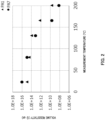
- ASTM D257 2007, the volume resistivity of the square plate test piece was measured with an electrometer 8340A manufactured by ADC CORPORATION at the inside temperature of 23°C, 80°C, 130°C, 165°C, and 200°C.
- Table 2 shows properties of the polyamide resin compositions obtained from polyamide resins 1 and 7, such as the flow length, tensile strength, flexural strength, flexural modulus, Charpy impact strength, and volume resistivity at each temperature.
- FIG. 1 shows the heat aging resistance (tensile strength retention) of the polyamide resin compositions obtained from polyamide resin 1 and polyamide resin 7.
- FIG. 2 shows the volume resistivity (at each temperature) of the polyamide resin compositions obtained from polyamide resin 1 and polyamide resin 7.
- polyamide resin 1 had a longer flow length (better injection fluidity), better mechanical properties in a high temperature range (around 150°C), better impact resistance at normal temperature, and a higher volume resistivity in a high temperature range than polyamide resin 7.
- Polyamide resin 1 contains, as the dicarboxylic acid-derived component unit (a), 20 mol% or more of a component unit (a1) derived from terephthalic acid, naphthalenedicarboxylic acid, or cyclohexanedicarboxylic acid, and, as diamine-derived component unit (b), a component unit (b2) derived from a diamine represented by the formula (1).
- Polyamide resin 7 contains no component unit (b2) derived from a diamine represented by the formula (1).
- the polyamide resins according to the present invention have high mechanical properties and electrical resistance in a high temperature range. Therefore, the present invention is expected to expand the applicability of polyamide resins to parts for electrical equipment that are expected to have high output, and thus contribute to the wider spread of polyamide resins.
Landscapes
- Chemical & Material Sciences (AREA)
- Health & Medical Sciences (AREA)
- Chemical Kinetics & Catalysis (AREA)
- Medicinal Chemistry (AREA)
- Polymers & Plastics (AREA)
- Organic Chemistry (AREA)
- Engineering & Computer Science (AREA)
- Mechanical Engineering (AREA)
- Polyamides (AREA)
Abstract
Description
- The present invention relates to a crystalline polyamide resin, a resin composition, and a molded article.
- Polyamide resins have been widely used as materials for various parts in the applications of clothing, industrial materials, and automobiles, and electrical and electronic and industrial applications due to the excellent moldability, mechanical properties, and chemical resistance of the resins.
- Attempts have been made to modify the raw materials of a polyamide resin to change the physical properties of the polyamide resin in order to develop properties according to these applications.
- For example, Patent Literature (hereinafter, referred to as PTL) 1 describes the usage of bis(aminomethyl)norbornane as a diamine component to be used in producing of a polyamide by polycondensation of a dicarboxylic acid component and the diamine component. PTL 1 discloses that the polyamide containing, as the diamine component, equimolar bis(aminomethyl)norbornane and 2-methylpentamethylenediamine is transparent and has a high freezing point. PTL 1 teaches that the diamine component is selected in such a way that no crystallization occurs during the cooling in order to increase the transparency of the polyamide.
- PTL 2 discloses that bis(aminomethyl)norbornane used as the diamine component is a mixture of 2,5-bis(aminomethyl)norbornane and 2,6-bis(aminomethyl)norbornane at equivalent amounts, and the molar ratio of the bis(aminomethyl)norbornane is set to 20 mol% or less, thereby obtaining a transparent polyamide having a high transition temperature.
- PTL 3 meanwhile discloses that setting of the content of bis(aminomethyl)norbornane to 17 wt% or more can increase the glass transition point of the obtained polyamide to increase the heat resistance. PTL 3 discloses that the polyamide obtained by mixing hexamethylenediamine and bis(aminomethyl)norbornane with the weight ratio of hexamethylenediamine/bis(aminomethyl)norbornane of 30/70 (molar ratio of 36/64) has a high glass transition point.
-
- PTL 1
Japanese Patent Application Laid-Open No. S48-60193 - PTL 2
Japanese Patent Application Laid-Open No. S53-125497 - PTL 3
Japanese Patent Application Laid-Open No. S63-154739 - As described in PTLs 1 to 3, polyamide resins having improved heat resistance due to the use of bis(aminomethyl)norbornane as a diamine component are known.
- However, the polyamide resins described in PTLs 1 to 3 are amorphous transparent polyamides with no melting point observed. Therefore, although the polyamide resins are suitable for applications such as films that require transparency, these polyamide resins have low fluidity during injection molding and low mechanical strength.
- With the expansion of the applications of polyamide resins in recent years, various physical properties are further required for polyamide resins. For example, a polyamide resin used as a part for electrical equipment is required to have higher electrical resistance in order to be applied to the downsized electrical equipment of recent years. In addition, in order to be applied to electrical equipment with increased output, a polyamide resin is required to exhibit high mechanical strength and electrical resistance in a high temperature range (around 150°C).
- The present invention was made in view of the circumstances described above and an object of the present invention is to provide a polyamide resin that is crystalline and capable of exhibit high mechanical strength and electrical resistance in a high temperature range (around 150°C), a resin composition containing the polyamide resin, and a molded article containing the polyamide resin.
- A crystalline polyamide resin relating to an embodiment of the present invention contains a dicarboxylic acid-derived component unit (a); and a diamine-derived component unit (b), in which the dicarboxylic acid-derived component unit (a) contains a component unit (a1) derived from terephthalic acid, naphthalenedicarboxylic acid, or cyclohexanedicarboxylic acid, the content of the component unit (a1) is more than 20 mol% and 100 mol% or less based on the total number of moles of the dicarboxylic acid-derived component unit (a), and the diamine-derived component unit (b) contains a component unit (b1) derived from an alkylenediamine having 4 to 18 carbon atoms and a component unit (b2) derived from a diamine represented by the following formula (1):

- n and two m's are each independently 0 or 1, and
- -X- is a single bond or a divalent group selected from the group consisting of -O-, -S-, -SO2-, -CO-, and -CH2-.
- A resin composition relating to another embodiment of the present invention contains the crystalline polyamide resin.
- A molded article relating to yet another embodiment of the present invention contains the resin composition.
- The present invention can provide a polyamide resin that is crystalline and capable of exhibit high mechanical strength and electrical resistance in a high temperature range (around 150°C), a resin composition containing the polyamide resin, and a molded article containing the polyamide resin.
-
-
FIG. 1 is a graph showing the heat aging resistance of polyamide resin compositions obtained from polyamide resin 1 and polyamide resin 7 in Examples; and -
FIG. 2 is a graph showing the volume resistivity of the polyamide resin compositions obtained from polyamide resin 1 and polyamide resin 7 in Examples, at each temperature. - The present inventors have found that a crystalline polyamide resin having the features described below can exhibit high mechanical strength and electrical resistance in a high temperature range (around 150°C), thereby completing the present invention: A crystalline polyamide resin containing a component unit (a) derived from a dicarboxylic acid (herein also referred to as "dicarboxylic acid-derived component unit (a)") and a component unit (b) derived from a diamine (herein also referred to as "diamine-derived component unit (b)"), where the diamine-derived component unit (b) contains a component unit (b1) derived from an alkylenediamine having 4 or more and 18 or less carbon atoms (herein, simply referred to as "4 to 18," and regarding any number of carbon atoms, similar description is applied) and a component unit (b2) derived from a diamine represented by the following formula (1):

- n and two m's are each independently 0 or 1, and
- -X- is a single bond or a divalent group selected from the group consisting of -O-, -S-, -SO2-, -CO-, and -CH2-.
- The reason for the above advantageous effects is not clear, but it can be presumed as follows.
- An alkylenediamine having at least one cyclic structure cross-linked within the same ring (the diamine represented by formula (1)) has low mobility because of the large rotational barrier (energy) due to the cyclic structure. Therefore, the alkylenediamine having such a cyclic structure can increase the glass transition temperature (Tg) of a resin as compared to an alkylenediamine having no such cyclic structure. This is considered why a crystalline polyamide resin having a component unit derived from a diamine having such a cyclic structure has high mechanical strength even in a high temperature range. For the same reason, it is considered that the crystalline polyamide resin having the component unit derived from the diamine having the above described cyclic structure can maintain high mechanical strength even in a high temperature range.
- According to the findings of the present inventors, wholly aromatic polymers, such as polyether sulfone (PES), polyphenylene sulfide (PPS), and polyether ether ketone (PEEK), are more likely to suffer short circuits (tracking) due to carbonization of aromatic rings, and more likely to have low electrical resistance. On the other hand, semi-aromatic polyamides, which have a smaller number of aromatic rings, and aliphatic polyamides suffer less tracking and have high electrical resistance.
- From the above, the following can be considered regarding semi-aromatic polyamides or aliphatic polyamides each with high electrical resistance: when molecular mobility is reduced in a high temperature range by the presence of the above described cyclic structure, even with some of the aromatic rings being carbonized in the high temperature range, the carbonized aromatic rings are less likely to come close to each other (the closeness may be caused by the movement of the rings); thus, the polyamides have high electrical resistance.
- Therefore, a crystalline polyamide having a component unit derived from the diamine having the above-described cyclic structure and maintaining its crystallinity without becoming completely amorphous is considered to have the following features: high fluidity during injection molding and mechanical strength due to its crystallinity, and has high mechanical strength and electrical resistance even in a high temperature range due to its high glass transition temperature (Tg); and is more likely to maintain the high mechanical strength and electrical resistance.
- Hereinafter, the specific configuration of the present invention will be described in more detail.
- The crystalline polyamide resin contains a dicarboxylic acid-derived component unit (a) and a diamine-derived component unit (b), and as the diamine-derived component unit (b), contains a component unit (b2) derived from a diamine represented by formula (1).
- The melting point (Tm) of the crystalline polyamide resin is observed with a differential scanning calorimeter (DSC). The melting point (Tm) of the crystalline polyamide resin is preferably 270°C or more and 360°C or less. A crystalline polyamide resin having a melting point (Tm) of 270°C or more is less likely to have impaired mechanical strength, heat resistance, and the like. A crystalline polyamide resin having a melting point (Tm) of 360°C or less is more likely to have improved moldability because the molding temperature does not need to be excessively high. The melting point (Tm) of the crystalline polyamide resin is more preferably 275°C or more and 330°C or less.
- The crystalline polyamide resin of the present invention has a reduced molecular orientation due to the above-described cyclic structure, thus has satisfactorily lowered crystallinity. Therefore, this crystalline polyamide resin has a satisfactorily low melting point (Tm) compared to other crystalline polyamide resins having a similar structure (for example, structures derived from an aromatic dicarboxylic acid and an alkylenediamine). This crystalline polyamide resin thus can be easily molded despite having high mechanical strength.
- The glass transition temperature (Tg) of the crystalline polyamide resin is preferably 140°C or more, more preferably 155°C or more. A crystalline polyamide resin having a glass transition temperature (Tg) of the above temperature or more is less likely to have impaired heat resistance, and can have increased mechanical strength and electrical resistance in a high temperature range. The upper limit of the glass transition temperature (Tg) of the crystalline polyamide resin is not limited, but may be 200°C from the viewpoint of not impairing the moldability.
- The heat of fusion (ΔH) of the crystalline polyamide resin is preferably 10 mJ/mg or more. A crystalline polyamide resin having heat of fusion (ΔH) of 10 mJ/mg or more is crystalline, and thus more likely to increase the fluidity during injection molding and the mechanical strength. From the same viewpoint, the heat of fusion (ΔH) of the crystalline polyamide resin is more preferably 15 mJ/mg, even more preferably 20 mJ/mg or more. The upper limit of the heat of fusion (ΔH) of the crystalline polyamide resin is not limited, but may be 90 mJ/mg from the viewpoint of not impairing the moldability.
- The heat of fusion (ΔH), melting point (Tm) and glass transition temperature (Tg) of the polyamide resin can be measured with a differential scanning calorimeter (DSC220C, manufactured by Seiko Instruments Inc.).
- Specifically, about 5 mg of a polyamide resin is sealed in an aluminum pan for measurement and heated from room temperature to 350°C at the rate of 10°C/min. For completely melting the resin, the resin is held at 350°C for 3 minutes and then cooled to 30°C at the rate of 10°C/min. After allowed to stand at 30°C for 5 minutes, the resin is heated a second time to 350°C at the rate of 10°C/min. The endothermic peak temperature (°C) in this second heating is used as the melting point (Tm) of the crystalline polyamide resin, and the displacement point corresponding to the glass transition is used as the glass transition temperature (Tg). The heat of fusion (ΔH) is determined from the area of the endothermic peak of crystallization during the second heating according to JIS K7122.
- The melting point (Tm), glass transition temperature (Tg), and heat of fusion (ΔH) of the crystalline polyamide resin can be adjusted by the structure of the dicarboxylic acid-derived component unit (a), the content of the component unit (b2) derived from a diamine represented by formula (1), the content ratio of the component unit (b1) derived from an alkylenediamine having 4 to 18 carbon atoms to the component unit (b2) derived from a diamine represented by formula (1), and/or the number of carbon atoms in the alkylenediamine having 4 to 18 carbon atoms.
- For example, from the viewpoint of setting the melting point (Tm) of the polyamide resin that is crystalline within the above-described range, the polyamide resin is preferably a semi-aromatic polyamide resin. The melting point (Tm) of a semi-aromatic polyamide resin usually does not exceed 340°C. From the viewpoint of obtaining satisfactory heat resistance of the polyamide resin by increasing its melting point (Tm) to some extent, the polyamide resin is preferably a semi-aromatic polyamide resin whose main component unit is formed of repeating units each composed of a component unit derived from an aromatic dicarboxylic acid or alicyclic dicarboxylic acid and a component unit derived from an aliphatic diamine. More preferred is a semi-aromatic polyamide resin formed of repeating units each composed of a component unit derived from an aromatic dicarboxylic acid and a component unit derived from an aliphatic diamine.
- For increasing the heat of fusion (ΔH) of the crystalline polyamide resin, it is preferred to lower the content of the component unit (b2) and the content ratio of the component unit (b2) (namely, the ratio of the component unit (b2) to the total number of moles of the diamine-derived component unit (b)). On the other hand, for increasing the glass transition temperature (Tg) of the crystalline polyamide resin and lowering the melting point (Tm) of the crystalline polyamide resin, it is preferred, for example, to increase the content of the component unit (b2) and the content ratio of the component unit (b2) (namely, the ratio of the component unit (b2) to the total number of moles of the diamine-derived component unit (b)).
- The intrinsic viscosity [η] of the crystalline polyamide resin measured in 96.5% sulfuric acid at a temperature of 25°C is preferably 0.6 dl/g or more and 1.5 dl/g or less. A crystalline polyamide resin having intrinsic viscosity [η] of 0.6 dl/g or more is more likely to satisfactorily increase the mechanical strength (for example, toughness) of the molded article. A crystalline polyamide resin having intrinsic viscosity [η] of 1.5 dl/g or less is less likely to impair the fluidity of the resin composition during molding. From the same viewpoint, the intrinsic viscosity [η] of the crystalline polyamide resin is more preferably 0.8 dl/g or more and 1.2 dl/g or less. The intrinsic viscosity [η] can be adjusted, for example, by the amount of terminal blocking of the crystalline polyamide resin.
- The intrinsic viscosity of the crystalline polyamide resin can be measured according to JIS K6810-1977.
- Specifically, 0.5 g of a crystalline polyamide resin is dissolved in 50 ml of 96.5% sulfuric acid solution to prepare a sample solution. The intrinsic viscosity can be obtained by measuring the falling time (seconds) of the sample solution with an Ubbelohde viscometer under the condition of 25±0.05°C, and applying the obtained value to the following equation for calculation.

- In the above equation, symbols and variables are defined as follows.
- [η]: Intrinsic viscosity (dl/g)
- ηSP: Specific viscosity
- C: Sample concentration (g/dl)
- ηSP is obtained by the following equation.

- t: Falling time of sample solution (seconds)
- t0: Falling time of blank sulfuric acid (seconds)
- The dicarboxylic acid-derived component unit (a) is not limited, but from the viewpoint of facilitating the increase of the melting point (Tm) and crystallinity, for example, the dicarboxylic acid-derived component unit (a) preferably contains a component unit derived from an aromatic dicarboxylic acid or an alicyclic dicarboxylic acid.
- Examples of the aromatic dicarboxylic acid include terephthalic acid, naphthalenedicarboxylic acid, and esters thereof. Examples of the alicyclic dicarboxylic acid include cyclohexanedicarboxylic acid and esters thereof. In particular, from the viewpoint of, for example, obtaining a polyamide resin having high crystallinity and high heat resistance, the dicarboxylic acid-derived component unit (a) preferably contains a component unit derived from an aromatic dicarboxylic acid, more preferably contains a component unit derived from terephthalic acid.
- The content of the component unit derived from an aromatic dicarboxylic acid or an alicyclic dicarboxylic acid is not limited, but the total amount of the component unit is preferably 50 mol% or more and 100 mol% or less based on the total number of moles of the dicarboxylic acid-derived component unit (a). A crystalline polyamide resin containing the above-described component unit whose content is 50 mol % or more is more likely to have increased crystallinity. From the same viewpoint, the content of the above-described component unit is more preferably 70 mol% or more and 100 mol% or less.
- In the present embodiment, the dicarboxylic acid-derived component unit (a) contains a component unit (a1) derived from terephthalic acid, naphthalenedicarboxylic acid, and/or cyclohexanedicarboxylic acid. Component units (a1) derived from terephthalic acid, naphthalenedicarboxylic acid, and cyclohexanedicarboxylic acid can increase the crystallinity of a polyamide, unlike isophthalic acid used in, for example, PTLs 1 to 3. From the viewpoint of obtaining satisfactory crystallinity of the polyamide resin, the content of the component unit (a1) is more than 20 mol% and 100 mol% or less based on the total number of moles of the dicarboxylic acid-derived component unit (a). From the viewpoint of further increasing the crystallinity of the polyamide resin, the content of the component unit (a1) based on the total number of moles of the dicarboxylic acid-derived component unit (a) is preferably 45 mol% or more and 100 mol% or less, more preferably 50 mol% or more and 99 mol% or less, even more preferably more than 80 mol% and 99 mol% or less, and particularly preferably more than 90 mol% and 99 mol% or less.
- The dicarboxylic acid-derived component unit (a) may contain a component unit (a2) derived from an aromatic carboxylic acid other than the component unit (a1) or a component unit (a3) derived from an aliphatic dicarboxylic acid having 4 to 20 carbon atoms within ranges that do not impair the effects of the present invention. However, from the viewpoint of not impairing the crystallinity of the resin, the content of component units derived from isophthalic acid and aliphatic dicarboxylic acid having 4 to 18 carbon atoms other than adipic acid is preferably small, specifically 20 mol% or less, more preferably 10 mol% or less, based on the total number of moles of the dicarboxylic acid-derived component unit (a).
- Examples of the component unit (a2) derived from an aromatic dicarboxylic acid other than terephthalic acid include component units derived from isophthalic acid and 2-methylterephthalic acid. In particular, a component unit derived from isophthalic acid is preferred. From the viewpoint of obtaining satisfactory crystallinity of the polyamide resin, the content of the component unit (a2) is preferably 1 mol% or more and 50 mol% or less, more preferably 1 mol% or more and 20 mol% or less, even more preferably 1 mol% or more and 10 mol% or less, and particularly preferably 1 mol% or more and 5 mol% or less, based on the total number of moles of the dicarboxylic acid-derived component unit (a).
- The component unit (a3) derived from an aliphatic dicarboxylic acid is a component unit derived from an aliphatic dicarboxylic acid having an alkylene group having 4 to 20 carbon atoms, and preferably a component unit derived from an aliphatic dicarboxylic acid having an alkylene group having 6 to 12 carbon atoms. Examples of the aliphatic dicarboxylic acid include succinic acid, glutaric acid, adipic acid, 2-methyladipic acid, trimethyladipic acid, pimelic acid, 2,2-dimethylglutaric acid, 3,3-diethylsuccinic acid, azelaic acid, sebacic acid, and suberic acid. In particular, adipic acid and sebacic acid are preferred. From the viewpoint of obtaining satisfactory crystallinity of the polyamide resin, the content of the component unit (a3) is preferably 0 mol% or more and 40 mol% or less, more preferably 0 mol% or more and 20 mol% or less, even more preferably 1 mol% or more and 10 mol% or less, and particularly preferably 1 mol% or more and 5 mol% or less, based on the total number of moles of the dicarboxylic acid-derived component unit (a).
- The semi-aromatic polyamide resin (A) may further contain, in addition to the above-described component units (a1), (a2), and (a3), a small amount of a component unit derived from a tribasic or higher polyvalent carboxylic acid, such as trimellitic acid or pyromellitic acid. The content of such a polyvalent carboxylic acid component unit may be 0 mol% or more and 5 mol% or less based on the total number of moles of the dicarboxylic acid-derived component unit (a).
- The diamine-derived component unit (b) contains a component unit (b 1) derived from an alkylenediamine having 4 to 18 carbon atoms and a component unit (b2) derived from an alkylenediamine having a specific cyclic structure.
- The number of carbon atoms in the alkylenediamine having 4 to 18 carbon atoms is more preferably 4 or more and 10 or less from the viewpoint of minimizing the reduction of Tg of the resin.
- The alkylenediamine having 4 to 18 carbon atoms may include a linear alkylenediamine or a branched alkylenediamine. From the viewpoint of increasing the crystallinity of the resin, the alkylenediamine having 4 to 18 carbon atoms preferably includes a linear alkylenediamine. That is, the component unit derived from an alkylenediamine having 4 to 18 carbon atoms preferably contains a component unit derived from a linear alkylenediamine.
- Examples of the alkylenediamine having 4 to 18 carbon atoms include linear alkylenediamines, such as 1,4-diaminobutane, 1,6-diaminohexane, 1,7-diaminoheptane, 1,8-octanediamine, 1,9-nonanediamine, and 1,10-decanediamine, and branched alkylenediamines, such as 2-methyl-1,5-pentanediamine and 2-methyl-1,8-octanediamine. In particular, 1,4-diaminobutane, 1,6-diaminohexane, 1,9-nonanediamine, 1,10-decanediamine, and 2-methyl-1,5-pentanediamine are preferred, and 1,6-diaminohexane and 1,10-decanediamine are more preferred. The above-described alkylenediamines may be used individually or in combination.
- The alkylenediamine having a specific cyclic structure is a diamine represented by following formula (1).

- In formula (1), n and two m's are each independently 0 or 1, and -X- is a single bond or a divalent group selected from the group consisting of -O-, -S-, -SO2-, -CO-, and -CH2-.
- The diamine represented by formula (1) is preferably norbornanediamine (m = n = 0) or bis(aminomethyl)norbornane (m = 1, n = 0), more preferably bis(aminomethyl)norbornane, and even more preferably 2,5-bis(aminomethyl)norbornane or 2,6-bis(aminomethyl)norbornane.
- In particular, a diamine with one or both of the two m's being 1 is more likely to increase the mechanical strength of the polyamide resin and maintain high mechanical strength of the polyamide resin.
- When the diamine represented by formula (1) has geometrical isomers (for example, trans isomer and cis isomer), any isomer may be used, and the ratio of the isomers is not limited.
- The content of the component unit (b2) derived from a diamine represented by formula (1) is not limited, so long as a crystalline polyamide resin whose melting point (Tm) is observed with DSC can be obtained. That is, the content of the component unit (b2) derived from a diamine represented by formula (1) depends on the number of carbon atoms and the content of the alkylenediamine having 4 to 18 carbon atoms to be used in combination, but is preferably 10 mol% or more and 45 mol% or less based on the total number of moles of the diamine-derived component unit (b). A component unit (b2) of 10 mol % or more is more likely to increase the glass transition temperature (Tg) of the polyamide resin to increase mechanical strength and electrical resistance in a high temperature range, and maintain the high mechanical strength and electrical resistance of the polyamide resin. A component unit (b2) of 10 mol % or more can satisfactorily lower the melting point (Tm) of the polyamide resin, and thus is more likely to increase the moldability of the polyamide resin. A component unit (b2) of 45 mol% or less is less likely to impair the crystallinity of the polyamide resin more than necessary (the resin is less likely to become amorphous), and thus is less likely to impair the fluidity during injection molding and mechanical strength of the resin. The content of the component unit (b2) derived from a diamine represented by formula (1) is more preferably 15 mol% or more and 45 mol% or less, even more preferably 25 mol% or more and 40 mol% or less, and particularly preferably 27 mol% or more and 38 mol% or less, based on the total number of moles of the diamine-derived component unit (b).
- The diamine-derived component unit (b) may further contain a component unit (b3) derived from another diamine within a range that does not impair the effects of the present invention. Examples of the diamine for the component unit (b3) include aromatic diamines and alicyclic diamines. The content of the component unit (b3) derived from another diamine may be 50 mol% or less based on the total number of moles of the diamine-derived component unit (b).
- In the crystalline polyamide resin, the terminal groups of at least some molecules may be blocked with a terminal blocking agent from the viewpoint of increasing thermal stability of a compound or during the molding and further increasing mechanical strength. For example, the terminal blocking agent is preferably a monoamine when the terminals of the molecules are carboxyl group, and is preferably a monocarboxylic acid when the terminals of the molecules are amino group.
- Examples of the monoamine include aliphatic monoamines, such as methylamine, ethylamine, propylamine, and butylamine; alicyclic monoamines, such as cyclohexylamine and dicyclohexylamine; and aromatic monoamines, such as aniline and toluidine. Examples of the monocarboxylic acid include aliphatic monocarboxylic acids having 2 to 30 carbon atoms, such as acetic acid, propionic acid, butyric acid, valeric acid, caproic acid, caprylic acid, lauric acid, tridecylic acid, myristic acid, palmitic acid, stearic acid, oleic acid, and linoleic acid; aromatic monocarboxylic acids, such as benzoic acid, toluic acid, naphthalenecarboxylic acid, methylnaphthalenecarboxylic acid, and phenylacetic acid; and alicyclic monocarboxylic acids, such as cyclohexanecarboxylic acid. The aromatic monocarboxylic acids and alicyclic monocarboxylic acids may have a substituent on the cyclic structure moiety.
- The crystalline polyamide resin can be produced, for example, by polycondensation of the above-described dicarboxylic acid and diamine in a uniformly dissolved solution. Specifically, as described in
WO03/085029 - From the viewpoint of adjusting the intrinsic viscosity of the crystalline polyamide resin, the above-described terminal blocking agent may be added to the reaction system. The intrinsic viscosity [η] (or molecular weight) of the crystalline polyamide resin can be adjusted by adjusting the amount of the terminal blocking agent to be added.
- The terminal blocking agent is added to the reaction system of the dicarboxylic acid and the diamine. The amount of the terminal blocking agent to be added is preferably 0.07 mol or less, more preferably 0.05 mol or less, based on 1 mol of the total dicarboxylic acid.
- A resin composition of the present invention contains the crystalline polyamide resin of the present invention.
- The content of the crystalline polyamide resin depends on the application of the resin composition, but may be, for example, 35 parts by mass or more and 95 parts by mass or less based on 100 parts by mass of the resin composition. A crystalline polyamide resin whose content is above a certain amount is more likely to exhibit the properties derived from the resin.
- The resin composition of the present invention may further contain one or more additional components other than the crystalline polyamide resin, as necessary.
- Examples of the additional components include fibrous fillers, nucleating agents, elastomers (rubber), flame retardants (for example, bromine, chlorine, phosphorus, antimony, and inorganic flame retardants), fluidity improvers, antistatic agents, release agents, antioxidants (for example, phenols, amines, sulfur, and phosphorus antioxidants), heat stabilizers (lactone compounds, vitamin E, hydroquinones, copper halides, and iodine compounds), light stabilizers (for example, benzotriazoles, triazines, benzophenones, benzoates, hindered amines, and oxanilides), and other polymers (for example, polyolefins, olefin copolymers, such as ethylene/propylene copolymer, ethylene/1-butene copolymer, and propylene/1-butene copolymer, polystyrene, polyamide, polycarbonate, polyacetal, polysulfone, polyphenylene oxide, fluororesin, silicone resin, and LCP). In particular, the resin composition of the present invention may further contain a fibrous filler from the viewpoint of increasing the mechanical strength of the molded article.
- The fibrous filler can impart high mechanical strength to the resin composition. Examples of the fibrous filler include glass fibers, wollastonite, potassium titanate whiskers, calcium carbonate whiskers, aluminum borate whiskers, magnesium sulfate whiskers, zinc oxide whiskers, milled fibers, and cut fibers. The above-described fibrous fillers may be used individually or in combination. In particular, wollastonite, glass fibers, and potassium titanate whiskers are preferred and wollastonite and glass fibers are more preferred as they can easily increase, for example, the mechanical strength of the molded article.
- The average fiber length of the fibrous filler may be, for example, 1 µm or more and 20 mm or less, preferably 5 µm or more and 10 mm or less, from the viewpoints of the moldability of the resin composition and the mechanical strength and heat resistance of the obtained molded article. In addition, the aspect ratio of the fibrous filler may be, for example, 5 or more and 2,000 or less, preferably 30 or more and 600 or less.
- The average fiber length and average fiber diameter of the fibrous filler can be measured by the following method.
- 1) After the resin composition is dissolved in a hexafluoroisopropanol/chloroform solution (10/90 vol%), the resulting solution is filtered and the obtained residue is collected.
- 2) The residue obtained in the above-described step 1) is dispersed in water, and the fiber length (Li) and the fiber diameter (Di) of each of randomly selected 300 fibers are measured with an optical microscope (magnification: 50×). Then, qi is defined as the number of fibers whose fiber length is Li, and the weight average length (Lw) is calculated based on the following equation, and the weight average length (Lw) is used as the average fiber length of the fibrous filler.

- In the similar manner, ri is defined as the number of fibers having a fiber diameter of Di, and the weight average diameter (Dw) is calculated based on the following equation, and the weight average diameter (Dw) is used as the average fiber diameter of the fibrous filler.

- The content of the fibrous filler is not limited, and may be, for example, 15 parts by mass or more and 70 parts by mass or less based on the total of 100 parts by mass of the crystalline polyamide resin and the fibrous filler.
- The resin composition of the present invention can be prepared by mixing the above-described crystalline polyamide resin and, as necessary, additional component(s) by a known resin kneading method, such as a method using a Henschel mixer, V blender, ribbon blender, or tumbler blender. Alternatively, the resin composition can be produced, after the mixing, by melt-kneading the mixture in a single-screw extruder, multi-screw extruder, kneader, or Banbury mixer, and then granulating or pulverizing the resulting melt kneaded product.
- The resin composition of the present invention is molded by a known molding method, such as compression molding, injection molding, or extrusion molding, to be used as various molded articles.
- A molded article of the resin composition of the present invention can be used for various applications. Examples of such applications include the following: automotive exterior parts, such as radiator grilles, rear spoilers, wheel covers, wheel caps, cowl vent grilles, air outlet louvers, air scoops, hood bulges, sunroofs, sunroof rails, fenders, and back doors; parts in automotive engine rooms, such as cylinder-head covers, engine mounts, air intake manifolds, throttle bodies, air intake pipes, radiator tanks, radiator supports, water pump inlets, water pumps, water pump outlets, thermostat housings, cooling fans, fan shrouds, oil pans, oil filter housings, oil filler caps, oil level gauges, oil pumps, timing belts, timing belt covers, and engine covers; automotive fuel system parts, such as fuel caps, fuel filler tubes, automotive fuel tanks, fuel sender modules, fuel cutoff valves, quick connectors, canisters, fuel delivery pipes, and fuel filler necks; automotive drive line parts, such as shift lever housings and propeller shafts; automotive chassis parts, such as stabilizer bars, linkage rods, and engine mount brackets; automotive functional parts such as window regulators, door locks, door handles, outside door mirror stays, wipers and parts thereof, accelerator pedals, pedal modules, joints, resin screws, nuts, bushes, seal rings, bearings, bearing retainers, gears, and actuators; automotive electronics parts, such as wire harness connectors, relay blocks, sensor housings, fuse parts, encapsulations, ignition coils, and distributor caps; fuel system parts for general purpose apparatuses, such as fuel tanks for general purpose apparatuses (for example, brush cutters, lawn mowers, and chain saws); electrical and electronic parts, such as connectors and LED reflectors; building material parts; industrial equipment parts; small housings (including housings for personal computers and mobile phones); various housings, such as exterior molded products; and exterior parts.
- In particular, the resin composition of the present invention has advantageous features, such as high mechanical strength and electrical resistance in a high temperature range, and thus can be suitably used for parts for electrical equipment.
- Hereinafter, the present invention is described with reference to Examples. The Examples should not be construed as limiting the scope of the present invention.
- For observing how the thermal properties of a polyamide resin are changed by the presence of the component unit (b2) derived from a diamine represented by the formula (1) as the diamine-derived component unit (b), experiments were conducted as follows.
- In the following experiments, the intrinsic viscosity [η], melting point (Tm) and glass transition temperature (Tg) of a resin were measured by the following methods.
- A sample solution was prepared by dissolving 0.5 g of a polyamide resin in 50 ml of 96.5% sulfuric acid solution according to JIS K6810-1977. The falling time (seconds) of the obtained sample solution was measured with an Ubbelohde viscometer under the condition of 25±0.05°C. The intrinsic viscosity [η] of the polyamide resin was calculated by applying the measurement results to the following equation.


- [η]: Intrinsic viscosity (dl/g)
- ηSP: Specific viscosity
- C: Sample concentration (g/dl)
- t: Falling time of sample solution (seconds)
- t0: Falling time of blank sulfuric acid (seconds)
- The heat of fusion (ΔH), melting point (Tm) and glass transition temperature (Tg) of the polyamide resin were measured with a differential scanning calorimeter (DSC220C, manufactured by Seiko Instruments Inc.)
- Specifically, about 5 mg of a polyamide resin was sealed in an aluminum pan for measurement and heated from room temperature to 350°C at the rate of 10°C/min. For completely melting the resin, the resin was held at 350°C for 3 minutes and then cooled to 30°C at the rate of 10°C/min. After allowed to stand at 30°C for 5 minutes, the resin was heated a second time to 350°C at the rate of 10°C/min. The endothermic peak temperature (°C) in this second heating was used as the melting point (Tm) of the crystalline polyamide resin, and the displacement point corresponding to the glass transition was used as the glass transition temperature (Tg) of the crystalline polyamide resin. The heat of fusion (ΔH) was determined from the area of the endothermic peak of crystallization during the second heating according to JIS K7122.
- An autoclave having an internal capacity of 1 L was charged with 259.5 g (1561.7 mmol) of terephthalic acid, 118.9 g (1023.1 mmol) of 1,6-diaminohexane, 85.0 g (551.1 mmol) of norbornanediamine, 0.37 g of sodium hypophosphite monohydrate, and 81.8 g of distilled water, and purged with nitrogen. Stirring was started from 190°C, and the internal temperature of the autoclave was raised to 250°C over 3 hours. At this time, the internal pressure of the autoclave was increased to 3.0 MPa. After the reaction was continued for 1 hour, the autoclave was vented to the atmosphere through a spray nozzle installed at the bottom thereof, and a low-order condensate was extracted. Subsequently, the low-order condensate was cooled to room temperature, and then was pulverized with a pulverizer until the condensate has a particle size of 1.5 mm or less and dried at 110°C for 24 hours. The intrinsic viscosity [η] of the obtained low-order condensate was 0.12 dl/g.
- Next, this low-order condensate was placed in a solid-state polymerization apparatus having shelves, and after the apparatus was purged with nitrogen, the temperature was raised to 215°C over about 1 hour and 30 minutes. After the reaction was continued for 1 hour and 30 minutes, the temperature was lowered to room temperature. The intrinsic viscosity [η] of the obtained prepolymer was 0.45 dl/g.
- The obtained prepolymer was then melt-polymerized in a twin-screw extruder with a screw diameter of 30 mm and LID of 36 under the conditions of a barrel setting temperature of 330°C, a screw rotation speed of 200 rpm, and a resin feed rate of 6 kg/h, thereby obtaining polyamide resin 1.
- Obtained polyamide resin 1 had an intrinsic viscosity [η] of 0.97 dl/g, a melting point (Tm) of 312°C, a glass transition temperature (Tg) of 167°C, and a heat of fusion (ΔH) of 44 mJ/mg.
- Polyamide resins 2 to 6 were obtained in the same manner as in Synthesis example 1, except that the ratio between 1,6-diaminohexane and norbornanediamine was changed while the total amount of 1,6-diaminohexane and norbornanediamine charged in the autoclave was maintained.
- An autoclave having an internal capacity of 13.6 L was charged with 2,774 g (16.7 mol) of terephthalic acid, 1,196 g (7.2 mol) of isophthalic acid, 2800 g (24.3 mol) of 1,6-diaminohexane, 36.6 g (0.3 mol) of benzoic acid, 5.7 g of sodium hypophosphite monohydrate, and 545 g of distilled water, and was purged with nitrogen. Stirring was started from 190°C, and the internal temperature of the autoclave was raised to 250°C over 3 hours. At this time, the internal pressure of the autoclave was increased to 3.0 MPa. After the reaction was continued for 1 hour, the autoclave was vented to the atmosphere through a spray nozzle installed at the bottom thereof, and a low-order condensate was extracted. Subsequently, the low-order condensate was cooled to room temperature, and then was pulverized with a pulverizer until the condensate has a particle size of 1.5 mm or less and dried at 110°C for 24 hours. The intrinsic viscosity [η] of the obtained low-order condensate was 0.15 dl/g.
- Next, this low-order condensate was placed in a solid-state polymerization apparatus having shelves, and after the apparatus was purged with nitrogen, the temperature was raised to 215°C over about 1 hour and 30 minutes. After the reaction was continued for 1 hour and 30 minutes, the temperature was lowered to room temperature. The intrinsic viscosity [η] of the obtained prepolymer was 0.20 dl/g.
- The obtained prepolymer was then melt-polymerized in a twin-screw extruder with a screw diameter of 30 mm and LID of 36 under the conditions of a barrel setting temperature of 330°C, a screw rotation speed of 200 rpm, and a resin feed rate of 6 kg/h, thereby obtaining polyamide resin 7.
- Obtained polyamide resin 7 had an intrinsic viscosity [η] of 1.0 dl/g, a melting point (Tm) of 330°C, a glass transition temperature (Tg) of 125°C, and a heat of fusion (ΔH) of 55 mJ/mg.
- Table 1 shows the compositions, melting points (Tm), and glass transition temperatures (Tg) of polyamide resins 1 to 7. In Table 1, "PA1" to "PA7" refer to respective polyamide resins 1 to 7. "TA" refers to terephthalic acid, "IA" isophthalic acid, "HMDA" 1,6-diaminohexane, and "NBDA" norbornanediamine.
Table 1 Dicarboxylic acid-derived component unit (a) Diamine-derived component unit (b) Intrinsic viscosity (dl/g) Tm (°C) Tg (°C) ΔH (mJ/mg) Composition (a1/a2) Molar ratio (a1/a2) Composition (b1/b2) Molar ratio (b1/b2) PA1 TA/- 100/0 HMDA/NBDA 65/35 0.97 312 167 44 PA2 TA/- 100/0 HMDA/ NBDA 70/30 0.95 325 162 44 PA3 TA/- 100/0 HMDA/ NBDA 60/40 0.90 305 172 28 PA4 TA/- 100/0 HMDA/ NBDA 50/50 0.93 - 182 0 PA5 TA/- 100/0 HMDA/NBDA 30/70 0.90 - 203 0 PA6 TA/- 100/0 HMDA/NBDA 20/80 0.92 - 218 0 PA7 TA/ IA 70/30 HMDA/- 100/0 1.0 330 125 55 - As is clear from Table 1, polyamide resins 1 to 6 had lower melting points (Tm) and higher glass transition temperatures (Tg) than polyamide resin 7. Polyamide resins 1 to 6 each contain a component unit (b2) derived from a diamine represented by the formula (1) as the diamine-derived component unit (b), and polyamide resin 7 contains no component unit (b2) derived from a diamine represented by the formula (1).
- For observing how the flow length, mechanical properties, and electrical characteristics of a polyamide resin are changed by the presence of the component unit (b2) derived from a diamine represented by the formula (1) as the diamine-derived component unit (b), experiments using polyamide resins 1 to 7 were conducted as follows.
- In a tumbler blender, 70 parts by mass of polyamide resin 1 or 7 and 30 parts by mass of glass fiber (CSX 3J-451, manufactured by Nitto Boseki Co., Ltd) were mixed. The mixture was melt-kneaded with 30 mmϕ vented twin-screw extruder at a cylinder temperature of 300 to 335°C. The resulting kneaded product was extruded into strands and cooled in a water bath. The strands were collected by a pelletizer and cut to obtain a polyamide resin composition in the form of pellets.
- Each polyamide resin composition was injected under the conditions as follows by using a bar flow mold with a width of 10 mm and a thickness of 0.5 mm, and the flow length (mm) of the polyamide resin composition in the mold was measured. A longer flow length indicates better injection fluidity.
- Molding machine: EC75N-2A, manufactured by Shibaura Machine Co., Ltd.
- Injection setting pressure: 2,000 kg/cm2
- Molding machine cylinder temperature: 335°C
- Mold temperature: 160°C
- The obtained polyamide resin composition was injection molded under the conditions as follows to prepare a test piece based on ASTM-1 (dumbbell specimen) having a thickness of 3.2 mm.
- Molding machine: SE50DU, manufactured by Sumitomo Heavy Industries, Ltd.
- Molding machine cylinder temperature: melting point of polyamide resin + 10°C
- Mold temperature: glass transition temperature of polyamide resin + 20°C
- The prepared test piece was allowed to stand at a temperature at in a nitrogen atmosphere at a temperature of 23°C for 24 hours according to ASTM D638. The test piece was then subjected to a tensile test in an atmosphere at a temperature of 150°C to measure the tensile strength and elongation rate (%).
- The obtained resin composition was injection molded under the conditions as follows to prepare a strip specimen having 1/8 inch thickness.
- Molding machine: SE50DU, manufactured by Sumitomo Heavy Industries, Ltd.
- Molding machine cylinder temperature: melting point of polyamide resin + 10°C
- Mold temperature: glass transition temperature of polyamide resin + 20°C
- The prepared test piece was allowed to stand in a nitrogen atmosphere at a temperature of 23°C for 24 hours according to ASTM D638. The test piece was then subjected to a bending test in an atmosphere at a temperature of 150°C with a bending tester (AB5, span of 51 mm and bending speed of 12.7 mm/min, manufactured by NTESCO) to measure the flexural strength and flexural modulus.
- Test pieces based on ASTM-1 (dumbbell specimen) having a thickness of 3 mm were prepared from each obtained polyamide resin composition.
- The obtained test pieces were stored in an air circulating oven at a temperature of 150°C for 504 hours, 1,008 hours, 1,512 hours, and 2,016 hours, respectively, and then removed from the oven and cooled to 23°C. The test pieces were subjected to a tensile test in an atmosphere at a temperature of 23°C and a relative humidity of 50% to measure the tensile strength. The retention of tensile strength was calculated by applying the obtained value to the following equation.

- A notched multi-purpose test piece was prepared from the obtained polyamide resin composition in accordance with ISO-179, and subjected to the measurement of the Charpy impact strength (J/m) at 23°C.
- A square plate test piece of 100 mm square and having a thickness of 2 mm was molded under the following molding conditions with the following injection molding machine.
- Molding machine: EC75N-2A, manufactured by Shibaura Machine Co., Ltd.
- Molding machine cylinder temperature: melting point of polyamide resin + 15°C
- Mold temperature: 120°C
- This square plate test piece was allowed to stand for 24 hours in an atmosphere at a temperature of 23°C and a relative humidity of 50%. In accordance with ASTM D257: 2007, the volume resistivity of the square plate test piece was measured with an electrometer 8340A manufactured by ADC CORPORATION at the inside temperature of 23°C, 80°C, 130°C, 165°C, and 200°C.
- Table 2 shows properties of the polyamide resin compositions obtained from polyamide resins 1 and 7, such as the flow length, tensile strength, flexural strength, flexural modulus, Charpy impact strength, and volume resistivity at each temperature.
FIG. 1 shows the heat aging resistance (tensile strength retention) of the polyamide resin compositions obtained from polyamide resin 1 and polyamide resin 7.FIG. 2 shows the volume resistivity (at each temperature) of the polyamide resin compositions obtained from polyamide resin 1 and polyamide resin 7.Table 2 Polyamide resin 1 Polyamide resin 7 Flow length L/t (mm) 23 19 Tensile strength at 150°C (MPa) 115 92 Flexural strength at 150°C (MPa) 183 140 Flexural modulus at 150°C (MPa) 10300 5600 Charpy impact strength at 23°C (kJ/m2) 14.4 13.3 Heat aging resistance after 504h (%) 97 84 after 1008h 94 89 after 1512h 96 83 after 2016h 96 92 Volume resistivity at 23°C (Ω·cm) 9.8×10¹⁴ 1.1×10¹⁰ at 80°C 3.3×10¹⁴ 8.7×10¹⁴ at 130°C 9.9×10¹³ 1.4×10¹³ at 165°C 1.7×10¹² 4.7×10⁹ at 200°C 5.3×10⁹ 1.5×10⁸ - As is clear from Table 2 and
FIGS. 1 and2 , polyamide resin 1 had a longer flow length (better injection fluidity), better mechanical properties in a high temperature range (around 150°C), better impact resistance at normal temperature, and a higher volume resistivity in a high temperature range than polyamide resin 7. Polyamide resin 1 contains, as the dicarboxylic acid-derived component unit (a), 20 mol% or more of a component unit (a1) derived from terephthalic acid, naphthalenedicarboxylic acid, or cyclohexanedicarboxylic acid, and, as diamine-derived component unit (b), a component unit (b2) derived from a diamine represented by the formula (1). Polyamide resin 7 contains no component unit (b2) derived from a diamine represented by the formula (1). - This application claims priority based on
Japanese Patent Application No. 2020-122161, filed on July 16, 2020 - The polyamide resins according to the present invention have high mechanical properties and electrical resistance in a high temperature range. Therefore, the present invention is expected to expand the applicability of polyamide resins to parts for electrical equipment that are expected to have high output, and thus contribute to the wider spread of polyamide resins.
Claims (11)
- A crystalline polyamide resin, comprising:a dicarboxylic acid-derived component unit (a); and a diamine-derived component unit (b), whereinthe dicarboxylic acid-derived component unit (a) contains a component unit (a1) derived from terephthalic acid, naphthalenedicarboxylic acid, or cyclohexanedicarboxylic acid,a content of the component unit (a1) is more than 20 mol% and 100 mol% or less based on a total number of moles of the dicarboxylic acid-derived component unit (a), andthe diamine-derived component unit (b) containsa component unit (b 1) derived from an alkylenediamine having 4 to 18 carbon atoms, anda component unit (b2) derived from a diamine represented by formula (1) below:
 whereinn and two m's are each independently 0 or 1, and-X- is a single bond or a divalent group selected from the group consisting of -O-, -S-, -SO2-, -CO-, and -CH2-.
 - The crystalline polyamide resin according to claim 1, wherein
a content of the component unit (b2) derived from the diamine represented by formula (1) is 10 mol% or more and 45 mol% or less based on a total number of moles of the diamine-derived component unit (b). - The crystalline polyamide resin according to claim 1 or 2, wherein
a content of the component unit (b2) derived from the diamine represented by formula (1) is 25 mol% or more and 40 mol% or less based on a total number of moles of the diamine-derived component unit (b). - The crystalline polyamide resin according to any one of claims 1 to 3, wherein
the crystalline polyamide resin has a melting point in a range of 270°C or more and 360°C or less. - The crystalline polyamide resin according to any one of claims 1 to 4, wherein
the crystalline polyamide resin has a glass transition temperature (Tg) of 140°C or more. - The crystalline polyamide resin according to any one of claims 1 to 5, wherein
the component unit (b1) derived from the alkylenediamine having 4 to 18 carbon atoms contains a component unit derived from a linear alkylenediamine or a branched alkylenediamine. - The crystalline polyamide resin according to claim 6, wherein
the linear alkylenediamine or the branched alkylenediamine is a diamine selected from the group consisting of 1,4-diaminobutane, 1,6-diaminohexane, 1,9-nonanediamine, 1,10-decanediamine, and 2-methyl-1,5-pentanediamine. - The crystalline polyamide resin according to any one of claims 1 to 7, wherein
the dicarboxylic acid-derived component unit (a) further contains a component unit derived from isophthalic acid or adipic acid. - A resin composition, comprising:
the crystalline polyamide resin according to any one of claims 1 to 8. - A molded article, comprising:
the resin composition according to claim 9. - The molded article according to claim 10, wherein
the molded article is a part for electrical equipment.
Applications Claiming Priority (2)
| Application Number | Priority Date | Filing Date | Title |
|---|---|---|---|
| JP2020122161 | 2020-07-16 | ||
| PCT/JP2021/025287 WO2022014390A1 (en) | 2020-07-16 | 2021-07-05 | Crystalline polyamide resin, resin composition, and molded article |
Publications (2)
| Publication Number | Publication Date |
|---|---|
| EP4183813A1 true EP4183813A1 (en) | 2023-05-24 |
| EP4183813A4 EP4183813A4 (en) | 2024-08-07 |
Family
ID=79555310
Family Applications (1)
| Application Number | Title | Priority Date | Filing Date |
|---|---|---|---|
| EP21842847.2A Pending EP4183813A4 (en) | 2020-07-16 | 2021-07-05 | Crystalline polyamide resin, resin composition, and molded article |
Country Status (6)
| Country | Link |
|---|---|
| US (1) | US20230203247A1 (en) |
| EP (1) | EP4183813A4 (en) |
| JP (1) | JP7391225B2 (en) |
| KR (1) | KR102841457B1 (en) |
| CN (1) | CN115605528B (en) |
| WO (1) | WO2022014390A1 (en) |
Families Citing this family (4)
| Publication number | Priority date | Publication date | Assignee | Title |
|---|---|---|---|---|
| US20240158633A1 (en) * | 2021-03-30 | 2024-05-16 | Mitsui Chemicals, Inc. | Polyamide resin composition and polyamide molded body |
| EP4464746A4 (en) * | 2022-01-12 | 2025-12-24 | Mitsui Chemicals Inc | POLYAMIDE RESIN COMPOSITION AND POLYAMIDE FORM PRODUCTS |
| EP4464747A4 (en) * | 2022-01-12 | 2025-12-24 | Mitsui Chemicals Inc | POLYAMIDE RESIN COMPOSITION AND POLYAMIDE FORMBODY |
| JP7809570B2 (en) * | 2022-03-29 | 2026-02-02 | 三井化学株式会社 | Polyamide resin composition and polyamide molded article |
Family Cites Families (18)
| Publication number | Priority date | Publication date | Assignee | Title |
|---|---|---|---|---|
| BE791468A (en) | 1971-11-16 | 1973-05-16 | Hoechst Ag | TRANSPARENT POLYAMIDES AND THEIR PREPARATION |
| DE2348752A1 (en) * | 1973-09-28 | 1975-04-24 | Hoechst Ag | Blends of styrene-acrylonitrile copolymers with polyamides - giving high hardness and modulus with good flow |
| DE2715413A1 (en) * | 1977-04-06 | 1978-10-12 | Bayer Ag | TRANSPARENT COPOLYAMID |
| CH667462A5 (en) * | 1985-01-07 | 1988-10-14 | Inventa Ag | TRANSPARENT COPOLYAMIDES, METHOD FOR THE PRODUCTION THEREOF AND THEIR USE FOR THE PRODUCTION OF MOLDED BODIES. |
| JPH0717747B2 (en) | 1986-12-19 | 1995-03-01 | 東レ株式会社 | Method for producing polyamide |
| JPH0543682A (en) * | 1991-08-09 | 1993-02-23 | Mitsui Toatsu Chem Inc | Production of transparent polyamide |
| JPWO2003085029A1 (en) | 2002-04-05 | 2005-08-11 | 三井化学株式会社 | Resin composition for light-emitting diode reflector |
| EP2036939A1 (en) | 2006-06-16 | 2009-03-18 | Ube Industries, Ltd. | Polyether polyamide elastomer |
| JP2012062403A (en) | 2010-09-16 | 2012-03-29 | Tosoh Corp | New polyamide and method for production thereof |
| JP6383543B2 (en) | 2013-03-29 | 2018-08-29 | 大阪ガスケミカル株式会社 | Polyamide resin having fluorene skeleton and use thereof |
| JP6377135B2 (en) * | 2014-04-02 | 2018-08-22 | 株式会社クラレ | polyamide |
| CN108701831B (en) | 2016-02-10 | 2021-06-04 | 日本电气株式会社 | Adhesives for Secondary Batteries |
| JP6834238B2 (en) | 2016-08-11 | 2021-02-24 | トヨタ紡織株式会社 | Polyamide compound and its manufacturing method |
| CN111918901B (en) * | 2018-03-23 | 2024-04-12 | 帝斯曼知识产权资产管理有限公司 | Polyamide and molded part made of the same |
| JP7289085B2 (en) * | 2019-06-26 | 2023-06-09 | パナソニックIpマネジメント株式会社 | Water softening systems and softeners |
| JP7099490B2 (en) | 2020-05-07 | 2022-07-12 | 昭和電工マテリアルズ株式会社 | Liquid resin composition for encapsulation and electronic component equipment |
| JP7795087B2 (en) * | 2022-02-28 | 2026-01-07 | 日本製鉄株式会社 | Manufacturing method of grain-oriented electrical steel sheet |
| JP7737952B2 (en) * | 2022-04-08 | 2025-09-11 | サントリーホールディングス株式会社 | Beverage manufacturing method |
-
2021
- 2021-07-05 JP JP2022536268A patent/JP7391225B2/en active Active
- 2021-07-05 WO PCT/JP2021/025287 patent/WO2022014390A1/en not_active Ceased
- 2021-07-05 US US18/000,195 patent/US20230203247A1/en not_active Abandoned
- 2021-07-05 CN CN202180035439.6A patent/CN115605528B/en active Active
- 2021-07-05 KR KR1020227039870A patent/KR102841457B1/en active Active
- 2021-07-05 EP EP21842847.2A patent/EP4183813A4/en active Pending
Also Published As
| Publication number | Publication date |
|---|---|
| WO2022014390A1 (en) | 2022-01-20 |
| KR20230008101A (en) | 2023-01-13 |
| EP4183813A4 (en) | 2024-08-07 |
| CN115605528A (en) | 2023-01-13 |
| JPWO2022014390A1 (en) | 2022-01-20 |
| JP7391225B2 (en) | 2023-12-04 |
| KR102841457B1 (en) | 2025-07-31 |
| CN115605528B (en) | 2024-02-06 |
| US20230203247A1 (en) | 2023-06-29 |
Similar Documents
| Publication | Publication Date | Title |
|---|---|---|
| EP4183813A1 (en) | Crystalline polyamide resin, resin composition, and molded article | |
| JP7040975B2 (en) | Glass fiber reinforced resin composition and its molded product | |
| EP3024892B1 (en) | Polyamide composition | |
| JP7576159B2 (en) | Polyamide resin composition and polyamide molded article | |
| KR102914957B1 (en) | Polyamide resin composition and polyamide molded body | |
| EP3024890B1 (en) | Polyamide composition | |
| JP2022144113A (en) | Polyamide resin composition and polyamide molding | |
| JP7370452B2 (en) | Crystalline polyamide resin, resin composition and molded body | |
| JP7523669B2 (en) | Polyamide resin composition and polyamide molded article | |
| JP7715839B2 (en) | Polyamide resin composition and polyamide molded article | |
| EP4464746A1 (en) | Polyamide resin composition and polyamide molded article | |
| JP7833935B2 (en) | Semi-aromatic polyamide resin composition and molded article | |
| JP7809570B2 (en) | Polyamide resin composition and polyamide molded article | |
| JP7809569B2 (en) | Polyamide resin composition and polyamide molded article | |
| CN116917416A (en) | Polyamide resin composition and polyamide molded body |
Legal Events
| Date | Code | Title | Description |
|---|---|---|---|
| STAA | Information on the status of an ep patent application or granted ep patent |
Free format text: STATUS: THE INTERNATIONAL PUBLICATION HAS BEEN MADE |
|
| PUAI | Public reference made under article 153(3) epc to a published international application that has entered the european phase |
Free format text: ORIGINAL CODE: 0009012 |
|
| STAA | Information on the status of an ep patent application or granted ep patent |
Free format text: STATUS: REQUEST FOR EXAMINATION WAS MADE |
|
| 17P | Request for examination filed |
Effective date: 20221213 |
|
| AK | Designated contracting states |
Kind code of ref document: A1 Designated state(s): AL AT BE BG CH CY CZ DE DK EE ES FI FR GB GR HR HU IE IS IT LI LT LU LV MC MK MT NL NO PL PT RO RS SE SI SK SM TR |
|
| DAV | Request for validation of the european patent (deleted) | ||
| DAX | Request for extension of the european patent (deleted) | ||
| A4 | Supplementary search report drawn up and despatched |
Effective date: 20240704 |
|
| RIC1 | Information provided on ipc code assigned before grant |
Ipc: C08L 77/06 20060101ALI20240628BHEP Ipc: C08G 69/26 20060101AFI20240628BHEP |