EP4183465A1 - Method for compression of aqueous slurry containing solid foreign matter and paper dust, and treatment method of waste gypsum board - Google Patents
Method for compression of aqueous slurry containing solid foreign matter and paper dust, and treatment method of waste gypsum board Download PDFInfo
- Publication number
- EP4183465A1 EP4183465A1 EP21841796.2A EP21841796A EP4183465A1 EP 4183465 A1 EP4183465 A1 EP 4183465A1 EP 21841796 A EP21841796 A EP 21841796A EP 4183465 A1 EP4183465 A1 EP 4183465A1
- Authority
- EP
- European Patent Office
- Prior art keywords
- mesh
- foreign matter
- gypsum
- paper dust
- openings
- Prior art date
- Legal status (The legal status is an assumption and is not a legal conclusion. Google has not performed a legal analysis and makes no representation as to the accuracy of the status listed.)
- Pending
Links
Images

Classifications
-
- B—PERFORMING OPERATIONS; TRANSPORTING
- B09—DISPOSAL OF SOLID WASTE; RECLAMATION OF CONTAMINATED SOIL
- B09B—DISPOSAL OF SOLID WASTE NOT OTHERWISE PROVIDED FOR
- B09B3/00—Destroying solid waste or transforming solid waste into something useful or harmless
- B09B3/30—Destroying solid waste or transforming solid waste into something useful or harmless involving mechanical treatment
- B09B3/32—Compressing or compacting
-
- C—CHEMISTRY; METALLURGY
- C01—INORGANIC CHEMISTRY
- C01F—COMPOUNDS OF THE METALS BERYLLIUM, MAGNESIUM, ALUMINIUM, CALCIUM, STRONTIUM, BARIUM, RADIUM, THORIUM, OR OF THE RARE-EARTH METALS
- C01F11/00—Compounds of calcium, strontium, or barium
- C01F11/46—Sulfates
- C01F11/468—Purification of calcium sulfates
-
- B—PERFORMING OPERATIONS; TRANSPORTING
- B01—PHYSICAL OR CHEMICAL PROCESSES OR APPARATUS IN GENERAL
- B01D—SEPARATION
- B01D29/00—Filters with filtering elements stationary during filtration, e.g. pressure or suction filters, not covered by groups B01D24/00 - B01D27/00; Filtering elements therefor
- B01D29/11—Filters with filtering elements stationary during filtration, e.g. pressure or suction filters, not covered by groups B01D24/00 - B01D27/00; Filtering elements therefor with bag, cage, hose, tube, sleeve or like filtering elements
- B01D29/31—Self-supporting filtering elements
- B01D29/35—Self-supporting filtering elements arranged for outward flow filtration
-
- B—PERFORMING OPERATIONS; TRANSPORTING
- B01—PHYSICAL OR CHEMICAL PROCESSES OR APPARATUS IN GENERAL
- B01D—SEPARATION
- B01D36/00—Filter circuits or combinations of filters with other separating devices
- B01D36/02—Combinations of filters of different kinds
-
- B—PERFORMING OPERATIONS; TRANSPORTING
- B03—SEPARATION OF SOLID MATERIALS USING LIQUIDS OR USING PNEUMATIC TABLES OR JIGS; MAGNETIC OR ELECTROSTATIC SEPARATION OF SOLID MATERIALS FROM SOLID MATERIALS OR FLUIDS; SEPARATION BY HIGH-VOLTAGE ELECTRIC FIELDS
- B03B—SEPARATING SOLID MATERIALS USING LIQUIDS OR USING PNEUMATIC TABLES OR JIGS
- B03B5/00—Washing granular, powdered or lumpy materials; Wet separating
- B03B5/48—Washing granular, powdered or lumpy materials; Wet separating by mechanical classifiers
-
- B—PERFORMING OPERATIONS; TRANSPORTING
- B03—SEPARATION OF SOLID MATERIALS USING LIQUIDS OR USING PNEUMATIC TABLES OR JIGS; MAGNETIC OR ELECTROSTATIC SEPARATION OF SOLID MATERIALS FROM SOLID MATERIALS OR FLUIDS; SEPARATION BY HIGH-VOLTAGE ELECTRIC FIELDS
- B03B—SEPARATING SOLID MATERIALS USING LIQUIDS OR USING PNEUMATIC TABLES OR JIGS
- B03B9/00—General arrangement of separating plant, e.g. flow sheets
- B03B9/06—General arrangement of separating plant, e.g. flow sheets specially adapted for refuse
- B03B9/061—General arrangement of separating plant, e.g. flow sheets specially adapted for refuse the refuse being industrial
- B03B9/065—General arrangement of separating plant, e.g. flow sheets specially adapted for refuse the refuse being industrial the refuse being building rubble
-
- B—PERFORMING OPERATIONS; TRANSPORTING
- B07—SEPARATING SOLIDS FROM SOLIDS; SORTING
- B07B—SEPARATING SOLIDS FROM SOLIDS BY SIEVING, SCREENING, SIFTING OR BY USING GAS CURRENTS; SEPARATING BY OTHER DRY METHODS APPLICABLE TO BULK MATERIAL, e.g. LOOSE ARTICLES FIT TO BE HANDLED LIKE BULK MATERIAL
- B07B1/00—Sieving, screening, sifting, or sorting solid materials using networks, gratings, grids, or the like
- B07B1/18—Drum screens
- B07B1/20—Stationary drums with moving interior agitators
-
- B—PERFORMING OPERATIONS; TRANSPORTING
- B30—PRESSES
- B30B—PRESSES IN GENERAL
- B30B9/00—Presses specially adapted for particular purposes
- B30B9/02—Presses specially adapted for particular purposes for squeezing-out liquid from liquid-containing material, e.g. juice from fruits, oil from oil-containing material
- B30B9/12—Presses specially adapted for particular purposes for squeezing-out liquid from liquid-containing material, e.g. juice from fruits, oil from oil-containing material using pressing worms or screws co-operating with a permeable casing
-
- C—CHEMISTRY; METALLURGY
- C02—TREATMENT OF WATER, WASTE WATER, SEWAGE, OR SLUDGE
- C02F—TREATMENT OF WATER, WASTE WATER, SEWAGE, OR SLUDGE
- C02F11/00—Treatment of sludge; Devices therefor
- C02F11/12—Treatment of sludge; Devices therefor by de-watering, drying or thickening
- C02F11/121—Treatment of sludge; Devices therefor by de-watering, drying or thickening by mechanical de-watering
- C02F11/125—Treatment of sludge; Devices therefor by de-watering, drying or thickening by mechanical de-watering using screw filters
-
- B—PERFORMING OPERATIONS; TRANSPORTING
- B02—CRUSHING, PULVERISING, OR DISINTEGRATING; PREPARATORY TREATMENT OF GRAIN FOR MILLING
- B02C—CRUSHING, PULVERISING, OR DISINTEGRATING IN GENERAL; MILLING GRAIN
- B02C23/00—Auxiliary methods or auxiliary devices or accessories specially adapted for crushing or disintegrating not provided for in preceding groups or not specially adapted to apparatus covered by a single preceding group
- B02C23/08—Separating or sorting of material, associated with crushing or disintegrating
- B02C23/10—Separating or sorting of material, associated with crushing or disintegrating with separator arranged in discharge path of crushing or disintegrating zone
-
- B—PERFORMING OPERATIONS; TRANSPORTING
- B02—CRUSHING, PULVERISING, OR DISINTEGRATING; PREPARATORY TREATMENT OF GRAIN FOR MILLING
- B02C—CRUSHING, PULVERISING, OR DISINTEGRATING IN GENERAL; MILLING GRAIN
- B02C23/00—Auxiliary methods or auxiliary devices or accessories specially adapted for crushing or disintegrating not provided for in preceding groups or not specially adapted to apparatus covered by a single preceding group
- B02C23/08—Separating or sorting of material, associated with crushing or disintegrating
- B02C23/14—Separating or sorting of material, associated with crushing or disintegrating with more than one separator
-
- B—PERFORMING OPERATIONS; TRANSPORTING
- B03—SEPARATION OF SOLID MATERIALS USING LIQUIDS OR USING PNEUMATIC TABLES OR JIGS; MAGNETIC OR ELECTROSTATIC SEPARATION OF SOLID MATERIALS FROM SOLID MATERIALS OR FLUIDS; SEPARATION BY HIGH-VOLTAGE ELECTRIC FIELDS
- B03B—SEPARATING SOLID MATERIALS USING LIQUIDS OR USING PNEUMATIC TABLES OR JIGS
- B03B5/00—Washing granular, powdered or lumpy materials; Wet separating
-
- B—PERFORMING OPERATIONS; TRANSPORTING
- B07—SEPARATING SOLIDS FROM SOLIDS; SORTING
- B07B—SEPARATING SOLIDS FROM SOLIDS BY SIEVING, SCREENING, SIFTING OR BY USING GAS CURRENTS; SEPARATING BY OTHER DRY METHODS APPLICABLE TO BULK MATERIAL, e.g. LOOSE ARTICLES FIT TO BE HANDLED LIKE BULK MATERIAL
- B07B1/00—Sieving, screening, sifting, or sorting solid materials using networks, gratings, grids, or the like
- B07B1/46—Constructional details of screens in general; Cleaning or heating of screens
- B07B1/4609—Constructional details of screens in general; Cleaning or heating of screens constructional details of screening surfaces or meshes
- B07B1/469—Perforated sheet-like material
Definitions
- the invention relates to a pressing method of aqueous slurry including solid foreign matter and paper dust and, in particular, a pressing method of gypsum slurry including solid foreign matter and paper dust and derived from waste gypsum boards.
- Gypsum slurry derived from waste gypsum boards includes paper dust, metal pieces such as metal fittings, sand, gravel, and so on, in addition to gypsum.
- solid foreign matter means, for example, metal pieces, sand, and gravel.
- Patent Document 1 JP 2020-065975A
- waste gypsum boards are crushed and heated so that gypsum therein is converted to gypsum hemihydrate or anhydrous type III gypsum.
- the resultant gypsum hemihydrate and/or the like are mixed with water to form a gypsum slurry, and gypsum dihydrate particles formed in the slurry are deposited in deposition tanks.
- the gypsum slurry is led to a foreign matter separator, and foreign matter in the slurry is deposited and separated, by the difference in the specific gravity between the gypsum slurry and the foreign matter.
- the paper dust in the slurry is separated by a vibration sieve. Since the separated paper dust has high water content, this method further needs the dehydration of the paper dust.
- the inventors have considered separating paper dust and solid foreign matter more efficiently from gypsum slurry derived from waste gypsum boards. As a remark, it is also needed for other slurries which include solid foreign matter and paper dust, to separate the solid foreign matter and the paper dust efficiently from the slurries, similarly to the slurry derived from waste gypsum boards.
- Patent Document 1 JP 2020-065975A
- the inventors have considered pressing the gypsum slurry by belt presses or screw presses. During this consideration, it has been found that the retrieval of paper dust having low water content is difficult by belt presses and that screw presses can press more efficiently.
- Screw presses press paper dust and solid foreign matter in the slurry towards the outlet of the press by means of vanes of the screw and eject the liquid component in the slurry through openings of a surrounding mesh.
- hard solid foreign matter in the slurry such as metal pieces and gravel, frequently damaged the mesh, and therefore, the continuous operation of screw presses was found difficult.
- the object of the invention is to reduce the damage to the meshes when pressing, by screw presses, aqueous slurry, such as gypsum slurry derived from waste gypsum boards, and to maintain the water content of the paper dust separated from the aqueous slurry within an allowable range.
- aqueous slurry such as gypsum slurry derived from waste gypsum boards
- a pressing method of aqueous slurry, including solid foreign matter and paper dust, according to the invention is characterized by
- a processing method of waste gypsum boards according to the invention carries out:
- Screw presses and belt presses have been known as the pressing devices that can continuously press aqueous slurries.
- a screw press is used to retrieve paper dust and foreign matter from the aqueous slurries.
- Screw presses push aqueous slurries towards the outlet by a screw and eject the liquid component in the slurry from a mesh surrounding the screw.
- the opening in the mesh is smaller, then, the paper dust and the foreign matter which are ejected with the liquid component are made smaller.
- those meshes having small openings have to be thin, the meshes have to be frequently damaged by solid foreign matter. Therefore, the damage to the meshes is to be reduced.
- the openings of mesh in the screw press are made not less than 1.5 mm and not greater than 3 mm, preferably, not less than 2 mm and not greater than 3 mm.
- This enables the mesh to have a thickness of not less than 1.5 mm and not greater than 3 mm, preferably, not less than 2 mm and not greater than 3 mm.
- the thickness of meshes has an upper limit substantially equal to the openings.
- the openings in the mesh are made larger to enable the mesh to have an increased thickness such that the damage to the mesh is reduced.
- the openings in the mesh exceed 3 mm, the screw presses were easily clogged, and the retrieved paper dust and the foreign matter had high water content.
- the liquid component passed through the mesh of the screw press is sieved by means of a sieve having openings not greater than 1 mm to separate the paper dust and foreign matter from the liquid component. Since large-sized solid foreign matter does not pass through the mesh in the screw press, the screen in the sieve is not damaged by the solid foreign matter. While the paper dust and the foreign matter not passing through the sieve have high water content, most of the paper dust and the foreign matter have already been removed from the liquid component by the screw press. Therefore, while the paper dust and the foreign matter treated by the sieve have high water content, the water content in the total of the retrieved paper dust and the foreign matter is within an allowable range.
- the opening in the screen is preferably not less than 0.4 mm and not greater than 0.8 mm.
- slurries to be treated are not limited to those derived from waste gypsum boards but arbitrary if it is aqueous and contains paper dust and solid foreign matter.
- Figs. 1 to 6 indicate an embodiment and its modifications.
- Fig. 1 indicates the processing of waste gypsum boards.
- the waste gypsum boards are crushed by a crusher 2, and if needed, they are pulverized after crushing.
- metallic foreign matter is separated by a magnetic separator, not shown in the drawings.
- Gypsum granules resultant from crushing are stored in a silo 4 and are heated in a heating apparatus 6 to prepare granules of gypsum hemihydrate or anhydrous type III gypsum.
- These granules include paper dust and solid foreign matter, such as metal pieces, sand, and gravel, even after crushing, pulverization, and magnetic separation, and the solid foreign matter is hard.
- the gypsum granules are mixed with filtrate from a solid/liquid separator 16 in a mixing tank 8 to form a gypsum slurry, and the gypsum slurry is aged in deposition tanks 10 under stirring to deposit gypsum dihydrate particles in the gypsum slurry. Without the mixing tank 8, the gypsum granules and the filtrate may be directly mixed in one of the deposition tanks 10. While Fig. 1 indicates multi-staged deposition tanks 10, one stage tank or arbitrary staged tanks are however usable.
- the gypsum slurry in the deposition tanks 10 is pressed by means of a screw press 12 to separate paper dust and foreign matter from the liquid component in the slurry.
- the liquid component passed the screw press 12 is dealt with a sieve 14 such as a vibration sieve, and paper dust and foreign matter are further separated from the liquid component as the oversized components.
- the paper dust and the foreign matter are obtained by both the screw press 12 and the sieve 14, then, for example, air dried, and separated into paper dust and solid foreign matter by a cyclone or the like.
- the liquid component passed through the sieve 14 (the undersized component) is separated into the powder of gypsum dihydrate particles and the filtrate by the solid/liquid separator 16 such as a filter press, and the filtrate is re-circulated to the mixing tank 8.
- the liquid component passed through the sieve 14 may be re-circulated to the deposition tanks 10 or the like, and the gypsum slurry may be supplied to the solid/liquid separator 16 through a separate path.
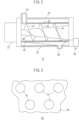
- Fig. 2 indicates the structure of the screw press 12.
- a screw shaft 20 is rotated by a driver 27, and vanes 21 mounted on the screw shaft 20 press the slurry from the left to the right in the drawing.
- a tubular mesh 22 provided with plural openings encloses the vanes 21.
- the diameter of the screw shaft 20 increases from the left to the right in the drawing, the gap between the mesh 22 and the screw shaft 20 decreases towards the right in the drawing, and thus the slurry is pressed.
- the mesh 22 is further enclosed by an outer tube 23.
- the gypsum slurry is supplied to the inside of the mesh 22 from an inlet port 24 at the left in the drawing, and the liquid component passed through the mesh 22 is evacuated from a liquid component outlet 25.
- the paper dust and foreign matter are transported to the right end of the mesh 22 by the screw shaft 20 and evacuated from a solid component outlet 26.
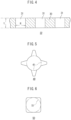
- Fig. 3 indicates the plan view of the mesh 22, and Fig. 4 indicates its cross-sectional view.
- the mesh 22 comprises a metal plate 30 such as a steel plate and is provided with plural circular openings 31 by punching.
- the thickness of the metal plate 30 is t
- the diameter of the openings 31 is R (opening diameter)
- the strength of the mesh 22 increases when the thickness t increases.
- the thickness t becomes larger than the diameter R, the punching becomes difficult, and therefore, the thickness t is made nearly equal to the diameter R.
- the value (t/R - 1) is preferably made within plus and minus 0.2 and more preferably, within plus and minus 0.1.
- the diameter R of the openings 31 was 1 mm or less, the mesh 22 was frequently damaged, and therefore, the diameter R is 1.5 mm or greater and preferably 2 mm or greater.
- the diameter of the openings 31 exceeded 3 mm, the slurry was frequently clogged within the gap between the screw shaft 20 and the mesh 22, and the water content of paper dust ejected from the solid component outlet 26 increased. Therefore, the diameter R is made 3 mm or less, and the thickness t is, for example, preferably made 3 mm or less.
- the preferable ranges of the diameter R of the openings 31 and the thickness t are as follows: Preferable Range: R: 1.5 mm or greater and 3 mm or less, t: nearly equal to R, 1.5 mm or greater, and 3 mm or less, More preferable Range: R: 2 mm or greater and 3 mm or less, t: nearly equal to R, 2 mm or greater, and 3 mm or less, In both cases: (t/R - 1): at least -0.2 and at most 0.2, and more preferably, (t/R - 1): at least -0.1 and at most 0.1.
- the diameter of an inscribed circle within the openings is defined as the opening diameter.
- the diameter of an inscribed circle 41 shown by the chain line is defined as the opening diameter
- the diameter of an inscribed circle 51 shown by the chain line is defined as the opening diameter.
- the opening rate of the mesh 22 is defined as the total opening area of openings 31 divided by the apparent area of the mesh 22 (area including the openings 31).
- the opening rate is preferably 15 % or greater and 30 % or less.
- a coarse sieve 14 having an opening of 1 mm or less, preferably, from 0.4 mm to 0.8 mm, can be used.
- the screen of the sieve 14 is, for example, made of metal but may be made of plastic.
- the number of openings is measured by an optical microscope in a predetermined length, such as 1 inch, and the diameter of the metal wire or the like of the screen is measured by the same optical microscope or by a micrometer.
- the opening of the sieve 14 is the resultant.
- a gypsum slurry having 10 wt% of paper dust and solid foreign matter in total (the total concentration of water and gypsum was 90 wt%) was pressed by means of a screw press 12 with a mesh 22 having an opening of 2 mm and the thickness of 2 mm at a rate of 550 Kg/hr.
- the solid component gotten from the solid component outlet 26 had a dry weight of 54 Kg/hr, the adhering water was 36 Kg/hr, and the water content was 40 wt%.
- the liquid component gotten from the liquid component outlet 25 was treated by a vibration sieve 14 having an opening of 0.5 mm.
- the resultant paper dust and foreign matter had a dry weight of 1 Kg/hr, the adhering water was 4 Kg/hr, and the water content was 80 wt%. In total, nearly all the paper dust and foreign matter were reclaimed at a rate of 55 Kg/hr, the adhering water was 40 Kg/hr, and the water content was 42 wt%.
- the paper dust and foreign matter were dried under air blow and were separated into solid foreign matter and paper dust by a cyclone.
Landscapes
- Engineering & Computer Science (AREA)
- Chemical & Material Sciences (AREA)
- Organic Chemistry (AREA)
- Mechanical Engineering (AREA)
- Environmental & Geological Engineering (AREA)
- Life Sciences & Earth Sciences (AREA)
- Chemical Kinetics & Catalysis (AREA)
- Inorganic Chemistry (AREA)
- Geology (AREA)
- Hydrology & Water Resources (AREA)
- Water Supply & Treatment (AREA)
- Separation Of Solids By Using Liquids Or Pneumatic Power (AREA)
- Processing Of Solid Wastes (AREA)
- Combined Means For Separation Of Solids (AREA)
- Filtration Of Liquid (AREA)
Abstract
Description
- The invention relates to a pressing method of aqueous slurry including solid foreign matter and paper dust and, in particular, a pressing method of gypsum slurry including solid foreign matter and paper dust and derived from waste gypsum boards.
- Gypsum slurry derived from waste gypsum boards includes paper dust, metal pieces such as metal fittings, sand, gravel, and so on, in addition to gypsum. In this specification, solid foreign matter means, for example, metal pieces, sand, and gravel. For reclaiming gypsum from waste gypsum boards, it is needed to separate paper dust and solid foreign matter from gypsum.
- Related pieces of the prior art will be described. According to Patent Document 1 (
JP 2020-065975A - Patent Document 1:
JP 2020-065975A - The inventors have considered pressing the gypsum slurry by belt presses or screw presses. During this consideration, it has been found that the retrieval of paper dust having low water content is difficult by belt presses and that screw presses can press more efficiently.
- Screw presses press paper dust and solid foreign matter in the slurry towards the outlet of the press by means of vanes of the screw and eject the liquid component in the slurry through openings of a surrounding mesh. However, hard solid foreign matter in the slurry, such as metal pieces and gravel, frequently damaged the mesh, and therefore, the continuous operation of screw presses was found difficult.
- The object of the invention is to reduce the damage to the meshes when pressing, by screw presses, aqueous slurry, such as gypsum slurry derived from waste gypsum boards, and to maintain the water content of the paper dust separated from the aqueous slurry within an allowable range.
- A pressing method of aqueous slurry, including solid foreign matter and paper dust, according to the invention is characterized by
- a pressing step for pressing said aqueous slurry by means of a screw press, provided with a mesh having openings not less than 1.5 mm and not greater than 3 mm, such that said aqueous slurry is separated into the solid foreign matter and the paper dust not passing through said mesh, and liquid component passing through said mesh, and
- a sieving step for sieving said liquid component by means of a sieve having openings not greater than 1 mm such that the solid foreign matter and the paper dust are separated from the liquid component.
- A processing method of waste gypsum boards according to the invention carries out:
- a deposition step for mixing gypsum hemihydrate and/or anhydrous type III gypsum, derived from waste gypsum boards with an aqueous medium to form a gypsum slurry including paper dust and solid foreign matter and then for depositing gypsum dihydrate particles in the gypsum slurry; and
- a solid/liquid separation step for extracting the gypsum dihydrate particles from the gypsum slurry.
- The invention is characterized by further comprising:
- a pressing step for pressing said gypsum slurry by means of a screw press, provided with a mesh having openings not less than 1.5 mm and not greater than 3 mm, such that said gypsum slurry is separated into the solid foreign matter and the paper dust not passing through said mesh, and a gypsum slurry passing through said mesh, and
- a sieving step for sieving said gypsum slurry passing through said mesh by means of a sieve having openings not greater than 1 mm such that the solid foreign matter and the paper dust are separated as oversized components from the gypsum slurry.
- Screw presses and belt presses have been known as the pressing devices that can continuously press aqueous slurries. However, it has been found difficult to retrieve, by belt presses, paper dust that has low water content from aqueous slurries containing the paper dust. Further, when treating aqueous slurries containing solid foreign matter such as metal pieces, the belt in the presses is inevitably damaged. Therefore, according to the invention, a screw press is used to retrieve paper dust and foreign matter from the aqueous slurries.
- Screw presses push aqueous slurries towards the outlet by a screw and eject the liquid component in the slurry from a mesh surrounding the screw. When the opening in the mesh is smaller, then, the paper dust and the foreign matter which are ejected with the liquid component are made smaller. However, since those meshes having small openings have to be thin, the meshes have to be frequently damaged by solid foreign matter. Therefore, the damage to the meshes is to be reduced.
- According to the invention, the openings of mesh in the screw press (opening diameter) are made not less than 1.5 mm and not greater than 3 mm, preferably, not less than 2 mm and not greater than 3 mm. This enables the mesh to have a thickness of not less than 1.5 mm and not greater than 3 mm, preferably, not less than 2 mm and not greater than 3 mm. Namely, since the openings in the mesh are made by punching, the thickness of meshes has an upper limit substantially equal to the openings. According to this invention, the openings in the mesh are made larger to enable the mesh to have an increased thickness such that the damage to the mesh is reduced. As a remark, when the openings in the mesh exceed 3 mm, the screw presses were easily clogged, and the retrieved paper dust and the foreign matter had high water content.
- When using the mesh having an opening not less than 1.5 mm and not greater than 3 mm, the damage to the meshes is reduced, but the liquid component passed through the mesh becomes to include paper dust and foreign matter. Therefore, the liquid component passed through the mesh of the screw press is sieved by means of a sieve having openings not greater than 1 mm to separate the paper dust and foreign matter from the liquid component. Since large-sized solid foreign matter does not pass through the mesh in the screw press, the screen in the sieve is not damaged by the solid foreign matter. While the paper dust and the foreign matter not passing through the sieve have high water content, most of the paper dust and the foreign matter have already been removed from the liquid component by the screw press. Therefore, while the paper dust and the foreign matter treated by the sieve have high water content, the water content in the total of the retrieved paper dust and the foreign matter is within an allowable range.
- When the openings of the sieve are made smaller, the water content in the paper dust and foreign matter is smaller. However, at the same time, the strength of the screen of the sieve decreases, and the screen becomes easily damaged by the solid foreign matter. Therefore, the opening in the screen is preferably not less than 0.4 mm and not greater than 0.8 mm.
- According to the invention, damage to the mesh in the screw press is reduced, and paper dust and foreign matter are extracted from the aqueous slurry such that they have a water content within an allowable range. The slurries to be treated are not limited to those derived from waste gypsum boards but arbitrary if it is aqueous and contains paper dust and solid foreign matter.
-
- [
Fig. 1 ] A schematic diagram of a reclamation plant of gypsum dihydrate according to an embodiment - [
Fig. 2 ] A partially cross-sectional view of a screw press used in the embodiment - [
Fig. 3 ] A plan view of a mesh in the screw press - [
Fig. 4 ] A cross-sectional view of the mesh in the screw press - [
Fig. 5 ] A plan view of a mesh according to a modification - [
Fig. 6 ] A plan view of a mesh according to a second modification - Embodiments for carrying out the invention will be described. The scope of the invention is determined according to the claims with reference to the specification and well-known techniques in the art, as the ordinary persons in the art understand the claims. The scope of the invention is not limited to the embodiments.
-
Figs. 1 to 6 indicate an embodiment and its modifications.Fig. 1 indicates the processing of waste gypsum boards. The waste gypsum boards are crushed by acrusher 2, and if needed, they are pulverized after crushing. In addition, metallic foreign matter is separated by a magnetic separator, not shown in the drawings. Gypsum granules resultant from crushing are stored in a silo 4 and are heated in aheating apparatus 6 to prepare granules of gypsum hemihydrate or anhydrous type III gypsum. These granules include paper dust and solid foreign matter, such as metal pieces, sand, and gravel, even after crushing, pulverization, and magnetic separation, and the solid foreign matter is hard. - The gypsum granules are mixed with filtrate from a solid/
liquid separator 16 in amixing tank 8 to form a gypsum slurry, and the gypsum slurry is aged indeposition tanks 10 under stirring to deposit gypsum dihydrate particles in the gypsum slurry. Without themixing tank 8, the gypsum granules and the filtrate may be directly mixed in one of thedeposition tanks 10. WhileFig. 1 indicatesmulti-staged deposition tanks 10, one stage tank or arbitrary staged tanks are however usable. - The gypsum slurry in the
deposition tanks 10 is pressed by means of ascrew press 12 to separate paper dust and foreign matter from the liquid component in the slurry. The liquid component passed thescrew press 12 is dealt with asieve 14 such as a vibration sieve, and paper dust and foreign matter are further separated from the liquid component as the oversized components. The paper dust and the foreign matter are obtained by both thescrew press 12 and thesieve 14, then, for example, air dried, and separated into paper dust and solid foreign matter by a cyclone or the like. - The liquid component passed through the sieve 14 (the undersized component) is separated into the powder of gypsum dihydrate particles and the filtrate by the solid/
liquid separator 16 such as a filter press, and the filtrate is re-circulated to themixing tank 8. However, the liquid component passed through thesieve 14 may be re-circulated to thedeposition tanks 10 or the like, and the gypsum slurry may be supplied to the solid/liquid separator 16 through a separate path. -
Fig. 2 indicates the structure of thescrew press 12. Ascrew shaft 20 is rotated by adriver 27, andvanes 21 mounted on thescrew shaft 20 press the slurry from the left to the right in the drawing. Atubular mesh 22 provided with plural openings encloses thevanes 21. The diameter of thescrew shaft 20 increases from the left to the right in the drawing, the gap between themesh 22 and thescrew shaft 20 decreases towards the right in the drawing, and thus the slurry is pressed. Themesh 22 is further enclosed by anouter tube 23. The gypsum slurry is supplied to the inside of themesh 22 from aninlet port 24 at the left in the drawing, and the liquid component passed through themesh 22 is evacuated from aliquid component outlet 25. The paper dust and foreign matter are transported to the right end of themesh 22 by thescrew shaft 20 and evacuated from asolid component outlet 26. -
Fig. 3 indicates the plan view of themesh 22, andFig. 4 indicates its cross-sectional view. Themesh 22 comprises ametal plate 30 such as a steel plate and is provided with pluralcircular openings 31 by punching. When the thickness of themetal plate 30 is t, and the diameter of theopenings 31 is R (opening diameter), the strength of themesh 22 increases when the thickness t increases. When the thickness t becomes larger than the diameter R, the punching becomes difficult, and therefore, the thickness t is made nearly equal to the diameter R. For example, the value (t/R - 1) is preferably made within plus and minus 0.2 and more preferably, within plus and minus 0.1. When the diameter R of theopenings 31 was 1 mm or less, themesh 22 was frequently damaged, and therefore, the diameter R is 1.5 mm or greater and preferably 2 mm or greater. When the diameter of theopenings 31 exceeded 3 mm, the slurry was frequently clogged within the gap between thescrew shaft 20 and themesh 22, and the water content of paper dust ejected from thesolid component outlet 26 increased. Therefore, the diameter R is made 3 mm or less, and the thickness t is, for example, preferably made 3 mm or less. The preferable ranges of the diameter R of theopenings 31 and the thickness t are as follows:Preferable Range: R: 1.5 mm or greater and 3 mm or less, t: nearly equal to R, 1.5 mm or greater, and 3 mm or less, More preferable Range: R: 2 mm or greater and 3 mm or less, t: nearly equal to R, 2 mm or greater, and 3 mm or less, In both cases: (t/R - 1): at least -0.2 and at most 0.2, and more preferably, (t/R - 1): at least -0.1 and at most 0.1. - When the
openings 31 of themesh 22 are not circular, the diameter of an inscribed circle within the openings is defined as the opening diameter. For example, regarding anopening 40 inFig. 5 , the diameter of an inscribedcircle 41 shown by the chain line is defined as the opening diameter, and regarding anopening 50 inFig. 6 , the diameter of an inscribedcircle 51 shown by the chain line is defined as the opening diameter. When there are various sizes of theopenings 31 or the like, the number of openings of diameter R is denoted as n(R). And then, {Sigma n(R) x R}/{Sigma n(R)}, or the number averaged opening diameter within the distribution of R is calculated as the average opening diameter. - The opening rate of the
mesh 22 is defined as the total opening area ofopenings 31 divided by the apparent area of the mesh 22 (area including the openings 31). The opening rate is preferably 15 % or greater and 30 % or less. When the opening rate is made large, the water content in the paper dust and foreign matter decreases, and the strength of themesh 22 decreases on the other hand. - Since the
screw press 12 separates large solid foreign matter, there is little chance that thesieve 14 is damaged by solid foreign matter. In addition, the quantity of paper dust and the foreign matter gotten from thesieve 14 is by far smaller than those gotten from thescrew press 12. Therefore, even if the paper dust and the foreign matter from thesieve 14 have high water content, the increase in the total water content in the paper dust and the foreign matter is small. Therefore, acoarse sieve 14 having an opening of 1 mm or less, preferably, from 0.4 mm to 0.8 mm, can be used. The screen of thesieve 14 is, for example, made of metal but may be made of plastic. When measuring the opening, the number of openings is measured by an optical microscope in a predetermined length, such as 1 inch, and the diameter of the metal wire or the like of the screen is measured by the same optical microscope or by a micrometer. When subtracting the diameter of the metal wire or the like multiplied by its number from the predetermined length and then dividing by the number of the openings, the opening of thesieve 14 is the resultant. - A gypsum slurry having 10 wt% of paper dust and solid foreign matter in total (the total concentration of water and gypsum was 90 wt%) was pressed by means of a
screw press 12 with amesh 22 having an opening of 2 mm and the thickness of 2 mm at a rate of 550 Kg/hr. The solid component gotten from thesolid component outlet 26 had a dry weight of 54 Kg/hr, the adhering water was 36 Kg/hr, and the water content was 40 wt%. The liquid component gotten from theliquid component outlet 25 was treated by avibration sieve 14 having an opening of 0.5 mm. The resultant paper dust and foreign matter had a dry weight of 1 Kg/hr, the adhering water was 4 Kg/hr, and the water content was 80 wt%. In total, nearly all the paper dust and foreign matter were reclaimed at a rate of 55 Kg/hr, the adhering water was 40 Kg/hr, and the water content was 42 wt%. The paper dust and foreign matter were dried under air blow and were separated into solid foreign matter and paper dust by a cyclone. - Replacing the
mesh 22 in thescrew press 12 with one having an opening of 0.5 mm (the thickness was also 0.5 mm), and the same slurry in the experiment was continuously pressed at a rate of 550 Kg/hr. The liquid component gotten from theliquid component outlet 25 had almost no paper dust nor foreign matter, and therefore, the treatment by thesieve 14 was not needed. However, when operating 80 hours from the start, themesh 22 was damaged, and the screw press became inoperable. -
- 2
- crusher
- 4
- silo
- 6
- heating apparatus
- 8
- mixing tank
- 10
- deposition tank
- 12
- screw press
- 14
- sieve
- 16
- solid/liquid separator
- 20
- screw shaft
- 21
- vane
- 22
- mesh
- 23
- outer tube
- 24
- inlet port
- 25
- liquid component outlet
- 26
- solid component outlet
- 27
- driver
- 30
- metal plate
- 31
- opening
- 40, 50
- opening
- 41, 51
- inscribed circle
Claims (5)
- A pressing method of aqueous slurry, including solid foreign matter and paper dust, being characterized bya pressing step for pressing said aqueous slurry by means of a screw press, provided with a mesh having openings not less than 1.5 mm and not greater than 3 mm, such that said aqueous slurry is separated into the solid foreign matter and the paper dust not passing through said mesh, and liquid component passing through said mesh, anda sieving step for sieving said liquid component by means of a sieve having openings not greater than 1 mm such that the solid foreign matter and the paper dust are separated from the liquid component.
- A processing method of waste gypsum boards comprising:a deposition step for mixing gypsum hemihydrate and/or anhydrous type III gypsum, derived from waste gypsum boards with an aqueous medium to form a gypsum slurry including paper dust and solid foreign matter and then for depositing gypsum dihydrate particles in the gypsum slurry; anda solid/liquid separation step for extracting the gypsum dihydrate particles from the gypsum slurry, being characterized in thata pressing step for pressing said gypsum slurry by means of a screw press, provided with a mesh having openings not less than 1.5 mm and not greater than 3 mm, such that said gypsum slurry is separated into the solid foreign matter and the paper dust not passing through said mesh, and a gypsum slurry passing through said mesh, anda sieving step for sieving said gypsum slurry passing through said mesh by means of a sieve having openings not greater than 1 mm such that the solid foreign matter and the paper dust are separated as oversized components from the gypsum slurryare performed after forming the gypsum slurry and before the solid/liquid separation step.
- The processing method of waste gypsum boards according to claim 2, being characterized in that the openings of said sieve are not less than 0.4 mm and not greater than 1 mm.
- The processing method of waste gypsum boards according to claim 3, being characterized in that, when a thickness of said mesh is t, and when a diameter of said openings is R, a ratio (t/R) of the thickness t and the diameter R of the openings is not less than 0.8 and not greater than 1.2.
- The processing method of waste gypsum boards according to claim 4, being characterized in that said mesh has an opening ratio which is a ratio of a total area of the openings and an apparent area of the mesh, not less than 15 % and not greater than 30 %.
Applications Claiming Priority (2)
| Application Number | Priority Date | Filing Date | Title |
|---|---|---|---|
| JP2020120398A JP7436310B2 (en) | 2020-07-14 | 2020-07-14 | Method for squeezing aqueous slurry containing solid foreign matter and paper powder, and method for treating waste gypsum board |
| PCT/JP2021/015913 WO2022014115A1 (en) | 2020-07-14 | 2021-04-19 | Method for compression of aqueous slurry containing solid foreign matter and paper dust, and treatment method of waste gypsum board |
Publications (2)
| Publication Number | Publication Date |
|---|---|
| EP4183465A1 true EP4183465A1 (en) | 2023-05-24 |
| EP4183465A4 EP4183465A4 (en) | 2024-08-07 |
Family
ID=79554733
Family Applications (1)
| Application Number | Title | Priority Date | Filing Date |
|---|---|---|---|
| EP21841796.2A Pending EP4183465A4 (en) | 2020-07-14 | 2021-04-19 | METHOD FOR COMPRESSING AQUEOUS SUSPENSION CONTAINING SOLID FOREIGN MATTER AND PAPER DUST AND METHOD FOR TREATING WASTE GYPSUM BOARD |
Country Status (4)
| Country | Link |
|---|---|
| US (1) | US12559380B2 (en) |
| EP (1) | EP4183465A4 (en) |
| JP (1) | JP7436310B2 (en) |
| WO (1) | WO2022014115A1 (en) |
Families Citing this family (2)
| Publication number | Priority date | Publication date | Assignee | Title |
|---|---|---|---|---|
| CN216155724U (en) * | 2021-09-02 | 2022-04-01 | 吴云萍 | Non-abrasion lamination spiral dewatering equipment with detachable driving device |
| CN115259822B (en) * | 2022-07-15 | 2023-04-14 | 生态环境部南京环境科学研究所 | Cellular Concrete Synergistically Prepared Using Steel Slag and Titanium Gypsum and Its Preparation Method |
Family Cites Families (11)
| Publication number | Priority date | Publication date | Assignee | Title |
|---|---|---|---|---|
| EP0386998A1 (en) * | 1989-03-08 | 1990-09-12 | Byron Whinston Harker | Method and apparatus for separating adhered paper from paper covered gypsum board |
| JPH05317900A (en) * | 1992-05-14 | 1993-12-03 | Hirofumi Yamada | Continuous recovery method for fine silica sand or the like contained in slurry and device therefor |
| JP2002088676A (en) | 2000-06-09 | 2002-03-27 | Ibiden Co Ltd | Papermaking sludge processing method and processing apparatus |
| JP4642203B2 (en) | 2000-09-20 | 2011-03-02 | 日立造船株式会社 | Organic waste treatment methods |
| JP2003088775A (en) * | 2001-09-18 | 2003-03-25 | Birukuriin:Kk | Gypsum board powdering equipment. |
| JP2009226309A (en) | 2008-03-24 | 2009-10-08 | Taiheiyo Cement Corp | Method for treating waste plaster board |
| JP5230512B2 (en) | 2009-04-13 | 2013-07-10 | 株式会社トクヤマ | How to treat gypsum board waste |
| JP2012024690A (en) | 2010-07-23 | 2012-02-09 | Minoru Hosoda | System for sorting and treating waste gypsum board |
| WO2012176688A1 (en) * | 2011-06-21 | 2012-12-27 | 株式会社トクヤマ | Method for reproducing gypsum from gypsum board waste |
| CN106807509A (en) * | 2017-02-13 | 2017-06-09 | 成都君华睿道科技有限公司 | A kind of solid refuse grinds screening plant |
| JP7078512B2 (en) | 2018-10-25 | 2022-05-31 | 株式会社トクヤマ | How to collect dihydrate gypsum from waste gypsum board |
-
2020
- 2020-07-14 JP JP2020120398A patent/JP7436310B2/en active Active
-
2021
- 2021-04-19 US US18/012,100 patent/US12559380B2/en active Active
- 2021-04-19 WO PCT/JP2021/015913 patent/WO2022014115A1/en not_active Ceased
- 2021-04-19 EP EP21841796.2A patent/EP4183465A4/en active Pending
Also Published As
| Publication number | Publication date |
|---|---|
| US20230257277A1 (en) | 2023-08-17 |
| EP4183465A4 (en) | 2024-08-07 |
| JP2022017699A (en) | 2022-01-26 |
| JP7436310B2 (en) | 2024-02-21 |
| WO2022014115A1 (en) | 2022-01-20 |
| US12559380B2 (en) | 2026-02-24 |
Similar Documents
| Publication | Publication Date | Title |
|---|---|---|
| KR101433692B1 (en) | Gypsum waste recycling system | |
| US12559380B2 (en) | Method for compression of aqueous slurry containing solid foreign matter and paper dust, and treatment method of waste gypsum board | |
| RU2000120924A (en) | METHOD FOR THE PRIMARY PROCESSING OF MIXED WASTE AND THE PROCESSING PLANT | |
| WO2020002977A1 (en) | Systems and method for washing and grading particulate material. | |
| EP3121261B1 (en) | Production of biogas from organic materials | |
| CN211801513U (en) | Preparation system of sugar alcohol powder | |
| CA3102588A1 (en) | System for physical-mechanical recovery and refining of non-ferrous met als from electronic scrap | |
| CN113714260A (en) | Kitchen waste sand and oil removing pretreatment method and device | |
| JP2020065975A (en) | Recovery method of gypsum dihydrate from waste gypsum board | |
| EP3914740B1 (en) | Recovery of chromite fines | |
| KR102008906B1 (en) | Break to sand of the making method and making device | |
| EP4166501A1 (en) | Method for recovering gypsum from waste gypsum boards | |
| US3165268A (en) | Method and apparatus for processing ferrous slag | |
| CN114345711A (en) | Alcohol production raw grain cleaning and micro-negative pressure crushing system processing system and process | |
| JP4563472B2 (en) | Manufacturing method of thin glass raw material | |
| MX2025004045A (en) | Bulk material mill for processing coarse material | |
| CN101585042A (en) | Aqueous medium physical recovery process and equipment for valuable components in waste circuit boards | |
| JP7211318B2 (en) | Desalination cleaning method and desalination cleaning apparatus for chlorine-containing ash | |
| DE3907445C2 (en) | ||
| US20160133425A1 (en) | Method and Apparatus for Recycling | |
| RU1776202C (en) | Method for mechanical separation of metals from metallurgical furnace slag | |
| JP3747327B2 (en) | Allophane purification method | |
| EP0073864A1 (en) | A process of reclaiming gypsum from plasterboard | |
| JPH0929136A (en) | Solid-liquid separation method and device | |
| CN215467010U (en) | Separating device for solid waste treatment |
Legal Events
| Date | Code | Title | Description |
|---|---|---|---|
| STAA | Information on the status of an ep patent application or granted ep patent |
Free format text: STATUS: THE INTERNATIONAL PUBLICATION HAS BEEN MADE |
|
| PUAI | Public reference made under article 153(3) epc to a published international application that has entered the european phase |
Free format text: ORIGINAL CODE: 0009012 |
|
| STAA | Information on the status of an ep patent application or granted ep patent |
Free format text: STATUS: REQUEST FOR EXAMINATION WAS MADE |
|
| 17P | Request for examination filed |
Effective date: 20230214 |
|
| AK | Designated contracting states |
Kind code of ref document: A1 Designated state(s): AL AT BE BG CH CY CZ DE DK EE ES FI FR GB GR HR HU IE IS IT LI LT LU LV MC MK MT NL NO PL PT RO RS SE SI SK SM TR |
|
| DAV | Request for validation of the european patent (deleted) | ||
| DAX | Request for extension of the european patent (deleted) | ||
| A4 | Supplementary search report drawn up and despatched |
Effective date: 20240710 |
|
| RIC1 | Information provided on ipc code assigned before grant |
Ipc: B07B 1/46 20060101ALN20240704BHEP Ipc: B02C 23/14 20060101ALN20240704BHEP Ipc: B02C 23/10 20060101ALN20240704BHEP Ipc: B09B 3/32 20220101ALI20240704BHEP Ipc: B07B 1/20 20060101ALI20240704BHEP Ipc: B03B 9/06 20060101ALI20240704BHEP Ipc: B01D 29/35 20060101ALI20240704BHEP Ipc: B30B 13/00 20060101ALI20240704BHEP Ipc: B30B 9/12 20060101ALI20240704BHEP Ipc: B30B 9/02 20060101ALI20240704BHEP Ipc: B01D 29/37 20060101ALI20240704BHEP Ipc: B01D 29/25 20060101ALI20240704BHEP Ipc: B01D 29/17 20060101ALI20240704BHEP Ipc: B09B 5/00 20060101ALI20240704BHEP Ipc: B07B 1/00 20060101ALI20240704BHEP Ipc: B03B 5/00 20060101ALI20240704BHEP Ipc: B01D 36/02 20060101AFI20240704BHEP |
|
| STAA | Information on the status of an ep patent application or granted ep patent |
Free format text: STATUS: EXAMINATION IS IN PROGRESS |
|
| 17Q | First examination report despatched |
Effective date: 20260325 |