EP4183421A1 - Antibody drug conjugate - Google Patents
Antibody drug conjugate Download PDFInfo
- Publication number
- EP4183421A1 EP4183421A1 EP21855628.0A EP21855628A EP4183421A1 EP 4183421 A1 EP4183421 A1 EP 4183421A1 EP 21855628 A EP21855628 A EP 21855628A EP 4183421 A1 EP4183421 A1 EP 4183421A1
- Authority
- EP
- European Patent Office
- Prior art keywords
- antibody
- her2
- heavy chain
- light chain
- antigen
- Prior art date
- Legal status (The legal status is an assumption and is not a legal conclusion. Google has not performed a legal analysis and makes no representation as to the accuracy of the status listed.)
- Pending
Links
Images


Classifications
-
- A—HUMAN NECESSITIES
- A61—MEDICAL OR VETERINARY SCIENCE; HYGIENE
- A61K—PREPARATIONS FOR MEDICAL, DENTAL OR TOILETRY PURPOSES
- A61K47/00—Medicinal preparations characterised by the non-active ingredients used, e.g. carriers or inert additives; Targeting or modifying agents chemically bound to the active ingredient
- A61K47/50—Medicinal preparations characterised by the non-active ingredients used, e.g. carriers or inert additives; Targeting or modifying agents chemically bound to the active ingredient the non-active ingredient being chemically bound to the active ingredient, e.g. polymer-drug conjugates
- A61K47/51—Medicinal preparations characterised by the non-active ingredients used, e.g. carriers or inert additives; Targeting or modifying agents chemically bound to the active ingredient the non-active ingredient being chemically bound to the active ingredient, e.g. polymer-drug conjugates the non-active ingredient being a modifying agent
- A61K47/68—Medicinal preparations characterised by the non-active ingredients used, e.g. carriers or inert additives; Targeting or modifying agents chemically bound to the active ingredient the non-active ingredient being chemically bound to the active ingredient, e.g. polymer-drug conjugates the non-active ingredient being a modifying agent the modifying agent being an antibody, an immunoglobulin or a fragment thereof, e.g. an Fc-fragment
- A61K47/6801—Drug-antibody or immunoglobulin conjugates defined by the pharmacologically or therapeutically active agent
- A61K47/6803—Drugs conjugated to an antibody or immunoglobulin, e.g. cisplatin-antibody conjugates
-
- C—CHEMISTRY; METALLURGY
- C07—ORGANIC CHEMISTRY
- C07K—PEPTIDES
- C07K16/00—Immunoglobulins [IG], e.g. monoclonal or polyclonal antibodies
- C07K16/18—Immunoglobulins [IG], e.g. monoclonal or polyclonal antibodies against material from animals or humans
- C07K16/32—Immunoglobulins [IG], e.g. monoclonal or polyclonal antibodies against material from animals or humans against translation products of oncogenes
-
- A—HUMAN NECESSITIES
- A61—MEDICAL OR VETERINARY SCIENCE; HYGIENE
- A61K—PREPARATIONS FOR MEDICAL, DENTAL OR TOILETRY PURPOSES
- A61K47/00—Medicinal preparations characterised by the non-active ingredients used, e.g. carriers or inert additives; Targeting or modifying agents chemically bound to the active ingredient
- A61K47/50—Medicinal preparations characterised by the non-active ingredients used, e.g. carriers or inert additives; Targeting or modifying agents chemically bound to the active ingredient the non-active ingredient being chemically bound to the active ingredient, e.g. polymer-drug conjugates
- A61K47/51—Medicinal preparations characterised by the non-active ingredients used, e.g. carriers or inert additives; Targeting or modifying agents chemically bound to the active ingredient the non-active ingredient being chemically bound to the active ingredient, e.g. polymer-drug conjugates the non-active ingredient being a modifying agent
- A61K47/54—Medicinal preparations characterised by the non-active ingredients used, e.g. carriers or inert additives; Targeting or modifying agents chemically bound to the active ingredient the non-active ingredient being chemically bound to the active ingredient, e.g. polymer-drug conjugates the non-active ingredient being a modifying agent the modifying agent being an organic compound
-
- A—HUMAN NECESSITIES
- A61—MEDICAL OR VETERINARY SCIENCE; HYGIENE
- A61K—PREPARATIONS FOR MEDICAL, DENTAL OR TOILETRY PURPOSES
- A61K31/00—Medicinal preparations containing organic active ingredients
- A61K31/33—Heterocyclic compounds
- A61K31/395—Heterocyclic compounds having nitrogen as a ring hetero atom, e.g. guanethidine or rifamycins
- A61K31/435—Heterocyclic compounds having nitrogen as a ring hetero atom, e.g. guanethidine or rifamycins having six-membered rings with one nitrogen as the only ring hetero atom
- A61K31/47—Quinolines; Isoquinolines
- A61K31/4738—Quinolines; Isoquinolines ortho- or peri-condensed with heterocyclic ring systems
- A61K31/4745—Quinolines; Isoquinolines ortho- or peri-condensed with heterocyclic ring systems condensed with ring systems having nitrogen as a ring hetero atom, e.g. phenantrolines
-
- A—HUMAN NECESSITIES
- A61—MEDICAL OR VETERINARY SCIENCE; HYGIENE
- A61K—PREPARATIONS FOR MEDICAL, DENTAL OR TOILETRY PURPOSES
- A61K47/00—Medicinal preparations characterised by the non-active ingredients used, e.g. carriers or inert additives; Targeting or modifying agents chemically bound to the active ingredient
- A61K47/50—Medicinal preparations characterised by the non-active ingredients used, e.g. carriers or inert additives; Targeting or modifying agents chemically bound to the active ingredient the non-active ingredient being chemically bound to the active ingredient, e.g. polymer-drug conjugates
- A61K47/51—Medicinal preparations characterised by the non-active ingredients used, e.g. carriers or inert additives; Targeting or modifying agents chemically bound to the active ingredient the non-active ingredient being chemically bound to the active ingredient, e.g. polymer-drug conjugates the non-active ingredient being a modifying agent
- A61K47/54—Medicinal preparations characterised by the non-active ingredients used, e.g. carriers or inert additives; Targeting or modifying agents chemically bound to the active ingredient the non-active ingredient being chemically bound to the active ingredient, e.g. polymer-drug conjugates the non-active ingredient being a modifying agent the modifying agent being an organic compound
- A61K47/545—Heterocyclic compounds
-
- A—HUMAN NECESSITIES
- A61—MEDICAL OR VETERINARY SCIENCE; HYGIENE
- A61K—PREPARATIONS FOR MEDICAL, DENTAL OR TOILETRY PURPOSES
- A61K47/00—Medicinal preparations characterised by the non-active ingredients used, e.g. carriers or inert additives; Targeting or modifying agents chemically bound to the active ingredient
- A61K47/50—Medicinal preparations characterised by the non-active ingredients used, e.g. carriers or inert additives; Targeting or modifying agents chemically bound to the active ingredient the non-active ingredient being chemically bound to the active ingredient, e.g. polymer-drug conjugates
- A61K47/51—Medicinal preparations characterised by the non-active ingredients used, e.g. carriers or inert additives; Targeting or modifying agents chemically bound to the active ingredient the non-active ingredient being chemically bound to the active ingredient, e.g. polymer-drug conjugates the non-active ingredient being a modifying agent
- A61K47/62—Medicinal preparations characterised by the non-active ingredients used, e.g. carriers or inert additives; Targeting or modifying agents chemically bound to the active ingredient the non-active ingredient being chemically bound to the active ingredient, e.g. polymer-drug conjugates the non-active ingredient being a modifying agent the modifying agent being a protein, peptide or polyamino acid
- A61K47/65—Peptidic linkers, binders or spacers, e.g. peptidic enzyme-labile linkers
-
- A—HUMAN NECESSITIES
- A61—MEDICAL OR VETERINARY SCIENCE; HYGIENE
- A61K—PREPARATIONS FOR MEDICAL, DENTAL OR TOILETRY PURPOSES
- A61K47/00—Medicinal preparations characterised by the non-active ingredients used, e.g. carriers or inert additives; Targeting or modifying agents chemically bound to the active ingredient
- A61K47/50—Medicinal preparations characterised by the non-active ingredients used, e.g. carriers or inert additives; Targeting or modifying agents chemically bound to the active ingredient the non-active ingredient being chemically bound to the active ingredient, e.g. polymer-drug conjugates
- A61K47/51—Medicinal preparations characterised by the non-active ingredients used, e.g. carriers or inert additives; Targeting or modifying agents chemically bound to the active ingredient the non-active ingredient being chemically bound to the active ingredient, e.g. polymer-drug conjugates the non-active ingredient being a modifying agent
- A61K47/68—Medicinal preparations characterised by the non-active ingredients used, e.g. carriers or inert additives; Targeting or modifying agents chemically bound to the active ingredient the non-active ingredient being chemically bound to the active ingredient, e.g. polymer-drug conjugates the non-active ingredient being a modifying agent the modifying agent being an antibody, an immunoglobulin or a fragment thereof, e.g. an Fc-fragment
-
- A—HUMAN NECESSITIES
- A61—MEDICAL OR VETERINARY SCIENCE; HYGIENE
- A61K—PREPARATIONS FOR MEDICAL, DENTAL OR TOILETRY PURPOSES
- A61K47/00—Medicinal preparations characterised by the non-active ingredients used, e.g. carriers or inert additives; Targeting or modifying agents chemically bound to the active ingredient
- A61K47/50—Medicinal preparations characterised by the non-active ingredients used, e.g. carriers or inert additives; Targeting or modifying agents chemically bound to the active ingredient the non-active ingredient being chemically bound to the active ingredient, e.g. polymer-drug conjugates
- A61K47/51—Medicinal preparations characterised by the non-active ingredients used, e.g. carriers or inert additives; Targeting or modifying agents chemically bound to the active ingredient the non-active ingredient being chemically bound to the active ingredient, e.g. polymer-drug conjugates the non-active ingredient being a modifying agent
- A61K47/68—Medicinal preparations characterised by the non-active ingredients used, e.g. carriers or inert additives; Targeting or modifying agents chemically bound to the active ingredient the non-active ingredient being chemically bound to the active ingredient, e.g. polymer-drug conjugates the non-active ingredient being a modifying agent the modifying agent being an antibody, an immunoglobulin or a fragment thereof, e.g. an Fc-fragment
- A61K47/6801—Drug-antibody or immunoglobulin conjugates defined by the pharmacologically or therapeutically active agent
- A61K47/6803—Drugs conjugated to an antibody or immunoglobulin, e.g. cisplatin-antibody conjugates
- A61K47/68037—Drugs conjugated to an antibody or immunoglobulin, e.g. cisplatin-antibody conjugates the drug being a camptothecin [CPT] or derivatives
-
- A—HUMAN NECESSITIES
- A61—MEDICAL OR VETERINARY SCIENCE; HYGIENE
- A61K—PREPARATIONS FOR MEDICAL, DENTAL OR TOILETRY PURPOSES
- A61K47/00—Medicinal preparations characterised by the non-active ingredients used, e.g. carriers or inert additives; Targeting or modifying agents chemically bound to the active ingredient
- A61K47/50—Medicinal preparations characterised by the non-active ingredients used, e.g. carriers or inert additives; Targeting or modifying agents chemically bound to the active ingredient the non-active ingredient being chemically bound to the active ingredient, e.g. polymer-drug conjugates
- A61K47/51—Medicinal preparations characterised by the non-active ingredients used, e.g. carriers or inert additives; Targeting or modifying agents chemically bound to the active ingredient the non-active ingredient being chemically bound to the active ingredient, e.g. polymer-drug conjugates the non-active ingredient being a modifying agent
- A61K47/68—Medicinal preparations characterised by the non-active ingredients used, e.g. carriers or inert additives; Targeting or modifying agents chemically bound to the active ingredient the non-active ingredient being chemically bound to the active ingredient, e.g. polymer-drug conjugates the non-active ingredient being a modifying agent the modifying agent being an antibody, an immunoglobulin or a fragment thereof, e.g. an Fc-fragment
- A61K47/6835—Medicinal preparations characterised by the non-active ingredients used, e.g. carriers or inert additives; Targeting or modifying agents chemically bound to the active ingredient the non-active ingredient being chemically bound to the active ingredient, e.g. polymer-drug conjugates the non-active ingredient being a modifying agent the modifying agent being an antibody, an immunoglobulin or a fragment thereof, e.g. an Fc-fragment the modifying agent being an antibody or an immunoglobulin bearing at least one antigen-binding site
- A61K47/6849—Medicinal preparations characterised by the non-active ingredients used, e.g. carriers or inert additives; Targeting or modifying agents chemically bound to the active ingredient the non-active ingredient being chemically bound to the active ingredient, e.g. polymer-drug conjugates the non-active ingredient being a modifying agent the modifying agent being an antibody, an immunoglobulin or a fragment thereof, e.g. an Fc-fragment the modifying agent being an antibody or an immunoglobulin bearing at least one antigen-binding site the antibody targeting a receptor, a cell surface antigen or a cell surface determinant
-
- A—HUMAN NECESSITIES
- A61—MEDICAL OR VETERINARY SCIENCE; HYGIENE
- A61K—PREPARATIONS FOR MEDICAL, DENTAL OR TOILETRY PURPOSES
- A61K47/00—Medicinal preparations characterised by the non-active ingredients used, e.g. carriers or inert additives; Targeting or modifying agents chemically bound to the active ingredient
- A61K47/50—Medicinal preparations characterised by the non-active ingredients used, e.g. carriers or inert additives; Targeting or modifying agents chemically bound to the active ingredient the non-active ingredient being chemically bound to the active ingredient, e.g. polymer-drug conjugates
- A61K47/51—Medicinal preparations characterised by the non-active ingredients used, e.g. carriers or inert additives; Targeting or modifying agents chemically bound to the active ingredient the non-active ingredient being chemically bound to the active ingredient, e.g. polymer-drug conjugates the non-active ingredient being a modifying agent
- A61K47/68—Medicinal preparations characterised by the non-active ingredients used, e.g. carriers or inert additives; Targeting or modifying agents chemically bound to the active ingredient the non-active ingredient being chemically bound to the active ingredient, e.g. polymer-drug conjugates the non-active ingredient being a modifying agent the modifying agent being an antibody, an immunoglobulin or a fragment thereof, e.g. an Fc-fragment
- A61K47/6835—Medicinal preparations characterised by the non-active ingredients used, e.g. carriers or inert additives; Targeting or modifying agents chemically bound to the active ingredient the non-active ingredient being chemically bound to the active ingredient, e.g. polymer-drug conjugates the non-active ingredient being a modifying agent the modifying agent being an antibody, an immunoglobulin or a fragment thereof, e.g. an Fc-fragment the modifying agent being an antibody or an immunoglobulin bearing at least one antigen-binding site
- A61K47/6851—Medicinal preparations characterised by the non-active ingredients used, e.g. carriers or inert additives; Targeting or modifying agents chemically bound to the active ingredient the non-active ingredient being chemically bound to the active ingredient, e.g. polymer-drug conjugates the non-active ingredient being a modifying agent the modifying agent being an antibody, an immunoglobulin or a fragment thereof, e.g. an Fc-fragment the modifying agent being an antibody or an immunoglobulin bearing at least one antigen-binding site the antibody targeting a determinant of a tumour cell
-
- A—HUMAN NECESSITIES
- A61—MEDICAL OR VETERINARY SCIENCE; HYGIENE
- A61K—PREPARATIONS FOR MEDICAL, DENTAL OR TOILETRY PURPOSES
- A61K47/00—Medicinal preparations characterised by the non-active ingredients used, e.g. carriers or inert additives; Targeting or modifying agents chemically bound to the active ingredient
- A61K47/50—Medicinal preparations characterised by the non-active ingredients used, e.g. carriers or inert additives; Targeting or modifying agents chemically bound to the active ingredient the non-active ingredient being chemically bound to the active ingredient, e.g. polymer-drug conjugates
- A61K47/51—Medicinal preparations characterised by the non-active ingredients used, e.g. carriers or inert additives; Targeting or modifying agents chemically bound to the active ingredient the non-active ingredient being chemically bound to the active ingredient, e.g. polymer-drug conjugates the non-active ingredient being a modifying agent
- A61K47/68—Medicinal preparations characterised by the non-active ingredients used, e.g. carriers or inert additives; Targeting or modifying agents chemically bound to the active ingredient the non-active ingredient being chemically bound to the active ingredient, e.g. polymer-drug conjugates the non-active ingredient being a modifying agent the modifying agent being an antibody, an immunoglobulin or a fragment thereof, e.g. an Fc-fragment
- A61K47/6835—Medicinal preparations characterised by the non-active ingredients used, e.g. carriers or inert additives; Targeting or modifying agents chemically bound to the active ingredient the non-active ingredient being chemically bound to the active ingredient, e.g. polymer-drug conjugates the non-active ingredient being a modifying agent the modifying agent being an antibody, an immunoglobulin or a fragment thereof, e.g. an Fc-fragment the modifying agent being an antibody or an immunoglobulin bearing at least one antigen-binding site
- A61K47/6851—Medicinal preparations characterised by the non-active ingredients used, e.g. carriers or inert additives; Targeting or modifying agents chemically bound to the active ingredient the non-active ingredient being chemically bound to the active ingredient, e.g. polymer-drug conjugates the non-active ingredient being a modifying agent the modifying agent being an antibody, an immunoglobulin or a fragment thereof, e.g. an Fc-fragment the modifying agent being an antibody or an immunoglobulin bearing at least one antigen-binding site the antibody targeting a determinant of a tumour cell
- A61K47/6855—Medicinal preparations characterised by the non-active ingredients used, e.g. carriers or inert additives; Targeting or modifying agents chemically bound to the active ingredient the non-active ingredient being chemically bound to the active ingredient, e.g. polymer-drug conjugates the non-active ingredient being a modifying agent the modifying agent being an antibody, an immunoglobulin or a fragment thereof, e.g. an Fc-fragment the modifying agent being an antibody or an immunoglobulin bearing at least one antigen-binding site the antibody targeting a determinant of a tumour cell the tumour determinant being from breast cancer cell
-
- A—HUMAN NECESSITIES
- A61—MEDICAL OR VETERINARY SCIENCE; HYGIENE
- A61K—PREPARATIONS FOR MEDICAL, DENTAL OR TOILETRY PURPOSES
- A61K47/00—Medicinal preparations characterised by the non-active ingredients used, e.g. carriers or inert additives; Targeting or modifying agents chemically bound to the active ingredient
- A61K47/50—Medicinal preparations characterised by the non-active ingredients used, e.g. carriers or inert additives; Targeting or modifying agents chemically bound to the active ingredient the non-active ingredient being chemically bound to the active ingredient, e.g. polymer-drug conjugates
- A61K47/51—Medicinal preparations characterised by the non-active ingredients used, e.g. carriers or inert additives; Targeting or modifying agents chemically bound to the active ingredient the non-active ingredient being chemically bound to the active ingredient, e.g. polymer-drug conjugates the non-active ingredient being a modifying agent
- A61K47/68—Medicinal preparations characterised by the non-active ingredients used, e.g. carriers or inert additives; Targeting or modifying agents chemically bound to the active ingredient the non-active ingredient being chemically bound to the active ingredient, e.g. polymer-drug conjugates the non-active ingredient being a modifying agent the modifying agent being an antibody, an immunoglobulin or a fragment thereof, e.g. an Fc-fragment
- A61K47/6835—Medicinal preparations characterised by the non-active ingredients used, e.g. carriers or inert additives; Targeting or modifying agents chemically bound to the active ingredient the non-active ingredient being chemically bound to the active ingredient, e.g. polymer-drug conjugates the non-active ingredient being a modifying agent the modifying agent being an antibody, an immunoglobulin or a fragment thereof, e.g. an Fc-fragment the modifying agent being an antibody or an immunoglobulin bearing at least one antigen-binding site
- A61K47/6875—Medicinal preparations characterised by the non-active ingredients used, e.g. carriers or inert additives; Targeting or modifying agents chemically bound to the active ingredient the non-active ingredient being chemically bound to the active ingredient, e.g. polymer-drug conjugates the non-active ingredient being a modifying agent the modifying agent being an antibody, an immunoglobulin or a fragment thereof, e.g. an Fc-fragment the modifying agent being an antibody or an immunoglobulin bearing at least one antigen-binding site the antibody being a hybrid immunoglobulin
- A61K47/6879—Medicinal preparations characterised by the non-active ingredients used, e.g. carriers or inert additives; Targeting or modifying agents chemically bound to the active ingredient the non-active ingredient being chemically bound to the active ingredient, e.g. polymer-drug conjugates the non-active ingredient being a modifying agent the modifying agent being an antibody, an immunoglobulin or a fragment thereof, e.g. an Fc-fragment the modifying agent being an antibody or an immunoglobulin bearing at least one antigen-binding site the antibody being a hybrid immunoglobulin the immunoglobulin having two or more different antigen-binding sites, e.g. bispecific or multispecific immunoglobulin
-
- A—HUMAN NECESSITIES
- A61—MEDICAL OR VETERINARY SCIENCE; HYGIENE
- A61P—SPECIFIC THERAPEUTIC ACTIVITY OF CHEMICAL COMPOUNDS OR MEDICINAL PREPARATIONS
- A61P35/00—Antineoplastic agents
-
- C—CHEMISTRY; METALLURGY
- C07—ORGANIC CHEMISTRY
- C07B—GENERAL METHODS OF ORGANIC CHEMISTRY; APPARATUS THEREFOR
- C07B59/00—Introduction of isotopes of elements into organic compounds ; Labelled organic compounds per se
- C07B59/008—Peptides; Proteins
-
- C—CHEMISTRY; METALLURGY
- C07—ORGANIC CHEMISTRY
- C07D—HETEROCYCLIC COMPOUNDS
- C07D491/00—Heterocyclic compounds containing in the condensed ring system both one or more rings having oxygen atoms as the only ring hetero atoms and one or more rings having nitrogen atoms as the only ring hetero atoms, not provided for by groups C07D451/00 - C07D459/00, C07D463/00, C07D477/00 or C07D489/00
- C07D491/22—Heterocyclic compounds containing in the condensed ring system both one or more rings having oxygen atoms as the only ring hetero atoms and one or more rings having nitrogen atoms as the only ring hetero atoms, not provided for by groups C07D451/00 - C07D459/00, C07D463/00, C07D477/00 or C07D489/00 in which the condensed system contains four or more hetero rings
-
- C—CHEMISTRY; METALLURGY
- C07—ORGANIC CHEMISTRY
- C07B—GENERAL METHODS OF ORGANIC CHEMISTRY; APPARATUS THEREFOR
- C07B2200/00—Indexing scheme relating to specific properties of organic compounds
- C07B2200/05—Isotopically modified compounds, e.g. labelled
-
- C—CHEMISTRY; METALLURGY
- C07—ORGANIC CHEMISTRY
- C07K—PEPTIDES
- C07K2317/00—Immunoglobulins specific features
- C07K2317/30—Immunoglobulins specific features characterized by aspects of specificity or valency
- C07K2317/31—Immunoglobulins specific features characterized by aspects of specificity or valency multispecific
-
- C—CHEMISTRY; METALLURGY
- C07—ORGANIC CHEMISTRY
- C07K—PEPTIDES
- C07K2317/00—Immunoglobulins specific features
- C07K2317/40—Immunoglobulins specific features characterized by post-translational modification
- C07K2317/41—Glycosylation, sialylation, or fucosylation
-
- C—CHEMISTRY; METALLURGY
- C07—ORGANIC CHEMISTRY
- C07K—PEPTIDES
- C07K2317/00—Immunoglobulins specific features
- C07K2317/50—Immunoglobulins specific features characterized by immunoglobulin fragments
- C07K2317/56—Immunoglobulins specific features characterized by immunoglobulin fragments variable (Fv) region, i.e. VH and/or VL
-
- C—CHEMISTRY; METALLURGY
- C07—ORGANIC CHEMISTRY
- C07K—PEPTIDES
- C07K2317/00—Immunoglobulins specific features
- C07K2317/60—Immunoglobulins specific features characterized by non-natural combinations of immunoglobulin fragments
- C07K2317/62—Immunoglobulins specific features characterized by non-natural combinations of immunoglobulin fragments comprising only variable region components
- C07K2317/622—Single chain antibody (scFv)
-
- C—CHEMISTRY; METALLURGY
- C07—ORGANIC CHEMISTRY
- C07K—PEPTIDES
- C07K2317/00—Immunoglobulins specific features
- C07K2317/90—Immunoglobulins specific features characterized by (pharmaco)kinetic aspects or by stability of the immunoglobulin
- C07K2317/92—Affinity (KD), association rate (Ka), dissociation rate (Kd) or EC50 value
Definitions
- the present application relates to an antibody-drug conjugate comprising a therapeutic antibody moiety, an intermediate linker moiety and a cytotoxic drug moiety which are linked.
- the present application further relates to use of the antibody-drug conjugate in preparing a medicament for preventing and treating cancer.
- Antibody-drug conjugates are a class of drugs that combine the high specificity of therapeutic antibodies and the high killing activity of cytotoxic drugs, where the therapeutic antibody moiety is linked to the cytotoxic drug moiety via an intermediate linker moiety.
- ADC drugs are marketed globally, among which antibody moieties of brentuximab vedotin, polatuzumab vedotin and enfortumab vedotin are directed against targets CD30, CD79b and Nectin-4, respectively; antibody moieties of trastuzumab emtansine and trastuzumab deruxtecan are directed against target HER2; antibody moieties of gemtuzumab ozogamicin and inotuzumab ozogamicin are directed against targets CD33 and CD22, respectively; antibody moiety of sacituzumab govitecan is directed against target TROP2.
- trastuzumab emtansine adopts maytansinoid toxin molecules acting on microtubules
- gemtuzumab ozogamicin and inotuzumab ozogamicin adopts calicheamicin toxin molecules acting on DNA
- trastuzumab deruxtecan and sacituzumab govitecan adopt camptothecin analog toxin molecules.
- trastuzumab emtansine adopts a non-cleavable linker, while the remaining seven of the above ADC drugs adopt cleavable linkers.
- Camptothecin (CPT) analogs and derivatives exert anti-tumor activity by binding to topoisomerase I, which exhibits significant activity against a wide variety of tumor types.
- CPT-11 irinotecan hydrochloride
- CPT-11 must be catalyzed by carboxylesterase in vivo before it can be converted to its active form SN-38 (formula I), this conversion is extremely inefficient, and SN38 itself is difficult to be prepared as drugs due to its poor solubility.
- Exatecan (formula II), another water-soluble CPT derivative, had been attempted for development as an anti-tumor drug, however, the development had been ceased by 2004, and exatecant does not need to be activated by enzymes.
- exatecan compared with SN-38, which is the pharmacodynamic ontology of irinotecan, exatecan has a stronger inhibitory effect on the activity of topoisomerase I.
- ADC drugs combine the dual advantages of high potency of cytotoxic small molecules and high selectivity of antibodies to specific tumor cells, however, there is still a need to develop highly potent and low-toxic ADC drugs that can target more indications.
- the present application provides an antibody-drug conjugate containing a deuterated modification, or a pharmaceutically acceptable salt or a solvate thereof, and specifically relates to a deuterated modification of a linker or a cytotoxic drug moiety.
- the present application provides an antibody-drug conjugate of general formula Ab-(L-U)n, or a pharmaceutically acceptable salt or a solvate thereof, wherein Ab represents an antibody moiety, L represents a linker moiety, U represents a cytotoxic drug moiety, and n is an integer or a decimal selected from the group consisting of 1 to 10.
- the present application provides an antibody-drug conjugate of general formula Ab-(L-U)n, or a pharmaceutically acceptable salt or a solvate thereof, wherein Ab (an antibody moiety) can specifically bind to a tumor antigen (including a tumor specific antigen and a tumor-associated antigen), which can be selected from any tumor prevention or treatment target known in the art, for example, can be selected from the group consisting of HER2, EGFR, CD20, CD30, CD33, CD47, CD79b, VEGF, VEGFR, MET, RET, PD-1, PD-L1, and the like.
- a tumor antigen including a tumor specific antigen and a tumor-associated antigen
- the present application provides an antibody-drug conjugate of general formula Ab-(L-U)n, or a pharmaceutically acceptable salt or a solvate thereof, wherein Ab (an antibody moiety) may be modifiable, for example, comprises changes, additions or subtractions of one or more amino acids.
- the present application provides an antibody-drug conjugate of general formula Ab-(L-U)n, or a pharmaceutically acceptable salt or a solvate thereof, wherein the antibody moiety Ab is an antibody capable of specifically binding to HER2.
- the antibody moiety Ab of the antibody-drug conjugate of general formula Ab-(L-U)n, or the pharmaceutically acceptable salt or the solvate thereof provided herein is trastuzumab having a sequence shown in Table S1 below.
- the antibody moiety Ab of the antibody-drug conjugate of general formula Ab-(L-U)n provided herein, or the pharmaceutically acceptable salt or the solvate thereof, is pertuzumab having a sequence shown in Table S2 below.
- the present application provides an antibody-drug conjugate of general formula Ab-(L-U)n, or a pharmaceutically acceptable salt or a solvate thereof, wherein the antibody moiety Ab comprises a first antigen-binding fragment that is monovalent and specifically binds to an ECD4 epitope of HER2 on an HER2-expressing cell, wherein the first antigen-binding fragment is an scFv comprising a VH and a VL, the VH having a K30 mutation, and/or the VL having an F53 mutation.
- the amino acid at position 30 in the sequence of VH is mutated from K to an acidic amino acid, e.g., E.
- the amino acid at position 53 in the sequence of VL is mutated from F to a neutral or basic amino acid, e.g., Y, A, or R.
- the scFv may comprise or be a sequence having a K30 mutation and/or a F53 mutation in the amino acid sequence set forth in SEQ ID NO: 1.
- the present application provides an antibody-drug conjugate of general formula Ab-(L-U)n, or a pharmaceutically acceptable salt or a solvate thereof, wherein the antibody moiety Ab comprises a first antigen-binding fragment that is monovalent and specifically binds to an ECD4 epitope of HER2 on an HER2-expressing cell, wherein the first antigen-binding fragment is an scFv, and comprises a heavy chain CDR1, a heavy chain CDR2, a heavy chain CDR3, a light chain CDR1, a light chain CDR2 and a light chain CDR3, the heavy chain CDR1, the heavy chain CDR2 and the heavy chain CDR3 comprising amino acid sequences set forth in SEQ ID NOs: 27, 28 and 29, respectively, and the light chain CDR1, the light chain CDR2 and the light chain CDR3 comprising amino acid sequences set forth in SEQ ID NOs: 30, 34 and 32, respectively; wherein the sequence set forth in SEQ ID NO: 27 is GFNIX 2 DTYI
- the present application provides an antibody-drug conjugate of general formula Ab-(L-U)n, or a pharmaceutically acceptable salt or a solvate thereof, wherein the antibody moiety Ab comprises a first antigen-binding fragment that is monovalent and specifically binds to an ECD4 epitope of HER2 on an HER2-expressing cell, wherein the first antigen-binding fragment is an scFv, and comprises a heavy chain CDR1, a heavy chain CDR2, a heavy chain CDR3, a light chain CDR1, a light chain CDR2 and a light chain CDR3, the heavy chain CDR1, the heavy chain CDR2 and the heavy chain CDR3 comprising amino acid sequences set forth in SEQ ID NOs: 43, 28 and 29, respectively, and the light chain CDR1, the light chain CDR2 and the light chain CDR3 comprising amino acid sequences set forth in SEQ ID NOs: 30, 31 and 32, respectively.
- the antibody moiety Ab comprises a first antigen-binding fragment that is monovalent and specifically
- the present application provides an antibody-drug conjugate of general formula Ab-(L-U)n, or a pharmaceutically acceptable salt or a solvate thereof, wherein the antibody moiety Ab comprises a first antigen-binding fragment that is monovalent and specifically binds to an ECD4 epitope of HER2 on an HER2-expressing cell, wherein the first antigen-binding fragment is an scFv and is selected from the group consisting of:
- the present application provides an antibody-drug conjugate of general formula Ab-(L-U)n, or a pharmaceutically acceptable salt or a solvate thereof, wherein the antibody moiety Ab comprises a first antigen-binding fragment that is monovalent and specifically binds to an ECD4 epitope of HER2 on an HER2-expressing cell, wherein the first antigen-binding fragment is an scFv and comprises a heavy chain variable region and a light chain variable region comprising amino acid sequences set forth in SEQ ID NOs: 35 and 36, respectively.
- the present application provides an antibody-drug conjugate of general formula Ab-(L-U)n, or a pharmaceutically acceptable salt or a solvate thereof, wherein the antibody moiety Ab comprises a first antigen-binding fragment that is monovalent and specifically binds to an ECD4 epitope of HER2 on an HER2-expressing cell, wherein the first antigen-binding fragment is an scFv, and a VH and VL of the first antigen-binding fragment is arranged from N-terminus to C-terminus in the following order: VH-linker-VL.
- the present application provides an antibody-drug conjugate of general formula Ab-(L-U)n, or a pharmaceutically acceptable salt or a solvate thereof, wherein the antibody moiety Ab further comprises a second antigen-binding fragment that is monovalent and specifically binds to an ECD2 epitope of HER2 on an HER2-expressing cell, the second antigen-binding fragment being an Fab.
- the present application provides an antibody-drug conjugate of general formula Ab-(L-U)n, or a pharmaceutically acceptable salt or a solvate thereof, wherein the antibody moiety Ab further comprises a second antigen-binding fragment that is monovalent and specifically binds to an ECD2 epitope of HER2 on an HER2-expressing cell, wherein the second antigen-binding fragment is an Fab and comprises a heavy chain CDR1, a heavy chain CDR2, a heavy chain CDR3, a light chain CDR1, a light chain CDR2 and a light chain CDR3, the heavy chain CDR1, the heavy chain CDR2 and the heavy chain CDR3 comprising amino acid sequences set forth in SEQ ID NOs: 45, 46 and 47, respectively, and the light chain CDR1, the light chain CDR2 and the light chain CDR3 comprising amino acid sequences set forth in SEQ ID NOs: 48, 49 and 50, respectively.
- the present application provides an antibody-drug conjugate of general formula Ab-(L-U)n, or a pharmaceutically acceptable salt or a solvate thereof, wherein the antibody moiety Ab further comprises a second antigen-binding fragment that is monovalent and specifically binds to an ECD2 epitope of HER2 on an HER2-expressing cell, wherein the second antigen-binding fragment is an scFv, and comprises a heavy chain variable region and a light chain variable region comprising amino acid sequences set forth in SEQ ID NOs: 37 and 38, respectively.
- the antibody moiety Ab of the antibody-drug conjugate of general formula Ab-(L-U)n, or the pharmaceutically acceptable salt or the solvate thereof provided herein is shown in Table S3.
- Table S3 Antibody moiety of exemplary antibody-drug conjugate, or pharmaceutically acceptable salt or solvate thereof Name Description First antigen-binding fragment (According to the Kabat numbering system) Second antigen-binding fragment / Epitope-containing domain ECD4 ECD2 Form scFV Fab Original sequence Trastuzumab Pertuzumab 1 Sequence substitution VL: F53Y / 2 Sequence substitution VH: K30E / 3 Sequence substitution VL: F53Y / VH: K30E
- the present application provides an antibody-drug conjugate of general formula Ab-(L-U)n, or a pharmaceutically acceptable salt or a solvate thereof, wherein the antibody moiety Ab comprises an immunoglobulin functional domain operably linked to a first antigen-binding fragment and/or a second antigen-binding fragment, the immunoglobulin functional domain comprising: i. one or more of CL, CH1, CH2 or CH3, or ii. an Fc.
- the present application provides an antibody-drug conjugate of general formula Ab-(L-U)n, or a pharmaceutically acceptable salt or a solvate thereof, wherein the antibody moiety Ab comprises an immunoglobulin functional domain operably linked to a first antigen-binding fragment and/or a second antigen-binding fragment, the immunoglobulin functional domain comprising: i. one or more of CL, CH1, CH2 or CH3, or ii. an Fc, wherein the CL, CH1, CH2, CH3 and Fc are derived from CL, CH1, CH2, CH3 and Fc of human IgG, respectively.
- the present application provides an antibody-drug conjugate of general formula Ab-(L-U)n, or a pharmaceutically acceptable salt or a solvate thereof, wherein the antibody moiety Ab comprises an immunoglobulin functional domain operably linked to a first antigen-binding fragment and/or a second antigen-binding fragment, the immunoglobulin functional domain comprising: i. one or more of CL, CH1, CH2 or CH3, or ii. an Fc, wherein the CL, CH1, CH2, CH3 or Fc has a modification or does not have a modification; preferably, the CH3 or Fc has a modification that is, e.g., an amino acid substitution at position 435 or/and position 436 according to the Kabat numbering system.
- the present application provides an antibody-drug conjugate of general formula Ab-(L-U)n, or a pharmaceutically acceptable salt or a solvate thereof, wherein the antibody moiety Ab comprises an immunoglobulin functional domain operably linked to a first antigen-binding fragment and/or a second antigen-binding fragment, the immunoglobulin functional domain comprising: i. one or more of CL, CH1, CH2 or CH3, or ii.
- Fc an Fc
- the Fc is a dimeric Fc comprising a first Fc polypeptide and a second Fc polypeptide
- the first antigen-binding fragment is operably linked to the first Fc polypeptide
- the second antigen-binding fragment is operably linked to the second Fc polypeptide.
- the present application provides an antibody-drug conjugate of general formula Ab-(L-U)n, or a pharmaceutically acceptable salt or a solvate thereof, wherein the antibody moiety Ab comprises a constant region operably linked to a first antigen-binding fragment and/or a second antigen-binding fragment, wherein the constant region may be a native sequence constant region or a mutated constant region of an immunoglobulin, e.g., one or more of native or mutated CL, CH1, CH2 and/or CH3 functional domains; in some examples, these functional domains are operably linked in a conventional manner in the art, the constant region may be derived from a constant region of a human immunoglobulin, such as from IgG1, IgG2, IgG3 or IgG4, and in some examples, the constant region may have modifications to improve its ability to mediate effector functions.
- the constant region may be a native sequence constant region or a mutated constant region of an immunoglobulin, e.g., one
- the present application provides an antibody-drug conjugate of general formula Ab-(L-U)n, or a pharmaceutically acceptable salt or a solvate thereof, wherein the antibody moiety Ab comprises an immunoglobulin functional domain or skeleton, e.g., an Fc, operably linked to a first antigen-binding fragment or/and a second antigen-binding fragment;
- the term Fc includes native sequence Fc regions and variant Fc regions, the Fc may be a human Fc, for example, it is derived from IgG1, IgG2, IgG3 or IgG4, and the Fc may have a modification so that its ability to mediate effector functions is improved.
- the skeleton has modifications, such as knob into hole, H435R, Y436F, defucosylation and the like; in some embodiments, the mutation sites of knob into hole in above skeleton include such as Y349C, T366S, L368A, Y407V, S354C, T366W and the like.
- the present application provides an antibody-drug conjugate of general formula Ab-(L-U)n, or a pharmaceutically acceptable salt or a solvate thereof, wherein the antibody moiety Ab comprises a skeleton operably linked to a first antigen-binding fragment and/or a second antigen-binding fragment.
- the skeleton described herein is a dimeric Fc comprising a first Fc polypeptide and a second Fc polypeptide.
- the dimeric Fc described herein has a modification.
- the dimeric Fc has an H435R modification or/and a Y436F modification, which may occur in one or both of polypeptide chain of the first Fc polypeptide and the second Fc polypeptide.
- the dimeric Fc has an H435R modification or/and a Y436F modification, which only occur in one Fc polypeptide rather than in the other Fc polypeptide.
- the dimeric Fc has mutation sites of knob-into-hole, such as Y349C, T366S, L368A, Y407V, S354C, T366W and the like.
- one chain of the dimeric Fc has T366W or/and S354C, and the other chain has Y407V, Y349C, T366S or/and L368A.
- the present application provides an antibody-drug conjugate of general formula Ab-(L-U)n, or a pharmaceutically acceptable salt or a solvate thereof, wherein the antibody moiety Ab is a bivalent bispecific antibody comprising: a heavy chain comprising SEQ ID NO: 11, a heavy chain comprising SEQ ID NO: 13, and a light chain comprising SEQ ID NO: 15.
- the antibody moiety Ab of the antibody-drug conjugate of general formula Ab-(L-U)n, or the pharmaceutically acceptable salt or the solvate thereof provided herein is shown in Table S4.
- Table S4 Antibody moiety of exemplary antibody-drug conjugate, or pharmaceutically acceptable salt or solvate thereof Name Description Amino acid sequence Expi Her2-2/ 23C-HE R2-2 First antigen-binding fragment (scFV) Heavy chain CDR1 GFNIEDTYIH (SEQ ID NO: 43) Heavy chain CDR2 RIYPTNGYTRYADSVKG (SEQ ID NO: 28) Heavy chain CDR3 WGGDGFYAMDYW (SEQ ID NO: 29) Heavy chain variable region Light chain CDR1 CRASQDVNTAVAW (SEQ ID NO: 30) Light chain CDR2 SASYLYS (SEQ ID NO: 31) Light chain CDR3 QQHYTTPPT (SEQ ID NO: 32) Light chain variable region anti-Her2-scFv-VH-K
- the present application provides an antibody-drug conjugate of general formula Ab-(L-U)n, or a pharmaceutically acceptable salt or a solvate thereof, wherein the cytotoxic drug moiety U is conjugated to the antibody moiety Ab via a linker moiety L.
- the linker moiety L disclosed herein may be linked to the antibody moiety by any method known in the art, preferably the linker moiety is linked to the antibody moiety via a sulfydryl group and/or amino group. In some more preferred embodiments, the linker moiety disclosed herein is linked to the antibody moiety via a sulfydryl group.
- the present application provides an antibody-drug conjugate of general formula Ab-(L-U)n, or a pharmaceutically acceptable salt or a solvate thereof, wherein the cytotoxic drug moiety U is conjugated to the antibody moiety Ab via a linker moiety L, which may be a cleavable linker or a non-cleavable linker; in some embodiments, the linker moiety disclosed herein is a cleavable linker, which may be of, e.g., a low pH-dependent degradation type (including a hydrazone bond, a carbonate bond, and the like), a proteolytic type (including a peptide-based bond), a high glutathione concentration-dependent degradation type (including a disulfide bond), or the like; in other embodiments, the linker moiety disclosed herein is a non-cleavable linker, for example, may be maleimidocaproyl, and the like.
- a linker moiety L which may be a cle
- the present application provides an antibody-drug conjugate of general formula Ab-(L-U)n, or a pharmaceutically acceptable salt or a solvate thereof, wherein the antibody moiety Ab is conjugated to one or more cytotoxic drug moieties U, which may be selected from the group consisting of, e.g., alkaloids, antimetabolites, anti-tumor antibiotics, alkylating agents, platinum-based drugs, and the like, preferably the cytotoxic drug is a microtubule inhibitor (including maytansinoid, auristatin) or a DNA-acting cytotoxic drug (including calicheamicin, duocarmycin, PBD (pyrrolobenzodiazepine), a topoisomerase I inhibitor, and the like).
- the cytotoxic drug moiety U of the antibody-drug conjugate of general formula Ab-(L-U)n, or the pharmaceutically acceptable salt or the solvate thereof provided herein is a topoisomerase I inhibitor.
- the cytotoxic drug moiety U of the antibody-drug conjugate of general formula Ab-(L-U)n, or the pharmaceutically acceptable salt or the solvate thereof provided herein is a camptothecin analog topoisomerase I inhibitor.
- the cytotoxic drug moiety U of the antibody-drug conjugate of general formula Ab-(L-U)n, or the pharmaceutically acceptable salt or the solvate thereof provided herein is selected from the group consisting of SN-38, an SN-38 derivative, exatecan, and an exatecan derivative.
- the present application provides an antibody-drug conjugate of general formula Ab-(L-U)n, or a pharmaceutically acceptable salt or a solvate thereof, wherein Ab represents an antibody moiety, L represents a linker moiety, U represents a camptothecin topoisomerase I inhibitor, and n is an integer or a decimal selected from 1 to 10, wherein the L moiety and/or the U moiety has a deuterated modification. In some embodiments, n is an integer or a decimal selected from the group consisting of 2 to 10, e.g., 2 to 9, 2 to 8, 3 to 9, 3 to 8, 4 to 9, 4 to 8, 5 to 9, and 5 to 8.
- the present application provides an antibody-drug conjugate of general formula Ab-(L-U)n, or a pharmaceutically acceptable salt or a solvate thereof, wherein Ab represents an antibody moiety, L represents a linker moiety, U represents a camptothecin topoisomerase I inhibitor, and n is an integer or a decimal selected from the group consisting of 1 to 10, wherein the L moiety and/or the U moiety has a deuterated modification, and the cytotoxic drug moiety U is selected from the group consisting of SN-38, an SN-38 derivative, exatecan, and an exatecan derivative.
- the antibody-drug conjugate of general formula Ab-(L-U)n or the pharmaceutically acceptable salt or the solvate thereof provided herein, comprises a structure of formula III below:
- the antibody-drug conjugate of general formula Ab-(L-U)n comprises a structure of formula IV below: wherein R 1 is selected from the group consisting of hydrogen (H) and deuterium (D).
- the antibody-drug conjugate of general formula Ab-(L-U)n, or the pharmaceutically acceptable salt or the solvate thereof provided herein comprises a structure of formula IV-1 or IV-2 below:
- the antibody-drug conjugate of general formula Ab-(L-U)n comprises a structure of formula V below: wherein R 1 and R 2 are each independently selected from the group consisting of hydrogen (H) and deuterium (D), and the left succinimide terminus of the structure is a site linking to the antibody moiety and the right carbonyl terminus is a site linking to the cytotoxic drug moiety.
- the antibody-drug conjugate of general formula Ab-(L-U)n, or the pharmaceutically acceptable salt or the solvate thereof provided herein comprises a structure of formula V-1, V-2, V-3, or V-4 below, and the structures of formulas V-1 to V-4 are linked to the antibody moiety by the left succinimide terminus and the cytotoxic drug moiety by the right carbonyl terminus, respectively:
- the antibody-drug conjugate of general formula Ab-(L-U)n comprises a structure of formula VI below: wherein, R 1 and R 2 are each independently selected from the group consisting of hydrogen (H) and deuterium (D).
- the antibody-drug conjugate of general formula Ab-(L-U)n comprises a structure of formula VI-1, VI-2, VI-3, or VI-4 below:
- the present application provides an antibody-drug conjugate, or a pharmaceutically acceptable salt or a solvate thereof, having a structure of formula VII: wherein,
- the present application provides an antibody-drug conjugate, or a pharmaceutically acceptable salt or a solvate thereof, having a structure of formula VII-1, VII-2, VII-3, or VII-4 below, wherein,
- the present application provides an antibody-drug conjugate, or a pharmaceutically acceptable salt or a solvate thereof, having a structure of formula VII-1 below, wherein,
- the present application provides an antibody-drug conjugate, or a pharmaceutically acceptable salt or a solvate thereof, having a structure of formula VII below, wherein,
- the present application provides an antibody-drug conjugate, or a pharmaceutically acceptable salt or a solvate thereof, having a structure of formula VII-1 below, wherein,
- the present application provides a pharmaceutical composition
- a pharmaceutical composition comprising the antibody-drug conjugate, or the pharmaceutically acceptable salt or the solvate thereof according to the present application, and a pharmaceutically acceptable carrier.
- the present application provides use of the antibody-drug conjugate, or the pharmaceutically acceptable salt or the solvate thereof according to the present application, in preparing a medicament for preventing and treating cancer.
- the present application provides use of a pharmaceutical composition comprising the antibody-drug conjugate, or the pharmaceutically acceptable salt or the solvate thereof according to the present application, and a pharmaceutically acceptable carrier in preparing a medicament for preventing and treating cancer.
- the present application provides an antibody-drug conjugate, or a pharmaceutically acceptable salt or a solvate thereof for use in preventing and treating cancer.
- the present application provides a method for treating or preventing cancer, the method comprising administering to a patient in need thereof a therapeutically effective amount of the antibody-drug conjugate, or the pharmaceutically acceptable salt or the solvate thereof according to the present application, or a pharmaceutical composition comprising the antibody-drug conjugate, or the pharmaceutically acceptable salt or the solvate thereof according to the present application, and a pharmaceutically acceptable carrier.
- the antibody-drug conjugate, or the pharmaceutically acceptable salt or the solvate thereof according to the present application may be used for preventing or treating HER2 positive cancer, HER2 negative cancer (including triple-negative breast cancer), and cancer that shows HER2 expression as IHC2+ detected by immunohistochemical assay.
- the present application provides a linker-drug intermediate compound having a structure of formula VI below, for use in obtaining an antibody-drug conjugate that links an antibody to the intermediate compound: wherein, R 1 and R 2 are each independently selected from the group consisting of hydrogen (H) and deuterium (D).
- the present application provides a linker-drug intermediate compound having a structure of formula VI-1, VI-2, VI-3 or VI-4 below, for use in obtaining an antibody-drug conjugate that links an antibody to the intermediate compound:
- the present application provides a linker compound having a structure of formula V below, for use in obtaining an antibody-drug conjugate that links a drug to an antibody via the linker: wherein R 1 and R 2 are each independently selected from the group consisting of hydrogen (H) and deuterium (D), and the left succinimide terminus of the structure is a site linking to the antibody moiety and the right carbonyl terminus is a site linking to the cytotoxic drug moiety.
- the present application provides a linker compound having a structure of formula V-1, V-2, V-3, or V-4 below, for use in obtaining an antibody-drug conjugate that links a drug to an antibody via the linker, and the structures of formulas V-1 to V-4 are linked to the antibody moiety by the left succinimide terminus and the cytotoxic drug moiety by the right carbonyl terminus, respectively:
- the present application provides a compound having a structure of formula IV(a) below: wherein R 1 is selected from the group consisting of hydrogen (H) and deuterium (D).
- the present application provides a compound having a structure of formula IV(a)-1 or formula IV(a)-2 below:
- the present application provides a compound having a structure of formula III(a) below:
- the present application provides an antibody-drug conjugate, or a pharmaceutically acceptable salt or a solvate thereof having improved pharmacokinetic properties.
- An improvement in pharmacokinetic properties will result in a reduction in toxicity of the target compound, an increase in safety and/or tolerability, an increase in efficacy and an improvement in the final therapeutic window.
- substituted means that any one or more hydrogen atoms on a specific atom are substituted by substituents, as long as the valence of the specific atom is normal and the resulting compound is stable.
- C m-n used herein means that the portion has an integer number of carbon atoms in the given range.
- C 1-6 means that the group may have 1 carbon atom, 2 carbon atoms, 3 carbon atoms, 4 carbon atoms, 5 carbon atoms, or 6 carbon atoms.
- variable e.g., R
- the variable is independently defined in each case. Therefore, for example, if a group is substituted with 2 R, the definition of each R is independent.
- a connecting group has a number of 0, for example, -(CH 2 ) 0 -, it means that the connecting group is a covalent bond.
- variable When a variable is a single bond, it means that the two groups are directly connected. For example, in A-L-Z, when L represents a single bond, it means that the structure is actually A-Z.
- halo- or halogen refers to fluorine, chlorine, bromine and iodine.
- hydroxy refers to -OH group.
- cyano refers to -CN group.
- sulfydryl refers to -SH group.
- amino refers to -NH 2 group.
- nitro refers to -NOz group.
- alkyl refers to hydrocarbyl with a general formula of C n H 2n+1 .
- the alkyl can be linear or branched.
- C 1-6 alkyl refers to alkyl containing 1 to 6 carbon atoms (for example, methyl, ethyl, n-propyl, isopropyl, n -butyl, isobutyl, sec -butyl, tert -butyl, n -pentyl, 1-methylbutyl, 2-methylbutyl, 3-methylbutyl, neopentyl, hexyl, 2-methylpentyl and the like).
- the alkyl moieties (namely alkyl) of alkoxy, alkylamino, dialkylamino, alkylsulfonyl and alkylthio are similarly defined as above.
- alkoxyl refers to -O-alkyl
- alkylamino refers to-NH-alkyl
- dialkylamino refers to -N(alkyl) 2 .
- alkylsulfonyl refers to-SO 2 -alkyl.
- alkylthio refers to -S-alkyl.
- alkenyl refers to linear or branched unsaturated aliphatic hydrocarbyl consisting of carbon atoms and hydrogen atoms with at least one double bond.
- alkenyl include, but are not limited to, ethenyl, 1-propenyl, 2-propenyl, 1-butenyl, isobutenyl, 1,3-butadienyl, and the like.
- alkynyl refers to linear or branched unsaturated aliphatic hydrocarbyl consisting of carbon atoms and hydrogen atoms with at least one triple bond.
- alkynyl include, but are not limited to, ethynyl (-C ⁇ CH), 1-propinyl (-C ⁇ C-CH 3 ), 2-propinyl (-CH 2 -C ⁇ CH), 1,3-butadiynyl (-C ⁇ C-C ⁇ CH), and the like.
- cycloalkyl refers to a carbon ring that is fully saturated and may exist in the form of a monocyclic, bridged cyclic, or spiro cyclic structure.
- the carbon ring is generally a 3-10 membered ring.
- cycloalkyl include, but are not limited to, cyclopropyl, cyclobutyl, cyclopentyl, cyclohexyl, norbomyl(bicyclo[2.2.1]heptyl), bicyclo[2.2.2]octyl, adamantyl, and the like.
- cycloalkenyl refers to a non-aromatic carbon ring that is not fully saturated and may exist in the form of a monocyclic, bridged cyclic, or spiro cyclic structure. Unless otherwise specified, the carbon ring is generally a 5-8 membered ring.
- Non-limiting examples of cycloalkenyl include, but are not limited to, cyclopentenyl, cyclopentadienyl, cyclohexenyl, cyclohexadienyl, cycloheptenyl, cycloheptadienyl, and the like.
- heterocyclyl refers to a fully saturated or partially unsaturated (but not fully unsaturated heteroaromatic group) nonaromatic ring which may exist in the form of a monocyclic, bridged cyclic, or spiro cyclic structure. Unless otherwise specified, the heterocyclyl is usually a 3-7 membered ring containing 1-3 heteroatoms (preferably 1 or 2 heteroatoms) independently selected from the group consisting of sulfur, oxygen, and/or nitrogen.
- heterocyclyl include, but are not limited to, oxiranyl, tetrahydrofuranyl, dihydrofuranyl, pyrrolidinyl, N -methylpyrrolidinyl, dihydropyrrolyl, piperidinyl, piperazinyl, pyrazolidinyl, 4 H -pyranyl, morpholinyl, thiomorpholinyl, tetrahydrothienyl, and the like.
- heterocycloalkyl refers to a fully saturated cyclic group that may exist in the form of a monocyclic, bridged cyclic, or spiro cyclic structure. Unless otherwise specified, the heterocyclyl is usually a 3-7 membered ring containing 1-3 heteroatoms (preferably 1 or 2 heteroatoms) independently selected from the group consisting of sulfur, oxygen, and/or nitrogen.
- Examples of 3 membered heterocycloalkyl include, but are not limited to, oxiranyl, thiiranyl, and aziranyl; non-limiting examples of 4 membered heterocycloalkyl include, but are not limited to, azetidinyl, oxetanyl, and thietanyl; examples of 5 membered heterocycloalkyl include, but are not limited to, tetrahydrofuranyl, tetrahydrothienyl, pyrrolidinyl, isoxazolidinyl, oxazolidinyl, isothiazolidinyl, thiazolidinyl, imidazolidinyl, and tetrahydropyrazolyl; examples of 6 membered heterocycloalkyl include, but are not limited to, piperidinyl, tetrahydropyranyl, tetrahydrothiopyranyl, morpholinyl, piperazinyl, 1,4-
- aryl refers to an aromatic monocyclic or fused polycyclic group of carbon atoms with the conjugated pi-electron system.
- aryl may have 6-20 carbon atoms, 6-14 carbon atoms or 6-12 carbon atoms.
- Non-limiting examples of aryl include, but are not limited to, phenyl, naphthyl, anthryl, 1,2,3,4-tetrahydronaphthalene, and the like.
- heteroaryl refers to a monocyclic or fused polycyclic system containing at least one ring atom selected from the group consisting of N, O and S, with the remaining ring atoms being C, and having at least one aromatic ring.
- the heteroaryl has a single 4-8 membered ring, in particular, a 5-8 membered ring, or is a plurality of fused rings comprising 6-14 ring atoms, in particular 6-10 ring atoms.
- heteroaryl include, but are not limited to, pyrrolyl, furanyl, thienyl, imidazolyl, oxazolyl, pyrazolyl, pyridinyl, pyrimidinyl, pyrazinyl, quinolyl, isoquinolyl, tetrazolyl, triazolyl, triazinyl, benzofuranyl, benzothienyl, indolyl, isoindolyl and the like.
- the "derivative” a compound formed by substituting atoms or atom groups in the molecule of the parent compound with other atoms or atom groups is referred to as a derivative of the parent compound.
- Any atom of a compound labeled and synthesized herein may represent any stable isotope of the atom, if not specifically designated. Unless otherwise specified, when a position in a structure is defined as H, i.e., hydrogen (H-1), this position contains only the naturally occurring isotope.
- a position in a structure is defined as D, i.e., deuterium (H-2)
- this position contains an isotope having an amount that is at least 3340 times greater than the amount of the naturally occurring isotope (0.015%) (i.e., at least 50.1% deuterium isotope)
- the content of the compound represented by the structure may be at least 52.5%, at least 60%, at least 67.5%, at least 75%, at least 82.5%, at least 90%, at least 95%, at least 97%, at least 98.5%, at least 99%, or at least 99.5%.
- the deuterated ratio of a compound labeled and synthesized herein refers to a ratio of the amount of the labeled synthetic isotope to the amount of the naturally occurring isotope.
- the deuterated ratio per designated deuterium atom of the compound labeled and synthesized herein may be at least 3500 times (52.5%), at least 4000 times (60%), at least 4500 times (67.5%), at least 5000 times (75%), at least 5500 times (82.5%), at least 6000 times (90%), at least 6333.3 times (95%), at least 6466.7 times (97%), at least 6566.7 times (98.5%), at least 6600 times (99%), at least 6633.3 times (99.5%).
- Isotopologues herein refer to compounds that differ only in isotopic composition in terms of chemical structure.
- the compound labeled and synthesized herein has the same chemical structure, with only isotopic changes in the atomic composition of its molecules. Therefore, the deuterium-containing compound at a specific position labeled and synthesized herein also contains very little hydrogen isotope at this position, and the amount of hydrogen isotopologue at a certain position in the compound labeled and synthesized herein depends on many factors, including the deuterium isotopic purity of the deuterated agent (D 2 O, D 2 , NaBD 4 , LiAlD 4 , and the like) and the effectiveness of introducing deuterium isotope synthesis methods.
- the total amount of such hydrogen isotopologue at a certain position will be less than 49.9%.
- the total amount of hydrogen isotopologue at a certain position in the compound labeled and synthesized herein will be less than 47.5%, 40%, 32.5%, 25%, 17.5%, 10%, 5%, 3%, 1%, or 0.5%.
- any individual atom not designated as deuterium is present at its natural isotopic abundance.
- treating means administering the compound or formulation described herein to prevent, ameliorate, or eliminate a disease or one or more symptoms associated with the disease, including: (i) preventing the occurrence of the disease or disease state in a mammal, particularly when such a mammal is predisposed to the disease state but has not yet been diagnosed with it; (ii) inhibiting a disease or disease state, i.e., arresting its development; (iii) alleviating a disease or disease state, i.e., causing its regression.
- terapéuticaally effective amount refers to an amount of the compound of the present application for (i) treating or preventing a specific disease, condition or disorder; (ii) alleviating, ameliorating or eliminating one or more symptoms of a specific disease, condition or disorder, or (iii) preventing or delaying onset of one or more symptoms of a specific disease, condition or disorder described herein.
- the amount of the compound of the present application composing the “therapeutically effective amount” varies dependently on the compound, the disease state and its severity, the route of administration, and the age of the mammal to be treated, but can be determined routinely by those skilled in the art in accordance with their knowledge and the present disclosure.
- pharmaceutically acceptable is used herein for those compounds, materials, compositions, and/or dosage forms which are, within the scope of sound medical judgment, suitable for use in contact with the tissues of human beings and animals without excessive toxicity, irritation, allergic response, or other problems or complications, and commensurate with a reasonable benefit/risk ratio.
- a pharmaceutically acceptable salt may be a metal salt, an ammonium salt, a salt formed with an organic base, a salt formed with an inorganic acid, a salt formed with an organic acid, a salt formed with a basic or acidic amino acid, and the like.
- solvate refers to a substance formed by association of a compound with a solvent molecule.
- pharmaceutical composition refers to a mixture consisting of one or more of the compounds or the salts thereof disclosed herein and a pharmaceutically acceptable excipient.
- the pharmaceutical composition is intended to facilitate the administration of the compound to an organic entity.
- pharmaceutically acceptable excipients refers to those which do not have a significant irritating effect on an organic entity and do not impair the biological activity and properties of the active compound. Suitable excipients are well known to those skilled in the art, for example carbohydrate, wax, water-soluble and/or water-swellable polymers, hydrophilic or hydrophobic material, gelatin, oil, solvent, water and the like.
- tautomer or "tautomeric form” refers to structural isomers of different energies that can interconvert via a low energy barrier.
- a proton tautomer also referred to as prototropic tautomer
- proton transfer such as keto-enol isomerism and imine-enamine isomerism.
- a specific example of a proton tautomer is an imidazole moiety where a proton can transfer between two ring nitrogens.
- a valence tautomer includes the interconversion via recombination of some bonding electrons.
- antibody is used in its broadest sense and specifically encompasses intact monoclonal antibodies, polyclonal antibodies, multispecific antibodies (e.g., bispecific antibodies) formed from at least two intact antibodies, multifunctional antibodies, and antibody fragments so long as they possess the desired biological activity.
- humanized antibody refers to an antibody comprising CDRs derived from a non-human antibody, and the remainder of the antibody molecule is derived from one or more human antibodies.
- mutant is used to refer to a peptide comprising an amino acid sequence derived from the amino acid sequence of the peptide as follows: substitution of one or two or more amino acids with amino acids different from the original peptide, deletion of one or two or more wild-type amino acids, insertion of one or two or more amino acids that do not exist in the wild type, and/or addition of amino acids that do not exist in the wild type to the amino terminus (N-terminus) and/or the carboxy terminus (C-terminus) of the wild type (hereinafter, collectively referred to as "mutation"). In the present application, “insertion” may also be included in “addition”.
- CDR complementarity-determining region
- hypervariable region refers to each region of an antibody variable domain which is highly variable in sequence and/or forms a structurally defined loop.
- Natural four-chain antibodies typically comprise six CDRs, three in the heavy chain variable region and three in the light chain variable region.
- variable region the antibody structural unit is composed of two pairs of polypeptide chains, each pair having one heavy chain and one light chain, and the N-terminal domain of each chain defining a region of about 100 to 110 or more amino acids primarily responsible for antigen recognition is the variable region.
- Fab means comprising the constant domain (CL) of the light chain and the first constant domain (CH1) of the heavy chain, together with the variable domains VL (light chain variable region) and VH (heavy chain variable region) in the light chain and heavy chain, respectively.
- the variable domain comprises complementarity-determining regions (CDRs) that are involved in antigen-binding.
- scFv includes the VH and VL domains of an antibody, wherein these domains are present in a single polypeptide chain.
- scFv further comprises a polypeptide linker between the VH and VL domains that enables the scFv to form the required structure for antigen-binding.
- ECD refers to an extracellular domain.
- HER receptors are receptor protein tyrosine kinases belonging to the human epidermal growth factor receptor (HER) family and include EGFR, HER2, HER3, and HER4 receptors, wherein the HER2 receptor generally comprises an extracellular domain that may bind HER ligand, a lipophilic transmembrane domain, a conserved intracellular tyrosine kinase domain, and a carboxy-terminal signaling domain with several tyrosine residues that can be phosphorylated, and the extracellular domain of HER2 comprises four domains that are ECD1, ECD2, ECD3 and ECD4, respectively.
- antibody moiety refers to an antibody moiety in an antibody-drug conjugate, which, in certain embodiments, is linked to an intermediate linker moiety via a specific functional group, and the antibody moiety can specifically bind to an antigen.
- linker moiety refers to a part of the antibody-drug conjugate which links an antibody moiety with a cytotoxic drug moiety and may be cleavable or uncleavable, wherein the cleavable linker refers to a part which may be cleaved in a target cell so as to release the cytotoxic drug.
- cytotoxic drug moiety refers to a cytotoxic drug moiety in an antibody-drug conjugate, and in certain specific embodiments, the cytotoxic drug moiety is linked to an intermediate linker moiety via a functional group, so that cytotoxic drug molecules can be liberated in tumor cells to exert an anti-tumor effect.
- trastuzumab refers to a recombinant humanized monoclonal antibody that selectively acts on the extracellular site of human epidermal growth factor receptor-4 (HER4) and can be used to treat HER2 positive cancer, an example of which is the commercially available therapeutic monoclonal antibody product under the trade name HERCEPTIN ® .
- pertuzumab refers to a recombinant humanized monoclonal antibody that selectively acts on the extracellular site of human epidermal growth factor receptor-2 (HER2) and can be used to treat HER2 positive cancer.
- HER2 human epidermal growth factor receptor-2
- HER2 is a second member of the EGFR family having a tyrosine kinase activity, wherein HER2 expression levels can be detected by immunohistochemical assay, HER2 positive refers to IHC3+, HER2 negative refers to IHC1+/0, and for IHC2+, ISH assay should be performed for further clarification.
- cancer refers to a physiological condition in mammals that is typically characterized by unregulated cell growth.
- triple-negative breast cancer is a breast cancer that is negative for expression of estrogen receptors, progesterone receptors, and human epidermal growth factor receptor-2.
- the percent identity (degree of homology) between sequences can be determined by comparing the two sequences, for example, using freely available computer programs (e.g., BLASTp or BLASTn with default settings) typically used for this purpose on the World Wide Web (e.g., www.ncbi.nlm.nih.gov).
- freely available computer programs e.g., BLASTp or BLASTn with default settings
- World Wide Web e.g., www.ncbi.nlm.nih.gov.
- Trastuzumab and Pertuzumab used in the examples of the present application were prepared according to the conventional methods for antibodies, wherein vectors were constructed first, and eukaryotic cells were transfected and then purified for expression, with the sequence of Trastuzumab being referenced to WHO DRUG INFORMATION INN RL78, and the sequence of Pertuzumab being referenced to the examples of WO0100245 .
- DS-8201 is the active ingredient of Enhertu, a commercially available formulation from Daiichi Sankyo Co., Ltd, and has the same structure as Trastuzumab-DXD prepared in the present application (see Example 15 for structure).
- anti-Her2 scFv-Fc human IgG1 was used as the Fc portion, and the variable region sequence of the anti-Her2 arm was a sequence based on the monoclonal antibody Herceptin ® .
- the light and heavy chain variable regions of the monoclonal antibody Herceptin ® were linked in series by a designed linker 1 (i.e., (GGGGS) 3 ) to form anti-Her2 scFv-Fc (SEQ ID NO: 1), the amino acid sequence of which is as follows:
- anti-Her2-scFv-VL-F53Y-Fc SEQ ID NO: 3: derived from wild-type anti-Her2 scFv-Fc, with an F53Y mutation in the VL region; the amino acid sequence is as follows:
- the DNA sequences of anti-Her2 scFv-Fc and the variants thereof were synthesized and each cloned into the pcDNA3.1 expression vector.
- the expression vector of anti-Her2 scFv-Fc or the variants thereof was transfected into ExpiCHO cells (CHO-S, Thermo) by using an ExpiCHO TM expression kit (Thermo Fisher, Cat. No. A29133). The cells were cultured in ExpiCHO expression medium in a humidified atmosphere in an incubator at 37 °C with 8% COz on an orbital shaker spinning at 130 rpm.
- the culture supernatant was collected, and protein purification was performed using protein A magnetic beads (Genscript, Cat. No. L00273).
- the protein concentration was measured using a UV-Vis spectrophotometer (NanoDrop lite, Thermo Scientific).
- Table 1 Sequence information about anti-Her2 scFv-Fc and the variants thereof Name Amino acid sequence (SEQ ID NO) Encoding DNA sequence (SEQ ID NO) Mutation site in variable region anti-Her2 scFv-Fc 1 2 None anti-Her2-scFv-VL-F53Y-Fc 3 4 F53Y anti-Her2-scFv-VL-F53A-Fc 5 6 F53A anti-Her2-scFv-VL-F53R-Fc 7 8 F53R anti-Her2-scFv-VH-K3 0E-Fc 9 10 K30E
- the affinity of the test molecules for human Her2 protein was determined by Biacore T200 (GE) as follows: an amount of anti-Her2 scFv-Fc or a variant thereof was captured by a chip conjugated to Anti-hIgG, and then an antigen human HER2 protein (Sino Biological, Cat. No. 10004-H08H) was allowed to flow over the chip surface. The response signals were detected in real time using Biacore T200, and association and dissociation curves were obtained.
- the buffer used in the experiment was Biacore universal buffer (137 mM NaCl, 2.7 mM KCl, 10 mM Na 2 HPO 4 ⁇ 12H 2 O, 1.8 mM KH 2 PO 4 , 0.05% surfactant P20 (GE, Cat. No. BR-1000-54), pH 7.4).
- Anti-hIgG (captured by human antibody capture kit, GE, Cat. No. 29-2346-00) was conjugated to a CM5 chip surface at a response value of up to about 9000 RU, and the response value after anti-Her2 scFv-Fc or a variant thereof captured was about 200 RU.
- the variant anti-Her2-scFv-VH-K30E-Fc has a binding KD of 0.54 nM for the antigen human Her2 protein. It is known that the introduction of mutations F53Y and K30E does not reduce the binding affinity for the antigen human Her2 protein.
- compositions of anti-Her2 scFv-Fc or the variants thereof were separated by gel column chromatography, wherein the components were eluted out in descending order according to their molecular weights.
- the gel chromatography column used was an ACQUITY UPLC Protein BEH SEC Column 200 ⁇ , 1.7 ⁇ m, 4.6 ⁇ 300 mm, and the column temperature was at 25 °C.
- the mobile phase was 50 mmol/L phosphate-buffered saline-200 mmol/L sodium chloride at pH 7.0 (2.33 g of sodium dihydrogen phosphate dihydrate, 12.53 g of disodium hydrogen phosphate dodecahydrate and 11.69 g of sodium chloride were weighed into about 800 mL of ultrapure water and completely dissolved by stirring; ultrapure water was added until the volume reached 1000 mL; the mixture was well mixed and then filtered through a 0.22 ⁇ m filter membrane).
- the sample was diluted with the mobile phase to obtain a 10 mg/mL test solution, 2 ⁇ L of which was precisely measured out and injected into a liquid chromatograph (adjusting the volume of injection so that 20 ⁇ g of protein was injected if the sample concentration was less than 10 mg/mL) for detected at 280 nm.
- the flow rate was at 0.30 mL/min, and isocratic elution was performed for 15 min.
- Data was processed, and the results were quantitatively analyzed using the area normalization method.
- the peak area percentages for the aggregate, immunoglobulin monomer and low molecular weight impurities were calculated.
- the aggregate peak appeared before the main peak, which represents the immunoglobulin monomer, and the low molecular weight impurity peaks appeared after the main peak.
- the main peak and aggregate content percentages in anti-Her2 scFv-Fc or the variants thereof are shown in Table 2.
- the variants anti-Her2-scFv-VL-F53Y-Fc and anti-Her2-scFv-VH-K30E-Fc have significantly reduced aggregate, wherein the aggregate content was reduced from 6.31% (in anti-Her2 scFv-Fc) to 4.94% and 3.39%, respectively.
- Table 2 Aggregate content and binding affinity of anti-Her2 scFv-Fc and variants thereof for antigen
- Anti-Her2 bispecific antibodies were produced as human IgG1 by knobs-into-holes (Ridgway, et al., 1996) Fc engineering. H435R and Y436F mutations (Jendeberg et al., 1997) were designed in the Fc region sequence of one heavy chain to reduce the affinity of Fc for protein A, which was favorable for removing the homodimers formed during the assembly of bispecific antibodies in the protein A affinity purification (Patent US5945311A ).
- the antigen-binding domain of one anti-Her2 arm of the anti-Her2 bispecific antibodies in this Example was in scFv (VH-linker-VL structure) form, and the variable region sequences comprised a mutation K30E (b-anti-Her2-scFv-VH-K30E-Fc, SEQ ID NO: 21), a mutation F53Y (b-anti-Her2-scFv-VL-F53Y-Fc, SEQ ID NO: 23), or both of the point mutations (anti-Her2-scFv-VH-K30E-VL-F53Y-Fc, SEQ ID NO: 11).
- the antigen-binding domain of another anti-Her2 arm of the anti-Her2 bispecific antibodies in this Example was in Fab form, including anti-Her2-domain2-HC-Fc (SEQ ID NO: 13) and anti-Her2-domain2-LC (SEQ ID NO: 15). Additionally, an anti-Her2 bispecific antibody without mutations was constructed in scFv form (VH-linker-VL structure or VL-linker-VH structure) as a control.
- Table 3 Sequence information about anti-Her2 bispecific antibodies Name Composition Amino acid sequence (SEQ ID NO) Nucleotide sequence (SEQ ID NO) Expi Her2-1 anti-Her2-scFv-VL-VH-Fc 18 anti-Her2-domai n2-HC-Fc-2 20 anti-Her2-domai n2-LC 16 Expi Her2-2 anti-Her2-scFv-VH-K30E-VL-F 53Y-Fc 12 anti-Her2-domai n2-HC-Fc 14 anti-Her2-domai n2-LC 16 Expi Her2-3 b-anti-Her2-scF v-VH-K30E-Fc 22 anti-Her2-domai n2-HC-Fc SEQ ID NO: 13 14 anti-Her2-domai n2-LC SEQ ID NO: 15 16 Expi Her2-4 b-anti-Her2-scF v-VL-F53Y-Fc 24 anti-Her2-domai n2-
- the DNA sequences of anti-Her2 bispecific antibodies (SEQ ID NOs: 12, 14 and 16) were synthesized and each cloned into the pcDNA3.1 expression vector.
- the transfection density was 6 ⁇ 10 6 cells/mL.
- the medium was CHOgro ® expression medium (Cat. No.
- fucose knockout anti-Her2 bispecific antibodies were prepared using FUT8- knockout CHO-S cells (designated as CHO FUT8-/- cells).
- the DNA sequences of anti-Her2 bispecific antibodies (SEQ ID NOs: 12, 14 and 16) were synthesized and each cloned into the pcDNA3.1 expression vector, respectively.
- the expression vectors of anti-Her2-scFv-VH-K30E-VL-F53Y-Fc, anti-Her2-domain2-HC-Fc and anti-Her2-domain2-LC were co-transfected into the FUT8- knockout CHO-S cells in a transfection ratio of 1:1:1.5 using a CHOgro ® high yield expression system (Cat. No. MIR 6270).
- the transfection density was 6 ⁇ 10 6 cells/mL.
- the medium was CHOgro ® expression medium (Cat. No. MIR 6200, manufacturer: Mirus).
- the culture was continued until day 10 after transfection, and the cell culture supernatant was collected by centrifugation. Protein purification was performed using protein A magnetic beads (Genscript, Cat. No. L00273).
- the protein concentration was measured using a UV-Vis spectrophotometer (NanoDrop lite, Thermo Scientific). This sample was designated as 23C2 Her2-2.
- the sequences of Expi Her2-1, Expi Her2-3, Expi Her2-4, and Expi Her2-5 were expressed in the CHO FUT8-/- cells to obtain corresponding fucose knockout anti-Her2 bispecific antibodies 23C2 Her2-1, 23C2 Her2-3, 23C2 Her2-4, and 23C2 Her2-5.
- the anti-Her2 bispecific antibody samples expressed by the CHO FUT8-/- cells and CHO-S cells were processed using a GlycoWorks RapiFluor-MS N-Glycan kit (Waters, Milford, Mass., USA).
- the N-glycans were released from protein and labeled. After column chromatography separation, analysis was performed using an FLR detector (Waters, Milford, Mass., USA), and the structure and content of N-glycan could be obtained.
- the glycan content percentages are shown in Table 4.
- the percentage of de-fucosylated glycans was 21.85%, and in the anti-Her2 bispecific antibody 23C2 HER2-2 expressed by FUT8- knockout CHO-S cells, the percentage of de-fucosylated glycans was 99.40%.
- This example relates to aggregate verification of anti-her2 bispecific antibodies 23C2 Her2-1, 23C2 Her2-2, 23C2 Her2-3, 23C2 Her2-4, and 23C2 Her2-5.
- the anti-her2 bispecific antibodies were separated by gel column chromatography, and the aggregate content was verified, wherein the components were eluted out in descending order according to their molecular weights.
- the gel chromatography column used was an ACQUITY UPLC Protein BEH SEC Column 200 ⁇ , 1.7 ⁇ m, 4.6 ⁇ 300 mm, and the column temperature was at 25 °C.
- the mobile phase was 50 mmol/L phosphate-buffered saline-200 mmol/L sodium chloride at pH 7.0 (2.33 g of sodium dihydrogen phosphate dihydrate, 12.53 g of disodium hydrogen phosphate dodecahydrate and 11.69 g of sodium chloride were weighed into about 800 mL of ultrapure water and completely dissolved by stirring; ultrapure water was added until the volume reached 1000 mL; the mixture was well mixed and then filtered through a 0.22 ⁇ m filter membrane).
- the sample was diluted with the mobile phase to obtain a 10 mg/mL test solution, 2 ⁇ L of which was precisely measured out and injected into a liquid chromatograph (adjusting the volume of injection so that 20 ⁇ g of protein was injected if the sample concentration was less than 10 mg/mL) for detected at 280 nm.
- the flow rate was at 0.30 mL/min, and isocratic elution was performed for 15 min.
- Data was processed, and the results were quantitatively analyzed using the area normalization method.
- the peak area percentages for the aggregate, immunoglobulin monomer and low molecular weight impurities were calculated.
- the aggregate peak appeared before the main peak, which represents the immunoglobulin monomer, and the low molecular weight impurity peaks appeared after the main peak.
- Table 5 Aggregate content of anti-Her2 bispecific antibodies Sample name Aggregate Monomer Low molecular weight fragments 23C2 Her2-2 8.51% 91.02% 0.47% 23C2 Her2-1 19.55% 80.0
- the affinity of the test molecules for HER2 protein was determined by Biacore T200 (GE) as follows: An amount of an anti-Her2 bispecific antibody was captured by a chip coupled to Anti-hIgG, and then human Her2 (Sino Biological, Cat. No. 10004-H08H) was allowed to flow over the chip surface. The response signals were detected in real time using Biacore T200, and association and dissociation curves were obtained.
- the buffer used in the experiment was Biacore universal buffer (137 mM NaCl, 2.7 mM KCl, 10 mM Na 2 HPO 4 ⁇ 12H 2 O, 1.8 mM KH 2 PO 4 , 0.05% surfactant P20, pH 7.4).
- Anti-hIgG (captured by human antibody capture kit, GE, Cat. No. 29-2346-00) was conjugated to a CM5 chip surface at a response value of up to about 9000 RU, and the response value of the captured anti-Her2 bispecific antibody was about 200 RU.
- the signal values of the interaction of different concentrations of Her2 protein 100 nM, 50 nM, 25 nM, 12.5 nM, 6.25 nM, and 3.125 nM
- the flow rate in the flow cell was at 50 ⁇ L/min
- the association was performed for 240 s
- the dissociation was performed for 1400 s
- the regeneration was performed using 3 M MgCl 2 (GE) for 60 s
- the baseline was stable.
- the binding affinity of the anti-Her2 bispecific antibody 23C2 Her2-2, as well as the controls trastuzumab and pertuzumab, for antigen Her2 is shown in Table 6.
- the binding KD of the anti-Her2 bispecific antibody 23C2 Her2-2 for antigen Her2 is 6.11E-10 M
- the binding KD of trastuzumab for antigen Her2 is 1.22E-09 M
- the binding KD of pertuzumab for antigen Her2 is 2.35E-09 M.
- the anti-Her2 bispecific antibody 23C2 Her2-2 showed higher affinity than trastuzumab and pertuzumab for antigen Her2.
- Table 6 Affinity of anti-Her2 bispecific antibodies for human Her2 antigen ka (1/Ms) kd (1/s) KD (M) 23C2 Her2-2 1.79E+05 1.09E-04 6.11E-10 Trastuzumab control sample 1.73E+05 2.12E-04 1.22E-09 Pertuzumab control sample 1.15E+05 2.69E-04 2.35E-09
- the killing effects of the anti-Her2 bispecific antibodies on target cells were studied using NK cells provided by human PBMCs (peripheral blood mononuclear cells), and the in vitro activity of the anti-Her2 bispecific antibodies was assessed by EC 50 value.
- BT474 cells were adjusted to a cell density of 3 ⁇ 10 5 cells/mL using 1640 medium containing 2% FBS (fetal bovine serum) and seeded in a 96-well cell culture plate (eppendorf, Cat. No. 0030730199) at 50 ⁇ L per well.
- FBS fetal bovine serum
- Different concentrations of the anti-Her2 bispecific antibodies (1000 ng/mL, 333 ng/mL, 111 ng/mL, 37 ng/mL, 12.3 ng/mL, 4.11 ng/mL, 1.37 ng/mL, 0.46 ng/mL, 0.15 ng/mL and 0.05 ng/mL) were prepared using 1640 medium and added to the above 96-well cell culture plate at 50 ⁇ L per well. Human PBMCs were adjusted to a cell density of 1.5 ⁇ 10 6 cells/mL using 1640 medium and added at 100 ⁇ L per well.
- An administration group (target cell + effector cell + antibody), a target cell group (BT474 cell), an effector cell group (human PBMC), a target cell + effector cell group, a blank control group (medium) and a lysis solution control group, and a target cell maximum release group (target cell + lysis solution) were set, with the effector-to-target cell ratio being 10:1.
- 20 ⁇ L/well of lysis solution (Promega, Cat. No. G182A) was added to the target cell maximum release group and the lysis solution control group. After 45 min, the cell lysis rates were measured using a CytoTox96 ® nonradioactive cytotoxicity assay (Promega, G1780).
- Rate of lysis % OD administration group ⁇ OD target cell + effector cell group / OD target cell maximum release group ⁇ OD target cell group ⁇ 100 %
- FIG. 1 shows the killing rate of the anti-Her2 bispecific antibodies against BT474 Her2+++ tumor cells.
- the ADCC-enhanced anti-Her2 bispecific antibodies represented as 23C2 HER2-1 and 23C2 HER2-2 in FIG. 1 ) had better killing effects on BT474 tumor cells than the combination of trastuzumab and pertuzumab and than the anti-Her2 bispecific antibodies (Expi HER2-1 and Expi HER2-2) expressed by CHO-S cells; wherein the EC 50 of the combination of trastuzumab and pertuzumab (1:1) is 8.627 ng/mL, the EC 50 of Expi HER2-1 is 38.05 ng/mL, and the EC 50 of Expi HER2-2 is 35.17 ng/mL, so that the Expi HER2-2 is superior to Expi HER2-1; the EC 50 of the ADCC-enhanced 23C2 HER2-1 is 4.728 ng/mL, and
- the killing effects of the anti-Her2 bispecific antibodies on target cells were studied using NK cells provided by human PBMCs (peripheral blood mononuclear cells), and the in vitro activity of the anti-Her2 bispecific antibodies was assessed by EC 50 value.
- NCI-N87 cells were adjusted to a cell density of 3 ⁇ 10 5 cells/mL using 1640 medium containing 2% FBS (fetal bovine serum) and seeded in a 96-well cell culture plate (eppendorf, Cat. No. 0030730199) at 50 ⁇ L per well.
- Different concentrations of the anti-Her2 bispecific antibodies or control drugs (8.1 nM, 2.7 nM, 0.9 nM, 0.3 nM, 0.1 nM, 0.03 nM, 0.01 nM, 0.003 nM, 0.001 nM and 0.0004 nM) were prepared using medium for experiment and added to the above 96-well cell culture plate at 50 ⁇ L per well.
- Human PBMCs were adjusted to a cell density of 1.5 ⁇ 10 6 cells/mL using medium for experiment and added at 100 ⁇ L per well.
- An administration group (target cell + effector cell + antibody or control drug), a target cell group (NCI-N87 cell), an effector cell group (human PBMC), a target cell + effector cell group, a blank control group (medium) and a lysis solution control group, and a target cell maximum release group (target cell + lysis solution) were set, with the effector-to-target cell ratio being 10:1.
- 20 ⁇ L/well of lysis solution Promega, Cat. No. G182A was added to the target cell maximum release group and the lysis solution control group.
- Rate of lysis % OD administration group ⁇ OD target cell + effector cell group / OD target cell maximum release group ⁇ OD target cell group ⁇ 100 %
- FIG. 2 shows the killing rate of anti-Her2 bispecific antibodies against NCI-N87 tumor cells.
- the ADCC-enhanced anti-Her2 bispecific antibody 23C2 HER2-2 had a better killing effect on NCI-N87 tumor cells than the combination of trastuzumab and pertuzumab, trastuzumab, T-DM1, and Expi HER2-1; wherein the EC 50 of the ADCC-enhanced 23C2 HER2-2 is 0.02447 nM, the EC 50 of the combination of trastuzumab and pertuzumab is 0.08267 nM, the EC 50 of Expi HER2-1 is 0.1048 nM, the EC 50 of T-DM1 is 0.07392 nM, and the EC 50 of trastuzumab is 0.07468 nM.
- the killing effects of the anti-Her2 bispecific antibodies on target cells were studied using NK cells provided by human PBMCs (peripheral blood mononuclear cells), and the in vitro activity of the anti-Her2 bispecific antibodies was assessed by EC 50 value.
- JIMT-1 cells were adjusted to a cell density of 3 ⁇ 10 5 cells/mL using 1640 medium containing 2% FBS (fetal bovine serum) and seeded in a 96-well cell culture plate (eppendorf, Cat. No. 0030730199) at 50 ⁇ L per well.
- Different concentrations of the anti-Her2 bispecific antibodies or control drugs (8.1 nM, 2.7 nM, 0.9 nM, 0.3 nM, 0.1 nM, 0.03 nM, 0.01 nM, 0.003 nM, 0.001 nM and 0.0004 nM) were prepared using medium for experiment and added to the above 96-well cell culture plate at 50 ⁇ L per well.
- Human PBMCs were adjusted to a cell density of 1.5 ⁇ 10 6 cells/mL using medium for experiment and added at 100 ⁇ L per well.
- An administration group (target cell + effector cell + antibody or control drug), a target cell group (BT474 cell), an effector cell group (human PBMC), a target cell + effector cell group, a blank control group (medium) and a lysis solution control group, and a target cell maximum release group (target cell + lysis solution) were set, with the effector-to-target cell ratio being 20:1. 45 min prior to the assay, 20 ⁇ L/well of lysis solution (Promega, Cat. No. G182A) was added to the target cell maximum release group and the lysis solution control group.
- Rate of lysis % OD administration group ⁇ OD target cell + effector cell group / OD target cell maximum release group ⁇ OD target cell group ⁇ 100 %
- FIG. 3 shows the killing rate of the anti-Her2 bispecific antibodies against JIMT-1 tumor cells.
- the ADCC-enhanced anti-Her2 bispecific antibody 23C2 HER2-2 had a better killing effect on JIMT-1 tumor cells than the combination of trastuzumab and pertuzumab, trastuzumab, T-DM1, and Expi HER2-1; wherein the EC 50 of the ADCC-enhanced 23C2 HER2-2 is 0.01006 nM, the EC 50 of the combination of trastuzumab and pertuzumab is 0.06727 nM, the EC 50 of Expi HER2-1 is 0.08066 nM, the EC 50 of T-DM1 is 0.08357 nM, and the EC 50 of trastuzumab is 0.07443 nM; in addition, the anti-Her2 bispecific antibody 23C2 HER2-2 showed a higher cell lysis rate.
- trastuzumab and pertuzumab were diluted with DMEM/F12 medium (GIBCO, Cat. No. 11330-032) containing 2% FBS (fetal bovine serum, manufacturer: GIBCO, Cat. No. 10099-141) to a final concentration of 3.2 ⁇ g/mL, and then serially diluted in a ratio of 1:1 until 9 concentrations (1.6 ⁇ g/mL, 0.8 ⁇ g/mL, 0.4 ⁇ g/mL, 0.2 ⁇ g/mL, 0.1 ⁇ g/mL, 0.05 ⁇ g/mL, 0.025 ⁇ g/mL, 0.0125 ⁇ g/mL and 0.00625 ⁇ g/mL) were obtained.
- DMEM/F12 medium GIBCO, Cat. No. 11330-032
- FBS fetal bovine serum, manufacturer: GIBCO, Cat. No. 10099-14
- BT474 Her2+++ cells growing at log phase were collected, adjusted to a density of 1 ⁇ 10 5 cells/mL, and plated at 100 ⁇ L per well, and a blank well without any cells was set as a control.
- the above serially diluted samples were added at 50 ⁇ L per well.
- the plate was incubated in an incubator at 37 °C with 5% CO 2 for 5 days.
- the culture medium was discarded, and CCK-8 (Dojindo, Japan, Cat. No. CK04) working solution was added at 100 ⁇ L per well.
- the plate was incubated for 4-5 h for color development and placed in a microplate reader (manufacturer: Thermo, Model: VarioskanFlash).
- the absorbance values at a wavelength of 450 nm were read and recorded using a reference wavelength of 630 nm.
- the proliferation inhibition rates against the tumor cells were calculated.
- the results are shown in FIG. 4 .
- the proliferation inhibition rate of the ADCC-enhanced anti-Her2 bispecific antibody 23C2 Her2-2 against BT474 tumor cells is 78.38%, which is better than that of trastuzumab (54.12%) and that of the combination of trastuzumab and pertuzumab (53.7%).
- NCI-N87 Her2++ gastric cancer cells were prepared at a concentration of 5 ⁇ 10 7 cells/mL and inoculated into nude mice (from Changzhou Cavens Laboratory Animal Ltd., 14-17 g, male, housed in an SPF environment) at the right side armpit at 0.1 mL/mouse.
- the diameter of the nude mouse xenograft tumor was measured using a vernier caliper, and the animals were randomized into 5 groups when the tumors grew to 100-250 mm 3 :
- Each administration group was intravenously injected with a corresponding dose of the drug twice a week for about 3 consecutive weeks (6 injections). Each group was dosed at 10 mL/kg except that the two drugs in group 5 (the combination group) were each administered at 5 mL/kg. Group 1 was dosed i.v. with PBS (Hyclone; Cat. No. sh30256.01) at 10 mL/kg at the same time. In the combination group, trastuzumab was administered at least 30 min after pertuzumab was administered.
- the anti-tumor effects of the test drugs were dynamically monitored by measuring the tumor volume.
- the tumor volume was measured 2-3 times a week, and meanwhile the mice were weighed; the data were recorded.
- the general behavior of the mice was observed every day.
- Table 8 Effects of anti-HER2 bispecific antibodies on NCI-N87 gastric cancer nude mouse xenograft tumor volume (mean ⁇ SD) Groups Dose (mg/kg) Route of administration Number of animals (mice) TV (mm 3 ) d0 d21 d0 d3 d6 d9 d12 d15 d18 d21 Control - i.v. 6 6 204 ⁇ 40 284 ⁇ 58 363 ⁇ 78 481 ⁇ 109 586 ⁇ 161 724 ⁇ 261 808 ⁇ 241 863 ⁇ 251 Expi Her2-1 10 i.v.
- SM5 N -[(9H-fluoren-9-ylmethoxy)carbonyl]glycylglycine
- SM4 exatecan mesylate
- C5 50 mg of SM4 (exatecan mesylate) and 50 mg of C5 were weighed into a 100 mL single-neck flask, 2 mL of DMF ( N,N- dimethylformamide) was added, the reaction system was cooled to 0 °C, and 54 mg of HATU (2-(7-azabenzotriazol-1-yl)-N,N,N',N'-tetramethyluronium hexafluorophosphate) and 30 mg of DIEA ( N,N -diisopropylethylamine) were added. The reaction system was warmed to room temperature. The reaction system was reacted at room temperature for 3 h.
- DMF N,N- dimethylformamide
- E5 was weighed into a 100 mg single-neck flask, 2 mL of N,N -dimethylformamide was added, 48 mg of MC-GGF-OH (maleimidocaproyl-glycyl-glycyl-phenylalanine) was added, and the reaction system was cooled to 0 °C. 54 mg of HATU was added and 30 mg of DIEA was added. The reaction system was warmed to room temperature. The reaction system was reacted for 1 h. 100 mL of ethyl acetate and 100 mL of water were added thereto, and the mixture was stirred for 20 min. The organic phase was separated off. The organic phase was concentrated to dryness at 40 °C.
- MC-GGF-OH maleimidocaproyl-glycyl-glycyl-phenylalanine
- the filtrate was dissolved by adding 330 mL of dichloromethane and 670 mL of ethyl acetate to obtain organic phase.
- the organic phase was washed 3 times with 30% aqueous potassium bicarbonate (500 mL ⁇ 3).
- the organic phase was dried over anhydrous sodium sulfate and filtered.
- the reaction solution was warmed to room temperature, added with 800 mL of water and stirred.
- the organic phase was separated and collected.
- the aqueous phase was extracted with 400 mL of dichloromethane.
- the organic phases were combined.
- the organic phase was washed with 800 mL of saturated brine for 1 time, dried over anhydrous sodium sulfate and filtered; the filtrate was concentrated under reduced pressure.
- the yield was 70%.
- LCMS (ESI) m/z: 437.34 [M+Na] + .
- DXD was prepared by reference to the method disclosed in Example 76 of the specification of Patent WO2014057687 .
- DAR values were determined by LC-MS method. 50 ⁇ g of the prepared ADC sample was added with 1 ⁇ L of glycosidase PNGaseF (RHINO BIO, China) and incubated at 37 °C for 20 h. The mass spectrometer used in the experiment was a high resolution Xevo G2-XS (Waters, USA). The concentration of the sample was adjusted to 5 ⁇ M, and mass spectrum data were collected in a positive ion mode by adopting a direct sampling method. The collected non-denaturing mass spectral data were analyzed and processed using the software UNIFI 1.8.2.169 (Waters, USA).
- Protein concentration was detected by lowry method. Trastuzumab and 23C2 Her2-2 were used as standard substance. The absorbance values of the standard substance and the prepared ADC sample at OD650 wavelength were detected by using a microplate reader, a standard curve wad fitted, the absorbance value of the sample was substituted into the standard curve, and the protein concentration was calculated.
- the experimental method 1 vial of cells in the logarithmic growth phase (NCI-N87 cells and SK-BR-3 cells) were collected, the cell density was adjusted to 2.5 ⁇ 10 6 cells/mL, and the cells were added to a 96-well plate at 20 ⁇ L/well.
- DS-8201 control IgG1 (a non-HER2 target-specific IgG1; Sino Biological, Cat No.
- HG1K HG1K
- DDDXD Conjugate IgG1-DDDXD were used as controls.
- the sample solution diluted in gradient and labeled endocytosis reagent (sartorius, 90564) were added to the cell plate at 20 ⁇ L/well and incubated at 37 °C for 15 min.
- the 96-well cell culture plate was taken and added with the two cells at 20 ⁇ L/well, and then the cell culture plate was incubated at 37 °C for 2 h.
- the 96-well cell culture plate was removed and placed in a flow cytometer to measure signal intensity.
- FIGs. 8 and 9 Results of endocytosis experiments on NCI-N87 and SK-BR-3 two HER2 positive cells are shown in FIGs. 8 and 9 , which show that the endocytosis of the anti-Her2 bispecific antibody ADC was stronger than that of the trastuzumab ADC.
- DXD and DDDXD were pre-diluted to 140,000 ng/mL in culture medium and labeled as S1, and then five-fold serially diluted to obtain their corresponding reference samples S1-S9; the final drug concentration range was 35000 ng/mL to 0.0896 ng/mL with 9 concentrations in total.
- HER2 positive tumor cells NCI-N87 in the logarithmic growth phase were collected, adjusted to a density of 1 ⁇ 10 5 cells/mL, and plated at 100 ⁇ L per well, and a blank well without any cells was set as a control.
- the above serially diluted two samples were added at 50 ⁇ L per well. The plate was incubated in an incubator at 37 °C with 5% COz for 5 days.
- the culture medium was discarded, and CCK-8 (Dojindo, Japan, Cat. No. CK04) working solution was added at 100 ⁇ L per well.
- the plate was incubated for 4-5 h for color developing and placed in a microplate reader (manufacturer: Thermo, Model: VarioskanFlash).
- the absorbance values at a wavelength of 450 nm were read and recorded using a reference wavelength of 630 nm.
- the proliferation inhibition against the tumor cells were calculated.
- DDDXD showed stronger tumor cell proliferation inhibitory activity than DXD.
- the antibody to be detected and the antibody-drug conjugate prepared in Example 15 were pre-diluted to 20 ⁇ g/mL by using a culture medium and labeled as S1, and then five-fold serially diluted to obtain their corresponding samples S1-S9.
- the final concentration range of the drug was 5000 ng/mL to 0.0128 ng/mL with 9 concentrations in total.
- the HER2 positive tumor cells (NCI-N87, BT474 and SK-BR-3) in the logarithmic growth phase were collected, each adjusted to a density of 2 ⁇ 10 4 cells/mL, and plated at 100 ⁇ L per well, and a blank well without any cells was set as a control.
- the serially diluted samples were added at 50 ⁇ L per well.
- the plate was incubated in an incubator at 37 °C with 5% COz.
- the culture medium was discarded, 100 ⁇ L of CTG detection medium (Promega, Cat. No. G7572) was added to each well, and the plate was incubated for 10 min for color developing and placed in a microplate reader (manufacturer Thermo, model: VarioskanFlash) to read the chemiluminescence value.
- the proliferation inhibition rates against the tumor cells were calculated.
- Each incubation system contained phosphate buffered saline (PBS, pH 7.4), fiver microsomal protein, substrate (acetonitrile solution of the sample to be tested) and NADPH, and incubation was performed in a 37 °C water bath, and the reaction was terminated by adding the same volume of ice-cold acetonitrile after 0, 5, 15, 30 and 60 min. Negative controls were incubated with heat-inactivated liver microsomes of the corresponding species. The remaining content of the original substrate was detected by LC/MS/MS method.
- PBS phosphate buffered saline
- substrate acetonitrile solution of the sample to be tested
- NADPH acetonitrile solution of the sample to be tested
- Negative controls were incubated with heat-inactivated liver microsomes of the corresponding species. The remaining content of the original substrate was detected by LC/MS/MS method.
- JIMT-1 breast cancer cells were prepared at a concentration of 2 ⁇ 10 7 mL ⁇ 0.1 mL/mouse, and inoculated under aseptic conditions into the right side armpit of nude mice. Animals were randomly divided into 3 groups after subcutaneous xenograft tumor inoculation until the tumor volume was around 100-300 mm 3 : model group: solvent (comprising L-histidine 0.89 mg/mL, L-histidine hydrochloride 4.04 mg/mL, polysorbate 80 0.3 mg/mL, sucrose 90 mg/mL), 6 animals; 23C2 Her2-2-DXD group: 1.68 mg/kg, qw, i.v. 6 animals; 23C2 Her2-2-DDDXD group: 1.59 mg/kg, qw, i.v. 6 animals. Measuring the tumor volume 2-3 times per week, weighing the mouse, and recording data; animal performance was observed daily.
- model group solvent (comprising L-histidine 0.89 mg/
- TGI tumor growth inhibition
Landscapes
- Health & Medical Sciences (AREA)
- Chemical & Material Sciences (AREA)
- Life Sciences & Earth Sciences (AREA)
- Medicinal Chemistry (AREA)
- General Health & Medical Sciences (AREA)
- Engineering & Computer Science (AREA)
- Bioinformatics & Cheminformatics (AREA)
- Veterinary Medicine (AREA)
- Pharmacology & Pharmacy (AREA)
- Public Health (AREA)
- Animal Behavior & Ethology (AREA)
- Organic Chemistry (AREA)
- Epidemiology (AREA)
- Immunology (AREA)
- Cell Biology (AREA)
- Oncology (AREA)
- General Chemical & Material Sciences (AREA)
- Nuclear Medicine, Radiotherapy & Molecular Imaging (AREA)
- Chemical Kinetics & Catalysis (AREA)
- Proteomics, Peptides & Aminoacids (AREA)
- Molecular Biology (AREA)
- Genetics & Genomics (AREA)
- Biophysics (AREA)
- Biochemistry (AREA)
- Medicinal Preparation (AREA)
- Peptides Or Proteins (AREA)
- Medicines Containing Antibodies Or Antigens For Use As Internal Diagnostic Agents (AREA)
- Pharmaceuticals Containing Other Organic And Inorganic Compounds (AREA)
Abstract
Description
- The present application relates to an antibody-drug conjugate comprising a therapeutic antibody moiety, an intermediate linker moiety and a cytotoxic drug moiety which are linked. The present application further relates to use of the antibody-drug conjugate in preparing a medicament for preventing and treating cancer.
- Antibody-drug conjugates (ADCs) are a class of drugs that combine the high specificity of therapeutic antibodies and the high killing activity of cytotoxic drugs, where the therapeutic antibody moiety is linked to the cytotoxic drug moiety via an intermediate linker moiety. Currently, at least eight ADC drugs are marketed globally, among which antibody moieties of brentuximab vedotin, polatuzumab vedotin and enfortumab vedotin are directed against targets CD30, CD79b and Nectin-4, respectively; antibody moieties of trastuzumab emtansine and trastuzumab deruxtecan are directed against target HER2; antibody moieties of gemtuzumab ozogamicin and inotuzumab ozogamicin are directed against targets CD33 and CD22, respectively; antibody moiety of sacituzumab govitecan is directed against target TROP2. For the cytotoxic drug moieties, brentuximab vedotin, polatuzumab vedotin and enfortumab vedotin adopt auristatin toxin molecules acting on microtubules, trastuzumab emtansine adopts maytansinoid toxin molecules acting on microtubules, gemtuzumab ozogamicin and inotuzumab ozogamicin adopts calicheamicin toxin molecules acting on DNA, and the lastest marketed trastuzumab deruxtecan and sacituzumab govitecan adopt camptothecin analog toxin molecules. For the intermediate linker moiety, trastuzumab emtansine adopts a non-cleavable linker, while the remaining seven of the above ADC drugs adopt cleavable linkers.
- Camptothecin (CPT) analogs and derivatives exert anti-tumor activity by binding to topoisomerase I, which exhibits significant activity against a wide variety of tumor types. To overcome the poor water solubility of CPT, researchers have synthesized a variety of CPT derivatives, of which irinotecan hydrochloride (CPT-11) is a water-soluble prodrug that has been approved for the treatment of metastatic colorectal cancer. However, CPT-11 must be catalyzed by carboxylesterase in vivo before it can be converted to its active form SN-38 (formula I), this conversion is extremely inefficient, and SN38 itself is difficult to be prepared as drugs due to its poor solubility. Exatecan (formula II), another water-soluble CPT derivative, had been attempted for development as an anti-tumor drug, however, the development had been ceased by 2004, and exatecant does not need to be activated by enzymes. In addition, compared with SN-38, which is the pharmacodynamic ontology of irinotecan, exatecan has a stronger inhibitory effect on the activity of topoisomerase I.

- ADC drugs combine the dual advantages of high potency of cytotoxic small molecules and high selectivity of antibodies to specific tumor cells, however, there is still a need to develop highly potent and low-toxic ADC drugs that can target more indications.
- In one aspect, the present application provides an antibody-drug conjugate containing a deuterated modification, or a pharmaceutically acceptable salt or a solvate thereof, and specifically relates to a deuterated modification of a linker or a cytotoxic drug moiety.
- In one aspect, the present application provides an antibody-drug conjugate of general formula Ab-(L-U)n, or a pharmaceutically acceptable salt or a solvate thereof, wherein Ab represents an antibody moiety, L represents a linker moiety, U represents a cytotoxic drug moiety, and n is an integer or a decimal selected from the group consisting of 1 to 10.
- In one aspect, the present application provides an antibody-drug conjugate of general formula Ab-(L-U)n, or a pharmaceutically acceptable salt or a solvate thereof, wherein Ab (an antibody moiety) can specifically bind to a tumor antigen (including a tumor specific antigen and a tumor-associated antigen), which can be selected from any tumor prevention or treatment target known in the art, for example, can be selected from the group consisting of HER2, EGFR, CD20, CD30, CD33, CD47, CD79b, VEGF, VEGFR, MET, RET, PD-1, PD-L1, and the like. In some embodiments, the present application provides an antibody-drug conjugate of general formula Ab-(L-U)n, or a pharmaceutically acceptable salt or a solvate thereof, wherein Ab (an antibody moiety) may be modifiable, for example, comprises changes, additions or subtractions of one or more amino acids.
- In some embodiments, the present application provides an antibody-drug conjugate of general formula Ab-(L-U)n, or a pharmaceutically acceptable salt or a solvate thereof, wherein the antibody moiety Ab is an antibody capable of specifically binding to HER2.
- In some embodiments, the antibody moiety Ab of the antibody-drug conjugate of general formula Ab-(L-U)n, or the pharmaceutically acceptable salt or the solvate thereof provided herein, is trastuzumab having a sequence shown in Table S1 below.
Table S1 Trastuzumab sequence Heavy chain variable region 
Heavy chain CDR1 GFNIKDTYIH (SEQ ID NO: 44) Heavy chain CDR2 RIYPTNGYTRYADSVKG (SEQ ID NO: 28) Heavy chain CDR3 WGGDGFYAMDYW (SEQ ID NO: 29) Light chain variable region 
Light chain CDR1 CRASQDVNTAVAW (SEQ ID NO: 30) Light chain CDR2 SASFLYS (SEQ ID NO: 33) Light chain CDR3 QQHYTTPPT (SEQ ID NO: 32) - In some embodiments, the antibody moiety Ab of the antibody-drug conjugate of general formula Ab-(L-U)n provided herein, or the pharmaceutically acceptable salt or the solvate thereof, is pertuzumab having a sequence shown in Table S2 below.
Table S2 Pertuzumab sequence Heavy chain variable region 
Heavy chain CDR1 GFTFTDYTMD (SEQ ID NO: 45) Heavy chain CDR2 DVNPNSGGSIYNQRFKG (SEQ ID NO: 46) Heavy chain CDR3 NLGPSFYFDY (SEQ ID NO: 47) Light chain variable region 
Light chain CDR1 KASQDVSIGVA (SEQ ID NO: 48) Light chain CDR2 SASYRYT (SEQ ID NO: 49) Light chain CDR3 QQYYIYPYT (SEQ ID NO: 50) - In some embodiments, the present application provides an antibody-drug conjugate of general formula Ab-(L-U)n, or a pharmaceutically acceptable salt or a solvate thereof, wherein the antibody moiety Ab comprises a first antigen-binding fragment that is monovalent and specifically binds to an ECD4 epitope of HER2 on an HER2-expressing cell, wherein the first antigen-binding fragment is an scFv comprising a VH and a VL, the VH having a K30 mutation, and/or the VL having an F53 mutation. In some embodiments, the amino acid at
position 30 in the sequence of VH is mutated from K to an acidic amino acid, e.g., E. In some embodiments, the amino acid at position 53 in the sequence of VL is mutated from F to a neutral or basic amino acid, e.g., Y, A, or R. For example, the scFv may comprise or be a sequence having a K30 mutation and/or a F53 mutation in the amino acid sequence set forth in SEQ ID NO: 1. - In one aspect, the present application provides an antibody-drug conjugate of general formula Ab-(L-U)n, or a pharmaceutically acceptable salt or a solvate thereof, wherein the antibody moiety Ab comprises a first antigen-binding fragment that is monovalent and specifically binds to an ECD4 epitope of HER2 on an HER2-expressing cell, wherein the first antigen-binding fragment is an scFv, and comprises a heavy chain CDR1, a heavy chain CDR2, a heavy chain CDR3, a light chain CDR1, a light chain CDR2 and a light chain CDR3, the heavy chain CDR1, the heavy chain CDR2 and the heavy chain CDR3 comprising amino acid sequences set forth in SEQ ID NOs: 27, 28 and 29, respectively, and the light chain CDR1, the light chain CDR2 and the light chain CDR3 comprising amino acid sequences set forth in SEQ ID NOs: 30, 34 and 32, respectively; wherein the sequence set forth in SEQ ID NO: 27 is GFNIX2DTYIH, where X2 is K or E; the sequence set forth in SEQ ID NO: 34 is SASX1LYS, where X1 is F or Y.
- In one aspect, the present application provides an antibody-drug conjugate of general formula Ab-(L-U)n, or a pharmaceutically acceptable salt or a solvate thereof, wherein the antibody moiety Ab comprises a first antigen-binding fragment that is monovalent and specifically binds to an ECD4 epitope of HER2 on an HER2-expressing cell, wherein the first antigen-binding fragment is an scFv, and comprises a heavy chain CDR1, a heavy chain CDR2, a heavy chain CDR3, a light chain CDR1, a light chain CDR2 and a light chain CDR3, the heavy chain CDR1, the heavy chain CDR2 and the heavy chain CDR3 comprising amino acid sequences set forth in SEQ ID NOs: 43, 28 and 29, respectively, and the light chain CDR1, the light chain CDR2 and the light chain CDR3 comprising amino acid sequences set forth in SEQ ID NOs: 30, 31 and 32, respectively.
- In one aspect, the present application provides an antibody-drug conjugate of general formula Ab-(L-U)n, or a pharmaceutically acceptable salt or a solvate thereof, wherein the antibody moiety Ab comprises a first antigen-binding fragment that is monovalent and specifically binds to an ECD4 epitope of HER2 on an HER2-expressing cell, wherein the first antigen-binding fragment is an scFv and is selected from the group consisting of:
- i. the first antigen-binding fragment comprising a heavy chain variable region and a light chain variable region which comprise amino acid sequences set forth in SEQ ID NOs: 41 and 42, respectively; and
- ii. the first antigen-binding fragment comprising a heavy chain variable region and a light chain variable region which comprise amino acid sequences having at least 80% identity to the amino acid sequences set forth in SEQ ID NOs: 41 and 42, respectively;
- wherein the sequence set forth in SEQ ID NO: 41 is:
EVQLVESGGGLVQPGGSLRLSCAASGFNIX2DTYIHWVRQAPGKGLEWVARIYPTNGYTRYADSVKGRFT ISADTSKNTAYLQMNSLRAEDTAVYYCSRWGGDGFYAMDYWGQGTLUTVSS, where X2 is K or E; - the sequence set forth in SEQ ID NO: 42 is:
DIQMTQSPSSLSASVGDRVTITCRASQDVNTAVAWYQQKPGKAPKLLIYSASX1LYSGVPSRFSGSRSGTDF TLTISSLQPEDFATYYCQQHYTTPPTFGQGTKVEIK, where X1 is F or Y. - In one aspect, the present application provides an antibody-drug conjugate of general formula Ab-(L-U)n, or a pharmaceutically acceptable salt or a solvate thereof, wherein the antibody moiety Ab comprises a first antigen-binding fragment that is monovalent and specifically binds to an ECD4 epitope of HER2 on an HER2-expressing cell, wherein the first antigen-binding fragment is an scFv and comprises a heavy chain variable region and a light chain variable region comprising amino acid sequences set forth in SEQ ID NOs: 35 and 36, respectively.
- In one aspect, the present application provides an antibody-drug conjugate of general formula Ab-(L-U)n, or a pharmaceutically acceptable salt or a solvate thereof, wherein the antibody moiety Ab comprises a first antigen-binding fragment that is monovalent and specifically binds to an ECD4 epitope of HER2 on an HER2-expressing cell, wherein the first antigen-binding fragment is an scFv, and a VH and VL of the first antigen-binding fragment is arranged from N-terminus to C-terminus in the following order: VH-linker-VL.
- In one aspect, the present application provides an antibody-drug conjugate of general formula Ab-(L-U)n, or a pharmaceutically acceptable salt or a solvate thereof, wherein the antibody moiety Ab further comprises a second antigen-binding fragment that is monovalent and specifically binds to an ECD2 epitope of HER2 on an HER2-expressing cell, the second antigen-binding fragment being an Fab.
- In one aspect, the present application provides an antibody-drug conjugate of general formula Ab-(L-U)n, or a pharmaceutically acceptable salt or a solvate thereof, wherein the antibody moiety Ab further comprises a second antigen-binding fragment that is monovalent and specifically binds to an ECD2 epitope of HER2 on an HER2-expressing cell, wherein the second antigen-binding fragment is an Fab and comprises a heavy chain CDR1, a heavy chain CDR2, a heavy chain CDR3, a light chain CDR1, a light chain CDR2 and a light chain CDR3, the heavy chain CDR1, the heavy chain CDR2 and the heavy chain CDR3 comprising amino acid sequences set forth in SEQ ID NOs: 45, 46 and 47, respectively, and the light chain CDR1, the light chain CDR2 and the light chain CDR3 comprising amino acid sequences set forth in SEQ ID NOs: 48, 49 and 50, respectively. In one aspect, the present application provides an antibody-drug conjugate of general formula Ab-(L-U)n, or a pharmaceutically acceptable salt or a solvate thereof, wherein the antibody moiety Ab further comprises a second antigen-binding fragment that is monovalent and specifically binds to an ECD2 epitope of HER2 on an HER2-expressing cell, wherein the second antigen-binding fragment is an scFv, and comprises a heavy chain variable region and a light chain variable region comprising amino acid sequences set forth in SEQ ID NOs: 37 and 38, respectively.
- In some specific embodiments, the antibody moiety Ab of the antibody-drug conjugate of general formula Ab-(L-U)n, or the pharmaceutically acceptable salt or the solvate thereof provided herein, is shown in Table S3.
Table S3 Antibody moiety of exemplary antibody-drug conjugate, or pharmaceutically acceptable salt or solvate thereof Name Description First antigen-binding fragment (According to the Kabat numbering system) Second antigen-binding fragment / Epitope-containing domain ECD4 ECD2 Form scFV Fab Original sequence Trastuzumab Pertuzumab 1 Sequence substitution VL: F53Y / 2 Sequence substitution VH: K30E / 3 Sequence substitution VL: F53Y / VH: K30E - In one aspect, the present application provides an antibody-drug conjugate of general formula Ab-(L-U)n, or a pharmaceutically acceptable salt or a solvate thereof, wherein the antibody moiety Ab comprises an immunoglobulin functional domain operably linked to a first antigen-binding fragment and/or a second antigen-binding fragment, the immunoglobulin functional domain comprising: i. one or more of CL, CH1, CH2 or CH3, or ii. an Fc.
- In one aspect, the present application provides an antibody-drug conjugate of general formula Ab-(L-U)n, or a pharmaceutically acceptable salt or a solvate thereof, wherein the antibody moiety Ab comprises an immunoglobulin functional domain operably linked to a first antigen-binding fragment and/or a second antigen-binding fragment, the immunoglobulin functional domain comprising: i. one or more of CL, CH1, CH2 or CH3, or ii. an Fc, wherein the CL, CH1, CH2, CH3 and Fc are derived from CL, CH1, CH2, CH3 and Fc of human IgG, respectively.
- In one aspect, the present application provides an antibody-drug conjugate of general formula Ab-(L-U)n, or a pharmaceutically acceptable salt or a solvate thereof, wherein the antibody moiety Ab comprises an immunoglobulin functional domain operably linked to a first antigen-binding fragment and/or a second antigen-binding fragment, the immunoglobulin functional domain comprising: i. one or more of CL, CH1, CH2 or CH3, or ii. an Fc, wherein the CL, CH1, CH2, CH3 or Fc has a modification or does not have a modification; preferably, the CH3 or Fc has a modification that is, e.g., an amino acid substitution at position 435 or/and position 436 according to the Kabat numbering system.
- In one aspect, the present application provides an antibody-drug conjugate of general formula Ab-(L-U)n, or a pharmaceutically acceptable salt or a solvate thereof, wherein the antibody moiety Ab comprises an immunoglobulin functional domain operably linked to a first antigen-binding fragment and/or a second antigen-binding fragment, the immunoglobulin functional domain comprising: i. one or more of CL, CH1, CH2 or CH3, or ii. an Fc, wherein the Fc is a dimeric Fc comprising a first Fc polypeptide and a second Fc polypeptide, the first antigen-binding fragment is operably linked to the first Fc polypeptide, and the second antigen-binding fragment is operably linked to the second Fc polypeptide.
- In one aspect, the present application provides an antibody-drug conjugate of general formula Ab-(L-U)n, or a pharmaceutically acceptable salt or a solvate thereof, wherein the antibody moiety Ab comprises a constant region operably linked to a first antigen-binding fragment and/or a second antigen-binding fragment, wherein the constant region may be a native sequence constant region or a mutated constant region of an immunoglobulin, e.g., one or more of native or mutated CL, CH1, CH2 and/or CH3 functional domains; in some examples, these functional domains are operably linked in a conventional manner in the art, the constant region may be derived from a constant region of a human immunoglobulin, such as from IgG1, IgG2, IgG3 or IgG4, and in some examples, the constant region may have modifications to improve its ability to mediate effector functions.
- In one aspect, the present application provides an antibody-drug conjugate of general formula Ab-(L-U)n, or a pharmaceutically acceptable salt or a solvate thereof, wherein the antibody moiety Ab comprises an immunoglobulin functional domain or skeleton, e.g., an Fc, operably linked to a first antigen-binding fragment or/and a second antigen-binding fragment; the term Fc includes native sequence Fc regions and variant Fc regions, the Fc may be a human Fc, for example, it is derived from IgG1, IgG2, IgG3 or IgG4, and the Fc may have a modification so that its ability to mediate effector functions is improved. For example, in some embodiments, the skeleton has modifications, such as knob into hole, H435R, Y436F, defucosylation and the like; in some embodiments, the mutation sites of knob into hole in above skeleton include such as Y349C, T366S, L368A, Y407V, S354C, T366W and the like.
- In one aspect, the present application provides an antibody-drug conjugate of general formula Ab-(L-U)n, or a pharmaceutically acceptable salt or a solvate thereof, wherein the antibody moiety Ab comprises a skeleton operably linked to a first antigen-binding fragment and/or a second antigen-binding fragment. In some embodiments, the skeleton described herein is a dimeric Fc comprising a first Fc polypeptide and a second Fc polypeptide. In some embodiments, the dimeric Fc described herein has a modification. In some embodiments, the dimeric Fc has an H435R modification or/and a Y436F modification, which may occur in one or both of polypeptide chain of the first Fc polypeptide and the second Fc polypeptide. In some specific embodiments, the dimeric Fc has an H435R modification or/and a Y436F modification, which only occur in one Fc polypeptide rather than in the other Fc polypeptide. In some embodiments, the dimeric Fc has mutation sites of knob-into-hole, such as Y349C, T366S, L368A, Y407V, S354C, T366W and the like. In some embodiments, one chain of the dimeric Fc has T366W or/and S354C, and the other chain has Y407V, Y349C, T366S or/and L368A.
- In one aspect, the present application provides an antibody-drug conjugate of general formula Ab-(L-U)n, or a pharmaceutically acceptable salt or a solvate thereof, wherein the antibody moiety Ab is a bivalent bispecific antibody comprising: a heavy chain comprising SEQ ID NO: 11, a heavy chain comprising SEQ ID NO: 13, and a light chain comprising SEQ ID NO: 15.
- In some specific embodiments, the antibody moiety Ab of the antibody-drug conjugate of general formula Ab-(L-U)n, or the pharmaceutically acceptable salt or the solvate thereof provided herein, is shown in Table S4.
Table S4 Antibody moiety of exemplary antibody-drug conjugate, or pharmaceutically acceptable salt or solvate thereof Name Description Amino acid sequence Expi Her2-2/ 23C-HE R2-2 First antigen-binding fragment (scFV) Heavy chain CDR1 GFNIEDTYIH (SEQ ID NO: 43) Heavy chain CDR2 RIYPTNGYTRYADSVKG (SEQ ID NO: 28) Heavy chain CDR3 WGGDGFYAMDYW (SEQ ID NO: 29) Heavy chain variable region 
Light chain CDR1 CRASQDVNTAVAW (SEQ ID NO: 30) Light chain CDR2 SASYLYS (SEQ ID NO: 31) Light chain CDR3 QQHYTTPPT (SEQ ID NO: 32) Light chain variable region 
anti-Her2-scFv-VH-K30 E-VL-F53Y-Fc 

Second antigen- binding fragment (Fab) Heavy chain variable region 
Light chain variable region 
anti-Her2-domain2-HC-Fc 
anti-Her2-domain2-LC 
Expi Her2-3/ 23C-HE R2-3 First antigen- binding fragment (scFV) Heavy chain CDR1 GFNIEDTYIH (SEQ ID NO: 43) Heavy chain CDR2 RIYPTNGYTRYADSVKG (SEQ ID NO: 28) Heavy chain CDR3 WGGDGFYAMDYW (SEQ ID NO: 29) Heavy chain variable region 
Light chain CDR& CRASQDVNTAVAW (SEQ ID NO: 30) Light chain CDR2 SASFLYS (SEQ ID NO: 33) Light chain CDR3 QQHYTTPPT (SEQ ID NO: 32) Light chain variable region 
Second antigen- binding fragment (Fab) Heavy chain variable region 
Light chain variable region 
Expi Her2-4/ 23C-HE R2-4 First antigen- binding fragment (scFV) Heavy chain CDR1 GFNIKDTYIH (SEQ ID NO: 44) Heavy chain CDR2 RIYPTNGYTRYADSVKG (SEQ ID NO: 28) Heavy chain CDR3 WGGDGFYAMDYW (SEQ ID NO: 29) Heavy chain variable region 
Light chain CDR1 CRASQDVNTAVAW (SEQ ID NO: 30) Light chain CDR2 SASYLYS (SEQ ID NO: 31) Light chain CDR3 QQHYTTPPT (SEQ ID NO: 32) Light chain variable region 
Second antigen-binding fragment (Fab) Heavy chain variable region 
Light chain variable region 
- In one aspect, the present application provides an antibody-drug conjugate of general formula Ab-(L-U)n, or a pharmaceutically acceptable salt or a solvate thereof, wherein the cytotoxic drug moiety U is conjugated to the antibody moiety Ab via a linker moiety L. The linker moiety L disclosed herein may be linked to the antibody moiety by any method known in the art, preferably the linker moiety is linked to the antibody moiety via a sulfydryl group and/or amino group. In some more preferred embodiments, the linker moiety disclosed herein is linked to the antibody moiety via a sulfydryl group.
- In one aspect, the present application provides an antibody-drug conjugate of general formula Ab-(L-U)n, or a pharmaceutically acceptable salt or a solvate thereof, wherein the cytotoxic drug moiety U is conjugated to the antibody moiety Ab via a linker moiety L, which may be a cleavable linker or a non-cleavable linker; in some embodiments, the linker moiety disclosed herein is a cleavable linker, which may be of, e.g., a low pH-dependent degradation type (including a hydrazone bond, a carbonate bond, and the like), a proteolytic type (including a peptide-based bond), a high glutathione concentration-dependent degradation type (including a disulfide bond), or the like; in other embodiments, the linker moiety disclosed herein is a non-cleavable linker, for example, may be maleimidocaproyl, and the like.
- In one aspect, the present application provides an antibody-drug conjugate of general formula Ab-(L-U)n, or a pharmaceutically acceptable salt or a solvate thereof, wherein the antibody moiety Ab is conjugated to one or more cytotoxic drug moieties U, which may be selected from the group consisting of, e.g., alkaloids, antimetabolites, anti-tumor antibiotics, alkylating agents, platinum-based drugs, and the like, preferably the cytotoxic drug is a microtubule inhibitor (including maytansinoid, auristatin) or a DNA-acting cytotoxic drug (including calicheamicin, duocarmycin, PBD (pyrrolobenzodiazepine), a topoisomerase I inhibitor, and the like). In some specific embodiments, the cytotoxic drug moiety U of the antibody-drug conjugate of general formula Ab-(L-U)n, or the pharmaceutically acceptable salt or the solvate thereof provided herein, is a topoisomerase I inhibitor.
- In some specific embodiments, the cytotoxic drug moiety U of the antibody-drug conjugate of general formula Ab-(L-U)n, or the pharmaceutically acceptable salt or the solvate thereof provided herein, is a camptothecin analog topoisomerase I inhibitor.
- In some preferred specific embodiments, the cytotoxic drug moiety U of the antibody-drug conjugate of general formula Ab-(L-U)n, or the pharmaceutically acceptable salt or the solvate thereof provided herein, is selected from the group consisting of SN-38, an SN-38 derivative, exatecan, and an exatecan derivative.
- In some embodiments, the present application provides an antibody-drug conjugate of general formula Ab-(L-U)n, or a pharmaceutically acceptable salt or a solvate thereof, wherein Ab represents an antibody moiety, L represents a linker moiety, U represents a camptothecin topoisomerase I inhibitor, and n is an integer or a decimal selected from 1 to 10, wherein the L moiety and/or the U moiety has a deuterated modification. In some embodiments, n is an integer or a decimal selected from the group consisting of 2 to 10, e.g., 2 to 9, 2 to 8, 3 to 9, 3 to 8, 4 to 9, 4 to 8, 5 to 9, and 5 to 8.
- In some embodiments, the present application provides an antibody-drug conjugate of general formula Ab-(L-U)n, or a pharmaceutically acceptable salt or a solvate thereof, wherein Ab represents an antibody moiety, L represents a linker moiety, U represents a camptothecin topoisomerase I inhibitor, and n is an integer or a decimal selected from the group consisting of 1 to 10, wherein the L moiety and/or the U moiety has a deuterated modification, and the cytotoxic drug moiety U is selected from the group consisting of SN-38, an SN-38 derivative, exatecan, and an exatecan derivative.
- In some embodiments, the antibody-drug conjugate of general formula Ab-(L-U)n, or the pharmaceutically acceptable salt or the solvate thereof provided herein, comprises a structure of formula III below:

- In some embodiments, the antibody-drug conjugate of general formula Ab-(L-U)n, or the pharmaceutically acceptable salt or the solvate thereof provided herein, comprises a structure of formula IV below:

- In some embodiments, the antibody-drug conjugate of general formula Ab-(L-U)n, or the pharmaceutically acceptable salt or the solvate thereof provided herein, comprises a structure of formula IV-1 or IV-2 below:
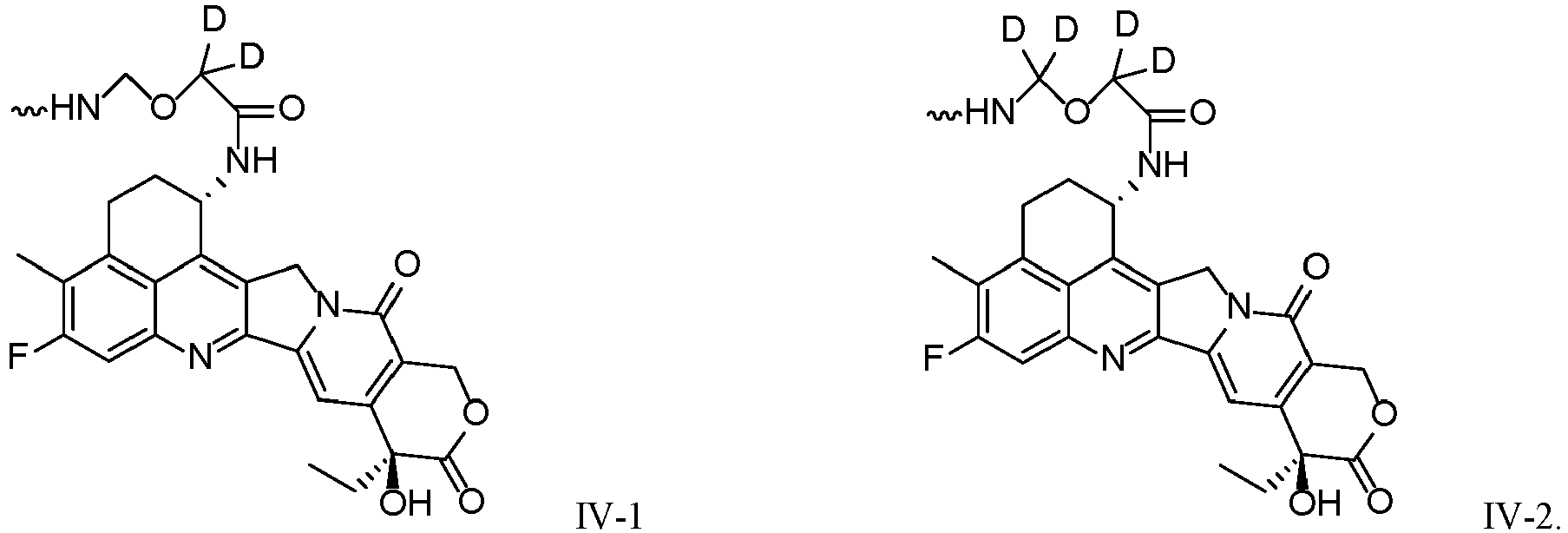
- In some embodiments, the antibody-drug conjugate of general formula Ab-(L-U)n, or the pharmaceutically acceptable salt or the solvate thereof provided herein, comprises a structure of formula V below:

- In some embodiments, the antibody-drug conjugate of general formula Ab-(L-U)n, or the pharmaceutically acceptable salt or the solvate thereof provided herein, comprises a structure of formula V-1, V-2, V-3, or V-4 below, and the structures of formulas V-1 to V-4 are linked to the antibody moiety by the left succinimide terminus and the cytotoxic drug moiety by the right carbonyl terminus, respectively:


- In some embodiments, the antibody-drug conjugate of general formula Ab-(L-U)n, or the pharmaceutically acceptable salt or the solvate thereof provided herein, comprises a structure of formula VI below:

R1 and R2 are each independently selected from the group consisting of hydrogen (H) and deuterium (D). - In some embodiments, the antibody-drug conjugate of general formula Ab-(L-U)n, or the pharmaceutically acceptable salt or the solvate thereof provided herein, comprises a structure of formula VI-1, VI-2, VI-3, or VI-4 below:

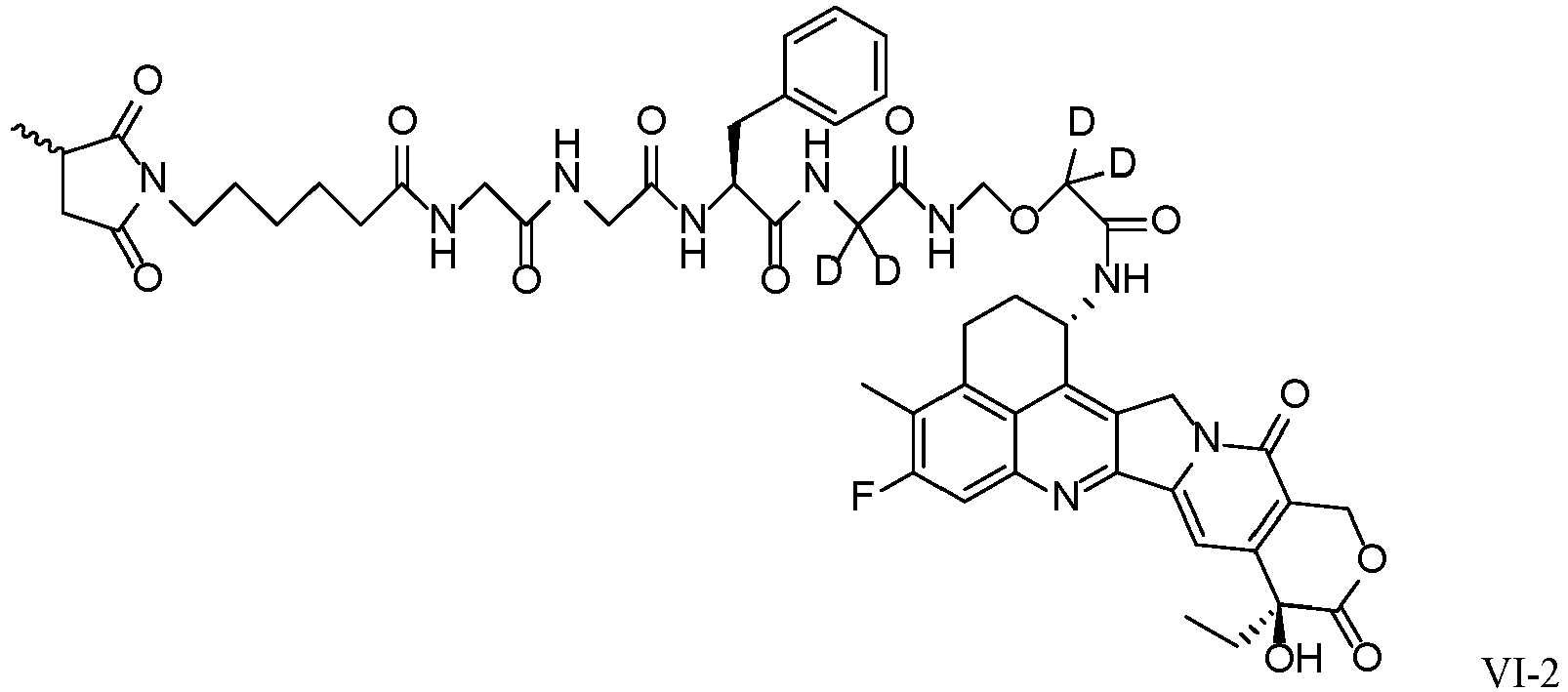


- In some specific embodiments, the present application provides an antibody-drug conjugate, or a pharmaceutically acceptable salt or a solvate thereof, having a structure of formula VII:

- Ab represents an antibody moiety comprising a first antigen-binding fragment and a second antigen-binding fragment, wherein the first antigen-binding fragment is an scFv, and comprises a heavy chain CDR1, a heavy chain CDR2, a heavy chain CDR3, a light chain CDR1, a light chain CDR2 and a light chain CDR3, the heavy chain CDR1, the heavy chain CDR2 and the heavy chain CDR3 comprising amino acid sequences set forth in SEQ ID NOs: 43, 28 and 29, respectively, and the light chain CDR1, the light chain CDR2 and the light chain CDR3 comprising amino acid sequences set forth in SEQ ID NOs: 30, 31 and 32, respectively;
- the second antigen-binding fragment is an Fab, and comprises a heavy chain CDR1, a heavy chain CDR2, a heavy chain CDR3, a light chain CDR1, a light chain CDR2 and a light chain CDR3, the heavy chain CDR1, the heavy chain CDR2 and the heavy chain CDR3 comprising amino acid sequences set forth in SEQ ID NOs: 45, 46 and 47, respectively, and the light chain CDR1, the light chain CDR2 and the light chain CDR3 comprising amino acid sequences set forth in SEQ ID NOs: 48, 49 and 50, respectively;
- n is an integer or a decimal selected from the group consisting of 1 to 10, and
- R1 and R2 are each independently selected from the group consisting of hydrogen (H) and deuterium (D).
- In some specific embodiments, the present application provides an antibody-drug conjugate, or a pharmaceutically acceptable salt or a solvate thereof, having a structure of formula VII-1, VII-2, VII-3, or VII-4 below,


- Ab represents an antibody moiety comprising a first antigen-binding fragment and a second antigen-binding fragment, wherein the first antigen-binding fragment is an scFv, and comprises a heavy chain CDR1, a heavy chain CDR2, a heavy chain CDR3, a light chain CDR1, a light chain CDR2 and a light chain CDR3, the heavy chain CDR1, the heavy chain CDR2 and the heavy chain CDR3 comprising amino acid sequences set forth in SEQ ID NOs: 43, 28 and 29, respectively, and the light chain CDR1, the light chain CDR2 and the light chain CDR3 comprising amino acid sequences set forth in SEQ ID NOs: 30, 31 and 32, respectively;
- the second antigen-binding fragment is an Fab, and comprises a heavy chain CDR1, a heavy chain CDR2, a heavy chain CDR3, a light chain CDR1, a light chain CDR2 and a light chain CDR3, the heavy chain CDR1, the heavy chain CDR2 and the heavy chain CDR3 comprising amino acid sequences set forth in SEQ ID NOs: 45, 46 and 47, respectively, and the light chain CDR1, the light chain CDR2 and the light chain CDR3 comprising amino acid sequences set forth in SEQ ID NOs: 48, 49 and 50, respectively;
- n is an integer or a decimal selected from the group consisting of 1 to 10.
- In one specific embodiment, the present application provides an antibody-drug conjugate, or a pharmaceutically acceptable salt or a solvate thereof, having a structure of formula VII-1 below,

- Ab represents an antibody moiety comprising a first antigen-binding fragment and a second antigen-binding fragment, wherein the first antigen-binding fragment is an scFv, and comprises a heavy chain CDR1, a heavy chain CDR2, a heavy chain CDR3, a light chain CDR1, a light chain CDR2 and a light chain CDR3, the heavy chain CDR1, the heavy chain CDR2 and the heavy chain CDR3 comprising amino acid sequences set forth in SEQ ID NOs: 43, 28 and 29, respectively, and the light chain CDR1, the light chain CDR2 and the light chain CDR3 comprising amino acid sequences set forth in SEQ ID NOs: 30, 31 and 32, respectively;
- the second antigen-binding fragment is an Fab, and comprises a heavy chain CDR1, a heavy chain CDR2, a heavy chain CDR3, a light chain CDR1, a light chain CDR2 and a light chain CDR3, the heavy chain CDR1, the heavy chain CDR2 and the heavy chain CDR3 comprising amino acid sequences set forth in SEQ ID NOs: 45, 46 and 47, respectively, and the light chain CDR1, the light chain CDR2 and the light chain CDR3 comprising amino acid sequences set forth in SEQ ID NOs: 48, 49 and 50, respectively;
- n is an integer or a decimal selected from the group consisting of 1 to 10.
- In one specific embodiment, the present application provides an antibody-drug conjugate, or a pharmaceutically acceptable salt or a solvate thereof, having a structure of formula VII below,

- Ab is trastuzumab,
- n is an integer or a decimal selected from the group consisting of 1 to 10, and
- R1 and R2 are each independently selected from the group consisting of hydrogen (H) and deuterium (D).
- In one specific embodiment, the present application provides an antibody-drug conjugate, or a pharmaceutically acceptable salt or a solvate thereof, having a structure of formula VII-1 below,

- Ab is trastuzumab,
- n is an integer or a decimal selected from the group consisting of 1 to 10.
- In one aspect, the present application provides a pharmaceutical composition comprising the antibody-drug conjugate, or the pharmaceutically acceptable salt or the solvate thereof according to the present application, and a pharmaceutically acceptable carrier.
- In one aspect, the present application provides use of the antibody-drug conjugate, or the pharmaceutically acceptable salt or the solvate thereof according to the present application, in preparing a medicament for preventing and treating cancer.
- In one aspect, the present application provides use of a pharmaceutical composition comprising the antibody-drug conjugate, or the pharmaceutically acceptable salt or the solvate thereof according to the present application, and a pharmaceutically acceptable carrier in preparing a medicament for preventing and treating cancer.
- In one aspect, the present application provides an antibody-drug conjugate, or a pharmaceutically acceptable salt or a solvate thereof for use in preventing and treating cancer.
- In one aspect, the present application provides a method for treating or preventing cancer, the method comprising administering to a patient in need thereof a therapeutically effective amount of the antibody-drug conjugate, or the pharmaceutically acceptable salt or the solvate thereof according to the present application, or a pharmaceutical composition comprising the antibody-drug conjugate, or the pharmaceutically acceptable salt or the solvate thereof according to the present application, and a pharmaceutically acceptable carrier.
- In some embodiments, the antibody-drug conjugate, or the pharmaceutically acceptable salt or the solvate thereof according to the present application, may be used for preventing or treating HER2 positive cancer, HER2 negative cancer (including triple-negative breast cancer), and cancer that shows HER2 expression as IHC2+ detected by immunohistochemical assay.
- In some aspects, the present application provides a linker-drug intermediate compound having a structure of formula VI below, for use in obtaining an antibody-drug conjugate that links an antibody to the intermediate compound:
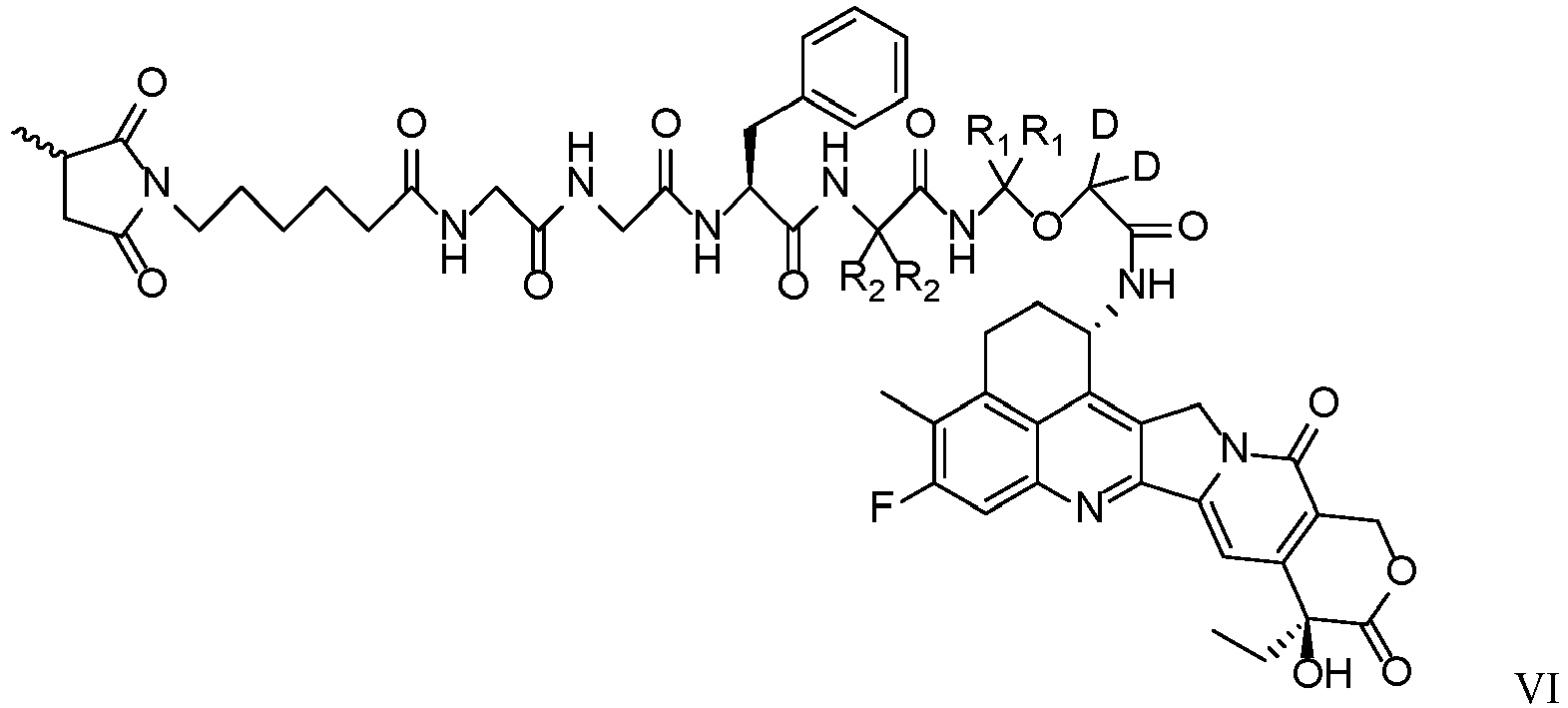
R1 and R2 are each independently selected from the group consisting of hydrogen (H) and deuterium (D). - In some aspects, the present application provides a linker-drug intermediate compound having a structure of formula VI-1, VI-2, VI-3 or VI-4 below, for use in obtaining an antibody-drug conjugate that links an antibody to the intermediate compound:


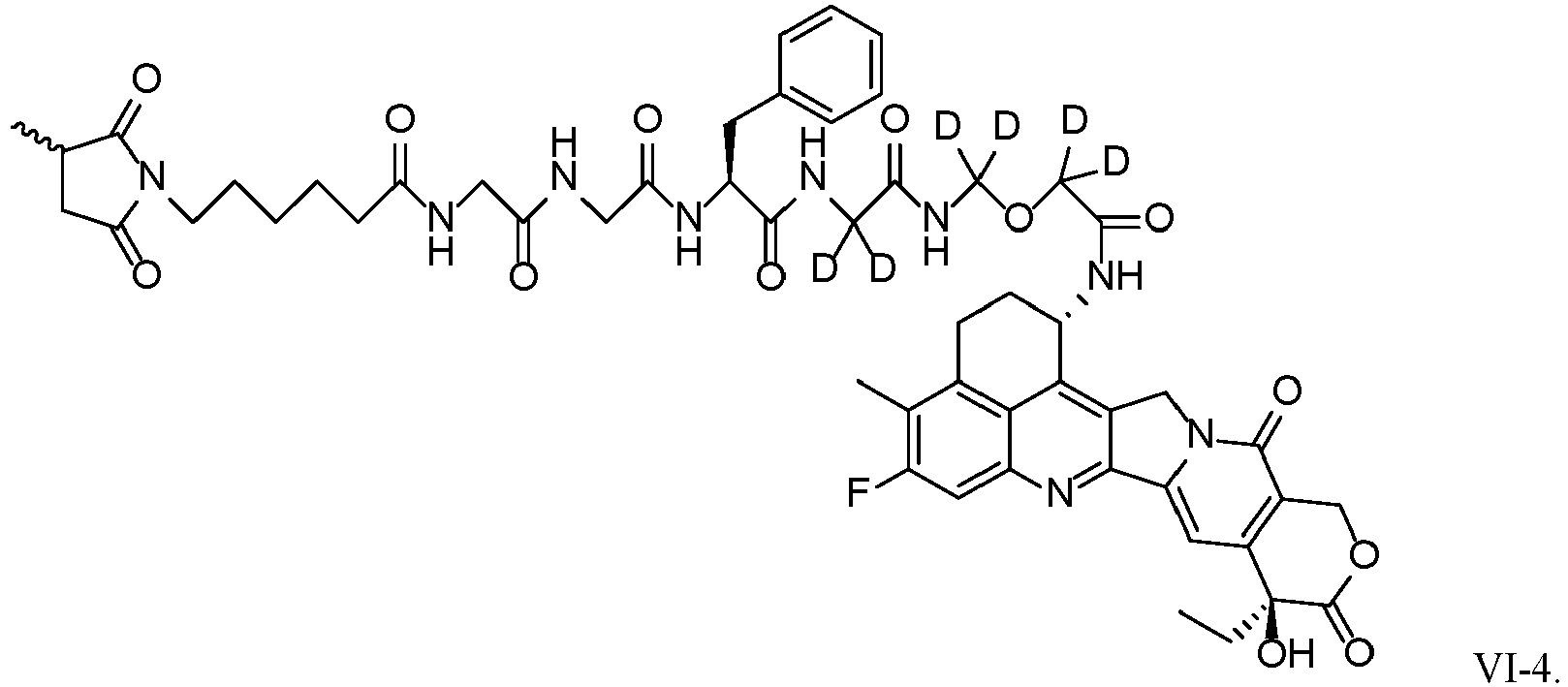
- In some aspects, the present application provides a linker compound having a structure of formula V below, for use in obtaining an antibody-drug conjugate that links a drug to an antibody via the linker:

- In some aspects, the present application provides a linker compound having a structure of formula V-1, V-2, V-3, or V-4 below, for use in obtaining an antibody-drug conjugate that links a drug to an antibody via the linker, and the structures of formulas V-1 to V-4 are linked to the antibody moiety by the left succinimide terminus and the cytotoxic drug moiety by the right carbonyl terminus, respectively:


- In some aspects, the present application provides a compound having a structure of formula IV(a) below:
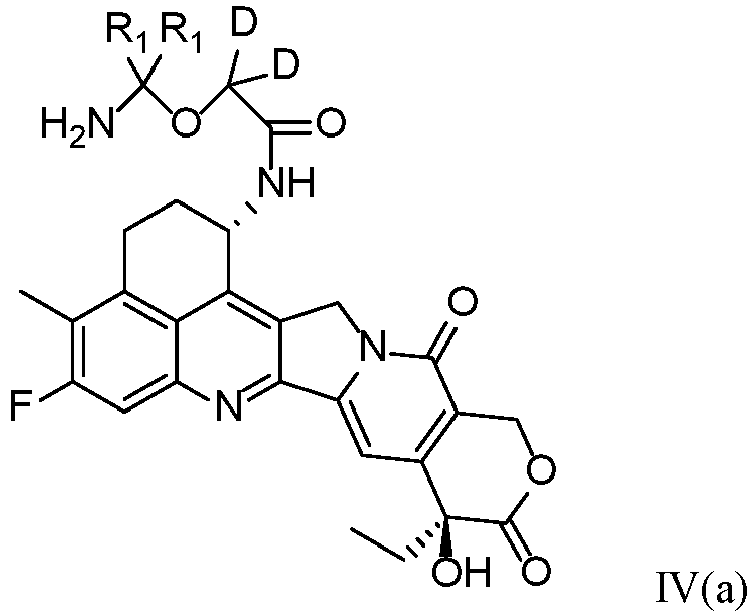
- In some aspects, the present application provides a compound having a structure of formula IV(a)-1 or formula IV(a)-2 below:


- In some aspects, the present application provides a compound having a structure of formula III(a) below:

- The present application provides an antibody-drug conjugate, or a pharmaceutically acceptable salt or a solvate thereof having improved pharmacokinetic properties. An improvement in pharmacokinetic properties will result in a reduction in toxicity of the target compound, an increase in safety and/or tolerability, an increase in efficacy and an improvement in the final therapeutic window.
-
-
FIG. 1 shows the killing rates of anti-HER2 bispecific antibodies (Expi HER2-1, Expi HER2-2, 23C2 HER2-1 and 23C2 HER2-2) and the combination of trastuzumab + pertuzumab against BT474 tumor cells; -
FIG. 2 shows the killing rates of anti-HER2 bispecific antibody, trastuzumab, T-DM1, and the combination of trastuzumab + pertuzumab against NCI-N87 tumor cells; -
FIG. 3 shows the killing rates of anti-HER2 bispecific antibody, trastuzumab, T-DM1, and the combination of trastuzumab + pertuzumab against JIMT-1 tumor cells; -
FIG. 4 shows the results of inhibition of anti-HER2 bispecific antibody, trastuzumab, and the combination of trastuzumab + pertuzumab on proliferation of BT474 tumor cells; -
FIG. 5 shows the effect of anti-HER2 bispecific antibody, PBS vehicle control, and the combination of trastuzumab + pertuzumab (Per + Tra) on changes in mouse tumor volume in a gastric cancer N87 mouse xenograft tumor model; -
FIG. 6 shows the effect of anti-HER2 bispecific antibody, PBS vehicle control, and the combination of trastuzumab + pertuzumab on changes in mouse body weight in the gastric cancer N87 mouse xenograft tumor efficacy; -
FIG. 7 shows a structure of some exemplary anti-HER2 bispecific antibodies, wherein a dimeric Fc is depicted with one chain shown in black (a first Fc polypeptide) and another chain shown in gray (a second Fc polypeptide), and one antigen-binding domain (a first antigen-binding fragment) is shown hatched and the other antigen-binding domain (a second antigen-binding fragment) is shown white; wherein the first antigen-binding fragment is an scFv and fused with the first Fc polypeptide, and the second antigen-binding fragment is an Fab and fused with the second Fc polypeptide; -
FIG. 8 shows the endocytic activity of drug conjugates of different antibodies (monoclonal antibody-DDDXD and bispecific antibody-DDDXD) in NCI-N87 tumor cells; and -
FIG. 9 shows the endocytic activity of drug conjugates of different antibodies (monoclonal antibody-DDDXD and bispecific antibody-DDDXD) in SK-BR-3 tumor cells. - Unless otherwise stated, the following terms used herein shall have the following meanings. A certain term, unless otherwise specifically defined, should not be considered uncertain or unclear, but construed according to its common meaning in the field. Reference is made to, for example, Singleton et al., Dictionary of Microbiology and Molecular Biology, 2nd ed., J. Wiley & Sons (New York, NY 1994); Sambrook et al., Molecular Cloning: A Laboratory Manual, Cold Springs Harbor Press (Cold Springs Harbor, NY 1989); Davis et al., Basic Methods in Molecular Biology, Elsevier Science Publishing Inc., New York, USA (2012); Abbas et al., Cellular and Molecular Immunology, Elsevier Science Health Science div (2009); He Wei et al., Medical Immunology, (2nd ed), People's Medical Publishing House, 2010. When referring to a trade name herein, it is intended to refer to its corresponding commercial product or its active ingredient.
- The term "substituted" means that any one or more hydrogen atoms on a specific atom are substituted by substituents, as long as the valence of the specific atom is normal and the resulting compound is stable. When the substituent is oxo (namely =O), it means that two hydrogen atoms are substituted, and oxo is not available on an aromatic group.
- The term "optional" or "optionally" means that the subsequently described event or circumstance may, but not necessarily, occur. The description includes instances where the event or circumstance occurs and instances where the event or circumstance does not occur. A certain group being "optionally substituted" means that the group may be substituted or unsubstituted, for example, ethyl being "optionally" substituted with halogen means that the ethyl may be unsubstituted (CH2CH3), monosubstituted (for example, CH2CH2F), polysubstituted (for example, CHFCH2F, CH2CHF2 and the like), or fully substituted (CF2CF3). It will be understood by those skilled in the art that for any groups comprising one or more substituents, any substitutions or substituting patterns which may not exist or cannot be synthesized spatially are not introduced.
- Cm-n used herein means that the portion has an integer number of carbon atoms in the given range. For example, "C1-6" means that the group may have 1 carbon atom, 2 carbon atoms, 3 carbon atoms, 4 carbon atoms, 5 carbon atoms, or 6 carbon atoms.
- When any variable (e.g., R) occurs more than once in the constitution or structure of a compound, the variable is independently defined in each case. Therefore, for example, if a group is substituted with 2 R, the definition of each R is independent.
- When a connecting group has a number of 0, for example, -(CH2)0-, it means that the connecting group is a covalent bond.
- When a variable is a single bond, it means that the two groups are directly connected. For example, in A-L-Z, when L represents a single bond, it means that the structure is actually A-Z.
- The term "halo-" or "halogen" refers to fluorine, chlorine, bromine and iodine.
- The term "hydroxy" refers to -OH group.
- The term "cyano" refers to -CN group.
- The term "sulfydryl" refers to -SH group.
- The term "amino" refers to -NH2 group.
- The term "nitro" refers to -NOz group.
- The term "alkyl" refers to hydrocarbyl with a general formula of CnH2n+1. The alkyl can be linear or branched. For example, the term "C1-6 alkyl" refers to alkyl containing 1 to 6 carbon atoms (for example, methyl, ethyl, n-propyl, isopropyl, n-butyl, isobutyl, sec-butyl, tert-butyl, n-pentyl, 1-methylbutyl, 2-methylbutyl, 3-methylbutyl, neopentyl, hexyl, 2-methylpentyl and the like). The alkyl moieties (namely alkyl) of alkoxy, alkylamino, dialkylamino, alkylsulfonyl and alkylthio are similarly defined as above.
- The term "alkoxyl" refers to -O-alkyl.
- The term "alkylamino" refers to-NH-alkyl.
- The term "dialkylamino" refers to -N(alkyl)2.
- The term "alkylsulfonyl" refers to-SO2-alkyl.
- The term "alkylthio" refers to -S-alkyl.
- The term "alkenyl" refers to linear or branched unsaturated aliphatic hydrocarbyl consisting of carbon atoms and hydrogen atoms with at least one double bond. Non-limiting examples of alkenyl include, but are not limited to, ethenyl, 1-propenyl, 2-propenyl, 1-butenyl, isobutenyl, 1,3-butadienyl, and the like.
- The term "alkynyl" refers to linear or branched unsaturated aliphatic hydrocarbyl consisting of carbon atoms and hydrogen atoms with at least one triple bond. Non-limiting examples of alkynyl include, but are not limited to, ethynyl (-C≡CH), 1-propinyl (-C≡C-CH3), 2-propinyl (-CH2-C≡CH), 1,3-butadiynyl (-C≡C-C≡CH), and the like. The term "cycloalkyl" refers to a carbon ring that is fully saturated and may exist in the form of a monocyclic, bridged cyclic, or spiro cyclic structure. Unless otherwise specified, the carbon ring is generally a 3-10 membered ring. Non-limiting examples of cycloalkyl include, but are not limited to, cyclopropyl, cyclobutyl, cyclopentyl, cyclohexyl, norbomyl(bicyclo[2.2.1]heptyl), bicyclo[2.2.2]octyl, adamantyl, and the like.
- The term "cycloalkenyl" refers to a non-aromatic carbon ring that is not fully saturated and may exist in the form of a monocyclic, bridged cyclic, or spiro cyclic structure. Unless otherwise specified, the carbon ring is generally a 5-8 membered ring. Non-limiting examples of cycloalkenyl include, but are not limited to, cyclopentenyl, cyclopentadienyl, cyclohexenyl, cyclohexadienyl, cycloheptenyl, cycloheptadienyl, and the like.
- The term "heterocyclyl" refers to a fully saturated or partially unsaturated (but not fully unsaturated heteroaromatic group) nonaromatic ring which may exist in the form of a monocyclic, bridged cyclic, or spiro cyclic structure. Unless otherwise specified, the heterocyclyl is usually a 3-7 membered ring containing 1-3 heteroatoms (preferably 1 or 2 heteroatoms) independently selected from the group consisting of sulfur, oxygen, and/or nitrogen. Non-limiting examples of heterocyclyl include, but are not limited to, oxiranyl, tetrahydrofuranyl, dihydrofuranyl, pyrrolidinyl, N-methylpyrrolidinyl, dihydropyrrolyl, piperidinyl, piperazinyl, pyrazolidinyl, 4H-pyranyl, morpholinyl, thiomorpholinyl, tetrahydrothienyl, and the like.
- The term "heterocycloalkyl" refers to a fully saturated cyclic group that may exist in the form of a monocyclic, bridged cyclic, or spiro cyclic structure. Unless otherwise specified, the heterocyclyl is usually a 3-7 membered ring containing 1-3 heteroatoms (preferably 1 or 2 heteroatoms) independently selected from the group consisting of sulfur, oxygen, and/or nitrogen. Examples of 3 membered heterocycloalkyl include, but are not limited to, oxiranyl, thiiranyl, and aziranyl; non-limiting examples of 4 membered heterocycloalkyl include, but are not limited to, azetidinyl, oxetanyl, and thietanyl; examples of 5 membered heterocycloalkyl include, but are not limited to, tetrahydrofuranyl, tetrahydrothienyl, pyrrolidinyl, isoxazolidinyl, oxazolidinyl, isothiazolidinyl, thiazolidinyl, imidazolidinyl, and tetrahydropyrazolyl; examples of 6 membered heterocycloalkyl include, but are not limited to, piperidinyl, tetrahydropyranyl, tetrahydrothiopyranyl, morpholinyl, piperazinyl, 1,4-thioxanyl, 1,4-dioxanyl, thiomorpholinyl, 1,3-dithianyl, and 1,4-dithianyl; examples of 7 membered heterocycloalkyl include, but are not limited to, azacycloheptanyl, oxacycloheptanyl and thiocycloheptanyl. Preferably, the heterocycloalkyl is a monocyclic heterocycloalkyl having 5 or 6 ring atoms.
- The term "aryl" refers to an aromatic monocyclic or fused polycyclic group of carbon atoms with the conjugated pi-electron system. For example, aryl may have 6-20 carbon atoms, 6-14 carbon atoms or 6-12 carbon atoms. Non-limiting examples of aryl include, but are not limited to, phenyl, naphthyl, anthryl, 1,2,3,4-tetrahydronaphthalene, and the like.
- The term "heteroaryl" refers to a monocyclic or fused polycyclic system containing at least one ring atom selected from the group consisting of N, O and S, with the remaining ring atoms being C, and having at least one aromatic ring. Preferably, the heteroaryl has a single 4-8 membered ring, in particular, a 5-8 membered ring, or is a plurality of fused rings comprising 6-14 ring atoms, in particular 6-10 ring atoms. Non-limiting examples of heteroaryl include, but are not limited to, pyrrolyl, furanyl, thienyl, imidazolyl, oxazolyl, pyrazolyl, pyridinyl, pyrimidinyl, pyrazinyl, quinolyl, isoquinolyl, tetrazolyl, triazolyl, triazinyl, benzofuranyl, benzothienyl, indolyl, isoindolyl and the like.
- The "derivative": a compound formed by substituting atoms or atom groups in the molecule of the parent compound with other atoms or atom groups is referred to as a derivative of the parent compound.
- Any atom of a compound labeled and synthesized herein may represent any stable isotope of the atom, if not specifically designated. Unless otherwise specified, when a position in a structure is defined as H, i.e., hydrogen (H-1), this position contains only the naturally occurring isotope. Similarly, unless otherwise specified, when a position in a structure is defined as D, i.e., deuterium (H-2), this position contains an isotope having an amount that is at least 3340 times greater than the amount of the naturally occurring isotope (0.015%) (i.e., at least 50.1% deuterium isotope), when one or more positions in the structure of the labeled synthetic compound are defined as D, i.e., deuterium (H-2), the content of the compound represented by the structure may be at least 52.5%, at least 60%, at least 67.5%, at least 75%, at least 82.5%, at least 90%, at least 95%, at least 97%, at least 98.5%, at least 99%, or at least 99.5%. The deuterated ratio of a compound labeled and synthesized herein refers to a ratio of the amount of the labeled synthetic isotope to the amount of the naturally occurring isotope. The deuterated ratio per designated deuterium atom of the compound labeled and synthesized herein may be at least 3500 times (52.5%), at least 4000 times (60%), at least 4500 times (67.5%), at least 5000 times (75%), at least 5500 times (82.5%), at least 6000 times (90%), at least 6333.3 times (95%), at least 6466.7 times (97%), at least 6566.7 times (98.5%), at least 6600 times (99%), at least 6633.3 times (99.5%). Isotopologues herein refer to compounds that differ only in isotopic composition in terms of chemical structure. The compound labeled and synthesized herein has the same chemical structure, with only isotopic changes in the atomic composition of its molecules. Therefore, the deuterium-containing compound at a specific position labeled and synthesized herein also contains very little hydrogen isotope at this position, and the amount of hydrogen isotopologue at a certain position in the compound labeled and synthesized herein depends on many factors, including the deuterium isotopic purity of the deuterated agent (D2O, D2, NaBD4, LiAlD4, and the like) and the effectiveness of introducing deuterium isotope synthesis methods. However, as previously mentioned, the total amount of such hydrogen isotopologue at a certain position will be less than 49.9%. The total amount of hydrogen isotopologue at a certain position in the compound labeled and synthesized herein will be less than 47.5%, 40%, 32.5%, 25%, 17.5%, 10%, 5%, 3%, 1%, or 0.5%.
- In the present application, any individual atom not designated as deuterium is present at its natural isotopic abundance.
- The term "treating" or "treatment" means administering the compound or formulation described herein to prevent, ameliorate, or eliminate a disease or one or more symptoms associated with the disease, including: (i) preventing the occurrence of the disease or disease state in a mammal, particularly when such a mammal is predisposed to the disease state but has not yet been diagnosed with it; (ii) inhibiting a disease or disease state, i.e., arresting its development; (iii) alleviating a disease or disease state, i.e., causing its regression.
- The term "therapeutically effective amount" refers to an amount of the compound of the present application for (i) treating or preventing a specific disease, condition or disorder; (ii) alleviating, ameliorating or eliminating one or more symptoms of a specific disease, condition or disorder, or (iii) preventing or delaying onset of one or more symptoms of a specific disease, condition or disorder described herein. The amount of the compound of the present application composing the "therapeutically effective amount" varies dependently on the compound, the disease state and its severity, the route of administration, and the age of the mammal to be treated, but can be determined routinely by those skilled in the art in accordance with their knowledge and the present disclosure. The term "pharmaceutically acceptable" is used herein for those compounds, materials, compositions, and/or dosage forms which are, within the scope of sound medical judgment, suitable for use in contact with the tissues of human beings and animals without excessive toxicity, irritation, allergic response, or other problems or complications, and commensurate with a reasonable benefit/risk ratio.
- A pharmaceutically acceptable salt, for example, may be a metal salt, an ammonium salt, a salt formed with an organic base, a salt formed with an inorganic acid, a salt formed with an organic acid, a salt formed with a basic or acidic amino acid, and the like.
- The term "solvate" refers to a substance formed by association of a compound with a solvent molecule.
- The term "pharmaceutical composition" refers to a mixture consisting of one or more of the compounds or the salts thereof disclosed herein and a pharmaceutically acceptable excipient. The pharmaceutical composition is intended to facilitate the administration of the compound to an organic entity.
- The term "pharmaceutically acceptable excipients" refers to those which do not have a significant irritating effect on an organic entity and do not impair the biological activity and properties of the active compound. Suitable excipients are well known to those skilled in the art, for example carbohydrate, wax, water-soluble and/or water-swellable polymers, hydrophilic or hydrophobic material, gelatin, oil, solvent, water and the like.
- The compounds and intermediates disclosed herein may also exist in different tautomeric forms, and all such forms are included within the scope of the present application. The term "tautomer" or "tautomeric form" refers to structural isomers of different energies that can interconvert via a low energy barrier. For example, a proton tautomer (also referred to as prototropic tautomer) includes interconversion via proton transfer, such as keto-enol isomerism and imine-enamine isomerism. A specific example of a proton tautomer is an imidazole moiety where a proton can transfer between two ring nitrogens. A valence tautomer includes the interconversion via recombination of some bonding electrons.
- The term "antibody" is used in its broadest sense and specifically encompasses intact monoclonal antibodies, polyclonal antibodies, multispecific antibodies (e.g., bispecific antibodies) formed from at least two intact antibodies, multifunctional antibodies, and antibody fragments so long as they possess the desired biological activity.
- The term "humanized antibody" refers to an antibody comprising CDRs derived from a non-human antibody, and the remainder of the antibody molecule is derived from one or more human antibodies.
- The term "mutant" is used to refer to a peptide comprising an amino acid sequence derived from the amino acid sequence of the peptide as follows: substitution of one or two or more amino acids with amino acids different from the original peptide, deletion of one or two or more wild-type amino acids, insertion of one or two or more amino acids that do not exist in the wild type, and/or addition of amino acids that do not exist in the wild type to the amino terminus (N-terminus) and/or the carboxy terminus (C-terminus) of the wild type (hereinafter, collectively referred to as "mutation"). In the present application, "insertion" may also be included in "addition". The term "CDR" (complementarity-determining region), also known as "hypervariable region", refers to each region of an antibody variable domain which is highly variable in sequence and/or forms a structurally defined loop. Natural four-chain antibodies typically comprise six CDRs, three in the heavy chain variable region and three in the light chain variable region.
- The term "variable region": the antibody structural unit is composed of two pairs of polypeptide chains, each pair having one heavy chain and one light chain, and the N-terminal domain of each chain defining a region of about 100 to 110 or more amino acids primarily responsible for antigen recognition is the variable region.
- The term "Fab" means comprising the constant domain (CL) of the light chain and the first constant domain (CH1) of the heavy chain, together with the variable domains VL (light chain variable region) and VH (heavy chain variable region) in the light chain and heavy chain, respectively. The variable domain comprises complementarity-determining regions (CDRs) that are involved in antigen-binding.
- The term "scFv" includes the VH and VL domains of an antibody, wherein these domains are present in a single polypeptide chain. In some embodiments, scFv further comprises a polypeptide linker between the VH and VL domains that enables the scFv to form the required structure for antigen-binding.
- The term "ECD" refers to an extracellular domain. HER receptors are receptor protein tyrosine kinases belonging to the human epidermal growth factor receptor (HER) family and include EGFR, HER2, HER3, and HER4 receptors, wherein the HER2 receptor generally comprises an extracellular domain that may bind HER ligand, a lipophilic transmembrane domain, a conserved intracellular tyrosine kinase domain, and a carboxy-terminal signaling domain with several tyrosine residues that can be phosphorylated, and the extracellular domain of HER2 comprises four domains that are ECD1, ECD2, ECD3 and ECD4, respectively.
- The term "antibody moiety" refers to an antibody moiety in an antibody-drug conjugate, which, in certain embodiments, is linked to an intermediate linker moiety via a specific functional group, and the antibody moiety can specifically bind to an antigen.
- The term "linker moiety" refers to a part of the antibody-drug conjugate which links an antibody moiety with a cytotoxic drug moiety and may be cleavable or uncleavable, wherein the cleavable linker refers to a part which may be cleaved in a target cell so as to release the cytotoxic drug.
- The term "cytotoxic drug moiety" refers to a cytotoxic drug moiety in an antibody-drug conjugate, and in certain specific embodiments, the cytotoxic drug moiety is linked to an intermediate linker moiety via a functional group, so that cytotoxic drug molecules can be liberated in tumor cells to exert an anti-tumor effect.
- Generic term "trastuzumab" refers to a recombinant humanized monoclonal antibody that selectively acts on the extracellular site of human epidermal growth factor receptor-4 (HER4) and can be used to treat HER2 positive cancer, an example of which is the commercially available therapeutic monoclonal antibody product under the trade name HERCEPTIN®.
- Generic term "pertuzumab" refers to a recombinant humanized monoclonal antibody that selectively acts on the extracellular site of human epidermal growth factor receptor-2 (HER2) and can be used to treat HER2 positive cancer.
- The term "HER2" is a second member of the EGFR family having a tyrosine kinase activity, wherein HER2 expression levels can be detected by immunohistochemical assay, HER2 positive refers to IHC3+, HER2 negative refers to IHC1+/0, and for IHC2+, ISH assay should be performed for further clarification.
- The term "cancer" refers to a physiological condition in mammals that is typically characterized by unregulated cell growth.
- The term "triple-negative breast cancer" is a breast cancer that is negative for expression of estrogen receptors, progesterone receptors, and human epidermal growth factor receptor-2.
- As used herein, unless otherwise stated, the terms "comprise", "comprises" and "comprising" or equivalents thereof (contain, contains, containing, include, includes, including) are open-ended statements and mean that elements, components and steps that are not specified may be included in addition to those listed.
- As used herein, unless otherwise indicated, all numbers expressing the amounts of ingredients, measurements, or reaction conditions used herein are to be understood as being modified in all instances by the term "about". The term "about" when connected to a percentage may mean, for example, ±0.1%, preferably, ±0.05%, and more preferably, ±0.01%.
- Unless otherwise specified clearly herein, singular terms encompass plural referents, and vice versa. Similarly, unless otherwise specified clearly herein, the word "or" is intended to include "and".
- As used herein, the percent identity (degree of homology) between sequences can be determined by comparing the two sequences, for example, using freely available computer programs (e.g., BLASTp or BLASTn with default settings) typically used for this purpose on the World Wide Web (e.g., www.ncbi.nlm.nih.gov).
- For clarity, the present application is further described with the following examples, which are, however, not intended to limit the scope of the present application. The reagents used herein are commercially available and can be used without further purification.
- Trastuzumab and Pertuzumab used in the examples of the present application were prepared according to the conventional methods for antibodies, wherein vectors were constructed first, and eukaryotic cells were transfected and then purified for expression, with the sequence of Trastuzumab being referenced to WHO DRUG INFORMATION INN RL78, and the sequence of Pertuzumab being referenced to the examples of
WO0100245 - In constructing anti-Her2 scFv-Fc, human IgG1 was used as the Fc portion, and the variable region sequence of the anti-Her2 arm was a sequence based on the monoclonal antibody Herceptin®. The light and heavy chain variable regions of the monoclonal antibody Herceptin® were linked in series by a designed linker 1 (i.e., (GGGGS)3) to form anti-Her2 scFv-Fc (SEQ ID NO: 1), the amino acid sequence of which is as follows:

- Further, point mutations were constructed in the anti-Her2 scFv-Fc sequence to construct the following variants: anti-Her2-scFv-VL-F53Y-Fc (SEQ ID NO: 3): derived from wild-type anti-Her2 scFv-Fc, with an F53Y mutation in the VL region; the amino acid sequence is as follows:

- anti-Her2-scFv-VL-F53A-Fc (SEQ ID NO: 5): derived from wild-type anti-Her2 scFv-Fc, with an F53A mutation in the VL region; the amino acid sequence is as follows:

- anti-Her2-scFv-VL-F53R-Fc (SEQ ID NO: 7): derived from wild-type anti-Her2 scFv-Fc, with an F53R mutation in the VL region; the amino acid sequence is as follows:

- anti-Her2-scFv-VH-K30E-Fc (SEQ ID NO: 9): derived from wild-type anti-Her2 scFv-Fc, with a K30E mutation in the VH region; the amino acid sequence is as follows:


- The DNA sequences of anti-Her2 scFv-Fc and the variants thereof (SEQ ID NOs: 2, 4, 6, 8, and 10) were synthesized and each cloned into the pcDNA3.1 expression vector. The expression vector of anti-Her2 scFv-Fc or the variants thereof was transfected into ExpiCHO cells (CHO-S, Thermo) by using an ExpiCHO™ expression kit (Thermo Fisher, Cat. No. A29133). The cells were cultured in ExpiCHO expression medium in a humidified atmosphere in an incubator at 37 °C with 8% COz on an orbital shaker spinning at 130 rpm. The culture supernatant was collected, and protein purification was performed using protein A magnetic beads (Genscript, Cat. No. L00273). The protein concentration was measured using a UV-Vis spectrophotometer (NanoDrop lite, Thermo Scientific).
Table 1: Sequence information about anti-Her2 scFv-Fc and the variants thereof Name Amino acid sequence (SEQ ID NO) Encoding DNA sequence (SEQ ID NO) Mutation site in variable region anti-Her2 scFv- Fc 1 2 None anti-Her2-scFv-VL-F53Y- Fc 3 4 F53Y anti-Her2-scFv-VL-F53A- Fc 5 6 F53A anti-Her2-scFv-VL-F53R-Fc 7 8 F53R anti-Her2-scFv-VH-K3 0E- Fc 9 10 K30E - For the expressed and purified anti-Her2 scFv-Fc and variants thereof, the affinity of the test molecules for human Her2 protein was determined by Biacore T200 (GE) as follows:
an amount of anti-Her2 scFv-Fc or a variant thereof was captured by a chip conjugated to Anti-hIgG, and then an antigen human HER2 protein (Sino Biological, Cat. No. 10004-H08H) was allowed to flow over the chip surface. The response signals were detected in real time using Biacore T200, and association and dissociation curves were obtained. The buffer used in the experiment was Biacore universal buffer (137 mM NaCl, 2.7 mM KCl, 10 mM Na2HPO4·12H2O, 1.8 mM KH2PO4, 0.05% surfactant P20 (GE, Cat. No. BR-1000-54), pH 7.4). Anti-hIgG (captured by human antibody capture kit, GE, Cat. No. 29-2346-00) was conjugated to a CM5 chip surface at a response value of up to about 9000 RU, and the response value after anti-Her2 scFv-Fc or a variant thereof captured was about 200 RU. Then the signal values of the interaction of different concentrations of human HER2 protein (100 nM, 50 nM, 25 nM, 12.5 nM, 6.25 nM, and 3.125 nM) with anti-Her2 scFv-Fc or the variant thereof were measured. The flow rate in the flow cell was at 50 µL/min, the association was performed for 240 s, the dissociation was performed for 1400 s, the regeneration was performed using 3 M MgCl2 (GE) for 60 s, and the baseline was stable. Results were obtained by calculation according to the affinity and kinetics 1:1 binding mode in biacore evaluation software. The affinity of anti-Her2 scFv-Fc or the variants for the antigen human Her2 protein is shown in Table 2. Compared to anti-Her2 scFv-Fc (KD = 0.77 nM), F53A mutation had a greater effect on the binding affinity of the variant anti-Her2-scFv-VL-F53A-Fc (KD = 1.26 nM) for the antigen human Her2 protein. The variant anti-Her2-scFv-VL-F53Y-Fc (KD = 0.8 nM) and anti-Her2 scFv-Fc (KD = 0.77 nM) showed similar binding affinity for the antigen human Her2 protein. The variant anti-Her2-scFv-VH-K30E-Fc has a binding KD of 0.54 nM for the antigen human Her2 protein. It is known that the introduction of mutations F53Y and K30E does not reduce the binding affinity for the antigen human Her2 protein. - Components of anti-Her2 scFv-Fc or the variants thereof were separated by gel column chromatography, wherein the components were eluted out in descending order according to their molecular weights. The gel chromatography column used was an ACQUITY UPLC Protein
BEH SEC Column 200 Å, 1.7 µm, 4.6 × 300 mm, and the column temperature was at 25 °C. The mobile phase was 50 mmol/L phosphate-buffered saline-200 mmol/L sodium chloride at pH 7.0 (2.33 g of sodium dihydrogen phosphate dihydrate, 12.53 g of disodium hydrogen phosphate dodecahydrate and 11.69 g of sodium chloride were weighed into about 800 mL of ultrapure water and completely dissolved by stirring; ultrapure water was added until the volume reached 1000 mL; the mixture was well mixed and then filtered through a 0.22 µm filter membrane). The sample was diluted with the mobile phase to obtain a 10 mg/mL test solution, 2 µL of which was precisely measured out and injected into a liquid chromatograph (adjusting the volume of injection so that 20 µg of protein was injected if the sample concentration was less than 10 mg/mL) for detected at 280 nm. The flow rate was at 0.30 mL/min, and isocratic elution was performed for 15 min. Data was processed, and the results were quantitatively analyzed using the area normalization method. The peak area percentages for the aggregate, immunoglobulin monomer and low molecular weight impurities were calculated. The aggregate peak appeared before the main peak, which represents the immunoglobulin monomer, and the low molecular weight impurity peaks appeared after the main peak. The main peak and aggregate content percentages in anti-Her2 scFv-Fc or the variants thereof are shown in Table 2. The variants anti-Her2-scFv-VL-F53Y-Fc and anti-Her2-scFv-VH-K30E-Fc have significantly reduced aggregate, wherein the aggregate content was reduced from 6.31% (in anti-Her2 scFv-Fc) to 4.94% and 3.39%, respectively.Table 2: Aggregate content and binding affinity of anti-Her2 scFv-Fc and variants thereof for antigen Her2 Name anti-Her2 scFv-Fc anti-Her2-scFv-VL-F53Y-Fc anti-Her2-scFv-VL-F53A-Fc anti-Her2-scFv-VL-F53R-Fc anti-Her2-scFv -VH-K30E-Fc Aggregate 6.31% 4.94% 6.96% 7.83% 3.39% Monomer 93.43% 94.83% 92.80% 91.90% 96.32% Low molecular weight fragments 0.25% 0.24% 0.23% 0.26% 0.28% Antigen Her2 (KD) 0.77 nM 0.8 nM 1.26 nM Not measured 0.54 nM - Anti-Her2 bispecific antibodies were produced as human IgG1 by knobs-into-holes (Ridgway, et al., 1996) Fc engineering. H435R and Y436F mutations (Jendeberg et al., 1997) were designed in the Fc region sequence of one heavy chain to reduce the affinity of Fc for protein A, which was favorable for removing the homodimers formed during the assembly of bispecific antibodies in the protein A affinity purification (Patent
US5945311A ). It can be seen from Example 2 that anti-Her2-scFv-VL-F53Y-Fc mutation and anti-Her2-scFv-VH-K30E-Fc mutation could significantly reduce the anti-Her2-scFv aggregate while the affinity for Her2 antigen remained unchanged. The antigen-binding domain of one anti-Her2 arm of the anti-Her2 bispecific antibodies in this Example was in scFv (VH-linker-VL structure) form, and the variable region sequences comprised a mutation K30E (b-anti-Her2-scFv-VH-K30E-Fc, SEQ ID NO: 21), a mutation F53Y (b-anti-Her2-scFv-VL-F53Y-Fc, SEQ ID NO: 23), or both of the point mutations (anti-Her2-scFv-VH-K30E-VL-F53Y-Fc, SEQ ID NO: 11). The antigen-binding domain of another anti-Her2 arm of the anti-Her2 bispecific antibodies in this Example was in Fab form, including anti-Her2-domain2-HC-Fc (SEQ ID NO: 13) and anti-Her2-domain2-LC (SEQ ID NO: 15). Additionally, an anti-Her2 bispecific antibody without mutations was constructed in scFv form (VH-linker-VL structure or VL-linker-VH structure) as a control.Table 3: Sequence information about anti-Her2 bispecific antibodies Name Composition Amino acid sequence (SEQ ID NO) Nucleotide sequence (SEQ ID NO) Expi Her2-1 anti-Her2-scFv-VL-VH- Fc 
18 anti-Her2-domai n2-HC-Fc-2 
20 anti-Her2-domai n2- LC 
16 Expi Her2-2 anti-Her2-scFv-VH-K30E-VL-F 53Y- Fc 
12 anti-Her2-domai n2-HC- Fc 
14 anti-Her2-domai n2- LC 
16 Expi Her2-3 b-anti-Her2-scF v-VH-K30E- Fc 
22 anti-Her2-domai n2-HC-Fc SEQ ID NO: 13 14 anti-Her2-domai n2-LC SEQ ID NO: 15 16 Expi Her2-4 b-anti-Her2-scF v-VL-F53Y- Fc 
24 anti-Her2-domai n2-HC-Fc SEQ ID NO: 13 14 anti-Her2-domai n2-LC SEQ ID NO: 15 16 Expi Her2-5 anti-Her2-scFv-VH-VL-Fc 
26 anti-Her2-domai n2-HC-Fc SEQ ID NO: 13 14 anti-Her2-domai n2-LC SEQ ID NO: 15 16 - The DNA sequences of anti-Her2 bispecific antibodies (SEQ ID NOs: 12, 14 and 16) were synthesized and each cloned into the pcDNA3.1 expression vector. The expression vectors of anti-Her2-scFv-VH-K30E-VL-F53Y-Fc (SEQ ID NO: 11), anti-Her2-domain2-HC-Fc (SEQ ID NO: 13) and anti-Her2-domain2-LC (SEQ ID NO: 15) were co-transfected into ExpiCHO cells in a transfection ratio of 1:1:1.5 using a CHOgro® high yield expression system (Cat. No. MIR 6270). The transfection density was 6 × 10⁶ cells/mL. The medium was CHOgro® expression medium (Cat. No. MIR 6200, manufacturer: Mirus). The culture was continued until
day 10 after transfection, and the cell culture supernatant was collected by centrifugation. Protein purification was performed using protein A magnetic beads (Genscript, Cat. No. L00273). The protein concentration was measured using a UV-Vis spectrophotometer (NanoDrop lite, Thermo Scientific). This sample was designated as Expi Her2-2. With reference to this method, other bispecific antibodies, Expi Her2-1, Expi Her2-3, Expi Her2-4, and Expi Her2-5, were obtained by expression and purification. - The interaction of IgG1 with FcgRIIIa can be improved by knocking out the fucose expression-related gene FUT8, and thereby the ADCC of the antibody is enhanced (Shields et al., 2002; Yamane-Ohnuki et al., 2004). In this example, fucose knockout anti-Her2 bispecific antibodies were prepared using FUT8- knockout CHO-S cells (designated as CHO FUT8-/- cells). The DNA sequences of anti-Her2 bispecific antibodies (SEQ ID NOs: 12, 14 and 16) were synthesized and each cloned into the pcDNA3.1 expression vector, respectively. The expression vectors of anti-Her2-scFv-VH-K30E-VL-F53Y-Fc, anti-Her2-domain2-HC-Fc and anti-Her2-domain2-LC were co-transfected into the FUT8- knockout CHO-S cells in a transfection ratio of 1:1:1.5 using a CHOgro® high yield expression system (Cat. No. MIR 6270). The transfection density was 6 × 10⁶ cells/mL. The medium was CHOgro® expression medium (Cat. No. MIR 6200, manufacturer: Mirus). The culture was continued until
day 10 after transfection, and the cell culture supernatant was collected by centrifugation. Protein purification was performed using protein A magnetic beads (Genscript, Cat. No. L00273). The protein concentration was measured using a UV-Vis spectrophotometer (NanoDrop lite, Thermo Scientific). This sample was designated as 23C2 Her2-2. With reference to this method, the sequences of Expi Her2-1, Expi Her2-3, Expi Her2-4, and Expi Her2-5 were expressed in the CHO FUT8-/- cells to obtain corresponding fucose knockout anti-Her2 bispecific antibodies 23C2 Her2-1, 23C2 Her2-3, 23C2 Her2-4, and 23C2 Her2-5. - The anti-Her2 bispecific antibody samples expressed by the CHO FUT8-/- cells and CHO-S cells were processed using a GlycoWorks RapiFluor-MS N-Glycan kit (Waters, Milford, Mass., USA). The N-glycans were released from protein and labeled. After column chromatography separation, analysis was performed using an FLR detector (Waters, Milford, Mass., USA), and the structure and content of N-glycan could be obtained. The glycan content percentages are shown in Table 4. In the normal anti-Her2 bispecific antibody Expi HER2-2, the percentage of de-fucosylated glycans was 21.85%, and in the anti-Her2 bispecific antibody 23C2 HER2-2 expressed by FUT8- knockout CHO-S cells, the percentage of de-fucosylated glycans was 99.40%.
Table 4: Glycan content analysis of anti-Her2 bispecific antibodies Component name Content (%) Expi HER2-2 23C2 HER2-2 A1(M3B) 1.81 9.84 A1G(4)1 0.16 0.17 A2 1.14 70.33 A2[3]G(4)1 / 2.34 A2[6]G(4)1 / 4.19 A2[3]BG(4)1 / 0.11 A2G(4)2 / 0.55 A2G(4)2S(3)1 / 0.21 A2G(4)2S(3,3)2 / 0.46 F(6)A1G(4)1 / / F(6)A1[3]G(4)1S(3)1 / / F(6)A1 12.77 / F(6)A2 60.69 0.60 F(6)A2[3]G(4)1 1.20 / F(6)A2[6]G(4)1 0.70 / F(6)A2G(4)2 / / F(6)A2G(4)2S(3)1 / / M3 / 0.26 M4 / 0.07 M4A1G(4)1 / 0.36 M4 D1 / 0.08 M5 12.31 5.67 M5A1G(4)1 / 0.05 M6 D1 2.11 0.75 M6 D3 0.73 0.18 M7 D1 0.80 0.44 M8 0.20 0.15 De-fucosylated glycans 21.85 99.40 Di-sialylated glycans / 0.46 High mannose glycans 20.07 7.24 Mono-sialylated glycans 0.18 0.21 Non-sialylated glycans 99.82 99.33 - This example relates to aggregate verification of anti-her2 bispecific antibodies 23C2 Her2-1, 23C2 Her2-2, 23C2 Her2-3, 23C2 Her2-4, and 23C2 Her2-5.
- The anti-her2 bispecific antibodies were separated by gel column chromatography, and the aggregate content was verified, wherein the components were eluted out in descending order according to their molecular weights. The gel chromatography column used was an ACQUITY UPLC Protein
BEH SEC Column 200 Å, 1.7 µm, 4.6 × 300 mm, and the column temperature was at 25 °C. The mobile phase was 50 mmol/L phosphate-buffered saline-200 mmol/L sodium chloride at pH 7.0 (2.33 g of sodium dihydrogen phosphate dihydrate, 12.53 g of disodium hydrogen phosphate dodecahydrate and 11.69 g of sodium chloride were weighed into about 800 mL of ultrapure water and completely dissolved by stirring; ultrapure water was added until the volume reached 1000 mL; the mixture was well mixed and then filtered through a 0.22 µm filter membrane). The sample was diluted with the mobile phase to obtain a 10 mg/mL test solution, 2 µL of which was precisely measured out and injected into a liquid chromatograph (adjusting the volume of injection so that 20 µg of protein was injected if the sample concentration was less than 10 mg/mL) for detected at 280 nm. The flow rate was at 0.30 mL/min, and isocratic elution was performed for 15 min. Data was processed, and the results were quantitatively analyzed using the area normalization method. The peak area percentages for the aggregate, immunoglobulin monomer and low molecular weight impurities were calculated. The aggregate peak appeared before the main peak, which represents the immunoglobulin monomer, and the low molecular weight impurity peaks appeared after the main peak.Table 5: Aggregate content of anti-Her2 bispecific antibodies Sample name Aggregate Monomer Low molecular weight fragments 23C2 Her2-2 8.51% 91.02% 0.47% 23C2 Her2-1 19.55% 80.05% 0.40% - The results show that after scFVs were assembled into bispecific antibodies, the assembled bispecific antibodies still produced a large amount of aggregate; however, the aggregate content in the bispecific antibodies can be reduced by introducing mutations. The aggregate content in 23C2 Her2-2 can be reduced to 8.51% compared to that in 23C2 Her2-1 comprising no mutation (Table 5).
- For the expressed and purified anti-Her2 bispecific antibodies, the affinity of the test molecules for HER2 protein was determined by Biacore T200 (GE) as follows:
An amount of an anti-Her2 bispecific antibody was captured by a chip coupled to Anti-hIgG, and then human Her2 (Sino Biological, Cat. No. 10004-H08H) was allowed to flow over the chip surface. The response signals were detected in real time using Biacore T200, and association and dissociation curves were obtained. The buffer used in the experiment was Biacore universal buffer (137 mM NaCl, 2.7 mM KCl, 10 mM Na2HPO4·12H2O, 1.8 mM KH2PO4, 0.05% surfactant P20, pH 7.4). Anti-hIgG (captured by human antibody capture kit, GE, Cat. No. 29-2346-00) was conjugated to a CM5 chip surface at a response value of up to about 9000 RU, and the response value of the captured anti-Her2 bispecific antibody was about 200 RU. Then the signal values of the interaction of different concentrations of Her2 protein (100 nM, 50 nM, 25 nM, 12.5 nM, 6.25 nM, and 3.125 nM) with the anti-Her2 bispecific antibody were measured. The flow rate in the flow cell was at 50 µL/min, the association was performed for 240 s, the dissociation was performed for 1400 s, the regeneration was performed using 3 M MgCl2 (GE) for 60 s, and the baseline was stable. - The results were obtained by calculation according to biacore evaluation software. The binding affinity of the anti-Her2 bispecific antibody 23C2 Her2-2, as well as the controls trastuzumab and pertuzumab, for antigen Her2 is shown in Table 6. The binding KD of the anti-Her2 bispecific antibody 23C2 Her2-2 for antigen Her2 is 6.11E-10 M, the binding KD of trastuzumab for antigen Her2 is 1.22E-09 M, and the binding KD of pertuzumab for antigen Her2 is 2.35E-09 M. The anti-Her2 bispecific antibody 23C2 Her2-2 showed higher affinity than trastuzumab and pertuzumab for antigen Her2.
Table 6: Affinity of anti-Her2 bispecific antibodies for human Her2 antigen ka (1/Ms) kd (1/s) KD (M) 23C2 Her2-2 1.79E+05 1.09E-04 6.11E-10 Trastuzumab control sample 1.73E+05 2.12E-04 1.22E-09 Pertuzumab control sample 1.15E+05 2.69E-04 2.35E-09 - With reference to the procedures in Example 6, the affinity of the expressed and purified anti-Her2 bispecific antibodies 23C2 Her2-1, 23C2 Her2-2, 23C2 Her2-3, 23C2 Her2-4, and 23C2 Her2-5 for HER2 protein was determined by Biacore T200 (GE).
- The result of the affinity determination of the anti-Her2 bispecific antibody 23C2 Her2-1 for the antigen human Her2 protein is shown in Table 7. It can be seen from the results in Tables 6 and 7 that the binding affinity of the anti-Her2 bispecific antibodies for the antigen human Her2 protein can be improved by introducing F53Y and K30E mutations.
Table 7: Affinity of anti-Her2 bispecific antibodies for human Her2 antigen Sample name 23 C2 Her2-1 Antigen Her2 KD 4.02 nM - The killing effects of the anti-Her2 bispecific antibodies on target cells (BT474 Her2+++, source: the Cell Bank of Type Culture Collection Committee of the Chinese Academy of Sciences) were studied using NK cells provided by human PBMCs (peripheral blood mononuclear cells), and the in vitro activity of the anti-Her2 bispecific antibodies was assessed by EC50 value.
- The specific procedures are as follows: BT474 cells were adjusted to a cell density of 3 × 10⁵ cells/mL using 1640 medium containing 2% FBS (fetal bovine serum) and seeded in a 96-well cell culture plate (eppendorf, Cat. No. 0030730199) at 50 µL per well. Different concentrations of the anti-Her2 bispecific antibodies (1000 ng/mL, 333 ng/mL, 111 ng/mL, 37 ng/mL, 12.3 ng/mL, 4.11 ng/mL, 1.37 ng/mL, 0.46 ng/mL, 0.15 ng/mL and 0.05 ng/mL) were prepared using 1640 medium and added to the above 96-well cell culture plate at 50 µL per well. Human PBMCs were adjusted to a cell density of 1.5 × 10⁶ cells/mL using 1640 medium and added at 100 µL per well. An administration group (target cell + effector cell + antibody), a target cell group (BT474 cell), an effector cell group (human PBMC), a target cell + effector cell group, a blank control group (medium) and a lysis solution control group, and a target cell maximum release group (target cell + lysis solution) were set, with the effector-to-target cell ratio being 10:1. 45 min prior to the assay, 20 µL/well of lysis solution (Promega, Cat. No. G182A) was added to the target cell maximum release group and the lysis solution control group. After 45 min, the cell lysis rates were measured using a CytoTox96® nonradioactive cytotoxicity assay (Promega, G1780).

-
FIG. 1 shows the killing rate of the anti-Her2 bispecific antibodies against BT474 Her2+++ tumor cells. The ADCC-enhanced anti-Her2 bispecific antibodies (represented as 23C2 HER2-1 and 23C2 HER2-2 inFIG. 1 ) had better killing effects on BT474 tumor cells than the combination of trastuzumab and pertuzumab and than the anti-Her2 bispecific antibodies (Expi HER2-1 and Expi HER2-2) expressed by CHO-S cells; wherein the EC50 of the combination of trastuzumab and pertuzumab (1:1) is 8.627 ng/mL, the EC50 of Expi HER2-1 is 38.05 ng/mL, and the EC50 of Expi HER2-2 is 35.17 ng/mL, so that the Expi HER2-2 is superior to Expi HER2-1; the EC50 of the ADCC-enhanced 23C2 HER2-1 is 4.728 ng/mL, and the EC50 of ADCC-enhanced 23C2 HER2-2 is 3.658 ng/mL, so that the ADCC-enhanced 23C2 HER2-2 is superior to 23C2 HER2-1. - The killing effects of the anti-Her2 bispecific antibodies on target cells (NCI-N87 Her2++, source: the Cell Bank of Type Culture Collection Committee of the Chinese Academy of Sciences) were studied using NK cells provided by human PBMCs (peripheral blood mononuclear cells), and the in vitro activity of the anti-Her2 bispecific antibodies was assessed by EC50 value.
- The specific procedures are as follows: NCI-N87 cells were adjusted to a cell density of 3 × 10⁵ cells/mL using 1640 medium containing 2% FBS (fetal bovine serum) and seeded in a 96-well cell culture plate (eppendorf, Cat. No. 0030730199) at 50 µL per well. Different concentrations of the anti-Her2 bispecific antibodies or control drugs (8.1 nM, 2.7 nM, 0.9 nM, 0.3 nM, 0.1 nM, 0.03 nM, 0.01 nM, 0.003 nM, 0.001 nM and 0.0004 nM) were prepared using medium for experiment and added to the above 96-well cell culture plate at 50 µL per well. Human PBMCs were adjusted to a cell density of 1.5 × 10⁶cells/mL using medium for experiment and added at 100 µL per well. An administration group (target cell + effector cell + antibody or control drug), a target cell group (NCI-N87 cell), an effector cell group (human PBMC), a target cell + effector cell group, a blank control group (medium) and a lysis solution control group, and a target cell maximum release group (target cell + lysis solution) were set, with the effector-to-target cell ratio being 10:1. 45 min prior to the assay, 20 µL/well of lysis solution (Promega, Cat. No. G182A) was added to the target cell maximum release group and the lysis solution control group. After 45 min, the cell lysis rates were measured using a CytoTox96® nonradioactive cytotoxicity assay (Promega, G1780). Trastuzumab, T-DM1 (trastuzumab-emtansine conjugate, under trade name Kadcyla®), the trastuzumab and pertuzumab (1:1), and Expi HER2-1 were used as the control drugs.

-
FIG. 2 shows the killing rate of anti-Her2 bispecific antibodies against NCI-N87 tumor cells. The ADCC-enhanced anti-Her2 bispecific antibody 23C2 HER2-2 had a better killing effect on NCI-N87 tumor cells than the combination of trastuzumab and pertuzumab, trastuzumab, T-DM1, and Expi HER2-1; wherein the EC50 of the ADCC-enhanced 23C2 HER2-2 is 0.02447 nM, the EC50 of the combination of trastuzumab and pertuzumab is 0.08267 nM, the EC50 of Expi HER2-1 is 0.1048 nM, the EC50 of T-DM1 is 0.07392 nM, and the EC50 of trastuzumab is 0.07468 nM. - The killing effects of the anti-Her2 bispecific antibodies on target cells (JIMT-1, source: AddexBio, Cat. No. C0006005) were studied using NK cells provided by human PBMCs (peripheral blood mononuclear cells), and the in vitro activity of the anti-Her2 bispecific antibodies was assessed by EC50 value.
- The specific procedures are as follows: JIMT-1 cells were adjusted to a cell density of 3 × 10⁵ cells/mL using 1640 medium containing 2% FBS (fetal bovine serum) and seeded in a 96-well cell culture plate (eppendorf, Cat. No. 0030730199) at 50 µL per well. Different concentrations of the anti-Her2 bispecific antibodies or control drugs (8.1 nM, 2.7 nM, 0.9 nM, 0.3 nM, 0.1 nM, 0.03 nM, 0.01 nM, 0.003 nM, 0.001 nM and 0.0004 nM) were prepared using medium for experiment and added to the above 96-well cell culture plate at 50 µL per well. Human PBMCs were adjusted to a cell density of 1.5 × 10⁶cells/mL using medium for experiment and added at 100 µL per well. An administration group (target cell + effector cell + antibody or control drug), a target cell group (BT474 cell), an effector cell group (human PBMC), a target cell + effector cell group, a blank control group (medium) and a lysis solution control group, and a target cell maximum release group (target cell + lysis solution) were set, with the effector-to-target cell ratio being 20:1. 45 min prior to the assay, 20 µL/well of lysis solution (Promega, Cat. No. G182A) was added to the target cell maximum release group and the lysis solution control group. After 45 min, the cell lysis rates were measured using a CytoTox96® nonradioactive cytotoxicity assay (Promega, G1780). Trastuzumab, T-DM1, the combination of trastuzumab and pertuzumab (1:1), and Expi HER2-1 were used as the control drugs.

-
FIG. 3 shows the killing rate of the anti-Her2 bispecific antibodies against JIMT-1 tumor cells. The ADCC-enhanced anti-Her2 bispecific antibody 23C2 HER2-2 had a better killing effect on JIMT-1 tumor cells than the combination of trastuzumab and pertuzumab, trastuzumab, T-DM1, and Expi HER2-1; wherein the EC50 of the ADCC-enhanced 23C2 HER2-2 is 0.01006 nM, the EC50 of the combination of trastuzumab and pertuzumab is 0.06727 nM, the EC50 of Expi HER2-1 is 0.08066 nM, the EC50 of T-DM1 is 0.08357 nM, and the EC50 of trastuzumab is 0.07443 nM; in addition, the anti-Her2 bispecific antibody 23C2 HER2-2 showed a higher cell lysis rate. - 23C2 Her2-2, trastuzumab and pertuzumab were diluted with DMEM/F12 medium (GIBCO, Cat. No. 11330-032) containing 2% FBS (fetal bovine serum, manufacturer: GIBCO, Cat. No. 10099-141) to a final concentration of 3.2 µg/mL, and then serially diluted in a ratio of 1:1 until 9 concentrations (1.6 µg/mL, 0.8 µg/mL, 0.4 µg/mL, 0.2 µg/mL, 0.1 µg/mL, 0.05 µg/mL, 0.025 µg/mL, 0.0125 µg/mL and 0.00625 µg/mL) were obtained. BT474 Her2+++ cells growing at log phase were collected, adjusted to a density of 1 × 10⁵ cells/mL, and plated at 100 µL per well, and a blank well without any cells was set as a control. The above serially diluted samples were added at 50 µL per well. The plate was incubated in an incubator at 37 °C with 5% CO2 for 5 days. The culture medium was discarded, and CCK-8 (Dojindo, Japan, Cat. No. CK04) working solution was added at 100 µL per well. The plate was incubated for 4-5 h for color development and placed in a microplate reader (manufacturer: Thermo, Model: VarioskanFlash). The absorbance values at a wavelength of 450 nm were read and recorded using a reference wavelength of 630 nm. The proliferation inhibition rates against the tumor cells were calculated.
- The results are shown in
FIG. 4 . The proliferation inhibition rate of the ADCC-enhanced anti-Her2 bispecific antibody 23C2 Her2-2 against BT474 tumor cells is 78.38%, which is better than that of trastuzumab (54.12%) and that of the combination of trastuzumab and pertuzumab (53.7%). - The in vivo efficacy of the anti-Her2 bispecific antibodies was assessed in a mouse xenograft model using NCI-N87 Her2++ gastric cancer cells (the Cell Bank of Type Culture Collection Committee of the Chinese Academy of Sciences). NCI-N87 Her2++ gastric cancer cells were prepared at a concentration of 5 × 10⁷ cells/mL and inoculated into nude mice (from Changzhou Cavens Laboratory Animal Ltd., 14-17 g, male, housed in an SPF environment) at the right side armpit at 0.1 mL/mouse. The diameter of the nude mouse xenograft tumor was measured using a vernier caliper, and the animals were randomized into 5 groups when the tumors grew to 100-250 mm3:
- Group 1: control
- Group 2: Expi Her2-1, 10 mg/kg
- Group 3: 23C2 Her2-2, 5 mg/kg
- Group 4: 23C2 Her2-2, 10 mg/kg
- Group 5: Per + Tra (the combination of trastuzumab and pertuzumab), 5 mg/kg + 5 mg/kg
- Each administration group was intravenously injected with a corresponding dose of the drug twice a week for about 3 consecutive weeks (6 injections). Each group was dosed at 10 mL/kg except that the two drugs in group 5 (the combination group) were each administered at 5 mL/kg.
Group 1 was dosed i.v. with PBS (Hyclone; Cat. No. sh30256.01) at 10 mL/kg at the same time. In the combination group, trastuzumab was administered at least 30 min after pertuzumab was administered. - The anti-tumor effects of the test drugs were dynamically monitored by measuring the tumor volume. The tumor volume was measured 2-3 times a week, and meanwhile the mice were weighed; the data were recorded. The general behavior of the mice was observed every day.
- Tumor volume (TV), calculated as follows: TV = 1/2 × a × b2, where a and b represent the length and width of the tumor, respectively.
- In this experiment, administration was started on d0 and performed 6 times (on d0, d3, d7, d10, d14 and d17). By d21 of the experiment, no animals died. The mean body weight of the mice in each group showed an upward trend (
FIG.6 ). The drugs had no significantly toxic effect. - By d21, the effect of each test sample of group 2 (10 mg/kg), group 3 (5 mg/kg), group 4 (10 mg/kg), and Per + Tra combination group (5 mg/kg + 5 mg/kg) on the volume of NCI-N87 gastric cancer nude mouse xenograft tumor is shown in Table 8 and
FIG. 5 . 23C2 Her2-2 group (10 mg/kg) had a better inhibitory effect on the NCI-N87 gastric cancer nude mouse xenograft tumor than Expi Her2-1 (10 mg/kg) and the Per + Tra combination group (5 mg/kg + 5 mg/kg).Table 8: Effects of anti-HER2 bispecific antibodies on NCI-N87 gastric cancer nude mouse xenograft tumor volume (mean ± SD) Groups Dose (mg/kg) Route of administration Number of animals (mice) TV (mm3) d0 d21 d0 d3 d6 d9 d12 d15 d18 d21 Control - i.v. 6 6 204±40 284±58 363±78 481±109 586±161 724±261 808±241 863±251 Expi Her2-1 10 i.v. 6 6 204±23 235±46 207±35 179±30 195±24 204±44 195±50 178±35 23C2 Her2-2 5 i.v. 6 6 204±31 246±37 250±47 277±67 318±79 348±86 353±84 358±101 23C2 Her2-2 10 i.v. 6 6 204±44 201±39 154±39 136±33 151±35 173±46 165±35 144±29 Per+ Tra 5+5 i.v. 6 6 204±34 224±48 199±59 202±65 205±45 231±93 218±94 218±91 -

- 20 g of SM5 (N-[(9H-fluoren-9-ylmethoxy)carbonyl]glycylglycine) was weighed into a 1 L three-necked flask, 300 mL of tetrahydrofuran and 100 mL of toluene were added, and the mixture was stirred uniformly and then added with 30 g of lead tetraacetate and 5.4 g of pyridine. The mixture was heated to 65 °C and reacted for 4 h. The reaction solution was cooled to room temperature and the solid was filtered off. The organic phase was concentrated to dryness at 40 °C. 300 mL of ethyl acetate and 300 mL of water were added to the concentrated dry organic phase. The organic phase was stirred for 20 min. The ethyl acetate phase was separated off. 100 mL of a saturated sodium chloride solution was added to the ethyl acetate phase, and the mixture was stirred for 20 min. The ethyl acetate phase was separated off and concentrated to dryness. The concentrate was subjected to silica gel column chromatography (petroleum ether:ethyl acetate = 1: 1) to obtain 13 g of A5. The yield was 63%. ESI-MS:m/z=391.1 [M+Na]+.
- 1.0 g of A5 was weighed into a 250 mL single neck flask, 15 mL of DME (ethylene glycol dimethyl ether) was added, 0.897 g benzyl glycolate was added, and the mixture was cooled to 0 °C in an ice-water bath. A solution was prepared from 0.27 mL of water and 0.108 g of NaOH. The prepared NaOH solution was added into the reaction solution. After 1 h of reaction at 0 °C, 0.078 g of glacial acetic acid was added to the reaction solution. 100 mL of water and 100 mL of ethyl acetate were added, the mixture was stirred for 20 min at room temperature, and the organic phase was separated off and concentrated to dryness. The reaction solution was subjected to silica gel column chromatography (petroleum ether:ethyl acetate = 1:1) to obtain 0.68 g of B5. The yield was 53%.
- 0.68 g of B5 was weighed into a 250 mL hydrogenation flask, 20 mL of ethanol and 10 mL of ethyl acetate were added, and 0.34 g wet palladium on carbon (
palladium content 10%) was added. The reaction solution was purged with hydrogen through the hydrogen balloon. The reaction system was reacted at room temperature for 1 h. The palladium on carbon was filtered off with celite. The filtrate was concentrated to dryness at 40 °C. 425 mg of C5 was obtained. The yield was 77%. ESI-MS:m/z=407.1 [M+Na]+. - 50 mg of SM4 (exatecan mesylate) and 50 mg of C5 were weighed into a 100 mL single-neck flask, 2 mL of DMF (N,N-dimethylformamide) was added, the reaction system was cooled to 0 °C, and 54 mg of HATU (2-(7-azabenzotriazol-1-yl)-N,N,N',N'-tetramethyluronium hexafluorophosphate) and 30 mg of DIEA (N,N-diisopropylethylamine) were added. The reaction system was warmed to room temperature. The reaction system was reacted at room temperature for 3 h. 100 mL of dichloromethane and 100 mL of water were added. The organic phase was stirred for 20 min. The organic phase was separated off and concentrated to dryness. The reaction solution was subjected to silica gel column chromatography (dichloromethane:methanol = 10:1) to obtain 88 mg of D5. The yield was 84%. ESI-MS:m/z=802.4 [M+H]+.
- 78 mg of D5 was weighed into a 100 mL single-neck flask, 4 mL of tetrahydrofuran was added, the reaction system was cooled to 0 °C and 78 mg of ethylenediamine was added. The reaction system was warmed to room temperature. The reaction system was reacted for 5 h. The reaction solution was concentrated to dryness at 40 °C. 55 mg of E5 was obtained. The yield was 98%. ESI-MS:m/z=580.3 [M+H]+.
- 55 mg of E5 was weighed into a 100 mg single-neck flask, 2 mL of N,N-dimethylformamide was added, 48 mg of MC-GGF-OH (maleimidocaproyl-glycyl-glycyl-phenylalanine) was added, and the reaction system was cooled to 0 °C. 54 mg of HATU was added and 30 mg of DIEA was added. The reaction system was warmed to room temperature. The reaction system was reacted for 1 h. 100 mL of ethyl acetate and 100 mL of water were added thereto, and the mixture was stirred for 20 min. The organic phase was separated off. The organic phase was concentrated to dryness at 40 °C. The reaction solution was subjected to silica gel column chromatography (ethyl acetate:methanol = 10:1) to obtain 26 mg of MC-GGFG-DXD. The yield was 27%. ESI-MS: m/z=1034.51 ([M+H]+). 1H-NMR (500 MHz, DMSO-d6) 8.62 (1H, t, J=6.5Hz), 8.50 (1H, d, J=9.0Hz), 8.29 (1H, t, J=6.0Hz), 8.12 (1H, d, J=8.0Hz), 8.06 (1H, t, J=6.0Hz), 8.00 (1H, t, J=6.0Hz), 7.76(1H, d, J=11Hz), 7.30(1H, s), 7.25-7.15 (5H, m), 6.90 (2H,s), 6.52 (1H,brs), 5.61-5.57 (1H,m), 5.42-5.40 (2H, m), 5.19-5.16 (2H, m), 4.64 (2H, d, J=7.0Hz), 4.49-4.44 (1H, m), 4.05-4.01 (2H, m), 3.76-3.51 (6H, m), 3.37~3.32(2H, m), 3.21-3.11 (2H, m), 3.02 (1H,dd,J=4.5,14.0), 2.77 (1H,dd,J=9.5,13.5), 2.37 (3H, s), 2.21~2.15(2H, m), 2.09 (2H, t, J=7.5Hz), 1.91-1.81 (2H, m), 1.49-1.42 (4H, m), 1.20-1.14 (2H, m), 0.87 (3H, t, J=6.5Hz).
-

- 80 g of ethyl diazoacetate was placed in a 3 L single-neck flask under nitrogen atmosphere, and 800 mL of dichloromethane and 800 mL of a 1% deuterated acetic acid solution (8 g of deuterated acetic acid dissolved in 800 mL of deuterium water) were added. The reaction solution was stirred at room temperature for 75 h under a light-shielding condition. The organic phase was separated and collected, the aqueous phase was extracted 2 times with dichloromethane (200 mL × 2), and the organic phases were combined. The organic phase was washed with 200 mL of deuterium water, the resulting organic phase was dried over anhydrous sodium sulfate, the sodium sulfate was removed by filtration, and the filtrate was concentrated to dryness under reduced pressure at 20 °C to obtain 49.25 g of intermediate A. The yield was 66%. 1H NMR (500 MHz, CDCl3) δ 4.27 (q, J = 7.1 Hz, 1H), 1.31 (t, J = 7.1 Hz, 2H).
- 50 g of N-fluorenylmethoxycarbonyl-glycyl-glycine was weighed into a 2 L round-bottom flask, 750 mL of tetrahydrofuran and 150 mL of glacial acetic acid were added, the mixture was stirred at 40 °C for 20 min, 100 g of lead tetraacetate was added, and the reaction system was warmed to 80 °C and then reacted for 3 h. The reaction solution was cooled to room temperature and filtered under vacuum, and the filter cake was washed with 250 mL of ethyl acetate. The filtrate was concentrated to dryness. The filtrate was dissolved by adding 330 mL of dichloromethane and 670 mL of ethyl acetate to obtain organic phase. The organic phase was washed 3 times with 30% aqueous potassium bicarbonate (500 mL × 3). The organic phase was dried over anhydrous sodium sulfate and filtered. The filtrate was concentrated to dryness under reduced pressure, and dissolved by adding 100 mL of dichloromethane; 100 mL of n-hexane was further added thereto, the mixture was stirred at room temperature until a solid was precipitated, and then 300 mL of a mixed solution of n-hexane and dichloromethane (n-hexane:dichloromethane = 1:1) was added thereto and stirred overnight. The reaction solution was filtered, and the filter cake was dried in a vacuum oven at 40 °C for 4 h to obtain 37.3 g of intermediate B. The yield was 72%. LCMS (ESI) m/z: 391.09 [M+Na]+.
- 78 g of intermediate B was weighed into a 3000 mL single-neck flask, 800 mL of dichloromethane was added thereto, and the mixture was added with 45 g of compound A. The 3000 mL single-neck flask was placed into an ice water bath, and the reaction system was cooled to 0 °C. 16 g of lithium tert-butoxide was dissolved in 400 mL of dichloromethane to prepare a lithium tert-butoxide solution. The lithium tert-butoxide solution was added to a 3000 mL round-bottom flask. The reaction system was reacted at 0 °C for 3 h. The reaction solution was warmed to room temperature, added with 800 mL of water and stirred. The organic phase was separated and collected. The aqueous phase was extracted with 400 mL of dichloromethane. The organic phases were combined. The organic phase was washed with 800 mL of saturated brine for 1 time, dried over anhydrous sodium sulfate and filtered; the filtrate was concentrated under reduced pressure. The reaction solution was subjected to silica gel column chromatography (petroleum ether:ethyl acetate =3:1) to obtain 61 g of intermediate C. The yield was 70%. LCMS (ESI) m/z: 437.34 [M+Na]+.
- 31.2 g of compound C was added to 270 mL of deuterated methanol and 70 mL of heavy water, and the mixture was stirred in an ice bath, followed by addition of 5.5 g of NaOH, and warmed to room temperature and stirred overnight. 300 mL of ethyl acetate and 300 mL of water were added to the reaction solution for extraction, and 20 mL of glacial acetic acid was added to the aqueous layer to adjust pH to 2-3; a solid precipitated out and filtered under vacuum to obtain 20.3 g of compound D. The yield was 69.8%. LCMS (ESI) m/z: 409.08 [M + Na]+.
- 2.0 g of exatecan mesylate dihydrate and 1.63 g of compound D were weighed into a 100 mL round-bottom flask. 40 mL of N,N-dimethylformamide was added thereto, and the mixture was stirred. The reaction solution was cooled to 0 °C. 2.0 g of 2-(7-azabenzotriazol-1-yl)-N,N,N',N'-tetramethyluronium hexafluorophosphate and 1.82 g of N,N-diisopropylethylamine were added successively thereto. The reaction system was reacted at 0 °C for 3 h. The reaction solution was poured into 120 mL of ice water. The reaction solution was stirred for 1 h and filtered. The filter cake was dissolved with dichloromethane. The reaction solution was subjected to column chromatography (100 g of 100-200 mesh silica gel, dichloromethane:methanol = 30:1, 2 L) to obtain 2.6 g of compound E. The yield was 92%. LCMS (ESI) m/z: 804.84 [M +H]+.
- 0.38 g of 1,8-diazabicyclo[5.4.0]undec-7-ene was weighed into a 100 mL round-bottom flask. 20 mL of tetrahydrofuran was added to the round-bottom flask and the mixture was stirred. The reaction solution was cooled to 0 °C. 2.0 g of compound E was weighed out and dissolved in 20 mL of tetrahydrofuran. The prepared solution of compound E was slowly added to a 100 mL round-bottom flask. The reaction system was naturally warmed to room temperature and reacted for 3 h. The reaction solution was filtered under nitrogen atmosphere. 1.45 g of compound F was obtained. The yield was 98%. LCMS (ESI) m/z: 582.39 [M +H]+.
- 1.00 g of compound F and 0.97 g of compound G were weighed into a 100 mL round-bottom flask, and 10 mL of N,N-dimethylformamide was added thereto. The reaction solution was cooled to -20 °C, and added with 0.34 g of 1-hydroxybenzotriazole and 0.49 g of 1-(3-dimethylaminopropyl)-3-ethylcarbodiimide hydrochloride. The reaction system was reacted at -20 °C for 3 h. 20 mL of DCM and 20 mL of water were added into the reaction solution, the mixture was stirred for 0.5 h and left standing for liquid separation, and the organic phase was collected. The organic phase was dried over anhydrous sodium sulfate and filtered. The filtrate was concentrated to dryness under reduced pressure. The reaction solution was subjected to silica gel column chromatography (dichloromethane:methanol = 15:1) to obtain 400 mg of compound H. The yield was about 22%. MS m/s: 1037.08 [M+H]+. H-NMR(500MHz, DMSO-d6) 8.62 (1H, t, J=6.5), 8.49 (1H, d, J=8.5), 8.29 (1H, t, J=5.5), 8.12 (1H, d, J=8.0), 8.06 (1H, t, J=5.5), 8.00 (1H, t, J=5.5), 7.74 (1H, d, J=10.5), 7.30 (1H, s), 7.27-7.12 (5H, m), 6.98 (2H, s), 6.51 (1H, brs), 5.61~5.58(1H, m), 5.45-5.37 (2H, m), 5.22-5.13 (2H, m), 4.64 (2H, d, J=6.5),4.49-4.45 (1H, m), 3.76-3.57 (6H, m), 3.37-3.32 (2H, m), 3.24-3.09 (2H, m), 3.02 (1H, dd, J=4.5,14.0), 2.77 (1H, dd, J=9.5,13.5), 2.36 (3H,s), 2.23-2.14 (2H, m) 2.09 (2H, t, J=7.5), 1.91-1.79 (2H, m), 1.49-1.42 (4H, m), 1.20~1.14(2H, m), 0.87 (3H, t, J=7.5).


- 0.85 g of compound A was added to 9 mL of deuterated methanol and 1 mL of heavy water, and the mixture was stirred in an ice bath, followed by addition of 0.32 g of sodium hydroxide, and stirred at room temperature overnight. The reaction solution was concentrated under reduced pressure at 40 °C to obtain compound I, which was directly used in the next step without purification.
- 0.30 g of exatecan mesylate dihydrate and 0.056 g of intermediate I were added to 3 mL of N,N-dimethylformamide. The mixture was stirred in an ice bath, followed by addition of 0.32 g of 1H-benzotriazol-1-yl-oxytripyrrolidinyl hexafluorinephosphate and 0.22 g of N,N-diisopropylethylamine, and stirred at room temperature for 4 h. The reaction solution was subjected to liquid chromatography to prepare 0.18 g of compound J. The yield was 64.3%. LC-MS (ESI) m/z: 496.37 [M+H]+. 1H-NMR (500 MHz, DMSO-d6) 8.39 (d, J = 8.9Hz, 1H), 7.70 (d, J = 10.9Hz, 1H), 7.29 (s, 1H), 6.52 (s, 1H), 5.58-5.54 (m, 1H), 5.47 (s, 1H), 5.40 (s, 2H), 5.17-5.02 (m, 2H), 3.24-3.03 (m, 2H), 2.34 (s, 3H), 2.25-2.09 (m, 2H), 1.92-1.80 (m, 2H), 0.87 (t, J = 7.3Hz, 3H).
- In addition, DXD was prepared by reference to the method disclosed in Example 76 of the specification of Patent
WO2014057687 .
-
- Solution A: PBS buffer at pH 7.4
- Solution B: 10 mM aqueous TCEP (tris(2-carboxyethyl)phosphine hydrochloride)
- Solution C: DMSO (dimethyl sulfoxide)
- Solution D: histidine buffer (containing 0.89 mg/mL L-histidine and 4.04 mg/mL L-histidine hydrochloride monohydrate)
- Solution E: 700 mg/mL sucrose solution (formulated with solution D)
- Solution F: 20 mg/mL Tween 80 (formulated with solution D)
- Antibody: trastuzumab, 23C2 Her2-2
- Linker-payload (linker-cytotoxic drug moiety): MC-GGFG-DXD and MC-GGFG-DDDXD
-
- 1. Antibody replacement
- a. an ultrafiltration centrifuge tube with 30 KD was fully wet using the solution A;
- b. the antibody was replaced into solution A;
- c. an appropriate amount of solution A was added to adjust antibody concentration to 5 mg/mL (23C2 Her2-2) and 7.5 mg/mL (trastuzumab).
- 2. Antibody reduction
- a. the molar weight of the antibody was calculated and recorded as N1;
- b. an appropriate amount of solution B was added into the antibody solution to ensure that the molar weight of TCEP in the reaction system was N2;
- c. the ultrafiltration centrifuge tube was wrapped with aluminum foil, placed on a rotary culture instrument and shaken at low speed (20 rpm) and reacted for 1 h at 37 °C in the dark.
- 3. Conjugation
- a. an appropriate amount of linker-payload was taken and dissolved in DMSO to adjust a final concentration to 10 mg/mL;
- b. DMSO was added into the antibody solution to make the antibody concentration be 5 wt%, and then the mixture was added with an appropriate amount of linker-payload solution to make the molar concentration be N3;
- c. the ultrafiltration centrifuge tube was wrapped with aluminum foil, placed on a rotary culture instrument and shaken at low speed (20 rpm) and reacted for 2 h at 20 °C in the dark.
- 4. Conjugation termination
- a. an ultrafiltration centrifuge tube was wet by using the solution D;
- b. the antibody was replaced into the solution D, an appropriate amount of solutions E and F were added, and the concentration of sucrose and Tween 80 was adjusted to 90 mg/mL and 0.3 mg/mL, respectively, and the mixture was frozen and stored at -80 °C.
- DAR values were determined by LC-MS method. 50 µg of the prepared ADC sample was added with 1 µL of glycosidase PNGaseF (RHINO BIO, China) and incubated at 37 °C for 20 h. The mass spectrometer used in the experiment was a high resolution Xevo G2-XS (Waters, USA). The concentration of the sample was adjusted to 5 µM, and mass spectrum data were collected in a positive ion mode by adopting a direct sampling method. The collected non-denaturing mass spectral data were analyzed and processed using the software UNIFI 1.8.2.169 (Waters, USA).
- Protein concentration was detected by lowry method. Trastuzumab and 23C2 Her2-2 were used as standard substance. The absorbance values of the standard substance and the prepared ADC sample at OD650 wavelength were detected by using a microplate reader, a standard curve wad fitted, the absorbance value of the sample was substituted into the standard curve, and the protein concentration was calculated.
- The following antibody-drug conjugates were prepared and assayed by the above method:

- Trastuzumab-DXD, antibody concentration: 4.25 mg/mL, DAR: 7.6.

- Trastuzumab-DDDXD, antibody concentration: 4.29 mg/mL, DAR: 7.7.

- 23C2 Her2-2-DXD, antibody concentration: 4.35 mg/mL, DAR: 5.7.

- 23C2 Her2-2-DDDXD, antibody concentration: 4.16 mg/mL, DAR: 5.8.
-
- 1. Reagent material preparation
- a. 1% agarose electrophoresis gel was formulated;
- b. gelred dye soaking solution was formulated and stored in the dark;
- c. a working solution of topoisomerase I was formulated by ultrapure water and buffer.
- 2. Sample formulation
- a. compound (DDDXD) was re-dissolved and diluted in DMSO (serially diluted 10-fold from the initial concentration of 200 µM to 5 concentrations).
- 3. Reaction system
- a. positive control: 15 µL of ultrapure water + 2 µL of 10× DNA Topoismerasel Buffer + 2 µL 0.1% BSA + 1 µL pBR322DNA;
- b. negative control: 14 µL of ultrapure water + 2 µL of 10× DNA Topoismerasel Buffer + 2 µL of 0.1% BSA + 1 µL of pBR322DNA + 1 µL of topoisomerase I working solution;
- c. sample group: 12 µL of ultrapure water + 2 µL of 10× DNA Topoismerasel Buffer + 2 µL of 0.1% BSA + 1 µL of pBR322DNA + 1 µL of topoisomerase I working solution + 2 µL of compound.
- 4. Procedures
- a. the above reaction system was placed in a water bath at 37 °C for 30 min;
- b. 2 µL of loading buffer was added into each tube system to terminate the reaction;
- c. agarose gel electrophoresis was performed for 1.5 h under the voltage of 2-2.5 V/cm;
- d. the gel after electrophoresis was stained with gelred dark bubbles for 1.5 h and photographed with a gel imager.
- With reference to the method of Example 6, the measured affinities of Trastuzumab, 23C2 HER2-2, Trastuzumab-DDDXD and 23C2 HER2-2-DDDXD for HER2 protein are shown in Table 10 below:
Sample ka (1/Ms) kd (1/s) KD (M) Trastuzumab 1.23E+05 1.12E-04 9.16E-10 23C2 HER2-2 1.73E+05 6.06E-05 3.49E-10 Trastuzumab-DDDXD 1.28E+05 1.19E-04 9.25E-10 23C2 HER2-2-DDDXD 1.28E+05 3.26E-05 2.55E-10 - The results show that the anti-Her2 bispecific antibody had a stronger antigen binding activity compared with trastuzumab, and the anti-Her2 bispecific antibody ADC had a stronger antigen binding activity compared with trastuzumab ADC.
- The experimental method: 1 vial of cells in the logarithmic growth phase (NCI-N87 cells and SK-BR-3 cells) were collected, the cell density was adjusted to 2.5 × 10⁶ cells/mL, and the cells were added to a 96-well plate at 20 µL/well. ADC samples Trastuzumab-DDDXD and 23C2 HER2-2-DDDXD prepared in Example 15 were pre-diluted to a concentration of 40 µg/mL and labeled as S1, and then subjected to 3-fold gradient dilution to obtain corresponding samples S1-S9. In addition, DS-8201, control IgG1 (a non-HER2 target-specific IgG1; Sino Biological, Cat No. HG1K), and DDDXD Conjugate IgG1-DDDXD were used as controls. The sample solution diluted in gradient and labeled endocytosis reagent (sartorius, 90564) were added to the cell plate at 20 µL/well and incubated at 37 °C for 15 min. The 96-well cell culture plate was taken and added with the two cells at 20 µL/well, and then the cell culture plate was incubated at 37 °C for 2 h. The 96-well cell culture plate was removed and placed in a flow cytometer to measure signal intensity.
- Results of endocytosis experiments on NCI-N87 and SK-BR-3 two HER2 positive cells are shown in
FIGs. 8 and9 , which show that the endocytosis of the anti-Her2 bispecific antibody ADC was stronger than that of the trastuzumab ADC. - DXD and DDDXD were pre-diluted to 140,000 ng/mL in culture medium and labeled as S1, and then five-fold serially diluted to obtain their corresponding reference samples S1-S9; the final drug concentration range was 35000 ng/mL to 0.0896 ng/mL with 9 concentrations in total. HER2 positive tumor cells NCI-N87 in the logarithmic growth phase were collected, adjusted to a density of 1 × 10⁵ cells/mL, and plated at 100 µL per well, and a blank well without any cells was set as a control. The above serially diluted two samples were added at 50 µL per well. The plate was incubated in an incubator at 37 °C with 5% COz for 5 days. The culture medium was discarded, and CCK-8 (Dojindo, Japan, Cat. No. CK04) working solution was added at 100 µL per well. The plate was incubated for 4-5 h for color developing and placed in a microplate reader (manufacturer: Thermo, Model: VarioskanFlash). The absorbance values at a wavelength of 450 nm were read and recorded using a reference wavelength of 630 nm. The proliferation inhibition against the tumor cells were calculated.
- The results of the NCI-N87 cell experiment are shown in Table 11 below:
Sample IC50 (nM) DXD 4.45 DDDXD 4.01 - DDDXD showed stronger tumor cell proliferation inhibitory activity than DXD.
- The antibody to be detected and the antibody-drug conjugate prepared in Example 15 were pre-diluted to 20 µg/mL by using a culture medium and labeled as S1, and then five-fold serially diluted to obtain their corresponding samples S1-S9. The final concentration range of the drug was 5000 ng/mL to 0.0128 ng/mL with 9 concentrations in total. The HER2 positive tumor cells (NCI-N87, BT474 and SK-BR-3) in the logarithmic growth phase were collected, each adjusted to a density of 2 × 10⁴ cells/mL, and plated at 100 µL per well, and a blank well without any cells was set as a control. The serially diluted samples were added at 50 µL per well. The plate was incubated in an incubator at 37 °C with 5% COz. The culture medium was discarded, 100 µL of CTG detection medium (Promega, Cat. No. G7572) was added to each well, and the plate was incubated for 10 min for color developing and placed in a microplate reader (manufacturer Thermo, model: VarioskanFlash) to read the chemiluminescence value. The proliferation inhibition rates against the tumor cells were calculated.
- The results of the NCI-N87 cell experiment are shown in Table 12 below:
Sample Inhibition rate % Trastuzumab 34.51 Trastuzumab-DDDXD 70.81 23C2 HER2-2 75.73 23C2 HER2-2-DDDXD 90.08 - The results of the BT474 cell experiment are shown in Table 13 below:
Sample Inhibition rate % Trastuzumab 67.91 Trastuzumab-DDDXD 47.82 23C2 HER2-2 75.56 23C2 HER2-2-DDDXD 73.76 - The results of the SK-BR-3 cell experiments are shown in Table 14 below:
Sample Inhibition rate % Trastuzumab 20.36 Trastuzumab-DDDXD 67.15 23C2 HER2-2 62.89 23C2 HER2-2-DDDXD 75.56 - It can be seen from the above results that the cell killing ability of the anti-Her2 bispecific antibody ADC was better than that of trastuzumab ADC.
- Each incubation system contained phosphate buffered saline (PBS, pH 7.4), fiver microsomal protein, substrate (acetonitrile solution of the sample to be tested) and NADPH, and incubation was performed in a 37 °C water bath, and the reaction was terminated by adding the same volume of ice-cold acetonitrile after 0, 5, 15, 30 and 60 min. Negative controls were incubated with heat-inactivated liver microsomes of the corresponding species. The remaining content of the original substrate was detected by LC/MS/MS method.
- The in vivo metabolic pathways and pharmacokinetic parameters of the antibody-drug conjugate of the present application were determined by reference to the methods described in Yoko Nagai, et al., Comprehensive Preclinical Pharmacokinetic Evaluations of Trastuzumab Deruxtecan (DS-8201a), an HER2-targeting antibody-drug conjugate, in Cynomolgus Monkeys, Xenobiotica, 2019, 49(9), 1086-1096.
- JIMT-1 breast cancer cells were prepared at a concentration of 2 × 107 mL × 0.1 mL/mouse, and inoculated under aseptic conditions into the right side armpit of nude mice. Animals were randomly divided into 3 groups after subcutaneous xenograft tumor inoculation until the tumor volume was around 100-300 mm3: model group: solvent (comprising L-histidine 0.89 mg/mL, L-histidine hydrochloride 4.04 mg/mL, polysorbate 80 0.3 mg/mL, sucrose 90 mg/mL), 6 animals; 23C2 Her2-2-DXD group: 1.68 mg/kg, qw, i.v. 6 animals; 23C2 Her2-2-DDDXD group: 1.59 mg/kg, qw, i.v. 6 animals. Measuring the tumor volume 2-3 times per week, weighing the mouse, and recording data; animal performance was observed daily.
- The relative weight (RWt) was calculated using the following formula:

- The tumor growth inhibition (TGI) was calculated using the following formula:

Groups Dosage mg/kg Frequency of administration Route of administration Number of animals Relative body weight change (%) Mean ± SD d0 d24 d6 d12 d18 d24 Model group - qw i.v. 6 6 5.8±3.1 9.1±3.9 9.6±3.8 15.8±5.4 23C2 Her2-2-DXD 1.68 qw i.v. 6 6 6.7±6.6 9.9±5.6 10.2±4.3 14.5±4.7 23C2 Her2-2-DDDXD 1.59 qw i.v. 6 6 8.8±3.5 11.5±5.0 12.4±2.9 15.0±5.4 - The drug effect is shown in Table 16 below:
Groups Dosage mg/kg Frequency of administration Route of administration Number of animals Tumor weight Mean±SD TGI (%) d0 d24 Model group - qw i.v. 6 6 0.594±0.166 - 23C2 Her2-2-DXD 1.68 qw i.v. 6 6 0.189±0.072 68.2% 23C2 Her2-2-DDDXD 1.59 qw i.v. 6 6 0.145±0.056 75.6% - The results show that: the 23C2 Her2-2-DXD and 23C2 Her2-2-DDDXD had significant drug effects on a JIMT-1 mouse xenograft tumor model of human breast cancer cells, and the 23C2 Her2-2-DDDXD had stronger tumor inhibition effect compared with the 23C2 Her2-2-DXD.
- According to the content disclosed in the present application, the methods of the present application have been described in terms of preferred embodiments. However, it will be apparent to those skilled in the art that changes and recombinations may be applied to the products, elements, methods and the steps or the sequence of steps of the methods described herein without departing from the concept, spirit and scope of the present application.
- All patents, patent applications and other publications are explicitly incorporated herein by reference for the purpose of description and disclosure. These publications are provided solely because they were disclosed prior to the filing date of the present application. All statements as to the dates of these documents or description as to the contents of these documents are based on the information available to the applicant and do not constitute any admission as to the correctness of the dates or the content of these documents. Moreover, in any country or region, any reference to these publications herein is not to be construed as an admission that the publications form part of the commonly recognized knowledge in the art. The disclosed contents of all documents cited herein are hereby incorporated by reference to the extent that they provide exemplary, procedural and other details supplementary to those described herein.
| Antibody (N1): TCEP (N2) | Antibody (N1): compound (N3) | |||
| 1:6/1:6.6 | 1:11.6/1:9.6 | |||
| | Groups | |||
| 1 | Saturated conjugation of Trastuzumab to MC-GGFG-DXD (N1:N2 = 1:6, N1:N3 = 1:11.6) | |||
| 2 | Saturated conjugation of Trastuzumab to MC-GGFG-DDDXD (N1:N2 = 1:6, N1:N3 = 1:11.6) | |||
| 3 | Saturated conjugation of 23C2 Her2-2 to MC-GGFG-DXD (N1:N2 = 1:6.6, N1:N3 = 1:9.6) | |||
| 4 | Saturated conjugation of 23C2 Her2-2 to MC-GGFG-DDDXD (N1:N2 = 1:6.6, N1:N3 = 1:9.6) | |||
Claims (25)
- An antibody-drug conjugate of general formula Ab-(L-U)n, or a pharmaceutically acceptable salt or a solvate thereof, wherein Ab represents an antibody moiety, L represents a linker moiety, U represents a cytotoxic drug moiety, and n is an integer or a decimal selected from the group consisting of 1 to 10, wherein the U is a camptothecin topoisomerase I inhibitor, and the L moiety and/or the U moiety has a deuterated modification.
- The antibody-drug conjugate, or the pharmaceutically acceptable salt or the solvate thereof according to claim 1, wherein the U is selected from the group consisting of SN-38, an SN-38 derivative, exatecan, and an exatecan derivative.
- The antibody-drug conjugate, or the pharmaceutically acceptable salt or the solvate thereof according to any one of claims 1-2, wherein the antibody-drug conjugate comprises a structure of formula III or formula IV below:


- The antibody-drug conjugate, or the pharmaceutically acceptable salt or the solvate thereof according to any one of claims 1-3, wherein the antibody-drug conjugate comprises a structure of formula VI below:

- The antibody-drug conjugate, or the pharmaceutically acceptable salt or the solvate thereof according to claim 4, wherein the formula VI is of a structure of VI-1, VI-2, VI-3, or VI-4 below:


- The antibody-drug conjugate, or the pharmaceutically acceptable salt or the solvate thereof according to any one of claims 1-5, wherein the Ab is an antibody capable of specifically binding to HER2.
- The antibody-drug conjugate, or the pharmaceutically acceptable salt or the solvate thereof according to claim 6, wherein the Ab comprises a first antigen-binding fragment that is monovalent and specifically binds to an ECD4 epitope of HER2 on an HER2-expressing cell, wherein the first antigen-binding fragment is an scFv, and comprises a heavy chain CDR1, a heavy chain CDR2, a heavy chain CDR3, a light chain CDR1, a light chain CDR2 and a light chain CDR3, the heavy chain CDR1, the heavy chain CDR2 and the heavy chain CDR3 comprising amino acid sequences set forth in SEQ ID NOs: 27, 28 and 29, respectively, and the light chain CDR1, the light chain CDR2 and the light chain CDR3 comprising amino acid sequences set forth in SEQ ID NOs: 30, 34 and 32, respectively.
- The antibody-drug conjugate, or the pharmaceutically acceptable salt or the solvate thereof according to claim 7, wherein the first antigen-binding fragment comprises a heavy chain CDR1, a heavy chain CDR2, a heavy chain CDR3, a light chain CDR1, a light chain CDR2 and a light chain CDR3, the heavy chain CDR1, the heavy chain CDR2 and the heavy chain CDR3 comprising amino acid sequences set forth in SEQ ID NOs: 43, 28 and 29, respectively, and the light chain CDR1, the light chain CDR2 and the light chain CDR3 comprising amino acid sequences set forth in SEQ ID NOs: 30, 31 and 32, respectively.
- The antibody-drug conjugate, or the pharmaceutically acceptable salt or the solvate thereof according to claim 7, wherein the first antigen-binding fragment is selected from the group consisting of:i. the first antigen-binding fragment comprising a heavy chain variable region and a light chain variable region which comprise amino acid sequences set forth in SEQ ID NOs: 41 and 42, respectively; andii. the first antigen-binding fragment comprising a heavy chain variable region and a light chain variable region which comprise amino acid sequences having at least 80% identity to the amino acid sequences set forth in SEQ ID NOs: 41 and 42, respectively.
- The antibody-drug conjugate, or the pharmaceutically acceptable salt or the solvate thereof according to any one of claims 7-9, wherein the first antigen-binding fragment comprises a heavy chain variable region and a light chain variable region, the heavy chain variable region comprising amino acid sequence set forth in SEQ ID No:35, and the light chain variable region comprising amino acid sequence set forth in SEQ ID No:36.
- The antibody-drug conjugate, or the pharmaceutically acceptable salt or the solvate thereof according to any one of claims 9-10, wherein a VH and VL of the first antigen-binding fragment is arranged from N-terminus to C-terminus in the following order: VH-linker-VL.
- The antibody-drug conjugate, or the pharmaceutically acceptable salt or the solvate thereof according to any one of claims 6-11, wherein the antibody moiety Ab further comprises a second antigen-binding fragment that is monovalent and specifically binds to an ECD2 epitope of HER2 on an HER2-expressing cell, the second antigen-binding fragment being an Fab.
- The antibody-drug conjugate, or the pharmaceutically acceptable salt or the solvate thereof according to claim 12, wherein the second antigen-binding fragment comprises a heavy chain CDR1, a heavy chain CDR2, a heavy chain CDR3, a light chain CDR1, a light chain CDR2 and a light chain CDR3, the heavy chain CDR1, the heavy chain CDR2 and the heavy chain CDR3 comprising amino acid sequences set forth in SEQ ID NOs: 45, 46 and 47, respectively, and the light chain CDR1, the light chain CDR2 and the light chain CDR3 comprising amino acid sequences set forth in SEQ ID NOs: 48, 49 and 50, respectively.
- The antibody-drug conjugate, or the pharmaceutically acceptable salt or the solvate thereof according to any one of claims 12-13, wherein the second antigen-binding fragment comprises a heavy chain variable region and a light chain variable region comprising amino acid sequences set forth in SEQ ID NOs: 37 and 38, respectively.
- The antibody-drug conjugate, or the pharmaceutically acceptable salt or the solvate thereof according to any one of claims 6-14, wherein the antibody moiety Ab comprises an immunoglobulin functional domain operably linked to the first antigen-binding fragment and/or the second antigen-binding fragment, the immunoglobulin functional domain comprising: i. one or more of CL, CH1, CH2 or CH3, or ii. an Fc.
- The antibody-drug conjugate, or the pharmaceutically acceptable salt or the solvate thereof according to claim 15, wherein the CL, CH1, CH2, CH3 and Fc are derived from CL, CH1, CH2, CH3 and Fc of human IgG, respectively.
- The antibody-drug conjugate, or the pharmaceutically acceptable salt or the solvate thereof according to claim 16, wherein the CL, CH1, CH2, CH3 or Fc has a modification or does not have a modification; preferably, the CH3 or Fc has a modification that is an amino acid substitution at position 435 or/and position 436 according to the Kabat numbering system.
- The antibody-drug conjugate, or the pharmaceutically acceptable salt or the solvate thereof according to any one of claims 15-17, wherein the Fc is a dimeric Fc comprising a first Fc polypeptide and a second Fc polypeptide, the first antigen-binding fragment is operably linked to the first Fc polypeptide, and the second antigen-binding fragment is operably linked to the second Fc polypeptide.
- The antibody-drug conjugate, or the pharmaceutically acceptable salt or the solvate thereof according to any one of claims 6-18, wherein the antibody moiety Ab is a bivalent bispecific antibody, comprising: a heavy chain set forth in SEQ ID NO: 11, a heavy chain set forth in SEQ ID NO: 13, and a light chain set forth in SEQ ID NO: 15.
- The antibody-drug conjugate, or the pharmaceutically acceptable salt or the solvate thereof according to any one of claims 1-5, wherein the antibody-drug conjugate has a structure of formula VII below:
 n is an integer or a decimal selected from the group consisting of 1 to 10, andR1 and R2 are each independently selected from the group consisting of hydrogen (H) and deuterium (D).
 - The antibody-drug conjugate, or the pharmaceutically acceptable salt or the solvate thereof according to claim 20, wherein the formula VII is of a structure of VII-1, VII-2, VII-3, or VII-4 below:


- Use of the antibody-drug conjugate, or the pharmaceutically acceptable salt or the solvate thereof according to any one of claims 1-21 in preparing a medicament for preventing and treating cancer, wherein preferably, the cancer is HER2 positive cancer, HER2 negative cancer, and cancer that shows HER2 expression as IHC2+ detected by immunohistochemical assay.
- A linker-drug intermediate compound having a structure of formula VI below:

- The linker-drug intermediate compound according to claim 23, wherein the formula VI is of a structure of VI-1, VI-2, VI-3, or VI-4 below:


- A compound having a structure of formula IV(a) or formula III(a) below:

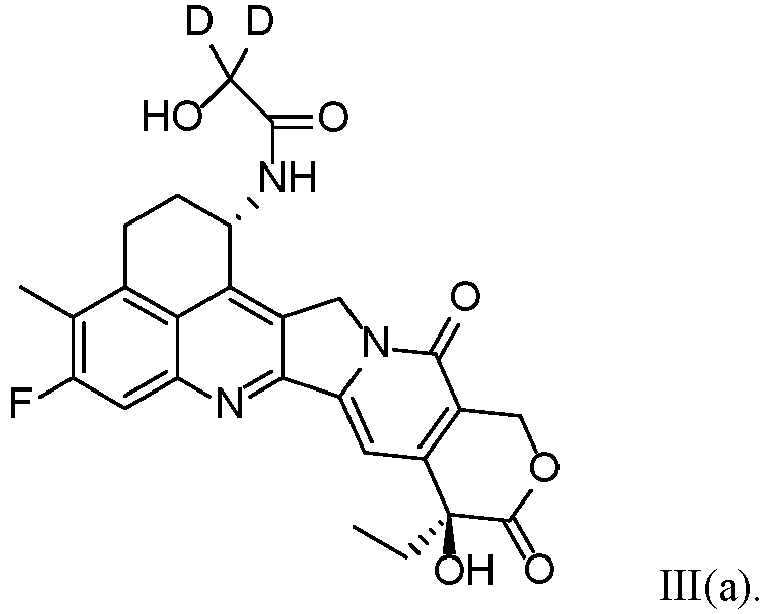
Applications Claiming Priority (2)
| Application Number | Priority Date | Filing Date | Title |
|---|---|---|---|
| CN202010814877 | 2020-08-13 | ||
| PCT/CN2021/112462 WO2022033578A1 (en) | 2020-08-13 | 2021-08-13 | Antibody drug conjugate |
Publications (2)
| Publication Number | Publication Date |
|---|---|
| EP4183421A1 true EP4183421A1 (en) | 2023-05-24 |
| EP4183421A4 EP4183421A4 (en) | 2025-04-23 |
Family
ID=80247729
Family Applications (1)
| Application Number | Title | Priority Date | Filing Date |
|---|---|---|---|
| EP21855628.0A Pending EP4183421A4 (en) | 2020-08-13 | 2021-08-13 | ANTIBODY-DRUG CONJUGATE |
Country Status (11)
| Country | Link |
|---|---|
| US (1) | US12622977B2 (en) |
| EP (1) | EP4183421A4 (en) |
| JP (1) | JP2023537051A (en) |
| KR (1) | KR20230051214A (en) |
| CN (8) | CN119792564A (en) |
| AU (1) | AU2021323863A1 (en) |
| BR (1) | BR112023002417A2 (en) |
| CA (1) | CA3188508A1 (en) |
| IL (1) | IL300446A (en) |
| MX (1) | MX2023001648A (en) |
| WO (1) | WO2022033578A1 (en) |
Cited By (3)
| Publication number | Priority date | Publication date | Assignee | Title |
|---|---|---|---|---|
| US12186403B2 (en) | 2021-07-19 | 2025-01-07 | Immunome, Inc. | Immunoconjugates and methods |
| WO2025186213A1 (en) | 2024-03-04 | 2025-09-12 | Debiopharm International S.A. | Combination of a wee1 inhibitor and a topoisomerase 1 inhibitor |
| US12545716B2 (en) | 2021-07-19 | 2026-02-10 | Immunome, Inc. | Immunoconjugates and methods |
Families Citing this family (20)
| Publication number | Priority date | Publication date | Assignee | Title |
|---|---|---|---|---|
| WO2021219046A1 (en) * | 2020-04-30 | 2021-11-04 | 正大天晴药业集团股份有限公司 | Antigen binding constructs targeting her2 and uses thereof |
| CN119792564A (en) | 2020-08-13 | 2025-04-11 | 正大天晴药业集团股份有限公司 | Antibody Drug Conjugates |
| US20250018052A1 (en) | 2021-09-16 | 2025-01-16 | Chia Tai Tianqing Pharmaceutical Group Co., Ltd. | Anti-her3 antibody drug conjugate, composition thereof, and use thereof |
| US20260021193A1 (en) * | 2022-07-26 | 2026-01-22 | Immunome, Inc. | Immunoconjugates and methods |
| US20260001891A1 (en) * | 2022-11-22 | 2026-01-01 | Keymed Biosciences (Chengdu) Co., Ltd. | Fused ring compound, conjugate thereof and use thereof |
| WO2024230678A1 (en) * | 2023-05-11 | 2024-11-14 | 映恩生物科技(上海)有限公司 | Camptothecin compound and conjugate thereof, preparation method therefor, and use thereof |
| CN120958033B (en) * | 2023-08-04 | 2026-03-31 | 映恩生物制药(苏州)有限公司 | Antibody-drug conjugates: recognition antibodies and their applications |
| WO2025087386A1 (en) * | 2023-10-25 | 2025-05-01 | 正大天晴药业集团南京顺欣制药有限公司 | Use of anti-her2 antibody-drug conjugate in treatment of breast cancer |
| CN117257977A (en) * | 2023-11-07 | 2023-12-22 | 正大天晴药业集团南京顺欣制药有限公司 | Methods for preparing antibody drug conjugates |
| WO2025131036A1 (en) * | 2023-12-22 | 2025-06-26 | 正大天晴药业集团股份有限公司 | Use of adc targeting her2 in treatment of breast cancer |
| WO2025155943A1 (en) * | 2024-01-18 | 2025-07-24 | Joinn Biologics Us Inc. | Immunoconjugates comprising camptothecin analogs and methods of use thereof |
| WO2025162211A1 (en) * | 2024-01-29 | 2025-08-07 | 正大天晴药业集团股份有限公司 | Use of anti-her2 antibody-drug conjugate in treatment of gastric cancer |
| WO2025162287A1 (en) * | 2024-01-29 | 2025-08-07 | 正大天晴药业集团股份有限公司 | Use of anti-her2 antibody-drug conjugate for treating intestinal cancer |
| WO2025242061A1 (en) * | 2024-05-21 | 2025-11-27 | 正大天晴药业集团股份有限公司 | Use of anti-her2 antibody-drug conjugate in treatment of biliary tract cancer |
| WO2025252039A1 (en) * | 2024-06-03 | 2025-12-11 | 正大天晴药业集团股份有限公司 | Use of anti-her2 antibody-drug conjugate in treatment of non-small cell lung cancer |
| KR20250175725A (en) * | 2024-06-07 | 2025-12-17 | (주)지아이이노베이션 | Pharmaceutical Composition For Treating Cancer Comprising Fusion Protein Comprising CD80 Protein And IL-2 Protein and Antibody-Drug Conjugate |
| CN118702819B (en) * | 2024-07-03 | 2025-10-03 | 武汉华美生物工程有限公司 | An antibody against DXD and its derivatives and its preparation and application |
| WO2026015407A1 (en) * | 2024-07-10 | 2026-01-15 | Asieris Pharmaceuticals (Usa), Inc. | Linkers for conjugates and methods of use thereof |
| WO2026086844A1 (en) * | 2024-10-23 | 2026-04-30 | 正大天晴药业集团股份有限公司 | Antibody-drug conjugate targeting egfr and c-met |
| CN121466318A (en) * | 2026-01-07 | 2026-02-06 | 哈尔滨医科大学 | Antibody-drug conjugates based on bioorthogonal reactions, their preparation methods and applications |
Family Cites Families (20)
| Publication number | Priority date | Publication date | Assignee | Title |
|---|---|---|---|---|
| US5945311A (en) | 1994-06-03 | 1999-08-31 | GSF--Forschungszentrumfur Umweltund Gesundheit | Method for producing heterologous bi-specific antibodies |
| JP2005522514A (en) | 2002-04-10 | 2005-07-28 | ジェネンテック・インコーポレーテッド | Modified anti-HER2 antibody |
| DE10355904A1 (en) * | 2003-11-29 | 2005-06-30 | Merck Patent Gmbh | Solid forms of anti-EGFR antibodies |
| KR101505157B1 (en) | 2012-05-08 | 2015-03-24 | 주식회사 종근당 | Anti-ErbB2 Antibody Variants |
| WO2014057687A1 (en) | 2012-10-11 | 2014-04-17 | 第一三共株式会社 | Antibody-drug conjugate |
| CN103319599B (en) | 2013-05-27 | 2015-02-18 | 上海交联药物研发有限公司 | Anti-human ErbB2 antibody-ansamitocin conjugate and applications thereof |
| KR102087850B1 (en) | 2013-10-11 | 2020-03-12 | 메르사나 테라퓨틱스, 인코포레이티드 | Protein-Polymer-Drug Conjugates |
| JP2016538283A (en) | 2013-11-13 | 2016-12-08 | ザイムワークス,インコーポレイテッド | Monovalent antigen binding constructs targeting EGFR and / or HER2 and uses thereof |
| EP4570318A3 (en) * | 2013-11-27 | 2025-10-15 | Zymeworks BC Inc. | Bispecific antigen-binding constructs targeting her2 |
| CA2925677A1 (en) * | 2013-12-20 | 2015-06-25 | F. Hoffmann-La Roche Ag | Bispecific her2 antibodies and methods of use |
| HRP20190431T1 (en) | 2014-01-31 | 2019-04-19 | Daiichi Sankyo Company, Limited | ANTI-HER2 ANTIBODY-LIGHT CONJUGATE |
| MX2017006016A (en) * | 2014-11-11 | 2017-06-19 | Amunix Operating Inc | Targeted xten conjugate compositions and methods of making same. |
| CN104610453A (en) * | 2015-01-23 | 2015-05-13 | 张帆 | Anti-HER2 dual-targeting antibodies, and preparation method and application thereof |
| CN107446045A (en) | 2016-07-22 | 2017-12-08 | 北京天广实生物技术股份有限公司 | A kind of anti-HER2 antibody, its pharmaceutical composition and purposes |
| BR112019017629A2 (en) | 2017-03-27 | 2020-04-07 | Hoffmann La Roche | antigen-binding receptor, isolated polynucleotide, vector, transduced t cell, methods for treating a disease and for inducing lysis, use of the receptor and receptor |
| WO2019034176A1 (en) * | 2017-08-18 | 2019-02-21 | 四川百利药业有限责任公司 | Camptothecin-antibody conjugate |
| BR112021004656A2 (en) | 2018-09-26 | 2021-06-01 | Jiangsu Hengrui Medicine Co., Ltd. | exatecan analogue drug-binding conjugate, method to prepare the same and application thereof |
| MY209065A (en) * | 2018-09-30 | 2025-06-18 | Jiangsu Hansoh Pharmaceutical Group Co Ltd | Anti-b7h3 antibody-exatecan analog conjugate and medicinal use thereof |
| EP3988574A4 (en) * | 2019-02-03 | 2022-10-12 | Shanghai Bao Pharmaceuticals Co., Ltd. | ANTI-HER2 BISPECIFIC ANTIBODIES AND USE THEREOF |
| CN119792564A (en) | 2020-08-13 | 2025-04-11 | 正大天晴药业集团股份有限公司 | Antibody Drug Conjugates |
-
2021
- 2021-08-13 CN CN202411649225.XA patent/CN119792564A/en active Pending
- 2021-08-13 CA CA3188508A patent/CA3188508A1/en active Pending
- 2021-08-13 CN CN202411649235.3A patent/CN119792568A/en active Pending
- 2021-08-13 MX MX2023001648A patent/MX2023001648A/en unknown
- 2021-08-13 CN CN202411649231.5A patent/CN119792566A/en active Pending
- 2021-08-13 WO PCT/CN2021/112462 patent/WO2022033578A1/en not_active Ceased
- 2021-08-13 CN CN202411649228.3A patent/CN119792565A/en active Pending
- 2021-08-13 IL IL300446A patent/IL300446A/en unknown
- 2021-08-13 EP EP21855628.0A patent/EP4183421A4/en active Pending
- 2021-08-13 CN CN202411649232.XA patent/CN119792567A/en active Pending
- 2021-08-13 CN CN202180041403.9A patent/CN115702008B/en active Active
- 2021-08-13 US US18/040,498 patent/US12622977B2/en active Active
- 2021-08-13 KR KR1020237007880A patent/KR20230051214A/en active Pending
- 2021-08-13 BR BR112023002417A patent/BR112023002417A2/en unknown
- 2021-08-13 JP JP2023508466A patent/JP2023537051A/en active Pending
- 2021-08-13 CN CN202411649224.5A patent/CN119792563A/en active Pending
- 2021-08-13 AU AU2021323863A patent/AU2021323863A1/en active Pending
- 2021-08-13 CN CN202411649220.7A patent/CN119792562A/en active Pending
Cited By (7)
| Publication number | Priority date | Publication date | Assignee | Title |
|---|---|---|---|---|
| US12186403B2 (en) | 2021-07-19 | 2025-01-07 | Immunome, Inc. | Immunoconjugates and methods |
| US12268750B2 (en) | 2021-07-19 | 2025-04-08 | Immunome, Inc. | Immunoconjugates and methods |
| US12274754B2 (en) | 2021-07-19 | 2025-04-15 | Immunome, Inc. | Immunoconjugates and methods |
| US12280121B2 (en) | 2021-07-19 | 2025-04-22 | Immunome, Inc. | Immunoconjugates and methods |
| US12285492B2 (en) | 2021-07-19 | 2025-04-29 | Immunome, Inc. | Immunoconjugates and methods |
| US12545716B2 (en) | 2021-07-19 | 2026-02-10 | Immunome, Inc. | Immunoconjugates and methods |
| WO2025186213A1 (en) | 2024-03-04 | 2025-09-12 | Debiopharm International S.A. | Combination of a wee1 inhibitor and a topoisomerase 1 inhibitor |
Also Published As
| Publication number | Publication date |
|---|---|
| CN119792562A (en) | 2025-04-11 |
| AU2021323863A1 (en) | 2023-03-23 |
| CN119792568A (en) | 2025-04-11 |
| CN119792565A (en) | 2025-04-11 |
| US20230405141A1 (en) | 2023-12-21 |
| IL300446A (en) | 2023-04-01 |
| CN119792563A (en) | 2025-04-11 |
| CN115702008B (en) | 2024-12-06 |
| KR20230051214A (en) | 2023-04-17 |
| CN119792567A (en) | 2025-04-11 |
| EP4183421A4 (en) | 2025-04-23 |
| CN115702008A (en) | 2023-02-14 |
| US12622977B2 (en) | 2026-05-12 |
| JP2023537051A (en) | 2023-08-30 |
| CN119792564A (en) | 2025-04-11 |
| MX2023001648A (en) | 2023-03-09 |
| WO2022033578A1 (en) | 2022-02-17 |
| BR112023002417A2 (en) | 2023-03-21 |
| CA3188508A1 (en) | 2022-02-17 |
| CN119792566A (en) | 2025-04-11 |
Similar Documents
| Publication | Publication Date | Title |
|---|---|---|
| US12622977B2 (en) | Antibody drug conjugate | |
| EP4389153A1 (en) | Anti-her3 antibody drug conjugate, composition thereof, and use thereof | |
| EP3468996B1 (en) | Anti-egfr antibody drug conjugates | |
| EP4230653A1 (en) | Anti-her3 antibody and anti-her3 antibody-drug conjugate and medical use thereof | |
| EP4471063A1 (en) | Antibody against her3, conjugate and use thereof | |
| EP4552654A1 (en) | Antibody-drug conjugate, and preparation method therefor and use thereof | |
| EP4480499A1 (en) | Conjugate of antibody-eribulin or derivative thereof, intermediate thereof, preparation method therefor, pharmaceutical composition thereof and use thereof | |
| EP4656248A2 (en) | Anti-c-met antibody drug conjugates | |
| CN114569739A (en) | Antibody drug conjugates | |
| CN119604509A (en) | An antitumor compound and its application | |
| EP4406974A1 (en) | Antibody-drug conjugate, preparation method therefor, and pharmaceutical use thereof | |
| EA051399B1 (en) | ANTIBODY-DRUG CONJUGATE | |
| HK40085503A (en) | Antibody drug conjugate | |
| EP4628104A1 (en) | Anti-cldn18.2 antibody-drug conjugate, and pharmaceutical composition thereof and use thereof | |
| HK40085503B (en) | Antibody drug conjugate | |
| WO2026098633A1 (en) | Conjugates and uses thereof | |
| US20250000991A1 (en) | Nectin-4 antibodies and antibody-drug conjugates |
Legal Events
| Date | Code | Title | Description |
|---|---|---|---|
| STAA | Information on the status of an ep patent application or granted ep patent |
Free format text: STATUS: THE INTERNATIONAL PUBLICATION HAS BEEN MADE |
|
| PUAI | Public reference made under article 153(3) epc to a published international application that has entered the european phase |
Free format text: ORIGINAL CODE: 0009012 |
|
| STAA | Information on the status of an ep patent application or granted ep patent |
Free format text: STATUS: REQUEST FOR EXAMINATION WAS MADE |
|
| 17P | Request for examination filed |
Effective date: 20230214 |
|
| AK | Designated contracting states |
Kind code of ref document: A1 Designated state(s): AL AT BE BG CH CY CZ DE DK EE ES FI FR GB GR HR HU IE IS IT LI LT LU LV MC MK MT NL NO PL PT RO RS SE SI SK SM TR |
|
| DAV | Request for validation of the european patent (deleted) | ||
| DAX | Request for extension of the european patent (deleted) | ||
| A4 | Supplementary search report drawn up and despatched |
Effective date: 20250321 |
|
| RIC1 | Information provided on ipc code assigned before grant |
Ipc: C07B 59/00 20060101ALI20250318BHEP Ipc: A61P 35/00 20060101ALI20250318BHEP Ipc: C07K 16/32 20060101ALI20250318BHEP Ipc: A61K 47/54 20170101ALI20250318BHEP Ipc: A61K 47/68 20170101AFI20250318BHEP |
|
| STAA | Information on the status of an ep patent application or granted ep patent |
Free format text: STATUS: EXAMINATION IS IN PROGRESS |
|
| 17Q | First examination report despatched |
Effective date: 20251029 |
|
| GRAP | Despatch of communication of intention to grant a patent |
Free format text: ORIGINAL CODE: EPIDOSNIGR1 |
|
| STAA | Information on the status of an ep patent application or granted ep patent |
Free format text: STATUS: GRANT OF PATENT IS INTENDED |
|
| INTG | Intention to grant announced |
Effective date: 20260312 |
|
| GRAS | Grant fee paid |
Free format text: ORIGINAL CODE: EPIDOSNIGR3 |
|
| GRAA | (expected) grant |
Free format text: ORIGINAL CODE: 0009210 |
|
| STAA | Information on the status of an ep patent application or granted ep patent |
Free format text: STATUS: THE PATENT HAS BEEN GRANTED |