EP4181458A1 - Quantum cryptography storage system, distribution control device, and computer-readable medium - Google Patents
Quantum cryptography storage system, distribution control device, and computer-readable medium Download PDFInfo
- Publication number
- EP4181458A1 EP4181458A1 EP22192591.0A EP22192591A EP4181458A1 EP 4181458 A1 EP4181458 A1 EP 4181458A1 EP 22192591 A EP22192591 A EP 22192591A EP 4181458 A1 EP4181458 A1 EP 4181458A1
- Authority
- EP
- European Patent Office
- Prior art keywords
- shares
- ssn
- distribution
- distributed
- storage devices
- Prior art date
- Legal status (The legal status is an assumption and is not a legal conclusion. Google has not performed a legal analysis and makes no representation as to the accuracy of the status listed.)
- Granted
Links
Images




Classifications
-
- G—PHYSICS
- G06—COMPUTING OR CALCULATING; COUNTING
- G06F—ELECTRIC DIGITAL DATA PROCESSING
- G06F21/00—Security arrangements for protecting computers, components thereof, programs or data against unauthorised activity
- G06F21/60—Protecting data
- G06F21/602—Providing cryptographic facilities or services
-
- H—ELECTRICITY
- H04—ELECTRIC COMMUNICATION TECHNIQUE
- H04L—TRANSMISSION OF DIGITAL INFORMATION, e.g. TELEGRAPHIC COMMUNICATION
- H04L9/00—Cryptographic mechanisms or cryptographic arrangements for secret or secure communications; Network security protocols
- H04L9/08—Key distribution or management, e.g. generation, sharing or updating, of cryptographic keys or passwords
- H04L9/0816—Key establishment, i.e. cryptographic processes or cryptographic protocols whereby a shared secret becomes available to two or more parties, for subsequent use
- H04L9/0852—Quantum cryptography
-
- H—ELECTRICITY
- H04—ELECTRIC COMMUNICATION TECHNIQUE
- H04L—TRANSMISSION OF DIGITAL INFORMATION, e.g. TELEGRAPHIC COMMUNICATION
- H04L67/00—Network arrangements or protocols for supporting network services or applications
- H04L67/01—Protocols
- H04L67/10—Protocols in which an application is distributed across nodes in the network
- H04L67/1097—Protocols in which an application is distributed across nodes in the network for distributed storage of data in networks, e.g. transport arrangements for network file system [NFS], storage area networks [SAN] or network attached storage [NAS]
-
- H—ELECTRICITY
- H04—ELECTRIC COMMUNICATION TECHNIQUE
- H04L—TRANSMISSION OF DIGITAL INFORMATION, e.g. TELEGRAPHIC COMMUNICATION
- H04L9/00—Cryptographic mechanisms or cryptographic arrangements for secret or secure communications; Network security protocols
- H04L9/08—Key distribution or management, e.g. generation, sharing or updating, of cryptographic keys or passwords
- H04L9/0816—Key establishment, i.e. cryptographic processes or cryptographic protocols whereby a shared secret becomes available to two or more parties, for subsequent use
- H04L9/0819—Key transport or distribution, i.e. key establishment techniques where one party creates or otherwise obtains a secret value, and securely transfers it to the other(s)
-
- H—ELECTRICITY
- H04—ELECTRIC COMMUNICATION TECHNIQUE
- H04L—TRANSMISSION OF DIGITAL INFORMATION, e.g. TELEGRAPHIC COMMUNICATION
- H04L9/00—Cryptographic mechanisms or cryptographic arrangements for secret or secure communications; Network security protocols
- H04L9/08—Key distribution or management, e.g. generation, sharing or updating, of cryptographic keys or passwords
- H04L9/0816—Key establishment, i.e. cryptographic processes or cryptographic protocols whereby a shared secret becomes available to two or more parties, for subsequent use
- H04L9/085—Secret sharing or secret splitting, e.g. threshold schemes
Definitions
- the present disclosure relates to a quantum cryptography storage system, a distribution control device, and a computer-readable medium.
- a network system in which storage devices (storages) such as hard disks are arranged as nodes of a communication network, and writing/reading of data from a user application connected to the communication network to/from these storages is conventionally known.
- storage devices storage devices
- writing/reading of data from a user application connected to the communication network to/from these storages is conventionally known.
- there is a method of improving safety by distributing the data on the basis of a secret sharing algorithm and storing the data in a distributed manner in a plurality of physically separated nodes.
- a quantum cryptography storage system includes a plurality of storage, a distribution control device, a generation device, and a distribution device.
- the plurality of storage devices are connected via a communication network.
- the distribution control device determines a distribution mode of shares into which data is distributed, based on quantum key distribution network (QKDN) information.
- QKDN quantum key distribution network
- the generation device generates an encryption key and a decryption key by using a quantum key shared by using a QKDN.
- the distribution device distributes the data into the shares, based on the distribution mode.
- each of the plurality of storage devices that stores the shares in a distributed manner decrypts the share encrypted with the decryption key and stores a share decrypted.
- QKDN quantum key distribution network
- the storage network is positioned as a user who consumes the quantum key provided by the QKDN. That is, the storage network is positioned as an application of the quantum key network.
- OTP encryption is an encryption scheme that requires a key having the same length as data to be encrypted (plaintext)
- OTP encryption key it is necessary to receive an OTP encryption key having the same size as the transmitted share from the QKDN.
- a rate at which the QKDN can generate and supply a quantum key (OTP encryption key) is lower than a rate of a communication path in a storage network as a general communication path. Therefore, the maximum transmission rate at the time of transmitting the share depends on the OTP encryption key generation/supply rate between the nodes that perform the transmission.
- FIG. 1 is a diagram illustrating an example of a device configuration of a quantum cryptography storage system 100 according to a first arrangement.
- the quantum cryptography storage system 100 of the first arrangement includes three nodes 10-1 to 10-3, a secure storage network (SSN) user plane 20, and secure storage agents (SSAs) 30-1 to 30-2.
- SSN secure storage network
- SSAs secure storage agents
- each node 10 is installed in each base (for example, a communication office building or the like).
- the node 10-1 includes a QKD module 1-1, a key manager (KM) 2-1, and an SSN shareholder 3-1.
- the node 10-2 includes a QKD module 1-2a, a QKD module 1-2b, a KM 2-2, an SSN shareholder 3-2, and an SSN controller 4.
- the node 10-3 includes a QKD module 1-3, a KM 2-3, an SSN shareholder 3-3, and a QKDN controller 5.
- the QKD modules 1-1 to 1-3 will be simply referred to as QKD modules 1 when not distinguished from each other.
- the KM 2-1 to KM 2-3 will be simply referred to as KMs 2 when not distinguished from each other.
- the SSN shareholders 3-1 to 3-3 will be simply referred to as SSN shareholders 3 when not distinguished from each other.
- the SSAs 30-1 to 30-2 will be simply referred to as SSAs 30 when not distinguished from each other.
- each node 10 may be housed in one housing, or may be configured as a plurality of devices by separate housings.
- an SSN data owner which is an owner of SSN user data, transmits and receives SSN user data.
- the SSAs 30 distribute the SSN user data into a plurality of shares on the basis of a secret sharing algorithm.
- the quantum cryptography storage system 100 of the first arrangement includes two networks of a quantum key distribution network (QKDN) 200 and an SSN 300.
- QKDN quantum key distribution network
- the QKDN 200 in the first arrangement is a quantum key distribution network including the three nodes 10-1 to 10-3.
- the QKDN 200 of the first arrangement includes the QKD modules 1, the KMs 2, and the QKDN controller 5.
- the QKD module 1-1 and the QKD module 1-2a generate a bit string (quantum key) shared by both through the QKD link connecting both.
- the QKD module 1-1 and the QKD module 1-2a transmit quantum keys to the KM 2-1 and the KM 2-2, respectively, whereby the KM 2-1 and the KM 2-2 share a quantum key.
- the QKD module 1-2b and the QKD module 1-3 similarly generate a quantum key, and the quantum key is shared between the KM 2-2 and the KM 2-3.
- the QKD module 1-1 and the QKD module 1-3 are not connected by a QKD link. Therefore, the KM 2-1 and the KM 2-3 share a quantum key by a key relay via KM 2-2, for example, by transmitting a part of the quantum key shared by the KM 2-1 and the KM 2-2 from the KM 2-2 to the KM 2-3.
- the shared quantum keys are transmitted from the KMs 2 to the SSN shareholders 3 in response to requests from the SSN shareholders 3 connected to the respective KMs 2.
- the SSN 300 of the first arrangement is a storage network including the three nodes 10-1 to 10-3 (the SSN shareholders 3-1 to 3-3 and the SSN controller 4), the SSN user plane 20, and the SSAs 30.
- an SSN data owner accommodated in the SSA 30-1 transmits a storage request to the SSA 30-1 to store SSN user data in the SSN shareholders 3.
- the SSA 30-1 Upon receiving the storage request, the SSA 30-1 distributes SSN user data 101 (hereinafter referred to as "original data 101") into a plurality of shares on the basis of a secret sharing algorithm.
- the SSA 30-1 inquires of the SSN controller 4 about a distribution mode (for example, the number of shares after distribution and the size of each share) for distribution to the shares.
- the SSN controller 4 determines a distribution mode and notifies the SSA 30-1 of the distribution mode. In determining the distribution mode, the SSN controller 4 determines a distributed storage mode of the shares to the SSN shareholders 3.
- FIG. 1 illustrates an example of a case where it is determined that shares 101-2 and 101-3 are stored in a distributed manner in the SSN shareholders 3-2 and 3-3, and at this time, the distribution number in the distribution mode is 2.
- the SSN controller 4 determines the size of each share in the distribution mode between the SSN shareholder 3-1 and the SSN shareholder 3-2 and between the SSN shareholder 3-1 and the SSN shareholder 3-3 according to communication rates available while applying the OTP encryption.
- the communication rates available while applying the OTP encryption are sharing rates of the OTP encryption keys between the KM 2-1 and the KM 2-2 and between the KM 2-1 and the KM 2-3.
- the SSN controller 4 acquires these sharing rates from the QKDN controller 5.
- the SSN controller 4 makes the size of the share 3-2 stored in a distributed manner in the SSN shareholder 3-2 larger than the size of the share 101-3 stored in a distributed manner in the SSN shareholder 3-3.
- the SSA 30-1 distributes the original data 101 into the shares 101-2 and 101-3 on the basis of the distribution mode determined by the SSN controller 4 as described above, that is, the distribution number to shares and the size of each share. Then, the SSA 30-1 temporarily stores the shares 101-2 and 101-3 in the SSN shareholder 3-1 accommodated in the SSA 30-1, and notifies the SSN controller 4 that distribution and temporary storage have been completed.
- the SSN controller 4 Upon receiving the notification from the SSA 30-1, the SSN controller 4 instructs the SSN shareholders 3-1 to 3-3 to execute the storage control process.
- the SSN shareholder 3-1 transmits the share 101-2 to the SSN shareholder 3-2 while performing OTP encryption.
- the SSN shareholder 3-2 decrypts the share 101-2 and stores the decrypted share 101-2.
- the SSN shareholder 3-1 deletes the share 101-2 temporarily stored in the SSN shareholder 3-1.
- the SSN shareholder 3-1 transmits the share 101-3 to the SSN shareholder 3-3 while performing OTP encryption.
- the SSN shareholder 3-3 decrypts the share 101-3 and stores the decrypted share 101-3.
- the SSN shareholder 3-1 deletes the share 101-3 temporarily stored in the SSN shareholder 3-1. Note that the process of transmitting the share 101-3 to the SSN shareholder 3-3 while performing OTP encryption starts at the same time as the start of the process of the SSN shareholder 3-1 transmitting the share 101-2 to the SSN shareholder 3-2 while performing OTP encryption.
- OTP keys supplied from the KMs 2 connected to the respective SSN shareholder 3 are used for the OTP-encrypted communication between the SSN shareholders 3. For example, when transmitting the share 101-2 to the SSN shareholder 3-2, the SSN shareholder 3-1 acquires an OTP encryption key from the KM 2-1, and encrypts and transmits the share 101-2 using the OTP encryption key.
- the SSN shareholder 3-2 acquires the same OTP encryption key as the OTP encryption key transmitted from the KM 2-1 to the SSN shareholder 3-1 from the KM 2-2, and decrypts the encrypted share 101-2 using the OTP encryption key acquired from the KM 2-2.
- the communication paths between the SSN shareholders 3 are, for example, the Internet, but the communication paths may be arbitrary.
- the present arrangement it is possible to ensure information-theoretic security against eavesdropping on communication paths for distributed storage in a storage network in which the shares 101-2 and 101-3 into which distribution is made on the basis of a secret sharing algorithm are stored in a distributed manner.
- the time until the transmission of the share 101-2 to the SSN shareholder 3-2 is completed and the time until the transmission of the share 101-3 to the SSN shareholder 3-3 is completed can be brought close to each other, the time until the distributed storage of the shares 101-2 and 101-3 is completed can be brought close to the shortest.
- the process in which the SSA 30-1 acquires the distribution mode from the SSN controller 4 does not necessarily need to be performed after the storage request is received by the user, and for example, the distribution mode may be periodically notified from the SSN controller 4 to the SSA 30-1.
- the process in which the SSN controller 4 acquires the sharing rates of the OTP encryption keys from the QKDN controller 5 is not necessarily performed in response to a request from the SSA 30-1, and a method of periodically notifying the SSN controller 4 from the QKDN controller 5 may be adopted.
- the SSN controller 4 is included in the node 10-2, but for example, the other node 10-1 or node 10-3 may include the SSN controller, or a plurality of nodes may include SSN controllers, and the SSN controllers may perform the storage control execution instruction in cooperation.
- the share 101-2 and the share 101-3 do not necessarily need to be a single share in the secret sharing algorithm to be used, and each may be a set of a plurality of shares.
- the SSN user data may be distributed into 40 shares all having the same size, a set of 30 shares may be allocated to the share 101-2, and a set of the remaining 10 shares may be allocated to the share 101-3.
- the SSN user data may be distributed into four distribution pieces having different sizes, where two pieces are allocated to the share 101-2 and two pieces are allocated to the share 101-3, and the ratio of the sum of the sizes of the two shares allocated to the share 101-2 and the sum of the sizes of the two shares allocated to the share 101-3 may be 3:1.
- the secret sharing algorithm in the present arrangement can use, for example, all-or-nothing transform (AONT), but the secret sharing algorithm is not limited thereto, and may be a predetermined secret sharing algorithm.
- AONT all-or-nothing transform
- FIG. 2 is a diagram illustrating an example of a functional configuration of the SSN controller 4 of the first arrangement.
- the SSN controller 4 of the first arrangement includes a communication control unit 41 and a determination unit 42.
- the communication control unit 41 receives QKDN information from the QKDN controller 5.
- the QKDN information includes a sharing rate of the quantum key between each KM 2.
- the QKDN information includes a stock amount of the quantum key that can be used in each of the plurality of SSN shareholders 3 (storage devices).
- the communication control unit 41 notifies an SSA 30 (distribution device) of a distribution mode of shares into which data is distributed (for example, the distribution number indicating the number of shares into which data is distributed, sizes of the shares, and SSN shareholders 3 that store the shares in a distributed manner).
- SSA 30 distributed device
- the determination unit 42 determines a distribution mode of the shares into which the data is distributed on the basis of the QKDN information. For example, the determination unit 42 determines the distribution number, the sizes of the shares, and the SSN shareholders 3 that store the shares in a distributed manner on the basis of at least one of the sharing rate of the quantum key and the stock amount of the quantum key.
- An example of the determination processing based on the sharing rate of the quantum key will be described later with reference to FIGS. 3A and 4 .
- an example of determination processing based on both the sharing rate of the quantum key and the stock amount of the quantum key will be described later with reference to FIG. 5 .
- FIG. 3A is a diagram for explaining a distributed storage method and a required time for the shares 101-2 and 101-3 according to the first arrangement.
- FIG. 3A illustrates an example of the sizes of the shares 101-2 and 101-3 specifically determined in the arrangement illustrated above with reference to FIG. 1 .
- the SSA 30-1 distributes the original data 101 into the two shares 101-2 and 101-3 with a total of 240 MB, which are stored in a distributed manner in the SSN shareholder 3-2 and the SSN shareholder 3-3.
- a quantum key OTP encryption key
- a quantum key OTP encryption key
- a quantum key is provided from the QKDN at a rate of 250 kbps, that is, OTP-encrypted communication at 250 kbps is available.
- the SSN controller 4 acquires the quantum key sharing rate between the KM 2-1 and the KM 2-2 and the quantum key sharing rate between the KM 2-1 and the KM 2-3 from the QKDN controller 5, and recognizes that the OTP-encrypted communication rate between the SSN shareholders 3-1 and 3-2 and the OTP-encrypted communication rate between the SSN shareholders 3-1 and 3-3 are 1 Mbps and 250 kbps, respectively. Then, the SSN controller 4 determines that the size ratio of the shares 101-2 and 101-3 is 4:1, that is, the share 101-2 is 192 MB and the share 101-3 is 48 MB, based on the fact that the ratio of the OTP-encrypted communication rate is 4:1.
- the SSN controller 4 determines the sizes of the shares 101-2 and 101-3 so that the times required for distributed storage approach the same value, whereby the original data 101 can be stored in a distributed manner in the shareholders 3-2 and 3-3 in a shorter time.
- FIG. 3B is a diagram for explaining the time required for transmission of the share 101-2 and the share 101-3 in a case where the sizes of the share 101-2 and the share 101-3 are equally divided, that is, 120 MB, for example, without using the method according to the present arrangement.
- FIGS. 1 and 3A illustrate an example in which the original data 101 is distributed into two pieces
- the number of SSN shareholders 3 and the distribution number of the original data 101 are not limited thereto, and can take various forms according to the configuration of the SSN, the capacity of the storage means included in the SSN shareholders 3, the management policy, and the like.
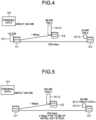
- FIG. 4 is a diagram for explaining a distributed storage method and a required time for shares 101-1 to 101-3 according to the first arrangement.
- the SSA 30-1 may distribute data into three shares 101-1 to 101-3, and the share 101-1 may be stored in a distributed manner in the SSN shareholder 3-1.
- the example illustrated using FIGS. 1 and 3A is a mode in which the QKDN 200 supplies the OTP encryption keys to the SSN shareholder 3 pairs (pair of SSN shareholders 3-1 and 3-2 and pair of SSN shareholders 3-1 and 3-3) while generating the OTP encryption keys. That is, the example illustrated using FIGS. 1 and 3A is a mode in which the sizes of the shares 101-1 and 101-2 are determined on the basis of the supply rates of the OTP encryption keys (the sharing rates of the quantum keys of the KM 2 pairs corresponding to the shareholder 3 pairs), but there is a case where OTP encryption keys accumulated in advance in the QKDN 200 (hereinafter referred to as a "key stock”) is available in some pairs of the SSN shareholders 3 or all pairs of the SSN shareholders 3.
- a key stock OTP encryption keys accumulated in advance in the QKDN 200
- FIG. 5 is a diagram for explaining a distributed storage method and a required time for the shares 101-2 and 101-3 according to the first arrangement.
- the example of FIG. 5 illustrates a case where the key stock is 16 MB, that is, a maximum of 16 MB of the share 101-3 can be transmitted by OTP-encrypted communication using the key stock between the SSN shareholder 3-1 and the SSN shareholder 3-3.
- the communication rate for this 16 MB is a normal communication rate between the SSN shareholder 3-1 and the SSN shareholder 3-3 regardless of the sharing rate of the OTP encryption key between the KM 2-1 and the KM 2-3 in the QKDN 200.
- the normal communication rate is 4 Mbps, which is the same as the link rate between the SSN shareholder 3-1 and the SSN shareholder 3-3.
- the SSN controller 4 acquires from the QKDN controller 5 that the key sharing rate between the KM 2-1 and the KM 2-3 is 250 kbps and that the key stock of 16 MB is available, recognizes that transmission is possible at 4 Mbps for 16 MB of the share and at 250 kbps for more than 16 MB between the shareholder 3-1 and the SSN shareholder 3-3, and determines the size of the share 101-2 to 180 MB and the size of the share 101-3 to 60 MB, so that the time required for transmission of the share 101-2 and the time required for transmission of the share 101-3 are both 1440 seconds. That is, out of 60 MB, 16 MB is transmitted at 4 Mbps using the key stock, and 44 MB is transmitted at 250 kbps. Therefore, the time required for transmission of the share 101-3 is the sum of 32 seconds (16 * 8 Mbit/4 Mbps) required for transmission of 16 MB and 1408 seconds ((60 - 16) * 8 Mbit/0.25 Mbps) required for transmission of 44 MB.
- the SSN controller 4 determines the relationship between the time required for transmission and the size of the share on the assumption that the entire share can be transmitted at the rate when the key stock is used, and can determine the size of the share.
- FIG. 6 is a flowchart illustrating an example of a distribution control method according to the first arrangement.
- the SSN controller 4 determines the distribution mode of the share on the basis of the sharing rate of the quantum key and the stock amount (step S1).
- the distribution mode of the share includes, for example, a distribution number indicating the number of shares into which the data is distributed, sizes of the shares, and SSN shareholders 3 (an example of distributed storage devices) that store the shares in a distributed manner.
- an SSA 30 (an example of a distribution device) distributes data into a plurality of shares on the basis of the distribution mode determined by the processing of step S1 (step S2).
- the SSN shareholder 3 determined in the processing of step S1 stores a plurality of shares in a distributed manner (step S3). Specifically, when receiving the share encrypted with the encryption key via the SSN 300, each SSN shareholder 3 decrypts the encrypted share with the decryption key corresponding to the encryption key, and stores the decrypted share.
- the encryption key and the decryption key are generated from a quantum key shared using the QKDN 200.
- the quantum cryptography storage system of the first arrangement it is possible to store data in a distributed manner in a plurality of storage devices in a shorter time while ensuring information-theoretic security of communication paths.
- FIG. 7 is a diagram illustrating an example of a device configuration of a quantum cryptography storage system 100-2 according to a modification of the first arrangement.
- the quantum cryptography storage system 100-2 of the modification is different from that of the first arrangement in that QKDN controllers 5-1 to 5-3 are provided in each node 10.
- the SSN controller 4 may receive the QKDN information from the QKDN controller 5 provided in each node 10.
- FIG. 8 is a diagram for explaining a distributed storage method and a required time for shares 101-1 to 101-3 according to the second arrangement.
- any three of SSN shareholders 3-2 to 3-6 are selected, and the three shares 101-1 to 101-3 temporarily stored in the SSN shareholder 3-1 are stored in a distributed manner.
- the SSN controller 4 acquires information on the OTP-encrypted communication rates (the sharing rate of the quantum key between the corresponding KMs 2) between the SSN shareholders 3 from the QKDN controller 5, and selects three SSN shareholders 3 that can complete transmission of the shares 101-1 to 101-3 in a shorter time.
- the OTP-encrypted communication rate between the SSN shareholder 3-1 and the SSN shareholder 3-2 is 1.5 Mbps.
- the OTP-encrypted communication rate between the SSN shareholder 3-1 and the SSN shareholder 3-3 is 200 kbps.
- the OTP-encrypted communication rate between the SSN shareholder 3-1 and the SSN shareholder 3-4 is 400 kbps.
- the OTP-encrypted communication rate between the SSN shareholder 3-1 and the SSN shareholder 3-5 is 1 Mbps.
- the OTP-encrypted communication rate between the SSN shareholder 3-1 and the SSN shareholder 3-6 is 3 Mbps.
- the topology of the storage network including the SSN shareholders 3-1 to 3-6 may be any topology such as a full mesh (fully connected).
- the SSN controller 4 selects SSN shareholders 3 capable of completing the transmission of the shares 101-1 to 101-3 in as short a time as possible. That is, the SSN controller 4 selects the three SSN shareholders 3 connected by links having higher OTP-encrypted communication rates. Specifically, in the example of FIG. 8 , the SSN controller 4 selects the SSN shareholder 3-2 (link's OTP-encrypted communication rate is 1.5 Mbps), the SSN shareholder 3-5 (link's OTP-encrypted communication rate is 1 Mbps), and the SSN shareholder 3-6 (link's OTP-encrypted communication rate is 3 Mbps).
- the distributed storage destinations of the shares 101-1 to 101-3 are determined on the basis of the supply rates (the sharing rates in the KM 2 pairs corresponding to the shareholder 3 pairs) in a case where the OTP encryption key is supplied to the SSN shareholder 3 pairs.
- the supply rates the sharing rates in the KM 2 pairs corresponding to the shareholder 3 pairs
- OTP encryption key is supplied to the SSN shareholder 3 pairs.
- OTP encryption keys key stock described above
- FIG. 9 is a diagram for explaining a distributed storage method and a required time for the shares 101-1 to 101-3 according to the second arrangement.
- the difference from FIG. 8 is that there is 160 MB of key stock between the SSN shareholder 3-1 and the SSN shareholder 3-4. That is, when the SSN shareholder 3-1 transmits the share 101-2 to the SSN shareholder 3-4, up to 160 MB of the share 101-2 can be transmitted by OTP-encrypted communication using the key stock.
- the communication rate when using the key stock is not bound by the supply rate of the OTP encryption key, and is a normal communication rate (in the example of FIG. 9 , 8 Mbps) between the SSN shareholder 3-1 and the SSN shareholder 3-3.
- the time required for transmission of the share 101-2 is a total of 1760 seconds including 160 seconds (160 * 8 Mbit/8 Mbps) required for transmission of 160 MB and 1600 seconds ((240 - 160) * 8 Mbit/0.4 Mbps) required for transmission of 80 MB.
- the SSN shareholder 3-4 is selected as the distributed storage destination of the share 101-2.
- FIGS. 10A and 10B are diagrams for explaining a distributed storage method and a required time for the shares 101-2 to 101-4 according to the third arrangement.
- the examples of FIGS. 10A and 10B illustrate a case where distributed storage is performed such that the storage capacity consumption of the SSN shareholder 3-2 and the storage capacity consumption of the SSN shareholder 3-3 are equal.
- the OTP-encrypted communication rate between the SSN shareholder 3-1 and the SSN shareholder 3-2 is 1 Mbps.
- the OTP-encrypted communication rate between the SSN shareholder 3-2 and the SSN shareholder 3-3 is 1 Mbps.
- the OTP-encrypted communication rate between the SSN shareholder 3-1 and the SSN shareholder 3-3 is 250 kbps.
- the SSN controller 4 determines to distribute the original data 101 into the three shares 101-2 to 101-4. Then, the SSN controller 4 performs control to transmit the share 101-3 from the SSN shareholder 3-1 to the SSN shareholder 3-3, and transmit the shares 101-2 and 101-4 from the SSN shareholder 3-1 to the SSN shareholder 3-2. Note that, regardless of the transmission order of the shares 101-2 and 101-4, either may precede, or part of the share 101-2 and part of the share 101-4 may be alternately transmitted.
- the SSN controller 4 causes the share 101-4 to be transmitted from the SSN shareholder 3-2 to the SSN shareholder 3-3, and after the transmission is completed, causes the share 101-4 to be deleted from the SSN shareholder 3-2.
- FIG. 10A is an example in which transmission of the share 101-4 from the SSN shareholder 3-2 to the SSN shareholder 3-3 is started after transmission of both the share 101-2 and the share 101-4 from the SSN shareholder 3-1 to the SSN shareholder 3-2 is completed. If the SSN shareholder 3-2 is able to receive the share 101-2 from the SSN shareholder 3-1 and transmit the share 101-4 to the SSN shareholder 3-3 in parallel, it can be as in FIG. 10B .
- the SSN controller 4 starts the transmission of the share 101-3 from the SSN shareholder 3-1 to the SSN shareholder 3-3, and at the same time, starts transmission of the share 101-4 from the SSN shareholder 3-1 to the SSN shareholder 3-2. Then, when the transmission of the share 101-4 is completed 576 seconds after the start, the SSN controller 4 immediately starts the transmission of the share 101-4 from the SSN shareholder 3-2 to the SSN shareholder 3-3, and simultaneously starts the transmission of the share 101-2 from the SSN shareholder 3-1 to the SSN shareholder 3-2.
- FIGS. 10A and 10B illustrate an example of a case where there is no key stock, but in a case where key stock is available between the SSN shareholders 3, the SSN controller 4 may determine a distribution mode of the shares in consideration of the key stock.
- the SSN controller 4 may determine the sizes of the shares in consideration of these times.
- FIGS. 3A, 3B , 4, and 5 an example in which the size of the original data 101 is the same as the total size of the shares 101-2 to 101-3 into which the distribution is made has been described.
- FIGS. 10A and 10B an example in which the size of the original data 101 and the total size of the shares 101-2 to 101-4 into which the distribution is made are the same has been described. It is not essential that the total sizes are the same, and for example, as in the AONT, a case where the total of the sizes of the shares 101-2 to 101-N (N is an integer) into which the distribution is made by the secret sharing algorithm is larger than the size of the original data 101 is also assumed.
- the time required for transmission of the shares 101-2 to 101-N can be obtained from the sizes of the shares 101-2 to 101-N after distribution, the OTP-encrypted communication rates between the SSN shareholders 3, and the key stock.
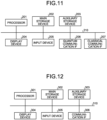
- FIG. 11 is a diagram illustrating an example of a hardware configuration of a QKD module 1 according to the first to third arrangements.
- the QKD module 1 includes a processor 201, a main storage device 202, an auxiliary storage device 203, a display device 204, an input device 205, a quantum communication IF (interface) 206, and a classical communication IF 207.
- the processor 201, the main storage device 202, the auxiliary storage device 203, the display device 204, the input device 205, the quantum communication IF 206, and the classical communication IF 207 are connected via a bus 210.
- the processor 201 executes a program read from the auxiliary storage device 203 to the main storage device 202.
- the main storage device 202 is a memory such as a read only memory (ROM) and a random access memory (RAM).
- the auxiliary storage device 203 is a hard disk drive (HDD), a memory card, or the like.
- the display device 204 displays the state and the like of the QKD module 1.
- the input device 205 receives an input from the user. Note that the QKD module 1 may not include the display device 204 and the input device 205.
- the quantum communication IF 206 is an interface for connection to a quantum cryptography communication path (optical fiber link).
- the classical communication IF 207 is an interface for connecting to a QKD control signal communication path, the KMs 2, and the like.
- the QKD module 1 does not include the display device 204 and the input device 205, for example, the display function and the input function of the external terminal connected via the classical communication IF 207 may be used.
- FIG. 12 is a diagram illustrating an example of a hardware configuration of the KMs 2, the SSN shareholders 3, the SSN controller 4, the QKDN controllers 5, and the SSAs 30 according to the first to third arrangements. Since the hardware configurations of the KMs 2, the SSN shareholders 3, the SSN controller 4, the QKDN controllers 5, and the SSAs 30 are similar to each other, the SSN controller 4 will be described as an example in the following description.
- the SSN controller 4 includes a processor 301, a main storage device 302, an auxiliary storage device 303, a display device 304, an input device 305, and a communication IF 306.
- the processor 301, the main storage device 302, the auxiliary storage device 303, the display device 304, the input device 305, and the communication IF 306 are connected via a bus 310.
- the processor 301 executes a program read from the auxiliary storage device 303 to the main storage device 302.
- the main storage device 302 is a memory such as a ROM and a RAM.
- the auxiliary storage device 303 is an HDD, a memory card, or the like.
- the display device 304 displays the state and the like of the SSN controller 4.
- the input device 305 receives an input from the user. Note that the SSN controller 4 may not include the display device 304 and the input device 305.
- the communication IF 306 is an interface for connecting to the SSN shareholders 3, the SSAs 30, and the like.
- the SSN controller 4 does not include the display device 304 and the input device 305, for example, a display function and an input function of an external terminal connected via the communication IF 306 may be used.
- the programs executed by the QKD modules 1, the KMs 2, the SSN shareholders 3, the SSN controller 4, the QKDN controllers 5, and the SSAs 30 are stored in computer-readable storage media such as a CD-ROM, a memory card, a CD-R, a digital versatile disc (DVD), and a Blu-ray (registered trademark) disc as a file in an installable format or an executable format, and are provided as computer program products.
- computer-readable storage media such as a CD-ROM, a memory card, a CD-R, a digital versatile disc (DVD), and a Blu-ray (registered trademark) disc as a file in an installable format or an executable format, and are provided as computer program products.
- the programs executed by the QKD modules 1, the KMs 2, the SSN shareholders 3, the SSN controller 4, the QKDN controllers 5, and the SSAs 30 may be stored on a computer connected to a network such as the Internet and provided by being downloaded via the network.
- the programs executed by the QKD modules 1, the KMs 2, the SSN shareholders 3, the SSN controller 4, the QKDN controllers 5, and the SSAs 30 may be provided via a network such as the Internet without being downloaded.
- the programs executed by the QKD modules 1, the KMs 2, the SSN shareholders 3, the SSN controller 4, the QKDN controllers 5, and the SSAs 30 may be provided by being incorporated in a ROM or the like in advance.
- Some or all of the functions of the QKD modules 1, the KMs 2, the SSN shareholders 3, the SSN controller 4, the QKDN controllers 5, and the SSAs 30 may be realized by hardware such as an integrated circuit (IC).
- the IC is, for example, a processor that is designed to execute an application-specific task.
- each processor may realize one of the functions or may realize two or more of the functions.
- the distributed storage method of the third arrangement may be applied to the first or second arrangement.
- a quantum cryptography storage system includes a plurality of storage devices, a distribution control device, a generation device, and a distribution device.
- the plurality of storage devices are connected via a communication network.
- the distribution control device determines a distribution mode of shares into which data is distributed, based on quantum key distribution network (QKDN) information.
- QKDN quantum key distribution network
- the generation device generates an encryption key and a decryption key by using a quantum key shared by using a QKDN.
- the distribution device distributes the data into the shares, based on the distribution mode.
- each of the plurality of storage devices that stores the shares in a distributed manner decrypts the share encrypted with the decryption key and stores a share decrypted.
- Example 2 In the quantum cryptography storage system according to Example 1, the shares are each encrypted by the one-time pad encryption using the encryption key.
- the distribution mode includes information indicating a distribution number indicating a number of shares into which the data is distributed, sizes of the shares, and distributed storage devices that store the shares in a distributed manner.
- the distribution control device determines the distribution number, the sizes of the shares, and the distributed storage devices, based on at least one of a sharing rate of the quantum key and a stock amount of the quantum key used in each of the plurality of storage devices.
- the QKDN information includes at least one of the sharing rate of the quantum key and the stock amount of the quantum key used in each of the plurality of storage devices.
- the distribution control device calculates required times required for distributed storage of the shares for each of the plurality of storage devices from at least one of the sharing rate of the quantum key and the stock amount of the quantum key used in each of the plurality of storage devices, and determines the distribution number, the sizes of the shares, and the distributed storage devices, based on the required times.
- the distribution control device selects a storage device that temporarily stores the shares from the plurality of storage devices, and determines the sizes of the shares such that required times for storing the shares in a distributed manner in the distributed storage devices from the selected storage device via the communication network approach a same value.
- the QKDN information includes at least one of the sharing rate of the quantum key and the stock amount of the quantum key used in each of the plurality of storage devices.
- the distribution mode includes information indicating the distribution number indicating the number of shares into which the data is distributed and the distributed storage devices that store the shares in a distributed manner.
- the distribution control device calculates required times required for distributed storage of the shares for each of the plurality of storage device from at least one of the sharing rate of the quantum key and the stock amount of the quantum key used in each of the plurality of storage devices, and selects a predetermined number of distributed storage devices from the plurality of storage devices in ascending order of the required times.
- Example 7 The quantum cryptography storage system according to any one of Examples 3 to 6, further includes a QKDN control device that acquires the QKDN information from a key management device.
- the distribution control device receives the QKDN information from the QKDN control device.
- Example 8 In the quantum cryptography storage system according to any one of Examples 1 to 7, the distribution device distributes the data into the plurality of shares, based on the distribution mode and a predetermined secret sharing algorithm.
- Example 9 A distribution control device communicates with a plurality of storage devices and a distribution device connected via a communication network.
- the distribution control device includes a determination unit and a communication control unit.
- the determination unit that determines a distribution mode of shares into which data is distributed, based on quantum key distribution network (QKDN) information.
- QKDN quantum key distribution network
- the communication control unit that notifies the distribution device of the distribution mode.
- Example 10 A computer program product includes a computer-readable medium including programmed instructions.
- the instructions cause computer that communicates with a plurality of storage devices and a distribution device connected via a communication network to function as a determination unit and a communication control unit.
- the determination unit determines a distribution mode of shares into which data is distributed, based on quantum key distribution network (QKDN) information.
- QKDN quantum key distribution network
- the communication control unit notifies the distribution device of the distribution mode.
Landscapes
- Engineering & Computer Science (AREA)
- Computer Security & Cryptography (AREA)
- Computer Networks & Wireless Communication (AREA)
- Signal Processing (AREA)
- Theoretical Computer Science (AREA)
- Physics & Mathematics (AREA)
- Electromagnetism (AREA)
- Bioethics (AREA)
- Health & Medical Sciences (AREA)
- General Health & Medical Sciences (AREA)
- Computer Hardware Design (AREA)
- Software Systems (AREA)
- General Engineering & Computer Science (AREA)
- General Physics & Mathematics (AREA)
- Financial Or Insurance-Related Operations Such As Payment And Settlement (AREA)
- Data Exchanges In Wide-Area Networks (AREA)
Abstract
Description
- The present disclosure relates to a quantum cryptography storage system, a distribution control device, and a computer-readable medium.
- A network system (storage network) in which storage devices (storages) such as hard disks are arranged as nodes of a communication network, and writing/reading of data from a user application connected to the communication network to/from these storages is conventionally known. In a case where data stored by an application needs to be kept secret in a storage network, there is a method of improving safety by distributing the data on the basis of a secret sharing algorithm and storing the data in a distributed manner in a plurality of physically separated nodes.
-
-
FIG. 1 is a diagram illustrating an example of a device configuration of a quantum cryptography storage system according to a first arrangement; -
FIG. 2 is a diagram illustrating an example of a functional configuration of an SSN controller according to the first arrangement; -
FIG. 3A is a diagram for explaining a share distributed storage method and a required time according to the first arrangement; -
FIG. 3B is a diagram for explaining a time required for share distributed storage; -
FIG. 4 is a diagram for explaining a share distributed storage method and a required time according to the first arrangement; -
FIG. 5 is a diagram for explaining a share distributed storage method and a required time according to the first arrangement; -
FIG. 6 is a flowchart illustrating an example of a distribution control method according to the first arrangement; -
FIG. 7 is a diagram illustrating an example of a device configuration of a quantum cryptography storage system according to a modification of the first arrangement; -
FIG. 8 is a diagram for explaining a share distributed storage method and a required time according to a second arrangement; -
FIG. 9 is a diagram for explaining a share distributed storage method and a required time according to the second arrangement; -
FIG. 10A is a diagram for explaining a share distributed storage method and a required time according to a third arrangement; -
FIG. 10B is a diagram for explaining a share distributed storage method and a required time according to the third arrangement; -
FIG. 11 is a diagram illustrating an example of a hardware configuration of a QKD module according to the first to third arrangements; and -
FIG. 12 is a diagram illustrating an example of a hardware configuration of a KM, an SSN shareholder, an SSN controller, a QKDN controller, and an SSA according to the first to third arrangements. - According to an arrangement, a quantum cryptography storage system includes a plurality of storage, a distribution control device, a generation device, and a distribution device. The plurality of storage devices are connected via a communication network. The distribution control device determines a distribution mode of shares into which data is distributed, based on quantum key distribution network (QKDN) information. The generation device generates an encryption key and a decryption key by using a quantum key shared by using a QKDN. The distribution device distributes the data into the shares, based on the distribution mode. When receiving a share encrypted using the encryption key via the communication network, each of the plurality of storage devices that stores the shares in a distributed manner decrypts the share encrypted with the decryption key and stores a share decrypted.
- Hereinafter, arrangements of a quantum cryptography storage system, a distribution control device, and a program will be described in detail with reference to the accompanying drawings.
- In a case where data is distributed on the basis of a secret sharing algorithm and stored in a distributed manner in a plurality of physically separated nodes, the original data cannot be restored unless a certain number or more or all distribution pieces (shares), which depends on the secret sharing algorithm, are obtained. For example, even if a share stored in one node is stolen due to an intrusion into the node via a network or a physical intrusion, it is ensured that the original data cannot be restored and even partial information of the original data cannot be obtained.
- In addition, when shares are stored in a distributed manner in a plurality of physically separated nodes, it is necessary not only to protect the shares stored in the nodes, but also to protect communication on communication paths from eavesdropping in a process of transmitting the shares to shareholders which are nodes as distributed storage destinations.
- Therefore, there has also been proposed a method of applying one-time pad (OTP) encryption using a quantum key supplied from a quantum key distribution network (hereinafter referred to as QKDN), which is a network different from a storage network, to communication for share transmission to ensure information-theoretic security. In this method, the storage network is positioned as a user who consumes the quantum key provided by the QKDN. That is, the storage network is positioned as an application of the quantum key network.
- Since OTP encryption is an encryption scheme that requires a key having the same length as data to be encrypted (plaintext), when a share is transmitted in the storage network by using OTP encryption, it is necessary to receive an OTP encryption key having the same size as the transmitted share from the QKDN. Typically, a rate at which the QKDN can generate and supply a quantum key (OTP encryption key) is lower than a rate of a communication path in a storage network as a general communication path. Therefore, the maximum transmission rate at the time of transmitting the share depends on the OTP encryption key generation/supply rate between the nodes that perform the transmission. When there is a difference in OTP encryption key sharing rate between node pairs, if shares are generated so that sizes of all shares are the same, share transmission in a slower node pair takes a longer time, and the distributed storage processing as a whole is not completed until share transmission in a slowest node pair is completed.
- In the following arrangements, a quantum cryptography storage system, a distribution control device, and a program capable of determining a distribution mode of shares in which share transmission in a node pair having a slow rate does not become a bottleneck in the entire distributed storage processing of shares even when there is a difference in OTP encryption key sharing rate different depending on the node pair will be described.
-
FIG. 1 is a diagram illustrating an example of a device configuration of a quantumcryptography storage system 100 according to a first arrangement. The quantumcryptography storage system 100 of the first arrangement includes three nodes 10-1 to 10-3, a secure storage network (SSN)user plane 20, and secure storage agents (SSAs) 30-1 to 30-2. - Hereinafter, the nodes 10-1 to 10-3 will be simply referred to as nodes 10 when not distinguished from each other. Each node 10 is installed in each base (for example, a communication office building or the like).
- The node 10-1 includes a QKD module 1-1, a key manager (KM) 2-1, and an SSN shareholder 3-1.
- The node 10-2 includes a QKD module 1-2a, a QKD module 1-2b, a KM 2-2, an SSN shareholder 3-2, and an
SSN controller 4. - The node 10-3 includes a QKD module 1-3, a KM 2-3, an SSN shareholder 3-3, and a
QKDN controller 5. - Hereinafter, the QKD modules 1-1 to 1-3 will be simply referred to as
QKD modules 1 when not distinguished from each other. Similarly, the KM 2-1 to KM 2-3 will be simply referred to as KMs 2 when not distinguished from each other. Similarly, the SSN shareholders 3-1 to 3-3 will be simply referred to as SSNshareholders 3 when not distinguished from each other. Similarly, the SSAs 30-1 to 30-2 will be simply referred to as SSAs 30 when not distinguished from each other. - Note that the devices installed in each node 10 may be housed in one housing, or may be configured as a plurality of devices by separate housings.
- In an
SSN user plane 20, an SSN data owner, which is an owner of SSN user data, transmits and receives SSN user data. Upon receiving the SSN user data, the SSAs 30 distribute the SSN user data into a plurality of shares on the basis of a secret sharing algorithm. - Next, a network configuration of the quantum
cryptography storage system 100 of the first arrangement will be described. The quantumcryptography storage system 100 of the first arrangement includes two networks of a quantum key distribution network (QKDN) 200 and anSSN 300. - The QKDN 200 in the first arrangement is a quantum key distribution network including the three nodes 10-1 to 10-3. Specifically, the QKDN 200 of the first arrangement includes the
QKD modules 1, the KMs 2, and theQKDN controller 5. - The QKD module 1-1 and the QKD module 1-2a generate a bit string (quantum key) shared by both through the QKD link connecting both. The QKD module 1-1 and the QKD module 1-2a transmit quantum keys to the KM 2-1 and the KM 2-2, respectively, whereby the KM 2-1 and the KM 2-2 share a quantum key.
- The QKD module 1-2b and the QKD module 1-3 similarly generate a quantum key, and the quantum key is shared between the KM 2-2 and the KM 2-3.
- In the present arrangement, the QKD module 1-1 and the QKD module 1-3 are not connected by a QKD link. Therefore, the KM 2-1 and the KM 2-3 share a quantum key by a key relay via KM 2-2, for example, by transmitting a part of the quantum key shared by the KM 2-1 and the KM 2-2 from the KM 2-2 to the KM 2-3.
- The shared quantum keys are transmitted from the KMs 2 to the
SSN shareholders 3 in response to requests from theSSN shareholders 3 connected to the respective KMs 2. - The
SSN 300 of the first arrangement is a storage network including the three nodes 10-1 to 10-3 (the SSN shareholders 3-1 to 3-3 and the SSN controller 4), theSSN user plane 20, and the SSAs 30. - For example, an SSN data owner accommodated in the SSA 30-1 transmits a storage request to the SSA 30-1 to store SSN user data in the
SSN shareholders 3. - Upon receiving the storage request, the SSA 30-1 distributes SSN user data 101 (hereinafter referred to as "
original data 101") into a plurality of shares on the basis of a secret sharing algorithm. The SSA 30-1 inquires of theSSN controller 4 about a distribution mode (for example, the number of shares after distribution and the size of each share) for distribution to the shares. - The
SSN controller 4 determines a distribution mode and notifies the SSA 30-1 of the distribution mode. In determining the distribution mode, theSSN controller 4 determines a distributed storage mode of the shares to theSSN shareholders 3.FIG. 1 illustrates an example of a case where it is determined that shares 101-2 and 101-3 are stored in a distributed manner in the SSN shareholders 3-2 and 3-3, and at this time, the distribution number in the distribution mode is 2. - In addition, the
SSN controller 4 determines the size of each share in the distribution mode between the SSN shareholder 3-1 and the SSN shareholder 3-2 and between the SSN shareholder 3-1 and the SSN shareholder 3-3 according to communication rates available while applying the OTP encryption. In the present arrangement, the communication rates available while applying the OTP encryption are sharing rates of the OTP encryption keys between the KM 2-1 and the KM 2-2 and between the KM 2-1 and the KM 2-3. TheSSN controller 4 acquires these sharing rates from theQKDN controller 5. - In the arrangement illustrated in
FIG. 1 , for example, it is assumed that the OTP encryption key sharing rate between the KM 2-1 and the KM 2-2 is higher than the OTP encryption key sharing rate between the KM 2-1 and the KM 2-3. In this case, the OTP encryption transmission rate between the SSN shareholders 3-1 and 3-2 is higher than the OTP encryption transmission rate between the SSN shareholders 3-1 and 3-3. Therefore, theSSN controller 4 makes the size of the share 3-2 stored in a distributed manner in the SSN shareholder 3-2 larger than the size of the share 101-3 stored in a distributed manner in the SSN shareholder 3-3. - In the example of
FIG. 1 , the SSA 30-1 distributes theoriginal data 101 into the shares 101-2 and 101-3 on the basis of the distribution mode determined by theSSN controller 4 as described above, that is, the distribution number to shares and the size of each share. Then, the SSA 30-1 temporarily stores the shares 101-2 and 101-3 in the SSN shareholder 3-1 accommodated in the SSA 30-1, and notifies theSSN controller 4 that distribution and temporary storage have been completed. - Upon receiving the notification from the SSA 30-1, the
SSN controller 4 instructs the SSN shareholders 3-1 to 3-3 to execute the storage control process. In the storage control process, first, the SSN shareholder 3-1 transmits the share 101-2 to the SSN shareholder 3-2 while performing OTP encryption. Upon receiving the encrypted share 101-2, the SSN shareholder 3-2 decrypts the share 101-2 and stores the decrypted share 101-2. When the share 101-2 is stored in the SSN shareholder 3-2, the SSN shareholder 3-1 deletes the share 101-2 temporarily stored in the SSN shareholder 3-1. - Also for the share 101-3, similarly to the share 101-2, first, the SSN shareholder 3-1 transmits the share 101-3 to the SSN shareholder 3-3 while performing OTP encryption. Upon receiving the encrypted share 101-3, the SSN shareholder 3-3 decrypts the share 101-3 and stores the decrypted share 101-3. When the share 101-3 is stored in the SSN shareholder 3-3, the SSN shareholder 3-1 deletes the share 101-3 temporarily stored in the SSN shareholder 3-1. Note that the process of transmitting the share 101-3 to the SSN shareholder 3-3 while performing OTP encryption starts at the same time as the start of the process of the SSN shareholder 3-1 transmitting the share 101-2 to the SSN shareholder 3-2 while performing OTP encryption.
- OTP keys (OTP encryption keys) supplied from the KMs 2 connected to the
respective SSN shareholder 3 are used for the OTP-encrypted communication between theSSN shareholders 3. For example, when transmitting the share 101-2 to the SSN shareholder 3-2, the SSN shareholder 3-1 acquires an OTP encryption key from the KM 2-1, and encrypts and transmits the share 101-2 using the OTP encryption key. - The SSN shareholder 3-2 acquires the same OTP encryption key as the OTP encryption key transmitted from the KM 2-1 to the SSN shareholder 3-1 from the KM 2-2, and decrypts the encrypted share 101-2 using the OTP encryption key acquired from the KM 2-2.
- Note that the communication paths between the
SSN shareholders 3 are, for example, the Internet, but the communication paths may be arbitrary. - According to the present arrangement, it is possible to ensure information-theoretic security against eavesdropping on communication paths for distributed storage in a storage network in which the shares 101-2 and 101-3 into which distribution is made on the basis of a secret sharing algorithm are stored in a distributed manner. In addition, since the time until the transmission of the share 101-2 to the SSN shareholder 3-2 is completed and the time until the transmission of the share 101-3 to the SSN shareholder 3-3 is completed can be brought close to each other, the time until the distributed storage of the shares 101-2 and 101-3 is completed can be brought close to the shortest.
- Note that the process in which the SSA 30-1 acquires the distribution mode from the
SSN controller 4 does not necessarily need to be performed after the storage request is received by the user, and for example, the distribution mode may be periodically notified from theSSN controller 4 to the SSA 30-1. Similarly, the process in which theSSN controller 4 acquires the sharing rates of the OTP encryption keys from theQKDN controller 5 is not necessarily performed in response to a request from the SSA 30-1, and a method of periodically notifying theSSN controller 4 from theQKDN controller 5 may be adopted. - Furthermore, in the present arrangement, the
SSN controller 4 is included in the node 10-2, but for example, the other node 10-1 or node 10-3 may include the SSN controller, or a plurality of nodes may include SSN controllers, and the SSN controllers may perform the storage control execution instruction in cooperation. - In addition, the share 101-2 and the share 101-3 do not necessarily need to be a single share in the secret sharing algorithm to be used, and each may be a set of a plurality of shares. For example, in a case where the size ratio of the shares 101-2 and 101-3 stored in a distributed manner in the shareholders 3-2 and 3-3 is 3:1, the SSN user data may be distributed into 40 shares all having the same size, a set of 30 shares may be allocated to the share 101-2, and a set of the remaining 10 shares may be allocated to the share 101-3. Furthermore, for example, the SSN user data may be distributed into four distribution pieces having different sizes, where two pieces are allocated to the share 101-2 and two pieces are allocated to the share 101-3, and the ratio of the sum of the sizes of the two shares allocated to the share 101-2 and the sum of the sizes of the two shares allocated to the share 101-3 may be 3:1.
- The secret sharing algorithm in the present arrangement can use, for example, all-or-nothing transform (AONT), but the secret sharing algorithm is not limited thereto, and may be a predetermined secret sharing algorithm.
-
FIG. 2 is a diagram illustrating an example of a functional configuration of theSSN controller 4 of the first arrangement. TheSSN controller 4 of the first arrangement includes a communication control unit 41 and a determination unit 42. - The communication control unit 41 receives QKDN information from the
QKDN controller 5. For example, the QKDN information includes a sharing rate of the quantum key between each KM 2. Further, for example, the QKDN information includes a stock amount of the quantum key that can be used in each of the plurality of SSN shareholders 3 (storage devices). - In addition, the communication control unit 41 notifies an SSA 30 (distribution device) of a distribution mode of shares into which data is distributed (for example, the distribution number indicating the number of shares into which data is distributed, sizes of the shares, and
SSN shareholders 3 that store the shares in a distributed manner). - The determination unit 42 determines a distribution mode of the shares into which the data is distributed on the basis of the QKDN information. For example, the determination unit 42 determines the distribution number, the sizes of the shares, and the
SSN shareholders 3 that store the shares in a distributed manner on the basis of at least one of the sharing rate of the quantum key and the stock amount of the quantum key. An example of the determination processing based on the sharing rate of the quantum key will be described later with reference toFIGS. 3A and4 . In addition, an example of determination processing based on both the sharing rate of the quantum key and the stock amount of the quantum key will be described later with reference toFIG. 5 . -
FIG. 3A is a diagram for explaining a distributed storage method and a required time for the shares 101-2 and 101-3 according to the first arrangement.FIG. 3A illustrates an example of the sizes of the shares 101-2 and 101-3 specifically determined in the arrangement illustrated above with reference toFIG. 1 . - In the example of
FIG. 3A , the SSA 30-1 distributes theoriginal data 101 into the two shares 101-2 and 101-3 with a total of 240 MB, which are stored in a distributed manner in the SSN shareholder 3-2 and the SSN shareholder 3-3. Between the SSN shareholder 3-1 and the SSN shareholder 3-2, a quantum key (OTP encryption key) is provided from the QKDN at a rate of 1 Mbps, that is, OTP-encrypted communication at 1 Mbps is available. On the other hand, between the SSN shareholder 3-1 and the SSN shareholder 3-3, a quantum key (OTP encryption key) is provided from the QKDN at a rate of 250 kbps, that is, OTP-encrypted communication at 250 kbps is available. - In this case, the
SSN controller 4 acquires the quantum key sharing rate between the KM 2-1 and the KM 2-2 and the quantum key sharing rate between the KM 2-1 and the KM 2-3 from theQKDN controller 5, and recognizes that the OTP-encrypted communication rate between the SSN shareholders 3-1 and 3-2 and the OTP-encrypted communication rate between the SSN shareholders 3-1 and 3-3 are 1 Mbps and 250 kbps, respectively. Then, theSSN controller 4 determines that the size ratio of the shares 101-2 and 101-3 is 4:1, that is, the share 101-2 is 192 MB and the share 101-3 is 48 MB, based on the fact that the ratio of the OTP-encrypted communication rate is 4:1. - With this determination, the time required to transmit the share 101-2 from the SSN shareholder 3-1 to the SSN shareholder 3-2 is 192 * 8 [Mbit]/1 [Mbps] = 1536 seconds. The time required to transmit the share 101-3 from the SSN shareholder 3-1 to the SSN shareholder 3-3 is also 48 * 8 [Mbit]/0.25 [Mbps] = 1536 seconds. As a result, in a case where transmission of the share 101-2 and transmission of the share 101-3 are simultaneously started, transmission of both are completed after 1536 seconds. That is, the
SSN controller 4 determines the sizes of the shares 101-2 and 101-3 so that the times required for distributed storage approach the same value, whereby theoriginal data 101 can be stored in a distributed manner in the shareholders 3-2 and 3-3 in a shorter time. - Note that
FIG. 3B is a diagram for explaining the time required for transmission of the share 101-2 and the share 101-3 in a case where the sizes of the share 101-2 and the share 101-3 are equally divided, that is, 120 MB, for example, without using the method according to the present arrangement. In this case, while the time required to transmit the share 101-2 is 120 * 8 [Mbit]/1 [Mbps] = 960 seconds, the time required to transmit the share 101-3 is 120 * 8 [Mbit]/0.25 [Mbps] = 3840 seconds. Therefore, the distributed storage of the shares 101-2 and 101-3 is completed after 3840 seconds. - As illustrated in
FIGS. 3A and 3B , according to the present arrangement, it is possible to shorten the time until the distributed storage of the shares 101-2 and 101-3 is completed. - Note that, although
FIGS. 1 and3A illustrate an example in which theoriginal data 101 is distributed into two pieces, the number ofSSN shareholders 3 and the distribution number of theoriginal data 101 are not limited thereto, and can take various forms according to the configuration of the SSN, the capacity of the storage means included in theSSN shareholders 3, the management policy, and the like. -
FIG. 4 is a diagram for explaining a distributed storage method and a required time for shares 101-1 to 101-3 according to the first arrangement. For example, as illustrated inFIG. 4 , the SSA 30-1 may distribute data into three shares 101-1 to 101-3, and the share 101-1 may be stored in a distributed manner in the SSN shareholder 3-1. In this case, assuming that 120 MB is stored in a distributed manner in the share 3-1, theSSN controller 4 determines the sizes of the share 101-2 and the share 101-3 such that 240 - 120 = 120 M is distributed to be 4:1, that is, they are 96 MB and 24 MB. - The example illustrated using
FIGS. 1 and3A is a mode in which theQKDN 200 supplies the OTP encryption keys to theSSN shareholder 3 pairs (pair of SSN shareholders 3-1 and 3-2 and pair of SSN shareholders 3-1 and 3-3) while generating the OTP encryption keys. That is, the example illustrated usingFIGS. 1 and3A is a mode in which the sizes of the shares 101-1 and 101-2 are determined on the basis of the supply rates of the OTP encryption keys (the sharing rates of the quantum keys of the KM 2 pairs corresponding to theshareholder 3 pairs), but there is a case where OTP encryption keys accumulated in advance in the QKDN 200 (hereinafter referred to as a "key stock") is available in some pairs of theSSN shareholders 3 or all pairs of theSSN shareholders 3. -
FIG. 5 is a diagram for explaining a distributed storage method and a required time for the shares 101-2 and 101-3 according to the first arrangement. The example ofFIG. 5 illustrates a case where the key stock is 16 MB, that is, a maximum of 16 MB of the share 101-3 can be transmitted by OTP-encrypted communication using the key stock between the SSN shareholder 3-1 and the SSN shareholder 3-3. The communication rate for this 16 MB is a normal communication rate between the SSN shareholder 3-1 and the SSN shareholder 3-3 regardless of the sharing rate of the OTP encryption key between the KM 2-1 and the KM 2-3 in theQKDN 200. In the example ofFIG. 5 , the normal communication rate is 4 Mbps, which is the same as the link rate between the SSN shareholder 3-1 and the SSN shareholder 3-3. - At this time, the
SSN controller 4 acquires from theQKDN controller 5 that the key sharing rate between the KM 2-1 and the KM 2-3 is 250 kbps and that the key stock of 16 MB is available, recognizes that transmission is possible at 4 Mbps for 16 MB of the share and at 250 kbps for more than 16 MB between the shareholder 3-1 and the SSN shareholder 3-3, and determines the size of the share 101-2 to 180 MB and the size of the share 101-3 to 60 MB, so that the time required for transmission of the share 101-2 and the time required for transmission of the share 101-3 are both 1440 seconds. That is, out of 60 MB, 16 MB is transmitted at 4 Mbps using the key stock, and 44 MB is transmitted at 250 kbps. Therefore, the time required for transmission of the share 101-3 is the sum of 32 seconds (16 * 8 Mbit/4 Mbps) required for transmission of 16 MB and 1408 seconds ((60 - 16) * 8 Mbit/0.25 Mbps) required for transmission of 44 MB. - Note that if a key stock larger than the size of the share to be transmitted is available, the
SSN controller 4 determines the relationship between the time required for transmission and the size of the share on the assumption that the entire share can be transmitted at the rate when the key stock is used, and can determine the size of the share. -
FIG. 6 is a flowchart illustrating an example of a distribution control method according to the first arrangement. First, the SSN controller 4 (an example of a distribution control device) determines the distribution mode of the share on the basis of the sharing rate of the quantum key and the stock amount (step S1). The distribution mode of the share includes, for example, a distribution number indicating the number of shares into which the data is distributed, sizes of the shares, and SSN shareholders 3 (an example of distributed storage devices) that store the shares in a distributed manner. - Next, an SSA 30 (an example of a distribution device) distributes data into a plurality of shares on the basis of the distribution mode determined by the processing of step S1 (step S2).
- Next, among the plurality of
SSN shareholders 3 connected by the SSN 300 (an example of a storage network), theSSN shareholder 3 determined in the processing of step S1 stores a plurality of shares in a distributed manner (step S3). Specifically, when receiving the share encrypted with the encryption key via theSSN 300, eachSSN shareholder 3 decrypts the encrypted share with the decryption key corresponding to the encryption key, and stores the decrypted share. The encryption key and the decryption key are generated from a quantum key shared using theQKDN 200. - As described above, according to the quantum cryptography storage system of the first arrangement, it is possible to store data in a distributed manner in a plurality of storage devices in a shorter time while ensuring information-theoretic security of communication paths.
- Next, a modification of the first arrangement will be described. In the description of the modification, the description similar to that of the first arrangement will be omitted, and parts different from those of the first arrangement will be described.
-
FIG. 7 is a diagram illustrating an example of a device configuration of a quantum cryptography storage system 100-2 according to a modification of the first arrangement. The quantum cryptography storage system 100-2 of the modification is different from that of the first arrangement in that QKDN controllers 5-1 to 5-3 are provided in each node 10. TheSSN controller 4 may receive the QKDN information from theQKDN controller 5 provided in each node 10. - Next, a second arrangement will be described. In the description of the second arrangement, the description similar to that of the first arrangement will be omitted, and parts different from those of the first arrangement will be described. In the second arrangement, a case where a secret sharing algorithm that generates a share having the same size as the
original data 101, such as secret sharing by a threshold method using exclusive OR, is used will be described. That is, in the second arrangement, an arrangement will be described on the assumption that the size of the share cannot be varied as in the first arrangement. -
FIG. 8 is a diagram for explaining a distributed storage method and a required time for shares 101-1 to 101-3 according to the second arrangement. In the present arrangement, any three of SSN shareholders 3-2 to 3-6 are selected, and the three shares 101-1 to 101-3 temporarily stored in the SSN shareholder 3-1 are stored in a distributed manner. TheSSN controller 4 acquires information on the OTP-encrypted communication rates (the sharing rate of the quantum key between the corresponding KMs 2) between theSSN shareholders 3 from theQKDN controller 5, and selects threeSSN shareholders 3 that can complete transmission of the shares 101-1 to 101-3 in a shorter time. - In the example of
FIG. 8 , the OTP-encrypted communication rate between the SSN shareholder 3-1 and the SSN shareholder 3-2 is 1.5 Mbps. The OTP-encrypted communication rate between the SSN shareholder 3-1 and the SSN shareholder 3-3 is 200 kbps. The OTP-encrypted communication rate between the SSN shareholder 3-1 and the SSN shareholder 3-4 is 400 kbps. The OTP-encrypted communication rate between the SSN shareholder 3-1 and the SSN shareholder 3-5 is 1 Mbps. The OTP-encrypted communication rate between the SSN shareholder 3-1 and the SSN shareholder 3-6 is 3 Mbps. - Note that, in the example of
FIG. 8 , only the links between the SSN shareholder 3-1 and the respective SSN shareholders 3-2 to 3-6 are illustrated for the sake of explanation, but the topology of the storage network including the SSN shareholders 3-1 to 3-6 may be any topology such as a full mesh (fully connected). - When transmitting the shares 101-1 to 101-3 from the SSN shareholder 3-1, the
SSN controller 4 selectsSSN shareholders 3 capable of completing the transmission of the shares 101-1 to 101-3 in as short a time as possible. That is, theSSN controller 4 selects the threeSSN shareholders 3 connected by links having higher OTP-encrypted communication rates. Specifically, in the example ofFIG. 8 , theSSN controller 4 selects the SSN shareholder 3-2 (link's OTP-encrypted communication rate is 1.5 Mbps), the SSN shareholder 3-5 (link's OTP-encrypted communication rate is 1 Mbps), and the SSN shareholder 3-6 (link's OTP-encrypted communication rate is 3 Mbps). - In the example of
FIG. 8 , while theQKDN 200 generates the OTP encryption key, the distributed storage destinations of the shares 101-1 to 101-3 are determined on the basis of the supply rates (the sharing rates in the KM 2 pairs corresponding to theshareholder 3 pairs) in a case where the OTP encryption key is supplied to theSSN shareholder 3 pairs. In some or all pairs ofSSN shareholders 3, when OTP encryption keys (key stock described above) previously accumulated in theQKDN 200 is available, it may be as illustrated inFIG. 9 . -
FIG. 9 is a diagram for explaining a distributed storage method and a required time for the shares 101-1 to 101-3 according to the second arrangement. The difference fromFIG. 8 is that there is 160 MB of key stock between the SSN shareholder 3-1 and the SSN shareholder 3-4. That is, when the SSN shareholder 3-1 transmits the share 101-2 to the SSN shareholder 3-4, up to 160 MB of the share 101-2 can be transmitted by OTP-encrypted communication using the key stock. The communication rate when using the key stock is not bound by the supply rate of the OTP encryption key, and is a normal communication rate (in the example ofFIG. 9 ,8 Mbps) between the SSN shareholder 3-1 and the SSN shareholder 3-3. - In the example of
FIG. 9 , when the share 101-2 is transmitted from the SSN shareholder 3-1 to the SSN shareholder 3-4, 160 MB of 240 MB is transmitted at 8 Mbps using the key stock, and 80 MB is transmitted at 400 kbps. Therefore, the time required for transmission of the share 101-2 is a total of 1760 seconds including 160 seconds (160 * 8 Mbit/8 Mbps) required for transmission of 160 MB and 1600 seconds ((240 - 160) * 8 Mbit/0.4 Mbps) required for transmission of 80 MB. - In the example of
FIG. 9 , since the time required for transmission to the SSN shareholder 3-4 (1760 seconds) is shorter than the time required for transmission to the SSN shareholder 3-5 inFIG. 8 (1920 seconds), the SSN shareholder 3-4 is selected as the distributed storage destination of the share 101-2. - Next, a third arrangement will be described. In the description of the third arrangement, the description similar to that of the first arrangement will be omitted, and parts different from those of the first arrangement will be described. In the first and second arrangements, transmission is directly performed from the SSN shareholder 3-1 serving as the starting point to the
SSN shareholders 3 serving as the distributed storage destinations. In the present arrangement, as illustrated inFIGS. 10A and 10B , a case where shares 101-2 to 101-4 are transmitted to theSSN shareholders 3 as the distributed storage destinations viaother SSN shareholders 3 will be described. -
FIGS. 10A and 10B are diagrams for explaining a distributed storage method and a required time for the shares 101-2 to 101-4 according to the third arrangement. The examples ofFIGS. 10A and 10B illustrate a case where distributed storage is performed such that the storage capacity consumption of the SSN shareholder 3-2 and the storage capacity consumption of the SSN shareholder 3-3 are equal. - In the example illustrated in
FIGS. 10A and 10B , the OTP-encrypted communication rate between the SSN shareholder 3-1 and the SSN shareholder 3-2 is 1 Mbps. The OTP-encrypted communication rate between the SSN shareholder 3-2 and the SSN shareholder 3-3 is 1 Mbps. The OTP-encrypted communication rate between the SSN shareholder 3-1 and the SSN shareholder 3-3 is 250 kbps. - In the example of
FIGS. 10A and 10B , theSSN controller 4 determines to distribute theoriginal data 101 into the three shares 101-2 to 101-4. Then, theSSN controller 4 performs control to transmit the share 101-3 from the SSN shareholder 3-1 to the SSN shareholder 3-3, and transmit the shares 101-2 and 101-4 from the SSN shareholder 3-1 to the SSN shareholder 3-2. Note that, regardless of the transmission order of the shares 101-2 and 101-4, either may precede, or part of the share 101-2 and part of the share 101-4 may be alternately transmitted. - In addition, when the transmission of the share 101-4 to the SSN shareholder 3-2 is completed, the
SSN controller 4 causes the share 101-4 to be transmitted from the SSN shareholder 3-2 to the SSN shareholder 3-3, and after the transmission is completed, causes the share 101-4 to be deleted from the SSN shareholder 3-2. -
FIG. 10A is an example in which transmission of the share 101-4 from the SSN shareholder 3-2 to the SSN shareholder 3-3 is started after transmission of both the share 101-2 and the share 101-4 from the SSN shareholder 3-1 to the SSN shareholder 3-2 is completed. If the SSN shareholder 3-2 is able to receive the share 101-2 from the SSN shareholder 3-1 and transmit the share 101-4 to the SSN shareholder 3-3 in parallel, it can be as inFIG. 10B . - In
FIG. 10B , distribution is made such that the shares 101-2, 101-3, and 101-4 are 120 MB, 48 MB, and 72 MB, respectively. TheSSN controller 4 starts the transmission of the share 101-3 from the SSN shareholder 3-1 to the SSN shareholder 3-3, and at the same time, starts transmission of the share 101-4 from the SSN shareholder 3-1 to the SSN shareholder 3-2. Then, when the transmission of the share 101-4 is completed 576 seconds after the start, theSSN controller 4 immediately starts the transmission of the share 101-4 from the SSN shareholder 3-2 to the SSN shareholder 3-3, and simultaneously starts the transmission of the share 101-2 from the SSN shareholder 3-1 to the SSN shareholder 3-2. - Further, after 576 seconds, the transmission of the share 101-4 to the SSN shareholder 3-3 is completed, and similarly after 960 seconds, the transmission of the share 101-2 to the SSN shareholder 3-2 is completed. Therefore, after 576 seconds + 960 seconds = 1536 seconds after the transmission of the share 101-4 from the SSN shareholder 3-1 to the SSN shareholder 3-2 is started, the processing of storing the shares 101-2 and 101-4 in a distributed manner in the SSN shareholders 3-2 and 3-4 is completed, and at the same time, the transmission of the share 101-3 to the SSN shareholder 3-3 is completed. As a result, the distributed storage can be completed in a shorter time than in the case of
FIG. 10A . - Furthermore,
FIGS. 10A and 10B illustrate an example of a case where there is no key stock, but in a case where key stock is available between theSSN shareholders 3, theSSN controller 4 may determine a distribution mode of the shares in consideration of the key stock. - Note that, in the first to third arrangements described above, in order to simplify the description, the time required for controlling the start of the transmission process, the time required for controlling the end of the transmission process, the time required for controlling the start of the reception process, the time required for controlling the end of the reception process, and the time required for controlling the start of the next transmission subsequent to the completion of the transmission have been described as 0, but these times do not need to be 0. In the process of calculating the time required for the transmission of the shares from the OTP-encrypted communication rates and the key stock acquired from the
QKDN controller 5, theSSN controller 4 may determine the sizes of the shares in consideration of these times. - In addition, in order to simplify the description, in
FIGS. 3A, 3B ,4, and 5 , an example in which the size of theoriginal data 101 is the same as the total size of the shares 101-2 to 101-3 into which the distribution is made has been described. In addition, inFIGS. 10A and 10B , an example in which the size of theoriginal data 101 and the total size of the shares 101-2 to 101-4 into which the distribution is made are the same has been described. It is not essential that the total sizes are the same, and for example, as in the AONT, a case where the total of the sizes of the shares 101-2 to 101-N (N is an integer) into which the distribution is made by the secret sharing algorithm is larger than the size of theoriginal data 101 is also assumed. Even in such a case, similarly to the first to third arrangements described above, the time required for transmission of the shares 101-2 to 101-N can be obtained from the sizes of the shares 101-2 to 101-N after distribution, the OTP-encrypted communication rates between theSSN shareholders 3, and the key stock. - Finally, an example of a hardware configuration of the
QKD modules 1, the KMs 2, theSSN shareholders 3, theSSN controller 4, and theQKDN controllers 5 of the first to third arrangements will be described. -
FIG. 11 is a diagram illustrating an example of a hardware configuration of aQKD module 1 according to the first to third arrangements. TheQKD module 1 includes aprocessor 201, amain storage device 202, anauxiliary storage device 203, adisplay device 204, aninput device 205, a quantum communication IF (interface) 206, and a classical communication IF 207. Theprocessor 201, themain storage device 202, theauxiliary storage device 203, thedisplay device 204, theinput device 205, the quantum communication IF 206, and the classical communication IF 207 are connected via abus 210. - The
processor 201 executes a program read from theauxiliary storage device 203 to themain storage device 202. Themain storage device 202 is a memory such as a read only memory (ROM) and a random access memory (RAM). Theauxiliary storage device 203 is a hard disk drive (HDD), a memory card, or the like. - The
display device 204 displays the state and the like of theQKD module 1. Theinput device 205 receives an input from the user. Note that theQKD module 1 may not include thedisplay device 204 and theinput device 205. - The quantum communication IF 206 is an interface for connection to a quantum cryptography communication path (optical fiber link). The classical communication IF 207 is an interface for connecting to a QKD control signal communication path, the KMs 2, and the like. When the
QKD module 1 does not include thedisplay device 204 and theinput device 205, for example, the display function and the input function of the external terminal connected via the classical communication IF 207 may be used. -
FIG. 12 is a diagram illustrating an example of a hardware configuration of the KMs 2, theSSN shareholders 3, theSSN controller 4, theQKDN controllers 5, and the SSAs 30 according to the first to third arrangements. Since the hardware configurations of the KMs 2, theSSN shareholders 3, theSSN controller 4, theQKDN controllers 5, and the SSAs 30 are similar to each other, theSSN controller 4 will be described as an example in the following description. - The
SSN controller 4 includes aprocessor 301, amain storage device 302, anauxiliary storage device 303, adisplay device 304, aninput device 305, and a communication IF 306. Theprocessor 301, themain storage device 302, theauxiliary storage device 303, thedisplay device 304, theinput device 305, and the communication IF 306 are connected via abus 310. - The
processor 301 executes a program read from theauxiliary storage device 303 to themain storage device 302. Themain storage device 302 is a memory such as a ROM and a RAM. Theauxiliary storage device 303 is an HDD, a memory card, or the like. - The
display device 304 displays the state and the like of theSSN controller 4. Theinput device 305 receives an input from the user. Note that theSSN controller 4 may not include thedisplay device 304 and theinput device 305. - The communication IF 306 is an interface for connecting to the
SSN shareholders 3, the SSAs 30, and the like. When theSSN controller 4 does not include thedisplay device 304 and theinput device 305, for example, a display function and an input function of an external terminal connected via the communication IF 306 may be used. - The programs executed by the
QKD modules 1, the KMs 2, theSSN shareholders 3, theSSN controller 4, theQKDN controllers 5, and the SSAs 30 are stored in computer-readable storage media such as a CD-ROM, a memory card, a CD-R, a digital versatile disc (DVD), and a Blu-ray (registered trademark) disc as a file in an installable format or an executable format, and are provided as computer program products. - In addition, the programs executed by the
QKD modules 1, the KMs 2, theSSN shareholders 3, theSSN controller 4, theQKDN controllers 5, and the SSAs 30 may be stored on a computer connected to a network such as the Internet and provided by being downloaded via the network. - In addition, the programs executed by the
QKD modules 1, the KMs 2, theSSN shareholders 3, theSSN controller 4, theQKDN controllers 5, and the SSAs 30 may be provided via a network such as the Internet without being downloaded. - In addition, the programs executed by the
QKD modules 1, the KMs 2, theSSN shareholders 3, theSSN controller 4, theQKDN controllers 5, and the SSAs 30 may be provided by being incorporated in a ROM or the like in advance. - Some or all of the functions of the
QKD modules 1, the KMs 2, theSSN shareholders 3, theSSN controller 4, theQKDN controllers 5, and the SSAs 30 may be realized by hardware such as an integrated circuit (IC). The IC is, for example, a processor that is designed to execute an application-specific task. - In addition, in a case where each function is realized by using a plurality of processors, each processor may realize one of the functions or may realize two or more of the functions.
- Although some arrangements of the present invention have been described, these arrangements have been presented as examples, and are not intended to limit the scope of the invention. These novel arrangements can be implemented in various other forms, and various omissions, substitutions, and changes can be made without departing from the gist of the invention. These arrangements and modifications thereof are included in the scope and gist of the invention, and are included in the invention described in the claims and the equivalent scope thereof.
- For example, the distributed storage method of the third arrangement may be applied to the first or second arrangement.
- Example 1. A quantum cryptography storage system includes a plurality of storage devices, a distribution control device, a generation device, and a distribution device. The plurality of storage devices are connected via a communication network. The distribution control device determines a distribution mode of shares into which data is distributed, based on quantum key distribution network (QKDN) information. The generation device generates an encryption key and a decryption key by using a quantum key shared by using a QKDN. The distribution device distributes the data into the shares, based on the distribution mode. When receiving a share encrypted using the encryption key via the communication network, each of the plurality of storage devices that stores the shares in a distributed manner decrypts the share encrypted with the decryption key and stores a share decrypted.
- Example 2. In the quantum cryptography storage system according to Example 1, the shares are each encrypted by the one-time pad encryption using the encryption key.
- Example 3. In the quantum cryptography storage system according to Example 2, the distribution mode includes information indicating a distribution number indicating a number of shares into which the data is distributed, sizes of the shares, and distributed storage devices that store the shares in a distributed manner. The distribution control device determines the distribution number, the sizes of the shares, and the distributed storage devices, based on at least one of a sharing rate of the quantum key and a stock amount of the quantum key used in each of the plurality of storage devices.
- Example 4. In the quantum cryptography storage system according to Example 3, the QKDN information includes at least one of the sharing rate of the quantum key and the stock amount of the quantum key used in each of the plurality of storage devices. The distribution control device calculates required times required for distributed storage of the shares for each of the plurality of storage devices from at least one of the sharing rate of the quantum key and the stock amount of the quantum key used in each of the plurality of storage devices, and determines the distribution number, the sizes of the shares, and the distributed storage devices, based on the required times.
- Example 5. In the quantum cryptography storage system according to Example 4, the distribution control device selects a storage device that temporarily stores the shares from the plurality of storage devices, and determines the sizes of the shares such that required times for storing the shares in a distributed manner in the distributed storage devices from the selected storage device via the communication network approach a same value.
- Example 6. In the quantum cryptography storage system according to Example 3, the QKDN information includes at least one of the sharing rate of the quantum key and the stock amount of the quantum key used in each of the plurality of storage devices. The distribution mode includes information indicating the distribution number indicating the number of shares into which the data is distributed and the distributed storage devices that store the shares in a distributed manner. The distribution control device calculates required times required for distributed storage of the shares for each of the plurality of storage device from at least one of the sharing rate of the quantum key and the stock amount of the quantum key used in each of the plurality of storage devices, and selects a predetermined number of distributed storage devices from the plurality of storage devices in ascending order of the required times.
- Example 7. The quantum cryptography storage system according to any one of Examples 3 to 6, further includes a QKDN control device that acquires the QKDN information from a key management device. The distribution control device receives the QKDN information from the QKDN control device.
- Example 8. In the quantum cryptography storage system according to any one of Examples 1 to 7, the distribution device distributes the data into the plurality of shares, based on the distribution mode and a predetermined secret sharing algorithm.
- Example 9. A distribution control device communicates with a plurality of storage devices and a distribution device connected via a communication network. The distribution control device includes a determination unit and a communication control unit. The determination unit that determines a distribution mode of shares into which data is distributed, based on quantum key distribution network (QKDN) information. The communication control unit that notifies the distribution device of the distribution mode.
- Example 10. A computer program product includes a computer-readable medium including programmed instructions. The instructions cause computer that communicates with a plurality of storage devices and a distribution device connected via a communication network to function as a determination unit and a communication control unit. The determination unit determines a distribution mode of shares into which data is distributed, based on quantum key distribution network (QKDN) information. The communication control unit notifies the distribution device of the distribution mode.
Claims (10)
- A quantum cryptography storage system (100) comprising:a plurality of storage devices (3) connected via a communication network;a distribution control device (4) that determines a distribution mode of shares into which data is distributed, based on quantum key distribution network (QKDN) information;a generation device that generates an encryption key and a decryption key by using a quantum key shared by using a QKDN; anda distribution device (30) that distributes the data into the shares, based on the distribution mode, whereinwhen receiving a share encrypted using the encryption key via the communication network, each of the plurality of storage devices (3) that stores the shares in a distributed manner decrypts the share encrypted with the decryption key and stores a share decrypted.
- The quantum cryptography storage system (100) according to claim 1, wherein
the shares are each encrypted by the one-time pad encryption using the encryption key. - The quantum cryptography storage system (100) according to claim 2, whereinthe distribution mode includes information indicating a distribution number indicating a number of shares into which the data is distributed, sizes of the shares, and distributed storage devices (3) that store the shares in a distributed manner, andthe distribution control device (4) determines the distribution number, the sizes of the shares, and the distributed storage devices (3), based on at least one of a sharing rate of the quantum key and a stock amount of the quantum key used in each of the plurality of storage devices (3) .
- The quantum cryptography storage system (100) according to claim 3, whereinthe QKDN information includes at least one of the sharing rate of the quantum key and the stock amount of the quantum key used in each of the plurality of storage devices (3), andthe distribution control device (4) calculates required times required for distributed storage of the shares for each of the plurality of storage devices (3) from at least one of the sharing rate of the quantum key and the stock amount of the quantum key used in each of the plurality of storage devices (3), and determines the distribution number, the sizes of the shares, and the distributed storage devices (3), based on the required times.
- The quantum cryptography storage system (100) according to claim 4, wherein
the distribution control device (4) selects a storage device (3) that temporarily stores the shares from the plurality of storage devices (3), and determines the sizes of the shares such that required times for storing the shares in a distributed manner in the distributed storage devices (3) from the selected storage device (3) via the communication network approach a same value. - The quantum cryptography storage system (100) according to claim 3, whereinthe QKDN information includes at least one of the sharing rate of the quantum key and the stock amount of the quantum key used in each of the plurality of storage devices (3) ,the distribution mode includes information indicating the distribution number indicating the number of shares into which the data is distributed and the distributed storage devices (3) that store the shares in a distributed manner, andthe distribution control device (4) calculates required times required for distributed storage of the shares for each of the plurality of storage device (3) from at least one of the sharing rate of the quantum key and the stock amount of the quantum key used in each of the plurality of storage devices (3), and selects a number of distributed storage devices (3) from the plurality of storage devices (3) in ascending order of the required times.
- The quantum cryptography storage system (100) according to any one of claims 3 to 6, further comprising a QKDN control device (5) that acquires the QKDN information from a key management device, wherein
the distribution control device (4) receives the QKDN information from the QKDN control device. - The quantum cryptography storage system (100) according to any one of claims 1 to 7, wherein
the distribution device (30) distributes the data into the plurality of shares, based on the distribution mode and a predetermined secret sharing algorithm. - A distribution control device (4) that communicates with a plurality of storage devices (3) and a distribution device (30) connected via a communication network, the distribution control device (4) comprising:a determination unit that determines a distribution mode of shares into which data is distributed, based on quantum key distribution network (QKDN) information; anda communication control unit that notifies the distribution device (30) of the distribution mode.
- A computer-readable medium including programmed instructions, the instructions causing a computer that communicates with a plurality of storage devices (3) and a distribution device (30) connected via a communication network to function as:a determination unit that determines a distribution mode of shares into which data is distributed, based on quantum key distribution network (QKDN) information; anda communication control unit that notifies the distribution device (30) of the distribution mode.
Applications Claiming Priority (1)
| Application Number | Priority Date | Filing Date | Title |
|---|---|---|---|
| JP2021184355A JP7612557B2 (en) | 2021-11-11 | 2021-11-11 | Quantum cryptography storage system, distributed control device and program |
Publications (2)
| Publication Number | Publication Date |
|---|---|
| EP4181458A1 true EP4181458A1 (en) | 2023-05-17 |
| EP4181458B1 EP4181458B1 (en) | 2026-03-04 |
Family
ID=83151733
Family Applications (1)
| Application Number | Title | Priority Date | Filing Date |
|---|---|---|---|
| EP22192591.0A Active EP4181458B1 (en) | 2021-11-11 | 2022-08-29 | Quantum cryptography storage system, distribution control device, and computer-readable medium |
Country Status (3)
| Country | Link |
|---|---|
| US (1) | US12206770B2 (en) |
| EP (1) | EP4181458B1 (en) |
| JP (1) | JP7612557B2 (en) |
Families Citing this family (3)
| Publication number | Priority date | Publication date | Assignee | Title |
|---|---|---|---|---|
| JP7673019B2 (en) * | 2022-04-14 | 2025-05-08 | 株式会社東芝 | Encrypted communication system, encrypted communication device, and encrypted communication method |
| CN118764200B (en) * | 2024-09-09 | 2024-12-31 | 国网上海能源互联网研究院有限公司 | Electric power secondary system business safety protection system and method |
| CN120896694B (en) * | 2025-09-30 | 2026-01-23 | 中电信量子信息科技集团有限公司 | Communication methods, devices, equipment, and media based on cryptographic infrastructure systems |
Family Cites Families (31)
| Publication number | Priority date | Publication date | Assignee | Title |
|---|---|---|---|---|
| US4A (en) * | 1836-08-10 | Thomas Blanchard | Stock shaving or rounding machine for edges ends etc of ships' tackle-blocks | |
| US2A (en) * | 1826-12-15 | 1836-07-29 | John Goulding | Mode of manufacturing wool or other fibrous materials |
| EP0739559B1 (en) * | 1993-09-09 | 2003-04-09 | BRITISH TELECOMMUNICATIONS public limited company | Method for key distribution using quantum cryptography |
| AU2001282852A1 (en) * | 2000-04-28 | 2001-11-20 | The Regents Of The University Of California | Method and apparatus for free-space quantum key distribution in daylight |
| US7581093B2 (en) * | 2003-12-22 | 2009-08-25 | Nortel Networks Limited | Hitless manual cryptographic key refresh in secure packet networks |
| US7437081B2 (en) * | 2004-11-01 | 2008-10-14 | Magiq Technologies, Inc | System and method for providing two-way communication of quantum signals, timing signals, and public data |
| US7826749B2 (en) * | 2005-09-19 | 2010-11-02 | The Chinese University Of Hong Kong | Method and system for quantum key distribution over multi-user WDM network with wavelength routing |
| US7889868B2 (en) * | 2005-09-30 | 2011-02-15 | Verizon Business Global Llc | Quantum key distribution system |
| US7940757B2 (en) * | 2006-02-23 | 2011-05-10 | Cisco Technology, Inc. | Systems and methods for access port ICMP analysis |
| US8855316B2 (en) * | 2008-01-25 | 2014-10-07 | Qinetiq Limited | Quantum cryptography apparatus |
| US20110206204A1 (en) * | 2008-10-17 | 2011-08-25 | Dmitry Ivanovich Sychev | Methods and devices of quantum encoding on dwdm (roadm) network and fiber optic links . |
| GB0819665D0 (en) * | 2008-10-27 | 2008-12-03 | Qinetiq Ltd | Quantum key dsitribution |
| KR101351012B1 (en) * | 2009-12-18 | 2014-01-10 | 한국전자통신연구원 | Method and apparatus for authentication user in multiparty quantum communications |
| US9237098B2 (en) * | 2012-07-03 | 2016-01-12 | Cisco Technologies, Inc. | Media access control (MAC) address summation in Datacenter Ethernet networking |
| JP6030925B2 (en) * | 2012-11-12 | 2016-11-24 | ルネサスエレクトロニクス株式会社 | Semiconductor device and information processing system |
| US10560265B2 (en) * | 2013-06-08 | 2020-02-11 | Quantumctek Co., Ltd. | Mobile secret communications method based on quantum key distribution network |
| KR101776137B1 (en) * | 2014-10-30 | 2017-09-19 | 에스케이 텔레콤주식회사 | Method and Apparatus for Supplying Key to Multiple Devices in Quantum Key Distribution System |
| CN105991285B (en) * | 2015-02-16 | 2019-06-11 | 阿里巴巴集团控股有限公司 | Identity authentication method, device and system for quantum key distribution process |
| JP6400513B2 (en) * | 2015-03-18 | 2018-10-03 | 株式会社東芝 | Quantum key distribution device, quantum key distribution method and program |
| CN106301769B (en) * | 2015-06-08 | 2020-04-10 | 阿里巴巴集团控股有限公司 | Quantum key output method, storage consistency verification method, device and system |
| US11588783B2 (en) * | 2015-06-10 | 2023-02-21 | Cisco Technology, Inc. | Techniques for implementing IPV6-based distributed storage space |
| US9960465B2 (en) * | 2015-07-30 | 2018-05-01 | Lg Chem, Ltd. | Battery pack |
| JP6692259B2 (en) * | 2016-08-31 | 2020-05-13 | 株式会社東芝 | Communication device, communication method, and communication system |
| CN112217637B (en) | 2016-11-04 | 2024-03-15 | 华为技术有限公司 | A quantum key relay method and device based on centralized management and control network |
| KR101860234B1 (en) * | 2016-12-20 | 2018-05-21 | 엘에스산전 주식회사 | Method for setting link speed of dual port switch |
| US10476794B2 (en) * | 2017-07-30 | 2019-11-12 | Mellanox Technologies Tlv Ltd. | Efficient caching of TCAM rules in RAM |
| US10673883B2 (en) * | 2018-05-14 | 2020-06-02 | Cisco Technology, Inc. | Time synchronization attack detection in a deterministic network |
| JP2020020928A (en) | 2018-07-31 | 2020-02-06 | 株式会社日立製作所 | Communication device and communication program |
| US11212294B2 (en) * | 2018-09-12 | 2021-12-28 | Grid7 LLC | Data packet security with expiring time-based hash message authentication codes (HMACs) |
| JP7356673B2 (en) * | 2019-02-22 | 2023-10-05 | パナソニックホールディングス株式会社 | Secure secret distribution storage system using cloud services |
| JP7649543B2 (en) | 2021-07-19 | 2025-03-21 | 国立研究開発法人情報通信研究機構 | Personal information protection management system for genome data |
-
2021
- 2021-11-11 JP JP2021184355A patent/JP7612557B2/en active Active
-
2022
- 2022-08-29 EP EP22192591.0A patent/EP4181458B1/en active Active
- 2022-08-30 US US17/823,190 patent/US12206770B2/en active Active
Non-Patent Citations (3)
| Title |
|---|
| ITU-T SG13: "LS on work progress on Quantum Key Distribution (QKD) network in SG13", vol. ISG QKD Quantum Key Distribution, 28 July 2021 (2021-07-28), pages 1 - 19, XP014408521, Retrieved from the Internet <URL:ftp://docbox.etsi.org/ISG/QKD/05-CONTRIBUTIONS/2021/QKD(21)030c002_LS_on_work_progress_on_Quantum_Key_Distribution__QKD__networ.zip SG13-LS213_att4.pdf> [retrieved on 20210728] * |
| JOHANNES BRAUN ET AL: "LINCOS - A Storage System Providing Long-Term Integrity, Authenticity, and Confidentiality (Full Paper)", IACR, INTERNATIONAL ASSOCIATION FOR CRYPTOLOGIC RESEARCH, vol. 20170201:154442, 31 January 2017 (2017-01-31), pages 1 - 12, XP061022428 * |
| SASAKI MASAHIDE: "Quantum Key Distribution and Its Applications", SECURITY & PRIVACY, IEEE, IEEE SERVICE CENTER, LOS ALAMITOS, CA, US, vol. 16, no. 5, 1 September 2018 (2018-09-01), pages 42 - 48, XP011691904, ISSN: 1540-7993, [retrieved on 20181011], DOI: 10.1109/MSP.2018.3761713 * |
Also Published As
| Publication number | Publication date |
|---|---|
| US12206770B2 (en) | 2025-01-21 |
| US20230148242A1 (en) | 2023-05-11 |
| JP7612557B2 (en) | 2025-01-14 |
| EP4181458B1 (en) | 2026-03-04 |
| JP2023071515A (en) | 2023-05-23 |
Similar Documents
| Publication | Publication Date | Title |
|---|---|---|
| JP5624526B2 (en) | Key sharing apparatus, key sharing method, and key sharing program | |
| EP4181458B1 (en) | Quantum cryptography storage system, distribution control device, and computer-readable medium | |
| EP4246876A1 (en) | Quantum cryptographic communication system, key management device, and key management method | |
| US9881300B2 (en) | Technologies for split key security | |
| EP2817916B1 (en) | Cryptographic transmission system using key encryption key | |
| US11550927B2 (en) | Storage data encryption/decryption apparatus and method | |
| US9755828B2 (en) | Communication device, communication method, computer program product, and communication system | |
| US20130138961A1 (en) | Communication terminal, communication system, communication method and communication program | |
| EP3413505A1 (en) | Communication apparatus, communication system, key sharing method, and computer-readable medium | |
| CN113329030A (en) | Block chain all-in-one machine, password acceleration card thereof, and key management method and device | |
| US12603759B2 (en) | Distribution and update of keys | |
| US12341879B2 (en) | Key management device, quantum cryptography communication system, and computer program product | |
| JP2001103045A (en) | Encryption key backup storage device | |
| CN121368867A (en) | Quantum entanglement distribution using multiple optical paths and automatic switching | |
| US12341881B2 (en) | Quantum cryptography communication system, quantum cryptography communication device, key management device, and computer program product | |
| JP7282717B2 (en) | Application key management system, application key management device, application key management method and program | |
| CN109711207A (en) | A kind of data ciphering method and device | |
| JP2026069298A (en) | Communication devices, communication systems, communication methods, and programs | |
| JP2020141425A (en) | Terminal equipment, key providing system, key generation method and computer program | |
| JP2022119465A (en) | Information processing device and information processing method | |
| HK40008839B (en) | Method, apparatus, node, and storage medium for recording information in blockchain network | |
| HK40008839A (en) | Method, apparatus, node, and storage medium for recording information in blockchain network |
Legal Events
| Date | Code | Title | Description |
|---|---|---|---|
| PUAI | Public reference made under article 153(3) epc to a published international application that has entered the european phase |
Free format text: ORIGINAL CODE: 0009012 |
|
| STAA | Information on the status of an ep patent application or granted ep patent |
Free format text: STATUS: REQUEST FOR EXAMINATION WAS MADE |
|
| 17P | Request for examination filed |
Effective date: 20220829 |
|
| AK | Designated contracting states |
Kind code of ref document: A1 Designated state(s): AL AT BE BG CH CY CZ DE DK EE ES FI FR GB GR HR HU IE IS IT LI LT LU LV MC MK MT NL NO PL PT RO RS SE SI SK SM TR |
|
| GRAP | Despatch of communication of intention to grant a patent |
Free format text: ORIGINAL CODE: EPIDOSNIGR1 |
|
| STAA | Information on the status of an ep patent application or granted ep patent |
Free format text: STATUS: GRANT OF PATENT IS INTENDED |
|
| INTG | Intention to grant announced |
Effective date: 20250924 |
|
| GRAS | Grant fee paid |
Free format text: ORIGINAL CODE: EPIDOSNIGR3 |
|
| GRAA | (expected) grant |
Free format text: ORIGINAL CODE: 0009210 |
|
| STAA | Information on the status of an ep patent application or granted ep patent |
Free format text: STATUS: THE PATENT HAS BEEN GRANTED |
|
| AK | Designated contracting states |
Kind code of ref document: B1 Designated state(s): AL AT BE BG CH CY CZ DE DK EE ES FI FR GB GR HR HU IE IS IT LI LT LU LV MC MK MT NL NO PL PT RO RS SE SI SK SM TR |
|
| REG | Reference to a national code |
Ref country code: CH Ref legal event code: F10 Free format text: ST27 STATUS EVENT CODE: U-0-0-F10-F00 (AS PROVIDED BY THE NATIONAL OFFICE) Effective date: 20260304 Ref country code: GB Ref legal event code: FG4D |
|
| REG | Reference to a national code |
Ref country code: IE Ref legal event code: FG4D |
|
| REG | Reference to a national code |
Ref country code: DE Ref legal event code: R096 Ref document number: 602022031499 Country of ref document: DE |
|
| PG25 | Lapsed in a contracting state [announced via postgrant information from national office to epo] |
Ref country code: RS Free format text: LAPSE BECAUSE OF FAILURE TO SUBMIT A TRANSLATION OF THE DESCRIPTION OR TO PAY THE FEE WITHIN THE PRESCRIBED TIME-LIMIT Effective date: 20260604 |
|
| PG25 | Lapsed in a contracting state [announced via postgrant information from national office to epo] |
Ref country code: ES Free format text: LAPSE BECAUSE OF FAILURE TO SUBMIT A TRANSLATION OF THE DESCRIPTION OR TO PAY THE FEE WITHIN THE PRESCRIBED TIME-LIMIT Effective date: 20260304 |
|
| REG | Reference to a national code |
Ref country code: NL Ref legal event code: MP Effective date: 20260304 |
|
| PG25 | Lapsed in a contracting state [announced via postgrant information from national office to epo] |
Ref country code: PL Free format text: LAPSE BECAUSE OF FAILURE TO SUBMIT A TRANSLATION OF THE DESCRIPTION OR TO PAY THE FEE WITHIN THE PRESCRIBED TIME-LIMIT Effective date: 20260304 |
|
| PG25 | Lapsed in a contracting state [announced via postgrant information from national office to epo] |
Ref country code: GR Free format text: LAPSE BECAUSE OF FAILURE TO SUBMIT A TRANSLATION OF THE DESCRIPTION OR TO PAY THE FEE WITHIN THE PRESCRIBED TIME-LIMIT Effective date: 20260605 |
|
| REG | Reference to a national code |
Ref country code: LT Ref legal event code: MG9D |
|
| PG25 | Lapsed in a contracting state [announced via postgrant information from national office to epo] |
Ref country code: LT Free format text: LAPSE BECAUSE OF FAILURE TO SUBMIT A TRANSLATION OF THE DESCRIPTION OR TO PAY THE FEE WITHIN THE PRESCRIBED TIME-LIMIT Effective date: 20260304 |
|
| PG25 | Lapsed in a contracting state [announced via postgrant information from national office to epo] |
Ref country code: NO Free format text: LAPSE BECAUSE OF FAILURE TO SUBMIT A TRANSLATION OF THE DESCRIPTION OR TO PAY THE FEE WITHIN THE PRESCRIBED TIME-LIMIT Effective date: 20260604 |
|
| PG25 | Lapsed in a contracting state [announced via postgrant information from national office to epo] |
Ref country code: FI Free format text: LAPSE BECAUSE OF FAILURE TO SUBMIT A TRANSLATION OF THE DESCRIPTION OR TO PAY THE FEE WITHIN THE PRESCRIBED TIME-LIMIT Effective date: 20260304 Ref country code: SE Free format text: LAPSE BECAUSE OF FAILURE TO SUBMIT A TRANSLATION OF THE DESCRIPTION OR TO PAY THE FEE WITHIN THE PRESCRIBED TIME-LIMIT Effective date: 20260304 |
|
| PG25 | Lapsed in a contracting state [announced via postgrant information from national office to epo] |
Ref country code: HR Free format text: LAPSE BECAUSE OF FAILURE TO SUBMIT A TRANSLATION OF THE DESCRIPTION OR TO PAY THE FEE WITHIN THE PRESCRIBED TIME-LIMIT Effective date: 20260304 |
|
| PG25 | Lapsed in a contracting state [announced via postgrant information from national office to epo] |
Ref country code: LV Free format text: LAPSE BECAUSE OF FAILURE TO SUBMIT A TRANSLATION OF THE DESCRIPTION OR TO PAY THE FEE WITHIN THE PRESCRIBED TIME-LIMIT Effective date: 20260304 |
|
| PG25 | Lapsed in a contracting state [announced via postgrant information from national office to epo] |
Ref country code: BG Free format text: LAPSE BECAUSE OF FAILURE TO SUBMIT A TRANSLATION OF THE DESCRIPTION OR TO PAY THE FEE WITHIN THE PRESCRIBED TIME-LIMIT Effective date: 20260304 |