EP4181420A1 - Npdcch monitoring restrictions for nbiot-ntn systems - Google Patents
Npdcch monitoring restrictions for nbiot-ntn systems Download PDFInfo
- Publication number
- EP4181420A1 EP4181420A1 EP22206961.9A EP22206961A EP4181420A1 EP 4181420 A1 EP4181420 A1 EP 4181420A1 EP 22206961 A EP22206961 A EP 22206961A EP 4181420 A1 EP4181420 A1 EP 4181420A1
- Authority
- EP
- European Patent Office
- Prior art keywords
- subframe
- transmission
- nprach
- npusch
- mac
- Prior art date
- Legal status (The legal status is an assumption and is not a legal conclusion. Google has not performed a legal analysis and makes no representation as to the accuracy of the status listed.)
- Pending
Links
Images

Classifications
-
- H—ELECTRICITY
- H04—ELECTRIC COMMUNICATION TECHNIQUE
- H04B—TRANSMISSION
- H04B7/00—Radio transmission systems, i.e. using radiation field
- H04B7/14—Relay systems
- H04B7/15—Active relay systems
- H04B7/185—Space-based or airborne stations; Stations for satellite systems
- H04B7/1851—Systems using a satellite or space-based relay
- H04B7/18513—Transmission in a satellite or space-based system
-
- H—ELECTRICITY
- H04—ELECTRIC COMMUNICATION TECHNIQUE
- H04W—WIRELESS COMMUNICATION NETWORKS
- H04W56/00—Synchronisation arrangements
- H04W56/0055—Synchronisation arrangements determining timing error of reception due to propagation delay
-
- Y—GENERAL TAGGING OF NEW TECHNOLOGICAL DEVELOPMENTS; GENERAL TAGGING OF CROSS-SECTIONAL TECHNOLOGIES SPANNING OVER SEVERAL SECTIONS OF THE IPC; TECHNICAL SUBJECTS COVERED BY FORMER USPC CROSS-REFERENCE ART COLLECTIONS [XRACs] AND DIGESTS
- Y02—TECHNOLOGIES OR APPLICATIONS FOR MITIGATION OR ADAPTATION AGAINST CLIMATE CHANGE
- Y02D—CLIMATE CHANGE MITIGATION TECHNOLOGIES IN INFORMATION AND COMMUNICATION TECHNOLOGIES [ICT], I.E. INFORMATION AND COMMUNICATION TECHNOLOGIES AIMING AT THE REDUCTION OF THEIR OWN ENERGY USE
- Y02D30/00—Reducing energy consumption in communication networks
- Y02D30/70—Reducing energy consumption in communication networks in wireless communication networks
Definitions
- the present disclosure relates to 5th Generation (5G) New Radio (NR) non-terrestrial network (NTN) operation, and relates more particularly to monitoring the downlink control signal in Narrow-Band Internet-of-Things (NB-loT) for NTN.
- 5G 5th Generation
- NR New Radio
- NTN non-terrestrial network
- NB-loT Internet-of-Things
- NB-loT physical downlink control channel is used to carry Downlink Control Information (DCI).
- DCI Downlink Control Information
- Some examples of information contained in DCI include uplink (UL) grant information and downlink (DL) scheduling information.
- the propagation delay between UE and enB/gNB (which can be alternatively referenced as a "base station”) is less than 1 msec, as the distance between a user equipment (UE) and eNB would be around 40 KM for the NBIOT case.
- the propagation delay between UE and eNB would be much larger than 1 msec, as the distance between UE and a GEO satellite and GEO satellite to eNB/gNB would be around 35786 Km. Therefore, in loT NTN networks, because of the large propagation delays, the duration for which the UE does not need to monitor any DL signal in response to UL transmission needs to be updated compared to traditional terrestrial networks.
- a method of optimizing the monitoring time window conditions or restrictions of NPDCCH for NBIOT-NTN is provided, which optimization enables UE to reduce power consumption by no longer requiring monitoring of NPDCCH for a dispensable duration.
- the changes that need to be made for NPDCCH monitoring restriction are provided for the case where UE does not need to monitor incoming DL signal which is transmitted by the gNB/eNB in response to UL transmissions.
- NPUSCH Physical Uplink Shared Channel
- HARQ hybrid automatic repeat request
- n TA UE ceil N TA , UE ⁇ specific ,
- n TA UE ceil N TA , UE ⁇ specific .
- NPRACH Narrowband Physical Random-Access Channel
- SR scheduling request
- a narrowband random access preamble for SR ends on subframe n
- NPRACH Narrowband Physical Random-Access Channel
- SR scheduling request
- UE UE-loT UE configured with higher layer parameter sr-WithoutHARQ-ACK-Config
- FIG. 1 is a diagram illustrating an example legacy terrestrial network (TN), which includes UE 1001, eNB/gNB 1002, evolved packet core (EPC) 1003, internet of things (loT) platform 1004, and application server 1005.
- TN legacy terrestrial network
- EPC evolved packet core
- LoT internet of things
- the propagation delay between UE 1001 and eNB/gNB 1002 is typically less than 1 msec (as the distance between UE and eNB would be around 40 KM for the typical NBIOT scenario).
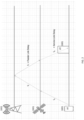
- FIG. 2 illustrates an example propagation delay between UE and eNB/gNB in NTN, which NTN includes a GEO satellite 2001 and an eNB/gNB 1002.
- NTN includes a GEO satellite 2001 and an eNB/gNB 1002.
- the propagation delay between UE 1001 and eNB/gNB 1002 would be much larger than 1 msec, as the total distance starting from UE 1001 to a GEO satellite 2001, then to eNB/gNB 1002 would be around 35786 Km, for example.
- the existing NPDCCH monitoring restrictions need to be optimized and updated where UE is not required to monitor NPDCCH.
- Feeder-link delay refers to one-way over-the-air (OTA) delay between the eNB/gNB 1002 and the satellite 2001.
- Service-link delay denoted as t s , refers to one-way OTA delay between the satellite 2001 and UE 1001.
- Timing advance is a UE offset between the start of a received downlink subframe and a transmitted uplink subframe, which offset at the UE is necessary to ensure that downlink and uplink subframes are synchronized with the eNB.
- T TA denotes the time length of the TA.
- K offset which is in the unit of subframes, refers to an integer which is signaled (e.g., by the eNB/gNB) to the UE and is used by the UE to delay transmission time of a UL transmission which is triggered by a DL reception at the UE so that the causality of the UE operation is guaranteed.
- K offset should always satisfy the condition K offset ⁇ T TA /1ms.
- K mac is an integer which is signaled (e.g., by the eNB/gNB) to the UE and is used by the UE to calculate RTT between the UE and the eNB/gNB.
- UE-specific TA will be used by UE in connected mode before UL transmission.
- This example scenario involves NB-loT Physical Uplink Shared Channel (NPUSCH) with the same hybrid automatic repeat request (HARQ) process when 2 HARQs are configured.
- NPUSCH Physical Uplink Shared Channel
- HARQ hybrid automatic repeat request
- the existing configuration restrictions e.g., 3GPP TS36.213 version 16.6 in a Terrestrial Network (TN) provide that, if an NB-IoT UE is configured with higher layer parameter twoHARQ-ProcessesConfig., and if the UE has an NPUSCH transmission ending in subframe n, then: 1) the UE is not required to receive transmissions in the Type B half-duplex guard periods for frequency division duplex (FDD); and 2) the UE is not expected to receive an NB-loT Physical Downlink Control Channel (NPDCCH) with downlink control information (DCI) format NO/N1 for the same HARQ process ID as the NPUSCH transmission in any subframe starting from subframe n+1 to subframe n+3.
- the UE DL Acknowledgement (ACK)/Negative Acknowledgement (NACK) monitoring restrictions are modified for this example scenario.
- the HARQ-ACK timing in response to NPUSCH transmission is n+4+ K mac .
- the DL subframe n+3+ K mac corresponds to the subframe immediately before HARQ-ACK.
- the DL subframe n + 1 ⁇ n TA UE starts immediately after UL subframe n. Therefore, the below-described changes need to be applied to the existing specifications, e.g., to 3GPP TS36.213 version 16.6, to properly accommodate the RTT between the UE and eNB.
- This example scenario relates to monitoring restrictions involving subframe after NPUSCH processing.
- the existing configuration restrictions e.g., 3GPP TS36.213 version 16.6 in a Terrestrial Network (TN) provide that, if the UE is not using higher layer parameter edt-Parameters or if the UE is using higher layer parameter edt-Parameters and 0 ⁇ I MCS ⁇ 2 , ( I MCS is the modulation and coding scheme field read from the DCI), then: if the NB-loT UE has a NPUSCH transmission ending in subframe n , the UE is not required to monitor NPDCCH in any subframe starting from subframe n+1 to subframe n+3.
- the UE DL monitoring restrictions are modified for this example scenario, i.e., the below-described changes need to be applied to the existing specifications, e.g., to 3GPP TS36.213 version 16.6, to properly accommodate the RTT between the UE and eNB.
- I MCS is the modulation and coding scheme field read from the DCI
- This example scenario relates to monitoring restrictions involving subframe after NPUSCH carrying Message 3 (Msg3).
- the existing configuration restrictions e.g., 3GPP TS36.213 version 16.6 in a Terrestrial Network (TN) provide that, if the NB-loT UE has an NPUSCH transmission for Msg3 ending in subframe n'with transport block size TBS Msg3 , whereas if maximum transport block size TBS Msg3, max for Msg3 would have been selected the NPUSCH transmission would have ended in subframe n, the UE is not required to monitor NPDCCH in any subframe starting from subframe n'+1 to subframe n+3.
- the UE DL monitoring restrictions are modified for this example scenario, i.e., the below-described changes need to be applied to the existing specifications, e.g., to 3GPP TS36.213 version 16.6, to properly accommodate the RTT between the UE and eNB.
- NPRACH Narrowband Physical Random-Access Channel
- SR scheduling request
- TN Terrestrial Network
- the UE DL monitoring restrictions are modified for this example scenario, i.e., the below-described changes need to be applied to the existing specifications, e.g., to 3GPP TS36.213 version 16.6, to properly accommodate the RTT between the UE and eNB.
- n TA UE ceil N TA , UE ⁇ specific .
- NPRACH Narrowband Physical Random-Access Channel
- SR scheduling request
- TN Terrestrial Network
- the UE DL monitoring restrictions are modified for this example scenario, i.e., the below-described changes need to be applied to the existing specifications, e.g., to 3GPP TS36.213 version 16.6, to properly accommodate the RTT between the UE and eNB.
- n TA UE ceil N TA , UE ⁇ specific .
- impact of K mac timing is taken into consideration for optimizing the monitoring window for DL reception at UE.
- the disclosed example embodiments of system optimization will help UEs reduce power consumption as UEs will not be required to monitor for DL signal for a longer duration.
- LTE-M LTE Machine Type Communication
Landscapes
- Engineering & Computer Science (AREA)
- Computer Networks & Wireless Communication (AREA)
- Signal Processing (AREA)
- Physics & Mathematics (AREA)
- Astronomy & Astrophysics (AREA)
- Aviation & Aerospace Engineering (AREA)
- General Physics & Mathematics (AREA)
- Mobile Radio Communication Systems (AREA)
Abstract
Description
- The present disclosure relates to 5th Generation (5G) New Radio (NR) non-terrestrial network (NTN) operation, and relates more particularly to monitoring the downlink control signal in Narrow-Band Internet-of-Things (NB-loT) for NTN.
- NB-loT physical downlink control channel (NPDCCH) is used to carry Downlink Control Information (DCI). Some examples of information contained in DCI include uplink (UL) grant information and downlink (DL) scheduling information.
- In legacy (traditional) terrestrial networks (TNs), an example of which is illustrated in
FIG. 1 , the propagation delay between UE and enB/gNB (which can be alternatively referenced as a "base station") is less than 1 msec, as the distance between a user equipment (UE) and eNB would be around 40 KM for the NBIOT case. For NTNs, the propagation delay between UE and eNB would be much larger than 1 msec, as the distance between UE and a GEO satellite and GEO satellite to eNB/gNB would be around 35786 Km. Therefore, in loT NTN networks, because of the large propagation delays, the duration for which the UE does not need to monitor any DL signal in response to UL transmission needs to be updated compared to traditional terrestrial networks. - Therefore, there is a need to optimize and update the DL monitoring restriction for the UE in loT NTN networks to improve UE performance.
- According to an example embodiment of the present disclosure, a method of optimizing the monitoring time window conditions or restrictions of NPDCCH for NBIOT-NTN is provided, which optimization enables UE to reduce power consumption by no longer requiring monitoring of NPDCCH for a dispensable duration.
- According to an example embodiment of the present disclosure, the changes that need to be made for NPDCCH monitoring restriction are provided for the case where UE does not need to monitor incoming DL signal which is transmitted by the gNB/eNB in response to UL transmissions.
- For an example scenario involving NB-loT Physical Uplink Shared Channel (NPUSCH) with the same hybrid automatic repeat request (HARQ) process when 2 HARQs are configured, if an NB-loT UE is configured with higher layer parameter twoHARQ-ProcessesConfig., and if the UE has an NPUSCH transmission ending in subframe n, then at least one of: 1) the UE is not required to receive transmissions in the Type B half-duplex guard periods for FDD; and 2) the UE is not expected to receive an NPDCCH with DCI format NO/N1 for the same HARQ process ID as the NPUSCH transmission in any subframe starting from subframe


- For an example scenario relating to monitoring restrictions involving subframe after NPUSCH processing, if the UE is not using higher layer parameter edt-Parameters or if the UE is using higher layer parameter edt-Parameters and 0 ≤ I MCS ≤ 2 , (I MCS is the modulation and coding scheme field read from the DCI), then: if the NB-loT UE has a NPUSCH transmission ending in subframe n , the UE is not required to monitor NPDCCH in any subframe starting from subframe


- For an example scenario relates to monitoring restrictions involving subframe after NPUSCH carrying Message 3 (Msg3), if the NB-loT UE has an NPUSCH transmission for Msg3 ending in subframe n'with transport block size TBS Msg3, whereas if maximum transport block size TBS Msg3,max for Msg3 would have been selected the NPUSCH transmission would have ended in subframe n, the UE is not required to monitor NPDCCH in any subframe starting from subframe


- For an example scenario relating to Narrowband Physical Random-Access Channel (NPRACH) for scheduling request (SR) involved in a long NPRACH transmission, for an NB-loT UE configured with higher layer parameter sr-WithoutHARQ-ACK-Config, if the transmission of a narrowband random access preamble for SR ends on subframe n, then: in case of frame structure type 1 with NPRACH format 0 and 1 when the number of NPRACH repetitions is greater than or equal to 64, or NPRACH format 2 when the number of NPRACH repetitions is greater than or equal to 16, the UE is not required to monitor NPDCCH UE-specific search space from subframe


- For an example scenario relating to Narrowband Physical Random-Access Channel (NPRACH) for scheduling request (SR) involved in a short NPRACH transmission, for an NB-loT UE configured with higher layer parameter sr-WithoutHARQ-ACK-Config, unless the transmission of a narrowband random access preamble for SR ends on subframe n, the UE is not required to monitor NPDCCH UE-specific search space from subframe


-
-
FIG. 1 is a diagram illustrating an example propagation delay between UE and eNB/gNB in a terrestrial network (TN). -
FIG. 2 is a diagram illustrating an example propagation delay between UE and eNB/gNB in NTN. -
FIG. 1 is a diagram illustrating an example legacy terrestrial network (TN), which includes UE 1001, eNB/gNB 1002, evolved packet core (EPC) 1003, internet of things (loT)platform 1004, andapplication server 1005. In the example legacy TN shown inFIG. 1 , the propagation delay between UE 1001 and eNB/gNB 1002 is typically less than 1 msec (as the distance between UE and eNB would be around 40 KM for the typical NBIOT scenario). -
FIG. 2 illustrates an example propagation delay between UE and eNB/gNB in NTN, which NTN includes a GEOsatellite 2001 and an eNB/gNB 1002. For the NTN shown inFIG. 2 , the propagation delay between UE 1001 and eNB/gNB 1002 would be much larger than 1 msec, as the total distance starting from UE 1001 to a GEOsatellite 2001, then to eNB/gNB 1002 would be around 35786 Km, for example. Considering the long propagation delays in NTN, the existing NPDCCH monitoring restrictions need to be optimized and updated where UE is not required to monitor NPDCCH. - In connection with
FIG. 2 , some parameters relevant to the NTN delay will be explained here. Feeder-link delay, denoted as tf, refers to one-way over-the-air (OTA) delay between the eNB/gNB 1002 and thesatellite 2001. Service-link delay, denoted as ts , refers to one-way OTA delay between thesatellite 2001 and UE 1001. Timing advance, TA, is a UE offset between the start of a received downlink subframe and a transmitted uplink subframe, which offset at the UE is necessary to ensure that downlink and uplink subframes are synchronized with the eNB. TTA denotes the time length of the TA. Koffset, which is in the unit of subframes, refers to an integer which is signaled (e.g., by the eNB/gNB) to the UE and is used by the UE to delay transmission time of a UL transmission which is triggered by a DL reception at the UE so that the causality of the UE operation is guaranteed. Koffset should always satisfy the condition Koffset ≥ TTA /1ms. Kmac is an integer which is signaled (e.g., by the eNB/gNB) to the UE and is used by the UE to calculate RTT between the UE and the eNB/gNB. - In the following sections, the proposed changes for optimizing the NPDCCH monitoring restrictions are discussed for various scenarios. UE-specific TA will be used by UE in connected mode before UL transmission.


- In the above formular, the various variables are defined as follows:
- a) NTA is timing offset between uplink and downlink radio frames at the UE, expressed in units of Ts . NTA works in the same way as legacy terrestrial networks. It is part of closed-loop uplink timing correction procedure. The amount of timing advance is being estimated by the eNB and the value is being communicated to UE in timing advance command.
- b) NTA,UE-specific is UE-self-estimated TA to pre-compensate for the service link delay between the UE and the satellite. It is computed by the UE based on satellite-ephemeris-related higher-layers parameters if configured, otherwise NTA,UE-specific =0.
- c) NTA,common is network-controlled (or network-specified) common TA, and may include any timing offset considered necessary by the network (e.g., feeder link delay). It is derived from the higher-layer parameters TACommon, TACommonDrift, and TACommonDriftVariation if configured, otherwise NTA,common = 0. These parameters are given to the UE in SIB31-NB.
- d) NTA,offset is Fixed timing advance offset, expressed in units of Ts . For frame structure type 1, NTA,offset = 0.
- e) Ts is basic unit of time expressed in millisecond (msec). Therefore, the granularity of TTA is 1 Ts , i.e., 1 msec.
- In the present disclosure, several example optimization changes (relative to existing configuration restrictions in Terrestrial Network) are provided, e.g., to 3GPP TS36.213 version 16.6, to accommodate the impact of UE-eNB RTT.
- This example scenario involves NB-loT Physical Uplink Shared Channel (NPUSCH) with the same hybrid automatic repeat request (HARQ) process when 2 HARQs are configured. As a point of reference, the existing configuration restrictions (e.g., 3GPP TS36.213 version 16.6) in a Terrestrial Network (TN) provide that, if an NB-IoT UE is configured with higher layer parameter twoHARQ-ProcessesConfig., and if the UE has an NPUSCH transmission ending in subframe n, then: 1) the UE is not required to receive transmissions in the Type B half-duplex guard periods for frequency division duplex (FDD); and 2) the UE is not expected to receive an NB-loT Physical Downlink Control Channel (NPDCCH) with downlink control information (DCI) format NO/N1 for the same HARQ process ID as the NPUSCH transmission in any subframe starting from subframe n+1 to subframe n+3.
- In contrast, for NTN, the UE DL Acknowledgement (ACK)/Negative Acknowledgement (NACK) monitoring restrictions are modified for this example scenario. The HARQ-ACK timing in response to NPUSCH transmission is n+4+Kmac. The DL subframe n+3+Kmac corresponds to the subframe immediately before HARQ-ACK. Also, it should be noted that the DL subframe


- This example scenario relates to monitoring restrictions involving subframe after NPUSCH processing. As a point of reference, the existing configuration restrictions (e.g., 3GPP TS36.213 version 16.6) in a Terrestrial Network (TN) provide that, if the UE is not using higher layer parameter edt-Parameters or if the UE is using higher layer parameter edt-Parameters and 0 ≤ I MCS ≤ 2 , (I MCS is the modulation and coding scheme field read from the DCI), then: if the NB-loT UE has a NPUSCH transmission ending in subframe n , the UE is not required to monitor NPDCCH in any subframe starting from subframe n+1 to subframe n+3.
- In contrast, for NTN, the UE DL monitoring restrictions are modified for this example scenario, i.e., the below-described changes need to be applied to the existing specifications, e.g., to 3GPP TS36.213 version 16.6, to properly accommodate the RTT between the UE and eNB. If the UE is not using higher layer parameter edt-Parameters or if the UE is using higher layer parameter edt-Parameters and 0 ≤ I MCS ≤ 2 , (I MCS is the modulation and coding scheme field read from the DCI), then: if the NB-loT UE has a NPUSCH transmission ending in subframe n , the UE is not required to monitor NPDCCH in any subframe starting from subframe


- This example scenario relates to monitoring restrictions involving subframe after NPUSCH carrying Message 3 (Msg3). As a point of reference, the existing configuration restrictions (e.g., 3GPP TS36.213 version 16.6) in a Terrestrial Network (TN) provide that, if the NB-loT UE has an NPUSCH transmission for Msg3 ending in subframe n'with transport block size TBS Msg3, whereas if maximum transport block size TBS Msg3,max for Msg3 would have been selected the NPUSCH transmission would have ended in subframe n, the UE is not required to monitor NPDCCH in any subframe starting from subframe n'+1 to subframe n+3.
- In contrast, for NTN, the UE DL monitoring restrictions are modified for this example scenario, i.e., the below-described changes need to be applied to the existing specifications, e.g., to 3GPP TS36.213 version 16.6, to properly accommodate the RTT between the UE and eNB. If the NB-loT UE has an NPUSCH transmission for Msg3 ending in subframe n'with transport block size TBS Msg3, whereas if maximum transport block size TBS Msg3,max for Msg3 would have been selected the NPUSCH transmission would have ended in subframe n, the UE is not required to monitor NPDCCH in any subframe starting from subframe


- This example scenario relates to Narrowband Physical Random-Access Channel (NPRACH) for scheduling request (SR) involved in long NPRACH transmission. As a point of reference, the existing configuration restrictions (e.g., 3GPP TS36.213 version 16.6) in a Terrestrial Network (TN) provide that, for an NB-loT UE configured with higher layer parameter sr-WithoutHARQ-ACK-Config, if the transmission of a narrowband random access preamble for SR ends on subframe n, then: in case of frame structure type 1 with NPRACH format 0 and 1 when the number of NPRACH repetitions is greater than or equal to 64, or NPRACH format 2 when the number of NPRACH repetitions is greater than or equal to 16, the UE is not required to monitor NPDCCH UE-specific search space from subframe n to subframe n+40.
- In contrast, for NTN, the UE DL monitoring restrictions are modified for this example scenario, i.e., the below-described changes need to be applied to the existing specifications, e.g., to 3GPP TS36.213 version 16.6, to properly accommodate the RTT between the UE and eNB. For an NB-loT UE configured with higher layer parameter sr-WithoutHARQ-ACK-Config, if the transmission of a narrowband random access preamble for SR ends on subframe n, then: in case of frame structure type 1 with NPRACH format 0 and 1 when the number of NPRACH repetitions is greater than or equal to 64, or NPRACH format 2 when the number of NPRACH repetitions is greater than or equal to 16, the UE is not required to monitor NPDCCH UE-specific search space from subframe


- This example scenario relates to Narrowband Physical Random-Access Channel (NPRACH) for scheduling request (SR) involved in short NPRACH transmission. As a point of reference, the existing configuration restrictions (e.g., 3GPP TS36.213 version 16.6) in a Terrestrial Network (TN) provide that, for an NB-loT UE configured with higher layer parameter sr-WithoutHARQ-ACK-Config, unless the transmission of a narrowband random access preamble for SR ends on subframe n, the UE is not required to monitor NPDCCH UE-specific search space from subframe n to subframe n+3.
- In contrast, for NTN, the UE DL monitoring restrictions are modified for this example scenario, i.e., the below-described changes need to be applied to the existing specifications, e.g., to 3GPP TS36.213 version 16.6, to properly accommodate the RTT between the UE and eNB. For an NB-loT UE configured with higher layer parameter sr-WithoutHARQ-ACK-Config, unless the transmission of a narrowband random access preamble for SR ends on subframe n, the UE is not required to monitor NPDCCH UE-specific search space from subframe


- According to the example embodiments of the present disclosure, impact of Kmac timing is taken into consideration for optimizing the monitoring window for DL reception at UE. The disclosed example embodiments of system optimization will help UEs reduce power consumption as UEs will not be required to monitor for DL signal for a longer duration.
- Although the example embodiments of the present disclosure have been described in the context of NB-loT for NTN operation, the present disclosure is equally applicable to 5G NR NTN operation, e.g., LTE Machine Type Communication (LTE-M) technology, and .
-
- 3GPP: 3rd Generation Partnership Project
- 5GC: 5G Core
- eNB: evolved Node B
- FDD: frequency division duplex
- gNB: next generation Node B
- HARQ: Hybrid automatic repeat request
- LTE: Long Term Evolution
- MIB: Master Information Block
- NPDCCH: NB-loT Physical Downlink Control Channel
- NPUSCH: NB-loT Physical Uplink Shared Channel
- NTN - Non Terrestrial Network
- NR: 5G New Radio
- PDCP: Packet Data Convergence Protocol
- PHY: Physical layer
- PNF: Physical Network Function
- PRACH: Physical Random Access Channel
- RAN: Radio Access Network
- RAT: Radio Access Technology
- RF: Radio Frequency
- RLC: Radio Link Control
- RRC: Radio Resource Control
- RRM: Radio Resource Management
- SIB: System Information Block
- UE: User Equipment
Claims (20)
- A method of optimizing a monitoring time window of NB-loT physical downlink control channel (NPDCCH) for one of i) narrow-band Internet-of-things (NB-loT) for non-terrestrial network (NTN) including a satellite and a base station, or ii) 5th Generation New Radio NTN, the method comprising:receiving, by a user equipment (UE), a specified signal transmitted by the base station, wherein the specified signal enables the UE to calculate a signal transmission round-trip time between the UE and the base station via the satellite; andadjusting, based on the specified signal, NPDCCH monitoring time window when the UE does not need to monitor a downlink (DL) signal transmitted by the base station in response to an uplink (UL) transmission.
- The method according to claim 1, wherein the specified signal is Kmac representing an integer.
- The method according to claim 2, wherein:the signal transmission round-trip time between the UE and the base station via the satellite is equal to the sum of UE's TTA and Kmac;UE's TTA is defined as a length of time of timing advance, TA, which TA is a UE offset between the start of a received downlink subframe and a transmitted uplink subframe, and TTA is represented by the following formula:
 Ts is a unit of time expressed in millisecond (msec);NTA is timing offset between uplink and downlink radio frames at the UE, expressed in units of Ts ;NTA,UE-specific is UE-self-estimated TA to pre-compensate for the service link delay between the satellite and the UE;NTA,common is network-specified TA; andNTA,offset is a fixed timing advance offset, expressed in units of Ts .
 - The method according to claim 3, wherein the method is for optimizing the monitoring time window of NPDCCH for NB-loT NTN.
- The method of claim 3, further comprising:
receiving, by the UE, a second specified signal Koffse transmitted by the base station, wherein Koffset represents units of subframes, and wherein Koffset is used by the UE to delay transmission time of a UL transmission which is triggered by a DL reception. - The method according to claim 3, wherein:
in the case NB-loT Physical Uplink Shared Channel (NPUSCH) with the same hybrid automatic repeat request (HARQ) process when 2 HARQs are configured, if an NB-loT UE is configured with parameter twoHARQ-ProcessesConfig., and if the UE has an NPUSCH transmission ending in subframe n, then at least one of: 1) the UE is not required to receive transmissions in the Type B half-duplex guard periods for FDD; and 2) the UE is not expected to receive an NPDCCH with DCI format NO/N1 for the same HARQ process ID as the NPUSCH transmission in any subframe starting from subframe

- The method of claim 3, wherein:
in the case of monitoring restrictions involving subframe after NB-loT Physical Uplink Shared Channel (NPUSCH) processing, if one of i) the UE is not using parameter edt-Parameters or ii) the UE is using parameter edt-Parameters and 0 ≤ I MCS ≤ 2 , wherein I MCS is a modulation and coding scheme field, then: if the UE has an NPUSCH transmission ending in subframe n , the UE is not required to monitor NPDCCH in any subframe starting from subframe

- The method of claim 3, wherein:
in the case of monitoring restrictions involving subframe after NB-loT Physical Uplink Shared Channel (NPUSCH) carrying Message 3 (Msg3), if the UE has an NPUSCH transmission for Msg3 ending in subframe n' with transport block size TBS Msg3, whereas if maximum transport block size TBS Msg3,max for Msg3 would have been selected the NPUSCH transmission would have ended in subframe n, the UE is not required to monitor NPDCCH in any subframe starting from subframe

- The method of claim 3, wherein:
in the case of Narrowband Physical Random-Access Channel (NPRACH) for scheduling request (SR) involved in a long NPRACH transmission, if the UE is configured with parameter sr-WithoutHARQ-ACK-Config, and if the transmission of a narrowband random access preamble for SR ends on subframe n, then: in case of frame structure type 1 with NPRACH format 0 and 1 when the number of NPRACH repetitions is greater than or equal to 64, or NPRACH format 2 when the number of NPRACH repetitions is greater than or equal to 16, the UE is not required to monitor NPDCCH UE-specific search space from subframe

- The method of claim 3, wherein:
in the case of Narrowband Physical Random-Access Channel (NPRACH) for scheduling request (SR) involved in a short NPRACH transmission, if the UE is configured with parameter sr-WithoutHARQ-ACK-Config, unless the transmission of a narrowband random access preamble for SR ends on subframe n, the UE is not required to monitor NPDCCH UE-specific search space from subframe

- The method according to claim 4, wherein:
in the case NB-loT Physical Uplink Shared Channel (NPUSCH) with the same hybrid automatic repeat request (HARQ) process when 2 HARQs are configured, if an NB-loT UE is configured with parameter twoHARQ-ProcessesConfig., and if the UE has an NPUSCH transmission ending in subframe n, then at least one of: 1) the UE is not required to receive transmissions in the Type B half-duplex guard periods for FDD; and 2) the UE is not expected to receive an NPDCCH with DCI format NO/N1 for the same HARQ process ID as the NPUSCH transmission in any subframe starting from subframe

- The method of claim 4, wherein:
in the case of monitoring restrictions involving subframe after NB-loT Physical Uplink Shared Channel (NPUSCH) processing, if one of i) the UE is not using parameter edt-Parameters or ii) the UE is using parameter edt-Parameters and 0 ≤ I MCS ≤ 2 , wherein I MCS is a modulation and coding scheme field, then: if the UE has an NPUSCH transmission ending in subframe n , the UE is not required to monitor NPDCCH in any subframe starting from subframe

- The method of claim 4, wherein:
in the case of monitoring restrictions involving subframe after NB-loT Physical Uplink Shared Channel (NPUSCH) carrying Message 3 (Msg3), if the UE has an NPUSCH transmission for Msg3 ending in subframe n' with transport block size TBS Msg3, whereas if maximum transport block size TBS Msg3,max for Msg3 would have been selected the NPUSCH transmission would have ended in subframe n, the UE is not required to monitor NPDCCH in any subframe starting from subframe

- The method of claim 4, wherein:
in the case of Narrowband Physical Random-Access Channel (NPRACH) for scheduling request (SR) involved in a long NPRACH transmission, if the UE is configured with parameter sr-WithoutHARQ-ACK-Config, and if the transmission of a narrowband random access preamble for SR ends on subframe n, then: in case of frame structure type 1 with NPRACH format 0 and 1 when the number of NPRACH repetitions is greater than or equal to 64, or NPRACH format 2 when the number of NPRACH repetitions is greater than or equal to 16, the UE is not required to monitor NPDCCH UE-specific search space from subframe

- The method of claim 4, wherein:
in the case of Narrowband Physical Random-Access Channel (NPRACH) for scheduling request (SR) involved in a short NPRACH transmission, if the UE is configured with parameter sr-WithoutHARQ-ACK-Config, unless the transmission of a narrowband random access preamble for SR ends on subframe n, the UE is not required to monitor NPDCCH UE-specific search space from subframe

- The method according to claim 5, wherein:
in the case NB-loT Physical Uplink Shared Channel (NPUSCH) with the same hybrid automatic repeat request (HARQ) process when 2 HARQs are configured, if an NB-loT UE is configured with parameter twoHARQ-ProcessesConfig., and if the UE has an NPUSCH transmission ending in subframe n, then at least one of: 1) the UE is not required to receive transmissions in the Type B half-duplex guard periods for FDD; and 2) the UE is not expected to receive an NPDCCH with DCI format N0/N1 for the same HARQ process ID as the NPUSCH transmission in any subframe starting from subframe

- The method of claim 5, wherein:
in the case of monitoring restrictions involving subframe after NB-loT Physical Uplink Shared Channel (NPUSCH) processing, if one of i) the UE is not using parameter edt-Parameters or ii) the UE is using parameter edt-Parameters and 0 ≤ I MCS ≤ 2 , wherein I MCS is a modulation and coding scheme field, then: if the UE has an NPUSCH transmission ending in subframe n , the UE is not required to monitor NPDCCH in any subframe starting from subframe

- The method of claim 5, wherein:
in the case of monitoring restrictions involving subframe after NB-loT Physical Uplink Shared Channel (NPUSCH) carrying Message 3 (Msg3), if the UE has an NPUSCH transmission for Msg3 ending in subframe n' with transport block size TBS Msg3, whereas if maximum transport block size TBS Msg3,max for Msg3 would have been selected the NPUSCH transmission would have ended in subframe n, the UE is not required to monitor NPDCCH in any subframe starting from subframe

- The method of claim 5, wherein:
in the case of Narrowband Physical Random-Access Channel (NPRACH) for scheduling request (SR) involved in a long NPRACH transmission, if the UE is configured with parameter sr-WithoutHARQ-ACK-Config, and if the transmission of a narrowband random access preamble for SR ends on subframe n, then: in case of frame structure type 1 with NPRACH format 0 and 1 when the number of NPRACH repetitions is greater than or equal to 64, or NPRACH format 2 when the number of NPRACH repetitions is greater than or equal to 16, the UE is not required to monitor NPDCCH UE-specific search space from subframe

- The method of claim 5, wherein:
in the case of Narrowband Physical Random-Access Channel (NPRACH) for scheduling request (SR) involved in a short NPRACH transmission, if the UE is configured with parameter sr-WithoutHARQ-ACK-Config, unless the transmission of a narrowband random access preamble for SR ends on subframe n, the UE is not required to monitor NPDCCH UE-specific search space from subframe

Applications Claiming Priority (2)
| Application Number | Priority Date | Filing Date | Title |
|---|---|---|---|
| IN202121051977 | 2021-11-12 | ||
| US18/052,714 US20230156498A1 (en) | 2021-11-12 | 2022-11-04 | Npdcch monitoring restrictions for nbiot-ntn systems |
Publications (1)
| Publication Number | Publication Date |
|---|---|
| EP4181420A1 true EP4181420A1 (en) | 2023-05-17 |
Family
ID=84331907
Family Applications (1)
| Application Number | Title | Priority Date | Filing Date |
|---|---|---|---|
| EP22206961.9A Pending EP4181420A1 (en) | 2021-11-12 | 2022-11-11 | Npdcch monitoring restrictions for nbiot-ntn systems |
Country Status (1)
| Country | Link |
|---|---|
| EP (1) | EP4181420A1 (en) |
Cited By (1)
| Publication number | Priority date | Publication date | Assignee | Title |
|---|---|---|---|---|
| WO2026065353A1 (en) * | 2024-09-30 | 2026-04-02 | Oppo广东移动通信有限公司 | System information transmission method and device |
-
2022
- 2022-11-11 EP EP22206961.9A patent/EP4181420A1/en active Pending
Non-Patent Citations (6)
| Title |
|---|
| 3GPP TS36.213 |
| FGI ET AL: "Timing relationship enhancements to NB-IoT NTN", vol. RAN WG1, no. e-Meeting; 20210816 - 20210827, 6 August 2021 (2021-08-06), XP052033538, Retrieved from the Internet <URL:https://ftp.3gpp.org/tsg_ran/WG1_RL1/TSGR1_106-e/Docs/R1-2107292.zip R1-2107292 Timing relationship enhancements to NB-IoT NTN.docx> [retrieved on 20210806] * |
| HUAWEI ET AL: "Discussion on HARQ enhancement for IoT in NTN", vol. RAN WG1, no. E-meeting; 20210510 - 20210527, 12 May 2021 (2021-05-12), XP052010715, Retrieved from the Internet <URL:https://ftp.3gpp.org/tsg_ran/WG1_RL1/TSGR1_105-e/Docs/R1-2104261.zip R1-2104261.docx> [retrieved on 20210512] * |
| HUAWEI ET AL: "Discussion on timing relationship enhancement for IoT in NTN", vol. RAN WG1, no. e-Meeting; 20211111 - 20211119, 6 November 2021 (2021-11-06), XP052074590, Retrieved from the Internet <URL:https://ftp.3gpp.org/tsg_ran/WG1_RL1/TSGR1_107-e/Docs/R1-2110809.zip R1-2110809.docx> [retrieved on 20211106] * |
| LENOVO ET AL: "Timing Relationship for IoT NTN", vol. RAN WG1, no. e-Meeting; 20211011 - 20211019, 1 October 2021 (2021-10-01), XP052058275, Retrieved from the Internet <URL:https://ftp.3gpp.org/tsg_ran/WG1_RL1/TSGR1_106b-e/Docs/R1-2109322.zip R1-2109322.docx> [retrieved on 20211001] * |
| MODERATOR (SONY): "FL summary 3 of AI 8.14.2: Timing relationships for IoT-NTN", vol. RAN WG1, no. e-Meeting; 20220221 - 20220303, 4 March 2022 (2022-03-04), XP052122288, Retrieved from the Internet <URL:https://ftp.3gpp.org/tsg_ran/WG1_RL1/TSGR1_108-e/Docs/R1-2202587.zip R1-2202587_AI8_14_2_FL Summary IoT NTN Timing Relationships.docx> [retrieved on 20220304] * |
Cited By (1)
| Publication number | Priority date | Publication date | Assignee | Title |
|---|---|---|---|---|
| WO2026065353A1 (en) * | 2024-09-30 | 2026-04-02 | Oppo广东移动通信有限公司 | System information transmission method and device |
Similar Documents
| Publication | Publication Date | Title |
|---|---|---|
| US20240098739A1 (en) | Method and apparatus in a telecommunication system | |
| CN110621064B (en) | Random access method and apparatus for use in wireless communication system supporting dual connectivity | |
| EP3177080B1 (en) | Base station apparatus, mobile station apparatus and wireless communication method | |
| US10880052B2 (en) | Method and apparatus for controlling power headroom report and hybrid automatic retransmission in mobile communication system | |
| CN102577543B (en) | Method and device in a mobile telecommunications network | |
| US20210168725A1 (en) | AIRBORNE STATUS DEPENDENT UPLINK POWER CONTROL RELATED TASK(S) FOR AERIAL UEs | |
| TWI399116B (en) | Method of managing discontinuous reception offset and related communication device | |
| US11051314B2 (en) | Method and LC device for transmitting scheduling request | |
| US20210282090A1 (en) | Uplink power control method, apparatus and storage medium | |
| EP3343988B1 (en) | Terminal device, network device, method for transmitting uplink reference signal and method for receiving same | |
| US10104689B2 (en) | Wireless shared spectrum access contention based on HARQ feedback | |
| EP3997908B1 (en) | Infrastructure equipment, communications devices, and methods | |
| CN104581911A (en) | Inter-node signaling interaction, uplink power control and uplink transmission methods and devices | |
| US8982786B2 (en) | Initial access setting information generating apparatus, method, and program, and base station apparatus | |
| US20180026742A1 (en) | Outer loop link adaptation with bundled feedback | |
| EP4654730A1 (en) | Method and device for random-access procedure in wireless communication system | |
| EP3890431A2 (en) | Tcp acknowledgment latency optimization | |
| WO2021047778A1 (en) | Techniques for two-step random access improvements | |
| US11658892B2 (en) | Ping latency optimization | |
| US20230156498A1 (en) | Npdcch monitoring restrictions for nbiot-ntn systems | |
| US20240340811A1 (en) | Methods and apparatuses for power control enhancement | |
| EP4287542A2 (en) | Completion of scell beam failure recovery | |
| WO2021160741A1 (en) | Transceiver and corresponding method | |
| EP4507404A1 (en) | Method for transmitting/receiving uplink in wireless communication system and device therefor | |
| WO2025129985A1 (en) | Method and system for efficient and low-latency information transmission |
Legal Events
| Date | Code | Title | Description |
|---|---|---|---|
| PUAI | Public reference made under article 153(3) epc to a published international application that has entered the european phase |
Free format text: ORIGINAL CODE: 0009012 |
|
| STAA | Information on the status of an ep patent application or granted ep patent |
Free format text: STATUS: THE APPLICATION HAS BEEN PUBLISHED |
|
| AK | Designated contracting states |
Kind code of ref document: A1 Designated state(s): AL AT BE BG CH CY CZ DE DK EE ES FI FR GB GR HR HU IE IS IT LI LT LU LV MC ME MK MT NL NO PL PT RO RS SE SI SK SM TR |
|
| P01 | Opt-out of the competence of the unified patent court (upc) registered |
Effective date: 20230601 |
|
| STAA | Information on the status of an ep patent application or granted ep patent |
Free format text: STATUS: REQUEST FOR EXAMINATION WAS MADE |
|
| 17P | Request for examination filed |
Effective date: 20231011 |
|
| RBV | Designated contracting states (corrected) |
Designated state(s): AL AT BE BG CH CY CZ DE DK EE ES FI FR GB GR HR HU IE IS IT LI LT LU LV MC ME MK MT NL NO PL PT RO RS SE SI SK SM TR |
|
| STAA | Information on the status of an ep patent application or granted ep patent |
Free format text: STATUS: EXAMINATION IS IN PROGRESS |
|
| 17Q | First examination report despatched |
Effective date: 20250626 |
|
| RAP1 | Party data changed (applicant data changed or rights of an application transferred) |
Owner name: MAVENIR US INC. |
|
| RAP1 | Party data changed (applicant data changed or rights of an application transferred) |
Owner name: MAVENIR SYSTEMS, INC. |