EP4180948A1 - Live firmware and configuration updates of multi-node alarm systems - Google Patents
Live firmware and configuration updates of multi-node alarm systems Download PDFInfo
- Publication number
- EP4180948A1 EP4180948A1 EP22206230.9A EP22206230A EP4180948A1 EP 4180948 A1 EP4180948 A1 EP 4180948A1 EP 22206230 A EP22206230 A EP 22206230A EP 4180948 A1 EP4180948 A1 EP 4180948A1
- Authority
- EP
- European Patent Office
- Prior art keywords
- partition
- network nodes
- file
- network
- update
- Prior art date
- Legal status (The legal status is an assumption and is not a legal conclusion. Google has not performed a legal analysis and makes no representation as to the accuracy of the status listed.)
- Pending
Links
Images


Classifications
-
- G—PHYSICS
- G06—COMPUTING OR CALCULATING; COUNTING
- G06F—ELECTRIC DIGITAL DATA PROCESSING
- G06F8/00—Arrangements for software engineering
- G06F8/60—Software deployment
- G06F8/65—Updates
- G06F8/656—Updates while running
-
- G—PHYSICS
- G06—COMPUTING OR CALCULATING; COUNTING
- G06F—ELECTRIC DIGITAL DATA PROCESSING
- G06F11/00—Error detection; Error correction; Monitoring
- G06F11/07—Responding to the occurrence of a fault, e.g. fault tolerance
- G06F11/14—Error detection or correction of the data by redundancy in operations
- G06F11/1402—Saving, restoring, recovering or retrying
- G06F11/1415—Saving, restoring, recovering or retrying at system level
- G06F11/1433—Saving, restoring, recovering or retrying at system level during software upgrading
Definitions
- the present invention relates to a method and system for performing live firmware and configuration updates.
- the present disclosure relates to updating network nodes, and more specifically, to performing live firmware updates and configuration updates for multi-node alarm systems.
- Performing upgrades of network nodes is a common task to maintain the latest version of an application or provide additional functionality to the network nodes. Often, during the upgrading of network nodes, the functionality of the nodes is limited or completely restricted. Also, each of the nodes in the network is generally required to individually connect to the source of the upgrade which consumes bandwidth as each file is repeated transferred over the network.
- a method for performing live firmware and configuration update comprises maintaining live operation of network nodes during an update, wherein each of the network nodes comprises a disk that is divided into a plurality of partitions, wherein a currently running application file is located in a first partition of the network node; and downloading an update file in a common partition of the disk of the network node to be updated.
- the method also comprises extracting the update file from the common partition to a second partition of the disk of the network nodes to be updated; and switching the live operation of the network nodes to operate from the currently running application file in the first partition to the update file in the second partition.
- the method may use a system as described below.
- embodiments include verifying the update file in the common partition of the network nodes to be updated.
- embodiments include extracting the file and storing the update file from the common partition to the second partition of the network nodes to be updated, responsive to the verification of the update file in the common partition.
- embodiments include continuing to use the currently running application file in the first partition of the network nodes if the verification of the update file fails.
- embodiments include transmitting a negative acknowledgment to a distribution node of the network nodes to indicate the failure of the verification of the update file in the common partition of the network nodes to be updated.
- discovering the nodes comprises obtaining an identifier for each network node in the network and an identifier corresponding to a firmware version for each network node.
- embodiments include authorizing the downloaded file stored in the common partition; and transferring the downloaded files to a partition of the disk based at least in part on the authorization.
- embodiments include verifying the download of the update files on each of the network nodes; and retransmitting the downloaded update file to the network nodes that did not verify the download.
- embodiments include multicasting, in parallel distribution, the update file via a single-entry point into a network of the one or more network nodes.
- a system for performing live firmware and configuration updates can comprise a client node; and one or more network nodes connected to the client node, wherein one of the network nodes is a distribution node.
- the one or more network nodes are configured to: maintain live operation of the one or more network nodes during an update, wherein each of the network nodes comprises a disk that is divided into a plurality of partitions, wherein a currently running application file is located in a first partition of the network node; and download an update file in a common partition of the disk; extract the update file from the common partition to a second partition of the disc; and switch the live operation of the one or more network nodes to operate from the currently running application file in the first partition to the update file in the second partition.
- the system may be configured to operate in accordance with the method discussed above.
- embodiments include one or more network nodes that are configured to verify the update file in the common partition.
- embodiments include one or more network nodes that are configured to extract the file and store the update file from the common partition to the second partition, responsive to the verification of the update file in the common partition.
- embodiments include one or more network nodes that are configured to continue to use the currently running application file in the first partition if the verification of the update file fails.
- embodiments include one or more network nodes that are configured to transmitting a negative acknowledgment to the distribution node to indicate the failure of the verification of the update file in the common partition.
- discovering the network nodes comprises obtaining an identifier for each other network node in the network and an identifier corresponding to a firmware version for each other network node.
- embodiments include one or more network nodes that are configured to: authorize the downloaded file stored in the common partition; and transfer the downloaded files to a partition of the disk based at least in part on the authorization.
- embodiments include one or more network nodes that are configured to: verify the download of the update files on each of the network nodes; and retransmit the downloaded update file to the other network nodes that did not verify the download.
- embodiments include a distribution node that is configured to multicast, in parallel distribution, the update file via a single-entry point into a network of the one or more network nodes.
- the technical effects and benefits of the system and method described herein may include maintaining a live system during an application update (counter to current systems which require the systems or nodes to be taken offline during the update procedure where the functionality is unavailable until the completion of the update).
- a live system may be viewed as a system that remains fully operational during each phase of the update process.
- the ability to maintain a live system may be due, at least in part, by using a multi-partitioned disk for the update procedure.
- FIG. 1 depicts an exemplary multi-node system 100 used for performing live firmware and configuration updates.
- the system 100 includes a client node 110 and one or more network nodes 120.
- the client node 110 may be configured to initiate the update process for updating the network nodes.
- the client node 110 can include but is not limited to a laptop, PC, or other computing devices.
- the client node 110 can receive the update file from cloud storage 140, another computing device 150, a portable storage device 160, etc.
- the client node 110 is also configured to maintain an updated view of the network nodes.
- the view of the network nodes can include the identifier information for each of the network nodes 120 and the version of firmware that each network node 120 is currently operating.
- the network nodes 120 may be fire system nodes (e.g., fire panels) or other types of controllers or accessory devices that can be utilized in a fire system.
- the client nodes 110 can communicate with the network nodes 120 over a network 130.
- the network(s) 130 may include, but are not limited to, any one or more different types of communications networks such as, for example, cable networks, public networks (e.g., the Internet), private networks (e.g., frame-relay networks), wireless networks, cellular networks, telephone networks (e.g., a public switched telephone network), or any other suitable private or public packet-switched or circuit-switched networks.
- Such network(s) may have any suitable communication range associated therewith and may include, for example, global networks (e.g., the Internet), metropolitan area networks (MANs), wide area networks (WANs), local area networks (LANs), or personal area networks (PANs).
- network(s) may include communication links and associated networking devices (e.g., link-layer switches, routers, etc.) for transmitting network traffic over any suitable type of medium including, but not limited to, coaxial cable, twisted-pair wire (e.g., twisted-pair copper wire), optical fiber, a hybrid fiber-coaxial (HFC) medium, a microwave medium, a radio frequency communication medium, a satellite communication medium, or any combination thereof.
- the client node 110 upon connecting to a network node 120, may obtain a complete view of the network.
- the distribution node 120 responsive to a request from the client node 110, can provide a current live view of the network nodes 120.
- the requests may include a request for firmware or configuration versions information.
- the client node 110 can connect to any network node 120 in the network 130 for the download phase.
- the network node 120 that is connected to the client node 110 may be a distribution node.
- the distribution node which can be a network node 120, can manage the distribution phase of the files for the network by determining which update files should be transmitted to which network nodes 120. For example, if one file needs to go to all the nodes a multicast group transfer will be commenced. Therefore, each file will not be sent to each node multiple times.
- the topology and the distribution of the update files is optimal.
- Network nodes 120 connected to the client node 110 are capable of distributing the relevant files to the other nodes in the network in a reliable and secure manner with a distributed parallel distribution algorithm for optimal use of the network and local node resources.
- the distribution node responsive to receiving the update files from the client node 110, may be configured to coordinate with the rest of the network nodes of the network via its own multicast sessions on which network nodes 120 can join the current download/update group session.
- the client node 110 may be capable of automatically discovering all of the nodes in the network.
- the client node 110 can also be configured to discover the firmware version of each of the nodes of the network.
- all nodes within the network will distribute its known CPUinfo to the rest of the network via MDNS services.
- the distribution node can provide a view of the network to client node 110 responsive to receiving a request which can include the version information of each node.
- the client node 110 responsive to receiving the user configuration, provides the updates to the network for use.
- the distribution node determines which nodes require such an upgrade or update based on any determined version mismatches.
- the upgrade can upgrade the readiness status and stats for the fire system nodes.
- FIG. 2 in which an exemplary node 200, which may be representative of any of the client nodes 120 and/or network nodes 120 of FIG 1 is shown.
- Node 200 is only illustrative and is not intended to suggest any limitation as to the scope of use or functionality of embodiments of the invention described herein.
- node 200 is shown in the form of a general-purpose computing device.
- the components of node 200 may include, but are not limited to, one or more processors 202, a memory 204, interface 206, and network adapter 208.
- the processor 202 can include a processor 202 of a general-purpose computer, special purpose computer, or other programmable data processing apparatus configured to execute instruction via the processor of the computer or other programmable data processing apparatus.
- Nodes 200 can include a variety of computer system readable media. Such media may be any available media that is accessible by node 200, and it includes both volatile and non-volatile media, removable and non-removable media.
- Memory 204 can include computer system readable media.
- the memory 204 can include any one or combination of volatile memory elements (e . g ., random access memory (RAM, such as DRAM, SRAM, SDRAM, etc .)) and nonvolatile memory elements (e.g ., ROM, erasable programmable read only memory (EPROM), electronically erasable programmable read only memory (EEPROM), etc.).
- Node 200 may further include other removable/non-removable, volatile/non-volatile computer system storage media.
- the processor 202 and a memory 204 are configured to carry out the operations for the nodes.
- Each of the network nodes 120 can include a memory or disk for storing applications. Each disk can be divided into logical partitions. The partition allows nodes to operate using different operating systems or creates the appearance of having multiple hard drives.
- the memory 204 may include one or more program modules (not shown) such as operating system(s), one or more application programs, other program modules, and program data. Each of the operating systems, one or more application programs, other program modules, and program data or some combination thereof, may include an implementation of a networking environment.
- the program modules generally carry out the functions and/or methodologies as described herein.
- Node 200 may also communicate with one or more external devices through the interface 206 such as a keyboard, a pointing device, a display, etc.; one or more devices that enable a user to interact with node 200; and/or any devices (e.g., network card, modem, etc.) that enable node 200 to communicate with one or more other computing devices.
- external devices such as a keyboard, a pointing device, a display, etc.
- devices that enable a user to interact with node 200 e.g., a keyboard, a pointing device, a display, etc.
- any devices e.g., network card, modem, etc.
- node 200 can communicate with one or more networks such as a local area network (LAN), a general wide area network (WAN), and/or a public network (e.g., the Internet) via network adapter 208.
- network adapter 208 communicates with the other components of node 200.
- the network nodes 120 include a memory or disk that comprises a multi-partition disk discussed with further reference to FIG. 3 . It can be appreciated the node 200 can include other components or modules and is not limited by the components shown in FIG. 2 .
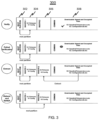
- FIG. 3 depicts an example multi-partition disk 300 of a network node 120.
- the multi-partition disk can include four or more partitions.
- the disk of the network node 120 can include a boot partition 302, a primary partition, that includes the boot loader which is software that is required to start-up and boot the operating system of the computing device or network node 120.
- the boot partition 302 access the application, operating system, or firmware in another partition of the disk.
- the current file that is live and currently running on the network node is "VI Firmware, VI Config" and is stored in the partition 304.
- the disk 300 can include a common partition 308.
- An update file "V2 Firmware, V2 Config" is downloaded to the common partition 308.
- the common partition 308 can be used to store the update file during the verification phase.
- the verification may include verifying the sender of the file, verifying the file itself, using a key to decrypt the file, etc.
- the update file may be discarded, and the network node 120 can provide a negative acknowledgment to the distribution node.
- the distribution node can resend the update file to the network node to attempt to re-install the update file.
- the verification process will be performed again. If the verification of the update file is successful, the file can be extracted from the common partition of the disk to another available partition of the disk. During this entire process of installing the update file, the original file remains unmodified in its own partition to allow the network to remain fully functional. This may provide a failsafe to return to the original version because the original file is not being overwritten as it is in conventional techniques.
- the update file may be extracted from the common partition 308 and is provided to and stored in partition 306.
- the extraction process includes decrypting the file, decompressing the file, and/or moving the compressed files to a different location for processing.
- Various extraction techniques can be used to access the update file from the common partition of the node such as using a hash, a credential, or some other key.
- the boot partition 302 is switched from partition 304 and points to the second partition 306 to resume operation of the network node 120 using the updated file.
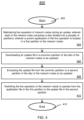
- FIG. 4 depicts a flowchart of a method 400 for performing live firmware and configuration updates.
- the method 400 may be implemented in a system 100 such as that shown in FIG. 1 .
- the method 400 begins at block 402 and continues to block 404 which provides for maintaining live operation of network nodes during an update, wherein each of the network nodes comprises a disk that is divided into a plurality of partitions, wherein the application file is located in a first partition a disk of the network node.
- each of the network nodes remains operational by using the version of the firmware or application that is stored in the first partition of the disk.
- Block 406 downloads an update file in a common partition of the disk of the network node to be updated.
- a discovery process may be performed by a distribution node to obtain an identifier for each network node in the network and an identifier corresponding to a firmware version for each network node.
- Block 408 extracts the update file from the common partition to a second partition of the disk of the network nodes to be updated. Responsive to verifying the update file in the common partition the files may be extracted from the common partition and stored in the second partition of the disk. A negative acknowledgment may be transmitted to the distribution node to indicate the failure of the verification of the update file in the common partition of the network nodes to be updated. In the event the verification fails, the network nodes continue to use the application file in the first partition.
- Block 410 switches the live operation of the network nodes to operate from the application file in the first partition to the update file in the second partition.
- the method 400 ends at block 412.
- the process flow diagram of FIG. 4 is not intended to indicate that the operations of the method 400 are to be executed in any particular order, or that all of the operations of the method 400 are to be included in every case. Additionally, the method 400 can include any suitable number of additional operations.
- the technical effects and benefits of the examples herein include using a connection to a single-entry point in the network thereby removing the complexity of the utility's need to communicate with the other networked nodes.
- the technical effects and benefits described herein provide a parallel and reliable method for performing network node updates.
- the file transfer uses multicasting to increase the upgrade speed and is impacted by the available network bandwidth and not by the number of network nodes in the system.
- the technical effects and benefits may include isolating the upgrade/update communication interface to a single-entry point in the fire network system reduces the cyber security attack surface.
- the network nodes and the client nodes may use a negative acknowledgment (NACK) process to verify the successful download of the application.
- NACK negative acknowledgment
- the user is not required to reinitiate the process in the event the application download process has failed.
Landscapes
- Engineering & Computer Science (AREA)
- Theoretical Computer Science (AREA)
- General Engineering & Computer Science (AREA)
- Software Systems (AREA)
- Physics & Mathematics (AREA)
- General Physics & Mathematics (AREA)
- Computer Security & Cryptography (AREA)
- Quality & Reliability (AREA)
- Stored Programmes (AREA)
- Information Transfer Between Computers (AREA)
Abstract
Description
- The present invention relates to a method and system for performing live firmware and configuration updates. The present disclosure relates to updating network nodes, and more specifically, to performing live firmware updates and configuration updates for multi-node alarm systems.
- Performing upgrades of network nodes is a common task to maintain the latest version of an application or provide additional functionality to the network nodes. Often, during the upgrading of network nodes, the functionality of the nodes is limited or completely restricted. Also, each of the nodes in the network is generally required to individually connect to the source of the upgrade which consumes bandwidth as each file is repeated transferred over the network.
- According to an embodiment, a method for performing live firmware and configuration update is provided. The method comprises maintaining live operation of network nodes during an update, wherein each of the network nodes comprises a disk that is divided into a plurality of partitions, wherein a currently running application file is located in a first partition of the network node; and downloading an update file in a common partition of the disk of the network node to be updated. The method also comprises extracting the update file from the common partition to a second partition of the disk of the network nodes to be updated; and switching the live operation of the network nodes to operate from the currently running application file in the first partition to the update file in the second partition.
- The method may use a system as described below.
- Optionally, embodiments include verifying the update file in the common partition of the network nodes to be updated.
- Optionally, embodiments include extracting the file and storing the update file from the common partition to the second partition of the network nodes to be updated, responsive to the verification of the update file in the common partition.
- Optionally, embodiments include continuing to use the currently running application file in the first partition of the network nodes if the verification of the update file fails.
- Optionally, embodiments include transmitting a negative acknowledgment to a distribution node of the network nodes to indicate the failure of the verification of the update file in the common partition of the network nodes to be updated.
- Optionally, discovering the nodes comprises obtaining an identifier for each network node in the network and an identifier corresponding to a firmware version for each network node.
- Optionally, embodiments include authorizing the downloaded file stored in the common partition; and transferring the downloaded files to a partition of the disk based at least in part on the authorization.
- Optionally, embodiments include verifying the download of the update files on each of the network nodes; and retransmitting the downloaded update file to the network nodes that did not verify the download.
- Optionally, embodiments include multicasting, in parallel distribution, the update file via a single-entry point into a network of the one or more network nodes.
- According to an embodiment, a system for performing live firmware and configuration updates is provided. The system can comprise a client node; and one or more network nodes connected to the client node, wherein one of the network nodes is a distribution node. The one or more network nodes are configured to: maintain live operation of the one or more network nodes during an update, wherein each of the network nodes comprises a disk that is divided into a plurality of partitions, wherein a currently running application file is located in a first partition of the network node; and download an update file in a common partition of the disk; extract the update file from the common partition to a second partition of the disc; and switch the live operation of the one or more network nodes to operate from the currently running application file in the first partition to the update file in the second partition.
- The system may be configured to operate in accordance with the method discussed above.
- Optionally, embodiments include one or more network nodes that are configured to verify the update file in the common partition.
- Optionally, embodiments include one or more network nodes that are configured to extract the file and store the update file from the common partition to the second partition, responsive to the verification of the update file in the common partition.
- Optionally, embodiments include one or more network nodes that are configured to continue to use the currently running application file in the first partition if the verification of the update file fails.
- Optionally, embodiments include one or more network nodes that are configured to transmitting a negative acknowledgment to the distribution node to indicate the failure of the verification of the update file in the common partition.
- Optionally, discovering the network nodes comprises obtaining an identifier for each other network node in the network and an identifier corresponding to a firmware version for each other network node.
- Optionally, embodiments include one or more network nodes that are configured to: authorize the downloaded file stored in the common partition; and transfer the downloaded files to a partition of the disk based at least in part on the authorization.
- Optionally, embodiments include one or more network nodes that are configured to: verify the download of the update files on each of the network nodes; and retransmit the downloaded update file to the other network nodes that did not verify the download.
- Optionally, embodiments include a distribution node that is configured to multicast, in parallel distribution, the update file via a single-entry point into a network of the one or more network nodes.
- The foregoing features and elements may be combined in various combinations without exclusivity, unless expressly indicated otherwise. These features and elements as well as the operation thereof will become more apparent in light of the following description and the accompanying drawings. It should be understood, however, that the following description and drawings are intended to be illustrative and explanatory in nature and non-limiting.
- The following descriptions should not be considered limiting in any way. With reference to the accompanying drawings, like elements are numbered alike:
-
FIG. 1 illustrates an example of a multi-node system for performing live firmware updates; -
FIG. 2 illustrates an example node; -
FIG. 3 illustrates an example of the partitions of a disk of a network node; and -
FIG. 4 illustrates a flowchart of an exemplary method for performing live firmware updates. - The technical effects and benefits of the system and method described herein may include maintaining a live system during an application update (counter to current systems which require the systems or nodes to be taken offline during the update procedure where the functionality is unavailable until the completion of the update). A live system may be viewed as a system that remains fully operational during each phase of the update process. The ability to maintain a live system may be due, at least in part, by using a multi-partitioned disk for the update procedure.
- A detailed description of one or more embodiments of the disclosed system and method are presented herein by way of exemplification and not limitation with reference to the Figures.
-
FIG. 1 depicts an exemplarymulti-node system 100 used for performing live firmware and configuration updates. Thesystem 100 includes aclient node 110 and one ormore network nodes 120. Theclient node 110 may be configured to initiate the update process for updating the network nodes. Theclient node 110 can include but is not limited to a laptop, PC, or other computing devices. Theclient node 110 can receive the update file fromcloud storage 140, anothercomputing device 150, aportable storage device 160, etc. Theclient node 110 is also configured to maintain an updated view of the network nodes. The view of the network nodes can include the identifier information for each of thenetwork nodes 120 and the version of firmware that eachnetwork node 120 is currently operating. - The
network nodes 120 may be fire system nodes (e.g., fire panels) or other types of controllers or accessory devices that can be utilized in a fire system. Theclient nodes 110 can communicate with thenetwork nodes 120 over anetwork 130. The network(s) 130 may include, but are not limited to, any one or more different types of communications networks such as, for example, cable networks, public networks (e.g., the Internet), private networks (e.g., frame-relay networks), wireless networks, cellular networks, telephone networks (e.g., a public switched telephone network), or any other suitable private or public packet-switched or circuit-switched networks. Such network(s) may have any suitable communication range associated therewith and may include, for example, global networks (e.g., the Internet), metropolitan area networks (MANs), wide area networks (WANs), local area networks (LANs), or personal area networks (PANs). In addition, such network(s) may include communication links and associated networking devices (e.g., link-layer switches, routers, etc.) for transmitting network traffic over any suitable type of medium including, but not limited to, coaxial cable, twisted-pair wire (e.g., twisted-pair copper wire), optical fiber, a hybrid fiber-coaxial (HFC) medium, a microwave medium, a radio frequency communication medium, a satellite communication medium, or any combination thereof. - The
client node 110 upon connecting to anetwork node 120, may obtain a complete view of the network. Thedistribution node 120, responsive to a request from theclient node 110, can provide a current live view of thenetwork nodes 120. The requests may include a request for firmware or configuration versions information. Theclient node 110 can connect to anynetwork node 120 in thenetwork 130 for the download phase. Thenetwork node 120 that is connected to theclient node 110 may be a distribution node. The distribution node, which can be anetwork node 120, can manage the distribution phase of the files for the network by determining which update files should be transmitted to whichnetwork nodes 120. For example, if one file needs to go to all the nodes a multicast group transfer will be commenced. Therefore, each file will not be sent to each node multiple times. The topology and the distribution of the update files is optimal. -
Network nodes 120 connected to theclient node 110 are capable of distributing the relevant files to the other nodes in the network in a reliable and secure manner with a distributed parallel distribution algorithm for optimal use of the network and local node resources. The distribution node, responsive to receiving the update files from theclient node 110, may be configured to coordinate with the rest of the network nodes of the network via its own multicast sessions on whichnetwork nodes 120 can join the current download/update group session. - The
client node 110, such as in a fire alarm system, may be capable of automatically discovering all of the nodes in the network. Theclient node 110 can also be configured to discover the firmware version of each of the nodes of the network. Optionally, responsive to joining the network or starting up, all nodes within the network will distribute its known CPUinfo to the rest of the network via MDNS services. The distribution node can provide a view of the network toclient node 110 responsive to receiving a request which can include the version information of each node. Theclient node 110, responsive to receiving the user configuration, provides the updates to the network for use. The distribution node determines which nodes require such an upgrade or update based on any determined version mismatches. The upgrade can upgrade the readiness status and stats for the fire system nodes. - Referring now to
Fig. 2 , in which anexemplary node 200, which may be representative of any of theclient nodes 120 and/ornetwork nodes 120 ofFIG 1 is shown.Node 200 is only illustrative and is not intended to suggest any limitation as to the scope of use or functionality of embodiments of the invention described herein. - As shown in
FIG. 2 ,node 200 is shown in the form of a general-purpose computing device. The components ofnode 200 may include, but are not limited to, one ormore processors 202, amemory 204,interface 206, andnetwork adapter 208. Theprocessor 202 can include aprocessor 202 of a general-purpose computer, special purpose computer, or other programmable data processing apparatus configured to execute instruction via the processor of the computer or other programmable data processing apparatus. -
Nodes 200 can include a variety of computer system readable media. Such media may be any available media that is accessible bynode 200, and it includes both volatile and non-volatile media, removable and non-removable media.Memory 204 can include computer system readable media. Thememory 204 can include any one or combination of volatile memory elements (e.g., random access memory (RAM, such as DRAM, SRAM, SDRAM, etc.)) and nonvolatile memory elements (e.g., ROM, erasable programmable read only memory (EPROM), electronically erasable programmable read only memory (EEPROM), etc.).Node 200 may further include other removable/non-removable, volatile/non-volatile computer system storage media. Theprocessor 202 and amemory 204 are configured to carry out the operations for the nodes. Each of thenetwork nodes 120 can include a memory or disk for storing applications. Each disk can be divided into logical partitions. The partition allows nodes to operate using different operating systems or creates the appearance of having multiple hard drives. - The
memory 204 may include one or more program modules (not shown) such as operating system(s), one or more application programs, other program modules, and program data. Each of the operating systems, one or more application programs, other program modules, and program data or some combination thereof, may include an implementation of a networking environment. The program modules generally carry out the functions and/or methodologies as described herein. -
Node 200 may also communicate with one or more external devices through theinterface 206 such as a keyboard, a pointing device, a display, etc.; one or more devices that enable a user to interact withnode 200; and/or any devices (e.g., network card, modem, etc.) that enablenode 200 to communicate with one or more other computing devices. - Still yet,
node 200 can communicate with one or more networks such as a local area network (LAN), a general wide area network (WAN), and/or a public network (e.g., the Internet) vianetwork adapter 208. As depicted,network adapter 208 communicates with the other components ofnode 200. It should be understood that although not shown, other hardware and/or software components could be used in conjunction withnode 200. In one or more embodiments, thenetwork nodes 120 include a memory or disk that comprises a multi-partition disk discussed with further reference toFIG. 3 . It can be appreciated thenode 200 can include other components or modules and is not limited by the components shown inFIG. 2 . -
FIG. 3 depicts anexample multi-partition disk 300 of anetwork node 120. In one non-limiting example, the multi-partition disk can include four or more partitions. The disk of thenetwork node 120 can include aboot partition 302, a primary partition, that includes the boot loader which is software that is required to start-up and boot the operating system of the computing device ornetwork node 120. Upon start-up, theboot partition 302 access the application, operating system, or firmware in another partition of the disk. In a non-limiting example, the current file that is live and currently running on the network node is "VI Firmware, VI Config" and is stored in thepartition 304. Thedisk 300 can include acommon partition 308. An update file "V2 Firmware, V2 Config" is downloaded to thecommon partition 308. In one or more embodiment of the disclosure, thecommon partition 308 can be used to store the update file during the verification phase. The verification may include verifying the sender of the file, verifying the file itself, using a key to decrypt the file, etc. - If the verification of the downloaded update file in the
common partition 308 of the disk fails, the update file may be discarded, and thenetwork node 120 can provide a negative acknowledgment to the distribution node. As shown, when the verification fails, the update file is not extracted to thepartition 306. In response, the distribution node can resend the update file to the network node to attempt to re-install the update file. The verification process will be performed again. If the verification of the update file is successful, the file can be extracted from the common partition of the disk to another available partition of the disk. During this entire process of installing the update file, the original file remains unmodified in its own partition to allow the network to remain fully functional. This may provide a failsafe to return to the original version because the original file is not being overwritten as it is in conventional techniques. - The update file may be extracted from the
common partition 308 and is provided to and stored inpartition 306. The extraction process includes decrypting the file, decompressing the file, and/or moving the compressed files to a different location for processing. Various extraction techniques can be used to access the update file from the common partition of the node such as using a hash, a credential, or some other key. - Finally, upon successfully installing the update file, the
boot partition 302 is switched frompartition 304 and points to thesecond partition 306 to resume operation of thenetwork node 120 using the updated file. -
FIG. 4 depicts a flowchart of amethod 400 for performing live firmware and configuration updates. Themethod 400 may be implemented in asystem 100 such as that shown inFIG. 1 . Themethod 400 begins atblock 402 and continues to block 404 which provides for maintaining live operation of network nodes during an update, wherein each of the network nodes comprises a disk that is divided into a plurality of partitions, wherein the application file is located in a first partition a disk of the network node. During the update process, each of the network nodes remains operational by using the version of the firmware or application that is stored in the first partition of the disk. - Block 406 downloads an update file in a common partition of the disk of the network node to be updated. A discovery process may be performed by a distribution node to obtain an identifier for each network node in the network and an identifier corresponding to a firmware version for each network node.
- Block 408 extracts the update file from the common partition to a second partition of the disk of the network nodes to be updated. Responsive to verifying the update file in the common partition the files may be extracted from the common partition and stored in the second partition of the disk. A negative acknowledgment may be transmitted to the distribution node to indicate the failure of the verification of the update file in the common partition of the network nodes to be updated. In the event the verification fails, the network nodes continue to use the application file in the first partition.
- Block 410 switches the live operation of the network nodes to operate from the application file in the first partition to the update file in the second partition. The
method 400 ends atblock 412. The process flow diagram ofFIG. 4 is not intended to indicate that the operations of themethod 400 are to be executed in any particular order, or that all of the operations of themethod 400 are to be included in every case. Additionally, themethod 400 can include any suitable number of additional operations. - The technical effects and benefits of the examples herein include using a connection to a single-entry point in the network thereby removing the complexity of the utility's need to communicate with the other networked nodes. The technical effects and benefits described herein provide a parallel and reliable method for performing network node updates. The file transfer uses multicasting to increase the upgrade speed and is impacted by the available network bandwidth and not by the number of network nodes in the system. The technical effects and benefits may include isolating the upgrade/update communication interface to a single-entry point in the fire network system reduces the cyber security attack surface.
- Also, the technical effects and benefits may include an auto-recovery feature. The network nodes and the client nodes may use a negative acknowledgment (NACK) process to verify the successful download of the application. In addition, the user is not required to reinitiate the process in the event the application download process has failed.
- The terminology used herein is for the purpose of describing particular embodiments only and is not intended to be limiting of the present disclosure. As used herein, the singular forms "a", "an" and "the" are intended to include the plural forms as well, unless the context clearly indicates otherwise. It will be further understood that the terms "comprises" and/or "comprising," when used in this specification, specify the presence of stated features, integers, steps, operations, elements, and/or components, but do not preclude the presence or addition of one or more other features, integers, steps, operations, element components, and/or groups thereof.
- While the present invention has been described with reference to an exemplary embodiment or embodiments, it will be understood by those skilled in the art that various changes may be made and equivalents may be substituted for elements thereof without departing from the scope of the claims. In addition, many modifications may be made to adapt a particular situation or material to the teachings of the present disclosure. Therefore, it is intended that the present invention not be limited to the particular embodiment disclosed as the best mode contemplated for carrying out this present invention , but that the present invention will include all embodiments falling within the scope of the claims.
Claims (15)
- A method for performing live firmware and configuration update, the method comprising:maintaining live operation of network nodes during an update, wherein each of the network nodes comprises a disk that is divided into a plurality of partitions, wherein a currently running application file is located in a first partition of the network node;downloading an update file in a common partition of the disk of the network node to be updated;extracting the update file from the common partition to a second partition of the disk of the network nodes to be updated; andswitching the live operation of the network nodes to operate from the currently running application file in the first partition to the update file in the second partition.
- The method of claim 1, comprising verifying the update file in the common partition of the network nodes to be updated.
- The method of claim 2, comprising extracting the file and storing the update file from the common partition to the second partition of the network nodes to be updated, responsive to the verification of the update file in the common partition.
- The method of claim 2 or 3, comprising continuing to use the currently running application file in the first partition of the network nodes if the verification of the update file fails.
- The method of claim 4, comprising transmitting a negative acknowledgment to a distribution node of the network nodes to indicate the failure of the verification of the update file in the common partition of the network nodes to be updated.
- The method of any preceding claim, wherein discovering the nodes comprises obtaining an identifier for each network node in the network and an identifier corresponding to a firmware version for each network node.
- The method of any preceding claim, further comprising authorizing the downloaded file stored in the common partition; and
transferring the downloaded files to a partition of the disk based at least in part on the authorization. - The method of any preceding claim, further comprising verifying the download of the update files on each of the network nodes; and
retransmitting the downloaded update file to the network nodes that did not verify the download. - The method of any preceding claim, further comprising multicasting, in parallel distribution, the update file via a single-entry point into a network of the one or more network nodes.
- A system for performing live firmware and configuration updates, the system comprising:a client node;one or more network nodes connected to the client node;wherein one of the network nodes is a distribution node, wherein the one or more network nodes are configured to:maintain live operation of the one or more network nodes during an update, wherein each of the network nodes comprises a disk that is divided into a plurality of partitions, wherein a currently running application file is located in a first partition of the network node;download an update file in a common partition of the disk;extract the update file from the common partition to a second partition of the disc; andswitch the live operation of the one or more network nodes to operate from the currently running application file in the first partition to the update file in the second partition.
- The system of claim 10, wherein the one or more network nodes are configured to verify the update file in the common partition.
- The system of claim 11, wherein the one or more network nodes are configured to extract the file and store the update file from the common partition to the second partition, responsive to the verification of the update file in the common partition.
- The system of claim 11 or 12, wherein the one or more network nodes are configured to continue to use the currently running application file in the first partition if the verification of the update file fails; and
optionally wherein the one or more network nodes are configured to transmitting a negative acknowledgment to the distribution node to indicate the failure of the verification of the update file in the common partition. - The system of any of claims 10 to 13, wherein the one or more network nodes are configured to:authorize the downloaded file stored in the common partition; andtransfer the downloaded files to a partition of the disk based at least in part on the authorization.
- The system of any of claims 10 to 14, wherein the one or more network nodes are configured to:verify the download of the update files on each of the network nodes; andretransmit the downloaded update file to the other network nodes that did not verify the download;
and/orwherein the distribution node is configured to multicast, in parallel distribution, the update file via a single-entry point into a network of the one or more network nodes.
Applications Claiming Priority (1)
| Application Number | Priority Date | Filing Date | Title |
|---|---|---|---|
| US202163278189P | 2021-11-11 | 2021-11-11 |
Publications (1)
| Publication Number | Publication Date |
|---|---|
| EP4180948A1 true EP4180948A1 (en) | 2023-05-17 |
Family
ID=84330354
Family Applications (1)
| Application Number | Title | Priority Date | Filing Date |
|---|---|---|---|
| EP22206230.9A Pending EP4180948A1 (en) | 2021-11-11 | 2022-11-08 | Live firmware and configuration updates of multi-node alarm systems |
Country Status (2)
| Country | Link |
|---|---|
| US (1) | US12124841B2 (en) |
| EP (1) | EP4180948A1 (en) |
Families Citing this family (2)
| Publication number | Priority date | Publication date | Assignee | Title |
|---|---|---|---|---|
| US20250063088A1 (en) * | 2023-08-16 | 2025-02-20 | Honeywell International Inc. | Methods for intelligent information download to multiple building control devices over a network |
| US20260017063A1 (en) * | 2024-07-14 | 2026-01-15 | Dell Products L.P. | Lean Network Communications Stack with Recovery Protocol for an NVMe Boot Partition |
Citations (1)
| Publication number | Priority date | Publication date | Assignee | Title |
|---|---|---|---|---|
| US20200249934A1 (en) * | 2017-08-21 | 2020-08-06 | Carrier Corporation | Fire and security system including addressable loop and automatic firmware upgrade |
Family Cites Families (24)
| Publication number | Priority date | Publication date | Assignee | Title |
|---|---|---|---|---|
| US6892230B1 (en) | 1999-06-11 | 2005-05-10 | Microsoft Corporation | Dynamic self-configuration for ad hoc peer networking using mark-up language formated description messages |
| US6601093B1 (en) | 1999-12-01 | 2003-07-29 | Ibm Corporation | Address resolution in ad-hoc networking |
| US6684343B1 (en) * | 2000-04-29 | 2004-01-27 | Hewlett-Packard Development Company, Lp. | Managing operations of a computer system having a plurality of partitions |
| US7483403B2 (en) | 2002-01-10 | 2009-01-27 | Robert Bosch Gmbh | Protocol for reliable, self-organizing, low-power wireless network for security and building automation systems |
| EP1576528A4 (en) | 2002-10-09 | 2011-05-18 | California Inst Of Techn | WEB SENSOR |
| US10237237B2 (en) | 2007-06-12 | 2019-03-19 | Icontrol Networks, Inc. | Communication protocols in integrated systems |
| US7904518B2 (en) * | 2005-02-15 | 2011-03-08 | Gytheion Networks Llc | Apparatus and method for analyzing and filtering email and for providing web related services |
| US7301455B2 (en) | 2005-09-20 | 2007-11-27 | Vulano Group, Inc. | Self-configuring emergency event alarm network |
| GB0618039D0 (en) | 2006-09-13 | 2006-10-25 | Trend Control Systems Ltd | Devices, systems and methods relating to management of a building's internal environment |
| WO2008088079A1 (en) | 2007-01-17 | 2008-07-24 | Panasonic Electric Works Co., Ltd. | Wireless fire alarm system |
| US11316753B2 (en) | 2007-06-12 | 2022-04-26 | Icontrol Networks, Inc. | Communication protocols in integrated systems |
| US10389736B2 (en) | 2007-06-12 | 2019-08-20 | Icontrol Networks, Inc. | Communication protocols in integrated systems |
| US8489779B2 (en) | 2010-02-09 | 2013-07-16 | Honeywell International Inc. | Systems and methods for auto addressing in a control network |
| CN102215246A (en) | 2010-04-12 | 2011-10-12 | 江苏联优信息科技有限公司 | Fire-fighting monitoring sensing network system and device |
| US9762437B2 (en) | 2012-07-17 | 2017-09-12 | The Procter & Gamble Company | Systems and methods for networking consumer devices |
| US9100397B2 (en) | 2012-07-23 | 2015-08-04 | Honeywell International Inc. | BACnet MS/TP automatic MAC addressing |
| US9230373B2 (en) | 2013-02-07 | 2016-01-05 | Honeywell International Inc. | System and method to aggregate control of multiple devices via multicast messages and automatic set up of connections |
| US9626180B2 (en) * | 2013-12-16 | 2017-04-18 | International Business Machines Corporation | Live operating system update mechanisms |
| KR101859994B1 (en) | 2014-03-04 | 2018-05-23 | 한국전자통신연구원 | Apparatus and method for interworking between devices without configuring, and distributed home network system using the same |
| US9674781B2 (en) | 2014-09-05 | 2017-06-06 | Google Inc. | Systems and methods for waking up devices of a fabric network |
| US9875644B2 (en) | 2014-09-09 | 2018-01-23 | Tyco Fire & Security Gmbh | Master slave wireless fire alarm and mass notification system |
| US20160266894A1 (en) * | 2015-03-11 | 2016-09-15 | Cavium, Inc. | Systems and methods for live upgrade and update of firmware on an embedded networking device |
| US10372559B2 (en) * | 2016-06-07 | 2019-08-06 | International Business Machines Corporation | Managing a redundant computerized database using a replicated database cache |
| KR102692889B1 (en) * | 2019-01-18 | 2024-08-08 | 삼성전자주식회사 | Method for updating firmware, electronic device and storage medium therefor |
-
2022
- 2022-11-04 US US17/980,739 patent/US12124841B2/en active Active
- 2022-11-08 EP EP22206230.9A patent/EP4180948A1/en active Pending
Patent Citations (1)
| Publication number | Priority date | Publication date | Assignee | Title |
|---|---|---|---|---|
| US20200249934A1 (en) * | 2017-08-21 | 2020-08-06 | Carrier Corporation | Fire and security system including addressable loop and automatic firmware upgrade |
Also Published As
| Publication number | Publication date |
|---|---|
| US20230143055A1 (en) | 2023-05-11 |
| US12124841B2 (en) | 2024-10-22 |
Similar Documents
| Publication | Publication Date | Title |
|---|---|---|
| US9240981B2 (en) | System and method for authenticating identity of discovered component in an infiniband (IB) network | |
| CN107534647B (en) | Systems, computing devices, and storage media for delivering startup scripts | |
| EP1966929B1 (en) | Methods and system for managing security keys within a wireless network | |
| CN104205778B (en) | System and method for supporting subnet manager (SM) main negotiation in a network environment | |
| US7194619B2 (en) | Remotely booting devices in a dense server environment without manually installing authentication parameters on the devices to be booted | |
| US12124841B2 (en) | Live firmware and configuration updates of multi-node alarm systems | |
| WO2018236567A1 (en) | SYSTEMS, METHODS AND APPARATUS FOR DOWNLOADING DOCKER IMAGES | |
| CN108604270A (en) | The security provisions of operating system | |
| US20180295016A1 (en) | Distribution of updates in an iot network | |
| US20120311682A1 (en) | System and method for providing restrictions on the location of peer subnet manager (sm) instances in an infiniband (ib) network | |
| US20050028001A1 (en) | Secured software patching and upgrade method for densely deployed networks having spanning-tree topology | |
| US20110162050A1 (en) | System and Method for Transmission of Files Within a Secured Network | |
| US11995450B2 (en) | Cloud-based provisioning of UEFI-enabled systems | |
| CN107450954A (en) | A kind of user's cloud terminal staging method based on cloud desktop | |
| US7764683B2 (en) | Reliable multicast operating system (OS) provisioning | |
| KR100792280B1 (en) | How to Reboot a Multi-Device Cluster While Maintaining Cluster Operation | |
| US20150127788A1 (en) | Centralized enterprise image upgrades for distributed campus networks | |
| JP2024505147A (en) | Fabric availability and synchronization | |
| EP3769481B1 (en) | Computing device and method for performing a secure neighbor discovery | |
| EP2564552B1 (en) | Network management in a communications network | |
| CN117135196A (en) | A data transmission method and related equipment | |
| KR101618602B1 (en) | Method for distributing Traffic in Network | |
| CN120386540A (en) | A method for implementing OTA program self-upgrade in Android system | |
| CN120979859A (en) | A method, apparatus, equipment, medium, and product for equipment upgrading. | |
| CN115136634A (en) | Apparatus and method for zero configuration deployment in a communication network |
Legal Events
| Date | Code | Title | Description |
|---|---|---|---|
| PUAI | Public reference made under article 153(3) epc to a published international application that has entered the european phase |
Free format text: ORIGINAL CODE: 0009012 |
|
| STAA | Information on the status of an ep patent application or granted ep patent |
Free format text: STATUS: THE APPLICATION HAS BEEN PUBLISHED |
|
| AK | Designated contracting states |
Kind code of ref document: A1 Designated state(s): AL AT BE BG CH CY CZ DE DK EE ES FI FR GB GR HR HU IE IS IT LI LT LU LV MC ME MK MT NL NO PL PT RO RS SE SI SK SM TR |
|
| STAA | Information on the status of an ep patent application or granted ep patent |
Free format text: STATUS: REQUEST FOR EXAMINATION WAS MADE |
|
| 17P | Request for examination filed |
Effective date: 20231116 |
|
| RBV | Designated contracting states (corrected) |
Designated state(s): AL AT BE BG CH CY CZ DE DK EE ES FI FR GB GR HR HU IE IS IT LI LT LU LV MC ME MK MT NL NO PL PT RO RS SE SI SK SM TR |
|
| STAA | Information on the status of an ep patent application or granted ep patent |
Free format text: STATUS: EXAMINATION IS IN PROGRESS |
|
| 17Q | First examination report despatched |
Effective date: 20251009 |