EP4180772A1 - Electronic chart application with enhanced element searching and highlighting using generic third-party data - Google Patents
Electronic chart application with enhanced element searching and highlighting using generic third-party data Download PDFInfo
- Publication number
- EP4180772A1 EP4180772A1 EP22207124.3A EP22207124A EP4180772A1 EP 4180772 A1 EP4180772 A1 EP 4180772A1 EP 22207124 A EP22207124 A EP 22207124A EP 4180772 A1 EP4180772 A1 EP 4180772A1
- Authority
- EP
- European Patent Office
- Prior art keywords
- flight chart
- flight
- chart
- aircraft
- symbol
- Prior art date
- Legal status (The legal status is an assumption and is not a legal conclusion. Google has not performed a legal analysis and makes no representation as to the accuracy of the status listed.)
- Pending
Links
Images



Classifications
-
- B—PERFORMING OPERATIONS; TRANSPORTING
- B64—AIRCRAFT; AVIATION; COSMONAUTICS
- B64D—EQUIPMENT FOR FITTING IN OR TO AIRCRAFT; FLIGHT SUITS; PARACHUTES; ARRANGEMENT OR MOUNTING OF POWER PLANTS OR PROPULSION TRANSMISSIONS IN AIRCRAFT
- B64D43/00—Arrangements or adaptations of instruments
-
- G—PHYSICS
- G01—MEASURING; TESTING
- G01C—MEASURING DISTANCES, LEVELS OR BEARINGS; SURVEYING; NAVIGATION; GYROSCOPIC INSTRUMENTS; PHOTOGRAMMETRY OR VIDEOGRAMMETRY
- G01C21/00—Navigation; Navigational instruments not provided for in groups G01C1/00 - G01C19/00
- G01C21/38—Electronic maps specially adapted for navigation; Updating thereof
- G01C21/3863—Structures of map data
- G01C21/387—Organisation of map data, e.g. version management or database structures
-
- G—PHYSICS
- G01—MEASURING; TESTING
- G01C—MEASURING DISTANCES, LEVELS OR BEARINGS; SURVEYING; NAVIGATION; GYROSCOPIC INSTRUMENTS; PHOTOGRAMMETRY OR VIDEOGRAMMETRY
- G01C23/00—Combined instruments indicating more than one navigational value, e.g. for aircraft; Combined measuring devices for measuring two or more variables of movement, e.g. distance, speed or acceleration
-
- G—PHYSICS
- G06—COMPUTING OR CALCULATING; COUNTING
- G06F—ELECTRIC DIGITAL DATA PROCESSING
- G06F16/00—Information retrieval; Database structures therefor; File system structures therefor
- G06F16/20—Information retrieval; Database structures therefor; File system structures therefor of structured data, e.g. relational data
- G06F16/29—Geographical information databases
-
- G—PHYSICS
- G06—COMPUTING OR CALCULATING; COUNTING
- G06F—ELECTRIC DIGITAL DATA PROCESSING
- G06F16/00—Information retrieval; Database structures therefor; File system structures therefor
- G06F16/80—Information retrieval; Database structures therefor; File system structures therefor of semi-structured data, e.g. markup language structured data such as SGML, XML or HTML
- G06F16/83—Querying
- G06F16/835—Query processing
- G06F16/8373—Query execution
-
- G—PHYSICS
- G06—COMPUTING OR CALCULATING; COUNTING
- G06F—ELECTRIC DIGITAL DATA PROCESSING
- G06F16/00—Information retrieval; Database structures therefor; File system structures therefor
- G06F16/80—Information retrieval; Database structures therefor; File system structures therefor of semi-structured data, e.g. markup language structured data such as SGML, XML or HTML
- G06F16/84—Mapping; Conversion
-
- G—PHYSICS
- G06—COMPUTING OR CALCULATING; COUNTING
- G06F—ELECTRIC DIGITAL DATA PROCESSING
- G06F3/00—Input arrangements for transferring data to be processed into a form capable of being handled by the computer; Output arrangements for transferring data from processing unit to output unit, e.g. interface arrangements
- G06F3/01—Input arrangements or combined input and output arrangements for interaction between user and computer
- G06F3/048—Interaction techniques based on graphical user interfaces [GUI]
- G06F3/0481—Interaction techniques based on graphical user interfaces [GUI] based on specific properties of the displayed interaction object or a metaphor-based environment, e.g. interaction with desktop elements like windows or icons, or assisted by a cursor's changing behaviour or appearance
- G06F3/0482—Interaction with lists of selectable items, e.g. menus
-
- G—PHYSICS
- G06—COMPUTING OR CALCULATING; COUNTING
- G06F—ELECTRIC DIGITAL DATA PROCESSING
- G06F3/00—Input arrangements for transferring data to be processed into a form capable of being handled by the computer; Output arrangements for transferring data from processing unit to output unit, e.g. interface arrangements
- G06F3/14—Digital output to display device ; Cooperation and interconnection of the display device with other functional units
-
- G—PHYSICS
- G06—COMPUTING OR CALCULATING; COUNTING
- G06F—ELECTRIC DIGITAL DATA PROCESSING
- G06F40/00—Handling natural language data
- G06F40/10—Text processing
- G06F40/12—Use of codes for handling textual entities
- G06F40/14—Tree-structured documents
- G06F40/143—Markup, e.g. Standard Generalized Markup Language [SGML] or Document Type Definition [DTD]
-
- G—PHYSICS
- G06—COMPUTING OR CALCULATING; COUNTING
- G06T—IMAGE DATA PROCESSING OR GENERATION, IN GENERAL
- G06T11/00—Two-dimensional [2D] image generation
- G06T11/60—Creating or editing images; Combining images with text
-
- G—PHYSICS
- G06—COMPUTING OR CALCULATING; COUNTING
- G06T—IMAGE DATA PROCESSING OR GENERATION, IN GENERAL
- G06T11/00—Two-dimensional [2D] image generation
- G06T11/60—Creating or editing images; Combining images with text
- G06T11/65—Creating or editing images; Combining images with text on geographic maps
-
- G—PHYSICS
- G08—SIGNALLING
- G08G—TRAFFIC CONTROL SYSTEMS
- G08G5/00—Traffic control systems for aircraft
- G08G5/20—Arrangements for acquiring, generating, sharing or displaying traffic information
- G08G5/21—Arrangements for acquiring, generating, sharing or displaying traffic information located onboard the aircraft
-
- G—PHYSICS
- G08—SIGNALLING
- G08G—TRAFFIC CONTROL SYSTEMS
- G08G5/00—Traffic control systems for aircraft
- G08G5/50—Navigation or guidance aids
- G08G5/53—Navigation or guidance aids for cruising
-
- G—PHYSICS
- G06—COMPUTING OR CALCULATING; COUNTING
- G06F—ELECTRIC DIGITAL DATA PROCESSING
- G06F16/00—Information retrieval; Database structures therefor; File system structures therefor
- G06F16/50—Information retrieval; Database structures therefor; File system structures therefor of still image data
- G06F16/56—Information retrieval; Database structures therefor; File system structures therefor of still image data having vectorial format
-
- G—PHYSICS
- G08—SIGNALLING
- G08G—TRAFFIC CONTROL SYSTEMS
- G08G5/00—Traffic control systems for aircraft
- G08G5/50—Navigation or guidance aids
- G08G5/55—Navigation or guidance aids for a single aircraft
Definitions
- Digital flight charts i.e., aeronautical charts
- the system comprises: a host computing device including one or more processers configured to execute program instructions causing the one or more processors to: convert one or more portable document format (PDF) flight chart files to one or more scalable vector graphics (SVG) flight chart files defined in extensible markup language (XML), wherein each of the SVG flight chart file(s) is associated with respective metadata defined in XML; detect one or more flight chart elements in each of the SVG flight chart file(s), wherein each of the flight chart element(s) comprises an element type of a plurality of element types, the plurality of element types comprising at least: an airway symbol, a runway symbol, or a taxiway symbol; convert the SVG flight chart file(s) to one or more flight charts defined in one or more sets of aircraft display hardware directives, wherein each of the flight chart(s) is associated with the respective metadata; and combine the flight chart(s),
- PDF portable document format
- SVG scalable vector graphics
- XML extensible markup language
- a method for flight chart element searching comprises: using a host computing device, converting one or more portable document format (PDF) flight chart files to one or more scalable vector graphics (SVG) flight chart files defined in extensible markup language (XML), wherein each of the SVG flight chart file(s) is associated with respective metadata defined in XML; detecting one or more flight chart elements in each of the SVG flight chart file(s), wherein each of the flight chart element(s) comprises an element type of a plurality of element types, the plurality of element types comprising at least: an airway symbol, a runway symbol, or a taxiway symbol; converting the SVG flight chart file(s) to one or more flight charts defined in one or more sets of aircraft display hardware directives, wherein each of the flight chart(s) is associated with the respective metadata; and combining the flight chart(s), the respective metadata, and flight chart element data of the detected flight chart element
- PDF portable document format
- SVG scalable vector graphics
- XML extensible markup language
- inventive concepts are not limited in their application to the details of construction and the arrangement of the components or steps or methodologies set forth in the following description or illustrated in the drawings.
- inventive concepts disclosed herein may be practiced without these specific details.
- well-known features may not be described in detail to avoid unnecessarily complicating the present disclosure.
- inventive concepts disclosed herein are capable of other embodiments or of being practiced or carried out in various ways. Also, it is to be understood that the phraseology and terminology employed herein is for the purpose of description and should not be regarded as limiting.
- a letter following a reference numeral is intended to reference an embodiment of the feature or element that may be similar, but not necessarily identical, to a previously described element or feature bearing the same reference numeral (e.g., 1, 1a, 1b).
- Such shorthand notations are used for purposes of convenience only, and should not be construed to limit the inventive concepts disclosed herein in any way unless expressly stated to the contrary.
- "or" refers to an inclusive or and not to an exclusive or. For example, a condition A or B is satisfied by any one of the following: A is true (or present) and B is false (or not present), A is false (or not present) and B is true (or present), and both A and B are true (or present).
- any reference to “one embodiment” or “some embodiments” means that a particular element, feature, structure, or characteristic described in connection with the embodiment is included in at least one embodiment of the inventive concepts disclosed herein.
- the appearances of the phrase “in some embodiments” in various places in the specification are not necessarily all referring to the same embodiment, and embodiments of the inventive concepts disclosed may include one or more of the features expressly described or inherently present herein, or any combination or sub-combination of two or more such features, along with any other features which may not necessarily be expressly described or inherently present in the present disclosure.
- Aeronautical charts are used by pilots to navigate aircraft during departing and landing phases (e.g., using airport diagrams and terminal flight charts) and during en-route phases (e.g., using en-route flight charts).
- flight charts and other tools pilots are able to determine position of the aircraft, safe altitudes for the aircraft, best route to a destination, navigation aids, alternative landing areas in case of an in-flight emergency, and other useful information such as radio frequencies and airspace boundaries.
- Specific charts are used for each phase of a flight and may vary from a map of a particular airport facility to an overview of the instrument routes covering an entire continent (e.g., global navigation charts).
- FIG. 1 shows a conventional en-route flight chart 100 that is 60 inches wide and 20 inches tall. Due to the size of the chart and the large number of airways, tracking a specific airway may be difficult for a pilot. This difficulty reduces the usability of en-route charts and makes operating a flight display cumbersome.
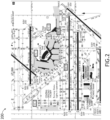
- FIG. 2 shows an airport diagram flight chart 200. Finding specific taxiways or runways for larger airports may be difficult due to the large number of chart elements, which may lead to taxiway collisions (since pilots may choose the wrong runway), and reduced turn-around times for flights (since navigation of taxiways may take longer than expected).
- Embodiments of the present disclosure are directed to a system for flight chart element searching.
- a method of flight chart element searching is also disclosed.
- the present system and method entail processing flight chart PDF files into a loadable mediaset to enable searching and highlighting of of runways, taxiways, airways, and other flight chart elements.
- the present system and method may employ the Electronic Charts Application Tool Suite (ECATS) developed by Collins Aerospace (Cedar Rapids, IA).
- ECATS Electronic Charts Application Tool Suite
- the present system converts PDF flight chart files into scalable vector graphics (SVG) flight chart files, detects flight chart elements (i.e., symbols) such as runways, taxiways, airways, and other elements, and outputs the flight charts into a loadable mediaset (e.g., flight chart database).
- a pilot of an aircraft may then search the flight charts for a specific flight chart element by inputting a name of the flight chart element into a search bar, and the flight chart element may then be highlighted on the displayed flight chart.
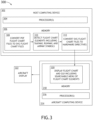
- FIG. 3 is a block diagram illustrating a system 300 flight chart element searching, in accordance with one or more embodiments of the present disclosure.
- the system includes a host computing device 302, an aircraft computing device 314, and an aircraft display 322.
- the host computing device 302 and the aircraft computing device 314 may be controllers (e.g., computers), each respectively including one or more processors 304, 316 and a memory 306, 318.
- processors e.g., computers
- the term "processor” or “processing element” may be broadly defined to encompass any device having one or more processing or logic elements, for example, one or more central processing units (CPUs), one or more graphics processing units (GPUs), one or more micro-processor devices, one or more application specific integrated circuit (ASIC) devices, one or more field programmable gate arrays (FPGAs), or one or more digital signal processors (DSPs), etc.
- CPUs central processing units
- GPUs graphics processing units
- ASIC application specific integrated circuit
- FPGAs field programmable gate arrays
- DSPs digital signal processors
- the one or more processors 304, 316 may include any device configured to execute algorithms and/or instructions (e.g., program instructions or modules stored in memory), and may be configured to perform the method steps described in the present disclosure.
- the processors 304 may execute the modules 308, 310, and 312, and the processors 316 may be configured to execute the module 320.
- the memories 306, 318 may include any storage medium known in the art suitable for storing program instructions executable by the associated processors 304, 316.
- the memories 306, 318 may include, but are not limited to, a read-only memory (ROM), a random-access memory (RAM), a magnetic or optical memory device (e.g., hard disk), a magnetic tape, a solid-state drive, and the like.
- ROM read-only memory
- RAM random-access memory
- magnetic or optical memory device e.g., hard disk
- magnetic tape e.g., a magnetic tape
- solid-state drive e.g., solid-state drive, and the like.
- the host computing device 302 may be, for example, a personal computer (PC), a laptop, a smartphone, a tablet, a server, a mainframe, etc. In some embodiments, the host computing device 302 may operate using a Microsoft ® Windows ® operating system, an Apple ® macOS ® operating system, a Linux-based operating system, etc. In some embodiments, the host computing device 302 may comprise a plurality of computing devices (e.g., a cloud-based system). It is noted that the host computing device 302 may be a ground-based computing device (e.g., not a part of an aircraft).
- the aircraft computing device(s) 314 may comprise one or more avionics embedded systems (e.g., an avionics suite), and may include a flight management system (FMS) computing device, a communications computing device, a navigation computing device, a flight display computing device, a flight control computing device, a fuel management computing device, a collision-avoidance computing device, a weather computing device, etc.
- the aircraft display 322 may be an LCD or CRT monitor, for example, a primary flight display (PFD), or a multifunction display (MFD), and may be configured to present a flight chart (e.g., defined in aircraft display hardware directives) to a user of an aircraft.
- a flight chart e.g., defined in aircraft display hardware directives
- One or more PDF flight chart files may be stored on the memory 306 of the host computing device 302.
- the module 308 may be configured to convert the PDF flight chart file(s) to one or more SVG flight chart files defined in extensible markup language (XML).
- the SVG flight chart file(s) may be images representing terminal flight charts, en-route flight charts, nautical charts, world aeronautical charts, sectional charts, etc.
- the images may show topographical features such as terrain elevations, ground features identifiable from altitude (rivers, dams, bridges, buildings, airports, beacons, landmarks, etc.), and information related to airspace classes, ground-based navigation aids, radio frequencies, longitude and latitude, navigation waypoints, navigation routes, etc.
- the SVG flight chart file(s) may be associated with metadata such as flight chart name (e.g., "Omaha Eppley Airfield"), flight chart type (e.g., terminal, en-route, world aeronautical, etc.), flight chart location, etc.
- flight chart name e.g., "Omaha Eppley Airfield”
- flight chart type e.g., terminal, en-route, world aeronautical, etc.
- flight chart location e.g., etc.
- the modules (e.g., program instructions) 310 and 312 stored on the memory 306 may process the SVG flight chart file(s).
- the modules 310 and 312 may be submodules of a flight chart processing module.
- the flight chart processing module may be substantially similar or substantially identical to the Electronic Charts Application Tool Suite developed by Collins Aerospace (Cedar Rapids, IA), and may be configured to convert the PDF flight chart file(s) to the SVG flight chart file(s), process and simplify the SVG flight chart file(s), convert the SVG flight chart(s) file to one or more flight charts defined in aircraft display hardware directives, compress the flight chart(s), and combine the flight chart(s) into a flight chart database.
- the module 310 may be configured to detect one or more flight chart elements in each of the SVG flight chart file(s).
- Each of the flight chart element(s) may comprise an element type such as an airway symbol, a runway symbol, a taxiway symbol, an obstacle symbol etc.
- the airway symbol may represent an air route or navigational path in the flight chart image.
- the runway symbol may represent a runway (for take-off and landing of an aircraft) in the flight chart image.
- the taxiway symbol may represent a taxiway (for taxiing the aircraft between a runway and a terminal) in the flight chart image.
- the module 310 may be an image recognition module (e.g., comprising one or more image recognition algorithms) configured to recognize patterns in the flight chart image.
- the SVG flight chart file(s) may comprise a plurality of SVG paths 400 (XML mark-up instructions that draw the lines, curves, and flight chart elements).
- Each SVG path 400 may include a set of coordinates (horizontal X coordinates and vertical Y coordinates) corresponding to the location of the respective flight chart element in the flight chart.
- the module 310 may detect (i.e., identify) specific flight chart elements based on the information encoded in the SVG paths 400 (by detecting patterns).
- a flight chart element 500 representing a font character 502 may be recognized by parsing the respective SVG path 400 using the following criteria: (1) the number of vertices 508, 516 (2) the sequence of angles 510, 512, and 514 at each vertex, (3) the sum of a sequence of angles 510, 512, 514, (4) the detection of a shape 518 inside the flight chart element 500, and (5) the ratio of width 504 to height 506.
- the module 310 may detect a sequence of font characters inside a rectangular box that overlaps a line. In this way, a variety of flight chart elements may be detected (e.g., landmarks, obstacles, airways, runways, taxiways, etc.).
- the module 312 may be configured convert the SVG flight chart file(s) to one or more flight charts defined in one or more sets of aircraft display hardware directives.
- Each of the aircraft display hardware directives may have a 32 bit form with 8 bits allocated to an opcode (e.g., that specifies a graphic operation to be performed, such as DRAW, MOVE, SETCOLOR) and 24 bits allocated to pixel data and pixel address (e.g., color of pixel(s), location of pixel(s), etc.).
- the aircraft display hardware directives may be quickly and easily drawn on the aircraft display 322 (after being loaded onto the aircraft computing device 314).
- the aircraft display hardware directives may decrease loading times and preserve processing and memory resources of the aircraft computing device 314 (since PDF or SVG flight chart files are too large to store on the memory 318 of the aircraft computing device 314, and may require long loading times to display on the aircraft display 322).
- the module 312 may be configured to combine the flight chart(s), the metadata, and flight chart element data into a flight chart database.
- Each of the detected flight chart elements may be associated with respective flight chart element data.
- the flight chart element data may include: (1) a flight chart element name associated with the respective flight chart element; (2) the element type of the respective flight chart element; (3) an x coordinate of the respective flight chart element; and (4) a y coordinate of the respective flight chart element.
- the element type may be, for example, an airway symbol, a runway symbol, a taxiway symbol, an obstacle symbol, etc.
- the flight chart database (including the metadata and flight chart element data) is then loaded onto the memory 318 of the aircraft computing device(s) 314.
- a list of flight charts may populate the aircraft display 322, and a user of the aircraft may then highlight and select a flight chart to present on the aircraft display 116.
- the flight chart database 110 may be searchable using the respective associated metadata 102 of the flight chart.
- the user of the aircraft may search for the name of the flight chart or the name of a geographical location corresponding to the flight chart (for example, "Chicago Airport").
- the module 320 may be configured to display one of the flight chart(s) selected by the user (using the aircraft display 322). Additionally, a graphical user interface (GUI) may be displayed using the aircraft display 322. The GUI may include a menu configured to present flight chart element names respectively associated with each of the flight chart element(s).
- GUI graphical user interface
- FIG. 7 shows a flight chart 710 and a GUI 715 (both displayed on the aircraft display 322).
- the GUI 715 may include a menu displaying a plurality of flight chart element names 720.
- the user may search for a specific flight chart element 735 (e.g., an airway symbol named "J70") using a search bar 723.
- the user may interface with the search bar 723 using an input device such as a keyboard, touchscreen, a microphone configured to receive a voice input (e.g., to transcribe the voice input into text), etc.
- the module 320 may highlight the associated flight chart element 735 on the flight chart 710 (using the aircraft display 322).
- the highlighting may be a color gradient 730 (i.e., a glow effect) applied around the flight chart element 735.
- the color gradient 730 may gradually transition from transparent to a solid color (e.g., red, blue, yellow, green, orange, etc.).
- a first color gradient e.g., red
- a second color gradient e.g., blue
- flight chart elements that comprise obstacle symbols may be highlighted (e.g., when they are dangerously close to the aircraft).
- a flight chart 810 may include a plurality of obstacle symbols 820 and 830.
- the obstacle symbol 830 may be highlighted using a color gradient (e.g., red).
- FIG. 9 is a table showing flight chart element data 900, in accordance with one or more embodiments of the present disclosure.
- the flight chart element data 900 may be extracted from the flight chart database.
- the columns may include a field name 910, a field data type 920 (e.g., string, integer, enumerated type), and a field size (e.g., 32 bits, 55 bits, etc.).
- a field name 910 e.g., string, integer, enumerated type
- a field size e.g., 32 bits, 55 bits, etc.
- the flight chart element data 900 may include a flight chart element type 940 (e.g., airway symbol, runway symbol, taxiway symbol, obstacle symbol, etc.), flight chart name 950 (e.g., the name of the flight chart that the flight chart element is found), flight chart element name 960 (e.g., searchable by the user using the search bar 723), flight chart element opcode name 970 (the aircraft display hardware directive used to update the flight chart element color and style for highlighting purposes), an X coordinate 980 (horizontal coordinate in the flight chart), and Y coordinate 990 (vertical coordinate in the flight chart).
- a flight chart element type 940 e.g., airway symbol, runway symbol, taxiway symbol, obstacle symbol, etc.
- flight chart name 950 e.g., the name of the flight chart that the flight chart element is found
- flight chart element name 960 e.g., searchable by the user using the search bar 723
- flight chart element opcode name 970 the aircraft display hardware directive used to update the
- FIG. 10 is a flowchart illustrating a method 1000 for flight chart element searching, in accordance with one or more embodiments of the present disclosure.
- the method 1000 may be implemented by the system 300 as described with respect to FIG. 3 .
- Steps 1010, 1020, 1030, and 1040 may be performed using a host computing device (e.g., host computing device 302 described with respect to FIG. 3 ), and steps 1050 and 1060 may be performed using an aircraft computing device (e.g., aircraft computing device 314 described with respect to FIG. 3 ).
- a host computing device e.g., host computing device 302 described with respect to FIG. 3
- steps 1050 and 1060 may be performed using an aircraft computing device (e.g., aircraft computing device 314 described with respect to FIG. 3 ).
- one or more PDF flight chart files may be converted to one or more SVG flight chart files defined in XML.
- Each of the SVG flight chart file(s) may be associated with respective metadata defined in XML (e.g., flight chart name, flight chart type, etc.).
- one or more flight chart elements may be detected in each of the SVG flight chart file(s).
- Each of the flight chart element(s) may comprise an element type (e.g., an airway symbol, a runway symbol, a taxiway symbol, etc.).
- the SVG flight chart file(s) may be converted to one or more flight charts defined in one or more sets of aircraft display hardware directives. Each of the flight chart(s) is associated with the respective metadata.
- the flight chart(s), the respective metadata, and flight chart element data of the detected flight chart element(s) may be combined into a flight chart database.
- the flight chart element data may include: a flight chart element name, a flight chart element type, a flight chart element x coordinate, and a flight chart element y coordinate.
- a flight chart and a graphical user interface may be displayed using an aircraft display.
- the aircraft display is configured to display the flight chart using a set of aircraft display hardware directives.
- the GUI includes a menu configured to present one or more flight chart element names associated with the flight chart element(s).
- the flight chart element name(s) are configured to be searchable by a user of an aircraft using a search bar.
- the associated flight chart element may be highlighted in the flight chart using the aircraft display.
Landscapes
- Engineering & Computer Science (AREA)
- Theoretical Computer Science (AREA)
- Physics & Mathematics (AREA)
- General Physics & Mathematics (AREA)
- General Engineering & Computer Science (AREA)
- Remote Sensing (AREA)
- Databases & Information Systems (AREA)
- Radar, Positioning & Navigation (AREA)
- Aviation & Aerospace Engineering (AREA)
- Data Mining & Analysis (AREA)
- Human Computer Interaction (AREA)
- Health & Medical Sciences (AREA)
- Artificial Intelligence (AREA)
- Audiology, Speech & Language Pathology (AREA)
- Computational Linguistics (AREA)
- General Health & Medical Sciences (AREA)
- Automation & Control Theory (AREA)
- Traffic Control Systems (AREA)
Abstract
Description
- Digital flight charts (i.e., aeronautical charts) are usually provided by third-party vendors in a format such as PDF and must be converted to an appropriate graphical format for use in flight displays. Flight charts can be cluttered with many chart elements, and thus a pilot may have difficulty deciphering the flight charts.
- A system for flight chart element searching is disclosed in accordance with one or more illustrative embodiments of the present disclosure. In one illustrative embodiment, the system comprises: a host computing device including one or more processers configured to execute program instructions causing the one or more processors to: convert one or more portable document format (PDF) flight chart files to one or more scalable vector graphics (SVG) flight chart files defined in extensible markup language (XML), wherein each of the SVG flight chart file(s) is associated with respective metadata defined in XML; detect one or more flight chart elements in each of the SVG flight chart file(s), wherein each of the flight chart element(s) comprises an element type of a plurality of element types, the plurality of element types comprising at least: an airway symbol, a runway symbol, or a taxiway symbol; convert the SVG flight chart file(s) to one or more flight charts defined in one or more sets of aircraft display hardware directives, wherein each of the flight chart(s) is associated with the respective metadata; and combine the flight chart(s), the respective metadata, and flight chart element data of the detected flight chart element(s) into a flight chart database, wherein the flight chart element data includes at least: a flight chart element name associated with one of the flight chart element(s) of one of the flight chart(s); the element type of the one of the flight chart element(s); an x coordinate of the one of the flight chart element(s); and a y coordinate of the one of the flight chart element(s).
- A method for flight chart element searching is disclosed in accordance with one or more illustrative embodiments of the present disclosure. In one illustrative embodiment, the method comprises: using a host computing device, converting one or more portable document format (PDF) flight chart files to one or more scalable vector graphics (SVG) flight chart files defined in extensible markup language (XML), wherein each of the SVG flight chart file(s) is associated with respective metadata defined in XML; detecting one or more flight chart elements in each of the SVG flight chart file(s), wherein each of the flight chart element(s) comprises an element type of a plurality of element types, the plurality of element types comprising at least: an airway symbol, a runway symbol, or a taxiway symbol; converting the SVG flight chart file(s) to one or more flight charts defined in one or more sets of aircraft display hardware directives, wherein each of the flight chart(s) is associated with the respective metadata; and combining the flight chart(s), the respective metadata, and flight chart element data of the detected flight chart element(s) into a flight chart database, wherein the flight chart element data includes at least: a flight chart element name associated with one of the flight chart element(s) of one of the flight chart(s); the element type of the one of the flight chart element(s); an x coordinate of the one of the flight chart element(s); and a y coordinate of the one of the flight chart element(s).
- It is to be understood that both the foregoing general description and the following detailed description are exemplary and explanatory only and are not necessarily restrictive of the invention as claimed. The accompanying drawings, which are incorporated in and constitute a part of the specification, illustrate embodiments of the invention and together with the general description, serve to explain the principles of the invention.
- The numerous advantages of the disclosure may be better understood by those skilled in the art by reference to the accompanying figures in which:
- FIG. 1
- is a conceptual image illustrating an en-route flight chart.
- FIG. 2
- is a conceptual image illustrating an airport diagram flight chart.
- FIG.
- 3 is a block diagram of a system for flight chart element searching, in accordance with one or more embodiments of the present disclosure.
- FIG. 4
- is a conceptual image illustrating an SVG path defined in XML, in accordance with one or more embodiments of the present disclosure.
- FIG. 5
- is a conceptual image illustrating the image recognition of a font character, in accordance with one or more embodiments of the present disclosure.
- FIG. 6
- is a conceptual image illustrating the detection of an airway symbol, in accordance with one or more embodiments of the present disclosure.
- FIG. 7
- is a conceptual image illustrating a flight chart with a highlighted airway symbol, in accordance with one or more embodiments of the present disclosure.
- FIG. 8
- is a conceptual image illustrating a flight chart with highlighted obstacle symbols, in accordance with one or more embodiments of the present disclosure.
- FIG. 9
- is a table illustrating flight chart element data, in accordance with one or more embodiments of the present disclosure.
- FIG. 10
- is a flowchart illustrating a method for flight chart element searching, in accordance with one or more embodiments of the present disclosure.
- Before explaining at least one embodiment of the inventive concepts disclosed herein in detail, it is to be understood that the inventive concepts are not limited in their application to the details of construction and the arrangement of the components or steps or methodologies set forth in the following description or illustrated in the drawings. In the following detailed description of embodiments of the present disclosure, numerous specific details are set forth in order to provide a more thorough understanding of the inventive concepts. However, it will be apparent to one of ordinary skill in the art having the benefit of the present disclosure that the inventive concepts disclosed herein may be practiced without these specific details. In other instances, well-known features may not be described in detail to avoid unnecessarily complicating the present disclosure. The inventive concepts disclosed herein are capable of other embodiments or of being practiced or carried out in various ways. Also, it is to be understood that the phraseology and terminology employed herein is for the purpose of description and should not be regarded as limiting.
- As used herein a letter following a reference numeral is intended to reference an embodiment of the feature or element that may be similar, but not necessarily identical, to a previously described element or feature bearing the same reference numeral (e.g., 1, 1a, 1b). Such shorthand notations are used for purposes of convenience only, and should not be construed to limit the inventive concepts disclosed herein in any way unless expressly stated to the contrary. Further, unless expressly stated to the contrary, "or" refers to an inclusive or and not to an exclusive or. For example, a condition A or B is satisfied by any one of the following: A is true (or present) and B is false (or not present), A is false (or not present) and B is true (or present), and both A and B are true (or present). In addition, use of the "a" or "an" are employed to describe elements and components of embodiments of the present inventive concepts. This is done merely for convenience and to give a general sense of the inventive concepts, and "a" and "an" are intended to include one or at least one and the singular also includes the plural unless it is obvious that it is meant otherwise.
- Finally, as used herein any reference to "one embodiment" or "some embodiments" means that a particular element, feature, structure, or characteristic described in connection with the embodiment is included in at least one embodiment of the inventive concepts disclosed herein. The appearances of the phrase "in some embodiments" in various places in the specification are not necessarily all referring to the same embodiment, and embodiments of the inventive concepts disclosed may include one or more of the features expressly described or inherently present herein, or any combination or sub-combination of two or more such features, along with any other features which may not necessarily be expressly described or inherently present in the present disclosure.
- Aeronautical charts (flight charts) are used by pilots to navigate aircraft during departing and landing phases (e.g., using airport diagrams and terminal flight charts) and during en-route phases (e.g., using en-route flight charts). Using flight charts and other tools, pilots are able to determine position of the aircraft, safe altitudes for the aircraft, best route to a destination, navigation aids, alternative landing areas in case of an in-flight emergency, and other useful information such as radio frequencies and airspace boundaries. Specific charts are used for each phase of a flight and may vary from a map of a particular airport facility to an overview of the instrument routes covering an entire continent (e.g., global navigation charts).
- Some flight charts are large and cluttered with information, making them difficult to decipher for a pilot and thus may impede safe and timely navigation. For example, it may be difficult to find specific elements on a chart such as taxiways, runways, and especially airways (e.g., navigational paths).
FIG. 1 shows a conventional en-route flight chart 100 that is 60 inches wide and 20 inches tall. Due to the size of the chart and the large number of airways, tracking a specific airway may be difficult for a pilot. This difficulty reduces the usability of en-route charts and makes operating a flight display cumbersome. Similarly,FIG. 2 shows an airportdiagram flight chart 200. Finding specific taxiways or runways for larger airports may be difficult due to the large number of chart elements, which may lead to taxiway collisions (since pilots may choose the wrong runway), and reduced turn-around times for flights (since navigation of taxiways may take longer than expected). - The above problems persist since flight charts are conventionally distributed as portable data format (PDF) files by vendors such as the National Geospatial-Intelligence Agency (NGA). The data in the PDF files are not accessible in a way such that pilots can easily find runways, taxiways, and airways. Thus, to solve the problems described above, it is desirable to provide flight charts that are easier to search and read.
- Embodiments of the present disclosure are directed to a system for flight chart element searching. A method of flight chart element searching is also disclosed. The present system and method entail processing flight chart PDF files into a loadable mediaset to enable searching and highlighting of of runways, taxiways, airways, and other flight chart elements. The present system and method may employ the Electronic Charts Application Tool Suite (ECATS) developed by Collins Aerospace (Cedar Rapids, IA). The present system converts PDF flight chart files into scalable vector graphics (SVG) flight chart files, detects flight chart elements (i.e., symbols) such as runways, taxiways, airways, and other elements, and outputs the flight charts into a loadable mediaset (e.g., flight chart database). A pilot of an aircraft may then search the flight charts for a specific flight chart element by inputting a name of the flight chart element into a search bar, and the flight chart element may then be highlighted on the displayed flight chart.
-
FIG. 3 is a block diagram illustrating asystem 300 flight chart element searching, in accordance with one or more embodiments of the present disclosure. The system includes ahost computing device 302, anaircraft computing device 314, and anaircraft display 322. - The
host computing device 302 and theaircraft computing device 314 may be controllers (e.g., computers), each respectively including one ormore processors memory more processors processors 304 may execute themodules processors 316 may be configured to execute themodule 320. Thememories processors memories - The
host computing device 302 may be, for example, a personal computer (PC), a laptop, a smartphone, a tablet, a server, a mainframe, etc. In some embodiments, thehost computing device 302 may operate using a Microsoft® Windows® operating system, an Apple® macOS® operating system, a Linux-based operating system, etc. In some embodiments, thehost computing device 302 may comprise a plurality of computing devices (e.g., a cloud-based system). It is noted that thehost computing device 302 may be a ground-based computing device (e.g., not a part of an aircraft). The aircraft computing device(s) 314 may comprise one or more avionics embedded systems (e.g., an avionics suite), and may include a flight management system (FMS) computing device, a communications computing device, a navigation computing device, a flight display computing device, a flight control computing device, a fuel management computing device, a collision-avoidance computing device, a weather computing device, etc. Theaircraft display 322 may be an LCD or CRT monitor, for example, a primary flight display (PFD), or a multifunction display (MFD), and may be configured to present a flight chart (e.g., defined in aircraft display hardware directives) to a user of an aircraft. - One or more PDF flight chart files may be stored on the
memory 306 of thehost computing device 302. Themodule 308 may be configured to convert the PDF flight chart file(s) to one or more SVG flight chart files defined in extensible markup language (XML). The SVG flight chart file(s) may be images representing terminal flight charts, en-route flight charts, nautical charts, world aeronautical charts, sectional charts, etc. The images may show topographical features such as terrain elevations, ground features identifiable from altitude (rivers, dams, bridges, buildings, airports, beacons, landmarks, etc.), and information related to airspace classes, ground-based navigation aids, radio frequencies, longitude and latitude, navigation waypoints, navigation routes, etc. The SVG flight chart file(s) may be associated with metadata such as flight chart name (e.g., "Omaha Eppley Airfield"), flight chart type (e.g., terminal, en-route, world aeronautical, etc.), flight chart location, etc. - The modules (e.g., program instructions) 310 and 312 stored on the
memory 306 may process the SVG flight chart file(s). Themodules - The
module 310 may be configured to detect one or more flight chart elements in each of the SVG flight chart file(s). Each of the flight chart element(s) may comprise an element type such as an airway symbol, a runway symbol, a taxiway symbol, an obstacle symbol etc. The airway symbol may represent an air route or navigational path in the flight chart image. The runway symbol may represent a runway (for take-off and landing of an aircraft) in the flight chart image. The taxiway symbol may represent a taxiway (for taxiing the aircraft between a runway and a terminal) in the flight chart image. Themodule 310 may be an image recognition module (e.g., comprising one or more image recognition algorithms) configured to recognize patterns in the flight chart image. - As shown in
FIG. 4 , the SVG flight chart file(s) may comprise a plurality of SVG paths 400 (XML mark-up instructions that draw the lines, curves, and flight chart elements). EachSVG path 400 may include a set of coordinates (horizontal X coordinates and vertical Y coordinates) corresponding to the location of the respective flight chart element in the flight chart. Themodule 310 may detect (i.e., identify) specific flight chart elements based on the information encoded in the SVG paths 400 (by detecting patterns). - For example, as shown in
FIG. 5 , aflight chart element 500 representing a font character 502 (e.g., the letter "A") may be recognized by parsing therespective SVG path 400 using the following criteria: (1) the number ofvertices 508, 516 (2) the sequence ofangles angles shape 518 inside theflight chart element 500, and (5) the ratio ofwidth 504 toheight 506. In another example, to detect anairway symbol 600 as shown inFIG. 6 , themodule 310 may detect a sequence of font characters inside a rectangular box that overlaps a line. In this way, a variety of flight chart elements may be detected (e.g., landmarks, obstacles, airways, runways, taxiways, etc.). - Referring back to
FIG. 3 , themodule 312 may be configured convert the SVG flight chart file(s) to one or more flight charts defined in one or more sets of aircraft display hardware directives. Each of the aircraft display hardware directives may have a 32 bit form with 8 bits allocated to an opcode (e.g., that specifies a graphic operation to be performed, such as DRAW, MOVE, SETCOLOR) and 24 bits allocated to pixel data and pixel address (e.g., color of pixel(s), location of pixel(s), etc.). The aircraft display hardware directives may be quickly and easily drawn on the aircraft display 322 (after being loaded onto the aircraft computing device 314). The aircraft display hardware directives may decrease loading times and preserve processing and memory resources of the aircraft computing device 314 (since PDF or SVG flight chart files are too large to store on thememory 318 of theaircraft computing device 314, and may require long loading times to display on the aircraft display 322). - Subsequently, the
module 312 may be configured to combine the flight chart(s), the metadata, and flight chart element data into a flight chart database. Each of the detected flight chart elements may be associated with respective flight chart element data. The flight chart element data may include: (1) a flight chart element name associated with the respective flight chart element; (2) the element type of the respective flight chart element; (3) an x coordinate of the respective flight chart element; and (4) a y coordinate of the respective flight chart element. The element type may be, for example, an airway symbol, a runway symbol, a taxiway symbol, an obstacle symbol, etc. - The flight chart database (including the metadata and flight chart element data) is then loaded onto the
memory 318 of the aircraft computing device(s) 314. A list of flight charts may populate theaircraft display 322, and a user of the aircraft may then highlight and select a flight chart to present on the aircraft display 116. - The flight chart database 110 may be searchable using the respective associated metadata 102 of the flight chart. For example, the user of the aircraft may search for the name of the flight chart or the name of a geographical location corresponding to the flight chart (for example, "Chicago Airport").
- The
module 320 may be configured to display one of the flight chart(s) selected by the user (using the aircraft display 322). Additionally, a graphical user interface (GUI) may be displayed using theaircraft display 322. The GUI may include a menu configured to present flight chart element names respectively associated with each of the flight chart element(s). - For example,
FIG. 7 shows aflight chart 710 and a GUI 715 (both displayed on the aircraft display 322). TheGUI 715 may include a menu displaying a plurality of flight chart element names 720. The user may search for a specific flight chart element 735 (e.g., an airway symbol named "J70") using asearch bar 723. The user may interface with thesearch bar 723 using an input device such as a keyboard, touchscreen, a microphone configured to receive a voice input (e.g., to transcribe the voice input into text), etc. - In response to the user searching for a flight chart element name 725 (e.g., "J70") and selecting the flight
chart element name 725, themodule 320 may highlight the associatedflight chart element 735 on the flight chart 710 (using the aircraft display 322). The highlighting may be a color gradient 730 (i.e., a glow effect) applied around theflight chart element 735. For example, thecolor gradient 730 may gradually transition from transparent to a solid color (e.g., red, blue, yellow, green, orange, etc.). In some embodiments, a first color gradient (e.g., red) may be applied to the highlightedflight chart element 735, and a second color gradient (e.g., blue) may be applied to other flight chart elements that are not selected. - In some embodiments, flight chart elements that comprise obstacle symbols (e.g., warning of dangerous structures or terrain such as tall buildings or mountains) may be highlighted (e.g., when they are dangerously close to the aircraft). For example, as shown in
FIG. 8 , aflight chart 810 may include a plurality ofobstacle symbols aircraft symbol 840 being within a threshold distance (i.e., radius) to a geographical location of the obstacle represented by theobstacle symbol 830, theobstacle symbol 830 may be highlighted using a color gradient (e.g., red). -
FIG. 9 is a table showing flightchart element data 900, in accordance with one or more embodiments of the present disclosure. The flightchart element data 900 may be extracted from the flight chart database. The columns may include afield name 910, a field data type 920 (e.g., string, integer, enumerated type), and a field size (e.g., 32 bits, 55 bits, etc.). The flightchart element data 900 may include a flight chart element type 940 (e.g., airway symbol, runway symbol, taxiway symbol, obstacle symbol, etc.), flight chart name 950 (e.g., the name of the flight chart that the flight chart element is found), flight chart element name 960 (e.g., searchable by the user using the search bar 723), flight chart element opcode name 970 (the aircraft display hardware directive used to update the flight chart element color and style for highlighting purposes), an X coordinate 980 (horizontal coordinate in the flight chart), and Y coordinate 990 (vertical coordinate in the flight chart). -
FIG. 10 is a flowchart illustrating amethod 1000 for flight chart element searching, in accordance with one or more embodiments of the present disclosure. Themethod 1000 may be implemented by thesystem 300 as described with respect toFIG. 3 .Steps host computing device 302 described with respect toFIG. 3 ), andsteps aircraft computing device 314 described with respect toFIG. 3 ). - At
step 1010, one or more PDF flight chart files may be converted to one or more SVG flight chart files defined in XML. Each of the SVG flight chart file(s) may be associated with respective metadata defined in XML (e.g., flight chart name, flight chart type, etc.). - At
step 1020, one or more flight chart elements may be detected in each of the SVG flight chart file(s). Each of the flight chart element(s) may comprise an element type (e.g., an airway symbol, a runway symbol, a taxiway symbol, etc.). - At
step 1030, the SVG flight chart file(s) may be converted to one or more flight charts defined in one or more sets of aircraft display hardware directives. Each of the flight chart(s) is associated with the respective metadata. - At
step 1040, the flight chart(s), the respective metadata, and flight chart element data of the detected flight chart element(s) may be combined into a flight chart database. The flight chart element data may include: a flight chart element name, a flight chart element type, a flight chart element x coordinate, and a flight chart element y coordinate. - At
step 1050, a flight chart and a graphical user interface (GUI) may be displayed using an aircraft display. The aircraft display is configured to display the flight chart using a set of aircraft display hardware directives. The GUI includes a menu configured to present one or more flight chart element names associated with the flight chart element(s). The flight chart element name(s) are configured to be searchable by a user of an aircraft using a search bar. - At
step 1060, in response to the user searching for a flight chart element name and selecting the flight chart element name, the associated flight chart element may be highlighted in the flight chart using the aircraft display. - It is believed that the present disclosure and many of its attendant advantages will be understood by the foregoing description, and it will be apparent that various changes may be made in the form, construction and arrangement of the components without departing from the disclosed subject matter or without sacrificing all of its material advantages. The form described is merely explanatory, and it is the intention of the following claims to encompass and include such changes. Furthermore, it is to be understood that the invention is defined by the appended claims.
Claims (12)
- A system for flight chart element searching, comprising:
a host computing device (302) including one or more processers (304) configured to execute program instructions causing the one or more processors to:convert one or more portable document format, PDF, flight chart files to one or more scalable vector graphics, SVG, flight chart files defined in extensible markup language, XML,wherein each of the SVG flight chart file(s) is associated with respective metadata defined in XML;detect one or more flight chart elements in each of the SVG flight chart file(s), wherein each of the flight chart element(s) comprises an element type of a plurality of element types, the plurality of element types comprising at least:
an airway symbol, a runway symbol, or a taxiway symbol;convert the SVG flight chart file(s) to one or more flight charts defined in one or more sets of aircraft display hardware directives, wherein each of the flight chart(s) is associated with the respective metadata; andcombine the flight chart(s), the respective metadata, and flight chart element data of the detected flight chart element(s) into a flight chart database,wherein the flight chart element data includes at least:a flight chart element name associated with one of the flight chart element(s) of one of the flight chart(s);the element type of the one of the flight chart element(s);an x coordinate of the one of the flight chart element(s); anda y coordinate of the one of the flight chart element(s). - The system for flight chart element searching of claim 1, comprising:an aircraft display (322) configured to display the flight chart(s) using the one or more set(s) of aircraft display hardware directives; andan aircraft computing device (314) including one or more processers configured to execute program instructions causing the one or more processors to:display the one of the flight chart(s) and a graphical user interface, GUI, using the aircraft display,wherein the GUI includes a menu configured to present the flight chart element name associated with the one of the flight chart element(s),wherein the flight chart element name is configured to be searchable by a user of an aircraft using a search bar; andresponsive to the user searching for the flight chart element name and selecting the flight chart element name, highlighting the associated one of the flight chart element(s) in the flight chart using the aircraft display.
- The system for flight chart element searching of claim 2,wherein the plurality of element types further comprise an obstacle symbol,wherein one of the flight chart element(s) comprises the obstacle symbol,wherein the processor(s) of the aircraft computing device are further configured to execute program instructions causing the processor(s) to:
responsive to a geographical location of the aircraft being within a threshold distance to a geographical location corresponding to the obstacle symbol, highlight the obstacle symbol using the aircraft display. - The system for flight chart element searching of any preceding claim, wherein the PDF flight chart file(s) are images representing a terminal flight chart, an en-route flight chart, a nautical flight chart, a world aeronautical flight chart, a sectional flight chart, or an airport diagram flight chart.
- The system for flight chart element searching of any preceding claim, wherein the respective metadata includes at least one of:a flight chart name, anda flight chart type.
- The system for flight chart element searching of claim 5, wherein each of the flight chart(s) is indexed by the flight chart name and the flight chart type included in the respective metadata.
- A method for flight chart element searching, comprising:
using a host computing device (302),converting one or more portable document format, PDF, flight chart files to one or more scalable vector graphics, SVG, flight chart files defined in extensible markup language, XML,wherein each of the SVG flight chart file(s) is associated with respective metadata defined in XML;detecting one or more flight chart elements in each of the SVG flight chart file(s), wherein each of the flight chart element(s) comprises an element type of a plurality of element types, the plurality of element types comprising at least:
an airway symbol, a runway symbol, or a taxiway symbol;converting the SVG flight chart file(s) to one or more flight charts defined in one or more sets of aircraft display hardware directives, wherein each of the flight chart(s) is associated with the respective metadata; andcombining the flight chart(s), the respective metadata, and flight chart element data of the detected flight chart element(s) into a flight chart database,wherein the flight chart element data includes at least:a flight chart element name associated with one of the flight chart element(s) of one of the flight chart(s);the element type of the one of the flight chart element(s);an x coordinate of the one of the flight chart element(s); anda y coordinate of the one of the flight chart element(s). - The method for flight chart element searching of claim 7, comprising:
using an aircraft computing device,displaying the one of the flight chart(s) and a graphical user interface, GUI, using an aircraft display,wherein the aircraft display is configured to display the flight chart(s) using the one or more set(s) of aircraft display hardware directives,wherein the GUI includes a menu configured to present the flight chart element name associated with the one of the flight chart element(s),wherein the flight chart element name is configured to be searchable by a user of an aircraft using a search bar; andresponsive to the user searching for the flight chart element name and selecting the flight chart element name, highlighting the associated one of the flight chart element(s) in the flight chart using the aircraft display. - The method for flight chart element searching of claim 8,wherein the plurality of element types further comprise an obstacle symbol,wherein one of the flight chart element(s) comprises the obstacle symbol,responsive to a geographical location of the aircraft being within a threshold distance to a geographical location corresponding to the obstacle symbol, highlighting the obstacle symbol using the aircraft display.
- The method for flight chart element searching of claim 7, wherein the PDF flight chart file(s) are images representing a terminal flight chart, an en-route flight chart, a nautical flight chart, a world aeronautical flight chart, a sectional flight chart, or an airport diagram flight chart.
- The method for flight chart element searching of claim 7, wherein the respective metadata includes at least one of:a flight chart name, anda flight chart type.
- The method for flight chart element searching of claim 11, wherein each of the flight chart(s) is indexed by the flight chart name and the flight chart type included in the respective metadata.
Applications Claiming Priority (2)
| Application Number | Priority Date | Filing Date | Title |
|---|---|---|---|
| US202163278576P | 2021-11-12 | 2021-11-12 | |
| US17/525,690 US20230150687A1 (en) | 2021-11-12 | 2021-11-12 | Electronic chart application with enhanced element searching and highlighting using generic third-party data |
Publications (1)
| Publication Number | Publication Date |
|---|---|
| EP4180772A1 true EP4180772A1 (en) | 2023-05-17 |
Family
ID=84331775
Family Applications (1)
| Application Number | Title | Priority Date | Filing Date |
|---|---|---|---|
| EP22207124.3A Pending EP4180772A1 (en) | 2021-11-12 | 2022-11-14 | Electronic chart application with enhanced element searching and highlighting using generic third-party data |
Country Status (2)
| Country | Link |
|---|---|
| US (1) | US20230150687A1 (en) |
| EP (1) | EP4180772A1 (en) |
Citations (5)
| Publication number | Priority date | Publication date | Assignee | Title |
|---|---|---|---|---|
| EP1736894A1 (en) * | 2004-03-30 | 2006-12-27 | Victor Company Of Japan, Limited | Digitization service manual generation method and additional data generation method |
| US20080103641A1 (en) * | 2006-10-31 | 2008-05-01 | Honeywell International, Inc. | Methods and apparatus for overlaying non-georeferenced symbology on a georeferenced chart |
| EP2224359A2 (en) * | 2009-02-27 | 2010-09-01 | Canon Kabushiki Kaisha | Image processing apparatus, image processing method, and computer program |
| WO2011036499A1 (en) * | 2009-09-28 | 2011-03-31 | Nats (Services) Limited | Aeronautical information processing |
| EP3845862A1 (en) * | 2020-01-06 | 2021-07-07 | Rockwell Collins, Inc. | Interactive charts system and method |
Family Cites Families (2)
| Publication number | Priority date | Publication date | Assignee | Title |
|---|---|---|---|---|
| CN114641753B (en) * | 2019-11-18 | 2025-01-14 | 欧特克公司 | Synthetic data generation and building information model (BIM) feature extraction from floor plan drawings using machine learning |
| US11994406B2 (en) * | 2020-09-11 | 2024-05-28 | The Government Of The United States Of America, As Represented By The Secretary Of The Navy | Group-based technique for dynamic label placement |
-
2021
- 2021-11-12 US US17/525,690 patent/US20230150687A1/en not_active Abandoned
-
2022
- 2022-11-14 EP EP22207124.3A patent/EP4180772A1/en active Pending
Patent Citations (5)
| Publication number | Priority date | Publication date | Assignee | Title |
|---|---|---|---|---|
| EP1736894A1 (en) * | 2004-03-30 | 2006-12-27 | Victor Company Of Japan, Limited | Digitization service manual generation method and additional data generation method |
| US20080103641A1 (en) * | 2006-10-31 | 2008-05-01 | Honeywell International, Inc. | Methods and apparatus for overlaying non-georeferenced symbology on a georeferenced chart |
| EP2224359A2 (en) * | 2009-02-27 | 2010-09-01 | Canon Kabushiki Kaisha | Image processing apparatus, image processing method, and computer program |
| WO2011036499A1 (en) * | 2009-09-28 | 2011-03-31 | Nats (Services) Limited | Aeronautical information processing |
| EP3845862A1 (en) * | 2020-01-06 | 2021-07-07 | Rockwell Collins, Inc. | Interactive charts system and method |
Non-Patent Citations (1)
| Title |
|---|
| OUBET S ED - INSTITUTE OF ELECTRICAL AND ELECTRONICS ENGINEERS: "Aeronautical charts for electronic flight bags", 22ND. DASC. THE 22ND. DIGITAL AVIONICS SYSTEMS CONFERENCE PROCEEDINGS. INDIANAPOLIS, IN, OCT. 12 - 16, 2003; [DIGITAL AVIONICS SYSTEMS CONFERENCE], NEW YORK, NY : IEEE, US, vol. 2, 12 October 2003 (2003-10-12), pages 13_D_1_1 - 13_D_1_9, XP010669024, ISBN: 978-0-7803-7844-5 * |
Also Published As
| Publication number | Publication date |
|---|---|
| US20230150687A1 (en) | 2023-05-18 |
Similar Documents
| Publication | Publication Date | Title |
|---|---|---|
| EP4181400B1 (en) | Tool to facilitate customer generated chart databases for use with a certified avionics system | |
| CN104859862B (en) | For arranging the system and method centered on pilot of aircraft displays | |
| US10861341B2 (en) | Method and system for prompting aircraft task reminders | |
| US10296179B2 (en) | System and method for producing and submitting a PIREP | |
| US6571155B2 (en) | Assembly, computer program product and method for displaying navigation performance based flight path deviation information | |
| CN105810019B (en) | Aircraft systems and methods with enhanced NOTAM | |
| US9709420B2 (en) | Reconfiguration of the display of a flight plan for the piloting of an aircraft | |
| CN108630019B (en) | System and method for rendering aircraft cockpit displays for use by ATC conditional approval instructions | |
| CN102682194A (en) | Temporally based weather symbology | |
| JP2010182292A (en) | Flight plan intent alert system and method | |
| US20080103641A1 (en) | Methods and apparatus for overlaying non-georeferenced symbology on a georeferenced chart | |
| US9340282B2 (en) | System and method for displaying vertical reference on a rotorcraft system | |
| US10606948B2 (en) | Predictive user interface for vehicle control system | |
| US10706726B2 (en) | Multiple flight data reference for a specific selection on a vertical and lateral display | |
| US12386486B2 (en) | Systems and methods for an actionable cockpit of an aircraft | |
| EP3696512B1 (en) | Correlative display system with decluttered displays for aircraft | |
| US20230026834A1 (en) | Systems and methods for correlating a notice to airmen (notam) with a chart on an avionic display in a cockpit of an aircraft | |
| EP4180772A1 (en) | Electronic chart application with enhanced element searching and highlighting using generic third-party data | |
| US11408751B2 (en) | Systems and methods for calibrating a sensor position on an aircraft | |
| EP3951322A1 (en) | Systems and methods for calibrating a sensor position on an aircraft | |
| US20250264978A1 (en) | Flight deck system with improved chart display | |
| Swaid et al. | A Methodology for Efficient Statistical Analysis of Air Distance in Aviation | |
| US20240308692A1 (en) | Service issue forecasting that adapts to aircraft operations | |
| EP4432177A1 (en) | Service issue forecasting that adapts to aircraft operations | |
| EP4092611A1 (en) | System and method for on-demand enabling of display features for an avionic display |
Legal Events
| Date | Code | Title | Description |
|---|---|---|---|
| PUAI | Public reference made under article 153(3) epc to a published international application that has entered the european phase |
Free format text: ORIGINAL CODE: 0009012 |
|
| STAA | Information on the status of an ep patent application or granted ep patent |
Free format text: STATUS: THE APPLICATION HAS BEEN PUBLISHED |
|
| AK | Designated contracting states |
Kind code of ref document: A1 Designated state(s): AL AT BE BG CH CY CZ DE DK EE ES FI FR GB GR HR HU IE IS IT LI LT LU LV MC ME MK MT NL NO PL PT RO RS SE SI SK SM TR |
|
| STAA | Information on the status of an ep patent application or granted ep patent |
Free format text: STATUS: REQUEST FOR EXAMINATION WAS MADE |
|
| 17P | Request for examination filed |
Effective date: 20231117 |
|
| RBV | Designated contracting states (corrected) |
Designated state(s): AL AT BE BG CH CY CZ DE DK EE ES FI FR GB GR HR HU IE IS IT LI LT LU LV MC ME MK MT NL NO PL PT RO RS SE SI SK SM TR |
|
| GRAP | Despatch of communication of intention to grant a patent |
Free format text: ORIGINAL CODE: EPIDOSNIGR1 |
|
| STAA | Information on the status of an ep patent application or granted ep patent |
Free format text: STATUS: GRANT OF PATENT IS INTENDED |
|
| RIC1 | Information provided on ipc code assigned before grant |
Ipc: G01C 23/00 20060101AFI20251125BHEP Ipc: G06V 30/14 20220101ALI20251125BHEP Ipc: G08G 5/00 20060101ALI20251125BHEP Ipc: G01C 21/00 20060101ALI20251125BHEP Ipc: G06F 16/11 20190101ALI20251125BHEP Ipc: G06V 30/00 20220101ALI20251125BHEP Ipc: G06F 16/54 20190101ALI20251125BHEP |
|
| INTG | Intention to grant announced |
Effective date: 20251217 |