EP4180702A1 - Industrial rechargeable wireless solenoid valve system - Google Patents
Industrial rechargeable wireless solenoid valve system Download PDFInfo
- Publication number
- EP4180702A1 EP4180702A1 EP21841746.7A EP21841746A EP4180702A1 EP 4180702 A1 EP4180702 A1 EP 4180702A1 EP 21841746 A EP21841746 A EP 21841746A EP 4180702 A1 EP4180702 A1 EP 4180702A1
- Authority
- EP
- European Patent Office
- Prior art keywords
- solenoid valve
- control unit
- unit
- factory
- industrial
- Prior art date
- Legal status (The legal status is an assumption and is not a legal conclusion. Google has not performed a legal analysis and makes no representation as to the accuracy of the status listed.)
- Pending
Links
Images





Classifications
-
- F—MECHANICAL ENGINEERING; LIGHTING; HEATING; WEAPONS; BLASTING
- F16—ENGINEERING ELEMENTS AND UNITS; GENERAL MEASURES FOR PRODUCING AND MAINTAINING EFFECTIVE FUNCTIONING OF MACHINES OR INSTALLATIONS; THERMAL INSULATION IN GENERAL
- F16K—VALVES; TAPS; COCKS; ACTUATING-FLOATS; DEVICES FOR VENTING OR AERATING
- F16K31/00—Actuating devices; Operating means; Releasing devices
- F16K31/02—Actuating devices; Operating means; Releasing devices electric; magnetic
- F16K31/06—Actuating devices; Operating means; Releasing devices electric; magnetic using a magnet, e.g. diaphragm valves, cutting off by means of a liquid
- F16K31/0675—Electromagnet aspects, e.g. electric supply therefor
-
- F—MECHANICAL ENGINEERING; LIGHTING; HEATING; WEAPONS; BLASTING
- F16—ENGINEERING ELEMENTS AND UNITS; GENERAL MEASURES FOR PRODUCING AND MAINTAINING EFFECTIVE FUNCTIONING OF MACHINES OR INSTALLATIONS; THERMAL INSULATION IN GENERAL
- F16K—VALVES; TAPS; COCKS; ACTUATING-FLOATS; DEVICES FOR VENTING OR AERATING
- F16K31/00—Actuating devices; Operating means; Releasing devices
- F16K31/02—Actuating devices; Operating means; Releasing devices electric; magnetic
- F16K31/06—Actuating devices; Operating means; Releasing devices electric; magnetic using a magnet, e.g. diaphragm valves, cutting off by means of a liquid
-
- G—PHYSICS
- G08—SIGNALLING
- G08C—TRANSMISSION SYSTEMS FOR MEASURED VALUES, CONTROL OR SIMILAR SIGNALS
- G08C17/00—Arrangements for transmitting signals characterised by the use of a wireless electrical link
- G08C17/02—Arrangements for transmitting signals characterised by the use of a wireless electrical link using a radio link
-
- F—MECHANICAL ENGINEERING; LIGHTING; HEATING; WEAPONS; BLASTING
- F15—FLUID-PRESSURE ACTUATORS; HYDRAULICS OR PNEUMATICS IN GENERAL
- F15B—SYSTEMS ACTING BY MEANS OF FLUIDS IN GENERAL; FLUID-PRESSURE ACTUATORS, e.g. SERVOMOTORS; DETAILS OF FLUID-PRESSURE SYSTEMS, NOT OTHERWISE PROVIDED FOR
- F15B13/00—Details of servomotor systems ; Valves for servomotor systems
- F15B13/02—Fluid distribution or supply devices characterised by their adaptation to the control of servomotors
- F15B13/04—Fluid distribution or supply devices characterised by their adaptation to the control of servomotors for use with a single servomotor
- F15B13/042—Fluid distribution or supply devices characterised by their adaptation to the control of servomotors for use with a single servomotor operated by fluid pressure
- F15B13/043—Fluid distribution or supply devices characterised by their adaptation to the control of servomotors for use with a single servomotor operated by fluid pressure with electrically-controlled pilot valves
- F15B13/0431—Fluid distribution or supply devices characterised by their adaptation to the control of servomotors for use with a single servomotor operated by fluid pressure with electrically-controlled pilot valves the electrical control resulting in an on-off function
-
- F—MECHANICAL ENGINEERING; LIGHTING; HEATING; WEAPONS; BLASTING
- F15—FLUID-PRESSURE ACTUATORS; HYDRAULICS OR PNEUMATICS IN GENERAL
- F15B—SYSTEMS ACTING BY MEANS OF FLUIDS IN GENERAL; FLUID-PRESSURE ACTUATORS, e.g. SERVOMOTORS; DETAILS OF FLUID-PRESSURE SYSTEMS, NOT OTHERWISE PROVIDED FOR
- F15B13/00—Details of servomotor systems ; Valves for servomotor systems
- F15B13/02—Fluid distribution or supply devices characterised by their adaptation to the control of servomotors
- F15B13/06—Fluid distribution or supply devices characterised by their adaptation to the control of servomotors for use with two or more servomotors
- F15B13/08—Assemblies of units, each for the control of a single servomotor only
- F15B13/0803—Modular units
- F15B13/0832—Modular valves
- F15B13/0839—Stacked plate type valves
-
- F—MECHANICAL ENGINEERING; LIGHTING; HEATING; WEAPONS; BLASTING
- F15—FLUID-PRESSURE ACTUATORS; HYDRAULICS OR PNEUMATICS IN GENERAL
- F15B—SYSTEMS ACTING BY MEANS OF FLUIDS IN GENERAL; FLUID-PRESSURE ACTUATORS, e.g. SERVOMOTORS; DETAILS OF FLUID-PRESSURE SYSTEMS, NOT OTHERWISE PROVIDED FOR
- F15B13/00—Details of servomotor systems ; Valves for servomotor systems
- F15B13/02—Fluid distribution or supply devices characterised by their adaptation to the control of servomotors
- F15B13/06—Fluid distribution or supply devices characterised by their adaptation to the control of servomotors for use with two or more servomotors
- F15B13/08—Assemblies of units, each for the control of a single servomotor only
- F15B13/0803—Modular units
- F15B13/0846—Electrical details
-
- F—MECHANICAL ENGINEERING; LIGHTING; HEATING; WEAPONS; BLASTING
- F15—FLUID-PRESSURE ACTUATORS; HYDRAULICS OR PNEUMATICS IN GENERAL
- F15B—SYSTEMS ACTING BY MEANS OF FLUIDS IN GENERAL; FLUID-PRESSURE ACTUATORS, e.g. SERVOMOTORS; DETAILS OF FLUID-PRESSURE SYSTEMS, NOT OTHERWISE PROVIDED FOR
- F15B13/00—Details of servomotor systems ; Valves for servomotor systems
- F15B13/02—Fluid distribution or supply devices characterised by their adaptation to the control of servomotors
- F15B13/06—Fluid distribution or supply devices characterised by their adaptation to the control of servomotors for use with two or more servomotors
- F15B13/08—Assemblies of units, each for the control of a single servomotor only
- F15B13/0803—Modular units
- F15B13/0878—Assembly of modular units
- F15B13/0885—Assembly of modular units using valves combined with other components
- F15B13/0889—Valves combined with electrical components
-
- F—MECHANICAL ENGINEERING; LIGHTING; HEATING; WEAPONS; BLASTING
- F16—ENGINEERING ELEMENTS AND UNITS; GENERAL MEASURES FOR PRODUCING AND MAINTAINING EFFECTIVE FUNCTIONING OF MACHINES OR INSTALLATIONS; THERMAL INSULATION IN GENERAL
- F16K—VALVES; TAPS; COCKS; ACTUATING-FLOATS; DEVICES FOR VENTING OR AERATING
- F16K27/00—Construction of housing; Use of materials therefor
- F16K27/003—Housing formed from a plurality of the same valve elements
-
- F—MECHANICAL ENGINEERING; LIGHTING; HEATING; WEAPONS; BLASTING
- F16—ENGINEERING ELEMENTS AND UNITS; GENERAL MEASURES FOR PRODUCING AND MAINTAINING EFFECTIVE FUNCTIONING OF MACHINES OR INSTALLATIONS; THERMAL INSULATION IN GENERAL
- F16K—VALVES; TAPS; COCKS; ACTUATING-FLOATS; DEVICES FOR VENTING OR AERATING
- F16K37/00—Special means in or on valves or other cut-off apparatus for indicating or recording operation thereof, or for enabling an alarm to be given
- F16K37/0025—Electrical or magnetic means
-
- F—MECHANICAL ENGINEERING; LIGHTING; HEATING; WEAPONS; BLASTING
- F16—ENGINEERING ELEMENTS AND UNITS; GENERAL MEASURES FOR PRODUCING AND MAINTAINING EFFECTIVE FUNCTIONING OF MACHINES OR INSTALLATIONS; THERMAL INSULATION IN GENERAL
- F16K—VALVES; TAPS; COCKS; ACTUATING-FLOATS; DEVICES FOR VENTING OR AERATING
- F16K37/00—Special means in or on valves or other cut-off apparatus for indicating or recording operation thereof, or for enabling an alarm to be given
- F16K37/0075—For recording or indicating the functioning of a valve in combination with test equipment
- F16K37/0083—For recording or indicating the functioning of a valve in combination with test equipment by measuring valve parameters
-
- H—ELECTRICITY
- H02—GENERATION; CONVERSION OR DISTRIBUTION OF ELECTRIC POWER
- H02J—ELECTRIC POWER NETWORKS; CIRCUIT ARRANGEMENTS OR SYSTEMS FOR SUPPLYING OR DISTRIBUTING ELECTRIC POWER; SYSTEMS FOR STORING ELECTRIC ENERGY
- H02J7/00—Circuit arrangements for charging or discharging batteries or for supplying loads from batteries
- H02J7/34—Parallel operation in networks using both storage and other DC sources, e.g. providing buffering
- H02J7/35—Parallel operation in networks using both storage and other DC sources, e.g. providing buffering with light sensitive cells
-
- H—ELECTRICITY
- H02—GENERATION; CONVERSION OR DISTRIBUTION OF ELECTRIC POWER
- H02J—ELECTRIC POWER NETWORKS; CIRCUIT ARRANGEMENTS OR SYSTEMS FOR SUPPLYING OR DISTRIBUTING ELECTRIC POWER; SYSTEMS FOR STORING ELECTRIC ENERGY
- H02J7/00—Circuit arrangements for charging or discharging batteries or for supplying loads from batteries
- H02J7/855—Circuit arrangements for charging or discharging batteries or for supplying loads from batteries with circuits adapted for supplying loads from the battery
-
- H—ELECTRICITY
- H02—GENERATION; CONVERSION OR DISTRIBUTION OF ELECTRIC POWER
- H02S—GENERATION OF ELECTRIC POWER BY CONVERSION OF INFRARED RADIATION, VISIBLE LIGHT OR ULTRAVIOLET LIGHT, e.g. USING PHOTOVOLTAIC [PV] MODULES
- H02S10/00—PV power plants; Combinations of PV energy systems with other systems for the generation of electric power
- H02S10/20—Systems characterised by their energy storage means
-
- H—ELECTRICITY
- H02—GENERATION; CONVERSION OR DISTRIBUTION OF ELECTRIC POWER
- H02S—GENERATION OF ELECTRIC POWER BY CONVERSION OF INFRARED RADIATION, VISIBLE LIGHT OR ULTRAVIOLET LIGHT, e.g. USING PHOTOVOLTAIC [PV] MODULES
- H02S40/00—Components or accessories in combination with PV modules, not provided for in groups H02S10/00 - H02S30/00
- H02S40/30—Electrical components
- H02S40/38—Energy storage means, e.g. batteries, structurally associated with PV modules
-
- H—ELECTRICITY
- H04—ELECTRIC COMMUNICATION TECHNIQUE
- H04Q—SELECTING
- H04Q9/00—Arrangements in telecontrol or telemetry systems for selectively calling a substation from a main station, in which substation desired apparatus is selected for applying a control signal thereto or for obtaining measured values therefrom
-
- H—ELECTRICITY
- H02—GENERATION; CONVERSION OR DISTRIBUTION OF ELECTRIC POWER
- H02J—ELECTRIC POWER NETWORKS; CIRCUIT ARRANGEMENTS OR SYSTEMS FOR SUPPLYING OR DISTRIBUTING ELECTRIC POWER; SYSTEMS FOR STORING ELECTRIC ENERGY
- H02J2207/00—Details of circuit arrangements for charging or discharging batteries or supplying loads from batteries
- H02J2207/40—Details of circuit arrangements for charging or discharging batteries or supplying loads from batteries adapted for charging from various sources, e.g. AC, DC or multivoltage
-
- H—ELECTRICITY
- H04—ELECTRIC COMMUNICATION TECHNIQUE
- H04Q—SELECTING
- H04Q2209/00—Arrangements in telecontrol or telemetry systems
- H04Q2209/40—Arrangements in telecontrol or telemetry systems using a wireless architecture
-
- Y—GENERAL TAGGING OF NEW TECHNOLOGICAL DEVELOPMENTS; GENERAL TAGGING OF CROSS-SECTIONAL TECHNOLOGIES SPANNING OVER SEVERAL SECTIONS OF THE IPC; TECHNICAL SUBJECTS COVERED BY FORMER USPC CROSS-REFERENCE ART COLLECTIONS [XRACs] AND DIGESTS
- Y02—TECHNOLOGIES OR APPLICATIONS FOR MITIGATION OR ADAPTATION AGAINST CLIMATE CHANGE
- Y02E—REDUCTION OF GREENHOUSE GAS [GHG] EMISSIONS, RELATED TO ENERGY GENERATION, TRANSMISSION OR DISTRIBUTION
- Y02E10/00—Energy generation through renewable energy sources
- Y02E10/50—Photovoltaic [PV] energy
-
- Y—GENERAL TAGGING OF NEW TECHNOLOGICAL DEVELOPMENTS; GENERAL TAGGING OF CROSS-SECTIONAL TECHNOLOGIES SPANNING OVER SEVERAL SECTIONS OF THE IPC; TECHNICAL SUBJECTS COVERED BY FORMER USPC CROSS-REFERENCE ART COLLECTIONS [XRACs] AND DIGESTS
- Y02—TECHNOLOGIES OR APPLICATIONS FOR MITIGATION OR ADAPTATION AGAINST CLIMATE CHANGE
- Y02E—REDUCTION OF GREENHOUSE GAS [GHG] EMISSIONS, RELATED TO ENERGY GENERATION, TRANSMISSION OR DISTRIBUTION
- Y02E70/00—Other energy conversion or management systems reducing GHG emissions
- Y02E70/30—Systems combining energy storage with energy generation of non-fossil origin
-
- Y—GENERAL TAGGING OF NEW TECHNOLOGICAL DEVELOPMENTS; GENERAL TAGGING OF CROSS-SECTIONAL TECHNOLOGIES SPANNING OVER SEVERAL SECTIONS OF THE IPC; TECHNICAL SUBJECTS COVERED BY FORMER USPC CROSS-REFERENCE ART COLLECTIONS [XRACs] AND DIGESTS
- Y02—TECHNOLOGIES OR APPLICATIONS FOR MITIGATION OR ADAPTATION AGAINST CLIMATE CHANGE
- Y02P—CLIMATE CHANGE MITIGATION TECHNOLOGIES IN THE PRODUCTION OR PROCESSING OF GOODS
- Y02P90/00—Enabling technologies with a potential contribution to greenhouse gas [GHG] emissions mitigation
- Y02P90/50—Energy storage in industry with an added climate change mitigation effect
Definitions
- An embodiment of the present disclosure relates to an industrial rechargeable wireless solenoid valve.
- Wired solenoid valves often used in automobile production lines and industrial automation lines, are used to control the movement of various machines and driving devices using air pressure.
- wired solenoid valves are used in various fields.
- a single wired solenoid valve has 2 to 3 wires. If there are 10 solenoid valves, 20 to 30 wires should be wired and connected individually, and if there are 100 solenoid valves, 200 to 300 wires should be wired and connected one by one.
- the process incurs the cost of the wires required for wiring, and a lot of work time is consumed to connect the wires individually. Further, it is difficult to diagnose the problem after installation. It takes much time to determine where and how a certain wire is shorted among numerous wires.
- a to-be-addressed issue according to an embodiment of the present disclosure is to provide an industrial rechargeable wireless solenoid valve system that is controlled by a wireless control signal and supplied with power from a rechargeable battery.
- a to-be-addressed issue according to an embodiment of the present disclosure is to provide an industrial rechargeable wireless solenoid valve system that does not require wiring using wireless communication, thereby reducing material costs and saving wiring work time.
- a to-be-addressed issue according to an embodiment of the present disclosure is to provide an industrial rechargeable wireless solenoid valve system that may diagnose a failure by checking the output state of the current solenoid valve.
- Another to-be-addressed issue according to an embodiment of the present disclosure is to provide an industrial rechargeable wireless solenoid valve system that provides time information for the initial uplink transmission to the wireless transceiver of the factory control unit before the wireless solenoid valve starts the uplink transmission for smooth wireless signal transmission and reception within the cycle time in the factory automation system, thereby allowing the factory control unit to properly configure uplink resources in consideration of this.
- the industrial rechargeable wireless solenoid valve system may comprise a wireless communication unit for receiving a command from the factory control unit; a solenoid valve control unit for receiving the command from the wireless communication unit and outputting an operation signal corresponding to the command; an output unit for receiving the operation signal from the solenoid valve control unit and driving the solenoid valve; and a power supply unit for supplying power to the wireless communication unit, the solenoid valve control unit, and the output unit, respectively.
- the solenoid valve control unit may respond to a factory control unit through a wireless communication unit for an output state of the solenoid valve by the output unit.
- the system may further comprise a rechargeable battery for supplying DC power to the power supply unit, wherein the battery is charged by a solar power module or an external DC power supply device.
- the system may further comprise an external DC power supply device for supplying DC power to the power supply unit.
- the factory control unit and the wireless communication unit may include a 2.4GHz Wi-Fi communication module, a Zigbee communication module.
- the industrial rechargeable wireless solenoid valve system may perform steps of: transmitting, by the solenoid valve control unit, time information to start the initial transmission of periodic uplink transmission by the solenoid valve control unit to the factory control unit; receiving, by the solenoid valve control unit, a configuration indicating periodic uplink resource assignment from the factory control unit; transmitting, by the solenoid valve control unit, the periodic uplink to the factory control unit based on the periodic uplink resource assignment; and transmitting a solenoid valve failure signal to a factory network when the response signal received by the factory control unit from the solenoid valve control unit is inconsistent with the command transmitted by the factory control unit to the solenoid valve control unit or the response signal is not received.
- the present disclosure provides an industrial rechargeable wireless solenoid valve system that is controlled by a wireless control signal and supplied with power from a rechargeable battery.
- the present disclosure provides an industrial rechargeable wireless solenoid valve system that does not require wiring using wireless communication, thereby reducing material costs and saving wiring work time.
- the present disclosure provides an industrial rechargeable wireless solenoid valve system that may diagnose a failure by checking the output state of the current solenoid valve.
- the present disclosure provides an industrial rechargeable wireless solenoid valve system that provides time information for the first start of uplink transmission to the wireless transceiver of the factory control unit before the wireless solenoid valve starts the uplink transmission for smooth wireless signal transmission and reception within the cycle time in the factory automation system, thereby allowing the factory control unit to properly configure uplink resources in consideration of this.
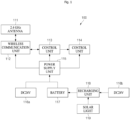
- FIG. 1 is a block diagram illustrating a partial configuration of an industrial rechargeable wireless solenoid valve system 100 according to an embodiment of the present disclosure.
- the industrial rechargeable wireless solenoid valve system 100 may comprise a wireless communication unit 112, a solenoid valve control unit 113, an output unit 114, and a power supply unit 115.
- the wireless communication unit 112 may transmit and receive a wireless signal through an antenna 111.
- the industrial rechargeable wireless solenoid valve system 100 may further comprise a rechargeable battery 117 and/or an external direct current power supply device 116a.
- the battery 117 may include a solar power module 119 and/or an external DC power supply device 116b connected through a charging unit 118.
- the wireless communication unit 112 may receive a command from the factory control unit 200 through the antenna 111 and transmit it to the solenoid valve control unit 113 or receive a response signal from the solenoid valve control unit 113 and transmit it to the factory control unit 200 through the antenna 111.
- the solenoid valve control unit 113 may receive a command from the wireless communication unit 112 and output an operation signal corresponding to a command to the output unit 114.
- the operation signal may be a signal that moves the solenoid valve 120 to the left or the right.
- the output unit 114 may receive an operation signal from the solenoid valve control unit 113 to actually drive the solenoid valve 120. For some examples, the output unit 114 allows the solenoid valve 120 to move to the left or to the solenoid valve 120 to move to the right.
- the power supply unit 115 may supply DC power to the wireless communication unit 112, the solenoid valve control unit 113, and the output unit 114, respectively.
- the power supply unit 115 may receive power from the external DC power supply device 116a and/or the rechargeable battery 117. Further, the rechargeable battery 117 may be charged through the charging unit 118 from the solar power module 119 and/or the external DC power supply device 116b.
- the wireless communication unit 210 of the factory control unit 200 and the wireless communication unit 112 of the solenoid valve control unit 113, respectively, may include a 2.4 GHz band Wi-Fi communication module and/or a ZigBee communication module.
- the solenoid valve control unit 113 may respond to the output state of the solenoid valve 120 by the output unit 114 to the factory control unit 200 through the wireless communication unit 112.
- FIGS. 2 and 3 are views illustrating a partial configuration of an industrial rechargeable wireless solenoid valve system 100 according to an embodiment of the present disclosure.
- the industrial rechargeable wireless solenoid valve system 100 is installed with an antenna 111, a battery 117, a charging unit 118, a power supply unit 115, a solenoid valve control unit 113, an output unit 114, and a solenoid valve 120 from top to bottom.
- the industrial rechargeable wireless solenoid valve system 100 may comprise an on/off switch 121 on one side, an external DC power terminal 122, and a battery charging terminal 123.
- the present disclosure provides an industrial rechargeable wireless solenoid valve system 100 controlled by a wireless control signal and powered by a rechargeable battery. Further, the present disclosure provides an industrial rechargeable wireless solenoid valve system 100 that does not require wiring using wireless communication, thereby reducing material costs and saving wiring work time.
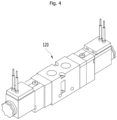
- FIG. 4 is a view showing the solenoid valve 120 in the industrial rechargeable wireless solenoid valve system 100 according to an embodiment of the present disclosure.
- the double-acting solenoid valve 120 may include two coils (the part from which the electric wires are protruded). When a control signal is applied to the wire on the left in the drawing, the solenoid valve 120 internally moves to the left, and on the contrary, when a control signal is applied to the wire on the right, the solenoid valve 120 internally moves to the right.
- FIGS. 5 and 6 are views showing the operation of the solenoid valve 120 in the industrial rechargeable wireless solenoid valve system 100 according to an embodiment of the present disclosure.
- portions marked "SOL1" and "SOL2" may be the above-described coils. Further, a portion indicated by a triangle may be, for example, a direction in which air pressure enters and exits. Among the white triangles, the central triangle is the part that receives air pressure from the compressor, and the remaining white triangles are the parts where the air pressure is released.
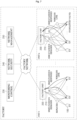
- FIG. 7 is a block diagram showing the configuration of an industrial rechargeable wireless solenoid valve system 100, according to an embodiment of the present disclosure.
- the industrial rechargeable wireless solenoid valve system 100 may be provided with multiple wireless solenoid valves 120 having the configuration as described above in the factory, and multiple wireless solenoid valves 120 may be defined as one unit. Further, such units may be provided in multiple quantities.
- multiple wireless solenoid valves 120 may be wirelessly coupled to factory control 200.
- the factory control unit 200 may include a wireless communication unit 210, and the wireless communication unit 210 may be connected to the wireless solenoid valves 120 through a repeater.
- each unit may include a factory control unit 200 with a wireless communication unit 210 and a repeater. Further, each factory control unit 200 may be connected to the factory network 220 by wire or wireless, and the factory network 220 may be connected to a monitoring control unit 230, a network security unit 240, and/or a network management unit 250 by wire or wireless.
- the factory control unit 200 periodically transmits a command to the wireless solenoid valve (i.e., the solenoid valve control unit 113) of one unit that returns a response per cycle time.
- the wireless solenoid valve i.e., the solenoid valve control unit 113
- the cycle time is usually 2 ms to 20 ms to set the waiting time limit (1 ms to 10 ms), and the transmission must be made within this cycle time.
- the factory control unit 200 requests the solenoid valve control unit 113 to operate, and accordingly, the solenoid valve control unit 113 responds, that is, returns the operation information.
- the factory control unit 200 of the factory network 220 periodically transmits a broadcast, multicast, or unicast command to the wireless solenoid valve control unit 113 of one unit.
- This wireless solenoid valve control unit 113 returns a response (e.g., driving or acknowledgment) within one cycle time.
- the probability that the cycle time may not be met should be ⁇ 10 -9 .
- the solenoid valve control unit 113 should simultaneously apply the received command at the same cycle time (jitter ⁇ 10us).
- FIG. 8 is a view illustrating a wireless signal transmission/reception and cycle period between a solenoid valve control unit 113, a factory control unit 200, and a factory network 220 in an industrial rechargeable wireless solenoid valve system 100 according to an embodiment of the present disclosure.
- the start/stop of the periodic command is performed.
- a scheduling configuration is needed to provide radio resources for the transmission of periodic commands from the factory control unit 200 and related responses from the solenoid valve control unit 113 within the cycle time described above.
- radio resource scheduling may be performed by the factory control unit 200.
- the commands are transmitted periodically from the factory network 220.
- the radio resource assignment of the factory control unit 200 for downlink command transmission and uplink response needs to be well coordinated with the factory network 220 to meet the cycle time requirements described above.
- the factory control unit 200 should configure the solenoid valve control unit 113 appropriately, provide radio resources to the solenoid valve control unit 113, and consider information to assist in supporting periodic commands and/or responses from the solenoid valve control unit 113.
- the factory control unit 200 needs to know the time to start the transmission. Information related to the start time of transmission should be known to the factory control unit 200. In some examples, one command may be included in the transmission. These commands are transmitted from the factory network 220. Further, the factory control unit 200 needs to know when to start the reception. Information related to the reception start time is known to the factory control unit 200. In some examples, the reception may include a response to the command. In some examples, a response is transmitted from one solenoid valve control 113 to the factory control unit 200.
- the information described above will help the factory control unit 200 to determine when to initiate a downlink transmission to the solenoid valve control 113 to provide the solenoid valve control unit 113 with a configuration for the downlink transmission.
- the activation time and/or start offset may be used to inform the solenoid valve control unit 113 of the time to start receiving downlink.
- the information also may assist the factory control unit in scheduling uplink transmissions for responses (e.g., time, message size, and content) and help provide configuration for uplink transmission to solenoid valve control unit 113.
- the activation time and/or start offset may be used to inform the solenoid valve control unit 113 of the time to start the uplink transmission.
- the embodiment of the present disclosure also provides a control processing method performed in the factory control unit 200.
- the factory control unit 200 receives information on the time to perform periodic transmissions.
- the factory control unit 200 may also receive information on the time to perform periodic receptions. Based on this information, the factory control unit 200 provides the solenoid valve control unit 113 with a configuration indicating periodic downlink resource assignment and periodic uplink resource assignment.
- the periodic downlink resource assignment and the periodic uplink resource assignment may be provided together in the same configuration or separately in different configurations.
- the activation time and/or start offset may be expressed as a hyper frame number, a frame number, a subframe number, or any combination thereof. Alternatively, the activation time and/or start offset may be expressed as days, hours, minutes, seconds, milliseconds, microseconds, or any combination thereof.
- Such downlink reception and/or uplink transmission may be semi-persistent, such as semi-persistent scheduling (SPS), and the activation time and/or start offsetmay be used to indicate when the downlink and/or uplink SPS starts.
- SPS semi-persistent scheduling
- the factory control unit 200 appropriately configures the solenoid valve control unit 113 and provides radio resources to the solenoid valve control unit 113 to consider additional information from the factory network 220 to the factory control unit 200, which helps support periodic command. Additional information from the factory control unit 200 to the factory network 220 may also be considered. The information may indicate cycle time limits and also allow the solenoid valve control 113 to determine which solenoid valve control unit 113 belongs to the same group with the same group ID so that the factory control unit 200 reserves resources for the same group for periodic transmission and may help to transmit the command mentioned above at the right time.
- multicast transmission is used for the same downlink command.
- PDCCH physical downlink control channel
- Lower layer signaling e.g., PDCCH signaling
- SPS semi-persistent scheduling
- RRC dedicated radio resource control
- a configuration that is required for the solenoid valve control unit 113 and can be configured exclusively for the solenoid valve control unit 113 may include, for example, (1) a group radio network temporary identifier (RNTI), (2) downlink and uplink SPS interval, (3) time to start downlink reception, (4) time to stop downlink reception, (5) time to start uplink transmission, (6) time to stop uplink transmission and (7) resource allocation for downlink reception and uplink transmission.
- RNTI group radio network temporary identifier
- the information known by the factory control unit 200 may include (a) the solenoid valve control unit 113 of one unit receiving a command, (b) the arrival interval time of the commands, (c) the expression of the cycle time limitation, (d) time to start command transmission and (e) command size/response size.
- FIG. 9 is a flowchart illustrating an operating method of an industrial rechargeable wireless solenoid valve system 100, according to an embodiment of the present disclosure.
- the solenoid valve control unit 113 transmits time information for starting the periodic uplink transmission by the solenoid valve control unit 113 to the factory control unit 200 (S1). That is, before the factory control unit 200 receives the configuration from the solenoid valve control unit 113, the solenoid valve control unit 113 transmits "information indicating the time at which the initial transmission of the periodic uplink transmission by the solenoid valve control unit 113 starts” to the factory control unit 200.
- time information for starting the initial uplink transmission is provided from the solenoid valve control unit 113 to the factory control unit 200 before the solenoid valve control unit 113 starts the uplink transmission to meet the cycle time required so that the factory control unit 200 considers this and configures the uplink resource appropriately.
- This method is different from the method of reconfiguring an already-active uplink SPS.
- the industrial rechargeable wireless solenoid valve system 100 directly provides "the time to start the initial transmission of the periodic uplink transmission by the solenoid valve control unit 113" and then sets the configuration.
- the information may include an interval of uplink transmission and the message size of uplink transmission.
- the solenoid valve control unit 113 receives a configuration indicating periodic uplink resource allocation from the factory control unit 200 (S2).
- the solenoid valve control unit 113 transmits the periodic uplink to the factory control unit 200 based on the periodic uplink resource allocation (S3). Meanwhile, the factory control unit 200 transmits the solenoid valve failure signal to the factory network 220 when the response signal received by the factory control unit 200 from the solenoid valve control unit 113 is inconsistent with the command transmitted to the solenoid valve control unit 113 or no response signal is received (S4). Therefore, the manager of the industrial rechargeable wireless solenoid valve system 100 may easily determine which part of multiple units, and/or multiple solenoid valves is failing through the monitoring control unit 230, the network security unit 240 and/or the network management unit 250.
- the present disclosure provides the time information of the initial starting uplink transmission to the wireless communication unit 210 of the factory control unit 200, thereby giving an industrial rechargeable wireless solenoid valve system 100 that allows the factory control unit 200 to consider this information to configure uplink resources properly.
Landscapes
- Engineering & Computer Science (AREA)
- General Engineering & Computer Science (AREA)
- Mechanical Engineering (AREA)
- Physics & Mathematics (AREA)
- Power Engineering (AREA)
- Fluid Mechanics (AREA)
- Computer Networks & Wireless Communication (AREA)
- General Physics & Mathematics (AREA)
- Electromagnetism (AREA)
- Magnetically Actuated Valves (AREA)
Abstract
Description
- An embodiment of the present disclosure relates to an industrial rechargeable wireless solenoid valve.
- Wired solenoid valves, often used in automobile production lines and industrial automation lines, are used to control the movement of various machines and driving devices using air pressure.
- Therefore, wired solenoid valves are used in various fields. A single wired solenoid valve has 2 to 3 wires. If there are 10 solenoid valves, 20 to 30 wires should be wired and connected individually, and if there are 100 solenoid valves, 200 to 300 wires should be wired and connected one by one.
- Therefore, the process incurs the cost of the wires required for wiring, and a lot of work time is consumed to connect the wires individually. Further, it is difficult to diagnose the problem after installation. It takes much time to determine where and how a certain wire is shorted among numerous wires.
- The above-described information disclosed in the background technology of the present disclosure is only for improving the understanding of the background of the present disclosure and thus may include information that does not constitute the prior art.
- A to-be-addressed issue according to an embodiment of the present disclosure is to provide an industrial rechargeable wireless solenoid valve system that is controlled by a wireless control signal and supplied with power from a rechargeable battery.
- A to-be-addressed issue according to an embodiment of the present disclosure is to provide an industrial rechargeable wireless solenoid valve system that does not require wiring using wireless communication, thereby reducing material costs and saving wiring work time.
- A to-be-addressed issue according to an embodiment of the present disclosure is to provide an industrial rechargeable wireless solenoid valve system that may diagnose a failure by checking the output state of the current solenoid valve.
- Another to-be-addressed issue according to an embodiment of the present disclosure is to provide an industrial rechargeable wireless solenoid valve system that provides time information for the initial uplink transmission to the wireless transceiver of the factory control unit before the wireless solenoid valve starts the uplink transmission for smooth wireless signal transmission and reception within the cycle time in the factory automation system, thereby allowing the factory control unit to properly configure uplink resources in consideration of this.
- The industrial rechargeable wireless solenoid valve system according to an embodiment of the present disclosure may comprise a wireless communication unit for receiving a command from the factory control unit; a solenoid valve control unit for receiving the command from the wireless communication unit and outputting an operation signal corresponding to the command; an output unit for receiving the operation signal from the solenoid valve control unit and driving the solenoid valve; and a power supply unit for supplying power to the wireless communication unit, the solenoid valve control unit, and the output unit, respectively.
- The solenoid valve control unit may respond to a factory control unit through a wireless communication unit for an output state of the solenoid valve by the output unit.
- The system may further comprise a rechargeable battery for supplying DC power to the power supply unit, wherein the battery is charged by a solar power module or an external DC power supply device.
- The system may further comprise an external DC power supply device for supplying DC power to the power supply unit.
- The factory control unit and the wireless communication unit may include a 2.4GHz Wi-Fi communication module, a Zigbee communication module.
- The industrial rechargeable wireless solenoid valve system may perform steps of: transmitting, by the solenoid valve control unit, time information to start the initial transmission of periodic uplink transmission by the solenoid valve control unit to the factory control unit; receiving, by the solenoid valve control unit, a configuration indicating periodic uplink resource assignment from the factory control unit; transmitting, by the solenoid valve control unit, the periodic uplink to the factory control unit based on the periodic uplink resource assignment; and transmitting a solenoid valve failure signal to a factory network when the response signal received by the factory control unit from the solenoid valve control unit is inconsistent with the command transmitted by the factory control unit to the solenoid valve control unit or the response signal is not received.
- The present disclosure provides an industrial rechargeable wireless solenoid valve system that is controlled by a wireless control signal and supplied with power from a rechargeable battery.
- The present disclosure provides an industrial rechargeable wireless solenoid valve system that does not require wiring using wireless communication, thereby reducing material costs and saving wiring work time.
- The present disclosure provides an industrial rechargeable wireless solenoid valve system that may diagnose a failure by checking the output state of the current solenoid valve.
- The present disclosure provides an industrial rechargeable wireless solenoid valve system that provides time information for the first start of uplink transmission to the wireless transceiver of the factory control unit before the wireless solenoid valve starts the uplink transmission for smooth wireless signal transmission and reception within the cycle time in the factory automation system, thereby allowing the factory control unit to properly configure uplink resources in consideration of this.
- A more complete appreciation of the present disclosure and many of the attendant aspects thereof will be readily obtained as the same becomes better understood by reference to the following detailed description when considered in connection with the accompanying drawings, wherein:
-
FIG. 1 is a block diagram illustrating a partial configuration of an industrial rechargeable wireless solenoid valve system according to an embodiment of the present disclosure; -
FIGS. 2 and3 are views illustrating a partial configuration of an industrial rechargeable wireless solenoid valve system according to an embodiment of the present disclosure; -
FIG. 4 is a view showing a solenoid valve in the industrial rechargeable wireless solenoid valve system according to an embodiment of the present disclosure; -
FIGS. 5 and 6 are views showing the operation of the solenoid valve in the industrial rechargeable wireless solenoid valve system according to an embodiment of the present disclosure -
FIG. 7 is a block diagram showing the configuration of an industrial rechargeable wireless solenoid valve system according to an embodiment of the present disclosure; -
FIG. 8 is a view illustrating a wireless signal transmission/reception and cycle period between a solenoid valvecontrolunit, a factory control unit, and a factory network in an industrial rechargeable wireless solenoid valve system according to an embodiment of the present disclosure; and -
FIG. 9 is a flowchart illustrating an operating method of an industrial rechargeable wireless solenoid valve system according to an embodiment of the present disclosure. -
FIG. 1 is a block diagram illustrating a partial configuration of an industrial rechargeable wirelesssolenoid valve system 100 according to an embodiment of the present disclosure. - As shown in
FIG. 1 , the industrial rechargeable wirelesssolenoid valve system 100, according to an embodiment of the present disclosure, may comprise awireless communication unit 112, a solenoidvalve control unit 113, anoutput unit 114, and apower supply unit 115. For some examples, thewireless communication unit 112 may transmit and receive a wireless signal through anantenna 111. In some examples, the industrial rechargeable wirelesssolenoid valve system 100 may further comprise arechargeable battery 117 and/or an external direct currentpower supply device 116a. Further, thebattery 117 may include asolar power module 119 and/or an external DCpower supply device 116b connected through acharging unit 118. Thewireless communication unit 112 may receive a command from thefactory control unit 200 through theantenna 111 and transmit it to the solenoidvalve control unit 113 or receive a response signal from the solenoidvalve control unit 113 and transmit it to thefactory control unit 200 through theantenna 111. - The solenoid
valve control unit 113 may receive a command from thewireless communication unit 112 and output an operation signal corresponding to a command to theoutput unit 114. In some examples, the operation signal may be a signal that moves thesolenoid valve 120 to the left or the right. - The
output unit 114 may receive an operation signal from the solenoidvalve control unit 113 to actually drive thesolenoid valve 120. For some examples, theoutput unit 114 allows thesolenoid valve 120 to move to the left or to thesolenoid valve 120 to move to the right. - The
power supply unit 115 may supply DC power to thewireless communication unit 112, the solenoidvalve control unit 113, and theoutput unit 114, respectively. - The
power supply unit 115 may receive power from the external DCpower supply device 116a and/or therechargeable battery 117. Further, therechargeable battery 117 may be charged through thecharging unit 118 from thesolar power module 119 and/or the external DCpower supply device 116b. - Meanwhile, the
wireless communication unit 210 of thefactory control unit 200 and thewireless communication unit 112 of the solenoidvalve control unit 113, respectively, may include a 2.4 GHz band Wi-Fi communication module and/or a ZigBee communication module. - Further, the solenoid
valve control unit 113 may respond to the output state of thesolenoid valve 120 by theoutput unit 114 to thefactory control unit 200 through thewireless communication unit 112. -
FIGS. 2 and3 are views illustrating a partial configuration of an industrial rechargeable wirelesssolenoid valve system 100 according to an embodiment of the present disclosure. - As shown in
FIG. 2 , the industrial rechargeable wirelesssolenoid valve system 100, according to an embodiment of the present disclosure, is installed with anantenna 111, abattery 117, acharging unit 118, apower supply unit 115, a solenoidvalve control unit 113, anoutput unit 114, and asolenoid valve 120 from top to bottom. Further, as shown inFIG. 3 , the industrial rechargeable wirelesssolenoid valve system 100, according to an embodiment of the present disclosure, may comprise an on/off switch 121 on one side, an externalDC power terminal 122, and abattery charging terminal 123. - In this way, the present disclosure provides an industrial rechargeable wireless
solenoid valve system 100 controlled by a wireless control signal and powered by a rechargeable battery. Further, the present disclosure provides an industrial rechargeable wirelesssolenoid valve system 100 that does not require wiring using wireless communication, thereby reducing material costs and saving wiring work time. -
FIG. 4 is a view showing thesolenoid valve 120 in the industrial rechargeable wirelesssolenoid valve system 100 according to an embodiment of the present disclosure. - As shown in
FIG. 4 , as an example, the double-actingsolenoid valve 120 may include two coils (the part from which the electric wires are protruded). When a control signal is applied to the wire on the left in the drawing, thesolenoid valve 120 internally moves to the left, and on the contrary, when a control signal is applied to the wire on the right, thesolenoid valve 120 internally moves to the right. -
FIGS. 5 and 6 are views showing the operation of thesolenoid valve 120 in the industrial rechargeable wirelesssolenoid valve system 100 according to an embodiment of the present disclosure. - As shown in
FIGS. 5 and 6 , portions marked "SOL1" and "SOL2" may be the above-described coils. Further, a portion indicated by a triangle may be, for example, a direction in which air pressure enters and exits. Among the white triangles, the central triangle is the part that receives air pressure from the compressor, and the remaining white triangles are the parts where the air pressure is released. - In the case of
FIG. 5 , when a control signal is applied to SOL2, thesolenoid valve 120 moves to the right, air pressure enters the rear part of the cylinder, and the air pressure in the front part is released. Thus, the cylinder moves forward. - Conversely, in the case of
FIG. 6 , when a control signal is applied to SOL1, thesolenoid valve 120 moves to the left, and air pressure enters the front part of the cylinder. The air pressure in the rear part is released, and the cylinder moves backward. -
FIG. 7 is a block diagram showing the configuration of an industrial rechargeable wirelesssolenoid valve system 100, according to an embodiment of the present disclosure. - As shown in
FIG. 7 , the industrial rechargeable wirelesssolenoid valve system 100 according to an embodiment of the present disclosure may be provided with multiplewireless solenoid valves 120 having the configuration as described above in the factory, and multiplewireless solenoid valves 120 may be defined as one unit. Further, such units may be provided in multiple quantities. - In some examples, multiple
wireless solenoid valves 120 may be wirelessly coupled tofactory control 200. For this, thefactory control unit 200 may include awireless communication unit 210, and thewireless communication unit 210 may be connected to thewireless solenoid valves 120 through a repeater. - For some examples, each unit may include a
factory control unit 200 with awireless communication unit 210 and a repeater. Further, eachfactory control unit 200 may be connected to the factory network 220 by wire or wireless, and the factory network 220 may be connected to amonitoring control unit 230, anetwork security unit 240, and/or anetwork management unit 250 by wire or wireless. - Under this configuration, the
factory control unit 200 periodically transmits a command to the wireless solenoid valve (i.e., the solenoid valve control unit 113) of one unit that returns a response per cycle time. - Here, the cycle time is usually 2 ms to 20 ms to set the waiting time limit (1 ms to 10 ms), and the transmission must be made within this cycle time. Further, under this configuration, the
factory control unit 200 requests the solenoidvalve control unit 113 to operate, and accordingly, the solenoidvalve control unit 113 responds, that is, returns the operation information. - After the wireless solenoid valves of one unit complete initial connection and registration and successfully receive the necessary parameters, the
factory control unit 200 of the factory network 220 periodically transmits a broadcast, multicast, or unicast command to the wireless solenoidvalve control unit 113 of one unit. This wireless solenoidvalve control unit 113 returns a response (e.g., driving or acknowledgment) within one cycle time. The probability that the cycle time may not be met should be <10-9. Further, the solenoidvalve control unit 113 should simultaneously apply the received command at the same cycle time (jitter < 10us).FIG. 8 is a view illustrating a wireless signal transmission/reception and cycle period between a solenoidvalve control unit 113, afactory control unit 200, and a factory network 220 in an industrial rechargeable wirelesssolenoid valve system 100 according to an embodiment of the present disclosure. - As shown in
FIG. 8 , after performing the registration steps for the factory network 220, the start/stop of the periodic command is performed. - Periodic command transmission: The solenoid
valve control unit 113 of one unit must certainly receive a command from thefactory control unit 200 based on the received parameters. The other solenoidvalve control unit 113 does not need to receive or wake up. A diversity technique (e.g., hybrid automatic repeat request (HARQ) retransmissions) may be applied to transmissions. For example, the HARQ retransmission may be performed when thewireless communication unit 210 of thefactory control unit 200 receives a certain HARQ NACK (negative acknowledgment). Only the solenoidvalve control unit 113 that has not successfully received the command needs to receive the retransmission. - Simultaneous command application: The solenoid valves of a unit must apply the received command simultaneously in one cycle time.
- Transmission of the response(s) to the command: The solenoid
valve control unit 113 of one unit must certainly transmit a response(s) to thefactory control unit 200 based on the received parameters. A diversity technique (e.g., HARQ retransmissions) may be applied to the responses. For example, HARQ retransmission may be performed when one solenoidvalve control unit 113 receives a certain HARQ NACK. - In order to obtain the transmission and response of periodic commands within the cycle time, a scheduling configuration is needed to provide radio resources for the transmission of periodic commands from the
factory control unit 200 and related responses from the solenoidvalve control unit 113 within the cycle time described above. - In the wireless access network, radio resource scheduling may be performed by the
factory control unit 200. However, the commands are transmitted periodically from the factory network 220. The radio resource assignment of thefactory control unit 200 for downlink command transmission and uplink response needs to be well coordinated with the factory network 220 to meet the cycle time requirements described above. To this end, thefactory control unit 200 should configure the solenoidvalve control unit 113 appropriately, provide radio resources to the solenoidvalve control unit 113, and consider information to assist in supporting periodic commands and/or responses from the solenoidvalve control unit 113. - To this end, the
factory control unit 200 needs to know the time to start the transmission. Information related to the start time of transmission should be known to thefactory control unit 200. In some examples, one command may be included in the transmission. These commands are transmitted from the factory network 220. Further, thefactory control unit 200 needs to know when to start the reception. Information related to the reception start time is known to thefactory control unit 200. In some examples, the reception may include a response to the command. In some examples, a response is transmitted from onesolenoid valve control 113 to thefactory control unit 200. - In some examples, the information described above will help the
factory control unit 200 to determine when to initiate a downlink transmission to thesolenoid valve control 113 to provide the solenoidvalve control unit 113 with a configuration for the downlink transmission. For example, the activation time and/or start offset may be used to inform the solenoidvalve control unit 113 of the time to start receiving downlink. When some response to the downlink transmission (For example, information, status report, acknowledgment or negative acknowledgment of the solenoid valve control unit 113) is needed, the information also may assist the factory control unit in scheduling uplink transmissions for responses (e.g., time, message size, and content) and help provide configuration for uplink transmission to solenoidvalve control unit 113. For example, the activation time and/or start offset may be used to inform the solenoidvalve control unit 113 of the time to start the uplink transmission. - The embodiment of the present disclosure also provides a control processing method performed in the
factory control unit 200. Thefactory control unit 200 receives information on the time to perform periodic transmissions. Thefactory control unit 200 may also receive information on the time to perform periodic receptions. Based on this information, thefactory control unit 200 provides the solenoidvalve control unit 113 with a configuration indicating periodic downlink resource assignment and periodic uplink resource assignment. The periodic downlink resource assignment and the periodic uplink resource assignment may be provided together in the same configuration or separately in different configurations. - The activation time and/or start offset may be expressed as a hyper frame number, a frame number, a subframe number, or any combination thereof. Alternatively, the activation time and/or start offset may be expressed as days, hours, minutes, seconds, milliseconds, microseconds, or any combination thereof. Such downlink reception and/or uplink transmission may be semi-persistent, such as semi-persistent scheduling (SPS), and the activation time and/or start offsetmay be used to indicate when the downlink and/or uplink SPS starts.
- In addition, the
factory control unit 200 appropriately configures the solenoidvalve control unit 113 and provides radio resources to the solenoidvalve control unit 113 to consider additional information from the factory network 220 to thefactory control unit 200, which helps support periodic command. Additional information from thefactory control unit 200 to the factory network 220 may also be considered. The information may indicate cycle time limits and also allow thesolenoid valve control 113 to determine which solenoidvalve control unit 113 belongs to the same group with the same group ID so that thefactory control unit 200 reserves resources for the same group for periodic transmission and may help to transmit the command mentioned above at the right time. - To handle the same command transmitted to one unit, which may have more than one solenoid
valve control unit 113,multicast transmission is used for the same downlink command. When multicast is used, physical downlink control channel (PDCCH) resources and scheduling complexity may be reduced. - Lower layer signaling (e.g., PDCCH signaling) is not used for semi-persistent scheduling (SPS) activation or deactivation. Instead, dedicated radio resource control (RRC) signaling indicates the time to start SPS transmission/reception. All the solenoid
valve control units 113 in one unit may equally understand when to start SPS transmission/reception and prevent additional power consumption of the solenoidvalve control unit 113 due to the initial SPS activation. - A configuration that is required for the solenoid
valve control unit 113 and can be configured exclusively for the solenoidvalve control unit 113 may include, for example, (1) a group radio network temporary identifier (RNTI), (2) downlink and uplink SPS interval, (3) time to start downlink reception, (4) time to stop downlink reception, (5) time to start uplink transmission, (6) time to stop uplink transmission and (7) resource allocation for downlink reception and uplink transmission. - Further, the information known by the
factory control unit 200 may include (a) the solenoidvalve control unit 113 of one unit receiving a command, (b) the arrival interval time of the commands, (c) the expression of the cycle time limitation, (d) time to start command transmission and (e) command size/response size. -
FIG. 9 is a flowchart illustrating an operating method of an industrial rechargeable wirelesssolenoid valve system 100, according to an embodiment of the present disclosure. - First, the solenoid
valve control unit 113 transmits time information for starting the periodic uplink transmission by the solenoidvalve control unit 113 to the factory control unit 200 (S1). That is, before thefactory control unit 200 receives the configuration from the solenoidvalve control unit 113, the solenoidvalve control unit 113 transmits "information indicating the time at which the initial transmission of the periodic uplink transmission by the solenoidvalve control unit 113 starts" to thefactory control unit 200. In other words, in a factory automation system, time information for starting the initial uplink transmission is provided from the solenoidvalve control unit 113 to thefactory control unit 200 before the solenoidvalve control unit 113 starts the uplink transmission to meet the cycle time required so that thefactory control unit 200 considers this and configures the uplink resource appropriately. This method is different from the method of reconfiguring an already-active uplink SPS. - In other words, the industrial rechargeable wireless
solenoid valve system 100, according to the present disclosure, directly provides "the time to start the initial transmission of the periodic uplink transmission by the solenoidvalve control unit 113" and then sets the configuration. Meanwhile, in some examples, the information may include an interval of uplink transmission and the message size of uplink transmission. - Subsequently, the solenoid
valve control unit 113 receives a configuration indicating periodic uplink resource allocation from the factory control unit 200 (S2). - Further, the solenoid
valve control unit 113 transmits the periodic uplink to thefactory control unit 200 based on the periodic uplink resource allocation (S3). Meanwhile, thefactory control unit 200 transmits the solenoid valve failure signal to the factory network 220 when the response signal received by thefactory control unit 200 from the solenoidvalve control unit 113 is inconsistent with the command transmitted to the solenoidvalve control unit 113 or no response signal is received (S4). Therefore, the manager of the industrial rechargeable wirelesssolenoid valve system 100 may easily determine which part of multiple units, and/or multiple solenoid valves is failing through themonitoring control unit 230, thenetwork security unit 240 and/or thenetwork management unit 250. - Further, in this way, the present disclosure provides the time information of the initial starting uplink transmission to the
wireless communication unit 210 of thefactory control unit 200, thereby giving an industrial rechargeable wirelesssolenoid valve system 100 that allows thefactory control unit 200 to consider this information to configure uplink resources properly.
Claims (6)
- An industrial rechargeable wireless solenoid valve system comprising:a wireless communication unit for receiving a command from the factory control unit;a solenoid valve control unit for receiving the command from the wireless communication unit and outputting an operation signal corresponding to the command;an output unit for receiving the operation signal from the solenoid valve control unit and driving the solenoid valve; anda power supply unit for supplying power tothe wireless communication unit, the solenoid valve control unit, and the output unit, respectively.
- The industrial rechargeable wireless solenoid valve system according to claim 1, wherein the solenoid valve control unit responds to a factory control unit through a wireless communication unit for an output state of the solenoid valve by the output unit.
- The industrial rechargeable wireless solenoid valve system according to claim 1, further comprising a rechargeable battery for supplying DC power to the power supply unit, wherein the battery is charged by a solar power module or an external DC power supply device.
- The industrial rechargeable wireless solenoid valve system according to claim 1, further comprising an external DC power supply device for supplying DC power to the power supply unit.
- The industrial rechargeable wireless solenoid valve system according to claim 1, wherein the factory control unit and the wireless communication unit include a 2.4GHz band Wi-Fi communication module or a ZigBee communication module.
- The industrial rechargeable wireless solenoid valve system according to claim 1, performing steps of:transmitting, by the solenoid valve control unit, time information to start the initial transmission of periodic uplink transmission by the solenoid valve control unit to the factory control unit;receiving, by the solenoid valve control unit, a configuration indicating periodic uplink resource assignment from the factory control unit;transmitting, by the solenoid valve control unit, the periodic uplink to the factory control unit based on the periodic uplink resource assignment; andtransmitting a solenoid valve failure signal to a factory network when the response signal received by the factory control unit from the solenoid valve control unit is inconsistent with the command transmitted by the factory control unit to the solenoid valve control unit or the response signal is not received.
Applications Claiming Priority (2)
| Application Number | Priority Date | Filing Date | Title |
|---|---|---|---|
| KR1020200085867A KR102272465B1 (en) | 2020-07-13 | 2020-07-13 | Industrial rechargeable wireless solenoid valve system |
| PCT/KR2021/008934 WO2022015001A1 (en) | 2020-07-13 | 2021-07-13 | Industrial rechargeable wireless solenoid valve system |
Publications (2)
| Publication Number | Publication Date |
|---|---|
| EP4180702A1 true EP4180702A1 (en) | 2023-05-17 |
| EP4180702A4 EP4180702A4 (en) | 2024-08-14 |
Family
ID=76899652
Family Applications (1)
| Application Number | Title | Priority Date | Filing Date |
|---|---|---|---|
| EP21841746.7A Pending EP4180702A4 (en) | 2020-07-13 | 2021-07-13 | INDUSTRIAL RECHARGEABLE WIRELESS SOLENOID VALVE SYSTEM |
Country Status (5)
| Country | Link |
|---|---|
| US (1) | US20230085709A1 (en) |
| EP (1) | EP4180702A4 (en) |
| KR (1) | KR102272465B1 (en) |
| CN (1) | CN115667772A (en) |
| WO (1) | WO2022015001A1 (en) |
Families Citing this family (3)
| Publication number | Priority date | Publication date | Assignee | Title |
|---|---|---|---|---|
| KR102272465B1 (en) * | 2020-07-13 | 2021-07-05 | 주식회사 썬에이치에스티 | Industrial rechargeable wireless solenoid valve system |
| KR102855170B1 (en) * | 2023-11-14 | 2025-09-04 | 주식회사 캠스텍 | Solar charging wireless communication valve and solar charging wireless communication valve control system |
| CN118912256B (en) * | 2024-07-22 | 2025-01-24 | 重庆度升阀门有限公司 | A battery powered wireless DRQF industrial and commercial valve control system |
Family Cites Families (13)
| Publication number | Priority date | Publication date | Assignee | Title |
|---|---|---|---|---|
| JP3463433B2 (en) * | 1995-11-07 | 2003-11-05 | 株式会社デンソー | Multiplex communication system |
| US7886766B2 (en) * | 2006-12-27 | 2011-02-15 | Eltav Wireless Monitoring Ltd. | Device and system for monitoring valves |
| BRPI0807862B8 (en) * | 2007-01-24 | 2023-01-31 | I2O Water Ltd | CONTROLLER AND CONTROL SYSTEM FOR A PRESSURE REDUCER VALVE |
| KR101124233B1 (en) * | 2009-11-23 | 2012-03-27 | 한국생산기술연구원 | Wireless communication control type solenoid valve |
| JP5229592B2 (en) * | 2010-06-30 | 2013-07-03 | 横河電機株式会社 | Wireless field device |
| KR101245241B1 (en) * | 2011-03-03 | 2013-03-19 | 김상민 | Valve for wireless telecommunication |
| EP2754304B1 (en) * | 2011-09-07 | 2018-08-01 | ABB Schweiz AG | Valve positioner and valve monitoring system |
| JP6007922B2 (en) * | 2014-01-07 | 2016-10-19 | 横河電機株式会社 | Contact signal converter |
| JP6474016B2 (en) * | 2014-03-28 | 2019-02-27 | Toto株式会社 | Remote control device and toilet system |
| KR101793209B1 (en) * | 2017-09-05 | 2017-11-03 | 주식회사 썬에이치에스티 | Remote JIG Control System And Method Using Wireless Magnetic Sensor |
| KR102627291B1 (en) * | 2018-08-07 | 2024-01-23 | 텔레호낙티에볼라게트 엘엠 에릭슨(피유비엘) | Method and device for facilitating HARQ transmission |
| CN109826661B (en) * | 2019-04-02 | 2020-07-21 | 北京天地玛珂电液控制系统有限公司 | Solenoid valve driver and hydraulic support control system |
| KR102272465B1 (en) * | 2020-07-13 | 2021-07-05 | 주식회사 썬에이치에스티 | Industrial rechargeable wireless solenoid valve system |
-
2020
- 2020-07-13 KR KR1020200085867A patent/KR102272465B1/en active Active
-
2021
- 2021-07-13 CN CN202180037285.4A patent/CN115667772A/en active Pending
- 2021-07-13 EP EP21841746.7A patent/EP4180702A4/en active Pending
- 2021-07-13 WO PCT/KR2021/008934 patent/WO2022015001A1/en not_active Ceased
-
2022
- 2022-11-26 US US17/994,288 patent/US20230085709A1/en not_active Abandoned
Also Published As
| Publication number | Publication date |
|---|---|
| KR102272465B1 (en) | 2021-07-05 |
| WO2022015001A1 (en) | 2022-01-20 |
| CN115667772A (en) | 2023-01-31 |
| EP4180702A4 (en) | 2024-08-14 |
| US20230085709A1 (en) | 2023-03-23 |
Similar Documents
| Publication | Publication Date | Title |
|---|---|---|
| US20230085709A1 (en) | Industrial rechargeable wireless solenoid valve system | |
| US12200635B2 (en) | Method and apparatus for performing and reporting measurements by user equipment configured with multiple carriers in mobile communication systems | |
| US12063533B2 (en) | Discontinuous reception method, related apparatus and system | |
| US20230363048A1 (en) | Drx operation method and device in wireless communication system | |
| CN111466150B (en) | Method and apparatus for handling bandwidth partial inactivity timers in wireless communication systems | |
| EP2494837B1 (en) | Coordinated signaling of scheduling information for uplink and downlink communications | |
| EP3739992B1 (en) | Information processing method, device, and apparatus | |
| KR20220124763A (en) | Method and apparatus for configuring discontinuous reception DRX parameters | |
| KR102883750B1 (en) | V2X HARQ process management | |
| JP2020533830A (en) | Quasi-static scheduling processing method, communication equipment and storage media | |
| MX2011004621A (en) | Method for enhancing user equipment (ue) power saving performance and ue. | |
| US20230177949A1 (en) | Industrial wireless sensor system | |
| WO2018127216A1 (en) | Data transmission method, device and system | |
| EP4084510B1 (en) | Information sending method and apparatus, information receiving method and apparatus, and device and storage medium | |
| CN101600253B (en) | Method, terminal and base substation for transforming terminal from discontinuous receiving state to continuous receiving state | |
| JPWO2022070344A5 (en) | Terminals, wireless communication methods, base stations and systems | |
| EP2921022A1 (en) | Drx and harq operations in adaptive tdd systems | |
| JP7631533B2 (en) | Intermittent reception control method and device | |
| EP4248595A1 (en) | Data communication with adaptable feedback mode | |
| US20230354153A1 (en) | Path processing method and apparatus, terminal, network device, and storage medium | |
| JP6821681B2 (en) | How to schedule subframes in a millimeter wave system | |
| CN102457975B (en) | Method and system for scheduling data as well as relevant equipment | |
| EP4311356A1 (en) | Sidelink transmission method and apparatus | |
| CN110944299B (en) | Multicast method and system thereof | |
| EP1909522B1 (en) | Mobile station, wireless access network apparatus, mobile communication system and communication method for controlling transmission timing |
Legal Events
| Date | Code | Title | Description |
|---|---|---|---|
| STAA | Information on the status of an ep patent application or granted ep patent |
Free format text: STATUS: THE INTERNATIONAL PUBLICATION HAS BEEN MADE |
|
| PUAI | Public reference made under article 153(3) epc to a published international application that has entered the european phase |
Free format text: ORIGINAL CODE: 0009012 |
|
| STAA | Information on the status of an ep patent application or granted ep patent |
Free format text: STATUS: REQUEST FOR EXAMINATION WAS MADE |
|
| 17P | Request for examination filed |
Effective date: 20221123 |
|
| AK | Designated contracting states |
Kind code of ref document: A1 Designated state(s): AL AT BE BG CH CY CZ DE DK EE ES FI FR GB GR HR HU IE IS IT LI LT LU LV MC MK MT NL NO PL PT RO RS SE SI SK SM TR |
|
| DAV | Request for validation of the european patent (deleted) | ||
| DAX | Request for extension of the european patent (deleted) | ||
| A4 | Supplementary search report drawn up and despatched |
Effective date: 20240712 |
|
| RIC1 | Information provided on ipc code assigned before grant |
Ipc: G05B 19/048 20060101ALI20240708BHEP Ipc: H02S 40/38 20140101ALI20240708BHEP Ipc: H04Q 9/00 20060101ALI20240708BHEP Ipc: H02J 7/35 20060101ALI20240708BHEP Ipc: H02J 7/00 20060101ALI20240708BHEP Ipc: F16K 37/00 20060101ALI20240708BHEP Ipc: F16K 31/06 20060101AFI20240708BHEP |