EP4180566A1 - Filtration mesh cleaning method, apparatus, clothes washing machine, and storage medium - Google Patents
Filtration mesh cleaning method, apparatus, clothes washing machine, and storage medium Download PDFInfo
- Publication number
- EP4180566A1 EP4180566A1 EP21793777.0A EP21793777A EP4180566A1 EP 4180566 A1 EP4180566 A1 EP 4180566A1 EP 21793777 A EP21793777 A EP 21793777A EP 4180566 A1 EP4180566 A1 EP 4180566A1
- Authority
- EP
- European Patent Office
- Prior art keywords
- filter screen
- cleaning
- air pressure
- air intake
- drying apparatus
- Prior art date
- Legal status (The legal status is an assumption and is not a legal conclusion. Google has not performed a legal analysis and makes no representation as to the accuracy of the status listed.)
- Granted
Links
Images

Classifications
-
- D—TEXTILES; PAPER
- D06—TREATMENT OF TEXTILES OR THE LIKE; LAUNDERING; FLEXIBLE MATERIALS NOT OTHERWISE PROVIDED FOR
- D06F—LAUNDERING, DRYING, IRONING, PRESSING OR FOLDING TEXTILE ARTICLES
- D06F33/00—Control of operations performed in washing machines or washer-dryers
- D06F33/30—Control of washing machines characterised by the purpose or target of the control
- D06F33/43—Control of cleaning or disinfection of washing machine parts, e.g. of tubs
-
- D—TEXTILES; PAPER
- D06—TREATMENT OF TEXTILES OR THE LIKE; LAUNDERING; FLEXIBLE MATERIALS NOT OTHERWISE PROVIDED FOR
- D06F—LAUNDERING, DRYING, IRONING, PRESSING OR FOLDING TEXTILE ARTICLES
- D06F58/00—Domestic laundry dryers
- D06F58/20—General details of domestic laundry dryers
- D06F58/22—Lint collecting arrangements
-
- D—TEXTILES; PAPER
- D06—TREATMENT OF TEXTILES OR THE LIKE; LAUNDERING; FLEXIBLE MATERIALS NOT OTHERWISE PROVIDED FOR
- D06F—LAUNDERING, DRYING, IRONING, PRESSING OR FOLDING TEXTILE ARTICLES
- D06F34/00—Details of control systems for washing machines, washer-dryers or laundry dryers
- D06F34/14—Arrangements for detecting or measuring specific parameters
-
- D—TEXTILES; PAPER
- D06—TREATMENT OF TEXTILES OR THE LIKE; LAUNDERING; FLEXIBLE MATERIALS NOT OTHERWISE PROVIDED FOR
- D06F—LAUNDERING, DRYING, IRONING, PRESSING OR FOLDING TEXTILE ARTICLES
- D06F35/00—Washing machines, apparatus, or methods not otherwise provided for
- D06F35/005—Methods for washing, rinsing or spin-drying
- D06F35/008—Methods for washing, rinsing or spin-drying for disinfecting the tub or the drum
-
- D—TEXTILES; PAPER
- D06—TREATMENT OF TEXTILES OR THE LIKE; LAUNDERING; FLEXIBLE MATERIALS NOT OTHERWISE PROVIDED FOR
- D06F—LAUNDERING, DRYING, IRONING, PRESSING OR FOLDING TEXTILE ARTICLES
- D06F58/00—Domestic laundry dryers
- D06F58/32—Control of operations performed in domestic laundry dryers
- D06F58/34—Control of operations performed in domestic laundry dryers characterised by the purpose or target of the control
- D06F58/45—Cleaning or disinfection of machine parts, e.g. of heat exchangers or filters
-
- D—TEXTILES; PAPER
- D06—TREATMENT OF TEXTILES OR THE LIKE; LAUNDERING; FLEXIBLE MATERIALS NOT OTHERWISE PROVIDED FOR
- D06F—LAUNDERING, DRYING, IRONING, PRESSING OR FOLDING TEXTILE ARTICLES
- D06F2103/00—Parameters monitored or detected for the control of domestic laundry washing machines, washer-dryers or laundry dryers
- D06F2103/28—Air properties
- D06F2103/30—Pressure
-
- D—TEXTILES; PAPER
- D06—TREATMENT OF TEXTILES OR THE LIKE; LAUNDERING; FLEXIBLE MATERIALS NOT OTHERWISE PROVIDED FOR
- D06F—LAUNDERING, DRYING, IRONING, PRESSING OR FOLDING TEXTILE ARTICLES
- D06F2103/00—Parameters monitored or detected for the control of domestic laundry washing machines, washer-dryers or laundry dryers
- D06F2103/42—Parameters monitored or detected for the control of domestic laundry washing machines, washer-dryers or laundry dryers related to filters or pumps
-
- D—TEXTILES; PAPER
- D06—TREATMENT OF TEXTILES OR THE LIKE; LAUNDERING; FLEXIBLE MATERIALS NOT OTHERWISE PROVIDED FOR
- D06F—LAUNDERING, DRYING, IRONING, PRESSING OR FOLDING TEXTILE ARTICLES
- D06F2105/00—Systems or parameters controlled or affected by the control systems of washing machines, washer-dryers or laundry dryers
- D06F2105/34—Filtering, e.g. control of lint removal devices
-
- D—TEXTILES; PAPER
- D06—TREATMENT OF TEXTILES OR THE LIKE; LAUNDERING; FLEXIBLE MATERIALS NOT OTHERWISE PROVIDED FOR
- D06F—LAUNDERING, DRYING, IRONING, PRESSING OR FOLDING TEXTILE ARTICLES
- D06F25/00—Washing machines with receptacles, e.g. perforated, having a rotary movement, e.g. oscillatory movement, the receptacle serving both for washing and for centrifugally separating water from the laundry and having further drying means, e.g. using hot air
-
- Y—GENERAL TAGGING OF NEW TECHNOLOGICAL DEVELOPMENTS; GENERAL TAGGING OF CROSS-SECTIONAL TECHNOLOGIES SPANNING OVER SEVERAL SECTIONS OF THE IPC; TECHNICAL SUBJECTS COVERED BY FORMER USPC CROSS-REFERENCE ART COLLECTIONS [XRACs] AND DIGESTS
- Y02—TECHNOLOGIES OR APPLICATIONS FOR MITIGATION OR ADAPTATION AGAINST CLIMATE CHANGE
- Y02B—CLIMATE CHANGE MITIGATION TECHNOLOGIES RELATED TO BUILDINGS, e.g. HOUSING, HOUSE APPLIANCES OR RELATED END-USER APPLICATIONS
- Y02B40/00—Technologies aiming at improving the efficiency of home appliances, e.g. induction cooking or efficient technologies for refrigerators, freezers or dish washers
Definitions
- Embodiments of the present application relate to the technical field of household appliances, and in particular, relates to a method for filter screen cleaning, an apparatus, a washing machine, and a storage medium.
- the drying performance may be affected in the drying stage, since the lint generated from the clothes in the cleaning stage will be circulated in the whole system along with the hot drying air and possibly enter the drying system to result in the accumulation of the lint over time.
- a filtering structure such as a filter screen
- the lint is collected by the filter screen, so that the lint is prevented from entering the drying system.
- the lint may be accumulated on the filter screen, and thus the user is required to clean the filtering structure regularly, for example, the user is required to detach the filter screen for cleaning and then reinstall the filtering structure.
- the existing filter screen cleaning method is complex in filter screen dismounting and cleaning processes, which brings inconvenience to the user; moreover, if the user forgets to clean or does not clean in time, the whole drying period will be prolonged, energy consumption will increase, and the service life of the product will be seriously influenced.
- the embodiments of the present application provide a method for filter screen cleaning, an apparatus, a washing machine and a storage medium, so as to achieve automatic cleaning of the filter screen.
- a method for filter screen cleaning is applied to a washing machine equipped with a drying apparatus, an air intake side of the drying apparatus is provided with a filter screen, a respective air pressure sensor is provided on either side of the filter screen, and a side of the filter screen facing towards the air intake side is provided with a filter screen cleaning component, and the method includes:
- the filter screen cleaning component includes a brush, a slide rail, a driving motor and spray nozzles, where the brush is provided on the slide rail, the driving motor is configured to drive the brush to move and/or the slide rail to move, and there are multiple spray nozzles and the spray nozzles are configured such that they face different areas of the filter screen respectively, the starting the filter screen cleaning component to clean the filter screen includes:
- the filter screen cleaning component further includes: a drain line which is connected to a drain pipe of the washing machine, and configured to discharge sewage after the filter screen is flushed.
- the method further includes:
- the detecting, by the air pressure sensor, the air pressure on either side of the filter screen during the air intake process of the drying apparatus includes:
- the detecting, by the air pressure sensor, the air pressure on either side of the filter screen during the air intake process of the drying apparatus includes:
- the detecting, by the air pressure sensor, the air pressure on either side of the filter screen during the air intake process of the drying apparatus includes:
- a control apparatus for filter screen cleaning is applied to a washing machine equipped with a drying apparatus, an air intake side of the drying apparatus is provided with a filter screen, a respective air pressure sensor is provided on either side of the filter screen, and a side of the filter screen facing towards the air intake side is provided with a filter screen cleaning component, and the apparatus includes:
- the filter screen cleaning component includes a brush, a slide rail, a driving motor and spray nozzles, where the brush is provided on the slide rail, the driving motor is configured to drive the brush to move and/or the slide rail to move, and there are multiple spray nozzles and the spray nozzles are configured such that they face different areas of the filter screen respectively,
- the controlling module when starting the filter screen cleaning component to clean the filter screen, is configured to:
- the filter screen cleaning component further includes: a drain line which is connected to a drain pipe of the washing machine, and configured to discharge sewage after the filter screen is flushed.
- control apparatus is further configured to:
- the detecting module when detecting the air pressure on either side of the filter screen via the air pressure sensor during the air intake process of the drying apparatus, is configured to:
- the detecting module when detecting the air pressure on either side of the filter screen via the air pressure sensor during the air intake process of the drying apparatus, is configured to:
- the detecting module when detecting the air pressure on either side of the filter screen via the air pressure sensor during the air intake process of the drying apparatus, is configured to:
- a washing machine is equipped with a drying apparatus, an air intake side of the drying apparatus is provided with a filter screen, a respective air pressure sensor is provided on either side of the filter screen, and a side of the filter screen facing towards the air intake side is provided with a filter screen cleaning component, and the washing machine further includes:
- a computer-readable storage medium on which a computer program is stored.
- the computer program when executed by a processor, implements the method according to the first aspect.
- a computer program product including a computer program.
- the computer program when executed by a processor, implements the method according to the first aspect.
- a filter screen cleaning component is provided on a side of a filter screen facing towards an air intake side, and is configured to clean the filter screen if air pressures on either sides of the filter screen are greater than a preset threshold.
- the filter screen is provided on the air intake side of a drying apparatus of a washing machine,
- the filter screen cleaning component further includes: a drain line which is connected to a drain pipe of the washing machine, and is configured to discharge sewage after the filter screen is flushed.
- a drying apparatus In a seventh aspect of an embodiment of the present application, provided is a drying apparatus.
- the drying apparatus is provided in a washing machine, an air intake side of the drying apparatus is provided with a filter screen, a respective air pressure sensor is provided on either side of the filter screen, and a side of the filter screen facing towards the air intake side is provided with the filter screen cleaning component according to the six aspect.
- the apparatus, the washing machine and the storage medium provided in the embodiments of the present application, during the air intake process of the drying apparatus, the air pressure on either side of the filter screen is detected by the air pressure sensor and the pressure difference is obtained according to the air pressures on either sides of the filter screen. If the pressure difference is greater than the preset threshold, the filter screen cleaning component is started to clean the filter screen. According to the present embodiments, the automatic cleaning of the filter screen can be realized through the filter screen cleaning component. The user does not need to manually disassemble the filter screen or manually clean the filter screen, which brings convenience to the user.
- a proper time for cleaning the filter screen can be determined according to the pressure difference between the air pressures on either sides of the filter screen, to avoid generation of impacts on the drying procedure due to excessive accumulation of the lint, thereby effectively improving the drying efficiency, reducing energy consumption and extending the product life.
- the drying performance may be affected in the drying stage, since the lint generated from the clothes in the cleaning stage will be circulated in the whole system along with the hot drying air and possibly enter the drying system to result in the accumulation of the lint over time.
- a filtering structure such as a filter screen
- the lint is collected by the filter screen, so that the lint is prevented from entering the drying system.
- the lint may be accumulated on the filter screen, and thus the user is required to clean the filtering structure regularly, for example, the user is required to detach the filter screen for cleaning and then reinstall the filtering structure.
- the existing filter screen cleaning method requires the user to regularly dismount and clean the filter screen and is complex in the dismounting process and cleaning process, which brings inconvenience to the user; moreover, if the user forgets to clean or does not clean in time, the whole drying period will be prolonged, energy consumption will increase, and the service life of the product will be seriously influenced.
- a filter screen cleaning component should be added in the washing machine to realize automatic cleaning.
- the user does not need to manually disassemble the filter screen or manually clean the filter screen, which brings convenience to the user.
- a respective air pressure sensor is provided on either side of a filter screen; during an air intake process of a drying apparatus, an air pressure on either side of the filter screen is detected by the air pressure sensor and a pressure difference is obtained according to air pressures on either sides of the filter screen; and if the pressure difference is greater than a preset threshold, a filter screen cleaning component is started to clean the filter screen, so that the filter screen can be cleaned at a proper time, to avoid generation of impacts on the drying procedure due to excessive accumulation of the lint, thereby effectively improving the drying efficiency, reducing energy consumption and extending the product life.
- FIG. 1 is a flowchart of a method for filter screen cleaning according to an embodiment of the present application.
- the present embodiment provides a method for filter screen cleaning. The method is applied to a washing machine equipped with a drying apparatus, an air intake side of the drying apparatus is provided with a filter screen, a respective air pressure sensor is provided on either side of the filter screen, and a side of the filter screen facing towards the air intake side is provided with a filter screen cleaning component. Since the lint of clothes is accumulated on the side of filter screen facing towards the air intake side, the side of the filter screen facing towards the air intake side can be cleaned through the filter screen cleaning component, where the filter screen cleaning component can be any equipment that can achieve the cleaning function, which is not limited here.
- the drying apparatus in the present embodiment may further include, but is not limited to, an evaporator, a condenser, and a fan, which are not described in detail herein.
- the method for filter screen cleaning provided in the present embodiment specifically includes the following steps.
- the filter screen will be blocked to a certain extent when the lint is accumulated on the filter screen, so the air pressures on either sides of the filter screen will be different, and there will be a certain pressure difference, and the more the lint accumulation, the greater the pressure difference between the air pressures on either sides of the filter screen. Therefore, in the present embodiment, an air pressure on either side of the filter screen is detected by a respective air pressure sensor provided on either side of the filter screen, and then a pressure difference is obtained according to air pressures on either sides of the filter screen.
- the air pressure sensor may detect the air pressure on either side of the filter screen at any time, for example, detect during the drying procedure, or detect when the user actively chooses to clean the filter screen, or detect during execution of a cleaning procedure after the user selects the cleaning procedure and a drying procedure, or detect at other times, or detect regularly.
- the air intake of the drying apparatus needs to be controlled, for example, the fan in the drying apparatus is controlled to start. Certainly, if the drying apparatus has already been in an air intake state when detecting the air pressure during the drying procedure, the air intake does not need to be controlled separately.
- the pressure difference between the air pressures on either sides of the filter screen is greater than the preset threshold.
- the pressure difference is greater than the preset threshold, it means that the accumulation of the lint on the filter screen has reached a certain level, which will have a negative impact on the drying procedure.
- the filter screen needs to be cleaned, and the filter screen cleaning component can be controlled to clean the filter screen.
- the preset threshold can be set according to actual requirements.
- the filter screen may be cleaned immediately, or may be cleaned until a proper time, for example, when the washing machine is in a rinse stage or a drain stage, the filter screen is cleaned, so as to avoid secondary pollution in the washing machine caused by the cleaned lint.
- an air pressure on either side of a filter screen is detected by an air pressure sensor, and a pressure difference is obtained according to air pressures on either sides of the filter screen. If the pressure difference is greater than a preset threshold, a filter screen cleaning component is started to clean the filter screen.
- the automatic cleaning of the filter screen can be realized through the filter screen cleaning component. The user does not need to manually disassemble the filter screen or manually clean the filter screen, which brings convenience to the user.
- a proper time for cleaning the filter screen can be determined according to the pressure difference between the air pressures on either sides of the filter screen, to avoid generation of impacts on the drying procedure due to excessive accumulation of the lint, thereby effectively improving the drying efficiency, reducing energy consumption and extending the product life.
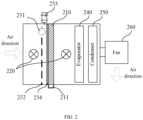
- the drying apparatus is shown in FIG. 2 , an air intake side of the drying apparatus is provided with a filter screen 210, a respective air pressure sensor 220 is provided on either side of the filter screen 210, and a side of the filter screen 210 facing towards the air intake side is provided with a filter screen cleaning component which includes a brush 231, a slide rail 232, a driving motor 233, and spray nozzles 234.
- the brush 231 is provided on the slide rail 232
- the driving motor 233 is configured to drive the brush 231 to move and/or the slide rail 232 to move, and the driving can be specifically realized by some transmission devices, which is not described herein again.
- each of the spray nozzles 234 can be controlled individually by means of a valve (only an example in the figure).
- the drying apparatus in the present embodiment may further include, but is not limited to, an evaporator 240, a condenser 250, and a fan 260, which are not described in detail herein.
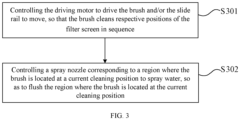
- S102 at which the filter screen cleaning component is started to clean the filter screen as described in the foregoing embodiment includes the following.
- the cleaning since the brush is provided on the slide rail, the cleaning may be performed along the direction of the slide rail when the driving motor drives the brush to move along the slide rail; and when the driving motor drives the slide rail to move, the brush can be driven to perform cleaning along the movement direction of the slide rail, so that the brush can move in a two-direction dimension, that is, the brush can clean respective positions of the filter screen.
- the spray nozzles are controlled to spray water, the current cleaning position of the brush can be determined, and then the spray nozzle corresponding to the region where the brush is located at the current cleaning position can be selected to spray water so as to flush the region.
- the execution sequence and the execution times of S301 and S302 are not limited, that is, the flushing may be performed while brushing, or the flushing may be performed first and then the brushing, or the brushing may be performed first and then the flushing, or the brushing and the flushing may be performed alternately for multiple times.
- the filter screen cleaning component may further include: a drain line which is connected to a drain pipe of the washing machine, and configured to discharge sewage after the filter screen is flushed.
- the filter screen cleaning may further include:
- the cleaning speed required by the filter screen cleaning component to clean the filter screen or the time required for cleaning the filter screen once can be set.
- the filter screen can be cleaned for multiple times.
- the air intake of the drying apparatus is controlled to retest the air pressures.
- the cleaning can be ended. If the pressure difference between the air pressures does not meet the requirements, the cleaning can be performed once again.
- the preset threshold in the present embodiment may be the same as the preset threshold in S 102, and certainly, it can be lower than the preset threshold in S 102, so that a better cleaning effect can be achieved for the filter screen.
- S101 at which the air pressure on either side of the filter screen is detected by the air pressure sensor during the air intake process of the drying apparatus as described above may include: after a user sets a cleaning procedure and a drying procedure, controlling air intake of the drying apparatus before a rinse stage or a drain stage of the cleaning procedure, and detecting, by the air pressure sensor, the air pressure on either side of the filter screen.
- the user when the user is in need of cleaning and drying the clothes, the user can set the cleaning and drying procedures in advance, before the drying procedure is executed, that is, in the process of executing the cleaning procedure, the air intake of the drying apparatus is controlled, and the air pressures on either sides of the filter screen are detected. If it is determined that the filter screen needs to be cleaned, the cleaning process of the filter screen can be completed before the drying procedure is executed, to avoid the influence on the execution of the drying procedure.
- the cleaning process may be performed in the rinse stage or the drain stage, and therefore it is necessary to finish the detection of the air pressures on either sides of the filter screen before the rinse stage or the drain stage of the cleaning procedure, and determine whether the filter screen needs to be cleaned, so that the cleaning process can be performed in the rinse stage or the drain stage when it is determined that the filter screen needs to be cleaned.
- S 102 at which the filter screen cleaning component is started to clean the filter screen as described above may include: in the rinse stage or the drain stage of the cleaning procedure, starting the filter screen cleaning component to clean the filter screen, where the sewage after the filter screen is flushed is discharged from the drain line.
- S 101 at which the air pressure on either side of the filter screen is detected by the air pressure sensor during the air intake process of the drying apparatus as described above may include: after a user sets a drying procedure, detecting, by the air pressure sensor, the air pressure on either side of the filter screen during an air intake stage of the drying procedure.
- the detection of air pressures on either sides of the filter screen can be carried out in the air intake stage of the drying procedure. Since the drying procedure has the air intake stage, it is not necessary to control the air intake of the drying apparatus separately to detect the air pressures on either sides of the filter screen, which can simplify the control process and play a certain effect of saving energy consumption.
- S 102 at which the filter screen cleaning component is started to clean the filter screen as described above includes: after completion of the drying procedure or in a rinse stage or a drain stage of a next cleaning procedure, starting the filter screen cleaning component to clean the filter screen, where the sewage after the filter screen is flushed is discharged from the drain line.
- the cleaning can be performed at any time after the drying procedure is ended, for example, immediately after completion of the cleaning procedure, or after the user takes out the clothes, or in the rinse stage or the drain stage of a next cleaning process.
- S 101 at which the air pressure on either side of the filter screen is detected by the air pressure sensor during the air intake process of the drying apparatus as described above may include: receiving a cleaning instruction of the filter screen from a user, controlling air intake of the drying apparatus according to the cleaning instruction, and detecting, by the air pressure sensor, the air pressure on either side of the filter screen.
- the user when the user is in no need of cleaning and drying, the user may also actively select to clean the filter screen, and the user may trigger a cleaning instruction for the filter screen, for example, a physical button may be set on the washing machine, or a cleaning button may be provided through a touch screen on the washing machine, and the cleaning instruction for the filter screen is triggered by clicking the button.
- a cleaning instruction for the filter screen for example, a physical button may be set on the washing machine, or a cleaning button may be provided through a touch screen on the washing machine, and the cleaning instruction for the filter screen is triggered by clicking the button.
- the cleaning instruction of the filter screen may be issued over voice, or the cleaning instruction of the filter screen may be issued by a remote controller, a mobile terminal, or the like.
- the air intake of the drying apparatus is controlled, the air pressure on either side of the filter screen is detected by the air pressure sensor, if the pressure difference between the air pressures on either sides of the filter screen is not greater than the preset threshold, the filter screen may not be cleaned, and the user can also be prompted not to clean the filter screen; otherwise, the cleaning process of the filter screen is executed.
- the air intake of the drying apparatus can be controlled to air-dry the filter screen, so as to ensure that the drying device is dry inside.
- the automatic cleaning of the filter screen can be realized through the filter screen cleaning component.
- the user does not need to manually disassemble the filter screen or manually clean the filter screen, which brings convenience to the user.
- a proper time for cleaning the filter screen can be determined according to the pressure difference between the air pressures on either sides of the filter screen, to avoid generation of impacts on the drying procedure due to excessive accumulation of the lint, thereby effectively improving the drying efficiency, reducing energy consumption and extending the product life.
- the filter screen can be detached, for example, a handle (such as the handle 211 in FIG. 2 ) can be disposed on the filter screen, and the user can detach the filter screen from the drying apparatus by pulling the handle, so as to facilitate the user to replace and manually clean the filter screen.
- a handle such as the handle 211 in FIG. 2
- the user can detach the filter screen from the drying apparatus by pulling the handle, so as to facilitate the user to replace and manually clean the filter screen.
- prompt information can be sent to a user to inquire whether the user adopts automatic cleaning or manual cleaning.
- the filter screen is cleaned through the filter screen cleaning component;
- the user can detach the filter screen by pulling the handle, and the filter screen is installed on the drying apparatus after manual cleaning.
- FIG. 4 is a structural diagram of a control apparatus for filter screen cleaning according to an embodiment of the present application.
- the control apparatus for filter screen cleaning provided in the present embodiment is applied to a washing machine equipped with a drying apparatus, an air intake side of the drying apparatus is provided with a filter screen, a respective air pressure sensor is provided on either side of the filter screen, and a side of the filter screen facing towards the air intake side is provided with a filter screen cleaning component, and the control apparatus for filter screen cleaning can carry out the processing procedure provided in the embodiments of the method for filter screen cleaning.
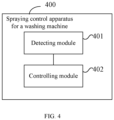
- the control apparatus for filter screen cleaning 400 includes a detecting module 401 and a controlling module 402.
- the detecting module 401 is configured to detect an air pressure on either side of the filter screen via the air pressure sensor during an air intake process of the drying apparatus, and obtain a pressure difference according to air pressures on either sides of the filter screen.
- the controlling module 402 is configured to start the filter screen cleaning component to clean the filter screen, if the pressure difference is greater than a preset threshold.
- the filter screen cleaning component includes a brush, a slide rail, a driving motor and spray nozzles, where the brush is provided on the slide rail, the driving motor is configured to drive the brush to move and/or the slide rail to move, and there are multiple spray nozzles and the spray nozzles are configured such that they face different areas of the filter screen respectively, the controlling module 402, when starting the filter screen cleaning component to clean the filter screen, is configured to:
- the filter screen cleaning component further includes: a drain line which is connected to a drain pipe of the washing machine, and configured to discharge sewage after the filter screen is flushed.
- controlling module 402 is further configured to:
- the detecting module 401 when detecting the air pressure on either side of the filter screen via the air pressure sensor during the air intake process of the drying apparatus, is configured to:
- the detecting module 401 when detecting the air pressure on either side of the filter screen via the air pressure sensor during the air intake process of the drying apparatus, is configured to:
- the detecting module 401 when detecting the air pressure on either side of the filter screen via the air pressure sensor during the air intake process of the drying apparatus, is configured to:
- control apparatus for filter screen cleaning provided in the embodiments of the present application may be specifically configured to execute the method embodiments provided in FIG. 1 or FIG. 3 , and its specific functions are not described herein again.
- the control apparatus for filter screen cleaning provided in the embodiments of the present application, during an air intake process of a drying apparatus, an air pressure on either side of a filter screen is detected by an air pressure sensor, and a pressure difference is obtained according to air pressures on either sides of the filter screen. If the pressure difference is greater than a preset threshold, a filter screen cleaning component is started to clean the filter screen.
- the automatic cleaning of the filter screen can be realized through the filter screen cleaning component. The user does not need to manually disassemble the filter screen or manually clean the filter screen, which brings convenience to the user.
- a proper time for cleaning the filter screen can be determined according to the pressure difference between the air pressures on either sides of the filter screen, to avoid generation of impacts on the drying procedure due to excessive accumulation of the lint, thereby effectively improving the drying efficiency, reducing energy consumption and extending the product life.
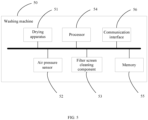
- FIG. 5 is a schematic structural diagram of a washing machine according to an embodiment of the present application.
- the washing machine 50 provided in the embodiment of the present application is equipped with a drying apparatus 51, where an air intake side of the drying apparatus is provided with a filter screen, a respective air pressure sensor 52 is provided on either side of the filter screen, and a side of the filter screen facing towards the air intake side is provided with a filter screen cleaning component 53.
- the washing machine 50 further includes a processor 54, a memory 55, and a computer program; where the computer program is stored in the memory 55 and configured to be executed by the processor 54 for the method for filter screen cleaning as described in the above embodiments.
- the above components may be connected by a bus, and the washing machine 50 may further include a communication interface 56 for receiving control commands.
- the washing machine of the embodiment shown in FIG. 5 can be used for implementing the technical solution of the above method embodiments, and the implementation principle and technical effect are similar, and are not described herein again.
- the present embodiment also provides a computer-readable storage medium on which a computer program is stored.
- the computer program when executed by a processor, implements the method for filter screen cleaning as described in the above embodiments.
- the present embodiment also provides a computer program product including a computer program.
- the computer program when executed by a processor, implements the method for filter screen cleaning as described in the above embodiments.
- the disclosed apparatus and method may be implemented in other ways.
- the above-described apparatus embodiments are merely illustrative, and for example, the division of the units is only a logical division, and other divisions may be realized in practice, for example, a plurality of units or components may be combined or integrated into another system, or some features may be omitted, or not executed.
- the shown or discussed mutual coupling or direct coupling or communication connection may be an indirect coupling or communication connection through some interfaces, devices or units, and may be in an electrical, mechanical or other form.
- the units described as separate parts may or may not be physically separate, and parts displayed as units may or may not be physical units, that is, they may be located in one place, or may be distributed on a plurality of network units. Some or all of the units can be selected according to actual needs to achieve the purpose of the solution of the present embodiments.
- functional units in the embodiments of the present application may be integrated into one processing unit, or each unit may exist alone physically, or two or more units are integrated into one unit.
- the integrated unit can be realized in a form of hardware, or in a form of hardware plus a software functional unit.
- the integrated unit implemented in the form of a software functional unit may be stored in a computer-readable storage medium.
- the software functional unit is stored in a storage medium and includes several instructions to enable a computer device (which may be a personal computer, a server, or a network device) or a processor (processor) to execute some steps of the methods described in the embodiments of the present application.
- the aforementioned storage medium includes: a USB flash disk, a mobile hard disk, a read-only memory (Read-Only Memory, ROM), a random access memory (Random Access Memory, RAM), a magnetic disk or an optical disk and other media on which program codes can be stored.
Landscapes
- Engineering & Computer Science (AREA)
- Textile Engineering (AREA)
- Control Of Washing Machine And Dryer (AREA)
- Drying Of Solid Materials (AREA)
Abstract
Description
- This application claims priority to
Chinese Patent Application No. 202010645224.3, filed to the China National Intellectual Property Administration on July 07, 2020 - Embodiments of the present application relate to the technical field of household appliances, and in particular, relates to a method for filter screen cleaning, an apparatus, a washing machine, and a storage medium.
- With the popularity of washing machines, more and more people use the washing machines to clean the clothes, which brings a lot of convenience to people's life. For an existing washing machine with a drying function, the drying performance may be affected in the drying stage, since the lint generated from the clothes in the cleaning stage will be circulated in the whole system along with the hot drying air and possibly enter the drying system to result in the accumulation of the lint over time.
- In order to eliminate the influence of the lint, a filtering structure, such as a filter screen, is usually provided in the drying system, and the lint is collected by the filter screen, so that the lint is prevented from entering the drying system. However, the lint may be accumulated on the filter screen, and thus the user is required to clean the filtering structure regularly, for example, the user is required to detach the filter screen for cleaning and then reinstall the filtering structure.
- The existing filter screen cleaning method is complex in filter screen dismounting and cleaning processes, which brings inconvenience to the user; moreover, if the user forgets to clean or does not clean in time, the whole drying period will be prolonged, energy consumption will increase, and the service life of the product will be seriously influenced.
- The embodiments of the present application provide a method for filter screen cleaning, an apparatus, a washing machine and a storage medium, so as to achieve automatic cleaning of the filter screen.
- In a first aspect of an embodiment of the present application, provided is a method for filter screen cleaning. The method is applied to a washing machine equipped with a drying apparatus, an air intake side of the drying apparatus is provided with a filter screen, a respective air pressure sensor is provided on either side of the filter screen, and a side of the filter screen facing towards the air intake side is provided with a filter screen cleaning component, and the method includes:
- In a possible implementation, the filter screen cleaning component includes a brush, a slide rail, a driving motor and spray nozzles, where the brush is provided on the slide rail, the driving motor is configured to drive the brush to move and/or the slide rail to move, and there are multiple spray nozzles and the spray nozzles are configured such that they face different areas of the filter screen respectively,
the starting the filter screen cleaning component to clean the filter screen includes: - controlling the driving motor to drive the brush and/or the slide rail to move, so that the brush cleans respective positions of the filter screen in sequence; and
- controlling a spray nozzle corresponding to a region where the brush is located at a current cleaning position to spray water, so as to flush the region where the brush is located at the current cleaning position.
- In a possible implementation, the filter screen cleaning component further includes: a drain line which is connected to a drain pipe of the washing machine, and configured to discharge sewage after the filter screen is flushed.
- In a possible implementation, the method further includes:
- after the filter screen is cleaned once, re-controlling air intake of the drying apparatus, detecting, by the air pressure sensor, an air pressure on either side of the filter screen, and obtaining a pressure difference according to air pressures on either sides of the filter screen; and
- if the pressure difference is greater than the preset threshold, restarting the filter screen cleaning component to clean the filter screen; or
- if the pressure difference is not greater than the preset threshold, ending the cleaning of the filter screen.
- In a possible implementation, the detecting, by the air pressure sensor, the air pressure on either side of the filter screen during the air intake process of the drying apparatus includes:
- after a user sets a cleaning procedure and a drying procedure, controlling air intake of the drying apparatus before a rinse stage or a drain stage of the cleaning procedure, and detecting, by the air pressure sensor, the air pressure on either side of the filter screen, and
- the starting the filter screen cleaning component to clean the filter screen includes:
in the rinse stage or the drain stage of the cleaning procedure, starting the filter screen cleaning component to clean the filter screen, where the sewage after the filter screen is flushed is discharged from the drain line. - In a possible implementation, the detecting, by the air pressure sensor, the air pressure on either side of the filter screen during the air intake process of the drying apparatus includes:
- after a user sets a drying procedure, detecting, by the air pressure sensor, the air pressure on either side of the filter screen during an air intake stage of the drying procedure, and
- the starting the filter screen cleaning component to clean the filter screen includes:
after completion of the drying procedure or in a rinse stage or a drain stage of a next cleaning procedure, starting the filter screen cleaning component to clean the filter screen, where the sewage after the filter screen is flushed is discharged from the drain line. - In a possible implementation, the detecting, by the air pressure sensor, the air pressure on either side of the filter screen during the air intake process of the drying apparatus includes:
- receiving a cleaning instruction of the filter screen from a user, controlling air intake of the drying apparatus according to the cleaning instruction, and detecting, by the air pressure sensor, the air pressure on either side of the filter screen, and
- after completion of the cleaning of filter screen, the method further includes:
controlling air intake of the drying apparatus, so as to air-dry the filter screen. - In a second aspect of an embodiment of the present application, provided is a control apparatus for filter screen cleaning. The apparatus is applied to a washing machine equipped with a drying apparatus, an air intake side of the drying apparatus is provided with a filter screen, a respective air pressure sensor is provided on either side of the filter screen, and a side of the filter screen facing towards the air intake side is provided with a filter screen cleaning component, and the apparatus includes:
- a detecting module, configured to detect an air pressure on either side of the filter screen via the air pressure sensor during an air intake process of the drying apparatus, and obtain a pressure difference according to air pressures on either sides of the filter screen; and
- a controlling module, configured to start the filter screen cleaning component to clean the filter screen, if the pressure difference is greater than a preset threshold.
- In a possible implementation, the filter screen cleaning component includes a brush, a slide rail, a driving motor and spray nozzles, where the brush is provided on the slide rail, the driving motor is configured to drive the brush to move and/or the slide rail to move, and there are multiple spray nozzles and the spray nozzles are configured such that they face different areas of the filter screen respectively,
the controlling module, when starting the filter screen cleaning component to clean the filter screen, is configured to: - control the driving motor to drive the brush and/or the slide rail to move, so that the brush cleans respective positions of the filter screen in sequence; and
- control a spray nozzle corresponding to a region where the brush is located at a current cleaning position to spray water, so as to flush the region where the brush is located at the current cleaning position.
- In a possible implementation, the filter screen cleaning component further includes: a drain line which is connected to a drain pipe of the washing machine, and configured to discharge sewage after the filter screen is flushed.
- In a possible implementation, the control apparatus is further configured to:
- after the filter screen is cleaned once, re-control air intake of the drying apparatus, control the detecting module to detect an air pressure on either side of the filter screen via the air pressure sensor and to obtain a pressure difference according to air pressures on either sides of the filter screen; and
- if the pressure difference is greater than the preset threshold, restart the filter screen cleaning component to clean the filter screen; or
- if the pressure difference is not greater than the preset threshold, end the cleaning of the filter screen.
- In a possible implementation, the detecting module, when detecting the air pressure on either side of the filter screen via the air pressure sensor during the air intake process of the drying apparatus, is configured to:
- after a user sets a cleaning procedure and a drying procedure, control air intake of the drying apparatus before a rinse stage or a drain stage of the cleaning procedure, and detect the air pressure on either side of the filter screen via the air pressure sensor, and
- the controlling module, when starting the filter screen cleaning component to clean the filter screen, is configured to:
in the rinse stage or the drain stage of the cleaning procedure, start the filter screen cleaning component to clean the filter screen, where the sewage after the filter screen is flushed is discharged from the drain line. - In a possible implementation, the detecting module, when detecting the air pressure on either side of the filter screen via the air pressure sensor during the air intake process of the drying apparatus, is configured to:
- after a user sets a drying procedure, detect the air pressure on either side of the filter screen via the air pressure sensor during an air intake stage of the drying procedure, and
- the controlling module, when starting the filter screen cleaning component to clean the filter screen, is configured to:
after completion of the drying procedure or in a rinse stage or a drain stage of a next cleaning procedure, start the filter screen cleaning component to clean the filter screen, where the sewage after the filter screen is flushed is discharged from the drain line. - In a possible implementation, the detecting module, when detecting the air pressure on either side of the filter screen via the air pressure sensor during the air intake process of the drying apparatus, is configured to:
- receive a cleaning instruction of the filter screen from a user, control air intake of the drying apparatus according to the cleaning instruction, and detect the air pressure on either of the filter screen via the air pressure sensor, and
- the controlling module, after completion of the cleaning of filter screen, is further configured to:
control air intake of the drying apparatus, so as to air-dry the filter screen. - In a third aspect of an embodiment of the present application, provided is a washing machine. The washing machine is equipped with a drying apparatus, an air intake side of the drying apparatus is provided with a filter screen, a respective air pressure sensor is provided on either side of the filter screen, and a side of the filter screen facing towards the air intake side is provided with a filter screen cleaning component, and the washing machine further includes:
- a memory configured to store a computer program; and
- a processor configured to execute the computer program stored in the memory to implement the method according to the first aspect.
- In a fourth aspect of an embodiment of the present application, provided is a computer-readable storage medium on which a computer program is stored. The computer program, when executed by a processor, implements the method according to the first aspect.
- In a fifth aspect of an embodiment of the present application, provided is a computer program product, including a computer program. The computer program, when executed by a processor, implements the method according to the first aspect.
- In a sixth aspect of an embodiment of the present application, provided is a filter screen cleaning component. The filter screen cleaning component is provided on a side of a filter screen facing towards an air intake side, and is configured to clean the filter screen if air pressures on either sides of the filter screen are greater than a preset threshold. The filter screen is provided on the air intake side of a drying apparatus of a washing machine,
- the filter screen cleaning component includes a brush, a slide rail, a driving motor and spray nozzles, where the brush is provided on the slide rail,
- the driving motor is configured to drive the brush to move and/or the slide rail to move, so that the brush cleans respective positions of the filter screen in sequence, and
- there are multiple spray nozzles and the spray nozzles are configured such that they face different areas of the filter screen respectively, and a spray nozzle corresponding to a region where the brush is located at a current cleaning position is configured to flush the region where the brush is located at the current cleaning position.
- In a possible implementation, the filter screen cleaning component further includes: a drain line which is connected to a drain pipe of the washing machine, and is configured to discharge sewage after the filter screen is flushed.
- In a seventh aspect of an embodiment of the present application, provided is a drying apparatus. The drying apparatus is provided in a washing machine, an air intake side of the drying apparatus is provided with a filter screen, a respective air pressure sensor is provided on either side of the filter screen, and a side of the filter screen facing towards the air intake side is provided with the filter screen cleaning component according to the six aspect.
- According to the method for filter screen cleaning, the apparatus, the washing machine and the storage medium provided in the embodiments of the present application, during the air intake process of the drying apparatus, the air pressure on either side of the filter screen is detected by the air pressure sensor and the pressure difference is obtained according to the air pressures on either sides of the filter screen. If the pressure difference is greater than the preset threshold, the filter screen cleaning component is started to clean the filter screen. According to the present embodiments, the automatic cleaning of the filter screen can be realized through the filter screen cleaning component. The user does not need to manually disassemble the filter screen or manually clean the filter screen, which brings convenience to the user. In addition, a proper time for cleaning the filter screen can be determined according to the pressure difference between the air pressures on either sides of the filter screen, to avoid generation of impacts on the drying procedure due to excessive accumulation of the lint, thereby effectively improving the drying efficiency, reducing energy consumption and extending the product life.
- In order to more clearly illustrate the embodiments of the present application or the technical solutions in the prior art, the drawings needed in the description of the embodiments or the prior art will be briefly described below, it is obvious that the drawings in the following description are only intended for some embodiments of the present application, and for those skilled in the art, other drawings can be obtained according to the drawings without creative efforts.
-
FIG. 1 is a flow chart of a method for filter screen cleaning according to an embodiment of the present application. -
FIG. 2 is a schematic diagram of a drying apparatus of a washing machine according to an embodiment of the present application. -
FIG. 3 is a flow chart of a method for filter screen cleaning according to another embodiment of the present application. -
FIG. 4 is a structural diagram of a control apparatus for filter screen cleaning according to an embodiment of the present application. -
FIG. 5 is a structural diagram of a washing machine according to an embodiment of the present application. - The technical solutions in the embodiments of the present application will be clearly and completely described below with reference to the drawings in the embodiments of the present application. It is obvious that the described embodiments are only a part of the embodiments of the present application, and not all of the embodiments. All other embodiments obtained by those skilled in the art based on the embodiments of the present application without any creative efforts shall fall within the protection scope of the embodiments of the present application.
- For an existing washing machine with a drying function, the drying performance may be affected in the drying stage, since the lint generated from the clothes in the cleaning stage will be circulated in the whole system along with the hot drying air and possibly enter the drying system to result in the accumulation of the lint over time. In order to eliminate the influence of the lint, a filtering structure, such as a filter screen, is usually provided in the drying system, and the lint is collected by the filter screen, so that the lint is prevented from entering the drying system. However, the lint may be accumulated on the filter screen, and thus the user is required to clean the filtering structure regularly, for example, the user is required to detach the filter screen for cleaning and then reinstall the filtering structure.
- The existing filter screen cleaning method requires the user to regularly dismount and clean the filter screen and is complex in the dismounting process and cleaning process, which brings inconvenience to the user; moreover, if the user forgets to clean or does not clean in time, the whole drying period will be prolonged, energy consumption will increase, and the service life of the product will be seriously influenced.
- In order to solve the above-described problems, from considerations according to the embodiments of the present application, a filter screen cleaning component should be added in the washing machine to realize automatic cleaning. The user does not need to manually disassemble the filter screen or manually clean the filter screen, which brings convenience to the user.
- However, how to trigger the filter screen cleaning component to clean the filter screen needs provision of some sensors to detect the accumulation degree of the lint on the filter screen. According to investigation and simulation tests, it is found that in the drying procedure, a pressure difference exists between air pressures on either sides of the filter screen due to the presence of the lint on the filter screen, and the more the lint accumulation, the greater the pressure difference between the air pressures on either sides of the filter screen. Therefore, in the embodiments of the present application, a respective air pressure sensor is provided on either side of a filter screen; during an air intake process of a drying apparatus, an air pressure on either side of the filter screen is detected by the air pressure sensor and a pressure difference is obtained according to air pressures on either sides of the filter screen; and if the pressure difference is greater than a preset threshold, a filter screen cleaning component is started to clean the filter screen, so that the filter screen can be cleaned at a proper time, to avoid generation of impacts on the drying procedure due to excessive accumulation of the lint, thereby effectively improving the drying efficiency, reducing energy consumption and extending the product life.
- The filter screen cleaning process is explained and illustrated in detail below with reference to specific embodiments.
-
FIG. 1 is a flowchart of a method for filter screen cleaning according to an embodiment of the present application. The present embodiment provides a method for filter screen cleaning. The method is applied to a washing machine equipped with a drying apparatus, an air intake side of the drying apparatus is provided with a filter screen, a respective air pressure sensor is provided on either side of the filter screen, and a side of the filter screen facing towards the air intake side is provided with a filter screen cleaning component. Since the lint of clothes is accumulated on the side of filter screen facing towards the air intake side, the side of the filter screen facing towards the air intake side can be cleaned through the filter screen cleaning component, where the filter screen cleaning component can be any equipment that can achieve the cleaning function, which is not limited here. In addition, the drying apparatus in the present embodiment may further include, but is not limited to, an evaporator, a condenser, and a fan, which are not described in detail herein. - The method for filter screen cleaning provided in the present embodiment specifically includes the following steps.
- S101, during an air intake process of a drying apparatus, an air pressure on either side of a filter screen is detected by an air pressure sensor, and a pressure difference is obtained according to air pressures on either sides of the filter screen.
- In the present embodiment, the filter screen will be blocked to a certain extent when the lint is accumulated on the filter screen, so the air pressures on either sides of the filter screen will be different, and there will be a certain pressure difference, and the more the lint accumulation, the greater the pressure difference between the air pressures on either sides of the filter screen. Therefore, in the present embodiment, an air pressure on either side of the filter screen is detected by a respective air pressure sensor provided on either side of the filter screen, and then a pressure difference is obtained according to air pressures on either sides of the filter screen.
- It should be noted that the air pressure sensor may detect the air pressure on either side of the filter screen at any time, for example, detect during the drying procedure, or detect when the user actively chooses to clean the filter screen, or detect during execution of a cleaning procedure after the user selects the cleaning procedure and a drying procedure, or detect at other times, or detect regularly. During the detection, the air intake of the drying apparatus needs to be controlled, for example, the fan in the drying apparatus is controlled to start. Certainly, if the drying apparatus has already been in an air intake state when detecting the air pressure during the drying procedure, the air intake does not need to be controlled separately.
- S102, starting the filter screen cleaning component to clean the filter screen, if the pressure difference is greater than a preset threshold.
- In the present embodiment, it is judged whether the pressure difference between the air pressures on either sides of the filter screen is greater than the preset threshold. When the pressure difference is greater than the preset threshold, it means that the accumulation of the lint on the filter screen has reached a certain level, which will have a negative impact on the drying procedure. The filter screen needs to be cleaned, and the filter screen cleaning component can be controlled to clean the filter screen. The preset threshold can be set according to actual requirements.
- It should be noted that, after the pressure difference is determined to be greater than the preset threshold, the filter screen may be cleaned immediately, or may be cleaned until a proper time, for example, when the washing machine is in a rinse stage or a drain stage, the filter screen is cleaned, so as to avoid secondary pollution in the washing machine caused by the cleaned lint.
- In the method for filter screen cleaning provided in the present embodiment, during an air intake process of a drying apparatus, an air pressure on either side of a filter screen is detected by an air pressure sensor, and a pressure difference is obtained according to air pressures on either sides of the filter screen. If the pressure difference is greater than a preset threshold, a filter screen cleaning component is started to clean the filter screen. According to the present embodiment, the automatic cleaning of the filter screen can be realized through the filter screen cleaning component. The user does not need to manually disassemble the filter screen or manually clean the filter screen, which brings convenience to the user. In addition, a proper time for cleaning the filter screen can be determined according to the pressure difference between the air pressures on either sides of the filter screen, to avoid generation of impacts on the drying procedure due to excessive accumulation of the lint, thereby effectively improving the drying efficiency, reducing energy consumption and extending the product life.
- In an optional embodiment, the drying apparatus is shown in
FIG. 2 , an air intake side of the drying apparatus is provided with afilter screen 210, a respectiveair pressure sensor 220 is provided on either side of thefilter screen 210, and a side of thefilter screen 210 facing towards the air intake side is provided with a filter screen cleaning component which includes abrush 231, aslide rail 232, a drivingmotor 233, andspray nozzles 234. Thebrush 231 is provided on theslide rail 232, the drivingmotor 233 is configured to drive thebrush 231 to move and/or theslide rail 232 to move, and the driving can be specifically realized by some transmission devices, which is not described herein again. There aremultiple spray nozzles 234 and thespray nozzles 234 are configured such that they face different areas of the filter screen respectively, each of thespray nozzles 234 can be controlled individually by means of a valve (only an example in the figure). In addition, the drying apparatus in the present embodiment may further include, but is not limited to, anevaporator 240, acondenser 250, and afan 260, which are not described in detail herein. - Further, as shown in
FIG. 3 , S102 at which the filter screen cleaning component is started to clean the filter screen as described in the foregoing embodiment includes the following. - S301, controlling the driving motor to drive the brush and/or the slide rail to move, so that the brush cleans respective positions of the filter screen in sequence.
- S302, controlling a spray nozzle corresponding to a region where the brush is located at a current cleaning position to spray water, so as to flush the region where the brush is located at the current cleaning position.
- In the present embodiment, since the brush is provided on the slide rail, the cleaning may be performed along the direction of the slide rail when the driving motor drives the brush to move along the slide rail; and when the driving motor drives the slide rail to move, the brush can be driven to perform cleaning along the movement direction of the slide rail, so that the brush can move in a two-direction dimension, that is, the brush can clean respective positions of the filter screen. In addition, when the spray nozzles are controlled to spray water, the current cleaning position of the brush can be determined, and then the spray nozzle corresponding to the region where the brush is located at the current cleaning position can be selected to spray water so as to flush the region.
- It should be noted that, in the present embodiment, the execution sequence and the execution times of S301 and S302 are not limited, that is, the flushing may be performed while brushing, or the flushing may be performed first and then the brushing, or the brushing may be performed first and then the flushing, or the brushing and the flushing may be performed alternately for multiple times.
- On the basis of the above embodiment, the filter screen cleaning component may further include: a drain line which is connected to a drain pipe of the washing machine, and configured to discharge sewage after the filter screen is flushed.
- On the basis of any one of the above embodiments, the filter screen cleaning may further include:
- after the filter screen is cleaned once, re-controlling air intake of the drying apparatus, detecting, by the air pressure sensor, an air pressure on either side of the filter screen, and obtaining a pressure difference according to air pressures on either sides of the filter screen; and
- if the pressure difference is greater than the preset threshold, restarting the filter screen cleaning component to clean the filter screen; or
- if the pressure difference is not greater than the preset threshold, ending the cleaning of the filter screen.
- In the present embodiment, the cleaning speed required by the filter screen cleaning component to clean the filter screen or the time required for cleaning the filter screen once can be set. The filter screen can be cleaned for multiple times. After each cleaning is ended, the air intake of the drying apparatus is controlled to retest the air pressures. When the pressure difference between the air pressures meets the requirements, the cleaning can be ended. If the pressure difference between the air pressures does not meet the requirements, the cleaning can be performed once again. With the above process, the cleaning efficiency of the filter screen can be effectively improved, and the requirements for ending the cleaning can be quickly met. It should be noted that the preset threshold in the present embodiment may be the same as the preset threshold in
S 102, and certainly, it can be lower than the preset threshold inS 102, so that a better cleaning effect can be achieved for the filter screen. - On the basis of any one of the above embodiments, in an optional embodiment, S101 at which the air pressure on either side of the filter screen is detected by the air pressure sensor during the air intake process of the drying apparatus as described above may include:
after a user sets a cleaning procedure and a drying procedure, controlling air intake of the drying apparatus before a rinse stage or a drain stage of the cleaning procedure, and detecting, by the air pressure sensor, the air pressure on either side of the filter screen. - In the present embodiment, when the user is in need of cleaning and drying the clothes, the user can set the cleaning and drying procedures in advance, before the drying procedure is executed, that is, in the process of executing the cleaning procedure, the air intake of the drying apparatus is controlled, and the air pressures on either sides of the filter screen are detected. If it is determined that the filter screen needs to be cleaned, the cleaning process of the filter screen can be completed before the drying procedure is executed, to avoid the influence on the execution of the drying procedure. Further, with the consideration that the cleaned lint may contaminate the laundry inside the washing machine, the cleaning process may be performed in the rinse stage or the drain stage, and therefore it is necessary to finish the detection of the air pressures on either sides of the filter screen before the rinse stage or the drain stage of the cleaning procedure, and determine whether the filter screen needs to be cleaned, so that the cleaning process can be performed in the rinse stage or the drain stage when it is determined that the filter screen needs to be cleaned.
- Correspondingly,
S 102 at which the filter screen cleaning component is started to clean the filter screen as described above may include:
in the rinse stage or the drain stage of the cleaning procedure, starting the filter screen cleaning component to clean the filter screen, where the sewage after the filter screen is flushed is discharged from the drain line. - In another optional embodiment,
S 101 at which the air pressure on either side of the filter screen is detected by the air pressure sensor during the air intake process of the drying apparatus as described above may include:
after a user sets a drying procedure, detecting, by the air pressure sensor, the air pressure on either side of the filter screen during an air intake stage of the drying procedure. - In the present embodiment, the detection of air pressures on either sides of the filter screen can be carried out in the air intake stage of the drying procedure. Since the drying procedure has the air intake stage, it is not necessary to control the air intake of the drying apparatus separately to detect the air pressures on either sides of the filter screen, which can simplify the control process and play a certain effect of saving energy consumption.
- Correspondingly,
S 102 at which the filter screen cleaning component is started to clean the filter screen as described above includes:
after completion of the drying procedure or in a rinse stage or a drain stage of a next cleaning procedure, starting the filter screen cleaning component to clean the filter screen, where the sewage after the filter screen is flushed is discharged from the drain line. - In the present embodiment, since the detection of the air pressures on either sides of the filter screen can be performed in the air intake stage of the drying procedure, when it is determined that the filter screen needs to be cleaned, the cleaning can be performed at any time after the drying procedure is ended, for example, immediately after completion of the cleaning procedure, or after the user takes out the clothes, or in the rinse stage or the drain stage of a next cleaning process.
- In another optional embodiment,
S 101 at which the air pressure on either side of the filter screen is detected by the air pressure sensor during the air intake process of the drying apparatus as described above may include:
receiving a cleaning instruction of the filter screen from a user, controlling air intake of the drying apparatus according to the cleaning instruction, and detecting, by the air pressure sensor, the air pressure on either side of the filter screen. - In the present embodiment, when the user is in no need of cleaning and drying, the user may also actively select to clean the filter screen, and the user may trigger a cleaning instruction for the filter screen, for example, a physical button may be set on the washing machine, or a cleaning button may be provided through a touch screen on the washing machine, and the cleaning instruction for the filter screen is triggered by clicking the button. Of course, the cleaning instruction of the filter screen may be issued over voice, or the cleaning instruction of the filter screen may be issued by a remote controller, a mobile terminal, or the like. After receiving the user's cleaning instruction for the filter screen, the air intake of the drying apparatus is controlled, the air pressure on either side of the filter screen is detected by the air pressure sensor, if the pressure difference between the air pressures on either sides of the filter screen is not greater than the preset threshold, the filter screen may not be cleaned, and the user can also be prompted not to clean the filter screen; otherwise, the cleaning process of the filter screen is executed.
- Further, since the user has no drying demand at present, in order to avoid that, after cleaning the filter screen, much residual water remains on the filter screen so that the drying apparatus is affected to some extent, such as rust, etc. After the filter screen is cleaned, the air intake of the drying apparatus can be controlled to air-dry the filter screen, so as to ensure that the drying device is dry inside.
- According to the method for filter screen cleaning provided in the above embodiment, the automatic cleaning of the filter screen can be realized through the filter screen cleaning component. The user does not need to manually disassemble the filter screen or manually clean the filter screen, which brings convenience to the user. In addition, a proper time for cleaning the filter screen can be determined according to the pressure difference between the air pressures on either sides of the filter screen, to avoid generation of impacts on the drying procedure due to excessive accumulation of the lint, thereby effectively improving the drying efficiency, reducing energy consumption and extending the product life.
- On the basis of the above embodiment, the filter screen can be detached, for example, a handle (such as the
handle 211 inFIG. 2 ) can be disposed on the filter screen, and the user can detach the filter screen from the drying apparatus by pulling the handle, so as to facilitate the user to replace and manually clean the filter screen. - Further, when the pressure difference is determined to be greater than the preset threshold, prompt information can be sent to a user to inquire whether the user adopts automatic cleaning or manual cleaning. When the user selects to adopt automatic cleaning, the filter screen is cleaned through the filter screen cleaning component; when the user selects to adopt manual cleaning, the user can detach the filter screen by pulling the handle, and the filter screen is installed on the drying apparatus after manual cleaning.
-
FIG. 4 is a structural diagram of a control apparatus for filter screen cleaning according to an embodiment of the present application. The control apparatus for filter screen cleaning provided in the present embodiment is applied to a washing machine equipped with a drying apparatus, an air intake side of the drying apparatus is provided with a filter screen, a respective air pressure sensor is provided on either side of the filter screen, and a side of the filter screen facing towards the air intake side is provided with a filter screen cleaning component, and the control apparatus for filter screen cleaning can carry out the processing procedure provided in the embodiments of the method for filter screen cleaning. As shown inFIG. 4 , the control apparatus for filter screen cleaning 400 includes a detectingmodule 401 and a controllingmodule 402. - The detecting
module 401 is configured to detect an air pressure on either side of the filter screen via the air pressure sensor during an air intake process of the drying apparatus, and obtain a pressure difference according to air pressures on either sides of the filter screen. - The controlling
module 402 is configured to start the filter screen cleaning component to clean the filter screen, if the pressure difference is greater than a preset threshold. - In a possible implementation, the filter screen cleaning component includes a brush, a slide rail, a driving motor and spray nozzles, where the brush is provided on the slide rail, the driving motor is configured to drive the brush to move and/or the slide rail to move, and there are multiple spray nozzles and the spray nozzles are configured such that they face different areas of the filter screen respectively,
the controllingmodule 402, when starting the filter screen cleaning component to clean the filter screen, is configured to: - control the driving motor to drive the brush and/or the slide rail to move, so that the brush cleans respective positions of the filter screen in sequence; and
- control a spray nozzle corresponding to a region where the brush is located at a current cleaning position to spray water, so as to flush the region where the brush is located at the current cleaning position.
- In a possible implementation, the filter screen cleaning component further includes: a drain line which is connected to a drain pipe of the washing machine, and configured to discharge sewage after the filter screen is flushed.
- In a possible implementation, the controlling
module 402 is further configured to: - after the filter screen is cleaned once, re-control air intake of the drying apparatus, control the detecting
module 401 to detect an air pressure on either side of the filter screen via the air pressure sensor and to obtain a pressure difference according to air pressures on either sides of the filter screen; and - if the pressure difference is greater than the preset threshold, restart the filter screen cleaning component to clean the filter screen; or
- if the pressure difference is not greater than the preset threshold, end the cleaning of the filter screen.
- In a possible implementation, the detecting
module 401, when detecting the air pressure on either side of the filter screen via the air pressure sensor during the air intake process of the drying apparatus, is configured to: - after a user sets a cleaning procedure and a drying procedure, control air intake of the drying apparatus before a rinse stage or a drain stage of the cleaning procedure, and detect the air pressure on either side of the filter screen via the air pressure sensor, and
- the controlling
module 402, when starting the filter screen cleaning component to clean the filter screen, is configured to:
in the rinse stage or the drain stage of the cleaning procedure, start the filter screen cleaning component to clean the filter screen, where the sewage after the filter screen is flushed is discharged from the drain line. - In a possible implementation, the detecting
module 401, when detecting the air pressure on either side of the filter screen via the air pressure sensor during the air intake process of the drying apparatus, is configured to: - after a user sets a drying procedure, detect the air pressure on either side of the filter screen via the air pressure sensor during an air intake stage of the drying procedure, and
- the controlling
module 402, when starting the filter screen cleaning component to clean the filter screen, is configured to:
after completion of the drying procedure or in a rinse stage or a drain stage of a next cleaning procedure, start the filter screen cleaning component to clean the filter screen, where the sewage after the filter screen is flushed is discharged from the drain line. - In a possible implementation, the detecting
module 401, when detecting the air pressure on either side of the filter screen via the air pressure sensor during the air intake process of the drying apparatus, is configured to: - receive a cleaning instruction of the filter screen from a user, control air intake of the drying apparatus according to the cleaning instruction, and detect the air pressure on either side of the filter screen via the air pressure sensor, and
- the controlling
module 402, after completion of the cleaning of filter screen, is further configured to:
control air intake of the drying apparatus, so as to air-dry the filter screen. - The control apparatus for filter screen cleaning provided in the embodiments of the present application may be specifically configured to execute the method embodiments provided in
FIG. 1 orFIG. 3 , and its specific functions are not described herein again. - According to the control apparatus for filter screen cleaning provided in the embodiments of the present application, during an air intake process of a drying apparatus, an air pressure on either side of a filter screen is detected by an air pressure sensor, and a pressure difference is obtained according to air pressures on either sides of the filter screen. If the pressure difference is greater than a preset threshold, a filter screen cleaning component is started to clean the filter screen. According to the present embodiment, the automatic cleaning of the filter screen can be realized through the filter screen cleaning component. The user does not need to manually disassemble the filter screen or manually clean the filter screen, which brings convenience to the user. In addition, a proper time for cleaning the filter screen can be determined according to the pressure difference between the air pressures on either sides of the filter screen, to avoid generation of impacts on the drying procedure due to excessive accumulation of the lint, thereby effectively improving the drying efficiency, reducing energy consumption and extending the product life.
-
FIG. 5 is a schematic structural diagram of a washing machine according to an embodiment of the present application. As shown inFIG. 5 , thewashing machine 50 provided in the embodiment of the present application is equipped with a dryingapparatus 51, where an air intake side of the drying apparatus is provided with a filter screen, a respectiveair pressure sensor 52 is provided on either side of the filter screen, and a side of the filter screen facing towards the air intake side is provided with a filterscreen cleaning component 53. Thewashing machine 50 further includes aprocessor 54, amemory 55, and a computer program; where the computer program is stored in thememory 55 and configured to be executed by theprocessor 54 for the method for filter screen cleaning as described in the above embodiments. The above components may be connected by a bus, and thewashing machine 50 may further include acommunication interface 56 for receiving control commands. - The washing machine of the embodiment shown in
FIG. 5 can be used for implementing the technical solution of the above method embodiments, and the implementation principle and technical effect are similar, and are not described herein again. - In addition, the present embodiment also provides a computer-readable storage medium on which a computer program is stored. The computer program, when executed by a processor, implements the method for filter screen cleaning as described in the above embodiments.
- In addition, the present embodiment also provides a computer program product including a computer program. The computer program, when executed by a processor, implements the method for filter screen cleaning as described in the above embodiments.
- In the embodiments provided in the present application, it should be understood that the disclosed apparatus and method may be implemented in other ways. For example, the above-described apparatus embodiments are merely illustrative, and for example, the division of the units is only a logical division, and other divisions may be realized in practice, for example, a plurality of units or components may be combined or integrated into another system, or some features may be omitted, or not executed. In addition, the shown or discussed mutual coupling or direct coupling or communication connection may be an indirect coupling or communication connection through some interfaces, devices or units, and may be in an electrical, mechanical or other form.
- The units described as separate parts may or may not be physically separate, and parts displayed as units may or may not be physical units, that is, they may be located in one place, or may be distributed on a plurality of network units. Some or all of the units can be selected according to actual needs to achieve the purpose of the solution of the present embodiments.
- In addition, functional units in the embodiments of the present application may be integrated into one processing unit, or each unit may exist alone physically, or two or more units are integrated into one unit. The integrated unit can be realized in a form of hardware, or in a form of hardware plus a software functional unit.
- The integrated unit implemented in the form of a software functional unit may be stored in a computer-readable storage medium. The software functional unit is stored in a storage medium and includes several instructions to enable a computer device (which may be a personal computer, a server, or a network device) or a processor (processor) to execute some steps of the methods described in the embodiments of the present application. In addition, the aforementioned storage medium includes: a USB flash disk, a mobile hard disk, a read-only memory (Read-Only Memory, ROM), a random access memory (Random Access Memory, RAM), a magnetic disk or an optical disk and other media on which program codes can be stored.
- It is obvious to those skilled in the art that, for convenience and simplicity of description, the foregoing division of the functional modules is merely used as an example, and in practical applications, the above functions may be assigned to different functional modules for execution, as needed, that is, the internal structure of the device is divided into different functional modules to perform all or part of the above described functions. For the specific working process of the device described above, reference may be made to the corresponding process in the foregoing method embodiment, which is not described herein again.
- Finally, it should be noted that: the above embodiments are only used for illustrating the technical solutions of the embodiments of the present application, and are not limited thereto; although embodiments of the present application have been described in detail with reference to the foregoing embodiments, those skilled in the art will understand that: the technical solutions described in the foregoing embodiments may still be modified, or some or all of the technical features may be equivalently replaced; and the modifications or the substitutions do not make the essence of the corresponding technical solutions depart from the scope of the technical solutions of the embodiments of the present application.
Claims (20)
- A method for filter screen cleaning, wherein the method is applied to a washing machine equipped with a drying apparatus, an air intake side of the drying apparatus is provided with a filter screen, a respective air pressure sensor is provided on either side of the filter screen, and a side of the filter screen facing towards the air intake side is provided with a filter screen cleaning component, and the method comprises:detecting, by the air pressure sensor, an air pressure on either side of the filter screen during an air intake process of the drying apparatus, and obtaining a pressure difference according to air pressures on either sides of the filter screen; andstarting the filter screen cleaning component to clean the filter screen, if the pressure difference is greater than a preset threshold.
- The method according to claim 1, wherein the filter screen cleaning component comprises a brush, a slide rail, a driving motor and spray nozzles, wherein the brush is provided on the slide rail, the driving motor is configured to drive the brush and/or the slide rail to move, and there are multiple spray nozzles and the spray nozzles are configured such that they face different areas of the filter screen respectively,
the starting the filter screen cleaning component to clean the filter screen comprises:controlling the driving motor to drive the brush and/or the slide rail to move, so that the brush cleans respective positions of the filter screen in sequence; andcontrolling a spray nozzle corresponding to a region in which the brush is located at a current cleaning position to spray water, so as to flush the region in which the brush is located at the current cleaning position. - The method according to claim 1 or 2, wherein the filter screen cleaning component further comprises: a drain line which is connected to a drain pipe of the washing machine, and configured to discharge sewage after the filter screen is flushed.
- The method according to any one of claims 1 to 3, further comprising:after the filter screen is cleaned once, re-controlling air intake of the drying apparatus, detecting, by the air pressure sensor, an air pressure on either side of the filter screen, and obtaining a pressure difference according to air pressures on either sides of the filter screen; andif the pressure difference is greater than the preset threshold, restarting the filter screen cleaning component to clean the filter screen; orif the pressure difference is not greater than the preset threshold, ending the cleaning of the filter screen.
- The method according to claim 3, wherein the detecting, by the air pressure sensor, the air pressure on either side of the filter screen during the air intake process of the drying apparatus comprises:after a user sets a cleaning procedure and a drying procedure, controlling air intake of the drying apparatus before a rinse stage or a drain stage of the cleaning procedure, and detecting, by the air pressure sensor, the air pressure on either side of the filter screen, andthe starting the filter screen cleaning component to clean the filter screen comprises:
in the rinse stage or the drain stage of the cleaning procedure, starting the filter screen cleaning component to clean the filter screen, wherein the sewage after the filter screen is flushed is discharged from the drain line. - The method according to claim 3, wherein the detecting, by the air pressure sensor, the air pressure on either side of the filter screen during the air intake process of the drying apparatus comprises:after a user sets a drying procedure, detecting, by the air pressure sensor, the air pressure on either side of the filter screen during an air intake stage of the drying procedure, andthe starting the filter screen cleaning component to clean the filter screen comprises:
after completion of the drying procedure or in a rinse stage or a drain stage of a next cleaning procedure, starting the filter screen cleaning component to clean the filter screen, wherein the sewage after the filter screen is flushed is discharged from the drain line. - The method according to claim 3, wherein the detecting, by the air pressure sensor, the air pressure on either side of the filter screen during the air intake process of the drying apparatus comprises:receiving a cleaning instruction of the filter screen from a user, controlling air intake of the drying apparatus according to the cleaning instruction, and detecting, by the air pressure sensor, the air pressure on either side of the filter screen, andafter completion of the cleaning of filter screen, the method further comprises:
controlling air intake of the drying apparatus, so as to air-dry the filter screen. - A control apparatus for filter screen cleaning, wherein the apparatus is applied to a washing machine equipped with a drying apparatus, an air intake side of the drying apparatus is provided with a filter screen, a respective air pressure sensor is provided on either side of the filter screen, and a side of the filter screen facing towards the air intake side is provided with a filter screen cleaning component, and the apparatus comprises:a detecting module, configured to detect an air pressure on either side of the filter screen via the air pressure sensor during an air intake process of the drying apparatus, and obtain a pressure difference according to air pressures on either sides of the filter screen; anda controlling module, configured to start the filter screen cleaning component to clean the filter screen, if the pressure difference is greater than a preset threshold.
- The apparatus according to claim 8, wherein the filter screen cleaning component comprises a brush, a slide rail, a driving motor and spray nozzles, wherein the brush is provided on the slide rail, the driving motor is configured to drive the brush to move and/or the slide rail to move, and there are multiple spray nozzles and the spray nozzles are configured such that they face different areas of the filter screen respectively,
the controlling module, when starting the filter screen cleaning component to clean the filter screen, is configured to:control the driving motor to drive the brush and/or the slide rail to move, so that the brush cleans respective positions of the filter screen in sequence; andcontrol a spray nozzle corresponding to a region in which the brush is located at a current cleaning position to spray water, so as to flush the region in which the brush is located at the current cleaning position. - The apparatus according to claim 8 or 9, wherein the filter screen cleaning component further comprises: a drain line which is connected to a drain pipe of the washing machine, and configured to discharge sewage after the filter screen is flushed.
- The apparatus according to any one of claims 8 to 10, wherein the controlling module is further configured to:after the filter screen is cleaned once, re-control air intake of the drying apparatus, control the detecting module to detect an air pressure on either side of the filter screen via the air pressure sensor and to obtain a pressure difference according to air pressures on either sides of the filter screen; andif the pressure difference is greater than the preset threshold, restart the filter screen cleaning component to clean the filter screen; orif the pressure difference is not greater than the preset threshold, end the cleaning of the filter screen.
- The apparatus according to claim 10, wherein the detecting module, when detecting the air pressure on either side of the filter screen via the air pressure sensor during the air intake process of the drying apparatus, is configured to:after a user sets a cleaning procedure and a drying procedure, control air intake of the drying apparatus before a rinse stage or a drain stage of the cleaning procedure, and detect the air pressure on either side of the filter screen via the air pressure sensor, andthe controlling module, when starting the filter screen cleaning component to clean the filter screen, is configured to:
in the rinse stage or the drain stage of the cleaning procedure, start the filter screen cleaning component to clean the filter screen, wherein the sewage after the filter screen is flushed is discharged from the drain line. - The apparatus according to claim 10, wherein the detecting module, when detecting the air pressure on either side of the filter screen via the air pressure sensor during the air intake process of the drying apparatus, is configured to:after a user sets a drying procedure, detect the air pressure on either side of the filter screen via the air pressure sensor during an air intake stage of the drying procedure, andthe controlling module, when starting the filter screen cleaning component to clean the filter screen, is configured to:
after completion of the drying procedure or in a rinse stage or a drain stage of a next cleaning procedure, start the filter screen cleaning component to clean the filter screen, wherein the sewage after the filter screen is flushed is discharged from the drain line. - The apparatus according to claim 10, wherein the detecting module, when detecting the air pressure on either side of the filter screen via the air pressure sensor during the air intake process of the drying apparatus, is configured to:receive a cleaning instruction of the filter screen from a user, control air intake of the drying apparatus according to the cleaning instruction, and detect the air pressure on either side of the filter screen via the air pressure sensor, andthe controlling module, after completion of the cleaning of filter screen, is further configured to:
control air intake of the drying apparatus, so as to air-dry the filter screen. - A washing machine, wherein the washing machine is equipped with a drying apparatus, an air intake side of the drying apparatus is provided with a filter screen, a respective air pressure sensor is provided on either side of the filter screen, and a side of the filter screen facing towards the air intake side is provided with a filter screen cleaning component, and the washing machine further comprises:a memory configured to store a computer program; anda processor configured to execute the computer program stored in the memory to implement the method according any one of claims 1 to 7.
- A computer-readable storage medium on which a computer program is stored; where the computer program, when executed by a processor, implements the method according any one of claims 1 to 7.
- A computer program product, comprising a computer program;
wherein the computer program, when executed by a processor, implements the method according any one of claims 1 to 7. - A filter screen cleaning component, wherein the filter screen cleaning component is provided on a side of a filter screen facing towards an air intake side, and is configured to clean the filter screen if air pressures on either sides of the filter screen are greater than a preset threshold, wherein the filter screen is provided on the air intake side of a drying apparatus of a washing machine,the filter screen cleaning component comprises a brush, a slide rail, a driving motor and spray nozzles, wherein the brush is provided on the slide rail,the driving motor is configured to drive the brush to move and/or the slide rail to move, so that the brush cleans respective positions of the filter screen in sequence, andthere are multiple spray nozzles and the spray nozzles are configured such that they face different areas of the filter screen respectively, and a spray nozzle corresponding to a region in which the brush is located at a current cleaning position is configured to flush the region in which the brush is located at the current cleaning position.
- The filter screen cleaning component according to claim 18, further comprising: a drain line which is connected to a drain pipe of the washing machine, and is configured to discharge sewage after the filter screen is flushed.
- A drying apparatus, wherein the drying apparatus is provided in a washing machine, an air intake side of the drying apparatus is provided with a filter screen, a respective air pressure sensor is provided on either side of the filter screen, and a side of the filter screen facing towards the air intake side is provided with the filter screen cleaning component according to claims 18 to 19.
Applications Claiming Priority (2)
| Application Number | Priority Date | Filing Date | Title |
|---|---|---|---|
| CN202010645224.3A CN113914064B (en) | 2020-07-07 | 2020-07-07 | Filter cleaning method, device, washing machine and storage medium |
| PCT/CN2021/104500 WO2021213556A1 (en) | 2020-07-07 | 2021-07-05 | Filtration mesh cleaning method, apparatus, clothes washing machine, and storage medium |
Publications (4)
| Publication Number | Publication Date |
|---|---|
| EP4180566A1 true EP4180566A1 (en) | 2023-05-17 |
| EP4180566A4 EP4180566A4 (en) | 2024-07-24 |
| EP4180566C0 EP4180566C0 (en) | 2025-04-23 |
| EP4180566B1 EP4180566B1 (en) | 2025-04-23 |
Family
ID=78270809
Family Applications (1)
| Application Number | Title | Priority Date | Filing Date |
|---|---|---|---|
| EP21793777.0A Active EP4180566B1 (en) | 2020-07-07 | 2021-07-05 | Filtration mesh cleaning method, apparatus, clothes washing machine, and storage medium |
Country Status (3)
| Country | Link |
|---|---|
| EP (1) | EP4180566B1 (en) |
| CN (1) | CN113914064B (en) |
| WO (1) | WO2021213556A1 (en) |
Families Citing this family (5)
| Publication number | Priority date | Publication date | Assignee | Title |
|---|---|---|---|---|
| CN115076902B (en) * | 2022-05-31 | 2026-05-15 | 青岛海尔空调器有限总公司 | Filter screen cleaning reminding method and device and air conditioner |
| CN116240710B (en) * | 2022-11-10 | 2026-03-03 | 珠海格力电器股份有限公司 | Filter screen self-cleaning device and method and clothes dryer formed by same |
| CN115928404A (en) * | 2022-11-30 | 2023-04-07 | 湖北美的洗衣机有限公司 | Drying control method, device, medium and clothes treatment equipment |
| CN115717773A (en) * | 2022-12-08 | 2023-02-28 | 深圳市英维克科技股份有限公司 | Filter adjusting device, air-conditioning system and filter control method for air-conditioning system |
| CN119980631B (en) * | 2025-01-24 | 2026-01-09 | 珠海格力电器股份有限公司 | Filter screen filth blocking treatment method of fabric treatment equipment and fabric treatment equipment |
Family Cites Families (12)
| Publication number | Priority date | Publication date | Assignee | Title |
|---|---|---|---|---|
| DE102006007442A1 (en) * | 2006-02-17 | 2007-08-23 | BSH Bosch und Siemens Hausgeräte GmbH | Cleaning device for a component of a household laundry drier |
| US8869421B2 (en) * | 2010-05-04 | 2014-10-28 | Lg Electronics Inc. | Control technology for clothes treatment apparatus |
| CN201873878U (en) * | 2010-11-26 | 2011-06-22 | 昆山伟裕金属制品有限公司 | Industrial drying machine |
| KR20130039811A (en) * | 2011-10-13 | 2013-04-23 | 엘지전자 주식회사 | Laundry machine and controlling method thereof |
| CN104562606A (en) * | 2013-10-29 | 2015-04-29 | 海尔集团公司 | Method for judging blockage of line chip filter of clothes drying machine and clothes drying machine |
| CN108265459B (en) * | 2016-12-30 | 2020-08-04 | 浙江三花智能控制股份有限公司 | Washing machine and washing machine control method |
| CN207031782U (en) * | 2017-06-23 | 2018-02-23 | 无锡小天鹅股份有限公司 | Device for clothing processing |
| CN109750471B (en) * | 2017-11-03 | 2021-04-06 | 青岛海尔洗涤电器有限公司 | An automatic cleaning filter device and clothing treatment equipment |
| CN209997342U (en) * | 2019-02-28 | 2020-01-31 | 青岛海尔滚筒洗衣机有限公司 | Automatic cleaning device for condenser filter screen of clothes dryer |
| CN110565347B (en) * | 2019-08-26 | 2020-07-14 | 无锡小天鹅电器有限公司 | Filtering component and clothes treatment device |
| CN110592910B (en) * | 2019-08-30 | 2020-11-17 | 珠海格力电器股份有限公司 | Filter device, method for judging blockage degree of filter device, cleaning method and washing machine |
| CN111218793B (en) * | 2020-01-07 | 2023-09-22 | 珠海格力电器股份有限公司 | Method and device for detecting filth blocking state of filtering component of clothes drying equipment and clothes drying equipment |
-
2020
- 2020-07-07 CN CN202010645224.3A patent/CN113914064B/en active Active
-
2021
- 2021-07-05 EP EP21793777.0A patent/EP4180566B1/en active Active
- 2021-07-05 WO PCT/CN2021/104500 patent/WO2021213556A1/en not_active Ceased
Also Published As
| Publication number | Publication date |
|---|---|
| EP4180566C0 (en) | 2025-04-23 |
| WO2021213556A1 (en) | 2021-10-28 |
| EP4180566B1 (en) | 2025-04-23 |
| CN113914064A (en) | 2022-01-11 |
| CN113914064B (en) | 2024-03-01 |
| EP4180566A4 (en) | 2024-07-24 |
Similar Documents
| Publication | Publication Date | Title |
|---|---|---|
| EP4180566B1 (en) | Filtration mesh cleaning method, apparatus, clothes washing machine, and storage medium | |
| US11653807B2 (en) | Self-cleaning method of self-moving cleaning robot and self-moving cleaning robot | |
| WO2023280054A1 (en) | Cleaning control method and device for mopping member | |
| CN101446016B (en) | Control method for washing device | |
| CN105734890A (en) | Double-roller washing machine control method | |
| CN116327054B (en) | Cleaning control method of floor scrubber and floor scrubber | |
| CN115363488A (en) | Floor washing machine control system, floor washing machine and control method | |
| TWI914222B (en) | Decision processing method of cleaning apparatus, cleaning apparatus, computer storage medium, and device | |
| CN102965879A (en) | Quick pre-cleaning washer and control method thereof | |
| CN102776749B (en) | Washing method for washing machine | |
| CN112030461A (en) | Washing machine control method and control device | |
| CN112442836A (en) | Thread scrap processing method of clothes processing equipment | |
| CN217488558U (en) | Cleaning base station and cleaning robot system | |
| CN115836829A (en) | Surface cleaning device water yield control method and system | |
| CN215993861U (en) | Base capable of cleaning inner wall of main machine shell of floor washing machine | |
| CN108294709A (en) | Intelligent control method and device for dish-washing machine | |
| CN109307449B (en) | A power plant condenser descaling device | |
| CN101822522B (en) | Dishwasher and control method thereof | |
| CN110042620B (en) | Spraying control method and device of washing machine, washing machine and storage medium | |
| JP5008575B2 (en) | Dishwasher | |
| CN119385475A (en) | Cleaning equipment and drying method, device, medium, and computer program product thereof | |
| CN115979054B (en) | Heat exchanger cleaning device, air conditioner and control method thereof | |
| CN110952263B (en) | Washing machine and control method thereof | |
| CN111121217B (en) | Cleaning method and device of air conditioner, storage medium and air conditioner | |
| CN111990942A (en) | Control method of dish washing machine |
Legal Events
| Date | Code | Title | Description |
|---|---|---|---|
| STAA | Information on the status of an ep patent application or granted ep patent |
Free format text: STATUS: THE INTERNATIONAL PUBLICATION HAS BEEN MADE |
|
| PUAI | Public reference made under article 153(3) epc to a published international application that has entered the european phase |
Free format text: ORIGINAL CODE: 0009012 |
|
| STAA | Information on the status of an ep patent application or granted ep patent |
Free format text: STATUS: REQUEST FOR EXAMINATION WAS MADE |
|
| 17P | Request for examination filed |
Effective date: 20230124 |
|
| AK | Designated contracting states |
Kind code of ref document: A1 Designated state(s): AL AT BE BG CH CY CZ DE DK EE ES FI FR GB GR HR HU IE IS IT LI LT LU LV MC MK MT NL NO PL PT RO RS SE SI SK SM TR |
|
| DAV | Request for validation of the european patent (deleted) | ||
| DAX | Request for extension of the european patent (deleted) | ||
| A4 | Supplementary search report drawn up and despatched |
Effective date: 20240621 |
|
| RIC1 | Information provided on ipc code assigned before grant |
Ipc: D06F 103/30 20200101ALN20240617BHEP Ipc: D06F 103/42 20200101ALN20240617BHEP Ipc: D06F 105/34 20200101ALN20240617BHEP Ipc: D06F 25/00 20060101ALN20240617BHEP Ipc: D06F 58/10 20060101ALI20240617BHEP Ipc: D06F 58/45 20200101ALI20240617BHEP Ipc: D06F 58/22 20060101AFI20240617BHEP |
|
| GRAP | Despatch of communication of intention to grant a patent |
Free format text: ORIGINAL CODE: EPIDOSNIGR1 |
|
| STAA | Information on the status of an ep patent application or granted ep patent |
Free format text: STATUS: GRANT OF PATENT IS INTENDED |
|
| RIC1 | Information provided on ipc code assigned before grant |
Ipc: D06F 103/30 20200101ALN20250116BHEP Ipc: D06F 103/42 20200101ALN20250116BHEP Ipc: D06F 105/34 20200101ALN20250116BHEP Ipc: D06F 25/00 20060101ALN20250116BHEP Ipc: D06F 58/10 20060101ALI20250116BHEP Ipc: D06F 58/45 20200101ALI20250116BHEP Ipc: D06F 58/22 20060101AFI20250116BHEP |
|
| RIC1 | Information provided on ipc code assigned before grant |
Ipc: D06F 103/30 20200101ALN20250130BHEP Ipc: D06F 103/42 20200101ALN20250130BHEP Ipc: D06F 105/34 20200101ALN20250130BHEP Ipc: D06F 25/00 20060101ALN20250130BHEP Ipc: D06F 58/10 20060101ALI20250130BHEP Ipc: D06F 58/45 20200101ALI20250130BHEP Ipc: D06F 58/22 20060101AFI20250130BHEP |
|
| GRAS | Grant fee paid |
Free format text: ORIGINAL CODE: EPIDOSNIGR3 |
|
| INTG | Intention to grant announced |
Effective date: 20250213 |
|
| GRAA | (expected) grant |
Free format text: ORIGINAL CODE: 0009210 |
|
| STAA | Information on the status of an ep patent application or granted ep patent |
Free format text: STATUS: THE PATENT HAS BEEN GRANTED |
|
| AK | Designated contracting states |
Kind code of ref document: B1 Designated state(s): AL AT BE BG CH CY CZ DE DK EE ES FI FR GB GR HR HU IE IS IT LI LT LU LV MC MK MT NL NO PL PT RO RS SE SI SK SM TR |
|
| REG | Reference to a national code |
Ref country code: GB Ref legal event code: FG4D |
|
| REG | Reference to a national code |
Ref country code: CH Ref legal event code: EP |
|
| REG | Reference to a national code |
Ref country code: DE Ref legal event code: R096 Ref document number: 602021029685 Country of ref document: DE |
|
| REG | Reference to a national code |
Ref country code: IE Ref legal event code: FG4D |
|
| U01 | Request for unitary effect filed |
Effective date: 20250513 |
|
| U07 | Unitary effect registered |
Designated state(s): AT BE BG DE DK EE FI FR IT LT LU LV MT NL PT RO SE SI Effective date: 20250520 |
|
| U20 | Renewal fee for the european patent with unitary effect paid |
Year of fee payment: 5 Effective date: 20250729 |
|
| PG25 | Lapsed in a contracting state [announced via postgrant information from national office to epo] |
Ref country code: ES Free format text: LAPSE BECAUSE OF FAILURE TO SUBMIT A TRANSLATION OF THE DESCRIPTION OR TO PAY THE FEE WITHIN THE PRESCRIBED TIME-LIMIT Effective date: 20250423 |
|
| PG25 | Lapsed in a contracting state [announced via postgrant information from national office to epo] |
Ref country code: NO Free format text: LAPSE BECAUSE OF FAILURE TO SUBMIT A TRANSLATION OF THE DESCRIPTION OR TO PAY THE FEE WITHIN THE PRESCRIBED TIME-LIMIT Effective date: 20250723 Ref country code: GR Free format text: LAPSE BECAUSE OF FAILURE TO SUBMIT A TRANSLATION OF THE DESCRIPTION OR TO PAY THE FEE WITHIN THE PRESCRIBED TIME-LIMIT Effective date: 20250724 |
|
| PG25 | Lapsed in a contracting state [announced via postgrant information from national office to epo] |
Ref country code: PL Free format text: LAPSE BECAUSE OF FAILURE TO SUBMIT A TRANSLATION OF THE DESCRIPTION OR TO PAY THE FEE WITHIN THE PRESCRIBED TIME-LIMIT Effective date: 20250423 |
|
| PG25 | Lapsed in a contracting state [announced via postgrant information from national office to epo] |
Ref country code: HR Free format text: LAPSE BECAUSE OF FAILURE TO SUBMIT A TRANSLATION OF THE DESCRIPTION OR TO PAY THE FEE WITHIN THE PRESCRIBED TIME-LIMIT Effective date: 20250423 |
|
| PG25 | Lapsed in a contracting state [announced via postgrant information from national office to epo] |
Ref country code: RS Free format text: LAPSE BECAUSE OF FAILURE TO SUBMIT A TRANSLATION OF THE DESCRIPTION OR TO PAY THE FEE WITHIN THE PRESCRIBED TIME-LIMIT Effective date: 20250723 |
|
| PG25 | Lapsed in a contracting state [announced via postgrant information from national office to epo] |
Ref country code: IS Free format text: LAPSE BECAUSE OF FAILURE TO SUBMIT A TRANSLATION OF THE DESCRIPTION OR TO PAY THE FEE WITHIN THE PRESCRIBED TIME-LIMIT Effective date: 20250823 |
|
| PG25 | Lapsed in a contracting state [announced via postgrant information from national office to epo] |
Ref country code: SM Free format text: LAPSE BECAUSE OF FAILURE TO SUBMIT A TRANSLATION OF THE DESCRIPTION OR TO PAY THE FEE WITHIN THE PRESCRIBED TIME-LIMIT Effective date: 20250423 |
|
| PG25 | Lapsed in a contracting state [announced via postgrant information from national office to epo] |
Ref country code: CZ Free format text: LAPSE BECAUSE OF FAILURE TO SUBMIT A TRANSLATION OF THE DESCRIPTION OR TO PAY THE FEE WITHIN THE PRESCRIBED TIME-LIMIT Effective date: 20250423 |
|
| PG25 | Lapsed in a contracting state [announced via postgrant information from national office to epo] |
Ref country code: SK Free format text: LAPSE BECAUSE OF FAILURE TO SUBMIT A TRANSLATION OF THE DESCRIPTION OR TO PAY THE FEE WITHIN THE PRESCRIBED TIME-LIMIT Effective date: 20250423 |
|
| REG | Reference to a national code |
Ref country code: CH Ref legal event code: H13 Free format text: ST27 STATUS EVENT CODE: U-0-0-H10-H13 (AS PROVIDED BY THE NATIONAL OFFICE) Effective date: 20260224 |
|
| PLBE | No opposition filed within time limit |
Free format text: ORIGINAL CODE: 0009261 |
|
| STAA | Information on the status of an ep patent application or granted ep patent |
Free format text: STATUS: NO OPPOSITION FILED WITHIN TIME LIMIT |
|
| REG | Reference to a national code |
Ref country code: CH Ref legal event code: L10 Free format text: ST27 STATUS EVENT CODE: U-0-0-L10-L00 (AS PROVIDED BY THE NATIONAL OFFICE) Effective date: 20260304 |
|
| GBPC | Gb: european patent ceased through non-payment of renewal fee |
Effective date: 20250723 |
|
| 26N | No opposition filed |
Effective date: 20260126 |
|
| PG25 | Lapsed in a contracting state [announced via postgrant information from national office to epo] |
Ref country code: GB Free format text: LAPSE BECAUSE OF NON-PAYMENT OF DUE FEES Effective date: 20250723 |
|
| PG25 | Lapsed in a contracting state [announced via postgrant information from national office to epo] |
Ref country code: CH Free format text: LAPSE BECAUSE OF NON-PAYMENT OF DUE FEES Effective date: 20250731 |
|
| PG25 | Lapsed in a contracting state [announced via postgrant information from national office to epo] |
Ref country code: IE Free format text: LAPSE BECAUSE OF NON-PAYMENT OF DUE FEES Effective date: 20250705 |
|
| PG25 | Lapsed in a contracting state [announced via postgrant information from national office to epo] |
Ref country code: MC Free format text: LAPSE BECAUSE OF FAILURE TO SUBMIT A TRANSLATION OF THE DESCRIPTION OR TO PAY THE FEE WITHIN THE PRESCRIBED TIME-LIMIT Effective date: 20250423 |
|
| PG25 | Lapsed in a contracting state [announced via postgrant information from national office to epo] |
Ref country code: CY Free format text: LAPSE BECAUSE OF FAILURE TO SUBMIT A TRANSLATION OF THE DESCRIPTION OR TO PAY THE FEE WITHIN THE PRESCRIBED TIME-LIMIT Effective date: 20250423 |