EP4180340A1 - Chemical agent supply device and chemical agent supply method - Google Patents
Chemical agent supply device and chemical agent supply method Download PDFInfo
- Publication number
- EP4180340A1 EP4180340A1 EP21885677.1A EP21885677A EP4180340A1 EP 4180340 A1 EP4180340 A1 EP 4180340A1 EP 21885677 A EP21885677 A EP 21885677A EP 4180340 A1 EP4180340 A1 EP 4180340A1
- Authority
- EP
- European Patent Office
- Prior art keywords
- drug
- cassettes
- control device
- cassette
- group
- Prior art date
- Legal status (The legal status is an assumption and is not a legal conclusion. Google has not performed a legal analysis and makes no representation as to the accuracy of the status listed.)
- Granted
Links
Images





Classifications
-
- B—PERFORMING OPERATIONS; TRANSPORTING
- B65—CONVEYING; PACKING; STORING; HANDLING THIN OR FILAMENTARY MATERIAL
- B65B—MACHINES, APPARATUS OR DEVICES FOR, OR METHODS OF, PACKAGING ARTICLES OR MATERIALS; UNPACKING
- B65B57/00—Automatic control, checking, warning, or safety devices
- B65B57/20—Applications of counting devices for controlling the feed of articles
-
- A—HUMAN NECESSITIES
- A61—MEDICAL OR VETERINARY SCIENCE; HYGIENE
- A61J—CONTAINERS SPECIALLY ADAPTED FOR MEDICAL OR PHARMACEUTICAL PURPOSES; DEVICES OR METHODS SPECIALLY ADAPTED FOR BRINGING PHARMACEUTICAL PRODUCTS INTO PARTICULAR PHYSICAL OR ADMINISTERING FORMS; DEVICES FOR ADMINISTERING FOOD OR MEDICINES ORALLY; BABY COMFORTERS; DEVICES FOR RECEIVING SPITTLE
- A61J7/00—Devices for administering medicines orally, e.g. spoons; Pill counting devices; Arrangements for time indication or reminder for taking medicine
- A61J7/0076—Medicament distribution means
- A61J7/0084—Medicament distribution means for multiple medicaments
-
- B—PERFORMING OPERATIONS; TRANSPORTING
- B65—CONVEYING; PACKING; STORING; HANDLING THIN OR FILAMENTARY MATERIAL
- B65B—MACHINES, APPARATUS OR DEVICES FOR, OR METHODS OF, PACKAGING ARTICLES OR MATERIALS; UNPACKING
- B65B1/00—Packaging fluent solid material, e.g. powders, granular or loose fibrous material, loose masses of small articles, in individual containers or receptacles, e.g. bags, sacks, boxes, cartons, cans, or jars
- B65B1/30—Devices or methods for controlling or determining the quantity or quality or the material fed or filled
-
- B—PERFORMING OPERATIONS; TRANSPORTING
- B65—CONVEYING; PACKING; STORING; HANDLING THIN OR FILAMENTARY MATERIAL
- B65B—MACHINES, APPARATUS OR DEVICES FOR, OR METHODS OF, PACKAGING ARTICLES OR MATERIALS; UNPACKING
- B65B5/00—Packaging individual articles in containers or receptacles, e.g. bags, sacks, boxes, cartons, cans, jars
- B65B5/10—Filling containers or receptacles progressively or in stages by introducing successive articles, or layers of articles
- B65B5/101—Filling containers or receptacles progressively or in stages by introducing successive articles, or layers of articles by gravity
- B65B5/103—Filling containers or receptacles progressively or in stages by introducing successive articles, or layers of articles by gravity for packaging pills or tablets
-
- B—PERFORMING OPERATIONS; TRANSPORTING
- B65—CONVEYING; PACKING; STORING; HANDLING THIN OR FILAMENTARY MATERIAL
- B65B—MACHINES, APPARATUS OR DEVICES FOR, OR METHODS OF, PACKAGING ARTICLES OR MATERIALS; UNPACKING
- B65B61/00—Auxiliary devices, not otherwise provided for, for operating on sheets, blanks, webs, binding material, containers or packages
- B65B61/02—Auxiliary devices, not otherwise provided for, for operating on sheets, blanks, webs, binding material, containers or packages for perforating, scoring, slitting, or applying code or date marks on material prior to packaging
- B65B61/025—Auxiliary devices, not otherwise provided for, for operating on sheets, blanks, webs, binding material, containers or packages for perforating, scoring, slitting, or applying code or date marks on material prior to packaging for applying, e.g. printing, code or date marks on material prior to packaging
-
- G—PHYSICS
- G07—CHECKING-DEVICES
- G07F—COIN-FREED OR LIKE APPARATUS
- G07F17/00—Coin-freed apparatus for hiring articles; Coin-freed facilities or services
- G07F17/0092—Coin-freed apparatus for hiring articles; Coin-freed facilities or services for assembling and dispensing of pharmaceutical articles
-
- G—PHYSICS
- G07—CHECKING-DEVICES
- G07F—COIN-FREED OR LIKE APPARATUS
- G07F9/00—Details other than those peculiar to special kinds or types of apparatus
- G07F9/02—Devices for alarm or indication, e.g. when empty; Advertising arrangements in coin-freed apparatus
Definitions
- the present disclosure relates to a drug supply device and a drug supply method.
- PTL 1 discloses a drug supply device in which drugs specified in the prescription are ejected from a plurality of cassettes housed in a plurality of respective shelves arranged in the up-down direction and left-right direction, and the ejected drugs are divided by collecting them at a hopper disposed below the shelves.
- a group is set by grouping the plurality of cassettes for storing the drug of the same type, and a plurality of the drugs of the same type are simultaneously ejected from the group in order to reduce the time for supplying the drugs.
- An object of the present disclosure is to reduce the time for supplying the drug in a drug supply device.
- a drug supply device of the present disclosure includes: a plurality of cassettes configured to eject a drug one by one; and a control device configured to set a plurality of groups including a plurality of cassettes selected from among the plurality of cassettes.
- the control device selects a cassette that performs a drug ejection operation from each of the plurality of groups such that a number of tablets of a drug to be ejected from the plurality of cassettes that perform the drug ejection operation is each levelled in one of the plurality of group and among the plurality of groups.
- Drug supply device 1 according to an embodiment of the present disclosure is described below with reference to the drawings. Note that in the following description, the upper side and lower side in FIG. 1 are the upper side and lower side of drug supply device 1, the left side and right side thereof are the left side and right side of drug supply device 1, and the lower left side and upper right side thereof are the front side and rear side of drug supply device 1.
- FIG. 1 is a perspective view illustrating an exemplary drug supply device 1.
- Drug supply device 1 includes first floor section 10 and second floor section 20.
- First floor section 10 includes operation unit 11 and take-out part 12.
- first floor section 10 includes an input unit (not illustrated in the drawing).
- Operation unit 11 is a device operated by the operator and includes a display, an operation button and the like, for example. When operation unit 11 is operated by the user, a variety of information is input to drug supply device 1.
- Drugs divided in drug supply device 1 are taken out from take-out part 12.
- Take-out part 12 includes an opening, and the user takes out drugs from the opening.
- the input unit is an input device to which a variety of information is input from an external device.
- the input unit is connected to a personal computer, and information about prescriptions issued by medical institutions is input from the personal computer, for example.
- Second floor section 20 includes a plurality of shelves 21 that respectively store a plurality of cassettes C.
- Second floor section 20 includes 20 shelves 21.
- the plurality of shelves 21 are disposed in five rows in the up-down direction and four columns in the left-right direction. Note that the number and arrangement of shelves 21 provided in second floor section 20 are not limited to the present embodiment, and the number of rows in the upper and lower direction and/or the number of columns in the left and right direction may be greater or smaller than the above-described numbers.
- second floor section 20 and first floor section 10 are described below with reference to FIG. 2 .
- the plurality of cassettes C are stored along the front-rear direction on both sides in the left-right direction in shelf 21.
- a plurality of drugs is stored in each cassette C.
- a drug of one type is stored in one of the plurality of cassettes C.
- the type of the drug stored in cassettes C different from each other in the plurality of cassettes C may be identical to or different from each other.
- Each of the plurality of cassettes C is configured to eject the stored drug one by one.
- Passage R extends through each of the plurality of shelves 21 in the up-down direction.
- First floor section 10 includes collection part 13, packaging unit 14, and control device 15.
- Collection part 13 receives the drug guided to first floor section 10, and guides the received drug to packaging unit 14 from outlet 13a.
- Outlet 13a is provided at an approximately center portion of collection part 13.
- Collection part 13 is a hopper, for example.
- Packaging unit 14 packages the drug guided to collection part 13.
- Packaging unit 14 includes conveyance part 14a, printer 14b, and sealing device 14c.
- conveyance part 14a feeds the packaging paper, and conveys the fed packaging paper to sealing device 14c side, for example.
- the drug guided from collection part 13 is put on the packaging paper and carried toward sealing device 14c together with the packaging paper.
- Printer 14b is a printer for printing the patient's name, the name of the drug supplied to the packaging paper, the dose date and time and the like on the surface of the packaging paper fed from the roller, for example.
- Sealing device 14c is a device that seals the packaging paper in which the drug is packaged.
- the packaging paper in which the drug is sealed is cut at a predetermined timing, and conveyed by a predetermined device toward take-out part 12, for example.
- Control device 15 is a computer that centrally controls drug supply device 1.
- Control device 15 includes a memory unit storing a predetermined program.
- Control device 15 acquires information input to the input unit, and controls a drug ejection operation of the plurality of cassettes C stored in each shelf 21 on the basis of the acquired information and the program (details are described later).
- the drug ejection operation is an operation of ejecting drugs by cassette C.
- Control device 15 includes a memory unit (not illustrated in the drawing).
- the information of cassette C is the type (e.g., drug name) of the drug stored in cassette C, the installed position of cassette C, the number of remaining drugs stored in cassette C, and the like.
- the number of remaining drugs is calculated by subtracting the number of tablets of the ejected drug from the number of tablets at the time point when the drug is supplied to cassette drug C input from operation unit 11 or the input unit, each time cassette C performs the drug ejection operation.
- control device 15 selects the plurality of cassettes C on the basis of a predetermined condition and sets the group in advance with the selected cassettes C.
- Control device 15 sets a plurality of groups. The group is set on the basis of information input from operation unit 11 or the input unit. Drug location information representing the position of cassette C and the type of drug to be stored thereto is input from operation unit 11 or the input unit.
- the group is set on the basis of the drug location information, i.e., the drug type and the installed position of cassette C.
- One group is composed of cassettes C for storing the drug of the same type.
- the first group includes four cassettes C for storing a drug with a name "drug A".
- control device 15 may set one group by selecting a plurality of cassettes C stored in one shelf 21.
- the plurality of cassettes C making up one of a plurality of groups may be selected from the plurality of cassettes C stored in one shelf 21.
- control device 15 may set another one group by selecting a plurality of cassettes C stored in different shelves 21.
- the plurality of cassettes C making up one of the plurality of groups may be selected to include one or more cassettes C stored in one shelf 21 and one or more cassettes C stored in another shelf.
- control device 15 After setting the group, control device 15 allocates a group number to the set group. Control device 15 causes the memory unit to map and store the group number and the installed positions of cassettes C included in the group with the group number.
- control device 15 when dividing the drug, and a process of control device 15 to select cassette C that performs the drug ejection operation are described with reference to the drawings.
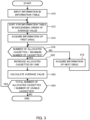
- control device 15 executes a program of the flowchart illustrated in FIG. 3 , for example.
- the information about a medical prescription includes the drug type (e.g., drug name) included in one package and the number of tablets of each drug.
- Control device 15 inputs information to information table T1 at S3 illustrated in FIG. 3 .
- Information table T1 is temporarily generated in the memory unit when a program is executed.
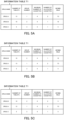
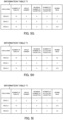
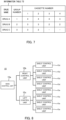
- Information table T1 maps the drug name, the number of tablets, the group number, the maximum number of cassettes, the number of allocated cassettes, and the average value ( FIG. 4 ).
- the drug name and the number of tablets are drug information per package input from the input unit.
- the drug information per package is, for example, information representing 15 tablets for the drug with a name "drug A", 10 tablets for the drug with a name “drug B", five tablets for the drug with a name “drug C”, and one tablet for each of the drugs with names "drug D", “drug E”, “drug F”, “drug G” and “drug H”.
- the drug name and the number of tablets are input to information table T1 as illustrated in FIG. 4 .
- control device 15 inputs the group number of that group in the column of the group number corresponding to the input drug name. In addition, control device 15 inputs the total number of cassettes C included in that group in the column of the maximum number of cassettes corresponding to the input drug name.
- the number of allocated cassettes is the number of cassettes C that perform the drug ejection operation among one of a plurality of groups.
- "1" is input as an initial value of the number of allocated cassettes. Details of the setting of the number of allocated cassettes are described later.
- the average value is an input value that is input when the drug name of the drug stored in cassette C included in the group set in advance is input, and an average value of the number of tablets to be ejected per package by cassette C that performs the drug ejection operation in this group. That is, the average value is a value obtained by dividing the value of the column of the number of tablets of information table T1 by the value of the column of the number of allocated cassettes.
- cassette C that ejects "drug A" is largest in the number of times (15 times) of the drug ejection operation.
- cassettes C that eject other drugs do not perform the drug ejection operation until all "drugs A" have been ejected.
- the time for which "drug A" is ejected 15 times corresponds to the time for which drugs per package is ejected. That is, to reduce the drug ejection time per package, it is preferable to reduce the maximum number of times of the drug ejection operation of cassette C.
- the number of allocated cassettes can be increased up to the maximum number of cassettes. However, in some cases the number of allocated cassettes may not be increased up to the maximum number of cassettes for all drugs. The reason for this is that in drug supply device 1, the maximum number of cassettes C that can perform the drug ejection operation per package is set.
- cassettes C that respectively perform the drug ejection operation for "drug D", "drug E”, “drug F”, “drug G” and “drug H", i.e., a total of five cassettes C are required.
- the maximum total number of cassettes C that can perform the drug ejection operation for "drug A", “drug B” and “drug C” set to the groups is 10 obtained by subtracting 5 from 15. That is, the total number of allocated cassettes of "drug A", “drug B” and “drug C” set to groups is limited to 10.
- control device 15 sets the number of allocated cassettes to reduce the drug ejection time per package in the state where the total number of allocated cassettes is limited. More specifically, in accordance with the following program, control device 15 sets the number of allocated cassettes such that the number of allocated cassettes is increased from the initial value, and that the average value calculated in accordance with the increase of the number of allocated cassettes is levelled among the plurality of groups.
- control device 15 sets the number of allocated cassettes in the state where the total number of allocated cassettes is limited to 10 in information input information table T1 illustrated in FIG. 4 is described below.
- control device 15 sorts the information of the drug set to the group in descending order of the average value in information table T1.
- the average value is arranged in descending order.
- information table T1 is not sorted, and kept in the state illustrated in FIG. 4 .
- control device 15 acquires the information about the first drug. More specifically, control device 15 acquires the information corresponding to "drug A" located at the top in information table T1 of FIG. 4 .
- control device 15 determines whether the number of allocated cassettes in the acquired drug information is smaller than the maximum number of cassettes.
- the number of allocated cassettes "1" of "drug A” acquired is smaller than the maximum number of cassettes "4".
- the process proceeds to S20, and control device 15 increases the acquired the number of allocated cassettes of the drug by one.
- control device 15 determines whether the total number of allocated cassettes is smaller than the number of usable cassettes.
- the number of usable cassettes is a value obtained by subtracting the number of cassettes C that eject drug not set to group from the maximum number of cassettes C that can perform the drug ejection operation per package.
- control device 15 returns the program back to S12, and sorts the information of the drug set to the group in descending order of the average value in information table T1. More specifically, since the average value of "drug A” has become “7.5", information table T1 is sorted as “drug B", “drug A” and “drug C” in this order from the top as illustrated in FIG. 5B .
- control device 15 acquires the information about the first drug. More specifically, control device 15 acquires information corresponding to "drug B" located at the top in information table T1 of FIG. 5B .
- control device 15 returns the program back to S12, and sorts the information of the drug set to the group in descending order of the average value in information table T1. More specifically, since the average value of "drug B" has become "5", the top of information table T1 becomes “drug A” as illustrated in FIG. 5D . In addition, “drug B” and “drug C” have the same average value. When the average value is the same, information table T1 is sorted in accordance with the order of the first sorting. Specifically, information table T1 is sorted as "drug A", “drug B” and “drug C” in this order from the top.
- control device 15 acquires the information about the first drug. More specifically, control device 15 acquires the information corresponding to "drug A" located at the top in information table T1 of FIG. 5D .
- control device 15 returns the program back to S12, and sorts the information of the drug set to the group in descending order of the average value in information table T1.
- information table T1 illustrated in FIG. 5E all average values are the same, and arranged in the order of the first sorting. Accordingly, information table T1 is kept in the state illustrated in FIG. 5E without being sorted.
- control device 15 acquires the information about the first drug. More specifically, control device 15 acquires the information corresponding to "drug A" located at the top in information table T1 of FIG. 5E .
- control device 15 returns the program back to S12, and sorts the information of the drug set to the group in descending order of the average value in information table T1. More specifically, since the average value of "drug A" has become "3.75", information table T1 is sorted as "drug B", "drug C” and "drug A” in this order from the top as illustrated in FIG. 5G .
- control device 15 acquires the information about the first drug. More specifically, control device 15 acquires information corresponding to "drug B" located at the top in information table T1 of FIG. 5G .
- control device 15 returns the program back to S12, and sorts the information of the drug set to the group in descending order of the average value in information table T1. More specifically, since the average value of "drug B" has become "3.3", information table T1 is sorted as "drug C", “drug A” and “drug B” in this order from the top as illustrated in FIG. 5I .
- control device 15 acquires the information about the first drug. More specifically, control device 15 acquires information corresponding to "drug C" located at the top in information table T1 of FIG. 5I .
- control device 15 returns the program back to S12, and sorts the information of the drug set to the group in descending order of the average value in information table T1. More specifically, since the average value of "drug C" has become "2.5", information table T1 is sorted as "drug A", “drug B” and "drug C" in this order from the top as illustrated in FIG. 5K .
- control device 15 acquires the information about the first drug. More specifically, control device 15 acquires the information corresponding to "drug A" located at the top in information table T1 of FIG. 5K .
- control device 15 acquires the information about the next drug. More specifically, control device 15 acquires the information corresponding to "drug B" located after "drug A" in information table T1 of FIG. 5K .
- control device 15 determines whether the number of allocated cassettes in the acquired drug information is smaller than the maximum number of cassettes.
- the number of allocated cassettes "3" of "drug B" acquired is smaller than the maximum number of cassettes "4".
- the process proceeds to S20, and control device 15 increases the acquired the number of allocated cassettes of the drug by one.
- control device 15 terminates the program.
- the number of allocated cassettes and the average value program are determined to be the values at the time point of the completion, i.e., the values input in information table T1 illustrated in FIG. 5L .
- the average value at the time point of the completion of the program is levelled among the plurality of groups.
- control device 15 selects cassette C that performs the drug ejection operation and determines the number of tablets of the drug to be ejected from the selected cassette C, for each of the plurality of groups.
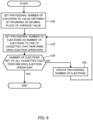
- Control device 15 sets the number of tablets of the drug to be ejected from cassette C that performs the drug ejection operation in a levelled manner in one of the plurality of groups on the basis of the average value levelled among the plurality of groups. Specifically, control device 15 selects cassettes C that perform the drug ejection operation such that the number of tablets of the drug to be ejected from the plurality of cassettes that perform the drug ejection operation is each levelled among one of the plurality of groups and among the plurality of groups. More specifically, control device 15 executes the program illustrated in the flowchart illustrated in FIG. 6 for each group.
- control device 15 executes a program for the first group.
- control device 15 acquires the average value of the first group from information table T1, and sets a provisional number of ejections as a value obtained by rounding up the decimal place of the acquired average value. Since "drug A" of the first group has an average value of "3.75" (see FIG. 5L ), "4" as a value obtained by rounding up the decimal place is the provisional number of ejections.
- control device 15 sets the provisional number of ejections as the number of ejections to one of cassettes C that performs the drug ejection operation in the first group.
- a cassette number is assigned to each of the plurality of cassettes C making up the group.
- cassette C with the smallest cassette number is selected from among cassettes C provided with no number of ejections.
- cassette C to which the number of ejections is to be set is not limited to cassette C with the smallest cassette number among cassettes C provided with no number of ejections.
- cassette C with the largest cassette number may be selected or cassette C may be selected at random among cassettes C provided with no number of ejections.
- control device 15 inputs the provisional number of ejections "4" as the number of ejections in the column of cassette number "1" corresponding to the group number "1" of the first group of ejection table T2 illustrated in FIG. 7 .
- Ejection table T2 is temporarily generated in the memory unit when executing a program. The number of ejections associated with the drug name, the group number, and the cassette number is input to information table T1.
- control device 15 determines whether the number of ejections has been set to all cassettes C that perform the drug ejection operation. More specifically, control device 15 determines whether the number of ejections is set to cassettes C for the number of the allocated cassettes.
- the number of allocated cassettes of the first group related to "drug A" is "4" (see FIG. 5L ), whereas the number of cassettes C provided with the number of ejections is 1. In this case (NO at S34), at S36, control device 15 updates the provisional number of ejections.
- control device 15 calculates the average value of the number of tablets to be ejected by cassette C provided with no number of ejections. Subsequently, an integer obtained by rounding up the decimal place of the calculated average value is determined. This integer is set as the provisional number of ejections after the update.
- the provisional number of ejections is updated as follows.
- the number of tablets of "drug A" is "15" (see FIG. 5L )
- " 4 " is set as the number of ejections of cassette C with the cassette number "1"
- control device 15 updates the provisional number of ejections to "4", which is a value obtained by rounding up the decimal place of the calculated average value "3.6".
- control device 15 inputs the provisional number of ejections "4" updated as the number of ejections, in the column of cassette number "2" corresponding to the group number "1" of the first group.
- control device 15 terminates the program.
- the number of ejections "4" is set to cassettes C with the cassette numbers "1" to"3
- the number of ejections "3” is set to cassette C with the cassette number "4" as illustrated in ejection table T2 of FIG. 7 .
- control device 15 executes a program for the second group.
- control device 15 acquires the average value of the second group from information table T1, and sets a value obtained by rounding up the decimal place of the acquired average value as a provisional number of ejections. Since the "drug B" of the second group has an average value of "2.5" (see FIG. 5L ), "3" as a value obtained by rounding up the decimal place is the provisional number of ejections.
- control device 15 sets the number of ejections to one cassette C that performs the drug ejection operation in the second group. More specifically, control device 15 inputs the provisional number of ejections "3" as the number of ejections in the column of cassette number "1" corresponding to the group number "2" of the second group in ejection table T2.
- control device 15 determines whether the number of ejections has been set to all cassettes C that perform the drug ejection operation.
- the number of allocated cassettes of the second group related to "drug B" is "4" (see FIG. 5L ), whereas the number of cassettes C provided with the number of ejections is 1. In this case (NO at S34), at S36, control device 15 updates the provisional number of ejections.
- control device 15 updates the provisional number of ejections to the calculated average value "3" as a value obtained by rounding up the decimal place of "2.3".
- control device 15 inputs the provisional number of ejections "3" updated as the number of ejections, in the column of cassette number "2" corresponding to the group number "2" of the second group.
- control device 15 When control device 15 repeatedly executes S30 to S36 and the number of ejections is set for all cassettes C for the number of allocated cassettes "4" in the second group (YES at S34), the program is terminated. At the time point of the completion of the program for the second group, the number of ejections "3" is set to cassettes C with the cassette numbers "1" and "2", and the number of ejections "2” is set to the cassettes C with the cassette numbers "3" and "4" as illustrated in ejection table T2 of FIG. 7 .
- control device 15 executes a program for the third group.
- control device 15 acquires the average value of the third group from information table T1, and sets a value obtained by rounding up the decimal place of the acquired average value as a provisional number of ejections. Since the "drug C" of the third group has an average value of "2.5" (see FIG. 5L ), "3" as a value obtained by rounding up the decimal place is the provisional number of ejections.
- control device 15 sets the number of ejections to one cassette C that performs the drug ejection operation in the third group. More specifically, control device 15 inputs the provisional number of ejections "3" as the number of ejections in the column of cassette number "1" corresponding to the group number "3" of the third group in ejection table T2.
- control device 15 determines whether the number of ejections has been set to all cassettes C that perform the drug ejection operation.
- the number of allocated cassettes of the third group related to "drug C" is "2" (see FIG. 5L ), whereas the number of cassettes C provided with the number of ejections is 1. In this case (NO at S34), at S36, control device 15 updates the provisional number of ejections.
- control device 15 updates the provisional number of ejections to "2", which is a value obtained by rounding up the decimal place of the calculated average value "2".
- control device 15 inputs the provisional number of ejections "2" as the number of ejections in the column of cassette number "2" corresponding to the group number "3" of the third group.
- the number of ejections is set for all cassettes C for the number of allocated cassettes "2" in the third group. Then (YES at S34), the program is terminated. At the time point of the completion of the program for the third group, the number of ejections "3" is set to cassette C with the cassette number "1", and the number of ejections "2" is set to cassette C with the cassette number "2" as illustrated in ejection table T2 of FIG. 7 .
- control device 15 has selected cassette C that performs the drug ejection operation from each of the plurality of groups such that the number of tablets of the drug to be ejected from the plurality of cassettes C that perform the drug ejection operation is each levelled in one of the plurality of groups and among the plurality of groups.
- cassettes C for the number of types of the drugs not set to group are selected, and the number of tablets of the drug included in input drug information is set as the number of ejections as it is. More specifically, cassettes C in which "drug D”, “drug E”, “drug F”, “drug G” and “drug H” are respectively stored are selected one by one, and the number of ejections "1" is set for each selected cassette C.
- the maximum number of times of the drug ejection operation of cassette C is the number of ejections "4" of cassettes C with the cassette numbers "1", “2" and “3" of "drug A”. That is, the drug ejection time per package corresponds to the time for ejecting "drug A" four times. Accordingly, the drug ejection time per package is shorter than in the above-described case where the number of allocated cassettes is set to "1" and "drug A" is ejected 15 times. Thus, the time for supplying the drug can be reduced.
- the value included in the input drug information the maximum number of cassettes C that can perform the drug ejection operation per package, the value input to information table T1, and the value input to ejection table T2 described above are examples, and naturally the above-described values are not limitative.
- control device 15 may determine all combinations of the number of cassettes C that perform the drug ejection operation and the number of tablets of the drug ejected by cassettes C that perform the drug ejection operation for each of the plurality of groups without calculating the average value in information table T1. Further, control device 15 may select a most levelled combination from the determined all combinations.
- control device 15 may select cassette C that performs the drug ejection operation such that the remaining numbers of tablets of the drugs stored in the plurality of cassettes C are each levelled among one of the plurality of groups. More specifically, control device 15 repeatedly selects cassette C that performs the drug ejection operation in the order of cassette number. For example, in the above-described example, the drug information related to one package is input and cassettes C with the cassette numbers "1" and "2" in the third group are selected.
- control device 15 selects cassettes C that perform the drug ejection operation in the order of cassettes C with the cassette numbers "3", "4" and "5" that have not performed the drug ejection operation last time. Note that since control device 15 can calculate the number of remaining drugs stored in cassette C as described above, control device 15 may select cassette C that performs the drug ejection operation in descending order of the number of remaining drugs in one of the plurality of groups. In this manner, the number of remaining drugs stored in cassettes C making up the group is levelled in each of the plurality of groups, and therefore the drug replenishing timing can be made approximately the same for the cassettes C making up the group.
- the number of tablets of the drug to be ejected from the plurality of cassettes C that perform the drug ejection operation is each levelled also among the plurality of groups, and thus the drug replenishing timing can be made approximately the same also among the plurality of groups.
- control device 15 may select cassette C that performs the drug ejection operation using a larger number of tablets of the drug than that of cassette C that performs other drug ejection operation, from among the plurality of cassettes C stored in shelf 21 disposed closer to collection part 13 than other shelves 21 among the plurality of shelves 21.
- cassettes C with the cassette numbers "1", “2” and “3” of the first group eject the largest amount of drug. Accordingly, control device 15 selects cassettes C with the cassette numbers "1", "2” and "3" of the first group from among the plurality of cassettes C stored in lowermost shelf 21 located closest to collection part 13.
- control device 15 may select cassette C stored in shelf 21 closest to outlet 13a of collection part 13 among the plurality of shelves 21 located lowermost. More specifically, since outlet 13a is located at the center of collection part 13 in the left-right direction, control device 15 selects cassette C stored in shelf 21 disposed at the center in the left-right direction. In this manner, the distance between outlet 13a and cassette C that performs the drug ejection operation, and in turn the migration length of the ejected drug can be reduced. Thus, the time for supplying the drug can be reduced.
- control device 15 may generate an alarm when the number of remaining drugs stored in one cassette C becomes equal to or smaller than a predetermined number of tablets. In this manner, in the case where cassette C where the number of remaining drugs becomes equal to or smaller than a predetermined number of tablets makes up a group, the drug can be supplied to other cassettes C making up the group in a timely manner. In addition, by replacing all drugs for cassettes C making up the group, mixture of drugs of different lots in one package can be prevented.
- control device 15 may continuously select one cassette C until all the drug stored is consumed, and may select another cassette C storing the drug of the same type as the consumed drug when all the drug stored in one cassette C is consumed.
- control device 15 may include main control unit 15a, right control unit 15b, left control unit 15c, and shelf control units 15d and 15e disposed in each shelf 21.
- FIG. 8 illustrates a total of eight shelf control units 15d and 15e for convenience of illustration, the total number of shelf control units 15d and 15e is the same as the total number of shelves 21
- Main control unit 15a acquires information input to the input unit, and controls right control unit 15b and left control unit 15c on the basis of the acquired information.
- Main control unit 15a includes a memory unit (not illustrated in the drawing).
- Right control unit 15b controls shelf control unit 15d disposed in shelf 21 on the right side in the second floor section on the basis of the acquired information.
- Left control unit 15c controls shelf control unit 15e disposed in shelf 21 on the left side in the second floor section on the basis of the acquired information. Shelf control units 15d and 15e controls the drug ejection operation of the plurality of cassettes C stored in shelf 21 on the basis of the acquired information.
- Cassette C that performs the drug ejection operation is selected by main control unit 15a.
- main control unit 15a transmits a control command value to right control unit 15b.
- right control unit 15b transmits the control command value to shelf control unit 15d disposed in shelf 21 in which cassette C that performs the drug ejection operation is stored. Shelf control unit 15d to which the control command value is transmitted causes cassette C to perform the drug ejection operation on the basis of the control command value.
- main control unit 15a selects cassette C that performs the drug ejection operation so as to reduce the number of shelves 21 in which cassette C that perform the drug ejection operation is stored.
- the number of shelf control units 15d and 15e that control cassettes C decreases, and thus the efficiency of the process in control device 15 is improved.
- the time for supplying the drug can be reduced.
- the present disclosure is widely applicable to drug supply devices.
Landscapes
- Engineering & Computer Science (AREA)
- Mechanical Engineering (AREA)
- Physics & Mathematics (AREA)
- General Physics & Mathematics (AREA)
- Health & Medical Sciences (AREA)
- Animal Behavior & Ethology (AREA)
- General Health & Medical Sciences (AREA)
- Public Health (AREA)
- Veterinary Medicine (AREA)
- Life Sciences & Earth Sciences (AREA)
- Quality & Reliability (AREA)
- Medical Preparation Storing Or Oral Administration Devices (AREA)
- Basic Packing Technique (AREA)
Abstract
Description
- The present disclosure relates to a drug supply device and a drug supply method.
-
PTL 1 discloses a drug supply device in which drugs specified in the prescription are ejected from a plurality of cassettes housed in a plurality of respective shelves arranged in the up-down direction and left-right direction, and the ejected drugs are divided by collecting them at a hopper disposed below the shelves. - Since the cassette ejects the drug one by one, the time for supplying the drugs per package increases as the number of the drugs of the same type specified per package increases. In view of this, in the related art, a group is set by grouping the plurality of cassettes for storing the drug of the same type, and a plurality of the drugs of the same type are simultaneously ejected from the group in order to reduce the time for supplying the drugs.
-
PTL 1
Japanese Examined Utility Model Publication No.H7-35301 - However, in the above-described drug supply device, when the total number of cassettes for which the drug ejection operation can be performed per package is limited, a plurality of groups are set, and consequently the number of tablets of the drug to be ejected from a single cassette is relatively increased, the time for supplying the drug is relatively increased.
- An object of the present disclosure is to reduce the time for supplying the drug in a drug supply device.
- To achieve the above-mentioned object, a drug supply device of the present disclosure includes: a plurality of cassettes configured to eject a drug one by one; and a control device configured to set a plurality of groups including a plurality of cassettes selected from among the plurality of cassettes. The control device selects a cassette that performs a drug ejection operation from each of the plurality of groups such that a number of tablets of a drug to be ejected from the plurality of cassettes that perform the drug ejection operation is each levelled in one of the plurality of group and among the plurality of groups.
- With the drug supply device of the present disclosure, it is possible to reduce the time for supplying the drug.
-
-
FIG. 1 is a perspective view of a drug supply device according to an embodiment of the present disclosure; -
FIG. 2 is a longitudinal sectional view of the drug supply device; -
FIG. 3 is a flowchart of a program executed by a control device; -
FIG. 4 is a diagram illustrating an information table; -
FIG. 5A is a diagram illustrating an information table; -
FIG. 5B is a diagram illustrating an information table; -
FIG. 5C is a diagram illustrating an information table; -
FIG. 5D is a diagram illustrating an information table; -
FIG. 5E is a diagram illustrating an information table; -
FIG. 5F is a diagram illustrating an information table; -
FIG. 5G is a diagram illustrating an information table; -
FIG. 5H is a diagram illustrating an information table; -
FIG. 5I is a diagram illustrating an information table; -
FIG. 5J is a diagram illustrating an information table; -
FIG. 5K is a diagram illustrating an information table; -
FIG. 5L is a diagram illustrating an information table; -
FIG. 6 is a flowchart of a program executed by the control device; -
FIG. 7 is a diagram illustrating an ejection table; and -
FIG. 8 is a control device of a modification. -
Drug supply device 1 according to an embodiment of the present disclosure is described below with reference to the drawings. Note that in the following description, the upper side and lower side inFIG. 1 are the upper side and lower side ofdrug supply device 1, the left side and right side thereof are the left side and right side ofdrug supply device 1, and the lower left side and upper right side thereof are the front side and rear side ofdrug supply device 1. -
FIG. 1 is a perspective view illustrating an exemplarydrug supply device 1.Drug supply device 1 includesfirst floor section 10 andsecond floor section 20. -
First floor section 10 includesoperation unit 11 and take-out part 12. In addition,first floor section 10 includes an input unit (not illustrated in the drawing). -
Operation unit 11 is a device operated by the operator and includes a display, an operation button and the like, for example. Whenoperation unit 11 is operated by the user, a variety of information is input todrug supply device 1. - Drugs divided in
drug supply device 1 are taken out from take-outpart 12. Take-outpart 12 includes an opening, and the user takes out drugs from the opening. - The input unit is an input device to which a variety of information is input from an external device. The input unit is connected to a personal computer, and information about prescriptions issued by medical institutions is input from the personal computer, for example.
-
Second floor section 20 includes a plurality ofshelves 21 that respectively store a plurality of cassettes C.Second floor section 20 includes 20shelves 21. The plurality ofshelves 21 are disposed in five rows in the up-down direction and four columns in the left-right direction. Note that the number and arrangement ofshelves 21 provided insecond floor section 20 are not limited to the present embodiment, and the number of rows in the upper and lower direction and/or the number of columns in the left and right direction may be greater or smaller than the above-described numbers. - Next, internal structures of
second floor section 20 andfirst floor section 10 are described below with reference toFIG. 2 . - In each of the plurality of
shelves 21, the plurality of cassettes C are stored along the front-rear direction on both sides in the left-right direction inshelf 21. A plurality of drugs is stored in each cassette C. A drug of one type is stored in one of the plurality of cassettes C. The type of the drug stored in cassettes C different from each other in the plurality of cassettes C may be identical to or different from each other. Each of the plurality of cassettes C is configured to eject the stored drug one by one. - The drug ejected from cassette C falls down passage R and is guided to
first floor section 10. Passage R extends through each of the plurality ofshelves 21 in the up-down direction. - Next,
first floor section 10 is described.First floor section 10 includescollection part 13,packaging unit 14, andcontrol device 15. -
Collection part 13 receives the drug guided tofirst floor section 10, and guides the received drug topackaging unit 14 fromoutlet 13a.Outlet 13a is provided at an approximately center portion ofcollection part 13.Collection part 13 is a hopper, for example. -
Packaging unit 14 packages the drug guided tocollection part 13.Packaging unit 14 includesconveyance part 14a,printer 14b, and sealingdevice 14c. - From a roller (not illustrated in the drawing) on which belt-shaped folded packaging paper is wound,
conveyance part 14a feeds the packaging paper, and conveys the fed packaging paper to sealingdevice 14c side, for example. The drug guided fromcollection part 13 is put on the packaging paper and carried toward sealingdevice 14c together with the packaging paper. -
Printer 14b is a printer for printing the patient's name, the name of the drug supplied to the packaging paper, the dose date and time and the like on the surface of the packaging paper fed from the roller, for example. -
Sealing device 14c is a device that seals the packaging paper in which the drug is packaged. - The packaging paper in which the drug is sealed is cut at a predetermined timing, and conveyed by a predetermined device toward take-out
part 12, for example. -
Control device 15 is a computer that centrally controlsdrug supply device 1.Control device 15 includes a memory unit storing a predetermined program.Control device 15 acquires information input to the input unit, and controls a drug ejection operation of the plurality of cassettes C stored in eachshelf 21 on the basis of the acquired information and the program (details are described later). The drug ejection operation is an operation of ejecting drugs by cassette C. -
Control device 15 includes a memory unit (not illustrated in the drawing). In the memory unit, information about the plurality of cassettes C in eachshelf 21 is stored. The information of cassette C is the type (e.g., drug name) of the drug stored in cassette C, the installed position of cassette C, the number of remaining drugs stored in cassette C, and the like. The number of remaining drugs is calculated by subtracting the number of tablets of the ejected drug from the number of tablets at the time point when the drug is supplied to cassette drug C input fromoperation unit 11 or the input unit, each time cassette C performs the drug ejection operation. - In addition,
control device 15 selects the plurality of cassettes C on the basis of a predetermined condition and sets the group in advance with the selected cassettesC. Control device 15 sets a plurality of groups. The group is set on the basis of information input fromoperation unit 11 or the input unit. Drug location information representing the position of cassette C and the type of drug to be stored thereto is input fromoperation unit 11 or the input unit. - The group is set on the basis of the drug location information, i.e., the drug type and the installed position of cassette C. One group is composed of cassettes C for storing the drug of the same type. For example, the first group includes four cassettes C for storing a drug with a name "drug A".
- In addition,
control device 15 may set one group by selecting a plurality of cassettes C stored in oneshelf 21. In other words, the plurality of cassettes C making up one of a plurality of groups may be selected from the plurality of cassettes C stored in oneshelf 21. In addition,control device 15 may set another one group by selecting a plurality of cassettes C stored indifferent shelves 21. In other words, the plurality of cassettes C making up one of the plurality of groups may be selected to include one or more cassettes C stored in oneshelf 21 and one or more cassettes C stored in another shelf. - After setting the group,
control device 15 allocates a group number to the set group.Control device 15 causes the memory unit to map and store the group number and the installed positions of cassettes C included in the group with the group number. - Next, the program to be executed by
control device 15 when dividing the drug, and a process ofcontrol device 15 to select cassette C that performs the drug ejection operation are described with reference to the drawings. - When information about a medical prescription is input from the input unit,
control device 15 executes a program of the flowchart illustrated inFIG. 3 , for example. The information about a medical prescription includes the drug type (e.g., drug name) included in one package and the number of tablets of each drug. -
Control device 15 inputs information to information table T1 at S3 illustrated inFIG. 3 . Information table T1 is temporarily generated in the memory unit when a program is executed. Information table T1 maps the drug name, the number of tablets, the group number, the maximum number of cassettes, the number of allocated cassettes, and the average value (FIG. 4 ). - The drug name and the number of tablets are drug information per package input from the input unit. The drug information per package is, for example, information representing 15 tablets for the drug with a name "drug A", 10 tablets for the drug with a name "drug B", five tablets for the drug with a name "drug C", and one tablet for each of the drugs with names "drug D", "drug E", "drug F", "drug G" and "drug H". When such information is input from the input unit, the drug name and the number of tablets are input to information table T1 as illustrated in
FIG. 4 . - In addition, when the drug name of the drug stored in cassette C included in the group set in advance is input,
control device 15 inputs the group number of that group in the column of the group number corresponding to the input drug name. In addition,control device 15 inputs the total number of cassettes C included in that group in the column of the maximum number of cassettes corresponding to the input drug name. - For example, in the case where the first group is composed of four cassettes C in which "drug A" is stored, "1" is input to the group number corresponding to "drug A", and "4" is input to the maximum number of cassettes corresponding to "drug A" in information table T1. In addition, in the case where the second group is composed of four cassettes C in which "drug B" is stored, "2" is input to the group number corresponding to "drug B", and "4" is input to the maximum number of cassettes corresponding to "drug B" in information table T1. Further, in the case where the third group is composed of four cassettes C in which "drug C" is stored, "3" is input to the group number corresponding to "drug C", and "4" is input to the maximum number of cassettes corresponding to "drug C" in information table T1.
- The number of allocated cassettes is the number of cassettes C that perform the drug ejection operation among one of a plurality of groups. At S10, "1" is input as an initial value of the number of allocated cassettes. Details of the setting of the number of allocated cassettes are described later.
- The average value is an input value that is input when the drug name of the drug stored in cassette C included in the group set in advance is input, and an average value of the number of tablets to be ejected per package by cassette C that performs the drug ejection operation in this group. That is, the average value is a value obtained by dividing the value of the column of the number of tablets of information table T1 by the value of the column of the number of allocated cassettes.
- Note that when the drug name of the drug stored in cassette C that is not included in the group set in advance is input, no information is input in the columns of the group number, the maximum number of cassettes, the number of allocated cassettes, and the average value corresponding to that drug name. The mark "-" shown in the cells of information table T1 indicates that there is no information input.
- In information table T1 illustrated in
FIG. 4 , "1 " as an initial value is input for the number of allocated cassettes. In addition, the cassette ejects drug C one by one as described above. Thus, in the case wherecontrol device 15 causes the plurality of cassettes C to perform the drug ejection operation on the basis of information table T1 illustrated inFIG. 4 , one cassette C in the first group ejects "drug A" 15 times, one cassette C in the second group ejects "drug B" ten times, and one cassette C in the third group ejects "drug C" five times. In addition, cassettes C that store "drug D", "drug E", "drug F", "drug G" and "drug H" each eject the drug one time. - In information table T1 illustrated in
FIG. 4 , cassette C that ejects "drug A" is largest in the number of times (15 times) of the drug ejection operation. On the other hand, after a set number of tablets are ejected, cassettes C that eject other drugs do not perform the drug ejection operation until all "drugs A" have been ejected. Thus, the time for which "drug A" is ejected 15 times corresponds to the time for which drugs per package is ejected. That is, to reduce the drug ejection time per package, it is preferable to reduce the maximum number of times of the drug ejection operation of cassette C. - To reduce the maximum number of times of the drug ejection operation of cassette C, it is preferable to increase the number of allocated cassettes for cassettes C making up the group. When the number of allocated cassettes is increased, the average value is reduced, and thus the maximum number of times of the drug ejection operation of cassette C is reduced. The number of allocated cassettes can be increased up to the maximum number of cassettes. However, in some cases the number of allocated cassettes may not be increased up to the maximum number of cassettes for all drugs. The reason for this is that in
drug supply device 1, the maximum number of cassettes C that can perform the drug ejection operation per package is set. - Now, the total number of allocated cassettes in the case where the maximum number of cassettes C that can perform the drug ejection operation per package is set to 15 is described below. As illustrated in
FIG. 3 , in the case where "drug D", "drug E", "drug F", "drug G" and "drug H" not set to group are set to one tablet, cassettes C that respectively perform the drug ejection operation for "drug D", "drug E", "drug F", "drug G" and "drug H", i.e., a total of five cassettes C are required. Accordingly, in the case where the maximum number of cassettes C that can perform the drug ejection operation per package is 15, the maximum total number of cassettes C that can perform the drug ejection operation for "drug A", "drug B" and "drug C" set to the groups is 10 obtained by subtracting 5 from 15. That is, the total number of allocated cassettes of "drug A", "drug B" and "drug C" set to groups is limited to 10. - That is,
control device 15 sets the number of allocated cassettes to reduce the drug ejection time per package in the state where the total number of allocated cassettes is limited. More specifically, in accordance with the following program,control device 15 sets the number of allocated cassettes such that the number of allocated cassettes is increased from the initial value, and that the average value calculated in accordance with the increase of the number of allocated cassettes is levelled among the plurality of groups. - A case where
control device 15 sets the number of allocated cassettes in the state where the total number of allocated cassettes is limited to 10 in information input information table T1 illustrated inFIG. 4 is described below. - At S12,
control device 15 sorts the information of the drug set to the group in descending order of the average value in information table T1. In information table T1 illustrated inFIG. 4 , the average value is arranged in descending order. As such, information table T1 is not sorted, and kept in the state illustrated inFIG. 4 . Subsequently, at S14,control device 15 acquires the information about the first drug. More specifically,control device 15 acquires the information corresponding to "drug A" located at the top in information table T1 ofFIG. 4 . - Further, at S16,
control device 15 determines whether the number of allocated cassettes in the acquired drug information is smaller than the maximum number of cassettes. The number of allocated cassettes "1" of "drug A" acquired is smaller than the maximum number of cassettes "4". In this case (YES at S16), the process proceeds to S20, andcontrol device 15 increases the acquired the number of allocated cassettes of the drug by one. Subsequently, the process proceeds to S22, andcontrol device 15 calculates the average value. More specifically, as in information table T1 illustrated inFIG. 5A ,control device 15 inputs "2" in the number of allocated cassettes of "drug A", and "7.5" (= number of tablets (=15)/number of allocated cassettes (=2)) to the average value. Note that in information table T1 illustrated inFIGS. 5A to 5L , only drugs with names "drug A", "drug B" and "drug C" are illustrated for convenience of description. - Subsequently, at S24,
control device 15 determines whether the total number of allocated cassettes is smaller than the number of usable cassettes. The number of usable cassettes is a value obtained by subtracting the number of cassettes C that eject drug not set to group from the maximum number of cassettes C that can perform the drug ejection operation per package. - As described above, the maximum number of cassettes C that can perform the drug ejection operation per package is 15, and the number of cassettes that eject the drugs not set to group ("drug D", "drug E", "drug F", "drug G" and "drug H") is 5. Accordingly, the number of usable cassettes is 10. At the time point when information table T1 is in the state illustrated in
FIG. 5A , the total number of allocated cassettes is 4 (=2+1+1), which is smaller than the number of usable cassettes. - In this case (YES at S24),
control device 15 returns the program back to S12, and sorts the information of the drug set to the group in descending order of the average value in information table T1. More specifically, since the average value of "drug A" has become "7.5", information table T1 is sorted as "drug B", "drug A" and "drug C" in this order from the top as illustrated inFIG. 5B . - Subsequently, at S14,
control device 15 acquires the information about the first drug. More specifically,control device 15 acquires information corresponding to "drug B" located at the top in information table T1 ofFIG. 5B . - The acquired number of allocated cassettes "1" of the "drug B" is smaller than the maximum number of cassettes "4". In this case (YES at S16), the process proceeds to S20, and
control device 15 increases the acquired the number of allocated cassettes of the drug by one. Subsequently, the process proceeds to S22, andcontrol device 15 calculates the average value. More specifically, as in information table T1 illustrated inFIG. 5C ,control device 15 inputs "2", increased by one, to the number of allocated cassettes of "drug B", and inputs "5" (= number of tablets (=10)/number of allocated cassettes (=2)) to the average value. - At the time point when information table T1 is in the state illustrated in
FIG. 5C , the total number of allocated cassettes is 5 (=2+2+1), which is smaller than the number of usable cassettes (=10). In this case (YES at S24),control device 15 returns the program back to S12, and sorts the information of the drug set to the group in descending order of the average value in information table T1. More specifically, since the average value of "drug B" has become "5", the top of information table T1 becomes "drug A" as illustrated inFIG. 5D . In addition, "drug B" and "drug C" have the same average value. When the average value is the same, information table T1 is sorted in accordance with the order of the first sorting. Specifically, information table T1 is sorted as "drug A", "drug B" and "drug C" in this order from the top. - Subsequently, at S14,
control device 15 acquires the information about the first drug. More specifically,control device 15 acquires the information corresponding to "drug A" located at the top in information table T1 ofFIG. 5D . - The number of allocated cassettes "2" of "drug A" acquired is smaller than the maximum number of cassettes "4". In this case (YES at S16), the process proceeds to S20, and
control device 15 increases the acquired the number of allocated cassettes of the drug by one. Subsequently, the process proceeds to S22, andcontrol device 15 calculates the average value. More specifically, as in information table T1 illustrated inFIG. 5E ,control device 15 inputs "3", increased by one, to the number of allocated cassettes of "drug A" and inputs "5" (= number of tablets (=15)/number of allocated cassettes (=3)) to the average value. - At the time point when information table T1 is in the state illustrated in
FIG. 5E , the total number of allocated cassettes is 6 (=3+2+1), which is smaller than the number of usable cassettes (=10). In this case (YES at S24),control device 15 returns the program back to S12, and sorts the information of the drug set to the group in descending order of the average value in information table T1. In information table T1 illustrated inFIG. 5E , all average values are the same, and arranged in the order of the first sorting. Accordingly, information table T1 is kept in the state illustrated inFIG. 5E without being sorted. - Subsequently, at S14,
control device 15 acquires the information about the first drug. More specifically,control device 15 acquires the information corresponding to "drug A" located at the top in information table T1 ofFIG. 5E . - The number of allocated cassettes "3" of "drug A" acquired is smaller than the maximum number of cassettes "4". In this case (YES at S16), the process proceeds to S20, and
control device 15 increases the acquired the number of allocated cassettes of the drug by one. Subsequently, the process proceeds to S22, andcontrol device 15 calculates the average value. More specifically, as in information table T1 illustrated inFIG. 5F ,control device 15 inputs "4", increased by one, to the number of allocated cassettes of "drug A", and inputs "3.75" (= number of tablets (=15)/number of allocated cassettes (=4)) to the average value. - At the time point when information table T1 is in the state illustrated in
FIG. 5F , the total number of allocated cassettes is 7 (=4+2+1), which is smaller than the number of usable cassettes (=10). In this case (YES at S24),control device 15 returns the program back to S12, and sorts the information of the drug set to the group in descending order of the average value in information table T1. More specifically, since the average value of "drug A" has become "3.75", information table T1 is sorted as "drug B", "drug C" and "drug A" in this order from the top as illustrated inFIG. 5G . - Subsequently, at S14,
control device 15 acquires the information about the first drug. More specifically,control device 15 acquires information corresponding to "drug B" located at the top in information table T1 ofFIG. 5G . - The number of allocated cassettes "2" of "drug B" acquired is smaller than the maximum number of cassettes "4". In this case (YES at S16), the process proceeds to S20, and
control device 15 increases the acquired the number of allocated cassettes of the drug by one. Subsequently, the process proceeds to S22, andcontrol device 15 calculates the average value. More specifically, as in information table T1 illustrated inFIG. 5H ,control device 15 inputs "3", increased by one, to the number of allocated cassettes of "drug B", and inputs "3.3" (= number of tablets (=10)/number of allocated cassettes (=3)) to the average value. - At the time point when information table T1 is in the state illustrated in
FIG. 5H , the total number of allocated cassettes is 8 (=3+1+4), which is smaller than the number of usable cassettes (=10). In this case (YES at S24),control device 15 returns the program back to S12, and sorts the information of the drug set to the group in descending order of the average value in information table T1. More specifically, since the average value of "drug B" has become "3.3", information table T1 is sorted as "drug C", "drug A" and "drug B" in this order from the top as illustrated inFIG. 5I . - Subsequently, at S14,
control device 15 acquires the information about the first drug. More specifically,control device 15 acquires information corresponding to "drug C" located at the top in information table T1 ofFIG. 5I . - The number of allocated cassettes "1" of "drug C" acquired is smaller than the maximum number of cassettes "4". In this case (YES at S16), the process proceeds to S20, and
control device 15 increases the acquired the number of allocated cassettes of the drug by one. Subsequently, the process proceeds to S22, andcontrol device 15 calculates the average value. More specifically, as in information table T1 illustrated inFIG. 5J ,control device 15 inputs "2", increased by one, to the number of allocated cassettes of "drug C", and inputs "2.5" (= number of tablets (=5)/number of allocated cassettes (=2)) to the average value. - At the time point when information table T1 is in the state illustrated in
FIG. 5J , the total number of allocated cassettes is 9 (=2+4+3), which is smaller than the number of usable cassettes (=10). In this case (YES at S24),control device 15 returns the program back to S12, and sorts the information of the drug set to the group in descending order of the average value in information table T1. More specifically, since the average value of "drug C" has become "2.5", information table T1 is sorted as "drug A", "drug B" and "drug C" in this order from the top as illustrated inFIG. 5K . - Subsequently, at S14,
control device 15 acquires the information about the first drug. More specifically,control device 15 acquires the information corresponding to "drug A" located at the top in information table T1 ofFIG. 5K . - The number of allocated cassettes "4" of "drug A" acquired is the same as the maximum number of cassettes "4". In this case (NO at S16), at S18,
control device 15 acquires the information about the next drug. More specifically,control device 15 acquires the information corresponding to "drug B" located after "drug A" in information table T1 ofFIG. 5K . - Subsequently, at S16,
control device 15 determines whether the number of allocated cassettes in the acquired drug information is smaller than the maximum number of cassettes. The number of allocated cassettes "3" of "drug B" acquired is smaller than the maximum number of cassettes "4". In this case (YES at S16), the process proceeds to S20, andcontrol device 15 increases the acquired the number of allocated cassettes of the drug by one. Subsequently, the process proceeds to S22, andcontrol device 15 calculates the average value. More specifically, as in information table T1 illustrated inFIG. 5L ,control device 15 inputs "4", increased by one, to the number of allocated cassettes of "drug B", and inputs "2.5" (= number of tablets (=10)/number of allocated cassettes (=4)) to the average value. - At the time point when information table T1 is in the state illustrated in
FIG. 5L , the total number of allocated cassettes is 10 (=4+4+2), which is the same as the number of usable cassettes (=10). In this case (NO at S24),control device 15 terminates the program. The number of allocated cassettes and the average value program are determined to be the values at the time point of the completion, i.e., the values input in information table T1 illustrated inFIG. 5L . The average value at the time point of the completion of the program is levelled among the plurality of groups. - Further, in response to the completion of the above-described program,
control device 15 selects cassette C that performs the drug ejection operation and determines the number of tablets of the drug to be ejected from the selected cassette C, for each of the plurality of groups. -
Control device 15 sets the number of tablets of the drug to be ejected from cassette C that performs the drug ejection operation in a levelled manner in one of the plurality of groups on the basis of the average value levelled among the plurality of groups. Specifically,control device 15 selects cassettes C that perform the drug ejection operation such that the number of tablets of the drug to be ejected from the plurality of cassettes that perform the drug ejection operation is each levelled among one of the plurality of groups and among the plurality of groups. More specifically,control device 15 executes the program illustrated in the flowchart illustrated inFIG. 6 for each group. - First,
control device 15 executes a program for the first group. At S30,control device 15 acquires the average value of the first group from information table T1, and sets a provisional number of ejections as a value obtained by rounding up the decimal place of the acquired average value. Since "drug A" of the first group has an average value of "3.75" (seeFIG. 5L ), "4" as a value obtained by rounding up the decimal place is the provisional number of ejections. - Subsequently, at S32,
control device 15 sets the provisional number of ejections as the number of ejections to one of cassettes C that performs the drug ejection operation in the first group. A cassette number is assigned to each of the plurality of cassettes C making up the group. As cassette C to which the number of ejections is to be set, cassette C with the smallest cassette number is selected from among cassettes C provided with no number of ejections. Note that naturally, cassette C to which the number of ejections is to be set is not limited to cassette C with the smallest cassette number among cassettes C provided with no number of ejections. For example, as cassette C to which the number of ejections is to be set, cassette C with the largest cassette number may be selected or cassette C may be selected at random among cassettes C provided with no number of ejections. - More specifically,
control device 15 inputs the provisional number of ejections "4" as the number of ejections in the column of cassette number "1" corresponding to the group number "1" of the first group of ejection table T2 illustrated inFIG. 7 . Ejection table T2 is temporarily generated in the memory unit when executing a program. The number of ejections associated with the drug name, the group number, and the cassette number is input to information table T1. - Further, at S34,
control device 15 determines whether the number of ejections has been set to all cassettes C that perform the drug ejection operation. More specifically,control device 15 determines whether the number of ejections is set to cassettes C for the number of the allocated cassettes. The number of allocated cassettes of the first group related to "drug A" is "4" (seeFIG. 5L ), whereas the number of cassettes C provided with the number of ejections is 1. In this case (NO at S34), at S36,control device 15 updates the provisional number of ejections. - The update of the provisional number of ejections at S36 is performed as follows. First,
control device 15 calculates the average value of the number of tablets to be ejected by cassette C provided with no number of ejections. Subsequently, an integer obtained by rounding up the decimal place of the calculated average value is determined. This integer is set as the provisional number of ejections after the update. - More specifically, the provisional number of ejections is updated as follows. In the first group, the number of tablets of "drug A" is "15" (see
FIG. 5L ), and "4 " is set as the number of ejections of cassette C with the cassette number "1", and accordingly the number of remaining tablets to be ejected by other cassettes C of the first group is "11" (=15-4). In addition, since the number of cassettes C provided with the number of ejections is 1 for the number of allocated cassettes "4", and accordingly the number of remaining allocated cassettes is "3" (=4-1). Accordingly, the average value of the number of tablets to be ejected by cassettes C provided with no number of ejections is "3.6" (=11/3). Then,control device 15 updates the provisional number of ejections to "4", which is a value obtained by rounding up the decimal place of the calculated average value "3.6". - Subsequently, at S32,
control device 15 inputs the provisional number of ejections "4" updated as the number of ejections, in the column of cassette number "2" corresponding to the group number "1" of the first group. - In this manner, when the number of ejections is set for all cassettes C for the number of allocated cassettes "4" in the first group by repeatedly executing S30 to S36 (YES at S34),
control device 15 terminates the program. At the time point of the completion of the program for the first group, the number of ejections "4" is set to cassettes C with the cassette numbers "1" to"3", and the number of ejections "3" is set to cassette C with the cassette number "4" as illustrated in ejection table T2 ofFIG. 7 . - Next,
control device 15 executes a program for the second group. At S30,control device 15 acquires the average value of the second group from information table T1, and sets a value obtained by rounding up the decimal place of the acquired average value as a provisional number of ejections. Since the "drug B" of the second group has an average value of "2.5" (seeFIG. 5L ), "3" as a value obtained by rounding up the decimal place is the provisional number of ejections. - Subsequently, at S32,
control device 15 sets the number of ejections to one cassette C that performs the drug ejection operation in the second group. More specifically,control device 15 inputs the provisional number of ejections "3" as the number of ejections in the column of cassette number "1" corresponding to the group number "2" of the second group in ejection table T2. - Further, at S34,
control device 15 determines whether the number of ejections has been set to all cassettes C that perform the drug ejection operation. The number of allocated cassettes of the second group related to "drug B" is "4" (seeFIG. 5L ), whereas the number of cassettes C provided with the number of ejections is 1. In this case (NO at S34), at S36,control device 15 updates the provisional number of ejections. - Since the number of ejections "3" is set for the number of tablets "10" of "drug B" (see
FIG. 5L ) in the second group, the number of remaining tablets is "7" (=10-3). In addition, since the number of cassettes C provided with the number of ejections is 1 for the number of allocated cassettes "4", the number of remaining allocated cassettes is "3" (=4-1). Accordingly, the average value of the number of tablets to be ejected by cassettes C provided with no number of ejections is "2.3" (=7/3). Then,control device 15 updates the provisional number of ejections to the calculated average value "3" as a value obtained by rounding up the decimal place of "2.3". - Subsequently, at S32,
control device 15 inputs the provisional number of ejections "3" updated as the number of ejections, in the column of cassette number "2" corresponding to the group number "2" of the second group. - When
control device 15 repeatedly executes S30 to S36 and the number of ejections is set for all cassettes C for the number of allocated cassettes "4" in the second group (YES at S34), the program is terminated. At the time point of the completion of the program for the second group, the number of ejections "3" is set to cassettes C with the cassette numbers "1" and "2", and the number of ejections "2" is set to the cassettes C with the cassette numbers "3" and "4" as illustrated in ejection table T2 ofFIG. 7 . - Next,
control device 15 executes a program for the third group. At S30,control device 15 acquires the average value of the third group from information table T1, and sets a value obtained by rounding up the decimal place of the acquired average value as a provisional number of ejections. Since the "drug C" of the third group has an average value of "2.5" (seeFIG. 5L ), "3" as a value obtained by rounding up the decimal place is the provisional number of ejections. - Subsequently, at S32,
control device 15 sets the number of ejections to one cassette C that performs the drug ejection operation in the third group. More specifically,control device 15 inputs the provisional number of ejections "3" as the number of ejections in the column of cassette number "1" corresponding to the group number "3" of the third group in ejection table T2. - Further, at S34,
control device 15 determines whether the number of ejections has been set to all cassettes C that perform the drug ejection operation. The number of allocated cassettes of the third group related to "drug C" is "2" (seeFIG. 5L ), whereas the number of cassettes C provided with the number of ejections is 1. In this case (NO at S34), at S36,control device 15 updates the provisional number of ejections. - Since the number of ejections "3" is set for the number of tablets of "5" of "drug C" in the third group, the number of remaining tablets is "2" (=5-3). In addition, since the number of cassettes C provided with the number of ejections is 1 for the number of allocated cassettes "2", the number of remaining allocated cassettes is "1" (=2-1). Accordingly, the average value of the number of tablets to be ejected by cassettes C provided with no number of ejections is "2" (=2/1). Then,
control device 15 updates the provisional number of ejections to "2", which is a value obtained by rounding up the decimal place of the calculated average value "2". - Subsequently, at S32,
control device 15 inputs the provisional number of ejections "2" as the number of ejections in the column of cassette number "2" corresponding to the group number "3" of the third group. - In this manner, the number of ejections is set for all cassettes C for the number of allocated cassettes "2" in the third group. Then (YES at S34), the program is terminated. At the time point of the completion of the program for the third group, the number of ejections "3" is set to cassette C with the cassette number "1", and the number of ejections "2" is set to cassette C with the cassette number "2" as illustrated in ejection table T2 of
FIG. 7 . - At the time when the programs are completed for the all groups, the number of ejections is levelled in one of the plurality of groups for each of the plurality of groups. In addition, as described above, the average value is levelled among the plurality of groups. This means that
control device 15 has selected cassette C that performs the drug ejection operation from each of the plurality of groups such that the number of tablets of the drug to be ejected from the plurality of cassettes C that perform the drug ejection operation is each levelled in one of the plurality of groups and among the plurality of groups. - On the other hand, for drugs not set to group, cassettes C for the number of types of the drugs not set to group are selected, and the number of tablets of the drug included in input drug information is set as the number of ejections as it is. More specifically, cassettes C in which "drug D", "drug E", "drug F", "drug G" and "drug H" are respectively stored are selected one by one, and the number of ejections "1" is set for each selected cassette C.
- In this manner, on the basis of the input drug information, a plurality of cassettes C that perform the drug ejection operation is selected, and the number of ejections is set for each selected cassette C. At this time, the maximum number of times of the drug ejection operation of cassette C is the number of ejections "4" of cassettes C with the cassette numbers "1", "2" and "3" of "drug A". That is, the drug ejection time per package corresponds to the time for ejecting "drug A" four times. Accordingly, the drug ejection time per package is shorter than in the above-described case where the number of allocated cassettes is set to "1" and "drug A" is ejected 15 times. Thus, the time for supplying the drug can be reduced.
- Note that the value included in the input drug information, the maximum number of cassettes C that can perform the drug ejection operation per package, the value input to information table T1, and the value input to ejection table T2 described above are examples, and naturally the above-described values are not limitative.
- The present disclosure is not limited to the embodiments described so far. As long as the main purpose of this disclosure is not departed from, various modifications to this embodiment and embodiments constructed by combining elements in different embodiments are also included within the scope of this disclosure.
- For example,
control device 15 may determine all combinations of the number of cassettes C that perform the drug ejection operation and the number of tablets of the drug ejected by cassettes C that perform the drug ejection operation for each of the plurality of groups without calculating the average value in information table T1. Further,control device 15 may select a most levelled combination from the determined all combinations. - In addition,
control device 15 may select cassette C that performs the drug ejection operation such that the remaining numbers of tablets of the drugs stored in the plurality of cassettes C are each levelled among one of the plurality of groups. More specifically,control device 15 repeatedly selects cassette C that performs the drug ejection operation in the order of cassette number. For example, in the above-described example, the drug information related to one package is input and cassettes C with the cassette numbers "1" and "2" in the third group are selected. Further, in the case where the drug information related to the next one package is input and the drug is ejected from the third group,control device 15 selects cassettes C that perform the drug ejection operation in the order of cassettes C with the cassette numbers "3", "4" and "5" that have not performed the drug ejection operation last time. Note that sincecontrol device 15 can calculate the number of remaining drugs stored in cassette C as described above,control device 15 may select cassette C that performs the drug ejection operation in descending order of the number of remaining drugs in one of the plurality of groups. In this manner, the number of remaining drugs stored in cassettes C making up the group is levelled in each of the plurality of groups, and therefore the drug replenishing timing can be made approximately the same for the cassettes C making up the group. In addition, as described above, the number of tablets of the drug to be ejected from the plurality of cassettes C that perform the drug ejection operation is each levelled also among the plurality of groups, and thus the drug replenishing timing can be made approximately the same also among the plurality of groups. - In addition,
control device 15 may select cassette C that performs the drug ejection operation using a larger number of tablets of the drug than that of cassette C that performs other drug ejection operation, from among the plurality of cassettes C stored inshelf 21 disposed closer tocollection part 13 thanother shelves 21 among the plurality ofshelves 21. In the above-described example, cassettes C with the cassette numbers "1", "2" and "3" of the first group eject the largest amount of drug. Accordingly,control device 15 selects cassettes C with the cassette numbers "1", "2" and "3" of the first group from among the plurality of cassettes C stored inlowermost shelf 21 located closest tocollection part 13. In addition,control device 15 may select cassette C stored inshelf 21 closest tooutlet 13a ofcollection part 13 among the plurality ofshelves 21 located lowermost. More specifically, sinceoutlet 13a is located at the center ofcollection part 13 in the left-right direction,control device 15 selects cassette C stored inshelf 21 disposed at the center in the left-right direction. In this manner, the distance betweenoutlet 13a and cassette C that performs the drug ejection operation, and in turn the migration length of the ejected drug can be reduced. Thus, the time for supplying the drug can be reduced. - In addition,
control device 15 may generate an alarm when the number of remaining drugs stored in one cassette C becomes equal to or smaller than a predetermined number of tablets. In this manner, in the case where cassette C where the number of remaining drugs becomes equal to or smaller than a predetermined number of tablets makes up a group, the drug can be supplied to other cassettes C making up the group in a timely manner. In addition, by replacing all drugs for cassettes C making up the group, mixture of drugs of different lots in one package can be prevented. - In addition,
control device 15 may continuously select one cassette C until all the drug stored is consumed, and may select another cassette C storing the drug of the same type as the consumed drug when all the drug stored in one cassette C is consumed. - In addition, as illustrated in
FIG. 8 ,control device 15 may includemain control unit 15a,right control unit 15b, leftcontrol unit 15c, andshelf control units shelf 21. Note thatFIG. 8 illustrates a total of eightshelf control units shelf control units shelves 21 -
Main control unit 15a acquires information input to the input unit, and controlsright control unit 15b and leftcontrol unit 15c on the basis of the acquired information.Main control unit 15a includes a memory unit (not illustrated in the drawing).Right control unit 15b controlsshelf control unit 15d disposed inshelf 21 on the right side in the second floor section on the basis of the acquired information.Left control unit 15c controlsshelf control unit 15e disposed inshelf 21 on the left side in the second floor section on the basis of the acquired information.Shelf control units shelf 21 on the basis of the acquired information. - Cassette C that performs the drug ejection operation is selected by
main control unit 15a. When causing cassette C stored inshelf 21 disposed on the right side to perform the drug ejection operation,main control unit 15a transmits a control command value toright control unit 15b. On the basis of the transmitted control command value,right control unit 15b transmits the control command value toshelf control unit 15d disposed inshelf 21 in which cassette C that performs the drug ejection operation is stored.Shelf control unit 15d to which the control command value is transmitted causes cassette C to perform the drug ejection operation on the basis of the control command value. In this case,main control unit 15a selects cassette C that performs the drug ejection operation so as to reduce the number ofshelves 21 in which cassette C that perform the drug ejection operation is stored. As the number ofshelves 21 in which cassette C that performs the drug ejection operation is stored decreases, the number ofshelf control units control device 15 is improved. Thus, the time for supplying the drug can be reduced. - This application is entitled to and claims the benefit of
Japanese Patent Application No. 2020-179599 filed on October 27, 2020 - The present disclosure is widely applicable to drug supply devices.
-
- 1 Drug supply device
- 13
Collection part 15 Control device - 21 Shelf
- C Cassette
Claims (7)
- A drug supply device comprising:a plurality of cassettes configured to eject a drug one by one; anda control device configured to set a plurality of groups including a plurality of cassettes selected from among the plurality of cassettes, whereinthe control device selects a cassette that performs a drug ejection operation from each of the plurality of groups such that a number of tablets of a drug to be ejected from the plurality of cassettes that perform the drug ejection operation is each levelled in one of the plurality of group and among the plurality of groups.
- The drug supply device according to claim 1,wherein the control device calculates an average value of the number of tablets of the drug to be ejected from the cassette that performs the drug ejection operation for each of the plurality of groups; andwherein the control device selects the cassette that performs the drug ejection operation such that the average value calculated is each levelled among the plurality of groups.
- The drug supply device according to claim 2, wherein on a basis of the average value levelled for each of the plurality of groups, the control device sets the number of tablets of the drug to be ejected from the cassette that performs the drug ejection operation such that the number of tablets is each levelled in one of the plurality of groups.
- The drug supply device according to any one of claims 1 to 3, wherein the control device selects the cassette that performs the drug ejection operation such that a remaining number of tablets of the drug stored in the plurality of cassettes is each levelled in one of the plurality of groups.
- The drug supply device according to any one of claims 1 to 4, further comprising a plurality of shelves configured to respectively store the plurality of cassettes, wherein
the control device selects a cassette making up one of the plurality of groups from among the plurality of cassettes stored in one shelf in the plurality of shelves. - The drug supply device according to any one of claims 1 to 4, further comprising:a plurality of shelves configured to respectively store the plurality of cassettes; anda collection part disposed below the plurality of shelves and configured to collect the drug ejected from the cassette that performs the drug ejection operation,wherein the control device selects the cassette that performs the drug ejection operation using a larger number of tablets of the drug to be ejected than another cassette that performs the drug ejection operation, from the plurality of cassettes stored in a shelf disposed closer to the collection part than another shelf in the plurality of shelves.
- A drug supply method comprising:setting a plurality of groups including a plurality of cassettes selected from among a plurality of cassettes configured to eject a drug one by one; andselecting a cassette that performs a drug ejection operation from each of the plurality of groups such that a number of tablets of a drug to be ejected from the plurality of cassettes that perform the drug ejection operation is each levelled in one of the plurality of group and among the plurality of groups.
Applications Claiming Priority (2)
| Application Number | Priority Date | Filing Date | Title |
|---|---|---|---|
| JP2020179599 | 2020-10-27 | ||
| PCT/JP2021/031580 WO2022091558A1 (en) | 2020-10-27 | 2021-08-27 | Chemical agent supply device and chemical agent supply method |
Publications (3)
| Publication Number | Publication Date |
|---|---|
| EP4180340A1 true EP4180340A1 (en) | 2023-05-17 |
| EP4180340A4 EP4180340A4 (en) | 2023-11-22 |
| EP4180340B1 EP4180340B1 (en) | 2025-05-21 |
Family
ID=81383948
Family Applications (1)
| Application Number | Title | Priority Date | Filing Date |
|---|---|---|---|
| EP21885677.1A Active EP4180340B1 (en) | 2020-10-27 | 2021-08-27 | Chemical agent supply device and chemical agent supply method |
Country Status (4)
| Country | Link |
|---|---|
| US (1) | US12465554B2 (en) |
| EP (1) | EP4180340B1 (en) |
| JP (1) | JP7369305B2 (en) |
| WO (1) | WO2022091558A1 (en) |
Families Citing this family (1)
| Publication number | Priority date | Publication date | Assignee | Title |
|---|---|---|---|---|
| EP4180340B1 (en) * | 2020-10-27 | 2025-05-21 | PHC Holdings Corporation | Chemical agent supply device and chemical agent supply method |
Family Cites Families (66)
| Publication number | Priority date | Publication date | Assignee | Title |
|---|---|---|---|---|
| US4018358A (en) * | 1975-09-18 | 1977-04-19 | Pharmaceutical Innovators, Ltd. | Cassette pill storing, dispensing and counting machine |
| JPS60225561A (en) * | 1984-04-25 | 1985-11-09 | 株式会社 東京商会 | Method and apparatus for controlling tablet distributing packer |
| US4664289A (en) * | 1985-06-03 | 1987-05-12 | Sanyo Electric Co, Ltd. | Drug dispensing apparatus |
| US4697721A (en) * | 1985-06-24 | 1987-10-06 | Pharmaceutical Innovators Ltd. | Pill storage and dispensing cassette |
| JP2779937B2 (en) * | 1988-06-20 | 1998-07-23 | 大和製衡株式会社 | Gravimetric weighing and filling machine |
| USRE35743E (en) * | 1988-09-12 | 1998-03-17 | Pearson Ventures, L.L.C. | Patient medication dispensing and associated record keeping system |
| JPH085443B2 (en) * | 1990-06-08 | 1996-01-24 | 三洋電機株式会社 | Drug packaging machine |
| JPH0735301U (en) | 1992-03-26 | 1995-06-27 | 株式会社東京商会 | Tablet packing machine control device |
| JPH0735301A (en) | 1993-05-20 | 1995-02-07 | Ebara Corp | Compact-type energy saving boiler |
| JPH086721Y2 (en) * | 1993-05-31 | 1996-02-28 | 株式会社東京商会 | Medicine packing machine |
| US5405048A (en) * | 1993-06-22 | 1995-04-11 | Kvm Technologies, Inc. | Vacuum operated medicine dispenser |
| US5720154A (en) * | 1994-05-27 | 1998-02-24 | Medco Containment Services, Inc. | Enhanced drug dispensing system |
| JP3014922B2 (en) | 1994-06-21 | 2000-02-28 | 東芝テック株式会社 | Load cell scale |
| US5709063A (en) * | 1994-09-01 | 1998-01-20 | Kabushiki Kaisha Yuyama Seisakusho | Tablet packing machine |
| US5725125A (en) * | 1995-09-25 | 1998-03-10 | Emperor Tea Company, Ltd. | Method of and means for providing multiple flavored beverages from a dispensing valve from a beverage dispensing unit |
| US5787678A (en) * | 1997-05-01 | 1998-08-04 | Kabushiki Kaisha Yuyama Seisakusho | Drug packaging device |
| US5897024A (en) * | 1997-07-21 | 1999-04-27 | Scriptpro Llc | Medicament dispensing cell |
| KR200213196Y1 (en) * | 1998-07-14 | 2001-04-02 | 김준호 | Pharmaceutical hopper switchgear for automatic tablet dispenser. |
| JP2000103404A (en) * | 1998-09-29 | 2000-04-11 | Sanyo Electric Co Ltd | Medicine feed device |
| JP2001287702A (en) * | 2000-04-11 | 2001-10-16 | Yuyama Manufacturing Co Ltd | Tablet filling apparatus |
| JP4360744B2 (en) * | 2000-07-19 | 2009-11-11 | 株式会社湯山製作所 | Tablet container feeder |
| DE10109063A1 (en) * | 2001-02-24 | 2002-09-05 | Beiersdorf Ag | Multiple-chamber container with product dispenser, esp. foods, cosmetics, etc. consists of connected chambers to form multiple-chamber system, each chamber with outlet and valve, and with re-aeration valve |
| US7040077B2 (en) * | 2001-09-28 | 2006-05-09 | Yuyama Mfg. Co. Ltd. | Medicine packing apparatus |
| US6684914B2 (en) * | 2001-10-11 | 2004-02-03 | Kirby-Lester, Inc. | Method and system for high-speed discrete object counting and dispensing |
| US6561377B1 (en) * | 2001-12-14 | 2003-05-13 | Pearson Research & Development, Llc | Vacuum drum pill counter |
| TWI225836B (en) * | 2002-02-20 | 2005-01-01 | Sanyo Electric Co | Medicine supply apparatus |
| US20040176873A1 (en) * | 2003-02-25 | 2004-09-09 | Kim Jun Ho | Pharmaceutical automation system |
| ATE440779T1 (en) * | 2003-04-02 | 2009-09-15 | Yuyama Mfg Co Ltd | TABLET PACKAGING DEVICE |
| EP2719368B1 (en) * | 2004-01-05 | 2019-06-26 | Tosho Inc. | Drug feeder and assembly thereof |
| US7726514B2 (en) * | 2004-07-07 | 2010-06-01 | Rxmedic Systems, Inc. | Automated article dispensation mechanism |
| JP5119593B2 (en) * | 2005-01-13 | 2013-01-16 | 株式会社湯山製作所 | Article dispensing apparatus, method, and medicine dispensing apparatus |
| JP4821130B2 (en) * | 2005-02-16 | 2011-11-24 | 株式会社湯山製作所 | Tablet filling equipment |
| US7412302B2 (en) * | 2005-04-08 | 2008-08-12 | Jm Smith Corporation | Pharmaceutical singulation counting and dispensing system |
| US7587259B2 (en) * | 2005-05-03 | 2009-09-08 | University Of Rochester | Items dispenser |
| US7174693B2 (en) * | 2005-07-15 | 2007-02-13 | Diamond Machine Works, Inc. | Article portioning head system |
| US8261936B2 (en) * | 2006-11-14 | 2012-09-11 | Parata Systems, Llc | Device for dispensing vials useful in system and method for dispensing prescriptions |
| US20080110555A1 (en) * | 2006-11-14 | 2008-05-15 | Steve Bouchelle | Device and method for labeling vials useful in system for dispensing prescriptions |
| US7596932B2 (en) * | 2007-01-17 | 2009-10-06 | Parata Systems, Llc | Devices for capping vials useful in system and method for dispensing prescriptions |
| US7912582B1 (en) * | 2007-05-03 | 2011-03-22 | Innovation Associates, Inc. | Robotic prescription filling system |
| US7837061B2 (en) * | 2007-05-18 | 2010-11-23 | Parata Systems, Llc | Methods and apparatus for dispensing solid pharmaceutical articles |
| US8714405B2 (en) * | 2007-08-10 | 2014-05-06 | Parata Systems, Llc | Device for staging and dispensing tablets useful in system and method for dispensing prescriptions |
| US20090087522A1 (en) * | 2007-10-02 | 2009-04-02 | Casey Theodore R | Packaged protein-enriched food product |
| WO2009091608A1 (en) * | 2008-01-18 | 2009-07-23 | Osgood Industries, Inc. | Improved filling apparatus |
| US8499967B2 (en) * | 2008-07-14 | 2013-08-06 | Parata Systems, Llc | Methods and apparatus for dispensing solid articles |
| TWI485093B (en) * | 2008-11-21 | 2015-05-21 | Yuyama Mfg Co Ltd | Lozenge delivery device |
| US9493290B2 (en) * | 2008-11-21 | 2016-11-15 | Yuyama Mfg. Co., Ltd. | Tablet dispenser |
| US8054086B2 (en) * | 2009-06-25 | 2011-11-08 | Parata Systems, Llc | Apparatus for dispensing and detecting solid pharmaceutical articles and related methods of operation |
| US8777054B2 (en) * | 2011-01-21 | 2014-07-15 | Parata Systems, Llc | Apparatus for dispensing solid articles and methods for using same |
| CN103998144A (en) * | 2011-10-28 | 2014-08-20 | 惠普发展公司,有限责任合伙企业 | Parallel addressing method |
| PT2702979E (en) * | 2012-08-31 | 2015-09-10 | Carefusion Switzerland 317 Sarl | An apparatus for packaging dosed quantities of solid drug portions |
| US9296545B2 (en) * | 2012-11-20 | 2016-03-29 | Parata Systems, Llc | Methods and apparatus for dispensing solid articles |
| KR101481967B1 (en) * | 2013-05-31 | 2015-01-14 | 주식회사 인포피아 | Atypical tablet dispensing apparatus |
| KR102595252B1 (en) * | 2015-03-23 | 2023-10-27 | 가부시키가이샤 유야마 세이사쿠쇼 | pharmaceutical distribution device |
| US10086965B2 (en) * | 2015-04-17 | 2018-10-02 | Carefusion Germany 326 Gmbh | Tube blister packaging apparatus and method |
| US10913648B2 (en) * | 2016-01-04 | 2021-02-09 | Micro Infinity Flow, Llc | Motor and pump system |
| US10561580B2 (en) * | 2016-06-07 | 2020-02-18 | GRAMedical LLC | Pill dispensers, systems and/or methods |
| CN112334389B (en) * | 2018-06-21 | 2022-03-22 | 普和希控股公司 | Medicine supply device and medicine packaging device |
| US10614916B1 (en) * | 2019-04-10 | 2020-04-07 | Tech Pharmacy Services, Llc | Means and methods for providing a continuous pharmaceutical operation service |
| JP7222539B2 (en) | 2019-04-25 | 2023-02-15 | 株式会社リヒトラブ | clipboard |
| US11661277B2 (en) * | 2019-06-25 | 2023-05-30 | Parata Systems, Llc | Automated pharmacy dispensing machine with autocalibration station |
| US11594094B2 (en) * | 2020-01-22 | 2023-02-28 | Parata Systems, Llc | Methods and apparatus for dispensing solid articles |
| US11613389B2 (en) * | 2020-03-10 | 2023-03-28 | Blue Sky Ventures (Ontario) Inc. | Bulk feeding apparatus and filling machine and method |
| EP4180340B1 (en) * | 2020-10-27 | 2025-05-21 | PHC Holdings Corporation | Chemical agent supply device and chemical agent supply method |
| US12521315B2 (en) * | 2021-06-22 | 2026-01-13 | Vmi Holland B.V. | Method, computer program product and dispensing device for dispensing discrete medicaments |
| JP7734915B2 (en) * | 2021-11-02 | 2025-09-08 | 株式会社トーショー | Medicine packaging machine |
| WO2025053087A1 (en) * | 2023-09-04 | 2025-03-13 | 株式会社トーショー | Drug conveyance/dispensation apparatus and tablet cassette |
-
2021
- 2021-08-27 EP EP21885677.1A patent/EP4180340B1/en active Active
- 2021-08-27 WO PCT/JP2021/031580 patent/WO2022091558A1/en not_active Ceased
- 2021-08-27 JP JP2022558883A patent/JP7369305B2/en active Active
-
2023
- 2023-02-10 US US18/108,399 patent/US12465554B2/en active Active
Also Published As
| Publication number | Publication date |
|---|---|
| EP4180340A4 (en) | 2023-11-22 |
| JP7369305B2 (en) | 2023-10-25 |
| EP4180340B1 (en) | 2025-05-21 |
| US20230181426A1 (en) | 2023-06-15 |
| JPWO2022091558A1 (en) | 2022-05-05 |
| WO2022091558A1 (en) | 2022-05-05 |
| US12465554B2 (en) | 2025-11-11 |
Similar Documents
| Publication | Publication Date | Title |
|---|---|---|
| JP7470911B2 (en) | Medicine Packaging Unit | |
| US12465554B2 (en) | Chemical agent supply device and chemical agent supply method | |
| CA2683892A1 (en) | Methods and apparatus for dispensing solid pharmaceutical articles | |
| JP6044270B2 (en) | Drug packaging system, information processing apparatus, and control method and program thereof. | |
| JPH03162204A (en) | Apparatus for subdivision-packing medicine | |
| JPS60225561A (en) | Method and apparatus for controlling tablet distributing packer | |
| JP6358283B2 (en) | Information processing apparatus, tablet supply apparatus, control method, program | |
| CN103373490B (en) | Tablet withdrawing device, point packaging system and control method thereof | |
| KR20150028204A (en) | Tablet supply apparatus, tablet supply method, tablet take-out unit | |
| JPH04307062A (en) | Prescription processor for medicine preparator | |
| JP2019118657A (en) | Medicine dividing and packing machine | |
| JP2016034853A (en) | Tablet supplying device, tablet supplying method, and program of the same | |
| CN121493355A (en) | Drug repackaging device and drug repackaging method | |
| JPS6350243B2 (en) | ||
| CN104417780B (en) | Lozenge feedway, lozenge supply method, lozenge retrieval unit | |
| EP4446709B1 (en) | Combination weighing device | |
| KR20150070014A (en) | Tablet supplying apparatus and control method thereof | |
| JPH086721Y2 (en) | Medicine packing machine | |
| JPH03182405A (en) | Supply method for medicine | |
| JPH03177210A (en) | Method for taking out medicine | |
| JP2022161205A (en) | Drug packaging device | |
| JP2016027925A (en) | Tablet feeder | |
| JP5655315B2 (en) | Picking equipment | |
| JPS62156771A (en) | Prescription processor | |
| JPH09117492A (en) | Processing apparatus for dispensing |
Legal Events
| Date | Code | Title | Description |
|---|---|---|---|
| STAA | Information on the status of an ep patent application or granted ep patent |
Free format text: STATUS: THE INTERNATIONAL PUBLICATION HAS BEEN MADE |
|
| PUAI | Public reference made under article 153(3) epc to a published international application that has entered the european phase |
Free format text: ORIGINAL CODE: 0009012 |
|
| STAA | Information on the status of an ep patent application or granted ep patent |
Free format text: STATUS: REQUEST FOR EXAMINATION WAS MADE |
|
| 17P | Request for examination filed |
Effective date: 20230213 |
|
| AK | Designated contracting states |
Kind code of ref document: A1 Designated state(s): AL AT BE BG CH CY CZ DE DK EE ES FI FR GB GR HR HU IE IS IT LI LT LU LV MC MK MT NL NO PL PT RO RS SE SI SK SM TR |
|
| A4 | Supplementary search report drawn up and despatched |
Effective date: 20231023 |
|
| RIC1 | Information provided on ipc code assigned before grant |
Ipc: B65B 5/10 20060101ALI20231017BHEP Ipc: B65B 57/20 20060101ALI20231017BHEP Ipc: G07F 9/02 20060101ALI20231017BHEP Ipc: G07F 17/00 20060101ALI20231017BHEP Ipc: B65B 1/30 20060101AFI20231017BHEP |
|
| DAV | Request for validation of the european patent (deleted) | ||
| DAX | Request for extension of the european patent (deleted) | ||
| STAA | Information on the status of an ep patent application or granted ep patent |
Free format text: STATUS: EXAMINATION IS IN PROGRESS |
|
| 17Q | First examination report despatched |
Effective date: 20240708 |
|
| GRAP | Despatch of communication of intention to grant a patent |
Free format text: ORIGINAL CODE: EPIDOSNIGR1 |
|
| STAA | Information on the status of an ep patent application or granted ep patent |
Free format text: STATUS: GRANT OF PATENT IS INTENDED |
|
| RAP3 | Party data changed (applicant data changed or rights of an application transferred) |
Owner name: PHC HOLDINGS CORPORATION |
|
| INTG | Intention to grant announced |
Effective date: 20250110 |
|
| GRAS | Grant fee paid |
Free format text: ORIGINAL CODE: EPIDOSNIGR3 |
|
| GRAA | (expected) grant |
Free format text: ORIGINAL CODE: 0009210 |
|
| STAA | Information on the status of an ep patent application or granted ep patent |
Free format text: STATUS: THE PATENT HAS BEEN GRANTED |
|
| AK | Designated contracting states |
Kind code of ref document: B1 Designated state(s): AL AT BE BG CH CY CZ DE DK EE ES FI FR GB GR HR HU IE IS IT LI LT LU LV MC MK MT NL NO PL PT RO RS SE SI SK SM TR |
|
| REG | Reference to a national code |
Ref country code: GB Ref legal event code: FG4D |
|
| REG | Reference to a national code |
Ref country code: CH Ref legal event code: EP |
|
| REG | Reference to a national code |
Ref country code: DE Ref legal event code: R096 Ref document number: 602021031279 Country of ref document: DE |
|
| REG | Reference to a national code |
Ref country code: IE Ref legal event code: FG4D Ref country code: NL Ref legal event code: FP |
|
| PGFP | Annual fee paid to national office [announced via postgrant information from national office to epo] |
Ref country code: NL Payment date: 20250826 Year of fee payment: 5 |
|
| PG25 | Lapsed in a contracting state [announced via postgrant information from national office to epo] |
Ref country code: PT Free format text: LAPSE BECAUSE OF FAILURE TO SUBMIT A TRANSLATION OF THE DESCRIPTION OR TO PAY THE FEE WITHIN THE PRESCRIBED TIME-LIMIT Effective date: 20250922 Ref country code: ES Free format text: LAPSE BECAUSE OF FAILURE TO SUBMIT A TRANSLATION OF THE DESCRIPTION OR TO PAY THE FEE WITHIN THE PRESCRIBED TIME-LIMIT Effective date: 20250521 Ref country code: FI Free format text: LAPSE BECAUSE OF FAILURE TO SUBMIT A TRANSLATION OF THE DESCRIPTION OR TO PAY THE FEE WITHIN THE PRESCRIBED TIME-LIMIT Effective date: 20250521 |
|
| PGFP | Annual fee paid to national office [announced via postgrant information from national office to epo] |
Ref country code: DE Payment date: 20250828 Year of fee payment: 5 |
|
| REG | Reference to a national code |
Ref country code: LT Ref legal event code: MG9D |
|
| PG25 | Lapsed in a contracting state [announced via postgrant information from national office to epo] |
Ref country code: GR Free format text: LAPSE BECAUSE OF FAILURE TO SUBMIT A TRANSLATION OF THE DESCRIPTION OR TO PAY THE FEE WITHIN THE PRESCRIBED TIME-LIMIT Effective date: 20250822 Ref country code: NO Free format text: LAPSE BECAUSE OF FAILURE TO SUBMIT A TRANSLATION OF THE DESCRIPTION OR TO PAY THE FEE WITHIN THE PRESCRIBED TIME-LIMIT Effective date: 20250821 |
|
| PG25 | Lapsed in a contracting state [announced via postgrant information from national office to epo] |
Ref country code: PL Free format text: LAPSE BECAUSE OF FAILURE TO SUBMIT A TRANSLATION OF THE DESCRIPTION OR TO PAY THE FEE WITHIN THE PRESCRIBED TIME-LIMIT Effective date: 20250521 |
|
| PG25 | Lapsed in a contracting state [announced via postgrant information from national office to epo] |
Ref country code: BG Free format text: LAPSE BECAUSE OF FAILURE TO SUBMIT A TRANSLATION OF THE DESCRIPTION OR TO PAY THE FEE WITHIN THE PRESCRIBED TIME-LIMIT Effective date: 20250521 |
|
| PGFP | Annual fee paid to national office [announced via postgrant information from national office to epo] |
Ref country code: GB Payment date: 20250827 Year of fee payment: 5 |
|
| PG25 | Lapsed in a contracting state [announced via postgrant information from national office to epo] |
Ref country code: HR Free format text: LAPSE BECAUSE OF FAILURE TO SUBMIT A TRANSLATION OF THE DESCRIPTION OR TO PAY THE FEE WITHIN THE PRESCRIBED TIME-LIMIT Effective date: 20250521 |
|
| PGFP | Annual fee paid to national office [announced via postgrant information from national office to epo] |
Ref country code: FR Payment date: 20250826 Year of fee payment: 5 |
|
| PG25 | Lapsed in a contracting state [announced via postgrant information from national office to epo] |
Ref country code: RS Free format text: LAPSE BECAUSE OF FAILURE TO SUBMIT A TRANSLATION OF THE DESCRIPTION OR TO PAY THE FEE WITHIN THE PRESCRIBED TIME-LIMIT Effective date: 20250821 |
|
| PG25 | Lapsed in a contracting state [announced via postgrant information from national office to epo] |
Ref country code: IS Free format text: LAPSE BECAUSE OF FAILURE TO SUBMIT A TRANSLATION OF THE DESCRIPTION OR TO PAY THE FEE WITHIN THE PRESCRIBED TIME-LIMIT Effective date: 20250921 |
|
| PG25 | Lapsed in a contracting state [announced via postgrant information from national office to epo] |
Ref country code: LV Free format text: LAPSE BECAUSE OF FAILURE TO SUBMIT A TRANSLATION OF THE DESCRIPTION OR TO PAY THE FEE WITHIN THE PRESCRIBED TIME-LIMIT Effective date: 20250521 |
|
| REG | Reference to a national code |
Ref country code: AT Ref legal event code: MK05 Ref document number: 1796562 Country of ref document: AT Kind code of ref document: T Effective date: 20250521 |
|
| PG25 | Lapsed in a contracting state [announced via postgrant information from national office to epo] |
Ref country code: DK Free format text: LAPSE BECAUSE OF FAILURE TO SUBMIT A TRANSLATION OF THE DESCRIPTION OR TO PAY THE FEE WITHIN THE PRESCRIBED TIME-LIMIT Effective date: 20250521 Ref country code: AT Free format text: LAPSE BECAUSE OF FAILURE TO SUBMIT A TRANSLATION OF THE DESCRIPTION OR TO PAY THE FEE WITHIN THE PRESCRIBED TIME-LIMIT Effective date: 20250521 Ref country code: SM Free format text: LAPSE BECAUSE OF FAILURE TO SUBMIT A TRANSLATION OF THE DESCRIPTION OR TO PAY THE FEE WITHIN THE PRESCRIBED TIME-LIMIT Effective date: 20250521 |
|
| PG25 | Lapsed in a contracting state [announced via postgrant information from national office to epo] |
Ref country code: CZ Free format text: LAPSE BECAUSE OF FAILURE TO SUBMIT A TRANSLATION OF THE DESCRIPTION OR TO PAY THE FEE WITHIN THE PRESCRIBED TIME-LIMIT Effective date: 20250521 |
|
| PG25 | Lapsed in a contracting state [announced via postgrant information from national office to epo] |
Ref country code: EE Free format text: LAPSE BECAUSE OF FAILURE TO SUBMIT A TRANSLATION OF THE DESCRIPTION OR TO PAY THE FEE WITHIN THE PRESCRIBED TIME-LIMIT Effective date: 20250521 |
|
| PG25 | Lapsed in a contracting state [announced via postgrant information from national office to epo] |
Ref country code: SK Free format text: LAPSE BECAUSE OF FAILURE TO SUBMIT A TRANSLATION OF THE DESCRIPTION OR TO PAY THE FEE WITHIN THE PRESCRIBED TIME-LIMIT Effective date: 20250521 |
|
| PG25 | Lapsed in a contracting state [announced via postgrant information from national office to epo] |
Ref country code: IT Free format text: LAPSE BECAUSE OF FAILURE TO SUBMIT A TRANSLATION OF THE DESCRIPTION OR TO PAY THE FEE WITHIN THE PRESCRIBED TIME-LIMIT Effective date: 20250521 |
|
| REG | Reference to a national code |
Ref country code: DE Ref legal event code: R097 Ref document number: 602021031279 Country of ref document: DE |
|
| PG25 | Lapsed in a contracting state [announced via postgrant information from national office to epo] |
Ref country code: RO Free format text: LAPSE BECAUSE OF FAILURE TO SUBMIT A TRANSLATION OF THE DESCRIPTION OR TO PAY THE FEE WITHIN THE PRESCRIBED TIME-LIMIT Effective date: 20250521 |
|
| REG | Reference to a national code |
Ref country code: CH Ref legal event code: H13 Free format text: ST27 STATUS EVENT CODE: U-0-0-H10-H13 (AS PROVIDED BY THE NATIONAL OFFICE) Effective date: 20260324 |
|
| PLBE | No opposition filed within time limit |
Free format text: ORIGINAL CODE: 0009261 |
|
| STAA | Information on the status of an ep patent application or granted ep patent |
Free format text: STATUS: NO OPPOSITION FILED WITHIN TIME LIMIT |
|
| PG25 | Lapsed in a contracting state [announced via postgrant information from national office to epo] |
Ref country code: MC Free format text: LAPSE BECAUSE OF FAILURE TO SUBMIT A TRANSLATION OF THE DESCRIPTION OR TO PAY THE FEE WITHIN THE PRESCRIBED TIME-LIMIT Effective date: 20250521 |
|
| REG | Reference to a national code |
Ref country code: CH Ref legal event code: L10 Free format text: ST27 STATUS EVENT CODE: U-0-0-L10-L00 (AS PROVIDED BY THE NATIONAL OFFICE) Effective date: 20260402 |
|
| PG25 | Lapsed in a contracting state [announced via postgrant information from national office to epo] |
Ref country code: LU Free format text: LAPSE BECAUSE OF NON-PAYMENT OF DUE FEES Effective date: 20250827 |
|
| PG25 | Lapsed in a contracting state [announced via postgrant information from national office to epo] |
Ref country code: CH Free format text: LAPSE BECAUSE OF NON-PAYMENT OF DUE FEES Effective date: 20250831 |
|
| 26N | No opposition filed |
Effective date: 20260224 |