EP4179046B1 - Jet fuel composition and method for producing a jet fuel composition - Google Patents
Jet fuel composition and method for producing a jet fuel composition Download PDFInfo
- Publication number
- EP4179046B1 EP4179046B1 EP21740037.3A EP21740037A EP4179046B1 EP 4179046 B1 EP4179046 B1 EP 4179046B1 EP 21740037 A EP21740037 A EP 21740037A EP 4179046 B1 EP4179046 B1 EP 4179046B1
- Authority
- EP
- European Patent Office
- Prior art keywords
- jet fuel
- component
- paraffins
- freezing point
- content
- Prior art date
- Legal status (The legal status is an assumption and is not a legal conclusion. Google has not performed a legal analysis and makes no representation as to the accuracy of the status listed.)
- Active
Links
Images

Classifications
-
- C—CHEMISTRY; METALLURGY
- C10—PETROLEUM, GAS OR COKE INDUSTRIES; TECHNICAL GASES CONTAINING CARBON MONOXIDE; FUELS; LUBRICANTS; PEAT
- C10L—FUELS NOT OTHERWISE PROVIDED FOR; NATURAL GAS; SYNTHETIC NATURAL GAS OBTAINED BY PROCESSES NOT COVERED BY SUBCLASSES C10G OR C10K; LIQUIFIED PETROLEUM GAS; USE OF ADDITIVES TO FUELS OR FIRES; FIRE-LIGHTERS
- C10L1/00—Liquid carbonaceous fuels
- C10L1/04—Liquid carbonaceous fuels essentially based on blends of hydrocarbons
-
- C—CHEMISTRY; METALLURGY
- C10—PETROLEUM, GAS OR COKE INDUSTRIES; TECHNICAL GASES CONTAINING CARBON MONOXIDE; FUELS; LUBRICANTS; PEAT
- C10L—FUELS NOT OTHERWISE PROVIDED FOR; NATURAL GAS; SYNTHETIC NATURAL GAS OBTAINED BY PROCESSES NOT COVERED BY SUBCLASSES C10G OR C10K; LIQUIFIED PETROLEUM GAS; USE OF ADDITIVES TO FUELS OR FIRES; FIRE-LIGHTERS
- C10L1/00—Liquid carbonaceous fuels
- C10L1/02—Liquid carbonaceous fuels essentially based on components consisting of carbon, hydrogen, and oxygen only
-
- C—CHEMISTRY; METALLURGY
- C10—PETROLEUM, GAS OR COKE INDUSTRIES; TECHNICAL GASES CONTAINING CARBON MONOXIDE; FUELS; LUBRICANTS; PEAT
- C10L—FUELS NOT OTHERWISE PROVIDED FOR; NATURAL GAS; SYNTHETIC NATURAL GAS OBTAINED BY PROCESSES NOT COVERED BY SUBCLASSES C10G OR C10K; LIQUIFIED PETROLEUM GAS; USE OF ADDITIVES TO FUELS OR FIRES; FIRE-LIGHTERS
- C10L2200/00—Components of fuel compositions
- C10L2200/04—Organic compounds
- C10L2200/0407—Specifically defined hydrocarbon fractions as obtained from, e.g. a distillation column
- C10L2200/043—Kerosene, jet fuel
-
- C—CHEMISTRY; METALLURGY
- C10—PETROLEUM, GAS OR COKE INDUSTRIES; TECHNICAL GASES CONTAINING CARBON MONOXIDE; FUELS; LUBRICANTS; PEAT
- C10L—FUELS NOT OTHERWISE PROVIDED FOR; NATURAL GAS; SYNTHETIC NATURAL GAS OBTAINED BY PROCESSES NOT COVERED BY SUBCLASSES C10G OR C10K; LIQUIFIED PETROLEUM GAS; USE OF ADDITIVES TO FUELS OR FIRES; FIRE-LIGHTERS
- C10L2200/00—Components of fuel compositions
- C10L2200/04—Organic compounds
- C10L2200/0461—Fractions defined by their origin
- C10L2200/0469—Renewables or materials of biological origin
- C10L2200/0484—Vegetable or animal oils
-
- C—CHEMISTRY; METALLURGY
- C10—PETROLEUM, GAS OR COKE INDUSTRIES; TECHNICAL GASES CONTAINING CARBON MONOXIDE; FUELS; LUBRICANTS; PEAT
- C10L—FUELS NOT OTHERWISE PROVIDED FOR; NATURAL GAS; SYNTHETIC NATURAL GAS OBTAINED BY PROCESSES NOT COVERED BY SUBCLASSES C10G OR C10K; LIQUIFIED PETROLEUM GAS; USE OF ADDITIVES TO FUELS OR FIRES; FIRE-LIGHTERS
- C10L2270/00—Specifically adapted fuels
- C10L2270/04—Specifically adapted fuels for turbines, planes, power generation
-
- C—CHEMISTRY; METALLURGY
- C10—PETROLEUM, GAS OR COKE INDUSTRIES; TECHNICAL GASES CONTAINING CARBON MONOXIDE; FUELS; LUBRICANTS; PEAT
- C10L—FUELS NOT OTHERWISE PROVIDED FOR; NATURAL GAS; SYNTHETIC NATURAL GAS OBTAINED BY PROCESSES NOT COVERED BY SUBCLASSES C10G OR C10K; LIQUIFIED PETROLEUM GAS; USE OF ADDITIVES TO FUELS OR FIRES; FIRE-LIGHTERS
- C10L2290/00—Fuel preparation or upgrading, processes or apparatus therefore, comprising specific process steps or apparatus units
- C10L2290/24—Mixing, stirring of fuel components
Definitions
- the freeze point of a jet fuel composition is an important factor in determining whether it is suitable for operation under low temperature conditions.
- FR3062391 discloses a diesel fuel blend having enhanced cold properties.
- the diesel fuel blend comprises a blend of a renewable fuel component and a mineral middle distillate fuel component in which the renewable fuel component and mineral middle distillate fuel component are present in a ratio of amounts by volume of from 10:90 to 90:10 and the diesel fuel blend contains 10-25 wt% n-paraffins in the C14-C20 range and an amount of iso-paraffins in the C14-C20 range such that the ratio of the sum of wt% amounts of iso-paraffins in the C14-C20 range to the sum of wt% amounts of n-paraffins in the C14- C20 range is less than 2.2.
- This document does not disclose jet fuel compositions.
- EP1664249B1 discloses a fuel composition prepared by blending petroleum derived kerosene base fuels and Fischer-Tropsch derived kerosene base fuels.
- the Fischer-Tropsch derived kerosene base fuel has boiling points within the range 130 to 300°C, a density from 730 to 770kg/m 3 at 15°C and consists of 90wt% or more of paraffinic components. It contains normal and iso-paraffins in a weight ratio of greater than 1:1.
- the purpose of addition of this Fischer-Tropsch derived kerosene base fuel, in an amount of 0.1 to 81vol% in the fuel composition, is to reduce the freeze point of the fuel composition below that of the petroleum derived kerosene fuel.
- WO2018224730A1 discloses a fuel composition comprising a petroleum derived jet fuel component and a renewable jet fuel component, wherein the fuel composition has a freezing point of -40°C or below and a cetane number more than 40.
- the renewable jet fuel component is a hydrotreated middle distillate having a distillation range from 145°C to 315°C.
- the petroleum derived jet fuel component has a freezing point between -47°C and -60°C and the difference between the freezing point of the renewable jet fuel component and the freezing point of the petroleum derived jet fuel component is less than 25°C.
- the renewable jet fuel component has an iso-paraffin content of more than 70wt%, more than 70wt% of C15 to C18 paraffins, less than 20wt% of paraffins smaller than C15 paraffins, less than 10wt% of paraffins larger than C18 paraffins.
- US20140187827A1 describes a method of making a jet fuel composition
- a jet fuel composition comprising a mineral-based kero/jet-type distillate component having an initial boiling point of at least 100° C and a deoxygenated and dewaxed renewable component derived from triglycerides and/or fatty acids having an iso-paraffin to normal paraffin ratio from 2:1 to 6:1 and an aromatics content less than about 1 vol %.
- the jet fuel composition comprises from 3vol% to 25vol% of the renewable component.
- compositions that include at least 98 wt% n-paraffins which may be suitable for use as a diesel fuel, aviation fuel, jet fuel blendstock, a blendstock to reduce the cloud point of a diesel fuel.
- the composition includes at least 98wt% C7-C12 n-paraffins, where at least 10wt% of the composition includes n-decane, at least 20wt% of the composition includes n-dodecane, and at least 75wt% of the composition includes even carbon number paraffins.
- US 2020/190421 A1 discloses another blend of a petroleum-derived jet fuel and a renewable jet fuel.
- cold properties of a jet fuel composition comprising a petroleum derived jet fuel component and more particularly the freezing point is not improved by addition of a renewable component for any petroleum derived jet fuel component with respect to the calculated freezing point obtained by a linear relation.
- the present invention relates to jet fuel compositions, in particular jet fuel compositions having improved cold properties, and more particularly improved freezing point with respect to theoretical linear behavior, which are mixtures of jet fuel from petroleum origin and renewable component.
- An improvement of cold properties and more specifically of the freezing point of the fuel composition of the invention is obtained by mixing a jet fuel from petroleum origin with a particular normal paraffins content to 1 to 50vol% of a renewable component consisting of hydroprocessed esters and fatty acids.
- a petroleum derived jet fuel component consists predominantly of refined hydrocarbons and trace levels of materials that are not hydrocarbons including oxygenates, organosulfur and nitrogenous compound.
- the refined hydrocarbons are derived from conventional sources including crude oil, natural gas liquid condensates, heavy oil, shale oil and oil sands.
- Hydroprocessed esters and fatty acids consist predominantly of mono-, di- and triglycerides, free fatty acids and fatty acid esters, which have been hydroprocessed to remove essentially oxygen.
- the invention relates to a jet fuel according to claim 1.
- the jet fuel composition of the invention has a freezing point below a theoretical freezing point calculated from a linear relation, and optionally below the freezing point of each component. This theoretical freezing point is obtained in a usual way by pondering the freezing point of each compound by its content and addition of the results.
- the petroleum derived jet fuel component may have a content of paraffins lower than C9 less than 10wt%, preferably less than 5wt% and a content of paraffins higher than C12 less than 20wt% preferably less than 18%wt.
- the content of paraffins lower than C9 may be from 0 to 5 or 10wt%, or from 0.5 to 5 or 10wt%.
- the content of paraffins higher than C12 may be from 0 to 18 or 20 wt% or from 4 to 18 or 20wt% or within any of these limits.
- the petroleum derived jet fuel component may have a total content of paraffins from 40 to 55wt %, preferably from 40 to 50wt%.
- the petroleum derived jet fuel component may preferably be a petroleum derived jet fuel that complies with the requirements for jet fuels as specified in the following standards : DefStan 91-091 Issue 11, ASTM D1655 January 2018.
- this petroleum derived jet fuel component may comply with the requirements for a Jet A1 or a Jet A.
- the petroleum derived jet fuel component may have a freezing point of -47°C or below.
- the content of renewable component in the jet fuel composition may be from 5 to 50vol% or from 10 to 50vol% or within any of these limits.
- the renewable component may include, or consist of, hydroprocessed synthesized paraffinic kerosine wholly derived from paraffins derived from hydrogenation and deoxygenation of fatty acid esters and free fatty acids and subsequent processing of the product including hydrocracking, or hydroisomerization, or isomerization, or fraction, or a combination thereof, and may include other conventional refinery processes.
- the renewable component is produced from hydroprocessed esters and fatty acids.
- the renewable component may comply with the requirements of synthesized paraffinic kerosine specified in Annex 2 of ASTM D7566 March 2019.
- the renewable component may be produced from natural occurring oil(s), in particular from the above mentioned treatments of such natural occurring oil(s).
- a natural occurring oil is defined as an oil of biomass origin, and do not contain or consist of any mineral oil.
- natural occurring oil(s) designates indifferently oil, fat and their mixtures.
- Said natural occurring oil(s) may contain one or several oils chosen among vegetable oil, animal fat, preferentially inedible highly saturated oils, waste oils, by-products of the refining of vegetable oil(s) or of animal oil(s) containing free fatty acids, tall oils, and oil produced by bacteria, yeast, algae, prokaryotes or eukaryotes.
- Suitable vegetable oils are for example palm oil, palm kernels oil, soy oils, soybean oil, rapeseed (colza or canola) oil, sunflower oil, linseed oil, rice bran oil, maize (corn) oil, olive oil, castor oil, sesame oil, pine oil, peanut oil, castor oil, mustard oil, carinata oil, palm kernel oil, hempseed oil, coconut oil, babasu oil, cottonseed oil, linola oil, jatropha oil.
- Animal fats include tallow, lard, grease (yellow and brown grease), fish oil/fat, butterfat, milk fats.
- By-products of the refining of vegetable oils or animal oils are by-products containing free fatty acids that are removed from the crude fats and oils by neutralisation or vacuum or steam distillation.
- Typical example is PFAD (palm free acid distillate).
- Waste oils include waste cooking oils (waste food oil) and oils recovered from residual water, such as trap and drain greases/oils, gutter oils, sewage oils, for example from water purification plants, and waste fat from the food industry.
- Tall oils including crude tall oils, distillate tall oils (DTO) and tall oil fatty acids (TOFA), preferably DTO and TOFA, can also be used in the present invention.
- DTO distillate tall oils
- TOFA tall oil fatty acids
- Tall oil or otherwise known as tallol, is a liquid by-product of the Kraft process for processing wood, for isolating on the one hand the wood pulp useful in the papermaking industry, and on the other hand tall oil.
- Tall oil is essentially obtained when conifers are used in the Kraft process. After treating wood chips with sodium sulfide in aqueous solution, the tall oil isolated is alkaline. The latter is then acidified with sulfuric acid to produce crude tall oil.
- the natural occurring oil(s) used in the present invention also include oils produced by microorganisms, either natural or genetically modified microorganisms, such as bacteria, yeast, algae, prokaryotes or eukaryotes.
- oils can be recovered by mechanical or chemical extraction well known methods.
- the renewable jet fuel component may have one or more of the following features :
- the renewable component may have one or more of the following features :
- the jet fuel composition of the invention has a normal paraffins content of C9-C12 paraffins from 10 to 20wt% and a total normal paraffins content from 15 to 30wt%.
- the jet fuel composition of the invention may comply with Jet A or Jet A1 requirements as defined in ASTM D7566 March 2019 or into DefStan 91-091 Issue 11 which refers to ASTM D7566.
- the content of renewable component in the jet fuel composition may be chosen such that the jet fuel composition complies with these requirements.
- the invention claims a method for producing a jet fuel composition, wherein the method is as defined in claim 8.
- the petroleum derived jet fuel component may be as previously described with respect to the jet fuel composition.
- the renewable component may be as previously described with respect to the jet fuel composition.
- a petroleum derived jet fuel component having a content of C9-C12 normal paraffins from 17wt% to 30wt% for preparing a jet fuel composition from a mixture of a petroleum derived jet fuel component and a renewable component consisting of hydroprocessed esters and fatty acids, such jet fuel composition having a freezing point of -40°C or below, preferably of -47°C or below, said freezing point being lower than a theoretical freezing point calculated from a linear relation.
- a method for obtaining a jet fuel composition from a mixture of a petroleum derived jet fuel component and a renewable component consisting of hydroprocessed esters and fatty acids such jet fuel composition having a freezing point of -40°C or below, preferably of -47°C or below, said freezing point being lower than a theoretical freezing point calculated from a linear relation, wherein the renewable component is mixed in a content from 1 to 50vo% with a petroleum derived jet fuel component having a content of C9-C12 normal paraffins from 17wt% to 30wt%.
- the petroleum derived jet fuel component and the renewable component may each be as previously described with respect to the jet fuel composition.
- Table 1 resumes the physical properties and composition of the petroleum jet fuel components and table 2 resumes the physical properties and composition of the renewable components.
- compositions were determined by a GCxGC method.
- Petroleum jet fuel components A and B have n-C9-C12 contents according to the invention. This is not the case of jet fuel components C, D which are used to prepare comparative examples.
- the freezing points have been measured using two standard methods.
- the first method is a manual one which is the usual reference method and corresponds to ASTM D2386-19.
- the second method is an automatic one and corresponds to ASTM D7153-15e1. It has been implemented with a PAC ISL apparatus.
- jet fuel compositions comprising the petroleum jet component A show significantly improved cold properties with respect to the calculated freezing point, as also shown for some renewable component on figure 1 .
- significantly improved we mean that the difference between the measured freezing point and the calculated freezing point is equal or higher than the reproducibility of the freezing point measurement method.
- the freezing point of the jet fuel composition is better than the freezing point of the petroleum jet component, or similar, but always within the specifications of jet fuels.
- Jet fuel compositions comprising a petroleum jet component which do not have from 17wt% to 30wt% of n-C9-C12 all have a freezing point which is not significantly better that the freezing point calculated from the linear relation.
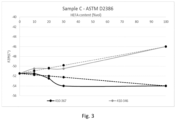
- not significantly better we mean that the difference between the measured freezing point and the calculated freezing point is less than the reproducibility of the freezing point measurement method. This can be clearly seen on the graph of Figure 3 , which shows the measured (with ASTM D2386-19) and calculated freezing point of compositions comprising jet component C.
Landscapes
- Chemical & Material Sciences (AREA)
- Oil, Petroleum & Natural Gas (AREA)
- Engineering & Computer Science (AREA)
- Chemical Kinetics & Catalysis (AREA)
- General Chemical & Material Sciences (AREA)
- Organic Chemistry (AREA)
- Production Of Liquid Hydrocarbon Mixture For Refining Petroleum (AREA)
- Liquid Carbonaceous Fuels (AREA)
Description
- Several standards specify the requirements for aviation turbine fuels, also called jet fuels, intended for use in aircraft turbine engines, including the requirements for jet fuels containing synthetic components, in particular from renewable origin such as hydroprocessed esters and fatty acids (HEFA).
- The freeze point of a jet fuel composition is an important factor in determining whether it is suitable for operation under low temperature conditions.
-
FR3062391 -
EP1664249B1 discloses a fuel composition prepared by blending petroleum derived kerosene base fuels and Fischer-Tropsch derived kerosene base fuels. The Fischer-Tropsch derived kerosene base fuel has boiling points within the range 130 to 300°C, a density from 730 to 770kg/m3 at 15°C and consists of 90wt% or more of paraffinic components. It contains normal and iso-paraffins in a weight ratio of greater than 1:1. The purpose of addition of this Fischer-Tropsch derived kerosene base fuel, in an amount of 0.1 to 81vol% in the fuel composition, is to reduce the freeze point of the fuel composition below that of the petroleum derived kerosene fuel. -
WO2018224730A1 discloses a fuel composition comprising a petroleum derived jet fuel component and a renewable jet fuel component, wherein the fuel composition has a freezing point of -40°C or below and a cetane number more than 40. The renewable jet fuel component is a hydrotreated middle distillate having a distillation range from 145°C to 315°C. The petroleum derived jet fuel component has a freezing point between -47°C and -60°C and the difference between the freezing point of the renewable jet fuel component and the freezing point of the petroleum derived jet fuel component is less than 25°C. The renewable jet fuel component has an iso-paraffin content of more than 70wt%, more than 70wt% of C15 to C18 paraffins, less than 20wt% of paraffins smaller than C15 paraffins, less than 10wt% of paraffins larger than C18 paraffins. -
US20140187827A1 describes a method of making a jet fuel composition comprising a mineral-based kero/jet-type distillate component having an initial boiling point of at least 100° C and a deoxygenated and dewaxed renewable component derived from triglycerides and/or fatty acids having an iso-paraffin to normal paraffin ratio from 2:1 to 6:1 and an aromatics content less than about 1 vol %. The jet fuel composition comprises from 3vol% to 25vol% of the renewable component. -
WO2017/197017A1 discloses compositions that include at least 98 wt% n-paraffins which may be suitable for use as a diesel fuel, aviation fuel, jet fuel blendstock, a blendstock to reduce the cloud point of a diesel fuel. The composition includes at least 98wt% C7-C12 n-paraffins, where at least 10wt% of the composition includes n-decane, at least 20wt% of the composition includes n-dodecane, and at least 75wt% of the composition includes even carbon number paraffins. -
US 2020/190421 A1 discloses another blend of a petroleum-derived jet fuel and a renewable jet fuel. - However, cold properties of a jet fuel composition comprising a petroleum derived jet fuel component and more particularly the freezing point is not improved by addition of a renewable component for any petroleum derived jet fuel component with respect to the calculated freezing point obtained by a linear relation.
- The present invention relates to jet fuel compositions, in particular jet fuel compositions having improved cold properties, and more particularly improved freezing point with respect to theoretical linear behavior, which are mixtures of jet fuel from petroleum origin and renewable component.
- An improvement of cold properties and more specifically of the freezing point of the fuel composition of the invention, is obtained by mixing a jet fuel from petroleum origin with a particular normal paraffins content to 1 to 50vol% of a renewable component consisting of hydroprocessed esters and fatty acids.
- A petroleum derived jet fuel component consists predominantly of refined hydrocarbons and trace levels of materials that are not hydrocarbons including oxygenates, organosulfur and nitrogenous compound. The refined hydrocarbons are derived from conventional sources including crude oil, natural gas liquid condensates, heavy oil, shale oil and oil sands.
- Hydroprocessed esters and fatty acids consist predominantly of mono-, di- and triglycerides, free fatty acids and fatty acid esters, which have been hydroprocessed to remove essentially oxygen.
- The invention relates to a jet fuel according to claim 1.
- The jet fuel composition of the invention has a freezing point below a theoretical freezing point calculated from a linear relation, and optionally below the freezing point of each component. This theoretical freezing point is obtained in a usual way by pondering the freezing point of each compound by its content and addition of the results.
- In particular, the petroleum derived jet fuel component may have a content of paraffins lower than C9 less than 10wt%, preferably less than 5wt% and a content of paraffins higher than C12 less than 20wt% preferably less than 18%wt. The content of paraffins lower than C9 may be from 0 to 5 or 10wt%, or from 0.5 to 5 or 10wt%. The content of paraffins higher than C12 may be from 0 to 18 or 20 wt% or from 4 to 18 or 20wt% or within any of these limits.
- In general, the petroleum derived jet fuel component may have a total content of paraffins from 40 to 55wt %, preferably from 40 to 50wt%.
- In general, the petroleum derived jet fuel component may preferably be a petroleum derived jet fuel that complies with the requirements for jet fuels as specified in the following standards : DefStan 91-091 Issue 11, ASTM D1655 January 2018. In particular, this petroleum derived jet fuel component may comply with the requirements for a Jet A1 or a Jet A.
- In general, the petroleum derived jet fuel component may have a freezing point of -47°C or below.
- In one embodiment, the content of renewable component in the jet fuel composition may be from 5 to 50vol% or from 10 to 50vol% or within any of these limits.
- In general, the renewable component may include, or consist of, hydroprocessed synthesized paraffinic kerosine wholly derived from paraffins derived from hydrogenation and deoxygenation of fatty acid esters and free fatty acids and subsequent processing of the product including hydrocracking, or hydroisomerization, or isomerization, or fraction, or a combination thereof, and may include other conventional refinery processes. In other words, the renewable component is produced from hydroprocessed esters and fatty acids. Advantageously, the renewable component may comply with the requirements of synthesized paraffinic kerosine specified in Annex 2 of ASTM D7566 March 2019.
- The renewable component may be produced from natural occurring oil(s), in particular from the above mentioned treatments of such natural occurring oil(s).
- A natural occurring oil is defined as an oil of biomass origin, and do not contain or consist of any mineral oil. In the description "natural occurring oil(s)" designates indifferently oil, fat and their mixtures.
- Said natural occurring oil(s) may contain one or several oils chosen among vegetable oil, animal fat, preferentially inedible highly saturated oils, waste oils, by-products of the refining of vegetable oil(s) or of animal oil(s) containing free fatty acids, tall oils, and oil produced by bacteria, yeast, algae, prokaryotes or eukaryotes.
- Suitable vegetable oils are for example palm oil, palm kernels oil, soy oils, soybean oil, rapeseed (colza or canola) oil, sunflower oil, linseed oil, rice bran oil, maize (corn) oil, olive oil, castor oil, sesame oil, pine oil, peanut oil, castor oil, mustard oil, carinata oil, palm kernel oil, hempseed oil, coconut oil, babasu oil, cottonseed oil, linola oil, jatropha oil.
- Animal fats include tallow, lard, grease (yellow and brown grease), fish oil/fat, butterfat, milk fats.
- By-products of the refining of vegetable oils or animal oils are by-products containing free fatty acids that are removed from the crude fats and oils by neutralisation or vacuum or steam distillation. Typical example is PFAD (palm free acid distillate).
- Waste oils include waste cooking oils (waste food oil) and oils recovered from residual water, such as trap and drain greases/oils, gutter oils, sewage oils, for example from water purification plants, and waste fat from the food industry.
- Tall oils, including crude tall oils, distillate tall oils (DTO) and tall oil fatty acids (TOFA), preferably DTO and TOFA, can also be used in the present invention.
- Tall oil, or otherwise known as tallol, is a liquid by-product of the Kraft process for processing wood, for isolating on the one hand the wood pulp useful in the papermaking industry, and on the other hand tall oil. Tall oil is essentially obtained when conifers are used in the Kraft process. After treating wood chips with sodium sulfide in aqueous solution, the tall oil isolated is alkaline. The latter is then acidified with sulfuric acid to produce crude tall oil.
- The natural occurring oil(s) used in the present invention also include oils produced by microorganisms, either natural or genetically modified microorganisms, such as bacteria, yeast, algae, prokaryotes or eukaryotes. In particular such oils can be recovered by mechanical or chemical extraction well known methods.The renewable jet fuel component may have one or more of the following features :
- a freezing point below -40°C
- a density at 15°C between 730 and 772 kg/m3.
- In combination or not with any of one or several of the above physical properties, the renewable component may have one or more of the following features :
- an isoparaffin content of 80wt% or more, for example from 80wt% to 95 or 99wt%,
- an iso-paraffins to normal paraffins ratio of at least 6.5:1, for example from 6.5:1 to 11,
- a C9-C17 paraffins content of at least 80wt%, for example from 80 to 99wt%,
- a C9-C17 iso-paraffins content of at least 75wt%, for example from 75 to 90wt%,
- a content of paraffins lower than C15 from 45wt% to 90wt%,
- a C9-C12 n-paraffins content of less than 20wt%, for example from 2 to 20wt%, from 2 to 15wt% or from 2 to 10%, in combination or not with any or all of the above features and their examples.
- The jet fuel composition of the invention has a normal paraffins content of C9-C12 paraffins from 10 to 20wt% and a total normal paraffins content from 15 to 30wt%.
- Advantageously, the jet fuel composition of the invention may comply with Jet A or Jet A1 requirements as defined in ASTM D7566 March 2019 or into DefStan 91-091 Issue 11 which refers to ASTM D7566. In particular, the content of renewable component in the jet fuel composition may be chosen such that the jet fuel composition complies with these requirements.
- According to a second aspect, the invention claims a method for producing a jet fuel composition, wherein the method is as defined in claim 8.
- The petroleum derived jet fuel component may be as previously described with respect to the jet fuel composition.
- The renewable component may be as previously described with respect to the jet fuel composition.
- Outside of the scope of the invention is the use of a petroleum derived jet fuel component having a content of C9-C12 normal paraffins from 17wt% to 30wt% for preparing a jet fuel composition from a mixture of a petroleum derived jet fuel component and a renewable component consisting of hydroprocessed esters and fatty acids, such jet fuel composition having a freezing point of -40°C or below, preferably of -47°C or below, said freezing point being lower than a theoretical freezing point calculated from a linear relation.
- Outside of the scope of the invention is a method for obtaining a jet fuel composition from a mixture of a petroleum derived jet fuel component and a renewable component consisting of hydroprocessed esters and fatty acids, such jet fuel composition having a freezing point of -40°C or below, preferably of -47°C or below, said freezing point being lower than a theoretical freezing point calculated from a linear relation, wherein the renewable component is mixed in a content from 1 to 50vo% with a petroleum derived jet fuel component having a content of C9-C12 normal paraffins from 17wt% to 30wt%. The petroleum derived jet fuel component and the renewable component may each be as previously described with respect to the jet fuel composition.
- The invention will be better understood with reference to the figures, which show exemplary embodiments of the invention.
-
Figure 1 is a graph comparing the measured freezing points and linear calculation of the freezing point (proportional to the volume content of the renewable jet component) for mixtures of a petroleum jet component according to the invention and several renewable jet components at different compositions. The measured freezing point is according to ASTM D2386-19. -
Figure 2 is a graph comparing the measured freezing points and linear calculation of the freezing point (proportional to the volume content of the renewable jet component) for mixtures of a petroleum jet component according to the invention and several renewable jet components at different compositions. The measured freezing point is according to ASTM D7153-15e1. -
Figure 3 is a graph comparing the measured freezing points and linear calculation of the freezing point (proportional to the volume content of the renewable jet component) for mixtures of a comparative petroleum jet component and several renewable jet components at different compositions. The measured freezing point is according to ASTM D2386-19. - Several petroleum jet fuel components have been mixed with different renewable components.
- Table 1 resumes the physical properties and composition of the petroleum jet fuel components and table 2 resumes the physical properties and composition of the renewable components.
- The compositions were determined by a GCxGC method.
- Petroleum jet fuel components A and B have n-C9-C12 contents according to the invention. This is not the case of jet fuel components C, D which are used to prepare comparative examples.
- The freezing points have been measured using two standard methods.
- The first method is a manual one which is the usual reference method and corresponds to ASTM D2386-19.
- The second method is an automatic one and corresponds to ASTM D7153-15e1. It has been implemented with a PAC ISL apparatus.
- The reproducibility "R" of these freezing point measurement methods are the following :
- ASTM D2386-19 : R=2.5
- ASTM D7153-15e1 : R=0.9
- All the jet fuel compositions comprising the petroleum jet component A show significantly improved cold properties with respect to the calculated freezing point, as also shown for some renewable component on
figure 1 . By "significantly improved" we mean that the difference between the measured freezing point and the calculated freezing point is equal or higher than the reproducibility of the freezing point measurement method. - From
figure 1 , we can expect an improvement of cold properties with respect to the linear calculations, with incorporation of 1 to 50 vol% of renewable jet component. Similar or better cold properties as the petroleum jet fuel component will be obtained. - The results show that improvement of cold properties is obtained even with renewable component having a high freezing point (-33°C). For some renewable jet components, the freezing point of the jet fuel composition is better than the freezing point of the petroleum jet component, or similar, but always within the specifications of jet fuels.
- Similar results are obtained with jet fuel compositions comprising the petroleum jet component B, as more clearly seen on
figure 2 . - Without wishing to be bound by a theory, the observed improvements may be due to the content of nC9-C12 of the jet fuel component.
Table 4 freezing points of mixtures of several comparative compositions made from mixtures of jets with renewable components Petroleum jet component Renewable component Content of Renewable component Freezing point Freezing point calculated from linear relation Freezing point Freezing point calculated from linear relation ASTM D2386-19 ASTM D7153-15e1 Vol% °C °C °C °C Sample C (408-6618) I (410-346) 0 -51,5 -51,5 -50,6 -50,6 10 -50,5 -51,0 -50,9 -49,8 20 -50,5 -50,4 -50,9 -48,9 30 -50,5 -49,9 -50,7 -48,1 100 -46,0 -46,0 -42,1 -42,1 Sample C (408-6618) J (410-367) 10 -51,5 -51,8 -51,6 -50,8 20 -52,5 -52,0 -52,8 -51,0 30 -54,0 -52,3 -54,1 -51,1 100 -54,0 -54,0 -52,4 -52,4 Sample D (408-6657) J (410-367) 0 -50.0 -50.0 -50.4 -50,4 10 -50.5 -50.4 -51.3 -50,6 20 -50.5 -50.8 -52.0 -51,1 100 -54 -54.0 -52.4 -52,4 Sample D (408-6657) I (410-346) 10 -49.5 -49.6 -50.2 -49,6 20 -49.0 -49.2 -49.7 -48,7 100 -46.0 -46.0 -42.1 -42,1 Sample D (408-6657) H (410-311) 10 -49.0 -49.1 -49.7 -49,4 20 -48.0 -48.2 -48.7 -48,4 30 -46.5 -47.3 -47.5 -47,3 100 -41.0 -41.0 -40.2 -40,2 - Jet fuel compositions comprising a petroleum jet component which do not have from 17wt% to 30wt% of n-C9-C12 all have a freezing point which is not significantly better that the freezing point calculated from the linear relation. By "not significantly better" we mean that the difference between the measured freezing point and the calculated freezing point is less than the reproducibility of the freezing point measurement method. This can be clearly seen on the graph of
Figure 3 , which shows the measured (with ASTM D2386-19) and calculated freezing point of compositions comprising jet component C. - Only the fuel compositions including a renewable component with a very low freezing point (-54°C) have a freezing point below the one of the petroleum jet component, but always not significantly better that the calculated freezing point.
- These results show that the cold properties of jet fuel composition comprising such petroleum jet component are not significantly improved despite the high iso-paraffins content of the renewable component.
Table 5 Properties of some of the above jet fuel compositions Petroleum jet component Renewable component Vol % of Renewable component Density (kg/m3) ASTM D1298-12b(2017) Sample A (408-6643) 789.4 H (410-311) 10 787.1 20 784.8 30 782.5 40 780.2 50 778.0 I (410-346) 20 783.7 30 780.8 40 777.9 Sample B (408-6628) 797.6 F (410-304) 10 793.4 20 789.2 I (410-346) 10 793.9 20 790.2 30 786.5 Table 6 Compositions (in wt%) of a jet fuel composition comprising Sample A Petroleum jet component Sample A (408-6643) Renewable component H (410-311) Vol % of Renewable component 10 20 30 40 50 n-C6 0.02 0.02 0.01 0.01 0.01 Iso-C7 0.06 0.06 0.05 0.04 0.04 n-C7 0.26 0.23 0.20 0.17 0.15 iso- C8 0.95 0.84 0.74 0.63 0.53 n- C8 0.85 0.76 0.68 0.60 0.52 iso- C9 2.31 2.07 1.82 1.58 1.33 n- C9 4.17 3.72 3.26 2.81 2.36 iso- C10 4.05 3.61 3.17 2.73 2.30 n- C10 5.34 4.76 4.17 3.59 3.01 iso- C11 2.76 2.46 2.17 1.87 1.58 n- C11 5.29 4.72 4.14 3.56 2.99 iso- C12 2.49 2.22 1.96 1.69 1.43 n- C12 3.84 3.42 3.01 2.59 2.18 iso- C13 1.64 1.47 1.30 1.13 0.96 n- C13 2.88 2.57 2.26 1.95 1.65 iso- C14 0.71 0.64 0.58 0.51 0.44 n- C14 1.57 1.40 1.24 1.08 0.92 iso- C15 1.79 3.24 4.70 6.16 7.62 n- C15 0.58 0.65 0.72 0.79 0.86 iso- C16 1.77 3.33 4.89 6.45 8.01 n- C16 0.28 0.44 0.59 0.75 0.91 iso- C17 1.20 2.39 3.58 4.77 5.96 n- C17 0.08 0.15 0.22 0.29 0.36 iso- C18 0.43 0.86 1.29 1.72 2.15 n- C18 0.03 0.06 0.09 0.12 0.15 C18 + 0.00 0.00 0.00 0.00 0.00 Total 45.32 46.08 46.83 47.58 48.34 total n-paraffins 25.17 22.89 20.60 18.32 16.03 total iso-paraffins 20.15 23.19 26.23 29.27 32.31 i / n 0.80 1.01 1.27 1.60 2.02 Total normal C9-C12 18.63 16.61 14.58 12.56 10.53 Total C9-C12 30.24 26.97 23.70 20.43 17.16 Total normal C9-C13 21.52 19.18 16.85 14.51 12.18 Total C9-C13 34.76 31.01 27.26 23.51 19.76 Table 7 Compositions (in wt%) of jet fuel compositions comprising Sample A and Sample B Petroleum jet component Sample A (408-6643) Sample B (408-6628) Renewable component I (410-346) I (410-346) Vol % of Renewable component 20 30 40 10 20 30 n-C6 0.02 0.01 0.01 0.01 0.01 0.01 Iso-C7 0.06 0.05 0.04 0.22 0.19 0.17 n-C7 0.23 0.20 0.17 0.25 0.22 0.20 iso- C8 0.92 0.86 0.79 0.66 0.63 0.60 n- C8 0.88 0.86 0.84 0.84 0.83 0.81 iso- C9 3.81 4.43 5.06 2.33 3.05 3.77 n- C9 4.14 3.89 3.65 1.97 1.99 2.02 iso- C10 5.71 6.32 6.93 5.39 5.97 6.55 n- C10 5.12 4.71 4.31 4.41 4.13 3.85 iso- C11 4.64 5.44 6.23 7.05 7.49 7.93 n- C11 5.00 4.56 4.12 5.71 5.24 4.78 iso- C12 4.26 5.02 5.77 5.53 6.06 6.59 n- C12 3.66 3.37 3.07 4.11 3.80 3.48 iso- C13 2.87 3.40 3.93 3.77 4.14 4.51 n- C13 2.65 2.38 2.11 1.92 1.76 1.61 iso- C14 1.70 2.17 2.63 2.03 2.41 2.78 n- C14 1.48 1.36 1.24 0.41 0.42 0.43 iso- C15 2.80 4.04 5.28 1.57 2.80 4.04 n- C15 0.59 0.63 0.67 0.13 0.21 0.30 iso- C16 2.73 3.99 5.25 1.28 2.56 3.84 n- C16 0.38 0.50 0.63 0.15 0.29 0.43 iso- C17 1.31 1.96 2.61 0.65 1.30 1.95 n- C17 0.09 0.13 0.17 0.04 0.08 0.12 iso- C18 0.50 0.75 1.00 0.25 0.50 0.75 n- C18 0.04 0.06 0.08 0.02 0.04 0.06 C18 + 0.02 0.03 0.04 0.01 0.02 0.03 Total 55.60 61.11 66.62 50.70 56.15 61.59 total n-paraffins 24.27 22.67 21.08 19.97 19.03 18.09 total iso-paraffins 31.31 38.41 45.51 30.73 37.10 43.48 i / n 1.29 1.69 2.16 1.54 1.95 2.40 Total normal C9-C12 17.91 16.53 15.16 16.20 15.16 14.13 Total C9-C12 36.33 37.74 39.15 36.49 37.73 38.96 Total normal C9-C13 20.56 18.92 17.27 18.12 16.93 15.74 Total C9-C13 41.85 43.52 45.19 42.19 43.63 45.08 Table 8 Compositions (in wt%) of jet fuel composition comprising Sample D Petroleum jet component Sample D (408-6657) Renewable component H (410-311) Vol % of Renewable component 10 20 30 n-C6 0.009 0.008 0.007 Iso-C7 0.117 0.104 0.091 n-C7 0.189 0.168 0.147 iso- C8 0.513 0.456 0.399 n- C8 0.676 0.612 0.548 iso- C9 1.945 1.74 1.535 n- C9 2.584 2.308 2.032 iso- C10 5.095 4.54 3.985 n- C10 4.042 3.604 3.166 iso- C11 3.952 3.524 3.096 n- C11 3.43 3.06 2.69 iso- C12 3.655 3.26 2.865 n- C12 2.98 2.66 2.34 iso- C13 2.863 2.556 2.249 n- C13 2.215 1.98 1.745 iso- C14 2.44 2.18 1.92 n- C14 1.567 1.404 1.241 iso- C15 3.596 4.852 6.108 n- C15 0.993 1.016 1.039 iso- C16 2.138 3.656 5.174 n- C16 0.575 0.7 0.825 iso- C17 1.433 2.596 3.759 n- C17 0.223 0.276 0.329 iso- C18 0.583 0.996 1.409 n- C18 0.093 0.116 0.139 C18 + 0.081 0.072 0.063 Total 47.99 48.44 48.90 total n-paraffins 19.58 17.91 16.25 total iso-paraffins 28.33 30.46 32.59 i / n 1.45 1.70 2.01 Total normal C9-C12 13.036 11.632 10.228 Total C9-C12 27.683 24.696 21.709 Total normal C9-C13 15.251 13.612 11.973 Total C9-C13 32.761 29.232 25.703
| 408-6643 | 408-6628 | 408-6618 | 408-6657 | |
| Sample A | Sample B | Sample C | Sample D | |
| Freezing point (°C) | -53.5 | -59.0 | -51.5 | -50.4 |
| ASTM D2386-19 | ||||
| Freezing point (°C) ASTM D7153-15e1 | -52.8 | -59.8 | -50.6 | -50.4 |
| Density at 15°C (Kg/m3) ASTM D1298 -12b(2017) | 789.4 | 797.6 | 799.0 | 802.3 |
| Composition (wt%) | ||||
| n- C6 | 0.02 | 0.01 | 0.01 | 0.01 |
| iso- C7 | 0.07 | 0.24 | 0.19 | 0.13 |
| n- C7 | 0.29 | 0.28 | 0.19 | 0.21 |
| iso- C8 | 1.05 | 0.69 | 0.46 | 0.57 |
| n- C8 | 0.93 | 0.86 | 0.71 | 0.74 |
| iso- C9 | 2.56 | 1.61 | 2.41 | 2.15 |
| n- C9 | 4.62 | 1.94 | 3.56 | 2.86 |
| iso- C10 | 4.49 | 4.81 | 6.00 | 5.65 |
| n- C10 | 5.92 | 4.69 | 4.60 | 4.48 |
| iso- C11 | 3.05 | 6.61 | 4.58 | 4.38 |
| n- C11 | 5.87 | 6.18 | 4.14 | 3.80 |
| iso- C12 | 2.75 | 5.00 | 3.97 | 4.05 |
| n- C12 | 4.25 | 4.42 | 3.54 | 3.30 |
| iso- C13 | 1.81 | 3.40 | 3.10 | 3.17 |
| n- C13 | 3.19 | 2.08 | 2.69 | 2.45 |
| iso- C14 | 0.78 | 1.66 | 2.52 | 2.70 |
| n- C14 | 1.73 | 0.40 | 1.86 | 1.73 |
| iso- C15 | 0.33 | 0.33 | 2.19 | 2.34 |
| n- C15 | 0.51 | 0.04 | 0.95 | 0.97 |
| iso- C16 | 0.21 | 0.48 | 0.62 | |
| n- C16 | 0.12 | 0.01 | 0.31 | 0.45 |
| iso- C17 | 0.01 | 0.13 | 0.27 | |
| n- C17 | 0.01 | 0.06 | 0.17 | |
| iso- C18 | 0.04 | 0.17 | ||
| n- C18 | 0.01 | 0.07 | ||
| C18 + | 0.03 | 0.09 | ||
| Total | 44.57 | 45.26 | 48.73 | 47.53 |
| total n-paraffins | 27.46 | 20.91 | 22.63 | 21.24 |
| total iso-paraffins | 17.11 | 24.35 | 26.07 | 26.20 |
| i / n | 0.62 | 1.16 | 1.15 | 1.23 |
| Isomerization ratio | 0.38 | 0.54 | 0.53 | 0.55 |
| Total normal C9-C12 | 20.66 | 17.23 | 15.84 | 14.44 |
| paraffins <C9 | 2.36 | 2.08 | 1.56 | 1.66 |
| paraffins >C12 | 8.70 | 7.92 | 14.37 | 15.20 |
| 410-304 | 410-310 | 410-311 | 410-346 | 410-367 | |
| F | G | H | I | J | |
| Freezing point (°C) | -46.0 | -33.0 | -41.0 | -46.0 | -54.0 |
| ASTM D2386-19 | |||||
| Freezing point (°C) ASTM D7153-15e1 | -34,4 | -40.2 | -42.1 | -52.4 | |
| Density at 15°C (Kg/m3) ASTM D1298 -12b(2017) | 755.6 | 762.3 | 767.7 | 760.7 | 750.7 |
| Composition (wt%) | |||||
| iso- C8 | 3.8 | 0.3 | 0.4 | 0.2 | |
| n- C8 | 3.3 | 0.5 | 0.1 | 0.7 | 1.2 |
| iso- C9 | 15.3 | 9.4 | 5.2 | 8.8 | 16.2 |
| n- C9 | 2.9 | 2.1 | 1.6 | 2.2 | 3.5 |
| iso- C10 | 13.9 | 11.1 | 8.2 | 10.6 | 17.1 |
| n- C10 | 2 | 1.6 | 1.3 | 1.9 | 2.4 |
| iso- C11 | 12 | 10.5 | 8.6 | 11.0 | 15.1 |
| n- C11 | 1.4 | 1.2 | 1.1 | 1.5 | 1.7 |
| iso- C12 | 10.9 | 10.5 | 8.5 | 10.3 | 12.6 |
| n- C12 | 1.1 | 1.0 | 0.9 | 1.3 | 1.2 |
| iso- C13 | 9.7 | 10.2 | 6.7 | 7.1 | 9.7 |
| n- C13 | 0.6 | 0.7 | 0.5 | 0.5 | 0.5 |
| iso- C14 | 5.7 | 6.5 | 5.9 | 5.4 | 5.0 |
| n- C14 | 0.3 | 0.4 | 0.5 | 0.5 | 0.3 |
| iso- C15 | 2.2 | 3.0 | 14.9 | 12.7 | 2.3 |
| n- C15 | 0.2 | 0.3 | 1.2 | 0.9 | 0.2 |
| iso- C16 | 3.6 | 6.4 | 15.8 | 12.8 | 2.7 |
| n- C16 | 0.5 | 0.9 | 1.7 | 1.4 | 0.3 |
| iso- C17 | 7.3 | 15.6 | 11.9 | 6.5 | 4.3 |
| n- C17 | 0.5 | 1.1 | 0.7 | 0.4 | 0.3 |
| iso- C18 | 2.4 | 5.9 | 4.3 | 2.5 | 1.5 |
| n- C18 | 0.2 | 0.5 | 0.3 | 0.2 | 0.1 |
| C18 + | 0.1 | 0.3 | 0.1 | 0.1 | |
| Total | 99.9 | 99.7 | 99.9 | 99.7 | 98.6 |
| total n-paraffins | 13 | 10.3 | 9.9 | 11.5 | 11.8 |
| total iso-paraffins | 86.8 | 89.4 | 90 | 88.1 | 86.7 |
| i / n | 6.7 | 8.7 | 9.9 | 7.7 | 7.4 |
| Isomerization ratio | 0.87 | 0.89 | 0.90 | 0.88 | 0.88 |
| Total normal C9-C12 | 7.4 | 5.9 | 4.9 | 6.9 | 8.8 |
| Total C9-C12 | 59.5 | 53.6 | 35.4 | 47.6 | 69.8 |
| Total C16 | 4.1 | 3.0 | 17.5 | 14.2 | 3.0 |
| Total C17 | 7.8 | 4.6 | 12.6 | 6.9 | 4.6 |
| iso-C16/iso-C17 | 0.5 | 0.4 | 1.3 | 2.0 | 0.6 |
| n-C16/n-C17 | 1.0 | 0.8 | 2.4 | 3.5 | 1.0 |
| C16/C17 | 0.5 | 0.4 | 1.4 | 2.1 | 0.7 |
| Petroleum jet | Renewable component | Content of Renewable | Freezing point | Freezing point calculated from | Freezing point | Freezing point calculated from |
| component | component | linear relation | linear relation | |||
| ASTM D2386-19 | ASTM D7153-15e1 | |||||
| Vol% | °C | °C | °C | °C | ||
| Sample A (408-6643) | H (410-311) | |||||
| 10 | -55.5 | -52.3 | -53.6 | -52.2 | ||
| 20 | -56 | -51.0 | -53.9 | -50.8 | ||
| 30 | -55 | -49.8 | -53.1 | -49.5 | ||
| 40 | -51.5 | -48.5 | -51.2 | -48.2 | ||
| 50 | -50.5 | -47.3 | -49.2 | -46.9 | ||
| 100 | -41 | -41.0 | -40.2 | -40.2 | ||
| Sample A (408-6643) | I (410-346) | |||||
| 20 | -54 | -52.0 | -54.5 | -51.2 | ||
| 30 | -53.5 | -51.3 | -54.5 | -50.1 | ||
| 40 | -52.5 | -50.5 | -53.5 | -48.9 | ||
| 100 | -46 | -46.0 | -42.1 | -42.1 |
| Sample A (408-6643) | F (410-304) | |||||
| 10 | -55.5 | -52.8 | ||||
| 20 | -56.5 | -52.0 | ||||
| 100 | -46 | -46.0 |
| Sample B (408-6628) | F (410-304) | |||||
| 0 | -59.0 | -59.0 | -59.8 | -59.8 | ||
| 10 | -62 | -57.7 | ||||
| 20 | -64 | -56.4 | ||||
| 100 | -46 |
| Sample B (408-6628) | J (410-367) | |||||
| 10 | -60.5 | -58.5 | -60.8 | -59.1 | ||
| 20 | -62.0 | -58 | -62.3 | -58.3 | ||
| 30 | -63.0 | -57.5 | -63.7 | -57.6 | ||
| 100 | -54.0 | -52.4 | -59.1 |
| Sample B (408-6628) | I (410-346) | |||||
| 10 | -61.5 | -57.7 | -60.8 | -58.0 | ||
| 20 | -62.5 | -56.4 | -62.1 | -56.3 | ||
| 30 | -59.5 | -55.1 | -60.5 | -54.5 | ||
| 100 | -46 | -42.1 | -42.1 |
Claims (11)
- Jet fuel composition consisting of a petroleum derived jet fuel component and a renewable component consisting of hydroprocessed esters and fatty acids, wherein- the jet fuel composition contains 1 to 50vol% of the renewable component and has a freezing point of -40°C or below, preferably of -47°C and below,- the renewable component has a freezing point below - 30°C, and- the petroleum derived jet fuel component has a freezing point of -40°C or below and a content of C9-C12 normal paraffins from 17wt% to 25wt%,
and wherein- the freezing point of the jet fuel composition is lower than a theoretical freezing point calculated from a linear relation, this theoretical freezing point being obtained by pondering the freezing point of each component by its volume content and addition of the results,- the jet fuel composition has a normal paraffins content of C9-C12 paraffins from 10 to 20wt% and a total normal paraffins content from 15 to 30wt%,the above-mentioned freezing points of the jet fuel composition and of its components being determined using a single and same method chosen from ASTM D2386-19 or ASTM D7153-15e1. - Jet fuel composition according to claim 1, wherein the petroleum derived jet fuel component has a total content of paraffins from 40 to 55wt %.
- Jet fuel composition according to claim 1 or 2, wherein the petroleum derived jet fuel component has a freezing point of -47°C or below.
- Jet fuel composition according to any one of claims 1 to 3, wherein the renewable component has one or more of the following features :- an isoparaffin content of 80wt% or more,- an iso-paraffins to normal paraffins ratio of at least 6.5:1,- a C9-C17 paraffins content of at least 80wt%,- a C9-C17 iso-paraffins content of at least 75wt%,- a content of paraffins lower than C15 from 45wt% to 90wt%.
- Jet fuel composition according to any one of claims 1 to 4, wherein the renewable component has:- a density at 15°C between 730 and 772 kg/m3.
- Jet fuel composition according to any one of claims 1 to 5, wherein the renewable component is produced from one or several oils chosen among vegetable oil, animal fat, preferentially inedible highly saturated oils, waste oils, by-products of the refining of vegetable oil(s) or of animal oil(s) containing free fatty acids, tall oils, and oil produced by bacteria, yeast, algae, prokaryotes or eukaryotes.
- Method for producing a jet fuel composition, wherein the method consist in mixing a petroleum derived jet fuel component and a renewable component consisting of hydroprocessed esters and fatty acids to obtain a jet fuel composition containing 1 to 50vol% of the renewable component and having a freezing point of -40°C or below, preferably of -47°C or below,
wherein- the renewable component has a freezing point below - 30°C,- the petroleum derived jet fuel component has a freezing point of -40°C or below and a content of C9-C12 normal paraffins from 17wt% to 25wt%,and wherein- the freezing point of the jet fuel composition is lower than a theoretical freezing point calculated from a linear relation, this theoretical freezing point being obtained by pondering the freezing point of each component by its volume content and addition of the results,- the jet fuel composition has a normal paraffins content of C9-C12 paraffins from 10 to 20wt% and a total normal paraffins content from 15 to 30wt%,the above-mentioned freezing points of the jet fuel composition and of its components being determined using a single and same method chosen from ASTM D2386-19 or ASTM D7153-15e1. - A method as claimed in claim 7, wherein the petroleum derived jet fuel component has a total content of paraffins from 40 to 55wt %.
- A method as claimed in claim 7 or 8, wherein the renewable jet fuel component has one or more of the following features :- an isoparaffin content of 80wt% or more,- an iso-paraffins to normal paraffins ratio of at least 6.5:1,- a C9-C17 paraffins content of at least 80wt%,- a C9-C17 iso-paraffins content of at least 75wt%,- a content of paraffins lower than C15 from 45wt% to 90wt%,- a C9-C12 n-paraffins content of less than 20wt%.
- A method as claimed in any of claims 7 to 9, wherein the renewable component has :- a density at 15°C between 730 and 772 kg/m3.
- A method as claimed in any of claims 7 to 10, wherein the renewable component is produced from one or several oils chosen among vegetable oil, animal fat, preferentially inedible highly saturated oils, waste oils, by-products of the refining of vegetable oil(s) or of animal oil(s) containing free fatty acids, tall oils, and oil produced by bacteria, yeast, algae, prokaryotes or eukaryotes.
Priority Applications (1)
| Application Number | Priority Date | Filing Date | Title |
|---|---|---|---|
| EP25157808.4A EP4530334A3 (en) | 2020-07-08 | 2021-07-06 | Jet fuel composition and method for producing a jet fuel composition |
Applications Claiming Priority (2)
| Application Number | Priority Date | Filing Date | Title |
|---|---|---|---|
| EP20305785 | 2020-07-08 | ||
| PCT/EP2021/068703 WO2022008534A1 (en) | 2020-07-08 | 2021-07-06 | Jet fuel composition and method for producing a jet fuel composition |
Related Child Applications (1)
| Application Number | Title | Priority Date | Filing Date |
|---|---|---|---|
| EP25157808.4A Division EP4530334A3 (en) | 2020-07-08 | 2021-07-06 | Jet fuel composition and method for producing a jet fuel composition |
Publications (2)
| Publication Number | Publication Date |
|---|---|
| EP4179046A1 EP4179046A1 (en) | 2023-05-17 |
| EP4179046B1 true EP4179046B1 (en) | 2025-02-26 |
Family
ID=71944046
Family Applications (2)
| Application Number | Title | Priority Date | Filing Date |
|---|---|---|---|
| EP21740037.3A Active EP4179046B1 (en) | 2020-07-08 | 2021-07-06 | Jet fuel composition and method for producing a jet fuel composition |
| EP25157808.4A Pending EP4530334A3 (en) | 2020-07-08 | 2021-07-06 | Jet fuel composition and method for producing a jet fuel composition |
Family Applications After (1)
| Application Number | Title | Priority Date | Filing Date |
|---|---|---|---|
| EP25157808.4A Pending EP4530334A3 (en) | 2020-07-08 | 2021-07-06 | Jet fuel composition and method for producing a jet fuel composition |
Country Status (8)
| Country | Link |
|---|---|
| US (1) | US12129440B2 (en) |
| EP (2) | EP4179046B1 (en) |
| DK (1) | DK4179046T3 (en) |
| ES (1) | ES3026235T3 (en) |
| FI (1) | FI4179046T3 (en) |
| PL (1) | PL4179046T3 (en) |
| PT (1) | PT4179046T (en) |
| WO (1) | WO2022008534A1 (en) |
Families Citing this family (8)
| Publication number | Priority date | Publication date | Assignee | Title |
|---|---|---|---|---|
| AU2022275869A1 (en) | 2021-05-18 | 2023-11-30 | Air Company Holdings, Inc. | Method and apparatus for selective alcohol upgrading |
| JP2025504395A (en) | 2022-01-11 | 2025-02-12 | エアー カンパニー ホールディングス インコーポレイテッド | Method and catalyst for converting carbon dioxide to long chain hydrocarbons - Patents.com |
| FR3134111B1 (en) | 2022-04-05 | 2025-06-20 | Axens | Renewable kerosene fuel with excellent cold properties |
| CN119907847A (en) * | 2022-09-22 | 2025-04-29 | 艾尔控股公司 | Synthetic fuel and method and apparatus for producing the same |
| DK181857B1 (en) * | 2023-05-02 | 2025-02-20 | Topsoe As | Process and plant for producing synthetic paraffinic kerosene as jet fuel |
| WO2025155548A1 (en) * | 2024-01-19 | 2025-07-24 | Uop Llc | Composition for jet fuel and process for blending |
| WO2025247757A1 (en) | 2024-05-29 | 2025-12-04 | Shell Internationale Research Maatschappij B.V. | Jet fuel component |
| WO2025247756A1 (en) | 2024-05-29 | 2025-12-04 | Shell Internationale Research Maatschappij B.V. | Jet fuel component |
Citations (1)
| Publication number | Priority date | Publication date | Assignee | Title |
|---|---|---|---|---|
| WO2017197017A1 (en) * | 2016-05-11 | 2017-11-16 | Reg Synthetic Fuels, Llc | Biorenewable kerosene, jet fuel, jet fuel blendstock, and method of manufacturing |
Family Cites Families (5)
| Publication number | Priority date | Publication date | Assignee | Title |
|---|---|---|---|---|
| CA2539038C (en) | 2003-09-17 | 2015-02-10 | Shell Internationale Research Maatschappij B.V. | Petroleum- and fischer-tropsch- derived kerosene blend |
| WO2008124607A1 (en) * | 2007-04-06 | 2008-10-16 | Syntroleum Corporation | Process for co-producing jet fuel and lpg from renewable sources |
| CA2889005A1 (en) | 2012-12-28 | 2014-09-25 | Exxonmobil Research And Engineering Company | Blending of dewaxed biofuels with mineral-based kero(jet) distillate cuts to provide on-spec jet fuels |
| FI127307B2 (en) | 2017-01-27 | 2024-12-10 | Neste Oyj | Fuel compositions with enhanced cold properties and methods of making the same |
| FI20175528A1 (en) * | 2017-06-07 | 2018-12-08 | Neste Oyj | The fuel composition and the method of making the fuel composition |
-
2021
- 2021-07-06 DK DK21740037.3T patent/DK4179046T3/en active
- 2021-07-06 EP EP21740037.3A patent/EP4179046B1/en active Active
- 2021-07-06 US US18/014,498 patent/US12129440B2/en active Active
- 2021-07-06 WO PCT/EP2021/068703 patent/WO2022008534A1/en not_active Ceased
- 2021-07-06 PT PT217400373T patent/PT4179046T/en unknown
- 2021-07-06 PL PL21740037.3T patent/PL4179046T3/en unknown
- 2021-07-06 FI FIEP21740037.3T patent/FI4179046T3/en active
- 2021-07-06 ES ES21740037T patent/ES3026235T3/en active Active
- 2021-07-06 EP EP25157808.4A patent/EP4530334A3/en active Pending
Patent Citations (1)
| Publication number | Priority date | Publication date | Assignee | Title |
|---|---|---|---|---|
| WO2017197017A1 (en) * | 2016-05-11 | 2017-11-16 | Reg Synthetic Fuels, Llc | Biorenewable kerosene, jet fuel, jet fuel blendstock, and method of manufacturing |
Also Published As
| Publication number | Publication date |
|---|---|
| DK4179046T3 (en) | 2025-05-26 |
| PL4179046T3 (en) | 2025-06-23 |
| ES3026235T3 (en) | 2025-06-10 |
| WO2022008534A1 (en) | 2022-01-13 |
| US12129440B2 (en) | 2024-10-29 |
| EP4179046A1 (en) | 2023-05-17 |
| EP4530334A3 (en) | 2025-06-11 |
| EP4530334A2 (en) | 2025-04-02 |
| PT4179046T (en) | 2025-04-29 |
| US20230313061A1 (en) | 2023-10-05 |
| FI4179046T3 (en) | 2025-06-02 |
Similar Documents
| Publication | Publication Date | Title |
|---|---|---|
| EP4179046B1 (en) | Jet fuel composition and method for producing a jet fuel composition | |
| JP7248866B2 (en) | hydrocarbon composition | |
| US8017819B2 (en) | Thermal treatment of triglycerides | |
| EP3504295B1 (en) | A method for manufacturing a fuel component | |
| US20110126449A1 (en) | Blended fuel composition having improved cold flow properties | |
| EP3184611B1 (en) | Method for producing an aviation fuel composition | |
| Iha et al. | Extraction and characterization of passion fruit and guava oils from industrial residual seeds and their application as biofuels | |
| CN119013377A (en) | Production of hydrocarbons from organic materials of biological origin | |
| US20250136881A1 (en) | Renewable jet-fuel composition | |
| US10889774B2 (en) | Lubricity additive for fuel with a low sulphur content | |
| EP3894523B1 (en) | Diesel fuel composition | |
| US12378477B2 (en) | Method for producing renewable aviation fuel | |
| FR3151599A1 (en) | Aviation fuel with high renewable fuel content and reduced aromatics content | |
| HK40083006A (en) | A hydrocarbon composition | |
| CA3121052A1 (en) | Blending of renewable fuels | |
| HK40065299A (en) | A hydrocarbon composition | |
| US20110237851A1 (en) | Thermal cracking of impurities in triglyceride feedstock | |
| JP2009120671A (en) | Method for liquefying coal and oil obtained by the same |
Legal Events
| Date | Code | Title | Description |
|---|---|---|---|
| STAA | Information on the status of an ep patent application or granted ep patent |
Free format text: STATUS: UNKNOWN |
|
| STAA | Information on the status of an ep patent application or granted ep patent |
Free format text: STATUS: THE INTERNATIONAL PUBLICATION HAS BEEN MADE |
|
| PUAI | Public reference made under article 153(3) epc to a published international application that has entered the european phase |
Free format text: ORIGINAL CODE: 0009012 |
|
| STAA | Information on the status of an ep patent application or granted ep patent |
Free format text: STATUS: REQUEST FOR EXAMINATION WAS MADE |
|
| 17P | Request for examination filed |
Effective date: 20230202 |
|
| AK | Designated contracting states |
Kind code of ref document: A1 Designated state(s): AL AT BE BG CH CY CZ DE DK EE ES FI FR GB GR HR HU IE IS IT LI LT LU LV MC MK MT NL NO PL PT RO RS SE SI SK SM TR |
|
| STAA | Information on the status of an ep patent application or granted ep patent |
Free format text: STATUS: EXAMINATION IS IN PROGRESS |
|
| DAV | Request for validation of the european patent (deleted) | ||
| DAX | Request for extension of the european patent (deleted) | ||
| 17Q | First examination report despatched |
Effective date: 20231013 |
|
| GRAP | Despatch of communication of intention to grant a patent |
Free format text: ORIGINAL CODE: EPIDOSNIGR1 |
|
| STAA | Information on the status of an ep patent application or granted ep patent |
Free format text: STATUS: GRANT OF PATENT IS INTENDED |
|
| GRAJ | Information related to disapproval of communication of intention to grant by the applicant or resumption of examination proceedings by the epo deleted |
Free format text: ORIGINAL CODE: EPIDOSDIGR1 |
|
| STAA | Information on the status of an ep patent application or granted ep patent |
Free format text: STATUS: EXAMINATION IS IN PROGRESS |
|
| TPAC | Observations filed by third parties |
Free format text: ORIGINAL CODE: EPIDOSNTIPA |
|
| INTG | Intention to grant announced |
Effective date: 20240415 |
|
| INTC | Intention to grant announced (deleted) | ||
| P01 | Opt-out of the competence of the unified patent court (upc) registered |
Free format text: CASE NUMBER: APP_57832/2024 Effective date: 20241023 |
|
| GRAP | Despatch of communication of intention to grant a patent |
Free format text: ORIGINAL CODE: EPIDOSNIGR1 |
|
| STAA | Information on the status of an ep patent application or granted ep patent |
Free format text: STATUS: GRANT OF PATENT IS INTENDED |
|
| TPAC | Observations filed by third parties |
Free format text: ORIGINAL CODE: EPIDOSNTIPA |
|
| INTG | Intention to grant announced |
Effective date: 20241129 |
|
| GRAS | Grant fee paid |
Free format text: ORIGINAL CODE: EPIDOSNIGR3 |
|
| GRAA | (expected) grant |
Free format text: ORIGINAL CODE: 0009210 |
|
| STAA | Information on the status of an ep patent application or granted ep patent |
Free format text: STATUS: THE PATENT HAS BEEN GRANTED |
|
| AK | Designated contracting states |
Kind code of ref document: B1 Designated state(s): AL AT BE BG CH CY CZ DE DK EE ES FI FR GB GR HR HU IE IS IT LI LT LU LV MC MK MT NL NO PL PT RO RS SE SI SK SM TR |
|
| REG | Reference to a national code |
Ref country code: GB Ref legal event code: FG4D |
|
| REG | Reference to a national code |
Ref country code: CH Ref legal event code: EP |
|
| REG | Reference to a national code |
Ref country code: DE Ref legal event code: R096 Ref document number: 602021026796 Country of ref document: DE |
|
| REG | Reference to a national code |
Ref country code: IE Ref legal event code: FG4D |
|
| REG | Reference to a national code |
Ref country code: PT Ref legal event code: SC4A Ref document number: 4179046 Country of ref document: PT Date of ref document: 20250429 Kind code of ref document: T Free format text: AVAILABILITY OF NATIONAL TRANSLATION Effective date: 20250422 |
|
| REG | Reference to a national code |
Ref country code: NL Ref legal event code: FP |
|
| REG | Reference to a national code |
Ref country code: DK Ref legal event code: T3 Effective date: 20250521 |
|
| REG | Reference to a national code |
Ref country code: FI Ref legal event code: FGE |
|
| REG | Reference to a national code |
Ref country code: SE Ref legal event code: TRGR Ref country code: ES Ref legal event code: FG2A Ref document number: 3026235 Country of ref document: ES Kind code of ref document: T3 Effective date: 20250610 |
|
| PG25 | Lapsed in a contracting state [announced via postgrant information from national office to epo] |
Ref country code: RS Free format text: LAPSE BECAUSE OF FAILURE TO SUBMIT A TRANSLATION OF THE DESCRIPTION OR TO PAY THE FEE WITHIN THE PRESCRIBED TIME-LIMIT Effective date: 20250526 |
|
| PGFP | Annual fee paid to national office [announced via postgrant information from national office to epo] |
Ref country code: PL Payment date: 20250630 Year of fee payment: 5 |
|
| REG | Reference to a national code |
Ref country code: LT Ref legal event code: MG9D |
|
| PG25 | Lapsed in a contracting state [announced via postgrant information from national office to epo] |
Ref country code: HR Free format text: LAPSE BECAUSE OF FAILURE TO SUBMIT A TRANSLATION OF THE DESCRIPTION OR TO PAY THE FEE WITHIN THE PRESCRIBED TIME-LIMIT Effective date: 20250226 |
|
| PG25 | Lapsed in a contracting state [announced via postgrant information from national office to epo] |
Ref country code: LV Free format text: LAPSE BECAUSE OF FAILURE TO SUBMIT A TRANSLATION OF THE DESCRIPTION OR TO PAY THE FEE WITHIN THE PRESCRIBED TIME-LIMIT Effective date: 20250226 |
|
| PGFP | Annual fee paid to national office [announced via postgrant information from national office to epo] |
Ref country code: PT Payment date: 20250626 Year of fee payment: 5 |
|
| PG25 | Lapsed in a contracting state [announced via postgrant information from national office to epo] |
Ref country code: BG Free format text: LAPSE BECAUSE OF FAILURE TO SUBMIT A TRANSLATION OF THE DESCRIPTION OR TO PAY THE FEE WITHIN THE PRESCRIBED TIME-LIMIT Effective date: 20250226 |
|
| PGFP | Annual fee paid to national office [announced via postgrant information from national office to epo] |
Ref country code: TR Payment date: 20250630 Year of fee payment: 5 |
|
| REG | Reference to a national code |
Ref country code: AT Ref legal event code: MK05 Ref document number: 1770625 Country of ref document: AT Kind code of ref document: T Effective date: 20250226 |
|
| PGFP | Annual fee paid to national office [announced via postgrant information from national office to epo] |
Ref country code: NL Payment date: 20250721 Year of fee payment: 5 Ref country code: LU Payment date: 20250721 Year of fee payment: 5 |
|
| REG | Reference to a national code |
Ref country code: GR Ref legal event code: EP Ref document number: 20250400844 Country of ref document: GR Effective date: 20250613 |
|
| PG25 | Lapsed in a contracting state [announced via postgrant information from national office to epo] |
Ref country code: SM Free format text: LAPSE BECAUSE OF FAILURE TO SUBMIT A TRANSLATION OF THE DESCRIPTION OR TO PAY THE FEE WITHIN THE PRESCRIBED TIME-LIMIT Effective date: 20250226 |
|
| PGFP | Annual fee paid to national office [announced via postgrant information from national office to epo] |
Ref country code: FI Payment date: 20250725 Year of fee payment: 5 Ref country code: ES Payment date: 20250827 Year of fee payment: 5 |
|
| PGFP | Annual fee paid to national office [announced via postgrant information from national office to epo] |
Ref country code: DK Payment date: 20250725 Year of fee payment: 5 Ref country code: DE Payment date: 20250722 Year of fee payment: 5 |
|
| PGFP | Annual fee paid to national office [announced via postgrant information from national office to epo] |
Ref country code: NO Payment date: 20250725 Year of fee payment: 5 Ref country code: GR Payment date: 20250721 Year of fee payment: 5 |
|
| PGFP | Annual fee paid to national office [announced via postgrant information from national office to epo] |
Ref country code: IT Payment date: 20250724 Year of fee payment: 5 |
|
| PGFP | Annual fee paid to national office [announced via postgrant information from national office to epo] |
Ref country code: BE Payment date: 20250721 Year of fee payment: 5 Ref country code: GB Payment date: 20250724 Year of fee payment: 5 |
|
| PG25 | Lapsed in a contracting state [announced via postgrant information from national office to epo] |
Ref country code: AT Free format text: LAPSE BECAUSE OF FAILURE TO SUBMIT A TRANSLATION OF THE DESCRIPTION OR TO PAY THE FEE WITHIN THE PRESCRIBED TIME-LIMIT Effective date: 20250226 |
|
| PGFP | Annual fee paid to national office [announced via postgrant information from national office to epo] |
Ref country code: FR Payment date: 20250725 Year of fee payment: 5 |
|
| PGFP | Annual fee paid to national office [announced via postgrant information from national office to epo] |
Ref country code: CH Payment date: 20250801 Year of fee payment: 5 Ref country code: SE Payment date: 20250722 Year of fee payment: 5 |
|
| PG25 | Lapsed in a contracting state [announced via postgrant information from national office to epo] |
Ref country code: EE Free format text: LAPSE BECAUSE OF FAILURE TO SUBMIT A TRANSLATION OF THE DESCRIPTION OR TO PAY THE FEE WITHIN THE PRESCRIBED TIME-LIMIT Effective date: 20250226 Ref country code: CZ Free format text: LAPSE BECAUSE OF FAILURE TO SUBMIT A TRANSLATION OF THE DESCRIPTION OR TO PAY THE FEE WITHIN THE PRESCRIBED TIME-LIMIT Effective date: 20250226 |
|
| PGFP | Annual fee paid to national office [announced via postgrant information from national office to epo] |
Ref country code: IE Payment date: 20250723 Year of fee payment: 5 |
|
| PG25 | Lapsed in a contracting state [announced via postgrant information from national office to epo] |
Ref country code: RO Free format text: LAPSE BECAUSE OF FAILURE TO SUBMIT A TRANSLATION OF THE DESCRIPTION OR TO PAY THE FEE WITHIN THE PRESCRIBED TIME-LIMIT Effective date: 20250226 |
|
| PG25 | Lapsed in a contracting state [announced via postgrant information from national office to epo] |
Ref country code: SK Free format text: LAPSE BECAUSE OF FAILURE TO SUBMIT A TRANSLATION OF THE DESCRIPTION OR TO PAY THE FEE WITHIN THE PRESCRIBED TIME-LIMIT Effective date: 20250226 |
|
| PGFP | Annual fee paid to national office [announced via postgrant information from national office to epo] |
Ref country code: IS Payment date: 20250710 Year of fee payment: 5 |
|
| REG | Reference to a national code |
Ref country code: DE Ref legal event code: R026 Ref document number: 602021026796 Country of ref document: DE |
|
| PLBI | Opposition filed |
Free format text: ORIGINAL CODE: 0009260 |
|
| PLAX | Notice of opposition and request to file observation + time limit sent |
Free format text: ORIGINAL CODE: EPIDOSNOBS2 |