EP4177785A1 - Information extraction method and apparatus, electronic device and readable storage medium - Google Patents
Information extraction method and apparatus, electronic device and readable storage medium Download PDFInfo
- Publication number
- EP4177785A1 EP4177785A1 EP22200126.5A EP22200126A EP4177785A1 EP 4177785 A1 EP4177785 A1 EP 4177785A1 EP 22200126 A EP22200126 A EP 22200126A EP 4177785 A1 EP4177785 A1 EP 4177785A1
- Authority
- EP
- European Patent Office
- Prior art keywords
- token
- entity
- relationship
- type
- prediction matrix
- Prior art date
- Legal status (The legal status is an assumption and is not a legal conclusion. Google has not performed a legal analysis and makes no representation as to the accuracy of the status listed.)
- Withdrawn
Links
Images


Classifications
-
- G—PHYSICS
- G06—COMPUTING OR CALCULATING; COUNTING
- G06F—ELECTRIC DIGITAL DATA PROCESSING
- G06F40/00—Handling natural language data
- G06F40/20—Natural language analysis
- G06F40/279—Recognition of textual entities
- G06F40/289—Phrasal analysis, e.g. finite state techniques or chunking
-
- G—PHYSICS
- G06—COMPUTING OR CALCULATING; COUNTING
- G06F—ELECTRIC DIGITAL DATA PROCESSING
- G06F40/00—Handling natural language data
- G06F40/20—Natural language analysis
- G06F40/279—Recognition of textual entities
-
- G—PHYSICS
- G06—COMPUTING OR CALCULATING; COUNTING
- G06F—ELECTRIC DIGITAL DATA PROCESSING
- G06F40/00—Handling natural language data
- G06F40/30—Semantic analysis
-
- G—PHYSICS
- G06—COMPUTING OR CALCULATING; COUNTING
- G06F—ELECTRIC DIGITAL DATA PROCESSING
- G06F16/00—Information retrieval; Database structures therefor; File system structures therefor
- G06F16/30—Information retrieval; Database structures therefor; File system structures therefor of unstructured textual data
- G06F16/35—Clustering; Classification
-
- G—PHYSICS
- G06—COMPUTING OR CALCULATING; COUNTING
- G06F—ELECTRIC DIGITAL DATA PROCESSING
- G06F18/00—Pattern recognition
- G06F18/20—Analysing
- G06F18/21—Design or setup of recognition systems or techniques; Extraction of features in feature space; Blind source separation
- G06F18/214—Generating training patterns; Bootstrap methods, e.g. bagging or boosting
-
- G—PHYSICS
- G06—COMPUTING OR CALCULATING; COUNTING
- G06F—ELECTRIC DIGITAL DATA PROCESSING
- G06F18/00—Pattern recognition
- G06F18/20—Analysing
- G06F18/24—Classification techniques
- G06F18/243—Classification techniques relating to the number of classes
- G06F18/2431—Multiple classes
-
- G—PHYSICS
- G06—COMPUTING OR CALCULATING; COUNTING
- G06N—COMPUTING ARRANGEMENTS BASED ON SPECIFIC COMPUTATIONAL MODELS
- G06N3/00—Computing arrangements based on biological models
- G06N3/02—Neural networks
-
- Y—GENERAL TAGGING OF NEW TECHNOLOGICAL DEVELOPMENTS; GENERAL TAGGING OF CROSS-SECTIONAL TECHNOLOGIES SPANNING OVER SEVERAL SECTIONS OF THE IPC; TECHNICAL SUBJECTS COVERED BY FORMER USPC CROSS-REFERENCE ART COLLECTIONS [XRACs] AND DIGESTS
- Y02—TECHNOLOGIES OR APPLICATIONS FOR MITIGATION OR ADAPTATION AGAINST CLIMATE CHANGE
- Y02D—CLIMATE CHANGE MITIGATION TECHNOLOGIES IN INFORMATION AND COMMUNICATION TECHNOLOGIES [ICT], I.E. INFORMATION AND COMMUNICATION TECHNOLOGIES AIMING AT THE REDUCTION OF THEIR OWN ENERGY USE
- Y02D10/00—Energy efficient computing, e.g. low power processors, power management or thermal management
Definitions
- the present disclosure relates to the field of artificial intelligence technologies, and particularly to the field of knowledge graph technologies, and more particularly to an information extraction method and apparatus, an electronic device and a readable storage medium.
- a knowledge graph records hundreds of millions of real world facts using triplets, which may be written in a form of (subject, relationship, object), the subject and the object represent entities, and the relationship represents a link or an inherent feature between the subject and the object.
- triplets such as single-entity overlap triplets, entity-pair overlap triplets, subject-and-object overlap triplets, or the like, which exist in the text, may not be extracted.
- an information extraction method including: acquiring to-be-processed text to obtain a semantic vector of each token in the to-be-processed text; generating a relationship prediction matrix, an entity prediction matrix and an alignment matrix according to each token in the to-be-processed text and the semantic vector of each token; and extracting a target triplet in the to-be-processed text using the relationship prediction matrix, the entity prediction matrix and the alignment matrix, and taking the target triplet as an information extraction result of the to-be-processed text.
- an information extraction apparatus including: an acquiring unit configured to acquire to-be-processed text to obtain a semantic vector of each token in the to-be-processed text; a generating unit configured to generate a relationship prediction matrix, an entity prediction matrix and an alignment matrix according to each token in the to-be-processed text and the semantic vector of each token; and an extracting unit configured to extract a target triplet in the to-be-processed text using the relationship prediction matrix, the entity prediction matrix and the alignment matrix, and take the target triplet as an information extraction result of the to-be-processed text.
- an electronic device including: at least one processor; and a memory connected with the at least one processor communicatively, wherein the memory stores instructions executable by the at least one processor to enable the at least one processor to perform the method as mentioned above.
- a non-transitory computer readable storage medium with computer instructions stored thereon, wherein the computer instructions are used for causing a computer to perform the method as mentioned above.
- a computer program product including a computer program which, when executed by a processor, implements the method as mentioned above.
- entities in the text and relationships between the entities may be jointly identified using the three matrices generated by the tokens in the text and the semantic vectors of the tokens, such that on the one hand, overlap triplets in the text may be extracted, and application scenarios of information extraction are expanded, and on the other hand, an accuracy and efficiency of information extraction may be improved.
- Fig. 1 is a schematic diagram according to a first embodiment of the present disclosure. As shown in Fig. 1 , an information extraction method according to this embodiment includes the following steps:
- the information extraction method includes the steps of acquiring the to-be-processed text to obtain the semantic vector of each token in the to-be-processed text; then, generating the relationship prediction matrix, the entity prediction matrix and the alignment matrix according to each token in the to-be-processed text and the semantic vector of each token; and then, extracting the target triplet in the to-be-processed text using the generated relationship prediction matrix, entity prediction matrix and alignment matrix, and taking the extracted target triplet as the information extraction result of the to-be-processed text; in this embodiment, entities in the text and relationships between the entities are jointly identified using the three matrices generated by the tokens in the text and the semantic vectors of the tokens, such that on the one hand, overlap triplets in the text may be extracted, and application scenarios of information extraction are expanded, and on the other hand, an accuracy and efficiency of information extraction may be improved.
- text input at an input end may be used as the to-be-processed text, or text on the Internet may be acquired as the to-be-processed text.
- the semantic vector of each token (such as, Chinese Character or English word) in the to-be-processed text may be obtained according to the acquired to-be-processed text.
- the to-be-processed text may be used as input of a pre-trained language model (for example, ERNIE), and an output result output by the pre-trained language model for each token in the to-be-processed text is used as the semantic vector of each token.
- a pre-trained language model for example, ERNIE
- the S102 of generating a relationship prediction matrix, an entity prediction matrix and an alignment matrix according to each token in the to-be-processed text and the semantic vector of each token is executed.
- a generation order of the relationship prediction matrix, the entity prediction matrix and the alignment matrix is not limited, and each matrix may be generated separately, or multiple matrices may be generated simultaneously; in this embodiment, the S102 of sequentially generating a relationship prediction matrix, an entity prediction matrix and an alignment matrix is taken as an example for description.
- the relationship prediction matrix generated in S102 is used to determine a subject start token and an object start token corresponding to a same relationship type in the to-be-processed text; in this embodiment, the entity prediction matrix generated in S102 is used to determine an entity start token and an entity end token corresponding to a same entity type in the to-be-processed text, thus obtaining a subject and an object corresponding to the same relationship type in the to-be-processed text according to the subject start token and the object start token corresponding to the same relationship type determined by the relationship prediction matrix; in this embodiment, the alignment matrix generated in S102 is used to determine whether the subject and the object corresponding to the same relationship type in the to-be-processed text belong to a same triplet.
- an adopted optional implementation may include: acquiring at least one relationship type, each relationship type acquired in this embodiment including a relationship entity type and a relationship object type; taking the at least one relationship type as a row in the relationship prediction matrix, and taking each token in the to-be-processed text as a column in the relationship prediction matrix; and obtaining values of different elements in the relationship prediction matrix according to the semantic vector of the token of each column and the relationship type of each row, a token of a column in the relationship prediction matrix where an element with a value of 1 is located being a subject start token or an object start token of a relationship type of a row where the element is located.
- relationship prediction matrix generated in S102 if a value of an element at a position of (2k-1, i) is 1, entity e i starting with token t i is a subject of relationship type k; if a value of an element at a position of (2k, i) is 1, entity e i starting with token t i is an object of relationship type k.
- an adopted optional implementation may include: for each element in the relationship prediction matrix, determining a token and a relationship type corresponding to the element; performing calculation according to the semantic vector of the determined token and the determined relationship type to obtain a calculation result of the element, the calculation in this embodiment being similarity calculation, or the semantic vector of the token and the relationship type being input into a neural network model to obtain the calculation result output by the neural network model; and under a condition that the obtained calculation result is determined to exceed a first preset threshold, setting the value of the element to 1, otherwise, setting the value of the element to 0.
- the subject and the object corresponding to the same relationship type are predicted by different rows in the relationship prediction matrix, thereby improving an accuracy of the predicted subject and object corresponding to the same relationship type.
- an adopted optional implementation may include: acquiring at least one entity type, each entity type acquired in this embodiment including an entity start type and an entity end type; taking the at least one entity type as a row in the entity prediction matrix, and taking each token in the to-be-processed text as a column in the entity prediction matrix; and obtaining values of different elements in the entity prediction matrix according to the semantic vector of the token of each column and the entity type of each row, a token of a column in the entity prediction matrix where an element with a value of 1 is located being an entity start token or an entity end token of an entity type of a row where the element is located.
- token t i is an entity start token of entity type m; if a value of an element at a position of (2m, i) is 1, token t i is an entity end token of entity type m.
- an adopted optional implementation may include: for each element in the entity prediction matrix, determining a token and an entity type corresponding to the element; performing calculation according to the semantic vector of the determined token and the determined entity type to obtain a calculation result of the element, the calculation in this embodiment being similarity calculation, or the semantic vector of the token and the relationship type being input into a neural network model to obtain the calculation result output by the neural network model; and under a condition that the obtained calculation result is determined to exceed a second preset threshold, setting the value of the element to 1, otherwise, 0.
- an entity corresponding to the same entity type is predicted by different rows in the entity prediction matrix, thereby improving an accuracy of the predicted entity corresponding to the same entity type.
- an adopted optional implementation may include: taking each token in the to-be-processed text both as a row and a column in the alignment matrix; and obtaining values of different elements in the alignment matrix according to the semantic vector of the token of each column and the semantic vector of the token of each row, token of a column and a row in the alignment matrix where an element with a value of 1 is located being entity end tokens of the same triplet.
- an adopted optional implementation may include: for each element in the alignment matrix, determining a row token and a column token corresponding to the element; performing calculation according to a semantic vector of the determined row token and a semantic vector of the determined column token to obtain a calculation result of the element, the calculation in this embodiment being similarity calculation, or the semantic vector of the token and the relationship type being input into a neural network model to obtain the calculation result output by the neural network model; and under a condition that the obtained calculation result is determined to exceed a third preset threshold, setting the value of the element to 1, otherwise, setting the value of the element to 0.
- whether the row token and the column token corresponding to each element belong to the same triplet may be determined by the value of each element in the alignment matrix, thereby screening the triplets, and improving the accuracy of the obtained target triplet.
- first preset threshold, the second preset threshold, and the third preset threshold in this embodiment may correspond to a same value, or different values.
- the S103 of extracting a target triplet in the to-be-processed text using the generated relationship prediction matrix, entity prediction matrix and alignment matrix, and then, taking the extracted target triplet as an information extraction result of the to-be-processed text is executed.
- an adopted optional implementation may include: determining a subject start token and an object start token corresponding to a same relationship type according to the relationship prediction matrix; determining an entity start token and an entity end token corresponding to a same entity type according to the entity prediction matrix; determining an entity and an object corresponding to the same relationship type in the to-be-processed text according to the subject start token and the object start token corresponding to the same relationship type, as well as the entity start token and the entity end token corresponding to the same entity type; combining the relationship types and the entities and the objects corresponding to the relationship types to obtain at least one candidate triplet; and selecting a triplet meeting a preset requirement from the obtained at least one candidate triplet as the target triplet according to the alignment matrix.
- the target triplet is extracted from the to-be-processed text using the relationship prediction matrix, the entity prediction matrix and the alignment matrix sequentially, such that interference of overlap information may be avoided, all triplets included in the to-be-processed text may be extracted as far as possible, and the accuracy of the extracted target triplet is improved.
- an adopted optional implementation may include: taking an element with a value of 1 in the relationship prediction matrix as a target element; and taking a token of a column where the target element is located as a start token of a relationship subject type or a start token of a relationship object type of a row where the target element is located.
- an adopted optional implementation may include: determining a target element with a value of 1 in the entity prediction matrix; and taking a token of a column where the determined target element is located as a start token of an entity start type or an end token of an entity end type of a row where the target element is located.
- an adopted optional implementation may include: for each candidate triplet, under a condition that a subject end token and an object end token in the candidate triplet are determined to have element values of 1 in the alignment matrix, taking the candidate triplet as the target triplet.
- the subject start token and the object start token corresponding to the same relationship type are determined according to the generated relationship prediction matrix, and the entity start token and the entity end token corresponding to the same entity type are determined according to the generated entity prediction matrix, such that a purpose of joint identification of the relationship between the entities is achieved, and the overlap triplets in the text may be extracted, thereby expanding application scenarios of information extraction, and further improving the accuracy and efficiency of information extraction.
- a subject start token "C-type” and an object start token "company-A” corresponding to a relationship type "allocation”, as well as a subject start token "C-type” and an object start token “Company-A” corresponding to a relationship type "company belonged to” are predicted according to a relationship prediction matrix, and then, according to an entity prediction matrix, an entity corresponding to the subject start token "C-type” is determined to "C-type drinking water machine” and an entity corresponding to the object start token "Company-A” is determined to "Company-A” or "Company-A, Department B", and finally, target triples (C-type drinking water machine, company belonged to, Company-A) and (C-type drinking water machine, allocation, Company-A, Department B”) are obtained according to an alignment matrix.
- to-be-processed text is "city A is the capital city of country B”
- relationship types for example, a relationship type "capital” and a relationship type "including”
- subjects and objects of corresponding relationship types are predicted in different rows, and thus, target triples (country B, capital, city A) and (country B, including, city A) may be extracted.
- to-be-processed text is "Company-A, Department B has its No.07 C-type drinking water machine being moved from the first floor to the second floor
- a target triplet extracted in this embodiment is (C-type drinking water machine , type, drinking water machine)
- C-type drinking water machine is a type of "drinking water machine” entity
- drinking water machine is a "machine type” entity
- different types of entities are predicted in different rows of an entity prediction matrix, the entities are not affected by each other, thus obtaining the target triplet.
- Fig. 2 is a schematic diagram according to a second embodiment of the present disclosure.
- a schematic diagram of a generated relationship prediction matrix is shown in Fig. 2 , in which "allocation-S" represents a relationship subject type of a relationship type "allocation”, and “allocation-O” represents a relationship object type of the relationship type "allocation”;
- the value of the element in the first row and the seventh column is 1, which indicates that the token "C-type” is a subject start token of the relationship type "allocation”;
- the value of the element in the second row and the first column is 1, which indicates that the token "Company-A" is an object start token of the relationship type "allocation”.
- Fig. 3 is a schematic diagram according to a third embodiment of the present disclosure.
- a schematic diagram of a generated entity prediction matrix is shown in Fig. 3 , in which "machine-B" represents an entity start token of an entity type "machine”, and “machine-E” represents an entity end token of the entity type "machine”; the value of the element in the first row and the seventh column is 1, which indicates that the token "C-type” is the entity start token of the entity type "machine”; the value of the element in the second row and the tenth column is 1, which indicates that the token "machine” is an entity end token of the entity type "machine”.
- Fig. 4 is a schematic diagram according to a fourth embodiment of the present disclosure.
- a schematic diagram of a generated alignment matrix is shown in Fig. 4 , in which the value of the element in the first row and the tenth column is 1, which indicates that an entity with the token "machine” as an end token and an entity with the token "Company-A" as an end token belong to a same triple.
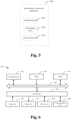
- FIG. 5 is a schematic diagram according to a fifth embodiment of the present disclosure. As shown in Fig. 5 , an information extraction apparatus 500 according to this embodiment includes:
- text input at an input end may be used as the to-be-processed text, or text on the Internet may be acquired as the to-be-processed text.
- the acquiring unit 501 may obtain the semantic vector of each token in the to-be-processed text according to the acquired to-be-processed text.
- the to-be-processed text may be used as input of a pre-trained language model, and an output result output by the pre-trained language model for each token in the to-be-processed text is used as the semantic vector of each token.
- the generating unit 502 After the acquiring unit 501 acquires the to-be-processed text to obtain the semantic vector of each token in the to-be-processed text, the generating unit 502 generates the relationship prediction matrix, the entity prediction matrix and the alignment matrix according to each token in the to-be-processed text and the semantic vector of each token.
- a generation order of the relationship prediction matrix, the entity prediction matrix and the alignment matrix is not limited, and each matrix may be generated separately, or multiple matrices may be generated simultaneously; in this embodiment, for example, the generating unit 502 sequentially generates the relationship prediction matrix, the entity prediction matrix and the alignment matrix.
- the relationship prediction matrix generated by the generating unit 502 is used to determine a subject start token and an object start token corresponding to a same relationship type in the to-be-processed text; in this embodiment, the entity prediction matrix generated by the generating unit 502 is used to determine an entity start token and an entity end token corresponding to a same entity type in the to-be-processed text, thus obtaining a subject and an object corresponding to the same relationship type in the to-be-processed text according to the subject start token and the object start token corresponding to the same relationship type determined by the relationship prediction matrix; in this embodiment, the alignment matrix generated by the generating unit 502 is used to determine whether the subject and the object corresponding to the same relationship type in the to-be-processed text belong to a same triplet.
- an adopted optional implementation may include: acquiring at least one relationship type, each relationship type acquired in this embodiment including a relationship entity type and a relationship object type; taking the at least one relationship type as a row in the relationship prediction matrix, and taking each token in the to-be-processed text as a column in the relationship prediction matrix; and obtaining values of different elements in the relationship prediction matrix according to the semantic vector of the token of each column and the relationship type of each row, herein a token of a column in the relationship prediction matrix where an element with the value of 1 is located being a subject start token or an object start token of a relationship type of a row where the element is located.
- an adopted optional implementation may include: for each element in the relationship prediction matrix, determining a token and a relationship type corresponding to the element; performing calculation according to the semantic vector of the determined token and the determined relationship type to obtain a calculation result of the element; and under a condition that the obtained calculation result is determined to exceed a first preset threshold, setting the value of the element to 1, otherwise, setting the value of the element to 0.
- the generating unit 502 predicts the subject and the object corresponding to the same relationship type by different rows in the relationship prediction matrix, thereby improving an accuracy of the predicted subject and object corresponding to the same relationship type.
- an adopted optional implementation may include: acquiring at least one entity type, each entity type acquired in this embodiment including an entity start type and an entity end type; taking the at least one entity type as a row in the entity prediction matrix, and taking each token in the to-be-processed text as a column in the entity prediction matrix; and obtaining values of different elements in the entity prediction matrix according to the semantic vector of the token of each column and the entity type of each row, a token of a column in the entity prediction matrix where an element with a value of 1 is located being an entity start token or an entity end token of an entity type of a row where the element is located.
- an adopted optional implementation may include: for each element in the entity prediction matrix, determining a token and an entity type corresponding to the element; performing calculation according to the semantic vector of the determined token and the determined entity type to obtain a calculation result of the element; and under a condition that the obtained calculation result is determined to exceed a second preset threshold, setting the value of the element to 1, otherwise, 0.
- the generating unit 502 predicts an entity corresponding to the same entity type by different rows in the entity prediction matrix, thereby improving an accuracy of the predicted entity corresponding to the same entity type.
- an adopted optional implementation may include: taking each token in the to-be-processed text both as a row and a column in the alignment matrix; and obtaining values of different elements in the alignment matrix according to the semantic vector of the token of each column and the semantic vector of the token of each row, tokens of a column and a row in the alignment matrix where an element with a value of 1 is located being entity end tokens of the same triplet.
- an adopted optional implementation may include: for each element in the alignment matrix, determining a row token and a column token corresponding to the element; performing calculation according to a semantic vector of the determined row token and a semantic vector of the determined column token to obtain a calculation result of the element; and under a condition that the obtained calculation result is determined to exceed a third preset threshold, setting the value of the element to 1, otherwise, setting the value of the element to 0.
- the generating unit 502 may determine whether the row token and the column token corresponding to each element belong to the same triplet by the value of each element in the alignment matrix, thereby screening the triplets, and improving the accuracy of the obtained target triplet.
- first preset threshold, the second preset threshold, and the third preset threshold in this embodiment may correspond to a same value, or different values.
- the extracting unit 503 extracts the target triplet in the to-be-processed text using the generated relationship prediction matrix, entity prediction matrix and alignment matrix, and then, takes the extracted target triplet as the information extraction result of the to-be-processed text.
- an adopted optional implementation may include: determining a subject start token and an object start token corresponding to a same relationship type according to the relationship prediction matrix; determining an entity start token and an entity end token corresponding to a same entity type according to the entity prediction matrix; determining an entity and an object corresponding to the same relationship type in the to-be-processed text according to the subject start token and the object start token corresponding to the same relationship type, as well as the entity start token and the entity end token corresponding to the same entity type; combining each relationship type and the entity and the object corresponding to the relationship type to obtain at least one candidate triplet; and selecting a triplet meeting a preset requirement from the obtained at least one candidate triplet as the target triplet according to the alignment matrix.
- the extracting unit 503 extracts the target triplet from the to-be-processed text using the relationship prediction matrix, the entity prediction matrix and the alignment matrix sequentially, such that interference of overlap information may be avoided, all triplets included in the to-be-processed text may be extracted as far as possible, and the accuracy of the extracted target triplet is improved.
- an adopted optional implementation may include: taking an element with a value of 1 in the relationship prediction matrix as a target element; and taking a token of a column where the target element is located as a start token of a relationship subject type or a start token of a relationship object type of a row where the target element is located.
- an adopted optional implementation may include: determining a target element with a value of 1 in the entity prediction matrix; and taking a token of a column where the determined target element is located as a start token of an entity start type or an end token of an entity end type of a row where the target element is located.
- an adopted optional implementation may include: for each candidate triplet, under a condition that a subject end token and an object end token in the candidate triplet are determined to have element values of 1 in the alignment matrix, taking the candidate triplet as the target triplet.
- the acquisition, storage and application of involved user personal information are in compliance with relevant laws and regulations, and do not violate public order and good customs.
- an electronic device a readable storage medium and a computer program product.
- Fig. 6 is a block diagram of an electronic device configured to implement the information extraction method according to the embodiment of the present disclosure.
- the electronic device is intended to represent various forms of digital computers, such as laptop computers, desktop computers, workstations, personal digital assistants, servers, blade servers, mainframe computers, and other appropriate computers.
- the electronic device may also represent various forms of mobile apparatuses, such as personal digital assistants, cellular telephones, smart phones, wearable devices, and other similar computing apparatuses.
- the components shown herein, their connections and relationships, and their functions, are meant to be exemplary only, and are not meant to limit implementation of the present disclosure described and/or claimed herein.
- the device 600 includes a computing unit 601 which may perform various appropriate actions and processing operations according to a computer program stored in a read only memory (ROM) 602 or a computer program loaded from a storage unit 608 into a random access memory (RAM) 603.
- ROM read only memory
- RAM random access memory
- Various programs and data necessary for the operation of the device 600 may be also stored in the RAM 603.
- the computing unit 601, the ROM 602, and the RAM 603 are connected with one other through a bus 604.
- An input/output (I/O) interface 605 is also connected to the bus 604.
- the multiple components in the device 600 are connected to the I/O interface 605, and include: an input unit 606, such as a keyboard, a mouse, or the like; an output unit 607, such as various types of displays, speakers, or the like; the storage unit 608, such as a magnetic disk, an optical disk, or the like; and a communication unit 609, such as a network card, a modem, a wireless communication transceiver, or the like.
- the communication unit 609 allows the device 600 to exchange information/data with other devices through a computer network, such as the Internet, and/or various telecommunication networks.
- the computing unit 601 may be a variety of general and/or special purpose processing components with processing and computing capabilities. Some examples of the computing unit 601 include, but are not limited to, a central processing unit (CPU), a graphic processing unit (GPU), various dedicated artificial intelligence (AI) computing chips, various computing units running machine learning model algorithms, a digital signal processor (DSP), and any suitable processor, controller, microcontroller, or the like.
- the computing unit 601 performs the methods and processing operations described above, such as the information extraction method.
- the information extraction method may be implemented as a computer software program tangibly contained in a machine readable medium, such as the storage unit 608.
- part or all of the computer program may be loaded and/or installed into the device 600 via the ROM 602 and/or the communication unit 609.
- the computer program When the computer program is loaded into the RAM 603 and executed by the computing unit 601, one or more steps of the information extraction method described above may be performed.
- the computing unit 601 may be configured to perform the information extraction method by any other suitable means (for example, by means of firmware).
- Various implementations of the systems and technologies described herein may be implemented in digital electronic circuitry, integrated circuitry, field programmable gate arrays (FPGA), application specific integrated circuits (ASIC), application specific standard products (ASSP), systems on chips (SOC), complex programmable logic devices (CPLD), computer hardware, firmware, software, and/or combinations thereof.
- the systems and technologies may be implemented in one or more computer programs which are executable and/or interpretable on a programmable system including at least one programmable processor, and the programmable processor may be special or general, and may receive data and instructions from, and transmit data and instructions to, a storage system, at least one input apparatus, and at least one output apparatus.
- Program codes for implementing the method according to the present disclosure may be written in any combination of one or more programming languages. These program codes may be provided to a processor or a controller of a general purpose computer, a special purpose computer, or other programmable information extraction apparatuses, such that the program code, when executed by the processor or the controller, causes functions/operations specified in the flowchart and/or the block diagram to be implemented.
- the program code may be executed entirely on a machine, partly on a machine, partly on a machine as a stand-alone software package and partly on a remote machine, or entirely on a remote machine or a server.
- the machine readable medium may be a tangible medium which may contain or store a program for use by or in connection with an instruction execution system, apparatus, or device.
- the machine readable medium may be a machine readable signal medium or a machine readable storage medium.
- the machine readable medium may include, but is not limited to, an electronic, magnetic, optical, electromagnetic, infrared, or semiconductor system, apparatus, or device, or any suitable combination of the foregoing.
- machine readable storage medium may include an electrical connection based on one or more wires, a portable computer disk, a hard disk, a random access memory (RAM), a read only memory (ROM), an erasable programmable read only memory (EPROM or flash memory), an optical fiber, a portable compact disc read only memory (CD-ROM), an optical storage device, a magnetic storage device, or any suitable combination of the foregoing.
- RAM random access memory
- ROM read only memory
- EPROM or flash memory erasable programmable read only memory
- CD-ROM compact disc read only memory
- magnetic storage device or any suitable combination of the foregoing.
- a computer having: a display apparatus (for example, a cathode ray tube (CRT) or liquid crystal display (LCD) monitor) for displaying information to a user; and a keyboard and a pointing apparatus (for example, a mouse or a trackball) by which a user may provide input for the computer.
- a display apparatus for example, a cathode ray tube (CRT) or liquid crystal display (LCD) monitor
- a keyboard and a pointing apparatus for example, a mouse or a trackball
- Other kinds of apparatuses may also be used to provide interaction with a user; for example, feedback provided for a user may be any form of sensory feedback (for example, visual feedback, auditory feedback, or tactile feedback); and input from a user may be received in any form (including acoustic, speech or tactile input).
- the systems and technologies described here may be implemented in a computing system (for example, as a data server) which includes a back-end component, or a computing system (for example, an application server) which includes a middleware component, or a computing system (for example, a user computer having a graphical user interface or a web browser through which a user may interact with an implementation of the systems and technologies described here) which includes a front-end component, or a computing system which includes any combination of such back-end, middleware, or front-end components.
- the components of the system may be interconnected through any form or medium of digital data communication (for example, a communication network). Examples of the communication network include: a local area network (LAN), a wide area network (WAN) and the Internet.
- a computer system may include a client and a server.
- the client and the server are remote from each other and interact through the communication network.
- the relationship between the client and the server is generated by virtue of computer programs which run on respective computers and have a client-server relationship to each other.
- the server may be a cloud server, also called a cloud computing server or a cloud host, and is a host product in a cloud computing service system, so as to overcome the defects of high management difficulty and weak service expansibility in conventional physical host and virtual private server (VPS) service.
- the server may also be a server of a distributed system, or a server incorporating a blockchain.
Landscapes
- Engineering & Computer Science (AREA)
- Theoretical Computer Science (AREA)
- Physics & Mathematics (AREA)
- General Engineering & Computer Science (AREA)
- General Physics & Mathematics (AREA)
- Artificial Intelligence (AREA)
- General Health & Medical Sciences (AREA)
- Computational Linguistics (AREA)
- Health & Medical Sciences (AREA)
- Data Mining & Analysis (AREA)
- Audiology, Speech & Language Pathology (AREA)
- Life Sciences & Earth Sciences (AREA)
- Evolutionary Computation (AREA)
- Computer Vision & Pattern Recognition (AREA)
- Evolutionary Biology (AREA)
- Bioinformatics & Computational Biology (AREA)
- Bioinformatics & Cheminformatics (AREA)
- Biomedical Technology (AREA)
- Biophysics (AREA)
- Molecular Biology (AREA)
- Computing Systems (AREA)
- Mathematical Physics (AREA)
- Software Systems (AREA)
- Databases & Information Systems (AREA)
- Information Retrieval, Db Structures And Fs Structures Therefor (AREA)
Abstract
The present disclosure provides an information extraction method and apparatus, an electronic device and a readable storage medium, and relates to the field of artificial intelligence technologies, and particularly to the field of knowledge graph technologies. The information extraction method includes: acquiring to-be-processed text to obtain a semantic vector of each token in the to-be-processed text; generating a relationship prediction matrix, an entity prediction matrix and an alignment matrix according to each token in the to-be-processed text and the semantic vector of each token; and extracting a target triplet in the to-be-processed text using the relationship prediction matrix, the entity prediction matrix and the alignment matrix, and taking the target triplet as an information extraction result of the to-be-processed text. With the present disclosure, overlap triplets in the text may be extracted, application scenarios of information extraction are expanded, and an accuracy and efficiency of information extraction are further improved.
Description
- The present disclosure relates to the field of artificial intelligence technologies, and particularly to the field of knowledge graph technologies, and more particularly to an information extraction method and apparatus, an electronic device and a readable storage medium.
- Usually, a knowledge graph records hundreds of millions of real world facts using triplets, which may be written in a form of (subject, relationship, object), the subject and the object represent entities, and the relationship represents a link or an inherent feature between the subject and the object. In a related art, when information extraction is performed on text to obtain triplets, there exists a problem that overlap triplets, such as single-entity overlap triplets, entity-pair overlap triplets, subject-and-object overlap triplets, or the like, which exist in the text, may not be extracted.
- According to a first aspect of the present disclosure, there is provided an information extraction method, including: acquiring to-be-processed text to obtain a semantic vector of each token in the to-be-processed text; generating a relationship prediction matrix, an entity prediction matrix and an alignment matrix according to each token in the to-be-processed text and the semantic vector of each token; and extracting a target triplet in the to-be-processed text using the relationship prediction matrix, the entity prediction matrix and the alignment matrix, and taking the target triplet as an information extraction result of the to-be-processed text.
- According to a second aspect of the present disclosure, there is provided an information extraction apparatus, including: an acquiring unit configured to acquire to-be-processed text to obtain a semantic vector of each token in the to-be-processed text; a generating unit configured to generate a relationship prediction matrix, an entity prediction matrix and an alignment matrix according to each token in the to-be-processed text and the semantic vector of each token; and an extracting unit configured to extract a target triplet in the to-be-processed text using the relationship prediction matrix, the entity prediction matrix and the alignment matrix, and take the target triplet as an information extraction result of the to-be-processed text.
- According to a third aspect of the present disclosure, there is provided an electronic device, including: at least one processor; and a memory connected with the at least one processor communicatively, wherein the memory stores instructions executable by the at least one processor to enable the at least one processor to perform the method as mentioned above.
- According to a fourth aspect of the present disclosure, there is provided a non-transitory computer readable storage medium with computer instructions stored thereon, wherein the computer instructions are used for causing a computer to perform the method as mentioned above.
- According to a fifth aspect of the present disclosure, there is provided a computer program product including a computer program which, when executed by a processor, implements the method as mentioned above.
- From the above technical solution, in the present disclosure, entities in the text and relationships between the entities may be jointly identified using the three matrices generated by the tokens in the text and the semantic vectors of the tokens, such that on the one hand, overlap triplets in the text may be extracted, and application scenarios of information extraction are expanded, and on the other hand, an accuracy and efficiency of information extraction may be improved.
- It should be understood that the statements in this section are not intended to identify key or critical features of the embodiments of the present disclosure, nor limit the scope of the present disclosure. Other features of the present disclosure will become apparent from the following description.
- The drawings are used for better understanding the present solution and do not constitute a limitation of the present disclosure. In the drawings,
-
Fig. 1 is a schematic diagram according to a first embodiment of the present disclosure; -
Fig. 2 is a schematic diagram according to a second embodiment of the present disclosure; -
Fig. 3 is a schematic diagram according to a third embodiment of the present disclosure; -
Fig. 4 is a schematic diagram according to a fourth embodiment of the present disclosure; -
Fig. 5 is a schematic diagram according to a fifth embodiment of the present disclosure; and -
Fig. 6 is a block diagram of an electronic device configured to implement an information extraction method according to embodiments of the present disclosure. - The following part will illustrate exemplary embodiments of the present disclosure with reference to the drawings, including various details of the embodiments of the present disclosure for a better understanding. The embodiments should be regarded only as exemplary ones. Therefore, those skilled in the art should appreciate that various changes or modifications can be made with respect to the embodiments described herein without departing from the scope and spirit of the present disclosure. Similarly, for clarity and conciseness, the descriptions of the known functions and mechanisms are omitted in the descriptions below.
-
Fig. 1 is a schematic diagram according to a first embodiment of the present disclosure. As shown inFig. 1 , an information extraction method according to this embodiment includes the following steps: - S101: acquiring to-be-processed text to obtain a semantic vector of each token in the to-be-processed text;
- S102: generating a relationship prediction matrix, an entity prediction matrix and an alignment matrix according to each token in the to-be-processed text and the semantic vector of each token; and
- S103: extracting a target triplet in the to-be-processed text using the relationship prediction matrix, the entity prediction matrix and the alignment matrix, and taking the target triplet as an information extraction result of the to-be-processed text.
- The information extraction method according to this embodiment includes the steps of acquiring the to-be-processed text to obtain the semantic vector of each token in the to-be-processed text; then, generating the relationship prediction matrix, the entity prediction matrix and the alignment matrix according to each token in the to-be-processed text and the semantic vector of each token; and then, extracting the target triplet in the to-be-processed text using the generated relationship prediction matrix, entity prediction matrix and alignment matrix, and taking the extracted target triplet as the information extraction result of the to-be-processed text; in this embodiment, entities in the text and relationships between the entities are jointly identified using the three matrices generated by the tokens in the text and the semantic vectors of the tokens, such that on the one hand, overlap triplets in the text may be extracted, and application scenarios of information extraction are expanded, and on the other hand, an accuracy and efficiency of information extraction may be improved.
- In this embodiment, during the S101 of acquiring to-be-processed text, text input at an input end may be used as the to-be-processed text, or text on the Internet may be acquired as the to-be-processed text.
- In this embodiment, after the S101 of acquiring to-be-processed text, the semantic vector of each token (such as, Chinese Character or English word) in the to-be-processed text may be obtained according to the acquired to-be-processed text.
- In this embodiment, during the S101 of obtaining a semantic vector of each token in the to-be-processed text, the to-be-processed text may be used as input of a pre-trained language model (for example, ERNIE), and an output result output by the pre-trained language model for each token in the to-be-processed text is used as the semantic vector of each token.
- In this embodiment, after the S101 of acquiring to-be-processed text to obtain a semantic vector of each token in the to-be-processed text, the S102 of generating a relationship prediction matrix, an entity prediction matrix and an alignment matrix according to each token in the to-be-processed text and the semantic vector of each token is executed.
- It may be understood that in this embodiment, a generation order of the relationship prediction matrix, the entity prediction matrix and the alignment matrix is not limited, and each matrix may be generated separately, or multiple matrices may be generated simultaneously; in this embodiment, the S102 of sequentially generating a relationship prediction matrix, an entity prediction matrix and an alignment matrix is taken as an example for description.
- In this embodiment, the relationship prediction matrix generated in S102 is used to determine a subject start token and an object start token corresponding to a same relationship type in the to-be-processed text; in this embodiment, the entity prediction matrix generated in S102 is used to determine an entity start token and an entity end token corresponding to a same entity type in the to-be-processed text, thus obtaining a subject and an object corresponding to the same relationship type in the to-be-processed text according to the subject start token and the object start token corresponding to the same relationship type determined by the relationship prediction matrix; in this embodiment, the alignment matrix generated in S102 is used to determine whether the subject and the object corresponding to the same relationship type in the to-be-processed text belong to a same triplet.
- Specifically, in this embodiment, during the S102 of generating the relationship prediction matrix according to each token in the to-be-processed text and the semantic vector of each token, an adopted optional implementation may include: acquiring at least one relationship type, each relationship type acquired in this embodiment including a relationship entity type and a relationship object type; taking the at least one relationship type as a row in the relationship prediction matrix, and taking each token in the to-be-processed text as a column in the relationship prediction matrix; and obtaining values of different elements in the relationship prediction matrix according to the semantic vector of the token of each column and the relationship type of each row, a token of a column in the relationship prediction matrix where an element with a value of 1 is located being a subject start token or an object start token of a relationship type of a row where the element is located.
- For example, in this embodiment, in the relationship prediction matrix generated in S102, if a value of an element at a position of (2k-1, i) is 1, entity ei starting with token ti is a subject of relationship type k; if a value of an element at a position of (2k, i) is 1, entity ei starting with token ti is an object of relationship type k.
- In this embodiment, during the S102 of obtaining values of different elements in the relationship prediction matrix according to the semantic vectors of the tokens of each column and the relationship types of each row, an adopted optional implementation may include: for each element in the relationship prediction matrix, determining a token and a relationship type corresponding to the element; performing calculation according to the semantic vector of the determined token and the determined relationship type to obtain a calculation result of the element, the calculation in this embodiment being similarity calculation, or the semantic vector of the token and the relationship type being input into a neural network model to obtain the calculation result output by the neural network model; and under a condition that the obtained calculation result is determined to exceed a first preset threshold, setting the value of the element to 1, otherwise, setting the value of the element to 0.
- That is, in this embodiment, after the relationship prediction matrix is generated according to the relationship type and the tokens in the to-be-processed text, the subject and the object corresponding to the same relationship type are predicted by different rows in the relationship prediction matrix, thereby improving an accuracy of the predicted subject and object corresponding to the same relationship type.
- Specifically, in this embodiment, during the S102 of generating an entity prediction matrix according to each token in the to-be-processed text and the semantic vector of each token, an adopted optional implementation may include: acquiring at least one entity type, each entity type acquired in this embodiment including an entity start type and an entity end type; taking the at least one entity type as a row in the entity prediction matrix, and taking each token in the to-be-processed text as a column in the entity prediction matrix; and obtaining values of different elements in the entity prediction matrix according to the semantic vector of the token of each column and the entity type of each row, a token of a column in the entity prediction matrix where an element with a value of 1 is located being an entity start token or an entity end token of an entity type of a row where the element is located.
- For example, in this embodiment, in the entity prediction matrix generated in S102, if a value of an element at a position of (2m-1, i) is 1, token ti is an entity start token of entity type m; if a value of an element at a position of (2m, i) is 1, token ti is an entity end token of entity type m.
- In this embodiment, during the S102 of obtaining values of different elements in the entity prediction matrix according to the semantic vector of the token of each column and the entity type of each row, an adopted optional implementation may include: for each element in the entity prediction matrix, determining a token and an entity type corresponding to the element; performing calculation according to the semantic vector of the determined token and the determined entity type to obtain a calculation result of the element, the calculation in this embodiment being similarity calculation, or the semantic vector of the token and the relationship type being input into a neural network model to obtain the calculation result output by the neural network model; and under a condition that the obtained calculation result is determined to exceed a second preset threshold, setting the value of the element to 1, otherwise, 0.
- That is, in this embodiment, after the entity prediction matrix is generated according to the entity type and the tokens in the to-be-processed text, an entity corresponding to the same entity type is predicted by different rows in the entity prediction matrix, thereby improving an accuracy of the predicted entity corresponding to the same entity type.
- Specifically, in this embodiment, during the S102 of generating the alignment matrix according to each token in the to-be-processed text and the semantic vector of each token, an adopted optional implementation may include: taking each token in the to-be-processed text both as a row and a column in the alignment matrix; and obtaining values of different elements in the alignment matrix according to the semantic vector of the token of each column and the semantic vector of the token of each row, token of a column and a row in the alignment matrix where an element with a value of 1 is located being entity end tokens of the same triplet.
- For example, in this embodiment, in the alignment matrix generated in S102, if a value of an element at a position of (i, j) is 1, entity ei with ti as an end token and entity ej with tj as an end token belong to the same triplet.
- In this embodiment, during the S102 of obtaining values of different elements in the alignment matrix according to the semantic vectors of the tokens of each column and the semantic vectors of the tokens of each row, an adopted optional implementation may include: for each element in the alignment matrix, determining a row token and a column token corresponding to the element; performing calculation according to a semantic vector of the determined row token and a semantic vector of the determined column token to obtain a calculation result of the element, the calculation in this embodiment being similarity calculation, or the semantic vector of the token and the relationship type being input into a neural network model to obtain the calculation result output by the neural network model; and under a condition that the obtained calculation result is determined to exceed a third preset threshold, setting the value of the element to 1, otherwise, setting the value of the element to 0.
- That is, in this embodiment, after the alignment matrix is generated according to the tokens in the to-be-processed text, whether the row token and the column token corresponding to each element belong to the same triplet may be determined by the value of each element in the alignment matrix, thereby screening the triplets, and improving the accuracy of the obtained target triplet.
- It may be understood that the first preset threshold, the second preset threshold, and the third preset threshold in this embodiment may correspond to a same value, or different values.
- In this embodiment, after the S102 of generating a relationship prediction matrix, an entity prediction matrix and an alignment matrix, the S103 of extracting a target triplet in the to-be-processed text using the generated relationship prediction matrix, entity prediction matrix and alignment matrix, and then, taking the extracted target triplet as an information extraction result of the to-be-processed text is executed.
- Specifically, in this embodiment, during the S103 of extracting a target triplet in the to-be-processed text using the generated relationship prediction matrix, entity prediction matrix and alignment matrix, an adopted optional implementation may include: determining a subject start token and an object start token corresponding to a same relationship type according to the relationship prediction matrix; determining an entity start token and an entity end token corresponding to a same entity type according to the entity prediction matrix; determining an entity and an object corresponding to the same relationship type in the to-be-processed text according to the subject start token and the object start token corresponding to the same relationship type, as well as the entity start token and the entity end token corresponding to the same entity type; combining the relationship types and the entities and the objects corresponding to the relationship types to obtain at least one candidate triplet; and selecting a triplet meeting a preset requirement from the obtained at least one candidate triplet as the target triplet according to the alignment matrix.
- That is, in this embodiment, the target triplet is extracted from the to-be-processed text using the relationship prediction matrix, the entity prediction matrix and the alignment matrix sequentially, such that interference of overlap information may be avoided, all triplets included in the to-be-processed text may be extracted as far as possible, and the accuracy of the extracted target triplet is improved.
- In this embodiment, during the S103 of determining a subject start token and an object start token corresponding to a same relationship type according to the relationship prediction matrix, an adopted optional implementation may include: taking an element with a value of 1 in the relationship prediction matrix as a target element; and taking a token of a column where the target element is located as a start token of a relationship subject type or a start token of a relationship object type of a row where the target element is located.
- In this embodiment, during the S103 of determining an entity start token and an entity end token corresponding to a same entity type according to the entity prediction matrix, an adopted optional implementation may include: determining a target element with a value of 1 in the entity prediction matrix; and taking a token of a column where the determined target element is located as a start token of an entity start type or an end token of an entity end type of a row where the target element is located.
- In this embodiment, during the S103 of selecting a triplet meeting a preset requirement from the obtained at least one candidate triplet as the target triplet according to the alignment matrix, an adopted optional implementation may include: for each candidate triplet, under a condition that a subject end token and an object end token in the candidate triplet are determined to have element values of 1 in the alignment matrix, taking the candidate triplet as the target triplet.
- In the information extraction method according to this embodiment, the subject start token and the object start token corresponding to the same relationship type are determined according to the generated relationship prediction matrix, and the entity start token and the entity end token corresponding to the same entity type are determined according to the generated entity prediction matrix, such that a purpose of joint identification of the relationship between the entities is achieved, and the overlap triplets in the text may be extracted, thereby expanding application scenarios of information extraction, and further improving the accuracy and efficiency of information extraction.
- For example, if to-be-processed text is "Company-A, Department B one No.07 C-type drinking water machine being moved from the first floor to the second floor", in this embodiment, a subject start token "C-type" and an object start token "company-A" corresponding to a relationship type "allocation", as well as a subject start token "C-type" and an object start token "Company-A" corresponding to a relationship type "company belonged to" are predicted according to a relationship prediction matrix, and then, according to an entity prediction matrix, an entity corresponding to the subject start token "C-type" is determined to "C-type drinking water machine" and an entity corresponding to the object start token "Company-A" is determined to "Company-A" or "Company-A, Department B", and finally, target triples (C-type drinking water machine, company belonged to, Company-A) and (C-type drinking water machine, allocation, Company-A, Department B") are obtained according to an alignment matrix.
- For example, if to-be-processed text is "city A is the capital city of country B", since different relationship types, for example, a relationship type "capital" and a relationship type "including", are set in a relationship prediction matrix in this embodiment, subjects and objects of corresponding relationship types are predicted in different rows, and thus, target triples (country B, capital, city A) and (country B, including, city A) may be extracted.
- For example, if to-be-processed text is "Company-A, Department B has its No.07 C-type drinking water machine being moved from the first floor to the second floor", and a target triplet extracted in this embodiment is (C-type drinking water machine , type, drinking water machine), since "C-type drinking water machine" is a type of "drinking water machine" entity, "drinking water machine" is a "machine type" entity, and different types of entities are predicted in different rows of an entity prediction matrix, the entities are not affected by each other, thus obtaining the target triplet.
-
Fig. 2 is a schematic diagram according to a second embodiment of the present disclosure. A schematic diagram of a generated relationship prediction matrix is shown inFig. 2 , in which "allocation-S" represents a relationship subject type of a relationship type "allocation", and "allocation-O" represents a relationship object type of the relationship type "allocation"; the value of the element in the first row and the seventh column is 1, which indicates that the token "C-type" is a subject start token of the relationship type "allocation"; the value of the element in the second row and the first column is 1, which indicates that the token "Company-A" is an object start token of the relationship type "allocation". -
Fig. 3 is a schematic diagram according to a third embodiment of the present disclosure. A schematic diagram of a generated entity prediction matrix is shown inFig. 3 , in which "machine-B" represents an entity start token of an entity type "machine", and "machine-E" represents an entity end token of the entity type "machine"; the value of the element in the first row and the seventh column is 1, which indicates that the token "C-type" is the entity start token of the entity type "machine"; the value of the element in the second row and the tenth column is 1, which indicates that the token "machine" is an entity end token of the entity type "machine". -
Fig. 4 is a schematic diagram according to a fourth embodiment of the present disclosure. A schematic diagram of a generated alignment matrix is shown inFig. 4 , in which the value of the element in the first row and the tenth column is 1, which indicates that an entity with the token "machine" as an end token and an entity with the token "Company-A" as an end token belong to a same triple. -
Fig. 5 is a schematic diagram according to a fifth embodiment of the present disclosure. As shown inFig. 5 , aninformation extraction apparatus 500 according to this embodiment includes: - an acquiring
unit 501 configured to acquire to-be-processed text to obtain a semantic vector of each token in the to-be-processed text; - a
generating unit 502 configured to generate a relationship prediction matrix, an entity prediction matrix and an alignment matrix according to each token in the to-be-processed text and the semantic vector of each token; and - an extracting
unit 503 configured to extract a target triplet in the to-be-processed text using the relationship prediction matrix, the entity prediction matrix and the alignment matrix, and take the target triplet as an information extraction result of the to-be-processed text. - When the acquiring
unit 501 acquires the to-be-processed text, text input at an input end may be used as the to-be-processed text, or text on the Internet may be acquired as the to-be-processed text. - After acquiring the to-be-processed text, the acquiring
unit 501 may obtain the semantic vector of each token in the to-be-processed text according to the acquired to-be-processed text. - When the acquiring
unit 501 obtains the semantic vector of each token in the to-be-processed text, the to-be-processed text may be used as input of a pre-trained language model, and an output result output by the pre-trained language model for each token in the to-be-processed text is used as the semantic vector of each token. - In this embodiment, after the acquiring
unit 501 acquires the to-be-processed text to obtain the semantic vector of each token in the to-be-processed text, the generatingunit 502 generates the relationship prediction matrix, the entity prediction matrix and the alignment matrix according to each token in the to-be-processed text and the semantic vector of each token. - It may be understood that in this embodiment, a generation order of the relationship prediction matrix, the entity prediction matrix and the alignment matrix is not limited, and each matrix may be generated separately, or multiple matrices may be generated simultaneously; in this embodiment, for example, the generating
unit 502 sequentially generates the relationship prediction matrix, the entity prediction matrix and the alignment matrix. - The relationship prediction matrix generated by the generating
unit 502 is used to determine a subject start token and an object start token corresponding to a same relationship type in the to-be-processed text; in this embodiment, the entity prediction matrix generated by the generatingunit 502 is used to determine an entity start token and an entity end token corresponding to a same entity type in the to-be-processed text, thus obtaining a subject and an object corresponding to the same relationship type in the to-be-processed text according to the subject start token and the object start token corresponding to the same relationship type determined by the relationship prediction matrix; in this embodiment, the alignment matrix generated by the generatingunit 502 is used to determine whether the subject and the object corresponding to the same relationship type in the to-be-processed text belong to a same triplet. - Specifically, when the generating
unit 502 generates the relationship prediction matrix according to each token in the to-be-processed text and the semantic vector of each token, an adopted optional implementation may include: acquiring at least one relationship type, each relationship type acquired in this embodiment including a relationship entity type and a relationship object type; taking the at least one relationship type as a row in the relationship prediction matrix, and taking each token in the to-be-processed text as a column in the relationship prediction matrix; and obtaining values of different elements in the relationship prediction matrix according to the semantic vector of the token of each column and the relationship type of each row, herein a token of a column in the relationship prediction matrix where an element with the value of 1 is located being a subject start token or an object start token of a relationship type of a row where the element is located. - In this embodiment, when the generating
unit 502 obtains the values of different elements in the relationship prediction matrix according to the semantic vector of the token of each column and the relationship type of each row, an adopted optional implementation may include: for each element in the relationship prediction matrix, determining a token and a relationship type corresponding to the element; performing calculation according to the semantic vector of the determined token and the determined relationship type to obtain a calculation result of the element; and under a condition that the obtained calculation result is determined to exceed a first preset threshold, setting the value of the element to 1, otherwise, setting the value of the element to 0. - That is, after generating the relationship prediction matrix according to the relationship type and the tokens in the to-be-processed text, the generating
unit 502 predicts the subject and the object corresponding to the same relationship type by different rows in the relationship prediction matrix, thereby improving an accuracy of the predicted subject and object corresponding to the same relationship type. - Specifically, when the generating
unit 502 generates the entity prediction matrix according to each token in the to-be-processed text and the semantic vector of each token, an adopted optional implementation may include: acquiring at least one entity type, each entity type acquired in this embodiment including an entity start type and an entity end type; taking the at least one entity type as a row in the entity prediction matrix, and taking each token in the to-be-processed text as a column in the entity prediction matrix; and obtaining values of different elements in the entity prediction matrix according to the semantic vector of the token of each column and the entity type of each row, a token of a column in the entity prediction matrix where an element with a value of 1 is located being an entity start token or an entity end token of an entity type of a row where the element is located. - When the generating
unit 502 obtains the values of different elements in the entity prediction matrix according to the semantic vectors of the tokens of each column and the entity types of each row, an adopted optional implementation may include: for each element in the entity prediction matrix, determining a token and an entity type corresponding to the element; performing calculation according to the semantic vector of the determined token and the determined entity type to obtain a calculation result of the element; and under a condition that the obtained calculation result is determined to exceed a second preset threshold, setting the value of the element to 1, otherwise, 0. - That is, after generating the entity prediction matrix according to the entity type and the tokens in the to-be-processed text, the generating
unit 502 predicts an entity corresponding to the same entity type by different rows in the entity prediction matrix, thereby improving an accuracy of the predicted entity corresponding to the same entity type. - Specifically, when the generating
unit 502 generates the alignment matrix according to each token in the to-be-processed text and the semantic vector of each token, an adopted optional implementation may include: taking each token in the to-be-processed text both as a row and a column in the alignment matrix; and obtaining values of different elements in the alignment matrix according to the semantic vector of the token of each column and the semantic vector of the token of each row, tokens of a column and a row in the alignment matrix where an element with a value of 1 is located being entity end tokens of the same triplet. - When the generating
unit 502 obtains the values of different elements in the alignment matrix according to the semantic vector of the token of each column and the semantic vector of the token of each row, an adopted optional implementation may include: for each element in the alignment matrix, determining a row token and a column token corresponding to the element; performing calculation according to a semantic vector of the determined row token and a semantic vector of the determined column token to obtain a calculation result of the element; and under a condition that the obtained calculation result is determined to exceed a third preset threshold, setting the value of the element to 1, otherwise, setting the value of the element to 0. - That is, after generating the alignment matrix according to the tokens in the to-be-processed text, the generating
unit 502 may determine whether the row token and the column token corresponding to each element belong to the same triplet by the value of each element in the alignment matrix, thereby screening the triplets, and improving the accuracy of the obtained target triplet. - It may be understood that the first preset threshold, the second preset threshold, and the third preset threshold in this embodiment may correspond to a same value, or different values.
- In this embodiment, after the
generating unit 502 generates the relationship prediction matrix, the entity prediction matrix and the alignment matrix, the extractingunit 503 extracts the target triplet in the to-be-processed text using the generated relationship prediction matrix, entity prediction matrix and alignment matrix, and then, takes the extracted target triplet as the information extraction result of the to-be-processed text. - Specifically, when the extracting
unit 503 extracts the target triplet in the to-be-processed text using the generated relationship prediction matrix, entity prediction matrix and alignment matrix, an adopted optional implementation may include: determining a subject start token and an object start token corresponding to a same relationship type according to the relationship prediction matrix; determining an entity start token and an entity end token corresponding to a same entity type according to the entity prediction matrix; determining an entity and an object corresponding to the same relationship type in the to-be-processed text according to the subject start token and the object start token corresponding to the same relationship type, as well as the entity start token and the entity end token corresponding to the same entity type; combining each relationship type and the entity and the object corresponding to the relationship type to obtain at least one candidate triplet; and selecting a triplet meeting a preset requirement from the obtained at least one candidate triplet as the target triplet according to the alignment matrix. - That is, the extracting
unit 503 extracts the target triplet from the to-be-processed text using the relationship prediction matrix, the entity prediction matrix and the alignment matrix sequentially, such that interference of overlap information may be avoided, all triplets included in the to-be-processed text may be extracted as far as possible, and the accuracy of the extracted target triplet is improved. - When the extracting
unit 503 determines the subject start token and the object start token corresponding to the same relationship type according to the relationship prediction matrix, an adopted optional implementation may include: taking an element with a value of 1 in the relationship prediction matrix as a target element; and taking a token of a column where the target element is located as a start token of a relationship subject type or a start token of a relationship object type of a row where the target element is located. - When the extracting
unit 503 determines the entity start token and the entity end token corresponding to the same entity type according to the entity prediction matrix, an adopted optional implementation may include: determining a target element with a value of 1 in the entity prediction matrix; and taking a token of a column where the determined target element is located as a start token of an entity start type or an end token of an entity end type of a row where the target element is located. - When the extracting
unit 503 selects the triplet meeting the preset requirement from the obtained at least one candidate triplet as the target triplet according to the alignment matrix, an adopted optional implementation may include: for each candidate triplet, under a condition that a subject end token and an object end token in the candidate triplet are determined to have element values of 1 in the alignment matrix, taking the candidate triplet as the target triplet. - In the technical solution of the present disclosure, the acquisition, storage and application of involved user personal information are in compliance with relevant laws and regulations, and do not violate public order and good customs.
- According to the embodiment of the present disclosure, there are also provided an electronic device, a readable storage medium and a computer program product.
-
Fig. 6 is a block diagram of an electronic device configured to implement the information extraction method according to the embodiment of the present disclosure. The electronic device is intended to represent various forms of digital computers, such as laptop computers, desktop computers, workstations, personal digital assistants, servers, blade servers, mainframe computers, and other appropriate computers. The electronic device may also represent various forms of mobile apparatuses, such as personal digital assistants, cellular telephones, smart phones, wearable devices, and other similar computing apparatuses. The components shown herein, their connections and relationships, and their functions, are meant to be exemplary only, and are not meant to limit implementation of the present disclosure described and/or claimed herein. - As shown in
Fig. 6 , thedevice 600 includes acomputing unit 601 which may perform various appropriate actions and processing operations according to a computer program stored in a read only memory (ROM) 602 or a computer program loaded from astorage unit 608 into a random access memory (RAM) 603. Various programs and data necessary for the operation of thedevice 600 may be also stored in theRAM 603. Thecomputing unit 601, theROM 602, and theRAM 603 are connected with one other through abus 604. An input/output (I/O)interface 605 is also connected to thebus 604. - The multiple components in the
device 600 are connected to the I/O interface 605, and include: aninput unit 606, such as a keyboard, a mouse, or the like; anoutput unit 607, such as various types of displays, speakers, or the like; thestorage unit 608, such as a magnetic disk, an optical disk, or the like; and acommunication unit 609, such as a network card, a modem, a wireless communication transceiver, or the like. Thecommunication unit 609 allows thedevice 600 to exchange information/data with other devices through a computer network, such as the Internet, and/or various telecommunication networks. - The
computing unit 601 may be a variety of general and/or special purpose processing components with processing and computing capabilities. Some examples of thecomputing unit 601 include, but are not limited to, a central processing unit (CPU), a graphic processing unit (GPU), various dedicated artificial intelligence (AI) computing chips, various computing units running machine learning model algorithms, a digital signal processor (DSP), and any suitable processor, controller, microcontroller, or the like. Thecomputing unit 601 performs the methods and processing operations described above, such as the information extraction method. For example, in some embodiments, the information extraction method may be implemented as a computer software program tangibly contained in a machine readable medium, such as thestorage unit 608. - In some embodiments, part or all of the computer program may be loaded and/or installed into the
device 600 via theROM 602 and/or thecommunication unit 609. When the computer program is loaded into theRAM 603 and executed by thecomputing unit 601, one or more steps of the information extraction method described above may be performed. Alternatively, in other embodiments, thecomputing unit 601 may be configured to perform the information extraction method by any other suitable means (for example, by means of firmware). - Various implementations of the systems and technologies described herein may be implemented in digital electronic circuitry, integrated circuitry, field programmable gate arrays (FPGA), application specific integrated circuits (ASIC), application specific standard products (ASSP), systems on chips (SOC), complex programmable logic devices (CPLD), computer hardware, firmware, software, and/or combinations thereof. The systems and technologies may be implemented in one or more computer programs which are executable and/or interpretable on a programmable system including at least one programmable processor, and the programmable processor may be special or general, and may receive data and instructions from, and transmit data and instructions to, a storage system, at least one input apparatus, and at least one output apparatus.
- Program codes for implementing the method according to the present disclosure may be written in any combination of one or more programming languages. These program codes may be provided to a processor or a controller of a general purpose computer, a special purpose computer, or other programmable information extraction apparatuses, such that the program code, when executed by the processor or the controller, causes functions/operations specified in the flowchart and/or the block diagram to be implemented. The program code may be executed entirely on a machine, partly on a machine, partly on a machine as a stand-alone software package and partly on a remote machine, or entirely on a remote machine or a server.
- In the context of the present disclosure, the machine readable medium may be a tangible medium which may contain or store a program for use by or in connection with an instruction execution system, apparatus, or device. The machine readable medium may be a machine readable signal medium or a machine readable storage medium. The machine readable medium may include, but is not limited to, an electronic, magnetic, optical, electromagnetic, infrared, or semiconductor system, apparatus, or device, or any suitable combination of the foregoing. More specific examples of the machine readable storage medium may include an electrical connection based on one or more wires, a portable computer disk, a hard disk, a random access memory (RAM), a read only memory (ROM), an erasable programmable read only memory (EPROM or flash memory), an optical fiber, a portable compact disc read only memory (CD-ROM), an optical storage device, a magnetic storage device, or any suitable combination of the foregoing.
- To provide interaction with a user, the systems and technologies described here may be implemented on a computer having: a display apparatus (for example, a cathode ray tube (CRT) or liquid crystal display (LCD) monitor) for displaying information to a user; and a keyboard and a pointing apparatus (for example, a mouse or a trackball) by which a user may provide input for the computer. Other kinds of apparatuses may also be used to provide interaction with a user; for example, feedback provided for a user may be any form of sensory feedback (for example, visual feedback, auditory feedback, or tactile feedback); and input from a user may be received in any form (including acoustic, speech or tactile input).
- The systems and technologies described here may be implemented in a computing system (for example, as a data server) which includes a back-end component, or a computing system (for example, an application server) which includes a middleware component, or a computing system (for example, a user computer having a graphical user interface or a web browser through which a user may interact with an implementation of the systems and technologies described here) which includes a front-end component, or a computing system which includes any combination of such back-end, middleware, or front-end components. The components of the system may be interconnected through any form or medium of digital data communication (for example, a communication network). Examples of the communication network include: a local area network (LAN), a wide area network (WAN) and the Internet.
- A computer system may include a client and a server. Generally, the client and the server are remote from each other and interact through the communication network. The relationship between the client and the server is generated by virtue of computer programs which run on respective computers and have a client-server relationship to each other. The server may be a cloud server, also called a cloud computing server or a cloud host, and is a host product in a cloud computing service system, so as to overcome the defects of high management difficulty and weak service expansibility in conventional physical host and virtual private server (VPS) service. The server may also be a server of a distributed system, or a server incorporating a blockchain.
- It should be understood that various forms of the flows shown above may be used and reordered, and steps may be added or deleted. For example, the steps described in the present disclosure may be executed in parallel, sequentially, or in different orders, which is not limited herein as long as the desired results of the technical solution disclosed in the present disclosure may be achieved.
- The above-mentioned implementations are not intended to limit the scope of the present disclosure. It should be understood by those skilled in the art that various modifications, combinations, sub-combinations and substitutions may be made, depending on design requirements and other factors. Any modification, equivalent substitution and improvement made within the spirit and principle of the present disclosure all should be included in the extent of protection of the present disclosure.
Claims (15)
- A computer-implemented information extraction method, comprising:acquiring (S101) to-be-processed text to obtain a semantic vector of each token in the to-be-processed text;generating (SI02) a relationship prediction matrix, an entity prediction matrix and an alignment matrix according to each token in the to-be-processed text and the semantic vector of each token; andextracting (S103) a target triplet in the to-be-processed text using the relationship prediction matrix, the entity prediction matrix and the alignment matrix, and taking the target triplet as an information extraction result of the to-be-processed text.
- The method according to claim 1, wherein the generating the relationship prediction matrix according to each token in the to-be-processed text and the semantic vector of each token comprises:acquiring at least one relationship type, each relationship type comprising a relationship subject type and a relationship object type;taking the at least one relationship type as a row in the relationship prediction matrix, and taking each token in the to-be-processed text as a column in the relationship prediction matrix; andobtaining values of different elements in the relationship prediction matrix according to the semantic vector of the token of each column and the relationship type of each row.
- The method according to claim 2, wherein the obtaining values of different elements in the relationship prediction matrix according to the semantic vector of the token of each column and the relationship type of each row comprises:for each element in the relationship prediction matrix, determining a token and a relationship type corresponding to the element;performing calculation according to the semantic vector of the determined token and the determined relationship type to obtain a calculation result of the element; andunder a condition that the calculation result is determined to exceed a first preset threshold, setting the value of the element to 1.
- The method according to any one of claims 1 to 3, wherein the generating the entity prediction matrix according to each token in the to-be-processed text and the semantic vector of each token comprises:acquiring at least one entity type, each entity type comprising an entity start type and an entity end type;taking the at least one entity type as a row in the entity prediction matrix, and taking each token in the to-be-processed text as a column in the entity prediction matrix; andobtaining values of different elements in the entity prediction matrix according to the semantic vector of the token of each column and the entity type of each row.
- The method according to claim 4, wherein the obtaining values of different elements in the entity prediction matrix according to the semantic vector of the token of each column and the entity type of each row comprises:for each element in the entity prediction matrix, determining a token and an entity type corresponding to the element;performing calculation according to the semantic vector of the determined token and the determined entity type to obtain a calculation result of the element; andunder a condition that the calculation result is determined to exceed a second preset threshold, setting the value of the element to 1.
- The method according to any one of claims 1 to 5, wherein the generating the alignment matrix according to each token in the to-be-processed text and the semantic vector of each token comprises:taking each token in the to-be-processed text both as a row and a column in the alignment matrix; andobtaining values of different elements in the alignment matrix according to the semantic vector of the token of each column and the semantic vector of the token of each row.
- The method according to claim 6, wherein the obtaining values of different elements in the alignment matrix according to the semantic vector of the token of each column and the semantic vector of the token of each row comprises:for each element in the alignment matrix, determining a row token and a column token corresponding to the element;performing calculation according to a semantic vector of the determined row token and a semantic vector of the determined column token to obtain a calculation result of the element; andunder a condition that the calculation result is determined to exceed a third preset threshold, setting the value of the element to 1.
- The method according to any one of claims 1 to 7, wherein the extracting the target triplet in the to-be-processed text using the relationship prediction matrix, the entity prediction matrix and the alignment matrix comprises:determining a subject start token and an object start token corresponding to a same relationship type according to the relationship prediction matrix;determining an entity start token and an entity end token corresponding to a same entity type according to the entity prediction matrix;determining an entity and an object corresponding to the same relationship type in the to-be-processed text according to the subject start token and the object start token corresponding to the same relationship type, as well as the entity start token and the entity end token corresponding to the same entity type;combining each relationship type and the entity and the object corresponding to the relationship type to obtain at least one candidate triplet; andselecting a triplet meeting a preset requirement from the at least one candidate triplet as the target triplet according to the alignment matrix.
- The method according to claim 8, wherein the determining the subject start token and the object start token corresponding to the same relationship type according to the relationship prediction matrix comprises:taking an element with the value of 1 in the relationship prediction matrix as a target element; andtaking a token of a column where the target element is located as a start token of a relationship subject type or a start token of a relationship object type of a row where the target element is located.
- The method according to claim 8 or 9, wherein the determining the entity start token and the entity end token corresponding to the same entity type according to the entity prediction matrix comprises:taking an element with the value of 1 in the entity prediction matrix as a target element; andtaking a token of a column where the target element is located as a start token of an entity start type or an end token of an entity end type of a row where the target element is located.
- The method according to claim 8, 9 or 10, wherein the selecting a triplet meeting a preset requirement from the at least one candidate triplet as the target triplet according to the alignment matrix comprises:
for each candidate triplet, under a condition that a subject end token and an object end token in the candidate triplet are determined to have element values of 1 in the alignment matrix, taking the candidate triplet as the target triplet. - An information extraction apparatus (500), comprising:an acquiring unit (501) configured to acquire (S101) to-be-processed text to obtain a semantic vector of each token in the to-be-processed text;a generating unit (502) configured to generate (SI02) a relationship prediction matrix, an entity prediction matrix and an alignment matrix according to each token in the to-be-processed text and the semantic vector of each token; andan extracting unit (503) configured to extract (SI03) a target triplet in the to-be-processed text using the relationship prediction matrix, the entity prediction matrix and the alignment matrix, and take the target triplet as an information extraction result of the to-be-processed text.
- An electronic device, comprising:at least one processor; anda memory connected with the at least one processor communicatively;wherein the memory stores instructions executable by the at least one processor to enable the at least one processor to perform the method according to any one of claims 1 to 11.
- A non-transitory computer readable storage medium with computer instructions stored thereon, wherein the computer instructions are used for causing a computer to perform the method according to any one of claims 1 to 11.
- A computer program product comprising a computer program which, when executed by a processor, implements the method according to any one of claims 1 to 11.
Applications Claiming Priority (1)
| Application Number | Priority Date | Filing Date | Title |
|---|---|---|---|
| CN202111300797.3A CN114218931B (en) | 2021-11-04 | 2021-11-04 | Information extraction methods, devices, electronic equipment and readable storage media |
Publications (1)
| Publication Number | Publication Date |
|---|---|
| EP4177785A1 true EP4177785A1 (en) | 2023-05-10 |
Family
ID=80695680
Family Applications (1)
| Application Number | Title | Priority Date | Filing Date |
|---|---|---|---|
| EP22200126.5A Withdrawn EP4177785A1 (en) | 2021-11-04 | 2022-10-06 | Information extraction method and apparatus, electronic device and readable storage medium |
Country Status (3)
| Country | Link |
|---|---|
| US (1) | US12333251B2 (en) |
| EP (1) | EP4177785A1 (en) |
| CN (1) | CN114218931B (en) |
Families Citing this family (5)
| Publication number | Priority date | Publication date | Assignee | Title |
|---|---|---|---|---|
| US12086552B2 (en) * | 2022-03-24 | 2024-09-10 | International Business Machines Corporation | Generating semantic vector representation of natural language data |
| CN115146068B (en) * | 2022-06-01 | 2023-10-03 | 西北工业大学 | Extraction method, device, equipment and storage medium for relational triples |
| CN115983383B (en) * | 2023-01-06 | 2026-03-17 | 国网冀北电力有限公司廊坊供电公司 | Entity Relationship Extraction Method and Related Devices for Power Equipment |
| CN117370429A (en) * | 2023-06-19 | 2024-01-09 | 陈建忠 | Text processing methods, devices, equipment and storage media |
| CN116561346B (en) * | 2023-07-06 | 2023-10-31 | 北京邮电大学 | Entity alignment method and device based on graph convolution network and information fusion |
Citations (1)
| Publication number | Priority date | Publication date | Assignee | Title |
|---|---|---|---|---|
| CN113590784A (en) * | 2021-07-27 | 2021-11-02 | 中国科学技术大学 | Triple information extraction method and device, electronic equipment and storage medium |
Family Cites Families (20)
| Publication number | Priority date | Publication date | Assignee | Title |
|---|---|---|---|---|
| US8244730B2 (en) * | 2006-05-30 | 2012-08-14 | Honda Motor Co., Ltd. | Learning syntactic patterns for automatic discovery of causal relations from text |
| US8818932B2 (en) * | 2011-02-14 | 2014-08-26 | Decisive Analytics Corporation | Method and apparatus for creating a predictive model |
| JP6310532B1 (en) * | 2016-11-24 | 2018-04-11 | ヤフー株式会社 | Generating device, generating method, and generating program |
| US20190122111A1 (en) * | 2017-10-24 | 2019-04-25 | Nec Laboratories America, Inc. | Adaptive Convolutional Neural Knowledge Graph Learning System Leveraging Entity Descriptions |
| CN107798136B (en) * | 2017-11-23 | 2020-12-01 | 北京百度网讯科技有限公司 | Entity relation extraction method, device and server based on deep learning |
| CN110310721B (en) * | 2018-03-27 | 2023-05-02 | 九阳股份有限公司 | Method and device for constructing recipe recommendation strategy based on knowledge graph |
| CN109582799B (en) * | 2018-06-29 | 2020-09-22 | 北京百度网讯科技有限公司 | Method, device and electronic device for determining knowledge sample data set |
| CN109165385B (en) * | 2018-08-29 | 2022-08-09 | 中国人民解放军国防科技大学 | Multi-triple extraction method based on entity relationship joint extraction model |
| CN111008276B (en) * | 2019-10-29 | 2023-04-18 | 云知声智能科技股份有限公司 | Complete entity relationship extraction method and device |
| CN111274391B (en) * | 2020-01-15 | 2023-09-01 | 北京百度网讯科技有限公司 | A SPO extraction method, device, electronic equipment and storage medium |
| CN111291185B (en) * | 2020-01-21 | 2023-09-22 | 京东方科技集团股份有限公司 | Information extraction methods, devices, electronic equipment and storage media |
| US11687570B2 (en) * | 2020-02-03 | 2023-06-27 | Samsung Electronics Co., Ltd. | System and method for efficient multi-relational entity understanding and retrieval |
| CN111444305B (en) * | 2020-03-19 | 2022-10-14 | 浙江大学 | Multi-triple combined extraction method based on knowledge graph embedding |
| CN111639498A (en) * | 2020-04-21 | 2020-09-08 | 平安国际智慧城市科技股份有限公司 | Knowledge extraction method, device, electronic device and storage medium |
| CN111814466B (en) * | 2020-06-24 | 2024-09-13 | 平安科技(深圳)有限公司 | Information extraction method based on machine reading understanding and related equipment thereof |
| CN112906368B (en) * | 2021-02-19 | 2022-09-02 | 北京百度网讯科技有限公司 | Industry text increment method, related device and computer program product |
| US11741318B2 (en) * | 2021-03-25 | 2023-08-29 | Nec Corporation | Open information extraction from low resource languages |
| CN113568969B (en) * | 2021-07-30 | 2024-06-04 | 咪咕文化科技有限公司 | Information extraction method, apparatus, device and computer readable storage medium |
| CN113836316B (en) * | 2021-09-23 | 2023-01-03 | 北京百度网讯科技有限公司 | Processing method, training method, device, equipment and medium for ternary group data |
| CN114398943B (en) * | 2021-12-09 | 2023-04-07 | 北京百度网讯科技有限公司 | Sample enhancement method and device thereof |
-
2021
- 2021-11-04 CN CN202111300797.3A patent/CN114218931B/en active Active
-
2022
- 2022-09-28 US US17/954,900 patent/US12333251B2/en active Active
- 2022-10-06 EP EP22200126.5A patent/EP4177785A1/en not_active Withdrawn
Patent Citations (1)
| Publication number | Priority date | Publication date | Assignee | Title |
|---|---|---|---|---|
| CN113590784A (en) * | 2021-07-27 | 2021-11-02 | 中国科学技术大学 | Triple information extraction method and device, electronic equipment and storage medium |
Also Published As
| Publication number | Publication date |
|---|---|
| CN114218931A (en) | 2022-03-22 |
| US12333251B2 (en) | 2025-06-17 |
| CN114218931B (en) | 2024-01-23 |
| US20230133717A1 (en) | 2023-05-04 |
Similar Documents
| Publication | Publication Date | Title |
|---|---|---|
| US12333251B2 (en) | Extracting triplets from text with relationship prediction matrix, entity prediction matrix, and alignment matrix | |
| CN113392253B (en) | Visual question answering model training and visual question answering methods, devices, equipment and media | |
| US20240403344A1 (en) | Code retrieval method and apparatus based on large language model | |
| CN113836314B (en) | Knowledge graph construction method, device, equipment and storage medium | |
| US20230005283A1 (en) | Information extraction method and apparatus, electronic device and readable storage medium | |
| CN113792154B (en) | Method, device, electronic equipment and storage medium for determining fault correlation | |
| CN113963197A (en) | Image recognition method and device, electronic equipment and readable storage medium | |
| CN114549695B (en) | Image generation method, device, electronic equipment and readable storage medium | |
| EP3992814A2 (en) | Method and apparatus for generating user interest profile, electronic device and storage medium | |
| CN114494784A (en) | Deep learning model training method, image processing method and object recognition method | |
| CN112580666A (en) | Image feature extraction method, training method, device, electronic equipment and medium | |
| US20230004774A1 (en) | Method and apparatus for generating node representation, electronic device and readable storage medium | |
| US12147431B2 (en) | Method and apparatus for pushing resource, and storage medium | |
| CN115454261A (en) | Input method candidate word generation method and device, electronic equipment and readable storage medium | |
| CN112558966B (en) | Depth model visualization data processing method and device and electronic equipment | |
| CN113947082A (en) | Word segmentation processing method, device, equipment and storage medium | |
| CN114924959A (en) | Page testing method and device, electronic equipment and medium | |
| CN114239505A (en) | Method, device and equipment for cleaning hidden characters in word document | |
| CN119829677A (en) | Distributed event request processing method and device | |
| CN112653885A (en) | Video repetition degree obtaining method, electronic equipment and storage medium | |
| EP4131022A1 (en) | Method and apparatus of determining location information, electronic device, storage medium, and program product | |
| CN114518805B (en) | Text generation method, device, electronic equipment and storage medium | |
| CN115905263A (en) | The update method of vector database and the face recognition method based on vector database | |
| CN115952403A (en) | Method, device, electronic device and storage medium for evaluating object performance | |
| CN114461771A (en) | Question answering method, device, electronic equipment and readable storage medium |
Legal Events
| Date | Code | Title | Description |
|---|---|---|---|
| PUAI | Public reference made under article 153(3) epc to a published international application that has entered the european phase |
Free format text: ORIGINAL CODE: 0009012 |
|
| STAA | Information on the status of an ep patent application or granted ep patent |
Free format text: STATUS: REQUEST FOR EXAMINATION WAS MADE |
|
| 17P | Request for examination filed |
Effective date: 20221006 |
|
| AK | Designated contracting states |
Kind code of ref document: A1 Designated state(s): AL AT BE BG CH CY CZ DE DK EE ES FI FR GB GR HR HU IE IS IT LI LT LU LV MC ME MK MT NL NO PL PT RO RS SE SI SK SM TR |
|
| STAA | Information on the status of an ep patent application or granted ep patent |
Free format text: STATUS: THE APPLICATION HAS BEEN WITHDRAWN |
|
| 18W | Application withdrawn |
Effective date: 20231009 |