EP4177321A1 - Label - Google Patents
Label Download PDFInfo
- Publication number
- EP4177321A1 EP4177321A1 EP21833533.9A EP21833533A EP4177321A1 EP 4177321 A1 EP4177321 A1 EP 4177321A1 EP 21833533 A EP21833533 A EP 21833533A EP 4177321 A1 EP4177321 A1 EP 4177321A1
- Authority
- EP
- European Patent Office
- Prior art keywords
- label
- adhesive layer
- segment
- container
- triblock copolymer
- Prior art date
- Legal status (The legal status is an assumption and is not a legal conclusion. Google has not performed a legal analysis and makes no representation as to the accuracy of the status listed.)
- Pending
Links
Images


Classifications
-
- B—PERFORMING OPERATIONS; TRANSPORTING
- B65—CONVEYING; PACKING; STORING; HANDLING THIN OR FILAMENTARY MATERIAL
- B65D—CONTAINERS FOR STORAGE OR TRANSPORT OF ARTICLES OR MATERIALS, e.g. BAGS, BARRELS, BOTTLES, BOXES, CANS, CARTONS, CRATES, DRUMS, JARS, TANKS, HOPPERS, FORWARDING CONTAINERS; ACCESSORIES, CLOSURES, OR FITTINGS THEREFOR; PACKAGING ELEMENTS; PACKAGES
- B65D65/00—Wrappers or flexible covers; Packaging materials of special type or form
- B65D65/02—Wrappers or flexible covers
- B65D65/14—Wrappers or flexible covers with areas coated with adhesive
-
- C—CHEMISTRY; METALLURGY
- C09—DYES; PAINTS; POLISHES; NATURAL RESINS; ADHESIVES; COMPOSITIONS NOT OTHERWISE PROVIDED FOR; APPLICATIONS OF MATERIALS NOT OTHERWISE PROVIDED FOR
- C09J—ADHESIVES; NON-MECHANICAL ASPECTS OF ADHESIVE PROCESSES IN GENERAL; ADHESIVE PROCESSES NOT PROVIDED FOR ELSEWHERE; USE OF MATERIALS AS ADHESIVES
- C09J153/00—Adhesives based on block copolymers containing at least one sequence of a polymer obtained by reactions only involving carbon-to-carbon unsaturated bonds; Adhesives based on derivatives of such polymers
- C09J153/02—Vinyl aromatic monomers and conjugated dienes
-
- B—PERFORMING OPERATIONS; TRANSPORTING
- B65—CONVEYING; PACKING; STORING; HANDLING THIN OR FILAMENTARY MATERIAL
- B65D—CONTAINERS FOR STORAGE OR TRANSPORT OF ARTICLES OR MATERIALS, e.g. BAGS, BARRELS, BOTTLES, BOXES, CANS, CARTONS, CRATES, DRUMS, JARS, TANKS, HOPPERS, FORWARDING CONTAINERS; ACCESSORIES, CLOSURES, OR FITTINGS THEREFOR; PACKAGING ELEMENTS; PACKAGES
- B65D65/00—Wrappers or flexible covers; Packaging materials of special type or form
- B65D65/38—Packaging materials of special type or form
- B65D65/42—Applications of coated or impregnated materials
-
- C—CHEMISTRY; METALLURGY
- C09—DYES; PAINTS; POLISHES; NATURAL RESINS; ADHESIVES; COMPOSITIONS NOT OTHERWISE PROVIDED FOR; APPLICATIONS OF MATERIALS NOT OTHERWISE PROVIDED FOR
- C09J—ADHESIVES; NON-MECHANICAL ASPECTS OF ADHESIVE PROCESSES IN GENERAL; ADHESIVE PROCESSES NOT PROVIDED FOR ELSEWHERE; USE OF MATERIALS AS ADHESIVES
- C09J153/00—Adhesives based on block copolymers containing at least one sequence of a polymer obtained by reactions only involving carbon-to-carbon unsaturated bonds; Adhesives based on derivatives of such polymers
-
- C—CHEMISTRY; METALLURGY
- C09—DYES; PAINTS; POLISHES; NATURAL RESINS; ADHESIVES; COMPOSITIONS NOT OTHERWISE PROVIDED FOR; APPLICATIONS OF MATERIALS NOT OTHERWISE PROVIDED FOR
- C09J—ADHESIVES; NON-MECHANICAL ASPECTS OF ADHESIVE PROCESSES IN GENERAL; ADHESIVE PROCESSES NOT PROVIDED FOR ELSEWHERE; USE OF MATERIALS AS ADHESIVES
- C09J7/00—Adhesives in the form of films or foils
- C09J7/30—Adhesives in the form of films or foils characterised by the adhesive composition
- C09J7/38—Pressure-sensitive adhesives [PSA]
- C09J7/381—Pressure-sensitive adhesives [PSA] based on macromolecular compounds obtained by reactions involving only carbon-to-carbon unsaturated bonds
- C09J7/387—Block-copolymers
-
- C—CHEMISTRY; METALLURGY
- C08—ORGANIC MACROMOLECULAR COMPOUNDS; THEIR PREPARATION OR CHEMICAL WORKING-UP; COMPOSITIONS BASED THEREON
- C08K—Use of inorganic or non-macromolecular organic substances as compounding ingredients
- C08K3/00—Use of inorganic substances as compounding ingredients
- C08K3/18—Oxygen-containing compounds, e.g. metal carbonyls
- C08K3/20—Oxides; Hydroxides
- C08K3/22—Oxides; Hydroxides of metals
- C08K2003/2227—Oxides; Hydroxides of metals of aluminium
-
- C—CHEMISTRY; METALLURGY
- C08—ORGANIC MACROMOLECULAR COMPOUNDS; THEIR PREPARATION OR CHEMICAL WORKING-UP; COMPOSITIONS BASED THEREON
- C08K—Use of inorganic or non-macromolecular organic substances as compounding ingredients
- C08K3/00—Use of inorganic substances as compounding ingredients
- C08K3/34—Silicon-containing compounds
- C08K3/36—Silica
-
- C—CHEMISTRY; METALLURGY
- C09—DYES; PAINTS; POLISHES; NATURAL RESINS; ADHESIVES; COMPOSITIONS NOT OTHERWISE PROVIDED FOR; APPLICATIONS OF MATERIALS NOT OTHERWISE PROVIDED FOR
- C09J—ADHESIVES; NON-MECHANICAL ASPECTS OF ADHESIVE PROCESSES IN GENERAL; ADHESIVE PROCESSES NOT PROVIDED FOR ELSEWHERE; USE OF MATERIALS AS ADHESIVES
- C09J2203/00—Applications of adhesives in processes or use of adhesives in the form of films or foils
- C09J2203/334—Applications of adhesives in processes or use of adhesives in the form of films or foils as a label
-
- C—CHEMISTRY; METALLURGY
- C09—DYES; PAINTS; POLISHES; NATURAL RESINS; ADHESIVES; COMPOSITIONS NOT OTHERWISE PROVIDED FOR; APPLICATIONS OF MATERIALS NOT OTHERWISE PROVIDED FOR
- C09J—ADHESIVES; NON-MECHANICAL ASPECTS OF ADHESIVE PROCESSES IN GENERAL; ADHESIVE PROCESSES NOT PROVIDED FOR ELSEWHERE; USE OF MATERIALS AS ADHESIVES
- C09J2301/00—Additional features of adhesives in the form of films or foils
- C09J2301/40—Additional features of adhesives in the form of films or foils characterized by the presence of essential components
- C09J2301/41—Additional features of adhesives in the form of films or foils characterized by the presence of essential components additives as essential feature of the carrier layer
-
- C—CHEMISTRY; METALLURGY
- C09—DYES; PAINTS; POLISHES; NATURAL RESINS; ADHESIVES; COMPOSITIONS NOT OTHERWISE PROVIDED FOR; APPLICATIONS OF MATERIALS NOT OTHERWISE PROVIDED FOR
- C09J—ADHESIVES; NON-MECHANICAL ASPECTS OF ADHESIVE PROCESSES IN GENERAL; ADHESIVE PROCESSES NOT PROVIDED FOR ELSEWHERE; USE OF MATERIALS AS ADHESIVES
- C09J2453/00—Presence of block copolymer
Definitions
- the present invention relates to a label.
- the present invention relates to a heat shrinkable label for the purpose of low contamination, which is preferably used for a pharmaceutical, a food, etc.
- heat shrinkable labels are widely used for containers made of glass, synthetic resin, etc. for foods, drinks, cosmetics, pharmaceuticals, etc., because heat shrinkable labels can wrap the containers with complicated shapes while maintaining high adhesion to the containers.
- the peripheral side surface of the container is shrink-wrapped by wrapping the shrinkable label around the peripheral side surface of the container to form a cylindrical label having a junctional region where the left and right ends of the heat shrinkable label are overlapped, and heat-shrinking the shrinkable label from the outside of the tubular label.
- a heat shrinkable label is known, wherein the cylindrical heat shrinkable film is heat-shrinked from the top of the container closed with a cap to the cap, to be tightly attached to the top of the container and the cap, and seal the cap part.
- the heat shrinkable label is used for the purpose of preventing the risk that the cap part gets dirty during transportation or display, or the content is tampered by opening the cap during the distribution process, and for guaranteeing virgin seal property.
- the heat shrinkable label used for such shrink wrapping may have a desired printing such as letters and patterns on the surface thereof.
- Patent Literature 1 describes a pressure sensitive adhesive sheet for an indication label, comprising a barrier base material having gas barrier properties to water vapor and oxygen, and a pressure sensitive adhesive layer, the pressure sensitive adhesive layer comprising an extruded product of a pressure sensitive adhesive composition that contains a thermoplastic elastomer.
- Patent Literature 2 describes a resin sheet comprising a barrier film and a shrink film, the barrier film having gas barrier properties to water vapor and oxygen, the shrink film having heat shrinkability, the barrier film and the shrink film being laminated via an adhesive layer, the barrier film comprising a material that contains an ethylene-vinyl alcohol based copolymer, the barrier film constituting at least one of outermost layers of the resin sheet.
- a label for shrink wrapping a resin container is required to have properties including tamper-proof property (virgin seal property) and prevention of the contents in the resin containers from being contaminated by the ink components of the print layer, and further in addition prevention of the contents in the resin containers from being contaminated by a binding agent such as a hot melt binding agent and an adhesive used to adhere the label to the resin container, and transparency for confirming contamination into the container and deterioration of the contents.
- tamper-proof property virtual seal property
- a binding agent such as a hot melt binding agent and an adhesive used to adhere the label to the resin container
- the present invention has been made in view of the above problems.
- the object of the present invention is to provide a label having excellent barrier property and transparency, wherein contamination of the container and adhesive residue due to the residual monomer in the adhesive layer are suppressed.
- the inventors of the present invention have earnestly conducted research. As a result, the inventors has found that the above problems can be solved by providing a transparent vapor-deposited film consisting of an inorganic oxide on the adhesive layer and making a triblock copolymer be contained in the adhesive composition used for the adhesive layer. Thus, the inventors have accomplished the present invention. Specifically, the present invention is as follows.
- the present invention can provide a label having excellent barrier property and transparency, wherein contamination of the container and adhesive residue due to the residual monomer in the adhesive layer are suppressed.
- embodiments for carrying out the present invention (hereinafter referred to as embodiments) are described in detail. However, these are explained for the purpose of illustrative examples, and the present invention is not limited thereto.
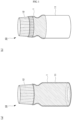
- FIG. 1(a) is a perspective view of a container in which the label of the present invention is used.
- the label 1 of the present invention is used for shrink-wrapping the container body 11 of the resin container 10 by wrapping around the barrel of the container body 11 and heat-shrinking the shrinkable label. Thereby, contamination of the container body 11 can be prevented during transportation or display.
- another embodiment of the present invention is the label 1 that is used for sealing and shrink-wrapping the container body 11 of the resin container 10 and the lid 12 detachably attached to the take-out port of the container body 11, by wrapping astride the container body 11 of the resin container 10 and the lid 12 in the circumferential direction of the resin container 10, and heat-shrinking the shrinkable label.
- the lid 12 of the resin container 10 cannot be opened without removing the label 1, and thus, the lid 12 is prevented from being opened during the distribution process, etc. of the resin container 10, and tampering of the content is prevented.
- it also functions to prevent contamination of the lid 12 during transportation or display.
- the label 1 may be provided with a separation line (not shown in FIGs.) such as a perforation or a half-cut groove, if necessary. By providing the separation line, the label 1 can be easily and cleanly separated from the container body 11 or the resin container 10, to be opened.
- a separation line such as a perforation or a half-cut groove
- the label 1 is wrapped around a barrel of the container body 11 or in the circumferential direction of the resin container 10, and is adhered to the entire surface by the adhesive layer 40 described later.
- the label 1 may not be easily peeled off in the distribution process of the resin container 10, and can have excellent tamper-proof property (virgin seal property).
- tamper-proof property virtual seal property
- a part of the surface of the adhesive layer 40 may be treated with glue exclusion such as a printing varnish or the like. Thereby, when the label 1 is peeled off from the container body 11 or the resin container 10, the label 1 can be easily peeled off, because the exfoliation starting point is formed.
- the label 1 of the present invention is wrapped around a barrel of the container body 11 of the resin container 10, or is wrapped astride the container body 11 of the resin container 10 and the lid 12 detachably attached to a take-out port of the container body 11 in the circumferential direction of the resin container 10. Both are used for shrink-wrapping.
- the label 1 may be shrink-wrapped as the label 1 covers a part or all of the take-out port of the container body 11 of the resin container 10., in order to make it easier to open the label 1.
- the resin container 10 is not particularly limited, and examples thereof include containers for foods, drinks, cosmetics, pharmaceuticals, etc.
- the label 1 of the present invention is suitably used for shrink-wrapping the container body 11 or the container body 11 and the lid 12 for medicines such as eye drops, nasal drops and prefilled syringes whose quality control is particularly strict.
- FIG. 3 shows a cross section of the label of the present invention
- the label 1 of the present invention comprises at least one heat shrinkable base material 20, a transparent vapor-deposited film 30 consisting of an inorganic oxide, and an adhesive layer 40. Further, in the label 1 of the present invention, the transparent vapor-deposited film 30 and the heat shrinkable base material 20 are sequentially laminated on the adhesive layer 40, and preferably a print layer (not shown in FIGs.) is provided on the surface opposite to the surface of the heat shrinkable base material 20 in contact with the transparent vapor-deposited film 30. Since the label 1 of the present invention is provided with the transparent vapor-deposited film 30 consisting of an inorganic oxide, contamination of the contents of the resin container 10 by the ink component of the print layer (not shown in FIGs.) can be prevented.
- the material of the heat shrinkable base material 20 used for the label 1 of the present invention is not particularly limited as long as the label 1 can exhibit heat-shrinkability, and a film generally used as a film for shrink wrapping can be used.
- the material of the heat shrinkable base material 20 may include, for example, at least one of a polyester-based resin, a polystyrene-based resin, a polyolefin-based resin, a polyvinyl chloride-based resin and the like.
- the heat shrinkable base material 20 is preferably made of a material comprising at least one of a polyester-based resin, a polystyrene-based resin and a polyolefin-based resin from the viewpoint of easily exhibiting a desired heat-shrinkability.
- the heat shrinkable base material 20 is more preferably made of a material comprising a polyester-based resin such as a polyethylene terephthalate because the thermal expansion coefficient of the heat shrinkable base material 20 is small, and the heat shrinkable base material 20 has excellent dimensional stability, and is suitable for a printed label or the like.
- the heat shrinkable base material 20 may be a single layer or a multilayer.
- the thickness of the heat shrinkable base material 20 is preferably 10 ⁇ m or more, more preferably 20 ⁇ m or more.
- the thickness of the heat shrinkable base material 20 is preferably 80 ⁇ m or less, more preferably 60 ⁇ m or less.
- the label 1 can easily exhibit the desired heat-shrinkability.
- the transparent vapor-deposited film 30 consisting of an inorganic oxide, is formed on at least one surface of the heat shrinkable base material 20.
- the inorganic oxide used for the transparent vapor-deposited film 30 includes silicon oxide, aluminum oxide, magnesium oxide, zinc oxide, indium oxide, tin oxide and the like. Among them, silicon oxide and aluminum oxide are preferable, and aluminum oxide is more preferable from the point of cost and versatility.
- the transparent vapor-deposited film 30 can have high transparency and barrier property, and the label 1 can have excellent barrier property and transparency.
- the transparent vapor-deposited film 30 may be a single layer or a multilayer.
- the transparent vapor-deposited film 30 may be laminated with a film made of an inorganic nitride such as silicon nitride or a film made of an inorganic oxynitride such as silicon oxynitride and aluminum oxynitride.
- an inorganic nitride such as silicon nitride
- a film made of an inorganic oxynitride such as silicon oxynitride and aluminum oxynitride.
- the method of forming the transparent vapor-deposited film 30 is not particularly limited, and examples thereof include a method of forming the above mentioned inorganic oxide on a base material by a vacuum vapor deposition method, a sputtering method, an ion plating method, a thermal CVD method, a plasma CVD method, or the like.
- the transparent vapor-deposited film 30 may be formed on the peelable base material in advance and transferred to the heat shrinkable base material 20.
- a method of depositing an inorganic oxide by direct evaporation may be used, but a method of reactive vapor deposition under an oxidizing atmosphere is more preferable from the viewpoint of productivity.
- a required amount of oxygen gas alone or a gas obtained by diluting oxygen gas with an inert gas may be introduced into a vacuum vapor deposition apparatus.
- the inert gas refers to a rare gas such as argon and helium, nitrogen gas, or a mixed gas thereof.
- the reactive vapor deposition is performed in a way that a metal or an inorganic oxide is vaporized from an evaporation source under the oxidizing atmosphere, and an oxidation reaction occurs in the vicinity of the heat shrinkable base material 20 to form the transparent vapor-deposited film 30 on the heat shrinkable base material 20.
- the transparent vapor-deposited film 30 consisting of an inorganic oxide is most preferably a complete oxide.
- the transparent vapor-deposited film 30 may be an incomplete oxide film in which some metal components remain.
- the heat shrinkable base material 20 is set in a vacuum vapor deposition apparatus equipped with a film traveling device and traveled via a cooling metal drum. At this time, while the aluminum is heated and evaporated, the evaporated metal vapor is used for vapor deposition. Alternatively, oxygen gas is supplied to a part where the metal vapor is present, and the aluminum is coagulated and deposited on the heat shrinkable base material 20 while being oxidized to form a transparent vapor-deposited film 30 consisting of aluminum oxide and wound up.
- the transparency of the transparent vapor-deposited film 30 can be changed.
- the inside pressure of the vacuum vapor deposition apparatus is returned to normal pressure, and the transparent vapor-deposited film 30 is wound up.
- the transparent vapor-deposited film 30 is preferably subjected to an aging treatment by leaving the transparent vapor-deposited film 30 at a predetermined temperature under atmospheric pressure for a predetermined period of time, whereby the barrier property and transparency are stabilized.
- the aging treatment is preferably performed at a temperature of 30 °C or more and less than 50 °C for one day or longer under atmospheric pressure, more preferably at a temperature of 30 °C or more and less than 45 °C for one day or more, in order to avoid deterioration of the physical properties of the transparent vapor-deposited film 30 due to heat shrinkage of the heat shrinkable base material 20.
- the thickness of the transparent vapor-deposited film 30 is preferably 1 nm or more, more preferably 5 nm or more, and further preferably 10 nm or more.
- the thickness of the transparent vapor-deposited film 30 is preferably 1,000 nm or less, more preferably 500 nm or less, and even more preferably 200 nm or less.
- the label 1 exhibits excellent barrier property, and when a print layer exists on the surface of the heat shrinkable base material 20, intrusion of the ink component of the print layer into the resin container 10 can be prevented, and contamination of the contents of the resin container 10 can be prevented.
- the thickness of the transparent vapor-deposited film 30 is 1,000 nm or less, it can be suppressed that the label 1 becomes excessively thick, and even when the heat shrinkable base material 20 is heat-shrinked, the transparent vapor-deposited film 30 is less likely to crack, and the transparency of the transparent vapor-deposited film 30 is maintained while maintaining excellent barrier property.
- the adhesive layer 40 is a layer formed from an adhesive composition comprising a triblock copolymer having a block structure of segment A1-segment B-segment A2.
- the adhesive layer 40 may be formed by using a method of coating a solution formed by dissolving the adhesive composition in a solvent using a bar coater, a roll coater, a die coater, a comma coater or the like, and removing the solvent by drying (solution casting method).
- the adhesive layer 40 may be formed by heating and melting the adhesive composition using a hot melt coating method, a T-die method, an inflation method, a calendar forming method, a lamination method or the like.
- the triblock copolymer for example, a styrene-based triblock copolymer, a hydrogenated product thereof, or an acrylic-based triblock copolymer may be used. Only one kind of the triblock copolymers may be used, or two or more kinds may be used. But, among them, the triblock copolymer preferably includes one or more selected from the group consisting of the styrene-based triblock copolymer, the hydrogenated product thereof, and the acrylic-based triblock copolymer.
- the styrene-based triblock copolymer and the hydrogenated product thereof are preferably styrene-butadiene-styrene copolymer (SBS), styrene-isoprene-styrene copolymer (SIS), or styrene-ethylene-butylene copolymer / styrene copolymer (SEBS).
- SBS styrene-butadiene-styrene copolymer
- SIS styrene-isoprene-styrene copolymer
- SEBS styrene-ethylene-butylene copolymer / styrene copolymer
- the acrylic triblock copolymer preferably has a segment A1 and a segment A2 both of which are composed of a methacrylate unit, and a segment B composed of an acrylate unit.
- Methacrylates of the constituent units of the segments A1 and A2 include methyl methacrylate, ethyl methacrylate, isopropyl methacrylate, n-propyl methacrylate, n-butyl methacrylate, isobutyl methacrylate, sec-butyl methacrylate, tert-butyl methacrylate, n-hexyl methacrylate, cyclohexyl methacrylate, 2-ethylhexyl methacrylate, n-octyl methacrylate, lauryl methacrylate, tridecyl methacrylate, stearyl methacrylate, isobornyl methacrylate, phenyl methacrylate, benzyl methacrylate
- methacrylates may be used alone or in combination of two or more.
- the methacrylate of the constituent units of the segments A1 and A2 is more preferably methyl methacrylate, ethyl methacrylate, tert-butyl methacrylate, cyclohexyl methacrylate, isobornyl methacrylate or phenyl methacrylate, from the viewpoint of the transparency of the obtained adhesive layer 40 and the heat resistance of the same when the heat shrinkable base material 20 is heat-shrinked.
- Acrylates of the constituent unit of the segment B of the acrylic triblock copolymer include butyl acrylate, isobutyl acrylate, sec-butyl acrylate, tert-butyl acrylate, amyl acrylate, isoamyl acrylate, hexyl acrylate, cyclohexyl acrylate, phenyl acrylate, methoxyethyl acrylate, ethoxyethyl acrylate, diethylaminoethyl acrylate, 2-hydroxyethyl acrylate, 2-aminoethyl acrylate, glycidyl acrylate, tetrahydrofurfuryl acrylate, 2-ethylhexyl acrylate, n-octyl acrylate, isooctyl acrylate, decyl acrylate, isobornyl acrylate, lauryl acrylate, benzyl acrylate, phen
- acrylates may be used alone or in combination of two or more.
- the acrylate of the constituent unit of the segment B is more preferably acrylates such as butyl acrylate, isobutyl acrylate and octyl acrylate from the viewpoint of improving the adhesive properties of the obtained adhesive layer 40.
- acrylates may be used alone or in combination of two or more.
- both the glass transition temperatures (Tg) of the segments A1 and A2 are 90 °C or more, and the glass transition temperature (Tg) of the segment B is -40 °C or less.
- the adhesive properties of the adhesive layer 40 may be controlled within the most suitable range.
- the polystyrene conversion weight average molecular weight (Mw) of the acrylic triblock copolymer is preferably 50,000 or more and 1,000,000 or less, more preferably 60,000 or more and 500,000 or less, and further preferably 70,000 or more and 450,000.
- the polystyrene conversion weight average molecular weight (Mw) of the styrene-based triblock copolymer or the hydrogenated product thereof is preferably 10,000 or more and 500,000 or less, more preferably 20,000 or more and 400,000 or less, and further preferably 30,000 or more and 300,000 or less.
- the adhesive layer 40 has an appropriate tack, exhibits high adhesive strength to the resin container 10, and is less likely to generate adhesive residue when the label 1 of the present invention is peeled off.
- a value of polystyrene conversion weight average molecular weight means a value measured as a standard polystyrene conversion value by gel permeation chromatography (GPC) using tetrahydrofuran (THF) as a solvent. Specifically, the measurement is performed using a GPC measuring apparatus ("HLC-8220GPC" manufactured by Tosoh Corporation) under the following condition:
- the adhesive composition may further contain a component other than the above-mentioned triblock copolymer.
- the other component includes a tackifier, a coupling agent, a filler, a softener, a plasticizer, a surfactant, an antioxidant, a heat stabilizer, a light stabilizer, a UV absorber, a colorant, a defoamer, a flame retardant, an antistatic agent, or the like.
- the adhesive composition preferably contains a tackifier.
- the tackifier preferably includes, for example, one or more selected from the group consisting of a rosin-based resin, a terpene-based resin, a styrene-based resin, and a hydrocarbon-based resin.
- a hydrogenated resin obtained by hydrogenating these resins may be used as the tackifier.
- the content of the tackifier is preferably 1 part by mass or more and 200 parts by mass or less, more preferably 10 parts by mass or more and 180 parts by mass or less, with respect to 100 parts by mass of the triblock copolymer from the viewpoint of the adhesive strength, tack and cohesive force of the adhesive layer 40.
- the tackifier is a component that supplementarily improves the adhesive strength of the adhesive layer 40, and is an oligomer having a mass average molecular weight (Mw) of usually less than 10,000, and is distinct from the above-mentioned triblock copolymers.
- Mw mass average molecular weight
- the adhesive layer 40 formed from the adhesive composition comprising the tackifier together with the above-mentioned triblock copolymer, can exhibit high adhesive strength to the container body 11 of the resin container 10.
- the adhesive composition does not contain a plasticizer.
- a plasticizer By not containing a plasticizer, there is no bleeding of the plasticizer from the adhesive layer 40 to the resin container 10, contamination of the contents of the resin container 10 can be prevented, and the adhesive layer 40 having excellent transparency can be obtained.
- the thickness of the adhesive layer 40 is preferably 5 ⁇ m or more, more preferably 10 ⁇ m or more, and further preferably 15 ⁇ m or more.
- the thickness is preferably 100 ⁇ m or less, more preferably 80 ⁇ m or less, and further preferably 70 ⁇ m or less.
- the thickness of the adhesive layer 40 is 5 ⁇ m or more, the label 1 can easily exhibit excellent adhesiveness to the resin container 10.
- shrink wrapping can be performed without hindering the heat shrinkage of the heat shrinkable base material 20.
- transfer of the components from the adhesive layer 40 to the resin container 10 can be further reduced, and contamination of the resin container 10 when the label 1 is used can be effectively suppressed.
- the label 1 of the present invention preferably has a total light transmittance (value measured in accordance with the Japanese Industrial Standards: JIS K7361-1: 1997) of 80% or more, and more preferably 90% or more.
- a total light transmittance value measured in accordance with the Japanese Industrial Standards: JIS K7361-1: 1997) of 80% or more, and more preferably 90% or more.
- the total light transmittance is 80% or more, the transparency is high, and the deterioration of the contents of the resin container 10 can be confirmed through the label 1, even in the state where the resin container 10 is shrink-wrapped.
- Such total light transmittance can be easily achieved by using a vapor-deposited film of silicon oxide or aluminum oxide as the transparent vapor-deposited film 30 consisting of an inorganic oxide.
- a release sheet 50 may be laminated on the adhesive surface of the adhesive layer 40, for the purpose of protecting the adhesive surface until the adhesive surface is attached to the resin container 10.
- the constitution of the release sheet 50 is arbitrary, and examples thereof include a plastic film subjected with peeling treatment with a release agent or the like.
- Specific examples of the plastic film include polyester films such as polyethylene terephthalate, polybutylene terephthalate and polyethylene naphthalate, and polyolefin films such as polypropylene and polyethylene.
- the release agent a silicone type, a fluorine type, a long chain alkyl type or the like can be used. Among these, preferable is a silicone type which can provide stable performance at a low cost.
Landscapes
- Chemical & Material Sciences (AREA)
- Chemical Kinetics & Catalysis (AREA)
- Organic Chemistry (AREA)
- Engineering & Computer Science (AREA)
- Mechanical Engineering (AREA)
- Details Of Rigid Or Semi-Rigid Containers (AREA)
- Laminated Bodies (AREA)
- Adhesive Tapes (AREA)
- Adhesives Or Adhesive Processes (AREA)
Abstract
Description
- The present invention relates to a label. In particular, the present invention relates to a heat shrinkable label for the purpose of low contamination, which is preferably used for a pharmaceutical, a food, etc.
- Conventionally, heat shrinkable labels are widely used for containers made of glass, synthetic resin, etc. for foods, drinks, cosmetics, pharmaceuticals, etc., because heat shrinkable labels can wrap the containers with complicated shapes while maintaining high adhesion to the containers.
- When wrapping a container by using a heat shrinkable label, generally the peripheral side surface of the container is shrink-wrapped by wrapping the shrinkable label around the peripheral side surface of the container to form a cylindrical label having a junctional region where the left and right ends of the heat shrinkable label are overlapped, and heat-shrinking the shrinkable label from the outside of the tubular label. In addition, a heat shrinkable label is known, wherein the cylindrical heat shrinkable film is heat-shrinked from the top of the container closed with a cap to the cap, to be tightly attached to the top of the container and the cap, and seal the cap part. The heat shrinkable label is used for the purpose of preventing the risk that the cap part gets dirty during transportation or display, or the content is tampered by opening the cap during the distribution process, and for guaranteeing virgin seal property. The heat shrinkable label used for such shrink wrapping may have a desired printing such as letters and patterns on the surface thereof.
- In recent years, containers for storing medicines or foods have changed from conventional glass containers to resin containers. When a heat shrinkable label printed with desired printing such as letters and patterns on the surface thereof is used to such resin containers, there is a concern that impurities such as low molecular weight components contained in the ink of the print layer permeate through the resin container and contaminate the contents.
-
Patent Literature 1 describes a pressure sensitive adhesive sheet for an indication label, comprising a barrier base material having gas barrier properties to water vapor and oxygen, and a pressure sensitive adhesive layer, the pressure sensitive adhesive layer comprising an extruded product of a pressure sensitive adhesive composition that contains a thermoplastic elastomer. - Patent Literature 2 describes a resin sheet comprising a barrier film and a shrink film, the barrier film having gas barrier properties to water vapor and oxygen, the shrink film having heat shrinkability, the barrier film and the shrink film being laminated via an adhesive layer, the barrier film comprising a material that contains an ethylene-vinyl alcohol based copolymer, the barrier film constituting at least one of outermost layers of the resin sheet.
-
- Patent Literature 1:
JP 2018-159027 - Patent Literature 2:
JP 2018-089800 - In a field such as pharmaceuticals, the demand for quality control is extremely high. A label for shrink wrapping a resin container is required to have properties including tamper-proof property (virgin seal property) and prevention of the contents in the resin containers from being contaminated by the ink components of the print layer, and further in addition prevention of the contents in the resin containers from being contaminated by a binding agent such as a hot melt binding agent and an adhesive used to adhere the label to the resin container, and transparency for confirming contamination into the container and deterioration of the contents.
- No conventional labels meet all these requirements.
- The present invention has been made in view of the above problems. The object of the present invention is to provide a label having excellent barrier property and transparency, wherein contamination of the container and adhesive residue due to the residual monomer in the adhesive layer are suppressed.
- In view of the above problems, the inventors of the present invention have earnestly conducted research. As a result, the inventors has found that the above problems can be solved by providing a transparent vapor-deposited film consisting of an inorganic oxide on the adhesive layer and making a triblock copolymer be contained in the adhesive composition used for the adhesive layer. Thus, the inventors have accomplished the present invention. Specifically, the present invention is as follows.
- (1) The first embodiment of the present invention is a label that is used for shrink-wrapping a container body of a resin container by wrapping around a barrel of the container body and heat-shrinking the shrinkable label, wherein the label comprises at least one heat shrinkable base material, a transparent vapor-deposited film consisting of an inorganic oxide, and an adhesive layer, and the adhesive layer comprises an adhesive composition comprising a triblock copolymer having a block structure of segment A1-segment B-segment A2.
- (2) The second embodiment of the present invention is a label that is used for sealing and shrink-wrapping a container body of a resin container and a lid detachably attached to a take-out port of the container body, by wrapping astride the container body of the resin container and the lid in the circumferential direction of the resin container, and heat-shrinking the shrinkable label, wherein the label comprises at least one heat shrinkable base material, a transparent vapor-deposited film consisting of an inorganic oxide, and an adhesive layer, and the adhesive layer comprises an adhesive composition comprising a triblock copolymer having a block structure of segment A1-segment B-segment A2.
- (3) The third embodiment of the present invention is the label according to (1) or (2), wherein the label wrapped around a barrel of the container body or the label wrapped in the circumferential direction of the resin container, is adhered to the entire surface by the adhesive layer.
- (4) The fourth embodiment of the present invention is the label according to any one of (1) to (3), wherein in the triblock copolymer, both the glass transition temperatures (Tg) of the segments A1 and A2 are 90 °C or more, and the glass transition temperature (Tg) of the segment B is -40 °C or less.
- (5) The fifth embodiment of the present invention is the label according to any one of (1) to (4), wherein the triblock copolymer comprises one or more selected from the group consisting of a styrene-based triblock copolymer, a hydrogenated product thereof, and an acrylic-based triblock copolymer.
- (6) The sixth embodiment of the present invention is the label according to any one of (1) to (5), wherein in the label, the transparent vapor-deposited film and the heat shrinkable base material are sequentially laminated on the adhesive layer, and a print layer is provided on the surface opposite to the surface of the heat shrinkable base material in contact with the transparent vapor-deposited film.
- (7) The seventh embodiment of the present invention is the label according to any one of (1) to (6), wherein the thickness of the transparent vapor-deposited film is 1 nm or more and 1,000 nm or less.
- (8) The eighth embodiment of the present invention is the label according to any one of (1) to (7), wherein the adhesive composition comprises one or more tackifier selected from the group consisting of a rosin-based resin, a terpene-based resin, a styrene-based resin, and a hydrocarbon-based resin, and the content of the tackifier is 1 part by mass or more and 200 parts by mass or less with respect to 100 parts by mass of the triblock copolymer.
- (9) The ninth embodiment of the present invention is the label according to any one of (1) to (8), wherein the adhesive composition does not contain a plasticizer.
- The present invention can provide a label having excellent barrier property and transparency, wherein contamination of the container and adhesive residue due to the residual monomer in the adhesive layer are suppressed.
-
-
FIG. 1(a) is a perspective view of a container in which the label of the present invention is used.FIG. 1(b) is a perspective view of a container in which the label of another embodiment of the present invention is used. -
FIG. 2(a) is a side view of another embodiment of a container in which the label of the present invention is used.FIG. 2(b) is a side view of another embodiment of a container in which the label of another embodiment of the present invention is used. -
FIG. 3 shows a cross section of the label of the present invention. - Hereinafter, embodiments for carrying out the present invention (hereinafter referred to as embodiments) are described in detail. However, these are explained for the purpose of illustrative examples, and the present invention is not limited thereto.
-
FIG. 1(a) is a perspective view of a container in which the label of the present invention is used. Thelabel 1 of the present invention is used for shrink-wrapping thecontainer body 11 of theresin container 10 by wrapping around the barrel of thecontainer body 11 and heat-shrinking the shrinkable label. Thereby, contamination of thecontainer body 11 can be prevented during transportation or display. - Further, as shown in
FIG. 1(b) , another embodiment of the present invention is thelabel 1 that is used for sealing and shrink-wrapping thecontainer body 11 of theresin container 10 and thelid 12 detachably attached to the take-out port of thecontainer body 11, by wrapping astride thecontainer body 11 of theresin container 10 and thelid 12 in the circumferential direction of theresin container 10, and heat-shrinking the shrinkable label. Thereby, thelid 12 of theresin container 10 cannot be opened without removing thelabel 1, and thus, thelid 12 is prevented from being opened during the distribution process, etc. of theresin container 10, and tampering of the content is prevented. In addition, it also functions to prevent contamination of thelid 12 during transportation or display. - The
label 1 may be provided with a separation line (not shown in FIGs.) such as a perforation or a half-cut groove, if necessary. By providing the separation line, thelabel 1 can be easily and cleanly separated from thecontainer body 11 or theresin container 10, to be opened. - Further, it is preferable that the
label 1 is wrapped around a barrel of thecontainer body 11 or in the circumferential direction of theresin container 10, and is adhered to the entire surface by theadhesive layer 40 described later. Thereby, thelabel 1 may not be easily peeled off in the distribution process of theresin container 10, and can have excellent tamper-proof property (virgin seal property). Further, in the part adhered to theadhesive layer 40, heat shrinkage is suppressed, cracks are less likely to occur in the transparent vapor-depositedfilm 30 described later, and excellent barrier property and transparency are maintained even after heat shrinkage. If necessary, a part of the surface of theadhesive layer 40 may be treated with glue exclusion such as a printing varnish or the like. Thereby, when thelabel 1 is peeled off from thecontainer body 11 or theresin container 10, thelabel 1 can be easily peeled off, because the exfoliation starting point is formed. - Further, similarly in the case of the syringe-
type resin container 10 of the syringe as shown inFIGs. 2(a) and 2(b) , thelabel 1 of the present invention is wrapped around a barrel of thecontainer body 11 of theresin container 10, or is wrapped astride thecontainer body 11 of theresin container 10 and thelid 12 detachably attached to a take-out port of thecontainer body 11 in the circumferential direction of theresin container 10. Both are used for shrink-wrapping. - As shown in
FIGs. 1(b) and2(b) , thelabel 1 may be shrink-wrapped as thelabel 1 covers a part or all of the take-out port of thecontainer body 11 of the resin container 10., in order to make it easier to open thelabel 1. - The
resin container 10 is not particularly limited, and examples thereof include containers for foods, drinks, cosmetics, pharmaceuticals, etc. Thelabel 1 of the present invention is suitably used for shrink-wrapping thecontainer body 11 or thecontainer body 11 and thelid 12 for medicines such as eye drops, nasal drops and prefilled syringes whose quality control is particularly strict. -
FIG. 3 shows a cross section of the label of the present invention Thelabel 1 of the present invention comprises at least one heatshrinkable base material 20, a transparent vapor-depositedfilm 30 consisting of an inorganic oxide, and anadhesive layer 40. Further, in thelabel 1 of the present invention, the transparent vapor-depositedfilm 30 and the heatshrinkable base material 20 are sequentially laminated on theadhesive layer 40, and preferably a print layer (not shown in FIGs.) is provided on the surface opposite to the surface of the heatshrinkable base material 20 in contact with the transparent vapor-depositedfilm 30. Since thelabel 1 of the present invention is provided with the transparent vapor-depositedfilm 30 consisting of an inorganic oxide, contamination of the contents of theresin container 10 by the ink component of the print layer (not shown in FIGs.) can be prevented. - The material of the heat
shrinkable base material 20 used for thelabel 1 of the present invention is not particularly limited as long as thelabel 1 can exhibit heat-shrinkability, and a film generally used as a film for shrink wrapping can be used. The material of the heatshrinkable base material 20 may include, for example, at least one of a polyester-based resin, a polystyrene-based resin, a polyolefin-based resin, a polyvinyl chloride-based resin and the like. In particular, the heatshrinkable base material 20 is preferably made of a material comprising at least one of a polyester-based resin, a polystyrene-based resin and a polyolefin-based resin from the viewpoint of easily exhibiting a desired heat-shrinkability. The heatshrinkable base material 20 is more preferably made of a material comprising a polyester-based resin such as a polyethylene terephthalate because the thermal expansion coefficient of the heatshrinkable base material 20 is small, and the heatshrinkable base material 20 has excellent dimensional stability, and is suitable for a printed label or the like. - The heat
shrinkable base material 20 may be a single layer or a multilayer. - In the
label 1 of the present invention, the thickness of the heatshrinkable base material 20 is preferably 10 µm or more, more preferably 20 µm or more. The thickness of the heatshrinkable base material 20 is preferably 80 µm or less, more preferably 60 µm or less. When the thickness of the heatshrinkable base material 20 is within the above numerical range, thelabel 1 can easily exhibit the desired heat-shrinkability. - The transparent vapor-deposited
film 30 consisting of an inorganic oxide, is formed on at least one surface of the heatshrinkable base material 20. - The inorganic oxide used for the transparent vapor-deposited
film 30 includes silicon oxide, aluminum oxide, magnesium oxide, zinc oxide, indium oxide, tin oxide and the like. Among them, silicon oxide and aluminum oxide are preferable, and aluminum oxide is more preferable from the point of cost and versatility. By using the inorganic oxide, the transparent vapor-depositedfilm 30 can have high transparency and barrier property, and thelabel 1 can have excellent barrier property and transparency. The transparent vapor-depositedfilm 30 may be a single layer or a multilayer. Further, the transparent vapor-depositedfilm 30 may be laminated with a film made of an inorganic nitride such as silicon nitride or a film made of an inorganic oxynitride such as silicon oxynitride and aluminum oxynitride. - The method of forming the transparent vapor-deposited
film 30 is not particularly limited, and examples thereof include a method of forming the above mentioned inorganic oxide on a base material by a vacuum vapor deposition method, a sputtering method, an ion plating method, a thermal CVD method, a plasma CVD method, or the like. The transparent vapor-depositedfilm 30 may be formed on the peelable base material in advance and transferred to the heatshrinkable base material 20. As the method of forming the transparent vapor-depositedfilm 30, a method of depositing an inorganic oxide by direct evaporation may be used, but a method of reactive vapor deposition under an oxidizing atmosphere is more preferable from the viewpoint of productivity. In order to generate the oxidizing atmosphere, a required amount of oxygen gas alone or a gas obtained by diluting oxygen gas with an inert gas may be introduced into a vacuum vapor deposition apparatus. The inert gas refers to a rare gas such as argon and helium, nitrogen gas, or a mixed gas thereof. The reactive vapor deposition is performed in a way that a metal or an inorganic oxide is vaporized from an evaporation source under the oxidizing atmosphere, and an oxidation reaction occurs in the vicinity of the heatshrinkable base material 20 to form the transparent vapor-depositedfilm 30 on the heatshrinkable base material 20. The transparent vapor-depositedfilm 30 consisting of an inorganic oxide is most preferably a complete oxide. However, in general, when attempting to form a complete oxide, there is a high probability that an excessively oxidized part is formed, the gas barrier property of the excessively oxidized part is inferior, and it is difficult to obtain high gas barrier property as a whole. Therefore, the transparent vapor-depositedfilm 30 may be an incomplete oxide film in which some metal components remain. - As an example, a method of forming the transparent vapor-deposited
film 30 consisting of aluminum oxide on the heatshrinkable base material 20 is explained below. The heatshrinkable base material 20 is set in a vacuum vapor deposition apparatus equipped with a film traveling device and traveled via a cooling metal drum. At this time, while the aluminum is heated and evaporated, the evaporated metal vapor is used for vapor deposition. Alternatively, oxygen gas is supplied to a part where the metal vapor is present, and the aluminum is coagulated and deposited on the heatshrinkable base material 20 while being oxidized to form a transparent vapor-depositedfilm 30 consisting of aluminum oxide and wound up. By changing the ratio between the amount of the evaporated aluminum and the amount of oxygen gas supplied at this time, the transparency of the transparent vapor-depositedfilm 30 can be changed. After the vapor deposition, the inside pressure of the vacuum vapor deposition apparatus is returned to normal pressure, and the transparent vapor-depositedfilm 30 is wound up. After that, the transparent vapor-depositedfilm 30 is preferably subjected to an aging treatment by leaving the transparent vapor-depositedfilm 30 at a predetermined temperature under atmospheric pressure for a predetermined period of time, whereby the barrier property and transparency are stabilized. The aging treatment is preferably performed at a temperature of 30 °C or more and less than 50 °C for one day or longer under atmospheric pressure, more preferably at a temperature of 30 °C or more and less than 45 °C for one day or more, in order to avoid deterioration of the physical properties of the transparent vapor-depositedfilm 30 due to heat shrinkage of the heatshrinkable base material 20. - In the
label 1 of the present invention, the thickness of the transparent vapor-depositedfilm 30 is preferably 1 nm or more, more preferably 5 nm or more, and further preferably 10 nm or more. The thickness of the transparent vapor-depositedfilm 30 is preferably 1,000 nm or less, more preferably 500 nm or less, and even more preferably 200 nm or less. In the case that the thickness of the transparent vapor-depositedfilm 30 is 1 nm or more, thelabel 1 exhibits excellent barrier property, and when a print layer exists on the surface of the heatshrinkable base material 20, intrusion of the ink component of the print layer into theresin container 10 can be prevented, and contamination of the contents of theresin container 10 can be prevented. Further, when the thickness of the transparent vapor-depositedfilm 30 is 1,000 nm or less, it can be suppressed that thelabel 1 becomes excessively thick, and even when the heatshrinkable base material 20 is heat-shrinked, the transparent vapor-depositedfilm 30 is less likely to crack, and the transparency of the transparent vapor-depositedfilm 30 is maintained while maintaining excellent barrier property. - In the
label 1 of the present invention, theadhesive layer 40 is a layer formed from an adhesive composition comprising a triblock copolymer having a block structure of segment A1-segment B-segment A2. - The
adhesive layer 40 may be formed by using a method of coating a solution formed by dissolving the adhesive composition in a solvent using a bar coater, a roll coater, a die coater, a comma coater or the like, and removing the solvent by drying (solution casting method). Alternatively, theadhesive layer 40 may be formed by heating and melting the adhesive composition using a hot melt coating method, a T-die method, an inflation method, a calendar forming method, a lamination method or the like. - As the above-mentioned triblock copolymer, for example, a styrene-based triblock copolymer, a hydrogenated product thereof, or an acrylic-based triblock copolymer may be used. Only one kind of the triblock copolymers may be used, or two or more kinds may be used. But, among them, the triblock copolymer preferably includes one or more selected from the group consisting of the styrene-based triblock copolymer, the hydrogenated product thereof, and the acrylic-based triblock copolymer.
- The styrene-based triblock copolymer and the hydrogenated product thereof are preferably styrene-butadiene-styrene copolymer (SBS), styrene-isoprene-styrene copolymer (SIS), or styrene-ethylene-butylene copolymer / styrene copolymer (SEBS).
- Further, the acrylic triblock copolymer preferably has a segment A1 and a segment A2 both of which are composed of a methacrylate unit, and a segment B composed of an acrylate unit. Methacrylates of the constituent units of the segments A1 and A2, include methyl methacrylate, ethyl methacrylate, isopropyl methacrylate, n-propyl methacrylate, n-butyl methacrylate, isobutyl methacrylate, sec-butyl methacrylate, tert-butyl methacrylate, n-hexyl methacrylate, cyclohexyl methacrylate, 2-ethylhexyl methacrylate, n-octyl methacrylate, lauryl methacrylate, tridecyl methacrylate, stearyl methacrylate, isobornyl methacrylate, phenyl methacrylate, benzyl methacrylate, methoxyethyl methacrylate, ethoxyethyl methacrylate, diethylaminoethyl methacrylate, 2-hydroxyethyl methacrylate, 2-aminoethyl methacrylate, glycidyl methacrylate, tetrahydrofurfuryl methacrylate and the like. These methacrylates may be used alone or in combination of two or more. Among these, the methacrylate of the constituent units of the segments A1 and A2, is more preferably methyl methacrylate, ethyl methacrylate, tert-butyl methacrylate, cyclohexyl methacrylate, isobornyl methacrylate or phenyl methacrylate, from the viewpoint of the transparency of the obtained
adhesive layer 40 and the heat resistance of the same when the heatshrinkable base material 20 is heat-shrinked. - Acrylates of the constituent unit of the segment B of the acrylic triblock copolymer, include butyl acrylate, isobutyl acrylate, sec-butyl acrylate, tert-butyl acrylate, amyl acrylate, isoamyl acrylate, hexyl acrylate, cyclohexyl acrylate, phenyl acrylate, methoxyethyl acrylate, ethoxyethyl acrylate, diethylaminoethyl acrylate, 2-hydroxyethyl acrylate, 2-aminoethyl acrylate, glycidyl acrylate, tetrahydrofurfuryl acrylate, 2-ethylhexyl acrylate, n-octyl acrylate, isooctyl acrylate, decyl acrylate, isobornyl acrylate, lauryl acrylate, benzyl acrylate, phenoxyethyl acrylate and the like. These acrylates may be used alone or in combination of two or more. Among these, the acrylate of the constituent unit of the segment B, is more preferably acrylates such as butyl acrylate, isobutyl acrylate and octyl acrylate from the viewpoint of improving the adhesive properties of the obtained
adhesive layer 40. These acrylates may be used alone or in combination of two or more. - Further, in the above triblock copolymer having the block structure of segment A1-segment B-segment A2, it is preferable that both the glass transition temperatures (Tg) of the segments A1 and A2 are 90 °C or more, and the glass transition temperature (Tg) of the segment B is -40 °C or less. When the glass transition temperatures (Tg) of these segments are respectively within the above numerical ranges, the adhesive properties of the
adhesive layer 40 may be controlled within the most suitable range. - The polystyrene conversion weight average molecular weight (Mw) of the acrylic triblock copolymer is preferably 50,000 or more and 1,000,000 or less, more preferably 60,000 or more and 500,000 or less, and further preferably 70,000 or more and 450,000. The polystyrene conversion weight average molecular weight (Mw) of the styrene-based triblock copolymer or the hydrogenated product thereof is preferably 10,000 or more and 500,000 or less, more preferably 20,000 or more and 400,000 or less, and further preferably 30,000 or more and 300,000 or less. Thereby, the
adhesive layer 40 has an appropriate tack, exhibits high adhesive strength to theresin container 10, and is less likely to generate adhesive residue when thelabel 1 of the present invention is peeled off. Therefore, thelabel 1 of the present invention has good handleability. In the present specification, a value of polystyrene conversion weight average molecular weight (Mw) means a value measured as a standard polystyrene conversion value by gel permeation chromatography (GPC) using tetrahydrofuran (THF) as a solvent. Specifically, the measurement is performed using a GPC measuring apparatus ("HLC-8220GPC" manufactured by Tosoh Corporation) under the following condition: - Column: TSKgel GMHXL -> TSKgel GMHXL -> TSKgel 2000HXL
- Injection amount: 80 µl
- Measurement temperature: 40 °C
- Flow velocity: 1 ml / min
- Detector: Differential refractometer
- Sample concentration: 1% (w/v)
- The adhesive composition may further contain a component other than the above-mentioned triblock copolymer. The other component includes a tackifier, a coupling agent, a filler, a softener, a plasticizer, a surfactant, an antioxidant, a heat stabilizer, a light stabilizer, a UV absorber, a colorant, a defoamer, a flame retardant, an antistatic agent, or the like. In particular, the adhesive composition preferably contains a tackifier. The tackifier preferably includes, for example, one or more selected from the group consisting of a rosin-based resin, a terpene-based resin, a styrene-based resin, and a hydrocarbon-based resin. A hydrogenated resin obtained by hydrogenating these resins may be used as the tackifier. The content of the tackifier is preferably 1 part by mass or more and 200 parts by mass or less, more preferably 10 parts by mass or more and 180 parts by mass or less, with respect to 100 parts by mass of the triblock copolymer from the viewpoint of the adhesive strength, tack and cohesive force of the
adhesive layer 40. - In the present specification, the tackifier is a component that supplementarily improves the adhesive strength of the
adhesive layer 40, and is an oligomer having a mass average molecular weight (Mw) of usually less than 10,000, and is distinct from the above-mentioned triblock copolymers. Theadhesive layer 40 formed from the adhesive composition comprising the tackifier together with the above-mentioned triblock copolymer, can exhibit high adhesive strength to thecontainer body 11 of theresin container 10. - Further, it is preferable that the adhesive composition does not contain a plasticizer. By not containing a plasticizer, there is no bleeding of the plasticizer from the
adhesive layer 40 to theresin container 10, contamination of the contents of theresin container 10 can be prevented, and theadhesive layer 40 having excellent transparency can be obtained. - The thickness of the
adhesive layer 40 is preferably 5 µm or more, more preferably 10 µm or more, and further preferably 15 µm or more. The thickness is preferably 100 µm or less, more preferably 80 µm or less, and further preferably 70 µm or less. When the thickness of theadhesive layer 40 is 5 µm or more, thelabel 1 can easily exhibit excellent adhesiveness to theresin container 10. Further, when the thickness of theadhesive layer 40 is 100 µm or less, shrink wrapping can be performed without hindering the heat shrinkage of the heatshrinkable base material 20. In addition, transfer of the components from theadhesive layer 40 to theresin container 10 can be further reduced, and contamination of theresin container 10 when thelabel 1 is used can be effectively suppressed. - The
label 1 of the present invention preferably has a total light transmittance (value measured in accordance with the Japanese Industrial Standards: JIS K7361-1: 1997) of 80% or more, and more preferably 90% or more. When the total light transmittance is 80% or more, the transparency is high, and the deterioration of the contents of theresin container 10 can be confirmed through thelabel 1, even in the state where theresin container 10 is shrink-wrapped. Such total light transmittance can be easily achieved by using a vapor-deposited film of silicon oxide or aluminum oxide as the transparent vapor-depositedfilm 30 consisting of an inorganic oxide. - In the
label 1 of the present invention, as shown inFIG. 3 , arelease sheet 50 may be laminated on the adhesive surface of theadhesive layer 40, for the purpose of protecting the adhesive surface until the adhesive surface is attached to theresin container 10. The constitution of therelease sheet 50 is arbitrary, and examples thereof include a plastic film subjected with peeling treatment with a release agent or the like. Specific examples of the plastic film include polyester films such as polyethylene terephthalate, polybutylene terephthalate and polyethylene naphthalate, and polyolefin films such as polypropylene and polyethylene. As the release agent, a silicone type, a fluorine type, a long chain alkyl type or the like can be used. Among these, preferable is a silicone type which can provide stable performance at a low cost. - The present invention has been described above explaining the embodiments. However, the technical scope of the present invention is not limited to the scope described in the above embodiments and examples. It is apparent to a person skilled in the art that various modifications or improvements may be added to the above embodiments. In addition, it is also clear from the description of the claims that the forms with the above modifications or improvements may be included in the technical scope of the present invention.
-
- 1
- Label
- 10
- Resin container
- 11
- Container body
- 12
- Lid
- 20
- Heat shrinkable base material
- 30
- Transparent vapor-deposited film
- 40
- Adhesive layer
- 50
- Release sheet
Claims (9)
- A label that is used for shrink-wrapping a container body of a resin container by wrapping around a barrel of the container body and heat-shrinking the shrinkable label,wherein the label comprises at least one heat shrinkable base material, a transparent vapor-deposited film consisting of an inorganic oxide, and an adhesive layer, andthe adhesive layer comprises an adhesive composition comprising a triblock copolymer having a block structure of segment A 1-segment B-segment A2.
- A label that is used for sealing and shrink-wrapping a container body of a resin container and a lid detachably attached to a take-out port of the container body, by wrapping astride the container body of the resin container and the lid in the circumferential direction of the resin container, and heat-shrinking the shrinkable label,wherein the label comprises at least one heat shrinkable base material, a transparent vapor-deposited film consisting of an inorganic oxide, and an adhesive layer, andthe adhesive layer comprises an adhesive composition comprising a triblock copolymer having a block structure of segment A 1-segment B-segment A2.
- The label according to claim 1 or 2, wherein the label wrapped around a barrel of the container body or the label wrapped in the circumferential direction of the resin container, is adhered to the entire surface by the adhesive layer.
- The label according to any one of claims 1 to 3, wherein in the triblock copolymer, both the glass transition temperatures (Tg) of the segments A1 and A2 are 90 °C or more, and the glass transition temperature (Tg) of the segment B is -40 °C or less.
- The label according to any one of claims 1 to 4, wherein the triblock copolymer comprises one or more selected from the group consisting of a styrene-based triblock copolymer, a hydrogenated product thereof, and an acrylic-based triblock copolymer.
- The label according to any one of claims 1 to 5, wherein in the label, the transparent vapor-deposited film and the heat shrinkable base material are sequentially laminated on the adhesive layer, and
a print layer is provided on the surface opposite to the surface of the heat shrinkable base material in contact with the transparent vapor-deposited film. - The label according to any one of claims 1 to 6, wherein the thickness of the transparent vapor-deposited film is 1 nm or more and 1,000 nm or less.
- The label according to any one of claims 1 to 7, wherein the adhesive composition comprises one or more tackifier selected from the group consisting of a rosin-based resin, a terpene-based resin, a styrene-based resin, and a hydrocarbon-based resin, and
the content of the tackifier is 1 part by mass or more and 200 parts by mass or less with respect to 100 parts by mass of the triblock copolymer. - The label according to any one of claims 1 to 8, wherein the adhesive composition does not contain a plasticizer.
Applications Claiming Priority (2)
| Application Number | Priority Date | Filing Date | Title |
|---|---|---|---|
| JP2020115114A JP7489061B2 (en) | 2020-07-02 | 2020-07-02 | label |
| PCT/JP2021/024793 WO2022004800A1 (en) | 2020-07-02 | 2021-06-30 | Label |
Publications (2)
| Publication Number | Publication Date |
|---|---|
| EP4177321A1 true EP4177321A1 (en) | 2023-05-10 |
| EP4177321A4 EP4177321A4 (en) | 2024-07-24 |
Family
ID=79316317
Family Applications (1)
| Application Number | Title | Priority Date | Filing Date |
|---|---|---|---|
| EP21833533.9A Pending EP4177321A4 (en) | 2020-07-02 | 2021-06-30 | LABEL |
Country Status (5)
| Country | Link |
|---|---|
| US (2) | US20230294890A1 (en) |
| EP (1) | EP4177321A4 (en) |
| JP (1) | JP7489061B2 (en) |
| CN (1) | CN115997245A (en) |
| WO (1) | WO2022004800A1 (en) |
Families Citing this family (1)
| Publication number | Priority date | Publication date | Assignee | Title |
|---|---|---|---|---|
| AU2023358610A1 (en) * | 2022-10-11 | 2025-05-01 | Brook & Whittle Limited | Recyclable light blocking film with perforations |
Family Cites Families (9)
| Publication number | Priority date | Publication date | Assignee | Title |
|---|---|---|---|---|
| JP2000356952A (en) | 1999-06-17 | 2000-12-26 | Union Chemicar Kk | Thermosensitive recording label |
| JP2014056269A (en) * | 2013-12-17 | 2014-03-27 | Toppan Printing Co Ltd | Label |
| CA2975070C (en) * | 2015-01-27 | 2022-11-15 | Kuraray Co., Ltd. | Acrylic block copolymer and adhesive composition |
| JP2016191858A (en) | 2015-03-31 | 2016-11-10 | 株式会社フジシールインターナショナル | Heat shrinkable adhesive label, label continuous body and container with label |
| US20170223879A1 (en) | 2016-01-28 | 2017-08-03 | Upm Raflatac Oy | Label arrangement and an item comprising said label arrangement |
| JP6752673B2 (en) | 2016-09-30 | 2020-09-09 | 株式会社フジシール | Manufacturing method of multi-layer label continuum and labeled container |
| JP2018089800A (en) | 2016-11-30 | 2018-06-14 | リンテック株式会社 | Resin sheet and method for producing the same |
| JP6927722B2 (en) | 2017-03-23 | 2021-09-01 | リンテック株式会社 | Label |
| JP6896582B2 (en) | 2017-10-05 | 2021-06-30 | リンテック株式会社 | Label for display |
-
2020
- 2020-07-02 JP JP2020115114A patent/JP7489061B2/en active Active
-
2021
- 2021-06-30 WO PCT/JP2021/024793 patent/WO2022004800A1/en not_active Ceased
- 2021-06-30 US US18/010,381 patent/US20230294890A1/en not_active Abandoned
- 2021-06-30 EP EP21833533.9A patent/EP4177321A4/en active Pending
- 2021-06-30 CN CN202180039778.1A patent/CN115997245A/en active Pending
-
2025
- 2025-07-10 US US19/265,174 patent/US20250333226A1/en active Pending
Also Published As
| Publication number | Publication date |
|---|---|
| EP4177321A4 (en) | 2024-07-24 |
| CN115997245A (en) | 2023-04-21 |
| US20250333226A1 (en) | 2025-10-30 |
| JP7489061B2 (en) | 2024-05-23 |
| WO2022004800A1 (en) | 2022-01-06 |
| US20230294890A1 (en) | 2023-09-21 |
| JP2022012938A (en) | 2022-01-18 |
Similar Documents
| Publication | Publication Date | Title |
|---|---|---|
| US4652473A (en) | Tamper-resistant packaging tape | |
| US20250333226A1 (en) | Label | |
| CN101102889B (en) | Removable curl labels | |
| US5641084A (en) | Tamper evident shrink band | |
| EP3859718B1 (en) | In-mold label, and container with in-mold label | |
| EP1839849A1 (en) | Heat-shrinkable layered film, molded article comprising the film, and heat-shrinkable label and container | |
| EP2657016A1 (en) | Heat shrinkable multilayer film and heat shrinkable label | |
| WO2017126563A1 (en) | Biaxially-stretched polyester film, laminate and packaging bag | |
| KR20060129455A (en) | Labeling and Labeling Process | |
| JP6255910B2 (en) | Multilayer film and packaging material using the same | |
| JP5535450B2 (en) | Heat shrinkable multilayer film | |
| JP2002361812A (en) | Multi-layer resin stretched film | |
| JP2018089800A (en) | Resin sheet and method for producing the same | |
| EP3378913B1 (en) | Use of an indication label, and method of manufacturing the same | |
| US20100055361A1 (en) | Heat shrinkable multilayer film | |
| JP2005298055A (en) | Packaging film having easy tearability and container using the packaging film | |
| US20130213581A1 (en) | Labels | |
| CN110300659A (en) | Laminate, manufacturing method thereof, package, and packaged article | |
| JP2001272915A (en) | Heat shrinkable label | |
| EP2809518B1 (en) | Low modulus shrink compliant labels | |
| WO2024177139A1 (en) | Laminate | |
| JP2007061477A (en) | Container for storing medical product or specimen | |
| JP2017128120A (en) | Gas barrier film, laminate and package | |
| JPH0999972A (en) | Packaging containers |
Legal Events
| Date | Code | Title | Description |
|---|---|---|---|
| STAA | Information on the status of an ep patent application or granted ep patent |
Free format text: STATUS: THE INTERNATIONAL PUBLICATION HAS BEEN MADE |
|
| PUAI | Public reference made under article 153(3) epc to a published international application that has entered the european phase |
Free format text: ORIGINAL CODE: 0009012 |
|
| STAA | Information on the status of an ep patent application or granted ep patent |
Free format text: STATUS: REQUEST FOR EXAMINATION WAS MADE |
|
| 17P | Request for examination filed |
Effective date: 20221212 |
|
| AK | Designated contracting states |
Kind code of ref document: A1 Designated state(s): AL AT BE BG CH CY CZ DE DK EE ES FI FR GB GR HR HU IE IS IT LI LT LU LV MC MK MT NL NO PL PT RO RS SE SI SK SM TR |
|
| DAV | Request for validation of the european patent (deleted) | ||
| DAX | Request for extension of the european patent (deleted) | ||
| A4 | Supplementary search report drawn up and despatched |
Effective date: 20240621 |
|
| RIC1 | Information provided on ipc code assigned before grant |
Ipc: C08K 3/22 20060101ALI20240617BHEP Ipc: C09J 153/00 20060101ALI20240617BHEP Ipc: C08K 3/36 20060101ALI20240617BHEP Ipc: C09J 7/38 20180101ALI20240617BHEP Ipc: G09F 3/10 20060101ALI20240617BHEP Ipc: G09F 3/04 20060101ALI20240617BHEP Ipc: C09J 153/02 20060101ALI20240617BHEP Ipc: C09J 11/08 20060101AFI20240617BHEP |