EP4175332A1 - Method for v2x service and device using same - Google Patents
Method for v2x service and device using same Download PDFInfo
- Publication number
- EP4175332A1 EP4175332A1 EP20943802.7A EP20943802A EP4175332A1 EP 4175332 A1 EP4175332 A1 EP 4175332A1 EP 20943802 A EP20943802 A EP 20943802A EP 4175332 A1 EP4175332 A1 EP 4175332A1
- Authority
- EP
- European Patent Office
- Prior art keywords
- message
- area
- server
- subscription
- subscription area
- Prior art date
- Legal status (The legal status is an assumption and is not a legal conclusion. Google has not performed a legal analysis and makes no representation as to the accuracy of the status listed.)
- Granted
Links
Images





Classifications
-
- H—ELECTRICITY
- H04—ELECTRIC COMMUNICATION TECHNIQUE
- H04W—WIRELESS COMMUNICATION NETWORKS
- H04W4/00—Services specially adapted for wireless communication networks; Facilities therefor
- H04W4/02—Services making use of location information
- H04W4/029—Location-based management or tracking services
-
- H—ELECTRICITY
- H04—ELECTRIC COMMUNICATION TECHNIQUE
- H04W—WIRELESS COMMUNICATION NETWORKS
- H04W4/00—Services specially adapted for wireless communication networks; Facilities therefor
- H04W4/02—Services making use of location information
- H04W4/023—Services making use of location information using mutual or relative location information between multiple location based services [LBS] targets or of distance thresholds
-
- G—PHYSICS
- G08—SIGNALLING
- G08G—TRAFFIC CONTROL SYSTEMS
- G08G1/00—Traffic control systems for road vehicles
- G08G1/16—Anti-collision systems
- G08G1/166—Anti-collision systems for active traffic, e.g. moving vehicles, pedestrians, bikes
-
- H—ELECTRICITY
- H04—ELECTRIC COMMUNICATION TECHNIQUE
- H04W—WIRELESS COMMUNICATION NETWORKS
- H04W4/00—Services specially adapted for wireless communication networks; Facilities therefor
- H04W4/02—Services making use of location information
- H04W4/021—Services related to particular areas, e.g. point of interest [POI] services, venue services or geofences
-
- H—ELECTRICITY
- H04—ELECTRIC COMMUNICATION TECHNIQUE
- H04W—WIRELESS COMMUNICATION NETWORKS
- H04W4/00—Services specially adapted for wireless communication networks; Facilities therefor
- H04W4/02—Services making use of location information
- H04W4/025—Services making use of location information using location based information parameters
-
- H—ELECTRICITY
- H04—ELECTRIC COMMUNICATION TECHNIQUE
- H04W—WIRELESS COMMUNICATION NETWORKS
- H04W4/00—Services specially adapted for wireless communication networks; Facilities therefor
- H04W4/30—Services specially adapted for particular environments, situations or purposes
- H04W4/40—Services specially adapted for particular environments, situations or purposes for vehicles, e.g. vehicle-to-pedestrians [V2P]
-
- H—ELECTRICITY
- H04—ELECTRIC COMMUNICATION TECHNIQUE
- H04W—WIRELESS COMMUNICATION NETWORKS
- H04W4/00—Services specially adapted for wireless communication networks; Facilities therefor
- H04W4/30—Services specially adapted for particular environments, situations or purposes
- H04W4/40—Services specially adapted for particular environments, situations or purposes for vehicles, e.g. vehicle-to-pedestrians [V2P]
- H04W4/44—Services specially adapted for particular environments, situations or purposes for vehicles, e.g. vehicle-to-pedestrians [V2P] for communication between vehicles and infrastructures, e.g. vehicle-to-cloud [V2C] or vehicle-to-home [V2H]
-
- H—ELECTRICITY
- H04—ELECTRIC COMMUNICATION TECHNIQUE
- H04W—WIRELESS COMMUNICATION NETWORKS
- H04W4/00—Services specially adapted for wireless communication networks; Facilities therefor
- H04W4/50—Service provisioning or reconfiguring
-
- H—ELECTRICITY
- H04—ELECTRIC COMMUNICATION TECHNIQUE
- H04W—WIRELESS COMMUNICATION NETWORKS
- H04W88/00—Devices specially adapted for wireless communication networks, e.g. terminals, base stations or access point devices
- H04W88/18—Service support devices; Network management devices
-
- H—ELECTRICITY
- H04—ELECTRIC COMMUNICATION TECHNIQUE
- H04W—WIRELESS COMMUNICATION NETWORKS
- H04W4/00—Services specially adapted for wireless communication networks; Facilities therefor
- H04W4/02—Services making use of location information
- H04W4/025—Services making use of location information using location based information parameters
- H04W4/026—Services making use of location information using location based information parameters using orientation information, e.g. compass
-
- H—ELECTRICITY
- H04—ELECTRIC COMMUNICATION TECHNIQUE
- H04W—WIRELESS COMMUNICATION NETWORKS
- H04W4/00—Services specially adapted for wireless communication networks; Facilities therefor
- H04W4/02—Services making use of location information
- H04W4/025—Services making use of location information using location based information parameters
- H04W4/027—Services making use of location information using location based information parameters using movement velocity, acceleration information
-
- H—ELECTRICITY
- H04—ELECTRIC COMMUNICATION TECHNIQUE
- H04W—WIRELESS COMMUNICATION NETWORKS
- H04W4/00—Services specially adapted for wireless communication networks; Facilities therefor
- H04W4/06—Selective distribution of broadcast services, e.g. multimedia broadcast multicast service [MBMS]; Services to user groups; One-way selective calling services
-
- H—ELECTRICITY
- H04—ELECTRIC COMMUNICATION TECHNIQUE
- H04W—WIRELESS COMMUNICATION NETWORKS
- H04W64/00—Locating users or terminals or network equipment for network management purposes, e.g. mobility management
- H04W64/006—Locating users or terminals or network equipment for network management purposes, e.g. mobility management with additional information processing, e.g. for direction or speed determination
-
- H—ELECTRICITY
- H04—ELECTRIC COMMUNICATION TECHNIQUE
- H04W—WIRELESS COMMUNICATION NETWORKS
- H04W76/00—Connection management
- H04W76/10—Connection setup
- H04W76/14—Direct-mode setup
Definitions
- the present disclosure relates to a method for vehicle-to-everything (V2X) service and a device using the same.
- V2X vehicle-to-everything
- a vehicle is an apparatus which moves a passenger from one place to another place.
- a representative example is a car.
- a vehicle-to-everything (V2X) communication technology which means vehicle-to-object communication, refers to a technology in which the vehicle communicates with other vehicles, pedestrians, road infrastructures, servers, and the like to provide a series of services.
- V2X vehicle-to-everything
- V2X For the V2X, standardization organizations such as Institute of Electrical and Electronics Engineers (IEEE), 3rd Generation Partnership Project (3GPP), etc. provide various communication specifications.
- DSRC Dedicated Short Range Communications
- C-V2X Cellular-V2X
- V2X has focused on vehicle safety through direct communication between vehicles, but recently V2X includes vehicle-to-infrastructure communication for communicating with peripheral devices via a network.
- V2X technology attempts are being made to extend V2X technology to be applied to pedestrians and other electronic devices, rather than simply being used for vehicle safety, such as vehicle-to-vehicle and vehicle-to-peripheral devices.
- the present disclosure provides relates to a method for vehicle-to-everything (V2X) and a device using the same.
- V2X vehicle-to-everything
- a server for vehicle-to-everything (V2X) service includes a processor, and a memory operatively coupled with the processor and configured to store instructions that, when executed by the processor, cause the RSU to perform functions.
- the functions includes receiving, from a first V2X device, a message for configuring a subscription area, receiving, from a second V2X device, a V2X message, the V2X message including a V2X ID identifying the second V2X device and driving information of the second V2X device, determining whether the second V2X device affects the first V2X device based on the V2X message if the second V2X device is not associated with the subscription area, and transmitting, to the first device, a reconfiguration message for requesting a reconfiguration of the subscription area of the first V2X device when the second V2X device affects the first V2X device.
- V2X vehicle-to-everything
- a method for vehicle-to-everything (V2X) service includes receiving, from a first V2X device, a message for configuring a subscription area, receiving, from a second V2X device, a V2X message, the V2X message including a V2X ID identifying the second V2X device and driving information of the second V2X device, determining whether the second V2X device affects the first V2X device based on the V2X message if the second V2X device is not associated with the subscription area, and transmitting, to the first device, a reconfiguration message for requesting a reconfiguration of the subscription area of the first V2X device when the second V2X device affects the first V2X device.
- V2X vehicle-to-everything
- a device for vehicle-to-everything (V2X) service includes a processor, and a memory operatively coupled with the processor and configured to store instructions that, when executed by the processor, cause the RSU to perform functions.
- the functions includes transmitting, to a V2X server, a message for configuring a subscription area, receiving, from the V2X sever, a reconfiguration message for requesting a reconfiguration of the subscription area, and reconfiguring the subscription area based on the reconfiguration message.
- a vehicle according to an embodiment of the present specification can be defined as a means of transport traveling on a road or track.
- Vehicles may include automobiles, ships, aircraft, trains, motorcycles, bicycles, and the like.
- the vehicle may include an internal combustion engine vehicle having an engine as a power source, a hybrid vehicle having an engine and an electric motor as a power source, an electric vehicle having an electric motor as a power source, and combinations thereof.
- a vehicle-to-everything (V2X) device refers to a device that provides V2X functions and V2X services to users based on software, and is also referred to as a SoftV2X device.
- the V2X device may be implemented based on hardware and/or software in an electronic device operated by a user such as User Equipment (UE), mobile station (MS), mobile terminal (MT), user terminal (UT), cellular phone, laptop, handheld device, tablet, drone, consumer electronics, and the like.
- the V2X device may be mounted on a vehicle or electronic device as an on-board unit (OBU) to provide V2X functions and services to the vehicle.
- a V2X device disposed inside or outside the vehicle may be connected to the vehicle through a wireless interface to provide V2X functions and V2X services to the vehicle.
- FIG. 1 shows a system to which an embodiment of the present specification is applied.
- a system includes a V2X device 100 and a V2X server 200.
- the V2X device 100 may communicate with the V2X server 200 through the base station 310 or a Road Side Unit (RSU) 320.
- the V2X device 100 may communicate with the base station 310, the RSU 320, a neighbor vehicle 350 and/or a neighbor V2X device using a wireless communication protocol. There is no limitation on the wireless communication protocol.
- the wireless communication protocol may include Dedicated Short Range Communications (DSRC), Cellular-V2X (C-V2X), WiFi, BLUETOOTH and/or cellular communication protocols based on 3rd Generation Partnership Project (3GPP) (e.g., Wideband Code Division Multiple Access (WCDMA), Long Term Evolution (LTE), New Radio (NR), etc.).
- DSRC Dedicated Short Range Communications
- C-V2X Cellular-V2X
- WiFi BLUETOOTH
- cellular communication protocols based on 3rd Generation Partnership Project (3GPP) (e.g., Wideband Code Division Multiple Access (WCDMA), Long Term Evolution (LTE), New Radio (NR), etc.).
- 3GPP 3rd Generation Partnership Project
- WCDMA Wideband Code Division Multiple Access
- LTE Long Term Evolution
- NR New Radio
- the V2X server 200 receives one or more V2X messages from the V2X device 100 within a managed area.
- the V2X server 200 may forward the one or more collected V2X messages to the subscribing V2X device 100.
- the V2X message may periodically or aperiodically be transmitted to the V2X server 200 by the V2X device 100 (or RSU 320), and is a message providing status information of the V2X device 100 (or device managed by the RSU 320). For example, the V2X device 100 may transmit 10 V2X messages per second.
- the V2X server 200 collects V2X messages from multiple V2X devices, and forwards the V2X messages to subscribing V2X devices.
- V2X ID A temporary identifier (ID) for identifying the V2X device sending this message. It is randomly selected by the V2X device and may be changed periodically. The size can be 4 octets.
- Position Indicates the location of the V2X device. May contain latitude, longitude and elevation. Position Accuracy Including the quality of various parameters used to model the accuracy of positioning.
- Velocity Indicates the velocity of the V2X device. Heading Indicates the current heading (direction of motion) of the V2X device.
- Path History defines a geometric path reflecting V2X device's movement over some period of time and/or distance Acceleration Indicates the acceleration of the V2X device. May include a set of acceleration values for three orthogonal directions of the V2X device: a longitudinal axis, a lateral axis, and a vertical axis.
- Device Type Indicates the type of V2X device. Example: pedestrian, automobile, bicycle, etc. Publishing Area To be described later
- the V2X message transmitted by the V2X device 100 to the V2X server 200 is called an uplink (UL) V2X message
- the V2X message transmitted by the V2X server 200 to the V2X device 100 is called a downlink (DL) V2X message.
- the V2X device 100 may include a processor 110 and a memory 120.
- the processor 110 implements the functions of the V2X device 100 and may include one or more software modules.
- the V2X device 100 may further include various additional devices according to functions such as a display, a user interface, and a wireless modem.
- the V2X server 200 is connected to one or more base stations 310 and/or RSU 320 and includes computing hardware that provides V2X functions and V2X services to the V2X device 100.
- the V2X server 200 may be a Mobile/Mutli-access Edge Computing (MEC)-based server or a centralized-based server.
- the V2X server 200 may be called another name, such as a Geocast server or a SoftV2X server.
- the V2X server 200 may include a processor 210 and a memory 220.
- the processor 210 implements the function of the V2X server 200, and may include one or more software modules.
- the processors 110 and 210 may include Application-Specific Integrated Circuits (ASICs), Central Processing Unit (CPU), Application Processor (AP), Digital Signal Processor (DSP), Digital Signal Processing Device (DSPD), Programmable Logic Device (PLD), Field Programmable Gate Array (FPGA), micro-controller, chipset, logic circuits, data processing device and/or combinations thereof.
- ASICs Application-Specific Integrated Circuits
- CPU Central Processing Unit
- AP Application Processor
- DSP Digital Signal Processor
- DSPD Digital Signal Processing Device
- PLD Programmable Logic Device
- FPGA Field Programmable Gate Array
- micro-controller chipset, logic circuits, data processing device and/or combinations thereof.
- the software code for performing the functions described herein may be stored in the memories 120 and 220 and executed by the processors 110 and 210.
- Memories 120 and 220 may store information accessible by processors 110 and 210. The information may include instructions executable by the processors 110 and 210 and/or data processed by the processor. Memories 120 and 220 may include any form of computer-readable medium operable to store information.
- the memories 120 and 220 include read only memory (ROM), random access memory (RAM), digital video disc (DVD), optical disc, flash memory, solid state drive (SSD), hard drive and combinations thereof.
- Message Queuing Telemetry Transport is used as a message queuing protocol between the V2X device 100 and the V2X server 200, but this is only an example.
- Advanced Message Queuing Protocol AMQP
- HTTP HyperText Transfer Protocol
- vendor specific protocols may be used.
- a tile refers to a geographic basic unit for setting a subscription area.
- a rectangle is shown in the form of a tile, but it is only an example. There are no restrictions on the shape of the tile, such as polygons or circles.
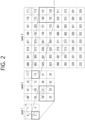
- FIG. 2 shows an example of a tile using a quadtree.
- the quadtree represents a partition of space in two dimensions by decomposing a map (i.e. world map) into four equal quadrants, subquadrants, and so on.
- the size of a quadrant varies according to a zoom level, and each quadrant corresponds to a tile. Here, the case where the levels are 1, 2, and 3 is shown. The larger the level, the smaller the size of the tile.
- a unique ID is assigned to a tile.
- the tile ID may have the number of bits corresponding to the level.
- the V2X device may acquire the ID of the tile in which it is located based on location information of the V2X device (e.g., latitude and longitude).
- the V2X device and/or the V2X server may adjust the size of the area by adjusting the level according to the situation.
- the area for the V2X service is defined as follows.
- FIG. 3 shows an example in which a subscription area is set.
- a first subscription area is set to the first V2X device 410, and a second subscription area is set to the second V2X device 450.
- Each V2X device can set/change/delete the subscription area periodically or aperiodically (e.g., when its location is changed).
- Each V2X device can request setting/change/deletion of the subscription area to the V2X server.
- the number of tiles included in the first subscription area is 9 and the number of tiles included in the second subscription area is 25, but the number of tiles included in the subscription area or the shape of the subscription area is not limited thereto.
- the subscription area may include a tile in which the V2X device is located.
- the subscription area may include one or more tiles other than a tile in which the V2X device is located.
- the first V2X device 410 may generate a first V2X message and periodically send the first V2X device to the V2X server.
- the second V2X device 450 may generate a second V2X message and periodically send the second V2X message to the V2X server.
- the V2X server may forward one or more V2X messages received in or around a subscription area to the V2X device related to the subscription area.
- a device that sets a subscription area may be referred to as a "subscriber device”.
- a device that transmits a V2X message to a V2X server can be referred to as a "provider device”.
- a V2X device may be a subscriber device, a provider device, or both a subscriber device and a provider device.
- the V2X server may forward the V2X messages transmitted by the provider devices in the management area to the subscriber device.
- the V2X server may deliver the V2X message of a provider device "associated" with the subscription area of a subscriber device to the subscriber device.
- a provider device associated with a subscription area of a subscriber device may be referred to as a 'subscribed provider device'.
- the provider device associated with the subscription area of the subscriber device may satisfy at least one of the following conditions (i) to (iii): (i) part or all of the publishing area of the provider device overlaps the subscription area of the subscriber device. (ii) some or all of the subscription area of the provider device overlaps with the subscription area of the subscriber device; and/or (iii) the location where the provider device transmits the V2X message is within the subscription area of the subscriber device.
- the V2X server delivers V2X messages received in the first subscription area to the first V2X device 410.
- the V2X server delivers V2X messages received in the second subscription area to the second V2X device 450.
- the V2X server may forward the first V2X message to the second V2X device 450.
- the second V2X device 450 is a subscriber device, and the first V2X device 410 is a subscribed provider device.
- the V2X server Since the second V2X device 450 is not located in the first subscription area (which means that condition (i) or condition (iii) is not satisfied), the V2X server does not forward the second V2X message to the first V2X device 410.
- the second V2X device 450 is not a provider device of the first V2X device 410. If condition (ii) is considered, the second V2X device 450 may be a provider device of the first V2X device 410.
- FIG. 4 is a flowchart illustrating a method for a V2X service according to an embodiment of the present specification.
- a V2X device sends a subscription request for requesting subscription of the V2X service to a V2X server.
- the subscription request may include information about the identifier, location, etc. of the V2X device.
- the V2X server may transmit a subscription response for granting or rejecting subscription to the V2X device in response to the subscription request.
- the V2X device may send the area configuration related to the V2X service to the V2X server.
- the area configuration may be included in a separate message or included in the subscription request.
- the area configuration includes information about configuration and/or modification of the subscription area.
- the V2X server may collect V2X messages from V2X devices in the management area, and perform message filtering.
- the V2X server receives the first V2X message from the second V2X device (step S541), and receives the second V2X message from the third V2X device (step S542). Assume that the second V2X device belongs to the subscription area of the first V2X device, but the third V2X device does not belong to the subscription area of the first V2X device.
- the V2X server publishes the first V2X message belonging to the subscription area of the first V2X device to the first V2X device.
- the first V2X device is a subscriber device and the second V2X device is a provider device. Since a V2X message of the third V2X device is not delivered to the first V2X device, the third V2X device is not a provider device of the first V2X device.
- the plurality of V2X messages may be published separately or as a single message.
- V2X server filters the V2X messages to be transmitted to V2X devices that have completed the subscription request.
- Message filtering may be referred to as a process of selecting a subscribed provider device associated with a subscriber device among a plurality of provider devices.
- Filtering conditions may be defined differently depending on the subscription area and/or the state of the V2X device. For example, if the number of V2X devices in the subscription area is large, the filtering conditions may be modified so that more messages are filtered out. Filtering condition may be related to the degree of risk of the V2X device.
- a subscription area is configured and registered with the V2X server.
- the V2X device can configure the size and/or shape of the subscription area based on its own driving information (e.g., speed/location/heading, etc.). For example, when driving or moving at high speed, the V2X device can configure a wider or larger subscription area, than compared to low-speed driving.
- a neighbor V2X device can come closer to a V2X device at high speed. Before the neighbor V2X device enters the subscription area, the V2X device cannot receive the message of the surrounding V2X device, there may be a delay in awareness and the V2X may be unprepared for the upcoming risk.
- FIG. 5 shows an example of a scenario due to a neighbor V2X device.
- a first V2X device 510 sets a subscription area 510a and is running at a relatively low speed.
- a second V2X device 520 is running toward the first V2X device 510 at high speed.
- the V2X server is receiving V2X messages from each of the first V2X device 510 and the second V2X device 520.
- the second V2X device 520 may also configure a subscription area.
- the V2X server does not deliver the V2X message of the second V2X device 520 to the first V2X device 510.
- the second V2X device 520 is now adjacent to the subscription area 510a, but the V2X server still does not deliver the V2X message of the second V2X device 520 to the first V2X device 510.
- the first V2X device 510 may not set the subscription area 510a large enough as the first V2X device 510 travels at a low speed. Therefore, the first V2X device 510 may not know the existence of the second V2X device 520 approaching at high speed, and it may be difficult for the first V2X device 510 to prepare for the upcoming risk of a fast approaching vehicle in advance.
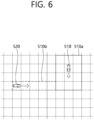
- FIG. 6 shows an example of reconfiguring a subscription area.
- the V2X server may know the speed/direction of the first V2X device 510 and the speed/direction of the second V2X device 520 through the received V2X messages. Accordingly, if the V2X server determines that the possibility of collision between the first V2X device 510 and the second V2X device 510 is high enough, the V2X server may request the first V2X device 510 to configure an additional subscription area 510b.
- the V2X server can know the driving information (e.g., speed/direction, etc.) of each V2X device based on the received V2X messages. Based on the driving information, the V2X server can determine the estimated risk area of each V2X device. The V2X server selects a V2X device whose subscription area does not overlap with the estimated risk area among V2X devices within the estimated risk area. The V2X server may request the selected V2X device to add/modify its subscription area. The V2X server may deliver the V2X message of the V2X device related to the estimated risk area to the selected V2X device. The selected V2X device can add/modify its subscription area according to the request of the V2X server. The selected V2X device may determine whether to add/modify the subscription area according to whether the dangerous situation satisfies a specific condition.
- the driving information e.g., speed/direction, etc.
- FIG. 7 shows an example of the system architecture of the V2X device and the V2X server.
- Each module may be implemented in software, stored in a memory, and executed by a processor. Not all modules are required. Some modules may be omitted or modified, and more modules may be added. The name of each module is merely an example, not a limitation.
- a V2X device 710 includes a user interface (UI) module 711, an application module 712, a message layer module 713, a client module 714, and a network stack module 718.
- UI user interface
- the UI module 711 may provide the user with a status of the V2X service, a warning, and the like, and receive a user input.
- the application module 712 may perform risk assessment and the like using the received message.
- the message layer module 713 handles the sending/receiving of messages.
- the client module 714 performs a client function to support the V2X service.
- the client module 714 includes an information collector 715, an area calculator 716, and a Message Queuing Telemetry Transport (MQTT) client protocol 717.
- the information collector 715 collects the location, sensor, and/or external information of the V2X device 710.
- the area calculator 716 determines the subscription area.
- the area calculator 716 may determine whether to modify/add the subscription area according to the request of the V2X server.
- the area calculator 716 may determine whether to modify/add the subscription area according to the state/risk level of the V2X device 710.
- the MQTT client protocol 717 implements the MQTT client protocol.
- a V2X server 750 includes a server module 751 and a network stack module 758.
- the server module 751 performs a server function to support the V2X function.
- the server module 751 includes a client manager 752, a message queue 753, and an MQTT server protocol 754.
- the client manager 752 manages a client connected to the V2X server 750.
- the message queue 753 includes a queue for storing messages to be relayed to clients, and manages messages.
- the MQTT server protocol 754 implements the MQTT server protocol.
- the network stack modules 718 and 758 implement IP network interfaces such as transmission control protocol/internet protocol (TCP/IP), user datagram protocol/internet protocol (UDP/IP), etc.
- TCP/IP transmission control protocol/internet protocol
- UDP/IP user datagram protocol/internet protocol
- MQTT is used as a message protocol, but this is only an example.
- Advanced Message Queuing Protocol AMQP
- HTTP HyperText Transfer Protocol
- vendor specific protocols may be used.
- FIG. 8 is a flowchart illustrating a method for a V2X service according to another embodiment of the present specification.
- a first V2X device sets a subscription area, and transmits a message having information about the subscription area to a V2X server.
- the subscription area may be set separately or together with the subscription request.
- the first V2X device may be called a subscriber device.
- a second V2X device transmits a V2X message to the V2X server.
- the V2X message may be arbitrarily or periodically transmitted regardless of the subscription request of the first V2X device.
- the V2X message may include at least one information element shown in Table 1, but there is no limitation.
- the V2X message may include a device ID of the second V2X device and driving information of the second V2X device.
- the driving information includes the location, velocity, and direction of the second V2X device.
- the second V2X device may transmit the V2X message according to a specific condition.
- Condition (1) When driving at a speed above a certain value for a specific time, the second V2X device may transmit a V2X message.
- Condition (2) When a sudden change in speed is detected for a specific time, the second V2X device may transmit a V2X message.
- Condition (3) When a sudden change in the heading direction is detected for a specific time, the second V2X device may transmit a V2X message.
- One or more of the above conditions (1) to (3) may be used.
- V is the speed of the second V2X device
- A is the speed change (acceleration) of the second V2X device
- D is the direction change of the second V2X device
- w1, w2, and w3 are weights. If D is greater than a specific value, the second V2X device may transmit a V2X message.
- step S830 if the second V2X device is not associated with the subscription area, the V2X server determines whether the second V2X device will affect the first V2X device based on the collected V2X message, and determines whether the subscription area is needed to be reconfigured or not.
- the V2X server forwards the V2X message to the first V2X device. That the second V2X device is associated with the subscription area means that (i) the second V2X device is located in the subscription area, (ii) the publishing area of the second V2X device overlaps with the subscription area, or (iii) the subscription area of the second V2X device overlaps with the subscription area.
- the V2X server may determine whether to reconfigure the subscription area of the first V2X device according to the degree of risk that the second V2X device affects the first V2X device.
- the server determines the estimated risk area of the second V2X device based on the V2X message. When the estimated risk area partially or completely overlaps the subscription area, it may be determined that the second V2X device affects the first V2X device.
- the estimated risk area may be determined based on driving information of the second V2X device.
- the estimated risk area may include at least one or more tiles on an expected path on which the second V2X device drives.
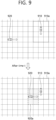
- FIG. 9 shows an example of calculating an estimated risk area.
- a first V2X device 910 configures a subscription area 910a.
- a second V2X device 920 travels toward the first V2X device 910 at a higher speed than the first V2X device 910.
- a V2X server can calculate the estimated positions of the first V2X device 910 and the second V2X device 920 based on the speed/direction of the first V2X device 910 and the second V2X device 920.
- the value of "t" may be determined by the V2X server in consideration of driving information of V2X devices.
- the V2X server may calculate the estimated risk area 920a in consideration of the moving direction and speed of the second V2X device 920 at time T+t.
- the V2X server may determine the estimated risk area 920a having one or more tiles in consideration of the distance and the driving route reached by the second V2X device 920 at time T+t+k.
- the V2X server may determine that the second V2X device 920 affects the risk of the first V2X device 910 .
- step S840 if it is determined that the subscription area needs to be reconfigured, the V2X server transmits a reconfiguration message for requesting the reconfiguration of the subscription area to the first V2X device. If it is determined that the second V2X device affects the first V2X device, the V2X server may transmit the reconfiguration message for requesting reconfiguration of the subscription area to the first V2X device.
- the reconfiguration message may include information on a subscription area recommended to be reconfigured by the first V2X device.
- the reconfiguration message may include information on an additional area recommended to be added in the subscription area.
- the reconfiguration message may include the driving information of the second V2X device.
- the reconfiguration message may include driving information of one or more V2X devices having one or more estimated risk areas overlapping the subscription area.
- the first V2X device may determine whether to reconfigure the subscription area based on the reconfiguration message.
- Reconfiguration of the subscription area may mean addition and/or modification of the subscription area.
- the first V2X device may notify the reconfigured subscription area to the V2X server.
- the first V2X device When the first V2X device receives information about the modified/added subscription area from the V2X server, the first V2X device can reconfigure the subscription area without further decision.
- the first V2X device may determine whether to reconfigure the subscription area based on its own driving information and the driving information of the second V2X device.
- the first V2X device may predict the estimated location of the second V2X device for a specific time, and check whether the estimated location is included in the subscription area. If the estimated location is included in the subscription area, the subscription area may be reconfigured.
Landscapes
- Engineering & Computer Science (AREA)
- Computer Networks & Wireless Communication (AREA)
- Signal Processing (AREA)
- Physics & Mathematics (AREA)
- General Physics & Mathematics (AREA)
- Mobile Radio Communication Systems (AREA)
- Telephonic Communication Services (AREA)
Abstract
Description
- The present disclosure relates to a method for vehicle-to-everything (V2X) service and a device using the same.
- A vehicle is an apparatus which moves a passenger from one place to another place. A representative example is a car. A vehicle-to-everything (V2X) communication technology, which means vehicle-to-object communication, refers to a technology in which the vehicle communicates with other vehicles, pedestrians, road infrastructures, servers, and the like to provide a series of services.
- For the V2X, standardization organizations such as Institute of Electrical and Electronics Engineers (IEEE), 3rd Generation Partnership Project (3GPP), etc. provide various communication specifications. Dedicated Short Range Communications (DSRC) is the communication standard protocol based on IEEE 802.11p. Cellular-V2X (C-V2X) is the communication standard protocol based on cellular communication protocol of 3GPP. In general, V2X has focused on vehicle safety through direct communication between vehicles, but recently V2X includes vehicle-to-infrastructure communication for communicating with peripheral devices via a network.
- Attempts are being made to extend V2X technology to be applied to pedestrians and other electronic devices, rather than simply being used for vehicle safety, such as vehicle-to-vehicle and vehicle-to-peripheral devices.
- The present disclosure provides relates to a method for vehicle-to-everything (V2X) and a device using the same.
- In an aspect, a server for vehicle-to-everything (V2X) service includes a processor, and a memory operatively coupled with the processor and configured to store instructions that, when executed by the processor, cause the RSU to perform functions. The functions includes receiving, from a first V2X device, a message for configuring a subscription area, receiving, from a second V2X device, a V2X message, the V2X message including a V2X ID identifying the second V2X device and driving information of the second V2X device, determining whether the second V2X device affects the first V2X device based on the V2X message if the second V2X device is not associated with the subscription area, and transmitting, to the first device, a reconfiguration message for requesting a reconfiguration of the subscription area of the first V2X device when the second V2X device affects the first V2X device.
- In another aspect, a method for vehicle-to-everything (V2X) service includes receiving, from a first V2X device, a message for configuring a subscription area, receiving, from a second V2X device, a V2X message, the V2X message including a V2X ID identifying the second V2X device and driving information of the second V2X device, determining whether the second V2X device affects the first V2X device based on the V2X message if the second V2X device is not associated with the subscription area, and transmitting, to the first device, a reconfiguration message for requesting a reconfiguration of the subscription area of the first V2X device when the second V2X device affects the first V2X device.
- In still another aspect, a device for vehicle-to-everything (V2X) service includes a processor, and a memory operatively coupled with the processor and configured to store instructions that, when executed by the processor, cause the RSU to perform functions. The functions includes transmitting, to a V2X server, a message for configuring a subscription area, receiving, from the V2X sever, a reconfiguration message for requesting a reconfiguration of the subscription area, and reconfiguring the subscription area based on the reconfiguration message.
- It is possible to provide V2X services to more diverse users as well as vehicles.
-
-
FIG. 1 shows a system to which an embodiment of the present specification is applied. -
FIG. 2 shows an example of a tile using a quadtree. -
FIG. 3 shows an example in which a subscription area is set. -
FIG. 4 is a flowchart illustrating a method for a V2X service according to an embodiment of the present specification. -
FIG. 5 shows an example of a scenario due to a neighbor V2X device. -
FIG. 6 shows an example of reconfiguring a subscription area. -
FIG. 7 shows an example of the system architecture of the V2X device and the V2X server. -
FIG. 8 is a flowchart illustrating a method for a V2X service according to another embodiment of the present specification. -
FIG. 9 shows an example of calculating an estimated risk area. - Hereinafter, the embodiments disclosed in the present specification will be described in detail with reference to the accompanying drawings, but the same or similar components are assigned the same reference numbers regardless of reference numerals, and redundant description thereof will be omitted. The suffixes "module" and "unit" for the components used in the following description are given or mixed in consideration of only the ease of writing the specification, and do not have distinct meanings or roles by themselves. In addition, in describing the embodiments disclosed in the present specification, if it is determined that detailed descriptions of related known technologies may obscure the gist of the embodiments disclosed in the present specification, the detailed description thereof will be omitted. In addition, the accompanying drawings are only for easy understanding of the embodiments disclosed in the present specification, and the technical ideas disclosed in the present specification are not limited by the accompanying drawings.
- Terms including an ordinal number, such as first, second, etc., may be used to describe various elements, but the elements are not limited by the terms. The above terms are used only for the purpose of distinguishing one component from another.
- When an element is referred to as being "connected" or "coupled" to another element, it is understood that it may be directly connected or coupled to the other element, but other elements may exist in between. On the other hand, when it is mentioned that a certain element is "directly connected" or "directly coupled" to another element, it should be understood that no other element is present in the middle.
- The singular expression includes the plural expression unless the context clearly dictates otherwise.
- In the present application, terms such as "comprises" or "have" are intended to designate that the features, numbers, steps, operations, components, parts, or combinations thereof described in the specification exist, but it is to be understood that this does not preclude the possibility of addition or existence of one or more other features, numbers, steps, operations, components, parts, or combinations thereof.
- A vehicle according to an embodiment of the present specification can be defined as a means of transport traveling on a road or track. Vehicles may include automobiles, ships, aircraft, trains, motorcycles, bicycles, and the like. The vehicle may include an internal combustion engine vehicle having an engine as a power source, a hybrid vehicle having an engine and an electric motor as a power source, an electric vehicle having an electric motor as a power source, and combinations thereof.
- A vehicle-to-everything (V2X) device according to an embodiment of the present specification refers to a device that provides V2X functions and V2X services to users based on software, and is also referred to as a SoftV2X device. The V2X device may be implemented based on hardware and/or software in an electronic device operated by a user such as User Equipment (UE), mobile station (MS), mobile terminal (MT), user terminal (UT), cellular phone, laptop, handheld device, tablet, drone, consumer electronics, and the like. The V2X device may be mounted on a vehicle or electronic device as an on-board unit (OBU) to provide V2X functions and services to the vehicle. A V2X device disposed inside or outside the vehicle may be connected to the vehicle through a wireless interface to provide V2X functions and V2X services to the vehicle.
-
FIG. 1 shows a system to which an embodiment of the present specification is applied. - A system includes a
V2X device 100 and aV2X server 200. TheV2X device 100 may communicate with theV2X server 200 through thebase station 310 or a Road Side Unit (RSU) 320. TheV2X device 100 may communicate with thebase station 310, the RSU 320, aneighbor vehicle 350 and/or a neighbor V2X device using a wireless communication protocol. There is no limitation on the wireless communication protocol. The wireless communication protocol may include Dedicated Short Range Communications (DSRC), Cellular-V2X (C-V2X), WiFi, BLUETOOTH and/or cellular communication protocols based on 3rd Generation Partnership Project (3GPP) (e.g., Wideband Code Division Multiple Access (WCDMA), Long Term Evolution (LTE), New Radio (NR), etc.). - The
V2X server 200 receives one or more V2X messages from theV2X device 100 within a managed area. TheV2X server 200 may forward the one or more collected V2X messages to the subscribingV2X device 100. - The V2X message may periodically or aperiodically be transmitted to the
V2X server 200 by the V2X device 100 (or RSU 320), and is a message providing status information of the V2X device 100 (or device managed by the RSU 320). For example, theV2X device 100 may transmit 10 V2X messages per second. TheV2X server 200 collects V2X messages from multiple V2X devices, and forwards the V2X messages to subscribing V2X devices. - The following table shows examples of information elements included in the V2X message. Not all information elements are required, and names are examples only. Information elements may be added/changed/deleted according to policies or circumstances.
[Table 1] Name Description V2X ID A temporary identifier (ID) for identifying the V2X device sending this message. It is randomly selected by the V2X device and may be changed periodically. The size can be 4 octets. Position Indicates the location of the V2X device. May contain latitude, longitude and elevation. Position Accuracy Including the quality of various parameters used to model the accuracy of positioning. Velocity Indicates the velocity of the V2X device. Heading Indicates the current heading (direction of motion) of the V2X device. Path History defines a geometric path reflecting V2X device's movement over some period of time and/or distance Acceleration Indicates the acceleration of the V2X device. May include a set of acceleration values for three orthogonal directions of the V2X device: a longitudinal axis, a lateral axis, and a vertical axis. Device Type Indicates the type of V2X device. Example: pedestrian, automobile, bicycle, etc. Publishing Area To be described later - The V2X message transmitted by the
V2X device 100 to theV2X server 200 is called an uplink (UL) V2X message, and the V2X message transmitted by theV2X server 200 to theV2X device 100 is called a downlink (DL) V2X message. - The
V2X device 100 may include aprocessor 110 and amemory 120. Theprocessor 110 implements the functions of theV2X device 100 and may include one or more software modules. TheV2X device 100 may further include various additional devices according to functions such as a display, a user interface, and a wireless modem. - The
V2X server 200 is connected to one ormore base stations 310 and/orRSU 320 and includes computing hardware that provides V2X functions and V2X services to theV2X device 100. TheV2X server 200 may be a Mobile/Mutli-access Edge Computing (MEC)-based server or a centralized-based server. TheV2X server 200 may be called another name, such as a Geocast server or a SoftV2X server. TheV2X server 200 may include aprocessor 210 and amemory 220. Theprocessor 210 implements the function of theV2X server 200, and may include one or more software modules. - The
processors memories processors -
Memories processors processors Memories memories - Message Queuing Telemetry Transport (MQTT) is used as a message queuing protocol between the
V2X device 100 and theV2X server 200, but this is only an example. Advanced Message Queuing Protocol (AMQP), HyperText Transfer Protocol (HTTP), and/or vendor specific protocols may be used. - Now, setting an area for V2X service will be described in more detail. Hereinafter, a tile refers to a geographic basic unit for setting a subscription area. Hereinafter, a rectangle is shown in the form of a tile, but it is only an example. There are no restrictions on the shape of the tile, such as polygons or circles.
-
FIG. 2 shows an example of a tile using a quadtree. - The quadtree represents a partition of space in two dimensions by decomposing a map (i.e. world map) into four equal quadrants, subquadrants, and so on. The size of a quadrant varies according to a zoom level, and each quadrant corresponds to a tile. Here, the case where the levels are 1, 2, and 3 is shown. The larger the level, the smaller the size of the tile. At each level, a unique ID is assigned to a tile. The tile ID may have the number of bits corresponding to the level.
- The V2X device may acquire the ID of the tile in which it is located based on location information of the V2X device (e.g., latitude and longitude). The V2X device and/or the V2X server may adjust the size of the area by adjusting the level according to the situation.
- In the following embodiment, the area for the V2X service is defined as follows.
- Management area: The area managed by the V2X server. The management area includes one or more tiles.
- Subscription area: The area where the V2X device requests a subscription to the V2X server. The subscription area may be referred to as another name, such as a concerned area, an impact area, or a geocast area. The subscription area contains one or more tiles. The subscription area may be included in one management area, and may be defined across a plurality of management areas managed by a plurality of V2X servers.
- Publishing area: The area where the V2X device publishes V2X messages to the V2X server. The publishing area may include one tile in each level. The publishing area may indicate a tile where the V2X device is currently located. Some or all of the publishing area may overlap with the subscription area.
-
FIG. 3 shows an example in which a subscription area is set. - A first subscription area is set to the
first V2X device 410, and a second subscription area is set to thesecond V2X device 450. Each V2X device can set/change/delete the subscription area periodically or aperiodically (e.g., when its location is changed). Each V2X device can request setting/change/deletion of the subscription area to the V2X server. - The number of tiles included in the first subscription area is 9 and the number of tiles included in the second subscription area is 25, but the number of tiles included in the subscription area or the shape of the subscription area is not limited thereto. The subscription area may include a tile in which the V2X device is located. Alternatively, the subscription area may include one or more tiles other than a tile in which the V2X device is located.
- The
first V2X device 410 may generate a first V2X message and periodically send the first V2X device to the V2X server. Thesecond V2X device 450 may generate a second V2X message and periodically send the second V2X message to the V2X server. - The V2X server may forward one or more V2X messages received in or around a subscription area to the V2X device related to the subscription area.
- A device that sets a subscription area may be referred to as a "subscriber device". A device that transmits a V2X message to a V2X server can be referred to as a "provider device". A V2X device may be a subscriber device, a provider device, or both a subscriber device and a provider device. The V2X server may forward the V2X messages transmitted by the provider devices in the management area to the subscriber device.
- The V2X server may deliver the V2X message of a provider device "associated" with the subscription area of a subscriber device to the subscriber device. A provider device associated with a subscription area of a subscriber device may be referred to as a 'subscribed provider device'. The provider device associated with the subscription area of the subscriber device may satisfy at least one of the following conditions (i) to (iii): (i) part or all of the publishing area of the provider device overlaps the subscription area of the subscriber device. (ii) some or all of the subscription area of the provider device overlaps with the subscription area of the subscriber device; and/or (iii) the location where the provider device transmits the V2X message is within the subscription area of the subscriber device.
- According to condition (i) or (iii), the V2X server delivers V2X messages received in the first subscription area to the
first V2X device 410. The V2X server delivers V2X messages received in the second subscription area to thesecond V2X device 450. - Since the
first V2X device 410 is located in the second subscription area, the V2X server may forward the first V2X message to thesecond V2X device 450. Thesecond V2X device 450 is a subscriber device, and thefirst V2X device 410 is a subscribed provider device. - Since the
second V2X device 450 is not located in the first subscription area (which means that condition (i) or condition (iii) is not satisfied), the V2X server does not forward the second V2X message to thefirst V2X device 410. Thesecond V2X device 450 is not a provider device of thefirst V2X device 410. If condition (ii) is considered, thesecond V2X device 450 may be a provider device of thefirst V2X device 410. -
FIG. 4 is a flowchart illustrating a method for a V2X service according to an embodiment of the present specification. - In step S510, a V2X device sends a subscription request for requesting subscription of the V2X service to a V2X server. The subscription request may include information about the identifier, location, etc. of the V2X device. The V2X server may transmit a subscription response for granting or rejecting subscription to the V2X device in response to the subscription request.
- In step S520, the V2X device may send the area configuration related to the V2X service to the V2X server. The area configuration may be included in a separate message or included in the subscription request. The area configuration includes information about configuration and/or modification of the subscription area.
- In step S530, the V2X server may collect V2X messages from V2X devices in the management area, and perform message filtering.
- The V2X server receives the first V2X message from the second V2X device (step S541), and receives the second V2X message from the third V2X device (step S542). Assume that the second V2X device belongs to the subscription area of the first V2X device, but the third V2X device does not belong to the subscription area of the first V2X device.
- In step S550, the V2X server publishes the first V2X message belonging to the subscription area of the first V2X device to the first V2X device. The first V2X device is a subscriber device and the second V2X device is a provider device. Since a V2X message of the third V2X device is not delivered to the first V2X device, the third V2X device is not a provider device of the first V2X device.
- If there are a plurality of V2X messages to be sent to the first V2X device, the plurality of V2X messages may be published separately or as a single message.
- Message filtering is that V2X server filters the V2X messages to be transmitted to V2X devices that have completed the subscription request. Message filtering may be referred to as a process of selecting a subscribed provider device associated with a subscriber device among a plurality of provider devices. Filtering conditions may be defined differently depending on the subscription area and/or the state of the V2X device. For example, if the number of V2X devices in the subscription area is large, the filtering conditions may be modified so that more messages are filtered out. Filtering condition may be related to the degree of risk of the V2X device.
- Now, how to modify a subscription area will be described.
- As described above, in order for a V2X device to receive a V2X message from a V2X server, a subscription area is configured and registered with the V2X server. The V2X device can configure the size and/or shape of the subscription area based on its own driving information (e.g., speed/location/heading, etc.). For example, when driving or moving at high speed, the V2X device can configure a wider or larger subscription area, than compared to low-speed driving.
- Outside the subscription area, a neighbor V2X device can come closer to a V2X device at high speed. Before the neighbor V2X device enters the subscription area, the V2X device cannot receive the message of the surrounding V2X device, there may be a delay in awareness and the V2X may be unprepared for the upcoming risk.
-
FIG. 5 shows an example of a scenario due to a neighbor V2X device. - A
first V2X device 510 sets asubscription area 510a and is running at a relatively low speed. Asecond V2X device 520 is running toward thefirst V2X device 510 at high speed. The V2X server is receiving V2X messages from each of thefirst V2X device 510 and thesecond V2X device 520. Although not shown in the drawing, thesecond V2X device 520 may also configure a subscription area. - At time T, the
second V2X device 520 is far away from thefirst V2X device 510 and is not located within thesubscription area 510a. Therefore, the V2X server does not deliver the V2X message of thesecond V2X device 520 to thefirst V2X device 510. - At time T+t, the
second V2X device 520 is now adjacent to thesubscription area 510a, but the V2X server still does not deliver the V2X message of thesecond V2X device 520 to thefirst V2X device 510. - The
first V2X device 510 may not set thesubscription area 510a large enough as thefirst V2X device 510 travels at a low speed. Therefore, thefirst V2X device 510 may not know the existence of thesecond V2X device 520 approaching at high speed, and it may be difficult for thefirst V2X device 510 to prepare for the upcoming risk of a fast approaching vehicle in advance. -
FIG. 6 shows an example of reconfiguring a subscription area. - The V2X server may know the speed/direction of the
first V2X device 510 and the speed/direction of thesecond V2X device 520 through the received V2X messages. Accordingly, if the V2X server determines that the possibility of collision between thefirst V2X device 510 and thesecond V2X device 510 is high enough, the V2X server may request thefirst V2X device 510 to configure anadditional subscription area 510b. - The V2X server can know the driving information (e.g., speed/direction, etc.) of each V2X device based on the received V2X messages. Based on the driving information, the V2X server can determine the estimated risk area of each V2X device. The V2X server selects a V2X device whose subscription area does not overlap with the estimated risk area among V2X devices within the estimated risk area. The V2X server may request the selected V2X device to add/modify its subscription area. The V2X server may deliver the V2X message of the V2X device related to the estimated risk area to the selected V2X device. The selected V2X device can add/modify its subscription area according to the request of the V2X server. The selected V2X device may determine whether to add/modify the subscription area according to whether the dangerous situation satisfies a specific condition.
-
FIG. 7 shows an example of the system architecture of the V2X device and the V2X server. Each module may be implemented in software, stored in a memory, and executed by a processor. Not all modules are required. Some modules may be omitted or modified, and more modules may be added. The name of each module is merely an example, not a limitation. - A
V2X device 710 includes a user interface (UI)module 711, anapplication module 712, amessage layer module 713, aclient module 714, and anetwork stack module 718. - The
UI module 711 may provide the user with a status of the V2X service, a warning, and the like, and receive a user input. Theapplication module 712 may perform risk assessment and the like using the received message. Themessage layer module 713 handles the sending/receiving of messages. - The
client module 714 performs a client function to support the V2X service. Theclient module 714 includes aninformation collector 715, anarea calculator 716, and a Message Queuing Telemetry Transport (MQTT)client protocol 717. Theinformation collector 715 collects the location, sensor, and/or external information of theV2X device 710. Thearea calculator 716 determines the subscription area. Thearea calculator 716 may determine whether to modify/add the subscription area according to the request of the V2X server. Thearea calculator 716 may determine whether to modify/add the subscription area according to the state/risk level of theV2X device 710. TheMQTT client protocol 717 implements the MQTT client protocol. - A
V2X server 750 includes aserver module 751 and a network stack module 758. Theserver module 751 performs a server function to support the V2X function. Theserver module 751 includes aclient manager 752, amessage queue 753, and anMQTT server protocol 754. Theclient manager 752 manages a client connected to theV2X server 750. Themessage queue 753 includes a queue for storing messages to be relayed to clients, and manages messages. TheMQTT server protocol 754 implements the MQTT server protocol. - The
network stack modules 718 and 758 implement IP network interfaces such as transmission control protocol/internet protocol (TCP/IP), user datagram protocol/internet protocol (UDP/IP), etc. - MQTT is used as a message protocol, but this is only an example. Advanced Message Queuing Protocol (AMQP), HyperText Transfer Protocol (HTTP), and/or vendor specific protocols may be used.
-
FIG. 8 is a flowchart illustrating a method for a V2X service according to another embodiment of the present specification. - In step S810, a first V2X device sets a subscription area, and transmits a message having information about the subscription area to a V2X server. The subscription area may be set separately or together with the subscription request. The first V2X device may be called a subscriber device.
- In step S820, a second V2X device transmits a V2X message to the V2X server. The V2X message may be arbitrarily or periodically transmitted regardless of the subscription request of the first V2X device. The V2X message may include at least one information element shown in Table 1, but there is no limitation. The V2X message may include a device ID of the second V2X device and driving information of the second V2X device. The driving information includes the location, velocity, and direction of the second V2X device. The second V2X device may transmit the V2X message according to a specific condition.
- Condition (1): When driving at a speed above a certain value for a specific time, the second V2X device may transmit a V2X message. Condition (2): When a sudden change in speed is detected for a specific time, the second V2X device may transmit a V2X message. Condition (3): When a sudden change in the heading direction is detected for a specific time, the second V2X device may transmit a V2X message.
- One or more of the above conditions (1) to (3) may be used. One or more of the above conditions (1) to (3) may be combined. For example, it is defined as D=w1∗V+w2∗A+w3∗D. V is the speed of the second V2X device, A is the speed change (acceleration) of the second V2X device, D is the direction change of the second V2X device, and w1, w2, and w3 are weights. If D is greater than a specific value, the second V2X device may transmit a V2X message.
- In step S830, if the second V2X device is not associated with the subscription area, the V2X server determines whether the second V2X device will affect the first V2X device based on the collected V2X message, and determines whether the subscription area is needed to be reconfigured or not.
- When the second V2X device is associated with the subscription area, the V2X server forwards the V2X message to the first V2X device. That the second V2X device is associated with the subscription area means that (i) the second V2X device is located in the subscription area, (ii) the publishing area of the second V2X device overlaps with the subscription area, or (iii) the subscription area of the second V2X device overlaps with the subscription area.
- If the second V2X device is not associated with the subscription area, the V2X server may determine whether to reconfigure the subscription area of the first V2X device according to the degree of risk that the second V2X device affects the first V2X device. The server determines the estimated risk area of the second V2X device based on the V2X message. When the estimated risk area partially or completely overlaps the subscription area, it may be determined that the second V2X device affects the first V2X device.
- The estimated risk area may be determined based on driving information of the second V2X device. The estimated risk area may include at least one or more tiles on an expected path on which the second V2X device drives.
-
FIG. 9 shows an example of calculating an estimated risk area. - A
first V2X device 910 configures asubscription area 910a. At time "T", asecond V2X device 920 travels toward thefirst V2X device 910 at a higher speed than thefirst V2X device 910. At time T + t, a V2X server can calculate the estimated positions of thefirst V2X device 910 and thesecond V2X device 920 based on the speed/direction of thefirst V2X device 910 and thesecond V2X device 920. The value of "t" may be determined by the V2X server in consideration of driving information of V2X devices. In addition, the V2X server may calculate the estimatedrisk area 920a in consideration of the moving direction and speed of thesecond V2X device 920 at time T+t. For example, the V2X server may determine the estimatedrisk area 920a having one or more tiles in consideration of the distance and the driving route reached by thesecond V2X device 920 at time T+t+k. - When a part or all of the estimated
risk area 920a overlaps with thesubscription area 910a, the V2X server may determine that thesecond V2X device 920 affects the risk of thefirst V2X device 910 . - Referring back to
FIG. 8 , in step S840, if it is determined that the subscription area needs to be reconfigured, the V2X server transmits a reconfiguration message for requesting the reconfiguration of the subscription area to the first V2X device. If it is determined that the second V2X device affects the first V2X device, the V2X server may transmit the reconfiguration message for requesting reconfiguration of the subscription area to the first V2X device. - The reconfiguration message may include information on a subscription area recommended to be reconfigured by the first V2X device. The reconfiguration message may include information on an additional area recommended to be added in the subscription area.
- The reconfiguration message may include the driving information of the second V2X device. The reconfiguration message may include driving information of one or more V2X devices having one or more estimated risk areas overlapping the subscription area.
- In step S850, the first V2X device may determine whether to reconfigure the subscription area based on the reconfiguration message. Reconfiguration of the subscription area may mean addition and/or modification of the subscription area. When the subscription area is reconfigured, the first V2X device may notify the reconfigured subscription area to the V2X server.
- When the first V2X device receives information about the modified/added subscription area from the V2X server, the first V2X device can reconfigure the subscription area without further decision.
- The first V2X device may determine whether to reconfigure the subscription area based on its own driving information and the driving information of the second V2X device. The first V2X device may predict the estimated location of the second V2X device for a specific time, and check whether the estimated location is included in the subscription area. If the estimated location is included in the subscription area, the subscription area may be reconfigured.
- In the above exemplary systems, although the methods have been described on the basis of the flowcharts using a series of the steps or blocks, the present disclosure is not limited to the sequence of the steps, and some of the steps may be performed at different sequences from the remaining steps or may be performed simultaneously with the remaining steps. Furthermore, those skilled in the art will understand that the steps shown in the flowcharts are not exclusive and may include other steps or one or more steps of the flowcharts may be deleted without affecting the scope of the present disclosure.
Claims (14)
- A server for vehicle-to-everything (V2X) service, the server comprising:a processor; anda memory operatively coupled with the processor and configured to store instructions that, when executed by the processor, cause the server to perform functions comprising:receiving, from a first V2X device, a message for configuring a subscription area;receiving, from a second V2X device, a V2X message, the V2X message including a V2X ID identifying the second V2X device and driving information of the second V2X device;determining that the second V2X device affects the first V2X device based on the V2X message if the second V2X device is not associated with the subscription area; andtransmitting, to the first device, a reconfiguration message for requesting a reconfiguration of the subscription area of the first V2X device when the second V2X device affects the first V2X device.
- The server of claim 1, wherein the determining that the second V2X device affects the first V2X device based on the V2X message comprises:determining an estimated risk area based on the V2X message; anddetermining whether the estimated risk area overlaps with the subscription area.
- The server of claim 2, wherein it is determined that the second V2X device affects the first V2X device when the estimated risk area overlaps with the subscription area.
- The server of claim 1, wherein the functions further comprise:
forwarding, to the first V2X device, the V2X message when the second V2X device is associated with the subscription area. - The server of claim 1, wherein the reconfiguration message includes information on a subscription area recommended to be reconfigured by the first V2X device.
- The server of claim 1, wherein the reconfiguration message includes driving information of the second V2X device.
- The server of claim 1, wherein the driving information includes a location of the second V2X device, a speed of the second V2X device and a direction of the second V2X device.
- A method for vehicle-to-everything (V2X) service, the method performed by a server and comprising:receiving, from a first V2X device, a message for configuring a subscription area;receiving, from a second V2X device, a V2X message, the V2X message including a V2X ID identifying the second V2X device and driving information of the second V2X device;determining that the second V2X device affects the first V2X device based on the V2X message if the second V2X device is not associated with the subscription area; andtransmitting, to the first device, a reconfiguration message for requesting a reconfiguration of the subscription area of the first V2X device when the second V2X device affects the first V2X device.
- The method of claim 9, wherein the determining that the second V2X device affects the first V2X device based on the V2X message comprises:determining an estimated risk area based on the V2X message; anddetermining whether the estimated risk area overlaps with the subscription area.
- The method of claim 10, wherein it is determined that the second V2X device affects the first V2X device when the estimated risk area overlaps with the subscription area.
- The method of claim 8, wherein the functions further comprise:
forwarding, to the first V2X device, the V2X message if the second V2X device is associated with the subscription area. - A device for vehicle-to-everything (V2X) service, the device comprising:a processor; anda memory operatively coupled with the processor and configured to store instructions that, when executed by the processor, cause the device to perform functions comprising:transmitting, to a V2X server, a message for configuring a subscription area;receiving, from the V2X sever, a reconfiguration message for requesting a reconfiguration of the subscription area; andreconfiguring the subscription area based on the reconfiguration message.
- The device of claim 12, wherein the reconfiguration message includes driving information of a V2X device which is not associated with the subscription area.
- The device of claim 12, wherein the reconfiguration message includes information on a subscription area recommended by the V2X server to be reconfigured by the first V2X device.
Applications Claiming Priority (1)
| Application Number | Priority Date | Filing Date | Title |
|---|---|---|---|
| PCT/KR2020/008514 WO2022004907A1 (en) | 2020-06-30 | 2020-06-30 | Method for v2x service and device using same |
Publications (3)
| Publication Number | Publication Date |
|---|---|
| EP4175332A1 true EP4175332A1 (en) | 2023-05-03 |
| EP4175332A4 EP4175332A4 (en) | 2024-04-03 |
| EP4175332B1 EP4175332B1 (en) | 2025-08-13 |
Family
ID=79316451
Family Applications (1)
| Application Number | Title | Priority Date | Filing Date |
|---|---|---|---|
| EP20943802.7A Active EP4175332B1 (en) | 2020-06-30 | 2020-06-30 | Method for v2x service and device using same |
Country Status (5)
| Country | Link |
|---|---|
| US (1) | US12150011B2 (en) |
| EP (1) | EP4175332B1 (en) |
| KR (1) | KR102846211B1 (en) |
| CN (1) | CN114830698B (en) |
| WO (1) | WO2022004907A1 (en) |
Families Citing this family (4)
| Publication number | Priority date | Publication date | Assignee | Title |
|---|---|---|---|---|
| DE102022201970A1 (en) | 2022-02-25 | 2023-08-31 | Siemens Mobility GmbH | Subscription to concurrently active switching devices |
| US12133079B2 (en) * | 2022-09-30 | 2024-10-29 | Ford Global Technologies, Llc | Pre-security message verification |
| EP4702770A1 (en) | 2023-04-26 | 2026-03-04 | Commsignia Kft. | Map-matching based message routing method, system, computer program product and computer readable medium for implementing the method |
| US12538106B2 (en) * | 2023-05-30 | 2026-01-27 | Lg Electronics Inc. | Method and apparatus for operating user equipment supporting soft vehicle to everything related to bluetooth low energy |
Family Cites Families (20)
| Publication number | Priority date | Publication date | Assignee | Title |
|---|---|---|---|---|
| US20130278441A1 (en) | 2012-04-24 | 2013-10-24 | Zetta Research and Development, LLC - ForC Series | Vehicle proxying |
| US20150215409A1 (en) * | 2012-09-04 | 2015-07-30 | Nokia Corporation | Method and apparatus for location-based publications and subscriptions |
| WO2016028761A1 (en) | 2014-08-18 | 2016-02-25 | Trimble Navigation Limited | Vehicle data system utilizing publish/subcribe gateways |
| JP6881297B2 (en) | 2015-03-20 | 2021-06-02 | 日本電気株式会社 | Vehicle communication systems, MMEs, vehicle terminals, and methods |
| US10554708B2 (en) * | 2015-03-27 | 2020-02-04 | Qualcomm Incorporated | Point-to-multipoint broadcast assisted vehicle-to-X broadcast |
| CN106302622B (en) * | 2015-06-12 | 2021-01-26 | 中兴通讯股份有限公司 | Internet of vehicles system and service implementation method and device thereof |
| CN106507449B (en) | 2015-09-07 | 2021-01-26 | 中兴通讯股份有限公司 | Control method and device for Internet of vehicles communication |
| JP6812979B2 (en) * | 2015-09-18 | 2021-01-13 | 日本電気株式会社 | RSU devices, control nodes, and methods thereof |
| WO2017052690A1 (en) | 2015-09-24 | 2017-03-30 | Intel Corporation | Congestion control for vehicular-to-anything services |
| CN107105000B (en) * | 2016-02-23 | 2021-07-30 | 中兴通讯股份有限公司 | V2X communication method and device |
| CN107295470B (en) | 2016-04-01 | 2021-07-16 | 北京三星通信技术研究有限公司 | A method and device for sending V2X messages |
| US20200178048A1 (en) * | 2016-10-06 | 2020-06-04 | Lg Electronics Inc. | V2x communication support method in wireless communication system |
| US10237874B2 (en) | 2016-11-03 | 2019-03-19 | Samsung Electronics Co., Ltd. | Method and apparatus for supporting vehicle to everything service |
| EP3562231B1 (en) * | 2016-12-23 | 2021-06-09 | LG Electronics Inc. | Method for performing v2x communication in wireless communication system and device for same |
| KR101959305B1 (en) * | 2017-09-15 | 2019-03-18 | 엘지전자 주식회사 | Vehicle |
| US20190173951A1 (en) | 2017-12-01 | 2019-06-06 | GM Global Technology Operations LLC | Vehicle communication using publish-subscribe messaging protocol |
| CN112087734B (en) | 2018-02-13 | 2022-01-14 | 华为技术有限公司 | Communication method and device |
| US12490045B2 (en) | 2018-09-26 | 2025-12-02 | Qualcomm Incorporated | Transmission with indication of geographic area |
| CN118102255A (en) * | 2018-10-08 | 2024-05-28 | 瑞典爱立信有限公司 | Method and apparatus for intelligent transportation system (its) message distribution |
| EP4322569A3 (en) * | 2018-11-19 | 2024-04-10 | Telefonaktiebolaget LM Ericsson (publ) | Geographical area message distribution |
-
2020
- 2020-06-30 US US17/776,898 patent/US12150011B2/en active Active
- 2020-06-30 KR KR1020227010982A patent/KR102846211B1/en active Active
- 2020-06-30 CN CN202080087339.3A patent/CN114830698B/en active Active
- 2020-06-30 EP EP20943802.7A patent/EP4175332B1/en active Active
- 2020-06-30 WO PCT/KR2020/008514 patent/WO2022004907A1/en not_active Ceased
Also Published As
| Publication number | Publication date |
|---|---|
| WO2022004907A1 (en) | 2022-01-06 |
| KR102846211B1 (en) | 2025-08-14 |
| KR20230029574A (en) | 2023-03-03 |
| EP4175332B1 (en) | 2025-08-13 |
| CN114830698B (en) | 2024-10-25 |
| EP4175332A4 (en) | 2024-04-03 |
| US20220408219A1 (en) | 2022-12-22 |
| US12150011B2 (en) | 2024-11-19 |
| CN114830698A (en) | 2022-07-29 |
Similar Documents
| Publication | Publication Date | Title |
|---|---|---|
| EP4175332B1 (en) | Method for v2x service and device using same | |
| US12250616B2 (en) | Road side unit for V2X service | |
| US12464327B2 (en) | Device and server for multicast service | |
| EP4156730B1 (en) | Device and method for v2x service | |
| US12581275B2 (en) | Method of operating a message exchange server related to V2X message transmission and reception and apparatus therefor | |
| EP4664941A1 (en) | Operation method and device for sharing and transferring v2x service-related information item by server and rsu device | |
| EP4207827B1 (en) | Road side unit for v2x service | |
| US12375892B2 (en) | Device using local server for V2X service | |
| EP4178237B1 (en) | Server and method for v2x service | |
| EP4718888A1 (en) | Method and apparatus for operating server related to pre-assessment of degree of risk |
Legal Events
| Date | Code | Title | Description |
|---|---|---|---|
| STAA | Information on the status of an ep patent application or granted ep patent |
Free format text: STATUS: THE INTERNATIONAL PUBLICATION HAS BEEN MADE |
|
| PUAI | Public reference made under article 153(3) epc to a published international application that has entered the european phase |
Free format text: ORIGINAL CODE: 0009012 |
|
| STAA | Information on the status of an ep patent application or granted ep patent |
Free format text: STATUS: REQUEST FOR EXAMINATION WAS MADE |
|
| 17P | Request for examination filed |
Effective date: 20220812 |
|
| AK | Designated contracting states |
Kind code of ref document: A1 Designated state(s): AL AT BE BG CH CY CZ DE DK EE ES FI FR GB GR HR HU IE IS IT LI LT LU LV MC MK MT NL NO PL PT RO RS SE SI SK SM TR |
|
| DAV | Request for validation of the european patent (deleted) | ||
| DAX | Request for extension of the european patent (deleted) | ||
| A4 | Supplementary search report drawn up and despatched |
Effective date: 20240304 |
|
| RIC1 | Information provided on ipc code assigned before grant |
Ipc: H04W 4/06 20090101ALI20240227BHEP Ipc: H04W 64/00 20090101ALI20240227BHEP Ipc: H04W 4/50 20180101ALI20240227BHEP Ipc: H04W 4/44 20180101ALI20240227BHEP Ipc: H04W 88/18 20090101ALI20240227BHEP Ipc: H04W 4/02 20180101ALI20240227BHEP Ipc: H04W 4/029 20180101ALI20240227BHEP Ipc: H04W 4/40 20180101AFI20240227BHEP |
|
| GRAP | Despatch of communication of intention to grant a patent |
Free format text: ORIGINAL CODE: EPIDOSNIGR1 |
|
| STAA | Information on the status of an ep patent application or granted ep patent |
Free format text: STATUS: GRANT OF PATENT IS INTENDED |
|
| INTG | Intention to grant announced |
Effective date: 20250314 |
|
| GRAS | Grant fee paid |
Free format text: ORIGINAL CODE: EPIDOSNIGR3 |
|
| GRAA | (expected) grant |
Free format text: ORIGINAL CODE: 0009210 |
|
| STAA | Information on the status of an ep patent application or granted ep patent |
Free format text: STATUS: THE PATENT HAS BEEN GRANTED |
|
| AK | Designated contracting states |
Kind code of ref document: B1 Designated state(s): AL AT BE BG CH CY CZ DE DK EE ES FI FR GB GR HR HU IE IS IT LI LT LU LV MC MK MT NL NO PL PT RO RS SE SI SK SM TR |
|
| REG | Reference to a national code |
Ref country code: GB Ref legal event code: FG4D |
|
| REG | Reference to a national code |
Ref country code: CH Ref legal event code: EP |
|
| REG | Reference to a national code |
Ref country code: DE Ref legal event code: R096 Ref document number: 602020056771 Country of ref document: DE |
|
| REG | Reference to a national code |
Ref country code: IE Ref legal event code: FG4D |
|
| REG | Reference to a national code |
Ref country code: NL Ref legal event code: MP Effective date: 20250813 |
|
| PG25 | Lapsed in a contracting state [announced via postgrant information from national office to epo] |
Ref country code: IS Free format text: LAPSE BECAUSE OF FAILURE TO SUBMIT A TRANSLATION OF THE DESCRIPTION OR TO PAY THE FEE WITHIN THE PRESCRIBED TIME-LIMIT Effective date: 20251213 |
|
| PG25 | Lapsed in a contracting state [announced via postgrant information from national office to epo] |
Ref country code: NO Free format text: LAPSE BECAUSE OF FAILURE TO SUBMIT A TRANSLATION OF THE DESCRIPTION OR TO PAY THE FEE WITHIN THE PRESCRIBED TIME-LIMIT Effective date: 20251113 |
|
| REG | Reference to a national code |
Ref country code: LT Ref legal event code: MG9D |
|
| PG25 | Lapsed in a contracting state [announced via postgrant information from national office to epo] |
Ref country code: PT Free format text: LAPSE BECAUSE OF FAILURE TO SUBMIT A TRANSLATION OF THE DESCRIPTION OR TO PAY THE FEE WITHIN THE PRESCRIBED TIME-LIMIT Effective date: 20251215 |
|
| PG25 | Lapsed in a contracting state [announced via postgrant information from national office to epo] |
Ref country code: FI Free format text: LAPSE BECAUSE OF FAILURE TO SUBMIT A TRANSLATION OF THE DESCRIPTION OR TO PAY THE FEE WITHIN THE PRESCRIBED TIME-LIMIT Effective date: 20250813 |
|
| PG25 | Lapsed in a contracting state [announced via postgrant information from national office to epo] |
Ref country code: NL Free format text: LAPSE BECAUSE OF FAILURE TO SUBMIT A TRANSLATION OF THE DESCRIPTION OR TO PAY THE FEE WITHIN THE PRESCRIBED TIME-LIMIT Effective date: 20250813 Ref country code: HR Free format text: LAPSE BECAUSE OF FAILURE TO SUBMIT A TRANSLATION OF THE DESCRIPTION OR TO PAY THE FEE WITHIN THE PRESCRIBED TIME-LIMIT Effective date: 20250813 |
|
| PG25 | Lapsed in a contracting state [announced via postgrant information from national office to epo] |
Ref country code: GR Free format text: LAPSE BECAUSE OF FAILURE TO SUBMIT A TRANSLATION OF THE DESCRIPTION OR TO PAY THE FEE WITHIN THE PRESCRIBED TIME-LIMIT Effective date: 20251114 |
|
| PG25 | Lapsed in a contracting state [announced via postgrant information from national office to epo] |
Ref country code: SE Free format text: LAPSE BECAUSE OF FAILURE TO SUBMIT A TRANSLATION OF THE DESCRIPTION OR TO PAY THE FEE WITHIN THE PRESCRIBED TIME-LIMIT Effective date: 20250813 |
|
| PG25 | Lapsed in a contracting state [announced via postgrant information from national office to epo] |
Ref country code: LV Free format text: LAPSE BECAUSE OF FAILURE TO SUBMIT A TRANSLATION OF THE DESCRIPTION OR TO PAY THE FEE WITHIN THE PRESCRIBED TIME-LIMIT Effective date: 20250813 |
|
| PG25 | Lapsed in a contracting state [announced via postgrant information from national office to epo] |
Ref country code: BG Free format text: LAPSE BECAUSE OF FAILURE TO SUBMIT A TRANSLATION OF THE DESCRIPTION OR TO PAY THE FEE WITHIN THE PRESCRIBED TIME-LIMIT Effective date: 20250813 Ref country code: PL Free format text: LAPSE BECAUSE OF FAILURE TO SUBMIT A TRANSLATION OF THE DESCRIPTION OR TO PAY THE FEE WITHIN THE PRESCRIBED TIME-LIMIT Effective date: 20250813 |
|
| PG25 | Lapsed in a contracting state [announced via postgrant information from national office to epo] |
Ref country code: RS Free format text: LAPSE BECAUSE OF FAILURE TO SUBMIT A TRANSLATION OF THE DESCRIPTION OR TO PAY THE FEE WITHIN THE PRESCRIBED TIME-LIMIT Effective date: 20251113 |
|
| PG25 | Lapsed in a contracting state [announced via postgrant information from national office to epo] |
Ref country code: ES Free format text: LAPSE BECAUSE OF FAILURE TO SUBMIT A TRANSLATION OF THE DESCRIPTION OR TO PAY THE FEE WITHIN THE PRESCRIBED TIME-LIMIT Effective date: 20250813 |
|
| REG | Reference to a national code |
Ref country code: AT Ref legal event code: MK05 Ref document number: 1826076 Country of ref document: AT Kind code of ref document: T Effective date: 20250813 |
|
| PG25 | Lapsed in a contracting state [announced via postgrant information from national office to epo] |
Ref country code: SM Free format text: LAPSE BECAUSE OF FAILURE TO SUBMIT A TRANSLATION OF THE DESCRIPTION OR TO PAY THE FEE WITHIN THE PRESCRIBED TIME-LIMIT Effective date: 20250813 |
|
| PG25 | Lapsed in a contracting state [announced via postgrant information from national office to epo] |
Ref country code: DK Free format text: LAPSE BECAUSE OF FAILURE TO SUBMIT A TRANSLATION OF THE DESCRIPTION OR TO PAY THE FEE WITHIN THE PRESCRIBED TIME-LIMIT Effective date: 20250813 |
|
| PG25 | Lapsed in a contracting state [announced via postgrant information from national office to epo] |
Ref country code: AT Free format text: LAPSE BECAUSE OF FAILURE TO SUBMIT A TRANSLATION OF THE DESCRIPTION OR TO PAY THE FEE WITHIN THE PRESCRIBED TIME-LIMIT Effective date: 20250813 |
|
| PG25 | Lapsed in a contracting state [announced via postgrant information from national office to epo] |
Ref country code: IT Free format text: LAPSE BECAUSE OF FAILURE TO SUBMIT A TRANSLATION OF THE DESCRIPTION OR TO PAY THE FEE WITHIN THE PRESCRIBED TIME-LIMIT Effective date: 20250813 |
|
| PG25 | Lapsed in a contracting state [announced via postgrant information from national office to epo] |
Ref country code: CZ Free format text: LAPSE BECAUSE OF FAILURE TO SUBMIT A TRANSLATION OF THE DESCRIPTION OR TO PAY THE FEE WITHIN THE PRESCRIBED TIME-LIMIT Effective date: 20250813 |
|
| PG25 | Lapsed in a contracting state [announced via postgrant information from national office to epo] |
Ref country code: EE Free format text: LAPSE BECAUSE OF FAILURE TO SUBMIT A TRANSLATION OF THE DESCRIPTION OR TO PAY THE FEE WITHIN THE PRESCRIBED TIME-LIMIT Effective date: 20250813 Ref country code: SK Free format text: LAPSE BECAUSE OF FAILURE TO SUBMIT A TRANSLATION OF THE DESCRIPTION OR TO PAY THE FEE WITHIN THE PRESCRIBED TIME-LIMIT Effective date: 20250813 |