EP4175029A1 - Side structure of battery pack for automotive secondary battery - Google Patents
Side structure of battery pack for automotive secondary battery Download PDFInfo
- Publication number
- EP4175029A1 EP4175029A1 EP21213527.1A EP21213527A EP4175029A1 EP 4175029 A1 EP4175029 A1 EP 4175029A1 EP 21213527 A EP21213527 A EP 21213527A EP 4175029 A1 EP4175029 A1 EP 4175029A1
- Authority
- EP
- European Patent Office
- Prior art keywords
- hole
- battery pack
- casing
- fixedly coupled
- secondary battery
- Prior art date
- Legal status (The legal status is an assumption and is not a legal conclusion. Google has not performed a legal analysis and makes no representation as to the accuracy of the status listed.)
- Withdrawn
Links
Images




Classifications
-
- H—ELECTRICITY
- H01—ELECTRIC ELEMENTS
- H01M—PROCESSES OR MEANS, e.g. BATTERIES, FOR THE DIRECT CONVERSION OF CHEMICAL ENERGY INTO ELECTRICAL ENERGY
- H01M50/00—Constructional details or processes of manufacture of the non-active parts of electrochemical cells other than fuel cells, e.g. hybrid cells
- H01M50/20—Mountings; Secondary casings or frames; Racks, modules or packs; Suspension devices; Shock absorbers; Transport or carrying devices; Holders
- H01M50/204—Racks, modules or packs for multiple batteries or multiple cells
-
- H—ELECTRICITY
- H01—ELECTRIC ELEMENTS
- H01M—PROCESSES OR MEANS, e.g. BATTERIES, FOR THE DIRECT CONVERSION OF CHEMICAL ENERGY INTO ELECTRICAL ENERGY
- H01M50/00—Constructional details or processes of manufacture of the non-active parts of electrochemical cells other than fuel cells, e.g. hybrid cells
- H01M50/50—Current conducting connections for cells or batteries
- H01M50/543—Terminals
- H01M50/547—Terminals characterised by the disposition of the terminals on the cells
- H01M50/548—Terminals characterised by the disposition of the terminals on the cells on opposite sides of the cell
-
- H—ELECTRICITY
- H01—ELECTRIC ELEMENTS
- H01M—PROCESSES OR MEANS, e.g. BATTERIES, FOR THE DIRECT CONVERSION OF CHEMICAL ENERGY INTO ELECTRICAL ENERGY
- H01M50/00—Constructional details or processes of manufacture of the non-active parts of electrochemical cells other than fuel cells, e.g. hybrid cells
- H01M50/10—Primary casings; Jackets or wrappings
- H01M50/147—Lids or covers
-
- H—ELECTRICITY
- H01—ELECTRIC ELEMENTS
- H01M—PROCESSES OR MEANS, e.g. BATTERIES, FOR THE DIRECT CONVERSION OF CHEMICAL ENERGY INTO ELECTRICAL ENERGY
- H01M50/00—Constructional details or processes of manufacture of the non-active parts of electrochemical cells other than fuel cells, e.g. hybrid cells
- H01M50/10—Primary casings; Jackets or wrappings
- H01M50/147—Lids or covers
- H01M50/148—Lids or covers characterised by their shape
- H01M50/15—Lids or covers characterised by their shape for prismatic or rectangular cells
-
- H—ELECTRICITY
- H01—ELECTRIC ELEMENTS
- H01M—PROCESSES OR MEANS, e.g. BATTERIES, FOR THE DIRECT CONVERSION OF CHEMICAL ENERGY INTO ELECTRICAL ENERGY
- H01M50/00—Constructional details or processes of manufacture of the non-active parts of electrochemical cells other than fuel cells, e.g. hybrid cells
- H01M50/10—Primary casings; Jackets or wrappings
- H01M50/147—Lids or covers
- H01M50/148—Lids or covers characterised by their shape
- H01M50/154—Lid or cover comprising an axial bore for receiving a central current collector
-
- H—ELECTRICITY
- H01—ELECTRIC ELEMENTS
- H01M—PROCESSES OR MEANS, e.g. BATTERIES, FOR THE DIRECT CONVERSION OF CHEMICAL ENERGY INTO ELECTRICAL ENERGY
- H01M50/00—Constructional details or processes of manufacture of the non-active parts of electrochemical cells other than fuel cells, e.g. hybrid cells
- H01M50/10—Primary casings; Jackets or wrappings
- H01M50/147—Lids or covers
- H01M50/166—Lids or covers characterised by the methods of assembling casings with lids
- H01M50/169—Lids or covers characterised by the methods of assembling casings with lids by welding, brazing or soldering
-
- H—ELECTRICITY
- H01—ELECTRIC ELEMENTS
- H01M—PROCESSES OR MEANS, e.g. BATTERIES, FOR THE DIRECT CONVERSION OF CHEMICAL ENERGY INTO ELECTRICAL ENERGY
- H01M50/00—Constructional details or processes of manufacture of the non-active parts of electrochemical cells other than fuel cells, e.g. hybrid cells
- H01M50/10—Primary casings; Jackets or wrappings
- H01M50/172—Arrangements of electric connectors penetrating the casing
- H01M50/174—Arrangements of electric connectors penetrating the casing adapted for the shape of the cells
- H01M50/176—Arrangements of electric connectors penetrating the casing adapted for the shape of the cells for prismatic or rectangular cells
-
- H—ELECTRICITY
- H01—ELECTRIC ELEMENTS
- H01M—PROCESSES OR MEANS, e.g. BATTERIES, FOR THE DIRECT CONVERSION OF CHEMICAL ENERGY INTO ELECTRICAL ENERGY
- H01M50/00—Constructional details or processes of manufacture of the non-active parts of electrochemical cells other than fuel cells, e.g. hybrid cells
- H01M50/10—Primary casings; Jackets or wrappings
- H01M50/183—Sealing members
- H01M50/186—Sealing members characterised by the disposition of the sealing members
- H01M50/188—Sealing members characterised by the disposition of the sealing members the sealing members being arranged between the lid and terminal
-
- H—ELECTRICITY
- H01—ELECTRIC ELEMENTS
- H01M—PROCESSES OR MEANS, e.g. BATTERIES, FOR THE DIRECT CONVERSION OF CHEMICAL ENERGY INTO ELECTRICAL ENERGY
- H01M50/00—Constructional details or processes of manufacture of the non-active parts of electrochemical cells other than fuel cells, e.g. hybrid cells
- H01M50/20—Mountings; Secondary casings or frames; Racks, modules or packs; Suspension devices; Shock absorbers; Transport or carrying devices; Holders
-
- H—ELECTRICITY
- H01—ELECTRIC ELEMENTS
- H01M—PROCESSES OR MEANS, e.g. BATTERIES, FOR THE DIRECT CONVERSION OF CHEMICAL ENERGY INTO ELECTRICAL ENERGY
- H01M50/00—Constructional details or processes of manufacture of the non-active parts of electrochemical cells other than fuel cells, e.g. hybrid cells
- H01M50/20—Mountings; Secondary casings or frames; Racks, modules or packs; Suspension devices; Shock absorbers; Transport or carrying devices; Holders
- H01M50/204—Racks, modules or packs for multiple batteries or multiple cells
- H01M50/207—Racks, modules or packs for multiple batteries or multiple cells characterised by their shape
- H01M50/209—Racks, modules or packs for multiple batteries or multiple cells characterised by their shape adapted for prismatic or rectangular cells
-
- H—ELECTRICITY
- H01—ELECTRIC ELEMENTS
- H01M—PROCESSES OR MEANS, e.g. BATTERIES, FOR THE DIRECT CONVERSION OF CHEMICAL ENERGY INTO ELECTRICAL ENERGY
- H01M50/00—Constructional details or processes of manufacture of the non-active parts of electrochemical cells other than fuel cells, e.g. hybrid cells
- H01M50/20—Mountings; Secondary casings or frames; Racks, modules or packs; Suspension devices; Shock absorbers; Transport or carrying devices; Holders
- H01M50/249—Mountings; Secondary casings or frames; Racks, modules or packs; Suspension devices; Shock absorbers; Transport or carrying devices; Holders specially adapted for aircraft or vehicles, e.g. cars or trains
-
- H—ELECTRICITY
- H01—ELECTRIC ELEMENTS
- H01M—PROCESSES OR MEANS, e.g. BATTERIES, FOR THE DIRECT CONVERSION OF CHEMICAL ENERGY INTO ELECTRICAL ENERGY
- H01M50/00—Constructional details or processes of manufacture of the non-active parts of electrochemical cells other than fuel cells, e.g. hybrid cells
- H01M50/20—Mountings; Secondary casings or frames; Racks, modules or packs; Suspension devices; Shock absorbers; Transport or carrying devices; Holders
- H01M50/269—Mechanical means for varying the arrangement of batteries or cells for different uses, e.g. for changing the number of batteries or for switching between series and parallel wiring
-
- H—ELECTRICITY
- H01—ELECTRIC ELEMENTS
- H01M—PROCESSES OR MEANS, e.g. BATTERIES, FOR THE DIRECT CONVERSION OF CHEMICAL ENERGY INTO ELECTRICAL ENERGY
- H01M50/00—Constructional details or processes of manufacture of the non-active parts of electrochemical cells other than fuel cells, e.g. hybrid cells
- H01M50/20—Mountings; Secondary casings or frames; Racks, modules or packs; Suspension devices; Shock absorbers; Transport or carrying devices; Holders
- H01M50/296—Mountings; Secondary casings or frames; Racks, modules or packs; Suspension devices; Shock absorbers; Transport or carrying devices; Holders characterised by terminals of battery packs
-
- H—ELECTRICITY
- H01—ELECTRIC ELEMENTS
- H01M—PROCESSES OR MEANS, e.g. BATTERIES, FOR THE DIRECT CONVERSION OF CHEMICAL ENERGY INTO ELECTRICAL ENERGY
- H01M50/00—Constructional details or processes of manufacture of the non-active parts of electrochemical cells other than fuel cells, e.g. hybrid cells
- H01M50/30—Arrangements for facilitating escape of gases
-
- H—ELECTRICITY
- H01—ELECTRIC ELEMENTS
- H01M—PROCESSES OR MEANS, e.g. BATTERIES, FOR THE DIRECT CONVERSION OF CHEMICAL ENERGY INTO ELECTRICAL ENERGY
- H01M50/00—Constructional details or processes of manufacture of the non-active parts of electrochemical cells other than fuel cells, e.g. hybrid cells
- H01M50/30—Arrangements for facilitating escape of gases
- H01M50/394—Gas-pervious parts or elements
-
- H—ELECTRICITY
- H01—ELECTRIC ELEMENTS
- H01M—PROCESSES OR MEANS, e.g. BATTERIES, FOR THE DIRECT CONVERSION OF CHEMICAL ENERGY INTO ELECTRICAL ENERGY
- H01M50/00—Constructional details or processes of manufacture of the non-active parts of electrochemical cells other than fuel cells, e.g. hybrid cells
- H01M50/50—Current conducting connections for cells or batteries
- H01M50/502—Interconnectors for connecting terminals of adjacent batteries; Interconnectors for connecting cells outside a battery casing
-
- H—ELECTRICITY
- H01—ELECTRIC ELEMENTS
- H01M—PROCESSES OR MEANS, e.g. BATTERIES, FOR THE DIRECT CONVERSION OF CHEMICAL ENERGY INTO ELECTRICAL ENERGY
- H01M50/00—Constructional details or processes of manufacture of the non-active parts of electrochemical cells other than fuel cells, e.g. hybrid cells
- H01M50/50—Current conducting connections for cells or batteries
- H01M50/543—Terminals
- H01M50/552—Terminals characterised by their shape
- H01M50/553—Terminals adapted for prismatic, pouch or rectangular cells
- H01M50/557—Plate-shaped terminals
-
- H—ELECTRICITY
- H01—ELECTRIC ELEMENTS
- H01M—PROCESSES OR MEANS, e.g. BATTERIES, FOR THE DIRECT CONVERSION OF CHEMICAL ENERGY INTO ELECTRICAL ENERGY
- H01M50/00—Constructional details or processes of manufacture of the non-active parts of electrochemical cells other than fuel cells, e.g. hybrid cells
- H01M50/50—Current conducting connections for cells or batteries
- H01M50/572—Means for preventing undesired use or discharge
- H01M50/584—Means for preventing undesired use or discharge for preventing incorrect connections inside or outside the batteries
- H01M50/588—Means for preventing undesired use or discharge for preventing incorrect connections inside or outside the batteries outside the batteries, e.g. incorrect connections of terminals or busbars
-
- H—ELECTRICITY
- H01—ELECTRIC ELEMENTS
- H01M—PROCESSES OR MEANS, e.g. BATTERIES, FOR THE DIRECT CONVERSION OF CHEMICAL ENERGY INTO ELECTRICAL ENERGY
- H01M50/00—Constructional details or processes of manufacture of the non-active parts of electrochemical cells other than fuel cells, e.g. hybrid cells
- H01M50/50—Current conducting connections for cells or batteries
- H01M50/572—Means for preventing undesired use or discharge
- H01M50/584—Means for preventing undesired use or discharge for preventing incorrect connections inside or outside the batteries
- H01M50/59—Means for preventing undesired use or discharge for preventing incorrect connections inside or outside the batteries characterised by the protection means
- H01M50/593—Spacers; Insulating plates
-
- H—ELECTRICITY
- H01—ELECTRIC ELEMENTS
- H01M—PROCESSES OR MEANS, e.g. BATTERIES, FOR THE DIRECT CONVERSION OF CHEMICAL ENERGY INTO ELECTRICAL ENERGY
- H01M50/00—Constructional details or processes of manufacture of the non-active parts of electrochemical cells other than fuel cells, e.g. hybrid cells
- H01M50/60—Arrangements or processes for filling or topping-up with liquids; Arrangements or processes for draining liquids from casings
- H01M50/609—Arrangements or processes for filling with liquid, e.g. electrolytes
- H01M50/627—Filling ports
- H01M50/636—Closing or sealing filling ports, e.g. using lids
-
- H—ELECTRICITY
- H01—ELECTRIC ELEMENTS
- H01M—PROCESSES OR MEANS, e.g. BATTERIES, FOR THE DIRECT CONVERSION OF CHEMICAL ENERGY INTO ELECTRICAL ENERGY
- H01M2220/00—Batteries for particular applications
- H01M2220/20—Batteries in motive systems, e.g. vehicle, ship, plane
-
- Y—GENERAL TAGGING OF NEW TECHNOLOGICAL DEVELOPMENTS; GENERAL TAGGING OF CROSS-SECTIONAL TECHNOLOGIES SPANNING OVER SEVERAL SECTIONS OF THE IPC; TECHNICAL SUBJECTS COVERED BY FORMER USPC CROSS-REFERENCE ART COLLECTIONS [XRACs] AND DIGESTS
- Y02—TECHNOLOGIES OR APPLICATIONS FOR MITIGATION OR ADAPTATION AGAINST CLIMATE CHANGE
- Y02E—REDUCTION OF GREENHOUSE GAS [GHG] EMISSIONS, RELATED TO ENERGY GENERATION, TRANSMISSION OR DISTRIBUTION
- Y02E60/00—Enabling technologies; Technologies with a potential or indirect contribution to GHG emissions mitigation
- Y02E60/10—Energy storage using batteries
Definitions
- the present disclosure relates to a side structure of a battery pack for an automotive secondary battery. More particularly, the present disclosure relates to a side structure of a battery pack for an automotive secondary battery that is capable of reducing a loss area caused by gaps between battery cells by reducing the number of battery cells in left and right directions from three to one, in order to increase the efficiency of energy generated from battery cells included in many secondary batteries for automobiles.
- Electrification and cordless are key to a future industrial change, and an era in which all things move using lithium polymer batteries is beginning.
- the application areas of secondary batteries are continuously expanding, such as wireless home appliances, robots, drones, energy storage devices, electric vehicles, electric ships, and the like.
- Secondary batteries are a key means of sustainable growth that may meet eco-friendly global trends, and the secondary battery market is expected to grow rapidly due to increased demand from around the world. According to IHS Markit, secondary batteries are expected to grow into a larger market than memory semiconductors by 2025.
- the proportion of secondary batteries for electric vehicles in the total secondary battery market is expected to increase from 65.9% in 2020 to 86.6% in 2030.
- secondary batteries for electric vehicles are expected to grow more than ten times over the next 10 years, from $30.4 billion in 2020 to $304.7 billion in 2030.
- FIG. 1 is a block diagram of a conventional cap assembly, a casing, and a battery cell.
- the interval between battery cells is formed to be spaced apart in the left and right directions, and thus there is a problem in that a loss region occurs in the interval between the battery cells, so the efficiency of energy generated from the battery cells is significantly lowered.
- Patent Document 1 KR 10-1212552
- an objective of the present disclosure is to provide a side structure of a battery pack for an automotive secondary battery that is capable of reducing a loss area generated due to gaps between battery cells by reducing the number of battery cells in left and right directions from three to one, in order to increase the efficiency of energy generated from a plurality of battery cells included in secondary batteries for automobiles.
- another objective of the present disclosure is to provide the side structure of a battery pack for an automotive secondary battery, in which an anode part cap assembly, in which an anode is protrudingly formed, and a cathode part cap assembly, in which a cathode is formed, are disposed on left and right side surfaces of a battery pack casing, respectively, rather than on an upper part of the battery pack casing.
- the present disclosure is capable of reducing a height of a space occupied by a battery pack, thereby being efficiently reflected in a structural design of an automobile and of stabilizing a structure of the battery cell by increasing a capacity of the battery.
- the side structure 10 of a battery pack for an automotive secondary battery including: an anode part cap assembly 20 provided with an anode protrudingly formed on one surface thereof and fixedly coupled to a left side of the casing 5; and a cathode part cap assembly 30 provided with a cathode protrudingly formed on one surface thereof and fixedly coupled to a right side of the casing 5,
- the anode part cap assembly 20 may include: a terminal plate 21 provided with upper coupling holes 21a recessed to be formed on opposite sides of a lower surface thereof, respectively; a conductor 22 provided under the terminal plate 21 and provided with an upper seating part 22a, on which a lower portion of the terminal plate 21 may be seated, and which may be
- the upper seating part 22a may be provided with upper protrusion parts 22b fixedly coupled to the upper coupling holes 21a and protrudingly formed on opposite sides of an upper surface thereof, respectively
- the conductor 22 may be provided with lower protrusion parts 22c protrudingly formed on opposite sides of a lower surface thereof, respectively
- the lower seating part 23a may be provided with lower coupling holes 23b, to which the lower protrusion parts 22c may be fixedly coupled, and which may be recessed to be formed on opposite sides of an upper surface thereof, respectively
- the first cap plate 23 is provided with upper protrusion parts 23c protrudingly formed on opposite sides of a lower surface thereof, respectively
- the insulator 24 is provided with insertion holes 24a recessed to be formed on opposite sides of an upper surface thereof, respectively, corresponding to the upper protrusion parts 23c.
- the terminal plate 21 may be provided with a first through hole 21b formed through on a center of an upper surface thereof
- the upper seating part 22a may be provided with a second through hole 22d having a larger diameter than the first through hole 21b and formed through on a center of the upper surface thereof
- the first cap plate 23 may be provided with a third through hole 23d having the same diameter as the second through hole 22d formed through on a center of the upper surface thereof
- the insulator 24 may be provided with a fourth through hole 24c having the same diameter as the third through hole 23d formed through on a center of the upper surface thereof
- the anode part cap assembly 20 may include: a seal gasket 25 closely coupled to the second through hole 22d, the third through hole 23d, and the fourth through hole 24c, and provided with an upper through hole 25a formed through on a center of an upper surface thereof; a rivet terminal 26 having an upper portion coupled to the first through hole 21b by caulking and welding, thereby being connected in series with the terminal plate 21; and an ano
- the seal gasket 25 may be provided with a base portion 25b protrudingly formed in a circumferential direction at a lower portion thereof
- the rivet terminal 26 may include: an upper body portion 26a protrudingly formed in an opposite direction of gravity, thereby being fixedly coupled to the first through hole 21b and the upper through hole 25a; an edge portion 26b provided at a lower portion of the upper body portion 26a and protrudingly formed in a circumferential direction; and a lower body portion 26c provided under the edge portion 26b and protrudingly formed in a direction of gravity, wherein the anode collector 27 may be provided with a lower through hole 27a, to which the lower body portion 26c may be fixedly coupled, and which may be formed through on a center of an upper surface thereof.
- the first cap plate 23 may be provided with a fixing hole 23e formed through on one side of the upper surface thereof, an upper insertion hole 23f formed through on an opposite side of the upper surface thereof, and a lower insertion hole 23g configured to inject an electrolyte into a plurality of battery cells accommodated at the inner side of the casing 5, and the anode part cap assembly 20 may further include: a vent 28 fixedly coupled to the fixing hole 23e; a seal ball 29 fixedly coupled to the lower insertion hole 23g, thereby sealing the lower insertion hole 23g so that the electrolyte may not flow out to an outside through the lower insertion hole 23g; and a seal ball cover 29a fixedly coupled to the upper insertion hole 23f so that the seal ball 29 may not be separated to an outer side.
- vent 28 may be provided with a plurality of through holes 28a formed through on an upper surface thereof so that a gas inside the casing 5 may be able to be discharged.
- a side structure of a battery pack for an automotive secondary battery according to the present disclosure can reduce the number of battery cells in left and right directions in the battery pack from three to one, thereby reducing a loss area generated due to gaps between battery cells. Accordingly, there is an effect that can dramatically increase the efficiency of energy generated from the battery cell.
- the side structure of a battery pack for an automotive secondary battery disposes an anode part cap assembly, in which an anode is protrudingly formed, and a cathode part cap assembly, in which a cathode is formed, on left and right side surfaces of a battery pack casing, respectively, rather than on an upper part of the battery pack casing.
- the side structure of a battery pack for an automotive secondary battery according to the present disclosure can increasing a capacity of the battery, thereby providing an effect of stabilizing the structure of the battery cell.
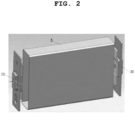
- FIG. 2 is a layout view of a side structure 10 of a battery pack for a secondary battery for a vehicle according to the present disclosure
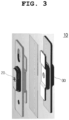
- FIG. 3 is a block diagram of a side structure of a battery pack for a secondary battery for a vehicle shown in FIG. 2 .
- the side structure 10 of a battery pack for a secondary battery for a vehicle is coupled to left and right sides of a battery pack casing 5 including a plurality of battery cells.
- the side structure 10 of a battery pack for a secondary battery for a vehicle includes an anode part cap assembly 20 and a cathode part cap assembly 30.
- the anode part cap assembly 20 is provided with an anode protrudingly formed on one surface thereof and fixedly coupled to a left side of the battery pack casing 5.
- the cathode part cap assembly 30 is provided with a cathode protrudingly formed on one surface thereof and fixedly coupled to a right side of the battery pack casing 5.
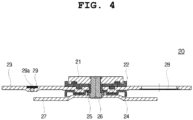
- FIG. 4 is an assembly view of an anode part cap assembly 20
- FIG. 5 is an exploded view of the anode part cap assembly 20 shown in FIG. 4
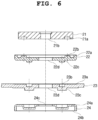
- FIG. 6 is an exploded view of a terminal plate 21, a conductor 22, a first cap plate 23, and an insulator 24.
- the anode part cap assembly 20 includes the terminal plate 21, the conductor 22, the first cap plate 23, and the insulator 24.
- the terminal plate 21 provided with upper coupling holes 21a recessed to be formed on opposite sides of a lower surface thereof, respectively.
- the terminal plate 21 is formed in a shape of a rectangular parallelepiped having a predetermined height.
- the terminal plate 21 may be made of a material having high electrical conductivity.
- the conductor 22 is provided under the terminal plate 21 and provided with an upper seating part 22a, on which a lower portion of the terminal plate 21 is seated, and which is recessed to be formed on a center of an upper surface thereof.
- the conductor 22 is formed in a shape of a rectangular parallelepiped having a predetermined height.
- the conductor 22 may be made of a material having no electrical conductivity.
- the upper seating part 22a is formed in a shape of a rectangular parallelepiped having a predetermined height, and a width and a length of the upper seating part 22a are formed to be larger than a width and a length of the terminal plate 21 to allow a lower portion of the terminal plate 21 to be inserted thereinto.
- the first cap plate 23 is provided under the conductor 22 and coupled by welding to the casing 5, thereby serving to protect an inside of the casing 5. At this time, the first cap plate 23 is formed to be elongated in left-right directions in a shape of a square plate having a predetermined thickness. In addition, the first cap plate 23 may be made of an aluminum material.
- the first cap plate 23 is provided with a lower seating part 23a, on which a lower portion of the conductor 22 is seated, and which is recessed to be formed on a center of an upper surface thereof.
- the lower seating part 23a is formed in a rectangular parallelepiped shape having a predetermined height, and a width and a length of the lower seating part 23a are formed to be larger than a width and a length of the conductor 22 to allow a lower portion of the conductor 22 to be inserted thereinto.
- the insulator 24 is provided at a lower surface of the first cap plate 23 and provided with a mounting portion 24b recessed to be formed at a lower surface of the insulator 24.
- the insulator 24 is formed in a rectangular shape having a predetermined height.
- the insulator 24 may be made of a plastic material.
- the upper seating part 22a is provided with upper protrusion parts 22b fixedly coupled to the upper coupling holes 21a of the terminal plate 21 and protrudingly formed on opposite sides of an upper surface thereof, respectively,
- the conductor 22 is provided with lower protrusion parts 22c protrudingly formed on opposite sides of a lower surface thereof, respectively,
- the lower seating part 23a is provided with lower coupling holes 23b, to which the lower protrusion parts 22c are fixedly coupled, and which are recessed to be formed on opposite sides of an upper surface thereof, respectively.
- first cap plate 23 is provided with upper protrusion parts 23c protrudingly formed on opposite sides of a lower surface thereof, respectively,
- the insulator 24 is provided with insertion holes 24a recessed to be formed on opposite sides of an upper surface thereof, respectively, corresponding to the upper protrusion parts 23c. At this time, each of the insertion holes 24a is formed in a shape of a cone with a diameter that increases toward a bottom.
- a first through hole 21b is formed through on a center of the upper surface of the terminal plate 21.
- the upper seating part 22a of the conductor 22 is provided with a second through hole 22d having a larger diameter than the first through hole 21b and formed through on a center of the upper surface thereof.
- the first cap plate 23 is provided with a third through hole 23d having the same diameter as the second through hole 22d formed through on a center of the upper surface thereof.
- the insulator 24 is provided with a fourth through hole 24c having the same diameter as the third through hole 23d formed through on a center of the upper surface thereof.
- FIG. 7 is an exploded view of a seal gasket 25, a rivet terminal 26, and an anode current collector 27.
- the anode part cap assembly 20 further includes the seal gasket 25, the rivet terminal 26, and the anode current collector 27.
- the seal gasket 25 is closely coupled to the second through hole 22d of the conductor 22, the third through hole 23d of the first cap plate 23, and the fourth through hole 24c of the insulator 24. At this time, the seal gasket 25 serves to seal current moving inside the rivet terminal 26 not to be leaked to the outside.
- the seal gasket 25 may be made of a material not having electrical conductivity.
- seal gasket 25 is provided with an upper through hole 25a formed through on a center of an upper surface thereof.
- the rivet terminal 26 is coupled to the first through hole 21b of the terminal plate 21 by caulking and welding and is connected in series with the terminal plate 21.
- the rivet terminal 26 may be made of a copper material thinly plated with nickel.
- an upper portion of the rivet terminal 26 is inserted through the upper through hole 25a of the seal gasket 25 and the first through hole 21b of the terminal plate 21, then is coupled to the first through hole 21b of the terminal plate 21 by caulking and welding.
- the anode current collector 27 is coupled to a lower portion of the rivet terminal 26 by caulking and welding, thereby being connected in series with the rivet terminal 26. At this time, the anode current collector 27 is formed to be elongated in the left-right directions in a shape of a rectangular plate having a predetermined thickness. In addition, the anode current collector 27 may be made of a material having high electrical conductivity.
- seal gasket 25 is provided with a base portion 25b protrudingly formed in a circumferential direction at a lower portion thereof.
- the rivet terminal 26 further includes an upper body portion 26a, an edge portion 26b, and a lower body portion 26c.
- the upper body portion 26a protrudingly formed in an opposite direction of gravity, thereby being fixedly coupled to the first through hole 21b of the terminal plate 21 and the upper through hole 25a of the seal gasket 25. At this time, the upper body portion 26a is formed in a shape of a cylinder having a predetermined height.
- edge portion 26b is provided at a lower portion of the upper body portion 26a and protrudingly formed in a circumferential direction.
- the lower body portion 26c is provided under the edge portion 26b and protrudingly formed in a direction of gravity. At this time, the lower body portion 26c is formed in a shape of a cylinder having a predetermined height.
- a diameter of the lower body portion 26c is formed to be larger than a diameter of the upper body portion 26a, and a height of the lower body portion 26c is formed to be smaller than a height of the upper body portion 26a.
- anode current collector 27 is provided with a lower through hole 27a, to which the lower body portion 26c of the rivet terminal 26 is fixedly coupled, and which is formed through on a center of the upper surface thereof.
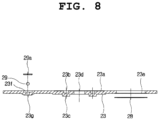
- FIG. 8 is an exploded view of the first cap plate 23, a seal ball 29, and a seal ball cover 29a.
- the first cap plate 23 is provided with a fixing hole 23e formed through on one side of the upper surface thereof.
- the first cap plate 23 is provided with an upper insertion hole 23f formed through on an opposite side of the upper surface thereof.
- a lower insertion hole 23g configured to inject an electrolyte into a plurality of battery cells accommodated at the inner side of the casing 5 is formed through under a lower portion of the upper insertion hole 23f.
- a diameter of the lower insertion hole 23g is formed to be smaller than a diameter of the upper insertion hole 23f.
- anode part cap assembly 20 further includes a vent 28, the seal ball 29, and the seal ball cover 29a.
- the vent 28 is fixedly coupled to the fixing hole 23e of the first cap plate 23. At this time, the vent 28 is formed in a shape of a plate having a predetermined thickness.
- vent (28) is provided, in order to improve the stability of the battery cell, with a plurality of through holes (28a) formed through on an upper surface thereof so that a gas inside the casing 5 is able to be discharged.
- the seal ball 29 is insertedly coupled to the lower insertion hole 23g of the first cap plate 23, thereby serving to seal the lower insertion hole 23g to prevent the electrolyte from flowing out through the lower insertion hole 23g.
- the seal ball 29 is formed in a shape of a sphere having a predetermined diameter.
- the seal ball cover 29a is fixedly coupled to the upper insertion hole 23f of the first cap plate 23 so that the seal ball 29 is not separated to an outer side. At this time, the seal ball cover 29a is formed in a shape of a disk having a predetermined thickness.
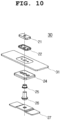
- FIG. 9 is an assembly view of a cathode part cap assembly 30, and FIG. 10 is an exploded view of the cathode part cap assembly 30 shown in FIG. 9 .
- the cathode part cap assembly 30 includes a second cap plate 31.
- the second cap plate 31 is not formed with the fixing hole 23e, the upper insertion hole 23f, and the lower insertion hole 23g.
- the second cap plate 31 is formed in the same shape as the first cap plate 23 from which the fixing hole 23e, the upper insertion hole 23f, and the lower insertion hole 23g are removed.
- the cathode cap assembly 30 does not include the vent 28, the seal ball 29, and the seal ball cover 29a included in the anode part cap assembly 20.
- a side structure 10 of a battery pack for an automotive secondary battery according to the present disclosure can reduce the number of battery cells in left and right directions in the battery pack from three to one, thereby reducing a loss area generated due to gaps between battery cells. Accordingly, there is an effect that can dramatically increase the efficiency of energy generated from the battery cell.
- the side structure 10 of a battery pack for an automotive secondary battery disposes an anode part cap assembly 20, in which an anode is protrudingly formed, and the cathode part cap assembly 30, in which a cathode is formed, on left and right side surfaces of a battery pack casing 5, respectively, rather than on an upper part of the battery pack casing 5.
- the present disclosure can reduce a height of a space occupied by a battery pack, thereby being efficiently reflected in a structural design of an automobile.
- the side structure 10 of a battery pack for an automotive secondary battery according to the present disclosure can increasing a capacity of the battery, thereby providing an effect of stabilizing the structure of the battery cell.
- the present disclosure has a main technical idea to provide the side structure of a battery pack for an automotive secondary battery, and the embodiment described above with reference to the drawings is only one embodiment.
- a true scope of the present disclosure is based on the claims but will also extend to even equivalent embodiments that may exist in various ways.
- a battery pack for an automotive secondary battery coupled to a left side and a right side of a casing provided on an outer side of the battery pack including a plurality of battery cells
- the side structure of a battery pack for an automotive secondary battery including: an anode part cap assembly provided with an anode protrudingly formed on one surface thereof and fixedly coupled to a left side of the casing; and a cathode part cap assembly provided with a cathode protrudingly formed on one surface thereof and fixedly coupled to a right side of the casing, wherein the anode part cap assembly comprises: a terminal plate; a conductor; and a first cap plate, wherein the first cap plate is provided with a lower seating part.
Landscapes
- Chemical & Material Sciences (AREA)
- Chemical Kinetics & Catalysis (AREA)
- Electrochemistry (AREA)
- General Chemical & Material Sciences (AREA)
- Engineering & Computer Science (AREA)
- Aviation & Aerospace Engineering (AREA)
- Sealing Battery Cases Or Jackets (AREA)
- Battery Mounting, Suspending (AREA)
- Connection Of Batteries Or Terminals (AREA)
Abstract
Description
- The present application claims priority to
Korean Patent Application No. 10-2021-0145410 filed on October 28, 2021 - The present disclosure relates to a side structure of a battery pack for an automotive secondary battery. More particularly, the present disclosure relates to a side structure of a battery pack for an automotive secondary battery that is capable of reducing a loss area caused by gaps between battery cells by reducing the number of battery cells in left and right directions from three to one, in order to increase the efficiency of energy generated from battery cells included in many secondary batteries for automobiles.
- Electrification and cordless are key to a future industrial change, and an era in which all things move using lithium polymer batteries is beginning. Specifically, the application areas of secondary batteries are continuously expanding, such as wireless home appliances, robots, drones, energy storage devices, electric vehicles, electric ships, and the like.
- Secondary batteries are a key means of sustainable growth that may meet eco-friendly global trends, and the secondary battery market is expected to grow rapidly due to increased demand from around the world. According to IHS Markit, secondary batteries are expected to grow into a larger market than memory semiconductors by 2025.
- In addition, according to SNE Research, the global secondary battery market is expected to grow more than 8 times over the next 10 years from $ 46.1 billion in 2020 to $ 351.7 billion in 2030, thanks to the expansion of electric vehicle supply.
- In addition, the proportion of secondary batteries for electric vehicles in the total secondary battery market is expected to increase from 65.9% in 2020 to 86.6% in 2030. In particular, secondary batteries for electric vehicles are expected to grow more than ten times over the next 10 years, from $30.4 billion in 2020 to $304.7 billion in 2030.
-
FIG. 1 is a block diagram of a conventional cap assembly, a casing, and a battery cell. - With reference to
FIG. 1 , in a conventional secondary battery for an electric vehicle, the interval between battery cells is formed to be spaced apart in the left and right directions, and thus there is a problem in that a loss region occurs in the interval between the battery cells, so the efficiency of energy generated from the battery cells is significantly lowered. - With reference to
FIG. 1 , in a conventional secondary battery for an electric vehicle, positive and negative poles are respectively formed on the left and right sides of an upper portion of the cap assembly, and battery cells are disposed under the cap assembly. In addition, since the battery cell provided with the cap assembly is disposed under the driver's feet, there is a problem in that the size of the space occupied by the battery pack increases. - The foregoing is intended merely to aid in the understanding of the background of the present disclosure, and is not intended to mean that the present disclosure falls within the purview of the related art that is already known to those skilled in the art.
- (Patent Document 1)
KR 10-1212552 - Accordingly, the present disclosure has been made keeping in mind the above problems occurring in the related art, and an objective of the present disclosure is to provide a side structure of a battery pack for an automotive secondary battery that is capable of reducing a loss area generated due to gaps between battery cells by reducing the number of battery cells in left and right directions from three to one, in order to increase the efficiency of energy generated from a plurality of battery cells included in secondary batteries for automobiles.
- In addition, another objective of the present disclosure is to provide the side structure of a battery pack for an automotive secondary battery, in which an anode part cap assembly, in which an anode is protrudingly formed, and a cathode part cap assembly, in which a cathode is formed, are disposed on left and right side surfaces of a battery pack casing, respectively, rather than on an upper part of the battery pack casing. As a result, the present disclosure is capable of reducing a height of a space occupied by a battery pack, thereby being efficiently reflected in a structural design of an automobile and of stabilizing a structure of the battery cell by increasing a capacity of the battery.
- In order to achieve the above objectives, according to one aspect of the present disclosure, there may be provided a
side structure 10 of a battery pack for an automotive secondary battery coupled to a left side and a right side of acasing 5 provided on an outer side of the battery pack including a plurality of battery cells, theside structure 10 of a battery pack for an automotive secondary battery, including: an anodepart cap assembly 20 provided with an anode protrudingly formed on one surface thereof and fixedly coupled to a left side of thecasing 5; and a cathodepart cap assembly 30 provided with a cathode protrudingly formed on one surface thereof and fixedly coupled to a right side of thecasing 5, wherein the anodepart cap assembly 20 may include: aterminal plate 21 provided withupper coupling holes 21a recessed to be formed on opposite sides of a lower surface thereof, respectively; aconductor 22 provided under theterminal plate 21 and provided with anupper seating part 22a, on which a lower portion of theterminal plate 21 may be seated, and which may be recessed to be formed on a center of an upper surface thereof; afirst cap plate 23 coupled by welding to thecasing 5, thereby protecting an inner side of thecasing 5; and aninsulator 24 provided under thefirst cap plate 23 and provided with amounting portion 24b recessed to be formed under a lower surface thereof, wherein thefirst cap plate 23 may be provided with a lowerportion seating part 23a, on which a lower portion of theconductor 22 may be seated, and which may be recessed to be formed on a center of an upper surface thereof. - In addition, the
upper seating part 22a may be provided withupper protrusion parts 22b fixedly coupled to theupper coupling holes 21a and protrudingly formed on opposite sides of an upper surface thereof, respectively, theconductor 22 may be provided withlower protrusion parts 22c protrudingly formed on opposite sides of a lower surface thereof, respectively, thelower seating part 23a may be provided withlower coupling holes 23b, to which thelower protrusion parts 22c may be fixedly coupled, and which may be recessed to be formed on opposite sides of an upper surface thereof, respectively, thefirst cap plate 23 is provided withupper protrusion parts 23c protrudingly formed on opposite sides of a lower surface thereof, respectively, and theinsulator 24 is provided withinsertion holes 24a recessed to be formed on opposite sides of an upper surface thereof, respectively, corresponding to theupper protrusion parts 23c. - In addition, the
terminal plate 21 may be provided with a first throughhole 21b formed through on a center of an upper surface thereof, theupper seating part 22a may be provided with a second throughhole 22d having a larger diameter than the first throughhole 21b and formed through on a center of the upper surface thereof, thefirst cap plate 23 may be provided with a third throughhole 23d having the same diameter as the second throughhole 22d formed through on a center of the upper surface thereof, theinsulator 24 may be provided with a fourth throughhole 24c having the same diameter as the third throughhole 23d formed through on a center of the upper surface thereof, and the anodepart cap assembly 20 may include: aseal gasket 25 closely coupled to the second throughhole 22d, the third throughhole 23d, and the fourth throughhole 24c, and provided with an upper throughhole 25a formed through on a center of an upper surface thereof; arivet terminal 26 having an upper portion coupled to the first throughhole 21b by caulking and welding, thereby being connected in series with theterminal plate 21; and an anodecurrent collector 27 coupled to a lower portion of therivet terminal 26 by caulking and welding, thereby being connected in series with therivet terminal 26, wherein therivet terminal 26 may have an upper portion inserted passing through the first throughhole 21b and the upper throughhole 25a, and the anodecurrent collector 27 may be seated under themounting portion 24b. - In addition, the
seal gasket 25 may be provided with abase portion 25b protrudingly formed in a circumferential direction at a lower portion thereof, therivet terminal 26 may include: anupper body portion 26a protrudingly formed in an opposite direction of gravity, thereby being fixedly coupled to the first throughhole 21b and the upper throughhole 25a; anedge portion 26b provided at a lower portion of theupper body portion 26a and protrudingly formed in a circumferential direction; and alower body portion 26c provided under theedge portion 26b and protrudingly formed in a direction of gravity, wherein theanode collector 27 may be provided with a lower throughhole 27a, to which thelower body portion 26c may be fixedly coupled, and which may be formed through on a center of an upper surface thereof. - In addition, the
first cap plate 23 may be provided with afixing hole 23e formed through on one side of the upper surface thereof, an upper insertion hole 23f formed through on an opposite side of the upper surface thereof, and a lower insertion hole 23g configured to inject an electrolyte into a plurality of battery cells accommodated at the inner side of thecasing 5, and the anodepart cap assembly 20 may further include: avent 28 fixedly coupled to thefixing hole 23e; aseal ball 29 fixedly coupled to the lower insertion hole 23g, thereby sealing the lower insertion hole 23g so that the electrolyte may not flow out to an outside through the lower insertion hole 23g; and aseal ball cover 29a fixedly coupled to the upper insertion hole 23f so that theseal ball 29 may not be separated to an outer side. - In addition, the
vent 28 may be provided with a plurality of throughholes 28a formed through on an upper surface thereof so that a gas inside thecasing 5 may be able to be discharged. - As described above, a side structure of a battery pack for an automotive secondary battery according to the present disclosure can reduce the number of battery cells in left and right directions in the battery pack from three to one, thereby reducing a loss area generated due to gaps between battery cells. Accordingly, there is an effect that can dramatically increase the efficiency of energy generated from the battery cell.
- In addition, the side structure of a battery pack for an automotive secondary battery according to the present disclosure disposes an anode part cap assembly, in which an anode is protrudingly formed, and a cathode part cap assembly, in which a cathode is formed, on left and right side surfaces of a battery pack casing, respectively, rather than on an upper part of the battery pack casing. As a result, there is an effect in that the present disclosure can reduce a height of a space occupied by a battery pack, thereby being efficiently reflected in a structural design of an automobile.
- In addition, the side structure of a battery pack for an automotive secondary battery according to the present disclosure can increasing a capacity of the battery, thereby providing an effect of stabilizing the structure of the battery cell.
- The above and other objectives, features, and other advantages of the present disclosure will be more clearly understood from the following detailed description when taken in conjunction with the accompanying drawings, in which:
-
FIG. 1 is a block diagram of a conventional cap assembly, a casing, and a battery cell; -
FIG. 2 is a layout view of a side structure of a battery pack for a secondary battery for a vehicle according to the present disclosure; -
FIG. 3 is a block diagram of the side structure of a battery pack for a secondary battery for a vehicle shown inFIG. 2 ; -
FIG. 4 is an assembly view of an anode part cap assembly; -
FIG. 5 is an exploded view of the anode part cap assembly shown inFIG. 4 ; -
FIG. 6 is an exploded view of a terminal plate, a conductor, a first cap plate, and an insulator; -
FIG. 7 is an exploded view of a seal gasket, a rivet terminal, and an anode current collector; -
FIG. 8 is an exploded view of a cap plate, a seal ball, and a seal ball cover; -
FIG. 9 is an assembly view of a cathode part cap assembly; and -
FIG. 10 is an exploded view of the cathode part cap assembly shown inFIG. 9 . - Hereinafter, an embodiment of the present disclosure will be described with reference to the accompanying drawings in order to describe in detail enough that a person of ordinary skill in the art to which the present disclosure pertains may easily implement the technical idea of the present disclosure.
- However, the following examples are merely examples to help the understanding of the present disclosure, thereby not reducing or limiting the scope of the present disclosure. In addition, the present disclosure may be embodied in several different forms and is not limited to the embodiments described herein.
-
FIG. 2 is a layout view of aside structure 10 of a battery pack for a secondary battery for a vehicle according to the present disclosure, andFIG. 3 is a block diagram of a side structure of a battery pack for a secondary battery for a vehicle shown inFIG. 2 . - With reference to
FIGS. 2 and3 , theside structure 10 of a battery pack for a secondary battery for a vehicle according to the present disclosure is coupled to left and right sides of abattery pack casing 5 including a plurality of battery cells. - The
side structure 10 of a battery pack for a secondary battery for a vehicle according to the present disclosure includes an anodepart cap assembly 20 and a cathodepart cap assembly 30. - First, the anode
part cap assembly 20 is provided with an anode protrudingly formed on one surface thereof and fixedly coupled to a left side of thebattery pack casing 5. - In addition, the cathode
part cap assembly 30 is provided with a cathode protrudingly formed on one surface thereof and fixedly coupled to a right side of thebattery pack casing 5. -
FIG. 4 is an assembly view of an anodepart cap assembly 20,FIG. 5 is an exploded view of the anodepart cap assembly 20 shown inFIG. 4 , andFIG. 6 is an exploded view of aterminal plate 21, aconductor 22, afirst cap plate 23, and aninsulator 24. - With reference to
FIGS. 4 to 6 , the anodepart cap assembly 20 includes theterminal plate 21, theconductor 22, thefirst cap plate 23, and theinsulator 24. - First, the
terminal plate 21 provided withupper coupling holes 21a recessed to be formed on opposite sides of a lower surface thereof, respectively. - At this time, the
terminal plate 21 is formed in a shape of a rectangular parallelepiped having a predetermined height. In addition, theterminal plate 21 may be made of a material having high electrical conductivity. - In addition, the
conductor 22 is provided under theterminal plate 21 and provided with anupper seating part 22a, on which a lower portion of theterminal plate 21 is seated, and which is recessed to be formed on a center of an upper surface thereof. - At this time, the
conductor 22 is formed in a shape of a rectangular parallelepiped having a predetermined height. In addition, theconductor 22 may be made of a material having no electrical conductivity. - In addition, the
upper seating part 22a is formed in a shape of a rectangular parallelepiped having a predetermined height, and a width and a length of theupper seating part 22a are formed to be larger than a width and a length of theterminal plate 21 to allow a lower portion of theterminal plate 21 to be inserted thereinto. - In addition, the
first cap plate 23 is provided under theconductor 22 and coupled by welding to thecasing 5, thereby serving to protect an inside of thecasing 5. At this time, thefirst cap plate 23 is formed to be elongated in left-right directions in a shape of a square plate having a predetermined thickness. In addition, thefirst cap plate 23 may be made of an aluminum material. - In addition, the
first cap plate 23 is provided with alower seating part 23a, on which a lower portion of theconductor 22 is seated, and which is recessed to be formed on a center of an upper surface thereof. At this time, thelower seating part 23a is formed in a rectangular parallelepiped shape having a predetermined height, and a width and a length of thelower seating part 23a are formed to be larger than a width and a length of theconductor 22 to allow a lower portion of theconductor 22 to be inserted thereinto. - In addition, the
insulator 24 is provided at a lower surface of thefirst cap plate 23 and provided with a mountingportion 24b recessed to be formed at a lower surface of theinsulator 24. - At this time, the
insulator 24 is formed in a rectangular shape having a predetermined height. In addition, theinsulator 24 may be made of a plastic material. - Meanwhile, the
upper seating part 22a is provided withupper protrusion parts 22b fixedly coupled to theupper coupling holes 21a of theterminal plate 21 and protrudingly formed on opposite sides of an upper surface thereof, respectively, - In addition, the
conductor 22 is provided withlower protrusion parts 22c protrudingly formed on opposite sides of a lower surface thereof, respectively, - In addition, the
lower seating part 23a is provided withlower coupling holes 23b, to which thelower protrusion parts 22c are fixedly coupled, and which are recessed to be formed on opposite sides of an upper surface thereof, respectively. - In addition, the
first cap plate 23 is provided withupper protrusion parts 23c protrudingly formed on opposite sides of a lower surface thereof, respectively, - In addition, the
insulator 24 is provided withinsertion holes 24a recessed to be formed on opposite sides of an upper surface thereof, respectively, corresponding to theupper protrusion parts 23c. At this time, each of theinsertion holes 24a is formed in a shape of a cone with a diameter that increases toward a bottom. - With reference to
FIG. 6 , a first throughhole 21b is formed through on a center of the upper surface of theterminal plate 21. - In addition, the
upper seating part 22a of theconductor 22 is provided with a second throughhole 22d having a larger diameter than the first throughhole 21b and formed through on a center of the upper surface thereof. - In addition, the
first cap plate 23 is provided with a third throughhole 23d having the same diameter as the second throughhole 22d formed through on a center of the upper surface thereof. - In addition, the
insulator 24 is provided with a fourth throughhole 24c having the same diameter as the third throughhole 23d formed through on a center of the upper surface thereof. -
FIG. 7 is an exploded view of aseal gasket 25, arivet terminal 26, and an anodecurrent collector 27. - With reference to
FIGS. 6 and7 , the anodepart cap assembly 20 further includes theseal gasket 25, therivet terminal 26, and the anodecurrent collector 27. - First, the
seal gasket 25 is closely coupled to the second throughhole 22d of theconductor 22, the third throughhole 23d of thefirst cap plate 23, and the fourth throughhole 24c of theinsulator 24. At this time, theseal gasket 25 serves to seal current moving inside therivet terminal 26 not to be leaked to the outside. In addition, theseal gasket 25 may be made of a material not having electrical conductivity. - In addition, the
seal gasket 25 is provided with an upper throughhole 25a formed through on a center of an upper surface thereof. - In addition, the
rivet terminal 26 is coupled to the first throughhole 21b of theterminal plate 21 by caulking and welding and is connected in series with theterminal plate 21. At this time, therivet terminal 26 may be made of a copper material thinly plated with nickel. - Specifically, an upper portion of the
rivet terminal 26 is inserted through the upper throughhole 25a of theseal gasket 25 and the first throughhole 21b of theterminal plate 21, then is coupled to the first throughhole 21b of theterminal plate 21 by caulking and welding. - In addition, the anode
current collector 27 is coupled to a lower portion of therivet terminal 26 by caulking and welding, thereby being connected in series with therivet terminal 26. At this time, the anodecurrent collector 27 is formed to be elongated in the left-right directions in a shape of a rectangular plate having a predetermined thickness. In addition, the anodecurrent collector 27 may be made of a material having high electrical conductivity. - Meanwhile, a current collected by the anode
current collector 27 passes through therivet terminal 26 and moves to theterminal plate 21. - In addition, the
seal gasket 25 is provided with abase portion 25b protrudingly formed in a circumferential direction at a lower portion thereof. - In addition, the
rivet terminal 26 further includes anupper body portion 26a, anedge portion 26b, and alower body portion 26c. - First, the
upper body portion 26a protrudingly formed in an opposite direction of gravity, thereby being fixedly coupled to the first throughhole 21b of theterminal plate 21 and the upper throughhole 25a of theseal gasket 25. At this time, theupper body portion 26a is formed in a shape of a cylinder having a predetermined height. - In addition, the
edge portion 26b is provided at a lower portion of theupper body portion 26a and protrudingly formed in a circumferential direction. - In addition, the
lower body portion 26c is provided under theedge portion 26b and protrudingly formed in a direction of gravity. At this time, thelower body portion 26c is formed in a shape of a cylinder having a predetermined height. - At this time, a diameter of the
lower body portion 26c is formed to be larger than a diameter of theupper body portion 26a, and a height of thelower body portion 26c is formed to be smaller than a height of theupper body portion 26a. - In addition, the anode
current collector 27 is provided with a lower throughhole 27a, to which thelower body portion 26c of therivet terminal 26 is fixedly coupled, and which is formed through on a center of the upper surface thereof. -
FIG. 8 is an exploded view of thefirst cap plate 23, aseal ball 29, and aseal ball cover 29a. - With reference to
FIG. 8 , thefirst cap plate 23 is provided with a fixinghole 23e formed through on one side of the upper surface thereof. - In addition, the
first cap plate 23 is provided with an upper insertion hole 23f formed through on an opposite side of the upper surface thereof. In addition, a lower insertion hole 23g configured to inject an electrolyte into a plurality of battery cells accommodated at the inner side of thecasing 5 is formed through under a lower portion of the upper insertion hole 23f. In this case, a diameter of the lower insertion hole 23g is formed to be smaller than a diameter of the upper insertion hole 23f. - In addition, the anode
part cap assembly 20 further includes avent 28, theseal ball 29, and theseal ball cover 29a. - First, the
vent 28 is fixedly coupled to the fixinghole 23e of thefirst cap plate 23. At this time, thevent 28 is formed in a shape of a plate having a predetermined thickness. - In addition, the vent (28) is provided, in order to improve the stability of the battery cell, with a plurality of through holes (28a) formed through on an upper surface thereof so that a gas inside the
casing 5 is able to be discharged. - In addition, the
seal ball 29 is insertedly coupled to the lower insertion hole 23g of thefirst cap plate 23, thereby serving to seal the lower insertion hole 23g to prevent the electrolyte from flowing out through the lower insertion hole 23g. At this time, theseal ball 29 is formed in a shape of a sphere having a predetermined diameter. - In addition, the
seal ball cover 29a is fixedly coupled to the upper insertion hole 23f of thefirst cap plate 23 so that theseal ball 29 is not separated to an outer side. At this time, theseal ball cover 29a is formed in a shape of a disk having a predetermined thickness. -
FIG. 9 is an assembly view of a cathodepart cap assembly 30, andFIG. 10 is an exploded view of the cathodepart cap assembly 30 shown inFIG. 9 . - With reference to
FIGS. 9 and10 , the cathodepart cap assembly 30 includes asecond cap plate 31. - Differently from the
first cap plate 23, thesecond cap plate 31 is not formed with the fixinghole 23e, the upper insertion hole 23f, and the lower insertion hole 23g. In other words, thesecond cap plate 31 is formed in the same shape as thefirst cap plate 23 from which thefixing hole 23e, the upper insertion hole 23f, and the lower insertion hole 23g are removed. - In addition, the
cathode cap assembly 30 does not include thevent 28, theseal ball 29, and theseal ball cover 29a included in the anodepart cap assembly 20. - A
side structure 10 of a battery pack for an automotive secondary battery according to the present disclosure can reduce the number of battery cells in left and right directions in the battery pack from three to one, thereby reducing a loss area generated due to gaps between battery cells. Accordingly, there is an effect that can dramatically increase the efficiency of energy generated from the battery cell. - In addition, the
side structure 10 of a battery pack for an automotive secondary battery according to the present disclosure disposes an anodepart cap assembly 20, in which an anode is protrudingly formed, and the cathodepart cap assembly 30, in which a cathode is formed, on left and right side surfaces of abattery pack casing 5, respectively, rather than on an upper part of thebattery pack casing 5. As a result, there is an effect in that the present disclosure can reduce a height of a space occupied by a battery pack, thereby being efficiently reflected in a structural design of an automobile. - In addition, the
side structure 10 of a battery pack for an automotive secondary battery according to the present disclosure can increasing a capacity of the battery, thereby providing an effect of stabilizing the structure of the battery cell. - As described above, the present disclosure has a main technical idea to provide the side structure of a battery pack for an automotive secondary battery, and the embodiment described above with reference to the drawings is only one embodiment. In addition, a true scope of the present disclosure is based on the claims but will also extend to even equivalent embodiments that may exist in various ways.
- In conclusion: Provided is aside structure of a battery pack for an automotive secondary battery coupled to a left side and a right side of a casing provided on an outer side of the battery pack including a plurality of battery cells, the side structure of a battery pack for an automotive secondary battery including: an anode part cap assembly provided with an anode protrudingly formed on one surface thereof and fixedly coupled to a left side of the casing; and a cathode part cap assembly provided with a cathode protrudingly formed on one surface thereof and fixedly coupled to a right side of the casing, wherein the anode part cap assembly comprises: a terminal plate; a conductor; and a first cap plate, wherein the first cap plate is provided with a lower seating part.
Claims (6)
- A side structure (10) of a battery pack for an automotive secondary battery coupled to a left side and a right side of a casing (5) provided on an outer side of the battery pack including a plurality of battery cells, the side structure (10) of a battery pack for an automotive secondary battery comprising:an anode part cap assembly (20) provided with an anode protrudingly formed on one surface thereof and fixedly coupled to a left side of the casing (5); anda cathode part cap assembly (30) provided with a cathode protrudingly formed on one surface thereof and fixedly coupled to a right side of the casing (5),wherein the anode part cap assembly (20) comprises:a terminal plate (21) provided with upper coupling holes (21a) recessed to be formed on opposite sides of a lower surface thereof, respectively;a conductor (22) provided under the terminal plate (21) and provided with an upper seating part (22a), on which a lower portion of the terminal plate (21) is seated, and which is recessed to be formed on a center of an upper surface thereof;a first cap plate (23) coupled by welding to the casing (5), thereby protecting an inner side of the casing (5); andan insulator (24) provided under the first cap plate (23) and provided with a mounting portion (24b) recessed to be formed under a lower surface thereof,wherein the first cap plate (23) is provided with a lower portion seating part (23a), on which a lower portion of the conductor (22) is seated, and which is recessed to be formed on a center of an upper surface thereof.
- The side structure of a battery pack for an automotive secondary battery of claim 1, wherein the upper seating part (22a) is provided with upper protrusion parts (22b) fixedly coupled to the upper coupling holes (21a) and protrudingly formed on opposite sides of an upper surface thereof, respectively,wherein the conductor (22) is provided with lower protrusion parts (22c) protrudingly formed on opposite sides of a lower surface thereof, respectively,wherein the lower seating part (23a) is provided with lower coupling holes (23b), to which the lower protrusion parts (22c) are fixedly coupled, and which are recessed to be formed on opposite sides of an upper surface thereof, respectively,wherein the first cap plate (23) is provided with upper protrusion parts (23c) protrudingly formed on opposite sides of a lower surface thereof, respectively, andwherein the insulator (24) is provided with insertion holes (24a) recessed to be formed on opposite sides of an upper surface thereof, respectively, corresponding to the upper protrusion parts (23c) .
- The side structure of a battery pack for an automotive secondary battery of claim 1, wherein the terminal plate (21) is provided with a first through hole (21b) formed through on a center of an upper surface thereof,wherein the upper seating part (22a) is provided with a second through hole (22d) having a larger diameter than the first through hole (21b) and formed through on a center of the upper surface thereof,wherein the first cap plate (23) is provided with a third through hole (23d) having the same diameter as the second through hole (22d) formed through on a center of the upper surface thereof,wherein the insulator (24) is provided with a fourth through hole (24c) having the same diameter as the third through hole (23d) formed through on a center of the upper surface thereof, andwherein the anode part cap assembly (20) comprises:a seal gasket (25) closely coupled to the second through hole (22d), the third through hole (23d), and the fourth through hole (24c), and provided with an upper through hole (25a) formed through on a center of an upper surface thereof;a rivet terminal (26) having an upper portion coupled to the first through hole (21b) by caulking and welding, thereby being connected in series with the terminal plate (21); andan anode current collector (27) coupled to a lower portion of the rivet terminal (26) by caulking and welding, thereby being connected in series with the rivet terminal (26),wherein the rivet terminal (26) has an upper portion inserted passing through the first through hole (21b) and the upper through hole (25a), andwherein the anode current collector (27) is seated under the mounting portion (24b).
- The side structure of a battery pack for an automotive secondary battery of claim 3, wherein the seal gasket (25) is provided with a base portion (25b) protrudingly formed in a circumferential direction at a lower portion thereof,wherein the rivet terminal (26) comprises:an upper body portion (26a) protrudingly formed in an opposite direction of gravity, thereby being fixedly coupled to the first through hole (21b) and the upper through hole (25a);an edge portion (26b) provided at a lower portion of the upper body portion (26a) and protrudingly formed in a circumferential direction; anda lower body portion (26c) provided under the edge portion (26b) and protrudingly formed in a direction of gravity, andwherein the anode collector (27) is provided with a lower through hole (27a), to which the lower body portion (26c) is fixedly coupled, and which is formed through on a center of an upper surface thereof.
- The side structure of a battery pack for an automotive secondary battery of claim 1, wherein the first cap plate (23) is provided with a fixing hole (23e) formed through on one side of the upper surface thereof, an upper insertion hole (23f) formed through on an opposite side of the upper surface thereof, and a lower insertion hole (23g) configured to inject an electrolyte into a plurality of battery cells accommodated at the inner side of the casing (5), and
wherein the anode part cap assembly (20) further comprises:a vent (28) fixedly coupled to the fixing hole (23e);a seal ball (29) fixedly coupled to the lower insertion hole (23g), thereby sealing the lower insertion hole (23g) so that the electrolyte does not flow out to an outside through the lower insertion hole (23g); anda seal ball cover (29a) fixedly coupled to the upper insertion hole (23f) so that the seal ball (29) is not separated to an outer side. - The side structure of a battery pack for an automotive secondary battery of claim 5, wherein the vent (28) is provided with a plurality of through holes (28a) formed through on an upper surface thereof so that a gas inside the casing (5) is able to be discharged.
Applications Claiming Priority (1)
| Application Number | Priority Date | Filing Date | Title |
|---|---|---|---|
| KR1020210145410A KR102712872B1 (en) | 2021-10-28 | 2021-10-28 | Side Arrangement Structure of Cap Assembly |
Publications (1)
| Publication Number | Publication Date |
|---|---|
| EP4175029A1 true EP4175029A1 (en) | 2023-05-03 |
Family
ID=78828017
Family Applications (1)
| Application Number | Title | Priority Date | Filing Date |
|---|---|---|---|
| EP21213527.1A Withdrawn EP4175029A1 (en) | 2021-10-28 | 2021-12-09 | Side structure of battery pack for automotive secondary battery |
Country Status (4)
| Country | Link |
|---|---|
| US (1) | US20230137125A1 (en) |
| EP (1) | EP4175029A1 (en) |
| KR (1) | KR102712872B1 (en) |
| CN (1) | CN116053692A (en) |
Families Citing this family (5)
| Publication number | Priority date | Publication date | Assignee | Title |
|---|---|---|---|---|
| KR102853427B1 (en) * | 2023-06-09 | 2025-09-02 | 삼성에스디아이 주식회사 | Secondary battery |
| KR102610475B1 (en) * | 2023-07-04 | 2023-12-06 | 주식회사 블루캡캔 | Laser welding method of dissimilar metals of secondary battery cap assembly |
| KR20250081396A (en) * | 2023-11-29 | 2025-06-05 | 삼성에스디아이 주식회사 | Can, secondary battery including same, and method of manufacturing secondary battery including same |
| JP2026003517A (en) * | 2024-06-24 | 2026-01-13 | プライムプラネットエナジー&ソリューションズ株式会社 | Energy storage devices |
| US20260066486A1 (en) * | 2024-09-04 | 2026-03-05 | Lg Electronics Inc. | Pouch type secondary battery and battery pack including the same |
Citations (4)
| Publication number | Priority date | Publication date | Assignee | Title |
|---|---|---|---|---|
| US20050074667A1 (en) * | 2003-10-07 | 2005-04-07 | Iuan-Jou Yang | Lithium battery |
| KR101212552B1 (en) | 2010-11-29 | 2012-12-14 | 한국과학기술원 | Structure for electric vehicle battery pack |
| EP2827399A2 (en) * | 2013-07-19 | 2015-01-21 | Samsung SDI Co., Ltd. | Rechargeable battery |
| US20180205044A1 (en) * | 2017-01-17 | 2018-07-19 | Fdk Corporation | Sealing body of tube-shaped battery and tube-shaped battery |
Family Cites Families (9)
| Publication number | Priority date | Publication date | Assignee | Title |
|---|---|---|---|---|
| US20120214053A1 (en) * | 2011-02-18 | 2012-08-23 | Dukjung Kim | Rechargeable battery and method of manufacturing the same |
| KR20130139446A (en) * | 2012-06-07 | 2013-12-23 | 삼성에스디아이 주식회사 | Secondary battery |
| KR20160148316A (en) * | 2015-06-16 | 2016-12-26 | 삼성에스디아이 주식회사 | Rechargeable battery |
| DE112016006086T5 (en) * | 2015-12-28 | 2018-09-13 | Gs Yuasa International Ltd. | Energy storage device and method for producing the energy storage device |
| KR102137699B1 (en) * | 2017-02-23 | 2020-07-24 | 주식회사 엘지화학 | Battery cell with bus bar |
| JP7011044B2 (en) * | 2018-03-28 | 2022-02-10 | 株式会社東芝 | Batteries, battery packs, power storage devices, vehicles and flying objects |
| JP6533333B1 (en) * | 2018-12-28 | 2019-06-19 | 株式会社ジェイ・イー・ティ | Method of manufacturing secondary battery and apparatus for manufacturing secondary battery |
| JP7326923B2 (en) | 2019-06-26 | 2023-08-16 | 株式会社村田製作所 | solid state battery |
| US11588198B2 (en) * | 2020-01-29 | 2023-02-21 | Toyota Motor Engineering & Manufacturing North America, Inc. | Pivoting bus bar module terminal assembly |
-
2021
- 2021-10-28 KR KR1020210145410A patent/KR102712872B1/en active Active
- 2021-11-24 US US17/535,175 patent/US20230137125A1/en not_active Abandoned
- 2021-11-30 CN CN202111448268.8A patent/CN116053692A/en active Pending
- 2021-12-09 EP EP21213527.1A patent/EP4175029A1/en not_active Withdrawn
Patent Citations (4)
| Publication number | Priority date | Publication date | Assignee | Title |
|---|---|---|---|---|
| US20050074667A1 (en) * | 2003-10-07 | 2005-04-07 | Iuan-Jou Yang | Lithium battery |
| KR101212552B1 (en) | 2010-11-29 | 2012-12-14 | 한국과학기술원 | Structure for electric vehicle battery pack |
| EP2827399A2 (en) * | 2013-07-19 | 2015-01-21 | Samsung SDI Co., Ltd. | Rechargeable battery |
| US20180205044A1 (en) * | 2017-01-17 | 2018-07-19 | Fdk Corporation | Sealing body of tube-shaped battery and tube-shaped battery |
Also Published As
| Publication number | Publication date |
|---|---|
| CN116053692A (en) | 2023-05-02 |
| KR20230060813A (en) | 2023-05-08 |
| KR102712872B1 (en) | 2024-10-04 |
| US20230137125A1 (en) | 2023-05-04 |
Similar Documents
| Publication | Publication Date | Title |
|---|---|---|
| EP4175029A1 (en) | Side structure of battery pack for automotive secondary battery | |
| US11804626B2 (en) | Battery modules with improved heat dissipation | |
| CN108735936B (en) | Battery modules, battery packs and vehicles | |
| EP3570347A1 (en) | Battery module having guide coupling structure and battery pack comprising same | |
| KR100949333B1 (en) | Battery module | |
| EP2523238A2 (en) | Battery module | |
| KR20180117033A (en) | Battery module | |
| CN113809380B (en) | Rechargeable battery | |
| US20130130099A1 (en) | Secondary battery of differential lead structure | |
| US10629944B2 (en) | Battery cell | |
| US10665828B2 (en) | Rechargeable battery | |
| US20150099164A1 (en) | Rechargeable battery | |
| KR101791427B1 (en) | Battery Pack Comprising Cap Plate Having Inducing Portion of Electrolyte On Inner Surface Thereof | |
| KR20160015751A (en) | Structure for fixing dimension of battery cell and parallel connecting structure between battery cells using the same | |
| KR20170005581A (en) | Battery Cell Having Coolant Flow Conduit | |
| KR102784799B1 (en) | Side structure of the cap assembly | |
| KR100696670B1 (en) | Secondary battery module | |
| CN106981589B (en) | Battery unit | |
| KR100759395B1 (en) | Secondary battery | |
| KR20060118798A (en) | Secondary battery module | |
| US11133547B2 (en) | Rechargeable battery | |
| CN222637550U (en) | Battery and electricity utilization device | |
| US20250239733A1 (en) | Secondary battery | |
| US20260121193A1 (en) | Battery module and battery pack including the same | |
| US20260038984A1 (en) | Sub plate assembly and secondary battery including the same |
Legal Events
| Date | Code | Title | Description |
|---|---|---|---|
| PUAI | Public reference made under article 153(3) epc to a published international application that has entered the european phase |
Free format text: ORIGINAL CODE: 0009012 |
|
| STAA | Information on the status of an ep patent application or granted ep patent |
Free format text: STATUS: REQUEST FOR EXAMINATION WAS MADE |
|
| 17P | Request for examination filed |
Effective date: 20211209 |
|
| AK | Designated contracting states |
Kind code of ref document: A1 Designated state(s): AL AT BE BG CH CY CZ DE DK EE ES FI FR GB GR HR HU IE IS IT LI LT LU LV MC MK MT NL NO PL PT RO RS SE SI SK SM TR |
|
| RBV | Designated contracting states (corrected) |
Designated state(s): AL AT BE BG CH CY CZ DE DK EE ES FI FR GB GR HR HU IE IS IT LI LT LU LV MC MK MT NL NO PL PT RO RS SE SI SK SM TR |
|
| STAA | Information on the status of an ep patent application or granted ep patent |
Free format text: STATUS: THE APPLICATION IS DEEMED TO BE WITHDRAWN |
|
| 18D | Application deemed to be withdrawn |
Effective date: 20250701 |