EP4175022B1 - Battery system and vehicle including the battery system - Google Patents
Battery system and vehicle including the battery system Download PDFInfo
- Publication number
- EP4175022B1 EP4175022B1 EP21205222.9A EP21205222A EP4175022B1 EP 4175022 B1 EP4175022 B1 EP 4175022B1 EP 21205222 A EP21205222 A EP 21205222A EP 4175022 B1 EP4175022 B1 EP 4175022B1
- Authority
- EP
- European Patent Office
- Prior art keywords
- venting
- battery
- separation sheet
- battery cell
- battery system
- Prior art date
- Legal status (The legal status is an assumption and is not a legal conclusion. Google has not performed a legal analysis and makes no representation as to the accuracy of the status listed.)
- Active
Links
Images



Classifications
-
- H—ELECTRICITY
- H01—ELECTRIC ELEMENTS
- H01M—PROCESSES OR MEANS, e.g. BATTERIES, FOR THE DIRECT CONVERSION OF CHEMICAL ENERGY INTO ELECTRICAL ENERGY
- H01M10/00—Secondary cells; Manufacture thereof
- H01M10/60—Heating or cooling; Temperature control
- H01M10/65—Means for temperature control structurally associated with the cells
- H01M10/656—Means for temperature control structurally associated with the cells characterised by the type of heat-exchange fluid
- H01M10/6561—Gases
- H01M10/6566—Means within the gas flow to guide the flow around one or more cells, e.g. manifolds, baffles or other barriers
-
- H—ELECTRICITY
- H01—ELECTRIC ELEMENTS
- H01M—PROCESSES OR MEANS, e.g. BATTERIES, FOR THE DIRECT CONVERSION OF CHEMICAL ENERGY INTO ELECTRICAL ENERGY
- H01M50/00—Constructional details or processes of manufacture of the non-active parts of electrochemical cells other than fuel cells, e.g. hybrid cells
- H01M50/30—Arrangements for facilitating escape of gases
- H01M50/35—Gas exhaust passages comprising elongated, tortuous or labyrinth-shaped exhaust passages
- H01M50/367—Internal gas exhaust passages forming part of the battery cover or case; Double cover vent systems
-
- H—ELECTRICITY
- H01—ELECTRIC ELEMENTS
- H01M—PROCESSES OR MEANS, e.g. BATTERIES, FOR THE DIRECT CONVERSION OF CHEMICAL ENERGY INTO ELECTRICAL ENERGY
- H01M10/00—Secondary cells; Manufacture thereof
- H01M10/60—Heating or cooling; Temperature control
- H01M10/61—Types of temperature control
- H01M10/613—Cooling or keeping cold
-
- H—ELECTRICITY
- H01—ELECTRIC ELEMENTS
- H01M—PROCESSES OR MEANS, e.g. BATTERIES, FOR THE DIRECT CONVERSION OF CHEMICAL ENERGY INTO ELECTRICAL ENERGY
- H01M10/00—Secondary cells; Manufacture thereof
- H01M10/60—Heating or cooling; Temperature control
- H01M10/65—Means for temperature control structurally associated with the cells
- H01M10/655—Solid structures for heat exchange or heat conduction
- H01M10/6554—Rods or plates
-
- H—ELECTRICITY
- H01—ELECTRIC ELEMENTS
- H01M—PROCESSES OR MEANS, e.g. BATTERIES, FOR THE DIRECT CONVERSION OF CHEMICAL ENERGY INTO ELECTRICAL ENERGY
- H01M50/00—Constructional details or processes of manufacture of the non-active parts of electrochemical cells other than fuel cells, e.g. hybrid cells
- H01M50/20—Mountings; Secondary casings or frames; Racks, modules or packs; Suspension devices; Shock absorbers; Transport or carrying devices; Holders
- H01M50/233—Mountings; Secondary casings or frames; Racks, modules or packs; Suspension devices; Shock absorbers; Transport or carrying devices; Holders characterised by physical properties of casings or racks, e.g. dimensions
- H01M50/24—Mountings; Secondary casings or frames; Racks, modules or packs; Suspension devices; Shock absorbers; Transport or carrying devices; Holders characterised by physical properties of casings or racks, e.g. dimensions adapted for protecting batteries from their environment, e.g. from corrosion
-
- H—ELECTRICITY
- H01—ELECTRIC ELEMENTS
- H01M—PROCESSES OR MEANS, e.g. BATTERIES, FOR THE DIRECT CONVERSION OF CHEMICAL ENERGY INTO ELECTRICAL ENERGY
- H01M50/00—Constructional details or processes of manufacture of the non-active parts of electrochemical cells other than fuel cells, e.g. hybrid cells
- H01M50/20—Mountings; Secondary casings or frames; Racks, modules or packs; Suspension devices; Shock absorbers; Transport or carrying devices; Holders
- H01M50/249—Mountings; Secondary casings or frames; Racks, modules or packs; Suspension devices; Shock absorbers; Transport or carrying devices; Holders specially adapted for aircraft or vehicles, e.g. cars or trains
-
- H—ELECTRICITY
- H01—ELECTRIC ELEMENTS
- H01M—PROCESSES OR MEANS, e.g. BATTERIES, FOR THE DIRECT CONVERSION OF CHEMICAL ENERGY INTO ELECTRICAL ENERGY
- H01M10/00—Secondary cells; Manufacture thereof
- H01M10/60—Heating or cooling; Temperature control
- H01M10/65—Means for temperature control structurally associated with the cells
- H01M10/656—Means for temperature control structurally associated with the cells characterised by the type of heat-exchange fluid
- H01M10/6561—Gases
- H01M10/6562—Gases with free flow by convection only
-
- H—ELECTRICITY
- H01—ELECTRIC ELEMENTS
- H01M—PROCESSES OR MEANS, e.g. BATTERIES, FOR THE DIRECT CONVERSION OF CHEMICAL ENERGY INTO ELECTRICAL ENERGY
- H01M2220/00—Batteries for particular applications
- H01M2220/20—Batteries in motive systems, e.g. vehicle, ship, plane
-
- Y—GENERAL TAGGING OF NEW TECHNOLOGICAL DEVELOPMENTS; GENERAL TAGGING OF CROSS-SECTIONAL TECHNOLOGIES SPANNING OVER SEVERAL SECTIONS OF THE IPC; TECHNICAL SUBJECTS COVERED BY FORMER USPC CROSS-REFERENCE ART COLLECTIONS [XRACs] AND DIGESTS
- Y02—TECHNOLOGIES OR APPLICATIONS FOR MITIGATION OR ADAPTATION AGAINST CLIMATE CHANGE
- Y02E—REDUCTION OF GREENHOUSE GAS [GHG] EMISSIONS, RELATED TO ENERGY GENERATION, TRANSMISSION OR DISTRIBUTION
- Y02E60/00—Enabling technologies; Technologies with a potential or indirect contribution to GHG emissions mitigation
- Y02E60/10—Energy storage using batteries
Definitions
- the present invention relates to a battery system allowing for a venting gas exhausted in case of a thermal runaway to be kept away from neighboring battery cells and to cool down before leaving the battery system. Further, the present invention relates to a vehicle comprising the battery system.
- an electric vehicle is an automobile that is propelled by an electric motor, using energy stored in rechargeable batteries.
- An electric vehicle may be solely powered by batteries or may be a form of hybrid vehicle powered by for example a gasoline generator.
- the vehicle may include a combination of electric motor and conventional combustion engine.
- an electric-vehicle battery, EVB, or traction battery is a battery used to power the propulsion of battery electric vehicles, BEVs.
- Electric-vehicle batteries differ from starting, lighting, and ignition batteries because they are designed to give power over sustained periods of time.
- a rechargeable or secondary battery differs from a primary battery in that it can be repeatedly charged and discharged, while the latter provides only an irreversible conversion of chemical to electrical energy.
- Low-capacity rechargeable batteries are used as power supply for small electronic devices, such as cellular phones, notebook computers and camcorders, while high-capacity rechargeable batteries are used as the power supply for electric and hybrid vehicles and the like.
- Rechargeable batteries may be used as a battery module formed of a plurality of unit battery cells coupled in series and/or in parallel so as to provide a high energy content, in particular for motor driving of a hybrid vehicle. That is, the battery module is formed by interconnecting the electrode terminals of the plurality of unit battery cells depending on a required amount of power and in order to realize a high-power rechargeable battery.
- Battery modules can be constructed either in block design or in modular design.
- each battery is coupled to a common current collector structure and a common battery management system and the unit thereof is arranged in a housing.
- pluralities of battery cells are connected to form submodules and several submodules are connected to form the battery module.
- battery systems often consist of a plurality of battery modules connected in series for providing a desired voltage.
- the battery modules may comprise submodules with a plurality of stacked battery cells, each stack comprising cells connected in parallel that are connected in series ( XpYs ) or multiple cells connected in series that are connected in parallel ( XsYp ) .
- a battery pack is a set of any number of (preferably identical) battery modules. They may be configured in a series, parallel or a mixture of both to deliver the desired voltage, capacity, or power density. Components of battery packs include the individual battery modules, and the interconnects, which provide electrical conductivity between them.
- Battery systems according to the prior art usually comprise a battery housing that serves as enclosure to seal the battery system against the environment and provides structural protection of the battery system's components.
- Housed battery systems are usually mounted as a whole into their application environment, e.g. an electric vehicle.
- a thermal management system may be used to efficiently emit, discharge and/or dissipate heat generated within the battery housing.
- an increase of the internal temperature can lead to abnormal reactions occurring in the battery cells.
- An example of such abnormal operation conditions is a thermal runaway in a battery cell that may be entered by a strongly overheated or overcharged cell.
- the thermal runaway is a self-accelerating chemical reaction inside the battery cell, which produces high amounts of heat and venting gas, until nearly all available material is exhausted.
- the exhausted material i.e. the venting products, may comprise hot and toxic venting gas as well as potentially conductive solid material, like graphite powder and metal fragments.
- the temperature of the venting products in particular of the venting gas, can reach temperatures of 1000°C or even higher, in particular when several battery cells go into thermal runaway at the same time or within a short time span.
- the temperature of the venting products is usually still very high when leaving the battery system through the system venting element to the environment. This presents a danger for bystanders as the hot venting products may cause burns and may ignite causing a fire.
- a state of the art venting concept of a battery system is to let the hot venting products of battery cells in thermal runaway condition expand into the battery housing and exit the battery system through a system venting element to the environment of the battery housing. As the venting products escape the battery system the pressure inside the battery system can be kept in a safe range.
- the system venting element can e.g. be dimensioned according to ISO4126-6. However, with such designs the venting stream can transfer heat or particles onto other cells or electrically conductive parts which could lead to a thermal propagation or short circuit causing a thermal runaway of other cells leading to a damage of the whole battery pack and possibly the vehicle.
- CN 110165104 concerns a battery pack including a plurality of cell blocks, each cell block comprising a plurality of battery cells, wherein the battery pack also includes a plenum chamber configured to fluidly couple each of the cell blocks to an exterior of the battery pack in response to a thermal event in the battery cell in a separate cell block.
- venting streams of all of the battery cells directly enter the cell chamber or a joint venting channel and flow unguided through the battery housing exiting the battery system through a system venting element to the environment of the battery housing. This may lead to the venting stream transferring heat and/or particles onto other cells or electrically conductive parts which could lead to a thermal propagation or short circuit causing a thermal runaway of further cells.
Landscapes
- Chemical & Material Sciences (AREA)
- Chemical Kinetics & Catalysis (AREA)
- Electrochemistry (AREA)
- General Chemical & Material Sciences (AREA)
- Engineering & Computer Science (AREA)
- Manufacturing & Machinery (AREA)
- Aviation & Aerospace Engineering (AREA)
- Battery Mounting, Suspending (AREA)
- Secondary Cells (AREA)
Description
- The present invention relates to a battery system allowing for a venting gas exhausted in case of a thermal runaway to be kept away from neighboring battery cells and to cool down before leaving the battery system. Further, the present invention relates to a vehicle comprising the battery system.
- In the recent years, vehicles for transportation of goods and peoples have been developed using electric power as a source for motion. Such an electric vehicle is an automobile that is propelled by an electric motor, using energy stored in rechargeable batteries. An electric vehicle may be solely powered by batteries or may be a form of hybrid vehicle powered by for example a gasoline generator. Furthermore, the vehicle may include a combination of electric motor and conventional combustion engine. In general, an electric-vehicle battery, EVB, or traction battery is a battery used to power the propulsion of battery electric vehicles, BEVs. Electric-vehicle batteries differ from starting, lighting, and ignition batteries because they are designed to give power over sustained periods of time. A rechargeable or secondary battery differs from a primary battery in that it can be repeatedly charged and discharged, while the latter provides only an irreversible conversion of chemical to electrical energy. Low-capacity rechargeable batteries are used as power supply for small electronic devices, such as cellular phones, notebook computers and camcorders, while high-capacity rechargeable batteries are used as the power supply for electric and hybrid vehicles and the like.
- In general, rechargeable batteries include an electrode assembly including a positive electrode, a negative electrode, and a separator interposed between the positive and negative electrodes, a case receiving the electrode assembly, and an electrode terminal electrically connected to the electrode assembly. An electrolyte solution is injected into the case in order to enable charging and discharging of the battery via an electrochemical reaction of the positive electrode, the negative electrode, and the electrolyte solution. The shape of the case, e.g. cylindrical or rectangular, depends on the battery's intended purpose. Lithium-ion (and similar lithium polymer) batteries, widely known via their use in laptops and consumer electronics, dominate the most recent group of electric vehicles in development.
- Rechargeable batteries may be used as a battery module formed of a plurality of unit battery cells coupled in series and/or in parallel so as to provide a high energy content, in particular for motor driving of a hybrid vehicle. That is, the battery module is formed by interconnecting the electrode terminals of the plurality of unit battery cells depending on a required amount of power and in order to realize a high-power rechargeable battery.
- Battery modules can be constructed either in block design or in modular design. In block designs each battery is coupled to a common current collector structure and a common battery management system and the unit thereof is arranged in a housing. In modular designs, pluralities of battery cells are connected to form submodules and several submodules are connected to form the battery module. In automotive applications, battery systems often consist of a plurality of battery modules connected in series for providing a desired voltage. Therein, the battery modules may comprise submodules with a plurality of stacked battery cells, each stack comprising cells connected in parallel that are connected in series (XpYs) or multiple cells connected in series that are connected in parallel (XsYp).
- A battery pack is a set of any number of (preferably identical) battery modules. They may be configured in a series, parallel or a mixture of both to deliver the desired voltage, capacity, or power density. Components of battery packs include the individual battery modules, and the interconnects, which provide electrical conductivity between them.
- Battery systems according to the prior art, despite any modular structure, usually comprise a battery housing that serves as enclosure to seal the battery system against the environment and provides structural protection of the battery system's components. Housed battery systems are usually mounted as a whole into their application environment, e.g. an electric vehicle.
- To provide thermal control of the enclosed battery cells within the battery housing a thermal management system may be used to efficiently emit, discharge and/or dissipate heat generated within the battery housing. In certain conditions of the battery cells an increase of the internal temperature can lead to abnormal reactions occurring in the battery cells. An example of such abnormal operation conditions is a thermal runaway in a battery cell that may be entered by a strongly overheated or overcharged cell. The thermal runaway is a self-accelerating chemical reaction inside the battery cell, which produces high amounts of heat and venting gas, until nearly all available material is exhausted. The exhausted material, i.e. the venting products, may comprise hot and toxic venting gas as well as potentially conductive solid material, like graphite powder and metal fragments.
- The temperature of the venting products, in particular of the venting gas, can reach temperatures of 1000°C or even higher, in particular when several battery cells go into thermal runaway at the same time or within a short time span. The temperature of the venting products is usually still very high when leaving the battery system through the system venting element to the environment. This presents a danger for bystanders as the hot venting products may cause burns and may ignite causing a fire.
- A state of the art venting concept of a battery system is to let the hot venting products of battery cells in thermal runaway condition expand into the battery housing and exit the battery system through a system venting element to the environment of the battery housing. As the venting products escape the battery system the pressure inside the battery system can be kept in a safe range. The system venting element can e.g. be dimensioned according to ISO4126-6. However, with such designs the venting stream can transfer heat or particles onto other cells or electrically conductive parts which could lead to a thermal propagation or short circuit causing a thermal runaway of other cells leading to a damage of the whole battery pack and possibly the vehicle.
- From
DE 10 2017 212 223 A1 a battery system is known where the venting products in case of a thermal runaway exit the battery cells at the bottom through a cooling plate directly into a joint venting channel. -
CN 110165104 concerns a battery pack including a plurality of cell blocks, each cell block comprising a plurality of battery cells, wherein the battery pack also includes a plenum chamber configured to fluidly couple each of the cell blocks to an exterior of the battery pack in response to a thermal event in the battery cell in a separate cell block. -
EP 2 475 028 A concerns a battery module in which a plurality of cells are arranged and housed in a case, wherein each of the cells has a vent through which a gas generated in the cell is released to outside the cell, the case is divided, by a flat plate provided at same sides of the cells, into a housing space housing the cells and an exhaust duct for releasing a gas from the vents of the cells to outside the case. - It is thus an object of the present disclosure to overcome or reduce at least some of the drawbacks of the prior art and to provide a battery system that minimizes the danger of burns and fire, in particular in a simple and cost-efficient manner.
- The present invention, which is given in the claims, seeks to solve at least one of the problems existing in the prior art to at least some extent.
- In particular, a battery system for a (electric) vehicle is provided comprising a battery housing and a plurality of battery cells within the battery housing. The battery housing may enclose the plurality of battery cells in a cell chamber. The battery cells are arranged in groups. Such a group may be defined by the spatial proximity of its constituent cells, i.e. the cells of one group may be closer to each other than the cells of different groups. In addition or alternatively, such a group may be defined by its constituent cells being electrically interconnected in a specific manner, e.g. in series or in parallel. For example, each battery cell group may form a cell stack. Multiple of these cell stacks may form a (sub)module of the battery system.
- Each battery cell group comprises a venting side with at least one venting exit. The venting side may also be considered the venting side of all of the battery cells of the battery system, i.e. the battery cells groups may have the same venting side. In an installation setting where the battery system is installed in a vehicle the venting side may e.g. be the top side of the battery cells or, preferably, the bottom side. In case of a thermal runaway a venting stream comprising venting products exits the battery cell group at the venting side through the venting exit(s).
- With known venting methods, as mentioned, the venting streams of all of the battery cells directly enter the cell chamber or a joint venting channel and flow unguided through the battery housing exiting the battery system through a system venting element to the environment of the battery housing. This may lead to the venting stream transferring heat and/or particles onto other cells or electrically conductive parts which could lead to a thermal propagation or short circuit causing a thermal runaway of further cells.
- The invention overcomes this problem due to the inventive separation sheet forming separate venting chambers for each of the battery cell groups. The separation sheet is arranged at the venting sides of the battery cell groups, the separation sheet forming one venting chamber for each of the battery cell groups. In other words, the one separation sheet provides multiple separate venting chambers, one for each battery cell group. The venting chambers are separate in the sense that a venting stream being vented by a battery cell group into one of the chambers cannot enter the neighboring venting chambers. Thus, each of the battery cell groups has its own venting chamber into which its venting stream in case of a thermal runaway is directed into. Thus, for each battery cell group at least one venting exit of the respective battery cell group adjoins the respective venting chamber. The venting chamber is formed by the separation sheet in conjunction with the venting side of battery cell group. According to the invention, each venting is delimited on a first side by the venting side of the battery cell group and on a second side opposite the first side by the separation sheet.
- The separation sheet is adapted or formed such that the venting streams leaving the venting exits is guided away from the battery cell groups through openings in the separation sheet, wherein the openings are arranged such that each of the venting chamber has at least one opening. Thus, each of the venting chambers comprises an opening for allowing the venting stream to exit the respective venting chamber. The separation sheet may be considered to function as a (venting) baffle, i.e. as an obstruction or guiding element, directing the stream of venting products exiting the venting exit away from the respective battery cell group through the respective opening in the separation sheet/venting chamber. The separation sheet may be formed such that the venting stream may be directed away from the cells more or less resistance free. The separation sheet may comprise guiding surfaces to guide the venting stream from the venting exit along the venting side and through the opening in the separation sheet as will be explained in more detail later on. The separation sheet may be adapted for guiding the venting stream leading the venting exit along at least a part of the venting side towards the opening. The opening may be arranged at a side end of the venting chamber. The separation sheet may comprise or consist of deep drawing metal, i.e. it may be produced via deep drawing of a metal sheet, in particular a steel sheet. Via this drawing process the venting chambers and/or the openings may be formed.
- The major advantage of the invention is that the venting stream does not enter directly a common/joint venting channel for venting all of the venting streams of all of the cells but that the venting stream is at first vented into the separate venting chamber. These venting chambers reduce the pressure of the respective venting stream by using the thermal mass of these chambers and the surrounding parts to reduce the initial venting stream temperature. Further, due to the dedicated venting chambers the venting streams are channeled away from the battery cells, in particular the main high voltage package area. The proposed venting geometry thus leads to a sufficient cool-down of the venting products before leaving the respective venting chamber so that the risk of damaging other cells via heat propagation is reduced. Also, the venting chambers shield the respective battery cells group from a venting stream leaving another cell chamber as this venting stream cannot enter other venting chambers. In particular, the venting products exiting the battery system of the invention towards the environment are at lower temperature than with known battery systems. The proposed arrangement of the discussed parts of the battery system is easy to achieve at virtually no added cost with respect to known designs.
- With the separation sheet of the invention, the venting streams of the battery cells do not directly enter the cell chamber, i.e. a joint venting channel, but rather enter the respective venting chamber first, as explained. However, the venting streams may be guided from each of the venting chambers into a joint venting channel which may guide the venting stream(s) outside the battery system via a system exit. Thus, according to an embodiment, the battery system comprises a cover element facing the venting side of the battery cell groups, the separation sheet being arranged between the cover element and the venting side, wherein a venting channel is arranged between the separation sheet and the cover element, the venting channel connecting a system exit of the battery housing with the venting chambers via the openings in the separation sheet. The separation sheet may thus, in conjunction with the cover element, also form a joint venting channel for all of the venting streams leaving the separate venting chambers. At a first side of the separation sheet the venting chambers may be formed, in particular in conjunction with the venting sides of the battery cell groups, while at a second side of the separation sheet facing away from the first side the joint venting channel may be formed, in particular in conjunction with the cover element. In an advantageous manner the pre-cooled venting streams exiting the venting chambers through the respective opening are merged into one venting stream thereby providing a controlled venting path to the system exit and thus the environment of the battery system. The venting streams are thus not only guided from their venting exits through their venting chambers but also through the joint venting channel.
- According to an embodiment the cover element is a bottom cover. The bottom cover may in particular be part of an underbody or underride protection of the battery housing. In other words, an underbody or underride protection may form the bottom cover. Accordingly, in an installation setting, the battery system is arranged such that the venting side is a bottom side, i.e. such that it faces downward. The venting streams may thus exit the cells downward into the adjacent venting chambers. Such an arrangement may allow for the venting streams to be guided particularly well as gravity will help. Also, such an arrangement may lead to better contact of the venting stream with the walls of the venting chamber and therefore to a better cooling of the venting stream, especially if a cooling plate is provided at the venting side of the battery cells as the venting stream may transfer a lot of heat to this cooling plate. The cooling plate may comprise venting holes or venting valves as venting exits for allowing the venting stream to leave the respective battery cell group.
- According to an embodiment the battery cell groups are supported by the separation sheet. In other words, the separation sheet may hold or carry the battery cells groups inside the battery housing. The battery cell groups may be arranged on the separation sheet. The separation sheet may be adapted to hold the battery cell groups, in particular the separation sheet may comprise fixation means for fixing the battery cells to the separation sheet. This may allow for an easy installation of the battery cells groups in the battery housing while simultaneously providing the venting chambers. This way the separation sheet may fulfill a double function: Providing the venting chambers and supporting the battery cell groups. Supporting sheets for supporting the battery cells groups that are already in use today may be used as separation sheets according to the invention, if these supporting sheets are adapted to provide the venting chambers according to the invention. In particular, the sheets may be deep drawn to form the venting chambers, the openings and/or the guiding surfaces. Thus, no additional parts need to be added to the battery system so that the costs stay more or less the same.
- According to an embodiment the separation sheet forms a structural member of the battery system. In other words, the separation sheet may function as a structural member of the battery system. The separation sheet may form such a structural member by being adapted to support the battery cells as explained above. As a structural member the separation sheet may, however, not only support the battery cells but may also provide stability to the battery system as a whole, may e.g. function as a cross strut. In that regard the separation sheet may also support the cover element, in particular the bottom cover. Therefore, the separation sheet may be considered part of the battery structure and is used to keep the structural integrity of the entire system.
- As mentioned above, the separation sheet, in particular the openings in the separation sheet, may be formed such that the venting stream may be directed away from the cells, preferably more or less resistance free. Thus, according to an embodiment, the separation sheet comprises guiding surfaces for guiding the venting stream towards the opening, in particular from the venting exit through the cell chamber to the opening. The separation sheet may be adapted such that each venting chamber comprises at least one guiding surface. Such guiding surfaces may guide the venting stream away from the battery cells in a constructively simple and efficient manner. In other words, a directional component away from the cells may be applied to the venting stream. The separation sheet may comprise multiple guiding surfaces adapted to direct the venting stream in different directions. For example, a first guiding surface may direct the venting stream in a first direction and a second guiding surface may direct the venting stream in a second direction, the first and second direction being for example perpendicular to one another. According to a respective embodiment a guiding surface of the separation sheet is arranged at a first end of the venting chamber and the opening is arranged at a second end of the venting chamber opposite the first end such that the venting stream is guided from the venting exit along the venting side towards the opening. Thus, the venting stream receives a directional component away from the cells to the side. A further guiding surface may be arranged at the opening to even better guide the venting stream through the opening. With the venting side being a bottom side, the venting stream may thus be guided downwards outside the opening. Further guiding surfaces may be provided to direct the venting stream to a center of the venting chamber.
- According to an embodiment each battery cell group forms a cell stack, each stack comprising battery cells electrically connected with one another, e.g. in parallel or in series, as mentioned above. Multiple of these stacks may form a (sub)module of the battery system, the stacks being electrically interconnected as well. It is advantageous to provide separate venting chambers for such cell stacks as these stacks may jointly experience a thermal runaway event, e.g due to heat propagation in between the cells of the same stack.
- According to an embodiment the battery system comprises multiple rows of battery cell groups, wherein for each row of battery cell groups a separation sheet is arranged at the venting side of the battery cell groups. Thus, for each of the rows the respective separation sheet forms separate venting chambers, one venting chamber for each battery cell group, for guiding the venting stream leaving the venting exits away from the battery cell groups through openings in the separation sheet. In other words, the battery system may comprise multiple separation sheets each providing venting chambers for multiple battery cells groups, for example for a row of battery cells groups, again one venting chamber per group. These separation sheets may each carry their respective battery cell groups and may function as structural members.
- According to another aspect of the present disclosure, a vehicle including a battery system as defined above is provided. The battery system is preferably integrated into an underbody construction of the vehicle which allows the battery system to have a substantially flat shape. As mentioned, the cover element may be a part of this underbody construction. The vehicle is advantageous as in case of a thermal runaway venting products are cooled down substantially by the separate venting chambers before entering the joint venting channel. Thereby the risk of thermal propagation and thus thermal runaway of further cells is reduced or prevented and damage to the vehicle may be prevented.
- Further aspects of the present disclosure could be learned from the dependent claims or the following description.
- Features will become apparent to those of ordinary skill in the art by describing in detail exemplary embodiments with reference to the attached drawings in which:
- Fig. 1
- illustrates a schematic perspective view of a battery system according to an embodiment,
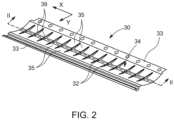
- Fig. 2
- illustrates one of separation sheets of
Fig. 1 in a schematic perspective view, - Fig. 3
- illustrates, in part, a cut-away of a separation sheet along the line II-II of
Fig. 2 along with a battery cell group, and - Fig. 4
- illustrates a sectional view along the line III-III of
Fig. 3 . - Reference will now be made in detail to embodiments, examples of which are illustrated in the accompanying drawings. Effects and features of the exemplary embodiments, and implementation methods thereof will be described with reference to the accompanying drawings. In the drawings, like reference numerals denote like elements, and redundant descriptions are omitted. The present disclosure, however, may be embodied in various different forms, and should not be construed as being limited to only the illustrated embodiments herein. Rather, these embodiments are provided as examples so that this disclosure will be thorough and complete, and will fully convey the aspects and features of the present disclosure to those skilled in the art.
- Accordingly, processes, elements, and techniques that are not considered necessary to those having ordinary skill in the art for a complete understanding of the aspects and features of the present disclosure may not be described. In the drawings, the relative sizes of elements, layers, and regions may be exaggerated for clarity.
- As used herein, the term "and/or" includes any and all combinations of one or more of the associated listed items. Further, the use of "may" when describing embodiments of the present disclosure refers to "one or more embodiments of the present disclosure." In the following description of embodiments of the present disclosure, the terms of a singular form may include plural forms unless the context clearly indicates otherwise.
- It will be understood that although the terms "first" and "second" are used to describe various elements, these elements should not be limited by these terms. These terms are only used to distinguish one element from another element. For example, a first element may be named a second element and, similarly, a second element may be named a first element, without departing from the scope of the present disclosure. As used herein, the term "and/or" includes any and all combinations of one or more of the associated listed items. Expressions such as "at least one of," when preceding a list of elements, modify the entire list of elements and do not modify the individual elements of the list.
- As used herein, the term "substantially," "about," and similar terms are used as terms of approximation and not as terms of degree, and are intended to account for the inherent deviations in measured or calculated values that would be recognized by those of ordinary skill in the art. Further, if the term "substantially" is used in combination with a feature that could be expressed using a numeric value, the term "substantially" denotes a range of +/- 5% of the value centered on the value.
- It will be further understood that the terms "include," "comprise," "including," or "comprising" specify a property, a region, a fixed number, a step, a process, an element, a component, and a combination thereof but do not exclude other properties, regions, fixed numbers, steps, processes, elements, components, and combinations thereof.
- It will also be understood that when an element is referred to as being "above" or "on" another element, it can be directly on the other element, or intervening elements may also be present.
- Herein, the terms "top" and "bottom" are defined according to the z-axis. For example, the top cover is positioned at the upper part of the z-axis, whereas the bottom cover is positioned at the lower part thereof. In the drawings, the sizes of elements may be exaggerated for clarity. For example, in the drawings, the size or thickness of each element may be arbitrarily shown for illustrative purposes, and thus the embodiments of the present disclosure should not be construed as being limited thereto.
- In the following description of embodiments of the present disclosure, the terms of a singular form may include plural forms unless the context clearly indicates otherwise.
- Unless otherwise defined, all terms (including technical and scientific terms) used herein have the same meaning as commonly understood by one of ordinary skill in the art to which the present disclosure belongs. It will be further understood that terms, such as those defined in commonly used dictionaries, should be interpreted as having a meaning that is consistent with their meaning in the context of the relevant art and/or the present specification, and should not be interpreted in an idealized or overly formal sense, unless expressly so defined herein.
-
Figure 1 shows an embodiment of abattery system 10 for an electric vehicle according to the invention, comprising a plurality ofbattery cells 12 and abottom cover 20 which is part of a battery housing. In this embodiment thebattery cells 12 are cylindrical cells but they could also have a different shape. Thebattery cells 12 are arranged inbattery cell groups 13, neighboringbattery cell groups 13 being spaced apart spatially from one another alongmultiple rows 15. Thebattery cells 12 of eachbattery cell group 13 are electrically interconnected with one another and thus form a cell stack via electrical connecting means 17 shown inFig. 4 . Neighboringbattery cell groups 13 of thesame row 15 may be electrically interconnected with one another and the neighboringrows 15 ofbattery cell groups 13 may also be electrically interconnected with one another so that the entirety of thebattery cells 12 forms a battery module with thebattery cell groups 13 and/orrows 15 as submodules. - Each
battery cell group 13 and therefore the entirety of thebattery cells 12 comprises a ventingside 14 at a bottom side wherein each battery cell group has at least one ventingexit 16 through which a venting stream V comprising venting products may exit thebattery cell group 13 in case of a thermal runaway, seeFigs. 3 and4 . Thus, thebattery cells 12 are arranged to vent the venting stream downwards towards thebottom cover 20. - The
battery system 10 further comprisesseparations sheets 30, wherein eachrow 15 ofbattery cell groups 13 is supported on oneseparation sheet 30. Eachseparation sheet 30 is thus arranged at the ventingsides 14 of itsbattery cell groups 13. In the first tworows 15 inFig. 1 some of thebattery cell groups 13 are not shown to allow a view of theunderlying separation sheets 30. Theseparation sheets 30 function as structural members carrying their respectivebattery cell groups 13. In addition, thebattery system 10 comprisesstruts 22 extending in parallel to theseparation sheets 30, thestruts 22 providing stability to thewhole battery system 10. Theseparation sheets 30 may be supported by thestruts 22. Theseparation sheets 30 themselves may thus also provide stability to thewhole battery system 10. - According to the invention, the
separation sheet 30 forms separate ventingchambers 36 such that there is one ventingchamber 36 provided for eachbattery cell group 13 of eachrow 15. These ventingchambers 16 serve to guide the venting stream V leaving the venting exits 16 away from thebattery cell groups 13 throughopenings 32 in theseparation sheet 30 as will be explained below.Figure 2 shows one of theseparation sheets 30, wherein the equidistantly arrangedopenings 32 can be seen. Theseparation sheet 30 has the shape of a shallow trough or channel with a depression extending along the x-axis. In other words, theseparation sheet 30 comprises two longitudinal profile rails 33 and a downwardly tapering channel bottom 34 with slopingside walls 35, the slopingside walls 35 being sloped with respect to the y-axis. - When the
battery cell groups 13 are arranged on theseparation sheet 30, the channel bottom 34 with the slopingside walls 35 forms in conjunction with the ventingside 14, in particular in conjunction with acarrier element 18, the ventingchambers 36. Thebattery cell groups 13 are arranged on theseparation sheet 30 such that between every two neighboringopenings 32 onebattery cell group 13 is placed as can be seen inFig. 3 and4 . The ventingchamber 36 is thus delimited upwards by the venting side 14 (or the carrier element 18) forming a first side and downwards by theseparation sheet 30 forming a second side opposite the first side. The ventingchamber 36 is further delimited to the sides bysidewall members 39. Theseparation member 30 may be produced via deep drawing a (metal) sheet, wherein via this drawing method the ventingchamber 36 including thesidewall members 39 may be drawn. Theopenings 32 may be produced at the same time. Thesidewall members 39 can be seen best inFig. 4 . - In a thermal runaway even, in a first step, a venting stream V comprising hot venting gasses and products, leaves the
battery cell group 13 shown inFigs. 3 and4 at the ventingside 14 through the ventingexit 16. A venting valve may be provided at the ventingexit 16. In a second step, the venting gas expands into the ventingchamber 36 such that the pressure of the venting gas and, through use of the thermal mass of the ventingchamber 36, the temperature of the venting gas is reduced. Also, the venting stream V is guided down the slopingside walls 35 of theseparation sheet 30 to the center of thechannel bottom 34 and therefore the center of the ventingchamber 36, the slopingside walls 35 thus acting as first guiding surfaces. The slopingside walls 35 can be seen inFig. 3 but are not shown inFig. 4 . Thesidewall members 39 may function as second guiding surfaces, wherein the right-side sidewall member 39a guides the venting stream V to the left towards the left-side sidewall member 39b and the left-side sidewall member 39b guides the venting stream V through theopening 32. As can be seen inFig. 4 , thesidewall member 39 of oneventing chamber 36 functions not only as a guiding surface for the venting stream of this ventingchamber 36 but also as a guiding surface for the venting stream of a neighboring cell chamber as thesidewall members 39 form dividing walls separating two neighboring cell chambers. - In a third step, the venting stream V is channelled away from the
battery cell group 13 through theopening 32 into a ventingchannel 40 which is arranged between theseparation sheet 30 and thebottom cover 20, seeFig.4 . When entering the ventingchannel 40 the venting stream V may join a main venting stream Vm flowing along the ventingchannel 40, the main venting stream Vm being made up of the venting streams of other battery cell groups. The ventingchannel 40 connects asystem exit 38 of the battery housing, shown schematically inFig. 1 , with the ventingchambers 36 via theopenings 32. In a fourth step, a venting valve provided at thesystem exit 38 opens at a certain pressure releasing the main venting stream Vm to the environment of thebattery system 10. - Thanks to the venting
chambers 36, a venting stream V leaving one of thebattery cell groups 13 does not enter the ventingchannel 40 directly but instead has to pass through the ventingchamber 36 first. The ventingchamber 36, due to its thermal mass, reduces the venting stream temperature before the venting stream V enters the joint/main venting channel 40. The ventingchamber 36 thus functions as a buffer space for the venting stream V where the venting stream V may be pre-cooled before entering the ventingchannel 40. Further, thebattery cell groups 13 are protected as theseparation sheet 30 with itsdedicated venting chambers 36 and guidingsurfaces battery cells 12 towards theopening 32. The venting products can therefore not deposit onto the cells. Theseparation sheet 30 thus works as a baffle. - The proposed venting geometry thus leads to a sufficient cool-down of the venting products before leaving the respective venting chamber so that the risk of damaging other cells via heat propagation is reduced. Also, the venting chambers shield the respective battery cell group from a venting stream leaving another venting chamber as this venting stream cannot easily enter other venting chambers. Further, the venting products exiting the battery system of the invention towards the environment are at lower temperature than with known battery systems. The proposed arrangement of the discussed parts of the battery system is easy to achieve at basically no added cost with respect to known designs.
-
- 10
- battery system
- 12
- battery cells
- 13
- battery cell groups
- 14
- venting side
- 15
- Rows of battery cell groups
- 16
- venting exit
- 17
- connecting means
- 18
- carrier element
- 20
- bottom cover
- 22
- struts
- 30
- separation sheet
- 32
- openings in the separation sheet
- 33
- profile rails
- 34
- channel bottom
- 35
- sloping side walls
- 36
- venting chamber
- 38
- system exit
- 40
- main venting channel
- V
- venting stream
- Vm
- main venting stream
Claims (11)
- A battery system (10), comprising a battery housing, and a plurality of battery cells (12) being arranged in a plurality of battery cell groups (13) within the battery housing, wherein each battery cell group (13) comprises a venting side (14) with at least one venting exit (16) through which a venting stream (V) comprising venting products exits the battery cell group (13) in case of a thermal runaway, the battery system (10) further comprising a separation sheet (30) including two longitudinal profile rails (33) and a channel bottom (34) with sloping side walls (35) extending between the longitudinal profile rails (33), wherein openings (32) are disposed at the channel bottom (34), wherein the separation sheet (30) is disposed covering the venting sides (14) of the battery cell groups (13) such that the channel bottom (34) with the sloping side walls (35) forms, in conjunction with the venting side (14), separate venting chambers (36), one venting chamber (36) for each battery cell group (13), wherein for each venting chamber (36) one of the openings (32) is provided and each venting chamber (36) is adapted to guide the venting stream leaving the venting exits (16) away from the battery cell groups (13) through the respective opening (32) in the separation sheet (30), wherein each venting chamber (36) is delimited on a first side by the venting side (14) of the battery cell group (13) and on a second side opposite the first side by the separation sheet (30).
- The battery system (10) of claim 1, wherein the battery system (10) comprises a cover element (20) facing the venting side (14) of the battery cell groups (13), the separation sheet (30) being arranged between the cover element (20) and the venting side (14), wherein a venting channel (40) is arranged between the separation sheet (30) and the cover element (20), the venting channel (40) connecting a system exit (38) of the battery housing with the venting chambers (36) via the openings (32) in the separation sheet (30).
- The battery system (10) of claim 2, wherein the cover element is a bottom cover (20).
- The battery system (10) of claim 3, wherein the bottom cover (20) is part of an underbody of the battery housing (20).
main request - The battery system (10) of any one of the preceding claims, wherein the battery cell groups (13) are supported by the separation sheet (30).
- The battery system (10) of any one of the preceding claims, wherein the separation sheet (30) forms a structural member of the battery system (10).
- The battery system (10) of any one of the preceding claims, wherein the separation sheet (30) comprises guiding surfaces (35, 39) for guiding the venting stream towards the opening (32).
- The battery system (10) of claim 7, wherein a guiding surface (39) of the separation sheet (30) is arranged at a first end of the venting chamber (36) and the opening (32) is arranged at a second end of the venting chamber (36) opposite the first end such that the venting stream is guided from the venting exit (16) along the venting side (14) towards the opening (32).
- The battery system (10) of any one of the preceding claims, wherein each battery cell group (13) forms a cell stack, each cell stack comprising battery cells (12) electrically connected with one another in parallel or in series.
- The battery system (10) of any one of the preceding claims, wherein the battery system (10) comprises multiple rows (15) of battery cell groups (13), wherein for each row (15) of battery cell groups (13), the separation sheet (30) is arranged at the venting side (14) of the battery cell groups (13), each separation sheet (30) forming separate venting chambers (36), one venting chamber (36) for each battery cell group (13) of the respective row (15), for guiding the venting stream leaving the venting exits (16) away from the battery cell groups (13) through openings (32) in the separation sheet (30).
- An electric vehicle including a battery system (10) according to any one of the preceding claims.
Priority Applications (6)
| Application Number | Priority Date | Filing Date | Title |
|---|---|---|---|
| PL21205222.9T PL4175022T3 (en) | 2021-10-28 | 2021-10-28 | BATTERY SYSTEM AND VEHICLE CONTAINING BATTERY SYSTEM |
| HUE21205222A HUE072637T2 (en) | 2021-10-28 | 2021-10-28 | Battery system and vehicle including the battery system |
| EP21205222.9A EP4175022B1 (en) | 2021-10-28 | 2021-10-28 | Battery system and vehicle including the battery system |
| KR1020220139192A KR102962012B1 (en) | 2021-10-28 | 2022-10-26 | Battery system and vehicle including the battery system |
| US17/975,496 US20230135353A1 (en) | 2021-10-28 | 2022-10-27 | Battery system and vehicle including the battery system |
| CN202211338210.2A CN116053696B (en) | 2021-10-28 | 2022-10-28 | Battery systems and vehicles including such battery systems |
Applications Claiming Priority (1)
| Application Number | Priority Date | Filing Date | Title |
|---|---|---|---|
| EP21205222.9A EP4175022B1 (en) | 2021-10-28 | 2021-10-28 | Battery system and vehicle including the battery system |
Publications (2)
| Publication Number | Publication Date |
|---|---|
| EP4175022A1 EP4175022A1 (en) | 2023-05-03 |
| EP4175022B1 true EP4175022B1 (en) | 2025-07-09 |
Family
ID=78414330
Family Applications (1)
| Application Number | Title | Priority Date | Filing Date |
|---|---|---|---|
| EP21205222.9A Active EP4175022B1 (en) | 2021-10-28 | 2021-10-28 | Battery system and vehicle including the battery system |
Country Status (3)
| Country | Link |
|---|---|
| EP (1) | EP4175022B1 (en) |
| HU (1) | HUE072637T2 (en) |
| PL (1) | PL4175022T3 (en) |
Families Citing this family (1)
| Publication number | Priority date | Publication date | Assignee | Title |
|---|---|---|---|---|
| US20250038351A1 (en) * | 2023-07-26 | 2025-01-30 | Lg Energy Solution, Ltd. | Battery pack |
Family Cites Families (8)
| Publication number | Priority date | Publication date | Assignee | Title |
|---|---|---|---|---|
| EP2419946B1 (en) * | 2009-04-15 | 2016-04-13 | Johnson Controls Saft Advanced Power Solutions LLC | Vent for electrochemical cell |
| JP5466906B2 (en) * | 2009-09-18 | 2014-04-09 | パナソニック株式会社 | Battery module |
| JPWO2014038184A1 (en) * | 2012-09-05 | 2016-08-08 | パナソニックIpマネジメント株式会社 | Battery module |
| JP6350592B2 (en) * | 2016-05-24 | 2018-07-04 | トヨタ自動車株式会社 | Automotive battery module |
| CN110165104B (en) * | 2016-07-29 | 2022-11-25 | 苹果公司 | High density battery pack |
| DE102017212223A1 (en) | 2017-07-18 | 2019-01-24 | Bayerische Motoren Werke Aktiengesellschaft | BATTERY OF AN ELECTRICALLY DRIVEN MOTOR VEHICLE |
| US11024901B2 (en) * | 2018-01-19 | 2021-06-01 | Hanon Systems | Battery cooling plate with integrated air vents |
| CN110071245B (en) * | 2019-04-29 | 2023-12-12 | 苏州安靠电源有限公司 | Battery module and battery pack |
-
2021
- 2021-10-28 EP EP21205222.9A patent/EP4175022B1/en active Active
- 2021-10-28 PL PL21205222.9T patent/PL4175022T3/en unknown
- 2021-10-28 HU HUE21205222A patent/HUE072637T2/en unknown
Also Published As
| Publication number | Publication date |
|---|---|
| EP4175022A1 (en) | 2023-05-03 |
| PL4175022T3 (en) | 2025-09-22 |
| HUE072637T2 (en) | 2025-11-28 |
| KR20230061271A (en) | 2023-05-08 |
Similar Documents
| Publication | Publication Date | Title |
|---|---|---|
| US20230135353A1 (en) | Battery system and vehicle including the battery system | |
| EP3319146B1 (en) | Battery system | |
| US20230246289A1 (en) | Battery system with active cooling of venting channel | |
| US12431560B2 (en) | Battery system and vehicle including the battery system | |
| CN118104043A (en) | Battery cell pack for electric vehicle | |
| EP4220820A1 (en) | Battery system with active cooling of venting channel | |
| EP4047728A1 (en) | Battery system and vehicle including the battery system | |
| EP4325631A1 (en) | Battery system and vehicle including the battery system | |
| EP4148843B1 (en) | Battery system and vehicle including the battery system | |
| EP4228069A1 (en) | Battery pack, electric vehicle and method for assembling a battery pack | |
| KR20240080846A (en) | Battery module and battery pack including the same | |
| EP4175022B1 (en) | Battery system and vehicle including the battery system | |
| US20250096407A1 (en) | Battery Pack And Vehicle Including Same | |
| CN115000563B (en) | Battery systems and vehicles including such battery systems | |
| EP4047730B1 (en) | Battery system and vehicle including the battery system | |
| US20230261284A1 (en) | Battery pack, electric vehicle and method for assembling a battery pack | |
| EP3890054B1 (en) | A battery system and a vehicle including at least one battery system | |
| KR102962012B1 (en) | Battery system and vehicle including the battery system | |
| KR102911657B1 (en) | Battery pack and Vehicle including the same | |
| EP4376195B1 (en) | Battery cell and battery module configured for stopping thermal propagation | |
| JP7843936B2 (en) | Battery pack and automobile including said battery pack | |
| US20240063498A1 (en) | Battery system and vehicle including the battery system | |
| US20260005388A1 (en) | Battery assembly including prismatic can battery cells having a side mounted vent cap | |
| US20250112325A1 (en) | Battery system with improved thermal runaway handling | |
| US20250337092A1 (en) | Battery system including improved cell cover |
Legal Events
| Date | Code | Title | Description |
|---|---|---|---|
| PUAI | Public reference made under article 153(3) epc to a published international application that has entered the european phase |
Free format text: ORIGINAL CODE: 0009012 |
|
| STAA | Information on the status of an ep patent application or granted ep patent |
Free format text: STATUS: REQUEST FOR EXAMINATION WAS MADE |
|
| 17P | Request for examination filed |
Effective date: 20221102 |
|
| AK | Designated contracting states |
Kind code of ref document: A1 Designated state(s): AL AT BE BG CH CY CZ DE DK EE ES FI FR GB GR HR HU IE IS IT LI LT LU LV MC MK MT NL NO PL PT RO RS SE SI SK SM TR |
|
| STAA | Information on the status of an ep patent application or granted ep patent |
Free format text: STATUS: EXAMINATION IS IN PROGRESS |
|
| 17Q | First examination report despatched |
Effective date: 20230921 |
|
| GRAP | Despatch of communication of intention to grant a patent |
Free format text: ORIGINAL CODE: EPIDOSNIGR1 |
|
| STAA | Information on the status of an ep patent application or granted ep patent |
Free format text: STATUS: GRANT OF PATENT IS INTENDED |
|
| INTG | Intention to grant announced |
Effective date: 20250205 |
|
| GRAS | Grant fee paid |
Free format text: ORIGINAL CODE: EPIDOSNIGR3 |
|
| GRAA | (expected) grant |
Free format text: ORIGINAL CODE: 0009210 |
|
| STAA | Information on the status of an ep patent application or granted ep patent |
Free format text: STATUS: THE PATENT HAS BEEN GRANTED |
|
| AK | Designated contracting states |
Kind code of ref document: B1 Designated state(s): AL AT BE BG CH CY CZ DE DK EE ES FI FR GB GR HR HU IE IS IT LI LT LU LV MC MK MT NL NO PL PT RO RS SE SI SK SM TR |
|
| REG | Reference to a national code |
Ref country code: GB Ref legal event code: FG4D |
|
| REG | Reference to a national code |
Ref country code: CH Ref legal event code: EP |
|
| REG | Reference to a national code |
Ref country code: IE Ref legal event code: FG4D |
|
| REG | Reference to a national code |
Ref country code: DE Ref legal event code: R096 Ref document number: 602021033698 Country of ref document: DE |
|
| PGFP | Annual fee paid to national office [announced via postgrant information from national office to epo] |
Ref country code: FR Payment date: 20250930 Year of fee payment: 5 |
|
| REG | Reference to a national code |
Ref country code: NL Ref legal event code: MP Effective date: 20250709 |
|
| REG | Reference to a national code |
Ref country code: HU Ref legal event code: AG4A Ref document number: E072637 Country of ref document: HU |
|
| PG25 | Lapsed in a contracting state [announced via postgrant information from national office to epo] |
Ref country code: PT Free format text: LAPSE BECAUSE OF FAILURE TO SUBMIT A TRANSLATION OF THE DESCRIPTION OR TO PAY THE FEE WITHIN THE PRESCRIBED TIME-LIMIT Effective date: 20251110 |
|
| PGFP | Annual fee paid to national office [announced via postgrant information from national office to epo] |
Ref country code: HU Payment date: 20251105 Year of fee payment: 5 |
|
| PG25 | Lapsed in a contracting state [announced via postgrant information from national office to epo] |
Ref country code: NL Free format text: LAPSE BECAUSE OF FAILURE TO SUBMIT A TRANSLATION OF THE DESCRIPTION OR TO PAY THE FEE WITHIN THE PRESCRIBED TIME-LIMIT Effective date: 20250709 |
|
| PG25 | Lapsed in a contracting state [announced via postgrant information from national office to epo] |
Ref country code: IS Free format text: LAPSE BECAUSE OF FAILURE TO SUBMIT A TRANSLATION OF THE DESCRIPTION OR TO PAY THE FEE WITHIN THE PRESCRIBED TIME-LIMIT Effective date: 20251109 |
|
| PGFP | Annual fee paid to national office [announced via postgrant information from national office to epo] |
Ref country code: DE Payment date: 20250930 Year of fee payment: 5 |
|
| PGFP | Annual fee paid to national office [announced via postgrant information from national office to epo] |
Ref country code: GB Payment date: 20251001 Year of fee payment: 5 |
|
| PG25 | Lapsed in a contracting state [announced via postgrant information from national office to epo] |
Ref country code: NO Free format text: LAPSE BECAUSE OF FAILURE TO SUBMIT A TRANSLATION OF THE DESCRIPTION OR TO PAY THE FEE WITHIN THE PRESCRIBED TIME-LIMIT Effective date: 20251009 |
|
| REG | Reference to a national code |
Ref country code: LT Ref legal event code: MG9D |
|
| PGFP | Annual fee paid to national office [announced via postgrant information from national office to epo] |
Ref country code: AT Payment date: 20260113 Year of fee payment: 5 |
|
| PG25 | Lapsed in a contracting state [announced via postgrant information from national office to epo] |
Ref country code: FI Free format text: LAPSE BECAUSE OF FAILURE TO SUBMIT A TRANSLATION OF THE DESCRIPTION OR TO PAY THE FEE WITHIN THE PRESCRIBED TIME-LIMIT Effective date: 20250709 |
|
| PG25 | Lapsed in a contracting state [announced via postgrant information from national office to epo] |
Ref country code: HR Free format text: LAPSE BECAUSE OF FAILURE TO SUBMIT A TRANSLATION OF THE DESCRIPTION OR TO PAY THE FEE WITHIN THE PRESCRIBED TIME-LIMIT Effective date: 20250709 |
|
| PG25 | Lapsed in a contracting state [announced via postgrant information from national office to epo] |
Ref country code: GR Free format text: LAPSE BECAUSE OF FAILURE TO SUBMIT A TRANSLATION OF THE DESCRIPTION OR TO PAY THE FEE WITHIN THE PRESCRIBED TIME-LIMIT Effective date: 20251010 |
|
| PG25 | Lapsed in a contracting state [announced via postgrant information from national office to epo] |
Ref country code: SE Free format text: LAPSE BECAUSE OF FAILURE TO SUBMIT A TRANSLATION OF THE DESCRIPTION OR TO PAY THE FEE WITHIN THE PRESCRIBED TIME-LIMIT Effective date: 20250709 |
|
| PG25 | Lapsed in a contracting state [announced via postgrant information from national office to epo] |
Ref country code: LV Free format text: LAPSE BECAUSE OF FAILURE TO SUBMIT A TRANSLATION OF THE DESCRIPTION OR TO PAY THE FEE WITHIN THE PRESCRIBED TIME-LIMIT Effective date: 20250709 |
|
| PG25 | Lapsed in a contracting state [announced via postgrant information from national office to epo] |
Ref country code: BG Free format text: LAPSE BECAUSE OF FAILURE TO SUBMIT A TRANSLATION OF THE DESCRIPTION OR TO PAY THE FEE WITHIN THE PRESCRIBED TIME-LIMIT Effective date: 20250709 |
|
| PGFP | Annual fee paid to national office [announced via postgrant information from national office to epo] |
Ref country code: PL Payment date: 20251014 Year of fee payment: 5 |
|
| PG25 | Lapsed in a contracting state [announced via postgrant information from national office to epo] |
Ref country code: RS Free format text: LAPSE BECAUSE OF FAILURE TO SUBMIT A TRANSLATION OF THE DESCRIPTION OR TO PAY THE FEE WITHIN THE PRESCRIBED TIME-LIMIT Effective date: 20251009 |
|
| PG25 | Lapsed in a contracting state [announced via postgrant information from national office to epo] |
Ref country code: ES Free format text: LAPSE BECAUSE OF FAILURE TO SUBMIT A TRANSLATION OF THE DESCRIPTION OR TO PAY THE FEE WITHIN THE PRESCRIBED TIME-LIMIT Effective date: 20250709 |
|
| PG25 | Lapsed in a contracting state [announced via postgrant information from national office to epo] |
Ref country code: RO Free format text: LAPSE BECAUSE OF FAILURE TO SUBMIT A TRANSLATION OF THE DESCRIPTION OR TO PAY THE FEE WITHIN THE PRESCRIBED TIME-LIMIT Effective date: 20250709 |
|
| PG25 | Lapsed in a contracting state [announced via postgrant information from national office to epo] |
Ref country code: SM Free format text: LAPSE BECAUSE OF FAILURE TO SUBMIT A TRANSLATION OF THE DESCRIPTION OR TO PAY THE FEE WITHIN THE PRESCRIBED TIME-LIMIT Effective date: 20250709 |
|
| PG25 | Lapsed in a contracting state [announced via postgrant information from national office to epo] |
Ref country code: DK Free format text: LAPSE BECAUSE OF FAILURE TO SUBMIT A TRANSLATION OF THE DESCRIPTION OR TO PAY THE FEE WITHIN THE PRESCRIBED TIME-LIMIT Effective date: 20250709 |
|
| PG25 | Lapsed in a contracting state [announced via postgrant information from national office to epo] |
Ref country code: IT Free format text: LAPSE BECAUSE OF FAILURE TO SUBMIT A TRANSLATION OF THE DESCRIPTION OR TO PAY THE FEE WITHIN THE PRESCRIBED TIME-LIMIT Effective date: 20250709 |
|
| PG25 | Lapsed in a contracting state [announced via postgrant information from national office to epo] |
Ref country code: CZ Free format text: LAPSE BECAUSE OF FAILURE TO SUBMIT A TRANSLATION OF THE DESCRIPTION OR TO PAY THE FEE WITHIN THE PRESCRIBED TIME-LIMIT Effective date: 20250709 |
|
| PG25 | Lapsed in a contracting state [announced via postgrant information from national office to epo] |
Ref country code: SK Free format text: LAPSE BECAUSE OF FAILURE TO SUBMIT A TRANSLATION OF THE DESCRIPTION OR TO PAY THE FEE WITHIN THE PRESCRIBED TIME-LIMIT Effective date: 20250709 Ref country code: EE Free format text: LAPSE BECAUSE OF FAILURE TO SUBMIT A TRANSLATION OF THE DESCRIPTION OR TO PAY THE FEE WITHIN THE PRESCRIBED TIME-LIMIT Effective date: 20250709 |