EP4175015A1 - Adjusting method of non-aqueous electrolytic solution and producing method of lithium-ion secondary battery with reused electrode plate - Google Patents
Adjusting method of non-aqueous electrolytic solution and producing method of lithium-ion secondary battery with reused electrode plate Download PDFInfo
- Publication number
- EP4175015A1 EP4175015A1 EP22194656.9A EP22194656A EP4175015A1 EP 4175015 A1 EP4175015 A1 EP 4175015A1 EP 22194656 A EP22194656 A EP 22194656A EP 4175015 A1 EP4175015 A1 EP 4175015A1
- Authority
- EP
- European Patent Office
- Prior art keywords
- electrolytic solution
- aqueous electrolytic
- electrode plate
- lithium
- secondary battery
- Prior art date
- Legal status (The legal status is an assumption and is not a legal conclusion. Google has not performed a legal analysis and makes no representation as to the accuracy of the status listed.)
- Pending
Links
Images





Classifications
-
- H—ELECTRICITY
- H01—ELECTRIC ELEMENTS
- H01M—PROCESSES OR MEANS, e.g. BATTERIES, FOR THE DIRECT CONVERSION OF CHEMICAL ENERGY INTO ELECTRICAL ENERGY
- H01M10/00—Secondary cells; Manufacture thereof
- H01M10/54—Reclaiming serviceable parts of waste accumulators
-
- H—ELECTRICITY
- H01—ELECTRIC ELEMENTS
- H01M—PROCESSES OR MEANS, e.g. BATTERIES, FOR THE DIRECT CONVERSION OF CHEMICAL ENERGY INTO ELECTRICAL ENERGY
- H01M10/00—Secondary cells; Manufacture thereof
- H01M10/05—Accumulators with non-aqueous electrolyte
- H01M10/052—Li-accumulators
- H01M10/0525—Rocking-chair batteries, i.e. batteries with lithium insertion or intercalation in both electrodes; Lithium-ion batteries
-
- H—ELECTRICITY
- H01—ELECTRIC ELEMENTS
- H01M—PROCESSES OR MEANS, e.g. BATTERIES, FOR THE DIRECT CONVERSION OF CHEMICAL ENERGY INTO ELECTRICAL ENERGY
- H01M50/00—Constructional details or processes of manufacture of the non-active parts of electrochemical cells other than fuel cells, e.g. hybrid cells
- H01M50/60—Arrangements or processes for filling or topping-up with liquids; Arrangements or processes for draining liquids from casings
- H01M50/609—Arrangements or processes for filling with liquid, e.g. electrolytes
-
- Y—GENERAL TAGGING OF NEW TECHNOLOGICAL DEVELOPMENTS; GENERAL TAGGING OF CROSS-SECTIONAL TECHNOLOGIES SPANNING OVER SEVERAL SECTIONS OF THE IPC; TECHNICAL SUBJECTS COVERED BY FORMER USPC CROSS-REFERENCE ART COLLECTIONS [XRACs] AND DIGESTS
- Y02—TECHNOLOGIES OR APPLICATIONS FOR MITIGATION OR ADAPTATION AGAINST CLIMATE CHANGE
- Y02E—REDUCTION OF GREENHOUSE GAS [GHG] EMISSIONS, RELATED TO ENERGY GENERATION, TRANSMISSION OR DISTRIBUTION
- Y02E60/00—Enabling technologies; Technologies with a potential or indirect contribution to GHG emissions mitigation
- Y02E60/10—Energy storage using batteries
-
- Y—GENERAL TAGGING OF NEW TECHNOLOGICAL DEVELOPMENTS; GENERAL TAGGING OF CROSS-SECTIONAL TECHNOLOGIES SPANNING OVER SEVERAL SECTIONS OF THE IPC; TECHNICAL SUBJECTS COVERED BY FORMER USPC CROSS-REFERENCE ART COLLECTIONS [XRACs] AND DIGESTS
- Y02—TECHNOLOGIES OR APPLICATIONS FOR MITIGATION OR ADAPTATION AGAINST CLIMATE CHANGE
- Y02W—CLIMATE CHANGE MITIGATION TECHNOLOGIES RELATED TO WASTEWATER TREATMENT OR WASTE MANAGEMENT
- Y02W30/00—Technologies for solid waste management
- Y02W30/50—Reuse, recycling or recovery technologies
- Y02W30/84—Recycling of batteries or fuel cells
Definitions
- the present disclosure relates to an adjusting method of a non-aqueous electrolytic solution and a producing method of a lithium-ion secondary battery with a reused electrode plate.
- JP2012-022969A discloses a recycling method of an electrode plate of a used lithium-ion secondary battery and a method of newly producing a lithium-ion secondary battery using the recycled electrode plate.
- the used lithium-ion secondary battery is disassembled and the electrode plate is taken out of the used lithium-ion secondary battery.
- the thus taken-out electrode plate (a positive electrode plate and a negative electrode plate) are cleansed with polar solvent and then dried to obtain a cleansed electrode plate. Thereafter, this cleansed electrode plate is used for producing an electrode body, and the thus produced electrode body is housed in a battery case.
- non-aqueous electrolytic solution including lithium (Li) salt for example, LiPF 6 ) containing element fluorine is injected in the battery case.
- the non-aqueous electrolytic solution including the Li salt containing element fluorine may generate hydrofluoric acid (HF) by the contact of moisture with the Li salt.
- HF hydrofluoric acid
- the thus HF-included non-aqueous electrolytic solution could decrease its pH level in a range of 4 to 5, for example.
- an electrode plate (a positive electrode plate and a negative electrode plate), which is taken out of a used lithium-ion secondary battery, is cleansed by polar solvent, a coating (coating including lithium) having existed on the electrode active material surface before cleansing is hardly removed. Accordingly, a coating containing the lithium exists on the electrode active material surface of the cleansed electrode plate (the cleansed positive electrode plate and the cleansed negative electrode plate).
- the present disclosure has been made in view of the above circumstances and has a purpose of providing an adjusting method of non-aqueous electrolytic solution that achieves reduction of HF included in the non-aqueous electrolytic solution and a producing method of a lithium-ion secondary battery with a reused electrode plate that achieves production of the lithium-ion secondary battery having a small IV resistance with the reused electrode plates.
- One aspect of the present disclosure is a method of adjusting non-aqueous electrolytic solution wherein the non-aqueous electrolytic solution includes lithium salt containing element fluorine, the non-aqueous electrolytic solution is configured to be brought into contact with a basic lithium compound to become a pH-level-adjusted non-aqueous electrolytic solution in which a pH level is adjusted in a range of 6 to 8 inclusive.
- the non-aqueous electrolytic solution is brought into contact with the basic Li compound (such as Li 3 PO 4 ) to adjust the pH level of the non-aqueous electrolytic solution to be within a range of 6 to 8 inclusive so that the pH-level-adjusted non-aqueous electrolytic solution is formed.
- the basic Li compound such as Li 3 PO 4
- a specific example of the method of adjusting the non-aqueous electrolytic solution is, for example, to mix the non-aqueous electrolytic solution with the basic Li compound for reaction of the basic Li compound with the HF, and then to remove precipitates (non-dissolved substance) from the electrolytic solution.
- One method of removing the precipitates is to extract a supernatant liquid or a filtrate of the electrolytic solution.
- Li 3 PO 4 is used as the basic Li compound
- a chemical equation of the basic Li compound with the HF is assumed to be represented as Li 3 PO 4 + 3HF ⁇ 3LiF + H 3 PO 4 (H + + H 2 PO 4 - ).
- the adjusted non-aqueous electrolytic solution when used as the non-aqueous electrolytic solution of a lithium-ion secondary battery with a reused electrode plate, reaction of lithium included in a coating of an electrode active material surface with the HF reduces creation of a LiF coating with high resistance on the electrode active material surface. Accordingly, the adjusted non-aqueous electrolytic solution, a pH level of which has been adjusted by the above-mentioned method of adjusting the non-aqueous electrolytic solution, can reduce the IV resistance of the lithium-ion secondary battery with the reused electrode plate.
- the basic Li compound preferably, Li 3 PO 4 (lithium phosphate), Li 2 CO 3 (lithium carbonate), Li 3 C 6 H 5 O 7 (lithium citrate), and others which make a reaction with the HF without generating moisture and in which the basic Li compound itself and a reaction product of the basic Li compound and the HF do not dissolve in a solvent of the non-aqueous electrolytic solution but just precipitate.
- Li 3 PO 4 lithium phosphate
- Li 2 CO 3 lithium carbonate
- Li 3 C 6 H 5 O 7 lithium citrate
- a basic-Li-compound-added non-aqueous electrolytic solution which is a non-aqueous electrolytic solution including Li salt containing element fluorine, in which the basic Li compound is added, is preferable.
- This basic-Li-compound-added non-aqueous electrolytic solution includes the Li salt containing the element fluorine and is added with the basic Li compound. Accordingly, even if moisture is mixed in the non-aqueous electrolytic solution to generate the HF, the basic Li compound added to the non-aqueous electrolytic solution and the HF make a reaction to reduce or remove the HF.
- an addition amount of the basic Li compound is preferable to be adjusted such that the pH level of the non-aqueous electrolytic solution is maintained within the range of 6 to 8 inclusive.
- Another aspect of the present disclosure is a method of newly producing a lithium-ion secondary battery with a reused electrode plate by reusing an electrode plate of a used lithium-ion secondary battery, the method including: cleansing and drying by cleansing the electrode plate having been taken out of the used lithium-ion secondary battery by polar solvent and by drying the electrode plate thereafter to obtain a cleansed electrode plate, producing an electrode body with the cleansed electrode plate, housing the electrode body in a battery case, and injecting non-aqueous electrolytic solution, which includes lithium salt containing element fluorine and a pH level of which is in a range of 6 to 8 inclusive, in the battery case.
- the non-aqueous electrolytic solution including the Li salt containing element fluorine and having the pH level within the range of 6 to 8 inclusive is injected in the battery case which accommodates the electrode body.
- the non-aqueous electrolytic solution including the Li salt containing element fluorine and having the pH level within the range of 6 to 8 inclusive is non-aqueous electrolytic solution that has been reduced or removed the HF.
- the coating (the coating including lithium) having existed on the electrode active material surface before cleansing is hard to be removed. Therefore, the coating including lithium exists on the electrode active material surface of the cleansed electrode plate (a cleansed positive electrode plate and a cleansed negative electrode plate). Accordingly, the electrolytic solution injected in the injecting comes to contact with the lithium included in the coating of the electrode active material surface of the cleansed electrode plate.
- polar solvent for example, ethyl methyl carbonate
- the polar solvent it is preferable to use a polar organic solvent which is used as a solvent of the non-aqueous electrolytic solution for a lithium-ion secondary battery, and examples of the polar organic solvent are given as EMC (ethyl methyl carbonate), DMC (dimethyl carbonate), DEC (diethyl carbonate), and EC (ethylene carbonate).
- EMC ethyl methyl carbonate
- DMC dimethyl carbonate
- DEC diethyl carbonate
- EC ethylene carbonate
- the used lithium-ion secondary battery is a lithium-ion secondary battery which was collected after being used as a power source for vehicles and electric appliances.
- the above-mentioned method of producing the lithium-ion secondary battery with the reused electrode plate wherein the method includes non-aqueous electrolytic solution adjusting of bringing the non-aqueous electrolytic solution including lithium salt containing element fluorine into contact with a basic lithium compound to adjust a pH level in a rage of 6 to 8 inclusive to form a pH-level-adjusted non-aqueous electrolytic solution, and the injecting is to inject the pH-level-adjusted non-aqueous electrolytic solution in the battery case.
- the non-aqueous electrolytic solution including Li salt containing element fluorine is brought into contact with the basic Li compound to form the pH-level-adjusted non-aqueous electrolytic solution which has been adjusted its pH level to be within the range of 6 to 8 inclusive. Then, this pH-level-adjusted non-aqueous electrolytic solution is injected in the battery case in the injecting. Namely, the pH-level-adjusted non-aqueous electrolytic solution that has been reduced or removed in an amount of the HF by the contact of the basic Li compound is used as an electrolytic solution for the lithium-ion secondary battery with the reused electrode plate.
- the reaction between the lithium included in the coating on the electrode active material surface and the HF included in the non-aqueous electrolytic solution is reduced, so that it is possible to reduce formation of the LiF coating with high resistance on the electrode active material surface due to the subject reaction. Accordingly, the electrode-plate-reused lithium-ion secondary battery having small IV resistance can be produced.
- FIG. 1 is a plan view of a lithium-ion secondary battery 100 with a reused electrode plate (hereinafter, also referred as an electrode-plate-reused secondary battery 100) according to the embodiment.
- FIG. 2 is an explanatory view illustrating a method of producing the electrode-plate-reused secondary battery 100, illustrated with an electrode body 150 disposed in a housing portion 119 of a battery case 110.
- the electrode-plate-reused secondary battery 100 is, as shown in FIG. 1 , provided with a battery case 110 of a rectangular shape in plan view, a positive electrode terminal 120 extending outside from an inside of the battery case 110, and a negative electrode terminal 130 extending outside from the inside of the battery case 110.
- the electrode body 150 is housed inside the battery case 110 as shown in FIG. 2 .
- This electrode body 150 is a laminated-type electrode body in which a positive electrode plate 160, a negative electrode plate 170, and a separator 180 interposed therebetween are laminated.
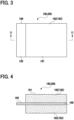
- the positive electrode plate 160 is of a rectangular shape in plan view and formed with a positive current collecting foil 166 formed of an aluminum foil and a positive electrode mixture layer 162 laminated on a surface (both faces) of the positive current collecting foil 166 (see FIG. 3 and FIG. 4 ).
- the positive electrode mixture layer 162 is provided with a positive active material 163, a binder (not shown), and a conductive assistant (not shown).
- a lithium-transition metal composite oxide (specifically, LiNi 1/3 Co 1/3 Mn 1/3 O 2 ) is used as the positive active material 163.
- a non-laminated portion 165 which is not laminated with the positive electrode mixture layer 162 on the surface (both faces) of the positive current collecting foil 166 in the positive electrode plate 160, is welded with the positive electrode terminal 120.
- the negative electrode plate 170 is of a rectangular shape in plan view and is provided with a negative current collecting foil 176 formed of a copper foil and a negative electrode mixture layer 172 laminated on a surface (both faces) of the negative current collecting foil 176 (see FIG. 5 and FIG. 6 ).
- graphite is used as the negative active material 173.
- the battery case 110 is formed of a laminate film 101 in which an inner resin film 111 placed on the most inner side of the battery case 110, a metal film 112 placed externally adjacent to this inner resin film 111, and an outer resin film 113 placed externally adjacent to this metal film 112 are laminated.
- This battery case 110 is formed in a manner that the laminate film 101 on which the electrode body 150 is placed in the housing portion 119 is folded at a folding part 110g as shown in FIG. 2 , and thus a welding sealing portion 115 (a peripheral end portion of the battery case 110) of an almost rectangular peripheral shape is sealed by thermal welding to form a rectangular shape in plan view as shown in FIG. 1 .
- a pH-level-adjusted non-aqueous electrolytic solution 40 explained below is injected in the battery case 110.
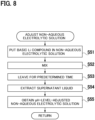
- FIG. 7 is a flow chart showing a flow of the producing method of the electrode-plate-reused secondary battery 100 according to the present embodiment.
- the used lithium-ion secondary battery 200 (hereinafter, referred as a used secondary battery 200) is disassembled to take out the positive electrode plate 260 and the negative electrode plate 270 (see FIG. 3 to FIG. 6 ).
- the used lithium-ion secondary battery 200 is a lithium-ion secondary battery having a similar configuration with the electrode-plate-reused secondary battery 100 as shown in FIG. 1 , and a lithium-ion secondary battery (a secondhand lithium-ion secondary battery) which was collected after being used as a power source of a vehicle, an electric appliance, or the like.
- the positive electrode plate 260 is an electrode plate having the similar configuration with the positive electrode plate 160 as shown in FIG. 3 and FIG. 4 , but is a positive electrode plate before cleansing and others are applied to form the positive electrode plate 160.
- the negative electrode plate 270 is an electrode plate having the similar configuration with the negative electrode plate 170, but is a negative electrode plate before cleansing and others are applied to form the negative electrode plate 170.
- step S2 a cleansing and drying step
- the positive electrode plate 260 and the negative electrode plate 270 which are taken out of the used secondary battery 200 are cleansed with polar solvent and dried thereafter to obtain cleansed electrode plates (the positive electrode plate 160 and the negative electrode plate 170).
- the positive electrode plate 260 is immersed for a predetermined time (10 minutes) in the poler solvent which is housed in a cleansing container in a glove box with an Ar-gas atmosphere.
- the positive electrode plate 260 is taken out of the polar solvent and immersed for a predetermined time (10 minutes) in unused polar solvent which is housed in a separately prepared another cleansing container in the same glove box with the Ar-gas atmosphere.
- the positive electrode plate 260 is cleansed by the polar solvent so that Li salt and others attached to the positive electrode plate 260 is removed from the positive electrode plate 260.
- the positive electrode plate 260 is taken out of the polar solvent and then dried in the same glove box with the Ar-gas atmosphere.
- the positive electrode plate 160 as the cleansed positive electrode plate is obtained.
- the negative electrode plate 270 is also cleansed and dried as similar to the above-mentioned positive electrode plate 260 to obtain the negative electrode plate 170 as the cleansed negative electrode plate.
- polar organic solvent which is used as the solvent of the non-aqueous electrolytic solution for a lithium-ion secondary battery, is used as the polar solvent.
- EMC ethyl methyl carbonate
- the positive electrode plate 160 and the negative electrode plate 170 as the cleansed electrode plates have existing (remaining) coatings including lithium on the surfaces of the positive active material 163 and the negative active material 173.
- step S3 an electrode body producing step
- the electrode body 150 is produced from the positive electrode plate 160 and the negative electrode plate 170 which are cleansed electrode plates.
- the positive electrode plate 160 and the negative electrode plate 170 are laminated with interposing a separator 180 therebetween to produce the electrode body 150.
- the separator 180 is a brand-new separator.
- the positive electrode terminal 120 is welded to the non-laminated portion 165 of the positive electrode plate 160 configuring the electrode body 150
- the negative electrode terminal 130 is welded to the non-laminated portion 175 of the negative electrode plate 170.
- step S4 a housing step
- the electrode body 150 is housed in the battery case 110.
- the electrode body 150 which have been welded with the positive electrode terminal 120 and the negative electrode terminal 130 is placed in the housing portion 119 of the laminate film 101 (see FIG. 2 ).
- the laminate film 101 is folded back at the folding part 110g to accommodate the electrode body 150 therein.
- a portion except an injection port 116 (see FIG. 11 ) to be injected with the pH-level-adjusted non-aqueous electrolytic solution 40 is pressurized and heated in its thickness direction to thermally weld inner resin films 111.
- the electrode body 150 is housed inside the battery case 110 with extending the positive electrode terminal 120 and the negative electrode terminal 130 from an inside of the battery case 110 (see FIG. 11 ).
- the non-aqueous electrolytic solution including the Li salt containing element fluorine may generate hydrofluoric acid (HF) by contact of moisture with the Li salt.
- HF hydrofluoric acid
- This non-aqueous electrolytic solution is degraded its pH level due to generation of the HF to be within a pH-level range of 4 to 5, for example.
- step S5 (a non-aqueous electrolytic solution adjusting step) is performed to reduce an HF amount in the non-aqueous electrolytic solution.
- the non-aqueous electrolytic solution 10 including the Li salt containing element fluorine is made to be in contact with the basic Li compound 20 so that the pH-level-adjusted non-aqueous electrolytic solution 40 which has been adjusted its pH level to be within the range of 6 to 8 inclusive is produced.
- FIG. 8 is a flowchart showing the flow of the adjusting method of the non-aqueous electrolytic solution according to the embodiment.
- step S51 the basic Li compound 20 is put in the non-aqueous electrolytic solution 10 including the Li salt containing element fluorine.
- a container body 61 and a lid 62 configuring a sealed container 60 are prepared.
- the non-aqueous electrolytic solution 10 of a predetermined amount for example, 200 ml
- the basic Li compound 20 of a predetermined amount for example, 4 g
- a basic-lithium-compound-added non-aqueous electrolytic solution 30 in which the basic Li compound 20 is added to the non-aqueous electrolytic solution 10 including Li salt containing element fluorine is produced.
- the container body 61 is hermetically sealed by the lid 62 to complete the sealed container 60 (see FIG. 9 ).
- the non-aqueous electrolytic solution 10 of the present embodiment includes LiPF 6 as the Li salt containing element fluorine and includes organic solvent in which EC (ethylene carbonate), EMC (ethyl methyl carbonate), and DMC (dimethyl carbonate) are mixed as a solvent. Further, as the basic Li compound 20, powder of Li 3 PO 4 (lithium phosphate) is used.
- step S52 the non-aqueous electrolytic solution 10 and the basic Li compound 20 are mixed.
- the sealed container 60 in which the non-aqueous electrolytic solution 10 and the basic Li compound 20 are accommodated is shaken so that the non-aqueous electrolytic solution 10 and the basic Li compound 20 are agitated and mixed.
- step S53 the sealed container 60 accommodated inside with a mixed solution of the non-aqueous electrolytic solution 10 and the basic Li compound 20 is left (preserved) as it is for a predetermined time.
- the basic Li compound 20 (Li 3 PO 4 ) and the HF included in the non-aqueous electrolytic solution 10 are reacted well enough and undissolved substance such as the basic Li compound 20 and the reaction product of the basic Li compound 20 and the HF are precipitated.
- the HF included in the non-aqueous electrolytic solution 10 can be reduced or removed.
- the term for leaving (the term for preservation) is set as 1 hour. Further, it is conceived that a chemical reaction of the basic Li compound 20 (Li 3 PO 4 ) and the HF contained in the non-aqueous electrolytic solution 10 is indicated as follows. Formula: Li 3 PO 4 + 3HF ⁇ 3LiF + H 3 PO 4 (H + + H 2 PO 4 - )
- step S54 in the subject glove box with the Ar gas atmosphere, the lid 62 of the sealed container 60 is taken off and supernatant liquid of the non-aqueous electrolytic solution 30 of which the basic Li compound 20 and others have been precipitated is extracted from the container body 61 (see FIG. 10 ).
- This supernatant liquid is the pH-level-adjusted non-aqueous electrolytic solution 40 in which a pH level has been adjusted within a range of 6 to 8 inclusive.
- step S55 the pH-level-adjusted non-aqueous electrolytic solution 40 is obtained.
- This pH-level-adjusted non-aqueous electrolytic solution 40 has been decreased its content amount of the HF as compared to the non-aqueous electrolytic solution 10 prior to performing the step S5 (the non-aqueous electrolytic solution adjusting step).
- step S6 an injecting step
- the pH-level-adjusted non-aqueous electrolytic solution 40 is injected in the battery case 110 through an injection port 116 as shown in FIG. 11 .
- the injection port 116 is closed by thermal welding so that the battery case 110 is sealed, and accordingly, the electrode-plate-reused lithium-ion secondary battery 100 shown in FIG. 1 is completed.
- the pH-level-adjusted non-aqueous electrolytic solution 40 is injected in the battery case 110 in step S6 (the injecting step). Namely, the pH-level-adjusted non-aqueous electrolytic solution 40 has been reduced or removed the amount of the HF by the contact of the basic Li compound 20, and the thus pH-level-adjusted non-aqueous electrolytic solution 40 is used as the electrolytic solution for the electrode-plate-reused lithium-ion secondary battery 100.
- the reaction of the HF and the Li contained in the coating of the surfaces of the positive active material 163 and the negative active material 173 is reduced, and thus it is possible to reduce formation of the LiF coating with high resistance on the surfaces of the positive active material 163 and the negative active material 173 by the reaction. Therefore, in the present embodiment, it can be achieved to produce the electrode-plate-reused lithium-ion secondary battery 100 with less IV resistance.
- sample batteries 1 to 4 four different types of non-aqueous electrolytic solution are prepared to produce four types of electrode-plate-reused lithium-ion secondary batteries 100 (hereinafter, referred as sample batteries 1 to 4).
- a process of the step S5 (the non-aqueous electrolytic solution adjusting step) is not performed and the non-aqueous electrolytic solution 10 is used as it is.
- the non-aqueous electrolytic solution 10 is injected in the battery case 110 in the step S6 (the injecting step).
- the pH level of the non-aqueous electrolytic solution 10 before injection in the battery case 110 in the step S6 is measured and the pH level is 4.5. This measurement result suggests that the pH level decreases to 4.5 since the moisture comes to contact with the Li salt (LiPF 6 ) containing element fluorine to generate the HF (hydrofluoric acid).
- step S5 the non-aqueous electrolytic solution adjusting step
- step S51 0.2 g of the basic Li compound 20 (Li 3 PO 4 ) is put in 200 ml of the non-aqueous electrolytic solution 10.
- step S55 the pH level of the pH-level-adjusted non-aqueous electrolytic solution 40 which is obtained in the step S55 is measured, and the pH level is 5.0 which is increased as compared to the non-aqueous electrolytic solution 10 before performing the step S5 (the non-aqueous electrolytic solution adjusting step).
- the process of the step S5 (the non-aqueous electrolytic solution adjusting step) is performed.
- the step S51 2.0 g of the basic Li compound 20 (Li 3 PO 4 ) is put in 200 ml of the non-aqueous electrolytic solution 10.
- the pH level of the pH-level-adjusted non-aqueous electrolytic solution 40 which is obtained in the step S55 is measured, and the pH level is 6.0 which is largely increased as compared to the non-aqueous electrolytic solution 10 before performing the step S5 (the non-aqueous electrolytic solution adjusting step).
- This pH-level-adjusted non-aqueous electrolytic solution 40 is considered to become the non-aqueous electrolytic solution which is decreased the HF enough as compared to the non-aqueous electrolytic solution 10.
- the process of the step S5 (the non-aqueous electrolytic solution adjusting step) is performed.
- 20.0 g of the basic Li compound 20 Li 3 PO 4
- the pH level of the pH-level-adjusted non-aqueous electrolytic solution 40 which is obtained in the step S55 is measured, and the pH level is 8.0 which is largely increased as compared to the non-aqueous electrolytic solution 10 before performing the step S5 (the non-aqueous electrolytic solution adjusting step).
- This pH-level-adjusted non-aqueous electrolytic solution 40 is considered to become the non-aqueous electrolytic solution which is decreased the HF enough (or the HF has disappeared) as compared to the non-aqueous electrolytic solution 10.
- the sample battery 1 is measured its IV resistance value. Specifically, the sample battery 1 is adjusted its SOC of 50%, and then left as it is for three hours under a temperature environment of 0°C. Thereafter, under the temperature environment of 0°C, the sample battery 1 is discharged at a constant current value of 0.2 C for ten seconds and a battery voltage value at the time of discharge termination is measured. Further, the discharge is performed for several times under the same condition with one exception of differentiating the discharge current value to 0.5 C, 1 C, and 2 C, and the battery voltage value at the time of termination of ten-second discharge in each of the discharge current values is measured.
- the sample batteries 3 and 4 which use the non-aqueous electrolytic solution (the pH-level-adjusted non-aqueous electrolytic solution 40) having the pH level within a range of 6 to 8 inclusive, have the IV resistance value lower by about 10% than the sample battery 1 which uses the non-aqueous electrolytic solution 10 with the pH level of 4.5.
- the non-aqueous electrolytic solution (the pH-level-adjusted non-aqueous electrolytic solution 40) including the Li salt containing element fluorine and having the pH level within the range of 6 to 8 inclusive is the non-aqueous electrolytic solution from which the HF has been reduced or removed as compared to the non-aqueous electrolytic solution 10 with the pH level of 4.5.
- the reaction of the HF and the Li included in the coating of the surfaces of the positive active material 163 and the negative active material 173 is reduced and thereby it is achieved to reduce formation of the LiF coating with high resistance on the surfaces of the positive active material 163 and the negative active material 173 by the subject reaction.
- the HF included in the non-aqueous electrolytic solution can be reduced or removed. Further, according to the manufacturing method of the electrode-plate-reused lithium-ion secondary battery in the present embodiment, it is achieved to produce the electrode-plate-reused lithium-ion secondary battery 100 with less IV resistance.
Landscapes
- Chemical & Material Sciences (AREA)
- Chemical Kinetics & Catalysis (AREA)
- Electrochemistry (AREA)
- General Chemical & Material Sciences (AREA)
- Engineering & Computer Science (AREA)
- Manufacturing & Machinery (AREA)
- Secondary Cells (AREA)
- Materials Engineering (AREA)
- Battery Electrode And Active Subsutance (AREA)
Abstract
There is provided a method of adjusting non-aqueous electrolytic solution achieving reduction in an amount of hydrofluoric acid (HF) included in the non-aqueous electrolytic solution and a method of producing a lithium-ion secondary battery with a reused electrode plate by producing a lithium-ion secondary battery having less IV resistance with a reused electrode plate. Nonaqueous electrolytic solution (10) includes Li salt containing element fluorine. This non-aqueous electrolytic solution (10) is brought into contact with a basic Li compound (20) to form a pH-level-adjusted non-aqueous electrolytic solution (40) which has been adjusted its pH level within a range of 6 to 8 inclusive.
Description
- The present disclosure relates to an adjusting method of a non-aqueous electrolytic solution and a producing method of a lithium-ion secondary battery with a reused electrode plate.
-
JP2012-022969A - However, the non-aqueous electrolytic solution including the Li salt containing element fluorine may generate hydrofluoric acid (HF) by the contact of moisture with the Li salt. The thus HF-included non-aqueous electrolytic solution could decrease its pH level in a range of 4 to 5, for example. Accordingly, as mentioned above, when an electrode plate of a used lithium-ion secondary battery is reused to newly produce a lithium-ion secondary battery with the reused electrode plate, use of this non-aqueous electrolytic solution including the HF with low pH level results in formation of a lithium fluoride (LiF) coating with high resistance on an electrode active material surface by the reaction of the HF in the non-aqueous electrolytic solution with lithium included in the coating of the electrode active material surface of the reused electrode plate, so that an IV resistance of the lithium-ion secondary battery with the reused electrode plate could be large. To address this, there has been a demand for reducing an HF amount in the non-aqueous electrolytic solution.
- Herein, even if an electrode plate (a positive electrode plate and a negative electrode plate), which is taken out of a used lithium-ion secondary battery, is cleansed by polar solvent, a coating (coating including lithium) having existed on the electrode active material surface before cleansing is hardly removed. Accordingly, a coating containing the lithium exists on the electrode active material surface of the cleansed electrode plate (the cleansed positive electrode plate and the cleansed negative electrode plate).
- The present disclosure has been made in view of the above circumstances and has a purpose of providing an adjusting method of non-aqueous electrolytic solution that achieves reduction of HF included in the non-aqueous electrolytic solution and a producing method of a lithium-ion secondary battery with a reused electrode plate that achieves production of the lithium-ion secondary battery having a small IV resistance with the reused electrode plates.
- One aspect of the present disclosure is a method of adjusting non-aqueous electrolytic solution wherein the non-aqueous electrolytic solution includes lithium salt containing element fluorine, the non-aqueous electrolytic solution is configured to be brought into contact with a basic lithium compound to become a pH-level-adjusted non-aqueous electrolytic solution in which a pH level is adjusted in a range of 6 to 8 inclusive.
- In the above-mentioned method of adjusting the non-aqueous electrolytic solution, the non-aqueous electrolytic solution is brought into contact with the basic Li compound (such as Li3PO4) to adjust the pH level of the non-aqueous electrolytic solution to be within a range of 6 to 8 inclusive so that the pH-level-adjusted non-aqueous electrolytic solution is formed. This method achieves reduction or removal of the HF contained in the non-aqueous electrolytic solution.
- Herein, a specific example of the method of adjusting the non-aqueous electrolytic solution is, for example, to mix the non-aqueous electrolytic solution with the basic Li compound for reaction of the basic Li compound with the HF, and then to remove precipitates (non-dissolved substance) from the electrolytic solution. One method of removing the precipitates is to extract a supernatant liquid or a filtrate of the electrolytic solution. When Li3PO4 is used as the basic Li compound, a chemical equation of the basic Li compound with the HF is assumed to be represented as Li3PO4 + 3HF → 3LiF + H3PO4 (H+ + H2PO4 -).
- Further, when the thus adjusted non-aqueous electrolytic solution is used as the non-aqueous electrolytic solution of a lithium-ion secondary battery with a reused electrode plate, reaction of lithium included in a coating of an electrode active material surface with the HF reduces creation of a LiF coating with high resistance on the electrode active material surface. Accordingly, the adjusted non-aqueous electrolytic solution, a pH level of which has been adjusted by the above-mentioned method of adjusting the non-aqueous electrolytic solution, can reduce the IV resistance of the lithium-ion secondary battery with the reused electrode plate.
- As the basic Li compound, preferably, Li3PO4 (lithium phosphate), Li2CO3 (lithium carbonate), Li3C6H5O7 (lithium citrate), and others which make a reaction with the HF without generating moisture and in which the basic Li compound itself and a reaction product of the basic Li compound and the HF do not dissolve in a solvent of the non-aqueous electrolytic solution but just precipitate.
- Further, a basic-Li-compound-added non-aqueous electrolytic solution which is a non-aqueous electrolytic solution including Li salt containing element fluorine, in which the basic Li compound is added, is preferable.
- This basic-Li-compound-added non-aqueous electrolytic solution includes the Li salt containing the element fluorine and is added with the basic Li compound. Accordingly, even if moisture is mixed in the non-aqueous electrolytic solution to generate the HF, the basic Li compound added to the non-aqueous electrolytic solution and the HF make a reaction to reduce or remove the HF. Hereinafter, an addition amount of the basic Li compound is preferable to be adjusted such that the pH level of the non-aqueous electrolytic solution is maintained within the range of 6 to 8 inclusive.
- Another aspect of the present disclosure is a method of newly producing a lithium-ion secondary battery with a reused electrode plate by reusing an electrode plate of a used lithium-ion secondary battery, the method including: cleansing and drying by cleansing the electrode plate having been taken out of the used lithium-ion secondary battery by polar solvent and by drying the electrode plate thereafter to obtain a cleansed electrode plate, producing an electrode body with the cleansed electrode plate, housing the electrode body in a battery case, and injecting non-aqueous electrolytic solution, which includes lithium salt containing element fluorine and a pH level of which is in a range of 6 to 8 inclusive, in the battery case.
- According to the above-mentioned method of producing a lithium-ion secondary battery with the reused electrode plate (hereinafter, referred as an electrode-plate-reused lithium-ion secondary battery), in the injecting, the non-aqueous electrolytic solution including the Li salt containing element fluorine and having the pH level within the range of 6 to 8 inclusive is injected in the battery case which accommodates the electrode body. The non-aqueous electrolytic solution including the Li salt containing element fluorine and having the pH level within the range of 6 to 8 inclusive is non-aqueous electrolytic solution that has been reduced or removed the HF. Thereby, the reaction between the lithium included in the coating of the electrode active material surface and the HF included in the non-aqueous electrolytic solution is restrained, so that it is possible to reduce formation of the LiF coating with high resistance on the electrode active material surface due to the subject reaction. Accordingly, it is achieved to produce the electrode-plate-reused lithium-ion secondary battery having less IV resistance.
- Herein, even if an electrode plate (a positive electrode plate or a negative electrode plate) taken out of the used lithium-ion secondary battery is cleansed with polar solvent (for example, ethyl methyl carbonate), the coating (the coating including lithium) having existed on the electrode active material surface before cleansing is hard to be removed. Therefore, the coating including lithium exists on the electrode active material surface of the cleansed electrode plate (a cleansed positive electrode plate and a cleansed negative electrode plate). Accordingly, the electrolytic solution injected in the injecting comes to contact with the lithium included in the coating of the electrode active material surface of the cleansed electrode plate. As the polar solvent, it is preferable to use a polar organic solvent which is used as a solvent of the non-aqueous electrolytic solution for a lithium-ion secondary battery, and examples of the polar organic solvent are given as EMC (ethyl methyl carbonate), DMC (dimethyl carbonate), DEC (diethyl carbonate), and EC (ethylene carbonate). Herein, the used lithium-ion secondary battery is a lithium-ion secondary battery which was collected after being used as a power source for vehicles and electric appliances.
- Further preferably, the above-mentioned method of producing the lithium-ion secondary battery with the reused electrode plate wherein the method includes non-aqueous electrolytic solution adjusting of bringing the non-aqueous electrolytic solution including lithium salt containing element fluorine into contact with a basic lithium compound to adjust a pH level in a rage of 6 to 8 inclusive to form a pH-level-adjusted non-aqueous electrolytic solution, and the injecting is to inject the pH-level-adjusted non-aqueous electrolytic solution in the battery case.
- In the above producing method, in the non-aqueous electrolytic solution adjusting, the non-aqueous electrolytic solution including Li salt containing element fluorine is brought into contact with the basic Li compound to form the pH-level-adjusted non-aqueous electrolytic solution which has been adjusted its pH level to be within the range of 6 to 8 inclusive. Then, this pH-level-adjusted non-aqueous electrolytic solution is injected in the battery case in the injecting. Namely, the pH-level-adjusted non-aqueous electrolytic solution that has been reduced or removed in an amount of the HF by the contact of the basic Li compound is used as an electrolytic solution for the lithium-ion secondary battery with the reused electrode plate. Thus, the reaction between the lithium included in the coating on the electrode active material surface and the HF included in the non-aqueous electrolytic solution is reduced, so that it is possible to reduce formation of the LiF coating with high resistance on the electrode active material surface due to the subject reaction. Accordingly, the electrode-plate-reused lithium-ion secondary battery having small IV resistance can be produced.
-
-
FIG. 1 is a plan view of a lithium-ion secondary battery with a reused electrode plate in an embodiment; -
FIG. 2 is an explanatory view of a method of producing the lithium-ion secondary battery with the reused electrode plate; -
FIG. 3 is a plan view of a positive electrode plate in the embodiment; -
FIG. 4 is a sectional view taken along a line B-B inFIG. 3 ; -
FIG. 5 is a plan view of a negative electrode plate in the embodiment; -
FIG. 6 is a sectional view taken along a line C-C inFIG. 5 ; -
FIG. 7 is a flow chart illustrating a flow of the producing method of the lithium-ion secondary battery with the reused electrode plate in the embodiment; -
FIG. 8 is a flow chart illustrating a flow of an adjusting method of non-aqueous electrolytic solution in the embodiment; -
FIG. 9 is an explanatory view of the adjusting method of the non-aqueous electrolytic solution; -
FIG. 10 is another explanatory view of the adjusting method of the non-aqueous electrolytic solution; -
FIG. 11 is an explanatory view of the producing method of the lithium-ion secondary battery with the reused electrode plate in the embodiment; and -
FIG. 12 is a diagram illustrating comparison of IV resistances of the lithium-ion secondary batteries with the reused electrode plates. - An embodiment of the present disclosure is now explained.
FIG. 1 is a plan view of a lithium-ion secondary battery 100 with a reused electrode plate (hereinafter, also referred as an electrode-plate-reused secondary battery 100) according to the embodiment.FIG. 2 is an explanatory view illustrating a method of producing the electrode-plate-reused secondary battery 100, illustrated with an electrode body 150 disposed in ahousing portion 119 of abattery case 110. The electrode-plate-reused secondary battery 100 is, as shown inFIG. 1 , provided with abattery case 110 of a rectangular shape in plan view, apositive electrode terminal 120 extending outside from an inside of thebattery case 110, and anegative electrode terminal 130 extending outside from the inside of thebattery case 110. - Further, as shown in
FIG. 2 , the electrode body 150 is housed inside thebattery case 110 as shown inFIG. 2 . This electrode body 150 is a laminated-type electrode body in which apositive electrode plate 160, anegative electrode plate 170, and a separator 180 interposed therebetween are laminated. Among these, thepositive electrode plate 160 is of a rectangular shape in plan view and formed with a positive current collectingfoil 166 formed of an aluminum foil and a positiveelectrode mixture layer 162 laminated on a surface (both faces) of the positive current collecting foil 166 (seeFIG. 3 and FIG. 4 ). The positiveelectrode mixture layer 162 is provided with a positiveactive material 163, a binder (not shown), and a conductive assistant (not shown). Herein, in the present embodiment, a lithium-transition metal composite oxide (specifically, LiNi1/3Co1/3Mn1/3O2) is used as the positiveactive material 163. Anon-laminated portion 165, which is not laminated with the positiveelectrode mixture layer 162 on the surface (both faces) of the positive current collectingfoil 166 in thepositive electrode plate 160, is welded with thepositive electrode terminal 120. - The
negative electrode plate 170 is of a rectangular shape in plan view and is provided with a negativecurrent collecting foil 176 formed of a copper foil and a negativeelectrode mixture layer 172 laminated on a surface (both faces) of the negative current collecting foil 176 (seeFIG. 5 and FIG. 6 ). Herein, in the present embodiment, graphite is used as the negativeactive material 173. Anon-laminated portion 175, which is not laminated with the negativeelectrode mixture layer 172 on the surface (both faces) of the negativecurrent collecting foil 176, is welded with thenegative electrode terminal 130. - The
battery case 110 is formed of alaminate film 101 in which aninner resin film 111 placed on the most inner side of thebattery case 110, a metal film 112 placed externally adjacent to thisinner resin film 111, and an outer resin film 113 placed externally adjacent to this metal film 112 are laminated. Thisbattery case 110 is formed in a manner that thelaminate film 101 on which the electrode body 150 is placed in thehousing portion 119 is folded at afolding part 110g as shown inFIG. 2 , and thus a welding sealing portion 115 (a peripheral end portion of the battery case 110) of an almost rectangular peripheral shape is sealed by thermal welding to form a rectangular shape in plan view as shown inFIG. 1 . Herein, a pH-level-adjusted non-aqueouselectrolytic solution 40 explained below is injected in thebattery case 110. - Next, a method of manufacturing the electrode-plate-reused secondary battery 100 and a method of adjusting the non-aqueous electrolytic solution according to the embodiment is explained. In the present embodiment, electrode plates (a positive electrode plate 260 and a negative electrode plate 270) of the used lithium-ion secondary battery 200 are reused to newly produce the electrode-plate-reused lithium-ion secondary battery 100.
FIG. 7 is a flow chart showing a flow of the producing method of the electrode-plate-reused secondary battery 100 according to the present embodiment. Firstly, in step S1, the used lithium-ion secondary battery 200 (hereinafter, referred as a used secondary battery 200) is disassembled to take out the positive electrode plate 260 and the negative electrode plate 270 (seeFIG. 3 to FIG. 6 ). - Herein, the used lithium-ion secondary battery 200 is a lithium-ion secondary battery having a similar configuration with the electrode-plate-reused secondary battery 100 as shown in
FIG. 1 , and a lithium-ion secondary battery (a secondhand lithium-ion secondary battery) which was collected after being used as a power source of a vehicle, an electric appliance, or the like. The positive electrode plate 260 is an electrode plate having the similar configuration with thepositive electrode plate 160 as shown inFIG. 3 and FIG. 4 , but is a positive electrode plate before cleansing and others are applied to form thepositive electrode plate 160. The negative electrode plate 270 is an electrode plate having the similar configuration with thenegative electrode plate 170, but is a negative electrode plate before cleansing and others are applied to form thenegative electrode plate 170. - Subsequently, in step S2 (a cleansing and drying step), the positive electrode plate 260 and the negative electrode plate 270 which are taken out of the used secondary battery 200 are cleansed with polar solvent and dried thereafter to obtain cleansed electrode plates (the
positive electrode plate 160 and the negative electrode plate 170). Specifically, the positive electrode plate 260 is immersed for a predetermined time (10 minutes) in the poler solvent which is housed in a cleansing container in a glove box with an Ar-gas atmosphere. Then, the positive electrode plate 260 is taken out of the polar solvent and immersed for a predetermined time (10 minutes) in unused polar solvent which is housed in a separately prepared another cleansing container in the same glove box with the Ar-gas atmosphere. Thus, the positive electrode plate 260 is cleansed by the polar solvent so that Li salt and others attached to the positive electrode plate 260 is removed from the positive electrode plate 260. - Subsequently, the positive electrode plate 260 is taken out of the polar solvent and then dried in the same glove box with the Ar-gas atmosphere. Thus, the
positive electrode plate 160 as the cleansed positive electrode plate is obtained. Further, the negative electrode plate 270 is also cleansed and dried as similar to the above-mentioned positive electrode plate 260 to obtain thenegative electrode plate 170 as the cleansed negative electrode plate. Herein, in the present embodiment, polar organic solvent, which is used as the solvent of the non-aqueous electrolytic solution for a lithium-ion secondary battery, is used as the polar solvent. To be specific, as the polar organic solvent, EMC (ethyl methyl carbonate), which is used as a solvent for pH-level-adjusted non-aqueouselectrolytic solution 40 explained below is used. - Even if the positive electrode plate 260 and the negative electrode plate 270 which are taken out of the used secondary battery 200 are cleansed with the polar solvent, it is hard to remove coating (coating including lithium) which has existed on surfaces of the positive
active material 163 and the negativeactive material 173 before cleansing. Accordingly, thepositive electrode plate 160 and thenegative electrode plate 170 as the cleansed electrode plates have existing (remaining) coatings including lithium on the surfaces of the positiveactive material 163 and the negativeactive material 173. - Subsequently, in step S3 (an electrode body producing step), the electrode body 150 is produced from the
positive electrode plate 160 and thenegative electrode plate 170 which are cleansed electrode plates. Specifically, thepositive electrode plate 160 and thenegative electrode plate 170 are laminated with interposing a separator 180 therebetween to produce the electrode body 150. Herein, the separator 180 is a brand-new separator. Thereafter, thepositive electrode terminal 120 is welded to thenon-laminated portion 165 of thepositive electrode plate 160 configuring the electrode body 150, and thenegative electrode terminal 130 is welded to thenon-laminated portion 175 of thenegative electrode plate 170. - Subsequently, in step S4 (a housing step), the electrode body 150 is housed in the
battery case 110. Specifically, the electrode body 150 which have been welded with thepositive electrode terminal 120 and thenegative electrode terminal 130 is placed in thehousing portion 119 of the laminate film 101 (seeFIG. 2 ). Then, thelaminate film 101 is folded back at thefolding part 110g to accommodate the electrode body 150 therein. Subsequently, of thewelding sealing portion 115, a portion except an injection port 116 (seeFIG. 11 ) to be injected with the pH-level-adjusted non-aqueouselectrolytic solution 40 is pressurized and heated in its thickness direction to thermally weldinner resin films 111. Thus, the electrode body 150 is housed inside thebattery case 110 with extending thepositive electrode terminal 120 and thenegative electrode terminal 130 from an inside of the battery case 110 (seeFIG. 11 ). - The non-aqueous electrolytic solution including the Li salt containing element fluorine may generate hydrofluoric acid (HF) by contact of moisture with the Li salt. This non-aqueous electrolytic solution is degraded its pH level due to generation of the HF to be within a pH-level range of 4 to 5, for example. Accordingly, when an electrode plate of a used lithium-ion secondary battery is reused to newly produce the lithium-ion secondary battery 100 with the reused electrode plate, use of this non-aqueous electrolytic solution including the HF with low pH level results in formation of LiF coating with high resistance on the electrode active material surface by the reaction of the HF in the non-aqueous electrolytic solution and the lithium included in the coating of the electrode active material surfaces of the reused electrode plate, so that the IV resistance of the secondary battery could be increased.
- To address this, in the present embodiment, step S5 (a non-aqueous electrolytic solution adjusting step) is performed to reduce an HF amount in the non-aqueous electrolytic solution. Specifically, in the step S5 (the non-aqueous electrolytic solution adjusting step), the non-aqueous
electrolytic solution 10 including the Li salt containing element fluorine is made to be in contact with thebasic Li compound 20 so that the pH-level-adjusted non-aqueouselectrolytic solution 40 which has been adjusted its pH level to be within the range of 6 to 8 inclusive is produced.FIG. 8 is a flowchart showing the flow of the adjusting method of the non-aqueous electrolytic solution according to the embodiment. - Firstly, in step S51, the
basic Li compound 20 is put in the non-aqueouselectrolytic solution 10 including the Li salt containing element fluorine. Specifically, acontainer body 61 and alid 62 configuring a sealedcontainer 60 are prepared. In thecontainer body 61 which has been placed in a glove box with the Ar gas atmosphere, the non-aqueouselectrolytic solution 10 of a predetermined amount (for example, 200 ml) is injected, and further, thebasic Li compound 20 of a predetermined amount (for example, 4 g) is injected. Thus, a basic-lithium-compound-added non-aqueouselectrolytic solution 30 in which thebasic Li compound 20 is added to the non-aqueouselectrolytic solution 10 including Li salt containing element fluorine is produced. Thereafter, thecontainer body 61 is hermetically sealed by thelid 62 to complete the sealed container 60 (seeFIG. 9 ). - Herein, the non-aqueous
electrolytic solution 10 of the present embodiment includes LiPF6 as the Li salt containing element fluorine and includes organic solvent in which EC (ethylene carbonate), EMC (ethyl methyl carbonate), and DMC (dimethyl carbonate) are mixed as a solvent. Further, as thebasic Li compound 20, powder of Li3PO4 (lithium phosphate) is used. - Subsequently, in step S52, the non-aqueous
electrolytic solution 10 and thebasic Li compound 20 are mixed. To be specific, in the same glove box with the Ar gas atmosphere, the sealedcontainer 60 in which the non-aqueouselectrolytic solution 10 and thebasic Li compound 20 are accommodated is shaken so that the non-aqueouselectrolytic solution 10 and thebasic Li compound 20 are agitated and mixed. - Subsequently, in step S53, the sealed
container 60 accommodated inside with a mixed solution of the non-aqueouselectrolytic solution 10 and thebasic Li compound 20 is left (preserved) as it is for a predetermined time. Thus, the basic Li compound 20 (Li3PO4) and the HF included in the non-aqueouselectrolytic solution 10 are reacted well enough and undissolved substance such as thebasic Li compound 20 and the reaction product of thebasic Li compound 20 and the HF are precipitated. In this manner, the HF included in the non-aqueouselectrolytic solution 10 can be reduced or removed. - In the present embodiment, the term for leaving (the term for preservation) is set as 1 hour. Further, it is conceived that a chemical reaction of the basic Li compound 20 (Li3PO4) and the HF contained in the non-aqueous
electrolytic solution 10 is indicated as follows.
Formula: Li3PO4 + 3HF → 3LiF + H3PO4 (H+ + H2PO4 -)
- Subsequently, in step S54, in the subject glove box with the Ar gas atmosphere, the
lid 62 of the sealedcontainer 60 is taken off and supernatant liquid of the non-aqueouselectrolytic solution 30 of which thebasic Li compound 20 and others have been precipitated is extracted from the container body 61 (seeFIG. 10 ). This supernatant liquid is the pH-level-adjusted non-aqueouselectrolytic solution 40 in which a pH level has been adjusted within a range of 6 to 8 inclusive. Finally, in step S55, the pH-level-adjusted non-aqueouselectrolytic solution 40 is obtained. This pH-level-adjusted non-aqueouselectrolytic solution 40 has been decreased its content amount of the HF as compared to the non-aqueouselectrolytic solution 10 prior to performing the step S5 (the non-aqueous electrolytic solution adjusting step). - Subsequently, in step S6 (an injecting step), the pH-level-adjusted non-aqueous
electrolytic solution 40 is injected in thebattery case 110 through aninjection port 116 as shown inFIG. 11 . Thereafter, theinjection port 116 is closed by thermal welding so that thebattery case 110 is sealed, and accordingly, the electrode-plate-reused lithium-ion secondary battery 100 shown inFIG. 1 is completed. - As explained above, in the present embodiment, the pH-level-adjusted non-aqueous
electrolytic solution 40 is injected in thebattery case 110 in step S6 (the injecting step). Namely, the pH-level-adjusted non-aqueouselectrolytic solution 40 has been reduced or removed the amount of the HF by the contact of thebasic Li compound 20, and the thus pH-level-adjusted non-aqueouselectrolytic solution 40 is used as the electrolytic solution for the electrode-plate-reused lithium-ion secondary battery 100. Thereby, the reaction of the HF and the Li contained in the coating of the surfaces of the positiveactive material 163 and the negativeactive material 173 is reduced, and thus it is possible to reduce formation of the LiF coating with high resistance on the surfaces of the positiveactive material 163 and the negativeactive material 173 by the reaction. Therefore, in the present embodiment, it can be achieved to produce the electrode-plate-reused lithium-ion secondary battery 100 with less IV resistance. - Firstly, four different types of non-aqueous electrolytic solution are prepared to produce four types of electrode-plate-reused lithium-ion secondary batteries 100 (hereinafter, referred as
sample batteries 1 to 4). In producing thesample battery 1, a process of the step S5 (the non-aqueous electrolytic solution adjusting step) is not performed and the non-aqueouselectrolytic solution 10 is used as it is. Namely, the non-aqueouselectrolytic solution 10 is injected in thebattery case 110 in the step S6 (the injecting step). The pH level of the non-aqueouselectrolytic solution 10 before injection in thebattery case 110 in the step S6 is measured and the pH level is 4.5. This measurement result suggests that the pH level decreases to 4.5 since the moisture comes to contact with the Li salt (LiPF6) containing element fluorine to generate the HF (hydrofluoric acid). - In producing the
sample battery 2, the process of the step S5 (the non-aqueous electrolytic solution adjusting step) is performed. Specifically, in step S51, 0.2 g of the basic Li compound 20 (Li3PO4) is put in 200 ml of the non-aqueouselectrolytic solution 10. After that, the pH level of the pH-level-adjusted non-aqueouselectrolytic solution 40 which is obtained in the step S55 is measured, and the pH level is 5.0 which is increased as compared to the non-aqueouselectrolytic solution 10 before performing the step S5 (the non-aqueous electrolytic solution adjusting step). This result suggests thebasic Li compound 20 and the HF included in the non-aqueouselectrolytic solution 10 make a reaction by the contact of the non-aqueouselectrolytic solution 10 including Li salt containing element fluorine with thebasic Li compound 20, so that the HF included in the non-aqueouselectrolytic solution 10 is decreased to raise the pH level. - In producing the
sample battery 3, too, the process of the step S5 (the non-aqueous electrolytic solution adjusting step) is performed. Specifically, in the step S51, 2.0 g of the basic Li compound 20 (Li3PO4) is put in 200 ml of the non-aqueouselectrolytic solution 10. After that, the pH level of the pH-level-adjusted non-aqueouselectrolytic solution 40 which is obtained in the step S55 is measured, and the pH level is 6.0 which is largely increased as compared to the non-aqueouselectrolytic solution 10 before performing the step S5 (the non-aqueous electrolytic solution adjusting step). This pH-level-adjusted non-aqueouselectrolytic solution 40 is considered to become the non-aqueous electrolytic solution which is decreased the HF enough as compared to the non-aqueouselectrolytic solution 10. - In producing the
sample battery 4, too, the process of the step S5 (the non-aqueous electrolytic solution adjusting step) is performed. Specifically, in the step S51, 20.0 g of the basic Li compound 20 (Li3PO4) is put in 200 ml of the non-aqueouselectrolytic solution 10. After that, the pH level of the pH-level-adjusted non-aqueouselectrolytic solution 40 which is obtained in the step S55 is measured, and the pH level is 8.0 which is largely increased as compared to the non-aqueouselectrolytic solution 10 before performing the step S5 (the non-aqueous electrolytic solution adjusting step). This pH-level-adjusted non-aqueouselectrolytic solution 40 is considered to become the non-aqueous electrolytic solution which is decreased the HF enough (or the HF has disappeared) as compared to the non-aqueouselectrolytic solution 10. - Subsequently, the
sample battery 1 is measured its IV resistance value. Specifically, thesample battery 1 is adjusted its SOC of 50%, and then left as it is for three hours under a temperature environment of 0°C. Thereafter, under the temperature environment of 0°C, thesample battery 1 is discharged at a constant current value of 0.2 C for ten seconds and a battery voltage value at the time of discharge termination is measured. Further, the discharge is performed for several times under the same condition with one exception of differentiating the discharge current value to 0.5 C, 1 C, and 2 C, and the battery voltage value at the time of termination of ten-second discharge in each of the discharge current values is measured. - After that, on a plane of coordinates in which a discharge current value is put on a horizontal axis and a battery voltage value at the time of termination of discharge is put on a vertical axis, the data obtained by the above-mentioned discharge is plotted. Then, based on these plotted data, an approximation line (a linear formula) is calculated by a least-square method and its inclination is obtained as an IV resistance value of the
sample battery 1. As similar to this method, the IV resistance values of thesample batteries 2 to 4 are also measured. Then, the IV resistance value of thesample battery 1 is set as a reference (=1) to obtain a ratio (referred as an IV resistance ratio) of the IV resistance values ofother sample batteries 2 to 4 to the IV resistance value of thesample battery 1. The results of the ratio are shown inFIG. 12 . InFIG. 12 , the pH level of the non-aqueous electrolytic solution used for the respective sample batteries are put on the horizontal axis and the values of the IV resistance ratio are put on the vertical axis. - As shown in
FIG. 12 , thesample batteries sample battery 1 which uses the non-aqueouselectrolytic solution 10 with the pH level of 4.5. This is because the non-aqueous electrolytic solution (the pH-level-adjusted non-aqueous electrolytic solution 40) including the Li salt containing element fluorine and having the pH level within the range of 6 to 8 inclusive is the non-aqueous electrolytic solution from which the HF has been reduced or removed as compared to the non-aqueouselectrolytic solution 10 with the pH level of 4.5. Thus, the reaction of the HF and the Li included in the coating of the surfaces of the positiveactive material 163 and the negativeactive material 173 is reduced and thereby it is achieved to reduce formation of the LiF coating with high resistance on the surfaces of the positiveactive material 163 and the negativeactive material 173 by the subject reaction. Further, thesample battery 2, which uses the non-aqueous electrolytic solution with the pH level within a range of 5 or more and less than 6, the IV resistance value is reduced by about 5% as compared to thesample battery 1 which uses the non-aqueouselectrolytic solution 10 with the pH level of 4.5. Even though the effect is less than that of thesample batteries sample battery 2 can also reduce the IV resistance value as compared to thesample battery 1. - As explained above, according to the adjusting method of the non-aqueous electrolytic solution in the present embodiment (the step S5), the HF included in the non-aqueous electrolytic solution can be reduced or removed. Further, according to the manufacturing method of the electrode-plate-reused lithium-ion secondary battery in the present embodiment, it is achieved to produce the electrode-plate-reused lithium-ion secondary battery 100 with less IV resistance.
- The present disclosure has been explained above in line with the embodiment, but the present disclosure is not limited to the embodiment and may naturally be made any modifications without departing from the scope of the disclosure.
-
- 10
- Nonaqueous electrolytic solution
- 20
- Basic Li compound
- 40
- pH-level-adjusted non-aqueous electrolytic solution (non-aqueous electrolytic solution)
- 100
- Electrode-plate-reused lithium-ion secondary battery
- 110
- Battery case
- 150
- Electrode body
- 160
- Positive electrode plate (cleansed positive electrode plate)
- 260
- Positive electrode plate
- 170
- Negative electrode plate (cleansed negative electrode plate)
- 270
- Negative electrode plate
- 200
- Used lithium-ion secondary battery
Claims (3)
- A method of adjusting non-aqueous electrolytic solution (10), whereinthe non-aqueous electrolytic solution (10) includes lithium salt containing element fluorine,the non-aqueous electrolytic solution is configured to be brought into contact with a basic lithium compound to become a pH-level-adjusted non-aqueous electrolytic solution (40) in which a pH level is adjusted in a range of 6 to 8 inclusive.
- A method of newly producing a lithium-ion secondary battery (100) with a reused electrode plate by reusing an electrode plate (260,270) of a used lithium-ion secondary battery (200), the method including:cleansing and drying (S2) by cleansing the electrode plate (260,270) having been taken out of the used lithium-ion secondary battery (200) by polar solvent and by drying the electrode plate thereafter to obtain a cleansed electrode plate (160,170),producing (S3) an electrode body (150) with the cleansed electrode plate (160,170),housing (S4) the electrode body (150) in a battery case (110), andinjecting (S6) non-aqueous electrolytic solution (40), which includes lithium salt containing element fluorine and a pH level of which is in a range of 6 to 8 inclusive, in the battery case (110).
- The method of newly producing the lithium-ion secondary battery (100) with the reused electrode plate according to claim 2, whereinthe method includes non-aqueous electrolytic solution adjusting (S5) of bringing the non-aqueous electrolytic solution (10) including lithium salt containing element fluorine into contact with a basic lithium compound to adjust a pH level in a rage of 6 to 8 inclusive to form a pH-level-adjusted non-aqueous electrolytic solution (40), andthe injecting (S6) is to inject the pH-level-adjusted non-aqueous electrolytic solution (40) in the battery case (110).
Applications Claiming Priority (1)
| Application Number | Priority Date | Filing Date | Title |
|---|---|---|---|
| JP2021174680A JP7455792B2 (en) | 2021-10-26 | 2021-10-26 | Method for preparing non-aqueous electrolyte and method for manufacturing lithium ion secondary battery using electrode plates |
Publications (1)
| Publication Number | Publication Date |
|---|---|
| EP4175015A1 true EP4175015A1 (en) | 2023-05-03 |
Family
ID=83271409
Family Applications (1)
| Application Number | Title | Priority Date | Filing Date |
|---|---|---|---|
| EP22194656.9A Pending EP4175015A1 (en) | 2021-10-26 | 2022-09-08 | Adjusting method of non-aqueous electrolytic solution and producing method of lithium-ion secondary battery with reused electrode plate |
Country Status (4)
| Country | Link |
|---|---|
| US (1) | US12603337B2 (en) |
| EP (1) | EP4175015A1 (en) |
| JP (1) | JP7455792B2 (en) |
| CN (1) | CN116031519A (en) |
Families Citing this family (1)
| Publication number | Priority date | Publication date | Assignee | Title |
|---|---|---|---|---|
| JP7455792B2 (en) * | 2021-10-26 | 2024-03-26 | プライムプラネットエナジー&ソリューションズ株式会社 | Method for preparing non-aqueous electrolyte and method for manufacturing lithium ion secondary battery using electrode plates |
Citations (3)
| Publication number | Priority date | Publication date | Assignee | Title |
|---|---|---|---|---|
| JP2006079953A (en) * | 2004-09-10 | 2006-03-23 | Shin Kobe Electric Mach Co Ltd | Method for measuring free acid in non-aqueous electrolyte |
| JP2012022969A (en) | 2010-07-16 | 2012-02-02 | Nissan Motor Co Ltd | Method for regenerating electrode of lithium ion battery |
| JP2014127417A (en) * | 2012-12-27 | 2014-07-07 | Nissan Motor Co Ltd | Method for collecting and reusing negative electrode active material of lithium ion battery |
Family Cites Families (6)
| Publication number | Priority date | Publication date | Assignee | Title |
|---|---|---|---|---|
| JPH04282563A (en) * | 1991-03-08 | 1992-10-07 | Fuji Elelctrochem Co Ltd | Nonaqueous electrolyte battery and manufacture thereof |
| CN101212061A (en) | 2006-12-27 | 2008-07-02 | 比亚迪股份有限公司 | Non-aqueous electrolyte solution and lithium ion secondary battery and their preparation method |
| JP6220365B2 (en) * | 2015-06-30 | 2017-10-25 | 宇部興産株式会社 | Lithium titanate powder and active material for electrode of power storage device, and electrode sheet and power storage device using the same |
| JP6304198B2 (en) | 2015-11-04 | 2018-04-04 | トヨタ自動車株式会社 | Non-aqueous electrolyte secondary battery and method for producing non-aqueous electrolyte secondary battery |
| CN109286042B (en) | 2017-07-21 | 2020-11-10 | 天津金牛电源材料有限责任公司 | Preparation method of electrolyte for lithium ion power battery |
| JP7455792B2 (en) * | 2021-10-26 | 2024-03-26 | プライムプラネットエナジー&ソリューションズ株式会社 | Method for preparing non-aqueous electrolyte and method for manufacturing lithium ion secondary battery using electrode plates |
-
2021
- 2021-10-26 JP JP2021174680A patent/JP7455792B2/en active Active
-
2022
- 2022-09-08 EP EP22194656.9A patent/EP4175015A1/en active Pending
- 2022-09-15 US US17/932,292 patent/US12603337B2/en active Active
- 2022-10-08 CN CN202211220977.5A patent/CN116031519A/en active Pending
Patent Citations (3)
| Publication number | Priority date | Publication date | Assignee | Title |
|---|---|---|---|---|
| JP2006079953A (en) * | 2004-09-10 | 2006-03-23 | Shin Kobe Electric Mach Co Ltd | Method for measuring free acid in non-aqueous electrolyte |
| JP2012022969A (en) | 2010-07-16 | 2012-02-02 | Nissan Motor Co Ltd | Method for regenerating electrode of lithium ion battery |
| JP2014127417A (en) * | 2012-12-27 | 2014-07-07 | Nissan Motor Co Ltd | Method for collecting and reusing negative electrode active material of lithium ion battery |
Also Published As
| Publication number | Publication date |
|---|---|
| US12603337B2 (en) | 2026-04-14 |
| JP2023064410A (en) | 2023-05-11 |
| US20230125431A1 (en) | 2023-04-27 |
| JP7455792B2 (en) | 2024-03-26 |
| CN116031519A (en) | 2023-04-28 |
Similar Documents
| Publication | Publication Date | Title |
|---|---|---|
| US11824172B2 (en) | Method and system for producing nonaqueous electrolyte secondary battery | |
| CN106605319B (en) | Wound electrode body lithium ion battery with active electrode material layers of different widths | |
| US20080311475A1 (en) | Charging a lithium ion battery | |
| DE112017007080B4 (en) | Process for stabilizing lithium titanate oxide (LTO) by surface coating, electroactive material and electrochemical lithium-ion cell | |
| Wang et al. | Manganese dissolution from LiMn2O4 cathodes at elevated temperature: methylene methanedisulfonate as electrolyte additive | |
| CN106654168B (en) | Nonaqueous electrolyte secondary battery and method for producing same, and conductive assistant for nonaqueous electrolyte secondary battery and method for producing same | |
| JP2020009587A (en) | Battery cell sheet, secondary battery, method of manufacturing battery cell sheet, and method of manufacturing secondary battery | |
| JP2017027656A (en) | Lithium ion secondary battery | |
| EP4175015A1 (en) | Adjusting method of non-aqueous electrolytic solution and producing method of lithium-ion secondary battery with reused electrode plate | |
| CN108550902B (en) | An all-solid-state lithium-ion battery and its in-situ preparation method | |
| JP2019160391A (en) | Method for manufacturing lithium ion secondary battery | |
| JP7161679B2 (en) | Method for manufacturing non-aqueous electrolyte secondary battery | |
| JP5473969B2 (en) | Secondary battery positive electrode and secondary battery equipped with the same | |
| WO2005027254A1 (en) | Nonaqueous electrolyte containing capacity enhancing additive of lithium ion cell and lithium ion cell employing it | |
| JP7325470B2 (en) | Non-aqueous electrolyte secondary battery and method for manufacturing non-aqueous electrolyte secondary battery | |
| JP2017188305A (en) | Method for evaluating lithium ion secondary battery output | |
| CN115149113A (en) | Manufacturing method of non-aqueous electrolyte secondary battery | |
| JP2018045790A (en) | Nonaqueous electrolyte battery | |
| KR20230165117A (en) | Producing method for lithium-ion secondary battery | |
| JP2001283920A (en) | Lithium secondary battery | |
| JP2009043535A (en) | Method for producing non-aqueous electrolyte battery | |
| US12614761B2 (en) | Nonaqueous electrolyte secondary battery, and method for fabricating nonaqueous electrolyte secondary battery | |
| EP4053935B1 (en) | Non-aqueous electrolyte secondary battery | |
| Farhat et al. | Adiponitrile-LiTFSI solution as alkylcarbonate free electrolyte for LTO/NMC Li-ion batteries | |
| Qu | AC-Impedance Investigations of Li-Ion Batteries with Wide Temperature Performance |
Legal Events
| Date | Code | Title | Description |
|---|---|---|---|
| PUAI | Public reference made under article 153(3) epc to a published international application that has entered the european phase |
Free format text: ORIGINAL CODE: 0009012 |
|
| STAA | Information on the status of an ep patent application or granted ep patent |
Free format text: STATUS: REQUEST FOR EXAMINATION WAS MADE |
|
| 17P | Request for examination filed |
Effective date: 20220908 |
|
| AK | Designated contracting states |
Kind code of ref document: A1 Designated state(s): AL AT BE BG CH CY CZ DE DK EE ES FI FR GB GR HR HU IE IS IT LI LT LU LV MC MK MT NL NO PL PT RO RS SE SI SK SM TR |