EP4175005A1 - Deterioration degree determination device for secondary battery - Google Patents
Deterioration degree determination device for secondary battery Download PDFInfo
- Publication number
- EP4175005A1 EP4175005A1 EP21832668.4A EP21832668A EP4175005A1 EP 4175005 A1 EP4175005 A1 EP 4175005A1 EP 21832668 A EP21832668 A EP 21832668A EP 4175005 A1 EP4175005 A1 EP 4175005A1
- Authority
- EP
- European Patent Office
- Prior art keywords
- battery
- deterioration degree
- characteristic
- determination
- voltage
- Prior art date
- Legal status (The legal status is an assumption and is not a legal conclusion. Google has not performed a legal analysis and makes no representation as to the accuracy of the status listed.)
- Granted
Links
Images








Classifications
-
- G—PHYSICS
- G01—MEASURING; TESTING
- G01R—MEASURING ELECTRIC VARIABLES; MEASURING MAGNETIC VARIABLES
- G01R31/00—Arrangements for testing electric properties; Arrangements for locating electric faults; Arrangements for electrical testing characterised by what is being tested not provided for elsewhere
- G01R31/36—Arrangements for testing, measuring or monitoring the electrical condition of accumulators or electric batteries, e.g. capacity or state of charge [SoC]
- G01R31/392—Determining battery ageing or deterioration, e.g. state of health
-
- H—ELECTRICITY
- H02—GENERATION; CONVERSION OR DISTRIBUTION OF ELECTRIC POWER
- H02J—ELECTRIC POWER NETWORKS; CIRCUIT ARRANGEMENTS OR SYSTEMS FOR SUPPLYING OR DISTRIBUTING ELECTRIC POWER; SYSTEMS FOR STORING ELECTRIC ENERGY
- H02J7/00—Circuit arrangements for charging or discharging batteries or for supplying loads from batteries
- H02J7/80—Circuit arrangements for charging or discharging batteries or for supplying loads from batteries including monitoring or indicating arrangements
- H02J7/84—Control of state of health [SOH]
-
- G—PHYSICS
- G01—MEASURING; TESTING
- G01R—MEASURING ELECTRIC VARIABLES; MEASURING MAGNETIC VARIABLES
- G01R31/00—Arrangements for testing electric properties; Arrangements for locating electric faults; Arrangements for electrical testing characterised by what is being tested not provided for elsewhere
- G01R31/36—Arrangements for testing, measuring or monitoring the electrical condition of accumulators or electric batteries, e.g. capacity or state of charge [SoC]
- G01R31/367—Software therefor, e.g. for battery testing using modelling or look-up tables
-
- G—PHYSICS
- G01—MEASURING; TESTING
- G01R—MEASURING ELECTRIC VARIABLES; MEASURING MAGNETIC VARIABLES
- G01R31/00—Arrangements for testing electric properties; Arrangements for locating electric faults; Arrangements for electrical testing characterised by what is being tested not provided for elsewhere
- G01R31/36—Arrangements for testing, measuring or monitoring the electrical condition of accumulators or electric batteries, e.g. capacity or state of charge [SoC]
- G01R31/382—Arrangements for monitoring battery or accumulator variables, e.g. SoC
- G01R31/3835—Arrangements for monitoring battery or accumulator variables, e.g. SoC involving only voltage measurements
-
- H—ELECTRICITY
- H01—ELECTRIC ELEMENTS
- H01M—PROCESSES OR MEANS, e.g. BATTERIES, FOR THE DIRECT CONVERSION OF CHEMICAL ENERGY INTO ELECTRICAL ENERGY
- H01M10/00—Secondary cells; Manufacture thereof
- H01M10/42—Methods or arrangements for servicing or maintenance of secondary cells or secondary half-cells
-
- H—ELECTRICITY
- H01—ELECTRIC ELEMENTS
- H01M—PROCESSES OR MEANS, e.g. BATTERIES, FOR THE DIRECT CONVERSION OF CHEMICAL ENERGY INTO ELECTRICAL ENERGY
- H01M10/00—Secondary cells; Manufacture thereof
- H01M10/42—Methods or arrangements for servicing or maintenance of secondary cells or secondary half-cells
- H01M10/4207—Methods or arrangements for servicing or maintenance of secondary cells or secondary half-cells for several batteries or cells simultaneously or sequentially
-
- H—ELECTRICITY
- H01—ELECTRIC ELEMENTS
- H01M—PROCESSES OR MEANS, e.g. BATTERIES, FOR THE DIRECT CONVERSION OF CHEMICAL ENERGY INTO ELECTRICAL ENERGY
- H01M10/00—Secondary cells; Manufacture thereof
- H01M10/42—Methods or arrangements for servicing or maintenance of secondary cells or secondary half-cells
- H01M10/425—Structural combination with electronic components, e.g. electronic circuits integrated to the outside of the casing
-
- H—ELECTRICITY
- H01—ELECTRIC ELEMENTS
- H01M—PROCESSES OR MEANS, e.g. BATTERIES, FOR THE DIRECT CONVERSION OF CHEMICAL ENERGY INTO ELECTRICAL ENERGY
- H01M10/00—Secondary cells; Manufacture thereof
- H01M10/42—Methods or arrangements for servicing or maintenance of secondary cells or secondary half-cells
- H01M10/4285—Testing apparatus
-
- H—ELECTRICITY
- H01—ELECTRIC ELEMENTS
- H01M—PROCESSES OR MEANS, e.g. BATTERIES, FOR THE DIRECT CONVERSION OF CHEMICAL ENERGY INTO ELECTRICAL ENERGY
- H01M10/00—Secondary cells; Manufacture thereof
- H01M10/42—Methods or arrangements for servicing or maintenance of secondary cells or secondary half-cells
- H01M10/48—Accumulators combined with arrangements for measuring, testing or indicating the condition of cells, e.g. the level or density of the electrolyte
-
- G—PHYSICS
- G01—MEASURING; TESTING
- G01R—MEASURING ELECTRIC VARIABLES; MEASURING MAGNETIC VARIABLES
- G01R31/00—Arrangements for testing electric properties; Arrangements for locating electric faults; Arrangements for electrical testing characterised by what is being tested not provided for elsewhere
- G01R31/36—Arrangements for testing, measuring or monitoring the electrical condition of accumulators or electric batteries, e.g. capacity or state of charge [SoC]
- G01R31/385—Arrangements for measuring battery or accumulator variables
- G01R31/387—Determining ampere-hour charge capacity or SoC
- G01R31/388—Determining ampere-hour charge capacity or SoC involving voltage measurements
-
- H—ELECTRICITY
- H01—ELECTRIC ELEMENTS
- H01M—PROCESSES OR MEANS, e.g. BATTERIES, FOR THE DIRECT CONVERSION OF CHEMICAL ENERGY INTO ELECTRICAL ENERGY
- H01M10/00—Secondary cells; Manufacture thereof
- H01M10/42—Methods or arrangements for servicing or maintenance of secondary cells or secondary half-cells
- H01M10/425—Structural combination with electronic components, e.g. electronic circuits integrated to the outside of the casing
- H01M2010/4271—Battery management systems including electronic circuits, e.g. control of current or voltage to keep battery in healthy state, cell balancing
-
- Y—GENERAL TAGGING OF NEW TECHNOLOGICAL DEVELOPMENTS; GENERAL TAGGING OF CROSS-SECTIONAL TECHNOLOGIES SPANNING OVER SEVERAL SECTIONS OF THE IPC; TECHNICAL SUBJECTS COVERED BY FORMER USPC CROSS-REFERENCE ART COLLECTIONS [XRACs] AND DIGESTS
- Y02—TECHNOLOGIES OR APPLICATIONS FOR MITIGATION OR ADAPTATION AGAINST CLIMATE CHANGE
- Y02E—REDUCTION OF GREENHOUSE GAS [GHG] EMISSIONS, RELATED TO ENERGY GENERATION, TRANSMISSION OR DISTRIBUTION
- Y02E60/00—Enabling technologies; Technologies with a potential or indirect contribution to GHG emissions mitigation
- Y02E60/10—Energy storage using batteries
Definitions
- the present disclosure relates to a deterioration degree determination device for a secondary battery.
- Patent Literature 1 discloses a configuration for detecting the deterioration degree of a secondary battery in a battery pack.
- the charging state (SOC) of the battery pack is equal to or lower than the lower limit value of a normal use range
- an individual secondary battery module is taken out and the remaining capacity of each is detected.
- the capacity difference between the secondary battery modules is calculated and compared with a threshold value, and when the capacity difference is equal to or greater than a predetermined value, it is assumed that the remaining lifetime of the secondary battery module having a small capacity is equal to or less than a predetermined value, and the deterioration degree for each secondary battery module is determined.
- Patent Literature 1 Republished Japanese Translation WO 2012/137456 A1
- Patent Literature 1 when the variation in the deterioration degree of the secondary battery module included in the battery pack is small, the remaining lifetime, that is, the deterioration degree cannot be derived with high accuracy. For example, when the deterioration degree of all the secondary battery modules included in the battery pack is high or low, the variation of the deterioration degree is unlikely to occur, and thus the detection accuracy of the deterioration degree is inferior. On the other hand, in order to take out the secondary battery module from the battery pack and individually determine the deterioration degree with high accuracy, the configuration tends to be complicated.
- the present disclosure is to provide a deterioration degree determination device for a secondary battery capable of determining a deterioration degree of a secondary battery with high accuracy with a simple configuration.
- a deterioration degree determination device for a secondary battery that determines a deterioration degree of a secondary battery includes:
- the deterioration degree of the secondary battery is determined based on the battery characteristic or the battery characteristic relationship value related to the voltage transition in the predetermined voltage section acquired from the secondary battery. Therefore, the deterioration degree can be determined by a simple process. By setting a voltage section that shows a high correlation between the voltage transition of the secondary battery and the deterioration degree as the voltage section to acquire the battery characteristic of the secondary battery, the deterioration degree of the secondary battery can be determined in high accuracy.
- the determination accuracy can be improved as a whole by performing the determination of the deterioration degree for the secondary battery in which determination accuracy can be sufficiently ensured.
- a deterioration degree determination device for a secondary battery capable of determining the deterioration degree with high accuracy in a simple configuration.
- FIGS. 1 to 6 An embodiment of a deterioration degree determination device for a secondary battery will be described with reference to FIGS. 1 to 6 .
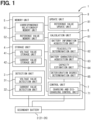
- a deterioration degree determination device 1 of the present embodiment 1 determines the deterioration degree of secondary batteries 21 to 26, and includes a battery information acquisition unit 61, a feasibility determination unit 62, a battery characteristic acquisition unit 63, and a deterioration degree determination unit 65.
- the battery information acquisition unit 61 acquires battery information related to the secondary batteries 21 to 26.
- the feasibility determination unit 62 determines the feasibility of the deterioration degree determination for each of the secondary batteries 21 to 26, based on the battery information acquired by the battery information acquisition unit 61 and the feasibility determination reference prepared in advance.
- the battery characteristic acquisition unit 63 acquires the battery characteristic related to the transition of a battery state in a predetermined voltage section for the secondary batteries 21 to 26 for which the determination of the deterioration degree is determined to be feasible by the feasibility determination unit 62.
- the deterioration degree determination unit 65 determines the deterioration degree of the secondary batteries 21 to 26 for which the determination of the deterioration degree is determined to be feasible, based on the battery characteristic acquired by the battery characteristic acquisition unit 63 or the battery characteristic relationship value calculated based on the battery characteristic.
- the type of the secondary batteries 21 to 26 of which the deterioration degree is to be determined is not limited, and the known secondary battery such as a nickel-metal hydride battery and a lithium ion battery can be a target.
- the corresponding secondary battery may have a single cell or multiple cells.
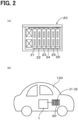
- the secondary batteries 21 to 26 form a secondary battery module that is a module that can be individually attached to and detached from a battery pack 20.
- the number of secondary batteries in the battery pack 20 is not particularly limited, but in the present embodiment 1, the number is six, and the secondary batteries 21 to 26 are connected in series. Instead of the above-mentioned, the secondary batteries 21 to 26 may be connected in parallel.
- the corresponding battery pack 20 is mounted on a vehicle 100 as a battery.
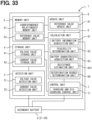
- the deterioration degree determination device 1 includes a detection unit 3, a storage unit 4, a memory unit 5, a calculation unit 6, a control unit 7, and an update unit 8.
- the detection unit 3 includes a voltage value detection unit 31 and a current value detection unit 32.
- the voltage value detection unit 31 is configured with a predetermined voltmeter and detects the voltage values of the secondary batteries 21 to 26.
- the current value detection unit 32 is configured with a predetermined ammeter and detects the current value flowing through the secondary batteries 21 to 26.
- the open circuit voltage of the secondary batteries 21 to 26 is configured to be acquired based on the voltage value detected by the voltage value detection unit 31.
- the storage unit 4 shown in FIG. 1 is configured with a rewritable non-volatile memory, and includes a voltage value storage unit 41 and a current value storage unit 42.
- the voltage value storage unit 41 stores the voltage value detected by the voltage value detection unit 31, and the current value storage unit 42 stores the current value detected by the current value detection unit 32.
- a memory unit 5 shown in FIG. 1 is configured with a non-volatile memory, and includes a correspondence relationship memory unit 51 and a reference value memory unit 52.
- the correspondence relationship memory unit 51 stores the correspondence relationship between the battery characteristic and a total capacity.
- the form of the corresponding correspondence relationship is not particularly limited, and can be, for example, a calculation formula, a map, a graph, and a table.
- the corresponding correspondence relationship can be created by machine learning using the measurement-purpose secondary battery, or created based on the measured value obtained by performing an accelerated deterioration test by using the measurement-purpose secondary battery, or created by a calculation formula that logically derives the correspondence relationship between the battery characteristic and the total capacity in a predetermined voltage section by using the secondary battery model.
- the correspondence relationship stored in the correspondence relationship memory unit 51 is appropriately set according to the battery characteristic acquired by the battery characteristic acquisition unit 63 described later.
- the above-mentioned total capacity can be the capacity from a fully discharged state to a fully charged state in the charging time.
- the total capacity can be the capacity from the fully charged state to the fully discharged state in the discharging time.
- the fully discharged state may be an effective fully discharged state defined by a system such as a vehicle on which the secondary battery 2 is mounted, and may be a state in which the lower limit voltage set by the user who uses the deterioration degree determination device 1 has been reached.
- the fully charged state may be an effective fully charged state defined by the system such as the vehicle and the like, or may be a state in which the upper limit voltage specified by the user has been reached.
- the reference value memory unit 52 shown in FIG. 1 stores, in advance, a feasibility reference value to determine the feasibility of the determination of the deterioration degree, which is used in the feasibility determination unit 62 described later, and a deterioration degree reference value to determine the deterioration degree used in the deterioration degree determination unit 65 described later. Both of the corresponding reference values are appropriately set according to the mode of determination in the feasibility determination unit 62 and the deterioration degree determination unit 65. In the present embodiment 1, multiple reference values are set for the deterioration degree reference value such that the deterioration degree can be divided into five stages and determined.
- the control unit 7 shown in FIG. 1 includes a charging and discharging control unit 71.
- the charging and discharging control unit 71 controls charging and discharging to charge and discharge the secondary battery 2.
- the charging and discharging control unit 71 is configured with an arithmetic device capable of executing a predetermined program.
- the calculation unit 6 shown in FIG. 1 is configured with a predetermined arithmetic device, and includes the battery information acquisition unit 61, the feasibility determination unit 62, the battery characteristic acquisition unit 63, a capacity estimation unit 64 as an estimation unit, and the deterioration degree determination unit 65.
- the battery information acquisition unit 61 acquires battery information that is information related to the secondary batteries 21 to 26.
- the corresponding battery information may be the history information of the secondary batteries 21 to 26, or can also be the history information replaced with or together with the battery characteristic described later.
- the battery information acquisition unit 61 acquires the battery characteristic acquired by the battery characteristic acquisition unit 63 described later as battery information.
- the feasibility determination unit 62 shown in FIG. 1 determines the feasibility of the determination of the deterioration degree for each of the secondary batteries 21 to 26 based on the battery information acquired by the battery information acquisition unit 61 or the battery information relationship value calculated from the corresponding battery information, and the feasibility determination reference stored in the reference value memory unit 52.
- the feasibility determination unit 62 determines the feasibility of the determination of the deterioration degree for each of the secondary batteries 21 to 26 based on the battery information relationship value calculated from the battery information acquired by the battery information acquisition unit 61 and the feasibility determination reference.
- the secondary battery for which the determination of the deterioration degree is determined to be infeasible is one outside the area of the training data used when the determination reference of the deterioration degree is defined in the deterioration degree determination unit 65 described later, and is one belonging to an unlearned area. Therefore, regarding the corresponding secondary battery, there is a possibility that the determination accuracy cannot be sufficiently ensured by the present deterioration degree determination, and thus the deterioration degree determination described later may not be performed. Accordingly, the determination accuracy can be improved as a whole by performing the determination of the deterioration degree for the secondary battery in which determination accuracy can be sufficiently ensured.
- the total capacity is separately measured by the update unit 8 described later, and can be used as training data to define the determination reference used for the deterioration degree determination from the next time onward. Accordingly, the determination reference can be updated according to the change over time of the secondary battery, and thus high determination accuracy can be maintained.
- the feasibility determination reference used in the feasibility determination unit 62 can be created by machine learning using a measurement-purpose secondary battery, be created based on the test measurement value obtained by performing an accelerated deterioration test by using the measurement-purpose secondary battery or the measurement value acquired from the used secondary battery, or be created by a relational expression that logically derives the feasibility determination reference by using the model of the secondary battery.
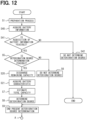
- the corresponding feasibility determination reference can be expressed as upper and lower limit values, only an upper limit value or only a lower limit value, or in a map format. For example, as shown in FIG. 4 , a predetermined range calculated by performing machine learning by using the correspondence relationship between a battery information A and a battery information B acquired from the measurement-purpose secondary battery as training data, can be used as the feasibility determination reference.
- the distance between the data with respect to the corresponding training data can be used as the feasibility determination reference.
- the distance between the corresponding data can be defined based on the Mahalanobis distance, the Euclidean distance, the Manhattan distance, the Chebyshev distance, and the like.
- the feasibility determination unit 62 is configured to perform feasibility determination based on the Mahalanobis distance calculated as a comparison result between the battery information relationship value calculated from the battery information acquired by the battery information acquisition unit and the feasibility determination reference, by using the preset relational expression related to multiple battery information. Multiple feasibility determination references may be set. That is, after the feasibility of the first deterioration degree determination is determined based on the first feasibility determination reference, the feasibility of the second deterioration degree determination with respect to the secondary battery for which the first deterioration degree determination is determined to be not feasible, may be determined based on the second feasibility determination reference.
- the battery characteristic acquisition unit 63 acquires the battery characteristic in a predetermined voltage section of the secondary batteries 21 to 26.
- the battery characteristic of the secondary batteries 21 to 26 can be, for example, a characteristic based on the voltage transition and the temperature transition of the secondary battery 2 in a predetermined voltage section Vs.
- the corresponding voltage transition for example, can be calculated based on at least one of the section capacity of the secondary batteries 21 to 26 in the predetermined voltage section, the ratio of the voltage change of the secondary batteries 21 to 26 with respect to the capacity change of the secondary battery 2 in the predetermined voltage section, and the ratio of the voltage change of the secondary batteries 21 to 26 with respect to the elapsed time in the predetermined voltage section.
- the predetermined voltage section can be a voltage section in which the deterioration degree of the secondary batteries 21 to 26 and the transition of the battery state show a correlation. Such a voltage section can be set based on the type and configuration of the secondary batteries 21 to 26, or can be derived by machine learning using the secondary battery.
- the battery characteristic acquisition unit 63 may acquire the absolute value of the acquired value as the battery characteristic.
- the predetermined voltage section Vs in which the battery characteristic of the secondary batteries 21 to 26 is acquired can be set for each of the secondary batteries 21 to 26, or can be appropriately changed.
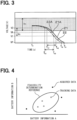
- the discharging voltage characteristic is used as the battery characteristic. As shown in FIG. 3 , the discharging voltage characteristic is calculated based on the voltage transition when the secondary battery 2 is discharged to a discharging target voltage VP.
- the discharging target voltage VP is not particularly limited, but can be a voltage equal to or lower than the lower limit value in a normal use range Vn for the voltage value of the secondary battery 2.
- the voltage transition for example, can be calculated based on at least one of the section capacity of the secondary battery 2 in the predetermined voltage section Vs, the ratio of the voltage change of the secondary battery 2 with respect to the capacity change of the secondary battery 2 in the predetermined voltage section Vs, and the ratio of the voltage change of the secondary battery 2 with respect to the elapsed time in the predetermined voltage section Vs.
- the predetermined voltage section Vs can be a voltage section in which the deterioration degree of the secondary battery 2 and the transition of the battery state show a correlation. Such the voltage section Vs can be set based on the type and configuration of the secondary battery 2, or can be derived by machine learning using the secondary battery 2. For example, in the present embodiment 1, as shown in FIG. 2 , the predetermined voltage section Vs is a section from a voltage value V1 to a voltage value V2. The voltage section Vs is a section in which the difference in the discharging voltage characteristic is remarkable according to the deterioration degree of the secondary battery 2.
- the capacity estimation unit 64 shown in FIG. 1 estimates the total capacity of the secondary battery 2 for which the deterioration degree determination is determined to be feasible by the feasibility determination unit 62 based on the battery characteristic acquired by the battery characteristic acquisition unit 63.
- a prediction model such as a regression formula created based on the training data acquired in advance can be used, and for example, linear regression, Lasso regression, Ridge regression, decision tree, and support vector regression can be used.
- the deterioration degree determination unit 65 shown in FIG. 1 determines the deterioration degree of the secondary battery 2 based on the battery characteristic or the battery characteristic relationship value.
- the battery characteristic relationship value is a value calculated based on the battery characteristic, and in the present embodiment 1, the estimation result of the capacity estimation unit 64 is adopted as the battery characteristic relationship value. Therefore, in the present embodiment 1, the deterioration degree determination unit 65 determines the deterioration degree of the secondary battery 2 based on the estimation result of the capacity estimation unit 64.
- the determination method can be performed by comparing the estimation result of the capacity estimation unit 64 with the reference value stored in advance in the reference value memory unit 52.
- the update unit 8 shown in FIG. 1 is configured with a predetermined arithmetic device and includes a reference value update unit 81.
- the reference value update unit 81 updates the feasibility determination reference and the deterioration degree determination reference stored in the reference value memory unit 52.
- the corresponding update can be performed by, with respect to the secondary battery for which the determination of the deterioration degree is determined to be infeasible by the feasibility determination unit 62 described above, acquiring the measured value of the total capacity by charging and discharging the corresponding secondary battery by the charging and discharging control unit 71, and updating the feasibility determination reference and the deterioration degree determination reference stored in the reference value memory unit 52 with the measured value as additional training data.
- step S1 shown in FIG. 5 as a preparation process, the secondary batteries 21 to 26 in the form of a module are taken out from the used battery pack 20 shown in (a) in FIG. 2 .
- step S2 the charging and discharging control unit 71 individually discharges the remaining capacity of the secondary batteries 21 to 26. As shown in FIG. 3 , the discharging continues until the open circuit voltage reaches the predetermined discharging target voltage VP.
- the secondary batteries 21 to 26 are nickel-metal hydride batteries, a memory effect may occur in the corresponding secondary batteries 21 to 26, but the cancellation of the memory effect is also performed at the same time for one, which is discharged down to the discharging target voltage VP or to a voltage close to the discharging target voltage VP, among the secondary batteries 21 to 26.
- the battery characteristic of each of the secondary batteries 21 to 26 is acquired by the battery characteristic acquisition unit 63.
- the above-mentioned discharging voltage characteristic is acquired as the battery characteristic.
- the discharging voltage characteristic is based on the voltage transition in the predetermined voltage section Vs of each of the secondary batteries 21 to 26 shown in FIG. 3 .
- the battery characteristic acquisition unit 63 acquires the voltage temporal change that indicates the relationship of the voltage change with respect to the passage of time from a discharging start T 0 to a discharging end T P1 as the voltage transition.
- the differential value in a voltage VA within the predetermined voltage section Vs that is, the slope of the tangent line at the voltage VA indicated by a reference numeral 21A in the graph of the voltage temporal change shown in FIG. 3 is calculated, and is used as the discharging voltage characteristic of the first secondary battery 21.
- the differential value in a voltage VA within the predetermined voltage section Vs that is, the slope of the tangent line at the voltage VA indicated by a reference numeral 21A in the graph of the voltage temporal change shown in FIG. 3 is calculated, and is used as the discharging voltage characteristic of the first secondary battery 21.
- the voltage temporal change is also acquired in the same manner as the voltage transition, and the differential value at the voltage VA within the predetermined voltage section Vs indicated by a reference numeral 22A is calculated and is used as the discharging voltage characteristic of the second secondary battery 22.
- the voltage temporal change is acquired as the voltage transition, and the differential value at the voltage VA is calculated to be used as the respective discharging voltage characteristics.
- the voltage temporal change is acquired as the voltage transition to use the differential value in the voltage VA within the predetermined voltage section Vs, but instead of the above-mentioned, the ratio of the voltage change between the two points in the voltage temporal change derived as the voltage transition, that is, the slope of the straight line passing through the corresponding two points in the graph of the voltage temporal change may be calculated and used as the discharging voltage characteristic.
- the ratio of the voltage change between the two points in the voltage temporal change derived as the voltage transition that is, the slope of the straight line passing through the corresponding two points in the graph of the voltage temporal change may be calculated and used as the discharging voltage characteristic.
- two points in the voltage temporal change of the first secondary battery 21 shown in FIG. 3 two points of start time T A1 and end time T A2 of the voltage section Vs can be adopted, and the same two points can also be adopted in the other secondary batteries 22 to 26.
- the battery information acquisition unit 61 acquires the battery characteristic acquired by the battery characteristic acquisition unit 63 as battery information. Thereafter, in a step S5, the feasibility determination unit 62 determines the feasibility of the determination of the deterioration degree. Specifically, the feasibility determination unit 62 determines the feasibility of the determination of the deterioration degree based on whether the distance between the data of the feasibility determination reference stored in the reference value memory unit 52 and the battery information relationship value calculated from the acquired battery information is within a predetermined range, that is, whether the corresponding battery information relationship value is within the feasibility determination reference shown in FIG. 4 .
- the feasibility determination unit 62 determines that the determination of the deterioration degree is not feasible, and proceeds to No in the step S5 shown in FIG. 5 .
- the process proceeds to a step S9 described later without determining the deterioration degree.
- the feasibility determination unit 62 determines that the determination of the deterioration degree is feasible, and proceeds to Yes in the step S5.
- the capacity estimation unit 64 estimates the total capacity of the secondary batteries 21 to 26, that is, the full charging capacity or the full discharging capacity, based on the battery characteristic acquired by the battery characteristic acquisition unit 63.
- the capacity estimation unit 64 estimates the total capacity of the secondary batteries 21 to 26 from the discharging voltage characteristic acquired by the battery characteristic acquisition unit 63 as the battery characteristic, based on the correspondence relationship between the total capacity and the discharging voltage characteristic based on the prediction model stored in the correspondence relationship memory unit 51.
- the deterioration degree determination unit 65 determines the deterioration degree of the secondary batteries 21 to 26 based on the total capacity estimated by the capacity estimation unit 64. Accordingly, the process proceeds to a step S9, and the present deterioration degree determination is ended. Thereafter, the process proceeds to a symbol A, and in a step S10, the update unit 8 determines whether there is a secondary battery for which the determination of the deterioration degree is determined to be infeasible by the feasibility determination unit 62 in the step S5. When determination is made that there is no secondary battery of which the deterioration degree is not determined, the process proceeds to No in the step S10, and the control flow is ended. On the other hand, when determination is made in the step S5 that there is a secondary battery of which the deterioration degree is not determined, the process proceeds to Yes in the step S10.
- the charging and discharging control unit 71 charges and discharges the secondary battery of which the deterioration degree is not determined, and measures the measured value of the total capacity.
- the reference value update unit 81 updates the feasibility determination reference and the deterioration degree determination reference stored in the reference value memory unit 52 by using the corresponding measured value as additional training data. Both of the corresponding reference values will be used for the deterioration degree determination from the next time onward.
- step S13 multiple secondary batteries 2 taken out from the battery pack 20 are prepared.
- step S14 the battery characteristic of each of the secondary batteries 2 is acquired.
- the acquisition of the corresponding battery characteristic can be performed as in the case of acquiring the battery characteristic in the deterioration degree determination device 1 of the present embodiment 1.
- step S15 the secondary battery 2 is ranked based on the corresponding battery characteristic or the battery characteristic relationship value calculated based on the corresponding battery characteristic.
- the total capacity of the secondary battery 2 is estimated based on the battery characteristic as the battery characteristic relationship value, and the secondary battery 2 is ranked based on whether the absolute value of the deterioration degree of the secondary battery 2 calculated from the corresponding total capacity is within a predetermined range.
- the absolute value of the deterioration degree is divided into a predetermined range of five stages, and the ranks are A, B, C, D, and E in order from the one with the smallest absolute value of the deterioration degree.
- the ranking criteria can be set as appropriate.
- the secondary batteries 21 to 26 are selected based on the rank.
- sorting is performed for each rank. Accordingly, the secondary batteries 2 included in the same rank have the same deterioration degree.
- the secondary batteries 2 of the same rank are combined to assemble the battery pack 20 to create a rebuilt product. Accordingly, the secondary battery 2 included in the battery pack 20 of a rebuilt product has the same absolute value of the deterioration degree, and the difference in the deterioration degree can be set to a predetermined reference value or less. The reference value for the difference in the deterioration degree can be appropriately set according to the ranking reference.
- the battery pack 20 is created of the secondary batteries 2 of the same rank, but is not limited thereto, and the battery pack 20 may be created within a predetermined range of ranks, for example, the battery pack 20 may be created from the secondary batteries 2 included in the A rank and the B rank.
- the secondary battery 2 ranked at the lowest rank E may be discarded as unusable, or may be disassembled and used for recycling of members.
- step S18 shown in FIG. 6 supplementary charging is performed in units of the battery pack 20. Accordingly, the secondary batteries 21 to 26 can be used as the battery pack 20.
- the deterioration degree of the secondary battery is determined based on the battery characteristic or the battery characteristic relationship value related to the voltage transition in the predetermined voltage section acquired from the secondary battery 2. Therefore, the deterioration degree can be determined by a simple process. By setting a voltage section that shows a high correlation between the voltage transition of the secondary battery 2 and the deterioration degree as the voltage section to acquire the battery characteristic of the secondary battery 2, the deterioration degree of the secondary battery 2 can be determined in high accuracy.
- the determination accuracy can be improved as a whole by performing the determination of the deterioration degree for the secondary battery 2 in which determination accuracy can be sufficiently ensured.
- the feasibility determination unit 62 performs the feasibility determination based on a comparison result between the battery information relationship value calculated from the battery information acquired by the battery information acquisition unit 61 and the feasibility determination reference, by using the preset relational expression related to multiple battery information. Accordingly, the determination accuracy can be improved by appropriately adjusting the relational expression.
- the battery pack 20 includes the multiple secondary batteries 2 having a usage history, and it is possible to provide the battery pack in which the battery characteristic related to the transition of the battery state of the predetermined voltage section Vs in the secondary battery 2 or the battery characteristic relationship value calculated based on the battery characteristic is within a predetermined range.
- the battery pack 20 having a small variation in battery characteristics can be provided.
- the voltage section Vs for acquiring the battery characteristic of the secondary battery 2 by setting the voltage section Vs showing a high correlation between the voltage transition of the secondary battery 2 and the deterioration degree, the variation in the deterioration degree of the secondary battery 2 included in the battery pack 20 becomes small, and thus the life extension and the quality improvement of the battery pack 20 can be attempted.
- the capacity estimation unit 64 estimates the total capacity of the secondary batteries 21 to 26 from the battery characteristic acquired by the battery characteristic acquisition unit 63, and the deterioration degree determination unit 65 determines the deterioration degree of the secondary batteries 21 to 26 based on the corresponding estimation result, but instead of the above-mentioned, the total capacity based on the battery characteristic acquired by the battery characteristic acquisition unit 63 may be not estimated, and the deterioration degree determination unit 65 may determine the deterioration degree of the secondary batteries 21 to 26.
- the battery characteristic acquisition unit 63 may acquire the absolute value of the acquired value as the battery characteristic, and the deterioration degree determination unit 65 may determine the deterioration degree based on the corresponding absolute value.
- the deterioration degree determination unit 65 may determine the deterioration degree of the secondary batteries 21 to 26 based on the difference in the battery characteristic acquired by the battery characteristic acquisition unit 63.
- the battery pack 20 is assembled by classifying the secondary batteries 21 to 26 into classes such that the deterioration degree of the secondary batteries 21 to 26 is within a predetermined range, but the battery pack 20 may be assembled by classifying the secondary batteries 21 to 26 into classes such that the difference between the deterioration degree and the deterioration degree of the secondary batteries 21 to 26 is within a predetermined range.
- the battery characteristic is the discharging voltage characteristic based on the voltage transition in the predetermined voltage sections Vs1 and Vs2 in the secondary batteries 21 to 26.
- the secondary batteries 21 to 26 are nickel-metal hydride batteries, at the time of reusing the used secondary batteries 21 to 26, the used secondary batteries 21 to 26 may be discharged for the purpose of canceling the memory effect, and by acquiring the discharging voltage characteristic during the discharging, the work process for reusing the secondary batteries 21 to 26 can be simplified.
- the discharging voltage characteristic is calculated based on the voltage transition during the discharging of the secondary battery 2, but instead of or together with the above-mentioned, the discharging voltage characteristic may be calculated based on the voltage transition during the voltage relaxation in which the open circuit voltage is returned after discharging is performed to reach the discharging target voltage VP and the discharging is stopped. For example, as in a modified embodiment 1 shown in FIG.
- the differential value at the predetermined voltage VA indicated by the reference numeral 21A can be calculated and used as the discharging voltage characteristic.
- the differential value at the predetermined voltage VA indicated by the reference numeral 22A can be calculated and be used as the discharging voltage characteristic, and also similarly for the other secondary batteries 23 to 26 (not shown), the discharging voltage characteristic can be acquired based on the voltage transition in the predetermined voltage section Vs in the voltage relaxation. Also in this case, the same operation effect as the operation effect of the present embodiment 1 is obtained.
- the capacity estimation unit 64 that estimates the total capacity of the secondary battery by using the battery characteristic acquired by the battery characteristic acquisition unit 63 as the battery characteristic relationship value, is provided, and the deterioration degree determination unit 65 determines the deterioration degree of the secondary batteries 21 to 26 based on the estimation result of the capacity estimation unit 64. Accordingly, the deterioration degree of the secondary batteries 21 to 26 can be detected with high accuracy.
- the ratio of the voltage change of the secondary battery 2 to the elapsed time in the predetermined voltage section Vs, that is, the differential value in the voltage temporal change is calculated, and is used as the discharging voltage characteristic. Accordingly, the deterioration degree of the secondary battery 2 can be determined with high accuracy and easily.
- the battery characteristic acquisition unit 63 may replace calculating the ratio of the voltage change of the secondary battery 2 to the elapsed time in the predetermined voltage section Vs as the voltage transition, or in addition to the above-mentioned, as in a modified embodiment 2 shown in FIG. 8 , may calculate the capacity change amount of each of the secondary batteries 21 to 26 in the predetermined voltage section Vs as a section capacity Qp and use the section capacity Qp as the discharging voltage characteristic.
- the section capacity Qp can be calculated from the current value flowing through the secondary batteries 21 to 26 and the time during which the current flows in the voltage section Vs detected by the current value detection unit 32. Also in this case, the deterioration degree of the secondary battery 2 can be determined with high accuracy and easily based on the discharging voltage characteristic.
- a total charging and discharging capacity Qt shown in FIG. 8 may be calculated as the capacity of all sections of discharging time T 0 to T P1 and T 0 to T P2 in each of the secondary batteries 21 to 26, and the capacity ratio, that is, the ratio of the section capacity Qp to the total charging and discharging capacity Qt may be calculated and be used as the discharging voltage characteristic.
- the capacity ratio that is a ratio of the section capacity Qp to the specific section capacity Qt' may be calculated and used as the discharging voltage characteristic.
- the deterioration degree of the secondary battery 2 can be determined with high accuracy and easily based on the discharging voltage characteristic.
- the voltage temporal change is acquired as the voltage transition to use the differential value in the voltage VA within the predetermined voltage section Vs, but instead of the above-mentioned, as in a modified embodiment 3 shown in FIG. 9 , the voltage-capacity change indicating the relationship of the voltage change with respect to the capacity from a capacity Q 0 at the discharging start time to a capacity Q p1 at the discharging end time as the voltage transition, may be acquired.
- the differential value in the voltage VA within the predetermined voltage section Vs that is, the slope of the tangent line at the voltage VA in the graph of the voltage-capacity change may be calculated, and may be used as the discharging voltage characteristic of the first secondary battery 21. Also in this case, the same operation effect as the operation effect of the present embodiment 1 is obtained.
- the battery characteristic acquisition unit 63 provided in the deterioration degree determination device 1 calculates the battery characteristic to acquire the battery characteristic, but instead of the above-mentioned, the deterioration degree determination device 1 may have an external input unit and calculate the battery characteristic by using an externally provided arithmetic device, such that by inputting the corresponding battery characteristic to the battery characteristic acquisition unit 63 via the external input unit, the battery characteristic acquisition unit 63 may acquire the battery characteristic.
- the discharging voltage characteristic is adopted as the battery characteristic, but at the same time, as shown in a modified embodiment 4 shown in FIG. 10 , the battery characteristic may include the charging voltage characteristic based on the voltage transition when the secondary batteries 21 to 26 are charged up to a predetermined charging target voltage VQ.
- the charging target voltage VQ is not particularly limited, but in the present embodiment 1, is set to be a value larger than the lower limit value of the normal use range Vn and smaller than the upper limit value thereof.
- the other configuration elements are the same as in the case of the embodiment 1.
- the calculation of the voltage transition in charging can be performed in the same manner as the calculation of the voltage transition in the discharging voltage characteristic in the embodiment 1 and each modified embodiment, and the calculated result is used as the charging voltage characteristic. That is, as shown in FIG. 10 , as the voltage transition, the voltage temporal change indicating the relationship of the voltage change with respect to the passage of time from the charging start, which are the discharging ends T P1 and T P2 , to the charging ends T Q1 and T Q2 is acquired.
- the differential value in a voltage VB within a predetermined voltage section VsB that is, the slope of the tangent line at the voltage VB indicated by a reference numeral 21B in the graph of the voltage temporal change shown in FIG.
- the predetermined voltage section VsB is a section from the voltage values V3 to V4, and is a section in which the difference in charging voltage characteristic is remarkable according to the deterioration degree of the secondary battery 2.
- the charging voltage characteristic may be the ratio of the voltage change between two points of the start time TB11 and TB21 and the end time TB12 and TB22 of the predetermined voltage section VsB as in the case of calculating the discharging voltage characteristic in the above-described embodiment 1, may be the section capacity Qp in the voltage section VsB, or may be the capacity ratio of the section capacity Qp to the total charging and discharging capacity QT by calculating the capacity of all sections of charging time T P1 to T Q1 and T P2 to T Q2 , that is, the total charging and discharging capacity QT when charging is performed to reach the charging target voltage VQ.
- the battery characteristic acquisition unit 63 acquires both the discharging voltage characteristic and the charging voltage characteristic, and the capacity estimation unit 64 estimates the total capacity of the secondary battery 2 based on the discharging voltage characteristic and the charging voltage characteristic. Accordingly the deterioration degree of the secondary battery 2 can be determined with higher accuracy.
- each of the secondary batteries 2 is charged before the battery pack 20 is assembled, and thus supplementary charging of the battery pack 20 in step S15 in FIG. 6 becomes unnecessary.
- the battery characteristic acquisition unit 63 acquires the charging voltage characteristic after acquiring the discharging voltage characteristic by discharging and then charging the secondary battery 2 but is not limited thereto, and may acquire the discharging voltage characteristic after acquiring the charging voltage characteristic by charging and then discharging the secondary battery.
- the battery characteristic acquisition unit 63 acquires both the discharging voltage characteristic and the charging voltage characteristic, but instead of the above-mentioned, may acquire only the charging voltage characteristic. In this case, the determination accuracy may be inferior to the determination accuracy in the case of acquiring both the discharging voltage characteristic and the charging voltage characteristic.
- the secondary batteries 21 to 26 are nickel-metal hydride batteries, a memory effect may occur, and when only the discharging voltage characteristic is acquired, in the discharging voltage characteristic, variation may occur in the voltage transition due to the influence of the memory effect, such that there is a concern that the improvement of the determination accuracy is restricted.
- the charging voltage characteristic which is acquired after the remaining capacity is discharged, is acquired, the charging voltage characteristic is acquired after the cancellation of the memory effect is attempted, such that the influence of the memory effect is small, and the determination accuracy can be expected to be improved.
- the charging voltage characteristic in the present modified embodiment 4 may be calculated based on the voltage transition during the voltage relaxation in which the open circuit voltage is returned after charging is performed to reach the predetermined charging target voltage VQ and the charging is stopped. For example, as in a modified embodiment 5 shown in FIG. 11 , based on the voltage transition in the predetermined voltage section VsB in the voltage relaxation after time T Q1 at which charging is stopped in the first secondary battery 21, the differential value at the predetermined voltage VB indicated by the reference numeral 21B may be calculated to be used as the charging voltage characteristic.
- the differential value at the predetermined voltage VB indicated by the reference numeral 22B may be calculated and used as the charging voltage characteristic. Also in this case, the same operation effect as the operation effect of the present embodiment 1 is obtained.
- the deterioration degree determination device 1 for the secondary battery capable of improving workability when the deterioration degree of the secondary batteries 21 to 26 forming the battery pack 20 is determined, can be provided.
- the deterioration degree determination unit 65 may determine the deterioration degree of the secondary battery 2 based on the battery characteristic acquired by the battery characteristic acquisition unit 63 without estimating the total capacity.
- the battery characteristic acquisition unit 63 may acquire the absolute value of the acquired value as the battery characteristic, and the deterioration degree determination unit 65 may determine the deterioration degree based on the corresponding absolute value.
- the deterioration degree determination unit 65 may determine the deterioration degree of the secondary battery 2 based on the difference in the battery characteristic acquired by the battery characteristic acquisition unit 63.
- the battery pack 20 may be assembled by classifying the secondary battery 2 into classes such that the difference between the deterioration degree and the deterioration degree of the secondary battery 2 is within a predetermined range.
- the battery information acquisition unit 61 acquires the battery characteristic of the secondary battery 2 acquired by the battery characteristic acquisition unit 63 as the battery information, but in the embodiment 2, the history information of the secondary battery 2 is acquired as the battery information.
- the history information of the secondary batteries 21 to 26 can include a charging electricity amount, a discharging electricity amount, a battery temperature, a charging state (SOC), an equalization frequency, an outside air temperature in each of the secondary batteries 21 to 26, the maximum value, the minimum value, the average value, the accumulated value, and the like in a predetermined period of the usage period, the temperature, and the like of a device mounted with the corresponding secondary battery.
- the predetermined period can be any period up to the present, and may be the entire period up to the present.
- Other configurations are the same as in the case of the embodiment 1, and the same reference numerals as those in the case of the embodiment 1 are assigned and the description thereof will be omitted.
- the step S1 is performed as in the case of the embodiment 1. Thereafter, the process proceeds to a step S40, and the battery information acquisition unit 61 attempts to acquire the battery information of the secondary batteries 21 to 26.
- the battery information acquisition unit 61 for example, attempts to acquire the history information of the charging electricity amount in each of the secondary batteries 21 to 26 as the battery information A, and attempts to acquire the temperature history in each of the secondary batteries 21 to 26 as the battery information B.
- the type of history information to be attempted to acquire here is not limited thereto.
- step S41 determination is made on whether the battery information A and B can be acquired by the battery information acquisition unit 61.
- the process proceeds to No in the step S41, and in a step S42, the measurement is failure, such that the flow is ended without determining the deterioration degree of the secondary battery 2.
- step S4 when the battery information can be acquired in the step S41 shown in FIG. 12 , the process proceeds to Yes in the step S41.
- step S5 as in the case of the embodiment 1, the feasibility of the determination of the deterioration degree is determined by the feasibility determination unit 62.
- steps S6 and S9 are performed as in the case of the embodiment 1, the process proceeds to the symbol A in FIG. 5 , and steps S10 to S12 are performed to end the flow.
- step S5 among the secondary batteries 21 to 26, for one of which the acquired battery information is within the feasibility determination reference, the feasibility determination unit 62 determines that the determination of the deterioration degree is feasible, the process proceeds to Yes in the step S5.
- step S20 among the secondary batteries 21 to 26, with respect to one for which the deterioration degree determination is determined to be feasible, the remaining capacity is individually discharged as in the step S5 of the embodiment 1 shown in FIG. 5 .
- the secondary batteries 21 to 26 are nickel-metal hydride batteries, the memory effect is also canceled at the same time.
- the discharging voltage characteristic is acquired as the battery characteristic as in the step S3 of the embodiment 1 shown in FIG. 5 .
- the steps S7 to S12 are performed to end the flow.
- the battery information acquisition unit 61 acquires the history information of the secondary batteries 21 to 26 as the battery information. Accordingly, the feasibility of the determination of the deterioration degree is determined based on the history information of the secondary batteries 21 to 26, and thus the determination accuracy can be improved.
- the battery information acquisition unit 61 acquires the battery characteristic of the secondary battery 2 acquired by the battery characteristic acquisition unit 63 as the battery information
- the battery information acquisition unit 61 acquires the history information of the secondary battery 2 as the battery information.
- the deterioration degree determination device 1 of a modified embodiment 6 is configured to acquire both the battery characteristic acquired by the battery characteristic acquisition unit 63 and the history information of the secondary battery 2 as the battery information.
- Other configurations are the same as in the case of the embodiment 1 and the embodiment 2, and the same reference numerals as those in the embodiment 1 and the embodiment 2 are given and the description thereof will be omitted.
- the step S1, the step S40, and the step S41 are performed as in the case of the embodiment 2.
- the process proceeds to No in the step S41 as in the case of the embodiment 2, and in the step S42, the measurement is failure, such that the flow is ended without determining the deterioration degree of the secondary battery 2.
- step S20 when the battery information can be acquired in the step S41 shown in FIG. 13 , as in the case of the embodiment 2, in the step S20, the remaining capacity of the secondary battery for which the battery information can be acquired is discharged, and the memory effect is also canceled at the same time when the secondary battery is a nickel-metal hydride battery.
- step S21 the battery characteristic is acquired as in the case of the embodiment 2, and the process proceeds to a step S50.
- the feasibility determination unit 62 determines the feasibility of the determination of the deterioration degree based on the battery characteristic and history information of the secondary batteries 21 to 26 as the battery information and the feasibility determination reference.
- the determination of the deterioration degree is determined to be not feasible, steps S6 and S9 are performed as in the case of the embodiment 1, the process proceeds to the symbol A in FIG. 5 , and steps S10 to S12 are performed to end the flow.
- the battery information used for determining the feasibility of the determination of the deterioration degree includes both the battery characteristic and the history information of the secondary batteries 21 to 26 as described above, and thus the feasibility of the determination of the deterioration degree can be determined with higher accuracy.
- the modified embodiment 6 also has the same operation effect as in the case of the embodiments 1 and 2.
- the deterioration degree determination device 1 of the present embodiment 3 has the same configuration as the configuration of the embodiment 2 shown in FIG. 12 .
- the reference value memory unit 52 stores a first feasibility determination reference D1 and a second feasibility determination reference D2.
- the first feasibility determination reference D1 stores the Mahalanobis distance D1 as the inter-data distance D1
- the second feasibility determination reference D2 stores the Mahalanobis distance as the inter-data distance
- the relationship of both is set as D1 ⁇ D2.
- the correspondence relationship memory unit 51 stores a first correspondence relationship and a second correspondence relationship.
- the first correspondence relationship is a correspondence relationship suitable for determining the deterioration degree of the secondary battery for which the determination of the deterioration degree is determined to be feasible by the first feasibility determination reference D1.
- the second correspondence relationship is a correspondence relationship suitable for determining the deterioration degree of the secondary battery for which the determination of the deterioration degree is determined to be feasible by the second feasibility determination reference D2.
- the correspondence relationship can be created as in the case of the embodiment 1.
- the flow of a method for determining the deterioration degree by the deterioration degree determination device 1 of the present embodiment 3 will be described below with reference to FIG. 14 .
- the same reference numerals as those in the case of the embodiment 2 shown in FIG. 12 are designated by the same reference numerals, and the description thereof will be omitted.
- the flow of the present embodiment 3 instead of the case of the embodiment 2 shown in FIG. 12 , as shown in FIG.
- the process proceeds to Yes in the step S41, and in a step S51, the feasibility determination unit 62 determines whether the determination of the deterioration degree of the secondary battery of which battery information can be acquired is feasible based on the first feasibility determination reference D1.
- the process proceeds to Yes in the step S51, and the step S22 and the step S23 are performed as in the step S20 and the step S21 of the case of the embodiment 2 .
- the capacity estimation unit 64 estimates the total capacity, that is, the full charging capacity or the full discharging capacity for, among the secondary batteries 21 to 26, one for which the determination of the deterioration degree is determined to be feasible in the step S51 from the battery characteristic acquired by the battery characteristic acquisition unit 63.
- the deterioration degree is determined in the step S8, the step S9 is performed to proceed to the symbol A in FIG. 5 , and the steps S10 to S12 are performed to end the flow.
- step S51 among the secondary batteries 21 to 26, with respect to one for which the determination of the deterioration degree is not feasible based on the first feasibility determination reference D1, the process proceeds to No in the step S51.
- the feasibility determination unit 62 determines whether the determination of the deterioration degree is feasible based on the second feasibility determination reference D2.
- the process proceeds to Yes in the step S52, and the step S24 and the step S25 are performed as in the step S20 and the step S21 of the case of the embodiment 2.
- the capacity estimation unit 64 estimates the total capacity, that is, the full charging capacity or the full discharging capacity for, among the secondary batteries 21 to 26, one for which the determination of the deterioration degree is determined to be feasible in the step S52 from the battery characteristic acquired by the battery characteristic acquisition unit 63.
- the deterioration degree is determined in the step S8, and the process proceeds to the step S9 to end the present deterioration degree determination.
- the process proceeds to No in the step S52 and then proceeds to the steps S6 and S9 as in the case of the embodiment 1 to end the present deterioration degree determination.
- the process proceeds to the symbol A in FIG. 5 , and the steps S10 to S12 are performed to end the flow.
- the deterioration degree determination device 1 of the present embodiment 3 has the first feasibility determination reference D1 and the second feasibility determination reference as multiple feasibility determination references, and has, as multiple correspondence relationships, a first correspondence relationship and a second correspondence relationship suitable for one for which the determination of the deterioration degree is determined to be feasible based on the respective feasibility determination references. Accordingly, the consistency between the reference of the determination feasibility of the deterioration degree and the reference of the determination the deterioration degree is high, and the deterioration degree can be determined with higher accuracy.
- the present embodiment also has the same operation effect as in the case of the embodiment 1.
- the calculation unit 6 further includes a vehicle information acquisition unit 66.
- vehicle information As vehicle information, the vehicle type of the vehicle 100, the product number of the battery pack, the module of the secondary battery, and the like, the position of the module in the battery pack, the year of manufacture, the period of use, and the travel distance of the vehicle 100, the location of the store of the vehicle 100, and the like can be exemplified.
- the reference value memory unit 52 stores the vehicle information reference as the determination reference of the vehicle information for determining the feasibility of the determination of the deterioration degree. In the present embodiment 4, multiple specific vehicle types are stored as the vehicle information.
- the correspondence relationship memory unit 51 stores the correspondence relationships corresponding to the corresponding specific vehicle types, respectively. Other configurations are the same as in the case of the embodiment 1 shown in FIG. 1 and the embodiment 2 (not shown), and the same reference numerals are given and the description thereof will be omitted.
- the flow of a method for determining the deterioration degree by the deterioration degree determination device 1 of the present embodiment 4 will be described below.
- the same reference numerals as those in the case of the embodiment 2 shown in FIG. 12 are designated by the same reference numerals, and the description thereof will be omitted.
- the process instead of the step S40 of the embodiment 2 shown in FIG. 12 , as shown in FIG. 16 , after the step S1, the process proceeds to the step S43, and the vehicle information acquisition unit 66 acquires the vehicle information of the vehicle 100 mounted with the battery pack 20.
- the corresponding vehicle information is not limited, but in the present embodiment 4, the vehicle type of the vehicle 100 is acquired.
- the feasibility determination unit 62 determines whether the vehicle information acquired by the vehicle information acquisition unit 66 corresponds to the vehicle information reference. In the present embodiment 4, determination is made on whether the vehicle type acquired by the vehicle information acquisition unit 66 corresponds to the specific vehicle type stored in the reference value memory unit 52. In the step S44, when determination is made that the corresponding vehicle type does not correspond to a specific vehicle type, the process proceeds to No in the step S44, and the flow is ended without determining the deterioration degree in the step S42 as in the case of the embodiment 2.
- step S44 when determination is made that the acquired vehicle information corresponds to the vehicle information reference, the process proceeds to Yes in the step S44.
- the steps S40 to S42, the steps S5 to S6, and the steps S20 to S21 are performed.
- the capacity estimation unit 64 estimates the total capacity of the secondary battery for which the determination of the deterioration degree is determined to be feasible according to the vehicle information in a step S73. That is, the capacity estimation unit 64 changes the estimation formula used for estimating the corresponding total capacity according to the vehicle information.
- the deterioration degree determination unit 65 determines the deterioration degree of the secondary batteries 21 to 26 based on the estimation result of the total capacity.
- the process proceeds to the step S9 to end the present deterioration degree determination. Thereafter, the process proceeds to the symbol A in FIG. 5 , and the steps S10 to S12 are performed to end the flow.
- the capacity estimation unit 64 can determine the deterioration degree according to the vehicle type by using an estimation formula for estimating the total capacity corresponding to the vehicle type as the vehicle information, and the estimation accuracy is further improved.
- the deterioration degree determination device 1 of the present embodiment 4 can also have the same operation effect as the operation effect of the present embodiment 1.
- the calculation unit 6 includes an impedance characteristic acquisition unit 67 as shown in FIG. 17 .
- the impedance characteristic acquisition unit 67 has a configuration for measuring complex impedance, and is configured to be able to measure the impedance of the secondary batteries 21 to 26.
- Other configurations are the same as those of the embodiment 1, and the same reference numerals are given to the same configurations of the embodiment 1, and the description thereof will be omitted.
- the battery characteristic acquisition unit 63 acquires the discharging voltage characteristic in the predetermined voltage section Vs shown in FIG. 3 , as in the case of the embodiment 1.
- the impedance characteristic acquisition unit 67 measures the complex impedance at the discharging end time T P1 and T P2 shown in FIG. 3 , acquires the impedance at a predetermined frequency, and calculates the values of the real axis and the imaginary axis on the complex plane.
- the value of the real axis and the imaginary axis of the impedance at a predetermined frequency f1 and the absolute value calculated from the value of the real axis and the value of the imaginary axis can be used.
- the declination calculated from the value of the real axis and the value of the imaginary axis at the predetermined frequency f1 can be used.
- the difference of the values of the real axis, the difference of the values of the imaginary axis, and the difference of the absolute values calculated from the difference of the values of the real axis and the difference of the values of the imaginary axis, and declination can also be used.
- the correspondence relationship memory unit 51 stores in advance the correspondence relationship between the impedance characteristic and the total capacity.
- the corresponding correspondence relationship can be created by machine learning using the measurement-purpose secondary battery 2, or created based on the measured value obtained by performing an accelerated deterioration test by using the measurement-purpose secondary battery, or created by a calculation formula that logically derives the correspondence relationship between the impedance characteristic and the total capacity in a predetermined voltage by using the model of the secondary battery.
- the capacity estimation unit 64 shown in FIG. 17 estimates the total capacity of the secondary battery 2 based on the discharging voltage characteristic acquired by the battery characteristic acquisition unit 63 and the impedance characteristic acquired by the impedance characteristic acquisition unit 67.
- the deterioration degree determination unit 65 determines the deterioration degree of the secondary battery 2 based on the estimation result of the capacity estimation unit 64 as in the case of the embodiment 1. According to the present embodiment 5, the total capacity is estimated based on the discharging voltage characteristic and the impedance characteristic, and thus the determination accuracy can be further improved.
- the timing at which the impedance characteristic acquisition unit 67 measures the complex impedance is set to the discharging end time T P1 and T P2 but is not limited thereto, and measurement may be performed at other timings.
- the impedance characteristic acquisition unit 67 may perform complex impedance measurement at the charging end time T Q1 and T Q2 shown in FIG. 12 .
- the capacity estimation unit 64 may use, instead of the impedance characteristic, the impedance characteristic relationship value calculated based on the impedance characteristic.
- the impedance characteristic relationship value for example, the difference in the impedance characteristic acquired by the impedance characteristic acquisition unit 67 can be adopted.
- the battery pack includes the multiple secondary batteries having the usage history, and the battery pack can be provided in which the difference in the deterioration degree of each of the multiple secondary batteries, which is determined based on the total capacity estimated by using the battery characteristic and the impedance characteristic related to the impedance when the secondary battery is charged or discharged, is within a predetermined range.
- the variation in the deterioration degree of the secondary battery included in the battery pack becomes smaller, and thus the lifetime of the battery pack as a rebuilt product can be extended and the quality improvement can be attempted.
- the deterioration degree determination unit 65 may determine the deterioration degree of the secondary batteries 21 to 26 based on the battery characteristic and the impedance characteristic acquired by the battery characteristic acquisition unit 63 without estimating the total capacity.
- the battery characteristic acquisition unit 63 may acquire the absolute value of the acquired value as the battery characteristic, and the deterioration degree determination unit 65 may determine the deterioration degree based on the corresponding absolute value.
- the deterioration degree determination unit 65 may determine the deterioration degree of the secondary batteries 21 to 26 based on the difference in the battery characteristic acquired by the battery characteristic acquisition unit 63.
- the battery pack 20 may be assembled by classifying the secondary batteries 21 to 26 into classes such that the difference between the deterioration degree and the deterioration degree of the secondary batteries 21 to 26 is within a predetermined range.
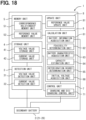
- an initial voltage acquisition unit 68 is provided as shown in FIG. 18 .
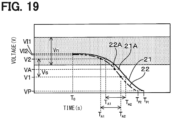
- the initial voltage acquisition unit 68 acquires initial voltages VI1 and VI2 that are the open circuit voltages of the secondary battery 2 at the discharging start time T 0 .
- the correspondence relationship memory unit 51 stores in advance the correspondence relationship among the initial voltage value, the battery characteristic, and the total capacity. The correspondence relationship can be created as in the case of the embodiment 1.
- Other configurations are the same as those of the embodiment 1, and the same reference numerals are given to the same configurations of the embodiment 1, and the description thereof will be omitted.
- the deterioration degree of the secondary battery 2 is determined also in consideration of the initial voltage in addition to the battery characteristic, and thus the determination accuracy can be further improved with a simple configuration.
- the initial voltage the initial voltage relationship value calculated based on the initial voltage may be used.
- the initial voltage relationship value for example, an absolute value of the initial voltage or a difference of the initial voltage acquired by the initial voltage acquisition unit 68 can be used.
- the battery pack 20 includes the multiple secondary batteries 21 to 26 including a recycled product, and the battery pack 20 can be provided in which the difference in the deterioration degree of each of the multiple secondary batteries 21 to 26, which is determined based on the total capacity estimated by using the battery characteristic and the initial voltage that is the open circuit voltage of the secondary batteries 21 to 26 when the acquisition of the battery characteristic is started, is within a predetermined range.
- the variation in the deterioration degree of the secondary batteries 21 to 26 included in the battery pack 20 becomes smaller, and thus the lifetime of the battery pack 20 as a rebuilt product can be extended and the quality improvement can be attempted.
- the deterioration degree determination unit 65 may determine the deterioration degree of the secondary batteries 21 to 26 based on the battery characteristic and the initial voltage acquired by the battery characteristic acquisition unit 63 without estimating the total capacity.
- the battery characteristic acquisition unit 63 may acquire the absolute value of the acquired value as the battery characteristic, and the deterioration degree determination unit 65 may determine the deterioration degree based on the corresponding absolute value.
- the deterioration degree determination unit 65 may determine the deterioration degree of the secondary batteries 21 to 26 based on the difference in the battery characteristic acquired by the battery characteristic acquisition unit 63.
- the battery pack 20 may be assembled by classifying the secondary batteries 21 to 26 into classes such that the difference between the deterioration degree and the deterioration degree of the secondary batteries 21 to 26 is within a predetermined range.
- the calculation unit 6 may have an internal resistance acquisition unit 69 that acquires the internal resistance of the secondary batteries 21 to 26, and the correspondence relationship memory unit 51 may store in advance the correspondence relationship among the internal resistance, the battery characteristic, and the total capacity.
- the internal resistance acquisition unit 69 the internal resistance can be calculated and acquired from the measured voltage, which is the voltage value itself detected by the voltage value detection unit 31, the open circuit voltage of the secondary batteries 21 to 26, and the current flowing through the secondary batteries 21 to 26.
- the open circuit voltage of the secondary battery 2 can be estimated and acquired for each time by using a map showing the correspondence relationship between the residual discharge amount and the initial voltage of the secondary batteries 21 to 26.
- the deterioration degree determination device 1 of the present modified embodiment 7 the deterioration degree of the secondary batteries 21 to 26 is determined also in consideration of the internal resistance in addition to the battery characteristic, and thus the determination accuracy can be further improved with a simple configuration.
- the deterioration degree determination device 1 of the present embodiment 7 includes a temperature detection unit 33 as shown in FIG. 21 in addition to the configuration of the embodiment 1 shown in FIG. 1 .
- the battery characteristic acquisition unit 63 is configured to acquire the discharging voltage characteristic based on the voltage transition of the secondary battery 2 in the predetermined voltage section Vs as the battery characteristic, but in the present embodiment 7, instead of the above-mentioned, the battery characteristic acquisition unit 63 acquires the temperature characteristic based on the temperature transition of the secondary battery 2 in predetermined voltage sections VsA and VsB as the battery characteristic.
- Other configurations are the same as those of the embodiment 1, and the same reference numerals are given to the same configurations of the embodiment 1, and the description thereof will be omitted.
- the voltage section VsA is a section in which the difference in the discharging voltage characteristic is remarkable according to the deterioration degree of the secondary battery 2
- the voltage section VsB is a section in which the difference in the charging voltage characteristic is remarkable according to the deterioration degree of the secondary battery 2.
- the temperature detection unit 33 acquires the temperature of the secondary battery 2 during charging and discharging.
- the first secondary battery 21 taken out from the battery pack 20 and the seventh secondary battery 27 taken out from another battery pack are adopted.
- the temperature transition of the secondary battery 2 in charging and discharging may show different behaviors depending on the measurement environment and the soak state of the secondary battery 2 when the inserted battery packs are different.
- the temperature transitions in the first secondary battery 21 and the seventh secondary battery 27 are within a measured room temperature setting range Tn, but show slightly different behaviors from each other.
- the battery characteristic acquisition unit 63 acquires the temperature characteristic in discharging and the temperature characteristic in charging based on the battery temperature detected by the temperature detection unit 33 in both the predetermined voltage section VsA during discharging and the predetermined voltage section VsB during charging after the discharging.
- the capacity estimation unit 64 estimates the total capacity of each of the secondary batteries 21 and 27 based on both temperature characteristics, and the deterioration degree determination unit 65 determines the deterioration degree.
- the temperature characteristic acquired by the battery characteristic acquisition unit 63 can be, as in the case of calculating the discharging voltage characteristic in the case of the embodiment 1 and the case of calculating the charging voltage characteristic in the case of the embodiment 3, the differential value of the temperature change of the predetermined voltage VA and VB in the predetermined voltage sections VsA and VsB, the ratio of the temperature change between two points in the predetermined voltage sections VsA and VsB, and the ratio of the temperature change of the secondary battery 2 to the capacity change of the secondary battery 2 in the voltage sections VsA and VsB.
- the same operation effect as in the case of the embodiment 1 can be obtained.
- the temperature characteristic is acquired in both discharging and charging but is not limited thereto, and only one of discharging and charging may be used.
- the battery pack includes the secondary battery having the usage history, and the battery pack can be provided in which the difference in the deterioration degree of each of the multiple secondary batteries, which is determined based on the total capacity estimated by using the battery characteristic including the temperature characteristic based on the temperature transition of the secondary battery in the predetermined voltage sections VsA and VsB, is within a predetermined range.
- the variation in the deterioration degree of the secondary battery included in the battery pack becomes smaller, and thus the quality improvement of the battery pack as a rebuilt product can be attempted.
- the deterioration degree determination unit 65 may determine the deterioration degree of the secondary batteries 21 to 26 based on the temperature characteristic acquired by the battery characteristic acquisition unit 63 without estimating the total capacity.
- the battery characteristic acquisition unit 63 may acquire the absolute value of the acquired value as the temperature characteristic, and the deterioration degree determination unit 65 may determine the deterioration degree based on the corresponding absolute value.
- the deterioration degree determination unit 65 may determine the deterioration degree of the secondary batteries 21 to 26 based on the difference in the temperature characteristic acquired by the battery characteristic acquisition unit 63.
- the battery pack 20 may be assembled by classifying the secondary batteries 21 to 26 into classes such that the difference between the deterioration degree and the deterioration degree of the secondary batteries 21 to 26 is within a predetermined range.
- the temperature characteristic at the charging time is acquired when the charging target voltage VQ is within the normal use range Vn and the predetermined voltage section VsA is within the normal use range Vn, but instead of the above-mentioned, as in a modified embodiment 8 shown in (a) in FIG. 23 , as the temperature characteristic at the charging time, the temperature characteristic may be acquired when the charging target voltage VQ exceeds the normal use range Vn and the predetermined voltage section VsB is in an area beyond the normal use range Vn. In this case, as shown in (b) in FIG. 23 , the temperature of the secondary batteries 21 and 27 easily rises, and thus the deterioration degree is easily reflected in the temperature transition. As a result, the determination accuracy can be improved. In the present modified embodiment 8, the secondary batteries 21 and 27 are charged to the charging target voltage VQ and then discharged to return the voltage of the secondary batteries 21 and 27 to the normal use range Vn.
- the secondary battery 2 is discharged, then charged, and then discharged again, but instead of the above-mentioned, as in a modified embodiment 9 shown in (a) in FIG. 24 and (b) in FIG. 24 , the battery may be charged first and then discharged without first discharging.
- the battery characteristic acquisition unit 63 may acquire the charging time temperature characteristic at the charging time and then acquire the discharging time temperature characteristic at the discharging time. Also in this case, the same operation effect as the operation effect of the embodiment 1 is obtained.
- the capacity estimation unit 64 as the estimation unit estimates the total capacity of the secondary battery 2 based on the battery characteristic acquired by the battery characteristic acquisition unit 63, but is not limited thereto, and the capacity estimation unit 64 may estimate at least one of the positive electrode capacity, the negative electrode capacity, the deviation amount of the relative relationship between the negative electrode SOC and the positive electrode SOC, the total capacity variation among the multiple cells forming the secondary batteries 21 to 26, and the battery resistance, positive electrode resistance, and negative electrode resistance of the secondary batteries 21 to 26.
- the capacity estimation unit 64 estimates a positive electrode capacity Qc of each of the secondary batteries 21 to 26.
- the correspondence relationship memory unit 51 stores the correspondence relationship between the battery characteristic and the positive electrode capacity Qc.
- the form of the corresponding correspondence relationship and the method for creating the correspondence relationship are not particularly limited, and can be, for example, a calculation formula, a map, a graph, and a table, as in the case of the embodiment 1.
- the corresponding correspondence relationship can be created by machine learning using the measurement-purpose secondary battery 2, or created based on the actual measurement value obtained by performing an accelerated deterioration test by using the measurement-purpose secondary battery 2, or created by a calculation formula that logically derives the correspondence relationship between the battery characteristic and the total capacity in a predetermined voltage section by using the model of the secondary battery 2.
- the correspondence relationship memory unit 51 for example, stores the correspondence relationship between the battery characteristic and the positive electrode capacity Qc based on the prediction model shown in (a) to (c) in FIG. 25 .
- Other configurations are the same as in the case of the embodiment 1, and the same reference numerals as those in the case of the embodiment 1 are assigned and the description thereof will be omitted.
- the steps S1 to S5 shown in FIG. 26 are performed as in the case of the embodiment 1 shown in FIG. 5 . Accordingly, as shown in (a) in FIG. 27 , the battery characteristic acquisition unit 63 acquires a discharging curve as the battery characteristic of each of the secondary batteries 21 to 26 in the predetermined voltage section Vs.
- the predetermined voltage section can be a section corresponding to a specific SOC range.
- the capacity estimation unit 64 estimates the positive electrode capacity Qc of the secondary batteries 21 to 26 from the discharging curve acquired by the battery characteristic acquisition unit 63 based on the correspondence relationship between the battery characteristic and the positive electrode capacity Qc based on the prediction model stored in the correspondence relationship memory unit 51.
- the deterioration degree determination unit 65 determines the deterioration degree of the secondary batteries 21 to 26 based on the positive electrode capacity Qc estimated by the capacity estimation unit 64.
- step S110 the charging and discharging control unit 71 charges and discharges the secondary battery of which the deterioration degree is not determined, and the measured value of the positive electrode capacity is measured.
- step S12 the feasibility determination reference and the deterioration degree determination reference are updated.
- the present embodiment 8 also has the same operation effect as the operation effect of the embodiment 1.
- the battery characteristic acquisition unit 63 acquires the discharging curve shown in (a) in FIG. 27 , but instead of the above-mentioned, may acquire the charging curve shown in (b) in FIG. 27 . Also in this case, the same operation effect as the operation effect of the embodiment 1 is obtained.
- the capacity estimation unit 64 estimates the positive electrode capacity Qc, but instead of the above-mentioned, in the embodiment 9, the capacity estimation unit 64 estimates the negative electrode capacity QA. That is, in the embodiment 9, as shown in FIG. 28 , in step S75 and step S111, based on the prediction model shown in (a) to (c) in FIG. 25 , the negative electrode capacity QA of the secondary batteries 21 to 26 is estimated based on the correspondence relationship between the battery characteristic and the negative electrode capacity QA.
- the embodiment 9 also has the same operation effect as the operation effect of the embodiment 1.
- the capacity estimation unit 64 estimates the deviation amount of the relative relationship between the negative electrode SOC and the positive electrode SOC of each of the secondary batteries 21 to 26.
- the correspondence relationship memory unit 51 stores the correspondence relationship between the battery characteristic and the deviation amount of in the relative relationship between the negative electrode SOC and the positive electrode SOC.
- the form of the corresponding correspondence relationship and the method for creating the correspondence relationship are not particularly limited, and can be as in the case of the embodiment 1.
- the secondary batteries 21 to 26 are made of nickel-metal hydride batteries, as shown in FIG. 29 , when hydrogen escapes from the reaction system in the battery container, the relative relationship between the negative electrode SOC and the positive electrode SOC deviates, and the OCV curve of the negative electrode deviates to the right side of the figure.
- the secondary batteries 21 to 26 are configured with lithium ion batteries, as shown in FIG. 29 , the lithium in the electrolytic solution is consumed in the formation of the solid electrolyte interface (SEI) film, such that the relative relationship between the negative electrode SOC and the positive electrode SOC deviates, and thus the OCV curve of the negative electrode deviates to the right side of the figure.
- SEI solid electrolyte interface
- the correspondence relationship memory unit 51 stores the correspondence relationship between a deviation amount Qx of the relative relationship between the negative electrode SOC and the positive electrode SOC, and the battery characteristic.
- Other configurations are the same as in the case of the embodiment 1, and the same reference numerals as those in the case of the embodiment 1 are assigned and the description thereof will be omitted.
- a method for determining the deterioration degree by the deterioration degree determination device 1 of the present embodiment 10 is performed as in the case of the above-mentioned embodiment 8, but as shown in FIG. 30 , in the step S3, the battery characteristic acquisition unit 63 acquires, as the battery characteristic, a discharging curve of the predetermined voltage section Vs corresponding to a low SOC range as the battery. Thereafter, as in the case of the embodiment 1 shown in FIG. 5 , the step S4 to the step S5 shown in FIG. 30 are performed.
- the process proceeds to a step S76, and based on the battery characteristic calculated from the corresponding discharging curve, the deviation amount Qx of the secondary batteries 21 to 26 is estimated based on the correspondence relationship between the battery characteristic, and the deviation amount Qx of the relative relationship between the negative electrode SOC and the positive electrode SOC stored in the correspondence relationship memory unit 51.
- the deterioration degree determination unit 65 determines the deterioration degree of the secondary batteries 21 to 26 based on the deviation amount Qx estimated by the capacity estimation unit 64.
- the present embodiment 10 also has the same operation effect as the operation effect of the embodiment 1.
- the battery characteristic is acquired from a low SOC range as the battery, but instead of the above-mentioned, may be acquired from a high SOC range.
- the discharging curve is acquired as the battery characteristic, but the charging curve may be acquired.
- the correspondence relationship memory unit 51 stores the correspondence relationship between the battery characteristic, and the amount of change of the discharging capacity in the charging and discharging curve for each of the secondary batteries 21 to 26, the capacity estimation unit 64 estimates the amount of change of the discharging capacity in the charging and discharging curve in the predetermined voltage section Vs, and the deterioration degree determination unit 65 detects whether the self-discharge amount of the cell increases based on the estimation result as the deterioration degree.
- other configurations are the same as in the case of the embodiment 1, and the same reference numerals as those in the case of the embodiment 1 are assigned and the description thereof will be omitted.
- each of the secondary batteries 21 to 26 has six cells.
- the discharging curve shown in (a) in FIG. 31 is stored in the correspondence relationship memory unit 51 as a discharging curve showing an initial state
- the discharging curve shown in (b) in FIG. 31 is stored in the correspondence relationship memory unit 51 as a discharging curve indicating that one of the cells has an increasing self-discharge amount.
- the discharging curve shown in (a) in FIG. 31 is estimated by the capacity estimation unit 64 based on the battery characteristic of the predetermined voltage section Vs
- the deterioration degree determination unit 65 determines that there is no cell having the increasing self-discharge amount.
- the use lower limit can be set to a second use lower limit Vmin2 that is a value higher than a first use lower limit Vmin1 that is for a case where there is no cell having an increasing self-discharge amount in the secondary battery. Accordingly, each cell can be prevented from being excessively discharged.
- each of the secondary batteries 21 to 26 includes six cells.
- the correspondence relationship memory unit 51 stores the correspondence relationship between the total capacity variation between the cells in one of the secondary batteries 21 to 26 and the battery characteristic.
- the total capacity variation between the cells indicates the degree of variation in the total capacity of each cell in multiple cells included in one of the secondary batteries 21 to 26.
- a difference Qmax-min obtained by subtracting a minimum Qmin from a maximum Qmax in the total capacity of the multiple cells is adopted.
- Other configurations are the same as in the case of the embodiment 1, and the same reference numerals as those in the case of the embodiment 1 are assigned and the description thereof will be omitted.
- the capacity estimation unit 64 estimates the difference Qmax-min from the correspondence relationship stored in the correspondence relationship memory unit 51 based on the battery characteristic acquired by the battery characteristic acquisition unit 63.
- the deterioration degree determination unit 65 detects the presence or absence of specific capacity deterioration of the cell based on the estimated difference Qmax-min. For example, when the estimated difference Qmax-min is determined to be equal to or greater than a predetermined value, determination is made that specific capacity deterioration occurs in one of the cells of the corresponding secondary batteries 21 to 26.
- the embodiment 13 has a resistance estimation unit 641 as an estimation unit.
- the resistance estimation unit 641 estimates the internal resistance of the secondary batteries 21 to 26 based on the battery characteristic of the secondary batteries 21 to 26.
- the correspondence relationship memory unit 51 stores the correspondence relationship between the internal resistance and the battery characteristic of one of the secondary batteries 21 to 26.
- the battery characteristic acquisition unit 63 can acquire the battery characteristic by performing pulse charging and discharging in a state of stack in which the secondary batteries 21 to 26 are connected to each other.
- the voltage section for acquiring the battery characteristic can be a predetermined voltage section corresponding to a specific SOC range.
- the correspondence relationship memory unit 51 stores the correspondence relationship between the internal resistance, the temperature, and the battery characteristic of one of the secondary batteries 21 to 26.
- the secondary batteries 21 to 26 may be individually charged and discharged to acquire the battery characteristic. In this case, it is not necessary to adjust the temperature and SOC to the same conditions, and the determination time can be shortened.
- the steps S1 to S5 shown in FIG. 34 are performed as in the case of the embodiment 1 shown in FIG. 5 .
- the resistance estimation unit 641 acquires the internal resistance of the secondary batteries 21 to 26 from the battery characteristic acquired by the battery characteristic acquisition unit 63, based on the correspondence relationship between the battery characteristic and the internal resistance of the secondary batteries 21 to 26 stored in the correspondence relationship memory unit 51.
- the deterioration degree determination unit 65 determines the deterioration degree of the secondary batteries 21 to 26 based on the internal resistance estimated by the resistance estimation unit 641.
- the charging and discharging control unit 71 charges and discharges the secondary battery of which the deterioration degree is not determined, and the measured value of the internal resistance is measured.
- the feasibility determination reference and the deterioration degree determination reference are updated.
- the present embodiment 13 also has the same operation effect as the operation effect of the embodiment 1.
- the resistance estimation unit 641 estimates the negative electrode resistance of the secondary batteries 21 to 26, and the deterioration degree determination unit 65 determines the deterioration degree of the secondary batteries 21 to 26.
- the resistance value of the positive electrode, the negative electrode, and other battery elements in the secondary batteries 21 to 26 can be calculated.
- the negative electrode resistance is remarkably reflected in the high frequency region in the voltage curve
- the positive electrode resistance is remarkably reflected in the low frequency region.
- nickel-metal hydride batteries are used as the secondary batteries 21 to 26, and the battery characteristic acquisition unit 63 acquires a voltage curve in a predetermined voltage section in a high frequency region as the battery characteristic.
- the correspondence relationship memory unit 51 stores in advance the correspondence relationship between the voltage curve in the high frequency region as the battery characteristic and the negative electrode resistance.
- the other configuration elements are the same as in the case of the embodiment 13, and the same reference numerals are given and the description thereof will be omitted.
- the dominant resistance element differs depending on the deterioration mode.
- the internal resistance of the secondary battery module is determined by the relationship among the three resistance components of electronic resistance, reaction resistance, and internal material transfer resistance, and the secondary battery module can be considered to be a series equivalent circuit of the three resistance components.
- the electronic resistance is a resistance component mainly generated in the time region immediately after a constant current is applied to a battery.
- the reaction resistance is a resistance component mainly generated in the time region after the time region in which the electronic resistance is generated.
- the internal material transfer resistance is generated when a constant current is applied for a long time, and is a resistance component mainly generated in the time region after the time region of the reaction resistance.
- the negative electrode reaction resistance dominant area is a temporal area in which the ratio of the reaction resistance of the negative electrode in a discharging period among the above three resistance components is the largest.
- the reaction resistance of the negative electrode predominantly determines the internal resistance of the secondary battery 2.
- the deterioration degree determination unit 65 determines the deterioration degree of the secondary batteries 21 to 26 based on the negative electrode resistance estimated by the resistance estimation unit 641 in the corresponding negative electrode reaction resistance dominant area.
- the resistance estimation unit 641 estimates the negative electrode resistance of the secondary batteries 21 to 26 based on the voltage curve acquired by the battery characteristic acquisition unit 63 and the correspondence relationship stored in the correspondence relationship memory unit 51.
- the deterioration degree determination unit 65 determines the deterioration degree of the secondary batteries 21 to 26 from the estimated negative electrode resistance.
- the charging and discharging control unit 71 charges and discharges the secondary battery of which the deterioration degree is not determined, and the measured value of the negative electrode resistance is measured.
- the feasibility determination reference and the deterioration degree determination reference are updated.
- the present embodiment 14 also has the same operation effect as the operation effect of the embodiment 1.
- the resistance estimation unit 641 estimates the positive electrode resistance of the secondary batteries 21 to 26, and the deterioration degree determination unit 65 determines the deterioration degree of the secondary batteries 21 to 26.
- nickel-metal hydride batteries are used as the secondary batteries 21 to 26, and the battery characteristic acquisition unit 63 acquires a voltage curve in a predetermined voltage section in a low frequency region as the battery characteristic.
- the correspondence relationship memory unit 51 stores in advance the correspondence relationship between the voltage curve as the battery characteristic and the positive electrode resistance.
- the deterioration degree determination unit 65 determines the deterioration degree of the secondary batteries 21 to 26 based on the positive electrode resistance estimated by the resistance estimation unit 641 in the positive electrode reaction resistance dominant area.
- the other configuration elements are the same as in the case of the embodiment 14, and the same reference numerals are given and the description thereof will be omitted.
- the resistance estimation unit 641 estimates the positive electrode resistance of the secondary batteries 21 to 26 based on the voltage curve acquired by the battery characteristic acquisition unit 63 and the correspondence relationship stored in the correspondence relationship memory unit 51.
- the deterioration degree determination unit 65 determines the deterioration degree of the secondary batteries 21 to 26 from the estimated positive electrode resistance.
- the charging and discharging control unit 71 charges and discharges the secondary battery of which the deterioration degree is not determined, and the measured value of the positive electrode resistance is measured.
- the feasibility determination reference and the deterioration degree determination reference are updated.
- the present embodiment 15 also has the same operation effect as the operation effect of the embodiment 1.
Landscapes
- Engineering & Computer Science (AREA)
- General Chemical & Material Sciences (AREA)
- Manufacturing & Machinery (AREA)
- Chemical & Material Sciences (AREA)
- Chemical Kinetics & Catalysis (AREA)
- Electrochemistry (AREA)
- Physics & Mathematics (AREA)
- General Physics & Mathematics (AREA)
- Power Engineering (AREA)
- Microelectronics & Electronic Packaging (AREA)
- Secondary Cells (AREA)
- Tests Of Electric Status Of Batteries (AREA)
- Charge And Discharge Circuits For Batteries Or The Like (AREA)
Abstract
Description
- This application is based on
Japanese Application No. 2020-113170 filed on June 30, 2020 - The present disclosure relates to a deterioration degree determination device for a secondary battery.
- Conventionally, a battery pack formed by combining multiple secondary batteries has been widely used. The secondary battery deteriorates with the use of the battery pack, but the deterioration degree varies for each secondary battery. Therefore, although the deterioration degree of some of the secondary batteries in the battery pack exceeds a reference, the battery pack as a whole cannot be used. In such a case, the usable secondary battery having a low deterioration degree is taken out from the corresponding battery pack, and reused.
Patent Literature 1 discloses a configuration for detecting the deterioration degree of a secondary battery in a battery pack. Specifically, after discharging is performed until the charging state (SOC) of the battery pack is equal to or lower than the lower limit value of a normal use range, an individual secondary battery module is taken out and the remaining capacity of each is detected. The capacity difference between the secondary battery modules is calculated and compared with a threshold value, and when the capacity difference is equal to or greater than a predetermined value, it is assumed that the remaining lifetime of the secondary battery module having a small capacity is equal to or less than a predetermined value, and the deterioration degree for each secondary battery module is determined. - Patent Literature 1: Republished Japanese Translation
WO 2012/137456 A1 - In the configuration disclosed in
Patent Literature 1, when the variation in the deterioration degree of the secondary battery module included in the battery pack is small, the remaining lifetime, that is, the deterioration degree cannot be derived with high accuracy. For example, when the deterioration degree of all the secondary battery modules included in the battery pack is high or low, the variation of the deterioration degree is unlikely to occur, and thus the detection accuracy of the deterioration degree is inferior. On the other hand, in order to take out the secondary battery module from the battery pack and individually determine the deterioration degree with high accuracy, the configuration tends to be complicated. - The present disclosure is to provide a deterioration degree determination device for a secondary battery capable of determining a deterioration degree of a secondary battery with high accuracy with a simple configuration.
- According to an aspect of the present disclosure, a deterioration degree determination device for a secondary battery that determines a deterioration degree of a secondary battery includes:
- a battery information acquisition unit that acquires battery information related to the secondary battery;
- a feasibility determination unit that determines feasibility of determination of the deterioration degree for each secondary battery based on the battery information acquired by the battery information acquisition unit and a feasibility determination reference prepared in advance;
- a battery characteristic acquisition unit that acquires a battery characteristic related to transition of a battery state in a predetermined voltage section for the secondary battery for which the determination of the deterioration degree is determined to be feasible by the feasibility determination unit; and
- a deterioration degree determination unit that determines the deterioration degree of the secondary battery for which the determination of the deterioration degree is determined to be feasible, based on the battery characteristic acquired by the battery characteristic acquisition unit or a battery characteristic relationship value calculated based on the battery characteristic.
- In the deterioration degree determination device of the above aspect, the deterioration degree of the secondary battery is determined based on the battery characteristic or the battery characteristic relationship value related to the voltage transition in the predetermined voltage section acquired from the secondary battery. Therefore, the deterioration degree can be determined by a simple process. By setting a voltage section that shows a high correlation between the voltage transition of the secondary battery and the deterioration degree as the voltage section to acquire the battery characteristic of the secondary battery, the deterioration degree of the secondary battery can be determined in high accuracy. Before the determination of the deterioration degree of the secondary battery is performed, determination is made on whether the determination of the deterioration degree is feasible for each secondary battery, and then the determination of the deterioration degree is performed for the secondary battery for which the determination of the deterioration degree is determined to be feasible. Therefore, the determination accuracy can be improved as a whole by performing the determination of the deterioration degree for the secondary battery in which determination accuracy can be sufficiently ensured.
- As described above, according to one aspect of the present disclosure, it is possible to provide a deterioration degree determination device for a secondary battery capable of determining the deterioration degree with high accuracy in a simple configuration.
- The reference numerals in parentheses described in the claims indicate the correspondence relationship with the specific means described in the embodiments described later, and do not limit the technical scope of the present disclosure.
- The above-described object and other objects, features and advantages of the present disclosure will become more apparent from the following detailed description with reference to the accompanying drawings. In the drawings:
-
FIG. 1 is a conceptual diagram showing a configuration of a deterioration degree determination device in anembodiment 1; -
FIG. 2 is a conceptual diagram showing a configuration of a battery pack and a conceptual diagram of a vehicle mounted with the battery pack in theembodiment 1; -
FIG. 3 is a conceptual diagram showing a battery characteristic in theembodiment 1; -
FIG. 4 is a conceptual diagram showing a feasibility determination reference in theembodiment 1; -
FIG. 5 is a flowchart showing a method for determining a deterioration degree of a secondary battery in theembodiment 1; -
FIG. 6 is a flowchart showing a method for manufacturing the battery pack in theembodiment 1; -
FIG. 7 is a conceptual diagram showing a battery characteristic in a modifiedembodiment 1; -
FIG. 8 is a conceptual diagram showing a battery characteristic in a modifiedembodiment 2; -
FIG. 9 is a conceptual diagram showing a battery characteristic in a modifiedembodiment 3; -
FIG. 10 is a conceptual diagram showing a battery characteristic in a modifiedembodiment 4; -
FIG. 11 is a conceptual diagram showing a battery characteristic in a modifiedembodiment 5; -
FIG. 12 is a flowchart showing a method for determining a deterioration degree of a secondary battery in anembodiment 2; -
FIG. 13 is a flowchart showing a method for determining a deterioration degree of a secondary battery in a modifiedembodiment 6; -
FIG. 14 is a flowchart showing a method for determining a deterioration degree of a secondary battery in anembodiment 3; -
FIG. 15 is a conceptual diagram showing a configuration of a deterioration degree determination device in anembodiment 4; -
FIG. 16 is a flowchart showing a method for determining the deterioration degree of the secondary battery in theembodiment 4; -
FIG. 17 is a conceptual diagram showing a configuration of a deterioration degree determination device in anembodiment 5; -
FIG. 18 is a conceptual diagram showing a configuration of a deterioration degree determination device in anembodiment 6; -
FIG. 19 is a conceptual diagram showing a battery characteristic in theembodiment 6; -
FIG. 20 is a conceptual diagram showing a configuration of a deterioration degree determination device in a modifiedembodiment 7; -
FIG. 21 is a conceptual diagram showing a configuration of a deterioration degree determination device in anembodiment 7; -
FIG. 22 is a conceptual diagram showing a battery characteristic in theembodiment 7; -
FIG. 23 is a conceptual diagram showing a battery characteristic in a modifiedembodiment 8; -
FIG. 24 is a conceptual diagram showing a battery characteristic in a modifiedembodiment 9; -
FIG. 25 is a conceptual diagram showing an SOC-OCV curve of a secondary battery in anembodiment 8; -
FIG. 26 is a flowchart showing a method for determining a deterioration degree of the secondary battery in theembodiment 8; -
FIG. 27 is a conceptual diagram showing (a) a discharging curve of the secondary battery and (b) a charging curve of the secondary battery in theembodiment 8; -
FIG. 28 is a flowchart showing a method for determining a deterioration degree of a secondary battery in anembodiment 9; -
FIG. 29 is a conceptual diagram showing an SOC-OCV curve of a secondary battery in anembodiment 10; -
FIG. 30 is a flowchart showing a method for determining a deterioration degree of a secondary battery in anembodiment 11; -
FIG. 31 is a conceptual diagram showing (a) a discharging curve of the secondary battery and (b) another discharging curve of the secondary battery in theembodiment 11; -
FIG. 32 is a conceptual diagram showing an example of an estimation result in anembodiment 12; -
FIG. 33 is a conceptual diagram showing a configuration of a deterioration degree determination device in anembodiment 13; and -
FIG. 34 is a flowchart showing a method for determining a deterioration degree of a secondary battery in theembodiment 13. - An embodiment of a deterioration degree determination device for a secondary battery will be described with reference to
FIGS. 1 to 6 . - As shown in
FIG. 1 , a deteriorationdegree determination device 1 of thepresent embodiment 1 determines the deterioration degree ofsecondary batteries 21 to 26, and includes a batteryinformation acquisition unit 61, afeasibility determination unit 62, a batterycharacteristic acquisition unit 63, and a deteriorationdegree determination unit 65. - The battery
information acquisition unit 61 acquires battery information related to thesecondary batteries 21 to 26. - The
feasibility determination unit 62 determines the feasibility of the deterioration degree determination for each of thesecondary batteries 21 to 26, based on the battery information acquired by the batteryinformation acquisition unit 61 and the feasibility determination reference prepared in advance. - The battery
characteristic acquisition unit 63 acquires the battery characteristic related to the transition of a battery state in a predetermined voltage section for thesecondary batteries 21 to 26 for which the determination of the deterioration degree is determined to be feasible by thefeasibility determination unit 62. - The deterioration
degree determination unit 65 determines the deterioration degree of thesecondary batteries 21 to 26 for which the determination of the deterioration degree is determined to be feasible, based on the battery characteristic acquired by the batterycharacteristic acquisition unit 63 or the battery characteristic relationship value calculated based on the battery characteristic. - Hereinafter, the deterioration
degree determination device 1 for the secondary battery of thepresent embodiment 1 will be described in detail. - In the deterioration
degree determination device 1 shown inFIG. 1 , the type of thesecondary batteries 21 to 26 of which the deterioration degree is to be determined is not limited, and the known secondary battery such as a nickel-metal hydride battery and a lithium ion battery can be a target. The corresponding secondary battery may have a single cell or multiple cells. In thepresent embodiment 1, as shown in (a) inFIG. 2 , thesecondary batteries 21 to 26 form a secondary battery module that is a module that can be individually attached to and detached from abattery pack 20. The number of secondary batteries in thebattery pack 20 is not particularly limited, but in thepresent embodiment 1, the number is six, and thesecondary batteries 21 to 26 are connected in series. Instead of the above-mentioned, thesecondary batteries 21 to 26 may be connected in parallel. As shown in (b) inFIG. 2 , the correspondingbattery pack 20 is mounted on avehicle 100 as a battery. - As shown in
FIG. 1 , the deteriorationdegree determination device 1 includes adetection unit 3, astorage unit 4, amemory unit 5, acalculation unit 6, acontrol unit 7, and anupdate unit 8. - The
detection unit 3 includes a voltagevalue detection unit 31 and a currentvalue detection unit 32. The voltagevalue detection unit 31 is configured with a predetermined voltmeter and detects the voltage values of thesecondary batteries 21 to 26. The currentvalue detection unit 32 is configured with a predetermined ammeter and detects the current value flowing through thesecondary batteries 21 to 26. The open circuit voltage of thesecondary batteries 21 to 26 is configured to be acquired based on the voltage value detected by the voltagevalue detection unit 31. - The
storage unit 4 shown inFIG. 1 is configured with a rewritable non-volatile memory, and includes a voltagevalue storage unit 41 and a currentvalue storage unit 42. The voltagevalue storage unit 41 stores the voltage value detected by the voltagevalue detection unit 31, and the currentvalue storage unit 42 stores the current value detected by the currentvalue detection unit 32. - A
memory unit 5 shown inFIG. 1 is configured with a non-volatile memory, and includes a correspondencerelationship memory unit 51 and a referencevalue memory unit 52. The correspondencerelationship memory unit 51 stores the correspondence relationship between the battery characteristic and a total capacity. The form of the corresponding correspondence relationship is not particularly limited, and can be, for example, a calculation formula, a map, a graph, and a table. The corresponding correspondence relationship can be created by machine learning using the measurement-purpose secondary battery, or created based on the measured value obtained by performing an accelerated deterioration test by using the measurement-purpose secondary battery, or created by a calculation formula that logically derives the correspondence relationship between the battery characteristic and the total capacity in a predetermined voltage section by using the secondary battery model. The correspondence relationship stored in the correspondencerelationship memory unit 51 is appropriately set according to the battery characteristic acquired by the batterycharacteristic acquisition unit 63 described later. - The above-mentioned total capacity can be the capacity from a fully discharged state to a fully charged state in the charging time. Alternatively, the total capacity can be the capacity from the fully charged state to the fully discharged state in the discharging time. The fully discharged state may be an effective fully discharged state defined by a system such as a vehicle on which the
secondary battery 2 is mounted, and may be a state in which the lower limit voltage set by the user who uses the deteriorationdegree determination device 1 has been reached. The fully charged state may be an effective fully charged state defined by the system such as the vehicle and the like, or may be a state in which the upper limit voltage specified by the user has been reached. - The reference
value memory unit 52 shown inFIG. 1 stores, in advance, a feasibility reference value to determine the feasibility of the determination of the deterioration degree, which is used in thefeasibility determination unit 62 described later, and a deterioration degree reference value to determine the deterioration degree used in the deteriorationdegree determination unit 65 described later. Both of the corresponding reference values are appropriately set according to the mode of determination in thefeasibility determination unit 62 and the deteriorationdegree determination unit 65. In thepresent embodiment 1, multiple reference values are set for the deterioration degree reference value such that the deterioration degree can be divided into five stages and determined. - The
control unit 7 shown inFIG. 1 includes a charging and dischargingcontrol unit 71. The charging and dischargingcontrol unit 71 controls charging and discharging to charge and discharge thesecondary battery 2. The charging and dischargingcontrol unit 71 is configured with an arithmetic device capable of executing a predetermined program. - The
calculation unit 6 shown inFIG. 1 is configured with a predetermined arithmetic device, and includes the batteryinformation acquisition unit 61, thefeasibility determination unit 62, the batterycharacteristic acquisition unit 63, acapacity estimation unit 64 as an estimation unit, and the deteriorationdegree determination unit 65. The batteryinformation acquisition unit 61 acquires battery information that is information related to thesecondary batteries 21 to 26. The corresponding battery information may be the history information of thesecondary batteries 21 to 26, or can also be the history information replaced with or together with the battery characteristic described later. In thepresent embodiment 1, the batteryinformation acquisition unit 61 acquires the battery characteristic acquired by the batterycharacteristic acquisition unit 63 described later as battery information. - The
feasibility determination unit 62 shown inFIG. 1 determines the feasibility of the determination of the deterioration degree for each of thesecondary batteries 21 to 26 based on the battery information acquired by the batteryinformation acquisition unit 61 or the battery information relationship value calculated from the corresponding battery information, and the feasibility determination reference stored in the referencevalue memory unit 52. In thepresent embodiment 1, thefeasibility determination unit 62 determines the feasibility of the determination of the deterioration degree for each of thesecondary batteries 21 to 26 based on the battery information relationship value calculated from the battery information acquired by the batteryinformation acquisition unit 61 and the feasibility determination reference. The secondary battery for which the determination of the deterioration degree is determined to be infeasible is one outside the area of the training data used when the determination reference of the deterioration degree is defined in the deteriorationdegree determination unit 65 described later, and is one belonging to an unlearned area. Therefore, regarding the corresponding secondary battery, there is a possibility that the determination accuracy cannot be sufficiently ensured by the present deterioration degree determination, and thus the deterioration degree determination described later may not be performed. Accordingly, the determination accuracy can be improved as a whole by performing the determination of the deterioration degree for the secondary battery in which determination accuracy can be sufficiently ensured. For the secondary battery of which the deterioration degree has not been determined in the present deterioration degree determination, the total capacity is separately measured by theupdate unit 8 described later, and can be used as training data to define the determination reference used for the deterioration degree determination from the next time onward. Accordingly, the determination reference can be updated according to the change over time of the secondary battery, and thus high determination accuracy can be maintained. - The feasibility determination reference used in the
feasibility determination unit 62 can be created by machine learning using a measurement-purpose secondary battery, be created based on the test measurement value obtained by performing an accelerated deterioration test by using the measurement-purpose secondary battery or the measurement value acquired from the used secondary battery, or be created by a relational expression that logically derives the feasibility determination reference by using the model of the secondary battery. The corresponding feasibility determination reference can be expressed as upper and lower limit values, only an upper limit value or only a lower limit value, or in a map format. For example, as shown inFIG. 4 , a predetermined range calculated by performing machine learning by using the correspondence relationship between a battery information A and a battery information B acquired from the measurement-purpose secondary battery as training data, can be used as the feasibility determination reference. That is, the distance between the data with respect to the corresponding training data can be used as the feasibility determination reference. The distance between the corresponding data can be defined based on the Mahalanobis distance, the Euclidean distance, the Manhattan distance, the Chebyshev distance, and the like. - In the
present embodiment 1, thefeasibility determination unit 62 is configured to perform feasibility determination based on the Mahalanobis distance calculated as a comparison result between the battery information relationship value calculated from the battery information acquired by the battery information acquisition unit and the feasibility determination reference, by using the preset relational expression related to multiple battery information. Multiple feasibility determination references may be set. That is, after the feasibility of the first deterioration degree determination is determined based on the first feasibility determination reference, the feasibility of the second deterioration degree determination with respect to the secondary battery for which the first deterioration degree determination is determined to be not feasible, may be determined based on the second feasibility determination reference. - The battery
characteristic acquisition unit 63 acquires the battery characteristic in a predetermined voltage section of thesecondary batteries 21 to 26. The battery characteristic of thesecondary batteries 21 to 26 can be, for example, a characteristic based on the voltage transition and the temperature transition of thesecondary battery 2 in a predetermined voltage section Vs. The corresponding voltage transition, for example, can be calculated based on at least one of the section capacity of thesecondary batteries 21 to 26 in the predetermined voltage section, the ratio of the voltage change of thesecondary batteries 21 to 26 with respect to the capacity change of thesecondary battery 2 in the predetermined voltage section, and the ratio of the voltage change of thesecondary batteries 21 to 26 with respect to the elapsed time in the predetermined voltage section. The predetermined voltage section can be a voltage section in which the deterioration degree of thesecondary batteries 21 to 26 and the transition of the battery state show a correlation. Such a voltage section can be set based on the type and configuration of thesecondary batteries 21 to 26, or can be derived by machine learning using the secondary battery. The batterycharacteristic acquisition unit 63 may acquire the absolute value of the acquired value as the battery characteristic. The predetermined voltage section Vs in which the battery characteristic of thesecondary batteries 21 to 26 is acquired can be set for each of thesecondary batteries 21 to 26, or can be appropriately changed. - In the
present embodiment 1, the discharging voltage characteristic is used as the battery characteristic. As shown inFIG. 3 , the discharging voltage characteristic is calculated based on the voltage transition when thesecondary battery 2 is discharged to a discharging target voltage VP. The discharging target voltage VP is not particularly limited, but can be a voltage equal to or lower than the lower limit value in a normal use range Vn for the voltage value of thesecondary battery 2. - The voltage transition, for example, can be calculated based on at least one of the section capacity of the
secondary battery 2 in the predetermined voltage section Vs, the ratio of the voltage change of thesecondary battery 2 with respect to the capacity change of thesecondary battery 2 in the predetermined voltage section Vs, and the ratio of the voltage change of thesecondary battery 2 with respect to the elapsed time in the predetermined voltage section Vs. - The predetermined voltage section Vs can be a voltage section in which the deterioration degree of the
secondary battery 2 and the transition of the battery state show a correlation. Such the voltage section Vs can be set based on the type and configuration of thesecondary battery 2, or can be derived by machine learning using thesecondary battery 2. For example, in thepresent embodiment 1, as shown inFIG. 2 , the predetermined voltage section Vs is a section from a voltage value V1 to a voltage value V2. The voltage section Vs is a section in which the difference in the discharging voltage characteristic is remarkable according to the deterioration degree of thesecondary battery 2. - In the
present embodiment 1, thecapacity estimation unit 64 shown inFIG. 1 estimates the total capacity of thesecondary battery 2 for which the deterioration degree determination is determined to be feasible by thefeasibility determination unit 62 based on the battery characteristic acquired by the batterycharacteristic acquisition unit 63. For the estimation of the total capacity, a prediction model such as a regression formula created based on the training data acquired in advance can be used, and for example, linear regression, Lasso regression, Ridge regression, decision tree, and support vector regression can be used. - The deterioration
degree determination unit 65 shown inFIG. 1 determines the deterioration degree of thesecondary battery 2 based on the battery characteristic or the battery characteristic relationship value. The battery characteristic relationship value is a value calculated based on the battery characteristic, and in thepresent embodiment 1, the estimation result of thecapacity estimation unit 64 is adopted as the battery characteristic relationship value. Therefore, in thepresent embodiment 1, the deteriorationdegree determination unit 65 determines the deterioration degree of thesecondary battery 2 based on the estimation result of thecapacity estimation unit 64. The determination method can be performed by comparing the estimation result of thecapacity estimation unit 64 with the reference value stored in advance in the referencevalue memory unit 52. - The
update unit 8 shown inFIG. 1 is configured with a predetermined arithmetic device and includes a referencevalue update unit 81. The referencevalue update unit 81 updates the feasibility determination reference and the deterioration degree determination reference stored in the referencevalue memory unit 52. The corresponding update can be performed by, with respect to the secondary battery for which the determination of the deterioration degree is determined to be infeasible by thefeasibility determination unit 62 described above, acquiring the measured value of the total capacity by charging and discharging the corresponding secondary battery by the charging and dischargingcontrol unit 71, and updating the feasibility determination reference and the deterioration degree determination reference stored in the referencevalue memory unit 52 with the measured value as additional training data. - The flow of a method for determining the deterioration degree by the deterioration
degree determination device 1 of thepresent embodiment 1 will be described below. - First, in a step S1 shown in
FIG. 5 , as a preparation process, thesecondary batteries 21 to 26 in the form of a module are taken out from the usedbattery pack 20 shown in (a) inFIG. 2 . In a step S2, the charging and dischargingcontrol unit 71 individually discharges the remaining capacity of thesecondary batteries 21 to 26. As shown inFIG. 3 , the discharging continues until the open circuit voltage reaches the predetermined discharging target voltage VP. When thesecondary batteries 21 to 26 are nickel-metal hydride batteries, a memory effect may occur in the correspondingsecondary batteries 21 to 26, but the cancellation of the memory effect is also performed at the same time for one, which is discharged down to the discharging target voltage VP or to a voltage close to the discharging target voltage VP, among thesecondary batteries 21 to 26. - Along with discharging of the remaining capacity in the step S2 shown in
FIG. 5 , in a step S3 shown inFIG. 5 , the battery characteristic of each of thesecondary batteries 21 to 26 is acquired by the batterycharacteristic acquisition unit 63. In thepresent embodiment 1, the above-mentioned discharging voltage characteristic is acquired as the battery characteristic. As described above, the discharging voltage characteristic is based on the voltage transition in the predetermined voltage section Vs of each of thesecondary batteries 21 to 26 shown inFIG. 3 . - In the
present embodiment 1, as shown inFIG. 3 , with respect to the firstsecondary battery 21, the batterycharacteristic acquisition unit 63 acquires the voltage temporal change that indicates the relationship of the voltage change with respect to the passage of time from a discharging start T0 to a discharging end TP1 as the voltage transition. The differential value in a voltage VA within the predetermined voltage section Vs, that is, the slope of the tangent line at the voltage VA indicated by areference numeral 21A in the graph of the voltage temporal change shown inFIG. 3 is calculated, and is used as the discharging voltage characteristic of the firstsecondary battery 21. As shown inFIG. 3 , for the secondsecondary battery 22, the voltage temporal change is also acquired in the same manner as the voltage transition, and the differential value at the voltage VA within the predetermined voltage section Vs indicated by areference numeral 22A is calculated and is used as the discharging voltage characteristic of the secondsecondary battery 22. Similarly, for the third to sixthsecondary batteries 23 to 26, the voltage temporal change is acquired as the voltage transition, and the differential value at the voltage VA is calculated to be used as the respective discharging voltage characteristics. - In the
present embodiment 1, as the discharging voltage characteristic, the voltage temporal change is acquired as the voltage transition to use the differential value in the voltage VA within the predetermined voltage section Vs, but instead of the above-mentioned, the ratio of the voltage change between the two points in the voltage temporal change derived as the voltage transition, that is, the slope of the straight line passing through the corresponding two points in the graph of the voltage temporal change may be calculated and used as the discharging voltage characteristic. For example, as two points in the voltage temporal change of the firstsecondary battery 21 shown inFIG. 3 , two points of start time TA1 and end time TA2 of the voltage section Vs can be adopted, and the same two points can also be adopted in the othersecondary batteries 22 to 26. - As shown in a step S4 of
FIG. 5 , the batteryinformation acquisition unit 61 acquires the battery characteristic acquired by the batterycharacteristic acquisition unit 63 as battery information. Thereafter, in a step S5, thefeasibility determination unit 62 determines the feasibility of the determination of the deterioration degree. Specifically, thefeasibility determination unit 62 determines the feasibility of the determination of the deterioration degree based on whether the distance between the data of the feasibility determination reference stored in the referencevalue memory unit 52 and the battery information relationship value calculated from the acquired battery information is within a predetermined range, that is, whether the corresponding battery information relationship value is within the feasibility determination reference shown inFIG. 4 . - When the acquired battery information is not within the feasibility determination reference, the
feasibility determination unit 62 determines that the determination of the deterioration degree is not feasible, and proceeds to No in the step S5 shown inFIG. 5 . In a step S6, among thesecondary batteries 21 to 26, with respect to one for which the determination of the deterioration degree is infeasible, the process proceeds to a step S9 described later without determining the deterioration degree. - On the other hand, in the step S5 shown in
FIG. 5 , when the acquired battery information is within the feasibility determination reference, thefeasibility determination unit 62 determines that the determination of the deterioration degree is feasible, and proceeds to Yes in the step S5. In a step S7, thecapacity estimation unit 64 estimates the total capacity of thesecondary batteries 21 to 26, that is, the full charging capacity or the full discharging capacity, based on the battery characteristic acquired by the batterycharacteristic acquisition unit 63. In thepresent embodiment 1, thecapacity estimation unit 64 estimates the total capacity of thesecondary batteries 21 to 26 from the discharging voltage characteristic acquired by the batterycharacteristic acquisition unit 63 as the battery characteristic, based on the correspondence relationship between the total capacity and the discharging voltage characteristic based on the prediction model stored in the correspondencerelationship memory unit 51. - In a step S8 shown in
FIG. 5 , the deteriorationdegree determination unit 65 determines the deterioration degree of thesecondary batteries 21 to 26 based on the total capacity estimated by thecapacity estimation unit 64. Accordingly, the process proceeds to a step S9, and the present deterioration degree determination is ended. Thereafter, the process proceeds to a symbol A, and in a step S10, theupdate unit 8 determines whether there is a secondary battery for which the determination of the deterioration degree is determined to be infeasible by thefeasibility determination unit 62 in the step S5. When determination is made that there is no secondary battery of which the deterioration degree is not determined, the process proceeds to No in the step S10, and the control flow is ended. On the other hand, when determination is made in the step S5 that there is a secondary battery of which the deterioration degree is not determined, the process proceeds to Yes in the step S10. - In a step S11 shown in
FIG. 5 , the charging and dischargingcontrol unit 71 charges and discharges the secondary battery of which the deterioration degree is not determined, and measures the measured value of the total capacity. In a step S12, the referencevalue update unit 81 updates the feasibility determination reference and the deterioration degree determination reference stored in the referencevalue memory unit 52 by using the corresponding measured value as additional training data. Both of the corresponding reference values will be used for the deterioration degree determination from the next time onward. - Next, a method for manufacturing a rebuilt product by using and assembling the
secondary battery 2 forming the module taken out from the usedbattery pack 20 into thenew battery pack 20 will be described below. - First, in a step S13 shown in
FIG. 6 , multiplesecondary batteries 2 taken out from thebattery pack 20 are prepared. In a step S14, the battery characteristic of each of thesecondary batteries 2 is acquired. The acquisition of the corresponding battery characteristic can be performed as in the case of acquiring the battery characteristic in the deteriorationdegree determination device 1 of thepresent embodiment 1. Thereafter, in a step S15, thesecondary battery 2 is ranked based on the corresponding battery characteristic or the battery characteristic relationship value calculated based on the corresponding battery characteristic. In thepresent embodiment 1, the total capacity of thesecondary battery 2 is estimated based on the battery characteristic as the battery characteristic relationship value, and thesecondary battery 2 is ranked based on whether the absolute value of the deterioration degree of thesecondary battery 2 calculated from the corresponding total capacity is within a predetermined range. In thepresent embodiment 1, the absolute value of the deterioration degree is divided into a predetermined range of five stages, and the ranks are A, B, C, D, and E in order from the one with the smallest absolute value of the deterioration degree. The ranking criteria can be set as appropriate. - Next, in a step S16 shown in
FIG. 6 , thesecondary batteries 21 to 26 are selected based on the rank. In thepresent embodiment 1, sorting is performed for each rank. Accordingly, thesecondary batteries 2 included in the same rank have the same deterioration degree. In a step S17, thesecondary batteries 2 of the same rank are combined to assemble thebattery pack 20 to create a rebuilt product. Accordingly, thesecondary battery 2 included in thebattery pack 20 of a rebuilt product has the same absolute value of the deterioration degree, and the difference in the deterioration degree can be set to a predetermined reference value or less. The reference value for the difference in the deterioration degree can be appropriately set according to the ranking reference. In thepresent embodiment 1, thebattery pack 20 is created of thesecondary batteries 2 of the same rank, but is not limited thereto, and thebattery pack 20 may be created within a predetermined range of ranks, for example, thebattery pack 20 may be created from thesecondary batteries 2 included in the A rank and the B rank. Thesecondary battery 2 ranked at the lowest rank E may be discarded as unusable, or may be disassembled and used for recycling of members. - Thereafter, in the
present embodiment 1, in step S18 shown inFIG. 6 , supplementary charging is performed in units of thebattery pack 20. Accordingly, thesecondary batteries 21 to 26 can be used as thebattery pack 20. - Next, the operation effect of the deterioration
degree determination device 1 of thepresent embodiment 1 will be described in detail. - In the deterioration
degree determination device 1 of thepresent embodiment 1, the deterioration degree of the secondary battery is determined based on the battery characteristic or the battery characteristic relationship value related to the voltage transition in the predetermined voltage section acquired from thesecondary battery 2. Therefore, the deterioration degree can be determined by a simple process. By setting a voltage section that shows a high correlation between the voltage transition of thesecondary battery 2 and the deterioration degree as the voltage section to acquire the battery characteristic of thesecondary battery 2, the deterioration degree of thesecondary battery 2 can be determined in high accuracy. Before performing the determination of the deterioration degree of thesecondary battery 2, determination is made on whether the determination of the deterioration degree is feasible for eachsecondary battery 2, and then the determination of the deterioration degree is performed for thesecondary battery 2 for which the determination of the deterioration degree is determined to be feasible. Therefore, the determination accuracy can be improved as a whole by performing the determination of the deterioration degree for thesecondary battery 2 in which determination accuracy can be sufficiently ensured. - In the
present embodiment 1, thefeasibility determination unit 62 performs the feasibility determination based on a comparison result between the battery information relationship value calculated from the battery information acquired by the batteryinformation acquisition unit 61 and the feasibility determination reference, by using the preset relational expression related to multiple battery information. Accordingly, the determination accuracy can be improved by appropriately adjusting the relational expression. - According to the deterioration
degree determination device 1 of thepresent embodiment 1, thebattery pack 20 includes the multiplesecondary batteries 2 having a usage history, and it is possible to provide the battery pack in which the battery characteristic related to the transition of the battery state of the predetermined voltage section Vs in thesecondary battery 2 or the battery characteristic relationship value calculated based on the battery characteristic is within a predetermined range. In the battery pack as a rebuilt product, thebattery pack 20 having a small variation in battery characteristics can be provided. As the voltage section Vs for acquiring the battery characteristic of thesecondary battery 2, by setting the voltage section Vs showing a high correlation between the voltage transition of thesecondary battery 2 and the deterioration degree, the variation in the deterioration degree of thesecondary battery 2 included in thebattery pack 20 becomes small, and thus the life extension and the quality improvement of thebattery pack 20 can be attempted. - In the
present embodiment 1, thecapacity estimation unit 64 estimates the total capacity of thesecondary batteries 21 to 26 from the battery characteristic acquired by the batterycharacteristic acquisition unit 63, and the deteriorationdegree determination unit 65 determines the deterioration degree of thesecondary batteries 21 to 26 based on the corresponding estimation result, but instead of the above-mentioned, the total capacity based on the battery characteristic acquired by the batterycharacteristic acquisition unit 63 may be not estimated, and the deteriorationdegree determination unit 65 may determine the deterioration degree of thesecondary batteries 21 to 26. The batterycharacteristic acquisition unit 63 may acquire the absolute value of the acquired value as the battery characteristic, and the deteriorationdegree determination unit 65 may determine the deterioration degree based on the corresponding absolute value. The deteriorationdegree determination unit 65 may determine the deterioration degree of thesecondary batteries 21 to 26 based on the difference in the battery characteristic acquired by the batterycharacteristic acquisition unit 63. - In the
present embodiment 1, thebattery pack 20 is assembled by classifying thesecondary batteries 21 to 26 into classes such that the deterioration degree of thesecondary batteries 21 to 26 is within a predetermined range, but thebattery pack 20 may be assembled by classifying thesecondary batteries 21 to 26 into classes such that the difference between the deterioration degree and the deterioration degree of thesecondary batteries 21 to 26 is within a predetermined range. - In the
present embodiment 1, the battery characteristic is the discharging voltage characteristic based on the voltage transition in the predetermined voltage sections Vs1 and Vs2 in thesecondary batteries 21 to 26. When thesecondary batteries 21 to 26 are nickel-metal hydride batteries, at the time of reusing the usedsecondary batteries 21 to 26, the usedsecondary batteries 21 to 26 may be discharged for the purpose of canceling the memory effect, and by acquiring the discharging voltage characteristic during the discharging, the work process for reusing thesecondary batteries 21 to 26 can be simplified. - In the
present embodiment 1, the discharging voltage characteristic is calculated based on the voltage transition during the discharging of thesecondary battery 2, but instead of or together with the above-mentioned, the discharging voltage characteristic may be calculated based on the voltage transition during the voltage relaxation in which the open circuit voltage is returned after discharging is performed to reach the discharging target voltage VP and the discharging is stopped. For example, as in a modifiedembodiment 1 shown inFIG. 7 , in the firstsecondary battery 21, based on the voltage transition in the predetermined voltage section Vs in the voltage relaxation after the time TP1 at which discharging is stopped after the discharging is performed to reach the discharging target voltage VP, the differential value at the predetermined voltage VA indicated by thereference numeral 21A can be calculated and used as the discharging voltage characteristic. Similarly, in the secondsecondary battery 22, based on the voltage transition in the predetermined voltage section Vs in the voltage relaxation after time TP2 at which the discharging is stopped, the differential value at the predetermined voltage VA indicated by thereference numeral 22A can be calculated and be used as the discharging voltage characteristic, and also similarly for the othersecondary batteries 23 to 26 (not shown), the discharging voltage characteristic can be acquired based on the voltage transition in the predetermined voltage section Vs in the voltage relaxation. Also in this case, the same operation effect as the operation effect of thepresent embodiment 1 is obtained. - In the
present embodiment 1, thecapacity estimation unit 64 that estimates the total capacity of the secondary battery by using the battery characteristic acquired by the batterycharacteristic acquisition unit 63 as the battery characteristic relationship value, is provided, and the deteriorationdegree determination unit 65 determines the deterioration degree of thesecondary batteries 21 to 26 based on the estimation result of thecapacity estimation unit 64. Accordingly, the deterioration degree of thesecondary batteries 21 to 26 can be detected with high accuracy. - In the
present embodiment 1, as the voltage transition, the ratio of the voltage change of thesecondary battery 2 to the elapsed time in the predetermined voltage section Vs, that is, the differential value in the voltage temporal change is calculated, and is used as the discharging voltage characteristic. Accordingly, the deterioration degree of thesecondary battery 2 can be determined with high accuracy and easily. - In addition, the battery
characteristic acquisition unit 63 may replace calculating the ratio of the voltage change of thesecondary battery 2 to the elapsed time in the predetermined voltage section Vs as the voltage transition, or in addition to the above-mentioned, as in a modifiedembodiment 2 shown inFIG. 8 , may calculate the capacity change amount of each of thesecondary batteries 21 to 26 in the predetermined voltage section Vs as a section capacity Qp and use the section capacity Qp as the discharging voltage characteristic. The section capacity Qp can be calculated from the current value flowing through thesecondary batteries 21 to 26 and the time during which the current flows in the voltage section Vs detected by the currentvalue detection unit 32. Also in this case, the deterioration degree of thesecondary battery 2 can be determined with high accuracy and easily based on the discharging voltage characteristic. - A total charging and discharging capacity Qt shown in
FIG. 8 may be calculated as the capacity of all sections of discharging time T0 to TP1 and T0 to TP2 in each of thesecondary batteries 21 to 26, and the capacity ratio, that is, the ratio of the section capacity Qp to the total charging and discharging capacity Qt may be calculated and be used as the discharging voltage characteristic. Instead of the total charging and discharging capacity Qt, a specific section capacity Qt' that is the capacity of the specific voltage section including the voltage section for calculating the battery characteristic may be calculated, and the capacity ratio that is a ratio of the section capacity Qp to the specific section capacity Qt' may be calculated and used as the discharging voltage characteristic. Also in this case, the deterioration degree of thesecondary battery 2 can be determined with high accuracy and easily based on the discharging voltage characteristic. - In the
present embodiment 1, as the discharging voltage characteristic, the voltage temporal change is acquired as the voltage transition to use the differential value in the voltage VA within the predetermined voltage section Vs, but instead of the above-mentioned, as in a modifiedembodiment 3 shown inFIG. 9 , the voltage-capacity change indicating the relationship of the voltage change with respect to the capacity from a capacity Q0 at the discharging start time to a capacity Qp1 at the discharging end time as the voltage transition, may be acquired. The differential value in the voltage VA within the predetermined voltage section Vs, that is, the slope of the tangent line at the voltage VA in the graph of the voltage-capacity change may be calculated, and may be used as the discharging voltage characteristic of the firstsecondary battery 21. Also in this case, the same operation effect as the operation effect of thepresent embodiment 1 is obtained. - In the
present embodiment 1, the batterycharacteristic acquisition unit 63 provided in the deteriorationdegree determination device 1 calculates the battery characteristic to acquire the battery characteristic, but instead of the above-mentioned, the deteriorationdegree determination device 1 may have an external input unit and calculate the battery characteristic by using an externally provided arithmetic device, such that by inputting the corresponding battery characteristic to the batterycharacteristic acquisition unit 63 via the external input unit, the batterycharacteristic acquisition unit 63 may acquire the battery characteristic. - In the
present embodiment 1, the discharging voltage characteristic is adopted as the battery characteristic, but at the same time, as shown in a modifiedembodiment 4 shown inFIG. 10 , the battery characteristic may include the charging voltage characteristic based on the voltage transition when thesecondary batteries 21 to 26 are charged up to a predetermined charging target voltage VQ. The charging target voltage VQ is not particularly limited, but in thepresent embodiment 1, is set to be a value larger than the lower limit value of the normal use range Vn and smaller than the upper limit value thereof. The other configuration elements are the same as in the case of theembodiment 1. - In the present modified
embodiment 4, the calculation of the voltage transition in charging can be performed in the same manner as the calculation of the voltage transition in the discharging voltage characteristic in theembodiment 1 and each modified embodiment, and the calculated result is used as the charging voltage characteristic. That is, as shown inFIG. 10 , as the voltage transition, the voltage temporal change indicating the relationship of the voltage change with respect to the passage of time from the charging start, which are the discharging ends TP1 and TP2, to the charging ends TQ1 and TQ2 is acquired. The differential value in a voltage VB within a predetermined voltage section VsB, that is, the slope of the tangent line at the voltage VB indicated by areference numeral 21B in the graph of the voltage temporal change shown inFIG. 10 is calculated, and is used as the charging voltage characteristic of the firstsecondary battery 21. As shown inFIG. 10 , for the secondsecondary battery 22, the voltage temporal change is also acquired in the same manner as the voltage transition, and the differential value at the voltage VB within the predetermined voltage section Vs indicated by areference numeral 22B is calculated and is used as the discharging voltage characteristic of the secondsecondary battery 22. Similarly, also for the third to sixthsecondary batteries 23 to 26, the voltage temporal change is acquired as the voltage transition, and the differential value at the voltage VB is calculated to be used as the respective charging voltage characteristics. The predetermined voltage section VsB is a section from the voltage values V3 to V4, and is a section in which the difference in charging voltage characteristic is remarkable according to the deterioration degree of thesecondary battery 2. - The charging voltage characteristic may be the ratio of the voltage change between two points of the start time TB11 and TB21 and the end time TB12 and TB22 of the predetermined voltage section VsB as in the case of calculating the discharging voltage characteristic in the above-described
embodiment 1, may be the section capacity Qp in the voltage section VsB, or may be the capacity ratio of the section capacity Qp to the total charging and discharging capacity QT by calculating the capacity of all sections of charging time TP1 to TQ1 and TP2 to TQ2, that is, the total charging and discharging capacity QT when charging is performed to reach the charging target voltage VQ. - In the present modified
embodiment 4, the batterycharacteristic acquisition unit 63 acquires both the discharging voltage characteristic and the charging voltage characteristic, and thecapacity estimation unit 64 estimates the total capacity of thesecondary battery 2 based on the discharging voltage characteristic and the charging voltage characteristic. Accordingly the deterioration degree of thesecondary battery 2 can be determined with higher accuracy. - When the
battery pack 20 of a rebuilt product is manufactured by using the deteriorationdegree determination device 1 of the present modifiedembodiment 4, each of thesecondary batteries 2 is charged before thebattery pack 20 is assembled, and thus supplementary charging of thebattery pack 20 in step S15 inFIG. 6 becomes unnecessary. - In the present modified
embodiment 4, the batterycharacteristic acquisition unit 63 acquires the charging voltage characteristic after acquiring the discharging voltage characteristic by discharging and then charging thesecondary battery 2 but is not limited thereto, and may acquire the discharging voltage characteristic after acquiring the charging voltage characteristic by charging and then discharging the secondary battery. - In the present modified
embodiment 4, the batterycharacteristic acquisition unit 63 acquires both the discharging voltage characteristic and the charging voltage characteristic, but instead of the above-mentioned, may acquire only the charging voltage characteristic. In this case, the determination accuracy may be inferior to the determination accuracy in the case of acquiring both the discharging voltage characteristic and the charging voltage characteristic. On the other hand, when thesecondary batteries 21 to 26 are nickel-metal hydride batteries, a memory effect may occur, and when only the discharging voltage characteristic is acquired, in the discharging voltage characteristic, variation may occur in the voltage transition due to the influence of the memory effect, such that there is a concern that the improvement of the determination accuracy is restricted. However, when only the charging voltage characteristic, which is acquired after the remaining capacity is discharged, is acquired, the charging voltage characteristic is acquired after the cancellation of the memory effect is attempted, such that the influence of the memory effect is small, and the determination accuracy can be expected to be improved. - The charging voltage characteristic in the present modified
embodiment 4, as in the case of the discharging voltage characteristic of theembodiment 1, may be calculated based on the voltage transition during the voltage relaxation in which the open circuit voltage is returned after charging is performed to reach the predetermined charging target voltage VQ and the charging is stopped. For example, as in a modifiedembodiment 5 shown inFIG. 11 , based on the voltage transition in the predetermined voltage section VsB in the voltage relaxation after time TQ1 at which charging is stopped in the firstsecondary battery 21, the differential value at the predetermined voltage VB indicated by thereference numeral 21B may be calculated to be used as the charging voltage characteristic. Similarly, based on the voltage transition in the predetermined voltage section VsB in the voltage relaxation after time TQ2 at which charging is stopped in the secondsecondary battery 22, the differential value at the predetermined voltage VB indicated by thereference numeral 22B may be calculated and used as the charging voltage characteristic. Also in this case, the same operation effect as the operation effect of thepresent embodiment 1 is obtained. - As described above, according to the above aspect, the deterioration
degree determination device 1 for the secondary battery capable of improving workability when the deterioration degree of thesecondary batteries 21 to 26 forming thebattery pack 20 is determined, can be provided. - In the present modified
embodiment 4, as in the modified embodiment of the case of theembodiment 1, the deteriorationdegree determination unit 65 may determine the deterioration degree of thesecondary battery 2 based on the battery characteristic acquired by the batterycharacteristic acquisition unit 63 without estimating the total capacity. The batterycharacteristic acquisition unit 63 may acquire the absolute value of the acquired value as the battery characteristic, and the deteriorationdegree determination unit 65 may determine the deterioration degree based on the corresponding absolute value. The deteriorationdegree determination unit 65 may determine the deterioration degree of thesecondary battery 2 based on the difference in the battery characteristic acquired by the batterycharacteristic acquisition unit 63. Thebattery pack 20 may be assembled by classifying thesecondary battery 2 into classes such that the difference between the deterioration degree and the deterioration degree of thesecondary battery 2 is within a predetermined range. - In the deterioration
degree determination device 1 of the above-describedembodiment 1, the batteryinformation acquisition unit 61 acquires the battery characteristic of thesecondary battery 2 acquired by the batterycharacteristic acquisition unit 63 as the battery information, but in theembodiment 2, the history information of thesecondary battery 2 is acquired as the battery information. The history information of thesecondary batteries 21 to 26 can include a charging electricity amount, a discharging electricity amount, a battery temperature, a charging state (SOC), an equalization frequency, an outside air temperature in each of thesecondary batteries 21 to 26, the maximum value, the minimum value, the average value, the accumulated value, and the like in a predetermined period of the usage period, the temperature, and the like of a device mounted with the corresponding secondary battery. The predetermined period can be any period up to the present, and may be the entire period up to the present. Other configurations are the same as in the case of theembodiment 1, and the same reference numerals as those in the case of theembodiment 1 are assigned and the description thereof will be omitted. - In the flow of the deterioration degree determination in the
present embodiment 2, as shown inFIG. 12 , first, the step S1 is performed as in the case of theembodiment 1. Thereafter, the process proceeds to a step S40, and the batteryinformation acquisition unit 61 attempts to acquire the battery information of thesecondary batteries 21 to 26. In thepresent embodiment 2, the batteryinformation acquisition unit 61, for example, attempts to acquire the history information of the charging electricity amount in each of thesecondary batteries 21 to 26 as the battery information A, and attempts to acquire the temperature history in each of thesecondary batteries 21 to 26 as the battery information B. The type of history information to be attempted to acquire here is not limited thereto. - Next, in a step S41 shown in
FIG. 12 , determination is made on whether the battery information A and B can be acquired by the batteryinformation acquisition unit 61. When the battery information A and B cannot be acquired in the step S41, the process proceeds to No in the step S41, and in a step S42, the measurement is failure, such that the flow is ended without determining the deterioration degree of thesecondary battery 2. - On the other hand, when the battery information can be acquired in the step S41 shown in
FIG. 12 , the process proceeds to Yes in the step S41. In the step S5, as in the case of theembodiment 1, the feasibility of the determination of the deterioration degree is determined by thefeasibility determination unit 62. Among thesecondary batteries 21 to 26, for one of which the acquired battery information is not within the feasibility determination reference, the determination of the deterioration degree is determined to be not feasible, steps S6 and S9 are performed as in the case of theembodiment 1, the process proceeds to the symbol A inFIG. 5 , and steps S10 to S12 are performed to end the flow. - On the other hand, in the step S5 shown in
FIG. 12 , among thesecondary batteries 21 to 26, for one of which the acquired battery information is within the feasibility determination reference, thefeasibility determination unit 62 determines that the determination of the deterioration degree is feasible, the process proceeds to Yes in the step S5. In a step S20, among thesecondary batteries 21 to 26, with respect to one for which the deterioration degree determination is determined to be feasible, the remaining capacity is individually discharged as in the step S5 of theembodiment 1 shown inFIG. 5 . When thesecondary batteries 21 to 26 are nickel-metal hydride batteries, the memory effect is also canceled at the same time. - Thereafter, in a step S21, with respect to one for which the determination of the deterioration degree is determined to be feasible, the discharging voltage characteristic is acquired as the battery characteristic as in the step S3 of the
embodiment 1 shown inFIG. 5 . As in the case of theembodiment 1, the steps S7 to S12 are performed to end the flow. - In the
present embodiment 2, the batteryinformation acquisition unit 61 acquires the history information of thesecondary batteries 21 to 26 as the battery information. Accordingly, the feasibility of the determination of the deterioration degree is determined based on the history information of thesecondary batteries 21 to 26, and thus the determination accuracy can be improved. - In the deterioration
degree determination device 1 of the above-describedembodiment 1, the batteryinformation acquisition unit 61 acquires the battery characteristic of thesecondary battery 2 acquired by the batterycharacteristic acquisition unit 63 as the battery information, and in the deteriorationdegree determination device 1 of theembodiment 2, the batteryinformation acquisition unit 61 acquires the history information of thesecondary battery 2 as the battery information. Instead of the above-mentioned, the deteriorationdegree determination device 1 of a modifiedembodiment 6 is configured to acquire both the battery characteristic acquired by the batterycharacteristic acquisition unit 63 and the history information of thesecondary battery 2 as the battery information. Other configurations are the same as in the case of theembodiment 1 and theembodiment 2, and the same reference numerals as those in theembodiment 1 and theembodiment 2 are given and the description thereof will be omitted. - In the flow of the deterioration degree determination in the modified
embodiment 6, as shown inFIG. 13 , first, the step S1, the step S40, and the step S41 are performed as in the case of theembodiment 2. When the battery information cannot be acquired in the step S41, the process proceeds to No in the step S41 as in the case of theembodiment 2, and in the step S42, the measurement is failure, such that the flow is ended without determining the deterioration degree of thesecondary battery 2. - On the other hand, when the battery information can be acquired in the step S41 shown in
FIG. 13 , as in the case of theembodiment 2, in the step S20, the remaining capacity of the secondary battery for which the battery information can be acquired is discharged, and the memory effect is also canceled at the same time when the secondary battery is a nickel-metal hydride battery. In the step S21, the battery characteristic is acquired as in the case of theembodiment 2, and the process proceeds to a step S50. - In the step S50 shown in
FIG. 13 , thefeasibility determination unit 62 determines the feasibility of the determination of the deterioration degree based on the battery characteristic and history information of thesecondary batteries 21 to 26 as the battery information and the feasibility determination reference. Among thesecondary batteries 21 to 26, for one of which the acquired battery information is not within the feasibility determination reference, the determination of the deterioration degree is determined to be not feasible, steps S6 and S9 are performed as in the case of theembodiment 1, the process proceeds to the symbol A inFIG. 5 , and steps S10 to S12 are performed to end the flow. On the other hand, among thesecondary batteries 21 to 26, with respect to one for which the determination of the deterioration degree is determined to be feasible, as in the case of theembodiment 1, the steps S7 to S9 are performed, the process proceeds to the symbol A inFIG. 5 , and the steps S10 to S12 are performed to end the flow. - According to the modified
embodiment 6, the battery information used for determining the feasibility of the determination of the deterioration degree includes both the battery characteristic and the history information of thesecondary batteries 21 to 26 as described above, and thus the feasibility of the determination of the deterioration degree can be determined with higher accuracy. The modifiedembodiment 6 also has the same operation effect as in the case of theembodiments - The deterioration
degree determination device 1 of thepresent embodiment 3 has the same configuration as the configuration of theembodiment 2 shown inFIG. 12 . In thepresent embodiment 3, the referencevalue memory unit 52 stores a first feasibility determination reference D1 and a second feasibility determination reference D2. In thepresent embodiment 3, the first feasibility determination reference D1 stores the Mahalanobis distance D1 as the inter-data distance D1, the second feasibility determination reference D2 stores the Mahalanobis distance as the inter-data distance, and the relationship of both is set as D1 < D2. - In the
present embodiment 3, the correspondencerelationship memory unit 51 stores a first correspondence relationship and a second correspondence relationship. The first correspondence relationship is a correspondence relationship suitable for determining the deterioration degree of the secondary battery for which the determination of the deterioration degree is determined to be feasible by the first feasibility determination reference D1. The second correspondence relationship is a correspondence relationship suitable for determining the deterioration degree of the secondary battery for which the determination of the deterioration degree is determined to be feasible by the second feasibility determination reference D2. The correspondence relationship can be created as in the case of theembodiment 1. - Next, the flow of a method for determining the deterioration degree by the deterioration
degree determination device 1 of thepresent embodiment 3 will be described below with reference toFIG. 14 . In thepresent embodiment 3, the same reference numerals as those in the case of theembodiment 2 shown inFIG. 12 are designated by the same reference numerals, and the description thereof will be omitted. In the flow of thepresent embodiment 3, instead of the case of theembodiment 2 shown inFIG. 12 , as shown inFIG. 14 , in the step S41, among thesecondary batteries 21 to 26, for one of which the battery information can be acquired, the process proceeds to Yes in the step S41, and in a step S51, thefeasibility determination unit 62 determines whether the determination of the deterioration degree of the secondary battery of which battery information can be acquired is feasible based on the first feasibility determination reference D1. In the step S51, among the corresponding secondary batteries, with respect to one for which the determination of the deterioration degree is determined to be feasible, the process proceeds to Yes in the step S51, and the step S22 and the step S23 are performed as in the step S20 and the step S21 of the case of theembodiment 2 . - Thereafter, in a step S71 shown in
FIG. 14 , based on the first correspondence relationship between the battery characteristic and the total capacity based on the prediction model stored in the correspondencerelationship memory unit 51, thecapacity estimation unit 64 estimates the total capacity, that is, the full charging capacity or the full discharging capacity for, among thesecondary batteries 21 to 26, one for which the determination of the deterioration degree is determined to be feasible in the step S51 from the battery characteristic acquired by the batterycharacteristic acquisition unit 63. As in the case of theembodiment 2, the deterioration degree is determined in the step S8, the step S9 is performed to proceed to the symbol A inFIG. 5 , and the steps S10 to S12 are performed to end the flow. - On the other hand, in the step S51 shown in
FIG. 14 , among thesecondary batteries 21 to 26, with respect to one for which the determination of the deterioration degree is not feasible based on the first feasibility determination reference D1, the process proceeds to No in the step S51. In a step S52, among thesecondary batteries 21 to 26, with respect to one for which the determination of the deterioration degree is determined to be not feasible in the step S51, thefeasibility determination unit 62 determines whether the determination of the deterioration degree is feasible based on the second feasibility determination reference D2. In the step S52, when the determination of the deterioration degree is determined to be feasible, the process proceeds to Yes in the step S52, and the step S24 and the step S25 are performed as in the step S20 and the step S21 of the case of theembodiment 2. - Thereafter, in a step S72 shown in
FIG. 14 , based on the second correspondence relationship between the battery characteristic and the total capacity based on the prediction model stored in the correspondencerelationship memory unit 51, thecapacity estimation unit 64 estimates the total capacity, that is, the full charging capacity or the full discharging capacity for, among thesecondary batteries 21 to 26, one for which the determination of the deterioration degree is determined to be feasible in the step S52 from the battery characteristic acquired by the batterycharacteristic acquisition unit 63. As in the case of theembodiment 2, the deterioration degree is determined in the step S8, and the process proceeds to the step S9 to end the present deterioration degree determination. On the other hand, among thesecondary batteries 21 to 26, with respect to one for which the determination of the deterioration degree is determined to be not feasible in the step S52, the process proceeds to No in the step S52 and then proceeds to the steps S6 and S9 as in the case of theembodiment 1 to end the present deterioration degree determination. After the step S9, the process proceeds to the symbol A inFIG. 5 , and the steps S10 to S12 are performed to end the flow. - The deterioration
degree determination device 1 of thepresent embodiment 3 has the first feasibility determination reference D1 and the second feasibility determination reference as multiple feasibility determination references, and has, as multiple correspondence relationships, a first correspondence relationship and a second correspondence relationship suitable for one for which the determination of the deterioration degree is determined to be feasible based on the respective feasibility determination references. Accordingly, the consistency between the reference of the determination feasibility of the deterioration degree and the reference of the determination the deterioration degree is high, and the deterioration degree can be determined with higher accuracy. The present embodiment also has the same operation effect as in the case of theembodiment 1. - In a deterioration degree determination device of the
embodiment 4, as shown inFIG. 15 , thecalculation unit 6 further includes a vehicleinformation acquisition unit 66. As vehicle information, the vehicle type of thevehicle 100, the product number of the battery pack, the module of the secondary battery, and the like, the position of the module in the battery pack, the year of manufacture, the period of use, and the travel distance of thevehicle 100, the location of the store of thevehicle 100, and the like can be exemplified. The referencevalue memory unit 52 stores the vehicle information reference as the determination reference of the vehicle information for determining the feasibility of the determination of the deterioration degree. In thepresent embodiment 4, multiple specific vehicle types are stored as the vehicle information. The correspondencerelationship memory unit 51 stores the correspondence relationships corresponding to the corresponding specific vehicle types, respectively. Other configurations are the same as in the case of theembodiment 1 shown inFIG. 1 and the embodiment 2 (not shown), and the same reference numerals are given and the description thereof will be omitted. - Next, the flow of a method for determining the deterioration degree by the deterioration
degree determination device 1 of thepresent embodiment 4 will be described below. In thepresent embodiment 4, the same reference numerals as those in the case of theembodiment 2 shown inFIG. 12 are designated by the same reference numerals, and the description thereof will be omitted. In the flow of thepresent embodiment 4, instead of the step S40 of theembodiment 2 shown inFIG. 12 , as shown inFIG. 16 , after the step S1, the process proceeds to the step S43, and the vehicleinformation acquisition unit 66 acquires the vehicle information of thevehicle 100 mounted with thebattery pack 20. The corresponding vehicle information is not limited, but in thepresent embodiment 4, the vehicle type of thevehicle 100 is acquired. - Thereafter, in a step S44 shown in
FIG. 16 , thefeasibility determination unit 62 determines whether the vehicle information acquired by the vehicleinformation acquisition unit 66 corresponds to the vehicle information reference. In thepresent embodiment 4, determination is made on whether the vehicle type acquired by the vehicleinformation acquisition unit 66 corresponds to the specific vehicle type stored in the referencevalue memory unit 52. In the step S44, when determination is made that the corresponding vehicle type does not correspond to a specific vehicle type, the process proceeds to No in the step S44, and the flow is ended without determining the deterioration degree in the step S42 as in the case of theembodiment 2. - On the other hand, in the step S44 shown in
FIG. 16 , when determination is made that the acquired vehicle information corresponds to the vehicle information reference, the process proceeds to Yes in the step S44. As in the case of theembodiment 2, the steps S40 to S42, the steps S5 to S6, and the steps S20 to S21 are performed. After the step S21, thecapacity estimation unit 64 estimates the total capacity of the secondary battery for which the determination of the deterioration degree is determined to be feasible according to the vehicle information in a step S73. That is, thecapacity estimation unit 64 changes the estimation formula used for estimating the corresponding total capacity according to the vehicle information. In the step S8, the deteriorationdegree determination unit 65 determines the deterioration degree of thesecondary batteries 21 to 26 based on the estimation result of the total capacity. After the step S8 and after the step S6, as in theembodiment 2, the process proceeds to the step S9 to end the present deterioration degree determination. Thereafter, the process proceeds to the symbol A inFIG. 5 , and the steps S10 to S12 are performed to end the flow. - According to the deterioration
degree determination device 1 of thepresent embodiment 4, thecapacity estimation unit 64 can determine the deterioration degree according to the vehicle type by using an estimation formula for estimating the total capacity corresponding to the vehicle type as the vehicle information, and the estimation accuracy is further improved. The deteriorationdegree determination device 1 of thepresent embodiment 4 can also have the same operation effect as the operation effect of thepresent embodiment 1. - In the deterioration
degree determination device 1 of thepresent embodiment 5, in addition to the configuration of theembodiment 1 shown inFIG. 1 , thecalculation unit 6 includes an impedancecharacteristic acquisition unit 67 as shown inFIG. 17 . The impedancecharacteristic acquisition unit 67 has a configuration for measuring complex impedance, and is configured to be able to measure the impedance of thesecondary batteries 21 to 26. Other configurations are the same as those of theembodiment 1, and the same reference numerals are given to the same configurations of theembodiment 1, and the description thereof will be omitted. - In the
present embodiment 5, the batterycharacteristic acquisition unit 63 acquires the discharging voltage characteristic in the predetermined voltage section Vs shown inFIG. 3 , as in the case of theembodiment 1. The impedancecharacteristic acquisition unit 67 measures the complex impedance at the discharging end time TP1 and TP2 shown inFIG. 3 , acquires the impedance at a predetermined frequency, and calculates the values of the real axis and the imaginary axis on the complex plane. - As the impedance characteristic, the value of the real axis and the imaginary axis of the impedance at a predetermined frequency f1 and the absolute value calculated from the value of the real axis and the value of the imaginary axis can be used. In addition to the above-mentioned, the declination calculated from the value of the real axis and the value of the imaginary axis at the predetermined frequency f1 can be used. At the predetermined frequency f1 and the predetermined frequency f2, the difference of the values of the real axis, the difference of the values of the imaginary axis, and the difference of the absolute values calculated from the difference of the values of the real axis and the difference of the values of the imaginary axis, and declination can also be used.
- The correspondence
relationship memory unit 51 stores in advance the correspondence relationship between the impedance characteristic and the total capacity. The corresponding correspondence relationship can be created by machine learning using the measurement-purposesecondary battery 2, or created based on the measured value obtained by performing an accelerated deterioration test by using the measurement-purpose secondary battery, or created by a calculation formula that logically derives the correspondence relationship between the impedance characteristic and the total capacity in a predetermined voltage by using the model of the secondary battery. - In the
present embodiment 5, similarly to theembodiment 1, after thefeasibility determination unit 62 determines the feasibility of the deterioration degree determination, thecapacity estimation unit 64 shown inFIG. 17 estimates the total capacity of thesecondary battery 2 based on the discharging voltage characteristic acquired by the batterycharacteristic acquisition unit 63 and the impedance characteristic acquired by the impedancecharacteristic acquisition unit 67. The deteriorationdegree determination unit 65 determines the deterioration degree of thesecondary battery 2 based on the estimation result of thecapacity estimation unit 64 as in the case of theembodiment 1. According to thepresent embodiment 5, the total capacity is estimated based on the discharging voltage characteristic and the impedance characteristic, and thus the determination accuracy can be further improved. - In the
present embodiment 5, the timing at which the impedancecharacteristic acquisition unit 67 measures the complex impedance is set to the discharging end time TP1 and TP2 but is not limited thereto, and measurement may be performed at other timings. For example, when the batterycharacteristic acquisition unit 63 acquires the charging voltage characteristic as in theembodiment 3, the impedancecharacteristic acquisition unit 67 may perform complex impedance measurement at the charging end time TQ1 and TQ2 shown inFIG. 12 . Thecapacity estimation unit 64 may use, instead of the impedance characteristic, the impedance characteristic relationship value calculated based on the impedance characteristic. As the impedance characteristic relationship value, for example, the difference in the impedance characteristic acquired by the impedancecharacteristic acquisition unit 67 can be adopted. - According to the deterioration
degree determination device 1 of thepresent embodiment 5, the battery pack includes the multiple secondary batteries having the usage history, and the battery pack can be provided in which the difference in the deterioration degree of each of the multiple secondary batteries, which is determined based on the total capacity estimated by using the battery characteristic and the impedance characteristic related to the impedance when the secondary battery is charged or discharged, is within a predetermined range. In such a battery pack, the variation in the deterioration degree of the secondary battery included in the battery pack becomes smaller, and thus the lifetime of the battery pack as a rebuilt product can be extended and the quality improvement can be attempted. - Also in the
present embodiment 5, the deteriorationdegree determination unit 65 may determine the deterioration degree of thesecondary batteries 21 to 26 based on the battery characteristic and the impedance characteristic acquired by the batterycharacteristic acquisition unit 63 without estimating the total capacity. The batterycharacteristic acquisition unit 63 may acquire the absolute value of the acquired value as the battery characteristic, and the deteriorationdegree determination unit 65 may determine the deterioration degree based on the corresponding absolute value. The deteriorationdegree determination unit 65 may determine the deterioration degree of thesecondary batteries 21 to 26 based on the difference in the battery characteristic acquired by the batterycharacteristic acquisition unit 63. Thebattery pack 20 may be assembled by classifying thesecondary batteries 21 to 26 into classes such that the difference between the deterioration degree and the deterioration degree of thesecondary batteries 21 to 26 is within a predetermined range. - In the
present embodiment 6, in addition to the configuration of theembodiment 1 shown inFIG. 1 , an initialvoltage acquisition unit 68 is provided as shown inFIG. 18 . As shown inFIG. 19 , the initialvoltage acquisition unit 68 acquires initial voltages VI1 and VI2 that are the open circuit voltages of thesecondary battery 2 at the discharging start time T0. The correspondencerelationship memory unit 51 stores in advance the correspondence relationship among the initial voltage value, the battery characteristic, and the total capacity. The correspondence relationship can be created as in the case of theembodiment 1. Other configurations are the same as those of theembodiment 1, and the same reference numerals are given to the same configurations of theembodiment 1, and the description thereof will be omitted. - According to the deterioration
degree determination device 1 of thepresent embodiment 6, the deterioration degree of thesecondary battery 2 is determined also in consideration of the initial voltage in addition to the battery characteristic, and thus the determination accuracy can be further improved with a simple configuration. Instead of the initial voltage, the initial voltage relationship value calculated based on the initial voltage may be used. As the initial voltage relationship value, for example, an absolute value of the initial voltage or a difference of the initial voltage acquired by the initialvoltage acquisition unit 68 can be used. - According to the deterioration
degree determination device 1 of thepresent embodiment 6, thebattery pack 20 includes the multiplesecondary batteries 21 to 26 including a recycled product, and thebattery pack 20 can be provided in which the difference in the deterioration degree of each of the multiplesecondary batteries 21 to 26, which is determined based on the total capacity estimated by using the battery characteristic and the initial voltage that is the open circuit voltage of thesecondary batteries 21 to 26 when the acquisition of the battery characteristic is started, is within a predetermined range. In such abattery pack 20, the variation in the deterioration degree of thesecondary batteries 21 to 26 included in thebattery pack 20 becomes smaller, and thus the lifetime of thebattery pack 20 as a rebuilt product can be extended and the quality improvement can be attempted. - In the
present embodiment 6, as in the modified embodiment of the case of theembodiment 1, the deteriorationdegree determination unit 65 may determine the deterioration degree of thesecondary batteries 21 to 26 based on the battery characteristic and the initial voltage acquired by the batterycharacteristic acquisition unit 63 without estimating the total capacity. The batterycharacteristic acquisition unit 63 may acquire the absolute value of the acquired value as the battery characteristic, and the deteriorationdegree determination unit 65 may determine the deterioration degree based on the corresponding absolute value. The deteriorationdegree determination unit 65 may determine the deterioration degree of thesecondary batteries 21 to 26 based on the difference in the battery characteristic acquired by the batterycharacteristic acquisition unit 63. Thebattery pack 20 may be assembled by classifying thesecondary batteries 21 to 26 into classes such that the difference between the deterioration degree and the deterioration degree of thesecondary batteries 21 to 26 is within a predetermined range. - As another modified
embodiment 7, as shown inFIG. 20 , thecalculation unit 6 may have an internalresistance acquisition unit 69 that acquires the internal resistance of thesecondary batteries 21 to 26, and the correspondencerelationship memory unit 51 may store in advance the correspondence relationship among the internal resistance, the battery characteristic, and the total capacity. In the internalresistance acquisition unit 69, the internal resistance can be calculated and acquired from the measured voltage, which is the voltage value itself detected by the voltagevalue detection unit 31, the open circuit voltage of thesecondary batteries 21 to 26, and the current flowing through thesecondary batteries 21 to 26. The open circuit voltage of thesecondary battery 2 can be estimated and acquired for each time by using a map showing the correspondence relationship between the residual discharge amount and the initial voltage of thesecondary batteries 21 to 26. According to the deteriorationdegree determination device 1 of the present modifiedembodiment 7, the deterioration degree of thesecondary batteries 21 to 26 is determined also in consideration of the internal resistance in addition to the battery characteristic, and thus the determination accuracy can be further improved with a simple configuration. - The deterioration
degree determination device 1 of thepresent embodiment 7 includes atemperature detection unit 33 as shown inFIG. 21 in addition to the configuration of theembodiment 1 shown inFIG. 1 . In the above-describedembodiment 1, the batterycharacteristic acquisition unit 63 is configured to acquire the discharging voltage characteristic based on the voltage transition of thesecondary battery 2 in the predetermined voltage section Vs as the battery characteristic, but in thepresent embodiment 7, instead of the above-mentioned, the batterycharacteristic acquisition unit 63 acquires the temperature characteristic based on the temperature transition of thesecondary battery 2 in predetermined voltage sections VsA and VsB as the battery characteristic. Other configurations are the same as those of theembodiment 1, and the same reference numerals are given to the same configurations of theembodiment 1, and the description thereof will be omitted. The voltage section VsA is a section in which the difference in the discharging voltage characteristic is remarkable according to the deterioration degree of thesecondary battery 2, and the voltage section VsB is a section in which the difference in the charging voltage characteristic is remarkable according to the deterioration degree of thesecondary battery 2. - In the
present embodiment 7, as shown in (a) inFIG. 22 and (b) inFIG. 22 , thetemperature detection unit 33 acquires the temperature of thesecondary battery 2 during charging and discharging. In thepresent embodiment 7, as thesecondary battery 2 for which the determination of the deterioration degree is determined to be feasible, the firstsecondary battery 21 taken out from thebattery pack 20 and the seventhsecondary battery 27 taken out from another battery pack are adopted. - The temperature transition of the
secondary battery 2 in charging and discharging may show different behaviors depending on the measurement environment and the soak state of thesecondary battery 2 when the inserted battery packs are different. In thepresent embodiment 7, as shown in (b) inFIG. 22 , the temperature transitions in the firstsecondary battery 21 and the seventhsecondary battery 27 are within a measured room temperature setting range Tn, but show slightly different behaviors from each other. In thepresent embodiment 7, after thefeasibility determination unit 62 determines that the determination of the deterioration degree is feasible, the batterycharacteristic acquisition unit 63 acquires the temperature characteristic in discharging and the temperature characteristic in charging based on the battery temperature detected by thetemperature detection unit 33 in both the predetermined voltage section VsA during discharging and the predetermined voltage section VsB during charging after the discharging. Thecapacity estimation unit 64 estimates the total capacity of each of thesecondary batteries degree determination unit 65 determines the deterioration degree. - The temperature characteristic acquired by the battery
characteristic acquisition unit 63 can be, as in the case of calculating the discharging voltage characteristic in the case of theembodiment 1 and the case of calculating the charging voltage characteristic in the case of theembodiment 3, the differential value of the temperature change of the predetermined voltage VA and VB in the predetermined voltage sections VsA and VsB, the ratio of the temperature change between two points in the predetermined voltage sections VsA and VsB, and the ratio of the temperature change of thesecondary battery 2 to the capacity change of thesecondary battery 2 in the voltage sections VsA and VsB. - Also in the
present embodiment 7, the same operation effect as in the case of theembodiment 1 can be obtained. In thepresent embodiment 7, the temperature characteristic is acquired in both discharging and charging but is not limited thereto, and only one of discharging and charging may be used. - According to the deterioration
degree determination device 1 of thepresent embodiment 7, the battery pack includes the secondary battery having the usage history, and the battery pack can be provided in which the difference in the deterioration degree of each of the multiple secondary batteries, which is determined based on the total capacity estimated by using the battery characteristic including the temperature characteristic based on the temperature transition of the secondary battery in the predetermined voltage sections VsA and VsB, is within a predetermined range. In such a battery pack, the variation in the deterioration degree of the secondary battery included in the battery pack becomes smaller, and thus the quality improvement of the battery pack as a rebuilt product can be attempted. - Also in the
present embodiment 7, the deteriorationdegree determination unit 65 may determine the deterioration degree of thesecondary batteries 21 to 26 based on the temperature characteristic acquired by the batterycharacteristic acquisition unit 63 without estimating the total capacity. The batterycharacteristic acquisition unit 63 may acquire the absolute value of the acquired value as the temperature characteristic, and the deteriorationdegree determination unit 65 may determine the deterioration degree based on the corresponding absolute value. The deteriorationdegree determination unit 65 may determine the deterioration degree of thesecondary batteries 21 to 26 based on the difference in the temperature characteristic acquired by the batterycharacteristic acquisition unit 63. Thebattery pack 20 may be assembled by classifying thesecondary batteries 21 to 26 into classes such that the difference between the deterioration degree and the deterioration degree of thesecondary batteries 21 to 26 is within a predetermined range. - In the
present embodiment 7, as shown in (a) inFIG. 22 , as the temperature characteristic at the charging time, the temperature characteristic is acquired when the charging target voltage VQ is within the normal use range Vn and the predetermined voltage section VsA is within the normal use range Vn, but instead of the above-mentioned, as in a modifiedembodiment 8 shown in (a) inFIG. 23 , as the temperature characteristic at the charging time, the temperature characteristic may be acquired when the charging target voltage VQ exceeds the normal use range Vn and the predetermined voltage section VsB is in an area beyond the normal use range Vn. In this case, as shown in (b) inFIG. 23 , the temperature of thesecondary batteries embodiment 8, thesecondary batteries secondary batteries - In the modified
embodiment 8, thesecondary battery 2 is discharged, then charged, and then discharged again, but instead of the above-mentioned, as in a modifiedembodiment 9 shown in (a) inFIG. 24 and (b) inFIG. 24 , the battery may be charged first and then discharged without first discharging. In this case, the batterycharacteristic acquisition unit 63 may acquire the charging time temperature characteristic at the charging time and then acquire the discharging time temperature characteristic at the discharging time. Also in this case, the same operation effect as the operation effect of theembodiment 1 is obtained. - In the above-described
embodiment 1, thecapacity estimation unit 64 as the estimation unit estimates the total capacity of thesecondary battery 2 based on the battery characteristic acquired by the batterycharacteristic acquisition unit 63, but is not limited thereto, and thecapacity estimation unit 64 may estimate at least one of the positive electrode capacity, the negative electrode capacity, the deviation amount of the relative relationship between the negative electrode SOC and the positive electrode SOC, the total capacity variation among the multiple cells forming thesecondary batteries 21 to 26, and the battery resistance, positive electrode resistance, and negative electrode resistance of thesecondary batteries 21 to 26. In theembodiment 8, thecapacity estimation unit 64 estimates a positive electrode capacity Qc of each of thesecondary batteries 21 to 26. The correspondencerelationship memory unit 51 stores the correspondence relationship between the battery characteristic and the positive electrode capacity Qc. The form of the corresponding correspondence relationship and the method for creating the correspondence relationship are not particularly limited, and can be, for example, a calculation formula, a map, a graph, and a table, as in the case of theembodiment 1. The corresponding correspondence relationship can be created by machine learning using the measurement-purposesecondary battery 2, or created based on the actual measurement value obtained by performing an accelerated deterioration test by using the measurement-purposesecondary battery 2, or created by a calculation formula that logically derives the correspondence relationship between the battery characteristic and the total capacity in a predetermined voltage section by using the model of thesecondary battery 2. In the present embodiment, the correspondencerelationship memory unit 51, for example, stores the correspondence relationship between the battery characteristic and the positive electrode capacity Qc based on the prediction model shown in (a) to (c) inFIG. 25 . Other configurations are the same as in the case of theembodiment 1, and the same reference numerals as those in the case of theembodiment 1 are assigned and the description thereof will be omitted. - Next, a method for determining the deterioration degree by the deterioration
degree determination device 1 of thepresent embodiment 8 will be described below. The description of the same steps as in the case of theembodiment 1 shown inFIG. 5 may be omitted by using the same reference numerals. - First, in the
present embodiment 8, the steps S1 to S5 shown inFIG. 26 are performed as in the case of theembodiment 1 shown inFIG. 5 . Accordingly, as shown in (a) inFIG. 27 , the batterycharacteristic acquisition unit 63 acquires a discharging curve as the battery characteristic of each of thesecondary batteries 21 to 26 in the predetermined voltage section Vs. The predetermined voltage section can be a section corresponding to a specific SOC range. - Next, in a step S74 shown in
FIG. 26 , thecapacity estimation unit 64 estimates the positive electrode capacity Qc of thesecondary batteries 21 to 26 from the discharging curve acquired by the batterycharacteristic acquisition unit 63 based on the correspondence relationship between the battery characteristic and the positive electrode capacity Qc based on the prediction model stored in the correspondencerelationship memory unit 51. Thereafter, in the step S8 shown inFIG. 26 , the deteriorationdegree determination unit 65 determines the deterioration degree of thesecondary batteries 21 to 26 based on the positive electrode capacity Qc estimated by thecapacity estimation unit 64. As in the case of theembodiment 1 shown inFIG. 5 , after the steps S9 and S10 shown inFIG. 26 are performed, in a step S110, the charging and dischargingcontrol unit 71 charges and discharges the secondary battery of which the deterioration degree is not determined, and the measured value of the positive electrode capacity is measured. As in the case of theembodiment 1, in the step S12, the feasibility determination reference and the deterioration degree determination reference are updated. - The
present embodiment 8 also has the same operation effect as the operation effect of theembodiment 1. In thepresent embodiment 8, the batterycharacteristic acquisition unit 63 acquires the discharging curve shown in (a) inFIG. 27 , but instead of the above-mentioned, may acquire the charging curve shown in (b) inFIG. 27 . Also in this case, the same operation effect as the operation effect of theembodiment 1 is obtained. - In the
embodiment 8, thecapacity estimation unit 64 estimates the positive electrode capacity Qc, but instead of the above-mentioned, in theembodiment 9, thecapacity estimation unit 64 estimates the negative electrode capacity QA. That is, in theembodiment 9, as shown inFIG. 28 , in step S75 and step S111, based on the prediction model shown in (a) to (c) inFIG. 25 , the negative electrode capacity QA of thesecondary batteries 21 to 26 is estimated based on the correspondence relationship between the battery characteristic and the negative electrode capacity QA. Theembodiment 9 also has the same operation effect as the operation effect of theembodiment 1. - In the
present embodiment 10, thecapacity estimation unit 64 estimates the deviation amount of the relative relationship between the negative electrode SOC and the positive electrode SOC of each of thesecondary batteries 21 to 26. The correspondencerelationship memory unit 51 stores the correspondence relationship between the battery characteristic and the deviation amount of in the relative relationship between the negative electrode SOC and the positive electrode SOC. The form of the corresponding correspondence relationship and the method for creating the correspondence relationship are not particularly limited, and can be as in the case of theembodiment 1. - For example, when the
secondary batteries 21 to 26 are made of nickel-metal hydride batteries, as shown inFIG. 29 , when hydrogen escapes from the reaction system in the battery container, the relative relationship between the negative electrode SOC and the positive electrode SOC deviates, and the OCV curve of the negative electrode deviates to the right side of the figure. For example, when thesecondary batteries 21 to 26 are configured with lithium ion batteries, as shown inFIG. 29 , the lithium in the electrolytic solution is consumed in the formation of the solid electrolyte interface (SEI) film, such that the relative relationship between the negative electrode SOC and the positive electrode SOC deviates, and thus the OCV curve of the negative electrode deviates to the right side of the figure. - In the
present embodiment 10, based on the prediction model shown inFIG. 29 , the correspondencerelationship memory unit 51 stores the correspondence relationship between a deviation amount Qx of the relative relationship between the negative electrode SOC and the positive electrode SOC, and the battery characteristic. Other configurations are the same as in the case of theembodiment 1, and the same reference numerals as those in the case of theembodiment 1 are assigned and the description thereof will be omitted. - A method for determining the deterioration degree by the deterioration
degree determination device 1 of thepresent embodiment 10 is performed as in the case of the above-mentionedembodiment 8, but as shown inFIG. 30 , in the step S3, the batterycharacteristic acquisition unit 63 acquires, as the battery characteristic, a discharging curve of the predetermined voltage section Vs corresponding to a low SOC range as the battery. Thereafter, as in the case of theembodiment 1 shown inFIG. 5 , the step S4 to the step S5 shown inFIG. 30 are performed. Thereafter, the process proceeds to a step S76, and based on the battery characteristic calculated from the corresponding discharging curve, the deviation amount Qx of thesecondary batteries 21 to 26 is estimated based on the correspondence relationship between the battery characteristic, and the deviation amount Qx of the relative relationship between the negative electrode SOC and the positive electrode SOC stored in the correspondencerelationship memory unit 51. Thereafter, in the step S5 shown inFIG. 30 , the deteriorationdegree determination unit 65 determines the deterioration degree of thesecondary batteries 21 to 26 based on the deviation amount Qx estimated by thecapacity estimation unit 64. Thepresent embodiment 10 also has the same operation effect as the operation effect of theembodiment 1. In thepresent embodiment 10, the battery characteristic is acquired from a low SOC range as the battery, but instead of the above-mentioned, may be acquired from a high SOC range. In thepresent embodiment 10, the discharging curve is acquired as the battery characteristic, but the charging curve may be acquired. - In the
present embodiment 11, the correspondencerelationship memory unit 51 stores the correspondence relationship between the battery characteristic, and the amount of change of the discharging capacity in the charging and discharging curve for each of thesecondary batteries 21 to 26, thecapacity estimation unit 64 estimates the amount of change of the discharging capacity in the charging and discharging curve in the predetermined voltage section Vs, and the deteriorationdegree determination unit 65 detects whether the self-discharge amount of the cell increases based on the estimation result as the deterioration degree. In thepresent embodiment 11, other configurations are the same as in the case of theembodiment 1, and the same reference numerals as those in the case of theembodiment 1 are assigned and the description thereof will be omitted. - In the
present embodiment 11, each of thesecondary batteries 21 to 26 has six cells. For example, the discharging curve shown in (a) inFIG. 31 is stored in the correspondencerelationship memory unit 51 as a discharging curve showing an initial state, and the discharging curve shown in (b) inFIG. 31 is stored in the correspondencerelationship memory unit 51 as a discharging curve indicating that one of the cells has an increasing self-discharge amount. When the discharging curve shown in (a) inFIG. 31 is estimated by thecapacity estimation unit 64 based on the battery characteristic of the predetermined voltage section Vs, the deteriorationdegree determination unit 65 determines that there is no cell having the increasing self-discharge amount. When the discharging curve shown in (b) inFIG. 31 is estimated by thecapacity estimation unit 64 based on the battery characteristic of the predetermined voltage section Vs, the deteriorationdegree determination unit 65 determines that there is a cell having the increasing self-discharge amount. When the discharging curve shown in (b) inFIG. 31 is estimated, the use lower limit can be set to a second use lower limit Vmin2 that is a value higher than a first use lower limit Vmin1 that is for a case where there is no cell having an increasing self-discharge amount in the secondary battery. Accordingly, each cell can be prevented from being excessively discharged. - In the
present embodiment 12, each of thesecondary batteries 21 to 26 includes six cells. The correspondencerelationship memory unit 51 stores the correspondence relationship between the total capacity variation between the cells in one of thesecondary batteries 21 to 26 and the battery characteristic. The total capacity variation between the cells indicates the degree of variation in the total capacity of each cell in multiple cells included in one of thesecondary batteries 21 to 26. In thepresent embodiment 12, as the total capacity variation between the cells, as shown inFIG. 32 , a difference Qmax-min obtained by subtracting a minimum Qmin from a maximum Qmax in the total capacity of the multiple cells is adopted. Other configurations are the same as in the case of theembodiment 1, and the same reference numerals as those in the case of theembodiment 1 are assigned and the description thereof will be omitted. - In the
present embodiment 12, thecapacity estimation unit 64 estimates the difference Qmax-min from the correspondence relationship stored in the correspondencerelationship memory unit 51 based on the battery characteristic acquired by the batterycharacteristic acquisition unit 63. The deteriorationdegree determination unit 65 detects the presence or absence of specific capacity deterioration of the cell based on the estimated difference Qmax-min. For example, when the estimated difference Qmax-min is determined to be equal to or greater than a predetermined value, determination is made that specific capacity deterioration occurs in one of the cells of the correspondingsecondary batteries 21 to 26. - As shown in
FIG. 33 , theembodiment 13 has aresistance estimation unit 641 as an estimation unit. Theresistance estimation unit 641 estimates the internal resistance of thesecondary batteries 21 to 26 based on the battery characteristic of thesecondary batteries 21 to 26. The correspondencerelationship memory unit 51 stores the correspondence relationship between the internal resistance and the battery characteristic of one of thesecondary batteries 21 to 26. The batterycharacteristic acquisition unit 63 can acquire the battery characteristic by performing pulse charging and discharging in a state of stack in which thesecondary batteries 21 to 26 are connected to each other. The voltage section for acquiring the battery characteristic can be a predetermined voltage section corresponding to a specific SOC range. - When the temperature and SOC are different between the
secondary batteries 21 to 26, the temperature and the voltage change during charging and discharging or the voltage change during the voltage relaxation after charging and discharging are acquired as the battery characteristic, and the resistance value can be estimated when the temperature and SOC are the same conditions. In this case, the correspondencerelationship memory unit 51 stores the correspondence relationship between the internal resistance, the temperature, and the battery characteristic of one of thesecondary batteries 21 to 26. Thesecondary batteries 21 to 26 may be individually charged and discharged to acquire the battery characteristic. In this case, it is not necessary to adjust the temperature and SOC to the same conditions, and the determination time can be shortened. - Next, a method for determining the deterioration degree by the deterioration
degree determination device 1 of thepresent embodiment 13 will be described below. First, in thepresent embodiment 13, the steps S1 to S5 shown inFIG. 34 are performed as in the case of theembodiment 1 shown inFIG. 5 . Next, in a step S77 shown inFIG. 34 , theresistance estimation unit 641 acquires the internal resistance of thesecondary batteries 21 to 26 from the battery characteristic acquired by the batterycharacteristic acquisition unit 63, based on the correspondence relationship between the battery characteristic and the internal resistance of thesecondary batteries 21 to 26 stored in the correspondencerelationship memory unit 51. Thereafter, in the step S8 shown inFIG. 34 , the deteriorationdegree determination unit 65 determines the deterioration degree of thesecondary batteries 21 to 26 based on the internal resistance estimated by theresistance estimation unit 641. As in the case of theembodiment 1 shown inFIG. 5 , after the steps S9 and S10 shown inFIG. 34 are performed, in a step S113, the charging and dischargingcontrol unit 71 charges and discharges the secondary battery of which the deterioration degree is not determined, and the measured value of the internal resistance is measured. As in the case of theembodiment 1, in the step S12, the feasibility determination reference and the deterioration degree determination reference are updated. Thepresent embodiment 13 also has the same operation effect as the operation effect of theembodiment 1. - In the deterioration
degree determination device 1 of theembodiment 14, theresistance estimation unit 641 estimates the negative electrode resistance of thesecondary batteries 21 to 26, and the deteriorationdegree determination unit 65 determines the deterioration degree of thesecondary batteries 21 to 26. - From the frequency characteristic in the voltage curve of the
secondary batteries 21 to 26, the resistance value of the positive electrode, the negative electrode, and other battery elements in thesecondary batteries 21 to 26 can be calculated. In nickel-metal hydride batteries and lithium ion batteries, the negative electrode resistance is remarkably reflected in the high frequency region in the voltage curve, and the positive electrode resistance is remarkably reflected in the low frequency region. In thepresent embodiment 14, nickel-metal hydride batteries are used as thesecondary batteries 21 to 26, and the batterycharacteristic acquisition unit 63 acquires a voltage curve in a predetermined voltage section in a high frequency region as the battery characteristic. The correspondencerelationship memory unit 51 stores in advance the correspondence relationship between the voltage curve in the high frequency region as the battery characteristic and the negative electrode resistance. The other configuration elements are the same as in the case of theembodiment 13, and the same reference numerals are given and the description thereof will be omitted. - In the internal resistance having a correlation with the deterioration degree of the
secondary batteries 21 to 26, the dominant resistance element differs depending on the deterioration mode. First, the internal resistance of the secondary battery module is determined by the relationship among the three resistance components of electronic resistance, reaction resistance, and internal material transfer resistance, and the secondary battery module can be considered to be a series equivalent circuit of the three resistance components. In general, the electronic resistance is a resistance component mainly generated in the time region immediately after a constant current is applied to a battery. The reaction resistance is a resistance component mainly generated in the time region after the time region in which the electronic resistance is generated. The internal material transfer resistance is generated when a constant current is applied for a long time, and is a resistance component mainly generated in the time region after the time region of the reaction resistance. The negative electrode reaction resistance dominant area is a temporal area in which the ratio of the reaction resistance of the negative electrode in a discharging period among the above three resistance components is the largest. In the corresponding negative electrode reaction resistance dominant area, the reaction resistance of the negative electrode predominantly determines the internal resistance of thesecondary battery 2. In thepresent embodiment 14, the deteriorationdegree determination unit 65 determines the deterioration degree of thesecondary batteries 21 to 26 based on the negative electrode resistance estimated by theresistance estimation unit 641 in the corresponding negative electrode reaction resistance dominant area. - In a method for determining the deterioration degree by the deterioration
degree determination device 1 of thepresent embodiment 14, the steps S1 to S5 shown in FIG. - 34 are performed as in the case of the
embodiment 13. In the step S77, theresistance estimation unit 641 estimates the negative electrode resistance of thesecondary batteries 21 to 26 based on the voltage curve acquired by the batterycharacteristic acquisition unit 63 and the correspondence relationship stored in the correspondencerelationship memory unit 51. The deteriorationdegree determination unit 65 determines the deterioration degree of thesecondary batteries 21 to 26 from the estimated negative electrode resistance. As in the case of theembodiment 1 shown inFIG. 5 , after the steps S9 and S10 shown inFIG. 34 are performed, in the step S113, the charging and dischargingcontrol unit 71 charges and discharges the secondary battery of which the deterioration degree is not determined, and the measured value of the negative electrode resistance is measured. As in the case of theembodiment 1, in the step S12, the feasibility determination reference and the deterioration degree determination reference are updated. Thepresent embodiment 14 also has the same operation effect as the operation effect of theembodiment 1. - In the deterioration
degree determination device 1 of theembodiment 15, theresistance estimation unit 641 estimates the positive electrode resistance of thesecondary batteries 21 to 26, and the deteriorationdegree determination unit 65 determines the deterioration degree of thesecondary batteries 21 to 26. In thepresent embodiment 15, nickel-metal hydride batteries are used as thesecondary batteries 21 to 26, and the batterycharacteristic acquisition unit 63 acquires a voltage curve in a predetermined voltage section in a low frequency region as the battery characteristic. The correspondencerelationship memory unit 51 stores in advance the correspondence relationship between the voltage curve as the battery characteristic and the positive electrode resistance. The deteriorationdegree determination unit 65 determines the deterioration degree of thesecondary batteries 21 to 26 based on the positive electrode resistance estimated by theresistance estimation unit 641 in the positive electrode reaction resistance dominant area. The other configuration elements are the same as in the case of theembodiment 14, and the same reference numerals are given and the description thereof will be omitted. - In a method for determining the deterioration degree by the deterioration
degree determination device 1 of thepresent embodiment 15, the steps S1 to S5 shown in FIG. - 34 are performed as in the case of the
embodiment 14. In the step S77, theresistance estimation unit 641 estimates the positive electrode resistance of thesecondary batteries 21 to 26 based on the voltage curve acquired by the batterycharacteristic acquisition unit 63 and the correspondence relationship stored in the correspondencerelationship memory unit 51. The deteriorationdegree determination unit 65 determines the deterioration degree of thesecondary batteries 21 to 26 from the estimated positive electrode resistance. As in the case of theembodiment 1 shown inFIG. 5 , after the steps S9 and S10 shown inFIG. 34 are performed, in the step S113, the charging and dischargingcontrol unit 71 charges and discharges the secondary battery of which the deterioration degree is not determined, and the measured value of the positive electrode resistance is measured. As in the case of theembodiment 1, in the step S12, the feasibility determination reference and the deterioration degree determination reference are updated. Thepresent embodiment 15 also has the same operation effect as the operation effect of theembodiment 1. - The present disclosure is not limited to each of the above embodiments, and can be applied to various embodiments without departing from the gist thereof.
- Although the present disclosure has been described in accordance with the embodiments, it is understood that the present disclosure is not limited to such embodiments or structures. The present disclosure also includes various modified embodiments and a modification within an equivalent scope. Various combinations or forms as well as other combinations or forms including only one element, one or more elements, or one or fewer elements, fall within the scope or the spirit of the present disclosure.
Claims (4)
- A deterioration degree determination device (1) for a secondary battery (21 to 26) configured to determine a deterioration degree of the secondary battery, the deterioration degree determination device comprising:a battery information acquisition unit (61) that acquires battery information related to the secondary battery;a feasibility determination unit (62) that determines feasibility of determination of the deterioration degree for each secondary battery based on the battery information acquired by the battery information acquisition unit and a feasibility determination reference prepared in advance;a battery characteristic acquisition unit (63) that acquires a battery characteristic related to transition of a battery state in a predetermined voltage section for the secondary battery for which the determination of the deterioration degree is determined to be feasible by the feasibility determination unit; anda deterioration degree determination unit (65) that determines the deterioration degree of the secondary battery for which the determination of the deterioration degree is determined to be feasible, based on the battery characteristic acquired by the battery characteristic acquisition unit or a battery characteristic relationship value calculated based on the battery characteristic.
- The deterioration degree determination device for a secondary battery according to claim 1, wherein
the battery information includes at least one of the battery characteristic and history information of the secondary battery. - The deterioration degree determination device for a secondary battery according to claim 1, wherein
the battery information includes both the battery characteristic and history information of the secondary battery. - The deterioration degree determination device for a secondary battery according to any one of claims 1 to 3, wherein
the feasibility determination unit performs determination of the feasibility based on a comparison result between a battery information relationship value calculated from the battery information acquired by the battery information acquisition unit and the feasibility determination reference, by using a preset relational expression related to a plurality of battery information.
Applications Claiming Priority (2)
| Application Number | Priority Date | Filing Date | Title |
|---|---|---|---|
| JP2020113170A JP7622363B2 (en) | 2020-06-30 | 2020-06-30 | Device for determining deterioration level of secondary battery |
| PCT/JP2021/022681 WO2022004356A1 (en) | 2020-06-30 | 2021-06-15 | Deterioration degree determination device for secondary battery |
Publications (3)
| Publication Number | Publication Date |
|---|---|
| EP4175005A1 true EP4175005A1 (en) | 2023-05-03 |
| EP4175005A4 EP4175005A4 (en) | 2024-11-27 |
| EP4175005B1 EP4175005B1 (en) | 2026-04-15 |
Family
ID=79316048
Family Applications (1)
| Application Number | Title | Priority Date | Filing Date |
|---|---|---|---|
| EP21832668.4A Active EP4175005B1 (en) | 2020-06-30 | 2021-06-15 | Deterioration degree determination device for secondary battery |
Country Status (5)
| Country | Link |
|---|---|
| US (1) | US12523708B2 (en) |
| EP (1) | EP4175005B1 (en) |
| JP (1) | JP7622363B2 (en) |
| CN (1) | CN115720689A (en) |
| WO (1) | WO2022004356A1 (en) |
Families Citing this family (10)
| Publication number | Priority date | Publication date | Assignee | Title |
|---|---|---|---|---|
| JP7516920B2 (en) | 2020-06-30 | 2024-07-17 | 株式会社デンソー | Device for determining deterioration level of secondary battery |
| US20230268753A1 (en) * | 2022-02-21 | 2023-08-24 | Lenovo (United States) Inc. | Intelligent battery charging based on history |
| JP7538971B2 (en) * | 2022-03-22 | 2024-08-22 | 株式会社東芝 | Information processing device, information processing method, information processing system, and computer program |
| CN115036597B (en) * | 2022-06-06 | 2026-04-10 | 联想(北京)有限公司 | A battery control method, device and battery |
| CN115327391B (en) * | 2022-10-14 | 2022-12-30 | 深圳市杰成镍钴新能源科技有限公司 | Detection method and device based on echelon battery utilization |
| FR3145810B1 (en) * | 2023-02-10 | 2025-05-02 | St Microelectronics Int Nv | Measuring the capacity of a battery |
| CN116482557A (en) * | 2023-03-20 | 2023-07-25 | 阿里巴巴(中国)有限公司 | A battery management method, device, electronic equipment and medium based on battery internal resistance |
| KR102666899B1 (en) * | 2023-05-12 | 2024-05-17 | 주식회사 비엘비 | System and method for diagnosing internal state of battery based on change of voltage characteristics |
| JP2025037328A (en) * | 2023-09-06 | 2025-03-18 | 株式会社豊田中央研究所 | Information processing system, information processing method, and program |
| CN121036286B (en) * | 2025-10-30 | 2026-01-30 | 中车株洲电力机车研究所有限公司 | A method, system, device, and storage medium for SOC equalization of a battery system. |
Family Cites Families (16)
| Publication number | Priority date | Publication date | Assignee | Title |
|---|---|---|---|---|
| JP3506037B2 (en) | 1999-03-31 | 2004-03-15 | サンケン電気株式会社 | Battery life determining method and battery life determining device |
| JP2005201716A (en) | 2004-01-14 | 2005-07-28 | Honda Motor Co Ltd | Current detection device and power storage device control device |
| EP2557428B1 (en) * | 2010-04-09 | 2015-07-01 | Toyota Jidosha Kabushiki Kaisha | Secondary battery degradation determination device and degradation determination method |
| JP5537236B2 (en) * | 2010-04-13 | 2014-07-02 | トヨタ自動車株式会社 | Lithium ion secondary battery deterioration determination device and deterioration determination method |
| CN103403565B (en) * | 2011-04-01 | 2015-07-01 | 丰田自动车株式会社 | Method for determining remaining lifetime |
| WO2013115038A1 (en) | 2012-01-31 | 2013-08-08 | プライムアースEvエナジー株式会社 | Battery state detection device |
| JP6040684B2 (en) * | 2012-09-28 | 2016-12-07 | 富士通株式会社 | Secondary battery state evaluation device, secondary battery state evaluation method, and secondary battery state evaluation program |
| CN104813534B (en) * | 2012-11-30 | 2016-08-17 | 株式会社杰士汤浅国际 | The performance of charge storage element reduces detection device, performance reduces detection method and accumulating system |
| JP6148879B2 (en) * | 2013-02-28 | 2017-06-14 | 旭化成株式会社 | Battery state estimation device for secondary battery, battery pack manufacturing method, and cell balance confirmation method |
| WO2014185163A1 (en) * | 2013-05-16 | 2014-11-20 | 日本電気株式会社 | Cell state-maintaining device, cell state management system, cell, method for maintaining cell state, and program |
| JP2015060761A (en) | 2013-09-19 | 2015-03-30 | 株式会社東芝 | Deterioration diagnostic system and deterioration diagnostic method of secondary battery |
| JP6485001B2 (en) | 2014-11-06 | 2019-03-20 | コニカミノルタ株式会社 | Electronic device, built-in power supply deterioration estimation system, and built-in power supply deterioration estimation method |
| JP6380417B2 (en) * | 2016-01-21 | 2018-08-29 | 横河電機株式会社 | Secondary battery capacity measuring system and secondary battery capacity measuring method |
| JP6602735B2 (en) * | 2016-09-21 | 2019-11-06 | 日立オートモティブシステムズ株式会社 | Secondary battery control device |
| JP6597580B2 (en) | 2016-12-12 | 2019-10-30 | トヨタ自動車株式会社 | Fuel cell system |
| US20210359347A1 (en) * | 2018-08-06 | 2021-11-18 | The Regents Of The University Of Michigan | Electrode Diagnostics For Lithium Ion Battery |
-
2020
- 2020-06-30 JP JP2020113170A patent/JP7622363B2/en active Active
-
2021
- 2021-06-15 WO PCT/JP2021/022681 patent/WO2022004356A1/en not_active Ceased
- 2021-06-15 CN CN202180046214.0A patent/CN115720689A/en active Pending
- 2021-06-15 EP EP21832668.4A patent/EP4175005B1/en active Active
-
2022
- 2022-12-20 US US18/068,650 patent/US12523708B2/en active Active
Also Published As
| Publication number | Publication date |
|---|---|
| JP2022011801A (en) | 2022-01-17 |
| US20230118313A1 (en) | 2023-04-20 |
| EP4175005A4 (en) | 2024-11-27 |
| CN115720689A (en) | 2023-02-28 |
| JP7622363B2 (en) | 2025-01-28 |
| EP4175005B1 (en) | 2026-04-15 |
| US12523708B2 (en) | 2026-01-13 |
| WO2022004356A1 (en) | 2022-01-06 |
Similar Documents
| Publication | Publication Date | Title |
|---|---|---|
| EP4175005B1 (en) | Deterioration degree determination device for secondary battery | |
| US12025676B2 (en) | Device for assessing degree of degradation of secondary battery and assembled battery | |
| US12352820B2 (en) | Server and external terminal for deterioration degree determination system for secondary battery, and deterioration degree determination system | |
| JP7147809B2 (en) | Deterioration degree determination device for secondary battery and assembled battery | |
| JP5605717B2 (en) | Cell balance apparatus and method using voltage change behavior of battery cell | |
| JP5739788B2 (en) | Charging / discharging planning system and charging / discharging planning method | |
| CN108291944B (en) | battery management device | |
| US11099240B2 (en) | Device and method for evaluating energy storage device and evaluation system | |
| JP6607316B2 (en) | Battery assembly circuit, capacity coefficient detection method, and capacity coefficient detection program | |
| US12510601B2 (en) | Secondary battery deterioration degree determination device | |
| EP4033585A1 (en) | Estimation device, estimation method, and computer program | |
| TW201337297A (en) | Method for estimating state of health (SOH) of battery cell | |
| CN117280230A (en) | Device and method for detecting degraded battery cells | |
| US20220115890A1 (en) | Control device for secondary battery to correct battery characteristics on open circuit voltage to remaining capacity | |
| US20230184838A1 (en) | Device and method for diagnosing battery | |
| JP5329894B2 (en) | Battery pack | |
| KR20220134391A (en) | Apparatus and method for diagnosing battery | |
| KR102954861B1 (en) | Calibration method for state of charge, and battery system providing the same | |
| KR20240177526A (en) | Calibration method for state of charge, and battery system providing the same | |
| KR20150139349A (en) | Apparatus and method for estimating battery's state of health |
Legal Events
| Date | Code | Title | Description |
|---|---|---|---|
| STAA | Information on the status of an ep patent application or granted ep patent |
Free format text: STATUS: THE INTERNATIONAL PUBLICATION HAS BEEN MADE |
|
| PUAI | Public reference made under article 153(3) epc to a published international application that has entered the european phase |
Free format text: ORIGINAL CODE: 0009012 |
|
| STAA | Information on the status of an ep patent application or granted ep patent |
Free format text: STATUS: REQUEST FOR EXAMINATION WAS MADE |
|
| 17P | Request for examination filed |
Effective date: 20221227 |
|
| AK | Designated contracting states |
Kind code of ref document: A1 Designated state(s): AL AT BE BG CH CY CZ DE DK EE ES FI FR GB GR HR HU IE IS IT LI LT LU LV MC MK MT NL NO PL PT RO RS SE SI SK SM TR |
|
| DAV | Request for validation of the european patent (deleted) | ||
| DAX | Request for extension of the european patent (deleted) | ||
| STAA | Information on the status of an ep patent application or granted ep patent |
Free format text: STATUS: EXAMINATION IS IN PROGRESS |
|
| A4 | Supplementary search report drawn up and despatched |
Effective date: 20241030 |
|
| RIC1 | Information provided on ipc code assigned before grant |
Ipc: H01M 10/30 20060101ALI20241024BHEP Ipc: G01R 31/392 20190101ALI20241024BHEP Ipc: G01R 31/387 20190101ALI20241024BHEP Ipc: G01R 31/385 20190101ALI20241024BHEP Ipc: G01R 31/382 20190101ALI20241024BHEP Ipc: H02J 7/00 20060101ALI20241024BHEP Ipc: H01M 10/48 20060101ALI20241024BHEP Ipc: H01M 10/42 20060101AFI20241024BHEP |
|
| 17Q | First examination report despatched |
Effective date: 20241111 |
|
| GRAP | Despatch of communication of intention to grant a patent |
Free format text: ORIGINAL CODE: EPIDOSNIGR1 |
|
| STAA | Information on the status of an ep patent application or granted ep patent |
Free format text: STATUS: GRANT OF PATENT IS INTENDED |
|
| INTG | Intention to grant announced |
Effective date: 20260120 |
|
| GRAS | Grant fee paid |
Free format text: ORIGINAL CODE: EPIDOSNIGR3 |
|
| GRAA | (expected) grant |
Free format text: ORIGINAL CODE: 0009210 |
|
| STAA | Information on the status of an ep patent application or granted ep patent |
Free format text: STATUS: THE PATENT HAS BEEN GRANTED |
|
| AK | Designated contracting states |
Kind code of ref document: B1 Designated state(s): AL AT BE BG CH CY CZ DE DK EE ES FI FR GB GR HR HU IE IS IT LI LT LU LV MC MK MT NL NO PL PT RO RS SE SI SK SM TR |
|
| REG | Reference to a national code |
Ref country code: CH Ref legal event code: F10 Free format text: ST27 STATUS EVENT CODE: U-0-0-F10-F00 (AS PROVIDED BY THE NATIONAL OFFICE) Effective date: 20260415 |
|
| REG | Reference to a national code |
Ref country code: DE Ref legal event code: R096 Ref document number: 602021052245 Country of ref document: DE |