EP4174788A1 - Learning program, learning method, and information processing apparatus - Google Patents
Learning program, learning method, and information processing apparatus Download PDFInfo
- Publication number
- EP4174788A1 EP4174788A1 EP22181859.4A EP22181859A EP4174788A1 EP 4174788 A1 EP4174788 A1 EP 4174788A1 EP 22181859 A EP22181859 A EP 22181859A EP 4174788 A1 EP4174788 A1 EP 4174788A1
- Authority
- EP
- European Patent Office
- Prior art keywords
- machine learning
- model
- feature
- unit
- learning
- Prior art date
- Legal status (The legal status is an assumption and is not a legal conclusion. Google has not performed a legal analysis and makes no representation as to the accuracy of the status listed.)
- Pending
Links
Images








Classifications
-
- G—PHYSICS
- G06—COMPUTING OR CALCULATING; COUNTING
- G06V—IMAGE OR VIDEO RECOGNITION OR UNDERSTANDING
- G06V10/00—Arrangements for image or video recognition or understanding
- G06V10/70—Arrangements for image or video recognition or understanding using pattern recognition or machine learning
- G06V10/82—Arrangements for image or video recognition or understanding using pattern recognition or machine learning using neural networks
-
- G—PHYSICS
- G06—COMPUTING OR CALCULATING; COUNTING
- G06V—IMAGE OR VIDEO RECOGNITION OR UNDERSTANDING
- G06V10/00—Arrangements for image or video recognition or understanding
- G06V10/70—Arrangements for image or video recognition or understanding using pattern recognition or machine learning
- G06V10/77—Processing image or video features in feature spaces; using data integration or data reduction, e.g. principal component analysis [PCA] or independent component analysis [ICA] or self-organising maps [SOM]; Blind source separation
- G06V10/774—Generating sets of training patterns; Bootstrap methods, e.g. bagging or boosting
-
- G—PHYSICS
- G06—COMPUTING OR CALCULATING; COUNTING
- G06N—COMPUTING ARRANGEMENTS BASED ON SPECIFIC COMPUTATIONAL MODELS
- G06N20/00—Machine learning
-
- G—PHYSICS
- G06—COMPUTING OR CALCULATING; COUNTING
- G06T—IMAGE DATA PROCESSING OR GENERATION, IN GENERAL
- G06T7/00—Image analysis
- G06T7/10—Segmentation; Edge detection
- G06T7/11—Region-based segmentation
-
- G—PHYSICS
- G06—COMPUTING OR CALCULATING; COUNTING
- G06T—IMAGE DATA PROCESSING OR GENERATION, IN GENERAL
- G06T7/00—Image analysis
- G06T7/10—Segmentation; Edge detection
- G06T7/194—Segmentation; Edge detection involving foreground-background segmentation
-
- G—PHYSICS
- G06—COMPUTING OR CALCULATING; COUNTING
- G06T—IMAGE DATA PROCESSING OR GENERATION, IN GENERAL
- G06T7/00—Image analysis
- G06T7/70—Determining position or orientation of objects or cameras
- G06T7/73—Determining position or orientation of objects or cameras using feature-based methods
- G06T7/75—Determining position or orientation of objects or cameras using feature-based methods involving models
-
- G—PHYSICS
- G06—COMPUTING OR CALCULATING; COUNTING
- G06V—IMAGE OR VIDEO RECOGNITION OR UNDERSTANDING
- G06V10/00—Arrangements for image or video recognition or understanding
- G06V10/20—Image preprocessing
- G06V10/26—Segmentation of patterns in the image field; Cutting or merging of image elements to establish the pattern region, e.g. clustering-based techniques; Detection of occlusion
-
- G—PHYSICS
- G06—COMPUTING OR CALCULATING; COUNTING
- G06V—IMAGE OR VIDEO RECOGNITION OR UNDERSTANDING
- G06V10/00—Arrangements for image or video recognition or understanding
- G06V10/40—Extraction of image or video features
-
- G—PHYSICS
- G06—COMPUTING OR CALCULATING; COUNTING
- G06T—IMAGE DATA PROCESSING OR GENERATION, IN GENERAL
- G06T2207/00—Indexing scheme for image analysis or image enhancement
- G06T2207/20—Special algorithmic details
- G06T2207/20081—Training; Learning
-
- G—PHYSICS
- G06—COMPUTING OR CALCULATING; COUNTING
- G06V—IMAGE OR VIDEO RECOGNITION OR UNDERSTANDING
- G06V20/00—Scenes; Scene-specific elements
- G06V20/50—Context or environment of the image
- G06V20/52—Surveillance or monitoring of activities, e.g. for recognising suspicious objects
Definitions
- Self-checkout machines have been widespread in stores such as supermarkets, convenience stores, and the like.
- the self-checkout machines are point-of-sale (POS) checkout systems in which users themselves who purchase products read barcodes of the products and make payment.
- POS point-of-sale
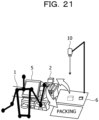
- FIG. 21 is a diagram for explaining an existing technique.
- a user 1 picks up a product 2 placed on a temporary table 6, performs an operation of scanning the barcode of the product 2 on a self-checkout machine 5, and do packing.
- image data of a camera 10 is analyzed, the product placed on the temporary table 6 is subject to object detection, and the number of products is specified. Fraud may be detected by checking whether or not the specified number of products matches the number of actually scanned products.
- a technique such as deep learning (hereinafter referred to as DL) or the like is used when performing the object detection as described with reference to FIG. 21 .
- DL deep learning
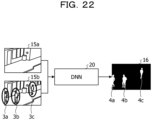
- FIG. 22 is a diagram for explaining the existing technique for specifying an area of an unknown object.
- a deep neural network (DNN) 20 that outputs a mask image 16 indicating an area different from the background from a background image 15a and a target image 15b is obtained by machine learning using a large number of various images.
- the background image 15a does not include objects 3a, 3b, and 3c present in the target image 15b.
- the mask image 16 indicates areas 4a, 4b, and 4c corresponding to the objects 3a, 3b, and 3c. For example, “1" is set for the pixels in the areas 4a, 4b, and 4c of the mask image 16, and "0" is set for the pixels in other areas.
- an area different from the background is specified, whereby, even for an unknown object, the area thereof may be specified. Accordingly, it is conceivable to specify an area of an unknown product to specify the number of products by applying the existing technique of FIG. 22 to the existing technique of FIG. 21 .
- the existing technique described above has a problem that an object not present in the background image but present in the target image may not be detected.
- the existing technique described with reference to FIG. 22 is a technique of specifying the entire region different from the background, and does not specify the position, size, and the like of individual objects. Accordingly, when multiple objects are close to each other, they become one connected area.
- FIG. 23 is a diagram for explaining a problem of the existing technique.
- a mask image 18 is output.
- the target image 17b includes products 7a, 7b, and 7c. Since the products 7a to 7c in the target image 17b are close to each other, one connected area 8 is indicated in the mask image 18. It is difficult to specify the areas corresponding to the products 7a, 7b, and 7c, and to specify the number of products "3" on the basis of the area 8 in the mask image 18.
- a learning program which causes a computer to execute a learning process including: obtaining training data that uses a background image in which an area where an object is to be arranged is imaged and a target image in which the object and the area are imaged as input data and uses information associated with the object not present in the background image but present in the target image as ground truth; and executing machine learning for a machine learning model on a basis of a result output from the machine learning model when the background image and the target image are input to the machine learning model on a basis of the training data and the ground truth.
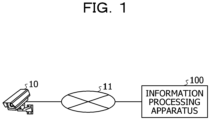
- FIG. 1 is a diagram illustrating a system according to the first embodiment. As illustrated in FIG. 1 , this system includes a camera 10 and an information processing apparatus 100. The camera 10 and the information processing apparatus 100 are mutually connected via a network 11. The camera 10 and the information processing apparatus 100 may be directly connected by wire or wirelessly.
- the camera 10 may be a camera that images the inside or outside of a store, or may be a camera that images the temporary table 6 on which products are placed illustrated in FIG. 21 .
- the camera 10 transmits image data in an imaging range to the information processing apparatus 100.
- image data captured by the camera 10 that does not include an object to be detected will be referred to as "background image data”.
- the background image data corresponds to the background image 15a described with reference to FIG. 22 .
- Image data captured by the camera 10 that includes an object to be detected will be referred to as "target image data”.
- the target image data corresponds to the target image 15b described with reference to FIG. 22 .
- the target image 15b includes objects 3a to 3c. While the capture area of the background image 15a is the same as the capture area of the target image 15b, the background image 15a does not include the objects 3a to 3c.
- the information processing apparatus 100 is a device that infers an area of an individual object included in the target image data on the basis of the background image data and the target image data.
- the information processing apparatus 100 receives the background image data from the camera 10 in advance before starting inference, and sequentially receives the target image data from the camera 10 when starting the inference.
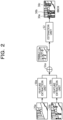
- FIG. 2 is a diagram for explaining the basic part of the processing of the information processing apparatus according to the first embodiment.
- the information processing apparatus 100 that executes the processing of the basic part includes feature extraction units 50a and 50b, a combining unit 51a, and an estimation unit 52.
- the feature extraction units 50a and 50b correspond to a commonly used convolutional neural network (CNN).
- CNN convolutional neural network
- the feature extraction unit 50a When background image data 25a is input, the feature extraction unit 50a outputs an image feature to the combining unit 51a on the basis of parameters trained by machine learning.
- target image data 25b When target image data 25b is input, the feature extraction unit 50b outputs an image feature to the combining unit 51a on the basis of parameters trained by machine learning.
- the image features output from the feature extraction units 50a and 50b are assumed to be values before being converted into probability values based on a softmax function or the like.
- the image feature of the background image data 25a will be referred to as a "background image feature”.
- the image feature of the target image data 25b will be referred to as a "target image feature”.
- the background image feature and the target image feature correspond to an intermediate feature.
- the same parameters are set in the feature extraction units 50a and 50b. Although the feature extraction units 50a and 50b are separately illustrated in FIG. 2 for convenience of explanation, the feature extraction units 50a and 50b are assumed to be the same CNN.
- the combining unit 51a combines the background image feature and the target image feature, and outputs the combined feature to the estimation unit 52.
- the estimation unit 52 corresponds to a commonly used convolutional neural network (CNN).
- CNN convolutional neural network
- the estimation unit 52 specifies a bbox of each object on the basis of the parameters trained by machine learning.
- the bounding box (bbox) indicates area information surrounding an object, and has position and size information.
- three pieces of bbox 30a, 30b, and 30c are specified.
- FIG. 3 is a diagram for explaining the first characteristic process.
- a positional coordinate feature output unit 53 and a combining unit 51b are included in addition to the feature extraction units 50a and 50b, the combining unit 51a, and the estimation unit 52 described with reference to FIG. 2 .
- the combining unit 51a combines the background image feature and the target image feature, and outputs the combined feature to the combining unit 51b.
- the positional coordinate feature output unit 53 outputs a plurality of coordinate features in which coordinate values are arranged in an image plane. For example, as illustrated in FIG. 3 , the positional coordinate feature output unit 53 outputs, to the combining unit 51b, an x-coordinate feature 53a, a y-coordinate feature 53b, and a distance feature 53c.
- Coordinate values from "-1" to "+1” are set in ascending order in the row direction from left to right for each pixel of the x-coordinate feature 53a. The same coordinate value is set for each pixel in the column direction. For example, "-1" is set for each pixel in the leftmost column of the x-coordinate feature 53a.
- Coordinate values from "-1" to "+1” are set in ascending order in the column direction from top to bottom for each pixel of the y-coordinate feature 53b. The same coordinate value is set for each pixel in the row direction. For example, "-1" is set for each pixel in the top row of the y-coordinate feature 53b.
- coordinate values from "0" to "+1” are set in ascending order from the central pixel toward the outside. For example, "0" is set for the central pixel of the distance feature 53c.
- the combining unit 51b outputs, to the estimation unit 52, information obtained by combining the background image feature, the target image feature, the x-coordinate feature 53a, the y-coordinate feature 53b, and the distance feature 53c.
- the estimation unit 52 specifies the bbox of each object on the basis of the parameters trained by machine learning.
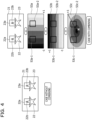
- FIG. 4 is a diagram for providing a supplementary explanation of the first characteristic process.
- a case of performing convolution using a neural network on an image 21 illustrated in FIG. 4 will be assumed.
- objects 22 and 23 contained in the image 21 have the same appearance. Accordingly, a result 22b obtained by performing the convolution process on an area 22a is the same as a result 23b obtained by performing the convolution process on an area 23a.
- the convolution is performed on the information obtained by combining the x-coordinate feature 53a, the y-coordinate feature 53b, and the distance feature 53c with the image feature.
- an area 53a-1, an area 53b-1, and an area 53c-1 are also convolved.
- an area 53a-2, an area 53b-2, and an area 53c-2 are also convolved.
- the result 22b obtained by performing the convolution process on the area 22a is not the same as the result 23b obtained by performing the convolution process on the area 23a, whereby it becomes possible to discriminate the objects 22 and 23.
- FIG. 5 is a diagram for explaining the second characteristic process.
- a mask generation unit 54 is included in addition to the feature extraction units 50a and 50b, the combining units 51a and 51b, the estimation unit 52, and the positional coordinate feature output unit 53 described with reference to FIG. 3 .
- the combining unit 51a combines the background image feature and the target image feature, and outputs the combined feature to the combining unit 51b and to the mask generation unit 54.
- the mask generation unit 54 corresponds to a commonly used convolutional neural network (CNN).
- CNN convolutional neural network
- the mask generation unit 54 When the feature obtained by combining the background image feature and the target image feature is input, the mask generation unit 54 generates a mask image 40 on the basis of the parameters trained by machine learning.
- the mask image 40 is information indicating an area of an object not present in the background image data 25a but present in the target image data 25b.
- the mask image 40 is a bitmap, and "1" is set for pixels corresponding to object areas while "0" is set for pixels corresponding to other areas.
- the combining unit 51b outputs, to the estimation unit 52, combined information 45 obtained by combining the background image feature, the target image feature, the x-coordinate feature 53a, the y-coordinate feature 53b, the distance feature 53c, and the mask image 40.
- the estimation unit 52 specifies the bbox of each object on the basis of the parameters trained by machine learning.
- the combined information 45 is information in which the background image feature, the target image feature, the x-coordinate feature 53a, the y-coordinate feature 53b, the distance feature 53c, and the mask image 40 overlap.
- the estimation unit 52 arranges a kernel in which parameters are set in the combined information 45 in which individual pieces of information overlap, and perform convolution while moving the position of the kernel.
- the machine learning is carried out using training data that uses background image data for learning and target image data for learning as input data and uses the bbox of the object contained in the target image data for learning as ground truth (GT).
- GT ground truth
- characteristics of individual objects contained in the target image data may be memorized, and the bbox of the object may be estimated only from the target image data without using the background image data.
- the object contained in the target image data for learning is directly memorized so that it is not possible to deal with an unknown object, which may be said to be overfitting (overtraining).
- a task that may not be solved without using the background image data is subject to the machine learning as an auxiliary task, thereby causing the neural network (NN) to utilize the background image.
- a process of machine learning of the mask generation unit 54 illustrated in FIG. 5 is an auxiliary task.
- the bbox estimation described above is a main task, and the task of generating a mask image is an auxiliary task.
- the mask image 40 generated by the mask generation unit 54 is further input to the estimation unit 52 to execute machine learning of estimating the bbox of the object. As a result, an effect of limiting the object to be detected to the object area in the mask image may be expected.
- the information processing apparatus 100 inputs input data to the feature extraction units 50a and 50b, and trains the parameters of the feature extraction units 50a and 50b, the estimation unit 52, and the mask generation unit 54 in such a manner that an error between the bbox output from the estimation unit 52 and the ground truth (ground truth value of bbox) and an error between the mask image output from the mask generation unit 54 and the ground truth (ground truth value of mask image) are made smaller.
- FIG. 6 is a functional block diagram illustrating a configuration of the information processing apparatus according to the first embodiment.
- the information processing apparatus 100 includes a communication unit 110, an input unit 120, a display unit 130, a storage unit 140, and a control unit 150.
- the communication unit 110 executes data communication with the camera 10 and an external device (not illustrated). For example, the communication unit 110 receives image data (background image data and target image data) from the camera 10. The communication unit 110 receives training data 141 to be used for machine learning and the like from the external device.
- the input unit 120 corresponds to an input device for inputting various types of information to the information processing apparatus 100.
- the display unit 130 displays an output result from the control unit 150.
- the storage unit 140 has the training data 141, an image table 142, a feature extraction model 143, a generation model 144, and an estimation model 145.
- the storage unit 140 corresponds to a semiconductor memory element such as a random access memory (RAM), a flash memory, or the like, or a storage device such as a hard disk drive (HDD) or the like.
- RAM random access memory
- HDD hard disk drive
- the training data 141 is data to be used at a time of executing machine learning.
- FIG. 7 is a diagram illustrating an exemplary data structure of the training data according to the first embodiment. As illustrated in FIG. 7 , the training data 141 retains an item number, input data, and ground truth (GT) in association with each other.
- the input data includes the background image data for learning and the target image data for learning.
- the ground truth includes GT of the mask image and GT of the bbox (coordinates of object area).
- the image table 142 is a table that retains the background image data and the target image data to be used at a time of inference.
- the feature extraction model 143 is a machine learning model (CNN) to be executed by the feature extraction units 50a and 50b.
- CNN machine learning model
- the generation model 144 is a machine learning model (CNN) to be executed by the mask generation unit 54.
- CNN machine learning model
- the estimation model 145 is a machine learning model (CNN) to be executed by the estimation unit 52.
- CNN machine learning model
- the control unit 150 includes an acquisition unit 151, a learning processing unit 152, and an inference processing unit 153.
- the control unit 150 corresponds to a central processing unit (CPU) or the like.
- the acquisition unit 151 obtains the training data 141 from an external device or the like, it registers the obtained training data 141 in the storage unit 140.
- the acquisition unit 151 obtains the background image data from the camera 10 in advance, and registers it in the image table 142.
- the acquisition unit 151 obtains the target image data from the camera 10, and registers it in the image table 142.
- the learning processing unit 152 executes machine learning of the feature extraction units 50a and 50b (feature extraction model 143), the mask generation unit 54 (generation model 144), and the estimation unit 52 (estimation model 145) on the basis of the training data 141.
- FIG. 8 is a diagram for explaining processing of the learning processing unit according to the first embodiment.
- the learning processing unit 152 includes the feature extraction units 50a and 50b, combining units 51a and 52b, the estimation unit 52, the mask generation unit 54, and the positional coordinate feature output unit 53.
- the learning processing unit 152 includes error calculation units 60a and 60b, a combining unit 61, and a weight update value calculation unit 62.
- the feature extraction units 50a and 50b, the estimation unit 52, the positional coordinate feature output unit 53, and the mask generation unit 54 will be collectively referred to as a "neural network" as appropriate.
- the feature extraction units 50a and 50b read and execute the feature extraction model 143.
- the feature extraction units 50a and 50b input image data to the feature extraction model 143, and calculate an image feature on the basis of the parameters of the feature extraction model 143.
- Processing of the positional coordinate feature output unit 53 is similar to the explanation given with reference to FIG. 3 .
- the mask generation unit 54 reads and executes the generation model 144.
- the mask generation unit 54 inputs, to the generation model 144, the feature obtained by combining the background image feature and the target image feature, and generates a mask image on the basis of the parameters of the generation model 144.
- the mask generation unit 54 outputs the mask image to the combining unit 51b and to the error calculation unit 60a.
- the estimation unit 52 reads and executes the estimation model 145.
- the estimation unit 52 reads and executes the estimation model 145.
- the estimation unit 52 inputs combined information to the estimation model 145, and specifies the bbox of each object on the basis of the parameters of the estimation model 145.
- the estimation model 145 outputs the bbox to the error calculation unit 60b.
- the learning processing unit 152 obtains background image data 26a for learning from the training data 141, and inputs it to the feature extraction unit 50a.
- the learning processing unit 152 obtains target image data 26b for learning from the training data 141, and inputs it to the feature extraction unit 50b.
- the learning processing unit 152 obtains GT of the mask image from the training data 141, and inputs it to the error calculation unit 60a.
- the learning processing unit 152 obtains GT of the bbox from the training data 141, and inputs it to the error calculation unit 60b.
- the error calculation unit 60a calculates an error between the mask image 41 output from the mask generation unit 54 and the GT of the mask image of the training data 141. In the following descriptions, the error between the mask image 41 and the GT of the mask image will be referred to as a "first error”.
- the error calculation unit 60a outputs the first error to the combining unit 61.
- the error calculation unit 60b calculates an error between the bbox output from the estimation unit 52 and the GT of the bbox of the training data 141.
- the error between the bbox output from the estimation unit 52 and the GT of the bbox of the training data 141 will be referred to as a "second error”.
- the error calculation unit 60b outputs the second error to the combining unit 61.
- the combining unit 61 calculates the sum of the first error and the second error. In the following descriptions, the sum of the first error and the second error will be referred to as a "total error". The combining unit 61 outputs the total error to the weight update value calculation unit 62.
- the weight update value calculation unit 62 updates the parameters (weights) of the neural network in such a manner that the total error reduces. For example, the weight update value calculation unit 62 updates the parameters of the feature extraction units 50a and 50b (feature extraction model 143), the mask generation unit 54 (generation model 144), and the estimation unit 52 (estimation model 145) using backpropagation or the like.
- the learning processing unit 152 repeatedly executes the process described above using each input data and ground truth stored in the training data 141.
- the learning processing unit 152 registers, in the storage unit 140, the feature extraction model 143, the generation model 144, and the estimation model 145 having been subject to the machine learning.
- the inference processing unit 153 specifies an area of an object not present in the background image data but present in the target image data using the feature extraction units 50a and 50b (feature extraction model 143), the mask generation unit 54 (generation model 144), and the estimation unit 52 (estimation model 145) having been subject to the machine learning.
- FIG. 9 is a diagram for explaining the processing of the inference processing unit according to the first embodiment.
- the inference processing unit 153 includes the feature extraction units 50a and 50b, the combining units 51a and 52b, the estimation unit 52, the mask generation unit 54, and the positional coordinate feature output unit 53.
- the feature extraction units 50a and 50b reads and executes the feature extraction model 143 having been subject to the machine learning.
- the feature extraction units 50a and 50b input image data to the feature extraction model 143, and calculate an image feature on the basis of the parameters of the feature extraction model 143.
- Processing of the positional coordinate feature output unit 53 is similar to the explanation given with reference to FIG. 3 .
- the mask generation unit 54 reads and executes the generation model 144 having been subject to the machine learning.
- the mask generation unit 54 inputs, to the generation model 144, the feature obtained by combining the background image feature and the target image feature, and generates a mask image on the basis of the parameters of the generation model 144.
- the mask generation unit 54 outputs the mask image to the combining unit 51b.
- the estimation unit 52 reads and executes the learned estimation model 145.
- the estimation unit 52 reads and executes the estimation model 145.
- the estimation unit 52 inputs the combined information 45 to the estimation model 145, and specifies the bbox of each object on the basis of the parameters of the estimation model 145.
- the inference processing unit 153 obtains the background image data 25a from the image table 142, and inputs it to the feature extraction unit 50a.
- the inference processing unit 153 obtains the target image data 25b from the image table 142, and inputs it to the feature extraction unit 50b.
- the inference processing unit 153 may output the information of the bbox specified by the estimation unit 52 to the display unit 130, or may output it to an external device.
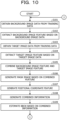
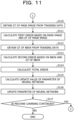
- FIGs. 10 and 11 are flowcharts illustrating the processing procedure of the learning process according to the first embodiment.
- the learning processing unit 152 of the information processing apparatus 100 obtains background image data from the training data 141 (step S101).
- the feature extraction unit 50a of the learning processing unit 152 extracts a background image feature on the basis of the background image data (step S102).
- the learning processing unit 152 obtains target image data from the training data 141 (step S103).
- the feature extraction unit 50b of the learning processing unit 152 extracts a target image feature on the basis of the target image data (step S104).
- the combining unit 51a of the learning processing unit 152 combines the background image feature and the target image feature (step S105).
- the mask generation unit 54 of the learning processing unit 152 generates a mask image on the basis of the combined feature (step S106).
- the positional coordinate feature output unit 53 of the learning processing unit 152 generates a positional coordinate feature (step S107).
- the combining unit 51b of the learning processing unit 152 generates combined information in which individual features are combined (step S108).
- the estimation unit 52 of the learning processing unit 152 estimates the bbox on the basis of the combined information (step S109).
- the learning processing unit 152 proceeds to step S110 in FIG. 11 .
- the learning processing unit 152 obtains the GT of the mask image from the training data 141 (step S110).
- the error calculation unit 60a of the learning processing unit 152 calculates a first error on the basis of the mask image and the GT of the mask image (step S111).
- the learning processing unit 152 obtains the GT of the bbox from the training data 141 (step S112).
- the error calculation unit 60b calculates a second error on the basis of the bbox and the GT of the bbox (step S113).
- the combining unit 61 of the learning processing unit 152 calculates a total error of the first error and the second error (step S114).
- the weight update value calculation unit 62 of the learning processing unit 152 calculates an update value of the parameter of the neural network (step S115).
- the learning processing unit 152 updates the parameter of the neural network (step S116).
- step S117 If the machine learning is continued (Yes in step S117), the learning processing unit 152 proceeds to step S101 in FIG. 10 . If the machine learning is not continued (No in step S117), the machine learning of the neural network is terminated.
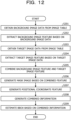
- FIG. 12 is a flowchart illustrating the processing procedure of the inference process according to the first embodiment.
- the inference processing unit 153 of the information processing apparatus 100 obtains background image data from the image table 142 (step S201).
- the feature extraction unit 50a of the inference processing unit 153 extracts a background image feature on the basis of the background image data (step S202).
- the inference processing unit 153 obtains target image data from the image table 142 (step S203).
- the feature extraction unit 50b of the inference processing unit 153 extracts a target image feature on the basis of the target image data (step S204).
- the combining unit 51a of the inference processing unit 153 combines the background image feature and the target image feature (step S205).
- the mask generation unit 54 of the inference processing unit 153 generates a mask image on the basis of the combined feature (step S206).
- the positional coordinate feature output unit 53 of the inference processing unit 153 generates a positional coordinate feature (step S207).
- the combining unit 51b of the inference processing unit 153 generates combined information obtained by combining individual features (step S208).
- the estimation unit 52 of the inference processing unit 153 estimates the bbox on the basis of the combined information (step S209).
- the information processing apparatus 100 inputs the background image data to the feature extraction unit 50a, and inputs the target image data to the feature extraction unit 50b, thereby extracting the background image feature and the target image feature.
- the information processing apparatus 100 inputs, to the mask generation unit 54, the feature obtained by combining the background image feature and the target image feature, and generates a mask image.
- the information processing apparatus 100 inputs the mask image and information obtained by combining the individual features to the estimation unit 52, thereby specifying the object area. As a result, it becomes possible to discriminate and detect each object even if the object included in the target image data is an unknown object that has not been learned in advance.
- the information processing apparatus 100 inputs, to the estimation unit 52, information obtained by combining the background image feature, the target image feature, the mask image, and the coordinate feature, and specifies the object area. As a result, even if the target image data contains objects having the same appearance, it is possible to execute convolution processing in such a manner that the individual objects can be distinguished from each other.
- the information processing apparatus 100 executes machine learning of the feature extraction units 50a and 50b, the mask generation unit 54, and the estimation unit 52 on the basis of the training data 141. As a result, even if the object contained in the target image data is an unknown object that has not been learned in advance, it is possible to carry out machine learning of the neural network in which each object can be discriminated and detected.
- the information processing apparatus 100 inputs, to the estimation unit 52, information obtained by further combining the coordinate feature in addition to the individual features, and executes machine learning. As a result, even if the target image data contains objects having the same appearance, it is possible to carry out machine learning of the neural network while individual objects are distinguished from each other.
- the information processing apparatus 100 inputs, to the estimation unit 52, the information obtained by further combining the mask image in addition to the individual features, and executes machine learning. As a result, an effect of limiting the object to be detected to the object area in the mask image may be expected.
- a configuration of a system according to a second embodiment is similar to the system described in the first embodiment. It is assumed that an information processing apparatus according to the second embodiment is connected to a camera 10 via a network 11 in a similar manner to the first embodiment.
- the information processing apparatus performs machine learning regarding feature extraction units 50a and 50b and an estimation unit 52, which are basic parts described with reference to FIG. 2 .
- the information processing apparatus specifies each object using the feature extraction units 50a and 50b and the estimation unit 52 having been subject to the machine learning.
- FIG. 13 is a functional block diagram illustrating a configuration of the information processing apparatus according to the second embodiment.
- this information processing apparatus 200 includes a communication unit 210, an input unit 220, a display unit 230, a storage unit 240, and a control unit 250.
- Descriptions regarding the communication unit 210, the input unit 220, and the display unit 230 are similar to the descriptions regarding the communication unit 110, the input unit 120, and the display unit 130 described in the first embodiment.
- the storage unit 240 has training data 241, an image table 242, a feature extraction model 243, and an estimation model 244.
- the storage unit 240 corresponds to a semiconductor memory element such as a RAM, a flash memory, or the like, or a storage device such as an HDD or the like.
- the training data 241 is data to be used at a time of executing machine learning.
- FIG. 14 is a diagram illustrating an exemplary data structure of the training data according to the second embodiment. As illustrated in FIG. 14 , the training data 241 retains an item number, input data, and ground truth (GT) in association with each other.
- the input data includes the background image data for learning and the target image data for learning.
- the ground truth includes GT of a bbox (coordinates of object area).
- the image table 242 is a table that retains the background image data and the target image data to be used at a time of inference.
- the feature extraction model 243 is a machine learning model (CNN) to be executed by the feature extraction units 50a and 50b.
- CNN machine learning model
- the estimation model 244 is a machine learning model (CNN) to be executed by the estimation unit 52.
- CNN machine learning model
- the control unit 250 includes an acquisition unit 251, a learning processing unit 252, and an inference processing unit 253.
- the control unit 250 corresponds to a CPU or the like.
- the acquisition unit 251 obtains the training data 241 from an external device or the like, it registers the obtained training data 241 in the storage unit 240.
- the acquisition unit 251 obtains the background image data from the camera 10 in advance, and registers it in the image table 242.
- the acquisition unit 251 obtains the target image data from the camera 10, and registers it in the image table 242.
- the learning processing unit 252 executes machine learning of the feature extraction units 50a and 50b (feature extraction model 243) and the estimation unit 52 (estimation model 244) on the basis of the training data 241.
- FIG. 15 is a diagram for explaining processing of the learning processing unit according to the second embodiment.
- the learning processing unit 252 includes the feature extraction units 50a and 50b, a combining unit 51a, and the estimation unit 52.
- the learning processing unit 252 includes an error calculation unit 80 and a weight update value calculation unit 81.
- the feature extraction units 50a and 50b and the estimation unit 52 will be collectively referred to as a "neural network" as appropriate.
- the feature extraction units 50a and 50b read and execute the feature extraction model 143.
- the feature extraction units 50a and 50b input image data to the feature extraction model 243, and calculate an image feature on the basis of parameters of the feature extraction model 243.
- the combining unit 51a combines the background image feature and the target image feature, and outputs the combined feature to the estimation unit 52.
- the estimation unit 52 reads and executes the estimation model 244.
- the estimation unit 52 reads and executes the estimation model 244.
- the estimation unit 52 inputs the combined feature to the estimation model 244, and specifies the bbox of each object on the basis of parameters of the estimation model 244.
- the estimation model 244 outputs the bbox to the error calculation unit 80.
- the learning processing unit 252 obtains background image data 26a for learning from the training data 241, and inputs it to the feature extraction unit 50a.
- the learning processing unit 252 obtains target image data 26b for learning from the training data 241, and inputs it to the feature extraction unit 50b.
- the learning processing unit 252 obtains GT of the bbox from the training data 241, and inputs it to the error calculation unit 80.
- the error calculation unit 80 calculates an error between the bbox output from the estimation unit 52 and the GT of the bbox of the training data 241.
- the error calculation unit 80 outputs the calculated error to the weight update value calculation unit 81.
- the weight update value calculation unit 81 updates parameters (weights) of the neural network in such a manner that the error reduces. For example, the weight update value calculation unit 81 updates the parameters of the feature extraction units 50a and 50b (feature extraction model 243) and the estimation unit 52 (estimation model 244) using backpropagation or the like.
- the learning processing unit 252 repeatedly executes the process described above using each input data and ground truth stored in the training data 241.
- the learning processing unit 252 registers, in the storage unit 240, the feature extraction model 243 and the estimation model 244 having been subject to the machine learning.
- the inference processing unit 253 specifies an area of an object not present in the background image data but present in the target image data using the feature extraction units 50a and 50b (feature extraction model 243) and the estimation unit 52 (estimation model 244) having been subject to the machine learning.
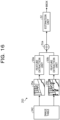
- FIG. 16 is a diagram for explaining processing of the inference processing unit according to the second embodiment.
- the inference processing unit 253 includes the feature extraction units 50a and 50b, the combining unit 51a, and the estimation unit 52.
- the feature extraction units 50a and 50b reads and executes the feature extraction model 243 having been subject to the machine learning.
- the feature extraction units 50a and 50b input image data to the feature extraction model 243, and calculate an image feature on the basis of parameters of the feature extraction model 243.
- the combining unit 51a combines the background image feature and the target image feature, and outputs the combined feature to the estimation unit 52.
- estimation unit 52 reads and executes the learned estimation model 244.
- the estimation unit 52 reads and executes the estimation model 244.
- the estimation unit 52 inputs, to the estimation model 244, information obtained by combining the background image feature and the target image feature, and specifies the bbox of each object on the basis of the parameters of the estimation model 244.
- the inference processing unit 253 obtains background image data 25a from the image table 242, and inputs it to the feature extraction unit 50a.
- the inference processing unit 253 obtains target image data 25b from the image table 242, and inputs it to the feature extraction unit 50b.
- the inference processing unit 253 may output the information of the bbox specified by the estimation unit 52 to the display unit 230, or may output it to an external device.
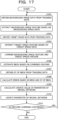
- FIG. 17 is a flowchart illustrating the processing procedure of the learning process according to the second embodiment.
- the learning processing unit 252 of the information processing apparatus 200 obtains background image data from the training data 241 (step S301).
- the feature extraction unit 50a of the learning processing unit 252 extracts a background image feature on the basis of the background image data (step S302).
- the learning processing unit 252 obtains target image data from the training data 241 (step S303).
- the feature extraction unit 50b of the learning processing unit 252 extracts a target image feature on the basis of the target image data (step S304).
- the combining unit 51a of the learning processing unit 252 combines the background image feature and the target image feature (step S305).
- the estimation unit 52 of the learning processing unit 252 estimates the bbox on the basis of the combined feature (step S306).
- the learning processing unit 252 obtains the GT of the bbox from the training data 241 (step S307).
- the error calculation unit 80 calculates an error on the basis of the bbox and the GT of the bbox (step S308).
- the weight update value calculation unit 81 of the learning processing unit 252 calculates an update value of the parameter of the neural network (step S309).
- the learning processing unit 252 updates the parameter of the neural network (step S310).
- step S311 If the machine learning is continued (Yes in step S311), the learning processing unit 252 proceeds to step S301. If the machine learning is not continued (No in step S311), the machine learning of the neural network is terminated.
- FIG. 18 is a flowchart illustrating the processing procedure of the inference process according to the second embodiment.
- the inference processing unit 253 of the information processing apparatus 200 obtains background image data from the image table 242 (step S401).
- the feature extraction unit 50a of the inference processing unit 253 extracts a background image feature on the basis of the background image data (step S402).
- the inference processing unit 253 obtains target image data from the image table 242 (step S403).
- the feature extraction unit 50b of the inference processing unit 253 extracts a target image feature on the basis of the target image data (step S404).
- the combining unit 51a of the inference processing unit 253 combines the background image feature and the target image feature (step S405).
- the estimation unit 52 of the inference processing unit 253 estimates the bbox on the basis of the combined feature (step S406).
- the information processing apparatus 200 inputs the background image data to the feature extraction unit 50a, and inputs the target image data to the feature extraction unit 50b, thereby extracting the background image feature and the target image feature.
- the information processing apparatus 200 inputs, to the estimation unit 52, the feature obtained by combining the background image feature and the target image feature, thereby specifying the object area. As a result, it becomes possible to discriminate and detect each object even if the object included in the target image data is an unknown object that has not been learned in advance.
- FIG. 19 is a diagram illustrating a system according to the third embodiment. As illustrated in FIG. 19 , this system includes a self-checkout machine 5, a camera 10, and an information processing apparatus 300. The self-checkout machine 5, the camera 10, and the information processing apparatus 300 are connected by wire or wirelessly.
- the self-checkout machine 5 is a point-of-sale (POS) checkout system in which the user 1 who purchases the product reads the barcode of the product and makes payment. For example, when the user 1 moves the product to be purchased to the scan area of the self-checkout machine 5, the self-checkout machine 5 scans the barcode of the product. When the scanning operation by the user 1 is complete, the self-checkout machine 5 notifies the information processing apparatus 300 of information regarding the number of scanned products. In the following descriptions, the information regarding the number of scanned products will be referred to as "scan information".
- the camera 10 is a camera that images the temporary table 6 of the self-checkout machine 5.
- the camera 10 transmits image data in an imaging range to the information processing apparatus 300. It is assumed that the camera 10 transmits image data (background image data) of the temporary table 6 on which no product is placed to the information processing apparatus 300 in advance. When a product to be purchased is placed on the temporary table 6, the camera 10 transmits image data (target image data) of the temporary table 6 to the information processing apparatus 300.
- the information processing apparatus 300 performs machine learning of the neural network in a similar manner to the information processing apparatus 100 described in the first embodiment.
- the neural network includes feature extraction units 50a and 50b, combining units 51a and 51b, an estimation unit 52, a positional coordinate feature output unit 53, and a mask generation unit 54.
- the information processing apparatus 300 inputs the background image data and the target image data to the neural network having been subject to the machine learning, thereby specifying each object included in the target image data.
- the information processing apparatus 300 counts the specified objects to specify the number of products.
- the information processing apparatus 300 detects an omission of scanning when the specified number of products does not match the number of products included in the scan information.
- the information processing apparatus 300 uses a result of inputting the background image data and the target image data to the neural network as an output result 70. Since the output result 70 includes three pieces of bbox of bbox 70a, 70b, and 70c, the information processing apparatus 300 specifies the number of products as "3". The information processing apparatus 300 detects an omission of scanning when the number of products included in the scan information is less than "3". The information processing apparatus 300 may notify a management server or the like (not illustrated) of the omission of scanning.
- FIG. 20 is a diagram illustrating an exemplary hardware configuration of the computer that implements functions similar to those of the information processing apparatus.
- a computer 400 includes a CPU 401 that executes various types of arithmetic processing, an input device 402 that receives data input from a user, and a display 403. Furthermore, the computer 400 includes a communication device 404 that receives distance image data from the camera 10, and an interface device 405 connected to various devices. The computer 400 includes a RAM 406 that temporarily stores various types of information, and a hard disk device 407. Additionally, each of the devices 401 to 407 is connected to a bus 408.
- the hard disk device 407 has an acquisition program 407a, a learning processing program 407b, and an inference processing program 407c.
- the CPU 401 reads the acquisition program 407a, the learning processing program 407b, and the inference processing program 407c, and loads them in the RAM 406.
- the acquisition program 407a functions as an acquisition process 406a.
- the learning processing program 407b functions as a learning processing process 406b.
- the inference processing program 407c functions as an inference processing process 406c.
- Processing of the acquisition process 406a corresponds to the processing of acquisition units 151 and 251.
- Processing of the learning processing process 406b corresponds to the processing of the learning processing units 152 and 252.
- Processing of the inference processing process 406c corresponds to the processing of the inference processing units 153 and 253.
- each of the programs 407a to 407c is not necessarily stored in the hard disk device 407 beforehand.
- each of the programs may be stored in a "portable physical medium" such as a flexible disk (FD), a compact disc read only memory (CD-ROM), a digital versatile disk (DVD), a magneto-optical disk, an integrated circuit (IC) card, or the like to be inserted into the computer 400.
- the computer 400 may read each of the programs 407a to 407c to execute it.
Landscapes
- Engineering & Computer Science (AREA)
- Theoretical Computer Science (AREA)
- Physics & Mathematics (AREA)
- General Physics & Mathematics (AREA)
- Computer Vision & Pattern Recognition (AREA)
- Multimedia (AREA)
- Software Systems (AREA)
- Evolutionary Computation (AREA)
- Computing Systems (AREA)
- Artificial Intelligence (AREA)
- Medical Informatics (AREA)
- Databases & Information Systems (AREA)
- General Health & Medical Sciences (AREA)
- Health & Medical Sciences (AREA)
- Data Mining & Analysis (AREA)
- General Engineering & Computer Science (AREA)
- Mathematical Physics (AREA)
- Image Analysis (AREA)
- Image Processing (AREA)
Abstract
A learning program is provided which causes a computer to execute a learning process including: obtaining training data that uses a background image in which an area where an object is to be arranged is imaged and a target image in which the object and the area are imaged as input data and uses information associated with the object not present in the background image but present in the target image as ground truth; and executing machine learning for a machine learning model on a basis of a result output from the machine learning model when the background image and the target image are input to the machine learning model on a basis of the training data and the ground truth.
Description
- The embodiments discussed herein are related to a learning program and the like.
- Self-checkout machines have been widespread in stores such as supermarkets, convenience stores, and the like. The self-checkout machines are point-of-sale (POS) checkout systems in which users themselves who purchase products read barcodes of the products and make payment. For example, with the self-checkout machines introduced, it becomes possible to reduce labor cost and to suppress incorrect payment caused by errors made by store clerks.
- Meanwhile, fraud by the users, such as not reading the barcodes, needs to be detected in the self-checkout machines.
-
FIG. 21 is a diagram for explaining an existing technique. In the example illustrated inFIG. 21 , it is assumed that auser 1 picks up aproduct 2 placed on a temporary table 6, performs an operation of scanning the barcode of theproduct 2 on a self-checkout machine 5, and do packing. According to the existing technique, image data of acamera 10 is analyzed, the product placed on the temporary table 6 is subject to object detection, and the number of products is specified. Fraud may be detected by checking whether or not the specified number of products matches the number of actually scanned products. In the existing technique, a technique such as deep learning (hereinafter referred to as DL) or the like is used when performing the object detection as described with reference toFIG. 21 . - In a case of performing the object detection using DL, large-volume labeled data is manually prepared, and the machine learning is executed for an object detection model for performing the object detection using the labeled data. Here, since the object detection model detects only objects learned in advance, it is not realistic to prepare labeled data to repeat machine learning of the object detection model again under the conditions that product types are enormous and the products are replaced daily as in the stores mentioned above.
- Note that there is an existing technique capable of specifying an area of an object even if the object is an unknown object that has not been learned in advance.
FIG. 22 is a diagram for explaining the existing technique for specifying an area of an unknown object. According to the existing technique described with reference toFIG. 22 , a deep neural network (DNN) 20 that outputs a mask image 16 indicating an area different from the background from abackground image 15a and atarget image 15b is obtained by machine learning using a large number of various images. - While the capture area of the
background image 15a and the capture area of thetarget image 15b are the same capture areas, thebackground image 15a does not includeobjects target image 15b. The mask image 16 indicatesareas objects areas - According to the existing technique of
FIG. 22 , an area different from the background is specified, whereby, even for an unknown object, the area thereof may be specified. Accordingly, it is conceivable to specify an area of an unknown product to specify the number of products by applying the existing technique ofFIG. 22 to the existing technique ofFIG. 21 . -
Japanese Laid-open Patent Publication No. 2019-153057 - However, the existing technique described above has a problem that an object not present in the background image but present in the target image may not be detected.
- The existing technique described with reference to
FIG. 22 is a technique of specifying the entire region different from the background, and does not specify the position, size, and the like of individual objects. Accordingly, when multiple objects are close to each other, they become one connected area. -
FIG. 23 is a diagram for explaining a problem of the existing technique. In the example illustrated inFIG. 23 , when abackground image 17a and a target image 17b are input to theDNN 20 having been subject to machine learning, amask image 18 is output. The target image 17b includesproducts products 7a to 7c in the target image 17b are close to each other, one connectedarea 8 is indicated in themask image 18. It is difficult to specify the areas corresponding to theproducts area 8 in themask image 18. - In one aspect, it is an object of the embodiments to provide a learning program, a learning method, and an information processing apparatus capable of providing a model capable of detecting an object not present in a background image but present in a target image.
- According to an aspect of the embodiments, a learning program is provided which causes a computer to execute a learning process including: obtaining training data that uses a background image in which an area where an object is to be arranged is imaged and a target image in which the object and the area are imaged as input data and uses information associated with the object not present in the background image but present in the target image as ground truth; and executing machine learning for a machine learning model on a basis of a result output from the machine learning model when the background image and the target image are input to the machine learning model on a basis of the training data and the ground truth.
-
-
FIG. 1 is a diagram illustrating a system according to a first embodiment; -
FIG. 2 is a diagram for explaining a basic part of processing of an information processing apparatus according to the first embodiment; -
FIG. 3 is a diagram for explaining a first characteristic process; -
FIG. 4 is a diagram for providing a supplementary explanation of the first characteristic process; -
FIG. 5 is a diagram for providing a supplementary explanation of a second characteristic process; -
FIG. 6 is a functional block diagram illustrating a configuration of the information processing apparatus according to the first embodiment; -
FIG. 7 is a diagram illustrating an exemplary data structure of training data according to the first embodiment; -
FIG. 8 is a diagram for explaining processing of a learning processing unit according to the first embodiment; -
FIG. 9 is a diagram for explaining processing of an inference processing unit according to the first embodiment; -
FIG. 10 is a flowchart (1) illustrating a processing procedure of a learning process according to the first embodiment; -
FIG. 11 is a flowchart (2) illustrating the processing procedure of the learning process according to the first embodiment; -
FIG. 12 is a flowchart illustrating a processing procedure of an inference process according to the first embodiment; -
FIG. 13 is a functional block diagram illustrating a configuration of an information processing apparatus according to a second embodiment; -
FIG. 14 is a diagram illustrating an exemplary data structure of training data according to the second embodiment; -
FIG. 15 is a diagram for explaining processing of a learning processing unit according to the second embodiment; -
FIG. 16 is a diagram for explaining processing of an inference processing unit according to the second embodiment; -
FIG. 17 is a flowchart illustrating a processing procedure of a learning process according to the second embodiment; -
FIG. 18 is a flowchart illustrating a processing procedure of an inference process according to the second embodiment; -
FIG. 19 is a diagram illustrating a system according to a third embodiment; -
FIG. 20 is a diagram illustrating an exemplary hardware configuration of a computer that implements functions similar to those of the information processing apparatus; -
FIG. 21 is a diagram for explaining an existing technique; -
FIG. 22 is a diagram for explaining an existing technique for specifying an area of an unknown object; and -
FIG. 23 is a diagram for explaining a problem of the existing technique. - Hereinafter, embodiments of a learning program, a learning method, and an information processing apparatus disclosed in the present application will be described in detail with reference to the drawings. Note that the embodiments do not limit the present disclosure.
- Next, an exemplary system according to a first embodiment will be described.
FIG. 1 is a diagram illustrating a system according to the first embodiment. As illustrated inFIG. 1 , this system includes acamera 10 and aninformation processing apparatus 100. Thecamera 10 and theinformation processing apparatus 100 are mutually connected via a network 11. Thecamera 10 and theinformation processing apparatus 100 may be directly connected by wire or wirelessly. - The
camera 10 may be a camera that images the inside or outside of a store, or may be a camera that images the temporary table 6 on which products are placed illustrated inFIG. 21 . Thecamera 10 transmits image data in an imaging range to theinformation processing apparatus 100. - In the following descriptions, image data captured by the
camera 10 that does not include an object to be detected will be referred to as "background image data". For example, the background image data corresponds to thebackground image 15a described with reference toFIG. 22 . Image data captured by thecamera 10 that includes an object to be detected will be referred to as "target image data". For example, the target image data corresponds to thetarget image 15b described with reference toFIG. 22 . Thetarget image 15b includesobjects 3a to 3c. While the capture area of thebackground image 15a is the same as the capture area of thetarget image 15b, thebackground image 15a does not include theobjects 3a to 3c. - The
information processing apparatus 100 is a device that infers an area of an individual object included in the target image data on the basis of the background image data and the target image data. Theinformation processing apparatus 100 receives the background image data from thecamera 10 in advance before starting inference, and sequentially receives the target image data from thecamera 10 when starting the inference. - Hereinafter, a basic part of processing of the
information processing apparatus 100 and first and second characteristic processes to be added to such basic part of the processing will be described in order. -
FIG. 2 is a diagram for explaining the basic part of the processing of the information processing apparatus according to the first embodiment. As illustrated inFIG. 2 , theinformation processing apparatus 100 that executes the processing of the basic part includesfeature extraction units unit 51a, and anestimation unit 52. - The
feature extraction units background image data 25a is input, thefeature extraction unit 50a outputs an image feature to the combiningunit 51a on the basis of parameters trained by machine learning. Whentarget image data 25b is input, thefeature extraction unit 50b outputs an image feature to the combiningunit 51a on the basis of parameters trained by machine learning. - The image features output from the
feature extraction units background image data 25a will be referred to as a "background image feature". The image feature of thetarget image data 25b will be referred to as a "target image feature". The background image feature and the target image feature correspond to an intermediate feature. - The same parameters are set in the
feature extraction units feature extraction units FIG. 2 for convenience of explanation, thefeature extraction units - The combining
unit 51a combines the background image feature and the target image feature, and outputs the combined feature to theestimation unit 52. - The
estimation unit 52 corresponds to a commonly used convolutional neural network (CNN). When the feature obtained by combining the background image feature and the target image feature is input, theestimation unit 52 specifies a bbox of each object on the basis of the parameters trained by machine learning. For example, the bounding box (bbox) indicates area information surrounding an object, and has position and size information. In the example illustrated inFIG. 2 , three pieces ofbbox - Next, the "first characteristic process" to be added to the basic part of the processing of the
information processing apparatus 100 illustrated inFIG. 2 will be described.FIG. 3 is a diagram for explaining the first characteristic process. InFIG. 3 , a positional coordinatefeature output unit 53 and a combiningunit 51b are included in addition to thefeature extraction units unit 51a, and theestimation unit 52 described with reference toFIG. 2 . - Descriptions regarding the
feature extraction units feature extraction units FIG. 2 . - The combining
unit 51a combines the background image feature and the target image feature, and outputs the combined feature to the combiningunit 51b. - The positional coordinate
feature output unit 53 outputs a plurality of coordinate features in which coordinate values are arranged in an image plane. For example, as illustrated inFIG. 3 , the positional coordinatefeature output unit 53 outputs, to the combiningunit 51b, anx-coordinate feature 53a, a y-coordinatefeature 53b, and adistance feature 53c. - Coordinate values from "-1" to "+1" are set in ascending order in the row direction from left to right for each pixel of the
x-coordinate feature 53a. The same coordinate value is set for each pixel in the column direction. For example, "-1" is set for each pixel in the leftmost column of thex-coordinate feature 53a. - Coordinate values from "-1" to "+1" are set in ascending order in the column direction from top to bottom for each pixel of the y-coordinate
feature 53b. The same coordinate value is set for each pixel in the row direction. For example, "-1" is set for each pixel in the top row of the y-coordinatefeature 53b. - For the
distance feature 53c, coordinate values from "0" to "+1" are set in ascending order from the central pixel toward the outside. For example, "0" is set for the central pixel of thedistance feature 53c. - The combining
unit 51b outputs, to theestimation unit 52, information obtained by combining the background image feature, the target image feature, thex-coordinate feature 53a, the y-coordinatefeature 53b, and thedistance feature 53c. - When the information obtained by combining the background image feature, the target image feature, the
x-coordinate feature 53a, the y-coordinatefeature 53b, and thedistance feature 53c is input, theestimation unit 52 specifies the bbox of each object on the basis of the parameters trained by machine learning. -
FIG. 4 is a diagram for providing a supplementary explanation of the first characteristic process. For example, a case of performing convolution using a neural network on animage 21 illustrated inFIG. 4 will be assumed. In a normal convolution process, it is difficult to discriminate objects having the same appearance as separate objects as the position does not change. For example, objects 22 and 23 contained in theimage 21 have the same appearance. Accordingly, aresult 22b obtained by performing the convolution process on anarea 22a is the same as aresult 23b obtained by performing the convolution process on anarea 23a. - Meanwhile, according to the first characteristic process described with reference to
FIG. 3 , the convolution is performed on the information obtained by combining thex-coordinate feature 53a, the y-coordinatefeature 53b, and thedistance feature 53c with the image feature. For example, in a case of performing convolution on thearea 22a, anarea 53a-1, anarea 53b-1, and anarea 53c-1 are also convolved. Similarly, in a case of performing convolution on thearea 23a, anarea 53a-2, anarea 53b-2, and anarea 53c-2 are also convolved. As a result, theresult 22b obtained by performing the convolution process on thearea 22a is not the same as theresult 23b obtained by performing the convolution process on thearea 23a, whereby it becomes possible to discriminate theobjects - Next, the "second characteristic process" to be added to the basic part of the processing of the
information processing apparatus 100 illustrated inFIG. 2 will be described.FIG. 5 is a diagram for explaining the second characteristic process. InFIG. 5 , amask generation unit 54 is included in addition to thefeature extraction units units estimation unit 52, and the positional coordinatefeature output unit 53 described with reference toFIG. 3 . - Descriptions regarding the
feature extraction units feature output unit 53 are similar to the descriptions given with reference toFIGs. 2 and3 . - The combining
unit 51a combines the background image feature and the target image feature, and outputs the combined feature to the combiningunit 51b and to themask generation unit 54. - The
mask generation unit 54 corresponds to a commonly used convolutional neural network (CNN). When the feature obtained by combining the background image feature and the target image feature is input, themask generation unit 54 generates amask image 40 on the basis of the parameters trained by machine learning. Themask image 40 is information indicating an area of an object not present in thebackground image data 25a but present in thetarget image data 25b. For example, themask image 40 is a bitmap, and "1" is set for pixels corresponding to object areas while "0" is set for pixels corresponding to other areas. - The combining
unit 51b outputs, to theestimation unit 52, combinedinformation 45 obtained by combining the background image feature, the target image feature, thex-coordinate feature 53a, the y-coordinatefeature 53b, thedistance feature 53c, and themask image 40. - When the combined
information 45 is input, theestimation unit 52 specifies the bbox of each object on the basis of the parameters trained by machine learning. For example, the combinedinformation 45 is information in which the background image feature, the target image feature, thex-coordinate feature 53a, the y-coordinatefeature 53b, thedistance feature 53c, and themask image 40 overlap. Theestimation unit 52 arranges a kernel in which parameters are set in the combinedinformation 45 in which individual pieces of information overlap, and perform convolution while moving the position of the kernel. - Here, a supplementary explanation will be given regarding the second characteristic process. For example, assuming machine learning in a case of not using the
mask generation unit 54, the machine learning is carried out using training data that uses background image data for learning and target image data for learning as input data and uses the bbox of the object contained in the target image data for learning as ground truth (GT). - When such machine learning is carried out, characteristics of individual objects contained in the target image data may be memorized, and the bbox of the object may be estimated only from the target image data without using the background image data. For example, the object contained in the target image data for learning is directly memorized so that it is not possible to deal with an unknown object, which may be said to be overfitting (overtraining).
- In order to suppress the overfitting described above, a task that may not be solved without using the background image data is subject to the machine learning as an auxiliary task, thereby causing the neural network (NN) to utilize the background image. For example, a process of machine learning of the
mask generation unit 54 illustrated inFIG. 5 is an auxiliary task. For example, the bbox estimation described above is a main task, and the task of generating a mask image is an auxiliary task. - Furthermore, the
mask image 40 generated by themask generation unit 54 is further input to theestimation unit 52 to execute machine learning of estimating the bbox of the object. As a result, an effect of limiting the object to be detected to the object area in the mask image may be expected. - In
FIG. 5 , theinformation processing apparatus 100 inputs input data to thefeature extraction units feature extraction units estimation unit 52, and themask generation unit 54 in such a manner that an error between the bbox output from theestimation unit 52 and the ground truth (ground truth value of bbox) and an error between the mask image output from themask generation unit 54 and the ground truth (ground truth value of mask image) are made smaller. - Next, an exemplary configuration of the
information processing apparatus 100 that executes the processes described with reference toFIGs. 2 to 4 will be described.FIG. 6 is a functional block diagram illustrating a configuration of the information processing apparatus according to the first embodiment. As illustrated inFIG. 6 , theinformation processing apparatus 100 includes a communication unit 110, an input unit 120, adisplay unit 130, a storage unit 140, and acontrol unit 150. - The communication unit 110 executes data communication with the
camera 10 and an external device (not illustrated). For example, the communication unit 110 receives image data (background image data and target image data) from thecamera 10. The communication unit 110 receivestraining data 141 to be used for machine learning and the like from the external device. - The input unit 120 corresponds to an input device for inputting various types of information to the
information processing apparatus 100. - The
display unit 130 displays an output result from thecontrol unit 150. - The storage unit 140 has the
training data 141, an image table 142, a feature extraction model 143, a generation model 144, and anestimation model 145. The storage unit 140 corresponds to a semiconductor memory element such as a random access memory (RAM), a flash memory, or the like, or a storage device such as a hard disk drive (HDD) or the like. - The
training data 141 is data to be used at a time of executing machine learning.FIG. 7 is a diagram illustrating an exemplary data structure of the training data according to the first embodiment. As illustrated inFIG. 7 , thetraining data 141 retains an item number, input data, and ground truth (GT) in association with each other. The input data includes the background image data for learning and the target image data for learning. The ground truth includes GT of the mask image and GT of the bbox (coordinates of object area). - The image table 142 is a table that retains the background image data and the target image data to be used at a time of inference.
- The feature extraction model 143 is a machine learning model (CNN) to be executed by the
feature extraction units - The generation model 144 is a machine learning model (CNN) to be executed by the
mask generation unit 54. When information obtained by combining the background image feature and the target image feature is input to the generation model 144, a mask image is output. - The
estimation model 145 is a machine learning model (CNN) to be executed by theestimation unit 52. When the combinedinformation 45 is input to theestimation model 145, the bbox is output. - The
control unit 150 includes anacquisition unit 151, alearning processing unit 152, and aninference processing unit 153. Thecontrol unit 150 corresponds to a central processing unit (CPU) or the like. - In a case where the
acquisition unit 151 obtains thetraining data 141 from an external device or the like, it registers the obtainedtraining data 141 in the storage unit 140. - The
acquisition unit 151 obtains the background image data from thecamera 10 in advance, and registers it in the image table 142. Theacquisition unit 151 obtains the target image data from thecamera 10, and registers it in the image table 142. - The
learning processing unit 152 executes machine learning of thefeature extraction units training data 141. -
FIG. 8 is a diagram for explaining processing of the learning processing unit according to the first embodiment. For example, thelearning processing unit 152 includes thefeature extraction units units 51a and 52b, theestimation unit 52, themask generation unit 54, and the positional coordinatefeature output unit 53. Furthermore, thelearning processing unit 152 includeserror calculation units unit 61, and a weight updatevalue calculation unit 62. In the following descriptions, thefeature extraction units estimation unit 52, the positional coordinatefeature output unit 53, and themask generation unit 54 will be collectively referred to as a "neural network" as appropriate. - Processing of the
feature extraction units FIG. 5 . For example, thefeature extraction units feature extraction units - Explanation of the combining
units FIG. 5 . - Processing of the positional coordinate
feature output unit 53 is similar to the explanation given with reference toFIG. 3 . - Processing of the
mask generation unit 54 is similar to the explanation given with reference toFIG. 5 . For example, themask generation unit 54 reads and executes the generation model 144. Themask generation unit 54 inputs, to the generation model 144, the feature obtained by combining the background image feature and the target image feature, and generates a mask image on the basis of the parameters of the generation model 144. Themask generation unit 54 outputs the mask image to the combiningunit 51b and to theerror calculation unit 60a. - Processing of the
estimation unit 52 is similar to the explanation given with reference toFIG. 5 . For example, theestimation unit 52 reads and executes theestimation model 145. Theestimation unit 52 reads and executes theestimation model 145. Theestimation unit 52 inputs combined information to theestimation model 145, and specifies the bbox of each object on the basis of the parameters of theestimation model 145. Theestimation model 145 outputs the bbox to theerror calculation unit 60b. - The
learning processing unit 152 obtainsbackground image data 26a for learning from thetraining data 141, and inputs it to thefeature extraction unit 50a. Thelearning processing unit 152 obtainstarget image data 26b for learning from thetraining data 141, and inputs it to thefeature extraction unit 50b. Furthermore, thelearning processing unit 152 obtains GT of the mask image from thetraining data 141, and inputs it to theerror calculation unit 60a. Thelearning processing unit 152 obtains GT of the bbox from thetraining data 141, and inputs it to theerror calculation unit 60b. - The
error calculation unit 60a calculates an error between themask image 41 output from themask generation unit 54 and the GT of the mask image of thetraining data 141. In the following descriptions, the error between themask image 41 and the GT of the mask image will be referred to as a "first error". Theerror calculation unit 60a outputs the first error to the combiningunit 61. - The
error calculation unit 60b calculates an error between the bbox output from theestimation unit 52 and the GT of the bbox of thetraining data 141. In the following descriptions, the error between the bbox output from theestimation unit 52 and the GT of the bbox of thetraining data 141 will be referred to as a "second error". Theerror calculation unit 60b outputs the second error to the combiningunit 61. - The combining
unit 61 calculates the sum of the first error and the second error. In the following descriptions, the sum of the first error and the second error will be referred to as a "total error". The combiningunit 61 outputs the total error to the weight updatevalue calculation unit 62. - The weight update
value calculation unit 62 updates the parameters (weights) of the neural network in such a manner that the total error reduces. For example, the weight updatevalue calculation unit 62 updates the parameters of thefeature extraction units - The
learning processing unit 152 repeatedly executes the process described above using each input data and ground truth stored in thetraining data 141. Thelearning processing unit 152 registers, in the storage unit 140, the feature extraction model 143, the generation model 144, and theestimation model 145 having been subject to the machine learning. - The description returns to
FIG. 6 . Theinference processing unit 153 specifies an area of an object not present in the background image data but present in the target image data using thefeature extraction units -
FIG. 9 is a diagram for explaining the processing of the inference processing unit according to the first embodiment. For example, theinference processing unit 153 includes thefeature extraction units units 51a and 52b, theestimation unit 52, themask generation unit 54, and the positional coordinatefeature output unit 53. - Processing of the
feature extraction units FIG. 5 . For example, thefeature extraction units feature extraction units - Explanation of the combining
units FIG. 5 . - Processing of the positional coordinate
feature output unit 53 is similar to the explanation given with reference toFIG. 3 . - Processing of the
mask generation unit 54 is similar to the explanation given with reference toFIG. 5 . For example, themask generation unit 54 reads and executes the generation model 144 having been subject to the machine learning. Themask generation unit 54 inputs, to the generation model 144, the feature obtained by combining the background image feature and the target image feature, and generates a mask image on the basis of the parameters of the generation model 144. Themask generation unit 54 outputs the mask image to the combiningunit 51b. - Processing of the
estimation unit 52 is similar to the explanation given with reference toFIG. 5 . For example, theestimation unit 52 reads and executes the learnedestimation model 145. Theestimation unit 52 reads and executes theestimation model 145. Theestimation unit 52 inputs the combinedinformation 45 to theestimation model 145, and specifies the bbox of each object on the basis of the parameters of theestimation model 145. - The
inference processing unit 153 obtains thebackground image data 25a from the image table 142, and inputs it to thefeature extraction unit 50a. Theinference processing unit 153 obtains thetarget image data 25b from the image table 142, and inputs it to thefeature extraction unit 50b. Theinference processing unit 153 may output the information of the bbox specified by theestimation unit 52 to thedisplay unit 130, or may output it to an external device. - Next, an exemplary processing procedure of the
information processing apparatus 100 according to the first embodiment will be described. Hereinafter, a processing procedure of a learning process and a processing procedure of an inference process executed by theinformation processing apparatus 100 will be described in order. - The processing procedure of the learning process will be described.
FIGs. 10 and11 are flowcharts illustrating the processing procedure of the learning process according to the first embodiment. As illustrated inFIG. 10 , thelearning processing unit 152 of theinformation processing apparatus 100 obtains background image data from the training data 141 (step S101). Thefeature extraction unit 50a of thelearning processing unit 152 extracts a background image feature on the basis of the background image data (step S102). - The
learning processing unit 152 obtains target image data from the training data 141 (step S103). Thefeature extraction unit 50b of thelearning processing unit 152 extracts a target image feature on the basis of the target image data (step S104). - The combining
unit 51a of thelearning processing unit 152 combines the background image feature and the target image feature (step S105). Themask generation unit 54 of thelearning processing unit 152 generates a mask image on the basis of the combined feature (step S106). - The positional coordinate
feature output unit 53 of thelearning processing unit 152 generates a positional coordinate feature (step S107). The combiningunit 51b of thelearning processing unit 152 generates combined information in which individual features are combined (step S108). - The
estimation unit 52 of thelearning processing unit 152 estimates the bbox on the basis of the combined information (step S109). Thelearning processing unit 152 proceeds to step S110 inFIG. 11 . - The description proceeds to
FIG. 11 . Thelearning processing unit 152 obtains the GT of the mask image from the training data 141 (step S110). Theerror calculation unit 60a of thelearning processing unit 152 calculates a first error on the basis of the mask image and the GT of the mask image (step S111). - The
learning processing unit 152 obtains the GT of the bbox from the training data 141 (step S112). Theerror calculation unit 60b calculates a second error on the basis of the bbox and the GT of the bbox (step S113). - The combining
unit 61 of thelearning processing unit 152 calculates a total error of the first error and the second error (step S114). The weight updatevalue calculation unit 62 of thelearning processing unit 152 calculates an update value of the parameter of the neural network (step S115). Thelearning processing unit 152 updates the parameter of the neural network (step S116). - If the machine learning is continued (Yes in step S117), the
learning processing unit 152 proceeds to step S101 inFIG. 10 . If the machine learning is not continued (No in step S117), the machine learning of the neural network is terminated. - Next, the processing procedure of the inference process will be described.
FIG. 12 is a flowchart illustrating the processing procedure of the inference process according to the first embodiment. As illustrated inFIG. 12 , theinference processing unit 153 of theinformation processing apparatus 100 obtains background image data from the image table 142 (step S201). Thefeature extraction unit 50a of theinference processing unit 153 extracts a background image feature on the basis of the background image data (step S202). - The
inference processing unit 153 obtains target image data from the image table 142 (step S203). Thefeature extraction unit 50b of theinference processing unit 153 extracts a target image feature on the basis of the target image data (step S204). - The combining
unit 51a of theinference processing unit 153 combines the background image feature and the target image feature (step S205). Themask generation unit 54 of theinference processing unit 153 generates a mask image on the basis of the combined feature (step S206). - The positional coordinate
feature output unit 53 of theinference processing unit 153 generates a positional coordinate feature (step S207). The combiningunit 51b of theinference processing unit 153 generates combined information obtained by combining individual features (step S208). - The
estimation unit 52 of theinference processing unit 153 estimates the bbox on the basis of the combined information (step S209). - Next, effects of the
information processing apparatus 100 according to the first embodiment will be described. Theinformation processing apparatus 100 inputs the background image data to thefeature extraction unit 50a, and inputs the target image data to thefeature extraction unit 50b, thereby extracting the background image feature and the target image feature. Theinformation processing apparatus 100 inputs, to themask generation unit 54, the feature obtained by combining the background image feature and the target image feature, and generates a mask image. Theinformation processing apparatus 100 inputs the mask image and information obtained by combining the individual features to theestimation unit 52, thereby specifying the object area. As a result, it becomes possible to discriminate and detect each object even if the object included in the target image data is an unknown object that has not been learned in advance. - The
information processing apparatus 100 inputs, to theestimation unit 52, information obtained by combining the background image feature, the target image feature, the mask image, and the coordinate feature, and specifies the object area. As a result, even if the target image data contains objects having the same appearance, it is possible to execute convolution processing in such a manner that the individual objects can be distinguished from each other. - The
information processing apparatus 100 executes machine learning of thefeature extraction units mask generation unit 54, and theestimation unit 52 on the basis of thetraining data 141. As a result, even if the object contained in the target image data is an unknown object that has not been learned in advance, it is possible to carry out machine learning of the neural network in which each object can be discriminated and detected. - The
information processing apparatus 100 inputs, to theestimation unit 52, information obtained by further combining the coordinate feature in addition to the individual features, and executes machine learning. As a result, even if the target image data contains objects having the same appearance, it is possible to carry out machine learning of the neural network while individual objects are distinguished from each other. - The
information processing apparatus 100 inputs, to theestimation unit 52, the information obtained by further combining the mask image in addition to the individual features, and executes machine learning. As a result, an effect of limiting the object to be detected to the object area in the mask image may be expected. - A configuration of a system according to a second embodiment is similar to the system described in the first embodiment. It is assumed that an information processing apparatus according to the second embodiment is connected to a
camera 10 via a network 11 in a similar manner to the first embodiment. - The information processing apparatus according to the second embodiment performs machine learning regarding
feature extraction units estimation unit 52, which are basic parts described with reference toFIG. 2 . The information processing apparatus specifies each object using thefeature extraction units estimation unit 52 having been subject to the machine learning. -
FIG. 13 is a functional block diagram illustrating a configuration of the information processing apparatus according to the second embodiment. As illustrated inFIG. 13 , thisinformation processing apparatus 200 includes acommunication unit 210, aninput unit 220, a display unit 230, a storage unit 240, and acontrol unit 250. - Descriptions regarding the
communication unit 210, theinput unit 220, and the display unit 230 are similar to the descriptions regarding the communication unit 110, the input unit 120, and thedisplay unit 130 described in the first embodiment. - The storage unit 240 has
training data 241, an image table 242, a feature extraction model 243, and an estimation model 244. The storage unit 240 corresponds to a semiconductor memory element such as a RAM, a flash memory, or the like, or a storage device such as an HDD or the like. - The
training data 241 is data to be used at a time of executing machine learning.FIG. 14 is a diagram illustrating an exemplary data structure of the training data according to the second embodiment. As illustrated inFIG. 14 , thetraining data 241 retains an item number, input data, and ground truth (GT) in association with each other. The input data includes the background image data for learning and the target image data for learning. The ground truth includes GT of a bbox (coordinates of object area). - The image table 242 is a table that retains the background image data and the target image data to be used at a time of inference.
- The feature extraction model 243 is a machine learning model (CNN) to be executed by the
feature extraction units - The estimation model 244 is a machine learning model (CNN) to be executed by the
estimation unit 52. When the background image feature and the target image feature are input to the estimation model 244, the bbox is output. - The
control unit 250 includes anacquisition unit 251, alearning processing unit 252, and aninference processing unit 253. Thecontrol unit 250 corresponds to a CPU or the like. - In a case where the
acquisition unit 251 obtains thetraining data 241 from an external device or the like, it registers the obtainedtraining data 241 in the storage unit 240. - The
acquisition unit 251 obtains the background image data from thecamera 10 in advance, and registers it in the image table 242. Theacquisition unit 251 obtains the target image data from thecamera 10, and registers it in the image table 242. - The
learning processing unit 252 executes machine learning of thefeature extraction units training data 241. -
FIG. 15 is a diagram for explaining processing of the learning processing unit according to the second embodiment. For example, thelearning processing unit 252 includes thefeature extraction units unit 51a, and theestimation unit 52. Furthermore, thelearning processing unit 252 includes anerror calculation unit 80 and a weight updatevalue calculation unit 81. In the following descriptions, thefeature extraction units estimation unit 52 will be collectively referred to as a "neural network" as appropriate. - Processing of the
feature extraction units FIG. 2 . For example, thefeature extraction units feature extraction units - The combining
unit 51a combines the background image feature and the target image feature, and outputs the combined feature to theestimation unit 52. - The
estimation unit 52 reads and executes the estimation model 244. Theestimation unit 52 reads and executes the estimation model 244. Theestimation unit 52 inputs the combined feature to the estimation model 244, and specifies the bbox of each object on the basis of parameters of the estimation model 244. The estimation model 244 outputs the bbox to theerror calculation unit 80. - The
learning processing unit 252 obtainsbackground image data 26a for learning from thetraining data 241, and inputs it to thefeature extraction unit 50a. Thelearning processing unit 252 obtainstarget image data 26b for learning from thetraining data 241, and inputs it to thefeature extraction unit 50b. Thelearning processing unit 252 obtains GT of the bbox from thetraining data 241, and inputs it to theerror calculation unit 80. - The
error calculation unit 80 calculates an error between the bbox output from theestimation unit 52 and the GT of the bbox of thetraining data 241. Theerror calculation unit 80 outputs the calculated error to the weight updatevalue calculation unit 81. - The weight update
value calculation unit 81 updates parameters (weights) of the neural network in such a manner that the error reduces. For example, the weight updatevalue calculation unit 81 updates the parameters of thefeature extraction units - The
learning processing unit 252 repeatedly executes the process described above using each input data and ground truth stored in thetraining data 241. Thelearning processing unit 252 registers, in the storage unit 240, the feature extraction model 243 and the estimation model 244 having been subject to the machine learning. - The description returns to
FIG. 13 . Theinference processing unit 253 specifies an area of an object not present in the background image data but present in the target image data using thefeature extraction units -
FIG. 16 is a diagram for explaining processing of the inference processing unit according to the second embodiment. For example, theinference processing unit 253 includes thefeature extraction units unit 51a, and theestimation unit 52. - Processing of the
feature extraction units FIG. 2 . For example, thefeature extraction units feature extraction units - The combining
unit 51a combines the background image feature and the target image feature, and outputs the combined feature to theestimation unit 52. - Processing of the
estimation unit 52 is similar to the explanation given with reference toFIG. 2 . For example, theestimation unit 52 reads and executes the learned estimation model 244. Theestimation unit 52 reads and executes the estimation model 244. Theestimation unit 52 inputs, to the estimation model 244, information obtained by combining the background image feature and the target image feature, and specifies the bbox of each object on the basis of the parameters of the estimation model 244. - The
inference processing unit 253 obtainsbackground image data 25a from the image table 242, and inputs it to thefeature extraction unit 50a. Theinference processing unit 253 obtainstarget image data 25b from the image table 242, and inputs it to thefeature extraction unit 50b. Theinference processing unit 253 may output the information of the bbox specified by theestimation unit 52 to the display unit 230, or may output it to an external device. - Next, an exemplary processing procedure of the
information processing apparatus 200 according to the second embodiment will be described. Hereinafter, a processing procedure of a learning process and a processing procedure of an inference process executed by theinformation processing apparatus 200 will be described in order. - The processing procedure of the learning process will be described.
FIG. 17 is a flowchart illustrating the processing procedure of the learning process according to the second embodiment. As illustrated inFIG. 17 , thelearning processing unit 252 of theinformation processing apparatus 200 obtains background image data from the training data 241 (step S301). Thefeature extraction unit 50a of thelearning processing unit 252 extracts a background image feature on the basis of the background image data (step S302). - The
learning processing unit 252 obtains target image data from the training data 241 (step S303). Thefeature extraction unit 50b of thelearning processing unit 252 extracts a target image feature on the basis of the target image data (step S304). - The combining
unit 51a of thelearning processing unit 252 combines the background image feature and the target image feature (step S305). Theestimation unit 52 of thelearning processing unit 252 estimates the bbox on the basis of the combined feature (step S306). - The
learning processing unit 252 obtains the GT of the bbox from the training data 241 (step S307). Theerror calculation unit 80 calculates an error on the basis of the bbox and the GT of the bbox (step S308). - The weight update
value calculation unit 81 of thelearning processing unit 252 calculates an update value of the parameter of the neural network (step S309). Thelearning processing unit 252 updates the parameter of the neural network (step S310). - If the machine learning is continued (Yes in step S311), the
learning processing unit 252 proceeds to step S301. If the machine learning is not continued (No in step S311), the machine learning of the neural network is terminated. - Next, the processing procedure of the inference process will be described.
FIG. 18 is a flowchart illustrating the processing procedure of the inference process according to the second embodiment. As illustrated inFIG. 18 , theinference processing unit 253 of theinformation processing apparatus 200 obtains background image data from the image table 242 (step S401). Thefeature extraction unit 50a of theinference processing unit 253 extracts a background image feature on the basis of the background image data (step S402). - The
inference processing unit 253 obtains target image data from the image table 242 (step S403). Thefeature extraction unit 50b of theinference processing unit 253 extracts a target image feature on the basis of the target image data (step S404). - The combining
unit 51a of theinference processing unit 253 combines the background image feature and the target image feature (step S405). - The
estimation unit 52 of theinference processing unit 253 estimates the bbox on the basis of the combined feature (step S406). - Next, effects of the
information processing apparatus 200 according to the second embodiment will be described. Theinformation processing apparatus 200 inputs the background image data to thefeature extraction unit 50a, and inputs the target image data to thefeature extraction unit 50b, thereby extracting the background image feature and the target image feature. Theinformation processing apparatus 200 inputs, to theestimation unit 52, the feature obtained by combining the background image feature and the target image feature, thereby specifying the object area. As a result, it becomes possible to discriminate and detect each object even if the object included in the target image data is an unknown object that has not been learned in advance. - Next, an exemplary system according to a third embodiment will be described.
FIG. 19 is a diagram illustrating a system according to the third embodiment. As illustrated inFIG. 19 , this system includes a self-checkout machine 5, acamera 10, and aninformation processing apparatus 300. The self-checkout machine 5, thecamera 10, and theinformation processing apparatus 300 are connected by wire or wirelessly. - It is assumed that a
user 1 picks up aproduct 2 placed on a temporary table 6, performs an operation of scanning the barcode of theproduct 2 on the self-checkout machine 5, and do packing. - The self-
checkout machine 5 is a point-of-sale (POS) checkout system in which theuser 1 who purchases the product reads the barcode of the product and makes payment. For example, when theuser 1 moves the product to be purchased to the scan area of the self-checkout machine 5, the self-checkout machine 5 scans the barcode of the product. When the scanning operation by theuser 1 is complete, the self-checkout machine 5 notifies theinformation processing apparatus 300 of information regarding the number of scanned products. In the following descriptions, the information regarding the number of scanned products will be referred to as "scan information". - The
camera 10 is a camera that images the temporary table 6 of the self-checkout machine 5. Thecamera 10 transmits image data in an imaging range to theinformation processing apparatus 300. It is assumed that thecamera 10 transmits image data (background image data) of the temporary table 6 on which no product is placed to theinformation processing apparatus 300 in advance. When a product to be purchased is placed on the temporary table 6, thecamera 10 transmits image data (target image data) of the temporary table 6 to theinformation processing apparatus 300. - The
information processing apparatus 300 performs machine learning of the neural network in a similar manner to theinformation processing apparatus 100 described in the first embodiment. The neural network includesfeature extraction units units estimation unit 52, a positional coordinatefeature output unit 53, and amask generation unit 54. - The
information processing apparatus 300 inputs the background image data and the target image data to the neural network having been subject to the machine learning, thereby specifying each object included in the target image data. Theinformation processing apparatus 300 counts the specified objects to specify the number of products. Theinformation processing apparatus 300 detects an omission of scanning when the specified number of products does not match the number of products included in the scan information. - For example, the
information processing apparatus 300 uses a result of inputting the background image data and the target image data to the neural network as anoutput result 70. Since theoutput result 70 includes three pieces of bbox ofbbox information processing apparatus 300 specifies the number of products as "3". Theinformation processing apparatus 300 detects an omission of scanning when the number of products included in the scan information is less than "3". Theinformation processing apparatus 300 may notify a management server or the like (not illustrated) of the omission of scanning. - As described above, with the information processing apparatus 100 (200) described in the first and second embodiments applied to the system illustrated in
FIG. 19 , it becomes possible to detect fraud by the user, such as not reading the barcode. - Next, an exemplary hardware configuration of a computer that implements functions similar to those of the information processing apparatus 100 (200, 300) described in the embodiments above will be described.
FIG. 20 is a diagram illustrating an exemplary hardware configuration of the computer that implements functions similar to those of the information processing apparatus. - As illustrated in
FIG. 20 , acomputer 400 includes aCPU 401 that executes various types of arithmetic processing, aninput device 402 that receives data input from a user, and adisplay 403. Furthermore, thecomputer 400 includes acommunication device 404 that receives distance image data from thecamera 10, and aninterface device 405 connected to various devices. Thecomputer 400 includes aRAM 406 that temporarily stores various types of information, and ahard disk device 407. Additionally, each of thedevices 401 to 407 is connected to abus 408. - The
hard disk device 407 has anacquisition program 407a, alearning processing program 407b, and aninference processing program 407c. TheCPU 401 reads theacquisition program 407a, thelearning processing program 407b, and theinference processing program 407c, and loads them in theRAM 406. - The
acquisition program 407a functions as anacquisition process 406a. Thelearning processing program 407b functions as alearning processing process 406b. Theinference processing program 407c functions as aninference processing process 406c. - Processing of the
acquisition process 406a corresponds to the processing ofacquisition units learning processing process 406b corresponds to the processing of thelearning processing units inference processing process 406c corresponds to the processing of theinference processing units - Note that each of the
programs 407a to 407c is not necessarily stored in thehard disk device 407 beforehand. For example, each of the programs may be stored in a "portable physical medium" such as a flexible disk (FD), a compact disc read only memory (CD-ROM), a digital versatile disk (DVD), a magneto-optical disk, an integrated circuit (IC) card, or the like to be inserted into thecomputer 400. Then, thecomputer 400 may read each of theprograms 407a to 407c to execute it.
Claims (12)
- A learning program for causing a computer to execute a learning process comprising:obtaining training data that uses a background image in which an area where an object is to be arranged is imaged and a target image in which the object and the area are imaged as input data and uses information associated with the object not present in the background image but present in the target image as ground truth; andexecuting machine learning for a machine learning model on a basis of a result output from the machine learning model when the background image and the target image are input to the machine learning model on a basis of the training data and the ground truth.
- The learning program according to claim 1, whereinthe machine learning model includes a feature extraction model that outputs an intermediate feature in a case where the background image and the target image are input and an estimation model that outputs an area of the object not present in the background image but present in the target image in a case where the intermediate feature is input, andthe executing the machine learning executes the machine learning for the feature extraction model and the estimation model on a basis of the ground truth.
- The learning program according to claim 2, whereinthe machine learning model further includes a generation model that outputs a mask image that indicates the area of the object not present in the background image but present in the target image in the case where the intermediate feature is input, and the ground truth further includes ground truth regarding the mask image,the estimation model outputs the area of the object in a case where the intermediate feature and the mask image are input, andthe executing the machine learning further executes the machine learning for the generation model on the basis of the ground truth.
- The learning program according to claim 3, whereinthe estimation model outputs the area of the object in a case where the intermediate feature, the mask image, and a coordinate feature in which a coordinate value is arranged in an image plane are input, andthe executing the machine learning executes the machine learning for the estimation model on the basis of the ground truth.
- A learning method comprising:obtaining, by a computer, training data that uses a background image in which an area where an object is to be arranged is imaged and a target image in which the object and the area are imaged as input data and uses information associated with the object not present in the background image but present in the target image as ground truth; andexecuting machine learning for a machine learning model on a basis of a result output from the machine learning model when the background image and the target image are input to the machine learning model on a basis of the training data and the ground truth.
- The learning method according to claim 5, whereinthe machine learning model includes a feature extraction model that outputs an intermediate feature in a case where the background image and the target image are input and an estimation model that outputs an area of the object not present in the background image but present in the target image in a case where the intermediate feature is input, andthe executing the machine learning executes the machine learning for the feature extraction model and the estimation model on a basis of the ground truth.
- The learning method according to claim 6, whereinthe machine learning model further includes a generation model that outputs a mask image that indicates the area of the object not present in the background image but present in the target image in the case where the intermediate feature is input, and the ground truth further includes ground truth regarding the mask image,the estimation model outputs the area of the object in a case where the intermediate feature and the mask image are input, andthe executing the machine learning further executes the machine learning for the generation model on the basis of the ground truth.
- The learning method according to claim 7, whereinthe estimation model outputs the area of the object in a case where the intermediate feature, the mask image, and a coordinate feature in which a coordinate value is arranged in an image plane are input, andthe executing the machine learning executes the machine learning for the estimation model on the basis of the ground truth.
- An information processing apparatus comprising:an acquisition unit configured to obtain training data that uses a background image in which an area where an object is to be arranged is imaged and a target image in which the object and the area are imaged as input data and uses information associated with the object not present in the background image but present in the target image as ground truth; anda learning processing unit configured to execute machine learning for a machine learning model on a basis of a result output from the machine learning model when the background image and the target image are input to the machine learning model on a basis of the training data and the ground truth.
- The information processing apparatus according to claim 9, whereinthe machine learning model includes a feature extraction model that outputs an intermediate feature in a case where the background image and the target image are input and an estimation model that outputs an area of the object not present in the background image but present in the target image in a case where the intermediate feature is input, andthe learning processing unit executes the machine learning for the feature extraction model and the estimation model on a basis of the ground truth.
- The information processing apparatus according to claim 10, whereinthe machine learning model further includes a generation model that outputs a mask image that indicates the area of the object not present in the background image but present in the target image in the case where the intermediate feature is input, and the ground truth further includes ground truth regarding the mask image,the estimation model outputs the area of the object in a case where the intermediate feature and the mask image are input, andthe learning processing unit further executes the machine learning for the generation model on the basis of the ground truth.
- The information processing apparatus according to claim 11, whereinthe estimation model outputs the area of the object in a case where the intermediate feature, the mask image, and a coordinate feature in which a coordinate value is arranged in an image plane are input, andthe learning processing unit executes the machine learning for the estimation model on the basis of the ground truth.
Applications Claiming Priority (1)
| Application Number | Priority Date | Filing Date | Title |
|---|---|---|---|
| JP2021174725A JP7764726B2 (en) | 2021-10-26 | 2021-10-26 | Learning program, learning method, and information processing device |
Publications (1)
| Publication Number | Publication Date |
|---|---|
| EP4174788A1 true EP4174788A1 (en) | 2023-05-03 |
Family
ID=82799936
Family Applications (1)
| Application Number | Title | Priority Date | Filing Date |
|---|---|---|---|
| EP22181859.4A Pending EP4174788A1 (en) | 2021-10-26 | 2022-06-29 | Learning program, learning method, and information processing apparatus |
Country Status (4)
| Country | Link |
|---|---|
| US (1) | US12198408B2 (en) |
| EP (1) | EP4174788A1 (en) |
| JP (1) | JP7764726B2 (en) |
| KR (1) | KR102835387B1 (en) |
Families Citing this family (2)
| Publication number | Priority date | Publication date | Assignee | Title |
|---|---|---|---|---|
| US11928660B2 (en) * | 2022-03-18 | 2024-03-12 | Toshiba Global Commerce Solutions Holdings Corporation | Scanner swipe guidance system |
| EP4697234A1 (en) | 2023-04-11 | 2026-02-18 | SoftBank Group Corp. | Action control system, method for generating learning data, display control device, and program |
Citations (1)
| Publication number | Priority date | Publication date | Assignee | Title |
|---|---|---|---|---|
| JP2019153057A (en) | 2018-03-02 | 2019-09-12 | 富士通株式会社 | Image processing apparatus, learning apparatus, image processing method, learning method, image processing program, and learning program |
Family Cites Families (11)
| Publication number | Priority date | Publication date | Assignee | Title |
|---|---|---|---|---|
| JP2009031939A (en) * | 2007-07-25 | 2009-02-12 | Advanced Telecommunication Research Institute International | Image processing apparatus, image processing method, and image processing program |
| JP4623387B2 (en) | 2008-09-04 | 2011-02-02 | ソニー株式会社 | Learning device and method, recognition device and method, and program |
| US9158971B2 (en) | 2014-03-03 | 2015-10-13 | Xerox Corporation | Self-learning object detectors for unlabeled videos using multi-task learning |
| JP2017191501A (en) * | 2016-04-14 | 2017-10-19 | キヤノン株式会社 | Information processing apparatus, information processing method, and program |
| JP7070157B2 (en) * | 2018-06-29 | 2022-05-18 | 富士通株式会社 | Image processing program, image processing device and image processing method |
| KR101982751B1 (en) * | 2018-12-27 | 2019-05-27 | 주식회사 월드씨엔에스 | Video surveillance device with motion path tracking technology using multi camera |
| JP7313828B2 (en) | 2019-01-22 | 2023-07-25 | キヤノン株式会社 | Information processing device, information processing method, and program |
| JP7434829B2 (en) * | 2019-11-21 | 2024-02-21 | オムロン株式会社 | Model generation device, estimation device, model generation method, and model generation program |
| JP7278202B2 (en) * | 2019-11-27 | 2023-05-19 | 富士フイルム株式会社 | Image learning device, image learning method, neural network, and image classification device |
| JP7490359B2 (en) * | 2019-12-24 | 2024-05-27 | キヤノン株式会社 | Information processing device, information processing method, and program |
| CN111415347B (en) * | 2020-03-25 | 2024-04-16 | 上海商汤临港智能科技有限公司 | Method and device for detecting legacy object and vehicle |
-
2021
- 2021-10-26 JP JP2021174725A patent/JP7764726B2/en active Active
-
2022
- 2022-06-29 EP EP22181859.4A patent/EP4174788A1/en active Pending
- 2022-07-04 US US17/857,083 patent/US12198408B2/en active Active
- 2022-07-15 KR KR1020220087406A patent/KR102835387B1/en active Active
Patent Citations (1)
| Publication number | Priority date | Publication date | Assignee | Title |
|---|---|---|---|---|
| JP2019153057A (en) | 2018-03-02 | 2019-09-12 | 富士通株式会社 | Image processing apparatus, learning apparatus, image processing method, learning method, image processing program, and learning program |
Non-Patent Citations (4)
| Title |
|---|
| BAKKAY M C ET AL: "BSCGAN: Deep Background Subtraction with Conditional Generative Adversarial Networks", 2018 25TH IEEE INTERNATIONAL CONFERENCE ON IMAGE PROCESSING (ICIP), IEEE, 7 October 2018 (2018-10-07), pages 4018 - 4022, XP033455172, DOI: 10.1109/ICIP.2018.8451603 * |
| BOUWMANS THIERRY ET AL: "Deep neural network concepts for background subtraction:A systematic review and comparative evaluation", NEURAL NETWORKS, ELSEVIER SCIENCE PUBLISHERS, BARKING, GB, vol. 117, 15 May 2019 (2019-05-15), pages 8 - 66, XP085751699, ISSN: 0893-6080, [retrieved on 20190515], DOI: 10.1016/J.NEUNET.2019.04.024 * |
| DOU JIANFANG ET AL: "Background subtraction based on deep convolutional neural networks features", MULTIMEDIA TOOLS AND APPLICATIONS, KLUWER ACADEMIC PUBLISHERS, BOSTON, US, vol. 78, no. 11, 12 November 2018 (2018-11-12), pages 14549 - 14571, XP036813780, ISSN: 1380-7501, [retrieved on 20181112], DOI: 10.1007/S11042-018-6854-Z * |
| MINEMATSU TSUBASA ET AL: "Simple background subtraction constraint for weakly supervised background subtraction network", 2019 16TH IEEE INTERNATIONAL CONFERENCE ON ADVANCED VIDEO AND SIGNAL BASED SURVEILLANCE (AVSS), IEEE, 18 September 2019 (2019-09-18), pages 1 - 8, XP033640697, DOI: 10.1109/AVSS.2019.8909896 * |
Also Published As
| Publication number | Publication date |
|---|---|
| JP7764726B2 (en) | 2025-11-06 |
| US12198408B2 (en) | 2025-01-14 |
| KR102835387B1 (en) | 2025-07-18 |
| JP2023064439A (en) | 2023-05-11 |
| KR20230059711A (en) | 2023-05-03 |
| US20230130674A1 (en) | 2023-04-27 |
Similar Documents
| Publication | Publication Date | Title |
|---|---|---|
| US8345101B2 (en) | Automatically calibrating regions of interest for video surveillance | |
| US11989928B2 (en) | Image processing system | |
| US9600893B2 (en) | Image processing device, method, and medium for discriminating a type of input image using non-common regions | |
| EP4174788A1 (en) | Learning program, learning method, and information processing apparatus | |
| US12062013B1 (en) | Automated planogram generation and usage | |
| US20230214421A1 (en) | Image processing apparatus, image processing method, and non-transitory storage medium | |
| JP2022176481A (en) | Identification program, identification method and information processing device | |
| EP4303825A1 (en) | Information processing program, information processing method, and information processing device | |
| JP2020198054A (en) | Program, information processing system, information processing device, and information processing method | |
| JP2022009474A (en) | Systems and methods for detecting lines in a vision system | |
| TWI734054B (en) | Information processing apparatus, display position adjusting method, and storage medium | |
| US20190333004A1 (en) | Processing system, processing method, and non-transitory storage medium | |
| EP4160533B1 (en) | Estimation program, estimation method, and estimation device | |
| EP4174796A1 (en) | Inference program, learning program, inference method, and learning method | |
| EP4125056A1 (en) | Information processing program, information processing method, and information processing device | |
| US12300079B2 (en) | Processing system, processing method, and non-transitory storage medium | |
| EP4383167A1 (en) | Information processing program, information processing method, and information processing apparatus | |
| EP4390875A1 (en) | Alert output program, alert output method, and information processing device | |
| JP2013101481A (en) | Reading device, method, and program | |
| US12620230B2 (en) | Non-transitory computer-readable recording medium, information processing method, and information processing apparatus for detecting fraud at accounting machine | |
| EP4475062A1 (en) | Information processing program, information processing method, and information processing apparatus | |
| US20230306630A1 (en) | Image analysis server, object counting method using image analysis server, and object counting syste | |
| JP6532114B1 (en) | INFORMATION PROCESSING APPARATUS, INFORMATION PROCESSING METHOD, AND PROGRAM | |
| JP7509238B2 (en) | Information processing device, information processing method, and program |
Legal Events
| Date | Code | Title | Description |
|---|---|---|---|
| PUAI | Public reference made under article 153(3) epc to a published international application that has entered the european phase |
Free format text: ORIGINAL CODE: 0009012 |
|
| STAA | Information on the status of an ep patent application or granted ep patent |
Free format text: STATUS: REQUEST FOR EXAMINATION WAS MADE |
|
| 17P | Request for examination filed |
Effective date: 20230223 |
|
| AK | Designated contracting states |
Kind code of ref document: A1 Designated state(s): AL AT BE BG CH CY CZ DE DK EE ES FI FR GB GR HR HU IE IS IT LI LT LU LV MC MK MT NL NO PL PT RO RS SE SI SK SM TR |
|
| STAA | Information on the status of an ep patent application or granted ep patent |
Free format text: STATUS: EXAMINATION IS IN PROGRESS |
|
| 17Q | First examination report despatched |
Effective date: 20240103 |