EP4174722A1 - Method and apparatus for generating synthetic data - Google Patents
Method and apparatus for generating synthetic data Download PDFInfo
- Publication number
- EP4174722A1 EP4174722A1 EP22203495.1A EP22203495A EP4174722A1 EP 4174722 A1 EP4174722 A1 EP 4174722A1 EP 22203495 A EP22203495 A EP 22203495A EP 4174722 A1 EP4174722 A1 EP 4174722A1
- Authority
- EP
- European Patent Office
- Prior art keywords
- embedding vector
- original data
- neural network
- data
- data embedding
- Prior art date
- Legal status (The legal status is an assumption and is not a legal conclusion. Google has not performed a legal analysis and makes no representation as to the accuracy of the status listed.)
- Withdrawn
Links
Images


Classifications
-
- G—PHYSICS
- G06—COMPUTING OR CALCULATING; COUNTING
- G06F—ELECTRIC DIGITAL DATA PROCESSING
- G06F21/00—Security arrangements for protecting computers, components thereof, programs or data against unauthorised activity
- G06F21/60—Protecting data
-
- G—PHYSICS
- G06—COMPUTING OR CALCULATING; COUNTING
- G06N—COMPUTING ARRANGEMENTS BASED ON SPECIFIC COMPUTATIONAL MODELS
- G06N3/00—Computing arrangements based on biological models
- G06N3/02—Neural networks
- G06N3/04—Architecture, e.g. interconnection topology
- G06N3/045—Combinations of networks
- G06N3/0455—Auto-encoder networks; Encoder-decoder networks
-
- G—PHYSICS
- G06—COMPUTING OR CALCULATING; COUNTING
- G06N—COMPUTING ARRANGEMENTS BASED ON SPECIFIC COMPUTATIONAL MODELS
- G06N3/00—Computing arrangements based on biological models
- G06N3/02—Neural networks
- G06N3/04—Architecture, e.g. interconnection topology
- G06N3/045—Combinations of networks
-
- G—PHYSICS
- G06—COMPUTING OR CALCULATING; COUNTING
- G06F—ELECTRIC DIGITAL DATA PROCESSING
- G06F16/00—Information retrieval; Database structures therefor; File system structures therefor
- G06F16/20—Information retrieval; Database structures therefor; File system structures therefor of structured data, e.g. relational data
- G06F16/24—Querying
- G06F16/245—Query processing
- G06F16/2455—Query execution
-
- G—PHYSICS
- G06—COMPUTING OR CALCULATING; COUNTING
- G06F—ELECTRIC DIGITAL DATA PROCESSING
- G06F16/00—Information retrieval; Database structures therefor; File system structures therefor
- G06F16/20—Information retrieval; Database structures therefor; File system structures therefor of structured data, e.g. relational data
- G06F16/24—Querying
- G06F16/248—Presentation of query results
-
- G—PHYSICS
- G06—COMPUTING OR CALCULATING; COUNTING
- G06F—ELECTRIC DIGITAL DATA PROCESSING
- G06F17/00—Digital computing or data processing equipment or methods, specially adapted for specific functions
- G06F17/10—Complex mathematical operations
- G06F17/18—Complex mathematical operations for evaluating statistical data, e.g. average values, frequency distributions, probability functions, regression analysis
-
- G—PHYSICS
- G06—COMPUTING OR CALCULATING; COUNTING
- G06F—ELECTRIC DIGITAL DATA PROCESSING
- G06F21/00—Security arrangements for protecting computers, components thereof, programs or data against unauthorised activity
- G06F21/60—Protecting data
- G06F21/62—Protecting access to data via a platform, e.g. using keys or access control rules
- G06F21/6218—Protecting access to data via a platform, e.g. using keys or access control rules to a system of files or objects, e.g. local or distributed file system or database
- G06F21/6245—Protecting personal data, e.g. for financial or medical purposes
-
- G—PHYSICS
- G06—COMPUTING OR CALCULATING; COUNTING
- G06N—COMPUTING ARRANGEMENTS BASED ON SPECIFIC COMPUTATIONAL MODELS
- G06N3/00—Computing arrangements based on biological models
- G06N3/02—Neural networks
- G06N3/04—Architecture, e.g. interconnection topology
- G06N3/047—Probabilistic or stochastic networks
-
- G—PHYSICS
- G06—COMPUTING OR CALCULATING; COUNTING
- G06N—COMPUTING ARRANGEMENTS BASED ON SPECIFIC COMPUTATIONAL MODELS
- G06N3/00—Computing arrangements based on biological models
- G06N3/02—Neural networks
- G06N3/04—Architecture, e.g. interconnection topology
- G06N3/0475—Generative networks
-
- G—PHYSICS
- G06—COMPUTING OR CALCULATING; COUNTING
- G06N—COMPUTING ARRANGEMENTS BASED ON SPECIFIC COMPUTATIONAL MODELS
- G06N3/00—Computing arrangements based on biological models
- G06N3/02—Neural networks
- G06N3/08—Learning methods
- G06N3/094—Adversarial learning
Definitions
- Embodiments disclosed relate to a synthetic data generating technique.
- the generative adversarial network shows high performance in a consecutive type of data such as image data.
- Conditional tabular GAN is one of the models developed to process unique characteristics of table data by using pre-processing used in conventional statistical schemes.
- a pre-processing process of this model may be affected by capability of an analyzer. Therefore, in the case that the pre-processing process has an error, the characteristics of the original data may be distortedly learned when synthetic data generating model training is performed.
- Patent Document 1 U.S. patent No. US 9,672,364 (registered on June 6, 2017 ).
- Embodiments disclosed are to provide a method and apparatus for generating synthetic data.
- a generative adversarial network-based synthetic data generating apparatus may include a generating unit configured to receive an original data embedding vector and to generate a fake data embedding vector by using an invertible neural network, and a discriminating unit configured to receive the original data embedding vector and the fake data embedding vector and to discriminate whether the original data embedding vector and the fake data embedding vector are fake data.
- the invertible neural network may include a first artificial neural network to generate an original data latent vector from the original data embedding vector, and a second artificial neural network to generate an estimated data embedding vector from the original data latent vector, wherein the first artificial neural network and the second artificial neural network are in an inverse function relation.
- the second artificial neural network may receive an input latent vector having a normal distribution and may generate a fake data embedding vector.
- the invertible neural network may derive a likelihood that is a probability distribution of the original data embedding vector for generating the estimated data embedding vector from the original data embedding vector.
- the invertible neural network may be trained based on a loss function including a regulation term including the likelihood.
- the regulation term may have a regulation parameter as a scale factor, and when the regulation parameter is increased in a positive direction, similarity to original data is increased and a degree of privacy is decreased, and when the regulation parameter is increased in a negative direction, the similarity to the original data is decreased and the degree of privacy is increased.
- the synthetic data generating apparatus may further include an encoding unit configured to receive original data and to generate the original data embedding vector by converting the original data into data in a lower dimension, and a decoding unit that is trained to reconstruct data in a same dimension as the original data from the original data embedding vector received from the encoding unit.
- the decoding unit may include a third artificial neural network that is trained to reconstruct data similar to the original data from the original data embedding vector.
- the decoding unit may receive the fake data embedding vector from the generating unit and may generate fake data by using the third artificial neural network.
- a generative adversarial network-based synthetic data generating method may include a generation operation that receives an original data embedding vector and generates a fake data embedding vector by using an invertible neural network, and a discrimination operation that receives the original data embedding vector and the fake data embedding vector and discriminates whether the original data embedding vector and the fake data embedding vector are fake data.
- the invertible neural network may include a first artificial neural network to generate an original data latent vector from the original data embedding vector, and a second artificial neural network to generate an estimated data embedding vector from the original data latent vector, wherein the first artificial neural network and the second artificial neural network are in an inverse function relationship.
- the second artificial neural network may receive an input latent vector having a normal distribution and may generate a fake data embedding vector.
- the invertible neural network may derive a likelihood that is a probability distribution of the original data embedding vector for generating the estimated data embedding vector from the original data embedding vector.
- the invertible neural network may be trained based on a loss function including a regulation term including the likelihood.
- the regulation term may have a regulation parameter as a scale factor, and when the regulation parameter is increased in a positive direction, similarity to original data is increased and a degree of privacy is decreased, and when the regulation parameter is increased in a negative direction, the similarity to the original data is decreased and the degree of privacy is increased.
- the synthetic data generating method may further include an encoding operation that receives original data and generates the original data embedding vector by converting the original data into data in a lower dimension, and a decoding operation that reconstructs data in a same dimension as the original data from the original data embedding vector.
- the decoding operation may use a third artificial neural network that is trained to reconstruct data similar to the original data from the original data embedding vector.
- the decoding operation may receive the fake data embedding vector from the generation operation and may generate fake data by using the third artificial neural network.
- a synthetic data generating apparatus and method that can control synthetic data performance and a privacy level.
- the terms “comprises,” or “includes,” specify features, numbers, steps, operations, elements, and/or part or a combination thereof, but should not be construed to exclude the presence or possibility of one or more other features, numbers, steps, operations, elements, and/or part or combination thereof.
- FIG. 1 is a block diagram illustrating a synthetic data generating apparatus according to an embodiment.
- a generative adversarial network (GAN)-based synthetic data generating apparatus 100 may include a generating unit 110 that receives an original data embedding vector and generates a fake data embedding vector by using an invertible neural network, and a discriminating unit 120 that receives the original data embedding vector and the fake data embedding vector and discriminates whether the original data embedding vector and the fake data embedding vector are fake data.
- GAN generative adversarial network
- the generative adversarial network is a generation model including a generator to generate fake data and a discriminator to discriminate original data and fake data.
- the generative adversarial network performs training in a manner in which the generator and the discriminator are in contention, and aims to generate fake data similar to the original data. For example, every time that the discriminator is aware of data generated by the generator is fake, the generator may receive negative feedback and may improve the quality of fake data by using the same.
- the discriminator may be trained to better discriminate fake data based on a result obtained by discriminating the original data and fake data.
- the generative adversarial network does not consider the distribution of original data as an explicit training goal and only performs adversarial training. Therefore, there may be a difference in distribution between fake data and the original data and thus, the usefulness of the fake data may be lowered. Specifically, a mode collapse that is the chronic problem of generative adversarial network may equally occur in table data.
- the generator of the generative adversarial network may be configured as an invertible neural network (INN) .
- the invertible neural network may be a neural network that is capable of inferring an input-output relationship bidirectionally.
- the calculation of z G -1 (x), which is performed in inverse direction, is available.
- z) that is the probability that generator G will generate x from z may be calculated as a byproduct. In this instance, the probability is referred to as likelihood.
- the invertible neural network may include a first artificial neural network that generates an original data latent vector from the original data embedding vector and a second artificial neural network that generates an estimated data embedding vector from the original data latent vector.
- the invertible neural network may be configured based on a neural ordinary differential equation (ODE) based on a differential equation.
- ODE neural ordinary differential equation
- the generating unit 110 may include a first artificial neural network ((G*) -1 ) 111 and a second artificial neural network (G*) 113 that is configured as an inverse function of the first artificial neural network.
- the first artificial neural network 111 may receive an embedding vector h real of original data x real , and may generate a latent vector z real .
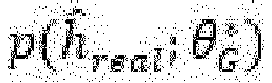
- the second artificial neural network 113 may receive the latent vector z real generated by the first artificial neural network 111 and may obtain the estimated value ⁇ real of the original data embedding vector h real and a byproduct p h ⁇ real ⁇ G ⁇ .
- the likelihood p h ⁇ real ⁇ G ⁇ may be added to a loss function of a generative adversarial network as a regularization term, and using the same, may control fake data performance and a privacy level.
- the second artificial neural network 113 may receive an input latent vector having a normal distribution and may generate a fake data embedding vector.
- the second artificial neural network 113 may receive a latent vector z having a normal distribution and may generate an embedding vector h fake of fake data. Subsequently, the discriminating unit 120 may receive the embedding vector h fake of the fake data and the embedding vector h real of the original data, and may determine (y) whether the original data embedding vector and the fake data embedding vector are genuine or fake. In this instance, every time that the discriminating unit 120 determines data generated by the second artificial neural network 113 is fake, the second artificial neural network 113 may receive negative feedback and may update performance.
- the process that the second artificial neural network 113 and the discriminating unit 120 perform adversarial training may utilize a training method used by a normal generative adversarial network (GAN).
- GAN normal generative adversarial network
- an invertible neural network may derive a likelihood that is the probability distribution of an original data embedding vector for generating an estimated data embedding vector from the original data embedding vector.
- an artificial neural network (G*) that receives a latent vector z as an input and generates data h is defined as an invertible neural network
- p(h; ⁇ (G*) ) that is the probability that generator G* will generate h as a byproduct may be obtained.
- p( ⁇ ; ⁇ (G*) ) that is a function associated with h is the probability distribution of h, which is referred to as a likelihood.
- G*: R dim( z ) ⁇ R dim(h) may be defined as follows.
- index K of F denotes a constant that is determined in advance by a model designer
- FC denotes a fully connected layer
- ⁇ denotes an activation function.
- the third line of Equation 1 is a differential equation defined as a neural ODE, and the complexity of a model may be reduced by using a function defined in the form of a differential equation.
- a model selecting matter that needs to determine how many layers are to be layered at the same time may be solved.
- an excessive bundle used when model training is performed may be distributed and shared by a plurality of artificial neural networks.
- p( ⁇ ; ⁇ (G*) ) that is the probability distribution of h may be derived from the distribution of z based on G* defined as an invertible neural network, that is, derived from standard Gaussian distribution N (0,1), using variable conversion theory.
- log p h log p z ⁇ ⁇ 0 1 Tr ⁇ f ⁇ z t dt , where h ⁇ z 1 , z ⁇ 0
- Equation 2 expresses a method of deriving the distribution of h from the distribution of z.
- the probability distribution of h may be derived after Tr( ⁇ f/ ⁇ z(t)) associated with f is obtained as shown in Equation 2.
- the invertible neural network may be trained based on a loss function including a regulation term including a likelihood.
- the loss function may be expressed as shown in Equation 3 below.
- L GAN ⁇ D ⁇ G * + ⁇ E ⁇ log p x ⁇ G * x ⁇ p data
- Equation 1 expresses a loss function associated with combining two training methods, and consequently, may include all the advantages of the GAN and the INN and may improve the quality of synthetic data.
- the regulation term may have a regulation parameter as a scale factor.
- a regulation parameter in the case that a regulation parameter is increased in a positive direction, similarity to original data is increased and the degree of privacy is decreased, and in the case that a regulation parameter is increased in a negative direction, the similarity to the original data is decreased and the degree of privacy is increased.
- a likelihood term may include a regulation parameter ⁇ .
- the generating unit 110 may be trained to increase the probability of generating a genuine sample, and thus, may generate fake data similar to the original data.
- the generating unit 110 may be trained to decrease the probability of generating the original data but to generate a high quality of fake data that may be determined as genuine data by the discriminating unit 120.
- an auto encoder may be a type of artificial neural network used for efficiently training coding of data of which label is not designated.
- the auto encoder may be configured with an encoder and a decoder, and may be used for a dimension reduction matter.
- the encoder may receive a higher-dimension input and may change the same into a lower-dimension internal representation (embedding vector), and the decoder may change the lower-dimension internal representation into a higher-dimension output again.
- the auto encoder may change an input into an embedding vector and may perform reconstruction of an output again.
- a cost function of the auto encoder may be learned using a reconstruction loss function (reconstruction error) that imposes a penalty point when the reconfiguration (i.e., output) is different from the input.
- the synthetic data generating apparatus 100 may further include the encoding unit 130 that receives original data, and generates an original data embedding vector by converting the original data into lower-dimension data.
- the generating unit 110 may not immediately use an invertible neural network.
- the encoding unit 130 may use the invertible neural network.
- the synthetic data generating apparatus 100 may further include a decoding unit 140 that is trained to reconstruct data similar to original data from the original data embedding vector received from the encoding unit 130.
- the encoding unit 130 may generate a lower-dimension embedding vector h real from original data x real .
- the decoding unit 140 may decode the embedding vector h real into higher-dimension data x ⁇ real again.
- the decoding unit 140 may include a third artificial neural network that is trained to reconstruct data similar to original data from an original data embedding vector.
- the third artificial neural network may be trained to generate reconstructed output x ⁇ real to be similar to x real .
- the decoding unit may receive the fake data embedding vector from the generating unit and may generate fake data by using the third artificial neural network.
- the decoding unit 140 may decode the fake data embedding vector h fake (lower dimension) by utilizing the trained third artificial neural network, and may generate fake data x fake (in the same dimension as that of x real ) that is synthetic data.
- the decoding unit 140 may receive a fake data embedding vector from the generating unit 110 and may generate fake data by using the third artificial neural network. As illustrated in FIG. 2 , the decoding unit 140 may receive a fake data embedding vector h fake from the generating unit 110, and may generate fake data x fake from h fake by using the third artificial neural network that is trained to reconstruct original data by using an original data embedding vector.
- a loss function may be defined as shown in Equation 4 below.
- an original data embedding vector h instead of original data x, is applied as input data, and thus, in above-described Equation 3 may be changed to
- D denotes a discriminator of a generative adversarial network
- G* denotes a generator that is designed using an invertible neural network
- L GAN ⁇ D , ⁇ (G*)
- WGAN loss WGAN loss, WGAN-GP loss, or the like
- Equation 5 a general generative adversarial network loss function as given in Equation 5.
- L AE ( ⁇ AE ) denotes a loss function associated with an encoding unit and a decoding unit, and may be expressed as given in Equation 6.
- the loss associated with the encoding unit and the decoding unit may be provided in the form of the sum of a reconstruction loss used for auto encoder training, L2 regularization for dimension reduction performed in the encoding unit, and the distance between a fake data embedding vector h fake estimated based on a latent vector z and an embedding vector ⁇ fake reconstructed by the decoding unit.
- ⁇ fake is a result obtained in a manner in which the decoding unit decodes h fake (i.e., x fake ) and the encoding unit encodes the same again.
- the encoding unit and the decoding unit may be trained to operate so that x ⁇ real becomes similar to x real within the range of original data.
- h fake generated in the generating unit may also affect training of the encoding unit and the decoding unit and thus, L AE ( ⁇ AE ) may derive a reliable result even in association with fake data.
- FIG. 3 is a flowchart illustrating a synthetic data generating method according to an embodiment.
- a generative adversarial network-based synthetic data generating method may include a generation operation 310 that receives an original data embedding vector, and generates a fake data embedding vector by using an invertible neural network.
- a generator of the generative adversarial network may be configured as an invertible neural network (INN).
- INN invertible neural network
- the invertible neural network may include a first artificial neural network that generates an original data latent vector from an original data embedding vector, and a second artificial neural network that generates an estimated data embedding vector from the original data latent vector.
- the first artificial neural network may receive an embedding vector h real of original data x real and may generate a latent vector z real .
- the second artificial neural network may receive the latent vector z real generated by the first artificial neural network and may obtain ⁇ real that is the estimated value of the original data embedding vector h real and p h ⁇ real ⁇ G ⁇ that is a byproduct.
- the synthetic data generating method may include a discrimination operation 320 that receives the original data embedding vector and the fake data embedding vector, and discriminates whether the original data embedding vector and the fake data embedding vector are fake data.
- the second artificial neural network may receive a latent vector z having a normal distribution and may generate an embedding vector h fake of the fake data.
- the discrimination operation may receive the embedding vector h fake of the fake data and the embedding vector h real of the original data, and may determine whether the original data embedding vector and the fake data embedding vector are genuine or fake.
- the second artificial neural network may receive negative feedback and may update performance.
- the invertible neural network may derive a likelihood that is the probability distribution of the original data embedding vector for generating the estimated data embedding vector from the original data embedding vector.
- the invertible neural network may perform training based on a loss function including a regulation term including a likelihood.
- the regulation term may have a regulation parameter as a scale factor. For example, in the case that the regulation parameter is increased in a positive direction, similarity to the original data is increased and the degree of privacy is decreased, and in the case that the regulation parameter is increased in a negative direction, the similarity to the original data is decreased and the degree of privacy is increased.
- the synthetic data generating method may further include an encoding operation that receives the original data and generates the original data embedding vector by converting the input original data into lower-dimension data, and a decoding operation that reconstructs data in the same dimension as the original data from the original data embedding vector.
- the encoding operation may generate a lower-dimension embedding vector h real from the original data x real .
- the decoding operation may decode the embedding vector h real into higher-dimension data x ⁇ real again.
- the decoding operation may use a third artificial neural network that is trained to reconstruct data similar to the original data from the original data embedding vector.
- the third artificial neural network may be trained to generate a reconstructed output x ⁇ real to be similar to x real .
- the decoding operation may receive the fake data embedding vector from the generation operation and may generate fake data by using the third artificial neural network.
- the decoding operation may decode the fake data embedding vector h fake (lower dimension) by utilizing the trained third artificial neural network, and may generate fake data x fake (in the same dimension as that of x real ) that is synthetic data.
- FIG. 4 is a block diagram illustrating an example of a computing environment including a computing device according to an embodiment.
- the respective components may have different functions and capabilities, in addition to the description below, and an additional component that is not described below may be included.
- the illustrated computing environment 10 includes a computing device 12.
- the computing device 12 may be one or more components included in the synthetic data generating apparatus 100.
- the computing device 12 may include at least one processor 14, a computer-readable storage medium 16, and a communication bus 18.
- the processor 14 may enable the computing device 12 to operate according to the above-described embodiments.
- the processor 14 may implement one or more programs stored in the computer-readable storage medium 16.
- the one or more programs may include one or more computer-executable instructions, and the computer-executable instructions may be configured to enable the computing device 12 to perform operations according to embodiments when the computer-executable instructions are executed by the processor 14.
- the computer-readable storage medium 16 may be configured to store a computer-executable instruction or program code, program data, and/or other appropriate types of information.
- the program 20 stored in the computer-readable storage medium 16 may include a set of instructions executable by the processor 14.
- the computer-readable storage medium 16 may be memory (volatile memory such as a random access memory, non-volatile memory, or an appropriate combination thereof), one or more magnetic disc storage devices, optical disc storage devices, flash memory devices, and other types of storage media capable of storing information desired or accessed by the computing device 12, or an appropriate combination thereof.
- the communication bus 18 may include the processor 14, the computer-readable storage medium 16, and may mutually connect to various other components of the computing device 12.
- the computing device 12 may include one or more input/output interfaces 22 that provides an interface for one or more input/output devices 24, and one or more network communication interfaces 26.
- the input/output interface 22 and the network communication interface 26 may be connected to the communication bus 18.
- the input/output device 24 may be connected to other components of the computing device 12 via the input/output interface 22.
- the illustrated input/output device 24 may include a pointing device (a mouse, a trackpad, or the like), a keyboard, a touch input device (a touch pad, a touch screen, or the like), a voice or sound input device, various types of sensor devices, and/or an input device such as a shooting device, and/or an output device such as a display device, a printer, a speaker, and/or a network card.
- the illustrated input/output device 24 may be included in the computing device 12 as one of the components that constitute the computing device 12, or may be connected to the computing device 12 as a separate device from the computing device 12.
Landscapes
- Engineering & Computer Science (AREA)
- Theoretical Computer Science (AREA)
- Physics & Mathematics (AREA)
- General Physics & Mathematics (AREA)
- Data Mining & Analysis (AREA)
- General Engineering & Computer Science (AREA)
- Software Systems (AREA)
- General Health & Medical Sciences (AREA)
- Health & Medical Sciences (AREA)
- Mathematical Physics (AREA)
- Computational Linguistics (AREA)
- Life Sciences & Earth Sciences (AREA)
- Databases & Information Systems (AREA)
- Computing Systems (AREA)
- Artificial Intelligence (AREA)
- Biomedical Technology (AREA)
- Molecular Biology (AREA)
- Biophysics (AREA)
- Evolutionary Computation (AREA)
- Bioethics (AREA)
- Computer Security & Cryptography (AREA)
- Computational Mathematics (AREA)
- Computer Hardware Design (AREA)
- Mathematical Analysis (AREA)
- Mathematical Optimization (AREA)
- Pure & Applied Mathematics (AREA)
- Probability & Statistics with Applications (AREA)
- Bioinformatics & Computational Biology (AREA)
- Algebra (AREA)
- Operations Research (AREA)
- Medical Informatics (AREA)
- Evolutionary Biology (AREA)
- Bioinformatics & Cheminformatics (AREA)
- Management, Administration, Business Operations System, And Electronic Commerce (AREA)
- Compression, Expansion, Code Conversion, And Decoders (AREA)
Abstract
Disclosed is a method and apparatus for generating synthetic data. A generative adversarial network (GAN)-based synthetic data generating apparatus according to an embodiment may include a generating unit configured to receive an original data embedding vector and to generate a fake data embedding vector by using an invertible neural network, and a discriminating unit configured to receive the original data embedding vector and the fake data embedding vector and to discriminate whether the original data embedding vector and the fake data embedding vector are fake data.
Description
- Embodiments disclosed relate to a synthetic data generating technique.
- Research on a generative adversarial network has been conducted as a scheme of generating synthetic data. The generative adversarial network shows high performance in a consecutive type of data such as image data. However, it is difficult to utilize the generative adversarial network in data in a form that combines a consecutive type of data and a category type of data.
- Conditional tabular GAN (CTGAN) is one of the models developed to process unique characteristics of table data by using pre-processing used in conventional statistical schemes. However, a pre-processing process of this model may be affected by capability of an analyzer. Therefore, in the case that the pre-processing process has an error, the characteristics of the original data may be distortedly learned when synthetic data generating model training is performed.
- (Patent Document 1)
U.S. patent No. US 9,672,364 (registered on June 6, 2017 - Embodiments disclosed are to provide a method and apparatus for generating synthetic data.
- A generative adversarial network-based synthetic data generating apparatus according to an embodiment may include a generating unit configured to receive an original data embedding vector and to generate a fake data embedding vector by using an invertible neural network, and a discriminating unit configured to receive the original data embedding vector and the fake data embedding vector and to discriminate whether the original data embedding vector and the fake data embedding vector are fake data.
- The invertible neural network may include a first artificial neural network to generate an original data latent vector from the original data embedding vector, and a second artificial neural network to generate an estimated data embedding vector from the original data latent vector, wherein the first artificial neural network and the second artificial neural network are in an inverse function relation.
- The second artificial neural network may receive an input latent vector having a normal distribution and may generate a fake data embedding vector.
- The invertible neural network may derive a likelihood that is a probability distribution of the original data embedding vector for generating the estimated data embedding vector from the original data embedding vector.
- The invertible neural network may be trained based on a loss function including a regulation term including the likelihood.
- The regulation term may have a regulation parameter as a scale factor, and when the regulation parameter is increased in a positive direction, similarity to original data is increased and a degree of privacy is decreased, and when the regulation parameter is increased in a negative direction, the similarity to the original data is decreased and the degree of privacy is increased.
- The synthetic data generating apparatus may further include an encoding unit configured to receive original data and to generate the original data embedding vector by converting the original data into data in a lower dimension, and a decoding unit that is trained to reconstruct data in a same dimension as the original data from the original data embedding vector received from the encoding unit.
- The decoding unit may include a third artificial neural network that is trained to reconstruct data similar to the original data from the original data embedding vector.
- The decoding unit may receive the fake data embedding vector from the generating unit and may generate fake data by using the third artificial neural network.
- A generative adversarial network-based synthetic data generating method according to an embodiment may include a generation operation that receives an original data embedding vector and generates a fake data embedding vector by using an invertible neural network, and a discrimination operation that receives the original data embedding vector and the fake data embedding vector and discriminates whether the original data embedding vector and the fake data embedding vector are fake data.
- The invertible neural network may include a first artificial neural network to generate an original data latent vector from the original data embedding vector, and a second artificial neural network to generate an estimated data embedding vector from the original data latent vector, wherein the first artificial neural network and the second artificial neural network are in an inverse function relationship.
- The second artificial neural network may receive an input latent vector having a normal distribution and may generate a fake data embedding vector.
- The invertible neural network may derive a likelihood that is a probability distribution of the original data embedding vector for generating the estimated data embedding vector from the original data embedding vector.
- The invertible neural network may be trained based on a loss function including a regulation term including the likelihood.
- The regulation term may have a regulation parameter as a scale factor, and when the regulation parameter is increased in a positive direction, similarity to original data is increased and a degree of privacy is decreased, and when the regulation parameter is increased in a negative direction, the similarity to the original data is decreased and the degree of privacy is increased.
- The synthetic data generating method may further include an encoding operation that receives original data and generates the original data embedding vector by converting the original data into data in a lower dimension, and a decoding operation that reconstructs data in a same dimension as the original data from the original data embedding vector.
- The decoding operation may use a third artificial neural network that is trained to reconstruct data similar to the original data from the original data embedding vector.
- The decoding operation may receive the fake data embedding vector from the generation operation and may generate fake data by using the third artificial neural network.
- According to embodiment disclosed, there is provided a synthetic data generating apparatus and method that can control synthetic data performance and a privacy level.
- The above and other aspects, features, and advantages of the present disclosure will be more apparent from the following detailed description taken in conjunction with the accompanying drawings, in which:
-
FIG. 1 is a block diagram illustrating a synthetic data generating apparatus according to an embodiment; -
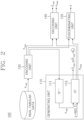
FIG. 2 is a block diagram illustrating a synthetic data generating apparatus according to an embodiment; -
FIG. 3 is a flowchart illustrating a synthetic data generating method according to an embodiment; and -
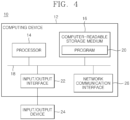
FIG. 4 is a block diagram illustrating an example of a computing environment including a computing device according to an embodiment. - Hereinafter, detailed embodiments of the disclosure will be described with reference to drawings. A detailed description below will be provided to help comprehensive understanding of the method, device, and/or system described in the present specification. However, this is merely an example, and the present disclosure is not limited thereto.
- When describing embodiments of the present disclosure, if it is determined that the detailed descriptions of a well-known art related to the present disclosure make the subject matter of the present disclosure unclear, the detailed descriptions thereof will be omitted herein. The terms to be described below are terms defined in consideration of functions in the present disclosure, and may be changed by a user, the intention of an operator, practice, or the like. Therefore, the definitions of the terms should be made based on the contents throughout the specification. The terms used in the detailed description is for the purpose of describing embodiments of the present disclosure only and is not intended to be restrictive. The singular forms are intended to include the plural forms as well, unless the context clearly indicates otherwise. In the descriptions, the terms "comprises," or "includes," specify features, numbers, steps, operations, elements, and/or part or a combination thereof, but should not be construed to exclude the presence or possibility of one or more other features, numbers, steps, operations, elements, and/or part or combination thereof.
-
FIG. 1 is a block diagram illustrating a synthetic data generating apparatus according to an embodiment. - According to an embodiment, a generative adversarial network (GAN)-based synthetic
data generating apparatus 100 may include a generatingunit 110 that receives an original data embedding vector and generates a fake data embedding vector by using an invertible neural network, and adiscriminating unit 120 that receives the original data embedding vector and the fake data embedding vector and discriminates whether the original data embedding vector and the fake data embedding vector are fake data. - According to an embodiment, the generative adversarial network (GAN) is a generation model including a generator to generate fake data and a discriminator to discriminate original data and fake data. The generative adversarial network performs training in a manner in which the generator and the discriminator are in contention, and aims to generate fake data similar to the original data. For example, every time that the discriminator is aware of data generated by the generator is fake, the generator may receive negative feedback and may improve the quality of fake data by using the same. In addition, the discriminator may be trained to better discriminate fake data based on a result obtained by discriminating the original data and fake data.
- For example, the generative adversarial network does not consider the distribution of original data as an explicit training goal and only performs adversarial training. Therefore, there may be a difference in distribution between fake data and the original data and thus, the usefulness of the fake data may be lowered. Specifically, a mode collapse that is the chronic problem of generative adversarial network may equally occur in table data.
- According to an embodiment, in order to overcome the uppermost limit of the existing generative adversarial network, the generator of the generative adversarial network may be configured as an invertible neural network (INN) .
- The invertible neural network may be a neural network that is capable of inferring an input-output relationship bidirectionally. For example, in the case that the generator is expressed as x=G(z) that receives a latent vector z as an input and generates data record x, the calculation of z=G-1(x), which is performed in inverse direction, is available. In this process, Pr(x|z) that is the probability that generator G will generate x from z may be calculated as a byproduct. In this instance, the probability is referred to as likelihood.
- According to an embodiment, the invertible neural network may include a first artificial neural network that generates an original data latent vector from the original data embedding vector and a second artificial neural network that generates an estimated data embedding vector from the original data latent vector.
- According to an embodiment, the invertible neural network may be configured based on a neural ordinary differential equation (ODE) based on a differential equation.
- Referring to
FIG. 2 , the generatingunit 110 may include a first artificial neural network ((G*)-1) 111 and a second artificial neural network (G*) 113 that is configured as an inverse function of the first artificial neural network. For example, the first artificialneural network 111 may receive an embedding vector hreal of original data xreal, and may generate a latent vector zreal. In addition, the second artificialneural network 113 may receive the latent vector zreal generated by the first artificialneural network 111 and may obtain the estimated value ĥreal of the original data embedding vector hreal and a byproduct

- According to an embodiment, the second artificial
neural network 113 may receive an input latent vector having a normal distribution and may generate a fake data embedding vector. - For example, the second artificial
neural network 113 may receive a latent vector z having a normal distribution and may generate an embedding vector hfake of fake data. Subsequently, the discriminatingunit 120 may receive the embedding vector hfake of the fake data and the embedding vector hreal of the original data, and may determine (y) whether the original data embedding vector and the fake data embedding vector are genuine or fake. In this instance, every time that the discriminatingunit 120 determines data generated by the second artificialneural network 113 is fake, the second artificialneural network 113 may receive negative feedback and may update performance. - For example, the process that the second artificial
neural network 113 and the discriminatingunit 120 perform adversarial training may utilize a training method used by a normal generative adversarial network (GAN). - According to an embodiment, an invertible neural network may derive a likelihood that is the probability distribution of an original data embedding vector for generating an estimated data embedding vector from the original data embedding vector.
- According to an embodiment, in the case that an artificial neural network (G*) that receives a latent vector z as an input and generates data h is defined as an invertible neural network, this is expressed as h=G*(z), and this means that the calculation of z=(G*)-1(h) is available. In this instance, p(h;θ(G*)) that is the probability that generator G* will generate h as a byproduct may be obtained. In this instance, in the case that the embedding vector h is regarded as a random variable, p(·;θ(G*)) that is a function associated with h is the probability distribution of h, which is referred to as a likelihood.
- According to an embodiment, G*:R dim(z) → R dim(h) may be defined as follows.

- Here, index K of F denotes a constant that is determined in advance by a model designer, FC denotes a fully connected layer, and σ denotes an activation function. The third line of
Equation 1 is a differential equation defined as a neural ODE, and the complexity of a model may be reduced by using a function defined in the form of a differential equation. In addition, a model selecting matter that needs to determine how many layers are to be layered at the same time may be solved. As shown in the last equation ofEquation 1, by defining an artificial neural network, which defines a differential equation, in the form of an ensemble that automatically determines weight (Mi(z,t)) according the characteristic of data and over time, an excessive bundle used when model training is performed may be distributed and shared by a plurality of artificial neural networks. - For example, p(·;θ(G*)) that is the probability distribution of h may be derived from the distribution of z based on G* defined as an invertible neural network, that is, derived from standard Gaussian distribution N (0,1), using variable conversion theory.

- For example, Equation 2 expresses a method of deriving the distribution of h from the distribution of z. Specifically, the probability distribution of h may be derived after Tr(∂f/∂z(t)) associated with f is obtained as shown in Equation 2.
- According to an embodiment, the invertible neural network may be trained based on a loss function including a regulation term including a likelihood.
- For example, the loss function may be expressed as shown in Equation 3 below.

- Here, LGAN(θD,θG* ) is a loss function associated with adversarial training of a generative adversarial network (GAN), and E[-logp(x;θG*)]x^p
data is a loss function associated with likelihood-based training of an invertible neural network (INN). Accordingly,Equation 1 expresses a loss function associated with combining two training methods, and consequently, may include all the advantages of the GAN and the INN and may improve the quality of synthetic data. - According to an embodiment, the regulation term may have a regulation parameter as a scale factor.
- According to an embodiment, in the case that a regulation parameter is increased in a positive direction, similarity to original data is increased and the degree of privacy is decreased, and in the case that a regulation parameter is increased in a negative direction, the similarity to the original data is decreased and the degree of privacy is increased.
- For example, training to increase a likelihood in Equation 3 refers to training in a direction of increasing the probability by which the
generating unit 110 will generate original data xreal. Conversely, training to decrease a likelihood refers to training in a direction of decreasing the probability by which thegenerating unit 110 will generate the original data, so as to decrease the risk of leaking sensitive information that synthetic data may have. Accordingly, as shown in Equation 3, a likelihood term may include a regulation parameter γ. For example, in the case that γ is a positive number, the generatingunit 110 may be trained to increase the probability of generating a genuine sample, and thus, may generate fake data similar to the original data. Conversely, in the case that γ is a negative number, the generatingunit 110 may be trained to decrease the probability of generating the original data but to generate a high quality of fake data that may be determined as genuine data by the discriminatingunit 120. - According to an embodiment, an auto encoder may be a type of artificial neural network used for efficiently training coding of data of which label is not designated. The auto encoder may be configured with an encoder and a decoder, and may be used for a dimension reduction matter. For example, the encoder may receive a higher-dimension input and may change the same into a lower-dimension internal representation (embedding vector), and the decoder may change the lower-dimension internal representation into a higher-dimension output again. The auto encoder may change an input into an embedding vector and may perform reconstruction of an output again. Accordingly, a cost function of the auto encoder may be learned using a reconstruction loss function (reconstruction error) that imposes a penalty point when the reconfiguration (i.e., output) is different from the input.
- According to an embodiment, the synthetic
data generating apparatus 100 may further include theencoding unit 130 that receives original data, and generates an original data embedding vector by converting the original data into lower-dimension data. - For example, in the case that a consecutive type of variable and a category type of variable are mixedly present, the generating
unit 110 may not immediately use an invertible neural network. As an example to overcome the problem, in the case that theencoding unit 130 embeds a category type of variable and a consecutive type of variable together as a consecutive type of variable, the generatingunit 110 may use the invertible neural network. - According to an embodiment, the synthetic
data generating apparatus 100 may further include adecoding unit 140 that is trained to reconstruct data similar to original data from the original data embedding vector received from theencoding unit 130. - For example, the
encoding unit 130 may generate a lower-dimension embedding vector hreal from original data xreal. In addition, thedecoding unit 140 may decode the embedding vector hreal into higher-dimension data x̂real again. - According to an embodiment, the
decoding unit 140 may include a third artificial neural network that is trained to reconstruct data similar to original data from an original data embedding vector. For example, the third artificial neural network may be trained to generate reconstructed output x̂real to be similar to xreal. - According to an embodiment, the decoding unit may receive the fake data embedding vector from the generating unit and may generate fake data by using the third artificial neural network. For example, the
decoding unit 140 may decode the fake data embedding vector hfake (lower dimension) by utilizing the trained third artificial neural network, and may generate fake data xfake (in the same dimension as that of xreal) that is synthetic data. - According to an embodiment, the
decoding unit 140 may receive a fake data embedding vector from the generatingunit 110 and may generate fake data by using the third artificial neural network. As illustrated inFIG. 2 , thedecoding unit 140 may receive a fake data embedding vector hfake from the generatingunit 110, and may generate fake data xfake from hfake by using the third artificial neural network that is trained to reconstruct original data by using an original data embedding vector. - According to an embodiment, in the case that the
encoding unit 130 and thedecoding unit 140 are added, a loss function may be defined as shown in Equation 4 below.
- Here, in the synthetic data generating apparatus according to an embodiment, an original data embedding vector h, instead of original data x, is applied as input data, and thus,
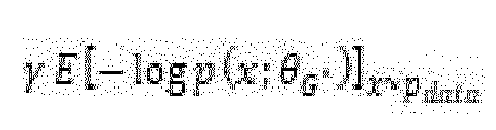

- In addition, D denotes a discriminator of a generative adversarial network, and G* denotes a generator that is designed using an invertible neural network. LGAN(θD, θ(G*)) denotes a loss function of the generative adversarial network, and may be defined as one of the various types of loss functions (e.g., WGAN loss, WGAN-GP loss, or the like) including a general generative adversarial network loss function as given in Equation 5.

- In addition, pz denotes the distribution of a latent vector, and pdata denotes the distribution of original data. LAE(θAE) denotes a loss function associated with an encoding unit and a decoding unit, and may be expressed as given in Equation 6.
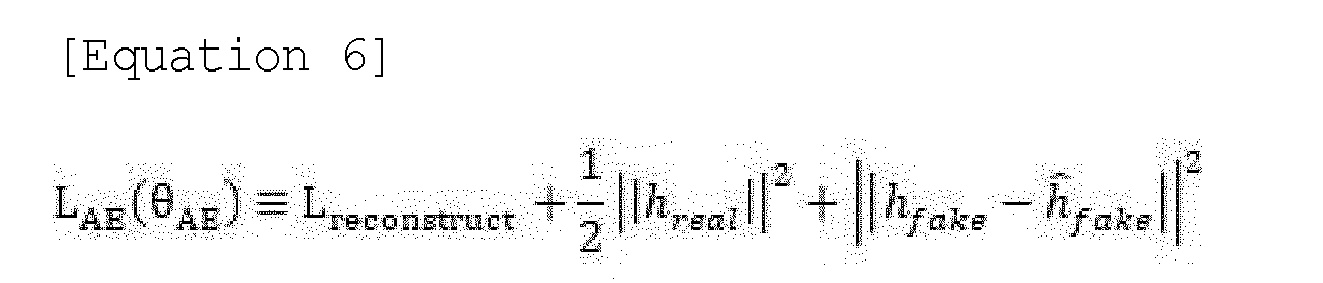
- Specifically, the loss associated with the encoding unit and the decoding unit may be provided in the form of the sum of a reconstruction loss used for auto encoder training, L2 regularization for dimension reduction performed in the encoding unit, and the distance between a fake data embedding vector hfake estimated based on a latent vector z and an embedding vector ĥfake reconstructed by the decoding unit. Here, ĥfake is a result obtained in a manner in which the decoding unit decodes hfake (i.e., xfake) and the encoding unit encodes the same again. In the case of an existing reconfiguration loss, the encoding unit and the decoding unit may be trained to operate so that x̂real becomes similar to xreal within the range of original data. However, hfake generated in the generating unit may also affect training of the encoding unit and the decoding unit and thus, LAE(θAE) may derive a reliable result even in association with fake data.
-
FIG. 3 is a flowchart illustrating a synthetic data generating method according to an embodiment. - According to an embodiment, a generative adversarial network-based synthetic data generating method may include a
generation operation 310 that receives an original data embedding vector, and generates a fake data embedding vector by using an invertible neural network. - According to an embodiment, in order to overcome the uppermost limit of an existing generative adversarial network, a generator of the generative adversarial network may be configured as an invertible neural network (INN).
- According to an embodiment, the invertible neural network may include a first artificial neural network that generates an original data latent vector from an original data embedding vector, and a second artificial neural network that generates an estimated data embedding vector from the original data latent vector.
- For example, the first artificial neural network may receive an embedding vector hreal of original data xreal and may generate a latent vector zreal. In addition, the second artificial neural network may receive the latent vector zreal generated by the first artificial neural network and may obtain ĥreal that is the estimated value of the original data embedding vector hreal and
- According to an embodiment, the synthetic data generating method may include a
discrimination operation 320 that receives the original data embedding vector and the fake data embedding vector, and discriminates whether the original data embedding vector and the fake data embedding vector are fake data. - For example, the second artificial neural network may receive a latent vector z having a normal distribution and may generate an embedding vector hfake of the fake data. Subsequently, the discrimination operation may receive the embedding vector hfake of the fake data and the embedding vector hreal of the original data, and may determine whether the original data embedding vector and the fake data embedding vector are genuine or fake. In this instance, every time that the discrimination operation determines that data generated by the second artificial neural network is fake, the second artificial neural network may receive negative feedback and may update performance.
- According to an embodiment, the invertible neural network may derive a likelihood that is the probability distribution of the original data embedding vector for generating the estimated data embedding vector from the original data embedding vector.
- According to an embodiment, the invertible neural network may perform training based on a loss function including a regulation term including a likelihood. In this instance, the regulation term may have a regulation parameter as a scale factor. For example, in the case that the regulation parameter is increased in a positive direction, similarity to the original data is increased and the degree of privacy is decreased, and in the case that the regulation parameter is increased in a negative direction, the similarity to the original data is decreased and the degree of privacy is increased.
- According to an embodiment, the synthetic data generating method may further include an encoding operation that receives the original data and generates the original data embedding vector by converting the input original data into lower-dimension data, and a decoding operation that reconstructs data in the same dimension as the original data from the original data embedding vector.
- For example, the encoding operation may generate a lower-dimension embedding vector hreal from the original data xreal. In addition, the decoding operation may decode the embedding vector hreal into higher-dimension data x̂real again.
- According to an embodiment, the decoding operation may use a third artificial neural network that is trained to reconstruct data similar to the original data from the original data embedding vector. For example, the third artificial neural network may be trained to generate a reconstructed output x̂real to be similar to xreal.
- According to an embodiment, the decoding operation may receive the fake data embedding vector from the generation operation and may generate fake data by using the third artificial neural network.
- For example, the decoding operation may decode the fake data embedding vector hfake (lower dimension) by utilizing the trained third artificial neural network, and may generate fake data xfake (in the same dimension as that of xreal) that is synthetic data.
- In the descriptions provided with reference to
FIG.3 , the parts overlap the parts which have been described with reference toFIGS. 1 and2 are omitted. -
FIG. 4 is a block diagram illustrating an example of a computing environment including a computing device according to an embodiment. In the illustrated embodiments, the respective components may have different functions and capabilities, in addition to the description below, and an additional component that is not described below may be included. - The illustrated
computing environment 10 includes acomputing device 12. According to an embodiment, thecomputing device 12 may be one or more components included in the syntheticdata generating apparatus 100. Thecomputing device 12 may include at least oneprocessor 14, a computer-readable storage medium 16, and acommunication bus 18. Theprocessor 14 may enable thecomputing device 12 to operate according to the above-described embodiments. For example, theprocessor 14 may implement one or more programs stored in the computer-readable storage medium 16. The one or more programs may include one or more computer-executable instructions, and the computer-executable instructions may be configured to enable thecomputing device 12 to perform operations according to embodiments when the computer-executable instructions are executed by theprocessor 14. - The computer-
readable storage medium 16 may be configured to store a computer-executable instruction or program code, program data, and/or other appropriate types of information. Theprogram 20 stored in the computer-readable storage medium 16 may include a set of instructions executable by theprocessor 14. According to an embodiment, the computer-readable storage medium 16 may be memory (volatile memory such as a random access memory, non-volatile memory, or an appropriate combination thereof), one or more magnetic disc storage devices, optical disc storage devices, flash memory devices, and other types of storage media capable of storing information desired or accessed by thecomputing device 12, or an appropriate combination thereof. - The
communication bus 18 may include theprocessor 14, the computer-readable storage medium 16, and may mutually connect to various other components of thecomputing device 12. - The
computing device 12 may include one or more input/output interfaces 22 that provides an interface for one or more input/output devices 24, and one or more network communication interfaces 26. The input/output interface 22 and thenetwork communication interface 26 may be connected to thecommunication bus 18. The input/output device 24 may be connected to other components of thecomputing device 12 via the input/output interface 22. The illustrated input/output device 24 may include a pointing device (a mouse, a trackpad, or the like), a keyboard, a touch input device (a touch pad, a touch screen, or the like), a voice or sound input device, various types of sensor devices, and/or an input device such as a shooting device, and/or an output device such as a display device, a printer, a speaker, and/or a network card. The illustrated input/output device 24 may be included in thecomputing device 12 as one of the components that constitute thecomputing device 12, or may be connected to thecomputing device 12 as a separate device from thecomputing device 12. - Although the present disclosure has been described in detail with reference to a representative embodiment, it would be apparent to those skilled in the art that various modifications can be made to the above-described embodiments without departing from the scope of the present disclosure. Therefore, the scope of the present disclosure cannot be determined merely based on the described embodiments. Rather, the scope of the present disclosure should be determined based on the accompanying claims and their equivalents.
- Description of reference numerals
- 10: computing environment
- 12: computing device
- 14: processor
- 16: computer-readable storage medium
- 18: communication bus
- 20: program
- 22: input/output interface
- 24: input/output device
- 26: network communication interface
- 100: synthetic data generating apparatus
- 110: generating unit
- 120: discriminating unit
- 130: encoding unit
- 140: decoding unit
Claims (15)
- A generative adversarial network-based synthetic data generating apparatus, the apparatus comprising:a generating unit configured to receive an original data embedding vector and to generate a fake data embedding vector by using an invertible neural network; anda discriminating unit configured to receive the original data embedding vector and the fake data embedding vector and to discriminate whether the original data embedding vector and the fake data embedding vector are fake data.
- The apparatus of claim 1, wherein the invertible neural network comprises:a first artificial neural network configured to generate an original data latent vector from the original data embedding vector; anda second artificial neural network configured to generate an estimated data embedding vector from the original data latent vector,wherein the first artificial neural network and the second artificial neural network are in an inverse function relationship.
- The apparatus of claim 2, wherein the second artificial neural network is configured to receive an input latent vector having a normal distribution and to generate a fake data embedding vector.
- The apparatus of claim 2, wherein the invertible neural network is configured to derive a likelihood that is a probability distribution of the original data embedding vector for generating the estimated data embedding vector from the original data embedding vector.
- The apparatus of claim 4, wherein the invertible neural network is configured to be trained based on a loss function including a regulation term including the likelihood.
- The apparatus of claim 5, wherein:the regulation term has a regulation parameter as a scale factor,when the regulation parameter is increased in a positive direction, similarity to original data is increased and a degree of privacy is decreased, andwhen the regulation parameter is increased in a negative direction, the similarity to the original data is decreased and the degree of privacy is increased.
- The apparatus of claim 1, further comprising:an encoding unit configured to receive original data and to generate the original data embedding vector by converting the original data into data in a lower dimension; anda decoding unit trained to reconstruct data in a same dimension as the original data from the original data embedding vector received from the encoding unit.
- The apparatus of claim 7, wherein the decoding unit comprises a third artificial neural network trained to reconstruct data similar to the original data from the original data embedding vector.
- The apparatus of claim 8, wherein the decoding unit is configured to receive the fake data embedding vector from the generating unit and to generate fake data by using the third artificial neural network.
- A generative adversarial network-based synthetic data generating method, the method comprising:a generation operation of receiving an original data embedding vector and generating a fake data embedding vector by using an invertible neural network; anda discrimination operation of receiving the original data embedding vector and the fake data embedding vector and discriminating whether the original data embedding vector and the fake data embedding vector are fake data.
- The method of claim 10, wherein the invertible neural network comprises:a first artificial neural network configured to generate an original data latent vector from the original data embedding vector; anda second artificial neural network configured to generate an estimated data embedding vector from the original data latent vector,wherein the first artificial neural network and the second artificial neural network are in an inverse function relationship.
- The method of claim 11, wherein the second artificial neural network is configured to receive an input latent vector having a normal distribution and to generate a fake data embedding vector.
- The method of claim 11, wherein the invertible neural network is configured to derive a likelihood that is a probability distribution of the original data embedding vector for generating the estimated data embedding vector from the original data embedding vector.
- The method of claim 13, wherein the invertible neural network is configured to be trained based on a loss function including a regulation term including the likelihood.
- The method of claim 14, wherein:the regulation term has a regulation parameter as a scale factor,when the regulation parameter is increased in a positive direction, similarity to original data is increased and a degree of privacy is decreased, andwhen the regulation parameter is increased in a negative direction, the similarity to the original data is decreased and the degree of privacy is increased.
Applications Claiming Priority (1)
| Application Number | Priority Date | Filing Date | Title |
|---|---|---|---|
| KR1020210144793A KR20230060266A (en) | 2021-10-27 | 2021-10-27 | Method and apparatus for generating synthetic data |
Publications (1)
| Publication Number | Publication Date |
|---|---|
| EP4174722A1 true EP4174722A1 (en) | 2023-05-03 |
Family
ID=83996545
Family Applications (1)
| Application Number | Title | Priority Date | Filing Date |
|---|---|---|---|
| EP22203495.1A Withdrawn EP4174722A1 (en) | 2021-10-27 | 2022-10-25 | Method and apparatus for generating synthetic data |
Country Status (3)
| Country | Link |
|---|---|
| US (1) | US20230125839A1 (en) |
| EP (1) | EP4174722A1 (en) |
| KR (1) | KR20230060266A (en) |
Families Citing this family (2)
| Publication number | Priority date | Publication date | Assignee | Title |
|---|---|---|---|---|
| CN117292024B (en) * | 2023-11-24 | 2024-04-12 | 上海蜜度科技股份有限公司 | Voice-based image generation method, device, medium and electronic device |
| KR20250089775A (en) * | 2023-12-12 | 2025-06-19 | (주)아이브릭스 | The Natural Language Data Augmentation Method Using Adversarial Generative Learning |
Citations (1)
| Publication number | Priority date | Publication date | Assignee | Title |
|---|---|---|---|---|
| US9672364B2 (en) | 2013-03-15 | 2017-06-06 | Microsoft Technology Licensing, Llc | Differentially private linear queries on histograms |
Family Cites Families (5)
| Publication number | Priority date | Publication date | Assignee | Title |
|---|---|---|---|---|
| US10531806B2 (en) * | 2013-12-17 | 2020-01-14 | University Of Florida Research Foundation, Inc. | Brain state advisory system using calibrated metrics and optimal time-series decomposition |
| WO2017212459A1 (en) * | 2016-06-09 | 2017-12-14 | Sentient Technologies (Barbados) Limited | Content embedding using deep metric learning algorithms |
| US11531907B2 (en) * | 2021-05-07 | 2022-12-20 | Sas Institute Inc. | Automated control of a manufacturing process |
| US12175629B2 (en) * | 2022-01-28 | 2024-12-24 | Baidu Usa Llc | Systems and methods for adjustable image rescaling |
| US20230419087A1 (en) * | 2022-06-24 | 2023-12-28 | Qualcomm Incorporated | Adapters for quantization |
-
2021
- 2021-10-27 KR KR1020210144793A patent/KR20230060266A/en active Pending
-
2022
- 2022-10-25 US US17/972,933 patent/US20230125839A1/en active Pending
- 2022-10-25 EP EP22203495.1A patent/EP4174722A1/en not_active Withdrawn
Patent Citations (1)
| Publication number | Priority date | Publication date | Assignee | Title |
|---|---|---|---|---|
| US9672364B2 (en) | 2013-03-15 | 2017-06-06 | Microsoft Technology Licensing, Llc | Differentially private linear queries on histograms |
Non-Patent Citations (7)
| Title |
|---|
| ADITYA GROVER ET AL: "Flow-GAN: Combining Maximum Likelihood and Adversarial Learning in Generative Models", ARXIV.ORG, CORNELL UNIVERSITY LIBRARY, 201 OLIN LIBRARY CORNELL UNIVERSITY ITHACA, NY 14853, 24 May 2017 (2017-05-24), XP081405378 * |
| JIAPENG ZHU ET AL: "LIA: Latently Invertible Autoencoder with Adversarial Learning", ARXIV.ORG, CORNELL UNIVERSITY LIBRARY, 201 OLIN LIBRARY CORNELL UNIVERSITY ITHACA, NY 14853, 19 June 2019 (2019-06-19), XP081378005 * |
| LEE JAEHOON ET AL: "Invertible Tabular GANs: Killing Two Birds with One Stone for Tabular Data Synthesis", 29 September 2021 (2021-09-29), pages 1 - 11, XP093022493, Retrieved from the Internet <URL:https://openreview.net/pdf?id=tvDBe6K8L5o> [retrieved on 20230209] * |
| LEI XU ET AL: "Modeling Tabular data using Conditional GAN", ARXIV.ORG, CORNELL UNIVERSITY LIBRARY, 201 OLIN LIBRARY CORNELL UNIVERSITY ITHACA, NY 14853, 1 July 2019 (2019-07-01), XP081510637 * |
| LUO JUNYU ET AL: "Learning Inverse Mapping by AutoEncoder Based Generative Adversarial Nets", 26 October 2017, SAT 2015 18TH INTERNATIONAL CONFERENCE, AUSTIN, TX, USA, SEPTEMBER 24-27, 2015; [LECTURE NOTES IN COMPUTER SCIENCE; LECT.NOTES COMPUTER], SPRINGER, BERLIN, HEIDELBERG, PAGE(S) 207 - 216, ISBN: 978-3-540-74549-5, XP047453734 * |
| VADIM BORISOV ET AL: "Deep Neural Networks and Tabular Data: A Survey", ARXIV.ORG, CORNELL UNIVERSITY LIBRARY, 201 OLIN LIBRARY CORNELL UNIVERSITY ITHACA, NY 14853, 5 October 2021 (2021-10-05), XP091073700 * |
| YOON JINSUNG ET AL: "Time-series Generative Adversarial Networks", 1 January 2019 (2019-01-01), XP055821728, Retrieved from the Internet <URL:https://papers.nips.cc/paper/2019/file/c9efe5f26cd17ba6216bbe2a7d26d490-Paper.pdf> [retrieved on 20210706] * |
Also Published As
| Publication number | Publication date |
|---|---|
| US20230125839A1 (en) | 2023-04-27 |
| KR20230060266A (en) | 2023-05-04 |
Similar Documents
| Publication | Publication Date | Title |
|---|---|---|
| US11756561B2 (en) | Speech coding using content latent embedding vectors and speaker latent embedding vectors | |
| CN110612538B (en) | Generate discrete latent representations of input data items | |
| US20250384299A1 (en) | Neural Network Representation Formats | |
| US20230125839A1 (en) | Method and apparatus for generating synthetic data | |
| CN116883781B (en) | Method and device for fine tuning of pre-training model, electronic equipment and storage medium | |
| US11156968B2 (en) | Adaptive control of negative learning for limited reconstruction capability auto encoder | |
| KR20200052453A (en) | Apparatus and method for training deep learning model | |
| CN117896546B (en) | Data transmission method, system, electronic equipment and storage medium | |
| EP4246377A1 (en) | Method and apparatus for training fake image discriminative model | |
| KR20220159104A (en) | Apparatus for Deep fake image discrimination and learning method thereof | |
| CN111178039B (en) | Model training method and device, and text processing method and device | |
| CN113851133B (en) | Model training and calling method and device, computer equipment and storage medium | |
| US8312137B1 (en) | Live experiment framework | |
| KR102533984B1 (en) | Advanced system and method for detecting video forgery | |
| CN115277523B (en) | Hybrid QoS prediction method and system based on improved condition variation self-encoder | |
| CN118864625A (en) | Image generation method and device | |
| WO2025151415A1 (en) | Secure real time voice anonymization and recovery | |
| He et al. | Fairness in Machine Learning: A Review for Statisticians | |
| Lokumarambage et al. | Generative AI-based vector quantized end-to-end semantic communication system for wireless image transmission | |
| US12322011B2 (en) | Product of variations in image generative models | |
| Pezone | Semantic communication based on generative AI: a new approach to image compression and edge optimization | |
| Wang et al. | Hallucination in Generative AI-Enabled Wireless Communications: Concepts, Issues, and Solutions | |
| CN121331148B (en) | Audio watermarking embedding method, apparatus, electronic device and storage medium | |
| CN117332082B (en) | Imbalanced language steganalysis method and device based on clustering and ensemble learning | |
| US20250315686A1 (en) | Adversarial example generation system |
Legal Events
| Date | Code | Title | Description |
|---|---|---|---|
| PUAI | Public reference made under article 153(3) epc to a published international application that has entered the european phase |
Free format text: ORIGINAL CODE: 0009012 |
|
| STAA | Information on the status of an ep patent application or granted ep patent |
Free format text: STATUS: EXAMINATION IS IN PROGRESS |
|
| 17P | Request for examination filed |
Effective date: 20221025 |
|
| AK | Designated contracting states |
Kind code of ref document: A1 Designated state(s): AL AT BE BG CH CY CZ DE DK EE ES FI FR GB GR HR HU IE IS IT LI LT LU LV MC ME MK MT NL NO PL PT RO RS SE SI SK SM TR |
|
| STAA | Information on the status of an ep patent application or granted ep patent |
Free format text: STATUS: THE APPLICATION IS DEEMED TO BE WITHDRAWN |
|
| 18D | Application deemed to be withdrawn |
Effective date: 20250722 |