EP4174610A1 - Movement control system, movement control method, and computer program - Google Patents
Movement control system, movement control method, and computer program Download PDFInfo
- Publication number
- EP4174610A1 EP4174610A1 EP22192854.2A EP22192854A EP4174610A1 EP 4174610 A1 EP4174610 A1 EP 4174610A1 EP 22192854 A EP22192854 A EP 22192854A EP 4174610 A1 EP4174610 A1 EP 4174610A1
- Authority
- EP
- European Patent Office
- Prior art keywords
- operation plan
- order
- information
- start information
- movable object
- Prior art date
- Legal status (The legal status is an assumption and is not a legal conclusion. Google has not performed a legal analysis and makes no representation as to the accuracy of the status listed.)
- Granted
Links
Images





Classifications
-
- G—PHYSICS
- G05—CONTROLLING; REGULATING
- G05D—SYSTEMS FOR CONTROLLING OR REGULATING NON-ELECTRIC VARIABLES
- G05D1/00—Control of position, course, altitude or attitude of land, water, air or space vehicles, e.g. using automatic pilots
- G05D1/02—Control of position or course in two dimensions
- G05D1/021—Control of position or course in two dimensions specially adapted to land vehicles
- G05D1/0276—Control of position or course in two dimensions specially adapted to land vehicles using signals provided by a source external to the vehicle
-
- G—PHYSICS
- G05—CONTROLLING; REGULATING
- G05D—SYSTEMS FOR CONTROLLING OR REGULATING NON-ELECTRIC VARIABLES
- G05D1/00—Control of position, course, altitude or attitude of land, water, air or space vehicles, e.g. using automatic pilots
- G05D1/20—Control system inputs
- G05D1/22—Command input arrangements
- G05D1/221—Remote-control arrangements
- G05D1/225—Remote-control arrangements operated by off-board computers
-
- G—PHYSICS
- G05—CONTROLLING; REGULATING
- G05D—SYSTEMS FOR CONTROLLING OR REGULATING NON-ELECTRIC VARIABLES
- G05D1/00—Control of position, course, altitude or attitude of land, water, air or space vehicles, e.g. using automatic pilots
- G05D1/02—Control of position or course in two dimensions
- G05D1/021—Control of position or course in two dimensions specially adapted to land vehicles
- G05D1/0231—Control of position or course in two dimensions specially adapted to land vehicles using optical position detecting means
- G05D1/0234—Control of position or course in two dimensions specially adapted to land vehicles using optical position detecting means using optical markers or beacons
-
- G—PHYSICS
- G05—CONTROLLING; REGULATING
- G05D—SYSTEMS FOR CONTROLLING OR REGULATING NON-ELECTRIC VARIABLES
- G05D1/00—Control of position, course, altitude or attitude of land, water, air or space vehicles, e.g. using automatic pilots
- G05D1/20—Control system inputs
- G05D1/22—Command input arrangements
- G05D1/229—Command input data, e.g. waypoints
-
- G—PHYSICS
- G05—CONTROLLING; REGULATING
- G05D—SYSTEMS FOR CONTROLLING OR REGULATING NON-ELECTRIC VARIABLES
- G05D1/00—Control of position, course, altitude or attitude of land, water, air or space vehicles, e.g. using automatic pilots
- G05D1/20—Control system inputs
- G05D1/24—Arrangements for determining position or orientation
- G05D1/243—Means capturing signals occurring naturally from the environment, e.g. ambient optical, acoustic, gravitational or magnetic signals
-
- G—PHYSICS
- G05—CONTROLLING; REGULATING
- G05D—SYSTEMS FOR CONTROLLING OR REGULATING NON-ELECTRIC VARIABLES
- G05D1/00—Control of position, course, altitude or attitude of land, water, air or space vehicles, e.g. using automatic pilots
- G05D1/20—Control system inputs
- G05D1/24—Arrangements for determining position or orientation
- G05D1/244—Arrangements for determining position or orientation using passive navigation aids external to the vehicle, e.g. markers, reflectors or magnetic means
-
- G—PHYSICS
- G06—COMPUTING OR CALCULATING; COUNTING
- G06Q—INFORMATION AND COMMUNICATION TECHNOLOGY [ICT] SPECIALLY ADAPTED FOR ADMINISTRATIVE, COMMERCIAL, FINANCIAL, MANAGERIAL OR SUPERVISORY PURPOSES; SYSTEMS OR METHODS SPECIALLY ADAPTED FOR ADMINISTRATIVE, COMMERCIAL, FINANCIAL, MANAGERIAL OR SUPERVISORY PURPOSES, NOT OTHERWISE PROVIDED FOR
- G06Q10/00—Administration; Management
- G06Q10/06—Resources, workflows, human or project management; Enterprise or organisation planning; Enterprise or organisation modelling
- G06Q10/063—Operations research, analysis or management
-
- G—PHYSICS
- G06—COMPUTING OR CALCULATING; COUNTING
- G06Q—INFORMATION AND COMMUNICATION TECHNOLOGY [ICT] SPECIALLY ADAPTED FOR ADMINISTRATIVE, COMMERCIAL, FINANCIAL, MANAGERIAL OR SUPERVISORY PURPOSES; SYSTEMS OR METHODS SPECIALLY ADAPTED FOR ADMINISTRATIVE, COMMERCIAL, FINANCIAL, MANAGERIAL OR SUPERVISORY PURPOSES, NOT OTHERWISE PROVIDED FOR
- G06Q10/00—Administration; Management
- G06Q10/08—Logistics, e.g. warehousing, loading or distribution; Inventory or stock management
-
- G—PHYSICS
- G05—CONTROLLING; REGULATING
- G05D—SYSTEMS FOR CONTROLLING OR REGULATING NON-ELECTRIC VARIABLES
- G05D2105/00—Specific applications of the controlled vehicles
- G05D2105/20—Specific applications of the controlled vehicles for transportation
- G05D2105/28—Specific applications of the controlled vehicles for transportation of freight
-
- G—PHYSICS
- G05—CONTROLLING; REGULATING
- G05D—SYSTEMS FOR CONTROLLING OR REGULATING NON-ELECTRIC VARIABLES
- G05D2107/00—Specific environments of the controlled vehicles
- G05D2107/70—Industrial sites, e.g. warehouses or factories
-
- G—PHYSICS
- G05—CONTROLLING; REGULATING
- G05D—SYSTEMS FOR CONTROLLING OR REGULATING NON-ELECTRIC VARIABLES
- G05D2109/00—Types of controlled vehicles
- G05D2109/10—Land vehicles
Definitions
- the present disclosure relates to a movement control system, a movement control method, and a computer program.
- a movable object such as a vehicle is operated according to an operation plan in a facility such as a warehouse or a factory to cause the movable object to carry out work such as parcel carriage
- operation of the movable object may stop due to some factor.
- a stoppage position is stored in the movable object, automated movement of the movable object from the stoppage position can be resumed.
- a movement control system includes: a receiver configured to receive start information for deciding a start order from which execution of an operation plan is started, the operation plan including a plurality of orders for controlling a movable object; and an operation plan executor configured to start the execution of the operation plan from the start order decided based on the start information.
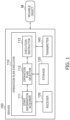
- FIG. 1 is a block diagram of a movement control system according to the present approach.
- the movement control system of FIG. 1 is configured to control one or more movable objects M according to an operation plan in a space such as a warehouse or a facility.
- a movement environment where the movable object M can move (for example, drive or fly) is provided in the space.
- the movable object M is a device capable of automatedly moving on a ground or in a space, such as an automated guided vehicle (AGV), a mobile robot, or a drone.
- AGV automated guided vehicle
- the movable object M is a device driving on the ground such as the AGV or the mobile robot, and parcel carriage is to be performed.
- the movable object M operates according to an operation plan managed by a server 100.
- the operation plan includes a plurality of orders for controlling the movable object M and a sequence for executing the orders.
- execution or resumption of the operation plan from any plan or any order by the movable object M is realized.
- the execution of the operation plan can be resumed from a desired point.
- the present approach will be described in detail.
- the movement control system of FIG. 1 includes the server 100 and one or more movable objects M. In FIG. 1 , only one movable object M is illustrated, but a plurality of movable objects M may be present.
- the server 100 includes an operation plan executor 110, a storage 120, a receiver 130, and a transmitter 140.
- the operation plan executor 110 includes a start information acquirer 111, an operation plan selector 112, and an execution instructor 113.
- the receiver 130 is configured to communicate with an external apparatus in a wireless or wired manner and receive data or information.
- the external apparatus includes, for example, a terminal apparatus of a user who carries out work, management, or the like in a warehouse, a facility, or the like, the movable object M, or equipment (such as a camera or a monitor device) installed in the movement environment.
- a plurality of receivers 130 may be provided according to the number of types of devices that may be set as communication targets of the server 100 or the number of communication schemes to be used.
- the terminal apparatus may be a general computer apparatus including an input device (such as a keyboard, a mouse, a touch panel, or a voice input device), an output device (such as a display or a speaker), a control device, a communication device, and the like.
- an input device such as a keyboard, a mouse, a touch panel, or a voice input device
- an output device such as a display or a speaker
- the transmitter 140 is configured to communicate with the external apparatus in a wireless or wired manner and transmit data or information.
- one or more antennas are connected to the transmitter 140.
- the one or more antennas may be shared by the transmitter 140 and the receiver 130.
- a specific example of the external apparatus is similar to the case of the receiver 130.
- a plurality of transmitters 140 may be provided according to the number of types of devices that may be set as communication targets of the server 100 or the number of communication schemes to be used.
- the storage 120 stores data of an operation plan for the movable object M set as a target to be controlled.
- An operation plan may be prepared for each of the movable objects M, and a single operation plan may be commonly applied to the plurality of movable objects M.
- the storage 120 may store map data of the movement environment, graph map data, specification information of each of the movable objects M, or the like.
- the map data stores detailed information of the movement environment (for example, a movement path, a position of an obstacle, a position of a shelf that keeps consignment, or the like).
- the map data may be created by the movable object M using a simultaneous localization and mapping (SLAM) technology. Alternatively, the map data may be drawing data for architecture or design of a facility.
- SLAM simultaneous localization and mapping
- the graph map data may be created by analyzing the map data by a computer based on a graph map creation technology, or may be created by a person with reference to the map data.
- the graph map data is associated with the map data, and the server 100 can control the operation of the movable object M using the graph map data.
- the graph map data includes a plurality of nodes, and an edge connecting the nodes. Each of the nodes is associated with an actual point (point on the map data) in the movement environment.
- the edge is associated with a route between points corresponding to nodes at both ends of the edge.
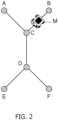
- FIG. 2 illustrates an example of a simplified movement environment including routes and points on which the movable object M moves.
- a plurality of points A, B, C, D, E, and F are illustrated. Routes are formed between the points A and C, the points B and C, the points C and D, the points D and E, and the points D and F.
- the movable object M cannot move between points where no route is formed.
- a route between points X and Y will be referred to as a route X-Y.
- the graph map data described above includes a plurality of nodes A, B, C, D, E, and F corresponding to the points A to F and edges connecting nodes. An edge corresponds to a route between points.
- FIG. 3 illustrates data of an operation plan stored in the storage 120 in a table format.
- This operation plan is for operating the movable object M in the movement environment of FIG. 2 .
- the operation plan includes a plurality of plans and an execution sequence of the plurality of plans. Plan IDs that are ascending numbers starting from 0 are assigned to the respective plans, and mean that the plans are executed in ascending sequence of the plan IDs.
- Each of the plans is acquired by bundling a plurality of procedures (purposes) necessary to achieve the operation plan as orders for each of the purposes.
- a plan in which a plan ID is 0 is referred to as a plan 0.
- Plans with other plan IDs are similarly referred to.
- the plan 0 is a plan in which the movable object M works at the point B, and moves to the point C.
- the plan 1 is a plan in which the movable object M emits a sound, then works, and thereafter moves to the point D.
- the plan 2 is a plan in which the movable object M moves to the point E, then emits a sound, and thereafter works.
- Each of the plans includes one or more orders in a format of a command that can be executed by the movable object M.
- the command is a code that can be interpreted and executed by the movable object M.
- Each of the plans includes an execution sequence of orders (commands).
- command IDs that are numbers in ascending sequence starting from 0 are assigned to the respective commands, and mean that the commands are executed in ascending sequence of the command IDs.
- a command in which a command ID is 0 is referred to as a command 0.
- Commands with other subsequent command IDs are similarly referred to.
- the operation plan is executed by executing the commands in ascending sequence of the plan IDs and also in ascending sequence of the command IDs.
- the operation plan includes start information for realizing start of execution (including a case of resumption) of the operation plan from a command (order) at any position or a plan at any position in the operation plan.
- the start information is provided for one or more commands in the operation plan.
- a value indicating a point ID (or a node ID) illustrated in FIG. 2 is stored.
- the command associated with the start information may be a command to be executed by the movable object M at the point corresponding to the point ID indicated by the start information.
- a user brings the movable object M to the point to arrange the movable object M at the point, and transmits an operation start instruction including the point ID corresponding to the point as the start information from a terminal apparatus 200 or the like to the server 100.
- the server 100 specifies a command corresponding to the point ID indicated by the start information included in the operation start instruction as a start command (start order), and starts the execution (including a case of resumption) of the operation plan from the start command.
- the start information acquirer 111 is configured to receive the operation start instruction for instructing start of the operation including the start information from the external apparatus such as the terminal apparatus 200 via the receiver 130, and acquire the start information from the operation start instruction.
- the user arranges the movable object M set as a target of the start of the operation at the point where the operation is desired to be started, and transmits the operation start instruction including the point ID corresponding to the arranged point as the start information to the server 100 using the terminal apparatus 200.
- a medium including the point ID is provided at the point corresponding to the point ID or a floor, a wall, or the like in the vicinity of the point, and the user may refer to the medium to specify the point ID.
- the medium may be printed character information or posted character information on paper.
- the start information acquirer 111 may transmit via the transmitter 140 a transmission request for requesting the terminal apparatus 200 to transmit the start information.
- the start information acquirer 111 may acquire the start information by responding to the transmission request and receiving a response including the start information from the terminal apparatus 200.
- the operation plan selector 112 is configured to acquire the start information acquired by the start information acquirer 111.
- the operation plan selector 112 detects the point ID indicated by the start information from the operation plan by a search, and sets a command (order) corresponding to the detected point ID, in other words, a command corresponding to the point ID in the plan including the detected point ID as the start command.
- the operation plan selector 112 decides to start the operation plan from the start command.
- the execution instructor 113 transmits instruction data for instructing execution of the command selected by the operation plan selector 112 to the movable object M via the transmitter 140.
- the instruction data includes the command, and the movable object M executes the command included in the instruction data.
- the server 100 can cause the movable object M to start or resume the operation plan from the desired point.
- the execution instructor 113 also sequentially transmits the instruction data for instructing the movable object M to execute commands in sequence after the selected command according to an execution situation of the commands. Alternatively, commands to be executed after the selected command may be collectively transmitted together with the selected command in the plan including the selected command. Thereafter, the server 100 may transmit the commands in units of plan to the movable object M.
- the movable object M executes the commands received from the server 100 in ascending sequence of the command IDs.
- the movable object M may determine whether its own device is present at the point at which the command included in the received instruction data is to be executed. When the movable object M is not present at the point, execution of the command may be avoided. In this case, the movable object M may transmit an error message to the server 100. The server 100 may transmit warning data indicating that the movable object M is not present at the point at which the command is to be executed to the terminal apparatus 200 of the user, and urge the user to arrange the movable object M at the point at which the command is to be executed.
- the movable object M may include a detector configured to detect a position where its own device is present.
- the detector of the movable object M may detect a position of its own device based on a mark representing the point provided in the movement environment using a camera or the like.
- the detector of the movable object M may detect the position of its own device by communicating with the position management server.
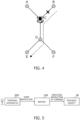
- FIG. 4 is a diagram for describing the present motion example.
- a route on which the movable object M is expected to be moved by the operation plan is represented by a broken line.
- the movable object M executes the command 0 in the plan 1 at the point B, and carries out work instructed by the command 0 (for example, reception of a parcel).
- the movable object M starts to move to the point C by executing the command 1 in the plan 1. It is assumed that in a mid-course of the movement of the movable object M, the operation of the movable object M has been interrupted, and the movable object M stops due to some accident (for example, system failure, drop of a parcel, tumble, or the like) on the route B-C.
- FIG. 4 illustrates a position marked by ⁇ at which the movable object M has stopped. The user monitoring the movable object M in the movement environment realizes that the operation of the movable object M has been interrupted, and decides that the work is to be resumed by the movable object M from the point C.
- the user moves to the stoppage point of the movable object M, picks up the movable object M to bring it to the point C, and brings down the movable object M. It is noted that the user may visually find the interruption of the operation of the movable object M, or may grasp occurrence of the interruption because of a notification about the interruption from the system.
- the user When the movable object M is arranged at the point C, by operating the terminal apparatus 200, the user generates the start information indicating the point ID of the point C and transmits the operation start instruction including the start information to the server 100.
- FIG. 5 illustrates an example in which the operation start instruction is transmitted to the server 100 from the terminal apparatus 200 of the user.
- the server 100 detects the start information included in the operation start instruction received from the terminal apparatus 200 of the user, and searches for and specifies a command corresponding to the start information in the operation plan.
- the command corresponding to the point C indicated by the start information that is, the command 1 in the plan 1, is specified as the start command.
- FIG. 6 illustrates an example in which the operation plan is searched for, and the server 100 specifies the command 1 as the start command.
- the server 100 transmits the instruction data for instructing the execution of the command 1 to the movable object M.
- FIG. 5 illustrates an example in which the server 100 transmits the instruction data to the movable object M.
- the movable object M executes the command instructed by the instruction data.
- the execution of the operation plan is resumed from the command 1 in the plan 1 of the operation plan. That is, it is possible to cause the movable object M to resume the work from the point C.
- the command 0 in the plan 1 is skipped, and output of a warning sound is not executed.
- the ID of the point C is associated with the command 0 in the plan 1
- the execution of the operation plan can be resumed from the command 0 in the plan 1.
- a configuration may be adopted in which separate pieces of start information (for example, C-0 and C-1) are assigned to both the command 0 and the command 1 in the plan 1, so that the execution of the operation plan can also be resumed from either command.
- the start information may be input using a sensor device 210 provided in the terminal apparatus 200.
- FIG. 7 illustrates an example in which the terminal apparatus 200 including the sensor device 210 is provided in the movement control system of FIG. 1 .
- the terminal apparatus 200 includes the sensor device 210, a start information detector 220, and a transceiver 230.
- the sensor device 210 is a camera, a barcode scanner, or the like.
- a medium including information (point ID) with which each point can be identified is provided at each point or a floor, a wall, or the like in the vicinity of the point or the like. Examples of the medium include a barcode, a two-dimensional barcode (for example, a QR code (registered trademark)), a unique code for recognition, an AR marker, a character, and the like.
- the user causes the sensor device 210 to sense the information from the medium.
- the start information detector 220 is configured to process the information sensed from the medium by the sensor device 210, and detect the point ID included in the information as the start information.
- the transceiver 230 is configured to transmit the acquired start information or the operation start instruction including the start information to the server 100.
- the terminal apparatus 200 transmits a response including the start information to the server 100.
- the character recognition processing may be performed by another device such as the server 100 instead of the terminal apparatus 200.
- the sensor device 210, the start information detector 220, and the like are provided in the terminal apparatus 200 but may be provided in another external apparatus.
- the other external apparatus may be the movable object M.
- FIG. 8 illustrates a case where the external apparatus in which the sensor device 210, the start information detector 220, and the like are provided is the movable object M.
- the same reference sign is assigned to an element having the same name as that of FIG. 7 , and redundant descriptions will be omitted.
- the movable object M senses the information from the medium by the sensor device 210 based on, for example, an instruction of the user or a transmission request from the server 100, and the start information detector 220 processes the sensed information to detect the point ID.
- the transceiver 230 includes the start information including the point ID in the operation start instruction or the response to the transmission request to be transmitted to the server 100.
- the movable object M may detect a position where its own device is present through a method such as self position estimation by a camera or radar, and acquire the point ID corresponding to the detected position.
- the character recognition processing may be performed by another device such as the server 100.
- the character recognition processing may be performed by a monitor device including a camera capable of monitoring each point or the like.
- the camera is configured to pick up an image of an area including the point, and a character of the point ID included in the picked-up image is recognized by image analysis.
- the camera acquires the recognized point ID, and transmits the start information including the point ID to the server 100.
- the camera may acquire the start information based on an instruction from the terminal apparatus 200.
- the camera may acquire the point ID by image pickup in response to the transmission request from the server 100.
- the character recognition processing may be performed by another device such as the server 100.
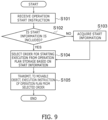
- FIG. 9 is a flowchart illustrating an example of the operation of the server 100 according to the present approach.
- the start information acquirer 111 checks whether the start information (for example, the point ID) is included in the operation start instruction (S102). When the start information is not included, by transmitting the transmission request of the start information to the external apparatus, the response including the start information is received (S103). When the start information is included in the operation start instruction or when the response including the start information is received, the order (command) for starting or resuming the execution of the operation plan is selected based on the start information (S104).
- the server 100 transmits the instruction data for instructing the execution of the selected order and subsequent orders (orders in the subsequent sequence after the selected order) to the movable object M (S105).
- the movable object M executes the order instructed by the instruction data received from the server 100.
- the operation plan can be started from any point (any order or any plan) in the operation plan.
- the start information is information (point ID) for identifying the point according to the first approach, but the start information may be information for identifying the order (command) (command identification information).
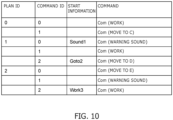
- FIG. 10 illustrates an example of the operation plan according to the present approach.
- Command identification information is stored in a column of the start information.
- Sound1 is command identification information for identifying a command for outputting a particular warning sound.
- the terminal apparatus 200 or the like transmits the operation start instruction including, as the start information, the command identification information of the command with which the execution of the operation plan is desired to be started.
- the operation plan selector 112 of the server 100 specifies a command corresponding to the command identification information indicated by the start information from the operation plan. For example, when the start information indicates Sound1, the command 0 in the plan 1 is specified as the start command.
- the user can easily designate the command with which the operation plan is desired to be started.
- the operation plan selector 112 transmits the transmission request of the start information.
- the order (command) for transmitting the transmission request may be added to the operation plan, and the transmission request may be transmitted when the operation plan selector 112 executes this command.
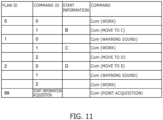
- FIG. 11 illustrates an example of the operation plan according to the present approach.
- "Start information acquisition” is stored in a column of the command ID as a label indicating acquisition of the start information.
- a point acquisition command for instructing the transmission of the transmission request is stored in a row corresponding to this label "start information acquisition”.
- the point acquisition command has a format that can be executed by the operation plan selector 112.
- the operation plan selector 112 searches for the label "start information acquisition” from the column of the command ID in the operation plan.
- a command (point acquisition command) corresponding to the "start information acquisition” detected by the search is specified from the column of the command.
- the operation plan selector 112 executes the point acquisition command.
- the operation plan selector 112 generates a transmission request of the start information, and transmits the transmission request to the external apparatus such as the terminal apparatus 200.
- the operation for transmitting the transmission request of the start information can be easily realized.
- the point ID is stored in advance in the column of the start information in the operation plan.
- the column of the start information is set to be blank as an initial state.
- the operation plan selector 112 instructs the movable object to execute orders in sequence from a first order with regard to the plurality of orders in the operation plan.
- the operation plan selector 112 adds the point ID to the column of the start information according to an execution situation of the operation plan.
- the operation plan selector 112 specifies a command corresponding to the point ID most recently added in the operation plan as the start command.
- a value indicating the point B is added in association with the command 1 in the plan 0 in the operation plan as the start information. That is, the operation plan selector 112 stores the value indicating the point B in association with the command 1.
- the point B corresponds to the point of the movable object M at which the command 1 is performed. It is noted that timing for storing the value indicating the point B may be after the instruction data for instructing the execution of the command 1 is transmitted, may be before the instruction data is transmitted, or may be at the same time as the transmission of the instruction data.
- a command is previously set to which the start information is registered among the commands in the operation plan.
- a command with which the start information is associated is previously set, and the operation plan selector 112 of the server 100 associates only the previously set command with the start information.
- the operation plan selector 112 reads the point ID (in the present example, the ID "B" of the point B) most recently stored (added) in the operation plan.
- the operation plan selector 112 decides that the execution of the operation plan is resumed from the command corresponding to the ID of the point B (command 1).
- the user may transmit the operation start instruction that does not include the start information to the server 100 from the terminal apparatus 200.
- the movable object M tumbles or drops a parcel on the route B-C, the user corrects a posture of the movable object M or loads the dropped parcel onto the movable object M, and then transmits the operation start instruction to the server 100.
- start information is the position information indicating the point
- start information is a command identification information (identification information for identifying a command or identification information for identifying an order)
- identification information for identifying a command or identification information for identifying an order can also be similarly implemented.
- the operation plan can be easily resumed.
- the operation plan selector 112 manages a history of an executed command among the plurality of orders (commands) in the operation plan instead of the addition of the start information to the operation plan.
- the execution history of the command may be stored in the storage 120.
- the operation plan selector 112 decides a command for resuming the execution of the operation plan based on the history. For example, the command most recently decided to be executed in the history or the command most recently instructed to be executed by the movable object M is decided as the command for resuming the execution of the operation plan.
- the start information is directly input to the terminal apparatus 200 from the input device or the like by the user, but a list of the start information may be transmitted to the terminal apparatus 200 from the operation plan selector 112 of the server 100, and the user may select the start information from the list displayed on the display of the terminal apparatus 200.
- the operation plan selector 112 of the server 100 acquires all the start information (for example, the point IDs) included in the column of the start information in the operation plan, and generates a list including the acquired start information.
- the operation plan selector 112 transmits the list to the terminal apparatus 200.
- the user causes the list to be displayed on the display of the terminal apparatus 200, and selects the start information from the list.
- the terminal apparatus 200 transmits the selected start information or the operation start instruction including the selected start information to the server 100.
- Timing at which the list is to be transmitted to the terminal apparatus 200 may be any timing.
- the timing may be when the operation plan is executed for the first time, or may be when the execution of the operation plan is resumed in a case where the execution of the operation plan has been suspended.
- the timing may be when an acquisition request for requesting acquisition of the list is received from the terminal apparatus 200, or may be other timing.
- the user can easily decide the start information for specifying the command for starting the operation plan.
- the command in the format that can be executed by the movable object M is included in the operation plan of the first approach.
- only identification information (command name) for collectively identifying one or more commands is stored in the operation plan, and a table (command correspondence table) in which the command name and the one or more commands are associated with each other is separately provided.
- the command correspondence table may be stored in the storage 120.
- the command name may be in a format easily visually understood by the user, or may be a unique format easily managed by the server 100.
- the command name does not necessarily need to be associated with only one command, and a plurality of operation commands may be associated with one command name.
- One command name may be collectively assigned to the grasp of the parcel position and the pickup among these operations, and both a command for the grasp of the parcel position and a command for the pickup may be associated with the command name.
- IDs (referred to as command sub IDs) indicating execution sequences may be assigned to the plurality of commands associated with the one command name. In the operation plan, a command ID may be assigned to the command name.
- the start information may be associated in units of the command name.
- the plurality of commands associated with the command name corresponding to the start information which is, for example, designated by the user may be specified, and the plurality of specified commands may be executed in the order indicated by the command sub IDs.
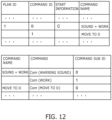
- FIG. 12 illustrates an example of the operation plan and the command correspondence table according to the present approach.
- "sound + work” is stored as a command name indicating an operation bundling output of a warning sound and work.
- the command correspondence table in a bottom diagram two commands including a command for instructing the output of the warning sound and a command for carrying out the work are associated with the command name "sound + work”.
- a sequence to be executed of each of the commands is indicated by a command sub ID. This means that commands are to be executed from a command with a smaller command sub ID.
- the start information is assigned in units of the command name, but the start information may be assigned in units of command.
- the column of the start information may be deleted in the operation plan, and the column of the start information may be added to the command correspondence table.
- the start information with the same value may be included in a plurality of plans in the operation plan. For example, when the movable object M reciprocates on the same route, the movable object M passes through the same point multiple times.
- the same start information may be assigned to both a command to be executed at the time of move on an outbound route and a command to be executed at the time of move on an inbound route.
- FIG. 13 illustrates an example of the operation plan according to the present approach.
- the plan 3 and subsequent plans are added to the operation plan of FIG. 3 .
- a command for carrying out move to the point D a command for outputting a warning sound at the point D, and the like are included.
- "D" indicating an ID of the point D is stored as the start information.
- the operation plan includes two pieces of the same start information "D".
- the operation plan selector 112 can decide the start command in the operation plan from the start information which is, for example, designated from the user as will be described below.
- the operation plan selector 112 performs a search from a top or a bottom of the operation plan in sequence, and sets a command corresponding to the start information that has been hit in an n-th place as the start command. That is, in a plan including the start information hit in the n-th place, a command associated with the start information is set as the start command.
- a value of "n" may be a predetermined value.
- the value may be variable according to the execution situation of the operation plan. For example, the value of "n” may be decided according to an elapsed time period from a start clock time of the operation plan.
- the value of "n” may be decided by the user, and the value of "n” may be transmitted to the server 100 from the terminal apparatus 200.
- plans including the respective start information with regard to all the start information hit in the search are transmitted to the terminal apparatus 200 of the user and displayed on the display.
- the user decides a plan to be started from, and transmits an ID of the decided plan to the server 100.
- the operation plan selector 112 of the server 100 decides to start from the command associated with the start information in the plan designated by the user.
- the command for resuming the operation can be specified, and the operation can be resumed.
- the same value as the start information included in the operation plan needs to be designated.
- values of those pieces of information may be different from each other.
- the start information acquired by the server 100 from the external apparatus such as the terminal apparatus 200 is set as "a"
- the start information in the operation plan is set as "a"'
- a conversion table in which "a" and "a”' are associated with each other is stored in the storage 120.
- the server 100 converts "a” into “a”' using the conversion table, and searches for the operation plan using the converted "a”' as the start information.
- a correspondence relationship between those pieces of information be grasped.
- information obtained by adding a prefix "pos_” to the start information acquired in the server 100 is set as the start information in the operation plan.
- the start information received in the server 100 is "a”
- "pos_a” obtained by adding a prefix "pos_” to "a” is created, and the operation plan is searched for using "pos_a” as the start information.
- a suffix instead of a prefix may be added, or both a prefix and a suffix may be added.
- the format of the start information received in the server 100 and the format of the start information in the operation plan can be mutually different.
- the designation of the start information by the user is facilitated.
- a mode is illustrated in which the same operation plan can be applied to the plurality of movable objects M with mutually different points set as departure points.
- FIG. 14 illustrates an example of the operation plan according to the present approach.
- the operation plan of FIG. 14 can be applied to a plurality of movable objects M with the different departure points.
- FIG. 15 illustrates an example of the movement environment of the operation plan according to the present approach.
- a departure point of a movable object M_X is set as the point A
- a departure point of a movable object M_Y is set as the point B.
- the operation plan is the same for the movable objects M_X and M_Y except that the departure points are different from each other.
- a common value is used in the column of the start information in the operation plan as position information corresponding to the point A and the point B.
- HomeO and Home1 are respectively associated with the command 0 in the plan 0 and the command 1 in the plan 0 as the start information.
- the same operation plan can be applied to the plurality of movable objects M using the different points.
- the same start information for example, Home1
- the same start information for example, Home1
- the same start information for example, HomeO
- the same start information for example, HomeO
- a recording medium for example, such as a barcode
- start information for example, HomeO
- the movable object M may be caused to read the same start information.
- initial positions (the point A in the case of the movable object M_X and the point B in the case of the movable object M_Y) may be respectively previously stored in the movable objects M_X and M_Y, and the start information including the initial positions may be transmitted to the server 100. In this manner, by using the same operation plan for the movable objects M_X and M_Y, recovery from the respective initial positions can be realized.
- the same operation plan can be applied to the plurality of movable objects M.
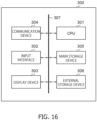
- FIG. 21 illustrates a hardware configuration of the server 100 of FIG. 1 .
- the server 100 according to the present approach is configured with a computer device 300.
- the computer device 300 includes a CPU 301, an input interface 302, a display device 303, a communication device 304, a main storage device 305 and an external storage device 306, and these are connected to each other with a bus 307.
- the CPU (Central Processing Unit) 301 executes a computer program (operation management program) which realizes the above-described respective functional configurations of the server 100 on the main storage device 305.
- the computer program may not be a single program but a plurality of programs or a combination of scripts.
- the input interface 302 is a circuit for inputting an operation signal from the input device such as a keyboard, a mouse and a touch panel, to the server 100.
- the input function of the server 100 can be constructed on the input interface 302.
- the display device 303 displays data or information output from the server 100. While the display device 303 is, for example, an LCD (Liquid Crystal Display), a CRT (Cathode-Ray Tube), and a PDP (Plasma Display Panel), the display device 303 is not limited to this.
- the data or the information output from the computer device 300 can be displayed by this display device 303.
- the output device of the server 100 can be constructed on the display device 303.
- the communication device 304 is a circuit for the server 100 to communicate with an external device in a wireless or wired manner. Information can be input from the external device via the communication device 304. Information input from the external device can be stored in a DB.
- the main storage device 305 stores a program (an information processing program) which realizes processing of the present approach, data required for execution of the program, data generated by execution of the program, and the like.
- the program is developed and executed on the main storage device 305. While the main storage device 305 is, for example, a RAM, a DRAM and an SRAM, the main storage device 305 is not limited to this. The storage in each approach may be constructed on the main storage device 305.
- the external storage device 306 stores the above-described program, data required for execution of the program, data generated by execution of the program, and the like. These kinds of program and data are read out to the main storage device 305 upon processing of the present approach. While the external storage device 306 is, for example, a hard disk, an optical disk, a flash memory and a magnetic tape, the external storage device 306 is not limited to this. The storage in each approach may be constructed on the external storage device 306.
- the above-described program may be installed in the computer device 300 in advance or may be stored in a storage medium such as a CD-ROM. Further, the program may be uploaded on the Internet.
- the server 100 may be configured with a single computer device 300 or may be configured as a system including a plurality of computer devices 300 which are connected to each other.
- a movement control system comprising:
- Clause 4 The movement control system according to clause 3, further comprising: a transmitter configured to transmit a transmission request for requesting transmission of the start information when the start information is not included in the operation start instruction.
- Clause 5 The movement control system according to clause 4, wherein the transmitter transmits the transmission request to a terminal apparatus operable by the movable object or a user.
- Clause 17 The movement control system according to any one of clauses 1 to 15, wherein the operation plan executor transmits one or more candidates of the start information to a terminal apparatus operable by the user, receives a candidate selected among the one or more candidates from the terminal apparatus, and decides the start order based on the received candidate.
- Clause 18 The movement control system according to clause 8, wherein when a plurality of pieces of position information same as the position information included in the start information in the operation plan exist, the operation plan executor transmits a selection request for requesting selection of an order among a plurality of orders corresponding to the plurality of pieces of same position information to a terminal apparatus operable by the user, receives a response including the selected order from the terminal apparatus, and sets the order included in the response as the start order.
- Clause 19 The movement control system according to clause 9, wherein when a plurality of pieces of identification information same as the identification information included in the start information in the operation plan exist, the operation plan executor transmits a selection request for requesting selection of the order from a plurality of orders corresponding to the plurality of pieces of same identification information to a terminal apparatus operable by the user, receives a response including the selected order from the user, and sets the order included in the response as the start order.
- a movement control method comprising:
- a computer program which causes a computer to perform processes comprising:
Landscapes
- Engineering & Computer Science (AREA)
- Physics & Mathematics (AREA)
- General Physics & Mathematics (AREA)
- Business, Economics & Management (AREA)
- Aviation & Aerospace Engineering (AREA)
- Radar, Positioning & Navigation (AREA)
- Remote Sensing (AREA)
- Automation & Control Theory (AREA)
- Human Resources & Organizations (AREA)
- Economics (AREA)
- Strategic Management (AREA)
- Entrepreneurship & Innovation (AREA)
- General Business, Economics & Management (AREA)
- Marketing (AREA)
- Operations Research (AREA)
- Quality & Reliability (AREA)
- Tourism & Hospitality (AREA)
- Development Economics (AREA)
- Theoretical Computer Science (AREA)
- Electromagnetism (AREA)
- Educational Administration (AREA)
- Game Theory and Decision Science (AREA)
- Train Traffic Observation, Control, And Security (AREA)
- Control Of Position, Course, Altitude, Or Attitude Of Moving Bodies (AREA)
Abstract
Description
- The present disclosure relates to a movement control system, a movement control method, and a computer program.
- When a movable object such as a vehicle is operated according to an operation plan in a facility such as a warehouse or a factory to cause the movable object to carry out work such as parcel carriage, operation of the movable object may stop due to some factor. When a stoppage position is stored in the movable object, automated movement of the movable object from the stoppage position can be resumed.
- When the stoppage position is not stored, an operator or the like needs to bring the movable object to an initial position, and automated movement needs to be started again from the initial position. Even when the operator is to return the movable object to the initial position, in a case where there are a plurality of initial positions, it is difficult to specify from which one of the initial positions the operation is to be resumed.
-
-
FIG. 1 is a block diagram of a movement control system according to a first approach; -
FIG. 2 illustrates an example of a graph map data of a movement environment; -
FIG. 3 illustrates an example of an operation plan; -
FIG. 4 is a diagram for describing a motion example of the first approach; -
FIG. 5 illustrates an example in which an operation start instruction is transmitted to a server from a terminal apparatus; -
FIG. 6 illustrates an example in which an operation plan is searched for to specify a start command; -
FIG. 7 illustrates an example in which a terminal apparatus including a sensor device is provided in the movement control system ofFIG. 1 ; -
FIG. 8 illustrates a case where an external apparatus in which a sensor device and the like are provided is a movable object; -
FIG. 9 is a flowchart illustrating an example of an operation of a server according to the first approach; -
FIG. 10 illustrates an example of the operation plan according to a second approach; -
FIG. 11 illustrates an example of the operation plan according to a third approach; -
FIG. 12 illustrates an example of the operation plan and a command correspondence table according to the present approach; -
FIG. 13 illustrates an example of the operation plan according to a seventh approach; -
FIG. 14 illustrates an example of the operation plan according to a ninth approach; -
FIG. 15 illustrates an example of a movement environment of the operation plan according to the ninth approach; and -
FIG. 16 is a block diagram illustrating an example of a hardware configuration of the server. - According to one approach, a movement control system includes: a receiver configured to receive start information for deciding a start order from which execution of an operation plan is started, the operation plan including a plurality of orders for controlling a movable object; and an operation plan executor configured to start the execution of the operation plan from the start order decided based on the start information.
- Hereinafter, approaches of the present invention will be described with reference to the drawings. The same reference sign is assigned to the same constituents in the drawings, and descriptions thereof will be appropriately omitted.
-
FIG. 1 is a block diagram of a movement control system according to the present approach. The movement control system ofFIG. 1 is configured to control one or more movable objects M according to an operation plan in a space such as a warehouse or a facility. A movement environment where the movable object M can move (for example, drive or fly) is provided in the space. The movable object M is a device capable of automatedly moving on a ground or in a space, such as an automated guided vehicle (AGV), a mobile robot, or a drone. According to the present approach, a case is assumed where the movable object M is a device driving on the ground such as the AGV or the mobile robot, and parcel carriage is to be performed. The movable object M operates according to an operation plan managed by aserver 100. The operation plan includes a plurality of orders for controlling the movable object M and a sequence for executing the orders. According to the present approach, execution or resumption of the operation plan from any plan or any order by the movable object M is realized. Thus, even in a case where the operation of the movable object M temporarily stops due to trouble such as a system failure in a mid-course of the operation plan, the execution of the operation plan can be resumed from a desired point. Hereinafter, the present approach will be described in detail. - The movement control system of
FIG. 1 includes theserver 100 and one or more movable objects M. InFIG. 1 , only one movable object M is illustrated, but a plurality of movable objects M may be present. Theserver 100 includes anoperation plan executor 110, astorage 120, areceiver 130, and atransmitter 140. Theoperation plan executor 110 includes a start information acquirer 111, anoperation plan selector 112, and anexecution instructor 113. - The
receiver 130 is configured to communicate with an external apparatus in a wireless or wired manner and receive data or information. In a case of the wireless communication, one or more antennas are connected to thereceiver 130. The external apparatus includes, for example, a terminal apparatus of a user who carries out work, management, or the like in a warehouse, a facility, or the like, the movable object M, or equipment (such as a camera or a monitor device) installed in the movement environment. A plurality ofreceivers 130 may be provided according to the number of types of devices that may be set as communication targets of theserver 100 or the number of communication schemes to be used. The terminal apparatus may be a general computer apparatus including an input device (such as a keyboard, a mouse, a touch panel, or a voice input device), an output device (such as a display or a speaker), a control device, a communication device, and the like. - The
transmitter 140 is configured to communicate with the external apparatus in a wireless or wired manner and transmit data or information. In a case of the wireless communication, one or more antennas are connected to thetransmitter 140. The one or more antennas may be shared by thetransmitter 140 and thereceiver 130. A specific example of the external apparatus is similar to the case of thereceiver 130. A plurality oftransmitters 140 may be provided according to the number of types of devices that may be set as communication targets of theserver 100 or the number of communication schemes to be used. - The
storage 120 stores data of an operation plan for the movable object M set as a target to be controlled. An operation plan may be prepared for each of the movable objects M, and a single operation plan may be commonly applied to the plurality of movable objects M. In addition, thestorage 120 may store map data of the movement environment, graph map data, specification information of each of the movable objects M, or the like. The map data stores detailed information of the movement environment (for example, a movement path, a position of an obstacle, a position of a shelf that keeps consignment, or the like). The map data may be created by the movable object M using a simultaneous localization and mapping (SLAM) technology. Alternatively, the map data may be drawing data for architecture or design of a facility. The graph map data may be created by analyzing the map data by a computer based on a graph map creation technology, or may be created by a person with reference to the map data. The graph map data is associated with the map data, and theserver 100 can control the operation of the movable object M using the graph map data. The graph map data includes a plurality of nodes, and an edge connecting the nodes. Each of the nodes is associated with an actual point (point on the map data) in the movement environment. The edge is associated with a route between points corresponding to nodes at both ends of the edge. -
FIG. 2 illustrates an example of a simplified movement environment including routes and points on which the movable object M moves. A plurality of points A, B, C, D, E, and F are illustrated. Routes are formed between the points A and C, the points B and C, the points C and D, the points D and E, and the points D and F. The movable object M cannot move between points where no route is formed. A route between points X and Y will be referred to as a route X-Y. The graph map data described above includes a plurality of nodes A, B, C, D, E, and F corresponding to the points A to F and edges connecting nodes. An edge corresponds to a route between points. -
FIG. 3 illustrates data of an operation plan stored in thestorage 120 in a table format. This operation plan is for operating the movable object M in the movement environment ofFIG. 2 . The operation plan includes a plurality of plans and an execution sequence of the plurality of plans. Plan IDs that are ascending numbers starting from 0 are assigned to the respective plans, and mean that the plans are executed in ascending sequence of the plan IDs. Each of the plans is acquired by bundling a plurality of procedures (purposes) necessary to achieve the operation plan as orders for each of the purposes. A plan in which a plan ID is 0 is referred to as aplan 0. Plans with other plan IDs are similarly referred to. Theplan 0 is a plan in which the movable object M works at the point B, and moves to the point C. Theplan 1 is a plan in which the movable object M emits a sound, then works, and thereafter moves to the point D. Theplan 2 is a plan in which the movable object M moves to the point E, then emits a sound, and thereafter works. - Each of the plans includes one or more orders in a format of a command that can be executed by the movable object M. The command is a code that can be interpreted and executed by the movable object M. Each of the plans includes an execution sequence of orders (commands). In more detail, for each plan, command IDs that are numbers in ascending sequence starting from 0 are assigned to the respective commands, and mean that the commands are executed in ascending sequence of the command IDs. A command in which a command ID is 0 is referred to as a
command 0. Commands with other subsequent command IDs are similarly referred to. The operation plan is executed by executing the commands in ascending sequence of the plan IDs and also in ascending sequence of the command IDs. - The operation plan includes start information for realizing start of execution (including a case of resumption) of the operation plan from a command (order) at any position or a plan at any position in the operation plan. The start information is provided for one or more commands in the operation plan. As a specific example of the start information, a value indicating a point ID (or a node ID) illustrated in
FIG. 2 is stored. The command associated with the start information may be a command to be executed by the movable object M at the point corresponding to the point ID indicated by the start information. For example, when the operation of the movable object M is to be started from a certain point, a user brings the movable object M to the point to arrange the movable object M at the point, and transmits an operation start instruction including the point ID corresponding to the point as the start information from aterminal apparatus 200 or the like to theserver 100. Theserver 100 specifies a command corresponding to the point ID indicated by the start information included in the operation start instruction as a start command (start order), and starts the execution (including a case of resumption) of the operation plan from the start command. - The
start information acquirer 111 is configured to receive the operation start instruction for instructing start of the operation including the start information from the external apparatus such as theterminal apparatus 200 via thereceiver 130, and acquire the start information from the operation start instruction. The user arranges the movable object M set as a target of the start of the operation at the point where the operation is desired to be started, and transmits the operation start instruction including the point ID corresponding to the arranged point as the start information to theserver 100 using theterminal apparatus 200. A medium including the point ID is provided at the point corresponding to the point ID or a floor, a wall, or the like in the vicinity of the point, and the user may refer to the medium to specify the point ID. The medium may be printed character information or posted character information on paper. - When the start information is not included in the operation start instruction or the same point ID as the point ID indicated by the start information is not stored in the operation plan, the
start information acquirer 111 may transmit via the transmitter 140 a transmission request for requesting theterminal apparatus 200 to transmit the start information. Thestart information acquirer 111 may acquire the start information by responding to the transmission request and receiving a response including the start information from theterminal apparatus 200. - The
operation plan selector 112 is configured to acquire the start information acquired by thestart information acquirer 111. Theoperation plan selector 112 detects the point ID indicated by the start information from the operation plan by a search, and sets a command (order) corresponding to the detected point ID, in other words, a command corresponding to the point ID in the plan including the detected point ID as the start command. Theoperation plan selector 112 decides to start the operation plan from the start command. - The
execution instructor 113 transmits instruction data for instructing execution of the command selected by theoperation plan selector 112 to the movable object M via thetransmitter 140. The instruction data includes the command, and the movable object M executes the command included in the instruction data. Thus, theserver 100 can cause the movable object M to start or resume the operation plan from the desired point. Theexecution instructor 113 also sequentially transmits the instruction data for instructing the movable object M to execute commands in sequence after the selected command according to an execution situation of the commands. Alternatively, commands to be executed after the selected command may be collectively transmitted together with the selected command in the plan including the selected command. Thereafter, theserver 100 may transmit the commands in units of plan to the movable object M. The movable object M executes the commands received from theserver 100 in ascending sequence of the command IDs. - The movable object M may determine whether its own device is present at the point at which the command included in the received instruction data is to be executed. When the movable object M is not present at the point, execution of the command may be avoided. In this case, the movable object M may transmit an error message to the
server 100. Theserver 100 may transmit warning data indicating that the movable object M is not present at the point at which the command is to be executed to theterminal apparatus 200 of the user, and urge the user to arrange the movable object M at the point at which the command is to be executed. The movable object M may include a detector configured to detect a position where its own device is present. The detector of the movable object M may detect a position of its own device based on a mark representing the point provided in the movement environment using a camera or the like. When a position management server configured to manage the position of the movable object M is present, the detector of the movable object M may detect the position of its own device by communicating with the position management server. - Hereinafter, a motion example of the present approach will be described using a specific example. As the motion example, a case is assumed where in a state in which the movable object M is arranged at the point B, and the
server 100 starts the operation plan illustrated inFIG. 2 . -
FIG. 4 is a diagram for describing the present motion example. InFIG. 4 , a route on which the movable object M is expected to be moved by the operation plan is represented by a broken line. - The movable object M executes the
command 0 in theplan 1 at the point B, and carries out work instructed by the command 0 (for example, reception of a parcel). - Next, the movable object M starts to move to the point C by executing the
command 1 in theplan 1. It is assumed that in a mid-course of the movement of the movable object M, the operation of the movable object M has been interrupted, and the movable object M stops due to some accident (for example, system failure, drop of a parcel, tumble, or the like) on the route B-C.FIG. 4 illustrates a position marked by × at which the movable object M has stopped. The user monitoring the movable object M in the movement environment realizes that the operation of the movable object M has been interrupted, and decides that the work is to be resumed by the movable object M from the point C. The user moves to the stoppage point of the movable object M, picks up the movable object M to bring it to the point C, and brings down the movable object M. It is noted that the user may visually find the interruption of the operation of the movable object M, or may grasp occurrence of the interruption because of a notification about the interruption from the system. - When the movable object M is arranged at the point C, by operating the
terminal apparatus 200, the user generates the start information indicating the point ID of the point C and transmits the operation start instruction including the start information to theserver 100. -
FIG. 5 illustrates an example in which the operation start instruction is transmitted to theserver 100 from theterminal apparatus 200 of the user. - The
server 100 detects the start information included in the operation start instruction received from theterminal apparatus 200 of the user, and searches for and specifies a command corresponding to the start information in the operation plan. In the present example, the command corresponding to the point C indicated by the start information, that is, thecommand 1 in theplan 1, is specified as the start command. -
FIG. 6 illustrates an example in which the operation plan is searched for, and theserver 100 specifies thecommand 1 as the start command. - The
server 100 transmits the instruction data for instructing the execution of thecommand 1 to the movable object M.FIG. 5 illustrates an example in which theserver 100 transmits the instruction data to the movable object M. The movable object M executes the command instructed by the instruction data. Thus, the execution of the operation plan is resumed from thecommand 1 in theplan 1 of the operation plan. That is, it is possible to cause the movable object M to resume the work from the point C. As a result, thecommand 0 in theplan 1 is skipped, and output of a warning sound is not executed. As a modified example, when the ID of the point C is associated with thecommand 0 in theplan 1, the execution of the operation plan can be resumed from thecommand 0 in theplan 1. A configuration may be adopted in which separate pieces of start information (for example, C-0 and C-1) are assigned to both thecommand 0 and thecommand 1 in theplan 1, so that the execution of the operation plan can also be resumed from either command. - When the user is to input the start information to the
terminal apparatus 200 and provide the start information to theserver 100, the start information may be input using asensor device 210 provided in theterminal apparatus 200. -
FIG. 7 illustrates an example in which theterminal apparatus 200 including thesensor device 210 is provided in the movement control system ofFIG. 1 . Theterminal apparatus 200 includes thesensor device 210, astart information detector 220, and atransceiver 230. Thesensor device 210 is a camera, a barcode scanner, or the like. A medium including information (point ID) with which each point can be identified is provided at each point or a floor, a wall, or the like in the vicinity of the point or the like. Examples of the medium include a barcode, a two-dimensional barcode (for example, a QR code (registered trademark)), a unique code for recognition, an AR marker, a character, and the like. The user causes thesensor device 210 to sense the information from the medium. Thestart information detector 220 is configured to process the information sensed from the medium by thesensor device 210, and detect the point ID included in the information as the start information. Thetransceiver 230 is configured to transmit the acquired start information or the operation start instruction including the start information to theserver 100. When the transmission request of the start information is received from theserver 100, theterminal apparatus 200 transmits a response including the start information to theserver 100. When the medium is character information and recognition processing of the character information is to be performed, the character recognition processing may be performed by another device such as theserver 100 instead of theterminal apparatus 200. - In the example of
FIG. 7 , thesensor device 210, thestart information detector 220, and the like are provided in theterminal apparatus 200 but may be provided in another external apparatus. The other external apparatus may be the movable object M. -
FIG. 8 illustrates a case where the external apparatus in which thesensor device 210, thestart information detector 220, and the like are provided is the movable object M. The same reference sign is assigned to an element having the same name as that ofFIG. 7 , and redundant descriptions will be omitted. The movable object M senses the information from the medium by thesensor device 210 based on, for example, an instruction of the user or a transmission request from theserver 100, and thestart information detector 220 processes the sensed information to detect the point ID. Thetransceiver 230 includes the start information including the point ID in the operation start instruction or the response to the transmission request to be transmitted to theserver 100. The movable object M may detect a position where its own device is present through a method such as self position estimation by a camera or radar, and acquire the point ID corresponding to the detected position. When the medium is the character information and the point ID is to be detected by the recognition processing of the character information, the character recognition processing may be performed by another device such as theserver 100. - As still another example of the other external apparatus, the character recognition processing may be performed by a monitor device including a camera capable of monitoring each point or the like. The camera is configured to pick up an image of an area including the point, and a character of the point ID included in the picked-up image is recognized by image analysis. The camera acquires the recognized point ID, and transmits the start information including the point ID to the
server 100. The camera may acquire the start information based on an instruction from theterminal apparatus 200. Alternatively, the camera may acquire the point ID by image pickup in response to the transmission request from theserver 100. When the medium is character information, and the point ID is to be detected by the recognition processing of the character information, the character recognition processing may be performed by another device such as theserver 100. -
FIG. 9 is a flowchart illustrating an example of the operation of theserver 100 according to the present approach. When the operation start instruction is received (S101), thestart information acquirer 111 checks whether the start information (for example, the point ID) is included in the operation start instruction (S102). When the start information is not included, by transmitting the transmission request of the start information to the external apparatus, the response including the start information is received (S103). When the start information is included in the operation start instruction or when the response including the start information is received, the order (command) for starting or resuming the execution of the operation plan is selected based on the start information (S104). Theserver 100 transmits the instruction data for instructing the execution of the selected order and subsequent orders (orders in the subsequent sequence after the selected order) to the movable object M (S105). The movable object M executes the order instructed by the instruction data received from theserver 100. - As described above, according to the present approach, when the start information is associated with the order (command) in the operation plan and the operation plan (including resumption) is to be started, by designating the start information, the operation plan can be started from any point (any order or any plan) in the operation plan.
- The start information is information (point ID) for identifying the point according to the first approach, but the start information may be information for identifying the order (command) (command identification information).
-
FIG. 10 illustrates an example of the operation plan according to the present approach. Command identification information is stored in a column of the start information. For example, Sound1 is command identification information for identifying a command for outputting a particular warning sound. Theterminal apparatus 200 or the like transmits the operation start instruction including, as the start information, the command identification information of the command with which the execution of the operation plan is desired to be started. Theoperation plan selector 112 of theserver 100 specifies a command corresponding to the command identification information indicated by the start information from the operation plan. For example, when the start information indicates Sound1, thecommand 0 in theplan 1 is specified as the start command. - As described above, according to the present approach, by using the command identification information as the start information, the user can easily designate the command with which the operation plan is desired to be started.
- When the start information is not included in the operation start instruction according to the first approach, the
operation plan selector 112 transmits the transmission request of the start information. As an example of an approach for realizing this operation, the order (command) for transmitting the transmission request may be added to the operation plan, and the transmission request may be transmitted when theoperation plan selector 112 executes this command. -
FIG. 11 illustrates an example of the operation plan according to the present approach. "Start information acquisition" is stored in a column of the command ID as a label indicating acquisition of the start information. In a column of the command, a point acquisition command for instructing the transmission of the transmission request is stored in a row corresponding to this label "start information acquisition". The point acquisition command has a format that can be executed by theoperation plan selector 112. - When the start information is not included in the operation start instruction, the
operation plan selector 112 searches for the label "start information acquisition" from the column of the command ID in the operation plan. A command (point acquisition command) corresponding to the "start information acquisition" detected by the search is specified from the column of the command. Theoperation plan selector 112 executes the point acquisition command. Thus, theoperation plan selector 112 generates a transmission request of the start information, and transmits the transmission request to the external apparatus such as theterminal apparatus 200. - As described above, according to the present approach, by including the label "start information acquisition" and the point acquisition command in the operation plan, the operation for transmitting the transmission request of the start information can be easily realized.
- According to the first approach, the point ID is stored in advance in the column of the start information in the operation plan. According to the present approach, the column of the start information is set to be blank as an initial state. The
operation plan selector 112 instructs the movable object to execute orders in sequence from a first order with regard to the plurality of orders in the operation plan. Theoperation plan selector 112 adds the point ID to the column of the start information according to an execution situation of the operation plan. When the operation of the movable object M has been suspended and the operation is to be resumed, theoperation plan selector 112 specifies a command corresponding to the point ID most recently added in the operation plan as the start command. - For example, in the specific example illustrated in
FIG. 4 described above, at the point B, when it is decided that thecommand 1 in the plan 0 (order of move to the point C) is to be transmitted to the movable object M, a value indicating the point B is added in association with thecommand 1 in theplan 0 in the operation plan as the start information. That is, theoperation plan selector 112 stores the value indicating the point B in association with thecommand 1. The point B corresponds to the point of the movable object M at which thecommand 1 is performed. It is noted that timing for storing the value indicating the point B may be after the instruction data for instructing the execution of thecommand 1 is transmitted, may be before the instruction data is transmitted, or may be at the same time as the transmission of the instruction data. A command is previously set to which the start information is registered among the commands in the operation plan. A command with which the start information is associated is previously set, and theoperation plan selector 112 of theserver 100 associates only the previously set command with the start information. - When the operation of the movable object M has been interrupted due to an accident in a mid-course of the move to the point C, the
operation plan selector 112 reads the point ID (in the present example, the ID "B" of the point B) most recently stored (added) in the operation plan. Theoperation plan selector 112 decides that the execution of the operation plan is resumed from the command corresponding to the ID of the point B (command 1). The user may transmit the operation start instruction that does not include the start information to theserver 100 from theterminal apparatus 200. When the movable object M tumbles or drops a parcel on the route B-C, the user corrects a posture of the movable object M or loads the dropped parcel onto the movable object M, and then transmits the operation start instruction to theserver 100. - In the above descriptions, the case where the start information is the position information indicating the point has been described, but as in the second approach, a case where the start information is a command identification information (identification information for identifying a command or identification information for identifying an order) can also be similarly implemented.
- As described above, according to the present approachesince the user does not need to input the start information, the operation plan can be easily resumed.
- The
operation plan selector 112 manages a history of an executed command among the plurality of orders (commands) in the operation plan instead of the addition of the start information to the operation plan. The execution history of the command may be stored in thestorage 120. When the execution of the operation plan has been temporarily stopped and then the execution of the operation plan is to be resumed, theoperation plan selector 112 decides a command for resuming the execution of the operation plan based on the history. For example, the command most recently decided to be executed in the history or the command most recently instructed to be executed by the movable object M is decided as the command for resuming the execution of the operation plan. - According to the first approach, the start information is directly input to the
terminal apparatus 200 from the input device or the like by the user, but a list of the start information may be transmitted to theterminal apparatus 200 from theoperation plan selector 112 of theserver 100, and the user may select the start information from the list displayed on the display of theterminal apparatus 200. - The
operation plan selector 112 of theserver 100 acquires all the start information (for example, the point IDs) included in the column of the start information in the operation plan, and generates a list including the acquired start information. Theoperation plan selector 112 transmits the list to theterminal apparatus 200. When the operation of the movable object M is stopped, the user causes the list to be displayed on the display of theterminal apparatus 200, and selects the start information from the list. - The
terminal apparatus 200 transmits the selected start information or the operation start instruction including the selected start information to theserver 100. Timing at which the list is to be transmitted to theterminal apparatus 200 may be any timing. For example, the timing may be when the operation plan is executed for the first time, or may be when the execution of the operation plan is resumed in a case where the execution of the operation plan has been suspended. Alternatively, the timing may be when an acquisition request for requesting acquisition of the list is received from theterminal apparatus 200, or may be other timing. - As described above, according to the present approach, by presenting the list of the start information to the user, the user can easily decide the start information for specifying the command for starting the operation plan.
- The command in the format that can be executed by the movable object M is included in the operation plan of the first approach. According to a sixth approach, only identification information (command name) for collectively identifying one or more commands is stored in the operation plan, and a table (command correspondence table) in which the command name and the one or more commands are associated with each other is separately provided. The command correspondence table may be stored in the
storage 120. - The command name may be in a format easily visually understood by the user, or may be a unique format easily managed by the
server 100. The command name does not necessarily need to be associated with only one command, and a plurality of operation commands may be associated with one command name. For example, when the movable object M is to perform loading, move to a loading location, grasp of a parcel position, pickup of a parcel, and the like may be needed. One command name may be collectively assigned to the grasp of the parcel position and the pickup among these operations, and both a command for the grasp of the parcel position and a command for the pickup may be associated with the command name. IDs (referred to as command sub IDs) indicating execution sequences may be assigned to the plurality of commands associated with the one command name. In the operation plan, a command ID may be assigned to the command name. - The start information may be associated in units of the command name. In this case, the plurality of commands associated with the command name corresponding to the start information which is, for example, designated by the user may be specified, and the plurality of specified commands may be executed in the order indicated by the command sub IDs.
-
FIG. 12 illustrates an example of the operation plan and the command correspondence table according to the present approach. In the operation plan in a top diagram, "sound + work" is stored as a command name indicating an operation bundling output of a warning sound and work. In the command correspondence table in a bottom diagram, two commands including a command for instructing the output of the warning sound and a command for carrying out the work are associated with the command name "sound + work". A sequence to be executed of each of the commands is indicated by a command sub ID. This means that commands are to be executed from a command with a smaller command sub ID. - In the example of
FIG. 12 , the start information is assigned in units of the command name, but the start information may be assigned in units of command. In this case, the column of the start information may be deleted in the operation plan, and the column of the start information may be added to the command correspondence table. Thus, it is possible to designate the command for starting the operation plan with still finer classifications. - As described above, according to the present approach, it is possible to create the operation plan easily understood or managed by the user or the
server 100. - The start information with the same value may be included in a plurality of plans in the operation plan. For example, when the movable object M reciprocates on the same route, the movable object M passes through the same point multiple times. In this case, the same start information may be assigned to both a command to be executed at the time of move on an outbound route and a command to be executed at the time of move on an inbound route.
-
FIG. 13 illustrates an example of the operation plan according to the present approach. Theplan 3 and subsequent plans are added to the operation plan ofFIG. 3 . In theplan 3, a command for carrying out move to the point D, a command for outputting a warning sound at the point D, and the like are included. In the command for carrying out move to the point D, "D" indicating an ID of the point D is stored as the start information. As a result, the operation plan includes two pieces of the same start information "D". - In this manner, when the plurality of pieces of the same start information are included, the
operation plan selector 112 can decide the start command in the operation plan from the start information which is, for example, designated from the user as will be described below. - As a first method, the
operation plan selector 112 performs a search from a top or a bottom of the operation plan in sequence, and sets a command corresponding to the start information that has been hit in an n-th place as the start command. That is, in a plan including the start information hit in the n-th place, a command associated with the start information is set as the start command. A value of "n" may be a predetermined value. In addition, the value may be variable according to the execution situation of the operation plan. For example, the value of "n" may be decided according to an elapsed time period from a start clock time of the operation plan. In addition, the value of "n" may be decided by the user, and the value of "n" may be transmitted to theserver 100 from theterminal apparatus 200. - As a second method, plans including the respective start information with regard to all the start information hit in the search are transmitted to the
terminal apparatus 200 of the user and displayed on the display. The user decides a plan to be started from, and transmits an ID of the decided plan to theserver 100. Theoperation plan selector 112 of theserver 100 decides to start from the command associated with the start information in the plan designated by the user. - As described above, according to the present approach, even when the plurality of pieces of start information with the same value are included in the operation plan, the command for resuming the operation can be specified, and the operation can be resumed.
- According to the first approach, when the start information is transmitted from the
terminal apparatus 200 or the like of the user to theserver 100, the same value as the start information included in the operation plan needs to be designated. However, as long as the start information to be transmitted to theserver 100 and the start information in the operation plan can be associated with each other, values of those pieces of information may be different from each other. - For example, the start information acquired by the
server 100 from the external apparatus such as theterminal apparatus 200 is set as "a", the start information in the operation plan is set as "a"', and a conversion table in which "a" and "a"' are associated with each other is stored in thestorage 120. When the start information "a"' is received from theterminal apparatus 200 or the like, theserver 100 converts "a" into "a"' using the conversion table, and searches for the operation plan using the converted "a"' as the start information. - In addition, by adding a prefix or a suffix to the start information received in the
server 100 or the start information in the operation plan, a correspondence relationship between those pieces of information be grasped. For example, information obtained by adding a prefix "pos_" to the start information acquired in theserver 100 is set as the start information in the operation plan. For example, when the start information received in theserver 100 is "a", "pos_a" obtained by adding a prefix "pos_" to "a" is created, and the operation plan is searched for using "pos_a" as the start information. A suffix instead of a prefix may be added, or both a prefix and a suffix may be added. Herein, an example has been illustrated where at least one of a prefix and a suffix is added to the start information received in theserver 100, but a method of adding at least one of a prefix and a suffix to the start information in the operation plan can also be adopted. - As described above, according to the present approach, the format of the start information received in the
server 100 and the format of the start information in the operation plan can be mutually different. Thus, for example, by using the value that the user easily understands as the start information to be transmitted to theserver 100, the designation of the start information by the user is facilitated. - A mode is illustrated in which the same operation plan can be applied to the plurality of movable objects M with mutually different points set as departure points.
-
FIG. 14 illustrates an example of the operation plan according to the present approach. The operation plan ofFIG. 14 can be applied to a plurality of movable objects M with the different departure points.FIG. 15 illustrates an example of the movement environment of the operation plan according to the present approach. For example, in the movement environment illustrated inFIG. 15 , a departure point of a movable object M_X is set as the point A, and a departure point of a movable object M_Y is set as the point B. The operation plan is the same for the movable objects M_X and M_Y except that the departure points are different from each other. At this time, a common value is used in the column of the start information in the operation plan as position information corresponding to the point A and the point B. In the present example, HomeO and Home1 are respectively associated with thecommand 0 in theplan 0 and thecommand 1 in theplan 0 as the start information. - By using the same start information for the different points in this manner, the same operation plan can be applied to the plurality of movable objects M using the different points. For example, in a case where the operation plan has been interrupted due to trouble during move of the movable object M_X or the movable object M_Y to a position C and the operation plan is to be resumed or the like, the same start information (for example, Home1) is designated for the movable objects M_X and M_Y. Thus, the move to the position C can be resumed from a midway on the route A-C or the route B-C. In addition, even when the execution of the operation plan is performed from the beginning for the movable objects M_X and M_Y, the same start information (for example, HomeO) can be designated. At this time, a recording medium (for example, such as a barcode) including the same start information (for example, HomeO) may be installed at both the point A corresponding to an initial position of the movable object M_X and the point B corresponding to an initial position of the movable object M_Y, and the movable object M may be caused to read the same start information. Alternatively, initial positions (the point A in the case of the movable object M_X and the point B in the case of the movable object M_Y) may be respectively previously stored in the movable objects M_X and M_Y, and the start information including the initial positions may be transmitted to the
server 100. In this manner, by using the same operation plan for the movable objects M_X and M_Y, recovery from the respective initial positions can be realized. - As described above, according to the present approach, by assigning the same start information to the different positions, the same operation plan can be applied to the plurality of movable objects M.
- FIG. 21 illustrates a hardware configuration of the
server 100 ofFIG. 1 . Theserver 100 according to the present approach is configured with acomputer device 300. Thecomputer device 300 includes aCPU 301, aninput interface 302, adisplay device 303, acommunication device 304, amain storage device 305 and anexternal storage device 306, and these are connected to each other with abus 307. - The CPU (Central Processing Unit) 301 executes a computer program (operation management program) which realizes the above-described respective functional configurations of the
server 100 on themain storage device 305. The computer program may not be a single program but a plurality of programs or a combination of scripts. By theCPU 301 executing the computer program, the respective functional configurations are realized. - The
input interface 302 is a circuit for inputting an operation signal from the input device such as a keyboard, a mouse and a touch panel, to theserver 100. The input function of theserver 100 can be constructed on theinput interface 302. - The
display device 303 displays data or information output from theserver 100. While thedisplay device 303 is, for example, an LCD (Liquid Crystal Display), a CRT (Cathode-Ray Tube), and a PDP (Plasma Display Panel), thedisplay device 303 is not limited to this. The data or the information output from thecomputer device 300 can be displayed by thisdisplay device 303. The output device of theserver 100 can be constructed on thedisplay device 303. - The
communication device 304 is a circuit for theserver 100 to communicate with an external device in a wireless or wired manner. Information can be input from the external device via thecommunication device 304. Information input from the external device can be stored in a DB. - The
main storage device 305 stores a program (an information processing program) which realizes processing of the present approach, data required for execution of the program, data generated by execution of the program, and the like. The program is developed and executed on themain storage device 305. While themain storage device 305 is, for example, a RAM, a DRAM and an SRAM, themain storage device 305 is not limited to this. The storage in each approach may be constructed on themain storage device 305. - The
external storage device 306 stores the above-described program, data required for execution of the program, data generated by execution of the program, and the like. These kinds of program and data are read out to themain storage device 305 upon processing of the present approach. While theexternal storage device 306 is, for example, a hard disk, an optical disk, a flash memory and a magnetic tape, theexternal storage device 306 is not limited to this. The storage in each approach may be constructed on theexternal storage device 306. - Note that the above-described program may be installed in the
computer device 300 in advance or may be stored in a storage medium such as a CD-ROM. Further, the program may be uploaded on the Internet. - Further, the
server 100 may be configured with asingle computer device 300 or may be configured as a system including a plurality ofcomputer devices 300 which are connected to each other. - While certain approaches have been described, these approaches have been presented by way of example only, and are not intended to limit the scope of the inventions. Indeed, the novel approaches described herein may be embodied in a variety of other forms; furthermore, various omissions, substitutions and changes in the form of the approaches described herein may be made without departing from the spirit of the inventions. The accompanying claims and their equivalents are intended to cover such forms or modifications as would fall within the scope and spirit of the inventions.
- The approaches as described before can be also configured as below.
-
Clause 1. A movement control system comprising: - a receiver configured to receive start information for deciding a start order from which execution of an operation plan is started, the operation plan including a plurality of orders for controlling a movable object; and
- an operation plan executor configured to start the execution of the operation plan from the start order decided based on the start information.
-
Clause 2. The movement control system according toclause 1, wherein - a sequence for executing the plurality of orders is set in the operation plan, and
- the operation plan executor includes a transmitter configured to transmit the start order and instruction data for instructing execution of an order in sequence after the start order to the movable object.
-
Clause 3. The movement control system according toclause - the receiver receives an operation start instruction including the start information, and
- the operation plan executor decides the start order based on the start information included in the operation start instruction.
- Clause 4. The movement control system according to
clause 3, further comprising:
a transmitter configured to transmit a transmission request for requesting transmission of the start information when the start information is not included in the operation start instruction. - Clause 5. The movement control system according to clause 4, wherein
the transmitter transmits the transmission request to a terminal apparatus operable by the movable object or a user. - Clause 6. The movement control system according to clause 4 or 5, wherein
- the operation plan includes a transmission order for instructing transmission of the transmission request, and
- when the start information is not included in the operation start instruction, the operation plan executor transmits the transmission request by detecting the transmission order from the operation plan and executing the transmission order.
- Clause 7. The movement control system according to any one of
clauses 1 to 5, wherein - the operation plan includes a plurality of plans and a sequence for executing the plurality of plans, and the plurality of plans include one or more orders and a sequence for executing the one or more orders, and
- the operation plan executor decides, based on the start information, a plan to be executed among the plurality of plans and the start order for starting execution of the plan among the one or more orders included in the plan to be executed.
- Clause 8. The movement control system according to any one of
clauses 1 to 7, wherein - the operation plan includes at least one piece of position information associated with at least one order among the plurality of orders,
- the start information includes position information of the movable object or position information indicating a position in a movement environment of the movable object, and
- the operation plan executor detects an order corresponding to the position information included in the start information in the operation plan, and sets the detected order as the start order.
- Clause 9. The movement control system according to any one of
clauses 1 to 7, wherein - the operation plan includes identification information for identifying at least one order among the plurality of orders, and the identification information is associated with the at least one order,
- the start information includes identification information for identifying the start order, and
- the operation plan executor detects an order corresponding to the identification information included in the start information in the operation plan, and sets the detected order as the start order.
- Clause 10. The movement control system according to any one of clauses 4 to 6, further comprising:
- a sensor device configured to sense a movement environment of the movable object; and
- a start information detector configured to perform sensing via the sensor device based on the transmission request, and detect the start information from sensing information, wherein
- the operation plan executor acquires the start information detected by the start information detector.
- Clause 11. The movement control system according to clause 10, further comprising:
- the movable object, wherein
- the movable object includes the sensor device and the start information detector.
- Clause 12. The movement control system according to clause 10 or 11, wherein
- a recording medium including the start information is provided in the movement environment, and
- the start information detector reads the start information from the recording medium via the sensor device.
- Clause 13. The movement control system according to clause 12, wherein
the recording medium is a barcode, a two-dimensional barcode, an AR marker, or character information. - Clause 14. The movement control system according to clause 8, wherein
- the operation plan executor transmits a transmission request for requesting transmission of the start information to the movable object,
- the transmission request includes information for instructing the movable object to estimate a position of the movable object and transmit start information including the position information indicating the estimated position, and
- the operation plan executor acquires the position information included in the start information received from the movable object, detects an order corresponding to the acquired position information, and sets the detected order as the start order.
- Clause 15. The movement control system according to clause 8, wherein
- the operation plan executor instructs the movable object to execute orders from a first order among the plurality of orders,
- when execution of a predetermined order among the plurality of orders is to be instructed, the operation plan executor stores position information indicating a position of the movable object caused to execute the predetermined order, and
- in a case where after execution of the operation plan is temporarily stopped and the execution of the operation plan is to be resumed, the operation plan executor specifies an order corresponding to most recently acquired position information, and sets the specified order as the start order.
- Clause 16. The movement control system according to any one of
clauses 1 to 15, wherein - the operation plan executor manages a history of an executed order among the plurality of orders, and
- in a case where after execution of the operation plan is temporarily stopped and the execution of the operation plan is to be resumed, the operation plan executor decides the start order corresponding to an order for resuming the execution of the operation plan based on the history.
- Clause 17. The movement control system according to any one of
clauses 1 to 15, wherein
the operation plan executor transmits one or more candidates of the start information to a terminal apparatus operable by the user, receives a candidate selected among the one or more candidates from the terminal apparatus, and decides the start order based on the received candidate. - Clause 18. The movement control system according to clause 8, wherein
when a plurality of pieces of position information same as the position information included in the start information in the operation plan exist, the operation plan executor transmits a selection request for requesting selection of an order among a plurality of orders corresponding to the plurality of pieces of same position information to a terminal apparatus operable by the user, receives a response including the selected order from the terminal apparatus, and sets the order included in the response as the start order. - Clause 19. The movement control system according to clause 9, wherein
when a plurality of pieces of identification information same as the identification information included in the start information in the operation plan exist, the operation plan executor transmits a selection request for requesting selection of the order from a plurality of orders corresponding to the plurality of pieces of same identification information to a terminal apparatus operable by the user, receives a response including the selected order from the user, and sets the order included in the response as the start order. - Clause 20. The movement control system according to any one of
clauses 1 to 19, further comprising:
the movable object. - Clause 21. A movement control method comprising:
- receiving start information for deciding a start order from which execution of an operation plan is started, the operation plan including a plurality of orders for controlling a movable object; and
- starting the execution of the operation plan from the start order decided based on the start information.
- Clause 22. A computer program which causes a computer to perform processes comprising:
- receiving start information for deciding a start order from which execution of an operation plan is started, the operation plan including a plurality of orders for controlling a movable object; and
- starting the execution of the operation plan from the start order decided based on the start information.
Claims (22)
- A movement control system comprising:a receiver configured to receive start information for deciding a start order from which execution of an operation plan is started, the operation plan including a plurality of orders for controlling a movable object; andan operation plan executor configured to start the execution of the operation plan from the start order decided based on the start information.
- The movement control system according to claim 1, whereina sequence for executing the plurality of orders is set in the operation plan, andthe operation plan executor includes a transmitter configured to transmit the start order and instruction data for instructing execution of an order in sequence after the start order to the movable object.
- The movement control system according to claim 1 or 2, whereinthe receiver receives an operation start instruction including the start information, andthe operation plan executor decides the start order based on the start information included in the operation start instruction.
- The movement control system according to claim 3, further comprising:
a transmitter configured to transmit a transmission request for requesting transmission of the start information when the start information is not included in the operation start instruction. - The movement control system according to claim 4, wherein
the transmitter transmits the transmission request to a terminal apparatus operable by the movable object or a user. - The movement control system according to claim 4 or 5, whereinthe operation plan includes a transmission order for instructing transmission of the transmission request, andwhen the start information is not included in the operation start instruction, the operation plan executor transmits the transmission request by detecting the transmission order from the operation plan and executing the transmission order.
- The movement control system according to any one of claims 1 to 5, whereinthe operation plan includes a plurality of plans and a sequence for executing the plurality of plans, and the plurality of plans include one or more orders and a sequence for executing the one or more orders, andthe operation plan executor decides, based on the start information, a plan to be executed among the plurality of plans and the start order for starting execution of the plan among the one or more orders included in the plan to be executed.
- The movement control system according to any one of claims 1 to 7, whereinthe operation plan includes at least one piece of position information associated with at least one order among the plurality of orders,the start information includes position information of the movable object or position information indicating a position in a movement environment of the movable object, andthe operation plan executor detects an order corresponding to the position information included in the start information in the operation plan, and sets the detected order as the start order.
- The movement control system according to any one of claims 1 to 7, whereinthe operation plan includes identification information for identifying at least one order among the plurality of orders, and the identification information is associated with the at least one order,the start information includes identification information for identifying the start order, andthe operation plan executor detects an order corresponding to the identification information included in the start information in the operation plan, and sets the detected order as the start order.
- The movement control system according to any one of claims 4 to 6, further comprising:a sensor device configured to sense a movement environment of the movable object; anda start information detector configured to perform sensing via the sensor device based on the transmission request, and detect the start information from sensing information, whereinthe operation plan executor acquires the start information detected by the start information detector.
- The movement control system according to claim 10, further comprising:the movable object, whereinthe movable object includes the sensor device and the start information detector.
- The movement control system according to claim 10 or 11, whereina recording medium including the start information is provided in the movement environment, andthe start information detector reads the start information from the recording medium via the sensor device.
- The movement control system according to claim 12, wherein
the recording medium is a barcode, a two-dimensional barcode, an AR marker, or character information. - The movement control system according to claim 8, whereinthe operation plan executor transmits a transmission request for requesting transmission of the start information to the movable object,the transmission request includes information for instructing the movable object to estimate a position of the movable object and transmit start information including the position information indicating the estimated position, andthe operation plan executor acquires the position information included in the start information received from the movable object, detects an order corresponding to the acquired position information, and sets the detected order as the start order.
- The movement control system according to claim 8, whereinthe operation plan executor instructs the movable object to execute orders from a first order among the plurality of orders,when execution of a predetermined order among the plurality of orders is to be instructed, the operation plan executor stores position information indicating a position of the movable object caused to execute the predetermined order, andin a case where after execution of the operation plan is temporarily stopped and the execution of the operation plan is to be resumed, the operation plan executor specifies an order corresponding to most recently acquired position information, and sets the specified order as the start order.
- The movement control system according to any one of claims 1 to 15, whereinthe operation plan executor manages a history of an executed order among the plurality of orders, andin a case where after execution of the operation plan is temporarily stopped and the execution of the operation plan is to be resumed, the operation plan executor decides the start order corresponding to an order for resuming the execution of the operation plan based on the history.
- The movement control system according to any one of claims 1 to 15, wherein
the operation plan executor transmits one or more candidates of the start information to a terminal apparatus operable by the user, receives a candidate selected among the one or more candidates from the terminal apparatus, and decides the start order based on the received candidate. - The movement control system according to claim 8, wherein
when a plurality of pieces of position information same as the position information included in the start information in the operation plan exist, the operation plan executor transmits a selection request for requesting selection of an order among a plurality of orders corresponding to the plurality of pieces of same position information to a terminal apparatus operable by the user, receives a response including the selected order from the terminal apparatus, and sets the order included in the response as the start order. - The movement control system according to claim 9, wherein
when a plurality of pieces of identification information same as the identification information included in the start information in the operation plan exist, the operation plan executor transmits a selection request for requesting selection of the order from a plurality of orders corresponding to the plurality of pieces of same identification information to a terminal apparatus operable by the user, receives a response including the selected order from the user, and sets the order included in the response as the start order. - The movement control system according to any one of claims 1 to 19, further comprising:
the movable object. - A movement control method comprising:receiving start information for deciding a start order from which execution of an operation plan is started, the operation plan including a plurality of orders for controlling a movable object; andstarting the execution of the operation plan from the start order decided based on the start information.
- A computer program which causes a computer to perform processes comprising:receiving start information for deciding a start order from which execution of an operation plan is started, the operation plan including a plurality of orders for controlling a movable object; andstarting the execution of the operation plan from the start order decided based on the start information.
Applications Claiming Priority (1)
| Application Number | Priority Date | Filing Date | Title |
|---|---|---|---|
| JP2021178065A JP7695007B2 (en) | 2021-10-29 | 2021-10-29 | Server device, mobility control method and computer program |
Publications (2)
| Publication Number | Publication Date |
|---|---|
| EP4174610A1 true EP4174610A1 (en) | 2023-05-03 |
| EP4174610B1 EP4174610B1 (en) | 2025-03-12 |
Family
ID=83398308
Family Applications (1)
| Application Number | Title | Priority Date | Filing Date |
|---|---|---|---|
| EP22192854.2A Active EP4174610B1 (en) | 2021-10-29 | 2022-08-30 | Movement control system, movement control method, and computer program |
Country Status (4)
| Country | Link |
|---|---|
| US (1) | US11868139B2 (en) |
| EP (1) | EP4174610B1 (en) |
| JP (1) | JP7695007B2 (en) |
| CN (1) | CN116069012A (en) |
Citations (3)
| Publication number | Priority date | Publication date | Assignee | Title |
|---|---|---|---|---|
| US20180329429A1 (en) * | 2016-03-11 | 2018-11-15 | Panasonic Intellectual Property Management Co., Lt d. | Automatic vehicle dispatching system and server device |
| US20200050198A1 (en) * | 2018-08-08 | 2020-02-13 | Uatc, Llc | Systems and Methods for Providing a Ridesharing Vehicle Service Using an Autonomous Vehicle |
| US20210286373A1 (en) * | 2020-03-16 | 2021-09-16 | Kabushiki Kaisha Toshiba | Travel control device, travel control method and computer program |
Family Cites Families (5)
| Publication number | Priority date | Publication date | Assignee | Title |
|---|---|---|---|---|
| JP6136434B2 (en) | 2013-03-25 | 2017-05-31 | 村田機械株式会社 | Autonomous automatic guided vehicle |
| US9864371B2 (en) * | 2015-03-10 | 2018-01-09 | John Bean Technologies Corporation | Automated guided vehicle system |
| JP7215257B2 (en) * | 2019-03-15 | 2023-01-31 | トヨタ自動車株式会社 | Information processing device, information processing method, and information processing program |
| TWI699636B (en) * | 2019-05-21 | 2020-07-21 | 華邦電子股份有限公司 | Collaborative robot control system and method |
| JP7355316B2 (en) | 2019-09-30 | 2023-10-03 | 株式会社トップライズ | Mobile object management system, mobile object management device, and mobile object management method |
-
2021
- 2021-10-29 JP JP2021178065A patent/JP7695007B2/en active Active
-
2022
- 2022-08-30 EP EP22192854.2A patent/EP4174610B1/en active Active
- 2022-09-08 US US17/939,995 patent/US11868139B2/en active Active
- 2022-09-08 CN CN202211092394.9A patent/CN116069012A/en active Pending
Patent Citations (3)
| Publication number | Priority date | Publication date | Assignee | Title |
|---|---|---|---|---|
| US20180329429A1 (en) * | 2016-03-11 | 2018-11-15 | Panasonic Intellectual Property Management Co., Lt d. | Automatic vehicle dispatching system and server device |
| US20200050198A1 (en) * | 2018-08-08 | 2020-02-13 | Uatc, Llc | Systems and Methods for Providing a Ridesharing Vehicle Service Using an Autonomous Vehicle |
| US20210286373A1 (en) * | 2020-03-16 | 2021-09-16 | Kabushiki Kaisha Toshiba | Travel control device, travel control method and computer program |
Also Published As
| Publication number | Publication date |
|---|---|
| US20230140600A1 (en) | 2023-05-04 |
| US11868139B2 (en) | 2024-01-09 |
| JP2023067088A (en) | 2023-05-16 |
| EP4174610B1 (en) | 2025-03-12 |
| JP7695007B2 (en) | 2025-06-18 |
| CN116069012A (en) | 2023-05-05 |
Similar Documents
| Publication | Publication Date | Title |
|---|---|---|
| US12298146B2 (en) | Stand-alone self-driving material-transport vehicle | |
| US12314899B2 (en) | Drone-based inventory management methods and systems | |
| CN109598444B (en) | Goods distribution method, system, control server and computer storage medium | |
| JP2007161485A (en) | Method and apparatus for managing location information of movable object | |
| CN112061657B (en) | Method and device for guiding a robot to transport goods in a warehouse | |
| US20200090111A1 (en) | Inventory management and scheduling tool | |
| US11548529B2 (en) | Control method, control device, and recording medium | |
| US20050149256A1 (en) | Device for determining the position by means of fixed and/or variable landmarks | |
| JP6685958B2 (en) | Confirmation work support device, confirmation work support system and program | |
| JP7334398B2 (en) | INVENTORY CONTROL DEVICE, INVENTORY CONTROL SYSTEM AND PROGRAM | |
| US20250086582A1 (en) | Shelf label management system, shelf label management method, and recording medium | |
| CN108602620A (en) | Go out to be put in storage operation auxiliary system, go out to be put in storage operation householder method and program | |
| EP4174610B1 (en) | Movement control system, movement control method, and computer program | |
| KR20220131131A (en) | A building where robots, that respond flexibly to obstacles, move | |
| CN108596295A (en) | The system and method for article position is confirmed using automatic vehicle | |
| JP5994415B2 (en) | Position information management system, management server, and flow line management method | |
| CN114364986B (en) | Remote sample delivery system | |
| CN114510035A (en) | Robot remote surveying method, device and storage medium | |
| JP2022132166A (en) | Robot supporting system | |
| JP2022130032A (en) | Information processor, information processing system, method for processing information, and program | |
| CN115128979A (en) | Remote control system of transformer substation robot | |
| JP2021163486A (en) | Storing route proposal program | |
| KR102474217B1 (en) | Production control System and method for vehicle manufacturing | |
| CN120996067A (en) | A method, device, and equipment for repositioning misplaced goods. | |
| JP2025078426A (en) | Radio tag communication device and program |
Legal Events
| Date | Code | Title | Description |
|---|---|---|---|
| PUAI | Public reference made under article 153(3) epc to a published international application that has entered the european phase |
Free format text: ORIGINAL CODE: 0009012 |
|
| STAA | Information on the status of an ep patent application or granted ep patent |
Free format text: STATUS: REQUEST FOR EXAMINATION WAS MADE |
|
| 17P | Request for examination filed |
Effective date: 20220830 |
|
| AK | Designated contracting states |
Kind code of ref document: A1 Designated state(s): AL AT BE BG CH CY CZ DE DK EE ES FI FR GB GR HR HU IE IS IT LI LT LU LV MC MK MT NL NO PL PT RO RS SE SI SK SM TR |
|
| STAA | Information on the status of an ep patent application or granted ep patent |
Free format text: STATUS: EXAMINATION IS IN PROGRESS |
|
| 17Q | First examination report despatched |
Effective date: 20240226 |
|
| REG | Reference to a national code |
Ref country code: DE Free format text: PREVIOUS MAIN CLASS: G05D0001020000 Ref country code: DE Ref legal event code: R079 Ref document number: 602022011654 Country of ref document: DE Free format text: PREVIOUS MAIN CLASS: G05D0001020000 Ipc: G05D0001225000 |
|
| GRAP | Despatch of communication of intention to grant a patent |
Free format text: ORIGINAL CODE: EPIDOSNIGR1 |
|
| STAA | Information on the status of an ep patent application or granted ep patent |
Free format text: STATUS: GRANT OF PATENT IS INTENDED |
|
| RIC1 | Information provided on ipc code assigned before grant |
Ipc: G06Q 10/08 20230101ALI20240925BHEP Ipc: G06Q 10/063 20230101ALI20240925BHEP Ipc: G06Q 50/40 20240101ALI20240925BHEP Ipc: G05D 109/10 20240101ALI20240925BHEP Ipc: G05D 107/70 20240101ALI20240925BHEP Ipc: G05D 105/28 20240101ALI20240925BHEP Ipc: G05D 1/229 20240101ALI20240925BHEP Ipc: G05D 1/225 20240101AFI20240925BHEP |
|
| INTG | Intention to grant announced |
Effective date: 20241011 |
|
| GRAS | Grant fee paid |
Free format text: ORIGINAL CODE: EPIDOSNIGR3 |
|
| GRAA | (expected) grant |
Free format text: ORIGINAL CODE: 0009210 |
|
| STAA | Information on the status of an ep patent application or granted ep patent |
Free format text: STATUS: THE PATENT HAS BEEN GRANTED |
|
| AK | Designated contracting states |
Kind code of ref document: B1 Designated state(s): AL AT BE BG CH CY CZ DE DK EE ES FI FR GB GR HR HU IE IS IT LI LT LU LV MC MK MT NL NO PL PT RO RS SE SI SK SM TR |
|
| REG | Reference to a national code |
Ref country code: GB Ref legal event code: FG4D |
|
| REG | Reference to a national code |
Ref country code: CH Ref legal event code: EP |
|
| REG | Reference to a national code |
Ref country code: DE Ref legal event code: R096 Ref document number: 602022011654 Country of ref document: DE |
|
| REG | Reference to a national code |
Ref country code: IE Ref legal event code: FG4D |
|
| PG25 | Lapsed in a contracting state [announced via postgrant information from national office to epo] |
Ref country code: RS Free format text: LAPSE BECAUSE OF FAILURE TO SUBMIT A TRANSLATION OF THE DESCRIPTION OR TO PAY THE FEE WITHIN THE PRESCRIBED TIME-LIMIT Effective date: 20250612 |
|
| PG25 | Lapsed in a contracting state [announced via postgrant information from national office to epo] |
Ref country code: FI Free format text: LAPSE BECAUSE OF FAILURE TO SUBMIT A TRANSLATION OF THE DESCRIPTION OR TO PAY THE FEE WITHIN THE PRESCRIBED TIME-LIMIT Effective date: 20250312 |
|
| PG25 | Lapsed in a contracting state [announced via postgrant information from national office to epo] |
Ref country code: ES Free format text: LAPSE BECAUSE OF FAILURE TO SUBMIT A TRANSLATION OF THE DESCRIPTION OR TO PAY THE FEE WITHIN THE PRESCRIBED TIME-LIMIT Effective date: 20250312 |
|
| REG | Reference to a national code |
Ref country code: LT Ref legal event code: MG9D |
|
| PG25 | Lapsed in a contracting state [announced via postgrant information from national office to epo] |
Ref country code: NO Free format text: LAPSE BECAUSE OF FAILURE TO SUBMIT A TRANSLATION OF THE DESCRIPTION OR TO PAY THE FEE WITHIN THE PRESCRIBED TIME-LIMIT Effective date: 20250612 |
|
| PG25 | Lapsed in a contracting state [announced via postgrant information from national office to epo] |
Ref country code: HR Free format text: LAPSE BECAUSE OF FAILURE TO SUBMIT A TRANSLATION OF THE DESCRIPTION OR TO PAY THE FEE WITHIN THE PRESCRIBED TIME-LIMIT Effective date: 20250312 |
|
| REG | Reference to a national code |
Ref country code: NL Ref legal event code: MP Effective date: 20250312 |
|
| PG25 | Lapsed in a contracting state [announced via postgrant information from national office to epo] |
Ref country code: LV Free format text: LAPSE BECAUSE OF FAILURE TO SUBMIT A TRANSLATION OF THE DESCRIPTION OR TO PAY THE FEE WITHIN THE PRESCRIBED TIME-LIMIT Effective date: 20250312 |
|
| PG25 | Lapsed in a contracting state [announced via postgrant information from national office to epo] |
Ref country code: BG Free format text: LAPSE BECAUSE OF FAILURE TO SUBMIT A TRANSLATION OF THE DESCRIPTION OR TO PAY THE FEE WITHIN THE PRESCRIBED TIME-LIMIT Effective date: 20250312 Ref country code: GR Free format text: LAPSE BECAUSE OF FAILURE TO SUBMIT A TRANSLATION OF THE DESCRIPTION OR TO PAY THE FEE WITHIN THE PRESCRIBED TIME-LIMIT Effective date: 20250613 |
|
| REG | Reference to a national code |
Ref country code: AT Ref legal event code: MK05 Ref document number: 1775519 Country of ref document: AT Kind code of ref document: T Effective date: 20250312 |
|
| PG25 | Lapsed in a contracting state [announced via postgrant information from national office to epo] |
Ref country code: NL Free format text: LAPSE BECAUSE OF FAILURE TO SUBMIT A TRANSLATION OF THE DESCRIPTION OR TO PAY THE FEE WITHIN THE PRESCRIBED TIME-LIMIT Effective date: 20250312 |
|
| PG25 | Lapsed in a contracting state [announced via postgrant information from national office to epo] |
Ref country code: SE Free format text: LAPSE BECAUSE OF FAILURE TO SUBMIT A TRANSLATION OF THE DESCRIPTION OR TO PAY THE FEE WITHIN THE PRESCRIBED TIME-LIMIT Effective date: 20250312 |
|
| PG25 | Lapsed in a contracting state [announced via postgrant information from national office to epo] |
Ref country code: SM Free format text: LAPSE BECAUSE OF FAILURE TO SUBMIT A TRANSLATION OF THE DESCRIPTION OR TO PAY THE FEE WITHIN THE PRESCRIBED TIME-LIMIT Effective date: 20250312 |
|
| PG25 | Lapsed in a contracting state [announced via postgrant information from national office to epo] |
Ref country code: PT Free format text: LAPSE BECAUSE OF FAILURE TO SUBMIT A TRANSLATION OF THE DESCRIPTION OR TO PAY THE FEE WITHIN THE PRESCRIBED TIME-LIMIT Effective date: 20250714 |
|
| PGFP | Annual fee paid to national office [announced via postgrant information from national office to epo] |
Ref country code: DE Payment date: 20250702 Year of fee payment: 4 |
|
| PG25 | Lapsed in a contracting state [announced via postgrant information from national office to epo] |
Ref country code: IT Free format text: LAPSE BECAUSE OF FAILURE TO SUBMIT A TRANSLATION OF THE DESCRIPTION OR TO PAY THE FEE WITHIN THE PRESCRIBED TIME-LIMIT Effective date: 20250312 Ref country code: PL Free format text: LAPSE BECAUSE OF FAILURE TO SUBMIT A TRANSLATION OF THE DESCRIPTION OR TO PAY THE FEE WITHIN THE PRESCRIBED TIME-LIMIT Effective date: 20250312 |
|
| PG25 | Lapsed in a contracting state [announced via postgrant information from national office to epo] |
Ref country code: AT Free format text: LAPSE BECAUSE OF FAILURE TO SUBMIT A TRANSLATION OF THE DESCRIPTION OR TO PAY THE FEE WITHIN THE PRESCRIBED TIME-LIMIT Effective date: 20250312 |
|
| PGFP | Annual fee paid to national office [announced via postgrant information from national office to epo] |
Ref country code: FR Payment date: 20250703 Year of fee payment: 4 |
|
| PG25 | Lapsed in a contracting state [announced via postgrant information from national office to epo] |
Ref country code: EE Free format text: LAPSE BECAUSE OF FAILURE TO SUBMIT A TRANSLATION OF THE DESCRIPTION OR TO PAY THE FEE WITHIN THE PRESCRIBED TIME-LIMIT Effective date: 20250312 Ref country code: CZ Free format text: LAPSE BECAUSE OF FAILURE TO SUBMIT A TRANSLATION OF THE DESCRIPTION OR TO PAY THE FEE WITHIN THE PRESCRIBED TIME-LIMIT Effective date: 20250312 |
|
| PG25 | Lapsed in a contracting state [announced via postgrant information from national office to epo] |
Ref country code: RO Free format text: LAPSE BECAUSE OF FAILURE TO SUBMIT A TRANSLATION OF THE DESCRIPTION OR TO PAY THE FEE WITHIN THE PRESCRIBED TIME-LIMIT Effective date: 20250312 |
|
| PG25 | Lapsed in a contracting state [announced via postgrant information from national office to epo] |
Ref country code: SK Free format text: LAPSE BECAUSE OF FAILURE TO SUBMIT A TRANSLATION OF THE DESCRIPTION OR TO PAY THE FEE WITHIN THE PRESCRIBED TIME-LIMIT Effective date: 20250312 |
|
| PG25 | Lapsed in a contracting state [announced via postgrant information from national office to epo] |
Ref country code: IS Free format text: LAPSE BECAUSE OF FAILURE TO SUBMIT A TRANSLATION OF THE DESCRIPTION OR TO PAY THE FEE WITHIN THE PRESCRIBED TIME-LIMIT Effective date: 20250712 |
|
| REG | Reference to a national code |
Ref country code: DE Ref legal event code: R097 Ref document number: 602022011654 Country of ref document: DE |
|
| PG25 | Lapsed in a contracting state [announced via postgrant information from national office to epo] |
Ref country code: DK Free format text: LAPSE BECAUSE OF FAILURE TO SUBMIT A TRANSLATION OF THE DESCRIPTION OR TO PAY THE FEE WITHIN THE PRESCRIBED TIME-LIMIT Effective date: 20250312 |
|
| PLBE | No opposition filed within time limit |
Free format text: ORIGINAL CODE: 0009261 |
|
| STAA | Information on the status of an ep patent application or granted ep patent |
Free format text: STATUS: NO OPPOSITION FILED WITHIN TIME LIMIT |
|
| REG | Reference to a national code |
Ref country code: CH Ref legal event code: L10 Free format text: ST27 STATUS EVENT CODE: U-0-0-L10-L00 (AS PROVIDED BY THE NATIONAL OFFICE) Effective date: 20260121 |
|
| 26N | No opposition filed |
Effective date: 20251215 |
|
| REG | Reference to a national code |
Ref country code: CH Ref legal event code: H13 Free format text: ST27 STATUS EVENT CODE: U-0-0-H10-H13 (AS PROVIDED BY THE NATIONAL OFFICE) Effective date: 20260324 |
|
| PG25 | Lapsed in a contracting state [announced via postgrant information from national office to epo] |
Ref country code: MC Free format text: LAPSE BECAUSE OF FAILURE TO SUBMIT A TRANSLATION OF THE DESCRIPTION OR TO PAY THE FEE WITHIN THE PRESCRIBED TIME-LIMIT Effective date: 20250312 |
|
| PG25 | Lapsed in a contracting state [announced via postgrant information from national office to epo] |
Ref country code: LU Free format text: LAPSE BECAUSE OF NON-PAYMENT OF DUE FEES Effective date: 20250830 |
|
| PG25 | Lapsed in a contracting state [announced via postgrant information from national office to epo] |
Ref country code: CH Free format text: LAPSE BECAUSE OF NON-PAYMENT OF DUE FEES Effective date: 20250831 |