EP4173925B1 - Method, device and storage medium for predicting remaining service life of rail transit hardware device - Google Patents
Method, device and storage medium for predicting remaining service life of rail transit hardware device Download PDFInfo
- Publication number
- EP4173925B1 EP4173925B1 EP21218264.6A EP21218264A EP4173925B1 EP 4173925 B1 EP4173925 B1 EP 4173925B1 EP 21218264 A EP21218264 A EP 21218264A EP 4173925 B1 EP4173925 B1 EP 4173925B1
- Authority
- EP
- European Patent Office
- Prior art keywords
- moment
- prediction
- state
- state value
- equation
- Prior art date
- Legal status (The legal status is an assumption and is not a legal conclusion. Google has not performed a legal analysis and makes no representation as to the accuracy of the status listed.)
- Active
Links
Images

Classifications
-
- B—PERFORMING OPERATIONS; TRANSPORTING
- B61—RAILWAYS
- B61L—GUIDING RAILWAY TRAFFIC; ENSURING THE SAFETY OF RAILWAY TRAFFIC
- B61L15/00—Indicators provided on the vehicle or train for signalling purposes
- B61L15/0081—On-board diagnosis or maintenance
-
- G—PHYSICS
- G01—MEASURING; TESTING
- G01M—TESTING STATIC OR DYNAMIC BALANCE OF MACHINES OR STRUCTURES; TESTING OF STRUCTURES OR APPARATUS, NOT OTHERWISE PROVIDED FOR
- G01M17/00—Testing of vehicles
- G01M17/08—Railway vehicles
-
- B—PERFORMING OPERATIONS; TRANSPORTING
- B61—RAILWAYS
- B61L—GUIDING RAILWAY TRAFFIC; ENSURING THE SAFETY OF RAILWAY TRAFFIC
- B61L27/00—Central railway traffic control systems; Trackside control; Communication systems specially adapted therefor
- B61L27/50—Trackside diagnosis or maintenance, e.g. software upgrades
-
- G—PHYSICS
- G05—CONTROLLING; REGULATING
- G05B—CONTROL OR REGULATING SYSTEMS IN GENERAL; FUNCTIONAL ELEMENTS OF SUCH SYSTEMS; MONITORING OR TESTING ARRANGEMENTS FOR SUCH SYSTEMS OR ELEMENTS
- G05B23/00—Testing or monitoring of control systems or parts thereof
- G05B23/02—Electric testing or monitoring
- G05B23/0205—Electric testing or monitoring by means of a monitoring system capable of detecting and responding to faults
- G05B23/0218—Electric testing or monitoring by means of a monitoring system capable of detecting and responding to faults characterised by the fault detection method dealing with either existing or incipient faults
- G05B23/0224—Process history based detection method, e.g. whereby history implies the availability of large amounts of data
- G05B23/024—Quantitative history assessment, e.g. mathematical relationships between available data; Functions therefor; Principal component analysis [PCA]; Partial least square [PLS]; Statistical classifiers, e.g. Bayesian networks, linear regression or correlation analysis; Neural networks
-
- G—PHYSICS
- G06—COMPUTING OR CALCULATING; COUNTING
- G06F—ELECTRIC DIGITAL DATA PROCESSING
- G06F17/00—Digital computing or data processing equipment or methods, specially adapted for specific functions
- G06F17/10—Complex mathematical operations
- G06F17/11—Complex mathematical operations for solving equations, e.g. nonlinear equations, general mathematical optimization problems
-
- G—PHYSICS
- G06—COMPUTING OR CALCULATING; COUNTING
- G06Q—INFORMATION AND COMMUNICATION TECHNOLOGY [ICT] SPECIALLY ADAPTED FOR ADMINISTRATIVE, COMMERCIAL, FINANCIAL, MANAGERIAL OR SUPERVISORY PURPOSES; SYSTEMS OR METHODS SPECIALLY ADAPTED FOR ADMINISTRATIVE, COMMERCIAL, FINANCIAL, MANAGERIAL OR SUPERVISORY PURPOSES, NOT OTHERWISE PROVIDED FOR
- G06Q10/00—Administration; Management
- G06Q10/04—Forecasting or optimisation specially adapted for administrative or management purposes, e.g. linear programming or "cutting stock problem"
-
- G—PHYSICS
- G06—COMPUTING OR CALCULATING; COUNTING
- G06Q—INFORMATION AND COMMUNICATION TECHNOLOGY [ICT] SPECIALLY ADAPTED FOR ADMINISTRATIVE, COMMERCIAL, FINANCIAL, MANAGERIAL OR SUPERVISORY PURPOSES; SYSTEMS OR METHODS SPECIALLY ADAPTED FOR ADMINISTRATIVE, COMMERCIAL, FINANCIAL, MANAGERIAL OR SUPERVISORY PURPOSES, NOT OTHERWISE PROVIDED FOR
- G06Q50/00—Information and communication technology [ICT] specially adapted for implementation of business processes of specific business sectors, e.g. utilities or tourism
- G06Q50/10—Services
- G06Q50/26—Government or public services
-
- G—PHYSICS
- G06—COMPUTING OR CALCULATING; COUNTING
- G06F—ELECTRIC DIGITAL DATA PROCESSING
- G06F2218/00—Aspects of pattern recognition specially adapted for signal processing
- G06F2218/02—Preprocessing
Definitions
- the present application relates to the technical field of rail transit, and in particular to a method, a device and a storage medium for predicting a remaining service life of a rail transit hardware device.
- a degradation model can be established according to a degradation trajectory of a product and a probability distribution of the remaining service life of the system can be acquired.
- a particle filter algorithm is suitable for the prediction of a nonlinear stochastic process with noise, which is widely used in the statistical model method.
- a fixed state equation is used, which cannot well evaluate the service life of the device in different states in the whole life cycle, thus affecting the accuracy of the service life prediction result.
- the present application provides a method, a device and a storage medium for predicting a remaining service life of a rail transit hardware device.
- a method for predicting a remaining service life of a rail transit hardware device is provided, according to claim 1.
- the determining particle weights at the moment of prediction on the basis of the state equation for the moment of prediction includes:
- the predicting a state value at the moment of prediction according to the particle weights at the moment of prediction and the state equation for the moment of prediction includes:
- the determining the remaining service life of the hardware device based on the state value at the moment of prediction includes: determining that the remaining service life of the hardware device is a duration from a current moment to the moment of prediction when the state value at the moment of prediction is greater than or equal to a state threshold.
- the determining the remaining service life of the hardware device based on the state value at the moment of prediction includes:
- the determining a state value at a subsequent moment of the moment of prediction on the basis of the state value at the moment of prediction includes:
- an electronic device is provided, according to claim 7.
- a computer-readable storage medium is provided, according to claim 8.
- the present application provides the method, the device and the storage medium for predicting the remaining service life of the rail transit hardware device, where the method includes: generating particles of the hardware device at an initial moment; determining a state equation for a moment of prediction from a pre-established multi-stage state variation equation; determining particle weights at the moment of prediction on the basis of the state equation for the moment of prediction; predicting a state value at the moment of prediction according to the particle weights at the moment of prediction and the state equation for the moment of prediction; and determining the remaining service life of the hardware device on the basis of the state value at the moment of prediction.
- the remaining service life of the hardware device is determined according to the state equation for the moment of prediction, and the state equation for the moment of prediction is determined from a pre-established multi-stage state variation equation, so that the prediction of the remaining service life of the hardware device enables the evaluation of the state variations in multiple stages, ensuring the applicability of the state equation for the moment of prediction to the current working condition of the hardware device.
- the problem of the low accuracy of state evaluation and service life prediction of the hardware device in the rail transit signal system under varying working conditions is solved, the reliability of the hardware device in the rail transit signal system is improved.
- the comprehensive security of urban rail transit is improved.
- the multi-stage state variation equation is composed of the state equations of the three-stage, which ensures the applicability of the state equation for the moment of prediction to the current working conditions of the hardware device, solves the problem that the prediction of the remaining service life of the hardware device is highly dependent on the state equation, and the remaining service life of the hardware device can be more accurately predicted.
- the state value at the moment of prediction is predicted according to the weight of each particle at the moment of prediction and the state equation for the moment of prediction. Since the weight of each particle at the moment of prediction ensures the matching of the weight with the current working condition of the hardware device at each moment of prediction, and the state equation for the moment of prediction ensures the applicability of the state equation for the moment of prediction to the current working condition of the hardware device, so that the state value at the moment of prediction obtained according to the weight of each particle at the moment of prediction and the state equation for the moment of prediction more accurately characterizes the real current state of the hardware device.
- the remaining service life of the hardware device is determined to be a duration from the current time to the moment of prediction when the state value at the moment of prediction is greater than or equal to the state threshold. Since the state value at the moment of prediction more accurately characterizes the real current state of the hardware device, the remaining service life of the hardware device obtained according to the state threshold is more accurate, which improves the reliability of the hardware device in the rail transit signal system and improves the comprehensive security of urban rail transit.
- the state equation for the subsequent moment of the moment of prediction is adjusted when the state value at the moment of prediction is less than the state threshold.
- the state value at the subsequent moment of the moment of prediction is predicted.
- the remaining service life of the hardware device is determined on the basis of the state value at the subsequent moment of the moment of prediction. Since the final remaining service life of the hardware device is predicted on the basis of the state value at each moment, the determination accuracy of the remaining service life of the hardware device reaches the moment level, and the state equation for each moment and the weights at each moment are adjusted according to the condition of the hardware device at that moment, thereby ensuring the prediction accuracy of the remaining service life of the hardware device.
- the state value at the moment of prediction is taken as the observed state value at the moment of prediction, and the particle weights at the subsequent moment of the moment of prediction are calculated according to the state equation for the moment of prediction and the observed state value at the moment of prediction, thereby obtaining the state value at the subsequent moment of the moment of prediction.
- the state value of the subsequent moment of the moment of prediction is used for adjusting the state equation for the subsequent moment of the moment of prediction and the weights at the subsequent moment of the moment of prediction, which enables that the state equation for the subsequent moment of the moment of prediction and the weights of the subsequent moment of the moment of prediction are adjusted on the basis of the predicted condition of the moment of prediction.
- the flexible adjustment of the state equation and weights is ensured, and the prediction accuracy of the remaining service life of the hardware device is ensured.
- the present embodiment provides the electronic device in which the computer program is stored in the memory and configured to be executed by the processor to implement the method including the following steps: generating particles of the hardware device at an initial moment; determining a state equation for a moment of prediction from a pre-established multi-stage state variation equation; determining particle weights at the moment of prediction on the basis of the state equation for the moment of prediction; predicting a state value at the moment of prediction according to the particle weights at the moment of prediction and the state equation for the moment of prediction; and determining the remaining service life of the hardware device on the basis of the state value at the moment of prediction.
- the remaining service life of the hardware device is determined according to the state equation for the moment of prediction, and the state equation for the moment of prediction is determined from a pre-established multi-stage state variation equation, so that the prediction of the remaining service life of the hardware device enables the evaluation of the state variations in multiple stages, ensuring the applicability of the state equation for the moment of prediction to the current working condition of the hardware device.
- the problem of the low accuracy of state evaluation and service life prediction of the hardware device in the rail transit signal system under varying working conditions is solved, the reliability of the hardware device in the rail transit signal system is improved.
- the comprehensive security of urban rail transit is improved.
- the present embodiment provides the computer-readable storage medium having the computer program stored thereon, where the computer program, when being executed by the processor, implements the method including the following steps: generating particles of the hardware device at an initial moment; determining a state equation for a moment of prediction from a pre-established multi-stage state variation equation; determining particle weights at the moment of prediction on the basis of the state equation for the moment of prediction; predicting a state value at the moment of prediction according to the particle weights at the moment of prediction and the state equation for the moment of prediction; and determining the remaining service life of the hardware device on the basis of the state value at the moment of prediction.
- the remaining service life of the hardware device is determined according to the state equation for the moment of prediction, and the state equation for the moment of prediction is determined from a pre-established multi-stage state variation equation, so that the prediction of the remaining service life of the hardware device enables the evaluation of the state variations in multiple stages, ensuring the applicability of the state equation for the moment of prediction to the current working condition of the hardware device.
- the problem of the low accuracy of state evaluation and service life prediction of the hardware device in the rail transit signal system under varying working conditions is solved, the reliability of the hardware device in the rail transit signal system is improved.
- the comprehensive security of urban rail transit is improved.
- the embodiments of the present application provide a method for predicting a remaining service life of a rail transit hardware device, where the method includes: generating particles of the hardware device at an initial moment; determining a state equation for a moment of prediction from a pre-established multi-stage state variation equation; determining particle weights at the moment of prediction on the basis of the state equation for the moment of prediction; predicting a state value at the moment of prediction according to the particle weights at the moment of prediction and the state equation for the moment of prediction; and determining the remaining service life of the hardware device on the basis of the state value at the moment of prediction.
- the remaining service life of the hardware device is determined according to the state equation for the moment of prediction, and the state equation for the moment of prediction is determined from a pre-established multi-stage state variation equation, so that the prediction of the remaining service life of the hardware device enables the evaluation of the state variations in multiple stages, ensuring the applicability of the state equation for the moment of prediction to the current working condition of the hardware device.
- the problem of the low accuracy of state evaluation and service life prediction of the hardware device in the rail transit signal system under varying working conditions is solved, the reliability of the hardware device in the rail transit signal system is improved.
- the comprehensive security of urban rail transit is improved.
- a method for predicting a remaining service life of a rail transit hardware device is provided according to an embodiment, which is implemented as follows.
- the particles at the initial moment may be obtained based on historical state data of the hardware device.
- a state equation for a moment of prediction is determined from a pre-established multi-stage state variation equation.
- the multi-stage state variation equation is obtained in advance according to a change process of the state value of the hardware device.
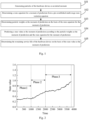
- Fig. 2 shows the change process of the historical state value of the hardware device in the rail transit signal system, and it can be seen that the change process of the state value can be divided into three stages.
- Equation (1) is used as the state equation to characterize the degradation law of the hardware device in the rail transit signal system at the initial stage.
- S t S t ⁇ 1 + d t ⁇ 1
- St is a state value at a moment t
- S t- 1 is a state value at a moment t - 1
- d t -1 is a state noise at the moment t - 1.
- Equation (2) is used as the state equation to describe the linear degradation of the hardware device in the rail transit signal system.
- S t S t ⁇ 1 + a t ⁇ 1 ⁇ ⁇ t + d t ⁇ 1
- a t- 1 is a coefficient, which for the sake of distinction with b t -1 will be referred to as a first coefficient, and ⁇ t is a time interval between two adjacent moments.
- stage 3 an exponential equation is used to describe the rapid degradation of the hardware device in the rail transit signal system in a later stage.
- S t S t ⁇ 1 ⁇ e b t ⁇ 1 ⁇ ⁇ t + d t ⁇ 1
- b t -1 is a coefficient, which for the sake of distinction with a t- 1 will be referred to as a second coefficient.
- an increment of the state value of the hardware device in the rail transit signal system may be used as the criterion for switching between state equations.
- the state value in stage 1 is higher than the initial state value by 0% ⁇ e 1 %.
- the state value in stage 2 is higher than the initial state value by e 1 % ⁇ e 2 %.
- the state value in stage 3 is higher than the initial state value by e 2 % ⁇ e 3 % . e 1 ⁇ e 2 ⁇ e 3 .
- the multi-stage state variation equation for any moment according to the invention is composed of state equations of three stages.
- S t is a state value at a moment t - 1
- t is a moment identifier
- S t -1 is a state value at the moment t - 1
- d t -1 is a state noise at the moment t - 1
- a t -1 is a first coefficient at the moment t - 1
- b t -1 is a second coefficient at the moment t - 1
- ⁇ t is a time interval between two adjacent moments.
- the multi-stage state variation equation according to the invention is composed of the state equations of the three-stages, which ensures the applicability of the state equation for the moment of prediction to the current working condition of the hardware device, and solves the problem that the prediction of the remaining service life of the hardware device is strongly dependent on the state equation, so that the remaining service life of the hardware device can be predicted more accurately.
- the state equation for the moment of prediction can be determined according to the characteristics of the change process of the state value of the hardware device.
- the increment of the state value of the hardware device in the rail transit signal system may be taken as the criterion for switching between the state equations.
- the state value in the first state is higher than the initial state value by 0% ⁇ e 1 %
- the state value of the second stage is higher than the initial state value by e 1 % ⁇ e 2 %
- the state value of the third stage is higher than the initial state value by e 2 % ⁇ e 3 %.
- the determination of the state equation for the moment of prediction may be performed with the e 1 % as a first threshold and e 2 % as a second threshold.
- the initial state value and the state value at the previous moment of the moment of prediction are acquired.
- the solution for determining the state equation for the moment of prediction realizes the dynamic determination of the state equation according to the statistical characteristics of the service life of the hardware device, which ensures the applicability of the state equation for the moment of prediction to the current working condition of the hardware device, so that the remaining service life of the hardware device can be more accurately predicted.
- particle weights at the moment of prediction are determined according to the state equation for the moment of prediction.
- the particle weights are the weights of the particles.
- the particle weights at the moment of prediction are the weight of the particles at the moment of prediction.
- predicted state values of the particles at the moment of prediction are determined according to the state equation for the moment of prediction.
- the particle weights at the moment of prediction are determined on the basis of the predicted state values of the particles.
- the weight of each particle at the moment of prediction is determined on the basis of the predicted value of the particle state as follows: w k i ⁇ w k ⁇ 1 i ⁇ P S k S ⁇ k i .
- k is the moment of prediction
- k - 1 is the previous moment of the moment of prediction
- h S k ⁇ 1 i
- d k ⁇ 1 is the state equation for the moment k
- i is a particle identifier
- S k ⁇ 1 i is an observed state value of the particle i at the moment k - 1 (that is, an observed value of a state value)
- d k -1 is a state noise at the moment k - 1
- P( ) is a conditional probability function
- S k is an observed state value at the moment k
- w k ⁇ 1 i is a weight of the particle i at the moment k - 1.
- P( ) is also obtained according to the change process of the historical state value of the hardware device in the rail transit signal system.
- the weight of each particle at the moment of prediction is determined according to the state equation for the moment of prediction, which ensures the matching of the weight with the current working condition of the hardware device at each moment of prediction, so that the remaining service life of the hardware device can be predicted more accurately.
- a state value at the moment of prediction is predicted according to the particle weights at the moment of prediction and the state equation for the moment of prediction.
- the observed state values of the particles at the previous moment of the moment of prediction and the state noise at the previous moment of the moment of prediction are acquired.
- the state value at the moment of prediction is predicted on the basis of the observed state values at the previous moment of the moment of prediction, the state noise at the previous moment of the moment of prediction, the state equation for the moment of prediction, and the particle weights at the moment of prediction.
- k is the moment of prediction
- k - 1 is the previous moment of the moment of prediction
- S ⁇ k i h S k ⁇ 1 i , d k ⁇ 1 .
- h S k ⁇ 1 i d k ⁇ 1 is the state equation for the moment k
- i is the particle identifier
- S k ⁇ 1 i is the observed state value of the particle i at the moment k - 1
- d k- 1 is the state noise at the moment k - 1
- n is the total number of the particles
- w k i is the weight of the particle i at the moment k .
- the state value at the moment of prediction is predicted according to the weight of each particle at the moment of prediction and the state equation for the moment of prediction. Since the weight of each particle at the moment of prediction ensures the matching of the weight with the current working condition of the hardware device at each moment of prediction, and the state equation for the moment of prediction ensures the applicability of the state equation for the moment of prediction to the current working condition of the hardware device, so that the state value at the moment of prediction obtained according to the weight of each particle at the moment of prediction and the state equation for the moment of prediction more accurately characterizes the real current state of the hardware device.
- the prediction of the remaining service life of the hardware device enables the evaluation of the state variation in the multiple stages, which ensures the applicability of the state equation for the moment of prediction to the current working condition of the hardware device, solves the problem of the low accuracy of the state evaluation and the service life prediction of the hardware device in the rail transit signal system under the varying working condition, improves the reliability of the hardware device in the rail transit signal system, and improves the comprehensive security of urban rail transit.
- the remaining service life of the hardware device is determined on the basis of the state value at the moment of prediction.
- the remaining service life of the hardware device is determined to be a duration from the current time to the moment of prediction.
- the remaining service life of the hardware device obtained according to the state threshold is more accurate, which improves the reliability of the hardware device in the rail transit signal system and improves the comprehensive security of urban rail transit.
- the remaining service life of the hardware device is determined to be the duration from the current time to the moment of prediction. Since the state value at the moment of prediction more accurately characterizes the real current state of the hardware device, the remaining service life of the hardware device obtained according to the state threshold is more accurate, which improves the reliability of the hardware device in the rail transit signal system and improves the comprehensive security of the urban rail transit.
- a state value at a subsequent moment of the moment of prediction is determined on the basis of the state value at the moment of prediction.
- the subsequent moment of the moment of prediction is taken as a moment of prediction, and the following steps are repeatedly performed: determining a state equation for a moment of prediction from a pre-established multi-stage state variation equation, determining particle weights at the moment of prediction on the basis of the state equation for the moment of prediction, predicting a state value at the moment of prediction according to the particle weights at the moment of prediction and the state equation for the moment of prediction, and determining the remaining service life of the hardware device on the basis of the state value at the moment of prediction (that is, the steps of 102 to 105 are repeatedly performed).
- the state equation for the moment of prediction is determined as a state equation for the subsequent moment of the prediction moment, the subsequent moment of the prediction moment is taken as a moment of prediction, and the following steps are repeatedly performed: determining particle weights at the moment of prediction on the basis of the state equation for the moment of prediction, predicting a state value at the moment of prediction according to the particle weights at the moment of prediction and the state equation for the moment of prediction, and determining the remaining service life of the hardware device on the basis of the state value at the moment of prediction (that is, the steps of 103 to 105 are repeatedly performed).
- the third threshold is a state value increment.
- the process of determining the state value at one time after prediction from the state value at the moment of prediction is as follows: taking the state value at the moment of prediction as an observed state value at the moment of prediction, and taking the state equation for the moment of prediction as a state equation for the subsequent moment of the moment of prediction; determining particle weights at the subsequent moment of the moment of prediction on the basis of the observed state value at the moment of prediction; and predicting a state value at the subsequent moment of the moment of prediction according to the particle weights at the subsequent moment of the prediction moment and the state equation for the subsequent moment of the prediction moment.
- the state equation for the subsequent moment of the moment of prediction is adjusted.
- the state value at the subsequent moment of the moment of prediction is predicted.
- the remaining service life of the hardware device is determined on the basis of the state value at the subsequent moment of the moment of prediction. Since the final remaining service life of the hardware device is predicted on the basis of the state value at each moment, the determination accuracy of the remaining service life of the hardware device reaches the moment level, and the state equation for each moment and the weights at each moment are adjusted according to the condition of the hardware device at that moment, thereby ensuring the prediction accuracy of the remaining service life of the hardware device.
- the state value at the moment of prediction is taken as the observed state value at the moment of prediction, and the particle weights at the subsequent moment of the moment of prediction are calculated according to the state equation for the moment of prediction and the observed state value at the moment of prediction, thereby obtaining the state value at the subsequent moment of the moment of prediction.
- the state value of the subsequent moment of the moment of prediction is used for adjusting the state equation for the subsequent moment of the moment of prediction and the weights at the subsequent moment of the moment of prediction, which enables that the state equation for the subsequent moment of the moment of prediction and the weights of the subsequent moment of the moment of prediction are adjusted on the basis of the predicted condition of the moment of prediction.
- the flexible adjustment of the state equation and weights is ensured, and the prediction accuracy of the remaining service life of the hardware device is ensured.
- Fig. 3 illustrates a schematic diagram of an estimation of a remaining service life of a hardware device in a rail transit signal system.
- the state curve 402 of the hardware device in the rail transit signal system after the moment k may be predicted, and the duration required for the degradation trajectory to reach the state threshold 403 from the moment of time k may be obtained, and this duration is the predicted remaining service life 404 of the hardware device in the rail transit signal system.
- the state value 405 of the hardware device in the rail transit signal system after the moment k + m may be predicted, and the duration required for the state value to reach the state threshold from the moment k + m is obtained, and this duration is the predicted remaining service life 406 of the hardware device in the rail transit signal system.
- the method for predicting the remaining service life of the rail transit hardware device is an improved scheme in which the multi-stage state variation equation and the particle filter method are integrated, and is an improved particle filter method. That is, steps 102-105 use the state equation and the observation equation to estimate the state value at the current moment, and the method uses the state equation and the observation equation to estimate the state value at the current time is the particle filtering method.
- Equation (4) is a state equation
- Equations (5) and (6) are observation equations.
- the particle filtering method mainly consists of two steps including prediction and update. Specifically, a Monte Carlo method is used to randomly sample the moment t - 1 to obtain the state S t -1 . Then, using the state equation (4), the state value ⁇ t of each particle at the moment t is predicted. Then, according to the importance sampling principle, according to Equation (5), the weight of each particle in the state estimation values is updated using the observation value S t at the moment t and normalized. Finally, the optimal estimate of the state value ⁇ t at the moment t is obtained by weighted averaging using Equation (6).
- the symbol ⁇ at the top of the variables indicates that the variables are estimated or predicted values.
- h S t ⁇ 1 i d t ⁇ 1 is the state equation for the moment t
- i is the particle identifier
- S t ⁇ 1 i is an observed state value of the particle i at the moment t - 1
- d t- 1 is the state noise at the moment t - 1
- P( ) is a conditional probability function
- S t is the observed state value at the moment t
- S ⁇ t i is the predicted state value of the particle i at the moment t
- w t ⁇ 1 i is the weight of the particle i at the moment t - 1
- w t i is the weight of the particle i at the moment t .
- the multi-stage state variation equation is integrated into the particle filter method. That is, three state Equations (1), (2) and (3) of the hardware device in the rail transit signal system are introduced into equation (4).
- equation (4) three state Equations (1), (2) and (3) of the hardware device in the rail transit signal system are introduced into equation (4).
- the state equation remains the Equation (1).
- the state equation is switched to Equation (2).
- the state equation is switched to Equation (3).
- the integration of the method for predicting the remaining service life of the rail transit hardware device provided in the embodiments is embodied in the specific implementation process of the method for predicting the remaining service life in the rail transit hardware device shown in Fig. 4 , which includes: 1) establishing a multi-stage state variation equation 202 according to the variation law of the state data 201 in the operation process of the hardware device in the rail transit signal system; 2) integrating the multi-stage state variation equation 202 and the particle filter method 203, to make the particle filter method be an improved particle filter prediction method 204 with multi-stage degradation evaluation capability; 3) according to the predicted state value 205 of the hardware device in the rail transit signal system, the applicability of the state equation is evaluated in real time, and the state equation 206 is switched accordingly; 4) the remaining service life 207 is obtained according to the difference between the predicted state value and the state threshold.
- a specific implementation of the method for predicting the remaining service life of the rail transit hardware device provided in the present embodiments can be as shown in Fig. 5 .
- a state equation 302 is obtained according to historical state data 301, and particles 303 are generated.
- the state value 304 at the moment of prediction is predicted using the state equation.
- the state value 308 at the subsequent moment is obtained. It is determined whether the state at the subsequent moment exceeds the threshold. If so, a new state equation 309 is selected for the subsequent moment to replace the current state equation according to the increment by which the state threshold is exceeded. Thereafter, the above steps are repeated for another round of operation.
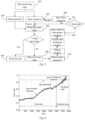
- Fig. 6 illustrates a predicted state curve of the hardware device in the rail transit signal system obtained by using the method for predicting the remaining service life of the rail transit hardware device in the embodiments.
- the predicted state value coincide with the experimentally observed state value at some positions. This indicates that the predicted state value is close to the true result.
- the predicted value of the remaining service life is calculated.
- the actual remaining service life is calculated by using the actual observed value, and the root mean square error of the predicted remaining service life is 3.46%. It can be seen that, the predicted remaining service life is close to the actual remaining service life.
- the root mean square error of the predicted value of the remaining service life obtained by using the unimproved particle filter method is 8.64%, which is greater than the root mean square error of the predicted value of the remaining service life obtained by using the improved particle filter method provided in the embodiments (that is, the method for predicting the remaining service life of the rail transit hardware device provided in the embodiments), indicating that the prediction result of the remaining service life obtained by the method of predicting the remaining service life of the rail transit hardware device provided in the embodiments is closer to the true value.
- the embodiments provide a method for predicting a remaining service life of a rail transit hardware device, where the method includes: generating particles of the hardware device at an initial moment; determining a state equation for a moment of prediction from a pre-established multi-stage state variation equation; determining particle weights at the moment of prediction on the basis of the state equation for the moment of prediction; predicting a state value at the moment of prediction according to the particle weights at the moment of prediction and the state equation for the moment of prediction; and determining the remaining service life of the hardware device on the basis of the state value at the moment of prediction.
- the remaining service life of the hardware device is determined according to the state equation for the moment of prediction, and the state equation for the moment of prediction is determined from a pre-established multi-stage state variation equation, so that the prediction of the remaining service life of the hardware device enables the evaluation of the state variations in multiple stages, ensuring the applicability of the state equation for the moment of prediction to the current working condition of the hardware device.
- the problem of the low accuracy of state evaluation and service life prediction of the hardware device in the rail transit signal system under varying working conditions is solved, the reliability of the hardware device in the rail transit signal system is improved.
- the comprehensive security of urban rail transit is improved.
- the embodiments provide an electronic device, including: a memory, a processor, and a computer program.
- the computer program is stored in the memory and configured to be executed by a processor to implement the method for predicting the remaining service life of the hardware device rail transit as disclosed in the embodiments shown in Fig. 1 .
- the method includes:
- the multi-stage state variation equation is composed of state equations of three stages including a first stage, a second stage and a third stage;
- the determining a state equation for a moment of prediction from a pre-established multi-stage state variation equation includes:
- the determining particle weights at the moment of prediction on the basis of the state equation for the moment of prediction includes:
- the predicting a state value at the moment of prediction according to the particle weights at the moment of prediction and the state equation for the moment of prediction includes:
- determining the remaining service life of the hardware device based on the state value at the moment of prediction includes: determining that the remaining service life of the hardware device is a duration from a current moment to the moment of prediction when the state value at the moment of prediction is greater than or equal to a state threshold.
- the determining the remaining service life of the hardware device based on the state value at the moment of prediction includes:
- the determining a state value at a subsequent moment of the moment of prediction on the basis of the state value at the moment of prediction includes:
- the present embodiment provides the electronic device in which the computer program is stored in the memory and configured to be executed by the processor to implement the method including the following steps: generating particles of the hardware device at an initial moment; determining a state equation for a moment of prediction from a pre-established multi-stage state variation equation; determining particle weights at the moment of prediction on the basis of the state equation for the moment of prediction; predicting a state value at the moment of prediction according to the particle weights at the moment of prediction and the state equation for the moment of prediction; and determining the remaining service life of the hardware device on the basis of the state value at the moment of prediction.
- the remaining service life of the hardware device is determined according to the state equation for the moment of prediction, and the state equation for the moment of prediction is determined from a pre-established multi-stage state variation equation, so that the prediction of the remaining service life of the hardware device enables the evaluation of the state variations in multiple stages, ensuring the applicability of the state equation for the moment of prediction to the current working condition of the hardware device.
- the problem of the low accuracy of state evaluation and service life prediction of the hardware device in the rail transit signal system under varying working conditions is solved, the reliability of the hardware device in the rail transit signal system is improved.
- the comprehensive security of urban rail transit is improved.
- the present embodiment provides a computer-readable storage medium having a computer program stored thereon.
- the computer program is executed by the processor to implement the method for predicting the remaining service life of the rail transit hardware device as disclosed in the embodiments shown in Fig. 1 .
- the method includes:
- the multi-stage state variation equation is composed of state equations of three stages including a first stage, a second stage and a third stage;
- the determining a state equation for a moment of prediction from a pre-established multi-stage state variation equation includes:
- the determining particle weights at the moment of prediction on the basis of the state equation for the moment of prediction includes:
- the predicting a state value at the moment of prediction according to the particle weights at the moment of prediction and the state equation for the moment of prediction includes:
- determining the remaining service life of the hardware device based on the state value at the moment of prediction includes: determining that the remaining service life of the hardware device is a duration from a current moment to the moment of prediction when the state value at the moment of prediction is greater than or equal to a state threshold.
- the determining the remaining service life of the hardware device based on the state value at the moment of prediction includes:
- the determining a state value at a subsequent moment of the moment of prediction on the basis of the state value at the moment of prediction includes:
- the present embodiment provides the computer-readable storage medium having the computer program stored thereon, where the computer program, when being executed by the processor, implements the method including the following steps: generating particles of the hardware device at an initial moment; determining a state equation for a moment of prediction from a pre-established multi-stage state variation equation; determining particle weights at the moment of prediction on the basis of the state equation for the moment of prediction; predicting a state value at the moment of prediction according to the particle weights at the moment of prediction and the state equation for the moment of prediction; and determining the remaining service life of the hardware device on the basis of the state value at the moment of prediction.
- the remaining service life of the hardware device is determined according to the state equation for the moment of prediction, and the state equation for the moment of prediction is determined from a pre-established multi-stage state variation equation, so that the prediction of the remaining service life of the hardware device enables the evaluation of the state variations in multiple stages, ensuring the applicability of the state equation for the moment of prediction to the current working condition of the hardware device.
- the problem of the low accuracy of state evaluation and service life prediction of the hardware device in the rail transit signal system under varying working conditions is solved, the reliability of the hardware device in the rail transit signal system is improved.
- the comprehensive security of urban rail transit is improved.
- the embodiments of the present application can be provided as a method, a system, or a computer program product. Accordingly, the present application may take the form of an entirely hardware embodiment, an entirely software embodiment or an embodiment combining software and hardware aspects. Furthermore, the present application may take the form of a computer program product embodied on one or more computer-usable storage media (including, but not limited to, magnetic disk storage, CD-ROM, optical storage, etc.) having computer-usable program code embodied therein. Schemes in embodiments of the present application may be implemented in a variety of computer languages, such as the object-oriented programming language Java, the transliteration scripting language JavaScript, etc.
- These computer program instructions may also be stored in a computer-readable memory that can direct a computer or other programmable data processing apparatus to function in a particular manner, such that the instructions stored in the computer-readable memory produce an article of manufacture including instruction means which implement the function specified in the flowchart flow or flows and/or block diagram block or blocks.
- These computer program instructions may also be loaded onto a computer or other programmable data processing apparatus to cause a series of operational steps to be performed on the computer or other programmable apparatus to produce a computer implemented process such that the instructions which are executed on the computer or other programmable apparatus provide steps for implementing the functions specified in the flowchart flow or flows and/or block diagram block or blocks.
- first and second are used for descriptive purposes only and are not to be construed as indicating or implying relative importance or as implicitly indicating the number of technical features indicated.
- a feature defined as “first” or “second” may explicitly or implicitly include one or more of the feature.
- the meaning of "a plurality” is at least two, for example, two, three, etc., unless specifically defined otherwise.
Landscapes
- Engineering & Computer Science (AREA)
- Physics & Mathematics (AREA)
- Business, Economics & Management (AREA)
- General Physics & Mathematics (AREA)
- Human Resources & Organizations (AREA)
- Theoretical Computer Science (AREA)
- Strategic Management (AREA)
- Economics (AREA)
- Mathematical Physics (AREA)
- Tourism & Hospitality (AREA)
- General Business, Economics & Management (AREA)
- Health & Medical Sciences (AREA)
- Development Economics (AREA)
- General Health & Medical Sciences (AREA)
- Marketing (AREA)
- Operations Research (AREA)
- Pure & Applied Mathematics (AREA)
- Mathematical Analysis (AREA)
- Data Mining & Analysis (AREA)
- Game Theory and Decision Science (AREA)
- Quality & Reliability (AREA)
- Biomedical Technology (AREA)
- Entrepreneurship & Innovation (AREA)
- Mechanical Engineering (AREA)
- Mathematical Optimization (AREA)
- Computational Mathematics (AREA)
- Primary Health Care (AREA)
- Automation & Control Theory (AREA)
- Educational Administration (AREA)
- Artificial Intelligence (AREA)
- Algebra (AREA)
- Evolutionary Computation (AREA)
- Databases & Information Systems (AREA)
- Software Systems (AREA)
- General Engineering & Computer Science (AREA)
- Management, Administration, Business Operations System, And Electronic Commerce (AREA)
- Testing Of Devices, Machine Parts, Or Other Structures Thereof (AREA)
Description
- The present application relates to the technical field of rail transit, and in particular to a method, a device and a storage medium for predicting a remaining service life of a rail transit hardware device.
- In the existing solutions addressing at the problem of low accuracy in predicting a remaining service life of a hardware device in a rail transit signal system, a statistical model are adopted to predict the remaining service life of the hardware device.
- In the method for predicting the remaining service life based on the statistical model, a degradation model can be established according to a degradation trajectory of a product and a probability distribution of the remaining service life of the system can be acquired. A particle filter algorithm is suitable for the prediction of a nonlinear stochastic process with noise, which is widely used in the statistical model method. However, in such method, usually, a fixed state equation is used, which cannot well evaluate the service life of the device in different states in the whole life cycle, thus affecting the accuracy of the service life prediction result.
- In order to solve at least one of the above technical defects, the present application provides a method, a device and a storage medium for predicting a remaining service life of a rail transit hardware device.
- In a first aspect of the present application, a method for predicting a remaining service life of a rail transit hardware device is provided, according to
claim 1. - Optionally, the determining particle weights at the moment of prediction on the basis of the state equation for the moment of prediction includes:
- determining predicted state values of the particles at the moment of prediction according to the state equation for the moment of prediction;
- determining the particle weights at the moment of prediction according to the predicted state values of the particles.
- Optionally, the predicting a state value at the moment of prediction according to the particle weights at the moment of prediction and the state equation for the moment of prediction includes:
- acquiring observed state values of the particles at a previous moment of the moment of prediction and a state noise at the previous moment of the moment of prediction; and
- predicting the state value at the moment of prediction according to the observed state value at the previous moment of the moment of prediction, the state noise at the previous moment of the moment of prediction, the state equation for the moment of prediction and the particle weights at the moment of prediction.
- Optionally, the determining the remaining service life of the hardware device based on the state value at the moment of prediction includes:
determining that the remaining service life of the hardware device is a duration from a current moment to the moment of prediction when the state value at the moment of prediction is greater than or equal to a state threshold. - Optionally, the determining the remaining service life of the hardware device based on the state value at the moment of prediction includes:
- when the state value at the moment of prediction is less than a state threshold,
- determining a state value at a subsequent moment of the moment of prediction on the basis of the state value at the moment of prediction;
- when a quotient of the state value at the subsequent moment of the moment of prediction and the initial state value is greater than a third threshold, taking the subsequent moment of the moment of prediction as a moment of prediction, and repeatedly performing the steps of determining a state equation for a moment of prediction from a pre-established multi-stage state variation equation, determining particle weights at the moment of prediction on the basis of the state equation for the moment of prediction, predicting a state value at the moment of prediction according to the particle weights at the moment of prediction and the state equation for the moment of prediction, and determining the remaining service life of the hardware device on the basis of the state value at the moment of prediction;
- when the quotient of the state value at the subsequent moment of the moment of prediction and the initial state value is less than or equal to the third threshold, determining the state equation for the moment of prediction as a state equation for the subsequent moment of the prediction moment, taking the subsequent moment of the prediction moment as a moment of prediction, and repeatedly performing the steps of determining particle weights at the moment of prediction on the basis of the state equation for the moment of prediction, predicting a state value at the moment of prediction according to the particle weights at the moment of prediction and the state equation for the moment of prediction, and determining the remaining service life of the hardware device on the basis of the state value at the moment of prediction.
- Optionally, the determining a state value at a subsequent moment of the moment of prediction on the basis of the state value at the moment of prediction includes:
- taking the state value at the moment of prediction as an observed state value at the moment of prediction, and taking the state equation for the moment of prediction as a state equation for the subsequent moment of the moment of prediction;
- determining particle weights at the subsequent moment of the moment of prediction on the basis of the observed state value at the moment of prediction;
- predicting an initial state value at the subsequent moment of the moment of prediction according to the particle weights at the subsequent moment of the prediction moment and the state equation for the subsequent moment of the prediction moment.
- In a second aspect of the present application, an electronic device is provided, according to claim 7.
- In a third aspect of the present application, a computer-readable storage medium is provided, according to claim 8.
- The present application provides the method, the device and the storage medium for predicting the remaining service life of the rail transit hardware device, where the method includes: generating particles of the hardware device at an initial moment; determining a state equation for a moment of prediction from a pre-established multi-stage state variation equation; determining particle weights at the moment of prediction on the basis of the state equation for the moment of prediction; predicting a state value at the moment of prediction according to the particle weights at the moment of prediction and the state equation for the moment of prediction; and determining the remaining service life of the hardware device on the basis of the state value at the moment of prediction.
- In the method provided in the present application, the remaining service life of the hardware device is determined according to the state equation for the moment of prediction, and the state equation for the moment of prediction is determined from a pre-established multi-stage state variation equation, so that the prediction of the remaining service life of the hardware device enables the evaluation of the state variations in multiple stages, ensuring the applicability of the state equation for the moment of prediction to the current working condition of the hardware device. The problem of the low accuracy of state evaluation and service life prediction of the hardware device in the rail transit signal system under varying working conditions is solved, the reliability of the hardware device in the rail transit signal system is improved. The comprehensive security of urban rail transit is improved.
- In addition, according to the invention, the multi-stage state variation equation is composed of the state equations of the three-stage, which ensures the applicability of the state equation for the moment of prediction to the current working conditions of the hardware device, solves the problem that the prediction of the remaining service life of the hardware device is highly dependent on the state equation, and the remaining service life of the hardware device can be more accurately predicted.
- In addition, in an implementation, the state value at the moment of prediction is predicted according to the weight of each particle at the moment of prediction and the state equation for the moment of prediction. Since the weight of each particle at the moment of prediction ensures the matching of the weight with the current working condition of the hardware device at each moment of prediction, and the state equation for the moment of prediction ensures the applicability of the state equation for the moment of prediction to the current working condition of the hardware device, so that the state value at the moment of prediction obtained according to the weight of each particle at the moment of prediction and the state equation for the moment of prediction more accurately characterizes the real current state of the hardware device.
- In addition, in an implementation, the remaining service life of the hardware device is determined to be a duration from the current time to the moment of prediction when the state value at the moment of prediction is greater than or equal to the state threshold. Since the state value at the moment of prediction more accurately characterizes the real current state of the hardware device, the remaining service life of the hardware device obtained according to the state threshold is more accurate, which improves the reliability of the hardware device in the rail transit signal system and improves the comprehensive security of urban rail transit.
- In addition, in an implementation, the state equation for the subsequent moment of the moment of prediction is adjusted when the state value at the moment of prediction is less than the state threshold. The state value at the subsequent moment of the moment of prediction is predicted. Then, the remaining service life of the hardware device is determined on the basis of the state value at the subsequent moment of the moment of prediction. Since the final remaining service life of the hardware device is predicted on the basis of the state value at each moment, the determination accuracy of the remaining service life of the hardware device reaches the moment level, and the state equation for each moment and the weights at each moment are adjusted according to the condition of the hardware device at that moment, thereby ensuring the prediction accuracy of the remaining service life of the hardware device.
- In addition, in an implementation, the state value at the moment of prediction is taken as the observed state value at the moment of prediction, and the particle weights at the subsequent moment of the moment of prediction are calculated according to the state equation for the moment of prediction and the observed state value at the moment of prediction, thereby obtaining the state value at the subsequent moment of the moment of prediction. The state value of the subsequent moment of the moment of prediction is used for adjusting the state equation for the subsequent moment of the moment of prediction and the weights at the subsequent moment of the moment of prediction, which enables that the state equation for the subsequent moment of the moment of prediction and the weights of the subsequent moment of the moment of prediction are adjusted on the basis of the predicted condition of the moment of prediction. The flexible adjustment of the state equation and weights is ensured, and the prediction accuracy of the remaining service life of the hardware device is ensured.
- The present embodiment provides the electronic device in which the computer program is stored in the memory and configured to be executed by the processor to implement the method including the following steps: generating particles of the hardware device at an initial moment; determining a state equation for a moment of prediction from a pre-established multi-stage state variation equation; determining particle weights at the moment of prediction on the basis of the state equation for the moment of prediction; predicting a state value at the moment of prediction according to the particle weights at the moment of prediction and the state equation for the moment of prediction; and determining the remaining service life of the hardware device on the basis of the state value at the moment of prediction. The remaining service life of the hardware device is determined according to the state equation for the moment of prediction, and the state equation for the moment of prediction is determined from a pre-established multi-stage state variation equation, so that the prediction of the remaining service life of the hardware device enables the evaluation of the state variations in multiple stages, ensuring the applicability of the state equation for the moment of prediction to the current working condition of the hardware device. The problem of the low accuracy of state evaluation and service life prediction of the hardware device in the rail transit signal system under varying working conditions is solved, the reliability of the hardware device in the rail transit signal system is improved. The comprehensive security of urban rail transit is improved.
- The present embodiment provides the computer-readable storage medium having the computer program stored thereon, where the computer program, when being executed by the processor, implements the method including the following steps: generating particles of the hardware device at an initial moment; determining a state equation for a moment of prediction from a pre-established multi-stage state variation equation; determining particle weights at the moment of prediction on the basis of the state equation for the moment of prediction; predicting a state value at the moment of prediction according to the particle weights at the moment of prediction and the state equation for the moment of prediction; and determining the remaining service life of the hardware device on the basis of the state value at the moment of prediction. The remaining service life of the hardware device is determined according to the state equation for the moment of prediction, and the state equation for the moment of prediction is determined from a pre-established multi-stage state variation equation, so that the prediction of the remaining service life of the hardware device enables the evaluation of the state variations in multiple stages, ensuring the applicability of the state equation for the moment of prediction to the current working condition of the hardware device. The problem of the low accuracy of state evaluation and service life prediction of the hardware device in the rail transit signal system under varying working conditions is solved, the reliability of the hardware device in the rail transit signal system is improved. The comprehensive security of urban rail transit is improved.
- The drawings, which are illustrated herein to provide a further understanding of the present application, constitute a part of the present application. Illustrative embodiment(s) of the present application and together with the accompanying description serve to explain the present application and do not constitute an undue limitation of the present application. In the drawings:
-
Fig. 1 is a schematic flowchart of a method for predicting a remaining service life of a rail transit hardware device according to an embodiment of the present application. -
Fig. 2 is a schematic diagram illustrating a change process of a state value of a rail transit hardware device according to an embodiment of the present application. -
Fig. 3 is a schematic diagram of estimation of a remaining service life of a hardware device in a rail transit signal system according to an embodiment of the present application. -
Fig. 4 is a schematic flowchart of another method for predicting a remaining service life of a rail transit hardware device according to an embodiment of the present application. -
Fig. 5 is a schematic flowchart of another method for predicting a remaining service life of a rail transit hardware device a according to an embodiment of the present application. -
Fig. 6 is a schematic diagram illustrating the effect of another method for predicting a remaining service life of a rail transit hardware device according to an embodiment of the present application. - In order to make the technical solutions and advantages of the embodiments of the present application clearer, the exemplary embodiments of the present application are described in further detail below with reference to the drawings. Obviously, the described embodiments are only a part of the embodiments of the present application, and not all embodiments are exhaustive.
- In implementing the present application, the inventors have noticed that existing solutions use a statistical model to predict the remaining service life of a hardware device. In the statistical model-based method for predicting the remaining service life, a degradation model can be established according to the degradation trajectory of the product and a probability distribution of the remaining service life of the system can be established. A particle filter algorithm is suitable for the prediction of a nonlinear stochastic process with noise, which is widely used in the statistical model-based method. However, in such method, usually, a fixed state equation is used, which cannot well evaluate the service life of the device in different states in the whole life cycle, thus affecting the accuracy of the service life prediction result.
- Addressing the above-mentioned problems, the embodiments of the present application provide a method for predicting a remaining service life of a rail transit hardware device, where the method includes: generating particles of the hardware device at an initial moment; determining a state equation for a moment of prediction from a pre-established multi-stage state variation equation; determining particle weights at the moment of prediction on the basis of the state equation for the moment of prediction; predicting a state value at the moment of prediction according to the particle weights at the moment of prediction and the state equation for the moment of prediction; and determining the remaining service life of the hardware device on the basis of the state value at the moment of prediction. In the method provided in the present application, the remaining service life of the hardware device is determined according to the state equation for the moment of prediction, and the state equation for the moment of prediction is determined from a pre-established multi-stage state variation equation, so that the prediction of the remaining service life of the hardware device enables the evaluation of the state variations in multiple stages, ensuring the applicability of the state equation for the moment of prediction to the current working condition of the hardware device. The problem of the low accuracy of state evaluation and service life prediction of the hardware device in the rail transit signal system under varying working conditions is solved, the reliability of the hardware device in the rail transit signal system is improved. The comprehensive security of urban rail transit is improved.
- With reference to
Fig. 1 , a method for predicting a remaining service life of a rail transit hardware device is provided according to an embodiment, which is implemented as follows. - At 101, particles of the hardware device at an initial moment are generated.
- The particles at the initial moment may be obtained based on historical state data of the hardware device.
- At 102, a state equation for a moment of prediction is determined from a pre-established multi-stage state variation equation.
- The multi-stage state variation equation is obtained in advance according to a change process of the state value of the hardware device.
Fig. 2 shows the change process of the historical state value of the hardware device in the rail transit signal system, and it can be seen that the change process of the state value can be divided into three stages. - In
stage 1, the hardware device state value is substantially non-varying and the degradation slope is substantially zero. Equation (1) is used as the state equation to characterize the degradation law of the hardware device in the rail transit signal system at the initial stage.
- St is a state value at a moment t, S t-1 is a state value at a moment t - 1, and d t-1 is a state noise at the moment t - 1.
- In
stage 2, the state value of the hardware device change in a linear manner. Equation (2) is used as the state equation to describe the linear degradation of the hardware device in the rail transit signal system.
- a t-1 is a coefficient, which for the sake of distinction with b t-1 will be referred to as a first coefficient, and Δt is a time interval between two adjacent moments.
- In
stage 3, an exponential equation is used to describe the rapid degradation of the hardware device in the rail transit signal system in a later stage.
- b t-1 is a coefficient, which for the sake of distinction with a t-1 will be referred to as a second coefficient.
- Therefore, an increment of the state value of the hardware device in the rail transit signal system may be used as the criterion for switching between state equations. The state value in
stage 1 is higher than the initial state value by 0%~e 1%. The state value instage 2 is higher than the initial state value by e 1%~e 2%. The state value instage 3 is higher than the initial state value by e 2%~e 3%. e 1 < e 2 < e 3 . - Based on the above characteristics, the multi-stage state variation equation for any moment according to the invention is composed of state equations of three stages.
- In the state equations:
- a state equation of a first stage for any moment is established on the basis of a state value at a previous moment and a state noise at the previous moment;
- a state equation of a second stage for any moment is established on the basis of a state value at a previous moment, a state noise at the previous moment, a first coefficient at the previous moment, and a time interval between two adjacent moments;
- a state equation of a third stage for any moment is established on the basis of a state value at a previous moment, a state noise at the previous moment, a second coefficient at the previous time, and a time interval between two adjacent moments.
- A moment t is taken as an example for illustration, and
- the state equation of the first stage is: St = S t-1 + d t-1;
- the state equation of the second stage is: St = S t-1 + a t-1 · Δt + d t-1; and
- the state equation of the third stage is: St = S t-1 · e b
t-1 ·Δt + d t-1 . - St is a state value at a moment t - 1, t is a moment identifier, S t-1 is a state value at the moment t - 1, d t-1 is a state noise at the moment t - 1, a t-1 is a first coefficient at the moment t - 1, b t-1 is a second coefficient at the moment t - 1, Δt is a time interval between two adjacent moments.
- The multi-stage state variation equation according to the invention is composed of the state equations of the three-stages, which ensures the applicability of the state equation for the moment of prediction to the current working condition of the hardware device, and solves the problem that the prediction of the remaining service life of the hardware device is strongly dependent on the state equation, so that the remaining service life of the hardware device can be predicted more accurately.
- In addition, after the multi-stage state variation equation is established, the state equation for the moment of prediction can be determined according to the characteristics of the change process of the state value of the hardware device.
- That is to say, the increment of the state value of the hardware device in the rail transit signal system may be taken as the criterion for switching between the state equations. The state value in the first state is higher than the initial state value by 0%~e 1%, the state value of the second stage is higher than the initial state value by e 1%~e 2%, and the state value of the third stage is higher than the initial state value by e 2%~e 3%.
- The determination of the state equation for the moment of prediction may be performed with the e 1% as a first threshold and e 2% as a second threshold.
- For example, the initial state value and the state value at the previous moment of the moment of prediction are acquired. A ratio is calculated as the ratio = the state value at the previous moment of the moment of prediction / the initial state value. If the ratio is less than the first threshold, the state equation for the moment of prediction is determined to be the state equation of the first stage. If the ratio is between the first threshold and the second threshold (which includes the situation where the ratio is equal to the first threshold or the second threshold), the state equation for the moment of prediction is determined to be the state equation of the second stage. If the ratio is greater than the second threshold, the state equation for the moment of prediction is determined to be the state equation of the third stage.
- The solution for determining the state equation for the moment of prediction provided in this embodiment realizes the dynamic determination of the state equation according to the statistical characteristics of the service life of the hardware device, which ensures the applicability of the state equation for the moment of prediction to the current working condition of the hardware device, so that the remaining service life of the hardware device can be more accurately predicted.
- At 103, particle weights at the moment of prediction are determined according to the state equation for the moment of prediction.
- The particle weights are the weights of the particles. The particle weights at the moment of prediction are the weight of the particles at the moment of prediction.
- In this step, predicted state values of the particles at the moment of prediction are determined according to the state equation for the moment of prediction. The particle weights at the moment of prediction are determined on the basis of the predicted state values of the particles.
- Since the particles are multiple, the predicted state value of each particle at the moment of prediction is determined according to the state equation for the moment of prediction as follows:

- The weight of each particle at the moment of prediction is determined on the basis of the predicted value of the particle state as follows:

- k is the moment of prediction, k - 1 is the previous moment of the moment of prediction,


- In this embodiment, the weight of each particle at the moment of prediction is determined according to the state equation for the moment of prediction, which ensures the matching of the weight with the current working condition of the hardware device at each moment of prediction, so that the remaining service life of the hardware device can be predicted more accurately.
- At 104, a state value at the moment of prediction is predicted according to the particle weights at the moment of prediction and the state equation for the moment of prediction.
- The observed state values of the particles at the previous moment of the moment of prediction and the state noise at the previous moment of the moment of prediction are acquired.
- The state value at the moment of prediction is predicted on the basis of the observed state values at the previous moment of the moment of prediction, the state noise at the previous moment of the moment of prediction, the state equation for the moment of prediction, and the particle weights at the moment of prediction.
- For example, the state value at the moment of prediction is

- k is the moment of prediction, and k - 1 is the previous moment of the moment of prediction, and


- In this step, the state value at the moment of prediction is predicted according to the weight of each particle at the moment of prediction and the state equation for the moment of prediction. Since the weight of each particle at the moment of prediction ensures the matching of the weight with the current working condition of the hardware device at each moment of prediction, and the state equation for the moment of prediction ensures the applicability of the state equation for the moment of prediction to the current working condition of the hardware device, so that the state value at the moment of prediction obtained according to the weight of each particle at the moment of prediction and the state equation for the moment of prediction more accurately characterizes the real current state of the hardware device.
- Through the integration of the multi-stage state variation equation and the particle filter method, the prediction of the remaining service life of the hardware device enables the evaluation of the state variation in the multiple stages, which ensures the applicability of the state equation for the moment of prediction to the current working condition of the hardware device, solves the problem of the low accuracy of the state evaluation and the service life prediction of the hardware device in the rail transit signal system under the varying working condition, improves the reliability of the hardware device in the rail transit signal system, and improves the comprehensive security of urban rail transit.
- At 105, the remaining service life of the hardware device is determined on the basis of the state value at the moment of prediction.
- If the state value at the moment of prediction is greater than or equal to the state threshold, the remaining service life of the hardware device is determined to be a duration from the current time to the moment of prediction.
- Since the state value at the moment of prediction more accurately characterizes the real current state of the hardware device, the remaining service life of the hardware device obtained according to the state threshold is more accurate, which improves the reliability of the hardware device in the rail transit signal system and improves the comprehensive security of urban rail transit.
- When the state value at the moment of prediction is greater than or equal to the state threshold, the remaining service life of the hardware device is determined to be the duration from the current time to the moment of prediction. Since the state value at the moment of prediction more accurately characterizes the real current state of the hardware device, the remaining service life of the hardware device obtained according to the state threshold is more accurate, which improves the reliability of the hardware device in the rail transit signal system and improves the comprehensive security of the urban rail transit.
- If the state value at the moment of prediction is less than the state threshold, a state value at a subsequent moment of the moment of prediction is determined on the basis of the state value at the moment of prediction. When a quotient of the state value at the subsequent moment of the moment of prediction and the initial state value is greater than a third threshold, the subsequent moment of the moment of prediction is taken as a moment of prediction, and the following steps are repeatedly performed: determining a state equation for a moment of prediction from a pre-established multi-stage state variation equation, determining particle weights at the moment of prediction on the basis of the state equation for the moment of prediction, predicting a state value at the moment of prediction according to the particle weights at the moment of prediction and the state equation for the moment of prediction, and determining the remaining service life of the hardware device on the basis of the state value at the moment of prediction (that is, the steps of 102 to 105 are repeatedly performed). When the quotient of the state value at the subsequent moment of the moment of prediction and the initial state value is less than or equal to the third threshold, the state equation for the moment of prediction is determined as a state equation for the subsequent moment of the prediction moment, the subsequent moment of the prediction moment is taken as a moment of prediction, and the following steps are repeatedly performed: determining particle weights at the moment of prediction on the basis of the state equation for the moment of prediction, predicting a state value at the moment of prediction according to the particle weights at the moment of prediction and the state equation for the moment of prediction, and determining the remaining service life of the hardware device on the basis of the state value at the moment of prediction (that is, the steps of 103 to 105 are repeatedly performed).
- The third threshold is a state value increment. When the increment between the state value at the subsequent moment of the prediction moment and the initial state value is relatively large (that is, being greater than the third threshold), the state equation for the subsequent moment of the prediction moment is adjusted.
- In addition, the process of determining the state value at one time after prediction from the state value at the moment of prediction is as follows: taking the state value at the moment of prediction as an observed state value at the moment of prediction, and taking the state equation for the moment of prediction as a state equation for the subsequent moment of the moment of prediction; determining particle weights at the subsequent moment of the moment of prediction on the basis of the observed state value at the moment of prediction; and predicting a state value at the subsequent moment of the moment of prediction according to the particle weights at the subsequent moment of the prediction moment and the state equation for the subsequent moment of the prediction moment.
- When the state value at the moment of prediction is less than the state threshold, the state equation for the subsequent moment of the moment of prediction is adjusted. The state value at the subsequent moment of the moment of prediction is predicted. Then, the remaining service life of the hardware device is determined on the basis of the state value at the subsequent moment of the moment of prediction. Since the final remaining service life of the hardware device is predicted on the basis of the state value at each moment, the determination accuracy of the remaining service life of the hardware device reaches the moment level, and the state equation for each moment and the weights at each moment are adjusted according to the condition of the hardware device at that moment, thereby ensuring the prediction accuracy of the remaining service life of the hardware device.
- In addition, the state value at the moment of prediction is taken as the observed state value at the moment of prediction, and the particle weights at the subsequent moment of the moment of prediction are calculated according to the state equation for the moment of prediction and the observed state value at the moment of prediction, thereby obtaining the state value at the subsequent moment of the moment of prediction. The state value of the subsequent moment of the moment of prediction is used for adjusting the state equation for the subsequent moment of the moment of prediction and the weights at the subsequent moment of the moment of prediction, which enables that the state equation for the subsequent moment of the moment of prediction and the weights of the subsequent moment of the moment of prediction are adjusted on the basis of the predicted condition of the moment of prediction. The flexible adjustment of the state equation and weights is ensured, and the prediction accuracy of the remaining service life of the hardware device is ensured.
-
Fig. 3 illustrates a schematic diagram of an estimation of a remaining service life of a hardware device in a rail transit signal system. - 401 is a variation curve of the state value of the hardware device. At the moment k, with the data of the moment k - 1, the
state curve 402 of the hardware device in the rail transit signal system after the moment k may be predicted, and the duration required for the degradation trajectory to reach thestate threshold 403 from the moment of time k may be obtained, and this duration is the predicted remainingservice life 404 of the hardware device in the rail transit signal system. - Similarly, at the moment k + m, with the data of the moment k + m - 1, the
state value 405 of the hardware device in the rail transit signal system after the moment k + m may be predicted, and the duration required for the state value to reach the state threshold from the moment k + m is obtained, and this duration is the predicted remainingservice life 406 of the hardware device in the rail transit signal system. - The method for predicting the remaining service life of the rail transit hardware device provided in the embodiments is an improved scheme in which the multi-stage state variation equation and the particle filter method are integrated, and is an improved particle filter method. That is, steps 102-105 use the state equation and the observation equation to estimate the state value at the current moment, and the method uses the state equation and the observation equation to estimate the state value at the current time is the particle filtering method.
- In the particle filtering method, Equation (4) is a state equation, and Equations (5) and (6) are observation equations. The particle filtering method mainly consists of two steps including prediction and update. Specifically, a Monte Carlo method is used to randomly sample the moment t - 1 to obtain the state S t-1. Then, using the state equation (4), the state value Ŝt of each particle at the moment t is predicted. Then, according to the importance sampling principle, according to Equation (5), the weight of each particle in the state estimation values is updated using the observation value St at the moment t and normalized. Finally, the optimal estimate of the state value Ŝt at the moment t is obtained by weighted averaging using Equation (6).


- In the equations, the symbol ^ at the top of the variables indicates that the variables are estimated or predicted values.


- In the embodiments, the multi-stage state variation equation is integrated into the particle filter method. That is, three state Equations (1), (2) and (3) of the hardware device in the rail transit signal system are introduced into equation (4). When the state value at a previous moment of the prediction moment is higher than the initial state value by 0%~e 1%, the state equation remains the Equation (1). When the state value at a previous moment of the prediction moment is higher than the initial state value by e 1%~e 2%, the state equation is switched to Equation (2). When the state value at a previous moment of the prediction moment is higher than the initial state value by e 2%, the state equation is switched to Equation (3).
- The integration of the method for predicting the remaining service life of the rail transit hardware device provided in the embodiments is embodied in the specific implementation process of the method for predicting the remaining service life in the rail transit hardware device shown in
Fig. 4 , which includes: 1) establishing a multi-stagestate variation equation 202 according to the variation law of thestate data 201 in the operation process of the hardware device in the rail transit signal system; 2) integrating the multi-stagestate variation equation 202 and theparticle filter method 203, to make the particle filter method be an improved particlefilter prediction method 204 with multi-stage degradation evaluation capability; 3) according to the predictedstate value 205 of the hardware device in the rail transit signal system, the applicability of the state equation is evaluated in real time, and thestate equation 206 is switched accordingly; 4) the remainingservice life 207 is obtained according to the difference between the predicted state value and the state threshold. - A specific implementation of the method for predicting the remaining service life of the rail transit hardware device provided in the present embodiments can be as shown in
Fig. 5 . Firstly, astate equation 302 is obtained according tohistorical state data 301, andparticles 303 are generated. Then, thestate value 304 at the moment of prediction is predicted using the state equation. Then, it is determined whether the predicted state value exceeds the state threshold. If so, the time required from the moment of prediction to the present is the remaining service life of thedevice 305. If not, the predictedstate value 304 is taken as thestate value 306 observed at the moment (that is, the observed state value), and theobservation equation 307 is introduced. After the update and normalization of the weights, thestate value 308 at the subsequent moment is obtained. It is determined whether the state at the subsequent moment exceeds the threshold. If so, anew state equation 309 is selected for the subsequent moment to replace the current state equation according to the increment by which the state threshold is exceeded. Thereafter, the above steps are repeated for another round of operation. -
Fig. 6 illustrates a predicted state curve of the hardware device in the rail transit signal system obtained by using the method for predicting the remaining service life of the rail transit hardware device in the embodiments. When the training data reaches 75%, the predicted state value coincide with the experimentally observed state value at some positions. This indicates that the predicted state value is close to the true result. From the predicted state value, the predicted value of the remaining service life is calculated. The actual remaining service life is calculated by using the actual observed value, and the root mean square error of the predicted remaining service life is 3.46%. It can be seen that, the predicted remaining service life is close to the actual remaining service life. - In addition, the root mean square error of the predicted value of the remaining service life obtained by using the unimproved particle filter method is 8.64%, which is greater than the root mean square error of the predicted value of the remaining service life obtained by using the improved particle filter method provided in the embodiments (that is, the method for predicting the remaining service life of the rail transit hardware device provided in the embodiments), indicating that the prediction result of the remaining service life obtained by the method of predicting the remaining service life of the rail transit hardware device provided in the embodiments is closer to the true value.
- The embodiments provide a method for predicting a remaining service life of a rail transit hardware device, where the method includes: generating particles of the hardware device at an initial moment; determining a state equation for a moment of prediction from a pre-established multi-stage state variation equation; determining particle weights at the moment of prediction on the basis of the state equation for the moment of prediction; predicting a state value at the moment of prediction according to the particle weights at the moment of prediction and the state equation for the moment of prediction; and determining the remaining service life of the hardware device on the basis of the state value at the moment of prediction. In the method provided in the present application, the remaining service life of the hardware device is determined according to the state equation for the moment of prediction, and the state equation for the moment of prediction is determined from a pre-established multi-stage state variation equation, so that the prediction of the remaining service life of the hardware device enables the evaluation of the state variations in multiple stages, ensuring the applicability of the state equation for the moment of prediction to the current working condition of the hardware device. The problem of the low accuracy of state evaluation and service life prediction of the hardware device in the rail transit signal system under varying working conditions is solved, the reliability of the hardware device in the rail transit signal system is improved. The comprehensive security of urban rail transit is improved.
- Based on the same inventive concept, the embodiments provide an electronic device, including: a memory, a processor, and a computer program.
- The computer program is stored in the memory and configured to be executed by a processor to implement the method for predicting the remaining service life of the hardware device rail transit as disclosed in the embodiments shown in
Fig. 1 . - Specifically, the method includes:
- generating particles of the hardware device at an initial moment;
- determining a state equation for a moment of prediction from a pre-established multi-stage state variation equation;
- determining particle weights at the moment of prediction on the basis of the state equation for the moment of prediction;
- predicting a state value at the moment of prediction according to the particle weights at the moment of prediction and the state equation for the moment of prediction;
- determining the remaining service life of the hardware device on the basis of the state value at the moment of prediction.
- According to the invention, the multi-stage state variation equation is composed of state equations of three stages including a first stage, a second stage and a third stage;
where, - the state equation of the first stage for any moment is established on the basis of a state value at a previous moment and a state noise at the previous moment;
- the state equation of the second stage for any moment is established on the basis of a state value at a previous moment, a state noise at the previous moment, a first coefficient at the previous moment and a time interval between two adjacent moments;
- the state equation of the third stage for any moment is established on the basis a state value at a previous moment, a state noise at the previous moment, a second coefficient at the previous moment and a time interval between two adjacent times.
- According to the invention, the determining a state equation for a moment of prediction from a pre-established multi-stage state variation equation includes:
- acquiring an initial state value and a state value at a previous moment of the moment of prediction;
- determining that the state equation for the moment of prediction is the state equation of the first stage when a ratio of the state value at the previous moment of the moment of prediction to the initial state value is less than a first threshold;
- determining that the state equation for the moment of prediction is the state equation of the second stage when the ratio of the state value at the previous moment of the moment of prediction to the initial state value is between the first threshold and a second threshold;
- determining that the state equation for the moment of prediction is the state equation of the third stage when the ratio of the state value at the previous moment of the moment of prediction to the initial state value is greater than the second threshold.
- Optionally, the determining particle weights at the moment of prediction on the basis of the state equation for the moment of prediction includes:
- determining predicted state values of the particles at the moment of prediction according to the state equation for the moment of prediction;
- determining the particle weights at the moment of prediction according to the predicted state values of the particles.
- Optionally, the predicting a state value at the moment of prediction according to the particle weights at the moment of prediction and the state equation for the moment of prediction includes:
- acquiring observed state values of the particles at a previous moment of the moment of prediction and a state noise at the previous moment of the moment of prediction; and
- predicting the state value at the moment of prediction according to the observed state value at the previous moment of the moment of prediction, the state noise at the previous moment of the moment of prediction, the state equation for the moment of prediction and the particle weights at the moment of prediction.
- Optionally, where the determining the remaining service life of the hardware device based on the state value at the moment of prediction includes:
determining that the remaining service life of the hardware device is a duration from a current moment to the moment of prediction when the state value at the moment of prediction is greater than or equal to a state threshold. - Optionally, the determining the remaining service life of the hardware device based on the state value at the moment of prediction includes:
- when the state value at the moment of prediction is less than a state threshold,
- determining a state value at a subsequent moment of the moment of prediction on the basis of the state value at the moment of prediction;
- when a quotient of the state value at the subsequent moment of the moment of prediction and the initial state value is greater than a third threshold, taking the subsequent moment of the moment of prediction as a moment of prediction, and repeatedly performing the steps of determining a state equation for a moment of prediction from a pre-established multi-stage state variation equation, determining particle weights at the moment of prediction on the basis of the state equation for the moment of prediction, predicting a state value at the moment of prediction according to the particle weights at the moment of prediction and the state equation for the moment of prediction, and determining the remaining service life of the hardware device on the basis of the state value at the moment of prediction;
- when the quotient of the state value at the subsequent moment of the moment of prediction and the initial state value is less than or equal to the third threshold, determining the state equation for the moment of prediction as a state equation for the subsequent moment of the prediction moment, taking the subsequent moment of the prediction moment as a moment of prediction, and repeatedly performing the steps of determining particle weights at the moment of prediction on the basis of the state equation for the moment of prediction, predicting a state value at the moment of prediction according to the particle weights at the moment of prediction and the state equation for the moment of prediction, and determining the remaining service life of the hardware device on the basis of the state value at the moment of prediction.
- Optionally, the determining a state value at a subsequent moment of the moment of prediction on the basis of the state value at the moment of prediction includes:
- taking the state value at the moment of prediction as an observed state value at the moment of prediction, and taking the state equation for the moment of prediction as a state equation for the subsequent moment of the moment of prediction;
- determining particle weights at the subsequent moment of the moment of prediction on the basis of the observed state value at the moment of prediction;
- predicting an initial state value at the subsequent moment of the moment of prediction according to the particle weights at the subsequent moment of the prediction moment and the state equation for the subsequent moment of the prediction moment.
- The present embodiment provides the electronic device in which the computer program is stored in the memory and configured to be executed by the processor to implement the method including the following steps: generating particles of the hardware device at an initial moment; determining a state equation for a moment of prediction from a pre-established multi-stage state variation equation; determining particle weights at the moment of prediction on the basis of the state equation for the moment of prediction; predicting a state value at the moment of prediction according to the particle weights at the moment of prediction and the state equation for the moment of prediction; and determining the remaining service life of the hardware device on the basis of the state value at the moment of prediction. The remaining service life of the hardware device is determined according to the state equation for the moment of prediction, and the state equation for the moment of prediction is determined from a pre-established multi-stage state variation equation, so that the prediction of the remaining service life of the hardware device enables the evaluation of the state variations in multiple stages, ensuring the applicability of the state equation for the moment of prediction to the current working condition of the hardware device. The problem of the low accuracy of state evaluation and service life prediction of the hardware device in the rail transit signal system under varying working conditions is solved, the reliability of the hardware device in the rail transit signal system is improved. The comprehensive security of urban rail transit is improved.
- Based on the same inventive concept, the present embodiment provides a computer-readable storage medium having a computer program stored thereon. The computer program is executed by the processor to implement the method for predicting the remaining service life of the rail transit hardware device as disclosed in the embodiments shown in
Fig. 1 . - Specifically, the method includes:
- generating particles of the hardware device at an initial moment;
- determining a state equation for a moment of prediction from a pre-established multi-stage state variation equation;
- determining particle weights at the moment of prediction on the basis of the state equation for the moment of prediction;
- predicting a state value at the moment of prediction according to the particle weights at the moment of prediction and the state equation for the moment of prediction;
- determining the remaining service life of the hardware device on the basis of the state value at the moment of prediction.
- According to the invention, the multi-stage state variation equation is composed of state equations of three stages including a first stage, a second stage and a third stage;
where, - the state equation of the first stage for any moment is established on the basis of a state value at a previous moment and a state noise at the previous moment;
- the state equation of the second stage for any moment is established on the basis of a state value at a previous moment, a state noise at the previous moment, a first coefficient at the previous moment and a time interval between two adjacent moments;
- the state equation of the third stage for any moment is established on the basis a state value at a previous moment, a state noise at the previous moment, a second coefficient at the previous moment and a time interval between two adjacent times.
- According to the invention, the determining a state equation for a moment of prediction from a pre-established multi-stage state variation equation includes:
- acquiring an initial state value and a state value at a previous moment of the moment of prediction;
- determining that the state equation for the moment of prediction is the state equation of the first stage when a ratio of the state value at the previous moment of the moment of prediction to the initial state value is less than a first threshold;
- determining that the state equation for the moment of prediction is the state equation of the second stage when the ratio of the state value at the previous moment of the moment of prediction to the initial state value is between the first threshold and a second threshold;
- determining that the state equation for the moment of prediction is the state equation of the third stage when the ratio of the state value at the previous moment of the moment of prediction to the initial state value is greater than the second threshold.
- Optionally, the determining particle weights at the moment of prediction on the basis of the state equation for the moment of prediction includes:
- determining predicted state values of the particles at the moment of prediction according to the state equation for the moment of prediction;
- determining the particle weights at the moment of prediction according to the predicted state values of the particles.
- Optionally, the predicting a state value at the moment of prediction according to the particle weights at the moment of prediction and the state equation for the moment of prediction includes:
- acquiring observed state values of the particles at a previous moment of the moment of prediction and a state noise at the previous moment of the moment of prediction; and
- predicting the state value at the moment of prediction according to the observed state value at the previous moment of the moment of prediction, the state noise at the previous moment of the moment of prediction, the state equation for the moment of prediction and the particle weights at the moment of prediction.
- Optionally, where the determining the remaining service life of the hardware device based on the state value at the moment of prediction includes:
determining that the remaining service life of the hardware device is a duration from a current moment to the moment of prediction when the state value at the moment of prediction is greater than or equal to a state threshold. - Optionally, the determining the remaining service life of the hardware device based on the state value at the moment of prediction includes:
- when the state value at the moment of prediction is less than a state threshold,
- determining a state value at a subsequent moment of the moment of prediction on the basis of the state value at the moment of prediction;
- when a quotient of the state value at the subsequent moment of the moment of prediction and the initial state value is greater than a third threshold, taking the subsequent moment of the moment of prediction as a moment of prediction, and repeatedly performing the steps of determining a state equation for a moment of prediction from a pre-established multi-stage state variation equation, determining particle weights at the moment of prediction on the basis of the state equation for the moment of prediction, predicting a state value at the moment of prediction according to the particle weights at the moment of prediction and the state equation for the moment of prediction, and determining the remaining service life of the hardware device on the basis of the state value at the moment of prediction;
- when the quotient of the state value at the subsequent moment of the moment of prediction and the initial state value is less than or equal to the third threshold, determining the state equation for the moment of prediction as a state equation for the subsequent moment of the prediction moment, taking the subsequent moment of the prediction moment as a moment of prediction, and repeatedly performing the steps of determining particle weights at the moment of prediction on the basis of the state equation for the moment of prediction, predicting a state value at the moment of prediction according to the particle weights at the moment of prediction and the state equation for the moment of prediction, and determining the remaining service life of the hardware device on the basis of the state value at the moment of prediction.
- Optionally, the determining a state value at a subsequent moment of the moment of prediction on the basis of the state value at the moment of prediction includes:
- taking the state value at the moment of prediction as an observed state value at the moment of prediction, and taking the state equation for the moment of prediction as a state equation for the subsequent moment of the moment of prediction;
- determining particle weights at the subsequent moment of the moment of prediction on the basis of the observed state value at the moment of prediction;
- predicting an initial state value at the subsequent moment of the moment of prediction according to the particle weights at the subsequent moment of the prediction moment and the state equation for the subsequent moment of the prediction moment.
- The present embodiment provides the computer-readable storage medium having the computer program stored thereon, where the computer program, when being executed by the processor, implements the method including the following steps: generating particles of the hardware device at an initial moment; determining a state equation for a moment of prediction from a pre-established multi-stage state variation equation; determining particle weights at the moment of prediction on the basis of the state equation for the moment of prediction; predicting a state value at the moment of prediction according to the particle weights at the moment of prediction and the state equation for the moment of prediction; and determining the remaining service life of the hardware device on the basis of the state value at the moment of prediction. The remaining service life of the hardware device is determined according to the state equation for the moment of prediction, and the state equation for the moment of prediction is determined from a pre-established multi-stage state variation equation, so that the prediction of the remaining service life of the hardware device enables the evaluation of the state variations in multiple stages, ensuring the applicability of the state equation for the moment of prediction to the current working condition of the hardware device. The problem of the low accuracy of state evaluation and service life prediction of the hardware device in the rail transit signal system under varying working conditions is solved, the reliability of the hardware device in the rail transit signal system is improved. The comprehensive security of urban rail transit is improved.
- It will be appreciated by one skilled in the art that, the embodiments of the present application can be provided as a method, a system, or a computer program product. Accordingly, the present application may take the form of an entirely hardware embodiment, an entirely software embodiment or an embodiment combining software and hardware aspects. Furthermore, the present application may take the form of a computer program product embodied on one or more computer-usable storage media (including, but not limited to, magnetic disk storage, CD-ROM, optical storage, etc.) having computer-usable program code embodied therein. Schemes in embodiments of the present application may be implemented in a variety of computer languages, such as the object-oriented programming language Java, the transliteration scripting language JavaScript, etc.
- The present application is described with reference to flowchart illustrations and/or block diagrams of methods, apparatus (systems), and computer program products according to embodiments of the present application. It will be understood that each flow and/or block of the flowcharts and/or block diagrams, and combinations of flows and/or blocks in the flowcharts and/or block diagrams, can be implemented by computer program instructions. These computer program instructions may be provided to a processor of a general purpose computer, special purpose computer, embedded processor or other programmable data processing apparatus to produce a machine, such that the instructions, which are executed via the processor of the computer or other programmable data processing apparatus, create means for implementing the functions specified in the flowchart flow or flows and/or block diagram block or blocks.
- These computer program instructions may also be stored in a computer-readable memory that can direct a computer or other programmable data processing apparatus to function in a particular manner, such that the instructions stored in the computer-readable memory produce an article of manufacture including instruction means which implement the function specified in the flowchart flow or flows and/or block diagram block or blocks.
- These computer program instructions may also be loaded onto a computer or other programmable data processing apparatus to cause a series of operational steps to be performed on the computer or other programmable apparatus to produce a computer implemented process such that the instructions which are executed on the computer or other programmable apparatus provide steps for implementing the functions specified in the flowchart flow or flows and/or block diagram block or blocks.
- Furthermore, the terms "first" and "second" are used for descriptive purposes only and are not to be construed as indicating or implying relative importance or as implicitly indicating the number of technical features indicated. Thus, a feature defined as "first" or "second" may explicitly or implicitly include one or more of the feature. In the description herein, the meaning of "a plurality" is at least two, for example, two, three, etc., unless specifically defined otherwise.
- It will be apparent to those skilled in the art that various modifications and variations can be made in the present application without departing from the gist or scope of the application. Thus, if these modifications and variations of the present application fall within the scope of the claims of the present application, the present application is intended to include these modifications and variations.
Claims (8)
- A computer-implemented method for predicting a remaining service life of a rail transit hardware device, characterized by comprising:generating (101) particles of the hardware device at an initial moment;determining (102) a state equation for a moment of prediction from a pre-established multi-stage state variation equation;determining (103) particle weights at the moment of prediction on the basis of the state equation for the moment of prediction;predicting (104) a state value at the moment of prediction according to the particle weights at the moment of prediction and the state equation for the moment of prediction;determining (105) the remaining service life of the hardware device on the basis of the state value at the moment of prediction,wherein the determining (102) the state equation for the moment of prediction from the pre-established multi-stage state variation equation comprises:
acquiring an initial state value and a state value at a previous moment of the moment of prediction; characterised by:determining that the state equation for the moment of prediction is a state equation of a first stage when a ratio of the state value at the previous moment of the moment of prediction to the initial state value is less than a first threshold, wherein the state equation of the first stage is established on the basis of the state value at the previous moment of the moment of prediction and a state noise at the previous moment;determining that the state equation for the moment of prediction is a state equation of the second stage when the ratio of the state value at the previous moment of the moment of prediction to the initial state value is between the first threshold and a second threshold, wherein the state equation of the second stage is established on the basis of the state value at the previous moment, the state noise at the previous moment, a first coefficient at the previous moment and a time interval between two adjacent moments;determining that the state equation for the moment of prediction is a state equation of the third stage when the ratio of the state value at the previous moment of the moment of prediction to the initial state value is greater than the second threshold, wherein the state equation of the third stage is established on the basis the state value at the previous moment, the state noise at the previous moment, a second coefficient at the previous moment and a time interval between two adjacent moments. - The computer-implemented method according to claim 1, wherein the determining (103) the particle weights at the moment of prediction on the basis of the state equation for the moment of prediction comprises:determining predicted state values of the particles at the moment of prediction according to the state equation for the moment of prediction;determining the particle weights at the moment of prediction according to the predicted state values of the particles.
- The computer-implemented method according to claim 1, wherein the predicting (104) the state value at the moment of prediction according to the particle weights at the moment of prediction and the state equation for the moment of prediction comprises:acquiring observed state values of the particles at a previous moment of the moment of prediction and a state noise at the previous moment of the moment of prediction; andpredicting the state value at the moment of prediction according to the observed state value at the previous moment of the moment of prediction, the state noise at the previous moment of the moment of prediction, the state equation for the moment of prediction and the particle weights at the moment of prediction.
- The computer-implemented method according to claim 1, wherein the determining (105) the remaining service life of the hardware device based on the state value at the moment of prediction comprises:
determining that the remaining service life of the hardware device is a duration from a current moment to the moment of prediction when the state value at the moment of prediction is greater than or equal to a state threshold. - The computer-implemented method according to claim 1, wherein the determining (105) the remaining service life of the hardware device based on the state value at the moment of prediction comprises:when the state value at the moment of prediction is less than a state threshold,determining a state value at a subsequent moment of the moment of prediction on the basis of the state value at the moment of prediction;when a quotient of the state value at the subsequent moment of the moment of prediction and the initial state value is greater than a third threshold, taking the subsequent moment of the moment of prediction as the moment of prediction, and repeatedly performing the steps of determining the state equation for the moment of prediction from the pre-established multi-stage state variation equation, determining the particle weights at the moment of prediction on the basis of the state equation for the moment of prediction, predicting the state value at the moment of prediction according to the particle weights at the moment of prediction and the state equation for the moment of prediction, and determining the remaining service life of the hardware device on the basis of the state value at the moment of prediction;when the quotient of the state value at the subsequent moment of the moment of prediction and the initial state value is less than or equal to the third threshold, determining the state equation for the moment of prediction as the state equation for the subsequent moment of the prediction moment, taking the subsequent moment of the prediction moment as the moment of prediction, and repeatedly performing the steps of determining the particle weights at the moment of prediction on the basis of the state equation for the moment of prediction, predicting the state value at the moment of prediction according to the particle weights at the moment of prediction and the state equation for the moment of prediction, and determining the remaining service life of the hardware device on the basis of the state value at the moment of prediction.
- The computer-implemented method according to claim 5, wherein the determining the state value at the subsequent moment of the moment of prediction on the basis of the state value at the moment of prediction comprises:taking the state value at the moment of prediction as an observed state value at the moment of prediction, and taking the state equation for the moment of prediction as the state equation for the subsequent moment of the moment of prediction;determining particle weights at the subsequent moment of the moment of prediction on the basis of the observed state value at the moment of prediction;predicting an initial state value at the subsequent moment of the moment of prediction according to the particle weights at the subsequent moment of the prediction moment and the state equation for the subsequent moment of the prediction moment.
- An electronic device comprising:a memory storing a computer program;a processor; andwherein the processor is configured to execute the computer program to implement the method according to any one of claims 1 to 6.
- A computer-readable storage medium having a computer program stored thereon, wherein the computer program, when executed by a processor, cause the processor to implement the method according to any one of claims 1 to 6.
Applications Claiming Priority (1)
| Application Number | Priority Date | Filing Date | Title |
|---|---|---|---|
| CN202111253264.4A CN114048895A (en) | 2021-10-27 | 2021-10-27 | Rail transit hardware equipment remaining life prediction method, equipment and storage medium |
Publications (2)
| Publication Number | Publication Date |
|---|---|
| EP4173925A1 EP4173925A1 (en) | 2023-05-03 |
| EP4173925B1 true EP4173925B1 (en) | 2025-03-19 |
Family
ID=79185692
Family Applications (1)
| Application Number | Title | Priority Date | Filing Date |
|---|---|---|---|
| EP21218264.6A Active EP4173925B1 (en) | 2021-10-27 | 2021-12-30 | Method, device and storage medium for predicting remaining service life of rail transit hardware device |
Country Status (3)
| Country | Link |
|---|---|
| US (1) | US20230130374A1 (en) |
| EP (1) | EP4173925B1 (en) |
| CN (1) | CN114048895A (en) |
Families Citing this family (2)
| Publication number | Priority date | Publication date | Assignee | Title |
|---|---|---|---|---|
| CN114722577B (en) * | 2022-03-17 | 2024-04-19 | 深圳大学 | Method, apparatus, device and storage medium for predicting remaining life of drilling tool |
| CN115860199A (en) * | 2022-11-22 | 2023-03-28 | 交控科技股份有限公司 | Passenger flow volume prediction method and device, electronic equipment and storage medium |
Family Cites Families (2)
| Publication number | Priority date | Publication date | Assignee | Title |
|---|---|---|---|---|
| CN104239694B (en) * | 2014-08-28 | 2016-11-23 | 北京交通大学 | The failure predication of a kind of municipal rail train bogie and condition maintenarnce method |
| CN105653851B (en) * | 2015-12-27 | 2018-09-21 | 北京化工大学 | Rolling bearing method for predicting residual useful life based on physical model stage by stage and particle filter |
-
2021
- 2021-10-27 CN CN202111253264.4A patent/CN114048895A/en active Pending
- 2021-12-30 US US17/565,502 patent/US20230130374A1/en not_active Abandoned
- 2021-12-30 EP EP21218264.6A patent/EP4173925B1/en active Active
Also Published As
| Publication number | Publication date |
|---|---|
| US20230130374A1 (en) | 2023-04-27 |
| CN114048895A (en) | 2022-02-15 |
| EP4173925A1 (en) | 2023-05-03 |
Similar Documents
| Publication | Publication Date | Title |
|---|---|---|
| Li et al. | Remaining useful life prediction based on a general expression of stochastic process models | |
| EP4173925A1 (en) | Method, device and storage medium for predicting remaining service life of rail transit hardware device | |
| CN120457352A (en) | A method for estimating battery health status | |
| CN109800627A (en) | The method for detecting abnormality and device of petroleum pipeline signal, equipment and readable medium | |
| CN106682754A (en) | Event occurrence probability prediction method and device | |
| CN110865928B (en) | Method for realizing capacity prediction based on ARIMA prediction model and gray prediction model | |
| CN111783242B (en) | A method and device for predicting the remaining life of rolling bearings based on RVM-KF | |
| CN112683535A (en) | Bearing life prediction method based on multi-stage wiener process | |
| CN116449081B (en) | Data acquisition system, device and storage medium with self-adaptive regulation and control function | |
| US8781672B2 (en) | System and method for importance sampling based time-dependent reliability prediction | |
| US11630028B2 (en) | Method and controller for deciding whether a bearing is faulty or not | |
| KR20150057553A (en) | Method for predicting fatigue life | |
| CN113918433A (en) | Adaptive intelligent network equipment performance index abnormity detection device and method | |
| US20160314405A1 (en) | Method of maintenance of equipment | |
| CN109784586B (en) | Prediction method and system for danger emergence condition of vehicle danger | |
| CN111079270B (en) | A bearing remaining life prediction method based on binary mixed stochastic process | |
| CN119623266A (en) | An artificial intelligence prediction method for vehicle collision HIC value | |
| CN117629648A (en) | A vehicle reliability assessment method, equipment and storage medium | |
| CN117572239A (en) | Energy storage battery state estimation method, system, equipment and medium | |
| CN116383048A (en) | Software quality information processing method and device | |
| US10445444B2 (en) | Flow rate prediction device, mixing ratio estimation device, method, and computer-readable recording medium | |
| CN116796124B (en) | A method, apparatus, equipment and medium for determining trend early warning levels | |
| CN110443035A (en) | Method and apparatus for calibrating a system for identifying intrusion attempts | |
| Orchard et al. | A novel RSPF approach to prediction of high-risk, low-probability failure events | |
| EP2980800A1 (en) | Noise level estimation |
Legal Events
| Date | Code | Title | Description |
|---|---|---|---|
| PUAI | Public reference made under article 153(3) epc to a published international application that has entered the european phase |
Free format text: ORIGINAL CODE: 0009012 |
|
| STAA | Information on the status of an ep patent application or granted ep patent |
Free format text: STATUS: REQUEST FOR EXAMINATION WAS MADE |
|
| 17P | Request for examination filed |
Effective date: 20220809 |
|
| AK | Designated contracting states |
Kind code of ref document: A1 Designated state(s): AL AT BE BG CH CY CZ DE DK EE ES FI FR GB GR HR HU IE IS IT LI LT LU LV MC MK MT NL NO PL PT RO RS SE SI SK SM TR |
|
| GRAP | Despatch of communication of intention to grant a patent |
Free format text: ORIGINAL CODE: EPIDOSNIGR1 |
|
| STAA | Information on the status of an ep patent application or granted ep patent |
Free format text: STATUS: GRANT OF PATENT IS INTENDED |
|
| INTG | Intention to grant announced |
Effective date: 20241015 |
|
| RIN1 | Information on inventor provided before grant (corrected) |
Inventor name: YU, YINGANG Inventor name: ZHAO, JINGYI |
|
| GRAS | Grant fee paid |
Free format text: ORIGINAL CODE: EPIDOSNIGR3 |
|
| GRAA | (expected) grant |
Free format text: ORIGINAL CODE: 0009210 |
|
| STAA | Information on the status of an ep patent application or granted ep patent |
Free format text: STATUS: THE PATENT HAS BEEN GRANTED |
|
| AK | Designated contracting states |
Kind code of ref document: B1 Designated state(s): AL AT BE BG CH CY CZ DE DK EE ES FI FR GB GR HR HU IE IS IT LI LT LU LV MC MK MT NL NO PL PT RO RS SE SI SK SM TR |
|
| REG | Reference to a national code |
Ref country code: GB Ref legal event code: FG4D |
|
| P01 | Opt-out of the competence of the unified patent court (upc) registered |
Free format text: CASE NUMBER: APP_7751/2025 Effective date: 20250214 |
|
| REG | Reference to a national code |
Ref country code: CH Ref legal event code: EP |
|
| REG | Reference to a national code |
Ref country code: IE Ref legal event code: FG4D |
|
| REG | Reference to a national code |
Ref country code: DE Ref legal event code: R096 Ref document number: 602021027769 Country of ref document: DE |
|
| PG25 | Lapsed in a contracting state [announced via postgrant information from national office to epo] |
Ref country code: RS Free format text: LAPSE BECAUSE OF FAILURE TO SUBMIT A TRANSLATION OF THE DESCRIPTION OR TO PAY THE FEE WITHIN THE PRESCRIBED TIME-LIMIT Effective date: 20250619 |
|
| PG25 | Lapsed in a contracting state [announced via postgrant information from national office to epo] |
Ref country code: FI Free format text: LAPSE BECAUSE OF FAILURE TO SUBMIT A TRANSLATION OF THE DESCRIPTION OR TO PAY THE FEE WITHIN THE PRESCRIBED TIME-LIMIT Effective date: 20250319 |
|
| REG | Reference to a national code |
Ref country code: LT Ref legal event code: MG9D |
|
| PG25 | Lapsed in a contracting state [announced via postgrant information from national office to epo] |
Ref country code: NO Free format text: LAPSE BECAUSE OF FAILURE TO SUBMIT A TRANSLATION OF THE DESCRIPTION OR TO PAY THE FEE WITHIN THE PRESCRIBED TIME-LIMIT Effective date: 20250619 |
|
| PG25 | Lapsed in a contracting state [announced via postgrant information from national office to epo] |
Ref country code: HR Free format text: LAPSE BECAUSE OF FAILURE TO SUBMIT A TRANSLATION OF THE DESCRIPTION OR TO PAY THE FEE WITHIN THE PRESCRIBED TIME-LIMIT Effective date: 20250319 |
|
| PG25 | Lapsed in a contracting state [announced via postgrant information from national office to epo] |
Ref country code: LV Free format text: LAPSE BECAUSE OF FAILURE TO SUBMIT A TRANSLATION OF THE DESCRIPTION OR TO PAY THE FEE WITHIN THE PRESCRIBED TIME-LIMIT Effective date: 20250319 |
|
| PG25 | Lapsed in a contracting state [announced via postgrant information from national office to epo] |
Ref country code: BG Free format text: LAPSE BECAUSE OF FAILURE TO SUBMIT A TRANSLATION OF THE DESCRIPTION OR TO PAY THE FEE WITHIN THE PRESCRIBED TIME-LIMIT Effective date: 20250319 Ref country code: GR Free format text: LAPSE BECAUSE OF FAILURE TO SUBMIT A TRANSLATION OF THE DESCRIPTION OR TO PAY THE FEE WITHIN THE PRESCRIBED TIME-LIMIT Effective date: 20250620 |
|
| REG | Reference to a national code |
Ref country code: NL Ref legal event code: MP Effective date: 20250319 |
|
| REG | Reference to a national code |
Ref country code: AT Ref legal event code: MK05 Ref document number: 1776748 Country of ref document: AT Kind code of ref document: T Effective date: 20250319 |
|
| PG25 | Lapsed in a contracting state [announced via postgrant information from national office to epo] |
Ref country code: NL Free format text: LAPSE BECAUSE OF FAILURE TO SUBMIT A TRANSLATION OF THE DESCRIPTION OR TO PAY THE FEE WITHIN THE PRESCRIBED TIME-LIMIT Effective date: 20250319 |
|
| PG25 | Lapsed in a contracting state [announced via postgrant information from national office to epo] |
Ref country code: SE Free format text: LAPSE BECAUSE OF FAILURE TO SUBMIT A TRANSLATION OF THE DESCRIPTION OR TO PAY THE FEE WITHIN THE PRESCRIBED TIME-LIMIT Effective date: 20250319 |
|
| PG25 | Lapsed in a contracting state [announced via postgrant information from national office to epo] |
Ref country code: SM Free format text: LAPSE BECAUSE OF FAILURE TO SUBMIT A TRANSLATION OF THE DESCRIPTION OR TO PAY THE FEE WITHIN THE PRESCRIBED TIME-LIMIT Effective date: 20250319 |
|
| PG25 | Lapsed in a contracting state [announced via postgrant information from national office to epo] |
Ref country code: ES Free format text: LAPSE BECAUSE OF FAILURE TO SUBMIT A TRANSLATION OF THE DESCRIPTION OR TO PAY THE FEE WITHIN THE PRESCRIBED TIME-LIMIT Effective date: 20250319 Ref country code: PT Free format text: LAPSE BECAUSE OF FAILURE TO SUBMIT A TRANSLATION OF THE DESCRIPTION OR TO PAY THE FEE WITHIN THE PRESCRIBED TIME-LIMIT Effective date: 20250721 |
|
| PG25 | Lapsed in a contracting state [announced via postgrant information from national office to epo] |
Ref country code: IT Free format text: LAPSE BECAUSE OF FAILURE TO SUBMIT A TRANSLATION OF THE DESCRIPTION OR TO PAY THE FEE WITHIN THE PRESCRIBED TIME-LIMIT Effective date: 20250319 Ref country code: PL Free format text: LAPSE BECAUSE OF FAILURE TO SUBMIT A TRANSLATION OF THE DESCRIPTION OR TO PAY THE FEE WITHIN THE PRESCRIBED TIME-LIMIT Effective date: 20250319 |
|
| PG25 | Lapsed in a contracting state [announced via postgrant information from national office to epo] |
Ref country code: AT Free format text: LAPSE BECAUSE OF FAILURE TO SUBMIT A TRANSLATION OF THE DESCRIPTION OR TO PAY THE FEE WITHIN THE PRESCRIBED TIME-LIMIT Effective date: 20250319 |
|
| PG25 | Lapsed in a contracting state [announced via postgrant information from national office to epo] |
Ref country code: EE Free format text: LAPSE BECAUSE OF FAILURE TO SUBMIT A TRANSLATION OF THE DESCRIPTION OR TO PAY THE FEE WITHIN THE PRESCRIBED TIME-LIMIT Effective date: 20250319 Ref country code: CZ Free format text: LAPSE BECAUSE OF FAILURE TO SUBMIT A TRANSLATION OF THE DESCRIPTION OR TO PAY THE FEE WITHIN THE PRESCRIBED TIME-LIMIT Effective date: 20250319 |
|
| PG25 | Lapsed in a contracting state [announced via postgrant information from national office to epo] |
Ref country code: RO Free format text: LAPSE BECAUSE OF FAILURE TO SUBMIT A TRANSLATION OF THE DESCRIPTION OR TO PAY THE FEE WITHIN THE PRESCRIBED TIME-LIMIT Effective date: 20250319 |
|
| PG25 | Lapsed in a contracting state [announced via postgrant information from national office to epo] |
Ref country code: SK Free format text: LAPSE BECAUSE OF FAILURE TO SUBMIT A TRANSLATION OF THE DESCRIPTION OR TO PAY THE FEE WITHIN THE PRESCRIBED TIME-LIMIT Effective date: 20250319 |
|
| PG25 | Lapsed in a contracting state [announced via postgrant information from national office to epo] |
Ref country code: IS Free format text: LAPSE BECAUSE OF FAILURE TO SUBMIT A TRANSLATION OF THE DESCRIPTION OR TO PAY THE FEE WITHIN THE PRESCRIBED TIME-LIMIT Effective date: 20250719 |
|
| REG | Reference to a national code |
Ref country code: DE Ref legal event code: R097 Ref document number: 602021027769 Country of ref document: DE |
|
| PGFP | Annual fee paid to national office [announced via postgrant information from national office to epo] |
Ref country code: GB Payment date: 20251229 Year of fee payment: 5 |
|
| PG25 | Lapsed in a contracting state [announced via postgrant information from national office to epo] |
Ref country code: DK Free format text: LAPSE BECAUSE OF FAILURE TO SUBMIT A TRANSLATION OF THE DESCRIPTION OR TO PAY THE FEE WITHIN THE PRESCRIBED TIME-LIMIT Effective date: 20250319 |
|
| PGFP | Annual fee paid to national office [announced via postgrant information from national office to epo] |
Ref country code: FR Payment date: 20251230 Year of fee payment: 5 |
|
| PLBE | No opposition filed within time limit |
Free format text: ORIGINAL CODE: 0009261 |
|
| STAA | Information on the status of an ep patent application or granted ep patent |
Free format text: STATUS: NO OPPOSITION FILED WITHIN TIME LIMIT |
|
| REG | Reference to a national code |
Ref country code: CH Ref legal event code: L10 Free format text: ST27 STATUS EVENT CODE: U-0-0-L10-L00 (AS PROVIDED BY THE NATIONAL OFFICE) Effective date: 20260128 |
|
| 26N | No opposition filed |
Effective date: 20251222 |
|
| PGFP | Annual fee paid to national office [announced via postgrant information from national office to epo] |
Ref country code: DE Payment date: 20251231 Year of fee payment: 5 |