EP4173859B1 - A method for controlling an air condition arrangement of a vehicle - Google Patents
A method for controlling an air condition arrangement of a vehicle Download PDFInfo
- Publication number
- EP4173859B1 EP4173859B1 EP21205308.6A EP21205308A EP4173859B1 EP 4173859 B1 EP4173859 B1 EP 4173859B1 EP 21205308 A EP21205308 A EP 21205308A EP 4173859 B1 EP4173859 B1 EP 4173859B1
- Authority
- EP
- European Patent Office
- Prior art keywords
- air
- evaporator
- vehicle
- fan duct
- distribution unit
- Prior art date
- Legal status (The legal status is an assumption and is not a legal conclusion. Google has not performed a legal analysis and makes no representation as to the accuracy of the status listed.)
- Active
Links
Images

Classifications
-
- B—PERFORMING OPERATIONS; TRANSPORTING
- B60—VEHICLES IN GENERAL
- B60H—ARRANGEMENTS OF HEATING, COOLING, VENTILATING OR OTHER AIR-TREATING DEVICES SPECIALLY ADAPTED FOR PASSENGER OR GOODS SPACES OF VEHICLES
- B60H1/00—Heating, cooling or ventilating devices
- B60H1/00642—Control systems or circuits; Control members or indication devices for heating, cooling or ventilating devices
- B60H1/00814—Control systems or circuits characterised by their output, for controlling particular components of the heating, cooling or ventilating installation
- B60H1/00878—Control systems or circuits characterised by their output, for controlling particular components of the heating, cooling or ventilating installation the components being temperature regulating devices
- B60H1/00899—Controlling the flow of liquid in a heat pump system
-
- B—PERFORMING OPERATIONS; TRANSPORTING
- B60—VEHICLES IN GENERAL
- B60H—ARRANGEMENTS OF HEATING, COOLING, VENTILATING OR OTHER AIR-TREATING DEVICES SPECIALLY ADAPTED FOR PASSENGER OR GOODS SPACES OF VEHICLES
- B60H1/00—Heating, cooling or ventilating devices
- B60H1/00642—Control systems or circuits; Control members or indication devices for heating, cooling or ventilating devices
- B60H1/00814—Control systems or circuits characterised by their output, for controlling particular components of the heating, cooling or ventilating installation
- B60H1/00821—Control systems or circuits characterised by their output, for controlling particular components of the heating, cooling or ventilating installation the components being ventilating, air admitting or air distributing devices
-
- B—PERFORMING OPERATIONS; TRANSPORTING
- B60—VEHICLES IN GENERAL
- B60H—ARRANGEMENTS OF HEATING, COOLING, VENTILATING OR OTHER AIR-TREATING DEVICES SPECIALLY ADAPTED FOR PASSENGER OR GOODS SPACES OF VEHICLES
- B60H1/00—Heating, cooling or ventilating devices
- B60H1/00642—Control systems or circuits; Control members or indication devices for heating, cooling or ventilating devices
- B60H1/00814—Control systems or circuits characterised by their output, for controlling particular components of the heating, cooling or ventilating installation
- B60H1/00878—Control systems or circuits characterised by their output, for controlling particular components of the heating, cooling or ventilating installation the components being temperature regulating devices
- B60H1/00899—Controlling the flow of liquid in a heat pump system
- B60H1/00921—Controlling the flow of liquid in a heat pump system where the flow direction of the refrigerant does not change and there is an extra subcondenser, e.g. in an air duct
-
- B—PERFORMING OPERATIONS; TRANSPORTING
- B60—VEHICLES IN GENERAL
- B60H—ARRANGEMENTS OF HEATING, COOLING, VENTILATING OR OTHER AIR-TREATING DEVICES SPECIALLY ADAPTED FOR PASSENGER OR GOODS SPACES OF VEHICLES
- B60H1/00—Heating, cooling or ventilating devices
- B60H1/32—Cooling devices
- B60H1/3204—Cooling devices using compression
- B60H1/3205—Control means therefor
-
- B—PERFORMING OPERATIONS; TRANSPORTING
- B60—VEHICLES IN GENERAL
- B60H—ARRANGEMENTS OF HEATING, COOLING, VENTILATING OR OTHER AIR-TREATING DEVICES SPECIALLY ADAPTED FOR PASSENGER OR GOODS SPACES OF VEHICLES
- B60H1/00—Heating, cooling or ventilating devices
- B60H1/32—Cooling devices
- B60H1/3204—Cooling devices using compression
- B60H1/3205—Control means therefor
- B60H1/3213—Control means therefor for increasing the efficiency in a vehicle heat pump
-
- B—PERFORMING OPERATIONS; TRANSPORTING
- B60—VEHICLES IN GENERAL
- B60H—ARRANGEMENTS OF HEATING, COOLING, VENTILATING OR OTHER AIR-TREATING DEVICES SPECIALLY ADAPTED FOR PASSENGER OR GOODS SPACES OF VEHICLES
- B60H1/00—Heating, cooling or ventilating devices
- B60H1/00642—Control systems or circuits; Control members or indication devices for heating, cooling or ventilating devices
- B60H1/00814—Control systems or circuits characterised by their output, for controlling particular components of the heating, cooling or ventilating installation
- B60H1/00878—Control systems or circuits characterised by their output, for controlling particular components of the heating, cooling or ventilating installation the components being temperature regulating devices
- B60H2001/00961—Control systems or circuits characterised by their output, for controlling particular components of the heating, cooling or ventilating installation the components being temperature regulating devices comprising means for defrosting outside heat exchangers
-
- B—PERFORMING OPERATIONS; TRANSPORTING
- B60—VEHICLES IN GENERAL
- B60H—ARRANGEMENTS OF HEATING, COOLING, VENTILATING OR OTHER AIR-TREATING DEVICES SPECIALLY ADAPTED FOR PASSENGER OR GOODS SPACES OF VEHICLES
- B60H1/00—Heating, cooling or ventilating devices
- B60H1/32—Cooling devices
- B60H2001/3236—Cooling devices information from a variable is obtained
- B60H2001/3239—Cooling devices information from a variable is obtained related to flow
- B60H2001/3241—Cooling devices information from a variable is obtained related to flow of air
-
- B—PERFORMING OPERATIONS; TRANSPORTING
- B60—VEHICLES IN GENERAL
- B60H—ARRANGEMENTS OF HEATING, COOLING, VENTILATING OR OTHER AIR-TREATING DEVICES SPECIALLY ADAPTED FOR PASSENGER OR GOODS SPACES OF VEHICLES
- B60H1/00—Heating, cooling or ventilating devices
- B60H1/32—Cooling devices
- B60H2001/3236—Cooling devices information from a variable is obtained
- B60H2001/3255—Cooling devices information from a variable is obtained related to temperature
- B60H2001/3258—Cooling devices information from a variable is obtained related to temperature of the air at a condensing unit
-
- B—PERFORMING OPERATIONS; TRANSPORTING
- B60—VEHICLES IN GENERAL
- B60H—ARRANGEMENTS OF HEATING, COOLING, VENTILATING OR OTHER AIR-TREATING DEVICES SPECIALLY ADAPTED FOR PASSENGER OR GOODS SPACES OF VEHICLES
- B60H1/00—Heating, cooling or ventilating devices
- B60H1/32—Cooling devices
- B60H2001/3269—Cooling devices output of a control signal
- B60H2001/328—Cooling devices output of a control signal related to an evaporating unit
- B60H2001/3282—Cooling devices output of a control signal related to an evaporating unit to control the air flow
Definitions
- the invention relates to a method and a control unit for controlling an air condition arrangement of a vehicle.
- An air condition arrangement of a vehicle usually comprises a heat pump system with a refrigerant loop and a HVAC module arranged in the engine compartment of the vehicle.
- an air distribution unit connected to the HVAC module can be arranged in the vehicle compartment for controlling the airflow into the vehicle compartment.
- Document DE102020007164 describes an air conditioner for a vehicle where a heat pump system comprises a condenser and an evaporator. Air heated by the condenser can be directed to the evaporator by means of a by-pass duct.
- An objective of the invention is to provide a method for controlling an air condition arrangement of a vehicle, by which method an improved performance of the air condition arrangement when used in cold weather can be achieved.
- the objective is achieved by a method for controlling an air condition arrangement of a vehicle according to claim 1 and a control unit according to claim 6.
- the invention is based on the insight that such a method resulting in that the heat pump system is at least partly "short-circuited" with respect to the energy flow of the heat pump system, can be used for increasing the performance of the air condition arrangement.
- the air heated by the condenser can be directed to the evaporator in a rational way without or with a minimum of additional equipment added to the air condition arrangement.
- the method comprises transferring energy to a low-pressure side of the heat pump system via the evaporator by directing the air flow to the evaporator.
- the pressure at the low pressure side of the heat pump system can be increased and the time required before the heat pump is able to work at nominal power in cold weather can be shorted.
- the method comprises increasing the temperature of the evaporator by directing the air flow to the evaporator.
- the evaporator can be defrosted after have been running at sub-zero degrees centigrade for a period of time.
- the method comprises regenerating a filter arranged in the evaporator fan duct by directing the air flow to the filter.
- the air is preferably heated to a temperature over 60°C by the condenser.
- humidity can be removed from a filter, such as an active carbon filter, and the filter can regain filtering capacity.
- the invention also relates to a control unit controlling an air condition arrangement of a vehicle.
- the advantages of the control unit are similar to the advantages already discussed hereinabove with reference to different embodiments of the method.
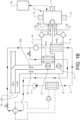
- Fig. 1A is a schematical illustration of an air condition arrangement 1 for a vehicle.
- the air condition arrangement 1 comprises a heat pump system 2 having a compressor 3, a condenser 4 and an evaporator 5.
- the heat pump system 2 has a loop or circuit 6 containing a refrigerant or working fluid.
- the refrigerant can flow in the circuit 6 in a direction from the compressor 3 to the condenser 4 and further from the condenser 4 to the evaporator 5 and from the evaporator 5 back to the compressor 3.
- the circulating direction of the refrigerant (to which the expressions upstream and downstream refer) in the circuit 6 is indicated by arrows 7.
- the compressor 3 is arranged for compressing the refrigerant circulating in the circuit 6 of the heat pump system 2.
- the compressor 3 can be driven by an electric motor (not shown).
- the heat pump system 2 further comprises an expansion valve 8 arranged upstream the evaporator 5 in the circuit 6 at a position between the condenser 4 and the evaporator 5.
- the expansion valve 8 is arranged to regulate a pressure drop of the refrigerant before the evaporator 5.
- the operating principle of the heat pump system 2 can be as follows.
- the refrigerant being in gaseous state is pressurized and circulated through the system by the compressor 3.
- the flow of refrigerant in the circuit 6 is controlled by the operation of the compressor 3.
- the hot and highly pressurized refrigerant is cooled in the condenser 4 until the refrigerant condenses into a high-pressure liquid having a lower temperature.
- the condensed refrigerant passes through the expansion valve 8 and then enters the evaporator 5, where the refrigerant absorbs heat and is evaporated. Thereafter, the flow of refrigerant returns to the compressor 3 and the cycle is repeated.
- the heat pump system 2 can be arranged in the engine compartment of the vehicle.
- the air condition arrangement 1 further comprises an air distribution unit 9 arranged in the vehicle for providing air to a vehicle compartment 10 of the vehicle.
- the air distribution unit 9 may have ports 11, 12, 13, which can be opened and closed, communicating with the vehicle compartment 10, such that air can be used for ventilation, the floor, defroster, etc., of the vehicle.
- the air distribution unit 9 is suitably arranged in immediate vicinity to or in the vehicle compartment 10.
- the air condition arrangement 1 suitably also comprises a HVAC module 14 interacting with the heat pump system 2 which module is connected to the air distribution unit 9 for providing heated or chilled air to the air distribution unit 9.
- the HVAC module 14 is suitably arranged in the engine compartment of the vehicle.
- the HVAC module 14 comprises a condenser fan duct 15 arranged to provide air from outside 16 the vehicle to the air distribution unit 9.
- the condenser fan duct 15 extends from outside 16 the vehicle to the air distribution unit 9.
- the air can be transported by a condenser fan 17 and passes the condenser 4 arranged in the condenser fan duct 15 before reaching the air distribution unit 9.
- the condenser 4 is arranged downstream the compressor 3 in the heat pump system 2 for exchanging heat with the air flowing in the condenser fan duct 15. In this way heated air can be provided to the air distribution unit 9 and further to the vehicle compartment 10.
- the direction of the airflow in the condenser fan duct 15 is indicated by arrows 18.
- the HVAC module comprises an evaporator fan duct 19 arranged to provide air from outside 20 the vehicle to the air distribution unit 9.
- the evaporator fan duct 19 extends from outside 20 the vehicle to the air distribution unit 9.
- the air can be transported by an evaporator fan 21 and passes the evaporator 5 arranged in the evaporator fan duct 19 before reaching the air distribution unit 9.
- the evaporator 5 is arranged upstream the compressor 3 in the heat pump system 2 for exchanging heat with the air flowing in the evaporator fan duct 19.
- chilled air can be provided to the air distribution unit 9 and further to the vehicle compartment 10.
- the direction of the airflow in the evaporator fan duct 19 is indicated by arrows 22.
- the condenser fan duct 15 and the evaporator fan duct 19 are suitably separate ducts which apart from being connected to the air distribution unit 9 have channels 23, 24 for providing air, which channels 23, 24 are separated from each other.
- a flow of air heated by the condenser 4 by work from the compressor 3 is directed to the evaporator 5.
- the air flow directed to the evaporator 5 can be a part of the flow, suitably a major part of the flow and preferably substantially the entire air flow passing the condenser. This is indicated with arrows 18, 22b showing the airflow from outside 16 the vehicle in the condenser fan duct 15 to the condenser 4 and further to the air distribution unit 9 and thereafter in the evaporator fan duct 19 from the air distribution unit 9 to the evaporator 5 and further to outside 20 the vehicle.
- the method is applied temporarily, such as during a certain time period at start up in cold weather.
- the reversed flow (as compared to normal operation) in the evaporator fan duct 19 is stopped and both the condenser fan duct 15 and the evaporator fan duct 19 can be used again for providing air from outside 16, 20 the vehicle to the air distribution unit 9, as illustrated in Fig. 1A .
- the reversed flow of heated air can also be used for increasing the temperature of a filter 25 for the purpose of regenerating the filter 25.
- a filter 25 can be arranged in the evaporator fan duct 19, for example close to the air distribution unit 9.
- Fig. 1B also shows a control unit 26 controlling the air condition arrangement 9.
- the control unit 26 is configured to control the air distribution unit 9 to redirect an air flow from the condenser fan duct 15 incoming to the air distribution unit 9, to the evaporator fan duct 19 such that the air from the condenser fan duct 15 will flow in the evaporator fan duct 19 in the reversed direction 22b from the air distribution unit 9 to the outside 20 of the vehicle.
- the heat pump system 2 is "short circuited" with respect to the energy flow, since energy of the air heated by the condenser 4 can be transferred to the evaporator 5 and further to the refrigerant of the circuit 6.
- the control unit 26 may comprise one or more microprocessors and/or one or more memory devices or any other components for executing computer programs or receiving and/or sending control signals for providing the control function. Particularly, the control unit 26 is provided with a computer program comprising program code means for performing all steps of any embodiment of the method described herein.
- the control unit 26 can be a separate component or be integrated in another controller.
Landscapes
- Physics & Mathematics (AREA)
- Thermal Sciences (AREA)
- Engineering & Computer Science (AREA)
- Mechanical Engineering (AREA)
- Air-Conditioning For Vehicles (AREA)
Description
- The invention relates to a method and a control unit for controlling an air condition arrangement of a vehicle.
- An air condition arrangement of a vehicle usually comprises a heat pump system with a refrigerant loop and a HVAC module arranged in the engine compartment of the vehicle. In addition, an air distribution unit connected to the HVAC module can be arranged in the vehicle compartment for controlling the airflow into the vehicle compartment.
- Such an air condition arrangement sometimes does not work in an optimal way since the heat pump system has low performance at start up in cold weather.
- Document
DE102020007164 describes an air conditioner for a vehicle where a heat pump system comprises a condenser and an evaporator. Air heated by the condenser can be directed to the evaporator by means of a by-pass duct. - An objective of the invention is to provide a method for controlling an air condition arrangement of a vehicle, by which method an improved performance of the air condition arrangement when used in cold weather can be achieved.
- The objective is achieved by a method for controlling an air condition arrangement of a vehicle according to claim 1 and a control unit according to
claim 6. - The invention is based on the insight that such a method resulting in that the heat pump system is at least partly "short-circuited" with respect to the energy flow of the heat pump system, can be used for increasing the performance of the air condition arrangement. The air heated by the condenser can be directed to the evaporator in a rational way without or with a minimum of additional equipment added to the air condition arrangement.
- According to one embodiment, the method comprises transferring energy to a low-pressure side of the heat pump system via the evaporator by directing the air flow to the evaporator. Hereby, the pressure at the low pressure side of the heat pump system can be increased and the time required before the heat pump is able to work at nominal power in cold weather can be shorted.
- According to a further embodiment, the method comprises increasing the temperature of the evaporator by directing the air flow to the evaporator. Hereby, the evaporator can be defrosted after have been running at sub-zero degrees centigrade for a period of time.
- According to a further embodiment, the method comprises regenerating a filter arranged in the evaporator fan duct by directing the air flow to the filter. The air is preferably heated to a temperature over 60°C by the condenser. Hereby, humidity can be removed from a filter, such as an active carbon filter, and the filter can regain filtering capacity.
- The invention also relates to a control unit controlling an air condition arrangement of a vehicle. The advantages of the control unit are similar to the advantages already discussed hereinabove with reference to different embodiments of the method.
- Further advantages and advantageous features of the invention are disclosed in the following description and in the claims.
- With reference to the appended drawings, below follows a more detailed description of embodiments of the invention cited as examples.
- In the drawings:
-
Fig. 1A is a schematic illustration of an air condition arrangement for a vehicle, and -
Fig. 1B shows how the air condition arrangement inFig. 1A can be used. -
Fig. 1A is a schematical illustration of an air condition arrangement 1 for a vehicle. - The air condition arrangement 1 comprises a
heat pump system 2 having acompressor 3, acondenser 4 and anevaporator 5. Theheat pump system 2 has a loop orcircuit 6 containing a refrigerant or working fluid. The refrigerant can flow in thecircuit 6 in a direction from thecompressor 3 to thecondenser 4 and further from thecondenser 4 to theevaporator 5 and from theevaporator 5 back to thecompressor 3. The circulating direction of the refrigerant (to which the expressions upstream and downstream refer) in thecircuit 6 is indicated byarrows 7. Thecompressor 3 is arranged for compressing the refrigerant circulating in thecircuit 6 of theheat pump system 2. Thecompressor 3 can be driven by an electric motor (not shown). Theheat pump system 2 further comprises anexpansion valve 8 arranged upstream theevaporator 5 in thecircuit 6 at a position between thecondenser 4 and theevaporator 5. Theexpansion valve 8 is arranged to regulate a pressure drop of the refrigerant before theevaporator 5. - The operating principle of the
heat pump system 2 can be as follows. The refrigerant being in gaseous state is pressurized and circulated through the system by thecompressor 3. The flow of refrigerant in thecircuit 6 is controlled by the operation of thecompressor 3. After passing thecompressor 3, the hot and highly pressurized refrigerant is cooled in thecondenser 4 until the refrigerant condenses into a high-pressure liquid having a lower temperature. The condensed refrigerant passes through theexpansion valve 8 and then enters theevaporator 5, where the refrigerant absorbs heat and is evaporated. Thereafter, the flow of refrigerant returns to thecompressor 3 and the cycle is repeated. Theheat pump system 2 can be arranged in the engine compartment of the vehicle. - The air condition arrangement 1 further comprises an
air distribution unit 9 arranged in the vehicle for providing air to avehicle compartment 10 of the vehicle. Theair distribution unit 9 may haveports vehicle compartment 10, such that air can be used for ventilation, the floor, defroster, etc., of the vehicle. Theair distribution unit 9 is suitably arranged in immediate vicinity to or in thevehicle compartment 10. - The air condition arrangement 1 suitably also comprises a
HVAC module 14 interacting with theheat pump system 2 which module is connected to theair distribution unit 9 for providing heated or chilled air to theair distribution unit 9. TheHVAC module 14 is suitably arranged in the engine compartment of the vehicle. - In the example embodiment illustrated in
Fig. 1A , theHVAC module 14 comprises acondenser fan duct 15 arranged to provide air from outside 16 the vehicle to theair distribution unit 9. Thecondenser fan duct 15 extends from outside 16 the vehicle to theair distribution unit 9. The air can be transported by acondenser fan 17 and passes thecondenser 4 arranged in thecondenser fan duct 15 before reaching theair distribution unit 9. In other words; thecondenser 4 is arranged downstream thecompressor 3 in theheat pump system 2 for exchanging heat with the air flowing in thecondenser fan duct 15. In this way heated air can be provided to theair distribution unit 9 and further to thevehicle compartment 10. The direction of the airflow in thecondenser fan duct 15 is indicated byarrows 18. - Further, the HVAC module comprises an
evaporator fan duct 19 arranged to provide air from outside 20 the vehicle to theair distribution unit 9. Theevaporator fan duct 19 extends from outside 20 the vehicle to theair distribution unit 9. The air can be transported by anevaporator fan 21 and passes theevaporator 5 arranged in theevaporator fan duct 19 before reaching theair distribution unit 9. In other words; theevaporator 5 is arranged upstream thecompressor 3 in theheat pump system 2 for exchanging heat with the air flowing in theevaporator fan duct 19. In this way chilled air can be provided to theair distribution unit 9 and further to thevehicle compartment 10. The direction of the airflow in theevaporator fan duct 19 is indicated byarrows 22. - The
condenser fan duct 15 and theevaporator fan duct 19 are suitably separate ducts which apart from being connected to theair distribution unit 9 havechannels 23, 24 for providing air, whichchannels 23, 24 are separated from each other. - With reference to
Fig. 1B , an example embodiment of the method are described. A flow of air heated by thecondenser 4 by work from thecompressor 3 is directed to theevaporator 5. The air flow directed to theevaporator 5 can be a part of the flow, suitably a major part of the flow and preferably substantially the entire air flow passing the condenser. This is indicated witharrows condenser fan duct 15 to thecondenser 4 and further to theair distribution unit 9 and thereafter in theevaporator fan duct 19 from theair distribution unit 9 to theevaporator 5 and further to outside 20 the vehicle. - The method is applied temporarily, such as during a certain time period at start up in cold weather. As soon as sufficient energy has been transferred via the
evaporator 5 to the low-pressure side of theheat pump system 2 enabling the heat pump system to work at nominal power or the temperature of theevaporator 5 has been increased sufficiently for defrosting theevaporator 5, the reversed flow (as compared to normal operation) in theevaporator fan duct 19 is stopped and both thecondenser fan duct 15 and theevaporator fan duct 19 can be used again for providing air from outside 16, 20 the vehicle to theair distribution unit 9, as illustrated inFig. 1A . - The reversed flow of heated air can also be used for increasing the temperature of a
filter 25 for the purpose of regenerating thefilter 25. Such afilter 25 can be arranged in theevaporator fan duct 19, for example close to theair distribution unit 9. -
Fig. 1B also shows acontrol unit 26 controlling theair condition arrangement 9. Thecontrol unit 26 is configured to control theair distribution unit 9 to redirect an air flow from thecondenser fan duct 15 incoming to theair distribution unit 9, to theevaporator fan duct 19 such that the air from thecondenser fan duct 15 will flow in theevaporator fan duct 19 in the reverseddirection 22b from theair distribution unit 9 to the outside 20 of the vehicle. This can be performed by closing allports air distribution unit 9 normally used for providing air into thevehicle compartment 10, while aport 27 between thecondenser fan duct 15 and theair distribution unit 9, whichport 27 can be opened and closed for communication with theair distribution unit 9, is open at the same time as aport 28 between theevaporator fan duct 19 and theair distribution unit 9, whichport 28 can be opened and closed for communication with theair distribution unit 9, is open as well. In this way, theheat pump system 2 is "short circuited" with respect to the energy flow, since energy of the air heated by thecondenser 4 can be transferred to theevaporator 5 and further to the refrigerant of thecircuit 6. - Furter, in this reverse mode where air flows in the reversed
direction 22b in theevaporator fan duct 19, thecondenser fan 17 is driven whereas theevaporator fan 21 is not running. - The
control unit 26 may comprise one or more microprocessors and/or one or more memory devices or any other components for executing computer programs or receiving and/or sending control signals for providing the control function. Particularly, thecontrol unit 26 is provided with a computer program comprising program code means for performing all steps of any embodiment of the method described herein. Thecontrol unit 26 can be a separate component or be integrated in another controller. - It is to be understood that the present invention is not limited to the embodiments described above and illustrated in the drawings; rather, the skilled person will recognize that many changes and modifications may be made within the scope of the appended claims.
Claims (7)
- A method for controlling an air condition arrangement (1) of a vehicle, the air condition arrangement (1) comprising a heat pump system (2) having a compressor (3), a condenser (4) and an evaporator (5), the method comprising directing a flow of air heated by the condenser (4) by work from the compressor (3) to the evaporator (5), wherein the air condition arrangement (1) comprising an air distribution unit (9) arranged in the vehicle for providing air to a vehicle compartment (10) of the vehicle, and a condenser fan duct (15) providing air from outside (16) the vehicle to the air distribution unit (9), which air passes the condenser (4) arranged in the condenser fan duct before reaching the air distribution unit, and an evaporator fan duct (19) providing air from outside (20) the vehicle to the air distribution unit (9), which air passes the evaporator (5) arranged in the evaporator fan duct before reaching the air distribution unit, characterized by redirecting an air flow from the condenser fan duct (15) incoming to the air distribution unit (9), to the evaporator fan duct (19) such that the air from the condenser fan duct will flow in the evaporator fan duct in a reversed direction (22b) from the air distribution unit (9) to the outside (20) of the vehicle.
- A method according to claim 1, characterized by transferring energy to a low-pressure side of the heat pump system (2) via the evaporator (5) by directing the air flow to the evaporator (5).
- A method according to claim 1 or 2, characterized by increasing the temperature of the evaporator (5) by directing the air flow to the evaporator (5).
- A method according to claim 1, characterized by regenerating a filter (25) arranged in the evaporator fan duct (19) by directing the air flow to the filter.
- A method according to claim 4, characterized by heating the air to a temperature over 60°C by the condenser (4).
- A control unit (26) controlling an air condition arrangement (1) of a vehicle, the air condition arrangement (1) comprising a heat pump system (2) having a compressor (3), a condenser (4) and an evaporator (5), the air condition arrangement further comprising an air distribution unit (9) arranged in the vehicle for providing air to a vehicle compartment (10) of the vehicle, and a condenser fan duct (15) providing air from outside (16) the vehicle to the air distribution unit, which air passes the condenser (4) arranged in the condenser fan duct before reaching the air distribution unit, and an evaporator fan duct (19) providing air from outside (20) the vehicle to the air distribution unit, which air passes the evaporator (5) arranged in the evaporator fan duct before reaching the air distribution unit, characterized in that the control unit (26) is configured to control the air distribution unit (9) to redirect an air flow from the condenser fan duct (15) incoming to the air distribution unit, to the evaporator fan duct (19) such that the air from the condenser fan duct will flow in the evaporator fan duct in a reversed direction (22b) from the air distribution unit (9) to the outside (20) of the vehicle.
- A computer program comprising program code means which, when the program is executed by a computer, cause the computer to carry out a method according to any of claims 1-5.
Priority Applications (4)
| Application Number | Priority Date | Filing Date | Title |
|---|---|---|---|
| EP21205308.6A EP4173859B1 (en) | 2021-10-28 | 2021-10-28 | A method for controlling an air condition arrangement of a vehicle |
| CN202280070999.XA CN118139753A (en) | 2021-10-28 | 2022-10-10 | Method for controlling an air conditioning device of a vehicle |
| PCT/CN2022/124404 WO2023071762A1 (en) | 2021-10-28 | 2022-10-10 | A method for controlling an air condition arrangement of a vehicle |
| US18/630,678 US12508870B2 (en) | 2021-10-28 | 2024-04-09 | Method for controlling an air condition arrangement of a vehicle |
Applications Claiming Priority (1)
| Application Number | Priority Date | Filing Date | Title |
|---|---|---|---|
| EP21205308.6A EP4173859B1 (en) | 2021-10-28 | 2021-10-28 | A method for controlling an air condition arrangement of a vehicle |
Publications (2)
| Publication Number | Publication Date |
|---|---|
| EP4173859A1 EP4173859A1 (en) | 2023-05-03 |
| EP4173859B1 true EP4173859B1 (en) | 2024-08-21 |
Family
ID=78414384
Family Applications (1)
| Application Number | Title | Priority Date | Filing Date |
|---|---|---|---|
| EP21205308.6A Active EP4173859B1 (en) | 2021-10-28 | 2021-10-28 | A method for controlling an air condition arrangement of a vehicle |
Country Status (4)
| Country | Link |
|---|---|
| US (1) | US12508870B2 (en) |
| EP (1) | EP4173859B1 (en) |
| CN (1) | CN118139753A (en) |
| WO (1) | WO2023071762A1 (en) |
Family Cites Families (8)
| Publication number | Priority date | Publication date | Assignee | Title |
|---|---|---|---|---|
| FR2743027B1 (en) * | 1995-12-29 | 1998-01-23 | Renault | AIR CONDITIONING DEVICE FOR THE VEHICLE INTERIOR |
| JP4120105B2 (en) | 1998-11-10 | 2008-07-16 | 株式会社デンソー | Air conditioner |
| DE10202968A1 (en) * | 2002-01-26 | 2003-07-31 | Behr Gmbh & Co | Heating or air conditioning for a motor vehicle |
| JP2005053325A (en) | 2003-08-04 | 2005-03-03 | Calsonic Kansei Corp | Air conditioner for vehicles |
| JP2013141932A (en) * | 2012-01-12 | 2013-07-22 | Panasonic Corp | Vehicle air conditioner |
| FR2987104B1 (en) | 2012-02-16 | 2018-05-25 | Valeo Systemes Thermiques | AIR CONDITIONING LOOP OPERATING IN HEAT PUMP WITH IMPULSE DEFROSTING. |
| WO2018190081A1 (en) | 2017-04-10 | 2018-10-18 | 一般財団法人電力中央研究所 | Electric-powered vehicle |
| DE102020007164A1 (en) * | 2020-11-23 | 2021-01-07 | Daimler Ag | Air conditioning for a heat pump operation |
-
2021
- 2021-10-28 EP EP21205308.6A patent/EP4173859B1/en active Active
-
2022
- 2022-10-10 CN CN202280070999.XA patent/CN118139753A/en active Pending
- 2022-10-10 WO PCT/CN2022/124404 patent/WO2023071762A1/en not_active Ceased
-
2024
- 2024-04-09 US US18/630,678 patent/US12508870B2/en active Active
Also Published As
| Publication number | Publication date |
|---|---|
| CN118139753A (en) | 2024-06-04 |
| WO2023071762A1 (en) | 2023-05-04 |
| EP4173859A1 (en) | 2023-05-03 |
| US12508870B2 (en) | 2025-12-30 |
| US20240270047A1 (en) | 2024-08-15 |
Similar Documents
| Publication | Publication Date | Title |
|---|---|---|
| CN111688432B (en) | Vehicle temperature control device | |
| CN109140815B (en) | Thermal management system and flow control device | |
| EP3025884A1 (en) | Vehicular air conditioning device, and constituent unit thereof | |
| EP2072298A1 (en) | Air conditioning system for vehicle | |
| CN109140816B (en) | Thermal management system | |
| KR20220122391A (en) | Heating control method of thermal management system for vehicle | |
| US10350964B2 (en) | Air conditioning device for vehicle | |
| EP3828020A1 (en) | Air conditioning device for vehicle | |
| CN111683829B (en) | Refrigerant fluid circuit | |
| CN110402203A (en) | Refrigeration plant for a vehicle with a refrigerant medium circuit that can operate as a refrigeration circuit for AC operation and as a heat pump circuit for heating operation | |
| KR20220036260A (en) | Vehicle thermal management system | |
| KR20200060633A (en) | Cooling and heating system for vehicle | |
| WO2023032826A1 (en) | Heat pump air conditioning system | |
| CN109982877B (en) | Vehicle heat pump system | |
| US20030056530A1 (en) | Combined heating and cooling system | |
| KR102694356B1 (en) | Heat pump system for vehicle | |
| CN109383214B (en) | Thermal management system | |
| EP4173859B1 (en) | A method for controlling an air condition arrangement of a vehicle | |
| KR102637895B1 (en) | Heat management system of vehicle | |
| JP6241663B2 (en) | Air conditioner for vehicles | |
| EP3689652A1 (en) | Vehicular air-conditioning device | |
| KR102882182B1 (en) | Automotive thermal management system | |
| KR20200055196A (en) | Cooling and heating system for vehicle | |
| US12508871B2 (en) | Refrigerant-coolant heat pump system of electric vehicles | |
| KR20250108204A (en) | Thermal management system for vehicle |
Legal Events
| Date | Code | Title | Description |
|---|---|---|---|
| PUAI | Public reference made under article 153(3) epc to a published international application that has entered the european phase |
Free format text: ORIGINAL CODE: 0009012 |
|
| STAA | Information on the status of an ep patent application or granted ep patent |
Free format text: STATUS: REQUEST FOR EXAMINATION WAS MADE |
|
| 17P | Request for examination filed |
Effective date: 20211028 |
|
| AK | Designated contracting states |
Kind code of ref document: A1 Designated state(s): AL AT BE BG CH CY CZ DE DK EE ES FI FR GB GR HR HU IE IS IT LI LT LU LV MC MK MT NL NO PL PT RO RS SE SI SK SM TR |
|
| GRAJ | Information related to disapproval of communication of intention to grant by the applicant or resumption of examination proceedings by the epo deleted |
Free format text: ORIGINAL CODE: EPIDOSDIGR1 |
|
| STAA | Information on the status of an ep patent application or granted ep patent |
Free format text: STATUS: GRANT OF PATENT IS INTENDED |
|
| GRAP | Despatch of communication of intention to grant a patent |
Free format text: ORIGINAL CODE: EPIDOSNIGR1 |
|
| INTG | Intention to grant announced |
Effective date: 20240402 |
|
| GRAS | Grant fee paid |
Free format text: ORIGINAL CODE: EPIDOSNIGR3 |
|
| GRAA | (expected) grant |
Free format text: ORIGINAL CODE: 0009210 |
|
| STAA | Information on the status of an ep patent application or granted ep patent |
Free format text: STATUS: THE PATENT HAS BEEN GRANTED |
|
| AK | Designated contracting states |
Kind code of ref document: B1 Designated state(s): AL AT BE BG CH CY CZ DE DK EE ES FI FR GB GR HR HU IE IS IT LI LT LU LV MC MK MT NL NO PL PT RO RS SE SI SK SM TR |
|
| REG | Reference to a national code |
Ref country code: GB Ref legal event code: FG4D |
|
| REG | Reference to a national code |
Ref country code: CH Ref legal event code: EP |
|
| REG | Reference to a national code |
Ref country code: IE Ref legal event code: FG4D |
|
| REG | Reference to a national code |
Ref country code: DE Ref legal event code: R096 Ref document number: 602021017457 Country of ref document: DE |
|
| REG | Reference to a national code |
Ref country code: LT Ref legal event code: MG9D |
|
| REG | Reference to a national code |
Ref country code: NL Ref legal event code: MP Effective date: 20240821 |
|
| PG25 | Lapsed in a contracting state [announced via postgrant information from national office to epo] |
Ref country code: NO Free format text: LAPSE BECAUSE OF FAILURE TO SUBMIT A TRANSLATION OF THE DESCRIPTION OR TO PAY THE FEE WITHIN THE PRESCRIBED TIME-LIMIT Effective date: 20241121 |
|
| REG | Reference to a national code |
Ref country code: AT Ref legal event code: MK05 Ref document number: 1715204 Country of ref document: AT Kind code of ref document: T Effective date: 20240821 |
|
| PG25 | Lapsed in a contracting state [announced via postgrant information from national office to epo] |
Ref country code: NL Free format text: LAPSE BECAUSE OF FAILURE TO SUBMIT A TRANSLATION OF THE DESCRIPTION OR TO PAY THE FEE WITHIN THE PRESCRIBED TIME-LIMIT Effective date: 20240821 Ref country code: PL Free format text: LAPSE BECAUSE OF FAILURE TO SUBMIT A TRANSLATION OF THE DESCRIPTION OR TO PAY THE FEE WITHIN THE PRESCRIBED TIME-LIMIT Effective date: 20240821 Ref country code: FI Free format text: LAPSE BECAUSE OF FAILURE TO SUBMIT A TRANSLATION OF THE DESCRIPTION OR TO PAY THE FEE WITHIN THE PRESCRIBED TIME-LIMIT Effective date: 20240821 Ref country code: PT Free format text: LAPSE BECAUSE OF FAILURE TO SUBMIT A TRANSLATION OF THE DESCRIPTION OR TO PAY THE FEE WITHIN THE PRESCRIBED TIME-LIMIT Effective date: 20241223 |
|
| PG25 | Lapsed in a contracting state [announced via postgrant information from national office to epo] |
Ref country code: BG Free format text: LAPSE BECAUSE OF FAILURE TO SUBMIT A TRANSLATION OF THE DESCRIPTION OR TO PAY THE FEE WITHIN THE PRESCRIBED TIME-LIMIT Effective date: 20240821 |
|
| PG25 | Lapsed in a contracting state [announced via postgrant information from national office to epo] |
Ref country code: LV Free format text: LAPSE BECAUSE OF FAILURE TO SUBMIT A TRANSLATION OF THE DESCRIPTION OR TO PAY THE FEE WITHIN THE PRESCRIBED TIME-LIMIT Effective date: 20240821 |
|
| PG25 | Lapsed in a contracting state [announced via postgrant information from national office to epo] |
Ref country code: AT Free format text: LAPSE BECAUSE OF FAILURE TO SUBMIT A TRANSLATION OF THE DESCRIPTION OR TO PAY THE FEE WITHIN THE PRESCRIBED TIME-LIMIT Effective date: 20240821 Ref country code: IS Free format text: LAPSE BECAUSE OF FAILURE TO SUBMIT A TRANSLATION OF THE DESCRIPTION OR TO PAY THE FEE WITHIN THE PRESCRIBED TIME-LIMIT Effective date: 20241221 |
|
| PG25 | Lapsed in a contracting state [announced via postgrant information from national office to epo] |
Ref country code: HR Free format text: LAPSE BECAUSE OF FAILURE TO SUBMIT A TRANSLATION OF THE DESCRIPTION OR TO PAY THE FEE WITHIN THE PRESCRIBED TIME-LIMIT Effective date: 20240821 |
|
| PG25 | Lapsed in a contracting state [announced via postgrant information from national office to epo] |
Ref country code: RS Free format text: LAPSE BECAUSE OF FAILURE TO SUBMIT A TRANSLATION OF THE DESCRIPTION OR TO PAY THE FEE WITHIN THE PRESCRIBED TIME-LIMIT Effective date: 20241121 Ref country code: ES Free format text: LAPSE BECAUSE OF FAILURE TO SUBMIT A TRANSLATION OF THE DESCRIPTION OR TO PAY THE FEE WITHIN THE PRESCRIBED TIME-LIMIT Effective date: 20240821 |
|
| PG25 | Lapsed in a contracting state [announced via postgrant information from national office to epo] |
Ref country code: RS Free format text: LAPSE BECAUSE OF FAILURE TO SUBMIT A TRANSLATION OF THE DESCRIPTION OR TO PAY THE FEE WITHIN THE PRESCRIBED TIME-LIMIT Effective date: 20241121 Ref country code: PT Free format text: LAPSE BECAUSE OF FAILURE TO SUBMIT A TRANSLATION OF THE DESCRIPTION OR TO PAY THE FEE WITHIN THE PRESCRIBED TIME-LIMIT Effective date: 20241223 Ref country code: PL Free format text: LAPSE BECAUSE OF FAILURE TO SUBMIT A TRANSLATION OF THE DESCRIPTION OR TO PAY THE FEE WITHIN THE PRESCRIBED TIME-LIMIT Effective date: 20240821 Ref country code: NO Free format text: LAPSE BECAUSE OF FAILURE TO SUBMIT A TRANSLATION OF THE DESCRIPTION OR TO PAY THE FEE WITHIN THE PRESCRIBED TIME-LIMIT Effective date: 20241121 Ref country code: NL Free format text: LAPSE BECAUSE OF FAILURE TO SUBMIT A TRANSLATION OF THE DESCRIPTION OR TO PAY THE FEE WITHIN THE PRESCRIBED TIME-LIMIT Effective date: 20240821 Ref country code: LV Free format text: LAPSE BECAUSE OF FAILURE TO SUBMIT A TRANSLATION OF THE DESCRIPTION OR TO PAY THE FEE WITHIN THE PRESCRIBED TIME-LIMIT Effective date: 20240821 Ref country code: IS Free format text: LAPSE BECAUSE OF FAILURE TO SUBMIT A TRANSLATION OF THE DESCRIPTION OR TO PAY THE FEE WITHIN THE PRESCRIBED TIME-LIMIT Effective date: 20241221 Ref country code: HR Free format text: LAPSE BECAUSE OF FAILURE TO SUBMIT A TRANSLATION OF THE DESCRIPTION OR TO PAY THE FEE WITHIN THE PRESCRIBED TIME-LIMIT Effective date: 20240821 Ref country code: FI Free format text: LAPSE BECAUSE OF FAILURE TO SUBMIT A TRANSLATION OF THE DESCRIPTION OR TO PAY THE FEE WITHIN THE PRESCRIBED TIME-LIMIT Effective date: 20240821 Ref country code: ES Free format text: LAPSE BECAUSE OF FAILURE TO SUBMIT A TRANSLATION OF THE DESCRIPTION OR TO PAY THE FEE WITHIN THE PRESCRIBED TIME-LIMIT Effective date: 20240821 Ref country code: BG Free format text: LAPSE BECAUSE OF FAILURE TO SUBMIT A TRANSLATION OF THE DESCRIPTION OR TO PAY THE FEE WITHIN THE PRESCRIBED TIME-LIMIT Effective date: 20240821 Ref country code: AT Free format text: LAPSE BECAUSE OF FAILURE TO SUBMIT A TRANSLATION OF THE DESCRIPTION OR TO PAY THE FEE WITHIN THE PRESCRIBED TIME-LIMIT Effective date: 20240821 |
|
| PG25 | Lapsed in a contracting state [announced via postgrant information from national office to epo] |
Ref country code: SM Free format text: LAPSE BECAUSE OF FAILURE TO SUBMIT A TRANSLATION OF THE DESCRIPTION OR TO PAY THE FEE WITHIN THE PRESCRIBED TIME-LIMIT Effective date: 20240821 Ref country code: RO Free format text: LAPSE BECAUSE OF FAILURE TO SUBMIT A TRANSLATION OF THE DESCRIPTION OR TO PAY THE FEE WITHIN THE PRESCRIBED TIME-LIMIT Effective date: 20240821 Ref country code: DK Free format text: LAPSE BECAUSE OF FAILURE TO SUBMIT A TRANSLATION OF THE DESCRIPTION OR TO PAY THE FEE WITHIN THE PRESCRIBED TIME-LIMIT Effective date: 20240821 |
|
| PG25 | Lapsed in a contracting state [announced via postgrant information from national office to epo] |
Ref country code: EE Free format text: LAPSE BECAUSE OF FAILURE TO SUBMIT A TRANSLATION OF THE DESCRIPTION OR TO PAY THE FEE WITHIN THE PRESCRIBED TIME-LIMIT Effective date: 20240821 |
|
| PG25 | Lapsed in a contracting state [announced via postgrant information from national office to epo] |
Ref country code: CZ Free format text: LAPSE BECAUSE OF FAILURE TO SUBMIT A TRANSLATION OF THE DESCRIPTION OR TO PAY THE FEE WITHIN THE PRESCRIBED TIME-LIMIT Effective date: 20240821 |
|
| PG25 | Lapsed in a contracting state [announced via postgrant information from national office to epo] |
Ref country code: SK Free format text: LAPSE BECAUSE OF FAILURE TO SUBMIT A TRANSLATION OF THE DESCRIPTION OR TO PAY THE FEE WITHIN THE PRESCRIBED TIME-LIMIT Effective date: 20240821 Ref country code: IT Free format text: LAPSE BECAUSE OF FAILURE TO SUBMIT A TRANSLATION OF THE DESCRIPTION OR TO PAY THE FEE WITHIN THE PRESCRIBED TIME-LIMIT Effective date: 20240821 |
|
| REG | Reference to a national code |
Ref country code: DE Ref legal event code: R097 Ref document number: 602021017457 Country of ref document: DE |
|
| REG | Reference to a national code |
Ref country code: CH Ref legal event code: PL |
|
| PLBE | No opposition filed within time limit |
Free format text: ORIGINAL CODE: 0009261 |
|
| STAA | Information on the status of an ep patent application or granted ep patent |
Free format text: STATUS: NO OPPOSITION FILED WITHIN TIME LIMIT |
|
| PG25 | Lapsed in a contracting state [announced via postgrant information from national office to epo] |
Ref country code: MC Free format text: LAPSE BECAUSE OF FAILURE TO SUBMIT A TRANSLATION OF THE DESCRIPTION OR TO PAY THE FEE WITHIN THE PRESCRIBED TIME-LIMIT Effective date: 20240821 |
|
| PG25 | Lapsed in a contracting state [announced via postgrant information from national office to epo] |
Ref country code: LU Free format text: LAPSE BECAUSE OF NON-PAYMENT OF DUE FEES Effective date: 20241028 Ref country code: BE Free format text: LAPSE BECAUSE OF NON-PAYMENT OF DUE FEES Effective date: 20241031 |
|
| PG25 | Lapsed in a contracting state [announced via postgrant information from national office to epo] |
Ref country code: CH Free format text: LAPSE BECAUSE OF NON-PAYMENT OF DUE FEES Effective date: 20241031 |
|
| 26N | No opposition filed |
Effective date: 20250522 |
|
| REG | Reference to a national code |
Ref country code: BE Ref legal event code: MM Effective date: 20241031 |
|
| PG25 | Lapsed in a contracting state [announced via postgrant information from national office to epo] |
Ref country code: SE Free format text: LAPSE BECAUSE OF FAILURE TO SUBMIT A TRANSLATION OF THE DESCRIPTION OR TO PAY THE FEE WITHIN THE PRESCRIBED TIME-LIMIT Effective date: 20240821 |
|
| PGFP | Annual fee paid to national office [announced via postgrant information from national office to epo] |
Ref country code: GB Payment date: 20250825 Year of fee payment: 5 |
|
| PGFP | Annual fee paid to national office [announced via postgrant information from national office to epo] |
Ref country code: FR Payment date: 20250820 Year of fee payment: 5 |
|
| PG25 | Lapsed in a contracting state [announced via postgrant information from national office to epo] |
Ref country code: IE Free format text: LAPSE BECAUSE OF NON-PAYMENT OF DUE FEES Effective date: 20241028 |
|
| PGFP | Annual fee paid to national office [announced via postgrant information from national office to epo] |
Ref country code: DE Payment date: 20251020 Year of fee payment: 5 |
|
| PG25 | Lapsed in a contracting state [announced via postgrant information from national office to epo] |
Ref country code: HU Free format text: LAPSE BECAUSE OF FAILURE TO SUBMIT A TRANSLATION OF THE DESCRIPTION OR TO PAY THE FEE WITHIN THE PRESCRIBED TIME-LIMIT; INVALID AB INITIO Effective date: 20211028 |
|
| PG25 | Lapsed in a contracting state [announced via postgrant information from national office to epo] |
Ref country code: CY Free format text: LAPSE BECAUSE OF FAILURE TO SUBMIT A TRANSLATION OF THE DESCRIPTION OR TO PAY THE FEE WITHIN THE PRESCRIBED TIME-LIMIT; INVALID AB INITIO Effective date: 20211028 |