EP4173853B1 - Aircraft system and method - Google Patents
Aircraft system and method Download PDFInfo
- Publication number
- EP4173853B1 EP4173853B1 EP22204937.1A EP22204937A EP4173853B1 EP 4173853 B1 EP4173853 B1 EP 4173853B1 EP 22204937 A EP22204937 A EP 22204937A EP 4173853 B1 EP4173853 B1 EP 4173853B1
- Authority
- EP
- European Patent Office
- Prior art keywords
- signal
- tire pressure
- configuration data
- pressure monitoring
- monitoring device
- Prior art date
- Legal status (The legal status is an assumption and is not a legal conclusion. Google has not performed a legal analysis and makes no representation as to the accuracy of the status listed.)
- Active
Links
Images







Classifications
-
- B—PERFORMING OPERATIONS; TRANSPORTING
- B60—VEHICLES IN GENERAL
- B60C—VEHICLE TYRES; TYRE INFLATION; TYRE CHANGING; CONNECTING VALVES TO INFLATABLE ELASTIC BODIES IN GENERAL; DEVICES OR ARRANGEMENTS RELATED TO TYRES
- B60C23/00—Devices for measuring, signalling, controlling, or distributing tyre pressure or temperature, specially adapted for mounting on vehicles; Arrangement of tyre inflating devices on vehicles, e.g. of pumps or of tanks; Tyre cooling arrangements
- B60C23/02—Signalling devices actuated by tyre pressure
- B60C23/04—Signalling devices actuated by tyre pressure mounted on the wheel or tyre
- B60C23/0408—Signalling devices actuated by tyre pressure mounted on the wheel or tyre transmitting the signals by non-mechanical means from the wheel or tyre to a vehicle body mounted receiver
- B60C23/0471—System initialisation, e.g. upload or calibration of operating parameters
-
- B—PERFORMING OPERATIONS; TRANSPORTING
- B60—VEHICLES IN GENERAL
- B60C—VEHICLE TYRES; TYRE INFLATION; TYRE CHANGING; CONNECTING VALVES TO INFLATABLE ELASTIC BODIES IN GENERAL; DEVICES OR ARRANGEMENTS RELATED TO TYRES
- B60C23/00—Devices for measuring, signalling, controlling, or distributing tyre pressure or temperature, specially adapted for mounting on vehicles; Arrangement of tyre inflating devices on vehicles, e.g. of pumps or of tanks; Tyre cooling arrangements
- B60C23/02—Signalling devices actuated by tyre pressure
- B60C23/04—Signalling devices actuated by tyre pressure mounted on the wheel or tyre
-
- B—PERFORMING OPERATIONS; TRANSPORTING
- B60—VEHICLES IN GENERAL
- B60C—VEHICLE TYRES; TYRE INFLATION; TYRE CHANGING; CONNECTING VALVES TO INFLATABLE ELASTIC BODIES IN GENERAL; DEVICES OR ARRANGEMENTS RELATED TO TYRES
- B60C23/00—Devices for measuring, signalling, controlling, or distributing tyre pressure or temperature, specially adapted for mounting on vehicles; Arrangement of tyre inflating devices on vehicles, e.g. of pumps or of tanks; Tyre cooling arrangements
- B60C23/02—Signalling devices actuated by tyre pressure
- B60C23/04—Signalling devices actuated by tyre pressure mounted on the wheel or tyre
- B60C23/0401—Signalling devices actuated by tyre pressure mounted on the wheel or tyre characterised by the type of alarm
- B60C23/0406—Alarms noticeable from outside the vehicle, e.g. indication in side mirror, front light or audible alarms
-
- B—PERFORMING OPERATIONS; TRANSPORTING
- B60—VEHICLES IN GENERAL
- B60C—VEHICLE TYRES; TYRE INFLATION; TYRE CHANGING; CONNECTING VALVES TO INFLATABLE ELASTIC BODIES IN GENERAL; DEVICES OR ARRANGEMENTS RELATED TO TYRES
- B60C23/00—Devices for measuring, signalling, controlling, or distributing tyre pressure or temperature, specially adapted for mounting on vehicles; Arrangement of tyre inflating devices on vehicles, e.g. of pumps or of tanks; Tyre cooling arrangements
- B60C23/02—Signalling devices actuated by tyre pressure
- B60C23/04—Signalling devices actuated by tyre pressure mounted on the wheel or tyre
- B60C23/0408—Signalling devices actuated by tyre pressure mounted on the wheel or tyre transmitting the signals by non-mechanical means from the wheel or tyre to a vehicle body mounted receiver
- B60C23/0479—Communicating with external units being not part of the vehicle, e.g. tools for diagnostic, mobile phones, electronic keys or service stations
-
- B—PERFORMING OPERATIONS; TRANSPORTING
- B60—VEHICLES IN GENERAL
- B60C—VEHICLE TYRES; TYRE INFLATION; TYRE CHANGING; CONNECTING VALVES TO INFLATABLE ELASTIC BODIES IN GENERAL; DEVICES OR ARRANGEMENTS RELATED TO TYRES
- B60C23/00—Devices for measuring, signalling, controlling, or distributing tyre pressure or temperature, specially adapted for mounting on vehicles; Arrangement of tyre inflating devices on vehicles, e.g. of pumps or of tanks; Tyre cooling arrangements
- B60C23/02—Signalling devices actuated by tyre pressure
- B60C23/04—Signalling devices actuated by tyre pressure mounted on the wheel or tyre
- B60C23/0408—Signalling devices actuated by tyre pressure mounted on the wheel or tyre transmitting the signals by non-mechanical means from the wheel or tyre to a vehicle body mounted receiver
- B60C23/0483—Wireless routers between wheel mounted transmitters and chassis mounted receivers
-
- B—PERFORMING OPERATIONS; TRANSPORTING
- B60—VEHICLES IN GENERAL
- B60C—VEHICLE TYRES; TYRE INFLATION; TYRE CHANGING; CONNECTING VALVES TO INFLATABLE ELASTIC BODIES IN GENERAL; DEVICES OR ARRANGEMENTS RELATED TO TYRES
- B60C23/00—Devices for measuring, signalling, controlling, or distributing tyre pressure or temperature, specially adapted for mounting on vehicles; Arrangement of tyre inflating devices on vehicles, e.g. of pumps or of tanks; Tyre cooling arrangements
- B60C23/02—Signalling devices actuated by tyre pressure
- B60C23/04—Signalling devices actuated by tyre pressure mounted on the wheel or tyre
- B60C23/0491—Constructional details of means for attaching the control device
- B60C23/0496—Valve stem attachments positioned outside of the tyre chamber
-
- B—PERFORMING OPERATIONS; TRANSPORTING
- B60—VEHICLES IN GENERAL
- B60C—VEHICLE TYRES; TYRE INFLATION; TYRE CHANGING; CONNECTING VALVES TO INFLATABLE ELASTIC BODIES IN GENERAL; DEVICES OR ARRANGEMENTS RELATED TO TYRES
- B60C2200/00—Tyres specially adapted for particular applications
- B60C2200/02—Tyres specially adapted for particular applications for aircrafts
Definitions
- the present invention relates to tire pressure monitoring devices, and methods of communicating configuration data from tire pressure monitoring devices.
- Tire pressure is an important part of the maintenance of a vehicle. Tire pressures should be maintained at predetermined pressures to ensure that a tire performs as intended by the manufacturer. Incorrect tire pressure can lead to a tire failing, perhaps bursting and causing damage to the vehicle and/or a loss of control. To check a tire pressure it is important to know what reference pressure is defined for the tire.
- US6087930 discloses an active integrated circuit transponder with on-board power supply mounted in or on a vehicle tire.
- a pressure sensor, a temperature sensor and a tire rotation sensor are mounted on a substrate along with the integrated circuit transponder chip, the power supply and an antenna.
- the transponder Upon receiving an interrogation signal from a remote source, the transponder activates the sensors to sense tire pressure and temperature and transmits an encoded radio frequency signal to the remote source containing serial, encoded tire identification, tire position on the vehicle, current tire pressure, current tire temperature and accumulated tire revolutions, as well as maximum and/or minimum tire and temperature pressure values encountered over a predetermined time period and other information specific to the tire.
- US2007/193349 discloses a tire pressure gauge for attachment to a valve stem.
- the tire pressure gauge includes a display physically supported on the device.
- JP2003291615 discloses a receiving circuit 17 and a transmitting circuit 18 arranged in sensor devices 14a to 14f, and the data received from other sensor devices 14a to 14f through the receiving circuit 17 are transferred through the transmitting circuit 18 by a CPU 25.
- EP3150408 discloses a method of operating a monitoring system to provide pressure warnings associated with a tyre of an aircraft.
- the monitoring system comprises a flight deck display on a flight deck of the aircraft and a processor.
- EP3991996 discloses a method of communicating configuration data of a tire pressure monitoring device configured to be affixed to a wheel in use
- a first aspect of the present invention provides a method of communicating configuration data of a tire pressure monitoring device configured to be affixed to a wheel in use.
- the method comprises, at the tire pressure monitoring device: receiving a request to confirm configuration data; responsive to receipt of the request to confirm configuration data, transmitting a configuration data signal which encodes the configuration data; wherein the configuration data signal is configured to be received and understood by a human, and the configuration data signal is indicative of any of an aircraft wheel location at which the tire pressure monitoring device is intended to be located, and a security code representative of security parameters of the tire pressure monitoring device, wherein at least one of: the configuration data signal comprises a visual signal, and the visual signal is transmitted using a visual indicator of the trusted tire pressure monitoring device; and the configuration data signal comprises an audible signal, and the audible signal is transmitted using a transducer of the tire pressure monitoring device.
- the configuration data signal By transmitting the configuration data signal from the tire pressure monitoring device, it can be ensured that the configuration data signal has come from a known, trusted, source. Furthermore, by ensuring that the configuration data signal is configured to be received and understood by a human, the need for a trusted device may be reduced and/or eliminated. Thus the required DAL may be achieved without the need for an additional trusted device, and the human receiving the data may verify the data. Untrusted information sources cannot be used to directly verify data when DAL is required in view of their untrusted nature. In the present case, untrusted information sources can be used, with a user interacting with the untrusted device and forming the trusted source.
- the configuration data signal may be configured to be directly transmitted to a human from the tire pressure monitoring device, for example without first being transferred to a further intermediate device.
- Verifying that the aircraft wheel location at which the tire pressure monitoring device is intended to be located is correctly installed in the tire pressure monitoring device may ensure that tire pressure monitoring devices are correctly configured.
- Verifying security codes may, for example, ensure that correct configuration of the tire pressure monitoring device, such as configuration for encrypted communication between tire pressure monitoring devices, has been performed.
- the configuration data signal may comprise a visual signal, and the visual signal may be transmitted using a visual indicator of the trusted tire pressure monitoring device.
- a visual signal is a relatively straightforward signal type, which can be easily received and understood by a human.
- the visual indicator may comprise a light source, and the method then comprises selectively illuminating the light source to transmit the configuration data signal.
- the presence and absence of light can be easily received and understood by a human, and hence the configuration data signal may be relatively simple.
- the light source may comprise a Light Emitting Diode (LED).
- the light source may be a multi-purpose light source, for example a light source configured to provide functionality in addition to transmitting the configuration data signal. This can reduce the cost and complexity of the tire pressure monitoring device.
- the light source may also be configured to be selectively illuminated to display a health status of a tire or a tire system, such as whether a monitored tire pressure is acceptable or if maintenance is required.
- the configuration data signal may comprise a number
- the selective illumination of the light source may comprise encoding the number into an illumination sequence representing individual digits of the number.
- a first number of illuminations of the light source may represent a first digit of the number
- a second number of illuminations of the light source may represent a second digit of the number
- This provides a relatively simple signal which is easily received and understood by a human.
- the number of illuminations may directly correspond to the digit of the number, for example with one illumination representing the digit "1", and five illuminations representing the digit "5".
- Each illumination may be a distinct flash of the light source having an illumination period of at least 100 ms, at least 200 ms, at least 300 ms, at least 400 ms or at least 500 ms, so that it can be observed directly by a human.
- the visual indicator comprises a display of the tire pressure monitoring device.
- the display may be a matrix-display or segment-display on which configuration data can be displayed in readable characters to enable a user to read configuration data from the display.
- the configuration data signal may comprise an audible signal, and the audible signal may be transmitted using a transducer of the trusted tire pressure monitoring device.
- the method may comprise selectively actuating the transducer to transmit the signal.
- the transducer can be caused to beep or a text-to-speech engine can convert configuration data into spoken information.
- Some examples may communicate the configuration data signal using both an audible signal and a visual signal.
- the configuration data signal may comprise a number
- the selective actuation of the transducer may comprise encoding the number into an actuation representing individual digits of the number.
- a first number of actuations or sounds of the transducer may represent a first digit of the number
- a second number of actuations or sounds of the transducer may represent a second digit of the number, and so on. As discussed above this can be easily received and understood by a human.
- the configuration data signal may comprise a start signal indicating a start of transmission, an end signal indicating an end of transmission, and an intermediate signal indicative of configuration data stored in the trusted tire pressure monitoring devices. This helps a human receiving the data configuration signal to interpret it, enabling the start and end, and when the configuration data is meant to be received, to be understood.
- the start signal may comprise a first type of signal
- the intermediate signal may comprise a second type of signal
- the end signal may comprise a third type of signal. This can further distinguish between the start, end and intermediate signals, and provide further clarity for a human as to which signal indicates configuration data.
- the first, second and third types of signal are possible.
- the first and third types of signal may comprise an audible signal and the second type of signal may comprise a visual signal, or vice versa.
- the first type of signal may comprise a first type of visual signal, such as a first colour of light
- the second type of signal may comprise a second type of visual signal, such as a second colour light different to the first colour light
- the third type of signal may comprise a third type of visual signal, such as a third colour light different to the first and second colours of light.
- the configuration data signal may comprise a plurality of sub-signals, each sub-signal comprising a start signal indicating a start of transmission of the sub-signal, an end signal indicating an end of transmission of the sub-signal, and an intermediate signal indicative of at least a portion of configuration data stored in the tire pressure monitoring device.
- Each intermediate signal may be indicative of a portion of configuration data stored in the tire pressure monitoring device.
- each intermediate signal may be indicative of a digit of a reference pressure stored in memory of the tire pressure monitoring device.
- An end signal of a first sub-signal may comprise a start signal of a second sequential sub-signal.
- a same sub-signal signal may indicate the end of one sub-signal and the start of another sub-signal. This can reduce the time required to transmit the configuration data signal.
- each sub-signal is confirmed as being received and understood by a human before a next sequential sub-signal is transmitted. This improves the reliability of the verification of the configuration data because a human receiving the data does not have to rely on their memory to the same extent.
- Each sub-signal may be transmitted in response to verification of a previous sub-signal by a user.
- the method may comprise transmitting an alert indicating that transmission of the configuration data signal is about to begin.
- This may enable a human to know when a signal is to be transmitted for easier understanding and subsequent verification of the data configuration signal. For example, this may enable the configuration data signal to be received, understood, and verified in a stepwise manner, which may be clear to a human.
- the alert can be a different signal from the start signal discussed above and can be additional or alternative to the start signal.
- the alert can be a first type of signal, such as an audible signal, and the start signal can be a second type of signal, such as a visual signal.
- the method may comprise verifying, by a human, that the configuration data of the tire pressure monitoring device matches an expected configuration data. This removes the need for another trusted device to perform verification, because the human may be regarded as a trusted source. Verification by a human that the configuration data of the trusted tire pressure monitoring device matches expected configuration data may take place using an untrusted device, for example by an untrusted intermediate device, such as a smartphone, tablet or other computing device, which provides the user with a prompt of what configuration data is expected. Although the intermediate device is untrusted, if it is faulty or has malicious software installed then the end result will be that the configuration is not verified, so safety is provided. This may reduce cost associated with the verification procedure compared to a process that requires an intermediate, independent, trusted device. It can also more provide more flexibility; because the intermediate device is untrusted its functionality can be provided by an application or app running on different hardware platforms without all those platforms having to be certified.
- Verifying, by a human, that the configuration data of the tire pressure monitoring device matches the expected configuration data may comprise comparing the configuration data to expected configuration contained in an aircraft maintenance manual accessible to the human.
- the expected configuration data may comprise a security code representative of security parameters of a further tire pressure monitoring device.
- the security code representative of security parameters of a further tire pressure monitoring device may be transmitted to the human in a further data configuration signal from the further tire pressure monitoring device.
- the request to confirm configuration data may be received at the tire pressure monitoring device via a short-range communication protocol. This provides security benefits as physical proximity is required and can also provide an operational benefit if the range is short enough that is generally received by a single device to prevent a request from being picked-up by a wrong tire pressure monitoring device.
- the request may be submitted via a communication protocol with a range of less than 5m, less than 2m, less than 1m, less than 50cm, less than 30cm or less than 15cm. Suitable communication protocols include Near Field Communication (NFC).
- NFC Near Field Communication
- no identifier is included in the request to confirm configuration data, with a short range of transmission and physical proximity indicating the device to respond.
- the request may include a unique identifier of a device.
- the unique identifier may be input by a user by reading a marking on the tire pressure monitoring device or determined by data provided on or by the tire pressure monitoring device, such as by scanning or a QR code of the tire pressure monitoring device, NFC, or Radio Frequency Identification (RFID) tag interrogation.
- RFID Radio Frequency Identification
- the method may comprise transmitting the configuration data signal to a further tire pressure monitoring device, and subsequently transmitting the configuration data signal from the further tire pressure monitoring device to be received and understood by a human.
- This may allow for configuration of one or more tire pressure monitoring devices to be transmitted from a single tire pressure monitoring device, which can simplify a procedure where the configuration data of several tire pressure monitoring devices needs to be verified. For example, a need to move between devices can be reduced and/or a tire pressure monitoring device which is positioned so that it is difficult for a human to receive the configuration data signal can be relayed by another of the devices. All the tire pressure monitoring devices may be trusted, so another tire pressure monitoring device can be a trusted intermediary. This does not significantly increase the cost or complexity of the system as a whole because no additional trusted devices are required.
- the method may comprise, at a first tire pressure monitoring device, receiving a request for configuration data of a second tire pressure monitoring device; transmitting the request from the first tire pressure monitoring device to the second tire pressure monitoring device; transmitting, from the second tire pressure monitoring device to the first tire pressure monitoring device, a configuration data signal indicative of configuration data stored in the second tire pressure monitoring device; and transmitting, from the second tire pressure monitoring device to a human, the configuration data signal indicative of configuration data stored in the second tire pressure monitoring device.
- a second aspect of the present invention provides a tire pressure monitoring device comprising a memory for storing configuration data, a light source, and a processor configured to selectively illuminate the light source to transmit a signal indicative of configuration data stored in the memory, the configuration data comprising any of an aircraft wheel location at which the tire pressure monitoring device is intended to be located, and a security code representative of security parameters of the tire pressure monitoring device.
- a tire pressure monitoring device comprising a memory for storing configuration data, a light source, and a processor configured to selectively illuminate the light source to transmit a signal indicative of configuration data stored in the memory, the configuration data comprising any of an aircraft wheel location at which the tire pressure monitoring device is intended to be located, and a security code representative of security parameters of the tire pressure monitoring device.
- the tire pressure monitoring device may be configured to communicate with a further tire pressure monitoring device, for example to send a further configuration data request to the further tire pressure monitoring device and/or to receive a further configuration data signal indicative of further configuration data stored in memory of the further tire pressure monitoring device.
- the tire pressure monitoring device and the further tire pressure monitoring device may comprise respective unique identifiers, for example unique identifiers which are presented in response to appropriate interrogation.
- a third aspect of the present invention provides an aircraft comprising a tire pressure monitoring device according to the second aspect of the present invention.
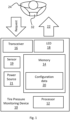
- a tire pressure monitoring device 10 according to an example is shown schematically in Figure 1 .
- the tire pressure monitoring device 10 comprises a processor 12, a memory 14, a transceiver 16, a visual indicator or display which is an LED 18 in this example, a sensor 19 and a power source 21.
- the processor 12 may be any suitable processor including single and multi-core processors, an Application Specific Integrated Circuit (ASIC) or like.
- the processor 12 is communicatively coupled to the transceiver 16, the LED 18, the memory 20 and the sensor 21.
- Memory 14 is a flash memory that stores configuration data 20 and also computer readable instructions for execution by the processor 12 in operation, although it will be appreciated that other types of memory may be used.
- the configuration data 20 can therefore be updated as required with configuration data.
- a reference tire pressure is stored in the configuration data 20.
- Additional data can also be stored in the configuration data 20, for example an aircraft identifier (such as an aircraft Tail identifier) and a wheel position.
- the configuration data 20 in some examples may further include a security code which is indicative of security parameters generated by the tire pressure monitoring device 10 during configuration.
- the security code is a numerical value, which may be generated using a hash function based on the remaining parameters of the configuration data, such as reference tire pressure, aircraft identifier and wheel location, along with any security keys of the tire pressure monitoring device 10. It will be appreciated that the hash value may be truncated to provide a security code of an appropriate length.
- Transceiver 16 is an appropriate transceiver capable of receiving a request to confirm the configuration data 20.
- the transceiver 16 comprises a short-range radio signal transceiver operating according to the NFC protocol. It will be appreciated, however, that other communication protocols may be used, including, for example, a Bluetooth low energy (BLE) communication protocol.
- BLE Bluetooth low energy
- the processor 12 encodes the configuration data 20 stored in the memory 14 of the tire pressure monitoring device 10, and transmits a signal 22 indicative of the configuration data 20 via the LED 18 to a user 24 observing the tire pressure monitoring device 10.
- the LED 18 is a three-colour LED which is capable of displaying red, blue, and green coloured light. Other examples may use a different number of colours of light than three and/or use other colours than red, blue, and green.
- the user 24 is a human.
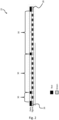
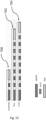
- FIG. 2 An example of the signal 22 is shown schematically in Figure 2 , where the signal encodes a reference tire pressure stored in configuration data 20 of the tire pressure monitoring device 10.
- Checking a reference tire pressure has been correctly stored in a tire pressure monitoring device is an important part of setup to confirm correct operation after configuration. It is possible that the configuration data is corrupted and stores an incorrect value, or an incorrect value may have been loaded in error or by a bad actor. The consequences of an incorrect reference tire pressure level in use may be severe, for example making a tire blow-out more likely if the tire is operated at too low a pressure.
- the reference tire pressure of the tire pressure monitoring device 10 is 178 PSI (1.23 MPa).
- the signal 22 as a whole has a start signal 26 in the form of a green flash of light from the LED 18, and an end signal 28 in the form of another green flash of light from the LED.
- the signal 22 is split into a number of sequential sub-signals 30, with each sub-signal 30 being representative of a digit of the reference tire pressure.
- Each sub-signal 30 has a start signal in the form of a green flash of light from the LED 18, an end signal in the form of another green flash of light from the LED 18, and an intermediate signal in the form of a flash/a number of red flashes of light from the LED 18.
- the start of the first sub-signal 30 is coincident with the start signal 26 of the overall signal 22, and the end of the last sub-signal 30 is coincident with the end signal 28 of the overall signal 22, such that the start 26 and end 28 signals resemble prolonged flashes of the LED 18. Furthermore, a flash of the LED to indicate the end of the first sub-signal 30 also functions as a start signal of the second sub-signal.
- the intermediate signals of each sub-signal 30 encode and are indicative of the reference tire pressure.
- the first sub-signal 30 there is one flash of red light from the LED 18, indicating that the first digit of the reference tire pressure is the number "1”.
- the second sub-signal 30 there are seven flashes of red light from the LED 18, indicating that the second digit of the reference tire pressure is the number "7”.
- the third sub-signal 30 there are eight flashes of red light from the LED 18, indicating that the third digit of the reference tire pressure is the number "8".
- the LED 18 can be used to output the signal 22 to the user 24, with the signal 22 being in a manner that is easily receivable and understandable by the user 24.
- each flash can be chosen depending on the length of the overall sequence and the length of flash needed to be clear to the user 24, and in the example of Figure 2 each flash is 0.5s long.
- the colour of the flashes can be different, for example with a different colour of light being used for each digit of the reference tire pressure so that a first colour indicates "units", a second colour indicates “tens” and a third colour indicates "hundreds”.
- the user 24 may take appropriate action to confirm that the reference tire pressure stored in the memory 14 is correct, or may take appropriate remedial action if the reference tire pressure is incorrect.
- the user 24 uses an untrusted device 32, for example a mobile phone or tablet computer running an application, to verify the configuration data 20.
- the untrusted device 32 can be used to input the user's verification of the configuration data 20.
- the untrusted device 32 can display a prompt with an expected reference pressure. The verification can be trusted because it occurs between the user 24 (who is trusted) and tire pressure monitoring device 10 (which is trusted because of its certification to a particular DAL).
- the tire pressure monitoring device 10 is depicted in Figure 1 as comprising an LED 18, and the signal 22 comprises flashes of the LED 18, it will be appreciated that in another embodiment the tire pressure monitoring device 10 may comprise a transducer in the form of a beeper or speaker, and that that the signal 22 may instead comprise audible noises instead of flashes of light. In other examples the signal may additionally or alternatively take the form of any of a signal displayed on an LCD screen in the form of flashing lights, pictures, or text. Similarly, other examples may display flashing lights, pictures or text on an LED matrix display.
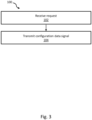
- a method 100 of operating the tire pressure monitoring device 10 is shown schematically in Figure 3 .
- the method 100 comprises receiving 102 a request to confirm the configuration data 20 of the tire pressure monitoring device 10 at the transceiver 16. Responsive to the request, a configuration data signal 22 encoding the configuration data 20 is transmitted 104 by the LED 18.
- a signal 22' takes a different form, as illustrated schematically in Figure 4 .
- sub-signals 30' are discrete signals separate from one another. This allow the signal 22' to be split such that each sub-signal 30' is easily recognisable and verifiable by a user.
- an untrusted device 32 may communicate with a tire pressure monitoring device 10, and the tire pressure monitoring device 10 may cause a sequence of discrete sub-signals 30' to be provided in response to instructions received over the receiver from the untrusted device.
- a first message indicating what form a first sub-signal 30' will take is displayed on the untrusted device 32.
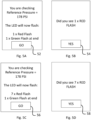
- This first message is shown schematically in Figure 5A . It provides data of what the reference pressure is expected to be, in this case 178 PSI (equivalent to 1.23 MPa, or 12.3 BAR), and of what signal is expected to be provided by the tire pressure monitoring device 10. In this case the signal is one red flash, indicating the digit 1, and one green flash, indicating the end of a sub-signal for that digit.
- the user 24 interacts with a user interface element 52 on the untrusted device 32 to cause the first sub-signal 30' to be transmitted by the LED 18.
- the user interface element is a button displayed on a touch screen of the untrusted device 32 which displays the text "go".
- the untrusted device 32 transmits a signal to the tire pressure monitoring device 10 to cause it to transmit or communicate the first sub-signal 30'.
- the untrusted device 32 displays a first verification message, allowing the user 24 to indicate that the first sub-signal 30' has been received and understood by a user interface element 54, as shown schematically in Figure 5B .
- a message is also provided to remind the user what they should have observed, in this case one red flash.
- a second message indicating what form a second sub-signal 30' will take is displayed on the untrusted device, as shown schematically in Figure 5C . Again this states the reference pressure and what the next signal is expected to be, in this case seven red flashes for the digit 7 followed by a green flash to indicate the end of the sub-signal.
- a user interface element 56 is provided which, when selected by the user, causes the tire pressure monitoring device 10 to transmit or communicate the second sub-signal 30', in the same way as described above for Figure 5A .
- a second verification message is displayed on the untrusted device 32, shown schematically in Figure 5D .
- a user can confirm the second sub-signal 30' has been observed by interacting with a user interface element 58, in the same as described above for Figure 5B .
- a third message indicating what form a third sub-signal 30' will take is displayed on the untrusted device 32, as shown schematically in Figure 5E . Again this includes the reference pressure and an indication that the third sub-signal 30' will comprise eight red flashes, corresponding to the digit 8.
- the user interacts with a user interface element 60 that causes the third sub-signal 30' to be transmitted or communicated by the LED 18.
- a third verification message 62 is displayed on the untrusted device, allowing the user to indicate that the third sub-signal 30' has been received and understood, as shown schematically in Figure 5F .
- a single user interface element is displayed to allow the user to provide positive confirmation.
- a timer may be associated with each screen after which a negative result may be assumed and the process terminates without confirmation.
- a specific negative option to cancel the process or to indicate that the observed sequence did not match that which was expected, can be included in the user interface to allow a user to indicate that the data has not been confirmed.
- This process allows an untrusted device to guide a user through the process because if the untrusted device attempts to mislead the user as to the configured pressure, the user, who is trusted, will notice that the signal from the tire pressure monitoring device does not match what is expected. Similarly, the use of a simple encoding where the number of flashes matches the digit, a user can identify potential false guidance on the untrusted device. If any of the observed sub-signals 30' are noted by the user as not being received or understood, a user interface element on the untrusted device 32 may be used to indicate this, and the user 24 may be required to repeat a configuration of the tire pressure monitoring device 10 and/or conduct further analysis and/or replace the tire pressure monitoring device 10.
- the process enables the user to identify any of incorrectly entered configurations, a faulty tire pressure monitoring device 10, a faulty untrusted device 32, and a malicious application running on the untrusted device 32.
- a further example method 200 of operating a system comprising the tire pressure monitoring device 10 and the untrusted device 32 is shown schematically in Figure 6 , with the signal 22' taking the form depicted in Figure 4 .
- the method 200 comprises submitting, at block 202, a request for configuration data from the tire pressure monitoring device using the untrusted device 32, by interacting with the user interface of the untrusted device 32.
- a start transmission option is chosen, at block 204, by interacting with the user interface of the untrusted device.
- the first sub-signal 30' is transmitted at block 206, and a user is required to verify at block 208 that the first sub-signal 30' has been correctly received by interacting with the user interface of the untrusted device 32.
- a start transmission option is chosen 210 for the second sub-signal 30', again interaction with a user interface of the untrusted device 32.
- the second sub-signal 30' is transmitted at block 212, and a user is required to verify at block 214 that the second sub-signal 30' has been correctly received by interacting with the user interface of the untrusted device 32.
- a start transmission option is then chosen at block 216 for the third sub-signal 30', again using a user interface of the untrusted device 32.
- the third sub-signal 30' is transmitted at block 218, and a user is required to verify at block 220 that the third sub-signal 30' has been correctly received, using the user interface of the untrusted device 32.
- the transmission sequence is then ended 222.
- the method 200 may transmit the sub-signals 30' in a stepwise manner, with verification of each sub-signal 30' being required before a next sub-signal in the sequence is transmitted. This can improve clarity of the signal for the user, and provide for easier verification of the configuration data in use while also reducing user error because there is less reliance on a user's memory.
- FIG. 7 An example of a network 300 of a first 302 and a second 304 tire pressure monitoring devices is shown schematically in Figure 7 .
- the first 302 and second 304 tire pressure monitoring devices have generally the same structure as the tire pressure monitoring device 10 of Figure 1 , but with differences that will now be described.
- Each of the first 302 and second 304 tire pressure monitoring devices has a processor 306, and a memory 308.
- the processor 306 may be any conventional processor, and the memory 308 stores respective configuration data 310,312.
- the first tire pressure monitoring device 302 has a receiver 314 for communicating with an untrusted device 316, a transceiver 318 for communicating with the second tire pressure monitoring device 304, and a visual indicator in the form of an LED 320.
- the LED 320 in this example is an LED which is capable of displaying both red, blue, and green coloured light as discussed above with reference to Figure 1 , other examples may use other types of visual indicator and other colours of light.
- the second tire pressure monitoring device 304 has a transceiver 322 for communicating with the transceiver 318 of the first tire pressure monitoring device 302.
- Two devices are shown here for clarity, but it will be appreciated that there will typically be more than two devices, with each tire having an associated tire pressure monitoring device.
- a method 400 of operating the network 300 is shown schematically in Figure 8 .
- the method 400 comprises receiving, at block 402, at the receiver 314 of the first tire pressure monitoring device 302, a request to confirm the configuration data 312 stored in the memory 308 of the second tire pressure monitoring device 304.
- the first tire pressure monitoring device 302 uses its transceiver 318 to transmit, at block 404, the request to the transceiver 322 of the second tire pressure monitoring device 304.
- the processor 306 of the second tire pressure monitoring device 304 encodes the configuration data 312 stored in the memory 308 of the second tire pressure monitoring device 304, and the processor 306 uses the transceiver 322 of the second tire pressure monitoring device 304 to transmit, at block 406, a signal representative of the configuration data 312 to the transceiver 318 of the first tire pressure monitoring device 302.
- the LED 320 of the first tire pressure monitoring device 302 then transmits 408 a signal 324 representative of the configuration data 312 stored in the memory 308 of the second tire pressure monitoring device 304 in manner such that the signal 324 can be received and understood by a user 24.
- the configuration data 312 stored in the memory 308 of the second tire pressure monitoring device 304 can be requested at and subsequently displayed by the first tire pressure monitoring device 302.
- This can provide for easier and simpler operation in use, as a user can request configuration data from multiple tire pressure monitoring devices at a single tire pressure monitoring device. This can also reduce the time taken to obtain configuration data, as a user does not need to move from device to device in order to request and obtain configuration data.
- This can also enable an arrangement where the second tire pressure monitoring device 304 is hidden from view, for example beneath a hubcap or other components, and/or where the second tire pressure monitoring device 304 is located internally within a wheel/tire.
- the signal communicated to the user may include additional elements to indicate which tire pressure monitoring device the configuration data applies to, for example by encoding a wheel position before or after the reference pressure. For example, where the second tire pressure monitoring device 304 is at a wheel allocated number "3", the LED 320 of the first tire pressure monitoring device 302 may flash three times to indicate that it is the configuration data of the tire pressure monitoring device of wheel "3" that is transmitted as the signal 324.
- Figure 9A depicts an example of a signal 324 including a location indication 350 of a tire pressure monitoring device.
- the location indication is an example of additional information as described above.
- An associated indication message and confirmation message to be displayed on the untrusted device 316 are depicted in Figures 9B and 9C , respectively.
- the indication message of Figure 9B is displayed as a message which indicates the number of red flashes corresponding to the tire pressure monitoring device location being checked, followed by a green flash to indicate end of transmission expected be observed by the user on the LED 320.
- the wheel location is "3" and the message indicates that three red flashes for the location indication 350 are expected.
- the location indication 350 is communicated or transmitted by causing the LED to provide three red flashes followed by a green flash.
- the confirmation message of Figure 9C is displayed by the untrusted device 316 which asks the user 24 to confirm that they have correctly received the location indication 350. Confirmation is provided via interaction with a user interface element 354 on the untrusted device 316. Once confirmation has taken place, an initial message similar to that of Figure 5A may be displayed on the untrusted device 316, and the remainder of the signal 324 may take a form similar to that of the signal 22' of Figure 4 , with the user continuing to work through the method of Figure 6 to confirm the configuration data.
- a unique identifier may be used to identify one or both of the first 302 and second 304 tire pressure monitoring devices and used to indicate which device(s) should communicate stored configuration information.
- the unique identifier can be determined by an untrusted device or entered manually into the untrusted device.
- the unique identifier can be determined by the untrusted device by: Near Field Communication (NFC) or Radio Frequency Identification (RFID) interrogation of the tire pressure monitoring device; by reading a printed indication of the serial number, such as a barcode (one- or two-dimensional) using a camera, reading characters of a serial number using Optical Character Recognition (OCR) using a camera or the like.
- Manual entry may involve entering the unique identifier as printed on a device or instead providing an aircraft tail identifier and an associated wheel position for which it is desired to confirm the configuration data.
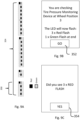
- Illustrative signals 600,602,604,606,608,610 that utilise red, blue, and green to indicate device location are shown in Figure 11 .
- a green flash indicates start of the signal 600,602,604,606,608,610
- a red flash indicates end of the signal 600,602,604,606,608,610
- blue flashes intermediate the green and red flashes indicate device location.
- six tire pressure monitoring devices 10 are installed on an aircraft, with one at each of the left nose wheel, the right nose wheel, a first landing gear wheel, a second landing gear wheel, a third landing gear wheel, and a fourth landing gear wheel, and a different number of blue flashes is used to distinctly identify each of those locations.
- an aircraft maintenance manual (AMM) task card may provide to the user 24 a list of tire pressure monitoring device locations, eg nose left, nose right, and so on, along with an associated expected flash sequence for the LED 18 which would correctly indicate the associated tire pressure monitoring device location.
- AMM task card may provide numerical values for expected flashes and/or may provide pictorial representations of the expected flashes such as seen in Figure 11 . It will be appreciated that the AMM task card may be provided separately to the user 24 as a physical task card, or, for example, as a display on a separate electronic device to the untrusted device 32.
- the user 24 submits a request for the tire pressure monitoring device 10 to display the stored location, using a user interface of the untrusted device 32.
- the stored location is then displayed by the LED 18.
- the untrusted device 32 does not tell the tire pressure monitoring device 10 which sequence to flash, but rather provides an instruction for the tire pressure monitoring device 10 to flash its sequence indicative of the stored location.
- An exemplary user interface 612 for starting the check is shown in Figure 12A , with the user 24 interacting with user interface element 614 to start the check.
- FIG. 12B An exemplary user interface 616 for a user 24 to verify the signal 600,602,604,606,608,610 is shown in Figure 12B , with the user 24 interacting with user interface elements 618,620 to provide an input indicative of whether the signal 600,602,604,606,608,610 is verified or not. If the signal 600,602,604,606,608,610, here indicative of stored location of the tire pressure monitoring device 10, is not verified, then the configuration data 20 needs to be reloaded.
- the untrusted device 32 can be used to input the user's verification of the configuration data 20.
- the verification can be trusted because it occurs between the user 24 (who is trusted) and tire pressure monitoring device 10 (which is trusted because of its certification to a particular DAL).
- signals 700,702,704 that use three colours of light, ie red, blue, and green, to indicate reference pressure are shown in Figure 13 .
- the reference pressure to be communicated is 178 PSI, and each signal 700,702,704 is used to communicate one digit of the reference pressure.
- the first signal 700 comprises one green flash, followed by one blue flash, followed by one red flash, to communicate that the "hundreds" digit is "1".
- the second signal 702 comprises one green flash, followed by seven blue flashes, followed by one red flash, to communicate that the "tens" digit is "7".
- the third signal 704 comprises one green flash, followed by eight blue flashes, followed by one red flash, to communicate that the "units" digit is "8".
- An AMM task card can also be used when checking the reference pressure stored in the tire pressure monitoring device 10.
- the AMM task card may provide an expected flash sequence for each signal 700,702,704 so that a user can verify the flash sequence seen relative to the AMM task card.
- the user 24 may be required to complete a portion of the AMM task card to complete the expected flash sequence for the reference pressure based on the location of the tire pressure monitoring device 10 that is being checked.
- the user 24 submits a request for the tire pressure monitoring device 10 to display the stored reference pressure, via the LED 18, using a user interface of the untrusted device 32.
- the untrusted device 32 does not tell the tire pressure monitoring device 10 which sequence to flash, but rather provides an instruction for the tire pressure monitoring device 10 to flash its sequence indicative of the stored reference pressure.
- An exemplary user interface 706 for starting the check for the "hundreds" digit is shown in Figure 14A , with the user 24 interacting with user interface element 708 to start the check for the "hundreds" digit.
- FIG. 14B An exemplary user interface 710 for a user 24 to verify the signal 700 for the "hundreds" digit is shown in Figure 14B , with the user 24 interacting with user interface elements 711,712 to indicate whether the signal 700 is verified, ie that seen on the AMM task card, or not.
- an exemplary user interface 714 for starting the check for the "tens" digit is shown in Figure 14C , with the user 24 interacting with user interface element 716 to start the check for the "tens” digit.
- An exemplary user interface 718 for a user 24 to verify the signal 702 for the "tens” digit is shown in Figure 14D , with the user 24 interacting with user interface elements 720,722 to indicate whether the signal 702 is verified or not.
- An exemplary user interface 724 for starting the check for the "units” digit is shown in Figure 14E , with the user 24 interacting with user interface element 726 to start the check for the "units” digit.
- An exemplary user interface 728 for a user to verify the signal 704 for the "units” digit is shown in Figure 14F , with the user 24 interacting with user interface elements 730,732 to indicate whether the signal 704 is verified or not.
- a further parameter which may be communicated to the user 24 by appropriate flashing of an LED of a tire pressure monitoring device is the security code.
- the security code is a numerical value, which may be generated using a hash function based on the remaining parameters of the configuration data 20, such as reference tire pressure, aircraft identifier and wheel location, along with any security keys of the tire pressure monitoring device 10. Such a numerical value may be communicated to the user 24.
- Communication of a security code may be of particular utility in a network of tire pressure monitoring devices, with such a network 800 illustrated schematically in Figure 15 .
- the network 800 comprises first 802 and second 804 tire pressure monitoring devices, each having substantially the same structure as the tire pressure monitoring device 10 of Figure 1 .
- Like reference numerals are used for the sake of clarity.
- the network 800 has been set-up such that the first 802 and second 804 tire pressure monitoring devices can communicate with one another securely. To do so, each of the first 802 and second 804 tire pressure monitoring devices exchange cryptographic parameters, such as cryptographic keys, such that secure communication between the first 802 and second 804 tire pressure monitoring devices is established.
- the processors 12 of the first 802 and second 804 tire pressure monitoring devices each generate a respective security code based on data that is common to the first 802 and second 804 tire pressure monitoring devices.
- common data may comprise cryptographic keys shared by the first 802 and second tire pressure monitoring devices.
- Security codes may be generated by taking a hash, or truncated hash, of the common data, to provide a numerical value that can be communicated to the user 24. As the security codes are generated based on common data, the security codes generated by the first 802 and second 804 tire pressure monitoring devices should be the same.
- the security codes can then be communicated to the user 24 by flashing of the respective LEDs 18 in a similar manner to that previously described.
- the user 24 can verify that correct establishment of secure communication between the first 802 and second 804 tire pressure monitoring devices has occurred because the devices all share the same data on which the security code is based.
- the security codes themselves can be thought of as forming part of the overall configuration data 20 of the first 802 and second 804 tire pressure monitoring devices.
- the tire pressure monitoring devices described herein may be useful for confirming safety critical configuration data with a high degree of reliability assurance. It is particularly suited for use in aircraft.
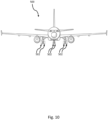
- An aircraft 500 comprising a respective tire pressure monitoring device 10 of Figure 1 for each tire 502 is shown schematically in Figure 10 .
- the tire pressure monitoring devices can form a network as discussed above with reference to Figures 7 and 15 or operate independently.
Landscapes
- Engineering & Computer Science (AREA)
- Mechanical Engineering (AREA)
- Computer Networks & Wireless Communication (AREA)
- Measuring Fluid Pressure (AREA)
Description
- The present invention relates to tire pressure monitoring devices, and methods of communicating configuration data from tire pressure monitoring devices.
- Checking tire pressure is an important part of the maintenance of a vehicle. Tire pressures should be maintained at predetermined pressures to ensure that a tire performs as intended by the manufacturer. Incorrect tire pressure can lead to a tire failing, perhaps bursting and causing damage to the vehicle and/or a loss of control. To check a tire pressure it is important to know what reference pressure is defined for the tire.
-
US6087930 discloses an active integrated circuit transponder with on-board power supply mounted in or on a vehicle tire. A pressure sensor, a temperature sensor and a tire rotation sensor are mounted on a substrate along with the integrated circuit transponder chip, the power supply and an antenna. Upon receiving an interrogation signal from a remote source, the transponder activates the sensors to sense tire pressure and temperature and transmits an encoded radio frequency signal to the remote source containing serial, encoded tire identification, tire position on the vehicle, current tire pressure, current tire temperature and accumulated tire revolutions, as well as maximum and/or minimum tire and temperature pressure values encountered over a predetermined time period and other information specific to the tire. -
US2007/193349 discloses a tire pressure gauge for attachment to a valve stem. The tire pressure gauge includes a display physically supported on the device. -
JP2003291615 circuit 18 arranged in sensor devices 14a to 14f, and the data received from other sensor devices 14a to 14f through the receiving circuit 17 are transferred through the transmittingcircuit 18 by a CPU 25. -
EP3150408 discloses a method of operating a monitoring system to provide pressure warnings associated with a tyre of an aircraft. The monitoring system comprises a flight deck display on a flight deck of the aircraft and a processor. -
EP3991996 discloses a method of communicating configuration data of a tire pressure monitoring device configured to be affixed to a wheel in use - A first aspect of the present invention provides a method of communicating configuration data of a tire pressure monitoring device configured to be affixed to a wheel in use. The method comprises, at the tire pressure monitoring device: receiving a request to confirm configuration data; responsive to receipt of the request to confirm configuration data, transmitting a configuration data signal which encodes the configuration data; wherein the configuration data signal is configured to be received and understood by a human, and the configuration data signal is indicative of any of an aircraft wheel location at which the tire pressure monitoring device is intended to be located, and a security code representative of security parameters of the tire pressure monitoring device, wherein at least one of: the configuration data signal comprises a visual signal, and the visual signal is transmitted using a visual indicator of the trusted tire pressure monitoring device; and the configuration data signal comprises an audible signal, and the audible signal is transmitted using a transducer of the tire pressure monitoring device.
- This allows the data from the tire pressure monitoring device to be confirmed without requiring intermediate devices to interpret or display the data. In particular, it may be necessary to ensure that configuration data has been correctly entered into a tire pressure monitoring device in a way which can be trusted. By reducing intermediate devices, then the requirement for intermediate devices to also be trusted is removed. For example, in aircraft, in order to obtain a desired Development Assurance Level (DAL, for example DAL B) for a vehicle tire system a strict certification is required. It is desirable to reduce intermediate devices to provide a robust system while reducing certification requirements. Reducing intermediate devices may reduce the cost of a system, may reduce the cost of manufacture of a system, and may reduce the cost of operation in use.
- By transmitting the configuration data signal from the tire pressure monitoring device, it can be ensured that the configuration data signal has come from a known, trusted, source. Furthermore, by ensuring that the configuration data signal is configured to be received and understood by a human, the need for a trusted device may be reduced and/or eliminated. Thus the required DAL may be achieved without the need for an additional trusted device, and the human receiving the data may verify the data. Untrusted information sources cannot be used to directly verify data when DAL is required in view of their untrusted nature. In the present case, untrusted information sources can be used, with a user interacting with the untrusted device and forming the trusted source. For example, by inputting confirmation of configuration data transmitted directly from the tire pressure monitoring device to an untrusted device, the user can form a trusted source. The configuration data signal may be configured to be directly transmitted to a human from the tire pressure monitoring device, for example without first being transferred to a further intermediate device.
- Verifying that the aircraft wheel location at which the tire pressure monitoring device is intended to be located is correctly installed in the tire pressure monitoring device may ensure that tire pressure monitoring devices are correctly configured. Verifying security codes may, for example, ensure that correct configuration of the tire pressure monitoring device, such as configuration for encrypted communication between tire pressure monitoring devices, has been performed.
- The configuration data signal may comprise a visual signal, and the visual signal may be transmitted using a visual indicator of the trusted tire pressure monitoring device. A visual signal is a relatively straightforward signal type, which can be easily received and understood by a human.
- The visual indicator may comprise a light source, and the method then comprises selectively illuminating the light source to transmit the configuration data signal. The presence and absence of light can be easily received and understood by a human, and hence the configuration data signal may be relatively simple.
- The light source may comprise a Light Emitting Diode (LED). The light source may be a multi-purpose light source, for example a light source configured to provide functionality in addition to transmitting the configuration data signal. This can reduce the cost and complexity of the tire pressure monitoring device. For example, the light source may also be configured to be selectively illuminated to display a health status of a tire or a tire system, such as whether a monitored tire pressure is acceptable or if maintenance is required.
- The configuration data signal may comprise a number, and the selective illumination of the light source may comprise encoding the number into an illumination sequence representing individual digits of the number. For example, a first number of illuminations of the light source may represent a first digit of the number, a second number of illuminations of the light source may represent a second digit of the number, and so on. This provides a relatively simple signal which is easily received and understood by a human. The number of illuminations may directly correspond to the digit of the number, for example with one illumination representing the digit "1", and five illuminations representing the digit "5". Each illumination may be a distinct flash of the light source having an illumination period of at least 100 ms, at least 200 ms, at least 300 ms, at least 400 ms or at least 500 ms, so that it can be observed directly by a human.
- In other examples, the visual indicator comprises a display of the tire pressure monitoring device. For example the display may be a matrix-display or segment-display on which configuration data can be displayed in readable characters to enable a user to read configuration data from the display.
- The configuration data signal may comprise an audible signal, and the audible signal may be transmitted using a transducer of the trusted tire pressure monitoring device. The method may comprise selectively actuating the transducer to transmit the signal. For example the transducer can be caused to beep or a text-to-speech engine can convert configuration data into spoken information. Some examples may communicate the configuration data signal using both an audible signal and a visual signal.
- The configuration data signal may comprise a number, and the selective actuation of the transducer may comprise encoding the number into an actuation representing individual digits of the number. For example, a first number of actuations or sounds of the transducer may represent a first digit of the number, a second number of actuations or sounds of the transducer may represent a second digit of the number, and so on. As discussed above this can be easily received and understood by a human.
- The configuration data signal may comprise a start signal indicating a start of transmission, an end signal indicating an end of transmission, and an intermediate signal indicative of configuration data stored in the trusted tire pressure monitoring devices. This helps a human receiving the data configuration signal to interpret it, enabling the start and end, and when the configuration data is meant to be received, to be understood.
- The start signal may comprise a first type of signal, the intermediate signal may comprise a second type of signal, and the end signal may comprise a third type of signal. This can further distinguish between the start, end and intermediate signals, and provide further clarity for a human as to which signal indicates configuration data. Various combinations of the first, second and third types of signal are possible. For example, the first and third types of signal may comprise an audible signal and the second type of signal may comprise a visual signal, or vice versa. Alternatively, or additionally, the first type of signal may comprise a first type of visual signal, such as a first colour of light, the second type of signal may comprise a second type of visual signal, such as a second colour light different to the first colour light, and the third type of signal may comprise a third type of visual signal, such as a third colour light different to the first and second colours of light. This can provide a straightforward way to distinguish between the start/end signals and the intermediate signal.
- The configuration data signal may comprise a plurality of sub-signals, each sub-signal comprising a start signal indicating a start of transmission of the sub-signal, an end signal indicating an end of transmission of the sub-signal, and an intermediate signal indicative of at least a portion of configuration data stored in the tire pressure monitoring device. This enables the data configuration signal to be split into smaller pieces, making it more easily understood by a human. Each intermediate signal may be indicative of a portion of configuration data stored in the tire pressure monitoring device. For example, each intermediate signal may be indicative of a digit of a reference pressure stored in memory of the tire pressure monitoring device.
- An end signal of a first sub-signal may comprise a start signal of a second sequential sub-signal. For example, a same sub-signal signal may indicate the end of one sub-signal and the start of another sub-signal. This can reduce the time required to transmit the configuration data signal.
- In some examples, each sub-signal is confirmed as being received and understood by a human before a next sequential sub-signal is transmitted. This improves the reliability of the verification of the configuration data because a human receiving the data does not have to rely on their memory to the same extent. Each sub-signal may be transmitted in response to verification of a previous sub-signal by a user.
- The method may comprise transmitting an alert indicating that transmission of the configuration data signal is about to begin. This may enable a human to know when a signal is to be transmitted for easier understanding and subsequent verification of the data configuration signal. For example, this may enable the configuration data signal to be received, understood, and verified in a stepwise manner, which may be clear to a human. The alert can be a different signal from the start signal discussed above and can be additional or alternative to the start signal. For example, the alert can be a first type of signal, such as an audible signal, and the start signal can be a second type of signal, such as a visual signal.
- The method may comprise verifying, by a human, that the configuration data of the tire pressure monitoring device matches an expected configuration data. This removes the need for another trusted device to perform verification, because the human may be regarded as a trusted source. Verification by a human that the configuration data of the trusted tire pressure monitoring device matches expected configuration data may take place using an untrusted device, for example by an untrusted intermediate device, such as a smartphone, tablet or other computing device, which provides the user with a prompt of what configuration data is expected. Although the intermediate device is untrusted, if it is faulty or has malicious software installed then the end result will be that the configuration is not verified, so safety is provided. This may reduce cost associated with the verification procedure compared to a process that requires an intermediate, independent, trusted device. It can also more provide more flexibility; because the intermediate device is untrusted its functionality can be provided by an application or app running on different hardware platforms without all those platforms having to be certified.
- Verifying, by a human, that the configuration data of the tire pressure monitoring device matches the expected configuration data, may comprise comparing the configuration data to expected configuration contained in an aircraft maintenance manual accessible to the human.
- The expected configuration data may comprise a security code representative of security parameters of a further tire pressure monitoring device. The security code representative of security parameters of a further tire pressure monitoring device may be transmitted to the human in a further data configuration signal from the further tire pressure monitoring device.
- The request to confirm configuration data may be received at the tire pressure monitoring device via a short-range communication protocol. This provides security benefits as physical proximity is required and can also provide an operational benefit if the range is short enough that is generally received by a single device to prevent a request from being picked-up by a wrong tire pressure monitoring device. The request may be submitted via a communication protocol with a range of less than 5m, less than 2m, less than 1m, less than 50cm, less than 30cm or less than 15cm. Suitable communication protocols include Near Field Communication (NFC). In some examples, no identifier is included in the request to confirm configuration data, with a short range of transmission and physical proximity indicating the device to respond. Alternatively, the request may include a unique identifier of a device. The unique identifier may be input by a user by reading a marking on the tire pressure monitoring device or determined by data provided on or by the tire pressure monitoring device, such as by scanning or a QR code of the tire pressure monitoring device, NFC, or Radio Frequency Identification (RFID) tag interrogation.
- The method may comprise transmitting the configuration data signal to a further tire pressure monitoring device, and subsequently transmitting the configuration data signal from the further tire pressure monitoring device to be received and understood by a human. This may allow for configuration of one or more tire pressure monitoring devices to be transmitted from a single tire pressure monitoring device, which can simplify a procedure where the configuration data of several tire pressure monitoring devices needs to be verified. For example, a need to move between devices can be reduced and/or a tire pressure monitoring device which is positioned so that it is difficult for a human to receive the configuration data signal can be relayed by another of the devices. All the tire pressure monitoring devices may be trusted, so another tire pressure monitoring device can be a trusted intermediary. This does not significantly increase the cost or complexity of the system as a whole because no additional trusted devices are required.
- For example, the method may comprise, at a first tire pressure monitoring device, receiving a request for configuration data of a second tire pressure monitoring device; transmitting the request from the first tire pressure monitoring device to the second tire pressure monitoring device; transmitting, from the second tire pressure monitoring device to the first tire pressure monitoring device, a configuration data signal indicative of configuration data stored in the second tire pressure monitoring device; and transmitting, from the second tire pressure monitoring device to a human, the configuration data signal indicative of configuration data stored in the second tire pressure monitoring device.
- A second aspect of the present invention provides a tire pressure monitoring device comprising a memory for storing configuration data, a light source, and a processor configured to selectively illuminate the light source to transmit a signal indicative of configuration data stored in the memory, the configuration data comprising any of an aircraft wheel location at which the tire pressure monitoring device is intended to be located, and a security code representative of security parameters of the tire pressure monitoring device. For example, any of the methods discussed above to communicate a configuration data signal with a light source can be used.
- The tire pressure monitoring device may be configured to communicate with a further tire pressure monitoring device, for example to send a further configuration data request to the further tire pressure monitoring device and/or to receive a further configuration data signal indicative of further configuration data stored in memory of the further tire pressure monitoring device. The tire pressure monitoring device and the further tire pressure monitoring device may comprise respective unique identifiers, for example unique identifiers which are presented in response to appropriate interrogation.
- A third aspect of the present invention provides an aircraft comprising a tire pressure monitoring device according to the second aspect of the present invention.
- Embodiments of the invention will now be described, by way of example only, with reference to the accompanying drawings, in which:
-
Figure 1 is a schematic view of a tire pressure monitoring device according to an example; -
Figure 2 is a schematic illustration of a first signal indicative of configuration data of a tire pressure monitoring device; -
Figure 3 is a schematic view illustrating a first example method of communicating configuration data of a tire pressure monitoring device; -
Figure 4 is a schematic illustration of a second signal indicative of configuration data of a tire pressure monitoring device; -
Figures 5A-G are schematic views illustrating a display of an untrusted device used to verify the signal ofFigure 4 ; -
Figure 6 is a schematic view illustrating a second example method of communicating configuration data of a tire pressure monitoring device; -
Figure 7 is a schematic view of a first network of tire pressure monitoring devices according to an example; -
Figure 8 is a schematic view illustrating a method of operating the network ofFigure 7 ; -
Figure 9A is a schematic illustration of a third signal indicative of configuration data of a tire pressure monitoring device; -
Figures 9B and 9C are schematic views illustrating a display of an untrusted device used to verify a location indication in the signal ofFigure 9A ; -
Figure 10 is a schematic view illustrating an aircraft comprising the tire pressure monitoring device ofFigure 1 or the network ofFigure 7 ; -
Figure 11 is a schematic illustration of a fourth signal indicative of configuration data of a tire pressure monitoring device; -
Figures 12A-B are schematic views illustrating a display of an untrusted device used to verify the signal ofFigure 11 ; -
Figure 13 is a schematic illustration of a third signal indicative of configuration data of a tire pressure monitoring device; -
Figures 14A-F are schematic views illustrating a display of an untrusted device used to verify the signal ofFigure 13 ; and -
Figure 15 is a schematic illustration of a second network of tire pressure monitoring devices according to an example. - A tire
pressure monitoring device 10 according to an example is shown schematically inFigure 1 . The tirepressure monitoring device 10 comprises aprocessor 12, amemory 14, atransceiver 16, a visual indicator or display which is anLED 18 in this example, asensor 19 and apower source 21. - The
processor 12 may be any suitable processor including single and multi-core processors, an Application Specific Integrated Circuit (ASIC) or like. Theprocessor 12 is communicatively coupled to thetransceiver 16, theLED 18, thememory 20 and thesensor 21. -
Memory 14 is a flash memory that storesconfiguration data 20 and also computer readable instructions for execution by theprocessor 12 in operation, although it will be appreciated that other types of memory may be used. Theconfiguration data 20 can therefore be updated as required with configuration data. A reference tire pressure is stored in theconfiguration data 20. Additional data can also be stored in theconfiguration data 20, for example an aircraft identifier (such as an aircraft Tail identifier) and a wheel position. Theconfiguration data 20 in some examples may further include a security code which is indicative of security parameters generated by the tirepressure monitoring device 10 during configuration. In some examples the security code is a numerical value, which may be generated using a hash function based on the remaining parameters of the configuration data, such as reference tire pressure, aircraft identifier and wheel location, along with any security keys of the tirepressure monitoring device 10. It will be appreciated that the hash value may be truncated to provide a security code of an appropriate length. -
Transceiver 16 is an appropriate transceiver capable of receiving a request to confirm theconfiguration data 20. In this embodiment, thetransceiver 16 comprises a short-range radio signal transceiver operating according to the NFC protocol. It will be appreciated, however, that other communication protocols may be used, including, for example, a Bluetooth low energy (BLE) communication protocol. When thetransceiver 16 receives a request to confirm theconfiguration data 20, theprocessor 12 encodes theconfiguration data 20 stored in thememory 14 of the tirepressure monitoring device 10, and transmits asignal 22 indicative of theconfiguration data 20 via theLED 18 to auser 24 observing the tirepressure monitoring device 10. Here theLED 18 is a three-colour LED which is capable of displaying red, blue, and green coloured light. Other examples may use a different number of colours of light than three and/or use other colours than red, blue, and green. In examples herein, theuser 24 is a human. - An example of the
signal 22 is shown schematically inFigure 2 , where the signal encodes a reference tire pressure stored inconfiguration data 20 of the tirepressure monitoring device 10. Checking a reference tire pressure has been correctly stored in a tire pressure monitoring device is an important part of setup to confirm correct operation after configuration. It is possible that the configuration data is corrupted and stores an incorrect value, or an incorrect value may have been loaded in error or by a bad actor. The consequences of an incorrect reference tire pressure level in use may be severe, for example making a tire blow-out more likely if the tire is operated at too low a pressure. - As shown in
Figure 2 , the reference tire pressure of the tirepressure monitoring device 10 is 178 PSI (1.23 MPa). Thesignal 22 as a whole has astart signal 26 in the form of a green flash of light from theLED 18, and anend signal 28 in the form of another green flash of light from the LED. Thesignal 22 is split into a number of sequential sub-signals 30, with each sub-signal 30 being representative of a digit of the reference tire pressure. Each sub-signal 30 has a start signal in the form of a green flash of light from theLED 18, an end signal in the form of another green flash of light from theLED 18, and an intermediate signal in the form of a flash/a number of red flashes of light from theLED 18. - As shown in
Figure 2 , the start of the first sub-signal 30 is coincident with thestart signal 26 of theoverall signal 22, and the end of thelast sub-signal 30 is coincident with theend signal 28 of theoverall signal 22, such that thestart 26 and end 28 signals resemble prolonged flashes of theLED 18. Furthermore, a flash of the LED to indicate the end of the first sub-signal 30 also functions as a start signal of the second sub-signal. - In the
signal 22, the intermediate signals of each sub-signal 30 encode and are indicative of the reference tire pressure. For example, in the first sub-signal 30, there is one flash of red light from theLED 18, indicating that the first digit of the reference tire pressure is the number "1". In the second sub-signal 30, there are seven flashes of red light from theLED 18, indicating that the second digit of the reference tire pressure is the number "7". In the third sub-signal 30, there are eight flashes of red light from theLED 18, indicating that the third digit of the reference tire pressure is the number "8". Thus theLED 18 can be used to output thesignal 22 to theuser 24, with thesignal 22 being in a manner that is easily receivable and understandable by theuser 24. The duration of each flash can be chosen depending on the length of the overall sequence and the length of flash needed to be clear to theuser 24, and in the example ofFigure 2 each flash is 0.5s long. In other examples, the colour of the flashes can be different, for example with a different colour of light being used for each digit of the reference tire pressure so that a first colour indicates "units", a second colour indicates "tens" and a third colour indicates "hundreds". - Once the
signal 22 is received by theuser 24, theuser 24 may take appropriate action to confirm that the reference tire pressure stored in thememory 14 is correct, or may take appropriate remedial action if the reference tire pressure is incorrect. In some examples, theuser 24 uses anuntrusted device 32, for example a mobile phone or tablet computer running an application, to verify theconfiguration data 20. As theuser 24 can be taken to be a trusted source, and the tirepressure monitoring device 10 is itself a trusted source, theuntrusted device 32 can be used to input the user's verification of theconfiguration data 20. For example, theuntrusted device 32 can display a prompt with an expected reference pressure. The verification can be trusted because it occurs between the user 24 (who is trusted) and tire pressure monitoring device 10 (which is trusted because of its certification to a particular DAL). - Whilst the tire
pressure monitoring device 10 is depicted inFigure 1 as comprising anLED 18, and thesignal 22 comprises flashes of theLED 18, it will be appreciated that in another embodiment the tirepressure monitoring device 10 may comprise a transducer in the form of a beeper or speaker, and that that thesignal 22 may instead comprise audible noises instead of flashes of light. In other examples the signal may additionally or alternatively take the form of any of a signal displayed on an LCD screen in the form of flashing lights, pictures, or text. Similarly, other examples may display flashing lights, pictures or text on an LED matrix display. - A
method 100 of operating the tirepressure monitoring device 10 is shown schematically inFigure 3 . Themethod 100 comprises receiving 102 a request to confirm theconfiguration data 20 of the tirepressure monitoring device 10 at thetransceiver 16. Responsive to the request, a configuration data signal 22 encoding theconfiguration data 20 is transmitted 104 by theLED 18. - In another example, a signal 22' takes a different form, as illustrated schematically in
Figure 4 . In this instance, sub-signals 30' are discrete signals separate from one another. This allow the signal 22' to be split such that each sub-signal 30' is easily recognisable and verifiable by a user. In this example, anuntrusted device 32 may communicate with a tirepressure monitoring device 10, and the tirepressure monitoring device 10 may cause a sequence of discrete sub-signals 30' to be provided in response to instructions received over the receiver from the untrusted device. - For example, in response to a request from the
user 24, submitted via theuntrusted device 32, to check or determine the configuration data stored in a tirepressure monitoring device 10, a first message indicating what form a first sub-signal 30' will take is displayed on theuntrusted device 32. This first message is shown schematically inFigure 5A . It provides data of what the reference pressure is expected to be, in thiscase 178 PSI (equivalent to 1.23 MPa, or 12.3 BAR), and of what signal is expected to be provided by the tirepressure monitoring device 10. In this case the signal is one red flash, indicating thedigit 1, and one green flash, indicating the end of a sub-signal for that digit. Theuser 24 interacts with auser interface element 52 on theuntrusted device 32 to cause the first sub-signal 30' to be transmitted by theLED 18. In this case, the user interface element is a button displayed on a touch screen of theuntrusted device 32 which displays the text "go". In response to activation of theuser interface element 52, such as by a tap, theuntrusted device 32 transmits a signal to the tirepressure monitoring device 10 to cause it to transmit or communicate the first sub-signal 30'. Meanwhile, theuntrusted device 32 displays a first verification message, allowing theuser 24 to indicate that the first sub-signal 30' has been received and understood by auser interface element 54, as shown schematically inFigure 5B . A message is also provided to remind the user what they should have observed, in this case one red flash. - When the
user interface element 54 is activated, such as by a tap on a touch screen of theuntrusted device 32, a second message indicating what form a second sub-signal 30' will take is displayed on the untrusted device, as shown schematically inFigure 5C . Again this states the reference pressure and what the next signal is expected to be, in this case seven red flashes for thedigit 7 followed by a green flash to indicate the end of the sub-signal. Auser interface element 56 is provided which, when selected by the user, causes the tirepressure monitoring device 10 to transmit or communicate the second sub-signal 30', in the same way as described above forFigure 5A . Once the second sub-signal 30' has been transmitted, a second verification message is displayed on theuntrusted device 32, shown schematically inFigure 5D . A user can confirm the second sub-signal 30' has been observed by interacting with auser interface element 58, in the same as described above forFigure 5B . - Next, a third message indicating what form a third sub-signal 30' will take is displayed on the
untrusted device 32, as shown schematically inFigure 5E . Again this includes the reference pressure and an indication that the third sub-signal 30' will comprise eight red flashes, corresponding to thedigit 8. As discussed above with reference toFigure 5A , the user interacts with auser interface element 60 that causes the third sub-signal 30' to be transmitted or communicated by theLED 18. Once the third sub-signal 30'has been transmitted, athird verification message 62 is displayed on the untrusted device, allowing the user to indicate that the third sub-signal 30' has been received and understood, as shown schematically inFigure 5F . - Finally a confirmation message is displayed on the
untrusted device 32 once all sub-signals 30' have been received, as shown schematically inFigure 5G . Although described here with reference to three sub-signals, it will be recognised that the number of sub-signals may vary depending on the configuration data requested. Other configuration data than pressure may be indicated and alphabetical data as well as numerical data can be communicated. Other encoding schemes can also be used, for example Morse code, but a direct correlation between a numerical value and the number of flashes has the benefit of requiring no specific user knowledge and potentially more reliable to recognise. - As discussed above with reference to
Figures 5A to 5G , only a single user interface element is displayed to allow the user to provide positive confirmation. A timer may be associated with each screen after which a negative result may be assumed and the process terminates without confirmation. Alternatively a specific negative option, to cancel the process or to indicate that the observed sequence did not match that which was expected, can be included in the user interface to allow a user to indicate that the data has not been confirmed. - This process allows an untrusted device to guide a user through the process because if the untrusted device attempts to mislead the user as to the configured pressure, the user, who is trusted, will notice that the signal from the tire pressure monitoring device does not match what is expected. Similarly, the use of a simple encoding where the number of flashes matches the digit, a user can identify potential false guidance on the untrusted device. If any of the observed sub-signals 30' are noted by the user as not being received or understood, a user interface element on the
untrusted device 32 may be used to indicate this, and theuser 24 may be required to repeat a configuration of the tirepressure monitoring device 10 and/or conduct further analysis and/or replace the tirepressure monitoring device 10. - The process enables the user to identify any of incorrectly entered configurations, a faulty tire
pressure monitoring device 10, a faultyuntrusted device 32, and a malicious application running on theuntrusted device 32. - A
further example method 200 of operating a system comprising the tirepressure monitoring device 10 and theuntrusted device 32 is shown schematically inFigure 6 , with the signal 22' taking the form depicted inFigure 4 . - The
method 200 comprises submitting, atblock 202, a request for configuration data from the tire pressure monitoring device using theuntrusted device 32, by interacting with the user interface of theuntrusted device 32. In response to the request, a start transmission option is chosen, atblock 204, by interacting with the user interface of the untrusted device. The first sub-signal 30' is transmitted atblock 206, and a user is required to verify atblock 208 that the first sub-signal 30' has been correctly received by interacting with the user interface of theuntrusted device 32. A start transmission option is chosen 210 for the second sub-signal 30', again interaction with a user interface of theuntrusted device 32. The second sub-signal 30' is transmitted atblock 212, and a user is required to verify atblock 214 that the second sub-signal 30' has been correctly received by interacting with the user interface of theuntrusted device 32. A start transmission option is then chosen atblock 216 for the third sub-signal 30', again using a user interface of theuntrusted device 32. The third sub-signal 30' is transmitted atblock 218, and a user is required to verify atblock 220 that the third sub-signal 30' has been correctly received, using the user interface of theuntrusted device 32. The transmission sequence is then ended 222. - In such a manner, the
method 200 may transmit the sub-signals 30' in a stepwise manner, with verification of each sub-signal 30' being required before a next sub-signal in the sequence is transmitted. This can improve clarity of the signal for the user, and provide for easier verification of the configuration data in use while also reducing user error because there is less reliance on a user's memory. - An example of a
network 300 of a first 302 and a second 304 tire pressure monitoring devices is shown schematically inFigure 7 . The first 302 and second 304 tire pressure monitoring devices have generally the same structure as the tirepressure monitoring device 10 ofFigure 1 , but with differences that will now be described. - Each of the first 302 and second 304 tire pressure monitoring devices has a
processor 306, and amemory 308. Theprocessor 306 may be any conventional processor, and thememory 308 stores respective configuration data 310,312. The first tirepressure monitoring device 302 has areceiver 314 for communicating with anuntrusted device 316, atransceiver 318 for communicating with the second tirepressure monitoring device 304, and a visual indicator in the form of anLED 320. TheLED 320 in this example is an LED which is capable of displaying both red, blue, and green coloured light as discussed above with reference toFigure 1 , other examples may use other types of visual indicator and other colours of light. The second tirepressure monitoring device 304 has atransceiver 322 for communicating with thetransceiver 318 of the first tirepressure monitoring device 302. Two devices are shown here for clarity, but it will be appreciated that there will typically be more than two devices, with each tire having an associated tire pressure monitoring device. - A
method 400 of operating thenetwork 300 is shown schematically inFigure 8 . Themethod 400 comprises receiving, atblock 402, at thereceiver 314 of the first tirepressure monitoring device 302, a request to confirm theconfiguration data 312 stored in thememory 308 of the second tirepressure monitoring device 304. The first tirepressure monitoring device 302 uses itstransceiver 318 to transmit, atblock 404, the request to thetransceiver 322 of the second tirepressure monitoring device 304. In response to receipt of the request, theprocessor 306 of the second tirepressure monitoring device 304 encodes theconfiguration data 312 stored in thememory 308 of the second tirepressure monitoring device 304, and theprocessor 306 uses thetransceiver 322 of the second tirepressure monitoring device 304 to transmit, at block 406, a signal representative of theconfiguration data 312 to thetransceiver 318 of the first tirepressure monitoring device 302. TheLED 320 of the first tirepressure monitoring device 302 then transmits 408 asignal 324 representative of theconfiguration data 312 stored in thememory 308 of the second tirepressure monitoring device 304 in manner such that thesignal 324 can be received and understood by auser 24. - Thus the
configuration data 312 stored in thememory 308 of the second tirepressure monitoring device 304 can be requested at and subsequently displayed by the first tirepressure monitoring device 302. This can provide for easier and simpler operation in use, as a user can request configuration data from multiple tire pressure monitoring devices at a single tire pressure monitoring device. This can also reduce the time taken to obtain configuration data, as a user does not need to move from device to device in order to request and obtain configuration data. This can also enable an arrangement where the second tirepressure monitoring device 304 is hidden from view, for example beneath a hubcap or other components, and/or where the second tirepressure monitoring device 304 is located internally within a wheel/tire. - In some examples, the signal communicated to the user may include additional elements to indicate which tire pressure monitoring device the configuration data applies to, for example by encoding a wheel position before or after the reference pressure. For example, where the second tire
pressure monitoring device 304 is at a wheel allocated number "3", theLED 320 of the first tirepressure monitoring device 302 may flash three times to indicate that it is the configuration data of the tire pressure monitoring device of wheel "3" that is transmitted as thesignal 324. -
Figure 9A depicts an example of asignal 324 including alocation indication 350 of a tire pressure monitoring device. The location indication is an example of additional information as described above. An associated indication message and confirmation message to be displayed on theuntrusted device 316 are depicted inFigures 9B and 9C , respectively. The indication message ofFigure 9B is displayed as a message which indicates the number of red flashes corresponding to the tire pressure monitoring device location being checked, followed by a green flash to indicate end of transmission expected be observed by the user on theLED 320. In the example ofFigure 9B , the wheel location is "3" and the message indicates that three red flashes for thelocation indication 350 are expected. In response to user interaction with auser interface element 352 on theuntrusted device 316, thelocation indication 350 is communicated or transmitted by causing the LED to provide three red flashes followed by a green flash. - Subsequent to communicating the
location indication 350, the confirmation message ofFigure 9C is displayed by theuntrusted device 316 which asks theuser 24 to confirm that they have correctly received thelocation indication 350. Confirmation is provided via interaction with auser interface element 354 on theuntrusted device 316. Once confirmation has taken place, an initial message similar to that ofFigure 5A may be displayed on theuntrusted device 316, and the remainder of thesignal 324 may take a form similar to that of the signal 22' ofFigure 4 , with the user continuing to work through the method ofFigure 6 to confirm the configuration data. - In some examples, a unique identifier may be used to identify one or both of the first 302 and second 304 tire pressure monitoring devices and used to indicate which device(s) should communicate stored configuration information. The unique identifier can be determined by an untrusted device or entered manually into the untrusted device. For example, the unique identifier can be determined by the untrusted device by: Near Field Communication (NFC) or Radio Frequency Identification (RFID) interrogation of the tire pressure monitoring device; by reading a printed indication of the serial number, such as a barcode (one- or two-dimensional) using a camera, reading characters of a serial number using Optical Character Recognition (OCR) using a camera or the like. Manual entry may involve entering the unique identifier as printed on a device or instead providing an aircraft tail identifier and an associated wheel position for which it is desired to confirm the configuration data.
- In examples previously described, only two colours of light, red and green, have been utilised in the
signals 22,22',324,350. It will be appreciated that signals where three or more colours of light are utilised are also envisaged, for example where red, blue, and green are utilised. - Illustrative signals 600,602,604,606,608,610 that utilise red, blue, and green to indicate device location are shown in
Figure 11 . Here, for each device location, a green flash indicates start of the signal 600,602,604,606,608,610, a red flash indicates end of the signal 600,602,604,606,608,610, and blue flashes intermediate the green and red flashes indicate device location. In the example ofFigure 11 , six tirepressure monitoring devices 10 are installed on an aircraft, with one at each of the left nose wheel, the right nose wheel, a first landing gear wheel, a second landing gear wheel, a third landing gear wheel, and a fourth landing gear wheel, and a different number of blue flashes is used to distinctly identify each of those locations. - In the example of
Figure 5A , the user interface of theuntrusted device 32 displays to theuser 24 the expected flash sequence. In alternative examples, an aircraft maintenance manual (AMM) task card may provide to the user 24 a list of tire pressure monitoring device locations, eg nose left, nose right, and so on, along with an associated expected flash sequence for theLED 18 which would correctly indicate the associated tire pressure monitoring device location. Such an AMM task card may provide numerical values for expected flashes and/or may provide pictorial representations of the expected flashes such as seen inFigure 11 . It will be appreciated that the AMM task card may be provided separately to theuser 24 as a physical task card, or, for example, as a display on a separate electronic device to theuntrusted device 32. - When checking the location stored in
configuration data 20 of a tirepressure monitoring device 10, theuser 24 submits a request for the tirepressure monitoring device 10 to display the stored location, using a user interface of theuntrusted device 32. The stored location is then displayed by theLED 18. Theuntrusted device 32 does not tell the tirepressure monitoring device 10 which sequence to flash, but rather provides an instruction for the tirepressure monitoring device 10 to flash its sequence indicative of the stored location. Anexemplary user interface 612 for starting the check is shown inFigure 12A , with theuser 24 interacting withuser interface element 614 to start the check. Anexemplary user interface 616 for auser 24 to verify the signal 600,602,604,606,608,610 is shown inFigure 12B , with theuser 24 interacting with user interface elements 618,620 to provide an input indicative of whether the signal 600,602,604,606,608,610 is verified or not. If the signal 600,602,604,606,608,610, here indicative of stored location of the tirepressure monitoring device 10, is not verified, then theconfiguration data 20 needs to be reloaded. - As the
user 24 can be taken to be a trusted source, and the tirepressure monitoring device 10 is itself a trusted source, theuntrusted device 32 can be used to input the user's verification of theconfiguration data 20. The verification can be trusted because it occurs between the user 24 (who is trusted) and tire pressure monitoring device 10 (which is trusted because of its certification to a particular DAL). - Similar to the signals 600,602,604,606,608,610 of
Figure 11 that indicate device location, signals 700,702,704 that use three colours of light, ie red, blue, and green, to indicate reference pressure are shown inFigure 13 . As illustrated inFigure 13 , the reference pressure to be communicated is 178 PSI, and each signal 700,702,704 is used to communicate one digit of the reference pressure. Thefirst signal 700 comprises one green flash, followed by one blue flash, followed by one red flash, to communicate that the "hundreds" digit is "1". Thesecond signal 702 comprises one green flash, followed by seven blue flashes, followed by one red flash, to communicate that the "tens" digit is "7". Thethird signal 704 comprises one green flash, followed by eight blue flashes, followed by one red flash, to communicate that the "units" digit is "8". - An AMM task card can also be used when checking the reference pressure stored in the tire
pressure monitoring device 10. For example, the AMM task card may provide an expected flash sequence for each signal 700,702,704 so that a user can verify the flash sequence seen relative to the AMM task card. In some examples, theuser 24 may be required to complete a portion of the AMM task card to complete the expected flash sequence for the reference pressure based on the location of the tirepressure monitoring device 10 that is being checked. - When checking the stored reference pressure of the tire
pressure monitoring device 10 using the AMM task card, theuser 24 submits a request for the tirepressure monitoring device 10 to display the stored reference pressure, via theLED 18, using a user interface of theuntrusted device 32. Theuntrusted device 32 does not tell the tirepressure monitoring device 10 which sequence to flash, but rather provides an instruction for the tirepressure monitoring device 10 to flash its sequence indicative of the stored reference pressure. Anexemplary user interface 706 for starting the check for the "hundreds" digit is shown inFigure 14A , with theuser 24 interacting withuser interface element 708 to start the check for the "hundreds" digit. Anexemplary user interface 710 for auser 24 to verify thesignal 700 for the "hundreds" digit is shown inFigure 14B , with theuser 24 interacting with user interface elements 711,712 to indicate whether thesignal 700 is verified, ie that seen on the AMM task card, or not. - Similarly an
exemplary user interface 714 for starting the check for the "tens" digit is shown inFigure 14C , with theuser 24 interacting withuser interface element 716 to start the check for the "tens" digit. Anexemplary user interface 718 for auser 24 to verify thesignal 702 for the "tens" digit is shown inFigure 14D , with theuser 24 interacting with user interface elements 720,722 to indicate whether thesignal 702 is verified or not. Anexemplary user interface 724 for starting the check for the "units" digit is shown inFigure 14E , with theuser 24 interacting withuser interface element 726 to start the check for the "units" digit. Anexemplary user interface 728 for a user to verify thesignal 704 for the "units" digit is shown inFigure 14F , with theuser 24 interacting with user interface elements 730,732 to indicate whether thesignal 704 is verified or not. - A further parameter which may be communicated to the
user 24 by appropriate flashing of an LED of a tire pressure monitoring device is the security code. As previously discussed, in some examples the security code is a numerical value, which may be generated using a hash function based on the remaining parameters of theconfiguration data 20, such as reference tire pressure, aircraft identifier and wheel location, along with any security keys of the tirepressure monitoring device 10. Such a numerical value may be communicated to theuser 24. - Communication of a security code may be of particular utility in a network of tire pressure monitoring devices, with such a
network 800 illustrated schematically inFigure 15 . Here thenetwork 800 comprises first 802 and second 804 tire pressure monitoring devices, each having substantially the same structure as the tirepressure monitoring device 10 ofFigure 1 . Like reference numerals are used for the sake of clarity. Thenetwork 800 has been set-up such that the first 802 and second 804 tire pressure monitoring devices can communicate with one another securely. To do so, each of the first 802 and second 804 tire pressure monitoring devices exchange cryptographic parameters, such as cryptographic keys, such that secure communication between the first 802 and second 804 tire pressure monitoring devices is established. - The
processors 12 of the first 802 and second 804 tire pressure monitoring devices each generate a respective security code based on data that is common to the first 802 and second 804 tire pressure monitoring devices. In some examples, such common data may comprise cryptographic keys shared by the first 802 and second tire pressure monitoring devices. Security codes may be generated by taking a hash, or truncated hash, of the common data, to provide a numerical value that can be communicated to theuser 24. As the security codes are generated based on common data, the security codes generated by the first 802 and second 804 tire pressure monitoring devices should be the same. - The security codes can then be communicated to the
user 24 by flashing of therespective LEDs 18 in a similar manner to that previously described. By verifying that the security codes communicated by the first 802 and second 804 tire pressure monitoring devices are the same, theuser 24 can verify that correct establishment of secure communication between the first 802 and second 804 tire pressure monitoring devices has occurred because the devices all share the same data on which the security code is based. It will be appreciated that the security codes themselves can be thought of as forming part of theoverall configuration data 20 of the first 802 and second 804 tire pressure monitoring devices. - The tire pressure monitoring devices described herein may be useful for confirming safety critical configuration data with a high degree of reliability assurance. It is particularly suited for use in aircraft. An
aircraft 500 comprising a respective tirepressure monitoring device 10 ofFigure 1 for eachtire 502 is shown schematically inFigure 10 . The tire pressure monitoring devices can form a network as discussed above with reference toFigures 7 and15 or operate independently. - It is to be noted that the term "or" as used herein is to be interpreted to mean "and/or", unless expressly stated otherwise.
Claims (12)
- A method of communicating configuration data of a tire pressure monitoring device (10) configured to be affixed to a wheel in use, the method comprising, at the tire pressure monitoring device (10):receiving a request to confirm configuration data (20);responsive to receipt of the request to confirm configuration data (20), transmitting a configuration data signal (22) which encodes the configuration data (20);wherein the configuration data signal (22) is configured to be received and understood by a human, and the configuration data signal (22) is indicative of any of an aircraft wheel location at which the tire pressure monitoring device (10) is intended to be located, and a security code representative of security parameters of the tire pressure monitoring device (10), wherein at least one of:the configuration data signal (22) comprises a visual signal, and the visual signal is transmitted using a visual indicator of the tire pressure monitoring device (10); andthe configuration data signal comprises an audible signal, and the audible signal is transmitted using a transducer of the tire pressure monitoring device (10).
- A method as claimed in Claim 1, wherein the visual indicator comprises a light source (18), and the method comprises selectively illuminating the light source (18) to transmit the configuration data signal (22).
- A method as claimed in Claim 2, wherein the configuration data signal (22) comprises a number, and the selective illumination of the light source (18) comprises encoding the number into an illumination sequence representing individual digits of the number.
- A method as claimed in any preceding claim, wherein the configuration data signal (22) comprises a start signal indicating a start of transmission, an end signal indicating an end of transmission, and an intermediate signal indicative of configuration data stored in the tire pressure monitoring device (10).
- A method as claimed in Claim 4, wherein the start signal comprises a first type of signal, the intermediate signal comprises a second type of signal, and the end signal comprises a third type of signal;
optionally wherein the first type of signal comprises a first colour light, the second type of signal comprises a second colour light different to the first colour light, and the third type of signal comprises a third colour light different to the first and second colours of light. - A method as claimed in any preceding claim, wherein the configuration data signal (22) comprises a plurality of sub-signals, each sub-signal comprising a start signal indicating a start of transmission of the sub-signal, an end signal indicating an end of transmission of the sub-signal, and an intermediate signal indicative of at least a portion of configuration data stored in the tire pressure monitoring device (10);
optionally wherein each sub-signal is confirmed as being received and understood by a human before a next sequential sub-signal is transmitted. - A method as claimed in any preceding claim, wherein the method comprises transmitting an alert indicating that transmission of the configuration data signal is about to begin.
- A method as claimed in any preceding claim, wherein the tire pressure monitoring device (10) comprises a trusted tire pressure monitoring device, and the method comprises verifying, by a human, that the configuration data (20) of the tire pressure monitoring device (10) matches expected configuration data, and verification by a human that the configuration data of the tire pressure monitoring device (10) matches expected configuration data takes place using an untrusted device;
optionally wherein the expected configuration data comprises a security code representative of security parameters of a further tire pressure monitoring device. - A method as claimed in any preceding claim, wherein a request to confirm configuration data is submitted via a short-range communication protocol.
- A method as claimed in any preceding claim, wherein the method comprises transmitting the configuration data signal (22) to a further tire pressure monitoring device, and subsequently transmitting the configuration data signal (22) from the further tire pressure monitoring device to be received and understood by a human.
- A tire pressure monitoring device (10) comprising a memory (14) for storing configuration data (20), a light source (18), and a processor (12) configured to selectively illuminate the light source (18) to transmit a signal (22) indicative of configuration data (20) stored in the memory (14), the configuration data (20) comprising any of an aircraft wheel location at which the tire pressure monitoring device (10) is intended to be located, and a security code representative of security parameters of the tire pressure monitoring device (10).
- An aircraft (500) comprising a tire pressure monitoring device (10) as claimed in Claim 11.
Applications Claiming Priority (1)
| Application Number | Priority Date | Filing Date | Title |
|---|---|---|---|
| GB2115730.0A GB2612373A (en) | 2021-11-02 | 2021-11-02 | Aircraft system and method |
Publications (2)
| Publication Number | Publication Date |
|---|---|
| EP4173853A1 EP4173853A1 (en) | 2023-05-03 |
| EP4173853B1 true EP4173853B1 (en) | 2025-04-02 |
Family
ID=78828469
Family Applications (1)
| Application Number | Title | Priority Date | Filing Date |
|---|---|---|---|
| EP22204937.1A Active EP4173853B1 (en) | 2021-11-02 | 2022-11-01 | Aircraft system and method |
Country Status (4)
| Country | Link |
|---|---|
| US (1) | US12391077B2 (en) |
| EP (1) | EP4173853B1 (en) |
| CN (1) | CN116061617A (en) |
| GB (1) | GB2612373A (en) |
Families Citing this family (4)
| Publication number | Priority date | Publication date | Assignee | Title |
|---|---|---|---|---|
| GB2612373A (en) * | 2021-11-02 | 2023-05-03 | Airbus Operations Ltd | Aircraft system and method |
| EP4253100A1 (en) | 2022-03-30 | 2023-10-04 | Airbus Operations Limited | Tire pressure monitoring devices |
| US11861135B1 (en) * | 2022-10-24 | 2024-01-02 | The Boeing Company | Aircraft spatial configuration difference display system |
| GB2639567B (en) * | 2024-03-12 | 2026-04-29 | Airbus Operations Ltd | A tire monitoring system |
Family Cites Families (52)
| Publication number | Priority date | Publication date | Assignee | Title |
|---|---|---|---|---|
| US4059823A (en) | 1977-01-17 | 1977-11-22 | Tyrspy Inc. | Tire pressure indicator |
| US4734674A (en) | 1985-04-08 | 1988-03-29 | Jack Taylor | Tire pressure warning system |
| US6738697B2 (en) * | 1995-06-07 | 2004-05-18 | Automotive Technologies International Inc. | Telematics system for vehicle diagnostics |
| US6087930A (en) | 1994-02-22 | 2000-07-11 | Computer Methods Corporation | Active integrated circuit transponder and sensor apparatus for transmitting vehicle tire parameter data |
| US5439331A (en) * | 1994-03-31 | 1995-08-08 | Tdw Delaware, Inc. | High pressure tapping apparatus |
| US6453737B2 (en) | 1999-06-16 | 2002-09-24 | Jorge A. Young | Tire pressure sensory and monitoring method |
| US6507276B1 (en) | 2000-06-12 | 2003-01-14 | Cm Automotive Systems Inc. | Tire pressure monitoring system |
| JP2003080910A (en) | 2001-06-28 | 2003-03-19 | Pacific Ind Co Ltd | Tire condition monitoring device |
| JP2003291615A (en) | 2002-04-08 | 2003-10-15 | Tokai Rika Co Ltd | Tire pressure detector |
| US6817235B2 (en) | 2002-10-08 | 2004-11-16 | Itzhak Sapir | Tire pressure sensor |
| US7295849B2 (en) | 2003-12-17 | 2007-11-13 | Lear Corporation | Vehicle two way remote communication system |
| US7385485B2 (en) | 2005-03-18 | 2008-06-10 | Infineon Technologies Ag | Smart time tire monitoring system |
| US7667583B2 (en) * | 2006-02-13 | 2010-02-23 | Measurement Ltd. | Tire pressure gauge |
| US7327244B2 (en) | 2006-02-15 | 2008-02-05 | Hui-Cheng Chung | Valve device with pressure alarm for tire |
| US7889064B2 (en) | 2007-10-26 | 2011-02-15 | Measurement Limited | Combined tire pressure gauge and remote tire pressure display |
| EP2177874B1 (en) | 2008-10-14 | 2012-12-26 | EchoStar Global B.V. | Universal remote control device |
| US8599044B2 (en) | 2010-08-11 | 2013-12-03 | The Boeing Company | System and method to assess and report a health of a tire |
| GB2490302A (en) | 2011-03-10 | 2012-10-31 | Safetvalve Ltd | TYre pressure warning system |
| TWI483858B (en) | 2012-09-07 | 2015-05-11 | Orange Electronic Co Ltd | Tire monitor parameter setting method |
| US9193223B2 (en) | 2014-02-19 | 2015-11-24 | Goodrich Corporation | Tire pressure indicator |
| GB2536496A (en) * | 2015-03-20 | 2016-09-21 | Airbus Operations Ltd | Method of checking the pressure of an aircraft tyre |
| GB2540414A (en) * | 2015-07-16 | 2017-01-18 | Airbus Operations Ltd | Tyre pressure sensor device |
| GB2542787A (en) * | 2015-09-29 | 2017-04-05 | Airbus Operations Ltd | Aircraft tyre pressure monitoring system |
| MY181922A (en) | 2016-04-15 | 2021-01-14 | Salutica Allied Solutions Sdn Bhd | Wireless cluster based system for communication between sensor networks |
| GB2569383A (en) | 2017-12-18 | 2019-06-19 | Airbus Operations Ltd | Tyre monitoring device and method |
| GB2584850A (en) * | 2019-06-17 | 2020-12-23 | Airbus Operations Ltd | Distributing data between devices |
| GB2584847A (en) | 2019-06-17 | 2020-12-23 | Airbus Operations Ltd | Tyre monitoring device configuration |
| GB2584853A (en) * | 2019-06-17 | 2020-12-23 | Airbus Operations Ltd | Initialisation of tyre monitoring devices |
| GB2584854A (en) * | 2019-06-17 | 2020-12-23 | Airbus Operations Ltd | Configuration mode entry for a tyre monitoring device |
| US11240751B2 (en) | 2019-07-25 | 2022-02-01 | Sensata Technologies, Inc. | Communication between a wheel unit sensor and a master controller |
| FR3099723B1 (en) * | 2019-08-05 | 2021-11-12 | Safran Landing Systems | Energy management method of an aircraft tire inflation pressure verification system |
| CN111361363B (en) | 2019-08-29 | 2020-09-18 | 山东航空股份有限公司 | Intelligent measurement system and method for air pressure of airplane tire |
| GB2591751A (en) * | 2020-02-04 | 2021-08-11 | Airbus Operations Ltd | Internal tire and/or wheel monitoring device and method |
| GB2600460A (en) * | 2020-10-30 | 2022-05-04 | Airbus Operations Ltd | Aircraft system and method |
| GB2600462A (en) * | 2020-10-30 | 2022-05-04 | Airbus Operations Ltd | Aircraft system and method |
| GB2600458A (en) * | 2020-10-30 | 2022-05-04 | Airbus Operations Ltd | Aircraft system and method |
| GB2600459A (en) * | 2020-10-30 | 2022-05-04 | Airbus Operations Ltd | Aircraft system and method |
| GB2603450A (en) * | 2020-10-30 | 2022-08-10 | Airbus Operations Ltd | Aircraft system and method |
| GB2600457A (en) * | 2020-10-30 | 2022-05-04 | Airbus Operations Ltd | Aircraft system and method |
| GB2602009A (en) * | 2020-12-15 | 2022-06-22 | Airbus Operations Ltd | Tyre pressure monitoring devices enforcing range limitation on communication |
| GB2612373A (en) * | 2021-11-02 | 2023-05-03 | Airbus Operations Ltd | Aircraft system and method |
| GB2614882A (en) * | 2022-01-19 | 2023-07-26 | Airbus Operations Ltd | Systems and methods for processing aircraft sensor data |
| CN116945821A (en) * | 2022-03-30 | 2023-10-27 | 空中客车营运有限公司 | Method for configuring a network, tire monitoring network and aircraft |
| EP4253100A1 (en) * | 2022-03-30 | 2023-10-04 | Airbus Operations Limited | Tire pressure monitoring devices |
| GB2618311A (en) | 2022-04-13 | 2023-11-08 | Airbus Operations Ltd | Synchronising a plurality of aircraft tire monitoring devices |
| GB2617599A (en) | 2022-04-13 | 2023-10-18 | Airbus Operations Ltd | An aircraft tire monitoring device |
| GB2618611A (en) * | 2022-05-13 | 2023-11-15 | Airbus Operations Ltd | A tire performance monitoring system |
| GB2618612B (en) * | 2022-05-13 | 2024-06-19 | Airbus Operations Ltd | A method of determining a tire performance characteristic of a tire |
| GB2618614A (en) * | 2022-05-13 | 2023-11-15 | Airbus Operations Ltd | A method of determining a tire performance characteristic of a tire |
| GB2618613A (en) * | 2022-05-13 | 2023-11-15 | Airbus Operations Ltd | A method of determining a tire performance characteristic of a tire |
| GB2619008A (en) * | 2022-05-18 | 2023-11-29 | Airbus Operations Ltd | An aircraft tire monitoring system |
| GB2623795A (en) | 2022-10-27 | 2024-05-01 | Airbus Operations Ltd | A tire monitoring device |
-
2021
- 2021-11-02 GB GB2115730.0A patent/GB2612373A/en active Pending
-
2022
- 2022-10-31 CN CN202211347478.2A patent/CN116061617A/en active Pending
- 2022-11-01 US US17/978,757 patent/US12391077B2/en active Active
- 2022-11-01 EP EP22204937.1A patent/EP4173853B1/en active Active
Also Published As
| Publication number | Publication date |
|---|---|
| US20230166568A1 (en) | 2023-06-01 |
| CN116061617A (en) | 2023-05-05 |
| US12391077B2 (en) | 2025-08-19 |
| GB2612373A (en) | 2023-05-03 |
| EP4173853A1 (en) | 2023-05-03 |
| GB202115730D0 (en) | 2021-12-15 |
Similar Documents
| Publication | Publication Date | Title |
|---|---|---|
| EP4173853B1 (en) | Aircraft system and method | |
| EP3991996B1 (en) | Aircraft system and method | |
| US12370843B2 (en) | Tire pressure monitoring devices | |
| US11557158B2 (en) | Vehicle diagnostic testing system | |
| US20210091852A1 (en) | Enhanced led signaling status for network device onboarding | |
| CN107067500A (en) | System and method for operating a vehicle using a mobile device | |
| EP4253101A1 (en) | A method of configuring a network of tire monitoring devices | |
| EP4368420A1 (en) | A tire monitoring device | |
| EP3937153A1 (en) | System and method for building a link between an aircraft alert message and an electronic checklist on an off board device | |
| CN106627844B (en) | TPMS pair system and matching method on a kind of production line | |
| EP2718884A1 (en) | Method for starting up electric or electronic devices, start-up apparatus, server and system | |
| JP2006502779A (en) | Medical examination system | |
| TW201813835A (en) | Method of building vehicle data in a tire pressure diagnostic tool | |
| JP2005130978A (en) | Communication propriety judging system between game controller and inspecting device | |
| EP3517325B1 (en) | Transmitter, trigger device, system for setting mode of transmitter, and method for setting mode of transmitter | |
| CN117730285A (en) | Operating and display units for field devices | |
| JP2018036680A (en) | Management system | |
| CN201397578Y (en) | Vehicle-mounted terminal unit for wireless vehicle identity identification | |
| CN106541792A (en) | A kind of TPM sensor initialization system and method | |
| JP2006302229A (en) | Safety unit configuration verification system | |
| US20080100427A1 (en) | Configurable protocol identification device | |
| CN105835637B (en) | The matching process and system of a kind of TPMS | |
| EP4253099B1 (en) | A method of exchanging cryptographic parameters in a network of tire monitoring devices | |
| CN104471543A (en) | Method and device for testing the data display in a security-critical system | |
| CN105082897B (en) | The system processing method of universal bluetooth programming tyre pressure sensor |
Legal Events
| Date | Code | Title | Description |
|---|---|---|---|
| PUAI | Public reference made under article 153(3) epc to a published international application that has entered the european phase |
Free format text: ORIGINAL CODE: 0009012 |
|
| STAA | Information on the status of an ep patent application or granted ep patent |
Free format text: STATUS: THE APPLICATION HAS BEEN PUBLISHED |
|
| AK | Designated contracting states |
Kind code of ref document: A1 Designated state(s): AL AT BE BG CH CY CZ DE DK EE ES FI FR GB GR HR HU IE IS IT LI LT LU LV MC ME MK MT NL NO PL PT RO RS SE SI SK SM TR |
|
| STAA | Information on the status of an ep patent application or granted ep patent |
Free format text: STATUS: REQUEST FOR EXAMINATION WAS MADE |
|
| 17P | Request for examination filed |
Effective date: 20231103 |
|
| RBV | Designated contracting states (corrected) |
Designated state(s): AL AT BE BG CH CY CZ DE DK EE ES FI FR GB GR HR HU IE IS IT LI LT LU LV MC ME MK MT NL NO PL PT RO RS SE SI SK SM TR |
|
| GRAP | Despatch of communication of intention to grant a patent |
Free format text: ORIGINAL CODE: EPIDOSNIGR1 |
|
| STAA | Information on the status of an ep patent application or granted ep patent |
Free format text: STATUS: GRANT OF PATENT IS INTENDED |
|
| INTG | Intention to grant announced |
Effective date: 20241121 |
|
| GRAS | Grant fee paid |
Free format text: ORIGINAL CODE: EPIDOSNIGR3 |
|
| GRAA | (expected) grant |
Free format text: ORIGINAL CODE: 0009210 |
|
| STAA | Information on the status of an ep patent application or granted ep patent |
Free format text: STATUS: THE PATENT HAS BEEN GRANTED |
|
| AK | Designated contracting states |
Kind code of ref document: B1 Designated state(s): AL AT BE BG CH CY CZ DE DK EE ES FI FR GB GR HR HU IE IS IT LI LT LU LV MC ME MK MT NL NO PL PT RO RS SE SI SK SM TR |
|
| REG | Reference to a national code |
Ref country code: GB Ref legal event code: FG4D |
|
| REG | Reference to a national code |
Ref country code: CH Ref legal event code: EP |
|
| REG | Reference to a national code |
Ref country code: IE Ref legal event code: FG4D |
|
| REG | Reference to a national code |
Ref country code: DE Ref legal event code: R096 Ref document number: 602022012527 Country of ref document: DE |
|
| PG25 | Lapsed in a contracting state [announced via postgrant information from national office to epo] |
Ref country code: NL Free format text: LAPSE BECAUSE OF FAILURE TO SUBMIT A TRANSLATION OF THE DESCRIPTION OR TO PAY THE FEE WITHIN THE PRESCRIBED TIME-LIMIT Effective date: 20250402 |
|
| REG | Reference to a national code |
Ref country code: AT Ref legal event code: MK05 Ref document number: 1780961 Country of ref document: AT Kind code of ref document: T Effective date: 20250402 |
|
| PG25 | Lapsed in a contracting state [announced via postgrant information from national office to epo] |
Ref country code: ES Free format text: LAPSE BECAUSE OF FAILURE TO SUBMIT A TRANSLATION OF THE DESCRIPTION OR TO PAY THE FEE WITHIN THE PRESCRIBED TIME-LIMIT Effective date: 20250402 Ref country code: FI Free format text: LAPSE BECAUSE OF FAILURE TO SUBMIT A TRANSLATION OF THE DESCRIPTION OR TO PAY THE FEE WITHIN THE PRESCRIBED TIME-LIMIT Effective date: 20250402 Ref country code: PT Free format text: LAPSE BECAUSE OF FAILURE TO SUBMIT A TRANSLATION OF THE DESCRIPTION OR TO PAY THE FEE WITHIN THE PRESCRIBED TIME-LIMIT Effective date: 20250804 |
|
| REG | Reference to a national code |
Ref country code: LT Ref legal event code: MG9D |
|
| PG25 | Lapsed in a contracting state [announced via postgrant information from national office to epo] |
Ref country code: GR Free format text: LAPSE BECAUSE OF FAILURE TO SUBMIT A TRANSLATION OF THE DESCRIPTION OR TO PAY THE FEE WITHIN THE PRESCRIBED TIME-LIMIT Effective date: 20250703 Ref country code: NO Free format text: LAPSE BECAUSE OF FAILURE TO SUBMIT A TRANSLATION OF THE DESCRIPTION OR TO PAY THE FEE WITHIN THE PRESCRIBED TIME-LIMIT Effective date: 20250702 |
|
| PG25 | Lapsed in a contracting state [announced via postgrant information from national office to epo] |
Ref country code: PL Free format text: LAPSE BECAUSE OF FAILURE TO SUBMIT A TRANSLATION OF THE DESCRIPTION OR TO PAY THE FEE WITHIN THE PRESCRIBED TIME-LIMIT Effective date: 20250402 |
|
| PG25 | Lapsed in a contracting state [announced via postgrant information from national office to epo] |
Ref country code: BG Free format text: LAPSE BECAUSE OF FAILURE TO SUBMIT A TRANSLATION OF THE DESCRIPTION OR TO PAY THE FEE WITHIN THE PRESCRIBED TIME-LIMIT Effective date: 20250402 |
|
| PG25 | Lapsed in a contracting state [announced via postgrant information from national office to epo] |
Ref country code: HR Free format text: LAPSE BECAUSE OF FAILURE TO SUBMIT A TRANSLATION OF THE DESCRIPTION OR TO PAY THE FEE WITHIN THE PRESCRIBED TIME-LIMIT Effective date: 20250402 |
|
| PG25 | Lapsed in a contracting state [announced via postgrant information from national office to epo] |
Ref country code: AT Free format text: LAPSE BECAUSE OF FAILURE TO SUBMIT A TRANSLATION OF THE DESCRIPTION OR TO PAY THE FEE WITHIN THE PRESCRIBED TIME-LIMIT Effective date: 20250402 |
|
| PG25 | Lapsed in a contracting state [announced via postgrant information from national office to epo] |
Ref country code: RS Free format text: LAPSE BECAUSE OF FAILURE TO SUBMIT A TRANSLATION OF THE DESCRIPTION OR TO PAY THE FEE WITHIN THE PRESCRIBED TIME-LIMIT Effective date: 20250702 |
|
| PG25 | Lapsed in a contracting state [announced via postgrant information from national office to epo] |
Ref country code: IS Free format text: LAPSE BECAUSE OF FAILURE TO SUBMIT A TRANSLATION OF THE DESCRIPTION OR TO PAY THE FEE WITHIN THE PRESCRIBED TIME-LIMIT Effective date: 20250802 |
|
| PG25 | Lapsed in a contracting state [announced via postgrant information from national office to epo] |
Ref country code: LV Free format text: LAPSE BECAUSE OF FAILURE TO SUBMIT A TRANSLATION OF THE DESCRIPTION OR TO PAY THE FEE WITHIN THE PRESCRIBED TIME-LIMIT Effective date: 20250402 |
|
| REG | Reference to a national code |
Ref country code: DE Ref legal event code: R097 Ref document number: 602022012527 Country of ref document: DE |
|
| PGFP | Annual fee paid to national office [announced via postgrant information from national office to epo] |
Ref country code: DE Payment date: 20251119 Year of fee payment: 4 |
|
| PG25 | Lapsed in a contracting state [announced via postgrant information from national office to epo] |
Ref country code: SM Free format text: LAPSE BECAUSE OF FAILURE TO SUBMIT A TRANSLATION OF THE DESCRIPTION OR TO PAY THE FEE WITHIN THE PRESCRIBED TIME-LIMIT Effective date: 20250402 Ref country code: DK Free format text: LAPSE BECAUSE OF FAILURE TO SUBMIT A TRANSLATION OF THE DESCRIPTION OR TO PAY THE FEE WITHIN THE PRESCRIBED TIME-LIMIT Effective date: 20250402 |
|
| PGFP | Annual fee paid to national office [announced via postgrant information from national office to epo] |
Ref country code: FR Payment date: 20251126 Year of fee payment: 4 |
|
| PG25 | Lapsed in a contracting state [announced via postgrant information from national office to epo] |
Ref country code: CZ Free format text: LAPSE BECAUSE OF FAILURE TO SUBMIT A TRANSLATION OF THE DESCRIPTION OR TO PAY THE FEE WITHIN THE PRESCRIBED TIME-LIMIT Effective date: 20250402 |
|
| PG25 | Lapsed in a contracting state [announced via postgrant information from national office to epo] |
Ref country code: EE Free format text: LAPSE BECAUSE OF FAILURE TO SUBMIT A TRANSLATION OF THE DESCRIPTION OR TO PAY THE FEE WITHIN THE PRESCRIBED TIME-LIMIT Effective date: 20250402 |
|
| PG25 | Lapsed in a contracting state [announced via postgrant information from national office to epo] |
Ref country code: SK Free format text: LAPSE BECAUSE OF FAILURE TO SUBMIT A TRANSLATION OF THE DESCRIPTION OR TO PAY THE FEE WITHIN THE PRESCRIBED TIME-LIMIT Effective date: 20250402 |
|
| PG25 | Lapsed in a contracting state [announced via postgrant information from national office to epo] |
Ref country code: IT Free format text: LAPSE BECAUSE OF FAILURE TO SUBMIT A TRANSLATION OF THE DESCRIPTION OR TO PAY THE FEE WITHIN THE PRESCRIBED TIME-LIMIT Effective date: 20250402 |
|
| PLBE | No opposition filed within time limit |
Free format text: ORIGINAL CODE: 0009261 |
|
| STAA | Information on the status of an ep patent application or granted ep patent |
Free format text: STATUS: NO OPPOSITION FILED WITHIN TIME LIMIT |
|
| REG | Reference to a national code |
Ref country code: CH Ref legal event code: L10 Free format text: ST27 STATUS EVENT CODE: U-0-0-L10-L00 (AS PROVIDED BY THE NATIONAL OFFICE) Effective date: 20260211 |
|
| PG25 | Lapsed in a contracting state [announced via postgrant information from national office to epo] |
Ref country code: RO Free format text: LAPSE BECAUSE OF FAILURE TO SUBMIT A TRANSLATION OF THE DESCRIPTION OR TO PAY THE FEE WITHIN THE PRESCRIBED TIME-LIMIT Effective date: 20250402 |
|
| 26N | No opposition filed |
Effective date: 20260105 |