EP4173820A1 - Method for producing high-temperature-resistant coatings and structures - Google Patents
Method for producing high-temperature-resistant coatings and structures Download PDFInfo
- Publication number
- EP4173820A1 EP4173820A1 EP22192841.9A EP22192841A EP4173820A1 EP 4173820 A1 EP4173820 A1 EP 4173820A1 EP 22192841 A EP22192841 A EP 22192841A EP 4173820 A1 EP4173820 A1 EP 4173820A1
- Authority
- EP
- European Patent Office
- Prior art keywords
- ceramic
- nanoparticles
- layer
- deposition
- sintering
- Prior art date
- Legal status (The legal status is an assumption and is not a legal conclusion. Google has not performed a legal analysis and makes no representation as to the accuracy of the status listed.)
- Granted
Links
Images


Classifications
-
- C—CHEMISTRY; METALLURGY
- C04—CEMENTS; CONCRETE; ARTIFICIAL STONE; CERAMICS; REFRACTORIES
- C04B—LIME, MAGNESIA; SLAG; CEMENTS; COMPOSITIONS THEREOF, e.g. MORTARS, CONCRETE OR LIKE BUILDING MATERIALS; ARTIFICIAL STONE; CERAMICS; REFRACTORIES; TREATMENT OF NATURAL STONE
- C04B35/00—Shaped ceramic products characterised by their composition; Ceramics compositions; Processing powders of inorganic compounds preparatory to the manufacturing of ceramic products
- C04B35/622—Forming processes; Processing powders of inorganic compounds preparatory to the manufacturing of ceramic products
- C04B35/62222—Forming processes; Processing powders of inorganic compounds preparatory to the manufacturing of ceramic products obtaining ceramic coatings
-
- C—CHEMISTRY; METALLURGY
- C04—CEMENTS; CONCRETE; ARTIFICIAL STONE; CERAMICS; REFRACTORIES
- C04B—LIME, MAGNESIA; SLAG; CEMENTS; COMPOSITIONS THEREOF, e.g. MORTARS, CONCRETE OR LIKE BUILDING MATERIALS; ARTIFICIAL STONE; CERAMICS; REFRACTORIES; TREATMENT OF NATURAL STONE
- C04B41/00—After-treatment of mortars, concrete, artificial stone or ceramics; Treatment of natural stone
- C04B41/009—After-treatment of mortars, concrete, artificial stone or ceramics; Treatment of natural stone characterised by the material treated
-
- B—PERFORMING OPERATIONS; TRANSPORTING
- B28—WORKING CEMENT, CLAY, OR STONE
- B28B—SHAPING CLAY OR OTHER CERAMIC COMPOSITIONS; SHAPING SLAG; SHAPING MIXTURES CONTAINING CEMENTITIOUS MATERIAL, e.g. PLASTER
- B28B1/00—Producing shaped prefabricated articles from the material
- B28B1/001—Rapid manufacturing of 3D objects by additive depositing, agglomerating or laminating of material
-
- B—PERFORMING OPERATIONS; TRANSPORTING
- B28—WORKING CEMENT, CLAY, OR STONE
- B28B—SHAPING CLAY OR OTHER CERAMIC COMPOSITIONS; SHAPING SLAG; SHAPING MIXTURES CONTAINING CEMENTITIOUS MATERIAL, e.g. PLASTER
- B28B11/00—Apparatus or processes for treating or working the shaped or preshaped articles
- B28B11/24—Apparatus or processes for treating or working the shaped or preshaped articles for curing, setting or hardening
- B28B11/243—Setting, e.g. drying, dehydrating or firing ceramic articles
-
- B—PERFORMING OPERATIONS; TRANSPORTING
- B32—LAYERED PRODUCTS
- B32B—LAYERED PRODUCTS, i.e. PRODUCTS BUILT-UP OF STRATA OF FLAT OR NON-FLAT, e.g. CELLULAR OR HONEYCOMB, FORM
- B32B18/00—Layered products essentially comprising ceramics, e.g. refractory products
-
- B—PERFORMING OPERATIONS; TRANSPORTING
- B33—ADDITIVE MANUFACTURING TECHNOLOGY
- B33Y—ADDITIVE MANUFACTURING, i.e. MANUFACTURING OF THREE-DIMENSIONAL [3D] OBJECTS BY ADDITIVE DEPOSITION, ADDITIVE AGGLOMERATION OR ADDITIVE LAYERING, e.g. BY 3D PRINTING, STEREOLITHOGRAPHY OR SELECTIVE LASER SINTERING
- B33Y10/00—Processes of additive manufacturing
-
- B—PERFORMING OPERATIONS; TRANSPORTING
- B33—ADDITIVE MANUFACTURING TECHNOLOGY
- B33Y—ADDITIVE MANUFACTURING, i.e. MANUFACTURING OF THREE-DIMENSIONAL [3D] OBJECTS BY ADDITIVE DEPOSITION, ADDITIVE AGGLOMERATION OR ADDITIVE LAYERING, e.g. BY 3D PRINTING, STEREOLITHOGRAPHY OR SELECTIVE LASER SINTERING
- B33Y40/00—Auxiliary operations or equipment, e.g. for material handling
- B33Y40/20—Post-treatment, e.g. curing, coating or polishing
-
- C—CHEMISTRY; METALLURGY
- C04—CEMENTS; CONCRETE; ARTIFICIAL STONE; CERAMICS; REFRACTORIES
- C04B—LIME, MAGNESIA; SLAG; CEMENTS; COMPOSITIONS THEREOF, e.g. MORTARS, CONCRETE OR LIKE BUILDING MATERIALS; ARTIFICIAL STONE; CERAMICS; REFRACTORIES; TREATMENT OF NATURAL STONE
- C04B35/00—Shaped ceramic products characterised by their composition; Ceramics compositions; Processing powders of inorganic compounds preparatory to the manufacturing of ceramic products
- C04B35/622—Forming processes; Processing powders of inorganic compounds preparatory to the manufacturing of ceramic products
- C04B35/626—Preparing or treating the powders individually or as batches ; preparing or treating macroscopic reinforcing agents for ceramic products, e.g. fibres; mechanical aspects section B
- C04B35/62605—Treating the starting powders individually or as mixtures
- C04B35/62625—Wet mixtures
- C04B35/6264—Mixing media, e.g. organic solvents
-
- C—CHEMISTRY; METALLURGY
- C04—CEMENTS; CONCRETE; ARTIFICIAL STONE; CERAMICS; REFRACTORIES
- C04B—LIME, MAGNESIA; SLAG; CEMENTS; COMPOSITIONS THEREOF, e.g. MORTARS, CONCRETE OR LIKE BUILDING MATERIALS; ARTIFICIAL STONE; CERAMICS; REFRACTORIES; TREATMENT OF NATURAL STONE
- C04B35/00—Shaped ceramic products characterised by their composition; Ceramics compositions; Processing powders of inorganic compounds preparatory to the manufacturing of ceramic products
- C04B35/622—Forming processes; Processing powders of inorganic compounds preparatory to the manufacturing of ceramic products
- C04B35/64—Burning or sintering processes
-
- C—CHEMISTRY; METALLURGY
- C04—CEMENTS; CONCRETE; ARTIFICIAL STONE; CERAMICS; REFRACTORIES
- C04B—LIME, MAGNESIA; SLAG; CEMENTS; COMPOSITIONS THEREOF, e.g. MORTARS, CONCRETE OR LIKE BUILDING MATERIALS; ARTIFICIAL STONE; CERAMICS; REFRACTORIES; TREATMENT OF NATURAL STONE
- C04B41/00—After-treatment of mortars, concrete, artificial stone or ceramics; Treatment of natural stone
- C04B41/45—Coating or impregnating, e.g. injection in masonry, partial coating of green or fired ceramics, organic coating compositions for adhering together two concrete elements
- C04B41/4505—Coating or impregnating, e.g. injection in masonry, partial coating of green or fired ceramics, organic coating compositions for adhering together two concrete elements characterised by the method of application
- C04B41/4545—Coating or impregnating, e.g. injection in masonry, partial coating of green or fired ceramics, organic coating compositions for adhering together two concrete elements characterised by the method of application applied as a powdery material
- C04B41/4547—Coating or impregnating, e.g. injection in masonry, partial coating of green or fired ceramics, organic coating compositions for adhering together two concrete elements characterised by the method of application applied as a powdery material characterised by the grain distribution
- C04B41/4549—Nanometer-sized particles
-
- C—CHEMISTRY; METALLURGY
- C04—CEMENTS; CONCRETE; ARTIFICIAL STONE; CERAMICS; REFRACTORIES
- C04B—LIME, MAGNESIA; SLAG; CEMENTS; COMPOSITIONS THEREOF, e.g. MORTARS, CONCRETE OR LIKE BUILDING MATERIALS; ARTIFICIAL STONE; CERAMICS; REFRACTORIES; TREATMENT OF NATURAL STONE
- C04B41/00—After-treatment of mortars, concrete, artificial stone or ceramics; Treatment of natural stone
- C04B41/80—After-treatment of mortars, concrete, artificial stone or ceramics; Treatment of natural stone of only ceramics
- C04B41/81—Coating or impregnation
- C04B41/85—Coating or impregnation with inorganic materials
- C04B41/87—Ceramics
-
- C—CHEMISTRY; METALLURGY
- C04—CEMENTS; CONCRETE; ARTIFICIAL STONE; CERAMICS; REFRACTORIES
- C04B—LIME, MAGNESIA; SLAG; CEMENTS; COMPOSITIONS THEREOF, e.g. MORTARS, CONCRETE OR LIKE BUILDING MATERIALS; ARTIFICIAL STONE; CERAMICS; REFRACTORIES; TREATMENT OF NATURAL STONE
- C04B2235/00—Aspects relating to ceramic starting mixtures or sintered ceramic products
- C04B2235/02—Composition of constituents of the starting material or of secondary phases of the final product
- C04B2235/30—Constituents and secondary phases not being of a fibrous nature
- C04B2235/32—Metal oxides, mixed metal oxides, or oxide-forming salts thereof, e.g. carbonates, nitrates, (oxy)hydroxides, chlorides
- C04B2235/3224—Rare earth oxide or oxide forming salts thereof, e.g. scandium oxide
- C04B2235/3229—Cerium oxides or oxide-forming salts thereof
-
- C—CHEMISTRY; METALLURGY
- C04—CEMENTS; CONCRETE; ARTIFICIAL STONE; CERAMICS; REFRACTORIES
- C04B—LIME, MAGNESIA; SLAG; CEMENTS; COMPOSITIONS THEREOF, e.g. MORTARS, CONCRETE OR LIKE BUILDING MATERIALS; ARTIFICIAL STONE; CERAMICS; REFRACTORIES; TREATMENT OF NATURAL STONE
- C04B2235/00—Aspects relating to ceramic starting mixtures or sintered ceramic products
- C04B2235/02—Composition of constituents of the starting material or of secondary phases of the final product
- C04B2235/30—Constituents and secondary phases not being of a fibrous nature
- C04B2235/32—Metal oxides, mixed metal oxides, or oxide-forming salts thereof, e.g. carbonates, nitrates, (oxy)hydroxides, chlorides
- C04B2235/3231—Refractory metal oxides, their mixed metal oxides, or oxide-forming salts thereof
- C04B2235/3232—Titanium oxides or titanates, e.g. rutile or anatase
-
- C—CHEMISTRY; METALLURGY
- C04—CEMENTS; CONCRETE; ARTIFICIAL STONE; CERAMICS; REFRACTORIES
- C04B—LIME, MAGNESIA; SLAG; CEMENTS; COMPOSITIONS THEREOF, e.g. MORTARS, CONCRETE OR LIKE BUILDING MATERIALS; ARTIFICIAL STONE; CERAMICS; REFRACTORIES; TREATMENT OF NATURAL STONE
- C04B2235/00—Aspects relating to ceramic starting mixtures or sintered ceramic products
- C04B2235/02—Composition of constituents of the starting material or of secondary phases of the final product
- C04B2235/30—Constituents and secondary phases not being of a fibrous nature
- C04B2235/32—Metal oxides, mixed metal oxides, or oxide-forming salts thereof, e.g. carbonates, nitrates, (oxy)hydroxides, chlorides
- C04B2235/3231—Refractory metal oxides, their mixed metal oxides, or oxide-forming salts thereof
- C04B2235/3244—Zirconium oxides, zirconates, hafnium oxides, hafnates, or oxide-forming salts thereof
-
- C—CHEMISTRY; METALLURGY
- C04—CEMENTS; CONCRETE; ARTIFICIAL STONE; CERAMICS; REFRACTORIES
- C04B—LIME, MAGNESIA; SLAG; CEMENTS; COMPOSITIONS THEREOF, e.g. MORTARS, CONCRETE OR LIKE BUILDING MATERIALS; ARTIFICIAL STONE; CERAMICS; REFRACTORIES; TREATMENT OF NATURAL STONE
- C04B2235/00—Aspects relating to ceramic starting mixtures or sintered ceramic products
- C04B2235/02—Composition of constituents of the starting material or of secondary phases of the final product
- C04B2235/30—Constituents and secondary phases not being of a fibrous nature
- C04B2235/32—Metal oxides, mixed metal oxides, or oxide-forming salts thereof, e.g. carbonates, nitrates, (oxy)hydroxides, chlorides
- C04B2235/3231—Refractory metal oxides, their mixed metal oxides, or oxide-forming salts thereof
- C04B2235/3258—Tungsten oxides, tungstates, or oxide-forming salts thereof
-
- C—CHEMISTRY; METALLURGY
- C04—CEMENTS; CONCRETE; ARTIFICIAL STONE; CERAMICS; REFRACTORIES
- C04B—LIME, MAGNESIA; SLAG; CEMENTS; COMPOSITIONS THEREOF, e.g. MORTARS, CONCRETE OR LIKE BUILDING MATERIALS; ARTIFICIAL STONE; CERAMICS; REFRACTORIES; TREATMENT OF NATURAL STONE
- C04B2235/00—Aspects relating to ceramic starting mixtures or sintered ceramic products
- C04B2235/02—Composition of constituents of the starting material or of secondary phases of the final product
- C04B2235/50—Constituents or additives of the starting mixture chosen for their shape or used because of their shape or their physical appearance
- C04B2235/52—Constituents or additives characterised by their shapes
- C04B2235/5292—Flakes, platelets or plates
-
- C—CHEMISTRY; METALLURGY
- C04—CEMENTS; CONCRETE; ARTIFICIAL STONE; CERAMICS; REFRACTORIES
- C04B—LIME, MAGNESIA; SLAG; CEMENTS; COMPOSITIONS THEREOF, e.g. MORTARS, CONCRETE OR LIKE BUILDING MATERIALS; ARTIFICIAL STONE; CERAMICS; REFRACTORIES; TREATMENT OF NATURAL STONE
- C04B2235/00—Aspects relating to ceramic starting mixtures or sintered ceramic products
- C04B2235/02—Composition of constituents of the starting material or of secondary phases of the final product
- C04B2235/50—Constituents or additives of the starting mixture chosen for their shape or used because of their shape or their physical appearance
- C04B2235/52—Constituents or additives characterised by their shapes
- C04B2235/5296—Constituents or additives characterised by their shapes with a defined aspect ratio, e.g. indicating sphericity
-
- C—CHEMISTRY; METALLURGY
- C04—CEMENTS; CONCRETE; ARTIFICIAL STONE; CERAMICS; REFRACTORIES
- C04B—LIME, MAGNESIA; SLAG; CEMENTS; COMPOSITIONS THEREOF, e.g. MORTARS, CONCRETE OR LIKE BUILDING MATERIALS; ARTIFICIAL STONE; CERAMICS; REFRACTORIES; TREATMENT OF NATURAL STONE
- C04B2235/00—Aspects relating to ceramic starting mixtures or sintered ceramic products
- C04B2235/65—Aspects relating to heat treatments of ceramic bodies such as green ceramics or pre-sintered ceramics, e.g. burning, sintering or melting processes
- C04B2235/656—Aspects relating to heat treatments of ceramic bodies such as green ceramics or pre-sintered ceramics, e.g. burning, sintering or melting processes characterised by specific heating conditions during heat treatment
-
- C—CHEMISTRY; METALLURGY
- C04—CEMENTS; CONCRETE; ARTIFICIAL STONE; CERAMICS; REFRACTORIES
- C04B—LIME, MAGNESIA; SLAG; CEMENTS; COMPOSITIONS THEREOF, e.g. MORTARS, CONCRETE OR LIKE BUILDING MATERIALS; ARTIFICIAL STONE; CERAMICS; REFRACTORIES; TREATMENT OF NATURAL STONE
- C04B2237/00—Aspects relating to ceramic laminates or to joining of ceramic articles with other articles by heating
- C04B2237/30—Composition of layers of ceramic laminates or of ceramic or metallic articles to be joined by heating, e.g. Si substrates
- C04B2237/32—Ceramic
- C04B2237/34—Oxidic
-
- C—CHEMISTRY; METALLURGY
- C04—CEMENTS; CONCRETE; ARTIFICIAL STONE; CERAMICS; REFRACTORIES
- C04B—LIME, MAGNESIA; SLAG; CEMENTS; COMPOSITIONS THEREOF, e.g. MORTARS, CONCRETE OR LIKE BUILDING MATERIALS; ARTIFICIAL STONE; CERAMICS; REFRACTORIES; TREATMENT OF NATURAL STONE
- C04B2237/00—Aspects relating to ceramic laminates or to joining of ceramic articles with other articles by heating
- C04B2237/30—Composition of layers of ceramic laminates or of ceramic or metallic articles to be joined by heating, e.g. Si substrates
- C04B2237/32—Ceramic
- C04B2237/34—Oxidic
- C04B2237/345—Refractory metal oxides
-
- C—CHEMISTRY; METALLURGY
- C04—CEMENTS; CONCRETE; ARTIFICIAL STONE; CERAMICS; REFRACTORIES
- C04B—LIME, MAGNESIA; SLAG; CEMENTS; COMPOSITIONS THEREOF, e.g. MORTARS, CONCRETE OR LIKE BUILDING MATERIALS; ARTIFICIAL STONE; CERAMICS; REFRACTORIES; TREATMENT OF NATURAL STONE
- C04B2237/00—Aspects relating to ceramic laminates or to joining of ceramic articles with other articles by heating
- C04B2237/30—Composition of layers of ceramic laminates or of ceramic or metallic articles to be joined by heating, e.g. Si substrates
- C04B2237/32—Ceramic
- C04B2237/34—Oxidic
- C04B2237/345—Refractory metal oxides
- C04B2237/346—Titania or titanates
-
- C—CHEMISTRY; METALLURGY
- C04—CEMENTS; CONCRETE; ARTIFICIAL STONE; CERAMICS; REFRACTORIES
- C04B—LIME, MAGNESIA; SLAG; CEMENTS; COMPOSITIONS THEREOF, e.g. MORTARS, CONCRETE OR LIKE BUILDING MATERIALS; ARTIFICIAL STONE; CERAMICS; REFRACTORIES; TREATMENT OF NATURAL STONE
- C04B2237/00—Aspects relating to ceramic laminates or to joining of ceramic articles with other articles by heating
- C04B2237/30—Composition of layers of ceramic laminates or of ceramic or metallic articles to be joined by heating, e.g. Si substrates
- C04B2237/32—Ceramic
- C04B2237/34—Oxidic
- C04B2237/345—Refractory metal oxides
- C04B2237/348—Zirconia, hafnia, zirconates or hafnates
-
- C—CHEMISTRY; METALLURGY
- C04—CEMENTS; CONCRETE; ARTIFICIAL STONE; CERAMICS; REFRACTORIES
- C04B—LIME, MAGNESIA; SLAG; CEMENTS; COMPOSITIONS THEREOF, e.g. MORTARS, CONCRETE OR LIKE BUILDING MATERIALS; ARTIFICIAL STONE; CERAMICS; REFRACTORIES; TREATMENT OF NATURAL STONE
- C04B2237/00—Aspects relating to ceramic laminates or to joining of ceramic articles with other articles by heating
- C04B2237/30—Composition of layers of ceramic laminates or of ceramic or metallic articles to be joined by heating, e.g. Si substrates
- C04B2237/32—Ceramic
- C04B2237/36—Non-oxidic
- C04B2237/363—Carbon
Definitions
- Ceramics materials are widely used in transportation, including aerospace, due to their high-temperature resistance and mechanical strength, resistance to corrosion in both oxidative and reductive environments, light weight, and low thermal-expansion coefficients. Components of airplanes and space vehicles requiring these properties include engine parts, brakes, insulating tiles, leading edges and cones, and even elements of cabin interiors. Ceramic-matrix composites combining ceramics with other materials such as carbon fibers are also important as they combine resistance to temperatures as high 2910°F (1600°C) and fracture toughness, a combination that is very difficult to achieve for single-component ceramics. Metal carbides are particularly important due to their light weight and multifunctional properties.
- Ceramic-based materials including coatings, three-dimensional (3D) objects, and ceramic composites thereof, having desirable properties such as high-temperature resistance and increased toughness.
- the present methods employ significantly lower temperatures. This avoids problems such as warping and delamination as well as enables the use of a greater variety of substrates in making the ceramic-based materials.
- a method for forming a ceramic-based material comprises depositing a ceramic-precursor composition comprising nanoparticles having at least one dimension less than 100 nm and an aspect ratio of 1.5 or greater, and a carrier fluid on a surface of a substrate to form an as-deposited layer of the ceramic precursor composition; and sintering the as-deposited layer of the ceramic precursor composition at a sintering temperature to form a ceramic-based material.
- An embodiment 2 is the method according to embodiment 1, wherein the nanoparticles have at least one dimension in a range of from 1 nm to 100 nm.
- An embodiment 3 is the method according to embodiment 2, wherein the nanoparticles have each of their dimensions less than 100 nm.
- An embodiment 4 is the method according any of embodiments 1-3, wherein the nanoparticles are nanoplatelets.
- An embodiment 5 is the method according to any of embodiments 1-4, wherein the nanoparticles comprise a ceramic compound.
- An embodiment 6 is the method according to any of embodiments 1-5, wherein the nanoparticles comprise WO 3 , ceria, hafnia, titania, or combinations thereof.
- An embodiment 7 is the method according to any of embodiments 1-6, wherein the nanoparticles comprise a compound that forms a ceramic compound during sintering.
- An embodiment 8 is the method according to any of embodiments 1-7, wherein the nanoparticles are monocrystalline.
- An embodiment 9 is the method according to any of embodiments 1-8, wherein the carrier fluid is water, an organic solvent, or an ionic liquid.
- An embodiment 10 is the method according to any of embodiments 1-8, wherein the carrier fluid is an inorganic ionic liquid.
- An embodiment 11 is the method according to any of embodiments 1-8, wherein the carrier fluid is a polymer or a precursor thereof.
- An embodiment 12 is the method according to embodiment 11, wherein the polymer an inorganic polymer or precursor thereof.
- An embodiment 13 is the method according to any of embodiments 1-12, wherein the deposition is carried out at a temperature of less than 100°C.
- An embodiment 14 is the method according to embodiment 13, wherein the deposition is carried out at room temperature or below.
- An embodiment 15 is the method according to any of embodiments 1-14, wherein the deposition is carried out using layer-by-layer deposition to provide an as-deposited multilayer structure comprising the as-deposited layer of the ceramic precursor composition.
- An embodiment 16 is the method according to any of embodiments 1-15, wherein the sintering temperature is below a sintering temperature that would be used if particles of the same composition as the nanoparticles were used, but having a diameter of from about 5 ⁇ m to about 100 ⁇ m.
- An embodiment 17 is the method according to any of embodiments 1-16, wherein the sintering temperature is 1000°C or less.
- An embodiment 18 is the method according to any of embodiments 1-17, wherein the substrate is a porous, carbonized substrate.
- a method for forming a ceramic-based material comprises depositing a ceramic precursor composition comprising ceramic nanoparticles having at least one dimension less than 100 nm and an aspect ratio of 1.5 or greater and a carrier fluid on a surface of a substrate via layer-by-layer deposition to form an as-deposited layer of the ceramic precursor composition; and sintering the as-deposited multilayer structure at a sintering temperature to form a ceramic-based material.
- An embodiment 20 is the method according to embodiment 19, further comprising depositing a composition comprising a non-ceramic material via layer-by-layer deposition to form a layer of the non-ceramic material in the as-deposited multilayer structure.
- Ceramic-based materials including coatings and three-dimensional (3D) objects.
- the present methods comprise depositing a ceramic precursor composition comprising nanoparticles and a carrier fluid on a surface of a substrate to form an as-deposited layer of the ceramic precursor composition on the surface.
- Depositions may be carried out one time, to form a single layer, but are generally carried out multiple times, to form a multilayer structure.
- each layer possesses an opposite charge from that of an underlying previously deposited layer (after rinsing any excess material that may remain from the underlying previously deposited layer) that are bonded by covalent and noncovalent forces.
- the substrate Prior to the deposition of an initial layer of the ceramic precursor composition, the substrate may be prepared by treating areas of the substrate to be coated to have a charge opposite from that of the initial layer.
- the chemical composition of the individual layers of the multilayer structure are the same. If different ceramic precursor compositions are used having different chemical compositions, the chemical composition of the individual layers will be different. Other types of compositions (e.g., those comprising other materials, including non-ceramic materials) may be deposited to include other materials within the multilayer structure. This is useful to provide ceramic composites. As further described below, although various deposition techniques may be used, the temperature used during the deposition is relatively low, e.g., room temperature. Next, the as-deposited (multi)layer is sintered to form a ceramic-based material. As further described below, the temperature used during sintering is lower than that typically used to sinter ceramics. This includes using a sintering temperature of, e.g., less than 1000°C.
- the nanoparticles to be used in the present methods may be characterized by their morphology and dimensions. However, the nanoparticles are generally non-spherical having an aspect ratio of 1.5 or higher. This includes an aspect ratio of 1.7, 2, 5, 10, 50, 100, etc. At least one dimension of the nanoparticles is nanoscale, i.e., 100 nm or less. This includes nanoparticles having one dimension, two dimensions, or all three dimensions that are nanoscale. The nanoscale dimension(s) may be 90 nm or less, 70 nm or less, 50 nm or less, 25 nm or less.
- the nanoscale dimension(s) is in a range of from 1 nm to 20 nm, from 1 nm to 15 nm, from 1 nm to 10 nm, from 1 nm to 5 nm, and from 2 nm to 5 nm. Any non-nanoscale dimensions (if any) are greater than 100 nm.
- Shapes of the non-spherical nanoparticles include, e.g., nanorods, nanotubes, nanofibers, nanowhiskers, nanodiscs, nanoplates, nanoplatelets, nanoflakes, etc.
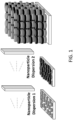
- FIG. 1 shows the shape of illustrative nanoplatelets.
- nanoplatelets need not have perfectly circular cross-sections, nor do they need to be perfectly identical as depicted in the schematic.
- Each of the three dimensions of such nanoplatelets may be nanoscale, but as noted above, the aspect ratio of the nanoplatelets is greater than 1, 1, 1.5 (x, y, z directions, respectively), e.g ., 1.5 or higher with the surface-area-to-volume ratio being relatively large.
- the nanoparticles are nanoplatelets having at least one dimension (the z- direction) in a range of from 1 to 100 nm.
- the at least one dimension (the z- direction) be in a range of from 1 to 50 nm, from 1 to 25 nm, from 1 to 5 nm, or from 2 to 5 nm.
- the nanoparticles are nanoplatelets having at least two, or all three dimensions within any of these ranges.
- the use of nanoparticles having nanoscale dimension(s), such as nanoplatelets, is by contrast to the typical size of ceramic particles ( e.g ., from 5 ⁇ m to 100 ⁇ m) used to form high-temperature ceramics using existing methods.
- the nanoparticle aspect ratio and dimensions may refer to average values, i.e., averaged over a representative number of nanoparticles.
- the composition of the nanoparticles is generally a ceramic compound.
- Ceramic compounds refer to inorganic (although elements in the ceramic compound can include carbon), nonmetallic (although elements in the ceramic compound can include metals), and crystalline ( i.e., as opposed to amorphous) solids.
- Illustrative ceramic compounds include oxides such as alumina, beryllia, ceria, zirconia, and hafnia.
- Ceramic compounds also include non-oxides such as borides, carbides, carbonates, nitrides, phosphates, silicides, and phosphates.
- the oxides and non-oxides include those of metals and metalloids, e.g ., calcium, titanium, hafnium, and silicon, without limitation.
- Specific illustrative ceramic compounds include boron oxide, boron nitride, silicon aluminum oxynitride, silicon carbide, silicon nitride, tantalum carbide, hafnium carbide, titanium carbide, tungsten oxide, and tungsten carbide.
- the nanoparticles are composed of WO 3 , ceria, hafnia, or titania.
- the nanoparticles are composed of a material that is capable of forming a ceramic compound during the steps of the method, e.g ., during sintering. This includes the nanoparticles forming the ceramic compound with the substrate during the steps of the method.
- the ceramic compound which may be formed includes any of those described above.
- a single type of nanoparticle (e.g ., having a single type of chemical composition) may be used, or a combination of different types (e.g ., having more than one type of chemical composition). In embodiments, a single type of nanoparticle is used.
- the nanoparticles may also be characterized by their crystallinity.
- the nanoparticles are monocrystalline, by which it is meant they are composed of a single crystalline phase ( i.e., as opposed to polycrystalline).
- Nanoparticles may be unfunctionalized, functionalized (e.g ., to facilitate their dispersal in the carrier fluid), or carrying spontaneously formed (i.e. self-assembly via surface adsorption onto the substrate) layers, to provide a desired component for a ceramic composite to be formed using the present methods, or both.
- organic ligands of organic-functionalized nanoparticles may be carbonized, thereby providing carbon as a component of a ceramic composite.
- Functionalization may also be used to achieve nanoparticles having a desired overall charge, which is useful for layer-by-layer deposition as described below.
- the carrier fluid provides a vehicle for dispersing and carrying the nanoparticles.
- the carrier fluid desirably allows for the formation of a stable dispersion of the nanoparticles, i.e., a colloid.
- the carrier fluid may also be used to impart a desired overall charge to the as-deposited layer to facilitate layer-by-layer deposition as described below.
- selection of an appropriate carrier fluid can depend upon the desired nanoparticles and the deposition technique used.
- a single type (e.g., single chemical composition) of carrier fluid or a combination of different types (e.g., different chemical compositions) of carrier fluids may be used.
- Illustrative carrier fluids include water, an organic solvent, an ionic liquid, and a polymer or a precursor thereof.
- Short-chain alcohols such as ethanol, methanol, isopropyl alcohol may be used.
- ionic liquids this includes materials comprising one or more cations and one or more anions and which have a melting point at or below room temperature.
- Illustrative anions for the ionic liquid include trifluoromethylsulfonate ("triflate,” CF 3 SO 3 - ), bis(trifluoromethylsulfonyl)imide (N(CF 3 SO 2 ) 2 - ), bis(perfluoroethylsulfonyl)imide ((C 2 F 5 SO 2 ) 2 N - )), tris(trifluoromethylsulfonyl)methide ((CF 3 SO 2 ) 3 C - )), tetrafluoroborate (BF 4 - ), hexafluorophosphate (PF 6 - ), hexafluoroantimonate (SbF 6 - ), and hexafluoroarsenate (AsF 6 - ). Mixtures and combinations of different anions may be used.
- triflate CF 3 SO 3 -
- bis(trifluoromethylsulfonyl)imide N(CF 3 SO 2
- Suitable commercially available ionic liquids include: Basionic ® ionic liquid products available from BASF (Florham Park, N.J.) and include: 1-Ethyl-3-methylimidazolium chloride, 1-Ethyl-3-methylimidazolium methanesulfonate, 1-Butyl-3-methylimidazolium chloride, 1-Butyl-3-methylimidazolium methanesulfonate, Methyl-tri-n-butylammonium methylsulfate, 1,2,4-Trimethylpyrazolium methylsulfate, 1-Ethyl-2,3-di-methylimidazolium ethylsulfate, 1,2,3-Trimethyl-imidazolium methylsulfate, Methylimidazolium chloride, Methylimidazolium hydrogensulfate, 1-Ethyl-3-methylimidazolium hydrogensulfate, 1-Ethyl-3-methyl
- Illustrative cations for the ionic liquid include tetraalkylammonium cations. Quaternary ammonium cations may be substituted with H, F, phenyl, alkyl groups with 1 to 15 carbon atoms, and other chemical substituents. Cations may further have bridged ring structures. Mixtures and combinations of different cations may be used.
- illustrative cations for the ionic liquid include: imidazolium; pyridinium; pyridazinium; pyrimidinium; pyrazinium; pyrazolium; oxazolium; 1,2,3-triazolium; 1,2,4-triazolium; thiazolium; piperidinium; pyrrolidinium; quinolinium; and isoquinolinium.
- the ionic liquid contains only inorganic ions to provide an inorganic ionic liquid.
- Inorganic ionic liquids include those composed of metal halides, such as mixed metal halides, and thiocyanate salts. Inorganic ionic liquids are useful to enhance the thermal and oxidative resistance of the ceramic-based materials formed using the present methods.
- a polymer or a precursor thereof is used as the carrier fluid.
- precursor it is meant a compound which is capable of forming the polymer during the steps of the method, e.g., during sintering.
- the polymer/precursor is an inorganic polymer (i.e., does not comprise carbon atoms in its polymeric backbone).
- inorganic polymers are useful to enhance thermal and oxidative resistance.
- Polysiloxanes, polysilazanes, polyphosphazenes, polyborazylenes, polyaminoboranes are illustrative inorganic polymers.
- inorganic polymers such as those described above but which also comprise organic substituents may be used and may be referred to as inorganic polymers.
- Additives may be included in the ceramic precursor composition as desired to tune the properties thereof as well as the properties of the desired ceramic-based material. Additives which stabilize the dispersion of the nanoparticles in the ceramic precursor composition may be used. Additives which facilitate chemical transformations (described below) during sintering may also be included. Illustrative additives include, e.g ., organic substances, metal salts, boric acid, and ammonia salts.
- loadings of the nanoparticles and if present, additives may be included in the carrier fluid to form the ceramic precursor composition. Loading amounts may be readily determined based on the types of nanoparticles and carrier fluid being used.
- a variety of thin-film deposition techniques may be used to form the as-deposited (multi)layer.
- the deposition technique is one that may be carried out using relatively low temperatures, including room temperature (20°C to 25°C).
- a range of deposition temperatures e.g., 10°C to 100°C may be use.
- the temperature at which the deposition is carried out may be less than 100°C.
- One illustrative includes layer-by-layer deposition.
- Layer-by-layer deposition generally involves the sequential application of compositions to a surface of a substrate to build-up a multilayer structure. Application can involve spraying (see FIG. 1 ), dip-coating, spin-coating, roll-to-roll coating (see FIG.
- application results in the self-assembly of the nanoparticles into relatively tightly packed monolayers of the nanoparticles, which is facilitated by their relatively high aspect ratios.
- Individual layers may be adhered together within the multilayer structure via electrostatic interactions (e.g ., two ceramic-precursor compositions having opposite charges due to charged nanoparticles, charged carrier fluid, or combinations thereof). However, other noncovalent and covalent interactions may be used to adhere neighboring layers.
- Rinsing is used between application of individual layers. Drying/heating may be used between application of individual layers as desired.
- the substrate surface Prior to deposition of an initial layer, the substrate surface may be chemically and/or mechanically treated to create a charged surface.
- any desired number of applications and sequences may be used to achieve a variety of multilayer structures having various compositions, properties, and overall thicknesses (e.g ., nanometers to microns, microns to millimeters).
- layer-by-layer deposition is often used with at least two compositions having different chemical compositions, this is not required.
- two ceramic-precursor compositions may be used which have the same type of nanoparticles (e.g ., same chemical composition), but have different charges thereon.
- other types of compositions e.g ., those comprising other materials, including non-ceramic materials
- layer-by-layer deposition allows for very high loadings of nanoparticles, far higher than achievable through existing techniques.
- loadings can be tailored for each individual layer and therefore, each layer may have the same or different loadings of nanoparticles.
- each layer or the combination of layers may include loadings tailored to the desired level of performance for any of the properties described herein.
- Another low-temperature deposition technique is freeze-casting.
- a directional temperature gradient is applied to induce freezing of the carrier fluid (e.g., water) and alignment of the nanoparticles.
- the frozen carrier fluid may be removed ( e.g ., sublimation) to form a porous (multi)layer of aligned nanoparticles.
- the ceramic-precursor compositions may be deposited on various substrates as desired.
- Substrates having planar (i.e., flat) and non-planar (e.g ., curved, 3D morphology) surfaces may be used.
- Porous substrates, e.g ., those formed from filamentary or woven/non-woven fabric carbon or ceramic fibers (e.g ., aramid nanofibers), may be used. Such porous substrates may be pyrolyzed to form undoped or doped carbon foams prior to deposition of the ceramic-precursor composition.
- Selection of the substrate material may be guided by the desire for the substrate to form a ceramic compound with the nanoparticles; to provide a component for a ceramic composite (e.g ., carbon); and/or to achieve a desired chemical and/or physical transformation during sintering (further described below).
- a ceramic composite e.g ., carbon
- Other illustrative substrate materials include silica, carbon, metals, ceramics (e.g ., silicon carbide).
- the present methods further comprise sintering the as-deposited (multi)layer to provide the ceramic-based material.
- Sintering involves heating the as-deposited (multi)layer to a sintering temperature for a period of time.
- the sintering temperature is sufficiently high so as to achieve densification and/or fusing of the individual nanoparticles together to form a solid matrix. This can include merging of crystal lattices of individual nanoparticles.
- the temperature at which sintering occurs is lower than in existing methods of forming ceramics.
- the specific sintering temperature depends, at least in part, on the composition of the nanoparticles.
- the sintering temperature for an as-deposited layer of a ceramic precursor composition comprising ceramic nanoparticles having one or more dimensions of from 2-5-nm may be at least 300°C less than the sintering temperature required if larger ceramic particles were used, e.g ., microparticles having a diameter of from 5 to 100 ⁇ m (and being otherwise sintered under the same conditions, e.g ., sintering time). This includes at least 400°C less, at least 500°C less, at least 600°C less, or at least 700°C less. In embodiments, the sintering temperature is 1000°C or less.
- temperatures may refer to sintering in the absence of an additional external force, e.g ., pressure. This does not preclude the application of pressure during sintering, in which case the sintering temperature may be further lowered.
- the sintering may be induced by light, e.g ., photo-induced sintering by laser or another focused light source, in which case the sintering temperature refers to the heating induced by the light.
- the temperatures above may refer to sintering for a particular time range, e.g., from seconds to hours. Sintering may be carried out in situ after the deposition.
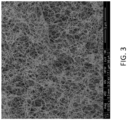
- FIG. 3 is an SEM image of an aramid nanofiber scaffold, which may be used as an illustrative porous substrate. As noted above, such a porous substrate may be pyrolyzed to form an N-doped carbon foam.
- FIG. 4 is a schematic showing the conversion of such an N-doped carbon foam 400 to a ceramic-based material 408 according to an illustrative embodiment of the present methods. As shown in step 402, any of the disclosed ceramic precursor compositions, e.g ., comprising nanoplatelets 404, may be deposited onto surfaces of the N-doped carbon foam 400, followed by in situ sintering via step 406 to form the ceramic-based material 408. Densification, e.g., via hot-pressing, may be used as shown in step 410.
- Transformations involving individual nanoparticles, the substrate, and/or between nanoparticles and the substrate include decomposition and/or carbonization of ligands on functionalized nanoparticles; hydrogen bonding; non-classical crystallization; seeded growth of mesophase; seeded crystallization of the substrate; ionexchange; recrystallization of the nanoparticles; self-assembly of the nanoparticles into other forms such as chains/sheets/capsules; ionic, covalent, or coordination bonding with the substrate; and densification of nanoparticles with the substrate.
- Chemical and physical transformations which may occur involving the carrier fluid include evaporation, polymerization, decomposition/carbonization, covalent bonding to nanoparticles, and crystallization of the ceramic phase therefrom.
- the composition, morphology, and dimensions of the ceramic-based materials formed using the present methods depend upon the details described above. However, generally the ceramic-based materials are either in the form of a coating adhered to the substrate or a 3D object. If the coating or 3D object is composed exclusively or primarily of a ceramic compound, it may be referred to as a ceramic coating/3D object. If the coating or 3D object contains a non-ceramic material (e.g ., non-carbide carbon), it may be referred to as a ceramic composite coating/3D object.
- the distinction between coating and 3D object is not meant to be particularly limiting. However, generally, although coatings may be thick ( e.g., mm), the other two dimensions are significantly greater than the thickness. By contrast, 3D objects may be small, but are generally microscale or larger and have the three dimensions of more similar magnitude to one another.
- the ceramic-based materials formed using the present methods may be characterized by a variety of properties. These include tensile strength ( ⁇ ). Tensile tests for coatings may be carried out using indentation tests using a standard Hysitron nanoindentor. Load-deformation curves may be obtained using a Berkovich tip. Stress-strain curves for ceramic composites may be carried out on ⁇ 1 mm-wide and 4-6 mm-long rectangular strips. Properties also include Young's modulus ( E ), which may be quantified using compression tests and evaluation of E in the deformation-plateau region. Other properties include electrical conductivity, adhesion, and density, measurements of which may be carried out according to ASTM standards used in the aviation industry. The specific values of each of these properties depends upon the type of ceramic-based material being used. Advantageously, the values may be tailored to the selected substrate to facilitate adhesion thereto over a wide temperature range and to meet intended usage requirements.
- ⁇ tensile strength
- Tensile tests for coatings may be carried out using inden
- the present methods may be used to provide ceramic-based materials for use in a variety of environments, including the aerospace industry, the automobile industry, the submarine industry, the electronics industry, the construction industry, and the like.
- the phrases "aerospace industry,” “automobile industry,” and “submarine industry” may refer to any device, craft, machine, or components thereof used in the industries such as aircraft, an airplane, a rotocraft, a boat, a submarine, a space ship, a trajectory device, a drone, a satellite, an automobile, a bus, a locomotive, a train car, and the like.
Landscapes
- Chemical & Material Sciences (AREA)
- Engineering & Computer Science (AREA)
- Ceramic Engineering (AREA)
- Manufacturing & Machinery (AREA)
- Materials Engineering (AREA)
- Structural Engineering (AREA)
- Organic Chemistry (AREA)
- Inorganic Chemistry (AREA)
- Mechanical Engineering (AREA)
- Nanotechnology (AREA)
- Laminated Bodies (AREA)
- Application Of Or Painting With Fluid Materials (AREA)
- Paints Or Removers (AREA)
Abstract
Description
- Ceramics materials are widely used in transportation, including aerospace, due to their high-temperature resistance and mechanical strength, resistance to corrosion in both oxidative and reductive environments, light weight, and low thermal-expansion coefficients. Components of airplanes and space vehicles requiring these properties include engine parts, brakes, insulating tiles, leading edges and cones, and even elements of cabin interiors. Ceramic-matrix composites combining ceramics with other materials such as carbon fibers are also important as they combine resistance to temperatures as high 2910°F (1600°C) and fracture toughness, a combination that is very difficult to achieve for single-component ceramics. Metal carbides are particularly important due to their light weight and multifunctional properties.
- Processing of ceramic composites into coatings or other aviation components is, however, challenging. The initial stages generally involve chemical vapor deposition (CVD), precursor pyrolysis, reactive melt infiltration, slurry infiltration, and hot pressing. Annealing requires high-temperature processing of the precursors at temperatures as high as 5430°F (3000°C) to sinter the constituent particles and fibers. Both bulk parts and coatings tend to deform during this process and components may also undergo undesirable phase changes.
- Provided are methods for forming ceramic-based materials, including coatings, three-dimensional (3D) objects, and ceramic composites thereof, having desirable properties such as high-temperature resistance and increased toughness. Compared to existing methods, however, the present methods employ significantly lower temperatures. This avoids problems such as warping and delamination as well as enables the use of a greater variety of substrates in making the ceramic-based materials.
- In an
embodiment 1, a method for forming a ceramic-based material comprises depositing a ceramic-precursor composition comprising nanoparticles having at least one dimension less than 100 nm and an aspect ratio of 1.5 or greater, and a carrier fluid on a surface of a substrate to form an as-deposited layer of the ceramic precursor composition; and sintering the as-deposited layer of the ceramic precursor composition at a sintering temperature to form a ceramic-based material. - An
embodiment 2 is the method according toembodiment 1, wherein the nanoparticles have at least one dimension in a range of from 1 nm to 100 nm. - An embodiment 3 is the method according to
embodiment 2, wherein the nanoparticles have each of their dimensions less than 100 nm. - An embodiment 4 is the method according any of embodiments 1-3, wherein the nanoparticles are nanoplatelets.
- An embodiment 5 is the method according to any of embodiments 1-4, wherein the nanoparticles comprise a ceramic compound.
- An embodiment 6 is the method according to any of embodiments 1-5, wherein the nanoparticles comprise WO3, ceria, hafnia, titania, or combinations thereof.
- An embodiment 7 is the method according to any of embodiments 1-6, wherein the nanoparticles comprise a compound that forms a ceramic compound during sintering.
- An embodiment 8, is the method according to any of embodiments 1-7, wherein the nanoparticles are monocrystalline.
- An embodiment 9 is the method according to any of embodiments 1-8, wherein the carrier fluid is water, an organic solvent, or an ionic liquid.
- An embodiment 10 is the method according to any of embodiments 1-8, wherein the carrier fluid is an inorganic ionic liquid.
- An embodiment 11 is the method according to any of embodiments 1-8, wherein the carrier fluid is a polymer or a precursor thereof.
- An embodiment 12 is the method according to embodiment 11, wherein the polymer an inorganic polymer or precursor thereof.
- An embodiment 13, is the method according to any of embodiments 1-12, wherein the deposition is carried out at a temperature of less than 100°C.
- An embodiment 14 is the method according to embodiment 13, wherein the deposition is carried out at room temperature or below.
- An embodiment 15 is the method according to any of embodiments 1-14, wherein the deposition is carried out using layer-by-layer deposition to provide an as-deposited multilayer structure comprising the as-deposited layer of the ceramic precursor composition.
- An embodiment 16 is the method according to any of embodiments 1-15, wherein the sintering temperature is below a sintering temperature that would be used if particles of the same composition as the nanoparticles were used, but having a diameter of from about 5 µm to about 100 µm.
- An embodiment 17 is the method according to any of embodiments 1-16, wherein the sintering temperature is 1000°C or less.
- An embodiment 18 is the method according to any of embodiments 1-17, wherein the substrate is a porous, carbonized substrate.
- In an embodiment 19, a method for forming a ceramic-based material comprises depositing a ceramic precursor composition comprising ceramic nanoparticles having at least one dimension less than 100 nm and an aspect ratio of 1.5 or greater and a carrier fluid on a surface of a substrate via layer-by-layer deposition to form an as-deposited layer of the ceramic precursor composition; and sintering the as-deposited multilayer structure at a sintering temperature to form a ceramic-based material.
- An embodiment 20 is the method according to embodiment 19, further comprising depositing a composition comprising a non-ceramic material via layer-by-layer deposition to form a layer of the non-ceramic material in the as-deposited multilayer structure.
- Other principal features and advantages of the disclosure will become apparent to those skilled in the art upon review of the following drawings, the detailed description, and the appended claims.
- Illustrative embodiments of the disclosure will hereafter be described with reference to the accompanying drawings.
-
FIG. 1 is a schematic showing the layer-by-layer deposition ofceramic precursor compositions -
FIG. 2 is a schematic showing the use of roll-to-roll coating as an application technique to carry out layer-by-layer deposition of cationic and anionic ceramic precursor compositions according to an illustrative embodiment of the present methods. -
FIG. 3 is a scanning electron microscope (SEM) image of an aramid nanofiber scaffold, which may be used a porous substrate in embodiments of the present methods. Such a porous substrate may be pyrolyzed to form an N-doped carbon foam prior to deposition of a ceramic precursor composition. -
FIG. 4 is a schematic showing the conversion of an N-doped carbon foam such as that formed from the aramid nanofiber scaffold ofFIG. 3 to a ceramic-based material according to an illustrative embodiment of the present methods. - Provided are methods for forming ceramic-based materials, including coatings and three-dimensional (3D) objects.
- The present methods comprise depositing a ceramic precursor composition comprising nanoparticles and a carrier fluid on a surface of a substrate to form an as-deposited layer of the ceramic precursor composition on the surface. Depositions may be carried out one time, to form a single layer, but are generally carried out multiple times, to form a multilayer structure. In embodiments, each layer possesses an opposite charge from that of an underlying previously deposited layer (after rinsing any excess material that may remain from the underlying previously deposited layer) that are bonded by covalent and noncovalent forces. Prior to the deposition of an initial layer of the ceramic precursor composition, the substrate may be prepared by treating areas of the substrate to be coated to have a charge opposite from that of the initial layer. If the same ceramic precursor composition is used during multiple depositions, the chemical composition of the individual layers of the multilayer structure are the same. If different ceramic precursor compositions are used having different chemical compositions, the chemical composition of the individual layers will be different. Other types of compositions (e.g., those comprising other materials, including non-ceramic materials) may be deposited to include other materials within the multilayer structure. This is useful to provide ceramic composites. As further described below, although various deposition techniques may be used, the temperature used during the deposition is relatively low, e.g., room temperature. Next, the as-deposited (multi)layer is sintered to form a ceramic-based material. As further described below, the temperature used during sintering is lower than that typically used to sinter ceramics. This includes using a sintering temperature of, e.g., less than 1000°C.
- The nanoparticles to be used in the present methods may be characterized by their morphology and dimensions. However, the nanoparticles are generally non-spherical having an aspect ratio of 1.5 or higher. This includes an aspect ratio of 1.7, 2, 5, 10, 50, 100, etc. At least one dimension of the nanoparticles is nanoscale, i.e., 100 nm or less. This includes nanoparticles having one dimension, two dimensions, or all three dimensions that are nanoscale. The nanoscale dimension(s) may be 90 nm or less, 70 nm or less, 50 nm or less, 25 nm or less. This includes embodiments in which the nanoscale dimension(s) is in a range of from 1 nm to 20 nm, from 1 nm to 15 nm, from 1 nm to 10 nm, from 1 nm to 5 nm, and from 2 nm to 5 nm. Any non-nanoscale dimensions (if any) are greater than 100 nm. Shapes of the non-spherical nanoparticles include, e.g., nanorods, nanotubes, nanofibers, nanowhiskers, nanodiscs, nanoplates, nanoplatelets, nanoflakes, etc.
FIG. 1 shows the shape of illustrative nanoplatelets. However, nanoplatelets need not have perfectly circular cross-sections, nor do they need to be perfectly identical as depicted in the schematic. Each of the three dimensions of such nanoplatelets may be nanoscale, but as noted above, the aspect ratio of the nanoplatelets is greater than 1, 1, 1.5 (x, y, z directions, respectively), e.g., 1.5 or higher with the surface-area-to-volume ratio being relatively large. In embodiments, the nanoparticles are nanoplatelets having at least one dimension (the z-direction) in a range of from 1 to 100 nm. This includes having the at least one dimension (the z-direction) be in a range of from 1 to 50 nm, from 1 to 25 nm, from 1 to 5 nm, or from 2 to 5 nm. In embodiments, the nanoparticles are nanoplatelets having at least two, or all three dimensions within any of these ranges. The use of nanoparticles having nanoscale dimension(s), such as nanoplatelets, is by contrast to the typical size of ceramic particles (e.g., from 5 µm to 100 µm) used to form high-temperature ceramics using existing methods. The nanoparticle aspect ratio and dimensions may refer to average values, i.e., averaged over a representative number of nanoparticles. - The composition of the nanoparticles is generally a ceramic compound. Ceramic compounds refer to inorganic (although elements in the ceramic compound can include carbon), nonmetallic (although elements in the ceramic compound can include metals), and crystalline (i.e., as opposed to amorphous) solids. Illustrative ceramic compounds include oxides such as alumina, beryllia, ceria, zirconia, and hafnia. Ceramic compounds also include non-oxides such as borides, carbides, carbonates, nitrides, phosphates, silicides, and phosphates. The oxides and non-oxides include those of metals and metalloids, e.g., calcium, titanium, hafnium, and silicon, without limitation. Specific illustrative ceramic compounds include boron oxide, boron nitride, silicon aluminum oxynitride, silicon carbide, silicon nitride, tantalum carbide, hafnium carbide, titanium carbide, tungsten oxide, and tungsten carbide. In embodiments, the nanoparticles are composed of WO3, ceria, hafnia, or titania.
- In embodiments, instead of the nanoparticles being composed of a ceramic compound, the nanoparticles are composed of a material that is capable of forming a ceramic compound during the steps of the method, e.g., during sintering. This includes the nanoparticles forming the ceramic compound with the substrate during the steps of the method. The ceramic compound which may be formed includes any of those described above.
- A single type of nanoparticle (e.g., having a single type of chemical composition) may be used, or a combination of different types (e.g., having more than one type of chemical composition). In embodiments, a single type of nanoparticle is used.
- The nanoparticles may also be characterized by their crystallinity. In embodiments, the nanoparticles are monocrystalline, by which it is meant they are composed of a single crystalline phase (i.e., as opposed to polycrystalline).
- Nanoparticles may be unfunctionalized, functionalized (e.g., to facilitate their dispersal in the carrier fluid), or carrying spontaneously formed (i.e. self-assembly via surface adsorption onto the substrate) layers, to provide a desired component for a ceramic composite to be formed using the present methods, or both. For example, during sintering, organic ligands of organic-functionalized nanoparticles may be carbonized, thereby providing carbon as a component of a ceramic composite. Functionalization may also be used to achieve nanoparticles having a desired overall charge, which is useful for layer-by-layer deposition as described below.
- The carrier fluid provides a vehicle for dispersing and carrying the nanoparticles. The carrier fluid desirably allows for the formation of a stable dispersion of the nanoparticles, i.e., a colloid. The carrier fluid may also be used to impart a desired overall charge to the as-deposited layer to facilitate layer-by-layer deposition as described below. Thus, selection of an appropriate carrier fluid can depend upon the desired nanoparticles and the deposition technique used. A single type (e.g., single chemical composition) of carrier fluid or a combination of different types (e.g., different chemical compositions) of carrier fluids may be used.
- Illustrative carrier fluids include water, an organic solvent, an ionic liquid, and a polymer or a precursor thereof. Short-chain alcohols such as ethanol, methanol, isopropyl alcohol may be used. Regarding ionic liquids, this includes materials comprising one or more cations and one or more anions and which have a melting point at or below room temperature. Illustrative anions for the ionic liquid include trifluoromethylsulfonate ("triflate," CF3SO3 -), bis(trifluoromethylsulfonyl)imide (N(CF3SO2)2 -), bis(perfluoroethylsulfonyl)imide ((C2F5SO2)2N-)), tris(trifluoromethylsulfonyl)methide ((CF3SO2)3C-)), tetrafluoroborate (BF4 -), hexafluorophosphate (PF6 -), hexafluoroantimonate (SbF6 -), and hexafluoroarsenate (AsF6 -). Mixtures and combinations of different anions may be used.
- Other suitable commercially available ionic liquids include: Basionic® ionic liquid products available from BASF (Florham Park, N.J.) and include: 1-Ethyl-3-methylimidazolium chloride, 1-Ethyl-3-methylimidazolium methanesulfonate, 1-Butyl-3-methylimidazolium chloride, 1-Butyl-3-methylimidazolium methanesulfonate, Methyl-tri-n-butylammonium methylsulfate, 1,2,4-Trimethylpyrazolium methylsulfate, 1-Ethyl-2,3-di-methylimidazolium ethylsulfate, 1,2,3-Trimethyl-imidazolium methylsulfate, Methylimidazolium chloride, Methylimidazolium hydrogensulfate, 1-Ethyl-3-methylimidazolium hydrogensulfate, 1-Ethyl-3-methylimidazolium tetrachloroaluminate, 1-Butyl-3-methylimidazolium hydrogensulfate, 1-Butyl-3-methylimidazolium tetrachloroaluminate, 1-Ethyl-3-methylimidazolium acetate, 1-Butyl-3-methylimidazolium acetate, 1-Ethyl-3-methylimidazolium ethylsulfate, 1-Butyl-3-methylimidazolium methylsulfate, 1-Ethyl-3-methylimidazolium thiocyanate, 1-Butyl-3-methylimidazolium thiocyanate, Choline acetate, Choline salicylate, Tris-(2-hydroxyethyl)-methylammonium methylsulfate. Mixtures and combinations of different ionic liquids may be used.
- Illustrative cations for the ionic liquid include tetraalkylammonium cations. Quaternary ammonium cations may be substituted with H, F, phenyl, alkyl groups with 1 to 15 carbon atoms, and other chemical substituents. Cations may further have bridged ring structures. Mixtures and combinations of different cations may be used.
- Other illustrative cations for the ionic liquid include: imidazolium; pyridinium; pyridazinium; pyrimidinium; pyrazinium; pyrazolium; oxazolium; 1,2,3-triazolium; 1,2,4-triazolium; thiazolium; piperidinium; pyrrolidinium; quinolinium; and isoquinolinium.
- Although organic cations/anions may be used, in embodiments, the ionic liquid contains only inorganic ions to provide an inorganic ionic liquid. Inorganic ionic liquids include those composed of metal halides, such as mixed metal halides, and thiocyanate salts. Inorganic ionic liquids are useful to enhance the thermal and oxidative resistance of the ceramic-based materials formed using the present methods.
- In embodiments, a polymer or a precursor thereof is used as the carrier fluid. By "precursor," it is meant a compound which is capable of forming the polymer during the steps of the method, e.g., during sintering. Although organic polymers/precursors may be used, in embodiments, the polymer/precursor is an inorganic polymer (i.e., does not comprise carbon atoms in its polymeric backbone). Again, inorganic polymers are useful to enhance thermal and oxidative resistance. Polysiloxanes, polysilazanes, polyphosphazenes, polyborazylenes, polyaminoboranes, are illustrative inorganic polymers. For purposes of the present disclosure, inorganic polymers such as those described above but which also comprise organic substituents may be used and may be referred to as inorganic polymers.
- Additives may be included in the ceramic precursor composition as desired to tune the properties thereof as well as the properties of the desired ceramic-based material. Additives which stabilize the dispersion of the nanoparticles in the ceramic precursor composition may be used. Additives which facilitate chemical transformations (described below) during sintering may also be included. Illustrative additives include, e.g., organic substances, metal salts, boric acid, and ammonia salts.
- Various loadings of the nanoparticles and if present, additives, may be included in the carrier fluid to form the ceramic precursor composition. Loading amounts may be readily determined based on the types of nanoparticles and carrier fluid being used.
- A variety of thin-film deposition techniques may be used to form the as-deposited (multi)layer. However, the deposition technique is one that may be carried out using relatively low temperatures, including room temperature (20°C to 25°C). Furthermore, depending on the thermal characteristics of the carrier fluid, a range of deposition temperatures, e.g., 10°C to 100°C may be use. Thus, the temperature at which the deposition is carried out may be less than 100°C. One illustrative includes layer-by-layer deposition. Layer-by-layer deposition generally involves the sequential application of compositions to a surface of a substrate to build-up a multilayer structure. Application can involve spraying (see
FIG. 1 ), dip-coating, spin-coating, roll-to-roll coating (seeFIG. 2 ), immersion, etc. As illustrated inFIG. 1 , application results in the self-assembly of the nanoparticles into relatively tightly packed monolayers of the nanoparticles, which is facilitated by their relatively high aspect ratios. Individual layers may be adhered together within the multilayer structure via electrostatic interactions (e.g., two ceramic-precursor compositions having opposite charges due to charged nanoparticles, charged carrier fluid, or combinations thereof). However, other noncovalent and covalent interactions may be used to adhere neighboring layers. Rinsing is used between application of individual layers. Drying/heating may be used between application of individual layers as desired. Prior to deposition of an initial layer, the substrate surface may be chemically and/or mechanically treated to create a charged surface. Following deposition of individual layers and prior to deposition of further layers, excess carrier fluid may be removed and recycled via heating or by other means prior to deposition of subsequent layers. Any desired number of applications and sequences may be used to achieve a variety of multilayer structures having various compositions, properties, and overall thicknesses (e.g., nanometers to microns, microns to millimeters). Although layer-by-layer deposition is often used with at least two compositions having different chemical compositions, this is not required. For example, two ceramic-precursor compositions may be used which have the same type of nanoparticles (e.g., same chemical composition), but have different charges thereon. As noted above, other types of compositions (e.g., those comprising other materials, including non-ceramic materials) may be deposited using layer-by-layer deposition to include other materials within the multilayer structure. This is useful to provide ceramic composites. - It is noted that layer-by-layer deposition allows for very high loadings of nanoparticles, far higher than achievable through existing techniques. In addition, such loadings can be tailored for each individual layer and therefore, each layer may have the same or different loadings of nanoparticles. In addition, each layer or the combination of layers may include loadings tailored to the desired level of performance for any of the properties described herein.
- Another low-temperature deposition technique that may be used is freeze-casting. In this embodiment, after application of the ceramic-precursor composition to the surface of the substrate (such application could be carried out using layer-by-layer deposition as described above), a directional temperature gradient is applied to induce freezing of the carrier fluid (e.g., water) and alignment of the nanoparticles. The frozen carrier fluid may be removed (e.g., sublimation) to form a porous (multi)layer of aligned nanoparticles.
- The ceramic-precursor compositions may be deposited on various substrates as desired. Substrates having planar (i.e., flat) and non-planar (e.g., curved, 3D morphology) surfaces may be used. Porous substrates, e.g., those formed from filamentary or woven/non-woven fabric carbon or ceramic fibers (e.g., aramid nanofibers), may be used. Such porous substrates may be pyrolyzed to form undoped or doped carbon foams prior to deposition of the ceramic-precursor composition. Selection of the substrate material may be guided by the desire for the substrate to form a ceramic compound with the nanoparticles; to provide a component for a ceramic composite (e.g., carbon); and/or to achieve a desired chemical and/or physical transformation during sintering (further described below). Other illustrative substrate materials include silica, carbon, metals, ceramics (e.g., silicon carbide).
- As noted above, the present methods further comprise sintering the as-deposited (multi)layer to provide the ceramic-based material. Sintering involves heating the as-deposited (multi)layer to a sintering temperature for a period of time. The sintering temperature is sufficiently high so as to achieve densification and/or fusing of the individual nanoparticles together to form a solid matrix. This can include merging of crystal lattices of individual nanoparticles. However, due to the use of the present nanoparticles, the temperature at which sintering occurs is lower than in existing methods of forming ceramics. The specific sintering temperature depends, at least in part, on the composition of the nanoparticles. However, by way of example only, the sintering temperature for an as-deposited layer of a ceramic precursor composition comprising ceramic nanoparticles having one or more dimensions of from 2-5-nm may be at least 300°C less than the sintering temperature required if larger ceramic particles were used, e.g., microparticles having a diameter of from 5 to 100 µm (and being otherwise sintered under the same conditions, e.g., sintering time). This includes at least 400°C less, at least 500°C less, at least 600°C less, or at least 700°C less. In embodiments, the sintering temperature is 1000°C or less. This includes 950°C or less, 900°C or less, 850°C or less, 800°C or less, or in a range of from 100°C to 1000°C. These temperatures may refer to sintering in the absence of an additional external force, e.g., pressure. This does not preclude the application of pressure during sintering, in which case the sintering temperature may be further lowered. The sintering may be induced by light, e.g., photo-induced sintering by laser or another focused light source, in which case the sintering temperature refers to the heating induced by the light. The temperatures above may refer to sintering for a particular time range, e.g., from seconds to hours. Sintering may be carried out in situ after the deposition.
-
FIG. 3 is an SEM image of an aramid nanofiber scaffold, which may be used as an illustrative porous substrate. As noted above, such a porous substrate may be pyrolyzed to form an N-doped carbon foam.FIG. 4 is a schematic showing the conversion of such an N-dopedcarbon foam 400 to a ceramic-basedmaterial 408 according to an illustrative embodiment of the present methods. As shown instep 402, any of the disclosed ceramic precursor compositions, e.g., comprisingnanoplatelets 404, may be deposited onto surfaces of the N-dopedcarbon foam 400, followed by in situ sintering viastep 406 to form the ceramic-basedmaterial 408. Densification, e.g., via hot-pressing, may be used as shown instep 410. - Other chemical and physical transformations (besides nanoparticle densification and/or fusing) may occur during sintering. Transformations involving individual nanoparticles, the substrate, and/or between nanoparticles and the substrate include decomposition and/or carbonization of ligands on functionalized nanoparticles; hydrogen bonding; non-classical crystallization; seeded growth of mesophase; seeded crystallization of the substrate; ionexchange; recrystallization of the nanoparticles; self-assembly of the nanoparticles into other forms such as chains/sheets/capsules; ionic, covalent, or coordination bonding with the substrate; and densification of nanoparticles with the substrate. Chemical and physical transformations which may occur involving the carrier fluid include evaporation, polymerization, decomposition/carbonization, covalent bonding to nanoparticles, and crystallization of the ceramic phase therefrom.
- The composition, morphology, and dimensions of the ceramic-based materials formed using the present methods depend upon the details described above. However, generally the ceramic-based materials are either in the form of a coating adhered to the substrate or a 3D object. If the coating or 3D object is composed exclusively or primarily of a ceramic compound, it may be referred to as a ceramic coating/3D object. If the coating or 3D object contains a non-ceramic material (e.g., non-carbide carbon), it may be referred to as a ceramic composite coating/3D object. The distinction between coating and 3D object is not meant to be particularly limiting. However, generally, although coatings may be thick (e.g., mm), the other two dimensions are significantly greater than the thickness. By contrast, 3D objects may be small, but are generally microscale or larger and have the three dimensions of more similar magnitude to one another.
- The ceramic-based materials formed using the present methods may be characterized by a variety of properties. These include tensile strength (σ). Tensile tests for coatings may be carried out using indentation tests using a standard Hysitron nanoindentor. Load-deformation curves may be obtained using a Berkovich tip. Stress-strain curves for ceramic composites may be carried out on ~1 mm-wide and 4-6 mm-long rectangular strips. Properties also include Young's modulus (E), which may be quantified using compression tests and evaluation of E in the deformation-plateau region. Other properties include electrical conductivity, adhesion, and density, measurements of which may be carried out according to ASTM standards used in the aviation industry. The specific values of each of these properties depends upon the type of ceramic-based material being used. Advantageously, the values may be tailored to the selected substrate to facilitate adhesion thereto over a wide temperature range and to meet intended usage requirements.
- The present methods may be used to provide ceramic-based materials for use in a variety of environments, including the aerospace industry, the automobile industry, the submarine industry, the electronics industry, the construction industry, and the like. Thus, the phrases "aerospace industry," "automobile industry," and "submarine industry" may refer to any device, craft, machine, or components thereof used in the industries such as aircraft, an airplane, a rotocraft, a boat, a submarine, a space ship, a trajectory device, a drone, a satellite, an automobile, a bus, a locomotive, a train car, and the like.
- Further, the disclosure comprises Examples according to the following clauses:
- 1. A method for forming a ceramic-based material, the method comprising:
- (a) depositing 402 a ceramic-precursor composition comprising nanoparticles having at least one dimension less than 100 nm and an aspect ratio of 1.5 or greater, and a carrier fluid on a surface of a
substrate 400 to form an as-deposited layer of the ceramic precursor composition; and - (b) sintering 406 the as-deposited layer of the ceramic precursor composition at a sintering temperature to form a ceramic-based
material 408.
- (a) depositing 402 a ceramic-precursor composition comprising nanoparticles having at least one dimension less than 100 nm and an aspect ratio of 1.5 or greater, and a carrier fluid on a surface of a
- 2. The method of
clause 1, wherein the nanoparticles have at least one dimension in a range of from 1 nm to 100 nm, preferably, wherein the nanoparticles are nanoplatelets 404. - 3. The method of
clauses - 4. The method of any of
clauses 1 to 3, wherein the nanoparticles comprise a compound that forms a ceramic compound duringsintering 406. - 5. The method of any of
clauses 1 to 4, wherein the nanoparticles are monocrystalline. - 6. The method of any of
clauses 1 to 5, wherein the carrier fluid is water, an organic solvent, or an ionic liquid. - 7. The method of any of
clauses 1 to 6, wherein the carrier fluid is an inorganic ionic liquid. - 8. The method of any of
clauses 1 to 7, wherein the carrier fluid is a polymer or a precursor thereof, preferably, wherein the polymer an inorganic polymer or precursor thereof. - 9. The method of any of
clauses 1 to 8, wherein thedeposition 402 is carried out at a temperature of less than 100°C, preferably, wherein thedeposition 402 is carried out at room temperature or below. - 10. The method of any of
clauses 1 to 9, wherein thedeposition 402 is carried out using layer-by-layer deposition to provide an as-deposited multilayer structure comprising the as-deposited layer of the ceramic precursor composition. - 11. The method of any of
clauses 1 to 10, wherein the sintering temperature is below a sintering temperature that would be used if particles of the same composition as the nanoparticles were used, but having a diameter of from about 5 µm to about 100 µm. - 12. The method of any of
clauses 1 to 11, wherein the sintering temperature is 1000°C or less. - 13. The method of any of
clauses 1 to 12, wherein thesubstrate 400 is a porous, carbonized substrate. - 14. The method of any of
clauses 1 to 13, wherein the nanoparticles comprise a ceramic compound and wherein thedeposition 402 is carried out using layer-by-layer deposition to provide an as-deposited multilayer structure comprising the as-deposited layer of the ceramic precursor composition. - 15. The method of clause 14, further comprising depositing a composition comprising a non-ceramic material via layer-by-layer deposition to form a layer of the non-ceramic material in the as-deposited multilayer structure.
- The word "illustrative" is used herein to mean serving as an example, instance, or illustration. Any aspect or design described herein as "illustrative" is not necessarily to be construed as preferred or advantageous over other aspects or designs. Further, for the purposes of this disclosure and unless otherwise specified, "a" or "an" means "one or more."
- If not already included, all numeric values of parameters in the present disclosure are proceeded by the term "about" which means approximately. This encompasses those variations inherent to the measurement of the relevant parameter as understood by those of ordinary skill in the art. This also encompasses the exact value of the disclosed numeric value and values that round to the disclosed numeric value.
- The foregoing description of illustrative embodiments of the disclosure has been presented for purposes of illustration and of description. It is not intended to be exhaustive or to limit the disclosure to the precise form disclosed, and modifications and variations are possible in light of the above teachings or may be acquired from practice of the disclosure. The embodiments were chosen and described in order to explain the principles of the disclosure and as practical applications of the disclosure to enable one skilled in the art to utilize the disclosure in various embodiments and with various modifications as suited to the particular use contemplated. It is intended that the scope of the disclosure be defined by the claims appended hereto and their equivalents.
Claims (15)
- A method for forming a ceramic-based material, the method comprising:a. depositing (402) a ceramic-precursor composition comprising nanoparticles having at least one dimension less than 100 nm and an aspect ratio of 1.5 or greater, and a carrier fluid on a surface of a substrate (400) to form an as-deposited layer of the ceramic precursor composition; andb. sintering (406) the as-deposited layer of the ceramic precursor composition at a sintering temperature to form a ceramic-based material (408).
- The method of claim 1, wherein the nanoparticles have at least one dimension in a range of from 1 nm to 100 nm, preferably, wherein the nanoparticles are nanoplatelets (404).
- The method of claims 1 or 2, wherein the nanoparticles comprise a ceramic compound, preferably, wherein the nanoparticles comprise WO3, ceria, hafnia, titania, or combinations thereof.
- The method of any of claims 1 to 3, wherein the nanoparticles comprise a compound that forms a ceramic compound during sintering (406).
- The method of any of claims 1 to 4, wherein the nanoparticles are monocrystalline.
- The method of any of claims 1 to 5, wherein the carrier fluid is water, an organic solvent, or an ionic liquid.
- The method of any of claims 1 to 6, wherein the carrier fluid is an inorganic ionic liquid.
- The method of any of claims 1 to 7, wherein the carrier fluid is a polymer or a precursor thereof, preferably, wherein the polymer an inorganic polymer or precursor thereof.
- The method of any of claims 1 to 8, wherein the deposition (402) is carried out at a temperature of less than 100°C, preferably, wherein the deposition (402) is carried out at room temperature or below.
- The method of any of claims 1 to 9, wherein the deposition (402) is carried out using layer-by-layer deposition to provide an as-deposited multilayer structure comprising the as-deposited layer of the ceramic precursor composition.
- The method of any of claims 1 to 10, wherein the sintering temperature is below a sintering temperature that would be used if particles of the same composition as the nanoparticles were used, but having a diameter of from about 5 µm to about 100 µm.
- The method of any of claims 1 to 11, wherein the sintering temperature is 1000°C or less.
- The method of any of claims 1 to 12, wherein the substrate (400) is a porous, carbonized substrate.
- The method of any of claims 1 to 13, wherein the nanoparticles comprise a ceramic compound and wherein the deposition (402) is carried out using layer-by-layer deposition to provide an as-deposited multilayer structure comprising the as-deposited layer of the ceramic precursor composition.
- The method of claim 14, further comprising depositing a composition comprising a non-ceramic material via layer-by-layer deposition to form a layer of the non-ceramic material in the as-deposited multilayer structure.
Applications Claiming Priority (1)
| Application Number | Priority Date | Filing Date | Title |
|---|---|---|---|
| US17/510,497 US12330993B2 (en) | 2021-10-26 | 2021-10-26 | Method for producing high-temperature-resistant coatings and structures |
Publications (2)
| Publication Number | Publication Date |
|---|---|
| EP4173820A1 true EP4173820A1 (en) | 2023-05-03 |
| EP4173820B1 EP4173820B1 (en) | 2024-05-15 |
Family
ID=83152141
Family Applications (1)
| Application Number | Title | Priority Date | Filing Date |
|---|---|---|---|
| EP22192841.9A Active EP4173820B1 (en) | 2021-10-26 | 2022-08-30 | Method for producing high-temperature-resistant coatings and structures |
Country Status (6)
| Country | Link |
|---|---|
| US (1) | US12330993B2 (en) |
| EP (1) | EP4173820B1 (en) |
| JP (1) | JP2023064743A (en) |
| CN (1) | CN116023170A (en) |
| BR (1) | BR102022014374A2 (en) |
| CA (1) | CA3170339C (en) |
Families Citing this family (3)
| Publication number | Priority date | Publication date | Assignee | Title |
|---|---|---|---|---|
| US12527147B2 (en) * | 2020-03-20 | 2026-01-13 | The Regents Of The University Of Michigan | Semiconductor nanoparticle-based detection |
| US12492506B2 (en) * | 2023-06-13 | 2025-12-09 | The Boeing Company | Fabricating methods and apparatuses for a multilayered, nanoparticle-coated fiber material |
| CN120817821B (en) * | 2025-09-17 | 2026-01-30 | 西北工业大学宁波研究院 | Preparation method of ultra-high temperature ceramic matrix composite material with layered structure |
Citations (1)
| Publication number | Priority date | Publication date | Assignee | Title |
|---|---|---|---|---|
| CN108558443A (en) * | 2017-12-27 | 2018-09-21 | 佛山科学技术学院 | A kind of preparation method and application method of nano modification mullite ceramic coating |
Family Cites Families (13)
| Publication number | Priority date | Publication date | Assignee | Title |
|---|---|---|---|---|
| FR2732336B1 (en) * | 1995-03-29 | 1997-06-20 | Aerospatiale | PROCESS FOR DEVELOPING A LIGHT SIC STRUCTURE, OF THE SANDWICH TYPE WITH A HONEYCOMB CORE, AND STRUCTURE THUS OBTAINED |
| US7863038B2 (en) * | 2002-03-29 | 2011-01-04 | Board Of Regents, The University Of Texas System | Implantable biosensor from stratified nanostructured membranes |
| WO2003103854A1 (en) | 2002-06-07 | 2003-12-18 | The Board Of Regents For Oklahoma State University | Preparation of the layer-by-layer assembled materials from dispersions of highly anisotropic colloids |
| US20100098902A1 (en) * | 2005-08-31 | 2010-04-22 | Nicholas Kotov | Layer-by-layer assemblies having preferential alignment of deposited axially anisotropic species and methods for preparation and use thereof |
| US8795783B2 (en) * | 2009-08-31 | 2014-08-05 | The Regents Of The University Of Michigan | Preparation of layer-by-layer materials and coatings from ionic liquids |
| KR101331403B1 (en) * | 2010-04-05 | 2013-11-21 | 한국세라믹기술원 | Process for silicon carbide coating on graphite |
| CN103102179B (en) * | 2013-01-06 | 2014-04-02 | 西北工业大学 | Method for preventing carbon/carbon-base or ceramic-base composite fastener from loosening |
| US10005668B1 (en) * | 2013-01-18 | 2018-06-26 | The United States Of America As Represented By The Administrator Of National Aeronautics And Space Administration | Methods for intercalating and exfoliating hexagonal boron nitride |
| CN103898499B (en) * | 2014-03-17 | 2017-01-04 | 中国人民解放军装甲兵工程学院 | A method for preparing SiC/Al2O3 coating by precursor conversion method |
| CN105622119A (en) * | 2015-12-31 | 2016-06-01 | 中物功能材料研究院有限公司 | Ceramic-based composite coating and preparation method thereof |
| CN105948819B (en) * | 2016-04-29 | 2019-02-15 | 航天材料及工艺研究所 | A kind of repair coating and its application in the repair of silicon carbide matrix composite coating |
| CN106116592A (en) * | 2016-06-20 | 2016-11-16 | 中物功能材料研究院有限公司 | Refractory ceramics base composite coating and preparation method thereof |
| CN111676469A (en) * | 2020-05-13 | 2020-09-18 | 中国人民解放军陆军装甲兵学院 | A method for preparing SiC/Al2O3 composite ceramic coating by laser cracking polycarbosilane precursor |
-
2021
- 2021-10-26 US US17/510,497 patent/US12330993B2/en active Active
-
2022
- 2022-07-20 BR BR102022014374-9A patent/BR102022014374A2/en unknown
- 2022-07-29 CN CN202210907998.8A patent/CN116023170A/en active Pending
- 2022-08-12 CA CA3170339A patent/CA3170339C/en active Active
- 2022-08-30 EP EP22192841.9A patent/EP4173820B1/en active Active
- 2022-10-25 JP JP2022170860A patent/JP2023064743A/en active Pending
Patent Citations (1)
| Publication number | Priority date | Publication date | Assignee | Title |
|---|---|---|---|---|
| CN108558443A (en) * | 2017-12-27 | 2018-09-21 | 佛山科学技术学院 | A kind of preparation method and application method of nano modification mullite ceramic coating |
Also Published As
| Publication number | Publication date |
|---|---|
| CA3170339C (en) | 2026-04-21 |
| CN116023170A (en) | 2023-04-28 |
| CA3170339A1 (en) | 2023-04-26 |
| EP4173820B1 (en) | 2024-05-15 |
| JP2023064743A (en) | 2023-05-11 |
| US12330993B2 (en) | 2025-06-17 |
| BR102022014374A2 (en) | 2023-05-09 |
| US20230130304A1 (en) | 2023-04-27 |
Similar Documents
| Publication | Publication Date | Title |
|---|---|---|
| EP4173820A1 (en) | Method for producing high-temperature-resistant coatings and structures | |
| USRE36573E (en) | Method for producing thick ceramic films by a sol gel coating process | |
| JP7087762B2 (en) | TaC coated graphite member | |
| KR20120117978A (en) | Ceramic composite materials containing carbon nanotube-infused fiber materials and methods for production thereof | |
| US5360638A (en) | Process for the production of a carbon-containing composite material part protected against oxidation | |
| CN108484190B (en) | A kind of preparation method of carbon fiber reinforced multiphase carbide ceramic matrix composite material | |
| US6284358B1 (en) | Textile preforms sheathed in a boron nitride coating, composites incorporating them and their preparation | |
| Tao et al. | Preparation of a flexible high emissivity coating on quartz fiber fabric for thermal protection | |
| KR20070090068A (en) | Protective film deposition methods, coated articles and coating compositions | |
| DE112020000384T5 (en) | Heat dissipation element | |
| US20230192563A1 (en) | Particle enhancement of ceramic matrix composites, method of manufacture thereof and articles comprising the same | |
| CN113896558B (en) | High-performance heat-conducting composite material and preparation method thereof | |
| Goerke et al. | Ceramic coatings processed by spraying of siloxane precursors (polymer-spraying) | |
| CN103396738A (en) | Preparation method of semi-inorganic heat-insulating and wave-permeable coating material | |
| Fekri et al. | Improvement of oxidation resistance of graphite by aluminosilicate coating with aluminum metaphosphate interlayer | |
| Du et al. | Online preparation of high-quality BN coatings with atomic diffusion based on carbon-free water-soluble precursor | |
| US5231061A (en) | Process for making coated ceramic reinforcement whiskers | |
| JP6374633B1 (en) | Method for producing member for molten metal bath | |
| Chen et al. | Dense and crack-free mullite films obtained from a hybrid sol–gel/dip-coating approach | |
| Farhan et al. | Characterization of latticed SiC nanowires containing coating for carbon foam using carbonization activated pack cementation process | |
| Zhang et al. | Large-area, crack-free polysilazane-based photonic crystals | |
| Feil et al. | Nanoparticle based inorganic coatings for corrosion protection of magnesium alloys | |
| US20190367417A1 (en) | Method of controllably coating a fiber preform during ceramic matrix composite (cmc) fabrication | |
| Ting et al. | Diamond-infiltrated carbon-carbon composites | |
| EP4656621A1 (en) | Damage resistant ceramic matrix composites |
Legal Events
| Date | Code | Title | Description |
|---|---|---|---|
| PUAI | Public reference made under article 153(3) epc to a published international application that has entered the european phase |
Free format text: ORIGINAL CODE: 0009012 |
|
| STAA | Information on the status of an ep patent application or granted ep patent |
Free format text: STATUS: THE APPLICATION HAS BEEN PUBLISHED |
|
| AK | Designated contracting states |
Kind code of ref document: A1 Designated state(s): AL AT BE BG CH CY CZ DE DK EE ES FI FR GB GR HR HU IE IS IT LI LT LU LV MC MK MT NL NO PL PT RO RS SE SI SK SM TR |
|
| STAA | Information on the status of an ep patent application or granted ep patent |
Free format text: STATUS: REQUEST FOR EXAMINATION WAS MADE |
|
| 17P | Request for examination filed |
Effective date: 20230530 |
|
| RBV | Designated contracting states (corrected) |
Designated state(s): AL AT BE BG CH CY CZ DE DK EE ES FI FR GB GR HR HU IE IS IT LI LT LU LV MC MK MT NL NO PL PT RO RS SE SI SK SM TR |
|
| GRAP | Despatch of communication of intention to grant a patent |
Free format text: ORIGINAL CODE: EPIDOSNIGR1 |
|
| STAA | Information on the status of an ep patent application or granted ep patent |
Free format text: STATUS: GRANT OF PATENT IS INTENDED |
|
| INTG | Intention to grant announced |
Effective date: 20231220 |
|
| GRAS | Grant fee paid |
Free format text: ORIGINAL CODE: EPIDOSNIGR3 |
|
| GRAA | (expected) grant |
Free format text: ORIGINAL CODE: 0009210 |
|
| STAA | Information on the status of an ep patent application or granted ep patent |
Free format text: STATUS: THE PATENT HAS BEEN GRANTED |
|
| P01 | Opt-out of the competence of the unified patent court (upc) registered |
Effective date: 20240307 |
|
| AK | Designated contracting states |
Kind code of ref document: B1 Designated state(s): AL AT BE BG CH CY CZ DE DK EE ES FI FR GB GR HR HU IE IS IT LI LT LU LV MC MK MT NL NO PL PT RO RS SE SI SK SM TR |
|
| REG | Reference to a national code |
Ref country code: CH Ref legal event code: EP |
|
| REG | Reference to a national code |
Ref country code: DE Ref legal event code: R096 Ref document number: 602022003472 Country of ref document: DE |
|
| REG | Reference to a national code |
Ref country code: IE Ref legal event code: FG4D |
|
| REG | Reference to a national code |
Ref country code: LT Ref legal event code: MG9D |
|
| REG | Reference to a national code |
Ref country code: NL Ref legal event code: MP Effective date: 20240515 |
|
| PG25 | Lapsed in a contracting state [announced via postgrant information from national office to epo] |
Ref country code: IS Free format text: LAPSE BECAUSE OF FAILURE TO SUBMIT A TRANSLATION OF THE DESCRIPTION OR TO PAY THE FEE WITHIN THE PRESCRIBED TIME-LIMIT Effective date: 20240915 |
|
| PG25 | Lapsed in a contracting state [announced via postgrant information from national office to epo] |
Ref country code: BG Free format text: LAPSE BECAUSE OF FAILURE TO SUBMIT A TRANSLATION OF THE DESCRIPTION OR TO PAY THE FEE WITHIN THE PRESCRIBED TIME-LIMIT Effective date: 20240515 |
|
| PG25 | Lapsed in a contracting state [announced via postgrant information from national office to epo] |
Ref country code: FI Free format text: LAPSE BECAUSE OF FAILURE TO SUBMIT A TRANSLATION OF THE DESCRIPTION OR TO PAY THE FEE WITHIN THE PRESCRIBED TIME-LIMIT Effective date: 20240515 Ref country code: HR Free format text: LAPSE BECAUSE OF FAILURE TO SUBMIT A TRANSLATION OF THE DESCRIPTION OR TO PAY THE FEE WITHIN THE PRESCRIBED TIME-LIMIT Effective date: 20240515 |
|
| PG25 | Lapsed in a contracting state [announced via postgrant information from national office to epo] |
Ref country code: GR Free format text: LAPSE BECAUSE OF FAILURE TO SUBMIT A TRANSLATION OF THE DESCRIPTION OR TO PAY THE FEE WITHIN THE PRESCRIBED TIME-LIMIT Effective date: 20240816 |
|
| PG25 | Lapsed in a contracting state [announced via postgrant information from national office to epo] |
Ref country code: PT Free format text: LAPSE BECAUSE OF FAILURE TO SUBMIT A TRANSLATION OF THE DESCRIPTION OR TO PAY THE FEE WITHIN THE PRESCRIBED TIME-LIMIT Effective date: 20240916 |
|
| REG | Reference to a national code |
Ref country code: AT Ref legal event code: MK05 Ref document number: 1686634 Country of ref document: AT Kind code of ref document: T Effective date: 20240515 |
|
| PG25 | Lapsed in a contracting state [announced via postgrant information from national office to epo] |
Ref country code: NL Free format text: LAPSE BECAUSE OF FAILURE TO SUBMIT A TRANSLATION OF THE DESCRIPTION OR TO PAY THE FEE WITHIN THE PRESCRIBED TIME-LIMIT Effective date: 20240515 |
|
| PG25 | Lapsed in a contracting state [announced via postgrant information from national office to epo] |
Ref country code: ES Free format text: LAPSE BECAUSE OF FAILURE TO SUBMIT A TRANSLATION OF THE DESCRIPTION OR TO PAY THE FEE WITHIN THE PRESCRIBED TIME-LIMIT Effective date: 20240515 |
|
| PG25 | Lapsed in a contracting state [announced via postgrant information from national office to epo] |
Ref country code: AT Free format text: LAPSE BECAUSE OF FAILURE TO SUBMIT A TRANSLATION OF THE DESCRIPTION OR TO PAY THE FEE WITHIN THE PRESCRIBED TIME-LIMIT Effective date: 20240515 |
|
| PG25 | Lapsed in a contracting state [announced via postgrant information from national office to epo] |
Ref country code: PL Free format text: LAPSE BECAUSE OF FAILURE TO SUBMIT A TRANSLATION OF THE DESCRIPTION OR TO PAY THE FEE WITHIN THE PRESCRIBED TIME-LIMIT Effective date: 20240515 |
|
| PG25 | Lapsed in a contracting state [announced via postgrant information from national office to epo] |
Ref country code: LV Free format text: LAPSE BECAUSE OF FAILURE TO SUBMIT A TRANSLATION OF THE DESCRIPTION OR TO PAY THE FEE WITHIN THE PRESCRIBED TIME-LIMIT Effective date: 20240515 |
|
| PG25 | Lapsed in a contracting state [announced via postgrant information from national office to epo] |
Ref country code: PT Free format text: LAPSE BECAUSE OF FAILURE TO SUBMIT A TRANSLATION OF THE DESCRIPTION OR TO PAY THE FEE WITHIN THE PRESCRIBED TIME-LIMIT Effective date: 20240916 Ref country code: PL Free format text: LAPSE BECAUSE OF FAILURE TO SUBMIT A TRANSLATION OF THE DESCRIPTION OR TO PAY THE FEE WITHIN THE PRESCRIBED TIME-LIMIT Effective date: 20240515 Ref country code: NO Free format text: LAPSE BECAUSE OF FAILURE TO SUBMIT A TRANSLATION OF THE DESCRIPTION OR TO PAY THE FEE WITHIN THE PRESCRIBED TIME-LIMIT Effective date: 20240815 Ref country code: NL Free format text: LAPSE BECAUSE OF FAILURE TO SUBMIT A TRANSLATION OF THE DESCRIPTION OR TO PAY THE FEE WITHIN THE PRESCRIBED TIME-LIMIT Effective date: 20240515 Ref country code: LV Free format text: LAPSE BECAUSE OF FAILURE TO SUBMIT A TRANSLATION OF THE DESCRIPTION OR TO PAY THE FEE WITHIN THE PRESCRIBED TIME-LIMIT Effective date: 20240515 Ref country code: IS Free format text: LAPSE BECAUSE OF FAILURE TO SUBMIT A TRANSLATION OF THE DESCRIPTION OR TO PAY THE FEE WITHIN THE PRESCRIBED TIME-LIMIT Effective date: 20240915 Ref country code: HR Free format text: LAPSE BECAUSE OF FAILURE TO SUBMIT A TRANSLATION OF THE DESCRIPTION OR TO PAY THE FEE WITHIN THE PRESCRIBED TIME-LIMIT Effective date: 20240515 Ref country code: GR Free format text: LAPSE BECAUSE OF FAILURE TO SUBMIT A TRANSLATION OF THE DESCRIPTION OR TO PAY THE FEE WITHIN THE PRESCRIBED TIME-LIMIT Effective date: 20240816 Ref country code: FI Free format text: LAPSE BECAUSE OF FAILURE TO SUBMIT A TRANSLATION OF THE DESCRIPTION OR TO PAY THE FEE WITHIN THE PRESCRIBED TIME-LIMIT Effective date: 20240515 Ref country code: ES Free format text: LAPSE BECAUSE OF FAILURE TO SUBMIT A TRANSLATION OF THE DESCRIPTION OR TO PAY THE FEE WITHIN THE PRESCRIBED TIME-LIMIT Effective date: 20240515 Ref country code: BG Free format text: LAPSE BECAUSE OF FAILURE TO SUBMIT A TRANSLATION OF THE DESCRIPTION OR TO PAY THE FEE WITHIN THE PRESCRIBED TIME-LIMIT Effective date: 20240515 Ref country code: AT Free format text: LAPSE BECAUSE OF FAILURE TO SUBMIT A TRANSLATION OF THE DESCRIPTION OR TO PAY THE FEE WITHIN THE PRESCRIBED TIME-LIMIT Effective date: 20240515 Ref country code: RS Free format text: LAPSE BECAUSE OF FAILURE TO SUBMIT A TRANSLATION OF THE DESCRIPTION OR TO PAY THE FEE WITHIN THE PRESCRIBED TIME-LIMIT Effective date: 20240815 |
|
| PG25 | Lapsed in a contracting state [announced via postgrant information from national office to epo] |
Ref country code: DK Free format text: LAPSE BECAUSE OF FAILURE TO SUBMIT A TRANSLATION OF THE DESCRIPTION OR TO PAY THE FEE WITHIN THE PRESCRIBED TIME-LIMIT Effective date: 20240515 |
|
| PG25 | Lapsed in a contracting state [announced via postgrant information from national office to epo] |
Ref country code: EE Free format text: LAPSE BECAUSE OF FAILURE TO SUBMIT A TRANSLATION OF THE DESCRIPTION OR TO PAY THE FEE WITHIN THE PRESCRIBED TIME-LIMIT Effective date: 20240515 |
|
| PG25 | Lapsed in a contracting state [announced via postgrant information from national office to epo] |
Ref country code: CZ Free format text: LAPSE BECAUSE OF FAILURE TO SUBMIT A TRANSLATION OF THE DESCRIPTION OR TO PAY THE FEE WITHIN THE PRESCRIBED TIME-LIMIT Effective date: 20240515 |
|
| PG25 | Lapsed in a contracting state [announced via postgrant information from national office to epo] |
Ref country code: RO Free format text: LAPSE BECAUSE OF FAILURE TO SUBMIT A TRANSLATION OF THE DESCRIPTION OR TO PAY THE FEE WITHIN THE PRESCRIBED TIME-LIMIT Effective date: 20240515 Ref country code: SK Free format text: LAPSE BECAUSE OF FAILURE TO SUBMIT A TRANSLATION OF THE DESCRIPTION OR TO PAY THE FEE WITHIN THE PRESCRIBED TIME-LIMIT Effective date: 20240515 |
|
| PG25 | Lapsed in a contracting state [announced via postgrant information from national office to epo] |
Ref country code: SM Free format text: LAPSE BECAUSE OF FAILURE TO SUBMIT A TRANSLATION OF THE DESCRIPTION OR TO PAY THE FEE WITHIN THE PRESCRIBED TIME-LIMIT Effective date: 20240515 |
|
| PG25 | Lapsed in a contracting state [announced via postgrant information from national office to epo] |
Ref country code: SM Free format text: LAPSE BECAUSE OF FAILURE TO SUBMIT A TRANSLATION OF THE DESCRIPTION OR TO PAY THE FEE WITHIN THE PRESCRIBED TIME-LIMIT Effective date: 20240515 Ref country code: SK Free format text: LAPSE BECAUSE OF FAILURE TO SUBMIT A TRANSLATION OF THE DESCRIPTION OR TO PAY THE FEE WITHIN THE PRESCRIBED TIME-LIMIT Effective date: 20240515 Ref country code: RO Free format text: LAPSE BECAUSE OF FAILURE TO SUBMIT A TRANSLATION OF THE DESCRIPTION OR TO PAY THE FEE WITHIN THE PRESCRIBED TIME-LIMIT Effective date: 20240515 Ref country code: EE Free format text: LAPSE BECAUSE OF FAILURE TO SUBMIT A TRANSLATION OF THE DESCRIPTION OR TO PAY THE FEE WITHIN THE PRESCRIBED TIME-LIMIT Effective date: 20240515 Ref country code: DK Free format text: LAPSE BECAUSE OF FAILURE TO SUBMIT A TRANSLATION OF THE DESCRIPTION OR TO PAY THE FEE WITHIN THE PRESCRIBED TIME-LIMIT Effective date: 20240515 Ref country code: CZ Free format text: LAPSE BECAUSE OF FAILURE TO SUBMIT A TRANSLATION OF THE DESCRIPTION OR TO PAY THE FEE WITHIN THE PRESCRIBED TIME-LIMIT Effective date: 20240515 |
|
| PG25 | Lapsed in a contracting state [announced via postgrant information from national office to epo] |
Ref country code: IT Free format text: LAPSE BECAUSE OF FAILURE TO SUBMIT A TRANSLATION OF THE DESCRIPTION OR TO PAY THE FEE WITHIN THE PRESCRIBED TIME-LIMIT Effective date: 20240515 |
|
| REG | Reference to a national code |
Ref country code: DE Ref legal event code: R097 Ref document number: 602022003472 Country of ref document: DE |
|
| PLBE | No opposition filed within time limit |
Free format text: ORIGINAL CODE: 0009261 |
|
| STAA | Information on the status of an ep patent application or granted ep patent |
Free format text: STATUS: NO OPPOSITION FILED WITHIN TIME LIMIT |
|
| PG25 | Lapsed in a contracting state [announced via postgrant information from national office to epo] |
Ref country code: LU Free format text: LAPSE BECAUSE OF NON-PAYMENT OF DUE FEES Effective date: 20240830 |
|
| 26N | No opposition filed |
Effective date: 20250218 |
|
| PG25 | Lapsed in a contracting state [announced via postgrant information from national office to epo] |
Ref country code: MC Free format text: LAPSE BECAUSE OF FAILURE TO SUBMIT A TRANSLATION OF THE DESCRIPTION OR TO PAY THE FEE WITHIN THE PRESCRIBED TIME-LIMIT Effective date: 20240515 Ref country code: SI Free format text: LAPSE BECAUSE OF FAILURE TO SUBMIT A TRANSLATION OF THE DESCRIPTION OR TO PAY THE FEE WITHIN THE PRESCRIBED TIME-LIMIT Effective date: 20240515 |
|
| REG | Reference to a national code |
Ref country code: BE Ref legal event code: MM Effective date: 20240831 |
|
| PG25 | Lapsed in a contracting state [announced via postgrant information from national office to epo] |
Ref country code: BE Free format text: LAPSE BECAUSE OF NON-PAYMENT OF DUE FEES Effective date: 20240831 |
|
| PG25 | Lapsed in a contracting state [announced via postgrant information from national office to epo] |
Ref country code: IE Free format text: LAPSE BECAUSE OF NON-PAYMENT OF DUE FEES Effective date: 20240830 |
|
| PG25 | Lapsed in a contracting state [announced via postgrant information from national office to epo] |
Ref country code: SE Free format text: LAPSE BECAUSE OF FAILURE TO SUBMIT A TRANSLATION OF THE DESCRIPTION OR TO PAY THE FEE WITHIN THE PRESCRIBED TIME-LIMIT Effective date: 20240515 |
|
| PGFP | Annual fee paid to national office [announced via postgrant information from national office to epo] |
Ref country code: DE Payment date: 20250827 Year of fee payment: 4 |
|
| PGFP | Annual fee paid to national office [announced via postgrant information from national office to epo] |
Ref country code: FR Payment date: 20250825 Year of fee payment: 4 |
|
| PG25 | Lapsed in a contracting state [announced via postgrant information from national office to epo] |
Ref country code: CY Free format text: LAPSE BECAUSE OF FAILURE TO SUBMIT A TRANSLATION OF THE DESCRIPTION OR TO PAY THE FEE WITHIN THE PRESCRIBED TIME-LIMIT; INVALID AB INITIO Effective date: 20220830 |
|
| PG25 | Lapsed in a contracting state [announced via postgrant information from national office to epo] |
Ref country code: HU Free format text: LAPSE BECAUSE OF FAILURE TO SUBMIT A TRANSLATION OF THE DESCRIPTION OR TO PAY THE FEE WITHIN THE PRESCRIBED TIME-LIMIT; INVALID AB INITIO Effective date: 20220830 |
|
| REG | Reference to a national code |
Ref country code: CH Ref legal event code: H13 Free format text: ST27 STATUS EVENT CODE: U-0-0-H10-H13 (AS PROVIDED BY THE NATIONAL OFFICE) Effective date: 20260324 |
|
| PG25 | Lapsed in a contracting state [announced via postgrant information from national office to epo] |
Ref country code: CH Free format text: LAPSE BECAUSE OF NON-PAYMENT OF DUE FEES Effective date: 20250831 |