EP4173642A1 - Self-disinfecting touch-sensing surface - Google Patents
Self-disinfecting touch-sensing surface Download PDFInfo
- Publication number
- EP4173642A1 EP4173642A1 EP21833450.6A EP21833450A EP4173642A1 EP 4173642 A1 EP4173642 A1 EP 4173642A1 EP 21833450 A EP21833450 A EP 21833450A EP 4173642 A1 EP4173642 A1 EP 4173642A1
- Authority
- EP
- European Patent Office
- Prior art keywords
- radiation
- touch
- detection surface
- radiation emitter
- touch detection
- Prior art date
- Legal status (The legal status is an assumption and is not a legal conclusion. Google has not performed a legal analysis and makes no representation as to the accuracy of the status listed.)
- Pending
Links
Images

Classifications
-
- A—HUMAN NECESSITIES
- A61—MEDICAL OR VETERINARY SCIENCE; HYGIENE
- A61L—METHODS OR APPARATUS FOR STERILISING MATERIALS OR OBJECTS IN GENERAL; DISINFECTION, STERILISATION OR DEODORISATION OF AIR; CHEMICAL ASPECTS OF BANDAGES, DRESSINGS, ABSORBENT PADS OR SURGICAL ARTICLES; MATERIALS FOR BANDAGES, DRESSINGS, ABSORBENT PADS OR SURGICAL ARTICLES
- A61L2/00—Disinfection or sterilisation of materials or objects, in general; Accessories therefor
- A61L2/02—Disinfection or sterilisation of materials or objects, in general; Accessories therefor using physical processes
- A61L2/08—Radiation
- A61L2/10—Ultraviolet [UV] radiation
-
- A—HUMAN NECESSITIES
- A61—MEDICAL OR VETERINARY SCIENCE; HYGIENE
- A61L—METHODS OR APPARATUS FOR STERILISING MATERIALS OR OBJECTS IN GENERAL; DISINFECTION, STERILISATION OR DEODORISATION OF AIR; CHEMICAL ASPECTS OF BANDAGES, DRESSINGS, ABSORBENT PADS OR SURGICAL ARTICLES; MATERIALS FOR BANDAGES, DRESSINGS, ABSORBENT PADS OR SURGICAL ARTICLES
- A61L2/00—Disinfection or sterilisation of materials or objects, in general; Accessories therefor
- A61L2/24—Apparatus using programmed or automatic operation
-
- A—HUMAN NECESSITIES
- A61—MEDICAL OR VETERINARY SCIENCE; HYGIENE
- A61N—ELECTROTHERAPY; MAGNETOTHERAPY; RADIATION THERAPY; ULTRASOUND THERAPY
- A61N5/00—Radiation therapy
- A61N5/06—Radiation therapy using light
- A61N5/0613—Apparatus adapted for a specific treatment
- A61N5/0624—Apparatus adapted for a specific treatment for eliminating microbes, germs, bacteria on or in the body
-
- A—HUMAN NECESSITIES
- A61—MEDICAL OR VETERINARY SCIENCE; HYGIENE
- A61L—METHODS OR APPARATUS FOR STERILISING MATERIALS OR OBJECTS IN GENERAL; DISINFECTION, STERILISATION OR DEODORISATION OF AIR; CHEMICAL ASPECTS OF BANDAGES, DRESSINGS, ABSORBENT PADS OR SURGICAL ARTICLES; MATERIALS FOR BANDAGES, DRESSINGS, ABSORBENT PADS OR SURGICAL ARTICLES
- A61L2202/00—Aspects relating to methods or apparatus for disinfecting or sterilising materials or objects
- A61L2202/10—Apparatus features
- A61L2202/11—Apparatus for generating biocidal substances, e.g. vaporisers, UV lamps
-
- A—HUMAN NECESSITIES
- A61—MEDICAL OR VETERINARY SCIENCE; HYGIENE
- A61L—METHODS OR APPARATUS FOR STERILISING MATERIALS OR OBJECTS IN GENERAL; DISINFECTION, STERILISATION OR DEODORISATION OF AIR; CHEMICAL ASPECTS OF BANDAGES, DRESSINGS, ABSORBENT PADS OR SURGICAL ARTICLES; MATERIALS FOR BANDAGES, DRESSINGS, ABSORBENT PADS OR SURGICAL ARTICLES
- A61L2202/00—Aspects relating to methods or apparatus for disinfecting or sterilising materials or objects
- A61L2202/10—Apparatus features
- A61L2202/14—Means for controlling sterilisation processes, data processing, presentation and storage means, e.g. sensors, controllers, programs
-
- A—HUMAN NECESSITIES
- A61—MEDICAL OR VETERINARY SCIENCE; HYGIENE
- A61L—METHODS OR APPARATUS FOR STERILISING MATERIALS OR OBJECTS IN GENERAL; DISINFECTION, STERILISATION OR DEODORISATION OF AIR; CHEMICAL ASPECTS OF BANDAGES, DRESSINGS, ABSORBENT PADS OR SURGICAL ARTICLES; MATERIALS FOR BANDAGES, DRESSINGS, ABSORBENT PADS OR SURGICAL ARTICLES
- A61L2202/00—Aspects relating to methods or apparatus for disinfecting or sterilising materials or objects
- A61L2202/10—Apparatus features
- A61L2202/16—Mobile applications, e.g. portable devices, trailers, devices mounted on vehicles
-
- G—PHYSICS
- G06—COMPUTING OR CALCULATING; COUNTING
- G06F—ELECTRIC DIGITAL DATA PROCESSING
- G06F3/00—Input arrangements for transferring data to be processed into a form capable of being handled by the computer; Output arrangements for transferring data from processing unit to output unit, e.g. interface arrangements
- G06F3/01—Input arrangements or combined input and output arrangements for interaction between user and computer
- G06F3/03—Arrangements for converting the position or the displacement of a member into a coded form
- G06F3/041—Digitisers, e.g. for touch screens or touch pads, characterised by the transducing means
Definitions
- the present invention deals with a touch detection surface with application in the field of electrical and/or electronic devices with at least one UV radiation emitter.
- the invention combines the germicidal or disinfectant effectiveness of UV electromagnetic radiation and the protection of said radiation in a local region to the contact surface of the switch, so as to sanitize the contact area of the touch detection surface of interest without harmful exposure or from humans or animals to UV radiation.
- Touch detection surfaces are elements which, when touching one or more points on their surface, release and/or interrupt and/or intensify and/or reduce the passage of electrical current in a given circuit.
- Touch sensing surfaces include touch screens, multi-touch screens, resistive touch screen, projected capacitive touch screens, integrated touch screen, among other devices that allow the same functionality.
- touch detection surfaces have their operator contact surfaces constructed of materials with a high possibility of proliferation of viruses and bacteria, thus allowing the risk of human contamination.
- Ultraviolet light has been shown to be effective in eliminating or inactivating most harmful microbial substances. Ultraviolet light is normally divided into three subcategories according to its wavelength of light or electromagnetic radiation which comprises the spectrum of said light.
- UV A is generally composed of electromagnetic radiation wavelengths mainly in the range of 320 nm to 400 nm
- UV B is generally composed of electromagnetic radiation wavelengths mostly in the 280nm to 320nm range
- UV C is generally composed of wavelengths less than 280nm.
- UV C is generally considered to have the greatest effectiveness in killing or inactivating germs.
- germicidal ultraviolet radiation of a wavelength of 254 nm is generally accepted to begin killing or passivating microbes with an exposure of about 2,000 ⁇ W-s / cm 2 with complete elimination or inactivation occurring by exposures in the range of about 12,000 ⁇ W-s / cm 2 .
- At least one radiation source which radiates UV-C rays on the contact surface, which may be located on the inside or outside of the device, being energized by the electrical circuit itself or by an additional electrical circuit, depending on the application and depending on the model of the touch detection surfaces.
- the surface to be decontaminated must receive more than 2000 ⁇ W-s / cm 2 per decontamination cycle.
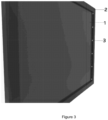
- figure 1 represents a cross-sectional view of the touch detection surface
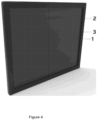
- Figure 2 represents a front view, in section, of the touch detection surface.
- the decontamination of the touch-sensitive screen happens due to UV-C radiation, which is considered effective against microorganisms harmful to human beings, however, for the invention to be effective, it is essential that the UV radiation reaches every surface that comes in contact with the operator.
- the radiation source can be located on the inside of the covering body and/or on the outside, and can also be located behind protective layers, such as the case of impact glass and/or between layers of translucent or transparent materials, since that radiation can effectively decontaminate the contact area used by the operator.
- the covering body (2) is equipped with a circuit board (4) that receives electrical current and transfers data through the wires (5), being connected to a touch-sensitive surface (1 ) which is irradiated by LED's emitting UV-C radiation (3).
- the LEDs (3) can be supplied electrically via the circuit board (4) or via a parallel electrical circuit.
- Radiation emitters can operate uninterruptedly or only when required by device or system programming. Thus, decontamination can occur either from the physical touch on the sensitive surface, that is, with energy release, or from the release of data by the electrical and/or electronic circuit and by means of previously defined programming.
- the radiation from the LED can be directed using optical fibers, as long as its final power is able to effectively decontaminate the entire proposed surface.
Landscapes
- Health & Medical Sciences (AREA)
- Public Health (AREA)
- Life Sciences & Earth Sciences (AREA)
- Animal Behavior & Ethology (AREA)
- General Health & Medical Sciences (AREA)
- Veterinary Medicine (AREA)
- Epidemiology (AREA)
- Biomedical Technology (AREA)
- Engineering & Computer Science (AREA)
- Pathology (AREA)
- Nuclear Medicine, Radiotherapy & Molecular Imaging (AREA)
- Radiology & Medical Imaging (AREA)
- Apparatus For Disinfection Or Sterilisation (AREA)
- Disinfection, Sterilisation Or Deodorisation Of Air (AREA)
Abstract
Description
- 1. The present invention deals with a touch detection surface with application in the field of electrical and/or electronic devices with at least one UV radiation emitter. The invention combines the germicidal or disinfectant effectiveness of UV electromagnetic radiation and the protection of said radiation in a local region to the contact surface of the switch, so as to sanitize the contact area of the touch detection surface of interest without harmful exposure or from humans or animals to UV radiation.
- 2. Touch detection surfaces are elements which, when touching one or more points on their surface, release and/or interrupt and/or intensify and/or reduce the passage of electrical current in a given circuit. Touch sensing surfaces include touch screens, multi-touch screens, resistive touch screen, projected capacitive touch screens, integrated touch screen, among other devices that allow the same functionality.
- 3. Currently, touch detection surfaces have their operator contact surfaces constructed of materials with a high possibility of proliferation of viruses and bacteria, thus allowing the risk of human contamination.
- 4 It is well known that, in environments with a high flow of people in which the activation of electrical and/or electronic circuits takes place through touch detection surfaces, the risk of contamination and consequent propagation of viruses and bacteria among users of these devices.
- 5 In order to mitigate or solve this risk of mass contamination, the present invention arose, since, through this developed tool, it became possible to autonomously decontaminate the surfaces which, through touch detection, trigger up electrical and/or electronic circuits.
- 6. Ultraviolet light has been shown to be effective in eliminating or inactivating most harmful microbial substances. Ultraviolet light is normally divided into three subcategories according to its wavelength of light or electromagnetic radiation which comprises the spectrum of said light.
- Petition 870200148181, dated Nov 24/, 2020, p. 3/5
- 7. These categories are commonly known as UV A, UV B or UV C. UV A is generally composed of electromagnetic radiation wavelengths mainly in the range of 320 nm to 400 nm, while UV B is generally composed of electromagnetic radiation wavelengths mostly in the 280nm to 320nm range and UV C is generally composed of wavelengths less than 280nm.
- 8. Of these three types of ultraviolet electromagnetic radiation, UV C is generally considered to have the greatest effectiveness in killing or inactivating germs. For example, germicidal ultraviolet radiation of a wavelength of 254 nm is generally accepted to begin killing or passivating microbes with an exposure of about 2,000 µW-s / cm2 with complete elimination or inactivation occurring by exposures in the range of about 12,000 µW-s / cm2.
- 9. For this, it is necessary at least one radiation source, which radiates UV-C rays on the contact surface, which may be located on the inside or outside of the device, being energized by the electrical circuit itself or by an additional electrical circuit, depending on the application and depending on the model of the touch detection surfaces.
- 10. The surface to be decontaminated must receive more than 2000 µW-s / cm2 per decontamination cycle.
- 11. The invention may be better understood through the following illustrative description, of a model in which the invention is applied, in line with the attached figures, where:
figure 1 represents a cross-sectional view of the touch detection surface andFigure 2 represents a front view, in section, of the touch detection surface. - 12. The decontamination of the touch-sensitive screen happens due to UV-C radiation, which is considered effective against microorganisms harmful to human beings, however, for the invention to be effective, it is essential that the UV radiation reaches every surface that comes in contact with the operator.
- 13. The radiation source can be located on the inside of the covering body and/or on the outside, and can also be located behind protective layers, such as the case of impact glass and/or between layers of translucent or transparent materials, since that radiation can effectively decontaminate the contact area used by the operator.
- 14. With reference to these figures, it can be seen that the covering body (2) is equipped with a circuit board (4) that receives electrical current and transfers data through the wires (5), being connected to a touch-sensitive surface (1 ) which is irradiated by LED's emitting UV-C radiation (3).
- 15. There is an inclination of about 30 degrees in the covering body (2) on which the radiation emitters are fixed. This inclination allows the radiation to be concentrated on the surface of the touch screen (1).
- 16. The LEDs (3) can be supplied electrically via the circuit board (4) or via a parallel electrical circuit.
- 17. Radiation emitters can operate uninterruptedly or only when required by device or system programming. Thus, decontamination can occur either from the physical touch on the sensitive surface, that is, with energy release, or from the release of data by the electrical and/or electronic circuit and by means of previously defined programming.
- 18. The radiation from the LED can be directed using optical fibers, as long as its final power is able to effectively decontaminate the entire proposed surface.
Claims (7)
- Touch detection surface with the ability to recognize the presence of contact points having at least one UV radiation emitter (3) with a wavelength between 100nm and 380nm capable of decontaminating the external part of the contact area (1) with the device operator, having an electrical circuit that can be programmed the best time when the radiation emitter will be turned on and off; characterized in that it can be equipped with a reflector (2) to reflect the radiation emitted by at least one and/or more radiation emitters in order to concentrate the radiation in a certain area.
- Touch detection surface with at least one UV radiation emitter according to claim 1, characterized in that it has at least one UV radiation emitter (3) located outside the device, which can be located inside one or more places.
- Touch detection surface with at least one UV radiation emitter according to claim 1, characterized in that it can have the UV radiation directed by optical fiber (5) to the region to be decontaminated.
- Touch detection surface with at least one UV radiation emitter according to claim 1, characterized in that there is a film on the surface of the screen (1) to protect the components from UV radiation.
- Touch detection surface with at least one UV radiation emitter according to claim 1, characterized in that it comprises touch-sensitive and multi-touch screens.
- Touch detection surface with at least one UV radiation emitter according to claim 1, characterized in that it can have at least one lighting LED (3) indicating that the detection surface is decontaminated.
- Touch detection surface with at least one UV radiation emitter according to claim 1, characterized in that they can comprise touch screens, multi-touch screens, resistive touch screen, projected capacitive touch screens, integrated touch screen.
Applications Claiming Priority (2)
| Application Number | Priority Date | Filing Date | Title |
|---|---|---|---|
| BR102020013480-9A BR102020013480B1 (en) | 2020-06-30 | 2020-06-30 | Self decontaminating touch detection surface |
| PCT/BR2021/050282 WO2022000061A1 (en) | 2020-06-30 | 2021-06-25 | Self-disinfecting touch-sensing surface |
Publications (2)
| Publication Number | Publication Date |
|---|---|
| EP4173642A1 true EP4173642A1 (en) | 2023-05-03 |
| EP4173642A4 EP4173642A4 (en) | 2024-08-21 |
Family
ID=74504321
Family Applications (1)
| Application Number | Title | Priority Date | Filing Date |
|---|---|---|---|
| EP21833450.6A Pending EP4173642A4 (en) | 2020-06-30 | 2021-06-25 | Self-disinfecting touch-sensing surface |
Country Status (5)
| Country | Link |
|---|---|
| US (1) | US20230248868A1 (en) |
| EP (1) | EP4173642A4 (en) |
| KR (1) | KR102845654B1 (en) |
| BR (1) | BR102020013480B1 (en) |
| WO (1) | WO2022000061A1 (en) |
Families Citing this family (2)
| Publication number | Priority date | Publication date | Assignee | Title |
|---|---|---|---|---|
| BR102021012622B1 (en) * | 2021-06-25 | 2022-02-01 | Fishiler Pimentel Zitenfeld Cardia | Mobile ultraviolet lamp station for adjustable mycobiological control of ambient air and critical surfaces |
| US20240189470A1 (en) * | 2022-12-09 | 2024-06-13 | Beyond Centerline Solutions | Body support apparatus |
Family Cites Families (9)
| Publication number | Priority date | Publication date | Assignee | Title |
|---|---|---|---|---|
| KR20070098525A (en) * | 2007-03-16 | 2007-10-05 | 이찬봉 | Self-sterilizing switch and button |
| KR100994885B1 (en) | 2009-04-14 | 2010-11-16 | 이찬봉 | Sterilizing Touch Panel |
| US20110291995A1 (en) * | 2010-05-25 | 2011-12-01 | Industrial Technology Research Institute | Sterilizing device and manufacturing method for sterilizing device |
| US8431910B1 (en) * | 2010-08-26 | 2013-04-30 | Lockheed Martin Corporation | Auto-sterilization of electronic and hand held devices |
| US9974877B2 (en) * | 2012-12-31 | 2018-05-22 | Sensor Electronic Technology, Inc. | Electronic gadget disinfection |
| US8895940B2 (en) * | 2013-03-05 | 2014-11-25 | University Of South Carolina | Switch sanitizing device |
| JP2018007929A (en) * | 2016-07-15 | 2018-01-18 | 株式会社Pfu | Sterilization device |
| AU2019242574B2 (en) * | 2018-03-30 | 2021-12-09 | Uv Partners, Inc. | Disinfection behavior tracking and ranking |
| KR20200048667A (en) * | 2018-10-30 | 2020-05-08 | 엘지이노텍 주식회사 | Ultraviolet sterillizing apparatus |
-
2020
- 2020-06-30 BR BR102020013480-9A patent/BR102020013480B1/en active IP Right Grant
-
2021
- 2021-06-25 WO PCT/BR2021/050282 patent/WO2022000061A1/en not_active Ceased
- 2021-06-25 KR KR1020237001800A patent/KR102845654B1/en active Active
- 2021-06-25 EP EP21833450.6A patent/EP4173642A4/en active Pending
- 2021-06-26 US US18/002,867 patent/US20230248868A1/en active Pending
Also Published As
| Publication number | Publication date |
|---|---|
| BR102020013480B1 (en) | 2021-08-31 |
| EP4173642A4 (en) | 2024-08-21 |
| KR102845654B1 (en) | 2025-08-14 |
| BR102020013480A2 (en) | 2021-01-19 |
| WO2022000061A1 (en) | 2022-01-06 |
| US20230248868A1 (en) | 2023-08-10 |
| KR20230026429A (en) | 2023-02-24 |
Similar Documents
| Publication | Publication Date | Title |
|---|---|---|
| US8895940B2 (en) | Switch sanitizing device | |
| CN111035859B (en) | Ultraviolet treatment device | |
| US20180154029A1 (en) | Sterilizing device and manufacturing method for sterilizing device | |
| KR102320696B1 (en) | Sterilization apparatus for elevator buttons | |
| EP4173642A1 (en) | Self-disinfecting touch-sensing surface | |
| US20220023468A1 (en) | Control surfaces and systems and methods for sanitation of control surfaces | |
| KR102259696B1 (en) | Door handle module | |
| KR20230073170A (en) | Indoor ultraviolet sterilization device dnd indoor ultraviolet sterilization system | |
| KR100994885B1 (en) | Sterilizing Touch Panel | |
| JP3227842U (en) | Portable UV sterilizer | |
| KR101736221B1 (en) | Ultraviolet ray sterilizing apparatus | |
| JP2022164278A (en) | UV irradiation device | |
| KR102360402B1 (en) | Apparatus for intelligent sterilization at all times and control method thereof | |
| CA3127069C (en) | System for neutralizing pathogens on tactile surfaces | |
| BR102020013246A2 (en) | self-decontaminating pressure switch | |
| JP2023551583A (en) | Use of polarized radiation to detect contacts on radiation exit windows | |
| KR20220150065A (en) | Sterilization apparatus of input button for elevator | |
| EP4275456B1 (en) | Luminaire for emitting ultraviolet radiation | |
| EP4129347A1 (en) | Disinfection system using uv light | |
| KR102668399B1 (en) | Utraviolet sterilizer | |
| WO2022152569A1 (en) | Exterior surface structure of a radiation exit window | |
| KR20220073168A (en) | Ultraviolet surface sterilizer | |
| WO2023062405A1 (en) | A method for enhancing uv light in a uv mask by the implementation of uv reflecting flow chamber | |
| KR20240040854A (en) | Apparatus for sterilizing using ultra violet ray | |
| WO2022152566A1 (en) | Setting a state of uv radiation sources in dependence on input from a detector arrangement |
Legal Events
| Date | Code | Title | Description |
|---|---|---|---|
| STAA | Information on the status of an ep patent application or granted ep patent |
Free format text: STATUS: THE INTERNATIONAL PUBLICATION HAS BEEN MADE |
|
| PUAI | Public reference made under article 153(3) epc to a published international application that has entered the european phase |
Free format text: ORIGINAL CODE: 0009012 |
|
| STAA | Information on the status of an ep patent application or granted ep patent |
Free format text: STATUS: REQUEST FOR EXAMINATION WAS MADE |
|
| 17P | Request for examination filed |
Effective date: 20230124 |
|
| AK | Designated contracting states |
Kind code of ref document: A1 Designated state(s): AL AT BE BG CH CY CZ DE DK EE ES FI FR GB GR HR HU IE IS IT LI LT LU LV MC MK MT NL NO PL PT RO RS SE SI SK SM TR |
|
| DAV | Request for validation of the european patent (deleted) | ||
| DAX | Request for extension of the european patent (deleted) | ||
| A4 | Supplementary search report drawn up and despatched |
Effective date: 20240723 |
|
| RIC1 | Information provided on ipc code assigned before grant |
Ipc: G06F 3/041 20060101ALI20240717BHEP Ipc: A61L 2/24 20060101ALI20240717BHEP Ipc: A61L 2/10 20060101AFI20240717BHEP |
|
| STAA | Information on the status of an ep patent application or granted ep patent |
Free format text: STATUS: EXAMINATION IS IN PROGRESS |
|
| 17Q | First examination report despatched |
Effective date: 20250926 |