EP4172241B1 - Composition and method for reacting an organosilicon compound and a silyl hydride catalyzed by a fluorinated arylborane lewis acid - Google Patents
Composition and method for reacting an organosilicon compound and a silyl hydride catalyzed by a fluorinated arylborane lewis acid Download PDFInfo
- Publication number
- EP4172241B1 EP4172241B1 EP21739854.4A EP21739854A EP4172241B1 EP 4172241 B1 EP4172241 B1 EP 4172241B1 EP 21739854 A EP21739854 A EP 21739854A EP 4172241 B1 EP4172241 B1 EP 4172241B1
- Authority
- EP
- European Patent Office
- Prior art keywords
- bis
- trifluoromethyl
- phenyl
- group
- borane
- Prior art date
- Legal status (The legal status is an assumption and is not a legal conclusion. Google has not performed a legal analysis and makes no representation as to the accuracy of the status listed.)
- Active
Links
Classifications
-
- C—CHEMISTRY; METALLURGY
- C08—ORGANIC MACROMOLECULAR COMPOUNDS; THEIR PREPARATION OR CHEMICAL WORKING-UP; COMPOSITIONS BASED THEREON
- C08G—MACROMOLECULAR COMPOUNDS OBTAINED OTHERWISE THAN BY REACTIONS ONLY INVOLVING UNSATURATED CARBON-TO-CARBON BONDS
- C08G77/00—Macromolecular compounds obtained by reactions forming a linkage containing silicon with or without sulfur, nitrogen, oxygen or carbon in the main chain of the macromolecule
- C08G77/04—Polysiloxanes
- C08G77/14—Polysiloxanes containing silicon bound to oxygen-containing groups
- C08G77/18—Polysiloxanes containing silicon bound to oxygen-containing groups to alkoxy or aryloxy groups
-
- C—CHEMISTRY; METALLURGY
- C08—ORGANIC MACROMOLECULAR COMPOUNDS; THEIR PREPARATION OR CHEMICAL WORKING-UP; COMPOSITIONS BASED THEREON
- C08G—MACROMOLECULAR COMPOUNDS OBTAINED OTHERWISE THAN BY REACTIONS ONLY INVOLVING UNSATURATED CARBON-TO-CARBON BONDS
- C08G77/00—Macromolecular compounds obtained by reactions forming a linkage containing silicon with or without sulfur, nitrogen, oxygen or carbon in the main chain of the macromolecule
- C08G77/04—Polysiloxanes
- C08G77/06—Preparatory processes
- C08G77/08—Preparatory processes characterised by the catalysts used
-
- C—CHEMISTRY; METALLURGY
- C08—ORGANIC MACROMOLECULAR COMPOUNDS; THEIR PREPARATION OR CHEMICAL WORKING-UP; COMPOSITIONS BASED THEREON
- C08G—MACROMOLECULAR COMPOUNDS OBTAINED OTHERWISE THAN BY REACTIONS ONLY INVOLVING UNSATURATED CARBON-TO-CARBON BONDS
- C08G77/00—Macromolecular compounds obtained by reactions forming a linkage containing silicon with or without sulfur, nitrogen, oxygen or carbon in the main chain of the macromolecule
- C08G77/04—Polysiloxanes
- C08G77/22—Polysiloxanes containing silicon bound to organic groups containing atoms other than carbon, hydrogen and oxygen
-
- C—CHEMISTRY; METALLURGY
- C08—ORGANIC MACROMOLECULAR COMPOUNDS; THEIR PREPARATION OR CHEMICAL WORKING-UP; COMPOSITIONS BASED THEREON
- C08G—MACROMOLECULAR COMPOUNDS OBTAINED OTHERWISE THAN BY REACTIONS ONLY INVOLVING UNSATURATED CARBON-TO-CARBON BONDS
- C08G77/00—Macromolecular compounds obtained by reactions forming a linkage containing silicon with or without sulfur, nitrogen, oxygen or carbon in the main chain of the macromolecule
- C08G77/04—Polysiloxanes
- C08G77/12—Polysiloxanes containing silicon bound to hydrogen
Definitions
- a composition includes a hydrocarbonoxy-functional organosilicon compound, a silyl hydride, and a fluorinated triarylborane Lewis acid.
- the fluorinated triarylborane Lewis acid catalyzes a reaction of a hydrocarbonoxy group from the organosilicon compound and silicon-bonded hydrogen atoms from the silyl hydride, thereby forming a siloxane bond in the resulting product.
- the catalysts predominantly employed in the preparation of both siloxane intermediates and siloxane-cured networks from Si-H functional silanes and siloxanes are platinum-based catalysts. Due to the increasingly high cost of platinum (Pt) and other drawbacks such as yellowing of cured siloxane compositions or formation of a black precipitate over time, there is an industry need for an alternative to Pt-based catalysts. Furthermore, Pt-based catalysts may also suffer from the drawback of requiring high temperatures (80°C - 110°C) to achieve sufficient reactivity to catalyze formation of siloxane bonds.
- fluorinated arylborane catalysts for reacting compounds with SiH groups and compounds with silanol or alkoxysilyl groups is known in the art and disclosed for example in document WO 2019/023008 A .
- a composition according to claim 1 comprises: A) a fluorinated triarylborane Lewis acid, B) a hydrocarbonoxy-functional organosilicon compound; and C) a silyl hydride.
- a method according to claim 11 comprises combining starting materials comprising A) the fluorinated triarylborane, B) the hydrocarbonoxy-functional organosilicon compound, and C) the silyl hydride.
- the fluorinated triarylborane Lewis acid has formula: where each R O is an ortho substituent, each R m is a meta substituent, and each RP is a para substituent, R L optional and includes a functional group or a functional polymer group; and subscript x is 0 or 1.
- each of R o1-6 , each of R m1-6 , and each of R p1-3 is independently selected from H, F, or CF 3 ; with the provisos that: not all of R o1-6 , R m1-6 , and R p1-3 can be H simultaneously; not all of R o1-6 , R m1-6 , and R p1-3 can be F simultaneously; and when two or more of R o1-4 are CF 3 , then R o5 and R o6 are each independently selected from H or F.
- R L may be a Lewis base that forms a complex with the fluorinated triarylborane Lewis acid and/or a molecule or moiety that contains at least one electron pair that is available to form a dative bond with the Lewis acid, and may be as described for R 4 in WO2019/055740 at paragraphs [0024] to [0025].
- R L include cyclic ethers such as tetrahydrofuran or tetrahydropyran.
- R L may be tetrahydrofuran (THF).
- the fluorinated triarylborane Lewis acid is selected from the group consisting of: A1) tris(3,5-bis(trifluoromethyl)phenyl)borane THF adduct; A2) bis(3,5-bis(trifluoromethyl)phenyl)(4-trifluoromethylphenyl)borane THF adduct; A3) bis(3,5-bis(trifluoromethyl)phenyl)(2,4,6-trifluorophenyl)borane THF adduct; A4) bis(3,5-bis(trifluoromethyl)phenyl)(2,6-difluorophenyl)borane THF adduct; A5) bis(3,5-bis(trifluoromethyl)phenyl)(2,5-bis(trifluoromethyl)phenyl)borane; A6) (3,5-bis(trifluoromethyl)phenyl)bis(2,5-bis(trifluoromethyl)phenyl)borane
- starting material A) may be selected from the group consisting of A1), A2), A3), A4), A5), and A7).
- starting material A) may be selected from the group consisting of: A1), A2), A3), A4), and A5).
- starting material A) may be selected from the group consisting of A1), A2) and A7).
- starting material A) may be selected from the group consisting of A2) and A5).
- starting material A) may be selected from the group consisting of A2), A3), A4), and A5).
- Fluorinated triarylborane Lewis acids are known in the art, and may be prepared by known methods, for example, the methods disclosed in WO2019/055740 , particularly at paragraphs [0052] to [0096] by varying appropriate starting materials.
- starting material A will depend on the type and amount of other starting materials used, however, starting material A) may be present in an amount of 0.1 ppm to 5 mol%, alternatively 0.1 ppm to 6000 ppm, alternatively 0.1 ppm to 600 ppm, alternatively 5 ppm to 6000 ppm, alternatively 5 ppm to 600 ppm, alternatively 5 ppm to 500 ppm, and alternatively 5 ppm to 100 ppm based on combined weights of starting materials A), B), and C) in the composition.
- Starting material B) in the composition and method described herein is a hydrocarbonoxy-functional organosilicon compound, i.e., an organosilicon compound having an average, per molecule of at least 1 silicon-bonded group of the formula -OR 2 , wherein each R 2 is an independently selected monovalent hydrocarbon group of 1 to 6 carbon atoms.
- Starting material B) may be one organosilicon compound or a combination of two or more organosilicon compounds that differ from one another.
- Examples of monovalent hydrocarbon groups for R 2 include alkyl groups such as methyl, ethyl, propyl (including n-propyl and isopropyl), butyl (including n-butyl, tert-butyl, sec-butyl, and iso-butyl), pentyl, and hexyl (including both linear and branched isomers of 5 - 6 carbon atoms); and alkenyl groups such as vinyl, allyl, butenyl, and hexenyl.
- each R 2 may be an alkyl group.
- each R 2 may be ethyl or methyl; alternatively methyl.
- Starting material B) may comprise a hydrocarbonoxysilane and/or an organosiloxane oligomer or polymer.
- the organosilicon compound may be B1) a hydrocarbonoxysilane of formula: R 1 (4-a) SiOR 2 a , where each R 1 is independently selected from the group consisting of a monovalent hydrocarbon group and a monovalent halogenated hydrocarbon group, each R 2 is the monovalent hydrocarbon group of 1 to 6 carbon atoms as described above, and subscript a is 1 to 4.
- R 1 examples include, but are not limited to, alkyl such as methyl, ethyl, propyl (including n-propyl and isopropyl), butyl (including n-butyl, tert-butyl, sec-butyl, and iso-butyl) as described above for R 2 , as well as pentyl, hexyl, heptyl, octyl, nonyl, decyl, dodecyl, undecyl, and octadecyl (and branched isomers thereof); cycloalkyl such as cyclopentyl and cyclohexyl; alkenyl such as vinyl, allyl, butenyl, and hexenyl; and aryl such as phenyl, tolyl, xylyl, naphthyl, benzyl, 1-phenylethyl, and 2-phenylethy
- Examples of monovalent halogenated hydrocarbon groups for R 1 include, but are not limited to, chlorinated alkyl groups such as chloromethyl and chloropropyl groups; fluorinated alkyl groups such as fluoromethyl, difluoromethyl, trifluoromethyl, 2-fluoropropyl, 3,3,3-trifluoropropyl, 4,4,4-trifluorobutyl, 4,4,4,3,3-pentafluorobutyl, 5,5,5,4,4,3,3-heptafluoropentyl, 6,6,6,5,5,4,4,3,3-nonafluorohexyl, and 8,8,8,7,7-pentafluorooctyl; chlorinated cycloalkyl groups such as 2,2-dichlorocyclopropyl, 2,3-dichlorocyclopentyl; and fluorinated cycloalkyl groups such as 2,2-difluorocyclopropyl, 2,3-difluorocyclobutyl,
- each R 1 may be a monovalent hydrocarbon group, alternatively an alkyl group or an aryl group.
- each R 1 may be an alkyl group, such as an alkyl group of 1 to 6 carbon atoms.
- each R 1 may be methyl or ethyl, alternatively methyl.
- Starting material B1) may comprise an alkoxysilane exemplified by a monoalkoxysilane, such as a trialkylalkoxysilane; a dialkoxysilane, such as a dialkyldialkoxysilane; a trialkoxysilane, such as an alkyltrialkoxysilane; a tetraalkoxysilane; or a combination thereof.
- a monoalkoxysilane such as a trialkylalkoxysilane
- a dialkoxysilane such as a dialkyldialkoxysilane
- a trialkoxysilane such as an alkyltrialkoxysilane
- tetraalkoxysilane a combination thereof.
- Suitable monoalkoxysilanes include trimethylmethoxysilane (TMSOMe), trimethylethoxysilane, triethylethoxysilane, triethylmethoxysilane, vinyldimethylethoxysilane, allyldimethylmethoxysilane, vinyldimethylmethoxysilane, dimethylphenylmethoxysilane, methyldiphenylmethoxysilane, triphenylmethoxysilane, and a combination thereof.
- TMSOMe trimethylmethoxysilane
- TMSOMe trimethylethoxysilane
- triethylethoxysilane triethylmethoxysilane
- vinyldimethylethoxysilane allyldimethylmethoxysilane
- vinyldimethylmethoxysilane dimethylphenylmethoxysilane
- methyldiphenylmethoxysilane triphenylmethoxys
- dialkoxysilanes examples include diisobutyldiethoxysilane, n-octadecylmethyldiethoxysilane, diphenyldiethoxysilane, diphenyldimethoxysilane, di(4-tolyl)dimethoxysilane, and combinations thereof.
- Suitable trialkoxysilanes include methyltrimethoxysilane, methyltriethoxysilane, ethyltrimethoxysilane, ethyltriethoxysilane, isobutyltrimethoxysilane, isobutyltriethoxysilane, allyltrimethoxysilane, vinyltrimethoxysilane, vinyltriethoxysilane, phenyltrimethoxysilane, p-tolyltrimethoxysilane, p-tolyltriethoxysilane, pentafluorophenyltriethoxysilane, 4-trifluoromethyltetrafluorophenyltriethoxysilane, 1-naphthyltriethoxysilane, 1-naphthyltrimethoxysilane, benzyltriethoxysilane, and a combination thereof.
- tetraalkoxysilanes examples include tetraethoxysilane and tetra-n-propoxysilane. These alkoxysilanes are known in the art and can be made by known methods such as alkoxylation of the corresponding chlorosilane, and/or suitable alkoxysilanes are commercially available, e.g., from Gelest, Inc. of Morrisville, Pennsylvania, USA.
- alkoxysilanes include, XIAMETER TM OFS-6070 silane, XIAMETER TM OFS-6011 silane, XIAMETER TM OFS-6020 silane, XIAMETER TM OFS-6030 silane, DOWSIL TM Z-6062 silane, DOWSIL TM Z-6300 silane, DOWSIL TM Z-6341 Silane, XIAMETER TM OFS-6040 silane, DOWSIL TM Z-6023 silane, DOWSIL TM Z-6015 silane, XIAMETER TM OFS-6920 silane, XIAMETER TM OFS-6690 silane and XIAMETER TM OFS-6076 silane; all of which are commercially available from The Dow Chemical Company of Midland, Michigan, USA and/or its subsidiaries.
- starting material B) may comprise an organosiloxane oligomer or polymer.
- the organosiloxane oligomer or polymer may have the hydrocarbonoxy-functional group contained in a group of formula B2): where each D independently represents an oxygen atom, a divalent hydrocarbon group, a divalent siloxane group, or a combination of a divalent hydrocarbon group and a divalent siloxane group; each R X independently represents a group of the formula -OR 2 , wherein each R 2 is as described above; each R 3 is independently selected from the group consisting of a monovalent hydrocarbon group and a monovalent halogenated hydrocarbon group as described above for R 1 ; subscript c represents 0, 1, 2, or 3; subscript e represents 0, 1, or 2; and subscript d has a value of 0 or greater, with the proviso that the sum of (e + c) is at least 1, such that, on average, at least one R X is present in the formula.
- subscript d may have a value of 0 to 18.
- subscript c may be 1.
- subscript c may be 2 or 3.
- subscript e may be 0.
- subscript d may be 0.
- subscript d may be 2 to 5, alternatively 2 to 3.
- each D may be independently selected from an oxygen atom and a divalent hydrocarbon group.
- each D may be an oxygen atom.
- each D may be a divalent hydrocarbon group exemplified by an alkylene group such as ethylene, propylene, butylene, or hexylene; an arylene group such as phenylene, or an alkylarylene group such as:
- an instance of D may be an oxygen atom while a different instance of D is a divalent hydrocarbon group.
- each R X may be independently selected from the group consisting of an alkoxy group and an alkenyloxy group.
- each X may be an alkoxy group, such as methoxy or ethoxy.
- each R 3 in the formula above may be independently selected from alkyl groups of 1 to 20 carbon atoms, aryl groups of 6 to 20 carbon atoms, and aralkyl groups of 7 to 20 carbon atoms.
- subscript b may be 0.
- the organosiloxane oligomer or polymer may comprise the groups described by formula B2) above in an amount of said polymer ranging from 0.2 mol % to 10 mol %, alternatively 0.5 mol % to 5 mol %, alternatively 0.5 mol % to 2.0 mol %, alternatively 0.5 mol % to 1.5 mol %, and alternatively 0.6 mol % to 1.2 mol %.
- Starting material B) may have a polyorganosiloxane backbone with a linear structure, i.e., a polydiorganosiloxane backbone.
- starting material B) may comprise an alkoxy-endblocked polydiorganosiloxane, an alkoxysilylhydrocarbylene-endblocked polydiorganosiloxane, or a combination thereof.
- starting material B) may comprise a polydiorganosiloxane of formula B3): where R 3 , RX, and subscripts c, d, and e are as described above, and subscript f has a value of 1 or more.
- subscript f may have a value sufficient to provide the polydiorganosiloxane of formula B3) with a viscosity of at least 100 mPa ⁇ s at 25 °C and/or a DP of at least 87. DP may be measured by GPC using polystyrene standards calibration.
- subscript f may have a value ranging from 1 to 200,000.
- each R 3 may be selected from the group consisting of alkyl, alkenyl, and aryl.
- the alkyl groups for R 3 may be selected from the group consisting of methyl, ethyl, and propyl.
- alkenyl groups for R 3 may be selected from the group consisting of vinyl, allyl, and hexenyl.
- the aryl groups for R 3 may be phenyl.
- each R X may be methoxy or ethoxy.
- Organosiloxane oligomers and polymers of formula B3) may be prepared, for example, as described in U.S. Patent Application Publication 2020-0140618 or PCT Publications WO2019/005711 or WO2019/005713 .
- the organosiloxane oligomer or polymer may comprise unit formula B4): (R X R 3 2 SiO 1/2 ) o (R 3 3 SiO 1/2 ) p (R 3 2 SiO 2/2 ) q (R X R 3 SiO 2/2 ) r (R X SiO 3/2 ) s (R 3 SiO 3/2 ) t (SiO 4/2 ) u , where R X represents the group of the formula -OR 3 as described above, subscripts o, p, q, and r have values such that o ⁇ 0, p ⁇ 0, q ⁇ 0, r ⁇ 0, s ⁇ 0, t ⁇ 0, u ⁇ 0, a quantity (o + r + s) has an average value of 1 or more, alternatively 1 to 6, alternatively 1 to 3, and alternatively 1 to 2; and each R 3 is independently selected from the group consisting of a monovalent hydrocarbon group and a monovalent halogenated hydrocarbon group as described
- a quantity (o + p + q + r + s + t + u) may be at least 3, alternatively 3 to 2000.
- a quantity (q + r) may be 1 to 2,000; alternatively 1 to 50.
- a quantity (o + p) may be 0 to 50, alternatively 0 to 2.
- the quantity (o + r + s) has an average value of 1 to 6, alternatively 1 to 3, and alternatively 1 to 2.
- each R 3 may be selected from the group consisting of alkyl, alkenyl, and aryl.
- alkyl groups for R 3 may be selected from the group consisting of methyl, ethyl, and propyl.
- alkenyl groups for R 3 may be selected from the group consisting of vinyl, allyl, and hexenyl.
- the aryl groups for R 3 may be phenyl.
- each R X may be methoxy or ethoxy.
- starting material B may comprise a polydiorganosiloxane of formula B5): R 3 2 R X SiO-(R 3 2 SiO) b -OSiR X R 3 2 , where each R 3 and each R X is are as described above, and subscript b ⁇ 1.
- subscript b may be 1 to 2,000, alternatively 5 to 900, alternatively 5 to 50, and alternatively subscript b may be 1 to 50.
- each R 3 may be independently selected from the group consisting of alkyl (e.g., methyl, ethyl, and propyl), alkenyl (e.g., vinyl, allyl, and hexenyl), and aryl (e.g., phenyl).
- each R X may be methoxy or ethoxy.
- Polydiorganosiloxanes of formula B3), such as methoxy-terminated polydimethylsiloxane with viscosity of 5 to 12 cSt are commercially available from Gelest, Inc. and 1,3-diethoxy-1,1,3,3-tetramethyldisiloxane is commercially available from Millipore Sigma of St. Louis, Missouri, USA.
- starting material B) may comprise unit formula B6): (R 3 SiO 3/2 ) m (R 3 R X SiO 2/2 ) n (R 3 2 R X SiO 1/2 ) z , where R 3 and R X are as described above, and subscript m is > 0 to 100, subscript n is 0 to 100, subscript z is 0 to 20.
- subscript m may be > 0 to 20, alternatively 1 to 20.
- subscript n may be 1 to 20.
- subscript z may be 0.
- subscript z may be > 0 to 20.
- each R 3 may be independently selected from the group consisting of alkyl (e.g., methyl, ethyl, and propyl), alkenyl (e.g., vinyl, allyl, and hexenyl), aryl (e.g., phenyl), and haloalkyl (e.g., chloromethyl, chloropropyl, and trifluoropropyl).
- each R X may be methoxy or ethoxy.
- alkoxy-functional siloxane resins may further comprise hydroxyl groups.
- Suitable alkoxy-functional siloxane resins of unit formula B6) include DOWSIL TM 3037, DOWSIL TM 3074, DOWSIL TM 1686, DOWSIL TM CF0189, DOWSIL TM Z-6289, DOWSIL TM US-CF2403 Resin and DOWSIL TM 2405 Resin from Dow Silicones Corporation of Midland, Michigan, USA.
- Suitable resins for starting material B) and methods for their preparation are known in the art.
- the alkoxy-functional organopolysiloxane resin, or the resin - polymer blend, prepared as described in U.S. Patent 9,670,392 ; U.S. Patent 10,125,225 ; or PCT Publication WO2014/124389 may be used as starting material B) herein.
- Starting material B) may comprise one or more of the compounds described herein.
- silyl hydride in the composition and method described herein is a silyl hydride.
- silyl hydride means a molecule that contains at least one silicon-bonded hydrogen atom (SiH) per molecule. Alternatively, the silyl hydride may have more than one SiH per molecule.
- Silyl hydrides used herein are capable of forming a siloxane bond in the presence of A) the fluorinated triarylborane Lewis acid and B) the organosilicon compound described above.
- Starting material C) may comprise one silyl hydride, or a combination of two or more silyl hydrides that differ from one another.
- the silyl hydride can be C1) a silane (e.g., with one silicon atom per molecule).
- the silyl hydride may be oligomeric or polymeric.
- Polymeric silyl hydrides can be linear, branched, or resinous.
- the silyl hydride may be C2) a polyorganohydrogensiloxane.
- Starting material C1) is a silane of formula H k SiR 5 (4-k) , where each R 5 is independently selected from the group consisting of a monovalent hydrocarbon group and a monovalent halogenated hydrocarbon group as described above for R 1 , and subscript k is 1 to 3, alternatively 1 or 2, and alternatively 1.
- each R 5 may be an alkyl group, such as an alkyl group of 1 to 6 carbon atoms.
- each R 5 may be methyl or ethyl.
- starting material C1) may be a silane of formula HSiR 5 3 , where each R 5 is an alkyl group of 1 to 6 carbon atoms.
- Suitable silanes include triethylsilane, dimethylethylsilane, diethylmethylsilane, dimethylisopropylsilane, dimethyl-tert-butylsilane, triisopropylsilane, chloromethyldimethylsilane, tripropylsilane, tributylsilane, triisobutylsilane, trihexylsilane, trioctylsilane, cyclohexyldimethylsilane, dimethylphenylsilane, diphenylmethylsilane, triphenylsilane, phenylsilane, bromoundecylsilane, 2-chloroethylsilane, dodecylsilane, n-octadecylsilane, and (tridecafluoro-1,1,2,2-t
- the polyorganohydrogensiloxane When starting material C2), a polyorganohydrogensiloxane is used for the silyl hydride, the polyorganohydrogensiloxane may be a homopolymer or a copolymer.
- the polyorganohydrogensiloxane may be linear, branched, or resinous.
- the silicon-bonded hydrogen atoms in the polyorganohydrogensiloxane can be located at terminal, pendant, or at both terminal and pendant positions.
- the polyorganohydrogensiloxane may comprise two or more siloxane units selected from HR 4 2 SiO 1/2 , R 4 3 SiO 1/2 , HR 4 SiO 2/2 , R 4 2 SiO 2/2 , R 4 SiO 3/2 , HSiO 3/2 and SiO 4/2 units.
- each R 4 is an independently selected monovalent hydrocarbon group, which is free of aliphatic unsaturation.
- R 4 examples include, but are not limited to, alkyl such methyl, ethyl, propyl, butyl, pentyl, hexyl, heptyl, octyl, decyl, dodecyl, undecyl, and octadecyl (and branched isomers thereof); cycloalkyl such as cyclopentyl and cyclohexyl; and aryl such as phenyl, tolyl, xylyl, naphthyl, benzyl, 1-phenylethyl, and 2-phenylethyl.
- each R 4 may be an alkyl group or a cycloalkyl group.
- each R 4 may be an alkyl group, such as methyl.
- the polydiorganohydrogensiloxane may have formula where subscript m is 0 or 1, and each R 6 is independently selected from the group consisting of Hand R 4 , with the proviso that at least one R 6 , per molecule, is a hydrogen atom.
- Suitable polyorganohydrogensiloxanes are exemplified by:
- Starting material D) is an optional solvent, which may be used to facilitate combination of starting materials A), B), and/or C) in the composition and method described herein.
- Solvents used herein are those that help fluidize the starting materials, but essentially do not react with any of these starting materials. Solvent may be selected based on solubility of the starting materials and volatility of the solvent. The solubility refers to the solvent being sufficient to dissolve and/or disperse the starting materials. Volatility refers to vapor pressure of the solvent.
- starting material A), the fluorinated triarylborane Lewis acid may be dissolved in a solvent before step 1).
- starting material B) may be dissolved in a solvent before step 1), e.g., when starting material B) is a viscous fluid, such as a gum, or a solid at RT, such as a resin.
- starting material C) may be dissolved in a solvent before step 1), e.g., when starting material C) is a solid at RT, such as a resin.
- the solvent may be used in any amount, which will be selected by one of skill in the art, depending on various factors, such as the selection of starting materials A, B), and C) their solubilities.
- Suitable solvents may be hydrocarbons. Suitable hydrocarbons include aromatic hydrocarbons such as benzene, toluene, or xylene; and/or aliphatic hydrocarbons such as heptane, hexane, or octane. Alternatively, the solvent may be a halogenated hydrocarbon such as dichloromethane, 1,1,1-trichloroethane or methylene chloride. One solvent, or a combination comprising two or more solvents, may be used herein.
- the amount of solvent can depend on various factors including the type of solvent selected and the amount and type of other starting materials selected. However, the amount of solvent may range from 0.1% to 99%, alternatively 2% to 50%, based on combined weights of starting materials A), B), and C).
- the method described above comprises: 1) combining starting materials comprising A) the fluorinated triarylborane Lewis acid, B) the organosilicon compound, and C) the silyl hydride, described above.
- the starting materials may optionally further comprise D) the solvent, which may be used to facilitate combining starting materials A), B), and C).
- the starting materials in step 1) may consist essentially of starting materials A), B), and C) (and optionally D)), described above.
- the starting materials in step 1) may consist of starting materials A), B), and C) (and optionally D)), described above.
- the resulting product of step 1) comprises a reaction product of starting materials B) and C) (which has a siloxane bond) and a side product comprising HR 2 .
- These conditions may comprise mixing, e.g., by any convenient means. Mixing may be performed using conventional mixing equipment, such as an agitated batch kettle. Alternatively, when the hydrocarbonoxy-functional organosilicon compound selected for starting material B) and/or the silyl hydride selected for starting material C) is viscous or solid (e.g., gum or resin), mixing under shear may be performed, e.g., with an extruder.
- the composition may be formed, e.g., by mixing starting materials comprising A), B), and C) described above.
- Starting materials A), B), and C) may be combined at RT or less, or may be heated.
- a temperature of 50 °C to 150 °C, alternatively 100 °C to 125 °C during mixing may be used.
- the temperature for combining starting materials A), B), and C) (and D), when present) may be 5 °C to 70 °C in step 1).
- Starting materials A), B), and C) (and D), when present) may be combined concurrently.
- starting materials A) and B) (and D), when present) may be combined to form a mixture, and thereafter the mixture may be combined with starting material C) (and additional D), when present), e.g., by adding starting material C) (or a solvent solution thereof) to said mixture, e.g., by metering over a period of time or by adding in one or more aliquots.
- the method may optionally further comprise one or more additional steps.
- the method may further comprise: step 2) during and/or after step 1), removing the side product of formula HR 2 generated during step 1) and/or step 3) removing and/or neutralizing residual fluorinated triarylborane Lewis acid in the product.
- By-product HR 2 may be removed by any convenient means, such as stripping and/or burning. Removing and/or neutralizing may be performed by adding E) a neutralizing agent to the product and optionally thereafter filtering the product. Steps 2) and 3) may be performed in any order. If a particulate by-product is present, e.g., as a result of neutralization, the method may further comprise step 4) removing a particulate such as alumina after neutralization by any convenient means, such as filtration.
- Starting material E) is a neutralizing agent that may optionally be used to neutralize starting material A) in the product.
- Alumina, triphenylamine, triphenylphosphine, triethylamine, and phenylacetylene are suitable neutralizing agents.
- Neutralizing agents are known in the art and are commercially available, e.g., from Millipore Sigma of St. Louis, Missouri, USA. The amount of neutralizing agent depends on various factors including the amount of starting material A), however, starting material E) may be present in an amount sufficient to provide a weight ratio of neutralizing agent to fluorinated triarylborane Lewis acid (E:A ratio) of 1:100 to 1000:1, alternatively 1:1 to 1000:1, and alternatively 1:100 to 1:1.
- E:A ratio weight ratio of neutralizing agent to fluorinated triarylborane Lewis acid
- the E:A ratio may be 1:1 to 20:1.
- the E:A ratio may be 100:1 to 1000: 1.
- One or more of the method steps described above may be performed at a temperature of 5 °C to 150 °C, alternatively 5 °C to 125 °C, alternatively RT to 150 °C, alternatively 5 °C to 70 °C, alternatively 5 °C to 65 °C, alternatively 10 °C to 60 °C, alternatively 15 °C to 50 °C, alternatively 20 °C to 35 °C, alternatively 5 °C to 35 °C, and alternatively RT.
- step 1) may be performed at the temperature of 5 °C to 70 °C, alternatively 5 °C to 65 °C, alternatively 10 °C to 60 °C, alternatively 15 °C to 50 °C, alternatively 20 °C to 35 °C, alternatively 5 °C to 30 °C, and alternatively 30 °C.
- relatively low temperatures e . g ., 90 °C or less, alternatively 80 °C or less, alternatively 70 °C or less, and alternatively 50 °C or less
- relatively low temperatures e . g ., 90 °C or less, alternatively 80 °C or less, alternatively 70 °C or less, and alternatively 50 °C or less
- composition and method described above can be used in the preparation of siloxanes, intermediates, and/or branched siloxane networks.
- the composition and method described above can be used in the preparation of polyorganosiloxane - polyolefin hybrid copolymers, e.g., when starting materials B2) and B3) are used in combination.
- the composition and method can be used for preparation of formulations such as elastomers, silicone foams, and paper coatings.
- NMR solvents (CDCl 3 , CD 2 Cl 2 , and C 6 D 6 ), obtained from Cambridge Isotope Laboratories, Inc., were dried over active 3 ⁇ molecular sieves or, in the case of C 6 D 6 , dried using Na/K alloy.
- 1-Bromo-3,5-bis(trifluoromethyl)benzene, 1-bromo-2,5-bis(trifluoromethyl)benzene, 1-bromo-2,6-difluorobenzene, 1-bromo-2,4,6-trifluorobenzene, and 1-bromo-4-trifluoromethylbenzene were purchased from Oakwood Chemical.
- 1-Bromo-2,3,5,6-tetrafluoro-4-trifluoromethylbenzene was purchased from Alfa Aesar. FAB was purchased from TCI. All other reagents were purchased from Sigma-Aldrich and used as received. n -Butyllithium (solution in hexanes) was titrated using 1.00 M decanol in toluene with 1,10-phenanthroline as an indicator prior to use. 1
- Multinuclear NMR spectra ( 1 H, 13 C, 19 F 29 Si, 11 B) were collected on one of the following instruments: Varian MR-400 or Varian VNMRS-500. 11 B NMR spectra were collected only on the Varian VNMRS-500.
- the 1 H and 13 C NMR chemical shifts were referenced in parts per million relative to residual solvent peaks: 1 H - 5.32 ppm for CD 2 Cl 2 , 7.15 ppm for C 6 D 6 , 7.25 ppm for CDCl 3 ; 13 C - 54.00 ppm for CD 2 Cl 2 , 128.00 ppm for C 6 D 6 , 77.00 ppm for CDCl 3 .
- the reaction mixture was stirred for 1 hour at -78 °C, then was allowed to warm to ambient temperature and was stirred for 1 hour to give a slightly cloudy solution.
- the reaction mixture was filtered and the volatiles were removed under reduced pressure to give a solid.
- the solid was triturated with hexane, filtered, and the volatiles were removed under reduced pressure to give the product as a colorless powder. Yield: 23.16 g, 94.53%.
- the compound was initially isolated as its ether adduct.
- the reaction mixture was stirred for 1 hour at -78 °C (some solids visible), then was allowed to warm to ambient temperature and was stirred overnight to give a clear solution.
- the volatiles were removed under reduced pressure to give a crystalline-appearing solid.
- the solid was dissolved in hexane, the solution was filtered and placed in the freezer over the weekend. A large amount of crystalline material formed. The supernatant was decanted and the volatiles were removed under reduced pressure to give a colorless crystalline material. Yield of material: 8.23 g, 93.5%.
- Catalyst Sample C1 tris(3,5-bis(trifluoromethyl)phenyl)borane THF adduct, was prepared as follows:
- n-Butyllithium (5.00 mL, 2.5 M in hexanes, 12.7 mmol) was added slowly dropwise to a cold (-78 °C, CO 2 (s) bath) solution of 1-bromo-3,5-bis(trifluoromethyl)benzene (3.76 g, 12.8 mmol) in diethyl ether (150 mL).
- THF-adduct product Part of the solid (4.041 g) was dissolved in ether (100 mL) and THF (5 mL) was added. The volatiles were removed from the reaction mixture under reduced pressure. The residue was extracted with benzene, filtered, and the volatiles were removed from the reaction mixture under reduced pressure to give the THF-adduct product as a colorless solid, 4.10 g, 91.3%.
- Catalyst sample C2 bis(3,5-bis(trifluoromethyl)phenyl)(4-trifluoromethylphenyl)borane THF adduct, was prepared as follows.
- n-Butyllithium (4.70 mL, 2.535 M in hexanes, 11.9 mmol) was added slowly dropwise to a cold (-78 °C, CO 2 (s)/acetone bath) solution of 1-bromo-4-trifluoromethylbenzene (2.750 g, 12.22 mmol) in diethyl ether (200 mL). The reaction mixture was stirred for 3 hours at -78 °C. Isopropoxybis(3,5-bis(trifluoromethyl)phenyl)borane (5.910 g, 11.91 mmol) in diethyl ether (15 mL) was added slowly.
- the reaction mixture was allowed to warm to ambient temperature while stirring overnight to give a clear yellow solution with a trace of precipitate.
- the solvent was removed under reduced pressure to give a thick yellow oil.
- the oil was stirred at a rapid rate with hexane (100 mL) overnight (some cloudiness develops).
- the hexane layer was decanted off, filtered, and the volatiles were removed under reduced pressure.
- the oil layer was extracted again with hexane and the process was repeated several times. A small amount of oil that did't dissolved was discarded. The volatiles were removed under reduced pressure from the filtrate to give a yellow oil.
- Catalyst sample C4 bis(3,5-bis(trifluoromethyl)phenyl)(2,6-difluorophenyl) THF adduct, was prepared as follows:
- n-Butyllithium (3.00 mL, 2.48 M in hexanes, 7.44 mmol) was added slowly dropwise to a cold (-78 °C, CO 2 (s) bath) solution of 1-bromo-2,6-difluorobenzene (1.46 g, 7.56 mmol) in diethyl ether (100 mL).
- the reaction mixture was stirred for 1 hour at -78 °C and then a solution of bis(3,5-bis(trifluoromethyl)phenyl)isopropoxyborane (3.69 g, 7.44 mmol) in ether (10 mL) was added slowly. Precipitate formed while the reaction mixture was allowed to warm to ambient temperature.
- Lithium bis(diethyletherate) bis(3,5-bis(trifluoromethyl)phenyl)(2,6-difluorophenyl)isopropoxyborate (5.85 g, 10.6 mmol) was dissolved in ether (150 mL) and chlorotrimethylsilane (3.00 mL, 23.6 mmol) was added to the solution at ambient temperature. Precipitate began to form within 15 minutes. The reaction mixture was allowed to stir over the weekend. By Monday, the volatiles had evaporated away (non-sealed container). The colorless solid was extracted with ether and filtered. The volatiles were removed under reduced pressure to give the product as a colorless solid, 4.98 g.
- n-Butyllithium (4.00 mL, 2.535 M in hexanes, 10.14 mmol) was added slowly to a cold (-78 °C, CO 2 (s) bath) solution of 1-bromo-2,5-bis(trifluoromethyl)benzene (3.00 g, 10.24 mmol) in diethyl ether (200 mL). The reaction mixture was stirred for 1 hour at -78 °C. Isopropoxy-bis(3,5-bis(trifluoromethyl)phenyl)borane (5.036 g, 10.15 mmol) in ether (18 mL) was added slowly. The reaction mixture was stirred for several hours at -78 °C.
- the solution was warmed to ambient temperature while stirring overnight to give a pale-yellow clear solution.
- the volatiles were removed from the reaction mixture to give a yellow oil.
- the oil was extracted with benzene. There was nothing insoluble.
- the volatiles were removed from the reaction mixture to give a yellow oil.
- the yield was 7.88 g, 98.3%.
- Lithium(diethyletherate) isopropoxy-bis(3,5-bis(trifluoromethyl)phenyl)(2,5-bis(trifluoromethyl)phenyl)-borate (7.88 g, 9.97 mmol) was dissolved in ether (150 mL). Chlorotrimethylsilane (2.6 mL, 20.5 mmol) was added. The reaction mixture was allowed to stir overnight to give a yellow solution with colorless precipitate. The volatiles were removed under reduced pressure. The residue was extracted with hexane (100 ml). The mixture was filtered and the volatiles were concentrated under reduced pressure. The solution was cooled in the freezer (-33 °C) overnight. The reaction mixture was filtered and the precipitate was dried under reduced pressure to give a white powder. Yield: 6.0182 g, 92.84%.
- the second crop of lithium diisopropoxy (3,5-bis(trifluoromethyl)phenyl)(2,5-bis(trifluoromethyl)phenyl)borate prepared as described above was treated similarly (2.017 g, 3.17 mmol, of lithium salt; 2.0 mL of TMSCl) and stirred for 3 hours.
- the total amount of combined reagents 5.335 g, 8.39 mmol; TMSCl: 4.0 mL, 31.6 mmol.
- the second reaction mixture was filtered and combined with the first reaction product.
- the volatiles were removed under reduced pressure.
- the residue was extracted with hexane, filtered, and the volatiles were removed overnight at 40 °C under reduced pressure to give the product as a yellow oil, 3.4703 g, 83.42%.
- n-Butyllithium (2.40 mL, 2.535 M in hexanes, 6.08 mmol) was added slowly to a cold (-78 °C, CO 2 (s) bath) solution of 1-bromo-2,5-bis(trifluoromethyl)benzene (1.800 g, 6.14 mmol) in diethyl ether (150 mL). The reaction mixture was stirred for 1 hour at -78 °C. Isopropoxy(2,5-bis(trifluoromethyl)phenyl)(3,5-bis(trifluoromethyl)phenyl)borane (3.022 g, 6.09 mmol) in ether (18 mL) was added slowly.
- the reaction mixture was stirred for several hours at -78 °C.
- the solution was allowed to warm to ambient temperature while stirring overnight to give a pale-yellow clear solution.
- the volatiles were removed from the reaction mixture to give a yellow oil.
- the oil was extracted with benzene. There was nothing insoluble.
- the volatiles were removed from the reaction mixture to give a yellow oil.
- the yield was 4.21 g, 87.6%.
- Catalyst Sample C7 was prepared as follows:
- Catalyst sample C8 bis(3,5-bis(trifluoromethyl)phenyl)(2,3,5,6-tetrafluoro-4-trifluoromethylphenyl)borane THF adduct, was prepared as follows:
- n-Butyllithium (3.00 mL, 2.54 M in hexanes, 7.61 mmol) was added to a cold (between -101 °C and -99 °C, CO 2 (s), then N 2 (l) methanol bath) solution of 1-bromo-2,3,5,6-tetrafluoro-4-trifluoromethylbenzene (2.26 g, 7.61 mmol) in diethyl ether (100 mL) with stirring. The reaction mixture was stirred for 2 hours at -100 °C then was allowed to warm up to -76 °C.
- Structure C1 is tris(3,5-bis(trifluoromethyl)phenyl)borane THF adduct (corresponding to starting material A1) in the claims).
- Structure C2 is bis(3,5-bis(trifluoromethyl)phenyl)(4-trifluoromethylphenyl)borane THF adduct corresponding to starting material A2) in the claims).
- Structure C3 is bis(3,5-bis(trifluoromethyl)phenyl)(2,4,6-trifluorophenyl)borane THF adduct (corresponding to starting material A3) in the claims).
- Structure C4 is bis(3,5-bis(trifluoromethyl)phenyl)(2,6-difluorophenyl)borane THF adduct (corresponding to starting material A4) in the claims).
- Structure C5 is bis(3,5-bis(trifluoromethyl)phenyl)(2,5-bis(trifluoromethyl)phenyl)borane (corresponding to starting material A5) in the claims).
- Structure C6 is (3,5-bis(trifluoromethyl)phenyl)bis(2,5-bis(trifluoromethyl)phenyl)borane (corresponding to starting material A6) in the claims).
- Structure C7 is tris(2,5-bis(trifluoromethyl)phenyl)borane.
- Structure C8 is bis(3,5-bis(trifluoromethyl)phenyl)(2,3,5,6-tetrafluoro-4-trifluoromethylphenyl)borane THF adduct (corresponding to starting material A7) in the claims).
- HTMS, PMDS, TES, TMSOMe, and FAB (described above in Table 1) were used as received.
- solutions of fluorinated triarylborane Lewis acid samples (catalysts) were prepared in 10-mL glass vials (ex. FAB, 30.7 mg, 0.06 mmol was dissolved in 5 mL of anhydrous deuterated benzene).
- the silyl hydride (ex: HTMS, 32.6 ⁇ L, 0.12 mmol, 1 equiv.), the organosilicon compound with an alkoxy group (ex: trimethylmethoxysilane, 17 ⁇ L, 0.12 mmol, 1 equiv.), an internal standard (mesitylene, 16.8 ⁇ L, 0.12 mmol, 1 equiv.).
- the catalyst (0.5 mL, 0.006 mmol, 5 mol%) was delivered as a stock solution via pipet. The final concentration of the solution is 0.24M.
- the tube was capped and 1 H NMR spectra were taken at regular time intervals. Conversion was established in comparison to the internal standard using a 400 MHz NMR.
- composition and method described herein employ fluorinated triarylborane Lewis acids as catalysts. These fluorinated triarylborane Lewis acids provide better reaction rate control than FAB.
- the composition and method described herein provide the further benefit that order of addition of the starting materials is not critical; the starting materials can be combined in any order.
- the present composition and method may provide the benefits of pot-life and/or process robustness. Without wishing to be bound by theory, it is thought that a silyl hydride should not be mixed with FAB, as that would trigger self-cure.
- a hyphen "-” or dash “-” in a range of values is “to” or “through”; a ">” is “above” or “greater-than”; a “ ⁇ ” is “at least” or “greater-than or equal to”; a “ ⁇ ” is “below” or “less-than”; and a “ ⁇ ” is “at most” or “less-than or equal to.”
Landscapes
- Chemical & Material Sciences (AREA)
- Health & Medical Sciences (AREA)
- Chemical Kinetics & Catalysis (AREA)
- Medicinal Chemistry (AREA)
- Polymers & Plastics (AREA)
- Organic Chemistry (AREA)
- Silicon Polymers (AREA)
- Low-Molecular Organic Synthesis Reactions Using Catalysts (AREA)
Description
- This application claims the benefit of
U.S. Provisional Patent Application Serial No. 63/043,153 filed on 24 June 2020 - A composition includes a hydrocarbonoxy-functional organosilicon compound, a silyl hydride, and a fluorinated triarylborane Lewis acid. In the method, the fluorinated triarylborane Lewis acid catalyzes a reaction of a hydrocarbonoxy group from the organosilicon compound and silicon-bonded hydrogen atoms from the silyl hydride, thereby forming a siloxane bond in the resulting product.
- The catalysts predominantly employed in the preparation of both siloxane intermediates and siloxane-cured networks from Si-H functional silanes and siloxanes are platinum-based catalysts. Due to the increasingly high cost of platinum (Pt) and other drawbacks such as yellowing of cured siloxane compositions or formation of a black precipitate over time, there is an industry need for an alternative to Pt-based catalysts. Furthermore, Pt-based catalysts may also suffer from the drawback of requiring high temperatures (80°C - 110°C) to achieve sufficient reactivity to catalyze formation of siloxane bonds.
- The use of fluorinated arylborane catalysts for reacting compounds with SiH groups and compounds with silanol or alkoxysilyl groups is known in the art and disclosed for example in document
WO 2019/023008 A . - A composition according to claim 1 comprises: A) a fluorinated triarylborane Lewis acid, B) a hydrocarbonoxy-functional organosilicon compound; and C) a silyl hydride. A method according to claim 11 comprises combining starting materials comprising A) the fluorinated triarylborane, B) the hydrocarbonoxy-functional organosilicon compound, and C) the silyl hydride.
- Starting material A) in the composition and method described herein is the fluorinated triarylborane Lewis acid. The fluorinated triarylborane Lewis acid has formula:

WO2019/055740 at paragraphs [0024] to [0025]. Examples of RL include cyclic ethers such as tetrahydrofuran or tetrahydropyran. Alternatively, RL may be tetrahydrofuran (THF). More particularly, the fluorinated triarylborane Lewis acid is selected from the group consisting of: A1) tris(3,5-bis(trifluoromethyl)phenyl)borane THF adduct; A2) bis(3,5-bis(trifluoromethyl)phenyl)(4-trifluoromethylphenyl)borane THF adduct; A3) bis(3,5-bis(trifluoromethyl)phenyl)(2,4,6-trifluorophenyl)borane THF adduct; A4) bis(3,5-bis(trifluoromethyl)phenyl)(2,6-difluorophenyl)borane THF adduct; A5) bis(3,5-bis(trifluoromethyl)phenyl)(2,5-bis(trifluoromethyl)phenyl)borane; A6) (3,5-bis(trifluoromethyl)phenyl)bis(2,5-bis(trifluoromethyl)phenyl)borane; A7) bis(3,5-bis(trifluoromethyl)phenyl)(2,3,5,6-tetrafluoro-4-trifluoromethylphenyl)borane THF adduct; and A8) a combination of two or more of A1) to A7). Alternatively, starting material A) may be selected from the group consisting of A1), A2), A3), A4), A5), and A7). Alternatively, starting material A) may be selected from the group consisting of: A1), A2), A3), A4), and A5). Alternatively, starting material A) may be selected from the group consisting of A1), A2) and A7). Alternatively, starting material A) may be selected from the group consisting of A2) and A5). Alternatively, starting material A) may be selected from the group consisting of A2), A3), A4), and A5). - Fluorinated triarylborane Lewis acids are known in the art, and may be prepared by known methods, for example, the methods disclosed in
WO2019/055740 , particularly at paragraphs [0052] to [0096] by varying appropriate starting materials. - The amount of starting material A) will depend on the type and amount of other starting materials used, however, starting material A) may be present in an amount of 0.1 ppm to 5 mol%, alternatively 0.1 ppm to 6000 ppm, alternatively 0.1 ppm to 600 ppm, alternatively 5 ppm to 6000 ppm, alternatively 5 ppm to 600 ppm, alternatively 5 ppm to 500 ppm, and alternatively 5 ppm to 100 ppm based on combined weights of starting materials A), B), and C) in the composition.
- Starting material B) in the composition and method described herein is a hydrocarbonoxy-functional organosilicon compound, i.e., an organosilicon compound having an average, per molecule of at least 1 silicon-bonded group of the formula -OR2, wherein each R2 is an independently selected monovalent hydrocarbon group of 1 to 6 carbon atoms. Starting material B) may be one organosilicon compound or a combination of two or more organosilicon compounds that differ from one another. Examples of monovalent hydrocarbon groups for R2 include alkyl groups such as methyl, ethyl, propyl (including n-propyl and isopropyl), butyl (including n-butyl, tert-butyl, sec-butyl, and iso-butyl), pentyl, and hexyl (including both linear and branched isomers of 5 - 6 carbon atoms); and alkenyl groups such as vinyl, allyl, butenyl, and hexenyl. Alternatively, each R2 may be an alkyl group. Alternatively, each R2 may be ethyl or methyl; alternatively methyl.
- Starting material B) may comprise a hydrocarbonoxysilane and/or an organosiloxane oligomer or polymer. For example, the organosilicon compound may be B1) a hydrocarbonoxysilane of formula: R1 (4-a)SiOR2 a, where each R1 is independently selected from the group consisting of a monovalent hydrocarbon group and a monovalent halogenated hydrocarbon group, each R2 is the monovalent hydrocarbon group of 1 to 6 carbon atoms as described above, and subscript a is 1 to 4. Examples of suitable monovalent hydrocarbon groups for R1 include, but are not limited to, alkyl such as methyl, ethyl, propyl (including n-propyl and isopropyl), butyl (including n-butyl, tert-butyl, sec-butyl, and iso-butyl) as described above for R2, as well as pentyl, hexyl, heptyl, octyl, nonyl, decyl, dodecyl, undecyl, and octadecyl (and branched isomers thereof); cycloalkyl such as cyclopentyl and cyclohexyl; alkenyl such as vinyl, allyl, butenyl, and hexenyl; and aryl such as phenyl, tolyl, xylyl, naphthyl, benzyl, 1-phenylethyl, and 2-phenylethyl. Examples of monovalent halogenated hydrocarbon groups for R1 include, but are not limited to, chlorinated alkyl groups such as chloromethyl and chloropropyl groups; fluorinated alkyl groups such as fluoromethyl, difluoromethyl, trifluoromethyl, 2-fluoropropyl, 3,3,3-trifluoropropyl, 4,4,4-trifluorobutyl, 4,4,4,3,3-pentafluorobutyl, 5,5,5,4,4,3,3-heptafluoropentyl, 6,6,6,5,5,4,4,3,3-nonafluorohexyl, and 8,8,8,7,7-pentafluorooctyl; chlorinated cycloalkyl groups such as 2,2-dichlorocyclopropyl, 2,3-dichlorocyclopentyl; and fluorinated cycloalkyl groups such as 2,2-difluorocyclopropyl, 2,3-difluorocyclobutyl, 3,4-difluorocyclohexyl, and 3,4-difluoro-5-methylcycloheptyl. Alternatively, each R1 may be a monovalent hydrocarbon group, alternatively an alkyl group or an aryl group. Alternatively, each R1 may be an alkyl group, such as an alkyl group of 1 to 6 carbon atoms. Alternatively, each R1 may be methyl or ethyl, alternatively methyl.
- Starting material B1) may comprise an alkoxysilane exemplified by a monoalkoxysilane, such as a trialkylalkoxysilane; a dialkoxysilane, such as a dialkyldialkoxysilane; a trialkoxysilane, such as an alkyltrialkoxysilane; a tetraalkoxysilane; or a combination thereof. Examples of suitable monoalkoxysilanes include trimethylmethoxysilane (TMSOMe), trimethylethoxysilane, triethylethoxysilane, triethylmethoxysilane, vinyldimethylethoxysilane, allyldimethylmethoxysilane, vinyldimethylmethoxysilane, dimethylphenylmethoxysilane, methyldiphenylmethoxysilane, triphenylmethoxysilane, and a combination thereof. Examples of suitable dialkoxysilanes include diisobutyldiethoxysilane, n-octadecylmethyldiethoxysilane, diphenyldiethoxysilane, diphenyldimethoxysilane, di(4-tolyl)dimethoxysilane, and combinations thereof. Examples of suitable trialkoxysilanes include methyltrimethoxysilane, methyltriethoxysilane, ethyltrimethoxysilane, ethyltriethoxysilane, isobutyltrimethoxysilane, isobutyltriethoxysilane, allyltrimethoxysilane, vinyltrimethoxysilane, vinyltriethoxysilane, phenyltrimethoxysilane, p-tolyltrimethoxysilane, p-tolyltriethoxysilane, pentafluorophenyltriethoxysilane, 4-trifluoromethyltetrafluorophenyltriethoxysilane, 1-naphthyltriethoxysilane, 1-naphthyltrimethoxysilane, benzyltriethoxysilane, and a combination thereof. Examples of suitable tetraalkoxysilanes include tetraethoxysilane and tetra-n-propoxysilane. These alkoxysilanes are known in the art and can be made by known methods such as alkoxylation of the corresponding chlorosilane, and/or suitable alkoxysilanes are commercially available, e.g., from Gelest, Inc. of Morrisville, Pennsylvania, USA.
- Other commercially available alkoxysilanes include, XIAMETER™ OFS-6070 silane, XIAMETER ™ OFS-6011 silane, XIAMETER ™ OFS-6020 silane, XIAMETER ™ OFS-6030 silane, DOWSIL™ Z-6062 silane, DOWSIL™ Z-6300 silane, DOWSIL™ Z-6341 Silane, XIAMETER ™ OFS-6040 silane, DOWSIL™ Z-6023 silane, DOWSIL™ Z-6015 silane, XIAMETER ™ OFS-6920 silane, XIAMETER ™ OFS-6690 silane and XIAMETER ™ OFS-6076 silane; all of which are commercially available from The Dow Chemical Company of Midland, Michigan, USA and/or its subsidiaries.
- Alternatively, starting material B) may comprise an organosiloxane oligomer or polymer. The organosiloxane oligomer or polymer may have the hydrocarbonoxy-functional group contained in a group of formula B2):

- Alternatively, each D may be independently selected from an oxygen atom and a divalent hydrocarbon group. Alternatively, each D may be an oxygen atom. Alternatively, each D may be a divalent hydrocarbon group exemplified by an alkylene group such as ethylene, propylene, butylene, or hexylene; an arylene group such as phenylene, or an alkylarylene group such as:

- Alternatively, each RX may be independently selected from the group consisting of an alkoxy group and an alkenyloxy group. Alternatively, each X may be an alkoxy group, such as methoxy or ethoxy.
- Alternatively, each R3 in the formula above may be independently selected from alkyl groups of 1 to 20 carbon atoms, aryl groups of 6 to 20 carbon atoms, and aralkyl groups of 7 to 20 carbon atoms.
- Alternatively, subscript b may be 0.
- The organosiloxane oligomer or polymer may comprise the groups described by formula B2) above in an amount of said polymer ranging from 0.2 mol % to 10 mol %, alternatively 0.5 mol % to 5 mol %, alternatively 0.5 mol % to 2.0 mol %, alternatively 0.5 mol % to 1.5 mol %, and alternatively 0.6 mol % to 1.2 mol %.
- Starting material B) may have a polyorganosiloxane backbone with a linear structure, i.e., a polydiorganosiloxane backbone. When starting material B) has a polydiorganosiloxane backbone, starting material B) may comprise an alkoxy-endblocked polydiorganosiloxane, an alkoxysilylhydrocarbylene-endblocked polydiorganosiloxane, or a combination thereof.
- Alternatively, starting material B) may comprise a polydiorganosiloxane of formula B3):

U.S. Patent Application Publication 2020-0140618 orPCT Publications WO2019/005711 orWO2019/005713 . - Alternatively, the organosiloxane oligomer or polymer may comprise unit formula B4):
(RXR3 2SiO1/2)o(R3 3SiO1/2)p(R3 2SiO2/2)q(RXR3SiO2/2)r(RXSiO3/2)s(R3SiO3/2)t(SiO4/2)u, where RX represents the group of the formula -OR3 as described above, subscripts o, p, q, and r have values such that o ≥ 0, p ≥ 0, q ≥ 0, r ≥ 0, s ≥ 0, t ≥ 0, u ≥ 0, a quantity (o + r + s) has an average value of 1 or more, alternatively 1 to 6, alternatively 1 to 3, and alternatively 1 to 2; and each R3 is independently selected from the group consisting of a monovalent hydrocarbon group and a monovalent halogenated hydrocarbon group as described above for R1. Alternatively, a quantity (o + p + q + r + s + t + u) may be at least 3, alternatively 3 to 2000. Alternatively, a quantity (q + r) may be 1 to 2,000; alternatively 1 to 50. Alternatively, a quantity (o + p) may be 0 to 50, alternatively 0 to 2. Alternatively, 1 ≥ s ≥ 0. Alternatively, 1 ≥ t ≥ 0. Alternatively, the quantity (o + r + s) has an average value of 1 to 6, alternatively 1 to 3, and alternatively 1 to 2. Alternatively, in unit formula B4) above, each R3 may be selected from the group consisting of alkyl, alkenyl, and aryl. Alternatively, the alkyl groups for R3 may be selected from the group consisting of methyl, ethyl, and propyl. Alternatively, alkenyl groups for R3 may be selected from the group consisting of vinyl, allyl, and hexenyl. Alternatively, the aryl groups for R3 may be phenyl. Alternatively, in the unit formula above, each RX may be methoxy or ethoxy. - Alternatively, (e.g., when o has an average value of 2, and p = r = s = t = u = 0), starting material B) may comprise a polydiorganosiloxane of formula B5):
R3 2RXSiO-(R3 2SiO)b-OSiRXR3 2, where each R3 and each RX is are as described above, and subscript b ≥ 1. Alternatively, subscript b may be 1 to 2,000, alternatively 5 to 900, alternatively 5 to 50, and alternatively subscript b may be 1 to 50. Alternatively, in formula B5), each R3 may be independently selected from the group consisting of alkyl (e.g., methyl, ethyl, and propyl), alkenyl (e.g., vinyl, allyl, and hexenyl), and aryl (e.g., phenyl). Alternatively, in formula B5), each RX may be methoxy or ethoxy. Polydiorganosiloxanes of formula B3), such as methoxy-terminated polydimethylsiloxane with viscosity of 5 to 12 cSt are commercially available from Gelest, Inc. and 1,3-diethoxy-1,1,3,3-tetramethyldisiloxane is commercially available from Millipore Sigma of St. Louis, Missouri, USA. - Alternatively, starting material B) may comprise unit formula B6): :
(R3SiO3/2)m(R3RXSiO2/2)n(R3 2RXSiO1/2)z, where R3 and RX are as described above, and subscript m is > 0 to 100, subscript n is 0 to 100, subscript z is 0 to 20. Alternatively, subscript m may be > 0 to 20, alternatively 1 to 20. Alternatively, subscript n may be 1 to 20. Alternatively, subscript z may be 0. Alternatively, subscript z may be > 0 to 20. Alternatively, in unit formula B6), each R3 may be independently selected from the group consisting of alkyl (e.g., methyl, ethyl, and propyl), alkenyl (e.g., vinyl, allyl, and hexenyl), aryl (e.g., phenyl), and haloalkyl (e.g., chloromethyl, chloropropyl, and trifluoropropyl). Alternatively, in unit formula B6), each RX may be methoxy or ethoxy. One skilled in the art would recognize that alkoxy-functional siloxane resins may further comprise hydroxyl groups. Examples of suitable alkoxy-functional siloxane resins of unit formula B6) include DOWSIL™ 3037, DOWSIL™ 3074, DOWSIL™ 1686, DOWSIL™ CF0189, DOWSIL™ Z-6289, DOWSIL™ US-CF2403 Resin and DOWSIL™ 2405 Resin from Dow Silicones Corporation of Midland, Michigan, USA. - Suitable resins for starting material B) and methods for their preparation are known in the art. For example, the alkoxy-functional organopolysiloxane resin, or the resin - polymer blend, prepared as described in
U.S. Patent 9,670,392 U.S. Patent 10,125,225 PCT Publication WO2014/124389 may be used as starting material B) herein. Starting material B) may comprise one or more of the compounds described herein. - Starting material C) in the composition and method described herein is a silyl hydride. The term "silyl hydride" means a molecule that contains at least one silicon-bonded hydrogen atom (SiH) per molecule. Alternatively, the silyl hydride may have more than one SiH per molecule. Silyl hydrides used herein are capable of forming a siloxane bond in the presence of A) the fluorinated triarylborane Lewis acid and B) the organosilicon compound described above. Starting material C) may comprise one silyl hydride, or a combination of two or more silyl hydrides that differ from one another.
- The silyl hydride can be C1) a silane (e.g., with one silicon atom per molecule). Alternatively, the silyl hydride may be oligomeric or polymeric. Polymeric silyl hydrides can be linear, branched, or resinous. For example, the silyl hydride may be C2) a polyorganohydrogensiloxane.
- Starting material C1) is a silane of formula HkSiR5 (4-k), where each R5 is independently selected from the group consisting of a monovalent hydrocarbon group and a monovalent halogenated hydrocarbon group as described above for R1, and subscript k is 1 to 3, alternatively 1 or 2, and alternatively 1. Alternatively, each R5 may be an alkyl group, such as an alkyl group of 1 to 6 carbon atoms. Alternatively, each R5 may be methyl or ethyl. Alternatively, starting material C1) may be a silane of formula HSiR5 3, where each R5 is an alkyl group of 1 to 6 carbon atoms.
- Examples of suitable silanes for starting material C1) are known in the art and are commercially available. Suitable silanes include triethylsilane, dimethylethylsilane, diethylmethylsilane, dimethylisopropylsilane, dimethyl-tert-butylsilane, triisopropylsilane, chloromethyldimethylsilane, tripropylsilane, tributylsilane, triisobutylsilane, trihexylsilane, trioctylsilane, cyclohexyldimethylsilane, dimethylphenylsilane, diphenylmethylsilane, triphenylsilane, phenylsilane, bromoundecylsilane, 2-chloroethylsilane, dodecylsilane, n-octadecylsilane, and (tridecafluoro-1,1,2,2-tetrahydrooctyl)silane, which are available from Sigma-Aldrich Inc. of St. Louis Missouri, USA or Gelest Inc., of Morrisville, Pennsylvania, USA.
- When starting material C2), a polyorganohydrogensiloxane is used for the silyl hydride, the polyorganohydrogensiloxane may be a homopolymer or a copolymer. The polyorganohydrogensiloxane may be linear, branched, or resinous. The silicon-bonded hydrogen atoms in the polyorganohydrogensiloxane can be located at terminal, pendant, or at both terminal and pendant positions.
- The polyorganohydrogensiloxane may comprise two or more siloxane units selected from HR4 2SiO1/2, R4 3SiO1/2, HR4SiO2/2, R4 2SiO2/2, R4SiO3/2, HSiO3/2 and SiO4/2 units. In the preceding units, each R4 is an independently selected monovalent hydrocarbon group, which is free of aliphatic unsaturation. Examples of suitable monovalent hydrocarbon groups for R4 include, but are not limited to, alkyl such methyl, ethyl, propyl, butyl, pentyl, hexyl, heptyl, octyl, decyl, dodecyl, undecyl, and octadecyl (and branched isomers thereof); cycloalkyl such as cyclopentyl and cyclohexyl; and aryl such as phenyl, tolyl, xylyl, naphthyl, benzyl, 1-phenylethyl, and 2-phenylethyl. Alternatively, each R4 may be an alkyl group or a cycloalkyl group. Alternatively, each R4 may be an alkyl group, such as methyl.
- When the polyorganohydrogensiloxane is linear, i.e., is a polydiorganohydrogensiloxane, the polydiorganohydrogensiloxane may have unit formula: (HR4 2SiO1/2)g(R4 3SiO1/2)h(R4 2SiO2/2)i(HR4SiO2/2)j, where R4 is as described above, and subscripts g, h, i, and j have values such that g ≥ 0, h ≥ 0, a quantity (g + h) = 2, i ≥ 0, j ≥ 0, and a quantity (g + j) ≥ 1, and a quantity (i + j) may be 0 to 1000.
- Alternatively, the polydiorganohydrogensiloxane may have formula

- Suitable polyorganohydrogensiloxanes are exemplified by:
- i) pentamethyldisiloxane,
- ii) bis(trimethylsiloxy)methyl-silane,
- iii) tetramethyldisiloxane,
- iv) bis-dimethylhydrogensiloxy-terminated polydimethylsiloxane,
- v) bis-dimethylhydrogensiloxy-terminated poly(dimethylsiloxane/methylhydrogensiloxane),
- vi) bis-dimethylhydrogensiloxy-terminated polymethylhydrogensiloxane,
- vii) bis-trimethylsiloxy-terminated poly(dimethylsiloxane/methylhydrogensiloxane),
- viii) bis-trimethylsiloxy-terminated polymethylhydrogensiloxane,
- ix) a resin consisting essentially of H(CH3)2SiO1/2 units and SiO4/2 units, and
- x) a combination of two or more of i) to ix).
- Methods of preparing linear and branched polyorganohydrogensiloxanes suitable for use as starting material C2), such as hydrolysis and condensation of organohalosilanes, are well known in the art, as exemplified in
U.S. Patents 5,310,843 ;4,370,358 ;4,707,531 ; and4,329,273 . Polyorganohydrogensiloxanes are also commercially available, such as those available from Gelest under the tradenames: DMS-HM15, DMS-H03, DMS-H25, DMS-H31, and DMS-H41. - Starting material D) is an optional solvent, which may be used to facilitate combination of starting materials A), B), and/or C) in the composition and method described herein. Solvents used herein are those that help fluidize the starting materials, but essentially do not react with any of these starting materials. Solvent may be selected based on solubility of the starting materials and volatility of the solvent. The solubility refers to the solvent being sufficient to dissolve and/or disperse the starting materials. Volatility refers to vapor pressure of the solvent. For example, starting material A), the fluorinated triarylborane Lewis acid, may be dissolved in a solvent before step 1). Alternatively, starting material B) may be dissolved in a solvent before step 1), e.g., when starting material B) is a viscous fluid, such as a gum, or a solid at RT, such as a resin. Alternatively, starting material C) may be dissolved in a solvent before step 1), e.g., when starting material C) is a solid at RT, such as a resin. The solvent may be used in any amount, which will be selected by one of skill in the art, depending on various factors, such as the selection of starting materials A, B), and C) their solubilities.
- Suitable solvents may be hydrocarbons. Suitable hydrocarbons include aromatic hydrocarbons such as benzene, toluene, or xylene; and/or aliphatic hydrocarbons such as heptane, hexane, or octane. Alternatively, the solvent may be a halogenated hydrocarbon such as dichloromethane, 1,1,1-trichloroethane or methylene chloride. One solvent, or a combination comprising two or more solvents, may be used herein.
- The amount of solvent can depend on various factors including the type of solvent selected and the amount and type of other starting materials selected. However, the amount of solvent may range from 0.1% to 99%, alternatively 2% to 50%, based on combined weights of starting materials A), B), and C).
- The method described above comprises: 1) combining starting materials comprising A) the fluorinated triarylborane Lewis acid, B) the organosilicon compound, and C) the silyl hydride, described above. The starting materials may optionally further comprise D) the solvent, which may be used to facilitate combining starting materials A), B), and C). For example, one or more of starting materials A), B), and C) may be dissolved in the solvent before being mixed with starting material D). Alternatively, the starting materials in step 1) may consist essentially of starting materials A), B), and C) (and optionally D)), described above. Alternatively, the starting materials in step 1) may consist of starting materials A), B), and C) (and optionally D)), described above.
- Combining the starting materials is performed under conditions that will react the groups of formula OR2 from starting material B) and the silicon-bonded hydrogen atoms of starting material C). The resulting product of step 1) comprises a reaction product of starting materials B) and C) (which has a siloxane bond) and a side product comprising HR2. These conditions may comprise mixing, e.g., by any convenient means. Mixing may be performed using conventional mixing equipment, such as an agitated batch kettle. Alternatively, when the hydrocarbonoxy-functional organosilicon compound selected for starting material B) and/or the silyl hydride selected for starting material C) is viscous or solid (e.g., gum or resin), mixing under shear may be performed, e.g., with an extruder. The composition may be formed, e.g., by mixing starting materials comprising A), B), and C) described above. Starting materials A), B), and C) may be combined at RT or less, or may be heated. For example, when heating, a temperature of 50 °C to 150 °C, alternatively 100 °C to 125 °C during mixing may be used. Alternatively, the temperature for combining starting materials A), B), and C) (and D), when present) may be 5 °C to 70 °C in step 1). Starting materials A), B), and C) (and D), when present) may be combined concurrently. Alternatively, starting materials A) and B) (and D), when present) may be combined to form a mixture, and thereafter the mixture may be combined with starting material C) (and additional D), when present), e.g., by adding starting material C) (or a solvent solution thereof) to said mixture, e.g., by metering over a period of time or by adding in one or more aliquots.
- The method may optionally further comprise one or more additional steps. The method may further comprise: step 2) during and/or after step 1), removing the side product of formula HR2 generated during step 1) and/or step 3) removing and/or neutralizing residual fluorinated triarylborane Lewis acid in the product. By-product HR2 may be removed by any convenient means, such as stripping and/or burning. Removing and/or neutralizing may be performed by adding E) a neutralizing agent to the product and optionally thereafter filtering the product. Steps 2) and 3) may be performed in any order. If a particulate by-product is present, e.g., as a result of neutralization, the method may further comprise step 4) removing a particulate such as alumina after neutralization by any convenient means, such as filtration.
- Starting material E) is a neutralizing agent that may optionally be used to neutralize starting material A) in the product. Alumina, triphenylamine, triphenylphosphine, triethylamine, and phenylacetylene are suitable neutralizing agents. Neutralizing agents are known in the art and are commercially available, e.g., from Millipore Sigma of St. Louis, Missouri, USA. The amount of neutralizing agent depends on various factors including the amount of starting material A), however, starting material E) may be present in an amount sufficient to provide a weight ratio of neutralizing agent to fluorinated triarylborane Lewis acid (E:A ratio) of 1:100 to 1000:1, alternatively 1:1 to 1000:1, and alternatively 1:100 to 1:1. Alternatively, when the neutralizing agent is triphenylphosphine or phenylacetylene, the E:A ratio may be 1:1 to 20:1. Alternatively, when the neutralizing agent is alumina, the E:A ratio may be 100:1 to 1000: 1.
- One or more of the method steps described above may be performed at a temperature of 5 °C to 150 °C, alternatively 5 °C to 125 °C, alternatively RT to 150 °C, alternatively 5 °C to 70 °C, alternatively 5 °C to 65 °C, alternatively 10 °C to 60 °C, alternatively 15 °C to 50 °C, alternatively 20 °C to 35 °C, alternatively 5 °C to 35 °C, and alternatively RT. Alternatively, step 1) may be performed at the temperature of 5 °C to 70 °C, alternatively 5 °C to 65 °C, alternatively 10 °C to 60 °C, alternatively 15 °C to 50 °C, alternatively 20 °C to 35 °C, alternatively 5 °C to 30 °C, and alternatively 30 °C. Without wishing to be bound by theory, it is thought that performing the method, particularly step 1) at relatively low temperatures (e.g., 90 °C or less, alternatively 80 °C or less, alternatively 70 °C or less, and alternatively 50 °C or less) may provide improved reaction rate, yield, or both.
- The composition and method described above can be used in the preparation of siloxanes, intermediates, and/or branched siloxane networks. Alternatively, the composition and method described above can be used in the preparation of polyorganosiloxane - polyolefin hybrid copolymers, e.g., when starting materials B2) and B3) are used in combination. The composition and method can be used for preparation of formulations such as elastomers, silicone foams, and paper coatings.
- These examples are intended to illustrate the invention and should not be interpreted as limiting the scope of the invention set forth in the claims. The starting materials described in Table 1 and the Reference Examples were used in the examples herein.
Table 1 - Starting Materials Name Chemical Description Supplier FAB Tris(pentafluorophenyl)borane TCI Heptane n-Heptane Millipore Sigma THF Tetrahydrofuran Millipore Sigma Toluene Toluene Millipore Sigma DEE Diethyl ether Millipore Sigma CDCl3 Deuterated chloroform Cambridge Isotope Laboratories, Inc. CD2Cl2 Deuterated methylene chloride Cambridge Isotope Laboratories, Inc. C6D6 Deuterated benzene Cambridge Isotope Laboratories, Inc. A2 Alumina Brenntag/Coastal Chemical Company Q5 reactant Oxygen scavenger Now known as Cu-0226 S, supplied by BASF A204 alumina LaRoche Industries, Inc. 4Å mol sieves Millipore Sigma 3Å mol sieves Millipore Sigma HTMS Heptamethyltrisiloxane, which has unit formula (Me3SiO1/2)2(MeHSiO2/2) Sigma Aldrich PMDS Pentamethyldisiloxane, which has unit formula (Me3SiO1/2)(Me2HSiO1/2) Sigma Aldrich TES Triethylsilane, which has formula (CH3CH2)3SiH Sigma Aldrich TMSOMe Trimethylmethoxysilane, which has formula (CH3)3Si(OCH3) Sigma Aldrich - Unless otherwise noted, all experimental procedures and manipulations of chemical substances were performed in a nitrogen-purged glove box or on a Schlenk line. All bulk reaction solvents (toluene, diethyl ether, hexane, tetrahydrofuran (THF)) were dried by passage through columns of alumina and Q5 reactive scavenger. All other solvents were purchased from Aldrich anhydrous grade and stored over activated 3 Å molecular sieves prior to use. NMR solvents (CDCl3, CD2Cl2, and C6D6), obtained from Cambridge Isotope Laboratories, Inc., were dried over active 3 Å molecular sieves or, in the case of C6D6, dried using Na/K alloy. 1-Bromo-3,5-bis(trifluoromethyl)benzene, 1-bromo-2,5-bis(trifluoromethyl)benzene, 1-bromo-2,6-difluorobenzene, 1-bromo-2,4,6-trifluorobenzene, and 1-bromo-4-trifluoromethylbenzene were purchased from Oakwood Chemical. 1-Bromo-2,3,5,6-tetrafluoro-4-trifluoromethylbenzene was purchased from Alfa Aesar. FAB was purchased from TCI. All other reagents were purchased from Sigma-Aldrich and used as received. n-Butyllithium (solution in hexanes) was titrated using 1.00 M decanol in toluene with 1,10-phenanthroline as an indicator prior to use.1
- Multinuclear NMR spectra (1H, 13C, 19F 29Si, 11B) were collected on one of the following instruments: Varian MR-400 or Varian VNMRS-500. 11B NMR spectra were collected only on the Varian VNMRS-500. The 1H and 13C NMR chemical shifts were referenced in parts per million relative to residual solvent peaks: 1H - 5.32 ppm for CD2Cl2, 7.15 ppm for C6D6, 7.25 ppm for CDCl3; 13C - 54.00 ppm for CD2Cl2, 128.00 ppm for C6D6, 77.00 ppm for CDCl3. 11B NMR chemical shifts were referenced externally to BF3(Et2O) (0 ppm), 19F NMR chemical shifts were referenced externally to CFCl3 (0 ppm). Sub-ambient reaction temperatures, except when dry ice or ice were the sole means of cooling, were measured using an Extech Instruments EasyView ™10 Dual K model EA 10 thermometer with a fine JKEM sensor PTFE wire K 36INJ.
- Preparation of lithium(diethyletherate) (3,5-bis(trifluoromethyl)phenyl)triisopropoxyborate was performed as follows:

- To a cold (-78 °C, CO2(s) bath) solution of 1-bromo-3,5-bis(trifluoromethyl)benzene (18.52 g, 63.19 mmol) in diethyl ether (200 mL) was added n-butyllithium (23.0 mL, 2.61 M in hexanes, 60.03 mmol) with stirring. The reaction mixture was stirred for 3 hours at -78 °C with formation of precipitate. Triisopropylborate (11.86 g, 63.06 mmol) in ether (20 mL) was added slowly. The reaction mixture was stirred for 1 hour at -78 °C, then was allowed to warm to ambient temperature and was stirred for 1 hour to give a slightly cloudy solution. The reaction mixture was filtered and the volatiles were removed under reduced pressure to give a solid. The solid was triturated with hexane, filtered, and the volatiles were removed under reduced pressure to give the product as a colorless powder. Yield: 23.16 g, 94.53%. The compound was initially isolated as its ether adduct.
- 1H NMR (500 MHz, THF-d8) δ 8.15 (s, 2H), 7.57 (s, 1H), 3.79 (p, J = 6.1 Hz, 3H), 0.95 (d, J = 6.1 Hz, 18H). 13C NMR (126 MHz, THF-d8) δ 159.12, 134.71, 128.90 (q, J = 31.3 Hz), 125.91 (q, J = 271.8 Hz), 118.70, 67.41 (dtd, J = 44.2, 22.2, 2.9 Hz), 61.67, 26.53 (d, J = 17.7 Hz), 25.28 (dtd, J = 40.4, 20.1, 3.0 Hz). 19F NMR (470 MHz, THF-d 8) δ -63.02. 11B NMR (160 MHz, THF-d 8) δ 3.84.
- Preparation of (3,5-bis(trifluoromethyl)phenyl)diisopropoxyborane was performed as follows:

- To a solution of lithium(diethyletherate) (3,5-bis(trifluoromethyl)phenyl)triisopropoxyborate (8.00 g, 19.6 mmol) in diethyl ether (100 mL) was added hydrogen chloride solution (12.3 mL, 2 M in ether, 24.6 mmol) with immediate formation of precipitate. The reaction mixture was stirred for two hours, filtered, and the volatiles were removed under reduced pressure. The resultant residue was extracted with hexane, filtered, and the volatiles were removed under reduced pressure to give the product as an oil. Yield: 5.10 g, 76.1%.
- 1H NMR (500 MHz, Chloroform-d) δ 8.01 (d, J = 1.9 Hz, 2H), 7.89 (dt, J = 2.0, 1.0 Hz, 1H), 4.59 (hept, J = 6.1 Hz, 1H), 1.27 (d, J = 6.2 Hz, 6H). 13C NMR (126 MHz, Chloroform-d) δ 134.19, 132.85 (td, J = 3.7, 1.9 Hz), 130.85 (q, J = 32.9 Hz), 123.67 (d, J = 272.6 Hz), 123.04 (hept, J = 3.9 Hz), 67.00, 24.58. 19F NMR (470 MHz, Chloroform-d) δ -63.34. 11B NMR (160 MHz, Chloroform-d) δ 26.66.
- Preparation of lithium(diethyletherate) bis(3,5-bis(trifluoromethyl)phenyl)diisopropoxyborane was performed as follows:

- To a cold (-78 °C, CO2(s) bath) solution of 1-bromo-3,5-bis(trifluoromethyl)benzene (4.26 g, 14.5 mmol) in diethyl ether (200 mL) was added n-butyllithium (5.30 mL, 2.61 M in hexanes, 60.0 mmol) with stirring. The reaction mixture was stirred for 1 hour at -78 °C with formation of precipitate. (3,5-Bis(trifluoromethyl)phenyl)diisopropoxyborane (4.82 g, 14.1 mmol) in ether (15 mL) was added slowly. The reaction mixture was stirred for 1 hour at -78 °C (some solids visible), then was allowed to warm to ambient temperature and was stirred overnight to give a clear solution. The volatiles were removed under reduced pressure to give a crystalline-appearing solid. The solid was dissolved in hexane, the solution was filtered and placed in the freezer over the weekend. A large amount of crystalline material formed. The supernatant was decanted and the volatiles were removed under reduced pressure to give a colorless crystalline material. Yield of material: 8.23 g, 93.5%.
- 1H NMR (400 MHz, Chloroform-d) δ 7.99 (d, J = 1.9 Hz, 2H), 7.74 (dt, J = 1.8, 1.0 Hz, 1H), 3.81 (q, J = 7.1 Hz, 2H), 3.35 (hept, J = 6.1 Hz, 1H), 1.45 (t, J = 7.1 Hz, 3H), 0.78 (d, J = 6.1 Hz, 6H). 13C NMR (101 MHz, Chloroform-d) δ 153.43, 134.19 - 133.42 (m), 129.51 (q, J = 31.9 Hz), 124.42 (q, J = 272.4 Hz), 119.68 (hept, J = 4.0 Hz), 66.83, 63.03, 25.48, 14.66. 19F NMR (376 MHz, Chloroform-d) δ -63.05. 11B NMR (160 MHz, Chloroform-d) δ 5.12.
- Preparation of bis(3,5-bis(trifluoromethyl)phenyl)isopropoxy borane was performed as follows:

- To a solution of lithium(diethyletherate) bis(3,5-bis(trifluoromethyl)phenyl)diisopropoxyborate (5.00 g, 7.86 mmol) in diethyl ether (100 mL) was added hydrogen chloride solution (5.5 mL, 2 M in ether, 11 mmol) with immediate formation of precipitate. The reaction mixture was stirred for one hour and the volatiles were removed under reduced pressure. The residue was extracted with hexane, filtered, and the volatiles were removed under reduced pressure to give the product as a colorless powder. Yield: 3.98 g, 102% (some residual solvent present).
- 1H NMR (400 MHz, Chloroform-d) δ 8.00 (ddd, J = 2.2, 1.4, 0.7 Hz, 2H), 7.98 (dq, J = 1.9, 0.6 Hz, 4H), 4.54 (hept, J = 6.1 Hz, 1H), 1.37 (d, J = 6.1 Hz, 6H). 13C NMR (101 MHz, Chloroform-d) δ 138.42, 133.32, 131.36 (q, J = 33.2 Hz), 124.39 (p, J = 3.8 Hz), 123.39 (d, J = 272.8 Hz), 71.74, 24.62. 19F NMR (376 MHz, Chloroform-d) δ - 63.33. 11B NMR (160 MHz, Chloroform-d) δ 41.80.
- Catalyst Sample C1, tris(3,5-bis(trifluoromethyl)phenyl)borane THF adduct, was prepared as follows:
-

- n-Butyllithium (5.00 mL, 2.5 M in hexanes, 12.7 mmol) was added slowly dropwise to a cold (-78 °C, CO2(s) bath) solution of 1-bromo-3,5-bis(trifluoromethyl)benzene (3.76 g, 12.8 mmol) in diethyl ether (150 mL).
- The reaction mixture was stirred for 1 hour at -78 °C. Isopropoxy-bis(3,5-bis(trifluoromethyl)phenyl)borane (6.29 g, 12.7 mmol) in ether (10 mL) was added slowly. The reaction mixture was stirred overnight while warming to ambient temperature to give a clear very pale-yellow solution. The volatiles were removed under reduced pressure to give a crystalline solid. The solid was dissolved in a minimum of boiling ether and the solution was placed in the freezer. After cooling overnight, the supernatant was decanted from the crystals which had formed and the crystals were dried under reduced pressure to give 6.74 g. A second crop of crystalline material (1.54 g) was obtained from concentrating the supernatant solution and cooling in the freezer overnight. Total yield: 8.28 g, 75.6%.
- 1H NMR (400 MHz, Benzene-d 6) δ 8.09 (s, 6H), 7.74 (s, 3H), 3.71 (p, J = 6.1 Hz, 1H), 2.97 (q, J = 7.0 Hz, 10H), 0.70 (t, J = 7.1 Hz, 15H), 0.67 (d, J = 6.2 Hz, 6H). 13C NMR (101 MHz, Benzene-d 6) δ 157.09, 133.79, 130.75 (q, J = 32.0 Hz), 124.71 (q, J = 272.8 Hz), 119.91 (p, J = 4.2 Hz), 65.91, 65.00, 25.47, 14.11. 19F NMR (376 MHz, Benzene-d 6) δ -62.76. 11B NMR (160 MHz, Benzene-d 6) δ 1.56.
-

- To a solution of lithium isopropoxytris(3,5-bis(trifluoromethyl)phenyl)borate (6.700 g, 7.75 mmol) in ether (100 mL) was added chlorotrimethylsilane (2.0 mL, 1.71 g, 15.8 mmol). The reaction mixture was stirred over the weekend. The reaction mixture was filtered and the volatiles were removed under reduced pressure to give the product as a colorless solid, 4.80 g, 95.2%.
- Part of the solid (4.041 g) was dissolved in ether (100 mL) and THF (5 mL) was added. The volatiles were removed from the reaction mixture under reduced pressure. The residue was extracted with benzene, filtered, and the volatiles were removed from the reaction mixture under reduced pressure to give the THF-adduct product as a colorless solid, 4.10 g, 91.3%.
- THF adduct: 1H NMR (400 MHz, Benzene-d 6) δ 7.80 - 7.78 (m, 6H), 7.72 (dq, J = 1.8, 0.9 Hz, 3H), 2.90 - 2.83 (m, 4H), 0.57 - 0.49 (m, 4H). 13C NMR (101 MHz, Benzene-d 6) δ 148.11, 133.40, 131.38 (q, J = 32.5 Hz), 124.21 (q, J = 272.8 Hz), 121.37 (p, J = 4.1 Hz), 74.14, 23.94 (d, J = 2.7 Hz). 19F NMR (376 MHz, Benzene-d 6) δ -62.95. 11B NMR (160 MHz, Benzene-d 6) δ 11.84.
- Catalyst sample C2, bis(3,5-bis(trifluoromethyl)phenyl)(4-trifluoromethylphenyl)borane THF adduct, was prepared as follows.
-

- n-Butyllithium (4.70 mL, 2.535 M in hexanes, 11.9 mmol) was added slowly dropwise to a cold (-78 °C, CO2(s)/acetone bath) solution of 1-bromo-4-trifluoromethylbenzene (2.750 g, 12.22 mmol) in diethyl ether (200 mL). The reaction mixture was stirred for 3 hours at -78 °C. Isopropoxybis(3,5-bis(trifluoromethyl)phenyl)borane (5.910 g, 11.91 mmol) in diethyl ether (15 mL) was added slowly. The reaction mixture was allowed to warm to ambient temperature while stirring overnight to give a clear yellow solution with a trace of precipitate. The solvent was removed under reduced pressure to give a thick yellow oil. The oil was stirred at a rapid rate with hexane (100 mL) overnight (some cloudiness develops). The hexane layer was decanted off, filtered, and the volatiles were removed under reduced pressure. The oil layer was extracted again with hexane and the process was repeated several times. A small amount of oil that hadn't dissolved was discarded. The volatiles were removed under reduced pressure from the filtrate to give a yellow oil. The oil was dissolved in diethyl ether (100 mL) and trimethylsilylchloride (1.5 g, 13.8 mmol) was added. Within 30 minutes copious precipitate had formed. The reaction mixture was allowed to stir overnight. The reaction mixture was filtered and the volatiles were removed under reduced pressure to give a pasty beige sludge. NMR spectra showed nearly complete reaction. The product was dissolved in ether and more TMSCl was added (0.4 mL). After stirring for several hours, the volatiles were removed under reduced pressure. The residue was extracted with benzene, filtered, and the volatiles were removed under reduced pressure to give a pasty solid. 1H NMR spectroscopy still showed some isopropyl groups and some ether. The residue was dissolved in ether, a small amount of TMSCl (0.2 mL) was added, and the reaction mixture was stirred for several hours. Several milliliters of THF were added and the volatiles were removed under reduced pressure. The product was extracted with benzene, filtered, and the volatiles were removed under reduced pressure to give the product as a white solid (5.370 g, 68.90%).
- NMR spectra of the borane-THF complex: 1H NMR (400 MHz, Benzene-d 6) δ 7.83 (s, 4H), 7.78 (tq, J = 1.7, 0.8 Hz, 2H), 7.41 (dq, J = 7.4, 0.8 Hz, 2H), 7.07 (dq, J = 7.5, 0.9 Hz, 2H), 3.04 - 2.96 (m, 4H), 0.70 - 0.62 (m, 4H). 13C NMR (126 MHz, Benzene-d 6) δ 149.08, 148.88, 134.18, 133.62 (d, J = 3.8 Hz), 131.11 (q, J = 32.4 Hz), 129.94 (q, J = 32.1 Hz), 125.06 (d, J = 272.1 Hz), 124.92 (q, J = 3.8 Hz), 124.34 (q, J = 272.7 Hz), 121.22 (dt, J = 8.0, 4.0 Hz), 73.53, 24.10. 19F NMR (376 MHz, Benzene-d 6) δ -62.56 (s, 3F), -62.78 (s, 12F). 11B NMR (160 MHz, Benzene-d 6) δ 18.54.
- Catalyst sample C3, bis(3,5-bis(trifluoromethyl)phenyl)(2,4,6-trifluorophenyl)borane THF adduct, was prepared as follows:
-

- In a N2-purged glove box, 2.06 g (9.78 mmol) of 1-bromo-2,4,6-trifluorobenzene was combined with 80 mL of diethyl ether in a 250-mL Schlenk flask. A Teflon-coated stir bar was added to the colorless solution and the flask was sealed with a rubber septum before being removed from the glove box. In a fume hood, the flask was connected to a nitrogen line and placed in a dry ice/acetone bath (-78 °C) for 20 minutes to chill. A 2.5 M solution of n-butyllithium in hexane (4.3 mL, 10.8 mmol) was added via syringe to the cold solution. The reaction mixture was stirred at -78 °C for 1 hour. A solution of 4.85 g of bis(3,5-bis(trifluoromethyl)phenyl)isopropoxyborane in 20 mL of diethyl ether was prepared in the glove box and drawn up into a syringe. The solution was injected into the flask containing the cold aryllithium solution at -78 °C and the mixture was stirred for half an hour at this temperature. The dry ice/acetone bath was removed and the reaction mixture was allowed to slowly warm to room temperature while stirring overnight. Then next morning, all volatiles were removed under vacuum to yield a sticky yellow solid. The flask was returned to the glove box and the sticky yellow material was extracted with 1) 80 mL of pentane, 2) 80 mL of hexanes, and 3) 60 mL of a 50/50 ether/hexanes mixture. All three solutions were placed in the glove box freezer overnight (-40 °C) and white crystalline material precipitated from solution. The crystalline material was collected by filtration, washed with cold pentane (-40 °C), and dried under vacuum for 1 hour. Total yield: 5.29 g (impure, approx. 5.5 mmol of desired lithium salt, 56%). It should be noted that pure material was not obtained; the lithium salt was contaminated with the isopropoxyborane starting material (12%-22% contaminated, depending on the batch of solid material collected). It was decided to proceed to the next step in the reaction without any further purification of the isolated material.
- 1H NMR (400 MHz, Benzene-d6) δ 8.26 (s, 4H, ortho-ArCH), 7.80 (s, 2H, para-ArCH), 6.22-6.07 (m, 2H, ortho-ArCH), 3.68 (hept, J = 5.8 Hz, 1H, CH(CH3)2), 3.07 (q, J = 7.1 Hz, 8H, OCH2), 0.81 (t, J = 7.1 Hz, 12H, OCH2CH3), 0.67 (d, J = 6.2 Hz, 6H, CH(CH3)2). 13C NMR (101 MHz, Benzene-d6) δ 166.2 (ddd, J = 231.3, 22.4, 14.0 Hz, ArC), 162.3 (dt, J = 247.1 , 20.2 Hz, ArC), 159.5 (br s, ArC), 157.3 (br s, ArC), 133.8 (s, ortho-ArCH), 130.7 (q, J = 31.9 Hz, ArC-CF3), 125.5 (q, J = 272.4 Hz, CF3), 119.9 (p, J = 4.0 Hz, para-ArCH), 101.0 (ddd, J = 36.6, 24.0, 3.7 Hz, meta-ArCH), 65.9 (s, OCH(CH3)2), 65.8 (s, OCH2CH3), 25.7 (s, OCH(CH3)2), 14.7 (s, OCH2CH3). 19F NMR (376 MHz, Benzene-d6) δ -62.7 (s, 12F, CF 3), -104.4 (br s, 2F, ortho-ArF), -112.3 (m, 1F, para-ArF).
-

- In a N2-purged glove box, 3.30 g (78% pure, 3.29 mmol) of the lithium borate salt was dissolved in 60 mL of diethyl ether to form a colorless solution (note: the lithium borane salt was contaminated with 22% bis(3,5-bis(trifluoromethyl)phenyl)isopropoxyborane). Trimethylsilylchloride (1.0 mL, 7.9 mmol) was added with stirring to the solution at room temperature. There was no immediate sign of a reaction. The mixture was allowed to stir overnight at room temperature. The next morning, a copious amount of LiCl precipitate had formed in the flask. An aliquot of the reaction mixture was removed and analyzed by 19F NMR spectroscopy to confirm that the reaction had gone to completion. The reaction mixture was filtered through Celite to remove LiCl and the filtrate was pumped down to dryness. The resultant sticky white solid was extracted with 80-90 mL of hexanes and filtered again. The hexanes solution was placed in the glove box freezer overnight (-40 °C), during which time a white microcrystalline solid precipitated. The solid was collected by filtration, washed with 5-10 mL of cold pentane (-40 °C), and dried under vacuum for 1 hour. Multinuclear NMR spectroscopy confirmed formation of the desired material in pure form. Yield: 0.992 g, 1.75 mmol, 53.2%.
- 1H NMR (400 MHz, Benzene-d6) δ 7.88 (s, 6H, ArCH on CF3-substituted ring), 6.03 (m, 2H, ArCH on 2,4,6-trifluorophenyl ring). 13C NMR (101 MHz, Benzene-d6) δ 167.4 (dt, J = 257.6, 16.2 Hz, para-ArCF), 166.2 (dt, J = 253.5, 15.2 Hz, ortho-ArCF), 142.8 (br s, ArC), 137.5 (d, J = 3.0 Hz, ortho-ArCH), 132.1 (q, J = 33.4 Hz, ArC-CF3), 126.9 (pent, J = 4.0 Hz, para-ArCH), 124.1 (q, J = 273.0 Hz, CF3), 112.6 (br s, ArC), 101.6 (ddd, J = 29.0, 24.9, 3.7 Hz, meta-ArCH). 19F NMR (376 MHz, Benzene-d6) δ -63.1 (s, 12F, CF3), -92.4 (m, 2F, ortho-ArCF), - 98.5 (s, 1F, para-ArCF). 11B NMR (160 MHz, Benzene-d 6) δ 62.9 (broad s).
- Preparation of THF adduct of bis(3,5-bis(trifluoromethyl)phenyl)(2,4,6-trifluoroborane

- In a N2-purged glove box, 0.992 g (1.75 mmol) of bis(3,5-bis(trifluoromethyl)phenyl)(2,4,6-trifluorophenyl)borane was weighed into a 110-mL glass jar and dissolved in 50 mL of THF. The THF was removed under vacuum with stirring to yield a white solid. The solid was triturated with 40 mL of pentane to help remove any uncoordinated THF. The white solid was characterized by multinuclear NMR spectroscopy as the mono-THF adduct of bis(3,5-bis(trifluoromethyl)phenyl)(2,4,6-trifluoro-phenyl)borane. Yield: 0.969 g, 1.51 mmol, 86.3 %.
- 1H NMR (400 MHz, Benzene-d6) δ 7.96 (s, 4H, ortho-ArCH), 7.79 (s, 2H, para-ArCH), 6.16 (t, J = 8.0 Hz, 2H, meta-ArCH), 3.10 (m, 4H, OCH 2), 0.79 (m, 4H, CH 2). 13C NMR (101 MHz, Benzene-d6) δ 165.3 (ddd, J = 245.4, 17.7, 14.3 Hz, ortho-ArCF), 163.9 (dd, J = 249.5, 16.2 Hz, para-ArCF), 148.4 (br s, ArC), 134.0 (s, ortho-ArCH), 131.4 (q, J = 32.4 Hz, ArC-CF3), 121.8 (m, para-ArCH), 124.8 (q, J = 272.7 Hz, CF3), 101.3 (ddd, J = 32.8, 24.2, 3.2 Hz, meta-ArCH), 72.6 (s, OCH2), 24.8 (s, CH2). 19F NMR (376 MHz, Benzene-d6) δ -62.8 (s, 12F, CF3), -96.9 (s, 2F, ortho-ArCF), -108.5 (s, 1F, para-ArCF). 11B NMR (160 MHz, Benzene-d 6) δ 13.2 (broad s).
- Catalyst sample C4, bis(3,5-bis(trifluoromethyl)phenyl)(2,6-difluorophenyl) THF adduct, was prepared as follows:
-

- n-Butyllithium (3.00 mL, 2.48 M in hexanes, 7.44 mmol) was added slowly dropwise to a cold (-78 °C, CO2(s) bath) solution of 1-bromo-2,6-difluorobenzene (1.46 g, 7.56 mmol) in diethyl ether (100 mL). The reaction mixture was stirred for 1 hour at -78 °C and then a solution of bis(3,5-bis(trifluoromethyl)phenyl)isopropoxyborane (3.69 g, 7.44 mmol) in ether (10 mL) was added slowly. Precipitate formed while the reaction mixture was allowed to warm to ambient temperature. By the time the reaction mixture had reached room temperature, the precipitate had dissolved to give a clear solution which was stirred for several hours. The solution was filtered and the volatiles were removed under reduced pressure to give a crystalline-appearing solid. The solid was dissolved in a minimum of boiling ether and the solution was placed in the glove box freezer (-33 °C). After cooling overnight, the supernatant was decanted from the crystals which had formed. The crystals were dried under reduced pressure. Yield: 6.85 g, 88.4%.
- 1H NMR (400 MHz, Benzene-d 6) δ 8.31 (s, 4H), 7.77 (tt, J = 2.0, 0.9 Hz, 2H), 6.60 (dq, J = 8.8, 7.5 Hz, 1H), 6.47 - 6.41 (m, 2H), 3.71 (hept, J = 6.2 Hz, 1H), 3.05 (qd, J = 7.1, 0.7 Hz, 8H), 0.82 (td, J = 7.1, 0.6 Hz, 12H), 0.68 (d, J = 6.2 Hz, 6H). 13C NMR (126 MHz, Benzene-d6) δ 164.45 (dd, J = 249.6, 11.3 Hz), 142.11, 137.21, 136.78 (t, J = 3.8 Hz), 135.51 (t, J = 10.8 Hz), 131.28 (q, J = 33.3 Hz), 126.10 (p, J = 3.8 Hz), 123.30 (q, J = 273.1 Hz), 111.72 - 111.40 (m), 73.82, 65.57, 15.11, 2.57. 19F NMR (376 MHz, Benzene-d 6) δ -62.64, -106.66. 11B NMR (160 MHz, Benzene-d 6) δ 0.68 (s).
-

- Lithium bis(diethyletherate) bis(3,5-bis(trifluoromethyl)phenyl)(2,6-difluorophenyl)isopropoxyborate (5.85 g, 10.6 mmol) was dissolved in ether (150 mL) and chlorotrimethylsilane (3.00 mL, 23.6 mmol) was added to the solution at ambient temperature. Precipitate began to form within 15 minutes. The reaction mixture was allowed to stir over the weekend. By Monday, the volatiles had evaporated away (non-sealed container). The colorless solid was extracted with ether and filtered. The volatiles were removed under reduced pressure to give the product as a colorless solid, 4.98 g. NMR spectra showed clean borane, but with only about 86% of the required ether for a mono etherate complex. The product was dissolved in ether to give a hazy solution. THF (6 mL) was added and the solution became crystal clear. The volatiles were removed under reduced pressure to give a glassy solid. The residue was extracted with benzene, filtered, and the volatiles were removed under reduced pressure to give a white solid. Yield: 4.63 g, 69.9%.
- 1H NMR (400 MHz, Benzene-d 6) δ 8.02 (d, J = 1.8 Hz, 2H), 7.77 (dq, J = 1.9, 0.9 Hz, 1H), 6.71 - 6.60 (m, 0H), 6.48 (t, J = 8.4 Hz, 1H), 3.17 - 3.09 (m, 2H), 0.77 - 0.68 (m, 2H). 13C NMR (101 MHz, Benzene-d 6) δ 164.82 (dd, J = 243.3, 14.1 Hz), 147.95, 133.82, 133.30, 130.91 (d, J = 32.4 Hz), 124.41 (q, J = 272.8 Hz), 121.40 (q, J = 3.9 Hz), 112.57 - 111.60 (m), 73.58, 24.03 (d, J = 3.3 Hz). 19F NMR (376 MHz, Benzene-d 6) δ -62.80, -99.69 (t, J = 7.5 Hz). 11B NMR (160 MHz, Benzene-d 6) δ 12.2 (s).
- Catalyst Sample C5, bis(3,5-bis(trifluoromethyl)phenyl)(2,5-bis(trifluoromethyl)phenyl)borane, was prepared as follows:
-
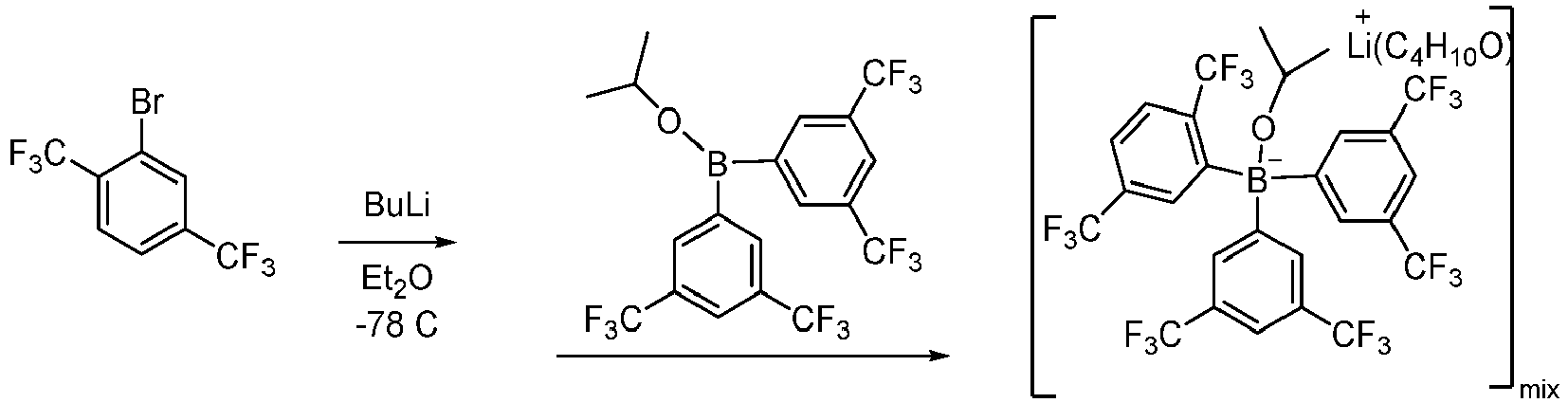
- n-Butyllithium (4.00 mL, 2.535 M in hexanes, 10.14 mmol) was added slowly to a cold (-78 °C, CO2(s) bath) solution of 1-bromo-2,5-bis(trifluoromethyl)benzene (3.00 g, 10.24 mmol) in diethyl ether (200 mL). The reaction mixture was stirred for 1 hour at -78 °C. Isopropoxy-bis(3,5-bis(trifluoromethyl)phenyl)borane (5.036 g, 10.15 mmol) in ether (18 mL) was added slowly. The reaction mixture was stirred for several hours at -78 °C. The solution was warmed to ambient temperature while stirring overnight to give a pale-yellow clear solution. The volatiles were removed from the reaction mixture to give a yellow oil. The oil was extracted with benzene. There was nothing insoluble. The volatiles were removed from the reaction mixture to give a yellow oil. The yield was 7.88 g, 98.3%.
- 1H NMR (400 MHz, Benzene-d6) δ 8.06 (s, 1H), 8.00 (s, 4H), 7.70 (dt, J = 1.8, 0.9 Hz, 2H), 7.40 (d, J = 8.3 Hz, 1H), 7.19 (d, J = 8.4 Hz, 1H), 3.79 (hept, J = 6.1 Hz, 1H), 2.78 (q, J = 7.1 Hz, 4H), 0.73 (d, J = 6.1 Hz, 6H), 0.54 (t, J = 7.1 Hz, 6H). 13C NMR (101 MHz, Benzene-d6) δ 158.31, 153.97, 135.44 (q, J = 3.7 Hz), 135.23, 133.55 (t, J = 4.1 Hz), 133.25, 133.18, 132.37 (d, J = 97.8 Hz), 130.92 (q, J = 32.0 Hz), 127.80 (q, J = 273.9 Hz), 124.92 (q, J = 272.5 Hz), 124.66 (q, J = 272.8 Hz), 123.86 (q, J = 3.8 Hz), 119.86 (p, J = 3.9 Hz), 66.24, 66.17, 25.60, 13.94. 19F NMR (376 MHz, Benzene-d6) δ -55.30 - -55.51 (m), -62.82, -63.61. 11B NMR (160 MHz, Benzene-d6) δ 2.16.
-

- Lithium(diethyletherate) isopropoxy-bis(3,5-bis(trifluoromethyl)phenyl)(2,5-bis(trifluoromethyl)phenyl)-borate (7.88 g, 9.97 mmol) was dissolved in ether (150 mL). Chlorotrimethylsilane (2.6 mL, 20.5 mmol) was added. The reaction mixture was allowed to stir overnight to give a yellow solution with colorless precipitate. The volatiles were removed under reduced pressure. The residue was extracted with hexane (100 ml). The mixture was filtered and the volatiles were concentrated under reduced pressure. The solution was cooled in the freezer (-33 °C) overnight. The reaction mixture was filtered and the precipitate was dried under reduced pressure to give a white powder. Yield: 6.0182 g, 92.84%.
- THF-free compound: 1H NMR (400 MHz, Benzene-d6) δ 7.87 (s, 2H), 7.85 (s, 4H), 7.29 (s, 1H), 7.11 (d, J = 1.2 Hz, 2H). 13C NMR (126 MHz, Benzene-d6) δ 140.87, 140.75, 137.49 (d, J = 3.8 Hz), 135.11 (q, J = 31.7 Hz), 133.26 (q, J = 33.0 Hz), 132.03 (q, J = 33.6 Hz), 128.29, 127.34 (q, J = 3.8 Hz), 127.11 (q, J = 4.0 Hz), 127.01 (q, J = 4.0 Hz), 124.46 (q, J = 274.3 Hz), 123.70 (q, J = 273.2 Hz), 123.49 (q, J = 272.9 Hz). 19F NMR (376 MHz, Benzene-d6) δ -56.98, -63.43, -63.47. 11B NMR (160 MHz, Benzene-d6) δ 64.37.
- Catalyst Sample C6, (3,5-bis(trifluoromethyl)phenyl)bis(2,5- bis(trifluoromethyl)phenyl)borane, was prepared as follows:
-

- To a cold (between -101 °C and -99 °C, CO2(s), then N2(l) methanol bath) solution of 1-bromo-2,5-bis(trifluoromethyl)benzene (3.000 g, 10.24 mmol) in diethyl ether (150 mL) was added n-butyllithium (4.00 mL, 2.535 M in hexanes, 10.14 mmol) with stirring. The reaction mixture was stirred for 2 hours at around -100 °C then was allowed to warm up to -78 °C. Bis(isopropoxy)(3,5-bis(trifluoromethyl)phenyl)borane (3.510 g, 10.26 mmol) in ether (10 mL) was added slowly. The reaction mixture was allowed to warm to ambient temperature while stirring overnight. The volatiles were removed from the pale-yellow nearly clear solution under reduced pressure to give a crystalline-appearing solid. The solid was dissolved in ether (10 mL) and placed in the freezer. Nothing precipitated. The ether was evaporated and the yellow solid was dissolved in hexane, filtered, and concentrated under a nitrogen stream to give crystalline solid. The supernatant was removed and the solid was dried under reduced pressure. Yield of colorless crystals from the first crop: 3.318 g. NMR analysis of the crystals showed pure desired compound. The supernatant was placed in the freezer overnight. Crystalline matter formed. The supernatant was pipetted out and discarded. The crystalline residue was dried under reduced pressure: 2.017 g. Total yield: 5.335 g, 82.79%.
- 1H NMR (400 MHz, Benzene-d6) δ 8.39 (s, 2H), 8.26 (s, 1H), 7.90 (dq, J = 1.8, 0.9 Hz, 1H), 7.56 (d, J = 8.2 Hz, 1H), 7.27 (ddt, J = 7.9, 1.7, 0.8 Hz, 1H), 3.18 (hept, J = 6.0 Hz, 2H), 2.92 (q, J = 7.1 Hz, 4H), 0.89 (t, J = 7.1 Hz, 6H), 0.78 (d, J = 6.1 Hz, 6H), 0.68 (d, J = 6.0 Hz, 6H). 13C NMR (101 MHz, Benzene-d6) δ 153.10, 136.65 (q, J = 29.6 Hz), 134.81 (dd, J = 2.7Hz, 1.9 Hz), 133.93 (q, J = 3.6 Hz), 131.93 (q, J = 31.6 Hz), 131.35, 129.76 (q, J = 31.9 Hz), 127.26 (q, J = 274.6 Hz), 125.17 (d, J = 272.4 Hz), 124.89 (q, J = 272.8 Hz), 123.25 (q, J = 3.9 Hz), 119.89 (p, J = 3.9 Hz), 66.42, 64.08, 25.49, 24.57, 14.36. 19F NMR (376 MHz, Benzene-d6) δ -55.79, -62.66, -63.30. 11B NMR (160 MHz, Benzene-d6) δ 5.32.
-

- To a solution of lithium(diethyletherate) diisopropoxy-(3,5-bis(trifluoromethyl)phenyl)(2,5-bis(trifluoromethyl)phenyl)borate (3.318 g, 5.21 mmol) in ether (10 mL) was added chlorotrimethylsilane (2.0 mL) with rapid formation of precipitate. The reaction mixture was allowed to stir overnight. The reaction mixture was filtered and the volatiles were removed under reduced pressure. NMR analysis showed the reaction was complete. Some putative TMS-O-iPr ether was present, too. The second crop of lithium diisopropoxy (3,5-bis(trifluoromethyl)phenyl)(2,5-bis(trifluoromethyl)phenyl)borate prepared as described above was treated similarly (2.017 g, 3.17 mmol, of lithium salt; 2.0 mL of TMSCl) and stirred for 3 hours. The total amount of combined reagents: 5.335 g, 8.39 mmol; TMSCl: 4.0 mL, 31.6 mmol. The second reaction mixture was filtered and combined with the first reaction product. The volatiles were removed under reduced pressure. The residue was extracted with hexane, filtered, and the volatiles were removed overnight at 40 °C under reduced pressure to give the product as a yellow oil, 3.4703 g, 83.42%.
- 1H NMR (400 MHz, Benzene-d6) δ 8.05 (d, J = 1.8 Hz, 2H), 7.80 (d, J = 2.3 Hz, 1H), 7.34 (d, J = 1.9 Hz, 1H), 7.12 (d, J = 6.5 Hz, 1H), 7.10 (d, J = 6.7 Hz, 1H), 3.78 (hept, J = 6.1 Hz, 1H), 0.85 (d, J = 6.1 Hz, 6H). 13C NMR (101 MHz, Benzene- d6) δ 139.07, 136.28, 135.37 (q, J = 31.8 Hz), 134.93 (d, J = 3.9 Hz), 133.49 (q, J = 32.7 Hz), 131.50 (q, J = 33.0 Hz), 127.87, 126.95 (dq, J = 7.5, 3.7 Hz), 126.46 (q, J = 3.7 Hz), 125.41 (hex, J = 3.8 Hz), 124.57 (q, J = 273.9 Hz), 123.98 (q, J = 272.8 Hz), 123.90 (q, J = 273.0 Hz), 72.49, 23.71. 19F NMR (376 MHz, Benzene-d6) δ -60.31, -63.27 (d, J = 3.3 Hz), -63.47 (d, J = 3.3 Hz). 11B NMR (160 MHz, Benzene-d6) δ 41.28.
-

- n-Butyllithium (2.40 mL, 2.535 M in hexanes, 6.08 mmol) was added slowly to a cold (-78 °C, CO2(s) bath) solution of 1-bromo-2,5-bis(trifluoromethyl)benzene (1.800 g, 6.14 mmol) in diethyl ether (150 mL). The reaction mixture was stirred for 1 hour at -78 °C. Isopropoxy(2,5-bis(trifluoromethyl)phenyl)(3,5-bis(trifluoromethyl)phenyl)borane (3.022 g, 6.09 mmol) in ether (18 mL) was added slowly. The reaction mixture was stirred for several hours at -78 °C. The solution was allowed to warm to ambient temperature while stirring overnight to give a pale-yellow clear solution. The volatiles were removed from the reaction mixture to give a yellow oil. The oil was extracted with benzene. There was nothing insoluble. The volatiles were removed from the reaction mixture to give a yellow oil. The yield was 4.21 g, 87.6%.
- 1H NMR (400 MHz, Benzene-d6) δ 8.30 (s, 2H), 8.12 (s, 2H), 7.65 (dt, J = 1.7, 0.9 Hz, 1H), 7.27 (d, J = 8.2 Hz, 2H), 7.08 (d, J = 8.2 Hz, 2H), 3.87 (hept, J = 6.2 Hz, 1H), 2.91 (q, J = 7.1 Hz, 4H), 0.65 (d, J = 6.2 Hz, 6H), 0.63 (t, J = 7.1 Hz, 6H). 13C NMR (101 MHz, Benzene-d6) δ 157.17, 156.73, 134.42, 133.88 (q, J = 3.6 Hz), 133.04 (d, J = 28.4 Hz), 132.88 (q, J = 32.1 Hz), 129.95 (q, J = 31.9 Hz), 127.74 (q, J = 273.6 Hz), 127.33 (q, J = 6.9 Hz), 124.97 (q, J = 272.4 Hz), 124.50 (q, J = 273.0 Hz), 122.72 (q, J = 3.8 Hz), 118.78 (p, J = 4.1 Hz), 65.88, 65.34, 25.11, 13.91. 19F NMR (376 MHz, Benzene-d6) δ -56.31, -62.89, -63.76. 11B NMR (160 MHz, Benzene-d6) δ 2.98.
-

- To a solution of lithium(diethyletherate) isopropoxy-bis(2,5-bis(trifluoromethyl)phenyl)(3,5-bis(trifluoromethyl)phenyl)borate (3.915 g, 4.95 mmol) in diethyl ether (150 mL) was added chlorotrimethylsilane (1.10 mL, 10.1 mmol) with stirring. Within 15 minutes, precipitate formed in solution. The reaction mixture was stirred overnight. The mixture was filtered and the volatiles were removed under reduced pressure to give a colorless solid, 3.260 g. The product was extracted with hexane, filtered, and the volatiles were removed under reduced pressure to give the product as a pale solid, 3.109 g, 96.53%.
- 1H NMR (500 MHz, Benzene-d6) δ 7.90 (s, 1H), 7.83 (s, 1H), 7.66 (s, 3H), 7.09 (s, 5H), 7.09 (s, 5H). 13C NMR (126 MHz, Benzene- d6) δ 141.54, 140.05, 138.35 (q, J = 3.8 Hz), 135.84 (q, J = 32.0 Hz), 133.02 (q, J = 33.0 Hz), 132.02 (q, J = 33.7 Hz), 129.98 (q, J = 3.5 Hz), 128.29, 127.91 (d, J = 2.4 Hz), 127.13 (q, J = 4.2 Hz), 124.15 (q, J = 274.2 Hz), 123.70 (q, J = 273.2 Hz), 123.37 (q, J = 273.2 Hz). 19F NMR (470 MHz, Benzene-d6) δ -56.40, -63.31, - 63.58. 11B NMR (160 MHz, Benzene-d6) δ 67.58.
- Catalyst Sample C7 was prepared as follows:
-

- This reaction was carried out in a manner similar to a previously reported procedure.2 Isopropylmagnesium chloride-lithium chloride (46.0 mL, 58.0 mmol, 1.26 M solution in THF) was added to a solution of 1-bromo-2,5-bis(trifluoromethyl)benzene (17.05 g, 58.2 mmol) in THF (250 mL) which was in an acetone bath cooled with dry ice (- 76 °C). After the addition was complete, the reaction flask was transferred to an ice bath (0 °C) and the reaction mixture was stirred for 2 hours. The reaction mixture was cooled to -78 °C and boron trifluoride diethyletherate (2.43 mL, 2.74 g, 19.3 mmol) in 15 mL of ether was added. The reaction mixture was allowed to warm to room temperature while it was stirred over the weekend. The volatiles were removed from the solution to give a reddish solid, 12.77 g. The residue was extracted with toluene and filtered. The volatiles were removed under reduced pressure to give a pink powder, 10.75 g. The solids were extracted with methylene chloride to give a light violet solution. The solution was placed overnight in the freezer. The supernatant was decanted from the very light pinkish crystalline material which formed. The material was dried overnight under reduced pressure. Yield: 7.0003 g, 55.73%.
2 Herrington, T. J.; Thom, A. J. W.; White, A. j. P.; Ashley, A. E. Dalton Trans. 2012, 41, 9019. - TH-free product: 1H NMR (400 MHz, Benzene-d 6) δ 7.57 (s, 1H), 7.13 (s, 3H), 7.08 (dd, J = 8.3, 1.8 Hz, 3H). 13C NMR (101 MHz, Benzene-d 6) δ 141.10, 136.50 (q, J = 32.2 Hz), 132.81 (q, J = 33.1 Hz), 131.59 (q, J = 3.8 Hz), 128.85 (q, J = 3.7 Hz), 127.45 (q, J = 3.4, 2.1 Hz), 123.93 (q, J = 274.6 Hz), 123.59 (q, J = 273.1 Hz). 19F NMR (376 MHz, Benzene-d 6) δ -56.48, -63.77. 11B NMR (160 MHz, Benzene-d 6) δ 68.81.
- Catalyst sample C8, bis(3,5-bis(trifluoromethyl)phenyl)(2,3,5,6-tetrafluoro-4-trifluoromethylphenyl)borane THF adduct, was prepared as follows:
-

- n-Butyllithium (3.00 mL, 2.54 M in hexanes, 7.61 mmol) was added to a cold (between -101 °C and -99 °C, CO2(s), then N2(l) methanol bath) solution of 1-bromo-2,3,5,6-tetrafluoro-4-trifluoromethylbenzene (2.26 g, 7.61 mmol) in diethyl ether (100 mL) with stirring. The reaction mixture was stirred for 2 hours at -100 °C then was allowed to warm up to -76 °C. Bis(3,5-bis(trifluoromethyl)phenyl)isopropoxy-borane (3.78 g, 7.61 mmol) in ether (10 mL) was added slowly to the reaction mixture. The reaction mixture was allowed to warm slowly to ambient temperature while stirring overnight. The next day, the pale-yellow, nearly clear solution was filtered and the volatiles were removed from the filtrate under reduced pressure to give a crystalline-appearing solid. The solid was washed with hexane, filtered, and dried under reduced pressure. An aliquot of the solid was removed for NMR analysis. It had limited solubility in benzene. The aliquot was dissolved in THF and the volatiles were removed under reduced pressure and then analyzed again by NMR in benzene. Yield: 6.16 g, 93.2%.
- 1H NMR (500 MHz, Benzene-d 6) δ 8.32 (s, 4H), 7.85 (s, 2H), 3.47 (h, J = 6.2 Hz, 1H), 3.26 - 3.17 (m, 4H), 1.24 - 1.16 (m, 4H), 0.55 (d, J = 6.2 Hz, 6H). 13C NMR (126 MHz, Benzene-d6) δ 144.07 (d, J = 259.4 Hz), 134.41, 133.82, 133.48 (d, J = 187.5 Hz), 130.59 (q, J = 32.2 Hz), 130.45 (q, J = 31.8 Hz), 126.40 - 123.43 (m), 125.84, 124.97 (q, J = 272.4 Hz), 119.94 (p, J = 4.0 Hz), 118.92 (d, J = 190.9 Hz), 109.57 (d, J = 22.7 Hz), 68.38, 65.30, 25.64, 25.13. 19F NMR (470 MHz, Benzene-d 6) δ -56.26 (t, J = 20.7 Hz), -62.59, -137.04, -141.73. 11B NMR (160 MHz, Benzene-d 6) δ 1.20.
-

- To a solution of lithium(tetrahydrofuranate) bis(3,5-bis(trifluoromethyl)phenyl)(2,3,5,6-tetrafluoro-4-(trifluoromethyl)phenyl)isopropoxyborate (6.16 g, 7.10 mmol) in diethyl ether (100 mL) was added chlorotrimethylsilane (2.00 mL, 18.4 mmol) with stirring. The reaction mixture was stirred overnight. The next day, analysis of an aliquot of the reaction mixture by 19F NMR spectroscopy revealed that no reaction had occurred. Hydrogen chloride solution in ether (7.00 mL, 2.0 M, 14.0 mmol) was added and the reaction mixture was stirred overnight. The next day, analysis of an aliquot of the reaction mixture by 19F NMR spectroscopy revealed that the reaction was complete. The mixture was filtered and the volatiles were removed from the filtrate under reduced pressure. The resultant residue was dissolved in toluene, filtered, and the volatiles were removed from the filtrate under reduced pressure to give 4.50 g of crude product. The colorless, pasty solid was washed with hexane and filtered to give a colorless powder, which was dried under reduced pressure. NMR analysis of the powder revealed that one molecule of isopropanol remained in the coordination sphere of the borane. Yield of the borane as a isopropanol adduct: 2.45 g, 52.8%.
- A portion of the borane isopropanol adduct (1.811 g) was dissolved in ether (40 mL) and THF (10 mL) was added to the solution. The solution was allowed to evaporate slowly to give large crystals. The supernatant was removed, and the very pale, yellow crystals were washed with hexane. The crystals were dried under reduced pressure (1.08 g). The crystals were analyzed by X-ray crystallography and found to be the borane isopropanol adduct. The THF had not displaced the coordinated alcohol. The supernatant solution from the crystals and the hexane washings were combined and concentrated under vacuum to give a second crop of crystals (0.422 g). The second crop of crystals was washed and dried in the same manner as the first crop. NMR analysis showed the presence of coordinated isopropanol, but little or no THF. THF was added and then the volatiles were removed under reduced pressure. NMR analysis showed the presence of THF, but still some isopropanol. The solid was dissolved in THF and then pumped off. This was repeated five more times to give the THF adduct of the product as a white powder. Yield: 0.413 g, 22.4%.
- 1H NMR (400 MHz, Benzene-d 6) δ 7.87 (s, 4H), 7.80 (s, 4H), 3.02 - 2.93 (m, 4H), 0.78 - 0.72 (m, 4H). 13C NMR (126 MHz, Benzene-d 6) δ 147.98 (td, J = 16.5, 3.6 Hz), 146.05 (tt, J = 11.8, 4.1 Hz), 145.58 (d, J = 20.9 Hz), 143.50 (d, J = 20.1 Hz), 133.44, 131.39 (q, J = 32.6 Hz), 124.24 (q, J = 272.7 Hz), 121.78 (t, J = 4.0 Hz), 121.45 (q, J = 274.4 Hz), 109.38 - 108.10 (m), 73.75, 23.90. 19F NMR (376 MHz, Benzene-d 6) δ -56.57 (t, J = 21.0 Hz), - 62.95, -130.60 (dd, J = 22.5, 13.2 Hz), -140.71 (qt, J = 19.7, 8.6 Hz). 11B NMR (160 MHz, Benzene-d 6) δ 7.22. The catalyst samples prepared as described above in Reference Example 2 are shown below.


- Structures of fluorinated arylborane Lewis acid catalyst samples C1 to C8, and commercially available FAB, are shown above. Structure C1 is tris(3,5-bis(trifluoromethyl)phenyl)borane THF adduct (corresponding to starting material A1) in the claims). Structure C2 is bis(3,5-bis(trifluoromethyl)phenyl)(4-trifluoromethylphenyl)borane THF adduct corresponding to starting material A2) in the claims). Structure C3 is bis(3,5-bis(trifluoromethyl)phenyl)(2,4,6-trifluorophenyl)borane THF adduct (corresponding to starting material A3) in the claims). Structure C4 is bis(3,5-bis(trifluoromethyl)phenyl)(2,6-difluorophenyl)borane THF adduct (corresponding to starting material A4) in the claims). Structure C5 is bis(3,5-bis(trifluoromethyl)phenyl)(2,5-bis(trifluoromethyl)phenyl)borane (corresponding to starting material A5) in the claims). Structure C6 is (3,5-bis(trifluoromethyl)phenyl)bis(2,5-bis(trifluoromethyl)phenyl)borane (corresponding to starting material A6) in the claims). Structure C7 is tris(2,5-bis(trifluoromethyl)phenyl)borane. Structure C8 is bis(3,5-bis(trifluoromethyl)phenyl)(2,3,5,6-tetrafluoro-4-trifluoromethylphenyl)borane THF adduct (corresponding to starting material A7) in the claims).
- HTMS, PMDS, TES, TMSOMe, and FAB (described above in Table 1) were used as received. In a nitrogen-purged glove-box, solutions of fluorinated triarylborane Lewis acid samples (catalysts) were prepared in 10-mL glass vials (ex. FAB, 30.7 mg, 0.06 mmol was dissolved in 5 mL of anhydrous deuterated benzene). In an NMR tube was placed the silyl hydride (ex: HTMS, 32.6 µL, 0.12 mmol, 1 equiv.), the organosilicon compound with an alkoxy group (ex: trimethylmethoxysilane, 17 µL, 0.12 mmol, 1 equiv.), an internal standard (mesitylene, 16.8 µL, 0.12 mmol, 1 equiv.). The catalyst (0.5 mL, 0.006 mmol, 5 mol%) was delivered as a stock solution via pipet. The final concentration of the solution is 0.24M. The tube was capped and 1H NMR spectra were taken at regular time intervals. Conversion was established in comparison to the internal standard using a 400 MHz NMR.
- All fluorinated triarylborane Lewis acid samples tested, except C7, catalyzed the SiH - SiOR cure reaction under the conditions tested. Without wishing to be bound by theory, it is thought that C7 was too sterically bulky to catalyze this reaction under these conditions, and that this further demonstrates that not all fluorinated aryl boranes will catalyze the reaction.

- Reaction Scheme with various silyl hydrides and fluorinated triarylboranes.
Table 1. Results of Reactions at RT Silane HTMS PMDS TES Fluorinated Triarylborane Sample Conversion (%) Conversion (%) Conversion (%) 2 h 24 h 2 h 24 h 2 h 24 h FAB 100 100 100 100 100 100 C1 93 98 86 89 59 74 C2 50 67 98 95 40 43 C3 76 97 90 95 44 79 C4 63 91 89 91 38 64 C5 44 65 91 93 44 48 C6 0 0 30 35 0 0 C7 0 0 0 0 0 0 C8 100 100 91 91 95 100 - Without wishing to be bound by theory, it is thought that TES is more difficult to react than HMTS, which is more difficult to react than PMDS, and C6 would yield higher conversions at higher temperatures.
- The composition and method described herein employ fluorinated triarylborane Lewis acids as catalysts. These fluorinated triarylborane Lewis acids provide better reaction rate control than FAB. The composition and method described herein provide the further benefit that order of addition of the starting materials is not critical; the starting materials can be combined in any order. The present composition and method may provide the benefits of pot-life and/or process robustness. Without wishing to be bound by theory, it is thought that a silyl hydride should not be mixed with FAB, as that would trigger self-cure.
- Abbreviations used in the specification have the definitions in Table 5, below.
Table 5 - Abbreviations Abbreviation Definition °C Degrees Celsius FTIR Fourier Transform Infrared g Grams GPC gel permeation chromatography iPr isopropyl Me Methyl mL Milliliters mmol Millimoles Mn number average molecular weight as measured bv GPC as described in Reference Example 2 Mp Peak molecular weight as measured by GPC as described in Reference Example 2 Mw weight average molecular weight NMR nuclear magnetic resonance PDI Polydispersity index Ph phenyl ppm parts per million PTFE polytetrafluoroethylene RH relative humidity RT room temperature of 25 °C ± 5 °C s seconds SiH content hydrogen, as silicon-bonded hydrogen, as measured by 29Si NMR THF tetrahydrofuran µL microliter µmol Micromole Vi Vinyl - All amounts, ratios, and percentages are by weight unless otherwise indicated. The amounts of all starting materials in a composition total 100% by weight. The articles 'a', 'an', and 'the' each refer to one or more, unless otherwise indicated by the context of specification. The singular includes the plural unless otherwise indicated.
- The term "comprising" and derivatives thereof, such as "comprise" and "comprises" are used herein in their broadest sense to mean and encompass the notions of "including," "include," "consist(ing) essentially of," and "consist(ing) of. The use of "for example," "e.g.," "such as," and "including" to list illustrative examples does not limit to only the listed examples. Thus, "for example" or "such as" means "for example, but not limited to" or "such as, but not limited to" and encompasses other similar or equivalent examples.
- Generally, as used herein a hyphen "-" or dash "-" in a range of values is "to" or "through"; a ">" is "above" or "greater-than"; a "≥" is "at least" or "greater-than or equal to"; a "<" is "below" or "less-than"; and a "≤" is "at most" or "less-than or equal to."
- It is to be understood that the appended claims are not limited to express and particular compounds, compositions, or methods described in the detailed description, which may vary between particular embodiments which fall within the scope of the appended claims.
Claims (15)
- A composition comprising:A) a fluorinated triarylborane Lewis acid selected from the group consisting of:A1) tris(3,5-bis(trifluoromethyl)phenyl)borane THF adduct;A2) bis(3,5-bis(trifluoromethyl)phenyl)(4-trifluoromethylphenyl)borane THF adduct;A3) bis(3,5-bis(trifluoromethyl)phenyl)(2,4,6-trifluorophenyl)borane THF adduct;A4) bis(3,5-bis(trifluoromethyl)phenyl)(2,6-difluorophenyl)borane THF adduct;A5) bis(3,5-bis(trifluoromethyl)phenyl)(2,5-bis(trifluoromethyl)phenyl)borane;A6) (3,5-bis(trifluoromethyl)phenyl)bis(2,5- bis(trifluoromethyl)phenyl)borane;A7) bis(3,5-bis(trifluoromethyl)phenyl)(2,3,5,6-tetrafluoro-4-trifluoromethylphenyl)borane THF adduct; andA8) a combination of two or more of A1) to A7);B) a hydrocarbonoxy-functional organosilicon compound having an average, per molecule of at least 1 silicon-bonded group of the formula -OR2, wherein each R2 is an independently selected monovalent hydrocarbon group of 1 to 6 carbon atoms; andC) a silyl hydride having at least 1 silicon-bonded hydrogen atom per molecule.
- The composition of claim 1, where starting material A) is selected from the group consisting of:A1) tris(3,5-bis(trifluoromethyl)phenyl)borane THF adduct;A2) bis(3,5-bis(trifluoromethyl)phenyl)(4-trifluoromethylphenyl)borane THF adduct;A3) bis(3,5-bis(trifluoromethyl)phenyl)(2,4,6-trifluorophenyl)borane THF adduct;A4) bis(3,5-bis(trifluoromethyl)phenyl)(2,6-difluorophenyl)borane THF adduct;A5) bis(3,5-bis(trifluoromethyl)phenyl)(2,5-bis(trifluoromethyl)phenyl)borane; andA7) bis(3,5-bis(trifluoromethyl)phenyl)(2,3,5,6-tetrafluoro-4-trifluoromethylphenyl)borane THF adduct.
- The composition of claim 2, where starting material A) is selected from the group consisting of: A1), A2), A3), A4), and A5).
- The composition of any one of the preceding claims, starting material A) is present in an amount of 0.1 ppm to 5 mol%, based on combined weights of B) the hydrocarbonoxy-functional organosilicon compound and C) the silyl hydride.
- The composition of claim 4, where in step 1), starting material A) is present in an amount of 5 ppm to 6,000 ppm based on combined weights of B) the organosilicon compound and C) the silyl hydride.
- The composition of any one of the preceding claims, where B) the organosilicon compound is selected from the group consisting of:B1) an alkoxysilane of formula: R1 (4-a)SiOR2 a, where each R1 is independently selected from the group consisting of a monovalent hydrocarbon group and a monovalent halogenated hydrocarbon group, each R2 is a monovalent hydrocarbon group of 1 to 6 carbon atoms, and subscript a is 1 to 4; andB2) an organosiloxane oligomer or polymer comprising a group of formula B2):

- The composition of claim 6, where the organosiloxane oligomer or polymer comprising unit formula:
(RXR3 2SiO1/2)o(R3 3SiO1/2)p(R3 2SiO2/2)q(RXR3SiO2/2)r(RXSiO3/2)s(R3SiO3/2)t(SiO4/2)u,
where RX represents a group of the formula -OR2 as described above, subscripts o, p, q, and r have values such that o ≥ 0, p ≥ 0, q ≥ 0, r ≥ 0, s ≥ 0, t ≥ 0, u ≥ 0, a quantity (o + r + s) has an average value of 1 or more. - The composition of any one of the preceding claims, where C) the silyl hydride is selected from the group consisting of:C1) a silane of formula HkSiR5 (4-k), where each R5 is independently selected from the group consisting of a monovalent hydrocarbon group and a monovalent halogenated hydrocarbon group, and subscript k is 1 to 3; andC2) an organohydrogensiloxane of unit formula:
(HR4 2SiO1/2)g(R4 3SiO1/2)h(R4 2SiO2/2)i(HR4SiO2/2)j, where each R4 is an independently selected monovalent hydrocarbon group, which is free of aliphatic unsaturation; subscripts g, h, i, and j have values such that g ≥ 0, h ≥ 0, a quantity (g + h) has an average value of 2, i ≥ 0, j ≥ 0, and a quantity (g + j) ≥ 1, and a quantity (i + j) ranges from 0 to 1000. - The composition of claim 8, where starting material C) is a silane of formula HSiR5 3, where each R5 is an alkyl group of 1 to 6 carbon atoms.
- The composition of claim 8, where starting material C) is a polydiorganohydrogensiloxane of formula

- A method comprising:1) combining starting materials comprising:A) a fluorinated triarylborane Lewis acid selected from the group consisting of:A1) tris(3,5-bis(trifluoromethyl)phenyl)borane THF adduct;A2) bis(3,5-bis(trifluoromethyl)phenyl)(4-trifluoromethylphenyl)borane THF adduct;A3) bis(3,5-bis(trifluoromethyl)phenyl)(2,4,6-trifluorophenyl)borane THF adduct;A4) bis(3,5-bis(trifluoromethyl)phenyl)(2,6-difluorophenyl)borane THF adduct;A5) bis(3,5-bis(trifluoromethyl)phenyl)(2,5-bis(trifluoromethyl)phenyl)borane;A6) (3,5-bis(trifluoromethyl)phenyl)bis(2,5- bis(trifluoromethyl)phenyl)borane;A7) bis(3,5-bis(trifluoromethyl)phenyl)(2,3,5,6-tetrafluoro-4-trifluoromethylphenyl)borane THF adduct; andA8) a combination of two or more of A1) to A7);B) a hydrocarbonoxy-functional organosilicon compound having an average, per molecule of at least 1 silicon-bonded group of the formula -OR2, wherein each R2 is an independently selected monovalent hydrocarbon group of 1 to 6 carbon atoms; andC) a silyl hydride having at least 1 silicon-bonded hydrogen atom per molecule;thereby forming a product of step 1) comprising a reaction product of starting materials B) and C) and a side product comprising HR2.
- The method of claim 11, where the method is performed at a temperature of 5 °C to 70 °C.
- The method of claim 11 or claim 12, further comprising: neutralizing residual fluorinated triarylborane Lewis acid in the product of step 1).
- The method of any one of claims 11 to 13, further comprising: during and/or after step 1), removing the side product comprising HR2.
- The method of any one of claims 11 to 14, further comprising: recovering the reaction product.
Applications Claiming Priority (2)
| Application Number | Priority Date | Filing Date | Title |
|---|---|---|---|
| US202063043153P | 2020-06-24 | 2020-06-24 | |
| PCT/US2021/037541 WO2021262495A1 (en) | 2020-06-24 | 2021-06-16 | Composition and method for reacting an organosilicon compound and a silyl hydride catalyzed by a fluorinated arylborane lewis acid |
Publications (2)
| Publication Number | Publication Date |
|---|---|
| EP4172241A1 EP4172241A1 (en) | 2023-05-03 |
| EP4172241B1 true EP4172241B1 (en) | 2024-02-28 |
Family
ID=76845333
Family Applications (1)
| Application Number | Title | Priority Date | Filing Date |
|---|---|---|---|
| EP21739854.4A Active EP4172241B1 (en) | 2020-06-24 | 2021-06-16 | Composition and method for reacting an organosilicon compound and a silyl hydride catalyzed by a fluorinated arylborane lewis acid |
Country Status (6)
| Country | Link |
|---|---|
| US (1) | US12398241B2 (en) |
| EP (1) | EP4172241B1 (en) |
| JP (1) | JP7748400B2 (en) |
| KR (1) | KR20230029859A (en) |
| CN (1) | CN116234858B (en) |
| WO (1) | WO2021262495A1 (en) |
Families Citing this family (2)
| Publication number | Priority date | Publication date | Assignee | Title |
|---|---|---|---|---|
| WO2025090430A1 (en) | 2023-10-23 | 2025-05-01 | Dow Silicones Corporation | Organosiloxane and methods for the preparation and use thereof |
| WO2026005871A1 (en) | 2024-06-24 | 2026-01-02 | Dow Silicones Corporation | Organosiloxane and methods for the preparation and use thereof |
Family Cites Families (62)
| Publication number | Priority date | Publication date | Assignee | Title |
|---|---|---|---|---|
| US3220972A (en) | 1962-07-02 | 1965-11-30 | Gen Electric | Organosilicon process using a chloroplatinic acid reaction product as the catalyst |
| US3159601A (en) | 1962-07-02 | 1964-12-01 | Gen Electric | Platinum-olefin complex catalyzed addition of hydrogen- and alkenyl-substituted siloxanes |
| US3296291A (en) | 1962-07-02 | 1967-01-03 | Gen Electric | Reaction of silanes with unsaturated olefinic compounds |
| NL131800C (en) | 1965-05-17 | |||
| US3516946A (en) | 1967-09-29 | 1970-06-23 | Gen Electric | Platinum catalyst composition for hydrosilation reactions |
| US3814730A (en) | 1970-08-06 | 1974-06-04 | Gen Electric | Platinum complexes of unsaturated siloxanes and platinum containing organopolysiloxanes |
| US3989668A (en) | 1975-07-14 | 1976-11-02 | Dow Corning Corporation | Method of making a silicone elastomer and the elastomer prepared thereby |
| US4329273A (en) | 1978-03-07 | 1982-05-11 | General Electric Company | Self-bonding silicone rubber compositions |
| US4370358A (en) | 1980-09-22 | 1983-01-25 | General Electric Company | Ultraviolet curable silicone adhesives |
| US4374967A (en) | 1981-07-06 | 1983-02-22 | Dow Corning Corporation | Low temperature silicone gel |
| JPS61195129A (en) | 1985-02-22 | 1986-08-29 | Toray Silicone Co Ltd | Production of organosilicon polymer |
| US4766176A (en) | 1987-07-20 | 1988-08-23 | Dow Corning Corporation | Storage stable heat curable organosiloxane compositions containing microencapsulated platinum-containing catalysts |
| US4784879A (en) | 1987-07-20 | 1988-11-15 | Dow Corning Corporation | Method for preparing a microencapsulated compound of a platinum group metal |
| JP2630993B2 (en) | 1988-06-23 | 1997-07-16 | 東レ・ダウコーニング・シリコーン株式会社 | Granules containing platinum-based catalyst for hydrosilylation reaction and method for producing the same |
| JPH0214244A (en) | 1988-06-30 | 1990-01-18 | Toray Dow Corning Silicone Co Ltd | Thermosetting organopolysiloxane composition |
| US5036117A (en) | 1989-11-03 | 1991-07-30 | Dow Corning Corporation | Heat-curable silicone compositions having improved bath life |
| GB9103191D0 (en) | 1991-02-14 | 1991-04-03 | Dow Corning | Platinum complexes and use thereof |
| JP2511348B2 (en) | 1991-10-17 | 1996-06-26 | 東レ・ダウコーニング・シリコーン株式会社 | Organopolysiloxane and method for producing the same |
| TW198054B (en) | 1992-02-10 | 1993-01-11 | Gen Electric | |
| US5625023A (en) | 1994-12-09 | 1997-04-29 | Dow Corning Corporation | Aerosol suppressant compositions for silicone coatings |
| US6624254B1 (en) | 1999-01-21 | 2003-09-23 | The Dow Chemical Company | Silane functionalized olefin interpolymer derivatives |
| GB9917372D0 (en) | 1999-07-23 | 1999-09-22 | Dow Corning | Silicone release coating compositions |
| FR2806930B1 (en) * | 2000-04-04 | 2002-06-28 | Rhodia Chimie Sa | USE OF A BORON DERIVATIVE AS A THERMOACTIVABLE CATALYST FOR THE POLYMERIZATION AND/OR CROSS-LINKING OF SILICONE BY DEHYDROGENOCONDENSATION |
| US6586535B1 (en) | 2000-06-22 | 2003-07-01 | Dow Corning Corporation | Coatings containing silicone mist suppressant compositions |
| FR2812564B1 (en) | 2000-08-04 | 2003-02-21 | Rhodia Chimie Sa | USE OF A BORON DERIVATIVE AS A CATALYST FOR THE HYDROSILYLATION OF UNSATURATED REAGENTS |
| US6716533B2 (en) | 2001-08-27 | 2004-04-06 | General Electric Company | Paper release compositions having improved adhesion to paper and polymeric films |
| US20030129287A1 (en) | 2001-12-05 | 2003-07-10 | Guzman Adriana T. | Systems, methods and apparatus for producing a frozen confection |
| US7064173B2 (en) | 2002-12-30 | 2006-06-20 | General Electric Company | Silicone condensation reaction |
| US7005475B2 (en) | 2003-06-10 | 2006-02-28 | General Electric Company | Curable silicone compositions having improved adhesion to polymeric films |
| US20050038188A1 (en) | 2003-08-14 | 2005-02-17 | Dongchan Ahn | Silicones having improved chemical resistance and curable silicone compositions having improved migration resistance |
| EP1756200A1 (en) | 2004-05-20 | 2007-02-28 | General Electric Company | Silicone condensation reaction |
| JP4906735B2 (en) | 2004-11-18 | 2012-03-28 | ダウ コーニング コーポレーション | Method for preparing branched siloxane |
| PL374519A1 (en) * | 2005-04-20 | 2006-10-30 | General Electric Company | Method for the manufacture of si-h-functional siloxane olygomers |
| US8048819B2 (en) | 2005-06-23 | 2011-11-01 | Momentive Performance Materials Inc. | Cure catalyst, composition, electronic device and associated method |
| EP2150575B1 (en) | 2007-05-25 | 2016-01-27 | Dow Corning Corporation | Release coating composition and method of forming the same |
| KR101648024B1 (en) | 2008-07-11 | 2016-08-12 | 다우 코닝 도레이 캄파니 리미티드 | Release modifier and release coating organopolysiloxane composition |
| BRPI0914446A2 (en) | 2008-10-23 | 2015-10-27 | Dow Global Technologies Llc | organoborane complex |
| EP2358791B1 (en) | 2008-11-26 | 2012-12-26 | Dow Corning Toray Co., Ltd. | Solventless cured release coating-forming organopolysiloxane composition and sheet-form substrate having a cured release coating |
| US9593209B2 (en) | 2009-10-22 | 2017-03-14 | Dow Corning Corporation | Process for preparing clustered functional polyorganosiloxanes, and methods for their use |
| CN103827215B (en) | 2011-10-04 | 2016-12-21 | 道康宁公司 | Iron content (II) complex and condensation catalyst, prepare the method for this catalyst and the compositions containing this catalyst |
| JP6336398B2 (en) | 2011-12-29 | 2018-06-06 | スリーエム イノベイティブ プロパティズ カンパニー | On-demand curable polysiloxane coating composition |
| WO2013142956A1 (en) | 2012-03-28 | 2013-10-03 | Uti Limited Partnership | Methods and compounds for photo lewis acid generation and uses thereof |
| ES2895424T3 (en) | 2013-02-11 | 2022-02-21 | Dow Silicones Corp | Moisture curable hot melt silicone adhesive compositions including a reactive siloxane resin with alkoxy functional groups |
| US9670392B2 (en) | 2013-02-11 | 2017-06-06 | Dow Corning Corporation | Stable thermal radical curable silicone adhesive compositions |
| WO2014160975A1 (en) | 2013-03-28 | 2014-10-02 | Dow Corning Corporation | Organosiloxane compositions and coatings, manufactured articles, methods and uses |
| DE102015214503A1 (en) | 2015-07-30 | 2017-02-02 | Wacker Chemie Ag | Process for the preparation of organopolysiloxanes |
| JP6784638B2 (en) * | 2017-04-14 | 2020-11-11 | 信越化学工業株式会社 | Curable organosilicon resin composition |
| CN110662790A (en) * | 2017-05-23 | 2020-01-07 | 瓦克化学股份公司 | Crosslinking of hydridosiloxanes with silicon (II) compounds |
| EP3645607B1 (en) | 2017-06-26 | 2025-11-05 | Dow Silicones Corporation | Method for hydrosilylation of aliphatically unsaturated alkoxysilanes and hydrogen terminated organosiloxane oligomers to prepare alkoxysilyl terminated polymers useful for functionalizing polyorganosiloxanes using an iridium catalyst |
| WO2019005710A1 (en) | 2017-06-26 | 2019-01-03 | Dow Silicones Corporation | Method for hydrosilylation of aliphatically unsaturated alkoxysilanes and hydrogen terminated organosiloxane oligomers to prepare alkoxysilyl terminated polymers useful for functionalizing polyorganosiloxanes using a rhodium catalyst |
| EP3645608B1 (en) | 2017-06-26 | 2024-06-19 | Dow Silicones Corporation | Method for hydrosilylation of aliphatically unsaturated alkoxys i lan es and hydrogen terminated organosiloxane oligomers to prepare alkoxysilyl terminated polymers useful for functionalizing polyorganosiloxanes using a cobalt catalyst |
| JP7256169B2 (en) * | 2017-07-25 | 2023-04-11 | ダウ シリコーンズ コーポレーション | Method for preparing graft copolymers having a polyolefin backbone and pendant polyorganosiloxane groups |
| KR102603979B1 (en) * | 2017-09-14 | 2023-11-21 | 다우 글로벌 테크놀로지스 엘엘씨 | Lewis acid polymerization catalyst |
| US11958936B2 (en) | 2017-09-14 | 2024-04-16 | Dow Global Technologies Llc | Process of manufacturing polyols |
| HUE068772T2 (en) | 2017-09-14 | 2025-01-28 | Univ Northwestern | Process of manufacturing polyols |
| EP3702330A4 (en) | 2017-10-26 | 2020-12-23 | Sumitomo Metal Mining Co., Ltd. | NICKEL COMPOSITE OXIDE AND METHOD FOR PRODUCING LITHIUM-NICKEL COMPOSITE OXIDE |
| KR20200135419A (en) | 2018-03-19 | 2020-12-02 | 다우 글로벌 테크놀로지스 엘엘씨 | Method for functionalizing an organo-metal compound with a silyl-based functionalizing agent, and a silyl-based functionalizing agent compound prepared thereby |
| BR112020019174A2 (en) | 2018-03-19 | 2021-01-05 | Dow Global Technologies Llc | TELEQUELIC POLYOLEFINE COMPOSITIONS FINISHED WITH SILICON AND PROCESSES FOR THE PREPARATION OF THE SAME |
| JP7163078B2 (en) * | 2018-06-14 | 2022-10-31 | 株式会社日本触媒 | Compositions containing triarylboron compounds |
| EP3856809A1 (en) | 2018-09-28 | 2021-08-04 | Dow Global Technologies LLC | Polyurethane cast elastomers based on poly(butylene oxide) polyols and method for making polyurethane cast elastomers |
| EP3898774B1 (en) * | 2018-12-21 | 2023-06-07 | Dow Silicones Corporation | Method for preparing a functionalized polyorganosiloxane |
| KR20220016902A (en) * | 2019-06-04 | 2022-02-10 | 다우 실리콘즈 코포레이션 | Bridged incomplete Lewis pairs as thermal triggers for the reaction of Si-H with Si-OR |
-
2021
- 2021-06-16 JP JP2022577260A patent/JP7748400B2/en active Active
- 2021-06-16 KR KR1020237002585A patent/KR20230029859A/en active Pending
- 2021-06-16 WO PCT/US2021/037541 patent/WO2021262495A1/en not_active Ceased
- 2021-06-16 US US17/916,834 patent/US12398241B2/en active Active
- 2021-06-16 EP EP21739854.4A patent/EP4172241B1/en active Active
- 2021-06-16 CN CN202180060943.1A patent/CN116234858B/en active Active
Also Published As
| Publication number | Publication date |
|---|---|
| US12398241B2 (en) | 2025-08-26 |
| CN116234858B (en) | 2025-05-06 |
| EP4172241A1 (en) | 2023-05-03 |
| CN116234858A (en) | 2023-06-06 |
| KR20230029859A (en) | 2023-03-03 |
| WO2021262495A1 (en) | 2021-12-30 |
| JP7748400B2 (en) | 2025-10-02 |
| JP2023532198A (en) | 2023-07-27 |
| US20230151157A1 (en) | 2023-05-18 |
Similar Documents
| Publication | Publication Date | Title |
|---|---|---|
| US7064173B2 (en) | Silicone condensation reaction | |
| EP0629648B1 (en) | Method for preparation of carbinol-functional siloxanes | |
| EP4172242B1 (en) | Composition and method for silyl hydride reaction catalyzed by fluorinated arylborane lewis acids | |
| EP3824017B1 (en) | Polysiloxane resin - polyolefin copolymer and methods for the preparation and use thereof | |
| EP1756200A1 (en) | Silicone condensation reaction | |
| US3714118A (en) | Organosilicon compounds | |
| JP4787393B2 (en) | Polymerization of siloxanes | |
| US12398241B2 (en) | Composition and method for reacting an organosilicon compound and a silyl hydride catalyzed by a fluorinated arylborane Lewis acid | |
| JPH06172535A (en) | Preparation of cluster azasilacycloalkyl- functional polysiloxane | |
| JP2021516709A (en) | Polyolefin-polydiorganosiloxane block copolymers and hydrolysis reaction methods for their synthesis | |
| JP4469063B2 (en) | Surface treatment agent for alumina powder | |
| MXPA02005915A (en) | Method for preparing polyorganosiloxanes by polymerisation catalysed by a catalytic system based of triflic acid or triflic acid derivatives. | |
| CN107001638A (en) | Method for producing the organo-silicon compound with amino | |
| US20050085612A1 (en) | Aminomethylene-functional siloxanes | |
| EP4341326A1 (en) | Processes for making polysiloxazanes and using same for producing amino-functional polyorganosiloxanes | |
| Allcock et al. | Hybrid phosphazene-organosilicon polymers: II. High-polymer and materials synthesis and properties | |
| CN1875053B (en) | Process for the manufacture of organosiloxanes modified with phosphonates | |
| US3350350A (en) | Method for preparing polysilarylene-polysiloxane copolymers | |
| JP7208795B2 (en) | co-modified silicone | |
| CN109843982B (en) | Reactive siloxanes and process for their preparation | |
| Liao | The Role of Hydrosilanes in the Preparation of Silicones | |
| CN119487043A (en) | Synthesis and use of carbamate functionalized alkoxysilanesilane compounds | |
| CN114364687A (en) | Hydrosilylatable mixtures free of noble metals | |
| Church | Synthesis of functionalized polycarbosilanes via acyclic diene metathesis (ADMET) polymerization | |
| KR20220111311A (en) | Silirane-functionalized compounds for preparing siloxanes, especially organosilicon compounds |
Legal Events
| Date | Code | Title | Description |
|---|---|---|---|
| STAA | Information on the status of an ep patent application or granted ep patent |
Free format text: STATUS: UNKNOWN |
|
| STAA | Information on the status of an ep patent application or granted ep patent |
Free format text: STATUS: THE INTERNATIONAL PUBLICATION HAS BEEN MADE |
|
| PUAI | Public reference made under article 153(3) epc to a published international application that has entered the european phase |
Free format text: ORIGINAL CODE: 0009012 |
|
| STAA | Information on the status of an ep patent application or granted ep patent |
Free format text: STATUS: REQUEST FOR EXAMINATION WAS MADE |
|
| 17P | Request for examination filed |
Effective date: 20230104 |
|
| AK | Designated contracting states |
Kind code of ref document: A1 Designated state(s): AL AT BE BG CH CY CZ DE DK EE ES FI FR GB GR HR HU IE IS IT LI LT LU LV MC MK MT NL NO PL PT RO RS SE SI SK SM TR |
|
| P01 | Opt-out of the competence of the unified patent court (upc) registered |
Effective date: 20230526 |
|
| DAV | Request for validation of the european patent (deleted) | ||
| DAX | Request for extension of the european patent (deleted) | ||
| GRAP | Despatch of communication of intention to grant a patent |
Free format text: ORIGINAL CODE: EPIDOSNIGR1 |
|
| STAA | Information on the status of an ep patent application or granted ep patent |
Free format text: STATUS: GRANT OF PATENT IS INTENDED |
|
| INTG | Intention to grant announced |
Effective date: 20231130 |
|
| GRAS | Grant fee paid |
Free format text: ORIGINAL CODE: EPIDOSNIGR3 |
|
| GRAA | (expected) grant |
Free format text: ORIGINAL CODE: 0009210 |
|
| STAA | Information on the status of an ep patent application or granted ep patent |
Free format text: STATUS: THE PATENT HAS BEEN GRANTED |
|
| AK | Designated contracting states |
Kind code of ref document: B1 Designated state(s): AL AT BE BG CH CY CZ DE DK EE ES FI FR GB GR HR HU IE IS IT LI LT LU LV MC MK MT NL NO PL PT RO RS SE SI SK SM TR |
|
| REG | Reference to a national code |
Ref country code: GB Ref legal event code: FG4D |
|
| REG | Reference to a national code |
Ref country code: CH Ref legal event code: EP |
|
| REG | Reference to a national code |
Ref country code: DE Ref legal event code: R096 Ref document number: 602021009909 Country of ref document: DE |
|
| REG | Reference to a national code |
Ref country code: IE Ref legal event code: FG4D |
|
| REG | Reference to a national code |
Ref country code: LT Ref legal event code: MG9D |
|
| PG25 | Lapsed in a contracting state [announced via postgrant information from national office to epo] |
Ref country code: IS Free format text: LAPSE BECAUSE OF FAILURE TO SUBMIT A TRANSLATION OF THE DESCRIPTION OR TO PAY THE FEE WITHIN THE PRESCRIBED TIME-LIMIT Effective date: 20240628 |
|
| REG | Reference to a national code |
Ref country code: NL Ref legal event code: MP Effective date: 20240228 |
|
| PG25 | Lapsed in a contracting state [announced via postgrant information from national office to epo] |
Ref country code: LT Free format text: LAPSE BECAUSE OF FAILURE TO SUBMIT A TRANSLATION OF THE DESCRIPTION OR TO PAY THE FEE WITHIN THE PRESCRIBED TIME-LIMIT Effective date: 20240228 |
|
| PG25 | Lapsed in a contracting state [announced via postgrant information from national office to epo] |
Ref country code: GR Free format text: LAPSE BECAUSE OF FAILURE TO SUBMIT A TRANSLATION OF THE DESCRIPTION OR TO PAY THE FEE WITHIN THE PRESCRIBED TIME-LIMIT Effective date: 20240529 |
|
| PG25 | Lapsed in a contracting state [announced via postgrant information from national office to epo] |
Ref country code: NL Free format text: LAPSE BECAUSE OF FAILURE TO SUBMIT A TRANSLATION OF THE DESCRIPTION OR TO PAY THE FEE WITHIN THE PRESCRIBED TIME-LIMIT Effective date: 20240228 Ref country code: HR Free format text: LAPSE BECAUSE OF FAILURE TO SUBMIT A TRANSLATION OF THE DESCRIPTION OR TO PAY THE FEE WITHIN THE PRESCRIBED TIME-LIMIT Effective date: 20240228 Ref country code: RS Free format text: LAPSE BECAUSE OF FAILURE TO SUBMIT A TRANSLATION OF THE DESCRIPTION OR TO PAY THE FEE WITHIN THE PRESCRIBED TIME-LIMIT Effective date: 20240528 |
|
| PG25 | Lapsed in a contracting state [announced via postgrant information from national office to epo] |
Ref country code: ES Free format text: LAPSE BECAUSE OF FAILURE TO SUBMIT A TRANSLATION OF THE DESCRIPTION OR TO PAY THE FEE WITHIN THE PRESCRIBED TIME-LIMIT Effective date: 20240228 |
|
| PG25 | Lapsed in a contracting state [announced via postgrant information from national office to epo] |
Ref country code: RS Free format text: LAPSE BECAUSE OF FAILURE TO SUBMIT A TRANSLATION OF THE DESCRIPTION OR TO PAY THE FEE WITHIN THE PRESCRIBED TIME-LIMIT Effective date: 20240528 Ref country code: NO Free format text: LAPSE BECAUSE OF FAILURE TO SUBMIT A TRANSLATION OF THE DESCRIPTION OR TO PAY THE FEE WITHIN THE PRESCRIBED TIME-LIMIT Effective date: 20240528 Ref country code: NL Free format text: LAPSE BECAUSE OF FAILURE TO SUBMIT A TRANSLATION OF THE DESCRIPTION OR TO PAY THE FEE WITHIN THE PRESCRIBED TIME-LIMIT Effective date: 20240228 Ref country code: LT Free format text: LAPSE BECAUSE OF FAILURE TO SUBMIT A TRANSLATION OF THE DESCRIPTION OR TO PAY THE FEE WITHIN THE PRESCRIBED TIME-LIMIT Effective date: 20240228 Ref country code: IS Free format text: LAPSE BECAUSE OF FAILURE TO SUBMIT A TRANSLATION OF THE DESCRIPTION OR TO PAY THE FEE WITHIN THE PRESCRIBED TIME-LIMIT Effective date: 20240628 Ref country code: HR Free format text: LAPSE BECAUSE OF FAILURE TO SUBMIT A TRANSLATION OF THE DESCRIPTION OR TO PAY THE FEE WITHIN THE PRESCRIBED TIME-LIMIT Effective date: 20240228 Ref country code: GR Free format text: LAPSE BECAUSE OF FAILURE TO SUBMIT A TRANSLATION OF THE DESCRIPTION OR TO PAY THE FEE WITHIN THE PRESCRIBED TIME-LIMIT Effective date: 20240529 Ref country code: FI Free format text: LAPSE BECAUSE OF FAILURE TO SUBMIT A TRANSLATION OF THE DESCRIPTION OR TO PAY THE FEE WITHIN THE PRESCRIBED TIME-LIMIT Effective date: 20240228 Ref country code: ES Free format text: LAPSE BECAUSE OF FAILURE TO SUBMIT A TRANSLATION OF THE DESCRIPTION OR TO PAY THE FEE WITHIN THE PRESCRIBED TIME-LIMIT Effective date: 20240228 Ref country code: BG Free format text: LAPSE BECAUSE OF FAILURE TO SUBMIT A TRANSLATION OF THE DESCRIPTION OR TO PAY THE FEE WITHIN THE PRESCRIBED TIME-LIMIT Effective date: 20240228 |
|
| PG25 | Lapsed in a contracting state [announced via postgrant information from national office to epo] |
Ref country code: PT Free format text: LAPSE BECAUSE OF FAILURE TO SUBMIT A TRANSLATION OF THE DESCRIPTION OR TO PAY THE FEE WITHIN THE PRESCRIBED TIME-LIMIT Effective date: 20240628 Ref country code: PL Free format text: LAPSE BECAUSE OF FAILURE TO SUBMIT A TRANSLATION OF THE DESCRIPTION OR TO PAY THE FEE WITHIN THE PRESCRIBED TIME-LIMIT Effective date: 20240228 |
|
| REG | Reference to a national code |
Ref country code: AT Ref legal event code: MK05 Ref document number: 1661208 Country of ref document: AT Kind code of ref document: T Effective date: 20240228 |
|
| PG25 | Lapsed in a contracting state [announced via postgrant information from national office to epo] |
Ref country code: SE Free format text: LAPSE BECAUSE OF FAILURE TO SUBMIT A TRANSLATION OF THE DESCRIPTION OR TO PAY THE FEE WITHIN THE PRESCRIBED TIME-LIMIT Effective date: 20240228 Ref country code: PT Free format text: LAPSE BECAUSE OF FAILURE TO SUBMIT A TRANSLATION OF THE DESCRIPTION OR TO PAY THE FEE WITHIN THE PRESCRIBED TIME-LIMIT Effective date: 20240628 Ref country code: PL Free format text: LAPSE BECAUSE OF FAILURE TO SUBMIT A TRANSLATION OF THE DESCRIPTION OR TO PAY THE FEE WITHIN THE PRESCRIBED TIME-LIMIT Effective date: 20240228 Ref country code: LV Free format text: LAPSE BECAUSE OF FAILURE TO SUBMIT A TRANSLATION OF THE DESCRIPTION OR TO PAY THE FEE WITHIN THE PRESCRIBED TIME-LIMIT Effective date: 20240228 |
|
| PG25 | Lapsed in a contracting state [announced via postgrant information from national office to epo] |
Ref country code: DK Free format text: LAPSE BECAUSE OF FAILURE TO SUBMIT A TRANSLATION OF THE DESCRIPTION OR TO PAY THE FEE WITHIN THE PRESCRIBED TIME-LIMIT Effective date: 20240228 |
|
| PG25 | Lapsed in a contracting state [announced via postgrant information from national office to epo] |
Ref country code: SM Free format text: LAPSE BECAUSE OF FAILURE TO SUBMIT A TRANSLATION OF THE DESCRIPTION OR TO PAY THE FEE WITHIN THE PRESCRIBED TIME-LIMIT Effective date: 20240228 |
|
| PG25 | Lapsed in a contracting state [announced via postgrant information from national office to epo] |
Ref country code: CZ Free format text: LAPSE BECAUSE OF FAILURE TO SUBMIT A TRANSLATION OF THE DESCRIPTION OR TO PAY THE FEE WITHIN THE PRESCRIBED TIME-LIMIT Effective date: 20240228 Ref country code: EE Free format text: LAPSE BECAUSE OF FAILURE TO SUBMIT A TRANSLATION OF THE DESCRIPTION OR TO PAY THE FEE WITHIN THE PRESCRIBED TIME-LIMIT Effective date: 20240228 |
|
| PG25 | Lapsed in a contracting state [announced via postgrant information from national office to epo] |
Ref country code: AT Free format text: LAPSE BECAUSE OF FAILURE TO SUBMIT A TRANSLATION OF THE DESCRIPTION OR TO PAY THE FEE WITHIN THE PRESCRIBED TIME-LIMIT Effective date: 20240228 |
|
| PG25 | Lapsed in a contracting state [announced via postgrant information from national office to epo] |
Ref country code: SK Free format text: LAPSE BECAUSE OF FAILURE TO SUBMIT A TRANSLATION OF THE DESCRIPTION OR TO PAY THE FEE WITHIN THE PRESCRIBED TIME-LIMIT Effective date: 20240228 |
|
| PG25 | Lapsed in a contracting state [announced via postgrant information from national office to epo] |
Ref country code: SM Free format text: LAPSE BECAUSE OF FAILURE TO SUBMIT A TRANSLATION OF THE DESCRIPTION OR TO PAY THE FEE WITHIN THE PRESCRIBED TIME-LIMIT Effective date: 20240228 Ref country code: SK Free format text: LAPSE BECAUSE OF FAILURE TO SUBMIT A TRANSLATION OF THE DESCRIPTION OR TO PAY THE FEE WITHIN THE PRESCRIBED TIME-LIMIT Effective date: 20240228 Ref country code: RO Free format text: LAPSE BECAUSE OF FAILURE TO SUBMIT A TRANSLATION OF THE DESCRIPTION OR TO PAY THE FEE WITHIN THE PRESCRIBED TIME-LIMIT Effective date: 20240228 Ref country code: EE Free format text: LAPSE BECAUSE OF FAILURE TO SUBMIT A TRANSLATION OF THE DESCRIPTION OR TO PAY THE FEE WITHIN THE PRESCRIBED TIME-LIMIT Effective date: 20240228 Ref country code: DK Free format text: LAPSE BECAUSE OF FAILURE TO SUBMIT A TRANSLATION OF THE DESCRIPTION OR TO PAY THE FEE WITHIN THE PRESCRIBED TIME-LIMIT Effective date: 20240228 Ref country code: CZ Free format text: LAPSE BECAUSE OF FAILURE TO SUBMIT A TRANSLATION OF THE DESCRIPTION OR TO PAY THE FEE WITHIN THE PRESCRIBED TIME-LIMIT Effective date: 20240228 Ref country code: AT Free format text: LAPSE BECAUSE OF FAILURE TO SUBMIT A TRANSLATION OF THE DESCRIPTION OR TO PAY THE FEE WITHIN THE PRESCRIBED TIME-LIMIT Effective date: 20240228 |
|
| REG | Reference to a national code |
Ref country code: DE Ref legal event code: R097 Ref document number: 602021009909 Country of ref document: DE |
|
| PG25 | Lapsed in a contracting state [announced via postgrant information from national office to epo] |
Ref country code: IT Free format text: LAPSE BECAUSE OF FAILURE TO SUBMIT A TRANSLATION OF THE DESCRIPTION OR TO PAY THE FEE WITHIN THE PRESCRIBED TIME-LIMIT Effective date: 20240228 |
|
| PG25 | Lapsed in a contracting state [announced via postgrant information from national office to epo] |
Ref country code: IT Free format text: LAPSE BECAUSE OF FAILURE TO SUBMIT A TRANSLATION OF THE DESCRIPTION OR TO PAY THE FEE WITHIN THE PRESCRIBED TIME-LIMIT Effective date: 20240228 |
|
| PLBE | No opposition filed within time limit |
Free format text: ORIGINAL CODE: 0009261 |
|
| STAA | Information on the status of an ep patent application or granted ep patent |
Free format text: STATUS: NO OPPOSITION FILED WITHIN TIME LIMIT |
|
| PG25 | Lapsed in a contracting state [announced via postgrant information from national office to epo] |
Ref country code: MC Free format text: LAPSE BECAUSE OF FAILURE TO SUBMIT A TRANSLATION OF THE DESCRIPTION OR TO PAY THE FEE WITHIN THE PRESCRIBED TIME-LIMIT Effective date: 20240228 |
|
| REG | Reference to a national code |
Ref country code: CH Ref legal event code: PL |
|
| 26N | No opposition filed |
Effective date: 20241129 |
|
| PG25 | Lapsed in a contracting state [announced via postgrant information from national office to epo] |
Ref country code: LU Free format text: LAPSE BECAUSE OF NON-PAYMENT OF DUE FEES Effective date: 20240616 |
|
| PG25 | Lapsed in a contracting state [announced via postgrant information from national office to epo] |
Ref country code: IE Free format text: LAPSE BECAUSE OF NON-PAYMENT OF DUE FEES Effective date: 20240616 |
|
| PG25 | Lapsed in a contracting state [announced via postgrant information from national office to epo] |
Ref country code: BE Free format text: LAPSE BECAUSE OF NON-PAYMENT OF DUE FEES Effective date: 20240630 Ref country code: SI Free format text: LAPSE BECAUSE OF FAILURE TO SUBMIT A TRANSLATION OF THE DESCRIPTION OR TO PAY THE FEE WITHIN THE PRESCRIBED TIME-LIMIT Effective date: 20240228 Ref country code: CH Free format text: LAPSE BECAUSE OF NON-PAYMENT OF DUE FEES Effective date: 20240630 |
|
| PG25 | Lapsed in a contracting state [announced via postgrant information from national office to epo] |
Ref country code: FR Free format text: LAPSE BECAUSE OF NON-PAYMENT OF DUE FEES Effective date: 20240630 |
|
| REG | Reference to a national code |
Ref country code: BE Ref legal event code: MM Effective date: 20240630 |
|
| PGFP | Annual fee paid to national office [announced via postgrant information from national office to epo] |
Ref country code: DE Payment date: 20250402 Year of fee payment: 5 |
|
| PG25 | Lapsed in a contracting state [announced via postgrant information from national office to epo] |
Ref country code: CY Free format text: LAPSE BECAUSE OF FAILURE TO SUBMIT A TRANSLATION OF THE DESCRIPTION OR TO PAY THE FEE WITHIN THE PRESCRIBED TIME-LIMIT; INVALID AB INITIO Effective date: 20210616 |
|
| GBPC | Gb: european patent ceased through non-payment of renewal fee |
Effective date: 20250616 |
|
| PG25 | Lapsed in a contracting state [announced via postgrant information from national office to epo] |
Ref country code: HU Free format text: LAPSE BECAUSE OF FAILURE TO SUBMIT A TRANSLATION OF THE DESCRIPTION OR TO PAY THE FEE WITHIN THE PRESCRIBED TIME-LIMIT; INVALID AB INITIO Effective date: 20210616 |
|
| PG25 | Lapsed in a contracting state [announced via postgrant information from national office to epo] |
Ref country code: GB Free format text: LAPSE BECAUSE OF NON-PAYMENT OF DUE FEES Effective date: 20250616 |