EP4172199B1 - Alpha-synuclein protofibril-binding antibodies - Google Patents
Alpha-synuclein protofibril-binding antibodies Download PDFInfo
- Publication number
- EP4172199B1 EP4172199B1 EP21765693.3A EP21765693A EP4172199B1 EP 4172199 B1 EP4172199 B1 EP 4172199B1 EP 21765693 A EP21765693 A EP 21765693A EP 4172199 B1 EP4172199 B1 EP 4172199B1
- Authority
- EP
- European Patent Office
- Prior art keywords
- seq
- synuclein
- antibody
- ban0805
- binding
- Prior art date
- Legal status (The legal status is an assumption and is not a legal conclusion. Google has not performed a legal analysis and makes no representation as to the accuracy of the status listed.)
- Active
Links
Images


Classifications
-
- C—CHEMISTRY; METALLURGY
- C07—ORGANIC CHEMISTRY
- C07K—PEPTIDES
- C07K16/00—Immunoglobulins [IG], e.g. monoclonal or polyclonal antibodies
- C07K16/18—Immunoglobulins [IG], e.g. monoclonal or polyclonal antibodies against material from animals or humans
-
- A—HUMAN NECESSITIES
- A61—MEDICAL OR VETERINARY SCIENCE; HYGIENE
- A61P—SPECIFIC THERAPEUTIC ACTIVITY OF CHEMICAL COMPOUNDS OR MEDICINAL PREPARATIONS
- A61P25/00—Drugs for disorders of the nervous system
-
- A—HUMAN NECESSITIES
- A61—MEDICAL OR VETERINARY SCIENCE; HYGIENE
- A61K—PREPARATIONS FOR MEDICAL, DENTAL OR TOILETRY PURPOSES
- A61K39/00—Medicinal preparations containing antigens or antibodies
- A61K2039/505—Medicinal preparations containing antigens or antibodies comprising antibodies
-
- C—CHEMISTRY; METALLURGY
- C07—ORGANIC CHEMISTRY
- C07K—PEPTIDES
- C07K2317/00—Immunoglobulins specific features
- C07K2317/20—Immunoglobulins specific features characterized by taxonomic origin
- C07K2317/24—Immunoglobulins specific features characterized by taxonomic origin containing regions, domains or residues from different species, e.g. chimeric, humanized or veneered
-
- C—CHEMISTRY; METALLURGY
- C07—ORGANIC CHEMISTRY
- C07K—PEPTIDES
- C07K2317/00—Immunoglobulins specific features
- C07K2317/30—Immunoglobulins specific features characterized by aspects of specificity or valency
- C07K2317/33—Crossreactivity, e.g. for species or epitope, or lack of said crossreactivity
-
- C—CHEMISTRY; METALLURGY
- C07—ORGANIC CHEMISTRY
- C07K—PEPTIDES
- C07K2317/00—Immunoglobulins specific features
- C07K2317/70—Immunoglobulins specific features characterized by effect upon binding to a cell or to an antigen
- C07K2317/76—Antagonist effect on antigen, e.g. neutralization or inhibition of binding
-
- C—CHEMISTRY; METALLURGY
- C07—ORGANIC CHEMISTRY
- C07K—PEPTIDES
- C07K2317/00—Immunoglobulins specific features
- C07K2317/90—Immunoglobulins specific features characterized by (pharmaco)kinetic aspects or by stability of the immunoglobulin
-
- C—CHEMISTRY; METALLURGY
- C07—ORGANIC CHEMISTRY
- C07K—PEPTIDES
- C07K2317/00—Immunoglobulins specific features
- C07K2317/90—Immunoglobulins specific features characterized by (pharmaco)kinetic aspects or by stability of the immunoglobulin
- C07K2317/92—Affinity (KD), association rate (Ka), dissociation rate (Kd) or EC50 value
Definitions
- WO2011/104696 A1 discloses a murine monoclonal IgG antibody mAb47, which binds to protofibril forms of ⁇ -synuclein. There remains a need for antibodies that selectively bind to protofibril forms of ⁇ -synuclein that are suitable for use in humans.
- the present disclosure relates to antibodies having high affinity for human ⁇ -synuclein protofibrils and low affinity for ⁇ -synuclein monomers.
- the antibodies described herein selectively target human ⁇ -synuclein aggregates such as oligomers/protofibrils, i.e., with a much stronger binding to ⁇ -synuclein protofibrils compared to monomer.
- the antibodies described herein have better selectivity than mAb47 when comparing the ⁇ -synuclein protofibril versus monomer binding ratios.
- the antibodies described herein are anti- ⁇ -synuclein antibodies.
- the present disclosure relates to BAN0805, a monoclonal antibody comprising a heavy chain comprising an amino acid sequence set forth in SEQ ID NO:3 and a light chain comprising an amino acid sequence set forth in SEQ ID NO:4 that selectively targets human ⁇ -synuclein aggregates such as oligomers/protofibrils with high affinity for human ⁇ -synuclein protofibrils and low affinity for ⁇ -synuclein monomers.
- BAN0805 also exhibits lower ⁇ -synuclein monomer binding than mAb47, resulting in better selectivity for BAN0805 than for mAb47 when comparing the ⁇ -synuclein protofibril versus monomer binding ratios. Additionally, binding to ⁇ - and ⁇ -synuclein monomer or A ⁇ -protofibrils was not detected for BAN0805.
- the present disclosure further relates to antibodies for improvements in treating neurodegenerative disorders with ⁇ -synuclein pathology, including, but not limited to, Parkinson's disease (PD).
- PD Parkinson's disease
- Any references in the description to methods of treatment refer to the compounds, pharmaceutical compositions and medicaments of the present invention for use in a method for treatment of the human (or animal) body by therapy (or for diagnosis).
- the present disclosure relates to antibodies having high affinity for human ⁇ -synuclein protofibrils and low affinity for ⁇ -synuclein monomers.
- the present disclosure relates to the following embodiments.
- Embodiment 1 An antibody comprising a heavy chain comprising the amino acid sequence of SEQ ID NO: 1 and a light chain comprising the amino acid sequence of SEQ ID NO: 2.
- Embodiment 2 The antibody of embodiment 1, wherein the antibody is of the IgG isotype.
- Embodiment 3 The antibody of embodiment 1, wherein the antibody is of the IgG4 isotype.
- Embodiment 6 The antibody of either embodiment 4 or 5, wherein the K D of said antibody for binding to the protofibril form of ⁇ -synuclein and the K D of said antibody for binding to the monomeric form of ⁇ -synuclein are measured by SPR.
- Embodiment 7 An antibody comprising a heavy chain comprising the amino acid sequence of SEQ ID NO: 3 and a light chain comprising the amino acid sequence of SEQ ID NO: 4.
- Embodiment 8 The antibody of embodiment 7, wherein the antibody comprises two heavy chains and two light chains.
- Embodiment 9 One or more nucleic acids encoding the antibody of any one of embodiments 1 to 8.
- Embodiment 10 The one or more nucleic acids of embodiment 9, wherein
- Embodiment 11 One or more vector(s) comprising the nucleic acid(s) of any one of embodiments 9 and 10.
- Embodiment 12 A host cell comprising the nucleic acid(s) of any one of embodiments 9 to 10.
- Embodiment 13 A host cell comprising the one or more vector(s) of embodiment 11.
- Embodiment 14 A host cell expressing the antibody of any one of embodiments 1-8.
- Embodiment 15 A composition comprising at least one antibody of any one of embodiments 1-8, and a pharmaceutically acceptable carrier.
- the present disclosure relates to an antibody having a high affinity for human ⁇ -synuclein protofibrils and low affinity of ⁇ -synuclein monomers, and comprising a heavy chain comprising the amino acid sequence of SEQ ID NO: 1, and a light chain comprising the amino acid sequence of SEQ ID NO: 2.
- the antibodies provided herein comprise a heavy chain comprising the amino acid sequence of SEQ ID NO: 1 and a light chain comprising the amino acid sequence of SEQ ID NO: 2.
- the antibodies provided herein comprise a heavy chain comprising the amino acid sequence of SEQ ID NO:3 and a light chain comprising the amino acid sequence of SEQ ID NO:4. In some embodiments, the antibodies provided herein comprise two heavy chains and two light chains.
- the antibody described in the present disclosure is of the IgG isotype, in particular human IgG isotype. In another embodiment, the antibody is of the IgG4 isotype.
- high affinity to human ⁇ -synuclein protofibrils refers to a dissociation constant K D of less than 10 -7 M for human ⁇ -synuclein protofibrils. Accordingly, in one embodiment, the antibodies described in the present disclosure have a K D of less than 10 -8 , 10 -9 , 10 -10 , 10 -11 M, or 10 -12 M for human ⁇ -synuclein protofibrils.
- the antibodies comprise a heavy chain comprising an amino acid sequence set forth in SEQ ID NO: 1 and a light chain comprising an amino acid sequence set forth in SEQ ID NO: 2, and have a K D of 11.2 to 25.8 pM for human ⁇ -synuclein protofibrils.
- the antibodies comprise a heavy chain comprising the amino acid sequence of SEQ ID NO: 1 and a light chain comprising the amino acid sequence of SEQ ID NO: 2, and have low affinity to human ⁇ -synuclein monomer.
- the K D of the antibodies described in the present disclosure for binding to the monomeric form of ⁇ -synuclein is at least 1500 nM, at least 1600 nM, at least 1700 nM, at least 1800 nM, at least 1900 nM, at least 2000 nM, at least 2100 nM, at least 2200 nM, at least 2300 nM, at least 2400 nM, at least 2500 nM, at least 2600 nM, at least 2700 nM, at least 2800 nM, at least 2900 nM, or at least 3000 nM.
- the antibodies comprise a heavy chain comprising an amino acid sequence set forth in SEQ ID NO: 1 and a light chain comprising an amino acid sequence set forth in SEQ ID NO: 2, and have a K D of 1650 nM to 2730 nM for the human ⁇ -synuclein monomer.
- the antibodies comprise a heavy chain comprising the amino acid sequence of SEQ ID NO: 1 and a light chain comprising the amino acid sequence of SEQ ID NO: 2, and have greater than 80,000 fold, greater than 90,000 fold, greater than 100,000 fold, greater than 110,000 fold, or greater than 120,000 fold selectivity to human ⁇ -synuclein protofibril versus monomeric ⁇ -synuclein.
- the antibodies comprise a heavy chain comprising an amino acid sequence set forth in SEQ ID NO: 1 and a light chain comprising an amino acid sequence set forth in SEQ ID NO: 2, and have a 64,000 fold to 244,000 fold selectivity to human ⁇ -synuclein protofibril versus monomeric ⁇ -synuclein.
- these binding affinities are measured using inhibition ELISA, for example, as described in example 3. In another embodiment, these binding affinities are measured by Surface Plasmon Resonance (SPR), for example, as described in example 3.
- SPR Surface Plasmon Resonance
- nucleic acids encoding an antibody of the invention.
- the one or more nucleic acids comprise the sequences of SEQ ID Nos: 11 and 12.
- the one or more nucleic acids comprise the sequences of SEQ ID Nos: 13 and 14.
- the one or more nucleic acids comprise the sequences of SEQ ID Nos: 17 and 18.
- the one or more nucleic acids comprise the sequences of SEQ ID Nos: 19 and 20.
- composition comprising an antibody of the invention and a pharmaceutically acceptable excipient.
- the initial variants of mAb47 were generated by direct grafting of mAb47 CDRs to human framework sequences, and making back-mutations to the mouse residues at various positions. None of the initial variants showed desired binding properties to ⁇ -synuclein. Therefore, a new model was built and analyzed to find more possible mutations for generating new variants.
- BAN0805 Since BAN0805 has one less back mutation than a comparable variant, and has shown binding and selectivity for protofibrils over monomer species, BAN0805 was chosen as the lead candidate.
- the antibodies were subjected to higher temperatures for 10 minutes, cooled to 4°C and used in an ELISA assay at the EC 80 concentration of each candidate (usually 5-50 ng/mL).
- BAN0805 was stable, retaining its binding ability to ⁇ -synuclein up to 75°C where it started to decrease, while the chimeric mouse antibody c47 or cmAb47 (the chimera combining human IgG4 and the variable region of mAb47) binding dropped drastically around 5°C earlier.
- cmAb47 was tested against BAN0805 in a thermal shift assay. Melting temperature data indicates that the Tm for BAN0805 was calculated to be 65-65.4°C, lower than the chimeric at 70°C.
- BAN0805 was monodispersed (Mw/Mn ⁇ 1.05). The mass recovery was 100% (calculated mass over injected mass), which indicates good protein recovery.
- Cross-Interaction Chromatography using bulk purified human polyclonal IgG is a technique for monitoring non-specific protein-protein interactions, and can be used to discriminate between soluble and insoluble antibodies.
- An elevated Retention Index (k') indicates a self-interaction propensity and a low solubility.
- BAN0805 showed a Retention Index of 0.025 which is below 0.035 of the cmAb47, indicating a low propensity for non-specific interactions and good solubility.
- samples of the purified candidate antibodies at 1 mg/mL were subjected to 10 cycles of 15 minutes at -80°C followed by thawing for 15 minutes at Room Temperature.
- samples of the purified candidate antibodies at 1 mg/mL were exposed to temperatures of a) 4°C, b) 25°C, c) 37°C and d) 50°C for two weeks. Samples were then analyzed by SEC-MALS to check for aggregation. The data suggest that freeze thaw cycles and heat stress did not cause aggregation in BAN0805. See FIG. 1 .
- BAN0805 was analyzed and compared to the closest germline (IGVH4-59*03/IGHJ3*01 for HK and IGVK2-28*01/IGKJ2*02 for KA) following IMGT CDR definitions and the DomainGapAlign tool.
- Overall identity to human germline was 86.5% for the light chain, above the 85% cutoff for it to be considered humanized for this analysis.
- For the heavy chain after grafting CDRs and introducing two mouse back mutations, the percentage identity to human germline dropped to just under 81%. This might be explained by the fact that the IMGT CDR2 is significantly shorter than the Kabat definition used here, which caused the insertion of a higher number of mouse residues at the beginning of the framework 3.
- Binding selectivity of BAN0805 to human ⁇ -synuclein protofibrils were measured by both inhibition ELISA and Surface Plasmon Resonance (SPR).
- IC 50 values for ⁇ -synuclein protofibril were very similar for mAb47 and BAN0805 (2.7 nM and 2.2 nM respectively) showing that the binding characteristics to protofibril did not change after humanization. In contrast, binding to ⁇ -synuclein monomer did change, resulting in a reduced binding strength of BAN0805 to ⁇ -synuclein monomer. This resulted in better selectivity for ⁇ -synuclein protofibril versus monomer for BAN0805 (910-fold) compared to mAb47 (340-fold). See FIG. 2 .
- mAb47 and BAN0805 The binding selectivity of mAb47 and BAN0805 was confirmed by SPR using a Biacore 8K instrument (GE Healthcare). Due to feasibility issues caused by the complexity of the target antigen in combination with pronounced avidity dependence of the antibodies, different assay set-ups were used to assess ⁇ -synuclein protofibril and monomer binding, respectively.
- the chip was coated with an anti-mouse or anti-human antibody for mAb47 and BAN0805, respectively. 0.25-1.5 ⁇ g/ml mAb47 or BAN0805 was then captured on the surface, followed by a 5-fold dilution single cycle kinetics injection of ⁇ -synuclein monomer.
- the chip was coated with 0.5 ⁇ g/ml PF and a 2-fold dilution of mAb47 or BAN0805 was injected using single cycle kinetics. Representative sensorgrams for mAb47 and BAN0805 are shown in FIG. 3 .
- the K D values for ⁇ -synuclein protofibril were similar for mAb47 and BAN0805, showing that the modification of mAb47 did not affect the strong binding to ⁇ -synuclein protofibril (Table 1), confirming the results from the inhibition ELISA.
- the K D values were in the pM range, confirming the afore-mentioned limitations with the inhibition ELISA.
- K D values measured with SPR resulted in a 110,000-fold and 18,000-fold selectivity for PF versus monomer for BAN0805 and mAb47, respectively.
- Average K D values for mAb47 and BAN0805 for ⁇ -synuclein monomer and protofibril are shown in Table 1.
- Table 1 K D values for mAb47 and BAN0805 for binding to ⁇ -synuclein protofibril (PF) and monomer (M) by Biacore SPR.
- PF ⁇ -synuclein protofibril
- M monomer
- the cross-reactivity of homologous proteins, such as ⁇ - or ⁇ -synuclein, and other aggregation prone proteins like A ⁇ was tested using both direct ELISA (where dense coating mimics aggregated forms of the coated protein), as well as inhibition ELISA.
- the cross-reactivity of mAb47 and BAN0805 was analyzed side-by-side by inhibition ELISA.
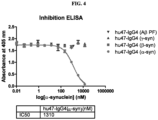
- the inhibition ELISA was performed with ⁇ -synuclein monomer, ⁇ -synuclein monomer and A ⁇ -protofibril as antigens. The result indicates there was no detectable binding of BAN0805 to ⁇ - or ⁇ -synuclein monomer or A ⁇ -protofibril.
- FIG. 4 A representative BAN0805 cross-reactivity test to ⁇ - or ⁇ -synuclein in inhibition ELISA is shown in FIG. 4 .
- Data are presented in Table 2.
- Table 2. Cross-reactivity of mAb47 and BAN0805 to ⁇ -synuclein monomer, ⁇ -synuclein monomer and A ⁇ -protofibril.
- Antibody ⁇ -synuclein monomer > 14 ⁇ M
- ⁇ -synuclein monomer > 14 ⁇ M
- a ⁇ -protofibril > 5 ⁇ M
- BAN0805 n.b. n.b. n.b.
- mAb47 n.b. n.b. n.b. n.b. no binding
- the present disclosure relates to an antibody having high affinity for ⁇ -synuclein protofibrils and low affinity to ⁇ -synuclein monomers, and having the following characteristics compared to murine mAb47:
- BAN0805 optimized DNA sequences encoding BAN0805 VH (SEQ ID NO: 13) and VL (SEQ ID NO: 14) including signal peptides were synthesized and cloned into GS vectors pXC-IgG4Pro(deltaK) and pXC-Kappa (Lonza), respectively.
- the resulting HC and LC SGVs were then used to generate a double gene vector (DGV) containing both the HC and LC genes.
- the optimized DNA sequences encoding BAN0805 heavy chain (HC) and light chain (LC) are set forth in SEQ ID NOs: 11 and 12, respectively.
- SEQ ID NOs: 13 and 14 The optimized DNA sequences encoding BAN0805 heavy chain variable region (VH) and light chain variable region (VL) are set forth in SEQ ID NOs: 13 and 14, respectively.
- SEQ ID NOs: 11-14 all include a nucleotide sequence encoding a signal peptide (see Table 3B).
- the nucleotide sequences corresponding to amino acid sequences for BAN0805 HC, LC, VH, and VL excluding the signal peptide are set forth in SEQ ID NOs: 17, 18, 19 and 20, respectively.
- the CDR sequences of BAN0805 are listed in Table 3A.
- the amino acid sequences of heavy chain CDR (VH-CDR) 1-3 according to Chothia nomenclature are set forth in SEQ ID NOs: 5, 6, and 7, respectively.
- the amino acid sequences of heavy chain CDR (VH-CDR) 1-3 according to Kabat nomenclature are set forth in SEQ ID NOs: 15, 16, and 7, respectively.
- the amino acid sequence of heavy chain CDR (VH-CDR-3) according to Chothia and Kabat nomenclatures is the same and set forth in SEQ ID NO: 7.
- the amino acid sequences of light chain CDR (VL-CDR) 1-3 according to Chothia and Kabat nomenclatures are the same, and set forth in SEQ ID NOs: 8, 9, and 10, respectively.
- the resultant DGV termed pBAN0805/DGV, was then transiently transfected to CHOK1SV GS-KO cells, and cultured under conditions which resulted in the secretion of assembled antibody.
- the secreted antibody was then purified by Protein A affinity chromatography. Table 3. SEQUENCE LISTING A.
- VH-CDR-1 (Chothia): GFSLTSYGVH (SEQ ID NO: 5)
- VH-CDR-1 (Kabat) SYGVH (SEQ ID NO: 15)
- Table 3A lists underlined sequences as CDR sequences according to Chothia nomenclature and bold sequences as CDR sequences according to Kabat nomenclature.
- CDR1, CDR2, and CDR3 are shown in standard order of appearance from left (N-terminus) to right (C-terminus).
- BAN0805 HC gene with signal sequence SEQ ID NO: 11
- BAN0805 LC gene with signal sequence SEQ ID NO: 12
- BAN0805 VH gene with signal sequence SEQ ID NO: 13
- BAN0805 VL gene with signal sequence SEQ ID NO: 14
- BAN0805 HC gene SEQ ID NO: 17
- BAN0805 LC gene SEQ ID NO: 18
- BAN0805 VH gene SEQ ID NO: 19
- BAN0805 VL gene SEQ ID NO: 20
- sequences encoding a signal peptide are underlined.
- the start codons are in bold and the stop codons are in italic.
Landscapes
- Health & Medical Sciences (AREA)
- Chemical & Material Sciences (AREA)
- Organic Chemistry (AREA)
- Life Sciences & Earth Sciences (AREA)
- Medicinal Chemistry (AREA)
- General Health & Medical Sciences (AREA)
- Proteomics, Peptides & Aminoacids (AREA)
- Molecular Biology (AREA)
- Genetics & Genomics (AREA)
- Biophysics (AREA)
- Biochemistry (AREA)
- Immunology (AREA)
- Chemical Kinetics & Catalysis (AREA)
- Neurosurgery (AREA)
- Animal Behavior & Ethology (AREA)
- Nuclear Medicine, Radiotherapy & Molecular Imaging (AREA)
- Public Health (AREA)
- Veterinary Medicine (AREA)
- General Chemical & Material Sciences (AREA)
- Pharmacology & Pharmacy (AREA)
- Neurology (AREA)
- Biomedical Technology (AREA)
- Bioinformatics & Cheminformatics (AREA)
- Engineering & Computer Science (AREA)
- Peptides Or Proteins (AREA)
- Micro-Organisms Or Cultivation Processes Thereof (AREA)
- Medicines Containing Antibodies Or Antigens For Use As Internal Diagnostic Agents (AREA)
- Preparation Of Compounds By Using Micro-Organisms (AREA)
Description
- International Patent Application No.
WO2011/104696 A1 discloses a murine monoclonal IgG antibody mAb47, which binds to protofibril forms of α-synuclein. There remains a need for antibodies that selectively bind to protofibril forms of α-synuclein that are suitable for use in humans. - The present disclosure relates to antibodies having high affinity for human α-synuclein protofibrils and low affinity for α-synuclein monomers. In some embodiments, the antibodies described herein selectively target human α-synuclein aggregates such as oligomers/protofibrils, i.e., with a much stronger binding to α-synuclein protofibrils compared to monomer. In some embodiments, the antibodies described herein have better selectivity than mAb47 when comparing the α-synuclein protofibril versus monomer binding ratios. In some embodiments, the antibodies described herein are anti-α-synuclein antibodies.
- In one aspect, the present disclosure relates to BAN0805, a monoclonal antibody comprising a heavy chain comprising an amino acid sequence set forth in SEQ ID NO:3 and a light chain comprising an amino acid sequence set forth in SEQ ID NO:4 that selectively targets human α-synuclein aggregates such as oligomers/protofibrils with high affinity for human α-synuclein protofibrils and low affinity for α-synuclein monomers. Interestingly, BAN0805 also exhibits lower α-synuclein monomer binding than mAb47, resulting in better selectivity for BAN0805 than for mAb47 when comparing the α-synuclein protofibril versus monomer binding ratios. Additionally, binding to β- and γ-synuclein monomer or Aβ-protofibrils was not detected for BAN0805.
- The present disclosure further relates to antibodies for improvements in treating neurodegenerative disorders with α-synuclein pathology, including, but not limited to, Parkinson's disease (PD). Any references in the description to methods of treatment refer to the compounds, pharmaceutical compositions and medicaments of the present invention for use in a method for treatment of the human (or animal) body by therapy (or for diagnosis).
-
-
FIG. 1 shows heat stress data for BAN0805. Samples of the purified candidate antibodies at 1 mg/mL were exposed to temperatures of a) 4°C, b) 25°C, c) 37°C and d) 50°C for two weeks. Samples were then analyzed by SEC-MALS to check for aggregation. The data suggest there are no aggregation concerns for BAN0805 due to heat stress. -
FIG. 2 shows the inhibition ELISA with IC50 values for BAN0805 when bound to α-synuclein monomers and protofibrils (PF). BAN0805 has a 910-fold better selectivity for the protofibril form of α-synuclein compared to mAb47 which only has a 340-fold selectivity (not shown). The protofibril level was expressed as equivalent to monomer level in concentration and the size of the protofibrils was not considered. The fold selectivity was calculated by dividing the IC50 value for the monomer binding with the IC50 value for the PF binding. -
FIG. 3 shows binding and selectivity for BAN0805 compared to mAb47 using Biacore SPR. The KD values for α-synuclein protofibril were similar for mAb47 and BAN0805, showing that the modification of mAb47 did not affect the strong binding to α-synuclein protofibril, confirming the results from the inhibition ELISA. The KD values measured with SPR resulted in a 110,000-fold and 18,000-fold selectivity for PF vs monomer for BAN0805 and mAb47, respectively. Representative sensorgrams of mAb47 and BAN0805 SPR measurements on Biacore 8K are shown. -
FIG. 4 shows cross-reactivity of BAN0805, here referred to as hu47-IgG4 to α-synuclein monomer, β-synuclein monomer, γ-synuclein monomer and Aβ-protofibril using inhibition ELISA. The result showed no detectable binding to β- or γ-synuclein monomer or Aβ-protofibril. - The present disclosure relates to antibodies having high affinity for human α-synuclein protofibrils and low affinity for α-synuclein monomers.
- As disclosed herein, the present disclosure relates to the following embodiments.
-
Embodiment 1. An antibody comprising a heavy chain comprising the amino acid sequence of SEQ ID NO: 1 and a light chain comprising the amino acid sequence of SEQ ID NO: 2. - Embodiment 2. The antibody of
embodiment 1, wherein the antibody is of the IgG isotype. -
Embodiment 3. The antibody ofembodiment 1, wherein the antibody is of the IgG4 isotype. - Embodiment 4. The antibody of any one of embodiments 1-3, wherein the antibody has a KD value for binding the protofibril form of α-synuclein at least 110,000 times smaller than the KD value for binding the monomeric form of α-synuclein.
- Embodiment 5. The antibody of any one of embodiments 1-3, wherein the antibody has a KD value for binding the protofibril form of α-synuclein of at most 18 pM and a KD value for binding the monomeric form of α-synuclein of at least 2200 nM.
- Embodiment 6. The antibody of either embodiment 4 or 5, wherein the KD of said antibody for binding to the protofibril form of α-synuclein and the KD of said antibody for binding to the monomeric form of α-synuclein are measured by SPR.
- Embodiment 7. An antibody comprising a heavy chain comprising the amino acid sequence of SEQ ID NO: 3 and a light chain comprising the amino acid sequence of SEQ ID NO: 4.
-
Embodiment 8. The antibody of embodiment 7, wherein the antibody comprises two heavy chains and two light chains. - Embodiment 9. One or more nucleic acids encoding the antibody of any one of
embodiments 1 to 8. - Embodiment 10. The one or more nucleic acids of embodiment 9, wherein
- (a) the one or more nucleic acids comprise the sequences of SEQ ID NOs: 11 and 12,
- (b) the one or more nucleic acids comprise the sequences of SEQ ID NOs: 13 and 14,
- (c) the one or more nucleic acids comprise the sequences of SEQ ID NOs: 17 and 18, or
- (d) the one or more nucleic acids comprise the sequences of SEQ ID NOs: 19 and 20.
- Embodiment 11. One or more vector(s) comprising the nucleic acid(s) of any one of embodiments 9 and 10.
- Embodiment 12. A host cell comprising the nucleic acid(s) of any one of embodiments 9 to 10.
- Embodiment 13. A host cell comprising the one or more vector(s) of embodiment 11.
- Embodiment 14. A host cell expressing the antibody of any one of embodiments 1-8.
- Embodiment 15. A composition comprising at least one antibody of any one of embodiments 1-8, and a pharmaceutically acceptable carrier.
- In one aspect, the present disclosure relates to an antibody having a high affinity for human α-synuclein protofibrils and low affinity of α-synuclein monomers, and comprising a heavy chain comprising the amino acid sequence of SEQ ID NO: 1, and a light chain comprising the amino acid sequence of SEQ ID NO: 2.
- In one embodiment, the antibodies provided herein comprise a heavy chain comprising the amino acid sequence of SEQ ID NO: 1 and a light chain comprising the amino acid sequence of SEQ ID NO: 2.
- In one embodiment, the antibodies provided herein comprise a heavy chain comprising the amino acid sequence of SEQ ID NO:3 and a light chain comprising the amino acid sequence of SEQ ID NO:4. In some embodiments, the antibodies provided herein comprise two heavy chains and two light chains.
- In one embodiment, the antibody described in the present disclosure is of the IgG isotype, in particular human IgG isotype. In another embodiment, the antibody is of the IgG4 isotype.
- Within the present disclosure, high affinity to human α-synuclein protofibrils refers to a dissociation constant KD of less than 10-7 M for human α-synuclein protofibrils. Accordingly, in one embodiment, the antibodies described in the present disclosure have a KD of less than 10-8, 10-9, 10-10, 10-11 M, or 10-12 M for human α-synuclein protofibrils. In specific embodiments, the antibodies comprise a heavy chain comprising an amino acid sequence set forth in SEQ ID NO: 1 and a light chain comprising an amino acid sequence set forth in SEQ ID NO: 2, and have a KD of 11.2 to 25.8 pM for human α-synuclein protofibrils.
- In another embodiment, the antibodies comprise a heavy chain comprising the amino acid sequence of SEQ ID NO: 1 and a light chain comprising the amino acid sequence of SEQ ID NO: 2, and have low affinity to human α-synuclein monomer. For example, the KD of the antibodies described in the present disclosure for binding to the monomeric form of α-synuclein is at least 1500 nM, at least 1600 nM, at least 1700 nM, at least 1800 nM, at least 1900 nM, at least 2000 nM, at least 2100 nM, at least 2200 nM, at least 2300 nM, at least 2400 nM, at least 2500 nM, at least 2600 nM, at least 2700 nM, at least 2800 nM, at least 2900 nM, or at least 3000 nM. In specific embodiments, the antibodies comprise a heavy chain comprising an amino acid sequence set forth in SEQ ID NO: 1 and a light chain comprising an amino acid sequence set forth in SEQ ID NO: 2, and have a KD of 1650 nM to 2730 nM for the human α-synuclein monomer.
- In one embodiment, the antibodies comprise a heavy chain comprising the amino acid sequence of SEQ ID NO: 1 and a light chain comprising the amino acid sequence of SEQ ID NO: 2, and have greater than 80,000 fold, greater than 90,000 fold, greater than 100,000 fold, greater than 110,000 fold, or greater than 120,000 fold selectivity to human α-synuclein protofibril versus monomeric α-synuclein. In specific embodiments, the antibodies comprise a heavy chain comprising an amino acid sequence set forth in SEQ ID NO: 1 and a light chain comprising an amino acid sequence set forth in SEQ ID NO: 2, and have a 64,000 fold to 244,000 fold selectivity to human α-synuclein protofibril versus monomeric α-synuclein.
- In one embodiment, these binding affinities are measured using inhibition ELISA, for example, as described in example 3. In another embodiment, these binding affinities are measured by Surface Plasmon Resonance (SPR), for example, as described in example 3.
- In another aspect, provided herein are one or more nucleic acids encoding an antibody of the invention. In one embodiment, the one or more nucleic acids comprise the sequences of SEQ ID Nos: 11 and 12. In another embodiment, the one or more nucleic acids comprise the sequences of SEQ ID Nos: 13 and 14. In one embodiment, the one or more nucleic acids comprise the sequences of SEQ ID Nos: 17 and 18. In one embodiment, the one or more nucleic acids comprise the sequences of SEQ ID Nos: 19 and 20.
- In another aspect, provided herein are vectors comprising nucleic acids that encode an antibody as described herein. Such vectors include but are not limited to cloning vectors or expression vectors. In one aspect, one or more vectors are providing encoding an antibody of the invention. In one embodiment, the one or more vectors comprise the sequences of SEQ ID Nos: 11 and 12. In another embodiment, the one or more vectors comprise the sequences of SEQ ID Nos: 13 and 14. In one embodiment, the one or more vectors comprise the sequences of SEQ ID Nos: 17 and 18. In one embodiment, the one or more vectors comprise the sequences of SEQ ID Nos: 19 and 20.
- In another aspect, provided herein are host cells comprising nucleic acids that encode an antibody of the invention. The host cells described herein may be mammalian cells, such as B cells, hybridomas, or CHO cells. In one embodiment, the host cells described herein are human cells.
- In another aspect, provided herein is a composition comprising an antibody of the invention and a pharmaceutically acceptable excipient.
- The initial variants of mAb47 were generated by direct grafting of mAb47 CDRs to human framework sequences, and making back-mutations to the mouse residues at various positions. None of the initial variants showed desired binding properties to α-synuclein. Therefore, a new model was built and analyzed to find more possible mutations for generating new variants.
- In the second attempt to improve mAb47, less likely residues that interact with the target and the residues at 4Å from the CDRs determined were checked. An antibody variant having a heavy chain sequence set forth in SEQ ID NO: 3 and a light chain sequence set forth in SEQ ID NO: 4 was generated and named as BAN0805. It was found that the back mutations V71K and R94K, while simultaneously present in BAN0805, are crucial for the binding capacity of these antibodies as their removal in the other variants have resulted in a loss of binding.
- Since BAN0805 has one less back mutation than a comparable variant, and has shown binding and selectivity for protofibrils over monomer species, BAN0805 was chosen as the lead candidate.
- To determine thermal stability, the antibodies were subjected to higher temperatures for 10 minutes, cooled to 4°C and used in an ELISA assay at the EC80 concentration of each candidate (usually 5-50 ng/mL). BAN0805 was stable, retaining its binding ability to α-synuclein up to 75°C where it started to decrease, while the chimeric mouse antibody c47 or cmAb47 (the chimera combining human IgG4 and the variable region of mAb47) binding dropped drastically around 5°C earlier.
- In order to determine the melting temperature of the antibodies, cmAb47 was tested against BAN0805 in a thermal shift assay. Melting temperature data indicates that the Tm for BAN0805 was calculated to be 65-65.4°C, lower than the chimeric at 70°C.
- Additionally, purified samples at 1 mg/mL were injected at 0.4 mL/min into a size exclusion column in an HPLC system and analyzed by multi-angle light scattering to determine the absolute molar masses and check for aggregation. The data suggest there were no aggregation concerns for BAN0805. BAN0805 was monodispersed (Mw/Mn < 1.05). The mass recovery was 100% (calculated mass over injected mass), which indicates good protein recovery.
- Cross-Interaction Chromatography using bulk purified human polyclonal IgG is a technique for monitoring non-specific protein-protein interactions, and can be used to discriminate between soluble and insoluble antibodies. An elevated Retention Index (k') indicates a self-interaction propensity and a low solubility. BAN0805 showed a Retention Index of 0.025 which is below 0.035 of the cmAb47, indicating a low propensity for non-specific interactions and good solubility.
- For freeze/thaw stress analysis, samples of the purified candidate antibodies at 1 mg/mL were subjected to 10 cycles of 15 minutes at -80°C followed by thawing for 15 minutes at Room Temperature. For heat-induced stress analysis, samples of the purified candidate antibodies at 1 mg/mL were exposed to temperatures of a) 4°C, b) 25°C, c) 37°C and d) 50°C for two weeks. Samples were then analyzed by SEC-MALS to check for aggregation. The data suggest that freeze thaw cycles and heat stress did not cause aggregation in BAN0805. See
FIG. 1 . - BAN0805 was analyzed and compared to the closest germline (IGVH4-59*03/IGHJ3*01 for HK and IGVK2-28*01/IGKJ2*02 for KA) following IMGT CDR definitions and the DomainGapAlign tool. Overall identity to human germline was 86.5% for the light chain, above the 85% cutoff for it to be considered humanized for this analysis. For the heavy chain, after grafting CDRs and introducing two mouse back mutations, the percentage identity to human germline dropped to just under 81%. This might be explained by the fact that the IMGT CDR2 is significantly shorter than the Kabat definition used here, which caused the insertion of a higher number of mouse residues at the beginning of the
framework 3. - Binding selectivity of BAN0805 to human α-synuclein protofibrils were measured by both inhibition ELISA and Surface Plasmon Resonance (SPR).
- The IC50 values for α-synuclein protofibril were very similar for mAb47 and BAN0805 (2.7 nM and 2.2 nM respectively) showing that the binding characteristics to protofibril did not change after humanization. In contrast, binding to α-synuclein monomer did change, resulting in a reduced binding strength of BAN0805 to α-synuclein monomer. This resulted in better selectivity for α-synuclein protofibril versus monomer for BAN0805 (910-fold) compared to mAb47 (340-fold). See
FIG. 2 . - However, due to detection limitations it was not possible to lower the antibody concentration further to make it possible to detect even lower IC50 values and hence approach the "true" IC50 value. Therefore, the IC50 values presented have been obtained according to the current procedure for the inhibition ELISA which has been used for all mAb47 and BAN0805 batches, with the notion that IC50 values for the protofibril are likely overestimated (i.e., the binding strength is likely underestimated). A more accurate binding and hence selectivity were obtained using SPR which is described below.
- The binding selectivity of mAb47 and BAN0805 was confirmed by SPR using a Biacore 8K instrument (GE Healthcare). Due to feasibility issues caused by the complexity of the target antigen in combination with pronounced avidity dependence of the antibodies, different assay set-ups were used to assess α-synuclein protofibril and monomer binding, respectively. For measurements of binding to monomer, the chip was coated with an anti-mouse or anti-human antibody for mAb47 and BAN0805, respectively. 0.25-1.5 µg/ml mAb47 or BAN0805 was then captured on the surface, followed by a 5-fold dilution single cycle kinetics injection of α-synuclein monomer. To measure binding to protofibril (PF), the chip was coated with 0.5 µg/ml PF and a 2-fold dilution of mAb47 or BAN0805 was injected using single cycle kinetics. Representative sensorgrams for mAb47 and BAN0805 are shown in
FIG. 3 . - The KD values for α-synuclein protofibril were similar for mAb47 and BAN0805, showing that the modification of mAb47 did not affect the strong binding to α-synuclein protofibril (Table 1), confirming the results from the inhibition ELISA. However, the KD values were in the pM range, confirming the afore-mentioned limitations with the inhibition ELISA. Importantly, it was confirmed by the SPR that the affinity of BAN0805 for α-synuclein monomer was reduced in comparison to mAb47. The KD values measured with SPR resulted in a 110,000-fold and 18,000-fold selectivity for PF versus monomer for BAN0805 and mAb47, respectively. Average KD values for mAb47 and BAN0805 for α-synuclein monomer and protofibril are shown in Table 1.
Table 1. KD values for mAb47 and BAN0805 for binding to α-synuclein protofibril (PF) and monomer (M) by Biacore SPR. Antibody α-synuclein PF KD (pM) α-synuclein monomer KD (nM) Selectivity PF vs. monomeric α-synuclein (fold) BAN0805 18.5±7.3 (n=27) 2190±540 (n=59) 110 000 mAb47 16.8±8.0 (n=18) 307±35 (n=23) 18 000 Data are presented as Mean± Standard deviation (n=Number of experiments)
KD: Dissociation constant - The cross-reactivity of homologous proteins, such as β- or γ-synuclein, and other aggregation prone proteins like Aβ was tested using both direct ELISA (where dense coating mimics aggregated forms of the coated protein), as well as inhibition ELISA. Here, the cross-reactivity of mAb47 and BAN0805, was analyzed side-by-side by inhibition ELISA. The inhibition ELISA was performed with β-synuclein monomer, γ-synuclein monomer and Aβ-protofibril as antigens. The result indicates there was no detectable binding of BAN0805 to β- or γ-synuclein monomer or Aβ-protofibril. A representative BAN0805 cross-reactivity test to β- or γ-synuclein in inhibition ELISA is shown in
FIG. 4 . Data are presented in Table 2.Table 2. Cross-reactivity of mAb47 and BAN0805 to β-synuclein monomer, γ-synuclein monomer and Aβ-protofibril. Antibody β-synuclein monomer (> 14 µM) γ-synuclein monomer (> 14 µM) Aβ-protofibril (> 5 µM) BAN0805 n.b. n.b. n.b. mAb47 n.b. n.b. n.b. n.b. = no binding - Results from inhibition ELISA and the Surface Plasmon Resonance (SPR) Biacore data both showed the affinity of BAN0805 for α-synuclein monomer was reduced in comparison to mAb47, indicating a better selectivity of BAN0805 compared to mAb47. Additionally, no binding to β- and γ-synuclein monomer or Aβ-protofibrils was seen at concentrations tested (up to µM range) for BAN0805.
- Thus, the present disclosure relates to an antibody having high affinity for α-synuclein protofibrils and low affinity to α-synuclein monomers, and having the following characteristics compared to murine mAb47:
- (1) BAN0805 has a much stronger binding to α-synuclein protofibrils compared to monomer;
- (2) both inhibition ELISA and SPR Biacore data showed that the α-synuclein monomer binding was stronger for mAb47 compared to BAN0805 resulting in better selectivity for BAN0805 than for mAb47 when comparing the α-synuclein protofibril versus monomer binding ratios (i.e., BAN0805 has a lower tendency to bind to the undesired monomeric α-synuclein target as compared to mAb47); and
- (3) no binding to β- and γ-synuclein monomer or Aβ-protofibrils was seen at concentrations tested (up to µM range) for BAN0805.
- To produce BAN0805, optimized DNA sequences encoding BAN0805 VH (SEQ ID NO: 13) and VL (SEQ ID NO: 14) including signal peptides were synthesized and cloned into GS vectors pXC-IgG4Pro(deltaK) and pXC-Kappa (Lonza), respectively. The resulting HC and LC SGVs were then used to generate a double gene vector (DGV) containing both the HC and LC genes. The optimized DNA sequences encoding BAN0805 heavy chain (HC) and light chain (LC) are set forth in SEQ ID NOs: 11 and 12, respectively. The optimized DNA sequences encoding BAN0805 heavy chain variable region (VH) and light chain variable region (VL) are set forth in SEQ ID NOs: 13 and 14, respectively. SEQ ID NOs: 11-14 all include a nucleotide sequence encoding a signal peptide (see Table 3B). The nucleotide sequences corresponding to amino acid sequences for BAN0805 HC, LC, VH, and VL excluding the signal peptide are set forth in SEQ ID NOs: 17, 18, 19 and 20, respectively. The CDR sequences of BAN0805 are listed in Table 3A. The amino acid sequences of heavy chain CDR (VH-CDR) 1-3 according to Chothia nomenclature are set forth in SEQ ID NOs: 5, 6, and 7, respectively. The amino acid sequences of heavy chain CDR (VH-CDR) 1-3 according to Kabat nomenclature are set forth in SEQ ID NOs: 15, 16, and 7, respectively. The amino acid sequence of heavy chain CDR (VH-CDR-3) according to Chothia and Kabat nomenclatures is the same and set forth in SEQ ID NO: 7. The amino acid sequences of light chain CDR (VL-CDR) 1-3 according to Chothia and Kabat nomenclatures are the same, and set forth in SEQ ID NOs: 8, 9, and 10, respectively.
- The resultant DGV, termed pBAN0805/DGV, was then transiently transfected to CHOK1SV GS-KO cells, and cultured under conditions which resulted in the secretion of assembled antibody. The secreted antibody was then purified by Protein A affinity chromatography.
Table 3. SEQUENCE LISTING A. BAN0805 VH: 
VL: 
Heavy Chain 
Light Chain 

CDRs VH-CDR-1 (Chothia): GFSLTSYGVH (SEQ ID NO: 5) VH-CDR-1 (Kabat): SYGVH (SEQ ID NO: 15) VH-CDR-2 (Chothia): VIWRGGSTDYSAAF (SEQ ID NO: 6) VH-CDR-2 (Kabat): VIWRGGSTDYSAAFMS (SEQ ID NO: 16) VH-CDR-3 (Kabat/Chothia): LLRSVGGFAD (SEQ ID NO: 7) VL-CDR-1 (Kabat/Chothia): RSSQTIVHNNGNTYLE (SEQ ID NO: 8) VL-CDR-2 (Kabat/Chothia): KVSNRFS (SEQ ID NO: 9) VL-CDR-3 (Kabat/Chothia): FQGSHVPFT (SEQ ID NO: 10) - Table 3A lists underlined sequences as CDR sequences according to Chothia nomenclature and bold sequences as CDR sequences according to Kabat nomenclature. CDR1, CDR2, and CDR3 are shown in standard order of appearance from left (N-terminus) to right (C-terminus).
-
BAN0805 HC gene with signal sequence (SEQ ID NO: 11) 

BAN0805 LC gene with signal sequence (SEQ ID NO: 12) 
BAN0805 VH gene with signal sequence (SEQ ID NO: 13) 
BAN0805 VL gene with signal sequence (SEQ ID NO: 14) 
BAN0805 HC gene (SEQ ID NO: 17) 

BAN0805 LC gene (SEQ ID NO: 18) 
BAN0805 VH gene (SEQ ID NO: 19) 
BAN0805 VL gene (SEQ ID NO: 20) 
- The sequences encoding a signal peptide are underlined. The start codons are in bold and the stop codons are in italic.
Claims (12)
- An anti-alpha synuclein antibody comprising a heavy chain comprising the amino acid sequence of SEQ ID NO: 1 and a light chain comprising the amino acid sequence of SEQ ID NO: 2.
- The antibody of claim 1, wherein the antibody is of the IgG isotype.
- The antibody of claim 1, wherein the antibody is of the IgG4 isotype.
- An anti-alpha synuclein antibody comprising a heavy chain comprising the amino acid sequence of SEQ ID NO:3 and a light chain comprising the amino acid sequence of SEQ ID NO:4.
- The antibody of claim 4, wherein the antibody comprises two heavy chains and two light chains.
- One or more nucleic acids encoding the antibody of any one of claims 1 to 5.
- The one or more nucleic acids of claim 6, wherein(a) the one or more nucleic acids comprise the sequences of SEQ ID NOs: 11 and 12,(b) the one or more nucleic acids comprise the sequences of SEQ ID NOs: 13 and 14,(c) the one or more nucleic acids comprise the sequences of SEQ ID NOs: 17 and 18, or(d) the one or more nucleic acids comprise the sequences of SEQ ID NOs: 19 and 20.
- One or more vectors comprising the nucleic acid(s) of any one of claims 6 to 7.
- A host cell comprising the nucleic acid(s) of any one of claims 6 to 7.
- A host cell comprising the one or more vector(s) of claim 8.
- A host cell expressing the antibody of any one of claims 1-5.
- A composition comprising the antibody of any one of claims 1-5 and a pharmaceutically acceptable carrier.
Priority Applications (6)
| Application Number | Priority Date | Filing Date | Title |
|---|---|---|---|
| HRP20250812TT HRP20250812T1 (en) | 2020-06-26 | 2021-06-25 | ANTIBODIES THAT BINDING ALPHA-SYNUCLEI PROTOFIBRIL |
| SM20250274T SMT202500274T1 (en) | 2020-06-26 | 2021-06-25 | Alpha-synuclein protofibril-binding antibodies |
| MA60122A MA60122B1 (en) | 2020-06-26 | 2021-06-25 | ANTIBODIES BINDING TO ALPHA-SYNUCLEIN PROTOFIBRIL |
| EP25168668.9A EP4570315A3 (en) | 2020-06-26 | 2021-06-25 | Alfa-synuclein protofibril-binding antibodies |
| SI202130320T SI4172199T1 (en) | 2020-06-26 | 2021-06-25 | ANTIBODIES THAT BINDING TO ALPHA-SYNUCLEI PROTOFIBRILLS |
| RS20250669A RS66984B1 (en) | 2020-06-26 | 2021-06-25 | Alpha-synuclein protofibril-binding antibodies |
Applications Claiming Priority (3)
| Application Number | Priority Date | Filing Date | Title |
|---|---|---|---|
| US202063044881P | 2020-06-26 | 2020-06-26 | |
| US202063071150P | 2020-08-27 | 2020-08-27 | |
| PCT/IB2021/000440 WO2021260434A1 (en) | 2020-06-26 | 2021-06-25 | α-SYNUCLEIN PROTOFIBRIL-BINDING ANTIBODIES |
Related Child Applications (2)
| Application Number | Title | Priority Date | Filing Date |
|---|---|---|---|
| EP25168668.9A Division EP4570315A3 (en) | 2020-06-26 | 2021-06-25 | Alfa-synuclein protofibril-binding antibodies |
| EP25168668.9A Division-Into EP4570315A3 (en) | 2020-06-26 | 2021-06-25 | Alfa-synuclein protofibril-binding antibodies |
Publications (2)
| Publication Number | Publication Date |
|---|---|
| EP4172199A1 EP4172199A1 (en) | 2023-05-03 |
| EP4172199B1 true EP4172199B1 (en) | 2025-05-14 |
Family
ID=77627146
Family Applications (2)
| Application Number | Title | Priority Date | Filing Date |
|---|---|---|---|
| EP25168668.9A Pending EP4570315A3 (en) | 2020-06-26 | 2021-06-25 | Alfa-synuclein protofibril-binding antibodies |
| EP21765693.3A Active EP4172199B1 (en) | 2020-06-26 | 2021-06-25 | Alpha-synuclein protofibril-binding antibodies |
Family Applications Before (1)
| Application Number | Title | Priority Date | Filing Date |
|---|---|---|---|
| EP25168668.9A Pending EP4570315A3 (en) | 2020-06-26 | 2021-06-25 | Alfa-synuclein protofibril-binding antibodies |
Country Status (27)
| Country | Link |
|---|---|
| US (2) | US11339212B2 (en) |
| EP (2) | EP4570315A3 (en) |
| JP (2) | JP7337959B2 (en) |
| KR (1) | KR20230027095A (en) |
| CN (1) | CN115803341A (en) |
| AU (1) | AU2021298222A1 (en) |
| CA (1) | CA3181207A1 (en) |
| DK (1) | DK4172199T3 (en) |
| ES (1) | ES3037420T3 (en) |
| FI (1) | FI4172199T3 (en) |
| HR (1) | HRP20250812T1 (en) |
| HU (1) | HUE072262T2 (en) |
| IL (1) | IL298584B2 (en) |
| LT (1) | LT4172199T (en) |
| MA (1) | MA60122B1 (en) |
| MD (1) | MD4172199T2 (en) |
| MX (1) | MX2022016005A (en) |
| PH (1) | PH12022552829A1 (en) |
| PL (1) | PL4172199T3 (en) |
| PT (1) | PT4172199T (en) |
| RS (1) | RS66984B1 (en) |
| SI (1) | SI4172199T1 (en) |
| SM (1) | SMT202500274T1 (en) |
| TW (1) | TWI879983B (en) |
| UY (1) | UY39295A (en) |
| WO (1) | WO2021260434A1 (en) |
| ZA (1) | ZA202211843B (en) |
Families Citing this family (2)
| Publication number | Priority date | Publication date | Assignee | Title |
|---|---|---|---|---|
| HUE072262T2 (en) | 2020-06-26 | 2025-11-28 | Bioarctic Ab | Alpha-synuclein protofibril-binding antibodies |
| WO2026068513A1 (en) | 2024-09-24 | 2026-04-02 | Bioarctic Ab | Bispecific binding molecule |
Family Cites Families (25)
| Publication number | Priority date | Publication date | Assignee | Title |
|---|---|---|---|---|
| US5470571A (en) * | 1988-01-27 | 1995-11-28 | The Wistar Institute | Method of treating human EGF receptor-expressing gliomas using radiolabeled EGF receptor-specific MAB 425 |
| WO1995007301A1 (en) * | 1993-09-07 | 1995-03-16 | Smithkline Beecham Corporation | Recombinant il4 antibodies useful in treatment of il4 mediated disorders |
| ATE312349T1 (en) | 1998-07-03 | 2005-12-15 | Innogenetics Nv | DIFFERENTIAL DIAGNOSIS OF NEURODEGENERATION |
| EP2082749A3 (en) | 2000-07-07 | 2010-06-30 | Bioarctic Neuroscience AB | Prevention and treatment of Alzheimer's disease |
| US20060018918A1 (en) | 2000-12-27 | 2006-01-26 | Board Of Regents, The University Of Texas System | Production of stabilized conformational isomers of disease associated proteins |
| TW200509968A (en) | 2002-11-01 | 2005-03-16 | Elan Pharm Inc | Prevention and treatment of synucleinopathic disease |
| US20080014194A1 (en) | 2003-10-31 | 2008-01-17 | Elan Pharmaceuticals, Inc. | Prevention and Treatment of Synucleinopathic and Amyloidogenic Disease |
| US8506959B2 (en) | 2002-11-01 | 2013-08-13 | Neotope Biosciences Limited | Prevention and treatment of synucleinopathic and amyloidogenic disease |
| US7358331B2 (en) | 2003-05-19 | 2008-04-15 | Elan Pharmaceuticals, Inc. | Truncated fragments of alpha-synuclein in Lewy body disease |
| WO2005047860A2 (en) | 2003-11-08 | 2005-05-26 | Elan Pharmaceuticals, Inc. | Antibodies to alpha-synuclein |
| US20050203010A1 (en) | 2003-11-14 | 2005-09-15 | Atgen Co., Ltd. | Novel peptides conferring environmental stress resistance and fusion proteins including said peptides |
| SE0401601D0 (en) | 2004-06-21 | 2004-06-21 | Bioarctic Neuroscience Ab | Protofibril specific antibodies and uses thereof |
| JP2009525046A (en) | 2006-01-31 | 2009-07-09 | エラン ファーマシューティカルズ,インコーポレイテッド | Alpha-synuclein kinase |
| BRPI0709050B1 (en) | 2006-03-23 | 2018-12-26 | Bioarctic Neuroscience Ab | antibody or fragment thereof, composition, methods for detecting ab protofibrils in vitro, and use of the antibody |
| DK2282758T3 (en) | 2008-04-29 | 2019-02-25 | Bioarctic Ab | ANTIBODIES AND VACCINES FOR USE IN THERAPEUTIC AND DIAGNOSTIC PROCEDURES FOR ALPHA-SYNUCLEIN-RELATED DISORDERS |
| WO2010069603A1 (en) * | 2008-12-19 | 2010-06-24 | Neurimmune Therapeutics Ag | Human anti-alpha-synuclein autoantibodies |
| US20120100129A1 (en) | 2009-06-29 | 2012-04-26 | Gellerfors Paer | N-Terminal Truncated Protofibrils/Oligomers for Use in Therapeutic and Diagnostic Methods for Alzheimer's Disease and Related Disorders |
| EP2539366B1 (en) * | 2010-02-26 | 2017-11-08 | BioArtic Neuroscience AB | Protofibril-binding antibodies and their use in therapeutic and diagnostic methods for parkinson's disease, dementia with lewy bodies and other alpha-synucleinopathies |
| UY33578A (en) * | 2010-08-31 | 2012-03-30 | Sanofi Sa | PEPTIDE PEPTIDE OR COMPLEX THAT JOINS INTEGRINE TO (ALPHA) AND METHODS AND USES THAT INVOLVE THE SAME |
| CN103796679B (en) * | 2011-06-23 | 2016-10-19 | 比奥根国际神经科学公司 | Anti-α synapse nucleoprotein binding molecule |
| US9534044B2 (en) * | 2013-02-28 | 2017-01-03 | United Arab Emirates University | Alpha-synuclein antibodies and uses thereof |
| EP4043493A1 (en) * | 2013-12-24 | 2022-08-17 | Janssen Pharmaceutica NV | Anti-vista antibodies and fragments |
| US11773166B2 (en) * | 2014-11-04 | 2023-10-03 | Ichnos Sciences SA | CD3/CD38 T cell retargeting hetero-dimeric immunoglobulins and methods of their production |
| EP3359569A2 (en) * | 2015-10-06 | 2018-08-15 | Alector LLC | Anti-trem2 antibodies and methods of use thereof |
| HUE072262T2 (en) | 2020-06-26 | 2025-11-28 | Bioarctic Ab | Alpha-synuclein protofibril-binding antibodies |
-
2021
- 2021-06-25 HU HUE21765693A patent/HUE072262T2/en unknown
- 2021-06-25 SI SI202130320T patent/SI4172199T1/en unknown
- 2021-06-25 DK DK21765693.3T patent/DK4172199T3/en active
- 2021-06-25 ES ES21765693T patent/ES3037420T3/en active Active
- 2021-06-25 TW TW110123445A patent/TWI879983B/en active
- 2021-06-25 KR KR1020227046153A patent/KR20230027095A/en active Pending
- 2021-06-25 AU AU2021298222A patent/AU2021298222A1/en active Pending
- 2021-06-25 MA MA60122A patent/MA60122B1/en unknown
- 2021-06-25 CN CN202180041047.0A patent/CN115803341A/en active Pending
- 2021-06-25 WO PCT/IB2021/000440 patent/WO2021260434A1/en not_active Ceased
- 2021-06-25 MD MDE20230490T patent/MD4172199T2/en unknown
- 2021-06-25 PH PH1/2022/552829A patent/PH12022552829A1/en unknown
- 2021-06-25 CA CA3181207A patent/CA3181207A1/en active Pending
- 2021-06-25 SM SM20250274T patent/SMT202500274T1/en unknown
- 2021-06-25 PL PL21765693.3T patent/PL4172199T3/en unknown
- 2021-06-25 US US17/359,212 patent/US11339212B2/en active Active
- 2021-06-25 IL IL298584A patent/IL298584B2/en unknown
- 2021-06-25 HR HRP20250812TT patent/HRP20250812T1/en unknown
- 2021-06-25 UY UY0001039295A patent/UY39295A/en unknown
- 2021-06-25 PT PT217656933T patent/PT4172199T/en unknown
- 2021-06-25 RS RS20250669A patent/RS66984B1/en unknown
- 2021-06-25 LT LTEPPCT/IB2021/000440T patent/LT4172199T/en unknown
- 2021-06-25 JP JP2021570377A patent/JP7337959B2/en active Active
- 2021-06-25 EP EP25168668.9A patent/EP4570315A3/en active Pending
- 2021-06-25 MX MX2022016005A patent/MX2022016005A/en unknown
- 2021-06-25 FI FIEP21765693.3T patent/FI4172199T3/en active
- 2021-06-25 EP EP21765693.3A patent/EP4172199B1/en active Active
-
2022
- 2022-04-21 US US17/726,144 patent/US20230080536A1/en not_active Abandoned
- 2022-10-31 ZA ZA2022/11843A patent/ZA202211843B/en unknown
-
2023
- 2023-08-22 JP JP2023134451A patent/JP2023159299A/en active Pending
Also Published As
Similar Documents
| Publication | Publication Date | Title |
|---|---|---|
| TWI801469B (en) | Antibodies | |
| TWI806940B (en) | Antibodies | |
| US20230080536A1 (en) | Alpha-synuclein protofibril-binding antibodies | |
| CN113484526B (en) | Method for detecting biological activity of anti-FcRn antibody or antigen binding fragment thereof | |
| JP2026071342A (en) | Modified anti-IgE antibody and its application | |
| HK40090209B (en) | Alpha-synuclein protofibril-binding antibodies | |
| HK40090209A (en) | Alpha-synuclein protofibril-binding antibodies | |
| HK40126746A (en) | Alfa-synuclein protofibril-binding antibodies | |
| JP2024532540A (en) | Bifunctional fusion proteins and uses thereof | |
| BR112022025466B1 (en) | a-SINUCLEIN PROTOFIBRILL BINDING ANTIBODIES, NUCLEIC ACIDS, VECTORS AND COMPOSITION COMPRISING THE SAID ANTIBODIES | |
| RU2810587C1 (en) | ANTIBODIES THAT BIND TO α-SYNUCLEIN PROTOFIBRILS | |
| HK40030984A (en) | Anti-alpha-synuclein antibodies | |
| HK40070445B (en) | Anti-b7h4 antibody, and bispecific antibody and use thereof | |
| HK40030984B (en) | Anti-alpha-synuclein antibodies |
Legal Events
| Date | Code | Title | Description |
|---|---|---|---|
| REG | Reference to a national code |
Ref country code: HR Ref legal event code: TUEP Ref document number: P20250812T Country of ref document: HR |
|
| STAA | Information on the status of an ep patent application or granted ep patent |
Free format text: STATUS: UNKNOWN |
|
| STAA | Information on the status of an ep patent application or granted ep patent |
Free format text: STATUS: THE INTERNATIONAL PUBLICATION HAS BEEN MADE |
|
| PUAI | Public reference made under article 153(3) epc to a published international application that has entered the european phase |
Free format text: ORIGINAL CODE: 0009012 |
|
| STAA | Information on the status of an ep patent application or granted ep patent |
Free format text: STATUS: REQUEST FOR EXAMINATION WAS MADE |
|
| 17P | Request for examination filed |
Effective date: 20221216 |
|
| AK | Designated contracting states |
Kind code of ref document: A1 Designated state(s): AL AT BE BG CH CY CZ DE DK EE ES FI FR GB GR HR HU IE IS IT LI LT LU LV MC MK MT NL NO PL PT RO RS SE SI SK SM TR |
|
| P01 | Opt-out of the competence of the unified patent court (upc) registered |
Effective date: 20230526 |
|
| REG | Reference to a national code |
Ref country code: HK Ref legal event code: DE Ref document number: 40090209 Country of ref document: HK |
|
| GRAP | Despatch of communication of intention to grant a patent |
Free format text: ORIGINAL CODE: EPIDOSNIGR1 |
|
| STAA | Information on the status of an ep patent application or granted ep patent |
Free format text: STATUS: GRANT OF PATENT IS INTENDED |
|
| INTG | Intention to grant announced |
Effective date: 20231221 |
|
| GRAJ | Information related to disapproval of communication of intention to grant by the applicant or resumption of examination proceedings by the epo deleted |
Free format text: ORIGINAL CODE: EPIDOSDIGR1 |
|
| STAA | Information on the status of an ep patent application or granted ep patent |
Free format text: STATUS: REQUEST FOR EXAMINATION WAS MADE |
|
| INTC | Intention to grant announced (deleted) | ||
| GRAP | Despatch of communication of intention to grant a patent |
Free format text: ORIGINAL CODE: EPIDOSNIGR1 |
|
| STAA | Information on the status of an ep patent application or granted ep patent |
Free format text: STATUS: GRANT OF PATENT IS INTENDED |
|
| INTG | Intention to grant announced |
Effective date: 20250113 |
|
| GRAS | Grant fee paid |
Free format text: ORIGINAL CODE: EPIDOSNIGR3 |
|
| GRAA | (expected) grant |
Free format text: ORIGINAL CODE: 0009210 |
|
| STAA | Information on the status of an ep patent application or granted ep patent |
Free format text: STATUS: THE PATENT HAS BEEN GRANTED |
|
| AK | Designated contracting states |
Kind code of ref document: B1 Designated state(s): AL AT BE BG CH CY CZ DE DK EE ES FI FR GB GR HR HU IE IS IT LI LT LU LV MC MK MT NL NO PL PT RO RS SE SI SK SM TR |
|
| REG | Reference to a national code |
Ref country code: GB Ref legal event code: FG4D Ref country code: TN Ref legal event code: VAGR Ref document number: TN/P/2025/0195 Country of ref document: TN |
|
| REG | Reference to a national code |
Ref country code: CH Ref legal event code: EP |
|
| REG | Reference to a national code |
Ref country code: IE Ref legal event code: FG4D |
|
| REG | Reference to a national code |
Ref country code: DE Ref legal event code: R096 Ref document number: 602021030828 Country of ref document: DE |
|
| REG | Reference to a national code |
Ref country code: NL Ref legal event code: FP |
|
| PGFP | Annual fee paid to national office [announced via postgrant information from national office to epo] |
Ref country code: MC Payment date: 20250618 Year of fee payment: 5 |
|
| PGFP | Annual fee paid to national office [announced via postgrant information from national office to epo] |
Ref country code: DE Payment date: 20250617 Year of fee payment: 5 |
|
| PGFP | Annual fee paid to national office [announced via postgrant information from national office to epo] |
Ref country code: GB Payment date: 20250613 Year of fee payment: 5 |
|
| PGFP | Annual fee paid to national office [announced via postgrant information from national office to epo] |
Ref country code: IS Payment date: 20250618 Year of fee payment: 5 Ref country code: NO Payment date: 20250627 Year of fee payment: 5 |
|
| VSFP | Annual fee paid to validation state [announced via postgrant information from national office to epo] |
Ref country code: MD Payment date: 20250630 Year of fee payment: 5 |
|
| PGFP | Annual fee paid to national office [announced via postgrant information from national office to epo] |
Ref country code: LU Payment date: 20250617 Year of fee payment: 5 Ref country code: NL Payment date: 20250619 Year of fee payment: 5 Ref country code: AL Payment date: 20250617 Year of fee payment: 5 Ref country code: BE Payment date: 20250617 Year of fee payment: 5 |
|
| REG | Reference to a national code |
Ref country code: SE Ref legal event code: TRGR |
|
| PGFP | Annual fee paid to national office [announced via postgrant information from national office to epo] |
Ref country code: LV Payment date: 20250612 Year of fee payment: 5 |
|
| PGFP | Annual fee paid to national office [announced via postgrant information from national office to epo] |
Ref country code: FR Payment date: 20250613 Year of fee payment: 5 |
|
| PGFP | Annual fee paid to national office [announced via postgrant information from national office to epo] |
Ref country code: MT Payment date: 20250611 Year of fee payment: 5 Ref country code: BG Payment date: 20250617 Year of fee payment: 5 |
|
| PGFP | Annual fee paid to national office [announced via postgrant information from national office to epo] |
Ref country code: AT Payment date: 20250721 Year of fee payment: 5 |
|
| PGFP | Annual fee paid to national office [announced via postgrant information from national office to epo] |
Ref country code: IE Payment date: 20250613 Year of fee payment: 5 |
|
| REG | Reference to a national code |
Ref country code: MA Ref legal event code: VAGR Ref document number: 60122 Country of ref document: MA Kind code of ref document: B1 |
|
| REG | Reference to a national code |
Ref country code: PT Ref legal event code: SC4A Ref document number: 4172199 Country of ref document: PT Date of ref document: 20250811 Kind code of ref document: T Free format text: AVAILABILITY OF NATIONAL TRANSLATION Effective date: 20250805 |
|
| REG | Reference to a national code |
Ref country code: FI Ref legal event code: FGE |
|
| REG | Reference to a national code |
Ref country code: DK Ref legal event code: T3 Effective date: 20250806 |
|
| REG | Reference to a national code |
Ref country code: HR Ref legal event code: ODRP Ref document number: P20250812T Country of ref document: HR Payment date: 20250711 Year of fee payment: 5 |
|
| REG | Reference to a national code |
Ref country code: HR Ref legal event code: T1PR Ref document number: P20250812 Country of ref document: HR |
|
| REG | Reference to a national code |
Ref country code: EE Ref legal event code: FG4A Ref document number: E025173 Country of ref document: EE Effective date: 20250617 |
|
| REG | Reference to a national code |
Ref country code: MD Ref legal event code: VAGR Ref document number: 4172199 Country of ref document: MD Date of ref document: 20250930 Kind code of ref document: T2 |
|
| REG | Reference to a national code |
Ref country code: ES Ref legal event code: FG2A Ref document number: 3037420 Country of ref document: ES Kind code of ref document: T3 Effective date: 20251001 |
|
| PGFP | Annual fee paid to national office [announced via postgrant information from national office to epo] |
Ref country code: SM Payment date: 20250702 Year of fee payment: 5 |
|
| PGFP | Annual fee paid to national office [announced via postgrant information from national office to epo] |
Ref country code: ES Payment date: 20250701 Year of fee payment: 5 Ref country code: FI Payment date: 20250708 Year of fee payment: 5 Ref country code: PT Payment date: 20250807 Year of fee payment: 5 |
|
| PGFP | Annual fee paid to national office [announced via postgrant information from national office to epo] |
Ref country code: LT Payment date: 20250611 Year of fee payment: 5 Ref country code: DK Payment date: 20250723 Year of fee payment: 5 |
|
| PGFP | Annual fee paid to national office [announced via postgrant information from national office to epo] |
Ref country code: GR Payment date: 20250808 Year of fee payment: 5 |
|
| PGFP | Annual fee paid to national office [announced via postgrant information from national office to epo] |
Ref country code: TR Payment date: 20250807 Year of fee payment: 5 Ref country code: PL Payment date: 20250613 Year of fee payment: 5 Ref country code: IT Payment date: 20250616 Year of fee payment: 5 |
|
| REG | Reference to a national code |
Ref country code: SK Ref legal event code: T3 Ref document number: E 46857 Country of ref document: SK |
|
| PGFP | Annual fee paid to national office [announced via postgrant information from national office to epo] |
Ref country code: HU Payment date: 20250905 Year of fee payment: 5 |
|
| PGFP | Annual fee paid to national office [announced via postgrant information from national office to epo] |
Ref country code: HR Payment date: 20250711 Year of fee payment: 5 |
|
| PGFP | Annual fee paid to national office [announced via postgrant information from national office to epo] |
Ref country code: SE Payment date: 20250715 Year of fee payment: 5 Ref country code: CH Payment date: 20250701 Year of fee payment: 5 |
|
| PGFP | Annual fee paid to national office [announced via postgrant information from national office to epo] |
Ref country code: EE Payment date: 20250716 Year of fee payment: 5 Ref country code: CZ Payment date: 20250612 Year of fee payment: 5 Ref country code: RS Payment date: 20250612 Year of fee payment: 5 |
|
| PGFP | Annual fee paid to national office [announced via postgrant information from national office to epo] |
Ref country code: RO Payment date: 20250804 Year of fee payment: 5 |
|
| PGFP | Annual fee paid to national office [announced via postgrant information from national office to epo] |
Ref country code: SK Payment date: 20250618 Year of fee payment: 5 |
|
| REG | Reference to a national code |
Ref country code: GR Ref legal event code: EP Ref document number: 20250401568 Country of ref document: GR Effective date: 20251009 |
|
| PGFP | Annual fee paid to national office [announced via postgrant information from national office to epo] |
Ref country code: MK Payment date: 20250715 Year of fee payment: 5 |
|
| VSFP | Annual fee paid to validation state [announced via postgrant information from national office to epo] |
Ref country code: MA Payment date: 20250624 Year of fee payment: 5 |
|
| REG | Reference to a national code |
Ref country code: HU Ref legal event code: AG4A Ref document number: E072262 Country of ref document: HU |
|
| PGFP | Annual fee paid to national office [announced via postgrant information from national office to epo] |
Ref country code: CY Payment date: 20250623 Year of fee payment: 5 |
|
| REG | Reference to a national code |
Ref country code: DE Ref legal event code: R097 Ref document number: 602021030828 Country of ref document: DE |
|
| PLBE | No opposition filed within time limit |
Free format text: ORIGINAL CODE: 0009261 |
|
| STAA | Information on the status of an ep patent application or granted ep patent |
Free format text: STATUS: NO OPPOSITION FILED WITHIN TIME LIMIT |
|
| REG | Reference to a national code |
Ref country code: CH Ref legal event code: L10 Free format text: ST27 STATUS EVENT CODE: U-0-0-L10-L00 (AS PROVIDED BY THE NATIONAL OFFICE) Effective date: 20260325 |
|
| 26N | No opposition filed |
Effective date: 20260217 |