EP4171160A1 - Efficient signalling of features combination for random access channel partitioning - Google Patents
Efficient signalling of features combination for random access channel partitioning Download PDFInfo
- Publication number
- EP4171160A1 EP4171160A1 EP22194121.4A EP22194121A EP4171160A1 EP 4171160 A1 EP4171160 A1 EP 4171160A1 EP 22194121 A EP22194121 A EP 22194121A EP 4171160 A1 EP4171160 A1 EP 4171160A1
- Authority
- EP
- European Patent Office
- Prior art keywords
- feature combination
- configuration
- random access
- feature
- radio
- Prior art date
- Legal status (The legal status is an assumption and is not a legal conclusion. Google has not performed a legal analysis and makes no representation as to the accuracy of the status listed.)
- Granted
Links
Images



Classifications
-
- H—ELECTRICITY
- H04—ELECTRIC COMMUNICATION TECHNIQUE
- H04W—WIRELESS COMMUNICATION NETWORKS
- H04W74/00—Wireless channel access
- H04W74/08—Non-scheduled access, e.g. ALOHA
- H04W74/0833—Random access procedures, e.g. with 4-step access
-
- H—ELECTRICITY
- H04—ELECTRIC COMMUNICATION TECHNIQUE
- H04W—WIRELESS COMMUNICATION NETWORKS
- H04W74/00—Wireless channel access
- H04W74/002—Transmission of channel access control information
-
- H—ELECTRICITY
- H04—ELECTRIC COMMUNICATION TECHNIQUE
- H04W—WIRELESS COMMUNICATION NETWORKS
- H04W74/00—Wireless channel access
- H04W74/08—Non-scheduled access, e.g. ALOHA
- H04W74/0833—Random access procedures, e.g. with 4-step access
- H04W74/0836—Random access procedures, e.g. with 4-step access with 2-step access
-
- H—ELECTRICITY
- H04—ELECTRIC COMMUNICATION TECHNIQUE
- H04W—WIRELESS COMMUNICATION NETWORKS
- H04W74/00—Wireless channel access
- H04W74/08—Non-scheduled access, e.g. ALOHA
- H04W74/0833—Random access procedures, e.g. with 4-step access
- H04W74/0838—Random access procedures, e.g. with 4-step access using contention-free random access [CFRA]
Definitions
- Some example embodiments may generally relate to mobile or wireless telecommunication systems, such as Long Term Evolution (LTE), fifth generation (5G) radio access technology (RAT), new radio (NR) access technology, and/or other communications systems.
- LTE Long Term Evolution
- 5G fifth generation
- RAT radio access technology
- NR new radio
- certain example embodiments may relate to systems and/or methods for efficiently signalling feature combinations for random access channel (RACH) partitioning.
- RACH random access channel
- Examples of mobile or wireless telecommunication systems may include radio frequency (RF) 5G RAT, the Universal Mobile Telecommunications System (UMTS) Terrestrial Radio Access Network (UTRAN), LTE Evolved UTRAN (E-UTRAN), LTE-Advanced (LTE-A), LTE-A Pro, NR access technology, and/or MulteFire Alliance.
- 5G wireless systems refer to the next generation (NG) of radio systems and network architecture.
- a 5G system is typically built on a 5G NR, but a 5G (or NG) network may also be built on E-UTRA radio. It is expected that NR can support service categories such as enhanced mobile broadband (eMBB), ultra-reliable low-latency-communication (URLLC), and massive machine-type communication (mMTC).
- eMBB enhanced mobile broadband
- URLLC ultra-reliable low-latency-communication
- mMTC massive machine-type communication
- the next generation radio access network represents the RAN for 5G, which may provide radio access for NR, LTE, and LTE-A.
- 5G next-generation radio access network
- gNB next-generation Node B
- NG-eNB next-generation eNB
- a method may include transmitting, by a network entity, a radio resources configuration associated with at least one feature combination configuration and associated random access resources configuration.
- the at least one feature combination configuration is associated with at least one of coverage enhancement, network slicing, reduced capability user equipment, or small data transmission.
- the associated random access resources configuration is associated with access conditions for the at least one feature combination configuration.
- an apparatus may include means for transmitting a radio resources configuration associated with at least one feature combination configuration and associated random access resources configuration.
- the at least one feature combination configuration is associated with at least one of coverage enhancement, network slicing, reduced capability user equipment, or small data transmission.
- the associated random access resources configuration is associated with access conditions for the at least one feature combination configuration.
- a non-transitory computer readable medium may be encoded with instructions that may, when executed in hardware, perform a method.
- the method may include transmitting a radio resources configuration associated with at least one feature combination configuration and associated random access resources configuration.
- the at least one feature combination configuration is associated with at least one of coverage enhancement, network slicing, reduced capability user equipment, or small data transmission.
- the associated random access resources configuration is associated with access conditions for the at least one feature combination configuration.
- a computer program product may perform a method.
- the method may include transmitting a radio resources configuration associated with at least one feature combination configuration and associated random access resources configuration.
- the at least one feature combination configuration is associated with at least one of coverage enhancement, network slicing, reduced capability user equipment, or small data transmission.
- the associated random access resources configuration is associated with access conditions for the at least one feature combination configuration.
- an apparatus may include at least one processor and at least one memory including computer program code.
- the at least one memory and the computer program code may be configured to, with the at least one processor, cause the apparatus to at least transmit a radio resources configuration associated with at least one feature combination configuration and associated random access resources configuration.
- the at least one feature combination configuration is associated with at least one of coverage enhancement, network slicing, reduced capability user equipment, or small data transmission.
- the associated random access resources configuration is associated with access conditions for the at least one feature combination configuration.
- an apparatus may include circuitry configured to transmit a radio resources configuration associated with at least one feature combination configuration and associated random access resources configuration.
- the at least one feature combination configuration is associated with at least one of coverage enhancement, network slicing, reduced capability user equipment, or small data transmission.
- the associated random access resources configuration is associated with access conditions for the at least one feature combination configuration.
- a method may include receiving, by a user equipment, a radio resources configuration associated with at least one feature combination configuration and associated random access resources configuration.
- the at least one feature combination configuration is associated with at least one of coverage enhancement, network slicing, reduced capability user equipment, or small data transmission.
- the associated random access resources configuration is associated with access conditions for the at least one feature combination configuration.
- an apparatus may include means for receiving a radio resources configuration associated with at least one feature combination configuration and associated random access resources configuration.
- the at least one feature combination configuration is associated with at least one of coverage enhancement, network slicing, reduced capability user equipment, or small data transmission.
- the associated random access resources configuration is associated with access conditions for the at least one feature combination configuration.
- a non-transitory computer readable medium may be encoded with instructions that may, when executed in hardware, perform a method.
- the method may include receiving a radio resources configuration associated with at least one feature combination configuration and associated random access resources configuration.
- the at least one feature combination configuration is associated with at least one of coverage enhancement, network slicing, reduced capability user equipment, or small data transmission.
- the associated random access resources configuration is associated with access conditions for the at least one feature combination configuration.
- a computer program product may perform a method.
- the method may include receiving a radio resources configuration associated with at least one feature combination configuration and associated random access resources configuration.
- the at least one feature combination configuration is associated with at least one of coverage enhancement, network slicing, reduced capability user equipment, or small data transmission.
- the associated random access resources configuration is associated with access conditions for the at least one feature combination configuration.
- an apparatus may include at least one processor and at least one memory including computer program code.
- the at least one memory and the computer program code may be configured to, with the at least one processor, cause the apparatus to at least receive a radio resources configuration associated with at least one feature combination configuration and associated random access resources configuration.
- the at least one feature combination configuration is associated with at least one of coverage enhancement, network slicing, reduced capability user equipment, or small data transmission.
- the associated random access resources configuration is associated with access conditions for the at least one feature combination configuration.
- an apparatus may include circuitry configured to receive a radio resources configuration associated with at least one feature combination configuration and associated random access resources configuration.
- the at least one feature combination configuration is associated with at least one of coverage enhancement, network slicing, reduced capability user equipment, or small data transmission.
- the associated random access resources configuration is associated with access conditions for the at least one feature combination configuration.
- RACH resources may define the time and frequency resources that may be used by user equipment (UE) for random access, and may include RACH occasions (ROs) in time and/or RACH preambles available in each RO.
- UE user equipment
- RACH occasions RACH occasions
- PRACH physical random access channel
- Each NR cell may have 64 preamble sequences available for each RO.
- CBRA contention-based random access
- FIG. 1(a) illustrates an example of a 2-step RACH procedure for partitioning of RACH resources, as defined in 3GPP Release (Rel)-16.
- FIG. 1(b) illustrates an example of a 4-step RACH procedure supported in 3GPP Rel-15.
- the partitioning in the 2-step RACH procedure may require partitioning the entire set of RACH resources into two pools, with each pool dedicated to the corresponding RACH procedure ( i.e., 2-step or 4-step RACH).
- the gNB may broadcast the two pools using a RACH-ConfigCommonTwoStepRA information element (IE), which may be further subdivided via a GroupB-ConfiguredTwoStepRA-r16 IE contained in the RACH-ConfigCommonTwoStepRA IE.
- the UE may then indicate whether it is using a 2-step or 4-step RACH procedure in message A (MsgA) for 2-step RACH procedure, or in an Msg1 for 4-step RACH, respectively, by selecting and transmitting a RACH resource from the corresponding pool of resources.
- MsgA 2-step or 4-step RACH procedure in message A
- Msg1 Msg1 for 4-step RACH
- Contention-free radio access (CFRA) resources and CBRA resources may be further partitioned.
- CFRA resources may be dedicated to a given UE (e.g., in RRC Connected mode with an assigned cell radio network temporary identifier (C-RNTI)), while the UE may need to contend for RACH resources in the contention-based pool.
- C-RNTI cell radio network temporary identifier
- different UEs may select the same CBRA resource, and/or may interfere with other UEs, causing an undesirable RACH collision.
- RACH resources may be further partitioned to support initial access of some 3GPP Rel-17 features, such as: Feature RACH indication / reason for partitioning CovEnh To indicate the need for coverage enhancement (e.g ., for request of Msg3 repetition) to the network Slicing To indicate the need for prioritization and isolation of a slice (including RACH isolation) to the network RedCap To indicate the reduced capabilities of the UE to the network so that the network can adapt subsequent transmissions (as compared to a regular UE) SDT To indicate the small data transmission (SDT) procedure, thus to request a larger Msg3 size or MSGA size (as compared to regular Msg3/MSGA size for non-SDT/legacy resume)
- SDT small data transmission
- the partitioning of RACH resources may be achieved either by partitioning the ROs for different features (i.e., different ROs may be dedicated to different features), or by partitioning the preambles associated with an RO for different features (i.e., different preambles of an RO may be dedicated to different features, as defined in 3GPP Rel-16 for 2-step and 4-step RACH partitioning).
- partitioning ROs per feature may introduce delays in the RA procedure since the UE requiring a feature may need to wait until a valid RO becomes available, with fewer valid ROs available per feature due to splitting of resources.
- preambles in an RO dedicated per feature may be realized, for example, by using a RACH mask, and may allow all features to use any RO, resulting in a lower RA latency achieved for any service in the cell.
- this may limit the number of preambles available per feature.
- the probability of undesirable RACH collisions may increase, which may also indirectly increase latency times.
- the supported cell sizes may also be limited in this case since an increased cell size may require skipping cyclic shifts when creating the PRACH preamble sequences so that larger distances between the cyclic shifts of the PRACH root sequences may be obtained.
- the number of root sequences may be limited by cell planning and inherent mathematical properties of the sequences themselves. The problem of preamble limitation and collision may worsen with more features to be separated.
- each cell may need to be selected and use one out of 256 PRACH configurations, determining the RO periodicity and the ROs location in time.
- RACH capacity and dimensioning has been possible due to the limited number of required RACH resources. For example, with 20ms RO periodicity and 40 MHz carrier bandwidth, about 3% of the resources may be dedicated to RACH.
- 3GPP Rel-17 separate RACH configurations may need to be available to support initial access for various 3GPP Rel-17 features, thereby increasing the number of resources used for RACH in the cell.
- the network may need to allocate a sufficient number of RACH resources for each additional RACH configuration dedicated to 3GPP Rel-17 features. This may ensure that the tolerable collision probability and latency key performance indicators (KPIs) are within the allowed targets for each feature (e.g ., ⁇ 1% PRACH collision probability).
- KPIs latency key performance indicators
- Certain example embodiments described herein may have various benefits and/or advantages to overcome the disadvantages described above. For example, certain example embodiments may provide a more efficient, leaner, and future-proof signalling of feature combinations for RA partitioning. Thus, certain example embodiments discussed below are directed to improvements in computer-related technology.
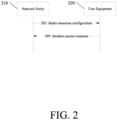
- FIG. 2 illustrates a signaling diagram depicting an example of efficiently signalling feature combinations for RACH partitioning.
- NE 210 and UE 220 may be similar to NE 510 and UE 520, as illustrated in FIG. 5 , according to certain example embodiments.
- NE 210 may transmit a radio resources configuration associated with at least one feature combination and associated random access resources configuration to UE 220, which may include signalling to indicate to UE 220 feature combinations and associated radio access resources split across the feature combinations applicable to a RACH configuration for NE 210 and UE 220.
- Some example embodiments may use a fixed number of explicitly reserved bits for signaling, wherein each RA purpose may be indicated by 1 bit, and K bits may be reserved for later changes.
- each RA partition may be determined under RACHCommon configuration based on at least one intended feature or feature combination sets.
- two Information Elements e.g. , bitmaps
- bitmaps may indicate the features or feature combination sets corresponding to the given RA partition.
- the two example encodings may indicate 4 purposes (e.g ., redCap, smallData, slicing, and CovEnh), while 4 bits may be reserved to retain enough flexibility.
- FeaturesCombinationlndicationBitmap may comprise a bit for each feature set to "true" in the FeatureCombination, allowing any combination out of those features to be signalled.
- the NE may only need to indicate the bitmap of feature combinations, and the abstract syntax notation (ASN).1 definition of the FeatureCombination indicates the remaining features.
- FeatureCombinationlndicationBitmap (size 4) may be configured as: RedCap Small Data Slicing CovEnh SDT + RedCap combo 1 1 0 0 Slicing + CovEnh + combo 1 1 0 0 0
- FeatureCombinationlndicationBitmap size 4 may be configured as: RedCap Small Data Slicing CovEnh R18 Feature SDT + RedCap combo 1 1 0 0 0 Slicing + CovEnh + combo 1 1 0 0 0 Slicing + CovEnh + R.18 1 1 0 0 1 1
- slicing may be indicated implicitly or separately, and/or may be considered or partially in the RA partition.
- each RA partition defined for the bitmaps in certain example embodiments may be used by the UE assigned to a specific slice group.
- slicing may be considered explicitly in the RA partition, but may be restricted to be combined only with a subset of other features (e.g., CovEnh) by using, for example, "CHOICE" type of signalling, an ASN.1 encoding representing a list of options to select.
- a more dynamic list of features may be populated, as shown below, thus allow for almost infinite extendibility as any number of additional RA features could be added at the cost of additional signalling, such as follows:
- slicing may be indicated in a feature combination, with overriding or partial applicability in the RA partition.
- slice group 2 may correspond to feature combination 1 (e.g ., SDT + RedCap)
- slice group 3 may correspond to feature combination 2 (e.g., SDT + covEnh).
- NE 210 may further indicate a sub-partitioning and/or prioritization within the configured combination of RA features.
- RA feature combination includes two features (i.e., Redcap and SmallData)
- various sub-partitions may be indicated via an additional bitmap, such as RedCap UEs (such as UE 220) doing SDT, Redcap UEs doing non-SDT, non-RedCap UEs doing SDT, and non-Redcap UEs doing non-SDT.
- the other cause values may be bundled with slicing; since all services may be associated with at least one slice, prioritization of those services may not be necessary, such as follows:
- the bit cost is 4 ⁇ .
- the slices may be signalled separately from the feature combination set and/or with special conditions, but with the feature sets becoming associated with any slice resources, by signalling the slicingGroup outside the FeatureCombination.
- UE 220 may then transmit a random access response to NE 210.
- FIG. 3 illustrates an example of a flow diagram of a method that may be performed by a NE, such as NE 520 illustrated in FIG. 5 , according to various example embodiments.
- the method may include transmitting a radio resources configuration to a UE (which may be similar to UE 510 in FIG. 5 ), which may include signalling to indicate to the UE feature combinations and associated radio access resources split across the feature combinations applicable to a RACH configuration for the NE and the UE.
- Some example embodiments may use a fixed number of explicitly reserved bits for signaling, wherein each RA purpose may be indicated by 1 bit, and K bits may be reserved for later changes.
- each RA partition may be determined under RACHCommon configuration based on at least one intended feature or feature combination sets.
- two bitmaps may indicate the features or feature combination sets corresponding to the given RA partition.
- a first bitmap i.e., denoted FeatureCombination
- FeatureCombination may indicate to the UE the applicable RA purposes/features (e.g ., RedCap, Small Data, CovEnh, etc.) used by the given cell (max N bits, thus max N purposes/features)
- a second bitmap i.e., denoted FeatureCombinationlndicationBitmap
- max M combinations e.g.
- FeatureCombination SEQUENCE ⁇ redCap ENUMERATED ⁇ true ⁇ OPTIONAL, smallData ENUMERATED ⁇ true ⁇ OPTIONAL, slicing ENUMERATED ⁇ true ⁇ OPTIONAL, covEnh ENUMERATED ⁇ true ⁇ OPTIONAL, spare 1 ENUMERATED ⁇ true ⁇ OPTIONAL, spare2 ENUMERATED ⁇ true ⁇ OPTIONAL, spare3 ENUMERATED ⁇ true ⁇ OPTIONAL, spare4 ENUMERATED ⁇ true ⁇ OPTIONAL ⁇
- FeaturesCombinationIndicationBitmap SEQUENCE ⁇ redCap ENUMERATED ⁇ true ⁇ OPTIONAL, smallData ENUMERATED ⁇ true ⁇ OPTIONAL, slicing ENUMERATED ⁇ true ⁇ OPTIONAL, covEnh ENUMERATED ⁇ true ⁇ OPTIONAL, spare 1 ENUMERATED ⁇ true ⁇ OPTIONAL, spare2 ENUMERATED ⁇ true ⁇ OPTIONAL, spare3 ENUMERATED ⁇ tru
- the two example encodings may indicate 4 purposes (e.g. , redCap, smallData, slicing, and CovEnh), while 4 bits may be reserved to retain enough flexibility.
- FeaturesCombinationlndicationBitmap may comprise a bit for each feature set to "true" in the FeatureCombination, allowing any combination out of those features to be signalled.
- the NE may only need to indicate the bitmap of feature combinations, and the ASN.1 definition of the FeatureCombination indicates the remaining features.
- FeatureCombinationlndicationBitmap (size 4) may be configured as: RedCap Small Data Slicing CovEnh SDT + RedCap combo 1 1 0 0 Slicing + CovEnh + combo 1 1 0 0 0
- FeatureCombinationlndicationBitmap size 4 may be configured as: RedCap Small Data Slicing CovEnh R18 Feature SDT + RedCap combo 1 1 0 0 0 Slicing + CovEnh + combo 1 1 0 0 0 Slicing + CovEnh + R.18 1 1 0 0 1 1
- slicing may be indicated implicitly or separately, and/or may be considered or partially in the RA partition.
- each RA partition defined for the bitmaps in certain example embodiments may be used by the UE assigned to a specific slice group.
- slicing may be considered explicitly in the RA partition, but may be restricted to be combined only with a subset of other features (e.g ., CovEnh) by using "CHOICE" type of signalling, an ASN.1 encoding representing a list of options to select.
- a more dynamic list of features may be populated, as shown below, thus allow for almost infinite extendibility as any number of additional RA features could be added at the cost of additional signalling, such as follows:
- slicing may be indicated in a feature combination, with overriding or partial applicability in the RA partition.
- slice group 2 may correspond to feature combination 1 (e.g. , SDT + RedCap)
- slice group 3 may correspond to feature combination 2 (e.g., SDT + covEnh).
- the NE may further indicate a sub-partitioning and/or prioritization within the configured combination of RA features.
- a sub-partitioning and/or prioritization within the configured combination of RA features.
- various sub-partitions may be indicated via an additional bitmap, such as Redcap UEs (such as the UE) doing SDT, Redcap UEs doing non-SDT, non-Redcap UEs doing SDT, and non-Redcap UEs doing non-SDT.
- all other cause values may be bundled with slicing; since all services may be associated with at least one slice, prioritization of those services may not be necessary, such as follows:
- the bit cost is 4 ⁇ .
- the slices may be signalled separately from the feature combination set and/or with special conditions, but with the feature sets becoming associated with slice resources, by signalling the slicingGroup outside the FeatureCombination.
- the method may further include receiving a random access response from the UE.
- FIG. 4 illustrates an example of a flow diagram of a method that may be performed by a UE, such as UE 520 illustrated in FIG. 5 , according to various example embodiments.
- the method may include receiving a radio resources configuration from a NE (which may be similar to NE 510 in FIG. 5 ), which may include signalling to indicate to the UE feature combinations and associated radio access resources split across the feature combinations applicable to a RACH configuration for the NE and the UE.
- Some example embodiments may use a fixed number of explicitly reserved bits for signaling, wherein each RA purpose may be indicated by 1 bit, and K bits may be reserved for later changes.
- each RA partition may be determined under RACHCommon configuration based on at least one intended feature or feature combination sets.
- two bitmaps may indicate the features or feature combination sets corresponding to the given RA partition.
- a first bitmap i.e., denoted FeatureCombination
- FeatureCombination may indicate to the UE the applicable RA purposes/features (e.g.
- FeatureCombination :: SEQUENCE ⁇ redCap ENUMERATED ⁇ true ⁇ OPTIONAL, smallData ENUMERATED ⁇ true ⁇ OPTIONAL, slicing ENUMERATED ⁇ true ⁇ OPTIONAL, covEnh ENUMERATED ⁇ true ⁇ OPTIONAL, spare 1 ENUMERATED ⁇ true ⁇ OPTIONAL, spare2 ENUMERATED ⁇ true ⁇ OPTIONAL, spare3 ENUMERATED ⁇ true ⁇ OPTIONAL, spare4 ENUMERATED ⁇ true ⁇ OPTIONAL
- the two example encodings may indicate 4 purposes (e.g. , redCap, smallData, slicing, and CovEnh), while 4 bits may be reserved to retain enough flexibility.
- FeaturesCombinationIndicationBitmap may comprise a bit for each feature set to "true" in the FeatureCombination, allowing any combination out of those features to be signalled.
- the NE may only need to indicate the bitmap of feature combinations, and the ASN.1 definition of the FeatureCombination indicates the remaining features.
- FeatureCombinationlndicationBitmap (size 4) may be configured as: RedCap Small Data Slicing CovEnh SDT + RedCap combo 1 1 0 0 Slicing + CovEnh + combo 1 1 0 0 0
- FeatureCombinationlndicationBitmap size 4 may be configured as: RedCap Small Data Slicing CovEnh R18 Feature SDT + RedCap combo 1 1 0 0 0 Slicing + CovEnh + combo 1 1 0 0 0 Slicing + CovEnh + R.18 1 1 0 0 1 1
- slicing may be indicated implicitly or separately, and/or may be considered or partially in the RA partition.
- each RA partition defined for the bitmaps in certain example embodiments may be used by the UE assigned to a specific slice group.
- slicing may be considered explicitly in the RA partition, but may be restricted to be combined only with a subset of other features (e.g., CovEnh) by using "CHOICE" type of signalling, an ASN.1 encoding representing s list of options to select.
- a more dynamic list of features may be populated, as shown below, thus allow for almost infinite extendibility as any number of additional RA features could be added at the cost of additional signalling, such as follows:
- slicing may be indicated in a feature combination, with overriding or partial applicability in the RA partition.
- slice group 2 may correspond to feature combination 1 (e.g ., SDT + RedCap)
- slice group 3 may correspond to feature combination 2 (e.g., SDT + covEnh).
- the NE may further indicate a sub-partitioning and/or prioritization within the configured combination of RA features.
- a sub-partitioning and/or prioritization within the configured combination of RA features.
- various sub-partitions may be indicated via an additional bitmap, such as Redcap UEs (such as the UE) doing SDT, Redcap UEs doing non-SDT, non-Redcap UEs doing SDT, and non-Redcap UEs doing non-SDT.
- all other cause values may be bundled with slicing; since all services may be associated with at least one slice, prioritization of those services may not be necessary, such as follows:
- the bit cost is 4 ⁇ .
- the slices may be signalled separately from the feature combination set and/or with special conditions, but with the feature sets becoming associated with slice resources, by signalling the slicingGroup outside the FeatureCombination.
- the method may further include transmitting a random access response to the NE.
- FIG. 5 illustrates an example of a system according to certain example embodiments.
- a system may include multiple devices, such as, for example, UE 510 and/or NE 520.
- UE 510 may include one or more of a mobile device, such as a mobile phone, smart phone, personal digital assistant (PDA), tablet, or portable media player, digital camera, pocket video camera, video game console, navigation unit, such as a global positioning system (GPS) device, desktop or laptop computer, single-location device, such as a sensor or smart meter, or any combination thereof.
- a mobile device such as a mobile phone, smart phone, personal digital assistant (PDA), tablet, or portable media player, digital camera, pocket video camera, video game console, navigation unit, such as a global positioning system (GPS) device, desktop or laptop computer, single-location device, such as a sensor or smart meter, or any combination thereof.
- GPS global positioning system
- NE 520 may be one or more of a base station, such as an eNB or gNB, a serving gateway, a server, and/or any other access node or combination thereof. Furthermore, UE 510 and/or NE 520 may be one or more of a citizens broadband radio service device (CBSD).
- CBSD citizens broadband radio service device
- NE 520 may further comprise at least one gNB-CU, which may be associated with at least one gNB-DU.
- the at least one gNB-CU and the at least one gNB-DU may be in communication via at least one F1 interface, at least one X n -C interface, and/or at least one NG interface via a 5GC.
- UE 510 and/or NE 520 may include at least one processor, respectively indicated as 511 and 521.
- Processors 511 and 521 may be embodied by any computational or data processing device, such as a central processing unit (CPU), application specific integrated circuit (ASIC), or comparable device.
- the processors may be implemented as a single controller, or a plurality of controllers or processors.
- At least one memory may be provided in one or more of the devices, as indicated at 512 and 522.
- the memory may be fixed or removable.
- the memory may include computer program instructions or computer code contained therein.
- Memories 512 and 522 may independently be any suitable storage device, such as a non-transitory computer-readable medium.
- a hard disk drive (HDD), random access memory (RAM), flash memory, or other suitable memory may be used.
- the memories may be combined on a single integrated circuit as the processor, or may be separate from the one or more processors.
- the computer program instructions stored in the memory, and which may be processed by the processors may be any suitable form of computer program code, for example, a compiled or interpreted computer program written in any suitable programming language.
- Processors 511 and 521, memories 512 and 522, and any subset thereof, may be configured to provide means corresponding to the various blocks of FIGs. 2-4 .
- the devices may also include positioning hardware, such as GPS or micro electrical mechanical system (MEMS) hardware, which may be used to determine a location of the device.
- MEMS micro electrical mechanical system
- Other sensors are also permitted, and may be configured to determine location, elevation, velocity, orientation, and so forth, such as barometers, compasses, and the like.
- transceivers 513 and 523 may be provided, and one or more devices may also include at least one antenna, respectively illustrated as 514 and 524.
- the device may have many antennas, such as an array of antennas configured for multiple input multiple output (MIMO) communications, or multiple antennas for multiple RATs. Other configurations of these devices, for example, may be provided.
- Transceivers 513 and 523 may be a transmitter, a receiver, both a transmitter and a receiver, or a unit or device that may be configured both for transmission and reception.
- the memory and the computer program instructions may be configured, with the processor for the particular device, to cause a hardware apparatus, such as UE, to perform any of the processes described above ( i.e., FIGs. 2-4 ). Therefore, in certain example embodiments, a non-transitory computer-readable medium may be encoded with computer instructions that, when executed in hardware, perform a process such as one of the processes described herein. Alternatively, certain example embodiments may be performed entirely in hardware.
- an apparatus may include circuitry configured to perform any of the processes or functions illustrated in FIGs. 2-4 .
- circuitry may be hardware-only circuit implementations, such as analog and/or digital circuitry.
- circuitry may be a combination of hardware circuits and software, such as a combination of analog and/or digital hardware circuitry with software or firmware, and/or any portions of hardware processors with software (including digital signal processors), software, and at least one memory that work together to cause an apparatus to perform various processes or functions.
- circuitry may be hardware circuitry and or processors, such as a microprocessor or a portion of a microprocessor, that includes software, such as firmware, for operation. Software in circuitry may not be present when it is not needed for the operation of the hardware.
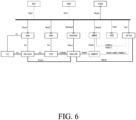
- FIG. 6 illustrates an example of a 5G network and system architecture according to certain example embodiments. Shown are multiple network functions that may be implemented as software operating as part of a network device or dedicated hardware, as a network device itself or dedicated hardware, or as a virtual function operating as a network device or dedicated hardware.
- the NE and UE illustrated in FIG. 6 may be similar to UE 510 and NE 520, respectively.
- the user plane function (UPF) may provide services such as intra-RAT and inter-RAT mobility, routing and forwarding of data packets, inspection of packets, user plane quality of service (QoS) processing, buffering of downlink packets, and/or triggering of downlink data notifications.
- the application function (AF) may primarily interface with the core network to facilitate application usage of traffic routing and interact with the policy framework.
- processor 511 and memory 512 may be included in or may form a part of processing circuitry or control circuitry.
- transceiver 513 may be included in or may form a part of transceiving circuitry.
Landscapes
- Engineering & Computer Science (AREA)
- Computer Networks & Wireless Communication (AREA)
- Signal Processing (AREA)
- Mobile Radio Communication Systems (AREA)
Abstract
Description
- Some example embodiments may generally relate to mobile or wireless telecommunication systems, such as Long Term Evolution (LTE), fifth generation (5G) radio access technology (RAT), new radio (NR) access technology, and/or other communications systems. For example, certain example embodiments may relate to systems and/or methods for efficiently signalling feature combinations for random access channel (RACH) partitioning.
- Examples of mobile or wireless telecommunication systems may include radio frequency (RF) 5G RAT, the Universal Mobile Telecommunications System (UMTS) Terrestrial Radio Access Network (UTRAN), LTE Evolved UTRAN (E-UTRAN), LTE-Advanced (LTE-A), LTE-A Pro, NR access technology, and/or MulteFire Alliance. 5G wireless systems refer to the next generation (NG) of radio systems and network architecture. A 5G system is typically built on a 5G NR, but a 5G (or NG) network may also be built on E-UTRA radio. It is expected that NR can support service categories such as enhanced mobile broadband (eMBB), ultra-reliable low-latency-communication (URLLC), and massive machine-type communication (mMTC). NR is expected to deliver extreme broadband, ultra-robust, low-latency connectivity, and massive networking to support the Internet of Things (IoT). The next generation radio access network (NG-RAN) represents the RAN for 5G, which may provide radio access for NR, LTE, and LTE-A. It is noted that the nodes in 5G providing radio access functionality to a user equipment (e.g., similar to the Node B in UTRAN or the Evolved Node B (eNB) in LTE) may be referred to as next-generation Node B (gNB) when built on NR radio, and may be referred to as next-generation eNB (NG-eNB) when built on E-UTRA radio.
- In accordance with some example embodiments, a method may include transmitting, by a network entity, a radio resources configuration associated with at least one feature combination configuration and associated random access resources configuration. The at least one feature combination configuration is associated with at least one of coverage enhancement, network slicing, reduced capability user equipment, or small data transmission. The associated random access resources configuration is associated with access conditions for the at least one feature combination configuration.
- In accordance with certain example embodiments, an apparatus may include means for transmitting a radio resources configuration associated with at least one feature combination configuration and associated random access resources configuration. The at least one feature combination configuration is associated with at least one of coverage enhancement, network slicing, reduced capability user equipment, or small data transmission. The associated random access resources configuration is associated with access conditions for the at least one feature combination configuration.
- In accordance with various example embodiments, a non-transitory computer readable medium may be encoded with instructions that may, when executed in hardware, perform a method. The method may include transmitting a radio resources configuration associated with at least one feature combination configuration and associated random access resources configuration. The at least one feature combination configuration is associated with at least one of coverage enhancement, network slicing, reduced capability user equipment, or small data transmission. The associated random access resources configuration is associated with access conditions for the at least one feature combination configuration.
- In accordance with some example embodiments, a computer program product may perform a method. The method may include transmitting a radio resources configuration associated with at least one feature combination configuration and associated random access resources configuration. The at least one feature combination configuration is associated with at least one of coverage enhancement, network slicing, reduced capability user equipment, or small data transmission. The associated random access resources configuration is associated with access conditions for the at least one feature combination configuration.
- In accordance with certain example embodiments, an apparatus may include at least one processor and at least one memory including computer program code. The at least one memory and the computer program code may be configured to, with the at least one processor, cause the apparatus to at least transmit a radio resources configuration associated with at least one feature combination configuration and associated random access resources configuration. The at least one feature combination configuration is associated with at least one of coverage enhancement, network slicing, reduced capability user equipment, or small data transmission. The associated random access resources configuration is associated with access conditions for the at least one feature combination configuration.
- In accordance with various example embodiments, an apparatus may include circuitry configured to transmit a radio resources configuration associated with at least one feature combination configuration and associated random access resources configuration. The at least one feature combination configuration is associated with at least one of coverage enhancement, network slicing, reduced capability user equipment, or small data transmission. The associated random access resources configuration is associated with access conditions for the at least one feature combination configuration.
- In accordance with some example embodiments, a method may include receiving, by a user equipment, a radio resources configuration associated with at least one feature combination configuration and associated random access resources configuration. The at least one feature combination configuration is associated with at least one of coverage enhancement, network slicing, reduced capability user equipment, or small data transmission. The associated random access resources configuration is associated with access conditions for the at least one feature combination configuration.
- In accordance with certain example embodiments, an apparatus may include means for receiving a radio resources configuration associated with at least one feature combination configuration and associated random access resources configuration. The at least one feature combination configuration is associated with at least one of coverage enhancement, network slicing, reduced capability user equipment, or small data transmission. The associated random access resources configuration is associated with access conditions for the at least one feature combination configuration.
- In accordance with various example embodiments, a non-transitory computer readable medium may be encoded with instructions that may, when executed in hardware, perform a method. The method may include receiving a radio resources configuration associated with at least one feature combination configuration and associated random access resources configuration. The at least one feature combination configuration is associated with at least one of coverage enhancement, network slicing, reduced capability user equipment, or small data transmission. The associated random access resources configuration is associated with access conditions for the at least one feature combination configuration.
- In accordance with some example embodiments, a computer program product may perform a method. The method may include receiving a radio resources configuration associated with at least one feature combination configuration and associated random access resources configuration. The at least one feature combination configuration is associated with at least one of coverage enhancement, network slicing, reduced capability user equipment, or small data transmission. The associated random access resources configuration is associated with access conditions for the at least one feature combination configuration.
- In accordance with certain example embodiments, an apparatus may include at least one processor and at least one memory including computer program code. The at least one memory and the computer program code may be configured to, with the at least one processor, cause the apparatus to at least receive a radio resources configuration associated with at least one feature combination configuration and associated random access resources configuration. The at least one feature combination configuration is associated with at least one of coverage enhancement, network slicing, reduced capability user equipment, or small data transmission. The associated random access resources configuration is associated with access conditions for the at least one feature combination configuration.
- In accordance with various example embodiments, an apparatus may include circuitry configured to receive a radio resources configuration associated with at least one feature combination configuration and associated random access resources configuration. The at least one feature combination configuration is associated with at least one of coverage enhancement, network slicing, reduced capability user equipment, or small data transmission. The associated random access resources configuration is associated with access conditions for the at least one feature combination configuration.
- For proper understanding of example embodiments, reference should be made to the accompanying drawings, wherein:
-
FIG. 1(a) illustrates an example of a 2-step RACH procedure. -
FIG. 1(b) illustrates an example of a 4-step RACH procedure. -
FIG. 2 illustrates an example of a signaling diagram according to certain example embodiments. -
FIG. 3 illustrates an example of a flow diagram of a method according to various example embodiments. -
FIG. 4 illustrates an example of a flow diagram of a method according to various example embodiments. -
FIG. 5 illustrates an example of various network devices according to some example embodiments. -
FIG. 6 illustrates an example of a 5G network and system architecture according to certain example embodiments. - It will be readily understood that the components of certain example embodiments, as generally described and illustrated in the figures herein, may be arranged and designed in a wide variety of different configurations. Thus, the following detailed description of some example embodiments of systems, methods, apparatuses, and computer program products for efficiently signalling feature combinations for RACH partitioning is not intended to limit the scope of certain example embodiments, but is instead representative of selected example embodiments.
- RACH resources may define the time and frequency resources that may be used by user equipment (UE) for random access, and may include RACH occasions (ROs) in time and/or RACH preambles available in each RO. When a UE transmits a physical random access channel (PRACH) preamble, the UE may transmit according to a specific pattern or sequence, similar to a signature. Each NR cell may have 64 preamble sequences available for each RO. In contention-based random access (CBRA), once the UE determines a suitable RO, the UE may randomly select one of the valid preambles for transmission in the RO among the available ROs, as configured by the network.
-
FIG. 1(a) illustrates an example of a 2-step RACH procedure for partitioning of RACH resources, as defined in 3GPP Release (Rel)-16. Similarly,FIG. 1(b) illustrates an example of a 4-step RACH procedure supported in 3GPP Rel-15. The partitioning in the 2-step RACH procedure may require partitioning the entire set of RACH resources into two pools, with each pool dedicated to the corresponding RACH procedure (i.e., 2-step or 4-step RACH). - In 3GPP Rel-16, the gNB may broadcast the two pools using a RACH-ConfigCommonTwoStepRA information element (IE), which may be further subdivided via a GroupB-ConfiguredTwoStepRA-r16 IE contained in the RACH-ConfigCommonTwoStepRA IE. The UE may then indicate whether it is using a 2-step or 4-step RACH procedure in message A (MsgA) for 2-step RACH procedure, or in an Msg1 for 4-step RACH, respectively, by selecting and transmitting a RACH resource from the corresponding pool of resources.
- Contention-free radio access (CFRA) resources and CBRA resources may be further partitioned. For example, CFRA resources may be dedicated to a given UE (e.g., in RRC Connected mode with an assigned cell radio network temporary identifier (C-RNTI)), while the UE may need to contend for RACH resources in the contention-based pool. For CBRA partitioning, different UEs may select the same CBRA resource, and/or may interfere with other UEs, causing an undesirable RACH collision.
- Currently, in order to enable the network to identify each feature based on the preamble/RO used by the UE, RACH resources may be further partitioned to support initial access of some 3GPP Rel-17 features, such as:
Feature RACH indication / reason for partitioning CovEnh To indicate the need for coverage enhancement (e.g., for request of Msg3 repetition) to the network Slicing To indicate the need for prioritization and isolation of a slice (including RACH isolation) to the network RedCap To indicate the reduced capabilities of the UE to the network so that the network can adapt subsequent transmissions (as compared to a regular UE) SDT To indicate the small data transmission (SDT) procedure, thus to request a larger Msg3 size or MSGA size (as compared to regular Msg3/MSGA size for non-SDT/legacy resume) - The partitioning of RACH resources may be achieved either by partitioning the ROs for different features (i.e., different ROs may be dedicated to different features), or by partitioning the preambles associated with an RO for different features (i.e., different preambles of an RO may be dedicated to different features, as defined in 3GPP Rel-16 for 2-step and 4-step RACH partitioning). However, dedicating ROs per feature may introduce delays in the RA procedure since the UE requiring a feature may need to wait until a valid RO becomes available, with fewer valid ROs available per feature due to splitting of resources. In contrast, preambles in an RO dedicated per feature may be realized, for example, by using a RACH mask, and may allow all features to use any RO, resulting in a lower RA latency achieved for any service in the cell. However, this may limit the number of preambles available per feature. In turn, the probability of undesirable RACH collisions may increase, which may also indirectly increase latency times. The supported cell sizes may also be limited in this case since an increased cell size may require skipping cyclic shifts when creating the PRACH preamble sequences so that larger distances between the cyclic shifts of the PRACH root sequences may be obtained. The number of root sequences may be limited by cell planning and inherent mathematical properties of the sequences themselves. The problem of preamble limitation and collision may worsen with more features to be separated.
- In order to configure RACH resources, each cell may need to be selected and use one out of 256 PRACH configurations, determining the RO periodicity and the ROs location in time. Prior to 3GPP Rel-16, RACH capacity and dimensioning has been possible due to the limited number of required RACH resources. For example, with 20ms RO periodicity and 40 MHz carrier bandwidth, about 3% of the resources may be dedicated to RACH. In contrast, beginning with 3GPP Rel-17, separate RACH configurations may need to be available to support initial access for various 3GPP Rel-17 features, thereby increasing the number of resources used for RACH in the cell. As a result, in addition to legacy RACH resources, the network may need to allocate a sufficient number of RACH resources for each additional RACH configuration dedicated to 3GPP Rel-17 features. This may ensure that the tolerable collision probability and latency key performance indicators (KPIs) are within the allowed targets for each feature (e.g., <1% PRACH collision probability).
- Certain example embodiments described herein may have various benefits and/or advantages to overcome the disadvantages described above. For example, certain example embodiments may provide a more efficient, leaner, and future-proof signalling of feature combinations for RA partitioning. Thus, certain example embodiments discussed below are directed to improvements in computer-related technology.
-
FIG. 2 illustrates a signaling diagram depicting an example of efficiently signalling feature combinations for RACH partitioning.NE 210 andUE 220 may be similar toNE 510 andUE 520, as illustrated inFIG. 5 , according to certain example embodiments. At 201,NE 210 may transmit a radio resources configuration associated with at least one feature combination and associated random access resources configuration toUE 220, which may include signalling to indicate toUE 220 feature combinations and associated radio access resources split across the feature combinations applicable to a RACH configuration forNE 210 andUE 220. Some example embodiments may use a fixed number of explicitly reserved bits for signaling, wherein each RA purpose may be indicated by 1 bit, and K bits may be reserved for later changes. For example, each RA partition may be determined under RACHCommon configuration based on at least one intended feature or feature combination sets. For example, two Information Elements (e.g., bitmaps) may indicate the features or feature combination sets corresponding to the given RA partition. A first bitmap (i.e., denoted FeatureCombination) may indicate to the UE the applicable RA purposes/features (e.g., RedCap, Small Data, CovEnh, etc.) used by the given cell (max N bits, thus max N purposes/features), while a second bitmap (i.e., denoted FeatureCombinationIndicationBitmap) may indicate the actual combinations of RA features and prioritization (max M combinations, e.g., RedCap + Small Data combo) applicable for the UE out of features/purposes set in the first bitmap, such as follows:FeatureCombination ::= SEQUENCE { redCap ENUMERATED {true} OPTIONAL, smallData ENUMERATED {true} OPTIONAL, slicing ENUMERATED {true} OPTIONAL, covEnh ENUMERATED {true} OPTIONAL, spare 1 ENUMERATED {true} OPTIONAL, spare2 ENUMERATED {true} OPTIONAL, spare3 ENUMERATED {true} OPTIONAL, spare4 ENUMERATED {true} OPTIONAL } - The two example encodings may indicate 4 purposes (e.g., redCap, smallData, slicing, and CovEnh), while 4 bits may be reserved to retain enough flexibility. FeaturesCombinationlndicationBitmap may comprise a bit for each feature set to "true" in the FeatureCombination, allowing any combination out of those features to be signalled.
- In another example, a bit string may be used for the spare values in the FeatureCombination (similar to master information block (MIB)), such as below:
FeatureCombination ::= SEQUENCE { redCap ENUMERATED {true} OPTIONAL, smallData ENUMERATED {true} OPTIONAL, slicing ENUMERATED {true} OPTIONAL, covEnh ENUMERATED {true} OPTIONAL, spare BIT STRING (SIZE(4)) } - As a result, the bit-cost in system information (SI) would be 3+(2-8) = 5-11 bits added to the RA feature combination. The NE may only need to indicate the bitmap of feature combinations, and the abstract syntax notation (ASN).1 definition of the FeatureCombination indicates the remaining features.
- Using the above embodiments, 3GPP Rel-17 may be configured as FeatureCombination (size 8): {RedCap: true; smallData: true; slicing: true; CovEnh: true; Reserved: false}, maxNrofFeatures = 4 (4 features set to true). Alternatively, FeatureCombinationlndicationBitmap (size 4) may be configured as:
RedCap Small Data Slicing CovEnh SDT + RedCap combo 1 1 0 0 Slicing + CovEnh + combo 1 1 0 0 - Using the above embodiments, 3GPP Rel-18 may configure the following: FeatureCombination (size 8): o {RedCap: true; smallData: true; slicing: true; CovEnh: true; Rel-18 Feature: true; Reserved: false}; maxNrofFeatures = 5 (5 features set to true). Alternatively, FeatureCombinationlndicationBitmap (size 4) may be configured as:
RedCap Small Data Slicing CovEnh R18 Feature SDT + RedCap combo 1 1 0 0 0 Slicing + CovEnh + combo 1 1 0 0 0 Slicing + CovEnh + R.18 1 1 0 0 1 - In various example embodiments, slicing may be indicated implicitly or separately, and/or may be considered or partially in the RA partition. For example, each RA partition defined for the bitmaps in certain example embodiments may be used by the UE assigned to a specific slice group. Additionally or alternatively, slicing may be considered explicitly in the RA partition, but may be restricted to be combined only with a subset of other features (e.g., CovEnh) by using, for example, "CHOICE" type of signalling, an ASN.1 encoding representing a list of options to select.
- As an example, a more dynamic list of features may be populated, as shown below, thus allow for almost infinite extendibility as any number of additional RA features could be added at the cost of additional signalling, such as follows:
    FeatureCombination ::= SEQUENCE (SIZE (1.. maxNrofFeatures)) OF RA-Feature
    RA-Feature :: CHOICE {
        redCap,
        smallData,
        slicing,
        covEnh,
        reserved 1, -- for potential Rel-18+Feature
        reserved2, -- for potential Rel-18+Feature
        reserved3, -- for potential Rel-18+Feature
        reserved4, -- for potential Rel-18+Feature }
    FeaturesCombinationIndicationBitmap ::= BIT STRING (SIZE (maxNrofFeatures))
    maxNrofFeatures ::= INTEGER (1..N) // e.g. N = 5

| FeatureCombination ::= SEQUENCE { | |||
| redCap | ENUMERATED {true} | OPTIONAL, | |
| smallData | ENUMERATED {true} | OPTIONAL, | |
| slicing | ENUMERATED {true} | OPTIONAL, | |
| covEnh | ENUMERATED {true} | OPTIONAL, | |
| spare 1 | ENUMERATED {true} | OPTIONAL, | |
| spare2 | ENUMERATED {true} | OPTIONAL, | |
| spare3 | ENUMERATED {true} | OPTIONAL, | |
| spare4 | ENUMERATED {true} | OPTIONAL | |
| } | |||
| FeatureCombination ::= SEQUENCE { | |||
| redCap | ENUMERATED {true} | OPTIONAL, | |
| smallData | ENUMERATED {true} | OPTIONAL, | |
| slicing | ENUMERATED {true} | OPTIONAL, | |
| covEnh | ENUMERATED {true} | OPTIONAL, | |
| spare | BIT STRING (SIZE(4)) | ||
| } | |||
| RedCap | Small Data | Slicing | CovEnh | |
| SDT + RedCap combo | 1 | 1 | 0 | 0 |
| Slicing + CovEnh + combo | 1 | 1 | 0 | 0 |
| RedCap | Small Data | Slicing | CovEnh | R18 Feature | |
| SDT + RedCap combo | 1 | 1 | 0 | 0 | 0 |
| Slicing + CovEnh + combo | 1 | 1 | 0 | 0 | 0 |
| Slicing + CovEnh + R.18 | 1 | 1 | 0 | 0 | 1 |


| FeatureCombination ::= SEQUENCE { | |||
| redCap | ENUMERATED {true} | OPTIONAL, | |
| smallData | ENUMERATED {true} | OPTIONAL, | |
| slicing | ENUMERATED {true} | OPTIONAL, | |
| covEnh | ENUMERATED {true} | OPTIONAL, | |
| spare 1 | ENUMERATED {true} | OPTIONAL, | |
| spare2 | ENUMERATED {true} | OPTIONAL, | |
| spare3 | ENUMERATED {true} | OPTIONAL, | |
| spare4 | ENUMERATED {true} | OPTIONAL | |
| } | |||
| FeatureCombination ::= SEQUENCE { | |||
| redCap | ENUMERATED {true} | OPTIONAL, | |
| smallData | ENUMERATED {true} | OPTIONAL, | |
| slicing | ENUMERATED {true} | OPTIONAL, | |
| covEnh | ENUMERATED {true} | OPTIONAL, | |
| spare | BIT STRING (SIZE(4)) | ||
| } | |||
| RedCap | Small Data | Slicing | CovEnh | |
| SDT + RedCap combo | 1 | 1 | 0 | 0 |
| Slicing + CovEnh + combo | 1 | 1 | 0 | 0 |
| RedCap | Small Data | Slicing | CovEnh | R18 Feature | |
| SDT + RedCap combo | 1 | 1 | 0 | 0 | 0 |
| Slicing + CovEnh + combo | 1 | 1 | 0 | 0 | 0 |
| Slicing + CovEnh + R.18 | 1 | 1 | 0 | 0 | 1 |


- 3GPP
- Third Generation Partnership Project
- 5G
- Fifth Generation
- 5GC
- Fifth Generation Core
- 5GS
- Fifth Generation System
- ASIC
- Application Specific Integrated Circuit
- ASN
- Abstract Syntax Notation
- BS
- Base Station
- CBRA
- Contention-Based Random Access
- CBSD
- Citizens Broadband Radio Service Device
- CFRA
- Contention-Free Random Access
- CE
- Coverage Enhancement
- CG
- Configured Grant
- CN
- Core Network
- C-RNTI
- Cell Radio Network Temporary Identifier
- CovEnh
- Coverage Enhancement
- CPU
- Central Processing Unit
- eMBB
- Enhanced Mobile Broadband
- eMTC
- Enhanced Machine Type Communication
- eNB
- Evolved Node B
- EPS
- Evolved Packet System
- gNB
- Next Generation Node B
- GPS
- Global Positioning System
- HDD
- Hard Disk Drive
- IE
- Information Element
- KPI
- Key Performance Indicator
- LTE
- Long-Term Evolution
- LTE-A
- Long-Term Evolution Advanced
- MAC
- Medium Access Control
- MEMS
- Micro Electrical Mechanical System
- MIB
- Master Information Block
- MIMO
- Multiple Input Multiple Output
- MME
- Mobility Management Entity
- mMTC
- Massive Machine Type Communication
- MTC
- Machine Type Communication
- NAS
- Non-Access Stratum
- NB-IoT
- Narrowband Internet of Things
- NE
- Network Entity
- NG
- Next Generation
- NG-eNB
- Next Generation Evolved Node B
- NG-RAN
- Next Generation Radio Access Network
- NR
- New Radio
- NR-U
- New Radio Unlicensed
- PDA
- Personal Digital Assistance
- PRACH
- Physical Random Access Channel
- PUR
- Periodic Uplink Resources
- RA
- Random Access
- RACH
- Random Access Channel
- RAM
- Random Access Memory
- RAN
- Radio Access Network
- RAT
- Radio Access Technology
- RedCap
- Reduced Capability
- RNTI
- Radio Network Temporary Identifier
- RO
- Random Access Channel Occasion
- RRC
- Radio Resource Control
- SD
- Small Data
- SDT
- Small Data Transmission
- SI
- System Information
- SIB
- System Information Block
- SMF
- Session Management Function
- SRB
- Signaling Radio Bearer
- UE
- User Equipment
- UMTS
- Universal Mobile Telecommunications System
- UPF
- User Plane Function
- URLLC
- Ultra-Reliable and Low-Latency Communication
- UTRAN
- Universal Mobile Telecommunications System Terrestrial Radio Access Network
- WLAN
- Wireless Local Area Network
Claims (15)
- An apparatus comprising means for performing:transmitting a radio resources configuration associated with at least one feature combination configuration and associated random access resources configuration, whereinthe at least one feature combination configuration is associated with at least one of coverage enhancement, network slicing, reduced capability user equipment, or small data transmission, andthe associated random access resources configuration is associated with access conditions for the at least one feature combination configuration.
- The apparatus of claim 1, wherein the at least one feature combination configuration is transmitted with at least one bit string to indicate at least one feature combination applicability for using the associated random access resources.
- The apparatus of any of claims 1 or 2, wherein the associated random access resources configuration comprises at least one radio access channel partition accessible at a certain time with a certain preamble.
- The apparatus of any of claims 1-3, wherein the at least one feature combination configuration comprises at least one of:at least one bit configured to indicate at least one feature combination association with the associated random access resources; orat least one reserved bit; orat least a selection list configured to determine the at least one feature combination associated with the random access resources.
- The apparatus of any of claims 1-4, wherein the associated random access resources configuration comprises at least one radio access partition assigned to at least one network slice group.
- The apparatus of any of claims 1-5, wherein the radio resources configuration comprises at least one radio access partition assigned to at least one network slice group.
- An apparatus comprising means for performing:receiving, by a user equipment, a radio resources configuration associated with at least one feature combination configuration and associated random access resources configuration, whereinthe at least one feature combination configuration is associated with at least one of coverage enhancement, network slicing, reduced capability user equipment, or small data transmission, andthe associated random access resources configuration is associated with access conditions for the at least one feature combination configuration.
- The apparatus of claim 7, wherein the at least one feature combination configuration is received with at least one bit string to indicate at least one feature combination applicability for using the associated random access resources.
- The apparatus of any of claims 7 or 8, wherein the associated random access resources configuration comprises at least one radio access channel partition accessible at a certain time with a certain preamble.
- The apparatus of any of claims 7-9, wherein the at least one feature combination configuration comprises at least one bit configured to indicate at least one feature combination association with the associated random access resources.
- The apparatus of any of claims 7-10, wherein the at least one feature combination configuration comprises at least one reserved bit.
- The apparatus of any of claims 7-11, wherein the at least one feature combination configuration comprises at least a selection list configured to determine the at least one feature combination associated with the random access resources.
- The apparatus of any of claims 7-12, wherein the associated random access resources configuration comprises at least one radio access partition assigned to at least one network slice group.
- The apparatus of any of claims 7-13, wherein the radio resources configuration comprises at least one radio access partition assigned to at least one network slice group.
- The apparatus of any of claims 7-14, wherein the radio resources configuration comprises at least one sub-partition associated with at least one of:reduced capability user equipment configured to perform small data transmission;reduced capability user equipment configured to perform non-small data transmission;non-reduced capability user equipment configured to perform small data transmission; ornon-reduced capability user equipment doing non-configured to perform small data transmission.
Applications Claiming Priority (1)
| Application Number | Priority Date | Filing Date | Title |
|---|---|---|---|
| PCT/CN2021/125775 WO2023065321A1 (en) | 2021-10-22 | 2021-10-22 | Efficient signalling of features combination for random access channel partitioning |
Publications (2)
| Publication Number | Publication Date |
|---|---|
| EP4171160A1 true EP4171160A1 (en) | 2023-04-26 |
| EP4171160B1 EP4171160B1 (en) | 2026-01-28 |
Family
ID=83229035
Family Applications (1)
| Application Number | Title | Priority Date | Filing Date |
|---|---|---|---|
| EP22194121.4A Active EP4171160B1 (en) | 2021-10-22 | 2022-09-06 | Efficient signalling of features combination for random access channel partitioning |
Country Status (5)
| Country | Link |
|---|---|
| US (1) | US20230127137A1 (en) |
| EP (1) | EP4171160B1 (en) |
| CN (1) | CN116033572B (en) |
| AR (1) | AR127384A1 (en) |
| WO (1) | WO2023065321A1 (en) |
Families Citing this family (1)
| Publication number | Priority date | Publication date | Assignee | Title |
|---|---|---|---|---|
| WO2025025242A1 (en) * | 2023-08-03 | 2025-02-06 | 北京小米移动软件有限公司 | Random access resource selection method, information processing method, device, system, and medium |
Citations (1)
| Publication number | Priority date | Publication date | Assignee | Title |
|---|---|---|---|---|
| US20210058971A1 (en) * | 2019-08-19 | 2021-02-25 | Samsung Electronics Co., Ltd. | Repetition of prach preamble transmission for ues |
Family Cites Families (5)
| Publication number | Priority date | Publication date | Assignee | Title |
|---|---|---|---|---|
| CN110167164B (en) * | 2018-02-14 | 2024-08-09 | 华为技术有限公司 | Method and communication device for random access resource configuration |
| US11903022B2 (en) * | 2018-04-05 | 2024-02-13 | Qualcomm Incorporated | Signaling to indicate locations of dedicated random access channel region in time domain |
| CN110784934B (en) * | 2018-07-31 | 2022-02-01 | 维沃移动通信有限公司 | Method and equipment for configuring random access resources |
| US12082260B2 (en) * | 2019-02-14 | 2024-09-03 | Nokia Technologies Oy | Increasing preamble transmission opportunities for random access in unlicensed band |
| US20230133904A1 (en) * | 2020-03-12 | 2023-05-04 | Nokia Technologies Oy | Enabling access for a reduced capability new radio (nr) device |
-
2021
- 2021-10-22 WO PCT/CN2021/125775 patent/WO2023065321A1/en not_active Ceased
-
2022
- 2022-08-29 US US17/898,091 patent/US20230127137A1/en active Pending
- 2022-09-06 EP EP22194121.4A patent/EP4171160B1/en active Active
- 2022-10-12 CN CN202211247296.8A patent/CN116033572B/en active Active
- 2022-10-17 AR ARP220102817A patent/AR127384A1/en active IP Right Grant
Patent Citations (1)
| Publication number | Priority date | Publication date | Assignee | Title |
|---|---|---|---|---|
| US20210058971A1 (en) * | 2019-08-19 | 2021-02-25 | Samsung Electronics Co., Ltd. | Repetition of prach preamble transmission for ues |
Non-Patent Citations (2)
| Title |
|---|
| ERICSSON: "RACH partitioning for Rel-17 features", vol. RAN WG2, no. Electronic meeting ;20211101 - 20211112, 21 October 2021 (2021-10-21), XP052067004, Retrieved from the Internet <URL:https://ftp.3gpp.org/tsg_ran/WG2_RL2/TSGR2_116-e/Docs/R2-2110559.zip R2-2110559 - RACH partitioning for Rel-17 features.docx> [retrieved on 20211021] * |
| QUALCOMM INCORPORATED: "Unified approach to RACH partitioning and indication", vol. RAN WG2, no. Online; 20210816 - 20210827, 6 August 2021 (2021-08-06), XP052033965, Retrieved from the Internet <URL:https://ftp.3gpp.org/tsg_ran/WG2_RL2/TSGR2_115-e/Docs/R2-2107219.zip R2-2107219_Unified RACH partitioning and indication.docx> [retrieved on 20210806] * |
Also Published As
| Publication number | Publication date |
|---|---|
| CN116033572B (en) | 2026-02-03 |
| US20230127137A1 (en) | 2023-04-27 |
| AR127384A1 (en) | 2024-01-17 |
| EP4171160B1 (en) | 2026-01-28 |
| WO2023065321A1 (en) | 2023-04-27 |
| CN116033572A (en) | 2023-04-28 |
Similar Documents
| Publication | Publication Date | Title |
|---|---|---|
| US12137483B2 (en) | Systems and methods of enhanced random access procedure | |
| KR102172118B1 (en) | Network slice selection method, radio access network device, and terminal | |
| JP7821342B2 (en) | Communication system and communication method | |
| CN113491165A (en) | Message structure in two-step random access from user equipment to base station | |
| US20180176962A1 (en) | Device and Method of Handling System Information | |
| CN108633100B (en) | Random access response method and equipment and random access method and equipment | |
| US12294999B2 (en) | Method and apparatus for beam-based transmission for sidelink | |
| EP3951418B1 (en) | Coordination of transmission reception point selection between base station and location management function | |
| US20260059434A1 (en) | Method and apparatus for reduced capability terminal to access a cell in mobile wireless communication system | |
| US12167472B2 (en) | Method and apparatus for random access resource selection in mobile wireless communication system | |
| CN108271256A (en) | Method for mapping resource and device | |
| EP4171160B1 (en) | Efficient signalling of features combination for random access channel partitioning | |
| WO2024033109A1 (en) | Reception mode adaptation for multi receiver chain capable devices | |
| US12150179B2 (en) | Indication of random access response transmission | |
| WO2021012119A1 (en) | Method and apparatus for data transmission | |
| US12075415B2 (en) | Sidelink aided scalable initial access for massive IIoT support | |
| KR102472510B1 (en) | Method and Apparatus for requesting and receiving conditional positioning assistance data in mobile wireless communication system | |
| US20240340867A1 (en) | Time domain resource allocation of random access message for reduced capability devices | |
| CN108736946B (en) | A beam feedback method and device | |
| US12167471B2 (en) | Method and apparatus for random access resource selection in mobile wireless communication system | |
| EP4443992A1 (en) | Multiple timing advance operation | |
| US20240381435A1 (en) | Method and apparatus for random access resource selection in mobile wireless communication system | |
| EP4346308A1 (en) | Small data transmission optimization using random access channel for reduced capability user equipment | |
| US20240381438A1 (en) | Method and apparatus for random access procedure in mobile wireless communication system | |
| US20240381436A1 (en) | Method and apparatus for random access procedure with preamble repetition in mobile wireless communication system |
Legal Events
| Date | Code | Title | Description |
|---|---|---|---|
| PUAI | Public reference made under article 153(3) epc to a published international application that has entered the european phase |
Free format text: ORIGINAL CODE: 0009012 |
|
| STAA | Information on the status of an ep patent application or granted ep patent |
Free format text: STATUS: THE APPLICATION HAS BEEN PUBLISHED |
|
| AK | Designated contracting states |
Kind code of ref document: A1 Designated state(s): AL AT BE BG CH CY CZ DE DK EE ES FI FR GB GR HR HU IE IS IT LI LT LU LV MC MK MT NL NO PL PT RO RS SE SI SK SM TR |
|
| STAA | Information on the status of an ep patent application or granted ep patent |
Free format text: STATUS: REQUEST FOR EXAMINATION WAS MADE |
|
| 17P | Request for examination filed |
Effective date: 20231024 |
|
| RBV | Designated contracting states (corrected) |
Designated state(s): AL AT BE BG CH CY CZ DE DK EE ES FI FR GB GR HR HU IE IS IT LI LT LU LV MC MK MT NL NO PL PT RO RS SE SI SK SM TR |
|
| STAA | Information on the status of an ep patent application or granted ep patent |
Free format text: STATUS: EXAMINATION IS IN PROGRESS |
|
| 17Q | First examination report despatched |
Effective date: 20250123 |
|
| REG | Reference to a national code |
Ref country code: DE Ref legal event code: R079 Free format text: PREVIOUS MAIN CLASS: H04W0074080000 Ipc: H04W0074083300 Ref country code: DE Ref legal event code: R079 Ref document number: 602022029154 Country of ref document: DE Free format text: PREVIOUS MAIN CLASS: H04W0074080000 Ipc: H04W0074083300 |
|
| GRAP | Despatch of communication of intention to grant a patent |
Free format text: ORIGINAL CODE: EPIDOSNIGR1 |
|
| STAA | Information on the status of an ep patent application or granted ep patent |
Free format text: STATUS: GRANT OF PATENT IS INTENDED |
|
| RIC1 | Information provided on ipc code assigned before grant |
Ipc: H04W 74/0838 20240101ALN20250520BHEP Ipc: H04W 74/0836 20240101ALN20250520BHEP Ipc: H04W 74/0833 20240101AFI20250520BHEP |
|
| INTG | Intention to grant announced |
Effective date: 20250617 |
|
| RIC1 | Information provided on ipc code assigned before grant |
Ipc: H04W 74/0833 20240101AFI20250611BHEP Ipc: H04W 74/0836 20240101ALN20250611BHEP Ipc: H04W 74/0838 20240101ALN20250611BHEP |
|
| GRAJ | Information related to disapproval of communication of intention to grant by the applicant or resumption of examination proceedings by the epo deleted |
Free format text: ORIGINAL CODE: EPIDOSDIGR1 |
|
| STAA | Information on the status of an ep patent application or granted ep patent |
Free format text: STATUS: EXAMINATION IS IN PROGRESS |
|
| GRAP | Despatch of communication of intention to grant a patent |
Free format text: ORIGINAL CODE: EPIDOSNIGR1 |
|
| STAA | Information on the status of an ep patent application or granted ep patent |
Free format text: STATUS: GRANT OF PATENT IS INTENDED |
|
| INTC | Intention to grant announced (deleted) | ||
| RIC1 | Information provided on ipc code assigned before grant |
Ipc: H04W 74/0833 20240101AFI20250828BHEP Ipc: H04W 74/0836 20240101ALN20250828BHEP Ipc: H04W 74/0838 20240101ALN20250828BHEP |
|
| INTG | Intention to grant announced |
Effective date: 20250908 |
|
| GRAS | Grant fee paid |
Free format text: ORIGINAL CODE: EPIDOSNIGR3 |
|
| GRAA | (expected) grant |
Free format text: ORIGINAL CODE: 0009210 |
|
| STAA | Information on the status of an ep patent application or granted ep patent |
Free format text: STATUS: THE PATENT HAS BEEN GRANTED |
|
| AK | Designated contracting states |
Kind code of ref document: B1 Designated state(s): AL AT BE BG CH CY CZ DE DK EE ES FI FR GB GR HR HU IE IS IT LI LT LU LV MC MK MT NL NO PL PT RO RS SE SI SK SM TR |
|
| REG | Reference to a national code |
Ref country code: CH Ref legal event code: F10 Free format text: ST27 STATUS EVENT CODE: U-0-0-F10-F00 (AS PROVIDED BY THE NATIONAL OFFICE) Effective date: 20260128 Ref country code: GB Ref legal event code: FG4D |
|
| REG | Reference to a national code |
Ref country code: DE Ref legal event code: R096 Ref document number: 602022029154 Country of ref document: DE |
|
| REG | Reference to a national code |
Ref country code: IE Ref legal event code: FG4D |