EP4170808B1 - Organic-inorganic hybrid porous material composition, electrochemical devices therewith, an electrical device and a method of manufacturing an eletrochemical device separator - Google Patents
Organic-inorganic hybrid porous material composition, electrochemical devices therewith, an electrical device and a method of manufacturing an eletrochemical device separator Download PDFInfo
- Publication number
- EP4170808B1 EP4170808B1 EP21931929.0A EP21931929A EP4170808B1 EP 4170808 B1 EP4170808 B1 EP 4170808B1 EP 21931929 A EP21931929 A EP 21931929A EP 4170808 B1 EP4170808 B1 EP 4170808B1
- Authority
- EP
- European Patent Office
- Prior art keywords
- organic
- inorganic hybrid
- separator
- porous material
- battery
- Prior art date
- Legal status (The legal status is an assumption and is not a legal conclusion. Google has not performed a legal analysis and makes no representation as to the accuracy of the status listed.)
- Active
Links
Images

Classifications
-
- C—CHEMISTRY; METALLURGY
- C07—ORGANIC CHEMISTRY
- C07F—ACYCLIC, CARBOCYCLIC OR HETEROCYCLIC COMPOUNDS CONTAINING ELEMENTS OTHER THAN CARBON, HYDROGEN, HALOGEN, OXYGEN, NITROGEN, SULFUR, SELENIUM OR TELLURIUM
- C07F15/00—Compounds containing elements of Groups 8, 9, 10 or 18 of the Periodic Table
- C07F15/02—Iron compounds
- C07F15/025—Iron compounds without a metal-carbon linkage
-
- B—PERFORMING OPERATIONS; TRANSPORTING
- B01—PHYSICAL OR CHEMICAL PROCESSES OR APPARATUS IN GENERAL
- B01J—CHEMICAL OR PHYSICAL PROCESSES, e.g. CATALYSIS OR COLLOID CHEMISTRY; THEIR RELEVANT APPARATUS
- B01J20/00—Solid sorbent compositions or filter aid compositions; Sorbents for chromatography; Processes for preparing, regenerating or reactivating thereof
- B01J20/22—Solid sorbent compositions or filter aid compositions; Sorbents for chromatography; Processes for preparing, regenerating or reactivating thereof comprising organic material
- B01J20/223—Solid sorbent compositions or filter aid compositions; Sorbents for chromatography; Processes for preparing, regenerating or reactivating thereof comprising organic material containing metals, e.g. organo-metallic compounds, coordination complexes
- B01J20/226—Coordination polymers, e.g. metal-organic frameworks [MOF], zeolitic imidazolate frameworks [ZIF]
-
- B—PERFORMING OPERATIONS; TRANSPORTING
- B01—PHYSICAL OR CHEMICAL PROCESSES OR APPARATUS IN GENERAL
- B01J—CHEMICAL OR PHYSICAL PROCESSES, e.g. CATALYSIS OR COLLOID CHEMISTRY; THEIR RELEVANT APPARATUS
- B01J20/00—Solid sorbent compositions or filter aid compositions; Sorbents for chromatography; Processes for preparing, regenerating or reactivating thereof
- B01J20/28—Solid sorbent compositions or filter aid compositions; Sorbents for chromatography; Processes for preparing, regenerating or reactivating thereof characterised by their form or physical properties
- B01J20/28054—Solid sorbent compositions or filter aid compositions; Sorbents for chromatography; Processes for preparing, regenerating or reactivating thereof characterised by their form or physical properties characterised by their surface properties or porosity
- B01J20/28057—Surface area, e.g. B.E.T specific surface area
- B01J20/28059—Surface area, e.g. B.E.T specific surface area being less than 100 m2/g
-
- B—PERFORMING OPERATIONS; TRANSPORTING
- B01—PHYSICAL OR CHEMICAL PROCESSES OR APPARATUS IN GENERAL
- B01J—CHEMICAL OR PHYSICAL PROCESSES, e.g. CATALYSIS OR COLLOID CHEMISTRY; THEIR RELEVANT APPARATUS
- B01J20/00—Solid sorbent compositions or filter aid compositions; Sorbents for chromatography; Processes for preparing, regenerating or reactivating thereof
- B01J20/28—Solid sorbent compositions or filter aid compositions; Sorbents for chromatography; Processes for preparing, regenerating or reactivating thereof characterised by their form or physical properties
- B01J20/28054—Solid sorbent compositions or filter aid compositions; Sorbents for chromatography; Processes for preparing, regenerating or reactivating thereof characterised by their form or physical properties characterised by their surface properties or porosity
- B01J20/28057—Surface area, e.g. B.E.T specific surface area
- B01J20/28061—Surface area, e.g. B.E.T specific surface area being in the range 100-500 m2/g
-
- B—PERFORMING OPERATIONS; TRANSPORTING
- B01—PHYSICAL OR CHEMICAL PROCESSES OR APPARATUS IN GENERAL
- B01J—CHEMICAL OR PHYSICAL PROCESSES, e.g. CATALYSIS OR COLLOID CHEMISTRY; THEIR RELEVANT APPARATUS
- B01J20/00—Solid sorbent compositions or filter aid compositions; Sorbents for chromatography; Processes for preparing, regenerating or reactivating thereof
- B01J20/28—Solid sorbent compositions or filter aid compositions; Sorbents for chromatography; Processes for preparing, regenerating or reactivating thereof characterised by their form or physical properties
- B01J20/28054—Solid sorbent compositions or filter aid compositions; Sorbents for chromatography; Processes for preparing, regenerating or reactivating thereof characterised by their form or physical properties characterised by their surface properties or porosity
- B01J20/28078—Pore diameter
- B01J20/2808—Pore diameter being less than 2 nm, i.e. micropores or nanopores
-
- B—PERFORMING OPERATIONS; TRANSPORTING
- B01—PHYSICAL OR CHEMICAL PROCESSES OR APPARATUS IN GENERAL
- B01J—CHEMICAL OR PHYSICAL PROCESSES, e.g. CATALYSIS OR COLLOID CHEMISTRY; THEIR RELEVANT APPARATUS
- B01J20/00—Solid sorbent compositions or filter aid compositions; Sorbents for chromatography; Processes for preparing, regenerating or reactivating thereof
- B01J20/28—Solid sorbent compositions or filter aid compositions; Sorbents for chromatography; Processes for preparing, regenerating or reactivating thereof characterised by their form or physical properties
- B01J20/28054—Solid sorbent compositions or filter aid compositions; Sorbents for chromatography; Processes for preparing, regenerating or reactivating thereof characterised by their form or physical properties characterised by their surface properties or porosity
- B01J20/28078—Pore diameter
- B01J20/28083—Pore diameter being in the range 2-50 nm, i.e. mesopores
-
- B—PERFORMING OPERATIONS; TRANSPORTING
- B01—PHYSICAL OR CHEMICAL PROCESSES OR APPARATUS IN GENERAL
- B01J—CHEMICAL OR PHYSICAL PROCESSES, e.g. CATALYSIS OR COLLOID CHEMISTRY; THEIR RELEVANT APPARATUS
- B01J20/00—Solid sorbent compositions or filter aid compositions; Sorbents for chromatography; Processes for preparing, regenerating or reactivating thereof
- B01J20/28—Solid sorbent compositions or filter aid compositions; Sorbents for chromatography; Processes for preparing, regenerating or reactivating thereof characterised by their form or physical properties
- B01J20/28054—Solid sorbent compositions or filter aid compositions; Sorbents for chromatography; Processes for preparing, regenerating or reactivating thereof characterised by their form or physical properties characterised by their surface properties or porosity
- B01J20/28078—Pore diameter
- B01J20/28085—Pore diameter being more than 50 nm, i.e. macropores
-
- C—CHEMISTRY; METALLURGY
- C07—ORGANIC CHEMISTRY
- C07F—ACYCLIC, CARBOCYCLIC OR HETEROCYCLIC COMPOUNDS CONTAINING ELEMENTS OTHER THAN CARBON, HYDROGEN, HALOGEN, OXYGEN, NITROGEN, SULFUR, SELENIUM OR TELLURIUM
- C07F1/00—Compounds containing elements of Groups 1 or 11 of the Periodic Table
- C07F1/08—Copper compounds
-
- C—CHEMISTRY; METALLURGY
- C07—ORGANIC CHEMISTRY
- C07F—ACYCLIC, CARBOCYCLIC OR HETEROCYCLIC COMPOUNDS CONTAINING ELEMENTS OTHER THAN CARBON, HYDROGEN, HALOGEN, OXYGEN, NITROGEN, SULFUR, SELENIUM OR TELLURIUM
- C07F15/00—Compounds containing elements of Groups 8, 9, 10 or 18 of the Periodic Table
- C07F15/04—Nickel compounds
- C07F15/045—Nickel compounds without a metal-carbon linkage
-
- H—ELECTRICITY
- H01—ELECTRIC ELEMENTS
- H01M—PROCESSES OR MEANS, e.g. BATTERIES, FOR THE DIRECT CONVERSION OF CHEMICAL ENERGY INTO ELECTRICAL ENERGY
- H01M50/00—Constructional details or processes of manufacture of the non-active parts of electrochemical cells other than fuel cells, e.g. hybrid cells
- H01M50/40—Separators; Membranes; Diaphragms; Spacing elements inside cells
- H01M50/409—Separators, membranes or diaphragms characterised by the material
- H01M50/411—Organic material
- H01M50/414—Synthetic resins, e.g. thermoplastics or thermosetting resins
-
- H—ELECTRICITY
- H01—ELECTRIC ELEMENTS
- H01M—PROCESSES OR MEANS, e.g. BATTERIES, FOR THE DIRECT CONVERSION OF CHEMICAL ENERGY INTO ELECTRICAL ENERGY
- H01M50/00—Constructional details or processes of manufacture of the non-active parts of electrochemical cells other than fuel cells, e.g. hybrid cells
- H01M50/40—Separators; Membranes; Diaphragms; Spacing elements inside cells
- H01M50/409—Separators, membranes or diaphragms characterised by the material
- H01M50/411—Organic material
- H01M50/414—Synthetic resins, e.g. thermoplastics or thermosetting resins
- H01M50/417—Polyolefins
-
- H—ELECTRICITY
- H01—ELECTRIC ELEMENTS
- H01M—PROCESSES OR MEANS, e.g. BATTERIES, FOR THE DIRECT CONVERSION OF CHEMICAL ENERGY INTO ELECTRICAL ENERGY
- H01M50/00—Constructional details or processes of manufacture of the non-active parts of electrochemical cells other than fuel cells, e.g. hybrid cells
- H01M50/40—Separators; Membranes; Diaphragms; Spacing elements inside cells
- H01M50/409—Separators, membranes or diaphragms characterised by the material
- H01M50/431—Inorganic material
- H01M50/434—Ceramics
-
- H—ELECTRICITY
- H01—ELECTRIC ELEMENTS
- H01M—PROCESSES OR MEANS, e.g. BATTERIES, FOR THE DIRECT CONVERSION OF CHEMICAL ENERGY INTO ELECTRICAL ENERGY
- H01M50/00—Constructional details or processes of manufacture of the non-active parts of electrochemical cells other than fuel cells, e.g. hybrid cells
- H01M50/40—Separators; Membranes; Diaphragms; Spacing elements inside cells
- H01M50/409—Separators, membranes or diaphragms characterised by the material
- H01M50/446—Composite material consisting of a mixture of organic and inorganic materials
-
- H—ELECTRICITY
- H01—ELECTRIC ELEMENTS
- H01M—PROCESSES OR MEANS, e.g. BATTERIES, FOR THE DIRECT CONVERSION OF CHEMICAL ENERGY INTO ELECTRICAL ENERGY
- H01M50/00—Constructional details or processes of manufacture of the non-active parts of electrochemical cells other than fuel cells, e.g. hybrid cells
- H01M50/40—Separators; Membranes; Diaphragms; Spacing elements inside cells
- H01M50/409—Separators, membranes or diaphragms characterised by the material
- H01M50/449—Separators, membranes or diaphragms characterised by the material having a layered structure
-
- H—ELECTRICITY
- H01—ELECTRIC ELEMENTS
- H01M—PROCESSES OR MEANS, e.g. BATTERIES, FOR THE DIRECT CONVERSION OF CHEMICAL ENERGY INTO ELECTRICAL ENERGY
- H01M50/00—Constructional details or processes of manufacture of the non-active parts of electrochemical cells other than fuel cells, e.g. hybrid cells
- H01M50/40—Separators; Membranes; Diaphragms; Spacing elements inside cells
- H01M50/409—Separators, membranes or diaphragms characterised by the material
- H01M50/449—Separators, membranes or diaphragms characterised by the material having a layered structure
- H01M50/451—Separators, membranes or diaphragms characterised by the material having a layered structure comprising layers of only organic material and layers containing inorganic material
-
- Y—GENERAL TAGGING OF NEW TECHNOLOGICAL DEVELOPMENTS; GENERAL TAGGING OF CROSS-SECTIONAL TECHNOLOGIES SPANNING OVER SEVERAL SECTIONS OF THE IPC; TECHNICAL SUBJECTS COVERED BY FORMER USPC CROSS-REFERENCE ART COLLECTIONS [XRACs] AND DIGESTS
- Y02—TECHNOLOGIES OR APPLICATIONS FOR MITIGATION OR ADAPTATION AGAINST CLIMATE CHANGE
- Y02E—REDUCTION OF GREENHOUSE GAS [GHG] EMISSIONS, RELATED TO ENERGY GENERATION, TRANSMISSION OR DISTRIBUTION
- Y02E60/00—Enabling technologies; Technologies with a potential or indirect contribution to GHG emissions mitigation
- Y02E60/10—Energy storage using batteries
Definitions
- This application relates to the technical field of lithium batteries, and in particular, to an organic-inorganic hybrid porous material composition, a separator, an electrochemical device, and a method for manufacturing an electrochemical separator device.
- lithium-ion batteries are widely used in energy storage power systems such as hydro, thermal, wind, and solar power stations, and many other fields such as electric tools, electric bicycles, electric motorcycles, and electric vehicles, military equipment, and aerospace.
- energy storage power systems such as hydro, thermal, wind, and solar power stations
- many other fields such as electric tools, electric bicycles, electric motorcycles, and electric vehicles, military equipment, and aerospace.
- the great development of the lithium-ion batteries gives rise to higher requirements on the cycle performance and rate performance of the batteries.
- a microporous polyolefin film such as polyethylene (PE) and polypropylene (PP) film is used as a separator.
- PE polyethylene
- PP polypropylene
- the novel organic-inorganic hybrid porous material is configured to modify a separator and can improve an ionic conductivity of the separator.
- the modified separator When the modified separator is applied to an electrochemical device such as a battery, the battery exhibits improved cycle performance and rate performance.
- compositions comprising an organic-inorganic hybrid porous material.
- the organic-inorganic hybrid porous material contains a doping element A.
- the element A is one or more selected from: Li, Na, K, Rb, Cs, Sr, Zn, Mg, Ca, or any combination thereof.
- An external specific surface area of the organic-inorganic hybrid porous material is 1 to 100 m 2 /g.
- a ratio of the external specific surface area to a total specific surface area of the organic-inorganic hybrid porous material is 0.7 to 0.9.
- this application uses the novel organic-inorganic hybrid porous material to modify a battery separator, so that the battery separator exhibits an improved ionic conductivity unexpectedly.
- a battery containing the separator unexpectedly exhibits improved cycle performance and rate performance.
- the total specific surface area of the organic-inorganic hybrid porous material is 1.15 to 140 m 2 /g.
- the total specific surface area is 5 to 110 m 2 /g.
- the total specific surface area is 10 to 80 m 2 /g.
- a volume median diameter D v50 of the organic-inorganic hybrid porous material is 0.1 to 2 ⁇ m.
- the volume median diameter is 0.3 to 1.5 ⁇ m.
- the volume median diameter is 0.5 to 1.0 ⁇ m.
- an average pore diameter of the organic-inorganic hybrid porous material is 0.1 to 10 nm.
- the average pore diameter is 0.5 to 8.9 nm.
- the average pore diameter is 0.8 to 6.5 nm.
- At least a part of atoms or cations of the element A are distributed in pores of the organic-inorganic hybrid porous material.
- the battery separator exhibits an improved ionic conductivity unexpectedly.
- a battery containing the separator unexpectedly exhibits improved cycle performance and rate performance.
- the organic-inorganic hybrid porous material is a metal-organic framework material.
- the battery separator exhibits an improved ionic conductivity unexpectedly.
- a battery containing the separator unexpectedly exhibits improved cycle performance and rate performance.
- At least a part of atoms or cations of the element A are distributed in pores of the metal-organic framework material.
- the battery separator exhibits an improved ionic conductivity unexpectedly.
- a battery containing the separator unexpectedly exhibits improved cycle performance and rate performance.
- the element A is one or more selected from: Li, Na, or K.
- the element A is Li.
- the battery separator exhibits an improved ionic conductivity unexpectedly.
- a battery containing the separator unexpectedly exhibits improved cycle performance and rate performance.
- a weight percent of the element A in the organic-inorganic hybrid porous material is 0.001% to 10%.
- the organic-inorganic hybrid porous material includes: a plurality of metal cations and/or a plurality of metal cluster cations; a plurality of bridging ligands, where the bridging ligands are linked to the metal cations and/or metal cluster cations by a coordination bond, so as to form a porously structured framework.
- a battery separator is modified by the novel organic-inorganic hybrid porous material based on the foregoing technical solution, the battery separator exhibits an improved ionic conductivity unexpectedly.
- a battery containing the separator unexpectedly exhibits improved cycle performance and rate performance.
- the organic-inorganic hybrid porous material possesses one of the following first to third structures: (i) a first structure: in the first structure, a bridging ligand is CN or SCN, a metal cation is a cation of one or more elements selected from: Zn, Co, Cu, Fe, Cd, Mn, Ag, Rh, Ru, Sc, Cr, Ni, Y, Ti, Zr, Hf, Sr, Pb, lanthanide, or any combination thereof, and the metal cation combines with the bridging ligand to form a cubic ordered assembled structure; (ii) a second structure: in the second structure, the bridging ligand is a polycarboxylic acid, the metal cation is a cation of one or more elements selected from: Zn, Co, Cu, Fe, Cd, Mn, Ag, Rh, Ru, Sc, Cr, Ni, Y, Ti, Zr, Hf, Sr, Pb, lanthanide, or any combination thereof
- the battery separator When a battery separator is modified by the novel organic-inorganic hybrid porous material based on the foregoing technical solution, the battery separator exhibits an improved ionic conductivity unexpectedly. A battery containing the separator unexpectedly exhibits improved cycle performance and rate performance.
- the organic-inorganic hybrid porous material is expressed as a general Formula I: L x (M a C b ) y •A z Formula I
- M is selected from one or more first-transition-series metal elements; a is a numerical value ranging from 0.1 to 10, x is a numerical value ranging from 0.5 to 50, y is a numerical value ranging from 0.5 to 50.
- L is a bridging ligand capable of combining with a metal M or a metal cluster M a C b to form a coordination bond.
- A is one or more metal elements selected from: Li, Na, K, Rb, Cs, Sr, Zn, Mg, Ca, or any combination thereof; and, 0 ⁇ z ⁇ 100.
- the organic-inorganic hybrid porous material is periodically assembled from a basic unit represented by Formula I along at least one spatial direction.
- the organic-inorganic hybrid porous material is periodically assembled from the basic unit represented by Formula I along an extension direction that is at least one of three spatial directions X', Y', and Z'.
- the periodically assembled quantity is an integer ranging from 3 to 10000.
- the three directions X', Y', and Z' are at an angle of 0 degree to 75 degrees to an X direction, a Y direction, and a Z direction of a Cartesian coordinate system respectively, and optionally, at an angle of 5 degrees to 60 degrees.
- the battery separator exhibits an improved ionic conductivity unexpectedly.
- a battery containing the separator unexpectedly exhibits improved cycle performance and rate performance.
- L is one or more selected from: cyano, imidazole, porphyrin, pyridine, pyrazole, pyrimidine, piperidine, pyrrolidine, furan, thiophene, piperazine, pyridazine, indole, quinoline, carbazole, morpholine, polycarboxylic acid, or a dimer or trimer of the foregoing ligands, or a multimer thereof.
- One or more hydrogen atoms in the bridging ligand are optionally substituted by one or more substituents selected from: cyano, nitro, amino, aldehyde, carboxyl, halogen, C 1 to C 8 alkyl, C 1 to C 8 hydroxyalkyl, C 1 to C 8 alkoxyl, C 2 to C 8 alkenyl, C 2 to C 8 alkynyl, C 3 to C 16 cycloalkyl, C 6 to C 20 aryl, C 6 to C 20 heteroaryl, or any combination thereof; and x is a numerical value ranging from 0.5 to 50.
- the battery separator When a battery separator is modified by the novel organic-inorganic hybrid porous material based on the foregoing technical solution, the battery separator exhibits an improved ionic conductivity unexpectedly. A battery containing the separator unexpectedly exhibits improved cycle performance and rate performance.
- b > 0, and 0.5 ⁇ a:b ⁇ 8.
- the battery separator exhibits an improved ionic conductivity unexpectedly.
- a battery containing the separator unexpectedly exhibits improved cycle performance and rate performance.
- a product of a and y represents a quantity of all metal cations in a single basic unit represented by Formula I.
- L includes a cyano ligand, that is, a -CN ligand
- M includes a Fe cation and/or a Ni cation
- A includes one or more elements selected from K, Na, or Li.
- L includes a benzenetricarboxylic acid ligand, that is, a BTC ligand, M includes a Fe cation, and A includes one or more elements selected from K, Na, or Li.
- a battery separator is modified by the novel organic-inorganic hybrid porous material based on the foregoing technical solution, the battery separator unexpectedly exhibits an improved ionic conductivity. A battery containing the separator unexpectedly exhibits improved cycle performance and rate performance.
- L includes a citric acid ligand, that is, a CIT ligand
- M includes a Cu cation
- A includes one or more elements selected from K, Na, or Li.
- L includes a tricarboxytriphenyl amine ligand, that is, a TCA ligand, M includes a Cu cation, and A includes one or more elements selected from K, Na, or Li;
- a battery separator is modified by the novel organic-inorganic hybrid porous material based on the foregoing technical solution, the battery separator unexpectedly exhibits an improved ionic conductivity.
- a battery containing the separator unexpectedly exhibits improved cycle performance and rate performance.
- L includes an anthraquinone-2,3-dicarboxylic acid ligand, that is, an AQDC ligand
- M includes a Cu cation
- A includes one or more elements selected from K, Na, or Li.
- L includes an imidazole and/or 2-aminobenzimidazole ligand, that is, an Im and/or abIm ligand
- M includes a Co cation
- A includes one or more elements selected from K, Na, or Li.
- L includes a terephthalic acid ligand, that is, a BDC ligand
- F includes a Fe cation
- C includes OH- and F-
- A includes one or more elements selected from K, Na, or Li.
- the invention relates to a composition.
- the composition includes organic-inorganic hybrid porous material particles and inorganic compound particles.
- the organic-inorganic hybrid porous material particles are particles of any one of the organic-inorganic hybrid porous materials described above.
- the inorganic compound is one or more selected from: zeolite, molecular sieve, aluminum oxide, aluminum oxyhydroxide, silicon dioxide, aluminum nitride, silicon carbide, magnesium oxide, calcium oxide, zinc oxide, zirconium oxide, titanium dioxide, or any combination thereof. Based on the foregoing technical solution, the organic-inorganic hybrid porous material particles work together with the inorganic compound particles to improve the rate performance and cycle performance of the battery.
- a weight ratio between the organic-inorganic hybrid porous material particles and the inorganic compound particles ranges from 1:5 to 5:1. Based on the foregoing technical solution, the organic-inorganic hybrid porous material particles work together with the inorganic compound particles to improve the rate performance and cycle performance of the battery.
- a weight percent of the organic-inorganic hybrid porous material particles is 20 wt% to 80 wt%, for example, 60 wt% to 80 wt%. Based on the foregoing technical solution, the organic-inorganic hybrid porous material particles work together with the inorganic compound particles to improve the rate performance and cycle performance of the battery.
- the composition further includes one or more ingredients selected from: a binder, a stabilizer, a wetting agent, a rheology modifier, a defoamer, a thickener, a pH adjuster, or an anti-corrosive agent.
- a third aspect of this application further provides an electrochemical device separator, including the material described in any embodiment above or the composition described in any embodiment above.
- the electrochemical device separator includes:
- the base layer is a porous polymer layer.
- the base layer is made of a material that is one or more selected from: polyethylene, polypropylene, polyester, polyacetal, polyamide, polycarbonate, polyimide, polyether ether ketone, polyether sulfone, polyphenylene oxide, polyphenylene sulfide, polyethylene naphthalate, any polyblend thereof, or any combination thereof.
- a volume median diameter D v50 of the organic-inorganic hybrid porous material particles is greater than an average pore diameter of the base layer. That the particle diameter of the organic-inorganic hybrid porous material particles is greater than a pore diameter of a bare film prevents connection between a positive coating layer and a negative coating layer, and provides an appropriate transport network for free and bulk-active ions, thereby improving the transport rate of active ions, increasing the ionic conductivity, and in turn, improving the rate performance and cycle performance.
- this application discloses the use of the material disclosed above or the composition disclosed above for improving the performance of an electrochemical device separator.
- this application discloses an electrochemical device.
- the electrochemical device includes the separator described in any embodiment above.
- the electrochemical device is a battery.
- the battery includes a positive electrode, a negative electrode, and the electrochemical device separator described in any embodiment above.
- the separator is located between the positive electrode and the negative electrode.
- the battery further includes an electrolytic solution.
- the positive electrode, the negative electrode, and the separator are all in contact with the electrolytic solution.
- the positive electrode contains a positive active material.
- the positive active material is one or more selected from: lithium cobalt oxide, lithium nickel oxide, lithium manganese oxide, lithium nickel cobalt manganese oxide, lithium nickel cobalt aluminum oxide, lithium iron phosphate, lithium manganese iron phosphate, lithium cobalt phosphate, sulfur simple substance, or any combination thereof.
- the negative electrode is made of a material that is one or more selected from: graphite, soft carbon, hard carbon, lithium-titanium composite oxide, metal M simple substance, alloy, oxide, carbide, or any combination thereof, where the metal M is selected from Li, Si, Sn, Zn, Mg, Cd, Ce, Ni, or Fe.
- the electrolytic solution contains a lithium salt.
- the lithium salt is one or more selected from: LiCl, LiBr, LiI, LiClO 4 , LiBF 4 , LiB 10 Cl 10 , LiPF 6 , LiAsF 6 , LiSbF 6 , LiAlCl 4 , LiSCN, Li(FSO 2 ) 2 N, LiCF 3 CO 2 , LiCH 3 SO 3 , LiCF 3 SO 3 , LiN(SO 2 CF 3 ) 2 , LiN(SO 2 C 2 F 5 ) 2 , LiC 4 F 9 SO 3 , LiC(CF 3 SO 2 ) 3 , (CF 3 SO 2 ) 2 NLi, LiOH, LiB(C 2 O 4 ) 2 , lithium chloroborane, lithium lower aliphatic carboxylate, lithium tetraphenylborate, lithium imide, or any combination thereof.
- the electrochemical device is a lithium-ion battery, a sodium-ion battery, a potassium-ion battery, a zinc-ion battery, a lithium-sulfur battery, or a lithium-ion supercapacitor.
- a fourth aspect of this application further provides an electrical device.
- the electrical device includes the electrochemical device described in any embodiment above.
- a fifth aspect of this application further provides a method for manufacturing an electrochemical device separator, including:
- the base layer is a porous polymer layer.
- the base layer is made of a material that is one or more selected from: polyethylene, polypropylene, polyester, polyacetal, polyamide, polycarbonate, polyimide, polyether ether ketone, polyether sulfone, polyphenylene oxide, polyphenylene sulfide, polyethylene naphthalate, any polyblend thereof, or any combination thereof.
- the step of overlaying at least a part of a surface of the base layer with an overlayer includes the following operations:
- This application discloses a composition comprising an organic-inorganic hybrid porous material.
- the organic-inorganic hybrid porous material contains a doping element A.
- the element A is one or more selected from: Li, Na, K, Rb, Cs, Sr, Zn, Mg, Ca, or any combination thereof.
- An external specific surface area of the organic-inorganic hybrid porous material is 1 to 100 m 2 /g.
- a ratio of the external specific surface area to a total specific surface area of the organic-inorganic hybrid porous material is 0.7 to 0.9.
- a “range” disclosed herein is defined in the form of a lower limit and an upper limit.
- a given range is defined by selecting a lower limit and an upper limit. The selected lower and upper limits define the boundaries of the given range.
- a range so defined may be inclusive or exclusive of the end values, and may be arbitrarily combined. That is, any lower limit may be combined with any upper limit to form a range. For example, if a range of 60 to 120 and a range of 80 to 110 are listed for a given parameter, it is expectable that such ranges may be understood as 60 to 110 and 80 to 120.
- a numerical range "a to b" is a brief representation of a combination of any real numbers between a and b inclusive, where both a and b are real numbers.
- the numerical range "0 to 5" means that all real numbers between 0 and 5 inclusive are listed herein, and the range "0 to 5" is just a brief representation of combinations of such numbers.
- a parameter is expressed as an integer greater than or equal to 2
- the expression is equivalent to that the parameter is an integer such as 2, 3, 4, 5, 6, 7, 8, 9, 10, 11, 12, and the like.
- steps described herein may be performed sequentially or randomly, and preferably, performed sequentially.
- the method includes steps (a) and (b) indicates that the method may include steps (a) and (b) performed sequentially, or steps (b) and (a) performed sequentially.
- the method may further include step (c) indicates that step (c) may be added into the method in any order.
- the method may include steps (a), (b), and (c), or may include steps (a), (c), and (b), or may include steps (c), (a), and (b), and so on.
- the term "or” is inclusive.
- the phrase "A or B” means "A alone, B alone, or both A and B.” More specifically, the condition "A or B” is satisfied by any of the following: A is true (or existent) and B is false (or absent); A is false (or absent) and B is true (or existent); or, both A and B are true (or existent).
- this application discloses an organic-inorganic hybrid porous material.
- the organic-inorganic hybrid porous material contains a doping element A.
- the element A is one or more selected from: Li, Na, K, Rb, Cs, Sr, Zn, Mg, Ca, or any combination thereof.
- An external specific surface area of the organic-inorganic hybrid porous material is 1 to 100 m 2 /g.
- a ratio of the external specific surface area to a total specific surface area of the organic-inorganic hybrid porous material is 0.7 to 0.9.
- An inner surface area calculated based on the national GB standard actually includes an inner surface area, and is close to a total specific surface area.
- a metal element A inside a pore is prone to dissociate out of the hole, thereby being adverse to desolvation of the metal element A transported inside the organic-inorganic hybrid compound, reducing continuity of the transport of the metal element A inside the structure, impairing the effect of ionic conductivity enhancement, and deteriorating the battery performance.
- the external specific surface area is less than 1 m 2 /g, the binding is not enough between the particles and other adjuvants.
- the ions in the battery cell can transfer mass from the outside into the organic-inorganic hybrid compound.
- the organic-inorganic hybrid porous material can hardly provide sufficient mass transfer channels for the active metal ions dissociated between the positive electrode and the negative electrode, thereby aggravating polarization and impairing the rate performance of the battery.
- organic-inorganic hybrid porous material means a material with a one-, two- or three-dimensional porous structure formed by inorganic atoms or clusters coordinated to organic ligands.
- the "external specific surface area” and “total specific surface area” are determined by a multipoint Brunauer-Emmett-Telter (BET) method based on the multi-molecular layer adsorption theory.
- the total specific surface area also known as nitrogen adsorption surface area, NSA
- the external specific surface area also known as statistical thickness surface area, STSA
- STSA statistical thickness surface area
- the total surface area and the external specific surface area are calculated by using the number of nitrogen molecules adsorbed by the organic-inorganic hybrid porous material from nitrogen under a given partial pressure.
- the NSA and STSA can be calculated based on the adsorption parameters.
- the STSA of the material is determined by plotting a function relationship between a nitrogen volume (V a ) adsorbed per gram of specimen under standard temperature and pressure (STP) and an adsorption-layer statistical thickness (t).
- V a nitrogen volume
- STP standard temperature and pressure
- t adsorption-layer statistical thickness
- the slope of the V a -t plot is determined by standard linear regression.
- M is the slope of the V a -t plot, 15.47 is a volume conversion constant of nitrogen and liquid nitrogen, and the measurement unit is converted to m 2 /g.
- V a -t plot incurs a negative intercept, it is reported that the STSA value is equal to the NSA value, because the principle of this method makes it impossible for the STSA value to exceed the NSA value.
- the external specific surface area of the organic-inorganic hybrid porous material is 1 to 100 m 2 /g.
- the external specific surface area is 1 to 10 m 2 /g, 10 to 20 m 2 /g, 20 to 30 m 2 /g, 30 to 40 m 2 /g, 40 to 50 m 2 /g, 50 to 60 m 2 /g, 60 to 70 m 2 /g, 70 to 80 m 2 /g, 80 to 90 m 2 /g, or 90 to 100 m 2 /g.
- the battery separator When a battery separator is modified by the novel organic-inorganic hybrid porous material based on the foregoing technical solution, the battery separator exhibits an improved ionic conductivity unexpectedly.
- a battery containing the separator exhibits improved cycle performance and rate performance unexpectedly.
- the ratio of the external specific surface area to a total specific surface area of the organic-inorganic hybrid porous material is 0.7 to 0.9. In some embodiments of this application the ratio is 0.7 to 0.75, 0.75 to 0.8, 0.8 to 0.85, or 0.85 to 0.9.
- the battery separator exhibits an improved ionic conductivity unexpectedly.
- a battery containing the separator exhibits improved cycle performance and rate performance unexpectedly.
- the total specific surface area of the organic-inorganic hybrid porous material is 1.15 to 140 m 2 /g.
- the total specific surface area of the organic-inorganic hybrid porous material is 5 to 110 m 2 /g, 10 to 80 m 2 /g, 1 to 10 m 2 /g, 10 to 20 m 2 /g, 20 to 30 m 2 /g, 30 to 40 m 2 /g, 40 to 50 m 2 /g, 50 to 60 m 2 /g, 60 to 70 m 2 /g, 70 to 80 m 2 /g, 80 to 90 m 2 /g, 90 to 100 m 2 /g, or 100 to 110 m 2 /g.
- the battery separator When a battery separator is modified by the novel organic-inorganic hybrid porous material based on the foregoing technical solution, the battery separator exhibits an improved ionic conductivity unexpectedly. A battery containing the separator unexpectedly exhibits improved cycle performance and rate performance.
- a volume median diameter D v50 of the organic-inorganic hybrid porous material is 0.1 to 2 ⁇ m.
- the volume median diameter D v50 of the organic-inorganic hybrid porous material is 0.3 to 1.5 ⁇ m, 0.5 to 1.0 ⁇ m, 0.1 to 0.2 ⁇ m, 0.2 to 0.4 ⁇ m, 0.4 to 0.6 ⁇ m, 0.6 to 0.8 ⁇ m, 0.8 to 1 ⁇ m, 1.0 to 1.2 ⁇ m, 1.2 to 1.4 ⁇ m, 1.4 to 1.6 ⁇ m, 1.6 to 1.8 ⁇ m, or 1.8 to 2 ⁇ m.
- the battery separator When a battery separator is modified by the novel organic-inorganic hybrid porous material based on the foregoing technical solution, the battery separator exhibits an improved ionic conductivity unexpectedly. A battery containing the separator unexpectedly exhibits improved cycle performance and rate performance.
- an average pore diameter of the organic-inorganic hybrid porous material is 0.1 to 10 nm.
- the average pore diameter of the organic-inorganic hybrid porous material is 0.5 to 8.9 nm, 0.8 to 6.5 nm, 0.1 to 0.2 nm, 0.2 to 0.4 nm, 0.4 to 0.6 nm, 0.6 to 0.8 nm, 0.8 to 1 nm, 1 to 2 nm, 2 to 4 nm, 4 to 6 nm, 6 to 8 nm, or 8 to 10 nm.
- the battery separator When a battery separator is modified by the novel organic-inorganic hybrid porous material based on the foregoing technical solution, the battery separator exhibits an improved ionic conductivity unexpectedly. A battery containing the separator unexpectedly exhibits improved cycle performance and rate performance.
- At least a part of the atoms or cations of the element A are distributed in the pores of the organic-inorganic hybrid porous material.
- the distribution positions of the A atoms can be displayed directly by using high-angle annular dark-field scanning transmission electron microscope (HAADF-STEM) atom imaging technology.
- HAADF-STEM high-angle annular dark-field scanning transmission electron microscope
- the organic-inorganic hybrid porous material is a metal-organic framework material.
- the battery separator exhibits an improved ionic conductivity unexpectedly.
- a battery containing the separator unexpectedly exhibits improved cycle performance and rate performance.
- metal-organic framework material means a material with a one-, two- or three-dimensional porous structure formed by metal atoms or clusters coordinated to organic ligands.
- At least a part of atoms or cations of the element A are distributed in pores of the metal-organic framework material.
- the battery separator exhibits an improved ionic conductivity unexpectedly.
- a battery containing the separator unexpectedly exhibits improved cycle performance and rate performance.
- the element A is one or more selected from: Li, Na, or K.
- the element A is Li.
- a weight percent of the element A in the organic-inorganic hybrid porous material is 0.001% to 10%.
- the weight percent of the element A in the organic-inorganic hybrid porous material is 0.001 to 0.01%, 0.01 to 0.1%, 0.1 to 1%, 1 to 5%, or 5 to 10%.
- the organic-inorganic hybrid porous material includes: a plurality of metal cations and/or a plurality of metal cluster cations; a plurality of bridging ligands, where the bridging ligands are linked to the metal cations and/or metal cluster cations by a coordination bond, so as to form a porously structured framework.
- the bridging ligand can effectively provide a complete metal-ligand framework required for undertaking a given proportion of defective sites.
- the complete framework structure can more effectively improve the ionic conductivity of the separator on the basis of maintaining structural stability of the organic-inorganic hybrid compound.
- bridging ligand is a ligand that links two or more atoms (usually metal atoms).
- the ligand itself may be a single atom, or may be formed of more than one atom.
- the organic-inorganic hybrid porous material possesses one of the following first to third structures: (i) a first structure: in the first structure, a bridging ligand is CN or SCN, a metal cation is a cation of one or more elements selected from: Zn, Co, Cu, Fe, Cd, Mn, Ag, Rh, Ru, Sc, Cr, Ni, Y, Ti, Zr, Hf, Sr, Pb, lanthanide, or any combination thereof, and the metal cation combines with the bridging ligand to form a cubic ordered assembled structure; (ii) a second structure: in the second structure, the bridging ligand is a polycarboxylic acid, the metal cation is a cation of one or more elements selected from: Zn, Co, Cu, Fe, Cd, Mn, Ag, Rh, Ru, Sc, Cr, Ni, Y, Ti, Zr, Hf, Sr, Pb, lanthanide,
- the battery separator When a battery separator is modified by the novel organic-inorganic hybrid porous material based on the foregoing technical solution, the battery separator exhibits an improved ionic conductivity unexpectedly. A battery containing the separator unexpectedly exhibits improved cycle performance and rate performance.
- the organic-inorganic hybrid porous material is expressed as a general Formula I: L x (M a C b ) y •A z Formula I
- M is selected from one or more first-transition-series metal elements; a is a numerical value ranging from 0.1 to 10, x is a numerical value ranging from 0.5 to 50, y is a numerical value ranging from 0.5 to 50;
- L is a bridging ligand capable of combining with a metal M or a metal cluster M a C b to form a coordination bond
- A is one or more metal elements selected from: Li, Na, K, Rb, Cs, Sr, Zn, Mg, Ca, or any combination thereof; and, 0 ⁇ z ⁇ 100.
- the first-transition-series metal element is chemically active, possesses a stable low oxidation valence state (+1 to +4), a relatively high electronegativity, and a high coordination capability, and is conducive to forming a coordination bond with a typical organic ligand, or to forming a metal cluster and then forming a coordination bond with the typical organic ligand, thereby avoiding the occurrence of an element valence state as high as +5 to +7.
- the high valence state leads to too many coordination bonds required in the space near the metal atom.
- the relatively low steric hindrance effect of the first-transition-series metal element can form a stable coordination structure more easily, so as to avoid a circumstance that the second- or three-transition-series metal element forms a metal-metal bond more easily to affect the stability of the coordination bond. In this way, the ionic conductivity of the separator can be improved more effectively.
- the metal M or metal cluster M a C b is linked to a plurality of organic ligands L by a coordination bond.
- the basic units are periodically assembled along at least one spatial direction to form a three-dimensional framework structure. Pores sized 0.1 to 10 nm are formed inside the structure constructed in that way.
- the position of a pore can hold metal ions or atom A.
- active ions such as lithium ions in a lithium-ion battery
- the metal ions or atoms A in the organic-inorganic hybrid compound can also participate in directional movement of the ions in an electric field.
- a void is formed at the position of the pore so that the remaining active ions can move through the pore, thereby ultimately achieving the effects of enhancing the ionic conductivity of the separator and alleviating polarization.
- a is 0.1 to 0.5, 0.5 to 1, 1 to 2, 2 to 3, 3 to 4, 4 to 5, 5 to 6, 6 to 7, 7 to 8, 8 to 9, or 9 to 10.
- b is 0, 1 to 2, 2 to 3, 3 to 4, 4 to 5, 5 to 6, 6 to 7, 7 to 8, 8 to 9, 9 to 10, 10 to 11, 11 to 12, 12 to 13, 13 to 14, 14 to 15, 15 to 16, 16 to 17, 17 to 18, 18 to 19, or 19 to 20.
- x is 0.5 to 6, 3 to 5, 4 to 5, 6 to 10, 10 to 15, 15 to 20, 20 to 25, 25 to 30, 30 to 35, 35 to 40, 40 to 45, or 45 to 50.
- y is 0.5 to 2, 1 to 2, 1 to 3, 1 to 5, 5 to 10, 10 to 15, 15 to 20, 20 to 25, 25 to 30, 30 to 35, 35 to 40, 40 to 45, or 45 to 50.
- z is 1 to 5, 1 to 10, 10 to 20, 20 to 30, 30 to 40, 40 to 50, 50 to 60, 60 to 70, 70 to 80, 80 to 90, or 90 to 100.
- the organic-inorganic hybrid porous material is periodically assembled from a basic unit represented by Formula I along at least one spatial direction.
- the organic-inorganic hybrid porous material is periodically assembled from the basic unit represented by Formula I along an extension direction that is at least one of three spatial directions X', Y', and Z'.
- the periodically assembled quantity is an integer ranging from 3 to 10000.
- the three directions X', Y', and Z' are at an angle of 0 degree to 75 degrees to an X direction, a Y direction, and a Z direction of a Cartesian coordinate system respectively, and optionally, at an angle of 5 degrees to 60 degrees.
- L is one or more selected from: cyano, imidazole, porphyrin, pyridine, pyrazole, pyrimidine, piperidine, pyrrolidine, furan, thiophene, piperazine, pyridazine, indole, quinoline, carbazole, morpholine, polycarboxylic acid, or a dimer or trimer of the foregoing ligands, or a multimer thereof.
- One or more hydrogen atoms in the bridging ligand are optionally substituted by one or more substituents selected from: cyano, nitro, amino, aldehyde, carboxyl, halogen, C 1 to C 8 alkyl, C 1 to C 8 hydroxyalkyl, C 1 to C 8 alkoxyl, C 2 to C 8 alkenyl, C 2 to C 8 alkynyl, C 3 to C 16 cycloalkyl, C 6 to C 20 aryl, C 6 to C 20 heteroaryl, or any combination thereof; and x is a numerical value ranging from 0.5 to 50.
- the battery separator When a battery separator is modified by the novel organic-inorganic hybrid porous material based on the foregoing technical solution, the battery separator exhibits an improved ionic conductivity unexpectedly. A battery containing the separator unexpectedly exhibits improved cycle performance and rate performance.
- b > 0, and 0.5 ⁇ a:b ⁇ 8.
- the battery separator exhibits an improved ionic conductivity unexpectedly.
- a battery containing the separator unexpectedly exhibits improved cycle performance and rate performance.
- the battery separator unexpectedly exhibits an improved ionic conductivity.
- a battery containing the separator unexpectedly exhibits improved cycle performance and rate performance.
- the ratio between the ligand and the metal is moderate.
- the active ions can shuttle quickly in the pores of the organic-inorganic hybrid compound, the structure of the material is relatively stable, and the phase transition is controllable. In this way, the ionic conductivity is improved, and in turn, the rate performance and cycle performance are improved.
- a product of a and y represents a quantity of all metal cations in a single basic unit represented by Formula I.
- L includes a cyano ligand, that is, a -CN ligand
- M includes a Fe cation and/or a Ni cation
- A includes one or more elements selected from K, Na, or Li.
- L includes a benzenetricarboxylic acid ligand, that is, a BTC ligand, M includes a Fe cation, and A includes one or more elements selected from K, Na, or Li.
- a battery separator is modified by the novel organic-inorganic hybrid porous material based on the foregoing technical solution, the battery separator unexpectedly exhibits an improved ionic conductivity. A battery containing the separator unexpectedly exhibits improved cycle performance and rate performance.
- L includes a citric acid ligand, that is, a CIT ligand
- M includes a Cu cation
- A includes one or more elements selected from K, Na, or Li.
- L includes a tricarboxytriphenyl amine (tricarboxytriphenyl amine) ligand, that is, a TCA ligand, M includes a Cu cation, and A includes one or more elements selected from K, Na, or Li;
- a battery separator is modified by the novel organic-inorganic hybrid porous material based on the foregoing technical solution, the battery separator unexpectedly exhibits an improved ionic conductivity.
- a battery containing the separator unexpectedly exhibits improved cycle performance and rate performance.
- L includes an anthraquinone-2,3-dicarboxylic acid ligand, that is, an AQDC ligand
- M includes a Cu cation
- A includes one or more elements selected from K, Na, or Li.
- L includes an imidazole and/or 2-aminobenzimidazole ligand, that is, an Im and/or abIm ligand
- M includes a Co cation
- A includes one or more elements selected from K, Na, or Li.
- L includes a terephthalic acid ligand, that is, a BDC ligand
- F includes a Fe cation
- C includes OH- and F-
- A includes one or more elements selected from K, Na, or Li.
- this application provides a composition.
- the composition includes organic-inorganic hybrid porous material particles and inorganic compound particles.
- the organic-inorganic hybrid porous material particles are particles of any one of the organic-inorganic hybrid porous materials described above.
- the inorganic compound is one or more selected from: zeolite, molecular sieve, aluminum oxide, aluminum oxyhydroxide, silicon dioxide, aluminum nitride, silicon carbide, magnesium oxide, calcium oxide, zinc oxide, zirconium oxide, titanium dioxide, or any combination thereof.
- the organic-inorganic hybrid porous material particles can provide a high ionic conductivity, and the inorganic compound particles can provide a rigid stable separator structure.
- the two types of particles work synergistically to improve the rate performance and cycle performance of the battery.
- the battery separator unexpectedly exhibits an improved ionic conductivity.
- a battery containing the separator unexpectedly exhibits improved cycle performance and rate performance.
- a weight ratio between the organic-inorganic hybrid porous material particles and the inorganic compound particles ranges from 1:5 to 5:1, for example, (1 to 2): 1.
- a weight percent of the organic-inorganic hybrid porous material particles is 20 wt% to 80 wt%, for example, 60 wt% to 80 wt%.
- the composition further includes one or more ingredients selected from: a binder, a stabilizer, a wetting agent, a rheology modifier, a defoamer, a thickener, a pH adjuster, or an anti-corrosive agent.
- a battery separator is modified by the composition based on the foregoing technical solution, the battery separator unexpectedly exhibits an improved ionic conductivity. A battery containing the separator unexpectedly exhibits improved cycle performance and rate performance.
- this application discloses an electrochemical device separator, including the material described in any embodiment above or the composition described in any embodiment above.
- the electrochemical device separator includes:
- the base layer is a porous polymer layer.
- the base layer is made of a material that is one or more selected from: polyethylene, polypropylene, polyester, polyacetal, polyamide, polycarbonate, polyimide, polyether ether ketone, polyether sulfone, polyphenylene oxide, polyphenylene sulfide, polyethylene naphthalate, any polyblend thereof, or any combination thereof.
- a thickness of the base layer is 10 to 100 ⁇ m, for example, 10 to 20 ⁇ m, 20 to 30 ⁇ m, 30 to 40 ⁇ m, 40 to 50 ⁇ m, 50 to 60 ⁇ m, 60 to 70 ⁇ m, 70 to 80 ⁇ m, 80 to 90 ⁇ m, or 90 to 100 ⁇ m.
- a thickness of the overlayer is 0.1 to 20 ⁇ m, for example, 0.1 to 1 ⁇ m, 1 to 3 ⁇ m, 3 to 5 ⁇ m, 5 to 7 ⁇ m, 7 to 9 ⁇ m, 9 to 11 ⁇ m, 11 to 13 ⁇ m, 13 to 15 ⁇ m, 15 to 17 ⁇ m, or 17 to 20 ⁇ m.
- a volume median diameter D v50 of the organic-inorganic hybrid porous material particles is greater than an average pore diameter of the base layer. That the particle diameter of the organic-inorganic hybrid porous material particles is greater than a pore diameter of a bare film prevents connection between a positive coating layer and a negative coating layer, and provides an appropriate transport network for free and bulk-active ions, thereby improving the transport rate of active ions, increasing the ionic conductivity, and in turn, improving the rate performance and cycle performance.
- the volume median diameter D v50 of the positive active material bears the meaning well known in the art, and can be determined by the method and instrument known in the art.
- the volume median diameter may be measured by using a laser particle size analyzer (such as Mastersizer 3000 manufactured by British-based Malvern Instruments Ltd.) by reference to the GB/T 19077-2016 particle size distribution laser diffraction method.
- D v50 represents a particle diameter of the material measured when the cumulative volume percent of the material reaches 50% in a volume-based particle size distribution.
- this application discloses the use of the material disclosed above or the composition disclosed above for improving the performance of an electrochemical device separator.
- this application discloses an electrochemical device.
- the electrochemical device includes the separator described in any embodiment above.
- the electrochemical device is a battery.
- the battery includes a positive electrode, a negative electrode, and the electrochemical device separator described in any embodiment above.
- the separator is located between the positive electrode and the negative electrode.
- the battery further includes an electrolytic solution.
- the positive electrode, the negative electrode, and the separator are all in contact with the electrolytic solution.
- the positive electrode contains a positive active material.
- the positive active material is one or more selected from: lithium cobalt oxide, lithium nickel oxide, lithium manganese oxide, lithium nickel cobalt manganese oxide, lithium nickel cobalt aluminum oxide, lithium iron phosphate, lithium manganese iron phosphate, lithium cobalt phosphate, sulfur simple substance, or any combination thereof.
- the negative electrode is made of a material that is one or more selected from: graphite, soft carbon, hard carbon, lithium-titanium composite oxide, metal M simple substance, alloy, oxide, carbide, or any combination thereof, where the metal M is selected from Li, Si, Sn, Zn, Mg, Cd, Ce, Ni, or Fe.
- the electrolytic solution contains a lithium salt.
- the lithium salt is one or more selected from: LiCl, LiBr, LiI, LiClO 4 , LiBF 4 , LiB 10 Cl 10 , LiPF 6 , LiAsF 6 , LiSbF 6 , LiAlCl 4 , LiSCN, Li(FSO 2 ) 2 N, LiCF 3 CO 2 , LiCH 3 SO 3 , LiCF 3 SO 3 , LiN(SO 2 CF 3 ) 2 , LiN(SO 2 C 2 F 5 ) 2 , LiC 4 F 9 SO 3 , LiC(CF 3 SO 2 ) 3 , (CF 3 SO 2 ) 2 NLi, LiOH, LiB(C 2 O 4 ) 2 , lithium chloroborane, lithium lower aliphatic carboxylate, lithium tetraphenylborate, lithium imide, or any combination thereof.
- the electrochemical device is a lithium-ion battery, a sodium-ion battery, a potassium-ion battery, a zinc-ion battery, a lithium-sulfur battery, or a lithium-ion supercapacitor.
- this application discloses an electrical device.
- the electrical device includes the electrochemical device described in any embodiment above.
- this application discloses a method for manufacturing an electrochemical device separator, including:
- the base layer is a porous polymer layer.
- the base layer is made of a material that is one or more selected from: polyethylene, polypropylene, polyester, polyacetal, polyamide, polycarbonate, polyimide, polyether ether ketone, polyether sulfone, polyphenylene oxide, polyphenylene sulfide, polyethylene naphthalate, any polyblend thereof, or any combination thereof.
- the step of overlaying at least a part of a surface of the base layer with an overlayer includes the following operations:
- a step of drying the base layer overlaid with the coating material is further included.
- the electrochemical device includes a secondary battery, and may specifically be a lithium-ion battery, a sodium-ion battery, a potassium-ion battery, a zinc-ion battery, a lithium-sulfur battery, or a lithium-ion supercapacitor.
- a secondary battery is provided.
- the secondary battery includes a positive electrode plate, a negative electrode plate, an electrolyte, and a separator.
- active ions are shuttled between the positive electrode plate and the negative electrode plate by intercalation and deintercalation.
- the electrolyte serves to conduct ions between the positive electrode plate and the negative electrode plate.
- the separator Located between the positive electrode plate and the negative electrode plate, the separator mainly serves to prevent a short circuit between the positive electrode plate and the negative electrode plate, and is penetrable to ions.
- the positive electrode plate includes a positive current collector and a positive film layer that overlays at least one surface of the positive current collector.
- the positive film layer includes a positive active material according to the first aspect of this application.
- the positive current collector includes two surfaces opposite to each other in a thickness direction thereof.
- the positive film layer is disposed on either or both of the two opposite surfaces of the positive current collector.
- the positive current collector may be a metal foil or a composite current collector.
- the metal foil may be an aluminum foil.
- the composite current collector may include a polymer material base layer and a metal layer formed on at least one surface of the polymer material base layer.
- the composite current collector may be formed by overlaying a polymer material substrate with a metal material (for example, aluminum, aluminum alloy, nickel, nickel alloy, titanium, titanium alloy, silver, and silver alloy).
- the polymer material substrate may be, for example, polypropylene (PP), polyethylene terephthalate (PET), polybutylene terephthalate (PBT), polystyrene (PS), or polyethylene (PE).
- the positive active material may be a positive active material that is well known in the art for use in a battery.
- the positive active material may include at least one of the following materials: olivine-structured lithium-containing phosphate, lithium transition metal oxide, and a modified compound thereof.
- this application is not limited to such materials, and other conventional materials usable as a positive active material of a battery may be used instead.
- One of the positive active materials may be used alone, or at least two thereof may be combined and used together.
- lithium transition metal oxide may include, but are not limited to, at least one of lithium cobalt oxide (such as LiCoO 2 ), lithium nickel oxide (such as LiNiO 2 ), lithium manganese oxide (such as LiMnO 2 , and LiMn 2 O 4 ), lithium nickel cobalt oxide, lithium manganese cobalt oxide, lithium nickel manganese oxide, lithium nickel cobalt manganese oxide (such as LiNi 1/3 Co 1/3 Mn 1/3 O 2 (briefly referred to as NCM 333 ), LiNi 0.5 Co 0.2 Mn 0.3 O 2 (briefly referred to as NCM 523 ), LiNi 0.5 Co 0.25 Mn 0.25 O 2 (briefly referred to as NCM 211 ), LiNi 0.6 Co 0.2 Mn 0.2 O 2 (briefly referred to as NCM 622 ), LiNi 0.8 Co 0.1 Mn 0.1 O 2 (briefly referred to as NCM 811 )), lithium nickel cobalt aluminum oxide (such as LiNi 0.85 Co, lithium
- Examples of the olivine-structured lithium-containing phosphate may include, but are not limited to, at least one of lithium iron phosphate (such as LiFePO 4 (briefly referred to as LFP)), a composite of lithium iron phosphate and carbon, lithium manganese phosphate (such as LiMnPO 4 ), a composite of lithium manganese phosphate and carbon, lithium manganese iron phosphate, or a composite of lithium manganese iron phosphate and carbon.
- lithium iron phosphate such as LiFePO 4 (briefly referred to as LFP)
- LiMnPO 4 lithium manganese phosphate
- LiMnPO 4 lithium manganese phosphate and carbon
- lithium manganese iron phosphate such as LiMnPO 4
- the positive film layer further optionally includes a binder.
- the binder may include at least one of polyvinylidene difluoride (PVDF), polytetrafluoroethylene (PTFE), poly(vinylidene fluoride-co-tetrafluoroethylene-co-propylene), poly (vinylidene fluoride-co-hexafluoropropylene-co-tetrafluoroethylene), poly(tetrafluoroethylene-co-hexafluoropropylene), or fluorinated acrylate resin.
- PVDF polyvinylidene difluoride
- PTFE polytetrafluoroethylene
- PTFE poly(vinylidene fluoride-co-tetrafluoroethylene-co-propylene)
- the positive film layer further optionally includes a conductive agent.
- the conductive agent may include at least one of superconductive carbon, acetylene black, carbon black, Ketjen black, carbon dots, carbon nanotubes, graphene, or carbon nanofibers.
- the positive electrode plate may be prepared according to the following method: dispersing the ingredients of the positive electrode plate such as the positive active material, the conductive agent, and the binder and any other ingredients in a solvent (such as N-methyl-pyrrolidone) to form a positive slurry, coating a positive current collector with the positive slurry, and performing steps such as drying and cold pressing to obtain the positive electrode plate.
- a solvent such as N-methyl-pyrrolidone
- the negative electrode plate includes a negative current collector and a negative film layer disposed on at least one surface of the negative current collector.
- the negative film layer includes a negative active material.
- the negative current collector includes two surfaces opposite to each other in a thickness direction thereof.
- the negative film layer is disposed on either or both of the two opposite surfaces of the negative current collector.
- the negative current collector may be a metal foil or a composite current collector.
- the metal foil may be a copper foil.
- the composite current collector may include a polymer material base layer and a metal layer formed on at least one surface of the polymer material base layer.
- the composite current collector may be formed by overlaying a polymer material substrate with a metal material (for example, copper, copper alloy, nickel, nickel alloy, titanium, titanium alloy, silver, and silver alloy).
- the polymer material substrate may be, for example, polypropylene (PP), polyethylene terephthalate (PET), polybutylene terephthalate (PBT), polystyrene (PS), or polyethylene (PE).
- the negative active material may be a negative active material that is well known in the art for use in a battery.
- the negative active material may include at least one of the following materials: artificial graphite, natural graphite, soft carbon, hard carbon, silicon-based material, tin-based material, lithium titanium oxide, and the like.
- the silicon-based material may be at least one selected from simple-substance silicon, silicon-oxygen compound, silicon-carbon composite, silicon-nitrogen composite, or silicon alloy.
- the tin-based material may be at least one selected from simple-substance tin, tin-oxygen compound, or tin alloy.
- this application is not limited to such materials, and other conventional materials usable as a negative active material of a battery may be used instead.
- One of the negative active materials may be used alone, or at least two thereof may be combined and used together.
- the negative film layer further optionally includes a binder.
- the binder may be at least one selected from styrene-butadiene rubber (SBR), polyacrylic acid (PAA), polyacrylic acid sodium (PAAS), polyacrylamide (PAM), polyvinyl alcohol (PVA), sodium alginate (SA), polymethyl acrylic acid (PMAA), and carboxymethyl chitosan (CMCS).
- the negative film layer further optionally includes a conductive agent.
- the conductive agent may be at least one selected from superconductive carbon, acetylene black, carbon black, Ketjen black, carbon dots, carbon nanotubes, graphene, or carbon nanofibers.
- the negative film layer further optionally includes other agents, such as a thickener (for example, sodium carboxymethyl cellulose (CMC-Na)).
- a thickener for example, sodium carboxymethyl cellulose (CMC-Na)
- the negative electrode plate may be prepared according to the following method: dispersing the ingredients of the negative electrode plate such as the negative active material, the conductive agent, and the binder and any other ingredients in a solvent (such as deionized water) to form a negative slurry, coating a negative current collector with the negative slurry, and performing steps such as drying and cold pressing to obtain the negative electrode plate.
- a solvent such as deionized water
- the electrolyte serves to conduct ions between the positive electrode plate and the negative electrode plate.
- the type of the electrolyte is not specifically limited in this application, and may be selected as required.
- the electrolyte may be in liquid- or gel-state, or all solid-state.
- the electrolyte is an electrolytic solution.
- the electrolytic solution includes an electrolyte salt and a solvent.
- the electrolyte salt may be at least one selected from lithium hexafluorophosphate, lithium tetrafluoroborate, lithium perchlorate, lithium hexafluoroarsenate, lithium bisfluorosulfonimide, lithium bistrifluoromethanesulfonimide, lithium trifluoromethanesulfonate, lithium difluorophosphate, lithium difluoro(oxalato)borate, lithium bis(oxalato)borate, lithium difluoro(bisoxalato)phosphate, or lithium tetrafluoro(oxalato)phosphate.
- the solvent may be at least one selected from ethylene carbonate, propylene carbonate, ethyl methyl carbonate, diethyl carbonate, dimethyl carbonate, dipropyl carbonate, methyl propyl carbonate, ethylene propyl carbonate, butylene carbonate, fluoroethylene carbonate, methyl formate, methyl acetate, ethyl acetate, propyl acetate, methyl propionate, ethyl propionate, propyl propionate, methyl butyrate, ethyl butyrate, 1,4-butyrolactone, sulfolane, methyl sulfonyl methane, ethyl methyl sulfone, and (ethylsulfonyl)ethane.
- the electrolytic solution further optionally includes an additive.
- the additive may include a negative film-forming additive or a positive film-forming additive.
- the additive may further include additives capable of improving specified performance of the battery, for example, an additive for improving overcharge performance of the battery, an additive for improving high- or low-temperature performance of the battery, and the like.
- the secondary battery further includes a separator.
- the type of the base layer of the separator is not particularly limited in this application, and any well-known porous structure that is highly stable both chemically and mechanically may be used as a base layer of the separator.
- the base layer of the separator may be made of at least one selected from glass fiber, non-woven fabric, polyethylene, polypropylene, or polyvinylidene difluoride.
- the separator may be a single-layer film or a multilayer composite film, without being particularly limited. When the separator is a multilayer composite film, materials of different layers may be identical or different, without being particularly limited.
- the positive electrode plate, the negative electrode plate, and the separator may be wound or stacked to form an electrode assembly.
- the secondary battery may include an outer package.
- the outer package may be configured to package the electrode assembly and the electrolyte.
- the outer package of the secondary battery may be a hard shell such as a hard plastic shell, an aluminum shell, a steel shell, or the like.
- the outer package of the secondary battery may be a soft package such as a pouch-type soft package.
- the material of the soft package may be plastic such as polypropylene, polybutylene terephthalate, or polybutylene succinate.
- the shape of the secondary battery is not particularly limited in this application, and may be cylindrical, prismatic or any other shape.
- FIG. 5 shows a prismatic secondary battery 5 as an example.
- the outer package may include a housing 51 and a cover plate 53.
- the housing 51 may include a bottom plate and a side plate connected to the bottom plate. The bottom plate and the side plate close in to form an accommodation cavity.
- the housing body 51 is provided with an opening that communicates with the accommodation cavity.
- the cover plate 53 can cover the opening to close the accommodation cavity.
- the positive electrode plate, the negative electrode plate, and the separator may be wound or stacked to form the electrode assembly 52.
- the electrode assembly 52 is packaged in the accommodation cavity.
- the electrolytic solution serves a function of infiltration in the electrode assembly 52.
- the number of electrode assemblies 52 in a secondary battery 5 may be one or more, and may be selected by a person skilled in the art as actually required.
- the secondary battery may be assembled into a battery module.
- the battery module may include one or more secondary batteries, and the specific number of secondary batteries in a battery module may be selected by a person skilled in the art depending on the application scenario and capacity of the battery module.
- FIG. 7 shows a battery module 4 as an example.
- a plurality of secondary batteries 5 may be arranged sequentially along a length direction of the battery module 4.
- the secondary batteries may be arranged in any other manner.
- the plurality of secondary batteries 5 may be fixed by a fastener.
- the battery module 4 may further include a shell that provides an accommodation space.
- the plurality of secondary batteries 5 are accommodated in the accommodation space.
- the battery modules may be assembled into a battery pack.
- the battery pack may include one or more battery modules, and the specific number of battery modules in a battery pack may be selected by a person skilled in the art depending on practical applications and capacity of the battery pack.
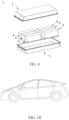
- FIG. 8 and FIG. 9 show a battery pack 1 as an example.
- the battery pack 1 may contain a battery box and a plurality of battery modules 4 disposed in the battery box.
- the battery box includes an upper box 2 and a lower box 3.
- the upper box 2 fits the lower box 3 to form a closed space for accommodating the battery modules 4.
- the plurality of battery modules 4 may be arranged in the battery box in any manner.
- the electrical device includes at least one of the secondary battery, the battery module, or the battery pack according to this application.
- the secondary battery, the battery module, or the battery pack may be used as a power supply of the electrical device, or used as an energy storage unit of the electrical device.
- the electrical device may include, but without being limited to, a mobile device (such as a mobile phone or a laptop computer), an electric vehicle (such as a battery electric vehicle, a hybrid electric vehicle, a plug-in hybrid electric vehicle, an electric bicycle, an electric scooter, an electric golf cart, or an electric truck), an electric train, a ship, a satellite system, or an energy storage system.
- the secondary battery, the battery module, or the battery pack may be selected for the electrical device according to practical requirements of the electrical device.
- FIG. 10 shows an electrical device as an example.
- the electrical device may be a battery electric vehicle, a hybrid electric vehicle, a plug-in hybrid electric vehicle, or the like.
- a battery pack or a battery module may be employed.
- the electrical device may be a mobile phone, a tablet computer, a notebook computer, or the like.
- the apparatus is generally required to be thin and light, and may have a secondary battery as a power supply.
- the resulting product is an organic-inorganic hybrid porous material expressed as the following general formula I. L x (M a C b ) y •A z Formula I
- M is selected from one or more first-transition-series metal elements; a is a numerical value ranging from 0.1 to 10, x is a numerical value ranging from 0.5 to 50, y is a numerical value ranging from 0.5 to 50.
- L is a bridging ligand capable of combining with a metal M or a metal cluster M a C b to form a coordination bond.
- A is one or more metal elements selected from: Li, Na, K, Rb, Cs, Sr, Zn, Mg, Ca, or any combination thereof; and z is a value ranging from 0 to 100, and z is greater than 0.
- the organic-inorganic hybrid porous material is (CN) 4.8 NiFe 0.8 -Li 1.2 . This material is used for preparing a separator in a next step.
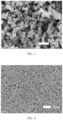
- FIG. 1 is a scanning electron microscope image of an organic-inorganic hybrid porous material according to Embodiment 1, where (a) is an image zoomed at a magnification of 10 k, and (b) is an image zoomed at a magnification of 3 k.
- the particles possess a cubic packing morphology.
- the surface of the particles is smooth without macropores.
- the particles overlap each other to form pores and provide dense electron transport channels, so that energy storage particles can be transported between the pores or inside the particles.
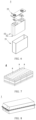
- FIG. 3 is a schematic diagram of an electrochemical device separator according to an embodiment.
- the electrochemical device separator 300 includes a base layer 31 and an overlayer 32.
- the overlayer 32 overlays both surfaces of the base layer 31.
- the overlayer 32 contains the organic-inorganic hybrid porous material.
- a PP-PE copolymer microporous film with a thickness of 20 ⁇ m and with an average pore diameter of 80 nm is provided as the base layer.
- a functional ingredient Using the material in the previous step as a functional ingredient, mixing the functional ingredient with polymethyl acrylate as a binder, a poly(acrylic acid-co-acrylate-co-acrylonitrile) as another binder, sodium carboxymethyl cellulose (chemically pure) as a stabilizer, and polyoxyethylene ether as a wetting agent evenly at a weight ratio of 85: 6: 3: 3: 3, and adding water to prepare a slurry with a solid content of 9 wt%.
- FIG. 4 is a schematic diagram of a battery according to an embodiment.
- the battery includes a positive electrode 41, a negative electrode 42, and an electrochemical device separator 300.
- the electrochemical device separator 300 is located between the positive electrode 41 and the negative electrode 42.
- the electrochemical device separator 300 includes a base layer 31 and an overlayer 32.
- the overlayer 32 overlays both surfaces of the base layer 31.
- the overlayer 32 contains the organic-inorganic hybrid porous material.
- the preparation steps are as follows: Stirring and mixing well LiNi 0.6 Co 0.2 Mn 0.2 O 2 as a positive active material, acetylene black (Denka, Denka Black) as a conductive agent, and polyvinylidene difluoride (Arkema, HSV 900) as a binder in an N-methylpyrrolidone solvent at a weight ratio of 94: 3: 3 to obtain a slurry with a solid content of 30 wt%.
- a dry coating layer on the surface of the positive electrode plate is 130 ⁇ m thick.
- the electrolytic solution is a solution containing 1 mol/L LiPF 6
- the solvent is a product of mixing EC, DEC, and DMC at a volume ratio of 1: 1: 1.
- a powdery composition which is used for preparing a separator in a next step, is provided.
- the powdery composition includes an organic-inorganic hybrid porous material (CN) 4.8 NiFe 0.8 -Li 1.2 prepared according to Embodiment 1 and Al 2 O 3 powder.
- the volume median diameter D v50 of the Al 2 O 3 material is 0.5 ⁇ m, and the external specific surface area of the material is 2.3 m 2 /g.
- the formula of the composition is as follows:
- the preparation method of the separator is identical to that in Embodiment 1.
- the preparation method of the secondary battery is identical to that in Embodiment 1.
- the separator is a PP-PE copolymer microporous film with a thickness of 20 ⁇ m and with an average pore diameter of 80 nm.
- the separator is not coated, but is directly used for assembling the secondary battery.
- the preparation method of the secondary battery is identical to that in Embodiment 1.
- a Li 3 PO 4 material (powder) with a volume median diameter D v50 of 0.5 ⁇ m and an external specific surface area of 8.5 m 2 /g is provided, and used for preparing a separator in a next step.
- the preparation method of the separator is identical to that in Embodiment 1.
- the preparation method of the secondary battery is identical to that in Embodiment 1.
- An Al 2 O 3 material (powder) with a volume median diameter D v50 of 0.5 ⁇ m and an external specific surface area of 2.3 m 2 /g is provided, and used for preparing a separator in a next step.
- the preparation method of the separator is identical to that in Embodiment 1.
- the preparation method of the secondary battery is identical to that in Embodiment 1.
- Table 2 shows the first feed solution parameters, the second feed solution parameters, the stirring speed, the storing temperature, and the chemical formula of the resulting product involved in the method for preparing the organic-inorganic hybrid porous materials in Embodiments 1 to 22 and Comparative Embodiments 4 to 9.
- the external specific surface area is a statistical thickness surface area (STSA).
- the pore diameter of the material is tested in the following way: refer to GB/T 21650.2-2008 to measure volumes of mesopores and macropores of the material, and then refer to GB/T 21650.3-2011 to measure a volume of micropores of the material.
- the average pore diameter is: total pore volume/specific surface area ⁇ 4. This test method assumes that the pores of the material are simple columnar pores.
- the doping element A in the material is tested in the following way: Drying a specimen of the material in a 150 °C vacuum environment to remove the adsorbed water impurities. Subsequently, performing an inductively coupled plasma-optical emission spectrometry (ICP) test (SPECTRO BLUE, from SPECTRO Analytical Instruments GmbH) on the specimen to determine a fraction of the doping element A.
- ICP inductively coupled plasma-optical emission spectrometry
- the ionic conductivity of the separator is tested by performing a constant-voltage AC impedance spectroscopy test on separator specimens that include different layers, where the test is performed based on a space-limited symmetric cell method by using a Biologic VMP3 electrochemical workstation.
- a symmetrical single-layer stacked battery is prepared in the following way: cutting out wafers from symmetrical copper foils, each with an area of 154 mm 2 ; using the two wafers as two sides of a multilayer separator respectively; and using a 1 mol/L LiPF 6 PC solution as an electrolytic solution.
- the battery is tested at a normal temperature of 25 °C. Rendered in a Nyquist plot, the test results take on a straight line, in which an intersection with the X-axis is Rs.
- the measured Rs values of the separators that include different numbers of layers are used to make a plot, in which a slope of a straight line fitted from the values is K.
- the volume median diameter D v50 is tested by using a Malvern Mastersizer 3000.
- the particle type is non-spherical and a dispersing medium is deionized water.
- the external specific surface area of the organic-inorganic hybrid porous material is 1 to 100 m 2 /g
- the organic-inorganic hybrid porous material is used as a coating material for the separator
- the separator exhibits an improved ionic conductivity unexpectedly
- the secondary battery exhibits improved cycle performance and rate performance.
- the separator in Comparative Embodiment 1 lacks the coating layer
- the separator in Comparative Embodiment 2 is coated with a material containing Li 3 PO 4
- the separator in Comparative Embodiment 3 is coated with a material containing Al 2 O 3 .
- the ionic conductivity of the separators in Comparative Embodiments 1 to 3 and/or the cycle performance and rate performance of the secondary battery are inferior to those in Embodiments 1 to 27.
- the external specific surface area of the organic-inorganic hybrid porous material is 0.5 m 2 /g (less than 1 m 2 /g), the organic-inorganic hybrid porous material is used as a coating material for the separator, the ionic conductivity of the separator is relatively low, and the cycle performance and rate performance of the secondary battery are inferior to those in Embodiments 1 to 27.
- the organic-inorganic hybrid porous material in Comparative Embodiment 4 is used as a coating material for the separator, the binding is not enough between the material and other adjuvants. In this case, the organic-inorganic hybrid porous material can hardly provide sufficient mass transfer channels for the active metal ions dissociated between the positive electrode and the negative electrode, thereby aggravating polarization and impairing the rate performance of the battery.
- the particle diameter of the organic-inorganic hybrid porous material is 120 m 2 /g (greater than 100 m 2 /g), the organic-inorganic hybrid porous material is used as a coating material for the separator, the ionic conductivity of the separator is relatively low, and the cycle performance and rate performance of the secondary battery are inferior to those in Embodiments 1 to 27.
- the shape of the outer surface of the organic-inorganic hybrid porous material in Comparative Embodiment 5 may be rather tortuous, thereby being adverse to the binding between the particles and other adjuvants during coating of the separator, and being adverse to ion shuttling between positive electrode and the negative electrode.
- the internal pore diameter of the organic-inorganic hybrid porous material in Comparative Embodiment 5 may be rather large.
- the doping element A inside the pores is prone to dissociate, thereby being adverse to desolvation of the element A transported in the organic-inorganic hybrid porous material. Consequently, the continuity of the transport of the metal element A in the structure is reduced, the effect of enhancing the ionic conductivity is impaired, and the battery performance is deteriorated.
- the volume median diameter D v50 of the organic-inorganic hybrid porous material is 0.1 to 2 ⁇ m.
- the particle diameter of the organic-inorganic hybrid porous material is greater than a pore diameter of the base layer.
- this prevents connection between a positive coating layer and a negative coating layer, and, on the other hand, this provides an appropriate transport network for free and bulk-active ions, thereby improving the transport rate of active ions, increasing the ionic conductivity, and in turn, improving the rate performance and cycle performance.
- the separator exhibits an improved ionic conductivity unexpectedly, and the secondary battery exhibits improved cycle performance and rate performance.
- the volume median diameter D v50 of the organic-inorganic hybrid porous material is 0.02 ⁇ m (less than 0.1 ⁇ m).
- the organic-inorganic hybrid porous material is used as a coating material for the separator, the separator exhibits an improved ionic conductivity, and the cycle performance and rate performance of the secondary battery are superior to that in Comparative Embodiment 1, but inferior to that in Embodiment 1.
- the volume median diameter D v50 of the organic-inorganic hybrid porous material is 3 ⁇ m (greater than 2 ⁇ m).
- the separator exhibits an improved ionic conductivity, and the cycle performance and rate performance of the secondary battery are superior to that in Comparative Embodiment 1, but inferior to that in Embodiment 1.
- the relative molecular mass of the bridging ligand in Embodiment 1 is smaller, the ionic conductivity of the organic-inorganic hybrid compound is higher, and the rate performance and cycle performance are higher. That is because the organic ligand with a low relative molecular mass constructs smaller pores for accommodating metal ions. More metal ions can be accommodated per unit space, thereby providing more ion transport channels and improving the ionic conductivity.
- Embodiments 1 and 23 to 27 after the organic-inorganic hybrid porous material particles and the Al 2 O 3 particles are blended, the two types of particles can be bound more closely due to complementarity of morphology between the particles.
- the metallic organic hybrid compound provides a high ionic conductivity, and the Al 2 O 3 provides a rigid stable separator structure.
- the two types of particles work synergistically to improve the rate performance and cycle performance of the battery.
- the content of the organic-inorganic hybrid porous material is 60% to 80%, the performance of the separator and secondary battery is unexpectedly improved.
- the organic-inorganic hybrid porous material according to this application achieves one or more of the following beneficial effects:
Landscapes
- Chemical & Material Sciences (AREA)
- Chemical Kinetics & Catalysis (AREA)
- Organic Chemistry (AREA)
- General Chemical & Material Sciences (AREA)
- Electrochemistry (AREA)
- Analytical Chemistry (AREA)
- Engineering & Computer Science (AREA)
- Inorganic Chemistry (AREA)
- Nanotechnology (AREA)
- Composite Materials (AREA)
- Materials Engineering (AREA)
- Ceramic Engineering (AREA)
- Cell Separators (AREA)
- Secondary Cells (AREA)
Description
- This application relates to the technical field of lithium batteries, and in particular, to an organic-inorganic hybrid porous material composition, a separator, an electrochemical device, and a method for manufacturing an electrochemical separator device.
- In recent years, the application scope of lithium-ion batteries has been expanded. The lithium-ion batteries are widely used in energy storage power systems such as hydro, thermal, wind, and solar power stations, and many other fields such as electric tools, electric bicycles, electric motorcycles, and electric vehicles, military equipment, and aerospace. The great development of the lithium-ion batteries gives rise to higher requirements on the cycle performance and rate performance of the batteries.
- In the related art, a microporous polyolefin film such as polyethylene (PE) and polypropylene (PP) film is used as a separator. Although such separators are cost-efficient, a limited ionic conductivity of the separators has bottlenecked the cycle performance and rate performance of the lithium-ion batteries. Therefore, the ionic conductivity of existing separators still needs to be improved.
- Relevant prior art includes:
- HUANG BIN ET AL: "Prussian Blue [
- LI YIWEI ET AL: "Synthetic control of Prussian blue derived nano-materials for energy storage and conversion application", MATERIALS TODAY ENERGY, vol. 14, 1 December 2019 (2019-12-01), page 100332, XP093046068, ISSN: 2468-6069, DOI: 10.1016/j.mtener.2019.07.003
-
CN 113 206 224 A -
CN 112 850 749 A - LONG WANG ET AL: "Rhombohedral Prussian White as Cathode for Rechargeable Sodium-Ion Batteries", JOURNAL OF THE AMERICAN CHEMICAL SOCIETY, vol. 137, no. 7, 10 February 2015 (2015-02-10), pages 2548-2554, XP055499604, ISSN: 0002-7863, DOI: 10.1021/ja510347s
- Kjeldgaard Solveig ET AL: "Strategies for synthesis of Prussian blue analogues", Royal Society Open Science, vol. 8, no. 1,27 January 2021 (2021 -01-27), page 201779, XP093046504, ISSN: 2054-5703, DOI: 10.1098/rsos.201779,
- Retrieved from the Internet: URL:https://royalsocietypublishing.org/doi/full-xml/10.1098/rsos.201779
-
US 2020/071175 A1 -
CN 108 421 280 A -
CN 109 216 712 A -
CN 110 416 475 A (this document discloses porous film materials as separator material for use in lithium ion batteries. The porous film material compositions are formed between chemically modified silica having double-bonds on the surface and acrylate to form polymers, thereby arriving at a "porous organic inorganic hybride material". -
US 2020/129971 A1 -
CN 105 833 852 A - Aspects of the invention are set out in the claims. This application is filed in view of the foregoing problems, and aims to provide a novel organic-inorganic hybrid porous material. The novel organic-inorganic hybrid porous material is configured to modify a separator and can improve an ionic conductivity of the separator. When the modified separator is applied to an electrochemical device such as a battery, the battery exhibits improved cycle performance and rate performance.
- To achieve the foregoing objective, this application discloses compositions comprising an organic-inorganic hybrid porous material. The organic-inorganic hybrid porous material contains a doping element A. The element A is one or more selected from: Li, Na, K, Rb, Cs, Sr, Zn, Mg, Ca, or any combination thereof. An external specific surface area of the organic-inorganic hybrid porous material is 1 to 100 m2/g. A ratio of the external specific surface area to a total specific surface area of the organic-inorganic hybrid porous material is 0.7 to 0.9.
- Therefore, this application uses the novel organic-inorganic hybrid porous material to modify a battery separator, so that the battery separator exhibits an improved ionic conductivity unexpectedly. A battery containing the separator unexpectedly exhibits improved cycle performance and rate performance.
- In any embodiment, the total specific surface area of the organic-inorganic hybrid porous material is 1.15 to 140 m2/g. Optionally, the total specific surface area is 5 to 110 m2/g. Further optionally, the total specific surface area is 10 to 80 m2/g. When a battery separator is modified by the novel organic-inorganic hybrid porous material based on the foregoing technical solution, the battery separator exhibits an improved ionic conductivity unexpectedly. A battery containing the separator unexpectedly exhibits improved cycle performance and rate performance.
- In any embodiment, a volume median diameter Dv50 of the organic-inorganic hybrid porous material is 0.1 to 2 µm. Optionally, the volume median diameter is 0.3 to 1.5 µm. Further optionally, the volume median diameter is 0.5 to 1.0 µm. When a battery separator is modified by the novel organic-inorganic hybrid porous material based on the foregoing technical solution, the battery separator exhibits an improved ionic conductivity unexpectedly. A battery containing the separator unexpectedly exhibits improved cycle performance and rate performance.
- In any embodiment, an average pore diameter of the organic-inorganic hybrid porous material is 0.1 to 10 nm. Optionally, the average pore diameter is 0.5 to 8.9 nm. Further optionally, the average pore diameter is 0.8 to 6.5 nm. When a battery separator is modified by the novel organic-inorganic hybrid porous material based on the foregoing technical solution, the battery separator exhibits an improved ionic conductivity unexpectedly. A battery containing the separator unexpectedly exhibits improved cycle performance and rate performance.
- In any embodiment, at least a part of atoms or cations of the element A are distributed in pores of the organic-inorganic hybrid porous material. When a battery separator is modified by the novel organic-inorganic hybrid porous material based on the foregoing technical solution, the battery separator exhibits an improved ionic conductivity unexpectedly. A battery containing the separator unexpectedly exhibits improved cycle performance and rate performance.
- In any embodiment, the organic-inorganic hybrid porous material is a metal-organic framework material. When a battery separator is modified by the novel organic-inorganic hybrid porous material based on the foregoing technical solution, the battery separator exhibits an improved ionic conductivity unexpectedly. A battery containing the separator unexpectedly exhibits improved cycle performance and rate performance.
- In any embodiment, at least a part of atoms or cations of the element A are distributed in pores of the metal-organic framework material. When a battery separator is modified by the novel organic-inorganic hybrid porous material based on the foregoing technical solution, the battery separator exhibits an improved ionic conductivity unexpectedly. A battery containing the separator unexpectedly exhibits improved cycle performance and rate performance.
- In any embodiment, the element A is one or more selected from: Li, Na, or K. Optionally, the element A is Li. When a battery separator is modified by the novel organic-inorganic hybrid porous material based on the foregoing technical solution, the battery separator exhibits an improved ionic conductivity unexpectedly. A battery containing the separator unexpectedly exhibits improved cycle performance and rate performance.
- In any embodiment, a weight percent of the element A in the organic-inorganic hybrid porous material is 0.001% to 10%. When a battery separator is modified by the novel organic-inorganic hybrid porous material based on the foregoing technical solution, the battery separator exhibits an improved ionic conductivity unexpectedly. A battery containing the separator unexpectedly exhibits improved cycle performance and rate performance.
- In any embodiment, the organic-inorganic hybrid porous material includes: a plurality of metal cations and/or a plurality of metal cluster cations; a plurality of bridging ligands, where the bridging ligands are linked to the metal cations and/or metal cluster cations by a coordination bond, so as to form a porously structured framework. When a battery separator is modified by the novel organic-inorganic hybrid porous material based on the foregoing technical solution, the battery separator exhibits an improved ionic conductivity unexpectedly. A battery containing the separator unexpectedly exhibits improved cycle performance and rate performance.
- In any embodiment, the organic-inorganic hybrid porous material possesses one of the following first to third structures: (i) a first structure: in the first structure, a bridging ligand is CN or SCN, a metal cation is a cation of one or more elements selected from: Zn, Co, Cu, Fe, Cd, Mn, Ag, Rh, Ru, Sc, Cr, Ni, Y, Ti, Zr, Hf, Sr, Pb, lanthanide, or any combination thereof, and the metal cation combines with the bridging ligand to form a cubic ordered assembled structure; (ii) a second structure: in the second structure, the bridging ligand is a polycarboxylic acid, the metal cation is a cation of one or more elements selected from: Zn, Co, Cu, Fe, Cd, Mn, Ag, Rh, Ru, Sc, Cr, Ni, Y, Ti, Zr, Hf, Sr, Pb, lanthanide, or any combination thereof, each metal cation is linked to four oxygen atoms on two carboxyl groups in two polycarboxylic acids by a coordination bond to form a metal-oxygen tetrahedral cluster, and the tetrahedral cluster combines with a remainder of the bridging ligand to form a cubic ordered assembled structure; and (iii) a third structure: in the third structure, the bridging ligand is optionally substituted imidazole, the metal cation is a cation of one or more elements selected from: Zn, Co, Cu, Fe, Cd, Mn, Ag, Rh, Ru, Sc, Cr, Ni, Y, Ti, Zr, Hf, Sr, Pb, lanthanide, or any combination thereof, and the metal cation combines with the bridging ligand to form a porous structure. When a battery separator is modified by the novel organic-inorganic hybrid porous material based on the foregoing technical solution, the battery separator exhibits an improved ionic conductivity unexpectedly. A battery containing the separator unexpectedly exhibits improved cycle performance and rate performance.
- In any embodiment, the organic-inorganic hybrid porous material is expressed as a general Formula I:
Lx(MaCb)y•Az Formula I
- In the general formula above, M is selected from one or more first-transition-series metal elements; a is a numerical value ranging from 0.1 to 10, x is a numerical value ranging from 0.5 to 50, y is a numerical value ranging from 0.5 to 50.
- C is one or more selected from: O, CO, O2-, S2-, C-, Br-, I-, OH-, H2O, -OH, =O, or any combination thereof, and b is a numerical value ranging from 0 to 20.
- L is a bridging ligand capable of combining with a metal M or a metal cluster MaCb to form a coordination bond.
- A is one or more metal elements selected from: Li, Na, K, Rb, Cs, Sr, Zn, Mg, Ca, or any combination thereof; and, 0 < z ≤ 100. When a battery separator is modified by the novel organic-inorganic hybrid porous material based on the foregoing technical solution, the battery separator unexpectedly exhibits an improved ionic conductivity. A battery containing the separator unexpectedly exhibits improved cycle performance and rate performance.
- In any embodiment, the organic-inorganic hybrid porous material is periodically assembled from a basic unit represented by Formula I along at least one spatial direction.
- Optionally, the organic-inorganic hybrid porous material is periodically assembled from the basic unit represented by Formula I along an extension direction that is at least one of three spatial directions X', Y', and Z'. The periodically assembled quantity is an integer ranging from 3 to 10000. The three directions X', Y', and Z' are at an angle of 0 degree to 75 degrees to an X direction, a Y direction, and a Z direction of a Cartesian coordinate system respectively, and optionally, at an angle of 5 degrees to 60 degrees. When a battery separator is modified by the novel organic-inorganic hybrid porous material based on the foregoing technical solution, the battery separator exhibits an improved ionic conductivity unexpectedly. A battery containing the separator unexpectedly exhibits improved cycle performance and rate performance.
- In any embodiment, L is one or more selected from: cyano, imidazole, porphyrin, pyridine, pyrazole, pyrimidine, piperidine, pyrrolidine, furan, thiophene, piperazine, pyridazine, indole, quinoline, carbazole, morpholine, polycarboxylic acid, or a dimer or trimer of the foregoing ligands, or a multimer thereof. One or more hydrogen atoms in the bridging ligand are optionally substituted by one or more substituents selected from: cyano, nitro, amino, aldehyde, carboxyl, halogen, C1 to C8 alkyl, C1 to C8 hydroxyalkyl, C1 to C8 alkoxyl, C2 to C8 alkenyl, C2 to C8 alkynyl, C3 to C16 cycloalkyl, C6 to C20 aryl, C6 to C20 heteroaryl, or any combination thereof; and x is a numerical value ranging from 0.5 to 50. When a battery separator is modified by the novel organic-inorganic hybrid porous material based on the foregoing technical solution, the battery separator exhibits an improved ionic conductivity unexpectedly. A battery containing the separator unexpectedly exhibits improved cycle performance and rate performance.
- In any embodiment, in Formula I, 0.5 ≤ x:y ≤ 6. When a battery separator is modified by the novel organic-inorganic hybrid porous material based on the foregoing technical solution, the battery separator exhibits an improved ionic conductivity unexpectedly. A battery containing the separator unexpectedly exhibits improved cycle performance and rate performance.
- In any embodiment, in Formula I, b > 0, and 0.5 ≤ a:b ≤ 8. When a battery separator is modified by the novel organic-inorganic hybrid porous material based on the foregoing technical solution, the battery separator exhibits an improved ionic conductivity unexpectedly. A battery containing the separator unexpectedly exhibits improved cycle performance and rate performance.
- In any embodiment, in Formula I,


- In any embodiment, in formula I, when M is a combination of cations of at least two metal elements, a product of a and y represents a quantity of all metal cations in a single basic unit represented by Formula I. When a battery separator is modified by the novel organic-inorganic hybrid porous material based on the foregoing technical solution, the battery separator exhibits an improved ionic conductivity unexpectedly. A battery containing the separator unexpectedly exhibits improved cycle performance and rate performance.
- In any embodiment, L includes a cyano ligand, that is, a -CN ligand, M includes a Fe cation and/or a Ni cation, and A includes one or more elements selected from K, Na, or Li. When a battery separator is modified by the novel organic-inorganic hybrid porous material based on the foregoing technical solution, the battery separator unexpectedly exhibits an improved ionic conductivity. A battery containing the separator unexpectedly exhibits improved cycle performance and rate performance.
- In any embodiment, L includes a benzenetricarboxylic acid ligand, that is, a BTC ligand, M includes a Fe cation, and A includes one or more elements selected from K, Na, or Li. When a battery separator is modified by the novel organic-inorganic hybrid porous material based on the foregoing technical solution, the battery separator unexpectedly exhibits an improved ionic conductivity. A battery containing the separator unexpectedly exhibits improved cycle performance and rate performance.
- In any embodiment, L includes a citric acid ligand, that is, a CIT ligand, M includes a Cu cation, and A includes one or more elements selected from K, Na, or Li. When a battery separator is modified by the novel organic-inorganic hybrid porous material based on the foregoing technical solution, the battery separator unexpectedly exhibits an improved ionic conductivity. A battery containing the separator unexpectedly exhibits improved cycle performance and rate performance.
- In any embodiment, L includes a tricarboxytriphenyl amine ligand, that is, a TCA ligand, M includes a Cu cation, and A includes one or more elements selected from K, Na, or Li; When a battery separator is modified by the novel organic-inorganic hybrid porous material based on the foregoing technical solution, the battery separator unexpectedly exhibits an improved ionic conductivity. A battery containing the separator unexpectedly exhibits improved cycle performance and rate performance.
- In any embodiment, L includes an anthraquinone-2,3-dicarboxylic acid ligand, that is, an AQDC ligand, M includes a Cu cation, and A includes one or more elements selected from K, Na, or Li. When a battery separator is modified by the novel organic-inorganic hybrid porous material based on the foregoing technical solution, the battery separator unexpectedly exhibits an improved ionic conductivity. A battery containing the separator unexpectedly exhibits improved cycle performance and rate performance.
- In any embodiment, L includes an imidazole and/or 2-aminobenzimidazole ligand, that is, an Im and/or abIm ligand, M includes a Co cation, and A includes one or more elements selected from K, Na, or Li. When a battery separator is modified by the novel organic-inorganic hybrid porous material based on the foregoing technical solution, the battery separator unexpectedly exhibits an improved ionic conductivity. A battery containing the separator unexpectedly exhibits improved cycle performance and rate performance.
- In any embodiment, L includes a terephthalic acid ligand, that is, a BDC ligand, F includes a Fe cation, C includes OH- and F-, and A includes one or more elements selected from K, Na, or Li. When a battery separator is modified by the novel organic-inorganic hybrid porous material based on the foregoing technical solution, the battery separator unexpectedly exhibits an improved ionic conductivity. A battery containing the separator unexpectedly exhibits improved cycle performance and rate performance.
- The invention relates to a composition. The composition includes organic-inorganic hybrid porous material particles and inorganic compound particles. The organic-inorganic hybrid porous material particles are particles of any one of the organic-inorganic hybrid porous materials described above. The inorganic compound is one or more selected from: zeolite, molecular sieve, aluminum oxide, aluminum oxyhydroxide, silicon dioxide, aluminum nitride, silicon carbide, magnesium oxide, calcium oxide, zinc oxide, zirconium oxide, titanium dioxide, or any combination thereof. Based on the foregoing technical solution, the organic-inorganic hybrid porous material particles work together with the inorganic compound particles to improve the rate performance and cycle performance of the battery.
- In any embodiment, a weight ratio between the organic-inorganic hybrid porous material particles and the inorganic compound particles ranges from 1:5 to 5:1. Based on the foregoing technical solution, the organic-inorganic hybrid porous material particles work together with the inorganic compound particles to improve the rate performance and cycle performance of the battery.
- In any embodiment, in the composition, a weight percent of the organic-inorganic hybrid porous material particles is 20 wt% to 80 wt%, for example, 60 wt% to 80 wt%. Based on the foregoing technical solution, the organic-inorganic hybrid porous material particles work together with the inorganic compound particles to improve the rate performance and cycle performance of the battery.
- In any embodiment, the composition further includes one or more ingredients selected from: a binder, a stabilizer, a wetting agent, a rheology modifier, a defoamer, a thickener, a pH adjuster, or an anti-corrosive agent. The foregoing technical solution improves overall performance of the composition.
- A third aspect of this application further provides an electrochemical device separator, including the material described in any embodiment above or the composition described in any embodiment above.
- In any embodiment, the electrochemical device separator includes:
- a base layer; and
- an overlayer, where the overlayer overlays at least a part of a surface of the base layer, and the overlayer contains the material described in any embodiment above or the composition described in any embodiment above.
- In any embodiment, the base layer is a porous polymer layer.
- In any embodiment, the base layer is made of a material that is one or more selected from: polyethylene, polypropylene, polyester, polyacetal, polyamide, polycarbonate, polyimide, polyether ether ketone, polyether sulfone, polyphenylene oxide, polyphenylene sulfide, polyethylene naphthalate, any polyblend thereof, or any combination thereof.
- In any embodiment, a volume median diameter Dv50 of the organic-inorganic hybrid porous material particles is greater than an average pore diameter of the base layer. That the particle diameter of the organic-inorganic hybrid porous material particles is greater than a pore diameter of a bare film prevents connection between a positive coating layer and a negative coating layer, and provides an appropriate transport network for free and bulk-active ions, thereby improving the transport rate of active ions, increasing the ionic conductivity, and in turn, improving the rate performance and cycle performance.
- In an embodiment of this application, this application discloses the use of the material disclosed above or the composition disclosed above for improving the performance of an electrochemical device separator.
- In an embodiment of this application, this application discloses an electrochemical device. The electrochemical device includes the separator described in any embodiment above.
- In an embodiment of this application, the electrochemical device is a battery. The battery includes a positive electrode, a negative electrode, and the electrochemical device separator described in any embodiment above. The separator is located between the positive electrode and the negative electrode.
- In an embodiment of this application, the battery further includes an electrolytic solution. The positive electrode, the negative electrode, and the separator are all in contact with the electrolytic solution.
- In an embodiment of this application, the positive electrode contains a positive active material. The positive active material is one or more selected from: lithium cobalt oxide, lithium nickel oxide, lithium manganese oxide, lithium nickel cobalt manganese oxide, lithium nickel cobalt aluminum oxide, lithium iron phosphate, lithium manganese iron phosphate, lithium cobalt phosphate, sulfur simple substance, or any combination thereof.
- In an embodiment of this application, the negative electrode is made of a material that is one or more selected from: graphite, soft carbon, hard carbon, lithium-titanium composite oxide, metal M simple substance, alloy, oxide, carbide, or any combination thereof, where the metal M is selected from Li, Si, Sn, Zn, Mg, Cd, Ce, Ni, or Fe.
- In an embodiment of this application, the electrolytic solution contains a lithium salt. The lithium salt is one or more selected from: LiCl, LiBr, LiI, LiClO4, LiBF4, LiB10Cl10, LiPF6, LiAsF6, LiSbF6, LiAlCl4, LiSCN, Li(FSO2)2N, LiCF3CO2, LiCH3SO3, LiCF3SO3, LiN(SO2CF3)2, LiN(SO2C2F5)2, LiC4F9SO3, LiC(CF3SO2)3, (CF3SO2)2NLi, LiOH, LiB(C2O4)2, lithium chloroborane, lithium lower aliphatic carboxylate, lithium tetraphenylborate, lithium imide, or any combination thereof.
- In an embodiment of this application, the electrochemical device is a lithium-ion battery, a sodium-ion battery, a potassium-ion battery, a zinc-ion battery, a lithium-sulfur battery, or a lithium-ion supercapacitor.
- A fourth aspect of this application further provides an electrical device. The electrical device includes the electrochemical device described in any embodiment above.
- A fifth aspect of this application further provides a method for manufacturing an electrochemical device separator, including:
- providing a base layer; and
- overlaying at least a part of a surface of the base layer with an overlayer, where the overlayer contains the material described in any embodiment above or the composition described in any embodiment above.
- Optionally, the base layer is a porous polymer layer.
- Optionally, the base layer is made of a material that is one or more selected from: polyethylene, polypropylene, polyester, polyacetal, polyamide, polycarbonate, polyimide, polyether ether ketone, polyether sulfone, polyphenylene oxide, polyphenylene sulfide, polyethylene naphthalate, any polyblend thereof, or any combination thereof.
- In an embodiment of this application, the step of overlaying at least a part of a surface of the base layer with an overlayer includes the following operations:
- providing a coating material, where the coating material contains the material described in any embodiment above or the composition described in any embodiment above; and
- overlaying at least a part of the surface of the base layer with the coating material.
- This application achieves at least the following beneficial effects:
- This application discloses a composition comprising an organic-inorganic hybrid porous material. The organic-inorganic hybrid porous material contains a doping element A. The element A is one or more selected from: Li, Na, K, Rb, Cs, Sr, Zn, Mg, Ca, or any combination thereof. An external specific surface area of the organic-inorganic hybrid porous material is 1 to 100 m2/g. In addition, a ratio of the external specific surface area to a total specific surface area of the organic-inorganic hybrid porous material is 0.7 to 0.9. This application uses the foregoing novel organic-inorganic hybrid porous material to modify a battery separator. Therefore, the ionic conductivity of the battery separator is effectively improved, and the cycle performance and rate performance of the battery that uses the separator are also effectively improved.
-
-
FIG. 1 is a scanning electron microscope image of an organic-inorganic hybrid porous material at a magnification of 10 k according to some embodiments of this application; -
FIG. 2 is a scanning electron microscope image of an organic-inorganic hybrid porous material at a magnification of 3 k according to some embodiments of this application; -
FIG. 3 is a schematic diagram of a separator according to an embodiment of this application; -
FIG. 4 is a schematic diagram of a separator according to an embodiment of this application; -
FIG. 5 is a schematic diagram of a secondary battery according to an embodiment of this application; -
FIG. 6 is an exploded view of a secondary battery shown inFIG. 5 according to an embodiment of this application; -
FIG. 7 is a schematic diagram of a battery module according to an embodiment of this application; -
FIG. 8 is a schematic diagram of a battery pack according to an embodiment of this application; -
FIG. 9 is an exploded view of the battery pack shown inFIG. 8 according to an embodiment of this application; and -
FIG. 10 is a schematic diagram of an electrical device that uses a secondary battery as a power supply according to an embodiment of this application. - Reference numerals:
1. battery pack; 2. upper box; 3. lower box; 4. battery module; 5. secondary battery; 51. housing; 52. electrode assembly; 53. cap assembly; 31. base layer; 32. overlayer; 41. positive electrode; 42. negative electrode; d1. pore diameter of the base layer; d2. particle diameter of the organic-inorganic hybrid porous material - The following describes in detail a composition with an organic-inorganic hybrid porous material and a preparation method thereof, a separator, a battery, and an electrical device according to this application with due reference to drawings. However, unnecessary details may be omitted in some cases. For example, a detailed description of a well-known matter or repeated description of a substantially identical structure may be omitted. That is intended to prevent the following descriptions from becoming unnecessarily long, and to facilitate understanding by a person skilled in the art.
- A "range" disclosed herein is defined in the form of a lower limit and an upper limit. A given range is defined by selecting a lower limit and an upper limit. The selected lower and upper limits define the boundaries of the given range. A range so defined may be inclusive or exclusive of the end values, and may be arbitrarily combined. That is, any lower limit may be combined with any upper limit to form a range. For example, if a range of 60 to 120 and a range of 80 to 110 are listed for a given parameter, it is expectable that such ranges may be understood as 60 to 110 and 80 to 120. In addition, if lower-
limit values limit values - Unless otherwise expressly specified herein, all the steps described herein may be performed sequentially or randomly, and preferably, performed sequentially. For example, that the method includes steps (a) and (b) indicates that the method may include steps (a) and (b) performed sequentially, or steps (b) and (a) performed sequentially. For example, that the method may further include step (c) indicates that step (c) may be added into the method in any order. For example, the method may include steps (a), (b), and (c), or may include steps (a), (c), and (b), or may include steps (c), (a), and (b), and so on.
- Unless otherwise expressly specified herein, "include" and "comprise" mentioned herein mean open-ended inclusion, and may also mean closed-ended inclusion. For example, the terms "include" and "comprise" may mean inclusion of other items not listed, or inclusion of only the listed items.
- Unless otherwise expressly specified herein, the term "or" is inclusive. For example, the phrase "A or B" means "A alone, B alone, or both A and B." More specifically, the condition "A or B" is satisfied by any of the following: A is true (or existent) and B is false (or absent); A is false (or absent) and B is true (or existent); or, both A and B are true (or existent).
- In an embodiment of this application, this application discloses an organic-inorganic hybrid porous material. The organic-inorganic hybrid porous material contains a doping element A. The element A is one or more selected from: Li, Na, K, Rb, Cs, Sr, Zn, Mg, Ca, or any combination thereof. An external specific surface area of the organic-inorganic hybrid porous material is 1 to 100 m2/g. A ratio of the external specific surface area to a total specific surface area of the organic-inorganic hybrid porous material is 0.7 to 0.9.
- Although the mechanism is still unclear, the applicant hereof unexpectedly finds that: when this application uses the novel organic-inorganic hybrid porous material to modify a battery separator, the battery separator exhibits an improved ionic conductivity unexpectedly. A battery containing the separator exhibits improved cycle performance and rate performance unexpectedly. When an external specific surface area is greater than 100 m2/g, two circumstances exist. A first circumstance is: a shape of an outer surface of the material is rather tortuous, thereby being adverse to the binding between particles and other adjuvants during coating of the separator, and being adverse to ion shuttling in a battery cell. A second circumstance is: mesopores occurring inside the structure of an organic-inorganic hybrid compound are large, that is, the pore size inside the material is excessive. An inner surface area calculated based on the national GB standard actually includes an inner surface area, and is close to a total specific surface area. In this case, a metal element A inside a pore is prone to dissociate out of the hole, thereby being adverse to desolvation of the metal element A transported inside the organic-inorganic hybrid compound, reducing continuity of the transport of the metal element A inside the structure, impairing the effect of ionic conductivity enhancement, and deteriorating the battery performance. When the external specific surface area is less than 1 m2/g, the binding is not enough between the particles and other adjuvants. The ions in the battery cell can transfer mass from the outside into the organic-inorganic hybrid compound. In this case, the organic-inorganic hybrid porous material can hardly provide sufficient mass transfer channels for the active metal ions dissociated between the positive electrode and the negative electrode, thereby aggravating polarization and impairing the rate performance of the battery.
- In an embodiment of this application, the term "organic-inorganic hybrid porous material" means a material with a one-, two- or three-dimensional porous structure formed by inorganic atoms or clusters coordinated to organic ligands.
- According to the invention, the "external specific surface area" and "total specific surface area" are determined by a multipoint Brunauer-Emmett-Telter (BET) method based on the multi-molecular layer adsorption theory. The total specific surface area (also known as nitrogen adsorption surface area, NSA) is a total surface area of a material calculated from nitrogen adsorption data based on the BET theory. The external specific surface area (also known as statistical thickness surface area, STSA) is an external specific surface area calculated from the nitrogen adsorption data based on the de Boer theory and an organic-inorganic hybrid porous material model.
- In an embodiment of this application, at a temperature of liquid nitrogen, the total surface area and the external specific surface area are calculated by using the number of nitrogen molecules adsorbed by the organic-inorganic hybrid porous material from nitrogen under a given partial pressure. The NSA and STSA can be calculated based on the adsorption parameters.
- In an embodiment of this application, the STSA of the material is determined by plotting a function relationship between a nitrogen volume (Va) adsorbed per gram of specimen under standard temperature and pressure (STP) and an adsorption-layer statistical thickness (t). A Va-t plot is drawn using Va (under STP, cm2/g) as a Y-axis (ordinate) and using t(10-10 m) as an X-axis (abscissa). Data with a P/P0 ratio value falling within a range of 0.2 to 0.5 is selected. The adsorption-layer statistical thickness is:

- The slope of the Va-t plot is determined by standard linear regression. The STSA is calculated by:

- In the formula above: M is the slope of the Va-t plot, 15.47 is a volume conversion constant of nitrogen and liquid nitrogen, and the measurement unit is converted to m2/g.
- If the Va-t plot incurs a negative intercept, it is reported that the STSA value is equal to the NSA value, because the principle of this method makes it impossible for the STSA value to exceed the NSA value.
- According to the invention, the external specific surface area of the organic-inorganic hybrid porous material is 1 to 100 m2/g. In some embodiments of this application, the external specific surface area is 1 to 10 m2/g, 10 to 20 m2/g, 20 to 30 m2/g, 30 to 40 m2/g, 40 to 50 m2/g, 50 to 60 m2/g, 60 to 70 m2/g, 70 to 80 m2/g, 80 to 90 m2/g, or 90 to 100 m2/g. When a battery separator is modified by the novel organic-inorganic hybrid porous material based on the foregoing technical solution, the battery separator exhibits an improved ionic conductivity unexpectedly. A battery containing the separator exhibits improved cycle performance and rate performance unexpectedly.
- According to the invention, the ratio of the external specific surface area to a total specific surface area of the organic-inorganic hybrid porous material is 0.7 to 0.9. In some embodiments of this application the ratio is 0.7 to 0.75, 0.75 to 0.8, 0.8 to 0.85, or 0.85 to 0.9. When a battery separator is modified by the novel organic-inorganic hybrid porous material based on the foregoing technical solution, the battery separator exhibits an improved ionic conductivity unexpectedly. A battery containing the separator exhibits improved cycle performance and rate performance unexpectedly.
- In some embodiments of this application, the total specific surface area of the organic-inorganic hybrid porous material is 1.15 to 140 m2/g. Optionally, the total specific surface area of the organic-inorganic hybrid porous material is 5 to 110 m2/g, 10 to 80 m2/g, 1 to 10 m2/g, 10 to 20 m2/g, 20 to 30 m2/g, 30 to 40 m2/g, 40 to 50 m2/g, 50 to 60 m2/g, 60 to 70 m2/g, 70 to 80 m2/g, 80 to 90 m2/g, 90 to 100 m2/g, or 100 to 110 m2/g. When a battery separator is modified by the novel organic-inorganic hybrid porous material based on the foregoing technical solution, the battery separator exhibits an improved ionic conductivity unexpectedly. A battery containing the separator unexpectedly exhibits improved cycle performance and rate performance.
- In some embodiments of this application, a volume median diameter Dv50 of the organic-inorganic hybrid porous material is 0.1 to 2 µm. Optionally, the volume median diameter Dv50 of the organic-inorganic hybrid porous material is 0.3 to 1.5 µm, 0.5 to 1.0 µm, 0.1 to 0.2 µm, 0.2 to 0.4 µm, 0.4 to 0.6 µm, 0.6 to 0.8 µm, 0.8 to 1 µm, 1.0 to 1.2 µm, 1.2 to 1.4 µm, 1.4 to 1.6 µm, 1.6 to 1.8 µm, or 1.8 to 2 µm. When a battery separator is modified by the novel organic-inorganic hybrid porous material based on the foregoing technical solution, the battery separator exhibits an improved ionic conductivity unexpectedly. A battery containing the separator unexpectedly exhibits improved cycle performance and rate performance.
- In some embodiments of this application, an average pore diameter of the organic-inorganic hybrid porous material is 0.1 to 10 nm. Optionally, the average pore diameter of the organic-inorganic hybrid porous material is 0.5 to 8.9 nm, 0.8 to 6.5 nm, 0.1 to 0.2 nm, 0.2 to 0.4 nm, 0.4 to 0.6 nm, 0.6 to 0.8 nm, 0.8 to 1 nm, 1 to 2 nm, 2 to 4 nm, 4 to 6 nm, 6 to 8 nm, or 8 to 10 nm. When a battery separator is modified by the novel organic-inorganic hybrid porous material based on the foregoing technical solution, the battery separator exhibits an improved ionic conductivity unexpectedly. A battery containing the separator unexpectedly exhibits improved cycle performance and rate performance.
- In some embodiments of this application, at least a part of the atoms or cations of the element A are distributed in the pores of the organic-inorganic hybrid porous material. The distribution positions of the A atoms can be displayed directly by using high-angle annular dark-field scanning transmission electron microscope (HAADF-STEM) atom imaging technology. When a battery separator is modified by the novel organic-inorganic hybrid porous material based on the foregoing technical solution, the battery separator exhibits an improved ionic conductivity unexpectedly. A battery containing the separator unexpectedly exhibits improved cycle performance and rate performance.
- In some embodiments of this application, the organic-inorganic hybrid porous material is a metal-organic framework material. When a battery separator is modified by the novel organic-inorganic hybrid porous material based on the foregoing technical solution, the battery separator exhibits an improved ionic conductivity unexpectedly. A battery containing the separator unexpectedly exhibits improved cycle performance and rate performance.
- The term "metal-organic framework material" means a material with a one-, two- or three-dimensional porous structure formed by metal atoms or clusters coordinated to organic ligands.
- In some embodiments of this application, at least a part of atoms or cations of the element A are distributed in pores of the metal-organic framework material. When a battery separator is modified by the novel organic-inorganic hybrid porous material based on the foregoing technical solution, the battery separator exhibits an improved ionic conductivity unexpectedly. A battery containing the separator unexpectedly exhibits improved cycle performance and rate performance.
- In some embodiments of this application, the element A is one or more selected from: Li, Na, or K. Optionally, the element A is Li. When a battery separator is modified by the novel organic-inorganic hybrid porous material based on the foregoing technical solution, the battery separator exhibits an improved ionic conductivity unexpectedly. A battery containing the separator unexpectedly exhibits improved cycle performance and rate performance.
- In some embodiments of this application, a weight percent of the element A in the organic-inorganic hybrid porous material is 0.001% to 10%. Optionally, the weight percent of the element A in the organic-inorganic hybrid porous material is 0.001 to 0.01%, 0.01 to 0.1%, 0.1 to 1%, 1 to 5%, or 5 to 10%. When a battery separator is modified by the novel organic-inorganic hybrid porous material based on the foregoing technical solution, the battery separator exhibits an improved ionic conductivity unexpectedly. A battery containing the separator unexpectedly exhibits improved cycle performance and rate performance.
- In some embodiments of this application, the organic-inorganic hybrid porous material includes: a plurality of metal cations and/or a plurality of metal cluster cations; a plurality of bridging ligands, where the bridging ligands are linked to the metal cations and/or metal cluster cations by a coordination bond, so as to form a porously structured framework. When a battery separator is modified by the novel organic-inorganic hybrid porous material based on the foregoing technical solution, the battery separator unexpectedly exhibits an improved ionic conductivity. A battery containing the separator unexpectedly exhibits improved cycle performance and rate performance. Compared with a monodentate ligand, the bridging ligand can effectively provide a complete metal-ligand framework required for undertaking a given proportion of defective sites. The complete framework structure can more effectively improve the ionic conductivity of the separator on the basis of maintaining structural stability of the organic-inorganic hybrid compound.
- The term "bridging ligand" is a ligand that links two or more atoms (usually metal atoms). The ligand itself may be a single atom, or may be formed of more than one atom.
- In some embodiments of this application, the organic-inorganic hybrid porous material possesses one of the following first to third structures: (i) a first structure: in the first structure, a bridging ligand is CN or SCN, a metal cation is a cation of one or more elements selected from: Zn, Co, Cu, Fe, Cd, Mn, Ag, Rh, Ru, Sc, Cr, Ni, Y, Ti, Zr, Hf, Sr, Pb, lanthanide, or any combination thereof, and the metal cation combines with the bridging ligand to form a cubic ordered assembled structure; (ii) a second structure: in the second structure, the bridging ligand is a polycarboxylic acid, the metal cation is a cation of one or more elements selected from: Zn, Co, Cu, Fe, Cd, Mn, Ag, Rh, Ru, Sc, Cr, Ni, Y, Ti, Zr, Hf, Sr, Pb, lanthanide, or any combination thereof, each metal cation is linked to four oxygen atoms on two carboxyl groups in two polycarboxylic acids by a coordination bond to form a metal-oxygen tetrahedral cluster, and the tetrahedral cluster combines with a remainder of the bridging ligand to form a cubic ordered assembled structure; and (iii) a third structure: in the third structure, the bridging ligand is optionally substituted imidazole, the metal cation is a cation of one or more elements selected from: Zn, Co, Cu, Fe, Cd, Mn, Ag, Rh, Ru, Sc, Cr, Ni, Y, Ti, Zr, Hf, Sr, Pb, lanthanide, or any combination thereof, and the metal cation combines with the bridging ligand to form a porous structure. When a battery separator is modified by the novel organic-inorganic hybrid porous material based on the foregoing technical solution, the battery separator exhibits an improved ionic conductivity unexpectedly. A battery containing the separator unexpectedly exhibits improved cycle performance and rate performance.
- In some embodiments of this application, the organic-inorganic hybrid porous material is expressed as a general Formula I:
Lx(MaCb)y•Az Formula I
- In the general formula above, M is selected from one or more first-transition-series metal elements; a is a numerical value ranging from 0.1 to 10, x is a numerical value ranging from 0.5 to 50, y is a numerical value ranging from 0.5 to 50;
- C is one or more selected from: O, CO, O2-, S2-, C-, Br-, I-, OH-, H2O, -OH, =O, or any combination thereof, and b is a numerical value ranging from 0 to 20;
- L is a bridging ligand capable of combining with a metal M or a metal cluster MaCb to form a coordination bond; and
- A is one or more metal elements selected from: Li, Na, K, Rb, Cs, Sr, Zn, Mg, Ca, or any combination thereof; and, 0 < z ≤ 100. When a battery separator is modified by the novel organic-inorganic hybrid porous material based on the foregoing technical solution, the battery separator exhibits an improved ionic conductivity unexpectedly. A battery containing the separator unexpectedly exhibits improved cycle performance and rate performance.
- In some of the foregoing technical solutions, the first-transition-series metal element is chemically active, possesses a stable low oxidation valence state (+1 to +4), a relatively high electronegativity, and a high coordination capability, and is conducive to forming a coordination bond with a typical organic ligand, or to forming a metal cluster and then forming a coordination bond with the typical organic ligand, thereby avoiding the occurrence of an element valence state as high as +5 to +7. The high valence state leads to too many coordination bonds required in the space near the metal atom. The relatively low steric hindrance effect of the first-transition-series metal element can form a stable coordination structure more easily, so as to avoid a circumstance that the second- or three-transition-series metal element forms a metal-metal bond more easily to affect the stability of the coordination bond. In this way, the ionic conductivity of the separator can be improved more effectively.
- In some of the foregoing technical solutions, the metal M or metal cluster MaCb is linked to a plurality of organic ligands L by a coordination bond. The basic units are periodically assembled along at least one spatial direction to form a three-dimensional framework structure. Pores sized 0.1 to 10 nm are formed inside the structure constructed in that way. The position of a pore can hold metal ions or atom A. During a charge-and-discharging cycle of the battery, along with the shuttling of active ions (such as lithium ions in a lithium-ion battery) at the separator, the metal ions or atoms A in the organic-inorganic hybrid compound can also participate in directional movement of the ions in an electric field. At the same time, a void is formed at the position of the pore so that the remaining active ions can move through the pore, thereby ultimately achieving the effects of enhancing the ionic conductivity of the separator and alleviating polarization.
- In some embodiments of this application, a is 0.1 to 0.5, 0.5 to 1, 1 to 2, 2 to 3, 3 to 4, 4 to 5, 5 to 6, 6 to 7, 7 to 8, 8 to 9, or 9 to 10.
- In some embodiments of this application, b is 0, 1 to 2, 2 to 3, 3 to 4, 4 to 5, 5 to 6, 6 to 7, 7 to 8, 8 to 9, 9 to 10, 10 to 11, 11 to 12, 12 to 13, 13 to 14, 14 to 15, 15 to 16, 16 to 17, 17 to 18, 18 to 19, or 19 to 20.
- In some embodiments of this application, x is 0.5 to 6, 3 to 5, 4 to 5, 6 to 10, 10 to 15, 15 to 20, 20 to 25, 25 to 30, 30 to 35, 35 to 40, 40 to 45, or 45 to 50.
- In some embodiments of this application, y is 0.5 to 2, 1 to 2, 1 to 3, 1 to 5, 5 to 10, 10 to 15, 15 to 20, 20 to 25, 25 to 30, 30 to 35, 35 to 40, 40 to 45, or 45 to 50.
- In some embodiments of this application, z is 1 to 5, 1 to 10, 10 to 20, 20 to 30, 30 to 40, 40 to 50, 50 to 60, 60 to 70, 70 to 80, 80 to 90, or 90 to 100.
- In some embodiments of this application, the organic-inorganic hybrid porous material is periodically assembled from a basic unit represented by Formula I along at least one spatial direction.
- In some embodiments of this application, the organic-inorganic hybrid porous material is periodically assembled from the basic unit represented by Formula I along an extension direction that is at least one of three spatial directions X', Y', and Z'. The periodically assembled quantity is an integer ranging from 3 to 10000. The three directions X', Y', and Z' are at an angle of 0 degree to 75 degrees to an X direction, a Y direction, and a Z direction of a Cartesian coordinate system respectively, and optionally, at an angle of 5 degrees to 60 degrees. When a battery separator is modified by the novel organic-inorganic hybrid porous material based on the foregoing technical solution, the battery separator exhibits an improved ionic conductivity unexpectedly. A battery containing the separator unexpectedly exhibits improved cycle performance and rate performance.
- In some embodiments of this application, L is one or more selected from: cyano, imidazole, porphyrin, pyridine, pyrazole, pyrimidine, piperidine, pyrrolidine, furan, thiophene, piperazine, pyridazine, indole, quinoline, carbazole, morpholine, polycarboxylic acid, or a dimer or trimer of the foregoing ligands, or a multimer thereof. One or more hydrogen atoms in the bridging ligand are optionally substituted by one or more substituents selected from: cyano, nitro, amino, aldehyde, carboxyl, halogen, C1 to C8 alkyl, C1 to C8 hydroxyalkyl, C1 to C8 alkoxyl, C2 to C8 alkenyl, C2 to C8 alkynyl, C3 to C16 cycloalkyl, C6 to C20 aryl, C6 to C20 heteroaryl, or any combination thereof; and x is a numerical value ranging from 0.5 to 50. When a battery separator is modified by the novel organic-inorganic hybrid porous material based on the foregoing technical solution, the battery separator exhibits an improved ionic conductivity unexpectedly. A battery containing the separator unexpectedly exhibits improved cycle performance and rate performance.
- In some embodiments of this application, in Formula I, 0.5 ≤ x:y ≤ 6. When a battery separator is modified by the novel organic-inorganic hybrid porous material based on the foregoing technical solution, the battery separator exhibits an improved ionic conductivity unexpectedly. A battery containing the separator unexpectedly exhibits improved cycle performance and rate performance.
- In some embodiments of this application, in Formula I, b > 0, and 0.5 ≤ a:b ≤ 8. When a battery separator is modified by the novel organic-inorganic hybrid porous material based on the foregoing technical solution, the battery separator exhibits an improved ionic conductivity unexpectedly. A battery containing the separator unexpectedly exhibits improved cycle performance and rate performance.
- In some embodiments of this application, in Formula I,


- In some embodiments of this application, in formula I, when M is a combination of cations of at least two metal elements, a product of a and y represents a quantity of all metal cations in a single basic unit represented by Formula I. When a battery separator is modified by the novel organic-inorganic hybrid porous material based on the foregoing technical solution, the battery separator unexpectedly exhibits an improved ionic conductivity. A battery containing the separator unexpectedly exhibits improved cycle performance and rate performance.
- In some embodiments of this application, L includes a cyano ligand, that is, a -CN ligand, M includes a Fe cation and/or a Ni cation, and A includes one or more elements selected from K, Na, or Li. When a battery separator is modified by the novel organic-inorganic hybrid porous material based on the foregoing technical solution, the battery separator unexpectedly exhibits an improved ionic conductivity. A battery containing the separator unexpectedly exhibits improved cycle performance and rate performance. With a low relative molecular mass (RMM) of the organic ligand, the organic-inorganic hybrid compound is highly ionically conductive, and therefore, the rate capability and cycle performance are high. The organic ligand with a low relative molecular mass constructs smaller pores for accommodating metal ions. More metal ions can be accommodated per unit space, thereby providing more ion transport channels and improving the ionic conductivity.
- In some embodiments of this application, L includes a benzenetricarboxylic acid ligand, that is, a BTC ligand, M includes a Fe cation, and A includes one or more elements selected from K, Na, or Li. When a battery separator is modified by the novel organic-inorganic hybrid porous material based on the foregoing technical solution, the battery separator unexpectedly exhibits an improved ionic conductivity. A battery containing the separator unexpectedly exhibits improved cycle performance and rate performance.
- In some embodiments of this application, L includes a citric acid ligand, that is, a CIT ligand, M includes a Cu cation, and A includes one or more elements selected from K, Na, or Li. When a battery separator is modified by the novel organic-inorganic hybrid porous material based on the foregoing technical solution, the battery separator unexpectedly exhibits an improved ionic conductivity. A battery containing the separator unexpectedly exhibits improved cycle performance and rate performance.
- In some embodiments of this application, L includes a tricarboxytriphenyl amine (tricarboxytriphenyl amine) ligand, that is, a TCA ligand, M includes a Cu cation, and A includes one or more elements selected from K, Na, or Li; When a battery separator is modified by the novel organic-inorganic hybrid porous material based on the foregoing technical solution, the battery separator unexpectedly exhibits an improved ionic conductivity. A battery containing the separator unexpectedly exhibits improved cycle performance and rate performance.
- In some embodiments of this application, L includes an anthraquinone-2,3-dicarboxylic acid ligand, that is, an AQDC ligand, M includes a Cu cation, and A includes one or more elements selected from K, Na, or Li. When a battery separator is modified by the novel organic-inorganic hybrid porous material based on the foregoing technical solution, the battery separator exhibits an improved ionic conductivity unexpectedly. A battery containing the separator unexpectedly exhibits improved cycle performance and rate performance.
- In some embodiments of this application, L includes an imidazole and/or 2-aminobenzimidazole ligand, that is, an Im and/or abIm ligand, M includes a Co cation, and A includes one or more elements selected from K, Na, or Li. When a battery separator is modified by the novel organic-inorganic hybrid porous material based on the foregoing technical solution, the battery separator unexpectedly exhibits an improved ionic conductivity. A battery containing the separator unexpectedly exhibits improved cycle performance and rate performance.
- In some embodiments of this application, L includes a terephthalic acid ligand, that is, a BDC ligand, F includes a Fe cation, C includes OH- and F-, and A includes one or more elements selected from K, Na, or Li. When a battery separator is modified by the novel organic-inorganic hybrid porous material based on the foregoing technical solution, the battery separator unexpectedly exhibits an improved ionic conductivity. A battery containing the separator unexpectedly exhibits improved cycle performance and rate performance.
- In some embodiments of this application, this application provides a composition. The composition includes organic-inorganic hybrid porous material particles and inorganic compound particles. The organic-inorganic hybrid porous material particles are particles of any one of the organic-inorganic hybrid porous materials described above. The inorganic compound is one or more selected from: zeolite, molecular sieve, aluminum oxide, aluminum oxyhydroxide, silicon dioxide, aluminum nitride, silicon carbide, magnesium oxide, calcium oxide, zinc oxide, zirconium oxide, titanium dioxide, or any combination thereof. After the organic-inorganic hybrid porous material particles and the inorganic compound particles are blended, the two types of particles can be combined more closely due to complementarity of morphology between the particles. The organic-inorganic hybrid porous material particles can provide a high ionic conductivity, and the inorganic compound particles can provide a rigid stable separator structure. The two types of particles work synergistically to improve the rate performance and cycle performance of the battery. When a battery separator is modified by the composition based on the foregoing technical solution, the battery separator unexpectedly exhibits an improved ionic conductivity. A battery containing the separator unexpectedly exhibits improved cycle performance and rate performance.
- In some embodiments of this application, a weight ratio between the organic-inorganic hybrid porous material particles and the inorganic compound particles ranges from 1:5 to 5:1, for example, (1 to 2): 1. When a battery separator is modified by the composition based on the foregoing technical solution, the battery separator unexpectedly exhibits an improved ionic conductivity. A battery containing the separator unexpectedly exhibits improved cycle performance and rate performance.
- In some embodiments of this application, in the composition, a weight percent of the organic-inorganic hybrid porous material particles is 20 wt% to 80 wt%, for example, 60 wt% to 80 wt%. When a battery separator is modified by the composition based on the foregoing technical solution, the battery separator unexpectedly exhibits an improved ionic conductivity. A battery containing the separator unexpectedly exhibits improved cycle performance and rate performance.
- In some embodiments of this application, the composition further includes one or more ingredients selected from: a binder, a stabilizer, a wetting agent, a rheology modifier, a defoamer, a thickener, a pH adjuster, or an anti-corrosive agent. When a battery separator is modified by the composition based on the foregoing technical solution, the battery separator unexpectedly exhibits an improved ionic conductivity. A battery containing the separator unexpectedly exhibits improved cycle performance and rate performance.
- In an embodiment of this application, this application discloses an electrochemical device separator, including the material described in any embodiment above or the composition described in any embodiment above.
- In some embodiments of this application, the electrochemical device separator includes:
- a base layer; and
- an overlayer, where the overlayer overlays at least a part of a surface of the base layer, and the overlayer contains the material described in any embodiment above or the composition described in any embodiment above.
- In some embodiments of this application, the base layer is a porous polymer layer.
- In some embodiments of this application, the base layer is made of a material that is one or more selected from: polyethylene, polypropylene, polyester, polyacetal, polyamide, polycarbonate, polyimide, polyether ether ketone, polyether sulfone, polyphenylene oxide, polyphenylene sulfide, polyethylene naphthalate, any polyblend thereof, or any combination thereof.
- In some embodiments of this application, a thickness of the base layer is 10 to 100 µm, for example, 10 to 20 µm, 20 to 30 µm, 30 to 40 µm, 40 to 50 µm, 50 to 60 µm, 60 to 70 µm, 70 to 80 µm, 80 to 90 µm, or 90 to 100 µm.
- In some embodiments of this application, a thickness of the overlayer is 0.1 to 20 µm, for example, 0.1 to 1 µm, 1 to 3 µm, 3 to 5 µm, 5 to 7 µm, 7 to 9 µm, 9 to 11 µm, 11 to 13 µm, 13 to 15 µm, 15 to 17 µm, or 17 to 20 µm.
- In some embodiments of this application, a volume median diameter Dv50 of the organic-inorganic hybrid porous material particles is greater than an average pore diameter of the base layer. That the particle diameter of the organic-inorganic hybrid porous material particles is greater than a pore diameter of a bare film prevents connection between a positive coating layer and a negative coating layer, and provides an appropriate transport network for free and bulk-active ions, thereby improving the transport rate of active ions, increasing the ionic conductivity, and in turn, improving the rate performance and cycle performance.
- In this application, the volume median diameter Dv50 of the positive active material bears the meaning well known in the art, and can be determined by the method and instrument known in the art. For example, the volume median diameter may be measured by using a laser particle size analyzer (such as Mastersizer 3000 manufactured by Britain-based Malvern Instruments Ltd.) by reference to the GB/T 19077-2016 particle size distribution laser diffraction method. Dv50 represents a particle diameter of the material measured when the cumulative volume percent of the material reaches 50% in a volume-based particle size distribution.
- In an embodiment of this application, this application discloses the use of the material disclosed above or the composition disclosed above for improving the performance of an electrochemical device separator.
- In an embodiment of this application, this application discloses an electrochemical device. The electrochemical device includes the separator described in any embodiment above.
- In an embodiment of this application, the electrochemical device is a battery. The battery includes a positive electrode, a negative electrode, and the electrochemical device separator described in any embodiment above. The separator is located between the positive electrode and the negative electrode.
- In an embodiment of this application, the battery further includes an electrolytic solution. The positive electrode, the negative electrode, and the separator are all in contact with the electrolytic solution.
- In an embodiment of this application, the positive electrode contains a positive active material. The positive active material is one or more selected from: lithium cobalt oxide, lithium nickel oxide, lithium manganese oxide, lithium nickel cobalt manganese oxide, lithium nickel cobalt aluminum oxide, lithium iron phosphate, lithium manganese iron phosphate, lithium cobalt phosphate, sulfur simple substance, or any combination thereof.
- In an embodiment of this application, the negative electrode is made of a material that is one or more selected from: graphite, soft carbon, hard carbon, lithium-titanium composite oxide, metal M simple substance, alloy, oxide, carbide, or any combination thereof, where the metal M is selected from Li, Si, Sn, Zn, Mg, Cd, Ce, Ni, or Fe.
- In an embodiment of this application, the electrolytic solution contains a lithium salt. The lithium salt is one or more selected from: LiCl, LiBr, LiI, LiClO4, LiBF4, LiB10Cl10, LiPF6, LiAsF6, LiSbF6, LiAlCl4, LiSCN, Li(FSO2)2N, LiCF3CO2, LiCH3SO3, LiCF3SO3, LiN(SO2CF3)2, LiN(SO2C2F5)2, LiC4F9SO3, LiC(CF3SO2)3, (CF3SO2)2NLi, LiOH, LiB(C2O4)2, lithium chloroborane, lithium lower aliphatic carboxylate, lithium tetraphenylborate, lithium imide, or any combination thereof.
- In an embodiment of this application, the electrochemical device is a lithium-ion battery, a sodium-ion battery, a potassium-ion battery, a zinc-ion battery, a lithium-sulfur battery, or a lithium-ion supercapacitor.
- In an embodiment of this application, this application discloses an electrical device. The electrical device includes the electrochemical device described in any embodiment above.
- In an embodiment of this application, this application discloses a method for manufacturing an electrochemical device separator, including:
- providing a base layer; and
- overlaying at least a part of a surface of the base layer with an overlayer, where the overlayer contains the material described in any embodiment above or the composition described in any embodiment above.
- Optionally, the base layer is a porous polymer layer.
- Optionally, the base layer is made of a material that is one or more selected from: polyethylene, polypropylene, polyester, polyacetal, polyamide, polycarbonate, polyimide, polyether ether ketone, polyether sulfone, polyphenylene oxide, polyphenylene sulfide, polyethylene naphthalate, any polyblend thereof, or any combination thereof.
- In an embodiment of this application, the step of overlaying at least a part of a surface of the base layer with an overlayer includes the following operations:
- providing a coating material, where the coating material contains the material described in any embodiment above or the composition described in any embodiment above; and
- overlaying at least a part of the surface of the base layer with the coating material.
- In an embodiment of this application, a step of drying the base layer overlaid with the coating material is further included.
- Further, an electrochemical device, a battery module, a battery pack, and an electrical device according to this application are described below with due reference to the drawings.
- In an embodiment of this application, the electrochemical device includes a secondary battery, and may specifically be a lithium-ion battery, a sodium-ion battery, a potassium-ion battery, a zinc-ion battery, a lithium-sulfur battery, or a lithium-ion supercapacitor.
- In an embodiment of this application, a secondary battery is provided.
- Generally, the secondary battery includes a positive electrode plate, a negative electrode plate, an electrolyte, and a separator. In a charge-and-discharge cycle of the battery, active ions are shuttled between the positive electrode plate and the negative electrode plate by intercalation and deintercalation. The electrolyte serves to conduct ions between the positive electrode plate and the negative electrode plate. Located between the positive electrode plate and the negative electrode plate, the separator mainly serves to prevent a short circuit between the positive electrode plate and the negative electrode plate, and is penetrable to ions.
- The positive electrode plate includes a positive current collector and a positive film layer that overlays at least one surface of the positive current collector. The positive film layer includes a positive active material according to the first aspect of this application.
- As an example, the positive current collector includes two surfaces opposite to each other in a thickness direction thereof. The positive film layer is disposed on either or both of the two opposite surfaces of the positive current collector.
- In some embodiments, the positive current collector may be a metal foil or a composite current collector. For example, the metal foil may be an aluminum foil. The composite current collector may include a polymer material base layer and a metal layer formed on at least one surface of the polymer material base layer. The composite current collector may be formed by overlaying a polymer material substrate with a metal material (for example, aluminum, aluminum alloy, nickel, nickel alloy, titanium, titanium alloy, silver, and silver alloy). The polymer material substrate may be, for example, polypropylene (PP), polyethylene terephthalate (PET), polybutylene terephthalate (PBT), polystyrene (PS), or polyethylene (PE).
- In some embodiments, the positive active material may be a positive active material that is well known in the art for use in a battery. For example, the positive active material may include at least one of the following materials: olivine-structured lithium-containing phosphate, lithium transition metal oxide, and a modified compound thereof. However, this application is not limited to such materials, and other conventional materials usable as a positive active material of a battery may be used instead. One of the positive active materials may be used alone, or at least two thereof may be combined and used together. Examples of the lithium transition metal oxide may include, but are not limited to, at least one of lithium cobalt oxide (such as LiCoO2), lithium nickel oxide (such as LiNiO2), lithium manganese oxide (such as LiMnO2, and LiMn2O4), lithium nickel cobalt oxide, lithium manganese cobalt oxide, lithium nickel manganese oxide, lithium nickel cobalt manganese oxide (such as LiNi1/3Co1/3Mn1/3O2 (briefly referred to as NCM333), LiNi0.5Co0.2Mn0.3O2 (briefly referred to as NCM523), LiNi0.5Co0.25Mn0.25O2 (briefly referred to as NCM211), LiNi0.6Co0.2Mn0.2O2 (briefly referred to as NCM622), LiNi0.8Co0.1Mn0.1O2 (briefly referred to as NCM811)), lithium nickel cobalt aluminum oxide (such as LiNi0.85Co0.15Al0.05O2), or a modified compound thereof. Examples of the olivine-structured lithium-containing phosphate may include, but are not limited to, at least one of lithium iron phosphate (such as LiFePO4 (briefly referred to as LFP)), a composite of lithium iron phosphate and carbon, lithium manganese phosphate (such as LiMnPO4), a composite of lithium manganese phosphate and carbon, lithium manganese iron phosphate, or a composite of lithium manganese iron phosphate and carbon.
- In some embodiments, the positive film layer further optionally includes a binder. For example, the binder may include at least one of polyvinylidene difluoride (PVDF), polytetrafluoroethylene (PTFE), poly(vinylidene fluoride-co-tetrafluoroethylene-co-propylene), poly (vinylidene fluoride-co-hexafluoropropylene-co-tetrafluoroethylene), poly(tetrafluoroethylene-co-hexafluoropropylene), or fluorinated acrylate resin.
- In some embodiments, the positive film layer further optionally includes a conductive agent. For example, the conductive agent may include at least one of superconductive carbon, acetylene black, carbon black, Ketjen black, carbon dots, carbon nanotubes, graphene, or carbon nanofibers.
- In some embodiments, the positive electrode plate may be prepared according to the following method: dispersing the ingredients of the positive electrode plate such as the positive active material, the conductive agent, and the binder and any other ingredients in a solvent (such as N-methyl-pyrrolidone) to form a positive slurry, coating a positive current collector with the positive slurry, and performing steps such as drying and cold pressing to obtain the positive electrode plate.
- The negative electrode plate includes a negative current collector and a negative film layer disposed on at least one surface of the negative current collector. The negative film layer includes a negative active material.
- For example, the negative current collector includes two surfaces opposite to each other in a thickness direction thereof. The negative film layer is disposed on either or both of the two opposite surfaces of the negative current collector.
- In some embodiments, the negative current collector may be a metal foil or a composite current collector. For example, the metal foil may be a copper foil. The composite current collector may include a polymer material base layer and a metal layer formed on at least one surface of the polymer material base layer. The composite current collector may be formed by overlaying a polymer material substrate with a metal material (for example, copper, copper alloy, nickel, nickel alloy, titanium, titanium alloy, silver, and silver alloy). The polymer material substrate may be, for example, polypropylene (PP), polyethylene terephthalate (PET), polybutylene terephthalate (PBT), polystyrene (PS), or polyethylene (PE).
- In some embodiments, the negative active material may be a negative active material that is well known in the art for use in a battery. For example, the negative active material may include at least one of the following materials: artificial graphite, natural graphite, soft carbon, hard carbon, silicon-based material, tin-based material, lithium titanium oxide, and the like. The silicon-based material may be at least one selected from simple-substance silicon, silicon-oxygen compound, silicon-carbon composite, silicon-nitrogen composite, or silicon alloy. The tin-based material may be at least one selected from simple-substance tin, tin-oxygen compound, or tin alloy. However, this application is not limited to such materials, and other conventional materials usable as a negative active material of a battery may be used instead. One of the negative active materials may be used alone, or at least two thereof may be combined and used together.
- In some embodiments, the negative film layer further optionally includes a binder. The binder may be at least one selected from styrene-butadiene rubber (SBR), polyacrylic acid (PAA), polyacrylic acid sodium (PAAS), polyacrylamide (PAM), polyvinyl alcohol (PVA), sodium alginate (SA), polymethyl acrylic acid (PMAA), and carboxymethyl chitosan (CMCS).
- In some embodiments, the negative film layer further optionally includes a conductive agent. The conductive agent may be at least one selected from superconductive carbon, acetylene black, carbon black, Ketjen black, carbon dots, carbon nanotubes, graphene, or carbon nanofibers.
- In some embodiments, the negative film layer further optionally includes other agents, such as a thickener (for example, sodium carboxymethyl cellulose (CMC-Na)).
- In some embodiments, the negative electrode plate may be prepared according to the following method: dispersing the ingredients of the negative electrode plate such as the negative active material, the conductive agent, and the binder and any other ingredients in a solvent (such as deionized water) to form a negative slurry, coating a negative current collector with the negative slurry, and performing steps such as drying and cold pressing to obtain the negative electrode plate.
- The electrolyte serves to conduct ions between the positive electrode plate and the negative electrode plate. The type of the electrolyte is not specifically limited in this application, and may be selected as required. For example, the electrolyte may be in liquid- or gel-state, or all solid-state.
- In some embodiments, the electrolyte is an electrolytic solution. The electrolytic solution includes an electrolyte salt and a solvent.
- In some embodiments, the electrolyte salt may be at least one selected from lithium hexafluorophosphate, lithium tetrafluoroborate, lithium perchlorate, lithium hexafluoroarsenate, lithium bisfluorosulfonimide, lithium bistrifluoromethanesulfonimide, lithium trifluoromethanesulfonate, lithium difluorophosphate, lithium difluoro(oxalato)borate, lithium bis(oxalato)borate, lithium difluoro(bisoxalato)phosphate, or lithium tetrafluoro(oxalato)phosphate.
- In some embodiments, the solvent may be at least one selected from ethylene carbonate, propylene carbonate, ethyl methyl carbonate, diethyl carbonate, dimethyl carbonate, dipropyl carbonate, methyl propyl carbonate, ethylene propyl carbonate, butylene carbonate, fluoroethylene carbonate, methyl formate, methyl acetate, ethyl acetate, propyl acetate, methyl propionate, ethyl propionate, propyl propionate, methyl butyrate, ethyl butyrate, 1,4-butyrolactone, sulfolane, methyl sulfonyl methane, ethyl methyl sulfone, and (ethylsulfonyl)ethane.
- In some embodiments, the electrolytic solution further optionally includes an additive. For example, the additive may include a negative film-forming additive or a positive film-forming additive. The additive may further include additives capable of improving specified performance of the battery, for example, an additive for improving overcharge performance of the battery, an additive for improving high- or low-temperature performance of the battery, and the like.
- In some embodiments, the secondary battery further includes a separator. The type of the base layer of the separator is not particularly limited in this application, and any well-known porous structure that is highly stable both chemically and mechanically may be used as a base layer of the separator.
- In some embodiments, the base layer of the separator may be made of at least one selected from glass fiber, non-woven fabric, polyethylene, polypropylene, or polyvinylidene difluoride. The separator may be a single-layer film or a multilayer composite film, without being particularly limited. When the separator is a multilayer composite film, materials of different layers may be identical or different, without being particularly limited.
- In some embodiments, the positive electrode plate, the negative electrode plate, and the separator may be wound or stacked to form an electrode assembly.
- In some embodiments, the secondary battery may include an outer package. The outer package may be configured to package the electrode assembly and the electrolyte.
- In some embodiments, the outer package of the secondary battery may be a hard shell such as a hard plastic shell, an aluminum shell, a steel shell, or the like. Alternatively, the outer package of the secondary battery may be a soft package such as a pouch-type soft package. The material of the soft package may be plastic such as polypropylene, polybutylene terephthalate, or polybutylene succinate.
- The shape of the secondary battery is not particularly limited in this application, and may be cylindrical, prismatic or any other shape.
FIG. 5 shows a prismaticsecondary battery 5 as an example. - In some embodiments, referring to
FIG. 6 , the outer package may include ahousing 51 and acover plate 53. Thehousing 51 may include a bottom plate and a side plate connected to the bottom plate. The bottom plate and the side plate close in to form an accommodation cavity. Thehousing body 51 is provided with an opening that communicates with the accommodation cavity. Thecover plate 53 can cover the opening to close the accommodation cavity. The positive electrode plate, the negative electrode plate, and the separator may be wound or stacked to form theelectrode assembly 52. Theelectrode assembly 52 is packaged in the accommodation cavity. The electrolytic solution serves a function of infiltration in theelectrode assembly 52. The number ofelectrode assemblies 52 in asecondary battery 5 may be one or more, and may be selected by a person skilled in the art as actually required. - In some embodiments, the secondary battery may be assembled into a battery module. The battery module may include one or more secondary batteries, and the specific number of secondary batteries in a battery module may be selected by a person skilled in the art depending on the application scenario and capacity of the battery module.
-
FIG. 7 shows abattery module 4 as an example. Referring toFIG. 7 , in thebattery module 4, a plurality ofsecondary batteries 5 may be arranged sequentially along a length direction of thebattery module 4. Alternatively, the secondary batteries may be arranged in any other manner. Further, the plurality ofsecondary batteries 5 may be fixed by a fastener. - Optionally, the
battery module 4 may further include a shell that provides an accommodation space. The plurality ofsecondary batteries 5 are accommodated in the accommodation space. - In some embodiments, the battery modules may be assembled into a battery pack. The battery pack may include one or more battery modules, and the specific number of battery modules in a battery pack may be selected by a person skilled in the art depending on practical applications and capacity of the battery pack.
-
FIG. 8 andFIG. 9 show abattery pack 1 as an example. Referring toFIG. 8 andFIG. 9 , thebattery pack 1 may contain a battery box and a plurality ofbattery modules 4 disposed in the battery box. The battery box includes anupper box 2 and alower box 3. Theupper box 2 fits thelower box 3 to form a closed space for accommodating thebattery modules 4. The plurality ofbattery modules 4 may be arranged in the battery box in any manner. - Further, this application provides an electrical device. The electrical device includes at least one of the secondary battery, the battery module, or the battery pack according to this application. The secondary battery, the battery module, or the battery pack may be used as a power supply of the electrical device, or used as an energy storage unit of the electrical device. The electrical device may include, but without being limited to, a mobile device (such as a mobile phone or a laptop computer), an electric vehicle (such as a battery electric vehicle, a hybrid electric vehicle, a plug-in hybrid electric vehicle, an electric bicycle, an electric scooter, an electric golf cart, or an electric truck), an electric train, a ship, a satellite system, or an energy storage system.
- The secondary battery, the battery module, or the battery pack may be selected for the electrical device according to practical requirements of the electrical device.
-
FIG. 10 shows an electrical device as an example. The electrical device may be a battery electric vehicle, a hybrid electric vehicle, a plug-in hybrid electric vehicle, or the like. To meet the requirements of the electrical device on a high power and a high energy density of the secondary battery, a battery pack or a battery module may be employed. - In another example, the electrical device may be a mobile phone, a tablet computer, a notebook computer, or the like. The apparatus is generally required to be thin and light, and may have a secondary battery as a power supply.
- The following describes embodiments of this application. The embodiments described below are exemplary, and are merely intended to construe this application but not to limit this application. In a case that no specific technique or condition is specified in an embodiment, the techniques or conditions described in the literature in this field or described in the instruction manual of the product may apply. A reagent or instrument used herein without specifying the manufacturer is a conventional product that is commercially available in the market.
- The ingredients used in embodiments and comparative embodiments are shown in the following table:
Table 1 Chemical formula of ingredient CAS number/source NiCl2 7718-54-9 Li4Fe (CN)6 13601-18-8 K4Fe(CN)6 13943-58-3 Na4Fe(CN)6 13601-19-9 HIm 288-32-4 HabIm 934-32-7 H3BTC 554-95-0 H3CIT 77-92-9 H2AQDC 27485-15-0 H2BDC 100-21-0 PP-PE copolymer microporous film ZhuoGao Electronic Technology Co., Ltd. Polymethyl acrylate Hubei NORNA Co., Ltd. Poly(acrylic acid-co-acrylate-co-acrylonitrile) Hubei NORNA Co., Ltd. Polyoxyethylene ether Hubei NORNA Co., Ltd. - Dissolving 129 grams of a first ingredient (NiCl2) in deionized water to obtain a first feed solution (a solution containing 0.1 mol/L NiCl2). Dissolving 192 grams of a second ingredient (Li4Fe(CN)6) in deionized water to obtain a second feed solution (a solution containing 0.08 mol/L Li4Fe(CN)6). Heating up the first and second feed solutions to 80 °C. Adding the first feed solution into the second feed solution dropwise at a speed of 1 mL/min. Stirring the second feed solution with a propellent stirring paddle at a speed of 400 r/min during the dropwise addition. Passing oxygen gas continuously into the second feed solution during the dropwise addition. Upon completion of the dropwise addition, storing the resulting product at 80 °C for 24 hours for a purpose of aging, and keeping stirring during the aging to obtain a precipitated product. Collecting the precipitated product by leaching. Treating the precipitated product in a vacuum atmosphere at 150 °C for 10 hours. The resulting product is an organic-inorganic hybrid porous material expressed as the following general formula I.
Lx(MaCb)y•Az Formula I
- In the general formula above, M is selected from one or more first-transition-series metal elements; a is a numerical value ranging from 0.1 to 10, x is a numerical value ranging from 0.5 to 50, y is a numerical value ranging from 0.5 to 50.
- C is one or more selected from: O, CO, O2-, S2-, C-, Br-, I-, OH-, H2O, -OH, =O, or any combination thereof, and b is a numerical value ranging from 0 to 20.
- L is a bridging ligand capable of combining with a metal M or a metal cluster MaCb to form a coordination bond.
- A is one or more metal elements selected from: Li, Na, K, Rb, Cs, Sr, Zn, Mg, Ca, or any combination thereof; and z is a value ranging from 0 to 100, and z is greater than 0.
- In this embodiment, the organic-inorganic hybrid porous material is (CN)4.8NiFe0.8-Li1.2. This material is used for preparing a separator in a next step.
-
FIG. 1 is a scanning electron microscope image of an organic-inorganic hybrid porous material according toEmbodiment 1, where (a) is an image zoomed at a magnification of 10 k, and (b) is an image zoomed at a magnification of 3 k. As can be seen from the drawing, the particles possess a cubic packing morphology. The surface of the particles is smooth without macropores. The particles overlap each other to form pores and provide dense electron transport channels, so that energy storage particles can be transported between the pores or inside the particles. -
FIG. 3 is a schematic diagram of an electrochemical device separator according to an embodiment. Theelectrochemical device separator 300 includes abase layer 31 and anoverlayer 32. Theoverlayer 32 overlays both surfaces of thebase layer 31. Theoverlayer 32 contains the organic-inorganic hybrid porous material. - In this embodiment, a PP-PE copolymer microporous film with a thickness of 20 µm and with an average pore diameter of 80 nm is provided as the base layer. Using the material in the previous step as a functional ingredient, mixing the functional ingredient with polymethyl acrylate as a binder, a poly(acrylic acid-co-acrylate-co-acrylonitrile) as another binder, sodium carboxymethyl cellulose (chemically pure) as a stabilizer, and polyoxyethylene ether as a wetting agent evenly at a weight ratio of 85: 6: 3: 3: 3, and adding water to prepare a slurry with a solid content of 9 wt%. Coating both surfaces of the base layer with the slurry by scraping, so as to form a wet coating layer 30 µm thick. Drying the coated product at 80 °C for 60 minutes to obtain a separator product. A dry coating layer on each side of the separator product is 5 µm thick.
-
FIG. 4 is a schematic diagram of a battery according to an embodiment. The battery includes apositive electrode 41, anegative electrode 42, and anelectrochemical device separator 300. Theelectrochemical device separator 300 is located between thepositive electrode 41 and thenegative electrode 42. Theelectrochemical device separator 300 includes abase layer 31 and anoverlayer 32. Theoverlayer 32 overlays both surfaces of thebase layer 31. Theoverlayer 32 contains the organic-inorganic hybrid porous material. - In this embodiment, the preparation steps are as follows: Stirring and mixing well LiNi0.6Co0.2Mn0.2O2 as a positive active material, acetylene black (Denka, Denka Black) as a conductive agent, and polyvinylidene difluoride (Arkema, HSV 900) as a binder in an N-methylpyrrolidone solvent at a weight ratio of 94: 3: 3 to obtain a slurry with a solid content of 30 wt%. Forming a wet coating 250 µm thick on one side of a 12-µm-thick aluminum foil by transfer coating. Subsequently, transferring the aluminum foil into an oven, and drying at 150 °C for 60 minutes. Cold-pressing the foil at a pressure of 60 tons by using a calendering machine, so as to obtain a positive electrode plate. A dry coating layer on the surface of the positive electrode plate is 130 µm thick.
- Stirring and mixing well graphite as a negative active material, acetylene black as a conductive agent, styrene butadiene rubber as a binder, and sodium carboxymethyl cellulose as a thickener at a weight ratio of 95: 2: 2: 1 in a deionized water solvent system to obtain a slurry with a solid content of 35 wt%. Spreading the slurry onto one side of a 12-µm-thick copper foil by using a doctor blade, so as to form a wet coating layer 120 µm thick. Subsequently, transferring the aluminum foil into an oven, and drying at 150 °C for 60 minutes. Cold-pressing the foil at a pressure of 50 tons by using a calendering machine, so as to obtain a negative electrode plate. A dry coating layer on the surface of the negative electrode plate is 60 µm thick.
- Stacking and winding the positive electrode plate, the separator prepared in the previous step, and the negative electrode plate in sequence to form a jelly-roll stacked structure (16 cm × 10 cm × 2.8 cm in size), that is, a bare cell. Putting the bare cell into a steel shell, injecting 150 grams of electrolytic solution into the steel shell, and packaging the steel shell to obtain a secondary battery. The electrolytic solution is a solution containing 1 mol/L LiPF6, and the solvent is a product of mixing EC, DEC, and DMC at a volume ratio of 1: 1: 1.
-
- 1. Preparing an organic-inorganic hybrid porous material
The preparation method of the organic-inorganic hybrid porous material inEmbodiments 2 to 22 is distinguished fromEmbodiment 1 by one or more of the following parameters (see Table 2 for details):- (1) Ingredients of the first feed solution and the concentration of each ingredient;
- (2) Ingredients of the second feed solution and the concentration of each ingredient;
- (3) Stirring speed; and
- (4) Storing temperature.
- 2. The preparation method of the separator is identical to that in
Embodiment 1. - 3. The preparation method of the secondary battery is identical to that in
Embodiment 1. - A powdery composition, which is used for preparing a separator in a next step, is provided. The powdery composition includes an organic-inorganic hybrid porous material (CN)4.8NiFe0.8 -Li1.2 prepared according to
Embodiment 1 and Al2O3 powder. The volume median diameter Dv50 of the Al2O3 material is 0.5 µm, and the external specific surface area of the material is 2.3 m2/g. The formula of the composition is as follows:
- The preparation method of the separator is identical to that in
Embodiment 1. - The preparation method of the secondary battery is identical to that in
Embodiment 1. - The separator is a PP-PE copolymer microporous film with a thickness of 20 µm and with an average pore diameter of 80 nm. The separator is not coated, but is directly used for assembling the secondary battery.
- The preparation method of the secondary battery is identical to that in
Embodiment 1. - A Li3PO4 material (powder) with a volume median diameter Dv50 of 0.5 µm and an external specific surface area of 8.5 m2/g is provided, and used for preparing a separator in a next step.
- The preparation method of the separator is identical to that in
Embodiment 1. The preparation method of the secondary battery is identical to that inEmbodiment 1. - An Al2O3 material (powder) with a volume median diameter Dv50 of 0.5 µm and an external specific surface area of 2.3 m2/g is provided, and used for preparing a separator in a next step.
- The preparation method of the separator is identical to that in
Embodiment 1. The preparation method of the secondary battery is identical to that inEmbodiment 1. -
- 1. Preparing an organic-inorganic hybrid porous material
The preparation method of the organic-inorganic hybrid porous material inComparative Embodiments 4 to 9 is distinguished fromEmbodiment 1 by one or more of the following parameters (see Table 2 for details):- (1) Ingredients of the first feed solution and the concentration of each ingredient;
- (2) Ingredients of the second feed solution and the concentration of each ingredient;
- (3) Stirring speed; and
- (4) Storing temperature.
- 2. The preparation method of the separator is identical to that in
Embodiment 1. - 3. The preparation method of the secondary battery is identical to that in
Embodiment 1. - Table 2 shows the first feed solution parameters, the second feed solution parameters, the stirring speed, the storing temperature, and the chemical formula of the resulting product involved in the method for preparing the organic-inorganic hybrid porous materials in
Embodiments 1 to 22 andComparative Embodiments 4 to 9.Table 2 First feed solution Second feed solution Stirring speed (r/min) Storing temperature °C Chemical formula of product Solute ingredients and weight Solution ingredients and concentration (M = mol/L) Solute ingredients and weight Solution ingredients and concentration (M=mol/L) Embodiment 1NiCl2 (129 g) Li4Fe(CN)6 (192 g) 400 80 (CN)4.8NiFe0.8Li1.2 0.1 M NiCl2 0.08 M Li4Fe(CN)6 Embodiment 2Cu(NO3)2 (281 g) + NaNO3 (43 g) H3BTC (210 g) 400 80 BTC2Cu3·Na 0.15 M Cu(NO3)2 + 0.05 M NaNO3 0.1 M H3 BTC Embodiment 3 Co (NO3)2 (183 g) + LiNO3 (69 g) HIM (123 g) + HabIM (62 g) 400 80 (IM)1.5(abIM)0.5Co·Li 0.1 M Co(NO3)2 +0.1 M LiNO3 0.15 M HIM +0.05 M HabIM Embodiment 4 Fe(NO3)2 (180 g) + LiNO3 (69 g) H3BTC (210 g) 800 80 (BTC)Fe·Li 0.1 M Fe(NO3)2 + 0.1 M LiNO3 0.1 M H3 BTC Embodiment 5 CuNO3 (126 g) + LiNO3 (35 g) H3CIT (96 g) 200 80 (CIT) Cu2·Li 0.1 M CuNO3 + 0.05 M LiNO3 0.05 M H3CIT Embodiment 6 Cu(NO3)2 (188 g) + LiNO3 (35 g) H3TCA (377 g) 400 80 (TCA)Cu·Li0.5 0.1 M Cu(NO3)2 + 0.05 M LiNO3 0.1 M H3TCA Embodiment 7 Mn(NO3)2 (179 g) + KNO3 (40 g) H2AQDC (296 g) 400 80 (2,7-AQDC)Mn·K0.4 0.1 M Mn(NO3)2 + 0.04 M KNO3 0.1 M H2AQDC Embodiment 8 Fe(OH)2 (90 g) + HF (4 g) + LiNO3 (41 g) H2BDC (133 g) 400 80 BDC0.8[Fe(OH)0.8F0.2]·Li0.6 0.1 M Fe(OH)2 + 0.02 M HF + 0.06 M LiNO3 0.08 M H2BDC Embodiment 9 Fe(OH)2 (90 g) + HF (4 g) + LiNO3 (69 g) H2BDC (166 g) 400 80 BDC[Fe(OH)0.8F0.2]·Li 0.1 M Fe(OH)2 + 0.02 M HF + 0.1 M LiNO3 0.1 M H2BDC Embodiment 10 Fe(OH)2 (65 g) + HF (2.9 g) + LiNO3 (66 g) H2BDC (200 g) 400 80 BDC3[Fe(OH)0.8[F0.2]1.8·Li2.4 0.072 M Fe(OH)2 + 0.0144 M HF + 0.096 M LiNO3 0.12 M H2BDC Embodiment 11 Fe(OH)2 (36 g) + HF (1.6 g) + LiNO3 (83 g) H2BDC (200 g) 400 80 BDC3[Fe(OH)0.8F0.2]·Li3 0.04 M Fe(OH)2 + 0.008 M HF + 0.12 M LiNO3 0.12 M H2BDC Embodiment 12 Fe(OH)2 (29 g) + HF (1.3 g) + LiNO3 (99 g) H2BDC (200 g) 400 80 BDC3[Fe(OH)0.8F0.2]0.7·Li3.6 0.032 M Fe(OH)2 + 0.0064 M HF + 0.144 M LiNO3 0.12 M H2BDC Embodiment 13 Fe(OH)2 (25 g) + HF (1.1 g) + LiNO3 (108 g) H2BDC (200 g) 400 80 BDC3[Fe(OH)0.8F0.2]0.7·Li3.9 0.028 M Fe(OH)2 + 0.0056 M HF + 0.156 M LiNO3 0.12 M H2BDC Embodiment 14 NiCl2 (129 g) Li4Fe(CN)6 (240 g) 450 80 (CN)6NiFe·Li2 0.1 M NiCl2 0.1 M Li4Fe(CN)6 Embodiment 15 NiCl2 (129 g) Li4Fe(CN)6 (192 g) 400 30 (CN)4.8NiFe0.8·Li1.2 0.1 M NiCl2 0.1 M Li4Fe(CN)6 Embodiment 16 NiCl2 (129 g) Li4Fe(CN)6 (192 g) 400 90 (CN)4.8NiFe0.8·Li1.2 0.1 M NiCl2 0.1 M Li4Fe(CN)6 Embodiment 17 NiCl2 (129 g) Li4Fe(CN)6 (192 g) 200 80 (CN)4.8NiFe0.8·Li1.2 0.1 M NiCl2 0.1 M Li4Fe(CN)6 Embodiment 18 NiCl2 (129 g) Li4Fe(CN)6 (192 g) 1200 80 (CN)4.8NiFe0.8·Li1.2 0.1 M NiCl2 0.1 M Li4Fe(CN)6 Embodiment 19 NiCl2 (129 g) Na4Fe(CN)6 (243 g) 400 80 (CN)4.8NiFe0.8·Li1.2 0.1 M NiCl2 0.08 M Na4Fe(CN)6 Embodiment 20 NiCl2 (129 g) K4Fe(CN)6 (294 g) 400 80 (CN)4.8NiFe0.8·Li1.2 0.1 M NiCl2 0.08 M K4Fe(CN)6 Embodiment 21 MnCl2 (126 g) Li4Fe(CN)6 (192 g) 400 80 (CN)4.8MnFe0.8·Li1.2 0.1 M MnCl2 0.1 M Li4Fe(CN)6 Embodiment 22 NiCl2 (129 g) Li4Fe(CN)6 (43.2 g) 400 80 (CN)1.08NiFe0.18·Li1.2 0.1 M NiCl2 0.018 M Li4Fe(CN)6 Comparative Embodiment 4NiCl2 (129 g) Li4Fe(CN)6 (192 g) 1 80 (CN)4.8NiFe0.8 ·Li1.2 0.1 M NiCl2 0.08 M Li4Fe(CN)6 Comparative Embodiment 5NiCl2 (129 g) Li4Fe(CN)6 (192 g) 2000 80 (CN)4.8NiFe0.8 ·Li1.2 0.1 M NiCl2 0.08 M Li4Fe(CN)6 Comparative Embodiment 6 NiCl2 (129 g) 1i4Fe(CN)6 (192 g) 400 5 (CN)4.8NiFe0.8 ·Li1.2 0.1 M NiCl2 0.08 M Li4Fe(CN)6 Comparative Embodiment 7 NiCl2 (129 g) Li4Fe(CN)6 (192 g) 400 100 (CN)4.8NiFe0.8 ·Li1.2 0.1 M NiCl2 0.08 M Li4Fe(CN)6 Comparative Embodiment 8 NiCl2 (97 g) Li4Fe(CN)6 (144 g) 400 100 (CN)4.8NiFe0.8 ·Li1.2 0.075 M NiCl2 0.06 M Li4Fe(CN)6 Comparative Embodiment 9 NiCl2 (177 g) Li4Fe(CN)6 (264 g) 400 100 (CN)4.8NiFe0.8 ·Li1.2 0.1375 M NiCl2 0.11 M Li4Fe(CN)6 - The organic-inorganic hybrid porous materials, the separators, and the batteries prepared in the embodiments and comparative embodiments are tested, and the test results are shown in Table 3. Examples of main test methods are as follows:
- For the test method of the external specific surface area of the material, refer to GB/T 10722-2003 Carbon Black-Determination of Total and External Specific Surface Areas by Nitrogen Adsorption. As defined in this standard, the external specific surface area is a statistical thickness surface area (STSA).
- For the test method of the total specific surface area of the material, refer to GB/T 10722-2003, in which nitrogen gas is used as an adsorption and desorption gas.
- The pore diameter of the material is tested in the following way: refer to GB/T 21650.2-2008 to measure volumes of mesopores and macropores of the material, and then refer to GB/T 21650.3-2011 to measure a volume of micropores of the material. The average pore diameter is: total pore volume/specific surface area × 4. This test method assumes that the pores of the material are simple columnar pores.
- The doping element A in the material is tested in the following way: Drying a specimen of the material in a 150 °C vacuum environment to remove the adsorbed water impurities. Subsequently, performing an inductively coupled plasma-optical emission spectrometry (ICP) test (SPECTRO BLUE, from SPECTRO Analytical Instruments GmbH) on the specimen to determine a fraction of the doping element A.
- The ionic conductivity of the separator is tested by performing a constant-voltage AC impedance spectroscopy test on separator specimens that include different layers, where the test is performed based on a space-limited symmetric cell method by using a Biologic VMP3 electrochemical workstation. Specifically, the mode in the EC-Lab software is set to Impedance Spectroscopy, and the parameters are set to the following values: frequency range: 1 MHz to 1 kHz; amplitude Va: 5 mV; E Range: -1 V to 1 V; and sampling frequency: Nd =10 and Na = 3. A symmetrical single-layer stacked battery is prepared in the following way: cutting out wafers from symmetrical copper foils, each with an area of 154 mm2; using the two wafers as two sides of a multilayer separator respectively; and using a 1 mol/L LiPF6 PC solution as an electrolytic solution. The battery is tested at a normal temperature of 25 °C. Rendered in a Nyquist plot, the test results take on a straight line, in which an intersection with the X-axis is Rs. The measured Rs values of the separators that include different numbers of layers are used to make a plot, in which a slope of a straight line fitted from the values is K. Therefore, the ionic conductivity l of the separator is calculated by l = K/K0 × l0, where l0 is the ionic conductivity of an known type specimen, and K0 is the slope of the straight line fitted from values of the known type specimen measured by the same method.
- The volume median diameter Dv50 is tested by using a Malvern Mastersizer 3000. The particle type is non-spherical and a dispersing medium is deionized water.
- The rate performance of the secondary battery is measured in the following way: Putting a secondary battery into a test channel of an Arbin electrochemical workstation. Charging the battery at a constant current of 0.1 C rate until a charge cut-off voltage of 4 V, and then charging the battery at a constant voltage for 30 minutes. Subsequently, discharging the battery at a constant current of a 0.1 C rate and a 1 C rate separately until a discharge cut-off voltage of 2.5 V, recording the discharge capacities corresponding to the two discharge rates as a 0.1 C capacity and a 1 C capacity respectively, and calculating the rate performance: rate performance = (1 C capacity/0.1 C capacity) × 100%.
- The cycle performance of the secondary battery is measured in the following way: Putting a secondary battery into a test channel of an Arbin electrochemical workstation. Charging the battery at a constant current of 1 C rate until a charge cut-off voltage of 4 V, leaving the battery to stand for 5 minutes, and then discharging the battery at a constant current of a 1 C rate until a discharge cut-off voltage of 2.5 V, recording the discharge capacities, and then leaving the battery to stand for 5 minutes. Repeating the foregoing charge-and-discharge process for 500 cycles, and calculating the cycle performance: cycle performance = 500th-cycle capacity/1st-cycle capacity × 100%.
Table 3 Separator coating layer ingredients and performance Separator performance Performance of secondary battery Main ingredients of separator coating layer Dv50 (µm) External specific surface area (STSA) m2/g Total specific surface area (NSA) (m2/g) STSA/NSA (%) Average pore diameter of porous material (nm) Ionic conductivity (10-3 S/cm) Rate performance (%) Cycle performance (%) Comparative Embodiment 1 No coating on the separator - - - - - 0.9 85 63 Comparative Embodiment 2 Li3PO4 0.5 8.51 8.86 96% 1.3 83 75 Comparative Embodiment 3 Al2O3 0.5 2.30 2.30 ~100% - 0.8 82 83 Comparative Embodiment 4 (CN)4.8NiFe0.8Li1.2 0.5 0.50 0.61 82% 5.5 0.7 79 80 Comparative Embodiment 5 (CN)4.8NiFe0.8Li1.2 0.5 120 146 82% 5.5 0.5 75 79 Comparative Embodiment 6 (CN)4.8NiFe0.8Li1.2 0.02 8.51 9.56 89% 5.5 2.3 72 79 Comparative Embodiment 7 (CN)4.8NiFe0.8Li1.2 3 8.51 11.66 73% 5.5 0.7 76 74 Comparative Embodiment 8 (CN)4.8NiFe0.8Li1.2 3 8.51 9.35 91% 5.5 1.5 79 74 Comparative Embodiment 9 (CN)4.8NiFe0.8Li1.2 3 8.51 12.33 69% 5.5 1.3 75 82 Embodiment 1 (CN)4.8NiFe0.8Li1.2 0.5 8.51 10.38 82% 5.5 2.0 95 92 Embodiment 2 BTC2Cu3Na 0.7 64.3 80.4 80% 0.5 1.3 86 89 Embodiment 3 (Im)1.5(abIm)0.5CoLi 0.3 80.1 109.7 73% 1.2 1.2 89 87 Embodiment 4 (BTC)FeLi 0.5 57.9 70.6 82% 8.9 1.3 87 88 Embodiment 5 (CIT)Cu2Li 1 4.28 5.71 75% 6.2 1.7 90 86 Embodiment 6 (TCA)CuLi0.5 0.5 8.50 11.6 73% 5.0 1.4 86 84 Embodiment 7 (2,7-AQDC)MnK0.4 0.5 14.1 19.6 72% 4.9 1.4 86 85 Embodiment 8 BDC0.8[Fe(OH)0.8F0.2]Li0.6 0.5 15.4 19.3 80% 0.1 1.4 87 86 Embodiment 9 BDC[Fe(OH)0.8F0.2]Li 0.5 15.4 18.8 82% 0.8 1.7 89 88 Embodiment 10 BDC3[Fe(OH)0.8F0.2]1.8Li2.4 0.5 15.4 18.1 85% 1.5 2.0 92 90 Embodiment 11 BDC3[Fe(OH)0.8F0.2]Li3 0.5 15.4 17.7 87% 1.7 2.1 91 91 Embodiment 12 BDC3[Fe(OH)0.8F0.2]0.8Li3.6 0.5 15.4 17.5 88% 1.8 1.6 89 88 Embodiment 13 BDC3[Fe(OH)0.8F0.2]0.7Li3.9 0.5 15.4 17.3 89% 1.8 1.4 87 86 Embodiment 14 (CN)6NiFeLi2 0.5 9.01 10.5 86% 7.0 1.8 93 94 Embodiment 15 (CN)4.8NiFe0.8·Li1.2 0.1 8.51 10.3 83% 6.2 1.1 87 86 Embodiment 16 (CN)4.8NiFe0.8Li1.2 2 8.51 11.2 76% 4.6 1.3 91 87 Embodiment 17 (CN)4.8NiFe0.8Li1.2 0.5 4.21 5.13 82% 5.7 1.2 90 87 Embodiment 18 (CN)4.8NiFe0.8Li1.2 0.5 90.1 110 82% 5.4 1.0 90 87 Embodiment 19 (CN)4.8NiFe0.8Na1.2 0.5 8.51 10.4 82% 5.6 1.8 91 89 Embodiment 20 (CN)4.8NiFe0.8K1.2 0.5 8.51 10.4 82% 5.8 1.5 88 86 Embodiment 21 (CN)4.8MnFe0.8Li1.2 0.5 8.51 11.1 77% 6.5 2.0 95 92 Embodiment 22 (CN)1.08NiFe0.18Li1.2 0.5 8.51 10.0 85% 9.8 1.5 86 87 Embodiment 23 80%(CN)4.8NiFe0.8Li1.2 + 20% Al2O3 0.5 8.51 - 82% - 1.9 95 93 Embodiment 24 60%(CN)4.8NiFe0.8Li1.2 + 40% Al2O3 0.5 8.51 - 82% - 1.9 96 94 Embodiment 25 51%(CN)4.8NiFe0.8Li1.2 + 49% Al2O3 0.5 8.51 - 82% - 1.7 92 89 Embodiment 26 40%(CN)4.8NiFe0.8Li1.2 + 60% Al2O3 0.5 8.51 - 82% - 1.4 90 88 Embodiment 27 20%(CN)4.8NiFe0.8Li1.2 + 80% Al2O3 0.5 8.51 - 82% - 1.1 87 84 *Note: For embodiments 23 to 27, the external specific surface area (STSA) and the STSA/NSA (%) are indicators that are measured for (CN)4.8NiFe0.8Li1.2 alone, without counting Al2O3 in. - The experimental data in Table 3 leads to the following experimental conclusions:
- In
Embodiments 1 to 27, the external specific surface area of the organic-inorganic hybrid porous material is 1 to 100 m2/g, the organic-inorganic hybrid porous material is used as a coating material for the separator, the separator exhibits an improved ionic conductivity unexpectedly, and the secondary battery exhibits improved cycle performance and rate performance. - The separator in
Comparative Embodiment 1 lacks the coating layer, the separator inComparative Embodiment 2 is coated with a material containing Li3PO4, and the separator inComparative Embodiment 3 is coated with a material containing Al2O3. The ionic conductivity of the separators inComparative Embodiments 1 to 3 and/or the cycle performance and rate performance of the secondary battery are inferior to those inEmbodiments 1 to 27. - In
Comparative Embodiment 4, the external specific surface area of the organic-inorganic hybrid porous material is 0.5 m2/g (less than 1 m2/g), the organic-inorganic hybrid porous material is used as a coating material for the separator, the ionic conductivity of the separator is relatively low, and the cycle performance and rate performance of the secondary battery are inferior to those inEmbodiments 1 to 27. Without being significantly affected by theories, when the organic-inorganic hybrid porous material inComparative Embodiment 4 is used as a coating material for the separator, the binding is not enough between the material and other adjuvants. In this case, the organic-inorganic hybrid porous material can hardly provide sufficient mass transfer channels for the active metal ions dissociated between the positive electrode and the negative electrode, thereby aggravating polarization and impairing the rate performance of the battery. - In
Comparative Embodiment 5, the particle diameter of the organic-inorganic hybrid porous material is 120 m2/g (greater than 100 m2/g), the organic-inorganic hybrid porous material is used as a coating material for the separator, the ionic conductivity of the separator is relatively low, and the cycle performance and rate performance of the secondary battery are inferior to those inEmbodiments 1 to 27. Without being limited by theories, the shape of the outer surface of the organic-inorganic hybrid porous material inComparative Embodiment 5 may be rather tortuous, thereby being adverse to the binding between the particles and other adjuvants during coating of the separator, and being adverse to ion shuttling between positive electrode and the negative electrode. In addition, the internal pore diameter of the organic-inorganic hybrid porous material inComparative Embodiment 5 may be rather large. The doping element A inside the pores is prone to dissociate, thereby being adverse to desolvation of the element A transported in the organic-inorganic hybrid porous material. Consequently, the continuity of the transport of the metal element A in the structure is reduced, the effect of enhancing the ionic conductivity is impaired, and the battery performance is deteriorated. - In
Embodiments 1 to 27, the volume median diameter Dv50 of the organic-inorganic hybrid porous material is 0.1 to 2 µm. When the organic-inorganic hybrid porous material is used as a coating material for the separator, the particle diameter of the organic-inorganic hybrid porous material is greater than a pore diameter of the base layer. On the one hand, this prevents connection between a positive coating layer and a negative coating layer, and, on the other hand, this provides an appropriate transport network for free and bulk-active ions, thereby improving the transport rate of active ions, increasing the ionic conductivity, and in turn, improving the rate performance and cycle performance. The separator exhibits an improved ionic conductivity unexpectedly, and the secondary battery exhibits improved cycle performance and rate performance. - In Embodiment 6, the volume median diameter Dv50 of the organic-inorganic hybrid porous material is 0.02 µm (less than 0.1 µm). The organic-inorganic hybrid porous material is used as a coating material for the separator, the separator exhibits an improved ionic conductivity, and the cycle performance and rate performance of the secondary battery are superior to that in
Comparative Embodiment 1, but inferior to that inEmbodiment 1. - In Comparative Embodiments 7 to 9, the volume median diameter Dv50 of the organic-inorganic hybrid porous material is 3 µm (greater than 2 µm). The separator exhibits an improved ionic conductivity, and the cycle performance and rate performance of the secondary battery are superior to that in
Comparative Embodiment 1, but inferior to that inEmbodiment 1. - As can be seen from Comparing
Embodiment 1 and Embodiment 6, the relative molecular mass of the bridging ligand inEmbodiment 1 is smaller, the ionic conductivity of the organic-inorganic hybrid compound is higher, and the rate performance and cycle performance are higher. That is because the organic ligand with a low relative molecular mass constructs smaller pores for accommodating metal ions. More metal ions can be accommodated per unit space, thereby providing more ion transport channels and improving the ionic conductivity. - As can be seen from comparison between
Embodiments 1, 8 to 13, and 22, when 1 ≤ x: (a × y) ≤ 4.3, especially when 1.6 ≤ x: (a × y) ≤ 3, the ratio between the bridging ligand and the metal is moderate. In this case, the active ions can shuttle quickly in the pores of the organic-inorganic hybrid compound, the structure of the material is relatively stable, and the phase transition is controllable. Therefore, the ionic conductivity of the separator is further improved, and the rate performance and cycle performance of the secondary battery are further improved. - As can be seen from
Embodiments 1 and 23 to 27, after the organic-inorganic hybrid porous material particles and the Al2O3 particles are blended, the two types of particles can be bound more closely due to complementarity of morphology between the particles. The metallic organic hybrid compound provides a high ionic conductivity, and the Al2O3 provides a rigid stable separator structure. The two types of particles work synergistically to improve the rate performance and cycle performance of the battery. When the content of the organic-inorganic hybrid porous material is 60% to 80%, the performance of the separator and secondary battery is unexpectedly improved. - The foregoing experimental phenomena and the rules summarized according to the experimental phenomena are all discovered for the first time by this application, and are not expected by a person skilled in the art before this application. The achieved technical effects of the organic-inorganic hybrid porous material, the separator, and the battery cell prepared in the embodiments are all discovered for the first time by this application, and are not expected by a person skilled in the art before this application.
- To sum up, the organic-inorganic hybrid porous material according to this application achieves one or more of the following beneficial effects:
- (1) The organic-inorganic hybrid porous material is used as an overlayer material for the separator, and the separator exhibits an improved ionic conductivity;
- (2) The battery containing the separator exhibits an improved cycle performance; and
- (3) The battery containing the separator exhibits an improved rate performance.
Claims (15)
- A composition, comprising organic-inorganic hybrid porous material particles and inorganic compound particles, whereinthe organic-inorganic hybrid porous material particles contains a doping element A, and the element A is one or more selected from: Li, Na, K, Rb, Cs, Sr, Zn, Mg, Ca, or any combination thereof;an external specific surface area of the organic-inorganic hybrid porous material is 1 to 100 m2/g; anda ratio of the external specific surface area to a total specific surface area of the organic-inorganic hybrid porous material is 0.7 to 0.9;wherein the external specific surface area and the total specific surface area are determined by a multipoint Brunauer-Emmett-Telter (BET) method based on the multi-molecular layer adsorption theory;wherein the inorganic compound is one or more selected from: zeolite, molecular sieve, aluminum oxide, aluminum oxyhydroxide, silicon dioxide, aluminum nitride, silicon carbide, magnesium oxide, calcium oxide, zinc oxide, zirconium oxide, titanium dioxide, or any combination thereof.
- The composition according to claim 1, whereinthe total specific surface area of the organic-inorganic hybrid porous material is 1.15 to 140 m2/g, optionally, 5 to 110 m2/g, and further optionally, 10 to 80 m2/g, and/ora volume median diameter Dv50 of the organic-inorganic hybrid porous material is 0.1 to 2 µm, optionally, 0.3 to 1.5 µm, and further optionally, 0.5 to 1.0 µm, wherein the volume median diameter Dv50 is measured using a laser particle size analyser by reference to the GB/T 19077-2016 particle size distribution laser diffraction method; and/oran average pore diameter of the organic-inorganic hybrid porous material is 0.1 to 10 nm, optionally, 0.5 to 8.9 nm, and further optionally, 0.8 to 6.5 nm, wherein method GB/T 21650.2-2008 is used to measure volumes of mesopores and macropores of the material, and then test method GB/T 21650.3-2011 is used to measure a volume of micropores of the material, wherein the average pore diameter is total pore volume/specific surface area x 4;and/or at least a part of atoms or cations of the element A are distributed in pores of the organic-inorganic hybrid porous material, and/orthe organic-inorganic hybrid porous material is a metal-organic framework material, and, optionally, at least a part of atoms or cations of the element A are distributed in pores of the metal-organic framework material.
- The composition according to any one of claims 1 to 2, further comprising one or more of the following features:
the element A is one or more selected from Li, Na, or K, and optionally, the element A is Li; and, a weight percent of the element A in the organic-inorganic hybrid porous material is 0.001% to 10%. - The composition according to any one of claims 1 to 3, whereinthe organic-inorganic hybrid porous material comprises:
a plurality of metal cations and/or a plurality of metal cluster cations,a plurality of bridging ligands, wherein the bridging ligands are linked to the metal cations and/or metal cluster cations by a coordination bond, so as to form a porously structured framework; and/orthe organic-inorganic hybrid porous material possesses one of the following first to third structures:a first structure: in the first structure, a bridging ligand is CN or SCN, a metal cation is a cation of one or more elements selected from: Zn, Co, Cu, Fe, Cd, Mn, Ag, Rh, Ru, Sc, Cr, Ni, Y, Ti, Zr, Hf, Sr, Pb, lanthanide, or any combination thereof, and the metal cation combines with the bridging ligand to form a cubic ordered assembled structure;a second structure: in the second structure, the bridging ligand is a polycarboxylic acid, the metal cation is a cation of one or more elements selected from: Zn, Co, Cu, Fe, Cd, Mn, Ag, Rh, Ru, Sc, Cr, Ni, Y, Ti, Zr, Hf, Sr, Pb, lanthanide, or any combination thereof, each metal cation is linked to four oxygen atoms on two carboxyl groups in two polycarboxylic acids by a coordination bond to form a metal-oxygen tetrahedral cluster, and the tetrahedral cluster combines with a remainder of the bridging ligand to form a cubic ordered assembled structure; anda third structure: in the third structure, the bridging ligand is optionally substituted imidazole, the metal cation is a cation of one or more elements selected from: Zn, Co, Cu, Fe, Cd, Mn, Ag, Rh, Ru, Sc, Cr, Ni, Y, Ti, Zr, Hf, Sr, Pb, lanthanide, or any combination thereof, and the metal cation combines with the bridging ligand to form a porous structure. - The composition according to any one of claims 1 to 4, wherein the organic-inorganic hybrid porous material is expressed as a general Formula I:
Lx(MaCb)y•Az Formula Iwherein, M is selected from one or more first-transition-series metal elements;wherein, C is one or more selected from: O, CO, O2-, S2-, C-, Br-, I-, OH-, H2O, -OH, =O, or any combination thereof, and b is a numerical value ranging from 0 to 20;wherein, L is a bridging ligand capable of combining with a metal M or a metal cluster MaCb to form a coordination bond;wherein, A is one or more metal elements selected from: Li, Na, K, Rb, Cs, Sr, Zn, Mg, Ca, or any combination thereof; anda is a numerical value ranging from 0.1 to 10, x is a numerical value ranging from 0.5 to 50, y is a numerical value ranging from 0.5 to 50, and 0 < z ≤ 100. - The composition according to claim 5, wherein the organic-inorganic hybrid porous material is periodically assembled from a basic unit represented by Formula I along at least one spatial direction; andoptionally, the organic-inorganic hybrid porous material is periodically assembled from the basic unit represented by Formula I along an extension direction that is at least one of three spatial directions X', Y', and Z', the periodically assembled quantity is an integer ranging from 3 to 10000, and the three directions X', Y', and Z' are at an angle of 0 degree to 75 degrees to an X direction, a Y direction, and a Z direction of a Cartesian coordinate system respectively, and optionally, at an angle of 5 degrees to 60 degrees.
- The composition according to claim 5, wherein L is one or more selected from: cyano, imidazole, porphyrin, pyridine, pyrazole, pyrimidine, piperidine, pyrrolidine, furan, thiophene, piperazine, pyridazine, indole, quinoline, carbazole, morpholine, polycarboxylic acid, or a dimer or trimer of the foregoing ligands, or a multimer thereof; and
one or more hydrogen atoms in the bridging ligand are optionally substituted by one or more substituents selected from: cyano, nitro, amino, aldehyde, carboxyl, halogen, C1 to C8 alkyl, C1 to C8 hydroxyalkyl, C1 to C8 alkoxyl, C2 to C8 alkenyl, C2 to C8 alkynyl, C3 to C16 cycloalkyl, C6 to C20 aryl, C6 to C20 heteroaryl, or any combination thereof. - The composition according to claim 5, comprising one or more of the following features:in Formula I, 0.5 ≤ x:y ≤ 6;in Formula I, b > 0, and 0.5 ≤ a:b ≤ 8;in Formula I,

 in formula I, when M is a combination of cations of at least two metal elements, a product of a and y represents a quantity of all metal cations in a single basic unit represented by Formula I.
 - The composition according to claim 5, wherein the general formula I has one or more of the following features:L comprises a -CN ligand, M comprises a Fe cation and/or a Ni cation, and A comprises one or more elements selected from K, Na, or Li;L comprises a benzenetricarboxylic acid (BTC) ligand, M comprises a Fe cation, and A comprises one or more elements selected from K, Na, or Li;L comprises a citric acid (CIT) ligand, M comprises a Cu cation, and A comprises one or more elements selected from K, Na, or Li;L comprises a tricarboxytriphenyl amine (TCA) ligand, M comprises a Cu cation, and A comprises one or more elements selected from K, Na, or Li;L comprises an anthraquinone-2,3-dicarboxylic acid (AQDC ligand), M comprises a Cu cation, and A comprises one or more elements selected from K, Na, or Li;L comprises an imidazole (Im) and/or 2-aminobenzimidazole (abIm) ligand, M comprises a Co cation, and A comprises one or more elements selected from K, Na, or Li; andL comprises a terephthalic acid (BDC) ligand, F comprises a Fe cation, C comprises OH- and F-, and A comprises one or more elements selected from K, Na, or Li.
- A composition according to any one of claims 1 to 9 wherein, in the composition, a weight percent of the organic-inorganic hybrid porous material particles is 20 wt% to 80 wt%, for example, 60 wt% to 80 wt%, and
optionally, the composition further comprises one or more ingredients selected from: a binder, a stabilizer, a wetting agent, a rheology modifier, a defoamer, a thickener, a pH adjuster, or an anti-corrosive agent. - An electrochemical device separator, comprising the composition according to any one of claims 1 to 10, and optionally comprising:a base layer (31), andan overlayer (32), wherein the overlayer (32) overlays at least a part of a surface of the base layer (31), and the overlayer (32) contains the material according to any one of claims 1 to 9 or the composition according to claim 10, whereinoptionally, the base layer (31) is a porous polymer layer; andoptionally, the base layer (31) is made of a material that is one or more selected from: polyethylene, polypropylene, polyester, polyacetal, polyamide, polycarbonate, polyimide, polyether ether ketone, polyether sulfone, polyphenylene oxide, polyphenylene sulfide, polyethylene naphthalate, any polyblend thereof, or any combination thereof; andoptionally, wherein a volume median diameter Dv50 of the organic-inorganic hybrid porous material particles is greater than an average pore diameter of the base layer (31).
- An electrochemical device, wherein the electrochemical device comprises the separator according to claim 11,optionally wherein the electrochemical device is a battery, the battery comprises a positive electrode (41), a negative electrode (42), and the electrochemical device separator according to claim 11, and the separator is located between the positive electrode (41) and the negative electrode (42), and optionally, the battery further comprises an electrolytic solution configured to infiltrate the positive electrode (41), the negative electrode (42), and the separator; and/orwherein the electrochemical device further comprises one or more of:- a positive electrode (41) containing a positive active material, wherein the positive active material is one or more selected from: lithium cobalt oxide, lithium nickel oxide, lithium manganese oxide, lithium nickel cobalt manganese oxide, lithium nickel cobalt aluminum oxide, lithium iron phosphate, lithium manganese iron phosphate, lithium cobalt phosphate, sulfur simple substance, or any combination thereof;- a negative electrode (42) made of a material that is one or more selected from: graphite, soft carbon, hard carbon, lithium-titanium composite oxide, metal M simple substance, alloy, oxide, carbide, or any combination thereof, wherein the metal M is selected from Li, Si, Sn, Zn, Mg, Cd, Ce, Ni, or Fe; and- an electrolytic solution containing a lithium salt that is one or more selected from: LiCl, LiBr, LiI, LiClO4, LiBF4, LiB10Cl10, LiPF6, LiAsF6, LiSbF6, LiAlCl4, LiSCN, Li(FSO2)2N, LiCF3CO2, LiCH3SO3, LiCF3SO3, LiN(SO2CF3)2, LiN(SO2C2F5)2, LiC4F9SO3, LiC(CF3SO2)3, (CF3SO2)2NLi, LiOH, LiB(C2O4)2, lithium chloroborane, lithium lower aliphatic carboxylate, lithium tetraphenylborate, lithium imide, or any combination thereof; and/orwherein the electrochemical device is a lithium-ion battery, a sodium-ion battery, a potassium-ion battery, a zinc-ion battery, a lithium-sulfur battery, or a lithium-ion supercapacitor.
- An electrical device, wherein the electrical device comprises the electrochemical device according to any one of claim 12.
- A method for manufacturing an electrochemical device separator, comprising:providing a base layer (31); andoverlaying at least a part of a surface of the base layer (31) with an overlayer (32), wherein the overlayer (32) contains the composition according to any one of claims 1 to 10, whereinoptionally, the base layer (31) is a porous polymer layer; andoptionally, the base layer (31) is made of a material that is one or more selected from: polyethylene, polypropylene, polyester, polyacetal, polyamide, polycarbonate, polyimide, polyether ether ketone, polyether sulfone, polyphenylene oxide, polyphenylene sulfide, polyethylene naphthalate, any polyblend thereof, or any combination thereof.
- The method according to claim 14, wherein the step of overlaying at least a part of a surface of the base layer (31) with an overlayer (32) comprises the following operations:providing a coating material, wherein the coating material contains the composition according to any one of claims 1 to 10; andoverlaying at least a part of the surface of the base layer (31) with the coating material.
Applications Claiming Priority (1)
| Application Number | Priority Date | Filing Date | Title |
|---|---|---|---|
| PCT/CN2021/114463 WO2023023968A1 (en) | 2021-08-25 | 2021-08-25 | Organic-inorganic hybrid porous material and preparation method therefor, membrane, electrochemical device, and electrical device |
Publications (3)
| Publication Number | Publication Date |
|---|---|
| EP4170808A1 EP4170808A1 (en) | 2023-04-26 |
| EP4170808A4 EP4170808A4 (en) | 2023-06-28 |
| EP4170808B1 true EP4170808B1 (en) | 2025-06-11 |
Family
ID=85321612
Family Applications (1)
| Application Number | Title | Priority Date | Filing Date |
|---|---|---|---|
| EP21931929.0A Active EP4170808B1 (en) | 2021-08-25 | 2021-08-25 | Organic-inorganic hybrid porous material composition, electrochemical devices therewith, an electrical device and a method of manufacturing an eletrochemical device separator |
Country Status (4)
| Country | Link |
|---|---|
| US (1) | US11944954B2 (en) |
| EP (1) | EP4170808B1 (en) |
| CN (1) | CN116391297A (en) |
| WO (1) | WO2023023968A1 (en) |
Families Citing this family (2)
| Publication number | Priority date | Publication date | Assignee | Title |
|---|---|---|---|---|
| CN114006131A (en) * | 2020-07-28 | 2022-02-01 | 宁德时代新能源科技股份有限公司 | Diaphragm, electronic device comprising diaphragm and preparation method of electronic device |
| CN118270803A (en) * | 2024-03-26 | 2024-07-02 | 苏州大学 | A tetrachloroaluminate modified A-type molecular sieve and its preparation method and application |
Family Cites Families (9)
| Publication number | Priority date | Publication date | Assignee | Title |
|---|---|---|---|---|
| FR3025799B1 (en) * | 2014-09-12 | 2016-10-14 | Commissariat Energie Atomique | PROCESS FOR THE PREPARATION OF A SOLID NANOCOMPOSITE MATERIAL BASED ON HEXA- AND OCTACYANOMETALLATES OF ALKALI METALS |
| US11198614B2 (en) * | 2015-06-30 | 2021-12-14 | Natron Energy, Inc. | Transition metal cyanide coordination compounds having multiple reactions |
| CN105664944B (en) * | 2016-02-19 | 2018-03-27 | 中国环境科学研究院 | A kind of Cu catalyst, Preparation method and use based on metal organic frame |
| CN105833852B (en) * | 2016-05-26 | 2018-10-09 | 华南理工大学 | A kind of MOFs composite adsorbing materials IMI@Cu-BTC and preparation method thereof |
| CN108421280B (en) * | 2018-02-12 | 2020-08-04 | 南京大学 | Sulfhydrylation organic-inorganic hybrid monolithic column and preparation method and application thereof |
| CN109216712B (en) * | 2018-09-29 | 2021-06-01 | 中南大学 | Preparation method of non-precious metal/carbon composite material based on metal organic framework, non-precious metal/carbon composite material and application thereof |
| CN110416475B (en) * | 2019-07-15 | 2022-11-04 | 湖北锂诺新能源科技有限公司 | Lithium ion battery composite isolating membrane and preparation method and application thereof |
| CN112850749A (en) * | 2021-01-26 | 2021-05-28 | 武汉理工大学 | Preparation method of electrochromic Prussian bletilla striata and analogue thin film thereof |
| CN113206224B (en) * | 2021-04-08 | 2022-07-01 | 华南理工大学 | Core-shell structure Prussian blue potassium ion battery positive electrode material modified by polymeric organic matters and preparation method thereof |
-
2021
- 2021-08-25 WO PCT/CN2021/114463 patent/WO2023023968A1/en not_active Ceased
- 2021-08-25 CN CN202180064654.9A patent/CN116391297A/en active Pending
- 2021-08-25 EP EP21931929.0A patent/EP4170808B1/en active Active
-
2022
- 2022-10-02 US US17/937,457 patent/US11944954B2/en active Active
Also Published As
| Publication number | Publication date |
|---|---|
| US20230285933A1 (en) | 2023-09-14 |
| EP4170808A4 (en) | 2023-06-28 |
| CN116391297A (en) | 2023-07-04 |
| WO2023023968A1 (en) | 2023-03-02 |
| US11944954B2 (en) | 2024-04-02 |
| EP4170808A1 (en) | 2023-04-26 |
Similar Documents
| Publication | Publication Date | Title |
|---|---|---|
| EP3961769B1 (en) | Secondary battery and manufacturing method therefor, and apparatus comprising secondary battery | |
| JP7403653B2 (en) | Secondary batteries and devices containing the secondary batteries | |
| EP3570351A1 (en) | Lithium ion battery | |
| US20230261175A1 (en) | Positive electrode active material and related electrode sheet, secondary battery, battery module, battery pack and apparatus thereof | |
| CN116231091B (en) | Electrolyte for lithium secondary battery, secondary battery and electrical device | |
| KR102713119B1 (en) | Secondary battery, method for manufacturing the same, and device including the secondary battery | |
| US12230810B2 (en) | Secondary battery and apparatus containing the same | |
| US12034153B2 (en) | Secondary battery, process for preparing the same and apparatus containing the secondary battery | |
| EP4394929A1 (en) | Positive electrode material and preparation method therefor, composite positive electrode material, positive electrode sheet, and secondary battery | |
| CN118043997B (en) | Positive electrode material, method for producing same, and secondary battery provided with same | |
| EP4138158B1 (en) | Composite positive electrode material and preparation method thereof, secondary battery, battery group including secondary battery, and electric apparatus including secondary battery. | |
| EP4394938A1 (en) | Positive electrode active material, preparation method therefor, positive electrode sheet, secondary battery, battery module, battery pack and electric apparatus | |
| US20250293252A1 (en) | Battery and electric device | |
| US11944954B2 (en) | Organic-inorganic hybrid porous material and preparation method thereof, separator, electrochemical device, and electrical device | |
| US20260022018A1 (en) | Carbon nanotube, preparation method and use of same, secondary battery, battery module, battery pack, and electrical device | |
| EP4672357A1 (en) | Negative electrode film, secondary battery and electrical device | |
| EP4597627A1 (en) | Positive electrode active material and preparation method therefor, and positive electrode sheet, secondary battery and electric device comprising positive electrode active material | |
| CN117941101B (en) | Positive electrode active material and preparation method thereof, electrode sheet, secondary battery and electrical device | |
| EP4546460A1 (en) | Secondary battery, battery module, battery pack, and electrical device | |
| EP4664552A1 (en) | Positive electrode sheet, battery, and electrical device | |
| EP4621907A1 (en) | Non-aqueous electrolyte solution and lithium secondary battery thereof, and electrical device | |
| EP4601040A1 (en) | Positive electrode active material, positive electrode sheet, secondary battery, electric device, and preparation method | |
| EP4614617A1 (en) | Positive electrode active material, preparation method therefor, positive electrode sheet, secondary battery and electrical apparatus | |
| EP4682979A1 (en) | Method for preparing positive electrode material, positive electrode material, positive electrode sheet, battery and electric device | |
| EP4672365A1 (en) | POSITIVE ELECTRODEACTIVITY MATERIAL AND MANUFACTURING METHOD THERE, AS WELL AS BATTERY CELL AND ELECTRICAL DEVICE |
Legal Events
| Date | Code | Title | Description |
|---|---|---|---|
| STAA | Information on the status of an ep patent application or granted ep patent |
Free format text: STATUS: UNKNOWN |
|
| STAA | Information on the status of an ep patent application or granted ep patent |
Free format text: STATUS: THE INTERNATIONAL PUBLICATION HAS BEEN MADE |
|
| PUAI | Public reference made under article 153(3) epc to a published international application that has entered the european phase |
Free format text: ORIGINAL CODE: 0009012 |
|
| STAA | Information on the status of an ep patent application or granted ep patent |
Free format text: STATUS: REQUEST FOR EXAMINATION WAS MADE |
|
| 17P | Request for examination filed |
Effective date: 20220927 |
|
| AK | Designated contracting states |
Kind code of ref document: A1 Designated state(s): AL AT BE BG CH CY CZ DE DK EE ES FI FR GB GR HR HU IE IS IT LI LT LU LV MC MK MT NL NO PL PT RO RS SE SI SK SM TR |
|
| A4 | Supplementary search report drawn up and despatched |
Effective date: 20230526 |
|
| RIC1 | Information provided on ipc code assigned before grant |
Ipc: H01M 4/02 20060101ALI20230522BHEP Ipc: H01M 50/409 20210101ALI20230522BHEP Ipc: H01M 10/0562 20100101ALI20230522BHEP Ipc: H01M 4/50 20100101ALI20230522BHEP Ipc: H01M 4/485 20100101ALI20230522BHEP Ipc: C07F 15/04 20060101ALI20230522BHEP Ipc: C07F 15/02 20060101ALI20230522BHEP Ipc: C07F 1/08 20060101ALI20230522BHEP Ipc: H01M 50/446 20210101AFI20230522BHEP |
|
| RAP1 | Party data changed (applicant data changed or rights of an application transferred) |
Owner name: CONTEMPORARY AMPEREX TECHNOLOGY(HONG KONG) LIMITED |
|
| DAV | Request for validation of the european patent (deleted) | ||
| DAX | Request for extension of the european patent (deleted) | ||
| REG | Reference to a national code |
Ref country code: DE Ref legal event code: R079 Free format text: PREVIOUS MAIN CLASS: H01M0050446000 Ipc: C07F0001080000 Ref country code: DE Ref legal event code: R079 Ref document number: 602021032292 Country of ref document: DE Free format text: PREVIOUS MAIN CLASS: H01M0050446000 Ipc: C07F0001080000 |
|
| GRAP | Despatch of communication of intention to grant a patent |
Free format text: ORIGINAL CODE: EPIDOSNIGR1 |
|
| STAA | Information on the status of an ep patent application or granted ep patent |
Free format text: STATUS: GRANT OF PATENT IS INTENDED |
|
| RIC1 | Information provided on ipc code assigned before grant |
Ipc: H01M 50/446 20210101ALI20250321BHEP Ipc: C07F 15/02 20060101ALI20250321BHEP Ipc: H01M 50/451 20210101ALI20250321BHEP Ipc: H01M 50/434 20210101ALI20250321BHEP Ipc: H01M 50/414 20210101ALI20250321BHEP Ipc: C07F 15/04 20060101ALI20250321BHEP Ipc: C07F 1/08 20060101AFI20250321BHEP |
|
| INTG | Intention to grant announced |
Effective date: 20250402 |
|
| GRAS | Grant fee paid |
Free format text: ORIGINAL CODE: EPIDOSNIGR3 |
|
| GRAA | (expected) grant |
Free format text: ORIGINAL CODE: 0009210 |
|
| STAA | Information on the status of an ep patent application or granted ep patent |
Free format text: STATUS: THE PATENT HAS BEEN GRANTED |
|
| AK | Designated contracting states |
Kind code of ref document: B1 Designated state(s): AL AT BE BG CH CY CZ DE DK EE ES FI FR GB GR HR HU IE IS IT LI LT LU LV MC MK MT NL NO PL PT RO RS SE SI SK SM TR |
|
| REG | Reference to a national code |
Ref country code: GB Ref legal event code: FG4D |
|
| REG | Reference to a national code |
Ref country code: CH Ref legal event code: EP |
|
| REG | Reference to a national code |
Ref country code: IE Ref legal event code: FG4D |
|
| REG | Reference to a national code |
Ref country code: DE Ref legal event code: R096 Ref document number: 602021032292 Country of ref document: DE |
|
| P01 | Opt-out of the competence of the unified patent court (upc) registered |
Free format text: CASE NUMBER: APP_28848/2025 Effective date: 20250617 |
|
| PG25 | Lapsed in a contracting state [announced via postgrant information from national office to epo] |
Ref country code: ES Free format text: LAPSE BECAUSE OF FAILURE TO SUBMIT A TRANSLATION OF THE DESCRIPTION OR TO PAY THE FEE WITHIN THE PRESCRIBED TIME-LIMIT Effective date: 20250611 Ref country code: FI Free format text: LAPSE BECAUSE OF FAILURE TO SUBMIT A TRANSLATION OF THE DESCRIPTION OR TO PAY THE FEE WITHIN THE PRESCRIBED TIME-LIMIT Effective date: 20250611 |
|
| PGFP | Annual fee paid to national office [announced via postgrant information from national office to epo] |
Ref country code: DE Payment date: 20250827 Year of fee payment: 5 |
|
| REG | Reference to a national code |
Ref country code: LT Ref legal event code: MG9D |
|
| PG25 | Lapsed in a contracting state [announced via postgrant information from national office to epo] |
Ref country code: GR Free format text: LAPSE BECAUSE OF FAILURE TO SUBMIT A TRANSLATION OF THE DESCRIPTION OR TO PAY THE FEE WITHIN THE PRESCRIBED TIME-LIMIT Effective date: 20250912 Ref country code: NO Free format text: LAPSE BECAUSE OF FAILURE TO SUBMIT A TRANSLATION OF THE DESCRIPTION OR TO PAY THE FEE WITHIN THE PRESCRIBED TIME-LIMIT Effective date: 20250911 |
|
| REG | Reference to a national code |
Ref country code: NL Ref legal event code: MP Effective date: 20250611 |
|
| PG25 | Lapsed in a contracting state [announced via postgrant information from national office to epo] |
Ref country code: BG Free format text: LAPSE BECAUSE OF FAILURE TO SUBMIT A TRANSLATION OF THE DESCRIPTION OR TO PAY THE FEE WITHIN THE PRESCRIBED TIME-LIMIT Effective date: 20250611 |
|
| PGFP | Annual fee paid to national office [announced via postgrant information from national office to epo] |
Ref country code: GB Payment date: 20250826 Year of fee payment: 5 |
|
| PG25 | Lapsed in a contracting state [announced via postgrant information from national office to epo] |
Ref country code: HR Free format text: LAPSE BECAUSE OF FAILURE TO SUBMIT A TRANSLATION OF THE DESCRIPTION OR TO PAY THE FEE WITHIN THE PRESCRIBED TIME-LIMIT Effective date: 20250611 |
|
| PGFP | Annual fee paid to national office [announced via postgrant information from national office to epo] |
Ref country code: FR Payment date: 20250826 Year of fee payment: 5 Ref country code: AT Payment date: 20251020 Year of fee payment: 5 |
|
| PG25 | Lapsed in a contracting state [announced via postgrant information from national office to epo] |
Ref country code: RS Free format text: LAPSE BECAUSE OF FAILURE TO SUBMIT A TRANSLATION OF THE DESCRIPTION OR TO PAY THE FEE WITHIN THE PRESCRIBED TIME-LIMIT Effective date: 20250911 |
|
| PG25 | Lapsed in a contracting state [announced via postgrant information from national office to epo] |
Ref country code: LV Free format text: LAPSE BECAUSE OF FAILURE TO SUBMIT A TRANSLATION OF THE DESCRIPTION OR TO PAY THE FEE WITHIN THE PRESCRIBED TIME-LIMIT Effective date: 20250611 |
|
| PG25 | Lapsed in a contracting state [announced via postgrant information from national office to epo] |
Ref country code: NL Free format text: LAPSE BECAUSE OF FAILURE TO SUBMIT A TRANSLATION OF THE DESCRIPTION OR TO PAY THE FEE WITHIN THE PRESCRIBED TIME-LIMIT Effective date: 20250611 |
|
| PG25 | Lapsed in a contracting state [announced via postgrant information from national office to epo] |
Ref country code: PT Free format text: LAPSE BECAUSE OF FAILURE TO SUBMIT A TRANSLATION OF THE DESCRIPTION OR TO PAY THE FEE WITHIN THE PRESCRIBED TIME-LIMIT Effective date: 20251013 |
|
| REG | Reference to a national code |
Ref country code: AT Ref legal event code: MK05 Ref document number: 1802255 Country of ref document: AT Kind code of ref document: T Effective date: 20250611 |
|
| PG25 | Lapsed in a contracting state [announced via postgrant information from national office to epo] |
Ref country code: IS Free format text: LAPSE BECAUSE OF FAILURE TO SUBMIT A TRANSLATION OF THE DESCRIPTION OR TO PAY THE FEE WITHIN THE PRESCRIBED TIME-LIMIT Effective date: 20251011 |
|
| PG25 | Lapsed in a contracting state [announced via postgrant information from national office to epo] |
Ref country code: SM Free format text: LAPSE BECAUSE OF FAILURE TO SUBMIT A TRANSLATION OF THE DESCRIPTION OR TO PAY THE FEE WITHIN THE PRESCRIBED TIME-LIMIT Effective date: 20250611 Ref country code: AT Free format text: LAPSE BECAUSE OF FAILURE TO SUBMIT A TRANSLATION OF THE DESCRIPTION OR TO PAY THE FEE WITHIN THE PRESCRIBED TIME-LIMIT Effective date: 20250611 |
|
| PG25 | Lapsed in a contracting state [announced via postgrant information from national office to epo] |
Ref country code: CZ Free format text: LAPSE BECAUSE OF FAILURE TO SUBMIT A TRANSLATION OF THE DESCRIPTION OR TO PAY THE FEE WITHIN THE PRESCRIBED TIME-LIMIT Effective date: 20250611 |
|
| PG25 | Lapsed in a contracting state [announced via postgrant information from national office to epo] |
Ref country code: PL Free format text: LAPSE BECAUSE OF FAILURE TO SUBMIT A TRANSLATION OF THE DESCRIPTION OR TO PAY THE FEE WITHIN THE PRESCRIBED TIME-LIMIT Effective date: 20250611 |
|
| PG25 | Lapsed in a contracting state [announced via postgrant information from national office to epo] |
Ref country code: EE Free format text: LAPSE BECAUSE OF FAILURE TO SUBMIT A TRANSLATION OF THE DESCRIPTION OR TO PAY THE FEE WITHIN THE PRESCRIBED TIME-LIMIT Effective date: 20250611 |
|
| PG25 | Lapsed in a contracting state [announced via postgrant information from national office to epo] |
Ref country code: SK Free format text: LAPSE BECAUSE OF FAILURE TO SUBMIT A TRANSLATION OF THE DESCRIPTION OR TO PAY THE FEE WITHIN THE PRESCRIBED TIME-LIMIT Effective date: 20250611 |
|
| PG25 | Lapsed in a contracting state [announced via postgrant information from national office to epo] |
Ref country code: RO Free format text: LAPSE BECAUSE OF FAILURE TO SUBMIT A TRANSLATION OF THE DESCRIPTION OR TO PAY THE FEE WITHIN THE PRESCRIBED TIME-LIMIT Effective date: 20250611 |
|
| REG | Reference to a national code |
Ref country code: DE Ref legal event code: R097 Ref document number: 602021032292 Country of ref document: DE |
|
| REG | Reference to a national code |
Ref country code: CH Ref legal event code: H13 Free format text: ST27 STATUS EVENT CODE: U-0-0-H10-H13 (AS PROVIDED BY THE NATIONAL OFFICE) Effective date: 20260324 |
|
| PG25 | Lapsed in a contracting state [announced via postgrant information from national office to epo] |
Ref country code: MC Free format text: LAPSE BECAUSE OF FAILURE TO SUBMIT A TRANSLATION OF THE DESCRIPTION OR TO PAY THE FEE WITHIN THE PRESCRIBED TIME-LIMIT Effective date: 20250611 |
|
| PG25 | Lapsed in a contracting state [announced via postgrant information from national office to epo] |
Ref country code: DK Free format text: LAPSE BECAUSE OF FAILURE TO SUBMIT A TRANSLATION OF THE DESCRIPTION OR TO PAY THE FEE WITHIN THE PRESCRIBED TIME-LIMIT Effective date: 20250611 |
|
| PG25 | Lapsed in a contracting state [announced via postgrant information from national office to epo] |
Ref country code: LU Free format text: LAPSE BECAUSE OF NON-PAYMENT OF DUE FEES Effective date: 20250825 Ref country code: IT Free format text: LAPSE BECAUSE OF FAILURE TO SUBMIT A TRANSLATION OF THE DESCRIPTION OR TO PAY THE FEE WITHIN THE PRESCRIBED TIME-LIMIT Effective date: 20250611 |
|
| PLBE | No opposition filed within time limit |
Free format text: ORIGINAL CODE: 0009261 |
|
| STAA | Information on the status of an ep patent application or granted ep patent |
Free format text: STATUS: NO OPPOSITION FILED WITHIN TIME LIMIT |
|
| PG25 | Lapsed in a contracting state [announced via postgrant information from national office to epo] |
Ref country code: CH Free format text: LAPSE BECAUSE OF NON-PAYMENT OF DUE FEES Effective date: 20250831 |
|
| REG | Reference to a national code |
Ref country code: CH Ref legal event code: L10 Free format text: ST27 STATUS EVENT CODE: U-0-0-L10-L00 (AS PROVIDED BY THE NATIONAL OFFICE) Effective date: 20260423 |