EP4170004A1 - A catalyst for selective ring-opening reaction and method of using same - Google Patents
A catalyst for selective ring-opening reaction and method of using same Download PDFInfo
- Publication number
- EP4170004A1 EP4170004A1 EP22194627.0A EP22194627A EP4170004A1 EP 4170004 A1 EP4170004 A1 EP 4170004A1 EP 22194627 A EP22194627 A EP 22194627A EP 4170004 A1 EP4170004 A1 EP 4170004A1
- Authority
- EP
- European Patent Office
- Prior art keywords
- catalyst
- reaction
- lube base
- sro
- solid acid
- Prior art date
- Legal status (The legal status is an assumption and is not a legal conclusion. Google has not performed a legal analysis and makes no representation as to the accuracy of the status listed.)
- Pending
Links
Images

Classifications
-
- B—PERFORMING OPERATIONS; TRANSPORTING
- B01—PHYSICAL OR CHEMICAL PROCESSES OR APPARATUS IN GENERAL
- B01J—CHEMICAL OR PHYSICAL PROCESSES, e.g. CATALYSIS OR COLLOID CHEMISTRY; THEIR RELEVANT APPARATUS
- B01J29/00—Catalysts comprising molecular sieves
- B01J29/04—Catalysts comprising molecular sieves having base-exchange properties, e.g. crystalline zeolites
- B01J29/06—Crystalline aluminosilicate zeolites; Isomorphous compounds thereof
- B01J29/08—Crystalline aluminosilicate zeolites; Isomorphous compounds thereof of the faujasite type, e.g. type X or Y
- B01J29/10—Crystalline aluminosilicate zeolites; Isomorphous compounds thereof of the faujasite type, e.g. type X or Y containing iron group metals, noble metals or copper
- B01J29/12—Noble metals
- B01J29/126—Y-type faujasite
-
- B—PERFORMING OPERATIONS; TRANSPORTING
- B01—PHYSICAL OR CHEMICAL PROCESSES OR APPARATUS IN GENERAL
- B01J—CHEMICAL OR PHYSICAL PROCESSES, e.g. CATALYSIS OR COLLOID CHEMISTRY; THEIR RELEVANT APPARATUS
- B01J29/00—Catalysts comprising molecular sieves
- B01J29/04—Catalysts comprising molecular sieves having base-exchange properties, e.g. crystalline zeolites
- B01J29/06—Crystalline aluminosilicate zeolites; Isomorphous compounds thereof
- B01J29/70—Crystalline aluminosilicate zeolites; Isomorphous compounds thereof of types characterised by their specific structure not provided for in groups B01J29/08 - B01J29/65
- B01J29/72—Crystalline aluminosilicate zeolites; Isomorphous compounds thereof of types characterised by their specific structure not provided for in groups B01J29/08 - B01J29/65 containing iron group metals, noble metals or copper
- B01J29/74—Noble metals
-
- B—PERFORMING OPERATIONS; TRANSPORTING
- B01—PHYSICAL OR CHEMICAL PROCESSES OR APPARATUS IN GENERAL
- B01J—CHEMICAL OR PHYSICAL PROCESSES, e.g. CATALYSIS OR COLLOID CHEMISTRY; THEIR RELEVANT APPARATUS
- B01J23/00—Catalysts comprising metals or metal oxides or hydroxides, not provided for in group B01J21/00
- B01J23/38—Catalysts comprising metals or metal oxides or hydroxides, not provided for in group B01J21/00 of noble metals
- B01J23/40—Catalysts comprising metals or metal oxides or hydroxides, not provided for in group B01J21/00 of noble metals of the platinum group metals
- B01J23/42—Platinum
-
- B—PERFORMING OPERATIONS; TRANSPORTING
- B01—PHYSICAL OR CHEMICAL PROCESSES OR APPARATUS IN GENERAL
- B01J—CHEMICAL OR PHYSICAL PROCESSES, e.g. CATALYSIS OR COLLOID CHEMISTRY; THEIR RELEVANT APPARATUS
- B01J21/00—Catalysts comprising the elements, oxides, or hydroxides of magnesium, boron, aluminium, carbon, silicon, titanium, zirconium, or hafnium
- B01J21/16—Clays or other mineral silicates
-
- B—PERFORMING OPERATIONS; TRANSPORTING
- B01—PHYSICAL OR CHEMICAL PROCESSES OR APPARATUS IN GENERAL
- B01J—CHEMICAL OR PHYSICAL PROCESSES, e.g. CATALYSIS OR COLLOID CHEMISTRY; THEIR RELEVANT APPARATUS
- B01J29/00—Catalysts comprising molecular sieves
- B01J29/005—Mixtures of molecular sieves comprising at least one molecular sieve which is not an aluminosilicate zeolite, e.g. from groups B01J29/03 - B01J29/049 or B01J29/82 - B01J29/89
-
- B—PERFORMING OPERATIONS; TRANSPORTING
- B01—PHYSICAL OR CHEMICAL PROCESSES OR APPARATUS IN GENERAL
- B01J—CHEMICAL OR PHYSICAL PROCESSES, e.g. CATALYSIS OR COLLOID CHEMISTRY; THEIR RELEVANT APPARATUS
- B01J29/00—Catalysts comprising molecular sieves
- B01J29/04—Catalysts comprising molecular sieves having base-exchange properties, e.g. crystalline zeolites
- B01J29/041—Mesoporous materials having base exchange properties, e.g. Si/Al-MCM-41
- B01J29/042—Mesoporous materials having base exchange properties, e.g. Si/Al-MCM-41 containing iron group metals, noble metals or copper
- B01J29/044—Iron group metals or copper
-
- B—PERFORMING OPERATIONS; TRANSPORTING
- B01—PHYSICAL OR CHEMICAL PROCESSES OR APPARATUS IN GENERAL
- B01J—CHEMICAL OR PHYSICAL PROCESSES, e.g. CATALYSIS OR COLLOID CHEMISTRY; THEIR RELEVANT APPARATUS
- B01J35/00—Catalysts, in general, characterised by their form or physical properties
-
- B—PERFORMING OPERATIONS; TRANSPORTING
- B01—PHYSICAL OR CHEMICAL PROCESSES OR APPARATUS IN GENERAL
- B01J—CHEMICAL OR PHYSICAL PROCESSES, e.g. CATALYSIS OR COLLOID CHEMISTRY; THEIR RELEVANT APPARATUS
- B01J35/00—Catalysts, in general, characterised by their form or physical properties
- B01J35/60—Catalysts, in general, characterised by their form or physical properties characterised by their surface properties or porosity
- B01J35/63—Pore volume
-
- B—PERFORMING OPERATIONS; TRANSPORTING
- B01—PHYSICAL OR CHEMICAL PROCESSES OR APPARATUS IN GENERAL
- B01J—CHEMICAL OR PHYSICAL PROCESSES, e.g. CATALYSIS OR COLLOID CHEMISTRY; THEIR RELEVANT APPARATUS
- B01J35/00—Catalysts, in general, characterised by their form or physical properties
- B01J35/60—Catalysts, in general, characterised by their form or physical properties characterised by their surface properties or porosity
- B01J35/64—Pore diameter
-
- B—PERFORMING OPERATIONS; TRANSPORTING
- B01—PHYSICAL OR CHEMICAL PROCESSES OR APPARATUS IN GENERAL
- B01J—CHEMICAL OR PHYSICAL PROCESSES, e.g. CATALYSIS OR COLLOID CHEMISTRY; THEIR RELEVANT APPARATUS
- B01J35/00—Catalysts, in general, characterised by their form or physical properties
- B01J35/60—Catalysts, in general, characterised by their form or physical properties characterised by their surface properties or porosity
- B01J35/64—Pore diameter
- B01J35/651—50-500 nm
-
- B—PERFORMING OPERATIONS; TRANSPORTING
- B01—PHYSICAL OR CHEMICAL PROCESSES OR APPARATUS IN GENERAL
- B01J—CHEMICAL OR PHYSICAL PROCESSES, e.g. CATALYSIS OR COLLOID CHEMISTRY; THEIR RELEVANT APPARATUS
- B01J35/00—Catalysts, in general, characterised by their form or physical properties
- B01J35/60—Catalysts, in general, characterised by their form or physical properties characterised by their surface properties or porosity
- B01J35/64—Pore diameter
- B01J35/653—500-1000 nm
-
- B—PERFORMING OPERATIONS; TRANSPORTING
- B01—PHYSICAL OR CHEMICAL PROCESSES OR APPARATUS IN GENERAL
- B01J—CHEMICAL OR PHYSICAL PROCESSES, e.g. CATALYSIS OR COLLOID CHEMISTRY; THEIR RELEVANT APPARATUS
- B01J35/00—Catalysts, in general, characterised by their form or physical properties
- B01J35/60—Catalysts, in general, characterised by their form or physical properties characterised by their surface properties or porosity
- B01J35/66—Pore distribution
-
- B—PERFORMING OPERATIONS; TRANSPORTING
- B01—PHYSICAL OR CHEMICAL PROCESSES OR APPARATUS IN GENERAL
- B01J—CHEMICAL OR PHYSICAL PROCESSES, e.g. CATALYSIS OR COLLOID CHEMISTRY; THEIR RELEVANT APPARATUS
- B01J35/00—Catalysts, in general, characterised by their form or physical properties
- B01J35/60—Catalysts, in general, characterised by their form or physical properties characterised by their surface properties or porosity
- B01J35/66—Pore distribution
- B01J35/695—Pore distribution polymodal
-
- B—PERFORMING OPERATIONS; TRANSPORTING
- B01—PHYSICAL OR CHEMICAL PROCESSES OR APPARATUS IN GENERAL
- B01J—CHEMICAL OR PHYSICAL PROCESSES, e.g. CATALYSIS OR COLLOID CHEMISTRY; THEIR RELEVANT APPARATUS
- B01J37/00—Processes, in general, for preparing catalysts; Processes, in general, for activation of catalysts
- B01J37/0009—Use of binding agents; Moulding; Pressing; Powdering; Granulating; Addition of materials ameliorating the mechanical properties of the product catalyst
- B01J37/0018—Addition of a binding agent or of material, later completely removed among others as result of heat treatment, leaching or washing,(e.g. forming of pores; protective layer, desintegrating by heat)
-
- B—PERFORMING OPERATIONS; TRANSPORTING
- B01—PHYSICAL OR CHEMICAL PROCESSES OR APPARATUS IN GENERAL
- B01J—CHEMICAL OR PHYSICAL PROCESSES, e.g. CATALYSIS OR COLLOID CHEMISTRY; THEIR RELEVANT APPARATUS
- B01J37/00—Processes, in general, for preparing catalysts; Processes, in general, for activation of catalysts
- B01J37/02—Impregnation, coating or precipitation
- B01J37/0201—Impregnation
-
- B—PERFORMING OPERATIONS; TRANSPORTING
- B01—PHYSICAL OR CHEMICAL PROCESSES OR APPARATUS IN GENERAL
- B01J—CHEMICAL OR PHYSICAL PROCESSES, e.g. CATALYSIS OR COLLOID CHEMISTRY; THEIR RELEVANT APPARATUS
- B01J37/00—Processes, in general, for preparing catalysts; Processes, in general, for activation of catalysts
- B01J37/04—Mixing
-
- B—PERFORMING OPERATIONS; TRANSPORTING
- B01—PHYSICAL OR CHEMICAL PROCESSES OR APPARATUS IN GENERAL
- B01J—CHEMICAL OR PHYSICAL PROCESSES, e.g. CATALYSIS OR COLLOID CHEMISTRY; THEIR RELEVANT APPARATUS
- B01J37/00—Processes, in general, for preparing catalysts; Processes, in general, for activation of catalysts
- B01J37/08—Heat treatment
-
- C—CHEMISTRY; METALLURGY
- C10—PETROLEUM, GAS OR COKE INDUSTRIES; TECHNICAL GASES CONTAINING CARBON MONOXIDE; FUELS; LUBRICANTS; PEAT
- C10G—CRACKING HYDROCARBON OILS; PRODUCTION OF LIQUID HYDROCARBON MIXTURES, e.g. BY DESTRUCTIVE HYDROGENATION, OLIGOMERISATION, POLYMERISATION; RECOVERY OF HYDROCARBON OILS FROM OIL-SHALE, OIL-SAND, OR GASES; REFINING MIXTURES MAINLY CONSISTING OF HYDROCARBONS; REFORMING OF NAPHTHA; MINERAL WAXES
- C10G45/00—Refining of hydrocarbon oils using hydrogen or hydrogen-generating compounds
- C10G45/58—Refining of hydrocarbon oils using hydrogen or hydrogen-generating compounds to change the structural skeleton of some of the hydrocarbon content without cracking the other hydrocarbons present, e.g. lowering pour point; Selective hydrocracking of normal paraffins
- C10G45/60—Refining of hydrocarbon oils using hydrogen or hydrogen-generating compounds to change the structural skeleton of some of the hydrocarbon content without cracking the other hydrocarbons present, e.g. lowering pour point; Selective hydrocracking of normal paraffins characterised by the catalyst used
- C10G45/62—Refining of hydrocarbon oils using hydrogen or hydrogen-generating compounds to change the structural skeleton of some of the hydrocarbon content without cracking the other hydrocarbons present, e.g. lowering pour point; Selective hydrocracking of normal paraffins characterised by the catalyst used containing platinum group metals or compounds thereof
-
- C—CHEMISTRY; METALLURGY
- C10—PETROLEUM, GAS OR COKE INDUSTRIES; TECHNICAL GASES CONTAINING CARBON MONOXIDE; FUELS; LUBRICANTS; PEAT
- C10G—CRACKING HYDROCARBON OILS; PRODUCTION OF LIQUID HYDROCARBON MIXTURES, e.g. BY DESTRUCTIVE HYDROGENATION, OLIGOMERISATION, POLYMERISATION; RECOVERY OF HYDROCARBON OILS FROM OIL-SHALE, OIL-SAND, OR GASES; REFINING MIXTURES MAINLY CONSISTING OF HYDROCARBONS; REFORMING OF NAPHTHA; MINERAL WAXES
- C10G45/00—Refining of hydrocarbon oils using hydrogen or hydrogen-generating compounds
- C10G45/58—Refining of hydrocarbon oils using hydrogen or hydrogen-generating compounds to change the structural skeleton of some of the hydrocarbon content without cracking the other hydrocarbons present, e.g. lowering pour point; Selective hydrocracking of normal paraffins
- C10G45/60—Refining of hydrocarbon oils using hydrogen or hydrogen-generating compounds to change the structural skeleton of some of the hydrocarbon content without cracking the other hydrocarbons present, e.g. lowering pour point; Selective hydrocracking of normal paraffins characterised by the catalyst used
- C10G45/64—Refining of hydrocarbon oils using hydrogen or hydrogen-generating compounds to change the structural skeleton of some of the hydrocarbon content without cracking the other hydrocarbons present, e.g. lowering pour point; Selective hydrocracking of normal paraffins characterised by the catalyst used containing crystalline alumino-silicates, e.g. molecular sieves
-
- C—CHEMISTRY; METALLURGY
- C10—PETROLEUM, GAS OR COKE INDUSTRIES; TECHNICAL GASES CONTAINING CARBON MONOXIDE; FUELS; LUBRICANTS; PEAT
- C10G—CRACKING HYDROCARBON OILS; PRODUCTION OF LIQUID HYDROCARBON MIXTURES, e.g. BY DESTRUCTIVE HYDROGENATION, OLIGOMERISATION, POLYMERISATION; RECOVERY OF HYDROCARBON OILS FROM OIL-SHALE, OIL-SAND, OR GASES; REFINING MIXTURES MAINLY CONSISTING OF HYDROCARBONS; REFORMING OF NAPHTHA; MINERAL WAXES
- C10G65/00—Treatment of hydrocarbon oils by two or more hydrotreatment processes only
- C10G65/02—Treatment of hydrocarbon oils by two or more hydrotreatment processes only plural serial stages only
- C10G65/04—Treatment of hydrocarbon oils by two or more hydrotreatment processes only plural serial stages only including only refining steps
- C10G65/043—Treatment of hydrocarbon oils by two or more hydrotreatment processes only plural serial stages only including only refining steps at least one step being a change in the structural skeleton
-
- C—CHEMISTRY; METALLURGY
- C10—PETROLEUM, GAS OR COKE INDUSTRIES; TECHNICAL GASES CONTAINING CARBON MONOXIDE; FUELS; LUBRICANTS; PEAT
- C10G—CRACKING HYDROCARBON OILS; PRODUCTION OF LIQUID HYDROCARBON MIXTURES, e.g. BY DESTRUCTIVE HYDROGENATION, OLIGOMERISATION, POLYMERISATION; RECOVERY OF HYDROCARBON OILS FROM OIL-SHALE, OIL-SAND, OR GASES; REFINING MIXTURES MAINLY CONSISTING OF HYDROCARBONS; REFORMING OF NAPHTHA; MINERAL WAXES
- C10G69/00—Treatment of hydrocarbon oils by at least one hydrotreatment process and at least one other conversion process
- C10G69/02—Treatment of hydrocarbon oils by at least one hydrotreatment process and at least one other conversion process plural serial stages only
-
- C—CHEMISTRY; METALLURGY
- C10—PETROLEUM, GAS OR COKE INDUSTRIES; TECHNICAL GASES CONTAINING CARBON MONOXIDE; FUELS; LUBRICANTS; PEAT
- C10M—LUBRICATING COMPOSITIONS; USE OF CHEMICAL SUBSTANCES EITHER ALONE OR AS LUBRICATING INGREDIENTS IN A LUBRICATING COMPOSITION
- C10M169/00—Lubricating compositions characterised by containing as components a mixture of at least two types of ingredient selected from base-materials, thickeners or additives, covered by the preceding groups, each of these compounds being essential
- C10M169/04—Mixtures of base-materials and additives
-
- C—CHEMISTRY; METALLURGY
- C10—PETROLEUM, GAS OR COKE INDUSTRIES; TECHNICAL GASES CONTAINING CARBON MONOXIDE; FUELS; LUBRICANTS; PEAT
- C10M—LUBRICATING COMPOSITIONS; USE OF CHEMICAL SUBSTANCES EITHER ALONE OR AS LUBRICATING INGREDIENTS IN A LUBRICATING COMPOSITION
- C10M169/00—Lubricating compositions characterised by containing as components a mixture of at least two types of ingredient selected from base-materials, thickeners or additives, covered by the preceding groups, each of these compounds being essential
- C10M169/06—Mixtures of thickeners and additives
-
- C—CHEMISTRY; METALLURGY
- C10—PETROLEUM, GAS OR COKE INDUSTRIES; TECHNICAL GASES CONTAINING CARBON MONOXIDE; FUELS; LUBRICANTS; PEAT
- C10M—LUBRICATING COMPOSITIONS; USE OF CHEMICAL SUBSTANCES EITHER ALONE OR AS LUBRICATING INGREDIENTS IN A LUBRICATING COMPOSITION
- C10M171/00—Lubricating compositions characterised by purely physical criteria, e.g. containing as base-material, thickener or additive, ingredients which are characterised exclusively by their numerically specified physical properties, i.e. containing ingredients which are physically well-defined but for which the chemical nature is either unspecified or only very vaguely indicated
- C10M171/02—Specified values of viscosity or viscosity index
-
- B—PERFORMING OPERATIONS; TRANSPORTING
- B01—PHYSICAL OR CHEMICAL PROCESSES OR APPARATUS IN GENERAL
- B01J—CHEMICAL OR PHYSICAL PROCESSES, e.g. CATALYSIS OR COLLOID CHEMISTRY; THEIR RELEVANT APPARATUS
- B01J2523/00—Constitutive chemical elements of heterogeneous catalysts
- B01J2523/80—Constitutive chemical elements of heterogeneous catalysts of Group VIII of the Periodic Table
- B01J2523/82—Metals of the platinum group
- B01J2523/828—Platinum
-
- C—CHEMISTRY; METALLURGY
- C10—PETROLEUM, GAS OR COKE INDUSTRIES; TECHNICAL GASES CONTAINING CARBON MONOXIDE; FUELS; LUBRICANTS; PEAT
- C10G—CRACKING HYDROCARBON OILS; PRODUCTION OF LIQUID HYDROCARBON MIXTURES, e.g. BY DESTRUCTIVE HYDROGENATION, OLIGOMERISATION, POLYMERISATION; RECOVERY OF HYDROCARBON OILS FROM OIL-SHALE, OIL-SAND, OR GASES; REFINING MIXTURES MAINLY CONSISTING OF HYDROCARBONS; REFORMING OF NAPHTHA; MINERAL WAXES
- C10G2400/00—Products obtained by processes covered by groups C10G9/00 - C10G69/14
- C10G2400/10—Lubricating oil
Definitions
- the present disclosure relates to a catalyst for selective ring-opening (SRO) reactions and a method of using the same. More particularly, the present disclosure relates to a catalyst for SRO reactions that can be used in lube base oil preparation processes and to a method of applying the catalyst to lube base oil preparation processes.
- SRO selective ring-opening
- Lube base oil is a raw material for lubricants.
- good lube base oils have a high viscosity index(VI), high stability (resistant to oxidation, heat, UV, etc.), and low volatility.
- the American Petroleum Institute (API) classifies lube base oils as shown in Table 1 below according to their quality, such as sulfur content, saturation, and VI. [Table 1] Classification Sulfur content (%) Saturate (%) VI Group I > 0.03 ⁇ 90 80 - 120 Group II ⁇ 0.03 ⁇ 90 80 - 120 Group III ⁇ 0.03 ⁇ 90 120 or more Group IV All poly alpha olefins (PAOs) Group V All other lube base oils not included in Group I, II, III, or IV
- Lube base oils classified into Group IV are highest-quality oils, and their quality is lowered from Group IV to Group I.
- Higher-quality lube base oils have a lower sulfur and nitrogen content, higher VI, lower pour point, lower CCS viscosity, and lower Noack volatility.
- the higher the quality of the lube base oil the higher the paraffin content, and the lower the naphthenic content and the aromatic content.
- the VI is one of the important physical properties for assessing the quality of lube base oils.
- the VI is an index related to changes in viscosity related to changes in temperature. The higher the VI, the smaller the change in viscosity for the change in temperature. Therefore, a lube base oil having a high VI is advantageous in terms of engine protection due to its relatively high viscosity at high temperatures, and it is advantageous in terms of driving an engine pump due to its relatively low viscosity at low temperatures. For this reason, lube base oils with a high VI are rated as higher-quality base oils.
- Group III+ lube base oils having a higher VI than Group III oils.
- Patent Literature 1 KR 10-2018-0132101 A1
- a first aspect of the present disclosure is to provide a catalyst for SRO reactions.
- a second aspect of the present disclosure is to provide a method of enhancing the VI of a lube base oil by using a catalyst of the first aspect.
- a third aspect of the present disclosure is to provide a method of preparing a lube base oil by using the catalyst of the first aspect.
- a catalyst for SRO reactions to achieve the first aspect of the present disclosure includes a solid acid material and a metal, wherein pores of the catalyst corresponding to a 20% or more pore volume with respect to the total pore volume of the catalyst have a pore size of 10 nm or more.
- the solid acid material comprises a first solid acid material and a second solid acid material, the first solid acid material having a pore size of 1 nm or less, and the second solid acid material having a pore size of greater than 1 nm.
- the first solid acid material comprises a zeolite, crystalline aluminosilicate, silica-alumina-phosphate (SAPO), aluminum phosphate (AlPO), a metal organic framework (MOF), or a combination thereof.
- SAPO silica-alumina-phosphate
- AlPO aluminum phosphate
- MOF metal organic framework
- the second solid acid material comprises silica-alumina (amorphous silica-alumin, ASA), clay, zirconia sulfated, zirconia, titania, niobia, alumina, silica, or a combination thereof.
- silica-alumina amorphous silica-alumin, ASA
- clay zirconia sulfated, zirconia, titania, niobia, alumina, silica, or a combination thereof.
- the metal is a Group VIII metal.
- the catalyst comprises the metal in an amount of 0.05% to 5% by weight with respect to the total weight of the catalyst.
- the catalyst further comprises a non-acidic binder.
- the catalyst comprises, with respect to 100 parts by weight of the second solid acid material, 10 to 100 parts by weight of the first solid acid material and 10 to 100 parts by weight of the non-acidic binder.
- the catalyst further comprises a promoter, in which the promoter comprises an alkali metal, an alkaline earth metal, a Group Vb metal, a Group VIb metal, Sn, or a combination thereof.
- a method of increasing the VI of a lube base oil to achieve the second aspect of the present disclosure comprises subjecting a reactant to a SRO reaction in the presence of the catalyst of the first aspect of the present disclosure.
- the reactant includes: a feed for preparation of a lube base oil; an intermediate oil in a lube base oil preparation process; or a lube base oil.
- the SRO reaction is carried out in the presence of hydrogen within a temperature in the range of from 100°C to 450°C.
- a method of preparing a lube base oil to achieve the third aspect of the present disclosure comprises the steps of: a) preparing a feed; b) introducing the feed into any one of a hydrodewaxing (HDW) reaction and a SRO reaction; and c) introducing the reaction product of step b) into the remaining one of the HDW reaction and the SRO reaction, in which the SRO reaction is carried out in the presence of the catalyst of claim 1.
- HDW hydrodewaxing
- the method further comprises d) introducing the reaction product of step c) into a hydrothermal (HDF) reaction.
- HDF hydrothermal
- the VI of the lube base oil prepared by the method is greater than the VI of the lube base oil prepared by a lube base oil preparation method in which no SRO reaction is carried out by at least.
- the VI described above is influenced by the type of a hydrocarbon compound present in a lube base oil.
- the VI of the lube base oil may vary depending on the content of paraffin compound/naphthenic compound/aromatic compound in the lube base oil. It is generally known that the higher the content of the compounds in order of paraffin > naphthenic > aromatic, the higher the VI.
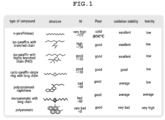
- the properties of each of the lube base oils according to the types of chemical compounds is shown in FIG. 1 .
- the top four compounds have a high paraffin content and a low naphthenic and aromatic content, thereby having an excellent VI. Therefore, with the use of these compounds, it is possible to prepare Group III+ lube base oils. However, as noted above, the amount of the top four compounds of FIG. 1 obtained from crude oil is very limited.
- the present disclosure is directed to providing a method for the preparation of Group III+ lube base oils using the top four compounds of FIG. 1 as well as the bottom three compounds as feeds for the preparation of lube base oils.
- the present disclosure provides a catalyst for SRO reactions that is capable of selectively opening some of the rings compounds in a feed for the preparation of a lube base oil.
- the SRO reaction opens the ring of naphthene or an aromatic compound in the feed and converts the naphthene or the aromatic compound to a branched paraffin. This makes it possible to obtain lube base oils having a higher VI than conventional lube base oils from the same feed.
- selective ring-opening(SRO) means preferentially cracking a carbon-carbon bond constituting a cyclic compound in a hydrocarbon compound having two or more rings to a carbon-carbon bond constituting the main chain and a carbon-carbon bond constituting a branch hydrocarbon connected to the cyclic compound.
- the ring opening reaction of the present disclosure aims to minimize cracking the carbon bonds that make up the main chain, and to selectively open only the carbon bonds that make up a cyclic compound, thereby maintaining the properties and yield of the lube base oil.
- An SRO reaction catalyst according to the present disclosure is a bi-functional catalyst including a solid acid material and a metal. While not being bound by any particular theory, it is expected that in the present disclosure, the SRO reactions may include reactions carried out through mechanisms such as those exemplified below.
- the function of the metal catalyst is required for the dehydrogenation and hydrofinishing reactions, and the function of the acid catalyst is required for the isomerization and ⁇ -cutting reactions, and it is expected that the metal and the solid acid used in the catalyst of the present disclosure may each fulfill the respective functions.
- the solid acid material refers to a solid material having a Brönsted acid site or a Lewis acid site.
- the solid acid material may include a first solid acid material and a second solid acid material.
- the first solid acid material has a pore size of about 1 nm or less and the second solid acid material has a pore size of greater than about 1 nm.
- the pore size of the second solid acid material may preferably be in the range of from greater than about 1 nm to 100,000 nm. More preferably, the pore size may be about 10 nm or more to about 100,000 nm or less.
- the first solid acid material comprises a zeolite, crystalline aluminosilicate, silica-alumina-phosphate (SAPO), aluminum phosphate (AlPO), a metal organic framework (MOF), or a combination thereof.
- SAPO silica-alumina-phosphate
- AlPO aluminum phosphate
- MOF metal organic framework
- the zeolite may be, for example, SAPO-11, SAPO-41, ZSM-5, ZSM-12, ZSM-23, ZSM-48, FAU, BETA, or MOR
- the first solid acid material is responsible for the treatment of compounds (for instance, a paraffin-based compound or a single ring compound) other than multiple-ring compounds in the feed and may contribute to increasing the selectivity of the second solid acid material for treatment of the multiple ring-compounds.
- compounds for instance, a paraffin-based compound or a single ring compound
- the second solid acid material may comprise silica-alumina (amorphous silica-alumina, ASA), clay, zirconia sulfated, zirconia, titania, niobia, alumina, silica, or a combination thereof.
- silica-alumina amorphous silica-alumina, ASA
- clay amorphous silica-alumina, ASA
- zirconia sulfated zirconia
- titania niobia
- alumina silica, or a combination thereof.
- the second solid acid material may be clay.
- the clay may be, but is not limited to, kaolinite, monmorillonite, smectite, illite, chlorite, vermiculite, talc, pyrophyllite, and the like, or may be a combination of the foregoing.
- the clay may be kaolinite.
- Multiple-ring compounds may be bulk in volume as compared to single-ring compounds or paraffin-based hydrocarbon compounds due to the presence of a plurality of rings. Because of the relatively small pore size of the first solid acid material, the multiple-ring compounds are difficult to have access to the active site of the first solid acid material, and thus the first solid acid material fails to induce a SRO reaction of the multiple-ring compounds.
- the second solid acid material on the other hand, has a relatively large pore size compared to the first solid acid material. Accordingly, the SRO reaction of the multiple-ring compounds can be carried out within the pores of the second solid acid material.
- the solid acid materials of the present disclosure may also function as a carrier and/or a binder.
- the solid acid material serves as a carrier and thus functions to support a metal component included in the catalyst of the present disclosure.
- the solid acid material may also serve as a binder and contribute to forming of the catalyst having sufficient strength so that that the catalyst of the present disclosure can be stably used in high temperature, high pressure reactors.
- the catalyst may further comprises a non-acidic carrier and/or binder.
- non-acidic carrier and binder refers to a material that does not function as an acid catalyst but can function as a carrier or binder, unlike the solid acid material.
- the non-acidic carrier and binder may be used additionally in the present disclosure to make the catalyst stable.
- the non-acidic binder may comprise carbon, silicon carbide, pseudo boehmite, or a mixture thereof
- the catalyst of the present disclosure comprises a metal.
- the metal may be a Group VIII metal.
- the metal may be Pt, Pd, Ru, Ir, Ni, Co, Fe, or a combination thereof.
- the metal is expected to promote dehydrogenation and hydrogenation in the catalyst of the present disclosure.
- the metal may also contribute to preventing deactivation of the catalyst.
- side reactions described below may also occur.
- the side reactions also occur at the active site of the solid acid material, and due to such adsorption, the catalyst can theoretically be deactivated.
- the catalyst of the present disclosure may include both of the metal and the solid acid material, the metal may promote a hydrogenation reaction, thereby facilitating a desorption reaction to cause a material adsorbed on the solid acid material to be desorbed.
- the catalyst may comprise the metal in an amount of 0.05% to 5% by weight, based on the total weight of the catalyst.
- the catalyst may comprise the metal in an amount of 0.1% to 3% by weight, and more preferably an amount of about 0.2% to 1% by weight.
- the content of the metal is less than about 0.05% by weight, since the content of the metal contained in the catalyst is too low, the function of the metal cannot be sufficiently performed. Particularly, there may be a problem in that the catalyst is deactivated in a very short time of use of the catalyst.
- the content of the metal exceeds 5% by weight, the hydrogenation reaction is excessively promoted, resulting in reduction in the efficiency of the SRO reaction, or resulting in the clogging of the solid acid active site in the solid acid material by the metal.
- the pores of the catalyst corresponding to about 20% or more of the pore volume of the entire pore volume of the catalyst may have a pore size of about 10 nm or more.
- the pores corresponding to, preferably at least about 30%, more preferably at least about 50%, even more preferably at least about 70%, yet even more preferably at least about 80%, and most preferably at least about 85%, of the total pore volume of the catalyst may have a pore size of about 10 nm or more.
- the pores corresponding to about 90% of the total pore volume may have such a pore size.
- the pore size may be about 50 nm or more, and more preferably about 100 nm or more.
- the upper limit of the pore size range may be about 1,000,000 nm.
- the catalyst of the present disclosure includes a specific percentage of the pores having a size larger than or equal to a specific nanometer, thereby enabling SRO reactions of bulky multiple-ring compounds. When the catalyst has a pore distribution below the levels listed above, it will be difficult to expect an improvement in the VI to be achieved by the catalyst of the present disclosure.
- the catalyst comprising the non-acidic binder may comprise, with respect to 100 parts by weight of the second solid acid material, about 10 to 100 parts by weight of the first solid acid material and about 10 to 100 parts by weight of the non-acidic binder.
- the catalyst may comprise about 30 to 90 parts by weight, more preferably about 40 to 80 parts by weight, more preferably about 50 to 70 parts by weight of the first solid acid material, relative to 100 parts by weight of the second solid acid material.
- the catalyst may comprise about 20 to 80 parts by weight, more preferably about 20 to 60 parts by weight, more preferably about 30 to 50 parts by weight of the non-acidic binder, relative to 100 parts by weight of the second solid acid material.
- the problem of decreasing the yield of the lube base oil may arise due to the degradation at the time of the reaction.
- the content of the non-acidic binder is lower than the lower limit of the above-mentioned range, a problem that the catalyst breaks in harsh reaction environments due to insufficient strength of the catalyst prepared may occur.
- the catalyst of the present disclosure may further comprise a promoter as needed.
- the promoter may be included for the purpose of modulating the reaction activity of the metal included in the catalyst.
- the promoter may be an alkali metal, an alkaline earth metal, a Group Vb metal, a Group VIb metal, Sn, or a combination thereof
- the promoter may preferably comprise Mg, Ca, or a combination thereof
- the content of the promoter in the catalyst of the present disclosure may be in a range of from about 1% to 10% by weight, based on the total weight of the catalyst.
- the Catalyst for SRO reactions of the present disclosure may be used in the methods described below.
- the present disclosure also provides a method of increasing the VI of a lube base oil by using the catalyst described above.
- the method comprises subjecting a reactant to a SRO reaction in the presence of the catalyst for SRO reactions.
- the reactant comprises: a feed for the preparation of a lube base oil; an intermediate oil in a lube base oil preparation process; or a lube base oil.
- the reactant may be a feed for the preparation of a lube base oil; or an intermediate oil in a lube base oil preparation process.
- the reactant may be an intermediate oil in a lube base oil preparation process.
- the intermediate oil refers to an oil that is produced when a feed for the preparation of a lube base oil has passed through at least one reactor and which is present before entering the hydrofinishing reaction.
- the intermediate oil in the present disclosure may be an oil present before or after a HDW reaction.
- the reactant may be an oil comprising a cyclic hydrocarbon compound.
- the reactant may satisfy the condition of 5% by weight ⁇ C N + C A ⁇ 100% by weight, and preferably the conditions of C P > 50% by weight and 20% by weight ⁇ C N + C A ⁇ 50% by weight.
- C P represents the content of paraffins
- C N represents the content of naphthene
- C A represents the content of aromatic compounds.
- the C A of the reactants may be 5% by weight or less and preferably 1% by weight or less.
- the SRO reaction may be carried out in the presence of hydrogen at a temperature in the range of from 100°C to 450°C.
- the reaction conditions except for the catalyst and temperature may be the same as the process conditions of a conventional HDW process.
- the VI of the lube base oil having undergone the method is greater than the VI of the lube base oil having not undergone the method by at least 5.
- the VI difference between the lube base oils may be greater than or equal to 8 and more preferably greater than or equal to 10.
- the present disclosure provides a method of preparing a lube base oil by using the catalyst described above.
- the method comprises the steps of a) preparing a feed; b) introducing the feed into any one of a HDW reaction and a SRO reaction; and c) introducing the reaction product of step b) into the remaining one of the HDW reaction and the SRO reaction.
- the SRO reaction is carried out in the presence of the catalyst of the present disclosure described above.
- the feed in the present disclosure is not particularly limited if it can be used as raw materials in conventional lube base oil preparation processes.
- the feed in the present disclosure may comprise oils that contain a lot of naphthene and aromatic compounds that have been difficult to use as raw materials in conventional lube base oil preparation processes for high-quality lube base oils such as Group III or higher lube base oils.
- the feed may be an oil comprising a cyclic hydrocarbon compound.
- the reactant may satisfy the condition of 5% by weight ⁇ C N + C A ⁇ 100% by weight, and preferably the conditions of C P > 50% by weight and 20% by weight ⁇ C N + C A ⁇ 50% by weight.
- C P represents the content of paraffins
- C N represents the content of naphthene
- C A represents the content of aromatic compounds.
- the C A of the reactants may be 5% by weight or less, and preferably 1% by weight or less.
- the HDW reaction refers to a reaction in which a wax component, such as n-paraffin, is isomerized to iso-paraffin, thereby removing the wax component.
- the HDW reaction may reduce the pour point of a lube base oil, thereby improving the low temperature performance of the lube base oil.
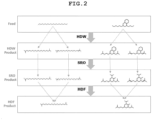
- FIG. 2 is a schematic illustration of structural changes in hydrocarbon compounds at each stage when a lube base oil preparation method according to one embodiment of the present disclosure is performed according to the defined sequence.
- the feed may first be introduced into a HDW reaction and then be introduced into a SRO reaction.
- the feed may first be introduced into the SRO reaction and then be introduced into the HDW reaction.
- both reactions are independent of each other in the point that the HDW reaction uses n-paraffins as the main reactants, and the SRO reaction uses cyclic hydrocarbon compounds such as naphthene and aromatic compound as the main reactants. Therefore, it does not matter that the order in which the reactions are performed is reversed.
- the HDW reaction is carried out under harsher reaction conditions than the SRO reaction. Therefore, in terms of the yield of the production of a lube base oil, desirably, the HDW reaction and the SRO reaction are separately performed.
- the SRO reaction is subsequent to the HDW reaction. This is because when the SRO reaction is performed after a small amount of aromatic compounds, impurities, and the like present in the feed are removed by the HDW reaction, side reactions attributable to the cracking are minimized, so that the loss in production yield can be prevented.
- the reaction conditions of the HDW reaction may be the same as the reaction conditions of conventional HDW reactions and may not be particularly limited.
- the HDW reaction is performed under conditions of a reaction temperature of 250°C to 410°C, a reaction pressure of 30 to 200 kg/cm 2 , a space velocity (LHSV) of 0.1 to 3.0 hr -1 , and a volumetric ratio of hydrogen to the feed of 150 to 1000 Nm 3 /m 3 .
- the catalyst that can be used in the HDW reaction comprises: a carrier having an acid site; and one or more hydrogenating metals selected from the elements of Groups 2, 6, 9 and 10 in the Periodic table.
- a carrier having an acid site i.e., Group VIII metals
- Co, Ni, Pt, and Pd are preferably used
- Mo and W are preferably used.
- the types of carriers having acid sites comprise molecular sieves, alumina, silica-alumina, and the like.
- the molecular sieves refer to crystalline aluminosilicates (zeolite), SAPO, ALPO, and the like.
- a medium-pore molecular sieve with a 10-membered oxygen ring such as SAPO-11, SAPO-41, ZSM-11, ZSM-22, ZSM-23, ZSM-35, or ZSM-48 may be used, and a large-pore molecular sieve with a 12-membered oxygen ring may be used.
- reaction conditions of the SRO reaction may be the same as the reaction conditions of the SRO reaction used in the method of increasing the VI of a lube base oil described above.
- the preparation method may further comprise introducing the reaction product of step c) into a hydrofinishing reaction.
- the hydrofinishing reaction may remove olefins and residual polycyclic aromatic compounds in the oil to ensure the stability of the prepared lube base oil.
- the reaction conditions of the hydrofinishing reaction may be the same as the reaction conditions of conventional hydrofinishing reactions and may not be particularly limited.
- the hydrofinishing reaction is performed under conditions of a reaction temperature of 250°C to 300°C, a reaction pressure of 30 to 200 kg/cm 2 , a space velocity (LHSV) of 0.1 to 3h -1 , and a volumetric ratio of hydrogen to feed of 300 to 1500 Nm 3 /m 3 .
- a catalyst used for the hydrofinishing reaction may be a catalyst in which a metal is supported on a carrier.
- the metal comprises one or more metals selected from Group 6, Group 8, Group 9, Group 10, and Group 11 elements having a hydrogenation function.
- a metal sulfide of Ni-Mo, Co-Mo, or Ni-W, or a noble metal such as Pt or Pd may be used.
- the carrier of the catalyst used for the hydrofinishing reaction may be silica, alumina, silica-alumina, titania, zirconia, or zeolite, each of which has a large surface area.
- alumina or silica-alumina may be used.
- the feed may be introduced into the HDW reaction first, and a HDW reaction product may then be introduced into the SRO reaction and the hydrofinishing reaction at the same time.
- the SRO reaction and the hydrofinishing reaction may be carried out under similar reaction conditions except for the catalyst.
- the preparation method may further comprise fractionating the reaction products to separate lube base oils having desired specifications after the hydrofinishing reaction.
- the VI of the lube base oil prepared by the lube base oil preparation method of the present disclosure is greater than the VI of the lube base oil prepared by a conventional lube base oil preparation method in which no SRO reaction is carried out by at least 5.
- the VI difference may be greater than or equal to 8 and more preferably greater than or equal to 10.
- a catalyst that is not impregnated with Pt was prepared using the same preparation method for Sample 1 except for the impregnation step.
- a catalyst thus obtained was referred to as Sample 2.
- ZSM-48 zeolite and pseudo-boehmite as a binder were mixed in a weight ratio of about 1:1 and then co-mulled. Subsequently, the mixture of the zeolite and the binder was impregnated with an aqueous solution of [Pt(NH 3 ) 4 ](NO 3 ) 2 such that the content of Pt became 0.5% by weight, based on the total weight of the catalyst, and then the impregnated mixture underwent forming. The formed mixture was then dried at a temperature of about 120°C for about 3 hours and calcined at about 500°C for about 3 hours. A catalyst thus obtained was referred to as Sample 3.
- Sample 2 (Condition of pressure ranging from 0.20 to 61,000.00 psia)
- Sample 3 (Condition of pressure ranging from 0.10 to 60,000.00 psia) Total penetration volume (mL/g) 0.71 0.35 Total pore area (m 2 /g) 14.64 178.91 Medium pore size-volume (nm) 21109.81 7.80 Medium pore size-volume (nm) 24.02 7.60 Average pore size-4V/A (nm) 193.01 7.80 Bulk density (g/mL) 0.81 1.20 Apparent density (g/mL) 1.90 2.06 Porosity (%) 57.29 41.89
- Feeds were sequentially introduced into an HDW reaction and an HDF reaction to prepare a lube base oil.
- the reaction conditions were as shown in Table 3 below.
- the properties of the prepared lube base oil are shown in Table 4.
- Feeds were sequentially introduced into an HDW reaction, an SRO reaction, and an HDF reaction to prepare a lube base oil.
- the SRO reaction was carried out in the presence of the catalyst of Sample 2, and the reaction conditions were as shown in Table 3.
- the properties of the prepared lube base oil are shown in Table 4.
- a lube base oil was prepared in the same manner as in Experimental example 1 except that the reaction temperature of the SRO reaction was changed to 280°C.
- the reaction conditions were as shown in Table 3 below.
- the properties of the prepared lube base oil are shown in Table 4.
- a lube base oil was prepared in the same manner as in Experimental example 1 except that the reaction temperature of the SRO reaction was changed to 320°C, and the SRO reaction was performed in the presence of the catalyst of Sample 3.
- the reaction conditions were as shown in Table 3 below.
- the properties of the prepared lube base oil are shown in Table 4.
- the lube base oil prepared in Comparative experimental example 1 in which the SRO reaction was not performed exhibits a higher VI than the lube base oil prepared in Comparative experimental example 2 in which the SRO reaction was performed in the presence of the catalyst of Sample 3. It can also be seen that the pour point of the lube base oil prepared in Comparative experimental example 2 is lower. It appears that since the catalyst of Sample 3 had fewer pores with large pore sizes of 10 nm or more, the ring-opening reaction of bulky multiple-cyclic hydrocarbon compounds cannot be promoted. Rather, considering the results of Comparative experimental example 2, it is considered that the catalyst of Sample 3 promoted the cracking reaction in the oil.
- Comparative experimental example 1 The composition of each of the lube base oils prepared in Comparative experimental example 1 and Experimental example 1, respectively was analyzed. The analysis result is shown in Table 5 below.
- Comparative experimental example 1 Experimental example 1 VI 120 129 Iso-paraffin 58.9% by weight 62.2% by weight 1-ring naphthene 30.9% by weight 29.7% by weight 2-ring naphthene 6.2% by weight 4.9% by weight 2-ring naphthene 2.6% by weight 2.4% by weight 4-ring+ naphthene 1.3% by weight 0.9% by weight
Landscapes
- Chemical & Material Sciences (AREA)
- Organic Chemistry (AREA)
- Chemical Kinetics & Catalysis (AREA)
- Engineering & Computer Science (AREA)
- Materials Engineering (AREA)
- Oil, Petroleum & Natural Gas (AREA)
- General Chemical & Material Sciences (AREA)
- Crystallography & Structural Chemistry (AREA)
- Dispersion Chemistry (AREA)
- Physics & Mathematics (AREA)
- Thermal Sciences (AREA)
- Catalysts (AREA)
Abstract
Description
- The present application claims priority to
Korean Patent Application No. 10-2021-0142897, filed October 25, 2021 - The present disclosure relates to a catalyst for selective ring-opening (SRO) reactions and a method of using the same. More particularly, the present disclosure relates to a catalyst for SRO reactions that can be used in lube base oil preparation processes and to a method of applying the catalyst to lube base oil preparation processes.
- Lube base oil is a raw material for lubricants. In general, good lube base oils have a high viscosity index(VI), high stability (resistant to oxidation, heat, UV, etc.), and low volatility. The American Petroleum Institute (API) classifies lube base oils as shown in Table 1 below according to their quality, such as sulfur content, saturation, and VI.
[Table 1] Classification Sulfur content (%) Saturate (%) VI Group I > 0.03 < 90 80 - 120 Group II ≤ 0.03 ≥ 90 80 - 120 Group III ≤ 0.03 ≥ 90 120 or more Group IV All poly alpha olefins (PAOs) Group V All other lube base oils not included in Group I, II, III, or IV - Lube base oils classified into Group IV are highest-quality oils, and their quality is lowered from Group IV to Group I. Higher-quality lube base oils have a lower sulfur and nitrogen content, higher VI, lower pour point, lower CCS viscosity, and lower Noack volatility. In addition, the higher the quality of the lube base oil, the higher the paraffin content, and the lower the naphthenic content and the aromatic content.
- The VI is one of the important physical properties for assessing the quality of lube base oils. The VI is an index related to changes in viscosity related to changes in temperature. The higher the VI, the smaller the change in viscosity for the change in temperature. Therefore, a lube base oil having a high VI is advantageous in terms of engine protection due to its relatively high viscosity at high temperatures, and it is advantageous in terms of driving an engine pump due to its relatively low viscosity at low temperatures. For this reason, lube base oils with a high VI are rated as higher-quality base oils. In addition, there is a growing market demand for lube base oils (hereinafter, referred to as Group III+ lube base oils) having a higher VI than Group III oils.
- There are two primary methods known for producing lube base oils having a higher VI than Group III oils. They are i) preparation of synthetic base oils (Group IV) from chemical raw materials, and ii) structural isomerization reaction with a feed (starting material) having a high paraffin content. However, in the case of i), there are problems that raw materials are expensive compared to mineral oil-based lube base oils, and the amount of raw materials that can be used is small. Therefore, the influence on the market is insignificant. In the case of ii), there is a problem that it is difficult to obtain an oil with a high paraffin content that can be used as a feed. This makes it difficult to supply large quantities to the market.
- (Patent Literature 1)
KR 10-2018-0132101 A1 - Accordingly, the present disclosure is to suggest a new solution to enable mass supply of lube base oils with high VI to the market. A first aspect of the present disclosure is to provide a catalyst for SRO reactions. A second aspect of the present disclosure is to provide a method of enhancing the VI of a lube base oil by using a catalyst of the first aspect. A third aspect of the present disclosure is to provide a method of preparing a lube base oil by using the catalyst of the first aspect.
- A catalyst for SRO reactions to achieve the first aspect of the present disclosure includes a solid acid material and a metal, wherein pores of the catalyst corresponding to a 20% or more pore volume with respect to the total pore volume of the catalyst have a pore size of 10 nm or more.
- According to one embodiment of the present disclosure, the solid acid material comprises a first solid acid material and a second solid acid material, the first solid acid material having a pore size of 1 nm or less, and the second solid acid material having a pore size of greater than 1 nm.
- According to one embodiment of the present disclosure, the first solid acid material comprises a zeolite, crystalline aluminosilicate, silica-alumina-phosphate (SAPO), aluminum phosphate (AlPO), a metal organic framework (MOF), or a combination thereof.
- According to one embodiment of the present disclosure, the second solid acid material comprises silica-alumina (amorphous silica-alumin, ASA), clay, zirconia sulfated, zirconia, titania, niobia, alumina, silica, or a combination thereof.
- According to one embodiment of the present disclosure, the metal is a Group VIII metal.
- According to one embodiment of the present disclosure, the catalyst comprises the metal in an amount of 0.05% to 5% by weight with respect to the total weight of the catalyst.
- According to one embodiment of the present disclosure, the catalyst further comprises a non-acidic binder.
- According to one embodiment of the present disclosure, the catalyst comprises, with respect to 100 parts by weight of the second solid acid material, 10 to 100 parts by weight of the first solid acid material and 10 to 100 parts by weight of the non-acidic binder.
- According to one embodiment of the present disclosure, the catalyst further comprises a promoter, in which the promoter comprises an alkali metal, an alkaline earth metal, a Group Vb metal, a Group VIb metal, Sn, or a combination thereof.
- A method of increasing the VI of a lube base oil to achieve the second aspect of the present disclosure comprises subjecting a reactant to a SRO reaction in the presence of the catalyst of the first aspect of the present disclosure.
- According to one embodiment of the present disclosure, the reactant includes: a feed for preparation of a lube base oil; an intermediate oil in a lube base oil preparation process; or a lube base oil.
- According to one embodiment of the present disclosure, the SRO reaction is carried out in the presence of hydrogen within a temperature in the range of from 100°C to 450°C.
- A method of preparing a lube base oil to achieve the third aspect of the present disclosure comprises the steps of: a) preparing a feed; b) introducing the feed into any one of a hydrodewaxing (HDW) reaction and a SRO reaction; and c) introducing the reaction product of step b) into the remaining one of the HDW reaction and the SRO reaction, in which the SRO reaction is carried out in the presence of the catalyst of
claim 1. - According to one embodiment of the present disclosure, the method further comprises d) introducing the reaction product of step c) into a hydrothermal (HDF) reaction.
- According to one embodiment of the present disclosure, the VI of the lube base oil prepared by the method is greater than the VI of the lube base oil prepared by a lube base oil preparation method in which no SRO reaction is carried out by at least.
- It is possible to prepare lube base oils having increased VI using a wider range of feeds by using the catalysts of the present disclosure.
-
-
FIG. 1 is a schematic illustration of the properties of each lube base oil according to the types of chemicals constituting the lube base oils; -
FIG. 2 is a schematic illustration of structural changes in hydrocarbon compounds at each stage when a lube base oil preparation method according to one embodiment of the present disclosure is performed according to the defined sequence in the method; -
FIG. 3 is a graph illustrating measurements of pore size distribution of a catalyst according to an example of the present disclosure; and -
FIG. 4 is a chart illustrating changes in viscosity of a lube base oil according to the number of days of treatment, measured according to one example of the present disclosure. - The above and other objectives, features, and advantages of the present disclosure will be more clearly understood from the following detailed description taken in conjunction with the accompanying drawings, but the present disclosure is not limited thereto. In describing the present disclosure, when the detailed description of the relevant known technology is determined to unnecessarily obscure the gist of the present disclosure, the detailed description may be omitted.
- The VI described above is influenced by the type of a hydrocarbon compound present in a lube base oil. Specifically, the VI of the lube base oil may vary depending on the content of paraffin compound/naphthenic compound/aromatic compound in the lube base oil. It is generally known that the higher the content of the compounds in order of paraffin > naphthenic > aromatic, the higher the VI. The properties of each of the lube base oils according to the types of chemical compounds is shown in
FIG. 1 . - Referring to
FIG. 1 , the top four compounds have a high paraffin content and a low naphthenic and aromatic content, thereby having an excellent VI. Therefore, with the use of these compounds, it is possible to prepare Group III+ lube base oils. However, as noted above, the amount of the top four compounds ofFIG. 1 obtained from crude oil is very limited. - The present disclosure is directed to providing a method for the preparation of Group III+ lube base oils using the top four compounds of
FIG. 1 as well as the bottom three compounds as feeds for the preparation of lube base oils. - The present disclosure provides a catalyst for SRO reactions that is capable of selectively opening some of the rings compounds in a feed for the preparation of a lube base oil. The SRO reaction opens the ring of naphthene or an aromatic compound in the feed and converts the naphthene or the aromatic compound to a branched paraffin. This makes it possible to obtain lube base oils having a higher VI than conventional lube base oils from the same feed.
- In the present disclosure, "selective ring-opening(SRO)" means preferentially cracking a carbon-carbon bond constituting a cyclic compound in a hydrocarbon compound having two or more rings to a carbon-carbon bond constituting the main chain and a carbon-carbon bond constituting a branch hydrocarbon connected to the cyclic compound. The ring opening reaction of the present disclosure aims to minimize cracking the carbon bonds that make up the main chain, and to selectively open only the carbon bonds that make up a cyclic compound, thereby maintaining the properties and yield of the lube base oil.
- An SRO reaction catalyst according to the present disclosure is a bi-functional catalyst including a solid acid material and a metal. While not being bound by any particular theory, it is expected that in the present disclosure, the SRO reactions may include reactions carried out through mechanisms such as those exemplified below.

- In the mechanism, the function of the metal catalyst is required for the dehydrogenation and hydrofinishing reactions, and the function of the acid catalyst is required for the isomerization and β-cutting reactions, and it is expected that the metal and the solid acid used in the catalyst of the present disclosure may each fulfill the respective functions.
- In the present disclosure, the solid acid material refers to a solid material having a Brönsted acid site or a Lewis acid site. According to one embodiment of the present disclosure, the solid acid material may include a first solid acid material and a second solid acid material. The first solid acid material has a pore size of about 1 nm or less and the second solid acid material has a pore size of greater than about 1 nm. In the present disclosure, the pore size of the second solid acid material may preferably be in the range of from greater than about 1 nm to 100,000 nm. More preferably, the pore size may be about 10 nm or more to about 100,000 nm or less.
- According to one embodiment of the present disclosure, the first solid acid material comprises a zeolite, crystalline aluminosilicate, silica-alumina-phosphate (SAPO), aluminum phosphate (AlPO), a metal organic framework (MOF), or a combination thereof. The zeolite may be, for example, SAPO-11, SAPO-41, ZSM-5, ZSM-12, ZSM-23, ZSM-48, FAU, BETA, or MOR
- The first solid acid material is responsible for the treatment of compounds (for instance, a paraffin-based compound or a single ring compound) other than multiple-ring compounds in the feed and may contribute to increasing the selectivity of the second solid acid material for treatment of the multiple ring-compounds.
- According to one embodiment of the present disclosure, the second solid acid material may comprise silica-alumina (amorphous silica-alumina, ASA), clay, zirconia sulfated, zirconia, titania, niobia, alumina, silica, or a combination thereof.
- In the present disclosure, the second solid acid material may be clay. The clay may be, but is not limited to, kaolinite, monmorillonite, smectite, illite, chlorite, vermiculite, talc, pyrophyllite, and the like, or may be a combination of the foregoing. In the present disclosure, the clay may be kaolinite.
- Multiple-ring compounds may be bulk in volume as compared to single-ring compounds or paraffin-based hydrocarbon compounds due to the presence of a plurality of rings. Because of the relatively small pore size of the first solid acid material, the multiple-ring compounds are difficult to have access to the active site of the first solid acid material, and thus the first solid acid material fails to induce a SRO reaction of the multiple-ring compounds. The second solid acid material, on the other hand, has a relatively large pore size compared to the first solid acid material. Accordingly, the SRO reaction of the multiple-ring compounds can be carried out within the pores of the second solid acid material.
- The solid acid materials of the present disclosure may also function as a carrier and/or a binder. The solid acid material serves as a carrier and thus functions to support a metal component included in the catalyst of the present disclosure. The solid acid material may also serve as a binder and contribute to forming of the catalyst having sufficient strength so that that the catalyst of the present disclosure can be stably used in high temperature, high pressure reactors.
- According to other embodiments of the present disclosure, the catalyst may further comprises a non-acidic carrier and/or binder. In the present disclosure, the term "non-acidic carrier and binder" refers to a material that does not function as an acid catalyst but can function as a carrier or binder, unlike the solid acid material. The non-acidic carrier and binder may be used additionally in the present disclosure to make the catalyst stable. For example, the non-acidic binder may comprise carbon, silicon carbide, pseudo boehmite, or a mixture thereof
- In addition, the catalyst of the present disclosure comprises a metal. According to one embodiment of the present disclosure, the metal may be a Group VIII metal. Preferably, the metal may be Pt, Pd, Ru, Ir, Ni, Co, Fe, or a combination thereof. In the event that a SRO reaction including a reaction following the SRO reaction mechanism described above progresses, the metal is expected to promote dehydrogenation and hydrogenation in the catalyst of the present disclosure.
- It is also expected that the metal may also contribute to preventing deactivation of the catalyst. Although not being bound by any particular theory, when a SRO reaction progresses, in the case where a reaction following the SRO reaction mechanism described above is performed, side reactions described below may also occur.

- As with SRO reactions, the side reactions also occur at the active site of the solid acid material, and due to such adsorption, the catalyst can theoretically be deactivated. However, since the catalyst of the present disclosure may include both of the metal and the solid acid material, the metal may promote a hydrogenation reaction, thereby facilitating a desorption reaction to cause a material adsorbed on the solid acid material to be desorbed.
- According to one embodiment of the present disclosure, the catalyst may comprise the metal in an amount of 0.05% to 5% by weight, based on the total weight of the catalyst. Preferably, the catalyst may comprise the metal in an amount of 0.1% to 3% by weight, and more preferably an amount of about 0.2% to 1% by weight. When the content of the metal is less than about 0.05% by weight, since the content of the metal contained in the catalyst is too low, the function of the metal cannot be sufficiently performed. Particularly, there may be a problem in that the catalyst is deactivated in a very short time of use of the catalyst. On the other hand, when the content of the metal exceeds 5% by weight, the hydrogenation reaction is excessively promoted, resulting in reduction in the efficiency of the SRO reaction, or resulting in the clogging of the solid acid active site in the solid acid material by the metal.
- According to one embodiment of the present disclosure, in the catalyst of the present disclosure, the pores of the catalyst corresponding to about 20% or more of the pore volume of the entire pore volume of the catalyst may have a pore size of about 10 nm or more. The pores corresponding to, preferably at least about 30%, more preferably at least about 50%, even more preferably at least about 70%, yet even more preferably at least about 80%, and most preferably at least about 85%, of the total pore volume of the catalyst may have a pore size of about 10 nm or more. The pores corresponding to about 90% of the total pore volume may have such a pore size. preferably, the pore size may be about 50 nm or more, and more preferably about 100 nm or more. The upper limit of the pore size range may be about 1,000,000 nm. The catalyst of the present disclosure includes a specific percentage of the pores having a size larger than or equal to a specific nanometer, thereby enabling SRO reactions of bulky multiple-ring compounds. When the catalyst has a pore distribution below the levels listed above, it will be difficult to expect an improvement in the VI to be achieved by the catalyst of the present disclosure.
- In one embodiment of the present disclosure, the catalyst comprising the non-acidic binder may comprise, with respect to 100 parts by weight of the second solid acid material, about 10 to 100 parts by weight of the first solid acid material and about 10 to 100 parts by weight of the non-acidic binder. Preferably, the catalyst may comprise about 30 to 90 parts by weight, more preferably about 40 to 80 parts by weight, more preferably about 50 to 70 parts by weight of the first solid acid material, relative to 100 parts by weight of the second solid acid material. Preferably, the catalyst may comprise about 20 to 80 parts by weight, more preferably about 20 to 60 parts by weight, more preferably about 30 to 50 parts by weight of the non-acidic binder, relative to 100 parts by weight of the second solid acid material. When the content of the first solid acid material and the non-acidic binder falls outside of this range, the problem of decreasing the yield of the lube base oil may arise due to the degradation at the time of the reaction. In particular, when the content of the non-acidic binder is lower than the lower limit of the above-mentioned range, a problem that the catalyst breaks in harsh reaction environments due to insufficient strength of the catalyst prepared may occur.
- According to one embodiment of the present disclosure, the catalyst of the present disclosure may further comprise a promoter as needed. The promoter may be included for the purpose of modulating the reaction activity of the metal included in the catalyst. The promoter may be an alkali metal, an alkaline earth metal, a Group Vb metal, a Group VIb metal, Sn, or a combination thereof In the present disclosure, the promoter may preferably comprise Mg, Ca, or a combination thereof In one embodiment of the present disclosure, the content of the promoter in the catalyst of the present disclosure may be in a range of from about 1% to 10% by weight, based on the total weight of the catalyst.
- The Catalyst for SRO reactions of the present disclosure may be used in the methods described below.
- The present disclosure also provides a method of increasing the VI of a lube base oil by using the catalyst described above. The method comprises subjecting a reactant to a SRO reaction in the presence of the catalyst for SRO reactions. According to one embodiment of the present disclosure, the reactant comprises: a feed for the preparation of a lube base oil; an intermediate oil in a lube base oil preparation process; or a lube base oil. Preferably the reactant may be a feed for the preparation of a lube base oil; or an intermediate oil in a lube base oil preparation process. Most preferably the reactant may be an intermediate oil in a lube base oil preparation process.
- The intermediate oil refers to an oil that is produced when a feed for the preparation of a lube base oil has passed through at least one reactor and which is present before entering the hydrofinishing reaction. For example, the intermediate oil in the present disclosure may be an oil present before or after a HDW reaction.
- According to one embodiment of the present disclosure, the reactant may be an oil comprising a cyclic hydrocarbon compound. The reactant may satisfy the condition of 5% by weight ≤ CN + CA < 100% by weight, and preferably the conditions of CP > 50% by weight and 20% by weight ≤ CN + CA ≤ 50% by weight.
- Here, CP represents the content of paraffins, CN represents the content of naphthene, and CA represents the content of aromatic compounds. In the present disclosure, the CA of the reactants may be 5% by weight or less and preferably 1% by weight or less.
- According to one embodiment of the present disclosure, the SRO reaction may be carried out in the presence of hydrogen at a temperature in the range of from 100°C to 450°C. The reaction conditions except for the catalyst and temperature may be the same as the process conditions of a conventional HDW process.
- According to one embodiment of the present disclosure, the VI of the lube base oil having undergone the method is greater than the VI of the lube base oil having not undergone the method by at least 5. Preferably, the VI difference between the lube base oils may be greater than or equal to 8 and more preferably greater than or equal to 10.
- The present disclosure provides a method of preparing a lube base oil by using the catalyst described above. The method comprises the steps of a) preparing a feed; b) introducing the feed into any one of a HDW reaction and a SRO reaction; and c) introducing the reaction product of step b) into the remaining one of the HDW reaction and the SRO reaction. Here, the SRO reaction is carried out in the presence of the catalyst of the present disclosure described above.
- The feed in the present disclosure is not particularly limited if it can be used as raw materials in conventional lube base oil preparation processes. The feed in the present disclosure may comprise oils that contain a lot of naphthene and aromatic compounds that have been difficult to use as raw materials in conventional lube base oil preparation processes for high-quality lube base oils such as Group III or higher lube base oils.
- According to one embodiment of the present disclosure, the feed may be an oil comprising a cyclic hydrocarbon compound. The reactant may satisfy the condition of 5% by weight ≤ CN + CA < 100% by weight, and preferably the conditions of CP > 50% by weight and 20% by weight ≤ CN + CA ≤ 50% by weight. Here, CP represents the content of paraffins, CN represents the content of naphthene, and CA represents the content of aromatic compounds. In the present disclosure, the CA of the reactants may be 5% by weight or less, and preferably 1% by weight or less.
- In the present disclosure, the HDW reaction refers to a reaction in which a wax component, such as n-paraffin, is isomerized to iso-paraffin, thereby removing the wax component. The HDW reaction may reduce the pour point of a lube base oil, thereby improving the low temperature performance of the lube base oil.
FIG. 2 is a schematic illustration of structural changes in hydrocarbon compounds at each stage when a lube base oil preparation method according to one embodiment of the present disclosure is performed according to the defined sequence. According to one embodiment of the present disclosure, as shown inFIG. 2 , the feed may first be introduced into a HDW reaction and then be introduced into a SRO reaction. According to another embodiment of the present disclosure, the feed may first be introduced into the SRO reaction and then be introduced into the HDW reaction. As can be seen fromFIG. 2 , both reactions are independent of each other in the point that the HDW reaction uses n-paraffins as the main reactants, and the SRO reaction uses cyclic hydrocarbon compounds such as naphthene and aromatic compound as the main reactants. Therefore, it does not matter that the order in which the reactions are performed is reversed. On the other hand, in general, the HDW reaction is carried out under harsher reaction conditions than the SRO reaction. Therefore, in terms of the yield of the production of a lube base oil, desirably, the HDW reaction and the SRO reaction are separately performed. In addition, in terms of the yield of the production of a lube base oil, more preferably, the SRO reaction is subsequent to the HDW reaction. This is because when the SRO reaction is performed after a small amount of aromatic compounds, impurities, and the like present in the feed are removed by the HDW reaction, side reactions attributable to the cracking are minimized, so that the loss in production yield can be prevented. - In the present disclosure, the reaction conditions of the HDW reaction may be the same as the reaction conditions of conventional HDW reactions and may not be particularly limited. According to one embodiment of the present disclosure, the HDW reaction is performed under conditions of a reaction temperature of 250°C to 410°C, a reaction pressure of 30 to 200 kg/cm2, a space velocity (LHSV) of 0.1 to 3.0 hr-1, and a volumetric ratio of hydrogen to the feed of 150 to 1000 Nm3/m3.
- The catalyst that can be used in the HDW reaction comprises: a carrier having an acid site; and one or more hydrogenating metals selected from the elements of
Groups - In the lube base oil preparation method according to the present disclosure, the reaction conditions of the SRO reaction may be the same as the reaction conditions of the SRO reaction used in the method of increasing the VI of a lube base oil described above.
- As shown in
FIG. 2 , according to one embodiment of the present disclosure, the preparation method may further comprise introducing the reaction product of step c) into a hydrofinishing reaction. The hydrofinishing reaction may remove olefins and residual polycyclic aromatic compounds in the oil to ensure the stability of the prepared lube base oil. - In the present disclosure, the reaction conditions of the hydrofinishing reaction may be the same as the reaction conditions of conventional hydrofinishing reactions and may not be particularly limited. According to one embodiment of the present disclosure, the hydrofinishing reaction is performed under conditions of a reaction temperature of 250°C to 300°C, a reaction pressure of 30 to 200 kg/cm2, a space velocity (LHSV) of 0.1 to 3h-1, and a volumetric ratio of hydrogen to feed of 300 to 1500 Nm3/m3.
- In addition, a catalyst used for the hydrofinishing reaction may be a catalyst in which a metal is supported on a carrier. The metal comprises one or more metals selected from Group 6, Group 8, Group 9,
Group 10, and Group 11 elements having a hydrogenation function. Preferably, a metal sulfide of Ni-Mo, Co-Mo, or Ni-W, or a noble metal such as Pt or Pd may be used. In addition, the carrier of the catalyst used for the hydrofinishing reaction may be silica, alumina, silica-alumina, titania, zirconia, or zeolite, each of which has a large surface area. Preferably, alumina or silica-alumina may be used. - According to one embodiment of the present disclosure, the feed may be introduced into the HDW reaction first, and a HDW reaction product may then be introduced into the SRO reaction and the hydrofinishing reaction at the same time. The SRO reaction and the hydrofinishing reaction may be carried out under similar reaction conditions except for the catalyst. In this case, there is an advantage that it becomes possible to carry out the method of the present disclosure using an conventional hydrofinishing reactor without the addition of anew reactor in a conventional lube base oil preparation plant comprising a HDW reactor and a hydrofinishing reactor.
- According to one embodiment of the present disclosure, the preparation method may further comprise fractionating the reaction products to separate lube base oils having desired specifications after the hydrofinishing reaction.
- According to one embodiment of the present disclosure, the VI of the lube base oil prepared by the lube base oil preparation method of the present disclosure is greater than the VI of the lube base oil prepared by a conventional lube base oil preparation method in which no SRO reaction is carried out by at least 5. Preferably, the VI difference may be greater than or equal to 8 and more preferably greater than or equal to 10. Hereinafter, preferred examples are presented to help the understanding of the present disclosure, but the following examples are provided only for easier understanding of the present disclosure, and thus the present disclosure is not limited thereto.
- USY zeolite, kaolin clay, and pseudo-boehmite as a binder were mixed in a weight ratio of about 30:50:20 and then co-mulled. Subsequently, the mixture of the zeolite, clay, and binder was impregnated with an aqueous solution of [Pt(NH3)4](NO3)2 such that the content of Pt became 0. 1% by weight, based on the total weight of the catalyst, and then the impregnated mixture underwent forming. The formed mixture was then dried at a temperature of about 120°C for about 3 hours and calcined at about 500°C for about 3 hours. A catalyst thus obtained was referred to as
Sample 1. - A catalyst that is not impregnated with Pt was prepared using the same preparation method for
Sample 1 except for the impregnation step. A catalyst thus obtained was referred to asSample 2. - ZSM-48 zeolite and pseudo-boehmite as a binder were mixed in a weight ratio of about 1:1 and then co-mulled. Subsequently, the mixture of the zeolite and the binder was impregnated with an aqueous solution of [Pt(NH3)4](NO3)2 such that the content of Pt became 0.5% by weight, based on the total weight of the catalyst, and then the impregnated mixture underwent forming. The formed mixture was then dried at a temperature of about 120°C for about 3 hours and calcined at about 500°C for about 3 hours. A catalyst thus obtained was referred to as
Sample 3. - The physical properties of
Samples [Table 2] Sample 2 (Condition of pressure ranging from 0.20 to 61,000.00 psia) Sample 3 (Condition of pressure ranging from 0.10 to 60,000.00 psia) Total penetration volume (mL/g) 0.71 0.35 Total pore area (m2/g) 14.64 178.91 Medium pore size-volume (nm) 21109.81 7.80 Medium pore size-volume (nm) 24.02 7.60 Average pore size-4V/A (nm) 193.01 7.80 Bulk density (g/mL) 0.81 1.20 Apparent density (g/mL) 1.90 2.06 Porosity (%) 57.29 41.89 - The pore size distributions of
Samples FIG. 3 . - In the case of
Sample 2, with respect to a total pore volume of 0.71 ml/g, it was confirmed that the pore volume of the pores with sizes of 100 nm or more accounts for about 85%. On the other hand, in the case ofSample 3, with respect to a total pore volume of 0.35 ml/g, it was confirmed that the pore volume of the pores having sizes of 100 nm or more accounts for about 6% or less. - Feeds were sequentially introduced into an HDW reaction and an HDF reaction to prepare a lube base oil. The reaction conditions were as shown in Table 3 below. The properties of the prepared lube base oil are shown in Table 4.
- Feeds were sequentially introduced into an HDW reaction, an SRO reaction, and an HDF reaction to prepare a lube base oil. The SRO reaction was carried out in the presence of the catalyst of
Sample 2, and the reaction conditions were as shown in Table 3. The properties of the prepared lube base oil are shown in Table 4. - A lube base oil was prepared in the same manner as in Experimental example 1 except that the reaction temperature of the SRO reaction was changed to 280°C. The reaction conditions were as shown in Table 3 below. The properties of the prepared lube base oil are shown in Table 4.
- A lube base oil was prepared in the same manner as in Experimental example 1 except that the reaction temperature of the SRO reaction was changed to 320°C, and the SRO reaction was performed in the presence of the catalyst of
Sample 3. The reaction conditions were as shown in Table 3 below. The properties of the prepared lube base oil are shown in Table 4.[Table 3] Comparative experimental example 1 Experimental example 1 Experimental example 2 Comparative experimental example 2 Feed 100D Kinematic viscosity (at 40°C) = 17.63 cSt Kinematic viscosity (at 100°C) = 4.024 cSt H2 partial pressure 160 kgf/cm2 LHSV HDW catalyst: 1.2/h, SRO Catalyst: 1.0/h HDF catalyst: 1.2/h H2/oil ratio 500 NM3/kl HDW reaction temperature 320°C 320°C 320°C 320°C SRO reaction temperature - 250°C 280°C 320°C SRO catalyst - Sample 2Sample 2Sample 3HDW reaction temperature 230°C 230°C 230°C 230°C [Table 4] Comparative experimental example 1 Experimental example 1 Experimental example 2 Comparative experimental example 2 Kinematic viscosity (at 40°C), cSt 18.80 17.70 17.53 19.1 Kinematic viscosity (at 100°C), cSt 4.098 4.013 4.126 4.08 VI 120 129 143 115 Pour point, °C -19 -18 -18 -33 Yield, % 91 88 89 86 - Referring to Comparative experimental examples 1 and 2 in Table 4, the lube base oil prepared in Comparative experimental example 1 in which the SRO reaction was not performed exhibits a higher VI than the lube base oil prepared in Comparative experimental example 2 in which the SRO reaction was performed in the presence of the catalyst of
Sample 3. It can also be seen that the pour point of the lube base oil prepared in Comparative experimental example 2 is lower. It appears that since the catalyst ofSample 3 had fewer pores with large pore sizes of 10 nm or more, the ring-opening reaction of bulky multiple-cyclic hydrocarbon compounds cannot be promoted. Rather, considering the results of Comparative experimental example 2, it is considered that the catalyst ofSample 3 promoted the cracking reaction in the oil. - On the other hand, referring to the results of Experimental examples 1 and 2, it can be seen that since the SRO reaction was performed in the presence of the catalyst of
Sample 2, the VI was increased compared to the case of Comparative experimental example 1. Given the results of the pore size distribution inFIG. 3 , it is considered that since in the case of the catalyst ofSample 2, the proportion of the pore volume of the pores having pore sizes of 10 nm or more is 20% or more with respect to the total pore volume of the catalyst ofSample 2, the catalyst promoted the ring opening reaction of cyclic hydrocarbon compounds having two or more rings. - The composition of each of the lube base oils prepared in Comparative experimental example 1 and Experimental example 1, respectively was analyzed. The analysis result is shown in Table 5 below.
[Table 5] Comparative experimental example 1 Experimental example 1 VI 120 129 Iso-paraffin 58.9% by weight 62.2% by weight 1-ring naphthene 30.9% by weight 29.7% by weight 2-ring naphthene 6.2% by weight 4.9% by weight 2-ring naphthene 2.6% by weight 2.4% by weight 4-ring+ naphthene 1.3% by weight 0.9% by weight - Referring to Table 5 above, it can be seen that the naphthene content in the lube base oil decreased and the iso-paraffin content increased through the SRO reaction. In particular, cyclic hydrocarbon compounds having two or more rings have a significant impact on VI improvement even with a slight reduction in the amount of the compounds. Therefore, it is expected that SRO reaction using the catalyst of the present disclosure will be highly advantageous in terms of improvement of the VI of a lube base oil.
- The same feed as in Experimental example 1 was sequentially introduced into an HDW reaction, an SRO reaction, and an HDF reaction to prepare a lube base oil over 10 days. The catalysts of
Sample 1 andSample 2 were used as catalysts for the SRO reaction. The kinematic viscosity of each of the lube base oils prepared was measured fromday 2 at 1-day intervals. The results are shown inFIG. 4 . - Referring to
FIG. 4 , when the catalyst ofSample 2 was used, the kinematic viscosity gradually increased as the number of days of treatment increased, and thus the VI value decreased (KV at 40°C = 17.80cSt, KV at 100°C = 4.011cSt, VI = 127, KV at 40°C = 19.43cSt, KV at 100°C = 4.228cSt, and VI = 124). - On the other hand, when the catalyst of
Sample 1 was used, it can be seen that the kinematic viscosity and the VI were maintained regardless of the number of days of treatment (in the case of using the catalyst ofSample 1, KV at 40°C = 18.40cSt, KV at 100°C = 4.123cSt, VI = 128 for the reaction products ofday 2 and day 10). - The above results reveal that the metal in the catalyst also performs a function of inhibiting the deactivation of a ring-opening reaction catalyst.
- All simple modifications and alterations of the present disclosure fall within the scope of the present disclosure, and the specific protection scope of the present disclosure will be clearly defined by the appended claims.
Claims (15)
- A catalyst for selective ring-opening(SRO) reactions, the catalyst comprising:a solid acid material; anda metal,wherein pores corresponding to a 20% or more pore volume with respect to the total pore volume of the catalyst have a pore size of 10 nm or more.
- The catalyst of claim 1, wherein the solid acid material comprises a first solid acid material and a second solid acid material,the first solid acid material has a pore size of 1 nm or less, andthe second solid acid material has a pore size greater than 1 nm.
- The catalyst of claim 2, wherein the first solid acid material comprises a zeolite, crystalline aluminosilicate, silica-alumina-phosphate (SAPO), aluminum phosphate (ALPO), a metal organic framework (MOF), or a combination thereof.
- The catalyst of claim 2, wherein the second solid acid material comprises silica-alumina (ASA, amorphous silica-alumina), clay, sulfated zirconia, zirconia, titania, niobia, alumina, silica, or a combination thereof.
- The catalyst of claim 1, wherein the metal is a Group VIII metal.
- The catalyst of claim 1, wherein the catalyst comprises the metal in an amount of 0.05% to 5% by weight with respect to the total weight of the catalyst.
- The catalyst of claim 2, wherein the catalyst further comprises anon-acidic binder.
- The catalyst of claim 7, wherein the catalyst comprises, with respect to 100 parts by weight of the second solid acid material, 10 to 100 parts by weight of the first solid acid material and 10 to 100 parts by weight of the non-acidic binder.
- The catalyst of claim 1, wherein the catalyst further comprises a promoter, and
the promoter comprises an alkali metal, an alkaline earth metal, a Group Vb metal, a Group VIb metal, Sn, or a combination thereof. - A method of increasing a viscosity index(VI) of a lube base oil, the method comprising:
subjecting a reactant to a SRO reaction in the presence of the catalyst of claim 1. - The method of claim 10, wherein the reactant comprises:a feed for preparation of a lube base oil;an intermediate oil in a lube base oil preparation process; ora lube base oil.
- The method of claim 10, wherein the SRO reaction is carried out in the presence of hydrogen within a temperature range of 100°C to 450°C.
- A method of preparing a lube base oil, the method comprising:a) preparing a feed;b) introducing the feed into any one of a hydrodewaxing reaction(HDW) or a SRO reaction;c) introducing the reaction product of step b) into the remaining one of the HDW reaction and the SRO reaction,
wherein the SRO reaction is carried out in the presence of the catalyst of claim 1. - The method of claim 13, further comprising d) introducing the reaction product of step c) into a hydrofinishing reaction.
- The method of claim 13, wherein the VI of the lube base oil prepared by the method of claim 13 or 14 is greater than the VI of a lube base oil prepared by a method in which no SRO reaction is carried out by at least 5.
Applications Claiming Priority (1)
| Application Number | Priority Date | Filing Date | Title |
|---|---|---|---|
| KR1020210142897A KR20230058973A (en) | 2021-10-25 | 2021-10-25 | A Catalyst for selective ring-opening reaction, and method of using the same |
Publications (1)
| Publication Number | Publication Date |
|---|---|
| EP4170004A1 true EP4170004A1 (en) | 2023-04-26 |
Family
ID=83270962
Family Applications (1)
| Application Number | Title | Priority Date | Filing Date |
|---|---|---|---|
| EP22194627.0A Pending EP4170004A1 (en) | 2021-10-25 | 2022-09-08 | A catalyst for selective ring-opening reaction and method of using same |
Country Status (4)
| Country | Link |
|---|---|
| US (1) | US12023651B2 (en) |
| EP (1) | EP4170004A1 (en) |
| KR (1) | KR20230058973A (en) |
| CN (1) | CN116020524B (en) |
Families Citing this family (1)
| Publication number | Priority date | Publication date | Assignee | Title |
|---|---|---|---|---|
| CN117696107B (en) * | 2023-12-19 | 2026-01-27 | 中海油天津化工研究设计院有限公司 | Light hydrocarbon dehydrogenation cracking synergistic catalyst and preparation method thereof |
Citations (3)
| Publication number | Priority date | Publication date | Assignee | Title |
|---|---|---|---|---|
| US5393408A (en) * | 1992-04-30 | 1995-02-28 | Chevron Research And Technology Company | Process for the stabilization of lubricating oil base stocks |
| US20140124410A1 (en) * | 2012-11-06 | 2014-05-08 | Instituto Mexicano Del Petroleo | Mesoporous composite of molecular sieves for hydrocracking of heavy crude oils and residues |
| KR20180132101A (en) | 2016-03-31 | 2018-12-11 | 엑손모빌 리서치 앤드 엔지니어링 컴퍼니 | Base stock and lubricant composition containing same |
Family Cites Families (17)
| Publication number | Priority date | Publication date | Assignee | Title |
|---|---|---|---|---|
| US5543035A (en) * | 1994-08-01 | 1996-08-06 | Chevron U.S.A. Inc. | Process for producing a high quality lubricating oil using a VI selective catalyst |
| US5763731A (en) | 1995-09-05 | 1998-06-09 | Exxon Research And Engineering Company | Process for selectively opening naphthenic rings |
| US6322692B1 (en) | 1996-12-17 | 2001-11-27 | Exxonmobil Research And Engineering Company | Hydroconversion process for making lubricating oil basestocks |
| FR2797883B1 (en) | 1999-08-24 | 2004-12-17 | Inst Francais Du Petrole | PROCESS FOR PRODUCING OILS WITH A HIGH VISCOSITY INDEX |
| FR2798136B1 (en) | 1999-09-08 | 2001-11-16 | Total Raffinage Distribution | NEW HYDROCARBON BASE OIL FOR LUBRICANTS WITH VERY HIGH VISCOSITY INDEX |
| US6623625B2 (en) | 2000-07-21 | 2003-09-23 | Exxonmobil Research And Engineering Company | Naphthene ring opening over group VIII metal catalysts containing cracking moderators |
| US6652737B2 (en) | 2000-07-21 | 2003-11-25 | Exxonmobil Research And Engineering Company | Production of naphtha and light olefins |
| US7405177B2 (en) | 2003-11-07 | 2008-07-29 | Uop Llc | Catalyst for selective opening of cyclic naphtha and process for using the catalyst |
| CA2541051C (en) | 2005-09-20 | 2013-04-02 | Nova Chemicals Corporation | Aromatic saturation and ring opening process |
| US20070138054A1 (en) | 2005-12-16 | 2007-06-21 | Palmer Thomas R | Selective ring opening by oxidation process |
| CN101376838B (en) * | 2007-08-27 | 2012-09-12 | 中国石油化工股份有限公司 | Production method of lubricating oil basic oil |
| CA2831435C (en) * | 2011-03-31 | 2018-05-01 | Chevron U.S.A. Inc. | Novel process and catalyst system for improving dewaxing catalyst stability and lubricant oil yield |
| CN103480408B (en) * | 2012-06-13 | 2016-01-20 | 中国石油天然气股份有限公司 | A rare earth-containing diesel distillate hydrogenation catalyst and its preparation and application |
| US10137438B2 (en) * | 2013-02-09 | 2018-11-27 | Indian Oil Corporation Limited | Hydroprocessing catalyst composition and process thereof |
| CN106111184A (en) * | 2016-06-27 | 2016-11-16 | 山东成泰化工有限公司 | A kind of isodecanol catalyst for preparing and preparation method thereof |
| US9919987B1 (en) | 2016-11-22 | 2018-03-20 | Chevron U.S.A. Inc. | Naphthene ring opening over self-supported multi-metallic catalysts |
| US9919293B1 (en) * | 2017-07-17 | 2018-03-20 | Kuwait Institute For Scientific Research | Catalyst for mild-hydrocracking of residual oil |
-
2021
- 2021-10-25 KR KR1020210142897A patent/KR20230058973A/en active Pending
-
2022
- 2022-09-08 EP EP22194627.0A patent/EP4170004A1/en active Pending
- 2022-09-21 CN CN202211152192.9A patent/CN116020524B/en active Active
- 2022-09-26 US US17/952,605 patent/US12023651B2/en active Active
Patent Citations (3)
| Publication number | Priority date | Publication date | Assignee | Title |
|---|---|---|---|---|
| US5393408A (en) * | 1992-04-30 | 1995-02-28 | Chevron Research And Technology Company | Process for the stabilization of lubricating oil base stocks |
| US20140124410A1 (en) * | 2012-11-06 | 2014-05-08 | Instituto Mexicano Del Petroleo | Mesoporous composite of molecular sieves for hydrocracking of heavy crude oils and residues |
| KR20180132101A (en) | 2016-03-31 | 2018-12-11 | 엑손모빌 리서치 앤드 엔지니어링 컴퍼니 | Base stock and lubricant composition containing same |
Also Published As
| Publication number | Publication date |
|---|---|
| CN116020524A (en) | 2023-04-28 |
| CN116020524B (en) | 2026-01-23 |
| US20230130836A1 (en) | 2023-04-27 |
| US12023651B2 (en) | 2024-07-02 |
| KR20230058973A (en) | 2023-05-03 |
Similar Documents
| Publication | Publication Date | Title |
|---|---|---|
| AU755963B2 (en) | Catalytic dewaxing process and catalyst composition | |
| US7670983B2 (en) | Oxygenate treatment of dewaxing catalyst for greater yield of dewaxed product | |
| US8182672B2 (en) | Process for preparing lube basestocks having superior low temperature properties at high VI | |
| EP2969198B1 (en) | Dewaxing catalysts | |
| JPH10503542A (en) | Production of lubricating oils with VI-selective catalysts | |
| CN103459563A (en) | Novel process and catalyst system for improving dewaxing catalyst stability and lubricant oil yield | |
| US11198115B2 (en) | Sequential impregnation for noble metal alloy formation | |
| US12023651B2 (en) | Catalyst for selective ring-opening reaction and method of using same | |
| JP5147400B2 (en) | Improved molecular sieve-containing hydrodewaxing catalyst | |
| EP1799795B1 (en) | Lube basestocks manufacturing process using improved hydrodewaxing catalysts | |
| KR101671545B1 (en) | Integrated hydrocracking and dewaxing of hydrocarbons | |
| EP4349481A1 (en) | Catalyst for selective ring-opening reaction and method of using same | |
| RU2258733C2 (en) | Lubrication oil base production process | |
| KR20230127276A (en) | Dewaxing catalyst and method of using the same | |
| KR20230028727A (en) | Trim dewaxing method and material of distillate | |
| WO2019163957A1 (en) | Method for producing lubricant base oil and method for producing wax |
Legal Events
| Date | Code | Title | Description |
|---|---|---|---|
| PUAI | Public reference made under article 153(3) epc to a published international application that has entered the european phase |
Free format text: ORIGINAL CODE: 0009012 |
|
| STAA | Information on the status of an ep patent application or granted ep patent |
Free format text: STATUS: THE APPLICATION HAS BEEN PUBLISHED |
|
| AK | Designated contracting states |
Kind code of ref document: A1 Designated state(s): AL AT BE BG CH CY CZ DE DK EE ES FI FR GB GR HR HU IE IS IT LI LT LU LV MC MK MT NL NO PL PT RO RS SE SI SK SM TR |
|
| STAA | Information on the status of an ep patent application or granted ep patent |
Free format text: STATUS: REQUEST FOR EXAMINATION WAS MADE |
|
| 17P | Request for examination filed |
Effective date: 20231016 |
|
| RBV | Designated contracting states (corrected) |
Designated state(s): AL AT BE BG CH CY CZ DE DK EE ES FI FR GB GR HR HU IE IS IT LI LT LU LV MC MK MT NL NO PL PT RO RS SE SI SK SM TR |
|
| RAP1 | Party data changed (applicant data changed or rights of an application transferred) |
Owner name: SK INNOVATION CO., LTD. Owner name: SK ON CO., LTD. |