EP4169950A1 - Anti-lilrb1 antibody and uses thereof - Google Patents
Anti-lilrb1 antibody and uses thereof Download PDFInfo
- Publication number
- EP4169950A1 EP4169950A1 EP21851407.3A EP21851407A EP4169950A1 EP 4169950 A1 EP4169950 A1 EP 4169950A1 EP 21851407 A EP21851407 A EP 21851407A EP 4169950 A1 EP4169950 A1 EP 4169950A1
- Authority
- EP
- European Patent Office
- Prior art keywords
- cdr
- acid sequence
- amino acid
- seq
- antibody
- Prior art date
- Legal status (The legal status is an assumption and is not a legal conclusion. Google has not performed a legal analysis and makes no representation as to the accuracy of the status listed.)
- Pending
Links
Images



Classifications
-
- C—CHEMISTRY; METALLURGY
- C07—ORGANIC CHEMISTRY
- C07K—PEPTIDES
- C07K16/00—Immunoglobulins [IG], e.g. monoclonal or polyclonal antibodies
- C07K16/18—Immunoglobulins [IG], e.g. monoclonal or polyclonal antibodies against material from animals or humans
- C07K16/28—Immunoglobulins [IG], e.g. monoclonal or polyclonal antibodies against material from animals or humans against receptors, cell surface antigens or cell surface determinants
- C07K16/2803—Immunoglobulins [IG], e.g. monoclonal or polyclonal antibodies against material from animals or humans against receptors, cell surface antigens or cell surface determinants against the immunoglobulin superfamily
-
- A—HUMAN NECESSITIES
- A61—MEDICAL OR VETERINARY SCIENCE; HYGIENE
- A61K—PREPARATIONS FOR MEDICAL, DENTAL OR TOILETRY PURPOSES
- A61K39/00—Medicinal preparations containing antigens or antibodies
-
- A—HUMAN NECESSITIES
- A61—MEDICAL OR VETERINARY SCIENCE; HYGIENE
- A61P—SPECIFIC THERAPEUTIC ACTIVITY OF CHEMICAL COMPOUNDS OR MEDICINAL PREPARATIONS
- A61P35/00—Antineoplastic agents
-
- C—CHEMISTRY; METALLURGY
- C07—ORGANIC CHEMISTRY
- C07K—PEPTIDES
- C07K16/00—Immunoglobulins [IG], e.g. monoclonal or polyclonal antibodies
- C07K16/18—Immunoglobulins [IG], e.g. monoclonal or polyclonal antibodies against material from animals or humans
- C07K16/28—Immunoglobulins [IG], e.g. monoclonal or polyclonal antibodies against material from animals or humans against receptors, cell surface antigens or cell surface determinants
-
- A—HUMAN NECESSITIES
- A61—MEDICAL OR VETERINARY SCIENCE; HYGIENE
- A61K—PREPARATIONS FOR MEDICAL, DENTAL OR TOILETRY PURPOSES
- A61K39/00—Medicinal preparations containing antigens or antibodies
- A61K2039/505—Medicinal preparations containing antigens or antibodies comprising antibodies
-
- C—CHEMISTRY; METALLURGY
- C07—ORGANIC CHEMISTRY
- C07K—PEPTIDES
- C07K2317/00—Immunoglobulins specific features
- C07K2317/20—Immunoglobulins specific features characterized by taxonomic origin
- C07K2317/21—Immunoglobulins specific features characterized by taxonomic origin from primates, e.g. man
-
- C—CHEMISTRY; METALLURGY
- C07—ORGANIC CHEMISTRY
- C07K—PEPTIDES
- C07K2317/00—Immunoglobulins specific features
- C07K2317/50—Immunoglobulins specific features characterized by immunoglobulin fragments
- C07K2317/55—Fab or Fab'
-
- C—CHEMISTRY; METALLURGY
- C07—ORGANIC CHEMISTRY
- C07K—PEPTIDES
- C07K2317/00—Immunoglobulins specific features
- C07K2317/50—Immunoglobulins specific features characterized by immunoglobulin fragments
- C07K2317/56—Immunoglobulins specific features characterized by immunoglobulin fragments variable (Fv) region, i.e. VH and/or VL
- C07K2317/565—Complementarity determining region [CDR]
-
- C—CHEMISTRY; METALLURGY
- C07—ORGANIC CHEMISTRY
- C07K—PEPTIDES
- C07K2317/00—Immunoglobulins specific features
- C07K2317/70—Immunoglobulins specific features characterized by effect upon binding to a cell or to an antigen
- C07K2317/73—Inducing cell death, e.g. apoptosis, necrosis or inhibition of cell proliferation
-
- C—CHEMISTRY; METALLURGY
- C07—ORGANIC CHEMISTRY
- C07K—PEPTIDES
- C07K2317/00—Immunoglobulins specific features
- C07K2317/90—Immunoglobulins specific features characterized by (pharmaco)kinetic aspects or by stability of the immunoglobulin
- C07K2317/92—Affinity (KD), association rate (Ka), dissociation rate (Kd) or EC50 value
Definitions
- the disclosure relates to an anti-LILRB1 antibody and uses thereof. More specifically, an anti-LILRB1 antibody or antigen-binding fragment thereof, and a use thereof for cancer therapy are provided.
- LILRB1 Leukocyte immunoglobulin-like receptor subfamily B member 1
- ILT2 Leukocyte immunoglobulin-like receptor subfamily B member 1
- LILRB1 also known as ILT2, CD85j, or LIR-1
- ILT2 Leukocyte immunoglobulin-like receptor subfamily B member 1
- LILRB1 participates in a signal transduction mechanism of inhibiting activities of immune cells by binding classical and non-classical MHC class I.
- An embodiment provides an anti-LILRB1 antibody, which binds to LILRB1, or antigen-binding fragment thereof.
- the anti-LILRB1 antibody or antigen-binding fragment thereof may have an activity to inhibit immune evasion of cancer cells.
- the anti-LILRB1 antibody or antigen-binding fragment thereof may have an anti-cancer effect.
- the anti-cancer effect may be against a cancer cell expressing or overexpressing MHC Class I on the surface.
- Another embodiment provides a pharmaceutical composition for treatment and/or prevention of a cancer, the composition comprising the anti-LILRB1 antibody or antigen-binding fragment thereof as an active ingredient.
- Another embodiment provides a method for treating and/or preventing cancer, comprising administering to a subject in need thereof a pharmaceutically effective amount of the anti-LILRB1 antibody or antigen-binding fragment thereof.
- Another embodiment provides a use of the anti-LILRB1 antibody or antigen-binding fragment thereof for the treatment and/or prevention of cancer or for the manufacture of a pharmaceutical composition for the treatment and/or prevention of cancer.
- Another embodiment provides a pharmaceutical composition for inhibiting immune evasion of cancer cells comprising the anti-LILRB1 antibody or antigen-binding fragment thereof.
- Another embodiment provides a method for inhibiting immune evasion of cancer cells, comprising administering a pharmaceutically effective amount of the anti-LILRB1 antibody or antigen-binding fragment thereof to a subject in need of inhibiting immune evasion of cancer cells.
- Another example provides a use of the anti-LILRB1 antibody or antigen-binding fragment thereof for inhibiting immune evasion of cancer cells, or for the manufacture of a pharmaceutical composition for inhibiting immune evasion of cancer cells.
- An embodiment provides an anti-LILRB1 antibody, which binds to LILRB1, or antigen-binding fragment thereof.
- the anti-LILRB1 antibody or antigen-binding fragment thereof may have an activity to inhibit immune evasion of cancer cells.
- the anti-LILRB1 antibody or antigen-binding fragment thereof may have an anti-cancer effect.
- the anti-LILRB1 antibody or antigen-binding fragment thereof may comprise the following complementarity determining regions (CDRs):
- the anti-LILRB1 antibody or antigen-binding fragment thereof may comprise:
- the anti-LILRB1 antibody or antigen-binding fragment thereof may comprise:
- an antibody for example, CDR, variable region, or heavy chain/light chain
- “comprising a specific amino acid sequence or consisting of a specific amino acid sequence” refers to all cases which the amino acid sequence is essentially included, and/or an insignificant mutation (for example, substitution, deletion, and/or addition of amino acid residue(s)) that does not affect antibody activity is introduced into the amino acid sequence.
- the anti-LILRB1 antibody or antigen-binding fragment thereof provided in this disclosure may have a binding affinity (K D ) to LILRB1 (for example, human LILRB1) of 10 mM or less, 5 mM or less, 1 mM or less, 0.5 mM or less, 0.2 mM or less, 0.15 mM or less, for example, 0.001 nM to 10 mM, 0.005 nM to 10 mM, 0.01 nM to 10 mM, 0.05 nM to 10 mM, 0.1 nM to 10 mM, 0.5 nM to 10 mM, 1 nM to 10 mM, 0.001 nM to 5 mM, 0.005 nM to 5 mM, 0.01 nM to 5 mM, 0.05 nM to 5 mM, 0.1 nM to 5 mM, 0.5 nM to 5 mM, 1 nM to 5 mM, 0.001
- compositions comprising the anti-LILRB1 antibody or antigen-binding fragment thereof as an active ingredient.
- the pharmaceutical composition may be a pharmaceutical composition for treating and/or preventing a cancer.
- the pharmaceutical composition may have an activity to inhibit immune evasion of a cancer cell.
- the cancer cell may be a cell expressing or overexpressing MHC Class I on cell surface.
- Another embodiment provides a method of treating and/or preventing a cancer, comprising administering (orally or parenterally) a pharmaceutically effective amount of the anti-LILRB1 antibody or antigen-binding fragment thereof to a subject (e.g., a mammal including human) in need of treating and/or preventing the cancer.
- a subject e.g., a mammal including human
- the methods provided in this disclosure may further comprise a step of identifying the subject in need of treating and/or preventing the cancer, and/or inhibiting immune evasion of the cancer cell, prior to the step of administering.
- Another embodiment provides the use of the anti-LILRB1 antibody or antigen-binding fragment thereof for the treatment and/or prevention of cancer or for use in the manufacture of a pharmaceutical composition for the treatment and/or prevention of cancer.
- Another example provides the use of the anti-LILRB1 antibody or antigen-binding fragment thereof for inhibiting immune evasion of cancer cells or the use in the preparation of a pharmaceutical composition for inhibiting immune evasion of cancer cells.
- Another embodiment provides a nucleic acid molecule encoding at least one polypeptide selected from the group consisting of CDR (CDR-L1, CDR-L2, CDR-L3, CDR-H1, CDR-H2, CDR-H3, a combination of CDR-L1, CDR-L2, and CDR-L3, or a combination of CDR-H1, CDR-H2, and CDR-H3), a light chain variable region comprising CDR-L1, CDR-L2, and CDR-L3, a heavy chain variable region comprising CDR-H1, CDR-H2, and CDR-H3; a light chain comprising the light chain variable region, and a heavy chain comprising the heavy chain variable region, of the anti-LILRB1 antibody described above.
- CDR CDR-L1, CDR-L2, CDR-L3, CDR-H1, CDR-H2, CDR-H3, a combination of CDR-L1, CDR-L2, and CDR-L3, or a combination of CDR-H1, CDR
- the recombinant vector may include the light chain variable region or light chain, and the heavy chain variable region or heavy chain (e.g., in two separate vectors), respectively, or (e.g., in one vector) together.
- the recombinant vector may be an expression vector for expressing the light chain variable region or light chain and the heavy chain variable region or heavy chain in an appropriate cell.
- Another embodiment provides a recombinant cell comprising the nucleic acid molecule or the recombinant vector.
- Another embodiment provides a method for producing an anti-LILRB1 antibody or antigen-binding fragment thereof, comprising expressing the antibody in the recombinant cell.
- the antigen-binding fragment of an anti-LILRB1 antibody may refer to a fragment which is derived from an anti-LILRB1 antibody and retain antigen (LILRB1) binding affinity of the antibody.
- the antigen-binding fragment may be a polypeptide comprising the 6 CDRs of an anti-LILRB1 antibody as described above, and, for example, may be scFv, scFv-Fc, scFv-Ck (kappa constant region), scFv-C ⁇ (lambda constant region), (scFv) 2 , Fab, Fab', or a F(ab') 2 , but not be limited thereto.
- the anti-LILRB1 antibody or antigen-binding fragment thereof may have a regulatory activity, for example, an antagonistic or agonistic activity, on LILRB1 protein.
- the anti-LILRB1 antibody or antigen-binding fragment thereof may have an activity of inhibiting immune evasion of a cancer cell.
- the anti-LILRB1 antibody or antigen-binding fragment thereof may have an anti-cancer effect.
- LILRB1 which is an antigen of an anti-LILRB1 antibody or antigen-binding fragment thereof provided in this disclosure, may be derived from mammal.
- LILRB1 as an antigen may be a human LILRB1 (e.g., GenBank accession numbers NP_001265328.2, NP_001265327.2, NP_001075108.2, NP_001075107.2, NP_001075106.2, NP_006660.4, NM_001081637.2, NM_001081638.3, NM_001081639.3, NM_001278398.2, NM_001278399.2, etc.), but not be limited thereto.
- MHC Class I may be one of classes of major histocompatibility complex (MHC) molecules.
- MHC major histocompatibility complex
- the MHC Class I may be a human MHC Class I and may be at least one selected from the group consisting of HLA (human leukocyte antigen)-A, HLA-B, HLA-C, HLA-E, HLA-F, and HLA-G, but not be limited thereto.
- HLA human leukocyte antigen
- the term "antibody” may refer to a protein that specifically binds to a specific antigen, and may be a protein produced by stimulation of an antigen in the immune system, or a protein produced by chemical synthesis or recombinant production, with no specific limitation.
- the antibody may be non-naturally occurring, for example, produced by recombinant or synthetic production.
- the antibody may be an animal antibody (e.g., a mouse antibody, etc.), a chimeric antibody, a humanized antibody, or a human antibody.
- the antibody may be a monoclonal or polyclonal antibody.
- the portion, except for the heavy-chain CDR and light-chain CDR portions or the heavy-chain variable and light-chain variable regions as defined above may be derived from any subtype of immunoglobulin (e.g., IgA, IgD, IgE, IgG (IgG1, IgG2, IgG3, IgG4), IgM, and the like), and, for example, derived from the framework portions, and/or light-chain constant region and/or heavy-chain constant region.
- the anti-LILRB1 antibody provided in this disclosure may be an antibody in a form of human IgG, for example, IgG1, IgG2, IgG3, or IgG4, but not be limited thereto.
- An intact antibody (e.g., IgG type) has a structure with two full-length light chains and two full-length heavy chains, in which each light chain is linked to a corresponding heavy chain via a disulfide bond.
- the constant region of an antibody is divided into a heavy-chain constant region and a light-chain constant region.
- the heavy-chain constant region is of a gamma ( ⁇ ), mu ( ⁇ ), alpha ( ⁇ ), delta ( ⁇ ), or epsilon ( ⁇ ) type, and has gamma1 ( ⁇ 1), gamma2 ( ⁇ 2), gamma3 ( ⁇ 3), gamma4 ( ⁇ 4), alpha1 ( ⁇ 1) or alpha2 ( ⁇ 2) as its subclass.
- the light chain constant region is of either a kappa ( ⁇ ) or lambda ( ⁇ ) type.
- the term “heavy chain” may be intended to encompass a full-length heavy chains and fragments thereof, wherein the full-length heavy chain may comprise a variable region VH including amino acid sequences sufficient to provide specificity to antigens, three constant regions CH1, CH2, and CH3, and a hinge.
- the term “light chain” may be intended to encompass full-length light chains and fragments thereof, wherein the full-length light chain may comprise a variable region VL including amino acid sequences sufficient to provide specificity to antigens, and a constant region CL.
- CDR complementarity determining region
- the term “complementarity determining region (CDR)” may refer to a portion that confers antigen-binding specificity in a variable region of an antibody, and may refer to an amino acid sequence found in a hyper variable region of a heavy chain or a light chain of immunoglobulin.
- the heavy and light chains may respectively include three CDRs (CDRH1, CDRH2, and CDRH3; and CDRL1, CDRL2, and CDRL3).
- the CDR may provide contacting residues that play an important role in the binding of an antibody to its antigen or an epitope of the antigen.
- the terms “specifically binding” and “specifically recognizing” may have the same general meaning as known to one of ordinary skill in the art, and indicate that an antibody and an antigen specifically interact with each other to lead to an immunological reaction.
- antibody may encompass may be understood to include an antigen-binding fragment of an antibody having antigen-binding ability.
- antigen-binding fragment used herein may refer to a polypeptide in any type, which comprises a portion (e.g., 6 CDRs as described herein) capable of binding to an antigen, and, for example, may be scFv, (scFv) 2 , scFv-Fc, Fab, Fab', or F(ab') 2 , but is not limited thereto.
- the antigen-binding fragment may be scFv, a fusion polypeptide wherein scFv is fused with a Fc region of an immunoglobulin (e.g., IgA, IgD, IgE, IgG (IgG1, IgG2, IgG3, IgG4), IgM, etc.) or a constant region (e.g., kappa or lambda).
- an immunoglobulin e.g., IgA, IgD, IgE, IgG (IgG1, IgG2, IgG3, IgG4), IgM, etc.
- a constant region e.g., kappa or lambda
- Fab has a structure having variable regions of light and heavy chains, a constant region of a light chain and a first constant region (CH1) of a heavy chain, and has one antigen-binding site.
- Fab' is different from Fab in that Fab' comprises a hinge region having at least one cysteine residue at the C-terminal of CH1.
- F(ab') 2 antibody is formed through disulfide bridging of the cysteine residues in the hinge region of Fab'.
- Fv is a minimal antibody fragment composed of only a heavy chain variable region and a light chain variable region. Recombination techniques of generating an Fv fragment are widely known in the art.
- Two-chain Fv comprises a heavy chain variable region and a light chain variable region which are linked to each other by a non-covalent bond.
- Single-chain Fv generally comprises a heavy-chain variable region and a light-chain variable region which are linked to each other by a covalent bond via a peptide linker or directly linked at the C-terminals to have a dimer structure like two-chain Fv.
- the antigen-binding fragments may be obtained using protease (for example, Fab may be obtained by restrictively cleaving a whole antibody with papain, and an F(ab') 2 fragment may be obtained by cleaving with pepsin), or may be prepared by using a genetic recombination technique.
- protease for example, Fab may be obtained by restrictively cleaving a whole antibody with papain, and an F(ab') 2 fragment may be obtained by cleaving with pepsin
- honeycomb region may refer to a region between CH1 and CH2 domains within heavy chain of an antibody, which functions to provide flexibility for the antigen-binding site in the antibody.
- the anti-LILRB1 antibody may be a monoclonal or polyclonal antibody and, for example, a monoclonal antibody.
- a monoclonal antibody can be prepared using a method widely known in the art, for example, using a phage display technique.
- the anti-LILRB1 antibody may be constructed in the form of a mouse-derived monoclonal antibody by a conventional method.
- individual monoclonal antibodies can be screened using a typical ELISA (Enzyme-Linked ImmunoSorbent Assay) format, based on the binding potential against LILRB1. Inhibitory activities can be verified through functional analysis such as competitive ELISA for verifying the molecular interaction of binding assemblies or functional analysis such as a cell-based assay. Then, with regard to monoclonal antibody members selected on the basis of their strong inhibitory activities, their affinities (Kd values) to LILRB1 may be each verified.
- ELISA Enzyme-Linked ImmunoSorbent Assay
- the finally selected antibodies can be prepared and used as humanized antibodies as well as human immunoglobulin antibodies in which the remaining parts except for the antigen-binding portion are humanized.
- Methods for producing humanized antibodies are well known in the art.
- the pharmaceutical composition may further comprise a pharmaceutically acceptable carrier, in addition to the active ingredient (the anti-LILRB1 antibody or antigen-binding fragment thereof).
- the pharmaceutically acceptable carrier may be anyone selected from those commonly used for the formulation of antibodies.
- the pharmaceutically acceptable carrier may be one or more selected from the group consisting of lactose, dextrose, sucrose, sorbitol, mannitol, starch, gum acacia, calcium phosphate, alginates, gelatin, calcium silicate, micro-crystalline cellulose, polyvinylpyrrolidone, cellulose, water, syrup, methyl cellulose, methylhydroxy benzoate, propylhydroxy benzoate, talc, magnesium stearate, mineral oil, and the like, but are not limited thereto.
- the pharmaceutical composition may further comprise one or more selected from the group consisting of a diluent, an excipient, a lubricant, a wetting agent, a sweetener, a flavor enhancer, an emulsifying agent, a suspension agent, preservative, and the like, which can be commonly used for manufacturing pharmaceutical composition.
- the pharmaceutical composition, or the antibody or antigen-binding fragment thereof may be administered orally or parenterally in a pharmaceutically effective amount.
- the parenteral administration may be intravenous injection, subcutaneous injection, muscular injection, intraperitoneal injection, endothelial administration, intranasal administration, intrapulmonary administration, rectal administration or intralesional local administration. Since proteins or peptides are digested when administered orally, the active ingredient in the compositions for oral administration may be coated or formulated to prevent digestion in stomach.
- the antibody or the compositions may be administered using an optional device that enables the active ingredient to be delivered to target cells (e.g., cancer cells).
- the content of the anti-LILRB1 antibody or antigen-binding fragment thereof or the dosage of the anti-LILRB1 antibody or antigen-binding fragment thereof in the pharmaceutical composition may be prescribed in a variety of ways, depending on various factors, such as the formulation method, administration method, age, weight, sex, pathology, food, administration time of the patient., administration interval, administration route, excretion rate, response sensitivity, etc.
- anti-LILRB1 antibody or antigen-binding fragment thereof may be administered at the amount of 0.005 ug/kg to 1000 mg/kg, 0.005 ug/kg to 500 mg/kg, 0.005 ug/kg to 250 mg/kg, 0.005 ug/kg to 100 mg/kg, 0.005 ug/kg to 75 mg/kg, 0.005 ug/kg to 50 mg/kg, 0.01 ug/kg to 1000 mg/kg, 0.01 ug/kg to 500 mg/kg, 0.01 ug/kg to 250 mg/kg, 0.01 ug/kg to 100 mg/kg, 0.01 ug/kg to 75 mg/kg, 0.01 ug/kg to 50 mg/kg, 0.05 ug/kg to 1000 mg/kg, 0.05 ug/kg to 500 mg/kg, 0.05 ug/kg to 250 mg/kg, 0.05 ug/kg to 100 mg/kg, 0.05 ug/kg to 75 mg/kg, or 0.05
- compositions may be formulated into a form of a solution in oil or an aqueous medium, a suspension, syrup, an emulsifying solution, an extract, powder, granules, a tablet, or a capsule, and may further comprise a dispersing or a stabilizing agent for the formulation.
- the subject, to whom the antibody, pharmaceutical composition, or method provided in this disclosure is applied may be selected from mammals including a mammal including primates such as humans and monkeys, rodents such as rats and mice, and the like.
- the cancer may be a solid cancer or blood cancer.
- the cancer may be, but not limited to, one or more selected from the group consisting of lung cancer (e.g., squamous cell carcinoma of the lung, small-cell lung cancer, non-small-cell lung cancer, adenocarcinoma of the lung), peritoneal carcinoma, skin cancer, squamous cell carcinoma, melanoma in the skin or eyeball, rectal cancer, cancer near the anus, esophagus cancer, small intestinal tumor, endocrine gland cancer, parathyroid cancer, adrenal cancer, soft-tissue sarcoma, urethral cancer, leukemia (e.g., chronic or acute leukemia), lymphocytic lymphoma, hepatoma, gastric cancer, pancreatic cancer, glioblastoma, cervical cancer, ovarian cancer, liver cancer, bladder cancer, hepatocellular adenoma, breast cancer, colon cancer, large intestine cancer, endometrial carcinoma or
- the cancer may be a primary cancer or a metastatic cancer.
- the cancer may be a cancer characterized by expression or overexpression of MHC Class I on a surface of cancer cell, and, for example, may be colon adenocarcinoma, small cell lung carcinoma, breast cancer, pancreatic cancer, malignant melanoma, bone osteosarcoma, renal cell carcinoma, or gastric cancer.
- the overexpression of MHC Class I may refer to an overexpression in cancer cells to which the antibody is applied as compared to normal cells.
- the cancer may be a cancer that does not show anticancer effect (resistant) to T-cell mediated immunotherapy.
- treatment of cancer may refer to all anti-cancer actions that prevent, alleviate or ameliorate the symptoms of cancer, or partially or completely remove a cancer, such as, cancer cell death, inhibition of cancer cell proliferation, inhibition of cancer metastasis, and the like.
- the anti-LILRB1 antibody or antigen-binding fragment thereof provided in this disclosure may be co-administered with another drug, for example, at least one selected from the group consisting of conventionally used agents for immunotherapy, anti-cancer agents, cytotoxic agents, and the like.
- another drug for example, at least one selected from the group consisting of conventionally used agents for immunotherapy, anti-cancer agents, cytotoxic agents, and the like.
- an embodiment provides a pharmaceutical composition of combined administration for treating and/or preventing a cancer, comprising (1) an anti-LILRB1 antibody or antigen-binding fragment thereof, and (2) at least one selected from the group consisting of agents for immunotherapy, anti-cancer agents, cytotoxic agents, and the like.
- Another embodiment provides a method of treating and/or preventing a cancer, comprising administering (1) an anti-LILRB1 antibody or antigen-binding fragment thereof, and (2) at least one selected from the group consisting of agents for immunotherapy, anti-cancer agents, cytotoxic agents, and the like, to a subject in need of treating and/or preventing the cancer.
- the agents for immunotherapy, anti-cancer agents, and cytotoxic agents may include any drugs which are conventionally used for cancer therapy, and/or have cytotoxic activity, and for example, they may be at least one selected from the group consisting of proteins such as cell therapeutics, antibodies, nucleic acid molecules such as siRNA, and/or small molecular chemicals such as paclitaxel, docetaxel, and the like, but not limited thereto.
- polypeptide molecule comprising a heavy chain complementarity determining region (CDR-H1, CDR-H2, CDR-H3, or a combination thereof), a light chain complementarity determining region (CDR-L1, CDR-L2, CDR-L3, or a combination thereof), a combination thereof; or heavy chain variable region, light chain variable region, or a combination thereof, of the anti-LILRB1 antibody as described above.
- the polypeptide molecule may be used in preparing an antibody as a precursor of antibody, or comprised in a protein scaffold having an antibody-like structure (e.g., peptibody), a bispecific antibody, or a multispecific antibody, as a component thereof.
- the polypeptide molecule comprising a heavy chain complementarity determining region (CDR-H1, CDR-H2, CDR-H3, or a combination thereof), a light chain complementarity determining region (CDR-L1, CDR-L2, CDR-L3, or a combination thereof), a combination thereof; or heavy chain variable region, light chain variable region, or a combination thereof, of the anti-LILRB1 antibody as described above may be used as a target (antigen) recognition domain or a secreted antibody, in cell therapeutics for target therapy, such as CAR-T.
- the polypeptide molecule may be used for constructing anti-LILRB1 antibody-secreting cells as cell therapeutics.
- Another embodiment provides a nucleic acid molecule encoding a heavy chain complementarity determining region (CDR-H1, CDR-H2, CDR-H3, or a combination thereof), a heavy chain variable region, or a heavy chain, of the anti-LILRB1 antibody.
- CDR-H1, CDR-H2, CDR-H3, or a combination thereof a heavy chain complementarity determining region, or a heavy chain, of the anti-LILRB1 antibody.
- Another embodiment provides a nucleic acid molecule encoding a light chain complementarity determining region (CDR-L1, CDR-L2, CDR-L3, or a combination thereof), a light chain variable region, or a light chain, of the anti-LILRB1 antibody.
- CDR-L1, CDR-L2, CDR-L3, or a combination thereof a light chain complementarity determining region
- a light chain variable region or a light chain, of the anti-LILRB1 antibody.
- Another embodiment provides a recombinant vector comprising a nucleic acid molecule encoding a heavy chain variable region or a heavy chain of the anti-LILRB1 antibody, and a light chain variable region or a light chain of the anti-LILRB1 antibody, respectively in two separate vectors or all together in one vector.
- Another embodiment provides a recombinant cell comprising the recombinant vector.
- vector refers to a means for expressing a target gene in a host cell, as exemplified by a plasmid vector, a cosmid vector, and a viral vector such as a bacteriophage vector, a lentivirus vector, an adenovirus vector, a retrovirus vector, and an adeno-associated virus vector.
- the recombinant vector may be constructed from or by manipulating a plasmid (for example, pSC101, pGV1106, pACYC177, ColE1, pKT230, pME290, pBR322, pUC8/9, pUC6, pBD9, pHC79, pIJ61, pLAFR1, pHV14, pGEX series, pET series, pUC19, etc.), a phage (for example, ⁇ gt4 ⁇ B, ⁇ -Charon, ⁇ z1, M13, etc.), or a virus vector (for example, SV40, etc.), which is commonly used in the art.
- a plasmid for example, pSC101, pGV1106, pACYC177, ColE1, pKT230, pME290, pBR322, pUC8/9, pUC6, pBD9, pHC79, pIJ61, pLAFR1, pHV14, p
- the nucleic acid molecule may be operatively linked to a promoter.
- operatively linked is intended to pertain to a functional linkage between a nucleotide sequence of interest and an expression regulatory sequence (for example, a promoter sequence).
- the regulatory element can control the transcription and/or translation of a polynucleotide of interest.
- the recombinant vector may be constructed typically as a cloning vector or an expression vector.
- a vector generally available in the relevant art for expressing a foreign protein in plant, animal, or microbial cells may be employed.
- Various methods well known in the art may be used for the construction of recombinant vectors.
- the recombinant vector may be constructed accordingly.
- the vector when a vector is constructed as an expression vector for use in a prokaryotic host, the vector typically includes a strong promoter for transcription (e.g., a pL ⁇ promoter, a trp promoter, a lac promoter, a tac promoter, a T7 promoter, etc.), a ribosomal binding site for initiating translation, and transcriptional/translational termination sequences.
- a strong promoter for transcription e.g., a pL ⁇ promoter, a trp promoter, a lac promoter, a tac promoter, a T7 promoter, etc.
- a ribosomal binding site for initiating translation
- transcriptional/translational termination sequences e.g., a ribosomal binding site for initiating translation.
- an expression vector for use in a eukaryotic host includes an origin of replication operable in a eukaryotic cell, such as an f1 origin of replication, an SV40 origin of replication, a pMB1 origin of replication, an adeno origin of replication, an AAV origin of replication, and a BBV origin of replication, but is not limited thereto.
- an origin of replication operable in a eukaryotic cell such as an f1 origin of replication, an SV40 origin of replication, a pMB1 origin of replication, an adeno origin of replication, an AAV origin of replication, and a BBV origin of replication, but is not limited thereto.
- the expression vector typically includes a promoter derived from genomes of mammalian cells (for example, metallothionein promoter) or from mammalian viruses (for example, adenovirus late promoter, vaccinia virus 7.5K promoter, SV40 promoter, cytomegalovirus promoter, tk promoter of HSV, etc.), and a polyadenylation sequence as a transcription termination sequence.
- a promoter derived from genomes of mammalian cells for example, metallothionein promoter
- mammalian viruses for example, adenovirus late promoter, vaccinia virus 7.5K promoter, SV40 promoter, cytomegalovirus promoter, tk promoter of HSV, etc.
- a polyadenylation sequence as a transcription termination sequence.
- Another embodiment provides a recombinant cell comprising the recombinant vector.
- the recombinant cell may be prepared by introducing the recombinant vector into a suitable host cell.
- any host cell known in the art may be employed in the present disclosure.
- Examples of the prokaryotic host cell available for the present disclosure may be selected from E. coli such as E . coli JM109, E. coli BL21, E . coli RR1, E. coli LE392, E. coli B, E. coli X 1776, E. coli W3110, Bacillus spp.
- Eukaryotic host cells that may be used for transformation may selected from, but are not limited to, Saccharomyces cerevisiae, insect cells, and animal cells, such as Sp2/0, CHO (Chinese hamster ovary) K1, CHO DG44, CHO S, CHO DXB11, CHO GS-KO, PER.C6, W138, BHK, COS-7, 293, HepG2, Huh7, 3T3, RIN, MDCK, etc.
- Saccharomyces cerevisiae insect cells
- animal cells such as Sp2/0, CHO (Chinese hamster ovary) K1, CHO DG44, CHO S, CHO DXB11, CHO GS-KO, PER.C6, W138, BHK, COS-7, 293, HepG2, Huh7, 3T3, RIN, MDCK, etc.
- the nucleic acid molecule or a recombinant vector carrying the same may be introduced (transfected) into a host cell using a method well known in the relevant art.
- this transfection may be carried out using a CaCl 2 or electroporation method when the host cell is prokaryotic.
- the genetic introduction may be achieved using, but not limited to, microinjection, calcium phosphate precipitation, electroporation, liposome-mediated transfection, or particle bombardment.
- a phenotype associated with a selection marker may be taken of a phenotype associated with a selection marker according to methods well known in the art.
- the selection marker is a gene conferring resistance to a certain antibiotic
- the host cells may be grown in the presence of the antibiotic in a medium to select a transformant of interest.
- Another embodiment provides a method of preparing the anti-LILRB1 antibody or antigen-binding fragment thereof, comprising expressing the nucleic acid molecule or a recombinant vector in a host cell.
- the step of expressing may be conducted by culturing the recombinant cell comprising the nucleic acid molecule (for example, in a recombinant vector) under a condition allowing the expression of the nucleic acid molecule.
- the method may further comprise isolating and/or purifying the antibody or its fragment from the cell culture, after the step of expressing or culturing.
- the anti-LILRB1 antibody or antigen-binding fragment thereof provided in this disclosure can have high anti-cancer effect by inhibiting the immune evasion mechanism of cancer cells, allowing that the immune cells can exhibit their anti-cancer effect.
- a phage display screening was performed using a library composed of human Fab antibodies. Phage panning was performed up to 4 rounds using human LILRB1-Fc (Cat. No. 2017-T2) (RnD systems) as an antigen. Additionally, since the antigen is in the form of Fc fusion, Fc control panning to remove the Fc binder in the panning step was also performed. The selected products were confirmed for their binding to the antigen through polyclonal phage ELISA.
- Monoclonal phage ELISA was performed to select a clone that specifically binds to an antigen among the phage obtained through panning in Example 1.1.
- an absorbance (A 450nm ) cut-off of 0.4 or more was determined to confirm a positive clone, and the sequence of the corresponding gene was analyzed.
- the purified phage ELISA of the unique Fab clone for the antigen was performed to obtain the EC 50 (pfu) value.
- genes encoding the Fab of the top 19 clones based on EC 50 in the phage specificity ELISA were amplified by PCR to produce expression vectors. After the antibody was expressed using TB media, soluble protein was obtained through periplasmic extraction. After purification through affinity chromatography, ELISA was performed to confirm binding to antigen.
- genes corresponding to each heavy chain variable region (VH) and light chain variable region (VL) were amplified by PCR.
- the genes of the light chain variable region (VL) were amplified in the same manner by PCR, and the gene sequences corresponding to the heavy chain variable region (VH) were generated by grafting CDRs into the sequence corresponding to the framework region (FR) of the clone with high expression level.
- VH and VL gene sequences were inserted into an expression vector (pCB-LIR-mAB, other than that, vectors including CMV promoter, or CMV/CHO beta-actin fusion promoter (KR10-1038126B1) and genes encoding human IgG4 heavy chain constant region and kappa light chain constant region can be used) designed to encode a human antibody in the form of IgG4 (IgG4 Fc: SEQ ID NO: 229, Kappa constant region: SEQ ID NO: 230).
- IgG4 Fc SEQ ID NO: 229
- Kappa constant region SEQ ID NO: 230
- the vectors constructed in Example 2 were prepared using the Plasmid Plus Maxi kit (Qiagen). These vectors were used for expressing antibodies in ExpiCHO-S TM cells.
- the vectors were transfected into ExpiCHO-S TM cells (Gibco) (1.2 ⁇ 10 9 cells/Culture Volume 200 mL) by adding 640 ⁇ L of ExpiFectamine TM CHO reagent (Thermo Fisher).
- ExpiCHO TM Expression Media Thermo Fisher
- 1200 ⁇ L of ExpiCHO TM Enhancer (Thermo Fisher) and 48 mL of ExpiCHO TM Feed (Thermo Fisher) were added to the culture.
- the cultured cells were centrifuged at 3500 rpm at 4°C for 20 minutes, and then, filtrated using 0.22 ⁇ m bottle-top filter system (Corning).
- the culture supernatant was harvested and purified using AKTA Pure L (GE healthcare).
- the culture supernatant was loaded into AKTA Pure L equipped with Hitrap MabSelectSure 5 mL column (GE healthcare) at the flow rate of 5 mL/min, and the column was washed with 10 column volumes (CV) of 1X PBS.
- elution buffer 0.1 M sodium citrate pH 3.4 buffer
- the eluate was concentrated using Amicon Ultra Filter Device (MWCO 10K, Merck), centrifuged and subjected to buffer exchange with 1X PBS buffer.
- the purified antibody samples were diluted with 1X PBS, to make the final concentration about 1 mg/mL.
- Ten (10) ⁇ L of Reducing Loading Buffer (3X) or Nonreducing Loading Buffer (3X) and 20 ⁇ L of the purified antibody sample were mixed and left in 95°C heating bath for 2 minutes, and then, brought out and cooled.
- the sample was injected into SDS-PAGE Gradient Gel (4-12%) equipped on an electrophoresis device at the amount of 10 ⁇ g per well and developed on the gel.
- Precision Plus Protein TM Dual Color Standards BIO-RAD
- the gel was stained with Coomassie staining solution and destained to obtain gel images ( Fig. 1 ).
- the binding affinities of the 19 antibodies, which were selected in Example 3, to the antigen, LILRB1, were measured using Biacore T200 (GE healthcare).
- An anti-human IgG (Fc) antibody (GE healthcare, Cat. No. BR-1008-39, final concentration of 25 ⁇ g/mL) was flowed at the flow rate of 5 ⁇ L/min for 360 seconds to be immobilized at 5000-7000 RU on Series S Sensor Chip CM5 (GE healthcare, Cat. No. BR-1005-30) using Amine Coupling Kit (GE healthcare, Cat. No. BR-1000-50).
- the antigen, human LILRB1 protein (LILRB1-His, RnD systems Cat. No.
- Antibody No. 10 showed a binding affinity (K D ) of about 24.13 nM to the LILRB1 antigen, and antibody No. 13 showed a binding affinity (K D ) of about 30.27 nM to the LILRB1 antigen (Table 22).
- the sensorgram results for the antibody No. 13 are shown in FIG. 2 .
- Example 4 In order to test whether or not the antibodies selected in Example 4 bind LILRB1 expressed on surface of cells, cell surface binding assay was performed. CHO cells overexpressing LILRB1 were cultured in Chemical Defined Medium, and added to a U-bottomed 96-well tissue culture plate (BD Falcon) to 2 ⁇ 10 5 cells/well. Each of the selected antibodies was added to the well to the final concentration of 10 ⁇ g/mL per well, and incubated at 4°C for 30 minutes. In order to see the level of LILRB1-specific binding of the selected antibodies, a human IgG4 isotype control antibody (Biolegend) was treated in the same manner.
- a human IgG4 isotype control antibody Biolegend
- Example 4 In order to determine whether the antibodies selected in Example 4 increase the degree of cancer cell lysis by NK cells, the cell death rate of HLA-G-overexpressing HEK293 cell by NK cell KHYG-1 was analyzed.
- KHYG-1 cells JCRB
- the selected antibody was added to the well to the final concentration of 10 ⁇ g/mL and incubated at 37 °C for one hour.
- a human IgG4 isotype control antibody Biolegend
- HLA-G-overexpressing HEK293 cells were stained in a separate tube with IncuCyte CytoLight Rapid Red Reagent (Sartorius) according to the manufacturer's protocol. After one hour, the HLA-G-overexpressing HEK293 cells were added to the plate at the amount of 4 ⁇ 10 5 cells/well (2 ⁇ 10 4 cells/mL). The plate was placed in IncuCyte S3 (Sartorius) equipped in an incubator under the condition of 37 °C and 5% CO 2 , and images thereof were taken for 72 hours.
- IncuCyte S3 (Sartorius) equipped in an incubator under the condition of 37 °C and 5% CO 2 , and images thereof were taken for 72 hours.
- Example 6 Assay of in vivo biological activities of the test antibodies
- Example 3 Three antibodies (antibody No. 10, No. 11, and No. 13) whose binding ability to the antigen was confirmed in Example 3 were tested for their in vivo anti-cancer efficacies. For this purpose, it was tested whether or not the administration of three types of antibodies reduces the size of tumor where the tumor was generated by engrafting human colorectal carcinoma cells (Bioware Brite Cell Line HCT116 Red-Fluc colorectal cancer cells (PerkinElmer)) and THP-1 derived macrophage to the mice. As a negative control, human colon cancer xenograft mice prepared as above were treated with a human IgG1 isotype control antibody (BioXcell, Cat. No. BP0297).
- THP-1 derived macrophages used above were prepared by differentiating THP-1 cells (ATCC) with 150 nM phorbol 12-myristate 13-acetate (PMA, Sigma), 20 ng/mL of interferon gamma (Peprotech) and 10 pg/mL of lipopolysaccharide (LPS, Sigma).
- PMA phorbol 12-myristate 13-acetate
- Peprotech interferon gamma
- LPS lipopolysaccharide
Landscapes
- Health & Medical Sciences (AREA)
- Chemical & Material Sciences (AREA)
- Immunology (AREA)
- Life Sciences & Earth Sciences (AREA)
- Organic Chemistry (AREA)
- Medicinal Chemistry (AREA)
- General Health & Medical Sciences (AREA)
- Public Health (AREA)
- Pharmacology & Pharmacy (AREA)
- Veterinary Medicine (AREA)
- Animal Behavior & Ethology (AREA)
- Biophysics (AREA)
- Molecular Biology (AREA)
- Biochemistry (AREA)
- Proteomics, Peptides & Aminoacids (AREA)
- Genetics & Genomics (AREA)
- General Chemical & Material Sciences (AREA)
- Chemical Kinetics & Catalysis (AREA)
- Nuclear Medicine, Radiotherapy & Molecular Imaging (AREA)
- Mycology (AREA)
- Microbiology (AREA)
- Epidemiology (AREA)
- Peptides Or Proteins (AREA)
- Medicines Containing Antibodies Or Antigens For Use As Internal Diagnostic Agents (AREA)
- Preparation Of Compounds By Using Micro-Organisms (AREA)
- Micro-Organisms Or Cultivation Processes Thereof (AREA)
- Medicines That Contain Protein Lipid Enzymes And Other Medicines (AREA)
- Pharmaceuticals Containing Other Organic And Inorganic Compounds (AREA)
Abstract
Description
- This application claims the benefits of
KR 10-2020-0094053 filed on July 28, 2020 - The disclosure relates to an anti-LILRB1 antibody and uses thereof. More specifically, an anti-LILRB1 antibody or antigen-binding fragment thereof, and a use thereof for cancer therapy are provided.
- Leukocyte immunoglobulin-like receptor subfamily B member 1 (LILRB1; also known as ILT2, CD85j, or LIR-1) is an inhibitory receptor, which is expressed in cells such as B cells, T cells, NK cells, dendritic cells, macrophages, and other immune cells. LILRB1 participates in a signal transduction mechanism of inhibiting activities of immune cells by binding classical and non-classical MHC class I.
- Therefore, it is required to develop a substance targeting LILRB1.
- An embodiment provides an anti-LILRB1 antibody, which binds to LILRB1, or antigen-binding fragment thereof. The anti-LILRB1 antibody or antigen-binding fragment thereof may have an activity to inhibit immune evasion of cancer cells. Furthermore, the anti-LILRB1 antibody or antigen-binding fragment thereof may have an anti-cancer effect. The anti-cancer effect may be against a cancer cell expressing or overexpressing MHC Class I on the surface.
- Another embodiment provides a pharmaceutical composition for treatment and/or prevention of a cancer, the composition comprising the anti-LILRB1 antibody or antigen-binding fragment thereof as an active ingredient. Another embodiment provides a method for treating and/or preventing cancer, comprising administering to a subject in need thereof a pharmaceutically effective amount of the anti-LILRB1 antibody or antigen-binding fragment thereof. Another embodiment provides a use of the anti-LILRB1 antibody or antigen-binding fragment thereof for the treatment and/or prevention of cancer or for the manufacture of a pharmaceutical composition for the treatment and/or prevention of cancer.
- Another embodiment provides a pharmaceutical composition for inhibiting immune evasion of cancer cells comprising the anti-LILRB1 antibody or antigen-binding fragment thereof. Another embodiment provides a method for inhibiting immune evasion of cancer cells, comprising administering a pharmaceutically effective amount of the anti-LILRB1 antibody or antigen-binding fragment thereof to a subject in need of inhibiting immune evasion of cancer cells. Another example provides a use of the anti-LILRB1 antibody or antigen-binding fragment thereof for inhibiting immune evasion of cancer cells, or for the manufacture of a pharmaceutical composition for inhibiting immune evasion of cancer cells.
- An embodiment provides an anti-LILRB1 antibody, which binds to LILRB1, or antigen-binding fragment thereof. The anti-LILRB1 antibody or antigen-binding fragment thereof may have an activity to inhibit immune evasion of cancer cells. In addition, the anti-LILRB1 antibody or antigen-binding fragment thereof may have an anti-cancer effect.
- The anti-LILRB1 antibody or antigen-binding fragment thereof may comprise the following complementarity determining regions (CDRs):
- Based on the CDR definition according to Kabat numbering (Kabat, E.A., Wu, T.T., Perry, H., Gottesman, K. and Foeller, C. (1991) Sequences of Proteins of Immunological Interest, Fifth Edition. NIH Publication No. 91-3242; http://www.abysis.org/),
- a CDR-L1 comprising an amino acid sequence of SEQ ID NO: 1, 13, 25, 37, 49, 61, 73, 85, 97, 109, 121, 133, 145, 157, 169, 181, 193, 205, or 217,
- a CDR-L2 comprising an amino acid sequence of SEQ ID NO: 2, 14, 26, 38, 50, 62, 74, 86, 98, 110, 122, 134, 146, 158, 170, 182, 194, 206, or 218,
- a CDR-L3 comprising an amino acid sequence of SEQ ID NO: 3, 15, 27, 39, 51, 63, 75, 87, 99, 111, 123, 135, 147, 159, 171, 183, 195, 207, or 219,
- a CDR-H1 comprising an amino acid sequence of SEQ ID NO: 4, 16, 28, 40, 52, 64, 76, 88, 100, 112, 124, 136, 148, 160, 172, 184, 196, 208 or 220,
- a CDR-H2 comprising an amino acid sequence of SEQ ID NO: 5, 17, 29, 41, 53, 65, 77, 89, 101, 113, 125, 137, 149, 161, 173, 185, 197, 209 or 221, and
- a CDR-H3 comprising an amino acid sequence of SEQ ID NO: 6, 18, 30, 42, 54, 66, 78, 90, 102, 114, 126, 138, 150, 162, 174, 186, 198, 210 or 222.
- In a specific embodiment, combinations of 6 CDRs (CDR-L1, CDR-L2, CDR-L3, CDR-H1, CDR-H2, and CDR-H3) that can be comprised in the anti-LILRB1 antibody or antigen-binding fragment thereof provided in this disclosure are illustrated in Table 1:
[Table 1] Clone CDR Amino Acid Sequence (N→C) (Kabat) SEQ ID NO 5 CDR-L1 RASQSIANYLN 1 CDR-L2 ATSTLQS 2 CDR-L3 QQSYSFPWT 3 CDR-H1 AYGIH 4 CDR-H2 WIIPLSGGAHYAQKFQG 5 CDR-H3 LYGWAEYFDV 6 6 CDR- L1 RASQSISNYLN 13 CDR- L2 AASTLQS 14 CDR-L3 QQSYSFPWT 15 CDR- H1 SYTIS 16 CDR-H2 WISPELGTSNYAQKFQG 17 CDR-H3 LRYGQTLYGFDI 18 7 CDR-L1 RASQSISNWLN 25 CDR-L2 GTSSLQS 26 CDR-L3 QQSYSFPFT 27 CDR-H1 SYGMH 28 CDR-H2 WIIPVSGGATYAQKFQG 29 CDR-H3 GSWAYYAEFDY 30 8 CDR-L1 RASQSISSYLN 37 CDR-L2 AASTLQS 38 CDR-L3 QQSYSFPYT 39 CDR-H1 SYGIH 40 CDR-H2 WIIPISGTTNYAQKFQG 41 CDR-H3 VGGVGLYVFDV 42 9 CDR-L1 RASQSISNYLN 49 CDR-L2 AASSLQS 50 CDR-L3 QQSYSFPWT 51 CDR-H1 SYAIH 52 CDR-H2 WIVPGLGVTNYAQKFQG 53 CDR-H3 QATLYQTEYMDV 54 10 CDR-L1 RASQSISNYLN 61 CDR-L2 AASNLQS 62 CDR-L3 QQSYSFPFT 63 CDR-H1 SHYMH 64 CDR-H2 WISPYLGSTNYAQKFQG 65 CDR-H3 DETGSTYGAFDY 66 11 CDR-L1 RASQSISNYLN 73 CDR-L2 DASTLQS 74 CDR-L3 QQSYSFPWT 75 CDR-H1 SYYVH 76 CDR-H2 WISPYSGGTNYAQKFQG 77 CDR-H3 DYYVSAYGAFDY 78 12 CDR-L1 RASQDISNYLN 85 CDR-L2 ATSSLQS 86 CDR-L3 QQSYSFPWT 87 CDR-H1 SYDIH 88 CDR-H2 RIVPYLGVTNYAQKFQG 89 CDR-H3 RQSQSSVYAFDI 90 13 CDR-L1 RASQSISNYLN 97 CDR-L2 AASRLQS 98 CDR-L3 QQSYSFPFT 99 CDR- H1 GYYIH 100 CDR-H2 WISPSSGGTIYAQKFQG 101 CDR-H3 DISVRWQAFDY 102 14 CDR-L1 RASQSISNYLN 109 CDR-L2 ATSNLQS 110 CDR-L3 QQSYSFPWT 111 CDR-H1 SYYMH 112 CDR-H2 WISPYLGITNYAQKFQG 113 CDR-H3 AGYQQAQYWFDY 114 15 CDR-L1 RASQSISNYLN 121 CDR-L2 ATSSLQS 122 CDR-L3 QQSYSFPYT 123 CDR-H1 SYAMS 124 CDR-H2 WIIPISGTTNYAQKFQG 125 CDR-H3 QHSVGSVFDY 126 16 CDR-L1 RASQDISSWLN 133 CDR-L2 AASSLQS 134 CDR-L3 QQSYSFPWT 135 CDR-H1 SYYMT 136 CDR-H2 GISPILGVTNYAQKFQG 137 CDR-H3 LLVGVSETYFDY 138 17 CDR-L1 RASQSISNYLN 145 CDR-L2 AASNMHS 146 CDR-L3 QQSHSFPWT 147 CDR-H1 TYAMS 148 CDR-H2 GISPTLGIANYAQKFQG 149 CDR-H3 VRYAGWTGYFDL 150 18 CDR-L1 RASQSISRWLN 157 CDR-L2 AASRLQS 158 CDR-L3 QQSESFPWT 159 CDR-H1 SYDIN 160 CDR-H2 WIIPTSGSTNYAQKFQG 161 CDR-H3 DSQSSYIGYFDV 162 19 CDR-L1 RASQSISNYLN 169 CDR-L2 DTSSLQS 170 CDR-L3 QQSYSTPYT 171 CDR-H1 AYGIS 172 CDR-H2 RIIPYLGTANYAQKFQG 173 CDR-H3 LSYGIGYESFDV 174 20 CDR-L1 RASQSISSYLN 181 CDR-L2 DTSTLQS 182 CDR-L3 QQSYSFPWT 183 CDR-H1 SYAMS 184 CDR-H2 SISSSGGSTYYADSVKG 185 CDR-H3 ELGGYGFSYFDY 186 21 CDR-L1 RASQSIRNYLN 193 CDR-L2 ATSSLQS 194 CDR-L3 QQSYSFPWT 195 CDR-H1 DYAMS 196 CDR-H2 GISGSDIYYADSVKG 197 CDR-H3 AVSYWSYTFDY 198 22 CDR-L1 RASQSIGSYLN 205 CDR-L2 DASTLQS 206 CDR-L3 QQSYSFPWT 207 CDR-H1 SYAMH 208 CDR-H2 GISSSGGTTYYADSVKG 209 CDR-H3 ALGWGGTWFDY 210 23 CDR-L1 RASQSISNYLN 217 CDR-L2 DTSTLQS 218 CDR-L3 QQSYSFPWT 219 CDR-H1 DYAMH 220 CDR-H2 AISGSGGYTHYADSVKG 221 CDR-H3 SATFGVWETFDV 222 - In an embodiment, the anti-LILRB1 antibody or antigen-binding fragment thereof may comprise:
- a light chain variable region comprising a CDR-L1, a CDR-L2, and CDR-L3, and
- a heavy chain variable region comprising a CDR-H1, a CDR-H2, and a CDR-H3, wherein the CDRs are as described above.
- In an embodiment, the anti-LILRB1 antibody or antigen-binding fragment thereof may comprise:
- a light chain variable region comprising an amino acid sequence of SEQ ID NO: 7, 19, 31, 43, 55, 67, 79, 91, 103, 115, 127, 139, 151, 163, 175, 187, 199, 211, or 223, and
- a heavy chain variable region comprising an amino acid sequence of SEQ ID NO: 9, 21, 33, 45, 57, 69, 81, 93, 105, 117, 129, 141, 153, 165, 177, 189, 201, 213, or 225.
- In a specific embodiment, combinations of a light chain variable region and a heavy chain variable region that can be comprised in the anti-LILRB1 antibody or antigen-binding fragment thereof provided in this disclosure are illustrated in Table 2:
[Table 2] Clo ne variable region Amino acid sequence(N→C) SEQ ID NO 5 light chain variable region 
7 heavy chain variable region 
9 6 light 
19 chain variable region 
heavy chain variable region 
21 7 light chain variable region 
31 heavy chain variable region 
33 8 light chain variable region 
43 heavy chain variable region 
45 9 light chain variable region 
55 heavy chain variable region 
57 10 light chain variable region 
67 heavy chain variable region 
69 11 light chain variable region 
79 heavy chain variable 
81 region 
12 light chain variable region 
91 heavy chain variable region 
93 13 light chain variable region 
103 heavy chain variable region 
105 14 light chain variable region 
115 heavy chain variable region 
117 15 light chain variable region 
127 heavy chain variable region 
129 16 light chain variable region 
139 heavy chain variable region 
141 17 light chain variable region 
151 heavy 
153 chain variable region 
18 light chain variable region 
163 heavy chain variable region 
165 19 light chain variable region 
175 heavy chain variable region 
177 20 light chain variable region 
187 heavy chain variable region 
189 21 light chain variable region 
199 heavy chain variable region 
201 22 light chain variable region 
211 heavy chain variable region 
213 23 light chain variable 
223 region heavy chain variable region 
225 - In this disclosure, an antibody (for example, CDR, variable region, or heavy chain/light chain) "comprising a specific amino acid sequence or consisting of a specific amino acid sequence" refers to all cases which the amino acid sequence is essentially included, and/or an insignificant mutation (for example, substitution, deletion, and/or addition of amino acid residue(s)) that does not affect antibody activity is introduced into the amino acid sequence.
- The anti-LILRB1 antibody or antigen-binding fragment thereof provided in this disclosure may have a binding affinity (KD) to LILRB1 (for example, human LILRB1) of 10 mM or less, 5 mM or less, 1 mM or less, 0.5 mM or less, 0.2 mM or less, 0.15 mM or less, for example, 0.001 nM to 10 mM, 0.005 nM to 10 mM, 0.01 nM to 10 mM, 0.05 nM to 10 mM, 0.1 nM to 10 mM, 0.5 nM to 10 mM, 1 nM to 10 mM, 0.001 nM to 5 mM, 0.005 nM to 5 mM, 0.01 nM to 5 mM, 0.05 nM to 5 mM, 0.1 nM to 5 mM, 0.5 nM to 5 mM, 1 nM to 5 mM, 0.001 nM to 1 mM, 0.005 nM to 1 mM, 0.01 nM to 1 mM, 0.05 nM to 1 mM, 0.1 nM to 1 mM, 0.5 nM to 1 mM, 1 nM to 1 mM, 0.001 nM to 0.5 mM, 0.005 nM to 0.5 mM, 0.01 nM to 0.5 mM, 0.05 nM to 0.5 mM, 0.1 nM to 0.5 mM, 0.5 nM to 0.5 mM, 1 nM to 0.5 mM, 0.001 nM to 0.2 mM, 0.005 nM to 0.2 mM, 0.01 nM to 0.2 mM, 0.05 nM to 0.2 mM, 0.1 nM to 0.2 mM, 0.5 nM to 0.2 mM, 1 nM to 0.2 mM, 0.001 nM to 0.15 mM, 0.005 nM to 0.15 mM, 0.01 nM to 0.15 mM, 0.05 nM to 0.15 mM, 0.1 nM to 0.15 mM, 0.5 nM to 0.15 mM, or 1 nM to 0.15 mM, when measured by surface plasmon resonance (SPR).
- Another embodiment provides a pharmaceutical composition comprising the anti-LILRB1 antibody or antigen-binding fragment thereof as an active ingredient. For example, the pharmaceutical composition may be a pharmaceutical composition for treating and/or preventing a cancer. In an embodiment, the pharmaceutical composition may have an activity to inhibit immune evasion of a cancer cell. The cancer cell may be a cell expressing or overexpressing MHC Class I on cell surface.
- Another embodiment provides a method of treating and/or preventing a cancer, comprising administering (orally or parenterally) a pharmaceutically effective amount of the anti-LILRB1 antibody or antigen-binding fragment thereof to a subject (e.g., a mammal including human) in need of treating and/or preventing the cancer.
- The methods provided in this disclosure may further comprise a step of identifying the subject in need of treating and/or preventing the cancer, and/or inhibiting immune evasion of the cancer cell, prior to the step of administering.
- Another embodiment provides the use of the anti-LILRB1 antibody or antigen-binding fragment thereof for the treatment and/or prevention of cancer or for use in the manufacture of a pharmaceutical composition for the treatment and/or prevention of cancer. Another example provides the use of the anti-LILRB1 antibody or antigen-binding fragment thereof for inhibiting immune evasion of cancer cells or the use in the preparation of a pharmaceutical composition for inhibiting immune evasion of cancer cells.
- Another embodiment provides a nucleic acid molecule encoding at least one polypeptide selected from the group consisting of CDR (CDR-L1, CDR-L2, CDR-L3, CDR-H1, CDR-H2, CDR-H3, a combination of CDR-L1, CDR-L2, and CDR-L3, or a combination of CDR-H1, CDR-H2, and CDR-H3), a light chain variable region comprising CDR-L1, CDR-L2, and CDR-L3, a heavy chain variable region comprising CDR-H1, CDR-H2, and CDR-H3; a light chain comprising the light chain variable region, and a heavy chain comprising the heavy chain variable region, of the anti-LILRB1 antibody described above.
- Another embodiment provides a recombinant vector comprising the nucleic acid molecule. In an embodiment, the recombinant vector may include the light chain variable region or light chain, and the heavy chain variable region or heavy chain (e.g., in two separate vectors), respectively, or (e.g., in one vector) together. The recombinant vector may be an expression vector for expressing the light chain variable region or light chain and the heavy chain variable region or heavy chain in an appropriate cell.
- Another embodiment provides a recombinant cell comprising the nucleic acid molecule or the recombinant vector.
- Another embodiment provides a method for producing an anti-LILRB1 antibody or antigen-binding fragment thereof, comprising expressing the antibody in the recombinant cell.
- As described herein, the antigen-binding fragment of an anti-LILRB1 antibody may refer to a fragment which is derived from an anti-LILRB1 antibody and retain antigen (LILRB1) binding affinity of the antibody. In an embodiment, the antigen-binding fragment may be a polypeptide comprising the 6 CDRs of an anti-LILRB1 antibody as described above, and, for example, may be scFv, scFv-Fc, scFv-Ck (kappa constant region), scFv-Cλ (lambda constant region), (scFv)2, Fab, Fab', or a F(ab')2, but not be limited thereto.
- The anti-LILRB1 antibody or antigen-binding fragment thereof may have a regulatory activity, for example, an antagonistic or agonistic activity, on LILRB1 protein. In addition, the anti-LILRB1 antibody or antigen-binding fragment thereof may have an activity of inhibiting immune evasion of a cancer cell. Furthermore, the anti-LILRB1 antibody or antigen-binding fragment thereof may have an anti-cancer effect.
- A protein LILRB1, which is an antigen of an anti-LILRB1 antibody or antigen-binding fragment thereof provided in this disclosure, may be derived from mammal. For example, LILRB1 as an antigen may be a human LILRB1 (e.g., GenBank accession numbers NP_001265328.2, NP_001265327.2, NP_001075108.2, NP_001075107.2, NP_001075106.2, NP_006660.4, NM_001081637.2, NM_001081638.3, NM_001081639.3, NM_001278398.2, NM_001278399.2, etc.), but not be limited thereto.
- MHC Class I may be one of classes of major histocompatibility complex (MHC) molecules. In an embodiment, the MHC Class I may be a human MHC Class I and may be at least one selected from the group consisting of HLA (human leukocyte antigen)-A, HLA-B, HLA-C, HLA-E, HLA-F, and HLA-G, but not be limited thereto.
- As described herein, the term "antibody" may refer to a protein that specifically binds to a specific antigen, and may be a protein produced by stimulation of an antigen in the immune system, or a protein produced by chemical synthesis or recombinant production, with no specific limitation. The antibody may be non-naturally occurring, for example, produced by recombinant or synthetic production. The antibody may be an animal antibody (e.g., a mouse antibody, etc.), a chimeric antibody, a humanized antibody, or a human antibody. The antibody may be a monoclonal or polyclonal antibody.
- In the anti-LILRB1 antibody or antigen-binding fragment thereof provided herein, the portion, except for the heavy-chain CDR and light-chain CDR portions or the heavy-chain variable and light-chain variable regions as defined above, may be derived from any subtype of immunoglobulin (e.g., IgA, IgD, IgE, IgG (IgG1, IgG2, IgG3, IgG4), IgM, and the like), and, for example, derived from the framework portions, and/or light-chain constant region and/or heavy-chain constant region. In an embodiment, the anti-LILRB1 antibody provided in this disclosure may be an antibody in a form of human IgG, for example, IgG1, IgG2, IgG3, or IgG4, but not be limited thereto.
- An intact antibody (e.g., IgG type) has a structure with two full-length light chains and two full-length heavy chains, in which each light chain is linked to a corresponding heavy chain via a disulfide bond. The constant region of an antibody is divided into a heavy-chain constant region and a light-chain constant region. The heavy-chain constant region is of a gamma (γ), mu (µ), alpha (α), delta (δ), or epsilon (ε) type, and has gamma1 (γ1), gamma2 (γ2), gamma3 (γ3), gamma4 (γ4), alpha1 (α1) or alpha2 (α2) as its subclass. The light chain constant region is of either a kappa (κ) or lambda (λ) type.
- As used herein, the term "heavy chain" may be intended to encompass a full-length heavy chains and fragments thereof, wherein the full-length heavy chain may comprise a variable region VH including amino acid sequences sufficient to provide specificity to antigens, three constant regions CH1, CH2, and CH3, and a hinge. The term "light chain" may be intended to encompass full-length light chains and fragments thereof, wherein the full-length light chain may comprise a variable region VL including amino acid sequences sufficient to provide specificity to antigens, and a constant region CL.
- The term "complementarity determining region (CDR)" may refer to a portion that confers antigen-binding specificity in a variable region of an antibody, and may refer to an amino acid sequence found in a hyper variable region of a heavy chain or a light chain of immunoglobulin. The heavy and light chains may respectively include three CDRs (CDRH1, CDRH2, and CDRH3; and CDRL1, CDRL2, and CDRL3). The CDR may provide contacting residues that play an important role in the binding of an antibody to its antigen or an epitope of the antigen. As used herein, the terms "specifically binding" and "specifically recognizing" may have the same general meaning as known to one of ordinary skill in the art, and indicate that an antibody and an antigen specifically interact with each other to lead to an immunological reaction.
- In this disclosure, unless differently stated, the term "antibody" may encompass may be understood to include an antigen-binding fragment of an antibody having antigen-binding ability.
- The term "antigen-binding fragment" used herein may refer to a polypeptide in any type, which comprises a portion (e.g., 6 CDRs as described herein) capable of binding to an antigen, and, for example, may be scFv, (scFv)2, scFv-Fc, Fab, Fab', or F(ab')2, but is not limited thereto. In addition, as described above, the antigen-binding fragment may be scFv, a fusion polypeptide wherein scFv is fused with a Fc region of an immunoglobulin (e.g., IgA, IgD, IgE, IgG (IgG1, IgG2, IgG3, IgG4), IgM, etc.) or a constant region (e.g., kappa or lambda).
- Among the antigen-binding fragments, Fab has a structure having variable regions of light and heavy chains, a constant region of a light chain and a first constant region (CH1) of a heavy chain, and has one antigen-binding site.
- Fab' is different from Fab in that Fab' comprises a hinge region having at least one cysteine residue at the C-terminal of CH1.
- F(ab')2 antibody is formed through disulfide bridging of the cysteine residues in the hinge region of Fab'.
- Fv is a minimal antibody fragment composed of only a heavy chain variable region and a light chain variable region. Recombination techniques of generating an Fv fragment are widely known in the art.
- Two-chain Fv comprises a heavy chain variable region and a light chain variable region which are linked to each other by a non-covalent bond. Single-chain Fv generally comprises a heavy-chain variable region and a light-chain variable region which are linked to each other by a covalent bond via a peptide linker or directly linked at the C-terminals to have a dimer structure like two-chain Fv.
- The antigen-binding fragments may be obtained using protease (for example, Fab may be obtained by restrictively cleaving a whole antibody with papain, and an F(ab')2 fragment may be obtained by cleaving with pepsin), or may be prepared by using a genetic recombination technique.
- The term "hinge region" may refer to a region between CH1 and CH2 domains within heavy chain of an antibody, which functions to provide flexibility for the antigen-binding site in the antibody.
- The anti-LILRB1 antibody may be a monoclonal or polyclonal antibody and, for example, a monoclonal antibody. A monoclonal antibody can be prepared using a method widely known in the art, for example, using a phage display technique. Alternatively, the anti-LILRB1 antibody may be constructed in the form of a mouse-derived monoclonal antibody by a conventional method.
- Meanwhile, individual monoclonal antibodies can be screened using a typical ELISA (Enzyme-Linked ImmunoSorbent Assay) format, based on the binding potential against LILRB1. Inhibitory activities can be verified through functional analysis such as competitive ELISA for verifying the molecular interaction of binding assemblies or functional analysis such as a cell-based assay. Then, with regard to monoclonal antibody members selected on the basis of their strong inhibitory activities, their affinities (Kd values) to LILRB1 may be each verified.
- The finally selected antibodies can be prepared and used as humanized antibodies as well as human immunoglobulin antibodies in which the remaining parts except for the antigen-binding portion are humanized. Methods for producing humanized antibodies are well known in the art.
- The pharmaceutical composition may further comprise a pharmaceutically acceptable carrier, in addition to the active ingredient (the anti-LILRB1 antibody or antigen-binding fragment thereof). The pharmaceutically acceptable carrier may be anyone selected from those commonly used for the formulation of antibodies. For example, the pharmaceutically acceptable carrier may be one or more selected from the group consisting of lactose, dextrose, sucrose, sorbitol, mannitol, starch, gum acacia, calcium phosphate, alginates, gelatin, calcium silicate, micro-crystalline cellulose, polyvinylpyrrolidone, cellulose, water, syrup, methyl cellulose, methylhydroxy benzoate, propylhydroxy benzoate, talc, magnesium stearate, mineral oil, and the like, but are not limited thereto. The pharmaceutical composition may further comprise one or more selected from the group consisting of a diluent, an excipient, a lubricant, a wetting agent, a sweetener, a flavor enhancer, an emulsifying agent, a suspension agent, preservative, and the like, which can be commonly used for manufacturing pharmaceutical composition.
- The pharmaceutical composition, or the antibody or antigen-binding fragment thereof may be administered orally or parenterally in a pharmaceutically effective amount. The parenteral administration may be intravenous injection, subcutaneous injection, muscular injection, intraperitoneal injection, endothelial administration, intranasal administration, intrapulmonary administration, rectal administration or intralesional local administration. Since proteins or peptides are digested when administered orally, the active ingredient in the compositions for oral administration may be coated or formulated to prevent digestion in stomach. In addition, the antibody or the compositions may be administered using an optional device that enables the active ingredient to be delivered to target cells (e.g., cancer cells).
- The content of the anti-LILRB1 antibody or antigen-binding fragment thereof or the dosage of the anti-LILRB1 antibody or antigen-binding fragment thereof in the pharmaceutical composition may be prescribed in a variety of ways, depending on various factors, such as the formulation method, administration method, age, weight, sex, pathology, food, administration time of the patient., administration interval, administration route, excretion rate, response sensitivity, etc. For example, anti-LILRB1 antibody or antigen-binding fragment thereof may be administered at the amount of 0.005 ug/kg to 1000 mg/kg, 0.005 ug/kg to 500 mg/kg, 0.005 ug/kg to 250 mg/kg, 0.005 ug/kg to 100 mg/kg, 0.005 ug/kg to 75 mg/kg, 0.005 ug/kg to 50 mg/kg, 0.01 ug/kg to 1000 mg/kg, 0.01 ug/kg to 500 mg/kg, 0.01 ug/kg to 250 mg/kg, 0.01 ug/kg to 100 mg/kg, 0.01 ug/kg to 75 mg/kg, 0.01 ug/kg to 50 mg/kg, 0.05 ug/kg to 1000 mg/kg, 0.05 ug/kg to 500 mg/kg, 0.05 ug/kg to 250 mg/kg, 0.05 ug/kg to 100 mg/kg, 0.05 ug/kg to 75 mg/kg, or 0.05 ug/kg to 50 mg/kg per day, but not be limited thereto. The daily dosage may be formulated into a single formulation in a unit dosage form or formulated in suitably divided dosage forms, or it may be manufactured to be contained in a multiple dosage container.
- The pharmaceutical compositions may be formulated into a form of a solution in oil or an aqueous medium, a suspension, syrup, an emulsifying solution, an extract, powder, granules, a tablet, or a capsule, and may further comprise a dispersing or a stabilizing agent for the formulation.
- The subject, to whom the antibody, pharmaceutical composition, or method provided in this disclosure is applied, may be selected from mammals including a mammal including primates such as humans and monkeys, rodents such as rats and mice, and the like.
- The cancer may be a solid cancer or blood cancer. The cancer may be, but not limited to, one or more selected from the group consisting of lung cancer (e.g., squamous cell carcinoma of the lung, small-cell lung cancer, non-small-cell lung cancer, adenocarcinoma of the lung), peritoneal carcinoma, skin cancer, squamous cell carcinoma, melanoma in the skin or eyeball, rectal cancer, cancer near the anus, esophagus cancer, small intestinal tumor, endocrine gland cancer, parathyroid cancer, adrenal cancer, soft-tissue sarcoma, urethral cancer, leukemia (e.g., chronic or acute leukemia), lymphocytic lymphoma, hepatoma, gastric cancer, pancreatic cancer, glioblastoma, cervical cancer, ovarian cancer, liver cancer, bladder cancer, hepatocellular adenoma, breast cancer, colon cancer, large intestine cancer, endometrial carcinoma or uterine carcinoma, salivary gland tumor, renal cell carcinoma, kidney cancer, prostate cancer, vulvar cancer, thyroid cancer, head and neck cancer, brain cancer, biliary tract cancer, gallbladder cancer, bone osteosarcoma, and the like. The cancer may be a primary cancer or a metastatic cancer. The cancer may be a cancer characterized by expression or overexpression of MHC Class I on a surface of cancer cell, and, for example, may be colon adenocarcinoma, small cell lung carcinoma, breast cancer, pancreatic cancer, malignant melanoma, bone osteosarcoma, renal cell carcinoma, or gastric cancer. The overexpression of MHC Class I may refer to an overexpression in cancer cells to which the antibody is applied as compared to normal cells. In one embodiment, the cancer may be a cancer that does not show anticancer effect (resistant) to T-cell mediated immunotherapy.
- As used herein, the term "treatment of cancer" may refer to all anti-cancer actions that prevent, alleviate or ameliorate the symptoms of cancer, or partially or completely remove a cancer, such as, cancer cell death, inhibition of cancer cell proliferation, inhibition of cancer metastasis, and the like.
- The anti-LILRB1 antibody or antigen-binding fragment thereof provided in this disclosure may be co-administered with another drug, for example, at least one selected from the group consisting of conventionally used agents for immunotherapy, anti-cancer agents, cytotoxic agents, and the like. Accordingly, an embodiment provides a pharmaceutical composition of combined administration for treating and/or preventing a cancer, comprising (1) an anti-LILRB1 antibody or antigen-binding fragment thereof, and (2) at least one selected from the group consisting of agents for immunotherapy, anti-cancer agents, cytotoxic agents, and the like. Another embodiment provides a method of treating and/or preventing a cancer, comprising administering (1) an anti-LILRB1 antibody or antigen-binding fragment thereof, and (2) at least one selected from the group consisting of agents for immunotherapy, anti-cancer agents, cytotoxic agents, and the like, to a subject in need of treating and/or preventing the cancer. The agents for immunotherapy, anti-cancer agents, and cytotoxic agents may include any drugs which are conventionally used for cancer therapy, and/or have cytotoxic activity, and for example, they may be at least one selected from the group consisting of proteins such as cell therapeutics, antibodies, nucleic acid molecules such as siRNA, and/or small molecular chemicals such as paclitaxel, docetaxel, and the like, but not limited thereto.
- Another embodiment provides a polypeptide molecule comprising a heavy chain complementarity determining region (CDR-H1, CDR-H2, CDR-H3, or a combination thereof), a light chain complementarity determining region (CDR-L1, CDR-L2, CDR-L3, or a combination thereof), a combination thereof; or heavy chain variable region, light chain variable region, or a combination thereof, of the anti-LILRB1 antibody as described above. The polypeptide molecule may be used in preparing an antibody as a precursor of antibody, or comprised in a protein scaffold having an antibody-like structure (e.g., peptibody), a bispecific antibody, or a multispecific antibody, as a component thereof. In another embodiment, the polypeptide molecule comprising a heavy chain complementarity determining region (CDR-H1, CDR-H2, CDR-H3, or a combination thereof), a light chain complementarity determining region (CDR-L1, CDR-L2, CDR-L3, or a combination thereof), a combination thereof; or heavy chain variable region, light chain variable region, or a combination thereof, of the anti-LILRB1 antibody as described above may be used as a target (antigen) recognition domain or a secreted antibody, in cell therapeutics for target therapy, such as CAR-T. In another embodiment, the polypeptide molecule may be used for constructing anti-LILRB1 antibody-secreting cells as cell therapeutics.
- Another embodiment provides a nucleic acid molecule encoding a heavy chain complementarity determining region (CDR-H1, CDR-H2, CDR-H3, or a combination thereof), a heavy chain variable region, or a heavy chain, of the anti-LILRB1 antibody.
- Another embodiment provides a nucleic acid molecule encoding a light chain complementarity determining region (CDR-L1, CDR-L2, CDR-L3, or a combination thereof), a light chain variable region, or a light chain, of the anti-LILRB1 antibody.
- Another embodiment provides a recombinant vector comprising a nucleic acid molecule encoding a heavy chain variable region or a heavy chain of the anti-LILRB1 antibody, and a light chain variable region or a light chain of the anti-LILRB1 antibody, respectively in two separate vectors or all together in one vector.
- Another embodiment provides a recombinant cell comprising the recombinant vector.
- The term "vector" refers to a means for expressing a target gene in a host cell, as exemplified by a plasmid vector, a cosmid vector, and a viral vector such as a bacteriophage vector, a lentivirus vector, an adenovirus vector, a retrovirus vector, and an adeno-associated virus vector. The recombinant vector may be constructed from or by manipulating a plasmid (for example, pSC101, pGV1106, pACYC177, ColE1, pKT230, pME290, pBR322, pUC8/9, pUC6, pBD9, pHC79, pIJ61, pLAFR1, pHV14, pGEX series, pET series, pUC19, etc.), a phage (for example, λgt4λB, λ-Charon, λΔz1, M13, etc.), or a virus vector (for example, SV40, etc.), which is commonly used in the art.
- In the recombinant vector, the nucleic acid molecule may be operatively linked to a promoter. The term "operatively linked" is intended to pertain to a functional linkage between a nucleotide sequence of interest and an expression regulatory sequence (for example, a promoter sequence). When being "operatively linked", the regulatory element can control the transcription and/or translation of a polynucleotide of interest.
- The recombinant vector may be constructed typically as a cloning vector or an expression vector. For recombinant expression vectors, a vector generally available in the relevant art for expressing a foreign protein in plant, animal, or microbial cells may be employed. Various methods well known in the art may be used for the construction of recombinant vectors.
- For use in hosts, such as prokaryotic or eukaryotic cells, the recombinant vector may be constructed accordingly. For example, when a vector is constructed as an expression vector for use in a prokaryotic host, the vector typically includes a strong promoter for transcription (e.g., a pLλ promoter, a trp promoter, a lac promoter, a tac promoter, a T7 promoter, etc.), a ribosomal binding site for initiating translation, and transcriptional/translational termination sequences. On the other hand, an expression vector for use in a eukaryotic host includes an origin of replication operable in a eukaryotic cell, such as an f1 origin of replication, an SV40 origin of replication, a pMB1 origin of replication, an adeno origin of replication, an AAV origin of replication, and a BBV origin of replication, but is not limited thereto. In addition, the expression vector typically includes a promoter derived from genomes of mammalian cells (for example, metallothionein promoter) or from mammalian viruses (for example, adenovirus late promoter, vaccinia virus 7.5K promoter, SV40 promoter, cytomegalovirus promoter, tk promoter of HSV, etc.), and a polyadenylation sequence as a transcription termination sequence.
- Another embodiment provides a recombinant cell comprising the recombinant vector.
- The recombinant cell may be prepared by introducing the recombinant vector into a suitable host cell. As long as it allows the sequential cloning and expression of the recombinant vector in a stable manner, any host cell known in the art may be employed in the present disclosure. Examples of the prokaryotic host cell available for the present disclosure may be selected from E. coli such as E. coli JM109, E. coli BL21, E. coli RR1, E. coli LE392, E. coli B, E. coli X 1776, E. coli W3110, Bacillus spp. such as Bacillus subtilis and Bacillus thuringiensis, and enterobacteriaceae strains such as Salmonella typhimurium, Serratia marcescens and various Pseudomonas species. Eukaryotic host cells that may be used for transformation may selected from, but are not limited to, Saccharomyces cerevisiae, insect cells, and animal cells, such as Sp2/0, CHO (Chinese hamster ovary) K1, CHO DG44, CHO S, CHO DXB11, CHO GS-KO, PER.C6, W138, BHK, COS-7, 293, HepG2, Huh7, 3T3, RIN, MDCK, etc.
- The nucleic acid molecule or a recombinant vector carrying the same may be introduced (transfected) into a host cell using a method well known in the relevant art. For example, this transfection may be carried out using a CaCl2 or electroporation method when the host cell is prokaryotic. For eukaryotic host cells, the genetic introduction may be achieved using, but not limited to, microinjection, calcium phosphate precipitation, electroporation, liposome-mediated transfection, or particle bombardment.
- To select a transformed host cell, advantage may be taken of a phenotype associated with a selection marker according to methods well known in the art. For example, when the selection marker is a gene conferring resistance to a certain antibiotic, the host cells may be grown in the presence of the antibiotic in a medium to select a transformant of interest.
- Another embodiment provides a method of preparing the anti-LILRB1 antibody or antigen-binding fragment thereof, comprising expressing the nucleic acid molecule or a recombinant vector in a host cell. The step of expressing may be conducted by culturing the recombinant cell comprising the nucleic acid molecule (for example, in a recombinant vector) under a condition allowing the expression of the nucleic acid molecule. The method may further comprise isolating and/or purifying the antibody or its fragment from the cell culture, after the step of expressing or culturing.
- The anti-LILRB1 antibody or antigen-binding fragment thereof provided in this disclosure can have high anti-cancer effect by inhibiting the immune evasion mechanism of cancer cells, allowing that the immune cells can exhibit their anti-cancer effect.
-
-
Fig. 1 shows electrophoresis images showing the results of SDS-PAGE gel analysis for anti-LILRB1 antibodies purified in an example. -
Fig. 2 is a sensorgram showing the results of SPR (surface plasmon resonance) assay for anti-LILRB1 antibody No. 13 according to an example. -
Fig. 3 shows graphs showing the binding ability of anti-LILRB1 antibodies No. 8, No. 10, No. 11, No. 13, and No. 18 to LILRB1 overexpressing CHO cells according to an example. -
Fig. 4 is a graph showing the IncuCyte S3-analyzed results of cell killing activity using HLA-G overexpressing HEK293 cells and natural killer cells KHYG-1, where those cells were treated with anti-LILRB1 antibodies (antibodies No. 10, No. 11 and No. 13) or human IgG4 isotype control antibody (negative control) according to an example. -
Fig. 5 is a graph showing in vivo anti-tumor effects of anti-LILRB1 antibodies No. 10, No. 11, and No. 13 according to an example. - Hereinafter, the present invention will be described in detail by examples.
- The following examples are intended merely to illustrate the invention and are not construed to restrict the invention.
- In order to select antibodies that specifically recognize human LILRB1, a phage display screening was performed using a library composed of human Fab antibodies. Phage panning was performed up to 4 rounds using human LILRB1-Fc (Cat. No. 2017-T2) (RnD systems) as an antigen. Additionally, since the antigen is in the form of Fc fusion, Fc control panning to remove the Fc binder in the panning step was also performed. The selected products were confirmed for their binding to the antigen through polyclonal phage ELISA.
- Monoclonal phage ELISA was performed to select a clone that specifically binds to an antigen among the phage obtained through panning in Example 1.1. For the antigen of Example 1.1, an absorbance (A450nm) cut-off of 0.4 or more was determined to confirm a positive clone, and the sequence of the corresponding gene was analyzed. In order to confirm the specificity of the antigen, the purified phage ELISA of the unique Fab clone for the antigen was performed to obtain the EC50 (pfu) value.
- Among the 47 unique clones that bind to the antigen obtained through panning in Example 1.2, genes encoding the Fab of the top 19 clones based on EC50 in the phage specificity ELISA were amplified by PCR to produce expression vectors. After the antibody was expressed using TB media, soluble protein was obtained through periplasmic extraction. After purification through affinity chromatography, ELISA was performed to confirm binding to antigen.
- For the genes selected from the Fab-type phage display library in Example 1.3, genes corresponding to each heavy chain variable region (VH) and light chain variable region (VL) were amplified by PCR. In the case of some clones with low expression level, the genes of the light chain variable region (VL) were amplified in the same manner by PCR, and the gene sequences corresponding to the heavy chain variable region (VH) were generated by grafting CDRs into the sequence corresponding to the framework region (FR) of the clone with high expression level. The constructed heavy chain variable region (VH) and light chain variable region (VL) gene sequences were inserted into an expression vector (pCB-LIR-mAB, other than that, vectors including CMV promoter, or CMV/CHO beta-actin fusion promoter (KR10-1038126B1) and genes encoding human IgG4 heavy chain constant region and kappa light chain constant region can be used) designed to encode a human antibody in the form of IgG4 (IgG4 Fc: SEQ ID NO: 229, Kappa constant region: SEQ ID NO: 230). The DNA sequence of the prepared expression vector was confirmed through sequencing.
- The amino acid sequences of CDR-L1, CDR-L2, CDR-L3, CDR-H1, CDR-H2, CDR-H3, light chain variable region, heavy chain variable region, light chain, and heavy chain of the 19 selected antibodies, and the nucleic acid sequences of the light chain variable region gene and the heavy chain variable region genes are shown in Tables 3 to 21 below. A clone number was assigned to each clone. Hereinafter, only simple clone numbers are indicated.
[Table 3] clon e region Amino acid sequence (N→C) or Nucleic acid sequence (5'→3') SE Q ID NO 5 CDR-L1 RASQSIANYLN 1 CDR-L2 ATSTLQS 2 CDR-L3 QQSYSFPWT 3 CDR-H1 AYGIH 4 CDR-H2 WIIPLSGGAHYAQKFQG 5 CDR-H3 LYGWAEYFDV 6 light chain variable region 
7 light chain 
8 variable region coding gene 
heavy chain variable region 
9 heavy chain variable region coding gene 
10 light chain (Kappa) 
11 heavy chain 
12 [Table 4] clone region Amino acid sequence (N→C) or Nucleic acid sequence (5'→3') SEQ ID NO 6 CDR-L1 RASQSISNYLN 13 CDR-L2 AASTLQS 14 CDR-L3 QQSYSFPWT 15 CDR-H1 SYTIS 16 CDR-H2 WISPELGTSNYAQKFQG 17 CDR-H3 LRYGQTLYGFDI 18 light chain variable region 
19 light chain variable region coding gene 
20 heavy chain variable region 
21 heavy chain variable region coding gene 
22 light chain (Kappa) 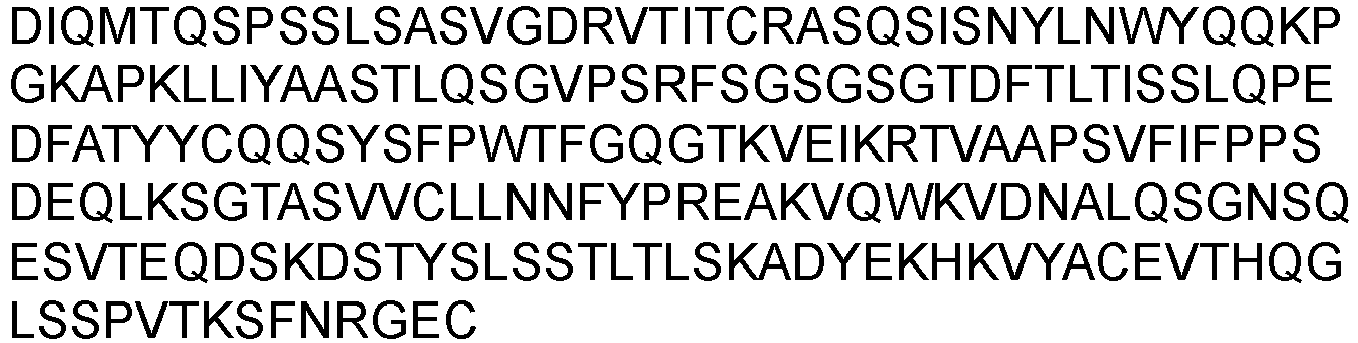
23 heavy chain 
24 
[Table 5] clon e region Amino acid sequence (N→C) or Nucleic acid sequence (5'→3') SE Q ID NO 7 CDR-L1 RASQSISNWLN 25 CDR-L2 GTSSLQS 26 CDR-L3 QQSYSFPFT 27 CDR-H1 SYGMH 28 CDR-H2 WIIPVSGGATYAQKFQG 29 CDR-H3 GSWAYYAEFDY 30 light chain variable region 
31 light chain variable region coding gene 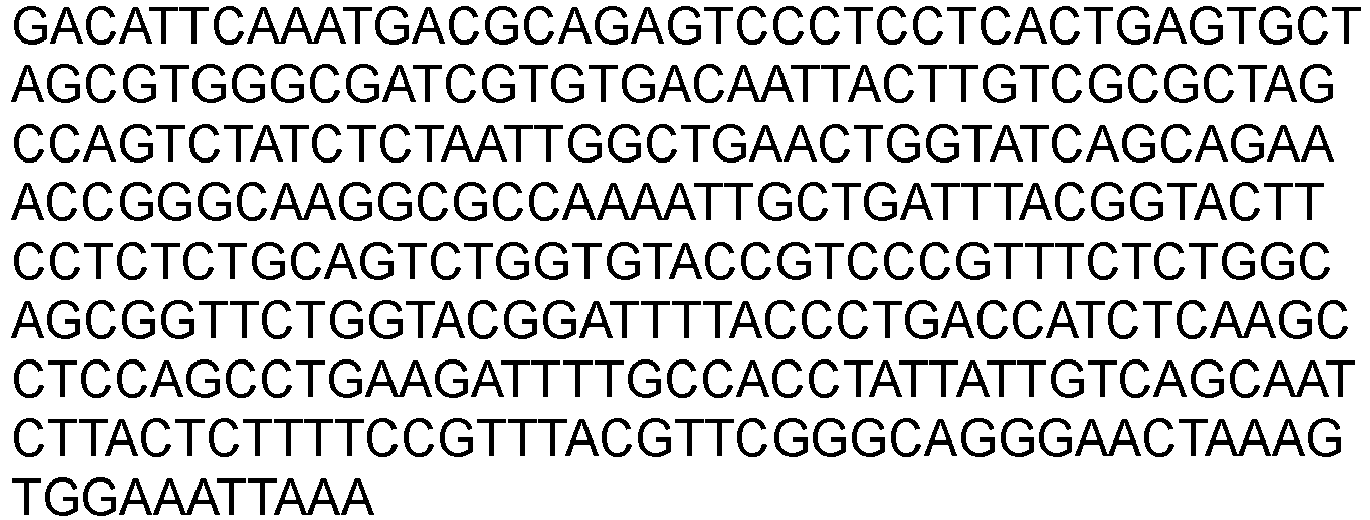
32 heavy chain variable region 
33 heavy chain variable region coding gene 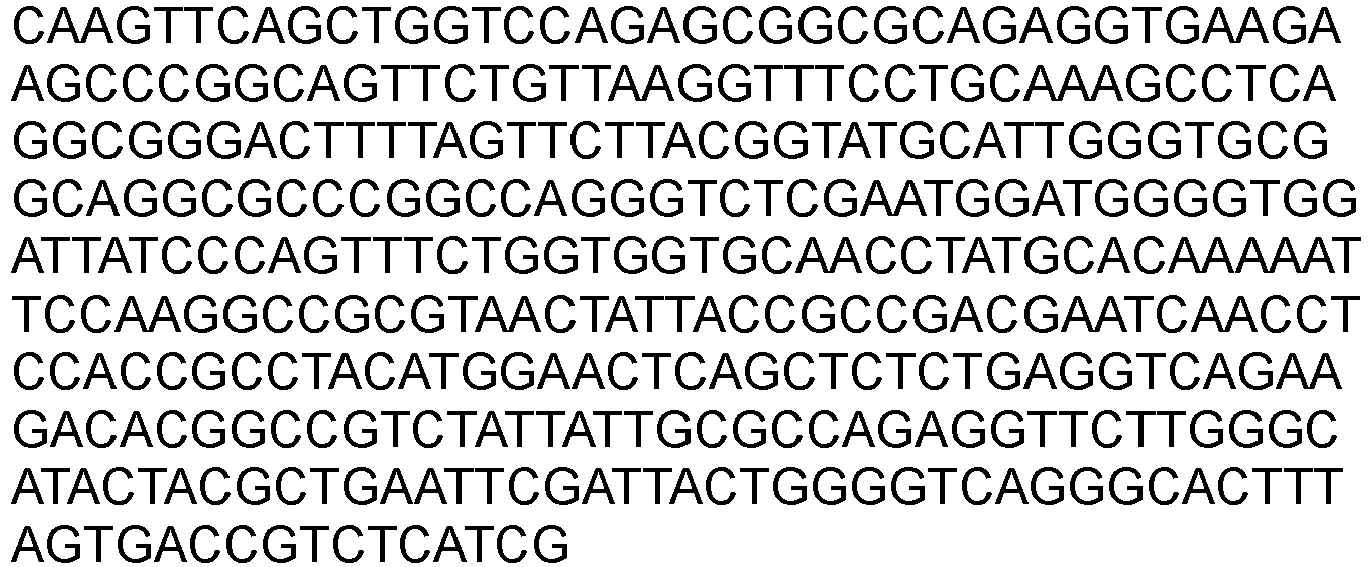
34 light chain (Kappa) 
35 heavy chain 
36 [Table 6] clon e region Amino acid sequence (N→C) or Nucleic acid sequence (5'→3') SE Q ID NO 8 CDR-L1 RASQSISSYLN 37 CDR-L2 AASTLQS 38 CDR-L3 QQSYSFPYT 39 CDR-H1 SYGIH 40 CDR-H2 WIIPISGTTNYAQKFQG 41 CDR-H3 VGGVGLYVFDV 42 light chain variable region 
43 light chain variable region coding gene 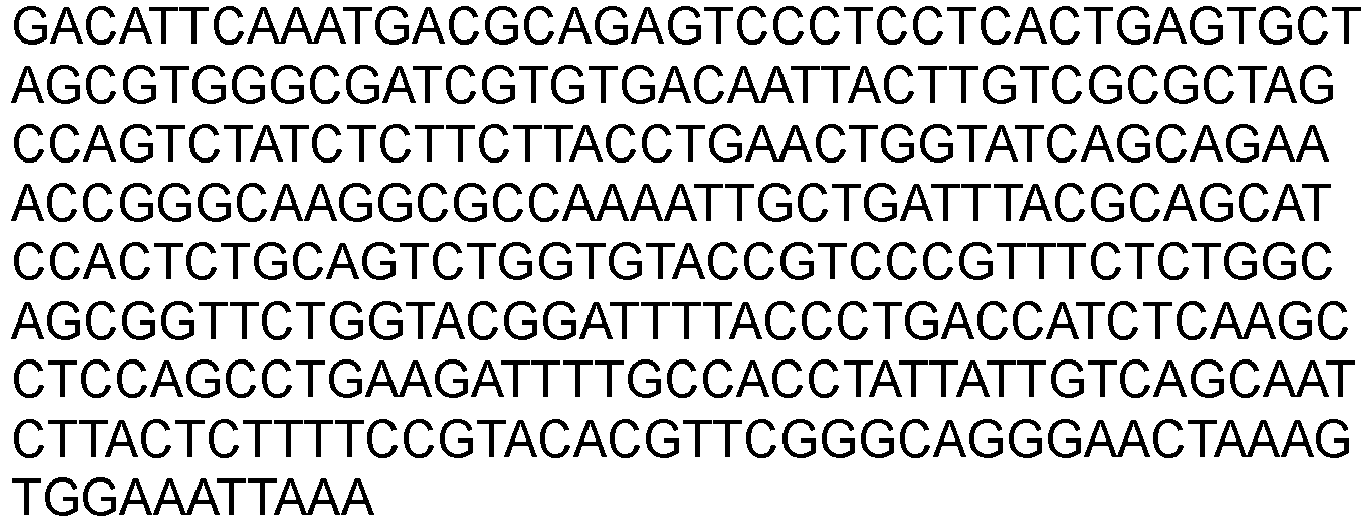
44 heavy 
45 chain variable region 
heavy chain variable region coding gene 
46 light chain (Kappa) 
47 heavy chain 
48 [Table 7] clon e region Amino acid sequence (N→C) or Nucleic acid sequence (5'→3') SE Q ID NO 9 CDR-L1 RASQSISNYLN 49 CDR-L2 AASSLQS 50 CDR-L3 QQSYSFPWT 51 CDR-H1 SYAIH 52 CDR-H2 WIVPGLGVTNYAQKFQG 53 CDR-H3 QATLYQTEYMDV 54 light 
55 chain variable region 
light chain variable region coding gene 
56 heavy chain variable region 
57 heavy chain variable region coding gene 
58 light chain (Kappa) 
59 heavy chain 
60 [Table 8] clon e region Amino acid sequence (N→C) or Nucleic acid sequence (5'→3') SE Q ID NO 10 CDR-L1 RASQSISNYLN 61 CDR-L2 AASNLQS 62 CDR-L3 QQSYSFPFT 63 CDR-H1 SHYMH 64 CDR-H2 WISPYLGSTNYAQKFQG 65 CDR-H3 DETGSTYGAFDY 66 light chain variable region 
67 light chain variable region coding gene 
68 heavy chain variable region 
69 heavy chain variable region coding gene 
70 light chain (Kappa) 
71 heavy 
72 chain 
[Table 9] clon e region Amino acid sequence (N→C) or Nucleic acid sequence (5'→3') SE Q ID NO 11 CDR-L1 RASQSISNYLN 73 CDR-L2 DASTLQS 74 CDR-L3 QQSYSFPWT 75 CDR-H1 SYYVH 76 CDR-H2 WISPYSGGTNYAQKFQG 77 CDR-H3 DYYVSAYGAFDY 78 light chain variable region 
79 light chain variable region coding gene 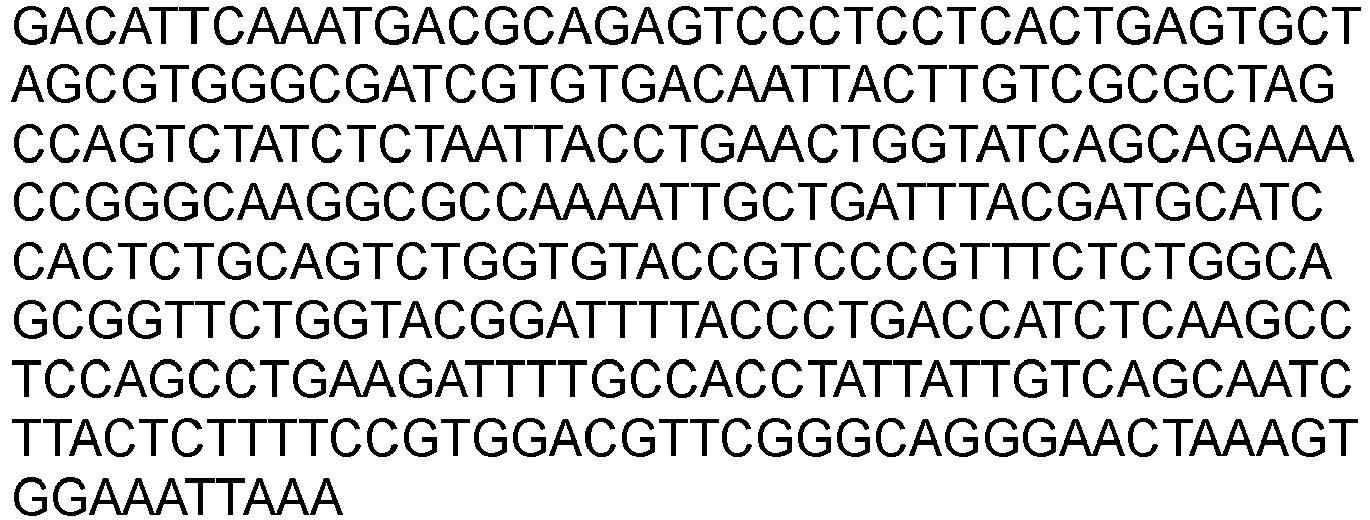
80 heavy chain variable region 
81 heavy chain variable region 
82 coding gene 
light chain (Kappa) 
83 heavy chain 
84 [Table 10] clon e region Amino acid sequence (N→C) or Nucleic acid sequence (5'→3') SE Q ID NO 12 CDR-L1 RASQDISNYLN 85 CDR-L2 ATSSLQS 86 CDR-L3 QQSYSFPWT 87 CDR-H1 SYDIH 88 CDR-H2 RIVPYLGVTNYAQKFQG 89 CDR-H3 RQSQSSVYAFDI 90 light chain variable region 
91 light chain variable region 
92 coding gene 
heavy chain variable region 
93 heavy chain variable region coding gene 
94 light chain (Kappa) 
95 heavy chain 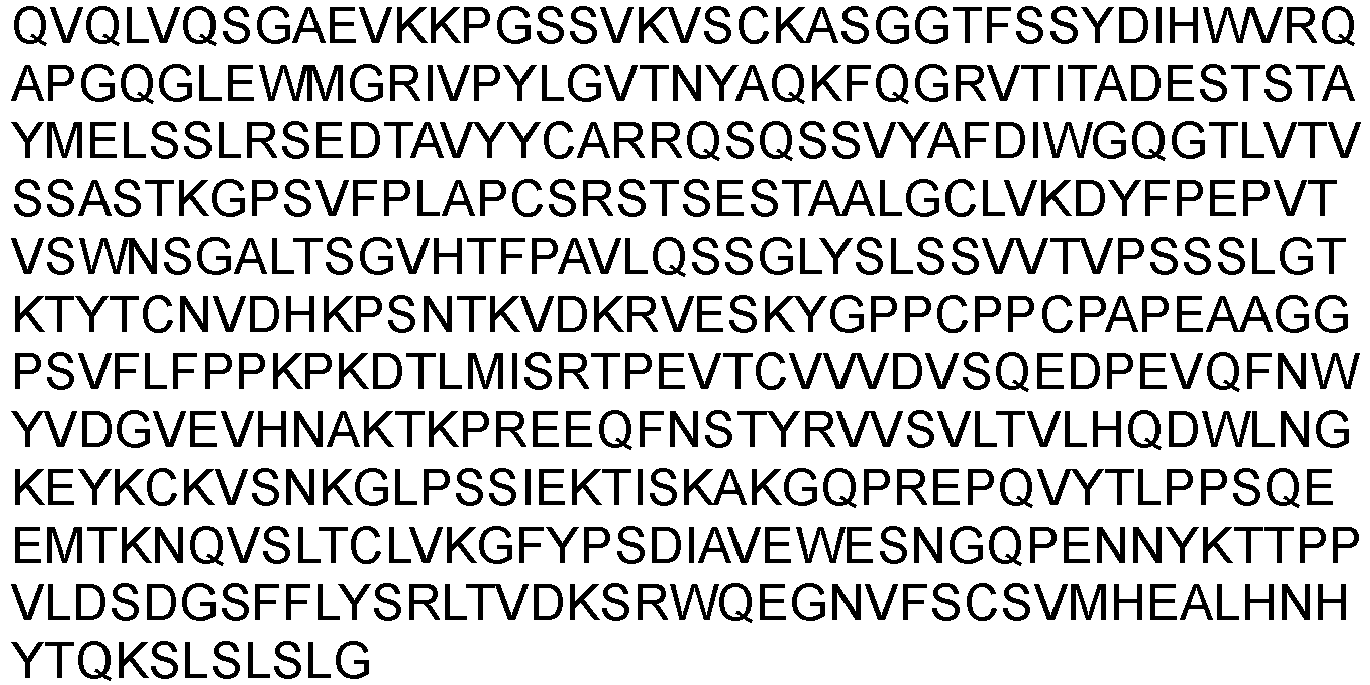
96 [Table 11] clon e region Amino acid sequence (N→C) or Nucleic acid sequence (5'→3') SE Q ID NO 13 CDR-L1 RASQSISNYLN 97 CDR-L2 AASRLQS 98 CDR-L3 QQSYSFPFT 99 CDR-H1 GYYIH 100 CDR-H2 WISPSSGGTIYAQKFQG 101 CDR-H3 DISVRWQAFDY 102 light chain variable region 
103 light chain variable region coding gene 
104 heavy chain variable region 
105 heavy chain variable region coding gene 
106 light chain (Kappa) 
107 heavy chain 
108 
[Table 12] clon e region Amino acid sequence (N→C) or Nucleic acid sequence (5'→3') SE Q ID NO 14 CDR-L1 RASQSISNYLN 109 CDR-L2 ATSNLQS 110 CDR-L3 QQSYSFPWT 111 CDR-H1 SYYMH 112 CDR-H2 WISPYLGITNYAQKFQG 113 CDR-H3 AGYQQAQYWFDY 114 light chain variable region 
115 light chain variable region coding gene 
116 heavy chain variable region 
117 heavy chain variable region coding gene 
118 light chain 
119 (Kappa) 
heavy chain 
120 [Table 13] clon e region Amino acid sequence (N→C) or Nucleic acid sequence (5'→3') SE Q ID NO 15 CDR-L1 RASQSISNYLN 121 CDR-L2 ATSSLQS 122 CDR-L3 QQSYSFPYT 123 CDR-H1 SYAMS 124 CDR-H2 WIIPISGTTNYAQKFQG 125 CDR-H3 QHSVGSVFDY 126 light chain variable region 
127 light chain variable region coding gene 
128 heavy chain variable 
129 region 
heavy chain variable region coding gene 
130 light chain (Kappa) 
131 heavy chain 
132 [Table 14] clon e region Amino acid sequence (N→C) or Nucleic acid sequence (5'→3') SE Q ID NO 16 CDR-L1 RASQDISSWLN 133 CDR-L2 AASSLQS 134 CDR-L3 QQSYSFPWT 135 CDR-H1 SYYMT 136 CDR-H2 GISPILGVTNYAQKFQG 137 CDR-H3 LLVGVSETYFDY 138 light chain variable 
139 region light chain variable region coding gene 
140 heavy chain variable region 
141 heavy chain variable region coding gene 
142 light chain (Kappa) 
143 heavy chain 
144 [Table 15] clone region Amino acid sequence (N→C) or Nucleic acid sequence (5'→3') SEQ ID NO 17 CDR-L1 RASQSISNYLN 145 CDR-L2 AASNMHS 146 CDR-L3 QQSHSFPWT 147 CDR-H1 TYAMS 148 CDR-H2 GISPTLGIANYAQKFQG 149 CDR-H3 VRYAGWTGYFDL 150 light chain variable region 
151 light chain variable region coding gene 
152 heavy chain variable region 
153 heavy chain variable region coding gene 
154 light chain (Kappa) 
155 heavy chain 
156 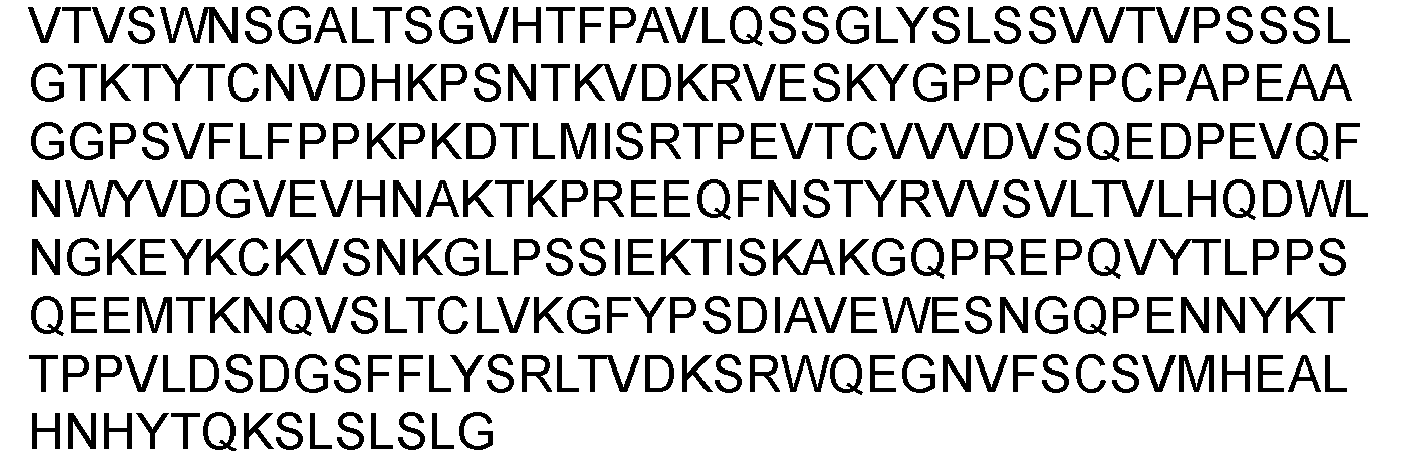
[Table 16] clon e region Amino acid sequence (N→C) or Nucleic acid sequence (5'→3') SE Q ID NO 18 CDR-L1 RASQSISRWLN 157 CDR-L2 AASRLQS 158 CDR-L3 QQSESFPWT 159 CDR-H1 SYDIN 160 CDR-H2 WIIPTSGSTNYAQKFQG 161 CDR-H3 DSQSSYIGYFDV 162 light chain variable region 
163 light chain variable region coding gene 
164 heavy chain variable region 
165 heavy chain variable region coding gene 
166 
light chain (Kappa) 
167 heavy chain 
168 [Table 17] clon e region Amino acid sequence (N→C) or Nucleic acid sequence (5'→3') SE Q ID NO 19 CDR-L1 RASQSISNYLN 169 CDR-L2 DTSSLQS 170 CDR-L3 QQSYSTPYT 171 CDR-H1 AYGIS 172 CDR-H2 RIIPYLGTANYAQKFQG 173 CDR-H3 LSYGIGYESFDV 174 light chain variable region 
175 light chain variable region coding gene 
176 
heavy chain variable region 
177 heavy chain variable region coding gene 
178 light chain (Kappa) 
179 heavy chain 
180 [Table 18] clon e region Amino acid sequence (N→C) or Nucleic acid sequence (5'→3') SE Q ID NO 20 CDR-L1 RASQSISSYLN 181 CDR-L2 DTSTLQS 182 CDR-L3 QQSYSFPWT 183 CDR-H1 SYAMS 184 CDR-H2 SISSSGGSTYYADSVKG 185 CDR-H3 ELGGYGFSYFDY 186 light chain variable region 
187 light chain variable region coding gene 
188 heavy chain variable region 
189 heavy chain variable region coding gene 
190 light chain (Kappa) 
191 heavy chain 
192 
[Table 19] clon e region Amino acid sequence (N→C) or Nucleic acid sequence (5'→3') SE Q ID NO 21 CDR-L1 RASQSIRNYLN 193 CDR-L2 ATSSLQS 194 CDR-L3 QQSYSFPWT 195 CDR-H1 DYAMS 196 CDR-H2 GISGSDIYYADSVKG 197 CDR-H3 AVSYWSYTFDY 198 light chain variable region 
199 light chain variable region coding gene 
200 heavy chain variable region 
201 heavy chain variable region coding gene 
202 light chain (Kappa) 
203 
heavy chain 
204 [Table 20] clon e region Amino acid sequence (N→C) or Nucleic acid sequence (5'→3') SE Q ID NO 22 CDR-L1 RASQSIGSYLN 205 CDR-L2 DASTLQS 206 CDR-L3 QQSYSFPWT 207 CDR-H1 SYAMH 208 CDR-H2 GISSSGGTTYYADSVKG 209 CDR-H3 ALGWGGTWFDY 210 light chain variable region 
211 light chain variable region coding gene 
212 heavy chain variable region 
213 heavy 
214 chain variable region coding gene 
light chain (Kappa) 
215 heavy chain 
216 [Table 21] clon e region Amino acid sequence (N→C) or Nucleic acid sequence (5'→3') SE Q ID NO 23 CDR-L1 RASQSISNYLN 217 CDR-L2 DTSTLQS 218 CDR-L3 QQSYSFPWT 219 CDR-H1 DYAMH 220 CDR-H2 AISGSGGYTHYADSVKG 221 CDR-H3 SATFGVWETFDV 222 light chain variable region 
223 light 
224 chain variable region coding gene 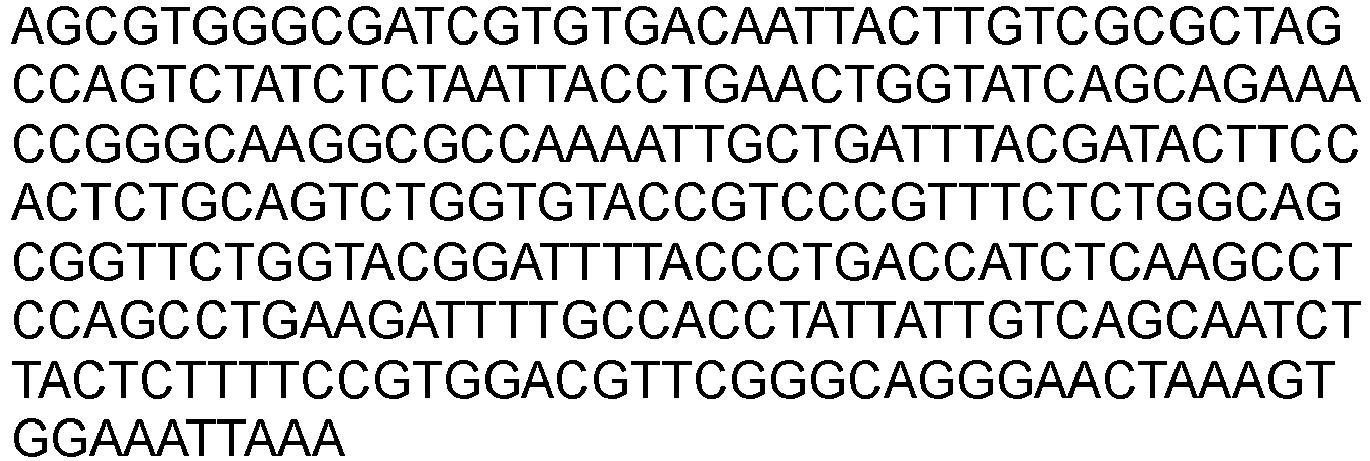
heavy chain variable region 
225 heavy chain variable region coding gene 
226 light chain (Kappa) 
227 heavy chain 
228 - The vectors constructed in Example 2 were prepared using the Plasmid Plus Maxi kit (Qiagen). These vectors were used for expressing antibodies in ExpiCHO-S™ cells. The vectors were transfected into ExpiCHO-S™cells (Gibco) (1.2 × 10⁹ cells/
Culture Volume 200 mL) by adding 640 µL of ExpiFectamine™ CHO reagent (Thermo Fisher). One day post-transfection, the cells were incubated in ExpiCHO™ Expression Media (Thermo Fisher) under the condition of 32°C and 5% CO2 for 7 to 11 days in total. On Day 1, 1200 µL of ExpiCHO™ Enhancer (Thermo Fisher) and 48 mL of ExpiCHO™ Feed (Thermo Fisher) were added to the culture. - The cultured cells were centrifuged at 3500 rpm at 4°C for 20 minutes, and then, filtrated using 0.22 µm bottle-top filter system (Corning). The culture supernatant was harvested and purified using AKTA Pure L (GE healthcare). The culture supernatant was loaded into AKTA Pure L equipped with
Hitrap MabSelectSure 5 mL column (GE healthcare) at the flow rate of 5 mL/min, and the column was washed with 10 column volumes (CV) of 1X PBS. Then, elution buffer (0.1 M sodium citrate pH 3.4 buffer) was loaded to the column, to elute a protein of interest. The eluate was concentrated using Amicon Ultra Filter Device (MWCO 10K, Merck), centrifuged and subjected to buffer exchange with 1X PBS buffer. - The purified antibody samples were diluted with 1X PBS, to make the final concentration about 1 mg/mL. Ten (10) µL of Reducing Loading Buffer (3X) or Nonreducing Loading Buffer (3X) and 20 µL of the purified antibody sample were mixed and left in 95°C heating bath for 2 minutes, and then, brought out and cooled. The sample was injected into SDS-PAGE Gradient Gel (4-12%) equipped on an electrophoresis device at the amount of 10 µg per well and developed on the gel. In order to analyze molecular weight of the sample, Precision Plus Protein™ Dual Color Standards (BIO-RAD) was injected to another separate well. The gel was stained with Coomassie staining solution and destained to obtain gel images (
Fig. 1 ). - The binding affinities of the 19 antibodies, which were selected in Example 3, to the antigen, LILRB1, were measured using Biacore T200 (GE healthcare). An anti-human IgG (Fc) antibody (GE healthcare, Cat. No. BR-1008-39, final concentration of 25 µg/mL) was flowed at the flow rate of 5 µL/min for 360 seconds to be immobilized at 5000-7000 RU on Series S Sensor Chip CM5 (GE healthcare, Cat. No. BR-1005-30) using Amine Coupling Kit (GE healthcare, Cat. No. BR-1000-50). The antigen, human LILRB1 protein (LILRB1-His, RnD systems Cat. No. 8989-T2) was injected thereto in 5 different concentrations from 25 nM to 400 nM at the flow rate of 30 µL/min to determine ka and kd values as shown in Table 22 and calculate KD value therefrom. Antibody No. 10 showed a binding affinity (KD) of about 24.13 nM to the LILRB1 antigen, and antibody No. 13 showed a binding affinity (KD) of about 30.27 nM to the LILRB1 antigen (Table 22). The sensorgram results for the antibody No. 13 are shown in
FIG. 2 .[Table 22] Antigen Binding Affinities (K D) of LILRB1 antibodies Clone number k a (x 105) (1/Ms) k d (x 10-4) (1/s) K D (nM) 8 0.6166 46.37 75.2 10 0.1233 2.977 24.13 11 0.08662 1.061 12.25 13 0.9729 2.945 30.27 14 1.621 663.1 409.1 16 1.157 96.35 83.3 18 1.439 6.221 4.32 22 0.6826 340.8 499.3 - In order to test whether or not the antibodies selected in Example 4 bind LILRB1 expressed on surface of cells, cell surface binding assay was performed. CHO cells overexpressing LILRB1 were cultured in Chemical Defined Medium, and added to a U-bottomed 96-well tissue culture plate (BD Falcon) to 2×10⁵ cells/well. Each of the selected antibodies was added to the well to the final concentration of 10 µg/mL per well, and incubated at 4°C for 30 minutes. In order to see the level of LILRB1-specific binding of the selected antibodies, a human IgG4 isotype control antibody (Biolegend) was treated in the same manner. After washing with FACS buffer, the cells were treated with an anti-human Fc-biotin antibody (life technologies) and incubated at 4°C for 1 hour. After washing with FACS buffer, streptavidin PE (BD Pharmigen) was added to each well and left at 4°C for 30 minutes. After washing with FACS buffer, it was suspended and analyzed by iQue screener (Sartorius). As shown in
FIG. 3 , the No. 8, No. 10, No. 11, No. 13, and No. 18 antibodies showed a higher level of binding than that of the human IgG4 isotype control antibody. - In order to determine whether the antibodies selected in Example 4 increase the degree of cancer cell lysis by NK cells, the cell death rate of HLA-G-overexpressing HEK293 cell by NK cell KHYG-1 was analyzed. KHYG-1 cells (JCRB) were added to 96-well tissue culture plate (BD Falcon) at the amount of 4×10⁵ cells/well (2×10⁴ cells/mL). The selected antibody was added to the well to the final concentration of 10 µg/mL and incubated at 37 °C for one hour. As a negative control, a human IgG4 isotype control antibody (Biolegend) was treated in the same manner. HLA-G-overexpressing HEK293 cells were stained in a separate tube with IncuCyte CytoLight Rapid Red Reagent (Sartorius) according to the manufacturer's protocol. After one hour, the HLA-G-overexpressing HEK293 cells were added to the plate at the amount of 4×10⁵ cells/well (2×10⁴ cells/mL). The plate was placed in IncuCyte S3 (Sartorius) equipped in an incubator under the condition of 37 °C and 5% CO2, and images thereof were taken for 72 hours.
- For comparison of the efficacy of each antibody, the normalized red area confluence value of the isotype control was converted to 1 to obtain the relative cell viability (Isotype = 1) as shown in Equation 1 below.

- The obtained results are shown in
Fig. 4 . InFigure 4 , it can be interpreted that the lower the relative cell viability, the higher the NK cell mediated cytotoxicity by the anti-LILRB1 mAb. As shown inFig. 4 , all of the tested antibodies (antibody No. 10, No. 11, and No. 13) increased cell death of HLA-G-overexpressing HEK293 cells compared to human IgG4 isotype control. These results show that the antibody provided in the present invention exhibits high cytotoxicity against cancer cells. - Three antibodies (antibody No. 10, No. 11, and No. 13) whose binding ability to the antigen was confirmed in Example 3 were tested for their in vivo anti-cancer efficacies. For this purpose, it was tested whether or not the administration of three types of antibodies reduces the size of tumor where the tumor was generated by engrafting human colorectal carcinoma cells (Bioware Brite Cell Line HCT116 Red-Fluc colorectal cancer cells (PerkinElmer)) and THP-1 derived macrophage to the mice. As a negative control, human colon cancer xenograft mice prepared as above were treated with a human IgG1 isotype control antibody (BioXcell, Cat. No. BP0297).
- The THP-1 derived macrophages used above were prepared by differentiating THP-1 cells (ATCC) with 150 nM phorbol 12-myristate 13-acetate (PMA, Sigma), 20 ng/mL of interferon gamma (Peprotech) and 10 pg/mL of lipopolysaccharide (LPS, Sigma).
- Five (5)-week-old female CIEA NOG Mouse (NOG immunodeficient mouse, Central Institute of Experimental Animals, Japan) were subcutaneously injected with a mixture of 3 × 10⁶ cells of HCT116 Red-Fluc colorectal cancer cells, 3 × 10⁶ cells of THP-1 derived macrophages and each of three antibodies (20 µg per mouse). From the 4th day after cell transplantation, each antibody was administered twice a week at the dosage of 5 mg/kg by intraperitoneal injection.
- The change in tumor volume according to the administration of the antibody was measured and shown in
Fig. 5 . As shown inFigure 5 , all the tested antibodies (antibody No. 10, No. 11, and No. 13) showed statistically significant effect of inhibiting tumor growth in the mouse model transplanted with HCT116 colorectal cancer cells and THP-1 derived macrophages.
Claims (13)
- An anti-LILRB1 antibody or antigen-binding fragment thereof, comprising complementarity determining regions (CDRs) as follows:a CDR-L1 comprising the amino acid sequence of SEQ ID NO: 1, 13, 25, 37, 49, 61, 73, 85, 97, 109, 121, 133, 145, 157, 169, 181, 193, 205 or 217,a CDR-L2 comprising the amino acid sequence of SEQ ID NO: 2, 14, 26, 38, 50, 62, 74, 86, 98, 110, 122, 134, 146, 158, 170, 182, 194, 206, or 218,a CDR-L3 comprising the amino acid sequence of SEQ ID NO: 3, 15, 27, 39, 51, 63, 75, 87, 99, 111, 123, 135, 147, 159, 171, 183, 195, 207, or 219,a CDR-H1 comprising the amino acid sequence of SEQ ID NO: 4, 16, 28, 40, 52, 64, 76, 88, 100, 112, 124, 136, 148, 160, 172, 184, 196, 208, or 220,a CDR-H2 comprising the amino acid sequence of SEQ ID NO: 5, 17, 29, 41, 53, 65, 77, 89, 101, 113, 125, 137, 149, 161, 173, 185, 197, 209, or 221, anda CDR-H3 comprising the amino acid sequence of SEQ ID NO: 6, 18, 30, 42, 54, 66, 78, 90, 102, 114, 126, 138, 150, 162, 174, 186, 198, 210, or 222,wherein the CDRs are defined based on Kabat numbering.
- The anti-LILRB1 antibody or antigen-binding fragment thereof of claim 1, comprising:(1) a CDR-L1 comprising the amino acid sequence of SEQ ID NO: 1, a CDR-L2 comprising the amino acid sequence of SEQ ID NO: 2, a CDR-L3 comprising the amino acid sequence of SEQ ID NO: 3, a CDR-H1 comprising the amino acid sequence of SEQ ID NO: 4, a CDR-H2 comprising the amino acid sequence of SEQ ID NO: 5, and a CDR-H3 comprising the amino acid sequence of SEQ ID NO: 6;(2) a CDR-L1 comprising the amino acid sequence of SEQ ID NO: 13, a CDR-L2 comprising the amino acid sequence of SEQ ID NO: 14, a CDR-L3 comprising the amino acid sequence of SEQ ID NO: 15, a CDR-H1 comprising the amino acid sequence of SEQ ID NO: 16, a CDR-H2 comprising the amino acid sequence of SEQ ID NO: 17, and a CDR-H3 comprising the amino acid sequence of SEQ ID NO: 18;(3) a CDR-L1 comprising the amino acid sequence of SEQ ID NO: 25, a CDR-L2 comprising the amino acid sequence of SEQ ID NO: 26, a CDR-L3 comprising the amino acid sequence of SEQ ID NO: 27, a CDR-H1 comprising the amino acid sequence of SEQ ID NO: 28, a CDR-H2 comprising the amino acid sequence of SEQ ID NO: 29, and a CDR-H3 comprising the amino acid sequence of SEQ ID NO: 30;(4) a CDR-L1 comprising the amino acid sequence of SEQ ID NO: 37, a CDR-L2 comprising the amino acid sequence of SEQ ID NO: 38, a CDR-L3 comprising the amino acid sequence of SEQ ID NO: 39, a CDR-H1 comprising the amino acid sequence of SEQ ID NO: 40, a CDR-H2 comprising the amino acid sequence of SEQ ID NO: 41, and a CDR-H3 comprising the amino acid sequence of SEQ ID NO: 42;(5) a CDR-L1 comprising the amino acid sequence of SEQ ID NO: 49, a CDR-L2 comprising the amino acid sequence of SEQ ID NO: 50, a CDR-L3 comprising the amino acid sequence of SEQ ID NO: 51, a CDR-H1 comprising the amino acid sequence of SEQ ID NO: 52, a CDR-H2 comprising the amino acid sequence of SEQ ID NO: 53, and a CDR-H3 comprising the amino acid sequence of SEQ ID NO: 54;(6) a CDR-L1 comprising the amino acid sequence of SEQ ID NO: 61, a CDR-L2 comprising the amino acid sequence of SEQ ID NO: 62, a CDR-L3 comprising the amino acid sequence of SEQ ID NO: 63, a CDR-H1 comprising the amino acid sequence of SEQ ID NO: 64, a CDR-H2 comprising the amino acid sequence of SEQ ID NO: 65, and a CDR-H3 comprising the amino acid sequence of SEQ ID NO: 66;(7) a CDR-L1 comprising the amino acid sequence of SEQ ID NO: 73, a CDR-L2 comprising the amino acid sequence of SEQ ID NO: 74, a CDR-L3 comprising the amino acid sequence of SEQ ID NO: 75, a CDR-H1 comprising the amino acid sequence of SEQ ID NO: 76, a CDR-H2 comprising the amino acid sequence of SEQ ID NO: 77, and a CDR-H3 comprising the amino acid sequence of SEQ ID NO: 78;(8) a CDR-L1 comprising the amino acid sequence of SEQ ID NO: 85, a CDR-L2 comprising the amino acid sequence of SEQ ID NO: 86, a CDR-L3 comprising the amino acid sequence of SEQ ID NO: 87, a CDR-H1 comprising the amino acid sequence of SEQ ID NO: 88, a CDR-H2 comprising the amino acid sequence of SEQ ID NO: 89, and a CDR-H3 comprising the amino acid sequence of SEQ ID NO: 90;(9) a CDR-L1 comprising the amino acid sequence of SEQ ID NO: 97, a CDR-L2 comprising the amino acid sequence of SEQ ID NO: 98, a CDR-L3 comprising the amino acid sequence of SEQ ID NO: 99, a CDR-H1 comprising the amino acid sequence of SEQ ID NO: 100, a CDR-H2 comprising the amino acid sequence of SEQ ID NO: 101, and a CDR-H3 comprising the amino acid sequence of SEQ ID NO: 102;(10) a CDR-L1 comprising the amino acid sequence of SEQ ID NO: 109, a CDR-L2 comprising the amino acid sequence of SEQ ID NO: 110, a CDR-L3 comprising the amino acid sequence of SEQ ID NO: 111, a CDR-H1 comprising the amino acid sequence of SEQ ID NO: 112, a CDR-H2 comprising the amino acid sequence of SEQ ID NO: 113, and a CDR-H3 comprising the amino acid sequence of SEQ ID NO: 114;(11) a CDR-L1 comprising the amino acid sequence of SEQ ID NO: 121, a CDR-L2 comprising the amino acid sequence of SEQ ID NO: 122, a CDR-L3 comprising the amino acid sequence of SEQ ID NO: 123, a CDR-H1 comprising the amino acid sequence of SEQ ID NO: 124, a CDR-H2 comprising the amino acid sequence of SEQ ID NO: 125, and a CDR-H3 comprising the amino acid sequence of SEQ ID NO: 126;(12) a CDR-L1 comprising the amino acid sequence of SEQ ID NO: 133, a CDR-L2 comprising the amino acid sequence of SEQ ID NO: 134, a CDR-L3 comprising the amino acid sequence of SEQ ID NO: 135, a CDR-H1 comprising the amino acid sequence of SEQ ID NO: 136, a CDR-H2 comprising the amino acid sequence of SEQ ID NO: 137, and a CDR-H3 comprising the amino acid sequence of SEQ ID NO: 138;(13) a CDR-L1 comprising the amino acid sequence of SEQ ID NO: 145, a CDR-L2 comprising the amino acid sequence of SEQ ID NO: 146, a CDR-L3 comprising the amino acid sequence of SEQ ID NO: 147, a CDR-H1 comprising the amino acid sequence of SEQ ID NO: 148, a CDR-H2 comprising the amino acid sequence of SEQ ID NO: 149, and a CDR-H3 comprising the amino acid sequence of SEQ ID NO: 150;(14) a CDR-L1 comprising the amino acid sequence of SEQ ID NO: 157, a CDR-L2 comprising the amino acid sequence of SEQ ID NO: 158, a CDR-L3 comprising the amino acid sequence of SEQ ID NO: 159, a CDR-H1 comprising the amino acid sequence of SEQ ID NO: 160, a CDR-H2 comprising the amino acid sequence of SEQ ID NO: 161, and a CDR-H3 comprising the amino acid sequence of SEQ ID NO: 162;(15) a CDR-L1 comprising the amino acid sequence of SEQ ID NO: 169, a CDR-L2 comprising the amino acid sequence of SEQ ID NO: 170, a CDR-L3 comprising the amino acid sequence of SEQ ID NO: 171, a CDR-H1 comprising the amino acid sequence of SEQ ID NO: 172, a CDR-H2 comprising the amino acid sequence of SEQ ID NO: 173, and a CDR-H3 comprising the amino acid sequence of SEQ ID NO: 174;(16) a CDR-L1 comprising the amino acid sequence of SEQ ID NO: 181, a CDR-L2 comprising the amino acid sequence of SEQ ID NO: 182, a CDR-L3 comprising the amino acid sequence of SEQ ID NO: 183, a CDR-H1 comprising the amino acid sequence of SEQ ID NO: 184, a CDR-H2 comprising the amino acid sequence of SEQ ID NO: 185, and a CDR-H3 comprising the amino acid sequence of SEQ ID NO: 186;(17) a CDR-L1 comprising the amino acid sequence of SEQ ID NO: 193, a CDR-L2 comprising the amino acid sequence of SEQ ID NO: 194, a CDR-L3 comprising the amino acid sequence of SEQ ID NO: 195, a CDR-H1 comprising the amino acid sequence of SEQ ID NO: 196, a CDR-H2 comprising the amino acid sequence of SEQ ID NO: 197, and a CDR-H3 comprising the amino acid sequence of SEQ ID NO: 198;(18) a CDR-L1 comprising the amino acid sequence of SEQ ID NO: 205, a CDR-L2 comprising the amino acid sequence of SEQ ID NO: 206, a CDR-L3 comprising the amino acid sequence of SEQ ID NO: 207, a CDR-H1 comprising the amino acid sequence of SEQ ID NO: 208, a CDR-H2 comprising the amino acid sequence of SEQ ID NO: 209, and a CDR-H3 comprising the amino acid sequence of SEQ ID NO: 210; or(19) a CDR-L1 comprising the amino acid sequence of SEQ ID NO: 217, a CDR-L2 comprising the amino acid sequence of SEQ ID NO: 218, a CDR-L3 comprising the amino acid sequence of SEQ ID NO: 219, a CDR-H1 comprising the amino acid sequence of SEQ ID NO: 220, a CDR-H2 comprising the amino acid sequence of SEQ ID NO: 221, and a CDR-H3 comprising the amino acid sequence of SEQ ID NO: 222.
- The anti-LILRB1 antibody or antigen-binding fragment thereof of claim 1, comprising:a light chain variable region comprising the amino acid sequence of SEQ ID NO: 7, 19, 31, 43, 55, 67, 79, 91, 103, 115, 127, 139, 151, 163, 175, 187, 199, 211, or 223, anda heavy chain variable region comprising the amino acid sequence of SEQ ID NO: 9, 21, 33, 45, 57, 69, 81, 93, 105, 117, 129, 141, 153, 165, 177, 189, 201, 213, or 225.
- The anti-LILRB1 antibody or antigen-binding fragment thereof of claim 1, wherein the antibody is a human IgG1 or IgG4 antibody.
- The anti-LILRB1 antibody or antigen-binding fragment thereof of claim 1, wherein the antigen-binding fragment is scFv, (scFv)2, Fab, Fab', F(ab')2 of the anti-LILRB1 antibody, a fusion polypeptide comprising scFv fused with an immunoglobulin Fc, or a fusion polypeptide comprising scFv fused with a constant region of a light chain.
- A pharmaceutical composition for treating or preventing a cancer, comprising the anti-LILRB1 antibody or antigen-binding fragment thereof of any one of claims 1 to 5.
- The pharmaceutical composition of claim 6, wherein the cancer is characterized by overexpression of MHC Class I.
- The pharmaceutical composition of claim 6, wherein the composition has an activity to inhibit immune evasion of cancer cells.
- A nucleic acid molecule encoding the antibody or antigen-binding fragment thereof of any one of claims 1 to 5.
- A recombinant vector comprising the nucleic acid molecule of claim 9.
- A recombinant cell comprising the nucleic acid molecule of claim 9 or a recombinant vector comprising the nucleic acid molecule.
- A method of preparing an anti-LILRB1 antibody or antigen-binding fragment thereof, comprising culturing the recombinant cell of claim 11.
- A pharmaceutical composition for inhibiting immune evasion of cancer cells, comprising the anti-LILRB1 antibody or antigen-binding fragment thereof of any one of claims 1 to 5.
Applications Claiming Priority (2)
| Application Number | Priority Date | Filing Date | Title |
|---|---|---|---|
| KR20200094053 | 2020-07-28 | ||
| PCT/KR2021/009696 WO2022025585A1 (en) | 2020-07-28 | 2021-07-27 | Anti-lilrb1 antibody and uses thereof |
Publications (2)
| Publication Number | Publication Date |
|---|---|
| EP4169950A1 true EP4169950A1 (en) | 2023-04-26 |
| EP4169950A4 EP4169950A4 (en) | 2024-03-20 |
Family
ID=80036572
Family Applications (1)
| Application Number | Title | Priority Date | Filing Date |
|---|---|---|---|
| EP21851407.3A Pending EP4169950A4 (en) | 2020-07-28 | 2021-07-27 | Anti-lilrb1 antibody and uses thereof |
Country Status (13)
| Country | Link |
|---|---|
| US (1) | US12606620B2 (en) |
| EP (1) | EP4169950A4 (en) |
| JP (1) | JP7508689B2 (en) |
| KR (1) | KR102816064B1 (en) |
| CN (1) | CN115867353B (en) |
| AU (1) | AU2021315366B2 (en) |
| BR (1) | BR112022026922A2 (en) |
| CA (1) | CA3186256A1 (en) |
| IL (1) | IL299942A (en) |
| MX (1) | MX2023001041A (en) |
| TW (2) | TWI893399B (en) |
| WO (1) | WO2022025585A1 (en) |
| ZA (1) | ZA202213434B (en) |
Families Citing this family (5)
| Publication number | Priority date | Publication date | Assignee | Title |
|---|---|---|---|---|
| CA3186256A1 (en) | 2020-07-28 | 2022-02-03 | Yoon Aa Choi | Anti-lilrb1 antibody and uses thereof |
| WO2023170434A1 (en) | 2022-03-11 | 2023-09-14 | Macomics Limited | Compositions and methods for modulation of macrophage activity |
| WO2024234530A1 (en) * | 2023-05-16 | 2024-11-21 | 成都优洛生物科技有限公司 | Anti-lilrb1 nanobody or antigen-binding fragment thereof, preparation method therefor and use thereof |
| CN117545780B (en) * | 2023-05-16 | 2025-12-30 | 成都优洛生物科技有限公司 | Anti-LILRB1 nanobody or its antigen-binding fragment, preparation method and uses |
| TW202513590A (en) * | 2023-06-20 | 2025-04-01 | 中國商科望(蘇州)生物醫藥科技有限公司 | Antibodies or antigen-binding fragments binding to lilrb1 and uses thereof |
Family Cites Families (15)
| Publication number | Priority date | Publication date | Assignee | Title |
|---|---|---|---|---|
| KR101038126B1 (en) | 2010-11-30 | 2011-05-31 | 주식회사 엘지생명과학 | New fusion promoters and recombinant vectors comprising them |
| US20150174203A1 (en) * | 2012-05-30 | 2015-06-25 | Icahn School Of Medicine At Mount Sinai | Compositions And Methods For Modulating Pro-Inflammatory Immune Response |
| CA2948871A1 (en) | 2014-05-22 | 2015-11-26 | Fred Hutchinson Cancer Research Center | Lilrb2 and notch-mediated expansion of hematopoietic precursor cells |
| WO2016065245A1 (en) | 2014-10-24 | 2016-04-28 | Incept, Llc | Extra luminal scaffold |
| WO2016065329A1 (en) | 2014-10-24 | 2016-04-28 | The Board Of Trustees Of The Leland Stanford Junior University | Compositions and methods for inducing phagocytosis of mhc class i positive cells and countering anti-cd47/sirpa resistance |
| CA3218106A1 (en) | 2015-03-06 | 2016-09-15 | The Board Of Regents Of The University Of Texas System | Anti-lilrb antibodies and their use in detecting and treating cancer |
| EA201890434A1 (en) | 2015-08-05 | 2018-10-31 | Янссен Байотек, Инк. | ANTIBODIES TO CD154 AND METHODS OF THEIR APPLICATION |
| WO2017106684A2 (en) | 2015-12-17 | 2017-06-22 | Janssen Biotech, Inc. | Antibodies specifically binding hla-dr and their uses |
| US11906519B2 (en) | 2016-07-29 | 2024-02-20 | The Board Of Regents Of The University Of Texas System | Methods for identifying LILRB-blocking antibodies |
| CN111867614A (en) * | 2018-01-18 | 2020-10-30 | 艾达奈特公司 | Anti-LILRB antibodies and their uses |
| MA53381A (en) | 2018-07-24 | 2021-06-02 | Amgen Inc | ASSOCIATION OF LILRB1 / 2 PATH INHIBITORS AND PD-1 PATH INHIBITORS |
| AU2019414793A1 (en) * | 2018-12-26 | 2021-06-24 | Innate Pharma | Compounds and methods for treatment of head and neck cancer |
| CN114555637B (en) | 2019-08-12 | 2026-01-06 | 比昂生物制剂公司 | Antibodies against ILT2 and their uses |
| EP4071172A4 (en) | 2019-12-23 | 2023-10-18 | Lg Chem, Ltd. | ANTI-LILRB1 ANTIBODIES AND USES THEREOF |
| CA3186256A1 (en) | 2020-07-28 | 2022-02-03 | Yoon Aa Choi | Anti-lilrb1 antibody and uses thereof |
-
2021
- 2021-07-27 CA CA3186256A patent/CA3186256A1/en active Pending
- 2021-07-27 US US18/003,582 patent/US12606620B2/en active Active
- 2021-07-27 TW TW112122842A patent/TWI893399B/en active
- 2021-07-27 TW TW110127573A patent/TWI901727B/en active
- 2021-07-27 KR KR1020210098593A patent/KR102816064B1/en active Active
- 2021-07-27 EP EP21851407.3A patent/EP4169950A4/en active Pending
- 2021-07-27 MX MX2023001041A patent/MX2023001041A/en unknown
- 2021-07-27 WO PCT/KR2021/009696 patent/WO2022025585A1/en not_active Ceased
- 2021-07-27 IL IL299942A patent/IL299942A/en unknown
- 2021-07-27 AU AU2021315366A patent/AU2021315366B2/en active Active
- 2021-07-27 CN CN202180046031.9A patent/CN115867353B/en active Active
- 2021-07-27 JP JP2023503488A patent/JP7508689B2/en active Active
- 2021-07-27 BR BR112022026922A patent/BR112022026922A2/en unknown
-
2022
- 2022-12-12 ZA ZA2022/13434A patent/ZA202213434B/en unknown
Also Published As
| Publication number | Publication date |
|---|---|
| MX2023001041A (en) | 2023-02-16 |
| WO2022025585A1 (en) | 2022-02-03 |
| IL299942A (en) | 2023-03-01 |
| KR102816064B1 (en) | 2025-06-02 |
| TWI901727B (en) | 2025-10-21 |
| JP2023537225A (en) | 2023-08-31 |
| KR20220014316A (en) | 2022-02-04 |
| US12606620B2 (en) | 2026-04-21 |
| US20230374127A1 (en) | 2023-11-23 |
| TWI893399B (en) | 2025-08-11 |
| TW202340258A (en) | 2023-10-16 |
| CN115867353A (en) | 2023-03-28 |
| BR112022026922A2 (en) | 2023-02-07 |
| AU2021315366B2 (en) | 2025-02-27 |
| AU2021315366A1 (en) | 2023-02-02 |
| ZA202213434B (en) | 2024-04-24 |
| JP7508689B2 (en) | 2024-07-01 |
| TW202208438A (en) | 2022-03-01 |
| CA3186256A1 (en) | 2022-02-03 |
| EP4169950A4 (en) | 2024-03-20 |
| CN115867353B (en) | 2026-04-14 |
| AU2021315366A9 (en) | 2023-06-29 |
Similar Documents
| Publication | Publication Date | Title |
|---|---|---|
| CA3161827C (en) | Anti-lilrb1 antibody and uses thereof | |
| US12606620B2 (en) | Anti-LILRB1 antibody and uses thereof | |
| CN112771161A (en) | Antibodies specific for trophoblast cell surface antigen 2(TROP2) | |
| JP2025179060A (en) | Anti-HER2/anti-4-1BB bispecific antibodies and uses thereof | |
| WO2021013064A1 (en) | Humanized vegfr2 antibody and application thereof | |
| WO2021013061A1 (en) | Humanized anti-vegfr2 antibody and application thereof | |
| KR20220072468A (en) | Antibody specifically binding to TIGIT and uses thereof | |
| RU2813373C1 (en) | Anti-lilrb1 antibody and uses thereof |
Legal Events
| Date | Code | Title | Description |
|---|---|---|---|
| STAA | Information on the status of an ep patent application or granted ep patent |
Free format text: STATUS: THE INTERNATIONAL PUBLICATION HAS BEEN MADE |
|
| PUAI | Public reference made under article 153(3) epc to a published international application that has entered the european phase |
Free format text: ORIGINAL CODE: 0009012 |
|
| STAA | Information on the status of an ep patent application or granted ep patent |
Free format text: STATUS: REQUEST FOR EXAMINATION WAS MADE |
|
| 17P | Request for examination filed |
Effective date: 20230118 |
|
| AK | Designated contracting states |
Kind code of ref document: A1 Designated state(s): AL AT BE BG CH CY CZ DE DK EE ES FI FR GB GR HR HU IE IS IT LI LT LU LV MC MK MT NL NO PL PT RO RS SE SI SK SM TR |
|
| DAV | Request for validation of the european patent (deleted) | ||
| DAX | Request for extension of the european patent (deleted) | ||
| A4 | Supplementary search report drawn up and despatched |
Effective date: 20240215 |
|
| RIC1 | Information provided on ipc code assigned before grant |
Ipc: A61P 35/00 20060101ALI20240209BHEP Ipc: A61K 39/395 20060101ALI20240209BHEP Ipc: C07K 16/28 20060101AFI20240209BHEP |