EP4169924A2 - Synthesis of halichondrins - Google Patents
Synthesis of halichondrins Download PDFInfo
- Publication number
- EP4169924A2 EP4169924A2 EP22214189.7A EP22214189A EP4169924A2 EP 4169924 A2 EP4169924 A2 EP 4169924A2 EP 22214189 A EP22214189 A EP 22214189A EP 4169924 A2 EP4169924 A2 EP 4169924A2
- Authority
- EP
- European Patent Office
- Prior art keywords
- optionally substituted
- certain embodiments
- compound
- formula
- salt
- Prior art date
- Legal status (The legal status is an assumption and is not a legal conclusion. Google has not performed a legal analysis and makes no representation as to the accuracy of the status listed.)
- Pending
Links
- 238000003786 synthesis reaction Methods 0.000 title abstract description 43
- 229930195695 Halichondrin Natural products 0.000 title abstract description 41
- 230000015572 biosynthetic process Effects 0.000 title abstract description 41
- 150000001875 compounds Chemical class 0.000 claims abstract description 387
- 238000000034 method Methods 0.000 claims abstract description 119
- 238000005859 coupling reaction Methods 0.000 claims abstract description 89
- 229910052739 hydrogen Inorganic materials 0.000 claims description 334
- 239000001257 hydrogen Substances 0.000 claims description 334
- 125000004435 hydrogen atom Chemical group [H]* 0.000 claims description 313
- 150000003839 salts Chemical class 0.000 claims description 281
- 125000000547 substituted alkyl group Chemical group 0.000 claims description 268
- QVGXLLKOCUKJST-UHFFFAOYSA-N atomic oxygen Chemical group [O] QVGXLLKOCUKJST-UHFFFAOYSA-N 0.000 claims description 173
- 125000000623 heterocyclic group Chemical group 0.000 claims description 173
- 125000002252 acyl group Chemical group 0.000 claims description 151
- 229910052736 halogen Inorganic materials 0.000 claims description 141
- 150000002367 halogens Chemical group 0.000 claims description 141
- 125000004452 carbocyclyl group Chemical group 0.000 claims description 104
- 125000004429 atom Chemical group 0.000 claims description 87
- 125000001072 heteroaryl group Chemical group 0.000 claims description 86
- 230000008878 coupling Effects 0.000 claims description 78
- 238000010168 coupling process Methods 0.000 claims description 77
- 125000003107 substituted aryl group Chemical group 0.000 claims description 46
- 125000000472 sulfonyl group Chemical group *S(*)(=O)=O 0.000 claims description 15
- 125000000475 sulfinyl group Chemical group [*:2]S([*:1])=O 0.000 claims description 10
- LFGREXWGYUGZLY-UHFFFAOYSA-N phosphoryl Chemical group [P]=O LFGREXWGYUGZLY-UHFFFAOYSA-N 0.000 claims description 9
- 239000012038 nucleophile Substances 0.000 claims description 8
- 238000006243 chemical reaction Methods 0.000 abstract description 251
- -1 halichondrin A Natural products 0.000 abstract description 170
- 230000001404 mediated effect Effects 0.000 abstract description 67
- 229930194670 homohalichondrin Natural products 0.000 abstract description 21
- GIEQUQHFFCIXFP-GVEGDGMYSA-N halichondrin a Chemical compound O([C@@H]1[C@@H](C)[C@@H]2O[C@@H]3C[C@@]4(O[C@H]5[C@@H](C)C[C@@]6(C[C@@H]([C@@H]7O[C@@H](C[C@@H]7O6)[C@@H](O)C[C@@H](O)CO)C)O[C@H]5C4)O[C@@H]3C[C@@H]2O[C@H]1C[C@@H]1C(=C)[C@H](C)C[C@@H](O1)CC[C@H]1C(=C)C[C@@H](O1)CC1)C(=O)C[C@H](O2)CC[C@H](O[C@@H]34)[C@H]2[C@H](O2)[C@@H]4O[C@@]4(O)[C@@H]3O[C@@]12[C@@H]4O GIEQUQHFFCIXFP-GVEGDGMYSA-N 0.000 abstract description 16
- 150000002576 ketones Chemical class 0.000 abstract description 16
- 239000000543 intermediate Substances 0.000 abstract description 14
- NMWGUXUJLUPRSU-UHFFFAOYSA-N norhalichondrin A Natural products O1C2C(C)CC3(OC4CC(O)C(CC(O)=O)OC4C(C)C3)OC2CC1(OC1CC2OC3CC4C(=C)C(C)CC(O4)CCC4C(=C)CC(O4)CC4)CC1OC2C(C)C3OC(=O)CC(O1)CCC(OC23)C1C(O1)C3OC3(O)C2OC41C3O NMWGUXUJLUPRSU-UHFFFAOYSA-N 0.000 abstract description 12
- 238000010189 synthetic method Methods 0.000 abstract description 3
- PXHVJJICTQNCMI-UHFFFAOYSA-N Nickel Chemical compound [Ni] PXHVJJICTQNCMI-UHFFFAOYSA-N 0.000 description 222
- YMWUJEATGCHHMB-UHFFFAOYSA-N Dichloromethane Chemical compound ClCCl YMWUJEATGCHHMB-UHFFFAOYSA-N 0.000 description 193
- 125000004432 carbon atom Chemical group C* 0.000 description 93
- 125000005842 heteroatom Chemical group 0.000 description 84
- 125000000217 alkyl group Chemical group 0.000 description 79
- 239000002585 base Substances 0.000 description 77
- 229910052759 nickel Inorganic materials 0.000 description 77
- 239000003153 chemical reaction reagent Substances 0.000 description 75
- 125000004169 (C1-C6) alkyl group Chemical group 0.000 description 64
- 125000000304 alkynyl group Chemical group 0.000 description 63
- YXFVVABEGXRONW-UHFFFAOYSA-N Toluene Chemical compound CC1=CC=CC=C1 YXFVVABEGXRONW-UHFFFAOYSA-N 0.000 description 61
- 125000003342 alkenyl group Chemical group 0.000 description 56
- 239000002253 acid Substances 0.000 description 51
- 229910052751 metal Inorganic materials 0.000 description 50
- 239000002184 metal Substances 0.000 description 50
- XEKOWRVHYACXOJ-UHFFFAOYSA-N Ethyl acetate Chemical compound CCOC(C)=O XEKOWRVHYACXOJ-UHFFFAOYSA-N 0.000 description 48
- 239000002904 solvent Substances 0.000 description 47
- HCHKCACWOHOZIP-UHFFFAOYSA-N Zinc Chemical compound [Zn] HCHKCACWOHOZIP-UHFFFAOYSA-N 0.000 description 46
- 239000003446 ligand Substances 0.000 description 46
- 239000011701 zinc Substances 0.000 description 46
- 229910052725 zinc Inorganic materials 0.000 description 45
- 125000003118 aryl group Chemical group 0.000 description 44
- OKKJLVBELUTLKV-UHFFFAOYSA-N Methanol Chemical compound OC OKKJLVBELUTLKV-UHFFFAOYSA-N 0.000 description 42
- 229910007928 ZrCl2 Inorganic materials 0.000 description 42
- 229910021585 Nickel(II) bromide Inorganic materials 0.000 description 40
- IPLJNQFXJUCRNH-UHFFFAOYSA-L nickel(2+);dibromide Chemical compound [Ni+2].[Br-].[Br-] IPLJNQFXJUCRNH-UHFFFAOYSA-L 0.000 description 40
- TXNLQUKVUJITMX-UHFFFAOYSA-N 4-tert-butyl-2-(4-tert-butylpyridin-2-yl)pyridine Chemical compound CC(C)(C)C1=CC=NC(C=2N=CC=C(C=2)C(C)(C)C)=C1 TXNLQUKVUJITMX-UHFFFAOYSA-N 0.000 description 39
- FPGGTKZVZWFYPV-UHFFFAOYSA-M tetrabutylammonium fluoride Chemical compound [F-].CCCC[N+](CCCC)(CCCC)CCCC FPGGTKZVZWFYPV-UHFFFAOYSA-M 0.000 description 38
- ZMANZCXQSJIPKH-UHFFFAOYSA-N Triethylamine Chemical compound CCN(CC)CC ZMANZCXQSJIPKH-UHFFFAOYSA-N 0.000 description 37
- CYSGHNMQYZDMIA-UHFFFAOYSA-N 1,3-Dimethyl-2-imidazolidinon Chemical compound CN1CCN(C)C1=O CYSGHNMQYZDMIA-UHFFFAOYSA-N 0.000 description 34
- QCWXUUIWCKQGHC-UHFFFAOYSA-N Zirconium Chemical compound [Zr] QCWXUUIWCKQGHC-UHFFFAOYSA-N 0.000 description 34
- 229910052726 zirconium Inorganic materials 0.000 description 34
- 125000003718 tetrahydrofuranyl group Chemical group 0.000 description 32
- OISVCGZHLKNMSJ-UHFFFAOYSA-N 2,6-dimethylpyridine Chemical compound CC1=CC=CC(C)=N1 OISVCGZHLKNMSJ-UHFFFAOYSA-N 0.000 description 30
- 125000004404 heteroalkyl group Chemical group 0.000 description 30
- RAXXELZNTBOGNW-UHFFFAOYSA-N imidazole Natural products C1=CNC=N1 RAXXELZNTBOGNW-UHFFFAOYSA-N 0.000 description 30
- 239000011651 chromium Substances 0.000 description 29
- 229910052757 nitrogen Inorganic materials 0.000 description 28
- WEVYAHXRMPXWCK-UHFFFAOYSA-N Acetonitrile Chemical compound CC#N WEVYAHXRMPXWCK-UHFFFAOYSA-N 0.000 description 27
- IJGRMHOSHXDMSA-UHFFFAOYSA-N Atomic nitrogen Chemical compound N#N IJGRMHOSHXDMSA-UHFFFAOYSA-N 0.000 description 27
- XYFCBTPGUUZFHI-UHFFFAOYSA-N Phosphine Chemical compound P XYFCBTPGUUZFHI-UHFFFAOYSA-N 0.000 description 26
- 125000001424 substituent group Chemical group 0.000 description 26
- UFHFLCQGNIYNRP-UHFFFAOYSA-N Hydrogen Chemical compound [H][H] UFHFLCQGNIYNRP-UHFFFAOYSA-N 0.000 description 25
- SIPUZPBQZHNSDW-UHFFFAOYSA-N bis(2-methylpropyl)aluminum Chemical compound CC(C)C[Al]CC(C)C SIPUZPBQZHNSDW-UHFFFAOYSA-N 0.000 description 25
- 125000001181 organosilyl group Chemical group [SiH3]* 0.000 description 25
- PWHULOQIROXLJO-UHFFFAOYSA-N Manganese Chemical compound [Mn] PWHULOQIROXLJO-UHFFFAOYSA-N 0.000 description 24
- JGFZNNIVVJXRND-UHFFFAOYSA-N N,N-Diisopropylethylamine (DIPEA) Chemical compound CCN(C(C)C)C(C)C JGFZNNIVVJXRND-UHFFFAOYSA-N 0.000 description 24
- KWGKDLIKAYFUFQ-UHFFFAOYSA-M lithium chloride Chemical compound [Li+].[Cl-] KWGKDLIKAYFUFQ-UHFFFAOYSA-M 0.000 description 24
- XLYOFNOQVPJJNP-UHFFFAOYSA-N water Substances O XLYOFNOQVPJJNP-UHFFFAOYSA-N 0.000 description 24
- 229910001868 water Inorganic materials 0.000 description 24
- QJGQUHMNIGDVPM-UHFFFAOYSA-N nitrogen group Chemical group [N] QJGQUHMNIGDVPM-UHFFFAOYSA-N 0.000 description 23
- ZDYVRSLAEXCVBX-UHFFFAOYSA-N pyridinium p-toluenesulfonate Chemical compound C1=CC=[NH+]C=C1.CC1=CC=C(S([O-])(=O)=O)C=C1 ZDYVRSLAEXCVBX-UHFFFAOYSA-N 0.000 description 23
- JUJWROOIHBZHMG-UHFFFAOYSA-N Pyridine Chemical compound C1=CC=NC=C1 JUJWROOIHBZHMG-UHFFFAOYSA-N 0.000 description 22
- 238000002360 preparation method Methods 0.000 description 22
- 125000000999 tert-butyl group Chemical group [H]C([H])([H])C(*)(C([H])([H])[H])C([H])([H])[H] 0.000 description 22
- JOXIMZWYDAKGHI-UHFFFAOYSA-N toluene-4-sulfonic acid Chemical compound CC1=CC=C(S(O)(=O)=O)C=C1 JOXIMZWYDAKGHI-UHFFFAOYSA-N 0.000 description 22
- NINIDFKCEFEMDL-UHFFFAOYSA-N Sulfur Chemical compound [S] NINIDFKCEFEMDL-UHFFFAOYSA-N 0.000 description 21
- 230000003197 catalytic effect Effects 0.000 description 21
- 125000002887 hydroxy group Chemical group [H]O* 0.000 description 20
- 239000002516 radical scavenger Substances 0.000 description 20
- FVAUCKIRQBBSSJ-UHFFFAOYSA-M sodium iodide Chemical compound [Na+].[I-] FVAUCKIRQBBSSJ-UHFFFAOYSA-M 0.000 description 19
- 229910052717 sulfur Inorganic materials 0.000 description 19
- CSCPPACGZOOCGX-UHFFFAOYSA-N Acetone Chemical compound CC(C)=O CSCPPACGZOOCGX-UHFFFAOYSA-N 0.000 description 18
- 150000001412 amines Chemical class 0.000 description 18
- 229910052760 oxygen Inorganic materials 0.000 description 18
- 239000001301 oxygen Substances 0.000 description 18
- 239000000203 mixture Substances 0.000 description 17
- BWHMMNNQKKPAPP-UHFFFAOYSA-L potassium carbonate Chemical compound [K+].[K+].[O-]C([O-])=O BWHMMNNQKKPAPP-UHFFFAOYSA-L 0.000 description 17
- 238000007363 ring formation reaction Methods 0.000 description 17
- 239000011593 sulfur Substances 0.000 description 17
- RIOQSEWOXXDEQQ-UHFFFAOYSA-N triphenylphosphine Chemical compound C1=CC=CC=C1P(C=1C=CC=CC=1)C1=CC=CC=C1 RIOQSEWOXXDEQQ-UHFFFAOYSA-N 0.000 description 17
- GQHTUMJGOHRCHB-UHFFFAOYSA-N 2,3,4,6,7,8,9,10-octahydropyrimido[1,2-a]azepine Chemical compound C1CCCCN2CCCN=C21 GQHTUMJGOHRCHB-UHFFFAOYSA-N 0.000 description 16
- VHYFNPMBLIVWCW-UHFFFAOYSA-N 4-Dimethylaminopyridine Chemical compound CN(C)C1=CC=NC=C1 VHYFNPMBLIVWCW-UHFFFAOYSA-N 0.000 description 16
- KRHYYFGTRYWZRS-UHFFFAOYSA-M Fluoride anion Chemical compound [F-] KRHYYFGTRYWZRS-UHFFFAOYSA-M 0.000 description 16
- 239000002841 Lewis acid Substances 0.000 description 16
- 229910021586 Nickel(II) chloride Inorganic materials 0.000 description 16
- DCFKHNIGBAHNSS-UHFFFAOYSA-N chloro(triethyl)silane Chemical compound CC[Si](Cl)(CC)CC DCFKHNIGBAHNSS-UHFFFAOYSA-N 0.000 description 16
- 238000010511 deprotection reaction Methods 0.000 description 16
- 150000007517 lewis acids Chemical class 0.000 description 16
- 125000002496 methyl group Chemical group [H]C([H])([H])* 0.000 description 16
- QMMRZOWCJAIUJA-UHFFFAOYSA-L nickel dichloride Chemical compound Cl[Ni]Cl QMMRZOWCJAIUJA-UHFFFAOYSA-L 0.000 description 16
- VYZAMTAEIAYCRO-UHFFFAOYSA-N Chromium Chemical compound [Cr] VYZAMTAEIAYCRO-UHFFFAOYSA-N 0.000 description 15
- 238000007792 addition Methods 0.000 description 15
- 150000001540 azides Chemical class 0.000 description 15
- 229910052804 chromium Inorganic materials 0.000 description 15
- YYROPELSRYBVMQ-UHFFFAOYSA-N 4-toluenesulfonyl chloride Chemical group CC1=CC=C(S(Cl)(=O)=O)C=C1 YYROPELSRYBVMQ-UHFFFAOYSA-N 0.000 description 14
- ZMXDDKWLCZADIW-UHFFFAOYSA-N N,N-Dimethylformamide Chemical compound CN(C)C=O ZMXDDKWLCZADIW-UHFFFAOYSA-N 0.000 description 14
- 239000000460 chlorine Substances 0.000 description 14
- 125000004122 cyclic group Chemical group 0.000 description 14
- 125000000753 cycloalkyl group Chemical group 0.000 description 14
- 125000004430 oxygen atom Chemical group O* 0.000 description 14
- 229920006395 saturated elastomer Polymers 0.000 description 14
- 150000003384 small molecules Chemical class 0.000 description 14
- 229940124530 sulfonamide Drugs 0.000 description 14
- 150000003456 sulfonamides Chemical class 0.000 description 14
- AQRLNPVMDITEJU-UHFFFAOYSA-N triethylsilane Chemical compound CC[SiH](CC)CC AQRLNPVMDITEJU-UHFFFAOYSA-N 0.000 description 14
- 125000006708 (C5-C14) heteroaryl group Chemical group 0.000 description 13
- 239000003054 catalyst Substances 0.000 description 13
- 125000004433 nitrogen atom Chemical group N* 0.000 description 13
- 229910000073 phosphorus hydride Inorganic materials 0.000 description 13
- 239000000047 product Substances 0.000 description 13
- 125000006239 protecting group Chemical group 0.000 description 13
- XEZNGIUYQVAUSS-UHFFFAOYSA-N 18-crown-6 Chemical compound C1COCCOCCOCCOCCOCCO1 XEZNGIUYQVAUSS-UHFFFAOYSA-N 0.000 description 12
- HZNVUJQVZSTENZ-UHFFFAOYSA-N 2,3-dichloro-5,6-dicyano-1,4-benzoquinone Chemical compound ClC1=C(Cl)C(=O)C(C#N)=C(C#N)C1=O HZNVUJQVZSTENZ-UHFFFAOYSA-N 0.000 description 12
- KDLHZDBZIXYQEI-UHFFFAOYSA-N Palladium Chemical compound [Pd] KDLHZDBZIXYQEI-UHFFFAOYSA-N 0.000 description 12
- 150000004678 hydrides Chemical class 0.000 description 12
- 125000002924 primary amino group Chemical group [H]N([H])* 0.000 description 12
- LFQSCWFLJHTTHZ-UHFFFAOYSA-N Ethanol Chemical compound CCO LFQSCWFLJHTTHZ-UHFFFAOYSA-N 0.000 description 11
- 239000011541 reaction mixture Substances 0.000 description 11
- 238000006578 reductive coupling reaction Methods 0.000 description 11
- 238000006467 substitution reaction Methods 0.000 description 11
- XWKFPIODWVPXLX-UHFFFAOYSA-N 2-methyl-5-methylpyridine Natural products CC1=CC=C(C)N=C1 XWKFPIODWVPXLX-UHFFFAOYSA-N 0.000 description 10
- 125000000008 (C1-C10) alkyl group Chemical group 0.000 description 9
- 239000007848 Bronsted acid Substances 0.000 description 9
- 125000005915 C6-C14 aryl group Chemical group 0.000 description 9
- KXDHJXZQYSOELW-UHFFFAOYSA-M Carbamate Chemical compound NC([O-])=O KXDHJXZQYSOELW-UHFFFAOYSA-M 0.000 description 9
- 229910021554 Chromium(II) chloride Inorganic materials 0.000 description 9
- 150000001299 aldehydes Chemical class 0.000 description 9
- 150000001844 chromium Chemical class 0.000 description 9
- XBWRJSSJWDOUSJ-UHFFFAOYSA-L chromium(ii) chloride Chemical group Cl[Cr]Cl XBWRJSSJWDOUSJ-UHFFFAOYSA-L 0.000 description 9
- 235000019441 ethanol Nutrition 0.000 description 9
- UMJSCPRVCHMLSP-UHFFFAOYSA-N pyridine Natural products COC1=CC=CN=C1 UMJSCPRVCHMLSP-UHFFFAOYSA-N 0.000 description 9
- 150000003254 radicals Chemical class 0.000 description 9
- 230000009466 transformation Effects 0.000 description 9
- HVHZEKKZMFRULH-UHFFFAOYSA-N 2,6-ditert-butyl-4-methylpyridine Chemical group CC1=CC(C(C)(C)C)=NC(C(C)(C)C)=C1 HVHZEKKZMFRULH-UHFFFAOYSA-N 0.000 description 8
- YEKPNMQQSPHKBP-UHFFFAOYSA-N 2-methyl-6-nitrobenzoic anhydride Chemical compound CC1=CC=CC([N+]([O-])=O)=C1C(=O)OC(=O)C1=C(C)C=CC=C1[N+]([O-])=O YEKPNMQQSPHKBP-UHFFFAOYSA-N 0.000 description 8
- LSNNMFCWUKXFEE-UHFFFAOYSA-M Bisulfite Chemical compound OS([O-])=O LSNNMFCWUKXFEE-UHFFFAOYSA-M 0.000 description 8
- 125000006374 C2-C10 alkenyl group Chemical group 0.000 description 8
- 125000000882 C2-C6 alkenyl group Chemical group 0.000 description 8
- IAZDPXIOMUYVGZ-UHFFFAOYSA-N Dimethylsulphoxide Chemical compound CS(C)=O IAZDPXIOMUYVGZ-UHFFFAOYSA-N 0.000 description 8
- 150000008064 anhydrides Chemical class 0.000 description 8
- 125000003178 carboxy group Chemical group [H]OC(*)=O 0.000 description 8
- WGLUMOCWFMKWIL-UHFFFAOYSA-N dichloromethane;methanol Chemical compound OC.ClCCl WGLUMOCWFMKWIL-UHFFFAOYSA-N 0.000 description 8
- 125000001188 haloalkyl group Chemical group 0.000 description 8
- AMXOYNBUYSYVKV-UHFFFAOYSA-M lithium bromide Chemical compound [Li+].[Br-] AMXOYNBUYSYVKV-UHFFFAOYSA-M 0.000 description 8
- 229930014626 natural product Natural products 0.000 description 8
- 229930190448 norhalichondrin Natural products 0.000 description 8
- 229910000027 potassium carbonate Inorganic materials 0.000 description 8
- LWIHDJKSTIGBAC-UHFFFAOYSA-K tripotassium phosphate Chemical compound [K+].[K+].[K+].[O-]P([O-])([O-])=O LWIHDJKSTIGBAC-UHFFFAOYSA-K 0.000 description 8
- RTZKZFJDLAIYFH-UHFFFAOYSA-N Diethyl ether Chemical compound CCOCC RTZKZFJDLAIYFH-UHFFFAOYSA-N 0.000 description 7
- LFTLOKWAGJYHHR-UHFFFAOYSA-N N-methylmorpholine N-oxide Chemical compound CN1(=O)CCOCC1 LFTLOKWAGJYHHR-UHFFFAOYSA-N 0.000 description 7
- 241000243142 Porifera Species 0.000 description 7
- 229910052799 carbon Inorganic materials 0.000 description 7
- 239000011203 carbon fibre reinforced carbon Substances 0.000 description 7
- YRFGXHUJNOHXQO-BEMDRSKZSA-N halichondrin c Chemical compound O([C@@H]1[C@@H](C)[C@@H]2O[C@@H]3C[C@@]4(O[C@H]5[C@@H](C)C[C@@]6(C[C@@H]([C@@H]7O[C@@H](C[C@@H]7O6)[C@@H](O)C[C@@H](O)CO)C)O[C@H]5C4)O[C@@H]3C[C@@H]2O[C@H]1C[C@@H]1C(=C)[C@H](C)C[C@@H](O1)CC[C@H]1C(=C)C[C@@H](O1)CC1)C(=O)C[C@H](O2)CC[C@H](O[C@@H]34)[C@H]2[C@H](O2)[C@@H]4O[C@@]4(O)[C@@H]3O[C@@]12C4 YRFGXHUJNOHXQO-BEMDRSKZSA-N 0.000 description 7
- 239000002798 polar solvent Substances 0.000 description 7
- FTVLMFQEYACZNP-UHFFFAOYSA-N trimethylsilyl trifluoromethanesulfonate Chemical compound C[Si](C)(C)OS(=O)(=O)C(F)(F)F FTVLMFQEYACZNP-UHFFFAOYSA-N 0.000 description 7
- 229910000404 tripotassium phosphate Inorganic materials 0.000 description 7
- 125000006714 (C3-C10) heterocyclyl group Chemical group 0.000 description 6
- BWZVCCNYKMEVEX-UHFFFAOYSA-N 2,4,6-Trimethylpyridine Chemical group CC1=CC(C)=NC(C)=C1 BWZVCCNYKMEVEX-UHFFFAOYSA-N 0.000 description 6
- QTBSBXVTEAMEQO-UHFFFAOYSA-N Acetic acid Chemical compound CC(O)=O QTBSBXVTEAMEQO-UHFFFAOYSA-N 0.000 description 6
- UHOVQNZJYSORNB-UHFFFAOYSA-N Benzene Chemical compound C1=CC=CC=C1 UHOVQNZJYSORNB-UHFFFAOYSA-N 0.000 description 6
- 125000003601 C2-C6 alkynyl group Chemical group 0.000 description 6
- 125000001313 C5-C10 heteroaryl group Chemical group 0.000 description 6
- 125000003277 amino group Chemical group 0.000 description 6
- 125000001797 benzyl group Chemical group [H]C1=C([H])C([H])=C(C([H])=C1[H])C([H])([H])* 0.000 description 6
- 229910052801 chlorine Inorganic materials 0.000 description 6
- 238000002474 experimental method Methods 0.000 description 6
- FXNFULJVOQMBCW-VZBLNRDYSA-N halichondrin b Chemical compound O([C@@H]1[C@@H](C)[C@@H]2O[C@@H]3C[C@@]4(O[C@H]5[C@@H](C)C[C@@]6(C[C@@H]([C@@H]7O[C@@H](C[C@@H]7O6)[C@@H](O)C[C@@H](O)CO)C)O[C@H]5C4)O[C@@H]3C[C@@H]2O[C@H]1C[C@@H]1C(=C)[C@H](C)C[C@@H](O1)CC[C@H]1C(=C)C[C@@H](O1)CC1)C(=O)C[C@H](O2)CC[C@H]3[C@H]2[C@H](O2)[C@@H]4O[C@@H]5C[C@@]21O[C@@H]5[C@@H]4O3 FXNFULJVOQMBCW-VZBLNRDYSA-N 0.000 description 6
- XMBWDFGMSWQBCA-UHFFFAOYSA-N hydrogen iodide Chemical compound I XMBWDFGMSWQBCA-UHFFFAOYSA-N 0.000 description 6
- 125000005647 linker group Chemical group 0.000 description 6
- GTCAXTIRRLKXRU-UHFFFAOYSA-N methyl carbamate Chemical compound COC(N)=O GTCAXTIRRLKXRU-UHFFFAOYSA-N 0.000 description 6
- VLKZOEOYAKHREP-UHFFFAOYSA-N n-Hexane Chemical compound CCCCCC VLKZOEOYAKHREP-UHFFFAOYSA-N 0.000 description 6
- 239000012434 nucleophilic reagent Substances 0.000 description 6
- XSXHWVKGUXMUQE-UHFFFAOYSA-N osmium dioxide Inorganic materials O=[Os]=O XSXHWVKGUXMUQE-UHFFFAOYSA-N 0.000 description 6
- 125000003367 polycyclic group Chemical group 0.000 description 6
- 238000012216 screening Methods 0.000 description 6
- 235000009518 sodium iodide Nutrition 0.000 description 6
- CIHOLLKRGTVIJN-UHFFFAOYSA-N tert‐butyl hydroperoxide Chemical compound CC(C)(C)OO CIHOLLKRGTVIJN-UHFFFAOYSA-N 0.000 description 6
- GJFNRSDCSTVPCJ-UHFFFAOYSA-N 1,8-bis(dimethylamino)naphthalene Chemical compound C1=CC(N(C)C)=C2C(N(C)C)=CC=CC2=C1 GJFNRSDCSTVPCJ-UHFFFAOYSA-N 0.000 description 5
- HEWZVZIVELJPQZ-UHFFFAOYSA-N 2,2-dimethoxypropane Chemical compound COC(C)(C)OC HEWZVZIVELJPQZ-UHFFFAOYSA-N 0.000 description 5
- HBAQYPYDRFILMT-UHFFFAOYSA-N 8-[3-(1-cyclopropylpyrazol-4-yl)-1H-pyrazolo[4,3-d]pyrimidin-5-yl]-3-methyl-3,8-diazabicyclo[3.2.1]octan-2-one Chemical class C1(CC1)N1N=CC(=C1)C1=NNC2=C1N=C(N=C2)N1C2C(N(CC1CC2)C)=O HBAQYPYDRFILMT-UHFFFAOYSA-N 0.000 description 5
- AMKGKYQBASDDJB-UHFFFAOYSA-N 9$l^{2}-borabicyclo[3.3.1]nonane Chemical compound C1CCC2CCCC1[B]2 AMKGKYQBASDDJB-UHFFFAOYSA-N 0.000 description 5
- FEJUGLKDZJDVFY-UHFFFAOYSA-N 9-borabicyclo[3.3.1]nonane Substances C1CCC2CCCC1B2 FEJUGLKDZJDVFY-UHFFFAOYSA-N 0.000 description 5
- 125000000041 C6-C10 aryl group Chemical group 0.000 description 5
- OKTJSMMVPCPJKN-UHFFFAOYSA-N Carbon Chemical group [C] OKTJSMMVPCPJKN-UHFFFAOYSA-N 0.000 description 5
- 229910021556 Chromium(III) chloride Inorganic materials 0.000 description 5
- KRHYYFGTRYWZRS-UHFFFAOYSA-N Fluorane Chemical compound F KRHYYFGTRYWZRS-UHFFFAOYSA-N 0.000 description 5
- FYYHWMGAXLPEAU-UHFFFAOYSA-N Magnesium Chemical group [Mg] FYYHWMGAXLPEAU-UHFFFAOYSA-N 0.000 description 5
- AFVFQIVMOAPDHO-UHFFFAOYSA-N Methanesulfonic acid Chemical compound CS(O)(=O)=O AFVFQIVMOAPDHO-UHFFFAOYSA-N 0.000 description 5
- DKGAVHZHDRPRBM-UHFFFAOYSA-N Tert-Butanol Chemical compound CC(C)(C)O DKGAVHZHDRPRBM-UHFFFAOYSA-N 0.000 description 5
- 229910052794 bromium Inorganic materials 0.000 description 5
- 150000001721 carbon Chemical group 0.000 description 5
- 125000001309 chloro group Chemical group Cl* 0.000 description 5
- QSWDMMVNRMROPK-UHFFFAOYSA-K chromium(3+) trichloride Chemical compound [Cl-].[Cl-].[Cl-].[Cr+3] QSWDMMVNRMROPK-UHFFFAOYSA-K 0.000 description 5
- 239000011636 chromium(III) chloride Substances 0.000 description 5
- JGFBRKRYDCGYKD-UHFFFAOYSA-N dibutyl(oxo)tin Chemical compound CCCC[Sn](=O)CCCC JGFBRKRYDCGYKD-UHFFFAOYSA-N 0.000 description 5
- 230000008030 elimination Effects 0.000 description 5
- 238000003379 elimination reaction Methods 0.000 description 5
- 150000002148 esters Chemical class 0.000 description 5
- 238000005755 formation reaction Methods 0.000 description 5
- 229910052740 iodine Inorganic materials 0.000 description 5
- 239000011572 manganese Substances 0.000 description 5
- 125000002950 monocyclic group Chemical group 0.000 description 5
- 150000002815 nickel Chemical class 0.000 description 5
- 125000006574 non-aromatic ring group Chemical group 0.000 description 5
- 239000000243 solution Substances 0.000 description 5
- YLQBMQCUIZJEEH-UHFFFAOYSA-N tetrahydrofuran Natural products C=1C=COC=1 YLQBMQCUIZJEEH-UHFFFAOYSA-N 0.000 description 5
- 125000001412 tetrahydropyranyl group Chemical group 0.000 description 5
- VZCYOOQTPOCHFL-UHFFFAOYSA-N trans-butenedioic acid Natural products OC(=O)C=CC(O)=O VZCYOOQTPOCHFL-UHFFFAOYSA-N 0.000 description 5
- 125000002221 trityl group Chemical group [H]C1=C([H])C([H])=C([H])C([H])=C1C([*])(C1=C(C(=C(C(=C1[H])[H])[H])[H])[H])C1=C([H])C([H])=C([H])C([H])=C1[H] 0.000 description 5
- 125000006570 (C5-C6) heteroaryl group Chemical group 0.000 description 4
- LJCZNYWLQZZIOS-UHFFFAOYSA-N 2,2,2-trichlorethoxycarbonyl chloride Chemical compound ClC(=O)OCC(Cl)(Cl)Cl LJCZNYWLQZZIOS-UHFFFAOYSA-N 0.000 description 4
- 125000003903 2-propenyl group Chemical group [H]C([*])([H])C([H])=C([H])[H] 0.000 description 4
- 125000006163 5-membered heteroaryl group Chemical group 0.000 description 4
- DLFVBJFMPXGRIB-UHFFFAOYSA-N Acetamide Chemical class CC(N)=O DLFVBJFMPXGRIB-UHFFFAOYSA-N 0.000 description 4
- FEWJPZIEWOKRBE-JCYAYHJZSA-N Dextrotartaric acid Chemical compound OC(=O)[C@H](O)[C@@H](O)C(O)=O FEWJPZIEWOKRBE-JCYAYHJZSA-N 0.000 description 4
- KFZMGEQAYNKOFK-UHFFFAOYSA-N Isopropanol Chemical compound CC(C)O KFZMGEQAYNKOFK-UHFFFAOYSA-N 0.000 description 4
- 229910002651 NO3 Inorganic materials 0.000 description 4
- NHNBFGGVMKEFGY-UHFFFAOYSA-N Nitrate Chemical compound [O-][N+]([O-])=O NHNBFGGVMKEFGY-UHFFFAOYSA-N 0.000 description 4
- MUBZPKHOEPUJKR-UHFFFAOYSA-N Oxalic acid Chemical compound OC(=O)C(O)=O MUBZPKHOEPUJKR-UHFFFAOYSA-N 0.000 description 4
- 229910019142 PO4 Inorganic materials 0.000 description 4
- 229910006069 SO3H Inorganic materials 0.000 description 4
- UIIMBOGNXHQVGW-UHFFFAOYSA-M Sodium bicarbonate Chemical compound [Na+].OC([O-])=O UIIMBOGNXHQVGW-UHFFFAOYSA-M 0.000 description 4
- QAOWNCQODCNURD-UHFFFAOYSA-L Sulfate Chemical compound [O-]S([O-])(=O)=O QAOWNCQODCNURD-UHFFFAOYSA-L 0.000 description 4
- 239000007983 Tris buffer Substances 0.000 description 4
- WLLIXJBWWFGEHT-UHFFFAOYSA-N [tert-butyl(dimethyl)silyl] trifluoromethanesulfonate Chemical compound CC(C)(C)[Si](C)(C)OS(=O)(=O)C(F)(F)F WLLIXJBWWFGEHT-UHFFFAOYSA-N 0.000 description 4
- 125000002015 acyclic group Chemical group 0.000 description 4
- WPYMKLBDIGXBTP-UHFFFAOYSA-N benzoic acid Chemical compound OC(=O)C1=CC=CC=C1 WPYMKLBDIGXBTP-UHFFFAOYSA-N 0.000 description 4
- PUJDIJCNWFYVJX-UHFFFAOYSA-N benzyl carbamate Chemical compound NC(=O)OCC1=CC=CC=C1 PUJDIJCNWFYVJX-UHFFFAOYSA-N 0.000 description 4
- 125000002619 bicyclic group Chemical group 0.000 description 4
- 125000001495 ethyl group Chemical group [H]C([H])([H])C([H])([H])* 0.000 description 4
- 239000012634 fragment Substances 0.000 description 4
- 125000000524 functional group Chemical group 0.000 description 4
- 229910000040 hydrogen fluoride Inorganic materials 0.000 description 4
- JEHCHYAKAXDFKV-UHFFFAOYSA-J lead tetraacetate Chemical compound CC(=O)O[Pb](OC(C)=O)(OC(C)=O)OC(C)=O JEHCHYAKAXDFKV-UHFFFAOYSA-J 0.000 description 4
- 229910003002 lithium salt Inorganic materials 0.000 description 4
- 159000000002 lithium salts Chemical class 0.000 description 4
- UBJFKNSINUCEAL-UHFFFAOYSA-N lithium;2-methylpropane Chemical compound [Li+].C[C-](C)C UBJFKNSINUCEAL-UHFFFAOYSA-N 0.000 description 4
- GDOPTJXRTPNYNR-UHFFFAOYSA-N methyl-cyclopentane Natural products CC1CCCC1 GDOPTJXRTPNYNR-UHFFFAOYSA-N 0.000 description 4
- 125000004092 methylthiomethyl group Chemical group [H]C([H])([H])SC([H])([H])* 0.000 description 4
- 229920000642 polymer Polymers 0.000 description 4
- 125000003808 silyl group Chemical group [H][Si]([H])([H])[*] 0.000 description 4
- 239000000126 substance Substances 0.000 description 4
- 125000005017 substituted alkenyl group Chemical group 0.000 description 4
- 125000004426 substituted alkynyl group Chemical group 0.000 description 4
- ILMRJRBKQSSXGY-UHFFFAOYSA-N tert-butyl(dimethyl)silicon Chemical group C[Si](C)C(C)(C)C ILMRJRBKQSSXGY-UHFFFAOYSA-N 0.000 description 4
- GMRIOAVKKGNMMV-UHFFFAOYSA-N tetrabutylazanium;azide Chemical group [N-]=[N+]=[N-].CCCC[N+](CCCC)(CCCC)CCCC GMRIOAVKKGNMMV-UHFFFAOYSA-N 0.000 description 4
- GETQZCLCWQTVFV-UHFFFAOYSA-N trimethylamine Chemical compound CN(C)C GETQZCLCWQTVFV-UHFFFAOYSA-N 0.000 description 4
- 125000006656 (C2-C4) alkenyl group Chemical group 0.000 description 3
- 125000006650 (C2-C4) alkynyl group Chemical group 0.000 description 3
- 125000006706 (C3-C6) carbocyclyl group Chemical group 0.000 description 3
- 125000005913 (C3-C6) cycloalkyl group Chemical group 0.000 description 3
- 125000006704 (C5-C6) cycloalkyl group Chemical group 0.000 description 3
- 125000003088 (fluoren-9-ylmethoxy)carbonyl group Chemical group 0.000 description 3
- RFFLAFLAYFXFSW-UHFFFAOYSA-N 1,2-dichlorobenzene Chemical compound ClC1=CC=CC=C1Cl RFFLAFLAYFXFSW-UHFFFAOYSA-N 0.000 description 3
- AUHZEENZYGFFBQ-UHFFFAOYSA-N 1,3,5-Me3C6H3 Natural products CC1=CC(C)=CC(C)=C1 AUHZEENZYGFFBQ-UHFFFAOYSA-N 0.000 description 3
- JDIIGWSSTNUWGK-UHFFFAOYSA-N 1h-imidazol-3-ium;chloride Chemical compound [Cl-].[NH2+]1C=CN=C1 JDIIGWSSTNUWGK-UHFFFAOYSA-N 0.000 description 3
- 125000004172 4-methoxyphenyl group Chemical group [H]C1=C([H])C(OC([H])([H])[H])=C([H])C([H])=C1* 0.000 description 3
- 125000006164 6-membered heteroaryl group Chemical group 0.000 description 3
- RGHNJXZEOKUKBD-SQOUGZDYSA-M D-gluconate Chemical compound OC[C@@H](O)[C@@H](O)[C@H](O)[C@@H](O)C([O-])=O RGHNJXZEOKUKBD-SQOUGZDYSA-M 0.000 description 3
- JOYRKODLDBILNP-UHFFFAOYSA-N Ethyl urethane Chemical compound CCOC(N)=O JOYRKODLDBILNP-UHFFFAOYSA-N 0.000 description 3
- LYCAIKOWRPUZTN-UHFFFAOYSA-N Ethylene glycol Chemical compound OCCO LYCAIKOWRPUZTN-UHFFFAOYSA-N 0.000 description 3
- LRHPLDYGYMQRHN-UHFFFAOYSA-N N-Butanol Chemical compound CCCCO LRHPLDYGYMQRHN-UHFFFAOYSA-N 0.000 description 3
- OFOBLEOULBTSOW-UHFFFAOYSA-N Propanedioic acid Natural products OC(=O)CC(O)=O OFOBLEOULBTSOW-UHFFFAOYSA-N 0.000 description 3
- HEMHJVSKTPXQMS-UHFFFAOYSA-M Sodium hydroxide Chemical compound [OH-].[Na+] HEMHJVSKTPXQMS-UHFFFAOYSA-M 0.000 description 3
- WYURNTSHIVDZCO-UHFFFAOYSA-N Tetrahydrofuran Chemical compound C1CCOC1 WYURNTSHIVDZCO-UHFFFAOYSA-N 0.000 description 3
- ZBIKORITPGTTGI-UHFFFAOYSA-N [acetyloxy(phenyl)-$l^{3}-iodanyl] acetate Chemical compound CC(=O)OI(OC(C)=O)C1=CC=CC=C1 ZBIKORITPGTTGI-UHFFFAOYSA-N 0.000 description 3
- 125000001931 aliphatic group Chemical group 0.000 description 3
- 229910052784 alkaline earth metal Inorganic materials 0.000 description 3
- 125000004450 alkenylene group Chemical group 0.000 description 3
- 125000002947 alkylene group Chemical group 0.000 description 3
- 125000004419 alkynylene group Chemical group 0.000 description 3
- 125000000129 anionic group Chemical group 0.000 description 3
- 125000003710 aryl alkyl group Chemical group 0.000 description 3
- 125000000732 arylene group Chemical group 0.000 description 3
- 125000004104 aryloxy group Chemical group 0.000 description 3
- JFDZBHWFFUWGJE-UHFFFAOYSA-N benzonitrile Chemical compound N#CC1=CC=CC=C1 JFDZBHWFFUWGJE-UHFFFAOYSA-N 0.000 description 3
- 125000001584 benzyloxycarbonyl group Chemical group C(=O)(OCC1=CC=CC=C1)* 0.000 description 3
- 125000001246 bromo group Chemical group Br* 0.000 description 3
- 239000000872 buffer Substances 0.000 description 3
- 239000003795 chemical substances by application Substances 0.000 description 3
- KRKNYBCHXYNGOX-UHFFFAOYSA-N citric acid Chemical compound OC(=O)CC(O)(C(O)=O)CC(O)=O KRKNYBCHXYNGOX-UHFFFAOYSA-N 0.000 description 3
- 238000004440 column chromatography Methods 0.000 description 3
- UAOMVDZJSHZZME-UHFFFAOYSA-N diisopropylamine Chemical compound CC(C)NC(C)C UAOMVDZJSHZZME-UHFFFAOYSA-N 0.000 description 3
- 229940050410 gluconate Drugs 0.000 description 3
- 125000005843 halogen group Chemical group 0.000 description 3
- 125000004474 heteroalkylene group Chemical group 0.000 description 3
- 125000005549 heteroarylene group Chemical group 0.000 description 3
- 150000002430 hydrocarbons Chemical group 0.000 description 3
- 125000001841 imino group Chemical group [H]N=* 0.000 description 3
- 125000000959 isobutyl group Chemical group [H]C([H])([H])C([H])(C([H])([H])[H])C([H])([H])* 0.000 description 3
- 125000001449 isopropyl group Chemical group [H]C([H])([H])C([H])(*)C([H])([H])[H] 0.000 description 3
- VZCYOOQTPOCHFL-UPHRSURJSA-N maleic acid Chemical compound OC(=O)\C=C/C(O)=O VZCYOOQTPOCHFL-UPHRSURJSA-N 0.000 description 3
- 125000004108 n-butyl group Chemical group [H]C([H])([H])C([H])([H])C([H])([H])C([H])([H])* 0.000 description 3
- 125000000740 n-pentyl group Chemical group [H]C([H])([H])C([H])([H])C([H])([H])C([H])([H])C([H])([H])* 0.000 description 3
- 125000004123 n-propyl group Chemical group [H]C([H])([H])C([H])([H])C([H])([H])* 0.000 description 3
- 230000003647 oxidation Effects 0.000 description 3
- 238000007254 oxidation reaction Methods 0.000 description 3
- 125000001997 phenyl group Chemical group [H]C1=C([H])C([H])=C(*)C([H])=C1[H] 0.000 description 3
- IUGYQRQAERSCNH-UHFFFAOYSA-N pivalic acid Chemical compound CC(C)(C)C(O)=O IUGYQRQAERSCNH-UHFFFAOYSA-N 0.000 description 3
- IUBQJLUDMLPAGT-UHFFFAOYSA-N potassium bis(trimethylsilyl)amide Chemical compound C[Si](C)(C)N([K])[Si](C)(C)C IUBQJLUDMLPAGT-UHFFFAOYSA-N 0.000 description 3
- 239000002243 precursor Substances 0.000 description 3
- BDERNNFJNOPAEC-UHFFFAOYSA-N propan-1-ol Chemical compound CCCO BDERNNFJNOPAEC-UHFFFAOYSA-N 0.000 description 3
- 238000001953 recrystallisation Methods 0.000 description 3
- SQGYOTSLMSWVJD-UHFFFAOYSA-N silver(1+) nitrate Chemical compound [Ag+].[O-]N(=O)=O SQGYOTSLMSWVJD-UHFFFAOYSA-N 0.000 description 3
- 239000012279 sodium borohydride Substances 0.000 description 3
- 229910000033 sodium borohydride Inorganic materials 0.000 description 3
- 239000007858 starting material Substances 0.000 description 3
- BDHFUVZGWQCTTF-UHFFFAOYSA-M sulfonate Chemical compound [O-]S(=O)=O BDHFUVZGWQCTTF-UHFFFAOYSA-M 0.000 description 3
- GFYHSKONPJXCDE-UHFFFAOYSA-N sym-collidine Natural products CC1=CN=C(C)C(C)=C1 GFYHSKONPJXCDE-UHFFFAOYSA-N 0.000 description 3
- 229940095064 tartrate Drugs 0.000 description 3
- BCNZYOJHNLTNEZ-UHFFFAOYSA-N tert-butyldimethylsilyl chloride Chemical compound CC(C)(C)[Si](C)(C)Cl BCNZYOJHNLTNEZ-UHFFFAOYSA-N 0.000 description 3
- 125000005270 trialkylamine group Chemical group 0.000 description 3
- ITMCEJHCFYSIIV-UHFFFAOYSA-M triflate Chemical compound [O-]S(=O)(=O)C(F)(F)F ITMCEJHCFYSIIV-UHFFFAOYSA-M 0.000 description 3
- 125000000025 triisopropylsilyl group Chemical group C(C)(C)[Si](C(C)C)(C(C)C)* 0.000 description 3
- WTKQMHWYSBWUBE-UHFFFAOYSA-N (3-nitropyridin-2-yl) thiohypochlorite Chemical compound [O-][N+](=O)C1=CC=CN=C1SCl WTKQMHWYSBWUBE-UHFFFAOYSA-N 0.000 description 2
- 125000004178 (C1-C4) alkyl group Chemical group 0.000 description 2
- 125000006552 (C3-C8) cycloalkyl group Chemical group 0.000 description 2
- KBPLFHHGFOOTCA-UHFFFAOYSA-N 1-Octanol Chemical compound CCCCCCCCO KBPLFHHGFOOTCA-UHFFFAOYSA-N 0.000 description 2
- 125000004973 1-butenyl group Chemical group C(=CCC)* 0.000 description 2
- 125000004972 1-butynyl group Chemical group [H]C([H])([H])C([H])([H])C#C* 0.000 description 2
- YRAJNWYBUCUFBD-UHFFFAOYSA-N 2,2,6,6-tetramethylheptane-3,5-dione Chemical compound CC(C)(C)C(=O)CC(=O)C(C)(C)C YRAJNWYBUCUFBD-UHFFFAOYSA-N 0.000 description 2
- 125000004974 2-butenyl group Chemical group C(C=CC)* 0.000 description 2
- 125000000069 2-butynyl group Chemical group [H]C([H])([H])C#CC([H])([H])* 0.000 description 2
- XLLIQLLCWZCATF-UHFFFAOYSA-N 2-methoxyethyl acetate Chemical compound COCCOC(C)=O XLLIQLLCWZCATF-UHFFFAOYSA-N 0.000 description 2
- BKOOMYPCSUNDGP-UHFFFAOYSA-N 2-methylbut-2-ene Chemical compound CC=C(C)C BKOOMYPCSUNDGP-UHFFFAOYSA-N 0.000 description 2
- LSBDFXRDZJMBSC-UHFFFAOYSA-N 2-phenylacetamide Chemical class NC(=O)CC1=CC=CC=C1 LSBDFXRDZJMBSC-UHFFFAOYSA-N 0.000 description 2
- 125000004105 2-pyridyl group Chemical group N1=C([*])C([H])=C([H])C([H])=C1[H] 0.000 description 2
- LDZNCSVWVMBVST-UHFFFAOYSA-N 2-trimethylsilylethyl hydrogen carbonate Chemical compound C[Si](C)(C)CCOC(O)=O LDZNCSVWVMBVST-UHFFFAOYSA-N 0.000 description 2
- MGADZUXDNSDTHW-UHFFFAOYSA-N 2H-pyran Chemical compound C1OC=CC=C1 MGADZUXDNSDTHW-UHFFFAOYSA-N 0.000 description 2
- 125000002774 3,4-dimethoxybenzyl group Chemical group [H]C1=C([H])C(=C([H])C(OC([H])([H])[H])=C1OC([H])([H])[H])C([H])([H])* 0.000 description 2
- XMIIGOLPHOKFCH-UHFFFAOYSA-M 3-phenylpropionate Chemical compound [O-]C(=O)CCC1=CC=CC=C1 XMIIGOLPHOKFCH-UHFFFAOYSA-M 0.000 description 2
- PXACTUVBBMDKRW-UHFFFAOYSA-M 4-bromobenzenesulfonate Chemical compound [O-]S(=O)(=O)C1=CC=C(Br)C=C1 PXACTUVBBMDKRW-UHFFFAOYSA-M 0.000 description 2
- JOOXCMJARBKPKM-UHFFFAOYSA-M 4-oxopentanoate Chemical compound CC(=O)CCC([O-])=O JOOXCMJARBKPKM-UHFFFAOYSA-M 0.000 description 2
- ZCYVEMRRCGMTRW-UHFFFAOYSA-N 7553-56-2 Chemical compound [I] ZCYVEMRRCGMTRW-UHFFFAOYSA-N 0.000 description 2
- QTBSBXVTEAMEQO-UHFFFAOYSA-M Acetate Chemical compound CC([O-])=O QTBSBXVTEAMEQO-UHFFFAOYSA-M 0.000 description 2
- WFDIJRYMOXRFFG-UHFFFAOYSA-N Acetic anhydride Chemical compound CC(=O)OC(C)=O WFDIJRYMOXRFFG-UHFFFAOYSA-N 0.000 description 2
- QGZKDVFQNNGYKY-UHFFFAOYSA-N Ammonia Chemical compound N QGZKDVFQNNGYKY-UHFFFAOYSA-N 0.000 description 2
- QGZKDVFQNNGYKY-UHFFFAOYSA-O Ammonium Chemical compound [NH4+] QGZKDVFQNNGYKY-UHFFFAOYSA-O 0.000 description 2
- CIWBSHSKHKDKBQ-JLAZNSOCSA-N Ascorbic acid Chemical compound OC[C@H](O)[C@H]1OC(=O)C(O)=C1O CIWBSHSKHKDKBQ-JLAZNSOCSA-N 0.000 description 2
- AXXLAOYVJJFFKW-UHFFFAOYSA-N B1CCCCCCCC1C1CCCCCCCC1 Chemical compound B1CCCCCCCC1C1CCCCCCCC1 AXXLAOYVJJFFKW-UHFFFAOYSA-N 0.000 description 2
- KXDAEFPNCMNJSK-UHFFFAOYSA-N Benzamide Chemical compound NC(=O)C1=CC=CC=C1 KXDAEFPNCMNJSK-UHFFFAOYSA-N 0.000 description 2
- BTBUEUYNUDRHOZ-UHFFFAOYSA-N Borate Chemical compound [O-]B([O-])[O-] BTBUEUYNUDRHOZ-UHFFFAOYSA-N 0.000 description 2
- DCERHCFNWRGHLK-UHFFFAOYSA-N C[Si](C)C Chemical compound C[Si](C)C DCERHCFNWRGHLK-UHFFFAOYSA-N 0.000 description 2
- HEDRZPFGACZZDS-UHFFFAOYSA-N Chloroform Chemical compound ClC(Cl)Cl HEDRZPFGACZZDS-UHFFFAOYSA-N 0.000 description 2
- KRKNYBCHXYNGOX-UHFFFAOYSA-K Citrate Chemical compound [O-]C(=O)CC(O)(CC([O-])=O)C([O-])=O KRKNYBCHXYNGOX-UHFFFAOYSA-K 0.000 description 2
- RGSFGYAAUTVSQA-UHFFFAOYSA-N Cyclopentane Chemical compound C1CCCC1 RGSFGYAAUTVSQA-UHFFFAOYSA-N 0.000 description 2
- PMATZTZNYRCHOR-CGLBZJNRSA-N Cyclosporin A Chemical compound CC[C@@H]1NC(=O)[C@H]([C@H](O)[C@H](C)C\C=C\C)N(C)C(=O)[C@H](C(C)C)N(C)C(=O)[C@H](CC(C)C)N(C)C(=O)[C@H](CC(C)C)N(C)C(=O)[C@@H](C)NC(=O)[C@H](C)NC(=O)[C@H](CC(C)C)N(C)C(=O)[C@H](C(C)C)NC(=O)[C@H](CC(C)C)N(C)C(=O)CN(C)C1=O PMATZTZNYRCHOR-CGLBZJNRSA-N 0.000 description 2
- LCGLNKUTAGEVQW-UHFFFAOYSA-N Dimethyl ether Chemical compound COC LCGLNKUTAGEVQW-UHFFFAOYSA-N 0.000 description 2
- ZHNUHDYFZUAESO-UHFFFAOYSA-N Formamide Chemical class NC=O ZHNUHDYFZUAESO-UHFFFAOYSA-N 0.000 description 2
- BDAGIHXWWSANSR-UHFFFAOYSA-M Formate Chemical compound [O-]C=O BDAGIHXWWSANSR-UHFFFAOYSA-M 0.000 description 2
- VEXZGXHMUGYJMC-UHFFFAOYSA-N Hydrochloric acid Chemical compound Cl VEXZGXHMUGYJMC-UHFFFAOYSA-N 0.000 description 2
- CKLJMWTZIZZHCS-REOHCLBHSA-N L-aspartic acid Chemical compound OC(=O)[C@@H](N)CC(O)=O CKLJMWTZIZZHCS-REOHCLBHSA-N 0.000 description 2
- JVTAAEKCZFNVCJ-UHFFFAOYSA-M Lactate Chemical compound CC(O)C([O-])=O JVTAAEKCZFNVCJ-UHFFFAOYSA-M 0.000 description 2
- 239000012448 Lithium borohydride Substances 0.000 description 2
- WMFOQBRAJBCJND-UHFFFAOYSA-M Lithium hydroxide Chemical compound [Li+].[OH-] WMFOQBRAJBCJND-UHFFFAOYSA-M 0.000 description 2
- OFOBLEOULBTSOW-UHFFFAOYSA-L Malonate Chemical compound [O-]C(=O)CC([O-])=O OFOBLEOULBTSOW-UHFFFAOYSA-L 0.000 description 2
- BAVYZALUXZFZLV-UHFFFAOYSA-N Methylamine Chemical compound NC BAVYZALUXZFZLV-UHFFFAOYSA-N 0.000 description 2
- IMNFDUFMRHMDMM-UHFFFAOYSA-N N-Heptane Chemical compound CCCCCCC IMNFDUFMRHMDMM-UHFFFAOYSA-N 0.000 description 2
- SECXISVLQFMRJM-UHFFFAOYSA-N N-Methylpyrrolidone Chemical compound CN1CCCC1=O SECXISVLQFMRJM-UHFFFAOYSA-N 0.000 description 2
- XUYPXLNMDZIRQH-LURJTMIESA-N N-acetyl-L-methionine Chemical class CSCC[C@@H](C(O)=O)NC(C)=O XUYPXLNMDZIRQH-LURJTMIESA-N 0.000 description 2
- VEQPNABPJHWNSG-UHFFFAOYSA-N Nickel(2+) Chemical compound [Ni+2] VEQPNABPJHWNSG-UHFFFAOYSA-N 0.000 description 2
- CTQNGGLPUBDAKN-UHFFFAOYSA-N O-Xylene Chemical group CC1=CC=CC=C1C CTQNGGLPUBDAKN-UHFFFAOYSA-N 0.000 description 2
- URLKBWYHVLBVBO-UHFFFAOYSA-N Para-Xylene Chemical group CC1=CC=C(C)C=C1 URLKBWYHVLBVBO-UHFFFAOYSA-N 0.000 description 2
- OFBQJSOFQDEBGM-UHFFFAOYSA-N Pentane Chemical compound CCCCC OFBQJSOFQDEBGM-UHFFFAOYSA-N 0.000 description 2
- NBIIXXVUZAFLBC-UHFFFAOYSA-N Phosphoric acid Chemical compound OP(O)(O)=O NBIIXXVUZAFLBC-UHFFFAOYSA-N 0.000 description 2
- 229910006074 SO2NH2 Inorganic materials 0.000 description 2
- PXIPVTKHYLBLMZ-UHFFFAOYSA-N Sodium azide Chemical compound [Na+].[N-]=[N+]=[N-] PXIPVTKHYLBLMZ-UHFFFAOYSA-N 0.000 description 2
- QAOWNCQODCNURD-UHFFFAOYSA-N Sulfuric acid Chemical compound OS(O)(=O)=O QAOWNCQODCNURD-UHFFFAOYSA-N 0.000 description 2
- XLOMVQKBTHCTTD-UHFFFAOYSA-N Zinc monoxide Chemical compound [Zn]=O XLOMVQKBTHCTTD-UHFFFAOYSA-N 0.000 description 2
- 125000002777 acetyl group Chemical group [H]C([H])([H])C(*)=O 0.000 description 2
- 230000004913 activation Effects 0.000 description 2
- WNLRTRBMVRJNCN-UHFFFAOYSA-L adipate(2-) Chemical compound [O-]C(=O)CCCCC([O-])=O WNLRTRBMVRJNCN-UHFFFAOYSA-L 0.000 description 2
- 125000003545 alkoxy group Chemical group 0.000 description 2
- 150000008052 alkyl sulfonates Chemical class 0.000 description 2
- 125000005377 alkyl thioxy group Chemical group 0.000 description 2
- 150000001408 amides Chemical class 0.000 description 2
- 125000005165 aryl thioxy group Chemical group 0.000 description 2
- 229940009098 aspartate Drugs 0.000 description 2
- IVRMZWNICZWHMI-UHFFFAOYSA-N azide group Chemical group [N-]=[N+]=[N-] IVRMZWNICZWHMI-UHFFFAOYSA-N 0.000 description 2
- 230000008901 benefit Effects 0.000 description 2
- 229940077388 benzenesulfonate Drugs 0.000 description 2
- SRSXLGNVWSONIS-UHFFFAOYSA-M benzenesulfonate Chemical compound [O-]S(=O)(=O)C1=CC=CC=C1 SRSXLGNVWSONIS-UHFFFAOYSA-M 0.000 description 2
- 125000004604 benzisothiazolyl group Chemical group S1N=C(C2=C1C=CC=C2)* 0.000 description 2
- 125000003236 benzoyl group Chemical group [H]C1=C([H])C([H])=C(C([H])=C1[H])C(*)=O 0.000 description 2
- WGQKYBSKWIADBV-UHFFFAOYSA-N benzylamine Chemical compound NCC1=CC=CC=C1 WGQKYBSKWIADBV-UHFFFAOYSA-N 0.000 description 2
- XMIIGOLPHOKFCH-UHFFFAOYSA-N beta-phenylpropanoic acid Natural products OC(=O)CCC1=CC=CC=C1 XMIIGOLPHOKFCH-UHFFFAOYSA-N 0.000 description 2
- 125000002618 bicyclic heterocycle group Chemical group 0.000 description 2
- IEPBPSSCIZTJIF-UHFFFAOYSA-N bis(2,2,2-trichloroethyl) carbonate Chemical compound ClC(Cl)(Cl)COC(=O)OCC(Cl)(Cl)Cl IEPBPSSCIZTJIF-UHFFFAOYSA-N 0.000 description 2
- AZWXAPCAJCYGIA-UHFFFAOYSA-N bis(2-methylpropyl)alumane Chemical compound CC(C)C[AlH]CC(C)C AZWXAPCAJCYGIA-UHFFFAOYSA-N 0.000 description 2
- JKJWYKGYGWOAHT-UHFFFAOYSA-N bis(prop-2-enyl) carbonate Chemical compound C=CCOC(=O)OCC=C JKJWYKGYGWOAHT-UHFFFAOYSA-N 0.000 description 2
- 125000000484 butyl group Chemical group [H]C([*])([H])C([H])([H])C([H])([H])C([H])([H])[H] 0.000 description 2
- XJHCXCQVJFPJIK-UHFFFAOYSA-M caesium fluoride Chemical compound [F-].[Cs+] XJHCXCQVJFPJIK-UHFFFAOYSA-M 0.000 description 2
- MIOPJNTWMNEORI-UHFFFAOYSA-N camphorsulfonic acid Chemical compound C1CC2(CS(O)(=O)=O)C(=O)CC1C2(C)C MIOPJNTWMNEORI-UHFFFAOYSA-N 0.000 description 2
- 125000000609 carbazolyl group Chemical group C1(=CC=CC=2C3=CC=CC=C3NC12)* 0.000 description 2
- 125000002837 carbocyclic group Chemical group 0.000 description 2
- CREMABGTGYGIQB-UHFFFAOYSA-N carbon carbon Chemical compound C.C CREMABGTGYGIQB-UHFFFAOYSA-N 0.000 description 2
- 125000002915 carbonyl group Chemical group [*:2]C([*:1])=O 0.000 description 2
- 150000001735 carboxylic acids Chemical class 0.000 description 2
- 238000006555 catalytic reaction Methods 0.000 description 2
- 239000013522 chelant Substances 0.000 description 2
- MVPPADPHJFYWMZ-UHFFFAOYSA-N chlorobenzene Chemical compound ClC1=CC=CC=C1 MVPPADPHJFYWMZ-UHFFFAOYSA-N 0.000 description 2
- 238000010668 complexation reaction Methods 0.000 description 2
- 150000003983 crown ethers Chemical class 0.000 description 2
- 125000001995 cyclobutyl group Chemical group [H]C1([H])C([H])([H])C([H])(*)C1([H])[H] 0.000 description 2
- 125000000582 cycloheptyl group Chemical group [H]C1([H])C([H])([H])C([H])([H])C([H])([H])C([H])(*)C([H])([H])C1([H])[H] 0.000 description 2
- 125000000113 cyclohexyl group Chemical group [H]C1([H])C([H])([H])C([H])([H])C([H])(*)C([H])([H])C1([H])[H] 0.000 description 2
- 125000000640 cyclooctyl group Chemical group [H]C1([H])C([H])([H])C([H])([H])C([H])([H])C([H])(*)C([H])([H])C([H])([H])C1([H])[H] 0.000 description 2
- 125000001511 cyclopentyl group Chemical group [H]C1([H])C([H])([H])C([H])([H])C([H])(*)C1([H])[H] 0.000 description 2
- 125000001559 cyclopropyl group Chemical group [H]C1([H])C([H])([H])C1([H])* 0.000 description 2
- DIOQZVSQGTUSAI-UHFFFAOYSA-N decane Chemical compound CCCCCCCCCC DIOQZVSQGTUSAI-UHFFFAOYSA-N 0.000 description 2
- NKLCNNUWBJBICK-UHFFFAOYSA-N dess–martin periodinane Chemical compound C1=CC=C2I(OC(=O)C)(OC(C)=O)(OC(C)=O)OC(=O)C2=C1 NKLCNNUWBJBICK-UHFFFAOYSA-N 0.000 description 2
- 125000005982 diphenylmethyl group Chemical group [H]C1=C([H])C([H])=C(C([H])=C1[H])C([H])(*)C1=C([H])C([H])=C([H])C([H])=C1[H] 0.000 description 2
- GUVUOGQBMYCBQP-UHFFFAOYSA-N dmpu Chemical compound CN1CCCN(C)C1=O GUVUOGQBMYCBQP-UHFFFAOYSA-N 0.000 description 2
- MOTZDAYCYVMXPC-UHFFFAOYSA-N dodecyl hydrogen sulfate Chemical compound CCCCCCCCCCCCOS(O)(=O)=O MOTZDAYCYVMXPC-UHFFFAOYSA-N 0.000 description 2
- 229940043264 dodecyl sulfate Drugs 0.000 description 2
- 229940079593 drug Drugs 0.000 description 2
- 239000003814 drug Substances 0.000 description 2
- 230000000694 effects Effects 0.000 description 2
- 229910052731 fluorine Inorganic materials 0.000 description 2
- 125000001153 fluoro group Chemical group F* 0.000 description 2
- VZCYOOQTPOCHFL-OWOJBTEDSA-L fumarate(2-) Chemical compound [O-]C(=O)\C=C\C([O-])=O VZCYOOQTPOCHFL-OWOJBTEDSA-L 0.000 description 2
- 125000005553 heteroaryloxy group Chemical group 0.000 description 2
- 125000005378 heteroarylthioxy group Chemical group 0.000 description 2
- GNOIPBMMFNIUFM-UHFFFAOYSA-N hexamethylphosphoric triamide Chemical compound CN(C)P(=O)(N(C)C)N(C)C GNOIPBMMFNIUFM-UHFFFAOYSA-N 0.000 description 2
- FUZZWVXGSFPDMH-UHFFFAOYSA-N hexanoic acid Chemical compound CCCCCC(O)=O FUZZWVXGSFPDMH-UHFFFAOYSA-N 0.000 description 2
- 238000004128 high performance liquid chromatography Methods 0.000 description 2
- 150000002466 imines Chemical class 0.000 description 2
- 125000003387 indolinyl group Chemical group N1(CCC2=CC=CC=C12)* 0.000 description 2
- 125000001041 indolyl group Chemical group 0.000 description 2
- XMBWDFGMSWQBCA-UHFFFAOYSA-M iodide Chemical compound [I-] XMBWDFGMSWQBCA-UHFFFAOYSA-M 0.000 description 2
- 239000011630 iodine Substances 0.000 description 2
- 125000002346 iodo group Chemical group I* 0.000 description 2
- ZXEKIIBDNHEJCQ-UHFFFAOYSA-N isobutanol Chemical compound CC(C)CO ZXEKIIBDNHEJCQ-UHFFFAOYSA-N 0.000 description 2
- QWTDNUCVQCZILF-UHFFFAOYSA-N isopentane Chemical compound CCC(C)C QWTDNUCVQCZILF-UHFFFAOYSA-N 0.000 description 2
- 239000012280 lithium aluminium hydride Substances 0.000 description 2
- 239000011777 magnesium Substances 0.000 description 2
- 229910052749 magnesium Inorganic materials 0.000 description 2
- 229940049920 malate Drugs 0.000 description 2
- BJEPYKJPYRNKOW-UHFFFAOYSA-L malate(2-) Chemical compound [O-]C(=O)C(O)CC([O-])=O BJEPYKJPYRNKOW-UHFFFAOYSA-L 0.000 description 2
- 229910052748 manganese Inorganic materials 0.000 description 2
- GPKUICFDWYEPTK-UHFFFAOYSA-N methoxycyclohexatriene Chemical compound COC1=CC=C=C[CH]1 GPKUICFDWYEPTK-UHFFFAOYSA-N 0.000 description 2
- KXKVLQRXCPHEJC-UHFFFAOYSA-N methyl acetate Chemical compound COC(C)=O KXKVLQRXCPHEJC-UHFFFAOYSA-N 0.000 description 2
- 150000007522 mineralic acids Chemical class 0.000 description 2
- 229910000069 nitrogen hydride Inorganic materials 0.000 description 2
- 231100000252 nontoxic Toxicity 0.000 description 2
- 230000003000 nontoxic effect Effects 0.000 description 2
- 238000005580 one pot reaction Methods 0.000 description 2
- 150000007524 organic acids Chemical class 0.000 description 2
- 235000005985 organic acids Nutrition 0.000 description 2
- 150000002894 organic compounds Chemical class 0.000 description 2
- 239000003960 organic solvent Substances 0.000 description 2
- KJIFKLIQANRMOU-UHFFFAOYSA-N oxidanium;4-methylbenzenesulfonate Chemical compound O.CC1=CC=C(S(O)(=O)=O)C=C1 KJIFKLIQANRMOU-UHFFFAOYSA-N 0.000 description 2
- FDPIMTJIUBPUKL-UHFFFAOYSA-N pentan-3-one Chemical compound CCC(=O)CC FDPIMTJIUBPUKL-UHFFFAOYSA-N 0.000 description 2
- VLTRZXGMWDSKGL-UHFFFAOYSA-N perchloric acid Chemical compound OCl(=O)(=O)=O VLTRZXGMWDSKGL-UHFFFAOYSA-N 0.000 description 2
- 239000008177 pharmaceutical agent Substances 0.000 description 2
- NBIIXXVUZAFLBC-UHFFFAOYSA-K phosphate Chemical compound [O-]P([O-])([O-])=O NBIIXXVUZAFLBC-UHFFFAOYSA-K 0.000 description 2
- 239000010452 phosphate Substances 0.000 description 2
- NROKBHXJSPEDAR-UHFFFAOYSA-M potassium fluoride Chemical compound [F-].[K+] NROKBHXJSPEDAR-UHFFFAOYSA-M 0.000 description 2
- LPNYRYFBWFDTMA-UHFFFAOYSA-N potassium tert-butoxide Chemical compound [K+].CC(C)(C)[O-] LPNYRYFBWFDTMA-UHFFFAOYSA-N 0.000 description 2
- 239000012041 precatalyst Substances 0.000 description 2
- 238000001556 precipitation Methods 0.000 description 2
- 125000001436 propyl group Chemical group [H]C([*])([H])C([H])([H])C([H])([H])[H] 0.000 description 2
- WHMDPDGBKYUEMW-UHFFFAOYSA-N pyridine-2-thiol Chemical compound SC1=CC=CC=N1 WHMDPDGBKYUEMW-UHFFFAOYSA-N 0.000 description 2
- 125000004076 pyridyl group Chemical group 0.000 description 2
- 125000002943 quinolinyl group Chemical group N1=C(C=CC2=CC=CC=C12)* 0.000 description 2
- 239000000376 reactant Substances 0.000 description 2
- 230000002829 reductive effect Effects 0.000 description 2
- 239000000523 sample Substances 0.000 description 2
- 125000002914 sec-butyl group Chemical group [H]C([H])([H])C([H])([H])C([H])(*)C([H])([H])[H] 0.000 description 2
- 238000010898 silica gel chromatography Methods 0.000 description 2
- 229910000030 sodium bicarbonate Inorganic materials 0.000 description 2
- MNWBNISUBARLIT-UHFFFAOYSA-N sodium cyanide Chemical compound [Na+].N#[C-] MNWBNISUBARLIT-UHFFFAOYSA-N 0.000 description 2
- PUZPDOWCWNUUKD-UHFFFAOYSA-M sodium fluoride Chemical compound [F-].[Na+] PUZPDOWCWNUUKD-UHFFFAOYSA-M 0.000 description 2
- KDYFGRWQOYBRFD-UHFFFAOYSA-L succinate(2-) Chemical compound [O-]C(=O)CCC([O-])=O KDYFGRWQOYBRFD-UHFFFAOYSA-L 0.000 description 2
- 125000004434 sulfur atom Chemical group 0.000 description 2
- 150000007970 thio esters Chemical class 0.000 description 2
- 150000003573 thiols Chemical class 0.000 description 2
- 125000000464 thioxo group Chemical group S=* 0.000 description 2
- 125000003944 tolyl group Chemical group 0.000 description 2
- 125000002088 tosyl group Chemical group [H]C1=C([H])C(=C([H])C([H])=C1C([H])([H])[H])S(*)(=O)=O 0.000 description 2
- 238000000844 transformation Methods 0.000 description 2
- 125000004306 triazinyl group Chemical group 0.000 description 2
- 125000002023 trifluoromethyl group Chemical group FC(F)(F)* 0.000 description 2
- 125000000026 trimethylsilyl group Chemical group [H]C([H])([H])[Si]([*])(C([H])([H])[H])C([H])([H])[H] 0.000 description 2
- NQPDZGIKBAWPEJ-UHFFFAOYSA-N valeric acid Chemical compound CCCCC(O)=O NQPDZGIKBAWPEJ-UHFFFAOYSA-N 0.000 description 2
- VNDYJBBGRKZCSX-UHFFFAOYSA-L zinc bromide Chemical compound Br[Zn]Br VNDYJBBGRKZCSX-UHFFFAOYSA-L 0.000 description 2
- JIAARYAFYJHUJI-UHFFFAOYSA-L zinc dichloride Chemical compound [Cl-].[Cl-].[Zn+2] JIAARYAFYJHUJI-UHFFFAOYSA-L 0.000 description 2
- BHHYHSUAOQUXJK-UHFFFAOYSA-L zinc fluoride Chemical compound F[Zn]F BHHYHSUAOQUXJK-UHFFFAOYSA-L 0.000 description 2
- UAYWVJHJZHQCIE-UHFFFAOYSA-L zinc iodide Chemical compound I[Zn]I UAYWVJHJZHQCIE-UHFFFAOYSA-L 0.000 description 2
- 150000003754 zirconium Chemical class 0.000 description 2
- LSPHULWDVZXLIL-UHFFFAOYSA-N (+/-)-Camphoric acid Chemical compound CC1(C)C(C(O)=O)CCC1(C)C(O)=O LSPHULWDVZXLIL-UHFFFAOYSA-N 0.000 description 1
- DFNJPPOAVCXQQQ-UHFFFAOYSA-N (1,1,1-trichloro-2-methylpropan-2-yl) carbamate Chemical compound ClC(Cl)(Cl)C(C)(C)OC(N)=O DFNJPPOAVCXQQQ-UHFFFAOYSA-N 0.000 description 1
- AXTXAVIVKGDCLE-UHFFFAOYSA-N (1,1-dibromo-2-methylpropan-2-yl) carbamate Chemical compound BrC(Br)C(C)(C)OC(N)=O AXTXAVIVKGDCLE-UHFFFAOYSA-N 0.000 description 1
- AFCTUKSQTSHXEZ-UHFFFAOYSA-N (1-cyano-2-methylpropan-2-yl) carbamate Chemical compound N#CCC(C)(C)OC(N)=O AFCTUKSQTSHXEZ-UHFFFAOYSA-N 0.000 description 1
- FTVXFBJENACRRL-UHFFFAOYSA-N (1-hydroxypiperidin-2-yl) carbamate Chemical compound NC(=O)OC1CCCCN1O FTVXFBJENACRRL-UHFFFAOYSA-N 0.000 description 1
- KLWCNEYVHPBUNM-UHFFFAOYSA-N (1-methylcyclobutyl) carbamate Chemical compound NC(=O)OC1(C)CCC1 KLWCNEYVHPBUNM-UHFFFAOYSA-N 0.000 description 1
- AKIHTGIGOHBKGE-UHFFFAOYSA-N (1-methylcyclohexyl) carbamate Chemical compound NC(=O)OC1(C)CCCCC1 AKIHTGIGOHBKGE-UHFFFAOYSA-N 0.000 description 1
- ZLIHDHDAJVINAN-UHFFFAOYSA-N (2,4,6-trimethyl-3-pyridin-2-ylphenyl)methanimine Chemical compound CC1=C(C=N)C(C)=CC(C)=C1C1=CC=CC=N1 ZLIHDHDAJVINAN-UHFFFAOYSA-N 0.000 description 1
- KJOPTLWVYZCJBX-UHFFFAOYSA-N (2,4,6-trimethylphenyl)methyl carbamate Chemical compound CC1=CC(C)=C(COC(N)=O)C(C)=C1 KJOPTLWVYZCJBX-UHFFFAOYSA-N 0.000 description 1
- IUZVXNNZBSTDJT-UHFFFAOYSA-N (2,4,6-tritert-butylphenyl) carbamate Chemical compound CC(C)(C)C1=CC(C(C)(C)C)=C(OC(N)=O)C(C(C)(C)C)=C1 IUZVXNNZBSTDJT-UHFFFAOYSA-N 0.000 description 1
- LZZRHUUMSXNYBI-UHFFFAOYSA-N (2,4-dichlorophenyl)methyl carbamate Chemical compound NC(=O)OCC1=CC=C(Cl)C=C1Cl LZZRHUUMSXNYBI-UHFFFAOYSA-N 0.000 description 1
- LEDMDNAHWYVAPC-UHFFFAOYSA-N (2-carbamoylphenyl)methyl benzoate Chemical compound NC(=O)C1=CC=CC=C1COC(=O)C1=CC=CC=C1 LEDMDNAHWYVAPC-UHFFFAOYSA-N 0.000 description 1
- SOFDTMPXXZJJMJ-UHFFFAOYSA-N (2-nitrobenzoyl) 2-nitrobenzoate Chemical group [O-][N+](=O)C1=CC=CC=C1C(=O)OC(=O)C1=CC=CC=C1[N+]([O-])=O SOFDTMPXXZJJMJ-UHFFFAOYSA-N 0.000 description 1
- SWHAGWLVMRLFKO-UHFFFAOYSA-N (2-nitrophenyl)methyl carbamate Chemical compound NC(=O)OCC1=CC=CC=C1[N+]([O-])=O SWHAGWLVMRLFKO-UHFFFAOYSA-N 0.000 description 1
- PMIODTBPFKLUMF-UHFFFAOYSA-N (2-nitrophenyl)methyl hydrogen carbonate Chemical compound OC(=O)OCC1=CC=CC=C1[N+]([O-])=O PMIODTBPFKLUMF-UHFFFAOYSA-N 0.000 description 1
- ZTESKPLFUKCHOF-UHFFFAOYSA-N (3,4-dimethoxyphenyl)methyl hydrogen carbonate Chemical compound COC1=CC=C(COC(O)=O)C=C1OC ZTESKPLFUKCHOF-UHFFFAOYSA-N 0.000 description 1
- HIPYHINICCKLGX-UHFFFAOYSA-N (3,5-dimethoxyphenyl)methyl carbamate Chemical compound COC1=CC(COC(N)=O)=CC(OC)=C1 HIPYHINICCKLGX-UHFFFAOYSA-N 0.000 description 1
- YVOBGLMMNWZYCL-UHFFFAOYSA-N (3-nitrophenyl) carbamate Chemical compound NC(=O)OC1=CC=CC([N+]([O-])=O)=C1 YVOBGLMMNWZYCL-UHFFFAOYSA-N 0.000 description 1
- AWOKSNNHYRGYIA-UHFFFAOYSA-N (4,5-dimethoxy-2-nitrophenyl)methyl carbamate Chemical compound COC1=CC(COC(N)=O)=C([N+]([O-])=O)C=C1OC AWOKSNNHYRGYIA-UHFFFAOYSA-N 0.000 description 1
- XHTUZBFAOYRMHI-UHFFFAOYSA-N (4-bromophenyl)methyl carbamate Chemical compound NC(=O)OCC1=CC=C(Br)C=C1 XHTUZBFAOYRMHI-UHFFFAOYSA-N 0.000 description 1
- SODPIMGUZLOIPE-UHFFFAOYSA-N (4-chlorophenoxy)acetic acid Chemical compound OC(=O)COC1=CC=C(Cl)C=C1 SODPIMGUZLOIPE-UHFFFAOYSA-N 0.000 description 1
- HIIOEWGKFCWTJU-UHFFFAOYSA-N (4-chlorophenyl)methyl carbamate Chemical compound NC(=O)OCC1=CC=C(Cl)C=C1 HIIOEWGKFCWTJU-UHFFFAOYSA-N 0.000 description 1
- NULWVEYYQSYAHP-UHFFFAOYSA-N (4-cyanophenyl)methyl carbamate Chemical compound NC(=O)OCC1=CC=C(C#N)C=C1 NULWVEYYQSYAHP-UHFFFAOYSA-N 0.000 description 1
- IERCGNSLWQVTPC-UHFFFAOYSA-N (4-decoxyphenyl)methyl carbamate Chemical compound CCCCCCCCCCOC1=CC=C(COC(N)=O)C=C1 IERCGNSLWQVTPC-UHFFFAOYSA-N 0.000 description 1
- QXENIPSNYCZWNY-UHFFFAOYSA-N (4-methoxyphenyl)-diphenylmethanamine Chemical compound C1=CC(OC)=CC=C1C(N)(C=1C=CC=CC=1)C1=CC=CC=C1 QXENIPSNYCZWNY-UHFFFAOYSA-N 0.000 description 1
- OKLFHGKWEQKSDZ-UHFFFAOYSA-N (4-methoxyphenyl)methanimine Chemical compound COC1=CC=C(C=N)C=C1 OKLFHGKWEQKSDZ-UHFFFAOYSA-N 0.000 description 1
- SDEOSHAQCMPJIJ-UHFFFAOYSA-N (4-methoxyphenyl)methyl carbamate Chemical compound COC1=CC=C(COC(N)=O)C=C1 SDEOSHAQCMPJIJ-UHFFFAOYSA-N 0.000 description 1
- HZFLPRPFCHEBPQ-UHFFFAOYSA-N (4-methoxyphenyl)methyl hydrogen carbonate Chemical compound COC1=CC=C(COC(O)=O)C=C1 HZFLPRPFCHEBPQ-UHFFFAOYSA-N 0.000 description 1
- WNNZAHBBDIVWBB-UHFFFAOYSA-N (4-methylsulfanylphenyl) carbamate Chemical compound CSC1=CC=C(OC(N)=O)C=C1 WNNZAHBBDIVWBB-UHFFFAOYSA-N 0.000 description 1
- RZTAQRMRWPYVRR-UHFFFAOYSA-N (4-methylsulfinylphenyl)methyl carbamate Chemical compound CS(=O)C1=CC=C(COC(N)=O)C=C1 RZTAQRMRWPYVRR-UHFFFAOYSA-N 0.000 description 1
- LRJOVUGHUMSKFA-UHFFFAOYSA-N (4-nitrophenyl)methanimine Chemical compound [O-][N+](=O)C1=CC=C(C=N)C=C1 LRJOVUGHUMSKFA-UHFFFAOYSA-N 0.000 description 1
- HQNKOEZESXBYJA-UHFFFAOYSA-N (4-phenyldiazenylphenyl)methyl carbamate Chemical compound C1=CC(COC(=O)N)=CC=C1N=NC1=CC=CC=C1 HQNKOEZESXBYJA-UHFFFAOYSA-N 0.000 description 1
- 125000006273 (C1-C3) alkyl group Chemical group 0.000 description 1
- 125000006583 (C1-C3) haloalkyl group Chemical group 0.000 description 1
- 125000004765 (C1-C4) haloalkyl group Chemical group 0.000 description 1
- 125000000171 (C1-C6) haloalkyl group Chemical group 0.000 description 1
- 125000004209 (C1-C8) alkyl group Chemical group 0.000 description 1
- 125000006648 (C1-C8) haloalkyl group Chemical group 0.000 description 1
- 125000006545 (C1-C9) alkyl group Chemical group 0.000 description 1
- 125000006592 (C2-C3) alkenyl group Chemical group 0.000 description 1
- 125000006593 (C2-C3) alkynyl group Chemical group 0.000 description 1
- 125000006376 (C3-C10) cycloalkyl group Chemical group 0.000 description 1
- 125000006713 (C5-C10) cycloalkyl group Chemical group 0.000 description 1
- 125000006569 (C5-C6) heterocyclic group Chemical group 0.000 description 1
- MIOPJNTWMNEORI-GMSGAONNSA-N (S)-camphorsulfonic acid Chemical compound C1C[C@@]2(CS(O)(=O)=O)C(=O)C[C@@H]1C2(C)C MIOPJNTWMNEORI-GMSGAONNSA-N 0.000 description 1
- RASLWNGTMHFPIQ-AATRIKPKSA-N (e)-3-(2-nitrophenyl)prop-2-enamide Chemical compound NC(=O)\C=C\C1=CC=CC=C1[N+]([O-])=O RASLWNGTMHFPIQ-AATRIKPKSA-N 0.000 description 1
- ZOJKRWXDNYZASL-NSCUHMNNSA-N (e)-4-methoxybut-2-enoic acid Chemical compound COC\C=C\C(O)=O ZOJKRWXDNYZASL-NSCUHMNNSA-N 0.000 description 1
- AJDIZQLSFPQPEY-UHFFFAOYSA-N 1,1,2-Trichlorotrifluoroethane Chemical compound FC(F)(Cl)C(F)(Cl)Cl AJDIZQLSFPQPEY-UHFFFAOYSA-N 0.000 description 1
- GLUABPSZMHYCNO-UHFFFAOYSA-N 1,2,3,3a,4,5,6,6a-octahydropyrrolo[3,2-b]pyrrole Chemical compound N1CCC2NCCC21 GLUABPSZMHYCNO-UHFFFAOYSA-N 0.000 description 1
- 125000005904 1,2,3,4-tetrahydro-1,6-naphthyridinyl group Chemical group 0.000 description 1
- RELMFMZEBKVZJC-UHFFFAOYSA-N 1,2,3-trichlorobenzene Chemical compound ClC1=CC=CC(Cl)=C1Cl RELMFMZEBKVZJC-UHFFFAOYSA-N 0.000 description 1
- WSLDOOZREJYCGB-UHFFFAOYSA-N 1,2-Dichloroethane Chemical compound ClCCCl WSLDOOZREJYCGB-UHFFFAOYSA-N 0.000 description 1
- TTXKLVVJWALEOY-UHFFFAOYSA-N 1,2-benzoxazol-5-ylmethyl carbamate Chemical compound NC(=O)OCC1=CC=C2ON=CC2=C1 TTXKLVVJWALEOY-UHFFFAOYSA-N 0.000 description 1
- VDFVNEFVBPFDSB-UHFFFAOYSA-N 1,3-dioxane Chemical compound C1COCOC1 VDFVNEFVBPFDSB-UHFFFAOYSA-N 0.000 description 1
- VAYTZRYEBVHVLE-UHFFFAOYSA-N 1,3-dioxol-2-one Chemical compound O=C1OC=CO1 VAYTZRYEBVHVLE-UHFFFAOYSA-N 0.000 description 1
- 125000005895 1,4,5,7-tetrahydropyrano[3,4-b]pyrrolyl group Chemical group 0.000 description 1
- RYHBNJHYFVUHQT-UHFFFAOYSA-N 1,4-Dioxane Chemical compound C1COCCO1 RYHBNJHYFVUHQT-UHFFFAOYSA-N 0.000 description 1
- FJANNOJSTOGZHK-UHFFFAOYSA-N 1-adamantyl carbamate Chemical compound C1C(C2)CC3CC2CC1(OC(=O)N)C3 FJANNOJSTOGZHK-UHFFFAOYSA-N 0.000 description 1
- MNCMBBIFTVWHIP-UHFFFAOYSA-N 1-anthracen-9-yl-2,2,2-trifluoroethanone Chemical group C1=CC=C2C(C(=O)C(F)(F)F)=C(C=CC=C3)C3=CC2=C1 MNCMBBIFTVWHIP-UHFFFAOYSA-N 0.000 description 1
- VFWCMGCRMGJXDK-UHFFFAOYSA-N 1-chlorobutane Chemical compound CCCCCl VFWCMGCRMGJXDK-UHFFFAOYSA-N 0.000 description 1
- XIUQHVQLGXTGGN-UHFFFAOYSA-N 1-cyclopropylethyl carbamate Chemical compound NC(=O)OC(C)C1CC1 XIUQHVQLGXTGGN-UHFFFAOYSA-N 0.000 description 1
- RRQYJINTUHWNHW-UHFFFAOYSA-N 1-ethoxy-2-(2-ethoxyethoxy)ethane Chemical compound CCOCCOCCOCC RRQYJINTUHWNHW-UHFFFAOYSA-N 0.000 description 1
- LNETULKMXZVUST-UHFFFAOYSA-N 1-naphthoic acid Chemical compound C1=CC=C2C(C(=O)O)=CC=CC2=C1 LNETULKMXZVUST-UHFFFAOYSA-N 0.000 description 1
- 125000001637 1-naphthyl group Chemical group [H]C1=C([H])C([H])=C2C(*)=C([H])C([H])=C([H])C2=C1[H] 0.000 description 1
- 125000006017 1-propenyl group Chemical group 0.000 description 1
- 125000000530 1-propynyl group Chemical group [H]C([H])([H])C#C* 0.000 description 1
- 125000005894 1H-benzo[e][1,4]diazepinyl group Chemical group 0.000 description 1
- UPQQXPKAYZYUKO-UHFFFAOYSA-N 2,2,2-trichloroacetamide Chemical class OC(=N)C(Cl)(Cl)Cl UPQQXPKAYZYUKO-UHFFFAOYSA-N 0.000 description 1
- QPLJYAKLSCXZSF-UHFFFAOYSA-N 2,2,2-trichloroethyl carbamate Chemical compound NC(=O)OCC(Cl)(Cl)Cl QPLJYAKLSCXZSF-UHFFFAOYSA-N 0.000 description 1
- 125000000453 2,2,2-trichloroethyl group Chemical group [H]C([H])(*)C(Cl)(Cl)Cl 0.000 description 1
- NRKYWOKHZRQRJR-UHFFFAOYSA-N 2,2,2-trifluoroacetamide Chemical class NC(=O)C(F)(F)F NRKYWOKHZRQRJR-UHFFFAOYSA-N 0.000 description 1
- XNMOEWPBTNQAQB-UHFFFAOYSA-N 2,2,5,7,8-pentamethyl-3,4-dihydrochromene-6-sulfonamide Chemical compound C1CC(C)(C)OC2=C1C(C)=C(S(N)(=O)=O)C(C)=C2C XNMOEWPBTNQAQB-UHFFFAOYSA-N 0.000 description 1
- NOGFHTGYPKWWRX-UHFFFAOYSA-N 2,2,6,6-tetramethyloxan-4-one Chemical group CC1(C)CC(=O)CC(C)(C)O1 NOGFHTGYPKWWRX-UHFFFAOYSA-N 0.000 description 1
- YQTCQNIPQMJNTI-UHFFFAOYSA-N 2,2-dimethylpropan-1-one Chemical group CC(C)(C)[C]=O YQTCQNIPQMJNTI-UHFFFAOYSA-N 0.000 description 1
- 125000005899 2,3-dihydro-1H-pyrrolo[2,3-b]pyridinyl group Chemical group 0.000 description 1
- 125000005900 2,3-dihydrofuro[2,3-b]pyridinyl group Chemical group 0.000 description 1
- PXVUDLXXKGSXHH-UHFFFAOYSA-N 2,4,6-trimethoxybenzenesulfonamide Chemical compound COC1=CC(OC)=C(S(N)(=O)=O)C(OC)=C1 PXVUDLXXKGSXHH-UHFFFAOYSA-N 0.000 description 1
- YECJUZIGFPJWGQ-UHFFFAOYSA-N 2,4,6-trimethylbenzenesulfonamide Chemical compound CC1=CC(C)=C(S(N)(=O)=O)C(C)=C1 YECJUZIGFPJWGQ-UHFFFAOYSA-N 0.000 description 1
- FFFIRKXTFQCCKJ-UHFFFAOYSA-M 2,4,6-trimethylbenzoate Chemical compound CC1=CC(C)=C(C([O-])=O)C(C)=C1 FFFIRKXTFQCCKJ-UHFFFAOYSA-M 0.000 description 1
- 125000001917 2,4-dinitrophenyl group Chemical group [H]C1=C([H])C(=C([H])C(=C1*)[N+]([O-])=O)[N+]([O-])=O 0.000 description 1
- UWKQJZCTQGMHKD-UHFFFAOYSA-N 2,6-di-tert-butylpyridine Chemical group CC(C)(C)C1=CC=CC(C(C)(C)C)=N1 UWKQJZCTQGMHKD-UHFFFAOYSA-N 0.000 description 1
- YJRISODHEYGPEL-UHFFFAOYSA-N 2,6-dimethoxy-4-methylbenzenesulfonamide Chemical compound COC1=CC(C)=CC(OC)=C1S(N)(=O)=O YJRISODHEYGPEL-UHFFFAOYSA-N 0.000 description 1
- DWKLSWPFGOTZII-UHFFFAOYSA-N 2-(1-adamantyl)propan-2-yl carbamate Chemical compound C1C(C2)CC3CC2CC1(C(C)(OC(N)=O)C)C3 DWKLSWPFGOTZII-UHFFFAOYSA-N 0.000 description 1
- YURLCYGZYWDCHL-UHFFFAOYSA-N 2-(2,6-dichloro-4-methylphenoxy)acetic acid Chemical compound CC1=CC(Cl)=C(OCC(O)=O)C(Cl)=C1 YURLCYGZYWDCHL-UHFFFAOYSA-N 0.000 description 1
- DVCVYHFEWYAJCP-UHFFFAOYSA-N 2-(2-nitrophenoxy)acetamide Chemical compound NC(=O)COC1=CC=CC=C1[N+]([O-])=O DVCVYHFEWYAJCP-UHFFFAOYSA-N 0.000 description 1
- XHNQIEUUMIBVBX-UHFFFAOYSA-N 2-(3,5-dimethoxyphenyl)propan-2-yl carbamate Chemical compound COC1=CC(OC)=CC(C(C)(C)OC(N)=O)=C1 XHNQIEUUMIBVBX-UHFFFAOYSA-N 0.000 description 1
- KPJXVLVCTUUFBA-UHFFFAOYSA-N 2-(3,5-ditert-butylphenyl)propan-2-yl carbamate Chemical compound CC(C)(C)C1=CC(C(C)(C)C)=CC(C(C)(C)OC(N)=O)=C1 KPJXVLVCTUUFBA-UHFFFAOYSA-N 0.000 description 1
- JTQUNAJHSFYGSN-UHFFFAOYSA-N 2-(4-methylphenyl)sulfonylethyl carbamate Chemical compound CC1=CC=C(S(=O)(=O)CCOC(N)=O)C=C1 JTQUNAJHSFYGSN-UHFFFAOYSA-N 0.000 description 1
- RHTMIQNZSGHFCN-UHFFFAOYSA-N 2-(4-phenyldiazenylphenyl)propan-2-yl carbamate Chemical compound C1=CC(C(C)(OC(N)=O)C)=CC=C1N=NC1=CC=CC=C1 RHTMIQNZSGHFCN-UHFFFAOYSA-N 0.000 description 1
- KXKIBGGGFMXVBJ-UHFFFAOYSA-N 2-(4-phenylphenyl)propan-2-yl carbamate Chemical compound C1=CC(C(C)(OC(N)=O)C)=CC=C1C1=CC=CC=C1 KXKIBGGGFMXVBJ-UHFFFAOYSA-N 0.000 description 1
- FGJAPOYTPXTLPY-UHFFFAOYSA-N 2-(benzylideneamino)-4-chlorophenol Chemical compound OC1=CC=C(Cl)C=C1N=CC1=CC=CC=C1 FGJAPOYTPXTLPY-UHFFFAOYSA-N 0.000 description 1
- TYYAMZMDZWXHHA-UHFFFAOYSA-N 2-(dibromomethyl)benzoic acid Chemical compound OC(=O)C1=CC=CC=C1C(Br)Br TYYAMZMDZWXHHA-UHFFFAOYSA-N 0.000 description 1
- JGYNXZIYXGSEJH-UHFFFAOYSA-N 2-(methylsulfanylmethoxymethyl)benzoic acid Chemical compound CSCOCC1=CC=CC=C1C(O)=O JGYNXZIYXGSEJH-UHFFFAOYSA-N 0.000 description 1
- 125000003821 2-(trimethylsilyl)ethoxymethyl group Chemical group [H]C([H])([H])[Si](C([H])([H])[H])(C([H])([H])[H])C([H])([H])C(OC([H])([H])[*])([H])[H] 0.000 description 1
- ZWEHNKRNPOVVGH-UHFFFAOYSA-N 2-Butanone Chemical compound CCC(C)=O ZWEHNKRNPOVVGH-UHFFFAOYSA-N 0.000 description 1
- XNWFRZJHXBZDAG-UHFFFAOYSA-N 2-METHOXYETHANOL Chemical compound COCCO XNWFRZJHXBZDAG-UHFFFAOYSA-N 0.000 description 1
- QXQMENSTZKYZCE-UHFFFAOYSA-N 2-[2,4-bis(2-methylbutan-2-yl)phenoxy]acetic acid Chemical compound CCC(C)(C)C1=CC=C(OCC(O)=O)C(C(C)(C)CC)=C1 QXQMENSTZKYZCE-UHFFFAOYSA-N 0.000 description 1
- XTRFZKJEMAVUIK-UHFFFAOYSA-N 2-[2,6-dichloro-4-(2,4,4-trimethylpentan-2-yl)phenoxy]acetic acid Chemical compound CC(C)(C)CC(C)(C)C1=CC(Cl)=C(OCC(O)=O)C(Cl)=C1 XTRFZKJEMAVUIK-UHFFFAOYSA-N 0.000 description 1
- UJRMHFPTLFNSTA-UHFFFAOYSA-N 2-chloro-2,2-diphenylacetic acid Chemical compound C=1C=CC=CC=1C(Cl)(C(=O)O)C1=CC=CC=C1 UJRMHFPTLFNSTA-UHFFFAOYSA-N 0.000 description 1
- SHHKMWMIKILKQW-UHFFFAOYSA-N 2-formylbenzenesulfonic acid Chemical compound OS(=O)(=O)C1=CC=CC=C1C=O SHHKMWMIKILKQW-UHFFFAOYSA-N 0.000 description 1
- CJNZAXGUTKBIHP-UHFFFAOYSA-M 2-iodobenzoate Chemical compound [O-]C(=O)C1=CC=CC=C1I CJNZAXGUTKBIHP-UHFFFAOYSA-M 0.000 description 1
- UYCIUCIKUGYNBR-UHFFFAOYSA-N 2-iodoethyl carbamate Chemical compound NC(=O)OCCI UYCIUCIKUGYNBR-UHFFFAOYSA-N 0.000 description 1
- LPUAWADEOBHDIP-UHFFFAOYSA-N 2-methyl-2-(2-nitrophenoxy)propanamide Chemical compound NC(=O)C(C)(C)OC1=CC=CC=C1[N+]([O-])=O LPUAWADEOBHDIP-UHFFFAOYSA-N 0.000 description 1
- OBEJXZIQPCOKSK-UHFFFAOYSA-N 2-methyl-2-(2-phenyldiazenylphenoxy)propanamide Chemical compound NC(=O)C(C)(C)OC1=CC=CC=C1N=NC1=CC=CC=C1 OBEJXZIQPCOKSK-UHFFFAOYSA-N 0.000 description 1
- LBLYYCQCTBFVLH-UHFFFAOYSA-M 2-methylbenzenesulfonate Chemical compound CC1=CC=CC=C1S([O-])(=O)=O LBLYYCQCTBFVLH-UHFFFAOYSA-M 0.000 description 1
- SDJNOBUNFYNROE-UHFFFAOYSA-N 2-methylbut-3-yn-2-yl carbamate Chemical compound C#CC(C)(C)OC(N)=O SDJNOBUNFYNROE-UHFFFAOYSA-N 0.000 description 1
- AUQKXXDHDKEBEY-UHFFFAOYSA-N 2-methylbutan-2-yl carbamate Chemical compound CCC(C)(C)OC(N)=O AUQKXXDHDKEBEY-UHFFFAOYSA-N 0.000 description 1
- BRUZQRBVNRKLJG-UHFFFAOYSA-N 2-methylpropyl carbamate Chemical compound CC(C)COC(N)=O BRUZQRBVNRKLJG-UHFFFAOYSA-N 0.000 description 1
- OWXVECVXBTWHPP-UHFFFAOYSA-N 2-methylsulfanylethyl carbamate Chemical compound CSCCOC(N)=O OWXVECVXBTWHPP-UHFFFAOYSA-N 0.000 description 1
- IXTODZAWAAKENF-UHFFFAOYSA-N 2-methylsulfonylethyl carbamate Chemical compound CS(=O)(=O)CCOC(N)=O IXTODZAWAAKENF-UHFFFAOYSA-N 0.000 description 1
- JWUJQDFVADABEY-UHFFFAOYSA-N 2-methyltetrahydrofuran Chemical compound CC1CCCO1 JWUJQDFVADABEY-UHFFFAOYSA-N 0.000 description 1
- 229940080296 2-naphthalenesulfonate Drugs 0.000 description 1
- 125000001622 2-naphthyl group Chemical group [H]C1=C([H])C([H])=C2C([H])=C(*)C([H])=C([H])C2=C1[H] 0.000 description 1
- KLGQWSOYKYFBTR-UHFFFAOYSA-N 2-nitrobenzamide Chemical compound NC(=O)C1=CC=CC=C1[N+]([O-])=O KLGQWSOYKYFBTR-UHFFFAOYSA-N 0.000 description 1
- MUAUTBNKPSNTFM-UHFFFAOYSA-N 2-phenylethyl carbamate Chemical compound NC(=O)OCCC1=CC=CC=C1 MUAUTBNKPSNTFM-UHFFFAOYSA-N 0.000 description 1
- UCZSGRLQZLKLCQ-UHFFFAOYSA-N 2-phenylpropan-2-yl carbamate Chemical compound NC(=O)OC(C)(C)C1=CC=CC=C1 UCZSGRLQZLKLCQ-UHFFFAOYSA-N 0.000 description 1
- FCOXSVSQGYUZTB-UHFFFAOYSA-N 2-phosphanylethyl carbamate Chemical compound NC(=O)OCCP FCOXSVSQGYUZTB-UHFFFAOYSA-N 0.000 description 1
- 125000001494 2-propynyl group Chemical group [H]C#CC([H])([H])* 0.000 description 1
- WYECGUSLBPACPT-UHFFFAOYSA-N 2-pyridin-4-ylpropan-2-yl carbamate Chemical compound NC(=O)OC(C)(C)C1=CC=NC=C1 WYECGUSLBPACPT-UHFFFAOYSA-N 0.000 description 1
- MZASHBBAFBWNFL-UHFFFAOYSA-N 2-trimethylsilylethanesulfonamide Chemical compound C[Si](C)(C)CCS(N)(=O)=O MZASHBBAFBWNFL-UHFFFAOYSA-N 0.000 description 1
- XSXPJNJLDYOPTF-UHFFFAOYSA-N 2-trimethylsilylethoxymethanamine Chemical compound C[Si](C)(C)CCOCN XSXPJNJLDYOPTF-UHFFFAOYSA-N 0.000 description 1
- QWYTUBPAXJYCTH-UHFFFAOYSA-N 2-trimethylsilylethyl carbamate Chemical compound C[Si](C)(C)CCOC(N)=O QWYTUBPAXJYCTH-UHFFFAOYSA-N 0.000 description 1
- GPVOTFQILZVCFP-UHFFFAOYSA-N 2-trityloxyacetic acid Chemical compound C=1C=CC=CC=1C(C=1C=CC=CC=1)(OCC(=O)O)C1=CC=CC=C1 GPVOTFQILZVCFP-UHFFFAOYSA-N 0.000 description 1
- KADQHJDUFKAUEB-UHFFFAOYSA-N 3-(2-nitrophenyl)propanamide Chemical compound NC(=O)CCC1=CC=CC=C1[N+]([O-])=O KADQHJDUFKAUEB-UHFFFAOYSA-N 0.000 description 1
- OEHZEBOCZWCVMK-UHFFFAOYSA-N 3-(4-hydroxyphenyl)propanamide Chemical compound NC(=O)CCC1=CC=C(O)C=C1 OEHZEBOCZWCVMK-UHFFFAOYSA-N 0.000 description 1
- NRZLJLXOGSCRAO-UHFFFAOYSA-N 3-(4-nitrophenyl)prop-2-enyl carbamate Chemical compound NC(=O)OCC=CC1=CC=C([N+]([O-])=O)C=C1 NRZLJLXOGSCRAO-UHFFFAOYSA-N 0.000 description 1
- MTZNODTZOSBYJW-UHFFFAOYSA-N 3-amino-5,5-dimethylcyclohex-2-en-1-one Chemical compound CC1(C)CC(N)=CC(=O)C1 MTZNODTZOSBYJW-UHFFFAOYSA-N 0.000 description 1
- SCLGGNBFBLJQFU-UHFFFAOYSA-N 3-aminopropyl acetate Chemical compound CC(=O)OCCCN SCLGGNBFBLJQFU-UHFFFAOYSA-N 0.000 description 1
- BMYNFMYTOJXKLE-UHFFFAOYSA-N 3-azaniumyl-2-hydroxypropanoate Chemical compound NCC(O)C(O)=O BMYNFMYTOJXKLE-UHFFFAOYSA-N 0.000 description 1
- ZRPLANDPDWYOMZ-UHFFFAOYSA-N 3-cyclopentylpropionic acid Chemical compound OC(=O)CCC1CCCC1 ZRPLANDPDWYOMZ-UHFFFAOYSA-N 0.000 description 1
- UVODFYVXDPJZFJ-UHFFFAOYSA-N 3-methyl-3-nitrobutanamide Chemical compound [O-][N+](=O)C(C)(C)CC(N)=O UVODFYVXDPJZFJ-UHFFFAOYSA-N 0.000 description 1
- VYIBCOSBNVFEIW-UHFFFAOYSA-N 3-phenylpropanamide Chemical class NC(=O)CCC1=CC=CC=C1 VYIBCOSBNVFEIW-UHFFFAOYSA-N 0.000 description 1
- 125000005901 4,5,6,7-tetrahydro-1H-pyrrolo[2,3-b]pyridinyl group Chemical group 0.000 description 1
- 125000005902 4,5,6,7-tetrahydrofuro[3,2-c]pyridinyl group Chemical group 0.000 description 1
- 125000005903 4,5,6,7-tetrahydrothieno[3,2-b]pyridinyl group Chemical group 0.000 description 1
- UBARRNXCKBFUEN-UHFFFAOYSA-N 4,5-diphenyl-5h-1,3-oxazol-2-one Chemical compound N=1C(=O)OC(C=2C=CC=CC=2)C=1C1=CC=CC=C1 UBARRNXCKBFUEN-UHFFFAOYSA-N 0.000 description 1
- NDRAHSMAGKWWFZ-UHFFFAOYSA-N 4-(methylsulfanylmethoxy)butanoic acid Chemical compound CSCOCCCC(O)=O NDRAHSMAGKWWFZ-UHFFFAOYSA-N 0.000 description 1
- BLEFBWAGWNSEGB-UHFFFAOYSA-N 4-[(4,8-dimethoxynaphthalen-1-yl)methyl]benzenesulfonamide Chemical compound C12=C(OC)C=CC=C2C(OC)=CC=C1CC1=CC=C(S(N)(=O)=O)C=C1 BLEFBWAGWNSEGB-UHFFFAOYSA-N 0.000 description 1
- WAGMYTXJRVPMGW-UHFFFAOYSA-N 4-azidobutanoic acid Chemical compound OC(=O)CCCN=[N+]=[N-] WAGMYTXJRVPMGW-UHFFFAOYSA-N 0.000 description 1
- QPSBONMVNZJUMM-UHFFFAOYSA-N 4-chloro-2-methanimidoylphenol Chemical compound OC1=CC=C(Cl)C=C1C=N QPSBONMVNZJUMM-UHFFFAOYSA-N 0.000 description 1
- XYOXIERJKILWCG-UHFFFAOYSA-N 4-chlorobutanamide Chemical compound NC(=O)CCCCl XYOXIERJKILWCG-UHFFFAOYSA-N 0.000 description 1
- UHAAUDAFKLCPEA-UHFFFAOYSA-N 4-methoxy-2,3,5,6-tetramethylbenzenesulfonamide Chemical compound COC1=C(C)C(C)=C(S(N)(=O)=O)C(C)=C1C UHAAUDAFKLCPEA-UHFFFAOYSA-N 0.000 description 1
- RVZNHBVRNJINRI-UHFFFAOYSA-N 4-methoxy-2,3,6-trimethylbenzenesulfonamide Chemical compound COC1=CC(C)=C(S(N)(=O)=O)C(C)=C1C RVZNHBVRNJINRI-UHFFFAOYSA-N 0.000 description 1
- ZJJLGMUSGUYZQP-UHFFFAOYSA-N 4-methoxy-2,6-dimethylbenzenesulfonamide Chemical compound COC1=CC(C)=C(S(N)(=O)=O)C(C)=C1 ZJJLGMUSGUYZQP-UHFFFAOYSA-N 0.000 description 1
- MSFQEZBRFPAFEX-UHFFFAOYSA-N 4-methoxybenzenesulfonamide Chemical compound COC1=CC=C(S(N)(=O)=O)C=C1 MSFQEZBRFPAFEX-UHFFFAOYSA-N 0.000 description 1
- KHKJLJHJTQRHSA-UHFFFAOYSA-N 4-methyl-4-nitropentanoic acid Chemical compound [O-][N+](=O)C(C)(C)CCC(O)=O KHKJLJHJTQRHSA-UHFFFAOYSA-N 0.000 description 1
- SPXOTSHWBDUUMT-UHFFFAOYSA-M 4-nitrobenzenesulfonate Chemical compound [O-][N+](=O)C1=CC=C(S([O-])(=O)=O)C=C1 SPXOTSHWBDUUMT-UHFFFAOYSA-M 0.000 description 1
- LUQVCHRDAGWYMG-UHFFFAOYSA-N 4-phenylbenzamide Chemical compound C1=CC(C(=O)N)=CC=C1C1=CC=CC=C1 LUQVCHRDAGWYMG-UHFFFAOYSA-N 0.000 description 1
- NNJMFJSKMRYHSR-UHFFFAOYSA-M 4-phenylbenzoate Chemical compound C1=CC(C(=O)[O-])=CC=C1C1=CC=CC=C1 NNJMFJSKMRYHSR-UHFFFAOYSA-M 0.000 description 1
- 125000005896 5,6-dihydro-4H-furo[3,2-b]pyrrolyl group Chemical group 0.000 description 1
- 125000005898 5,7-dihydro-4H-thieno[2,3-c]pyranyl group Chemical group 0.000 description 1
- 125000005897 6,7-dihydro-5H-furo[3,2-b]pyranyl group Chemical group 0.000 description 1
- FHVDTGUDJYJELY-UHFFFAOYSA-N 6-{[2-carboxy-4,5-dihydroxy-6-(phosphanyloxy)oxan-3-yl]oxy}-4,5-dihydroxy-3-phosphanyloxane-2-carboxylic acid Chemical compound O1C(C(O)=O)C(P)C(O)C(O)C1OC1C(C(O)=O)OC(OP)C(O)C1O FHVDTGUDJYJELY-UHFFFAOYSA-N 0.000 description 1
- QXPJDKVEHRKBOE-UHFFFAOYSA-N 9-phenyl-9h-fluoren-1-amine Chemical compound C1=2C(N)=CC=CC=2C2=CC=CC=C2C1C1=CC=CC=C1 QXPJDKVEHRKBOE-UHFFFAOYSA-N 0.000 description 1
- GDXXYJRQFQZYNL-UHFFFAOYSA-N 9h-fluoren-1-ylmethyl carbamate Chemical compound C1C2=CC=CC=C2C2=C1C(COC(=O)N)=CC=C2 GDXXYJRQFQZYNL-UHFFFAOYSA-N 0.000 description 1
- ZZOKVYOCRSMTSS-UHFFFAOYSA-N 9h-fluoren-9-ylmethyl carbamate Chemical compound C1=CC=C2C(COC(=O)N)C3=CC=CC=C3C2=C1 ZZOKVYOCRSMTSS-UHFFFAOYSA-N 0.000 description 1
- 102100031260 Acyl-coenzyme A thioesterase THEM4 Human genes 0.000 description 1
- VVJKKWFAADXIJK-UHFFFAOYSA-N Allylamine Chemical compound NCC=C VVJKKWFAADXIJK-UHFFFAOYSA-N 0.000 description 1
- NLXLAEXVIDQMFP-UHFFFAOYSA-N Ammonia chloride Chemical compound [NH4+].[Cl-] NLXLAEXVIDQMFP-UHFFFAOYSA-N 0.000 description 1
- 229910017048 AsF6 Inorganic materials 0.000 description 1
- KHBQMWCZKVMBLN-UHFFFAOYSA-N Benzenesulfonamide Chemical compound NS(=O)(=O)C1=CC=CC=C1 KHBQMWCZKVMBLN-UHFFFAOYSA-N 0.000 description 1
- BVKZGUZCCUSVTD-UHFFFAOYSA-M Bicarbonate Chemical compound OC([O-])=O BVKZGUZCCUSVTD-UHFFFAOYSA-M 0.000 description 1
- WKBOTKDWSSQWDR-UHFFFAOYSA-N Bromine atom Chemical compound [Br] WKBOTKDWSSQWDR-UHFFFAOYSA-N 0.000 description 1
- DKPFZGUDAPQIHT-UHFFFAOYSA-N Butyl acetate Natural products CCCCOC(C)=O DKPFZGUDAPQIHT-UHFFFAOYSA-N 0.000 description 1
- FERIUCNNQQJTOY-UHFFFAOYSA-M Butyrate Chemical compound CCCC([O-])=O FERIUCNNQQJTOY-UHFFFAOYSA-M 0.000 description 1
- FERIUCNNQQJTOY-UHFFFAOYSA-N Butyric acid Natural products CCCC(O)=O FERIUCNNQQJTOY-UHFFFAOYSA-N 0.000 description 1
- 125000004648 C2-C8 alkenyl group Chemical group 0.000 description 1
- 125000004649 C2-C8 alkynyl group Chemical group 0.000 description 1
- OYPRJOBELJOOCE-UHFFFAOYSA-N Calcium Chemical compound [Ca] OYPRJOBELJOOCE-UHFFFAOYSA-N 0.000 description 1
- KXDHJXZQYSOELW-UHFFFAOYSA-N Carbamic acid Chemical group NC(O)=O KXDHJXZQYSOELW-UHFFFAOYSA-N 0.000 description 1
- BVKZGUZCCUSVTD-UHFFFAOYSA-L Carbonate Chemical compound [O-]C([O-])=O BVKZGUZCCUSVTD-UHFFFAOYSA-L 0.000 description 1
- ZAMOUSCENKQFHK-UHFFFAOYSA-N Chlorine atom Chemical compound [Cl] ZAMOUSCENKQFHK-UHFFFAOYSA-N 0.000 description 1
- RYGMFSIKBFXOCR-UHFFFAOYSA-N Copper Chemical group [Cu] RYGMFSIKBFXOCR-UHFFFAOYSA-N 0.000 description 1
- XDTMQSROBMDMFD-UHFFFAOYSA-N Cyclohexane Chemical compound C1CCCCC1 XDTMQSROBMDMFD-UHFFFAOYSA-N 0.000 description 1
- RBNPOMFGQQGHHO-UWTATZPHSA-M D-glycerate Chemical compound OC[C@@H](O)C([O-])=O RBNPOMFGQQGHHO-UWTATZPHSA-M 0.000 description 1
- YZCKVEUIGOORGS-OUBTZVSYSA-N Deuterium Chemical compound [2H] YZCKVEUIGOORGS-OUBTZVSYSA-N 0.000 description 1
- MYMOFIZGZYHOMD-UHFFFAOYSA-N Dioxygen Chemical compound O=O MYMOFIZGZYHOMD-UHFFFAOYSA-N 0.000 description 1
- PXGOKWXKJXAPGV-UHFFFAOYSA-N Fluorine Chemical compound FF PXGOKWXKJXAPGV-UHFFFAOYSA-N 0.000 description 1
- AEMRFAOFKBGASW-UHFFFAOYSA-M Glycolate Chemical compound OCC([O-])=O AEMRFAOFKBGASW-UHFFFAOYSA-M 0.000 description 1
- 229910004373 HOAc Inorganic materials 0.000 description 1
- 241000353756 Halichondria okadai Species 0.000 description 1
- 101000638510 Homo sapiens Acyl-coenzyme A thioesterase THEM4 Proteins 0.000 description 1
- MHAJPDPJQMAIIY-UHFFFAOYSA-N Hydrogen peroxide Chemical compound OO MHAJPDPJQMAIIY-UHFFFAOYSA-N 0.000 description 1
- AVXURJPOCDRRFD-UHFFFAOYSA-N Hydroxylamine Chemical compound ON AVXURJPOCDRRFD-UHFFFAOYSA-N 0.000 description 1
- DGAQECJNVWCQMB-PUAWFVPOSA-M Ilexoside XXIX Chemical compound C[C@@H]1CC[C@@]2(CC[C@@]3(C(=CC[C@H]4[C@]3(CC[C@@H]5[C@@]4(CC[C@@H](C5(C)C)OS(=O)(=O)[O-])C)C)[C@@H]2[C@]1(C)O)C)C(=O)O[C@H]6[C@@H]([C@H]([C@@H]([C@H](O6)CO)O)O)O.[Na+] DGAQECJNVWCQMB-PUAWFVPOSA-M 0.000 description 1
- NHTMVDHEPJAVLT-UHFFFAOYSA-N Isooctane Chemical compound CC(C)CC(C)(C)C NHTMVDHEPJAVLT-UHFFFAOYSA-N 0.000 description 1
- WHUUTDBJXJRKMK-VKHMYHEASA-N L-glutamic acid Chemical compound OC(=O)[C@@H](N)CCC(O)=O WHUUTDBJXJRKMK-VKHMYHEASA-N 0.000 description 1
- WHXSMMKQMYFTQS-UHFFFAOYSA-N Lithium Chemical compound [Li] WHXSMMKQMYFTQS-UHFFFAOYSA-N 0.000 description 1
- 241001465754 Metazoa Species 0.000 description 1
- NTIZESTWPVYFNL-UHFFFAOYSA-N Methyl isobutyl ketone Chemical compound CC(C)CC(C)=O NTIZESTWPVYFNL-UHFFFAOYSA-N 0.000 description 1
- UIHCLUNTQKBZGK-UHFFFAOYSA-N Methyl isobutyl ketone Natural products CCC(C)C(C)=O UIHCLUNTQKBZGK-UHFFFAOYSA-N 0.000 description 1
- BZLVMXJERCGZMT-UHFFFAOYSA-N Methyl tert-butyl ether Chemical compound COC(C)(C)C BZLVMXJERCGZMT-UHFFFAOYSA-N 0.000 description 1
- 238000006751 Mitsunobu reaction Methods 0.000 description 1
- HSGSGNFSUDPBDX-UHFFFAOYSA-N N,N-dimethylacetamide N,N-dimethylformamide Chemical compound C(=O)N(C)C.C(=O)N(C)C.C(C)(=O)N(C)C HSGSGNFSUDPBDX-UHFFFAOYSA-N 0.000 description 1
- PVNIIMVLHYAWGP-UHFFFAOYSA-N Niacin Chemical compound OC(=O)C1=CC=CN=C1 PVNIIMVLHYAWGP-UHFFFAOYSA-N 0.000 description 1
- 229910021588 Nickel(II) iodide Inorganic materials 0.000 description 1
- DFPAKSUCGFBDDF-UHFFFAOYSA-N Nicotinamide Chemical class NC(=O)C1=CC=CN=C1 DFPAKSUCGFBDDF-UHFFFAOYSA-N 0.000 description 1
- NFHFRUOZVGFOOS-UHFFFAOYSA-N Pd(PPh3)4 Substances [Pd].C1=CC=CC=C1P(C=1C=CC=CC=1)C1=CC=CC=C1.C1=CC=CC=C1P(C=1C=CC=CC=1)C1=CC=CC=C1.C1=CC=CC=C1P(C=1C=CC=CC=1)C1=CC=CC=C1.C1=CC=CC=C1P(C=1C=CC=CC=1)C1=CC=CC=C1 NFHFRUOZVGFOOS-UHFFFAOYSA-N 0.000 description 1
- CYTYCFOTNPOANT-UHFFFAOYSA-N Perchloroethylene Chemical group ClC(Cl)=C(Cl)Cl CYTYCFOTNPOANT-UHFFFAOYSA-N 0.000 description 1
- 239000004721 Polyphenylene oxide Substances 0.000 description 1
- ZLMJMSJWJFRBEC-UHFFFAOYSA-N Potassium Chemical compound [K] ZLMJMSJWJFRBEC-UHFFFAOYSA-N 0.000 description 1
- XBDQKXXYIPTUBI-UHFFFAOYSA-M Propionate Chemical compound CCC([O-])=O XBDQKXXYIPTUBI-UHFFFAOYSA-M 0.000 description 1
- XBDQKXXYIPTUBI-UHFFFAOYSA-N Propionic acid Chemical compound CCC(O)=O XBDQKXXYIPTUBI-UHFFFAOYSA-N 0.000 description 1
- PKCBEMBYOWEEOS-UHFFFAOYSA-N S=C=S.ClC(Cl)(Cl)Cl Chemical compound S=C=S.ClC(Cl)(Cl)Cl PKCBEMBYOWEEOS-UHFFFAOYSA-N 0.000 description 1
- 238000003800 Staudinger reaction Methods 0.000 description 1
- KDYFGRWQOYBRFD-UHFFFAOYSA-N Succinic acid Natural products OC(=O)CCC(O)=O KDYFGRWQOYBRFD-UHFFFAOYSA-N 0.000 description 1
- QYTDEUPAUMOIOP-UHFFFAOYSA-N TEMPO Chemical group CC1(C)CCCC(C)(C)N1[O] QYTDEUPAUMOIOP-UHFFFAOYSA-N 0.000 description 1
- FEWJPZIEWOKRBE-UHFFFAOYSA-N Tartaric acid Natural products [H+].[H+].[O-]C(=O)C(O)C(O)C([O-])=O FEWJPZIEWOKRBE-UHFFFAOYSA-N 0.000 description 1
- ZMZDMBWJUHKJPS-UHFFFAOYSA-M Thiocyanate anion Chemical compound [S-]C#N ZMZDMBWJUHKJPS-UHFFFAOYSA-M 0.000 description 1
- DTQVDTLACAAQTR-UHFFFAOYSA-M Trifluoroacetate Chemical compound [O-]C(=O)C(F)(F)F DTQVDTLACAAQTR-UHFFFAOYSA-M 0.000 description 1
- YZCKVEUIGOORGS-NJFSPNSNSA-N Tritium Chemical compound [3H] YZCKVEUIGOORGS-NJFSPNSNSA-N 0.000 description 1
- 239000005083 Zinc sulfide Substances 0.000 description 1
- CLPYVPMXLNNKLB-UHFFFAOYSA-N [(2-nitrophenyl)-phenylmethyl] carbamate Chemical compound C=1C=CC=C([N+]([O-])=O)C=1C(OC(=O)N)C1=CC=CC=C1 CLPYVPMXLNNKLB-UHFFFAOYSA-N 0.000 description 1
- LXKLUWFIBVXFGX-QPJJXVBHSA-N [(e)-3-phenylprop-2-enyl] carbamate Chemical compound NC(=O)OC\C=C\C1=CC=CC=C1 LXKLUWFIBVXFGX-QPJJXVBHSA-N 0.000 description 1
- MQLDYIKXBMSDCL-UHFFFAOYSA-N [2,4-bis(methylsulfanyl)phenyl] carbamate Chemical compound CSC1=CC=C(OC(N)=O)C(SC)=C1 MQLDYIKXBMSDCL-UHFFFAOYSA-N 0.000 description 1
- OJUHIDQVEFLXSE-UHFFFAOYSA-N [2-(4-methoxyphenyl)-2-oxoethyl] carbamate Chemical compound COC1=CC=C(C(=O)COC(N)=O)C=C1 OJUHIDQVEFLXSE-UHFFFAOYSA-N 0.000 description 1
- XSXGGUVGOHDUPF-UHFFFAOYSA-N [4-(carbamoyloxymethyl)phenyl]boronic acid Chemical compound NC(=O)OCC1=CC=C(B(O)O)C=C1 XSXGGUVGOHDUPF-UHFFFAOYSA-N 0.000 description 1
- 229940022663 acetate Drugs 0.000 description 1
- ZOIORXHNWRGPMV-UHFFFAOYSA-N acetic acid;zinc Chemical compound [Zn].CC(O)=O.CC(O)=O ZOIORXHNWRGPMV-UHFFFAOYSA-N 0.000 description 1
- GCPWJFKTWGFEHH-UHFFFAOYSA-N acetoacetamide Chemical compound CC(=O)CC(N)=O GCPWJFKTWGFEHH-UHFFFAOYSA-N 0.000 description 1
- 125000003668 acetyloxy group Chemical group [H]C([H])([H])C(=O)O[*] 0.000 description 1
- 125000000641 acridinyl group Chemical group C1(=CC=CC2=NC3=CC=CC=C3C=C12)* 0.000 description 1
- 230000003213 activating effect Effects 0.000 description 1
- 239000013543 active substance Substances 0.000 description 1
- 150000001266 acyl halides Chemical class 0.000 description 1
- 125000004423 acyloxy group Chemical group 0.000 description 1
- 125000005585 adamantoate group Chemical group 0.000 description 1
- 239000000654 additive Substances 0.000 description 1
- 230000000996 additive effect Effects 0.000 description 1
- 150000001298 alcohols Chemical class 0.000 description 1
- 125000003172 aldehyde group Chemical group 0.000 description 1
- 229940072056 alginate Drugs 0.000 description 1
- 235000010443 alginic acid Nutrition 0.000 description 1
- 229920000615 alginic acid Polymers 0.000 description 1
- 239000003513 alkali Substances 0.000 description 1
- 229910052783 alkali metal Inorganic materials 0.000 description 1
- 150000001340 alkali metals Chemical class 0.000 description 1
- 150000001342 alkaline earth metals Chemical class 0.000 description 1
- 150000001336 alkenes Chemical class 0.000 description 1
- 125000005194 alkoxycarbonyloxy group Chemical group 0.000 description 1
- 125000003282 alkyl amino group Chemical group 0.000 description 1
- 125000002877 alkyl aryl group Chemical group 0.000 description 1
- 150000008055 alkyl aryl sulfonates Chemical class 0.000 description 1
- 150000001347 alkyl bromides Chemical class 0.000 description 1
- 125000005196 alkyl carbonyloxy group Chemical group 0.000 description 1
- 150000001348 alkyl chlorides Chemical class 0.000 description 1
- 150000001350 alkyl halides Chemical class 0.000 description 1
- 150000001351 alkyl iodides Chemical class 0.000 description 1
- 208000026935 allergic disease Diseases 0.000 description 1
- HSFWRNGVRCDJHI-UHFFFAOYSA-N alpha-acetylene Natural products C#C HSFWRNGVRCDJHI-UHFFFAOYSA-N 0.000 description 1
- AWUCVROLDVIAJX-UHFFFAOYSA-N alpha-glycerophosphate Natural products OCC(O)COP(O)(O)=O AWUCVROLDVIAJX-UHFFFAOYSA-N 0.000 description 1
- 229910000147 aluminium phosphate Inorganic materials 0.000 description 1
- 125000003368 amide group Chemical group 0.000 description 1
- 229910021529 ammonia Inorganic materials 0.000 description 1
- 238000004458 analytical method Methods 0.000 description 1
- 150000001450 anions Chemical class 0.000 description 1
- DQEFBVRIBYYPLE-UHFFFAOYSA-N anthracen-9-ylmethyl carbamate Chemical compound C1=CC=C2C(COC(=O)N)=C(C=CC=C3)C3=CC2=C1 DQEFBVRIBYYPLE-UHFFFAOYSA-N 0.000 description 1
- FKFZOFZWJNHJDE-UHFFFAOYSA-N anthracene-9-sulfonamide Chemical compound C1=CC=C2C(S(=O)(=O)N)=C(C=CC=C3)C3=CC2=C1 FKFZOFZWJNHJDE-UHFFFAOYSA-N 0.000 description 1
- 125000005428 anthryl group Chemical group [H]C1=C([H])C([H])=C2C([H])=C3C(*)=C([H])C([H])=C([H])C3=C([H])C2=C1[H] 0.000 description 1
- 230000000259 anti-tumor effect Effects 0.000 description 1
- 125000001769 aryl amino group Chemical group 0.000 description 1
- 125000005199 aryl carbonyloxy group Chemical group 0.000 description 1
- 125000005200 aryloxy carbonyloxy group Chemical group 0.000 description 1
- 229940072107 ascorbate Drugs 0.000 description 1
- 235000010323 ascorbic acid Nutrition 0.000 description 1
- 239000011668 ascorbic acid Substances 0.000 description 1
- 229940067597 azelate Drugs 0.000 description 1
- 125000003725 azepanyl group Chemical group 0.000 description 1
- 125000002785 azepinyl group Chemical group 0.000 description 1
- 125000002393 azetidinyl group Chemical group 0.000 description 1
- 125000000852 azido group Chemical group *N=[N+]=[N-] 0.000 description 1
- 239000011324 bead Substances 0.000 description 1
- DUXANUSOCMOJSI-UHFFFAOYSA-N benzhydryl carbamate Chemical compound C=1C=CC=CC=1C(OC(=O)N)C1=CC=CC=C1 DUXANUSOCMOJSI-UHFFFAOYSA-N 0.000 description 1
- 125000003785 benzimidazolyl group Chemical group N1=C(NC2=C1C=CC=C2)* 0.000 description 1
- 125000004603 benzisoxazolyl group Chemical group O1N=C(C2=C1C=CC=C2)* 0.000 description 1
- 229940050390 benzoate Drugs 0.000 description 1
- 125000000499 benzofuranyl group Chemical group O1C(=CC2=C1C=CC=C2)* 0.000 description 1
- 125000001164 benzothiazolyl group Chemical group S1C(=NC2=C1C=CC=C2)* 0.000 description 1
- 125000004196 benzothienyl group Chemical group S1C(=CC2=C1C=CC=C2)* 0.000 description 1
- 125000003354 benzotriazolyl group Chemical group N1N=NC2=C1C=CC=C2* 0.000 description 1
- 125000004541 benzoxazolyl group Chemical group O1C(=NC2=C1C=CC=C2)* 0.000 description 1
- KVPFKMBYCSISTN-UHFFFAOYSA-N benzylsulfanylformic acid Chemical compound OC(=O)SCC1=CC=CC=C1 KVPFKMBYCSISTN-UHFFFAOYSA-N 0.000 description 1
- BVCRERJDOOBZOH-UHFFFAOYSA-N bicyclo[2.2.1]heptanyl Chemical group C1C[C+]2CC[C-]1C2 BVCRERJDOOBZOH-UHFFFAOYSA-N 0.000 description 1
- 238000004166 bioassay Methods 0.000 description 1
- 230000033228 biological regulation Effects 0.000 description 1
- UXXXZMDJQLPQPH-UHFFFAOYSA-N bis(2-methylpropyl) carbonate Chemical compound CC(C)COC(=O)OCC(C)C UXXXZMDJQLPQPH-UHFFFAOYSA-N 0.000 description 1
- HROGQYMZWGPHIB-UHFFFAOYSA-N bis(4-methoxyphenyl)methanamine Chemical compound C1=CC(OC)=CC=C1C(N)C1=CC=C(OC)C=C1 HROGQYMZWGPHIB-UHFFFAOYSA-N 0.000 description 1
- ACBQROXDOHKANW-UHFFFAOYSA-N bis(4-nitrophenyl) carbonate Chemical compound C1=CC([N+](=O)[O-])=CC=C1OC(=O)OC1=CC=C([N+]([O-])=O)C=C1 ACBQROXDOHKANW-UHFFFAOYSA-N 0.000 description 1
- JZUVESQYEHERMD-UHFFFAOYSA-N bis[(4-nitrophenyl)methyl] carbonate Chemical compound C1=CC([N+](=O)[O-])=CC=C1COC(=O)OCC1=CC=C([N+]([O-])=O)C=C1 JZUVESQYEHERMD-UHFFFAOYSA-N 0.000 description 1
- GDTBXPJZTBHREO-UHFFFAOYSA-N bromine Substances BrBr GDTBXPJZTBHREO-UHFFFAOYSA-N 0.000 description 1
- 125000003865 brosyl group Chemical group [H]C1=C([H])C(=C([H])C([H])=C1Br)S(*)(=O)=O 0.000 description 1
- KDYFGRWQOYBRFD-NUQCWPJISA-N butanedioic acid Chemical compound O[14C](=O)CC[14C](O)=O KDYFGRWQOYBRFD-NUQCWPJISA-N 0.000 description 1
- 239000011575 calcium Substances 0.000 description 1
- 229910052791 calcium Inorganic materials 0.000 description 1
- FATUQANACHZLRT-KMRXSBRUSA-L calcium glucoheptonate Chemical compound [Ca+2].OC[C@@H](O)[C@@H](O)[C@H](O)[C@@H](O)C(O)C([O-])=O.OC[C@@H](O)[C@@H](O)[C@H](O)[C@@H](O)C(O)C([O-])=O FATUQANACHZLRT-KMRXSBRUSA-L 0.000 description 1
- 150000004657 carbamic acid derivatives Chemical class 0.000 description 1
- 235000013877 carbamide Nutrition 0.000 description 1
- 150000001722 carbon compounds Chemical class 0.000 description 1
- 150000005323 carbonate salts Chemical class 0.000 description 1
- 150000004649 carbonic acid derivatives Chemical class 0.000 description 1
- 150000007942 carboxylates Chemical class 0.000 description 1
- 239000002738 chelating agent Substances 0.000 description 1
- 229910052729 chemical element Inorganic materials 0.000 description 1
- 229910001914 chlorine tetroxide Inorganic materials 0.000 description 1
- VXIVSQZSERGHQP-UHFFFAOYSA-N chloroacetamide Chemical class NC(=O)CCl VXIVSQZSERGHQP-UHFFFAOYSA-N 0.000 description 1
- FOCAUTSVDIKZOP-UHFFFAOYSA-M chloroacetate Chemical compound [O-]C(=O)CCl FOCAUTSVDIKZOP-UHFFFAOYSA-M 0.000 description 1
- 229940089960 chloroacetate Drugs 0.000 description 1
- 125000003016 chromanyl group Chemical group O1C(CCC2=CC=CC=C12)* 0.000 description 1
- 125000004230 chromenyl group Chemical group O1C(C=CC2=CC=CC=C12)* 0.000 description 1
- 125000000259 cinnolinyl group Chemical group N1=NC(=CC2=CC=CC=C12)* 0.000 description 1
- 229910052802 copper Inorganic materials 0.000 description 1
- 239000010949 copper Substances 0.000 description 1
- 239000006184 cosolvent Substances 0.000 description 1
- 239000007819 coupling partner Substances 0.000 description 1
- LDHQCZJRKDOVOX-NSCUHMNNSA-M crotonate Chemical compound C\C=C\C([O-])=O LDHQCZJRKDOVOX-NSCUHMNNSA-M 0.000 description 1
- 239000013078 crystal Substances 0.000 description 1
- 238000002425 crystallisation Methods 0.000 description 1
- 230000008025 crystallization Effects 0.000 description 1
- 150000003997 cyclic ketones Chemical class 0.000 description 1
- 125000001047 cyclobutenyl group Chemical group C1(=CCC1)* 0.000 description 1
- LWABFMLTBBNLTA-UHFFFAOYSA-N cyclobutyl carbamate Chemical compound NC(=O)OC1CCC1 LWABFMLTBBNLTA-UHFFFAOYSA-N 0.000 description 1
- 125000002188 cycloheptatrienyl group Chemical group C1(=CC=CC=CC1)* 0.000 description 1
- 125000001162 cycloheptenyl group Chemical group C1(=CCCCCC1)* 0.000 description 1
- 125000003678 cyclohexadienyl group Chemical group C1(=CC=CCC1)* 0.000 description 1
- NNGAQKAUYDTUQR-UHFFFAOYSA-N cyclohexanimine Chemical compound N=C1CCCCC1 NNGAQKAUYDTUQR-UHFFFAOYSA-N 0.000 description 1
- 125000000596 cyclohexenyl group Chemical group C1(=CCCCC1)* 0.000 description 1
- AUELWJRRASQDKI-UHFFFAOYSA-N cyclohexyl carbamate Chemical compound NC(=O)OC1CCCCC1 AUELWJRRASQDKI-UHFFFAOYSA-N 0.000 description 1
- 125000004090 cyclononenyl group Chemical group C1(=CCCCCCCC1)* 0.000 description 1
- 125000006547 cyclononyl group Chemical group [H]C1([H])C([H])([H])C([H])([H])C([H])([H])C([H])([H])C([H])(*)C([H])([H])C([H])([H])C1([H])[H] 0.000 description 1
- 125000000522 cyclooctenyl group Chemical group C1(=CCCCCCC1)* 0.000 description 1
- 125000000058 cyclopentadienyl group Chemical group C1(=CC=CC1)* 0.000 description 1
- 125000002433 cyclopentenyl group Chemical group C1(=CCCC1)* 0.000 description 1
- JMFVWNKPLURQMI-UHFFFAOYSA-N cyclopentyl carbamate Chemical compound NC(=O)OC1CCCC1 JMFVWNKPLURQMI-UHFFFAOYSA-N 0.000 description 1
- 125000000298 cyclopropenyl group Chemical group [H]C1=C([H])C1([H])* 0.000 description 1
- UWYRVVJXSNXVAI-UHFFFAOYSA-N cyclopropylmethyl carbamate Chemical compound NC(=O)OCC1CC1 UWYRVVJXSNXVAI-UHFFFAOYSA-N 0.000 description 1
- 125000001295 dansyl group Chemical group [H]C1=C([H])C(N(C([H])([H])[H])C([H])([H])[H])=C2C([H])=C([H])C([H])=C(C2=C1[H])S(*)(=O)=O 0.000 description 1
- 125000005892 decahydro-1,8-naphthyridinyl group Chemical group 0.000 description 1
- 125000004652 decahydroisoquinolinyl group Chemical group C1(NCCC2CCCCC12)* 0.000 description 1
- 125000005508 decahydronaphthalenyl group Chemical group 0.000 description 1
- 125000005891 decahydronaphthyridinyl group Chemical group 0.000 description 1
- 125000004856 decahydroquinolinyl group Chemical group N1(CCCC2CCCCC12)* 0.000 description 1
- 229910052805 deuterium Inorganic materials 0.000 description 1
- 239000012954 diazonium Substances 0.000 description 1
- 150000001989 diazonium salts Chemical class 0.000 description 1
- PIZLBWGMERQCOC-UHFFFAOYSA-N dibenzyl carbonate Chemical compound C=1C=CC=CC=1COC(=O)OCC1=CC=CC=C1 PIZLBWGMERQCOC-UHFFFAOYSA-N 0.000 description 1
- 229940120124 dichloroacetate Drugs 0.000 description 1
- JXTHNDFMNIQAHM-UHFFFAOYSA-N dichloroacetic acid Chemical compound OC(=O)C(Cl)Cl JXTHNDFMNIQAHM-UHFFFAOYSA-N 0.000 description 1
- YSAVZVORKRDODB-OLQVQODUSA-N diethyl (2r,3s)-2,3-dihydroxybutanedioate Chemical compound CCOC(=O)[C@@H](O)[C@@H](O)C(=O)OCC YSAVZVORKRDODB-OLQVQODUSA-N 0.000 description 1
- 229960004132 diethyl ether Drugs 0.000 description 1
- YSAVZVORKRDODB-WDSKDSINSA-N diethyl tartrate Chemical group CCOC(=O)[C@@H](O)[C@H](O)C(=O)OCC YSAVZVORKRDODB-WDSKDSINSA-N 0.000 description 1
- 125000000723 dihydrobenzofuranyl group Chemical group O1C(CC2=C1C=CC=C2)* 0.000 description 1
- 125000004582 dihydrobenzothienyl group Chemical group S1C(CC2=C1C=CC=C2)* 0.000 description 1
- 125000004852 dihydrofuranyl group Chemical group O1C(CC=C1)* 0.000 description 1
- 125000004655 dihydropyridinyl group Chemical group N1(CC=CC=C1)* 0.000 description 1
- 125000005054 dihydropyrrolyl group Chemical group [H]C1=C([H])C([H])([H])C([H])([H])N1* 0.000 description 1
- 125000005057 dihydrothienyl group Chemical group S1C(CC=C1)* 0.000 description 1
- 229940043279 diisopropylamine Drugs 0.000 description 1
- BADXJIPKFRBFOT-UHFFFAOYSA-N dimedone Chemical compound CC1(C)CC(=O)CC(=O)C1 BADXJIPKFRBFOT-UHFFFAOYSA-N 0.000 description 1
- 125000000532 dioxanyl group Chemical group 0.000 description 1
- 125000005879 dioxolanyl group Chemical group 0.000 description 1
- SXZIXHOMFPUIRK-UHFFFAOYSA-N diphenylmethanimine Chemical compound C=1C=CC=CC=1C(=N)C1=CC=CC=C1 SXZIXHOMFPUIRK-UHFFFAOYSA-N 0.000 description 1
- SEBARIVPCNBHKO-UHFFFAOYSA-N dipyridin-2-ylmethyl carbamate Chemical compound C=1C=CC=NC=1C(OC(=O)N)C1=CC=CC=N1 SEBARIVPCNBHKO-UHFFFAOYSA-N 0.000 description 1
- 238000010494 dissociation reaction Methods 0.000 description 1
- 230000005593 dissociations Effects 0.000 description 1
- 125000005883 dithianyl group Chemical group 0.000 description 1
- 125000005411 dithiolanyl group Chemical group S1SC(CC1)* 0.000 description 1
- POULHZVOKOAJMA-UHFFFAOYSA-M dodecanoate Chemical compound CCCCCCCCCCCC([O-])=O POULHZVOKOAJMA-UHFFFAOYSA-M 0.000 description 1
- 239000012039 electrophile Substances 0.000 description 1
- ZSWFCLXCOIISFI-UHFFFAOYSA-N endo-cyclopentadiene Natural products C1C=CC=C1 ZSWFCLXCOIISFI-UHFFFAOYSA-N 0.000 description 1
- 238000006345 epimerization reaction Methods 0.000 description 1
- 125000004185 ester group Chemical group 0.000 description 1
- CCIVGXIOQKPBKL-UHFFFAOYSA-M ethanesulfonate Chemical compound CCS([O-])(=O)=O CCIVGXIOQKPBKL-UHFFFAOYSA-M 0.000 description 1
- 125000001033 ether group Chemical group 0.000 description 1
- 125000000219 ethylidene group Chemical group [H]C(=[*])C([H])([H])[H] 0.000 description 1
- 125000002534 ethynyl group Chemical group [H]C#C* 0.000 description 1
- FGIVSGPRGVABAB-UHFFFAOYSA-N fluoren-9-ylmethyl hydrogen carbonate Chemical compound C1=CC=C2C(COC(=O)O)C3=CC=CC=C3C2=C1 FGIVSGPRGVABAB-UHFFFAOYSA-N 0.000 description 1
- 239000011737 fluorine Substances 0.000 description 1
- RGEAONPOJJBMHO-UHFFFAOYSA-N furan-2-ylmethyl carbamate Chemical compound NC(=O)OCC1=CC=CO1 RGEAONPOJJBMHO-UHFFFAOYSA-N 0.000 description 1
- 125000002541 furyl group Chemical group 0.000 description 1
- 229930195712 glutamate Natural products 0.000 description 1
- JFCQEDHGNNZCLN-UHFFFAOYSA-N glutaric acid Chemical compound OC(=O)CCCC(O)=O JFCQEDHGNNZCLN-UHFFFAOYSA-N 0.000 description 1
- 150000004820 halides Chemical class 0.000 description 1
- 125000006341 heptafluoro n-propyl group Chemical group FC(F)(F)C(F)(F)C(F)(F)* 0.000 description 1
- DMEGYFMYUHOHGS-UHFFFAOYSA-N heptamethylene Natural products C1CCCCCC1 DMEGYFMYUHOHGS-UHFFFAOYSA-N 0.000 description 1
- MNWFXJYAOYHMED-UHFFFAOYSA-N heptanoic acid Chemical compound CCCCCCC(O)=O MNWFXJYAOYHMED-UHFFFAOYSA-N 0.000 description 1
- 125000004475 heteroaralkyl group Chemical group 0.000 description 1
- 125000005241 heteroarylamino group Chemical group 0.000 description 1
- IPCSVZSSVZVIGE-UHFFFAOYSA-M hexadecanoate Chemical compound CCCCCCCCCCCCCCCC([O-])=O IPCSVZSSVZVIGE-UHFFFAOYSA-M 0.000 description 1
- 125000006038 hexenyl group Chemical group 0.000 description 1
- 125000004051 hexyl group Chemical group [H]C([H])([H])C([H])([H])C([H])([H])C([H])([H])C([H])([H])C([H])([H])* 0.000 description 1
- 125000005980 hexynyl group Chemical group 0.000 description 1
- ZMZDMBWJUHKJPS-UHFFFAOYSA-N hydrogen thiocyanate Natural products SC#N ZMZDMBWJUHKJPS-UHFFFAOYSA-N 0.000 description 1
- QAOWNCQODCNURD-UHFFFAOYSA-M hydrogensulfate Chemical compound OS([O-])(=O)=O QAOWNCQODCNURD-UHFFFAOYSA-M 0.000 description 1
- XLYOFNOQVPJJNP-UHFFFAOYSA-M hydroxide Chemical compound [OH-] XLYOFNOQVPJJNP-UHFFFAOYSA-M 0.000 description 1
- HSNUXDIQZKIQRR-UHFFFAOYSA-N hydroxy-imino-bis(phenylmethoxy)-$l^{5}-phosphane Chemical compound C=1C=CC=CC=1COP(=O)(N)OCC1=CC=CC=C1 HSNUXDIQZKIQRR-UHFFFAOYSA-N 0.000 description 1
- QWMUDOFWQWBHFI-UHFFFAOYSA-N hydroxy-imino-diphenoxy-$l^{5}-phosphane Chemical compound C=1C=CC=CC=1OP(=O)(N)OC1=CC=CC=C1 QWMUDOFWQWBHFI-UHFFFAOYSA-N 0.000 description 1
- RIGIWEGXTTUCIQ-UHFFFAOYSA-N hydroxy-imino-diphenyl-$l^{5}-phosphane Chemical compound C=1C=CC=CC=1P(=O)(N)C1=CC=CC=C1 RIGIWEGXTTUCIQ-UHFFFAOYSA-N 0.000 description 1
- 125000002883 imidazolyl group Chemical group 0.000 description 1
- 125000003453 indazolyl group Chemical group N1N=C(C2=C1C=CC=C2)* 0.000 description 1
- 125000003406 indolizinyl group Chemical group C=1(C=CN2C=CC=CC12)* 0.000 description 1
- 239000003112 inhibitor Substances 0.000 description 1
- 238000005342 ion exchange Methods 0.000 description 1
- 230000007794 irritation Effects 0.000 description 1
- SUMDYPCJJOFFON-UHFFFAOYSA-N isethionic acid Chemical compound OCCS(O)(=O)=O SUMDYPCJJOFFON-UHFFFAOYSA-N 0.000 description 1
- KQNPFQTWMSNSAP-UHFFFAOYSA-N isobutyric acid Chemical compound CC(C)C(O)=O KQNPFQTWMSNSAP-UHFFFAOYSA-N 0.000 description 1
- 125000004594 isoindolinyl group Chemical group C1(NCC2=CC=CC=C12)* 0.000 description 1
- 125000000904 isoindolyl group Chemical group C=1(NC=C2C=CC=CC12)* 0.000 description 1
- 125000002183 isoquinolinyl group Chemical group C1(=NC=CC2=CC=CC=C12)* 0.000 description 1
- 125000001786 isothiazolyl group Chemical group 0.000 description 1
- 125000000842 isoxazolyl group Chemical group 0.000 description 1
- 229940001447 lactate Drugs 0.000 description 1
- JYTUSYBCFIZPBE-AMTLMPIISA-M lactobionate Chemical compound [O-]C(=O)[C@H](O)[C@@H](O)[C@@H]([C@H](O)CO)O[C@@H]1O[C@H](CO)[C@H](O)[C@H](O)[C@H]1O JYTUSYBCFIZPBE-AMTLMPIISA-M 0.000 description 1
- 229940099584 lactobionate Drugs 0.000 description 1
- 150000002596 lactones Chemical class 0.000 description 1
- 229940070765 laurate Drugs 0.000 description 1
- 229940058352 levulinate Drugs 0.000 description 1
- 229910052744 lithium Inorganic materials 0.000 description 1
- DLEDOFVPSDKWEF-UHFFFAOYSA-N lithium butane Chemical compound [Li+].CCC[CH2-] DLEDOFVPSDKWEF-UHFFFAOYSA-N 0.000 description 1
- 239000011976 maleic acid Substances 0.000 description 1
- 229910001512 metal fluoride Inorganic materials 0.000 description 1
- AFVFQIVMOAPDHO-UHFFFAOYSA-M methanesulfonate group Chemical group CS(=O)(=O)[O-] AFVFQIVMOAPDHO-UHFFFAOYSA-M 0.000 description 1
- HNQIVZYLYMDVSB-UHFFFAOYSA-N methanesulfonimidic acid Chemical compound CS(N)(=O)=O HNQIVZYLYMDVSB-UHFFFAOYSA-N 0.000 description 1
- RMIODHQZRUFFFF-UHFFFAOYSA-M methoxyacetate Chemical compound COCC([O-])=O RMIODHQZRUFFFF-UHFFFAOYSA-M 0.000 description 1
- 125000004184 methoxymethyl group Chemical group [H]C([H])([H])OC([H])([H])* 0.000 description 1
- MOVBJUGHBJJKOW-UHFFFAOYSA-N methyl 2-amino-5-methoxybenzoate Chemical compound COC(=O)C1=CC(OC)=CC=C1N MOVBJUGHBJJKOW-UHFFFAOYSA-N 0.000 description 1
- CXHHBNMLPJOKQD-UHFFFAOYSA-M methyl carbonate Chemical compound COC([O-])=O CXHHBNMLPJOKQD-UHFFFAOYSA-M 0.000 description 1
- 150000004702 methyl esters Chemical class 0.000 description 1
- NYEBKUUITGFJAK-UHFFFAOYSA-N methylsulfanylmethanethioic s-acid Chemical compound CSC(O)=S NYEBKUUITGFJAK-UHFFFAOYSA-N 0.000 description 1
- 125000004170 methylsulfonyl group Chemical group [H]C([H])([H])S(*)(=O)=O 0.000 description 1
- 238000002156 mixing Methods 0.000 description 1
- 239000002808 molecular sieve Substances 0.000 description 1
- CQDGTJPVBWZJAZ-UHFFFAOYSA-N monoethyl carbonate Chemical compound CCOC(O)=O CQDGTJPVBWZJAZ-UHFFFAOYSA-N 0.000 description 1
- 125000002757 morpholinyl group Chemical group 0.000 description 1
- MZRVEZGGRBJDDB-UHFFFAOYSA-N n-Butyllithium Substances [Li]CCCC MZRVEZGGRBJDDB-UHFFFAOYSA-N 0.000 description 1
- YNTOKMNHRPSGFU-UHFFFAOYSA-N n-Propyl carbamate Chemical compound CCCOC(N)=O YNTOKMNHRPSGFU-UHFFFAOYSA-N 0.000 description 1
- 125000003136 n-heptyl group Chemical group [H]C([H])([H])C([H])([H])C([H])([H])C([H])([H])C([H])([H])C([H])([H])C([H])([H])* 0.000 description 1
- 125000001280 n-hexyl group Chemical group C(CCCCC)* 0.000 description 1
- KVBGVZZKJNLNJU-UHFFFAOYSA-M naphthalene-2-sulfonate Chemical compound C1=CC=CC2=CC(S(=O)(=O)[O-])=CC=C21 KVBGVZZKJNLNJU-UHFFFAOYSA-M 0.000 description 1
- KVBGVZZKJNLNJU-UHFFFAOYSA-N naphthalene-2-sulfonic acid Chemical compound C1=CC=CC2=CC(S(=O)(=O)O)=CC=C21 KVBGVZZKJNLNJU-UHFFFAOYSA-N 0.000 description 1
- 125000005893 naphthalimidyl group Chemical group 0.000 description 1
- 125000001624 naphthyl group Chemical group 0.000 description 1
- 125000004593 naphthyridinyl group Chemical group N1=C(C=CC2=CC=CN=C12)* 0.000 description 1
- SLCVBVWXLSEKPL-UHFFFAOYSA-N neopentyl glycol Chemical compound OCC(C)(C)CO SLCVBVWXLSEKPL-UHFFFAOYSA-N 0.000 description 1
- 125000001971 neopentyl group Chemical group [H]C([*])([H])C(C([H])([H])[H])(C([H])([H])[H])C([H])([H])[H] 0.000 description 1
- BFSQJYRFLQUZKX-UHFFFAOYSA-L nickel(ii) iodide Chemical compound I[Ni]I BFSQJYRFLQUZKX-UHFFFAOYSA-L 0.000 description 1
- 235000001968 nicotinic acid Nutrition 0.000 description 1
- 239000011664 nicotinic acid Substances 0.000 description 1
- SFDJOSRHYKHMOK-UHFFFAOYSA-N nitramide Chemical compound N[N+]([O-])=O SFDJOSRHYKHMOK-UHFFFAOYSA-N 0.000 description 1
- LYGJENNIWJXYER-UHFFFAOYSA-N nitromethane Chemical compound C[N+]([O-])=O LYGJENNIWJXYER-UHFFFAOYSA-N 0.000 description 1
- XKLJHFLUAHKGGU-UHFFFAOYSA-N nitrous amide Chemical compound ON=N XKLJHFLUAHKGGU-UHFFFAOYSA-N 0.000 description 1
- BDJRBEYXGGNYIS-UHFFFAOYSA-N nonanedioic acid Chemical compound OC(=O)CCCCCCCC(O)=O BDJRBEYXGGNYIS-UHFFFAOYSA-N 0.000 description 1
- 125000001736 nosyl group Chemical group S(=O)(=O)(C1=CC=C([N+](=O)[O-])C=C1)* 0.000 description 1
- 229940078552 o-xylene Drugs 0.000 description 1
- QIQXTHQIDYTFRH-UHFFFAOYSA-N octadecanoic acid Chemical compound CCCCCCCCCCCCCCCCCC(O)=O QIQXTHQIDYTFRH-UHFFFAOYSA-N 0.000 description 1
- 125000005889 octahydrochromenyl group Chemical group 0.000 description 1
- 125000005890 octahydroisochromenyl group Chemical group 0.000 description 1
- 125000004365 octenyl group Chemical group C(=CCCCCCC)* 0.000 description 1
- 125000005069 octynyl group Chemical group [H]C([H])([H])C([H])([H])C([H])([H])C([H])([H])C([H])([H])C([H])([H])C#C* 0.000 description 1
- ZQPPMHVWECSIRJ-KTKRTIGZSA-M oleate Chemical compound CCCCCCCC\C=C/CCCCCCCC([O-])=O ZQPPMHVWECSIRJ-KTKRTIGZSA-M 0.000 description 1
- 229940049964 oleate Drugs 0.000 description 1
- JRZJOMJEPLMPRA-UHFFFAOYSA-N olefin Natural products CCCCCCCC=C JRZJOMJEPLMPRA-UHFFFAOYSA-N 0.000 description 1
- 230000003287 optical effect Effects 0.000 description 1
- 125000005882 oxadiazolinyl group Chemical group 0.000 description 1
- 125000001715 oxadiazolyl group Chemical group 0.000 description 1
- 235000006408 oxalic acid Nutrition 0.000 description 1
- 125000005880 oxathiolanyl group Chemical group 0.000 description 1
- 125000002971 oxazolyl group Chemical group 0.000 description 1
- 125000003551 oxepanyl group Chemical group 0.000 description 1
- 125000003585 oxepinyl group Chemical group 0.000 description 1
- 125000003566 oxetanyl group Chemical group 0.000 description 1
- 150000002924 oxiranes Chemical class 0.000 description 1
- 125000000466 oxiranyl group Chemical group 0.000 description 1
- 125000004043 oxo group Chemical group O=* 0.000 description 1
- BSCHIACBONPEOB-UHFFFAOYSA-N oxolane;hydrate Chemical compound O.C1CCOC1 BSCHIACBONPEOB-UHFFFAOYSA-N 0.000 description 1
- AUONHKJOIZSQGR-UHFFFAOYSA-N oxophosphane Chemical compound P=O AUONHKJOIZSQGR-UHFFFAOYSA-N 0.000 description 1
- 125000003854 p-chlorophenyl group Chemical group [H]C1=C([H])C(*)=C([H])C([H])=C1Cl 0.000 description 1
- 125000006505 p-cyanobenzyl group Chemical group [H]C1=C([H])C(=C([H])C([H])=C1C#N)C([H])([H])* 0.000 description 1
- 125000006503 p-nitrobenzyl group Chemical group [H]C1=C([H])C(=C([H])C([H])=C1[N+]([O-])=O)C([H])([H])* 0.000 description 1
- 229910052763 palladium Inorganic materials 0.000 description 1
- 125000006340 pentafluoro ethyl group Chemical group FC(F)(F)C(F)(F)* 0.000 description 1
- 125000002255 pentenyl group Chemical group C(=CCCC)* 0.000 description 1
- 125000001147 pentyl group Chemical group C(CCCC)* 0.000 description 1
- 125000005981 pentynyl group Chemical group 0.000 description 1
- VLTRZXGMWDSKGL-UHFFFAOYSA-M perchlorate Chemical compound [O-]Cl(=O)(=O)=O VLTRZXGMWDSKGL-UHFFFAOYSA-M 0.000 description 1
- 230000000737 periodic effect Effects 0.000 description 1
- JRKICGRDRMAZLK-UHFFFAOYSA-L peroxydisulfate Chemical compound [O-]S(=O)(=O)OOS([O-])(=O)=O JRKICGRDRMAZLK-UHFFFAOYSA-L 0.000 description 1
- 125000004934 phenanthridinyl group Chemical group C1(=CC=CC2=NC=C3C=CC=CC3=C12)* 0.000 description 1
- 125000001791 phenazinyl group Chemical group C1(=CC=CC2=NC3=CC=CC=C3N=C12)* 0.000 description 1
- 125000001484 phenothiazinyl group Chemical group C1(=CC=CC=2SC3=CC=CC=C3NC12)* 0.000 description 1
- 125000001644 phenoxazinyl group Chemical group C1(=CC=CC=2OC3=CC=CC=C3NC12)* 0.000 description 1
- LCPDWSOZIOUXRV-UHFFFAOYSA-N phenoxyacetic acid Chemical compound OC(=O)COC1=CC=CC=C1 LCPDWSOZIOUXRV-UHFFFAOYSA-N 0.000 description 1
- BSCCSDNZEIHXOK-UHFFFAOYSA-N phenyl carbamate Chemical compound NC(=O)OC1=CC=CC=C1 BSCCSDNZEIHXOK-UHFFFAOYSA-N 0.000 description 1
- FAQJJMHZNSSFSM-UHFFFAOYSA-N phenylglyoxylic acid Chemical compound OC(=O)C(=O)C1=CC=CC=C1 FAQJJMHZNSSFSM-UHFFFAOYSA-N 0.000 description 1
- ABOYDMHGKWRPFD-UHFFFAOYSA-N phenylmethanesulfonamide Chemical compound NS(=O)(=O)CC1=CC=CC=C1 ABOYDMHGKWRPFD-UHFFFAOYSA-N 0.000 description 1
- NIXKBAZVOQAHGC-UHFFFAOYSA-N phenylmethanesulfonic acid Chemical compound OS(=O)(=O)CC1=CC=CC=C1 NIXKBAZVOQAHGC-UHFFFAOYSA-N 0.000 description 1
- AFDMODCXODAXLC-UHFFFAOYSA-N phenylmethanimine Chemical compound N=CC1=CC=CC=C1 AFDMODCXODAXLC-UHFFFAOYSA-N 0.000 description 1
- 239000008363 phosphate buffer Substances 0.000 description 1
- 150000008298 phosphoramidates Chemical class 0.000 description 1
- 150000003013 phosphoric acid derivatives Chemical class 0.000 description 1
- 125000005498 phthalate group Chemical class 0.000 description 1
- 125000004592 phthalazinyl group Chemical group C1(=NN=CC2=CC=CC=C12)* 0.000 description 1
- 125000005545 phthalimidyl group Chemical group 0.000 description 1
- IBBMAWULFFBRKK-UHFFFAOYSA-N picolinamide Chemical class NC(=O)C1=CC=CC=N1 IBBMAWULFFBRKK-UHFFFAOYSA-N 0.000 description 1
- 229940075930 picrate Drugs 0.000 description 1
- OXNIZHLAWKMVMX-UHFFFAOYSA-M picrate anion Chemical compound [O-]C1=C([N+]([O-])=O)C=C([N+]([O-])=O)C=C1[N+]([O-])=O OXNIZHLAWKMVMX-UHFFFAOYSA-M 0.000 description 1
- WLJVNTCWHIRURA-UHFFFAOYSA-M pimelate(1-) Chemical compound OC(=O)CCCCCC([O-])=O WLJVNTCWHIRURA-UHFFFAOYSA-M 0.000 description 1
- 125000004193 piperazinyl group Chemical group 0.000 description 1
- 125000003386 piperidinyl group Chemical group 0.000 description 1
- 229950010765 pivalate Drugs 0.000 description 1
- 125000005547 pivalate group Chemical group 0.000 description 1
- 239000002574 poison Substances 0.000 description 1
- 231100000614 poison Toxicity 0.000 description 1
- 229920000570 polyether Polymers 0.000 description 1
- 239000011591 potassium Substances 0.000 description 1
- 229910052700 potassium Inorganic materials 0.000 description 1
- TZLVRPLSVNESQC-UHFFFAOYSA-N potassium azide Chemical compound [K+].[N-]=[N+]=[N-] TZLVRPLSVNESQC-UHFFFAOYSA-N 0.000 description 1
- 239000011698 potassium fluoride Substances 0.000 description 1
- 235000003270 potassium fluoride Nutrition 0.000 description 1
- OCAAZRFBJBEVPS-UHFFFAOYSA-N prop-2-enyl carbamate Chemical compound NC(=O)OCC=C OCAAZRFBJBEVPS-UHFFFAOYSA-N 0.000 description 1
- ZNZJJSYHZBXQSM-UHFFFAOYSA-N propane-2,2-diamine Chemical compound CC(C)(N)N ZNZJJSYHZBXQSM-UHFFFAOYSA-N 0.000 description 1
- 125000001042 pteridinyl group Chemical group N1=C(N=CC2=NC=CN=C12)* 0.000 description 1
- 125000000561 purinyl group Chemical group N1=C(N=C2N=CNC2=C1)* 0.000 description 1
- 125000004309 pyranyl group Chemical group O1C(C=CC=C1)* 0.000 description 1
- 125000003373 pyrazinyl group Chemical group 0.000 description 1
- 125000003226 pyrazolyl group Chemical group 0.000 description 1
- 125000002098 pyridazinyl group Chemical group 0.000 description 1
- RWUGBYOALBYTGU-UHFFFAOYSA-N pyridin-4-ylmethyl carbamate Chemical compound NC(=O)OCC1=CC=NC=C1 RWUGBYOALBYTGU-UHFFFAOYSA-N 0.000 description 1
- 125000000714 pyrimidinyl group Chemical group 0.000 description 1
- 125000000719 pyrrolidinyl group Chemical group 0.000 description 1
- 125000000168 pyrrolyl group Chemical group 0.000 description 1
- 125000001453 quaternary ammonium group Chemical group 0.000 description 1
- 150000003242 quaternary ammonium salts Chemical class 0.000 description 1
- 125000002294 quinazolinyl group Chemical group N1=C(N=CC2=CC=CC=C12)* 0.000 description 1
- FLCPORVHXQFBHT-UHFFFAOYSA-N quinolin-8-yl carbamate Chemical compound C1=CN=C2C(OC(=O)N)=CC=CC2=C1 FLCPORVHXQFBHT-UHFFFAOYSA-N 0.000 description 1
- 125000001567 quinoxalinyl group Chemical group N1=C(C=NC2=CC=CC=C12)* 0.000 description 1
- 230000009257 reactivity Effects 0.000 description 1
- 230000008707 rearrangement Effects 0.000 description 1
- 238000006476 reductive cyclization reaction Methods 0.000 description 1
- YBKWIGSMABMNJZ-UHFFFAOYSA-N s-(2,3,4,5,6-pentachlorophenyl)thiohydroxylamine Chemical compound NSC1=C(Cl)C(Cl)=C(Cl)C(Cl)=C1Cl YBKWIGSMABMNJZ-UHFFFAOYSA-N 0.000 description 1
- RTKRAORYZUBVGQ-UHFFFAOYSA-N s-(2,4-dinitrophenyl)thiohydroxylamine Chemical compound NSC1=CC=C([N+]([O-])=O)C=C1[N+]([O-])=O RTKRAORYZUBVGQ-UHFFFAOYSA-N 0.000 description 1
- LOVVSIULYJABJF-UHFFFAOYSA-N s-(2-nitrophenyl)thiohydroxylamine Chemical compound NSC1=CC=CC=C1[N+]([O-])=O LOVVSIULYJABJF-UHFFFAOYSA-N 0.000 description 1
- BDEZGPKAMAVGBE-UHFFFAOYSA-N s-(3-nitropyridin-2-yl)thiohydroxylamine Chemical compound NSC1=NC=CC=C1[N+]([O-])=O BDEZGPKAMAVGBE-UHFFFAOYSA-N 0.000 description 1
- DAXSYWBYJZACTA-UHFFFAOYSA-N s-(4-methoxy-2-nitrophenyl)thiohydroxylamine Chemical compound COC1=CC=C(SN)C([N+]([O-])=O)=C1 DAXSYWBYJZACTA-UHFFFAOYSA-N 0.000 description 1
- LOFZYSZWOLKUGE-UHFFFAOYSA-N s-benzyl carbamothioate Chemical compound NC(=O)SCC1=CC=CC=C1 LOFZYSZWOLKUGE-UHFFFAOYSA-N 0.000 description 1
- MAGSSGQAJNNDLU-UHFFFAOYSA-N s-phenylthiohydroxylamine Chemical compound NSC1=CC=CC=C1 MAGSSGQAJNNDLU-UHFFFAOYSA-N 0.000 description 1
- PIDYQAYNSQSDQY-UHFFFAOYSA-N s-tritylthiohydroxylamine Chemical compound C=1C=CC=CC=1C(C=1C=CC=CC=1)(SN)C1=CC=CC=C1 PIDYQAYNSQSDQY-UHFFFAOYSA-N 0.000 description 1
- BPELEZSCHIEMAE-UHFFFAOYSA-N salicylaldehyde imine Chemical compound OC1=CC=CC=C1C=N BPELEZSCHIEMAE-UHFFFAOYSA-N 0.000 description 1
- YGSDEFSMJLZEOE-UHFFFAOYSA-M salicylate Chemical compound OC1=CC=CC=C1C([O-])=O YGSDEFSMJLZEOE-UHFFFAOYSA-M 0.000 description 1
- 229960001860 salicylate Drugs 0.000 description 1
- 229930195734 saturated hydrocarbon Natural products 0.000 description 1
- 229940116351 sebacate Drugs 0.000 description 1
- CXMXRPHRNRROMY-UHFFFAOYSA-L sebacate(2-) Chemical compound [O-]C(=O)CCCCCCCCC([O-])=O CXMXRPHRNRROMY-UHFFFAOYSA-L 0.000 description 1
- 150000005376 secondary alkyl halides Chemical class 0.000 description 1
- 238000012163 sequencing technique Methods 0.000 description 1
- 229940096017 silver fluoride Drugs 0.000 description 1
- REYHXKZHIMGNSE-UHFFFAOYSA-M silver monofluoride Chemical compound [F-].[Ag+] REYHXKZHIMGNSE-UHFFFAOYSA-M 0.000 description 1
- QRUBYZBWAOOHSV-UHFFFAOYSA-M silver trifluoromethanesulfonate Chemical compound [Ag+].[O-]S(=O)(=O)C(F)(F)F QRUBYZBWAOOHSV-UHFFFAOYSA-M 0.000 description 1
- 229910000108 silver(I,III) oxide Inorganic materials 0.000 description 1
- AWUCVROLDVIAJX-GSVOUGTGSA-N sn-glycerol 3-phosphate Chemical compound OC[C@@H](O)COP(O)(O)=O AWUCVROLDVIAJX-GSVOUGTGSA-N 0.000 description 1
- 239000011734 sodium Substances 0.000 description 1
- 229910052708 sodium Inorganic materials 0.000 description 1
- URGAHOPLAPQHLN-UHFFFAOYSA-N sodium aluminosilicate Chemical compound [Na+].[Al+3].[O-][Si]([O-])=O.[O-][Si]([O-])=O URGAHOPLAPQHLN-UHFFFAOYSA-N 0.000 description 1
- UKLNMMHNWFDKNT-UHFFFAOYSA-M sodium chlorite Chemical compound [Na+].[O-]Cl=O UKLNMMHNWFDKNT-UHFFFAOYSA-M 0.000 description 1
- FIGCISKOGMXHSJ-UHFFFAOYSA-N sodium diazide Chemical compound [N-]=[N+]=[N-].[Na]N=[N+]=[N-] FIGCISKOGMXHSJ-UHFFFAOYSA-N 0.000 description 1
- AJPJDKMHJJGVTQ-UHFFFAOYSA-M sodium dihydrogen phosphate Chemical compound [Na+].OP(O)([O-])=O AJPJDKMHJJGVTQ-UHFFFAOYSA-M 0.000 description 1
- 239000011775 sodium fluoride Substances 0.000 description 1
- 235000013024 sodium fluoride Nutrition 0.000 description 1
- 229910000162 sodium phosphate Inorganic materials 0.000 description 1
- LEDMRZGFZIAGGB-UHFFFAOYSA-L strontium carbonate Chemical compound [Sr+2].[O-]C([O-])=O LEDMRZGFZIAGGB-UHFFFAOYSA-L 0.000 description 1
- 229910000018 strontium carbonate Inorganic materials 0.000 description 1
- TYFQFVWCELRYAO-UHFFFAOYSA-L suberate(2-) Chemical compound [O-]C(=O)CCCCCCC([O-])=O TYFQFVWCELRYAO-UHFFFAOYSA-L 0.000 description 1
- 125000005346 substituted cycloalkyl group Chemical group 0.000 description 1
- 239000000758 substrate Substances 0.000 description 1
- 125000000565 sulfonamide group Chemical group 0.000 description 1
- 150000003459 sulfonic acid esters Chemical class 0.000 description 1
- 150000003461 sulfonyl halides Chemical class 0.000 description 1
- YBBRCQOCSYXUOC-UHFFFAOYSA-N sulfuryl dichloride Chemical group ClS(Cl)(=O)=O YBBRCQOCSYXUOC-UHFFFAOYSA-N 0.000 description 1
- 239000011975 tartaric acid Substances 0.000 description 1
- 235000002906 tartaric acid Nutrition 0.000 description 1
- XKXIQBVKMABYQJ-UHFFFAOYSA-M tert-butyl carbonate Chemical compound CC(C)(C)OC([O-])=O XKXIQBVKMABYQJ-UHFFFAOYSA-M 0.000 description 1
- XBXCNNQPRYLIDE-UHFFFAOYSA-N tert-butylcarbamic acid Chemical compound CC(C)(C)NC(O)=O XBXCNNQPRYLIDE-UHFFFAOYSA-N 0.000 description 1
- 125000005931 tert-butyloxycarbonyl group Chemical group [H]C([H])([H])C(OC(*)=O)(C([H])([H])[H])C([H])([H])[H] 0.000 description 1
- 125000005207 tetraalkylammonium group Chemical group 0.000 description 1
- 229950011008 tetrachloroethylene Drugs 0.000 description 1
- QSUJAUYJBJRLKV-UHFFFAOYSA-M tetraethylazanium;fluoride Chemical compound [F-].CC[N+](CC)(CC)CC QSUJAUYJBJRLKV-UHFFFAOYSA-M 0.000 description 1
- 125000005887 tetrahydrobenzofuranyl group Chemical group 0.000 description 1
- 125000005886 tetrahydrobenzothienyl group Chemical group 0.000 description 1
- 125000005888 tetrahydroindolyl group Chemical group 0.000 description 1
- 125000003039 tetrahydroisoquinolinyl group Chemical group C1(NCCC2=CC=CC=C12)* 0.000 description 1
- 125000000147 tetrahydroquinolinyl group Chemical group N1(CCCC2=CC=CC=C12)* 0.000 description 1
- 125000003507 tetrahydrothiofenyl group Chemical group 0.000 description 1
- 125000004632 tetrahydrothiopyranyl group Chemical group S1C(CCCC1)* 0.000 description 1
- 125000005247 tetrazinyl group Chemical group N1=NN=NC(=C1)* 0.000 description 1
- 125000003831 tetrazolyl group Chemical group 0.000 description 1
- 125000005305 thiadiazolinyl group Chemical group 0.000 description 1
- 125000001113 thiadiazolyl group Chemical group 0.000 description 1
- 125000005458 thianyl group Chemical group 0.000 description 1
- 125000000335 thiazolyl group Chemical group 0.000 description 1
- 125000001544 thienyl group Chemical group 0.000 description 1
- 125000001583 thiepanyl group Chemical group 0.000 description 1
- 125000003777 thiepinyl group Chemical group 0.000 description 1
- 125000002053 thietanyl group Chemical group 0.000 description 1
- 125000001730 thiiranyl group Chemical group 0.000 description 1
- 150000003568 thioethers Chemical group 0.000 description 1
- UIERETOOQGIECD-ONEGZZNKSA-N tiglic acid Chemical compound C\C=C(/C)C(O)=O UIERETOOQGIECD-ONEGZZNKSA-N 0.000 description 1
- 239000010936 titanium Substances 0.000 description 1
- LMYRWZFENFIFIT-UHFFFAOYSA-N toluene-4-sulfonamide Chemical compound CC1=CC=C(S(N)(=O)=O)C=C1 LMYRWZFENFIFIT-UHFFFAOYSA-N 0.000 description 1
- 230000001988 toxicity Effects 0.000 description 1
- 231100000419 toxicity Toxicity 0.000 description 1
- 125000005881 triazolinyl group Chemical group 0.000 description 1
- 125000001425 triazolyl group Chemical group 0.000 description 1
- IMFACGCPASFAPR-UHFFFAOYSA-N tributylamine Chemical compound CCCCN(CCCC)CCCC IMFACGCPASFAPR-UHFFFAOYSA-N 0.000 description 1
- 229940066528 trichloroacetate Drugs 0.000 description 1
- YNJBWRMUSHSURL-UHFFFAOYSA-N trichloroacetic acid Chemical compound OC(=O)C(Cl)(Cl)Cl YNJBWRMUSHSURL-UHFFFAOYSA-N 0.000 description 1
- ZBZJXHCVGLJWFG-UHFFFAOYSA-N trichloromethyl(.) Chemical compound Cl[C](Cl)Cl ZBZJXHCVGLJWFG-UHFFFAOYSA-N 0.000 description 1
- STMPXDBGVJZCEX-UHFFFAOYSA-N triethylsilyl trifluoromethanesulfonate Chemical compound CC[Si](CC)(CC)OS(=O)(=O)C(F)(F)F STMPXDBGVJZCEX-UHFFFAOYSA-N 0.000 description 1
- 125000004044 trifluoroacetyl group Chemical group FC(C(=O)*)(F)F 0.000 description 1
- KAKQVSNHTBLJCH-UHFFFAOYSA-N trifluoromethanesulfonimidic acid Chemical compound NS(=O)(=O)C(F)(F)F KAKQVSNHTBLJCH-UHFFFAOYSA-N 0.000 description 1
- 125000001889 triflyl group Chemical group FC(F)(F)S(*)(=O)=O 0.000 description 1
- ONDSBJMLAHVLMI-UHFFFAOYSA-N trimethylsilyldiazomethane Chemical compound C[Si](C)(C)[CH-][N+]#N ONDSBJMLAHVLMI-UHFFFAOYSA-N 0.000 description 1
- BZVJOYBTLHNRDW-UHFFFAOYSA-N triphenylmethanamine Chemical compound C=1C=CC=CC=1C(C=1C=CC=CC=1)(N)C1=CC=CC=C1 BZVJOYBTLHNRDW-UHFFFAOYSA-N 0.000 description 1
- 229910052722 tritium Inorganic materials 0.000 description 1
- WFKWXMTUELFFGS-UHFFFAOYSA-N tungsten Chemical compound [W] WFKWXMTUELFFGS-UHFFFAOYSA-N 0.000 description 1
- 229910052721 tungsten Inorganic materials 0.000 description 1
- 239000010937 tungsten Substances 0.000 description 1
- ZDPHROOEEOARMN-UHFFFAOYSA-N undecanoic acid Chemical compound CCCCCCCCCCC(O)=O ZDPHROOEEOARMN-UHFFFAOYSA-N 0.000 description 1
- 150000003672 ureas Chemical class 0.000 description 1
- LVLANIHJQRZTPY-UHFFFAOYSA-N vinyl carbamate Chemical compound NC(=O)OC=C LVLANIHJQRZTPY-UHFFFAOYSA-N 0.000 description 1
- 125000000391 vinyl group Chemical group [H]C([*])=C([H])[H] 0.000 description 1
- 238000010792 warming Methods 0.000 description 1
- 238000010626 work up procedure Methods 0.000 description 1
- 125000001834 xanthenyl group Chemical group C1=CC=CC=2OC3=CC=CC=C3C(C12)* 0.000 description 1
- 150000003751 zinc Chemical class 0.000 description 1
- 239000004246 zinc acetate Substances 0.000 description 1
- 229960000314 zinc acetate Drugs 0.000 description 1
- 229940102001 zinc bromide Drugs 0.000 description 1
- 239000011592 zinc chloride Substances 0.000 description 1
- 235000005074 zinc chloride Nutrition 0.000 description 1
- 229960001939 zinc chloride Drugs 0.000 description 1
- 239000011787 zinc oxide Substances 0.000 description 1
- LRXTYHSAJDENHV-UHFFFAOYSA-H zinc phosphate Chemical compound [Zn+2].[Zn+2].[Zn+2].[O-]P([O-])([O-])=O.[O-]P([O-])([O-])=O LRXTYHSAJDENHV-UHFFFAOYSA-H 0.000 description 1
- 229910000165 zinc phosphate Inorganic materials 0.000 description 1
- NWONKYPBYAMBJT-UHFFFAOYSA-L zinc sulfate Chemical compound [Zn+2].[O-]S([O-])(=O)=O NWONKYPBYAMBJT-UHFFFAOYSA-L 0.000 description 1
- 229960001763 zinc sulfate Drugs 0.000 description 1
- 229910000368 zinc sulfate Inorganic materials 0.000 description 1
- 229910052984 zinc sulfide Inorganic materials 0.000 description 1
- DRDVZXDWVBGGMH-UHFFFAOYSA-N zinc;sulfide Chemical compound [S-2].[Zn+2] DRDVZXDWVBGGMH-UHFFFAOYSA-N 0.000 description 1
Images


Classifications
-
- C—CHEMISTRY; METALLURGY
- C07—ORGANIC CHEMISTRY
- C07D—HETEROCYCLIC COMPOUNDS
- C07D493/00—Heterocyclic compounds containing oxygen atoms as the only ring hetero atoms in the condensed system
- C07D493/22—Heterocyclic compounds containing oxygen atoms as the only ring hetero atoms in the condensed system in which the condensed system contains four or more hetero rings
-
- C—CHEMISTRY; METALLURGY
- C07—ORGANIC CHEMISTRY
- C07D—HETEROCYCLIC COMPOUNDS
- C07D493/00—Heterocyclic compounds containing oxygen atoms as the only ring hetero atoms in the condensed system
- C07D493/02—Heterocyclic compounds containing oxygen atoms as the only ring hetero atoms in the condensed system in which the condensed system contains two hetero rings
- C07D493/04—Ortho-condensed systems
Definitions
- Halichondrins are polyether natural products, originally isolated from the marine scavenger Halichondria okadai by Uemura, Hirata, and coworkers. See, e.g., Uemura, D.; Takahashi, K.; Yamamoto, T.; Katayama, C.; Tanaka, J.; Okumura, Y.; Hirata, Y. J. Am. Chem. Soc. 1985, 107, 4796 ; Hirata, Y.; Uemura, D. Pure Appl. Chem. 1986, 58, 701 . Several additional members, including halistatin, were isolated from various marine scavengers.
- This class of natural products displays interesting structural diversity, such as the oxidation state of the carbons of the C8-C14 polycycle, and the length of the carbon backbone.
- this class of natural products is sub-grouped into the norhalichondrin series (e.g., norhalichondrin A, B, and C), the halichondrin series (e.g., halichondrin A, B, C), and the homohalichondrin series (e.g., homohalichondrin A, B, C) (see Figure 1 ).
- norhalichondrin series e.g., norhalichondrin A, B, and C
- halichondrin series e.g., halichondrin A, B, C
- homohalichondrin series e.g., homohalichondrin A, B, C
- the present invention provides new synthetic methods useful in the synthesis of halichondrin natural products and related molecules. As described herein, a novel nickel/zirconium-mediated coupling reaction has been developed as a key step in the synthesis. In addition to synthetic methods, the present invention also provides compounds which are useful synthetic intermediates in the synthesis of halichondrin natural products and analogs thereof.
- the present invention provides methods for preparing ketones using a Ni/Zr-mediated coupling reaction, as outlined in Scheme 1A. These coupling reactions can be applied to the synthesis of halichondrins (e.g., halichondrin A, B, C; homohalichondrin A, B, C; norhalichondrin A, B, C), and analogs thereof.
- halichondrins e.g., halichondrin A, B, C; homohalichondrin A, B, C; norhalichondrin A, B, C
- Ni/Zr-mediated coupling reactions provided herein to the preparation of compounds in the halichondrin series (e.g., halichondrin A, B, C, and analogs thereof) is outlined in Scheme 2A, for example.
- This strategy involves a coupling of a "left half' building block with a "right half' building block via a Ni/Zr-mediated ketolization reaction described herein.
- Ni/Zr-mediated coupling reactions provided herein to the preparation of compounds in the homohalichondrin series (e . g ., homohalichondrin A, B, C, and analogs thereof) is outlined in Scheme 2B, for example.
- This strategy involves a coupling of a "left half' building block with a "right half' building block via a Ni/Zr-mediated ketolization reaction described herein.
- Ni/Zr-mediated coupling reactions provided herein to the preparation of compounds in the norhalichondrin series (e . g ., norhalichondrin A, B, C, and analogs thereof) is outlined in Scheme 2C, for example.
- This strategy involves coupling of a "left half' building block with a "right half' building block via a Ni/Zr-mediated ketolization reaction described herein.
- Ni/Zr-mediated coupling reactions provided herein to the preparation of additional halichondrin analogs is outlined in Scheme 2D, for example. This strategy involves a coupling of a "left half' building block with a "right half' building block via a Ni/Zr-mediated ketolization reaction described herein.
- halichondrins e.g., halichondrin A, B, C; homohalichondrin A, B, C; norhalichondrin A, B, C
- halichondrin A, B, C homohalichondrin A, B, C
- norhalichondrin A, B, C norhalichondrin A, B, C
- the present invention provides methods useful in the preparation of said "right half' and "left half' building blocks.
- the present invention provides compounds which are useful intermediates en route to halichondrins (e.g., halichondrin A, B, C; homohalichondrin A, B, C; norhalichondrin A, B, C), and analogs thereof.
- halichondrins e.g., halichondrin A, B, C; homohalichondrin A, B, C; norhalichondrin A, B, C
- novel "left half' and "right half' building blocks of halichondrins e.g., halichondrin A, B, C; homohalichondrin A, B, C; norhalichondrin A, B, C
- the present invention provides methods useful in the preparation of halichondrin analogs; in particular, the preparation of Compound (1).
- the present invention also provides compounds ( i.e., synthetic intermediates) useful in the synthesis of Compound (1).
- the present invention provides methods for preparing Compound (1) that involve substituting the primary hydroxyl group of Compound (2) (-OH; denoted by * in Scheme 1 ) with an amino group (-NH 2 ).
- the substitution may be carried out in one or more steps.
- the substitution may be carried out by converting the primary hydroxyl group of Compound (2) to a leaving group ( e.g., -OR 1 ), followed by substitution of the leaving group with an amine or amine precursor (e.g., azide).
- halichondrins Current methods for the synthesis of halichondrins can be found, for example, in international PCT publications, WO 2016/176560, published November 3, 2016 , and WO 2016/003975, published January 7, 2016 ; the entire contents of each of which is incorporated herein by reference.
- halichondrins Other current methods for the synthesis of halichondrins can be found, for example, in U.S. Patent No. 9,938,288, issued April 10, 2018 ; U.S. Provisional Patent Application, U.S.S.N. 62/586,416, filed November 15, 2017 ; International Application No. PCT/US2018/031765, filed May 9, 2018 ; U.S. Patent Application Publication No. US 2018/0155361, published June 7, 2018 ; the entire contents of each of which is incorporated herein by reference.
- Compounds described herein can comprise one or more asymmetric centers, and thus can exist in various stereoisomeric forms, e.g., enantiomers and/or diastereomers.
- the compounds described herein can be in the form of an individual enantiomer, diastereomer or geometric isomer, or can be in the form of a mixture of stereoisomers, including racemic mixtures and mixtures enriched in one or more stereoisomer.
- Isomers can be isolated from mixtures by methods known to those skilled in the art, including chiral high pressure liquid chromatography (HPLC) and the formation and crystallization of chiral salts; or preferred isomers can be prepared by asymmetric syntheses.
- HPLC high pressure liquid chromatography
- structures depicted herein are also meant to include compounds that differ only in the presence of one or more isotopically enriched atoms.
- compounds having the present structures except for the replacement of hydrogen by deuterium or tritium, replacement of 19 F with 18 F, or the replacement of 12 C with 13 C or 14 C are within the scope of the disclosure.
- Such compounds are useful, for example, as analytical tools or probes in biological assays.
- C 1-6 alkyl is intended to encompass, C 1 , C 2 , C 3 , C 4 , C 5 , C 6 , C 1-6 , C 1-5 , C 1-4 , C 1-3 , C 1-2 , C 2-6 , C 2-5 , C 2-4 , C 2-3 , C 3-6 , C 3-5 , C 3-4 , C 4-6 , C 4-5 , and C 5-6 alkyl.
- aliphatic refers to alkyl, alkenyl, alkynyl, and carbocyclic groups.
- heteroaliphatic refers to heteroalkyl, heteroalkenyl, heteroalkynyl, and heterocyclic groups.
- alkyl refers to a radical of a straight-chain or branched saturated hydrocarbon group having from 1 to 10 carbon atoms (“C 1-10 alkyl”). In some embodiments, an alkyl group has 1 to 9 carbon atoms ("C 1-9 alkyl”). In some embodiments, an alkyl group has 1 to 8 carbon atoms ("C 1-8 alkyl”). In some embodiments, an alkyl group has 1 to 7 carbon atoms (“C 1-7 alkyl”). In some embodiments, an alkyl group has 1 to 6 carbon atoms (“C 1-6 alkyl”). In some embodiments, an alkyl group has 1 to 5 carbon atoms (“C 1-5 alkyl”).
- an alkyl group has 1 to 4 carbon atoms ("C 1-4 alkyl”). In some embodiments, an alkyl group has 1 to 3 carbon atoms ("C 1-3 alkyl”). In some embodiments, an alkyl group has 1 to 2 carbon atoms ("C 1-2 alkyl”). In some embodiments, an alkyl group has 1 carbon atom (“C 1 alkyl”). In some embodiments, an alkyl group has 2 to 6 carbon atoms (“C 2-6 alkyl”).
- C 1-6 alkyl groups include methyl (C 1 ), ethyl (C 2 ), propyl (C 3 ) (e.g., n-propyl, isopropyl), butyl (C 4 ) (e.g., n-butyl, tert-butyl, sec-butyl, iso-butyl), pentyl (C 5 ) (e.g., n-pentyl, 3-pentanyl, amyl, neopentyl, 3-methyl-2-butanyl, tertiary amyl), and hexyl (C 6 ) (e.g., n-hexyl).
- alkyl groups include n-heptyl (C 7 ), n-octyl (C 8 ), and the like. Unless otherwise specified, each instance of an alkyl group is independently unsubstituted (an "unsubstituted alkyl") or substituted (a "substituted alkyl") with one or more substituents (e.g., halogen, such as F).
- substituents e.g., halogen, such as F
- the alkyl group is an unsubstituted C 1-10 alkyl (such as unsubstituted C 1-6 alkyl, e.g., -CH 3 (Me), unsubstituted ethyl (Et), unsubstituted propyl (Pr, e.g., unsubstituted n-propyl (n-Pr), unsubstituted isopropyl (i-Pr)), unsubstituted butyl (Bu, e.g., unsubstituted n-butyl (n-Bu), unsubstituted tert-butyl (tert-Bu or t-Bu), unsubstituted sec-butyl (sec-Bu), unsubstituted isobutyl (i-Bu)).
- the alkyl group is a substituted C 1-10 alkyl (such as substituted C 1-6 alkyl, e.g.,
- haloalkyl is a substituted alkyl group, wherein one or more of the hydrogen atoms are independently replaced by a halogen, e.g., fluoro, bromo, chloro, or iodo.
- the haloalkyl moiety has 1 to 8 carbon atoms ("C 1-8 haloalkyl”).
- the haloalkyl moiety has 1 to 6 carbon atoms ("C 1-6 haloalkyl”).
- the haloalkyl moiety has 1 to 4 carbon atoms ("C 1-4 haloalkyl").
- the haloalkyl moiety has 1 to 3 carbon atoms ("C 1-3 haloalkyl”). In some embodiments, the haloalkyl moiety has 1 to 2 carbon atoms ("C 1-2 haloalkyl”). Examples of haloalkyl groups include -CHF 2 , -CH 2 F, -CF 3 , -CH 2 CF 3 , -CF 2 CF 3 , -CF 2 CF 2 CF 3 , -CCl 3 , -CFCl 2 , -CF 2 Cl, and the like.
- heteroalkyl refers to an alkyl group, which further includes at least one heteroatom (e.g., 1, 2, 3, or 4 heteroatoms) selected from oxygen, nitrogen, or sulfur within ( i.e. , inserted between adjacent carbon atoms of) and/or placed at one or more terminal position(s) of the parent chain.
- a heteroalkyl group refers to a saturated group having from 1 to 10 carbon atoms and 1 or more heteroatoms within the parent chain ("heteroC 1-10 alkyl").
- a heteroalkyl group is a saturated group having 1 to 9 carbon atoms and 1 or more heteroatoms within the parent chain (“heteroC 1-9 alkyl").
- a heteroalkyl group is a saturated group having 1 to 8 carbon atoms and 1 or more heteroatoms within the parent chain ("heteroC 1-8 alkyl"). In some embodiments, a heteroalkyl group is a saturated group having 1 to 7 carbon atoms and 1 or more heteroatoms within the parent chain ("heteroC 1-7 alkyl"). In some embodiments, a heteroalkyl group is a saturated group having 1 to 6 carbon atoms and 1 or more heteroatoms within the parent chain (“heteroC 1-6 alkyl"). In some embodiments, a heteroalkyl group is a saturated group having 1 to 5 carbon atoms and 1 or 2 heteroatoms within the parent chain (“heteroC 1-5 alkyl").
- a heteroalkyl group is a saturated group having 1 to 4 carbon atoms and 1 or 2 heteroatoms within the parent chain ("heteroC 1-4 alkyl"). In some embodiments, a heteroalkyl group is a saturated group having 1 to 3 carbon atoms and 1 heteroatom within the parent chain ("heteroC 1-3 alkyl”). In some embodiments, a heteroalkyl group is a saturated group having 1 to 2 carbon atoms and 1 heteroatom within the parent chain ("heteroC 1-2 alkyl"). In some embodiments, a heteroalkyl group is a saturated group having 1 carbon atom and 1 heteroatom (“heteroC 1 alkyl").
- a heteroalkyl group is a saturated group having 2 to 6 carbon atoms and 1 or 2 heteroatoms within the parent chain ("heteroC 2-6 alkyl"). Unless otherwise specified, each instance of a heteroalkyl group is independently unsubstituted (an "unsubstituted heteroalkyl") or substituted (a "substituted heteroalkyl") with one or more substituents. In certain embodiments, the heteroalkyl group is an unsubstituted heteroC 1-10 alkyl. In certain embodiments, the heteroalkyl group is a substituted heteroC 1-10 alkyl.
- alkenyl refers to a radical of a straight-chain or branched hydrocarbon group having from 2 to 10 carbon atoms and one or more carbon-carbon double bonds (e.g., 1, 2, 3, or 4 double bonds).
- an alkenyl group has 2 to 9 carbon atoms ("C 2-9 alkenyl”).
- an alkenyl group has 2 to 8 carbon atoms ("C 2-8 alkenyl”).
- an alkenyl group has 2 to 7 carbon atoms (“C 2-7 alkenyl”).
- an alkenyl group has 2 to 6 carbon atoms (“C 2-6 alkenyl”).
- an alkenyl group has 2 to 5 carbon atoms ("C 2-5 alkenyl”). In some embodiments, an alkenyl group has 2 to 4 carbon atoms ("C 2-4 alkenyl”). In some embodiments, an alkenyl group has 2 to 3 carbon atoms ("C 2-3 alkenyl”). In some embodiments, an alkenyl group has 2 carbon atoms ("C 2 alkenyl”).
- the one or more carbon-carbon double bonds can be internal (such as in 2-butenyl) or terminal (such as in 1-butenyl).
- Examples of C 2-4 alkenyl groups include ethenyl (C 2 ), 1-propenyl (C 3 ), 2-propenyl (C 3 ), 1-butenyl (C 4 ), 2-butenyl (C 4 ), butadienyl (C 4 ), and the like.
- Examples of C 2-6 alkenyl groups include the aforementioned C 2-4 alkenyl groups as well as pentenyl (C 5 ), pentadienyl (C 5 ), hexenyl (C 6 ), and the like. Additional examples of alkenyl include heptenyl (C 7 ), octenyl (C 8 ), octatrienyl (C 8 ), and the like.
- each instance of an alkenyl group is independently unsubstituted (an "unsubstituted alkenyl") or substituted (a "substituted alkenyl") with one or more substituents.
- the alkenyl group is an unsubstituted C 2-10 alkenyl.
- the alkenyl group is a substituted C 2-10 alkenyl.
- heteroalkenyl refers to an alkenyl group, which further includes at least one heteroatom (e.g., 1, 2, 3, or 4 heteroatoms) selected from oxygen, nitrogen, or sulfur within ( i.e ., inserted between adjacent carbon atoms of) and/or placed at one or more terminal position(s) of the parent chain.
- a heteroalkenyl group refers to a group having from 2 to 10 carbon atoms, at least one double bond, and 1 or more heteroatoms within the parent chain (“heteroC 2-10 alkenyl").
- a heteroalkenyl group has 2 to 9 carbon atoms at least one double bond, and 1 or more heteroatoms within the parent chain ("heteroC 2-9 alkenyl"). In some embodiments, a heteroalkenyl group has 2 to 8 carbon atoms, at least one double bond, and 1 or more heteroatoms within the parent chain ("heteroC 2-8 alkenyl”). In some embodiments, a heteroalkenyl group has 2 to 7 carbon atoms, at least one double bond, and 1 or more heteroatoms within the parent chain (“heteroC 2-7 alkenyl").
- a heteroalkenyl group has 2 to 6 carbon atoms, at least one double bond, and 1 or more heteroatoms within the parent chain ("heteroC 2-6 alkenyl"). In some embodiments, a heteroalkenyl group has 2 to 5 carbon atoms, at least one double bond, and 1 or 2 heteroatoms within the parent chain ("heteroC 2-5 alkenyl”). In some embodiments, a heteroalkenyl group has 2 to 4 carbon atoms, at least one double bond, and 1 or 2 heteroatoms within the parent chain (“heteroC 2-4 alkenyl").
- a heteroalkenyl group has 2 to 3 carbon atoms, at least one double bond, and 1 heteroatom within the parent chain ("heteroC 2-3 alkenyl"). In some embodiments, a heteroalkenyl group has 2 to 6 carbon atoms, at least one double bond, and 1 or 2 heteroatoms within the parent chain ("heteroC 2-6 alkenyl”). Unless otherwise specified, each instance of a heteroalkenyl group is independently unsubstituted (an "unsubstituted heteroalkenyl") or substituted (a "substituted heteroalkenyl") with one or more substituents. In certain embodiments, the heteroalkenyl group is an unsubstituted heteroC 2-10 alkenyl. In certain embodiments, the heteroalkenyl group is a substituted heteroC 2-10 alkenyl.
- alkynyl refers to a radical of a straight-chain or branched hydrocarbon group having from 2 to 10 carbon atoms and one or more carbon-carbon triple bonds (e.g., 1, 2, 3, or 4 triple bonds) ("C 2-10 alkynyl”). In some embodiments, an alkynyl group has 2 to 9 carbon atoms ("C 2-9 alkynyl”). In some embodiments, an alkynyl group has 2 to 8 carbon atoms (“C 2-8 alkynyl”). In some embodiments, an alkynyl group has 2 to 7 carbon atoms (“C 2-7 alkynyl”).
- an alkynyl group has 2 to 6 carbon atoms ("C 2-6 alkynyl”). In some embodiments, an alkynyl group has 2 to 5 carbon atoms ("C 2-5 alkynyl”). In some embodiments, an alkynyl group has 2 to 4 carbon atoms ("C 2-4 alkynyl”). In some embodiments, an alkynyl group has 2 to 3 carbon atoms ("C 2-3 alkynyl”). In some embodiments, an alkynyl group has 2 carbon atoms ("C 2 alkynyl”). The one or more carbon-carbon triple bonds can be internal (such as in 2-butynyl) or terminal (such as in 1-butynyl).
- Examples of C 2-4 alkynyl groups include, without limitation, ethynyl (C 2 ), 1-propynyl (C 3 ), 2-propynyl (C 3 ), 1-butynyl (C 4 ), 2-butynyl (C 4 ), and the like.
- Examples of C 2-6 alkenyl groups include the aforementioned C 2-4 alkynyl groups as well as pentynyl (C 5 ), hexynyl (C 6 ), and the like. Additional examples of alkynyl include heptynyl (C 7 ), octynyl (C 8 ), and the like.
- each instance of an alkynyl group is independently unsubstituted (an "unsubstituted alkynyl") or substituted (a "substituted alkynyl") with one or more substituents.
- the alkynyl group is an unsubstituted C 2-10 alkynyl.
- the alkynyl group is a substituted C 2-10 alkynyl.
- heteroalkynyl refers to an alkynyl group, which further includes at least one heteroatom (e . g ., 1, 2, 3, or 4 heteroatoms) selected from oxygen, nitrogen, or sulfur within ( i . e ., inserted between adjacent carbon atoms of) and/or placed at one or more terminal position(s) of the parent chain.
- a heteroalkynyl group refers to a group having from 2 to 10 carbon atoms, at least one triple bond, and 1 or more heteroatoms within the parent chain ("heteroC 2-10 alkynyl").
- a heteroalkynyl group has 2 to 9 carbon atoms, at least one triple bond, and 1 or more heteroatoms within the parent chain ("heteroC 2-9 alkynyl"). In some embodiments, a heteroalkynyl group has 2 to 8 carbon atoms, at least one triple bond, and 1 or more heteroatoms within the parent chain ("heteroC 2-8 alkynyl”). In some embodiments, a heteroalkynyl group has 2 to 7 carbon atoms, at least one triple bond, and 1 or more heteroatoms within the parent chain (“heteroC 2-7 alkynyl").
- a heteroalkynyl group has 2 to 6 carbon atoms, at least one triple bond, and 1 or more heteroatoms within the parent chain ("heteroC 2-6 alkynyl"). In some embodiments, a heteroalkynyl group has 2 to 5 carbon atoms, at least one triple bond, and 1 or 2 heteroatoms within the parent chain ("heteroC 2-5 alkynyl"). In some embodiments, a heteroalkynyl group has 2 to 4 carbon atoms, at least one triple bond, and 1or 2 heteroatoms within the parent chain (“heteroC 2-4 alkynyl").
- a heteroalkynyl group has 2 to 3 carbon atoms, at least one triple bond, and 1 heteroatom within the parent chain ("heteroC 2-3 alkynyl"). In some embodiments, a heteroalkynyl group has 2 to 6 carbon atoms, at least one triple bond, and 1 or 2 heteroatoms within the parent chain ("heteroC 2-6 alkynyl"). Unless otherwise specified, each instance of a heteroalkynyl group is independently unsubstituted (an "unsubstituted heteroalkynyl") or substituted (a "substituted heteroalkynyl") with one or more substituents. In certain embodiments, the heteroalkynyl group is an unsubstituted heteroC 2-10 alkynyl. In certain embodiments, the heteroalkynyl group is a substituted heteroC 2-10 alkynyl.
- carbocyclyl refers to a radical of a non-aromatic cyclic hydrocarbon group having from 3 to 14 ring carbon atoms ("C 3-14 carbocyclyl") and zero heteroatoms in the non-aromatic ring system.
- a carbocyclyl group has 3 to 10 ring carbon atoms ("C 3-10 carbocyclyl”).
- a carbocyclyl group has 3 to 8 ring carbon atoms (“C 3-8 carbocyclyl”).
- a carbocyclyl group has 3 to 7 ring carbon atoms (“C 3-7 carbocyclyl”).
- a carbocyclyl group has 3 to 6 ring carbon atoms ("C 3-6 carbocyclyl”). In some embodiments, a carbocyclyl group has 4 to 6 ring carbon atoms ("C 4-6 carbocyclyl”). In some embodiments, a carbocyclyl group has 5 to 6 ring carbon atoms ("C 5-6 carbocyclyl”). In some embodiments, a carbocyclyl group has 5 to 10 ring carbon atoms ("C 5-10 carbocyclyl”).
- Exemplary C 3-6 carbocyclyl groups include, without limitation, cyclopropyl (C 3 ), cyclopropenyl (C 3 ), cyclobutyl (C 4 ), cyclobutenyl (C 4 ), cyclopentyl (C 5 ), cyclopentenyl (C 5 ), cyclohexyl (C 6 ), cyclohexenyl (C 6 ), cyclohexadienyl (C 6 ), and the like.
- Exemplary C 3-8 carbocyclyl groups include, without limitation, the aforementioned C 3-6 carbocyclyl groups as well as cycloheptyl (C 7 ), cycloheptenyl (C 7 ), cycloheptadienyl (C 7 ), cycloheptatrienyl (C 7 ), cyclooctyl (C 8 ), cyclooctenyl (C 8 ), bicyclo[2.2.1]heptanyl (C 7 ), bicyclo[2.2.2]octanyl (C 8 ), and the like.
- Exemplary C 3-10 carbocyclyl groups include, without limitation, the aforementioned C 3-8 carbocyclyl groups as well as cyclononyl (C 9 ), cyclononenyl (C 9 ), cyclodecyl (C 10 ), cyclodecenyl (C 10 ), octahydro-1H-indenyl (C 9 ), decahydronaphthalenyl (C 10 ), spiro[4.5]decanyl (C 10 ), and the like.
- the carbocyclyl group is either monocyclic (“monocyclic carbocyclyl”) or polycyclic (e.g ., containing a fused, bridged or spiro ring system such as a bicyclic system (“bicyclic carbocyclyl”) or tricyclic system (“tricyclic carbocyclyl”)) and can be saturated or can contain one or more carbon-carbon double or triple bonds.
- Carbocyclyl also includes ring systems wherein the carbocyclyl ring, as defined above, is fused with one or more aryl or heteroaryl groups wherein the point of attachment is on the carbocyclyl ring, and in such instances, the number of carbons continue to designate the number of carbons in the carbocyclic ring system.
- each instance of a carbocyclyl group is independently unsubstituted (an "unsubstituted carbocyclyl") or substituted (a "substituted carbocyclyl”) with one or more substituents.
- the carbocyclyl group is an unsubstituted C 3-14 carbocyclyl.
- the carbocyclyl group is a substituted C 3-14 carbocyclyl.
- “carbocyclyl” is a monocyclic, saturated carbocyclyl group having from 3 to 14 ring carbon atoms ("C 3-14 cycloalkyl”). In some embodiments, a cycloalkyl group has 3 to 10 ring carbon atoms ("C 3-10 cycloalkyl”). In some embodiments, a cycloalkyl group has 3 to 8 ring carbon atoms ("C 3-8 cycloalkyl”). In some embodiments, a cycloalkyl group has 3 to 6 ring carbon atoms ("C 3-6 cycloalkyl").
- a cycloalkyl group has 4 to 6 ring carbon atoms ("C 4-6 cycloalkyl”). In some embodiments, a cycloalkyl group has 5 to 6 ring carbon atoms ("C 5-6 cycloalkyl”). In some embodiments, a cycloalkyl group has 5 to 10 ring carbon atoms ("C 5-10 cycloalkyl”). Examples of C 5-6 cycloalkyl groups include cyclopentyl (C 5 ) and cyclohexyl (C 5 ).
- C 3-6 cycloalkyl groups include the aforementioned C 5-6 cycloalkyl groups as well as cyclopropyl (C 3 ) and cyclobutyl (C 4 ).
- Examples of C 3-8 cycloalkyl groups include the aforementioned C 3-6 cycloalkyl groups as well as cycloheptyl (C 7 ) and cyclooctyl (C 8 ).
- each instance of a cycloalkyl group is independently unsubstituted (an "unsubstituted cycloalkyl") or substituted (a "substituted cycloalkyl") with one or more substituents.
- the cycloalkyl group is an unsubstituted C 3-14 cycloalkyl.
- the cycloalkyl group is a substituted C 3-14 cycloalkyl.
- heterocyclyl refers to a radical of a 3- to 14-membered non-aromatic ring system having ring carbon atoms and 1 to 4 ring heteroatoms, wherein each heteroatom is independently selected from nitrogen, oxygen, and sulfur ("3-14 membered heterocyclyl").
- heterocyclyl groups that contain one or more nitrogen atoms, the point of attachment can be a carbon or nitrogen atom, as valency permits.
- a heterocyclyl group can either be monocyclic (“monocyclic heterocyclyl”) or polycyclic (e.g., a fused, bridged or spiro ring system such as a bicyclic system (“bicyclic heterocyclyl”) or tricyclic system (“tricyclic heterocyclyl”)), and can be saturated or can contain one or more carbon-carbon double or triple bonds.
- Heterocyclyl polycyclic ring systems can include one or more heteroatoms in one or both rings.
- Heterocyclyl also includes ring systems wherein the heterocyclyl ring, as defined above, is fused with one or more carbocyclyl groups wherein the point of attachment is either on the carbocyclyl or heterocyclyl ring, or ring systems wherein the heterocyclyl ring, as defined above, is fused with one or more aryl or heteroaryl groups, wherein the point of attachment is on the heterocyclyl ring, and in such instances, the number of ring members continue to designate the number of ring members in the heterocyclyl ring system.
- each instance of heterocyclyl is independently unsubstituted (an "unsubstituted heterocyclyl") or substituted (a "substituted heterocyclyl") with one or more substituents.
- the heterocyclyl group is an unsubstituted 3-14 membered heterocyclyl. In certain embodiments, the heterocyclyl group is a substituted 3-14 membered heterocyclyl.
- a heterocyclyl group is a 5-10 membered non-aromatic ring system having ring carbon atoms and 1-4 ring heteroatoms, wherein each heteroatom is independently selected from nitrogen, oxygen, and sulfur ("5-10 membered heterocyclyl").
- a heterocyclyl group is a 5-8 membered non-aromatic ring system having ring carbon atoms and 1-4 ring heteroatoms, wherein each heteroatom is independently selected from nitrogen, oxygen, and sulfur ("5-8 membered heterocyclyl").
- a heterocyclyl group is a 5-6 membered non-aromatic ring system having ring carbon atoms and 1-4 ring heteroatoms, wherein each heteroatom is independently selected from nitrogen, oxygen, and sulfur ("5-6 membered heterocyclyl").
- the 5-6 membered heterocyclyl has 1-3 ring heteroatoms selected from nitrogen, oxygen, and sulfur.
- the 5-6 membered heterocyclyl has 1-2 ring heteroatoms selected from nitrogen, oxygen, and sulfur.
- the 5-6 membered heterocyclyl has 1 ring heteroatom selected from nitrogen, oxygen, and sulfur.
- Exemplary 3-membered heterocyclyl groups containing 1 heteroatom include, without limitation, azirdinyl, oxiranyl, and thiiranyl.
- Exemplary 4-membered heterocyclyl groups containing 1 heteroatom include, without limitation, azetidinyl, oxetanyl, and thietanyl.
- Exemplary 5-membered heterocyclyl groups containing 1 heteroatom include, without limitation, tetrahydrofuranyl, dihydrofuranyl, tetrahydrothiophenyl, dihydrothiophenyl, pyrrolidinyl, dihydropyrrolyl, and pyrrolyl-2,5-dione.
- Exemplary 5-membered heterocyclyl groups containing 2 heteroatoms include, without limitation, dioxolanyl, oxathiolanyl and dithiolanyl.
- Exemplary 5-membered heterocyclyl groups containing 3 heteroatoms include, without limitation, triazolinyl, oxadiazolinyl, and thiadiazolinyl.
- Exemplary 6-membered heterocyclyl groups containing 1 heteroatom include, without limitation, piperidinyl, tetrahydropyranyl, dihydropyridinyl, and thianyl.
- Exemplary 6-membered heterocyclyl groups containing 2 heteroatoms include, without limitation, piperazinyl, morpholinyl, dithianyl, and dioxanyl.
- Exemplary 6-membered heterocyclyl groups containing 3 heteroatoms include, without limitation, triazinyl.
- Exemplary 7-membered heterocyclyl groups containing 1 heteroatom include, without limitation, azepanyl, oxepanyl and thiepanyl.
- Exemplary 8-membered heterocyclyl groups containing 1 heteroatom include, without limitation, azocanyl, oxecanyl and thiocanyl.
- bicyclic heterocyclyl groups include, without limitation, indolinyl, isoindolinyl, dihydrobenzofuranyl, dihydrobenzothienyl, tetrahydrobenzothienyl, tetrahydrobenzofuranyl, tetrahydroindolyl, tetrahydroquinolinyl, tetrahydroisoquinolinyl, decahydroquinolinyl, decahydroisoquinolinyl, octahydrochromenyl, octahydroisochromenyl, decahydronaphthyridinyl, decahydro-1,8-naphthyridinyl, octahydropyrrolo[3,2-b]pyrrole, indolinyl, phthalimidyl, naphthalimidyl, chromanyl, chromenyl, 1H-benzo[e][1,4-
- aryl refers to a radical of a monocyclic or polycyclic (e.g., bicyclic or tricyclic) 4n+2 aromatic ring system (e.g., having 6, 10, or 14 ⁇ electrons shared in a cyclic array) having 6-14 ring carbon atoms and zero heteroatoms provided in the aromatic ring system ("C 6-14 aryl").
- an aryl group has 6 ring carbon atoms ("C 6 aryl”; e.g., phenyl).
- an aryl group has 10 ring carbon atoms ("C 10 aryl”; e.g., naphthyl such as 1-naphthyl and 2-naphthyl).
- an aryl group has 14 ring carbon atoms ("C 14 aryl”; e.g., anthracyl).
- Aryl also includes ring systems wherein the aryl ring, as defined above, is fused with one or more carbocyclyl or heterocyclyl groups wherein the radical or point of attachment is on the aryl ring, and in such instances, the number of carbon atoms continue to designate the number of carbon atoms in the aryl ring system.
- each instance of an aryl group is independently unsubstituted (an "unsubstituted aryl") or substituted (a "substituted aryl”) with one or more substituents.
- the aryl group is an unsubstituted C 6-14 aryl.
- the aryl group is a substituted C 6-14 aryl.
- heteroaryl refers to a radical of a 5-14 membered monocyclic or polycyclic ( e . g ., bicyclic, tricyclic) 4n+2 aromatic ring system ( e . g ., having 6, 10, or 14 ⁇ electrons shared in a cyclic array) having ring carbon atoms and 1-4 ring heteroatoms provided in the aromatic ring system, wherein each heteroatom is independently selected from nitrogen, oxygen, and sulfur ("5-14 membered heteroaryl").
- the point of attachment can be a carbon or nitrogen atom, as valency permits.
- Heteroaryl polycyclic ring systems can include one or more heteroatoms in one or both rings.
- Heteroaryl includes ring systems wherein the heteroaryl ring, as defined above, is fused with one or more carbocyclyl or heterocyclyl groups wherein the point of attachment is on the heteroaryl ring, and in such instances, the number of ring members continue to designate the number of ring members in the heteroaryl ring system.
- Heteroaryl also includes ring systems wherein the heteroaryl ring, as defined above, is fused with one or more aryl groups wherein the point of attachment is either on the aryl or heteroaryl ring, and in such instances, the number of ring members designates the number of ring members in the fused polycyclic (aryl/heteroaryl) ring system.
- the point of attachment can be on either ring, i.e., either the ring bearing a heteroatom (e.g., 2-indolyl) or the ring that does not contain a heteroatom (e.g., 5-indolyl).
- a heteroatom e.g., 2-indolyl
- a heteroatom e.g., 5-indolyl
- a heteroaryl group is a 5-10 membered aromatic ring system having ring carbon atoms and 1-4 ring heteroatoms provided in the aromatic ring system, wherein each heteroatom is independently selected from nitrogen, oxygen, and sulfur ("5-10 membered heteroaryl").
- a heteroaryl group is a 5-8 membered aromatic ring system having ring carbon atoms and 1-4 ring heteroatoms provided in the aromatic ring system, wherein each heteroatom is independently selected from nitrogen, oxygen, and sulfur ("5-8 membered heteroaryl").
- a heteroaryl group is a 5-6 membered aromatic ring system having ring carbon atoms and 1-4 ring heteroatoms provided in the aromatic ring system, wherein each heteroatom is independently selected from nitrogen, oxygen, and sulfur ("5-6 membered heteroaryl").
- the 5-6 membered heteroaryl has 1-3 ring heteroatoms selected from nitrogen, oxygen, and sulfur.
- the 5-6 membered heteroaryl has 1-2 ring heteroatoms selected from nitrogen, oxygen, and sulfur.
- the 5-6 membered heteroaryl has 1 ring heteroatom selected from nitrogen, oxygen, and sulfur.
- each instance of a heteroaryl group is independently unsubstituted (an "unsubstituted heteroaryl") or substituted (a "substituted heteroaryl") with one or more substituents.
- the heteroaryl group is an unsubstituted 5-14 membered heteroaryl.
- the heteroaryl group is a substituted 5-14 membered heteroaryl.
- Exemplary 5-membered heteroaryl groups containing 1 heteroatom include, without limitation, pyrrolyl, furanyl, and thiophenyl.
- Exemplary 5-membered heteroaryl groups containing 2 heteroatoms include, without limitation, imidazolyl, pyrazolyl, oxazolyl, isoxazolyl, thiazolyl, and isothiazolyl.
- Exemplary 5-membered heteroaryl groups containing 3 heteroatoms include, without limitation, triazolyl, oxadiazolyl, and thiadiazolyl.
- Exemplary 5-membered heteroaryl groups containing 4 heteroatoms include, without limitation, tetrazolyl.
- Exemplary 6-membered heteroaryl groups containing 1 heteroatom include, without limitation, pyridinyl.
- Exemplary 6-membered heteroaryl groups containing 2 heteroatoms include, without limitation, pyridazinyl, pyrimidinyl, and pyrazinyl.
- Exemplary 6-membered heteroaryl groups containing 3 or 4 heteroatoms include, without limitation, triazinyl and tetrazinyl, respectively.
- Exemplary 7-membered heteroaryl groups containing 1 heteroatom include, without limitation, azepinyl, oxepinyl, and thiepinyl.
- Exemplary 5,6-bicyclic heteroaryl groups include, without limitation, indolyl, isoindolyl, indazolyl, benzotriazolyl, benzothiophenyl, isobenzothiophenyl, benzofuranyl, benzoisofuranyl, benzimidazolyl, benzoxazolyl, benzisoxazolyl, benzoxadiazolyl, benzthiazolyl, benzisothiazolyl, benzthiadiazolyl, indolizinyl, and purinyl.
- Exemplary 6,6-bicyclic heteroaryl groups include, without limitation, naphthyridinyl, pteridinyl, quinolinyl, isoquinolinyl, cinnolinyl, quinoxalinyl, phthalazinyl, and quinazolinyl.
- Exemplary tricyclic heteroaryl groups include, without limitation, phenanthridinyl, dibenzofuranyl, carbazolyl, acridinyl, phenothiazinyl, phenoxazinyl, and phenazinyl.
- unsaturated or “partially unsaturated” refers to a moiety that includes at least one double or triple bond.
- saturated refers to a moiety that does not contain a double or triple bond, i.e., the moiety only contains single bonds.
- alkylene is the divalent moiety of alkyl
- alkenylene is the divalent moiety of alkenyl
- alkynylene is the divalent moiety of alkynyl
- heteroalkylene is the divalent moiety of heteroalkyl
- heteroalkenylene is the divalent moiety of heteroalkenyl
- heteroalkynylene is the divalent moiety of heteroalkynyl
- carbocyclylene is the divalent moiety of carbocyclyl
- heterocyclylene is the divalent moiety of heterocyclyl
- arylene is the divalent moiety of aryl
- heteroarylene is the divalent moiety of heteroaryl.
- a group is optionally substituted unless expressly provided otherwise.
- the term “optionally substituted” refers to being substituted or unsubstituted.
- alkyl, alkenyl, alkynyl, heteroalkyl, heteroalkenyl, heteroalkynyl, carbocyclyl, heterocyclyl, aryl, and heteroaryl groups are optionally substituted.
- Optionally substituted refers to a group which may be substituted or unsubstituted (e.g., “substituted” or “unsubstituted” alkyl, “substituted” or “unsubstituted” alkenyl, “substituted” or “unsubstituted” alkynyl, “substituted” or “unsubstituted” heteroalkyl, “substituted” or “unsubstituted” heteroalkenyl, "substituted” or “unsubstituted” heteroalkynyl, "substituted” or “unsubstituted” carbocyclyl, "substituted” or “unsubstituted” heterocyclyl, "substituted” or “unsubstituted” aryl or “substituted” or “unsubstituted” heteroaryl group).
- substituted means that at least one hydrogen present on a group is replaced with a permissible substituent, e.g., a substituent which upon substitution results in a stable compound, e.g., a compound which does not spontaneously undergo transformation such as by rearrangement, cyclization, elimination, or other reaction.
- a "substituted" group has a substituent at one or more substitutable positions of the group, and when more than one position in any given structure is substituted, the substituent is either the same or different at each position.
- substituted is contemplated to include substitution with all permissible substituents of organic compounds, and includes any of the substituents described herein that results in the formation of a stable compound.
- the present invention contemplates any and all such combinations in order to arrive at a stable compound.
- heteroatoms such as nitrogen may have hydrogen substituents and/or any suitable substituent as described herein which satisfy the valencies of the heteroatoms and results in the formation of a stable moiety.
- the invention is not intended to be limited in any manner by the exemplary substituents described herein.
- halo or halogen refers to fluorine (fluoro, -F), chlorine (chloro, -Cl), bromine (bromo, -Br), or iodine (iodo, -I).
- hydroxyl refers to the group -OH.
- amino refers to the group -NH 2 .
- substituted amino by extension, refers to a monosubstituted amino, a disubstituted amino, or a trisubstituted amino. In certain embodiments, the "substituted amino” is a monosubstituted amino or a disubstituted amino group.
- trisubstituted amino refers to an amino group wherein the nitrogen atom directly attached to the parent molecule is substituted with three groups, and includes groups selected from -N(R bb ) 3 and -N(R bb ) 3 + X - , wherein R bb and X - are as defined herein.
- sulfonyl refers to a group selected from -SO 2 N(R bb ) 2 , -SO 2 R aa , and - SO 2 OR aa , wherein R aa and R bb are as defined herein.
- acyl groups include aldehydes (-CHO), carboxylic acids (-CO 2 H), ketones, acyl halides, esters, amides, imines, carbonates, carbamates, and ureas.
- Acyl substituents include, but are not limited to, any of the substituents described herein, that result in the formation of a stable moiety ( e .
- sil refers to the group -Si(R aa ) 3 , wherein R aa is as defined herein.
- Nitrogen atoms can be substituted or unsubstituted as valency permits, and include primary, secondary, tertiary, and quaternary nitrogen atoms.
- the substituent present on the nitrogen atom is an nitrogen protecting group (also referred to herein as an "amino protecting group").
- Nitrogen protecting groups are well known in the art and include those described in detail in Protecting Groups in Organic Synthesis, T. W. Greene and P. G. M. Wuts, 3rd edition, John Wiley & Sons, 1999 , incorporated herein by reference.
- Nitrogen protecting groups such as carbamate groups include, but are not limited to, methyl carbamate, ethyl carbamate, 9-fluorenylmethyl carbamate (Fmoc), 9-(2-sulfo)fluorenylmethyl carbamate, 9-(2,7-dibromo)fluoroenylmethyl carbamate, 2,7-di-t-butyl-[9-(10,10-dioxo-10,10,10,10-tetrahydrothioxanthyl)]methyl carbamate (DBD-Tmoc), 4-methoxyphenacyl carbamate (Phenoc), 2,2,2-trichloroethyl carbamate (Troc), 2-trimethylsilylethyl carbamate (Teoc), 2-phenylethyl carbamate (hZ), 1-(1-adamantyl)-1-methylethyl carbamate
- Nitrogen protecting groups such as sulfonamide groups include, but are not limited to, p-toluenesulfonamide (Ts), benzenesulfonamide, 2,3,6-trimethyl-4-methoxybenzenesulfonamide (Mtr), 2,4,6-trimethoxybenzenesulfonamide (Mtb), 2,6-dimethyl-4-methoxybenzenesulfonamide (Pme), 2,3,5,6-tetramethyl-4-methoxybenzenesulfonamide (Mte), 4-methoxybenzenesulfonamide (Mbs), 2,4,6-trimethylbenzenesulfonamide (Mts), 2,6-dimethoxy-4-methylbenzenesulfonamide (iMds), 2,2,5,7,8-pentamethylchroman-6-sulfonamide (Pmc), methanesulfonamide
- Ts p-toluenesulfonamide
- nitrogen protecting groups include, but are not limited to, phenothiazinyl-(10)-acyl derivative, N'-p-toluenesulfonylaminoacyl derivative, N'-phenylaminothioacyl derivative, N-benzoylphenylalanyl derivative, N-acetylmethionine derivative, 4,5-diphenyl-3-oxazolin-2-one, N-phthalimide, N-dithiasuccinimide (Dts), N-2,3-diphenylmaleimide, N-2,5-dimethylpyrrole, N-1,1,4,4-tetramethyldisilylazacyclopentane adduct (STABASE), 5-substituted 1,3-dimethyl-1,3,5-triazacyclohexan-2-one, 5-substituted 1,3-dibenzyl-1,3,5-triazacyclohexan-2-one, 1-substituted 3,5-dinitro-4
- a nitrogen protecting group is benzyl (Bn), tert-butyloxycarbonyl (BOC), carbobenzyloxy (Cbz), 9-flurenylmethyloxycarbonyl (Fmoc), trifluoroacetyl, triphenylmethyl, acetyl (Ac), benzoyl (Bz), p-methoxybenzyl (PMB), 3,4-dimethoxybenzyl (DMPM), p-methoxyphenyl (PMP), 2,2,2-trichloroethyloxycarbonyl (Troc), triphenylmethyl (Tr), tosyl (Ts), brosyl (Bs), nosyl (Ns), mesyl (Ms), triflyl (Tf), or dansyl (Ds).
- Bn benzyl
- BOC tert-butyloxycarbonyl
- Cbz carbobenzyloxy
- Fmoc 9-flurenylmethyloxycarbony
- the substituent present on an oxygen atom is an oxygen protecting group (also referred to herein as an "hydroxyl protecting group").
- Oxygen protecting groups are well known in the art and include those described in detail in Protecting Groups in Organic Synthesis, T. W. Greene and P. G. M. Wuts, 3rd edition, John Wiley & Sons, 1999 , incorporated herein by reference.
- oxygen protecting groups include, but are not limited to, methyl, methoxylmethyl (MOM), methylthiomethyl (MTM), t-butylthiomethyl, (phenyldimethylsilyl)methoxymethyl (SMOM), benzyloxymethyl (BOM), p-methoxybenzyloxymethyl (PMBM), (4-methoxyphenoxy)methyl (p-AOM), guaiacolmethyl (GUM), t-butoxymethyl, 4-pentenyloxymethyl (POM), siloxymethyl, 2-methoxyethoxymethyl (MEM), 2,2,2-trichloroethoxymethyl, bis(2-chloroethoxy)methyl, 2-(trimethylsilyl)ethoxymethyl (SEMOR), tetrahydropyranyl (THP), 3-bromotetrahydropyranyl, tetrahydrothiopyranyl, 1-methoxycyclohexyl, 4-methoxytetrahydropyranyl (MTHP), 4-meth
- an oxygen protecting group is silyl.
- an oxygen protecting group is t-butyldiphenylsilyl (TBDPS), t-butyldimethylsilyl (TBDMS), triisoproylsilyl (TIPS), triphenylsilyl (TPS), triethylsilyl (TES), trimethylsilyl (TMS), triisopropylsiloxymethyl (TOM), acetyl (Ac), benzoyl (Bz), allyl carbonate, 2,2,2-trichloroethyl carbonate (Troc), 2-trimethylsilylethyl carbonate, methoxymethyl (MOM), 1-ethoxyethyl (EE), 2-methyoxy-2-propyl (MOP), 2,2,2-trichloroethoxyethyl, 2-methoxyethoxymethyl (MEM), 2-trimethylsilylethoxymethyl (SEM), methylthiomethyl (MTM), tetra
- the substituent present on a sulfur atom is a sulfur protecting group (also referred to as a "thiol protecting group").
- a sulfur protecting group is acetamidomethyl, t-butyl, 3-nitro-2-pyridine sulfenyl, 2-pyridine-sulfenyl, or triphenylmethyl.
- a “counterion” or “anionic counterion” is a negatively charged group associated with a positively charged group in order to maintain electronic neutrality.
- An anionic counterion may be monovalent (i.e., including one formal negative charge).
- An anionic counterion may also be multivalent (i.e., including more than one formal negative charge), such as divalent or trivalent.
- Exemplary counterions include halide ions (e.g., F - , Cl - , Br - , ⁇ ), NO 3 - , ClO 4 - , OH - , H 2 PO 4 - , HCO 3 - , HSO 4 - , sulfonate ions (e.g., methansulfonate, trifluoromethanesulfonate, p- toluenesulfonate, benzenesulfonate, 10-camphor sulfonate, naphthalene-2-sulfonate, naphthalene-1-sulfonic acid-5-sulfonate, ethan-1-sulfonic acid-2-sulfonate, and the like), carboxylate ions (e.g., acetate, propanoate, benzoate, glycerate, lactate, tartrate, glycolate, gluconate, and the like), BF 4 -
- Exemplary counterions which may be multivalent include CO 3 2- , HPO 4 2- , PO 4 3- , B 4 O 7 2- , SO 4 2- , S 2 O 3 2- , carboxylate anions (e.g., tartrate, citrate, fumarate, maleate, malate, malonate, gluconate, succinate, glutarate, adipate, pimelate, suberate, azelate, sebacate, salicylate, phthalates, aspartate, glutamate, and the like), and carboranes.
- carboxylate anions e.g., tartrate, citrate, fumarate, maleate, malate, malonate, gluconate, succinate, glutarate, adipate, pimelate, suberate, azelate, sebacate, salicylate, phthalates, aspartate, glutamate, and the like
- carboranes e.g., tartrate, citrate, fumarate, maleate, malate, malonate,
- leaving group is given its ordinary meaning in the art of synthetic organic chemistry and refers to an atom or a group capable of being displaced by a nucleophile. See, for example, Smith, March Advanced Organic Chemistry 6th ed. (501-502 ).
- Suitable leaving groups include, but are not limited to, halogen (such as F, Cl, Br, or I (iodine)), alkoxycarbonyloxy, aryloxycarbonyloxy, alkanesulfonyloxy, arenesulfonyloxy, alkyl-carbonyloxy (e.g., acetoxy), arylcarbonyloxy, aryloxy, methoxy, N,O- dimethylhydroxylamino, pixyl, and haloformates.
- halogen such as F, Cl, Br, or I (iodine)
- alkoxycarbonyloxy such as F, Cl, Br, or I (iodine)
- alkanesulfonyloxy alkanesulfonyloxy
- arenesulfonyloxy alkyl-carbonyloxy (e.g., acetoxy)
- alkyl-carbonyloxy e.g., acetoxy
- the leaving group is a brosylate, such as p -bromobenzenesulfonyloxy.
- the leaving group is a nosylate, such as 2-nitrobenzenesulfonyloxy.
- the leaving group may also be a phosphineoxide (e.g., formed during a Mitsunobu reaction) or an internal leaving group such as an epoxide or cyclic sulfate.
- phosphineoxide e.g., formed during a Mitsunobu reaction
- an internal leaving group such as an epoxide or cyclic sulfate.
- Other non-limiting examples of leaving groups are water, ammonia, alcohols, ether moieties, thioether moieties, zinc halides, magnesium moieties, diazonium salts, and copper moieties.
- At least one instance refers to 1, 2, 3, 4, or more instances, but also encompasses a range, e.g., for example, from 1 to 4, from 1 to 3, from 1 to 2, from 2 to 4, from 2 to 3, or from 3 to 4 instances, inclusive.
- non-hydrogen group refers to any group that is defined for a particular variable that is not hydrogen.
- salt refers to any and all salts, and encompasses pharmaceutically acceptable salts.
- pharmaceutically acceptable salt refers to those salts which are, within the scope of sound medical judgment, suitable for use in contact with the tissues of humans and lower animals without undue toxicity, irritation, allergic response, and the like, and are commensurate with a reasonable benefit/risk ratio.
- Pharmaceutically acceptable salts are well known in the art. For example, Berge et al. describe pharmaceutically acceptable salts in detail in J. Pharmaceutical Sciences, 1977, 66, 1-19 , incorporated herein by reference.
- Pharmaceutically acceptable salts of the compounds of this invention include those derived from suitable inorganic and organic acids and bases.
- Examples of pharmaceutically acceptable, nontoxic acid addition salts are salts of an amino group formed with inorganic acids, such as hydrochloric acid, hydrobromic acid, phosphoric acid, sulfuric acid, and perchloric acid or with organic acids, such as acetic acid, oxalic acid, maleic acid, tartaric acid, citric acid, succinic acid, or malonic acid or by using other methods known in the art such as ion exchange.
- inorganic acids such as hydrochloric acid, hydrobromic acid, phosphoric acid, sulfuric acid, and perchloric acid
- organic acids such as acetic acid, oxalic acid, maleic acid, tartaric acid, citric acid, succinic acid, or malonic acid or by using other methods known in the art such as ion exchange.
- salts include adipate, alginate, ascorbate, aspartate, benzenesulfonate, benzoate, bisulfate, borate, butyrate, camphorate, camphorsulfonate, citrate, cyclopentanepropionate, digluconate, dodecylsulfate, ethanesulfonate, formate, fumarate, glucoheptonate, glycerophosphate, gluconate, hemisulfate, heptanoate, hexanoate, hydroiodide, 2-hydroxy-ethanesulfonate, lactobionate, lactate, laurate, lauryl sulfate, malate, maleate, malonate, methanesulfonate, 2-naphthalenesulfonate, nicotinate, nitrate, oleate, oxalate, palmitate, pamoate, pectinate,
- Salts derived from appropriate bases include alkali metal, alkaline earth metal, ammonium, and N + (C 1-4 alkyl) 4 salts.
- Representative alkali or alkaline earth metal salts include sodium, lithium, potassium, calcium, magnesium, and the like.
- Further pharmaceutically acceptable salts include, when appropriate, nontoxic ammonium, quaternary ammonium, and amine cations formed using counterions such as halide, hydroxide, carboxylate, sulfate, phosphate, nitrate, lower alkyl sulfonate, and aryl sulfonate.
- stereoisomers that are not mirror images of one another are termed “diastereomers” and those that are non-superimposable mirror images of each other are termed “enantiomers”.
- enantiomers When a compound has an asymmetric center, for example, it is bonded to four different groups, a pair of enantiomers is possible.
- An enantiomer can be characterized by the absolute configuration of its asymmetric center and is described by the R- and S-sequencing rules of Cahn and Prelog, or by the manner in which the molecule rotates the plane of polarized light and designated as dextrorotatory or levorotatory ( i . e ., as (+) or (-)-isomers respectively).
- a chiral compound can exist as either individual enantiomer or as a mixture thereof. A mixture containing equal proportions of the enantiomers is called a "racemic mixture".
- small molecule refers to molecules, whether naturally-occurring or artificially created (e . g ., via chemical synthesis) that have a relatively low molecular weight.
- a small molecule is an organic compound ( i . e ., it contains carbon).
- the small molecule may contain multiple carbon-carbon bonds, stereocenters, and other functional groups ( e . g ., amines, hydroxyl, carbonyls, and heterocyclic rings, etc .).
- the molecular weight of a small molecule is not more than about 1,000 g/mol, not more than about 900 g/mol, not more than about 800 g/mol, not more than about 700 g/mol, not more than about 600 g/mol, not more than about 500 g/mol, not more than about 400 g/mol, not more than about 300 g/mol, not more than about 200 g/mol, or not more than about 100 g/mol.
- the molecular weight of a small molecule is at least about 100 g/mol, at least about 200 g/mol, at least about 300 g/mol, at least about 400 g/mol, at least about 500 g/mol, at least about 600 g/mol, at least about 700 g/mol, at least about 800 g/mol, or at least about 900 g/mol, or at least about 1,000 g/mol. Combinations of the above ranges (e . g ., at least about 200 g/mol and not more than about 500 g/mol) are also possible.
- the small molecule is a therapeutically active agent such as a drug (e.g., a molecule approved by the U.S. Food and Drug Administration as provided in the Code of Federal Regulations (C.F.R.)).
- catalysis refers to the increase in rate of a chemical reaction due to the participation of a substance called a "catalyst.”
- the amount and nature of a catalyst remains essentially unchanged during a reaction.
- a catalyst is regenerated, or the nature of a catalyst is essentially restored after a reaction.
- a catalyst may participate in multiple chemical transformations. The effect of a catalyst may vary due to the presence of other substances known as inhibitors or poisons (which reduce the catalytic activity) or promoters (which increase the activity).
- Catalyzed reactions have lower activation energy (rate-limiting free energy of activation) than the corresponding uncatalyzed reaction, resulting in a higher reaction rate at the same temperature.
- Catalysts may affect the reaction environment favorably, bind to the reagents to polarize bonds, form specific intermediates that are not typically produced by a uncatalyzed reaction, or cause dissociation of reagents to reactive forms.
- solvent refers to a substance that dissolves one or more solutes, resulting in a solution.
- a solvent may serve as a medium for any reaction or transformation described herein.
- the solvent may dissolve one or more reactants or reagents in a reaction mixture.
- the solvent may facilitate the mixing of one or more reagents or reactants in a reaction mixture.
- the solvent may also serve to increase or decrease the rate of a reaction relative to the reaction in a different solvent.
- Solvents can be polar or non-polar, protic or aprotic.
- Common organic solvents useful in the methods described herein include, but are not limited to, acetone, acetonitrile, benzene, benzonitrile, 1-butanol, 2-butanone, butyl acetate, tert -butyl methyl ether, carbon disulfide carbon tetrachloride, chlorobenzene, 1-chlorobutane, chloroform, cyclohexane, cyclopentane, 1,2-dichlorobenzene, 1,2-dichloroethane, dichloromethane (DCM), N , N -dimethylacetamide N , N -dimethylformamide (DMF), 1,3-dimethyl-3,4,5,6-tetrahydro-2-pyrimidinone (DMPU), 1,4-dioxane, 1,3-dioxane, diethylether, 2-ethoxyethyl ether, ethyl acetate, ethyl alcohol
- Ni/Zr-mediated coupling reactions useful in the preparation of ketone-containing compounds.
- the Ni/Zr-mediated ketolization reactions provided herein are particularly useful in the synthesis of halichondrins and analogs thereof. Therefore, also provided herein are methods for the preparation of halichondrins (e.g., halichondrin A, B, C; homohalichondrin A, B, C; norhalichondrin A, B, C) and analogs thereof.
- the present invention also provides compounds (i.e., intermediates) useful in the methods provided herein.
- the compounds provided herein are useful as synthetic intermediates en route to halichondrins and analogs thereof.
- the present invention provides reagents and catalysts useful in the methods described herein.
- Ni/Zr-mediated ketolization reactions involving a coupling of a thioester and an alkyl halide (e.g., alkyl iodide, alkyl bromide, alkyl chloride, etc. ) or alkyl leaving group (e.g., alkyl sulfonate) ( Scheme 1A ).
- the ketolization reactions may be intermolecular or intramolecular (i.e., in Scheme 1A , R A and R B are optionally joined by a linker).
- a compound of Formula ( C ): or a salt thereof comprising reacting a compound of Formula ( A ): or a salt thereof, with a compound of Formula ( B ): or a salt thereof, in the presence of nickel and zirconium; wherein:
- R A is a small molecule.
- R B is a small molecule.
- Small molecules encompass complex small molecules, such as natural products, pharmaceutical agents, and fragments thereof, and intermediates thereto.
- a "linker” is a group comprising optionally substituted alkylene, optionally substituted heteroalkylene, optionally substituted alkenylene, optionally substituted heteroalkenylene, optionally substituted alkynylene, optionally substituted heteroalkynylene, optionally substituted arylene, optionally substituted heteroarylene, optionally substituted carbocyclylene, optionally substituted heterocyclylene, optionally substituted acylene, or any combination thereof.
- the compound of Formula ( A ) is of Formula ( A-1 ): or a salt thereof; the compound of Formula ( B ) is of Formula ( B-1 ): or a salt thereof; and the compound of Formula ( C ) is of Formula ( C-1 ): or a salt thereof, wherein:
- R A1 is a small molecule.
- R B1 and R B2 are independently a small molecules.
- Small molecules encompass complex small molecules, such as natural products, pharmaceutical agents, and fragments thereof, and intermediates thereto.
- Ni/Zr-mediated ketolization reactions may be performed in an intramolecular fashion to yield cyclic ketones as shown in Scheme 1C.
- Ni/Zr-mediated ketolization reactions are carried out in the presence of nickel.
- the ketolization reaction is carried out in the presence of a nickel complex. Any nickel complex (e.g ., nickel salt, nickel complex, nickel catalyst, or nickel pre-catalyst) known or available in the art may be used in the reaction.
- the ketolization reaction is carried out in the presence of nickel (II).
- the ketolization reaction is carried out in the presence of a nickel (0).
- the nickel complex is of the formula: NiX 2 ⁇ (ligand), wherein X is halogen ( e.g ., Cl, Br, I, or F).
- ligand is a bidendate ligand.
- the ligand is an optionally substituted bispyridyl ligand.
- the nickel complex is NiX 2 ⁇ (tbbpy), wherein X is halogen ( e.g ., Cl, Br, I, or F), and "tbbpy" is 4,4'-bis( tert -butyl)-2,2'-bipyridine, having the structure: .
- the nickel complex is NiCl 2 ⁇ (tbbpy).
- the nickel complex is NiBr 2 ⁇ (tbbpy).
- the nickel complex is used after complexation of a nickel source and a "ligand" in solution.
- the nickel complex is of the formula: NiX 2 ⁇ (ligand); wherein X is halogen and "ligand” is a bidentate ligand.
- the nickel source is NiCl 2 ; the "ligand” is 4,4'-di-tert-butyl-2,2'-dipyridyl (tbbpy); and the resulting nickel complex is of the formula NiCl 2 ⁇ (tbbpy).
- the nickel source is NiBr 2 ; and the "ligand” is 4,4'-di-tert-butyl-2,2'-dipyridyl (tbbpy); and the resulting nickel complex is of the formula NiBr 2 ⁇ (tbbpy).
- the nickel is present in a catalytic amount. In certain embodiments, the nickel is present at approximately 1-5 mol%, 5-10 mol%, 1-10 mol%, 5-20 mol%, 10-20 mol%, 20-30 mol%, 20-40 mol%, 30-40 mol%, 40-50 mol%, 50-60 mol%, 60-70 mol%, 70-80 mol%, or 80-90 mol% relative to a compound of Formula (A) or (B) in the reaction mixture. In certain embodiments, the nickel is present in from 1-50 mol%. In certain embodiments, the nickel is present in from 1-10 mol%. In certain embodiments, the nickel is present in approximately 5 mol%.
- the nickel is present in approximately 30 mol%. In certain embodiments, the nickel is present in a stoichiometric or excess amount relative to a compound of Formula ( A ) or ( B ) in the reaction mixture. In certain embodiments, approximately 1 equivalent of nickel is present ( i.e ., stoichiometric). In other embodiments, greater than 1 equivalent of nickel is present ( i.e ., excess).
- the Ni/Zr-mediated ketolization reactions are carried out in the presence of zirconium.
- the reaction is carried out in the presence of a zirconium complex.
- Any zirconium source e.g ., zirconium salt, complex, catalyst or precatalyst
- the zirconium source is of the formula (ligand) n ZrX 2 ; wherein n is the number of ligands ( e.g., 0, 1, 2, 3, 4), and X is halogen ( e.g., Cl, Br, I, or F).
- n is 2, and the ligand is cyclopentadienyl.
- the zirconium source is Cp 2 ZrX 2 . In certain embodiments, the zirconium source is Cp 2 ZrCl 2 .
- the zirconium is present in a catalytic amount. In certain embodiments, the zirconium is present in between 1-5 mol%, 5-10 mol%, 1-10 mol%, 5-20 mol%, 10-20 mol%, 20-30 mol%, 30-40 mol%, 40-50 mol%, 50-60 mol%, 60-70 mol%, 70-80 mol%, or 80-90 mol% relative to a compound of Formula ( A ) or ( B ) in the reaction mixture. In certain embodiments, the zirconium is present in a stoichiometric or excess amount relative to a compound of Formula ( A ) or ( B ) in the reaction mixture.
- approximately 1 equivalent of zirconium is present (i.e ., stoichiometric). In other embodiments, greater than 1 equivalent of zirconium is present ( i.e ., excess). In certain embodiments, approximately 1.1, 1.2, 1.3, 1.4, 1.5, 1.6, 1.7, 1.8, 1.9, 2, 2.5, 3, 3.5, 4, 4.5, 5, 6, 7, 8, 9, or 10 equivalents of zirconium is present. In certain embodiments, approximately 3 equivalents of zirconium is present.
- a Ni/Zr-mediated ketolization reaction provided herein is performed in the presence of one or more additional reagents or catalysts, such as a reducing metal.
- the reducing metal is zinc.
- the reducing metal is magnesium.
- zinc metal is used (i.e., zinc(0)).
- magnesium metal is used (i.e ., magnesium(0)).
- the reaction is carried out in the presence of zinc powder, zinc foil, zinc beads, or any other form of zinc metal.
- a zinc salt is employed such as zinc acetate, zinc sulfate, zinc chloride, zinc bromide, zinc iodide, zinc fluoride, zinc sulfide, or zinc phosphate.
- the zinc may be present in a catalytic, stoichiometric, or excess amount.
- the zinc is present in excess ( i . e ., greater than 1 equivalent) relative to a compound of Formula ( A ) or Formula ( B ).
- between 1 and 10 equivalents of zinc are used.
- approximately 1.5, 2, 2.5, 3, 3.5, 4, 4.5, 5, 5.5, 6, 7, 8, 9, or 10 equivalents of zinc are present.
- approximately 6 equivalents of zinc are used.
- the ketolization reaction is carried out in the presence of one or more reagents which help activate zinc metal in the reaction (e.g ., by clearing the surface of zinc oxide).
- the reaction is carried out in the presence of a trialkylsilyl halide (e.g ., triethylsilyl chloride (TESCl)).
- TSCl triethylsilyl chloride
- This reagent may be present in a catalytic, stoichiometric, or excess amount. In certain embodiments, approximately 1.5, 2, 2.5, 3, 3.5, 4, 4.5, 5, 5.5, 6, 7, 8, 9, or 10 equivalents of this reagent is present. In certain embodiments, approximately 1.5 equivalents of this reagent is present.
- the Ni/Zr-mediated ketolization is carried out in the presence of one or more additional reagents (i.e ., in addition to nickel, zirconium, and zinc).
- the Ni/Zr-mediated ketolization reaction is carried out in the presence of a base or proton scavenger.
- the base is a pyridine base.
- the base is 2,6-di- tert -butyl pyridine.
- the base is 2,6-lutidine.
- the base is 2,6-di- tert -butyl-4-methylpyridine.
- the base is used in a stoichiometric or excess amount. In certain embodiments, approximately 1.5, 2, 2.5, 3, 3.5, 4, 4.5, 5, 5.5, 6, 7, 8, 9, or 10 equivalents of the base or proton scavenger is present. In certain embodiments, approximately 4 equivalents of the base or proton scavenger is employed.
- the Ni/Zr-mediated ketolization described herein is carried out in a solvent.
- Any solvent may be used, and the scope of the method is not limited to any particular solvent or mixture of solvents.
- the solvent may be polar or non-polar, protic or aprotic, or a combination of solvents ( e.g ., co-solvents). Examples of useful organic solvents are provided herein.
- the ketolization reaction is carried out in 1,3-dimethyl-2-imidazolidinone (DMI).
- the ketolization reaction is carried out in a 1,3-dimethyl-2-imidazolidinone (DMI)/tetrahydrofuran (THF) mixture.
- the ketolization reaction is carried out in a 1,3-dimethyl-2-imidazolidinone (DMI)/ethyl acetate (EtOAc) mixture.
- the Ni/Zr-mediated ketolization reactions described herein may be carried out at any concentration in solvent.
- Concentration refers to the molar concentration (mol/L) of a coupling partners (e.g ., compounds of Formula ( A ) or ( B )) in a solvent.
- the concentration is about 0.1 M.
- the concentration is approximately 0.5 M.
- the concentration is approximately 0.1, 0.2, 0.3, 0.4, 0.5, 0.6, 0.7, 0.8, or 0.9 M.
- the concentration is greater than 1 M. In certain embodiments, the concentration is less than 0.1 M.
- the Ni/Zr-mediated ketolization reactions described herein can be carried out at any temperature.
- the reaction is carried out at around room temperature ( i.e ., between 18 and 24 °C).
- the reaction is carried out below room temperature ( e.g ., between 0 °C and room temperature).
- the reaction is carried out at above room temperature ( e.g ., between room temperature and 100 °C).
- the reaction is carried out at a temperature ranging from approximately room temperature to approximately 100 °C.
- the reaction is carried out at a temperature ranging from approximately room temperature to approximately 50 °C.
- the Ni/Zr-mediated ketolization reaction is carried out in the presence of a nickel complex, a zirconium complex, and a reducing metal.
- the nickel complex is NiBr 2 (dtbbpy).
- the zirconium complex is Cp 2 ZrCl 2 .
- the reducing metal is zinc.
- the reaction is carried out in the presence of NiBr 2 (dtbbpy), Cp 2 ZrCl 2 , and zinc metal.
- the reaction is carried out in a polar solvent such as DMI (1,3-dimethyl-2-imidazolidinone). In certain embodiments, the reaction is carried out at around room temperature.
- the reaction is carried out at a temperature ranging from approximately room temperature to approximately 100 °C. In certain embodiments, the reaction is carried out at a temperature ranging from approximately room temperature to approximately 50 °C.
- the coupling is carried out under the following conditions: 5 mol% NiBr 2 (dtbbpy), 1.0 equivalent Cp 2 ZrCl 2 , excess zinc metal, in DMI at room temperature.
- the reaction is carried out in the presence of NiBr 2 (dtbbpy), Cp 2 ZrCl 2 , zinc metal, and a base or proton scavenger. In certain embodiments, the reaction is carried out in the presence of NiBr 2 (dtbbpy), Cp 2 ZrCl 2 , zinc metal, and ( t -Bu) 2 (Me)Py. In certain embodiments, the reaction is carried out in a mixture of DMI and EtOAc (ethyl acetate). In certain embodiments, the reaction is carried out at around room temperature. In certain embodiments, the reaction is carried out at a temperature ranging from approximately room temperature to approximately 100 °C.
- the reaction is carried out at a temperature ranging from approximately room temperature to approximately 50 °C.
- the coupling is carried out under the following conditions: 30 mol% NiBr 2 (dtbbpy), 3.0 equivalents Cp 2 ZrCl 2 , 6.0 equivalents zinc metal, and 4.0 equivalents ( t -Bu) 2 (Me)Py, in DMI-EtOAc at room temperature.
- the Ni/Zr-mediated ketolization reactions provided herein can be applied to the synthesis of halichondrins (e.g., halichondrin A, B, C; homohalichondrin A, B, C, norhalichondrin A, B, C) and analogs thereof.
- halichondrins e.g., halichondrin A, B, C; homohalichondrin A, B, C, norhalichondrin A, B, C
- methods are useful in the synthesis of compounds of Formula ( H3-A ), such as Compound (1).
- the methods comprise the steps of: (1) coupling a "left half' building block with a "right half' building block via a Ni/Zr-mediated ketolization reaction provided herein; followed by (2) cyclizing the resulting coupling product (e.g., acid-mediated cyclization); optionally, followed by any necessary synthetic transformations to arrive at a desired product.
- the Ni/Zr-mediated ketolization reactions provided herein can be applied to the preparation of halichondrins (e.g., halichondrin A, B, C) and analogs thereof.
- halichondrins e.g., halichondrin A, B, C
- coupling of a left half of Formula ( L-2-14 ) with a right half of Formula ( R-2-I ) via a Ni/Zr-mediated ketolization yields a ketone of Formula ( H-2-II ), cyclization of which provides a compound of Formula ( H-2-I ), which is a halichondrin or an analog thereof, or an intermediate thereto.
- a method of preparing a compound of Formula ( H-2-I ): or a salt thereof comprising cyclizing a compound of Formula ( H-2-II ): or a salt thereof, wherein:
- the step of cyclizing a compound of Formula ( H-2-II ), or a salt thereof is carried out in the presence of an acid.
- the acid may be a Lewis acid or a Br ⁇ nsted acid. In certain embodiments, the acid is a Br ⁇ nsted acid. In certain embodiments, the acid is a sulfonic acid. In certain embodiments, the acid is a salt of a sulfonic acid. In certain embodiments, the acid is a pyridinium salt. In certain embodiments, the acid is pyridinium p-toluenesulfonate (PPTS). In certain embodiments, the acid is present in a catalytic amount.
- the acid is present in a stoichiometric (e.g., approximately 1 equivalent) or excess amount (e.g., greater than 1 equivalent). In certain embodiments, the acid is present in an excess amount (e.g., about 5 equivalents).
- the step of cyclizing is carried out in the presence of PPTS. In certain embodiments, the step is carried out in a solvent such as CH 2 Cl 2 . In certain embodiments, the reaction is carried out at a temperature ranging from approximately 0 °C to approximately 50 °C. In certain embodiments, the reaction is carried out at around room temperature. In certain embodiments, the reaction is carried out at around 20 °C. For example, in certain embodiments, the step of cyclizing is carried out under the following conditions: 5 equivalents of PPTS in CH 2 Cl 2 at around 20 °C (e.g., for 2 hours).
- R P1 , R P2 , and R P3 are silyl protecting groups, and R P4 and R P5 are hydrogen.
- R P1 and R P2 are TBS, R P3 is TES, and R P4 and R P5 are hydrogen.
- the compound of Formula ( H-2-II ) is of Formula ( H-2-IIA ): or a salt thereof.
- a method of preparing a compound of Formula ( H-2-II ): or a salt thereof comprising coupling a compound of Formula ( L-2-14 ): or a salt thereof, with a compound of Formula ( R-2-I ): or a salt thereof, wherein:
- the step of coupling to provide a compound of Formula ( H-2-II ) is a Ni/Zr-mediated ketolization provided herein. Any reagents or conditions provided herein for the Ni/Zr-mediated ketolization may be used in the coupling.
- the Ni/Zr-mediated ketolization reaction is carried out in the presence of a nickel complex, a zirconium complex, and a reducing metal. The reaction may also be carried out in the presence of one or more additional reagents, such a base or proton scavenger.
- the nickel complex is NiBr 2 (dtbbpy).
- the zirconium complex is Cp 2 ZrCl 2 .
- the reducing metal is zinc.
- the additional base or proton scavenger is ( t -Bu) 2 (Me)Py.
- the reaction is carried out in the presence of NiBr 2 (dtbbpy), Cp 2 ZrCl 2 , and zinc metal.
- the reaction is carried out in the presence of NiBr 2 (dtbbpy), Cp 2 ZrCl 2 , and zinc metal.
- the reaction is carried out in the presence of NiBr 2 (dtbbpy), Cp 2 ZrCl 2 , zinc metal, and ( t -Bu) 2 (Me)Py.
- the reaction is carried out in a polar solvent such as DMI (1,3-dimethyl-2-imidazolidinone). In certain embodiments, the reaction is carried out in a mixture of DMI and EtOAc (ethyl acetate). In certain embodiments, the reaction is carried out at a temperature ranging from approximately room temperature to approximately 100 °C. In certain embodiments, the reaction is carried out at a temperature ranging from approximately room temperature to approximately 50 °C. In certain embodiments, the reaction is carried out at around room temperature.
- a polar solvent such as DMI (1,3-dimethyl-2-imidazolidinone).
- the reaction is carried out in a mixture of DMI and EtOAc (ethyl acetate).
- the reaction is carried out at a temperature ranging from approximately room temperature to approximately 100 °C. In certain embodiments, the reaction is carried out at a temperature ranging from approximately room temperature to approximately 50 °C. In certain embodiments, the reaction is carried out at around room temperature.
- the coupling is carried out under the following conditions: 30 mol% NiBr 2 (dtbbpy), 3.0 equivalents Cp 2 ZrCl 2 , 6.0 equivalents zinc metal, and 4.0 equivalents ( t -Bu) 2 (Me)Py, in DMI-EtOAc at room temperature.
- R P1 , R P2 , R P3 , R P4 and R P5 are silyl protecting groups.
- R P1 and R P2 are TBS; and R P3 , R P4 , and R P5 are TES.
- the method of preparing a compound of Formula ( H-2-II ) further comprises one or more steps of deprotecting one or more oxygen atoms of the compound of Formula ( H-2-II ) (e.g., to yield a compound of Formula ( H-2-IIA ), or a salt thereof).
- the resulting compound or salt thereof can then be used in the cyclization step to yield a compound of Formula ( H-2-I ), or a salt thereof.
- the step of deprotecting is carried out in the presence of a fluoride source (e.g., when the one or more oxygen atoms are protected with silyl groups).
- fluoride sources useful in the invention include, but are not limited to, metal fluorides (e.g. , sodium fluoride, potassium fluoride, cesium fluoride, silver fluoride) and tetraalkylammonium fluorides (e.g. , tetramethylammonium fluoride, tetraethylammonium fluoride, tetrabutylammonium fluoride).
- the fluoride source is a tetraalkylammonium fluoride.
- the fluoride source is tetrabutylammonium fluoride (TBAF).
- hydrogen fluoride (HF) is used.
- HF•pyridine is used as the HF source.
- protecting groups useful in the present invention, and reagents useful in protection/deprotection reactions can be found in the art, e.g., in Protecting Groups in Organic Synthesis, T. W. Greene and P. G. M. Wuts, 3 rd edition, John Wiley & Sons, 1999, incorporated herein by reference.
- the method may comprise one or more additional steps (e.g ., deprotection, protection, substitution, addition, elimination) to yield a desired compound (e.g ., halichondrin A, B, C, or an analog thereof).
- additional steps e.g ., deprotection, protection, substitution, addition, elimination
- Ni/Zr-mediated ketolization reactions can be applied to the preparation of homohalichondrins (e.g ., homohalichondrin A, B, C), and analogs thereof.
- homohalichondrins e.g ., homohalichondrin A, B, C
- coupling of a left half of Formula ( L-2-16 ) with a right half of Formula ( R-2-I ) via a Ni/Zr-mediated ketolization yields a ketone of Formula ( HH-2-II ), cyclization of which provides a compound of Formula ( HH-2-I ), which is a homohalichondrin natural product or an analog thereof, or an intermediate thereto.
- HH-2-I a compound of Formula ( HH-2-I ): or a salt thereof, the method comprising cyclizing a compound of Formula ( HH-2-II ): or a salt thereof, wherein:
- the step of cyclizing a compound of Formula ( HH-2-II ), or a salt thereof is carried out in the presence of an acid.
- the acid may be a Lewis acid or a Br ⁇ nsted acid. In certain embodiments, the acid is a Br ⁇ nsted acid. In certain embodiments, the acid is a sulfonic acid. In certain embodiments, the acid is a salt of a sulfonic acid. In certain embodiments, the acid is a pyridinium salt. In certain embodiments, the acid is pyridinium p-toluenesulfonate (PPTS). In certain embodiments, the acid is present in a catalytic amount.
- the acid is present in a stoichiometric (e.g ., approximately 1 equivalent) or excess amount ( e.g ., greater than 1 equivalent). In certain embodiments, the acid is present in an excess amount ( e.g ., about 5 equivalents).
- the step of cyclizing is carried out in the presence of PPTS. In certain embodiments, the step is carried out in a solvent such as CH 2 Cl 2 . In certain embodiments, the reaction is carried out at a temperature ranging from approximately 0 °C to approximately 50 °C. In certain embodiments, the reaction is carried out at around room temperature. In certain embodiments, the reaction is carried out at around 20 °C. For example, in certain embodiments, the step of cyclizing is carried out under the following conditions: 5 equivalents of PPTS in CH 2 Cl 2 at around 20 °C ( e.g ., for 2 hours).
- R P1 and R P2 are silyl protecting groups; and R P4 and R P5 are hydrogen.
- R P1 is TBS; R P2 is TES; and R P4 and R P5 are hydrogen.
- the compound of Formula ( HH-2-II ) is of Formula ( HH-2-IIA ): or a salt thereof.
- HH-2-II a compound of Formula ( HH-2-II ): or a salt thereof, the method comprising coupling a compound of Formula ( L-2-16 ): or a salt thereof, with a compound of Formula ( R-2-I ): or a salt thereof, wherein:
- the step of coupling to provide a compound of Formula ( HH-2-II ) is a Ni/Zr-mediated ketolization as provided herein. Any reagents or conditions provided herein for the Ni/Zr-mediated ketolization may be used in the coupling.
- the Ni/Zr-mediated ketolization reaction is carried out in the presence of a nickel complex, a zirconium complex, and a reducing metal. The reaction may also be carried out in the presence of one or more additional reagents, such a base or proton scavenger.
- the nickel complex is NiBr 2 (dtbbpy).
- the zirconium complex is Cp 2 ZrCl 2 .
- the reducing metal is zinc.
- the additional base or proton scavenger is ( t -Bu) 2 (Me)Py.
- the reaction is carried out in the presence of NiBr 2 (dtbbpy), Cp 2 ZrCl 2 , and zinc metal.
- the reaction is carried out in the presence of NiBr 2 (dtbbpy), Cp 2 ZrCl 2 , and zinc metal.
- the reaction is carried out in the presence of NiBr 2 (dtbbpy), Cp 2 ZrCl 2 , zinc metal, and ( t -Bu) 2 (Me)Py.
- the reaction is carried out in a polar solvent such as DMI (1,3-dimethyl-2-imidazolidinone). In certain embodiments, the reaction is carried out in a mixture of DMI and EtOAc (ethyl acetate). In certain embodiments, the reaction is carried out at a temperature ranging from approximately room temperature to approximately 100 °C. In certain embodiments, the reaction is carried out at a temperature ranging from approximately room temperature to approximately 50 °C. In certain embodiments, the reaction is carried out at around room temperature.
- a polar solvent such as DMI (1,3-dimethyl-2-imidazolidinone).
- the reaction is carried out in a mixture of DMI and EtOAc (ethyl acetate).
- the reaction is carried out at a temperature ranging from approximately room temperature to approximately 100 °C. In certain embodiments, the reaction is carried out at a temperature ranging from approximately room temperature to approximately 50 °C. In certain embodiments, the reaction is carried out at around room temperature.
- the coupling is carried out under the following conditions: 30 mol% NiBr 2 (dtbbpy), 3.0 equivalents Cp 2 ZrCl 2 , 6.0 equivalents zinc metal, and 4.0 equivalents ( t -Bu) 2 (Me)Py, in DMI-EtOAc at room temperature.
- R P1 , R P2 , R P3 , R P4 and R P5 are silyl protecting groups.
- R P1 and R P2 are TBS; and R P3 , R P4 , and R P5 are TES.
- the method of preparing a compound of Formula ( HH-2-II ) further comprises one or more steps of deprotecting one or more oxygen atoms of the compound of Formula (HH-2-II) ( e.g ., to yield a compound of Formula ( HH-2-IIA ), or a salt thereof).
- the resulting compound, or salt thereof is then cyclizedto yield a compound of Formula ( HH-2-I ), or a salt thereof.
- a step of deprotecting is carried out in the presence of a fluoride source (e.g ., when one or more oxygen atoms are protected with silyl groups). Examples of fluoride sources are provided herein.
- HH-2-I a compound of Formula ( HH-2-I ), or salt thereof, is obtained, one or more additional steps (e.g ., deprotection, protection, substitution, addition, elimination) may be performed to yield a desired compound (e.g ., homohalichondrin A, B, C, or an analog thereof, or intermediate thereto).
- additional steps e.g ., deprotection, protection, substitution, addition, elimination
- a desired compound e.g ., homohalichondrin A, B, C, or an analog thereof, or intermediate thereto.
- Ni/Zr-mediated ketolization reactions can be applied to the preparation of norhalichondrins (e.g ., norhalichondrin A, B, C) and analogs thereof.
- norhalichondrins e.g ., norhalichondrin A, B, C
- coupling of a left half of Formula ( L-2-15 ) with a right half of Formula ( R-2-I ) via a Ni/Zr-mediated ketolization yields a ketone of Formula ( NH-2-II ), cyclization of which provides a compound of Formula ( NH-2-I ), which is a norhalichondrin or an analog thereof, or intermediate thereto.
- a method of preparing a compound of Formula ( NH-2-I ): or a salt thereof comprising cyclizing a compound of Formula ( NH-2-II ): or a salt thereof, wherein:
- the step of cyclizing a compound of Formula (NH-2-II), or a salt thereof is carried out in the presence of an acid.
- the acid may be a Lewis acid or a Br ⁇ nsted acid. In certain embodiments, the acid is a Br ⁇ nsted acid. In certain embodiments, the acid is a sulfonic acid. In certain embodiments, the acid is a salt of a sulfonic acid. In certain embodiments, the acid is a pyridinium salt. In certain embodiments, the acid is pyridinium p -toluenesulfonate (PPTS). In certain embodiments, the acid is present in a catalytic amount.
- the acid is present in a stoichiometric (e.g ., approximately 1 equivalent) or excess amount ( e.g ., greater than 1 equivalent). In certain embodiments, the acid is present in an excess amount ( e.g ., about 5 equivalents).
- the step of cyclizing is carried out in the presence of PPTS. In certain embodiments, the step is carried out in a solvent such as CH 2 Cl 2 . In certain embodiments, the reaction is carried out at a temperature ranging from approximately 0 °C to approximately 50 °C. In certain embodiments, the reaction is carried out at around room temperature. In certain embodiments, the reaction is carried out at around 20 °C. For example, in certain embodiments, the step of cyclizing is carried out under the following conditions: 5 equivalents of PPTS in CH 2 Cl 2 at around 20 °C ( e.g ., for 2 hours).
- R P3 is a silyl protecting group; R 7 is optionally substituted alkyl; and R P4 and R P5 are hydrogen.
- R P3 is TES; R 7 is methyl; and R P4 and R P5 are hydrogen.
- the compound of Formula ( NH-2-II ) is of Formula ( NH-2-IIA ): or a salt thereof.
- a method of preparing a compound of Formula ( NH-2-II ): or a salt thereof comprising coupling a compound of Formula ( L-2-15 ): or a salt thereof, with a compound of Formula ( R-2-I ): or a salt thereof, wherein:
- the step of coupling to provide a compound of Formula ( NH-2-II ) is a Ni/Zr-mediated ketolization provided herein. Any reagents or conditions provided herein for the Ni/Zr-mediated ketolization may be used in the coupling.
- the Ni/Zr-mediated ketolization reaction is carried out in the presence of a nickel complex, a zirconium complex, and a reducing metal. The reaction may also be carried out in the presence of one or more additional reagents, such a base or proton scavenger.
- the nickel complex is NiBr 2 (dtbbpy).
- the zirconium complex is Cp 2 ZrCl 2 .
- the reducing metal is zinc.
- the additional base or proton scavenger is ( t -Bu) 2 (Me)Py.
- the reaction is carried out in the presence of NiBr 2 (dtbbpy), Cp 2 ZrCl 2 , and zinc metal.
- the reaction is carried out in the presence of NiBr 2 (dtbbpy), Cp 2 ZrCl 2 , and zinc metal.
- the reaction is carried out in the presence of NiBr 2 (dtbbpy), Cp 2 ZrCl 2 , zinc metal, and ( t -Bu) 2 (Me)Py.
- the reaction is carried out in a polar solvent such as DMI (1,3-dimethyl-2-imidazolidinone). In certain embodiments, the reaction is carried out in a mixture of DMI and EtOAc (ethyl acetate). In certain embodiments, the reaction is carried out at a temperature ranging from approximately room temperature to approximately 100 °C. In certain embodiments, the reaction is carried out at a temperature ranging from approximately room temperature to approximately 50 °C. In certain embodiments, the reaction is carried out at around room temperature.
- a polar solvent such as DMI (1,3-dimethyl-2-imidazolidinone).
- the reaction is carried out in a mixture of DMI and EtOAc (ethyl acetate).
- the reaction is carried out at a temperature ranging from approximately room temperature to approximately 100 °C. In certain embodiments, the reaction is carried out at a temperature ranging from approximately room temperature to approximately 50 °C. In certain embodiments, the reaction is carried out at around room temperature.
- the coupling is carried out under the following conditions: 30 mol% NiBr 2 (dtbbpy), 3.0 equivalents Cp 2 ZrCl 2 , 6.0 equivalents zinc metal, and 4.0 equivalents ( t -Bu) 2 (Me)Py, in DMI-EtOAc at room temperature.
- R P3 is a silyl protecting group; R 7 is optionally substituted alkyl; and R P4 and R P5 are silyl protecting groups.
- R P3 is TES; R 7 is methyl; and R P4 and R P5 are TES.
- the method of preparing a compound of Formula ( NH-2-II ) further comprises one or more steps of deprotecting one or more oxygen atoms of the compound of Formula ( NH-2-II ) ( e.g ., to yield a compound of Formula ( NH-2-IIA ), or a salt thereof).
- the resulting compound, or salt thereof is then cyclized to yield a compound of Formula ( NH-2-I ), or a salt thereof.
- a step of deprotecting is carried out in the presence of a fluoride source ( e.g ., when the one or more oxygen atoms are protected with silyl groups). Examples of fluoride sources are provided herein.
- the method may comprise one or more additional steps (e.g ., deprotection, protection, substitution, addition, elimination) to yield a desired compound (e.g ., homohalichondrin A, B, C, or an analog thereof).
- additional steps e.g ., deprotection, protection, substitution, addition, elimination
- a desired compound e.g ., homohalichondrin A, B, C, or an analog thereof.
- Ni/Zr-mediated ketolization reactions can be applied to the preparation of additional halichondrin analogs.
- coupling of a left half of Formula ( L-2-6 ) with a right half of Formula ( R-2-I ) via a Ni/Zr-mediated ketolization yields a ketone of Formula ( H3-2-II ), cyclization of which provides a compound of Formula ( H3-2-I ).
- the compound of Formula ( H3-2-I ) can be subjected to further synthetic transformation to yield a desired compound.
- the compound of Formula ( H3-2-II ) is of Formula ( H3-2-IIA ): or a salt thereof.
- the method is a method of preparing Compound (2): or a salt thereof, the method comprising cyclizing a compound of the formula: or a salt thereof.
- the step of cyclizing a compound of Formula ( H3-2-II ), Compound (C), or a salt thereof is carried out in the presence of an acid.
- the acid may be a Lewis acid or a Br ⁇ nsted acid. In certain embodiments, the acid is a Br ⁇ nsted acid. In certain embodiments, the acid is a sulfonic acid. In certain embodiments, the acid is a salt of a sulfonic acid. In certain embodiments, the acid is a pyridinium salt. In certain embodiments, the acid is pyridinium p -toluenesulfonate (PPTS). In certain embodiments, the acid is present in a catalytic amount.
- the acid is present in a stoichiometric (e.g ., approximately 1 equivalent) or excess amount ( e.g ., greater than 1 equivalent). In certain embodiments, the acid is present in an excess amount ( e.g ., about 5 equivalents). In certain embodiments, the step is carried out in a solvent. In certain embodiments, the reaction is carried out in dichloromethane (DCM). In certain embodiments, the reaction is carried out at a temperature ranging from approximately 0°C to approximately 50 °C. In certain embodiments, the reaction is carried out at a temperature ranging from approximately 0°C to approximately room temperature. In certain embodiments, the reaction is carried out at around 20 °C. In certain embodiments, the reaction is carried out at around room temperature. In certain embodiments, the reaction is carried out at around 9-11 °C.
- DCM dichloromethane
- the step of cyclizing is carried out in the presence of PPTS. In certain embodiments, the step of cyclizing is carried out in the presence of PPTS in DCM. For example, in certain embodiments, the step of cyclizing is carried out under the following conditions: 5 equivalents of PPTS in DCM at around 20 °C ( e.g., for 2 hours). For example, in certain embodiments, the step of cyclizing is carried out under the following conditions: 5 equivalents of PPTS in DCM at around 9-11 °C ( e.g., for 3 hours).
- R P6 are oxygen protecting groups; and R P4 and R P5 are hydrogen.
- R P6 are joined to form: and R P4 and R P5 are hydrogen.
- two R P6 are joined to form: and R P4 and R P5 are hydrogen.
- each R P6 , R P4 , and R P5 are each hydrogen.
- one or more free hydroxyl groups of Compound (C) is substituted with an oxygen protecting group (e.g., a silyl protecting group).
- the method comprises coupling a compound of Formula ( EL ): or a salt thereof, with a compound of the formula ( E-R ): or a salt thereof, to yield a compound of the formula ( E-1 ): or a salt thereof, wherein:
- the step of coupling to provide a compound of Formula ( H3-2-II ), ( E-1 ), or a salt thereof is a Ni/Zr-mediated ketolization provided herein.
- Any reagents or conditions provided herein for the Ni/Zr-mediated ketolization may be used in the coupling. See, e.g., the section entitled Ni / Zr-MediatedKetolization Reactions above.
- the Ni/Zr-mediated ketolization reaction is carried out in the presence of nickel and zirconium complexes. In certain embodiments, the Ni/Zr-mediated ketolization reaction is carried out in the presence of a nickel complex, a zirconium complex, and a reducing metal.
- the nickel is a nickel complex. In certain embodiments, the nickel is a nickel(II) or nickel(0) complex. In certain embodiments, the nickel complex is of the formula: NiX 2 •(ligand); wherein X is halogen and "ligand" is a bidentate ligand. In certain embodiments, the nickel complex is used after complexation of a nickel source and a "ligand" in solution. In certain embodiments, the nickel source is NiCl 2 ; the "ligand” is 4,4'-di-tert-butyl-2,2'-dipyridyl (tbbpy); and the nickel complex is of the formula NiCl 2 •(tbbpy).
- the nickel source is NiBr 2 ; and the "ligand” is 4,4'-di-tert-butyl-2,2'-dipyridyl (tbbpy); and the nickel complex is of the formula NiBr 2 •(tbbpy).
- the zirconium complex is Cp 2 ZrCl 2 . In certain embodiments, Cp 2 ZrCl 2 is present in a stoichiometric or excess amount (e.g., from 1-4 equivalents).
- the reducing metal is zinc metal. In certain embodiments, the reducing metal is manganese metal. In certain embodiments, the zinc or manganese metal is present in an excess amount.
- the reaction may also be carried out in the presence of one or more additional reagents, such a base and/or proton scavenger. In certain embodiments, the reaction is carried out in the presence of ( t -Bu) 2 (Me)Py. In certain embodiments, the reaction is carried out in the presence of proton sponge ( e.g., 1,8-bis(dimethylamino)naphthalene).
- the reaction is carried out in the presence of NiBr 2 (dtbbpy), Cp 2 ZrCl 2 , and zinc metal. In certain embodiments, the reaction is carried out in the presence of NiBr 2 (dtbbpy), Cp 2 ZrCl 2 , and manganese metal. In certain embodiments, the reaction is carried out in the presence of NiBr 2 (dtbbpy), Cp 2 ZrCl 2 , zinc metal, and ( t -Bu) 2 (Me)Py. In certain embodiments, the reaction is carried out in the presence of NiBr 2 (dtbbpy), Cp 2 ZrCl 2 , manganese metal, and ( t -Bu) 2 (Me)Py.
- the reaction is carried out in a polar solvent, such as DMI (1,3-dimethyl-2-imidazolidinone). In certain embodiments, the reaction is carried out in a mixture of DMI and EtOAc (ethyl acetate). In certain embodiments, the reaction is carried out in a mixture of DMI and ethanol. In certain embodiments, the reaction is carried out at a temperature ranging from approximately room temperature to approximately 100 °C. In certain embodiments, the reaction is carried out at a temperature ranging from approximately room temperature to approximately 50 °C. In certain embodiments, the reaction is carried out at around room temperature. In certain embodiments, the reaction is carried out at around 30 °C.
- a polar solvent such as DMI (1,3-dimethyl-2-imidazolidinone.
- the reaction is carried out in a mixture of DMI and EtOAc (ethyl acetate). In certain embodiments, the reaction is carried out in a mixture of DMI and ethanol.
- the reaction is carried out at a
- the coupling is carried out under the following conditions: 30 mol% NiBr 2 (dtbbpy), 3.0 equivalents Cp 2 ZrCl 2 , 6.0 equivalents zinc metal, and 4.0 equivalents ( t -Bu) 2 (Me)Py, in DMI-EtOAc at room temperature.
- the coupling is carried out in the presence of NiBr 2 (dtbbpy), Cp 2 ZrCl 2 , and manganese metal in DMI.
- the coupling is carried out under the following conditions: approximately 75 mol% NiBr 2 (dtbbpy), 3.5 equivalents Cp 2 ZrCl 2 , and 7 equivalents manganese metal in DMI at around 30 °C (e.g., for 4 hours).
- the coupling is carried out by reacting a compound of Formula ( L-2-6 ), or a salt thereof, in the presence of a compound of Formula ( R-2-1 ), or a salt thereof, Cp 2 ZrCl 2 , and manganese metal; followed by the addition of NiBr 2 (dtbbpy) to the reaction mixture.
- the coupling is carried out by reacting a compound of Formula ( L-2-6 ), or a salt thereof, in the presence of a compound of Formula ( R-2-I ), or a salt thereof, Cp 2 ZrCl 2 , and manganese metal in DMI; followed by the addition of NiBr 2 (dtbbpy) in a solution of DMI to the reaction mixture.
- the coupling is carried out by reacting a compound of Formula ( E-L ), or a salt thereof, in the presence of a compound of Formula ( R-L ), or a salt thereof, Cp 2 ZrCl 2 , and manganese metal; followed by the addition of NiBr 2 (dtbbpy) to the reaction mixture.
- the coupling is carried out by reacting a compound of Formula ( E-L ), or a salt thereof, in the presence of a compound of Formula ( R-L ), or a salt thereof, Cp 2 ZrCl 2 , and manganese metal in DMI; followed by the addition of NiBr 2 (dtbbpy) in a solution of DMI to the reaction mixture.
- the coupling reaction to yield a compound of Formula ( H3-2-II ), ( E-1 ), or a salt thereof can be carried out to yield any amount of product.
- the reaction is carried out to yield more than 1 g, 2 g, 5 g, 10 g, 20 g, 30 g, 50 g, 100 g, 200 g, 500 g, or 1 kg of product.
- the reaction is carried out to yield less than 1 g of product.
- the reaction is carried out to yield from 1 g to 100 g of product, inclusive.
- the reaction is carried out to yield approximately 1 g, 2 g, 5 g, 10 g, 20 g, 30 g, 40 g, 50 g, 60 g, 70 g, 80 g, 90 g, or 100 g of product.
- X 1 is a halogen and R S is optionally substituted pyridyl. In certain embodiments, X 1 is -I. In certain embodiments, R S is 2-pyridyl. In certain embodiments, X 1 is -I; and R S is 2-pyridyl.
- R P6 are joined to form: and R P4 and R P5 are silyl protecting groups. In certain embodiments, two R P6 are joined to form: and R P4 and R P5 are TES.
- the method of preparing a compound of Formula ( H3-2-II ) further comprises one or more steps of deprotecting one or more oxygen atoms (e.g ., removing groups R P4 , R P5 , and/or R P6 ) of the compound of Formula ( H3-2-II ) ( e.g., to yield a compound of Formula ( H3-2-IIA ), or a salt thereof).
- the resulting compound, or salt thereof can then be used in the cyclization step to yield a compound of Formula ( H3-2-I ), or a salt thereof.
- the method of preparing a compound of Formula ( E-1 ) can further comprise one or more steps of deprotecting one or more oxygen atoms (e.g., removing groups R P4 , R P5 , and/or R P6 ) of the compound of Formula ( E-1 ) ( e.g., to yield Compound (C), or a salt thereof).
- the resulting compound, or salt thereof can then be used in the cyclization step to yield Compound (2).
- a step of deprotecting is carried out in the presence of a fluoride source (e.g., when R P4 , R P5 , and/or R P6 are silyl protecting groups).
- fluoride sources are provided herein.
- the fluoride source is TBAF.
- the step of deprotection is carried out in the presence of an imidazole hydrochloride.
- R P4 and R P5 are TES; and the step of deprotecting (to remove R P4 and R P5 ) is carried out in the presence of TBAF and imidazole hydrochloride.
- R P4 and R P5 are TES; and the step of deprotecting (to remove R P6 , R P4 , and R P5 ) is carried out in the presence of TBAF and imidazole hydrochloride. In certain embodiments, the reaction is carried out in a solvent such as THF.
- the method may comprise one or more additional steps (e.g ., deprotection, protection, substitution, addition, elimination) to yield a desired compound.
- compounds of Formula ( H3-A ) can be prepared by converting compounds of Formula ( H3-OH ).
- the primary hydroxyl group (denoted by * in Scheme 4) is converted to a leaving group -OR L by treatment of a compound of Formula ( H3-A ) with a reagent of formula X L -R L .
- the group - OR L can then be substituted for an amine or amine precursor.
- the method comprises substituting the primary -OR L group with an azide (-N 3 ) ( i.e., to yield a compound of Formula ( H3-N3 )).
- the azide moiety can then be reduced to an amine to yield a compound of Formula ( H3-A ).
- the compound of Formula (H3-A) is a Compound (1), or a salt thereof. Therefore, provided herein are methods for preparing Compound (1) and salts thereof.
- Compound (1) can be prepared by converting Compound (2) to a compound of Formula (A).
- the primary hydroxyl group of Compound (2) (denoted by * in Scheme 2) is converted to a leaving group -OR L by treatment of Compound (2) with a reagent of formula X L -R L .
- the leaving group is a sulfonate (i.e ., R L is optionally substituted sulfonyl).
- the group -OR L can then be substituted for an amine or amine precursor.
- the method comprises substituting the primary -OR L group with an azide (-N 3 ) ( i.e., to yield a compound of Formula (B)).
- the azide moiety of a compound of Formula (B) can then be reduced to an amine to yield Compound (1).
- a method of preparing a compound of Formula ( H3-A ): or a salt thereof comprising a step of reducing a compound of Formula ( H3-N3 ): or a salt thereof, wherein:
- the method provided herein is a method for preparing Compound (1): or a salt thereof, the method comprising reducing a compound of Formula (B): or a salt thereof.
- the step of reducing to form a compound of Formula ( H3-A ), Compound (1), or a salt thereof may be carried out in the presence of any reagents or conditions capable of reducing an azide to an amine (see, e.g., Chem. Rev., 1988, 88 (2), pp 297-368 ).
- the step of reducing is carried out in the presence of a phosphine reagent (i.e., the Staudinger reaction).
- the phosphine is a trialkylphosphine.
- the phosphine is a triarylphosphine.
- the phosphine is triphenylphosphine (Ph 3 P). In certain embodiments, the phosphine reagent is polymer-bound phosphine. In certain embodiments, the phosphine reagent is polymer-bound triphenylphosphine. In certain embodiments, treatment with the phosphine is followed by treatment with water, e.g ., an aqueous work-up.
- the reaction is carried out in a solvent. In certain embodiments, the reaction is carried out in THF. In certain embodiments, the reaction is carried out in THF and water. In certain embodiments, the reaction is carried out at a temperature ranging from approximately 0 °C to approximately 50 °C.
- the reaction is carried out at a temperature ranging from approximately 0 °C to approximately room temperature. In certain embodiments, the reaction is carried out at a temperature ranging from approximately room temperature to approximately 50 °C. In certain embodiments, the reaction is carried out at around room temperature. In certain embodiments, the reactions is carried out at around 25 °C.
- the reaction is carried out in the presence of polymer-bound PPh 3 in THF and water. In certain embodiments, the reaction is carried out under the following conditions: 3 equivalents polymer-bound PPh 3 in THF and water at around 25 °C ( e.g ., for 70 hours).
- the product is purified and isolated by precipitation. In certain embodiments, the product is purified by column chromatography. In certain embodiments, the product is isolated and purified using a combination of column chromatography and precipitation.
- R P6 is hydrogen. In certain embodiments, R P6 is an oxygen protecting group. In certain embodiments, R P6 is a silyl protecting group. In certain embodiments, one or more free hydroxyl groups of Compound (B) and Compound (1) is substituted with an oxygen protecting group (e.g ., a silyl protecting group).
- the step of reducing is carried out in the presence of palladium and hydrogen (e.g ., Pd/C and H 2 ) .
- the step of reducing is carried out in the presence of a hydride (i.e., H - ) source.
- the method is a method of preparing a compound of Formula (B): or a salt thereof, the method comprising reacting a compound of Formula (A): or a salt thereof, in the presence of an azide, wherein: R L is optionally substituted sulfonyl, optionally substituted sulfinyl, optionally substituted phosphoryl, or optionally substituted acyl.
- the reaction to form a compound of Formula ( H3-N3 ), Compound (B), or a salt thereof, is carried out in the presence of an azide.
- the azide is an azide salt.
- the azide is a tetraalkylammonium azide ( i.e., [(alkyl) 4 N]N 3 ).
- the azide is tetrabutylammonium azide ([ n -Bu 4 N]N 3 ).
- approximately 1 equivalent of the azide is present.
- greater than 1 equivalent of the azide is present.
- approximately 1-10 equivalents of azide are present.
- approximately 5-10 equivalents are present.
- approximately 8 equivalents of azide is present.
- the reaction is carried out in a solvent.
- the solvent is a polar solvent.
- the solvent is an apolar solvent.
- the solvent is toluene.
- the reaction is carried out at above room temperature. In certain embodiments, the reaction is carried out at a temperature ranging from room temperature to approximately 150 °C. In certain embodiments, the reaction is carried out at approximately 100 °C.
- the reaction is carried out in the presence of tetrabutylammonium azide ([ n -Bu 4 N]N 3 ) in toluene. In certain embodiments, the reaction is carried out in the presence of tetrabutylammonium azide ([ n -Bu 4 N]N 3 ) in toluene at approximately 100 °C. In certain embodiments, the reaction is carried out under the following conditions: 8 equivalents of tetrabutylammonium azide ([ n -Bu 4 N]N 3 ) in toluene at approximately 100 °C ( e.g., for 5 hours).
- R P6 is hydrogen and R L is Ts. In certain embodiments, R P6 is an oxygen protecting group and R L is Ts. In certain embodiments, R P6 is a silyl protecting group and R L is Ts. In certain embodiments, one or more free hydroxyl groups of Compound (A) and Compound (B) is substituted with an oxygen protecting group (e.g., a silyl protecting group).
- an oxygen protecting group e.g., a silyl protecting group
- the compound of Formula (A) is the following: or a salt thereof.
- "Ts” is a tosyl group of the formula:
- Also provided herein is a method of preparing a compound of Formula ( H3-L ): or a salt thereof, the method comprising a step of reacting a compound of Formula ( H3-OH ): or a salt thereof, in the presence of a reagent of the formula X L -R L , to yield a compound of Formula ( H3-L ), or a salt thereof, wherein:
- the method is a method of preparing a compound of Formula (A): or a salt thereof, the method comprising reacting Compound (2): or a salt thereof, in the presence of a reagent of the formula X L -R L , wherein:
- the reaction to form a compound of Formula ( H3-L ), Compound (A), or a salt thereof, is carried out in the presence of a reagent of the formula X L -R L .
- the overall transformation coverts the primary hydroxyl group of the starting material to a leaving group (e.g., a sulfonyl leaving group) of formula -OR L .
- the reagent of the formula X L -R L is a sulfonating agent. Sulfonating reagents capable of converting a free hydroxyl group to a sulfonate leaving group are known in the art.
- the reagent of the formula X L -R L is a sulfonyl halide ( i.e ., wherein R L is optionally substituted sulfonyl).
- the reagent is a tosyl halide ( i.e., X L -Ts).
- the reagent is a sulfonyl chloride (X 1 is chlorine and R L is optionally substituted sulfonyl). In certain embodiments, the reagent is tosyl chloride (TsCl). In certain embodiments, approximately 1 equivalent of the reagent is used. In certain embodiments, greater than 1 equivalent of the reagent is used. In certain embodiments, approximately 3 equivalents of the reagent is used.
- the reaction is carried out in the presence of one or more additional reagents. In certain embodiments, the reaction is carried out in the presence of a base.
- the base is a nitrogen base. In certain embodiments, the base is an amine base. In certain embodiments, the base is a trialkylamine base. Examples of amine bases include, but are not limited to, triethylamine (TEA) and diisopropylethylamine (DIPEA). In certain embodiments, the base is triethylamine (TEA).
- the base is a heterocyclic base. Examples of heterocyclic bases include, but are not limited to, pyridine and imidazole bases. In certain embodiments, approximately 1 equivalent of the base is used. In certain embodiments, greater than 1 equivalent of the base is used. In certain embodiments, an excess ( e.g ., approximately 6 equivalents) of the base is used.
- the reaction is carried out in the presence of a Lewis acid.
- the Lewis acid is dibutyltin oxide.
- the Lewis acid is present in 1 equivalent or less ( e.g ., 0.5 equivalents).
- the reaction is carried out in a solvent.
- the solvent is dichloromethane (DCM).
- the reaction is carried out at a temperature ranging from approximately 0 °C to approximately 50 °C. In certain embodiments, the reaction is carried out at a temperature ranging from approximately room temperature to approximately 50 °C. In certain embodiments, the reaction is carried out at around room temperature. In certain embodiments, the reaction is carried out at around 25 °C.
- the reaction is carried out in the presence of TsCl, TEA, and a Lewis acid. In certain embodiments, the reaction is carried out in the presence of TsCl, TEA, and dibutyltin oxide. In certain embodiments, the reaction is carried out in the presence of TsCl, TEA, and dibutyltin oxide in DCM. In certain embodiments, the reaction is carried out in the presence of TsCl, TEA, and dibutyltin oxide in DCM at around 25 °C.
- the reaction is carried out under the following conditions: 3 equivalents TsCl, excess TEA (e.g ., approximately 6 equivalents), and less than 1 equivalent of dibutyltin oxide (e.g., 0.6 equivalents) in DCM at approximately 25 °C ( e.g., for 3 hours).
- R P6 is hydrogen and R L is Ts.
- R P6 is an oxygen protecting group, and R L is Ts.
- R P6 is a silyl protecting group, and R L is Ts.
- one or more free hydroxyl groups of Compound (A) and Compound (2) is substituted with an oxygen protecting group (e.g ., a silyl protecting group).
- a compound of Formula ( R-2-1 ) can be prepared by substitution of a compound of Formula ( R-4-11B ) ( i.e., substitution of the group -OR P7 with the group -X 1 ).
- a compound of Formula ( R-4-11B ) can be prepared by deprotecting and re-protecting one or more oxygen atoms of a compound of Formula ( R-4-11A ), thereby converting one occurrence of the group -OR P5 to the group -OR P7 ).
- a compound of Formula ( R-4-11 ) can be prepared by cyclizing a compound of Formula ( R-4-10 ).
- a compound of Formula ( R-4-10 ) can be obtained by coupling a compound of Formula ( R-4-8 ) with a compound of Formula ( R-4-9 ).
- a method of preparing a compound of Formula ( R-2-I ): or a salt thereof comprising reacting a compound of Formula ( R-4-11B ): or a salt thereof, in the presence of a nucleophile, thereby substituting the group -OR P7 with the group -X 1 ; wherein:
- method is a method of preparing a compound of Formula ( E-R ): or a salt thereof, the method comprising reacting a compound of Formula ( E-R-1 ): or a salt thereof, in the presence of a nucleophile, thereby substituting the group -OR P7 with the group -X 1 ; wherein:
- the method of preparing a compound of Formula ( R-2-I ), ( E-R ), or a salt thereof comprises a step of reacting a compound of Formula ( R-4-11B ), or a salt thereof, in the presence of a nucleophile, thereby substituting the leaving group -OR P7 with the group -X 1 .
- the nucleophile is a halide anion (e.g ., Cl - , Br - , I - , F - ).
- the reaction is carried out in the presence of a halide salt.
- the reaction is carried out in the presence of an iodide salt (e.g ., NaI, KI), thereby substituting the leaving group -OR P7 with the group -I.
- the iodide salt is sodium iodide (NaI).
- the reaction is carried out in the presence of NaI.
- the reaction is carried out in a polar solvent (e . g ., DMF or DMI).
- the reaction is carried out at a temperature ranging from approximately 0 °C to approximately 50 °C.
- the reaction is carried out at a temperature ranging from approximately room temperature to approximately 50 °C.
- the reaction is carried out at around room temperature.
- the reaction is carried out in the presence of NaI in DMI at around room temperature.
- the reaction is carried out under the following conditions: 5 equivalents of NaI in DMF at room temperature ( e . g ., for 2-5 hours).
- the reaction is carried out under the following conditions: 5 equivalents of NaI in DMI at room temperature ( e . g ., for 2-5 hours).
- the group -OR P7 is a leaving group. In certain embodiments, the group -OR P7 is -O-sulfonyl. In certain embodiments, the group -OR P7 is -OMs. In certain embodiments, the group -OR P7 is -OTs. In certain embodiments, the group -OR P7 is -OTf. In certain embodiments, the group -OR P7 is -O-acyl. In certain embodiments, the group -OR P7 is -O-phosphoryl. In certain embodiments, R P5 is a silyl protecting group. In certain embodiments, R P5 is TES. In certain embodiments, -OR P7 is -OTf and R P5 is TES.
- a compound of Formula ( R-4-11B ) can be prepared by deprotecting and re-protecting one or more oxygen atoms of a compound of Formula ( R-4-11A ), thereby converting one occurrence of the group -OR P5 to the group -OR P7 .
- a method of preparing a compound of Formula ( R-4-11B ), or a salt thereof comprising:
- the method comprises:
- the compounds of Formula ( R-4-11A ) and ( E-R-2 ) can be deprotected to remove the groups R P5 ( i.e ., step (a)).
- the R P5 groups are silyl protecting groups; and step (a) is carried out in the presence of a fluoride source.
- the fluoride source is tetrabutylammonium fluoride (TBAF).
- TBAF tetrabutylammonium fluoride
- two R P5 are joined with the intervening atoms to form a ring of the formula: and step (a) is carried out in the presence of an acid.
- step (a) is carried out in the presence of an acid.
- the acid is p- toluenesulfonic acid (TsOH).
- the acid is p -toluenesulfonic acid monohydrate (TsOH•H 2 O).
- the acid is present in a catalytic amount.
- the step of deprotecting is carried out in DCM and an alcohol (e.g ., ROH). In certain embodiments, the deprotection is carried out in DCM and MeOH. In certain embodiments, the reaction is carried out at a temperature ranging from approximately 0 °C to approximately 50 °C. In certain embodiments, the deprotection is carried out at around room temperature. In certain embodiments, the deprotection is carried out at around 25 °C.
- two R P5 are joined with the intervening atoms to form a ring of the formula: and the deprotection is carried out in the presence of TsOH•H 2 O in DCM and an alcohol.
- the deprotection is carried out under the following conditions: catalytic TsOH•H 2 O ( e.g ., 0.02 equiv) in DCM and MeOH at around 25 °C ( e.g ., for 4 hours).
- step (b) is carried out in the presence of a sulfonating reagent and a base (thereby installing R P7 as a sulfonyl group), followed by a silylating reagent and a base (thereby installing R P5 as a silyl group).
- the sulfonating reagent is a triflating agent.
- the sulfonating reagent is Tf 2 O.
- the silylating reagent is TESOTf.
- the base is an amine or pyridine base. In certain embodiments, the base is 2,4,6-collidine.
- the steps of protecting are carried out in a solvent.
- the solvent is DCM.
- the steps of protecting are carried out at below room temperature (e . g ., from about -78 °C to -40 °C; from about -78 °C to 0 °C; from about -78 °C to room temperature).
- -OR P7 is -OTf and R P5 is TES; and step (b) is carried out in the presence of Tf 2 O and a base, followed by TESOTf and a base.
- the reaction is carried out in the presence of Tf 2 O and 2,4,6-collidine in DCM, followed by addition of TESOTf.
- the reaction is carried out under the following conditions: approximately 1.4 equivalents of Tf 2 O and 5 equivalents of 2,4,6-collidine in DCM at around -78 °C, followed by addition of 1.4 equivalents of TESOTf and warming to around -40 °C.
- the method comprises cyclizing a compound of Formula ( E-R-3 ): or a salt thereof, to yield a compound of Formula ( E-R-2 ): or a salt thereof, wherein:
- the step of cyclizing a compound of Formula ( R-4-10 ), ( E-R-3 ), or a salt thereof, is carried out in the presence of an anhydride reagent.
- the anhydride reagent is a benzoic anhydride.
- the reagent is a nitrobenzoic anhydride.
- the anhydride is 2-methyl-6-nitrobenzoic anhydride (MNBA).
- the anhydride reagent may be present in a catalytic, stoichiometric, or excess amount.
- the anhydride reagent is present in excess ( i . e ., greater than 1 equivalent) relative to a compound of Formula ( R-4-10 ) or ( E-R-3 ).
- the anhydride is present in approximately 3 equivalents.
- the reaction is carried out in the presence of a nucleophilic reagent capable of activating the carboxyl group -CO 2 R 8 or -CO 2 H.
- the nucleophilic reagent is a pyridine.
- the nucleophilic reagent is 4-dimethylaminopyridine (DMAP).
- DMAP 4-dimethylaminopyridine
- the nucleophilic reagent is present in excess ( i . e ., greater than 1 equivalent) relative to a compound of Formula ( R-4-10 ) or ( E-R-3 ). In certain embodiments, the reagent is present in approximately 6 equivalents.
- the step of cyclizing is carried out in the presence of a base.
- the base is a nitrogen base.
- the base is an amine base.
- the base is a trialkylamine base ( e . g ., trimethylamine, triethylamine, tributylamine, diisopropyl ethylamine).
- the base is a heteroaryl base ( e.g ., a pyridine base, an imidazole base).
- the base is diisopropyl ethylamine (DIPEA).
- DIPEA diisopropyl ethylamine
- the base is present in excess ( i . e ., greater than 1 equivalent) relative to a compound of Formula ( R-4-10 ). IN certain embodiments, the base is present in approximately 6 equivalents.
- the step of cyclizing is carried out in a solvent (e . g ., toluene).
- the reaction is carried out at above room temperature.
- the deprotection is carried out in DCM and MeOH.
- the reaction is carried out at a temperature ranging from approximately room temperature to approximately 100 °C. In certain embodiments, the reaction is carried out at approximately 70 °C or 80 °C.
- the step of cyclizing is carried out in the presence of an anhydride reagent, a nucleophilic reagent, and a base.
- the anhydride reagent is 2-methyl-6-nitrobenzoic anhydride.
- the nucleophilic reagent is DMAP.
- the base is a trialkylamine base such as DIPEA.
- the step is carried out in the presence of 2-methyl-6-nitrobenzoic anhydride (MNBA), 4-dimethylaminopyridine (DMAP), and diisopropyl ethylamine (DIPEA).
- the step of cyclizing is carried out under the following conditions: 6 equivalents MNBA, 12 equivalents DMAP, and 6 equivalents DIPEA, in toluene at around 70 °C.
- the step of cyclizing is carried out under the following conditions: 3 equivalents MNBA, 6 equivalents DMAP, and 6 equivalents DIPEA, in toluene at around 80 °C ( e . g ., for 6 hours).
- the reaction entails slow addition ( i . e ., dropwise addition) of the compound of Formula ( R-4-10 ) or ( E-R-3 ), or salt thereof, to the reaction mixture.
- the compound of Formula ( R-4-10 ) is of the Formula ( R-4-10A ): or a salt thereof.
- two R P5 are joined with the intervening atoms to form a ring of the formula: and R 8 is hydrogen. In certain embodiments, two R P5 are joined with the intervening atoms to form a ring of the formula: and R 8 is hydrogen.
- Also provided herein is a method of preparing a compound of Formula ( R-4-10 ): or a salt thereof, the method comprising the steps of:
- the method comprises:
- step (a) above (to prepare a compound of Formula ( R-4-10B ), ( E-R-6 ), or a salt thereof) is a Ni/Cr-mediated reductive coupling reaction; and step (b) above (to prepare a compound of Formula ( R-4-10 ), ( E-R-7 ), or a salt thereof) is an acid-promoted or base-promoted intramolecular furan cyclization.
- Reagents and conditions for steps (a) and (b) can be found in, e . g ., international PCT application publications, WO 2016/176560, published November 3, 2016 , and WO 2016/003975, published January 7, 2016 , the entire contents of which is incorporated herein by reference.
- the Ni/Cr-mediated reductive coupling (i . e ., step (a)) is carried out in the presence of nickel and chromium.
- the nickel is a nickel complex. Examples of nickel complexes include, but are not limited to, those shown in Figure 9B .
- the nickel complex is (Et) 2 Phen•NiCl 2 .
- the nickel complex is the following: In certain embodiments, the nickel complex is present in a catalytic amount.
- the chromium is a chromium complex.
- the chromium complex is prepared from a chromium salt and a chiral ligand.
- the chromium salt is CrCl 2 or CrCl 3 .
- the chiral ligand is a chiral sulfonamide. Examples of chiral ligands include, but are not limited to, those shown in Figure 9B .
- the chiral ligand is ( S )- 4-G .
- the chiral sulfonamide ligand is one of the following: or a salt thereof.
- the chromium complex is present in a catalytic amount.
- the Ni/Cr-mediated reductive coupling may be carried out in the presence of one or more additional reagents.
- the coupling is carried out in the presence of a lithium salt (e . g ., LiCl or LiBr).
- the coupling is carried out in the presence of a reducing metal such as zinc or manganese ( e . g ., zinc or manganese metal).
- the coupling is carried out in the presence of zirconium ( e . g ., ZrCp 2 Cl 2 ).
- the reducing metal is zinc metal.
- the metal is manganese metal.
- the coupling is carried out in the presence of a base or proton scavenger (e . g ., 2,6-di- tert -butyl-4-methylpyridine).
- a base or proton scavenger e . g ., 2,6-di- tert -butyl-4-methylpyridine.
- the coupling is carried out in the presence of proton sponge (e.g., 1,8-bis(dimethylamino)naphthalene).
- the reaction is carried out in a solvent.
- the solvent is acetonitrile (MeCN).
- the deprotection is carried out in DCM and MeOH.
- the reaction is carried out at a temperature ranging from approximately room temperature to approximately 100 °C. In certain embodiments, the reaction is carried out at a temperature ranging from approximately room temperature to approximately 50 °C. In certain embodiments, the reaction is carried out at around room temperature. In certain embodiments, the reaction is carried out at around 30 °C.
- the Ni/Cr-mediated reductive coupling is carried out in the presence of a nickel complex, a chromium salt, a sulfonamide ligand, a lithium salt, a zirconium complex, a reducing metal, and a base or proton scavenger.
- the step of coupling is carried out in the presence of (Et) 2 Phen•NiCl 2 , CrCl 2 , ( S )- 4-G , LiCl, ZrCp 2 Cl 2 , manganese metal, and a base or proton scavenger ( e.g ., 2,6-di- tert- butyl-4-methylpyridine).
- the reaction is carried out under the following conditions: 2 mol% (Et) 2 Phen•NiCl 2 , 10 mol% CrCl 2 , 10 mol% ligand ( S )- 4-G , 2 equivalents LiCl, 2.5 equivalents ZrCp 2 Cl 2 , excess manganese metal, and 2.5 equivalents 2,6-di- tert -butyl-4-methylpyridine, in MeCN at room temperature ( e . g ., for 2 hours).
- the Ni/Cr-mediated reductive coupling is carried out in the presence of a nickel complex, a chromium salt, a sulfonamide ligand, a zirconium complex, a reducing metal, and a base or proton scavenger.
- the coupling is carried out in the presence of: a nickel complex of the formula: CrCl 3, a sulfonamide ligand of the formula: Cp 2 ZrCl 2 , manganese metal, and a base or proton scavenger ( e .
- reaction is carried out in MeCN. In certain embodiments, the reaction is carried out at around 30 °C.
- the coupling can be carried out under the following conditions: 3 mol% of a nickel complex of the formula: mol% CrCl 3 , 20 mol% of a sulfonamide ligand of the formula: equivalents Cp 2 ZrCl 2 , 2 equivalents manganese metal, and 2 equivalents of 2,6-di- tert -butyl-4-methylpyridine, and proton sponge in MeCN at around 30 °C.
- step (b) (to prepare a compound of Formula ( R-4-10 ), ( E-R-7 ), or a salt thereof) is carried out in the presence of a Lewis acid.
- the Lewis acid is AgOTf.
- the Lewis acid is Ag 2 O.
- the Lewis acid is SrCO 3 .
- the Lewis acid may be present in a catalytic, stoichiometric, or excess amount.
- step (b) is carried out in the presence of a base.
- the base is a carbonate salt.
- the base is potassium carbonate (K 2 CO 3 ).
- the reaction is carried out in a solvent.
- the solvent is MeOH.
- the solvent is MeCN.
- the reaction is carried out in MeOH and water.
- the reaction is carried out at above room temperature.
- the reaction is carried out at a temperature ranging from approximately room temperature to approximately 100 °C.
- the reaction is carried out at from 50-60 °C.
- the reaction is carried out at around 60 °C.
- the reaction is carried out at around 55 °C.
- the reaction conditions are sufficient to hydrolyze the ester -CO 2 R 8 (wherein R 8 is hydrogen in the product ( E-R-7 ) or ( R-4-10 )).
- the reaction is carried out under the following conditions: 10 equivalents K 2 CO 3 in MeCN at 60 °C ( e . g ., for 3 hours).
- the reaction is carried out in the presence of K 2 CO 3 , in MeOH and water, at around 55 °C.
- the reaction can be carried out under the following conditions: 10 equivalents K 2 CO 3 in MeOH and water at around 55 °C ( e . g ., for 23 hours).
- two R P5 are joined with the intervening atoms to form a ring of the formula: R P8 is hydrogen; and R 8 is optionally substituted alkyl or hydrogen.
- R P8 is hydrogen; and R 8 is methyl.
- R P5 are joined with the intervening atoms to form a ring of the formula: R P8 is hydrogen; and R 8 is hydrogen.
- a compound of Formula ( R-4-8 ) can be prepared by reducing the ester moiety (-CO 2 R 8 ) of a compound of Formula ( R-4-7 ) to an aldehyde moiety.
- a compound of Formula ( R-4-7 ) can be prepared by coupling a compound of Formula ( R-4-5B ) with a compound of Formula ( R-4-6 ), followed by formation of the pyran ring via cyclization of the adduct, or a deprotected form of the adduct.
- a compound of Formula ( R-4-5B ) can be prepared by reducing the ester moiety (-CO 2 R 8 ) of a compound of Formula ( R-4-5A ) to an aldehyde moiety.
- a compound of Formula ( R-4-5A ) can be prepared by cyclization of a compound of Formula ( R-4-4 ), which can be prepared by coupling a compound of Formula ( R-4-2 ) with an olefin of Formula ( R-4-3 ).
- a compound of Formula ( R-4-2 ) can be prepared by reducing the lactone of a compound of Formula ( R-4-1 ).
- the method comprises a step of reducing a compound of Formula ( E-R-8 ): or a salt thereof, to yield a compound of Formula ( E-R-4 ): or a salt thereof, wherein:
- the step of reducing is carried out in the presence of a hydride (i.e ., H - ) source.
- a hydride i.e ., H -
- Any hydride source known in the art may be used in this transformation.
- examples of hydride sources include, but are not limited to, lithium aluminum hydride (LAH), sodium borohydride (NaBH 4 ), lithium borohydride, and diisobutylaluminum hydride (DIBAL).
- the hydride source is diisobutylaluminum hydride (DIBAL).
- the hydride source is present in a stoichiometric or excess amount.
- the step of reducing may optionally comprise reducing the -CO 2 R 8 moiety to an alcohol, followed by oxidation of the resulting alcohol to an aldehyde to yield a compound of Formula ( R-4-7 ), ( E-R-8 ), or a salt thereof.
- the step of reducing is carried out in the presence of DIBAL.
- the reaction is carried out in a solvent.
- the solvent is DCM.
- the reaction is carried out at below room temperature.
- the reaction is carried out at a temperature ranging from approximately -78 °C to approximately room temperature.
- the reaction is carried out at a temperature ranging from approximately -78 °C to approximately 0 °C.
- the reaction is carried out at around -78 °C.
- the reaction is carried out under the following conditions: DIBAL in DCM at around -78 °C.
- the reaction is carried out under the following conditions: approximately 2.3 equivalents DIBAL in DCM at around -78 °C ( e.g ., for 1-2 hours).
- two R P5 are joined with the intervening atoms to form a ring of the formula: R P8 is hydrogen; and R 8 is optionally substituted alkyl.
- R P8 is hydrogen, and R 8 is ethyl.
- R P5 are joined with the intervening atoms to form a ring of the formula: R P8 is hydrogen, and R 8 is methyl.
- the method comprises:
- the method comprises:
- step (a) above (to form a compound of Formula ( R-4-7A ), ( E-R-11 ), or a salt thereof) is a Ni/Cr-mediated reductive coupling reaction; and step (a-i) or (c) (to form a compound of Formula ( R-4-7 ), ( E-R-13 ), or a salt thereof) is a ketal deprotection and an acid-promoted intramolecular pyran cyclization.
- Reagents and conditions for steps (a), (a-i), and/or (c) above can be found in, e.g. , international PCT publications, WO 2016/176560, published November 3, 2016 , and WO 2016/003975, published January 7, 2016 ; the entire contents of each of which is incorporated herein by reference.
- Ni/Cr-mediated reductive coupling i.e ., steps (a) is carried out in the presence of nickel and chromium.
- the nickel is a nickel complex. Examples of nickel complexes include, but are not limited to, those shown in Figure 9B .
- the nickel complex is (Et) 2 Phen•NiCl 2 .
- the nickel complex is the following: In certain embodiments, the nickel complex is present in a catalytic amount.
- the chromium is a chromium complex.
- the chromium complex is prepared from a chromium salt and a chiral ligand.
- the chromium salt is CrCl 2 or CrCl 3 .
- the chiral ligand is a chiral sulfonamide. Examples of chiral ligands include, but are not limited to, those shown in Figure 9B .
- the chiral ligand is ( S )- 4-G .
- the sulfonamide ligand is one of the following: or a salt thereof.
- the chromium complex is present in a catalytic amount.
- the Ni/Cr-mediated reductive coupling may be carried out in the presence of one or more additional reagents.
- the coupling is carried out in the presence of a lithium salt (e . g ., LiCl).
- the coupling is carried out in the presence of a reducing metal such as zinc or manganese ( e . g ., zinc or manganese metal).
- the reducing metal is zinc metal.
- the reducing metal is manganese metal.
- the coupling is carried out in the presence of zirconium ( e . g ., ZrCp 2 Cl 2 ).
- the coupling is carried out in the presence of a base or proton scavenger (e . g ., 2,6-di- tert -butyl-4-methylpyridine).
- a proton sponge e.g., 1,8-bis(dimethylamino)naphthalene
- the reaction is carried out in a solvent.
- the solvent is MeCN.
- the reaction is carried out at a temperature ranging from approximately room temperature to approximately 100 °C. In certain embodiments, the reaction is carried out at a temperature ranging from approximately room temperature to approximately 50 °C. In certain embodiments, the reaction is carried out at around room temperature. In certain embodiments, the reaction is carried out at around 40 °C.
- the Ni/Cr-mediated reductive coupling is carried out in the presence of a nickel complex, a chromium salt, a sulfonamide ligand, a lithium salt, a zirconium complex, a reducing metal, and a base or proton scavenger.
- the step of coupling is carried out in the presence of (Et) 2 Phen•NiCl 2 , CrCl 2 , ( S )- 4-F , LiCl, manganese metal, and ZrCp 2 Cl 2 .
- the reaction is carried out under the following conditions: 2 mol% (Et) 2 Phen•NiCl 2 , 10 mol% CrCl 2 , 10 mol% ligand ( S )- 4-F , 2 equivalents LiCl, excess manganese metal, 2.5 equivalents ZrCp 2 Cl 2 , in MeCN at room temperature ( e.g ., for 3 hours).
- the coupling is carried out in the presence of: a nickel complex of the formula: CrCl 2 , a sulfonamide ligand of the formula: Cp 2 ZrCl 2 , manganese metal, and a base or proton scavenger (e.g ., 2,6-di- tert -butyl-4-methylpyridine and/or proton sponge ( e.g ., 1,8-Bis(dimethylamino)naphthalene)).
- a nickel complex of the formula: CrCl 2 e.g ., 2,6-di- tert -butyl-4-methylpyridine and/or proton sponge ( e.g ., 1,8-Bis(dimethylamino)naphthalene)
- a base or proton scavenger e.g ., 2,6-di- tert -butyl-4-methylpyridine and/or proton sponge (e.g ., 1,8
- the reaction is carried out under the following conditions: 0.5 mol% or more of a nickel complex of the formula: 20 mol% CrCl 2 , 20 mol% a sulfonamide ligand of the formula: 1.1 equivalent Cp 2 ZrCl 2 , 4 equivalents manganese metal, and proton sponge in MeCN at around 40 °C ( e . g ., for 19 hours).
- R P5 and R P8 are silyl protecting groups; and the deprotection in step (b) is carried out in the presence of a fluoride source.
- the fluoride source is tetrabutylammonium fluoride (TBAF).
- two R P5 are joined with the intervening atoms to form a ring of the formula: two R P9 are joined together to form: R P8 is optionally substituted benzyl or optionally substituted silyl protecting group; and R 8 is optionally substituted alkyl.
- two R P5 are joined with the intervening atoms to form a ring of the formula: two R P9 are joined together to form R P8 is MPM; R 8 is ethyl.
- two R P5 are joined with the intervening atoms to form a ring of the formula: two R P9 are joined together to form R P8 is TBS; and R 8 is methyl.
- the ketal deprotection and acid-promoted intramolecular pyran cyclization in steps (a-i) and (c) (to form a compound of Formula ( R-4-7 ), ( E-R-13 ), or a salt thereof) involves deprotecting the ketal of the starting material, followed by a cyclization reaction to provide the new six-membered ring of the compound of Formula ( R-4-7 ) or ( E-R-13 ).
- the deprotecting and cyclizing may be done in the same step, or in separate steps, and in either order.
- the step of deprotecting and cyclizing is carried out in the presence of an acid (e . g ., Lewis acid or Br ⁇ nsted acid).
- the acid is a Lewis acid.
- the step of deprotecting and cyclizing is carried out in the presence of a hydride source.
- the step of deprotecting and cyclizing is carried out in the presence of a trialkylsilyl sulfonate or trialkylsilyl halide. In certain embodiments, the step of deprotecting and cyclizing is carried out in the presence of triethylsilyl trifluoromethylsulfonate (TESOTf). In certain embodiments, the step of deprotecting and cyclizing is carried out in the presence of trimethylsilyl trifluoromethylsulfonate (TMSOTf). In certain embodiments, the TESOTf or TMSOTf is present in a stoichiometric or excess amount.
- TESOTf triethylsilyl trifluoromethylsulfonate
- TMSOTf trimethylsilyl trifluoromethylsulfonate
- the TESOTf or TMSOTf is present in a stoichiometric or excess amount.
- the step of deprotecting and cyclizing is carried out in the presence of a trialkylsilane. In certain embodiments, the step of deprotecting and cyclizing is carried out in the presence of triethylsilane (Et 3 SiH). In certain embodiments, the Et 3 SiH is present in a stoichiometric or excess amount.
- the reaction is carried out in a solvent ( e . g ., CH 2 Cl 2 ). In certain embodiments, the reaction is carried out at below room temperature. In certain embodiments, the reaction is carried out at approximately 0 °C. In certain embodiments, the reaction is carried out at a temperature ranging from approximately -78 °C to approximately 0 °C. In certain embodiments, the reaction is carried out at a temperature ranging from approximately -78 °C to approximately room temperature.
- a solvent e . g ., CH 2 Cl 2
- the reaction is carried out at below room temperature. In certain embodiments, the reaction is carried out at approximately 0 °C. In certain embodiments, the reaction is carried out at a temperature ranging from approximately -78 °C to approximately 0 °C. In certain embodiments, the reaction is carried out at a temperature ranging from approximately -78 °C to approximately room temperature.
- the step of deprotecting and cyclizing is carried out in the presence of a Lewis acid and a hydride source.
- the reaction is carried out in the presence of TESOTf and triethylsilane.
- the reaction is carried out in the presence of TESOTf and triethylsilane in DCM at around 0 °C.
- the reaction is carried out in the presence of TMSOTf and triethylsilane.
- the reaction is carried out in the presence of TMSOTf and triethylsilane in DCM at a temperature ranging from approximately -78 °C to approximately 0 °C.
- the reaction is carried out under the following conditions: 10 equivalents triethylsilane, 5 equivalents TESOTf, in DCM at around 0 °C ( e . g ., for 3 hours).
- the reaction is carried out under the following conditions: 5 equivalents triethylsilane, 5 equivalents TMSOTf, in DCM at temperature ranging from approximately -78 °C to approximately 0 °C ( e . g ., for 1 hour).
- the step or re-protecting a compound of Formula ( R-4-7C ), ( E-R-13 ), or a salt thereof ( i . e ., step (d)), is carried out to install the R P5 groups.
- the resulting R P5 groups are joined together to form the following formula:
- the R P5 groups are of the following formula:
- the reaction is carried out in the presence of a ketal or ketone; and an acid.
- the ketal is of the formula: dimethoxypropane).
- the acid is pyridinium p -toluenesulfonate (PPTS).
- the reaction is carried out in the presence of 2,2-dimethoxypropane and PPTS. In certain embodiments, the reaction is carried out in a solvent ( e . g ., THF). In certain embodiments, the reaction is carried out in the presence of 2,2,-dimethoxypropane and PPTS in THF at around 40 °C. In certain embodiments, the protection is carried out under the following conditions: 4 equivalents 2,2,-dimethoxypropane and 5 mol% PPTS in THF at around 40 °C ( e . g ., for 4-5 hours).
- the compound of Formula ( E-R-14 ), ( E-R-8 ), ( R-4-7 ), or ( R-4-7B ), or salt thereof is purified by any combination of silica gel column chromatography, ODS (octadecylsilyl) column chromatography, and recrystallization.
- the method comprises reducing a compound of Formula ( E-R-15 ): or a salt thereof, to yield a compound of Formula ( E-R-9 ): or a salt thereof, wherein:
- the step of reducing is carried out in the presence of a hydride (i.e ., H - ) source. Any hydride source known in the art may be used in this transformation. Examples of hydride sources are provided herein.
- the hydride source is diisobutylaluminum hydride (DIBAL).
- DIBAL diisobutylaluminum hydride
- DIBAL diisobutylaluminum hydride
- a stoichiometric or excess amount of DIBAL is used in the reaction.
- the step of reducing may optionally comprise reducing the -CO 2 R 8 moiety to an alcohol, followed by oxidation of the resulting alcohol to an aldehyde to yield a compound of Formula ( R-4-5B) or ( E-R-9 ), or a salt thereof.
- the step of reducing is carried out in the presence of DIBAL.
- the reaction is carried out in a solvent (e . g ., DCM).
- the reaction is carried out at below room temperature.
- the reaction is carried out at around -78 °C.
- the reaction is carried out at a temperature ranging from approximately -70 °C to approximately - 78 °C.
- the reaction is carried out at a temperature ranging from approximately -78 °C to approximately 0 °C.
- the reaction is carried out at a temperature ranging from approximately -78 °C to approximately room temperature.
- the reaction is carried out under the following conditions: DIBAL in DCM at -78 °C ( e.g ., for 1-2 hours).
- the reaction is carried out under the following conditions: 2.3 equivalents DIBAL in DCM at -70 °C to -78 °C ( e . g ., for 1-2 hours).
- two R P5 are joined with the intervening atoms to form a ring of the formula:
- R P8 is optionally substituted benzyl or optionally substituted silyl protecting group; and
- R 8 is optionally substituted alkyl.
- two R P5 are joined with the intervening atoms to form a ring of the formula:
- R P8 is MPM; and
- R 8 is methyl.
- two R P5 are joined with the intervening atoms to form a ring of the formula: R P8 is TBS; and R 8 is methyl.
- Also provided herein is a method of preparing a compound of Formula ( R-4-5A ): or a salt thereof, the method comprising cyclizing a compound of Formula ( R-4-4 ): or a salt thereof, wherein:
- the method comprises a step of cyclizing a compound of Formula ( E-R-16 ): or a salt thereof, to yield a compound of Formula ( E-R-15 ): or a salt thereof, wherein:
- the step of cyclizing a compound of Formula ( R-4-4 ) or ( E-R-16), or a salt thereof, is carried out in the presence of a base.
- a base Any base may be used in this cyclization reaction.
- the base is a phosphate salt.
- the base is potassium phosphate (K 3 PO 4 ).
- the base is present in 1 equivalent or less. In certain embodiments, the base is present in excess amount.
- the step of cyclizing is carried out in the presence of one or more additional reagents, such as a metal chelator.
- the reaction is carried out in the presence of a crown ether ( e . g ., 18-crown-6).
- the reaction is carried out in the presence of 18-crown-6. In certain embodiments, 1 equivalent or less of 18-crown-6 is used.
- the reaction is carried out in the presence of a solvent.
- the solvent is toluene and/or MeOAc.
- the reaction is carried out at a temperature ranging from approximately 0 °C to approximately 50 °C. In certain embodiments, the reaction is carried out at from 0 °C to room temperature. In certain embodiments, the reaction is carried out at around room temperature.
- the step of cyclizing is carried out in the presence of a base and a crown ether.
- the reaction is carried out in the presence of K 3 PO 4 and 18-crown-6.
- the reaction is carried out under the following conditions: 1 equivalent K 3 PO 4 , 3 equivalents 18-crown-6, in toluene at room temperature.
- the reaction is carried out under the following conditions: 0.3 equivalents K 3 PO 4 , 0.9 equivalents 18-crown-6, in toluene and MeOAc at around 3 °C ( e . g ., for 1-2 hours).
- the compound of Formula ( R-4-4 ) is a compound of Formula ( R-4-4A ): or a salt thereof.
- two R P5 are joined with the intervening atoms to form a ring of the formula:
- R P8 is optionally substituted benzyl or optionally substituted silyl protecting group; and
- R 8 is optionally substituted alkyl.
- two R P5 are joined with the intervening atoms to form a ring of the formula:
- R P8 is MPM; and
- R 8 is methyl.
- two R P5 are joined with the intervening atoms to form a ring of the formula: ;
- R P8 is TBS; and R 8 is methyl.
- the compound of Formula ( R-4-5A ) or ( E-R-15 ), or a salt thereof is purified by silica gel column chromatography and/or recrystallization.
- Also provided herein is a method of preparing a compound of Formula ( R-4-4 ): or a salt thereof, the method comprising coupling a compound of Formula ( R-4-2 ): or a salt thereof, with a compound of Formula ( R-4-3 ): or a salt thereof, wherein:
- the coupling of a compound of Formula ( R-4-2 ) and a compound of Formula ( R-4-3 ) yields a compound of the Formula ( R-4-4A ): or a salt thereof
- the method of preparing a compound of ( R-4-4 ), or a salt thereof comprises protecting an oxygen atom of a compound of Formula ( R-4-4A ), or a salt thereof ( e . g ., to introduce the group R P8 ).
- the method may further comprise a step of deprotecting the compound to remove the protecting group R P10 .
- the method comprises coupling a compound of Formula ( E-R-17 ): or a salt thereof, with a compound of Formula ( R-4-3 ): or a salt thereof, to yield a compound of Formula ( E-R-18 ): or a salt thereof, wherein:
- the method further comprising steps of (a) protecting the free hydroxyl group of the compound of Formula ( E-R-18 ), or a salt thereof; and (b) deprotecting the resulting compound to remove the group R P10 .
- the coupling of a compound of Formula ( R-4-2 ) and a compound of Formula ( R-4-3 ) to yield a compound of Formula ( R-4-4 ) is a Ni/Cr-mediated coupling.
- the Ni/Cr-mediated reductive coupling is carried out in the presence of nickel and chromium.
- the nickel is a nickel complex. Examples of nickel complexes include, but are not limited to, those shown in Figure 9B .
- the nickel complex is (Me) 2 Phen(OMe) 2 •NiCl 2 .
- the nickel complex is present in a catalytic amount.
- the nickel complex is the following:
- the chromium is a chromium complex.
- the chromium complex is prepared from a chromium salt and a chiral ligand.
- the chromium salt is CrCl 3 or CrCl 2 .
- the chiral ligand is a chiral sulfonamide. Examples of chiral ligands include, but are not limited to, those shown in Figure 9B .
- the chiral ligand is ( R )- 4-E .
- the chromium complex is present in a catalytic amount.
- the sulfonamide ligand is one of the following: or a salt thereof.
- the Ni/Cr-mediated reductive coupling may be carried out in the presence of one or more additional reagents.
- the coupling is carried out in the presence of a lithium salt (e . g ., LiCl).
- the coupling is carried out in the presence of a reducing metal such as zinc or manganese ( e . g ., zinc or manganese metal).
- the coupling is carried out in the presence of zirconium ( e . g ., ZrCp 2 Cl 2 ).
- the coupling is carried out in the presence of a base or proton scavenger ( e .
- the coupling is carried out in the presence of proton sponge (e . g ., 1,8-bis(dimethylamino)naphthalene).
- the reaction is carried out in a solvent (e . g ., MeCN). In certain embodiments, the reaction is carried out at a temperature ranging from approximately room temperature to approximately 100 °C. In certain embodiments, the reaction is carried out at a temperature ranging from approximately room temperature to approximately 50 °C. In certain embodiments, the reaction is carried out at around room temperature. In certain embodiments, the reaction is carried out at around 30 °C.
- a solvent e . g ., MeCN
- the reaction is carried out at a temperature ranging from approximately room temperature to approximately 100 °C. In certain embodiments, the reaction is carried out at a temperature ranging from approximately room temperature to approximately 50 °C. In certain embodiments, the reaction is carried out at around room temperature. In certain embodiments, the reaction is carried out at around 30 °C.
- the Ni/Cr-mediated reductive coupling is carried out in the presence of a nickel complex, a chromium salt, a sulfonamide ligand, a lithium salt, a zirconium complex, a reducing metal, and a base or proton scavenger.
- the step of coupling is carried out in the presence of (Me) 2 Phen(OMe) 2 •NiCl 2 , CrCl 2 , ligand ( S )- 4-E , LiCl, manganese metal, 2,6-lutidine, and ZrCp 2 Cl 2 .
- the reaction is carried out in a solvent (e.g ., MeCN).
- the reaction is carried out at around room temperature.
- the reaction is carried out under the following conditions: 2 mol% (Me) 2 Phen(OMe) 2 •NiCl 2 , 10 mol% CrCl 2 , 10 mol% ligand ( S )- 4-E , 2 equivalents LiCl, 1.1 equivalents Cp 2 ZrCl 2 , 1 equivalent 2,6-lutidine, and excess manganese in MeCN at room temperature.
- the coupling is carried out in the presence of: a nickel complex of the formula: CrCl 2 , a sulfonamide ligand of the formula: Cp 2 ZrCl 2 , manganese metal, and a base or proton scavenger (e . g ., 2,6-lutidine and/or proton sponge ( e.g ., 1,8-bis(dimethylamino)naphthalene)).
- a nickel complex of the formula: CrCl 2 e. g ., a sulfonamide ligand of the formula: Cp 2 ZrCl 2 , manganese metal
- a base or proton scavenger e . g ., 2,6-lutidine and/or proton sponge ( e.g ., 1,8-bis(dimethylamino)naphthalene)
- the reaction is carried out under the following conditions: 0.5 mol% of a nickel complex of the formula: 20 ml% CrCl 2 , 20 mol% of a sulfonamide ligand of the formula: 1.1 equivalents Cp 2 ZrCl 2 , 4 equivalents manganese metal, 2 equivalents 2,6-lutidine, and proton sponge in MeCN at around 30 °C ( e.g ., for 2-3 hours).
- two R P5 are joined with the intervening atoms to form a ring of the formula:
- R P8 is optionally substituted benzyl or optionally substituted silyl protecting group;
- R 8 is optionally substituted alkyl;
- R P10 is a silyl protecting group.
- two R P5 are joined with the intervening atoms to form a ring of the formula:
- R P8 is MPM;
- R 8 is methyl;
- R P10 is TES.
- two R P5 are joined with the intervening atoms to form a ring of the formula:
- R P8 is TBS;
- R 8 is methyl; and
- R P10 is TES.
- the method of preparing a compound of Formula ( R-4-2 ), or a salt thereof comprises the steps of:
- the step of reducing is carried out in the presence of a hydride (i.e ., H - ) source. Any hydride source known in the art may be used in this transformation. Examples of hydride sources are provided herein.
- the hydride source is lithium borohydride (LiBH 4 ).
- the step of oxidizing (i . e ., step (c)) involves a Swern oxidation.
- the step of reducing is carried out in the presence of LiBH 4 .
- the reaction is carried out in a solvent such as diethyl ether.
- the reaction is carried out at approximately 0 °C.
- the reaction is carried out under the following conditions: LiBH 4 in diethyl ether at 0 °C.
- two R P5 are joined with the intervening atoms to form a ring of the formula: and R P10 is a silyl protecting group. In certain embodiments, two R P5 are joined with the intervening atoms to form a ring of the formula: and R P10 is TES.
- the method comprises:
- the step of reducing a compound of Formula ( R-4-1 ), ( E-R-19 ), or a salt thereof ( i.e ., step (a)), is carried out in the presence of a hydride source.
- a hydride source is lithium borohydride (LiBH 4 ).
- the hydride source is diisobutylaluminum hydride (DIBAL).
- DIBAL diisobutylaluminum hydride
- the reaction is carried out in a solvent ( e . g ., toluene).
- the reaction is carried out in the presence of DIBAL in toluene.
- the reaction is carried out at a temperature ranging from approximately room temperature to approximately -78 °C to approximately 0 °C. In certain embodiments, the reaction is carried out under the following conditions: approximately 1.3 equivalents of DIBAL in toluene at from -78 to -60 °C ( e . g ., for less than 1 hour).
- the step of olefinating a compound of Formula ( R-4-2A ), ( E-R-20 ), or a salt thereof is carried out in the presence of an olefinating reagent and a base.
- the olefinating reagent is Ph 3 PCH 3 Br.
- the base is an alkoxide.
- the base is t -BuOK.
- the step of olefinating is carried out in the presence of Ph 3 PCH 3 Br and t- BuOK.
- the reaction is carried out in a solvent ( e . g ., THF).
- the reaction is carried out at a temperature ranging from approximately 0 °C to approximately room temperature.
- the step of olefinating is carried out under the following conditions: 4 equivalents Ph 3 PCH 3 Br, 3 equivalents t -BuOK, in THF at from 0 to 10 °C ( e . g ., for less than 1 hour).
- R P10 is a silyl protecting group; and the step (c) of protecting is carried out in the presence of a silylating reagent and an amine base.
- R P10 is TES; and the silylating reagent is TESOTf.
- the amine base is triethylamine (TEA).
- the step of protecting is carried out in the presence of TESOTf and TEA.
- the reaction is carried out at a temperature ranging from approximately 0 °C to approximately room temperature.
- the step of protecting is carried out in the presence of TESOTf and TEA in THF at from 0 to 10 °C ( e . g ., for less than 1 hour).
- the step of oxidizing a compound of Formula ( R-4-2C) , ( E-R-22 ), or a salt thereof is a Johnson-Lemieux oxidative cleavage.
- the reaction is carried out in the presence of osmium tetroxide (OsO 4 ) or K 2 OsO 4 ; and N-Methylmorpholine N-oxide (NMO).
- the reaction is carried out in the presence of sodium periodate (NaIO 4 ) or lead acetate Pb(OAc) 4 .
- the reaction is carried out in the presence of osmium tetroxide (OsO 4 ) and N-Methylmorpholine N-oxide (NMO), followed by sodium periodate (NaIO 4 ).
- the step of oxidizing is carried out in the presence of THF, acetone, and/or water.
- the reaction is carried out at a temperature ranging from approximately 0 °C to approximately 50 °C.
- the step of oxidizing is carried out under the following conditions: 25 equivalents OsO 4 and 3 equivalents NMO in THF/acetone/water at room temperature ( e . g ., for 19 hours), followed by the addition of 3 equivalents NaIO 4 at room temperature ( e . g. , for less than 1 hour).
- preparation of halichondrin natural products and analogs thereof may comprise a coupling of a "left half' fragment with a "right half' fragment.
- Methods useful in the preparation of right half building blocks are provided above.
- the present invention provides "left hand" building blocks, and methods useful in their preparation.
- left halves of compounds in the halichondrin series e . g ., halichondrin A, B, C, and analogs thereof
- a left half building block of Formula ( L-2-14 ) can be prepared by thiolation of a compound of Formula ( L-5-17 ), which can be prepared by cyclizing a compound of Formula ( L-5-16B ).
- a compound of Formula ( L-5-16B ) can be prepared by cyclization of a compound of Formula ( L-5-16A ), which can be prepared from an intermediate of Formula ( L-5-15 ) via oxidation and olefination.
- an intermediate of Formula ( L-5-15 ) can be prepared by rearrangement of a compound of Formula ( L-5-14 ).
- a compound of Formula ( L-5-14 ) can be prepared by coupling a compound of Formula ( L-5-12 ) with a compound of Formula ( L-5-5 ).
- a compound of Formula ( L-5-12 ) can be prepared by epoxidation of a compound of Formula ( L-5-11 ), which may be prepared by coupling a compound of Formula ( L-5-10 ) with a compound of Formula ( L-5-9 ).
- a method of preparing a compound of Formula ( L-2-14 ): or a salt thereof comprising a step of reacting a compound of Formula ( L-5-17 ): or a salt thereof, in the presence of a thiolating agent; wherein:
- the step of forming a compound of Formula ( L-2-14 ) comprises reacting a compound of Formula ( L-5-17 ) in the presence of a thiolating agent.
- a thiolating agent Any thiolating agent known in the art may be used to this end.
- the thiolating agent is a disulfide.
- the thiolating agent is of the formula (R S S) 2 .
- the thiolating agent is of the formula (pyridine-S) 2 .
- the thiolating agent is:
- the step of thiolating a compound of Formula ( L-5-17 ) is carried out in the presence of one of more additional reagents.
- the step of thiolating is carried out in the presence of a phosphine reagent (e.g ., triphenylphosphine (Ph 3 P)).
- a phosphine reagent e.g ., triphenylphosphine (Ph 3 P)
- the step of thiolating is carried out in the presence of a disulfide and a phosphine.
- the reaction is carried out in the presence of (Py-S) 2 and Ph 3 P.
- the reaction is carried out in a solvent such as CH 2 Cl 2 .
- the reaction is carried out at a temperature ranging from approximately 0 °C to approximately 50 °C.
- the reaction is carried out at room temperature.
- the step of thiolating is carried out under the following conditions: 1.4 equivalents of (Py-S) 2 , 1.2 equivalents of Ph 3 P, in CH 2 Cl 2 at room temperature ( e . g ., for 10-20 hours).
- the method of thiolating a compound of Formula ( L-5-17 ), or a salt thereof comprises the steps of:
- R P1 , R P2 , R P3 , and R P4 are silyl protecting groups.
- R P1 and R P2 are TBS; and R P3 and R P4 are TES.
- a method of preparing a compound of Formula ( L-5-17 ): or a salt thereof comprising a step of cyclizing a compound of Formula ( L-5-16B ): or a salt thereof; wherein:
- the step of cyclizing a compound of Formula ( 7-5-16B ) is carried out in the presence of a base.
- the base is a nitrogen base.
- the base is an amine or amide base.
- the base is an amidine or guanidine base.
- the base is an amidine base ( e . g ., 1,8-diazabicyclo(5.4.0)undec-7-ene (DBU)).
- the step of cyclizing is carried out in the presence of an acid.
- the acid is a Lewis acid.
- the acid is a Br ⁇ nsted acid.
- the step of cyclizing is carried out in the presence of a lithium salt (e . g ., LiBr, LiCl).
- the step of cyclizing may be carried out in the presence of one or more additional reagents.
- the step of cyclizing is carried out in the presence of R 8 -OAc.
- the step of cyclizing is carried out in the presence of BnOAc.
- the step of cyclizing is carried out in the presence of a lithium salt, and a base. In certain embodiments, the step of cyclizing is carried out in the presence of LiBr and DBU. In certain embodiments, the reaction is carried out in a solvent such as MeCN. In certain embodiments, the reaction is carried out at a temperature ranging from approximately 0 °C to approximately 50 °C. In certain embodiments, the reaction is carried out at room temperature. For example, in certain embodiments, the reaction is carried out under the following conditions: 10 equivalents LiBr, 5 equivalents DBU, and 10 equivalents BnOAc in MeCN at room temperature (e.g., for 10-20 hours).
- R P1 , R P1 , and R P3 are silyl protecting groups; and R P4 and R P8 are optionally substituted benzyl.
- R P1 and R P2 are TBS; R P3 is TES; R P4 is MPM; and R 8 is benzyl.
- the compound of Formula (L-5-17), or a salt thereof is deprotected to remove the group R P4 yield a compound of Formula (L-5-17C): or a salt thereof; and optionally re-protecting (i.e. , to switch the group R P4 from, e.g. , a benzyl protecting group (e.g. , MPM) to a silyl protecting group (e.g. , trialkylsilyl such as triethylsilyl).
- a benzyl protecting group e.g. , MPM
- silyl protecting group e.g. , trialkylsilyl such as triethylsilyl
- the olefin is of the formula: Furthermore, any olefin metathesis catalyst known in the art may be used in the metathesis reaction to furnish a compound of Formula (L-5-16B).
- R P1 , R P1 , R P10 , and R P3 are silyl protecting groups; and R P4 is optionally substituted benzyl.
- R P1 and R P2 are TBS; and R P3 is TES; R P4 is MPM; and R P10 is TES.
- the step of cyclizing a compound of Formula (L-5-16A), or a salt thereof is carried out in the presence of a base.
- the step of cyclizing is carried out in the presence of an acid (e.g., Lewis acid or Br ⁇ nsted acid).
- the acid is a phosphoric acid.
- the acid is present in catalytic, stoichiometric, or excess amount relative to the compound of Formula (L-5-16A).
- the acid is present in catalytic amount (e.g., approximately 5 mol%).
- the step of cyclizing is carried out in the presence of diphenylphosphate.
- the step of cyclizing is carried out in a solvent such as THF, or a mixture of THF and H 2 O.
- the reaction is carried out at a temperature ranging from approximately 0 °C to approximately 50 °C.
- the reaction is carried out at around room temperature.
- the reaction is carried out under the following conditions: 5 mol% diphenylphosphate in THF-H 2 O at room temperature (e.g., for approximately 24 hours).
- Also provided herein is a method of preparing a compound of Formula (L-5-16A): or a salt thereof, the method comprising the steps of:
- the reaction in step (a) above is an oxidative cleavage; the reaction in step (b) is an olefination reaction.
- the oxidative cleavage is carried out via ozonolysis (e.g., in the presence of O 3 ).
- the cleavage is carried out in the presence of one or more reagents capable of dihydroxylating a double bond (e.g., osmium tetroxide (OsO 4 ), N-methylmorpholine N-oxide (NMMO)), followed by a transition metal (e.g., a lead complex such as Pb(OAc) 4 ).
- the double bond is dihydroxylated by treatment with OsO 4 , NMMO, and water.
- the reaction is carried out in the presence of a solvent such as acetone.
- the reaction is carried out at a temperature ranging from approximately 0 °C to approximately 50 °C.
- the reaction is carried out at room temperature.
- the double bond is dihydroxylated under the following conditions: 10 mol% OsO 4 , 2 equivalents NMMO, and water, in acetone at room temperature (e.g., for 20-25 hours).
- the resulting compound is then treated, in certain embodiments, with Pb(OAc) 4 and K 2 CO 3 to yield the aldehyde or hemiacetal.
- this step is carried out under the following conditions: 1.2 equivalents Pb(OAc) 4 , 3 equivalents K 2 CO 3 , in CH 2 Cl 2 at room temperature (e.g., for approximately 1 hour).
- the olefination is carried out in the presence of a Wittig or Homer-Wadsworth Emmons reagent. In certain embodiments, the olefination is carried out in the presence of a reagent of the formula: (RO) 2 P(O)CH 2 CO 2 R 8 . In certain embodiments, the reagent is of the formula: (MeO) 2 P(O)CH 2 CO 2 R 8 ( e . g ., (MeO) 2 P(O)CH 2 CO 2 Bn). In certain embodiments, the olefination is carried out in the presence of a base (e.g., a phosphate salt such as K 3 PO 4 ).
- a base e.g., a phosphate salt such as K 3 PO 4
- the olefination is carried out in the presence of an olefination reagent of the formula: (RO) 2 P(O)CH 2 CO 2 R 8 , and a base. In certain embodiments, the olefination is carried out in the presence of (MeO) 2 P(O)CH 2 CO 2 Bn and K 3 PO 4 . In certain embodiments, the reaction is carried out in a solvent such as toluene. In certain embodiments, the reaction is carried out at a temperature ranging from approximately 0 °C to approximately 50 °C. In certain embodiments, the reaction is carried out at room temperature.
- the reaction is carried out under the following conditions: 4 equivalents (MeO) 2 P(O)CH 2 CO 2 Bn, 3 equivalents K 3 PO 4 , in toluene at room temperature (e.g., for about 20-25 hours).
- R P1 , R P2 , R P3 , and R P10 are silyl protecting groups; and R P4 and R 8 are optionally substituted benzyl.
- R P1 and R P2 are TBS; R P3 and R P10 are TES; R P4 is MPM; and R 8 is benzyl.
- a method of preparing a compound of Formula (L-5-15): or a salt thereof comprising a step of reacting a compound of Formula (L-5-14): or a salt thereof, in the presence of an acid or a base, wherein:
- the method of forming a compound of Formula (L-5-15), or a salt thereof involves reacting a step of reacting a compound of Formula (L-5-14), or a salt thereof, in the presence of an acid or a base.
- an acid is used.
- the acid may be a Lewis acid or a Br ⁇ nsted acid.
- the acid is a Br ⁇ nsted acid.
- the acid is a phosphoric acid (e.g., phosphoric acid, diphenylphosphate).
- the reaction is carried out in a solvent such as toluene.
- the compound of Formula (L-5-15) is of the Formula (L-5-15A): or a salt thereof, and the method further comprises a step of protecting the compound of Formula (L-5-15A), or a salt thereof, to yield a compound of Formula (L-5-15) (e.g., to install the group R P3 , wherein the group R P3 is an oxygen protecting group).
- R P1 , R P2 , and R P10 are silyl protecting groups; and R P4 is optionally substituted benzyl.
- R P1 and R P2 are TBS; R P10 is TES; and R P4 is MPM.
- the coupling of a compound of Formula (L-5-12) with a compound of Formula (L-5-5) is carried out in the presence of an organometallic reagent (e.g., to covert X 4 to a metal for addition to the compound of Formula (L-5-12)).
- the organometallic reagent is a lithium reagent (e.g., to convert the compound of the Formula (L-5-5) to a compound of the formula: for addition to the compound of Formula (L-5-12)).
- lithium reagent is an organolithium (e.g., n-butyllithium, tert-butyllithium, sec-butyllithium).
- the lithium reagent is LiHMDS or LDA.
- the reaction is carried out in the presence of tert-butyllithium.
- the reaction is performed in a solvent such as THF.
- the reaction is carried out at a temperature ranging from approximately -78 °C to approximately 0 °C.
- the reaction is carried out at -78° C to room temperature.
- the reaction is carried out with 2.6 equivalents of tert-butyllithium in THF from -78° C to room temperature (e.g., over less than 1 hour).
- R P1 , R P2 , and R P10 are silyl protecting groups; and R P4 is optionally substituted benzyl.
- R P1 and R P2 are TBS; R P10 is TES; and R P4 is MPM.
- Also provided herein is a method of preparing a compound of Formula (L-5-12): or a salt thereof, the method comprising a step of epoxidizing a compound of Formula (L-5-11): or a salt thereof, wherein:
- the epoxidation reagent is a peracid (e.g., m-CPBA). In certain embodiments, the epoxidation reagent is an organometallic reagent. In certain embodiments, the epoxidation reagent is a titanium reagent ( e . g ., Ti(Oi-Pr) 4 ). In certain embodiments, the epoxidation reagent is a vanadium reagent ( e . g ., VO(TMHD) 2 ). In certain embodiments, the epoxidation is a Sharpless epoxidation.
- the epoxidation reagent is a peracid (e.g., m-CPBA). In certain embodiments, the epoxidation reagent is an organometallic reagent. In certain embodiments, the epoxidation reagent is a titanium reagent ( e . g ., Ti(Oi-Pr) 4 ). In certain
- the step of epoxidizing is carried out in the presence of one or more additional reagents.
- epoxidation is carried out in the presence of a peroxide (e.g. , t -BuOOH).
- the step of epoxidizing is carried out in the presence of a vanadium reagent and a peroxide.
- the reaction is carried out in the presence of VO(TMHD) 2 and t -BuOOH.
- the reaction is carried out in a solvent such as toluene.
- the reaction is carried out at a temperature ranging from approximately 0 °C to approximately 50 °C.
- the reaction is carried out at room temperature.
- the reaction is carried out under the following conditions: 5 mol% VO(TMHD) 2 and 2 equivalents t-BuOOH in toluene at room temperature (e.g., for 1-10 hours).
- R P1 , R P2 , and R P10 are silyl protecting groups; and R P4 is optionally substituted benzyl.
- R P1 and R P2 are TBS; and R P10 is TES.
- Also provided herein is a method of preparing a compound of Formula (L-5-11): or a salt thereof, the method comprising a step of coupling a compound of Formula (L-5-10): or a salt thereof, with a compound of Formula (L-5-9): or a salt thereof, wherein:
- the coupling of a compound of Formula (L-5-10) with a compound of Formula (L-5-9) is carried out in the presence of a metal or organometallic reagent (e.g. , to covert X 4 to a metal for addition to the compound of Formula (L-5-9)).
- a metal or organometallic reagent e.g. , to covert X 4 to a metal for addition to the compound of Formula (L-5-9).
- the reaction is carried out in the presence of copper.
- the copper is a copper complex or copper salt.
- the copper source is Li(thienylCuCN).
- the reaction is carried out in the presence of a lithium reagent.
- lithium reagent is an organolithium (e.g., n-butyllithium, tert-butyllithium, sec-butyllithium).
- the lithium reagent is LiHMDS or LDA.
- the reactions is carried out in the presence of a lithium reagent and a copper reagent (e.g., to convert the compound of the Formula (L-5-10) to a compound of the formula: for addition to the compound of Formula (L-5-9)).
- the reaction may also be carried out in the presence of a Lewis acid (e . g ., BF 3 •Et 2 O).
- the step of coupling is carried out in the presence of a copper source, an organometallic, and a Lewis acid.
- the reaction is carried out in the presence of Li(thienylCuCN), n-butyllithium, and BF 3 •Et 2 O.
- the reaction is carried out in a solvent such as Et 2 O.
- the reaction is carried out at a temperature ranging from approximately -78 °C to approximately 0 °C.
- the reaction is carried out at a temperature ranging from approximately -78 °C to approximately room temperature.
- the reaction is carried out at around -78 °C.
- the reaction is carried out under the following conditions: 2 equivalents Li(thienylCuCN), 1.75 equivalents n-butyllithium, and 1.6 equivalents BF 3 •Et 2 O, in Et 2 O at - 78 °C (e.g., for 1 hour).
- R P1 and R P2 are silyl protecting groups; In certain embodiments, R P1 and R P2 are TBS.
- left hand building blocks of homohalichondrins e.g., homohalichondrin A, B, C
- analogs thereof such as compounds of Formula (L-2-16).
- Methods useful in the preparation of left hand building blocks of homohalichondrins are outlined in Scheme 4B.
- a compound of Formula (L-2-16) can be prepared by thiolating a compound of Formula (L-5-26), which can be prepared via cyclization of a compound of Formula (L-5-25C).
- a compound of Formula (L-5-25C) can be prepared by oxidation and olefination of a compound of Formula (L-5-25A).
- a compound of Formula (L-5-24) can be prepared by hydroboration, oxidation, and cyclization of a compound of Formula (L-5-23A), which can be prepared by epoxidizing the internal olefin of a compound of Formula (L-5-22), followed by cyclization.
- a compound of Formula (L-5-22) can be prepared by reducing a compound of Formula (L-5-21B), which may be prepare by reduction and olefination of a nitrile of Formula (L-5-21A). The nitrile can be prepared by reduction and olefination of a compound of Formula (L-5-3), followed by substitution of a compound of Formula (L-5-20) (i.e., to convert the group -OR P7 to -CN).
- the step of forming a compound of Formula (L-2-16) comprises reacting a compound of Formula (L-5-26) in the presence of a thiolating agent.
- a thiolating agent Any thiolating agent known in the art may be used to this end.
- the thiolating agent is a disulfide.
- the thiolating agent is of the formula (R S S) 2 .
- the thiolating agent is of the formula (pyridine-S) 2 .
- the thiolating agent is:
- the step of thiolating a compound of Formula (L-5-26) is carried out in the presence of one of more additional reagents.
- the step of thiolating is carried out in the presence of a phosphine reagent (e.g., triphenylphosphine (Ph 3 P)).
- a phosphine reagent e.g., triphenylphosphine (Ph 3 P)
- the step of thiolating is carried out in the presence of a disulfide and a phosphine.
- the reaction is carried out in the presence of (Py-S) 2 and Ph 3 P.
- the reaction is carried out in a solvent such as toluene.
- the reaction is carried out at a temperature ranging from approximately 0 °C to approximately 50 °C.
- the reaction is carried out at room temperature.
- the step of thiolating is carried out under the following conditions: 1.2 equivalents of (Py-S) 2 , 3 equivalents of Ph 3 P, in toluene at room temperature (e.g., for 10-20 hours).
- the method of thiolating a compound of Formula (L-5-26), or a salt thereof comprises the steps of:
- R P1 , R P3 , and R P4 are silyl protecting groups.
- R P1 is TBS; and R P3 and R P4 are TES.
- the step of cyclizing a compound of Formula (7-5-25C) is carried out in the presence of a base.
- the base is a nitrogen base.
- the base is an amidine, guanidine base.
- the base is an amine or amide base.
- the base is an amidine base (e.g., 1,8-diazabicyclo(5.4.0)undec-7-ene (DBU)).
- the step of cyclizing is carried out in the presence of an acid.
- the acid is a Lewis acid.
- the step of cyclizing is carried out in the presence of a lithium salt (e.g., LiBr, LiCl).
- the step of cyclizing may be carried out in the presence of one or more additional reagents. In certain embodiments, the step of cyclizing is carried out in the presence of R 8 -OAc. In certain embodiments, the step of cyclizing is carried out in the presence of BnOAc.
- the step of cyclizing is carried out in the presence of a lithium salt, and a base. In certain embodiments, the step of cyclizing is carried out in the presence of LiBr and DBU. In certain embodiments, the reaction is carried out in a solvent such as MeCN. In certain embodiments, the reaction is carried out at a temperature ranging from approximately 0 °C to approximately 50 °C. In certain embodiments, the reaction is carried out at room temperature. For example, in certain embodiments, the reaction is carried out under the following conditions: 10 equivalents LiBr and 20 equivalents DBU in MeCN at room temperature (e.g., for 10-20 hours).
- R P1 and R P3 are silyl protecting groups; R P4 is optionally substituted benzyl; and R 8 is optionally substituted benzyl.
- R P1 is TBS; R P3 is TES; R P4 is MPM; and R 8 is benzyl.
- the compound of Formula (L-5-26), or a salt thereof is deprotected to remove the group R P4 yield a compound of Formula (L-5-26B): or a salt thereof; and optionally re-protected ( i.e. , to switch the group R P4 from, e.g. , a benzyl protecting group (e.g. , MPM) to a silyl protecting group ( e.g. , trialkylsilyl such as triethylsilyl).
- a benzyl protecting group e.g. , MPM
- silyl protecting group e.g. , trialkylsilyl such as triethylsilyl
- Also provided herein is a method of preparing a compound of Formula (L-5-25C): or a salt thereof, the method comprising a step of reacting a compound of Formula (L-5-25A): or a salt thereof, in the presence of an olefin and an olefin metathesis catalyst; wherein:
- the olefin is of the formula: Further, any olefin metathesis known in the art may be used in the metathesis reaction to furnish a compound of Formula (L-5-25C).
- the reaction in step (a) above is an oxidative cleavage; the reaction in step (b) is an olefination reaction.
- the oxidative cleavage is carried out via ozonolysis (e.g., in the presence of O 3 ).
- the cleavage is carried out in the presence of reagents capable of dihydroxylating a double bond (e.g., osmium tetroxide (OsO 4 ), N-methylmorpholine N-oxide (NMMO)), followed by a transition metal (e.g., a lead complex such as Pb(OAc) 4 ).
- reagents capable of dihydroxylating a double bond e.g., osmium tetroxide (OsO 4 ), N-methylmorpholine N-oxide (NMMO)
- a transition metal e.g., a lead complex such as Pb(OAc) 4
- the double bond is dihydroxylated by treatment with OsO 4 , NMMO, and water.
- the reaction is carried out in the presence of a solvent such as acetone.
- the reaction is carried out at a temperature ranging from approximately 0 °C to approximately 50 °C.
- the reaction is carried out at room temperature.
- the double bond is dihydroxylated under the following conditions: 10 mol% OsO 4 , 2 equivalents NMMO, and water, in acetone at room temperature (e.g., for 1-5 hours).
- the resulting compound is then treated, in certain embodiments, with Pb(OAc) 4 and K 2 CO 3 to yield the aldehyde or hemiacetal.
- this step is carried out under the following conditions: 1.5 equivalents Pb(OAc) 4 , 10 equivalents K 2 CO 3 , in CH 2 Cl 2 at room temperature (e.g., for under 1 hour).
- the olefination is carried out in the presence of a Wittig or Homer-Wadsworth Emmons reagent. In certain embodiments, the olefination is carried out in the presence of a reagent of the formula: (RO) 2 P(O)CH 2 CO 2 R 8 . In certain embodiments, the reagent is of the formula: (MeO) 2 P(O)CH 2 CO 2 R 8 (e.g., (MeO) 2 P(O)CH 2 CO 2 Bn). In certain embodiments, the olefination is carried out in the presence of a base (e.g., a phosphate salt such as K 3 PO 4 , or a hydride such as NaH).
- a base e.g., a phosphate salt such as K 3 PO 4 , or a hydride such as NaH.
- the olefination is carried out in the presence of an olefination reagent of the formula: (RO) 2 P(O)CH 2 CO 2 R 8 , and a base.
- the olefination is carried out in the presence of (MeO) 2 P(O)CH 2 CO 2 Bn and NaH.
- the reaction is carried out in a solvent such as THF.
- the reaction is carried out at a temperature ranging from approximately -78 °C to approximately room temperature. In certain embodiments, the reaction is carried out at 0 °C.
- the reaction is carried out under the following conditions: 5 equivalents (MeO) 2 P(O)CH 2 CO 2 Bn, 4 equivalents NaH, in THF at 0 °C (e.g., for about 1-5 hours).
- R P1 and R P3 are silyl protecting groups; R P4 is optionally substituted benzyl; and R 8 is optionally substituted benzyl.
- R P1 is TBS; R P3 is TES; R P4 is MPM; and R 8 is benzyl.
- Also provided herein is a method of preparing a compound of Formula (L-5-25A): or a salt thereof, the method comprising a step of coupling a compound of Formula (L-5-24): or a salt thereof, with a compound of Formula (L-5-5): or a salt thereof, wherein:
- the coupling of a compound of Formula (L-5-24) with a compound of Formula (L-5-5) is carried out in the presence of an organometallic reagent (e.g. , to covert X 4 to a metal for addition to the compound of Formula (L-5-24)).
- the organometallic reagent is a lithium reagent (e.g., to convert the compound of the Formula (L-5-5) to a compound of the formula: for addition to the compound of Formula (L-5-24)).
- lithium reagent is an organolithium (e.g., n-butyllithium, tert-butyllithium, sec-butyllithium).
- the lithium reagent is LiHMDS or LDA.
- the reaction is carried out in the presence of tert- butyllithium.
- the reaction is performed in a solvent such as THF.
- the reaction is carried out at a temperature ranging from approximately -78 °C to approximately room temperature.
- the reaction is carried out at approximately -78° C.
- the reaction is carried out with 2.5 equivalents of tert-butyllithium in THF at -78° C (e.g., over less than 1 hour).
- R P1 and R P3 are silyl protecting groups; and R P4 is optionally substituted benzyl.
- R P1 is TBS; R P3 is TES; and R P4 is MPM.
- the step of oxidizing a compound of Formula (L-5-23B) is carried out in the presence of an oxidant.
- the oxidant is a hypervalent iodine reagent.
- the oxidant is a periodinane (e.g., Dess-Martin periodinane).
- the oxidant is (Diacetoxyiodo)benzene (PhI(OAc) 2 ).
- the oxidation is carried out in the presence of one or more addition reagents.
- the oxidation is carried out in the presence of (2,2,6,6-tetramethylpiperidin-1-yl)oxyl (TEMPO).
- the oxidation is carried out in the presence of TEMPO and hypervalent iodine.
- the oxidation in step (a) and the cyclization in step (b) are carried out in the same step, or in subsequent steps.
- the cyclization in step (b) is carried out in a separate step, and in the presence of an acid (e.g., Lewis acid or Br ⁇ nsted acid) or a base.
- the step of oxidizing is carried out in the presence of PhI(OAc) 2 and TEMPO. In certain embodiments, the step of oxidizing is carried out in a solvent such as CH 2 Cl 2 . In certain embodiments, the reaction is carried out at a temperature ranging from approximately 0 °C to approximately 50 °C. In certain embodiments, the step of oxidizing is carried out at room temperature. For example, in certain embodiments, the reaction is carried out under the following conditions: 20 mol% TEMPO, 3 equivalents PhI(OAc) 2 , in CH 2 Cl 2 at room temperature (e.g., over 24-48 hours).
- R P1 and R P3 are silyl protecting groups; and R P10 is hydrogen.
- R P1 is TBS; R P3 is TES; and R P10 is hydrogen.
- a method of preparing a compound of Formula (L-5-23B): or a salt thereof comprising a step of hydrating a compound of Formula (L-5-23A): or a salt thereof, wherein:
- the step of hydrating the compound of Formula (L-5-23A) is a hydroboration reaction.
- Any reagents or conditions to effect hydroboration may be used.
- the reaction can be carried out in the presence of a borane (e . g ., BH 3 or 9-BBN), followed by a peroxide (e.g. , H 2 O 2 ) or a perborate (e.g. , sodium perborate (NaBO 3 )).
- a borane e.g , BH 3 or 9-BBN
- a peroxide e.g. , H 2 O 2
- a perborate e.g. , sodium perborate (NaBO 3 )
- the reaction is carried out in the presence of 9-BBN.
- the reaction involves addition of NaBO 3 •H 2 O.
- the step of hydrating is carried out in the presence of 9-BBN, followed by NaBO 3 •H 2 O.
- the reaction is carried out in a solvent such as THF.
- the reaction is carried out at 0 °C to room temperature.
- the reaction is carried out under the following conditions: 3 equivalents 9-BBN in THF, from 0 °C to room temperature (e.g., over 1 hour) followed by the addition of aqueous NaBO 3 •H 2 O.
- R P1 and R P3 are silyl protecting groups; and R P10 is hydrogen.
- R P1 is TBS; R P3 is TES; and R P10 is hydrogen.
- the epoxidation reagent is a peracid (e.g., m-CPBA). In certain embodiments, the epoxidation reagent is an organometallic reagent. In certain embodiments, the epoxidation reagent is a titanium reagent ( e . g ., Ti(Oi-Pr) 4 ). In certain embodiments, the epoxidation reagent is a vanadium reagent ( e . g ., VO(TMHD) 2 ). In certain embodiments, the epoxidation is a Sharpless epoxidation.
- the epoxidation reagent is a peracid (e.g., m-CPBA). In certain embodiments, the epoxidation reagent is an organometallic reagent. In certain embodiments, the epoxidation reagent is a titanium reagent ( e . g ., Ti(Oi-Pr) 4 ). In certain
- the epoxidation is an asymmetric epoxidation (e.g., Sharpless asymmetric epoxidation).
- the step of epoxidizing is carried out in the presence of one or more additional reagents.
- epoxidation is carried out in the presence of a peroxide (e.g., t-BuOOH).
- the step of epoxidizing is carried out in the presence of a titanium complex, a tartrate ligand, and a peroxide.
- the reaction is carried out in the presence of Ti(Oi-Pr) 4 , (+)-DET, and t-BuOOH.
- the reaction is carried out in the presence of molecular sieves.
- the reaction is carried out in the presence of a solvent such as CH 2 Cl 2 .
- the reaction is carried out at a temperature ranging from approximately -78 °C to approximately room temperature. In certain embodiments, the reaction is carried out at around -10 °C.
- the reaction is carried out under the following conditions: 15 mol% Ti(Oi-Pr) 4 , 20 mol% (+)-DET, 1.5 equivalents t-BuOOH, and 4 ⁇ molecular sieves in CH 2 Cl 2 at -10 °C (e.g., for 10-20 hours).
- R P6 and R P10 are silyl protecting groups; and R P1 is hydrogen. In certain embodiments, R P6 and R P10 are TBS; and R P1 is hydrogen. In certain embodiments, R P6 is deprotected before the step of cyclizing a compound of Formula (L-5-22A).
- the epoxidation/cyclization provides a compound of Formula (L-5-22B): or a salt thereof, which can then be protected to yield a compound of Formula (L-5-23A), or a salt thereof (e.g., to install the group R P3 ; wherein R P3 is an oxygen protecting group).
- the step of reducing a compound of (L-5-21B), or a salt thereof converts the - CO 2 R 8 moiety to an -OR P1 group (i.e., -OH).
- the step of reducing is carried out in the presence of a hydride (i.e. , H - ) source.
- a hydride i.e. , H -
- Any hydride source known in the art may be used in this transformation. Examples of hydride sources include, but are not limited to, lithium aluminum hydride, sodium borohydride, lithium borohydride, and diisobutylaluminum hydride.
- the hydride source is diisobutylaluminum hydride (DIBAL).
- the step of reducing is carried out in the presence of DIBAL.
- the reaction is carried out in a solvent (e.g., THF).
- the reaction is carried out at below room temperature.
- the reaction is carried out at a temperature ranging from approximately -78 °C to approximately room temperature.
- the reaction is carried out at around -78 °C.
- the reaction is carried out under the following conditions: 4 equivalents of DIBAL in THF at -78 °C (e.g., for under 1 hour).
- R P6 and R P10 are silyl protecting groups; and R 8 is optionally substituted alkyl. In certain embodiments, R P6 and R P10 are TBS; and R 8 is methyl.
- the compound of Formula (L-5-22) is of Formula (L-5-22-C): or a salt thereof.
- Also provided herein is a method of preparing a compound of Formula (L-5-21B): or a salt thereof, the method comprising the steps of:
- the step of reducing a compound of (L-5-21A), or a salt thereof converts the -CN moiety to an aldehyde group (i.e., -CHO).
- the step of reducing is carried out in the presence of a hydride (i.e. , H - ) source.
- a hydride i.e. , H -
- Any hydride source known in the art may be used in this transformation. Examples of hydride sources include, but are not limited to, lithium aluminum hydride, sodium borohydride, lithium borohydride, and diisobutylaluminum hydride.
- the hydride source is diisobutylaluminum hydride (DIBAL).
- the step of reducing may optionally comprise reducing the -CN moiety to an alcohol, followed by oxidation of the resulting alcohol to an aldehyde to yield a compound of Formula (L-5-21C), or a salt thereof.
- the step of reducing is carried out in the presence of DIBAL.
- the reaction is carried out in a solvent (e.g., hexanes, CH 2 Cl 2 ).
- the reaction is carried out at below room temperature.
- the reaction is carried out at a temperature ranging from approximately -78 °C to approximately room temperature.
- the reaction is carried out at around -78 °C.
- the reaction is carried out under the following conditions: 1.1 equivalents of DIBAL in hexanes-CH 2 Cl 2 at -78 °C (e.g., for under 1 hour).
- the olefination of a compound of Formula (L-5-21C), or a salt thereof (i.e., step (b) above), is carried out in the presence of a Wittig or Homer-Wadsworth Emmons reagent.
- the olefination is carried out in the presence of a reagent of the formula: (RO) 2 P(O)CH 2 CO 2 R 8 .
- the reagent is of the formula: (MeO) 2 P(O)CH 2 CO 2 R 8 (e.g., (MeO) 2 P(O)CH 2 CO 2 Bn).
- the reagent is of the formula: (CF 3 CH 2 O) 2 P(O)CH 2 CO 2 R 8 ( e . g ., (CF 3 CH 2 O) 2 P(O)CH 2 CO 2 Me).
- the olefination is carried out in the presence of a base.
- the base is a phosphate salt such as K 3 PO 4 .
- the base is an amide base.
- the base is a diisopropyl amide base (e.g., LDA).
- the base is a hexamethyldisilazide base (e.g., LiHMDS, NaHMDS, KHMDS).
- the olefination is carried out in the presence of one or more additional reagents. In certain embodiments, the olefination is carried out in the presence of a crown ether (e.g., 18-crown-6).
- a crown ether e.g., 18-crown-6
- the olefination is carried out in the presence of a reagent of the formula (RO) 2 P(O)CH 2 CO 2 R 8 , a base.
- the reaction is carried out in the presence of (CF 3 CH 2 O) 2 P(O)CH 2 CO 2 Me and KHMDS.
- 18-crown-6 is present.
- the reaction is carried out in a solvent (e.g., THF).
- the reaction is carried out at a temperature ranging from approximately -78 °C to approximately room temperature. In certain embodiments, the reaction is carried out at -78 °C.
- the reaction is carried out under the following conditions: 1.5 equivalents (CF 3 CH 2 O) 2 P(O)CH 2 CO 2 Me, 1.5 equivalents KHMDS, 8 equivalents 18-crown-6, in THF at -78 °C (e.g., for under 1 hour).
- R P6 and R P10 are silyl protecting groups; and R 8 is optionally substituted alkyl. In certain embodiments, R P6 and R P10 are TBS; and R 8 is methyl.
- Also provided herein is a method of preparing a compound of Formula (L-5-21A): or a salt thereof, the method comprising reacting a compound of Formula (L-5-20): or a salt thereof, in the presence of cyanide; wherein:
- the method of preparing a compound of Formula (L-5-21A), or a salt thereof comprises reacting a compound of Formula (L-5-20), or a salt thereof, in the presence of cyanide.
- the cyanide is a cyanide salt (e.g., NaCN, KCN, LiCN).
- the cyanide salt is sodium cyanide (NaCN).
- the reaction may be carried out in the presence of one or more additional reagents (e.g., a crown ether).
- the reaction is carried out in the presence of NaCN, in a solvent such as DMSO.
- the reaction is carried out at a temperature ranging from approximately 0 °C to approximately 50 °C.
- the reaction is carried out at room temperature.
- the reaction is carried out under the following conditions: 20 equivalents NaCN in DMSO at room temperature (e.g., for 1 hour).
- R P6 and R P10 are silyl protecting groups. In certain embodiments, R P6 and R P10 are TBS.
- left half building blocks of Formula (L-2-15) can be prepared by converting the ester group (i.e. , -CO 2 R 8 ) of a compound of Formula (L-5-32) to a thioester moiety ( i . e ., -C(O)SR S ).
- a compound of Formula (L-5-32) can be prepared by oxidizing a compound of Formula (L-5-31), which can be prepared by cyclizing a compound of Formula (L-5-30).
- a compound of Formula (L-5-30) can be prepared via oxidative cleavage and olefination of a compound of Formula (L-5-28), which can be obtained by coupling a compound of Formula (L-5-27) with a compound of Formula (L-5-5).
- a compound of Formula (L-5-27) can be obtained from an intermediate of Formula (L-5-21A), as described herein.
- the step of forming a compound of Formula (L-2-15) comprises reacting a compound of Formula (L-5-32) in the presence of a thiolating agent.
- a thiolating agent Any thiolating agent known in the art may be used to this end.
- the thiolating agent is a disulfide.
- the thiolating agent is of the formula (R S S) 2 .
- the thiolating agent is of the formula (pyridine-S) 2 .
- the thiolating agent is:
- the step of thiolating a compound of Formula (L-5-32) is carried out in the presence of one of more additional reagents.
- the step of thiolating is carried out in the presence of a phosphine reagent (e.g., triphenylphosphine (Ph 3 P)).
- a phosphine reagent e.g., triphenylphosphine (Ph 3 P)
- the step of thiolating is carried out in the presence of a disulfide and a phosphine.
- the reaction is carried out in the presence of (Py-S) 2 and Ph 3 P.
- the reaction is carried out in a solvent such as toluene or CH 2 Cl 2 .
- the reaction is carried out at a temperature ranging from approximately 0 °C to approximately 50 °C. In certain embodiments, the reaction is carried out at room temperature.
- the step of thiolating is carried out under the following conditions: 1.4 equivalents of (Py-S) 2 , 1.2 equivalents of Ph 3 P, in toluene at room temperature (e.g., for 10-20 hours).
- the method of thiolating a compound of Formula (L-5-32), or a salt thereof comprises the steps of:
- R 7 is optionally substituted alkyl; and R P6 and R P4 are silyl protecting groups. In certain embodiments, R 7 is optionally substituted alkyl; R P6 and R P4 are TES.
- Also provided herein is a method of preparing a compound of Formula (L-5-32): or a salt thereof, the method comprising oxidizing a compound of Formula (L-5-31): or a salt thereof, wherein:
- the method of preparing a compound of Formula (L-5-32), or a salt thereof comprises the steps of:
- any method can be used in the step of oxidizing a compound of Formula (L-5-31) or (L-5-31B).
- the oxidation is carried out in the presence of a periodinane (e.g., Dess-Martin periodinane (DMP)).
- the oxidation involves a Swern oxidation.
- the oxidation is carried out in the presence of a chromium reagent (e.g., pyridinium chlorochromate (PCC)).
- the step of oxidizing involves a Pinnick oxidation, e.g.
- the oxidation involves carrying out the reaction in the presence of a periodinane (e.g., DMP) followed by a chlorite (e.g., NaClO 2 ).
- a periodinane e.g., DMP
- a chlorite e.g., NaClO 2
- the oxidation is carried out in the presence of DMP and NaHCO 3 in a solvent (e.g., CH 2 Cl 2 ), followed by NaClO 2 and NaH 2 PO 4 in a solvent (e.g., t -BuOH/H 2 O).
- the reactions are carried out at a temperature ranging from approximately 0 °C to approximately 50 °C.
- the reactions are carried out at around room temperature.
- the reaction is carried out under the following conditions: (a) 2 equivalents DMP, 10 equivalents NaHCO 3 in CH 2 Cl 2 at room temperature (e.g., for under 1 hour); followed by (b) 3 equivalents NaClO 2 , 4 equivalents NaH 2 PO 4 , with 2-methyl-2-butene in t-BuOH and water at room temperature (e.g., for under 1 hour).
- the step of protecting a compound of Formula (L-5-32C) involves treating the compound with an alkylating agent.
- the alkylating agent is an alkyl halide or a reagent of the structure: alkyl-leaving group.
- the alkylating agent is a methyl transfer reagent (e.g., diazomethane, trimethylsilyldiazomethane (TMSCH 2 N 2 )).
- the step of protecting is carried out in the presence of TMSCH 2 N 2 .
- the reaction is carried out in a solvent (e.g., benzene/MeOH).
- the reaction is carried out at a temperature ranging from approximately 0 °C to approximately 50 °C.
- the reaction is carried out at around room temperature.
- the reaction is carried out under the following conditions: 3 equivalents TMSCH 2 N 2 in benzene/MeOH at room temperature (e.g., for 5 min).
- R 7 is optionally substituted alkyl; and R P6 is a silyl protecting group; R P4 is optionally substituted benzyl; and R 8 is optionally substituted benzyl.
- R 7 is methyl; R P6 is TES; R P4 is MPM; and R 8 is benzyl.
- the compound of Formula (L-5-32), or a salt thereof is deprotected to remove the group R P4 yield a compound of Formula (L-5-32D): or a salt thereof; and optionally re-protected (i.e., to switch the group R P4 from, e.g., a benzyl protecting group (e.g., MPM) to a silyl protecting group (e.g., trialkylsilyl such as triethylsilyl).
- a benzyl protecting group e.g., MPM
- silyl protecting group e.g., trialkylsilyl such as triethylsilyl
- the step of cyclizing a compound of Formula (7-5-30) is carried out in the presence of a base.
- the base is a nitrogen base.
- the base is an amidine or guanidine base.
- the base is an amine or an amide.
- the base is an amidine base (e.g., 1,8-diazabicyclo(5.4.0)undec-7-ene (DBU)).
- the step of cyclizing is carried out in the presence of an acid.
- the acid is a Lewis acid.
- the step of cyclizing is carried out in the presence of a lithium salt (e.g., LiBr, LiCl).
- the step of cyclizing may be carried out in the presence of one or more additional reagents.
- the step of cyclizing is carried out in the presence of BnOAc.
- the step of cyclizing is carried out in the presence of a lithium salt, and a base. In certain embodiments, the step of cyclizing is carried out in the presence of LiBr and DBU. In certain embodiments, the reaction is carried out in a solvent such as MeCN. In certain embodiments, the reaction is carried out at a temperature ranging from approximately 0 °C to approximately 50 °C. In certain embodiments, the reaction is carried out at room temperature. For example, in certain embodiments, the reaction is carried out under the following conditions: 10 equivalents LiBr, 5 equivalents DBU, and 2 equivalents BnOAc in MeCN at room temperature (e.g., for 10-20 hours).
- R P1 is a silyl; and R P6 is a silyl protecting group; R P4 is optionally substituted benzyl; and R 8 is optionally substituted benzyl.
- R P1 is TES; R P6 is TES; R P4 is MPM; and R 8 is benzyl.
- Also provided herein is a method of preparing a compound of Formula (L-5-30): or a salt thereof, the method comprising a step of reacting a compound of Formula (L-5-28): or a salt thereof, in the presence of an olefin and an olefin metathesis catalyst; wherein:
- the olefin is of the formula: .
- any olefin metathesis known in the art may be used in the metathesis reaction to furnish a compound of Formula (L-5-30).
- the double bond is dihydroxylated by treatment with OsO 4 , NMMO, and water.
- the reaction is carried out in the presence of a solvent such as acetone.
- the reaction is carried out at a temperature ranging from approximately 0 °C to approximately 50 °C.
- the reaction is carried out at room temperature.
- the double bond is dihydroxylated under the following conditions: 5 mol% OsO 4 , 2 equivalents NMMO, and water, in acetone at room temperature (e.g., for 10-20 hours).
- the resulting compound is then treated, in certain embodiments, with Pb(OAc) 4 and K 2 CO 3 to yield the aldehyde or hemiacetal.
- this step is carried out under the following conditions: 2 equivalents Pb(OAc) 4 , 10 equivalents K 2 CO 3 , in CH 2 Cl 2 at room temperature (e.g., for under 1 hour).
- the olefination is carried out in the presence of a Wittig or Homer-Wadsworth Emmons reagent. In certain embodiments, the olefination is carried out in the presence of a reagent of the formula: (RO) 2 P(O)CH 2 CO 2 R 8 . In certain embodiments, the reagent is of the formula: (MeO) 2 P(O)CH 2 CO 2 R 8 (e.g., (MeO) 2 P(O)CH 2 CO 2 Bn). In certain embodiments, the olefination is carried out in the presence of a base (e.g., a phosphate salt such as K 3 PO 4 ).
- a base e.g., a phosphate salt such as K 3 PO 4
- the olefination is carried out in the presence of an olefination reagent of the formula: (RO) 2 P(O)CH 2 CO 2 R 8 , and a base. In certain embodiments, the olefination is carried out in the presence of (MeO) 2 P(O)CH 2 CO 2 Bn and K 3 PO 4 . In certain embodiments, the reaction is carried out in a solvent such as toluene. In certain embodiments, the reaction is carried out at a temperature ranging from approximately 0 °C to approximately 50 °C. In certain embodiments, the reaction is carried out at room temperature.
- the reaction is carried out under the following conditions: 4 equivalents (MeO) 2 P(O)CH 2 CO 2 Bn, 3 equivalents K 3 PO 4 , in a solvent at room temperature (e.g., for 24-48 hours).
- R P1 is a silyl; and R P6 is a silyl protecting group; R P4 is optionally substituted benzyl; and R 8 is optionally substituted benzyl.
- R P1 is TES; R P6 is TES; R P4 is MPM; and R 8 is benzyl.
- the coupling of a compound of Formula (L-5-4) with a compound of Formula (L-5-5) is carried out in the presence of an organometallic reagent (e.g., to covert X 4 to a metal for addition to the compound of Formula (L-5-4)).
- the organometallic reagent is a lithium reagent (e.g., to convert the compound of the Formula (L-5-5) to a compound of the formula: for addition to the compound of Formula (L-5-4)).
- lithium reagent is an organolithium (e.g., n-butyllithium, tert-butyllithium, sec-butyllithium).
- the lithium reagent is LiHMDS or LDA.
- the reaction is carried out in the presence of tert- butyllithium.
- the reaction is performed in a solvent such as toluene, THF, Et 2 O, or a combination thereof.
- the reaction is carried out at a temperature ranging from approximately -78 °C to approximately room temperature.
- the reaction is carried out at -78° C.
- the reaction is carried out with 2.2 equivalents of tert -butyllithium in toluene and Et 2 O at -78° C (e.g., for less than 1 hour).
- R P1 is a silyl; and R P6 is a silyl protecting group; R P4 is optionally substituted benzyl; and R 8 is optionally substituted benzyl.
- R P1 is TES; R P6 is TES; R P4 is MPM; and R 8 is benzyl.
- left half building blocks of Formula (L-2-6) can be prepared by converting the ester group (i.e. , -CO 2 R 8 ) of a compound of Formula (L-5-7B) to a thioester moiety ( i . e ., - C(O)SR S ).
- a compound of Formula (L-5-7B) can be prepared by cyclizing a compound of Formula (L-5-7A), which may be prepared by oxidative cleavage and olefination of a compound of Formula (L-5-6A).
- a compound of Formula (L-5-6A) can be prepared by coupling a compound of Formula (L-5-4) with a compound of Formula (L-5-5). As also shown in scheme 4D, a compound of Formula (L-5-4) can be prepared via homologation of a lactone of Formula (L-5-3).
- the method is a method of preparing a compound of Formula (E-L): or a salt thereof, the method comprising a step of reacting a compound of Formula (E-L-1): or a salt thereof, in the presence of a thiolating agent; wherein:
- the step of forming a compound of Formula (L-2-6), (E-L), or a salt thereof comprises reacting a compound of Formula (L-5-7B), (E-L-1), or a salt thereof, in the presence of a thiolating agent.
- a thiolating agent Any thiolating agent known in the art may be used to this end.
- the thiolating agent is a disulfide.
- the thiolating agent is of the formula (R S S) 2 .
- the thiolating agent is of the formula (pyridine-S) 2 .
- the thiolating agent is: (2,2'-dipyridyl sulfide).
- the thiolating reagent is present in stoichiometric or excess amounts (e.g., 1-2 equivalents)
- the step of thiolating is carried out in the presence of one of more additional reagents. In certain embodiments, the step of thiolating is carried out in the presence of a phosphine reagent.
- the phosphine is a trialkyl phosphine. In certain embodiments, the phosphine is a triaryl phosphine. In certain embodiments, the phosphine is PPh 3 . In certain embodiments, the phosphine is polymer-bound PPh 3 . In certain embodiments, the phosphine is present in stoichiometric or excess amounts (e.g., 1-3 equivalents).
- the step of thiolating is carried out in the presence of a disulfide and a phosphine.
- the reaction is carried out in the presence of 2,2'-dipyridyl sulfide and Ph 3 P.
- the reaction is carried out in a solvent.
- the solvent is DCM.
- the solvent is acetonitrile.
- the reaction is carried out at from 0° C to room temperature.
- the reaction is carried out at a temperature ranging from approximately 0 °C to approximately 50 °C.
- the reaction is carried out at room temperature.
- the reaction is carried out in the presence of 2,2'-dipyridyl sulfide and Ph 3 P in MeCN at from 0° C to room temperature.
- the step of thiolating is carried out under the following conditions: 1.4 equivalents of 2,2'-dipyridyl sulfide, 1.2 equivalents of Ph 3 P, in DCM at room temperature (e.g., for 10-20 hours).
- the step of thiolating is carried out under the following conditions: 1.2 equivalents of 2,2'-dipyridyl sulfide, 2.3 equivalents of Ph 3 P, in MeCN at from 0 °C to room temperature (e.g., for 10-20 hours).
- two R P6 are joined with the intervening atoms to form a ring of the formula: and R P4 is a silyl protecting group. In certain embodiments, two R P6 are joined with the intervening atoms to form a ring of the formula: and R P4 is TES.
- the method of thiolating a compound of Formula (L-5-7B), or a salt thereof comprises:
- the method comprises:
- R P4 and R 8 are optionally substituted benzyl protecting groups; and the step of deprotecting ( i.e. , step (a)) is carried out in the presence of H 2 and Pd/C.
- R P4 is MPM and R 8 is benzyl (Bn); and the step of deprotecting is carried out in the presence of H 2 and Pd/C.
- the step of deprotecting is carried out in the presence of H 2 and Pd/C in i-PrOAc.
- R P4 is a silyl protecting group; and the step of protecting ( i.e. , step (b)) is carried out in the presence of a silylating agent and base.
- R P4 is TES; and the silylating reagent is TESCl.
- the base is imidazole.
- the step of protecting is carried out in the presence of TESCl and imidazole.
- the step of protecting is carried out in the presence of TESCl and imidazole in DMF.
- the compounds of Formulae (E-L-4), (L-5-7D), or salts thereof are purified by silica gel chromatography and/or purification.
- the method comprises cyclizing a compound of Formula (EL-2): or a salt thereof, to yield a compound of Formula (E-L-1): or a salt thereof, wherein:
- the step of cyclizing a compound of Formula (7-5-7A), (EL-2), or a salt thereof is carried out in the presence of a base.
- the base is a nitrogen base.
- the base is an amidine, guanidine base.
- the base is an amine or amide base.
- the base is an amidine base (e.g., 1,8-diazabicyclo(5.4.0)undec-7-ene (DBU)).
- the base is DBU.
- the base is used in an excess amount.
- the step of cyclizing is carried out in the presence of an acid.
- the acid is a Lewis acid.
- the step of cyclizing is carried out in the presence of a lithium salt (e.g., LiBr, LiCl).
- a lithium salt e.g., LiBr, LiCl
- the reaction is carried out in the presence of LiBr.
- the base is used in an excess amount.
- the step of cyclizing may be carried out in the presence of one or more additional reagents.
- the step of cyclizing is carried out in the presence of a reagent of the formula: R 8 OAc.
- the step of cyclizing is carried out in the presence of BnOAc.
- the reagent is present in an excess amount.
- the reaction is carried out in a solvent.
- the solvent is MeCN.
- the reaction is carried out at a temperature ranging from approximately 0 °C to approximately 50 °C. In certain embodiments, the reaction is carried out at room temperature. In certain embodiments, the reaction is carried out at around 30 °C.
- the step of cyclizing is carried out in the presence of a lithium salt and a base. In certain embodiments, the step of cyclizing is carried out in the presence of LiBr and DBU. In certain embodiments, the step of cyclizing is carried out in the presence of LiBr, DBU, and R 8 OAc. In certain embodiments, the step of cyclizing is carried out in the presence of LiBr, DBU, and BnOAc. In certain embodiments, the step of cyclizing is carried out in the presence of LiBr, DBU, and BnOAc in MeCN from room temperature to around 30 °C.
- the reaction is carried out under the following conditions: 10 equivalents LiBr, 5 equivalents DBU, and 10 equivalents BnOAc in MeCN at room temperature (e.g., for 10-20 hours).
- the reaction is carried out under the following conditions: 10 equivalents LiBr, 5 equivalents DBU, and 5 equivalents BnOAc in MeCN at room temperature to around 30 °C (e.g., for around 24 hours).
- R P6 are joined with the intervening atoms to form a ring of the formula: and R P4 and R P8 are optionally substituted benzyl groups.
- R P4 is MPM; and R P8 is benzyl.
- the compound of Formula (L-5-7B), or a salt thereof is deprotected to remove the group R P4 yield a compound of Formula (L-5-7D): or a salt thereof; and optionally re-protected (i.e., to switch the group R P4 from, e.g., a benzyl protecting group (e.g., MPM) to a silyl protecting group (e.g., trialkylsilyl such as triethylsilyl).
- a benzyl protecting group e.g., MPM
- silyl protecting group e.g., trialkylsilyl such as triethylsilyl
- Also provided herein is a method of preparing a compound of Formula (L-5-7A): or a salt thereof, the method comprising a step of reacting a compound of Formula (L-5-6A): or a salt thereof, in the presence of an olefin and an olefin metathesis catalyst; wherein:
- the olefin is of the formula: .
- any olefin metathesis known in the art may be used in the metathesis reaction to furnish a compound of Formula (L-5-7A).
- the method comprises the steps of:
- the oxidation of a compound of Formula (L-5-6A), (E-L-5), or a salt thereof (i.e., step (a)) above is an oxidative cleavage.
- the oxidative cleavage is carried out via ozonolysis (e.g., in the presence of O 3 ).
- the oxidizing cleavage is a Johnson-Lemieux oxidative cleavage.
- the cleavage is carried out in the presence of reagents capable of dihydroxylating a double bond (e.g., osmium tetroxide (OsO 4 ) and N-methylmorpholine N-oxide (NMO); or potassium osmate (VI) dehydrate (K 2 OsO 4 ) and NMO), followed by a transition metal (e.g., a lead complex such as Pb(OAc) 4 ).
- reagents capable of dihydroxylating a double bond e.g., osmium tetroxide (OsO 4 ) and N-methylmorpholine N-oxide (NMO); or potassium osmate (VI) dehydrate (K 2 OsO 4 ) and NMO
- a transition metal e.g., a lead complex such as Pb(OAc) 4
- the cleavage is carried out in the presence of reagents capable of dihydroxylating a double bond (e.g., osmium tetroxide (OsO 4 ) and N-methylmorpholine N-oxide (NMO); or potassium osmate (VI) dehydrate (K 2 O S O 4 ) and NMO), followed by sodium periodate (NaIO 4 ).
- reagents capable of dihydroxylating a double bond e.g., osmium tetroxide (OsO 4 ) and N-methylmorpholine N-oxide (NMO); or potassium osmate (VI) dehydrate (K 2 O S O 4 ) and NMO
- NaIO 4 sodium periodate
- the double bond is dihydroxylated by treatment with OsO 4 , NMO, and water.
- the reaction is carried out in the presence of a solvent such as acetone.
- the reaction is carried out at a temperature ranging from approximately 0 °C to approximately 50 °C.
- the reaction is carried out at room temperature.
- the double bond is dihydroxylated under the following conditions: 10 mol% OsO 4 , 2 equivalents NMO, and water, in acetone at room temperature (e.g., for 20-25 hours).
- the resulting compound is then treated, in certain embodiments, with Pb(OAc) 4 and K 2 CO 3 to yield the aldehyde and/or hemiacetal.
- this step is carried out under the following conditions: 1.2 equivalents Pb(OAc) 4 , 3 equivalents K 2 CO 3 , in CH 2 Cl 2 at room temperature (e.g., for approximately 1 hour).
- the step of oxidizing is carried out in the presence of osmium tetroxide (OsO 4 ) or potassium osmate (VI) dehydrate (K 2 OsO 4 ), and NMO; followed by NaIO 4 .
- the step of oxidizing is carried out in the presence of potassium osmate (VI) dehydrate (K 2 OsO 4 ) and NMO, followed by NaIO 4 .
- the reaction is carried out in a solvent.
- the reaction is carried out in acetone and water.
- the reaction is carried out at a temperature ranging from approximately 0 °C to approximately 50 °C. In certain embodiments, the reaction is carried out at around room temperature.
- the reaction is carried out in the presence of K 2 OsO 4 and NMO, followed by NaIO 4 , in acetone and water, at around room temperature.
- the reaction is carried out under the following conditions: K 2 OsO 4 •2H 2 O and NMO, followed by NaIO 4 , in acetone and water, at around room temperature.
- the olefination in step (b) is carried out in the presence of a Wittig or Homer-Wadsworth Emmons reagent. In certain embodiments, the olefination is carried out in the presence of a reagent of the formula: (RO) 2 P(O)CH 2 CO 2 R 8 . In certain embodiments, the reagent is of the formula: (MeO) 2 P(O)CH 2 CO 2 R 8 (e.g., (MeO) 2 P(O)CH 2 CO 2 Bn). In certain embodiments, the olefination is carried out in the presence of a base (e.g., a phosphate salt such as K 3 PO 4 ).
- a base e.g., a phosphate salt such as K 3 PO 4
- the olefination is carried out in the presence of an olefination reagent of the formula: (RO) 2 P(O)CH 2 CO 2 R 8 , and a base. In certain embodiments, the olefination is carried out in the presence of (MeO) 2 P(O)CH 2 CO 2 Bn and K 3 PO 4 . In certain embodiments, the reaction is carried out in a solvent such as toluene. In certain embodiments, the reaction is carried out at a temperature ranging from approximately 0 °C to approximately 50 °C. In certain embodiments, the reaction is carried out at room temperature. In certain embodiments, the reaction is carried out at around 30 °C.
- the olefination is carried out in the presence of (MeO) 2 P(O)CH 2 CO 2 Bn and K 3 PO 4 , in toluene at around 30 °C.
- the reaction is carried out under the following conditions: 4 equivalents (MeO) 2 P(O)CH 2 CO 2 Bn, 3 equivalents K 3 PO 4 at room temperature (e.g., for about 20-25 hours).
- the reaction is carried out under the following conditions: 5 equivalents (MeO) 2 P(O)CH 2 CO 2 Bn, 4 equivalents K 3 PO 4 at around 30 °C (e.g., for about 1-3 days).
- R P6 are joined with the intervening atoms to form a ring of the formula: and R P4 and R P8 are optionally substituted benzyl groups.
- R P4 is MPM; and R P8 is benzyl.
- Also provided herein is a method of preparing a compound of Formula (L-5-6A): or a salt thereof, the method comprising a step of coupling a compound of Formula (L-5-4): or a salt thereof, with a compound of Formula (L-5-5): or a salt thereof, wherein:
- the method comprises comprising a step of coupling a compound of Formula (E-L-7): or a salt thereof, with a compound of Formula (E-L-8): or a salt thereof, to yield a compound of Formula (E-L-5): or a salt thereof, wherein:
- the coupling of a compound of Formula (L-5-4) with a compound of Formula (L-5-5) (or a compound of the formula (E-L-7) and (E-L-8)) is carried out in the presence of an organometallic reagent ( e . g ., to covert X 4 to a metal for addition to the compound of Formula (L-5-4) or (E-L-7)).
- an organometallic reagent e . g ., to covert X 4 to a metal for addition to the compound of Formula (L-5-4) or (E-L-7)).
- the organometallic reagent is a lithium reagent (e.g., to convert the compound of the Formula (L-5-5) to a compound of the formula: for addition to the compound of Formula (L-5-4); e.g., to convert the compound of the Formula (E-L-8) to a compound of the formula: for addition to the compound of Formula (E-L-7)).
- lithium reagent is an organolithium (e.g., n-butyllithium, tert -butyllithium, sec-butyllithium).
- the lithium reagent is LiHMDS or LDA.
- the lithium reagent is sec-butyllithium.
- the reaction is carried out in the presence of tert- butyllithium.
- the reaction is performed in a solvent such as THF.
- the reaction is carried out at a temperature ranging from approximately -78° C to approximately room temperature.
- the reaction is carried out at a temperature ranging from approximately -78 °C to approximately 0 °C.
- the reaction is carried out with 2.6 equivalents of tert -butyllithium in THF from -78° C to room temperature (e.g., over less than 1 hour).
- the reaction is carried out in the presence of sec- butyllithium. In certain embodiments, the reaction is performed in THF. In certain embodiments, the reaction is carried out at a temperature ranging from approximately -78 °C to approximately room temperature. In certain embodiments, the reaction is carried out at a temperature ranging from approximately -78 ° C to approximately 0 °C. In certain embodiments, the reaction is carried out with sec -butyllithium in THF at around -78° C to room temperature. For example, in certain embodiments, the reaction is carried out with about 2 equivalents of sec-butyllithium in THF from -78° C to room temperature ( e.g., over less than 1 hour).
- R P6 are joined with the intervening atoms to form a ring of the formula and R P4 is optionally substituted benzyl. In certain embodiments, two R P6 are joined with the intervening atoms to form a ring of the formula: and R P4 is MPM.
- the method comprises the steps of:
- the step of reducing in step (a) above may be carried out in the presence of a hydride source.
- the hydride source is DIBAL.
- the step of olefination in step (b) above may be carried out in the presence of an olefination reagent (e . g ., MePPh 3 Br).
- the step of olefination is carried out in the presence of a base ( e . g ., an alkoxide such as t -BuOK).
- the step of hydrating in step (c) above is a hydroboration reaction.
- the step of hydroboration involves treatment with 9-BBN followed by NaBO 3 •H 2 O.
- the steps of oxidizing and cyclizing in step (d) above may be carried out in the same step or subsequent steps.
- the step of oxidizing may be carried out in the presence of any oxidizing agents.
- the step of oxidizing is carried out in the presence of TEMPO and PhI(OAc) 2 .
- the step of oxidizing is carried out in the presence of NaHCO 3 .
- two R P6 are joined with the intervening atoms to form a ring of the formula: In certain embodiments, two R P6 are joined with the intervening atoms to form a ring of the formula:
- a reagent may be present in a catalytic amount.
- a catalytic amount is from 0-1 mol%, 0-5 mol%, 0-10 mol%, 1-5 mol%, 1-10 mol%, 5-10 mol%, 10-20 mol%, 20-30 mol%, 30-40 mol%, 40-50 mol%, 50-60 mol%, 60-70 mol%, 70-80 mol%, 80-90 mol%, or 90-99 mol%.
- a reagent may be present in a stoichiometric amount ( i . e ., about 1 equivalent).
- a reagent may be present in excess amount ( i . e ., greater than 1 equivalent).
- the excess amount is about 1.1, 1.2, 1.3, 1.4, 1.5, 2.0, 2.5, 3.0, 3.5, 4.0, 4.5, 5.0, 5.5, 6.0, 6.5, 7.0, 7.5, 8.0, 8.5, 9.0, 9.5, 10, 15, or 20 equivalents.
- the excess amount is from about 1.1-2, 2-3, 3-4, 4-5, 1.1-5, 5-10, 10-15, 15-20, or 10-20 equivalents. In certain embodiments, the excess amount is greater than 20 equivalents.
- a reaction described herein may be carried out at any temperature.
- a reaction is carried out at or around room temperature (rt) (21 °C or 70 °F).
- a reaction is carried out at below room temperature (e . g ., from -100 °C to 21 °C).
- a reaction is carried out at or around -78 °C.
- a reaction is carried out at or around -10 °C.
- a reaction is carried out at around 0 °C.
- a reaction is carried out at above room temperature.
- a reaction is carried out at 30, 40, 50, 60, 70, 80, 110, 120, 130, 140, or 150 °C.
- a reaction is carried out at above 150 °C.
- a reaction described herein may be carried out in a solvent, or a mixture of solvents (i.e., cosolvents).
- Solvents can be polar or non-polar, protic or aprotic. Any solvent may be used in the reactions described herein, and the reactions are not limited to particular solvents or combinations of solvents.
- Common organic solvents useful in the methods described herein include, but are not limited to, acetone, acetonitrile, benzene, benzonitrile, 1-butanol, 2-butanone, butyl acetate, tert-butyl methyl ether, carbon disulfide carbon tetrachloride, chlorobenzene, 1-chlorobutane, chloroform, cyclohexane, cyclopentane, 1,2-dichlorobenzene, 1,2-dichloroethane, dichloromethane (DCM), N,N -dimethylacetamide N,N- dimethylformamide (DMF), 1,3-dimethyl-3,4,5,6-tetrahydro-2-pyrimidinone (DMPU), 1,4-dioxane, 1,3-dioxane, diethylether, 2-ethoxyethyl ether, ethyl acetate, ethyl alcohol, ethylene glycol
- a reaction described herein may be carried out over any amount of time. In certain embodiments, a reaction is allowed to run for seconds, minutes, hours, or days.
- a compound is produced in from 1-10%, 10-20% 20-30%, 30-40%, 40-50%, 50-60%, 60-70%, 70-80%, 80-90%, or 90-100% yield.
- the yield is the percent yield after one synthetic step. In certain embodiments, the yield is the percent yield after more than one synthetic step ( e.g., 2, 3, 4, or 5 synthetic steps).
- Methods described herein may further comprise one or more purification steps.
- a compound produced by a method described herein may be purified by chromatography, extraction, filtration, precipitation, crystallization, or any other method known in the art.
- a compound or mixture is carried forward to the next synthetic step without purification ( i . e ., crude).
- the synthetic method provided herein can be carried out on any scale (i.e., to yield any amount of product). In certain emodiments, the methods are applicable to small-scale synthethsis or larger-scale process manufacture. In certain embodiments, a reaction provided herein is carried out to yield less than 1 g of product. In certain embodiments, a reaction provided herein is carried out to yield greater than 1 g, 2 g, 5 g, 10 g, 15 g, 20 g, 25 g, 30 g, 40 g, 50 g, 100 g, 200 g, 500 g, or 1 kg of product.
- the present invention also provides novel compounds.
- the compounds are useful in the preparation of halichondrins, analogs thereof, and intermediates thereto.
- the compounds provided herein are useful in the synthesis of compounds of Formula (H3-A), such as Compound (1), or intermediates thereto.
- the compound is of the following formula: or a salt thereof.
- the compound is of the formula: or a salt thereof, wherein: R 1 is optionally substituted sulfonyl, optionally substituted sulfinyl, optionally substituted phosphoryl, or optionally substituted acyl.
- the compound is of Formula (E-R): or a salt thereof, wherein:
- the compound is of the formula: or a salt thereof.
- the compound is of the Formula (E-1): or a salt thereof, wherein: R P4 , R P5 , and R P6 are each independently hydrogen, optionally substituted alkyl, optionally substituted acyl, or an oxygen protecting group; optionally wherein two R P6 are joined with the intervening atoms to form optionally substituted heterocyclyl.
- the compound is of the formula: or a salt thereof.
- the compound is of Formula (E-L): or a salt thereof, wherein: R S is optionally substituted alkyl, optionally substituted carbocyclyl, optionally substituted aryl, optionally substituted heterocyclyl, or optionally substituted heteroaryl; each instance of R P4 and R P6 are independently hydrogen, optionally substituted alkyl, optionally substituted acyl, or an oxygen protecting group; optionally wherein two R P6 are joined with the intervening atoms to form optionally substituted heterocyclyl.
- R S is optionally substituted alkyl, optionally substituted carbocyclyl, optionally substituted aryl, optionally substituted heterocyclyl, or optionally substituted heteroaryl
- each instance of R P4 and R P6 are independently hydrogen, optionally substituted alkyl, optionally substituted acyl, or an oxygen protecting group
- two R P6 are joined with the intervening atoms to form optionally substituted heterocyclyl.
- the compound is of the formula: or a salt thereof.
- the compound is of the Formula (E-R-1): or a salt thereof, wherein:
- the compound is of the Formula (E-R-2): or a salt thereof, wherein: each instance of R P5 is hydrogen, optionally substituted alkyl, optionally substituted acyl, or an oxygen protecting group; optionally wherein two R P5 groups are joined together with the intervening atoms to form optionally substituted heterocyclyl ring.
- the compound is of the Formula (E-R-7): or a salt thereof, wherein:
- the compound is of the Formula (E-R-4): or a salt thereof, wherein: each instance of R P5 and R P8 is independently hydrogen, optionally substituted alkyl, optionally substituted acyl, or an oxygen protecting group; optionally wherein two R P5 groups are joined together with the intervening atoms to form an optionally substituted heterocyclyl ring.
- the compound is of the Formula (E-R-6): or a salt thereof, wherein:
- the compound is of the Formula (E-R-8): or a salt thereof, wherein:
- the compound is of the Formula (E-R-9): or a salt thereof, wherein: each instance of R P5 and R P8 is independently hydrogen, optionally substituted alkyl, optionally substituted acyl, or an oxygen protecting group; optionally wherein two R P5 groups are joined together with the intervening atoms to form an optionally substituted heterocyclyl ring.
- the compound is of the Formula (E-R-11): or a salt thereof, wherein: each instance of R P5 , R P8 , and R P9 is independently hydrogen, optionally substituted alkyl, optionally substituted acyl, or an oxygen protecting group; optionally wherein two R P5 groups are joined together with the intervening atoms to form an optionally substituted heterocyclyl ring; optionally wherein two R P9 groups are joined together with the intervening atoms to form an optionally substituted heterocyclyl ring.
- the compound is of Formula (E-R-15): or a salt thereof, wherein:
- the compound is of Formula (E-R-16): or a salt thereof, wherein:
- the compound is of Formula (E-R-17): or a salt thereof, wherein: each instance of R P5 and R P10 is independently hydrogen, optionally substituted alkyl, optionally substituted acyl, or an oxygen protecting group; optionally wherein two R P5 groups are joined together with the intervening atoms to form an optionally substituted heterocyclyl ring.
- the compound is of Formula (E-R-19): or a salt thereof, wherein: each instance of R P5 and R P10 is independently hydrogen, optionally substituted alkyl, optionally substituted acyl, or an oxygen protecting group; optionally wherein two R P5 groups are joined together with the intervening atoms to form an optionally substituted heterocyclyl ring.
- each instance of R P5 and R P10 is independently hydrogen, optionally substituted alkyl, optionally substituted acyl, or an oxygen protecting group; optionally wherein two R P5 groups are joined together with the intervening atoms to form an optionally substituted heterocyclyl ring.
- the compound is of Formula (E-L-1): or a salt thereof, wherein:
- the compound is of Formula (E-L-2): or a salt thereof, wherein:
- the compound is of Formula (E-L-5): or a salt thereof, wherein: each instance of R P4 and R P6 are independently hydrogen, optionally substituted alkyl, optionally substituted acyl, or an oxygen protecting group; optionally wherein two R P6 are joined with the intervening atoms to form optionally substituted heterocyclyl.
- the compound is of Formula (E-L-7): or a salt thereof, wherein: each instance of R P4 and R P6 are independently hydrogen, optionally substituted alkyl, optionally substituted acyl, or an oxygen protecting group; optionally wherein two R P6 are joined with the intervening atoms to form optionally substituted heterocyclyl.
- R L is optionally substituted sulfonyl, optionally substituted sulfinyl, optionally substituted phosphoryl, or optionally substituted acyl. In certain embodiments, R L is optionally substituted sulfonyl. In certain embodiments, R L is optionally substituted sulfinyl. In certain embodiments, R L is optionally substituted phosphoryl. In certain embodiments, R L is optionally substituted acyl. In certain embodiments, R L is -SO 2 -alkyl. In certain embodiments, R L is mesyl (-SO 2 CH 3 ; "Ms"). In certain embodiments, R L is -SO 2 -aryl.
- R L is -SO 2 Ph. In certain embodiments, R L is p- toluenesulfonyl (-SO 2 C 6 H 4 p -CH 3 ; “tosyl” or “Ts”). In certain embodiments, R L is trifluoromethanesulfonyl (-SO 2 CF 3 ; “triflyl” or “Tf”).
- R L is p-bromobenzenesulfonyl (-SO 2 C 6 H 4 p -Br; “brosyl” or “Bs”), In certain embodiments, R L is nonafluorobutanesulfonyl (-OSO 2 (CF 2 ) 3 CF 3 ; "Nf”). In certain embodiments, R L is 2- or 4-nitrobenzenesulfonyl (-SO 2 C 6 H 4 p -NO 2 or -SO 2 C 6 H 4 o -NO 2 ; "nosyl” or “Ns”). In certain embodiments, R L is 2,2,2-trifluoroethyl-1-sulfonyl. In certain embodiments, R L is 5-(dimethylamino)naphthalene-1-sulfonyl ("dansyl” or "Ds").
- X L is halogen or a leaving group. As defined herein, in certain embodiments, X L is halogen. In certain embodiments, X L is -Cl. In certain embodiments, X L is -Br. In certain embodiments, X L is -I.
- R S is optionally substituted alkyl, optionally substituted carbocyclyl, optionally substituted aryl, optionally substituted heterocyclyl, or optionally substituted heteroaryl. In certain embodiments, R S is optionally substituted alkyl. In certain embodiments, R S is optionally substituted C 1-6 alkyl. In certain embodiments, R S is unsubstituted C 1-6 alkyl. In certain embodiments, R S is selected from the group consisting of methyl, ethyl, n -propyl, iso -propyl, n- butyl, iso -butyl, sec -butyl, and tert -butyl.
- R S is optionally substituted carbocyclyl. In certain embodiments, R S is optionally substituted aryl. In certain embodiments, R S is optionally substituted heterocyclyl. In certain embodiments, R S is optionally substituted heteroaryl. In certain embodiments, R S is optionally substituted 6-membered heteroaryl. In certain embodiments, R S is optionally substituted 6-membered heteroaryl comprising 1, 2, or 3 nitrogen atoms. In certain embodiments, R S is optionally substituted pyridyl. In certain embodiments, R S is unsubstituted pyridyl (Py). In certain embodiments, R S is optionally substituted 2-pyridyl.
- R S is unsubstituted 2-pyridyl (2-Py). In certain embodiments, R S is selected from the group consisting of: In certain embodiments, R S is (abbreviated herein as "2-Py” or “Py”).
- X 1 is halogen or a leaving group. In certain embodiments, X 1 is a halogen. In certain embodiments, X 1 is -Cl (i.e., chloride). In certain embodiments, X 1 is -Br (i.e., bromide). In certain embodiments, X 1 is -I (i.e., iodide). In certain embodiments, X 1 is - F (i.e., fluoride). In certain embodiments, X 1 is a leaving group.
- X 1 is halogen or a leaving group. In certain embodiments, X 1 is a halogen. In certain embodiments, X 1 is -Cl (i.e., chloride). In certain embodiments, X 1 is -Br (i.e., bromide). In certain embodiments, X 1 is -I (i.e., iodide). In certain embodiments, X 1 is - F (i.e., fluoride).
- X 2 is halogen or a leaving group. In certain embodiments, X 2 is a halogen. In certain embodiments, X 2 is -Cl. In certain embodiments, X 2 is -Br. In certain embodiments, X 2 is -I. In certain embodiments, X 2 is -F. In certain embodiments, X 2 is a leaving group.
- X 3 is halogen or a leaving group. In certain embodiments, X 3 is a halogen. In certain embodiments, X 3 is -Cl. In certain embodiments, X 3 is -Br. In certain embodiments, X 3 is -I. In certain embodiments, X 3 is -F. In certain embodiments, X 3 is a leaving group.
- X 4 is halogen or a leaving group. In certain embodiments, X 4 is a halogen. In certain embodiments, X 4 is -Cl. In certain embodiments, X 4 is -Br. In certain embodiments, X 4 is -I. In certain embodiments, X 4 is -F. In certain embodiments, X 4 is a leaving group.
- R 1 is hydrogen, halogen, or optionally substituted alky. In certain embodiments, R 1 is hydrogen. In certain embodiments, R 1 is halogen. In certain embodiments, R 1 is optionally substituted alkyl. In certain embodiments, R 1 is optionally substituted C 1-6 alkyl. In certain embodiments, R 1 is unsubstituted C 1-6 alkyl. In certain embodiments, R 1 is optionally substituted C 1-3 alkyl. In certain embodiments, R 1 is unsubstituted C 1-3 alkyl.
- R 1 is selected from the group consisting of methyl, ethyl, n -propyl, iso -propyl, n -butyl, iso -butyl, sec -butyl, and tert -butyl. In certain embodiments, R 1 is methyl.
- R 2 is hydrogen, halogen, or optionally substituted alky. In certain embodiments, R 2 is hydrogen. In certain embodiments, R 2 is halogen. In certain embodiments, R 2 is optionally substituted alkyl. In certain embodiments, R 2 is optionally substituted C 1-6 alkyl. In certain embodiments, R 2 is unsubstituted C 1-6 alkyl. In certain embodiments, R 2 is optionally substituted C 1-3 alkyl. In certain embodiments, R 2 is unsubstituted C 1-3 alkyl.
- R 2 is selected from the group consisting of methyl, ethyl, n -propyl, iso -propyl, n -butyl, iso -butyl, sec -butyl, and tert -butyl. In certain embodiments, R 2 is methyl.
- R 3 is hydrogen, halogen, or optionally substituted alky. In certain embodiments, R 3 is hydrogen. In certain embodiments, R 3 is halogen. In certain embodiments, R 3 is optionally substituted alkyl. In certain embodiments, R 3 is optionally substituted C 1-6 alkyl. In certain embodiments, R 3 is unsubstituted C 1-6 alkyl. In certain embodiments, R 3 is optionally substituted C 1-3 alkyl. In certain embodiments, R 3 is unsubstituted C 1-3 alkyl.
- R 3 is selected from the group consisting of methyl, ethyl, n -propyl, iso -propyl, n -butyl, iso -butyl, sec -butyl, and tert -butyl. In certain embodiments, R 3 is methyl.
- each instance of R 4 is independently hydrogen, halogen, or optionally substituted alkyl; and optionally two R 4 groups are taken together to form:
- R 4 is hydrogen.
- R 4 is halogen.
- R 4 is optionally substituted alkyl.
- R 4 is optionally substituted C 1-6 alkyl.
- R 4 is unsubstituted C 1-6 alkyl.
- R 4 is optionally substituted C 1-3 alkyl.
- R 4 is unsubstituted C 1-3 alkyl.
- R 4 is selected from the group consisting of methyl, ethyl, n -propyl, iso -propyl, n -butyl, iso -butyl, sec -butyl, and tert -butyl. In certain embodiments, R 4 is methyl. In certain embodiments, two R 4 groups are taken together to form:
- R 5 is hydrogen, halogen, or optionally substituted alky. In certain embodiments, R 5 is hydrogen. In certain embodiments, R 5 is halogen. In certain embodiments, R 3 is optionally substituted alkyl. In certain embodiments, R 5 is optionally substituted C 1-6 alkyl. In certain embodiments, R 5 is unsubstituted C 1-6 alkyl. In certain embodiments, R 5 is optionally substituted C 1-3 alkyl. In certain embodiments, R 5 is unsubstituted C 1-3 alkyl.
- R 5 is selected from the group consisting of methyl, ethyl, n -propyl, iso -propyl, n -butyl, iso -butyl, sec -butyl, and tert -butyl. In certain embodiments, R 5 is methyl.
- each instance of R 6 is independently hydrogen, halogen, or optionally substituted alkyl; and optionally two R 6 groups are taken together to form:
- R 6 is hydrogen.
- R 6 is halogen.
- R 6 is optionally substituted alkyl.
- R 6 is optionally substituted C 1-6 alkyl.
- R 6 is unsubstituted C 1-6 alkyl.
- R 6 is optionally substituted C 1-3 alkyl.
- R 6 is unsubstituted C 1-3 alkyl.
- R 6 is selected from the group consisting of methyl, ethyl, n -propyl, iso -propyl, n -butyl, iso -butyl, sec -butyl, and tert -butyl. In certain embodiments, R 6 is methyl. In certain embodiments, two R 6 groups are taken together to form:
- R 7 is hydrogen, optionally substituted alkyl, optionally substituted carbocyclyl, optionally substituted aryl, optionally substituted heterocyclyl, optionally substituted heteroaryl, optionally substituted acyl, or an oxygen protecting group.
- R 7 is hydrogen.
- R 7 is optionally substituted alkyl.
- R 7 is optionally substituted C 1-6 alkyl.
- R 7 is unsubstituted C 1-6 alkyl.
- R 7 is optionally substituted C 1-3 alkyl.
- R 7 is unsubstituted C 1-3 alkyl.
- R 7 is selected from the group consisting of methyl, ethyl, n -propyl, iso -propyl, n -butyl, iso -butyl, sec -butyl, and tert -butyl. In certain embodiments, R 7 is methyl. In certain embodiments, R 7 is ethyl. In certain embodiments, R 7 is optionally substituted carbocyclyl. In certain embodiments, R 7 is optionally substituted aryl. In certain embodiments, R 7 is optionally substituted heterocyclyl. In certain embodiments, R 7 is optionally substituted heteroaryl. In certain embodiments, R 7 is optionally substituted acyl. In certain embodiments, R 7 is an oxygen protecting group. In certain embodiments, R 7 is an optionally substituted benzyl protecting group. In certain embodiments, R 7 is benzyl (-CH 2 Ph; "Bn").
- R 8 is hydrogen, optionally substituted alkyl, optionally substituted carbocyclyl, optionally substituted aryl, optionally substituted heterocyclyl, optionally substituted heteroaryl, optionally substituted acyl, or an oxygen protecting group. In certain embodiments, R 8 is hydrogen. In certain embodiments, R 8 is optionally substituted alkyl. In certain embodiments, R 8 is optionally substituted C 1-6 alkyl. In certain embodiments, R 8 is unsubstituted C 1-6 alkyl. In certain embodiments, R 8 is optionally substituted C 1-3 alkyl. In certain embodiments, R 8 is unsubstituted C 1-3 alkyl.
- R 8 is selected from the group consisting of methyl, ethyl, n -propyl, iso -propyl, n -butyl, iso -butyl, sec -butyl, and tert -butyl. In certain embodiments, R 8 is methyl. In certain embodiments, R 8 is ethyl. In certain embodiments, R 8 is optionally substituted carbocyclyl. In certain embodiments, R 8 is optionally substituted aryl. In certain embodiments, R 8 is optionally substituted heterocyclyl. In certain embodiments, R 8 is optionally substituted heteroaryl. In certain embodiments, R 8 is optionally substituted acyl. In certain embodiments, R 8 is an oxygen protecting group. In certain embodiments, R 8 is an optionally substituted benzyl protecting group. In certain embodiments, R 8 is benzyl (-CH 2 Ph; "Bn").
- R X is hydrogen or -OR Xa . In certain embodiments, R X is hydrogen. In certain embodiments, R X is -OR Xa .
- R Xa is hydrogen, optionally substituted alkyl, optionally substituted acyl, or an oxygen protecting group. In certain embodiments, R Xa is hydrogen. In certain embodiments, R Xa is optionally substituted alkyl. In certain embodiments, R Xa is optionally substituted acyl. In certain embodiments, R Xa is or an oxygen protecting group. In certain embodiments, R Xa is optionally substituted allyl. In certain embodiments, R Xa is
- R Y is hydrogen or -OR Ya . In certain embodiments, R Y is hydrogen. In certain embodiments, R Y is -OR Ya .
- R Ya is hydrogen, optionally substituted alkyl, optionally substituted acyl, or an oxygen protecting group.
- R Ya is hydrogen.
- R Ya is optionally substituted alkyl.
- R Ya is optionally substituted acyl.
- R Ya is or an oxygen protecting group.
- R Ya is optionally substituted allyl.
- R Ya is optionally substituted
- R Xa and R Ya are j oined together with their intervening atoms to form optionally substituted heterocyclyl. In certain embodiments, R Xa and R Ya are joined together with their intervening atoms to form optionally substituted 5-membered heterocyclyl. In certain embodiments, R Xa and R Ya are j oined together with their intervening atoms to form optionally substituted 1,3-dioxolane ring. In certain embodiments, R Xa and R Ya are joined together with their intervening atoms to form the following: In certain embodiments, R Xa and R Ya are joined together with their intervening atoms to form the following:
- R P1 is hydrogen, optionally substituted alkyl, optionally substituted acyl, or an oxygen protecting group. In certain embodiments, R P1 is hydrogen. In certain embodiments, R P1 is optionally substituted alkyl. In certain embodiments, R P1 is optionally substituted C 1-6 alkyl. In certain embodiments, R P1 is unsubstituted C 1-6 alkyl. In certain embodiments, R P1 is optionally substituted C 1-3 alkyl. In certain embodiments, R P1 is unsubstituted C 1-3 alkyl.
- R P1 is selected from the group consisting of methyl, ethyl, n -propyl, iso -propyl, n -butyl, iso -butyl, sec -butyl, and tert -butyl.
- R P1 is optionally substituted acyl.
- R P1 is an oxygen protecting group.
- R P1 is optionally substituted allyl.
- R P1 is allyl.
- R P1 is optionally substituted silyl.
- R P1 is trialkylsilyl.
- R P1 is triethylsilyl (-SiEt 3 ; "TES"). In certain embodiments, R P1 is trimethylsilyl (-SiMe 3 ; “TMS”). In certain embodiments, R P1 is tert -butyl dimethylsilyl (-Sit-BuMe 2 ; “TBS”). In certain embodiments, R P1 is tert -butyl diphenylsilyl (-Si t -BuPh 2 ; "TBDPS”). In certain embodiments, R P1 is an optionally substituted benzyl protecting group. In certain embodiments, R P1 is benzyl (-CH 2 Ph; "Bn”). In certain embodiments, R P1 is a methoxybenzyl protecting group. In certain embodiments, R P1 is para -methoxybenzyl:
- R P1 and R P2 are joined with the intervening atoms to form optionally substituted heterocyclyl.
- R P2 is hydrogen, optionally substituted alkyl, optionally substituted acyl, or an oxygen protecting group. In certain embodiments, R P2 is hydrogen. In certain embodiments, R P2 is optionally substituted alkyl. In certain embodiments, R P2 is optionally substituted C 1-6 alkyl. In certain embodiments, R P2 is unsubstituted C 1-6 alkyl. In certain embodiments, R P2 is optionally substituted C 1-3 alkyl. In certain embodiments, R P2 is unsubstituted C 1-3 alkyl.
- R P2 is selected from the group consisting of methyl, ethyl, n -propyl, iso -propyl, n -butyl, iso -butyl, sec -butyl, and tert -butyl.
- R P2 is optionally substituted acyl.
- R P2 is an oxygen protecting group.
- R P2 is optionally substituted allyl.
- R P2 is allyl.
- R P2 is optionally substituted silyl.
- R P2 is trialkylsilyl.
- R P2 is triethylsilyl (-SiEt 3 ; "TES"). In certain embodiments, R P2 is trimethylsilyl (-SiMe 3 ; “TMS”). In certain embodiments, R P2 is tert-butyl dimethylsilyl (-Si t -BuMe 2 ; “TBS”). In certain embodiments, R P2 is tert -butyl diphenylsilyl (-Si t -BuPh 2 ; "TBDPS”). In certain embodiments, R P2 is an optionally substituted benzyl protecting group. In certain embodiments, R P2 is benzyl (-CH 2 Ph; "Bn”). In certain embodiments, R P2 is a methoxybenzyl protecting group. In certain embodiments, R P2 is para-methoxybenzyl:
- R P3 and R P3 are joined with the intervening atoms to form optionally substituted heterocyclyl.
- R P3 is hydrogen, optionally substituted alkyl, optionally substituted acyl, or an oxygen protecting group. In certain embodiments, R P3 is hydrogen. In certain embodiments, R P3 is optionally substituted alkyl. In certain embodiments, R P3 is optionally substituted C 1-6 alkyl. In certain embodiments, R P3 is unsubstituted C 1-6 alkyl. In certain embodiments, R P3 is optionally substituted C 1-3 alkyl. In certain embodiments, R P3 is unsubstituted C 1-3 alkyl.
- R P3 is selected from the group consisting of methyl, ethyl, n -propyl, iso -propyl, n -butyl, iso -butyl, sec -butyl, and tert -butyl.
- R P3 is optionally substituted acyl.
- R P3 is an oxygen protecting group.
- R P3 is optionally substituted allyl.
- R P3 is allyl.
- R P3 is optionally substituted silyl.
- R P3 is trialkylsilyl.
- R P3 is triethylsilyl (-SiEt 3 ; "TES"). In certain embodiments, R P3 is trimethylsilyl (-SiMe 3 ; “TMS”). In certain embodiments, R P3 is tert -butyl dimethylsilyl (-Si t -BuMe 2 ; “TBS”). In certain embodiments, R P3 is tert -butyl diphenylsilyl (-Si t -BuPh 2 ; "TBDPS”). In certain embodiments, R P3 is an optionally substituted benzyl protecting group. In certain embodiments, R P3 is benzyl (-CH 2 Ph; "Bn”). In certain embodiments, R P3 is a methoxybenzyl protecting group. In certain embodiments, R P3 is para -methoxybenzyl:
- R P4 is hydrogen, optionally substituted alkyl, optionally substituted acyl, or an oxygen protecting group. In certain embodiments, R P4 is hydrogen. In certain embodiments, R P4 is optionally substituted alkyl. In certain embodiments, R P4 is optionally substituted C 1-6 alkyl. In certain embodiments, R P4 is unsubstituted C 1-6 alkyl. In certain embodiments, R P4 is optionally substituted C 1-3 alkyl. In certain embodiments, R P4 is unsubstituted C 1-3 alkyl.
- R P4 is selected from the group consisting of methyl, ethyl, n -propyl, iso -propyl, n -butyl, iso -butyl, sec -butyl, and tert -butyl.
- R P4 is optionally substituted acyl.
- R P4 is an oxygen protecting group.
- R P4 is optionally substituted allyl.
- R P4 is allyl.
- R P4 is optionally substituted silyl.
- R P4 is trialkylsilyl.
- R P4 is triethylsilyl (-SiEt 3 ; "TES"). In certain embodiments, R P4 is trimethylsilyl (-SiMe 3 ; “TMS”). In certain embodiments, R P4 is tert -butyl dimethylsilyl (-Si t -BuMe 2 ; “TBS”). In certain embodiments, R P4 is tert-butyl diphenylsilyl (-Si t -BuPh 2 ; "TBDPS”). In certain embodiments, R P4 is an optionally substituted benzyl protecting group. In certain embodiments, R P4 is benzyl (-CH 2 Ph; "Bn”). In certain embodiments, R P4 is a methoxybenzyl protecting group. In certain embodiments, R P4 is para-methoxybenzyl:
- R P5 is hydrogen, optionally substituted alkyl, optionally substituted acyl, or an oxygen protecting group; optionally wherein two R P5 are joined with the intervening atoms to form optionally substituted heterocyclyl.
- R P5 is hydrogen.
- R P5 is optionally substituted alkyl.
- R P5 is optionally substituted C 1-6 alkyl.
- R P5 is unsubstituted C 1-6 alkyl.
- R P5 is optionally substituted C 1-3 alkyl.
- R P5 is unsubstituted C 1-3 alkyl.
- R P5 is selected from the group consisting of methyl, ethyl, n -propyl, iso -propyl, n -butyl, iso -butyl, sec -butyl, and tert -butyl.
- R P5 is optionally substituted acyl.
- R P5 is an oxygen protecting group.
- R P5 is optionally substituted allyl.
- R P5 is allyl.
- R P5 is optionally substituted silyl.
- R P5 is trialkylsilyl.
- R P5 is triethylsilyl (-SiEt 3 ; "TES"). In certain embodiments, R P5 is trimethylsilyl (-SiMe 3 ; “TMS”). In certain embodiments, R P5 is tert -butyl dimethylsilyl (-Si t- BuMe 2 ; “TBS”). In certain embodiments, R P5 is tert -butyl diphenylsilyl (-Si t -BuPh 2 ; “TBDPS”). In certain embodiments, R P5 is an optionally substituted benzyl protecting group. In certain embodiments, R P5 is benzyl (-CH 2 Ph; "Bn").
- R P5 is a methoxybenzyl protecting group. In certain embodiments, R P5 is para -methoxybenzyl: In certain embodiments, two R P5 are j oined with the intervening atoms to form optionally substituted heterocyclyl. In certain embodiments, two R P5 are joined with the intervening atoms to form optionally substituted six-membered heterocyclyl.
- two R P5 are joined with the intervening atoms to form a ring of the formula: In certain embodiments, two R P5 are joined with the intervening atoms to form a ring of the formula: In certain embodiments, two R P5 are joined with the intervening atoms to form a ring of the formula: In certain embodiments, two R P5 are joined with the intervening atoms to form a ring of the formula: In certain embodiments, two R P5 are joined with the intervening atoms to form a ring of the formula:
- R P6 is hydrogen, optionally substituted alkyl, optionally substituted acyl, or an oxygen protecting group; optionally wherein two R P6 are joined with the intervening atoms to form optionally substituted heterocyclyl.
- R P6 is hydrogen.
- R P6 is optionally substituted alkyl.
- R P6 is optionally substituted C 1-6 alkyl.
- R P6 is unsubstituted C 1-6 alkyl.
- R P6 is optionally substituted C 1-3 alkyl.
- R P6 is unsubstituted C 1-3 alkyl.
- R P6 is selected from the group consisting of methyl, ethyl, n -propyl, iso -propyl, n -butyl, iso -butyl, sec -butyl, and tert -butyl.
- R P6 is optionally substituted acyl.
- R P6 is an oxygen protecting group.
- R P6 is optionally substituted allyl.
- R P6 is allyl.
- R P6 is optionally substituted silyl.
- R P6 is trialkylsilyl.
- R P6 is triethylsilyl (-SiEt 3 ; "TES"). In certain embodiments, R P6 is trimethylsilyl (-SiMe 3 ; “TMS”). In certain embodiments, R P6 is tert -butyl dimethylsilyl (-Si t- BuMe 2 ; “TBS”). In certain embodiments, R P6 is tert -butyl diphenylsilyl (-Si t -BuPh 2 ; “TBDPS”). In certain embodiments, R P6 is an optionally substituted benzyl protecting group. In certain embodiments, R P6 is benzyl (-CH 2 Ph; "Bn").
- R P6 is a methoxybenzyl protecting group. In certain embodiments, R P6 is para -methoxybenzyl: ("MPM" or "PMB"). In certain embodiments, two R P6 are joined with the intervening atoms to form optionally substituted heterocyclyl. In certain embodiments, two R P6 are joined with the intervening atoms to form optionally substituted six-membered heterocyclyl. In certain embodiments, two R P6 are joined with the intervening atoms to form a ring of the formula: In certain embodiments, two R P6 are joined with the intervening atoms to form a ring of the formula:
- R P7 is hydrogen, optionally substituted alkyl, optionally substituted acyl, or an oxygen protecting group. In other embodiments, R P7 is optionally substituted sulfonyl, optionally substituted sulfinyl, optionally substituted phosphoryl, optionally substituted acyl, or an oxygen protecting group. In certain embodiments, R P7 is optionally substituted sulfonyl. In certain embodiments, R P7 is mesyl (-SO 2 CH 3 ; "Ms"). In certain embodiments, R P7 is tosyl (C -SO 2 C 6 H 4 p -CH 3 ; "Ts").
- R P7 is triflyl (-SO 2 CF 3 ; "Tf'). In certain embodiments, R P7 is optionally substituted sulfinyl. In certain embodiments, R P7 is optionally substituted phosphoryl. In certain embodiments, R P7 is optionally substituted acyl.
- R P7 is hydrogen. In certain embodiments, R P7 is optionally substituted alkyl. In certain embodiments, R P7 is optionally substituted C 1-6 alkyl. In certain embodiments, R P7 is unsubstituted C 1-6 alkyl. In certain embodiments, R P7 is optionally substituted C 1-3 alkyl. In certain embodiments, R P7 is unsubstituted C 1-3 alkyl. In certain embodiments, R P7 is selected from the group consisting of methyl, ethyl, n -propyl, iso- propyl, n -butyl, iso -butyl, sec -butyl, and tert -butyl.
- R P7 is optionally substituted acyl. In certain embodiments, R P7 is an oxygen protecting group. In certain embodiments, R P7 is optionally substituted allyl. In certain embodiments, R P7 is allyl. In certain embodiments, R P7 is optionally substituted silyl. In certain embodiments, R P7 is trialkylsilyl. In certain embodiments, R P7 is triethylsilyl (-SiEt 3 ; "TES"). In certain embodiments, R P7 is trimethylsilyl (-SiMe 3 ; "TMS"). In certain embodiments, R P7 is tert- butyl dimethylsilyl (-Si t -BuMe 2 ; "TBS").
- R P7 is tert -butyl diphenylsilyl (-Si t -BuPh 2 ; "TBDPS”). In certain embodiments, R P7 is an optionally substituted benzyl protecting group. In certain embodiments, R P7 is benzyl (-CH 2 Ph; "Bn”). In certain embodiments, R P7 is a methoxybenzyl protecting group. In certain embodiments, R P7 is para -methoxybenzyl:
- R P8 is hydrogen, optionally substituted alkyl, optionally substituted acyl, or an oxygen protecting group. In certain embodiments, R P8 is hydrogen. In certain embodiments, R P8 is optionally substituted alkyl. In certain embodiments, R P8 is optionally substituted C 1-6 alkyl. In certain embodiments, R P8 is unsubstituted C 1-6 alkyl. In certain embodiments, R P8 is optionally substituted C 1-3 alkyl. In certain embodiments, R P8 is unsubstituted C 1-3 alkyl.
- R P8 is selected from the group consisting of methyl, ethyl, n -propyl, iso- propyl, n -butyl, iso -butyl, sec- butyl, and tert -butyl.
- R P8 is optionally substituted acyl.
- R P8 is an oxygen protecting group.
- R P8 is optionally substituted allyl.
- R P8 is allyl.
- R P8 is optionally substituted silyl.
- R P8 is trialkylsilyl.
- R P8 is triethylsilyl (-SiEt 3 ; "TES"). In certain embodiments, R P8 is trimethylsilyl (-SiMe 3 ; “TMS”). In certain embodiments, R P8 is tert- butyl dimethylsilyl (-Si t -BuMe 2 ; “TBS”). In certain embodiments, R P8 is tert -butyl diphenylsilyl (-Si t -BuPh 2 ; "TBDPS”). In certain embodiments, R P8 is an optionally substituted benzyl protecting group. In certain embodiments, R P8 is benzyl (-CH 2 Ph; "Bn”). In certain embodiments, R P8 is a methoxybenzyl protecting group. In certain embodiments, R P8 is para- methoxybenzyl:
- R P9 is hydrogen, optionally substituted alkyl, optionally substituted acyl, or an oxygen protecting group. In certain embodiments, R P9 is hydrogen. In certain embodiments, R P9 is optionally substituted alkyl. In certain embodiments, R P9 is optionally substituted C 1-6 alkyl. In certain embodiments, R P9 is unsubstituted C 1-6 alkyl. In certain embodiments, R P9 is optionally substituted C 1-3 alkyl. In certain embodiments, R P9 is unsubstituted C 1-3 alkyl.
- R P9 is selected from the group consisting of methyl, ethyl, n -propyl, iso -propyl, n -butyl, iso -butyl, sec- butyl, and tert- butyl.
- R P9 is optionally substituted acyl.
- R P9 is an oxygen protecting group.
- R P9 is optionally substituted allyl.
- R P9 is allyl.
- R P9 is optionally substituted silyl.
- R P9 is trialkylsilyl.
- R P9 is triethylsilyl (-SiEt 3 ; "TES”). In certain embodiments, R P9 is trimethylsilyl (-SiMe 3 ; “TMS”). In certain embodiments, R P9 is tert -butyl dimethylsilyl (-Si t -BuMe 2 ; “TBS”). In certain embodiments, R P9 is tert- butyl diphenylsilyl (-Si t -BuPh 2 ; “TBDPS”). In certain embodiments, R P9 is an optionally substituted benzyl protecting group. In certain embodiments, R P9 is benzyl (-CH 2 Ph; "Bn").
- R P9 is a methoxybenzyl protecting group. In certain embodiments, R P9 is para -methoxybenzyl: In certain embodiments, two R P9 are joined together with the intervening atoms to form optionally substituted heterocyclyl. In certamin embodiments, two R P9 are joined together to form In certamin embodiments, two R P9 are joined together to form
- R P10 is hydrogen, optionally substituted alkyl, optionally substituted acyl, or an oxygen protecting group. In certain embodiments, R P10 is hydrogen. In certain embodiments, R P10 is optionally substituted alkyl. In certain embodiments, R P10 is optionally substituted C 1-6 alkyl. In certain embodiments, R P10 is unsubstituted C 1-6 alkyl. In certain embodiments, R P10 is optionally substituted C 1-3 alkyl. In certain embodiments, R P10 is unsubstituted C 1-3 alkyl.
- R P10 is selected from the group consisting of methyl, ethyl, n -propyl, iso- propyl, n -butyl, iso -butyl, sec -butyl, and tert -butyl.
- R P10 is optionally substituted acyl.
- R P10 is an oxygen protecting group.
- R P10 is optionally substituted allyl.
- R P10 is allyl.
- R P10 is optionally substituted silyl.
- R P10 is trialkylsilyl.
- R P10 is triethylsilyl (-SiEt 3 ; "TES"). In certain embodiments, R P10 is trimethylsilyl (-SiMe 3 ; “TMS”). In certain embodiments, R P10 is tert -butyl dimethylsilyl (-Si t -BuMe 2 ; “TBS”). In certain embodiments, R P10 is tert -butyl diphenylsilyl (-Si t -BuPh 2 ; "TBDPS”). In certain embodiments, R P10 is an optionally substituted benzyl protecting group. In certain embodiments, R P10 is benzyl (-CH 2 Ph; "Bn”). In certain embodiments, R P10 is a methoxybenzyl protecting group. In certain embodiments, R P10 is para -methoxybenzyl:
- R is hydrogen or optionally substituted alkyl. In certain embodiments, R is hydrogen. In certain embodiments, R is optionally substituted alkyl. In certain embodiments, R is optionally substituted C 1-6 alkyl. In certain embodiments, R is unsubstituted C 1-6 alkyl. In certain embodiments, R is optionally substituted C 1-3 alkyl. In certain embodiments, R is unsubstituted C 1-3 alkyl. In certain embodiments, R is selected from the group consisting of methyl, ethyl, n -propyl, iso -propyl, n -butyl, iso -butyl, sec- butyl, and tert -butyl.
- the structure ( S,S )- 1-C can be prepared directly via a coupling of ( S )- 1-A with ( S )- 1-B ( Figure 2A ).
- sequence presents challenges.
- anion-based ketone syntheses might be problematic, because of the presence of an O-R group at the ⁇ - and ⁇ '-positions.
- the "umpolung" concept represented by dithiane chemistry, is the historical solution for this type of problem (see, e . g ., For a review, for example see: Seebach, D. Angew. Chem. Int. Ed. 1979, 18, 239 ; Corey, E. J.; Seeback, D. Angew. Chem. Int.
- NiBr 2 •(dtbbpy) complex gave a better coupling efficiency than NiCl 2 •(dtbbpy) complex (see, e . g ., Lu, Z.; Fu, G. C. Angew. Chem. Int. Ed. 2010, 49, 6676 ; Serrano, E.; Martin, R. Angew. Chem. Int. Ed. 2016, 55, 11207 ; Zhang, X.; MacMillan, D. W. C. J. Am. Chem. Soc. 2016, 138, 13862 ).
- 2-thiopyridine ester was found most effective for the coupling.
- 2-Thiopyridine ester was originally used for their seminal work of macrolactonization by Corey and Nicolaou (see, e.g., Corey, E. J.; Nicolaou, K. C. J. J. Am. Chem. Soc. 1974, 96, 5614 ) and by Nicolaou Gerlack and Thalmann (see, e.g., Gerlach, H.; Thalmann, A. Helv. Chim. Acta 1974, 57, 2661 ). Mn (powder) and Zn (powder) were found to be effective reducing-metals.
- DMI 1,3-dimethyl-2-imdazolidione
- a 5:1 mixture of DMI and EtOAc was a good solvent system, when a substrate(s) exhibited a poor solubility in DMI.
- addition of one equivalent Cp 2 ZrCl 2 dramatically enhanced the coupling rate; the coupling completed within minutes to hours with Cp 2 ZrCl 2 , compared with overnight to days without Cp 2 ZrCl 2 .
- by-product formation via a (I ⁇ SPy)-displacement was eliminated or suppressed by addition of Cp 2 ZrCl 2 .
- Ni-catalytic cycle starts with Ni(II) ⁇ Ni(0) reduction by Zn, followed by its oxidative addition to 2-thiopyridine ester, i.e ., 2-D ⁇ 2-E ⁇ 2-F. Because of the strong Zr-SR bond, it is possible that Cp 2 ZrCl 2 and/or a Zr-salt could accelerate the step from 2-F to 2-G , thereby resulting in the dramatic rate-acceleration. On the other hand, a second catalytic cycle involving Cp 2 ZrCl 2 ; Zn-reduction of Cp 2 ZrCl 2 to form a low-valent Zr-species could be operative.
- the coupling-rate acceleration by addition of Cp 2 ZrCl 2 indicates its involvement in the rate-limiting step. Therefore, the rate-limiting step is likely 1-E ⁇ 1-F .
- alkyl iodide participates only after the rate-limiting step, which could explain the reason why the Zr/Ni-mediated one-pot ketone synthesis is uniquely different from other Zn/Pd- and Fe/Cu-mediated ketone syntheses.
- Figure 5A summarizes further examples. Common protecting groups were tolerated well (a, Figure 5A ).
- the coupling was effective for mono- and di-methylated substrates at the ⁇ -position, as well as mono-methylated substrate at the ⁇ -position, but not effective for dimethylated substrate at the ⁇ -position or admantyl substrate ( b , Figure 5A ).
- This method allows one to selectively to activate, and couple, an alkyl iodide over an alkyl bromide or chloride, as well as an aryl bromide ( c , Figure 5A ).
- this reaction exhibited a radical nature, thereby suggesting the possibility that it might be effective for substrates bearing a free hydroxyl and/or acidic group.
- the coupling with these substrates gave the desired products, but further improvements were obviously required for practical uses ( d , Figure 5A ).
- Solvents and reagents are commercial grade and were used as supplied, unless otherwise noted. Reactions involving air or moisture sensitive reagents or intermediates were performed under an inert atmosphere of nitrogen or argon in glassware that was oven dried. Analytical thin layer chromatography (TLC) was performed with E. Merck pre-coated TLC plates, silica gel 60F-254, layer thickness 0.25 mm. TLC plates were visualized by staining with AMCAN (ammonium molybdate/cerium ammonium nitrate), potassium permanganate, or p -anisaldehyde. Flash chromatography separations were performed on E.
- AMCAN ammonium molybdate/cerium ammonium nitrate
- potassium permanganate potassium permanganate
- p -anisaldehyde Flash chromatography separations were performed on E.
- Optical rotations were measured at 20 °C using Perkin-Elmer 241 polarimeter. IR spectra were recorded on Bruker Alpha FT-IR spectrometer. Electrospray ionization experiments were performed on Micromass Inc., Platform II Atmospheric Pressure Ionization Mass Spectrometer.
- the desired stereochemistry should be preferentially formed under a basic condition (see, e.g., Negri, D. P.; Kishi, Y. Tetrahedron Lett., 1987 , 28 , 1063). Indeed, this approach worked nicely for a synthesis of halichondrins A-Cs. However, an alternative route for the final transformation was desired.
- Ketone 2-B is available via an alternative, well-defined route.
- the Zr/Ni-mediated one-pot ketone synthesis showed a potential to meet these needs; specifically, this method was proved effective for coupling of ( S )- 2-C +( S )- 2-D ⁇ ( ⁇ , ⁇ )- 2-E .
- the requisite ketone 2-B could be synthesized from iodide 2-5 and 2-thiopyridine ester 2-6.
- Ketone 2-B could also be obtained via coupling at the C38-C39 bond, but we focused on the former route because of the overall synthetic efficiency of 2-5 .
- the desired product 2-7 was obtained in the first attempt under the conditions used for (( S )- 2-C + ( S ) -2-D ⁇ ( ⁇ , ⁇ )- 2-E )-coupling. Conditions were then optimized for this case. First, Cp 2 ZrCl 2 was important to accelerate the ketone coupling and, at the same time, suppress by-product formation via a (I ⁇ SPy)-displace-ment at C37. Second, a 5:1 mixture of DMI and EtOAc was found to be the best solvent. Third, the coupling proceeded well at 0.1 M concentration, although a higher concentration, for example 0.4 M, was better. Fourth, both Zn and Mn metals were effective.
- the coupling condition specified in Figure 7 is shown as an example procedure.
- the ketone coupling was carried out in 0.5-1.0 g scales, to furnish the desired product 2-7 in 80-90% yields.
- Ketone 2-7 also served for a model study on the second stage of synthesis, i . e ., deprotection of the silyl groups, followed by acid-catalyzed [5,5]-spiroketal formation.
- the C50/C52-dioxasilinane group in 2-7 was readily removed on a treatment with HF•Py, to give the corresponding diol.
- a treatment of the resultant C49/C52-diol with TBAF (4 equiv.) buffered with pivalic acid (2 equiv.) gave the completely deprotected product within 6 hours, thereby confirming the ease of deprotection of the two TES group at C35 and C41.
- This transformation was also done in one step, i . e ., treatment directly with TBAF, buffered with pivalic acid.
- the first stage in this approach was to apply Zr/Ni-mediated one-pot ketone synthesis for each combination.
- the ketone coupling was conducted under the previously defined condition, to furnish the expected products in 80-90% isolated yields. All the ketones were isolated by medium-pressured column chromatography (neutral silica gel) and fully characterized. The results were virtually identical with those found for 2-5 + 2-6 ⁇ 2-7 , including coupling rates, isolated yields, and detected by-products.
- the ( 2-5 + 2-14 )-coupling was carried out in a 200 mg scale of 2-5 , to give the expected, desired ketone in 88% isolated yield, along with three by-products 2-8 , 2-9 , and one corresponding to 2-11 in small amounts ( ⁇ 3%). Noteworthily, the C12 allyl group of halichondrins-C was found intact in the time-scale of ketone synthesis.
- the second stage was deprotection of the silyl protecting groups, followed by [5,5]-spiroketal formation under acidic conditions.
- Halichondrin-B synthesis was first studied, where deprotection of the silyl groups and formation of the [5,5]-spiroketal were effected with TBAF buffered with pivalic acid in DMF and then PPTS in CH 2 Cl 2 , to give a ⁇ 5:1 mixture of halichondrin B and its C38-epimer.
- halichondrin A 2-12 + 2-14 ⁇ 2-20
- an additional step was required to remove the C12/C13 anisylidene, i . e ., PPTS treatment in a mixture of isopropanol and 2,2-dimethyl-1,3-propandiol.
- the ratio of halichondrin A and its C38-epimer changed from ⁇ 5:1 down to ⁇ 3:1.
- C38-epimer was isomerized, furnishing halichondrin A in 61% total yield from 2- 12.
- Spectroscopic comparison confirmed that halichondrin A was identical to the authentic sample.
- halichondrin C ( 2-13 + 2-14 ⁇ 2-23 ) was also carried out. In this series, an additional step was required to remove the allyl group at C12, which was uneventfully achieved with the method used in the previous synthesis. Synthetic halichondrin C and C38-epimer were isolated in 55% and 11% yields, respectively. Spectroscopic comparison confirmed that halichondrin C was identical to the authentic sample. Noteworthily, attempted TMSOTf-induced isomerization in CH 2 Cl 2 did not give halichondrin C.
- halichondrin B was chosen, where 150 mg of halichondrin B (77% yield) was obtained from 200 mg of the right half 2-5.
- a buffered TBAF solution was prepared by mixing TBAF solution (TCI #T1125; 3.52 mL of 1 M in THF, 3.52 mmol, 10 eq.) and PivOH (180 mg, 1.76 mmol, 5 eq.). To a stirred solution of 2-S-1 (303 mg, 0.178 mmol, 1 equiv.) in DMF (8.8 mL) was added the buffered TBAF solution at room temperature. After being stirred for 4 h at the same temperature, CaCO 3 (6.0 g) and DOWEX 50WX8-400 (6.0 g) were added.
- halichondrin B (17.1 mg, 0.0154 mmol, 68%) as a colorless solid.
Landscapes
- Organic Chemistry (AREA)
- Chemical & Material Sciences (AREA)
- Pharmaceuticals Containing Other Organic And Inorganic Compounds (AREA)
- Organic Low-Molecular-Weight Compounds And Preparation Thereof (AREA)
- Carbon And Carbon Compounds (AREA)
- Silicates, Zeolites, And Molecular Sieves (AREA)
- Heterocyclic Carbon Compounds Containing A Hetero Ring Having Oxygen Or Sulfur (AREA)
- Plural Heterocyclic Compounds (AREA)
- Furan Compounds (AREA)
- Pyrane Compounds (AREA)
- Nitrogen And Oxygen Or Sulfur-Condensed Heterocyclic Ring Systems (AREA)
- Heterocyclic Carbon Compounds Containing A Hetero Ring Having Nitrogen And Oxygen As The Only Ring Hetero Atoms (AREA)
- Catalysts (AREA)
Abstract
Description
- This application claims priority under 35 U.S.C. § 119(e) to U.S. provisional patent applications,
U.S.S.N. 62/529,333, filed July 6, 2017 U.S.S.N. 62/529,310, filed July 6, 2017 - Halichondrins are polyether natural products, originally isolated from the marine scavenger Halichondria okadai by Uemura, Hirata, and coworkers. See, e.g., Uemura, D.; Takahashi, K.; Yamamoto, T.; Katayama, C.; Tanaka, J.; Okumura, Y.; Hirata, Y. J. Am. Chem. Soc. 1985, 107, 4796; Hirata, Y.; Uemura, D. Pure Appl. Chem. 1986, 58, 701. Several additional members, including halistatin, were isolated from various marine scavengers. This class of natural products displays interesting structural diversity, such as the oxidation state of the carbons of the C8-C14 polycycle, and the length of the carbon backbone. Thus, this class of natural products is sub-grouped into the norhalichondrin series (e.g., norhalichondrin A, B, and C), the halichondrin series (e.g., halichondrin A, B, C), and the homohalichondrin series (e.g., homohalichondrin A, B, C) (see
Figure 1 ). Except halichondrin A, all the members have been isolated from natural sources. Due to their intriguing structural architecture and extraordinary antitumor activity, halichondrins have received much attention from the scientific community. - The present invention provides new synthetic methods useful in the synthesis of halichondrin natural products and related molecules. As described herein, a novel nickel/zirconium-mediated coupling reaction has been developed as a key step in the synthesis. In addition to synthetic methods, the present invention also provides compounds which are useful synthetic intermediates in the synthesis of halichondrin natural products and analogs thereof.
- For example, in certain embodiments, provided herein are compounds and methods useful in the synthesis of Compound (1):

- In one aspect, the present invention provides methods for preparing ketones using a Ni/Zr-mediated coupling reaction, as outlined in Scheme 1A. These coupling reactions can be applied to the synthesis of halichondrins (e.g., halichondrin A, B, C; homohalichondrin A, B, C; norhalichondrin A, B, C), and analogs thereof.

- Application of Ni/Zr-mediated coupling reactions provided herein to the preparation of compounds in the halichondrin series (e.g., halichondrin A, B, C, and analogs thereof) is outlined in Scheme 2A, for example. This strategy involves a coupling of a "left half' building block with a "right half' building block via a Ni/Zr-mediated ketolization reaction described herein.

- Application of Ni/Zr-mediated coupling reactions provided herein to the preparation of compounds in the homohalichondrin series (e.g., homohalichondrin A, B, C, and analogs thereof) is outlined in Scheme 2B, for example. This strategy involves a coupling of a "left half' building block with a "right half' building block via a Ni/Zr-mediated ketolization reaction described herein.

- Application of Ni/Zr-mediated coupling reactions provided herein to the preparation of compounds in the norhalichondrin series (e.g., norhalichondrin A, B, C, and analogs thereof) is outlined in Scheme 2C, for example. This strategy involves coupling of a "left half' building block with a "right half' building block via a Ni/Zr-mediated ketolization reaction described herein.

- Application of Ni/Zr-mediated coupling reactions provided herein to the preparation of additional halichondrin analogs is outlined in Scheme 2D, for example. This strategy involves a coupling of a "left half' building block with a "right half' building block via a Ni/Zr-mediated ketolization reaction described herein.

- In general, the provided methods for the preparation of halichondrins (e.g., halichondrin A, B, C; homohalichondrin A, B, C; norhalichondrin A, B, C), and analogs thereof, involve the coupling of a "left half' fragment with a "right half' fragment. In another aspect, the present invention provides methods useful in the preparation of said "right half' and "left half' building blocks.
- In another aspect, the present invention provides compounds which are useful intermediates en route to halichondrins (e.g., halichondrin A, B, C; homohalichondrin A, B, C; norhalichondrin A, B, C), and analogs thereof. For example, in one aspect, the present invention provides novel "left half' and "right half' building blocks of halichondrins (e.g., halichondrin A, B, C; homohalichondrin A, B, C; norhalichondrin A, B, C), and analogs thereof, and intermediates useful in the preparation of said building blocks.
- In yet another aspect, the present invention provides methods useful in the preparation of halichondrin analogs; in particular, the preparation of Compound (1). The present invention also provides compounds (i.e., synthetic intermediates) useful in the synthesis of Compound (1).
- In one aspect, the present invention provides methods for preparing Compound (1) that involve substituting the primary hydroxyl group of Compound (2) (-OH; denoted by * in Scheme 1) with an amino group (-NH2). The substitution may be carried out in one or more steps. For example, the substitution may be carried out by converting the primary hydroxyl group of Compound (2) to a leaving group (e.g., -OR1), followed by substitution of the leaving group with an amine or amine precursor (e.g., azide).

- Current methods for the synthesis of halichondrins can be found, for example, in international
PCT publications, WO 2016/176560, published November 3, 2016 , andWO 2016/003975, published January 7, 2016 ; the entire contents of each of which is incorporated herein by reference. - Other current methods for the synthesis of halichondrins can be found, for example, in
U.S. Patent No. 9,938,288, issued April 10, 2018 U.S.S.N. 62/586,416, filed November 15, 2017 PCT/US2018/031765, filed May 9, 2018 ; U.S. Patent Application Publication No.US 2018/0155361, published June 7, 2018 ; the entire contents of each of which is incorporated herein by reference. - The details of certain embodiments of the invention are set forth in the Detailed Description of Certain Embodiments, as described below. Other features, objects, and advantages of the invention will be apparent from the Definitions, Examples, Figures, and Claims.
- Definitions of specific functional groups and chemical terms are described in more detail below. The chemical elements are identified in accordance with the Periodic Table of the Elements, CAS version, Handbook of Chemistry and Physics, 75th Ed., inside cover, and specific functional groups are generally defined as described therein. Additionally, general principles of organic chemistry, as well as specific functional moieties and reactivity, are described in Organic Chemistry, Thomas Sorrell, University Science Books, Sausalito, 1999; Smith and March, March's Advanced Organic Chemistry, 5th Edition, John Wiley & Sons, Inc., New York, 2001; Larock, Comprehensive Organic Transformations, VCH Publishers, Inc., New York, 1989; and Carruthers, Some Modern Methods of Organic Synthesis, 3rd Edition, Cambridge University Press, Cambridge, 1987.
- Compounds described herein can comprise one or more asymmetric centers, and thus can exist in various stereoisomeric forms, e.g., enantiomers and/or diastereomers. For example, the compounds described herein can be in the form of an individual enantiomer, diastereomer or geometric isomer, or can be in the form of a mixture of stereoisomers, including racemic mixtures and mixtures enriched in one or more stereoisomer. Isomers can be isolated from mixtures by methods known to those skilled in the art, including chiral high pressure liquid chromatography (HPLC) and the formation and crystallization of chiral salts; or preferred isomers can be prepared by asymmetric syntheses. See, for example, Jacques et al., Enantiomers, Racemates and Resolutions (Wiley Interscience, New York, 1981); Wilen et al., Tetrahedron 33:2725 (1977); Eliel, E.L. Stereochemistry of Carbon Compounds (McGraw-Hill, NY, 1962); and Wilen, S.H., Tables of Resolving Agents and Optical Resolutions p. 268 (E.L. Eliel, Ed., Univ. of Notre Dame Press, Notre Dame, IN 1972). The invention additionally encompasses compounds as individual isomers substantially free of other isomers, and alternatively, as mixtures of various isomers.
- Unless otherwise stated, structures depicted herein are also meant to include compounds that differ only in the presence of one or more isotopically enriched atoms. For example, compounds having the present structures except for the replacement of hydrogen by deuterium or tritium, replacement of 19F with 18F, or the replacement of 12C with 13C or 14C are within the scope of the disclosure. Such compounds are useful, for example, as analytical tools or probes in biological assays.
- When a range of values is listed, it is intended to encompass each value and sub-range within the range. For example "C1-6 alkyl" is intended to encompass, C1, C2, C3, C4, C5, C6, C1-6, C1-5, C1-4, C1-3, C1-2, C2-6, C2-5, C2-4, C2-3, C3-6, C3-5, C3-4, C4-6, C4-5, and C5-6 alkyl.
- The term "aliphatic" refers to alkyl, alkenyl, alkynyl, and carbocyclic groups. Likewise, the term "heteroaliphatic" refers to heteroalkyl, heteroalkenyl, heteroalkynyl, and heterocyclic groups.
- The term "alkyl" refers to a radical of a straight-chain or branched saturated hydrocarbon group having from 1 to 10 carbon atoms ("C1-10 alkyl"). In some embodiments, an alkyl group has 1 to 9 carbon atoms ("C1-9 alkyl"). In some embodiments, an alkyl group has 1 to 8 carbon atoms ("C1-8 alkyl"). In some embodiments, an alkyl group has 1 to 7 carbon atoms ("C1-7 alkyl"). In some embodiments, an alkyl group has 1 to 6 carbon atoms ("C1-6 alkyl"). In some embodiments, an alkyl group has 1 to 5 carbon atoms ("C1-5 alkyl"). In some embodiments, an alkyl group has 1 to 4 carbon atoms ("C1-4 alkyl"). In some embodiments, an alkyl group has 1 to 3 carbon atoms ("C1-3 alkyl"). In some embodiments, an alkyl group has 1 to 2 carbon atoms ("C1-2 alkyl"). In some embodiments, an alkyl group has 1 carbon atom ("C1 alkyl"). In some embodiments, an alkyl group has 2 to 6 carbon atoms ("C2-6 alkyl"). Examples of C1-6 alkyl groups include methyl (C1), ethyl (C2), propyl (C3) (e.g., n-propyl, isopropyl), butyl (C4) (e.g., n-butyl, tert-butyl, sec-butyl, iso-butyl), pentyl (C5) (e.g., n-pentyl, 3-pentanyl, amyl, neopentyl, 3-methyl-2-butanyl, tertiary amyl), and hexyl (C6) (e.g., n-hexyl). Additional examples of alkyl groups include n-heptyl (C7), n-octyl (C8), and the like. Unless otherwise specified, each instance of an alkyl group is independently unsubstituted (an "unsubstituted alkyl") or substituted (a "substituted alkyl") with one or more substituents (e.g., halogen, such as F). In certain embodiments, the alkyl group is an unsubstituted C1-10 alkyl (such as unsubstituted C1-6 alkyl, e.g., -CH3 (Me), unsubstituted ethyl (Et), unsubstituted propyl (Pr, e.g., unsubstituted n-propyl (n-Pr), unsubstituted isopropyl (i-Pr)), unsubstituted butyl (Bu, e.g., unsubstituted n-butyl (n-Bu), unsubstituted tert-butyl (tert-Bu or t-Bu), unsubstituted sec-butyl (sec-Bu), unsubstituted isobutyl (i-Bu)). In certain embodiments, the alkyl group is a substituted C1-10 alkyl (such as substituted C1-6 alkyl, e.g., -CF3, Bn).
- The term "haloalkyl" is a substituted alkyl group, wherein one or more of the hydrogen atoms are independently replaced by a halogen, e.g., fluoro, bromo, chloro, or iodo. In some embodiments, the haloalkyl moiety has 1 to 8 carbon atoms ("C1-8 haloalkyl"). In some embodiments, the haloalkyl moiety has 1 to 6 carbon atoms ("C1-6 haloalkyl"). In some embodiments, the haloalkyl moiety has 1 to 4 carbon atoms ("C1-4 haloalkyl"). In some embodiments, the haloalkyl moiety has 1 to 3 carbon atoms ("C1-3 haloalkyl"). In some embodiments, the haloalkyl moiety has 1 to 2 carbon atoms ("C1-2 haloalkyl"). Examples of haloalkyl groups include -CHF2, -CH2F, -CF3, -CH2CF3, -CF2CF3, -CF2CF2CF3, -CCl3, -CFCl2, -CF2Cl, and the like.
- The term "heteroalkyl" refers to an alkyl group, which further includes at least one heteroatom (e.g., 1, 2, 3, or 4 heteroatoms) selected from oxygen, nitrogen, or sulfur within (i.e., inserted between adjacent carbon atoms of) and/or placed at one or more terminal position(s) of the parent chain. In certain embodiments, a heteroalkyl group refers to a saturated group having from 1 to 10 carbon atoms and 1 or more heteroatoms within the parent chain ("heteroC1-10 alkyl"). In some embodiments, a heteroalkyl group is a saturated group having 1 to 9 carbon atoms and 1 or more heteroatoms within the parent chain ("heteroC1-9 alkyl"). In some embodiments, a heteroalkyl group is a saturated group having 1 to 8 carbon atoms and 1 or more heteroatoms within the parent chain ("heteroC1-8 alkyl"). In some embodiments, a heteroalkyl group is a saturated group having 1 to 7 carbon atoms and 1 or more heteroatoms within the parent chain ("heteroC1-7 alkyl"). In some embodiments, a heteroalkyl group is a saturated group having 1 to 6 carbon atoms and 1 or more heteroatoms within the parent chain ("heteroC1-6 alkyl"). In some embodiments, a heteroalkyl group is a saturated group having 1 to 5 carbon atoms and 1 or 2 heteroatoms within the parent chain ("heteroC1-5 alkyl"). In some embodiments, a heteroalkyl group is a saturated group having 1 to 4 carbon atoms and 1 or 2 heteroatoms within the parent chain ("heteroC1-4 alkyl"). In some embodiments, a heteroalkyl group is a saturated group having 1 to 3 carbon atoms and 1 heteroatom within the parent chain ("heteroC1-3 alkyl"). In some embodiments, a heteroalkyl group is a saturated group having 1 to 2 carbon atoms and 1 heteroatom within the parent chain ("heteroC1-2 alkyl"). In some embodiments, a heteroalkyl group is a saturated group having 1 carbon atom and 1 heteroatom ("heteroC1 alkyl"). In some embodiments, a heteroalkyl group is a saturated group having 2 to 6 carbon atoms and 1 or 2 heteroatoms within the parent chain ("heteroC2-6 alkyl"). Unless otherwise specified, each instance of a heteroalkyl group is independently unsubstituted (an "unsubstituted heteroalkyl") or substituted (a "substituted heteroalkyl") with one or more substituents. In certain embodiments, the heteroalkyl group is an unsubstituted heteroC1-10 alkyl. In certain embodiments, the heteroalkyl group is a substituted heteroC1-10 alkyl.
- The term "alkenyl" refers to a radical of a straight-chain or branched hydrocarbon group having from 2 to 10 carbon atoms and one or more carbon-carbon double bonds (e.g., 1, 2, 3, or 4 double bonds). In some embodiments, an alkenyl group has 2 to 9 carbon atoms ("C2-9 alkenyl"). In some embodiments, an alkenyl group has 2 to 8 carbon atoms ("C2-8 alkenyl"). In some embodiments, an alkenyl group has 2 to 7 carbon atoms ("C2-7 alkenyl"). In some embodiments, an alkenyl group has 2 to 6 carbon atoms ("C2-6 alkenyl"). In some embodiments, an alkenyl group has 2 to 5 carbon atoms ("C2-5 alkenyl"). In some embodiments, an alkenyl group has 2 to 4 carbon atoms ("C2-4 alkenyl"). In some embodiments, an alkenyl group has 2 to 3 carbon atoms ("C2-3 alkenyl"). In some embodiments, an alkenyl group has 2 carbon atoms ("C2 alkenyl"). The one or more carbon-carbon double bonds can be internal (such as in 2-butenyl) or terminal (such as in 1-butenyl). Examples of C2-4 alkenyl groups include ethenyl (C2), 1-propenyl (C3), 2-propenyl (C3), 1-butenyl (C4), 2-butenyl (C4), butadienyl (C4), and the like. Examples of C2-6 alkenyl groups include the aforementioned C2-4 alkenyl groups as well as pentenyl (C5), pentadienyl (C5), hexenyl (C6), and the like. Additional examples of alkenyl include heptenyl (C7), octenyl (C8), octatrienyl (C8), and the like. Unless otherwise specified, each instance of an alkenyl group is independently unsubstituted (an "unsubstituted alkenyl") or substituted (a "substituted alkenyl") with one or more substituents. In certain embodiments, the alkenyl group is an unsubstituted C2-10 alkenyl. In certain embodiments, the alkenyl group is a substituted C2-10 alkenyl. In an alkenyl group, a C=C double bond for which the stereochemistry is not specified (e.g., -CH=CHCH3 may be an (E)- or

- The term "heteroalkenyl" refers to an alkenyl group, which further includes at least one heteroatom (e.g., 1, 2, 3, or 4 heteroatoms) selected from oxygen, nitrogen, or sulfur within (i.e., inserted between adjacent carbon atoms of) and/or placed at one or more terminal position(s) of the parent chain. In certain embodiments, a heteroalkenyl group refers to a group having from 2 to 10 carbon atoms, at least one double bond, and 1 or more heteroatoms within the parent chain ("heteroC2-10 alkenyl"). In some embodiments, a heteroalkenyl group has 2 to 9 carbon atoms at least one double bond, and 1 or more heteroatoms within the parent chain ("heteroC2-9 alkenyl"). In some embodiments, a heteroalkenyl group has 2 to 8 carbon atoms, at least one double bond, and 1 or more heteroatoms within the parent chain ("heteroC2-8 alkenyl"). In some embodiments, a heteroalkenyl group has 2 to 7 carbon atoms, at least one double bond, and 1 or more heteroatoms within the parent chain ("heteroC2-7 alkenyl"). In some embodiments, a heteroalkenyl group has 2 to 6 carbon atoms, at least one double bond, and 1 or more heteroatoms within the parent chain ("heteroC2-6 alkenyl"). In some embodiments, a heteroalkenyl group has 2 to 5 carbon atoms, at least one double bond, and 1 or 2 heteroatoms within the parent chain ("heteroC2-5 alkenyl"). In some embodiments, a heteroalkenyl group has 2 to 4 carbon atoms, at least one double bond, and 1 or 2 heteroatoms within the parent chain ("heteroC2-4 alkenyl"). In some embodiments, a heteroalkenyl group has 2 to 3 carbon atoms, at least one double bond, and 1 heteroatom within the parent chain ("heteroC2-3 alkenyl"). In some embodiments, a heteroalkenyl group has 2 to 6 carbon atoms, at least one double bond, and 1 or 2 heteroatoms within the parent chain ("heteroC2-6 alkenyl"). Unless otherwise specified, each instance of a heteroalkenyl group is independently unsubstituted (an "unsubstituted heteroalkenyl") or substituted (a "substituted heteroalkenyl") with one or more substituents. In certain embodiments, the heteroalkenyl group is an unsubstituted heteroC2-10 alkenyl. In certain embodiments, the heteroalkenyl group is a substituted heteroC2-10 alkenyl.
- The term "alkynyl" refers to a radical of a straight-chain or branched hydrocarbon group having from 2 to 10 carbon atoms and one or more carbon-carbon triple bonds (e.g., 1, 2, 3, or 4 triple bonds) ("C2-10 alkynyl"). In some embodiments, an alkynyl group has 2 to 9 carbon atoms ("C2-9 alkynyl"). In some embodiments, an alkynyl group has 2 to 8 carbon atoms ("C2-8 alkynyl"). In some embodiments, an alkynyl group has 2 to 7 carbon atoms ("C2-7 alkynyl"). In some embodiments, an alkynyl group has 2 to 6 carbon atoms ("C2-6 alkynyl"). In some embodiments, an alkynyl group has 2 to 5 carbon atoms ("C2-5 alkynyl"). In some embodiments, an alkynyl group has 2 to 4 carbon atoms ("C2-4 alkynyl"). In some embodiments, an alkynyl group has 2 to 3 carbon atoms ("C2-3 alkynyl"). In some embodiments, an alkynyl group has 2 carbon atoms ("C2 alkynyl"). The one or more carbon-carbon triple bonds can be internal (such as in 2-butynyl) or terminal (such as in 1-butynyl). Examples of C2-4 alkynyl groups include, without limitation, ethynyl (C2), 1-propynyl (C3), 2-propynyl (C3), 1-butynyl (C4), 2-butynyl (C4), and the like. Examples of C2-6 alkenyl groups include the aforementioned C2-4 alkynyl groups as well as pentynyl (C5), hexynyl (C6), and the like. Additional examples of alkynyl include heptynyl (C7), octynyl (C8), and the like. Unless otherwise specified, each instance of an alkynyl group is independently unsubstituted (an "unsubstituted alkynyl") or substituted (a "substituted alkynyl") with one or more substituents. In certain embodiments, the alkynyl group is an unsubstituted C2-10 alkynyl. In certain embodiments, the alkynyl group is a substituted C2-10 alkynyl.
- The term "heteroalkynyl" refers to an alkynyl group, which further includes at least one heteroatom (e.g., 1, 2, 3, or 4 heteroatoms) selected from oxygen, nitrogen, or sulfur within (i.e., inserted between adjacent carbon atoms of) and/or placed at one or more terminal position(s) of the parent chain. In certain embodiments, a heteroalkynyl group refers to a group having from 2 to 10 carbon atoms, at least one triple bond, and 1 or more heteroatoms within the parent chain ("heteroC2-10 alkynyl"). In some embodiments, a heteroalkynyl group has 2 to 9 carbon atoms, at least one triple bond, and 1 or more heteroatoms within the parent chain ("heteroC2-9 alkynyl"). In some embodiments, a heteroalkynyl group has 2 to 8 carbon atoms, at least one triple bond, and 1 or more heteroatoms within the parent chain ("heteroC2-8 alkynyl"). In some embodiments, a heteroalkynyl group has 2 to 7 carbon atoms, at least one triple bond, and 1 or more heteroatoms within the parent chain ("heteroC2-7 alkynyl"). In some embodiments, a heteroalkynyl group has 2 to 6 carbon atoms, at least one triple bond, and 1 or more heteroatoms within the parent chain ("heteroC2-6 alkynyl"). In some embodiments, a heteroalkynyl group has 2 to 5 carbon atoms, at least one triple bond, and 1 or 2 heteroatoms within the parent chain ("heteroC2-5 alkynyl"). In some embodiments, a heteroalkynyl group has 2 to 4 carbon atoms, at least one triple bond, and
1or 2 heteroatoms within the parent chain ("heteroC2-4 alkynyl"). In some embodiments, a heteroalkynyl group has 2 to 3 carbon atoms, at least one triple bond, and 1 heteroatom within the parent chain ("heteroC2-3 alkynyl"). In some embodiments, a heteroalkynyl group has 2 to 6 carbon atoms, at least one triple bond, and 1 or 2 heteroatoms within the parent chain ("heteroC2-6 alkynyl"). Unless otherwise specified, each instance of a heteroalkynyl group is independently unsubstituted (an "unsubstituted heteroalkynyl") or substituted (a "substituted heteroalkynyl") with one or more substituents. In certain embodiments, the heteroalkynyl group is an unsubstituted heteroC2-10 alkynyl. In certain embodiments, the heteroalkynyl group is a substituted heteroC2-10 alkynyl. - The term "carbocyclyl" or "carbocyclic" refers to a radical of a non-aromatic cyclic hydrocarbon group having from 3 to 14 ring carbon atoms ("C3-14 carbocyclyl") and zero heteroatoms in the non-aromatic ring system. In some embodiments, a carbocyclyl group has 3 to 10 ring carbon atoms ("C3-10 carbocyclyl"). In some embodiments, a carbocyclyl group has 3 to 8 ring carbon atoms ("C3-8 carbocyclyl"). In some embodiments, a carbocyclyl group has 3 to 7 ring carbon atoms ("C3-7 carbocyclyl"). In some embodiments, a carbocyclyl group has 3 to 6 ring carbon atoms ("C3-6 carbocyclyl"). In some embodiments, a carbocyclyl group has 4 to 6 ring carbon atoms ("C4-6 carbocyclyl"). In some embodiments, a carbocyclyl group has 5 to 6 ring carbon atoms ("C5-6 carbocyclyl"). In some embodiments, a carbocyclyl group has 5 to 10 ring carbon atoms ("C5-10 carbocyclyl"). Exemplary C3-6 carbocyclyl groups include, without limitation, cyclopropyl (C3), cyclopropenyl (C3), cyclobutyl (C4), cyclobutenyl (C4), cyclopentyl (C5), cyclopentenyl (C5), cyclohexyl (C6), cyclohexenyl (C6), cyclohexadienyl (C6), and the like. Exemplary C3-8 carbocyclyl groups include, without limitation, the aforementioned C3-6 carbocyclyl groups as well as cycloheptyl (C7), cycloheptenyl (C7), cycloheptadienyl (C7), cycloheptatrienyl (C7), cyclooctyl (C8), cyclooctenyl (C8), bicyclo[2.2.1]heptanyl (C7), bicyclo[2.2.2]octanyl (C8), and the like. Exemplary C3-10 carbocyclyl groups include, without limitation, the aforementioned C3-8 carbocyclyl groups as well as cyclononyl (C9), cyclononenyl (C9), cyclodecyl (C10), cyclodecenyl (C10), octahydro-1H-indenyl (C9), decahydronaphthalenyl (C10), spiro[4.5]decanyl (C10), and the like. As the foregoing examples illustrate, in certain embodiments, the carbocyclyl group is either monocyclic ("monocyclic carbocyclyl") or polycyclic (e.g., containing a fused, bridged or spiro ring system such as a bicyclic system ("bicyclic carbocyclyl") or tricyclic system ("tricyclic carbocyclyl")) and can be saturated or can contain one or more carbon-carbon double or triple bonds. "Carbocyclyl" also includes ring systems wherein the carbocyclyl ring, as defined above, is fused with one or more aryl or heteroaryl groups wherein the point of attachment is on the carbocyclyl ring, and in such instances, the number of carbons continue to designate the number of carbons in the carbocyclic ring system. Unless otherwise specified, each instance of a carbocyclyl group is independently unsubstituted (an "unsubstituted carbocyclyl") or substituted (a "substituted carbocyclyl") with one or more substituents. In certain embodiments, the carbocyclyl group is an unsubstituted C3-14 carbocyclyl. In certain embodiments, the carbocyclyl group is a substituted C3-14 carbocyclyl.
- In some embodiments, "carbocyclyl" is a monocyclic, saturated carbocyclyl group having from 3 to 14 ring carbon atoms ("C3-14 cycloalkyl"). In some embodiments, a cycloalkyl group has 3 to 10 ring carbon atoms ("C3-10 cycloalkyl"). In some embodiments, a cycloalkyl group has 3 to 8 ring carbon atoms ("C3-8 cycloalkyl"). In some embodiments, a cycloalkyl group has 3 to 6 ring carbon atoms ("C3-6 cycloalkyl"). In some embodiments, a cycloalkyl group has 4 to 6 ring carbon atoms ("C4-6 cycloalkyl"). In some embodiments, a cycloalkyl group has 5 to 6 ring carbon atoms ("C5-6 cycloalkyl"). In some embodiments, a cycloalkyl group has 5 to 10 ring carbon atoms ("C5-10 cycloalkyl"). Examples of C5-6 cycloalkyl groups include cyclopentyl (C5) and cyclohexyl (C5). Examples of C3-6 cycloalkyl groups include the aforementioned C5-6 cycloalkyl groups as well as cyclopropyl (C3) and cyclobutyl (C4). Examples of C3-8 cycloalkyl groups include the aforementioned C3-6 cycloalkyl groups as well as cycloheptyl (C7) and cyclooctyl (C8). Unless otherwise specified, each instance of a cycloalkyl group is independently unsubstituted (an "unsubstituted cycloalkyl") or substituted (a "substituted cycloalkyl") with one or more substituents. In certain embodiments, the cycloalkyl group is an unsubstituted C3-14 cycloalkyl. In certain embodiments, the cycloalkyl group is a substituted C3-14 cycloalkyl.
- The term "heterocyclyl" or "heterocyclic" refers to a radical of a 3- to 14-membered non-aromatic ring system having ring carbon atoms and 1 to 4 ring heteroatoms, wherein each heteroatom is independently selected from nitrogen, oxygen, and sulfur ("3-14 membered heterocyclyl"). In heterocyclyl groups that contain one or more nitrogen atoms, the point of attachment can be a carbon or nitrogen atom, as valency permits. A heterocyclyl group can either be monocyclic ("monocyclic heterocyclyl") or polycyclic (e.g., a fused, bridged or spiro ring system such as a bicyclic system ("bicyclic heterocyclyl") or tricyclic system ("tricyclic heterocyclyl")), and can be saturated or can contain one or more carbon-carbon double or triple bonds. Heterocyclyl polycyclic ring systems can include one or more heteroatoms in one or both rings. "Heterocyclyl" also includes ring systems wherein the heterocyclyl ring, as defined above, is fused with one or more carbocyclyl groups wherein the point of attachment is either on the carbocyclyl or heterocyclyl ring, or ring systems wherein the heterocyclyl ring, as defined above, is fused with one or more aryl or heteroaryl groups, wherein the point of attachment is on the heterocyclyl ring, and in such instances, the number of ring members continue to designate the number of ring members in the heterocyclyl ring system. Unless otherwise specified, each instance of heterocyclyl is independently unsubstituted (an "unsubstituted heterocyclyl") or substituted (a "substituted heterocyclyl") with one or more substituents. In certain embodiments, the heterocyclyl group is an unsubstituted 3-14 membered heterocyclyl. In certain embodiments, the heterocyclyl group is a substituted 3-14 membered heterocyclyl.
- In some embodiments, a heterocyclyl group is a 5-10 membered non-aromatic ring system having ring carbon atoms and 1-4 ring heteroatoms, wherein each heteroatom is independently selected from nitrogen, oxygen, and sulfur ("5-10 membered heterocyclyl"). In some embodiments, a heterocyclyl group is a 5-8 membered non-aromatic ring system having ring carbon atoms and 1-4 ring heteroatoms, wherein each heteroatom is independently selected from nitrogen, oxygen, and sulfur ("5-8 membered heterocyclyl"). In some embodiments, a heterocyclyl group is a 5-6 membered non-aromatic ring system having ring carbon atoms and 1-4 ring heteroatoms, wherein each heteroatom is independently selected from nitrogen, oxygen, and sulfur ("5-6 membered heterocyclyl"). In some embodiments, the 5-6 membered heterocyclyl has 1-3 ring heteroatoms selected from nitrogen, oxygen, and sulfur. In some embodiments, the 5-6 membered heterocyclyl has 1-2 ring heteroatoms selected from nitrogen, oxygen, and sulfur. In some embodiments, the 5-6 membered heterocyclyl has 1 ring heteroatom selected from nitrogen, oxygen, and sulfur.
- Exemplary 3-membered heterocyclyl groups containing 1 heteroatom include, without limitation, azirdinyl, oxiranyl, and thiiranyl. Exemplary 4-membered heterocyclyl groups containing 1 heteroatom include, without limitation, azetidinyl, oxetanyl, and thietanyl. Exemplary 5-membered heterocyclyl groups containing 1 heteroatom include, without limitation, tetrahydrofuranyl, dihydrofuranyl, tetrahydrothiophenyl, dihydrothiophenyl, pyrrolidinyl, dihydropyrrolyl, and pyrrolyl-2,5-dione. Exemplary 5-membered heterocyclyl groups containing 2 heteroatoms include, without limitation, dioxolanyl, oxathiolanyl and dithiolanyl. Exemplary 5-membered heterocyclyl groups containing 3 heteroatoms include, without limitation, triazolinyl, oxadiazolinyl, and thiadiazolinyl. Exemplary 6-membered heterocyclyl groups containing 1 heteroatom include, without limitation, piperidinyl, tetrahydropyranyl, dihydropyridinyl, and thianyl. Exemplary 6-membered heterocyclyl groups containing 2 heteroatoms include, without limitation, piperazinyl, morpholinyl, dithianyl, and dioxanyl. Exemplary 6-membered heterocyclyl groups containing 3 heteroatoms include, without limitation, triazinyl. Exemplary 7-membered heterocyclyl groups containing 1 heteroatom include, without limitation, azepanyl, oxepanyl and thiepanyl. Exemplary 8-membered heterocyclyl groups containing 1 heteroatom include, without limitation, azocanyl, oxecanyl and thiocanyl. Exemplary bicyclic heterocyclyl groups include, without limitation, indolinyl, isoindolinyl, dihydrobenzofuranyl, dihydrobenzothienyl, tetrahydrobenzothienyl, tetrahydrobenzofuranyl, tetrahydroindolyl, tetrahydroquinolinyl, tetrahydroisoquinolinyl, decahydroquinolinyl, decahydroisoquinolinyl, octahydrochromenyl, octahydroisochromenyl, decahydronaphthyridinyl, decahydro-1,8-naphthyridinyl, octahydropyrrolo[3,2-b]pyrrole, indolinyl, phthalimidyl, naphthalimidyl, chromanyl, chromenyl, 1H-benzo[e][1,4]diazepinyl, 1,4,5,7-tetrahydropyrano[3,4-b]pyrrolyl, 5,6-dihydro-4H-furo[3,2-b]pyrrolyl, 6,7-dihydro-5H-furo[3,2-b]pyranyl, 5,7-dihydro-4H-thieno[2,3-c]pyranyl, 2,3-dihydro-1H-pyrrolo[2,3-b]pyridinyl, 2,3-dihydrofuro[2,3-b]pyridinyl, 4,5,6,7-tetrahydro-1H-pyrrolo[2,3-b]pyridinyl, 4,5,6,7-tetrahydrofuro[3,2-c]pyridinyl, 4,5,6,7-tetrahydrothieno[3,2-b]pyridinyl, 1,2,3,4-tetrahydro-1,6-naphthyridinyl, and the like.
- The term "aryl" refers to a radical of a monocyclic or polycyclic (e.g., bicyclic or tricyclic) 4n+2 aromatic ring system (e.g., having 6, 10, or 14 π electrons shared in a cyclic array) having 6-14 ring carbon atoms and zero heteroatoms provided in the aromatic ring system ("C6-14 aryl"). In some embodiments, an aryl group has 6 ring carbon atoms ("C6 aryl"; e.g., phenyl). In some embodiments, an aryl group has 10 ring carbon atoms ("C10 aryl"; e.g., naphthyl such as 1-naphthyl and 2-naphthyl). In some embodiments, an aryl group has 14 ring carbon atoms ("C14 aryl"; e.g., anthracyl). "Aryl" also includes ring systems wherein the aryl ring, as defined above, is fused with one or more carbocyclyl or heterocyclyl groups wherein the radical or point of attachment is on the aryl ring, and in such instances, the number of carbon atoms continue to designate the number of carbon atoms in the aryl ring system. Unless otherwise specified, each instance of an aryl group is independently unsubstituted (an "unsubstituted aryl") or substituted (a "substituted aryl") with one or more substituents. In certain embodiments, the aryl group is an unsubstituted C6-14 aryl. In certain embodiments, the aryl group is a substituted C6-14 aryl.
- The term "heteroaryl" refers to a radical of a 5-14 membered monocyclic or polycyclic (e.g., bicyclic, tricyclic) 4n+2 aromatic ring system (e.g., having 6, 10, or 14 π electrons shared in a cyclic array) having ring carbon atoms and 1-4 ring heteroatoms provided in the aromatic ring system, wherein each heteroatom is independently selected from nitrogen, oxygen, and sulfur ("5-14 membered heteroaryl"). In heteroaryl groups that contain one or more nitrogen atoms, the point of attachment can be a carbon or nitrogen atom, as valency permits. Heteroaryl polycyclic ring systems can include one or more heteroatoms in one or both rings. "Heteroaryl" includes ring systems wherein the heteroaryl ring, as defined above, is fused with one or more carbocyclyl or heterocyclyl groups wherein the point of attachment is on the heteroaryl ring, and in such instances, the number of ring members continue to designate the number of ring members in the heteroaryl ring system. "Heteroaryl" also includes ring systems wherein the heteroaryl ring, as defined above, is fused with one or more aryl groups wherein the point of attachment is either on the aryl or heteroaryl ring, and in such instances, the number of ring members designates the number of ring members in the fused polycyclic (aryl/heteroaryl) ring system. Polycyclic heteroaryl groups wherein one ring does not contain a heteroatom (e.g., indolyl, quinolinyl, carbazolyl, and the like) the point of attachment can be on either ring, i.e., either the ring bearing a heteroatom (e.g., 2-indolyl) or the ring that does not contain a heteroatom (e.g., 5-indolyl).
- In some embodiments, a heteroaryl group is a 5-10 membered aromatic ring system having ring carbon atoms and 1-4 ring heteroatoms provided in the aromatic ring system, wherein each heteroatom is independently selected from nitrogen, oxygen, and sulfur ("5-10 membered heteroaryl"). In some embodiments, a heteroaryl group is a 5-8 membered aromatic ring system having ring carbon atoms and 1-4 ring heteroatoms provided in the aromatic ring system, wherein each heteroatom is independently selected from nitrogen, oxygen, and sulfur ("5-8 membered heteroaryl"). In some embodiments, a heteroaryl group is a 5-6 membered aromatic ring system having ring carbon atoms and 1-4 ring heteroatoms provided in the aromatic ring system, wherein each heteroatom is independently selected from nitrogen, oxygen, and sulfur ("5-6 membered heteroaryl"). In some embodiments, the 5-6 membered heteroaryl has 1-3 ring heteroatoms selected from nitrogen, oxygen, and sulfur. In some embodiments, the 5-6 membered heteroaryl has 1-2 ring heteroatoms selected from nitrogen, oxygen, and sulfur. In some embodiments, the 5-6 membered heteroaryl has 1 ring heteroatom selected from nitrogen, oxygen, and sulfur. Unless otherwise specified, each instance of a heteroaryl group is independently unsubstituted (an "unsubstituted heteroaryl") or substituted (a "substituted heteroaryl") with one or more substituents. In certain embodiments, the heteroaryl group is an unsubstituted 5-14 membered heteroaryl. In certain embodiments, the heteroaryl group is a substituted 5-14 membered heteroaryl.
- Exemplary 5-membered heteroaryl groups containing 1 heteroatom include, without limitation, pyrrolyl, furanyl, and thiophenyl. Exemplary 5-membered heteroaryl groups containing 2 heteroatoms include, without limitation, imidazolyl, pyrazolyl, oxazolyl, isoxazolyl, thiazolyl, and isothiazolyl. Exemplary 5-membered heteroaryl groups containing 3 heteroatoms include, without limitation, triazolyl, oxadiazolyl, and thiadiazolyl. Exemplary 5-membered heteroaryl groups containing 4 heteroatoms include, without limitation, tetrazolyl. Exemplary 6-membered heteroaryl groups containing 1 heteroatom include, without limitation, pyridinyl. Exemplary 6-membered heteroaryl groups containing 2 heteroatoms include, without limitation, pyridazinyl, pyrimidinyl, and pyrazinyl. Exemplary 6-membered heteroaryl groups containing 3 or 4 heteroatoms include, without limitation, triazinyl and tetrazinyl, respectively. Exemplary 7-membered heteroaryl groups containing 1 heteroatom include, without limitation, azepinyl, oxepinyl, and thiepinyl. Exemplary 5,6-bicyclic heteroaryl groups include, without limitation, indolyl, isoindolyl, indazolyl, benzotriazolyl, benzothiophenyl, isobenzothiophenyl, benzofuranyl, benzoisofuranyl, benzimidazolyl, benzoxazolyl, benzisoxazolyl, benzoxadiazolyl, benzthiazolyl, benzisothiazolyl, benzthiadiazolyl, indolizinyl, and purinyl. Exemplary 6,6-bicyclic heteroaryl groups include, without limitation, naphthyridinyl, pteridinyl, quinolinyl, isoquinolinyl, cinnolinyl, quinoxalinyl, phthalazinyl, and quinazolinyl. Exemplary tricyclic heteroaryl groups include, without limitation, phenanthridinyl, dibenzofuranyl, carbazolyl, acridinyl, phenothiazinyl, phenoxazinyl, and phenazinyl.
- The term "unsaturated bond" refers to a double or triple bond.
- The term "unsaturated" or "partially unsaturated" refers to a moiety that includes at least one double or triple bond.
- The term "saturated" refers to a moiety that does not contain a double or triple bond, i.e., the moiety only contains single bonds.
- Affixing the suffix "-ene" to a group indicates the group is a divalent moiety, e.g., alkylene is the divalent moiety of alkyl, alkenylene is the divalent moiety of alkenyl, alkynylene is the divalent moiety of alkynyl, heteroalkylene is the divalent moiety of heteroalkyl, heteroalkenylene is the divalent moiety of heteroalkenyl, heteroalkynylene is the divalent moiety of heteroalkynyl, carbocyclylene is the divalent moiety of carbocyclyl, heterocyclylene is the divalent moiety of heterocyclyl, arylene is the divalent moiety of aryl, and heteroarylene is the divalent moiety of heteroaryl.
- A group is optionally substituted unless expressly provided otherwise. The term "optionally substituted" refers to being substituted or unsubstituted. In certain embodiments, alkyl, alkenyl, alkynyl, heteroalkyl, heteroalkenyl, heteroalkynyl, carbocyclyl, heterocyclyl, aryl, and heteroaryl groups are optionally substituted. "Optionally substituted" refers to a group which may be substituted or unsubstituted (e.g., "substituted" or "unsubstituted" alkyl, "substituted" or "unsubstituted" alkenyl, "substituted" or "unsubstituted" alkynyl, "substituted" or "unsubstituted" heteroalkyl, "substituted" or "unsubstituted" heteroalkenyl, "substituted" or "unsubstituted" heteroalkynyl, "substituted" or "unsubstituted" carbocyclyl, "substituted" or "unsubstituted" heterocyclyl, "substituted" or "unsubstituted" aryl or "substituted" or "unsubstituted" heteroaryl group). In general, the term "substituted" means that at least one hydrogen present on a group is replaced with a permissible substituent, e.g., a substituent which upon substitution results in a stable compound, e.g., a compound which does not spontaneously undergo transformation such as by rearrangement, cyclization, elimination, or other reaction. Unless otherwise indicated, a "substituted" group has a substituent at one or more substitutable positions of the group, and when more than one position in any given structure is substituted, the substituent is either the same or different at each position. The term "substituted" is contemplated to include substitution with all permissible substituents of organic compounds, and includes any of the substituents described herein that results in the formation of a stable compound. The present invention contemplates any and all such combinations in order to arrive at a stable compound. For purposes of this invention, heteroatoms such as nitrogen may have hydrogen substituents and/or any suitable substituent as described herein which satisfy the valencies of the heteroatoms and results in the formation of a stable moiety. The invention is not intended to be limited in any manner by the exemplary substituents described herein.
- Exemplary carbon atom substituents include, but are not limited to, halogen, -CN, -NO2, -N3, -SO2H, -SO3H, -OH, -ORaa, -ON(Rbb)2, -N(Rbb)2, -N(Rbb)3 +X-, -N(ORcc)Rbb, -SH, -SRaa, -SSRcc, -C(=O)Raa, -CO2H, -CHO, -C(ORcc)3, -CO2Raa, -OC(=O)Raa, -OCO2Raa, -C(=O)N(Rbb)2, -OC(=O)N(Rbb)2, -NRbbC(=O)Raa, -NRbbCO2Raa, -NRbbC(=O)N(Rbb)2, -C(=NRbb)Raa, -C(=NRbb)ORaa, -OC(=NRbb)Raa, -OC(=NRbb)ORaa, -C(=NRbb)N(Rbb)2, -OC(=NRbb)N(Rbb)2, -NRbbC(=NRbb)N(Rbb)2, -C(=O)NRbbSO2Raa, -NRbbSO2Raa, -SO2N(Rbb)2, -SO2Raa, -SO2ORaa, -OSO2Raa, -S(=O)Raa, -OS(=O)Raa, -Si(Raa)3, -OSi(Raa)3 -C(=S)N(Rbb)2, -C(=O)SRaa, -C(=S)SRaa, -SC(=S)SRaa, -SC(=O)SRaa, -OC(=O)SRaa, -SC(=O)ORaa, -SC(=O)Raa, -P(=O)(Raa)2, -P(=O)(ORcc)2, -OP(=O)(Raa)2, -OP(=O)(ORcc)2, -P(=O)(N(Rbb)2)2, -OP(=O)(N(Rbb)2)2, -NRbbP(=O)(Raa)2, -NRbbP(=O)(ORcc)2, -NRbbP(=O)(N(Rbb)2)2, -P(Rcc)2, -P(ORcc)2, -P(Rcc)3 +X-, -P(ORcc)3 +X-, -P(Rcc)4, -P(ORcc)4, -OP(Rcc)2, -OP(Rcc)3 +X-, -OP(ORcc)2, -OP(ORcc)3 +X-, -OP(Rcc)4, -OP(ORcc)4, -B(Raa)2, -B(ORcc)2, -BRaa(ORcc), C1-10 alkyl, C1-10 perhaloalkyl, C2-10 alkenyl, C2-10 alkynyl, heteroC1-10 alkyl, heteroC2-10 alkenyl, heteroC2-10 alkynyl, C3-10 carbocyclyl, 3-14 membered heterocyclyl, C6-14 aryl, and 5-14 membered heteroaryl, wherein each alkyl, alkenyl, alkynyl, heteroalkyl, heteroalkenyl, heteroalkynyl, carbocyclyl, heterocyclyl, aryl, and heteroaryl is independently substituted with 0, 1, 2, 3, 4, or 5 Rdd groups; wherein X- is a counterion;
- or two geminal hydrogens on a carbon atom are replaced with the group =O, =S, =NN(Rbb)2, =NNRbbC(=O)Raa, =NNRbbC(=O)ORaa, =NNRbbS(=O)2Raa, =NRbb, or =NORcc;
- each instance of Raa is, independently, selected from C1-10 alkyl, C1-10 perhaloalkyl, C2-10 alkenyl, C2-10 alkynyl, heteroC1-10 alkyl, heteroC2-10 alkenyl, heteroC2-10 alkynyl, C3-10 carbocyclyl, 3-14 membered heterocyclyl, C6-14 aryl, and 5-14 membered heteroaryl, or two Raa groups are joined to form a 3-14 membered heterocyclyl or 5-14 membered heteroaryl ring, wherein each alkyl, alkenyl, alkynyl, heteroalkyl, heteroalkenyl, heteroalkynyl, carbocyclyl, heterocyclyl, aryl, and heteroaryl is independently substituted with 0, 1, 2, 3, 4, or 5 Rdd groups;
- each instance of Rbb is, independently, selected from hydrogen, -OH, -ORaa, -N(Rcc)2, -CN, -C(=O)Raa, -C(=O)N(Rcc)2, -CO2Raa, -SO2Raa, -C(=NRcc)ORaa, -C(=NRcc)N(Rcc)2, -SO2N(Rcc)2, -SO2Rcc, -SO2ORcc, -SORaa, -C(=S)N(Rcc)2, -C(=O)SRcc, -C(=S)SRcc, -P(=O)(Raa)2, -P(=O)(ORcc)2, -P(=O)(N(Rcc)2)2, C1-10 alkyl, C1-10 perhaloalkyl, C2-10 alkenyl, C2-10 alkynyl, heteroC1-10 alkyl, heteroC2-10 alkenyl, heteroC2-1 0alkynyl, C3-10 carbocyclyl, 3-14 membered heterocyclyl, C6-14 aryl, and 5-14 membered heteroaryl, or two Rbb groups are joined to form a 3-14 membered heterocyclyl or 5-14 membered heteroaryl ring, wherein each alkyl, alkenyl, alkynyl, heteroalkyl, heteroalkenyl, heteroalkynyl, carbocyclyl, heterocyclyl, aryl, and heteroaryl is independently substituted with 0, 1, 2, 3, 4, or 5 Rdd groups; wherein X- is a counterion;
- each instance of Rcc is, independently, selected from hydrogen, C1-10 alkyl, C1-10 perhaloalkyl, C2-10 alkenyl, C2-10 alkynyl, heteroC1-10 alkyl, heteroC2-10 alkenyl, heteroC2-10 alkynyl, C3-10 carbocyclyl, 3-14 membered heterocyclyl, C6-14 aryl, and 5-14 membered heteroaryl, or two Rcc groups are joined to form a 3-14 membered heterocyclyl or 5-14 membered heteroaryl ring, wherein each alkyl, alkenyl, alkynyl, heteroalkyl, heteroalkenyl, heteroalkynyl, carbocyclyl, heterocyclyl, aryl, and heteroaryl is independently substituted with 0, 1, 2, 3, 4, or 5 Rdd groups;
- each instance of Rdd is, independently, selected from halogen, -CN, -NO2, -N3, -SO2H, -SO3H, -OH, -ORee, -ON(Rff)2, -N(Rff)2, -N(Rff)3 +X-, -N(ORee)Rff, -SH, -SRee, -SSRee, -C(=O)Ree, -CO2H, -CO2Ree, -OC(=O)Ree, -OCO2Ree, -C(=O)N(Rff)2, -OC(=O)N(Rff)2, -NRffC(=O)Ree, -NRffCO2Ree, -NRffC(=O)N(Rff)2, -C(=NRff)ORee, -OC(=NRff)Ree, -OC(=NRff)ORee, -C(=NRff)N(Rff)2, -OC(=NRff)N(Rff)2, -NRffC(=NRff)N(Rff)2, -NRffSO2Ree, -SO2N(Rff)2, -SO2Ree, -SO2ORee, -OSO2Ree, -S(=O)Ree, -Si(Ree)3, -OSi(Ree)3, -C(=S)N(Rff)2, -C(=O)SRee, -C(=S)SRee, -SC(=S)SRee, -P(=O)(ORee)2, -P(=O)(Ree)2, -OP(=O)(Ree)2, -OP(=O)(ORee)2, C1-6 alkyl, C1-6 perhaloalkyl, C2-6 alkenyl, C2-6 alkynyl, heteroC1-6 alkyl, heteroC2-6 alkenyl, heteroC2-6 alkynyl, C3-10 carbocyclyl, 3-10 membered heterocyclyl, C6-10 aryl, 5-10 membered heteroaryl, wherein each alkyl, alkenyl, alkynyl, heteroalkyl, heteroalkenyl, heteroalkynyl, carbocyclyl, heterocyclyl, aryl, and heteroaryl is independently substituted with 0, 1, 2, 3, 4, or 5 Rgg groups, or two geminal Rdd substituents can be j oined to form =O or =S; wherein X- is a counterion;
- each instance of Ree is, independently, selected from C1-6 alkyl, C1-6 perhaloalkyl, C2-6 alkenyl, C2-6 alkynyl, heteroC1-6 alkyl, heteroC2-6 alkenyl, heteroC2-6 alkynyl, C3-10 carbocyclyl, C6-10 aryl, 3-10 membered heterocyclyl, and 3-10 membered heteroaryl, wherein each alkyl, alkenyl, alkynyl, heteroalkyl, heteroalkenyl, heteroalkynyl, carbocyclyl, heterocyclyl, aryl, and heteroaryl is independently substituted with 0, 1, 2, 3, 4, or 5 Rgg groups;
- each instance of Rff is, independently, selected from hydrogen, C1-6 alkyl, C1-6 perhaloalkyl, C2-6 alkenyl, C2-6 alkynyl, heteroC1-6 alkyl, heteroC2-6 alkenyl, heteroC2-6 alkynyl, C3-10 carbocyclyl, 3-10 membered heterocyclyl, C6-10 aryl and 5-10 membered heteroaryl, or two Rff groups are joined to form a 3-10 membered heterocyclyl or 5-10 membered heteroaryl ring, wherein each alkyl, alkenyl, alkynyl, heteroalkyl, heteroalkenyl, heteroalkynyl, carbocyclyl, heterocyclyl, aryl, and heteroaryl is independently substituted with 0, 1, 2, 3, 4, or 5 Rgg groups; and
- each instance of Rgg is, independently, halogen, -CN, -NO2, -N3, -SO2H, -SO3H, -OH, -OC1-6 alkyl, -ON(C1-6 alkyl)2, -N(C1-6 alkyl)2, -N(C1-6 alkyl)3 +X-, -NH(C1-6 alkyl)2 +X-, -NH2(C1-6 alkyl)+X-, -NH3 +X-, -N(OC1-6 alkyl)(C1-6 alkyl), -N(OH)(C1-6 alkyl), -NH(OH), -SH, -SC1-6 alkyl, -SS(C1-6 alkyl), -C(=O)(C1-6 alkyl), -CO2H, -CO2(C1-6 alkyl), -OC(=O)(C1-6 alkyl), -OCO2(C1-6 alkyl), -C(=O)NH2, -C(=O)N(C1-6 alkyl)2, -OC(=O)NH(C1-6 alkyl), -NHC(=O)(C1-6 alkyl), -N(C1-6 alkyl)C(=O)( C1-6 alkyl), -NHCO2(C1-6 alkyl), -NHC(=O)N(C1-6 alkyl)2, -NHC(=O)NH(C1-6 alkyl), -NHC(=O)NH2, -C(=NH)O(C1-6 alkyl), -OC(=NH)(C1-6 alkyl), -OC(=NH)OC1-6 alkyl, -C(=NH)N(C1-6 alkyl)2, -C(=NH)NH(C1-6 alkyl), -C(=NH)NH2, -OC(=NH)N(C1-6 alkyl)2, -OC(=NH)NH(C1-6 alkyl), -OC(=NH)NH2, -NHC(=NH)N(C1-6 alkyl)2, -NHC(=NH)NH2, -NHSO2(C1-6 alkyl), -SO2N(C1-6 alkyl)2, -SO2NH(C1-6 alkyl), -SO2NH2, -SO2(C1-6 alkyl), -SO2O(C1-6 alkyl), -OSO2(C1-6 alkyl), -SO(C1-6 alkyl), -Si(C1-6 alkyl)3, -OSi(C1-6 alkyl)3 -C(=S)N(C1-6 alkyl)2, C(=S)NH(C1-6 alkyl), C(=S)NH2, -C(=O)S(C1-6 alkyl), -C(=S)SC1-6 alkyl, -SC(=S)SC1-6 alkyl, -P(=O)(OC1-6 alkyl)2, -P(=O)(C1-6 alkyl)2, -OP(=O)(C1-6 alkyl)2, -OP(=O)(OC1-6 alkyl)2, C1-6 alkyl, C1-6 perhaloalkyl, C2-6 alkenyl, C2-6 alkynyl, heteroC1-6 alkyl, heteroC2-6 alkenyl, heteroC2-6 alkynyl, C3-10 carbocyclyl, C6-10 aryl, 3-10 membered heterocyclyl, 5-10 membered heteroaryl; or two geminal Rgg substituents can be joined to form =O or =S; wherein X- is a counterion.
- In certain embodiments, carbon atom substituents include: halogen, -CN, -NO2, -N3, -SO2H, -SO3H, -OH, -OC1-6 alkyl, -ON(C1-6 alkyl)2, -N(C1-6 alkyl)2, -N(C1-6 alkyl)3 +X-, -NH(C1-6 alkyl)2 +X-, -NH2(C1-6 alkyl)+X-, -NH3 +X-, -N(OC1-6 alkyl)(C1-6 alkyl), -N(OH)(C1-6 alkyl), -NH(OH), -SH, -SC1-6 alkyl, -SS(C1-6 alkyl), -C(=O)(C1-6 alkyl), -CO2H, -CO2(C1-6 alkyl), -OC(=O)(C1-6 alkyl), -OCO2(C1-6 alkyl), -C(=O)NH2, -C(=O)N(C1-6 alkyl)2, -OC(=O)NH(C1-6 alkyl), -NHC(=O)(C1-6 alkyl), -N(C1-6 alkyl)C(=O)( C1-6 alkyl), -NHCO2(C1-6 alkyl), -NHC(=O)N(C1-6 alkyl)2, -NHC(=O)NH(C1-6 alkyl), -NHC(=O)NH2, -C(=NH)O(C1-6 alkyl), -OC(=NH)(C1-6 alkyl), -OC(=NH)OC1-6 alkyl, -C(=NH)N(C1-6 alkyl)2, -C(=NH)NH(C1-6 alkyl), -C(=NH)NH2, -OC(=NH)N(C1-6 alkyl)2, -OC(=NH)NH(C1-6 alkyl), -OC(=NH)NH2, -NHC(=NH)N(C1-6 alkyl)2, -NHC(=NH)NH2, -NHSO2(C1-6 alkyl), -SO2N(C1-6 alkyl)2, -SO2NH(C1-6 alkyl), -SO2NH2, -SO2(C1-6 alkyl), -SO2O(C1-6 alkyl), -OSO2(C1-6 alkyl), -SO(C1-6 alkyl), -Si(C1-6 alkyl)3, -OSi(C1-6 alkyl)3 -C(=S)N(C1-6 alkyl)2, C(=S)NH(C1-6 alkyl), C(=S)NH2, -C(=O)S(C1-6 alkyl), -C(=S)SC1-6 alkyl, -SC(=S)SC1-6 alkyl, -P(=O)(OC1-6 alkyl)2, -P(=O)(C1-6 alkyl)2, -OP(=O)(C1-6 alkyl)2, -OP(=O)(OC1-6 alkyl)2, C1-6 alkyl, C1-6 perhaloalkyl, C2-6 alkenyl, C2-6 alkynyl, heteroC1-6 alkyl, heteroC2-6 alkenyl, heteroC2-6 alkynyl, C3-10 carbocyclyl, C6-10 aryl, 3-10 membered heterocyclyl, 5-10 membered heteroaryl; or two geminal Rgg substituents can be j oined to form =O or =S; wherein X- is a counterion.
- The term "halo" or "halogen" refers to fluorine (fluoro, -F), chlorine (chloro, -Cl), bromine (bromo, -Br), or iodine (iodo, -I).
- The term "hydroxyl" or "hydroxy" refers to the group -OH. The term "substituted hydroxyl" or "substituted hydroxyl," by extension, refers to a hydroxyl group wherein the oxygen atom directly attached to the parent molecule is substituted with a group other than hydrogen, and includes groups selected from -ORaa, -ON(Rbb)2, -OC(=O)SRaa, -OC(=O)Raa, -OCO2Raa, -OC(=O)N(Rbb)2, -OC(=NRbb)Raa, -OC(=NRbb)ORaa, -OC(=NRbb)N(Rbb)2, -OS(=O)Raa, -OSO2Raa, -OSi(Raa)3, -OP(Rcc)2, -OP(Rcc)3 +X-, -OP(ORcc)2, -OP(ORcc)3 +X-, -OP(=O)(Raa)2, -OP(=O)(ORcc)2, and -OP(=O)(N(Rbb)2)2, wherein X-, Raa, Rbb, and Rcc are as defined herein.
- The term "amino" refers to the group -NH2. The term "substituted amino," by extension, refers to a monosubstituted amino, a disubstituted amino, or a trisubstituted amino. In certain embodiments, the "substituted amino" is a monosubstituted amino or a disubstituted amino group.
- The term "monosubstituted amino" refers to an amino group wherein the nitrogen atom directly attached to the parent molecule is substituted with one hydrogen and one group other than hydrogen, and includes groups selected from -NH(Rbb), -NHC(=O)Raa, -NHCO2Raa, -NHC(=O)N(Rbb)2, -NHC(=NRbb)N(Rbb)2, -NHSO2Raa, -NHP(=O)(ORcc)2, and -NHP(=O)(N(Rbb)2)2, wherein Raa, Rbb and Rcc are as defined herein, and wherein Rbb of the group -NH(Rbb) is not hydrogen.
- The term "disubstituted amino" refers to an amino group wherein the nitrogen atom directly attached to the parent molecule is substituted with two groups other than hydrogen, and includes groups selected from -N(Rbb)2, -NRbbC(=O)Raa, -NRbbCO2Raa, -NRbbC(=O)N(Rbb)2, -NRbbC(=NRbb)N(Rbb)2, -NRbbSO2Raa, -NRbbP(=O)(ORcc)2, and -NRbbP(=O)(N(Rbb)2)2, wherein Raa, Rbb, and Rcc are as defined herein, with the proviso that the nitrogen atom directly attached to the parent molecule is not substituted with hydrogen.
- The term "trisubstituted amino" refers to an amino group wherein the nitrogen atom directly attached to the parent molecule is substituted with three groups, and includes groups selected from -N(Rbb)3 and -N(Rbb)3 +X-, wherein Rbb and X- are as defined herein.
- The term "sulfonyl" refers to a group selected from -SO2N(Rbb)2, -SO2Raa, and - SO2ORaa, wherein Raa and Rbb are as defined herein.
- The term "sulfinyl" refers to the group -S(=O)Raa, wherein Raa is as defined herein.
- The term "acyl" refers to a group having the general formula -C(=O)RX1, -C(=O)ORX1, -C(=O)-O-C(=O)RX1, -C(=O)SRX1, -C(=O)N(RX1)2, -C(=S)RX1, -C(=S)N(RX1)2, -C(=S)O(RX1), -C(=S)S(RX1), -C(=NRX1)RX1, -C(=NRX1)ORX1, -C(=NRX1)SRX1, and -C(=NRX1)N(RX1)2, wherein RX1 is hydrogen; halogen; substituted or unsubstituted hydroxyl; substituted or unsubstituted thiol; substituted or unsubstituted amino; substituted or unsubstituted acyl, cyclic or acyclic, substituted or unsubstituted, branched or unbranched aliphatic; cyclic or acyclic, substituted or unsubstituted, branched or unbranched heteroaliphatic; cyclic or acyclic, substituted or unsubstituted, branched or unbranched alkyl; cyclic or acyclic, substituted or unsubstituted, branched or unbranched alkenyl; substituted or unsubstituted alkynyl; substituted or unsubstituted aryl, substituted or unsubstituted heteroaryl, aliphaticoxy, heteroaliphaticoxy, alkyloxy, heteroalkyloxy, aryloxy, heteroaryloxy, aliphaticthioxy, heteroaliphaticthioxy, alkylthioxy, heteroalkylthioxy, arylthioxy, heteroarylthioxy, mono- or di- aliphaticamino, mono- or di- heteroaliphaticamino, mono- or di- alkylamino, mono- or di- heteroalkylamino, mono- or di-arylamino, or mono- or di-heteroarylamino; or two RX1 groups taken together form a 5- to 6-membered heterocyclic ring. Exemplary acyl groups include aldehydes (-CHO), carboxylic acids (-CO2H), ketones, acyl halides, esters, amides, imines, carbonates, carbamates, and ureas. Acyl substituents include, but are not limited to, any of the substituents described herein, that result in the formation of a stable moiety (e.g., aliphatic, alkyl, alkenyl, alkynyl, heteroaliphatic, heterocyclic, aryl, heteroaryl, acyl, oxo, imino, thiooxo, cyano, isocyano, amino, azido, nitro, hydroxyl, thiol, halo, aliphaticamino, heteroaliphaticamino, alkylamino, heteroalkylamino, arylamino, heteroarylamino, alkylaryl, arylalkyl, aliphaticoxy, heteroaliphaticoxy, alkyloxy, heteroalkyloxy, aryloxy, heteroaryloxy, aliphaticthioxy, heteroaliphaticthioxy, alkylthioxy, heteroalkylthioxy, arylthioxy, heteroarylthioxy, acyloxy, and the like, each of which may or may not be further substituted).
- The term "carbonyl" refers a group wherein the carbon directly attached to the parent molecule is sp2 hybridized, and is substituted with an oxygen, nitrogen or sulfur atom, e.g., a group selected from ketones (e.g., -C(=O)Raa), carboxylic acids (e.g., -CO2H), aldehydes (-CHO), esters (e.g., -CO2Raa, -C(=O)SRaa, -C(=S)SRaa), amides (e.g., -C(=O)N(Rbb)2, - C(=O)NRbbSO2Raa, -C(=S)N(Rbb)2), and imines (e.g., -C(=NRbb)Raa, -C(=NRbb)ORaa), - C(=NRbb)N(Rbb)2), wherein Raa and Rbb are as defined herein.
- The term "silyl" refers to the group -Si(Raa)3, wherein Raa is as defined herein.
- The term "oxo" refers to the group =O, and the term "thiooxo" refers to the group =S.
- Nitrogen atoms can be substituted or unsubstituted as valency permits, and include primary, secondary, tertiary, and quaternary nitrogen atoms. Exemplary nitrogen atom substituents include, but are not limited to, hydrogen, -OH, -ORaa, -N(Rcc)2, -CN, -C(=O)Raa, -C(=O)N(Rcc)2, -CO2Raa, -SO2Raa, -C(=NRbb)Raa, -C(=NRcc)ORaa, -C(=NRcc)N(Rcc)2, -SO2N(Rcc)2, -SO2Rcc, -SO2ORcc, -SORaa, -C(=S)N(Rcc)2, -C(=O)SRcc, -C(=S)SRcc, -P(=O)(ORcc)2, -P(=O)(Raa)2, -P(=O)(N(Rcc)2)2, C1-10 alkyl, C1-10 perhaloalkyl, C2-10 alkenyl, C2-10 alkynyl, heteroC1-10alkyl, heteroC2-10alkenyl, heteroC2-10alkynyl, C3-10 carbocyclyl, 3-14 membered heterocyclyl, C6-14 aryl, and 5-14 membered heteroaryl, or two Rcc groups attached to an N atom are joined to form a 3-14 membered heterocyclyl or 5-14 membered heteroaryl ring, wherein each alkyl, alkenyl, alkynyl, heteroalkyl, heteroalkenyl, heteroalkynyl, carbocyclyl, heterocyclyl, aryl, and heteroaryl is independently substituted with 0, 1, 2, 3, 4, or 5 Rdd groups, and wherein Raa, Rbb, Rcc and Rdd are as defined above.
- In certain embodiments, the substituent present on the nitrogen atom is an nitrogen protecting group (also referred to herein as an "amino protecting group"). Nitrogen protecting groups include, but are not limited to, -OH, -ORaa, -N(Rcc)2, -C(=O)Raa, -C(=O)N(Rcc)2, -CO2Raa, -SO2Raa, -C(=NRcc)Raa, -C(=NRcc)ORaa, -C(=NRcc)N(Rcc)2, -SO2N(Rcc)2, -SO2Rcc, -SO2ORcc, -SORaa, -C(=S)N(Rcc)2, -C(=O)SRcc,-C(=S)SRcc, C1-10 alkyl (e.g., aralkyl, heteroaralkyl), C2-10 alkenyl, C2-10 alkynyl, heteroC1-10 alkyl, heteroC2-10 alkenyl, heteroC2-10 alkynyl, C3-10 carbocyclyl, 3-14 membered heterocyclyl, C6-14 aryl, and 5-14 membered heteroaryl groups, wherein each alkyl, alkenyl, alkynyl, heteroalkyl, heteroalkenyl, heteroalkynyl, carbocyclyl, heterocyclyl, aralkyl, aryl, and heteroaryl is independently substituted with 0, 1, 2, 3, 4, or 5 Rdd groups, and wherein Raa, Rbb, Rcc and Rdd are as defined herein. Nitrogen protecting groups are well known in the art and include those described in detail in Protecting Groups in Organic Synthesis, T. W. Greene and P. G. M. Wuts, 3rd edition, John Wiley & Sons, 1999, incorporated herein by reference.
- For example, nitrogen protecting groups such as amide groups (e.g., -C(=O)Raa) include, but are not limited to, formamide, acetamide, chloroacetamide, trichloroacetamide, trifluoroacetamide, phenylacetamide, 3-phenylpropanamide, picolinamide, 3-pyridylcarboxamide, N-benzoylphenylalanyl derivative, benzamide, p-phenylbenzamide, o-nitophenylacetamide, o-nitrophenoxyacetamide, acetoacetamide, (N'-dithiobenzyloxyacylamino)acetamide, 3-(p-hydroxyphenyl)propanamide, 3-(o-nitrophenyl)propanamide, 2-methyl-2-(o-nitrophenoxy)propanamide, 2-methyl-2-(o-phenylazophenoxy)propanamide, 4-chlorobutanamide, 3-methyl-3-nitrobutanamide, o-nitrocinnamide, N-acetylmethionine derivative, o-nitrobenzamide and o-(benzoyloxymethyl)benzamide.
- Nitrogen protecting groups such as carbamate groups (e.g., -C(=O)ORaa) include, but are not limited to, methyl carbamate, ethyl carbamate, 9-fluorenylmethyl carbamate (Fmoc), 9-(2-sulfo)fluorenylmethyl carbamate, 9-(2,7-dibromo)fluoroenylmethyl carbamate, 2,7-di-t-butyl-[9-(10,10-dioxo-10,10,10,10-tetrahydrothioxanthyl)]methyl carbamate (DBD-Tmoc), 4-methoxyphenacyl carbamate (Phenoc), 2,2,2-trichloroethyl carbamate (Troc), 2-trimethylsilylethyl carbamate (Teoc), 2-phenylethyl carbamate (hZ), 1-(1-adamantyl)-1-methylethyl carbamate (Adpoc), 1,1-dimethyl-2-haloethyl carbamate, 1,1-dimethyl-2,2-dibromoethyl carbamate (DB-t-BOC), 1,1-dimethyl-2,2,2-trichloroethyl carbamate (TCBOC), 1-methyl-1-(4-biphenylyl)ethyl carbamate (Bpoc), 1-(3,5-di-t-butylphenyl)-1-methylethyl carbamate (t-Bumeoc), 2-(2'- and 4'-pyridyl)ethyl carbamate (Pyoc), 2-(N,N-dicyclohexylcarboxamido)ethyl carbamate, t-butyl carbamate (BOC or Boc), 1-adamantyl carbamate (Adoc), vinyl carbamate (Voc), allyl carbamate (Alloc), 1-isopropylallyl carbamate (Ipaoc), cinnamyl carbamate (Coc), 4-nitrocinnamyl carbamate (Noc), 8-quinolyl carbamate, N-hydroxypiperidinyl carbamate, alkyldithio carbamate, benzyl carbamate (Cbz), p-methoxybenzyl carbamate (Moz), p-nitobenzyl carbamate, p-bromobenzyl carbamate, p-chlorobenzyl carbamate, 2,4-dichlorobenzyl carbamate, 4-methylsulfinylbenzyl carbamate (Msz), 9-anthrylmethyl carbamate, diphenylmethyl carbamate, 2-methylthioethyl carbamate, 2-methylsulfonylethyl carbamate, 2-(p-toluenesulfonyl)ethyl carbamate, [2-(1,3-dithianyl)]methyl carbamate (Dmoc), 4-methylthiophenyl carbamate (Mtpc), 2,4-dimethylthiophenyl carbamate (Bmpc), 2-phosphonioethyl carbamate (Peoc), 2-triphenylphosphonioisopropyl carbamate (Ppoc), 1,1-dimethyl-2-cyanoethyl carbamate, m-chloro-p-acyloxybenzyl carbamate, p-(dihydroxyboryl)benzyl carbamate, 5-benzisoxazolylmethyl carbamate, 2-(trifluoromethyl)-6-chromonylmethyl carbamate (Tcroc), m-nitrophenyl carbamate, 3,5-dimethoxybenzyl carbamate, o-nitrobenzyl carbamate, 3,4-dimethoxy-6-nitrobenzyl carbamate, phenyl(o-nitrophenyl)methyl carbamate, t-amyl carbamate, S-benzyl thiocarbamate, p-cyanobenzyl carbamate, cyclobutyl carbamate, cyclohexyl carbamate, cyclopentyl carbamate, cyclopropylmethyl carbamate, p-decyloxybenzyl carbamate, 2,2-dimethoxyacylvinyl carbamate, o-(N,N-dimethylcarboxamido)benzyl carbamate, 1,1-dimethyl-3-(N,N-dimethylcarboxamido)propyl carbamate, 1,1-dimethylpropynyl carbamate, di(2-pyridyl)methyl carbamate, 2-furanylmethyl carbamate, 2-iodoethyl carbamate, isoborynl carbamate, isobutyl carbamate, isonicotinyl carbamate, p-(p'-methoxyphenylazo)benzyl carbamate, 1-methylcyclobutyl carbamate, 1-methylcyclohexyl carbamate, 1-methyl-1-cyclopropylmethyl carbamate, 1-methyl-1-(3,5-dimethoxyphenyl)ethyl carbamate, 1-methyl-1-(p-phenylazophenyl)ethyl carbamate, 1-methyl-1-phenylethyl carbamate, 1-methyl-1-(4-pyridyl)ethyl carbamate, phenyl carbamate, p-(phenylazo)benzyl carbamate, 2,4,6-tri-t-butylphenyl carbamate, 4-(trimethylammonium)benzyl carbamate, and 2,4,6-trimethylbenzyl carbamate.
- Nitrogen protecting groups such as sulfonamide groups (e.g., -S(=O)2Raa) include, but are not limited to, p-toluenesulfonamide (Ts), benzenesulfonamide, 2,3,6-trimethyl-4-methoxybenzenesulfonamide (Mtr), 2,4,6-trimethoxybenzenesulfonamide (Mtb), 2,6-dimethyl-4-methoxybenzenesulfonamide (Pme), 2,3,5,6-tetramethyl-4-methoxybenzenesulfonamide (Mte), 4-methoxybenzenesulfonamide (Mbs), 2,4,6-trimethylbenzenesulfonamide (Mts), 2,6-dimethoxy-4-methylbenzenesulfonamide (iMds), 2,2,5,7,8-pentamethylchroman-6-sulfonamide (Pmc), methanesulfonamide (Ms), β-trimethylsilylethanesulfonamide (SES), 9-anthracenesulfonamide, 4-(4',8'-dimethoxynaphthylmethyl)benzenesulfonamide (DNMBS), benzylsulfonamide, trifluoromethylsulfonamide, and phenacylsulfonamide.
- Other nitrogen protecting groups include, but are not limited to, phenothiazinyl-(10)-acyl derivative, N'-p-toluenesulfonylaminoacyl derivative, N'-phenylaminothioacyl derivative, N-benzoylphenylalanyl derivative, N-acetylmethionine derivative, 4,5-diphenyl-3-oxazolin-2-one, N-phthalimide, N-dithiasuccinimide (Dts), N-2,3-diphenylmaleimide, N-2,5-dimethylpyrrole, N-1,1,4,4-tetramethyldisilylazacyclopentane adduct (STABASE), 5-substituted 1,3-dimethyl-1,3,5-triazacyclohexan-2-one, 5-substituted 1,3-dibenzyl-1,3,5-triazacyclohexan-2-one, 1-substituted 3,5-dinitro-4-pyridone, N-methylamine, N-allylamine, N-[2-(trimethylsilyl)ethoxy]methylamine (SEM), N-3-acetoxypropylamine, N-(1-isopropyl-4-nitro-2-oxo-3-pyroolin-3-yl)amine, quaternary ammonium salts, N-benzylamine, N-di(4-methoxyphenyl)methylamine, N-5-dibenzosuberylamine, N-triphenylmethylamine (Tr), N-[(4-methoxyphenyl)diphenylmethyl]amine (MMTr), N-9-phenylfluorenylamine (PhF), N-2,7-dichloro-9-fluorenylmethyleneamine, N-ferrocenylmethylamino (Fcm), N-2-picolylamino N'-oxide, N-1,1-dimethylthiomethyleneamine, N-benzylideneamine, N-p-methoxybenzylideneamine, N-diphenylmethyleneamine, N-[(2-pyridyl)mesityl]methyleneamine, N-(N',N'-dimethylaminomethylene)amine, N,N'-isopropylidenediamine, N-p-nitrobenzylideneamine, N-salicylideneamine, N-5-chlorosalicylideneamine, N-(5-chloro-2-hydroxyphenyl)phenylmethyleneamine, N-cyclohexylideneamine, N-(5,5-dimethyl-3-oxo-1-cyclohexenyl)amine, N-borane derivative, N-diphenylborinic acid derivative, N-[phenyl(pentaacylchromium- or tungsten)acyl]amine, N-copper chelate, N-zinc chelate, N-nitroamine, N-nitrosoamine, amine N-oxide, diphenylphosphinamide (Dpp), dimethylthiophosphinamide (Mpt), diphenylthiophosphinamide (Ppt), dialkyl phosphoramidates, dibenzyl phosphoramidate, diphenyl phosphoramidate, benzenesulfenamide, o-nitrobenzenesulfenamide (Nps), 2,4-dinitrobenzenesulfenamide, pentachlorobenzenesulfenamide, 2-nitro-4-methoxybenzenesulfenamide, triphenylmethylsulfenamide, and 3-nitropyridinesulfenamide (Npys). In certain embodiments, a nitrogen protecting group is benzyl (Bn), tert-butyloxycarbonyl (BOC), carbobenzyloxy (Cbz), 9-flurenylmethyloxycarbonyl (Fmoc), trifluoroacetyl, triphenylmethyl, acetyl (Ac), benzoyl (Bz), p-methoxybenzyl (PMB), 3,4-dimethoxybenzyl (DMPM), p-methoxyphenyl (PMP), 2,2,2-trichloroethyloxycarbonyl (Troc), triphenylmethyl (Tr), tosyl (Ts), brosyl (Bs), nosyl (Ns), mesyl (Ms), triflyl (Tf), or dansyl (Ds).
- In certain embodiments, the substituent present on an oxygen atom is an oxygen protecting group (also referred to herein as an "hydroxyl protecting group"). Oxygen protecting groups include, but are not limited to, -Raa, -N(Rbb)2, -C(=O)SRaa, -C(=O)Raa, -CO2Raa, -C(=O)N(Rbb)2, -C(=NRbb)Raa, -C(=NRbb)ORaa, -C(=NRbb)N(Rbb)2, -S(=O)Raa, -SO2Raa, -Si(Raa)3, -P(Rcc)2, -P(Rcc)3 +X-, -P(ORcc)2, -P(ORcc)3 +X-, -P(=O)(Raa)2, -P(=O)(ORcc)2, and -P(=O)(N(Rbb)2)2, wherein X-, Raa, Rbb, and Rcc are as defined herein. Oxygen protecting groups are well known in the art and include those described in detail in Protecting Groups in Organic Synthesis, T. W. Greene and P. G. M. Wuts, 3rd edition, John Wiley & Sons, 1999, incorporated herein by reference.
- Exemplary oxygen protecting groups include, but are not limited to, methyl, methoxylmethyl (MOM), methylthiomethyl (MTM), t-butylthiomethyl, (phenyldimethylsilyl)methoxymethyl (SMOM), benzyloxymethyl (BOM), p-methoxybenzyloxymethyl (PMBM), (4-methoxyphenoxy)methyl (p-AOM), guaiacolmethyl (GUM), t-butoxymethyl, 4-pentenyloxymethyl (POM), siloxymethyl, 2-methoxyethoxymethyl (MEM), 2,2,2-trichloroethoxymethyl, bis(2-chloroethoxy)methyl, 2-(trimethylsilyl)ethoxymethyl (SEMOR), tetrahydropyranyl (THP), 3-bromotetrahydropyranyl, tetrahydrothiopyranyl, 1-methoxycyclohexyl, 4-methoxytetrahydropyranyl (MTHP), 4-methoxytetrahydrothiopyranyl, 4-methoxytetrahydrothiopyranyl S,S-dioxide, 1-[(2-chloro-4-methyl)phenyl]-4-methoxypiperidin-4-yl (CTMP), 1,4-dioxan-2-yl, tetrahydrofuranyl, tetrahydrothiofuranyl, 2,3,3a,4,5,6,7,7a-octahydro-7,8,8-trimethyl-4,7-methanobenzofuran-2-yl, 1-ethoxyethyl, 1-(2-chloroethoxy)ethyl, 1-methyl-1-methoxyethyl, 1-methyl-1-benzyloxyethyl, 1-methyl-1-benzyloxy-2-fluoroethyl, 2,2,2-trichloroethyl, 2-trimethylsilylethyl, 2-(phenylselenyl)ethyl, t-butyl, allyl, p-chlorophenyl, p-methoxyphenyl, 2,4-dinitrophenyl, benzyl (Bn), p-methoxybenzyl, 3,4-dimethoxybenzyl, o-nitrobenzyl, p-nitrobenzyl, p-halobenzyl, 2,6-dichlorobenzyl, p-cyanobenzyl, p-phenylbenzyl, 2-picolyl, 4-picolyl, 3-methyl-2-picolyl N-oxido, diphenylmethyl, p,p'-dinitrobenzhydryl, 5-dibenzosuberyl, triphenylmethyl, α-naphthyldiphenylmethyl, p-methoxyphenyldiphenylmethyl, di(p-methoxyphenyl)phenylmethyl, tri(p-methoxyphenyl)methyl, 4-(4'-bromophenacyloxyphenyl)diphenylmethyl, 4,4',4"-tris(4,5-dichlorophthalimidophenyl)methyl, 4,4',4"-tris(levulinoyloxyphenyl)methyl, 4,4',4"-tris(benzoyloxyphenyl)methyl, 3-(imidazol-1-yl)bis(4',4"-dimethoxyphenyl)methyl, 1,1-bis(4-methoxyphenyl)-1'-pyrenylmethyl, 9-anthryl, 9-(9-phenyl)xanthenyl, 9-(9-phenyl-10-oxo)anthryl, 1,3-benzodithiolan-2-yl, benzisothiazolyl S,S-dioxido, trimethylsilyl (TMS), triethylsilyl (TES), triisopropylsilyl (TIPS), dimethylisopropylsilyl (IPDMS), diethylisopropylsilyl (DEIPS), dimethylthexylsilyl, t-butyldimethylsilyl (TBDMS), t-butyldiphenylsilyl (TBDPS), tribenzylsilyl, tri-p-xylylsilyl, triphenylsilyl, diphenylmethylsilyl (DPMS), t-butylmethoxyphenylsilyl (TBMPS), formate, benzoylformate, acetate, chloroacetate, dichloroacetate, trichloroacetate, trifluoroacetate, methoxyacetate, triphenylmethoxyacetate, phenoxyacetate, p-chlorophenoxyacetate, 3-phenylpropionate, 4-oxopentanoate (levulinate), 4,4-(ethylenedithio)pentanoate (levulinoyldithioacetal), pivaloate, adamantoate, crotonate, 4-methoxycrotonate, benzoate, p-phenylbenzoate, 2,4,6-trimethylbenzoate (mesitoate), methyl carbonate, 9-fluorenylmethyl carbonate (Fmoc), ethyl carbonate, 2,2,2-trichloroethyl carbonate (Troc), 2-(trimethylsilyl)ethyl carbonate (TMSEC), 2-(phenylsulfonyl) ethyl carbonate (Psec), 2-(triphenylphosphonio) ethyl carbonate (Peoc), isobutyl carbonate, vinyl carbonate, allyl carbonate, t-butyl carbonate (BOC or Boc), p-nitrophenyl carbonate, benzyl carbonate, p-methoxybenzyl carbonate, 3,4-dimethoxybenzyl carbonate, o-nitrobenzyl carbonate, p-nitrobenzyl carbonate, S-benzyl thiocarbonate, 4-ethoxy-1-napththyl carbonate, methyl dithiocarbonate, 2-iodobenzoate, 4-azidobutyrate, 4-nitro-4-methylpentanoate, o-(dibromomethyl)benzoate, 2-formylbenzenesulfonate, 2-(methylthiomethoxy)ethyl, 4-(methylthiomethoxy)butyrate, 2-(methylthiomethoxymethyl)benzoate, 2,6-dichloro-4-methylphenoxyacetate, 2,6-dichloro-4-(1,1,3,3-tetramethylbutyl)phenoxyacetate, 2,4-bis(1,1-dimethylpropyl)phenoxyacetate, chlorodiphenylacetate, isobutyrate, monosuccinoate, (E)-2-methyl-2-butenoate, o-(methoxyacyl)benzoate, α-naphthoate, nitrate, alkyl N,N,N',N'-tetramethylphosphorodiamidate, alkyl N-phenylcarbamate, borate, dimethylphosphinothioyl, alkyl 2,4-dinitrophenylsulfenate, sulfate, methanesulfonate (mesylate), benzylsulfonate, and tosylate (Ts). In certain embodiments, an oxygen protecting group is silyl. In certain embodiments, an oxygen protecting group is t-butyldiphenylsilyl (TBDPS), t-butyldimethylsilyl (TBDMS), triisoproylsilyl (TIPS), triphenylsilyl (TPS), triethylsilyl (TES), trimethylsilyl (TMS), triisopropylsiloxymethyl (TOM), acetyl (Ac), benzoyl (Bz), allyl carbonate, 2,2,2-trichloroethyl carbonate (Troc), 2-trimethylsilylethyl carbonate, methoxymethyl (MOM), 1-ethoxyethyl (EE), 2-methyoxy-2-propyl (MOP), 2,2,2-trichloroethoxyethyl, 2-methoxyethoxymethyl (MEM), 2-trimethylsilylethoxymethyl (SEM), methylthiomethyl (MTM), tetrahydropyranyl (THP), tetrahydrofuranyl (THF), p-methoxyphenyl (PMP), triphenylmethyl (Tr), methoxytrityl (MMT), dimethoxytrityl (DMT), allyl, p-methoxybenzyl (PMB, MPM), t-butyl, benzyl (Bn), allyl, or pivaloyl (Piv).
- In certain embodiments, the substituent present on a sulfur atom is a sulfur protecting group (also referred to as a "thiol protecting group"). Sulfur protecting groups include, but are not limited to, -Raa, -N(Rbb)2, -C(=O)SRaa, -C(=O)Raa, -CO2Raa, -C(=O)N(Rbb)2, -C(=NRbb)Raa, -C(=NRbb)ORaa, -C(=NRbb)N(Rbb)2, -S(=O)Raa, -SO2Raa, -Si(Raa)3, -P(Rcc)2, -P(Rcc)3 +X-, -P(ORcc)2, -P(ORcc)3 +X-, -P(=O)(Raa)2, -P(=O)(ORcc)2, and -P(=O)(N(Rbb) 2)2, wherein Raa, Rbb, and Rcc are as defined herein. Sulfur protecting groups are well known in the art and include those described in detail in Protecting Groups in Organic Synthesis, T. W. Greene and P. G. M. Wuts, 3rd edition, John Wiley & Sons, 1999, incorporated herein by reference. In certain embodiments, a sulfur protecting group is acetamidomethyl, t-butyl, 3-nitro-2-pyridine sulfenyl, 2-pyridine-sulfenyl, or triphenylmethyl.
- A "counterion" or "anionic counterion" is a negatively charged group associated with a positively charged group in order to maintain electronic neutrality. An anionic counterion may be monovalent (i.e., including one formal negative charge). An anionic counterion may also be multivalent (i.e., including more than one formal negative charge), such as divalent or trivalent. Exemplary counterions include halide ions (e.g., F-, Cl-, Br-, Γ), NO3 -, ClO4 -, OH-, H2PO4 -, HCO3 -, HSO4 -, sulfonate ions (e.g., methansulfonate, trifluoromethanesulfonate, p-toluenesulfonate, benzenesulfonate, 10-camphor sulfonate, naphthalene-2-sulfonate, naphthalene-1-sulfonic acid-5-sulfonate, ethan-1-sulfonic acid-2-sulfonate, and the like), carboxylate ions (e.g., acetate, propanoate, benzoate, glycerate, lactate, tartrate, glycolate, gluconate, and the like), BF4 -, PF4 -, PF6 -, AsF6 -, SbF6 -, B[3,5-(CF3)2C6H3]4]-, B(C6F5)4 -, BPh4 -, Al(OC(CF3)3)4 -, and carborane anions (e.g., CB11H12 - or (HCB11Me5Br6)-). Exemplary counterions which may be multivalent include CO3 2-, HPO4 2-, PO4 3-, B4O7 2-, SO4 2-, S2O3 2-, carboxylate anions (e.g., tartrate, citrate, fumarate, maleate, malate, malonate, gluconate, succinate, glutarate, adipate, pimelate, suberate, azelate, sebacate, salicylate, phthalates, aspartate, glutamate, and the like), and carboranes.
- The term "leaving group" is given its ordinary meaning in the art of synthetic organic chemistry and refers to an atom or a group capable of being displaced by a nucleophile. See, for example, Smith, March Advanced Organic Chemistry 6th ed. (501-502). Examples of suitable leaving groups include, but are not limited to, halogen (such as F, Cl, Br, or I (iodine)), alkoxycarbonyloxy, aryloxycarbonyloxy, alkanesulfonyloxy, arenesulfonyloxy, alkyl-carbonyloxy (e.g., acetoxy), arylcarbonyloxy, aryloxy, methoxy, N,O-dimethylhydroxylamino, pixyl, and haloformates. In some cases, the leaving group is a sulfonic acid ester, such as toluenesulfonate (tosylate, -OTs), methanesulfonate (mesylate, - OMs), p-bromobenzenesulfonyloxy (brosylate, -OBs), -OS(=O)2(CF2)3CF3 (nonaflate, -ONf), or trifluoromethanesulfonate (triflate, -OTf). In some cases, the leaving group is a brosylate, such as p-bromobenzenesulfonyloxy. In some cases, the leaving group is a nosylate, such as 2-nitrobenzenesulfonyloxy.The leaving group may also be a phosphineoxide (e.g., formed during a Mitsunobu reaction) or an internal leaving group such as an epoxide or cyclic sulfate. Other non-limiting examples of leaving groups are water, ammonia, alcohols, ether moieties, thioether moieties, zinc halides, magnesium moieties, diazonium salts, and copper moieties. Further exemplary leaving groups include, but are not limited to, halo (e.g., chloro, bromo, iodo) and activated substituted hydroxyl groups (e.g., -OC(=O)SRaa, -OC(=O)Raa, - OCO2Raa, -OC(=O)N(Rbb)2, -OC(=NRbb)Raa, -OC(=NRbb)ORaa, -OC(=NRbb)N(Rbb)2, - OS(=O)Raa, -OSO2Raa, -OP(Rcc)2, -OP(Rcc)3, -OP(=O)2Raa, -OP(=O)(Raa)2, - OP(=O)(ORcc)2, -OP(=O)2N(Rbb)2, and -OP(=O)(NRbb)2, wherein Raa, Rbb, and Rcc are as defined herein).
- As used herein, use of the phrase "at least one instance" refers to 1, 2, 3, 4, or more instances, but also encompasses a range, e.g., for example, from 1 to 4, from 1 to 3, from 1 to 2, from 2 to 4, from 2 to 3, or from 3 to 4 instances, inclusive.
- A "non-hydrogen group" refers to any group that is defined for a particular variable that is not hydrogen.
- The following definitions are more general terms used throughout the present application.
- As used herein, the term "salt" refers to any and all salts, and encompasses pharmaceutically acceptable salts. The term "pharmaceutically acceptable salt" refers to those salts which are, within the scope of sound medical judgment, suitable for use in contact with the tissues of humans and lower animals without undue toxicity, irritation, allergic response, and the like, and are commensurate with a reasonable benefit/risk ratio. Pharmaceutically acceptable salts are well known in the art. For example, Berge et al. describe pharmaceutically acceptable salts in detail in J. Pharmaceutical Sciences, 1977, 66, 1-19, incorporated herein by reference. Pharmaceutically acceptable salts of the compounds of this invention include those derived from suitable inorganic and organic acids and bases. Examples of pharmaceutically acceptable, nontoxic acid addition salts are salts of an amino group formed with inorganic acids, such as hydrochloric acid, hydrobromic acid, phosphoric acid, sulfuric acid, and perchloric acid or with organic acids, such as acetic acid, oxalic acid, maleic acid, tartaric acid, citric acid, succinic acid, or malonic acid or by using other methods known in the art such as ion exchange. Other pharmaceutically acceptable salts include adipate, alginate, ascorbate, aspartate, benzenesulfonate, benzoate, bisulfate, borate, butyrate, camphorate, camphorsulfonate, citrate, cyclopentanepropionate, digluconate, dodecylsulfate, ethanesulfonate, formate, fumarate, glucoheptonate, glycerophosphate, gluconate, hemisulfate, heptanoate, hexanoate, hydroiodide, 2-hydroxy-ethanesulfonate, lactobionate, lactate, laurate, lauryl sulfate, malate, maleate, malonate, methanesulfonate, 2-naphthalenesulfonate, nicotinate, nitrate, oleate, oxalate, palmitate, pamoate, pectinate, persulfate, 3-phenylpropionate, phosphate, picrate, pivalate, propionate, stearate, succinate, sulfate, tartrate, thiocyanate, p-toluenesulfonate, undecanoate, valerate salts, and the like. Salts derived from appropriate bases include alkali metal, alkaline earth metal, ammonium, and N+(C1-4 alkyl)4 salts. Representative alkali or alkaline earth metal salts include sodium, lithium, potassium, calcium, magnesium, and the like. Further pharmaceutically acceptable salts include, when appropriate, nontoxic ammonium, quaternary ammonium, and amine cations formed using counterions such as halide, hydroxide, carboxylate, sulfate, phosphate, nitrate, lower alkyl sulfonate, and aryl sulfonate.
- It is also to be understood that compounds that have the same molecular formula but differ in the nature or sequence of bonding of their atoms or the arrangement of their atoms in space are termed "isomers". Isomers that differ in the arrangement of their atoms in space are termed "stereoisomers".
- Stereoisomers that are not mirror images of one another are termed "diastereomers" and those that are non-superimposable mirror images of each other are termed "enantiomers". When a compound has an asymmetric center, for example, it is bonded to four different groups, a pair of enantiomers is possible. An enantiomer can be characterized by the absolute configuration of its asymmetric center and is described by the R- and S-sequencing rules of Cahn and Prelog, or by the manner in which the molecule rotates the plane of polarized light and designated as dextrorotatory or levorotatory (i.e., as (+) or (-)-isomers respectively). A chiral compound can exist as either individual enantiomer or as a mixture thereof. A mixture containing equal proportions of the enantiomers is called a "racemic mixture".
- The term "small molecule" refers to molecules, whether naturally-occurring or artificially created (e.g., via chemical synthesis) that have a relatively low molecular weight. Typically, a small molecule is an organic compound (i.e., it contains carbon). The small molecule may contain multiple carbon-carbon bonds, stereocenters, and other functional groups (e.g., amines, hydroxyl, carbonyls, and heterocyclic rings, etc.). In certain embodiments, the molecular weight of a small molecule is not more than about 1,000 g/mol, not more than about 900 g/mol, not more than about 800 g/mol, not more than about 700 g/mol, not more than about 600 g/mol, not more than about 500 g/mol, not more than about 400 g/mol, not more than about 300 g/mol, not more than about 200 g/mol, or not more than about 100 g/mol. In certain embodiments, the molecular weight of a small molecule is at least about 100 g/mol, at least about 200 g/mol, at least about 300 g/mol, at least about 400 g/mol, at least about 500 g/mol, at least about 600 g/mol, at least about 700 g/mol, at least about 800 g/mol, or at least about 900 g/mol, or at least about 1,000 g/mol. Combinations of the above ranges (e.g., at least about 200 g/mol and not more than about 500 g/mol) are also possible. In certain embodiments, the small molecule is a therapeutically active agent such as a drug (e.g., a molecule approved by the U.S. Food and Drug Administration as provided in the Code of Federal Regulations (C.F.R.)).
- The term "catalysis," "catalyze," or "catalytic" refers to the increase in rate of a chemical reaction due to the participation of a substance called a "catalyst." In certain embodiments, the amount and nature of a catalyst remains essentially unchanged during a reaction. In certain embodiments, a catalyst is regenerated, or the nature of a catalyst is essentially restored after a reaction. A catalyst may participate in multiple chemical transformations. The effect of a catalyst may vary due to the presence of other substances known as inhibitors or poisons (which reduce the catalytic activity) or promoters (which increase the activity). Catalyzed reactions have lower activation energy (rate-limiting free energy of activation) than the corresponding uncatalyzed reaction, resulting in a higher reaction rate at the same temperature. Catalysts may affect the reaction environment favorably, bind to the reagents to polarize bonds, form specific intermediates that are not typically produced by a uncatalyzed reaction, or cause dissociation of reagents to reactive forms.
- The term "solvent" refers to a substance that dissolves one or more solutes, resulting in a solution. A solvent may serve as a medium for any reaction or transformation described herein. The solvent may dissolve one or more reactants or reagents in a reaction mixture. The solvent may facilitate the mixing of one or more reagents or reactants in a reaction mixture. The solvent may also serve to increase or decrease the rate of a reaction relative to the reaction in a different solvent. Solvents can be polar or non-polar, protic or aprotic. Common organic solvents useful in the methods described herein include, but are not limited to, acetone, acetonitrile, benzene, benzonitrile, 1-butanol, 2-butanone, butyl acetate, tert-butyl methyl ether, carbon disulfide carbon tetrachloride, chlorobenzene, 1-chlorobutane, chloroform, cyclohexane, cyclopentane, 1,2-dichlorobenzene, 1,2-dichloroethane, dichloromethane (DCM), N,N-dimethylacetamide N,N-dimethylformamide (DMF), 1,3-dimethyl-3,4,5,6-tetrahydro-2-pyrimidinone (DMPU), 1,4-dioxane, 1,3-dioxane, diethylether, 2-ethoxyethyl ether, ethyl acetate, ethyl alcohol, ethylene glycol, dimethyl ether, heptane, n-hexane, hexanes, hexamethylphosphoramide (HMPA), 2-methoxyethanol, 2-methoxyethyl acetate, methyl alcohol, 2-methylbutane, 4-methyl-2-pentanone, 2-methyl-1-propanol, 2-methyl-2-propanol, 1-methyl-2-pyrrolidinone, dimethylsulfoxide (DMSO), nitromethane, 1-octanol, pentane, 3-pentanone, 1-propanol, 2-propanol, pyridine, tetrachloroethylene, tetrahyrdofuran (THF), 2-methyltetrahydrofuran, toluene, trichlorobenzene, 1,1,2-trichlorotrifluoroethane, 2,2,4-trimethylpentane, trimethylamine, triethylamine, N,N-diisopropylethylamine, diisopropylamine, water, o-xylene, and p-xylene.
- The accompanying drawings, which constitute a part of this specification, illustrate several embodiments of the invention and together with the description, serve to explain the principles of the invention.
-
Figure 1 shows the structures of halichondrin A, B, and C; homohalichondrin A, B, and C; and norhalichondrin A, B, and C. -
Figure 2A shows an example of a Ni/Zr-mediated ketolization.Figure 2B shows an example of a Ni-catalyzed ketone coupling.Figure 2C shows feasibility studies under three variations of Ni-mediated one-pot ketone coupling. -
Figure 3A shows proposed catalytic cycles for the Ni/Zr-mediated ketolization provided herein.Figure 3B shows exemplary coupling with common radical probes. -
Figure 4 shows one-pot ketone coupling with nucleophiles bearing a α-OR and other functional groups. Reaction conditions: 1-5 (1.0 equiv.), 1-7 (1.2 equiv.), NiBr2•(dtbbpy) (5 mol%). -
Figure 5A shows examples of Ni/Zr-ketolization reaction, andFigure 5B shows a further example. -
Figure 5C shows results of nickel ligand screening experiments.Figure 5D shows NiBr2, NiCl2, and NiI2 comparison experiments.Figure 5E shows the results of solvent screening experiments.Figure 5F shows the results of co-solvent screening experiments.Figure 5G shows additive screening experiments.Figure 5H shows screening of zirconium equivalents.Figure 5I shows studies with various electrophiles.Figure 5J shows reducing reagent screening experiments.Figure 5K shows concentration studies.Figure 5L shows substrate ratio experiememts. -
Figure 6 shows potential routes to halichondrins and analogs thereof. -
Figure 7 shows the Ni/Zr-ketolization provided herein applied to the synthesis of a halichondrin analog. Reagents and conditions: (a) 2-5 (1.0 equiv.), 2-6 (1.3 equiv.), NiBr2•(dtbbpy) (30 mol%), Cp2ZrCl2 (3 equiv.), (t-Bu)2(Me)Py (4 equiv.), Zn (6 equiv.) in 5:1 DMI-EtOAc (C 0.1 M), rt. (b) HF•Py (20 equiv.), THF, followed by TBAF (4 equiv.), pivalic acid (2 equiv.), DMF, rt. (c) PPTS (5 equiv.), CH2Cl2, ~20 °C, 2 hr. Abbreviation: TES = Et3Si-; SPy-2: 2-thiopyridine; DMI: 1,3-dimethyl-2-imidazolidinone; TBAF: tetrabutylammonium fluoride; PPTS: pyridinium p-toluenesulfonate. -
Figure 8A shows exemplary right- and left-halves of halichondrins, homohalichondrins, and norhalichondrins.Figure 8B shows an exemplary synthesis of halicondrins. Reagents and conditions: For all the cases,step # 1 was ketone coupling under the conditions specified inScheme 3;step # 2 was TBAF (10 equiv.), pivalic acid (5 equiv.), DMF, rt, 3-8 hr;step # 3 was PPTS, CH2Cl2, ~20 °C, 2-4 hours. Epimerization of C38-epi-halichondrins was done with TMSOTf, CH2Cl2, -78 °C. For the halichondrin-A or -C series, these steps were followed by PPTS, 2,2-dimethylpropan-1,3-diol, i-PrOH, rt, overnight or by Pd(PPh3)4, dimedone, CH2Cl2, rt, 4-8 hours, respectively. In the norhalichondrin series, the methyl ester at C53 was hydrolyzed by treatment with aq. LiOH, THF, rt, at the end of transformation. Numbers after i and ii indicate the yield for ketone couplings and overall yield after ketone coupling, respectively. -
Figure 9A shows an exemplary synthesis of the C27-C37 building block. Reagents and Conditions: a. 1. LiBH4, Et2O, 0 °C (-100%). 2. TES-Cl, imidazole, CH2Cl2, rt (-100%). 3. Swern oxidation (see, e.g., Rodriguez, A.; Nomen, M.; Spur, B. W.; Godfroid, J. J. Tetrahedron Lett. 1999, 40, 5161); b. 1. Cr-catalyst prepared from (S)-4-E (10 mol%), (Me)2Phen-(OMe)2•NiCl2 (2 mol%), LiCl (2 equiv.), Mn (excess), Cp2ZrCl2 (1.1 equiv.), 2,6-lutidine (1 equiv.), MeCN (C 0.4 M), rt, 1 hour (93% for 2 steps; dr = 19:1). 2. MPMO(=NH)CCl3, La(OTf)3, toluene, rt, 6 hours. 3. p-TsOH (cat.), MeOH-CH2Cl2, rt, 4 hours (88% for 2 steps). c. 1. K3PO4 (1 equiv.), 18-Crown-6 (3 equiv.), toluene (79%). 2. DIBAL, CH2Cl2, -78 °C, 1.5 hours (94%). Abbreviation: 18-Crown-6 = 1,4,7,10,13,16-hexa-oxacyclooctadecane; DIBAL = diisobutylaluminium hydride; p-TsOH = p-toluenesulfonic acid.Figure 9B shows exemplary sulfonamide ligands and nickel complexes useful in the Ni/Cr coupling reactions provided herein. -
Figure 10A shows exemplary synthesis of C20-C37 building block. Reagents and Conditions: a. 1. Cr-catalyst prepared from (R)-4-F (10 mol%), (Et)2Phen•NiCl2 (2 mol%), LiCl (2 equiv.), Mn (excess), Cp2ZrCl2 (1 equiv.), MeCN (C 0.3 M), rt, 3 hours. 2. TBAF (2 equiv.), AcOH (0.6 equiv.), THF, 0 °C→rt (79% for 2 steps). 3. TES-H (10 equiv.), TEOTf (5 equiv.), CH2Cl2, 0 °C, 3 hours (87%). 4. 2,2-dimethoxypropane (3 equiv.), acetone, 0 °C→rt. b. DIBAL, CH2Cl2, -78 °C, 1.5 hours (89% for 2 steps). Abbreviation: MPM = p-MeOC6H4CH2-; TES = Et3Si-.Figure 10B shows Analysis on stereochemical course of reductive cyclization: desired and undesired series. -
Figure 11 shows exemplary synthesis of the C1-C37 building block in the halichondrin B series. Reagents and Conditions: a. 1. Cr-catalyst prepared from (S)-4-G (10 mol%), (Et)2Phen•NiCl2 (2 mol%), LiCl (2 equiv.), Mn (excess), ZrCp2Cl2 (2.5 equiv.), 2,6-di-t-butyl-4-methyridine (2.5 equiv.), MeCN (C 0.x M), rt, 2 hours. 2. K2CO3 (10 equiv.), 60 °C, 16 hr, then add H2O (1/10 volume of MeOH), 60 °C, 3 hours. b. 2-methyl-6-nitrobenzoic anhydride (6 equiv.), 4-dimethylaminopyridine (12 equiv.), i-Pr2NEt (6 equiv.), toluene, 70 °C (syringe pump; 73% for 3 steps). c. 1. p-TsOH, MeOH, rt, 1 hour. 2. Tf2O (1.2 equiv.), 2,6-lutidine (5 equiv.), CH2Cl2, -78 °C, 15 min, followed by addition of TESOTf (1.5 equiv.), -78 °C→0 °C, then followed by addition of NaI (5 equiv.) in DMF, rt, 2.5 hours (94% for steps). Abbreviation: TES = Et3Si-; p-TsOH = p-toluenesulfonic acid. -
Figure 12 shows the X-ray structure of C35/C37-Diol of 4-10-B. -
Figure 13 shows exemplary synthesis of the C1-C37 building block in the halichondrin A series. Reagents and conditions: a. 1. Ac2O, py, rt. 2. CSA, CH2Cl2-MeOH, rt. 3. TBSOTf, 2,6-lutidine, CH2Cl2, -78 °C, 1 hour (92% for 3 steps). 4. DIBAL, CH2Cl2, -78 °C, 1 hour (88%). Follow the synthetic sequence under the conditions defined inFigure 11 , except that (Me)6PhenNiCl2 (2 mol%) was used for the Ni/Cr-mediated coupling. The overall yield from bis-TBS-4-8 to 4-12-A was 40.8%, which was good compared with the overall yield in the halichondrin B series. Abbreviation: TBS = tBuMe2Si-; CSA = camphorsulfonic acid. -
Figure 14A shows an exemplary synthesis of the C1-C37 building block in the halichondrin-C series Reagents and conditions: a. Follow the synthetic sequence under the conditions defined inFigure 11 . The overall yield from 4-8 to 4-12-C was 54.2%, which was good compared with the overall yield in the halichondrin B series.Figure 14B shows an X-ray structure of the product. -
Figure 15 shows exemplary stereocontrolled [6,6]-spiroketal synthesis. Abbreviation: MPM =p-MeOC6H4CH2-. -
Figure 16 shows exemplary synthesis of a left half of halichondrin analogs. Reagents and conditions: a. 1. TBSOTf (2.5 equiv.), Et3N (5 equiv.), CH2Cl2, 0 °C~rt, 3 hours. 2. NH4Cl aq., EtOAc, THF, 50 °C, 3 hours (100% for 2 steps). b. 1. DIBAL (1.3 equiv.), CH2Cl2, -78 °C, 40 minutes. 2. MePPh3Br (4 equiv.), t-BuOK (3 equiv.), THF, 0 °C~rt, 1.5 hours (96% for 2 steps). 3. 9-BBN (2.5 eq.), THF, rt, 1.5 hours then NaBO3•H2O aq. 4. TEMPO (10 mol%), PhI(OAc)2 (3 equiv.), NaHCO3 (10 equiv.), 4 °C, 15 hours (97% for 2 steps). c. 5 (1.4 equiv.), t-BuLi (2.6 equiv.), THF, -78 °C, 15 min (90%). d. 1. OsO4 (10 mol%), NMMO (2 equiv.), H2O, acetone, rt, 21 hours. 2. Pb(OAc)4 (1.2 equiv.), K2CO3 (3 equiv.), CH2Cl2, rt, 1 hour (83% for 2 steps). 3. (MeO)2P(=O)CH2CO2Bn (4 equiv.), K3PO4 (3 equiv.), rt, 23 hours. e. LiBr (10 equiv.), DBU (5 equiv.), BnOAc (10 equiv.), MeCN, rt, 12 hr, 2. DDQ (2 equiv.), CH2Cl2,pH 7 buffer, rt, 40 min (75% for 3 steps). 3. TESCl (2 equiv.), imidazole (4 equiv.), CH2Cl2, rt, 16 hours. 4. H2 (1 atm), Pd/C, EtOAc, rt, 45 min, 5. (PyS)2 (1.4 equiv.), PPh3 (1.2 equiv.), CH2Cl2, rt, 17 hr (96% for 3 steps). Abbreviation: DIBAL = diisobutylaluminium hydride; 9-BBN = 9-borabicyclononane; TEMPO = 2,2,6,6-tetramethyl-1-piperidinyloxy; NMMO or NMO = 4-methylmorpholine N-oxide; DBU = 1,8-diazabicyclo[5.4.0]-undec-7-ene; DDQ = 2,3-dichloro-5,6-dicyano-p-benzoquinone. -
Figure 17 shows an exemplary synthesis of a left hand building block of halichondrins. Reagents and conditions: a. 10 (1.8 equiv.), n-BuLi (1.75 equiv.), Li(thienylCuCN) (2.0 equiv.), BF3•Et2O (1.6 equiv.), Et2O, -78 °C, 1 hour (81%). b. 1. VO(TMHD)2(5 mol%), tBuOOH (5.5 M in decane, 2 equiv.), toluene, rt, 5 hours. 2. TESCl (2.0 equiv.), imidazole (4.0 equiv.), CH2Cl2, 0 °C, 2 hr (85% for 2 steps). c. t-BuLi (2.6 equiv.), THF, -78 °C, 0.5 hours (85%). d. 1. (PhO)2P(=O)OH (5 mol%), toluene (0.05M), 0 °C to rt, 12 hours. 2. TESCl (3.0 equiv.), imidazole (6.0 equiv.), CH2Cl2, rt, 2 hours (85% for 2 steps). e. 1. OsO4 (5% mol), NMMO (2.0 equiv.), acetone/H2O, rt, 12 hours. 2. Pb(OAc)4 (1.5 equiv.), K2CO3 (10 equiv.), CH2Cl2, rt, 10 minutes. 3. (MeO)2P(=O)COOBn (4 equiv.), K3PO4 (8 equiv.), toluene, rt, 15 hours (82% for 3 steps). 4. (PhO)2P(=O)OH (5 mol%), THF-H2O (4:1, 0.02M), rt, 24 hours. 5. TBSCl (1.5 equiv.), imidazole (3.0 equiv.), CH2Cl2, rt, 2 hours (80% for 2 steps). f. BnOAc (1 equiv.), and LiCl (10 equiv.), DBU (20 equiv.), MeCN (0.05M), 24 hr (86% alone with 8% 18). or BnOAc (1 equiv.), and LiCl (10 equiv.), DBU (20 equiv.), M (50 mol%), MeCN (0.05M), 2 hours; then BnOAc (1 equiv.), and LiCl (10 equiv.), DBU (20 equiv.), MeCN (0.05M), 24 hours (93%). g. 1. DDQ (1.6 equiv.), CH2Cl2, phosphate buffer, 0°C, 0.5 hours. 2. TESCl (3 equiv.), imidazole (6 equiv.), CH2Cl2, rt, 2 hours (90% for 2 steps). 3. Pd/C, H2 balloon, EtOAc, rt, 1 hour. 4. (PyS)2 (1.4 equiv.), PPh3 (1.3 equiv.), toluene, rt, 3 hr (91% for 2 steps). Abbreviation: TMHD = tris(2,2,6,6-tetramethyl-3,5-heptanedionate). -
Figure 18 shows an exemplary synthesis of a left half building block in the homohalichondrin series. Reagents and conditions: a. 1. DIBAL (1.3 equiv.), CH2Cl2, -78 °C, 15 min. 2. MePPh3Br (4 equiv.), t-BuOK (3 equiv.), THF, 0 °C-rt, 20 minutes. 3. TBSOTf (1.3 equiv.), 2,6-lutidine (2 equiv.), CH2Cl2, 0 °C-rt, 1 hour. 4. HF•py (ca. 8 equiv.), pyridine, MeCN, -10 °C-rt, 1.5 hours (96% for 4 steps). b. 1. Tf2O (1.2 equiv.), 2,6-lutidine (4 equiv.), CH2Cl2, -78 °C, 10 minutes. 2. NaCN (10 equiv.), DMSO, rt, 1 hour. 3. TBSCl (3 equiv.), pyridine (8 equiv.), AgNO3 (3 equiv.), DMF, 0 °C-rt, 18 hours (87% for 3 steps). c. 1. DIBAL (1.1 equiv.), CH2Cl2, hexanes, -78 °C, 30 minutes. 2. (CF3CH2O)2P(O)CH2CO2Me (1.5 equiv.), 18-Crown-6 (8 equiv.), KHMDS (1.5 equiv.), THF, -78 °C, 30 minutes (84% for 2 steps). 3. DIBAL (4 equiv.), THF, -78 °C~0 °C, 30 minutes (99%). d. 1. (+)-DET (20 mol%), Ti(OPr-i)4 (15 mol%), TBHP (1.5 equiv.), MS 4A, CH2Cl2, -10 °C, 15 hours (86% for desired isomer, 11% for undesired isomer). 2. TBAF (6 equiv.), MS 4Ǻ, THF (96%). e. 1. TBSCl (1.5 equiv.), Et3N (4 equiv.), CH2Cl2, rt, 5 hours (99%). 2. TESCl (1.2 equiv.), imidazole (3 euiv.), CH2Cl2, 0 °C-rt, 15 minutes. 3. 9-BBN (3 equiv.), THF, 0 °C-rt, 1 hour then NaBO3•H2O aq. (94% for 2 steps). 4. TEMPO (20 mol%), PhI(OAc)2 (3 equiv.), CH2Cl2, rt, 36 hours (95%). f. 1. 5 (1.3 equiv.), t-BuLi (2.5 equiv.), THF, -78 °C, 30 minutes. 2. OsO4 (10 mol%), NMMO (2 equiv.), H2O, acetone, rt, 4 hours. 3. Pb(OAc)4 (1.5 equiv.), K2CO3 (10 equiv.), CH2Cl2, rt, 15 minutes (68% for 3 steps). 4. (MeO)2P(=O)CH2CO2Bn (5 equiv.), NaH (4 equiv.), THF, 0 °C, 3 hours (88%). g. 1. LiBr (10 equiv.), DBU (20 equiv.), MeCN, rt, 11 hours (70%). h. DDQ (3 equiv.), CH2Cl2, t-BuOH,pH 7 buffer, rt, 15 minutes (86%). 2. TESCl (1.5 equiv.), imidazole (3 equiv.), CH2Cl2, rt, 4 hr (97%). 3. H2 (1 atm), Pd/C, AcOEt, rt, 2 hours (89%). 4. (PyS)2 (1.2 equiv.), PPh3 (3 equiv.), toluene, rt, 12 hours (97%). Abbreviation: 18-Crown-6 = 1,4,7,10,13,16-hexa-oxacyclooctadecane; KHMDS = potassium bis(trimethylsilyl)amide; 9-BBN = 9-borabicyclononane; DET = diethyl tartrate; TBHP = tert-butyl hydroperoxide; MS = molecular sieves; TBAF = tetrabutylammonium fluoride. -
Figure 19 shows an exemplary synthesis of a left hand C38-C53 building block in the norhalichondrin series. Reagents and conditions: a. 1. Tf2O (1.2 equiv.), 2,6-lutidine (4 equiv.), CH2Cl2, -78 °C, 10 minutes. 2. NaCN (10 equiv.), DMSO, rt, 1 hour (87% for two steps). 3. DIBAL (4.5 equiv.), CH2Cl2, -78 °C, 30 minutes. 4. NaBH4 (5 equiv), MeOH, rt, 30 minutes. 5. TBSOTf (3 equiv.), 2,6-lutidine (3.5 equiv.), CH2Cl2, rt, 30 minutes (90% for 3 steps). 6. 9-BBN (2 equiv.), THF, rt, 2 hours, then NaOH, H2O2, H2O, rt, 3 hr (91%). 7. TEMPO (0.5 equiv.), PhI(OAc)2 (5.0 equiv.), CH3CN, H2O, THF, rt, 12 hours (90%). 8. p-TsOH●H2O (1.0 equiv.), H2O (10 equiv.), CH2Cl2, rt, 24 hours. 9. TESOTf (10 equiv), 2,6-lutidine (12 equiv.), CH2Cl2, rt, 1 hour (76% for 2 steps). b. 1. 5, t-BuLi (2.2 equiv.), toluene, Et2O, -78 °C, 10 minutes (82%). 2. OsO4 (5 mol%), NMMO (2 equiv.), H2O, acetone, rt, 12 hours. 3. Pb(OAc)4 (2 equiv.), K2CO3 (10 equiv.), rt, 30 minutes (86% for 2 steps). 4. (MeO)2P(=O)CH2CO2Bn (4 equiv.), K3PO4 (3 equiv.), rt, 36 hours (93%). c. LiBr (10 equiv.), DBU (5 equiv.), BnOAc (2 equiv.), CH3CN, rt, 12 hours (82%). d. 1. TBAF (1.5 equiv.), HOAc (1.0 equiv.), THF, 0 °C, 5 hours (81%). 2. Dess-Martin periodinane (2.0 equiv.), NaHCO3 (10 equiv.), CH2Cl2, rt, 30 min. 3. NaClO2 (3 equiv.), NaH2PO4 (4 equiv.), 2-methyl-2-butene, t-BuOH, H2O, rt, 30 minutes. 4. TMSCH2N2 (3.0 equiv.), benzene, MeOH, rt, 5 minutes (87% for 3 steps). e. 1. DDQ (2.0 equiv.), CH2Cl2, aqueous pH7 buffer, rt, 1 hour. 2. TESOTf (2.0 equiv.), 2,6-lutidine (2.5 equiv.), CH2Cl2, rt, 30 minutes (83% for 2 steps). f. 1. Pd/C (10 wt%), H2, EtOAc, rt, 3 hours. 2. (SPy)2(1.4 equiv.), PPh3 (1.2 equiv.), toluene, rt, 12 hours (88% for 2 steps). Abbreviation: p-TsOH = p-toluenesulfonic acid. -
Figure 20 shows an X-Ray Structure for Halichondrin C prepared using the methods described herein. A colorless single crystal of Halichondrin C was obtained by recrystallization from MeOH:CH2Cl2 = 1:1. -
Figure 21 shows an exemplary synthetic scheme for the preparation of an exemplary C33-C43 fragment of halichondrins and analogs thereof. -
Figure 22 shows an exemplary synthetic scheme for the preparation of an exemplary C27-C37 fragment of halichondrins and analogs thereof. -
Figure 23 shows an exemplary synthetic scheme for the preparation of an exemplary C39-C43 fragment of halichondrins and analogs thereof. - Provided herein are Ni/Zr-mediated coupling reactions useful in the preparation of ketone-containing compounds. The Ni/Zr-mediated ketolization reactions provided herein are particularly useful in the synthesis of halichondrins and analogs thereof. Therefore, also provided herein are methods for the preparation of halichondrins (e.g., halichondrin A, B, C; homohalichondrin A, B, C; norhalichondrin A, B, C) and analogs thereof.
- In certain embodiments, provided herein are methods useful in the preparation of compounds of Formula (H3-A), including Compound (1):

- The present invention also provides compounds (i.e., intermediates) useful in the methods provided herein. In certain embodiments, the compounds provided herein are useful as synthetic intermediates en route to halichondrins and analogs thereof. Furthermore, the present invention provides reagents and catalysts useful in the methods described herein.
- In one aspect, provided herein are nickel/zirconium-mediated ketolization reactions ("Ni/Zr-mediated ketolization reactions") involving a coupling of a thioester and an alkyl halide (e.g., alkyl iodide, alkyl bromide, alkyl chloride, etc.) or alkyl leaving group (e.g., alkyl sulfonate) (Scheme 1A). The ketolization reactions may be intermolecular or intramolecular (i.e., in Scheme 1A, RA and RB are optionally joined by a linker). In certain embodiments, the compound of Formula (A) is a primary or secondary alkyl halide (X1 = halogen), and the compound of Formula (B) is an alkyl thioester (RB = optionally substituted alkyl), as shown in Scheme 1B.


- As represented in Scheme 1A, provided herein are methods for preparing a compound of Formula (C):


- RA is optionally substituted alkyl;
- RB is optionally substituted alkyl, optionally substituted alkenyl, optionally substituted alkynyl, optionally substituted aryl, optionally substituted carbocyclyl, optionally substituted heteroaryl, or optionally substituted heterocyclyl;
- optionally wherein RA and RB are joined together via a linker, wherein the linker is selected from the group consisting of optionally substituted alkylene, optionally substituted heteroalkylene, optionally substituted alkenylene, optionally substituted heteroalkenylene, optionally substituted alkynylene, optionally substituted heteroalkynylene, optionally substituted arylene, optionally substituted heteroarylene, optionally substituted carbocyclylene, optionally substituted heterocyclylene, optionally substituted acylene, and combinations thereof;
- X1 is halogen or a leaving group; and
- RS is optionally substituted alkyl, optionally substituted carbocyclyl, optionally substituted aryl, optionally substituted heterocyclyl, or optionally substituted heteroaryl.
- In certain embodiments, RA is a small molecule. In certain embodiments, RB is a small molecule. Small molecules encompass complex small molecules, such as natural products, pharmaceutical agents, and fragments thereof, and intermediates thereto.
- As generally defined herein, a "linker" is a group comprising optionally substituted alkylene, optionally substituted heteroalkylene, optionally substituted alkenylene, optionally substituted heteroalkenylene, optionally substituted alkynylene, optionally substituted heteroalkynylene, optionally substituted arylene, optionally substituted heteroarylene, optionally substituted carbocyclylene, optionally substituted heterocyclylene, optionally substituted acylene, or any combination thereof.
- In certain embodiments, the compound of Formula (A) is of Formula (A-1):


- X1 is halogen or a leaving group;
- RS is optionally substituted alkyl, optionally substituted carbocyclyl, optionally substituted aryl, optionally substituted heterocyclyl, or optionally substituted heteroaryl;
- each instance of RA1, RA2, RB1, and RB2 is independently hydrogen, optionally substituted alkyl, optionally substituted alkenyl, optionally substituted alkynyl, optionally substituted aryl, optionally substituted carbocyclyl, optionally substituted heteroaryl, or optionally substituted heterocyclyl; optionally wherein RA1 and RB1 are joined together via a linker.
- In certain embodiments, RA1 is a small molecule. In certain embodiments, RB1 and RB2 are independently a small molecules. Small molecules encompass complex small molecules, such as natural products, pharmaceutical agents, and fragments thereof, and intermediates thereto.
- The Ni/Zr-mediated ketolization reactions provided herein may be performed in an intramolecular fashion to yield cyclic ketones as shown in Scheme 1C.

- As shown in Scheme 1C, provided herein are methods for preparing a compound of Formula (C-2):


- RA2 and RB2 are optionally substituted alkyl, optionally substituted alkenyl, optionally substituted alkynyl, optionally substituted aryl, optionally substituted carbocyclyl, optionally substituted heteroaryl, or optionally substituted heterocyclyl;
- X1 is halogen or a leaving group;
- RS is optionally substituted alkyl, optionally substituted carbocyclyl, optionally substituted aryl, optionally substituted heterocyclyl, or optionally substituted heteroaryl; and
-

- Ni/Zr-mediated ketolization reactions provided herein are carried out in the presence of nickel. In certain embodiments, the ketolization reaction is carried out in the presence of a nickel complex. Any nickel complex (e.g., nickel salt, nickel complex, nickel catalyst, or nickel pre-catalyst) known or available in the art may be used in the reaction. In certain embodiments, the ketolization reaction is carried out in the presence of nickel (II). In certain embodiment, the ketolization reaction is carried out in the presence of a nickel (0). In certain embodiments, the nickel complex is of the formula: NiX2●(ligand), wherein X is halogen (e.g., Cl, Br, I, or F). In certain embodiments, "ligand" is a bidendate ligand. In certain embodiments, the ligand is an optionally substituted bispyridyl ligand. In certain embodiments, the nickel complex is NiX2●(tbbpy), wherein X is halogen (e.g., Cl, Br, I, or F), and "tbbpy" is 4,4'-bis(tert-butyl)-2,2'-bipyridine, having the structure:

- In certain embodiments, the nickel complex is used after complexation of a nickel source and a "ligand" in solution. In certain embodiments, the nickel complex is of the formula: NiX2●(ligand); wherein X is halogen and "ligand" is a bidentate ligand. In certain embodiments, the nickel source is NiCl2; the "ligand" is 4,4'-di-tert-butyl-2,2'-dipyridyl (tbbpy); and the resulting nickel complex is of the formula NiCl2●(tbbpy). In certain embodiments, the nickel source is NiBr2; and the "ligand" is 4,4'-di-tert-butyl-2,2'-dipyridyl (tbbpy); and the resulting nickel complex is of the formula NiBr2●(tbbpy).
- In certain embodiments, the nickel is present in a catalytic amount. In certain embodiments, the nickel is present at approximately 1-5 mol%, 5-10 mol%, 1-10 mol%, 5-20 mol%, 10-20 mol%, 20-30 mol%, 20-40 mol%, 30-40 mol%, 40-50 mol%, 50-60 mol%, 60-70 mol%, 70-80 mol%, or 80-90 mol% relative to a compound of Formula (A) or (B) in the reaction mixture. In certain embodiments, the nickel is present in from 1-50 mol%. In certain embodiments, the nickel is present in from 1-10 mol%. In certain embodiments, the nickel is present in approximately 5 mol%. In certain embodiments, the nickel is present in approximately 30 mol%. In certain embodiments, the nickel is present in a stoichiometric or excess amount relative to a compound of Formula (A) or (B) in the reaction mixture. In certain embodiments, approximately 1 equivalent of nickel is present (i.e., stoichiometric). In other embodiments, greater than 1 equivalent of nickel is present (i.e., excess).
- As described above, the Ni/Zr-mediated ketolization reactions are carried out in the presence of zirconium. In certain embodiments, the reaction is carried out in the presence of a zirconium complex. Any zirconium source (e.g., zirconium salt, complex, catalyst or precatalyst) known or available in the art may be used in the reaction. In certain embodiments, the zirconium source is of the formula (ligand)nZrX2; wherein n is the number of ligands (e.g., 0, 1, 2, 3, 4), and X is halogen (e.g., Cl, Br, I, or F). In certain embodiments, n is 2, and the ligand is cyclopentadienyl. In certain embodiments, the zirconium source is Cp2ZrX2. In certain embodiments, the zirconium source is Cp2ZrCl2.
- In certain embodiments, the zirconium is present in a catalytic amount. In certain embodiments, the zirconium is present in between 1-5 mol%, 5-10 mol%, 1-10 mol%, 5-20 mol%, 10-20 mol%, 20-30 mol%, 30-40 mol%, 40-50 mol%, 50-60 mol%, 60-70 mol%, 70-80 mol%, or 80-90 mol% relative to a compound of Formula (A) or (B) in the reaction mixture. In certain embodiments, the zirconium is present in a stoichiometric or excess amount relative to a compound of Formula (A) or (B) in the reaction mixture. In certain embodiments, approximately 1 equivalent of zirconium is present (i.e., stoichiometric). In other embodiments, greater than 1 equivalent of zirconium is present (i.e., excess). In certain embodiments, approximately 1.1, 1.2, 1.3, 1.4, 1.5, 1.6, 1.7, 1.8, 1.9, 2, 2.5, 3, 3.5, 4, 4.5, 5, 6, 7, 8, 9, or 10 equivalents of zirconium is present. In certain embodiments, approximately 3 equivalents of zirconium is present.
- In certain embodiments, a Ni/Zr-mediated ketolization reaction provided herein is performed in the presence of one or more additional reagents or catalysts, such as a reducing metal. In certain embodiments, the reducing metal is zinc. In certain embodiments, the reducing metal is magnesium. In certain embodiments, zinc metal is used (i.e., zinc(0)). In certain embodiments, magnesium metal is used (i.e., magnesium(0)). In certain embodiments, the reaction is carried out in the presence of zinc powder, zinc foil, zinc beads, or any other form of zinc metal. In certain embodiments, a zinc salt is employed such as zinc acetate, zinc sulfate, zinc chloride, zinc bromide, zinc iodide, zinc fluoride, zinc sulfide, or zinc phosphate. The zinc may be present in a catalytic, stoichiometric, or excess amount. In certain embodiments, the zinc is present in excess (i.e., greater than 1 equivalent) relative to a compound of Formula (A) or Formula (B). In certain embodiments, between 1 and 10 equivalents of zinc are used. In certain embodiments, approximately 1.5, 2, 2.5, 3, 3.5, 4, 4.5, 5, 5.5, 6, 7, 8, 9, or 10 equivalents of zinc are present. In certain embodiments, approximately 6 equivalents of zinc are used.
- In certain embodiments, the ketolization reaction is carried out in the presence of one or more reagents which help activate zinc metal in the reaction (e.g., by clearing the surface of zinc oxide). In certain embodiments, the reaction is carried out in the presence of a trialkylsilyl halide (e.g., triethylsilyl chloride (TESCl)). This reagent may be present in a catalytic, stoichiometric, or excess amount. In certain embodiments, approximately 1.5, 2, 2.5, 3, 3.5, 4, 4.5, 5, 5.5, 6, 7, 8, 9, or 10 equivalents of this reagent is present. In certain embodiments, approximately 1.5 equivalents of this reagent is present.
- In certain embodiments, the Ni/Zr-mediated ketolization is carried out in the presence of one or more additional reagents (i.e., in addition to nickel, zirconium, and zinc).
- In certain embodiments, the Ni/Zr-mediated ketolization reaction is carried out in the presence of a base or proton scavenger. In certain embodiments, the base is a pyridine base. In certain embodiments, the base is 2,6-di-tert-butyl pyridine. In certain embodiments, the base is 2,6-lutidine. In certain embodiments, the base is 2,6-di-tert-butyl-4-methylpyridine. In certain embodiments, the base is used in a stoichiometric or excess amount. In certain embodiments, approximately 1.5, 2, 2.5, 3, 3.5, 4, 4.5, 5, 5.5, 6, 7, 8, 9, or 10 equivalents of the base or proton scavenger is present. In certain embodiments, approximately 4 equivalents of the base or proton scavenger is employed.
- In certain embodiments, the Ni/Zr-mediated ketolization described herein is carried out in a solvent. Any solvent may be used, and the scope of the method is not limited to any particular solvent or mixture of solvents. The solvent may be polar or non-polar, protic or aprotic, or a combination of solvents (e.g., co-solvents). Examples of useful organic solvents are provided herein. In certain embodiments, the ketolization reaction is carried out in 1,3-dimethyl-2-imidazolidinone (DMI). In certain embodiments, the ketolization reaction is carried out in a 1,3-dimethyl-2-imidazolidinone (DMI)/tetrahydrofuran (THF) mixture. In certain embodiments, the ketolization reaction is carried out in a 1,3-dimethyl-2-imidazolidinone (DMI)/ethyl acetate (EtOAc) mixture.
- The Ni/Zr-mediated ketolization reactions described herein may be carried out at any concentration in solvent. Concentration refers to the molar concentration (mol/L) of a coupling partners (e.g., compounds of Formula (A) or (B)) in a solvent. In certain embodiments, the concentration is about 0.1 M. In certain embodiments, the concentration is approximately 0.5 M. In certain embodiments, the concentration is approximately 0.1, 0.2, 0.3, 0.4, 0.5, 0.6, 0.7, 0.8, or 0.9 M. In certain embodiments, the concentration is greater than 1 M. In certain embodiments, the concentration is less than 0.1 M.
- The Ni/Zr-mediated ketolization reactions described herein can be carried out at any temperature. In certain embodiments, the reaction is carried out at around room temperature (i.e., between 18 and 24 °C). In certain embodiments, the reaction is carried out below room temperature (e.g., between 0 °C and room temperature). In certain embodiments, the reaction is carried out at above room temperature (e.g., between room temperature and 100 °C). In certain embodiments, the reaction is carried out at a temperature ranging from approximately room temperature to approximately 100 °C. In certain embodiments, the reaction is carried out at a temperature ranging from approximately room temperature to approximately 50 °C.
- In certain embodiments, the Ni/Zr-mediated ketolization reaction is carried out in the presence of a nickel complex, a zirconium complex, and a reducing metal. In certain embodiments, the nickel complex is NiBr2(dtbbpy). In certain embodiments, the zirconium complex is Cp2ZrCl2. In certain embodiments, the reducing metal is zinc. In certain embodiments, the reaction is carried out in the presence of NiBr2(dtbbpy), Cp2ZrCl2, and zinc metal. In certain embodiments, the reaction is carried out in a polar solvent such as DMI (1,3-dimethyl-2-imidazolidinone). In certain embodiments, the reaction is carried out at around room temperature. In certain embodiments, the reaction is carried out at a temperature ranging from approximately room temperature to approximately 100 °C. In certain embodiments, the reaction is carried out at a temperature ranging from approximately room temperature to approximately 50 °C. For example, in certain embodiments, the coupling is carried out under the following conditions: 5 mol% NiBr2(dtbbpy), 1.0 equivalent Cp2ZrCl2, excess zinc metal, in DMI at room temperature.
- In certain embodiments, the reaction is carried out in the presence of NiBr2(dtbbpy), Cp2ZrCl2, zinc metal, and a base or proton scavenger. In certain embodiments, the reaction is carried out in the presence of NiBr2(dtbbpy), Cp2ZrCl2, zinc metal, and (t-Bu)2(Me)Py. In certain embodiments, the reaction is carried out in a mixture of DMI and EtOAc (ethyl acetate). In certain embodiments, the reaction is carried out at around room temperature. In certain embodiments, the reaction is carried out at a temperature ranging from approximately room temperature to approximately 100 °C. In certain embodiments, the reaction is carried out at a temperature ranging from approximately room temperature to approximately 50 °C. For example, in certain embodiments, the coupling is carried out under the following conditions: 30 mol% NiBr2(dtbbpy), 3.0 equivalents Cp2ZrCl2, 6.0 equivalents zinc metal, and 4.0 equivalents (t-Bu)2(Me)Py, in DMI-EtOAc at room temperature.
- The Ni/Zr-mediated ketolization reactions provided herein can be applied to the synthesis of halichondrins (e.g., halichondrin A, B, C; homohalichondrin A, B, C, norhalichondrin A, B, C) and analogs thereof. In certain embodiments, methods are useful in the synthesis of compounds of Formula (H3-A), such as Compound (1). In certain embodiments, the methods comprise the steps of: (1) coupling a "left half' building block with a "right half' building block via a Ni/Zr-mediated ketolization reaction provided herein; followed by (2) cyclizing the resulting coupling product (e.g., acid-mediated cyclization); optionally, followed by any necessary synthetic transformations to arrive at a desired product.
- The Ni/Zr-mediated ketolization reactions provided herein can be applied to the preparation of halichondrins (e.g., halichondrin A, B, C) and analogs thereof. For example, as shown in Scheme 2A, coupling of a left half of Formula (L-2-14) with a right half of Formula (R-2-I) via a Ni/Zr-mediated ketolization yields a ketone of Formula (H-2-II), cyclization of which provides a compound of Formula (H-2-I), which is a halichondrin or an analog thereof, or an intermediate thereto.

- Provided herein is a method of preparing a compound of Formula (H-2-I):
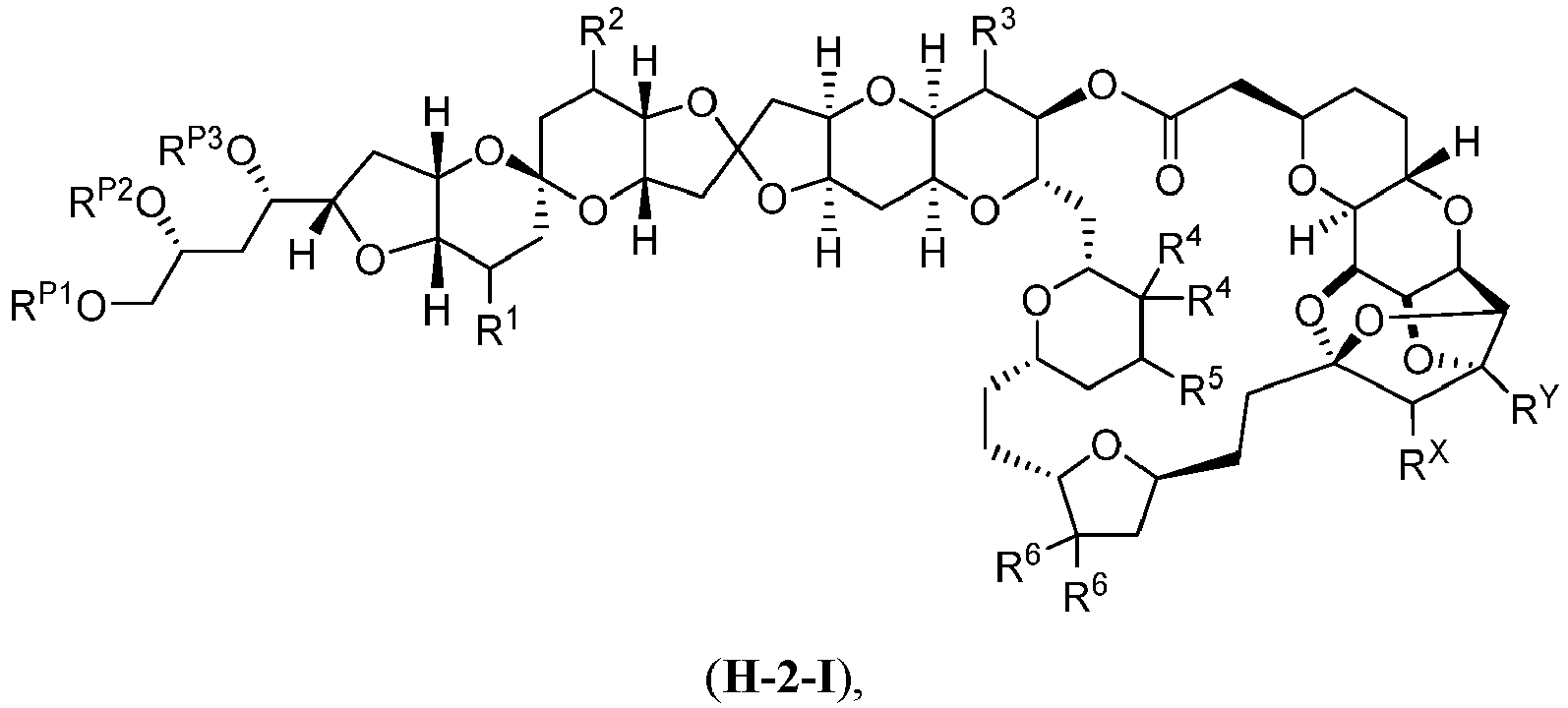

- R1, R2, R3, and R5 are each independently hydrogen, halogen, or optionally substituted alkyl;
- each instance of R4 is independently hydrogen, halogen, or optionally substituted alkyl, or two R4 groups are taken together to form: ;

- each instance of R6 is independently hydrogen, halogen, optionally substituted alkyl, or two R 6 groups are taken together to form: ;

- RP1, RP2, RP3, RP4, and RP5 are each independently hydrogen, optionally substituted alkyl, optionally substituted acyl, or an oxygen protecting group;
- RX is hydrogen or -ORXa, wherein RXa is hydrogen, optionally substituted alkyl, optionally substituted acyl, or an oxygen protecting group; and
- RY is hydrogen or -ORYa, wherein RYa is hydrogen, optionally substituted alkyl, optionally substituted acyl, or an oxygen protecting group;
- optionally wherein RXa and RYa are joined together with their intervening atoms to form optionally substituted heterocyclyl.
- In certain embodiments, the step of cyclizing a compound of Formula (H-2-II), or a salt thereof, is carried out in the presence of an acid. The acid may be a Lewis acid or a Brønsted acid. In certain embodiments, the acid is a Brønsted acid. In certain embodiments, the acid is a sulfonic acid. In certain embodiments, the acid is a salt of a sulfonic acid. In certain embodiments, the acid is a pyridinium salt. In certain embodiments, the acid is pyridinium p-toluenesulfonate (PPTS). In certain embodiments, the acid is present in a catalytic amount. In certain embodiments, the acid is present in a stoichiometric (e.g., approximately 1 equivalent) or excess amount (e.g., greater than 1 equivalent). In certain embodiments, the acid is present in an excess amount (e.g., about 5 equivalents).
- In certain embodiments, the step of cyclizing is carried out in the presence of PPTS. In certain embodiments, the step is carried out in a solvent such as CH2Cl2. In certain embodiments, the reaction is carried out at a temperature ranging from approximately 0 °C to approximately 50 °C. In certain embodiments, the reaction is carried out at around room temperature. In certain embodiments, the reaction is carried out at around 20 °C. For example, in certain embodiments, the step of cyclizing is carried out under the following conditions: 5 equivalents of PPTS in CH2Cl2 at around 20 °C (e.g., for 2 hours).
- In certain embodiments, RP1, RP2, and RP3 are silyl protecting groups, and RP4 and RP5 are hydrogen. In certain embodiments, RP1 and RP2 are TBS, RP3 is TES, and RP4 and RP5 are hydrogen.
- In certain embodiments, the compound of Formula (H-2-II) is of Formula (H-2-IIA):

- Provided herein is a method of preparing a compound of Formula (H-2-II):


- RS is optionally substituted alkyl, optionally substituted carbocyclyl, optionally substituted aryl, optionally substituted heterocyclyl, or optionally substituted heteroaryl;
- X1 is halogen or a leaving group;
- R1, R2, R3, and R5 are each independently hydrogen, halogen, or optionally substituted alkyl;
- each instance of R4 is independently hydrogen, halogen, or optionally substituted alkyl, or two R4 groups are taken together to form:

- each instance of R6 is independently hydrogen, halogen, or optionally substituted alkyl, or two R6 groups are taken together to form:

- RP1, RP2 , RP3, RP4, and RP5 are each independently hydrogen, optionally substituted alkyl, optionally substituted acyl, or an oxygen protecting group;
- RX is hydrogen or -ORXa, wherein RXa is hydrogen, optionally substituted alkyl, optionally substituted acyl, or an oxygen protecting group; and
- RY is hydrogen or -ORYa, wherein RYa is hydrogen, optionally substituted alkyl, optionally substituted acyl, or an oxygen protecting group;
- optionally wherein RXa and RYa are joined together with their intervening atoms to form optionally substituted heterocyclyl.
- In certain embodiments, the step of coupling to provide a compound of Formula (H-2-II) is a Ni/Zr-mediated ketolization provided herein. Any reagents or conditions provided herein for the Ni/Zr-mediated ketolization may be used in the coupling. In certain embodiments, the Ni/Zr-mediated ketolization reaction is carried out in the presence of a nickel complex, a zirconium complex, and a reducing metal. The reaction may also be carried out in the presence of one or more additional reagents, such a base or proton scavenger. In certain embodiments, the nickel complex is NiBr2(dtbbpy). In certain embodiments, the zirconium complex is Cp2ZrCl2. In certain embodiments, the reducing metal is zinc. In certain embodiments, the additional base or proton scavenger is (t-Bu)2(Me)Py. In certain embodiments, the reaction is carried out in the presence of NiBr2(dtbbpy), Cp2ZrCl2, and zinc metal. In certain embodiments, the reaction is carried out in the presence of NiBr2(dtbbpy), Cp2ZrCl2, and zinc metal. In certain embodiments, the reaction is carried out in the presence of NiBr2(dtbbpy), Cp2ZrCl2, zinc metal, and (t-Bu)2(Me)Py. In certain embodiments, the reaction is carried out in a polar solvent such as DMI (1,3-dimethyl-2-imidazolidinone). In certain embodiments, the reaction is carried out in a mixture of DMI and EtOAc (ethyl acetate). In certain embodiments, the reaction is carried out at a temperature ranging from approximately room temperature to approximately 100 °C. In certain embodiments, the reaction is carried out at a temperature ranging from approximately room temperature to approximately 50 °C. In certain embodiments, the reaction is carried out at around room temperature.
- For example, in certain embodiments, the coupling is carried out under the following conditions: 30 mol% NiBr2(dtbbpy), 3.0 equivalents Cp2ZrCl2, 6.0 equivalents zinc metal, and 4.0 equivalents (t-Bu)2(Me)Py, in DMI-EtOAc at room temperature.
- In certain embodiments, RP1, RP2, RP3, RP4 and RP5 are silyl protecting groups. In certain embodiments, RP1 and RP2 are TBS; and RP3, RP4, and RP5 are TES.
- In certain embodiments, the method of preparing a compound of Formula (H-2-II) further comprises one or more steps of deprotecting one or more oxygen atoms of the compound of Formula (H-2-II) (e.g., to yield a compound of Formula (H-2-IIA), or a salt thereof). In certain embodiments, the resulting compound or salt thereof can then be used in the cyclization step to yield a compound of Formula (H-2-I), or a salt thereof. In certain embodiments, the step of deprotecting is carried out in the presence of a fluoride source (e.g., when the one or more oxygen atoms are protected with silyl groups).
- Examples of fluoride sources useful in the invention include, but are not limited to, metal fluorides (e.g., sodium fluoride, potassium fluoride, cesium fluoride, silver fluoride) and tetraalkylammonium fluorides (e.g., tetramethylammonium fluoride, tetraethylammonium fluoride, tetrabutylammonium fluoride). In certain embodiments, the fluoride source is a tetraalkylammonium fluoride. In certain embodiments, the fluoride source is tetrabutylammonium fluoride (TBAF). In certain embodiments, hydrogen fluoride (HF) is used. In certain embodiments, HF•pyridine is used as the HF source. Other examples of protecting groups useful in the present invention, and reagents useful in protection/deprotection reactions can be found in the art, e.g., in Protecting Groups in Organic Synthesis, T. W. Greene and P. G. M. Wuts, 3rd edition, John Wiley & Sons, 1999, incorporated herein by reference.
- Once a compound of Formula (H-2-I), or salt thereof, is obtained, the method may comprise one or more additional steps (e.g., deprotection, protection, substitution, addition, elimination) to yield a desired compound (e.g., halichondrin A, B, C, or an analog thereof).
- The Ni/Zr-mediated ketolization reactions provided herein can be applied to the preparation of homohalichondrins (e.g., homohalichondrin A, B, C), and analogs thereof. For example, as shown in Scheme 2B, coupling of a left half of Formula (L-2-16) with a right half of Formula (R-2-I) via a Ni/Zr-mediated ketolization yields a ketone of Formula (HH-2-II), cyclization of which provides a compound of Formula (HH-2-I), which is a homohalichondrin natural product or an analog thereof, or an intermediate thereto.

- Provided herein is a method of preparing a compound of Formula (HH-2-I):


- R1, R2, R3, and R5 are each independently hydrogen, halogen, or optionally substituted alkyl;
- each instance of R4 is independently hydrogen, halogen, or optionally substituted alkyl, or two R 4 groups are taken together to form: ;

- each instance of R6 is independently hydrogen, halogen, or optionally substituted alkyl, or two R 6 groups are taken together to form: ;

- RP1, RP3, RP4, and RP5 are each independently hydrogen, optionally substituted alkyl, optionally substituted acyl, or an oxygen protecting group;
- RX is hydrogen or -ORXa, wherein RXa is hydrogen, optionally substituted alkyl, optionally substituted acyl, or an oxygen protecting group; and
- RY is hydrogen or -ORYa, wherein RYa is hydrogen, optionally substituted alkyl, optionally substituted acyl, or an oxygen protecting group;
- optionally wherein RXa and RYa are joined together with their intervening atoms to form optionally substituted heterocyclyl.
- In certain embodiments, the step of cyclizing a compound of Formula (HH-2-II), or a salt thereof, is carried out in the presence of an acid. The acid may be a Lewis acid or a Brønsted acid. In certain embodiments, the acid is a Brønsted acid. In certain embodiments, the acid is a sulfonic acid. In certain embodiments, the acid is a salt of a sulfonic acid. In certain embodiments, the acid is a pyridinium salt. In certain embodiments, the acid is pyridinium p-toluenesulfonate (PPTS). In certain embodiments, the acid is present in a catalytic amount. In certain embodiments, the acid is present in a stoichiometric (e.g., approximately 1 equivalent) or excess amount (e.g., greater than 1 equivalent). In certain embodiments, the acid is present in an excess amount (e.g., about 5 equivalents).
- In certain embodiments, the step of cyclizing is carried out in the presence of PPTS. In certain embodiments, the step is carried out in a solvent such as CH2Cl2. In certain embodiments, the reaction is carried out at a temperature ranging from approximately 0 °C to approximately 50 °C. In certain embodiments, the reaction is carried out at around room temperature. In certain embodiments, the reaction is carried out at around 20 °C. For example, in certain embodiments, the step of cyclizing is carried out under the following conditions: 5 equivalents of PPTS in CH2Cl2 at around 20 °C (e.g., for 2 hours).
- In certain embodiments, RP1 and RP2 are silyl protecting groups; and RP4 and RP5 are hydrogen. In certain embodiments, RP1 is TBS; RP2 is TES; and RP4 and RP5 are hydrogen.
- In certain embodiments, the compound of Formula (HH-2-II) is of Formula (HH-2-IIA):

- Provided herein is a method of preparing a compound of Formula (HH-2-II):


- RS is optionally substituted alkyl, optionally substituted carbocyclyl, optionally substituted aryl, optionally substituted heterocyclyl, or optionally substituted heteroaryl;
- X1 is halogen or a leaving group;
- R1, R2, R3, and R5 are each independently hydrogen, halogen, or optionally substituted alkyl;
- each instance of R4 is independently hydrogen, halogen, or optionally substituted alkyl, or two R4 groups are taken together to form:
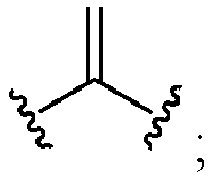
- each instance of R6 is independently hydrogen, halogen, or optionally substituted alkyl, or two R6 groups are taken together to form:

- RP1, RP3, RP4, and RP5 are each independently hydrogen, optionally substituted alkyl, optionally substituted acyl, or an oxygen protecting group;
- RX is hydrogen or -ORXa, wherein RXa is hydrogen, optionally substituted alkyl, optionally substituted acyl, or an oxygen protecting group; and
- RY is hydrogen or -ORYa, wherein RYa is hydrogen, optionally substituted alkyl, optionally substituted acyl, or an oxygen protecting group;
- optionally wherein RXa and RYa are joined together with their intervening atoms to form optionally substituted heterocyclyl.
- In certain embodiments, the step of coupling to provide a compound of Formula (HH-2-II) is a Ni/Zr-mediated ketolization as provided herein. Any reagents or conditions provided herein for the Ni/Zr-mediated ketolization may be used in the coupling. In certain embodiments, the Ni/Zr-mediated ketolization reaction is carried out in the presence of a nickel complex, a zirconium complex, and a reducing metal. The reaction may also be carried out in the presence of one or more additional reagents, such a base or proton scavenger. In certain embodiments, the nickel complex is NiBr2(dtbbpy). In certain embodiments, the zirconium complex is Cp2ZrCl2. In certain embodiments, the reducing metal is zinc. In certain embodiments, the additional base or proton scavenger is (t-Bu)2(Me)Py. In certain embodiments, the reaction is carried out in the presence of NiBr2(dtbbpy), Cp2ZrCl2, and zinc metal. In certain embodiments, the reaction is carried out in the presence of NiBr2(dtbbpy), Cp2ZrCl2, and zinc metal. In certain embodiments, the reaction is carried out in the presence of NiBr2(dtbbpy), Cp2ZrCl2, zinc metal, and (t-Bu)2(Me)Py. In certain embodiments, the reaction is carried out in a polar solvent such as DMI (1,3-dimethyl-2-imidazolidinone). In certain embodiments, the reaction is carried out in a mixture of DMI and EtOAc (ethyl acetate). In certain embodiments, the reaction is carried out at a temperature ranging from approximately room temperature to approximately 100 °C. In certain embodiments, the reaction is carried out at a temperature ranging from approximately room temperature to approximately 50 °C. In certain embodiments, the reaction is carried out at around room temperature.
- For example, in certain embodiments, the coupling is carried out under the following conditions: 30 mol% NiBr2(dtbbpy), 3.0 equivalents Cp2ZrCl2, 6.0 equivalents zinc metal, and 4.0 equivalents (t-Bu)2(Me)Py, in DMI-EtOAc at room temperature.
- In certain embodiments, RP1, RP2, RP3, RP4 and RP5 are silyl protecting groups. In certain embodiments, RP1 and RP2 are TBS; and RP3, RP4, and RP5 are TES.
- In certain embodiments, the method of preparing a compound of Formula (HH-2-II) further comprises one or more steps of deprotecting one or more oxygen atoms of the compound of Formula (HH-2-II) (e.g., to yield a compound of Formula (HH-2-IIA), or a salt thereof). In certain embodiments, the resulting compound, or salt thereof, is then cyclizedto yield a compound of Formula (HH-2-I), or a salt thereof. In certain embodiments, a step of deprotecting is carried out in the presence of a fluoride source (e.g., when one or more oxygen atoms are protected with silyl groups). Examples of fluoride sources are provided herein.
- Once a compound of Formula (HH-2-I), or salt thereof, is obtained, one or more additional steps (e.g., deprotection, protection, substitution, addition, elimination) may be performed to yield a desired compound (e.g., homohalichondrin A, B, C, or an analog thereof, or intermediate thereto).
- The Ni/Zr-mediated ketolization reactions provided herein can be applied to the preparation of norhalichondrins (e.g., norhalichondrin A, B, C) and analogs thereof. For example, as shown in Scheme 2C, coupling of a left half of Formula (L-2-15) with a right half of Formula (R-2-I) via a Ni/Zr-mediated ketolization yields a ketone of Formula (NH-2-II), cyclization of which provides a compound of Formula (NH-2-I), which is a norhalichondrin or an analog thereof, or intermediate thereto.

- Provided herein is a method of preparing a compound of Formula (NH-2-I):


- R1, R2, R3, and R5 are each independently hydrogen, halogen, or optionally substituted alkyl;
- each instance of R4 is independently hydrogen, halogen, or optionally substituted alkyl, or two R4 groups are taken together to form:

- each instance of R6 is independently hydrogen, halogen, or optionally substituted alkyl, or two R6 groups are taken together to form:

- RP3, RP4, and RP5 are each independently hydrogen, optionally substituted alkyl, optionally substituted acyl, or an oxygen protecting group;
- R7 is hydrogen, optionally substituted alkyl, optionally substituted carbocyclyl, optionally substituted aryl, optionally substituted heterocyclyl, optionally substituted heteroaryl, optionally substituted acyl, or an oxygen protecting group;
- RX is hydrogen or -ORXa, wherein RXa is hydrogen, optionally substituted alkyl, optionally substituted acyl, or an oxygen protecting group; and
- RY is hydrogen or -ORYa, wherein RYa is hydrogen, optionally substituted alkyl, optionally substituted acyl, or an oxygen protecting group;
- optionally wherein RXa and RYa are joined together with their intervening atoms to form optionally substituted heterocyclyl.
- In certain embodiments, the step of cyclizing a compound of Formula (NH-2-II), or a salt thereof, is carried out in the presence of an acid. The acid may be a Lewis acid or a Brønsted acid. In certain embodiments, the acid is a Brønsted acid. In certain embodiments, the acid is a sulfonic acid. In certain embodiments, the acid is a salt of a sulfonic acid. In certain embodiments, the acid is a pyridinium salt. In certain embodiments, the acid is pyridinium p-toluenesulfonate (PPTS). In certain embodiments, the acid is present in a catalytic amount. In certain embodiments, the acid is present in a stoichiometric (e.g., approximately 1 equivalent) or excess amount (e.g., greater than 1 equivalent). In certain embodiments, the acid is present in an excess amount (e.g., about 5 equivalents).
- In certain embodiments, the step of cyclizing is carried out in the presence of PPTS. In certain embodiments, the step is carried out in a solvent such as CH2Cl2. In certain embodiments, the reaction is carried out at a temperature ranging from approximately 0 °C to approximately 50 °C. In certain embodiments, the reaction is carried out at around room temperature. In certain embodiments, the reaction is carried out at around 20 °C. For example, in certain embodiments, the step of cyclizing is carried out under the following conditions: 5 equivalents of PPTS in CH2Cl2 at around 20 °C (e.g., for 2 hours).
- In certain embodiments, RP3 is a silyl protecting group; R7 is optionally substituted alkyl; and RP4 and RP5 are hydrogen. In certain embodiments, RP3 is TES; R7 is methyl; and RP4 and RP5 are hydrogen.
- In certain embodiments, the compound of Formula (NH-2-II) is of Formula (NH-2-IIA):

- Provided herein is a method of preparing a compound of Formula (NH-2-II):


- RS is optionally substituted alkyl, optionally substituted carbocyclyl, optionally substituted aryl, optionally substituted heterocyclyl, or optionally substituted heteroaryl;
- X1 is halogen or a leaving group;
- R1, R2, R3, and R5 are each independently hydrogen, halogen, or optionally substituted alkyl;
- each instance of R4 is independently hydrogen, halogen, or optionally substituted alkyl, or two R4 groups are taken together to form:

- each instance of R6 is independently hydrogen, halogen, or optionally substituted alkyl, or two R6 groups are taken together to form:

- RP3, RP4, and RP5 are each independently hydrogen, optionally substituted alkyl, optionally substituted acyl, or an oxygen protecting group;
- R7 is hydrogen, optionally substituted alkyl, optionally substituted carbocyclyl, optionally substituted aryl, optionally substituted heterocyclyl, optionally substituted heteroaryl, optionally substituted acyl, or an oxygen protecting group;
- RX is hydrogen or -ORXa, wherein RXa is hydrogen, optionally substituted alkyl, optionally substituted acyl, or an oxygen protecting group; and
- RY is hydrogen or -ORYa, wherein RYa is hydrogen, optionally substituted alkyl, optionally substituted acyl, or an oxygen protecting group;
- optionally wherein RXa and RYa are joined together with their intervening atoms to form optionally substituted heterocyclyl.
- In certain embodiments, the step of coupling to provide a compound of Formula (NH-2-II) is a Ni/Zr-mediated ketolization provided herein. Any reagents or conditions provided herein for the Ni/Zr-mediated ketolization may be used in the coupling. In certain embodiments, the Ni/Zr-mediated ketolization reaction is carried out in the presence of a nickel complex, a zirconium complex, and a reducing metal. The reaction may also be carried out in the presence of one or more additional reagents, such a base or proton scavenger. In certain embodiments, the nickel complex is NiBr2(dtbbpy). In certain embodiments, the zirconium complex is Cp2ZrCl2. In certain embodiments, the reducing metal is zinc. In certain embodiments, the additional base or proton scavenger is (t-Bu)2(Me)Py. In certain embodiments, the reaction is carried out in the presence of NiBr2(dtbbpy), Cp2ZrCl2, and zinc metal. In certain embodiments, the reaction is carried out in the presence of NiBr2(dtbbpy), Cp2ZrCl2, and zinc metal. In certain embodiments, the reaction is carried out in the presence of NiBr2(dtbbpy), Cp2ZrCl2, zinc metal, and (t-Bu)2(Me)Py. In certain embodiments, the reaction is carried out in a polar solvent such as DMI (1,3-dimethyl-2-imidazolidinone). In certain embodiments, the reaction is carried out in a mixture of DMI and EtOAc (ethyl acetate). In certain embodiments, the reaction is carried out at a temperature ranging from approximately room temperature to approximately 100 °C. In certain embodiments, the reaction is carried out at a temperature ranging from approximately room temperature to approximately 50 °C. In certain embodiments, the reaction is carried out at around room temperature.
- For example, in certain embodiments, the coupling is carried out under the following conditions: 30 mol% NiBr2(dtbbpy), 3.0 equivalents Cp2ZrCl2, 6.0 equivalents zinc metal, and 4.0 equivalents (t-Bu)2(Me)Py, in DMI-EtOAc at room temperature.
- In certain embodiments, RP3 is a silyl protecting group; R7 is optionally substituted alkyl; and RP4 and RP5 are silyl protecting groups. In certain embodiments, RP3 is TES; R7 is methyl; and RP4 and RP5 are TES.
- In certain embodiments, the method of preparing a compound of Formula (NH-2-II) further comprises one or more steps of deprotecting one or more oxygen atoms of the compound of Formula (NH-2-II) (e.g., to yield a compound of Formula (NH-2-IIA), or a salt thereof). In certain embodiments, the resulting compound, or salt thereof, is then cyclized to yield a compound of Formula (NH-2-I), or a salt thereof. In certain embodiments, a step of deprotecting is carried out in the presence of a fluoride source (e.g., when the one or more oxygen atoms are protected with silyl groups). Examples of fluoride sources are provided herein.
- Once a compound of Formula (NH-2-I), or salt thereof, is obtained, the method may comprise one or more additional steps (e.g., deprotection, protection, substitution, addition, elimination) to yield a desired compound (e.g., homohalichondrin A, B, C, or an analog thereof).
- Methods for the preparation of additional halichondrin analogs are provided herein. The Ni/Zr-mediated ketolization reactions provided herein can be applied to the preparation of additional halichondrin analogs. For example, as shown in Scheme 2D, coupling of a left half of Formula (L-2-6) with a right half of Formula (R-2-I) via a Ni/Zr-mediated ketolization yields a ketone of Formula (H3-2-II), cyclization of which provides a compound of Formula (H3-2-I). The compound of Formula (H3-2-I) can be subjected to further synthetic transformation to yield a desired compound.

- As shown in Scheme 2D, provided herein is a method of preparing a compound of Formula (H3-2-I):


- R1, R2, R3, and R5 are each independently hydrogen, halogen, or optionally substituted alkyl;
- each instance of R4 is independently hydrogen, halogen, or optionally substituted alkyl, or two R4 groups are taken together to form:

- each instance of R6 is independently hydrogen, halogen, or optionally substituted alkyl, or two R6 groups are taken together to form:

- RP4, RP5, and RP6 are each independently hydrogen, optionally substituted alkyl, optionally substituted acyl, or an oxygen protecting group; optionally wherein two RP6 are joined with the intervening atoms to form optionally substituted heterocyclyl;
- RX is hydrogen or -ORXa, wherein RXa is hydrogen, optionally substituted alkyl, optionally substituted acyl, or an oxygen protecting group; and
- RY is hydrogen or -ORYa, wherein RYa is hydrogen, optionally substituted alkyl, optionally substituted acyl, or an oxygen protecting group;
- optionally wherein RXa and RYa are joined together with their intervening atoms to form optionally substituted heterocyclyl.
- In certain embodiments, the compound of Formula (H3-2-II) is of Formula (H3-2-IIA):

- In certain embodiments, the method is a method of preparing Compound (2):


- In certain embodiments, the step of cyclizing a compound of Formula (H3-2-II), Compound (C), or a salt thereof, is carried out in the presence of an acid. The acid may be a Lewis acid or a Brønsted acid. In certain embodiments, the acid is a Brønsted acid. In certain embodiments, the acid is a sulfonic acid. In certain embodiments, the acid is a salt of a sulfonic acid. In certain embodiments, the acid is a pyridinium salt. In certain embodiments, the acid is pyridinium p-toluenesulfonate (PPTS). In certain embodiments, the acid is present in a catalytic amount. In certain embodiments, the acid is present in a stoichiometric (e.g., approximately 1 equivalent) or excess amount (e.g., greater than 1 equivalent). In certain embodiments, the acid is present in an excess amount (e.g., about 5 equivalents). In certain embodiments, the step is carried out in a solvent. In certain embodiments, the reaction is carried out in dichloromethane (DCM). In certain embodiments, the reaction is carried out at a temperature ranging from approximately 0°C to approximately 50 °C. In certain embodiments, the reaction is carried out at a temperature ranging from approximately 0°C to approximately room temperature. In certain embodiments, the reaction is carried out at around 20 °C. In certain embodiments, the reaction is carried out at around room temperature. In certain embodiments, the reaction is carried out at around 9-11 °C.
- In certain embodiments, the step of cyclizing is carried out in the presence of PPTS. In certain embodiments, the step of cyclizing is carried out in the presence of PPTS in DCM. For example, in certain embodiments, the step of cyclizing is carried out under the following conditions: 5 equivalents of PPTS in DCM at around 20 °C (e.g., for 2 hours). For example, in certain embodiments, the step of cyclizing is carried out under the following conditions: 5 equivalents of PPTS in DCM at around 9-11 °C (e.g., for 3 hours).
- In certain embodiments, two RP6 are oxygen protecting groups; and RP4 and RP5 are hydrogen. In certain embodiments, two RP6 are joined to form:


- As shown in Scheme 2D, provided herein is a method of preparing a compound of Formula (H3-2-II):


- RS is optionally substituted alkyl, optionally substituted carbocyclyl, optionally substituted aryl, optionally substituted heterocyclyl, or optionally substituted heteroaryl;
- X1 is halogen or a leaving group;
- R1, R2, R3, and R5 are each independently hydrogen, halogen, or optionally substituted alkyl;
- each instance of R4 is independently hydrogen, halogen, or optionally substituted alkyl, or two R4 groups are taken together to form:

- each instance of R6 is independently hydrogen, halogen, or optionally substituted alkyl, or two R6 groups are taken together to form:

- RP4, RP5, and RP6 are each independently hydrogen, optionally substituted alkyl, optionally substituted acyl, or an oxygen protecting group; optionally wherein two RP6 are joined with the intervening atoms to form optionally substituted heterocyclyl;
- RX is hydrogen or -ORXa, wherein RXa is hydrogen, optionally substituted alkyl, optionally substituted acyl, or an oxygen protecting group; and
- RY is hydrogen or -ORYa, wherein RYa is hydrogen, optionally substituted alkyl, optionally substituted acyl, or an oxygen protecting group;
- optionally wherein RXa and RYa are joined together with their intervening atoms to form optionally substituted heterocyclyl.
- In certain embodiments, the method comprises coupling a compound of Formula (EL):
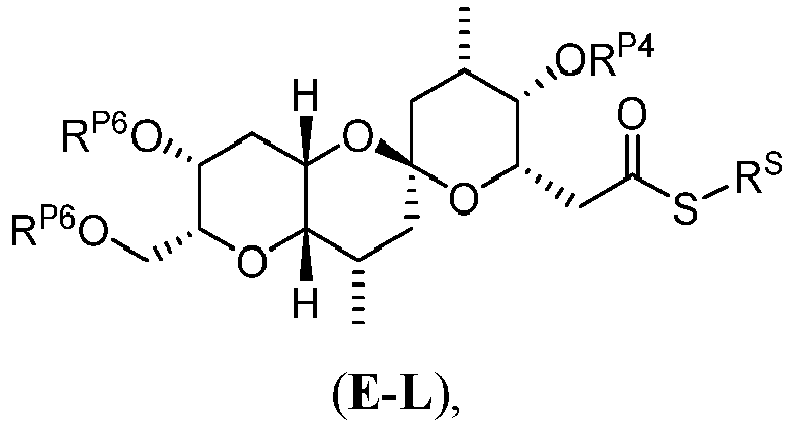


- RS is optionally substituted alkyl, optionally substituted carbocyclyl, optionally substituted aryl, optionally substituted heterocyclyl, or optionally substituted heteroaryl;
- X1 is halogen or a leaving group; and
- RP4, RP5, and RP6 are each independently hydrogen, optionally substituted alkyl, optionally substituted acyl, or an oxygen protecting group; optionally wherein two RP6 are joined with the intervening atoms to form optionally substituted heterocyclyl.
- In certain embodiments, the step of coupling to provide a compound of Formula (H3-2-II), (E-1), or a salt thereof, is a Ni/Zr-mediated ketolization provided herein. Any reagents or conditions provided herein for the Ni/Zr-mediated ketolization may be used in the coupling. See, e.g., the section entitled Ni/Zr-MediatedKetolization Reactions above.
- In certain embodiments, the Ni/Zr-mediated ketolization reaction is carried out in the presence of nickel and zirconium complexes. In certain embodiments, the Ni/Zr-mediated ketolization reaction is carried out in the presence of a nickel complex, a zirconium complex, and a reducing metal.
- In certain embodiments, the nickel is a nickel complex. In certain embodiments, the nickel is a nickel(II) or nickel(0) complex. In certain embodiments, the nickel complex is of the formula: NiX2•(ligand); wherein X is halogen and "ligand" is a bidentate ligand. In certain embodiments, the nickel complex is used after complexation of a nickel source and a "ligand" in solution. In certain embodiments, the nickel source is NiCl2; the "ligand" is 4,4'-di-tert-butyl-2,2'-dipyridyl (tbbpy); and the nickel complex is of the formula NiCl2•(tbbpy). In certain embodiments, the nickel source is NiBr2; and the "ligand" is 4,4'-di-tert-butyl-2,2'-dipyridyl (tbbpy); and the nickel complex is of the formula NiBr2•(tbbpy).
- In certain embodiments, the zirconium complex is Cp2ZrCl2. In certain embodiments, Cp2ZrCl2 is present in a stoichiometric or excess amount (e.g., from 1-4 equivalents). In certain embodiments, the reducing metal is zinc metal. In certain embodiments, the reducing metal is manganese metal. In certain embodiments, the zinc or manganese metal is present in an excess amount. The reaction may also be carried out in the presence of one or more additional reagents, such a base and/or proton scavenger. In certain embodiments, the reaction is carried out in the presence of (t-Bu)2(Me)Py. In certain embodiments, the reaction is carried out in the presence of proton sponge (e.g., 1,8-bis(dimethylamino)naphthalene).
- In certain embodiments, the reaction is carried out in the presence of NiBr2(dtbbpy), Cp2ZrCl2, and zinc metal. In certain embodiments, the reaction is carried out in the presence of NiBr2(dtbbpy), Cp2ZrCl2, and manganese metal. In certain embodiments, the reaction is carried out in the presence of NiBr2(dtbbpy), Cp2ZrCl2, zinc metal, and (t-Bu)2(Me)Py. In certain embodiments, the reaction is carried out in the presence of NiBr2(dtbbpy), Cp2ZrCl2, manganese metal, and (t-Bu)2(Me)Py.
- In certain embodiments, the reaction is carried out in a polar solvent, such as DMI (1,3-dimethyl-2-imidazolidinone). In certain embodiments, the reaction is carried out in a mixture of DMI and EtOAc (ethyl acetate). In certain embodiments, the reaction is carried out in a mixture of DMI and ethanol. In certain embodiments, the reaction is carried out at a temperature ranging from approximately room temperature to approximately 100 °C. In certain embodiments, the reaction is carried out at a temperature ranging from approximately room temperature to approximately 50 °C. In certain embodiments, the reaction is carried out at around room temperature. In certain embodiments, the reaction is carried out at around 30 °C.
- For example, in certain embodiments, the coupling is carried out under the following conditions: 30 mol% NiBr2(dtbbpy), 3.0 equivalents Cp2ZrCl2, 6.0 equivalents zinc metal, and 4.0 equivalents (t-Bu)2(Me)Py, in DMI-EtOAc at room temperature.
- In certain embodiments, the coupling is carried out in the presence of NiBr2(dtbbpy), Cp2ZrCl2, and manganese metal in DMI. For example, in certain embodiments, the coupling is carried out under the following conditions: approximately 75 mol% NiBr2(dtbbpy), 3.5 equivalents Cp2ZrCl2, and 7 equivalents manganese metal in DMI at around 30 °C (e.g., for 4 hours).
- In certain embodiments, the coupling is carried out by reacting a compound of Formula (L-2-6), or a salt thereof, in the presence of a compound of Formula (R-2-1), or a salt thereof, Cp2ZrCl2, and manganese metal; followed by the addition of NiBr2(dtbbpy) to the reaction mixture. In certain embodiments, the coupling is carried out by reacting a compound of Formula (L-2-6), or a salt thereof, in the presence of a compound of Formula (R-2-I), or a salt thereof, Cp2ZrCl2, and manganese metal in DMI; followed by the addition of NiBr2(dtbbpy) in a solution of DMI to the reaction mixture.
- In certain embodiments, the coupling is carried out by reacting a compound of Formula (E-L), or a salt thereof, in the presence of a compound of Formula (R-L), or a salt thereof, Cp2ZrCl2, and manganese metal; followed by the addition of NiBr2(dtbbpy) to the reaction mixture. In certain embodiments, the coupling is carried out by reacting a compound of Formula (E-L), or a salt thereof, in the presence of a compound of Formula (R-L), or a salt thereof, Cp2ZrCl2, and manganese metal in DMI; followed by the addition of NiBr2(dtbbpy) in a solution of DMI to the reaction mixture.
- The coupling reaction to yield a compound of Formula (H3-2-II), (E-1), or a salt thereof, can be carried out to yield any amount of product. In certain embodiments, the reaction is carried out to yield more than 1 g, 2 g, 5 g, 10 g, 20 g, 30 g, 50 g, 100 g, 200 g, 500 g, or 1 kg of product. In certain embodiments, the reaction is carried out to yield less than 1 g of product. In certain embodiments, the reaction is carried out to yield from 1 g to 100 g of product, inclusive. In certain embodiments, the reaction is carried out to yield approximately 1 g, 2 g, 5 g, 10 g, 20 g, 30 g, 40 g, 50 g, 60 g, 70 g, 80 g, 90 g, or 100 g of product.
- In certain embodiments, X1 is a halogen and RS is optionally substituted pyridyl. In certain embodiments, X1 is -I. In certain embodiments, RS is 2-pyridyl. In certain embodiments, X1 is -I; and RS is 2-pyridyl.
- In certain embodiments, two RP6 are joined to form:and RP4 and RP5 are silyl protecting groups. In certain embodiments, two RP6 are joined to form:


- In certain embodiments, the method of preparing a compound of Formula (H3-2-II) further comprises one or more steps of deprotecting one or more oxygen atoms (e.g., removing groups RP4, RP5, and/or RP6) of the compound of Formula (H3-2-II) (e.g., to yield a compound of Formula (H3-2-IIA), or a salt thereof). In certain embodiments, the resulting compound, or salt thereof, can then be used in the cyclization step to yield a compound of Formula (H3-2-I), or a salt thereof. Likewise, the method of preparing a compound of Formula (E-1) can further comprise one or more steps of deprotecting one or more oxygen atoms (e.g., removing groups RP4, RP5, and/or RP6) of the compound of Formula (E-1) (e.g., to yield Compound (C), or a salt thereof). In certain embodiments, the resulting compound, or salt thereof, can then be used in the cyclization step to yield Compound (2).
- In certain embodiments, a step of deprotecting is carried out in the presence of a fluoride source (e.g., when RP4, RP5, and/or RP6 are silyl protecting groups). Examples of fluoride sources are provided herein. In certain embodiments, the fluoride source is TBAF. In certain embodiments, the step of deprotection is carried out in the presence of an imidazole hydrochloride. In certain embodiments, RP4 and RP5 are TES; and the step of deprotecting (to remove RP4 and RP5) is carried out in the presence of TBAF and imidazole hydrochloride. In certain embodiments, two RP6 are joined to form:

- Once a compound of Formula (H3-2-I), (E-1), or salt thereof, is obtained, the method may comprise one or more additional steps (e.g., deprotection, protection, substitution, addition, elimination) to yield a desired compound.
- Provided herein are methods for preparing amino analogs of halichondrins, such as compound of Formula (H3-A). For example, as shown below in
Scheme 4, compounds of Formula (H3-A) can be prepared by converting compounds of Formula (H3-OH). The primary hydroxyl group (denoted by * in Scheme 4) is converted to a leaving group -ORL by treatment of a compound of Formula (H3-A) with a reagent of formula XL-RL. The group - ORL can then be substituted for an amine or amine precursor. In certain embodiments, the method comprises substituting the primary -ORL group with an azide (-N3) (i.e., to yield a compound of Formula (H3-N3)). The azide moiety can then be reduced to an amine to yield a compound of Formula (H3-A).
- In certain embodiments, the compound of Formula (H3-A) is a Compound (1), or a salt thereof. Therefore, provided herein are methods for preparing Compound (1) and salts thereof. For example, as shown below in
Scheme 2, Compound (1) can be prepared by converting Compound (2) to a compound of Formula (A). In this step, the primary hydroxyl group of Compound (2) (denoted by * in Scheme 2) is converted to a leaving group -ORL by treatment of Compound (2) with a reagent of formula XL-RL. In certain embodiments, the leaving group is a sulfonate (i.e., RL is optionally substituted sulfonyl). The group -ORL can then be substituted for an amine or amine precursor. In certain embodiments, the method comprises substituting the primary -ORL group with an azide (-N3) (i.e., to yield a compound of Formula (B)). The azide moiety of a compound of Formula (B) can then be reduced to an amine to yield Compound (1).
- As shown in
Scheme 4 above, provided herein is a method of preparing a compound of Formula (H3-A):

- R1, R1, R3, and R5 are each independently hydrogen, halogen, or optionally substituted alkyl;
- each instance of R4 is independently hydrogen, halogen, or optionally substituted alkyl, or two R4 groups are taken together to form:

- each instance of R6 is independently hydrogen, halogen, or optionally substituted alkyl, or two R6 groups are taken together to form:

- RP4, RP5, and RP6 are each independently hydrogen, optionally substituted alkyl, optionally substituted acyl, or an oxygen protecting group;
- RX is hydrogen or -ORXa, wherein RXa is hydrogen, optionally substituted alkyl, optionally substituted acyl, or an oxygen protecting group; and
- RY is hydrogen or -ORYa, wherein RYa is hydrogen, optionally substituted alkyl, optionally substituted acyl, or an oxygen protecting group;
- In certain embodiments, as shown in
Scheme 2, the method provided herein is a method for preparing Compound (1):

- The step of reducing to form a compound of Formula (H3-A), Compound (1), or a salt thereof, may be carried out in the presence of any reagents or conditions capable of reducing an azide to an amine (see, e.g., Chem. Rev., 1988, 88 (2), pp 297-368). In certain embodiments, the step of reducing is carried out in the presence of a phosphine reagent (i.e., the Staudinger reaction). In certain embodiments, the phosphine is a trialkylphosphine. In certain embodiments, the phosphine is a triarylphosphine. In certain embodiments, the phosphine is triphenylphosphine (Ph3P). In certain embodiments, the phosphine reagent is polymer-bound phosphine. In certain embodiments, the phosphine reagent is polymer-bound triphenylphosphine. In certain embodiments, treatment with the phosphine is followed by treatment with water, e.g., an aqueous work-up.
- In certain embodiments, approximately 1 equivalent of the phosphine reagent is used. In certain embodiments, greater than 1 equivalent of the phosphine reagent is used. In certain embodiments, approximately 1-10 equivalents of the phosphine reagent is used. In certain embodiments, approximately 1-5 equivalents of the phosphine reagent is used. In certain embodiments, approximately 3 equivalents of the phosphine is used. In certain embodiments, the reaction is carried out in a solvent. In certain embodiments, the reaction is carried out in THF. In certain embodiments, the reaction is carried out in THF and water. In certain embodiments, the reaction is carried out at a temperature ranging from approximately 0 °C to approximately 50 °C. In certain embodiments, the reaction is carried out at a temperature ranging from approximately 0 °C to approximately room temperature. In certain embodiments, the reaction is carried out at a temperature ranging from approximately room temperature to approximately 50 °C. In certain embodiments, the reaction is carried out at around room temperature. In certain embodiments, the reactions is carried out at around 25 °C.
- In certain embodiments, the reaction is carried out in the presence of polymer-bound PPh3 in THF and water. In certain embodiments, the reaction is carried out under the following conditions: 3 equivalents polymer-bound PPh3 in THF and water at around 25 °C (e.g., for 70 hours).
- In certain embodiments, the product is purified and isolated by precipitation. In certain embodiments, the product is purified by column chromatography. In certain embodiments, the product is isolated and purified using a combination of column chromatography and precipitation.
- In certain embodiments, RP6 is hydrogen. In certain embodiments, RP6 is an oxygen protecting group. In certain embodiments, RP6 is a silyl protecting group. In certain embodiments, one or more free hydroxyl groups of Compound (B) and Compound (1) is substituted with an oxygen protecting group (e.g., a silyl protecting group).
- Other reagents and conditions may be used to convert the azide of Compound (B), or a compound of Formula (H3-N3), to an amine. For example, in certain embodiments, the step of reducing is carried out in the presence of palladium and hydrogen (e.g., Pd/C and H2) . In certain embodiments, the step of reducing is carried out in the presence of a hydride (i.e., H-) source.
- As shown in
Scheme 4, also provided herein is a method of preparing a compound of Formula (H3-N3):

- RL is optionally substituted sulfonyl, optionally substituted sulfinyl, optionally substituted phosphoryl, or optionally substituted acyl;
- R1, R1, R3, and R5 are each independently hydrogen, halogen, or optionally substituted alkyl;
- each instance of R4 is independently hydrogen, halogen, or optionally substituted alkyl, or two R4 groups are taken together to form:

- each instance of R6 is independently hydrogen, halogen, or optionally substituted alkyl, or two R6 groups are taken together to form:

- RP4, RP5, and RP6 are each independently hydrogen, optionally substituted alkyl, optionally substituted acyl, or an oxygen protecting group;
- RX is hydrogen or -ORXa, wherein RXa is hydrogen, optionally substituted alkyl, optionally substituted acyl, or an oxygen protecting group; and
- RY is hydrogen or -ORYa, wherein RYa is hydrogen, optionally substituted alkyl, optionally substituted acyl, or an oxygen protecting group;
- In certain embodiments, as shown in
Scheme 2, the method is a method of preparing a compound of Formula (B):

RL is optionally substituted sulfonyl, optionally substituted sulfinyl, optionally substituted phosphoryl, or optionally substituted acyl. - The reaction to form a compound of Formula (H3-N3), Compound (B), or a salt thereof, is carried out in the presence of an azide. In certain embodiments, the azide is an azide salt. In certain embodiments, the azide sodium azide (NaN3) or potassium azide (KN3). In certain embodiments, the azide is a tetraalkylammonium azide (i.e., [(alkyl)4N]N3). In certain embodiments, the azide is tetrabutylammonium azide ([n-Bu4N]N3). In certain embodiments, approximately 1 equivalent of the azide is present. In certain embodiments, greater than 1 equivalent of the azide is present. In certain embodiments, approximately 1-10 equivalents of azide are present. In certain embodiments, approximately 5-10 equivalents are present. In certain embodiments, approximately 8 equivalents of azide is present.
- In certain embodiments, the reaction is carried out in a solvent. In certain embodiments, the solvent is a polar solvent. In certain embodiments, the solvent is an apolar solvent. In certain embodiments, the solvent is toluene. In certain embodiments, the reaction is carried out at above room temperature. In certain embodiments, the reaction is carried out at a temperature ranging from room temperature to approximately 150 °C. In certain embodiments, the reaction is carried out at approximately 100 °C.
- In certain embodiments, the reaction is carried out in the presence of tetrabutylammonium azide ([n-Bu4N]N3) in toluene. In certain embodiments, the reaction is carried out in the presence of tetrabutylammonium azide ([n-Bu4N]N3) in toluene at approximately 100 °C. In certain embodiments, the reaction is carried out under the following conditions: 8 equivalents of tetrabutylammonium azide ([n-Bu4N]N3) in toluene at approximately 100 °C (e.g., for 5 hours).
- In certain embodiments, RP6 is hydrogen and RL is Ts. In certain embodiments, RP6 is an oxygen protecting group and RL is Ts. In certain embodiments, RP6 is a silyl protecting group and RL is Ts. In certain embodiments, one or more free hydroxyl groups of Compound (A) and Compound (B) is substituted with an oxygen protecting group (e.g., a silyl protecting group).
- In certain embodiments, the compound of Formula (A) is the following:


- Also provided herein is a method of preparing a compound of Formula (H3-L):


- RL is optionally substituted sulfonyl, optionally substituted sulfinyl, optionally substituted phosphoryl, or optionally substituted acyl;
- XL is halogen or a leaving group;
- R1, R2, R3, and R5 are each independently hydrogen, halogen, or optionally substituted alkyl;
- each instance of R4 is independently hydrogen, halogen, or optionally substituted alkyl, or two R4 groups are taken together to form:

- each instance of R6 is independently hydrogen, halogen, or optionally substituted alkyl, or two R6 groups are taken together to form:

- RP4, RP5, and RP6 are each independently hydrogen, optionally substituted alkyl, optionally substituted acyl, or an oxygen protecting group;
- RX is hydrogen or -ORXa, wherein RXa is hydrogen, optionally substituted alkyl, optionally substituted acyl, or an oxygen protecting group; and
- RY is hydrogen or -ORYa, wherein RYa is hydrogen, optionally substituted alkyl, optionally substituted acyl, or an oxygen protecting group;
- In certain embodiments, the method is a method of preparing a compound of Formula (A):


- XL is halogen or a leaving group; and
- RL is optionally substituted sulfonyl, optionally substituted sulfinyl, optionally substituted phosphoryl, or optionally substituted acyl.
- The reaction to form a compound of Formula (H3-L), Compound (A), or a salt thereof, is carried out in the presence of a reagent of the formula XL-RL. The overall transformation coverts the primary hydroxyl group of the starting material to a leaving group (e.g., a sulfonyl leaving group) of formula -ORL.
- In certain embodiments, the reagent of the formula XL-RL is a sulfonating agent. Sulfonating reagents capable of converting a free hydroxyl group to a sulfonate leaving group are known in the art. In certain embodiments, the reagent of the formula XL-RL is a sulfonyl halide (i.e., wherein RL is optionally substituted sulfonyl). In certain embodiments, the reagent is a tosyl halide (i.e., XL-Ts). In certain embodiments, the reagent is a sulfonyl chloride (X1 is chlorine and RL is optionally substituted sulfonyl). In certain embodiments, the reagent is tosyl chloride (TsCl). In certain embodiments, approximately 1 equivalent of the reagent is used. In certain embodiments, greater than 1 equivalent of the reagent is used. In certain embodiments, approximately 3 equivalents of the reagent is used.
- In certain embodiments, the reaction is carried out in the presence of one or more additional reagents. In certain embodiments, the reaction is carried out in the presence of a base. In certain embodiments, the base is a nitrogen base. In certain embodiments, the base is an amine base. In certain embodiments, the base is a trialkylamine base. Examples of amine bases include, but are not limited to, triethylamine (TEA) and diisopropylethylamine (DIPEA). In certain embodiments, the base is triethylamine (TEA). In certain embodiments, the base is a heterocyclic base. Examples of heterocyclic bases include, but are not limited to, pyridine and imidazole bases. In certain embodiments, approximately 1 equivalent of the base is used. In certain embodiments, greater than 1 equivalent of the base is used. In certain embodiments, an excess (e.g., approximately 6 equivalents) of the base is used.
- In certain embodiments, the reaction is carried out in the presence of a Lewis acid. In certain embodiments, the Lewis acid is dibutyltin oxide. In certain embodiments, the Lewis acid is present in 1 equivalent or less (e.g., 0.5 equivalents).
- In certain embodiments, the reaction is carried out in a solvent. In certain embodiments, the solvent is dichloromethane (DCM). In certain embodiments, the reaction is carried out at a temperature ranging from approximately 0 °C to approximately 50 °C. In certain embodiments, the reaction is carried out at a temperature ranging from approximately room temperature to approximately 50 °C. In certain embodiments, the reaction is carried out at around room temperature. In certain embodiments, the reaction is carried out at around 25 °C.
- In certain embodiments, the reaction is carried out in the presence of TsCl, TEA, and a Lewis acid. In certain embodiments, the reaction is carried out in the presence of TsCl, TEA, and dibutyltin oxide. In certain embodiments, the reaction is carried out in the presence of TsCl, TEA, and dibutyltin oxide in DCM. In certain embodiments, the reaction is carried out in the presence of TsCl, TEA, and dibutyltin oxide in DCM at around 25 °C. In certain embodiments, the reaction is carried out under the following conditions: 3 equivalents TsCl, excess TEA (e.g., approximately 6 equivalents), and less than 1 equivalent of dibutyltin oxide (e.g., 0.6 equivalents) in DCM at approximately 25 °C (e.g., for 3 hours).
- In certain embodiments, RP6 is hydrogen and RL is Ts. In certain embodiments, RP6 is an oxygen protecting group, and RL is Ts. In certain embodiments, RP6 is a silyl protecting group, and RL is Ts. In certain embodiments, one or more free hydroxyl groups of Compound (A) and Compound (2) is substituted with an oxygen protecting group (e.g., a silyl protecting group).
- Methods for preparing the starting materials (i.e., compounds of Formula (H3-OH), Compound (2), and salts thereof) are provided herein, e.g., under the subsection entitled Synthesis of Additonal Halichondrin Analogs.
- Also provided herein are methods useful in the preparation of "right half' building blocks of halichondrins (e.g., halichondrin A, B, C; homohalichondrin A, B, C, norhalichondrin A, B, C, and analogs thereof). For example, as described above, compounds of Formula (R-2-1) are useful as right half building blocks. As shown below in Scheme 3A, a compound of Formula (R-2-1) can be prepared by substitution of a compound of Formula (R-4-11B) (i.e., substitution of the group -ORP7 with the group -X1). A compound of Formula (R-4-11B) can be prepared by deprotecting and re-protecting one or more oxygen atoms of a compound of Formula (R-4-11A), thereby converting one occurrence of the group -ORP5 to the group -ORP7). As also shown in Scheme 3A, a compound of Formula (R-4-11) can be prepared by cyclizing a compound of Formula (R-4-10). Furthermore, a compound of Formula (R-4-10) can be obtained by coupling a compound of Formula (R-4-8) with a compound of Formula (R-4-9).

- As shown in Scheme 3A, provided herein is a method of preparing a compound of Formula (R-2-I):


- X1 is halogen or a leaving group;
- R3 and R5 are each independently hydrogen, halogen, or optionally substituted alkyl;
- each instance of R4 is independently hydrogen, halogen, or optionally substituted alkyl, or two R4 groups are taken together to form:

- each instance of R6 is independently hydrogen, halogen, or optionally substituted alkyl, or two R6 groups are taken together to form:

- RP5 is hydrogen, optionally substituted alkyl, optionally substituted acyl, or an oxygen protecting group;
- RP7 is optionally substituted sulfonyl, optionally substituted sulfinyl, optionally substituted phosphoryl, optionally substituted acyl, or an oxygen protecting group;
- optionally wherein RP5 and RP7 are joined with the intervening atoms to form optionally substituted heterocyclyl;
- RX is hydrogen or -ORXa, wherein RXa is hydrogen, optionally substituted alkyl, optionally substituted acyl, or an oxygen protecting group; and
- RY is hydrogen or -ORYa, wherein RYa is hydrogen, optionally substituted alkyl, optionally substituted acyl, or an oxygen protecting group;
- optionally wherein RXa and RYa are joined together with their intervening atoms to form optionally substituted heterocyclyl.
- In certain embodiments, method is a method of preparing a compound of Formula (E-R):


- X1 is halogen or a leaving group;
- RP5 is hydrogen, optionally substituted alkyl, optionally substituted acyl, or an oxygen protecting group; and
- RP7 is optionally substituted sulfonyl, optionally substituted sulfinyl, optionally substituted phosphoryl, optionally substituted acyl, or an oxygen protecting group;
- optionally wherein RP5 and RP7 are joined with the intervening atoms to form optionally substituted heterocyclyl.
- As described above, the method of preparing a compound of Formula (R-2-I), (E-R), or a salt thereof, comprises a step of reacting a compound of Formula (R-4-11B), or a salt thereof, in the presence of a nucleophile, thereby substituting the leaving group -ORP7 with the group -X1. In certain embodiments, the nucleophile is a halide anion (e.g., Cl-, Br-, I-, F-). In certain embodiments, the reaction is carried out in the presence of a halide salt. In certain embodiments, the reaction is carried out in the presence of an iodide salt (e.g., NaI, KI), thereby substituting the leaving group -ORP7 with the group -I. In certain embodiments, the iodide salt is sodium iodide (NaI). In certain embodiments, the reaction is carried out in the presence of NaI. In certain embodiments, the reaction is carried out in a polar solvent (e.g., DMF or DMI). In certain embodiments, the reaction is carried out at a temperature ranging from approximately 0 °C to approximately 50 °C. In certain embodiments, the reaction is carried out at a temperature ranging from approximately room temperature to approximately 50 °C. In certain embodiments, the reaction is carried out at around room temperature.
- In certain embodiments, the reaction is carried out in the presence of NaI in DMI at around room temperature. For example, in certain embodiments, the reaction is carried out under the following conditions: 5 equivalents of NaI in DMF at room temperature (e.g., for 2-5 hours). For example, in certain embodiments, the reaction is carried out under the following conditions: 5 equivalents of NaI in DMI at room temperature (e.g., for 2-5 hours).
- In certain embodiments, the group -ORP7 is a leaving group. In certain embodiments, the group -ORP7 is -O-sulfonyl. In certain embodiments, the group -ORP7 is -OMs. In certain embodiments, the group -ORP7 is -OTs. In certain embodiments, the group -ORP7 is -OTf. In certain embodiments, the group -ORP7 is -O-acyl. In certain embodiments, the group -ORP7 is -O-phosphoryl. In certain embodiments, RP5 is a silyl protecting group. In certain embodiments, RP5 is TES. In certain embodiments, -ORP7 is -OTf and RP5 is TES.
- As shown in Scheme 3A, a compound of Formula (R-4-11B) can be prepared by deprotecting and re-protecting one or more oxygen atoms of a compound of Formula (R-4-11A), thereby converting one occurrence of the group -ORP5 to the group -ORP7.
- For example, in certain embodiments, provided herein is a method of preparing a compound of Formula (R-4-11B), or a salt thereof, the method comprising:
- (a) a step of deprotecting a compound of Formula (R-4-11A):


- In certain embodiments, the method comprises:
- (a) a step of deprotecting a compound of Formula (E-R-2):


- (b) one or more steps of re-protecting the product of step (a) to yield a compound of Formula (E-R-1):

- RP5 is hydrogen, optionally substituted alkyl, optionally substituted acyl, or an oxygen protecting group; optionally wherein two RP5 groups are joined together with the intervening atoms to form an optionally substituted heterocyclyl ring; and
- RP7 is optionally substituted sulfonyl, optionally substituted sulfinyl, optionally substituted phosphoryl, optionally substituted acyl, or an oxygen protecting group;
- optionally wherein RP5 and RP7 are joined with the intervening atoms to form optionally substituted heterocyclyl.
- As shown above, the compounds of Formula (R-4-11A) and (E-R-2) can be deprotected to remove the groups RP5 (i.e., step (a)). In certain embodiments, the RP5 groups are silyl protecting groups; and step (a) is carried out in the presence of a fluoride source. In certain embodiments, the fluoride source is tetrabutylammonium fluoride (TBAF). In certain embodiments, two RP5 are joined with the intervening atoms to form a ring of the formula:


- In certain embodiments, the step of deprotecting is carried out in DCM and an alcohol (e.g., ROH). In certain embodiments, the deprotection is carried out in DCM and MeOH. In certain embodiments, the reaction is carried out at a temperature ranging from approximately 0 °C to approximately 50 °C. In certain embodiments, the deprotection is carried out at around room temperature. In certain embodiments, the deprotection is carried out at around 25 °C.
- In certain embodiments, two RP5 are joined with the intervening atoms to form a ring of the formula:

- In certain embodiments, on compound of Formula (R-4-11B) or (E-R-1), -ORP7 is a sulfonate leaving group and RP5 is a silyl protecting group; and step (b) is carried out in the presence of a sulfonating reagent and a base (thereby installing RP7 as a sulfonyl group), followed by a silylating reagent and a base (thereby installing RP5 as a silyl group). In certain embodiments, the sulfonating reagent is a triflating agent. In certain embodiments, the sulfonating reagent is Tf2O. In certain embodiments, the silylating reagent is TESOTf. In certain embodiments, the base is an amine or pyridine base. In certain embodiments, the base is 2,4,6-collidine.
- In certain embodiments, the steps of protecting are carried out in a solvent. In certain embodiments, the solvent is DCM. In certain embodiments, the steps of protecting are carried out at below room temperature (e.g., from about -78 °C to -40 °C; from about -78 °C to 0 °C; from about -78 °C to room temperature).
- In certain embodiments, -ORP7 is -OTf and RP5 is TES; and step (b) is carried out in the presence of Tf2O and a base, followed by TESOTf and a base. In certain embodiments, the reaction is carried out in the presence of Tf2O and 2,4,6-collidine in DCM, followed by addition of TESOTf. In certain embodiments, the reaction is carried out under the following conditions: approximately 1.4 equivalents of Tf2O and 5 equivalents of 2,4,6-collidine in DCM at around -78 °C, followed by addition of 1.4 equivalents of TESOTf and warming to around -40 °C.
- As shown in Scheme 3A, also provided herein is a method of preparing a compound of Formula (R-4-11A):


- R3 and R5 are each independently hydrogen, halogen, or optionally substituted alkyl;
- each instance of R4 is independently hydrogen, halogen, optionally substituted alkyl, or two R4 groups are taken together to form:

- each instance of R6 is independently hydrogen, halogen, optionally substituted alkyl, or two R6 groups are taken together to form:

- each instance of RP5 and RP8 is independently hydrogen, optionally substituted alkyl, optionally substituted acyl, or an oxygen protecting group; optionally, wherein two RP5 groups are joined together with the intervening atoms to form an optionally substituted heterocyclyl ring;
- R8 is hydrogen, optionally substituted alkyl, optionally substituted carbocyclyl, optionally substituted aryl, optionally substituted heterocyclyl, optionally substituted heteroaryl, optionally substituted acyl, or an oxygen protecting group;
- RX is hydrogen or -ORXa, wherein RXa is hydrogen, optionally substituted alkyl, optionally substituted acyl, or an oxygen protecting group; and
- RY is hydrogen or -ORYa, wherein RYa is hydrogen, optionally substituted alkyl, optionally substituted acyl, or an oxygen protecting group;
- optionally wherein RXa and RYa are joined together with their intervening atoms to form optionally substituted heterocyclyl.
- In certain embodiments, the method comprises cyclizing a compound of Formula (E-R-3):


- each instance of RP5 is independently hydrogen, optionally substituted alkyl, optionally substituted acyl, or an oxygen protecting group; optionally wherein two RP5 groups are joined together with the intervening atoms to form an optionally substituted heterocyclyl ring; and
- R8 is hydrogen, optionally substituted alkyl, optionally substituted carbocyclyl, optionally substituted aryl, optionally substituted heterocyclyl, optionally substituted heteroaryl, optionally substituted acyl, or an oxygen protecting group.
- In certain embodiments, the step of cyclizing a compound of Formula (R-4-10), (E-R-3), or a salt thereof, is carried out in the presence of an anhydride reagent. In certain embodiments, the anhydride reagent is a benzoic anhydride. In certain embodiments, the reagent is a nitrobenzoic anhydride. In certain embodiments, the anhydride is 2-methyl-6-nitrobenzoic anhydride (MNBA). The anhydride reagent may be present in a catalytic, stoichiometric, or excess amount. In certain embodiments, the anhydride reagent is present in excess (i.e., greater than 1 equivalent) relative to a compound of Formula (R-4-10) or (E-R-3). In certain embodiments, the anhydride is present in approximately 3 equivalents.
- In certain embodiments, the reaction is carried out in the presence of a nucleophilic reagent capable of activating the carboxyl group -CO2R8 or -CO2H. In certain embodiments, the nucleophilic reagent is a pyridine. In certain embodiments, the nucleophilic reagent is 4-dimethylaminopyridine (DMAP). In certain embodiments, the nucleophilic reagent is present in excess (i.e., greater than 1 equivalent) relative to a compound of Formula (R-4-10) or (E-R-3). In certain embodiments, the reagent is present in approximately 6 equivalents.
- In certain embodiments, the step of cyclizing is carried out in the presence of a base. In certain embodiments, the base is a nitrogen base. In certain embodiments, the base is an amine base. In certain embodiments, the base is a trialkylamine base (e.g., trimethylamine, triethylamine, tributylamine, diisopropyl ethylamine). In certain embodiments, the base is a heteroaryl base (e.g., a pyridine base, an imidazole base). In certain embodiments, the base is diisopropyl ethylamine (DIPEA). In certain embodiments, the base is present in excess (i.e., greater than 1 equivalent) relative to a compound of Formula (R-4-10). IN certain embodiments, the base is present in approximately 6 equivalents.
- In certain embodiments, the step of cyclizing is carried out in a solvent (e.g., toluene). In certain embodiments, the reaction is carried out at above room temperature. In certain embodiments, the deprotection is carried out in DCM and MeOH. In certain embodiments, the reaction is carried out at a temperature ranging from approximately room temperature to approximately 100 °C. In certain embodiments, the reaction is carried out at approximately 70 °C or 80 °C.
- In certain embodiments, the step of cyclizing is carried out in the presence of an anhydride reagent, a nucleophilic reagent, and a base. In certain embodiments, the anhydride reagent is 2-methyl-6-nitrobenzoic anhydride. In certain embodiments, the nucleophilic reagent is DMAP. In certain embodiments, the base is a trialkylamine base such as DIPEA. In certain embodiments, the step is carried out in the presence of 2-methyl-6-nitrobenzoic anhydride (MNBA), 4-dimethylaminopyridine (DMAP), and diisopropyl ethylamine (DIPEA).
- For example, in certain embodiments, the step of cyclizing is carried out under the following conditions: 6 equivalents MNBA, 12 equivalents DMAP, and 6 equivalents DIPEA, in toluene at around 70 °C. For example, in certain embodiments, the step of cyclizing is carried out under the following conditions: 3 equivalents MNBA, 6 equivalents DMAP, and 6 equivalents DIPEA, in toluene at around 80 °C (e.g., for 6 hours). In certain embodiments, the reaction entails slow addition (i.e., dropwise addition) of the compound of Formula (R-4-10) or (E-R-3), or salt thereof, to the reaction mixture.
- In certain embodiments, the compound of Formula (R-4-10) is of the Formula (R-4-10A):

- In certain embodiments, two RP5 are joined with the intervening atoms to form a ring of the formula:


- Also provided herein is a method of preparing a compound of Formula (R-4-10):

- (a) coupling a compound of Formula (R-4-8):
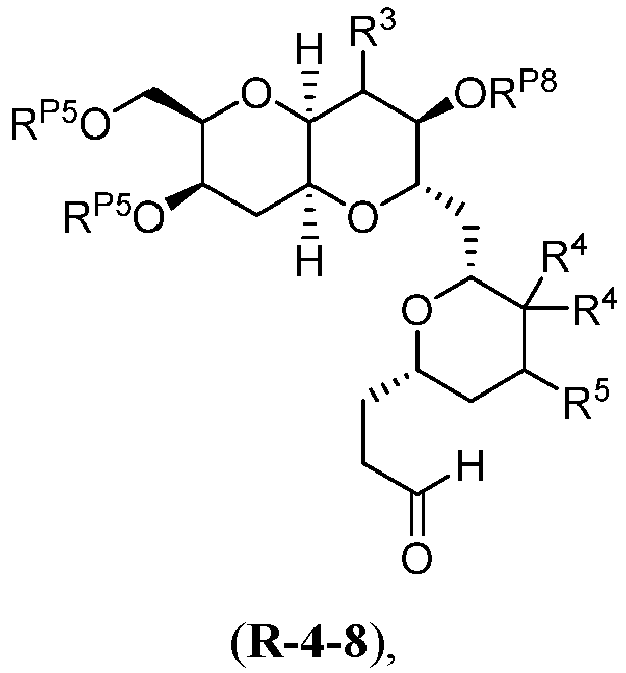


- (b) cyclizing a compound of Formula (R-4-10B), or a salt thereof, to yield a compound of Formula (R-4-10), or a salt thereof, wherein:
- X3 and X2 are each independently halogen or a leaving group;
- R3 and R5 are each independently hydrogen, halogen, or optionally substituted alkyl;
- each instance of R4 is independently hydrogen, halogen, or optionally substituted alkyl, or two R4 groups are taken together to form:

- each instance of R6 is independently hydrogen, halogen, or optionally substituted alkyl, or two R6 groups are taken together to form:

- each instance of RP5 and RP8 is independently hydrogen, optionally substituted alkyl, optionally substituted acyl, or an oxygen protecting group; optionally wherein two RP5 groups are joined together with the intervening atoms to form an optionally substituted heterocyclyl ring;
- R8 is hydrogen, optionally substituted alkyl, optionally substituted carbocyclyl, optionally substituted aryl, optionally substituted heterocyclyl, optionally substituted heteroaryl, optionally substituted acyl, or an oxygen protecting group;
- RX is hydrogen or -ORXa, wherein RXa is hydrogen, optionally substituted alkyl, optionally substituted acyl, or an oxygen protecting group; and
- RY is hydrogen or -ORYa, wherein RYa is hydrogen, optionally substituted alkyl, optionally substituted acyl, or an oxygen protecting group;
- optionally wherein RXa and RYa are joined together with their intervening atoms to form optionally substituted heterocyclyl.
- In certain embodiments, the method comprises:
- (a) a step of coupling a compound of Formula (E-R-4):


- (b) a step of cyclizing a compound of Formula (E-R-6), or a salt thereof, to yield a compound of Formula (E-R-7):

- X3 and X2 are each independently halogen or a leaving group;
- each instance of RP5 and RP8 is independently hydrogen, optionally substituted alkyl, optionally substituted acyl, or an oxygen protecting group; optionally wherein two RP5 groups are joined together with the intervening atoms to form an optionally substituted heterocyclyl ring; and
- R8 is hydrogen, optionally substituted alkyl, optionally substituted carbocyclyl, optionally substituted aryl, optionally substituted heterocyclyl, optionally substituted heteroaryl, optionally substituted acyl, or an oxygen protecting group.
- In certain embodiments, step (a) above (to prepare a compound of Formula (R-4-10B), (E-R-6), or a salt thereof) is a Ni/Cr-mediated reductive coupling reaction; and step (b) above (to prepare a compound of Formula (R-4-10), (E-R-7), or a salt thereof) is an acid-promoted or base-promoted intramolecular furan cyclization. Reagents and conditions for steps (a) and (b) can be found in, e.g., international
PCT application publications, WO 2016/176560, published November 3, 2016 , andWO 2016/003975, published January 7, 2016 , the entire contents of which is incorporated herein by reference. - The Ni/Cr-mediated reductive coupling (i.e., step (a)) is carried out in the presence of nickel and chromium. In certain embodiments, the nickel is a nickel complex. Examples of nickel complexes include, but are not limited to, those shown in
Figure 9B . In certain embodiments, the nickel complex is (Et)2Phen•NiCl2. In certain embodiments, the nickel complex is the following:
- In certain embodiments, the chromium is a chromium complex. In certain embodiments, the chromium complex is prepared from a chromium salt and a chiral ligand. In certain embodiments, the chromium salt is CrCl2 or CrCl3. In certain embodiments, the chiral ligand is a chiral sulfonamide. Examples of chiral ligands include, but are not limited to, those shown in
Figure 9B . In certain embodiments, the chiral ligand is (S)-4-G. In certain embodiments, the chiral sulfonamide ligand is one of the following:
- The Ni/Cr-mediated reductive coupling may be carried out in the presence of one or more additional reagents. In certain embodiments, the coupling is carried out in the presence of a lithium salt (e.g., LiCl or LiBr). In certain embodiments, the coupling is carried out in the presence of a reducing metal such as zinc or manganese (e.g., zinc or manganese metal). In certain embodiments, the coupling is carried out in the presence of zirconium (e.g., ZrCp2Cl2). In certain embodiments, the reducing metal is zinc metal. In certain embodiments, the metal is manganese metal. In certain embodiments, the coupling is carried out in the presence of a base or proton scavenger (e.g., 2,6-di-tert-butyl-4-methylpyridine). In certain embodiments, the coupling is carried out in the presence of proton sponge (e.g., 1,8-bis(dimethylamino)naphthalene).
- In certain embodiments, the reaction is carried out in a solvent. In certain embodiments, the solvent is acetonitrile (MeCN). In certain embodiments, the deprotection is carried out in DCM and MeOH. In certain embodiments, the reaction is carried out at a temperature ranging from approximately room temperature to approximately 100 °C. In certain embodiments, the reaction is carried out at a temperature ranging from approximately room temperature to approximately 50 °C. In certain embodiments, the reaction is carried out at around room temperature. In certain embodiments, the reaction is carried out at around 30 °C.
- In certain embodiments, the Ni/Cr-mediated reductive coupling is carried out in the presence of a nickel complex, a chromium salt, a sulfonamide ligand, a lithium salt, a zirconium complex, a reducing metal, and a base or proton scavenger. In certain embodiments, the step of coupling is carried out in the presence of (Et)2Phen•NiCl2, CrCl2, (S)-4-G, LiCl, ZrCp2Cl2, manganese metal, and a base or proton scavenger (e.g., 2,6-di-tert-butyl-4-methylpyridine). For example, in certain embodiments, the reaction is carried out under the following conditions: 2 mol% (Et)2Phen•NiCl2, 10 mol% CrCl2, 10 mol% ligand (S)-4-G, 2 equivalents LiCl, 2.5 equivalents ZrCp2Cl2, excess manganese metal, and 2.5
equivalents 2,6-di-tert-butyl-4-methylpyridine, in MeCN at room temperature (e.g., for 2 hours). - In certain embodiments, the Ni/Cr-mediated reductive coupling is carried out in the presence of a nickel complex, a chromium salt, a sulfonamide ligand, a zirconium complex, a reducing metal, and a base or proton scavenger. In certain embodiments, the coupling is carried out in the presence of: a nickel complex of the formula:

 mol% CrCl3, 20 mol% of a sulfonamide ligand of the formula:
 equivalents Cp2ZrCl2, 2 equivalents manganese metal, and 2 equivalents of 2,6-di-tert-butyl-4-methylpyridine, and proton sponge in MeCN at around 30 °C.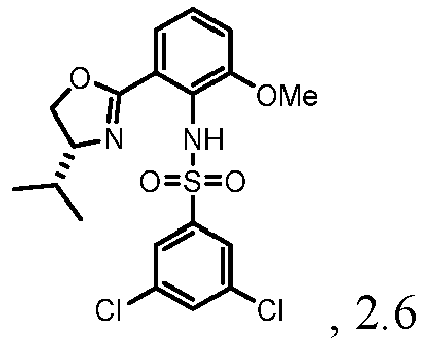
- In certain embodiments, step (b) (to prepare a compound of Formula (R-4-10), (E-R-7), or a salt thereof) is carried out in the presence of a Lewis acid. In certain embodiments, the Lewis acid is AgOTf. In certain embodiments, the Lewis acid is Ag2O. In certain embodiments, the Lewis acid is SrCO3. The Lewis acid may be present in a catalytic, stoichiometric, or excess amount. In other embodiments, step (b) is carried out in the presence of a base. In certain embodiments, the base is a carbonate salt. In certain embodiments, the base is potassium carbonate (K2CO3).
- In certain embodiments, the reaction is carried out in a solvent. In certain embodiments, the solvent is MeOH. In certain embodiments, the solvent is MeCN. In certain embodiments, the reaction is carried out in MeOH and water. In certain embodiments, the reaction is carried out at above room temperature. In certain embodiments, the reaction is carried out at a temperature ranging from approximately room temperature to approximately 100 °C. In certain embodiments, the reaction is carried out at from 50-60 °C. In certain embodiments, the reaction is carried out at around 60 °C. In certain embodiments, the reaction is carried out at around 55 °C.
- In certain embodiments, in addition to affecting the furan cyclization, the reaction conditions are sufficient to hydrolyze the ester -CO2R8 (wherein R8 is hydrogen in the product (E-R-7) or (R-4-10)).
- For example, in certain embodiments, the reaction is carried out under the following conditions: 10 equivalents K2CO3 in MeCN at 60 °C (e.g., for 3 hours). In certain embodiments, the reaction is carried out in the presence of K2CO3, in MeOH and water, at around 55 °C. As another example, the reaction can be carried out under the following conditions: 10 equivalents K2CO3 in MeOH and water at around 55 °C (e.g., for 23 hours).
- In certain embodiments, two RP5 are joined with the intervening atoms to form a ring of the formula:


- As shown in Scheme 3B, a compound of Formula (R-4-8) can be prepared by reducing the ester moiety (-CO2R8) of a compound of Formula (R-4-7) to an aldehyde moiety. A compound of Formula (R-4-7) can be prepared by coupling a compound of Formula (R-4-5B) with a compound of Formula (R-4-6), followed by formation of the pyran ring via cyclization of the adduct, or a deprotected form of the adduct. In turn, a compound of Formula (R-4-5B) can be prepared by reducing the ester moiety (-CO2R8) of a compound of Formula (R-4-5A) to an aldehyde moiety. A compound of Formula (R-4-5A) can be prepared by cyclization of a compound of Formula (R-4-4), which can be prepared by coupling a compound of Formula (R-4-2) with an olefin of Formula (R-4-3). As shown in Scheme 3B, a compound of Formula (R-4-2) can be prepared by reducing the lactone of a compound of Formula (R-4-1).

- As shown in Scheme 3B, provided herein is a method of preparing a compound of Formula (R-4-8):

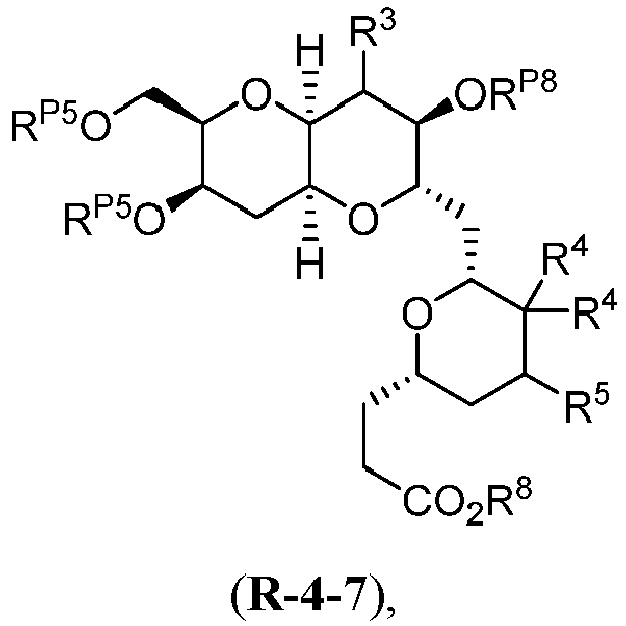
- R3 and R5 are each independently hydrogen, halogen, or optionally substituted alkyl;
- each instance of R4 is independently hydrogen, halogen, or optionally substituted alkyl, or two R4 groups are taken together to form:

- each instance of RP5 and RP8 is independently hydrogen, optionally substituted alkyl, optionally substituted acyl, or an oxygen protecting group; optionally wherein two RP5 groups are joined together with the intervening atoms to form an optionally substituted heterocyclyl ring; and
- R8 is hydrogen, optionally substituted alkyl, optionally substituted carbocyclyl, optionally substituted aryl, optionally substituted heterocyclyl, optionally substituted heteroaryl, optionally substituted acyl, or an oxygen protecting group.
- In certain embodiments, the method comprises a step of reducing a compound of Formula (E-R-8):


- each instance of RP5 and RP8 is independently hydrogen, optionally substituted alkyl, optionally substituted acyl, or an oxygen protecting group; optionally wherein two RP5 groups are joined together with the intervening atoms to form an optionally substituted heterocyclyl ring; and
- R8 is hydrogen, optionally substituted alkyl, optionally substituted carbocyclyl, optionally substituted aryl, optionally substituted heterocyclyl, optionally substituted heteroaryl, optionally substituted acyl, or an oxygen protecting group.
- The step of reducing a compound of Formula (R-4-7), (E-R-8), or a salt thereof, converts the ester group -CO2R8 to an aldehyde group. In certain embodiments, the step of reducing is carried out in the presence of a hydride (i.e., H-) source. Any hydride source known in the art may be used in this transformation. Examples of hydride sources include, but are not limited to, lithium aluminum hydride (LAH), sodium borohydride (NaBH4), lithium borohydride, and diisobutylaluminum hydride (DIBAL). In certain embodiments, the hydride source is diisobutylaluminum hydride (DIBAL). In certain embodiments, the hydride source is present in a stoichiometric or excess amount.
- The step of reducing may optionally comprise reducing the -CO2R8 moiety to an alcohol, followed by oxidation of the resulting alcohol to an aldehyde to yield a compound of Formula (R-4-7), (E-R-8), or a salt thereof.
- In certain embodiments, the step of reducing is carried out in the presence of DIBAL. In certain embodiments, the reaction is carried out in a solvent. In certain embodiments, the solvent is DCM. In certain embodiments, the reaction is carried out at below room temperature. In certain embodiments, the reaction is carried out at a temperature ranging from approximately -78 °C to approximately room temperature. In certain embodiments, the reaction is carried out at a temperature ranging from approximately -78 °C to approximately 0 °C. In certain embodiments, the reaction is carried out at around -78 °C. For example, in certain embodiments, the reaction is carried out under the following conditions: DIBAL in DCM at around -78 °C. For example, in certain embodiments, the reaction is carried out under the following conditions: approximately 2.3 equivalents DIBAL in DCM at around -78 °C (e.g., for 1-2 hours).
- In certain embodiments, two RP5 are joined with the intervening atoms to form a ring of the formula:


- As shown in Scheme 3B, also provided herein is a method of preparing a compound of Formula (R-4-7):

- (a) coupling a compound of Formula (R-4-5B):


(a-i) deprotecting and cyclizing a compound of Formula (R-4-7A), or a salt thereof, to give a compound of Formula (R-4-7), or a salt thereof; wherein:- R3 and R5 are each independently hydrogen, halogen, or optionally substituted alkyl;
- each instance of R4 is independently hydrogen, halogen, or optionally substituted alkyl, or two R4 groups are taken together to form:

- each instance of RP5, RP8, and RP9 is independently hydrogen, optionally substituted alkyl, optionally substituted acyl, or an oxygen protecting group; optionally wherein two RP5 groups are joined together with the intervening atoms to form an optionally substituted heterocyclyl ring; and optionally, wherein two RP9 groups are joined together with the intervening atoms to form an optionally substituted heterocyclyl ring; and
- R8 is hydrogen, optionally substituted alkyl, optionally substituted carbocyclyl, optionally substituted aryl, optionally substituted heterocyclyl, optionally substituted heteroaryl, optionally substituted acyl, or an oxygen protecting group.
- In certain embodiments, after the step of coupling the compounds of Formulae (R-4-5B) and (R-4-6) (i.e., step (a)), the method comprises:
- (b) a step of deprotecting a compound of Formula (R-4-7A), or a salt thereof, to yield a compound of Formula (R-4-7B):

- (c) a step of cyclizing to yield a compound of Formula (R-4-7C):

- (d) a step of re-protecting the compound of Formula (R-4-7C), or a salt thereof, at one or more oxygen atoms to yield a compound of Formula to yield a compound of Formula (R-4-7B):
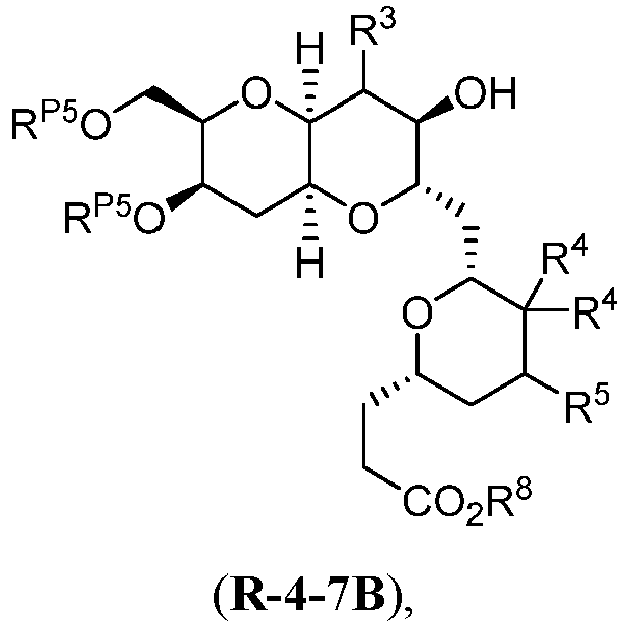
- In certain embodiments, the method comprises:
- (a) a step of coupling a compound of Formula (E-R-9):


- (b) a step of deprotecting a compound of Formula (E-R-11), or a salt thereof, under conditions sufficient to remove the groups RP5 and RP8, to yield a compound of Formula (E-R-12):

- (c) a step of deprotecting and cyclizing the compound of Formula (E-R-12), or salt thereof, to yield a compound of Formula (E-R-13):

- (d) a step of protecting the compound of Formula (E-R-13), or a salt thereof, to yield a compound of Formula (E-R-14):
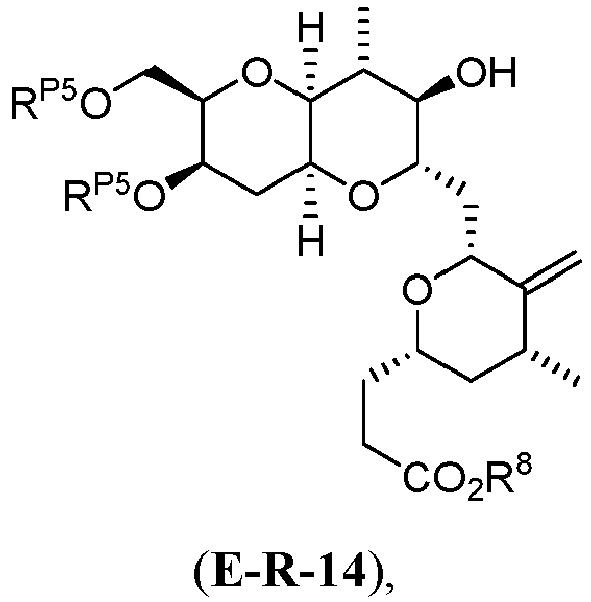
- each instance of RP5, RP8, and RP9 is independently hydrogen, optionally substituted alkyl, optionally substituted acyl, or an oxygen protecting group; optionally wherein two RP5 groups are joined together with the intervening atoms to form an optionally substituted heterocyclyl ring; and optionally wherein two RP9 groups are joined together with the intervening atoms to form an optionally substituted heterocyclyl ring; and
- R8 is hydrogen, optionally substituted alkyl, optionally substituted carbocyclyl, optionally substituted aryl, optionally substituted heterocyclyl, optionally substituted heteroaryl, optionally substituted acyl, or an oxygen protecting group.
- In certain embodiments, step (a) above (to form a compound of Formula (R-4-7A), (E-R-11), or a salt thereof) is a Ni/Cr-mediated reductive coupling reaction; and step (a-i) or (c) (to form a compound of Formula (R-4-7), (E-R-13), or a salt thereof) is a ketal deprotection and an acid-promoted intramolecular pyran cyclization. Reagents and conditions for steps (a), (a-i), and/or (c) above can be found in, e.g., international
PCT publications, WO 2016/176560, published November 3, 2016 , andWO 2016/003975, published January 7, 2016 ; the entire contents of each of which is incorporated herein by reference. - The Ni/Cr-mediated reductive coupling (i.e., steps (a)) is carried out in the presence of nickel and chromium. In certain embodiments, the nickel is a nickel complex. Examples of nickel complexes include, but are not limited to, those shown in
Figure 9B . In certain embodiments, the nickel complex is (Et)2Phen•NiCl2. In certain embodiments, the nickel complex is the following:
- In certain embodiments, the chromium is a chromium complex. In certain embodiments, the chromium complex is prepared from a chromium salt and a chiral ligand. In certain embodiments, the chromium salt is CrCl2 or CrCl3. In certain embodiments, the chiral ligand is a chiral sulfonamide. Examples of chiral ligands include, but are not limited to, those shown in
Figure 9B . In certain embodiments, the chiral ligand is (S)-4-G. In certain embodiments, the sulfonamide ligand is one of the following: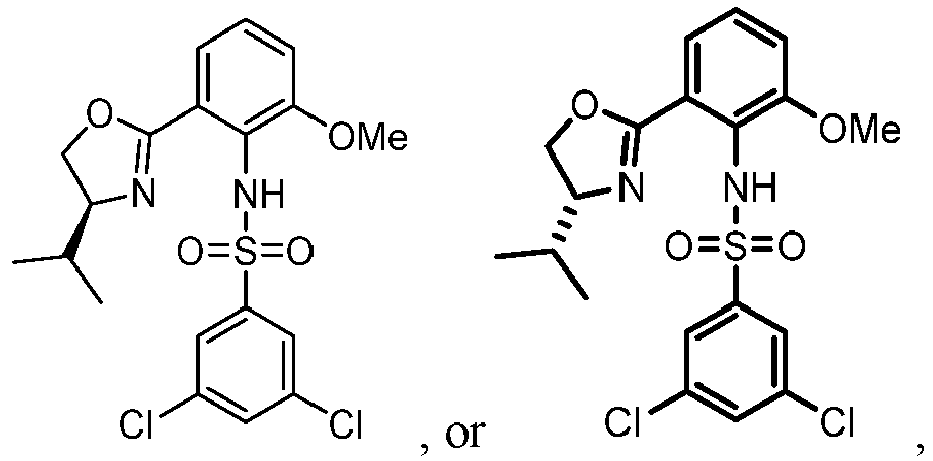
- The Ni/Cr-mediated reductive coupling may be carried out in the presence of one or more additional reagents. In certain embodiments, the coupling is carried out in the presence of a lithium salt (e.g., LiCl). In certain embodiments, the coupling is carried out in the presence of a reducing metal such as zinc or manganese (e.g., zinc or manganese metal). In certain embodiments, the reducing metal is zinc metal. In certain embodiments, the reducing metal is manganese metal. In certain embodiments, the coupling is carried out in the presence of zirconium (e.g., ZrCp2Cl2). In certain embodiments, the coupling is carried out in the presence of a base or proton scavenger (e.g., 2,6-di-tert-butyl-4-methylpyridine). In certain embodiments, the coupling is carried out in the presence of a proton sponge (e.g., 1,8-bis(dimethylamino)naphthalene).
- In certain embodiments, the reaction is carried out in a solvent. In certain embodiments, the solvent is MeCN. In certain embodiments, the reaction is carried out at a temperature ranging from approximately room temperature to approximately 100 °C. In certain embodiments, the reaction is carried out at a temperature ranging from approximately room temperature to approximately 50 °C. In certain embodiments, the reaction is carried out at around room temperature. In certain embodiments, the reaction is carried out at around 40 °C.
- In certain embodiments, the Ni/Cr-mediated reductive coupling is carried out in the presence of a nickel complex, a chromium salt, a sulfonamide ligand, a lithium salt, a zirconium complex, a reducing metal, and a base or proton scavenger. In certain embodiments, the step of coupling is carried out in the presence of (Et)2Phen•NiCl2, CrCl2, (S)-4-F, LiCl, manganese metal, and ZrCp2Cl2. For example, in certain embodiments, the reaction is carried out under the following conditions: 2 mol% (Et)2Phen•NiCl2, 10 mol% CrCl2, 10 mol% ligand (S)-4-F, 2 equivalents LiCl, excess manganese metal, 2.5 equivalents ZrCp2Cl2, in MeCN at room temperature (e.g., for 3 hours).
- In certain embodiments, the coupling is carried out in the presence of: a nickel complex of the formula:


- In certain embodiments, RP5 and RP8 are silyl protecting groups; and the deprotection in step (b) is carried out in the presence of a fluoride source. In certain embodiments, the fluoride source is tetrabutylammonium fluoride (TBAF).
- In certain embodiments, two RP5 are joined with the intervening atoms to form a ring of the formula:


- The ketal deprotection and acid-promoted intramolecular pyran cyclization in steps (a-i) and (c) (to form a compound of Formula (R-4-7), (E-R-13), or a salt thereof) involves deprotecting the ketal of the starting material, followed by a cyclization reaction to provide the new six-membered ring of the compound of Formula (R-4-7) or (E-R-13). The deprotecting and cyclizing may be done in the same step, or in separate steps, and in either order. In certain embodiments, the step of deprotecting and cyclizing is carried out in the presence of an acid (e.g., Lewis acid or Brønsted acid). In certain embodiments, the acid is a Lewis acid. In certain embodiments, the step of deprotecting and cyclizing is carried out in the presence of a hydride source.
- In certain embodiments, the step of deprotecting and cyclizing is carried out in the presence of a trialkylsilyl sulfonate or trialkylsilyl halide. In certain embodiments, the step of deprotecting and cyclizing is carried out in the presence of triethylsilyl trifluoromethylsulfonate (TESOTf). In certain embodiments, the step of deprotecting and cyclizing is carried out in the presence of trimethylsilyl trifluoromethylsulfonate (TMSOTf). In certain embodiments, the TESOTf or TMSOTf is present in a stoichiometric or excess amount.
- In certain embodiments, the step of deprotecting and cyclizing is carried out in the presence of a trialkylsilane. In certain embodiments, the step of deprotecting and cyclizing is carried out in the presence of triethylsilane (Et3SiH). In certain embodiments, the Et3SiH is present in a stoichiometric or excess amount.
- In certain embodiments, the reaction is carried out in a solvent (e.g., CH2Cl2). In certain embodiments, the reaction is carried out at below room temperature. In certain embodiments, the reaction is carried out at approximately 0 °C. In certain embodiments, the reaction is carried out at a temperature ranging from approximately -78 °C to approximately 0 °C. In certain embodiments, the reaction is carried out at a temperature ranging from approximately -78 °C to approximately room temperature.
- In certain embodiments, the step of deprotecting and cyclizing is carried out in the presence of a Lewis acid and a hydride source. In certain embodiments, the reaction is carried out in the presence of TESOTf and triethylsilane. In certain embodiments, the reaction is carried out in the presence of TESOTf and triethylsilane in DCM at around 0 °C. In certain embodiments, the reaction is carried out in the presence of TMSOTf and triethylsilane. In certain embodiments, the reaction is carried out in the presence of TMSOTf and triethylsilane in DCM at a temperature ranging from approximately -78 °C to approximately 0 °C. In certain embodiments, the reaction is carried out under the following conditions: 10 equivalents triethylsilane, 5 equivalents TESOTf, in DCM at around 0 °C (e.g., for 3 hours). As another example, in certain embodiments, the reaction is carried out under the following conditions: 5 equivalents triethylsilane, 5 equivalents TMSOTf, in DCM at temperature ranging from approximately -78 °C to approximately 0 °C (e.g., for 1 hour).
- In certain embodiments, the step or re-protecting a compound of Formula (R-4-7C), (E-R-13), or a salt thereof (i.e., step (d)), is carried out to install the RP5 groups. In certain embodiments, the resulting RP5 groups are joined together to form the following formula:


equivalents - In certain embodiments, the compound of Formula (E-R-14), (E-R-8), (R-4-7), or (R-4-7B), or salt thereof, is purified by any combination of silica gel column chromatography, ODS (octadecylsilyl) column chromatography, and recrystallization.
- As also shown in Scheme 3B, provided herein is a method of preparing a compound of Formula (R-4-5B):


- R3 is hydrogen, halogen, or optionally substituted alkyl;
- each instance of RP5 and RP8 is independently hydrogen, optionally substituted alkyl, optionally substituted acyl, or an oxygen protecting group; optionally wherein two RP5 groups are joined together with the intervening atoms to form an optionally substituted heterocyclyl ring; and
- R8 is hydrogen, optionally substituted alkyl, optionally substituted carbocyclyl, optionally substituted aryl, optionally substituted heterocyclyl, optionally substituted heteroaryl, optionally substituted acyl, or an oxygen protecting group.
- In certain embodiments, the method comprises reducing a compound of Formula (E-R-15):
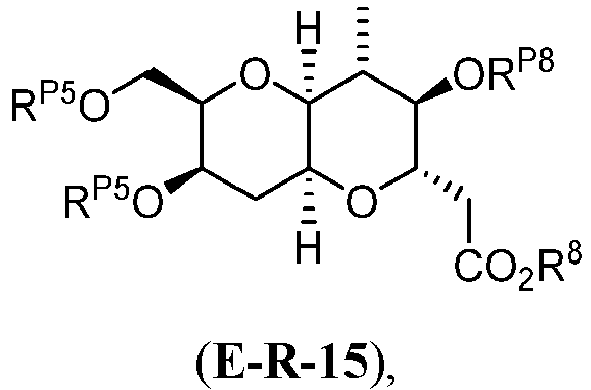

- each instance of RP5 and RP8 is independently hydrogen, optionally substituted alkyl, optionally substituted acyl, or an oxygen protecting group; optionally wherein two RP5 groups are joined together with the intervening atoms to form an optionally substituted heterocyclyl ring; and
- R8 is hydrogen, optionally substituted alkyl, optionally substituted carbocyclyl, optionally substituted aryl, optionally substituted heterocyclyl, optionally substituted heteroaryl, optionally substituted acyl, or an oxygen protecting group.
- The step of reducing a compound of (R-4-5A), (E-R-15), or a salt thereof, converts the -CO2R8 moiety to an aldehyde. In certain embodiments, the step of reducing is carried out in the presence of a hydride (i.e., H-) source. Any hydride source known in the art may be used in this transformation. Examples of hydride sources are provided herein. In certain embodiments, the hydride source is diisobutylaluminum hydride (DIBAL). In certain embodiments, a stoichiometric or excess amount of DIBAL is used in the reaction.
- The step of reducing may optionally comprise reducing the -CO2R8 moiety to an alcohol, followed by oxidation of the resulting alcohol to an aldehyde to yield a compound of Formula (R-4-5B) or (E-R-9), or a salt thereof.
- In certain embodiments, the step of reducing is carried out in the presence of DIBAL. In certain embodiments, the reaction is carried out in a solvent (e.g., DCM). In certain embodiments, the reaction is carried out at below room temperature. In certain embodiments, the reaction is carried out at around -78 °C. In certain embodiments, the reaction is carried out at a temperature ranging from approximately -70 °C to approximately - 78 °C. In certain embodiments, the reaction is carried out at a temperature ranging from approximately -78 °C to approximately 0 °C. In certain embodiments, the reaction is carried out at a temperature ranging from approximately -78 °C to approximately room temperature. For example, in certain embodiments, the reaction is carried out under the following conditions: DIBAL in DCM at -78 °C (e.g., for 1-2 hours). For example, in certain embodiments, the reaction is carried out under the following conditions: 2.3 equivalents DIBAL in DCM at -70 °C to -78 °C (e.g., for 1-2 hours).
- In certain embodiments, two RP5 are joined with the intervening atoms to form a ring of the formula:


- Also provided herein is a method of preparing a compound of Formula (R-4-5A):


- R3 is hydrogen, halogen, or optionally substituted alkyl;
- each instance of RP5, RP8, and RP10 is independently hydrogen, optionally substituted alkyl, optionally substituted acyl, or an oxygen protecting group; optionally wherein two RP5 groups are joined together with the intervening atoms to form an optionally substituted heterocyclyl ring; and
- R8 is hydrogen, optionally substituted alkyl, optionally substituted carbocyclyl, optionally substituted aryl, optionally substituted heterocyclyl, optionally substituted heteroaryl, optionally substituted acyl, or an oxygen protecting group.
- In certain embodiments, the method comprises a step of cyclizing a compound of Formula (E-R-16):
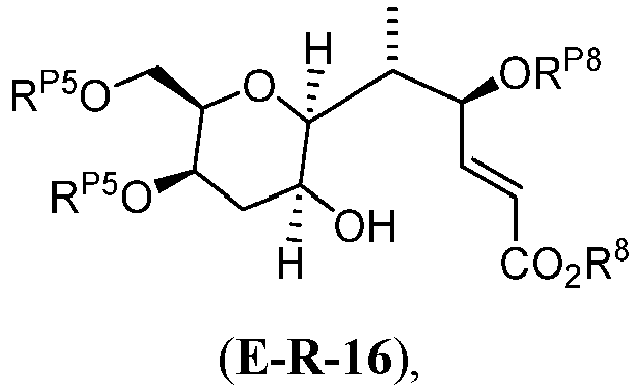

- each instance of RP5 and RP8 is independently hydrogen, optionally substituted alkyl, optionally substituted acyl, or an oxygen protecting group; optionally wherein two RP5 groups are joined together with the intervening atoms to form an optionally substituted heterocyclyl ring; and
- R8 is hydrogen, optionally substituted alkyl, optionally substituted carbocyclyl, optionally substituted aryl, optionally substituted heterocyclyl, optionally substituted heteroaryl, optionally substituted acyl, or an oxygen protecting group.
- In certain embodiments, the step of cyclizing a compound of Formula (R-4-4) or (E-R-16), or a salt thereof, is carried out in the presence of a base. Any base may be used in this cyclization reaction. In certain embodiments, the base is a phosphate salt. In certain embodiments, the base is potassium phosphate (K3PO4). In certain embodiments, the base is present in 1 equivalent or less. In certain embodiments, the base is present in excess amount.
- In certain embodiments, the step of cyclizing is carried out in the presence of one or more additional reagents, such as a metal chelator. In certain embodiments, the reaction is carried out in the presence of a crown ether (e.g., 18-crown-6). In certain embodiments, the reaction is carried out in the presence of 18-crown-6. In certain embodiments, 1 equivalent or less of 18-crown-6 is used.
- In certain embodiment, the reaction is carried out in the presence of a solvent. In certain embodiments, the solvent is toluene and/or MeOAc. In certain embodiments, the reaction is carried out at a temperature ranging from approximately 0 °C to approximately 50 °C. In certain embodiments, the reaction is carried out at from 0 °C to room temperature. In certain embodiments, the reaction is carried out at around room temperature.
- In certain embodiments, the step of cyclizing is carried out in the presence of a base and a crown ether. In certain embodiments, the reaction is carried out in the presence of K3PO4 and 18-crown-6. For example, in certain embodiments, the reaction is carried out under the following conditions: 1 equivalent K3PO4, 3 equivalents 18-crown-6, in toluene at room temperature. For example, in certain embodiments, the reaction is carried out under the following conditions: 0.3 equivalents K3PO4, 0.9 equivalents 18-crown-6, in toluene and MeOAc at around 3 °C (e.g., for 1-2 hours).
- In certain embodiments, the compound of Formula (R-4-4) is a compound of Formula (R-4-4A):

- In certain embodiments, two RP5 are joined with the intervening atoms to form a ring of the formula:

 ; RP8 is TBS; and R8 is methyl.
- In certain embodiments, the compound of Formula (R-4-5A) or (E-R-15), or a salt thereof, is purified by silica gel column chromatography and/or recrystallization.
- Also provided herein is a method of preparing a compound of Formula (R-4-4):


- X4 is halogen or a leaving group;
- R3 is hydrogen, halogen, or optionally substituted alkyl;
- each instance of RP5 and RP10 is independently hydrogen, optionally substituted alkyl, optionally substituted acyl, or an oxygen protecting group; optionally wherein two RP5 groups are joined together with the intervening atoms to form an optionally substituted heterocyclyl ring; and
- R8 is hydrogen, optionally substituted alkyl, optionally substituted carbocyclyl, optionally substituted aryl, optionally substituted heterocyclyl, optionally substituted heteroaryl, optionally substituted acyl, or an oxygen protecting group.
- In certain embodiments, the coupling of a compound of Formula (R-4-2) and a compound of Formula (R-4-3) yields a compound of the Formula (R-4-4A):

- In certain embodiments, the method comprises coupling a compound of Formula (E-R-17):


- X4 is halogen or a leaving group;
- R3 is hydrogen, halogen, or optionally substituted alkyl;
- each instance of RP5 and RP10 is independently hydrogen, optionally substituted alkyl, optionally substituted acyl, or an oxygen protecting group; optionally wherein two RP5 groups are joined together with the intervening atoms to form an optionally substituted heterocyclyl ring; and
- R8 is hydrogen, optionally substituted alkyl, optionally substituted carbocyclyl, optionally substituted aryl, optionally substituted heterocyclyl, optionally substituted heteroaryl, optionally substituted acyl, or an oxygen protecting group.
- In certain embodiments, the method further comprising steps of (a) protecting the free hydroxyl group of the compound of Formula (E-R-18), or a salt thereof; and (b) deprotecting the resulting compound to remove the group RP10.
- In certain embodiments, the coupling of a compound of Formula (R-4-2) and a compound of Formula (R-4-3) to yield a compound of Formula (R-4-4) (or the coupling of a compound of Formula (E-R-17) and a compound of Formula (R-4-3) to yield a compound of Formula (E-R-18)) is a Ni/Cr-mediated coupling. The Ni/Cr-mediated reductive coupling is carried out in the presence of nickel and chromium. In certain embodiments, the nickel is a nickel complex. Examples of nickel complexes include, but are not limited to, those shown in
Figure 9B . In certain embodiments, the nickel complex is (Me)2Phen(OMe)2•NiCl2. In certain embodiments, the nickel complex is present in a catalytic amount. In certain embodiments, the nickel complex is the following:
- In certain embodiments, the chromium is a chromium complex. In certain embodiments, the chromium complex is prepared from a chromium salt and a chiral ligand. In certain embodiments, the chromium salt is CrCl3 or CrCl2. In certain embodiments, the chiral ligand is a chiral sulfonamide. Examples of chiral ligands include, but are not limited to, those shown in
Figure 9B . In certain embodiments, the chiral ligand is (R)-4-E. In certain embodiments, the chromium complex is present in a catalytic amount. In certain embodiments, the sulfonamide ligand is one of the following:
- The Ni/Cr-mediated reductive coupling may be carried out in the presence of one or more additional reagents. In certain embodiments, the coupling is carried out in the presence of a lithium salt (e.g., LiCl). In certain embodiments, the coupling is carried out in the presence of a reducing metal such as zinc or manganese (e.g., zinc or manganese metal). In certain embodiments, the coupling is carried out in the presence of zirconium (e.g., ZrCp2Cl2). In certain embodiments, the coupling is carried out in the presence of a base or proton scavenger (e.g., 2,6-di-tert-butyl-4-methylpyridine or 2,6-lutidine). In certain embodiments, the coupling is carried out in the presence of proton sponge (e.g., 1,8-bis(dimethylamino)naphthalene).
- In certain embodiments, the reaction is carried out in a solvent (e.g., MeCN). In certain embodiments, the reaction is carried out at a temperature ranging from approximately room temperature to approximately 100 °C. In certain embodiments, the reaction is carried out at a temperature ranging from approximately room temperature to approximately 50 °C. In certain embodiments, the reaction is carried out at around room temperature. In certain embodiments, the reaction is carried out at around 30 °C.
- In certain embodiments, the Ni/Cr-mediated reductive coupling is carried out in the presence of a nickel complex, a chromium salt, a sulfonamide ligand, a lithium salt, a zirconium complex, a reducing metal, and a base or proton scavenger. In certain embodiments, the step of coupling is carried out in the presence of (Me)2Phen(OMe)2•NiCl2, CrCl2, ligand (S)-4-E, LiCl, manganese metal, 2,6-lutidine, and ZrCp2Cl2. In certain embodiments, the reaction is carried out in a solvent (e.g., MeCN). In certain embodiments, the reaction is carried out at around room temperature. For example, in certain embodiments, the reaction is carried out under the following conditions: 2 mol% (Me)2Phen(OMe)2•NiCl2, 10 mol% CrCl2, 10 mol% ligand (S)-4-E, 2 equivalents LiCl, 1.1 equivalents Cp2ZrCl2, 1 equivalent 2,6-lutidine, and excess manganese in MeCN at room temperature.
- In certain embodiments, the coupling is carried out in the presence of: a nickel complex of the formula:


equivalents 2,6-lutidine, and proton sponge in MeCN at around 30 °C (e.g., for 2-3 hours). - In certain embodiments, two RP5 are joined with the intervening atoms to form a ring of the formula:


- Provided herein a method of preparing a compound of Formula (R-4-2):


- R3 is hydrogen, halogen, or optionally substituted alkyl; and
- each instance of RP5 and RP10 is independently hydrogen, optionally substituted alkyl, optionally substituted acyl, or an oxygen protecting group; optionally wherein two RP5 groups are joined together with the intervening atoms to form an optionally substituted heterocyclyl ring.
- In certain embodiments, the method of preparing a compound of Formula (R-4-2), or a salt thereof, comprises the steps of:
- (a) reducing a compound of Formula (R-4-1):


- (b) protecting a compound of Formula (R-4-1), or a salt thereof, to yield a compound of Formula (R-4-1B):

- (c) oxidizing the compound of Formula (R-4-1B), or a salt thereof, to yield a compound of Formula (R-4-2), or a salt thereof.
- The step of reducing a compound of (R-4-2), or a salt thereof, reduces the lactone of the compound. In certain embodiments, the step of reducing is carried out in the presence of a hydride (i.e., H-) source. Any hydride source known in the art may be used in this transformation. Examples of hydride sources are provided herein. In certain embodiments, the hydride source is lithium borohydride (LiBH4). In certain embodiments, the step of oxidizing (i.e., step (c)) involves a Swern oxidation.
- In certain embodiments, the step of reducing is carried out in the presence of LiBH4. In certain embodiments, the reaction is carried out in a solvent such as diethyl ether. In certain embodiments, the reaction is carried out at approximately 0 °C. For example, in certain embodiments, the reaction is carried out under the following conditions: LiBH4 in diethyl ether at 0 °C.
- In certain embodiments, two RP5 are joined with the intervening atoms to form a ring of the formula:


- Also provided herein is an alternative method of preparing a compound of Formula (R-4-2), or a salt thereof, comprising:
- (a) a step of reducing a compound of Formula (R-4-1):


- (b) a step of olefinating the compound of Formula (R-4-2A), or a salt thereof, to yield a compound of Formula (R-4-2B):

- (c) a step of protecting the compound of Formula (R-4-2B), or salt thereof, to yield a compound of Formula (R-4-2C):

- (d) a step of oxidizing a compound of Formula (R-4-2C), or a salt thereof, to yield a compound of Formula (R-4-2):

- R3 is hydrogen, halogen, or optionally substituted alkyl; and
- each instance of RP5 and RP10 is independently hydrogen, optionally substituted alkyl, optionally substituted acyl, or an oxygen protecting group; optionally wherein two RP5 groups are joined together with the intervening atoms to form an optionally substituted heterocyclyl ring.
- In certain embodiments, the method comprises:
- (a) a step of reducing a compound of Formula (E-R-19):


- (b) a step of olefinating the compound of Formula (E-R-20), or a salt thereof, to yield a compound of Formula (E-R-21):

- (c) a step of protecting the compound of Formula (E-R-21), or salt thereof, to yield a compound of Formula (E-R-22):

- (d) a step of oxidizing a compound of Formula (E-R-22), or a salt thereof, to yield a compound of Formula (E-R-17):

each instance of RP5 and RP10 is independently hydrogen, optionally substituted alkyl, optionally substituted acyl, or an oxygen protecting group; optionally wherein two RP5 groups are joined together with the intervening atoms to form an optionally substituted heterocyclyl ring. - In certain embodiments, the step of reducing a compound of Formula (R-4-1), (E-R-19), or a salt thereof (i.e., step (a)), is carried out in the presence of a hydride source. Examples of hydride sources are provided herein. In certain embodiments, the hydride source is lithium borohydride (LiBH4). In certain embodiments, the hydride source is diisobutylaluminum hydride (DIBAL). In certain embodiments, the reaction is carried out in a solvent (e.g., toluene). In certain embodiments, the reaction is carried out in the presence of DIBAL in toluene. In certain embodiments, the reaction is carried out at a temperature ranging from approximately room temperature to approximately -78 °C to approximately 0 °C. In certain embodiments, the reaction is carried out under the following conditions: approximately 1.3 equivalents of DIBAL in toluene at from -78 to -60 °C (e.g., for less than 1 hour).
- In certain embodiments, the step of olefinating a compound of Formula (R-4-2A), (E-R-20), or a salt thereof (i.e., step (b)), is carried out in the presence of an olefinating reagent and a base. In certain embodiments, the olefinating reagent is Ph3PCH3Br. In certain embodiments, the base is an alkoxide. In certain embodiments, the base is t-BuOK. In certain embodiments, the step of olefinating is carried out in the presence of Ph3PCH3Br and t-BuOK. In certain embodiments, the reaction is carried out in a solvent (e.g., THF). In certain embodiments, the reaction is carried out at a temperature ranging from approximately 0 °C to approximately room temperature. In certain embodiments, the step of olefinating is carried out under the following conditions: 4 equivalents Ph3PCH3Br, 3 equivalents t-BuOK, in THF at from 0 to 10 °C (e.g., for less than 1 hour).
- In certain embodiments, RP10 is a silyl protecting group; and the step (c) of protecting is carried out in the presence of a silylating reagent and an amine base. In certain embodiments, RP10 is TES; and the silylating reagent is TESOTf. In certain embodiments, the amine base is triethylamine (TEA). In certain embodiments, the step of protecting is carried out in the presence of TESOTf and TEA. In certain embodiments, the reaction is carried out at a temperature ranging from approximately 0 °C to approximately room temperature. In certain embodiments, the step of protecting is carried out in the presence of TESOTf and TEA in THF at from 0 to 10 °C (e.g., for less than 1 hour).
- In certain embodiments, the step of oxidizing a compound of Formula (R-4-2C), (E-R-22), or a salt thereof, is a Johnson-Lemieux oxidative cleavage. For example, in certain embodiments, the reaction is carried out in the presence of osmium tetroxide (OsO4) or K2OsO4; and N-Methylmorpholine N-oxide (NMO). In certain embodiments, the reaction is carried out in the presence of sodium periodate (NaIO4) or lead acetate Pb(OAc)4. In certain embodiments, the reaction is carried out in the presence of osmium tetroxide (OsO4) and N-Methylmorpholine N-oxide (NMO), followed by sodium periodate (NaIO4). In certain embodiments, the step of oxidizing is carried out in the presence of THF, acetone, and/or water. In certain embodiments, the reaction is carried out at a temperature ranging from approximately 0 °C to approximately 50 °C. For example, in certain embodiments, the step of oxidizing is carried out under the following conditions: 25 equivalents OsO4 and 3 equivalents NMO in THF/acetone/water at room temperature (e.g., for 19 hours), followed by the addition of 3 equivalents NaIO4 at room temperature (e.g., for less than 1 hour).
- As described herein, preparation of halichondrin natural products and analogs thereof may comprise a coupling of a "left half' fragment with a "right half' fragment. Methods useful in the preparation of right half building blocks are provided above. In another aspect, the present invention provides "left hand" building blocks, and methods useful in their preparation.
- Provided herein are methods useful in the preparation of "left half' building blocks of halichondrins and analogs thereof. For example, left halves of compounds in the halichondrin series (e.g., halichondrin A, B, C, and analogs thereof) can be prepared as shown in Scheme 4A. For example, a left half building block of Formula (L-2-14) can be prepared by thiolation of a compound of Formula (L-5-17), which can be prepared by cyclizing a compound of Formula (L-5-16B). To this end, a compound of Formula (L-5-16B) can be prepared by cyclization of a compound of Formula (L-5-16A), which can be prepared from an intermediate of Formula (L-5-15) via oxidation and olefination. As also shown in Scheme 4A, an intermediate of Formula (L-5-15) can be prepared by rearrangement of a compound of Formula (L-5-14). A compound of Formula (L-5-14) can be prepared by coupling a compound of Formula (L-5-12) with a compound of Formula (L-5-5). A compound of Formula (L-5-12) can be prepared by epoxidation of a compound of Formula (L-5-11), which may be prepared by coupling a compound of Formula (L-5-10) with a compound of Formula (L-5-9).

- As shown in Scheme 4A, provided herein is a method of preparing a compound of Formula (L-2-14):


- RS is optionally substituted alkyl, optionally substituted carbocyclyl, optionally substituted aryl, optionally substituted heterocyclyl, or optionally substituted heteroaryl;
- R1 and R2 are independently hydrogen, halogen, or optionally substituted alkyl;
- RP1, RP2, RP3, and RP4 are independently hydrogen, optionally substituted alkyl, optionally substituted acyl, or an oxygen protecting group; and
- R8 is hydrogen, optionally substituted alkyl, optionally substituted carbocyclyl, optionally substituted aryl, optionally substituted heterocyclyl, optionally substituted heteroaryl, optionally substituted acyl, or an oxygen protecting group.
- As described herein, the step of forming a compound of Formula (L-2-14) comprises reacting a compound of Formula (L-5-17) in the presence of a thiolating agent. Any thiolating agent known in the art may be used to this end. In certain embodiments, the thiolating agent is a disulfide. In certain embodiments, the thiolating agent is of the formula (RSS)2. In certain embodiments, the thiolating agent is of the formula (pyridine-S)2. In certain embodiments, the thiolating agent is:

- In certain embodiments, the step of thiolating a compound of Formula (L-5-17) is carried out in the presence of one of more additional reagents. In certain embodiments, the step of thiolating is carried out in the presence of a phosphine reagent (e.g., triphenylphosphine (Ph3P)).
- In certain embodiments, the step of thiolating is carried out in the presence of a disulfide and a phosphine. In certain embodiments, the reaction is carried out in the presence of (Py-S)2 and Ph3P. In certain embodiments, the reaction is carried out in a solvent such as CH2Cl2. In certain embodiments, the reaction is carried out at a temperature ranging from approximately 0 °C to approximately 50 °C. In certain embodiments, the reaction is carried out at room temperature. For example, in certain embodiments, the step of thiolating is carried out under the following conditions: 1.4 equivalents of (Py-S)2, 1.2 equivalents of Ph3P, in CH2Cl2 at room temperature (e.g., for 10-20 hours).
- In certain embodiments, the method of thiolating a compound of Formula (L-5-17), or a salt thereof, comprises the steps of:
- (a) deprotecting a compound of Formula (L-5-17), or a salt thereof, to yield a compound of Formula (L-5-17B):

- (b) thiolating a compound of Formula (L-5-17B), or a salt thereof, to yield a compound of Formula (L-2-14), or a salt thereof.
- In certain embodiments, RP1, RP2, RP3, and RP4 are silyl protecting groups. In certain embodiments, RP1 and RP2 are TBS; and RP3 and RP4 are TES.
- As also shown in Scheme 4A, provided herein is a method of preparing a compound of Formula (L-5-17):


- R1 and R2 are independently hydrogen, halogen, or optionally substituted alkyl;
- RP1, RP2, RP3, and RP4 are independently hydrogen, optionally substituted alkyl, optionally substituted acyl, or an oxygen protecting group; and
- R8 is hydrogen, optionally substituted alkyl, optionally substituted carbocyclyl, optionally substituted aryl, optionally substituted heterocyclyl, optionally substituted heteroaryl, optionally substituted acyl, or an oxygen protecting group.
- In certain embodiments, the step of cyclizing a compound of Formula (7-5-16B) is carried out in the presence of a base. In certain embodiments, the base is a nitrogen base. In certain embodiments, the base is an amine or amide base. In certain embodiments, the base is an amidine or guanidine base. In certain embodiments, the base is an amidine base (e.g., 1,8-diazabicyclo(5.4.0)undec-7-ene (DBU)). In certain embodiments, the step of cyclizing is carried out in the presence of an acid. In certain embodiments, the acid is a Lewis acid. In certain embodiments, the acid is a Brønsted acid.
- In certain embodiments, the step of cyclizing is carried out in the presence of a lithium salt (e.g., LiBr, LiCl). The step of cyclizing may be carried out in the presence of one or more additional reagents. In certain embodiments, the step of cyclizing is carried out in the presence of R8-OAc. In certain embodiments, the step of cyclizing is carried out in the presence of BnOAc.
- In certain embodiments, the step of cyclizing is carried out in the presence of a lithium salt, and a base. In certain embodiments, the step of cyclizing is carried out in the presence of LiBr and DBU. In certain embodiments, the reaction is carried out in a solvent such as MeCN. In certain embodiments, the reaction is carried out at a temperature ranging from approximately 0 °C to approximately 50 °C. In certain embodiments, the reaction is carried out at room temperature. For example, in certain embodiments, the reaction is carried out under the following conditions: 10 equivalents LiBr, 5 equivalents DBU, and 10 equivalents BnOAc in MeCN at room temperature (e.g., for 10-20 hours).
- In certain embodiments, RP1, RP1, and RP3 are silyl protecting groups; and RP4 and RP8 are optionally substituted benzyl. In certain embodiments, RP1 and RP2 are TBS; RP3 is TES; RP4 is MPM; and R8 is benzyl.
- In certain embodiments, the compound of Formula (L-5-17), or a salt thereof, is deprotected to remove the group RP4 yield a compound of Formula (L-5-17C):

- Provided herein is a method of preparing a compound of Formula (L-5-16B):

- (a) cyclizing a compound of Formula (L-5-15):


- (b) reacting the compound of Formula (L-5-15B), or a salt thereof, in the presence of an olefin and an olefin metathesis catalyst to yield a compound of Formula (L-5-16B), wherein:
- R1 and R2 are independently hydrogen, halogen, or optionally substituted alkyl; and
- RP1, RP2, RP3, RP4, and RP10 are independently hydrogen, optionally substituted alkyl, optionally substituted acyl, or an oxygen protecting group.
- In certain embodiments, the olefin is of the formula:

- In certain embodiments, RP1, RP1, RP10, and RP3 are silyl protecting groups; and RP4 is optionally substituted benzyl. In certain embodiments, RP1 and RP2 are TBS; and RP3 is TES; RP4 is MPM; and RP10 is TES.
- Provided herein is a method of preparing a compound of Formula (L-5-16B):

- or a salt thereof,
- the method comprising a step of cyclizing a compound of Formula (L-5-16A):

- or a salt thereof, wherein:
- R1 and R2 are independently hydrogen, halogen, or optionally substituted alkyl;
- RP1, RP2, RP3, RP4, and RP10 are independently hydrogen, optionally substituted alkyl, optionally substituted acyl, or an oxygen protecting group; and
- R8 is hydrogen, optionally substituted alkyl, optionally substituted carbocyclyl, optionally substituted aryl, optionally substituted heterocyclyl, optionally substituted heteroaryl, optionally substituted acyl, or an oxygen protecting group.
- In certain embodiments, the step of cyclizing a compound of Formula (L-5-16A), or a salt thereof, is carried out in the presence of a base. In certain embodiment, the step of cyclizing is carried out in the presence of an acid (e.g., Lewis acid or Brønsted acid). In certain embodiments, the acid is a phosphoric acid. In certain embodiments, the acid is diphenylphosphate ((PhO)2P(=O)OH). In certain embodiments, the acid is present in catalytic, stoichiometric, or excess amount relative to the compound of Formula (L-5-16A). In certain embodiments, the acid is present in catalytic amount (e.g., approximately 5 mol%).
- In certain embodiments, the step of cyclizing is carried out in the presence of diphenylphosphate. In certain embodiments, the step of cyclizing is carried out in a solvent such as THF, or a mixture of THF and H2O. In certain embodiments, the reaction is carried out at a temperature ranging from approximately 0 °C to approximately 50 °C. In certain embodiments, the reaction is carried out at around room temperature. For example, in certain embodiments, the reaction is carried out under the following conditions: 5 mol% diphenylphosphate in THF-H2O at room temperature (e.g., for approximately 24 hours).
- Also provided herein is a method of preparing a compound of Formula (L-5-16A):

- (a) oxidizing a compound of Formula (L-5-15):


- (b) reacting the compound of Formula (L-5-15B) or (L-5-15BB), or a salt thereof, in the presence of a olefination reagent, to yield a compound of Formula (L-5-15C):

- R1 and R2 are independently hydrogen, halogen, or optionally substituted alkyl;
- RP1, RP2, RP3, RP4, and RP10 are independently hydrogen, optionally substituted alkyl, optionally substituted acyl, or an oxygen protecting group; and
- R8 is hydrogen, optionally substituted alkyl, optionally substituted carbocyclyl, optionally substituted aryl, optionally substituted heterocyclyl, optionally substituted heteroaryl, optionally substituted acyl, or an oxygen protecting group.
- The reaction in step (a) above is an oxidative cleavage; the reaction in step (b) is an olefination reaction. In certain embodiments, the oxidative cleavage is carried out via ozonolysis (e.g., in the presence of O3). In certain embodiments, the cleavage is carried out in the presence of one or more reagents capable of dihydroxylating a double bond (e.g., osmium tetroxide (OsO4), N-methylmorpholine N-oxide (NMMO)), followed by a transition metal (e.g., a lead complex such as Pb(OAc)4). In certain embodiments, the double bond is dihydroxylated by treatment with OsO4, NMMO, and water. In certain embodiments, the reaction is carried out in the presence of a solvent such as acetone. In certain embodiments, the reaction is carried out at a temperature ranging from approximately 0 °C to approximately 50 °C. In certain embodiments, the reaction is carried out at room temperature. For example, in certain embodiments, the double bond is dihydroxylated under the following conditions: 10 mol% OsO4, 2 equivalents NMMO, and water, in acetone at room temperature (e.g., for 20-25 hours). The resulting compound is then treated, in certain embodiments, with Pb(OAc)4 and K2CO3 to yield the aldehyde or hemiacetal. For example, in certain embodiments, this step is carried out under the following conditions: 1.2 equivalents Pb(OAc)4, 3 equivalents K2CO3, in CH2Cl2 at room temperature (e.g., for approximately 1 hour).
- In certain embodiments, the olefination is carried out in the presence of a Wittig or Homer-Wadsworth Emmons reagent. In certain embodiments, the olefination is carried out in the presence of a reagent of the formula: (RO)2P(O)CH2CO2R8. In certain embodiments, the reagent is of the formula: (MeO)2P(O)CH2CO2R8 (e.g., (MeO)2P(O)CH2CO2Bn). In certain embodiments, the olefination is carried out in the presence of a base (e.g., a phosphate salt such as K3PO4).
- In certain embodiments, the olefination is carried out in the presence of an olefination reagent of the formula: (RO)2P(O)CH2CO2R8, and a base. In certain embodiments, the olefination is carried out in the presence of (MeO)2P(O)CH2CO2Bn and K3PO4. In certain embodiments, the reaction is carried out in a solvent such as toluene. In certain embodiments, the reaction is carried out at a temperature ranging from approximately 0 °C to approximately 50 °C. In certain embodiments, the reaction is carried out at room temperature. For example, in certain embodiments, the reaction is carried out under the following conditions: 4 equivalents (MeO)2P(O)CH2CO2Bn, 3 equivalents K3PO4, in toluene at room temperature (e.g., for about 20-25 hours).
- In certain embodiments, RP1, RP2, RP3, and RP10 are silyl protecting groups; and RP4 and R8 are optionally substituted benzyl. In certain embodiments, RP1 and RP2 are TBS; RP3 and RP10 are TES; RP4 is MPM; and R8 is benzyl.
- Provided herein is a method of preparing a compound of Formula (L-5-15):


- R1 and R2 are independently hydrogen, halogen, or optionally substituted alkyl; and
- RP1, RP2, RP3, RP4, and RP10 are independently hydrogen, optionally substituted alkyl, optionally substituted acyl, or an oxygen protecting group.
- As described above, the method of forming a compound of Formula (L-5-15), or a salt thereof, involves reacting a step of reacting a compound of Formula (L-5-14), or a salt thereof, in the presence of an acid or a base. In certain embodiments, an acid is used. The acid may be a Lewis acid or a Brønsted acid. In certain embodiments, the acid is a Brønsted acid. In certain embodiments, the acid is a phosphoric acid (e.g., phosphoric acid, diphenylphosphate). In certain embodiments, the acid is diphenylphosphate ((PhO)2P(=O)OH). In certain embodiments, the reaction is carried out in a solvent such as toluene. In certain embodiments, the reaction is carried out at a temperature ranging from approximately 0 °C to approximately 50 °C. In certain embodiments, the reaction is carried out from approximately 0° C to room temperature. For example, in certain embodiments, the reaction is carried out under the following conditions: 5 mol% (PhO)2P(=O)OH in toluene from 0° C to room temperature (e.g., over 10-15 hours).
- In certain embodiments, the compound of Formula (L-5-15) is of the Formula (L-5-15A):

- In certain embodiments, RP1, RP2, and RP10 are silyl protecting groups; and RP4 is optionally substituted benzyl. In certain embodiments, RP1 and RP2 are TBS; RP10 is TES; and RP4 is MPM.
- As shown in Scheme 4A, also provided herein is a method of preparing a compound of Formula (L-5-14):


- X4 is halogen or a leaving group;
- R1 and R2 are independently hydrogen, halogen, or optionally substituted alkyl; and
- RP1, RP2, RP4, and RP10 are independently hydrogen, optionally substituted alkyl, optionally substituted acyl, or an oxygen protecting group.
- In certain embodiments, the coupling of a compound of Formula (L-5-12) with a compound of Formula (L-5-5) is carried out in the presence of an organometallic reagent (e.g., to covert X4 to a metal for addition to the compound of Formula (L-5-12)). In certain embodiments, the organometallic reagent is a lithium reagent (e.g., to convert the compound of the Formula (L-5-5) to a compound of the formula:

- In certain embodiments, RP1, RP2, and RP10 are silyl protecting groups; and RP4 is optionally substituted benzyl. In certain embodiments, RP1 and RP2 are TBS; RP10 is TES; and RP4 is MPM.
- Also provided herein is a method of preparing a compound of Formula (L-5-12):


- R1 is hydrogen, halogen, or optionally substituted alkyl; and
- RP1, RP2, and RP10 are independently hydrogen, optionally substituted alkyl, optionally substituted acyl, or an oxygen protecting group.
- Any epoxidation reagent may be used in the step of epoxidizing described above. In certain embodiments, the epoxidation reagent is a peracid (e.g., m-CPBA). In certain embodiments, the epoxidation reagent is an organometallic reagent. In certain embodiments, the epoxidation reagent is a titanium reagent (e.g., Ti(Oi-Pr)4). In certain embodiments, the epoxidation reagent is a vanadium reagent (e.g., VO(TMHD)2). In certain embodiments, the epoxidation is a Sharpless epoxidation. In certain embodiments, the step of epoxidizing is carried out in the presence of one or more additional reagents. In certain embodiments, epoxidation is carried out in the presence of a peroxide (e.g., t-BuOOH).
- In certain embodiments, the step of epoxidizing is carried out in the presence of a vanadium reagent and a peroxide. In certain embodiments, the reaction is carried out in the presence of VO(TMHD)2 and t-BuOOH. In certain embodiments, the reaction is carried out in a solvent such as toluene. In certain embodiments, the reaction is carried out at a temperature ranging from approximately 0 °C to approximately 50 °C. In certain embodiments, the reaction is carried out at room temperature. For example, in certain embodiments, the reaction is carried out under the following conditions: 5 mol% VO(TMHD)2 and 2 equivalents t-BuOOH in toluene at room temperature (e.g., for 1-10 hours).
- In certain embodiments, RP1, RP2, and RP10 are silyl protecting groups; and RP4 is optionally substituted benzyl. In certain embodiments, RP1 and RP2 are TBS; and RP10 is TES.
- Also provided herein is a method of preparing a compound of Formula (L-5-11):


- X4 is halogen or a leaving group;
- R1 is hydrogen, halogen, or optionally substituted alkyl; and
- RP1, RP2, and RP10 are independently hydrogen, optionally substituted alkyl, optionally substituted acyl, or an oxygen protecting group.
- In certain embodiments, the coupling of a compound of Formula (L-5-10) with a compound of Formula (L-5-9) is carried out in the presence of a metal or organometallic reagent (e.g., to covert X4 to a metal for addition to the compound of Formula (L-5-9)). In certain embodiments, the reaction is carried out in the presence of copper. In certain embodiments, the copper is a copper complex or copper salt. In a particular embodiment, the copper source is Li(thienylCuCN). In certain embodiments, the reaction is carried out in the presence of a lithium reagent. In certain embodiments, lithium reagent is an organolithium (e.g., n-butyllithium, tert-butyllithium, sec-butyllithium). In certain embodiments, the lithium reagent is LiHMDS or LDA. In certain embodiments, the reactions is carried out in the presence of a lithium reagent and a copper reagent (e.g., to convert the compound of the Formula (L-5-10) to a compound of the formula:

- In certain embodiments, the step of coupling is carried out in the presence of a copper source, an organometallic, and a Lewis acid. In certain embodiments, the reaction is carried out in the presence of Li(thienylCuCN), n-butyllithium, and BF3•Et2O. In certain embodiments, the reaction is carried out in a solvent such as Et2O. In certain embodiments, the reaction is carried out at a temperature ranging from approximately -78 °C to approximately 0 °C. In certain embodiments, the reaction is carried out at a temperature ranging from approximately -78 °C to approximately room temperature. In certain embodiments, the reaction is carried out at around -78 °C. For example, in certain embodiments, the reaction is carried out under the following conditions: 2 equivalents Li(thienylCuCN), 1.75 equivalents n-butyllithium, and 1.6 equivalents BF3•Et2O, in Et2O at - 78 °C (e.g., for 1 hour).
- In certain embodiments, RP1 and RP2 are silyl protecting groups; In certain embodiments, RP1 and RP2 are TBS.
- Also provided herein are "left hand" building blocks of homohalichondrins (e.g., homohalichondrin A, B, C), and analogs thereof, such as compounds of Formula (L-2-16). Methods useful in the preparation of left hand building blocks of homohalichondrins (e.g., compounds of Formula (L-2-16)) are outlined in Scheme 4B. For instance, a compound of Formula (L-2-16) can be prepared by thiolating a compound of Formula (L-5-26), which can be prepared via cyclization of a compound of Formula (L-5-25C). To this end, a compound of Formula (L-5-25C) can be prepared by oxidation and olefination of a compound of Formula (L-5-25A). As also shown in Scheme 4B, coupling of a compound of Formula (L-5-24) with a compound of Formula (L-5-5) can provide a compound of Formula (L-5-25A). Furthermore, a compound of Formula (L-5-24) can be prepared by hydroboration, oxidation, and cyclization of a compound of Formula (L-5-23A), which can be prepared by epoxidizing the internal olefin of a compound of Formula (L-5-22), followed by cyclization. A compound of Formula (L-5-22) can be prepared by reducing a compound of Formula (L-5-21B), which may be prepare by reduction and olefination of a nitrile of Formula (L-5-21A). The nitrile can be prepared by reduction and olefination of a compound of Formula (L-5-3), followed by substitution of a compound of Formula (L-5-20) (i.e., to convert the group -ORP7 to -CN).

- As shown in Scheme 4B, provided herein is a method of preparing a compound of Formula (L-2-16):


- RS is optionally substituted alkyl, optionally substituted carbocyclyl, optionally substituted aryl, optionally substituted heterocyclyl, or optionally substituted heteroaryl;
- R1 and R2 are independently hydrogen, halogen, or optionally substituted alkyl;
- RP1, RP3, and RP4 are each independently hydrogen, optionally substituted alkyl, optionally substituted acyl, or an oxygen protecting group; and
- R8 is hydrogen, optionally substituted alkyl, optionally substituted carbocyclyl, optionally substituted aryl, optionally substituted heterocyclyl, optionally substituted heteroaryl, optionally substituted acyl, or an oxygen protecting group.
- As described herein, the step of forming a compound of Formula (L-2-16) comprises reacting a compound of Formula (L-5-26) in the presence of a thiolating agent. Any thiolating agent known in the art may be used to this end. In certain embodiments, the thiolating agent is a disulfide. In certain embodiments, the thiolating agent is of the formula (RSS)2. In certain embodiments, the thiolating agent is of the formula (pyridine-S)2. In certain embodiments, the thiolating agent is:

- In certain embodiments, the step of thiolating a compound of Formula (L-5-26) is carried out in the presence of one of more additional reagents. In certain embodiments, the step of thiolating is carried out in the presence of a phosphine reagent (e.g., triphenylphosphine (Ph3P)).
- In certain embodiments, the step of thiolating is carried out in the presence of a disulfide and a phosphine. In certain embodiments, the reaction is carried out in the presence of (Py-S)2 and Ph3P. In certain embodiments, the reaction is carried out in a solvent such as toluene. In certain embodiments, the reaction is carried out at a temperature ranging from approximately 0 °C to approximately 50 °C. In certain embodiments, the reaction is carried out at room temperature. For example, in certain embodiments, the step of thiolating is carried out under the following conditions: 1.2 equivalents of (Py-S)2, 3 equivalents of Ph3P, in toluene at room temperature (e.g., for 10-20 hours).
- In certain embodiments, the method of thiolating a compound of Formula (L-5-26), or a salt thereof, comprises the steps of:
- (a) deprotecting a compound of Formula (L-5-26), or a salt thereof, to yield a compound of Formula (L-5-26B):

- (b) thiolating a compound of Formula (L-5-26B), or a salt thereof, to yield a compound of Formula (L-2-6), or a salt thereof.
- In certain embodiments, RP1, RP3, and RP4 are silyl protecting groups. In certain embodiments, RP1 is TBS; and RP3 and RP4 are TES.
- As also shown in Scheme 4B, provided herein is a method of preparing a compound of Formula (L-5-26):


- R1 and R2 are independently hydrogen, halogen, or optionally substituted alkyl;
- RP1, RP3, and RP4 are each independently hydrogen, optionally substituted alkyl, optionally substituted acyl, or an oxygen protecting group; and
- R8 is hydrogen, optionally substituted alkyl, optionally substituted carbocyclyl, optionally substituted aryl, optionally substituted heterocyclyl, optionally substituted heteroaryl, optionally substituted acyl, or an oxygen protecting group.
- In certain embodiments, the step of cyclizing a compound of Formula (7-5-25C) is carried out in the presence of a base. In certain embodiments, the base is a nitrogen base. In certain embodiments, the base is an amidine, guanidine base. In certain embodiments, the base is an amine or amide base. In certain embodiments, the base is an amidine base (e.g., 1,8-diazabicyclo(5.4.0)undec-7-ene (DBU)). In certain embodiments, the step of cyclizing is carried out in the presence of an acid. In certain embodiments, the acid is a Lewis acid. In certain embodiments, the step of cyclizing is carried out in the presence of a lithium salt (e.g., LiBr, LiCl). The step of cyclizing may be carried out in the presence of one or more additional reagents. In certain embodiments, the step of cyclizing is carried out in the presence of R8-OAc. In certain embodiments, the step of cyclizing is carried out in the presence of BnOAc.
- In certain embodiments, the step of cyclizing is carried out in the presence of a lithium salt, and a base. In certain embodiments, the step of cyclizing is carried out in the presence of LiBr and DBU. In certain embodiments, the reaction is carried out in a solvent such as MeCN. In certain embodiments, the reaction is carried out at a temperature ranging from approximately 0 °C to approximately 50 °C. In certain embodiments, the reaction is carried out at room temperature. For example, in certain embodiments, the reaction is carried out under the following conditions: 10 equivalents LiBr and 20 equivalents DBU in MeCN at room temperature (e.g., for 10-20 hours).
- In certain embodiments, RP1 and RP3 are silyl protecting groups; RP4 is optionally substituted benzyl; and R8 is optionally substituted benzyl. In certain embodiments, RP1 is TBS; RP3 is TES; RP4 is MPM; and R8 is benzyl.
- In certain embodiments, the compound of Formula (L-5-26), or a salt thereof, is deprotected to remove the group RP4 yield a compound of Formula (L-5-26B):

- Also provided herein is a method of preparing a compound of Formula (L-5-25C):


- R1 and R2 are independently hydrogen, halogen, or optionally substituted alkyl;
- RP1, RP3, and RP4 are each independently hydrogen, optionally substituted alkyl, optionally substituted acyl, or an oxygen protecting group; and
- R8 is hydrogen, optionally substituted alkyl, optionally substituted carbocyclyl, optionally substituted aryl, optionally substituted heterocyclyl, optionally substituted heteroaryl, optionally substituted acyl, or an oxygen protecting group.
- In certain embodiments, the olefin is of the formula:

- Also provided herein is an alternative method of preparing a compound of Formula (L-5-25C):

- (a) oxidizing a compound of Formula (L-5-25A):


- (c) reacting the compound of Formula (L-5-25B) or (L-5-25BB), or a salt thereof, in the presence of a olefination reagent, to yield a compound of Formula (L-5-25C), or a salt thereof.
- The reaction in step (a) above is an oxidative cleavage; the reaction in step (b) is an olefination reaction. In certain embodiments, the oxidative cleavage is carried out via ozonolysis (e.g., in the presence of O3). In certain embodiments, the cleavage is carried out in the presence of reagents capable of dihydroxylating a double bond (e.g., osmium tetroxide (OsO4), N-methylmorpholine N-oxide (NMMO)), followed by a transition metal (e.g., a lead complex such as Pb(OAc)4).
- In certain embodiments, the double bond is dihydroxylated by treatment with OsO4, NMMO, and water. In certain embodiments, the reaction is carried out in the presence of a solvent such as acetone. In certain embodiments, the reaction is carried out at a temperature ranging from approximately 0 °C to approximately 50 °C. In certain embodiments, the reaction is carried out at room temperature. For example, in certain embodiments, the double bond is dihydroxylated under the following conditions: 10 mol% OsO4, 2 equivalents NMMO, and water, in acetone at room temperature (e.g., for 1-5 hours). The resulting compound is then treated, in certain embodiments, with Pb(OAc)4 and K2CO3 to yield the aldehyde or hemiacetal. For example, in certain embodiments, this step is carried out under the following conditions: 1.5 equivalents Pb(OAc)4, 10 equivalents K2CO3, in CH2Cl2 at room temperature (e.g., for under 1 hour).
- In certain embodiments, the olefination is carried out in the presence of a Wittig or Homer-Wadsworth Emmons reagent. In certain embodiments, the olefination is carried out in the presence of a reagent of the formula: (RO)2P(O)CH2CO2R8. In certain embodiments, the reagent is of the formula: (MeO)2P(O)CH2CO2R8 (e.g., (MeO)2P(O)CH2CO2Bn). In certain embodiments, the olefination is carried out in the presence of a base (e.g., a phosphate salt such as K3PO4, or a hydride such as NaH).
- In certain embodiments, the olefination is carried out in the presence of an olefination reagent of the formula: (RO)2P(O)CH2CO2R8, and a base. In certain embodiments, the olefination is carried out in the presence of (MeO)2P(O)CH2CO2Bn and NaH. In certain embodiments, the reaction is carried out in a solvent such as THF. In certain embodiments, the reaction is carried out at a temperature ranging from approximately -78 °C to approximately room temperature. In certain embodiments, the reaction is carried out at 0 °C. For example, in certain embodiments, the reaction is carried out under the following conditions: 5 equivalents (MeO)2P(O)CH2CO2Bn, 4 equivalents NaH, in THF at 0 °C (e.g., for about 1-5 hours).
- In certain embodiments, RP1 and RP3 are silyl protecting groups; RP4 is optionally substituted benzyl; and R8 is optionally substituted benzyl. In certain embodiments, RP1 is TBS; RP3 is TES; RP4 is MPM; and R8 is benzyl.
- Also provided herein is a method of preparing a compound of Formula (L-5-25A):


- X4 is halogen or a leaving group;
- R1 and R2 are independently hydrogen, halogen, or optionally substituted alkyl;
- RP1, RP3, and RP4 are each independently hydrogen, optionally substituted alkyl, optionally substituted acyl, or an oxygen protecting group; and
- R8 is hydrogen, optionally substituted alkyl, optionally substituted carbocyclyl, optionally substituted aryl, optionally substituted heterocyclyl, optionally substituted heteroaryl, optionally substituted acyl, or an oxygen protecting group.
- In certain embodiments, the coupling of a compound of Formula (L-5-24) with a compound of Formula (L-5-5) is carried out in the presence of an organometallic reagent (e.g., to covert X4 to a metal for addition to the compound of Formula (L-5-24)). In certain embodiments, the organometallic reagent is a lithium reagent (e.g., to convert the compound of the Formula (L-5-5) to a compound of the formula:

- In certain embodiments, the reaction is carried out in the presence of tert-butyllithium. In certain embodiments, the reaction is performed in a solvent such as THF. In certain embodiments, the reaction is carried out at a temperature ranging from approximately -78 °C to approximately room temperature. In certain embodiments, the reaction is carried out at approximately -78° C. For example, in certain embodiments, the reaction is carried out with 2.5 equivalents of tert-butyllithium in THF at -78° C (e.g., over less than 1 hour).
- In certain embodiments, RP1 and RP3 are silyl protecting groups; and RP4 is optionally substituted benzyl. In certain embodiments, RP1 is TBS; RP3 is TES; and RP4 is MPM.
- Provided herein is a method of preparing a compound of Formula (L-5-24):

- (a) oxidizing a compound of Formula (L-5-23B):


- (b) cyclizing a compound of Formula (L-5-23C), or a salt thereof, to yield a compound of Formula (L-5-24), or a salt thereof, wherein:
- R1 is hydrogen, halogen, or optionally substituted alkyl; and
- RP1, RP3, and RP10 are each independently hydrogen, optionally substituted alkyl, optionally substituted acyl, or an oxygen protecting group.
- The step of oxidizing a compound of Formula (L-5-23B) is carried out in the presence of an oxidant. In certain embodiments, the oxidant is a hypervalent iodine reagent. In certain embodiments, the oxidant is a periodinane (e.g., Dess-Martin periodinane). In certain embodiments, the oxidant is (Diacetoxyiodo)benzene (PhI(OAc)2). In certain embodiments, the oxidation is carried out in the presence of one or more addition reagents. In certain embodiments, the oxidation is carried out in the presence of (2,2,6,6-tetramethylpiperidin-1-yl)oxyl (TEMPO). In certain embodiments, the oxidation is carried out in the presence of TEMPO and hypervalent iodine. In certain embodiments, the oxidation in step (a) and the cyclization in step (b) are carried out in the same step, or in subsequent steps. In certain embodiments, the cyclization in step (b) is carried out in a separate step, and in the presence of an acid (e.g., Lewis acid or Brønsted acid) or a base.
- In certain embodiments, the step of oxidizing is carried out in the presence of PhI(OAc)2 and TEMPO. In certain embodiments, the step of oxidizing is carried out in a solvent such as CH2Cl2. In certain embodiments, the reaction is carried out at a temperature ranging from approximately 0 °C to approximately 50 °C. In certain embodiments, the step of oxidizing is carried out at room temperature. For example, in certain embodiments, the reaction is carried out under the following conditions: 20 mol% TEMPO, 3 equivalents PhI(OAc)2, in CH2Cl2 at room temperature (e.g., over 24-48 hours).
- In certain embodiments, RP1 and RP3 are silyl protecting groups; and RP10 is hydrogen. In certain embodiments, RP1 is TBS; RP3 is TES; and RP10 is hydrogen.
- Provided herein is a method of preparing a compound of Formula (L-5-23B):


- R1 is hydrogen, halogen, or optionally substituted alkyl; and
- RP1, RP3, and RP10 are each independently hydrogen, optionally substituted alkyl, optionally substituted acyl, or an oxygen protecting group.
- In certain embodiments, the step of hydrating the compound of Formula (L-5-23A) is a hydroboration reaction. Any reagents or conditions to effect hydroboration may be used. For example, the reaction can be carried out in the presence of a borane (e.g., BH3 or 9-BBN), followed by a peroxide (e.g., H2O2) or a perborate (e.g., sodium perborate (NaBO3)). In certain embodiments, the reaction is carried out in the presence of 9-BBN. In certain embodiments, the reaction involves addition of NaBO3•H2O.
- In certain embodiments, the step of hydrating is carried out in the presence of 9-BBN, followed by NaBO3•H2O. In certain embodiments, the reaction is carried out in a solvent such as THF. In certain embodiments, the reaction is carried out at 0 °C to room temperature. In certain embodiments, the reaction is carried out under the following conditions: 3 equivalents 9-BBN in THF, from 0 °C to room temperature (e.g., over 1 hour) followed by the addition of aqueous NaBO3•H2O.
- In certain embodiments, RP1 and RP3 are silyl protecting groups; and RP10 is hydrogen. In certain embodiments, RP1 is TBS; RP3 is TES; and RP10 is hydrogen.
- Provided herein is a method of preparing a compound of Formula (L-5-23A):

- (a) epoxidizing a compound of Formula (L-5-22):


- (b) cyclizing a compound of Formula (L-5-22A), or a salt thereof, to yield a compound of Formula (L-5-23A), or a salt thereof.
- Any epoxidation reagent may be used in the step of epoxidizing described above. In certain embodiments, the epoxidation reagent is a peracid (e.g., m-CPBA). In certain embodiments, the epoxidation reagent is an organometallic reagent. In certain embodiments, the epoxidation reagent is a titanium reagent (e.g., Ti(Oi-Pr)4). In certain embodiments, the epoxidation reagent is a vanadium reagent (e.g., VO(TMHD)2). In certain embodiments, the epoxidation is a Sharpless epoxidation. In certain embodiments, the epoxidation is an asymmetric epoxidation (e.g., Sharpless asymmetric epoxidation). In certain embodiments, the epoxidation is carried out in the presence of one or more chiral ligands (e.g., (+)- or (-)-DET, (+)- or (-)-DIPT; wherein DET = diethyltartrate and DIPT = diisopropyltartrate). In certain embodiments, the step of epoxidizing is carried out in the presence of one or more additional reagents. In certain embodiments, epoxidation is carried out in the presence of a peroxide (e.g., t-BuOOH).
- In certain embodiments, the step of epoxidizing is carried out in the presence of a titanium complex, a tartrate ligand, and a peroxide. In certain embodiments, the reaction is carried out in the presence of Ti(Oi-Pr)4, (+)-DET, and t-BuOOH. In certain embodiments, the reaction is carried out in the presence of molecular sieves. In certain embodiments, the reaction is carried out in the presence of a solvent such as CH2Cl2. In certain embodiments, the reaction is carried out at a temperature ranging from approximately -78 °C to approximately room temperature. In certain embodiments, the reaction is carried out at around -10 °C. For example, in certain embodiments, the reaction is carried out under the following conditions: 15 mol% Ti(Oi-Pr)4, 20 mol% (+)-DET, 1.5 equivalents t-BuOOH, and 4Ǻ molecular sieves in CH2Cl2 at -10 °C (e.g., for 10-20 hours).
- In certain embodiments, RP6 and RP10 are silyl protecting groups; and RP1 is hydrogen. In certain embodiments, RP6 and RP10 are TBS; and RP1 is hydrogen. In certain embodiments, RP6 is deprotected before the step of cyclizing a compound of Formula (L-5-22A).
- In certain embodiments, the epoxidation/cyclization provides a compound of Formula (L-5-22B):
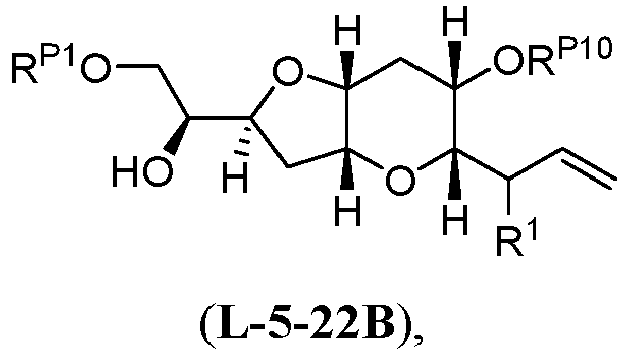
- As shown in Scheme 4B, provided herein is a method of preparing a compound of Formula (L-5-22):


- R1 is hydrogen, halogen, or optionally substituted alkyl;
- RP1, RP6, and RP10 are each independently hydrogen, optionally substituted alkyl, optionally substituted acyl, or an oxygen protecting group; and
- R8 is hydrogen, optionally substituted alkyl, optionally substituted carbocyclyl, optionally substituted aryl, optionally substituted heterocyclyl, optionally substituted heteroaryl, optionally substituted acyl, or an oxygen protecting group.
- The step of reducing a compound of (L-5-21B), or a salt thereof, converts the - CO2R8 moiety to an -ORP1 group (i.e., -OH). In certain embodiments, the step of reducing is carried out in the presence of a hydride (i.e., H-) source. Any hydride source known in the art may be used in this transformation. Examples of hydride sources include, but are not limited to, lithium aluminum hydride, sodium borohydride, lithium borohydride, and diisobutylaluminum hydride. In certain embodiments, the hydride source is diisobutylaluminum hydride (DIBAL).
- In certain embodiments, the step of reducing is carried out in the presence of DIBAL. In certain embodiments, the reaction is carried out in a solvent (e.g., THF). In certain embodiments, the reaction is carried out at below room temperature. In certain embodiments, the reaction is carried out at a temperature ranging from approximately -78 °C to approximately room temperature. In certain embodiments, the reaction is carried out at around -78 °C. For example, in certain embodiments, the reaction is carried out under the following conditions: 4 equivalents of DIBAL in THF at -78 °C (e.g., for under 1 hour).
- In certain embodiments, RP6 and RP10 are silyl protecting groups; and R8 is optionally substituted alkyl. In certain embodiments, RP6 and RP10 are TBS; and R8 is methyl.
- In certain embodiments, the compound of Formula (L-5-22) is of Formula (L-5-22-C):

- Also provided herein is a method of preparing a compound of Formula (L-5-21B):

- (a) reducing a compound of Formula (L-5-21A):


- (b) reacting a compound of Formula (L-5-21C), or a salt thereof, in the presence of an olefinating reagent to yield a compound of Formula (L-5-21B), or a salt thereof.
- The step of reducing a compound of (L-5-21A), or a salt thereof (i.e., step (a) above), converts the -CN moiety to an aldehyde group (i.e., -CHO). In certain embodiments, the step of reducing is carried out in the presence of a hydride (i.e., H-) source. Any hydride source known in the art may be used in this transformation. Examples of hydride sources include, but are not limited to, lithium aluminum hydride, sodium borohydride, lithium borohydride, and diisobutylaluminum hydride. In certain embodiments, the hydride source is diisobutylaluminum hydride (DIBAL). The step of reducing may optionally comprise reducing the -CN moiety to an alcohol, followed by oxidation of the resulting alcohol to an aldehyde to yield a compound of Formula (L-5-21C), or a salt thereof.
- In certain embodiments, the step of reducing is carried out in the presence of DIBAL. In certain embodiments, the reaction is carried out in a solvent (e.g., hexanes, CH2Cl2). In certain embodiments, the reaction is carried out at below room temperature. In certain embodiments, the reaction is carried out at a temperature ranging from approximately -78 °C to approximately room temperature. In certain embodiments, the reaction is carried out at around -78 °C. For example, in certain embodiments, the reaction is carried out under the following conditions: 1.1 equivalents of DIBAL in hexanes-CH2Cl2 at -78 °C (e.g., for under 1 hour).
- In certain embodiments, the olefination of a compound of Formula (L-5-21C), or a salt thereof (i.e., step (b) above), is carried out in the presence of a Wittig or Homer-Wadsworth Emmons reagent. In certain embodiments, the olefination is carried out in the presence of a reagent of the formula: (RO)2P(O)CH2CO2R8. In certain embodiments, the reagent is of the formula: (MeO)2P(O)CH2CO2R8 (e.g., (MeO)2P(O)CH2CO2Bn). In certain embodiments, the reagent is of the formula: (CF3CH2O)2P(O)CH2CO2R8 (e.g., (CF3CH2O)2P(O)CH2CO2Me). In certain embodiments, the olefination is carried out in the presence of a base. In certain embodiments, the base is a phosphate salt such as K3PO4. In certain embodiments, the base is an amide base. In certain embodiments, the base is a diisopropyl amide base (e.g., LDA). In certain embodiments, the base is a hexamethyldisilazide base (e.g., LiHMDS, NaHMDS, KHMDS). In certain embodiments, the olefination is carried out in the presence of one or more additional reagents. In certain embodiments, the olefination is carried out in the presence of a crown ether (e.g., 18-crown-6).
- In certain embodiments, the olefination is carried out in the presence of a reagent of the formula (RO)2P(O)CH2CO2R8, a base. In certain embodiments, the reaction is carried out in the presence of (CF3CH2O)2P(O)CH2CO2Me and KHMDS. In certain embodiments, 18-crown-6 is present. In certain embodiments, the reaction is carried out in a solvent (e.g., THF). In certain embodiments, the reaction is carried out at a temperature ranging from approximately -78 °C to approximately room temperature. In certain embodiments, the reaction is carried out at -78 °C. For example, in certain embodiments, the reaction is carried out under the following conditions: 1.5 equivalents (CF3CH2O)2P(O)CH2CO2Me, 1.5 equivalents KHMDS, 8 equivalents 18-crown-6, in THF at -78 °C (e.g., for under 1 hour).
- In certain embodiments, RP6 and RP10 are silyl protecting groups; and R8 is optionally substituted alkyl. In certain embodiments, RP6 and RP10 are TBS; and R8 is methyl.
- Also provided herein is a method of preparing a compound of Formula (L-5-21A):


- R1 is hydrogen, halogen, or optionally substituted alkyl;
- RP6, RP7 and RP10 are each independently hydrogen, optionally substituted alkyl, optionally substituted acyl, or an oxygen protecting group; and wherein -ORP7 is a leaving group.
- The method of preparing a compound of Formula (L-5-21A), or a salt thereof, comprises reacting a compound of Formula (L-5-20), or a salt thereof, in the presence of cyanide. In certain embodiments, the cyanide is a cyanide salt (e.g., NaCN, KCN, LiCN). In certain embodiments, the cyanide salt is sodium cyanide (NaCN). The reaction may be carried out in the presence of one or more additional reagents (e.g., a crown ether). In certain embodiments, the reaction is carried out in the presence of NaCN, in a solvent such as DMSO. In certain embodiments, the reaction is carried out at a temperature ranging from approximately 0 °C to approximately 50 °C. In certain embodiments, the reaction is carried out at room temperature. For example, in certain embodiments, the reaction is carried out under the following conditions: 20 equivalents NaCN in DMSO at room temperature (e.g., for 1 hour).
- In certain embodiments, RP6 and RP10 are silyl protecting groups. In certain embodiments, RP6 and RP10 are TBS.
- Provided herein are method of preparing "left half' building blocks of compounds in the norhalichondrin series (e.g., norhalichondrin A, B, C, and analogs thereof). For example, as shown in Scheme 4C, left half building blocks of Formula (L-2-15) can be prepared by converting the ester group (i.e., -CO2R8) of a compound of Formula (L-5-32) to a thioester moiety (i.e., -C(O)SRS). To this end, a compound of Formula (L-5-32) can be prepared by oxidizing a compound of Formula (L-5-31), which can be prepared by cyclizing a compound of Formula (L-5-30). A compound of Formula (L-5-30) can be prepared via oxidative cleavage and olefination of a compound of Formula (L-5-28), which can be obtained by coupling a compound of Formula (L-5-27) with a compound of Formula (L-5-5). A compound of Formula (L-5-27) can be obtained from an intermediate of Formula (L-5-21A), as described herein.

- As shown in Scheme 4C, provided herein is a method of preparing a compound of Formula (L-2-15):


- RS is optionally substituted alkyl, optionally substituted carbocyclyl, optionally substituted aryl, optionally substituted heterocyclyl, or optionally substituted heteroaryl;
- R1 and R2 are independently hydrogen, halogen, or optionally substituted alkyl;
- each instance of RP4 and RP6 are independently hydrogen, optionally substituted alkyl, optionally substituted acyl, or an oxygen protecting group; and
- R7 and R8 are independently hydrogen, optionally substituted alkyl, optionally substituted carbocyclyl, optionally substituted aryl, optionally substituted heterocyclyl, or optionally substituted heteroaryl.
- As described herein, the step of forming a compound of Formula (L-2-15) comprises reacting a compound of Formula (L-5-32) in the presence of a thiolating agent. Any thiolating agent known in the art may be used to this end. In certain embodiments, the thiolating agent is a disulfide. In certain embodiments, the thiolating agent is of the formula (RSS)2. In certain embodiments, the thiolating agent is of the formula (pyridine-S)2. In certain embodiments, the thiolating agent is:

- In certain embodiments, the step of thiolating a compound of Formula (L-5-32) is carried out in the presence of one of more additional reagents. In certain embodiments, the step of thiolating is carried out in the presence of a phosphine reagent (e.g., triphenylphosphine (Ph3P)).
- In certain embodiments, the step of thiolating is carried out in the presence of a disulfide and a phosphine. In certain embodiments, the reaction is carried out in the presence of (Py-S)2 and Ph3P. In certain embodiments, the reaction is carried out in a solvent such as toluene or CH2Cl2. In certain embodiments, the reaction is carried out at a temperature ranging from approximately 0 °C to approximately 50 °C. In certain embodiments, the reaction is carried out at room temperature. For example, in certain embodiments, the step of thiolating is carried out under the following conditions: 1.4 equivalents of (Py-S)2, 1.2 equivalents of Ph3P, in toluene at room temperature (e.g., for 10-20 hours).
- In certain embodiments, the method of thiolating a compound of Formula (L-5-32), or a salt thereof, comprises the steps of:
- (a) deprotecting a compound of Formula (L-5-32), or a salt thereof, to yield a compound of Formula (L-5-32B):

- (b) thiolating a compound of Formula (L-5-32B), or a salt thereof, to yield a compound of Formula (L-2-15), or a salt thereof.
- In certain embodiments, R7 is optionally substituted alkyl; and RP6 and RP4 are silyl protecting groups. In certain embodiments, R7 is optionally substituted alkyl; RP6 and RP4 are TES.
- Also provided herein is a method of preparing a compound of Formula (L-5-32):


- R1 and R2 are independently hydrogen, halogen, or optionally substituted alkyl;
- RP1, RP4, and RP6 are independently hydrogen, optionally substituted alkyl, optionally substituted acyl, or an oxygen protecting group; and
- R8 is hydrogen, optionally substituted alkyl, optionally substituted carbocyclyl, optionally substituted aryl, optionally substituted heterocyclyl, optionally substituted heteroaryl, optionally substituted acyl, or an oxygen protecting group.
- In certain embodiments, the method of preparing a compound of Formula (L-5-32), or a salt thereof, comprises the steps of:
- (a) Oxidizing a compound of Formula (L-5-31B):


- (b) protecting a compound of Formula (L-5-32C), or a salt thereof, to yield a compound of Formula (L-5-32), or a salt thereof.
- Any method can be used in the step of oxidizing a compound of Formula (L-5-31) or (L-5-31B). In certain embodiments, the oxidation is carried out in the presence of a periodinane (e.g., Dess-Martin periodinane (DMP)). In certain embodiments, the oxidation involves a Swern oxidation. In certain embodiments, the oxidation is carried out in the presence of a chromium reagent (e.g., pyridinium chlorochromate (PCC)). In certain embodiments, the step of oxidizing involves a Pinnick oxidation, e.g., treatment of the reaction mixture with a chlorite (e.g., sodium chlorite (NaClO2)). In certain embodiments, the oxidation involves carrying out the reaction in the presence of a periodinane (e.g., DMP) followed by a chlorite (e.g., NaClO2). In certain embodiments, the oxidation is carried out in the presence of DMP and NaHCO3 in a solvent (e.g., CH2Cl2), followed by NaClO2 and NaH2PO4 in a solvent (e.g., t-BuOH/H2O). In certain embodiments, the reactions are carried out at a temperature ranging from approximately 0 °C to approximately 50 °C. In certain embodiments, the reactions are carried out at around room temperature. For example, in certain embodiments, the reaction is carried out under the following conditions: (a) 2 equivalents DMP, 10 equivalents NaHCO3 in CH2Cl2 at room temperature (e.g., for under 1 hour); followed by (b) 3 equivalents NaClO2, 4 equivalents NaH2PO4, with 2-methyl-2-butene in t-BuOH and water at room temperature (e.g., for under 1 hour).
- In certain embodiments, the step of protecting a compound of Formula (L-5-32C) involves treating the compound with an alkylating agent. In certain embodiments, the alkylating agent is an alkyl halide or a reagent of the structure: alkyl-leaving group. In certain embodiments, the alkylating agent is a methyl transfer reagent (e.g., diazomethane, trimethylsilyldiazomethane (TMSCH2N2)).
- In certain embodiments, the step of protecting is carried out in the presence of TMSCH2N2. In certain embodiments, the reaction is carried out in a solvent (e.g., benzene/MeOH). In certain embodiments, the reaction is carried out at a temperature ranging from approximately 0 °C to approximately 50 °C. In certain embodiments, the reaction is carried out at around room temperature. For example, in certain embodiments, the reaction is carried out under the following conditions: 3 equivalents TMSCH2N2 in benzene/MeOH at room temperature (e.g., for 5 min).
- In certain embodiments, R7 is optionally substituted alkyl; and RP6 is a silyl protecting group; RP4 is optionally substituted benzyl; and R8 is optionally substituted benzyl. In certain embodiments, R7 is methyl; RP6 is TES; RP4 is MPM; and R8 is benzyl.
- In certain embodiments, the compound of Formula (L-5-32), or a salt thereof, is deprotected to remove the group RP4 yield a compound of Formula (L-5-32D):

- As shown in Scheme 4C, provided herein is a method of preparing a compound of Formula (L-5-31):
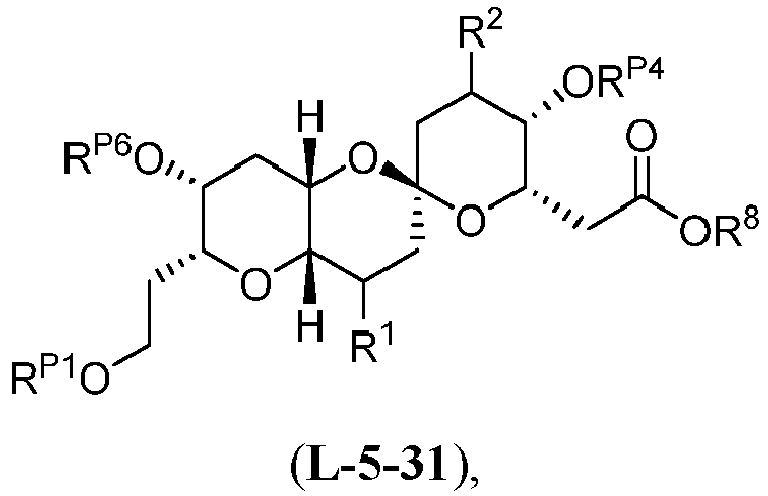

- R1 and R2 are independently hydrogen, halogen, or optionally substituted alkyl;
- RP1, RP4 and RP6 are independently hydrogen, optionally substituted alkyl, optionally substituted acyl, or an oxygen protecting group; optionally wherein two RP6 are joined with the intervening atoms to form optionally substituted heterocyclyl; and
- R8 is hydrogen, optionally substituted alkyl, optionally substituted carbocyclyl, optionally substituted aryl, optionally substituted heterocyclyl, optionally substituted heteroaryl, optionally substituted acyl, or an oxygen protecting group.
- In certain embodiments, the step of cyclizing a compound of Formula (7-5-30) is carried out in the presence of a base. In certain embodiments, the base is a nitrogen base. In certain embodiments, the base is an amidine or guanidine base. In certain embodiments, the base is an amine or an amide. In certain embodiments, the base is an amidine base (e.g., 1,8-diazabicyclo(5.4.0)undec-7-ene (DBU)). In certain embodiments, the step of cyclizing is carried out in the presence of an acid. In certain embodiments, the acid is a Lewis acid. In certain embodiments, the step of cyclizing is carried out in the presence of a lithium salt (e.g., LiBr, LiCl). The step of cyclizing may be carried out in the presence of one or more additional reagents. In certain embodiments, the step of cyclizing is carried out in the presence of BnOAc.
- In certain embodiments, the step of cyclizing is carried out in the presence of a lithium salt, and a base. In certain embodiments, the step of cyclizing is carried out in the presence of LiBr and DBU. In certain embodiments, the reaction is carried out in a solvent such as MeCN. In certain embodiments, the reaction is carried out at a temperature ranging from approximately 0 °C to approximately 50 °C. In certain embodiments, the reaction is carried out at room temperature. For example, in certain embodiments, the reaction is carried out under the following conditions: 10 equivalents LiBr, 5 equivalents DBU, and 2 equivalents BnOAc in MeCN at room temperature (e.g., for 10-20 hours).
- In certain embodiments, RP1 is a silyl; and RP6 is a silyl protecting group; RP4 is optionally substituted benzyl; and R8 is optionally substituted benzyl. In certain embodiments, RP1 is TES; RP6 is TES; RP4 is MPM; and R8 is benzyl.
- Also provided herein is a method of preparing a compound of Formula (L-5-30):
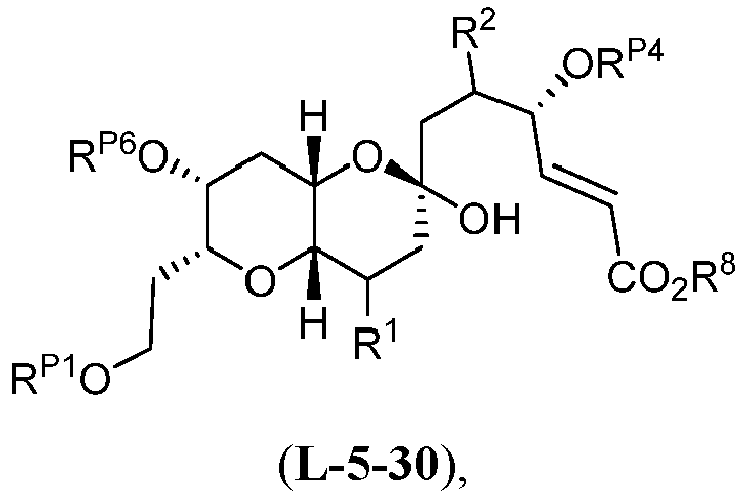

- R1 and R2 are independently hydrogen, halogen, or optionally substituted alkyl; and
- RP1, RP4 and RP6 are independently hydrogen, optionally substituted alkyl, optionally substituted acyl, or an oxygen protecting group; optionally wherein two RP6 are joined with the intervening atoms to form optionally substituted heterocyclyl.
- In certain embodiments, the olefin is of the formula:

- Also provided herein is an alternative method of preparing a compound of Formula (L-5-30):

- (a) oxidizing a compound of Formula (L-5-28):


- (b) reacting the compound of Formula (L-5-29) or (L-5-29B), or a salt thereof, in the presence of a olefination reagent, to yield a compound of Formula (L-5-30), or a salt thereof. The reaction in step (a) above is an oxidative cleavage; the reaction in step (b) is an olefination reaction. In certain embodiments, the oxidative cleavage is carried out via ozonolysis (e.g., in the presence of O3). In certain embodiments, the cleavage is carried out in the presence of reagents capable of dihydroxylating a double bond (e.g., osmium tetroxide (OsO4), N-methylmorpholine N-oxide (NMMO)), followed by a transition metal (e.g., a lead complex such as Pb(OAc)4).
- In certain embodiments, the double bond is dihydroxylated by treatment with OsO4, NMMO, and water. In certain embodiments, the reaction is carried out in the presence of a solvent such as acetone. In certain embodiments, the reaction is carried out at a temperature ranging from approximately 0 °C to approximately 50 °C. In certain embodiments, the reaction is carried out at room temperature. For example, in certain embodiments, the double bond is dihydroxylated under the following conditions: 5 mol% OsO4, 2 equivalents NMMO, and water, in acetone at room temperature (e.g., for 10-20 hours). The resulting compound is then treated, in certain embodiments, with Pb(OAc)4 and K2CO3 to yield the aldehyde or hemiacetal. For example, in certain embodiments, this step is carried out under the following conditions: 2 equivalents Pb(OAc)4, 10 equivalents K2CO3, in CH2Cl2 at room temperature (e.g., for under 1 hour).
- In certain embodiments, the olefination is carried out in the presence of a Wittig or Homer-Wadsworth Emmons reagent. In certain embodiments, the olefination is carried out in the presence of a reagent of the formula: (RO)2P(O)CH2CO2R8. In certain embodiments, the reagent is of the formula: (MeO)2P(O)CH2CO2R8 (e.g., (MeO)2P(O)CH2CO2Bn). In certain embodiments, the olefination is carried out in the presence of a base (e.g., a phosphate salt such as K3PO4).
- In certain embodiments, the olefination is carried out in the presence of an olefination reagent of the formula: (RO)2P(O)CH2CO2R8, and a base. In certain embodiments, the olefination is carried out in the presence of (MeO)2P(O)CH2CO2Bn and K3PO4. In certain embodiments, the reaction is carried out in a solvent such as toluene. In certain embodiments, the reaction is carried out at a temperature ranging from approximately 0 °C to approximately 50 °C. In certain embodiments, the reaction is carried out at room temperature. For example, in certain embodiments, the reaction is carried out under the following conditions: 4 equivalents (MeO)2P(O)CH2CO2Bn, 3 equivalents K3PO4, in a solvent at room temperature (e.g., for 24-48 hours).
- In certain embodiments, RP1 is a silyl; and RP6 is a silyl protecting group; RP4 is optionally substituted benzyl; and R8 is optionally substituted benzyl. In certain embodiments, RP1 is TES; RP6 is TES; RP4 is MPM; and R8 is benzyl.
- Also provided herein is a method of preparing a compound of Formula (L-5-28):


- X4 is halogen or a leaving group;
- R1 and R2 are independently hydrogen, halogen, or optionally substituted alkyl; and
- each instance of RP1, RP4, and RP6 are independently hydrogen, optionally substituted alkyl, optionally substituted acyl, or an oxygen protecting group; optionally wherein two RP6 are joined with the intervening atoms to form optionally substituted heterocyclyl.
- In certain embodiments, the coupling of a compound of Formula (L-5-4) with a compound of Formula (L-5-5) is carried out in the presence of an organometallic reagent (e.g., to covert X4 to a metal for addition to the compound of Formula (L-5-4)). In certain embodiments, the organometallic reagent is a lithium reagent (e.g., to convert the compound of the Formula (L-5-5) to a compound of the formula:

- In certain embodiments, the reaction is carried out in the presence of tert-butyllithium. In certain embodiments, the reaction is performed in a solvent such as toluene, THF, Et2O, or a combination thereof. In certain embodiments, the reaction is carried out at a temperature ranging from approximately -78 °C to approximately room temperature. In certain embodiments, the reaction is carried out at -78° C. For example, in certain embodiments, the reaction is carried out with 2.2 equivalents of tert-butyllithium in toluene and Et2O at -78° C (e.g., for less than 1 hour).
- In certain embodiments, RP1 is a silyl; and RP6 is a silyl protecting group; RP4 is optionally substituted benzyl; and R8 is optionally substituted benzyl. In certain embodiments, RP1 is TES; RP6 is TES; RP4 is MPM; and R8 is benzyl.
- Provided herein are methods useful in the preparation of "left half' building blocks of other halichondrin analogs (e.g., compounds of Formula (H3-2-1)). For example, as shown in Scheme 4D, left half building blocks of Formula (L-2-6) can be prepared by converting the ester group (i.e., -CO2R8) of a compound of Formula (L-5-7B) to a thioester moiety (i.e., - C(O)SRS). A compound of Formula (L-5-7B) can be prepared by cyclizing a compound of Formula (L-5-7A), which may be prepared by oxidative cleavage and olefination of a compound of Formula (L-5-6A). A compound of Formula (L-5-6A) can be prepared by coupling a compound of Formula (L-5-4) with a compound of Formula (L-5-5). As also shown in scheme 4D, a compound of Formula (L-5-4) can be prepared via homologation of a lactone of Formula (L-5-3).
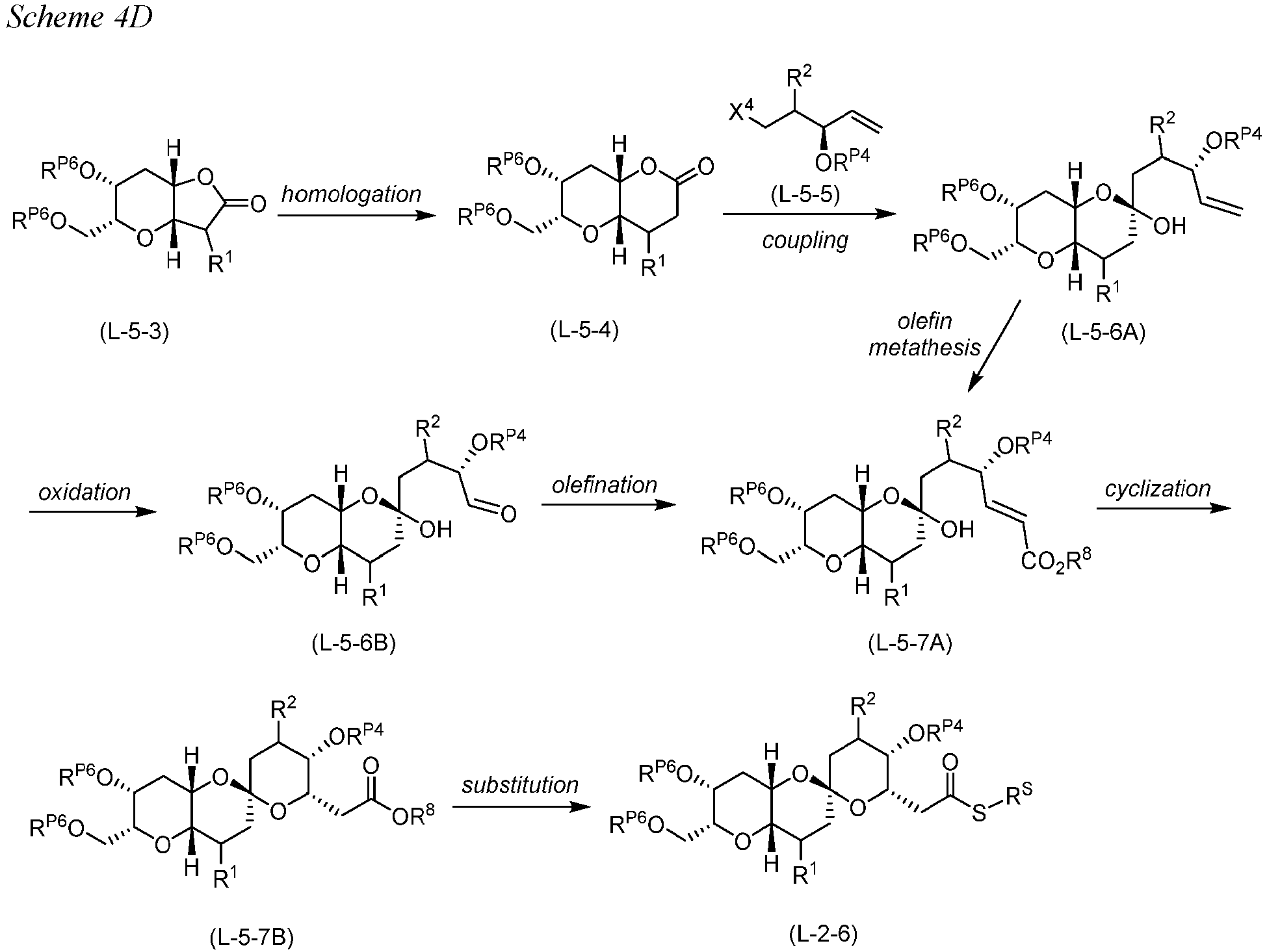
- As shown in Scheme 4D, provided herein is a method of preparing a compound of Formula (L-2-6):


- RS is optionally substituted alkyl, optionally substituted carbocyclyl, optionally substituted aryl, optionally substituted heterocyclyl, or optionally substituted heteroaryl;
- R1 and R2 are independently hydrogen, halogen, or optionally substituted alkyl;
- each instance of RP4 and RP6 are independently hydrogen, optionally substituted alkyl, optionally substituted acyl, or an oxygen protecting group; optionally wherein two RP6 are joined with the intervening atoms to form optionally substituted heterocyclyl; and
- R8 is hydrogen, optionally substituted alkyl, optionally substituted carbocyclyl, optionally substituted aryl, optionally substituted heterocyclyl, optionally substituted heteroaryl, optionally substituted acyl, or an oxygen protecting group.
- In certain embodiments, the method is a method of preparing a compound of Formula (E-L):

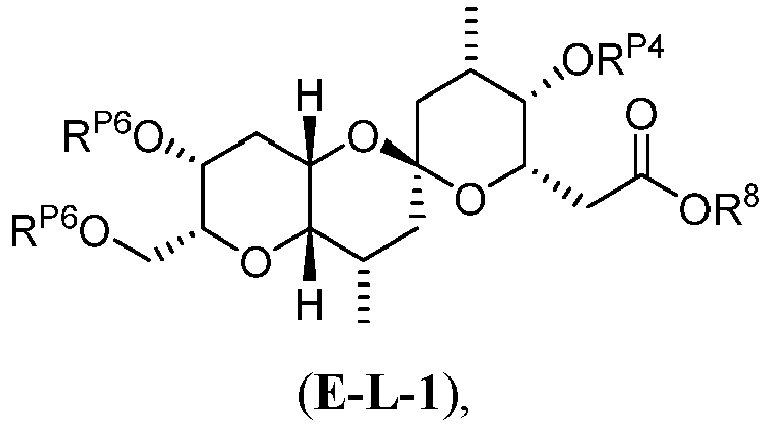
- RS is optionally substituted alkyl, optionally substituted carbocyclyl, optionally substituted aryl, optionally substituted heterocyclyl, or optionally substituted heteroaryl;
- each instance of RP4 and RP6 are independently hydrogen, optionally substituted alkyl, optionally substituted acyl, or an oxygen protecting group; optionally wherein two RP6 are joined with the intervening atoms to form optionally substituted heterocyclyl; and
- R8 is hydrogen, optionally substituted alkyl, optionally substituted carbocyclyl, optionally substituted aryl, optionally substituted heterocyclyl, optionally substituted heteroaryl, optionally substituted acyl, or an oxygen protecting group.
- As described herein, the step of forming a compound of Formula (L-2-6), (E-L), or a salt thereof, comprises reacting a compound of Formula (L-5-7B), (E-L-1), or a salt thereof, in the presence of a thiolating agent. Any thiolating agent known in the art may be used to this end. In certain embodiments, the thiolating agent is a disulfide. In certain embodiments, the thiolating agent is of the formula (RSS)2. In certain embodiments, the thiolating agent is of the formula (pyridine-S)2. In certain embodiments, the thiolating agent is:

- In certain embodiments, the step of thiolating is carried out in the presence of one of more additional reagents. In certain embodiments, the step of thiolating is carried out in the presence of a phosphine reagent. In certain embodiments, the phosphine is a trialkyl phosphine. In certain embodiments, the phosphine is a triaryl phosphine. In certain embodiments, the phosphine is PPh3. In certain embodiments, the phosphine is polymer-bound PPh3. In certain embodiments, the phosphine is present in stoichiometric or excess amounts (e.g., 1-3 equivalents).
- In certain embodiments, the step of thiolating is carried out in the presence of a disulfide and a phosphine. In certain embodiments, the reaction is carried out in the presence of 2,2'-dipyridyl sulfide and Ph3P. In certain embodiments, the reaction is carried out in a solvent. In certain embodiments, the solvent is DCM. In certain embodiments, the solvent is acetonitrile. In certain embodiments, the reaction is carried out at from 0° C to room temperature. In certain embodiments, the reaction is carried out at a temperature ranging from approximately 0 °C to approximately 50 °C. In certain embodiments, the reaction is carried out at room temperature. In certain embodiments, the reaction is carried out in the presence of 2,2'-dipyridyl sulfide and Ph3P in MeCN at from 0° C to room temperature.
- For example, in certain embodiments, the step of thiolating is carried out under the following conditions: 1.4 equivalents of 2,2'-dipyridyl sulfide, 1.2 equivalents of Ph3P, in DCM at room temperature (e.g., for 10-20 hours). For example, in certain embodiments, the step of thiolating is carried out under the following conditions: 1.2 equivalents of 2,2'-dipyridyl sulfide, 2.3 equivalents of Ph3P, in MeCN at from 0 °C to room temperature (e.g., for 10-20 hours).
- In certain embodiments, two RP6 are joined with the intervening atoms to form a ring of the formula:


- In certain embodiments, the method of thiolating a compound of Formula (L-5-7B), or a salt thereof, comprises:
- (a) a step of deprotecting a compound of Formula (L-5-7B), or a salt thereof, under conditions sufficient to remove the RP4 and R8 groups, to yield a compound of Formula (L-5-7C):

- (b) a step of protecting a compound of Formula (L-5-7C), or a salt thereof, to yield a compound of Formula (L-5-7D):

- In certain embodiments, the method comprises:
- (a) a step of deprotecting a compound of Formula (E-L-1), or a salt thereof, under conditions sufficient to remove the RP4 and R8 groups, to yield a compound of Formula (E-L-3):
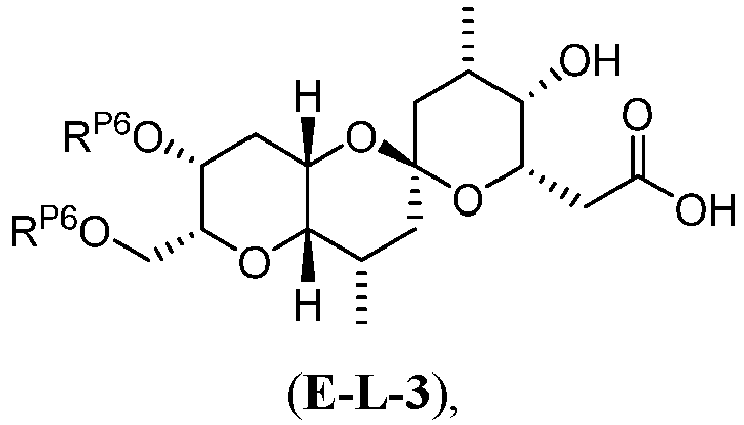
- (b) a step of protecting a compound of Formula (E-L-3), or a salt thereof, to yield a compound of Formula (E-L-4): or a salt thereof.

- In certain embodiments, with respect to the compounds of Formula (L-5-7B), (E-L-1), or a salt thereof, RP4 and R8 are optionally substituted benzyl protecting groups; and the step of deprotecting (i.e., step (a)) is carried out in the presence of H2 and Pd/C. In certain embodiments, RP4 is MPM and R8 is benzyl (Bn); and the step of deprotecting is carried out in the presence of H2 and Pd/C. In certain embodiments, the step of deprotecting is carried out in the presence of H2 and Pd/C in i-PrOAc.
- In certain embodiments, with respect to the compound of Formula (E-L-4), (L-5-7D), or salt thereof, RP4 is a silyl protecting group; and the step of protecting (i.e., step (b)) is carried out in the presence of a silylating agent and base. In certain embodiments, RP4 is TES; and the silylating reagent is TESCl. In certain embodiments, the base is imidazole. In certain embodiments, the step of protecting is carried out in the presence of TESCl and imidazole. In certain embodiments, the step of protecting is carried out in the presence of TESCl and imidazole in DMF.
- In certain embodiments, the compounds of Formulae (E-L-4), (L-5-7D), or salts thereof, are purified by silica gel chromatography and/or purification.
- As also shown in Scheme 4D, provided herein is a method of preparing a compound of Formula (L-5-7B):

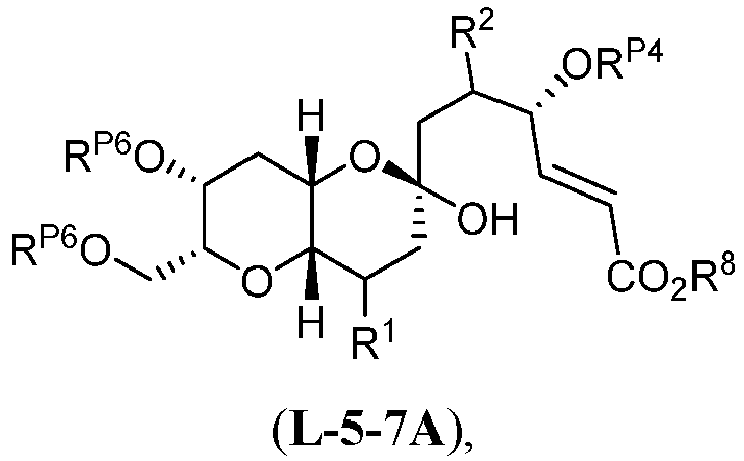
- R1 and R2 are independently hydrogen, halogen, or optionally substituted alkyl;
- each instance of RP4 and RP6 are independently hydrogen, optionally substituted alkyl, optionally substituted acyl, or an oxygen protecting group; optionally wherein two RP6 are joined with the intervening atoms to form optionally substituted heterocyclyl; and
- R8 is hydrogen, optionally substituted alkyl, optionally substituted carbocyclyl, optionally substituted aryl, optionally substituted heterocyclyl, optionally substituted heteroaryl, optionally substituted acyl, or an oxygen protecting group.
- In certain embodiments, the method comprises cyclizing a compound of Formula (EL-2):


- each instance of RP4 and RP6 are independently hydrogen, optionally substituted alkyl, optionally substituted acyl, or an oxygen protecting group; optionally wherein two RP6 are joined with the intervening atoms to form optionally substituted heterocyclyl; and
- R8 is hydrogen, optionally substituted alkyl, optionally substituted carbocyclyl, optionally substituted aryl, optionally substituted heterocyclyl, optionally substituted heteroaryl, optionally substituted acyl, or an oxygen protecting group.
- In certain embodiments, the step of cyclizing a compound of Formula (7-5-7A), (EL-2), or a salt thereof, is carried out in the presence of a base. In certain embodiments, the base is a nitrogen base. In certain embodiments, the base is an amidine, guanidine base. In certain embodiments, the base is an amine or amide base. In certain embodiments, the base is an amidine base (e.g., 1,8-diazabicyclo(5.4.0)undec-7-ene (DBU)). In certain embodiments, the base is DBU. In certain embodiments, the base is used in an excess amount.
- In certain embodiments, the step of cyclizing is carried out in the presence of an acid. In certain embodiments, the acid is a Lewis acid.
- In certain embodiments, the step of cyclizing is carried out in the presence of a lithium salt (e.g., LiBr, LiCl). In certain embodiments, the reaction is carried out in the presence of LiBr. In certain embodiments, the base is used in an excess amount.
- The step of cyclizing may be carried out in the presence of one or more additional reagents. In certain embodiments, the step of cyclizing is carried out in the presence of a reagent of the formula: R8OAc. In certain embodiments, the step of cyclizing is carried out in the presence of BnOAc. In certain embodiments, the reagent is present in an excess amount.
- In certain embodiments, the reaction is carried out in a solvent. In certain embodiments, the solvent is MeCN. In certain embodiments, the reaction is carried out at a temperature ranging from approximately 0 °C to approximately 50 °C. In certain embodiments, the reaction is carried out at room temperature. In certain embodiments, the reaction is carried out at around 30 °C.
- In certain embodiments, the step of cyclizing is carried out in the presence of a lithium salt and a base. In certain embodiments, the step of cyclizing is carried out in the presence of LiBr and DBU. In certain embodiments, the step of cyclizing is carried out in the presence of LiBr, DBU, and R8OAc. In certain embodiments, the step of cyclizing is carried out in the presence of LiBr, DBU, and BnOAc. In certain embodiments, the step of cyclizing is carried out in the presence of LiBr, DBU, and BnOAc in MeCN from room temperature to around 30 °C.
- For example, in certain embodiments, the reaction is carried out under the following conditions: 10 equivalents LiBr, 5 equivalents DBU, and 10 equivalents BnOAc in MeCN at room temperature (e.g., for 10-20 hours). For example, in certain embodiments, the reaction is carried out under the following conditions: 10 equivalents LiBr, 5 equivalents DBU, and 5 equivalents BnOAc in MeCN at room temperature to around 30 °C (e.g., for around 24 hours).
- In certain embodiments, two RP6 are joined with the intervening atoms to form a ring of the formula:


- In certain embodiments, the compound of Formula (L-5-7B), or a salt thereof, is deprotected to remove the group RP4 yield a compound of Formula (L-5-7D):

- Also provided herein is a method of preparing a compound of Formula (L-5-7A):


- R1 and R2 are independently hydrogen, halogen, or optionally substituted alkyl;
- each instance of RP4 and RP6 are independently hydrogen, optionally substituted alkyl, optionally substituted acyl, or an oxygen protecting group; optionally wherein two RP6 are joined with the intervening atoms to form optionally substituted heterocyclyl; and
- R8 is hydrogen, optionally substituted alkyl, optionally substituted carbocyclyl, optionally substituted aryl, optionally substituted heterocyclyl, optionally substituted heteroaryl, optionally substituted acyl, or an oxygen protecting group.
- In certain embodiments, the olefin is of the formula:. Further, any olefin metathesis known in the art may be used in the metathesis reaction to furnish a compound of Formula (L-5-7A).

- Also provided herein is an alternative method of preparing a compound of Formula (L-5-7A):

- (a) oxidizing a compound of Formula (L-5-6A):

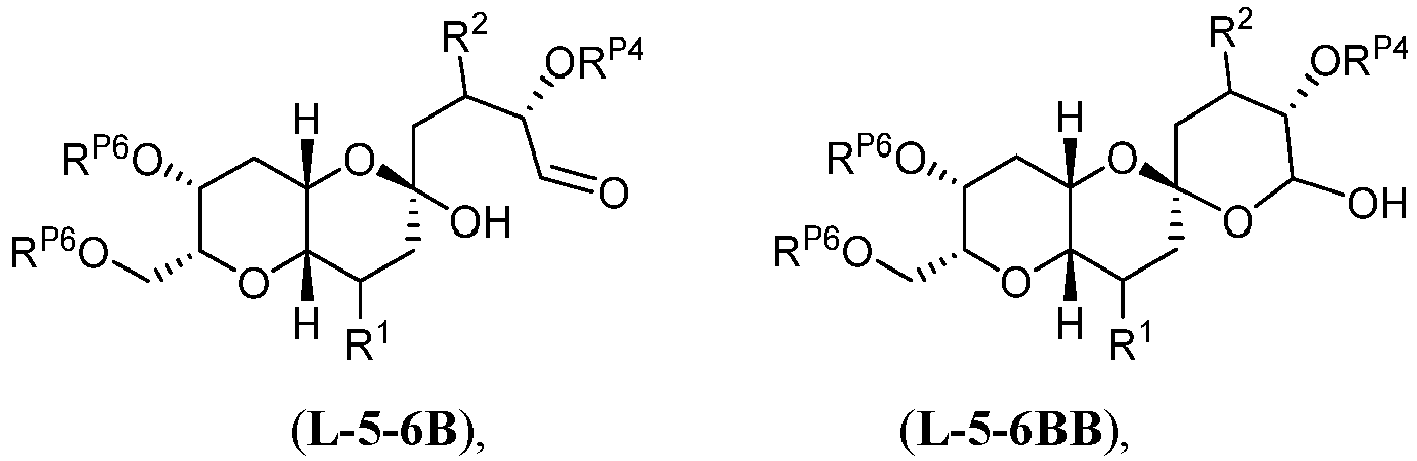
- (b) reacting the compound of Formula (L-5-6B) and/or (L-5-6BB), or a salt thereof, in the presence of a olefination reagent, to yield a compound of Formula (L-5-7A), or a salt thereof.
- In certain embodiments, the method comprises the steps of:
- (a) oxidizing a compound of Formula (E-L-5):


- (b) reacting the compound of Formula (E-L-6), or a salt thereof, in the presence of a olefination reagent, to yield a compound of Formula (E-L-2):
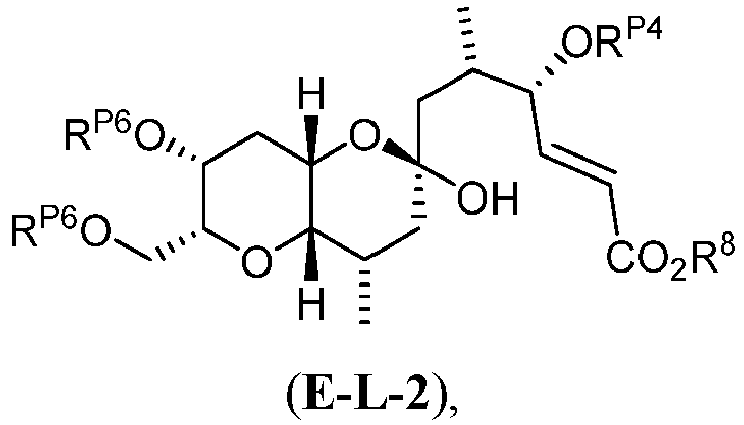
- each instance of RP4 and RP6 are independently hydrogen, optionally substituted alkyl, optionally substituted acyl, or an oxygen protecting group; optionally wherein two RP6 are joined with the intervening atoms to form optionally substituted heterocyclyl; and
- R8 is hydrogen, optionally substituted alkyl, optionally substituted carbocyclyl, optionally substituted aryl, optionally substituted heterocyclyl, optionally substituted heteroaryl, optionally substituted acyl, or an oxygen protecting group.
- The oxidation of a compound of Formula (L-5-6A), (E-L-5), or a salt thereof (i.e., step (a)) above is an oxidative cleavage. In certain embodiments, the oxidative cleavage is carried out via ozonolysis (e.g., in the presence of O3). In certain embodiments, the oxidizing cleavage is a Johnson-Lemieux oxidative cleavage. For example, In certain embodiments, the cleavage is carried out in the presence of reagents capable of dihydroxylating a double bond (e.g., osmium tetroxide (OsO4) and N-methylmorpholine N-oxide (NMO); or potassium osmate (VI) dehydrate (K2OsO4) and NMO), followed by a transition metal (e.g., a lead complex such as Pb(OAc)4). In certain embodiments, the cleavage is carried out in the presence of reagents capable of dihydroxylating a double bond (e.g., osmium tetroxide (OsO4) and N-methylmorpholine N-oxide (NMO); or potassium osmate (VI) dehydrate (K2OSO4) and NMO), followed by sodium periodate (NaIO4).
- In certain embodiments, the double bond is dihydroxylated by treatment with OsO4, NMO, and water. In certain embodiments, the reaction is carried out in the presence of a solvent such as acetone. In certain embodiments, the reaction is carried out at a temperature ranging from approximately 0 °C to approximately 50 °C. In certain embodiments, the reaction is carried out at room temperature. For example, in certain embodiments, the double bond is dihydroxylated under the following conditions: 10 mol% OsO4, 2 equivalents NMO, and water, in acetone at room temperature (e.g., for 20-25 hours). The resulting compound is then treated, in certain embodiments, with Pb(OAc)4 and K2CO3 to yield the aldehyde and/or hemiacetal. For example, in certain embodiments, this step is carried out under the following conditions: 1.2 equivalents Pb(OAc)4, 3 equivalents K2CO3, in CH2Cl2 at room temperature (e.g., for approximately 1 hour).
- In certain embodiments, the step of oxidizing is carried out in the presence of osmium tetroxide (OsO4) or potassium osmate (VI) dehydrate (K2OsO4), and NMO; followed by NaIO4. In certain embodiments, the step of oxidizing is carried out in the presence of potassium osmate (VI) dehydrate (K2OsO4) and NMO, followed by NaIO4. In certain embodiments, the reaction is carried out in a solvent. In certain embodiments, the reaction is carried out in acetone and water. In certain embodiments, the reaction is carried out at a temperature ranging from approximately 0 °C to approximately 50 °C. In certain embodiments, the reaction is carried out at around room temperature. In certain embodiments, the reaction is carried out in the presence of K2OsO4 and NMO, followed by NaIO4, in acetone and water, at around room temperature. For example, in certain embodiments, the reaction is carried out under the following conditions: K2OsO4•2H2O and NMO, followed by NaIO4, in acetone and water, at around room temperature.
- In certain embodiments, the olefination in step (b) is carried out in the presence of a Wittig or Homer-Wadsworth Emmons reagent. In certain embodiments, the olefination is carried out in the presence of a reagent of the formula: (RO)2P(O)CH2CO2R8. In certain embodiments, the reagent is of the formula: (MeO)2P(O)CH2CO2R8 (e.g., (MeO)2P(O)CH2CO2Bn). In certain embodiments, the olefination is carried out in the presence of a base (e.g., a phosphate salt such as K3PO4).
- In certain embodiments, the olefination is carried out in the presence of an olefination reagent of the formula: (RO)2P(O)CH2CO2R8, and a base. In certain embodiments, the olefination is carried out in the presence of (MeO)2P(O)CH2CO2Bn and K3PO4. In certain embodiments, the reaction is carried out in a solvent such as toluene. In certain embodiments, the reaction is carried out at a temperature ranging from approximately 0 °C to approximately 50 °C. In certain embodiments, the reaction is carried out at room temperature. In certain embodiments, the reaction is carried out at around 30 °C. In certain embodiments, the olefination is carried out in the presence of (MeO)2P(O)CH2CO2Bn and K3PO4, in toluene at around 30 °C. For example, in certain embodiments, the reaction is carried out under the following conditions: 4 equivalents (MeO)2P(O)CH2CO2Bn, 3 equivalents K3PO4 at room temperature (e.g., for about 20-25 hours). For example, in certain embodiments, the reaction is carried out under the following conditions: 5 equivalents (MeO)2P(O)CH2CO2Bn, 4 equivalents K3PO4 at around 30 °C (e.g., for about 1-3 days).
- In certain embodiments, two RP6 are joined with the intervening atoms to form a ring of the formula:


- Also provided herein is a method of preparing a compound of Formula (L-5-6A):


- X4 is halogen or a leaving group;
- R1 and R2 are independently hydrogen, halogen, or optionally substituted alkyl; and
- each instance of RP4 and RP6 are independently hydrogen, optionally substituted alkyl, optionally substituted acyl, or an oxygen protecting group; optionally wherein two RP6 are joined with the intervening atoms to form optionally substituted heterocyclyl.
- In certain embodiments, the method comprises comprising a step of coupling a compound of Formula (E-L-7):


- X4 is halogen or a leaving group; and
- each instance of RP4 and RP6 are independently hydrogen, optionally substituted alkyl, optionally substituted acyl, or an oxygen protecting group; optionally wherein two RP6 are joined with the intervening atoms to form optionally substituted heterocyclyl.
- In certain embodiments, the coupling of a compound of Formula (L-5-4) with a compound of Formula (L-5-5) (or a compound of the formula (E-L-7) and (E-L-8)) is carried out in the presence of an organometallic reagent (e.g., to covert X4 to a metal for addition to the compound of Formula (L-5-4) or (E-L-7)). In certain embodiments, the organometallic reagent is a lithium reagent (e.g., to convert the compound of the Formula (L-5-5) to a compound of the formula:for addition to the compound of Formula (L-5-4); e.g., to convert the compound of the Formula (E-L-8) to a compound of the formula:
 for addition to the compound of Formula (E-L-7)). In certain embodiments, lithium reagent is an organolithium (e.g., n-butyllithium, tert-butyllithium, sec-butyllithium). In certain embodiments, the lithium reagent is LiHMDS or LDA. In certain embodiments, the lithium reagent is sec-butyllithium.
- In certain embodiments, the reaction is carried out in the presence of tert-butyllithium. In certain embodiments, the reaction is performed in a solvent such as THF. In certain embodiments, the reaction is carried out at a temperature ranging from approximately -78° C to approximately room temperature. In certain embodiments, the reaction is carried out at a temperature ranging from approximately -78 °C to approximately 0 °C. For example, in certain embodiments, the reaction is carried out with 2.6 equivalents of tert-butyllithium in THF from -78° C to room temperature (e.g., over less than 1 hour).
- In certain embodiments, the reaction is carried out in the presence of sec-butyllithium. In certain embodiments, the reaction is performed in THF. In certain embodiments, the reaction is carried out at a temperature ranging from approximately -78 °C to approximately room temperature. In certain embodiments, the reaction is carried out at a temperature ranging from approximately -78 ° C to approximately 0 °C. In certain embodiments, the reaction is carried out with sec-butyllithium in THF at around -78° C to room temperature. For example, in certain embodiments, the reaction is carried out with about 2 equivalents of sec-butyllithium in THF from -78° C to room temperature (e.g., over less than 1 hour).
- In certain embodiments, two RP6 are joined with the intervening atoms to form a ring of the formula


- As shown in Scheme 4D, provided herein is a method of preparing a compound of Formula (L-5-4) from a compound of Formula (L-5-3). In certain embodiments, the method comprises the steps of:
- (a) reducing a compound of Formula (L-5-3):


- (b) olefinating a compound of Formula (L-5-3A), or a salt thereof, to yield a compound of Formula (L-5-3B):

- (c) hydrating a compound of Formula (L-5-3B), or a salt thereof, to yield a compound of Formula (L-5-3C):

- (d) oxidizing and cyclizing a compound of Formula (L-5-3C), or a salt thereof, to yield a compound of Formula (L-5-4):

- The step of reducing in step (a) above may be carried out in the presence of a hydride source. In certain embodiments, the hydride source is DIBAL. In certain embodiments, the step of olefination in step (b) above may be carried out in the presence of an olefination reagent (e.g., MePPh3Br). In certain embodiments, the step of olefination is carried out in the presence of a base (e.g., an alkoxide such as t-BuOK). In certain embodiments, the step of hydrating in step (c) above is a hydroboration reaction. In certain embodiments, the step of hydroboration involves treatment with 9-BBN followed by NaBO3•H2O. The steps of oxidizing and cyclizing in step (d) above may be carried out in the same step or subsequent steps. The step of oxidizing may be carried out in the presence of any oxidizing agents. In certain embodiments, the step of oxidizing is carried out in the presence of TEMPO and PhI(OAc)2. In certain embodiments, the step of oxidizing is carried out in the presence of NaHCO3.
- In certain embodiments, two RP6 are joined with the intervening atoms to form a ring of the formula:


- The following embodiments apply to all synthetic methods described above and herein.
- The reactions provided and described herein may involve one or more reagents. In certain embodiments, a reagent may be present in a catalytic amount. In certain embodiments, a catalytic amount is from 0-1 mol%, 0-5 mol%, 0-10 mol%, 1-5 mol%, 1-10 mol%, 5-10 mol%, 10-20 mol%, 20-30 mol%, 30-40 mol%, 40-50 mol%, 50-60 mol%, 60-70 mol%, 70-80 mol%, 80-90 mol%, or 90-99 mol%. In certain embodiments, a reagent may be present in a stoichiometric amount (i.e., about 1 equivalent). In certain embodiments, a reagent may be present in excess amount (i.e., greater than 1 equivalent). In certain embodiments, the excess amount is about 1.1, 1.2, 1.3, 1.4, 1.5, 2.0, 2.5, 3.0, 3.5, 4.0, 4.5, 5.0, 5.5, 6.0, 6.5, 7.0, 7.5, 8.0, 8.5, 9.0, 9.5, 10, 15, or 20 equivalents. In certain embodiments, the excess amount is from about 1.1-2, 2-3, 3-4, 4-5, 1.1-5, 5-10, 10-15, 15-20, or 10-20 equivalents. In certain embodiments, the excess amount is greater than 20 equivalents.
- A reaction described herein may be carried out at any temperature. In certain embodiments, a reaction is carried out at or around room temperature (rt) (21 °C or 70 °F). In certain embodiments, a reaction is carried out at below room temperature (e.g., from -100 °C to 21 °C). In certain embodiments, a reaction is carried out at or around -78 °C. In certain embodiments, a reaction is carried out at or around -10 °C. In certain embodiments, a reaction is carried out at around 0 °C. In certain embodiments, a reaction is carried out at above room temperature. In certain embodiment, a reaction is carried out at 30, 40, 50, 60, 70, 80, 110, 120, 130, 140, or 150 °C. In certain embodiments, a reaction is carried out at above 150 °C.
- A reaction described herein may be carried out in a solvent, or a mixture of solvents (i.e., cosolvents). Solvents can be polar or non-polar, protic or aprotic. Any solvent may be used in the reactions described herein, and the reactions are not limited to particular solvents or combinations of solvents. Common organic solvents useful in the methods described herein include, but are not limited to, acetone, acetonitrile, benzene, benzonitrile, 1-butanol, 2-butanone, butyl acetate, tert-butyl methyl ether, carbon disulfide carbon tetrachloride, chlorobenzene, 1-chlorobutane, chloroform, cyclohexane, cyclopentane, 1,2-dichlorobenzene, 1,2-dichloroethane, dichloromethane (DCM), N,N-dimethylacetamide N,N-dimethylformamide (DMF), 1,3-dimethyl-3,4,5,6-tetrahydro-2-pyrimidinone (DMPU), 1,4-dioxane, 1,3-dioxane, diethylether, 2-ethoxyethyl ether, ethyl acetate, ethyl alcohol, ethylene glycol, dimethyl ether, heptane, n-hexane, hexanes, hexamethylphosphoramide (HMPA), 2-methoxyethanol, 2-methoxyethyl acetate, methyl alcohol, 2-methylbutane, 4-methyl-2-pentanone, 2-methyl-1-propanol, 2-methyl-2-propanol, 1-methyl-2-pyrrolidinone, dimethylsulfoxide (DMSO), nitromethane, 1-octanol, pentane, 3-pentanone, 1-propanol, 2-propanol, pyridine, tetrachloroethylene, tetrahyrdofuran (THF), 2-methyltetrahydrofuran, toluene, trichlorobenzene, 1,1,2-trichlorotrifluoroethane, 2,2,4-trimethylpentane, trimethylamine, triethylamine, N,N-diisopropylethylamine, diisopropylamine, water, o-xylene, p-xylene.
- A reaction described herein may be carried out over any amount of time. In certain embodiments, a reaction is allowed to run for seconds, minutes, hours, or days.
- Methods described herein can be used to prepare compounds in any chemical yield. In certain embodiments, a compound is produced in from 1-10%, 10-20% 20-30%, 30-40%, 40-50%, 50-60%, 60-70%, 70-80%, 80-90%, or 90-100% yield. In certain embodiments, the yield is the percent yield after one synthetic step. In certain embodiments, the yield is the percent yield after more than one synthetic step (e.g., 2, 3, 4, or 5 synthetic steps).
- Methods described herein may further comprise one or more purification steps. For example, in certain embodiments, a compound produced by a method described herein may be purified by chromatography, extraction, filtration, precipitation, crystallization, or any other method known in the art. In certain embodiments, a compound or mixture is carried forward to the next synthetic step without purification (i.e., crude).
- The synthetic method provided herein can be carried out on any scale (i.e., to yield any amount of product). In certain emodiments, the methods are applicable to small-scale synthethsis or larger-scale process manufacture. In certain embodiments, a reaction provided herein is carried out to yield less than 1 g of product. In certain embodiments, a reaction provided herein is carried out to yield greater than 1 g, 2 g, 5 g, 10 g, 15 g, 20 g, 25 g, 30 g, 40 g, 50 g, 100 g, 200 g, 500 g, or 1 kg of product.
- The present invention also provides novel compounds. The compounds are useful in the preparation of halichondrins, analogs thereof, and intermediates thereto. In certain embodiments, the compounds provided herein are useful in the synthesis of compounds of Formula (H3-A), such as Compound (1), or intermediates thereto.
- Provided herein are compounds of Formula (H3-N3):

- R1, R2, R3, and R5 are each independently hydrogen, halogen, or optionally substituted alkyl;
- each instance of R4 is independently hydrogen, halogen, or optionally substituted alkyl, or two R4 groups are taken together to form:

- each instance of R6 is independently hydrogen, halogen, or optionally substituted alkyl, or two R6 groups are taken together to form:

- RP6 is hydrogen, optionally substituted alkyl, optionally substituted acyl, or an oxygen protecting group;
- RX is hydrogen or -ORXa, wherein RXa is hydrogen, optionally substituted alkyl, optionally substituted acyl, or an oxygen protecting group; and
- RY is hydrogen or -ORYa, wherein RYa is hydrogen, optionally substituted alkyl, optionally substituted acyl, or an oxygen protecting group;
- optionally wherein RXa and RYa are joined together with their intervening atoms to form optionally substituted heterocyclyl.
- In certain embodiments, the compound is of the following formula:

- Provided herein are compounds of Formula (H3-L):

- RL is optionally substituted sulfonyl, optionally substituted sulfinyl, optionally substituted phosphoryl, or optionally substituted acyl;
- R1, R2, R3, and R5 are each independently hydrogen, halogen, or optionally substituted alkyl;
- each instance of R4 is independently hydrogen, halogen, or optionally substituted alkyl, or two R4 groups are taken together to form:

- each instance of R6 is independently hydrogen, halogen, or optionally substituted alkyl, or two R6 groups are taken together to form:

- RP6 is hydrogen, optionally substituted alkyl, optionally substituted acyl, or an oxygen protecting group;
- RX is hydrogen or -ORXa, wherein RXa is hydrogen, optionally substituted alkyl, optionally substituted acyl, or an oxygen protecting group; and
- RY is hydrogen or -ORYa, wherein RYa is hydrogen, optionally substituted alkyl, optionally substituted acyl, or an oxygen protecting group;
- optionally wherein RXa and RYa are joined together with their intervening atoms to form optionally substituted heterocyclyl.
- In certain embodiments, the compound is of the formula:

R1 is optionally substituted sulfonyl, optionally substituted sulfinyl, optionally substituted phosphoryl, or optionally substituted acyl. - Provided herein are compounds of Formula (H-2-II):

- R1, R2, R3, and R5 are each independently hydrogen, halogen, or optionally substituted alkyl;
- each instance of R4 is independently hydrogen, halogen, or optionally substituted alkyl, or two R4 groups are taken together to form:

- each instance of R6 is independently hydrogen, halogen, or optionally substituted alkyl, or two R6 groups are taken together to form:

- RP1, RP2, RP3, RP4, and RP5 are each independently hydrogen, optionally substituted alkyl, optionally substituted acyl, or an oxygen protecting group;
- RX is hydrogen or -ORXa, wherein RXa is hydrogen, optionally substituted alkyl, optionally substituted acyl, or an oxygen protecting group; and
- RY is hydrogen or -ORYa, wherein RYa is hydrogen, optionally substituted alkyl, optionally substituted acyl, or an oxygen protecting group;
- optionally wherein RXa and RYa are joined together with their intervening atoms to form optionally substituted heterocyclyl.
- Provided herein are compounds of Formula (L-2-14):

- RS is optionally substituted alkyl, optionally substituted carbocyclyl, optionally substituted aryl, optionally substituted heterocyclyl, or optionally substituted heteroaryl;
- R1 and R2 are each independently hydrogen, halogen, or optionally substituted alkyl; and
- RP1, RP2, RP3, and RP4 are each independently hydrogen, optionally substituted alkyl, optionally substituted acyl, or an oxygen protecting group.
- Provided herein are compounds of Formula (R-2-1):

- X1 is halogen or a leaving group;
- R3 and R5 are each independently hydrogen, halogen, or optionally substituted alkyl;
- each instance of R4 is independently hydrogen, halogen, or optionally substituted alkyl, or two R4 groups are taken together to form:

- each instance of R6 is independently hydrogen, halogen, or optionally substituted alkyl, or two R6 groups are taken together to form:

- RP5 is hydrogen, optionally substituted alkyl, optionally substituted acyl, or an oxygen protecting group;
- RX is hydrogen or -ORXa, wherein RXa is hydrogen, optionally substituted alkyl, optionally substituted acyl, or an oxygen protecting group; and
- RY is hydrogen or -ORYa, wherein RYa is hydrogen, optionally substituted alkyl, optionally substituted acyl, or an oxygen protecting group;
- optionally wherein RXa and RYa are joined together with their intervening atoms to form optionally substituted heterocyclyl.
- In certain embodiments, the compound is of Formula (E-R):

- X1 is halogen or a leaving group; and
- RP5 is hydrogen, optionally substituted alkyl, optionally substituted acyl, or an oxygen protecting group.
- Provided herein are compounds of Formula (HH-2-II):

- R1, R2, R3, and R5 are each independently hydrogen, halogen, or optionally substituted alkyl;
- each instance of R4 is independently hydrogen, halogen, or optionally substituted alkyl, or two R4 groups are taken together to form:

- each instance of R6 is independently hydrogen, halogen, or optionally substituted alkyl, or two R6 groups are taken together to form:

- RP1, RP3, RP4, and RP5 are each independently hydrogen, optionally substituted alkyl, optionally substituted acyl, or an oxygen protecting group;
- RX is hydrogen or -ORXa, wherein RXa is hydrogen, optionally substituted alkyl, optionally substituted acyl, or an oxygen protecting group; and
- RY is hydrogen or -ORYa, wherein RYa is hydrogen, optionally substituted alkyl, optionally substituted acyl, or an oxygen protecting group;
- optionally wherein RXa and RYa are joined together with their intervening atoms to form optionally substituted heterocyclyl.
- Provided herein are compounds of Formula (L-2-16):

- RS is optionally substituted alkyl, optionally substituted carbocyclyl, optionally substituted aryl, optionally substituted heterocyclyl, or optionally substituted heteroaryl;
- R1 and R2 are independently hydrogen, halogen, or optionally substituted alkyl;
- RP1, RP3 and RP4 are independently hydrogen, optionally substituted alkyl, optionally substituted acyl, or an oxygen protecting group;
- RX is hydrogen or -ORXa, wherein RXa is hydrogen, optionally substituted alkyl, optionally substituted acyl, or an oxygen protecting group; and
- RY is hydrogen or -ORYa, wherein RYa is hydrogen, optionally substituted alkyl, optionally substituted acyl, or an oxygen protecting group;
- optionally wherein RXa and RYa are joined together with their intervening atoms to form optionally substituted heterocyclyl.
- Provided herein are compounds of Formula (NH-2-II):

- R1, R2, R3, and R5 are each independently hydrogen, halogen, or optionally substituted alkyl;
- each instance of R4 is independently hydrogen, halogen, or optionally substituted alkyl, or two R4 groups are taken together to form:

- each instance of R6 is independently hydrogen, halogen, or optionally substituted alkyl, or two R6 groups are taken together to form:

- RP3, RP4, and RP5 are each independently hydrogen, optionally substituted alkyl, optionally substituted acyl, or an oxygen protecting group;
- R7 is hydrogen, optionally substituted alkyl, optionally substituted carbocyclyl, optionally substituted aryl, optionally substituted heterocyclyl, optionally substituted heteroaryl, optionally substituted acyl, or an oxygen protecting group;
- RX is hydrogen or -ORXa, wherein RXa is hydrogen, optionally substituted alkyl, optionally substituted acyl, or an oxygen protecting group; and
- RY is hydrogen or -ORYa, wherein RYa is hydrogen, optionally substituted alkyl, optionally substituted acyl, or an oxygen protecting group;
- optionally wherein RXa and RYa are joined together with their intervening atoms to form optionally substituted heterocyclyl.
- Provided herein are compounds of Formula (L-2-15):

- RS is optionally substituted alkyl, optionally substituted carbocyclyl, optionally substituted aryl, optionally substituted heterocyclyl, or optionally substituted heteroaryl;
- R1 and R2 are independently hydrogen, halogen, or optionally substituted alkyl;
- RP3 and RP4 are independently hydrogen, optionally substituted alkyl, optionally substituted acyl, or an oxygen protecting group;
- R7 is hydrogen, optionally substituted alkyl, optionally substituted carbocyclyl, optionally substituted aryl, optionally substituted heterocyclyl, optionally substituted heteroaryl, optionally substituted acyl, or an oxygen protecting group.
- Provided herein are compounds of Formula (H3-2-I):

- R1, R2, R3, and R5 are each independently hydrogen, halogen, or optionally substituted alkyl;
- each instance of R4 is independently hydrogen, halogen, or optionally substituted alkyl, or two R4 groups are taken together to form:

- each instance of R6 is independently hydrogen, halogen, or optionally substituted alkyl, or two R6 groups are taken together to form:

- each instance of RP6 is independently hydrogen, optionally substituted alkyl, optionally substituted acyl, or an oxygen protecting group; optionally wherein two RP6 are joined with the intervening atoms to form optionally substituted heterocyclyl;
- RX is hydrogen or -ORXa, wherein RXa is hydrogen, optionally substituted alkyl, optionally substituted acyl, or an oxygen protecting group; and
- RY is hydrogen or -ORYa, wherein RYa is hydrogen, optionally substituted alkyl, optionally substituted acyl, or an oxygen protecting group;
- optionally wherein RXa and RYa are joined together with their intervening atoms to form optionally substituted heterocyclyl.
- In certain embodiments, the compound is of the formula:

- Provided herein are compounds of Formula (H3-2-II):

- R1, R2, R3, and R5 are each independently hydrogen, halogen, or optionally substituted alkyl;
- each instance of R4 is independently hydrogen, halogen, or optionally substituted alkyl, or two R4 groups are taken together to form:

- each instance of R6 is independently hydrogen, halogen, or optionally substituted alkyl, or two R6 groups are taken together to form:

- RP4, RP5, and RP6 are each independently hydrogen, optionally substituted alkyl, optionally substituted acyl, or an oxygen protecting group; optionally wherein two RP6 are joined with the intervening atoms to form optionally substituted heterocyclyl;
- RX is hydrogen or -ORXa, wherein RXa is hydrogen, optionally substituted alkyl, optionally substituted acyl, or an oxygen protecting group; and
- RY is hydrogen or -ORYa, wherein RYa is hydrogen, optionally substituted alkyl, optionally substituted acyl, or an oxygen protecting group;
- optionally wherein RXa and RYa are joined together with their intervening atoms to form optionally substituted heterocyclyl.
- In certain embodiments, the compound is of the Formula (E-1):

RP4, RP5, and RP6 are each independently hydrogen, optionally substituted alkyl, optionally substituted acyl, or an oxygen protecting group; optionally wherein two RP6 are joined with the intervening atoms to form optionally substituted heterocyclyl. - In certain embodiments, the compound is of the formula:

- Provided herein are compounds of Formula (L-2-6):

- RS is optionally substituted alkyl, optionally substituted carbocyclyl, optionally substituted aryl, optionally substituted heterocyclyl, or optionally substituted heteroaryl;
- R1 and R2 are independently hydrogen, halogen, or optionally substituted alkyl; and
- RP4 and RP6 are each independently hydrogen, optionally substituted alkyl, optionally substituted acyl, or an oxygen protecting group; optionally wherein two RP6 are joined with the intervening atoms to form optionally substituted heterocyclyl.
- In certain embodiments, the compound is of Formula (E-L):

RS is optionally substituted alkyl, optionally substituted carbocyclyl, optionally substituted aryl, optionally substituted heterocyclyl, or optionally substituted heteroaryl; each instance of RP4 and RP6 are independently hydrogen, optionally substituted alkyl, optionally substituted acyl, or an oxygen protecting group; optionally wherein two RP6 are joined with the intervening atoms to form optionally substituted heterocyclyl. - In certain embodiments, the compound is of the formula:

- Provided herein are compounds of Formula (R-4-11B):

- R3 and R5 are each independently hydrogen, halogen, or optionally substituted alkyl;
- each instance of R4 is independently hydrogen, halogen, or optionally substituted alkyl, or two R4 groups are taken together to form:

- each instance of R6 is independently hydrogen, halogen, or optionally substituted alkyl, or two R6 groups are taken together to form:

- RP5 and RP7 are each independently hydrogen, optionally substituted alkyl, optionally substituted acyl, or an oxygen protecting group;
- RP7 is optionally substituted sulfonyl, optionally substituted sulfinyl, optionally substituted phosphoryl, optionally substituted acyl, or an oxygen protecting group;
- optionally wherein RP5 and RP7 are joined with the intervening atoms to form optionally substituted heterocyclyl;
- RX is hydrogen or -ORXa, wherein RXa is hydrogen, optionally substituted alkyl, optionally substituted acyl, or an oxygen protecting group; and
- RY is hydrogen or -ORYa, wherein RYa is hydrogen, optionally substituted alkyl, optionally substituted acyl, or an oxygen protecting group;
- optionally wherein RXa and RYa are joined together with their intervening atoms to form optionally substituted heterocyclyl.
- In certain embodiments, the compound is of the Formula (E-R-1):

- RP5 is hydrogen, optionally substituted alkyl, optionally substituted acyl, or an oxygen protecting group; and
- RP7 is optionally substituted sulfonyl, optionally substituted sulfinyl, optionally substituted phosphoryl, optionally substituted acyl, or an oxygen protecting group; and
- optionally wherein RP5 and RP7 are joined with the intervening atoms to form optionally substituted heterocyclyl.
- Provided herein are compounds of Formula (R-4-11A):

- R3 and R5 are each independently hydrogen, halogen, or optionally substituted alkyl;
- each instance of R4 is independently hydrogen, halogen, optionally substituted alkyl, or two R4 groups are taken together to form:

- each instance of R6 is independently hydrogen, halogen, optionally substituted alkyl, or two R6 groups are taken together to form:

- each instance of RP5 is independently hydrogen, optionally substituted alkyl, optionally substituted acyl, or an oxygen protecting group; optionally wherein two RP5 groups are joined together with the intervening atoms to form an optionally substituted heterocyclyl ring;
- RX is hydrogen or -ORXa, wherein RXa is hydrogen, optionally substituted alkyl, optionally substituted acyl, or an oxygen protecting group; and
- RY is hydrogen or -ORYa, wherein RYa is hydrogen, optionally substituted alkyl, optionally substituted acyl, or an oxygen protecting group;
- optionally wherein RXa and RYa are joined together with their intervening atoms to form optionally substituted heterocyclyl.
- In certain embodiments, the compound is of the Formula (E-R-2):

each instance of RP5 is hydrogen, optionally substituted alkyl, optionally substituted acyl, or an oxygen protecting group; optionally wherein two RP5 groups are joined together with the intervening atoms to form optionally substituted heterocyclyl ring. - Provided herein are compounds of Formula (R-4-10):

- R3 and R5 are each independently hydrogen, halogen, or optionally substituted alkyl;
- each instance of R4 is independently hydrogen, halogen, or optionally substituted alkyl, or two R4 groups are taken together to form:

- each instance of R6 is independently hydrogen, halogen, or optionally substituted alkyl, or two R6 groups are taken together to form:

- each instance of RP5 and RP8 is independently hydrogen, optionally substituted alkyl, optionally substituted acyl, or an oxygen protecting group; optionally wherein two RP5 groups are joined together with the intervening atoms to form an optionally substituted heterocyclyl ring;
- R8 is hydrogen, optionally substituted alkyl, optionally substituted carbocyclyl, optionally substituted aryl, optionally substituted heterocyclyl, optionally substituted heteroaryl, optionally substituted acyl, or an oxygen protecting group;
- RX is hydrogen or -ORXa, wherein RXa is hydrogen, optionally substituted alkyl, optionally substituted acyl, or an oxygen protecting group; and
- RY is hydrogen or -ORYa, wherein RYa is hydrogen, optionally substituted alkyl, optionally substituted acyl, or an oxygen protecting group;
- optionally wherein RXa and RYa are joined together with their intervening atoms to form optionally substituted heterocyclyl.
- In certain embodiments, the compound is of the Formula (E-R-7):

- each instance of RP5 is independently hydrogen, optionally substituted alkyl, optionally substituted acyl, or an oxygen protecting group; optionally wherein two RP5 groups are joined together with the intervening atoms to form an optionally substituted heterocyclyl ring; and
- R8 is hydrogen, optionally substituted alkyl, optionally substituted carbocyclyl, optionally substituted aryl, optionally substituted heterocyclyl, optionally substituted heteroaryl, optionally substituted acyl, or an oxygen protecting group.
- Provided herein are compounds of Formula (R-4-8):

- R3 and R5 are each independently hydrogen, halogen, or optionally substituted alkyl;
- each instance of R4 is independently hydrogen, halogen, or optionally substituted alkyl, or two R4 groups are taken together to form:

- each instance of RP5 and RP8 is independently hydrogen, optionally substituted alkyl, optionally substituted acyl, or an oxygen protecting group; optionally wherein two RP5 groups are joined together with the intervening atoms to form an optionally substituted heterocyclyl ring.
- In certain embodiments, the compound is of the Formula (E-R-4):
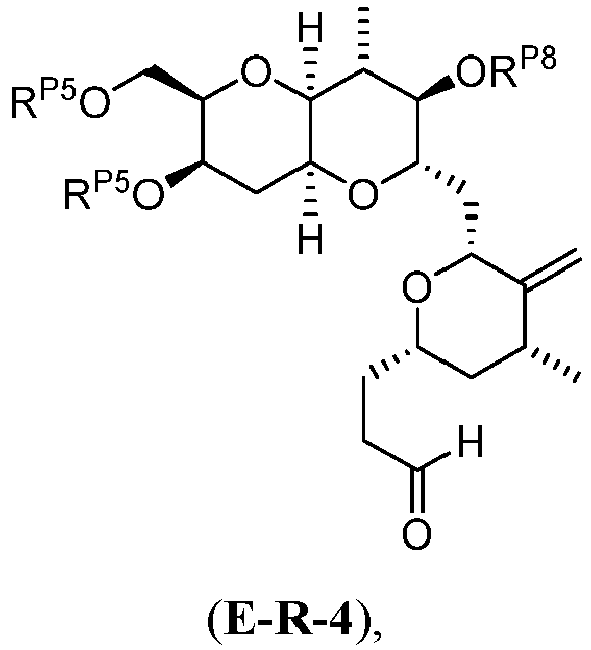
each instance of RP5 and RP8 is independently hydrogen, optionally substituted alkyl, optionally substituted acyl, or an oxygen protecting group; optionally wherein two RP5 groups are joined together with the intervening atoms to form an optionally substituted heterocyclyl ring. - Provided herein are compounds of Formula (R-4-9):

- X3 and X2 are each independently halogen or a leaving group;
- R8 is hydrogen, optionally substituted alkyl, optionally substituted carbocyclyl, optionally substituted aryl, optionally substituted heterocyclyl, optionally substituted heteroaryl, optionally substituted acyl, or an oxygen protecting group;
- RX is hydrogen or -ORXa, wherein RXa is hydrogen, optionally substituted alkyl, optionally substituted acyl, or an oxygen protecting group; and
- RY is hydrogen or -ORYa, wherein RYa is hydrogen, optionally substituted alkyl, optionally substituted acyl, or an oxygen protecting group;
- optionally wherein RXa and RYa are joined together with their intervening atoms to form optionally substituted heterocyclyl.
- Provided herein are compounds of Formula (R-4-10B):

- X3 is halogen or a leaving group;
- R3 and R5 are each independently hydrogen, halogen, or optionally substituted alkyl;
- each instance of R4 is independently hydrogen, halogen, or optionally substituted alkyl, or two R4 groups are taken together to form:
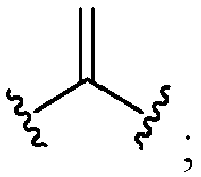
- each instance of R6 is independently hydrogen, halogen, or optionally substituted alkyl, or two R6 groups are taken together to form:

- each instance of RP5 and RP8 is independently hydrogen, optionally substituted alkyl, optionally substituted acyl, or an oxygen protecting group; optionally wherein two RP5 groups are joined together with the intervening atoms to form an optionally substituted heterocyclyl ring;
- R8 is hydrogen, optionally substituted alkyl, optionally substituted carbocyclyl, optionally substituted aryl, optionally substituted heterocyclyl, optionally substituted heteroaryl, optionally substituted acyl, or an oxygen protecting group;
- RX is hydrogen or -ORXa, wherein RXa is hydrogen, optionally substituted alkyl, optionally substituted acyl, or an oxygen protecting group; and
- RY is hydrogen or -ORYa, wherein RYa is hydrogen, optionally substituted alkyl, optionally substituted acyl, or an oxygen protecting group;
- optionally wherein RXa and RYa are joined together with their intervening atoms to form optionally substituted heterocyclyl.
- In certain embodiments, the compound is of the Formula (E-R-6):

- X3 is halogen or a leaving group;
- each instance of RP5 and RP8 is independently hydrogen, optionally substituted alkyl, optionally substituted acyl, or an oxygen protecting group; optionally wherein two RP5 groups are joined together with the intervening atoms to form an optionally substituted heterocyclyl ring; and
- R8 is hydrogen, optionally substituted alkyl, optionally substituted carbocyclyl, optionally substituted aryl, optionally substituted heterocyclyl, optionally substituted heteroaryl, optionally substituted acyl, or an oxygen protecting group.
- Provided herein are compounds of Formula (R-4-7):

- R3 and R5 are each independently hydrogen, halogen, or optionally substituted alkyl;
- each instance of R4 is independently hydrogen, halogen, optionally substituted alkyl, or two R4 groups are taken together to form:

- each instance of RP5 and RP8 is independently hydrogen, optionally substituted alkyl, optionally substituted acyl, or an oxygen protecting group; optionally wherein two RP5 groups are joined together with the intervening atoms to form an optionally substituted heterocyclyl ring; and
- R8 is hydrogen, optionally substituted alkyl, optionally substituted carbocyclyl, optionally substituted aryl, optionally substituted heterocyclyl, optionally substituted heteroaryl, optionally substituted acyl, or an oxygen protecting group.
- In certain embodiments, the compound is of the Formula (E-R-8):

- each instance of RP5 and RP8 is independently hydrogen, optionally substituted alkyl, optionally substituted acyl, or an oxygen protecting group; optionally wherein two RP5 groups are joined together with the intervening atoms to form an optionally substituted heterocyclyl ring; and
- R8 is hydrogen, optionally substituted alkyl, optionally substituted carbocyclyl, optionally substituted aryl, optionally substituted heterocyclyl, optionally substituted heteroaryl, optionally substituted acyl, or an oxygen protecting group.
- Provided herein are compounds of Formula (R-4-5B):

- R3 is hydrogen, halogen, or optionally substituted alkyl;
- each instance of RP5 and RP8 are independently hydrogen, optionally substituted alkyl, optionally substituted acyl, or an oxygen protecting group; optionally wherein two RP5 groups are joined together with the intervening atoms to form an optionally substituted heterocyclyl ring; and
- R8 is hydrogen, optionally substituted alkyl, optionally substituted carbocyclyl, optionally substituted aryl, optionally substituted heterocyclyl, optionally substituted heteroaryl, optionally substituted acyl, or an oxygen protecting group.
- In certain embodiments, the compound is of the Formula (E-R-9):

each instance of RP5 and RP8 is independently hydrogen, optionally substituted alkyl, optionally substituted acyl, or an oxygen protecting group; optionally wherein two RP5 groups are joined together with the intervening atoms to form an optionally substituted heterocyclyl ring. - Provided herein are compounds of Formula (R-4-7A):

- R3 and R5 are each independently hydrogen, halogen, or optionally substituted alkyl;
- each instance of R4 is independently hydrogen, halogen, or optionally substituted alkyl, or two R4 groups are taken together to form:

- each instance of RP5, RP8, and RP9 is independently hydrogen, optionally substituted alkyl, optionally substituted acyl, or an oxygen protecting group; optionally wherein two RP5 groups are joined together with the intervening atoms to form an optionally substituted heterocyclyl ring; and optionally wherein two RP9 groups are joined together with the intervening atoms to form an optionally substituted heterocyclyl ring; and
- R8 is hydrogen, optionally substituted alkyl, optionally substituted carbocyclyl, optionally substituted aryl, optionally substituted heterocyclyl, optionally substituted heteroaryl, optionally substituted acyl, or an oxygen protecting group.
- In certain embodiments, the compound is of the Formula (E-R-11):
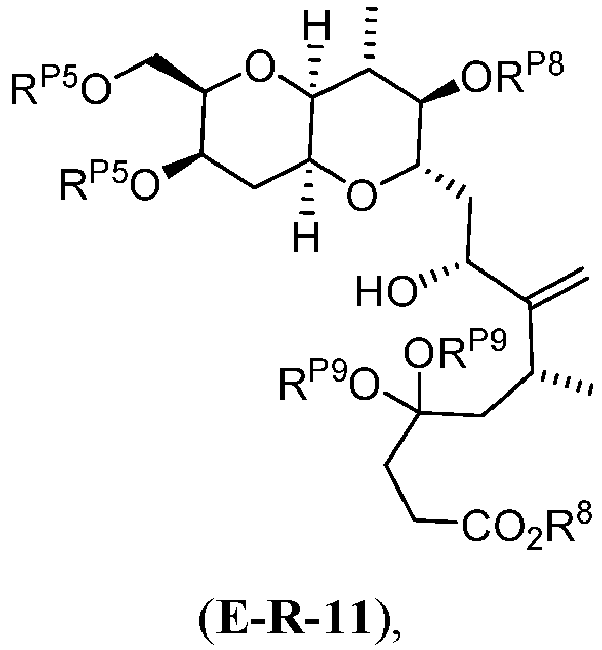
each instance of RP5, RP8, and RP9 is independently hydrogen, optionally substituted alkyl, optionally substituted acyl, or an oxygen protecting group; optionally wherein two RP5 groups are joined together with the intervening atoms to form an optionally substituted heterocyclyl ring; optionally wherein two RP9 groups are joined together with the intervening atoms to form an optionally substituted heterocyclyl ring. - Provided herein are compounds of Formula (R-4-5A):

- R3 is hydrogen, halogen, or optionally substituted alkyl;
- each instance of RP5 and RP8 is independently hydrogen, optionally substituted alkyl, optionally substituted acyl, or an oxygen protecting group; optionally wherein two RP5 groups are joined together with the intervening atoms to form an optionally substituted heterocyclyl ring; and
- R8 is hydrogen, optionally substituted alkyl, optionally substituted carbocyclyl, optionally substituted aryl, optionally substituted heterocyclyl, optionally substituted heteroaryl, optionally substituted acyl, or an oxygen protecting group.
- In certain embodiments, the compound is of Formula (E-R-15):

- each instance of RP5 and RP8 is independently hydrogen, optionally substituted alkyl, optionally substituted acyl, or an oxygen protecting group; optionally wherein two RP5 groups are joined together with the intervening atoms to form an optionally substituted heterocyclyl ring; and
- R8 is hydrogen, optionally substituted alkyl, optionally substituted carbocyclyl, optionally substituted aryl, optionally substituted heterocyclyl, optionally substituted heteroaryl, optionally substituted acyl, or an oxygen protecting group.
- Provided herein are compounds of Formula (R-4-4):

- R3 is hydrogen, halogen, or optionally substituted alkyl;
- each instance of RP5, RP8, and RP10 is independently hydrogen, optionally substituted alkyl, optionally substituted acyl, or an oxygen protecting group; optionally wherein two RP5 groups are joined together with the intervening atoms to form an optionally substituted heterocyclyl ring; and
- R8 is hydrogen, optionally substituted alkyl, optionally substituted carbocyclyl, optionally substituted aryl, optionally substituted heterocyclyl, optionally substituted heteroaryl, optionally substituted acyl, or an oxygen protecting group.
- In certain embodiments, the compound is of Formula (E-R-16):

- each instance of RP5 and RP8 is independently hydrogen, optionally substituted alkyl, optionally substituted acyl, or an oxygen protecting group; optionally wherein two RP5 groups are joined together with the intervening atoms to form an optionally substituted heterocyclyl ring; and
- R8 is hydrogen, optionally substituted alkyl, optionally substituted carbocyclyl, optionally substituted aryl, optionally substituted heterocyclyl, optionally substituted heteroaryl, optionally substituted acyl, or an oxygen protecting group.
- Provided herein are compounds of Formula (R-4-2):

- R3 is hydrogen, halogen, or optionally substituted alkyl; and
- each instance of RP5 and RP10 is independently hydrogen, optionally substituted alkyl, optionally substituted acyl, or an oxygen protecting group; optionally wherein two RP5 groups are joined together with the intervening atoms to form an optionally substituted heterocyclyl ring.
- In certain embodiments, the compound is of Formula (E-R-17):

each instance of RP5 and RP10 is independently hydrogen, optionally substituted alkyl, optionally substituted acyl, or an oxygen protecting group; optionally wherein two RP5 groups are joined together with the intervening atoms to form an optionally substituted heterocyclyl ring. - Provided herein are compounds of Formula (R-4-1):

- R3 is hydrogen, halogen, or optionally substituted alkyl; and
- RP5 is independently hydrogen, optionally substituted alkyl, optionally substituted acyl, or an oxygen protecting group; optionally wherein two RP5 groups are joined together with the intervening atoms to form an optionally substituted heterocyclyl ring.
- In certain embodiments, the compound is of Formula (E-R-19):

each instance of RP5 and RP10 is independently hydrogen, optionally substituted alkyl, optionally substituted acyl, or an oxygen protecting group; optionally wherein two RP5 groups are joined together with the intervening atoms to form an optionally substituted heterocyclyl ring. - Provided herein are compounds of the compound of Formula (E-R-22):

each instance of RP5 and RP10 is independently hydrogen, optionally substituted alkyl, optionally substituted acyl, or an oxygen protecting group; optionally wherein two RP5 groups are joined together with the intervening atoms to form an optionally substituted heterocyclyl ring. - Provided herein are compounds of Formula (L-5-17):

- R1 and R2 are independently hydrogen, halogen, or optionally substituted alkyl;
- RP1, RP2, RP3, and RP4 are independently hydrogen, optionally substituted alkyl, optionally substituted acyl, or an oxygen protecting group; and
- R8 is hydrogen, optionally substituted alkyl, optionally substituted carbocyclyl, optionally substituted aryl, optionally substituted heterocyclyl, or optionally substituted heteroaryl, optionally substituted acyl, or an oxygen protecting group.
- Also provided herein are compounds of Formula (L-5-16B):

- R1 and R2 are independently hydrogen, halogen, or optionally substituted alkyl;
- RP1, RP2, RP3, and RP4 are independently hydrogen, optionally substituted alkyl, optionally substituted acyl, or an oxygen protecting group; and
- R8 is hydrogen, optionally substituted alkyl, optionally substituted carbocyclyl, optionally substituted aryl, optionally substituted heterocyclyl, or optionally substituted heteroaryl, optionally substituted acyl, or an oxygen protecting group.
- Provided herein are compounds of Formula (L-5-16A):

- R1 and R2 are independently hydrogen, halogen, or optionally substituted alkyl;
- RP1, RP2, RP3, RP4, and RP10 are independently hydrogen, optionally substituted alkyl, optionally substituted acyl, or an oxygen protecting group; and
- R8 is hydrogen, optionally substituted alkyl, optionally substituted carbocyclyl, optionally substituted aryl, optionally substituted heterocyclyl, or optionally substituted heteroaryl, optionally substituted acyl, or an oxygen protecting group.
- Provided herein are compounds of Formula (L-5-15):

- R1 and R2 are independently hydrogen, halogen, or optionally substituted alkyl; and
- RP1, RP2, RP3, RP4, and RP10 are independently hydrogen, optionally substituted alkyl, optionally substituted acyl, or an oxygen protecting group.
- Also provided herein are compounds of Formula (L-5-14):

- R1 and R2 are independently hydrogen, halogen, or optionally substituted alkyl; and
- RP1, RP2, RP4, and RP10 are independently hydrogen, optionally substituted alkyl, optionally substituted acyl, or an oxygen protecting group.
- Provided herein are compounds of Formula (L-5-12):

- R1 and R2 are independently hydrogen, halogen, or optionally substituted alkyl; and
- RP1, RP2, and RP10 are independently hydrogen, optionally substituted alkyl, optionally substituted acyl, or an oxygen protecting group.
- Provided herein are compounds of Formula (L-5-11):

- R1 is hydrogen, halogen, or optionally substituted alkyl; and
- RP1, RP2, and RP10 are independently hydrogen, optionally substituted alkyl, optionally substituted acyl, or an oxygen protecting group.
- Also provided herein are compounds of Formula (L-5-26):

- R1 and R2 are independently hydrogen, halogen, or optionally substituted alkyl;
- RP1, RP3, and RP4 are each independently hydrogen, optionally substituted alkyl, optionally substituted acyl, or an oxygen protecting group; and
- R8 is hydrogen, optionally substituted alkyl, optionally substituted carbocyclyl, optionally substituted aryl, optionally substituted heterocyclyl, or optionally substituted heteroaryl, optionally substituted acyl, or an oxygen protecting group.
- Also provided herein are compounds of Formula (L-5-25C):

- R1 and R2 are independently hydrogen, halogen, or optionally substituted alkyl;
- RP1, RP3, and RP4 are each independently hydrogen, optionally substituted alkyl, optionally substituted acyl, or an oxygen protecting group; and
- R8 is hydrogen, optionally substituted alkyl, optionally substituted carbocyclyl, optionally substituted aryl, optionally substituted heterocyclyl, optionally substituted heteroaryl, optionally substituted acyl, or an oxygen protecting group.
- Also provided herein are compounds of Formula (L-5-25A):

- R1 and R2 are independently hydrogen, halogen, or optionally substituted alkyl; and
- RP1, RP3, and RP4 are each independently hydrogen, optionally substituted alkyl, optionally substituted acyl, or an oxygen protecting group.
- Provided herein are compounds of Formula (L-5-24):

- R1 is hydrogen, halogen, or optionally substituted alkyl; and
- RP1 and RP3 are each independently hydrogen, optionally substituted alkyl, optionally substituted acyl, or an oxygen protecting group.
- Provided herein are compounds of Formula (L-5-23B):
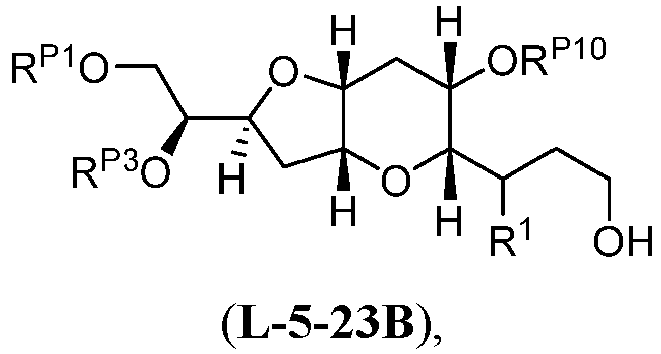
- R1 is hydrogen, halogen, or optionally substituted alkyl; and
- RP1, RP3, and RP10 are each independently hydrogen, optionally substituted alkyl, optionally substituted acyl, or an oxygen protecting group.
- Also provided herein are compound of Formula (L-5-23C):

- R1 is hydrogen, halogen, or optionally substituted alkyl; and
- RP1, RP3, and RP10 are each independently hydrogen, optionally substituted alkyl, optionally substituted acyl, or an oxygen protecting group.
- Provided herein are compounds of Formula (L-5-23A):

- R1 is hydrogen, halogen, or optionally substituted alkyl; and
- RP1, RP3, and RP10 are each independently hydrogen, optionally substituted alkyl, optionally substituted acyl, or an oxygen protecting group.
- Provided herein are compounds of Formula (L-5-22):

- R1 is hydrogen, halogen, or optionally substituted alkyl; and
- RP1, RP3, and RP10 are each independently hydrogen, optionally substituted alkyl, optionally substituted acyl, or an oxygen protecting group.
- Also provided herein are compounds of Formula (L-5-22A):

- R1 is hydrogen, halogen, or optionally substituted alkyl; and
- RP1, RP3, and RP10 are each independently hydrogen, optionally substituted alkyl, optionally substituted acyl, or an oxygen protecting group.
- Provided herein are compounds of Formula (L-5-21B):

- R1 is hydrogen, halogen, or optionally substituted alkyl;
- RP1, RP6, and RP10 are each independently hydrogen, optionally substituted alkyl, optionally substituted acyl, or an oxygen protecting group; and
- R8 is hydrogen, optionally substituted alkyl, optionally substituted carbocyclyl, optionally substituted aryl, optionally substituted heterocyclyl, optionally substituted heteroaryl, optionally substituted acyl, or an oxygen protecting group.
- Provided herein are compounds of Formula (L-5-21A):

- R1 is hydrogen, halogen, or optionally substituted alkyl; and
- RP6 and RP10 are each independently hydrogen, optionally substituted alkyl, optionally substituted acyl, or an oxygen protecting group.
- Provided herein are compounds of Formula (L-5-32):

- R1 and R2 are independently hydrogen, halogen, or optionally substituted alkyl;
- each instance of RP4 and RP6 are independently hydrogen, optionally substituted alkyl, optionally substituted acyl, or an oxygen protecting group; and
- R7 and R8 are independently hydrogen, optionally substituted alkyl, optionally substituted carbocyclyl, optionally substituted aryl, optionally substituted heterocyclyl, optionally substituted heteroaryl, optionally substituted acyl, or an oxygen protecting group.
- Also provided herein are compounds of Formula (L-5-31):

- R1 and R2 are independently hydrogen, halogen, or optionally substituted alkyl;
- RP1, RP4, and RP6 are independently hydrogen, optionally substituted alkyl, optionally substituted acyl, or an oxygen protecting group; and
- R8 is hydrogen, optionally substituted alkyl, optionally substituted carbocyclyl, optionally substituted aryl, optionally substituted heterocyclyl, optionally substituted heteroaryl, optionally substituted acyl, or an oxygen protecting group.
- Also provided herein are compounds of Formula (L-5-32A):

- R1 and R2 are independently hydrogen, halogen, or optionally substituted alkyl;
- RP1, RP4 and RP6 are independently hydrogen, optionally substituted alkyl, optionally substituted acyl, or an oxygen protecting group; optionally wherein two RP6 are joined with the intervening atoms to form optionally substituted heterocyclyl; and
- R8 is hydrogen, optionally substituted alkyl, optionally substituted carbocyclyl, optionally substituted aryl, optionally substituted heterocyclyl, optionally substituted heteroaryl, optionally substituted acyl, or an oxygen protecting group.
- Also provided herein are compounds of Formula (L-5-28):

- R1 and R2 are independently hydrogen, halogen, or optionally substituted alkyl; and
- RP1, RP4 and RP6 are independently hydrogen, optionally substituted alkyl, optionally substituted acyl, or an oxygen protecting group; optionally wherein two RP6 are joined with the intervening atoms to form optionally substituted heterocyclyl.
- Provided herein are compounds of Formula (L-5-27):

- R1 and R2 are independently hydrogen, halogen, or optionally substituted alkyl; and
- each instance of RP4 and RP6 are independently hydrogen, optionally substituted alkyl, optionally substituted acyl, or an oxygen protecting group.
- Provided herein are compounds of Formula (L-5-7B):

- R1 and R2 are independently hydrogen, halogen, or optionally substituted alkyl;
- each instance of RP4 and RP6 are independently hydrogen, optionally substituted alkyl, optionally substituted acyl, or an oxygen protecting group; optionally wherein two RP6 are joined with the intervening atoms to form optionally substituted heterocyclyl; and
- R8 is hydrogen, optionally substituted alkyl, optionally substituted carbocyclyl, optionally substituted aryl, optionally substituted heterocyclyl, optionally substituted heteroaryl, optionally substituted acyl, or an oxygen protecting group.
- In certain embodiments, the compound is of Formula (E-L-1):

- RS is optionally substituted alkyl, optionally substituted carbocyclyl, optionally substituted aryl, optionally substituted heterocyclyl, or optionally substituted heteroaryl;
- each instance of RP4 and RP6 are independently hydrogen, optionally substituted alkyl, optionally substituted acyl, or an oxygen protecting group; optionally wherein two RP6 are joined with the intervening atoms to form optionally substituted heterocyclyl; and
- R8 is hydrogen, optionally substituted alkyl, optionally substituted carbocyclyl, optionally substituted aryl, optionally substituted heterocyclyl, optionally substituted heteroaryl, optionally substituted acyl, or an oxygen protecting group.
- Also provided herein are compounds of Formula (L-5-7A):

- R1 and R2 are independently hydrogen, halogen, or optionally substituted alkyl;
- each instance of RP4 and RP6 are independently hydrogen, optionally substituted alkyl, optionally substituted acyl, or an oxygen protecting group; optionally wherein two RP6 are joined with the intervening atoms to form optionally substituted heterocyclyl; and
- R8 is hydrogen, optionally substituted alkyl, optionally substituted carbocyclyl, optionally substituted aryl, optionally substituted heterocyclyl, optionally substituted heteroaryl, optionally substituted acyl, or an oxygen protecting group.
- In certain embodiments, the compound is of Formula (E-L-2):
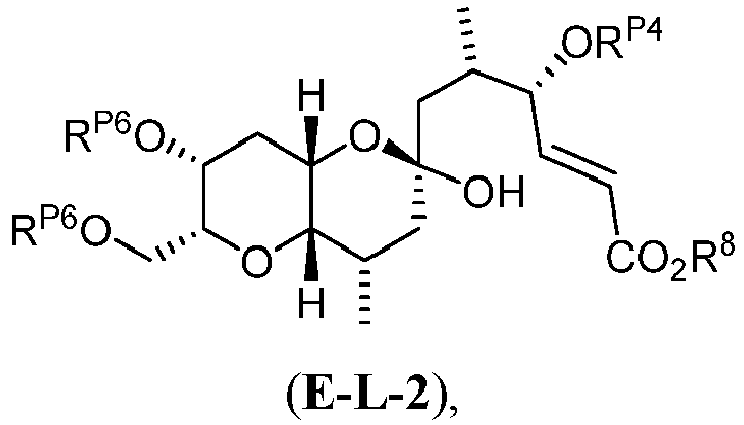
- each instance of RP4 and RP6 are independently hydrogen, optionally substituted alkyl, optionally substituted acyl, or an oxygen protecting group; optionally wherein two RP6 are joined with the intervening atoms to form optionally substituted heterocyclyl; and
- R8 is hydrogen, optionally substituted alkyl, optionally substituted carbocyclyl, optionally substituted aryl, optionally substituted heterocyclyl, optionally substituted heteroaryl, optionally substituted acyl, or an oxygen protecting group.
- Provided herein are compounds of Formula (E-L-6):

- each instance of RP4 and RP6 are independently hydrogen, optionally substituted alkyl, optionally substituted acyl, or an oxygen protecting group; optionally wherein two RP6 are joined with the intervening atoms to form optionally substituted heterocyclyl; and
- R8 is hydrogen, optionally substituted alkyl, optionally substituted carbocyclyl, optionally substituted aryl, optionally substituted heterocyclyl, optionally substituted heteroaryl, optionally substituted acyl, or an oxygen protecting group.
- Provided herein are compounds of Formula (L-5-6A):

- R1 and R2 are independently hydrogen, halogen, or optionally substituted alkyl; and
- each instance of RP4 and RP6 are independently hydrogen, optionally substituted alkyl, optionally substituted acyl, or an oxygen protecting group; optionally wherein two RP6 are joined with the intervening atoms to form optionally substituted heterocyclyl.
- In certain embodiments, the compound is of Formula (E-L-5):

each instance of RP4 and RP6 are independently hydrogen, optionally substituted alkyl, optionally substituted acyl, or an oxygen protecting group; optionally wherein two RP6 are joined with the intervening atoms to form optionally substituted heterocyclyl. - Also provided herein are compounds of Formula (L-5-4):

- R1 is independently hydrogen, halogen, or optionally substituted alkyl; and
- each RP6 is independently hydrogen, optionally substituted alkyl, optionally substituted acyl, or an oxygen protecting group; optionally wherein two RP6 are joined with the intervening atoms to form optionally substituted heterocyclyl.
- In certain embodiments, the compound is of Formula (E-L-7):

each instance of RP4 and RP6 are independently hydrogen, optionally substituted alkyl, optionally substituted acyl, or an oxygen protecting group; optionally wherein two RP6 are joined with the intervening atoms to form optionally substituted heterocyclyl. - In certain embodiments, RL is optionally substituted sulfonyl, optionally substituted sulfinyl, optionally substituted phosphoryl, or optionally substituted acyl. In certain embodiments, RL is optionally substituted sulfonyl. In certain embodiments, RL is optionally substituted sulfinyl. In certain embodiments, RL is optionally substituted phosphoryl. In certain embodiments, RL is optionally substituted acyl. In certain embodiments, RL is -SO2-alkyl. In certain embodiments, RL is mesyl (-SO2CH3; "Ms"). In certain embodiments, RL is -SO2-aryl. In certain embodiments, RL is -SO2Ph. In certain embodiments, RL is p-toluenesulfonyl (-SO2C6H4 p-CH3; "tosyl" or "Ts"). In certain embodiments, RL is trifluoromethanesulfonyl (-SO2CF3; "triflyl" or "Tf"). In certain embodiments, RL is p-bromobenzenesulfonyl (-SO2C6H4 p-Br; "brosyl" or "Bs"), In certain embodiments, RL is nonafluorobutanesulfonyl (-OSO2(CF2)3CF3; "Nf"). In certain embodiments, RL is 2- or 4-nitrobenzenesulfonyl (-SO2C6H4 p-NO2 or -SO2C6H4 o-NO2; "nosyl" or "Ns"). In certain embodiments, RL is 2,2,2-trifluoroethyl-1-sulfonyl. In certain embodiments, RL is 5-(dimethylamino)naphthalene-1-sulfonyl ("dansyl" or "Ds").
- As defined herein, XL is halogen or a leaving group. As defined herein, in certain embodiments, XL is halogen. In certain embodiments, XL is -Cl. In certain embodiments, XL is -Br. In certain embodiments, XL is -I.
- As defined herein, RS is optionally substituted alkyl, optionally substituted carbocyclyl, optionally substituted aryl, optionally substituted heterocyclyl, or optionally substituted heteroaryl. In certain embodiments, RS is optionally substituted alkyl. In certain embodiments, RS is optionally substituted C1-6 alkyl. In certain embodiments, RS is unsubstituted C1-6 alkyl. In certain embodiments, RS is selected from the group consisting of methyl, ethyl, n-propyl, iso-propyl, n-butyl, iso-butyl, sec-butyl, and tert-butyl. In certain embodiments, RS is optionally substituted carbocyclyl. In certain embodiments, RS is optionally substituted aryl. In certain embodiments, RS is optionally substituted heterocyclyl. In certain embodiments, RS is optionally substituted heteroaryl. In certain embodiments, RS is optionally substituted 6-membered heteroaryl. In certain embodiments, RS is optionally substituted 6-membered heteroaryl comprising 1, 2, or 3 nitrogen atoms. In certain embodiments, RS is optionally substituted pyridyl. In certain embodiments, RS is unsubstituted pyridyl (Py). In certain embodiments, RS is optionally substituted 2-pyridyl. In certain embodiments, RS is unsubstituted 2-pyridyl (2-Py). In certain embodiments, RS is selected from the group consisting of:
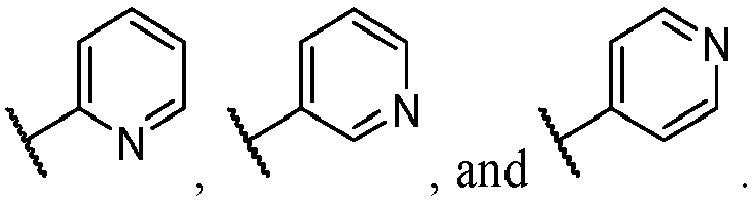

- As defined herein, X1 is halogen or a leaving group. In certain embodiments, X1 is a halogen. In certain embodiments, X1 is -Cl (i.e., chloride). In certain embodiments, X1 is -Br (i.e., bromide). In certain embodiments, X1 is -I (i.e., iodide). In certain embodiments, X1 is - F (i.e., fluoride). In certain embodiments, X1 is a leaving group.
- As defined herein, X2 is halogen or a leaving group. In certain embodiments, X2 is a halogen. In certain embodiments, X2 is -Cl. In certain embodiments, X2 is -Br. In certain embodiments, X2 is -I. In certain embodiments, X2 is -F. In certain embodiments, X2 is a leaving group.
- As defined herein, X3 is halogen or a leaving group. In certain embodiments, X3 is a halogen. In certain embodiments, X3 is -Cl. In certain embodiments, X3 is -Br. In certain embodiments, X3 is -I. In certain embodiments, X3 is -F. In certain embodiments, X3 is a leaving group.
- As defined herein, X4 is halogen or a leaving group. In certain embodiments, X4 is a halogen. In certain embodiments, X4 is -Cl. In certain embodiments, X4 is -Br. In certain embodiments, X4 is -I. In certain embodiments, X4 is -F. In certain embodiments, X4 is a leaving group.
- As defined herein, R1 is hydrogen, halogen, or optionally substituted alky. In certain embodiments, R1 is hydrogen. In certain embodiments, R1 is halogen. In certain embodiments, R1 is optionally substituted alkyl. In certain embodiments, R1 is optionally substituted C1-6 alkyl. In certain embodiments, R1 is unsubstituted C1-6 alkyl. In certain embodiments, R1 is optionally substituted C1-3 alkyl. In certain embodiments, R1 is unsubstituted C1-3 alkyl. In certain embodiments, R1 is selected from the group consisting of methyl, ethyl, n-propyl, iso-propyl, n-butyl, iso-butyl, sec-butyl, and tert-butyl. In certain embodiments, R1 is methyl.
- As defined herein, R2 is hydrogen, halogen, or optionally substituted alky. In certain embodiments, R2 is hydrogen. In certain embodiments, R2 is halogen. In certain embodiments, R2 is optionally substituted alkyl. In certain embodiments, R2 is optionally substituted C1-6 alkyl. In certain embodiments, R2 is unsubstituted C1-6 alkyl. In certain embodiments, R2 is optionally substituted C1-3 alkyl. In certain embodiments, R2 is unsubstituted C1-3 alkyl. In certain embodiments, R2 is selected from the group consisting of methyl, ethyl, n-propyl, iso-propyl, n-butyl, iso-butyl, sec-butyl, and tert-butyl. In certain embodiments, R2 is methyl.
- As defined herein, R3 is hydrogen, halogen, or optionally substituted alky. In certain embodiments, R3 is hydrogen. In certain embodiments, R3 is halogen. In certain embodiments, R3 is optionally substituted alkyl. In certain embodiments, R3 is optionally substituted C1-6 alkyl. In certain embodiments, R3 is unsubstituted C1-6 alkyl. In certain embodiments, R3 is optionally substituted C1-3 alkyl. In certain embodiments, R3 is unsubstituted C1-3 alkyl. In certain embodiments, R3 is selected from the group consisting of methyl, ethyl, n-propyl, iso-propyl, n-butyl, iso-butyl, sec-butyl, and tert-butyl. In certain embodiments, R3 is methyl.
- As defined herein, each instance of R4 is independently hydrogen, halogen, or optionally substituted alkyl; and optionally two R4 groups are taken together to form:


- As defined herein, R5 is hydrogen, halogen, or optionally substituted alky. In certain embodiments, R5 is hydrogen. In certain embodiments, R5 is halogen. In certain embodiments, R3 is optionally substituted alkyl. In certain embodiments, R5 is optionally substituted C1-6 alkyl. In certain embodiments, R5 is unsubstituted C1-6 alkyl. In certain embodiments, R5 is optionally substituted C1-3 alkyl. In certain embodiments, R5 is unsubstituted C1-3 alkyl. In certain embodiments, R5 is selected from the group consisting of methyl, ethyl, n-propyl, iso-propyl, n-butyl, iso-butyl, sec-butyl, and tert-butyl. In certain embodiments, R5 is methyl.
- As defined herein, each instance of R6 is independently hydrogen, halogen, or optionally substituted alkyl; and optionally two R6 groups are taken together to form:


- As defined herein, R7 is hydrogen, optionally substituted alkyl, optionally substituted carbocyclyl, optionally substituted aryl, optionally substituted heterocyclyl, optionally substituted heteroaryl, optionally substituted acyl, or an oxygen protecting group. In certain embodiments, R7 is hydrogen. In certain embodiments, R7 is optionally substituted alkyl. In certain embodiments, In certain embodiments, R7 is optionally substituted C1-6 alkyl. In certain embodiments, R7 is unsubstituted C1-6 alkyl. In certain embodiments, R7 is optionally substituted C1-3 alkyl. In certain embodiments, R7 is unsubstituted C1-3 alkyl. In certain embodiments, R7 is selected from the group consisting of methyl, ethyl, n-propyl, iso-propyl, n-butyl, iso-butyl, sec-butyl, and tert-butyl. In certain embodiments, R7 is methyl. In certain embodiments, R7 is ethyl. In certain embodiments, R7 is optionally substituted carbocyclyl. In certain embodiments, R7 is optionally substituted aryl. In certain embodiments, R7 is optionally substituted heterocyclyl. In certain embodiments, R7 is optionally substituted heteroaryl. In certain embodiments, R7 is optionally substituted acyl. In certain embodiments, R7 is an oxygen protecting group. In certain embodiments, R7 is an optionally substituted benzyl protecting group. In certain embodiments, R7 is benzyl (-CH2Ph; "Bn").
- As defined herein, R8 is hydrogen, optionally substituted alkyl, optionally substituted carbocyclyl, optionally substituted aryl, optionally substituted heterocyclyl, optionally substituted heteroaryl, optionally substituted acyl, or an oxygen protecting group. In certain embodiments, R8 is hydrogen. In certain embodiments, R8 is optionally substituted alkyl. In certain embodiments, In certain embodiments, R8 is optionally substituted C1-6 alkyl. In certain embodiments, R8 is unsubstituted C1-6 alkyl. In certain embodiments, R8 is optionally substituted C1-3 alkyl. In certain embodiments, R8 is unsubstituted C1-3 alkyl. In certain embodiments, R8 is selected from the group consisting of methyl, ethyl, n-propyl, iso-propyl, n-butyl, iso-butyl, sec-butyl, and tert-butyl. In certain embodiments, R8 is methyl. In certain embodiments, R8 is ethyl. In certain embodiments, R8 is optionally substituted carbocyclyl. In certain embodiments, R8 is optionally substituted aryl. In certain embodiments, R8 is optionally substituted heterocyclyl. In certain embodiments, R8 is optionally substituted heteroaryl. In certain embodiments, R8 is optionally substituted acyl. In certain embodiments, R8 is an oxygen protecting group. In certain embodiments, R8 is an optionally substituted benzyl protecting group. In certain embodiments, R8 is benzyl (-CH2Ph; "Bn").
- As defined herein, RX is hydrogen or -ORXa. In certain embodiments, RX is hydrogen. In certain embodiments, RX is -ORXa.
- As generally defined herein, RXa is hydrogen, optionally substituted alkyl, optionally substituted acyl, or an oxygen protecting group. In certain embodiments, RXa is hydrogen. In certain embodiments, RXa is optionally substituted alkyl. In certain embodiments, RXa is optionally substituted acyl. In certain embodiments, RXa is or an oxygen protecting group. In certain embodiments, RXa is optionally substituted allyl. In certain embodiments, RXa is

- As defined herein, RY is hydrogen or -ORYa. In certain embodiments, RY is hydrogen. In certain embodiments, RY is -ORYa.
- As generally defined herein, RYa is hydrogen, optionally substituted alkyl, optionally substituted acyl, or an oxygen protecting group. In certain embodiments, RYa is hydrogen. In certain embodiments, RYa is optionally substituted alkyl. In certain embodiments, RYa is optionally substituted acyl. In certain embodiments, RYa is or an oxygen protecting group. In certain embodiments, RYa is optionally substituted allyl. In certain embodiments, RYa is

- In certain embodiments, RXa and RYa are j oined together with their intervening atoms to form optionally substituted heterocyclyl. In certain embodiments, RXa and RYa are joined together with their intervening atoms to form optionally substituted 5-membered heterocyclyl. In certain embodiments, RXa and RYa are j oined together with their intervening atoms to form optionally substituted 1,3-dioxolane ring. In certain embodiments, RXa and RYa are joined together with their intervening atoms to form the following:


- As defined herein, RP1 is hydrogen, optionally substituted alkyl, optionally substituted acyl, or an oxygen protecting group. In certain embodiments, RP1 is hydrogen. In certain embodiments, RP1 is optionally substituted alkyl. In certain embodiments, In certain embodiments, RP1 is optionally substituted C1-6 alkyl. In certain embodiments, RP1 is unsubstituted C1-6 alkyl. In certain embodiments, RP1 is optionally substituted C1-3 alkyl. In certain embodiments, RP1 is unsubstituted C1-3 alkyl. In certain embodiments, RP1 is selected from the group consisting of methyl, ethyl, n-propyl, iso-propyl, n-butyl, iso-butyl, sec-butyl, and tert-butyl. In certain embodiments, RP1 is optionally substituted acyl. In certain embodiments, RP1 is an oxygen protecting group. In certain embodiments, RP1 is optionally substituted allyl. In certain embodiments, RP1 is allyl. In certain embodiments, RP1 is optionally substituted silyl. In certain embodiments, RP1 is trialkylsilyl. In certain embodiments, RP1 is triethylsilyl (-SiEt3; "TES"). In certain embodiments, RP1 is trimethylsilyl (-SiMe3; "TMS"). In certain embodiments, RP1 is tert-butyl dimethylsilyl (-Sit-BuMe2; "TBS"). In certain embodiments, RP1 is tert-butyl diphenylsilyl (-Sit-BuPh2; "TBDPS"). In certain embodiments, RP1 is an optionally substituted benzyl protecting group. In certain embodiments, RP1 is benzyl (-CH2Ph; "Bn"). In certain embodiments, RP1 is a methoxybenzyl protecting group. In certain embodiments, RP1 is para-methoxybenzyl:

- In certain embodiments, RP1 and RP2 are joined with the intervening atoms to form optionally substituted heterocyclyl.
- As defined herein, RP2 is hydrogen, optionally substituted alkyl, optionally substituted acyl, or an oxygen protecting group. In certain embodiments, RP2 is hydrogen. In certain embodiments, RP2 is optionally substituted alkyl. In certain embodiments, RP2 is optionally substituted C1-6 alkyl. In certain embodiments, RP2 is unsubstituted C1-6 alkyl. In certain embodiments, RP2 is optionally substituted C1-3 alkyl. In certain embodiments, RP2 is unsubstituted C1-3 alkyl. In certain embodiments, RP2 is selected from the group consisting of methyl, ethyl, n-propyl, iso-propyl, n-butyl, iso-butyl, sec-butyl, and tert-butyl. In certain embodiments, RP2 is optionally substituted acyl. In certain embodiments, RP2 is an oxygen protecting group. In certain embodiments, RP2 is optionally substituted allyl. In certain embodiments, RP2 is allyl. In certain embodiments, RP2 is optionally substituted silyl. In certain embodiments, RP2 is trialkylsilyl. In certain embodiments, RP2 is triethylsilyl (-SiEt3; "TES"). In certain embodiments, RP2 is trimethylsilyl (-SiMe3; "TMS"). In certain embodiments, RP2 is tert-butyl dimethylsilyl (-Sit-BuMe2; "TBS"). In certain embodiments, RP2 is tert-butyl diphenylsilyl (-Sit-BuPh2; "TBDPS"). In certain embodiments, RP2 is an optionally substituted benzyl protecting group. In certain embodiments, RP2 is benzyl (-CH2Ph; "Bn"). In certain embodiments, RP2 is a methoxybenzyl protecting group. In certain embodiments, RP2 is para-methoxybenzyl:

- In certain embodiments, RP3 and RP3 are joined with the intervening atoms to form optionally substituted heterocyclyl.
- As defined herein, RP3 is hydrogen, optionally substituted alkyl, optionally substituted acyl, or an oxygen protecting group. In certain embodiments, RP3 is hydrogen. In certain embodiments, RP3 is optionally substituted alkyl. In certain embodiments, RP3 is optionally substituted C1-6 alkyl. In certain embodiments, RP3 is unsubstituted C1-6 alkyl. In certain embodiments, RP3 is optionally substituted C1-3 alkyl. In certain embodiments, RP3 is unsubstituted C1-3 alkyl. In certain embodiments, RP3 is selected from the group consisting of methyl, ethyl, n-propyl, iso-propyl, n-butyl, iso-butyl, sec-butyl, and tert-butyl. In certain embodiments, RP3 is optionally substituted acyl. In certain embodiments, RP3 is an oxygen protecting group. In certain embodiments, RP3 is optionally substituted allyl. In certain embodiments, RP3 is allyl. In certain embodiments, RP3 is optionally substituted silyl. In certain embodiments, RP3 is trialkylsilyl. In certain embodiments, RP3 is triethylsilyl (-SiEt3; "TES"). In certain embodiments, RP3 is trimethylsilyl (-SiMe3; "TMS"). In certain embodiments, RP3 is tert-butyl dimethylsilyl (-Sit-BuMe2; "TBS"). In certain embodiments, RP3 is tert-butyl diphenylsilyl (-Sit-BuPh2; "TBDPS"). In certain embodiments, RP3 is an optionally substituted benzyl protecting group. In certain embodiments, RP3 is benzyl (-CH2Ph; "Bn"). In certain embodiments, RP3 is a methoxybenzyl protecting group. In certain embodiments, RP3 is para-methoxybenzyl:

- As defined herein, RP4 is hydrogen, optionally substituted alkyl, optionally substituted acyl, or an oxygen protecting group. In certain embodiments, RP4 is hydrogen. In certain embodiments, RP4 is optionally substituted alkyl. In certain embodiments, RP4 is optionally substituted C1-6 alkyl. In certain embodiments, RP4 is unsubstituted C1-6 alkyl. In certain embodiments, RP4 is optionally substituted C1-3 alkyl. In certain embodiments, RP4 is unsubstituted C1-3 alkyl. In certain embodiments, RP4 is selected from the group consisting of methyl, ethyl, n-propyl, iso-propyl, n-butyl, iso-butyl, sec-butyl, and tert-butyl. In certain embodiments, RP4 is optionally substituted acyl. In certain embodiments, RP4 is an oxygen protecting group. In certain embodiments, RP4 is optionally substituted allyl. In certain embodiments, RP4 is allyl. In certain embodiments, RP4 is optionally substituted silyl. In certain embodiments, RP4 is trialkylsilyl. In certain embodiments, RP4 is triethylsilyl (-SiEt3; "TES"). In certain embodiments, RP4 is trimethylsilyl (-SiMe3; "TMS"). In certain embodiments, RP4 is tert-butyl dimethylsilyl (-Sit-BuMe2; "TBS"). In certain embodiments, RP4 is tert-butyl diphenylsilyl (-Sit-BuPh2; "TBDPS"). In certain embodiments, RP4 is an optionally substituted benzyl protecting group. In certain embodiments, RP4 is benzyl (-CH2Ph; "Bn"). In certain embodiments, RP4 is a methoxybenzyl protecting group. In certain embodiments, RP4 is para-methoxybenzyl:

- As defined herein, RP5 is hydrogen, optionally substituted alkyl, optionally substituted acyl, or an oxygen protecting group; optionally wherein two RP5 are joined with the intervening atoms to form optionally substituted heterocyclyl. In certain embodiments, RP5 is hydrogen. In certain embodiments, RP5 is optionally substituted alkyl. In certain embodiments, RP5 is optionally substituted C1-6 alkyl. In certain embodiments, RP5 is unsubstituted C1-6 alkyl. In certain embodiments, RP5 is optionally substituted C1-3 alkyl. In certain embodiments, RP5 is unsubstituted C1-3 alkyl. In certain embodiments, RP5 is selected from the group consisting of methyl, ethyl, n-propyl, iso-propyl, n-butyl, iso-butyl, sec-butyl, and tert-butyl. In certain embodiments, RP5 is optionally substituted acyl. In certain embodiments, RP5 is an oxygen protecting group. In certain embodiments, RP5 is optionally substituted allyl. In certain embodiments, RP5 is allyl. In certain embodiments, RP5 is optionally substituted silyl. In certain embodiments, RP5 is trialkylsilyl. In certain embodiments, RP5 is triethylsilyl (-SiEt3; "TES"). In certain embodiments, RP5 is trimethylsilyl (-SiMe3; "TMS"). In certain embodiments, RP5 is tert-butyl dimethylsilyl (-Sit-BuMe2; "TBS"). In certain embodiments, RP5 is tert-butyl diphenylsilyl (-Sit-BuPh2; "TBDPS"). In certain embodiments, RP5 is an optionally substituted benzyl protecting group. In certain embodiments, RP5 is benzyl (-CH2Ph; "Bn"). In certain embodiments, RP5 is a methoxybenzyl protecting group. In certain embodiments, RP5 is para-methoxybenzyl:


- As defined herein, RP6 is hydrogen, optionally substituted alkyl, optionally substituted acyl, or an oxygen protecting group; optionally wherein two RP6 are joined with the intervening atoms to form optionally substituted heterocyclyl. In certain embodiments, RP6 is hydrogen. In certain embodiments, RP6 is optionally substituted alkyl. In certain embodiments, RP6 is optionally substituted C1-6 alkyl. In certain embodiments, RP6 is unsubstituted C1-6 alkyl. In certain embodiments, RP6 is optionally substituted C1-3 alkyl. In certain embodiments, RP6 is unsubstituted C1-3 alkyl. In certain embodiments, RP6 is selected from the group consisting of methyl, ethyl, n-propyl, iso-propyl, n-butyl, iso-butyl, sec-butyl, and tert-butyl. In certain embodiments, RP6 is optionally substituted acyl. In certain embodiments, RP6 is an oxygen protecting group. In certain embodiments, RP6 is optionally substituted allyl. In certain embodiments, RP6 is allyl. In certain embodiments, RP6 is optionally substituted silyl. In certain embodiments, RP6 is trialkylsilyl. In certain embodiments, RP6 is triethylsilyl (-SiEt3; "TES"). In certain embodiments, RP6 is trimethylsilyl (-SiMe3; "TMS"). In certain embodiments, RP6 is tert-butyl dimethylsilyl (-Sit-BuMe2; "TBS"). In certain embodiments, RP6 is tert-butyl diphenylsilyl (-Sit-BuPh2; "TBDPS"). In certain embodiments, RP6 is an optionally substituted benzyl protecting group. In certain embodiments, RP6 is benzyl (-CH2Ph; "Bn"). In certain embodiments, RP6 is a methoxybenzyl protecting group. In certain embodiments, RP6 is para-methoxybenzyl:


- As defined herein, in certain embodiments, RP7 is hydrogen, optionally substituted alkyl, optionally substituted acyl, or an oxygen protecting group. In other embodiments, RP7 is optionally substituted sulfonyl, optionally substituted sulfinyl, optionally substituted phosphoryl, optionally substituted acyl, or an oxygen protecting group. In certain embodiments, RP7 is optionally substituted sulfonyl. In certain embodiments, RP7 is mesyl (-SO2CH3; "Ms"). In certain embodiments, RP7 is tosyl (C -SO2C6H4 p-CH3; "Ts"). In certain embodiments, RP7 is triflyl (-SO2CF3; "Tf'). In certain embodiments, RP7 is optionally substituted sulfinyl. In certain embodiments, RP7 is optionally substituted phosphoryl. In certain embodiments, RP7 is optionally substituted acyl.
- In certain embodiments, RP7 is hydrogen. In certain embodiments, RP7 is optionally substituted alkyl. In certain embodiments, RP7 is optionally substituted C1-6 alkyl. In certain embodiments, RP7 is unsubstituted C1-6 alkyl. In certain embodiments, RP7 is optionally substituted C1-3 alkyl. In certain embodiments, RP7 is unsubstituted C1-3 alkyl. In certain embodiments, RP7 is selected from the group consisting of methyl, ethyl, n-propyl, iso-propyl, n-butyl, iso-butyl, sec-butyl, and tert-butyl. In certain embodiments, RP7 is optionally substituted acyl. In certain embodiments, RP7 is an oxygen protecting group. In certain embodiments, RP7 is optionally substituted allyl. In certain embodiments, RP7 is allyl. In certain embodiments, RP7 is optionally substituted silyl. In certain embodiments, RP7 is trialkylsilyl. In certain embodiments, RP7 is triethylsilyl (-SiEt3; "TES"). In certain embodiments, RP7 is trimethylsilyl (-SiMe3; "TMS"). In certain embodiments, RP7 is tert-butyl dimethylsilyl (-Sit-BuMe2; "TBS"). In certain embodiments, RP7 is tert-butyl diphenylsilyl (-Sit-BuPh2; "TBDPS"). In certain embodiments, RP7 is an optionally substituted benzyl protecting group. In certain embodiments, RP7 is benzyl (-CH2Ph; "Bn"). In certain embodiments, RP7 is a methoxybenzyl protecting group. In certain embodiments, RP7 is para-methoxybenzyl:

- As defined herein, RP8 is hydrogen, optionally substituted alkyl, optionally substituted acyl, or an oxygen protecting group. In certain embodiments, RP8 is hydrogen. In certain embodiments, RP8 is optionally substituted alkyl. In certain embodiments, RP8 is optionally substituted C1-6 alkyl. In certain embodiments, RP8 is unsubstituted C1-6 alkyl. In certain embodiments, RP8 is optionally substituted C1-3 alkyl. In certain embodiments, RP8 is unsubstituted C1-3 alkyl. In certain embodiments, RP8 is selected from the group consisting of methyl, ethyl, n-propyl, iso-propyl, n-butyl, iso-butyl, sec-butyl, and tert-butyl. In certain embodiments, RP8 is optionally substituted acyl. In certain embodiments, RP8 is an oxygen protecting group. In certain embodiments, RP8 is optionally substituted allyl. In certain embodiments, RP8 is allyl. In certain embodiments, RP8 is optionally substituted silyl. In certain embodiments, RP8 is trialkylsilyl. In certain embodiments, RP8 is triethylsilyl (-SiEt3; "TES"). In certain embodiments, RP8 is trimethylsilyl (-SiMe3; "TMS"). In certain embodiments, RP8 is tert-butyl dimethylsilyl (-Sit-BuMe2; "TBS"). In certain embodiments, RP8 is tert-butyl diphenylsilyl (-Sit-BuPh2; "TBDPS"). In certain embodiments, RP8 is an optionally substituted benzyl protecting group. In certain embodiments, RP8 is benzyl (-CH2Ph; "Bn"). In certain embodiments, RP8 is a methoxybenzyl protecting group. In certain embodiments, RP8 is para-methoxybenzyl:

- As defined herein, RP9 is hydrogen, optionally substituted alkyl, optionally substituted acyl, or an oxygen protecting group. In certain embodiments, RP9 is hydrogen. In certain embodiments, RP9 is optionally substituted alkyl. In certain embodiments, RP9 is optionally substituted C1-6 alkyl. In certain embodiments, RP9 is unsubstituted C1-6 alkyl. In certain embodiments, RP9 is optionally substituted C1-3 alkyl. In certain embodiments, RP9 is unsubstituted C1-3 alkyl. In certain embodiments, RP9 is selected from the group consisting of methyl, ethyl, n-propyl, iso-propyl, n-butyl, iso-butyl, sec-butyl, and tert-butyl. In certain embodiments, RP9 is optionally substituted acyl. In certain embodiments, RP9 is an oxygen protecting group. In certain embodiments, RP9 is optionally substituted allyl. In certain embodiments, RP9 is allyl. In certain embodiments, RP9 is optionally substituted silyl. In certain embodiments, RP9 is trialkylsilyl. In certain embodiments, RP9 is triethylsilyl (-SiEt3; "TES"). In certain embodiments, RP9 is trimethylsilyl (-SiMe3; "TMS"). In certain embodiments, RP9 is tert-butyl dimethylsilyl (-Sit-BuMe2; "TBS"). In certain embodiments, RP9 is tert-butyl diphenylsilyl (-Sit-BuPh2; "TBDPS"). In certain embodiments, RP9 is an optionally substituted benzyl protecting group. In certain embodiments, RP9 is benzyl (-CH2Ph; "Bn"). In certain embodiments, RP9 is a methoxybenzyl protecting group. In certain embodiments, RP9 is para-methoxybenzyl:


- As defined herein, RP10 is hydrogen, optionally substituted alkyl, optionally substituted acyl, or an oxygen protecting group. In certain embodiments, RP10 is hydrogen. In certain embodiments, RP10 is optionally substituted alkyl. In certain embodiments, RP10 is optionally substituted C1-6 alkyl. In certain embodiments, RP10 is unsubstituted C1-6 alkyl. In certain embodiments, RP10 is optionally substituted C1-3 alkyl. In certain embodiments, RP10 is unsubstituted C1-3 alkyl. In certain embodiments, RP10 is selected from the group consisting of methyl, ethyl, n-propyl, iso-propyl, n-butyl, iso-butyl, sec-butyl, and tert-butyl. In certain embodiments, RP10 is optionally substituted acyl. In certain embodiments, RP10 is an oxygen protecting group. In certain embodiments, RP10 is optionally substituted allyl. In certain embodiments, RP10 is allyl. In certain embodiments, RP10 is optionally substituted silyl. In certain embodiments, RP10 is trialkylsilyl. In certain embodiments, RP10 is triethylsilyl (-SiEt3; "TES"). In certain embodiments, RP10 is trimethylsilyl (-SiMe3; "TMS"). In certain embodiments, RP10 is tert-butyl dimethylsilyl (-Sit-BuMe2; "TBS"). In certain embodiments, RP10 is tert-butyl diphenylsilyl (-Sit-BuPh2; "TBDPS"). In certain embodiments, RP10 is an optionally substituted benzyl protecting group. In certain embodiments, RP10 is benzyl (-CH2Ph; "Bn"). In certain embodiments, RP10 is a methoxybenzyl protecting group. In certain embodiments, RP10 is para-methoxybenzyl:

- As generally defined herein, R is hydrogen or optionally substituted alkyl. In certain embodiments, R is hydrogen. In certain embodiments, R is optionally substituted alkyl. In certain embodiments, R is optionally substituted C1-6 alkyl. In certain embodiments, R is unsubstituted C1-6 alkyl. In certain embodiments, R is optionally substituted C1-3 alkyl. In certain embodiments, R is unsubstituted C1-3 alkyl. In certain embodiments, R is selected from the group consisting of methyl, ethyl, n-propyl, iso-propyl, n-butyl, iso-butyl, sec-butyl, and tert-butyl.
- The structure (S,S)-1-C can be prepared directly via a coupling of (S)-1-A with (S)-1-B (
Figure 2A ). Although appealing, sequence presents challenges. For example, anion-based ketone syntheses might be problematic, because of the presence of an O-R group at the β- and β'-positions. The "umpolung" concept, represented by dithiane chemistry, is the historical solution for this type of problem (see, e.g., For a review, for example see: Seebach, D. Angew. Chem. Int. Ed. 1979, 18, 239; Corey, E. J.; Seeback, D. Angew. Chem. Int. Ed, 1965, 4, 1077; Seebach, D.; Corey, E. J. J. Org. Chem. 1975, 40, 231). Indeed, dithiane-based ketone synthesis has successfully been applied to a synthesis of complex natural products (For a review, see, e.g., Yus, M.; Najera, C.; Foubelo, F. Tetrahedron, 2003, 59, 6147; Smith, III. A. S.; Adams, C. M.; Acc. Chem. Rev. 2004, 37, 365). Nevertheless, a direct ketone synthesis was developed which can be used in the synthesis of ketones, including complex molecules. The best chance of achieving this goal would be a radical-based, preferably one-pot, ketone synthesis. A related Zn/Pd-mediated one-pot ketone synthesis was reported (see, e.g., Lee, J. H.; Kishi, Y. J. Am. Chem. Soc. 2016, 138, 7178). - Recently, Weix, Gong, Reisman, and others extensively studied Ni-mediated one-pot ketone synthesis, pioneered by Mukaiyama in 1981 (see, e.g., Onaka, M.; Matsuoka, Y.; Mukaiyama, T. Chem. Lett. 1981, 531; Wotal, A. C.; Weix, D. J. Org. Lett. 2012, 14, 1476; Wotal, A. C.; Ribson, R. D.; Weix, D. J. Organometallics 2014, 33, 5874; Wu, F.; Lu, W.; Qian, Q.; Ren, Q.; Gong, H. Org. Lett. 2012, 14, 3044; Zhao, C.; Jia, X.; Wang, X.; Gong, H. J. Am. Chem. Soc. 2014, 136, 17645 and references cited therein; Cherney, A. H.; Kadunce, N. T.; Reisman, S. E. J. Am. Chem. Soc. 2013, 135, 7442). Among a wide range of substrates reported, one specific example given by Gong and coworkers suggested a possibility that Ni-mediated one-pot ketone synthesis might meet with our need (
Figure 2B ). The substrates shown inFigure 2C were arbitrarily chosen for this study. The arbitrarily chosen substrates were tested under these three conditions, thereby demonstrating the feasibility of proposed coupling, e.g., via Weix and Reisman protocols. At the same time, it became evident that serious improvements were required successfully to use the Ni-mediated one-pot ketone synthesis at a late-stage coupling in a convergent synthesis of complex molecules. - More than 15 ligands were first tested to solubilize NiCl2, thereby showing 4,4'-di-tert-butyl-2,2'-bipyrine (dtbbpy) to give the best result. Noteworthily, NiBr2•(dtbbpy) complex gave a better coupling efficiency than NiCl2•(dtbbpy) complex (see, e.g., Lu, Z.; Fu, G. C. Angew. Chem. Int. Ed. 2010, 49, 6676; Serrano, E.; Martin, R. Angew. Chem. Int. Ed. 2016, 55, 11207; Zhang, X.; MacMillan, D. W. C. J. Am. Chem. Soc. 2016, 138, 13862).
- Among the activated forms of carboxylic acid studied, 2-thiopyridine ester, originally reported by Mukaiyama, was found most effective for the coupling. 2-Thiopyridine ester was originally used for their seminal work of macrolactonization by Corey and Nicolaou (see, e.g., Corey, E. J.; Nicolaou, K. C. J. J. Am. Chem. Soc. 1974, 96, 5614) and by Nicolaou Gerlack and Thalmann (see, e.g., Gerlach, H.; Thalmann, A. Helv. Chim. ). Mn (powder) and Zn (powder) were found to be effective reducing-metals.
- Among many solvent-systems tested, 1,3-dimethyl-2-imdazolidione (DMI) was found best. A 5:1 mixture of DMI and EtOAc was a good solvent system, when a substrate(s) exhibited a poor solubility in DMI. As expected, better coupling yields were obtained at higher concentration, typical concentration being in the range of C = 0.1-0.5 M. While studying additive effects, it was discovered that addition of one equivalent Cp2ZrCl2 dramatically enhanced the coupling rate; the coupling completed within minutes to hours with Cp2ZrCl2, compared with overnight to days without Cp2ZrCl2. In addition, by-product formation via a (I→SPy)-displacement was eliminated or suppressed by addition of Cp2ZrCl2.
- The observed, dramatic rate-acceleration indicated that Cp2ZrCl2 was involved in the rate-limiting step of catalytic reaction. Two different catalytic cycles had been proposed for the Ni-mediated one-pot ketone synthesis, i.e., (1) the catalytic cycle involving a (L)Ni(alkyl)2 intermediate and (2) the catalytic cycle of sequential reduction. However, in order to explain the observed results, a new mechanism is proposed, consisting of Ni-catalytic cycle, Zr-catalytic cycle, and Zr->Ni transmetallation (
Figure 3A ). The Ni-catalytic cycle starts with Ni(II)→Ni(0) reduction by Zn, followed by its oxidative addition to 2-thiopyridine ester, i.e., 2-D → 2-E → 2-F. Because of the strong Zr-SR bond, it is possible that Cp2ZrCl2 and/or a Zr-salt could accelerate the step from 2-F to 2-G, thereby resulting in the dramatic rate-acceleration. On the other hand, a second catalytic cycle involving Cp2ZrCl2; Zn-reduction of Cp2ZrCl2 to form a low-valent Zr-species could be operative. According to the seminal work by Schwartz, such a low-valent Zr-species readily activates an alkyl iodide, i.e., Cp2ZrCl2→Cp2Zr →Cp2Zr-R (see, e.g., Williams, G. M.; Gell, K. I.; Schwartz, J. J. Am. Chem. Soc. 1980, 102, 3660; Williams, G. M.; Schwartz, J. J. Am. Chem. Soc. 1982, 104, 1122). Then, the Ni- and Zr-catalytic cycles are coupled with Zr/Ni-transmetallation, to yield 2-H (For transmetallation from alkenyl-Zr→alkenyl-Ni, see, e.g., Negishi, E., Van Horn, D. E. J. Am. Chem. Soc. 1977, 99, 3168; Loots, M. J., Schwartz, J. J. Am. Chem. Soc. 1977, 99, 8045). Overall, Cp2ZrCl2 plays critical dual roles in this scheme. To differentiate the previous Ni-mediated method, this transformation as Zr/Ni-mediated ketone synthesis. - Related to the mechanism proposed, several commonly known thiol-scavengers were tested, observing only insignificant effect on the acceleration of coupling rate, thereby supporting the proposed dual roles of Cp2ZrCl2. As noted, the dramatic coupling-rate acceleration of coupling-rate by addition of Cp2ZrCl2 indicated its involvement in the rate-limiting step. Although there is no experimental support, it is possible that the rate-limiting step is likely 1-F -> 1-G. Thus, alkyl iodide participates only after the rate-limiting step, which could explain the reason why the Zr/Ni-mediated ketone synthesis is uniquely different from the Zn/Pd- and Fe/Cu-mediated ketone syntheses. As noted, the coupling-rate acceleration by addition of Cp2ZrCl2 indicates its involvement in the rate-limiting step. Therefore, the rate-limiting step is likely 1-E → 1-F. Thus, alkyl iodide participates only after the rate-limiting step, which could explain the reason why the Zr/Ni-mediated one-pot ketone synthesis is uniquely different from other Zn/Pd- and Fe/Cu-mediated ketone syntheses.
- The behavior of common radical probes were tested (
Figure 3B ). The observation on 4e showed the radical nature of coupling reaction. On the other hand, 4a~d gave the normal ketones, thereby suggesting that a radical intermediate was involved only in a very short time-scale (for the reactivity and stability-instability of β-alkoxyalkyl-Zr(IV)-species, see, e.g., Buchwald, S. L.; Nielsen, R. B.; Dewan, ; Wipf, P.; Smitrovich, J. H. J. Org. Chem. 1991, 56, 6494). - In order to establish exemplary optimum conditions, the effect of molar ratio of 1-1 (X = I) and 1-2 (Y = SPy) on the coupling efficiency were studied under the condition of NiBr2(dtbbpy) (5 mol%), Cp2ZrCl2 (1.0 equiv.), Zn (excess) in DMI (C: 0.5 M) at rt, to give the following results: 89% isolated yield for 1-1:1-2 = 1.5:1.0, 89% for 1-1:1-2 = 1.2:1.0, 85% for 1-1:1-2 = 1.1: 1.0, 83% for 1-1:1-2 = 1.0:1.0, 75% for 1-1:1-2 = 0.8:1.0. Considering all of these observations, the conditions were chosen as: NiBr2(dtbbpy) (5 mol%), Cp2ZrCl2 (1 equiv.), Mn or Zn (excess) in DMI or 5:1 DMI-EtOAc (C: 0.5-0.1 M) at ~20 °C, with (1.2:1.0)-molar ratio of nucleophile and electrophile for further studies. However, based on the molecular size and complexity of coupling partners, the molar ratio could accordingly be adjusted without any noticeable drawback.
Figure 4 summarizes the substrates bearing an OR or relevant group at the α-position. The new method gave the expected products in excellent yields. -
Figure 5A summarizes further examples. Common protecting groups were tolerated well (a,Figure 5A ). The coupling was effective for mono- and di-methylated substrates at the β-position, as well as mono-methylated substrate at the α-position, but not effective for dimethylated substrate at the α-position or admantyl substrate (b,Figure 5A ). This method allows one to selectively to activate, and couple, an alkyl iodide over an alkyl bromide or chloride, as well as an aryl bromide (c,Figure 5A ). As mentioned, this reaction exhibited a radical nature, thereby suggesting the possibility that it might be effective for substrates bearing a free hydroxyl and/or acidic group. Indeed, the coupling with these substrates gave the desired products, but further improvements were obviously required for practical uses (d,Figure 5A ). - Finally, in order to demonstrate the applicability of the Zr/Ni-mediated one-pot ketone synthesis to the structure motif given in
Figure 2 , we studied the coupling of (S)-1-11 with (S)-1-12 and (R)-1-12 and obtained expected products (S,S)-1-13 and (S,R)-1-13, respectively (Figure 5B ). During the coupling, the stereochemical purity of products, as well as starting materials, could be lost, for example, via retro-oxy-Michael/oxy-Michael process. Experimentally, it was found that (S,S)-1-13 and (S,R)-1-13 gave virtually identical 1H NMR spectra, but exhibited a very similar but distinctly different 13C NMR spectra. With use of 13C NMR spectra, the stereochemical purity of (S,S)-1-13 and (S,R)-1-13 was studied, thereby demonstrating that no stereochemistry scrambling took place in the ketone coupling. - A new Zr/Ni-mediated one-pot ketone synthesis was reported, where Cp2ZrCl2 dramatically accelerated the coupling rate and, at the same time, suppressed by-product formation via a (I→SPy)-displacement. Unlike Zn/Pd- and Fe/Cu-mediated one-pot ketone syntheses, the new method was found effective for the nucleophiles bearing an OR or relevant group at α-position. A mechanism, consisting of Ni-catalytic cycle, Zr-catalytic cycle, and Zr->Ni transmetallation, was proposed, where Cp2ZrCl2 was suggested to play critical dual roles. The newly developed Zr/Ni-mediated method gives a realistic hope of incorporating one-pot ketone at the late-stage in a convergent synthesis of complex molecules.
- Solvents and reagents are commercial grade and were used as supplied, unless otherwise noted. Reactions involving air or moisture sensitive reagents or intermediates were performed under an inert atmosphere of nitrogen or argon in glassware that was oven dried. Analytical thin layer chromatography (TLC) was performed with E. Merck pre-coated TLC plates, silica gel 60F-254, layer thickness 0.25 mm. TLC plates were visualized by staining with AMCAN (ammonium molybdate/cerium ammonium nitrate), potassium permanganate, or p-anisaldehyde. Flash chromatography separations were performed on E. Merck Silica Gel 60 (40-63 µm), Kanto Chemical Silica Gel 60N (spherical, neutral, 40-50 µm), or Wako Pure Chemical Industry Wakogel 50NH2 (38-63 µm). Medium pressure column chromatography was performed with YAMAZEN Smart Flash. NMR spectra were recorded on a Varian Inova 600 MHz or Varian Inova 500 MHz. Chemical shifts were reported in parts per million (ppm). The residual solvent peak was used as an internal reference (for 1H NMR spectra: 7.26 ppm in CDCl3, 7.16 ppm in C6D6, 3.31 ppm in CD3OD, and 5.33 in CD2Cl2; for 13C NMR: 77.0 ppm in CDCl3, 128.0 ppm in C6D6, 49.0 ppm in CD3OD, and 53.8 ppm in CD2Cl2). Coupling constants (J) are reported in Hz and the splitting abbreviations used are: s for singlet, d for doublet, t for triplet, q for quartet, m for multiplet, and br for broad. Optical rotations were measured at 20 °C using Perkin-Elmer 241 polarimeter. IR spectra were recorded on Bruker Alpha FT-IR spectrometer. Electrospray ionization experiments were performed on Micromass Inc., Platform II Atmospheric Pressure Ionization Mass Spectrometer.
-

- In a glove box, to a solution of iodide 1-1 (29.1 mg, 0.12 mmol, 1.2 eq.) and thioester 1-2 (27.3 mg, 0.10 mmol, 1.0 eq.) in DMI (0.2 mL, Sigma-aldrich, 99.5%) were added Cp2ZrCl2 (29.3 mg, 0.10 mmol, 1.0 eq. Sigma-aldrich, 98%), Zn powder (19.6 mg, 0.3 mmol, 3.0 eq. Sigma-aldrich, used without any activation), and NiBr2•dtbbpy (4.8 mg, 0.01 mmol, 10 mol%, preparation see page 8) at room temperature. After being stirred at the same temperature for mins to hrs (monitored by TLC), the reaction mixture was removed from glove box and diluted with EtOAc and sat. NaHCO3 aq. The organic layer was separated and the aqueous layer was extracted with ethyl acetate. The combined organic layer was dried over Na2SO4, filtered, and concentrated under reduced pressure. The obtained crude material was purified by flash column chromatography on silica gel to give 1-3 as colorless oil.
- In a glove box, to a solution of
iodide 4a-e (0.24 mmol, 1.2 eq.) and thioester 1-5 (54.6 mg, 0.20 mmol, 1.0 eq.) in either DMI (0.4 mL, sigma aldrich, 99.5%) or DMI/EtOAc (0.334 mL/0.066mL) were added Cp2ZrCl2 (58.5 mg, 0.20 mmol, 1.0 eq. Sigma-aldrich, 98%), Zn powder (39.2 mg, 0.6 mmol, 3.0 eq. Sigma-aldrich, used without any activation), and NiBr2•dtbbpy (9.7 mg, 0.02 mmol, 10 mol%, preparation see page 8) at room temperature. After being stirred at the same temperature for 10 min to 1 h (monitored by TLC), the reaction mixture was removed from glove box and diluted with EtOAc and sat. NaHCO3 aq. The organic layer was separated and the aqueous layer was extracted with ethyl acetate. The combined organic layer was dried over Na2SO4, filtered, and concentrated under reduced pressure. The obtained crude material was purified by flash column chromatography on silica gel to give 4a-d, S1 as colorless oils. Note: DMI or DMI/EtOAc depending on the solubilities f substrates was used as solvent. -

- 42.1 mg (0.171 mmol, 86%); IR (film) 2930, 2856, 1712, 1612, 1513, 1463, 1300, 1246, 1178, 1109, 1037, 910, 831 cm-1; 1H NMR (600 MHz, CDCl3) δ = 7.09 (d, J = 8.4 Hz, 2H), 6.82 (d, J = 8.4 Hz, 2H), 5.81-5.74 (m, 1H), 4.99 (dd, J = 17.4, 1.7 Hz, 1H), 4.94 (dd, J = 10.2, 1.7 Hz, 1H), 3.78 (s, 3H), 2.83 (t, J = 7.8 Hz, 2H), 2.69 (t, J =7.8 Hz, 2H), 2.38 (t, J= 7.2 Hz, 2H), 2.03 (q, J = 7.2 Hz, 2H), 1.60-1.54 (m, 2H), 1.38-1.32 (m, 2H); 13C NMR (126 MHz, CDCl3) δ = 210.5, 158.1, 138.6, 133.3, 129.4, 114.8, 114.0, 55.4, 44.7, 43.0, 33.6, 29.1, 28.6, 23.4; HRMS (ESI) m/z calc. for C16H23O2 [M+H]+ 247.1708; found 247.1693.
-

- 59.8 mg, (0.186 mmol, 93%); IR (film) 2931, 2859, 1712, 1612, 1513, 1594, 1463, 1447, 1408, 1373, 1300, 1246, 1178, 1101, 1036, 826, 771, 700 cm-1; 1H NMR (600 MHz, CDCl3) δ = 7.32 (t, J= 7.8 Hz, 2H), 7.25 (d, J= 7.8 Hz, 2H), 7.22 (t, J =7.8 Hz, 1H), 7.09 (d, J = 9.0 Hz, 2H), 6.82 (d, J = 9.0 Hz, 2H), 6.42 (d, J = 11.4 Hz, 1H), 5.65-5.60 (m, 1H), 3.78 (s, 3H), 2.82 (t, J = 7.2 Hz, 2H), 2.66 (t, J =8.4 Hz, 2H), 2.35 (t, J = 7.8 Hz, 2H), 2.32 (qd, J = 7.2 Hz, 2.0 Hz, 2H), 1.62-1.56 (m, 2H), 1.44-1.38 (m, 2H); 13C NMR (126 MHz, CDCl3) δ = 210.4, 158.1, 137.8, 133.3, 132.6, 129.4, 129.3, 128.9, 128.3, 126.6, 114.0, 55.4, 44.7, 42.9, 29.5, 29.1, 28.4, 23.5; HRMS (ESI) m/z calc. for C22H26NaO2 [M+Na]+ 345.1825; found 345.1830.
-

- 61.6 mg, (0.173 mmol, 87%); IR (film) 2953, 2932, 2836, 1712, 1612, 1512, 1464, 1442, 1369, 1301, 1287, 1245, 1177, 1099, 1035, 832 cm-1; 1H NMR (600 MHz, CDCl3) δ = 7.20 (d, J = 8.4 Hz, 2H), 7.08 (d, J = 8.4 Hz, 2H), 6.87 (d, J = 8.4 Hz, 2H), 6.82 (d, J = 8.4 Hz, 2H), 4.29 (q, J= 6.6 Hz, 1H), 3.80 (s, 3H), 3.78 (s, 3H), 3.28-3.20 (m, 2H), 2.83-2.78 (m, 2H), 2.70-2.66 (m, 2H), 2.50-2.39 (m, 2H), 1.84-1.77 (m, 2H), 1.39 (d, J = 6.6 Hz, 3H); 13C NMR (126 MHz, CDCl3) δ = 210.1, 159.0, 158.0, 136.1, 133.3, 129.3, 127.5, 114.0, 113.9, 77.5, 67.4, 55.4, 44.7, 39.9, 29.0, 24.2, 24.1; HRMS (ESI) m/z calc. for C22H28NaO4 [M+Na]+ 379.1880; found 379.1885.
-
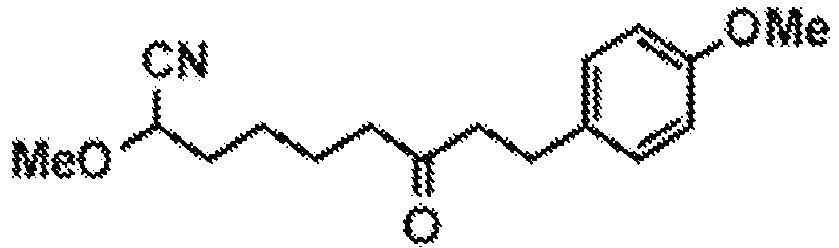
- 52.3 mg (0.180 mmol, 90%); IR (film) 2937, 2868, 2834, 1711, 1612, 1513, 1463, 1410, 1372, 1300, 1246, 1179, 1113, 1073, 1035, 829 cm-1; 1H NMR (600 MHz, CDCl3) δ = 7.09 (d, J = 8.4 Hz, 2H), 6.82 (d, J = 8.4 Hz, 2H), 4.02 (t, J =7.2 Hz, 1H), 3.78 (s, 3H), 3.47 (s, 3H), 2.83 (t, J = 7.8 Hz, 2H), 2.69 (t, J = 7.8 Hz, 2H), 2.39 (t, J = 7.8 Hz, 2H), 1.81 (q, J =7.2 Hz, 2H), 1.62-1.56 (m, 2H), 1.47-1.41 (m, 2H); 13C NMR (126 MHz, CDCl3) δ = 209.8, 158.1, 133.2, 129.4, 118.1, 114.0, 70.5, 58.1, 55.4, 44.7, 42.7, 33.3, 29.1, 24.4, 23.0; HRMS (ESI) m/z calc. for C17H24NO3 [M+H]+ 290.1751; found 290.1760.
-

- 33.8 mg (0.155 mmol, 77%)IR (film) 2926, 1753, 1612, 1513, 1442, 1365, 1301, 1246, 1178, 1109, 1036, 911, 829 cm-1; 1H NMR (500 MHz, CDCl3) δ = 7.09 (d, J = 8.5 Hz, 2H), 6.82 (d, J = 8.5 Hz, 2H), 5.83-5.73 (m, 1H), 5.01 (dd, J = 17.5 Hz, 1.4 Hz, 1H), 4.97 (dd, J= 10.0 Hz, 1.4 Hz, 1H), 3.78 (s, 3H), 2.84 (t, J = 7.5 Hz, 2H), 2.70 (t, J = 7.5 Hz, 2H), 2.48 (t, J =7.5 Hz, 2H), 2.31 (q, J = 7.5 Hz, 2H); 13C NMR (126 MHz, C6D6) δ = 207.1, 158.6, 137.6, 133.6, 129.6, 115.0, 114.2, 54.7, 44.5, 41.8, 29.1, 28.0; HRMS (ESI) m/z calc. for C14H19O2 [M+H]+ 219.1380; found 219.1374.
- In a glove box, to a solution of
iodide 7a-m (0.24 mmol, 1.2 eq.) and thioester 1-5 (54.6 mg, 0.20 mmol, 1.0 eq.) in either DMI (0.4 mL, sigma aldrich, 99.5%) or DMI/EtOAc (0.334 mL/0.066mL) were added Cp2ZrCl2 (58.5 mg, 0.20 mmol, 1.0 eq. Sigma-aldrich, 98%), Zn powder (39.2 mg, 0.6 mmol, 3.0 eq. Sigma-aldrich, used without any activation), and NiBr2•dtbbpy (9.7 mg, 0.02 mmol, 10 mol%, preparation see page 8) at room temperature. After being stirred at the same temperature for 10 min to 2 hr (monitored by TLC), the reaction mixture was removed from glove box and diluted with EtOAc and sat. NaHCO3 aq. The organic layer was separated and the aqueous layer was extracted with ethyl acetate. The combined organic layer was dried over Na2SO4, filtered, and concentrated under reduced pressure. The obtained crude material was purified by flash column chromatography on silica gel to give 8a-m as colorless oils or white amorphous solids. Note 1: DMI or DMI/EtOAc depending on the solubilities of substrates was used as the solvent. Note 2: 2.0 eq. of lutidine was added before addition of Cp2ZrCl2 for the syntheses of 8d and 8e. -

- 51.7 mg (0.186 mmol, 93%); IR (film) 3035, 2988, 2935, 1711, 1612, 1513, 1478, 1370, 1246, 1178, 1058, 1036, 829, 669 cm-1; 1H NMR (500 MHz, CDCl3) δ = 7.09 (d, J = 8.5 Hz, 2H), 6.81 (d, J= 8.5 Hz, 2H), 4.44 (quin, J= 6.0 H, 1H), 4.15 (dd, J= 8.5 Hz, 8.0 Hz, 1H), 3.77 (s, 3H), 3.50 (dd, J = 8.5 Hz, 8.0 Hz, 1H), 2.88-2.80 (m, 3H), 2.76-2.71 (m, 2H), 2.52 (dd, J = 16.5 Hz, 7.0 Hz, 1H) 1.38 (s, 3H), 1.33 (s, 3H); 13C NMR (126 MHz, CDCl3) δ = 207.8, 158.0, 132.8, 129.2, 113.9, 108.8, 71.7, 69.4, 55.2, 47.2, 45.2, 28.7, 26.9, 25.5; HRMS (ESI) m/z calc. for C16H22NaO4 [M+Na]+ 301.1410; found 301.1425.
-
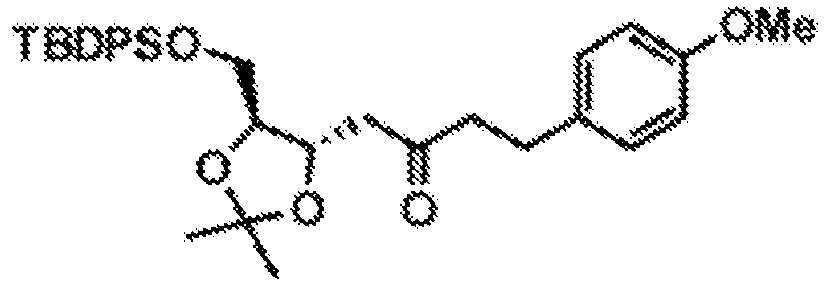
- 102.3 mg (0.187 mg, 94%);

-

- 49.1 mg (0.188 mg, 94%); IR (film) 2934, 2849, 1712, 1612, 1513, 1441, 1300, 1246, 1178, 1087, 1043, 828 cm-1; 1H NMR (600 MHz, CDCl3) δ = 7.09 (d, J= 8.4 Hz, 2H), 6.81 (d, J = 8.4 Hz, 2H), 3.91 (d, J =11.4 Hz, 1H), 3.78 (s, 3H), 3.77-3.72 (m, 1H), 3.41 (t, J =10.8 Hz, 1H), 2.83 (t, J =7.8 Hz, 2H), 2.74 (q, J = 5.4 Hz, 2H), 2.64 (dd, J =15.6 Hz, 7.8 Hz, 1H), 2.36 (dd, J = 15.6 Hz, 5.2 Hz, 1H), 1.80 (d, J = 5.2 Hz, 1H), 1.58 (d, J =12.6 Hz, 1H), 1.53-1.46 (m, 3H), 1.29-1.21 (m, 1H); 13C NMR (126 MHz, CDCl3) δ = 210.2, 158.1, 135.7, 133.9, 133.3, 129.8, 129.3, 127.8, 114.0, 63.1, 55.4, 44.7, 39.5, 29.1, 27.0, 26.7, 19.3; HRMS (ESI) m/z calc. for C16H23O3 [M+H]+ 263.1642; found 263.1649.
-

- 73.4 mg (0.187 mg, 94%);

-

- 61.9 mg (0.177 mg, 89%);

-

- 75.7 mg (0.186 mmol, 93%);

-

- 103.4 mg, (0.171 mmol, 86%); IR (film) 2955, 2930, 2893, 2856, 1716, 1513, 1472, 1428, 1361, 1248, 1178, 1111, 1084, 1038, 836, 776, 739, 702, 615, 505 cm-1; 1H NMR (600 MHz, CDCl3) δ = 7.68-7.65 (m, 4H), 7.45-7.35 (m, 6H), 7.09 (d, J= 7.8 Hz, 2H), 6.82 (d, J= 7.8 Hz, 2H), 4.42-4.37 (m, 1H), 3.78 (s, 3H), 3.71 (t, J =6.0 Hz, 2H), 2.85-2.79 (m, 1H), 2.72-2.68 (m, 1H), 2.60 (dd, J = 15.6 Hz, 6.6 Hz, 1H), 2.49 (dd, J = 15.6 Hz, 4.8 Hz, 1H), 1.78-1.65 (m, 2H), 1.06 (s, 9H), 0.83 (s, 9H), 0.03 (s, 3H), 0.01 (s, 3H); 13C NMR (151 MHz, CDCl3) δ = 209.0, 158.0, 135.72, 135.69, 133.87, 133.84, 133.3, 129.75, 129.73, 129.3, 127.8, 114.0, 66.7, 60.5, 55.4, 50.5, 46.5, 40.3, 28.7, 27.0, 26.0, 19.3, 19.1, -4.5, -4.6; HRMS (ESI) m/z calc. for C36H53O4Si2 [M+H]+ 605.3477; found 605.3464.
-

- 94.8 mg (0.188 mmol, 94%); IR (film) 2931, 2896, 2835, 1715, 1612, 1513, 1471, 1464, 1428, 1362, 1300, 1247, 1178, 1111, 1087, 1037, 823, 738, 703, 688, 622, 615, 505, 490, 429 cm-1; 1H NMR (600 MHz, C6D6) δ = 7.81-7.77 (m, 4H), 7.26-7.22 (m, 6H), 6.98 (d, J = 8.5 Hz, 2H), 6.77 (d, J = 8.5 Hz, 2H), 3.99-3.93 (m, 1H), 3.86-3.80 (m, 1H), 3.76-3.70 (m, 1H), 3.33 (s, 3H), 3.10 (s, 3H), 2.82 (t, J =8.0 Hz, 2H), 2.44-2.36 (m, 3H), 2.13 (dd, J = 15.5 Hz, 4.8 Hz, 1H), 1.73-1.67 (m, 2H), 1.18 (s, 9H); 13C NMR (126 MHz, C6D6) δ = 207.3, 159.0, 136.4, 134.6, 134.0, 130.4, 130.0, 128.5, 114.0, 75.0, 61.1, 57.2, 55.1, 48.1, 46.1, 37.5, 29.4, 27.5, 17.8; HRMS (ESI) m/z calc. for C31H40NaO4Si [M+Na]+ 527.2588; found 527.2593.
-

- 90.0 mg (0.169 mmol, 85%); IR (film) 2956, 2931, 2857, 1738, 1716, 1513, 1428, 1363, 1244, 1179, 1111, 1036, 824, 739, 704, 614, 505 cm-1; 1H NMR (600 MHz, C6D6) δ = 7.79-7.74 (m, 4H), 7.26-7.21 (m, 6H), 6.98 (d, J = 7.8 Hz, 2H), 6.77 (d, J = 7.8 Hz, 2H), 5.67-5.62 (m, 1H), 3.73-3.64 (m, 2H), 3.32 (s, 3H), 2.79 (t, J =7.2 Hz, 2H), 2.46 (dd, J= 16.2 Hz, 6.6 Hz, 1H), 2.42-2.35 (m, 1H), 2.33-2.26 (m, 1H), 2.22 (dd, J = 16.2 Hz, 6.6 Hz, 2H), 1.86-1.79 (m, 1H), 1.78-1.72 (m, 1H), 1.62 (s, 3H), 1.18 (s, 9H); 13C NMR (126 MHz, C6D6) δ = 205.8, 170.0, 159.0, 136.4, 134.4, 133.8, 130.4, 130.0, 128.5, 114.6, 68.4, 60.8, 55.2, 47.7, 45.4, 37.4, 29.4, 27.4, 21.0, 19.8; HRMS (ESI) m/z calc. for C32H40NaO5Si [M+Na]+ 555.2537; found 555.2533.
-

- 28.4 mg (0.074 mmol, 37%);

-

- 69.6 mg (0.182 mmol, 91%);

-

- 62.8 mg (0.172 mmol, 86%);

-

- 71.9 mg (0.181 mmol, 91%);

- In a glove box, to a solution of iodide 9a-u (0.24 mmol, 1.2 eq.) and thioester 1-5 (54.6 mg, 0.20 mmol, 1.0 eq.) in either DMI (0.4 mL, sigma aldrich, 99.5%) or DMI/EtOAc (0.334 mL/0.066mL) were added Cp2ZrCl2 (58.5 mg, 0.20 mmol, 1.0 eq. Sigma-aldrich, 98%), Zn powder (39.2 mg, 0.6 mmol, 3.0 eq. Sigma-aldrich, used without any activation), and NiBr2□dtbbpy (9.7 mg, 0.02 mmol, 10 mol%, preparation see page 8) at room temperature. After being stirred at the same temperature for 10 min to 3 hr (monitored by TLC), the reaction mixture was removed from glove box and diluted with EtOAc and sat. NaHCO3 aq. The organic layer was separated and the aqueous layer was extracted with ethyl acetate. The combined organic layer was dried over Na2SO4, filtered, and concentrated under reduced pressure. The obtained crude material was purified by flash column chromatography on silica gel to give 10a-u as colorless oils or white amorphous solids. Note 1: DMI or DMI/EtOAc depending on the solubilities of substrates was used as the solvent. Note 2: 2.0 eq. of lutidine was added before addition of Cp2ZrCl2 for the syntheses of 10c. Note 3: 1.5 eq. of
iodide 9p-u, and 1.5 eq. of Cp2ZrCl2 were used during syntheses of 10p-u. -

- 87.9 mg (0.191 mmol, 96%); IR (film) 2952, 2931, 2834, 1714, 1513, 1247, 1036, 975, 823, 688, 613, 487 cm-1; 1H NMR (600 MHz, CDCl3) δ = 7.66-7.64 (m, 4H), 7.44-7.36 (m, 6H), 7.09 (d, J = 9.0 Hz, 2H), 6.82 (d, J = 9.0 Hz, 2H), 3.78 (s, 3H), 3.66 (t, J =5.9 Hz, 2H), 2.83 (t, J =7.2 Hz, 2H), 2.69 (t, J = 7.8 Hz, 2H), 2.51 (t, J =7.2 Hz, 2H), 1.85-1.80 (m, 2H), 1.05 (s, 9H); 13C NMR (151 MHz, CDCl3) δ = 210.2, 158.1, 135.7, 133.9, 133.3, 129.8, 129.3, 127.8, 114.0, 63.1, 55.4, 44.7, 39.5, 29.1, 27.0, 26.7, 19.3; HRMS (ESI) m/z calc. for C29H37O3Si [M+H]+ 461.2506; found 461.2508.
-

- 63.8 mg (0.190 mmol, 95%); IR (film) 2954, 2929, 2857, 1715, 1513, 1247, 1097, 1038, 835, 776 cm-1; 1H NMR (600 MHz, CDCl3) δ = 7.09 (d, J = 9.0 Hz, 2H), 6.82 (d, J = 9.0 Hz, 2H), 3.78 (s, 3H), 3.59 (t, J =6.0 Hz, 2H), 2.84 (t, J =7.2 Hz, 2H), 2.71 (t, J = 7.8 Hz, 2H), 246 (t, J =7.2 Hz, 2H), 1.79-1.74 (m, 2H), 0.88 (s, 9H), 0.03 (s, 6H); 13C NMR (151 MHz, CDCl3) δ = 210.3, 158.1, 133.3, 129.4, 114.0, 62.3, 55.4, 44.8, 39.5, 29.1, 26.9, 26.1, 18.4, -5.2; HRMS (ESI) m/z calc. for C19H33O3Si [M+H]+ 337.2193; found 337.2186.
-

- 61.5 mg (0.183 mmol, 92%); IR (film) 2953, 2876, 2835, 1715, 1612, 1513, 1464, 1247, 1178, 1095, 1038, 1005, 826, 808, 743 cm-1; 1H NMR (600 MHz, C6D6) δ = 6.97 (d, J = 8.4 Hz, 2H), 6.77 (d, J = 8.4 Hz, 2H), 3.47 (t, J = 5.9 Hz, 2H), 3.33 (s, 3H), 2.80 (t, J = 7.8 Hz, 2H), 2.31 (t, J =7.8 Hz, 2H), 2.15 (t, J = 7.2 Hz, 2H), 1.80-1.75 (m, 2H), 0.99 (t, J =7.2 Hz, 9H), 0.58 (q, J = 7.2 Hz, 6H); 13C NMR (151 MHz, C6D6) δ = 208.3, 159.0, 134.0, 130.0, 114.6, 62.4, 55.1, 44.9, 39.5, 29.6, 27.6, 7.5, 5.2; HRMS (ESI) m/z calc. for C19H33O3Si [M+H]+ 337.2193; found 337.2186.
-

- 64.9 mg (0.190 mmol, 95%); IR (film) 2932, 2855, 2835, 1711, 1612, 1585, 1512, 1464, 1441, 1363, 1301, 1245, 1177, 1095, 1034, 819 cm-1; 1H NMR 7.23 (d, J = 9.0 Hz, 2H), 7.08 (d, J = 9.0 Hz, 2H), 6.87 (d, J = 9.0 Hz, 2H), 6.81 (d, J = 9.0 Hz, 2H), 4.39 (s, 2H), 3.80 (s, 3H), 3.78 (s, 3H), 3.43 (t, J =6.0 Hz, 2H), 2.82 (t, J=7.2 Hz, 2H), 2.68 (t, J = 7.2 Hz, 2H), 2.48 (t, J =7.2 Hz, 2H), 1.89-1.84 (m, 2H); 13C NMR (126 MHz, CDCl3) δ = 210.1, 159.3, 158.1, 133.3, 130.6 , 129.39, 129.36, 114.0, 113.9, 72.6, 69.1, 55.40, 55.39, 44.7, 39.8, 29.0, 24.0; HRMS (ESI) m/z calc. for C21H26NaO4 [M+Na]+ 365.1723; found 365.1724.
-

- 55.4 mg (0.181 mmol, 91%); IR (film) 2940, 2870, 1712, 1612, 1513, 1442, 1331, 1246, 1179, 1076, 1034, 991, 815 cm-1; 1H NMR (600 MHz, CDCl3) δ = 7.09 (d, J = 9.0 Hz, 2H), 6.81 (d, J = 9.0 Hz, 2H), 4.53 (s, 1H), 3.82 (t, J =9.6 Hz, 1H), 3.78 (s, 3H), 3.71 (q, J =6.0 Hz, 1H), 3.48 (t, J= 5.0 Hz, 1H), 3.38 (q, J = 6.0 Hz, 1H), 2.84 (t, J = 7.8 Hz, 2H), 2.72 (t, J =7.8 Hz, 2H), 2.54-2.44 (m, 2H), 1.89-1.83 (m, 2H), 1.80 (d, J =8.4 Hz, 1H), 1.71-1.65 (m, 1H), 1.58-1.48 (m, 4H); 13C NMR (151 MHz, CDCl3) δ = 209.9, 157.9, 133.2, 129.2, 113.9, 76.8, 66.5, 62.4, 55.2, 44.6, 39.8, 30.7, 28.9, 25.4, 23.9, 19.7; HRMS (ESI) m/z calc. for C18H26NaO4 [M+Na]+ 329.1723; found 329.1722.
-

- 49.9 mg (0.189 mmol, 95%); IR (film) 2959, 2935, 1734, 1711, 1512, 1364, 1238, 1177, 1109, 1034, 761 cm-1; 1H NMR (600 MHz, CDCl3) δ = 7.09 (d, J = 9.0 Hz, 2H), 6.81 (d, J = 9.0 Hz, 2H), 4.03 (t, J =6.6 Hz, 2H), 3.77 (s, 3H), 2.84 (t, J =7.2 Hz, 2H), 2.70 (t, J =7.2 Hz, 2H), 2.45 (t, J =7.2 Hz, 2H), 2.02 (s, 3H), 1.92-1.86 (m, 2H); 13C NMR (151 MHz, CDCl3) δ = 209.2, 171.2, 158.1, 133.1, 129.4, 114.0, 63.7, 55.4, 44.7, 39.3, 29.0, 22.7, 21.0; HRMS (ESI) m/z calc. for C15H21O4 [M+H]+ 265.1434; found 265.1433.
-

- 85.4 mg (0.180 mmol, 90%); IR (film) 2959, 2931, 2857, 1713, 1513, 1463, 1442, 1247, 1178, 1111, 1037, 824, 741, 702, 614, 506 cm-1; 1H NMR (600 MHz, CDCl3) δ = 7.66-7.63 (m, 4H), 7.44-7.41 (m, 2H), 7.40-7.36 (m, 4H), 7.09 (d, J= 9.0 Hz, 2H), 6.82 (d, J= 9.0 Hz, 2H), 3.78 (s, 3H), 3.52 (dd, J = 9.6 Hz, 5.2 Hz, 1H), 3.43 (dd, J = 10.2 Hz, 6.6 Hz, 1H), 2.82 (t, J= 8.4 Hz, 2H), 2.68 (td, J= 7.8 Hz, 2.0 Hz, 2H), 2.63 (dd, J= 16.2 Hz, 5.2 Hz, 1H), 2.28-2.22 (m, 1H), 2.18 (dd, J = 16.2 Hz, 16.0 Hz, 1H), 1.05 (s, 9H), 0.88 (d, J= 6.6 Hz, 3H); 13C NMR (126 MHz, CDCl3) δ = 209.9, 157.9, 135.6, 133.7, 133.2, 129.6, 129.2, 127.7, 113.9, 68.3, 55.3, 46.8, 45.1, 32.0, 28.9, 26.9, 19.3, 16.8; HRMS (ESI) m/z calc. for C30H39O3Si [M+H]+ 475.2663; found 475.2654.
-

- 88.4 mg (0.181 mmol, 91%); IR (film) 2958, 2858, 1711, 1512, 1264, 1178, 907, 825, 731, 703, 650, 436 cm-1; 1H NMR (600 MHz, CDCl3) δ = 7.64-7.62 (m, 4H), 7.44-7.41 (m, 2H), 7.39-7.36 (m, 4H), 7.09 (d, J = 9.0 Hz, 2H), 6.82 (d, J = 9.0 Hz, 2H), 3.78 (s, 3H), 3.39 (s, 2H), 2.79 (t, J = 7.8 Hz, 2H), 2.68 (t, J =7.8 Hz, 2H), 2.42 (s, 2H), 1.06 (s, 9H), 0.97 (s, 6H); 13C NMR (126 MHz, CDCl3) δ = 210.2, 158.0, 135.8, 133.8, 133.4, 129.8, 129.4, 127.8, 114.0, 72.2, 55.4, 50.2, 46.9, 36.3, 29.0, 27.1, 24.5, 19.6; HRMS (ESI) m/z calc. for C31H41O3Si [M+H]+ 489.2819; found 489.2832.
-

- 90.1 mg (0.190 mmol, 95%); IR (film) 2959, 2931, 2857, 1710, 1612, 1513, 1463, 1247, 1178, 1111, 1038, 823, 740, 703, 614, 519 cm-1; 1H NMR (600 MHz, CDCl3) δ = 7.66-7.64 (m, 4H), 7.45-7.41 (m, 2H), 7.40=7.37 (m, 4H), 7.09 (d, J = 9.0 Hz, 2H), 6.82 (d, J = 9.0 Hz, 2H), 3.79 (s, 3H), 3.65 (t, J =6.6 Hz, 2H), 2.84-2.70 (m, 5H), 1.97-1.90 (m, 1H), 1.53-1.47 (m, 1H), 1.06 (s, 9H), 1.02 (d, J=7.2 Hz, 3H); 13C NMR (126 MHz, CDCl3) δ = 213.6, 157.9, 135.6, 133.7, 133.4, 129.7, 129.3, 127.7, 113.9, 61.6, 55.3, 43.1, 42.9, 35.3, 28.9, 26.9, 19.2, 16.2; HRMS (ESI) m/z calc. for C30H39O3Si [M+H]+ 475.2663; found 475.2657.
-

- 46.0 mg (0.192 mmol, 96%); IR (film) 2932, 2836, 1712, 1612, 1513, 1442, 1374, 1300, 1245, 1178, 1091, 1034, 829, 546 cm-1; 1H NMR (600 MHz, CDCl3) δ = 7.10 (d, J = 8.4 Hz, 2H), 6.82 (d, J= 8.4 Hz, 2H), 3.78 (s, 3H), 3.55 (t, J =6.6 Hz, 2H), 2.85 (t, J =7.8 Hz, 2H), 2.72 (t, J = 7.8 Hz, 2H), 2.58 (t, J =7.8 Hz, 2H), 2.05-2.00 (m, 2H); 13C NMR (126 MHz, CDCl3) δ = 209.1, 158.2, 133.0, 129.4, 114.1, 55.4, 44.8, 44.6, 29.7, 29.1, 26.4; HRMS (ESI) m/z calc. for C13H18ClO2 [M+H]+ 241.0990; found 241.0998.
-

- 54.3 mg (0.191 mmol, 96%); IR (film) 2933, 2835, 1712, 1611, 1512, 1441, 1409, 1372, 1300, 1245, 1178, 1035, 828, 555 cm-1; 1H NMR (600 MHz, CDCl3) δ = 7.09 (d, J = 8.4 Hz, 2H), 6.82 (d, J= 8.4 Hz, 2H), 3.78 (s, 3H), 3.42 (t, J =6.6 Hz, 2H), 2.85 (t, J =7.8 Hz, 2H), 2.72 (t, J = 7.8 Hz, 2H), 2.58 (t, J =7.8 Hz, 2H), 2.13-2.08 (m, 2H); 13C NMR (126 MHz, CDCl3) δ = 209.0, 158.1, 133.0, 129.4, 114.1, 55.4, 44.8, 40.9, 33.4, 29.1, 26.4; HRMS (ESI) m/z calc. for C13H18BrO2 [M+H]+ 285.0485; found 285.0476.
-

- 61.7 mg (0.164 mmol, 82%); IR (film) 2960, 2936, 1714, 1612, 1513, 1465, 1455, 1443, 1416, 1359, 1302, 1246, 1189, 1175, 1098, 1037, 1037, 1019, 963, 931, 921, 903, 830, 814, 795, 664, 543 cm-1; 1H NMR (600 MHz, C6D6) δ = 7.72 (d, J = 8.4 Hz, 2H), 6.94 (d, J = 8.4 Hz, 2H), 6.79 (d, J= 8.4 Hz, 2H), 6.69 (d, J = 8.4 Hz, 2H), 3.79 (t, J =6.6 Hz, 2H), 3.34 (s, 3H), 2.70 (t, J =7.2 Hz, 2H), 2.14 (t, J= 7.2 Hz, 2H), 1.85 (t, J =6.6 Hz, 2H), 1.82 (s, 3H), 1.59-1.54 (m, 2H); 13C NMR (126 MHz, C6D6) δ = 207.4, 159.0, 144.6, 134.7, 133.8, 130.2, 129.9, 114.6, 70.0, 55.2, 55.1, 44.7, 38.3, 29.5, 23.5, 21.5; HRMS (ESI) m/z calc. for C20H24NaO5S [M+Na]+ 399.1237; found 399.1221.
-

- 57.6 mg (0.160 mmol, 82%); IR (film) 2934, 1712, 1612, 1512, 1488, 1454, 1404, 1370, 1300, 1246, 1178, 1109, 1035, 1011, 824, 518 cm-1; 1H NMR (600 MHz, CDCl3) δ = 7.38 (d, J = 8.4 Hz, 2H), 7.08 (d, J = 8.4 Hz, 2H), 7.00 (d, J = 8.4 Hz, 2H), 6.81 (d, J = 8.4 Hz, 2H), 3.78 (s, 3H), 2.82 (t, J = 8.4 Hz, 2H), 2.66 (t, J =8.4 Hz, 2H), 2.53 (t, J = 7.2 Hz, 2H), 2.36 (t, J =7.2 Hz, 2H), 1.88-1.82 (m, 2H); 13C NMR (151 MHz, CDCl3) δ = 209.9, 158.1, 140.7, 133.2, 131.5, 130.3, 129.4, 119.8, 114.0, 55.4, 44.7, 42.1, 34.5, 29.0, 25.0; HRMS (ESI) m/z calc. for C19H21BrNaO2 [M+Na]+ 383.0617; found 383.0608.
-

- 27.3 mg (0.123 mmol, 62%); IR (film) 3523-3306 (br), 2918, 1708, 1612, 1513, 1299, 1246, 1179, 1107, 1066, 848 cm-1; 1H NMR (600 MHz, CDCl3) δ = 7.10 (d, J = 8.4 Hz, 2H), 6.82 (d, J = 8.4 Hz, 2H), 3.78 (s, 3H), 3.63 (t, J =6.6 Hz, 2H), 2.85 (t, J =6.6 Hz, 2H), 2.73 (t, J = 6.6 Hz, 2H), 2.53 (t, J =6.6 Hz, 2H), 1.85-1.80 (m, 2H); 13C NMR (126 MHz, CDCl3) δ = 210.9, 158.1, 133.1, 129.3, 114.1, 62.5, 55.4, 44.8, 39.9, 29.1, 26.5; HRMS (ESI) m/z calc. for C13H17O2 [M+H-H2O]+ 205.1223; found 205.1223. Note: Exists as a mixture of ketone and hemiacetal (30:1).
-

- 30.9 mg (0.131 mmol, 66%); IR (film) 3513-3300 (br), 2916, 1705, 1610, 1513, 1299, 1246, 1179, 1107, 1100, 1087, 845 cm-1; 1H NMR (600 MHz, CDCl3) δ = 7.10 (d, J = 8.4 Hz, 2H), 6.82 (d, J = 8.4 Hz, 2H), 3.78 (s, 3H), 3.78-3.76 (m, 1H), 2.87-2.80 (m, 2H), 2.77-2.68 (m, 2H), 2.58-2.49 (m, 2H), 1.65-1.55 (m, 2H), 1.18 (d, J =5.2 Hz, 3H); 13C NMR (126 MHz, CDCl3) δ = 211.1, 158.0, 133.4, 129.3, 114.1, 67.6, 55.4, 44.8, 39.5, 32.7 29.1, 23.9; HRMS (ESI) m/z calc. for C14H20O3 [M+H]+ 237.1491; found 237.1485. Note: Exists as a mixture of ketone and hemiacetal (20:1).
-

- 24.8 mg (0.099 mmol, 50%); IR (film) 3550-3450 (br), 2966, 2928, 1708, 1611, 1512, 1464, 1366, 1300. 1244, 1177, 1138, 1035, 822 cm-1; 1H NMR (500 MHz, CDCl3) (only peaks of the ketone in the mixture are shown) δ = 7.09 (d, J = 8.4 Hz, 2H), 6.82 (d, J = 8.4 Hz, 2H), 3.78 (s, 3H), 2.84 (t, J =9.6 Hz, 2H), 2.74 (t, J =9.6 Hz, 2H), 2.52 (t, J =9.6 Hz, 2H), 1.74 (t J =9.6 Hz, 2H), 1.19 (s, 6H); 13C NMR (126 MHz, CDCl3) (all peaks of the mixture are shown) δ = 210.9, 133.0, 129.2, 129.1, 113.9, 113.8, 70.1, 55.3, 44.8, 43.2, 38.0, 37.2, 36.6, 36.2, 30.4, 30.0, 29.4, 29.0 HRMS (ESI) m/z calc. for C15H23O3 [M+H]+ 251.1647; found 251.1639. Note: Exists as a mixture of ketone and hemiacetal (2.5:1).
-

- 25.3 mg (0.091 mmol); 1H NMR shows complex mixtures which are considered as a mixture of the ketone and two hemiacetal isomers. 1H NMR of 10s is shown in
Part 8 of this supporting information. In order to confirm the structure, 10s was subject to TESOTf (1.2 eq.) and 2,6-lutidine (1.5 eq.) in dichloromethane. The expected 8e was isolated as the major product for 87% yield. -

- 40.7 mg (0.083 mmol, 42%); IR (film) 3489 (br), 2930, 2857, 1711, 1612, 1513, 1471, 1428, 1301, 1247, 1178, 1111, 1038, 823, 739, 703, 689, 617, 504 cm-1; 1H NMR (600 MHz, C6D6) δ = 7.80-7.75 (m, 4H), 7.25-7.20 (m, 6H), 6.95 (d, J= 9.0 Hz, 2H), 6.78 (d, J = 9.0 Hz, 2H), 4.33-4.27 (m, 1H), 3.88-3.83 (m, 1H), 3.80-3.76 (m, 1H), 3.32 (s, 3H), 3.28 (d, J =2.9 Hz, 1H), 2.77-2.73 (m, 2H), 2.27 (t, J =7.8 Hz, 2H), 2.19 (dd, J = 16.8 Hz, 9.0 Hz, 1H), 2.02 (dd, J= 16.8 Hz, 3.4 Hz, 2H), 1.68-1.61 (m, 1H), 1.52-1.46 (m, 1H), 1.16 (s, 9H); 13C NMR (126 MHz, C6D6) δ = 209.7, 159.0, 136.4, 134.3, 133.8, 130.4, 130.0, 114.6, 110.8, 110.7, 66.6, 62.5, 55.2, 50.1, 45.7, 39.6, 29.3, 27.5, 19.7; HRMS (ESI) m/z calc. for C30H39O4Si [M+H]+ 491.2612; found 491.2604.
-

- 42.9 mg (0.116 mmol, 58%); IR (film) 2951, 2905, 2834, 1721, 1610, 1508, 1483, 14691, 1280, 1170, 1105, 1087, 845, 721 cm-1; 1H NMR (600 MHz, CDCl3) δ = 8.73 (s, 1H), 8.30 (d, J = 5.6 Hz, 1H), 8.26 (d, J = 5.6 Hz, 1H),), 7.59 (t, J = 5.6 Hz, 1H), 7.08 (d, J = 8.4 Hz, 2H), 6.80 (d, J = 8.4 Hz, 2H), 4.35 (t, J =6.6 Hz, 2H), 3.75 (s, 3H), 2.86 (t, J = 7.8 Hz, 2H), 2.73 (t, J = 7.8 Hz, 2H), 2.56 (t, J = 6.6 Hz, 2H), 2.07 (m, 2H); 13C NMR (126 MHz, CDCl3) δ = 209.2, 170.8, 165.8, 158.4, 134.8, 134.5, 133.0, 131.4, 131.0, 129.8, 129.4, 128.9, 114.0, 64.8, 55.4, 44.8, 39.4, 29.3, 22.9; HRMS (ESI) m/z calc. for C21H22NaO6 [M+Na]+ 393.1314; found 393.1303.
- In a glove box, to a solution of iodide 1-12 (27.1 mg, 0.12 mmol, 1.2 eq.) and thioester 1-11 (23.7 mg, 0.10 mmol, 1.0 eq.) in DMI (0.2 mL, Sigma-aldrich, 99.5%) were added Cp2ZrCl2 (29.3 mg, 0.10 mmol, 1.0 eq. Sigma-aldrich, 98%), Zn powder (19.6 mg, 0.3 mmol, 3.0 eq. Sigma-aldrich, used without any activation), and NiBr2•dtbbpy (4.8 mg, 0.01 mmol, 10 mol%, preparation see page 8) at room temperature. After being stirred at the same temperature for 40 mins (monitored by TLC), the reaction mixture was removed from glove box and diluted with EtOAc and sat. NaHCO3 aq. The organic layer was separated and the aqueous layer was extracted with ethyl acetate. The combined organic layer was dried over Na2SO4, filtered, and concentrated under reduced pressure. The obtained crude material was purified by flash column chromatography on silica gel to give 1-13 as a colorless oil.
-

- 19.4 mg (0.086 mmol, 86%); IR (film) 2933, 2487, 1713, 1440, 1378, 1356, 1203, 1175, 1088 cm-1; 1H NMR (600 MHz, CDCl3) δ = 3.91 (d, J = 9.2 Hz, 2H), 3.79-3.73 (m, 2H), 3.43 (dd, J = 11.2, 10.8 Hz, 2H), 2.67 (dd, J = 14.8, 5.8 Hz, 2H), 2.44 (dd, J = 14.8, 5.8 Hz, 2H), 1.80 (d, J= 7.2 Hz, 2H), 1.62-1.58 (m, 3H), 1.52-1.46 (m, 5H), 1.30-1.21 (m, 2H); 13C NMR (126 MHz, CDCl3) δ = 207.7, 74.1, 68.7, 50.6, 50.4, 31.9, 25.9, 23.5 HRMS (ESI) m/z calc. for C13H22NaO3 [M+Na]+ 249.1467; found 249.1460.
-

- 20.2 mg (0.089 mmol, 89%);

-

- 19.2 mg (0.085 mmol, 85%) from (S)-1-11; 19.4 mg (0.086 mmol, 86%) from (R)-1-11. 1H NMR (600 MHz, CDCl3) δ = 3.91 (d, J = 9.2 Hz, 2H), 3.79-3.73 (m, 2H), 3.43 (dd, J= 11.2, 10.8 Hz, 2H), 2.67 (dd, J = 14.8, 5.8 Hz, 2H), 2.44 (dd, J= 14.8, 5.8 Hz, 2H), 1.80 (d, J= 7.2 Hz, 2H), 1.62-1.58 (m, 3H), 1.52-1.46 (m, 5H), 1.30-1.21 (m, 2H); 13C NMR (126 MHz, CDCl3) δ = 207.7, 74.1, 68.7, 50.4, 31.9, 25.9, 23.5 ppm; HRMS (ESI) m/z calc. for C13H22NaO3 [M+Na]+ 249.1467; found 249.1463.
-

- 19.0 mg (0.084 mmol, 84%);

- A unified, efficient, and scalable synthesis of halichondrins, with use of Zr/Ni-mediated one-pot ketone synthesis as the final coupling reaction has been developed. In a previous synthesis, the key intermediate for construction of the [6,6] and [5,5] spiroketals was enone 2-3, which was synthesized via a Ni/Cr-mediated coupling of 2-1 with 2-2 in an excellent overall yield (
Figure 7 ). The best combination of protecting groups at C35, C41, and C48 was recently identified to be TES, TBS, and TES, respectively. During this transformation, three chiral centers were introduced at C38, C40, and C44, cf., 2-3 →2-A → 2-B → 2-4. Based on the synthetic work of calcimycin, the desired stereochemistry should be preferentially formed under a basic condition (see, e.g., Negri, D. P.; Kishi, Y. Tetrahedron Lett., 1987, 28, 1063). Indeed, this approach worked nicely for a synthesis of halichondrins A-Cs. However, an alternative route for the final transformation was desired. - Ketone 2-B is available via an alternative, well-defined route. The Zr/Ni-mediated one-pot ketone synthesis showed a potential to meet these needs; specifically, this method was proved effective for coupling of (S)-2-C+(S)-2-D→(∑,∑)-2-E. The requisite ketone 2-B could be synthesized from iodide 2-5 and 2-thiopyridine ester 2-6. Ketone 2-B could also be obtained via coupling at the C38-C39 bond, but we focused on the former route because of the overall synthetic efficiency of 2-5. The feasibility of this disconnection was demonstrated with use of the combination of CH2I at C40 with C(=O)SPy at C38. Py = 2-pyridyl.
- Being encouraged with the successful ((S)-2-C + (S)-2-D → (∑,∑)-2-E)-coupling, the feasibility study for the proposed synthesis began. For this study, the right half 2-5 of halichondrin Bs was chosen. The C35-protecting group was selected for two reasons, i.e., (1) the rate of ketone coupling with 2-5 was significantly faster than that with the corresponding C35-TBS substrate and (2) deprotection of the C35-TES group in the following step was noticeably faster than that of the corresponding C35-TBS substrate. On the other hand, the left half 2-6 was chosen, because of its availability in a larger quantity at the time of preliminary study. The C41-protecting group was chosen primarily for the ease of deprotection.
- The desired product 2-7 was obtained in the first attempt under the conditions used for ((S)-2-C + (S)-2-D → (∑,∑)-2-E)-coupling. Conditions were then optimized for this case. First, Cp2ZrCl2 was important to accelerate the ketone coupling and, at the same time, suppress by-product formation via a (I→SPy)-displace-ment at C37. Second, a 5:1 mixture of DMI and EtOAc was found to be the best solvent. Third, the coupling proceeded well at 0.1 M concentration, although a higher concentration, for example 0.4 M, was better. Fourth, both Zn and Mn metals were effective. Fifth, 2,6-di-tert-butyl-4-methylpyridine was used to avoid partial deprotection of the TES groups during the reaction and/or workup. Lastly, as expected, the coupling efficiency depended on the molar ratio of 2-5 and 2-6, for example 84% yield with 2-5:2-6 = 1.0:1.3; 62% with 1.0:1.0; 71% with 1.0:1.2.
- Considering all these factors, the coupling condition specified in
Figure 7 is shown as an example procedure. For all the couplings, the molar ratio of 2-5:2-6 = 1.0:1.3 was used, considering the molecular size and complexity of 2-5 vs. 2-6. Under this condition, the ketone coupling was carried out in 0.5-1.0 g scales, to furnish the desired product 2-7 in 80-90% yields. - In this coupling, three by-products were isolated in very small amounts (~3% yields). Spectroscopic analysis (1H NMR, MS) suggested these by-products to be 2-8, 2-9, and 2-10, respectively. The first two by-products were derived from 2-5, formation of which was not surprising in light of the results discussed in the method-development work. The third by-product 2-10 was obviously derived from 2-6, which was, as speculated, formed via a Ni-mediated decarbonylation, the transformation depicted in
Figure 7 . - Ketone 2-7 also served for a model study on the second stage of synthesis, i.e., deprotection of the silyl groups, followed by acid-catalyzed [5,5]-spiroketal formation. As expected, the C50/C52-dioxasilinane group in 2-7 was readily removed on a treatment with HF•Py, to give the corresponding diol. A treatment of the resultant C49/C52-diol with TBAF (4 equiv.) buffered with pivalic acid (2 equiv.) gave the completely deprotected product within 6 hours, thereby confirming the ease of deprotection of the two TES group at C35 and C41. This transformation was also done in one step, i.e., treatment directly with TBAF, buffered with pivalic acid.
- The completely desilylated product was treated with an acid, to furnish 2-11; namely, PPTS in CH2Cl2 at room temperature gave a ~5:1 mixture of 2-11 and its C38-epi- 11, which were separated by revere phase, medium-pressure column chromatography, to furnish 2-11 (67% overall yield from 2-5) and C38-epi-2-11 (13% overall yield from 2-5). With the method previously reported, C38-epi-2-11 was isomerized to give additional 2-11 (9% isolated yield), thereby making the overall yield of 2-11 from 5 76%. The structure of 2-11 was concluded from spectroscopic analysis; 1H and 13C NMR spectra were found beautifully to correspond to those of norhalichondrin B.
- The results given in the previous section made a convincing case that the Zr/Ni-mediated one-pot ketone synthesis should lead to the development of a unified synthesis of the halichondrin class of natural products, and analogs thereof. To demonstrate experimentally, three types of right- and left-halves were prepared, respectively (
Figure 8A ). Combinations of these right- and left-halves should give all the nine halichondrins (Figure 8B ). - The first stage in this approach was to apply Zr/Ni-mediated one-pot ketone synthesis for each combination. The ketone coupling was conducted under the previously defined condition, to furnish the expected products in 80-90% isolated yields. All the ketones were isolated by medium-pressured column chromatography (neutral silica gel) and fully characterized. The results were virtually identical with those found for 2-5 + 2-6 → 2-7, including coupling rates, isolated yields, and detected by-products. For example, the (2-5 + 2-14)-coupling was carried out in a 200 mg scale of 2-5, to give the expected, desired ketone in 88% isolated yield, along with three by-products 2-8, 2-9, and one corresponding to 2-11 in small amounts (~3%). Noteworthily, the C12 allyl group of halichondrins-C was found intact in the time-scale of ketone synthesis.
- The second stage was deprotection of the silyl protecting groups, followed by [5,5]-spiroketal formation under acidic conditions. Halichondrin-B synthesis was first studied, where deprotection of the silyl groups and formation of the [5,5]-spiroketal were effected with TBAF buffered with pivalic acid in DMF and then PPTS in CH2Cl2, to give a ~5:1 mixture of halichondrin B and its C38-epimer. Reverse-phase medium-pressure column chromatography was adopted for separation/isolation, to furnish halichondrin B and C38-epimer in an excellent overall yield; for example, 200 mg of 2-5 gave 133 mg (68%) and 25 mg (13%) of halichondrin B and C38-epi-halichondrin B, respectively. With the method previously reported, C38-epi-halichondrin B was isomerized to give additional 17 mg halichondrin B (9% isolated yield). Thus, the overall yield of halichondrin B was 77% from 2-5. Spectroscopic comparison (HR-MS, 1H and 13C NMR) confirmed that halichondrin B was identical to the authentic sample. The reproducibility of overall transformation was excellent and no potential issue was noticed for scaling.
- Similarly, the synthesis of halichondrin A (2-12 + 2-14 → 2-20) was carried out. In this series, an additional step was required to remove the C12/C13 anisylidene, i.e., PPTS treatment in a mixture of isopropanol and 2,2-dimethyl-1,3-propandiol. During the acid-treatment, the ratio of halichondrin A and its C38-epimer changed from ~5:1 down to ~3:1. As before, C38-epimer was isomerized, furnishing halichondrin A in 61% total yield from 2-12. Spectroscopic comparison confirmed that halichondrin A was identical to the authentic sample.
- The synthesis of halichondrin C (2-13 + 2-14 → 2-23) was also carried out. In this series, an additional step was required to remove the allyl group at C12, which was uneventfully achieved with the method used in the previous synthesis. Synthetic halichondrin C and C38-epimer were isolated in 55% and 11% yields, respectively. Spectroscopic comparison confirmed that halichondrin C was identical to the authentic sample. Noteworthily, attempted TMSOTf-induced isomerization in CH2Cl2 did not give halichondrin C. This phenomenon was observed for all the members in the halichondrin-C sub-group, but not for any member of other sub-groups, thereby indicating that the reason for the unsuccessful isomerization was due to the chemical property of halichondrin-C polycycle. Spectroscopic analysis of a product formed during the attempted reaction suggested a rearrangement of the halichondrin-C polycycle to a C12 ketal.
- Synthesis in the norhalichondrin series proceeded equally well, although an extra step was required to hydrolyze the methyl ester at C53, which was achieved under the condition used in the previous work. It should be noted that, for synthesis of norhalichondrin C, base-induced hydrolysis of the methyl ester was done before deprotection of the ally group, because of the base-instability of halichondrin-C polycycle. Spectroscopic comparison established that norhalichondrins A-C thus obtained were identical to the authentic samples.
- Lastly, the ketone route was applied to the homohalichondrin series. It is noteworthy that the previous enone route was not effective for a synthesis of homohalichondrins; it was successful only for homohalichondrin A, but with a very low efficiency (5% isolated yield). To our delight, the new synthetic route was found effective for a total synthesis of all the homohalichondrins; the overall efficiency in the homohalichondrin series was comparable to that in the halichondrin and norhalichondrin series. For instance, 100 mg 2-5 furnished 72 mg homohalichondrin B (75% overall yield). Spectroscopic comparison (HR-MS, 1H and 13C NMR) confirmed that homohalichondrins A-C were identical to the authentic samples. The reproducibility of overall transformation was excellent and no potential issue was noticed for scaling.
- In summary, a unified, efficient, and scalable synthesis of the halichondrin class of natural products was completed. Newly developed Zr/Ni-mediated one-pot ketone synthesis was used for coupling of right halves with left haves, where Cp2ZrCl2 was found crucial to accelerate the coupling rate and, at the same time, suppress by-product formation. Halichondrins were obtained from these ketones basically in two operations, i.e., desilylation and then [5,5]-spiroketal formation. Notably, the new synthetic route was successfully applied for a total synthesis of all the homohalichondrins. All the halichondrins thus synthesized were isolated as crystalline solids. We succeeded in growing a single crystal for an X-ray analysis for some of them; thus far, the analysis completed for halichondrin C, which was the first successful X-ray analysis of intact halichondrin. To demonstrate the scalability, halichondrin B was chosen, where 150 mg of halichondrin B (77% yield) was obtained from 200 mg of the right half 2-5.
-

- In a glove box, to a mixture of 2-5 (41.6 mg, 0.0424 mmol, 1 eq.), 2-6 (39 mg, 0.0551 mol, 1.3 eq.), DTBMP (21.8 mg, 0.106 mmol, 2.5 eq.), Zn (16.6 mg, 0.254 mmol, 6 eq.), and Cp2ZrCl2 (24.8 mg, 0.0848 mmol, 2 eq.) were added 5:1 mixture of DMI-EtOAc (0.2 mL) and NiBr2·dtbbpy (7.2 mg, 0.0148 mmol, 35 mol%) at room temperature. After being stirred for 1.5 h at the same temperature, the reaction was removed from the glove box and quenched with sat. NaHCO3 aq. The organic layer was separated and the aqueous layer was extracted with Et2O. The combined organic layer was dried over Na2SO4, filtered, and concentrated under reduced pressure. The residue was purified by YAMAZEN purification system with neutral silica gel to give 2-7 (51.7 mg, 0.0356 mmol, 84%) as a colorless amorphous solid. (2-7):


- To a stirred solution of 2-7 (108 mg, 0.0743 mmol, 1 equiv.) in dry THF (7.5 mL, 0.01M) in a plastic tube was added pyridine-buffered pyridinium hydrofluoride solution (0.16 mL, 20 equiv.; freshly prepared from 0.20 mL of pyridinium hydrofluoride available from Aldrich, 0.60 mL of pyridine) at 0 °C. After being stirred for 2 hours at the same temperature, the reaction was quenched with sat. aq. NaHCO3 until gas evolution stopped. The aqueous layer was extracted with EtOAc. The combined organic phase was washed with brine, dried over Na2SO4, and concentrated under reduced pressure. The crude material was used for the next step without further purification. To a stirred solution of crude diol (calculated as 0.0743 mmol, 1 equiv.) in DMF (3.7 mL, 0.02M) was added the buffered TBAF solution (0.37 mL, 5 equiv., freshly prepared by 0.74 mL TBAF solution (1 M in THF) and 38 mg PivOH) at room temperature. After being stirred for 4 h at the same temperature, CaCO, (2.0 g) and DOWEX 50WX8-400 (2.0 g) were added. After being stirred for 1 h at room temperature, the resulted mixture was diluted with EtOAc and filtered through a pad of Celite. The filter cake was washed with EtOAc thoroughly. The filtrate was concentrated under reduced pressure to give a crude tetraol, which was used in the next step without further purification. To a stirred solution of the crude tetraol (calculated as 0.0743 mmol, 1 eq.) in CH2Cl2 (3.7 mL, 0.02M) was added PPTS (93.3 mg, 0.371mmol, 5 equiv.) at room temperature. After being stirred for 2.5 h at the same temperature, the reaction mixture was directly subjected to column chromatography on amino silica gel (100% EtOAc, then 9% MeOH in EtOAc) to give a crude 2-11 with its C38 epimer. The mixture was purified by YAMAZEN purification system with ODS column (Rf gradient: 10% MeCN in H2O to 100% MeCN) to give 2-11 (53.1 mg, 0.0498 mmol, 67% for 3 steps) as a white solid and C38-epi-2-11 (10.2 mg, 0.0096 mmol, 13% for 3 steps) as a white solid. (2-11): [α]20 D -62.0(c 0.30, MeOH). 1H NMR (600 MHz, CD3OD) δ: 5.06 (1H, s), 5.02 (1H, s), 4.88 (1H, s), 4.81 (1H, s), 4.70 (1H, dd, J= 4.5, 4.5 Hz), 4.63 (1H, dd, J= 7.8, 4.8 Hz), 4.60 (1H, dd, J= 4.2, 4.2 Hz), 4.45 (1H, d, J= 12.6 Hz), 4.33 (1H, ddd, J= 9.6, 9.6, 4.2 Hz), 4.30 (1H, m), 4.25-4.23 (1H, m), 4.18 (1H, dd, J= 6.6, 4.8 Hz), 4.13-4.06 (4H, m), 3.99 (1H, d, J= 2.4 Hz), 3.90-3.86 (2H, m), 3.81 (1H, s), 3.72-3.69 (3H, m), 3.61 (1H, d, J = 10.8 Hz), 3.41 (1H, dd, J = 6.0, 6.6 Hz), 3.22 (1H, ddd, J = 6.6, 4.8, 4.8 Hz), 2.98 (1H, dd, J = 10.4, 1.5 Hz), 2.82-2.79 (1H, m), 2.56 (1H, dd, J = 17.4, 3.6 Hz), 2.45 (1H, dd, J = 17.4, 1.8 Hz), 2.40 (1H, dd, J = 13.2, 6.0 Hz), 2.38-2.25 (6H, m), 2.22-2.16 (3H, m), 2.11-1.97 (9H, m), 1.94-1.90 (3H, m), 1.86-1.80 (3H, m), 1.74-1.67 (3H, m), 1.60 (1H, ddd, J= 12.0, 12.0, 6.0 Hz), 1.51-1.29 (9H, m), 1.11 (3H, d, J = 7.8 Hz), 1.06 (3H, d, J= 7.8 Hz), 1.05-0.99 (1H, m), 0.95 (3H, d, J= 7.2 Hz), 0.94 (3H, d, J= 7.2 Hz) ppm. 13C NMR (125 MHz, CD3OD) δ: 172.8, 153.3, 153.2, 114.8, 111.2, 105.7, 104.7, 98.6, 83.8, 82.4, 81.4, 80.6, 79.1, 78.0, 78.0, 77.9, 77.3, 77.3, 77.2, 76.3, 76.1, 75.8, 75.3, 75.0, 75.0, 74.9, 73.8, 72.7, 69.6, 68.5, 66.3, 65.7, 63.2, 49.4, 45.5, 44.9, 44.8, 41.2, 39.7, 38.2, 38.1, 37.8, 37.4, 37.2, 35.8, 35.4, 33.0, 31.8, 31.2, 31.0, 30.8, 30.1, 29.4, 27.3, 18.4, 18.1, 17.4, 15.8 ppm. FTIR (film): 3476, 2956, 2918, 2850, 1733, 1668, 1589, 1433, 1207, 1134, 1097, 1021 cm-1. HRMS (ESI) m/z: [M+Na]+ calcd for C58H82O18Na, 1089.5393; found, 1089.5378.
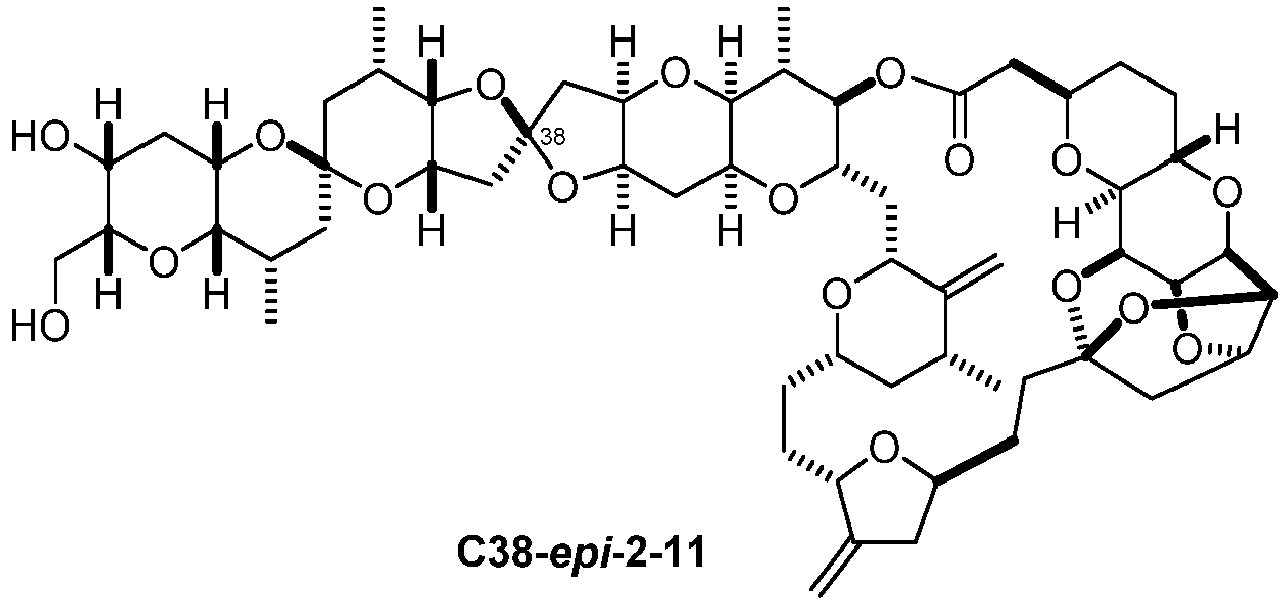
- C38-epi-2-11: [α]20 D -68.3 (c 0.20, MeOH). 1H NMR (600 MHz, CD3OD) δ: 5.04 (1H, s), 5.00 (1H, s), 4.87 (1H, s), 4.80 (1H, s), 4.72 (1H, dd, J = 12.0, 7.2 Hz), 4.70 (1H, dd, J = 6.0, 5.4 Hz), 4.60 (1H, dd, J= 5.4, 5.4 Hz), 4.43 (1H, d, J = 12.0 Hz), 4.36 (1H, ddd, J = 12.0, 12.0, 4.8 Hz), 4.27 (1H, m), 4.18-4.05 (6H, m), 4.10 (1H, dd, J = 5.4, 1.8 Hz), 3.91-3.84 (3H, m), 3.78 (1H, s), 3.70-3.60 (4H, m), 3.57 (1H, d, J = 13.8 Hz), 3.42 (1H, dd, J = 7.8, 6.6 Hz), 3.33 (1H, d, J = 2.4 Hz), 3.32-3.31 (2H, m), 3.16 (1H, dd, J = 10.6, 7.6 Hz),2.99 (1H, d, J = 11.4 Hz), 2.84-2.79 (1H, m), 2.55 (1H, dd, J = 20.7, 10.5 Hz), 2.45 (1H, dd, J = 20.7, 2.4 Hz), 2.35-1.90 (20H, m), 1.86-1.70 (3H, m), 1.74-1.51 (5H, m), 1.51-1.29 (9H, m), 1.10 (3H, d, J= 7.8 Hz), 1.03 (3H, d, J= 8.4 Hz), 1.05-0.99 (1H, m), 1.01 (3H, d, J= 7.8 Hz), 1.00 (3H, d, J = 7.8 Hz) ppm. 13C NMR (125 MHz, CD3OD) δ: 172.8, 153.3, 152.8, 115.6, 111.3, 105.1, 104.7, 98.4, 83.8, 82.4, 81.5, 79.8, 79.2, 79.0, 78.9, 78.4, 77.9, 77.9, 77.0, 76.5, 76.1, 76.1, 76.0, 75.2, 75.2, 75.0, 74.7, 73.2, 73.2, 69.5, 68.5, 68.3, 66.3, 63.2, 49.5, 45.5, 45.0, 44.8, 41.2, 39.6, 38.7, 38.2, 38.2, 37.5, 37.4, 37.2, 35.4, 35.3, 34.6, 33.3, 31.8, 31.3, 31.0, 30.7, 30.1, 29.2, 27.0, 18.4, 18.3, 17.4, 15.2 ppm. FTIR (film): 3465, 2960, 2918, 2850, 1735, 1668, 1590, 1433, 1210, 1134, 1097, 1022 cm-1. HRMS (ESI) m/z: [M+Na]+ calcd for C58H82O18Na, 1089.5393; found, 1089.5367. C38-epi-2-11 was epimerized to 2-11 by the following procedure:

- To a solution of C38-epi-2-11 (10.1 mg, 0.0095 mmol, 1 eq.) in CH2Cl2 (4.7 mL) was added TMSOTf (95 µL, 0.525 mmol, excess) at -78 °C. After being stirred for 15 min at the same temperature, the reaction was quenched with sat. NaHCO3 aq. After being stirred for 1 h at 0 °C, the organic layer was separated and the aqueous layer was extracted with CH2Cl2. The combined organic layer was dried over Na2SO4, filtered, and concentrated under reduced pressure. The crude material was purified by YAMAZEN purification system with ODS column (Rf gradient: 10% MeCN in H2O to 100% MeCN) to give 2-11 (6.9 mg, 0.0065 mmol, 68%) as a white solid.
- An exemplary reaction sequence converting Compound (2) to Compound (1) is shown below in
Scheme 3. Exemplary experimental procedures are provided below.
-

- In a glove box, to a solution of iodide 2-5 (200 mg, 0.203 mmol, 1 eq.) and thioester 2-14 (252.5 mg, 0.264 mmol, 1.3 equiv.) in DMI (1.7 mL) and EtOAc (0.34 mL) were added DTBMP (167 mg, 0.816 mmol, 4 eq.), Zn powder (80.0 mg, 1.22 mmol, 6 eq.), Cp2ZrCl2 (178.4 mg, 0.612 mmol, 3 eq.), and NiBr2-dtbbpy (29.7 mg, 0.062 mmol, 30 mol%) at room temperature. After being stirred for 1.5 h at the same temperature, the reaction mixture was removed from glove box and diluted with EtOAc and sat. NaHCO3 aq. The organic layer was separated and the aqueous layer was extracted with EtOAc. The combined organic layer was dried over Na2SO4, filtered, and concentrated under reduced pressure. The obtained crude material was purified by YAMAZEN purification system on neutral silica gel to give ketone 2-S-1 (303 mg, 0.178 mmol, 88%) as a white amorphous solid. (2-S-1): [α]20 D -58.3 (c 1.20, CHCl3). 1H NMR (600 MHz, C6D6) δ: 5.21 (1H, s), 5.11 (1H, s), 4.94 (1H, s), 4.85 (1H, d, J = 7.2 Hz), 4.81-4.78 (2H, m), 4.69 (1H, d, J= 10.2 Hz), 4.54-4.51 (2H, m), 4.36 (1H, d, J= 7.8 Hz), 4.27 (1H, s), 4.24 (1H, m), 4.18-4.13 (2H, m), 4.10-4.07 (2H, m), 3.93-3.88 (2H, m), 3.83-3.81 (3H, m), 3.78-3.75 (2H, m), 3.63 (1H, dd, J = 6.0, 4.2 Hz), 3.44 (2H, m), 3.33 (1H, s), 3.19 (1H, dd, J= 16.2, 10.2 Hz), 3.16 (1H, d, J= 5.4 Hz), 3.11-3.02 (2H, m), 2.78 (1H, dd, J= 16.8, 7.2 Hz), 2.60 (1H, d, J= 9.6 Hz), 2.49-2.43 (1H, m), 2.41-2.31 (5H, m), 2.28-2.24 (3H, m), 2.19-1.96 (10H, m), 1.93 (1H, d, J= 13.2 Hz), 1.87-1.64 (7H, m), 1.61 (1H, ddd, J= 15.0, 4.8, 4.8 Hz), 1.56-1.43 (7H, m), 1.40 (1H, dd, J = 13.2, 4.8 Hz), 1.33 (1H, dd, J = 9.6, 9.6 Hz), 1.18 (3H, d, J = 6.6 Hz), 1.15 (3H, d, J = 7.2 Hz), 1.12-1.04 (27H, m), 1.10 (9H, s), 1.04 (9H, s), 1.00 (3H, d, J= 6.6 Hz), 0.96 (3H, d, J= 6.0 Hz), 0.78 (6H, q, J= 8.0 Hz), 0.69-0.65 (12H, m), 0.28 (6H, s), 0.150 (3H, s), 0.148 (3H, s) ppm. 13C NMR (125 MHz, C6D6) δ: 206.8, 171.3, 153.0, 152.7, 110.0, 104.9, 103.8, 97.0, 82.4, 81.5, 81.0, 80.4, 78.4, 78.1, 77.6, 76.9, 75.5, 74.9, 74.7, 74.1, 74.0, 73.8, 72.9, 72.0, 71.8, 71.5, 70.5, 69.9, 68.4, 68.3, 65.9, 64.6, 48.6, 46.8, 46.3, 43.9, 41.3, 39.5, 39.3, 38.5, 38.2, 37.8, 36.4, 35.5, 35.4, 35.3, 32.5, 31.3, 30.7, 30.6, 29.0, 26.6, 26.3(×6), 26.3(×6), 18.7, 18.6, 18.5, 18.4, 18.1, 16.4, 7.4(×6), 7.4(×6), 7.3(×6), 6.0(×3), 5.7(×3), 5.3(×3), -4.0, -4.2, -5.1, -5.2 ppm. FTIR (film): 3450, 2936, 2864, 1734, 1642, 1547, 1147, 1112, 1055, 1021, 997 cm-1. HRMS (ESI) m/z: [M+Na]+ calcd for C90H158O20Si5Na, 1722.0085; found, 1722.0061.

- A buffered TBAF solution was prepared by mixing TBAF solution (TCI #T1125; 3.52 mL of 1 M in THF, 3.52 mmol, 10 eq.) and PivOH (180 mg, 1.76 mmol, 5 eq.). To a stirred solution of 2-S-1 (303 mg, 0.178 mmol, 1 equiv.) in DMF (8.8 mL) was added the buffered TBAF solution at room temperature. After being stirred for 4 h at the same temperature, CaCO3 (6.0 g) and DOWEX 50WX8-400 (6.0 g) were added. After being stirred for 2 h at room temperature, the resulted mixture was diluted with EtOAc and filtered through a pad of Celite. The filter cake was washed with EtOAc thoroughly. The filtrate was concentrated under reduced pressure to give a crude material, which was used in the next step without further purification. To a stirred solution of the crude material (calculated as 0.178 mmol, 1 eq.) in CH2Cl2 (17.6 mL) was added PPTS (221.8 mg, 0.882 mmol, 5 eq.) at room temperature. After being stirred for 4 h at the same temperature, the reaction mixture was directly subjected to column chromatography on amino silica gel (100% EtOAc, then 9% MeOH in EtOAc) to give a crude 2-17 with its C38 epimer. The mixture was purified by YAMAZEN purification system with ODS column (Rf gradient: 10% MeCN in H2O to 100% MeCN) to give halichondrin B 17 (133.0 mg, 0.120 mmol, 68% for 2 steps) as a white crystalline solid and C38-epi-17 (25.0 mg, 0.0225 mmol, 13% for 2 steps) as a white solid. Halichondrin B (17): [α]20 D -62.3 (c 1.00, MeOH). MP: 164-166 °C (recrystallized from Hexanes-CH2Cl2). 1H NMR (600 MHz, CD3OD) δ: 5.07 (1H, d, J= 1.8 Hz), 5.02 (1H, d, J = 1.8 Hz), 4.89 (1H, s), 4.81 (1H, s), 4.70 (1H, dd, J= 4.8, 3.6 Hz), 4.63 (1H, dd, J= 7.2, 4.8 Hz), 4.60 (1H, dd, J= 4.2, 4.2 Hz), 4.45 (1H, d, J= 10.8 Hz), 4.33 (1H, ddd, J= 9.6, 9.6, 4.2 Hz), 4.30 (1H, m), 4.25-4.23 (1H, m), 4.18 (1H, dd, J= 6.6, 4.2 Hz), 4.13-4.05 (6H, m), 3.99 (1H, ddd, J = 9.6, 4.8, 4.8 Hz), 3.90-3.85 (3H, m), 3.71 (1H, dd, J= 10.2, 10.2 Hz), 3.70 (1H, m), 3.61 (1H, d, J= 7.6 Hz), 3.56 (1H,s), 3.53 (1H, dd, J= 10.4, 4.2 Hz), 3.47 (1H, dd, J= 10.8, 6.0 Hz), 3.22 (1H, dd, J = 6.6, 4.8 Hz), 2.98 (1H, dd, J = 9.6, 2.4 Hz), 2.82-2.78 (1H, m), 2.56 (1H, dd, J= 17.4, 9.6 Hz), 2.45 (1H, dd, J= 17.4, 2.4 Hz), 2.39 (1H, dd, J= 13.8, 5.7 Hz), 2.38-2.22 (7H, m), 2.22-2.16 (2H, m), 2.09-1.97 (7H, m), 1.86-1.81 (3H, m), 1.77-1.67 (4H, m), 1.62-1.58 (2H, m), 1.57-1.29 (9H, m), 1.10 (3H, d, J= 6.6 Hz), 1.06 (3H, d, J= 6.6 Hz), 1.05-0.99 (1H, m), 1.02 (3H, d, J= 6.6 Hz), 0.97 (3H, d, J= 6.6 Hz) ppm. 13C NMR (125 MHz, CD3OD) δ: 172.8, 153.3, 153.2, 114.8, 111.3, 105.7, 104.8, 98.4, 83.8, 82.4, 81.3, 81.3, 80.7, 79.1, 78.1, 77.9, 77.9, 77.4, 77.2, 76.3, 76.1, 75.8, 75.4, 75.0, 75.0, 74.9, 73.7, 73.3, 73.1, 73.0, 71.6, 69.6, 67.2, 65.7, 49.4, 45.5, 44.9, 44.9, 41.2, 39.7, 37.9, 37.9, 37.8, 37.5, 37.5, 37.2, 36.3, 35.8, 33.0, 31.8, 31.3, 31.0, 30.8, 29.4, 27.1, 27.1, 18.4, 18.3, 18.1, 15.8 ppm. FTIR (film): 3460, 2936, 2864, 1736, 1642, 1557, 1167, 1122, 1105, 1054, 1041, 1021, 997 cm-1. HRMS (ESI) m/z: [M+Na]+ calcd for C60H86O19Na, 1133.5656; found, 1133.5651.

- C38-epi-Halichondrin B: [α]20 D -66.0 (c 1.00, MeOH). 1H NMR (600 MHz, CD3OD) δ: 5.04 (1H, s), 5.00 (1H, s), 4.87 (1H, s), 4.81 (1H, s), 4.72 (1H, dd, J = 10.2, 6.6 Hz), 4.70 (1H, dd, J= 4.2, 4.2 Hz), 4.60 (1H, dd, J= 4.8, 4.8 Hz), 4.43 (1H, d, J= 10.8 Hz), 4.37 (1H, ddd, J = 12.0, 12.0, 4.8 Hz), 4.27 (1H, m), 4.19-4.06 (8H, m), 3.99 (1H, ddd, J= 9.6, 5.4, 4.2 Hz), 3.91-3.82 (4H, m), 3.78 (1H, ddd, J = 14.4 4.8, 4.2 Hz), 3.64-3.56 (3H, m), 3.53 (1H, dd, J= 11.4, 4.5 Hz), 3.46 (1H, dd, J= 11.4, 6.0 Hz), 3.34 (2H, m), 3.17 (1H, dd, J = 8.7, 6.3 Hz), 2.99 (1H, dd, J = 9.6, 1.8 Hz), 2.84-2.79 (1H, m), 2.55 (1H, dd, J = 16.8, 8.4 Hz), 2.47 (1H, dd, J = 16.8, 2.4 Hz), 2.35-1.93 (20H, m), 1.86-1.82 (2H, m), 1.79-1.70 (5H, m), 1.67-1.33 (12H, m), 1.10 (3H, d, J= 6.6 Hz), 1.04 (3H, d, J= 8.4 Hz), 1.05-0.99 (1H, m), 1.02 (3H, d, J= 7.8 Hz), 1.00 (3H, d, J= 6.6 Hz) ppm. 13C NMR (125 MHz, CD3OD) δ: 172.8, 153.3, 152.8, 115.5, 111.3, 105.1, 104.7, 98.2, 83.8, 82.4, 81.3, 81.1, 79.9, 79.2, 78.9, 78.9, 78.4, 77.9, 77.9, 76.5, 76.1, 76.1, 76.0, 75.2, 75.2, 74.7, 73.5, 73.3, 73.1, 73.0, 71.7, 69.5, 68.2, 67.1, 49.9, 45.6, 45.0, 44.7, 41.2, 39.6, 38.3, 38.2, 38.1, 37.5, 37.5, 37.2, 36.2, 35.4, 33.3, 31.8, 31.3, 30.9, 30.5, 30.2, 29.3, 27.1, 26.8, 18.4, 18.3, 15.2 ppm. FTIR (film): 3460, 2936, 2864, 1736, 1642, 1557, 1167, 1122, 1105, 1054, 1041, 1021, 997 cm-1. HRMS (ESI) m/z: [M+Na]+ calcd for C60H86O19Na, 1133.5656; found, 1133.5651. C38-epi-17 was epimerized to halichondrin B (17) by the following procedure:

- To a solution of C38-epi-17 (25.0 mg, 0.0225 mmol, 1 eq.) in CH2Cl2 (11.2 mL) was added TMSOTf (0.225 mL, 0.719 mmol, excess) at -78 °C. After being stirred for 15 min, the reaction was quenched with sat. NaHCO3 aq. After being stirred for 1 h at 0 °C, the organic layer was separated and the aqueous layer was extracted with CH2Cl2. The combined organic layer was dried over Na2SO4, filtered, and concentrated under reduced pressure. The crude material was purified by YAMAZEN purification system with ODS column (Rf gradient: 10% MeCN in H2O to 100% MeCN) to give halichondrin B (17) (17.1 mg, 0.0154 mmol, 68%) as a colorless solid.
-

- In a glove box, to a solution of iodide 2-5 (100 mg, 0.102 mmol, 1 eq.) and thioester 2-16 (95.5 mg, 0.132 mmol, 1.3 eq.) in DMI (0.85 mL) and EtOAc (0.17 mL) were added DTBMP (83.8 mg, 0.408 mmol, 4 eq.), Zn powder (40.0 mg, 0.612 mmol, 6 eq.), Cp2ZrCl2 (89.4 mg, 0.306 mmol, 3 eq.), and NiBr2-dtbbpy (14.9 mg, 0.0306 mmol, 30 mol%) at room temperature. After being stirred for 1.5 h at the same temperature, the reaction mixture was removed from glove box and diluted with EtzO and sat. NaHCO3 aq. The organic layer was separated and the aqueous layer was extracted with Et2O. The combined organic layer was dried over Na2SO4, filtered, and concentrated under reduced pressure. The obtained crude material was purified by flash column chromatography on neutral silica gel (0%, 15%, 25% EtOAc in Hexanes) to give ketone 2-S-2 (125.7 mg, 0.0856 mmol, 84%) as a colorless amorphous solid. (2-S-2): [α]20 D -68.4 (c 1.00, CHCl3). 1H NMR (600 MHz, C6D6) δ: 5.21 (1H, s), 5.11 (1H, s), 4.94 (1H, s), 4.85 (1H, t, J = 6.6 Hz), 4.81-4.77 (2H, m), 4.69 (1H, d, J = 10.2 Hz), 4.52 (1H, ddd, J= 9.8, 9.8, 4.2 Hz), 4.36 (1H, d, J= 9.6 Hz), 4.27 (1H, s), 4.14 (1H, dd, J= 4.2, 4.2 Hz), 4.11-4.06 (2H, m), 4.03-3.97 (3H, m), 3.89 (1H, dd, J= 5.7, 5.7 Hz), 3.84-3.72 (4H, m), 3.78-3.68 (5H, m), 3.64 (1H, dd, J= 6.3, 3.9 Hz), 3.59 (1H, brs), 3.45 (1H, q, J= 4.0 Hz), 3.38 (3H, s), 3.37 (1H, s), 3.20-3.14 (2H, m), 3.13 (1H, s), 3.07 (1H, dd, J= 17.8, 6.0 Hz), 2.99 (1H, dd, J= 17.8, 6.0 Hz), 2.84 (1H, dd, J= 14.4, 7.8 Hz), 2.81-2.75 (2H, m), 2.61 (1H, d, J= 10.2 Hz), 2.58 (1H, dd, J= 14.8, 5.4 Hz), 2.42-2.21 (7H, m), 2.21-2.06 (5H, m), 1.99 (1H, dd, J= 12.6, 12.6 Hz), 1.93 (1H, d, J= 13.2 Hz), 1.89-1.82 (1H, m), 1.79-1.64 (3H, m), 1.62-1.30 (9H, m), 1.18 (3H, d, J = 6.6 Hz), 1.12-1.04 (31H, m), 1.01 (3H, d, J= 6.6 Hz), 0.98 (3H, d, J= 6.6 Hz), 0.70-0.61 (18H, m) ppm. 13C NMR (125 MHz, C6D6) δ: 206.9, 171.7, 171.3, 153.0, 152.6, 110.0, 104.9, 103.7, 96.9, 82.4, 81.0, 78.3, 78.0, 77.7, 77.2, 76.9, 76.5, 76.1, 75.5, 74.8, 74.70, 74.67, 74.1, 74.0, 73.8, 73.0, 70.3, 69.6, 68.4, 65.9, 65.7, 64.6, 64.5, 50.9, 48.6, 46.8, 46.3, 43.9, 41.3, 39.5, 39.3, 38.6, 37.5, 36.3, 35.5, 35.4, 32.5, 31.1, 31.0, 30.7, 30.6, 29.2, 29.0, 26.2, 18.6, 18.1, 17.2, 16.4, 7.4, 7.28, 7.25, 6.0, 5.4, 5.3 ppm; FTIR (film): 2954, 2921, 2876, 1737, 1458, 1436, 1372, 1287, 1262, 1239, 1207, 1187, 1154, 1073, 740, 728 cm-1. HRMS (ESI) m/z: [M+Na]+ calcd for C78H128O20Si3Na, 1491.8204; found, 1491.8181.

- A buffered TBAF solution was prepared by mixing TBAF solution (TCI #T1125; 0.86 mL of 1 M in THF, 0.86 mmol, 10 eq.) and PivOH (43.9 mg, 0.430 mmol, 5 eq.). To a stirred solution of ketone 2-S-2 (125.7 mg, 0.0856 mmol, 1 eq.) in DMF (4.3 mL) was added the buffered TBAF solution at room temperature. After being stirred for 6 h at the same temperature, CaCO3 (2.4 g) and DOWEX 50WX8-400 (2.4 g) were added after diluting with 10 mL EtOAc. After being stirred for 1 h at room temperature, the resulted mixture was diluted with EtOAc and filtered through a pad of Celite. The filter cake was washed with EtOAc thoroughly. The filtrate was concentrated under reduced pressure to give a crude tetraol, which was used in the next step without further purification. To a stirred solution of the crude tetraol (calculated as 0.0856 mmol, 1 eq.) in CH2Cl2 (8.5 mL) was added PPTS (86.4 mg, 0.344 mmol, 4 eq.) at room temperature. After being stirred for 1 h at the same temperature, the reaction mixture was directly subjected to column chromatography on amino silica gel (CH2Cl2 then 25%, 50%, 75%, then 100% EtOAc in Hexanes then 2% MeOH in EtOAc) to give a crude Norhalichondrin B methyl ester with its C38 epimer. The compound was used in the next step after concentration without further purification.
To a stirred solution of the crude methyl ester (calculated as 0.0856 mmol, 1 eq.) in THF (10 mL) was added 1M LiOH aq. (3.3 mL) at room temperature.3 After being stirred for 2 h at the same temperature, the reaction mixture was diluted with 6.6 mL of water. The THF was then removed from the mixture by evaporator. After the reaction was cooled down to 0 °C, 1 M HCl aq. (3.3 mL) was added and the reaction mixture was allowed for further 2 min stirring. The resulting mixture was extracted by EtOAc. The combined organic layer was dried over Na2SO4, filtered, and concentrated under reduced pressure. The resulting mixture was purified by YAMAZEN purification system with ODS column (Rf gradient: 10% MeCN in H2O to 100% MeCN) to give Norhalichondrin B (18) (62.4 mg, 0.0570 mmol, 67% for 3 steps) as a colorless solid and 38-epi-Norhalichondrin B (C38-epi-18) (8.4 mg, 0.0077 mmol, 9% for 3 steps) as a colorless solid. Norhalichondrin B (18): [α]20 D -54.6 (c 1.00, MeOH).. 1H NMR (600 MHz, CD3OD) δ: 5.06 (1H, d, J= 1.5 Hz), 5.01 (1H, d, J= 1.5 Hz), 4.88 (1H, s), 4.81 (1H, d, J = 1.5 Hz), 4.70 (1H, t, J = 4.0 Hz), 4.63 (1H, dd, J = 7.8, 4.7 Hz), 4.60 (1H, t, J = 4.0 Hz), 4.45 (1H, d, J = 9.6 Hz), 4.32 (1H, td, J = 10.2, 4.6 Hz), 4.31-4.29 (1H, m), 4.24 (1H, ddd, J= 11.2, 4.2, 1.8 Hz), 4.18 (1H, dd, J = 6.6, 4.8 Hz), 4.14-4.09 (3H, m), 4.07 (1H, dd, J = 9.6, 9.3 Hz), 3.99 (1H, dd, J = 5.8, 2.4 Hz), 3.91-3.85 (2H, m), 3.82-3.78 (2H, m), 3.74-3.69 (2H, m), 3.61 (1H, d, J= 10.4 Hz), 3.59-3.56 (1H, m), 3.30 (1H, m), 3.22 (1H, dd, J= 6.6, 5.1 Hz), 2.98 (1H, dd, J= 9.6, 1.8 Hz), 2.81 (1H, ddd, J= 16.0, 8.0, 2.1 Hz), 2.59 (1H, dd, J = 15.0, 7.8 Hz), 2.57-2.52 (2H, m), 2.45 (1H, dd, J = 17.6, 1.8 Hz), 2.40 (1H, dd, J = 13.2, 6.2 Hz), 2.34-2.32 (2H, m), 2.32-2.24 (4H, m), 2.21-2.15 (3H, m), 2.13-1.93 (8H, m), 1.87-1.79 (2H, m), 1.76-1.71 (3H, m), 1.70-1.66 (1H, m), 1.64-1.57 (1H, m), 1.56-1.47 (4H, m), 1.46-1.29 (5H, m), 1.10 (3H, d, J = 6.6 Hz), 1.06 (3H, d, J = 7.0 Hz), 1.02 (1H, d, J =12.0 Hz), 0.98 (3H, d, J= 7.2 Hz), 0.95 (3H, d, J= 7.2 Hz) ppm. 13C NMR (150 MHz, CD3OD) δ: 172.8 (2C), 153.3, 153.2, 114.7, 111.2, 105.6, 104.8, 98.5, 83.8, 82.4, 80.6, 79.0, 78.1, 77.90, 77.85, 77.76, 77.4, 77.23, 77.18, 76.3, 76.1, 75.8, 75.4, 75.02, 74.98, 74.9, 73.7, 72.7, 69.6, 68.0, 67.8, 65.8, 49.4, 45.4, 44.9, 44.7, 41.2, 39.8, 38.22, 38.20, 38.0, 37.8, 37.5, 37.2, 35.7, 35.5, 33.0, 31.8, 31.3, 31.0, 30.8, 30.0, 29.4, 27.3, 18.4, 18.1,17.3, 15.8 ppm. FTIR (film): 3480, 2926, 2873, 2853, 1736, 1676, 1565, 1395, 1334, 1265, 1207, 1188, 1152, 1134, 1118, 1086, 1072, 1045, 1020, 996 cm-1, HRMS (ESI) m/z: [M+Na]+ calcd for C59H82O19Na, 117.5348; found 1117.5292.
- 38-epi -Norhalichondrin B (C38-epi-18): [α]20 D -69.7 (c 0.400, MeOH). 1H NMR (600 MHz, CD3OD) δ: 5.04 (1H, d, J= 1.5 Hz), 4.96 (1H, d, J= 1.5 Hz), 4.87 (1H, d, J= 1.5 Hz), 4.80 (1H, s), 4.74-4.68 (2H, m), 4.60 (1H, t, J = 4.5 Hz), 4.43 (1H, d, J = 9.6 Hz), 4.37 (1H, td, J = 10.2, 4.6 Hz), 4.30-4.25 (1H, m), 4.20-4.04 (4H, m), 4.01 (1H, dd, J = 5.8, 2.4 Hz), 3.91-3.83 (2H, m), 3.80 (1H, t, J= 7.8 Hz), 3.75 (1H, brs), 3.65-3.55 (2H, m), 3.34 (1H, m), 3.17 (1H, dd, J = 6.6, 5.0 Hz), 2.99 (1H, dd, J = 9.6, 1.8 Hz), 2.82 (1H, ddd, J = 16.0, 8.0, 2.1 Hz), 2.63-2.51 (2H, m), 2.48 (1H, dd, J = 15.0, 7.8 Hz), 2.36-2.24 (4H, m), 2.23-2.13 (4H, m), 2.13-1.92 (5H, m), 2.47 (1H, dd, J = 17.6, 1.8 Hz), 2.40 (1H, dd, J = 13.2, 6.2 Hz), 2.34-2.32 (2H, m), 2.32-2.24 (4H, m), 2.21-2.15 (2H, m), 2.13-1.93 (6H, m), 1.82 (1H, td, J = 12.0, 2.0 Hz), 1.77 (1H, d, J = 12.0 Hz), 1.72 (1H, d, J = 12.0 Hz), 1.69-1.60 (2H, m), 1.59-1.47 (3H, m), 1.47-1.34 (4H, m), 1.10 (3H, d, J= 6.6 Hz), 1.06 (1H, d, J= 12.0 Hz), 1.04 (3H, d, J= 7.0 Hz), 1.00 (3H, d, J= 7.2 Hz), 0.97 (3H, d, J= 7.2 Hz) ppm. 13C NMR (150 MHz, CD3OD) δ: 172.9 (2C), 153.3, 152.9, 115.6, 111.4, 105.1, 104.7, 98.4, 83.8, 82.4, 79.9, 79.2, 79.0, 78.4, 78.0, 77.9, 77.1, 76.5, 76.1, 76.0, 75.2, 74.8, 73.3, 73.2, 69.5, 68.3, 68.0, 67.9, 45.6, 45.0, 44.7, 41.2, 38.9, 38.7, 38.3, 38.2, 37.5, 37.2, 35.5, 33.3, 31.8, 31.3, 31.0, 30.2, 30.0, 29.3, 27.0, 18.4, 18.3, 17.4, 15.2 ppm. FTIR (film): HRMS (ESI) m/z: [M+Na]+ calcd for C59H82O19Na, 117.5348; found 1117.5292. C38-epi-18 was epimerized to Norhalichondrin B (18) by the following procedure:

- To a solution of C38-epi-18 (8.4 mg, 0.0077 mmol, 1 eq.) in CH2Cl2 (3 mL) was added TMSOTf (0.07 mL, 0.385 mmol, excess) at -78 °C. After being stirred for 15 min at the same temperature, the reaction was quenched with sat. NaHCO3 aq. After being stirred for 1 h at 0 °C, the organic layer was separated and the aqueous layer was extracted with CH2Cl2. The combined organic layer was dried over Na2SO4, filtered, and concentrated under reduced pressure. The crude material was purified by YAMAZEN purification system with ODS column (Rf gradient: 10% MeCN in H2O to 100% MeCN) to give Norhalichondrin B (18) (5.0 mg, 0.0046 mmol, 60%) as a colorless solid.
-

- In a glove box, to a solution of iodide 2-5 (103 mg, 0.105 mmol, 1 eq.) and thioester 2-16 (113 mg, 0.132 mmol, 1.3 eq.) in DMI (0.85 mL) and EtOAc (0.17 mL) were added DTBMP (83.8 mg, 0.408 mmol, 4 eq.), Zn powder (40.0 mg, 0.612 mmol, 6 eq.), Cp2ZrCl2 (89.4 mg, 0.306 mmol, 3 eq.), and NiBr2-dtbbpy (14.9 mg, 0.0306 mmol, 30 mol%) at room temperature. After being stirred for 1.5 h at the same temperature, the reaction mixture was removed from glove box and diluted with Et2O and sat. NaHCO3 aq. The organic layer was separated and the aqueous layer was extracted with Et2O. The combined organic layer was dried over Na2SO4, filtered, and concentrated under reduced pressure. The obtained crude material was purified by flash column chromatography on neutral silica gel (0%, 9%, 17% EtOAc in Hexanes) to give ketone 2-S-3 (137 mg, 0.0857 mmol, 82%) as a colorless amorphous solid. In a preliminary study, the coupling reaction of iodide 5 (25.0 mg, 0.0254 mmol) and thioester 16 (30.0 mg, 0.0352 mmol) gave desired ketone (35.7 mg 0.0223 mmol) in 88% yield. (2-S-3): [α]20 D -50.8 (c 1.00, CHCl3). 1H NMR (600 MHz, C6D6) δ: 5.21 (1H, s), 5.11 (1H, s), 4.93 (1H, s), 4.85-4.78 (3H, m), 4.69 (1H, d, J = 10.2 Hz), 4.52 (1H, ddd, J = 9.8, 9.8, 4.2 Hz), 4.47 (1H, ddd, J = 10.4, 5.3, 5.3 Hz), 4.34 (1H, d, J = 9.6 Hz), 4.27 (1H, s), 4.14 (1H, dd, J = 4.2, 4.2 Hz), 4.11-4.07 (2H, m), 4.02-4.00 (3H, m), 3.89 (1H, dd, J = 5.7, 5.7 Hz), 3.84-3.80 (3H, m), 3.78-3.68 (5H, m), 3.64 (1H, dd, J = 6.3, 3.9 Hz), 3.45 (1H, d, J = 3.6 Hz), 3.29 (1H, s), 3.20-3.16 (2H, m), 3.06 (1H, dd, J = 17.6, 5.7 Hz), 3.01 (1H, dd, J = 17.6, 6.9 Hz), 2.93 (1H, s), 2.80 (1H, d, J = 7.8 Hz), 2.77 (1H, d, J = 7.2 Hz), 2.61 (1H, d, J = 10.2 Hz), 2.46 (1H, d, J = 15.0 Hz), 2.39-2.22 (9H, m), 2.20-2.05 (6H, m), 1.98 (1H, dd, J = 12.6, 12.6 Hz), 1.93 (1H, d, J = 13.2 Hz), 1.87-1.84 (2H, m), 1.75-1.65 (4H, m), 1.62-1.30 (11H, m), 1.18 (3H, d, J = 6.6 Hz), 1.12-1.04 (30H, m), 1.04-1.03 (12H, m), 0.96 (3H, d, J = 6.6 Hz), 0.77 (6H, q, J = 8.0 Hz), 0.69-0.64 (12H, m), 0.14 (3H, s), 0.13 (3H, s) ppm. 13C NMR (125 MHz, C6D6) δ: 206.7, 171.3, 153.0, 152.6, 110.0, 104.9, 103.7, 96.9, 82.4, 81.0, 79.1, 78.3, 78.0, 77.9, 77.7, 76.9, 76.8, 76.1, 75.5, 74.8, 74.7, 74.2, 74.1, 74.0, 73.8, 73.6, 73.0, 70.4, 69.3, 68.4, 66.1, 65.9, 64.7, 63.7, 48.6, 46.8, 46.3, 43.9, 41.3, 39.5, 39.3, 38.6, 37.7, 37.6, 36.5, 36.3, 35.5, 35.3, 32.5, 31.6, 31.1, 30.7, 30.65, 30.60, 29.5, 29.0, 26.2, 18.7, 18.6, 18.1, 17.6, 16.4, 7.5, 7.34, 7.28, 6.0, 5.7, 5.3, -5.1, -5.3 ppm. FTIR (film): 2953, 2927, 2875, 1720, 1459, 1086, 1015, 834, 725 cm-1. HRMS (ESI) m/z: [M+Na]+ calcd for C85H144O20Si4Na, 1619.9220; found, 1619.9298.

- A buffered TBAF solution was prepared by mixing TBAF solution (TCI #T1125; 0.86 mL of 1 M in THF, 0.86 mmol, 10 eq.) and PivOH (43.9 mg, 0.430 mmol, 5 eq.). To a stirred solution of ketone 2-S-3 (137 mg, 0.0857 mmol, 1 eq.) in DMF (4.3 mL) was added the buffered TBAF solution at room temperature. After being stirred for 7 h at the same temperature, CaCO3 (2.4 g) and DOWEX 50WX8-400 (2.4 g) were added. After being stirred for 1 h at room temperature, the resulted mixture was diluted with EtOAc and filtered through a pad of Celite. The filter cake was washed with EtOAc thoroughly. The filtrate was concentrated under reduced pressure to give a crude tetraol, which was used in the next step without further purification. To a stirred solution of the crude tetraol (calculated as 0.0857 mmol, 1 eq.) in CH2Cl2 (8.6 mL) was added PPTS (108 mg, 0.430 mmol, 5 eq.) at room temperature. After being stirred for 1 h at the same temperature, the reaction mixture was directly subjected to column chromatography on amino silica gel (CH2Cl2 then 25%, 50%, 75%, then 100% EtOAc in Hexanes then 2% MeOH in EtOAc) to give a crude Homohalichondrin B with its C38 epimer. The mixture was purified by YAMAZEN purification system with ODS column (Rf gradient: 10% MeCN in H2O to 100% MeCN) to give Homohalichondrin B (19) (63.8 mg, 0.0568 mmol, 66% for 2 steps) as a colorless solid and 38-epi-Homohalichondrin B (C38-epi-19) (14.4 mg, 0.0.0128 mmol, 15% for 2 steps) as a colorless solid. Homohalichondrin B (19): [α]20 D -43.7 (c 1.02, MeOH). 1H NMR (600 MHz, CD3OD) δ: 5.06 (1H, s), 5.01 (1H, s), 4.88 (1H, s), 4.81 (1H, s), 4.70 (1H, dd, J = 4.5, 4.5 Hz), 4.63 (1H, dd, J = 7.8, 4.8 Hz), 4.60 (1H, dd, J = 4.5, 4.5 Hz), 4.45 (1H, d, J = 10.8 Hz), 4.33 (1H, ddd, J = 9.6, 9.6, 4.2 Hz), 4.30 (1H, s), 4.25-4.21 (2H, m), 4.18 (1H, dd, J = 5.7, 5.7 Hz), 4.06-4.13 (4H, m), 4.02 (1H, s), 3.95 (1H, s), 3.87-3.88 (3H, m), 3.71 (1H, dd, J = 10.2, 10.2 Hz), 3.66 (1H, s), 3.61 (1H, d, J = 10.8 Hz), 3.55-3.60 (3H, m), 3.50 (1H, ddd, J = 5.4, 5.4, 5.4 Hz), 3.21 (1H, dd, J = 5.7, 5.7 Hz), 3.12 (1H, s), 2.98 (1H, d, J = 10.2 Hz), 2.80 (1H, dd, J = 9.0, 6.6 Hz), 2.56 (1H, dd, J = 17.4, 9.6 Hz), 2.45 (1H, d, J = 17.4 Hz), 2.39 (1H, dd, J = 13.2, 5.4 Hz), 2.38-2.24 (6H, m), 2.22-2.13 (4H, m), 2.09-1.97 (9H, m), 1.90 (1H, ddd, J = 15.6, 4.2, 4.2 Hz), 1.80-1.84 (2H, m), 1.74-1.67 (3H, m), 1.60 (1H, ddd, J = 12.0, 12.0, 6.0 Hz), 1.51-1.29 (9H, m), 1.10 (3H, d, J = 6.6 Hz), 1.05 (3H, d, J = 7.2 Hz), 1.05-0.99 (1H, m), 0.95 (3H, d, J = 6.6 Hz), 0.94 (3H, d, J = 5.4 Hz) ppm. 13C NMR (125 MHz, CDCl3) δ: 171.2, 151.8, 151.6, 112.4, 110.1, 104.4, 104.1, 96.6, 82.2, 81.1, 79.8, 78.4, 77.7, 77.6, 76.6, 76.29, 76.25, 75.4, 75.3, 75.1, 74.9, 74.8, 74.4, 73.9, 73.7, 73.5, 72.8, 71.9, 71.2, 70.8, 68.2, 66.7, 65.7, 63.7, 48.4, 43.4, 42.5, 40.4, 38.7, 37.3, 37.0, 36.92, 36.87, 36.6, 36.0, 34.4, 32.1, 31.4, 30.7, 30.1, 29.4, 29.0, 28.9, 28.2, 25.8, 18.0, 17.8, 17.1, 15.0 ppm. FTIR (film): 3460, 2926, 2874, 1736, 1652, 1567, 1187, 1132, 1105, 1074, 1041, 1021, 997 cm-1. HRMS (ESI) m/z: [M+Na]+ calcd for C61H86O19Na, 1145.5656; found, 1145.5770.

- 38-epi-Homohalichondrin B (C38-epi-19): [α]20 D -86.6 (c 0.860, MeOH). 1H NMR (600 MHz, CD3OD) δ: 5.04 (1H, d, J = 1.8 Hz), 4.96 (1H, d, J = 1.8 Hz), 4.87 (1H, s), 4.80 (1H, s), 4.72 (1H, dd, J = 10.2, 6.6 Hz), 4.70 (1H, dd, J = 4.2, 4.2 Hz), 4.60 (1H, dd, J = 4.5, 4.5 Hz), 4.44 (1H, d, J = 10.8 Hz), 4.37 (1H, ddd, J = 10.2, 10.2, 4.2 Hz), 4.28 (1H, d, J = 2.4 Hz), 4.23 (1H, ddd, J = 9.6, 4.8, 4.8 Hz), 4.19-4.05 (6H, m), 4.02 (1H, s), 3.98 (1H, dd, J = 4.8, 1.8 Hz), 3.91-3.85 (3H, m), 3.81 (1H, s), 3.63 (1H, dd, J = 10.5, 10.5 Hz), 3.59-3.56 (3H, m), 3.54 (1H, d, J = 2.4 Hz), 3.51-3.47 (1H, m), 3.17 (1H, dd, J = 8.4, 6.0 Hz), 3.15 (1H, s), 2.99 (1H, dd, J = 9.6, 1.2 Hz), 2.83-2.79 (1H, m), 2.56 (1H, dd, J = 17.0, 8.7 Hz), 2.47 (1H, dd, J = 17.0, 2.4 Hz), 2.35-1.93 (21H, m), 1.91 (1H, ddd, J = 15.6, 4.5, 4.5 Hz), 1.83 (1H, ddd, J = 11.1, 11.1, 2.4 Hz), 1.77 (1H, d, J = 13.2 Hz), 1.71 (1H, dd, 13.2, 2.4 Hz), 1.68-1.60 (2H, m), 1.58-1.54 (1H, m), 1.50-1.33 (7H, m), 1.29 (1H, dd, J = 12.6, 4.2 Hz), 1.10 (3H, d, J = 7.2 Hz), 1.05-0.98 (1H, m), 1.004 (3H, d, J = 7.2 Hz), 0.995 (3H, d, J = 6.6 Hz), 0.96 (3H, d, J = 7.2 Hz) ppm. 13C NMR (125 MHz, CD3OD) δ: 172.9, 153.3, 152.8, 115.6, 111.3, 105.1, 104.7, 98.0, 83.8, 82.4, 80.2, 79.8, 79.2, 78.9, 78.5, 78.4, 77.9, 77.8, 76.5, 76.12, 76.09, 76.0, 75.7, 75.2, 75.1, 74.8, 74.4, 73.2, 72.9, 69.5, 68.3, 65.3, 65.1, 45.6, 45.0, 44.7, 41.2, 39.6, 38.6, 38.2, 38.1, 37.5, 37.2, 35.4, 33.3, 31.9, 31.8, 31.3, 30.9, 30.19, 30.16, 29.3, 26.8, 18.4, 17.7, 15.2 pm. FTIR (film): 3487, 2925, 2872, 1737, 1188, 1119, 1074, 1019, 996, 896, 735 cm-1. HRMS (ESI) m/z: [M+Na]+ calcd for C61H86O19Na, 1145.5656; found, 1145.5631. C38-epi-19 was epimerized to Homohalichondrin B (19) by the following procedure:

- To a solution of C38-epi-19 (14.4 mg, 0.0128 mmol, 1 eq.) in CH2Cl2 (6.4 mL) was added TMSOTf (0.13 mL, 0.719 mmol, excess) at -78 °C. After being stirred for 15 min at the same temperature, the reaction was quenched with sat. NaHCO3 aq. After being stirred for 1 h at 0 °C, the organic layer was separated and the aqueous layer was extracted with CH2Cl2. The combined organic layer was dried over Na2SO4, filtered, and concentrated under reduced pressure. The crude material was purified by YAMAZEN purification system with ODS column (Rf gradient: 10% MeCN in H2O to 100% MeCN) to give Homohalichondrin B (19) (8.9 mg, 0.00792 mmol, 62%) as a colorless solid.
-

- In a glove box, to a solution of iodide 2-12 (100.0 mg, 0.0883 mmol, 1 eq.) and thioester 2-14 (109.5 mg, 0.115 mmol, 1.3 eq.) in DMI (0.75 mL) and EtOAc (0.15 mL) were added DTBMP (72.5 mg, 0.353 mmol, 4 eq.), Zn powder (34.6 mg, 0.529 mmol, 6 eq.), Cp2ZrCl2 (77.4 mg, 0.265 mmol, 3 eq.), and NiBr2-dtbbpy (12.9 mg, 0.027 mmol, 30 mol%) at room temperature. After being stirred for 1.5 h at the same temperature, the reaction mixture was removed from glove box and diluted with EtOAc and sat. NaHCO2 aq. The organic layer was separated and the aqueous layer was extracted with EtOAc. The combined organic layer was dried over Na2SO4, filtered, and concentrated under reduced pressure. The obtained crude material was purified by YAMAZEN purification system on neutral silica gel (0%, 9%, then 20% EtOAc in Hexanes) to give ketone 2-S-4 (140.0 mg, 0.0756 mmol, 86%) as a colorless amorphous solid. (2-S-4): [α]20 D -64.8 (c 1.00, CHCl3). 1H NMR (600 MHz, C6D6) δ: 7.35 (2H, d, J = 8.4 Hz), 6.72 (2H, d, J = 8.4 Hz), 6.07 (1H, s), 5.19 (1H, s), 5.08 (1H, s), 4.94 (1H, s), 4.84-4.79 (3H, m), 4.66 (1H, d, J = 10.8 Hz), 4.51-4.46 (2H, m), 4.39 (1H, br s), 4.35 (1H, dd, J = 5.4, 1.2 Hz), 4.33 (1H, dd, J = 8.4, 1.2 Hz), 4.23-4.21 (1H, m), 4.14-4.11 (1H, m), 3.83-3.80 (3H, m), 4.05 (1H, s), 4.03-3.95 (4H, m), 3.91-3.87 (1H, m), 3.82-3.79 (3H, m), 3.76-3.71 (3H, m), 3.46 (1H, dd, J = 8.4, 4.8 Hz), 3.41 (1H, s), 3.31 (1H, s), 3.24 (3H, s), 3.18-3.13 (2H, m), 3.07-2.99 (2H, m), 2.76 (1H, dd, J = 16.8, 4.8 Hz), 2.74-2.70 (1H, m), 2.52 (1H, d, J = 9.6 Hz), 2.47-2.41 (1H, m), 2.37-2.29 (6H, m), 2.27-2.18 (5H, m), 2.13-1.92 (11H, m), 1.83-1.46 (12H, m), 1.38-1.27 (1H, m), 1.18 (3H, d, J = 6.6 Hz), 1.12 (3H, d, J = 7.2 Hz), 1.09 (9H, t, J = 7.2 Hz), 1.08 (9H, s), 1.07-1.03 (21H, m), 1.02 (9H, s), 0.94 (3H, d, J= 7.2 Hz), 0.76 (6H, q, J = 7.8 Hz), 0.69-0.64 (12H, m), 0.26 (6H, s), 0.13 (3H, s), 0.13 (3H, s) ppm. 13C NMR (125 MHz, C6D6) δ 206.7, 171.1, 161.4, 152.9, 152.7, 119.0, 114.1, 109.3, 109.0, 105.0, 103.8, 97.0, 90.2, 83.8, 81.5, 80.3, 78.4, 78.1, 77.9, 76.0, 76.0, 75.5, 74.8, 74.7, 74.2, 74.0, 73.6, 72.9, 72.0, 71.8, 71.5, 70.1, 69.8, 68.3, 68.3, 65.9, 64.6, 54.8, 46.8, 46.2, 44.0, 41.3, 39.5, 38.7, 38.2, 37.7, 36.4, 35.4, 35.4, 32.4, 31.0, 30.9, 30.7, 30.3, 27.6, 26.6, 26.3(×6), 26.3(×6), 18.7, 18.6, 18.5, 18.4, 18.1, 16.4, 7.4(×6), 7.3(×6), 7.3(×3), 7.3(×3), 6.0(×6), 5.7(×6), 5.3(×6) ppm. FTIR (film): 2955, 2917, 2876, 1736, 1648, 1519, 1253, 1096, 1032, 1009, 851 cm-1. HRMS (ESI) m/z: [M+Na]+ calcd for C98H164O23Si5Na, 1849.0510; found, 1849.0490.

- To a stirred solution of 2-S-5 (138 mg, 0.0735 mmol, 1 equiv.) in DMF (3.7 mL, 0.02M) was added the buffered TBAF solution (0.74 mL, 10 equiv., freshly prepared by 1.48 mL TBAF solution (1 M in THF) and 75 mg PivOH) at room temperature. After being stirred for 3 h at the same temperature, CaCO3 (3.0 g) and DOWEX 50WX8-400 (3.0 g) were added.1 After being stirred for 2 h at room temperature, the resulted mixture was diluted with EtOAc and filtered through a pad of Celite. The filter cake was washed with EtOAc thoroughly. The filtrate was concentrated under reduced pressure to give a crude material, which was used in the next step without further purification. To a stirred solution of the crude material (calculated as 0.0735 mmol, 1 eq.) in CH2Cl2 (3.7 mL, 0.02M) was added PPTS (184.6 mg, 0.735 mmol, 10 equiv.) at room temperature. After being stirred for 1.5 h at the same temperature, TLC analysis indicated the disappearance of starting material. iPrOH (1.2 mL) and additional PPTS (184.6 mg, 0.735 mmol, 10 eq.) were added to the resulted solution at the same temperature. After being stirred for 20 h, the reaction mixture was directly subjected to column chromatography on amino silica gel (CH2Cl2 then 100% EtOAc then 16% MeOH in EtOAc) to give a crude halichondrin A with its C-38 epimer. The mixture was purified by YAMAZEN purification system with ODS column (Rf gradient: 10% MeCN in H2O to 50% MeCN in H2O) to give halichondrin A (20) (40.0 mg, 0.035 mmol, 48% for 3 steps) as a white crystalline solid and 38-epi-halichondrin A (C38-epi-20) (13.5 mg, 0.0118 mmol, 16% for 3 steps) as a white solid. Halichondrin A (20): [α]20 D -73.2 (c 0.11, MeOH). MP: 168-170 °C (recrystallized from Hexanes-CH2Cl2) 1H NMR (600 MHz, CD3OD) δ: 5.08 (1H, s), 5.03 (1H, s), 4.88 (1H, s), 4.82 (1H, s), 4.62 (1H, dd, J = 7.2, 4.2 Hz), 4.45 (1H, d, J =11.2 Hz), 4.37 (1H, dd, J = 4.8, 3.0 Hz), 4.32 (1H, ddd, J = 10.0, 10.0, 4.2 Hz), 4.32-4.28 (2H, m), 4.25 (1H, ddd, J = 11.2, 4.4, 2.4 Hz), 4.20 (1H, dd, J = 3.2, 2.1 Hz), 4.14-4.07 (4H, m), 4.05 (1H, ddd, J = 2.4, 2.4, 2.4 Hz), 3.99 (1H, ddd, J = 9.6, 4.8, 4.2 Hz), 3.91-3.84 (3H, m), 3.78 (1H, ddd, J = 8.8, 4.8, 4.4 Hz), 3.75-3.70 (1H, m), 3.69 (1H, dd, J = 2.3, 2.3 Hz,), 3.61 (1H, d, J = 11.7 Hz), 3.56 (1H, dd, J = 2.3, 1.8 Hz), 3.53 (1H, s), 3.53 (1H, dd, J = 11.2, 4.7, Hz), 3.47 (1H, dd, J = 11.2, 6.5 Hz), 3.22 (1H, dd, J = 6.5, 4.7 Hz), 2.94 (1H, dd, J = 10.0, 2.3 Hz), 2.82 (1H, dddd, J = 15.8, 7.6, 4.7, 2.9 Hz), 2.57 (1H, dd, J = 17.9, 9.7 Hz), 2.45 (1H, dd, J = 17.9, 1.8 Hz), 2.40 (1H, dd, J = 13.2, 6.2 Hz), 2.36-2.24 (8H, m), 2.20-2.13 (1H, m), 2.10-1.97 (6H, m), 1.92-1.79 (4H, m), 1.78-1.67 (4H, m), 1.60 (1H, ddd, J = 14.2, 8.4, 8.4 Hz), 1.56-1.42 (4H, m), 1.42-1.28 (5H, m), 1.10 (3H, d, J = 6.5 Hz), 1.06 (3H, d, J = 7.6 Hz), 1.02 (3H, d, J = 7.0 Hz), 1.04-0.98 (1H, m), 0.97 (3H, d, J = 7.0 Hz) ppm. 13C NMR (125 MHz, 12CD3OD) δ 172.8, 153.3, 153.1, 114.8, 113.4, 112.9, 105.7, 104.8, 98.4, 85.5, 82.3, 81.3, 81.2, 80.8, 79.0, 78.0, 77.9, 77.6, 77.4, 76.3, 76.0, 75.8, 75.5, 75.2, 75.1, 75.1, 73.8, 73.7, 73.3, 73.1, 73.0, 71.6, 69.6, 67.2, 65.6, 45.6, 45.0, 44.9, 41.1, 39.8, 37.9, 37.9, 37.8, 37.5, 37.5, 37.2, 36.3, 33.0, 31.8, 31.3, 31.3, 30.9, 30.8, 28.4, 27.1, 27.1, 18.4, 18.3, 18.1, 15.9 ppm. FTIR (film): 3429, 2925, 2872, 1736, 1454, 1372, 1269, 1191, 1129, 1109, 1073, 1020, 753 cm-1. HRMS (ESI) m/z: [M+H]+ calcd for C60H87O21, 1143.5734; found, 1143.5720.

- 38-epi-Halichondrin A (C38-epi-20): [α]20 D -74.3 (c 0.50, MeOH). 1H NMR (600 MHz, CD3OD) δ: 5.04 (1H, s), 4.96 (1H, s), 4.87 (1H, s), 4.81 (1H, s), 4.72 (1H, dd, J = 10.2, 6.6 Hz), 4.43 (1H, d, J = 10.2 Hz), 4.38-4.31 (4H, m), 4.37 (1H, ddd, J = 12.0, 12.0, 4.8 Hz), 4.20 (1H, m), 4.18-4.06 (7H, m), 3.99 (1H, ddd, J = 9.6, 5.4, 4.2 Hz), 3.91-3.83 (4H, m), 3.78 (1H, ddd, J = 14.4 4.8, 4.2 Hz), 3.64 (1H, d, J = 9.6 Hz), 3.59-3.56 (2H, m), 3.53 (1H, dd, J = 10.8, 4.5 Hz), 3.47 (1H, dd, J = 11.4, 6.0 Hz), 3.17 (1H, dd, J = 9.0, 6.6 Hz), 2.95 (1H, dd, J = 9.6, 1.8 Hz), 2.86-2.80 (1H, m), 2.56 (1H, dd, J = 17.4, 9.6 Hz), 2.47 (1H, dd, J = 17.4, 2.4 Hz), 2.36-2.18 (9H, m), 2.12-2.07 (3H, m), 2.04-1.96 (4H, m), 1.88-1.81 (3H, m), 1.77-1.73 (2H, m), 1.69-1.65 (2H, m), 1.62-1.34 (10H, m), 1.09 (3H, d, J = 6.6 Hz), 1.04 (3H, d, J = 8.4 Hz), 1.05-0.99 (1H, m), 1.02 (3H, d, J = 7.8 Hz), 1.00 (3H, d, J = 6.6 Hz) ppm. 13C NMR (125 MHz, CD3OD) δ: 172.9, 153.3, 152.8, 115.6, 113.3, 113.0, 105.1, 104.7, 98.3, 85.5, 82.4, 81.3, 81.1, 80.0, 79.1, 78.9, 78.9, 78.5, 77.9, 76.7, 76.1, 76.0, 75.9, 75.5, 75.3, 74.8, 73.9, 73.5, 73.3, 73.2, 73.2, 71.7, 69.5, 68.3, 67.2, 45.6, 44.9, 44.8, 41.2, 39.7, 38.3, 38.3, 38.1, 37.5, 37.5, 37.2, 36.2, 33.3, 31.8, 31.3, 31.0, 30.9, 29.9, 28.3, 27.1, 26.8, 18.4, 18.3, 18.3, 15.2 ppm. FTIR (film): 3439, 2925, 2872, 1736, 1454, 1372, 1279, 1192, 1119, 1073, 1020, 753 cm-1. HRMS (ESI) m/z: [M+H]+ calcd for C60H87O21, 1143.5734; found, 1143.5721. C38-epi-20 was epimerized to Halichondrin A (20) by the following procedure:

- To a stirred solution of C38-epi-20 (13.0 mg, 0.0114 mmol, 1 eq.) in CH2Cl2 (5.7 mL) was added TMSOTf (0.114 mL, 0.631 mmol, excess) at -78 °C. After being stirred for 15 min, the reaction was quenched with sat. NaHCO3 aq. After being stirred for 1 h at 0 °C, the organic layer was separated and the aqueous layer was extracted with CH2Cl2. The combined organic layer was dried over Na2SO4, filtered, and concentrated under reduced pressure. The crude material was purified by YAMAZEN purification system with ODS column (Rf gradient: 10% MeCN in H2O to 50% MeCN in H2O) to give halichondrin A (20) (11.3 mg, 0.00988 mmol, 86%) as a white solid.
-

- In a glove box, to a solution of iodide 2-5 (55 mg, 0.0487 mmol, 1 eq.) and thioester 2-16 (45.9 mg, 0.0634 mmol, 1.3 eq.) in DMI (0.4 mL) and EtOAc (0.08 mL) were added DTBMP (40 mg, 0.195 mmol, 4 eq.), Zn powder (19.0 mg, 0.292 mmol, 6 eq.), Cp2ZrCl2 (42.7 mg, 0.146 mmol, 3 eq.), and NiBr2-dtbbpy (7.1 mg, 0.0146 mmol, 30 mol%) at room temperature. After being stirred for 1.5 h at the same temperature, the reaction mixture was removed from glove box and diluted with EtzO and sat. NaHCO3 aq. The organic layer was separated and the aqueous layer was extracted with Et2O. The combined organic layer was dried over Na2SO4, filtered, and concentrated under reduced pressure. The obtained crude material was purified by flash column chromatography on neutral silica gel (0%, 15%, 25% EtOAc in Hexanes) to give ketone 2-S-5 (68.4 mg, 0.0423 mmol, 87%) as a colorless amorphous solid. 2-S-5: [α]20 D -61.5 (c 1.00, CHCl3). 1H NMR (600 MHz, C6D6) δ: 7.36 (2H, d, J = 8.4 Hz), 6.73 (2H, d, J = 8.4 Hz), 6.08 (1H, s), 5.22 (1H, s), 5.11 (1H, s), 4.96 (1H, s), 4.84-4.80 (3H, m), 4.69 (1H, d, J = 10.2 Hz), 4.50 (1H, ddd, J = 9.6, 9.3, 2.0 Hz), 4.41 (1H, s), 4.39-4.34 (2H, m), 4.06 (1H, s), 4.05-3.96 (4H, m), 3.84-3.77 (2H, m), 3.77-3.70 (3H, m), 3.58 (1H, s), 3.45 (1H, dd, J = 8.4, 4.2 Hz), 3.37 (3H, s), 3.35 (1H, s), 3.22 (3H, s), 3.20-3.14 (1H, m), 3.11 (1H, s), 3.07 (1H, dd, J = 17.4, 5.7 Hz), 2.99 (1H, dd, J = 17.4, 6.9 Hz), 2.84 (1H, dd, J = 14.4, 7.2 Hz), 2.78 (1H, dd, J = 14.8, 7.2 Hz), 2.76-2.70 (1H, m), 2.57 (1H, dd, J =15.0, 5.4 Hz), 2.53 (1H, d, J = 9.6 Hz), 2.43-2.20 (10H, m), 2.16-2.06 (5H, m), 2.06-2.01 (1H, m), 1.98 (1H, dd, J = 12.0, 12.0 Hz), 1.87-1.80 (1H, m), 1.78-1.63 (4H, m), 1.62-1.44 (7H, m), 1.38-1.30 (3H, m), 1.20 (3H, d, J = 7.2 Hz), 1.13-1.02 (34H, m), 0.98 (3H, d, J = 7.2 Hz), 0.71-0.60 (18H, m) ppm. 13C NMR (150 MHz, C6D6) δ: 206.9, 171.8, 171.2, 161.4, 153.0, 152.6, 128.8, 128.7, 119.0, 114.1, 109.3, 109.0, 105.1, 103.8, 96.9, 90.2, 83.8, 78.3, 78.1, 78.0, 77.2, 76.5, 76.1, 76.0, 75.5, 74.8, 74.7, 74.2, 74.0, 73.8, 73.6, 73.0, 70.1, 69.5, 68.4, 65.9, 65.7, 64.6, 64.5, 54.8, 50.9, 46.9, 46.3, 44.0, 41.3, 39.50, 38.7, 37.5, 37.2, 36.4, 36.3, 35.5, 32.4, 31.1, 31.0, 30.9, 30.3, 30.2, 29.2, 27.6, 18.6, 18.2, 17.3, 16.5, 7.5, 7.3, 7.2, 6.0, 5.4, 5.3 ppm. FTIR (film): 2953, 2934, 2876, 2104, 1738, 1518, 1458, 1373, 1304, 1154, 1090, 1033, 1014, 855, 830, 740 cm-1. HRMS (ESI) m/z: [M+Na]+ calcd for C86H134O23Si3Na, 1641.8521; found, 1641.8591.

- A buffered TBAF solution was prepared by mixing TBAF solution (TCI #T1125; 0.37 mL of 1 M in THF, 0.37 mmol, 10 eq.) and PivOH (18.5 mg, 0.182 mmol, 5 eq.). To a stirred solution of ketone 2-S-5 (59 mg, 0.0364 mmol, 1 eq.) in DMF (2.0 mL) was added the buffered TBAF solution at room temperature. After being stirred for 6 h at the same temperature, CaCO3 (1.0 g) and DOWEX 50WX8-400 (1.0 g) were added after diluting with 5 mL EtOAc. After being stirred for 1 h at room temperature, the resulted mixture was diluted with EtOAc and filtered through a pad of Celite. The filter cake was washed with EtOAc thoroughly. The filtrate was concentrated under reduced pressure to give a crude tetraol, which was used in the next step without further purification. To a stirred solution of the crude tetraol (calculated as 0.0364 mmol, 1 eq.) in CH2Cl2 (8.5 mL) was added PPTS (36.8 mg, 0.146 mmol, 4 eq.) at room temperature. After 1 h, TLC analysis indicated the disappearance of starting material. iPrOH (0.4 mL) and additional PPTS (46.0 mg, 0.183 mmol, 5 eq.) were added to the resulted solution at the same temperature. After being stirred for 12 h at the same temperature, the reaction mixture was directly subjected to column chromatography on amino silica gel (CH2Cl2 then 25%, 50%, 75%, then 100% EtOAc in Hexanes then 2% MeOH in EtOAc) to give a crude Norhalichondrin A methyl ester with its C38 epimer. The compound was used in the next step after concentration without further purification. To a stirred solution of the crude methyl ester (calculated as 0.0364 mmol, 1 eq.) in THF (5 mL) was added 1M LiOH aq. (1.5 mL) at room temperature.3 After being stirred for 2 h at the same temperature, the reaction mixture was diluted with water (3 mL). The THF was then removed from the mixture by evaporator. After the reaction was cooled down to 0 °C, 1 M HCl aq. (1.5 mL) was added and the reaction mixture was allowed for further 2 min stirring. The resulting mixture was extracted with EtOAc. The combined organic layer was dried over Na2SO4, filtered, and concentrated under reduced pressure. The resulting mixture was purified by YAMAZEN purification system with ODS column (Rf gradient: 10% MeCN in H2O to 100% MeCN) to give Norhalichondrin A (21) (20.2 mg, 0.0179 mmol, 49% for 3 steps) as a colorless solid and 38-epi-Norhalichondrin A (C38-epi-21) (9.8 mg, 0.0087 mmol, 24% for 3 steps) as a colorless solid. Norhalichondrin A (21) [α]20 D -70.3 (c 0.37, MeOH) 1H NMR (600 MHz, CD3OD) δ: 5.06 (1H, s), 5.02 (1H, s), 4.88 (1H, s), 4.81 (1H, s), 4.62 (1H, dd, J = 7.3, 4.7 Hz), 4.45 (1H, d, J = 9.6 Hz), 4.39-4.35 (1H, m), 4.35-4.29 (3H, m), 4.25 (1H, ddd, J = 11.2, 4.2, 1.8 Hz), 4.21 (1H, dd, J = 3.2, 2.4 Hz), 4.13-4.07 (3H, m), 3.98 (1H, d, J = 2.1 Hz), 3.91-3.86 (2H, m), 3.82-3.76 (2H, m), 3.74-3.69 (2H, m), 3.63-3.58 (2H, m), 3.53 (1H, s), 3.33-3.28 (1H, m), 3.22 (1H, dd, J = 6.6, 4.7 Hz), 2.93 (1H, dd, J = 9.6, 1.8 Hz), 2.83 (1H, ddd, J = 16.0, 8.0, 2.1 Hz), 2.58 (1H, dd, J = 16.2, 9.6 Hz), 2.53-2.47 (2H, brs), 2.44 (1H, dd, J = 17.6, 1.8 Hz), 2.39 (1H, dd, J = 13.2, 6.2 Hz), 2.36-2.23 (6H, m), 2.20-2.12 (2H, m), 2.11-1.99 (6H, m), 1.94 (1H, ddd, J = 14.8, 3.0, 3.0 Hz), 1.90-1.79 (2H, m), 1.76-1.66 (3H, m), 1.57-1.47 (4H, m), 1.43-1.31 (7H, m), 1.10 (3H, d, J = 6.6 Hz), 1.06 (3H, d, J = 7.0 Hz), 1.04-1.03 (1H, m), 0.98 (3H, d, J = 7.2 Hz), 0.96 (3H, d, J = 7.2 Hz) ppm. 13C NMR (150 MHz, CD3OD) δ: 172.8 (2C), 153.3, 153.2, 114.8, 113.4, 112.9, 105.7, 104.8, 98.5, 85.5, 82.3, 80.7, 79.0, 78.8, 78.0 (2C), 77.6, 77.4, 77.3, 76.3, 76.0, 75.8, 75.5, 75.3, 75.1 (2C), 73.8, 73.7, 72.7, 69.6, 68.1, 68.0, 65.7, 45.5, 44.9 (2C), 41.1, 39.8, 38.2, 38.1, 37.8, 37.5, 37.1, 35.7, 33.0, 31.8, 31.34, 31.30, 30.8 (2C), 30.7, 30.1, 28.4, 27.3, 18.4, 18.1, 17.4, 15.8 ppm. FTIR (film): 3458, 2927, 2873, 1750, 1579, 1410, 1269, 1195, 1074, 1019, 991, 967 cm-1. HRMS (ESI) m/z: [M+Na]+ calcd for C59H82O21Na, 1149.5246; found, 1149.5189.

- 38-epi-Norhalichondrin A (C38-epi-21): [α]20 D -83.8 (c 0.277, MeOH) δ: 5.05 (1H, s), 4.96 (1H, s), 4.87 (1H, s), 4.80 (1H, s), 4.62 (1H, dd, J = 9.6, 6.6 Hz), 4.43 (1H, d, J = 9.6 Hz), 4.39-4.33 (2H, m), 4.32-4.29 (2H, m), 4.20 (1H, t, J = 3.2 Hz), 4.17-4.05 (4H, m), 4.00 (1H, dd, J = 5.4, 2.1 Hz), 3.93-3.83 (4H, m), 3.79 (1H, t, J = 6.4 Hz), 3.75-3.73 (1H, m), 3.67-3.56 (2H, m), 3.52 (1H, s), 3.34-3.32 (1H, m), 3.17 (1H, dd, J = 9.6, 6.0 Hz), 2.94 (1H, dd, J = 9.6, 1.8 Hz), 2.83 (1H, ddd, J = 16.0, 8.0, 2.1 Hz), 2.56 (1H, dd, J = 16.2, 9.6 Hz), 2.53-2.47 (2H, brs), 2.47 (1H, dd, J = 17.6, 1.8 Hz), 2.35 (1H, d, J = 15.6 Hz), 2.33-2.17 (6H, m), 2.14-2.06 (4H, m), 2.05-1.95 (4H, m), 1.92-1.80 (m, 3H), 1.77-1.64 (3H, m), 1.59-1.46 (4H, m), 1.43-1.31 (7H, m), 1.09 (3H, d, J = 6.6 Hz), 1.03 (3H, d, J = 7.0 Hz), 1.01-0.99 (1H, m), 0.99 (3H, d, J = 7.2 Hz), 0.98 (3H, d, J = 7.2 Hz). 13C NMR (125 MHz, CD3OD) 172.9 (2C), 153.4, 152.7, 115.6, 113.4, 113.0, 105.2, 104.7, 98.4, 85.5, 82.4, 79.9, 79.1, 79.0, 78.9, 78.8, 78.6, 78.0, 77.0, 76.7, 76.1, 75.9, 75.8, 75.6, 75.3, 74.8, 74.0, 73.3, 73.2, 69.5, 68.4, 68.2, 68.0, 65.9, 45.5, 44.9, 44.8, 41.2, 39.7, 38.6, 38.2, 38.1, 37.5, 37.2, 35.7, 33.2, 31.8, 31.3, 31.0, 30.9, 30.1, 29.9, 27.0, 18.4, 18.3, 17.5,15.1 ppm. FTIR (film): 3500 (br), 2927, 2873, 1736, 1579, 1191, 1075, 1020, 1009, 882, 756 cm-1. HRMS (ESI) m/z: [M+Na]+ calcd for C59H82O21Na, 1149.5246; found, 1149.5156. C38-epi-21 was epimerized to Norhalichondrin A (21) by the following procedure:

- To a solution of C38-epi-21 (9.8 mg, 0.0087 mmol, 1 eq.) in CH2Cl2 (3.5 mL) was added TMSOTf (0.11 mL, 0.435 mmol, excess) at -78 °C. After being stirred for 15 min, the reaction was quenched with sat. NaHCO3 aq. After being stirred for 1 h at 0 °C, the organic layer was separated and the aqueous layer was extracted with CH2Cl2. The combined organic layer was dried over Na2SO4, filtered, and concentrated under reduced pressure. The crude material was purified by YAMAZEN purification system with ODS column (Rf gradient: 10% MeCN in H2O to 100% MeCN) to give Norhalichondrin B (21) (6.2 mg, 0.0055 mmol, 63%) as a colorless solid.
-

- In a glove box, to a solution of iodide 2-12 (57.0 mg, 0.0503 mmol, 1 eq.) and thioester 2-16 (55.7 mg, 0.0653 mmol, 1.3 eq.) in DMI (0.42 mL) and EtOAc (80 µL) were added DTBMP (41.3 mg, 0.201 mmol, 4 eq.), Zn powder (19.7 mg, 0.301 mmol, 6 eq.), Cp2ZrCl2 (44.1 mg, 0.151 mmol, 3 eq.), and NiBr2-dtbbpy (7.3 mg, 0.0150 mmol, 30 mol%) at room temperature. After being stirred for 2 h at the same temperature, the reaction mixture was removed from glove box and diluted with Et2O and sat. NaHCO3 aq. The organic layer was separated and the aqueous layer was extracted with Et2O. The combined organic layer was dried over Na2SO4, filtered, and concentrated under reduced pressure. The obtained crude material was purified by flash column chromatography on neutral silica gel (0%, 9%, then 16% EtOAc in Hexanes) to give ketone 2-S-6 (74.8 mg, 0.0428 mmol, 85%) as a colorless amorphous solid. 2-S-6: [α]20 D -73.0 (c 1.07, CHCl3). 1H NMR (600 MHz, C6D6) δ: 7.36 (2H, d, J = 8.4 Hz), 6.73 (2H, d, J = 8.4 Hz), 6.08 (1H, s), 5.22 (1H, s), 5.11 (1H, s), 4.96 (1H, s), 4.84-4.80 (3H, m), 4.69 (1H, d, J = 10.2 Hz), 4.52-4.46 (2H, m), 4.41 (1H, s), 4.37 (1H, dd, J = 4.8, 1.2 Hz), 4.35 (1H, d, J = 10.2 Hz), 4.06-3.97 (5H, m), 3.83-3.80 (3H, m), 3.78-3.69 (69H, m), 3.67 (1H, s), 3.47 (1H, dd, J = 8.4, 4.2 Hz), 3.28 (1H, s), 3.22 (3H, s), 3.19-3.15 (2H, m), 3.06 (1H, dd, J = 17.4, 5.7 Hz), 3.00 (1H, dd, J = 17.4, 6.9 Hz), 2.92 (1H, d, J = 1.8 Hz), 2.79 (1H, dd, J = 17.1, 7.5 Hz), 2.77-2.73 (1H, m), 2.53 (1H, d, J = 9.6 Hz), 2.47 (1H, d, J = 15.6 Hz), 2.42-2.21 (10H, m), 2.15-2.03 (6H, m), 1.98 (1H, dd, J = 12.0, 12.0 Hz), 1.87-1.82 (2H, m), 1.76-1.67 (4H, m), 1.61-1.47 (6H, m), 1.38-1.27 (3H, m), 1.20 (3H, d, J = 7.8 Hz), 1.11 (9H, t, J = 8.1 Hz), 1.09 (3H, d, J = 6.6 Hz), 1.06-1.04 (21H, m), 1.00 (9H, s), 0.96 (3H, d, J = 6.0 Hz), 0.77 (6H, q, J = 7.8 Hz), 0.70-0.65 (12H, m), 0.14 (3H, s), 0.13 (3H, s) ppm. 13C NMR (125 MHz, C6D6) δ: 206.7, 171.1, 161.4, 153.0, 152.7, 128.73, 128.69, 119.0, 114.1, 109.3, 109.0, 105.1, 103.8, 96.9, 90.2, 83.8, 79.1, 78.4, 78.1, 77.99, 77.96, 76.8, 76.1, 76.0, 75.5, 74.8, 74.7, 74.2, 74.0, 73.8, 73.6, 73.1, 70.1, 69.3, 68.4, 66.2, 65.9, 64.6, 63.8, 54.8, 46.9, 46.3, 44.0, 41.3, 39.50, 39.45, 38.7, 37.7, 37.6, 36.5, 36.4, 35.5, 32.4, 31.6, 31.1, 30.9, 30.7, 30.3, 30.2, 29.6, 27.7, 26.2, 18.7, 18.6, 18.2, 17.6, 16.5, 7.5, 7.4, 7.3, 6.0, 5.7, 5.3, -5.1, -5.3 ppm. FTIR (film): 2953, 2927, 2875, 2104, 1724, 1615, 1518, 1459, 1373, 1306, 1251, 1092, 1032, 1010, 833, 742 cm-1. HRMS (ESI) m/z: [M+Na]+ calcd for C93H150O23Si4Na, 1769.9537; found, 1769.9316.

- A buffered TBAF solution was prepared by mixing TBAF solution (TCI #T1125; 0.43 mL of 1 M in THF, 0.43 mmol, 10 eq.) and PivOH (22.0 mg, 0.215 mmol, 5 eq.). To a solution of ketone S-6 (74.8 mg, 0.0428 mmol, 1 eq.) in DMF (2.1 mL) was added the buffered TBAF solution at room temperature. After being stirred for 7 h at the same temperature, CaCO3 (1.5 g) and DOWEX 50WX8-400 (1.5 g) were added. After being stirred for 1 h at the same temperature, the resulted mixture was diluted with EtOAc and filtered through a pad of Celite. The filter cake was washed with EtOAc thoroughly. The filtrate was concentrated under reduced pressure to give a crude tetraol, which was used in the next step without further purification. To a stirred solution of above tetraol (calculated as 0.0428 mmol, 1 eq.) in CH2Cl2 (2.1 mL) was added PPTS (53.8 mg, 0.214 mmol, 5 eq.) at room temperature. After 1 h, TLC analysis indicated the disappearance of starting material. iPrOH (0.43 mL) and additional PPTS (53.8 mg, 0.214 mmol, 5 eq.) were added to the resulted solution at the same temperature. After being stirred for 18 h, the reaction mixture was directly subjected to column chromatography on amino silica gel (CH2Cl2 then 25%, 50%, 75%, then 100% EtOAc in Hexanes then 4% MeOH in EtOAc) to give a crude Homohalichondrin A with its C-38 epimer. The mixture was purified by YAMAZEN purification system with ODS column (Rf gradient: 10% MeCN in H2O to 100% MeCN) to give Homohalichondrin A (22) (27.2 mg, 0.0235 mmol, 55% for 2 steps) as a colorless solid and 38-epi-Homohalichondrin A (C38-epi-22) (10.7 mg, 0.00926 mmol, 22% for 2 steps) as a colorless solid. Homohalichondrin A (22): [α]20 D -80.3 (c 1.22, MeOH). 1H NMR (600 MHz, CD3OD) δ: 5.07 (1H, s), 5.01 (1H, s), 4.88 (1H, s), 4.81 (1H, s), 4.63 (1H, dd, J = 7.8, 4.8 Hz), 4.44 (1H, d, J = 4.8 Hz), 4.37 (1H, s), 4.34-4.31 (3H, m), 4.25-4.22 (2H, m), 4.21 (1H, dd, J = 2.7, 2.7 Hz), 4.11-4.08 (3H, m), 4.03 (1H, s), 3.95 (1H, s), 3.89-3.87 (3H, m), 3.71 (1H, dd, J = 10.2, 10.2 Hz), 3.66 (1H, s), 3.61-3.57 (4H, m), 3.53 (1H, s), 3.50 (1H, dd, J= 9.6, 4.8 Hz), 3.22 (1H, dd, J = 6.0, 6.0 Hz), 3.12 (1H, s), 2.94 (1H, d, J = 10.2 Hz), 2.82 (1H, dd, J = 15.9, 5.7 Hz), 2.57 (1H, dd, J = 17.3, 9.3 Hz), 2.45 (1H, d, J = 17.3 Hz), 2.39 (1H, dd, J = 13.5, 5.7 Hz), 2.38-2.24 (6H, m), 2.20-2.14 (3H, m), 2.09-1.98 (8H, m), 1.91-1.81 (4H, m), 1.74-1.68 (3H, m), 1.51-1.32 (9H, m), 1.10 (3H, d, J = 6.6 Hz), 1.05 (3H, d, J = 7.2 Hz), 1.05-0.99 (1H, m), 0.95 (3H, d, J = 6.6 Hz), 0.94 (3H, d, J = 6.0 Hz) ppm. 13C NMR (125 MHz, 12CD3OD) δ: 172.8, 153.2, 153.0, 114.7, 113.3, 112.9, 105.7, 104.8, 98.1, 85.5, 82.3, 81.0, 79.8, 79.0, 78.4, 78.1, 77.9, 77.5, 76.3, 75.9, 75.8, 75.7, 75.5, 75.3, 74.5, 73.8, 73.7, 72.3, 69.6, 65.8, 65.2, 65.1, 49.9, 45.5, 44.9, 44.8, 41.1, 39.8, 38.1, 38.0, 37.8, 37.4, 37.23, 37.15, 33.0, 32.0, 31.8, 31.3, 30.8, 30.7, 30.1, 28.4, 27.1, 18.4, 18.2, 17.7 ppm. FTIR (film): 3398, 2927, 2873, 1736, 1372, 1269, 1187, 1129, 1074, 1020, 902, 753 cm-1. HRMS (ESI) m/z: [M+NH4]+ calcd for C61H90NO21, 1172.6000; found, 1172.5982.

- 38-epi-Homohalichondrin A (C38-epi-22): [α]20 D -92.3 (c 0.573, MeOH). 1H NMR (600 MHz, CD3OD) δ: 5.04 (1H, d, J = 1.8 Hz), 4.96 (1H, d, J = 1.8 Hz), 4.87 (1H, s), 4.80 (1H, s), 4.72 (1H, dd, J = 10.5, 6.6 Hz), 4.43 (1H, d, J = 10.2 Hz), 4.37 (1H, ddd, J = 9.6, 9.6, 4.2 Hz), 4.34 (1H, s), 4.32-4.30 (2H, m), 4.23 (1H, ddd, J = 10.2, 5.7, 4.5 Hz), 4.20 (1H, dd, J = 2.7, 2.7 Hz), 4.16-4.06 (4H, m), 4.02 (1H, s), 3.98 (1H, dd, J = 4.5, 2.1 Hz), 3.91-3.84 (3H, m), 3.81 (1H, dd, J = 2.4, 2.4 Hz), 3.64 (1H, dd, J = 10.2, 10.2 Hz), 3.60-3.56 (3H, m), 3.54 (1H, d, J = 3.0 Hz), 3.52 (1H, s), 3.51-3.47 (1H, m), 3.17 (1H, dd, J = 8.4, 6.0 Hz), 3.15 (1H, d, J = 1.8 Hz), 2.95 (1H, dd, J = 9.6, 1.8 Hz), 2.85-2.81 (1H, m), 2.56 (1H, dd, J = 17.1, 9.0 Hz), 2.47 (1H, dd, J = 17.1, 2.4 Hz), 2.36-1.97 (19H, m), 1.91 (1H, ddd, J = 15.9, 4.8, 4.8 Hz), 1.88-1.81 (2H, m), 1.79-1.65 (3H, m), 1.57-1.52 (1H, m), 1.47 (1H, dd, J = 12.9, 12.9 Hz), 1.42-1.35 (6H, m), 1.29 (1H, dd, J = 12.6, 4.8 Hz), 1.09 (3H, d, J = 6.6 Hz), 1.06-0.99 (1H, m), 1.003 (3H, d, J = 7.2 Hz), 0.997 (3H, d, J = 6.6 Hz), 0.96 (3H, d, J = 7.2 Hz) ppm. 13C NMR (125 MHz, CD3OD) δ: 172.9, 153.3, 152.7, 115.6, 113.3, 113.0, 105.1, 104.7, 97.9, 85.5, 82.4, 80.2, 79.8, 79.1, 78.88, 78.86, 78.5, 78.4, 77.8, 76.7, 76.1, 75.9, 75.83, 75.76, 75.5, 75.3, 75.1, 74.8, 74.4, 73.9, 73.2, 72.9, 69.5, 68.3, 65.3, 65.1, 45.6, 45.0, 44.8, 41.2, 39.7, 38.6, 38.3, 38.1, 37.5, 37.2, 33.3, 31.9, 31.7, 31.3, 31.0, 30.9, 30.1, 29.9, 28.3, 26.8, 18.4, 17.7, 15.2 ppm. FTIR (film): 3445, 2926, 2873, 1737, 1435, 1373, 1267, 1193, 1108, 1075, 1018, 897, 736 cm-1. HRMS (ESI) m/z: [M+Na]+ calcd for C61H86O21Na, 1177.5536; found, 1177.5554. C38-epi-22 was epimerized to Homohalichondrin A (22) by following procedure:

- To a solution of C38-epi-22 (9.7 mg, 0.00840 mmol, 1 eq.) in CH2Cl2 (4.2 mL) was added TMSOTf (0.084 mL, 0.465 mmol, excess) at -78 °C. After being stirred for 15 min, the reaction was quenched with sat. NaHCO3 aq. After being stirred for 1 h at 0 °C, the organic layer was separated and the aqueous layer was extracted with CH2Cl2. The combined organic layer was dried over Na2SO4, filtered, and concentrated under reduced pressure. The crude material was purified by YAMAZEN purification system with ODS column (Rf gradient: 10% MeCN in H2O to 100% MeCN) to give Homohalichondrin A (22) (7.0 mg, 0.00606 mmol, 72%) as a colorless solid.
-

- In a glove box, to a solution of iodide 2-13 (100 mg, 0.0962 mmol, 1 eq.) and thioester 2-14 (119 mg, 0.1246 mmol, 1.3 eq.) in DMI (0.80 mL) and EtOAc (0.16 mL) were added DTBMP (79 mg, 0.385 mmol, 4 eq.), Zn powder (37.7 mg, 0.576 mmol, 6 eq.), Cp2ZrCl2 (84.4 mg, 0.289 mmol, 3 eq.), and NiBr2-dtbbpy (14.0 mg, 0.0288 mmol, 30 mol%) at room temperature. After being stirred for 1.5 h at the same temperature, the reaction mixture was removed from glove box and diluted with EtOAc and sat. NaHCO3 aq. The organic layer was separated and the aqueous layer was extracted with EtOAc. The combined organic layer was dried over Na2SO4, filtered, and concentrated under reduced pressure. The obtained crude material was purified by YAMAZEN purification system on neutral silica gel (0%, 9%, then 15% EtOAc in Hexanes) to give ketone S-7 (143.2 mg, 0.0818 mmol, 85%) as a white amorphous solid. 2-S-8: [α]20 D -59.4 (c 1.25, CHCl3). 1H NMR (600 MHz, C6D6) δ: 5.75 (1H, dddd, J = 17.3, 10.5, 5.1, 5.1 Hz), 5.21 (1H, s), 5.15 (1H, ddd, J = 17.3, 1.8, 1.8 Hz), 5.12 (1H, s), 4.97 (1H, ddd, J = 10.5, 1.8, 1.8 Hz), 4.94 (1H, s), 4.85 (1H, dd, J = 7.2, 7.2 Hz), 4.81-4.79 (2H, m), 4.67 (1H, d, J = 10.2 Hz), 4.54-4.50 (2H, m), 4.37-4.36 (2H, m), 4.32 (1H, d, J = 4.2 Hz), 4.26-4.23 (1H, m), 4.17-4.14 (1H, m), 4.11 (1H, dd, J = 6.6, 4.8 Hz), 4.06-3.99 (3H, m), 3.93-3.88 (2H, m), 3.84-3.74 (7H, m), 3.70 (1H, dd, J = 13.2, 6.0 Hz), 3.44-3.43 (2H, m), 3.33 (1H, s), 3.19 (1H, dd, J = 17.6, 6.3 Hz), 3.16 (1H, dd, J = 17.6, 6.6 Hz), 3.11-3.02 (2H, m), 2.77 (1H, dd, J = 10.8, 2.4 Hz), 2.57 (1H, d, J = 9.6 Hz), 2.49-2.44 (1H, m), 2.40-2.23 (9H, m), 2.18-2.02 (9H, m), 1.96 (1H, dd, J = 13.8, 6.0 Hz), 1.86-1.66 (7H, m), 1.61 (1H, ddd, J = 15.0, 4.8, 4.8 Hz), 1.55-1.47 (5H, m), 1.36-1.32 (3H, m), 1.19 (3H, d, J = 7.2 Hz), 1.15 (3H, d, J = 6.6 Hz), 1.11 (9H, t, J = 8.0 Hz), 1.10 (9H, s), 1.09 (9H, t, J = 8.4 Hz), 1.07 (9H, t, J= 8.4 Hz), 1.04 (9H, s), 1.01 (3H, d, J = 7.2 Hz), 0.96 (3H, d, J = 7.2 Hz), 0.77 (6H, q, J = 7.8 Hz), 0.70-0.65 (12H, m), 0.28 (6H, s), 0.15 (6H, s) ppm. 13C NMR (125 MHz, C6D6) δ: 206.8, 171.3, 152.9, 152.6, 134.6, 116.6, 116.2, 109.3, 104.9, 103.8, 97.0, 83.3, 81.5, 80.4, 78.4, 77.9, 77.6, 75.9, 75.4, 75.1, 75.0, 75.0, 74.9, 74.7, 74.1, 74.0, 73.8, 72.8, 72.0, 71.8, 71.5, 70.4, 69.9, 68.4, 68.3, 65.9, 64.6, 51.7, 46.8, 46.3, 43.9, 41.2, 39.4, 39.3, 38.5, 38.2, 37.8, 36.4, 35.9, 35.4, 35.3, 32.5, 31.1, 30.7, 30.6, 30.5, 28.5, 26.6, 26.3(×6), 26.3(×6), 18.7, 18.6, 18.5, 18.4, 18.1, 16.4, 7.4(×6), 7.4(×6), 7.3(×6), 6.0(×3), 5.7(×3), 5.3(×3), -4.0, -4.2, -5.1, -5.2 ppm. FTIR (film): 2953, 2928, 2876, 1732, 1461, 1410, 1372, 1253, 1079, 1034, 1006, 834, 740 cm-1. HRMS (ESI) m/z: [M+H]+ calcd for C93H162O21Si5Na, 1778.0347; found, 1778.0332.

- To a stirred solution of 2-S-8 (141 mg, 0.0803 mmol, 1 equiv.) in DMF (4.0 mL, 0.02M) was added the buffered TBAF solution (0.80 mL, 10 equiv., freshly prepared by 1.60 mL TBAF solution (1 M in THF) and 81.6 mg PivOH) at room temperature. After being stirred for 3 h at the same temperature, CaCO3 (3.0 g) and DOWEX 50WX8-400 (3.0 g) were added.' After being stirred for 2 h at room temperature, the resulted mixture was diluted with EtOAc and filtered through a pad of Celite. The filter cake was washed with EtOAc thoroughly. The filtrate was concentrated under reduced pressure to give a crude material, which was used in the next step without further purification. To a stirred solution of above tetraol (calculated as 0.0803 mmol, 1 eq.) in CH2Cl2 (8 mL) was added PPTS (100 mg, 0.402 mmol, 5 eq.) at room temperature. After being stirred for 3 h at the same temperature, the reaction mixture was directly subjected to column chromatography on amino silica gel (CH2Cl2 then 50%, 75%, then 100% EtOAc in Hexanes then 9% MeOH in EtOAc) to give a crude spiro ketal, which was used in the next step without further purification. To a mixture of above crude spiro ketal (calculated as 0.0803 mmol, 1 eq.), dimedone (22.5 mg, 0.160 mmol, 2 equiv.), and Pd(PPh3)4 (9.3 mg, 0.00803 mmol, 10 mol%) was added degassed CH2Cl2 (8 mL) at room temperature. After being stirred for 4 h at the same temperature, the resulted solution was directly subjected to column chromatography on amino silica gel (CH2Cl2 then 50%, 100% EtOAc in Hexanes then 9% MeOH in EtOAc) to give a crude halichondrin C with its C-38 epimer. The mixture was purified by YAMAZEN purification system with ODS column (Rf gradient: 10% MeCN in H2O to 100% MeCN) to give Halichondrin C (23) (48.1 mg, 0.0427 mmol, 55% for 3 steps) as a white crystalline solid and 38-epi-halicondrin C (C38-epi-23) (9.5 mg, 0.00843 mmol, 11% for 3 steps) as a colorless solid. Halichondrin C (23): [α]20 D -66.8 (c 0.25, MeOH). 1H NMR (600 MHz, CD3OD) δ: 5.07 (1H, s), 5.01 (1H, s), 4.88 (1H, s), 4.81 (1H, s), 4.62 (1H, dd, J = 7.2, 4.4 Hz), 4.43 (1H, d, J = 11.2 Hz), 4.42-4.38 (1H, m), 4.34-4.27 (3H, m), 4.24 (1H, ddd, J = 11.2, 4.4, 2.0 Hz), 4.17 (1H, dd, J = 3.8, 1.0 Hz), 4.14-4.06 (4H, m), 4.05 (1H, ddd, J = 2.0, 2.0, 2.0 Hz), 3.99 (1H, ddd, J = 9.4, 4.3, 4.3 Hz), 3.92-3.82 (3H, m), 3.77 (1H, ddd, J = 8.4, 4.4, 4.2 Hz), 3.74-3.66 (2H, m), 3.61 (1H, d, J = 11.2 Hz), 3.58-3.55 (1H, m), 3.53 (1H, dd, J= 11.2, 4.4 Hz), 3.46 (1H, dd, J = 11.2, 6.4 Hz), 3.22 (1H, dd, J = 6.4, 4.8 Hz), 2.94 (1H, dd, J = 9.8, 2.0 Hz), 2.84-2.75 (1H, m), 2.55 (1H, dd, J = 17.6, 9.2 Hz), 2.45 (1H, dd, J = 17.6, 2.4 Hz), 2.39 (1H, dd, J = 13.2, 6.3 Hz), 2.36-2.21 (9H, m), 2.20-2.02 (5H, m), 2.01-1.94 (2H, m), 1.89-1.78 (3H, m), 1.78-1.56 (6H, m), 1.56-1.20 (11H, m), 1.10 (3H, d, J = 6.3 Hz), 1.06 (3H, d, J = 6.8 Hz), 1.05-0.99 (1H, m), 1.02 (3H, d, J = 7.2 Hz), 0.97 (3H, d, J = 6.8 Hz). 13C NMR (125 MHz, CD3OD) δ: 172.8, 153.3, 153.1, 114.8, 114.2, 110.4, 105.7, 104.7, 98.4, 86.2, 81.3, 81.2, 80.8, 79.0, 78.0, 78.0, 77.4, 77.2, 76.4, 76.3, 76.1, 75.8, 75.3, 75.0, 74.9, 74.7, 73.8, 73.3, 73.1, 73.0, 71.6, 69.5, 67.2, 65.7, 53.7, 45.5, 44.9, 44.9, 41.2, 39.7, 38.0, 37.9, 37.8, 37.5, 37.5, 37.2, 36.3, 36.2, 33.0, 31.8, 31.2, 31.0
, 30.8, 29.0, 27.1, 27.0, 18.4, 18.3, 18.1, 15.8. FTIR (film): 3422, 2926, 2873, 1736, 1436, 1310, 1186, 1117, 1074, 1021, 995, 910, 755 cm-1. HRMS (ESI) m/z: [M+Na]+calcd for C60H86O20Na, 1149.5605; found, 1149.5614.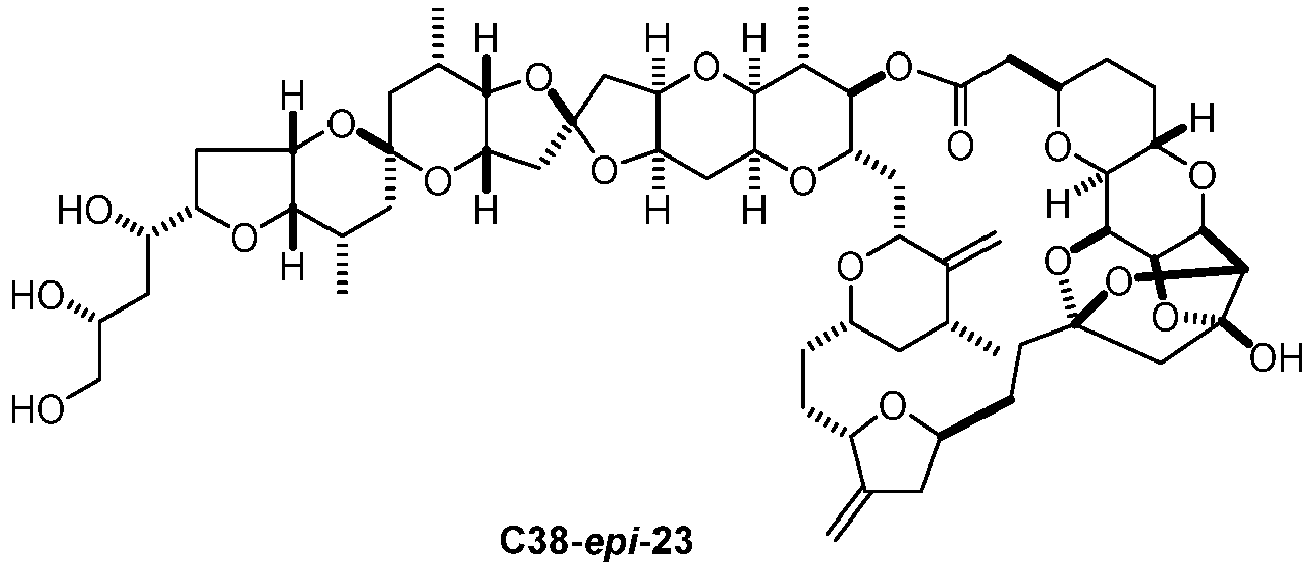
- 38-epi-Halichondrin C (C38-epi-23): [α]20 D -69.6 (c 0.46, MeOH). 1H NMR (600 MHz, CD3OD) δ: 5.03 (1H, s), 4.95 (1H, s), 4.87 (1H, s), 4.81 (1H, s), 4.72 (1H, dd, J = 10.2, 6.6 Hz), 4.41 (1H, d, J = 11.4 Hz), 4.38-4.32 (2H, m), 4.32-4.28 (2H, m), 4.17-4.06 (6H, m), 3.99 (1H, ddd, J = 9.6, 5.4, 4.2 Hz), 3.90-3.83 (4H, m), 3.78 (1H, ddd, J = 14.4 4.8, 4.2 Hz), 3.63-3.56 (3H, m), 3.53 (1H, dd, J = 11.6, 4.5 Hz), 3.47 (1H, dd, J = 10.8, 6.0 Hz), 3.17 (1H, dd, J = 9.0, 6.0 Hz), 2.95 (1H, dd, J = 9.6, 1.8 Hz), 2.86-2.80 (1H, m), 2.54 (1H, dd, J = 16.8, 8.4 Hz), 2.47 (1H, dd, J = 16.8, 2.4 Hz), 2.34-2.08 (12H, m), 2.12-2.07 (3H, m), 2.04-1.96 (4H, m), 1.88-1.81 (2H, m), 1.79-1.29 (15H, m), 1.10 (3H, d, J = 6.0 Hz), 1.04 (3H, d, J = 8.4 Hz), 1.05-0.99 (1H, m), 1.02 (3H, d, J = 6.6 Hz), 1.00 (3H, d, J = 6.6 Hz) ppm. 13C NMR (125 MHz, CD3OD) δ: 172.9, 153.3, 152.8, 115.6, 114.2, 110.5, 105.1, 104.7, 98.3, 86.2, 81.3, 81.1, 80.0, 79.2, 78.9, 78.9, 78.4, 77.9, 76.6, 76.4, 76.1, 76.0, 75.9, 75.2, 74.9, 74.8, 73.6, 73.3, 73.2, 73.1, 71.7, 69.4, 68.3, 67.2, 53.7, 45.6, 44.9, 44.7, 41.2, 39.6, 38.3, 38.3, 38.1, 37.5, 37.5, 37.2, 36.2, 36.0, 33.3, 31.7, 31.2, 30.9, 30.2, 28.9, 27.1, 26.8, 18.4, 18.3, 18.3, 15.2. ppm. FTIR (film): 3427, 2925, 2872, 1736, 1662, 1553, 1436, 1311, 1188, 1117, 1075, 1023, 996, 898, 735 cm-1. HRMS (ESI) m/z: [M+Na]+ calcd for C60H86O20Na, 1149.5605; found, 1149.5618.
-

- In a glove box, to a solution of iodide 2-13 (50 mg, 0.0482 mmol, 1 eq.) and thioester 2-15 (45.4 mg, 0.0627 mmol, 1.3 eq.) in DMI (0.4 mL) and EtOAc (0.08 mL) were added DTBMP (39.5 mg, 0.193 mmol, 4 eq.), Zn powder (18.8 mg, 0.289 mmol, 6 eq.), Cp2ZrCl2 (42.2 mg, 0.144 mmol, 3 eq.), and NiBr2-dtbbpy (7.0 mg, 0.0144 mmol, 30 mol%) at room temperature. After being stirred for 1.5 h at the same temperature, the reaction mixture was removed from glove box and diluted with Et2O and sat. NaHCO3 aq. The organic layer was separated and the aqueous layer was extracted with Et2O. The combined organic layer was dried over Na2SO4, filtered, and concentrated under reduced pressure. The obtained crude material was purified by flash column chromatography on neutral silica gel (0%, 15%, 25% EtOAc in Hexanes) to give ketone 2-S-8 (62.4 mg, 0.0409 mmol, 85%) as a colorless amorphous solid. (S-8): [α]20 D -64.8 (c 1.00, CHCl3). 1H NMR (600 MHz, C6D6) δ: 5.75 (1H, dddd, J = 17.3, 10.5, 5.1, 5.1 Hz), 5.21 (1H, s), 5.15 (1H, ddd, J = 17.3, 1.8, 1.8 Hz), 5.11 (1H, s), 4.97 (1H, ddd, J = 10.5, 1.8, 1.8 Hz), 4.94 (1H, s), 4.87-4.82 (1H, m), 4.82-4.77 (2H, m), 4.67 (1H, d, J = 10.8 Hz), 4.52 (1H, ddd, J = 10.2, 10.2, 4.8 Hz), 4.38-4.33 (2H, m), 4.32 (1H, J = 4.6 Hz), 4.11 (1H, dd, J = 6.9, 5.1 Hz), 4.07-3.97 (4H, m), 3.84-3.78 (4H, m), 3.77-3.68 (3H, m), 3.58 (1H, d, J = 1.2 Hz), 3.43 (1H, ddd, J = 4.5, 4.5, 4.5 Hz), 3.37 (4H, s), 3.36 (1H, s), 3.21-3.11 (3H, m), 2.86-2.81 (1H, m), 2.80-2.74 (2H, m), 2.59-2.54 (2H, m), 2.42-2.35 (3H, m), 2.34-2.22 (8H, m), 2.20-2.04 (7H, m), 1.97 (1H, dd, J = 13.8, 13.5 Hz, ), 1.87-1.80 (1H, m), 1.78-1.63 (4H, m), 1.62-1.44 (7H, m), 1.38-1.30 (2H, m), 1.19 (3H, d, J = 7.2 Hz), 1.13-1.02 (31H, m), 1.01 (3H, d, J = 7.2 Hz), 0.99 (3H, d, J = 7.2 Hz), 0.71-0.60 (18H, m) ppm. 13C NMR (125 MHz, C6D6) δ: 206.9, 171.8, 171.3, 152.9, 152.6, 134.6, 116.6, 116.2, 109.3, 105.0, 103.8, 96.9, 83.3, 78.3, 77.9, 77.7, 77.2, 76.5, 76.0, 75.4, 75.1, 75.0, 74.9, 74.6, 74.1, 74.0, 73.8, 73.0, 70.4, 69.6, 68.4, 66.0, 65.9, 64.6, 64.5 51.7, 50.9, 46.8, 46.3, 43.9, 41.2, 39.5, 39.3, 38.6, 37.7, 37.2, 36.4, 36.3, 35.9, 35.4, 32.5, 31.1, 31.0, 30.7, 30.5, 29.2, 28.5, 18.6, 18.2, 17.3, 16.5, 7.5, 7.3, 7.2, 6.0, 5.4, 5.3 ppm. FTIR (film): 2953, 2913, 2876, 1737, 1458, 1372, 1337, 1312, 1280, 1208, 1186, 1155, 1119, 1085, 1072, 1035, 1012, 823, 736 cm-1. HRMS (ESI) m/z: [M+Na]+ calcd for C81H132O21Si3Na, 1547.8467; found, 1547.8524.

- A buffered TBAF solution was prepared by mixing TBAF solution (TCI #T1125; 0.33 mL of 1 M in THF, 0.33 mmol, 10 eq.) and PivOH (16.7 mg, 0.164 mmol, 5 eq.). To a stirred solution of ketone 2-S-8 (50 mg, 0.0328 mmol, 1 eq.) in DMF (2.0 mL) was added the buffered TBAF solution at room temperature. After being stirred for 6 h at the same temperature, CaCO3 (1.0 g) and DOWEX 50WX8-400 (1.0 g) were added after diluting with 5 mL EtOAc. After being stirred for 1 h at room temperature, the resulted mixture was diluted with EtOAc and filtered through a pad of Celite. The filter cake was washed with EtOAc thoroughly. The filtrate was concentrated under reduced pressure to give a crude tetraol, which was used in the next step without further purification. To a stirred solution of the crude tetraol (calculated as 0.0328 mmol, 1 eq.) in CH2Cl2 (8.5 mL) was added PPTS (33.1 mg, 0.132 mmol, 4 eq.) at room temperature. After 1 h, TLC analysis indicated the disappearance of starting material. The reaction mixture was directly subjected to column chromatography on amino silica gel (CH2Cl2 then 25%, 50%, 75%, then 100% EtOAc in Hexanes then 2% MeOH in EtOAc) to give a crude allyl protected Norhalichondrin C methyl ester with its C38 epimer. The compound was used in the next step after concentration without further purification. To a stirred solution of the crude methyl ester (calculated as 0.0328 mmol, 1 eq.) in THF (5 mL), 1.3 mL of aqueous 1M LiOH was added at room temperature. After being stirred for 1.5 h at the same temperature, the reaction mixture was diluted by 3 mL of water. The THF was then removed from the mixture by evaporator. After the reaction was cooled down to 0 °C, 1.5 mL of 1 M aqueous HCl was added immediately followed by 10 mL of
PH 7 aqueous buffer solution. The resulting mixture was extracted with EtOAc. The combined organic layers were dried over Na2SO4, filtered, and concentrated under reduced pressure. The resulting mixture was moved to next step without further purification.
To a mixture of above crude acid (calculated as 0.0328 mmol, 1 eq.), dimedone (9.2 mg, 0.0656 mmol, 2 eq.), and Pd(PPh3)4 (5.7 mg, 0.00492 mmol, 15 mol%) was added CH2Cl2 (4.0 mL) at room temperature. After being stirred for 3 h at the same temperature, the resulted solution was diluted with DMF (3 mL). After removal of DCM by evaporator, the mixture was purified by YAMAZEN purification system with ODS column (Rf gradient: 10% MeCN in H2O to 100% MeCN) to give Norhalichondrin C (24) (21.0 mg, 0.019 mmol, 58% for 4 steps) as a colorless solid. 38-epi-Homohalicondrin C (C38-epi-24) was decomposed while concentrating with inseparable reagent residue after ODS column. Norhalichondrin C (24): [α]20 D -61.2 (c 0.300, MeOH) 1H NMR (600 MHz, CD3OD) δ: 5.06 (1H, s), 5.01 (1H, s), 4.88 (1H, s), 4.81 (1H, s), 4.62 (1H, dd, J = 7.2, 4.8 Hz), 4.43 (1H, d, J = 10.8 Hz), 4.42-4.39 (1H, m), 4.34-4.27 (3H, m), 4.24 (1H, ddd, J = 11.2, 4.2, 1.8 Hz), 4.17 (1H, dd, J = 4.2 Hz), 4.11 (2H, brs), 4.09-4.05 (1H, m), 3.98 (1H, brs), 3.91-3.85 (2H, m), 3.82-3.76 (2H, m), 3.73-3.67 (2H, m), 3.62-3.57 (2H, m), 3.53 (1H, s), 3.31 (1H, m), 3.21 (1H, dd, J = 6.6, 4.7 Hz), 2.94 (1H, d, J = 9.6 Hz), 2.81 (1H, dd, J = 15.0, 6.6 Hz), 2.55 (1H, dd, J = 16.2, 9.6 Hz), 2.52-2.48 (2H, brs), 2.45 (1H, d, J = 17.6), 2.39 (1H, dd, J = 13.2, 6.2 Hz), 2.33 (2H, brs), 2.31-2.23 (5H, m), 2.19-1.99 (6H, m), 1.99-1.94 (2H, m), 1.92 (1H, d, J = 13.2 Hz), 1.90-1.79 (2H, m), 1.76-1.63 (3H, m), 1.54-1.46 (4H, m), 1.46-1.26 (7H, m), 1.10 (3H, d, J = 6.0 Hz), 1.06 (3H, d, J = 6.6 Hz), 1.02 (1H, d, J = 12.0 Hz), 0.98 (3H, d, J = 7.2 Hz), 0.96 (3H, d, J = 7.2 Hz). 13C NMR (150 MHz, CD3OD) δ: 172.8 (2C), 153.3, 153.2, 114.8, 114.2, 110.4, 105.7, 104.8, 98.5, 86.2, 80.7, 80.6, 79.1, 79.0, 78.0 (2C), 77.2 (2C), 76.3 (2C), 76.0, 75.8, 75.3, 75.0, 74.9, 74.7, 73.8, 73.7, 72.7 (2C), 69.5, 68.1, 68.0, 65.7, 53.6, 45.5, 44.9, 41.1, 39.7, 38.2, 38.1, 37.8, 37.5, 37.1, 36.7, 35.7, 33.0, 31.8, 31.2, 32.0, 30.8, 30.0, 29.0, 27.3, 18.4, 18.1, 17.4, 15.8. FTIR (film): 3480, 2953, 2932, 2923, 1733, 1317, 1189, 1119, 1073, 1011, 995, 964, 914, 555 cm-1. HRMS (ESI) m/z: [M+Na]+ calcd for C59H82O20Na, 1113.5297; found, 1133.5248. -

- In a glove box, to a solution of iodide 2-13 (52.1 mg, 0.0501 mmol, 1 eq.) and thioester 2-16 (55.5 mg, 0.0651 mmol, 1.3 eq.) in DMI (0.40 mL) and EtOAc (80 µL) were added DTBMP (39.5 mg, 0.192 mmol, 4 eq.), Zn powder (18.9 mg, 0.289 mmol, 6 eq.), Cp2ZrCl2 (42.2 mg, 0.144 mmol, 3 eq.), and NiBr2-dtbbpy (7.0 mg, 0.0144 mmol, 30 mol%) at room temperature. After being stirred for 4 h at the same temperature, the reaction mixture was removed from glove box and diluted with Et2O and sat. NaHCO3 aq. The organic layer was separated and the aqueous layer was extracted with Et2O. The combined organic layer was dried over Na2SO4, filtered, and concentrated under reduced pressure. The obtained crude material was purified by flash column chromatography on neutral silica gel (0%, 9%, 13%, then 17% EtOAc in Hexanes) to give ketone 2-S-9 (70.5 mg, 0.0426 mmol, 85%) as a colorless amorphous solid. 2-S-9: [α]20 D -64.0 (c 0.800, CHCl3). 1H NMR (600 MHz, C6D6) δ: 5.75 (1H, dddd, J = 17.3, 10.5, 5.1, 5.1 Hz), 5.21 (1H, s), 5.15 (1H, ddd, J = 17.3, 1.8, 1.8 Hz), 5.12 (1H, s), 4.97 (1H, ddd, J = 10.5, 1.8, 1.8 Hz), 4.94 (1H, s), 4.86-4.79 (3H, m), 4.67 (1H, d, J = 10.8 Hz), 4.52 (1H, ddd, J = 10.2, 10.2, 4.8 Hz), 4.48 (1H, ddd, J = 10.2, 5.4, 5.4 Hz), 4.37 (1H, dd, J = 3.9, 3.0 Hz), 4.35 (1H, dd, J = 10.2, 1.8 Hz), 4.32 (1H, d, J = 3.6 Hz), 4.11 (1H, dd, J = 6.9, 5.1 Hz), 4.06-3.98 (4H, m), 3.84-3.79 (5H, m), 3.78-3.75 (2H, m), 3.73-3.67 (4H, m), 3.45 (1H, ddd, J = 4.5, 4.5, 4.5 Hz), 3.28 (1H, s), 3.21-3.16 (2H, m), 3.07 (1H, dd, J = 17.6, 6.3 Hz), 3.01 (1H, dd, J = 17.6, 6.6 Hz), 2.93 (1H, d, J = 2.4 Hz), 2.80-2.76 (2H, m), 2.57 (1H, dd, J = 9.9, 2.1 Hz), 2.47 (1H, d, J = 16.2 Hz), 2.40-2.23 (9H, m), 2.23-2.05 (6H, m), 1.98 (1H, dddd, J = 14.1, 11.7, 4.0, 4.0 Hz), 1.89-1.82 (2H, m), 1.77-1.68 (4H, m), 1.61 (1H, ddd, J = 14.4, 4.8, 4.8 Hz), 1.58 (1H, dd, J = 12.9, 3.9 Hz), 1.55-1.47 (5H, m), 1.36-1.32 (3H, m), 1.19 (3H, d, J = 7.8 Hz), 1.11 (9H, t, J = 8.0 Hz), 1.09 (3H, d, J = 6.6 Hz), 1.07 (9H, t, J = 8.4 Hz), 1.05 (9H, t, J = 8.4 Hz), 1.02-1.01 (12H, m), 0.96 (3H, d, J = 7.2 Hz), 0.77 (6H, q, J = 7.8 Hz), 0.69-0.65 (12H, m), 0.14 (3H, s), 0.13 (3H, s) ppm. 13C NMR (125 MHz, C6D6) δ: 206.8, 171.3, 153.0, 152.6, 134.6, 116.6, 116.2, 109.3, 104.39, 103.8, 96.9, 83.3, 79.1, 78.4, 78.0, 77.9, 77.7, 76.8, 76.0, 75.5, 75.1, 75.0, 74.9, 74.7, 74.22, 74.16, 74.1, 73.8, 73.6, 73.0, 70.4, 69.4, 68.4, 66.2, 65.9, 64.6, 63.8, 51.7, 46.8, 46.3, 43.9, 41.2, 39.5, 39.3, 38.6, 37.7, 37.6, 36.5, 36.4, 35.9, 35.3, 32.5, 31.6, 31.1, 30.72, 30.67, 30.5, 29.6, 28.6, 26.2, 18.7, 18.6, 18.1, 17.6, 16.4, 7.5, 7.4, 7.3, 6.0, 5.7, 5.3, -5.1, -5.3 ppm. FTIR (film): 2953, 2928, 2875, 1730, 1554, 1459, 1372, 1310, 1238, 1185, 1155, 1077, 1034, 1012, 834, 740 cm-1. HRMS (ESI) m/z: [M+H]+ calcd for C88H149O21Si4, 1653.9663; found, 1653.9702.

- A buffered TBAF solution was prepared by mixing TBAF solution (TCI #T1125; 0.43 mL of 1 M in THF, 0.43 mmol, 10 eq.) and PivOH (22.0 mg, 0.215 mmol, 5 eq.). To a stirred solution of ketone 2-S-9 (70.5 mg, 0.0426 mmol) in DMF (2.1 mL) were added the buffered TBAF solution at room temperature. After being stirred for 8 h at the same temperature, CaCO3 (1.5 g) and DOWEX 50WX8-400 (1.5 g) were added. After being stirred for 1 h at the same temperature, the resulted mixture was diluted with EtOAc and filtered through a pad of Celite. The filter cake was washed with EtOAc thoroughly. The filtrate was concentrated under reduced pressure to give a crude tetraol, which was used in the next step without further purification. To a stirred solution of above tetraol (calculated as 0.0426 mmol, 1 eq.) in CH2Cl2 (4.3 mL) was added PPTS (53.5 mg, 0.213 mmol, 5 eq.) at room temperature. After being stirred for 1 h at the same temperature, the reaction mixture was directly subjected to column chromatography on amino silica gel (CH2Cl2 then 25%, 50%, 75%, then 100% EtOAc in Hexanes then 2% MeOH in EtOAc) to give a crude spiro ketal, which was used in the next step without further purification.
To a mixture of above crude spiro ketal (calculated as 0.0426 mmol, 1 eq.), dimedone (11.9 mg, 0.0849 mmol, 2 eq.), and Pd(PPh3)4 (4.9 mg, 0.00424 mmol, 10 mol%) was added CH2Cl2 (4.3 mL) at room temperature. After being stirred for 8 h at the same temperature, the resulted solution was directly subjected to column chromatography on amino silica gel (CH2Cl2 then 25%, 50%, 77%, then 100% EtOAc in Hexanes then 3% MeOH in EtOAc) to give a crude Homohalichondrin C with its C-38 epimer. The mixture was purified by YAMAZEN purification system with ODS column (Rf gradient: 10% MeCN in H2O to 100% MeCN) to give Homohalichondrin C (25) (31.7 mg, 0.0278 mmol, 65% for 3 steps) as a colorless solid and 38-epi-Homohalicondrin C (C38-epi-25) (5.1 mg, 0.00448 mmol, 11% for 3 steps) as a colorless solid. Homohalichondrin C (25): [α]20 D -57.9 (c 0.53, CH2Cl2). 1H NMR (600 MHz, CD3OD) δ: 5.06 (1H, d, J = 1.8 Hz), 5.01 (1H, s), 4.88 (1H, s), 4.81 (1H, d, J = 1.2 Hz), 4.63 (1H, dd, J = 7.8, 4.8 Hz), 4.43 (1H, d, J = 9.6 Hz), 4.40 (1H, s), 4.34-4.28 (3H, m), 4.25-4.22 (2H, m), 4.17 (1H, d, J = 4.2 Hz), 4.13-4.09 (2H, m), 4.07 (1H, dd, J = 7.8, 7.8 Hz), 4.02 (1H, s), 3.95 (1H, s), 3.90-3.86 (3H, m), 3.70 (1H, dd, J = 10.5, 10.5 Hz), 3.66 (1H, dd, J = 2.7, 2.7 Hz), 3.60 (1H, d, J = 11.4 Hz), 3.59-3.57 (3H, m), 3.50 (1H, dd, J = 10.5, 5.1 Hz), 3.21 (1H, dd, J = 7.2, 4.8 Hz), 3.12 (1H, d, J = 2.4 Hz), 2.95 (1H, d, J = 10.2, 1.8 Hz), 2.82-2.79 (1H, m), 2.55 (1H, dd, J = 17.9, 9.3 Hz), 2.45 (1H, dd, J = 17.9, 2.4 Hz), 2.39 (1H, dd, J = 13.2, 6.0 Hz), 2.37-2.24 (8H, m), 2.20-1.96 (11H, m), 1.90 (1H, ddd, J = 15.6, 4.8, 4.8 Hz), 1.84-1.80 (2H, m), 1.74 (1H, s), 1.72 (1H, s), 1.68-1.64 (2H, m), 1.51-1.29 (9H, m), 1.10 (3H, d, J = 6.0 Hz), 1.05 (3H, d, J = 7.2 Hz), 1.04-0.99 (1H, m), 0.95 (3H, d, J = 7.2 Hz), 0.94 (3H, d, J = 6.6 Hz) ppm. 13C NMR (125 MHz, CDCl3) δ: 171.2, 151.7, 151.4, 113.2, 112.4, 109.3, 104.5, 104.2, 96.6, 84.4, 79.8, 79.4, 77.6, 77.1, 76.3, 76.2, 75.3, 75.1, 74.8, 74.7, 74.4, 73.8, 73.7, 73.5, 72.8, 72.0, 71.2, 70.8, 68.1, 66.1, 65.3, 63.6, 52.4, 43.4, 42.5, 40.4, 38.7, 37.2, 36.94, 36.89, 36.8, 36.5, 36.0, 34.9, 32.0, 31.3, 30.6, 30.0, 29.4, 29.0, 28.9, 27.7, 25.8, 18.0, 17.7, 17.1, 15.0 ppm. FTIR (film): 3422, 2926, 2873, 1736, 1436, 1310, 1186, 1117, 1074, 1021, 995, 910, 755 cm-1. HRMS (ESI) m/z: [M+Na]+ calcd for C61H86O20Na, 1161.5605; found, 1161.5587.
- 38-epi-Homohalichondrin C (C38-epi-25): [α]20 D -88.2 (c 0.34, CH2Cl2). 1H NMR (600 MHz, CD3OD) δ: 5.04 (1H, d, J = 1.8 Hz), 4.95 (1H, d, J = 2.4 Hz), 4.87 (1H, s), 4.81 (1H, s), 4.72 (1H, dd, J = 10.2, 6.6 Hz), 4.42 (1H, d, J = 10.8 Hz), 4.38 (1H, s), 4.36 (1H, ddd, J = 10.4, 10.4, 4.5 Hz), 4.32-4.28 (2H, m), 4.23 (1H, ddd, J = 10.1, 5.9, 4.2 Hz), 4.17-4.09 (4H, m), 4.08-4.05 (1H, m), 4.03 (1H, s), 3.98 (1H, dd, J= 4.8, 1.8 Hz), 3.89-3.84 (3H, m), 3.81 (1H, dd, J = 2.4, 2.4 Hz), 3.63-3.56 (4H, m), 3.54 (1H, d, J = 3.0 Hz), 3.50 (1H, dd, J = 10.2, 5.4 Hz), 3.17 (1H, dd, J = 9.0, 6.6 Hz), 3.15 (1H, s), 2.96 (1H, dd, J = 9.9, 2.1 Hz), 2.83-2.79 (1H, m), 2.54 (1H, dd, J = 17.4, 8.4 Hz), 2.47 (1H, dd, J = 17.4, 2.7 Hz), 2.36-1.89 (23H, m), 1.83 (1H, ddd, J = 12.0, 12.0, 2.4 Hz), 1.78-1.75 (1H, m), 1.72-1.67 (2H, m), 1.64 (1H, ddd, J = 12.0, 3.0, 3.0 Hz), 1.58-1.53 (1H, m), 1.49-1.28 (8H, m), 1.10 (3H, d, J = 6.0 Hz), 1.05-0.98 (1H, m), 1.00 (3H, d, J = 7.2 Hz), 0.998 (3H. d. J = 6.6 Hz), 0.96 (3H, d, J = 7.2 Hz) ppm. 13C NMR (125 MHz, CD3OD) δ: 172.9, 153.3, 152.8, 115.6, 114.2, 110.5, 105.1, 104.7, 98.0, 86.2, 80.3, 79.8, 79.2, 78.9, 78.5, 78.4, 77.8, 76.6, 76.4, 76.1, 76.0, 75.9, 75.8, 75.2, 75.1, 74.9, 74.8, 74.4, 73.2, 72.9, 69.4, 68.4, 65.3, 65.1, 53.7, 45.6, 45.0, 44.8, 41.2, 39.6, 38.6, 38.3, 38.2, 37.5, 37.2, 36.0, 33.3, 31.9, 31.7, 31.2, 30.9, 30.2, 28.9, 26.8, 18.4, 17.7, 15.2 ppm. FTIR (film): 34.7, 2925, 2872, 1736, 1662, 1553, 1436, 1311, 1188, 1117, 1075, 1023, 996, 898, 735 cm-1. HRMS (ESI) m/z: [M+Na]+ calcd for C61H86O20Na, 1161.5605; found, 1161.5618.
- The synthesis of C27-C37 building block is summarized in
Figure 9A . First, a catalytic, asymmetric Ni/Cr-mediated reaction was used to couple aldehyde 4-2 with methyl β-iodoacrylate (4-3) in the presence of the Cr-catalyst (10 mol%) prepared from (R)-4-E (Figure 9B ), to furnish the allylic alcohol in 93% yield with 19:1 stereoselectivity (see, e.g., Namba, K.; Kishi, Y. Org. Lett. 2004, 6, 5031; Guo, H.; Dong, C.-G.; Kim, D.-S.; Urabe, D.; Wang, J.; Kim, J. T.; Liu, X.; Sasaki, T.; Kishi, Y. J. Am. Chem. Soc. 2009, 131, 15387). Second, an oxy-Michael reaction was used to construct the tetrahydropyran ring with the desired stereochemistry at C29. The previous work suggested that this process could be achieved in a highly stereoselective manner; indeed, on treatment of 4-4 with K3PO4/18-Crown-6/toluene, oxy-Michael cyclization smoothly took place, to furnish the desired stereoisomer exclusively (see, e.g., Aicher, T. D.; Buszek, K. R.; Fang, F. G.; Forsyth, C. J.; Jung, S. H.; Kishi, Y.; Scola, P. M. Tetrahedron Lett. 1992, 33, 1549). The methyl ester was then reduced with DIBAL, to givealdehyde 5, the substrate for the next catalytic, asymmetric Ni/Cr-mediated coupling reaction to form the C19-C20 bond. -
Figure 10A summarizes the synthesis of C20-C37 building block from 4-5. The crucial transformation in this sequence was the catalytic, asymmetric Ni/Cr-mediated coupling to introduce the chiral center at C27, followed by reductive cyclization to introduce the chiral center at C23. The overall stereochemistry-outcome of the proposed transformation deserves a comment. The stereochemistry at C27 was introduced under the influence of a chiral Cr-catalyst prepared from a chiral sulfonamide. Via the toolbox approach, (S)-4-F was identified as the best ligand for the substrates closely related to 4-6 (see, e.g., Guo, H.; Dong, C.-G.; Kim, D.-S.; Urabe, D.; Wang, J.; Kim, J. T.; Liu, X.; Sasaki, T.; Kishi, Y. J. Am. Chem. Soc. 2009, 131, 15387). The same Cr-catalyst was found equally effective for the present case; the (4-5 -> 4-6)-coupling was conducted in the presence of 10 mol% Cr-catalyst and 2 mol% (Et)2Phen(H)2•NiCl2, to furnish the expected allylic alcohol with >40:1 stereoselectivity (1H NMR). To facilitate 1H NMR analysis, the authentic sample of undesired allylic alcohol was prepared with the Cr-catalyst prepared from (R)-sulfonamide. - The next reductive cyclization was expected stereoselectively to yield the desired product, as demonstrated on the closely related substrates (see, e.g., Lewis, M. D.; Cha, J. K.; Kishi, Y. J. Am. Chem. Soc. 1982, 104, 4976; Dong, C.-G.; Henderson, J. A.; Kaburagi, Y.; Sasaki, T.; Kim, D.-S.; Kim, J. T.; Urabe, D.; Guo, H.; Kishi, Y. J. Am. Chem. Soc. 2009, 131, 15642). Nevertheless, there was a concern on the proposed transformation, because of the presence of dioxasilinane group. Experimentally, it was found that the reductive cyclization did give the desired product as the major product, but accompanied with byproducts apparently derived through reactions on the dioxasilinane group. In order to avoid the complication due to the undesired side-reaction(s), the dioxasilinane group was first deprotected with TBAF-AcOH treatment and then subjected to reductive-cyclization, to furnish practically the single product. The undesired allylic alcohol was prepared via the coupling of 4-5 with 4-6 in the presence of the Cr-catalyst derived from (S)-4-A. The product at this stage was a triol, as the C30 MPM group was cleaved off during the process. With a standard procedure, the alcohols at C35 and C37 were selectively protected, to give sixmembered acetonide 4-7.
- The observed stereochemistry-outcome was explained by a stereoelectronic effect, coupled with conformational analysis. Due to a stereoelectronic effect, the reducing-reagent approached the oxonium ion preferentially from the direction resulting in a trans-diaxial relationship between the newly formed bond and a lone pair of oxygen-electrons, the oxonium ion 4-A (
Figure 10B ). For clarity, the C27-olefinic carbon is replaced with a saturated carbon in the oxonium ions 4-A-C, and the oxonium ion 4-C is shown its antipode. Similarly, the approach from the bottom-direction also met with the stereoelectronic effect. However, the top-approach was favored over the bottom-approach, because the former approach led directly to the product in chair-conformation, whereas the latter approach led to the product in boat-conformation. Apparently, there was no serious steric hindrance for the reagent to approach from the top-face. Reductive cyclization of the undesired allylic alcohol gave a 2:1 mixture of tetrahydropyrans. The observed result was again explained again by a stereoelectronic effect, coupled conformational analysis, cf., oxonium ions 4-B and 4-C inFigure 10B . Two modes of reduction depicted on 4-B and 4-C led directly to a product in chair conformation, but both approaches suffer from the 1,3-diaxial-like interaction with either C25-Me or C29-CH2 group. This analysis explained the poor stereoselectivity in reductive cyclization in the undesired allylic alcohol series. Because of the poor-selectivity observed in the reductive cyclization of undesired allylic alcohol, the overall stereoselectivity of 4-5 + 4-6 -> 4-7 became higher than the stereoselectivity achieved by the catalytic, asymmetric Ni/Cr-mediated coupling. Finally, the ethyl ester in 4-7 was reduced with DIBAL, to furnish aldehyde 4-8, the synthetic intermediate for the next Ni/Cr-mediated coupling reaction to form the C19-C20 bond of halichondrins A-C. Notably, without protection of the C30 hydroxyl group, the DIBAL reduction smoothly and cleanly proceeded to give the desired 4-8 in 89% yield, along with ~5% of the over-reduced primary alcohol. - The C19-C20 bond with a catalytic, asymmetric Ni/Cr-mediated coupling of 4-8 with 4-9-B was formed (
Figure 11 ) (see, e.g., Yan, W.; Li, Z.; Kishi, Y. J. Am. Chem. Soc. 2015, 137, 6219; Li, Z.; Yan, W.; Kishi, Y. Am. Chem. Soc. 2015, 137, 6226). It should be noted that aldehyde 4-8 bore a free hydroxyl group at C30. There was no precedent for demonstrating that the catalytic cycle of Ni/Cr-mediated reaction could function with a substrate with a free hydroxyl group. Nevertheless, this possibility was pursued, because two synthetic steps, i.e., protection and deprotection of the C30 hydroxyl group, could be saved in this manner. In this connection, it should be noted that catalytic asymmetric Ni/Cr-mediated coupling uses Cp2ZrCl2 as the agent dissociating a product from a Cr-complex (see, e.g., Namba, K.; Kishi, Y. Org. Lett. 2004, 6, 5031) thereby suggesting a possibility of utilizing Cp2ZrCl2 as a masking agent for the free hydroxyl group in situ. This possibility was experimentally tested; the catalytic, asymmetric coupling of 4-8 with 4-9-B smoothly proceeded in addition of Cp2ZrCl2 (2.5 equiv.) and 2,6-di-t-butyl-4-methylpridine (2.5 equiv.), to furnish the desired product in an excellent yield. - Being encouraged with the successful coupling of 4-8 bearing a free hydroxyl group, a coupling with the vinyl iodide bearing a free carboxylic acid at C1 was tested. Amazingly, the catalytic, asymmetric Ni/Cr-mediated coupling of 4-8 did give the desired product in ~50% yield. The coupling with 4-9-B was used for further studies.
- Adopting the toolbox approach, a satisfactory sulfonamide ligand was identified. The ligand screening was conducted in the presence of Cr-catalyst, prepared from CrCl2 (10 mol%), sulfonamide (13 mol%), proton scavenger (12 mol%), and (Me)6Phen•NiCl2 in MeCN at room temperature. Through this screening, three exemplary sulfonamides emerged, i.e., (S)-4-I (dr = 19:1), (S)-4-G (dr = 29:1), and (S)-4-H (dr = 24:1). The coupling yield with these three ligands was then estimated from the overall yield of 4-8 → 4-11-B, i.e., 73% with (S)-4-I, 65% with (S)-4-G, and 67% with (S)-4-H. These overall yields were based on the experiments starting with 1.65 g, 250 mg, and 250 mg of 7 with (S)-4-I, (S)-4-G, and (S)-4-H, respectively. Based on this result, sulfonamide (S)-4-I was used for preparative purpose. It is noteworthy that, unlike the first and second couplings, this Ni/Cr-mediated coupling utilized the structurally complex nucleophile. Remarkably, the coupling efficiency was excellent even with use of the molar ratio 4-7:4-8 = 1.0:1.1.
- The next task was an SN2-cylcization of the C20 alcohol to the C17 chloride to form the methylenetetrahydrofuran ring. Various bases cleanly achieved this five-membered-ring forming cyclization, unless there was a base-labile functional group(s) in the substrate (see, e.g., Lee, J. H.; Li, Z.; Osawa, A.; Kishi, Y. J. Am. Chem. Soc. 2016, 138, 16248). After the base-induced cyclization, the methyl ester at C1 was hydrolyzed with aqueous base, to furnish seco-acid 4-10-B. For example, in the halichondrin-A synthesis, this transformation was achieved in 2 separate steps, i.e., AgOTf/Ag2O in THF and LiOH in aqueous MeOH. In this work, this transformation was carried out in one-pot. The seco-acid thus obtained was subjected to macrolactonization with Shiina's reagent, to furnish crystalline C1-C37 mactrolactone acetonide 4-11-B in an excellent yield (see, e.g., Shiina, I.; Kubota, M.; Ibuka, R. Tetrahedron Lett. 2002, 43, 7535; Shiina, I.; Mukaiyama, T. Chem. Lett. 1994, 677; Shiina, I. Bull Chem. Soc. Jpn. 2014, 87 196). The structure of 4-11-B was confirmed via an X-ray analysis of its C35/C37-diol, i.e., the product at step c-1 (
Figure 12 ). - For the preparative purpose, the transformation of 4-8 + 4-9-B -> 4-10-B -> 11-B was carried out without purification/isolation of the intermediates. The macrolactone 4-11-B was isolated by silica gel flash-chromatography (neutral silica gel) in 73% overall yield from 4-8 in multi-gram scales.
- A 1H NMR analysis indicated that 4-11-B thus obtained was contaminated with ~5% of its C20-epimer, thereby showing that the overall stereoselectivity for this transformation was ~20:1. The material was carried on of this purity; namely, 4-11-B was transformed to iodide 4-12-B with 4-steps/2-pots procedure, i.e., (1) p-TsOH/MeOH-CH2Cl2, (2) Tf2O/lutidine/ CH2Cl2, followed by addition of TESOTf and then NaI in DMF. The product was isolated by silica gel flash-chromatography (neutral silica gel), to furnish 4-12-B in 92% overall yield. 1H NMR analysis indicated that 4-12-B thus obtained was contaminated with ~5% of the C20-epimer. Although 4-12-B was crystalline, it was again difficult to remove the minor stereoisomer by recrystallization. Therefore, the minor C20 diastereomer was removed by preparative HPLC (ZORBAX SIL; 300~500 mg injection), to furnish 4-12-B (mp: 158~160 °C), which was used for the synthesis of halichondrins in the B-series.
-
Figure 13 summarizes the synthesis of right half in the halichondrin-A series. The synthesis followed the synthetic route developed in the halichondrin B series, with two modifications. First, 4-9-A, instead of 4-9-B, was used. Second, the C35/C37-protecting group in 8 was switched to the corresponding bis-TBS before the Ni/Cr-mediated coupling reaction, because the anisylidene group in 4-9-A was acid-labile and could not survive under the aqueous acidic condition; step c-1 inFigure 11 . Once again, the minor stereoisomer that originated from the Ni/Cr-mediated coupling was removed by preparative HPLC. -
Figure 14 summarizes the synthesis of right half in the halichondrin C series. The synthesis followed the synthetic route developed in the halichondrin B series, except one; 4-9-C, instead of 4-9-B, was used for the Ni/Cr-mediated coupling. The synthesis proceeded without any unexpected difficulty, to furnish the right half 4-12-C (mp: 84-6 °C) in the overall efficiency very similar to that in the halichondrin B series. Once again, the minor stereoisomer that originated from the Ni/Cr-mediated coupling was removed by preparative HPLC. - In the syntheses reported, seven chiral centers were introduced at C17, C20, C23, C25, C27, C29, and C30. The availability of the authentic sample of undesired stereoisomer(s) should facilitate the analysis of purity and stereoselectivity for a given step. Among them, the chiral centers at C20, C27, and C30 were introduced under the influence of chiral Cr-catalysts derived from (R)-4-E, (R)-4-F, and (S)-4-I. Therefore, the authentic sample of undesired minor stereoisomers formed in each of catalytic, asymmetric Ni/Cr-mediated couplings was readily prepared via the coupling in the presence of (S)-4-E, (S)-4-F, and (R)-4-I. In practice, the antipode was prepared with use of the Cr-catalyst prepared from (S)-E or (R)-E for each coupling. The chiral centers at C17 and C25 originated from the chiral centers present in C1-C19 and C20-C26 building blocks. Thus, use of C17-epi-C1-C19 building block gave the stereoisomer at C17, whereas use of the antipode of C20-C26 building block gave the minor stereoisomers at C25. The stereochemistry analysis was carried out in reference to these authentic samples.
- Right halves of halichondrins A-C were synthesized by coupling the common C20-C37 building block 4-8 with the C1-C19 building blocks 4-9-A, 4-9-B, and 4-9-C, respectively. Catalytic, asymmetric Ni/Cr-mediated coupling was used for three C-C bond formations. For all the cases, the stereochemistry was introduced under the influence of Cr-catalysts prepared from chiral sulfonamides, identified via the toolbox approach. For (4-2 + 4-3)-, (4-5 + 4-6)-, and (4-7 + 4-8)-couplings, the stereoselectivity of 19:1, >40:1, and ~20:1 was achieved by the Cr-catalysts prepared from (R)-4-E, (R)-4-F, and (S)-4-I, respectively. Unlike the first and second couplings, the third coupling utilized the structurally complex nucleophile. It was demonstrated that the coupling efficiency was excellent even with use of the molar ratio 4-8 : 4-9A~C = 1.0:1.1. In addition, third coupling was achieved with the substrate bearing a free-hydroxyl group. The products obtained in the Ni/Cr-mediated couplings were converted to the right halves of halichondrins A-C in excellent overall yields. The right halves of halichondrins A-C (4-12A through 4-12C) were synthesized in 28, 24, and 24 steps from commercial D-galactal in 13.4%, 21.1%, and 16.7% overall yields, respectively.
-

- To a stirred solution of 4-1 (4.0 g, 11.7 mmol, 1 eq.) in Et2O (100 mL) was added lithium borohydride (510 mg, 23.4 mmol, 2 eq.) at 0 °C. After being stirred for 8 h at room temperature, the reaction was carefully quenched with sat. NH4Cl aq. at 0 °C and stirred for 30 min. The organic layer was separated and the aqueous phase was extracted with EtOAc. The combined organic layer was washed with brine, dried over Na2SO4, and concentrated under reduced pressure. The residue was purified by flash column chromatography on silica gel (33% then 100% EtOAc in Hexanes) to give diol (4.1 g, 11.8 mmol, quantitative) as a white solid. The spectroscopic data obtained are consistent with those previously reported in our literature. See, e.g., Chen, C.-L.; Namba, K.; Kishi, Y. Org. Lett. 2009, 11, 409-412.

- To a stirred solution of diol (4.1 g, calculated as 11.7 mmol, 1 eq.) in CH2Cl2 (57 mL) were added imidazole (4.8 g, 70.2 mmol, 6 eq.) and TESCl (5.9 mL, 35.1 mmol, 3 eq.) at room temperature. After being stirred for 12 h at the same temperature, the reaction was quenched with sat. NaHCO3 aq. at 0 °C and stirred for 30 min. The organic layer was separated and the aqueous phase was extracted with hexanes/EtOAc (1:1). The combined organic layer was washed with brine, dried over Na2SO4, and concentrated under reduced pressure. The residue was purified by flash column chromatography on silica gel (0% then 3% EtOAc in Hexanes) to give bis-TES 4-S2 (6.8 g, 11.8 mmol, quantitative) as colorless oil. 4-S2: [α]20 D +1.1 (c 1.0, CHCl3). 1H NMR (600 MHz, CDCl3) δ: 4.23 (1H, m), 4.21 (1H, dd, J = 12.6, 2.4 Hz), 4.17 (1H, dd, J = 12.6, 1.8 Hz), 3.77 (1H, ddd, J = 4.2, 2.4, 1.8 Hz), 3.53 (1H, dd, J = 10.2, 5.4 Hz), 3.50 (1H, dd, J = 10.2, 5.4 Hz), 3.29 (1H, dd, J = 6.6, 1.8 Hz), 3.20 (1H, brs), 2.16 (1H, ddd, J = 14.4, 2.4, 2.4 Hz), 1.99 (1H, qdt, J = 7.2, 6.6, 5.4 Hz), 1.74 (1H, ddd, J = 14.4, 4.2, 4.2 Hz), 1.05 (9H, s), 1.03 (3H, d, J = 7.2 Hz), 1.02 (9H, s), 0.98 (9H, t, J = 8.4 Hz), 0.94 (9H, t, J = 8.4 Hz), 0.70-0.55 (12H, m) ppm. 13C NMR (150 MHz, CDCl3) δ: 81.1, 77.1, 68.2, 67.8, 65.5, 64.9, 38.8, 37.4, 27.8, 27.2, 23.3, 20.6, 13.2, 7.0, 6.8, 5.1, 4.4 ppm. FTIR (film): 2954, 2875, 1465, 1239, 1168, 1104, 1082, 1036, 1007, 927, 826, 772, 723, 649, 442 cm-1. HRMS (ESI) m/z: [M+Na]+ calcd for C29H62O5Si3Na, 597.3797; found, 597.3807.

- To a stirred solution of (COCl)2 (7.5 mL, 88.6 mmol, 5 eq.) in CH2Cl2 (250 mL) was added a solution of DMSO (12.4 mL, 174 mmol, 10 eq.) in CH2Cl2 (10 mL) at -78 °C. After being stirred for 30 min at the same temperature, a solution of 4-S2 (10.0 g, 17.4 mmol, 1 eq.) in CH2Cl2 (30 mL) was introduced to the reaction mixture. After being stirred for 2 h at -60 °C, to the mixture was added Et3N (42 mL, 305 mmol, 17 eq.) at -78 °C and warmed up to 0 °C over 30 min. After being stirred for 15 min at 0 °C, the mixture was quenched with sat. NH4Cl aq. The organic layer was separated and the aqueous phase was extracted with EtOAc. The combined organic layer was washed with brine, dried over Na2SO4, and concentrated under reduced pressure. The residue was filtrated though a pad of silica gel (hexanes/EtOAc = 1:1) to give a crude aldehyde 4-2 as pale yellow oil. The obtained crude material was used in the next reaction without further purification.

- To a mixture of CrCl2 (257 mg, 2.1 mmol, 12 mol%), (S)-sulfonamide ligand [i-Pr, PhCl2, OMe] (1.08 g, 2.4 mmol, 14 mol%), and proton scavenger (522 mg, 2.4 mmol, 14 mol%) in a glove box was added MeCN (44 mL) and the resulting solution was stirred for 3 h at room temperature. In a separate flask, the above crude 4-2 (calculated as 17.4 mmol, 1 eq.), methyl 3-iodoacrylate (3.7 g, 17.4 mmol, 1 eq.), NiCl2·DMP(OMe)2 (138 mg, 0.348 mmol, 2 mol%), LiCl (1.48 mg, 34.8 mmol, 2 eq.), Mn (3.8 g, 70 mmol, 4 eq.), Cp2ZrCl2 (5.6 g, 19.1 mmol, 1.1 eq.), and 2,6-lutidine (4.1 mL, 34.8 mmol, 2 eq.) were mixed together and the Cr-complex solution (26 mL) was transferred to the flask. Additional methyl 3-iodoacrylate (1.8 g, 8.7 mmol, 0.5 eq.) and Cr-complex solution (11 mL) were added after 30 min. After being stirred for 45 min, to the mixture was added the remained Cr-complex solution (7 mL). After being stirred for 15 min, the reaction mixture was removed from the glove box and diluted with EtOAc. After florisil was added, the resultant suspension was stirred vigorously for 1 h. The mixture was filtered through a short pad of silica gel (EtOAc). After removal of solvent under reduced pressure, the residue was purified by flash column chromatography on silica gel (3% then 25% EtOAc in Hexanes) to give allylic alcohol 4-S3 (8.8 g, 16.2 mmol, 93% for 2 steps, dr: 16:1 based on integration ratio of 1H NMR) as pale yellow oil. 4-S3: [α]20 D -1.3 (c 1.0, CHCl3). 1H NMR (600 MHz, C6D6) δ: 7.18 (1H, dd, J = 15.6, 3.6 Hz), 6.32 (1H, dd, J = 15.6, 2.4 Hz), 4.39 (1H, brs), 4.15 (1H, dd, J = 12.6, 1.2 Hz), 3.94 (1H, dd, J = 12.6, 2.4 Hz), 3.89 (1H, brs), 3.66 (1H, ddd, J = 4.2, 2.4, 1.2 Hz), 3.43 (3H, s,), 3.18 (1H, dd, J= 6.6, 1.2 Hz), 2.66 (1H, brs), 2.13 (1H, qdd, J = 6.6, 6.6, 1.8 Hz), 2.02 (1H, ddd, J = 15.0, 2.4, 2.4 Hz), 1.99 (1H, d, J = 4.2 Hz), 1.29 (1H, m), 1.28 (9H, s), 1.12 (9H, s), 1.10 (3H, d, J = 6.6 Hz), 1.06-1.00 (9H, m), 0.74-0.61 (6H, m) ppm. 13C NMR (150 MHz, CDCl3) δ: 166.6, 150.2, 128.3, 120.5, 82.2, 77.4, 72.1, 68.2, 67.7, 65.6, 51.1, 40.3, 38.7, 28.0, 27.6, 23.5, 20.9, 9.8, 7.3, 5.4 ppm. IR (film): 3501, 2952, 2876, 1725, 1706, 1659, 1474, 1167 cm-1. HRMS (ESI) m/z: [M+Na]+ calcd for C27H52O7Si2Na, 567.3144; found, 567.3157.

- To a stirred suspension of allylic alcohol 4-S3 (5.65 g, 10.4 mmol, 1 eq.) and La(OTf)3 (640 mg, 1.1 mmol, 10 mol%) in toluene (21 mL) was added MPMOC(NH)CCl3 (6.0 g, 21 mmol, 2 eq.) by syringe pump over 5.5 h. After being stirred for additional 30 min, the mixture was quenched with sat. NaHCO3 aq. The organic layer was separated and the aqueous phase was extracted with EtOAc. The combined organic layer was washed with brine, dried over Na2SO4, and concentrated under reduced pressure. The residue was purified by flash column chromatography on silica gel (3% then 17% EtOAc in Hexanes) to give MPM ether S-3 as a partially separable mixture with reagent residues. 4-S4: [α]20 D +20.9 (c 1.0, CHCl3). 1H NMR (600 MHz, CDCl3) δ: 7.20 (2H, d, J = 8.4 Hz), 6.89 (1H, dd, J = 16.2, 6.0 Hz), 6.87 (2H, d, J = 8.4 Hz), 6.03 (1H, dd, J = 16.2, 1.2 Hz), 4.56 (1H, d, J = 11.4 Hz), 4.20 (1H, d, J = 11.4 Hz), 4.19 (1H, brs), 4.18 (1H, dd, J = 12.0, 2.4 Hz), 4.11 (1H, dd, J = 12.0, 1.2 Hz), 3.96 (1H, ddd, J = 6.0, 2.4, 1.2 Hz), 3.80 (3H, s), 3.77 (3H, s), 3.45 (1H, ddd, J = 4.2, 2.4, 1.2 Hz), 3.27 (1H, dd, J = 7.2, 1.2 Hz), 3.14 (1H, brs), 2.10 (1H, dqd, J = 7.2, 6.6, 2.4 Hz), 2.08 (1H, ddd, J = 14.4, 2.4, 2.4 Hz), 1.61 (1H, ddd, J = 14.4, 4.2, 4.2 Hz), 1.03 (9H, s), 1.01 (3H, d, J = 6.6 Hz), 1.00 (9H, s), 0.98-0.94 (9H, m), 0.65-0.50 (6H, m) ppm. 13C NMR (150 MHz, CDCl3) δ: 166.7, 159.3, 147.7, 130.2, 129.3, 121.4, 113.7, 80.6, 77.9, 76.9, 70.5, 68.0, 67.5, 64.9, 55.2, 51.6, 38.6, 27.7, 27.2, 23.2, 20.5, 10.3, 7.0, 5.1 ppm. IR (film): 2950, 2875, 1726, 1659, 1612, 1513, 1168 cm-1. HRMS (ESI) m/z: [M+Na]+ calcd for C35H60O8Si2Na, 687.3719; found, 687.3706.

- This selective deprotection of TES ether could be accomplished by following two different procedures. Selective deprotection with TsOH·H2O: To a stirred solution of the above MPM-ether 4-S4(calculated as 10.4 mmol, 1 eq.) in CH2Cl2 (20 mL) and MeOH (10 mL) was added TsOH·H2O (10 mg, 0.0525 mmol, 0.5 mol%) at room temperature. After being stirred for 30 min at the same temperature, additional TsOH·H2O (20 × 3 mg, 0.450 mmol, 3 mol%) was added every 30 min, and the resultant mixture was stirred for 4 h. The reaction mixture was quenched with sat. NaHCO3 aq. The organic layer was separated and the aqueous layer was extracted with EtOAc. The combined organic layer was washed with brine, dried over Na2SO4, and concentrated under reduced pressure. The residue was purified by flash column chromatography on silica gel (3% then 33% EtOAc in Hexanes) to give secondary alcohol 4-4 (5.04 g, 9.15 mmol, 88% for 2 steps) as colorless oil, which is contaminated with a small amount of reagent residue. Selective deprotection with HFIP: A solution of the above MPM-ether 4-S4 (~6 g) in 1,1,1,3,3,3-hexafluoro-2-propanol (40 mL) and H2O (4 mL) was stirred for 10 h at room temperature. The reaction mixture was concentrated and the resultant residue was purified by flash column chromatography on silica gel (3% then 33% EtOAc in Hexanes) to give secondary alcohol 4-4 (4.2 g, 7.63 mmol, ca. 79% in 2 steps) as colorless oil. 4-4: [α]20 D +18.8 (c 1.0, CHCl3). 1H NMR (600 MHz, CDCl3) δ: 7.20 (2H, d, J = 12.0 Hz), 6.95 (1H, dd, J = 16.2, 4.8 Hz), 6.86 (2H, d, J = 12.0 Hz), 6.07 (1H, dd, J = 16.2, 1.2 Hz), 4.54 (1H, d, J = 12.0 Hz), 4.35 (1H, dd, J = 3.0, 3.0 Hz), 4.22 (1H, dd, J = 12.6, 3.0 Hz), 4.19 (1H, d, J = 12.0 Hz), 4.18 (1H, m), 4.16 (1H, dd, J = 12.6, 1.2 Hz), 3.80 (3H, s), 3.76 (3H, s), 3.53 (1H, d, J = 10.8 Hz), 3.45 (1H, ddd, J = 10.8, 3.0, 3.0 Hz), 3.27 (1H, brs), 3.24 (1H, d, J = 8.4 Hz), 2.19 (1H, ddd, J = 14.4, 3.0, 3.0 Hz), 2.14 (1H, dqd, J = 8.4, 6.6, 2.4 Hz), 1.57 (1H, ddd, J = 14.4, 3.0, 3.0 Hz), 1.03 (9H, s), 1.02 (3H, d, J = 6.6 Hz), 1.02 (9H, s) ppm. 13C NMR (150 MHz, CDCl3) δ: 166.7, 159.3, 148.1, 130.2, 129.4, 121.6, 113.8, 82.1, 77.1, 76.6, 70.6, 69.3, 68.6, 64.4, 55.3, 51.6, 38.3, 36.7, 27.7, 27.2, 23.1, 20.3, 10.9 ppm. IR (film): 3538, 2938, 2859, 1725, 1658, 1612, 1514, 1251 cm-1. HRMS (ESI) m/z: [M+Na]+ calcd for C29H46O8SiNa, 573.2854; found, 573.2846.

- To a stirred solution of 4-4 (2.80 g, 5.08 mmol, 1 eq.) in toluene (340 mL) were added 18-crown-6 (2.69 g, 10.2 mmol, 2 eq.) and K3PO4 (21.6 g, 102 mmol, 20 eq.) at room temperature. After being stirred for 14 h at the same temperature, additional 18-crown-6 (671 mg, 2.54 mmol, 0.5 eq.) was added. After being stirred for 5 h at the same temperature, the reaction was quenched with sat. NH4Cl aq. The organic layer was separated and the aqueous layer was extracted with EtOAc. The combined organic layer was washed with brine, dried over Na2SO4, filtered, and concentrated under reduced pressure. The residue was purified by flash column chromatography to give 4-S5 (2.64 g, 4.79 mmol, 94%) as colorless oil. 4-S5: [α]20 D -25.8 (c 1.0, CHCl3). 1H NMR (600 MHz, CDCl3) δ: 7.25 (2H, d, J = 8.4 Hz), 6.88 (1H, d J = 8.4 Hz), 4.56 (1H, d, J = 10.2 Hz), 4.45 (1H, d, J = 10.2 Hz), 4.29 (1H, ddd, J = 7.8, 4.2, 4.2 Hz), 4.14 (1H, dd, J = 12.0, 6.0 Hz), 4.07 (1H, dd, J = 12.0, 3.0 Hz), 3.98 (1H, ddd, J = 9.6, 7.8, 3.6 Hz), 3.82-3.77 (4H, m), 3.66 (3H, s), 3.60 (1H, ddd, J = 6.0, 4.2, 3.0 Hz), 3.40 (1H, dd, J = 7.8, 4.8 Hz), 3.14 (1H, dd, J = 9.6, 9.6 Hz), 2.67 (1H, dd, J = 15.6, 3.6 Hz), 2.48 (1H, dd, J = 15.6, 7.8 Hz), 2.11 (1H, ddd, J = 13.2, 7.8, 7.8 Hz), 2.00-1.92 (2H, m), 1.21 (3H, d, J = 7.2 Hz), 1.03 (9H, s), 1.01 (9H, s) ppm. 13C NMR (150 MHz, CDCl3) δ: 171.6, 159.4, 129.9, 129.7, 113.9, 80.4, 78.6, 73.7, 73.0, 72.4, 68.9, 66.9, 65.1, 55.3, 51.6, 39.5, 37.8, 31.9, 27.4, 27.1, 22.2, 20.8, 16.1 ppm. IR (film): 2934, 2858, 1740, 1612, 1514, 1250 cm-1. HRMS (ESI) m/z: [M+Na]+ calcd for C29H46O8SiNa, 573.2854; found, 573.2847.

- To a stirred solution of 4-S5 (5.0 g, 9.07 mmol, 1 eq.) in toluene (100 ml) was added DIBAL solution (11.3 mL of 1M in hexanes, 11.3 mmol, 1.2 eq.) dropwise at -78 °C. After being stirred for 1.5 h at the same temperature, the reaction was quenched with acetone (0.3 mL). The mixture was stirred for 15 min and sat. Rochelle's salt aq. was added. After being stirred for 3 h at room temperature, the mixture was diluted with EtOAc. The organic layer was separated and the aqueous layer was extracted with EtOAc. The combined organic layer was washed with brine, dried over Na2SO4, filtered, and concentrated under reduced pressure. The residue was purified by flash column chromatography on neutral silica gel (5%, 20% then 33% EtOAc in Hexanes) to give 4-5 (4.37 g, 8.49 mmol, 94%) as a colorless amorphous solid. 4-5: [α]20 D -37.3(c 1.0, CHCl3). 1H NMR (600 MHz, C6D6) δ: 9.51 (1H, t, J = 2.4 Hz), 7.21 (2H, m), 6.82 (2H, m), 4.33 (1H, d, J = 10.6 Hz), 4.24 (1H, d, J = 10.6 Hz), 4.17 (1H, dd, J = 12.3, 3.5 Hz), 4.11 (1H, m), 3.99-3.91 (2H, m), 3.31 (3H, s), 3.26 (1H, m), 3.0 (1H, dd, J = 7.0, 4.1 Hz), 2.91 (1H, m), 2.81 (1H, dd, J = 10.6, 9.4 Hz), 2.40 (1H, m), 2.34 (1H, m), 2.18-2.08 (2H, m), 1.54 (1H, dt, J = 14.1, 5.3 Hz), 1.24 (9H, s), 1.18 (3H, d, J = 7.0 Hz), 1.13 (9H, s) ppm. 13C NMR (125 MHz, C6D6) δ: 200.1, 160.6, 131.2, 130.4, 114.7, 81.4, 80.8, 74.5, 74.4, 73.3, 69.1, 68.2, 66.0, 55.4, 47.9, 40.9, 34.2, 28.4, 28.1, 23.6, 21.6, 17.3 ppm. IR (film): 2933, 2857, 1725, 1514, 1250, 1078 cm-1. HRMS (ESI) m/z: [M+Na]+ calcd for C28H44O7SiNa, 543.7272; found, 543.2750.

- In a glove box, to a mixture of CrCl2 (104 mg, 0.849 mmol, 10 mol%), (S)-sulfonamide ligand (465 mg, 0.934 mmol, 11 mol%), and proton scavenger (200 mg, 0.934 mmol, 11 mol%) was added MeCN (28 mL) and the resulted solution was stirred for 1 h at room temperature. In a separate flask, 4-5 (4.37 g, 8.49 mmol, 1 eq.), 4-6 (5.22 g, 12.7 mmol, 1.5 eq.), LiCl (720 mg, 17.0 mmol, 2 eq.), Mn (932 mg, 17.0 mmol, 2 eq.), Cp2ZrCl2 (2.48 g, 8.49 mmol, 1 eq.), and NiCl2·DEP (331 mg, 0.849 mmol, 10 mol%) were mixed together. Then Cr complex solution was transferred to the flask, and the resulting mixture was stirred vigorously for 3 h at room temperature. The reaction mixture was removed from the glove box and diluted with EtOAc (100 mL). Aqueous potassium serinate (0.5 M, 100 mL) and sat. NaHCO3 aq. (100 mL) were added, and the resulting mixture was stirred for 1 h. The suspension was filtered through a pad of Celite. The organic layer was separated and the aqueous layer was extracted with EtOAc. The combined organic layer washed with brine, dried over Na2SO4, filtered, and concentrated under reduced pressure to give a crude allylic alcohol, which was used in the next reaction without further purification. A buffered TBAF solution was prepared by mixing TBAF solution (21 ml of 1M in THF, 21.0 mmol, 2.5 eq.) and AcOH (0.608 mL, 10.6 mmol, 1.25 eq.) at room temperature. To a stirred solution of the crude alcohol (calculated as 8.49 mmol) in THF (100 mL) was added the TBAF-AcOH solution at 0 °C. The reaction mixture was stirred for 1 h at the same temperature, and then quenched with sat. NH4Cl aq. The mixture was diluted with EtOAc. The organic layer was separated and the aqueous layer was extracted with EtOAc. The combined organic layer was washed with brine, dried over Na2SO4, filtered, and concentrated under reduced pressure. The residue was purified by flash column chromatography on neutral silica gel (20%, 50% then 100% EtOAc in Hexanes) to give 4-S6 (4.45 g, 6.69 mmol, 79% for 2 steps) as colorless oil. 4-S6: [α]20 D -23.9 (c 1.0, CHCl3). 1H NMR (600 MHz, C6D6) δ: 7.29 (2H, m), 6.86 (2H, m), 5.45 (1H, s), 5.01 (1H, s), 4.52 (1H, brd, J = 5.9 Hz), 4.47 (1H, d, J = 11.2 Hz), 4.43 (1H, m), 4.38 (1H, d, J =11.2 Hz), 4.02-3.95 (3H, m), 3.87 (2H, m), 3.57 (1H, brs), 3.43 (1H, brs), 3.37-3.30 (4H, m), 3.25 (2H, m), 3.07 (1H, m), 2.98 (1H, dd, J = 7.6, 6.5 Hz), 2.93 (1H, m), 2.61 (1H, m), 2.55 (2H, t, J = 7.9 Hz), 2.29 (1H, m), 2.24-2.14 (2H, m), 2.12 (1H, ddd, J = 14.2, 3.2, 3.2 Hz), 2.02 (2H, m), 2.07-1.98 (2H, m), 1.90-1.80 (3H, m), 1.30 (3H, d, J = 7.0 Hz), 1.18 (1H, m), 0.99 (3H, t, J = 7.0 Hz), 0.89 (3H, d, J = 7.6 Hz), 0.74 (3H, s), 0.69 (3H, s) ppm, 13C NMR (125 MHz, C6D6) δ: 173.7, 159.8, 159.3, 131.1, 129.5, 114.1, 107.9, 100.0, 81.0, 80.1, 79.5, 75.7, 74.5, 72.2, 70.12, 70.11, 64.8, 64.4, 63.5, 60.2, 54.8, 41.5, 38.9, 38.8, 35.2, 31.3, 30.5, 29.4, 28.9, 22.9, 22.8, 22.7, 17.8, 14.3 ppm. IR (film): 3470, 2956, 2871, 1732, 1514, 1248, 1081, 1035 cm-1. HRMS (ESI) m/z: [M+Na]+ calcd for C36H56O11Na, 687.3715; found, 687.3715.
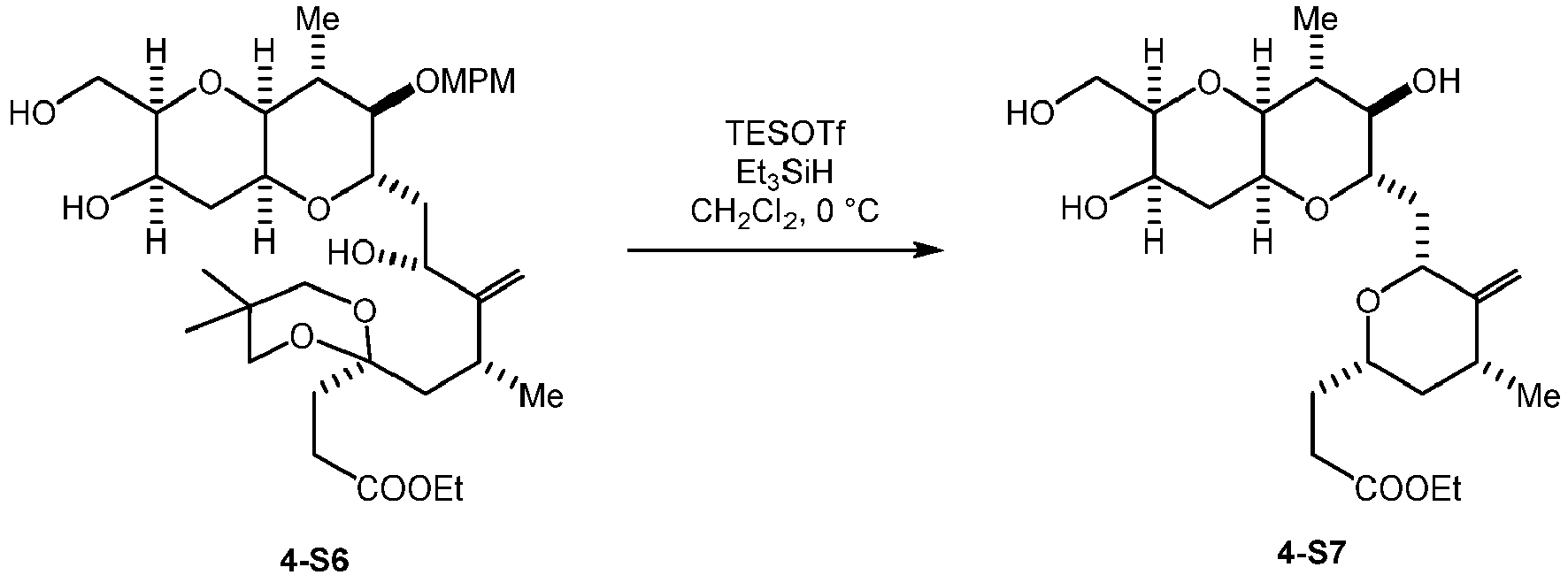
- To a stirred solution of 4-S6 (4.45 g, 6.69 mmol, 1 eq.) and TESH (10.7 mL, 66.9 mmol, 10 eq.) in CH2Cl2 (90 mL) was added TESOTf (7.58 mL, 33.5 mmol, 5 eq.) dropwise at 0 °C. After being stirred for 3 h, the mixture was poured into sat. NaHCO3 aq. The organic layer was separated and the aqueous layer was extracted with CH2Cl2. The combined organic layer was washed with brine, dried over Na2SO4, filtrated, and concentrated under reduced pressure. The residue was purified by flash column chromatography on neutral silica gel (10%, 50% then 100% EtOAc in Hexanes) to give 4-S7(2.57 g, 5.81 mmol, 87%) as colorless oil 4-S7: [α]20 D -29.1 (c 1.0, MeOH). 1H NMR (600 MHz, C6D6) δ: 4.77 (1H, s), 4.75 (1H, d, J = 1.8 Hz), 4.39 (1H, m), 4.27-4.14 (2H, m), 4.03 (1H, m), 3.95 (1H, m), 3.88 (1H, ddd, J = 11.9, 7.8, 4.4 Hz), 3.78 (1H, dd, J = 8.2, 4.1 Hz), 3.57 (1H, m), 3.52 (1H, m), 3.46 (1H, ddd, J = 7.5, 3.6, 3.6 Hz), 3.41 (1H, m), 3.03 (1H, dd, J = 5.0 Hz), 2.91 (1H, brs), 2.88 (1H, brs), 2.44 (2H, m), 2.25 (1H. m), 2.07-1.85 (4H, m), 1.76-1.65 (2H, m), 1.31 (1H, ddd, J= 12.8, 4.3, 1.8 Hz), 1.16 (1H, ddd, J = 15.0, 3.1, 3.1 Hz), 1.02 (3H, t, J = 7.0 Hz), 0.95-0.87 (4H, m), 0.85 (3H, d, J = 7.6 Hz) (one OH proton is missing) ppm. 13C NMR (125 MHz, C6D6) δ: 173.5, 151.2, 104.6, 80.9, 78.6, 77.2, 76.7, 76.5, 71.0, 65.5, 63.5, 62.6, 60.3, 42.7, 38.7, 35.9, 35.0, 32.4, 31.3, 30.7, 18.0, 16.2, 14.3 ppm. IR (film): 3435, 2928, 1729, 1420, 1253, 1165, 1092, 1048, 639 cm-1. HRMS (ESI) m/z: [M+Na]+ calcd for C23H38O8Na, 465.2459; found, 465.2460.

- To a stirred solution of 4-S7 (1.83 g, 4.14 mmol, 1 eq.) and 2,2-dimethoxypropane (37.6 mL, 306 mmol, 30 eq.) in acetone (100 mL) was added CSA (236 mg, 1.02 mmol, 10 mol%) at 0 °C. After being stirred for 30 min, the mixture was warmed to room temperature and stirred for 4 h. The reaction was quenched with Et3N (2 mL), diluted with EtOAc and stirred for 30 min. Then the mixture was poured into sat. NaHCO3 aq. The organic layer was separated and the aqueous layer was extracted with EtOAc. The combined organic layer was washed with brine, dried over Na2SO4, filtrated, and concentrated under reduced pressure. The residue was passed through a pad of silica gel (EtOAc) to give a crude acetonide 4-7 as colorless oil. The obtained crude material was used in the next reaction without further purification. Pure acetonide 4-7 (239 mg, 0.495 mmol) was isolated in 91% yield from diol (241 mg, 0.545 mmol). The product was obtained as colorless oil. 4-7: [α]20 D -19.0 (c 1.05, CHCl3). 1H NMR (600 MHz, C6D6) δ: 4.91 (1H, s), 4.72 (1H, s), 4.39-4.36 (1H, m), 4.09 (1H, dd, J = 7.2, 4.2 Hz), 4.01-3.98 (2H, m), 3.75 (1H, dd, J = 12.6, 2.4 Hz), 3.68 (1H, dd, J = 7.8, 4.5 Hz), 3.63 (1H, dd, J = 12.3, 2.7 Hz), 3.52 (1H, s), 3.45-3.40 (2H, m), 3.37 (1H, d, J = 7.2 Hz), 3.17 (1H, dd, J = 3.6, 3.6 Hz), 2.71 (1H, dd, J = 5.4, 3.0 Hz), 2.47-2.44 (2H, m), 2.28-2.13 (4H, m), 1.96-1.92 (1H, m), 1.74-1.66 (2H, m), 1.48 (3H, s), 1.41 (1H, ddd, J = 14.4, 4.5, 4.5 Hz), 1.32-1.30 (1H, m), 1.21 (3H, s), 1.17 (3H, d, J = 7.2 Hz), 1.00 (3H, t, J = 6.9 Hz), 0.94-0.87 (1H, m), 0.87 (3H, d, J = 6.6 Hz) ppm. 13C NMR (125 MHz, C6D6) δ: 173.2, 151.3, 104.7, 98.4, 78.3, 76.7, 75.8, 73.9, 70.2, 64.1, 63.7, 62.9, 60.0, 42.9, 40.6, 36.0, 34.5, 32.8, 31.2, 30.6, 28.8, 19.7, 18.0, 16.5, 14.3 ppm. FTIR (film): 3502, 2957, 2926, 2874, 1733, 1457, 1373, 1250, 1181, 1084, 1057, 1039, 977, 906, 836 cm-1. HRMS (ESI) m/z: [M+NH4]+ calcd for C26H46NO8, 500.3218; found, 500.3248.

- To a stirred solution of 4-7 (calculated as 10.2 mmol) in CH2Cl2 (200 mL) was added DIBAL (22 mL, 22.4 mmol, 2.2 eq.) dropwise at -78 °C. After being stirred for 1.5 h at the same temperature, the reaction was quenched with acetone (0.30 mL) and stirred for 15 min at -78 °C. Then sat. Rochelle's salt aq. was added, and the mixture was warmed to room temperature. After being stirred for 3h, the mixture was diluted with EtOAc. The organic layer was separated and the aqueous layer was extracted with EtOAc. The combined organic layer was washed with brine, dried over Na2SO4, filtrated, and concentrated under reduced pressure. The residue was combined with another crude material (ca. 400 mg) and purified by flash column chromatography on neutral silica gel (5%, 20% then 33% EtOAc in Hexanes) to give aldehyde 4-8 (4.1 g, 82-90% for 2 steps) as a colorless amorphous solid. One batch reaction: To a solution of 4-7 (206 mg, 0.427 mmol, 1 eq.) in CH2Cl2 (8.5 mL) was added DIBAL (0.94 mL of 1.0 M in Hexanes, 0.939 mmol, 2.2 eq.) dropwise at -78 °C. After being stirred for 50 min at the same temperature, the reaction was quenched with acetone (0.30 mL) and MeOH (0.30 mL). Then 20% Rochelle's salt aq. was added, and the mixture was stirred for 2 h at room temperature. The organic layer was separated and the aqueous layer was extracted with EtOAc. The combined organic layer was washed with brine, dried over Na2SO4, filtrated, and concentrated under reduced pressure. The residue was purified by flash column chromatography on neutral silica gel (5%, 20% then 33% EtOAc in Hexanes) to give 4-8 (167 mg, 0.381 mmol, 89%) as a colorless amorphous solid. 4-8: [α]20 D -17.3 (c 1.0, CHCl3). 1H NMR (600 MHz, C6D6) δ: 9.46 (1H, t, J = 1.5 Hz), 4.92 (1H, s), 4.73 (1H, d, J = 1.8 Hz), 4.41 (1H, dd, J = 5.9 Hz), 4.02 (1H, dd, J = 7.6, 4.7 Hz), 3.74 (1H, dd, J = 12.3, 2.9 Hz), 3.66 (1H, dd, J = 7.6, 4.1 Hz), 3.60 (1H, dd, J = 12.3, 3.5 Hz), 3.48 (1H, m), 3.39 (1H, m), 3.32 (1H, m), 3.27 (1H, m), 3.12 (1H, dd, J = 3.5, 3.5 Hz), 2.64 (1H, m), 2.34-2.11 (6H, m), 1.91 (1H, m), 1.53-1.45 (4H, m), 1.38 (1H, ddd, J = 14.1, 4.7, 4.7 Hz), 1.24 (1H, ddd, J = 12.6, 4.4, 2.3 Hz), 1.19 (3H, s), 1.11 (3H, d, J = 7.6 Hz), 0.89 (3H, d, J = 6.5 Hz), 0.86 (1H, dd, J = 24.6, 12.3 Hz) ppm. 13C NMR (125 MHz, C6D6) δ: 201.0, 151.2, 104.8, 98.4, 78.2, 76.6, 75.9, 74.2, 73.8, 70.2, 63.9, 63.2, 63.0, 42.9, 40.38, 40.36, 36.0, 34.5, 33.0, 29.0, 28.4, 19.5, 18.0, 16.4 ppm. IR (film): 3506, 2923, 2852, 1723, 1374, 1112, 1086, 908 cm-1. HRMS (ESI) m/z: [M+Na]+ calcd for C24H38O7Na, 461.2510; found, 461.2512.

- In a glove box, to a mixture of CrCl2 (46.2 mg, 0.376 mmol, 10 mol%), (R)-sulfonamide ligand (264 mg, 0.491 mmol, 13 mol%), and proton scavenger (97 mg, 0.453 mmol, 12 mol%) was added MeCN (9.4 mL) and the resulting solution was stirred for 1 h at room temperature. In a separate flask, 4-8 (1.65 g, 3.76 mmol, 1 eq.), 4-9-B (2.30 g, 4.14 mmol, 1.1 eq.), DTBMP (1.93 g, 9.40 mmol, 2.5 eq.), LiCl (319 mg, 7.52 mmol, 2 eq.), Mn (826 mg, 15.0 mmol, 4 eq.), Cp2ZrCl2 (2.75 g, 9.40 mmol, 2.5 eq.), and NiCl2·DEP (27.5 mg, 0.0752 mmol, 2 mol%) were mixed and then the solution of Cr complex was transferred to this flask. After being stirred for 1 h at room temperature, the reaction was removed from the glove box and diluted with EtOAc (15 mL). Potassium serinate aq. (0.5M, 15 mL) and sat. NaHCO3 aq. (15 mL) were added. After being stirred for 1 h, the resulting suspension was filtered through a pad of Celite. The organic layer was separated and the aqueous layer was extracted with EtOAc and washed with brine. The combined organic layer was dried over Na2SO4, filtered, and concentrated under reduced pressure to give a crude diol, which was used in the next reaction without further purification. To a stirred solution of the crude diol (calculated as 3.76 mmol, 1 eq.) in MeOH (75 mL) was added K2CO3 (5.2 g, 37.6 mmol, 10 eq.). The reaction was heated to 60 °C and stirred for 15 h. Then H2O (7.5 mL) was added. After being stirred for additional 3 h at the same temperature, the mixture was cooled to room temperature, filtered through a pad of Celite, and concentrated under reduced pressure. To the residue were added EtOAc, sat. NH4Cl aq., and brine. The organic layer was separated and the aqueous phase was extracted with EtOAc. The combined organic layer was dried over Na2SO4, filtrated, and concentrated under reduced pressure to give a crude seco acid 10-B, which was used in the next reaction without further purification. The macrolactonization was tested under Shiina's condition and Yamaguchi's condition. Shiina macrolactonization: To a stirred solution of MNBA (7.8 g, 22.6 mmol, 6 eq.) in toluene (2.5 L) was added DMAP (5.5 g, 45.1 mmol, 12 eq.) at 70 °C. A solution of the crude 4-10-B (calculated as 3.76 mmol, 1 eq.) and DIPEA (3.9 mL, 22.6 mmol, 6 eq.) in toluene (200 mL) was added to the MNBA solution via a syringe pump over 15 h. After completion of addition, the syringe was rinsed with toluene (40 mL). After being stirred for additional 30 min, the reaction was cooled to room temperature and concentrated under reduced pressure. The residue was dissolved in CH2Cl2 and washed with 0.5 M HCl and sat. NaHCO3 aq., successively. The organic layer was dried over Na2SO4, filtrated, and concentrated under reduced pressure. The residue was purified by flash column chromatography on neutral silica gel (13%, 25%, 33%, 50%, 67%, then 100% EtOAc in Hexanes) to give 4-11-B (2.19 g, 2.74 mmol, 73% for 3 steps) as a colorless solid. The obtained product was a mixture of diastereomer at C-20 stereocenter (dr = 19:1, determined by 1H NMR) Yamaguchi macroloctonization: To a stirred solution of the crude 4-10-B (calculated as 0.456 mmol) in THF (4.6 mL) were added NEt3 (0.159 mL, 1.14 mmol, 2.5 eq.) and 2,4,6-trichlorobenzoyl chloride (139 mg, 0.57 mmol, 1.25 eq.). The mixture was stirred for 2 h, and then filtered through a pad of Celite, which was washed with toluene (35.4 mL). In a separate flask, DMAP (334 mg, 2.74 mmol, 6 eq.) was dissolved in toluene (290 mL, 1.6 mM) at 80 °C. The solution of mixed anhydride was transferred into DMAP solution via a syringe pump over 13 h. The reaction was cooled to room temperature and quenched with sat. NaHCO3 aq. The organic layer was separated and the aqueous layer was extracted with EtOAc. The combined organic layer was dried over Na2SO4, filtered, and concentrated. The residue was purified by flash column chromatography on neutral silica gel (13%, 25%, 33%, 50%, 67%, then 100% EtOAc in Hexanes) to give 4-11-B (124 mg, 0.155 mmol, 34% for 3 steps) as a colorless solid. 4-11-B: [α]20 D -72.5 (c 1.09, CHCl3). MP: 188-189 °C (recrystallized from CH2Cl2-EtOAc). 1H NMR (600 MHz, C6D6) δ: 5.22 (1H, brs), 5.08 (1H, d, J = 1.8 Hz), 5.00 (1H, ddd, J = 10.6, 7.6, 2.9 Hz), 4.94 (1H, s), 4.82 (1H, dd, J = 7.6, 5.3 Hz), 4.76 (1H, brs), 4.68 (1H, brd, J = 10.0 Hz), 4.55 (1H, ddd, J = 10.3, 10.3, 4.1 Hz), 4.30 (1H, dd, J = 4.1, 1.8 Hz), 4.17-4.07 (3H, m), 3.98 (1H, m), 3.90 (1H, dd, J = 6.5, 4.7 Hz), 3.85 (1H, brd, J = 10.6 Hz), 3.81 (1H, dd, J = 11.7, 4.1 Hz), 3.73 (1H, m), 3.69 (1H, dd, J = 12.0, 3.8 Hz), 3.65 (1H, dd, J = 6.5, 4.1 Hz), 3.58-3.50 (2H, m), 3.05 (1H, dd, J = 3.3, 3.3 Hz), 2.85 (1H, dd, J = 16.4, 7.0 Hz), 2.76 (1H, m), 2.72 (1H, m), 2.62 (1H, dd, J = 9.4, 1.8 Hz), 2.50-2.36 (3H, m), 2.34-2.22 (3H, m), 2.22-2.03 (5H, m), 1.97-1.85 (3H, m), 1.72 (1H, dddd, J = 9.8, 9.8, 9.8, 4.7 Hz), 1.62-1.27 (11H, m), 1.26-1.21 (6H, m), 1.06 (1H, dd, J = 23.5, 12.3 Hz), 0.97 (3H, d, J = 6.5 Hz) ppm. 13C NMR (125 MHz, C6D6) δ: 171.3, 152.9, 152.7, 110.0, 105.0, 103.8, 98.7, 82.3, 81.0, 78.2, 78.1, 77.3, 76.9, 76.4, 76.1, 75.1, 74.7, 74.3 (x2), 74.0, 70.4, 69.9, 68.5, 64.1, 63.9, 62.4, 48.5, 43.8, 41.5, 39.4, 39.3, 38.8, 36.3, 35.6, 32.5, 32.4, 31.11, 31.09, 30.62, 29.3, 28.5, 20.3, 18.1, 16.4 ppm. IR (film): 2923, 2869, 1725, 1188, 1118, 1086, 755 cm-1. HRMS (ESI) m/z: [M+Na]+ calcd for C44H62O13Na, 821.4083; found, 821.4084.

- Ni/Cr-Mediated coupling of 4-8 with 4-9-B in the presence of Cr-catalyst prepared from (R)-4-G and (R)-4-H was carried out as follows: In a glove box, to a mixture of CrCl2 (7.0 mg, 10 mol%), sulfonamide (R)-G (43.2 mg, 13 mol%), proton scavenger (14.7 mg, 12 mol%) and LiCl (24.1 mg, 0.57 mmol, 1.0 eq) was added MeCN (1.4 mL, 0.4 M) and stirred for 1 h at r.t. In a separate flask, 4-8 (250 mg, 0.57 mmol, 1.0 eq), 4-9-B (350 mg, 0.63 mmol, 1.1 eq), DTBMP (290 mg, 1.43 mmol, 2.5 eq), Mn (125 mg, 2.28 mmol, 4.0 eq) and Cp2ZrCl2 (0.42 g, 1.43 mmol, 2.5 eq) were mixed, and the solution of Cr complex was then transferred to this flask. After being stirred for 1 min, HMP●NiCl2 (2.2 mg, 1 mol%; doped in LiCl) was added. Additional HMP●NiCl2 (2.2 mg, 1 mol%; doped in LiCl) was added after 1 and 2 h, respectively. The reaction mixture was stirred for 3 h total at r.t. The reaction was removed from the glove box and diluted with EtOAc (10 mL). Aqueous potassium serinate (0.5 M, 3 mL) and saturated aqueous NaHCO3 (3 mL) were added. After being stirred for 1 h, the resulting suspension was filtered through a pad of celite. The filtrate was extracted with EtOAc, washed with sat. NaCl, dried over Na2SO4, filtered, and concentrated. With use of the procedure given for the coupling with sulfonamide (R)-4-G, the crude product was converted to macrolactone 4-11-B; thus, 296 mg 4-11-B (65% overall yield; dr = 29: 1) was obtained from 250 mg 4-8.
- The Ni/Cr-mediated coupling with the Cr-catalyst prepared from (R)-4-H was carried out with use of the same procedure; 305 mg 4-11-B (67% overall yield; dr = 24:1) was obtained from 250 mg 4-8.
- Sulfonamides (R)-4-G, (R)-4-H, and (R)-4-I were synthesized via the general scheme shown below. As an example, the synthesis of (R)-4-G is given below.

- Step 1: To a slurry of NaH (5.56 g, 60% in mineral oil, 140 mmol, 3.0 eq) in anhydrous THF (100 mL) was added 5,8-dimethylnapthol (8.00 g, 46.5 mmol, 1.0 eq) at 0 °C with stirring for 1 h. Then 3-fluoro-2-nitrobenzonitrile (8.50 g, 51.2 mmol, 1.1 eq) was dissolved in THF (50 mL) added via syringe. The reaction was allowed to warm to room temperature and stirred for 3 h at room temperature before quenched with water at 0 °C. The organic solvent (THF) was removed in vacuo and the slurry was extracted with EtOAc (2 X 100 ml). The combined organic layers were washed with brine, water, dried over Na2SO4 and filtered. The solvent was removed in vacuo to afford 16.1 g of crude product which was purified with column chromatography using EtOAc: Hexanes (10:90) to afford pure red solid (12.20 g, 38.4 mmol, 82%). 1H NMR (600 MHz, CDCl3) δ: 7.96 (1H, dd, J = 8.5, 1.1 Hz), 7.48 (1H, dd, J = 8.4, 7.5 Hz), 7.46-7.40 (2H, m), 7.30-7.24 (1H, m), 7.19 (1H, d, J = 7.1 Hz), 7.08 (1H, dd, J = 7.5, 1.1 Hz), 6.97-6.91 (1H, m), 2.69 (3H, s), 2.66 (3H, s) ppm. 13C NMR (125 MHz, CDCl3) δ: 151.6, 151.5, 142.3, 135.6, 132.7, 130.9, 129.7, 127.7, 126.7, 126.5, 125.3, 123.5, 122.8, 117.6, 113.6, 108.0, 23.6, 20.1 ppm. IR (neat) v 2963, 2929, 2242, 1599, 1573, 1442, 1357, 1263, 1135, 997, 908, 824, 793, 750, 729 cm-1. HRMS (ESI) calcd. for C19H14N2O3Na [M + Na]+: 341.0897, found 341.0903.
- Step 2: To a solution of the above adduct (12.20 g, 38.4 mmol, 1.0 eq) in anhydrous EtOAc (150 mL) was added AcOH (17.5 ml, 307 mmol, 8.0 eq) followed by Pd/C (0.61 g, 5.8 mmol, 0.015 eq). A hydrogen balloon was attached. After the reaction was stirred for 4 h, the slurry was filtered through celite, and a mixture of brine and sat. NaHCO3 (1:1) was added to filtrate, extracted carefully with EtOAc (2 X 50 ml) and the organic solvent was removed in vacuo and crude product was purified by column chromatography using EtOAc: Hexanes (5:95) to afford pure yellow solid (9.69 g, 33.6 mmol, 88% yield). 1H NMR (600 MHz, CDCl3) δ: 7.85 (1H, dd, J = 8.5, 1.2 Hz), 7.43 (1H, dd, J = 8.5, 7.5 Hz), 7.28-7.23 (1H, m), 7.18 (1H, dd, J = 7.1, 1.0 Hz), 7.13 (1H, dd, J = 7.9, 1.4 Hz), 6.96 (1H, dd, J = 7.6, 1.1 Hz), 6.67 (1H, dd, J = 8.0, 1.4 Hz), 6.59 (1H, t, J = 7.9 Hz), 4.74 (1H, s), 2.75 (3H, s), 2.68 (3H, s). 13C NMR (125 MHz, CDCl3) δ: 153.3, 145.5, 141.7, 135.6, 132.5, 131.7, 129.1, 127.4, 126.6, 126.0, 125.4, 121.7, 120.9, 117.8, 117.3, 115.9, 96.7, 23.9, 20.1. IR (neat) v 3477, 3366, 2963, 2930, 2218, 1621, 1481, 1232, 1140, 969, 824, 750, 731 cm-1.
- Step 3: To a solution of the above product (9.60 g, 33.3 mmol, 1.0 eq) in anhydrous chlorobenzene (80 mL) was added to ZnCl2 (9.09 g, 66.7 mmol, 2.0 eq) and (R)-valinol (6.9 g, 66.7, 2.0 eq) at room temperature. The solution was heated to reflux for 30 h and quenched with water. The slurry was treated with NH4OH (50 mL) with stirring for 30 min and extracted with EtOAc (3 X 50 mL). The combined organic layers were washed with brine and water, dried over Na2SO4 and filtered. The solvent was removed in vacuo and the crude product was purified by column chromatography using EtOAc: Hexanes (15:85) to afford pure light yellow solid (10.43 g, 27.9 mmol, 84%). [α]D 20 -22.9 (c = 1.0, CHCl3). 1H NMR (600 MHz, CDCl3) δ: 7.78 (1H, dd, J = 8.5, 1.1 Hz), 7.51 (1H, dd, J = 8.1, 1.5 Hz), 7.39 (1H, t, J = 8.0 Hz), 7.25 (1H, dd, J = 7.1, 0.9 Hz), 7.18 (1H, dd, J = 7.2, 1.1 Hz), 6.97 - 6.92 (1H, m), 6.72 (1H, dd, J = 7.8, 1.4 Hz), 6.56 (2H, t, J = 7.9 Hz), 6.51 (1H, s), 4.38 (1H, dd, J = 9.5, 8.2 Hz), 4.15 (1H, ddd, J = 9.5, 8.1, 6.8 Hz), 4.05 (1H, t, J = 8.1 Hz), 2.87 (3H, s), 2.68 (3H, s), 1.89-1.78 (1H, m, J = 6.6 Hz), 1.08 (3H, d, J = 6.7 Hz), 0.98 (3H, d, J = 6.8 Hz) ppm. 13C NMR (125 MHz, CDCl3) δ: 163.6, 154.8, 144.8, 140.9, 135.5, 132.4, 132.2, 128.7, 127.2, 126.5, 125.5, 124.2, 120.5, 120.1, 115.1, 114.4, 110.2, 73.1, 69.0, 33.3, 24.5, 20.2, 19.1, 18.7 ppm. IR (neat) v 3478, 3282, 2958, 1634, 1592, 1551, 1472, 1362, 1228, 1192, 1075, 981, 823, 734 cm-1. HRMS (ESI) calcd.for C24H26Cl2N2O2 [M+H]+: 375.2067, found 375.2051;.
- Step 4: To a solution of the above product (10.41 g, 27.8 mmol, 1.0 eq) in anhydrous pyridine (70 mL) was added 3,5-dichlorobenzenesulfonyl chloride (10.26 g, 41.8 mmol, 1.5 equiv) and DMAP (36 mg, 0.3 mmol, 0.01 eq). The solution was stirred at room temperature overnight before quenched with water. The mixture was extracted with EtOAc (2 X 50 ml) and combined organic layers were washed with 1N HCl (3 X 50 ml), brine and water. The organic layer was dried over Na2SO4 and filtered. The solvent was removed in vacuo to afford the crude product which was purified by column chromatography using EtOAc: Hexanes (15:85) to afford pure white solid (R)-4-G (12.82g, 22.0 mmol, 83%). Recrystallization from EtOAc/Hexanes gave 10.31 g white crystals. (R)-4-G: [α]D 20 -12.1 (c = 1.0, CHCl3). mp = 138-140 °C. 1H NMR (600MHz, CDCl3) δ: 12.71 (1H, s), 7.78 (2H, s), 7.56 (4H, brs,), 7.45-7.42 (2H, m), 7.19-7.14 (3H, m,), 7.02 (4H, s), 7.01-6.97 (4H, m), 6.90 (2H, brs), 6.85 (2H, s), 6.80 (2H, s), 4.48 (1H, dd, J = 9.6, 8.3 Hz), 4.25 (1H, brs), 4.17 (2H, t, J = 8.2 Hz), 2.64 (1.3H, s), 2.37 (1.7H, s), 2.18 (3H, s), 1.92 (1H, m), 1.15 (3H, s), 1.04 (3H, s) ppm. 13C NMR (125 MHz, CDCl3) δ: 163.4, 152.1, 150.7, 145.0, 135.4, 134.7, 132.2, 131.3, 130.9, 128.7, 127.0, 126.5, 125.2, 124.8, 124.6, 123.6, 123.1, 122.3, 121.7, 121.0, 118.3, 116.9, 115.9, 72.7, 70.1, 33.3, 23.2, 20.1, 18.8 ppm. IR (neat) v 3078, 2959, 2929, 1639, 1571, 1464, 1339, 1265, 1164, 1134, 989, 923, 801, 746, 669, 576 cm-1. HRMS (ESI) calcd. for C30H28Cl2N2O4S [M+H]+: 583.1220, found 583.1233;
- Using the same procedure, sulfonamides (R)-4-H and (R)-4-I were synthesized. (R)-4-H: [α]D 20 -9.1 (c = 1.0, CHCl3). mp = 117-119 °C. 1H NMR (500MHz, CDCl3) δ: 12.77 (1H, s), 7.85 - 7.78 (1H, m), 7.67 - 7.59 (2H, m), 7.59 - 7.55 (2H, m), 7.47 (1H, ddd, J = 8.2, 6.9, 1.3 Hz), 7.40 - 7.30 (2H, m), 7.02 (1H, t, J = 8.0 Hz), 6.89 - 6.82 (3H, m), 4.49 (1H, dd, J = 9.6, 8.3 Hz,), 4.25 (1H, ddd, J = 9.6, 8.1, 6.8 Hz), 4.17 (1H, t, J = 8.3 Hz), 1.97 - 1.86 (1H, m, J = 6.8 Hz), 1.15 (3H, d, J = 6.7 Hz), 1.04 (3H, d, J = 6.7 Hz) ppm. 13C NMR (125 MHz, CDCl3) δ 163.5, 150.9, 150.2, 145.3, 134.9, 131.1, 127.7, 126.8, 126.6, 126.1, 125.7, 124.8, 124.7, 124.6, 124.3, 123.9, 121.8, 121.5, 118.4, 114.1, 72.8, 70.3, 33.4, 18.9 ppm. IR (neat) v 3076, 2959, 2929, 1639, 1571, 1465, 1389, 1339, 1268, 1165, 1134, 1078, 980, 800, 739, 580 cm-1. HRMS (ESI) calcd. for C28H25Cl2N2O4S [M+H]+: 555.0907, found 555.0915. (R)-4-I: [α]D 20 +13.4 (c = 1.0, CHCl3). mp = 96-98 °C. 1HNMR (600 MHz, CDCl3) δ: 12.27 (1H, brs), 7.86-7.94 (2H, m), 7.50-7.54 (1H, m), 7.43 (1H, d, J = 7.8, Hz), 7.13 (1H, t, J = 8.1 Hz), 7.01 (1H, d, J = 8.3 Hz), 4.40-4.48 (1H, m), 4.06-4.20 (3H, m), 1.83-1.91 (1H, m), 1.79 (1H, brd, J = 12.2 Hz), 1.71 (1H, br d, J = 12.2 Hz,), 1.55 (1H, m), 1.31-1.43 (2H, m), 1.10 (3H, d, J = 6.6 Hz), 0.99 (3H, d, J = 6.6 Hz), 0.85 (3H, d, J = 6.8 Hz), 0.87 (3H, d, J = 6.8 Hz), 0.40 (1H, q, J = 12.0 Hz), 0.25 (1H, q, J = 12.0 Hz), 0.20 (1H, q, J = 12.0 Hz); 13C NMR (125 MHz, CDCl3) δ: 163.4, 150.5, 146.3, 135.3, 131.5, 128.9, 125.2, 124.8, 120.8, 119.1, 117.2, 76.7, 72.6, 69.8, 42.9, 39.1, 39.0, 33.1, 30.4, 30.4,22.0, 18.7, 18.6. IR (neat) v 3079, 2951, 2926, 2869, 1638, 1571, 1467, 1337, 1269, 1165, 1014, 940, 801, 744, 606, 577 cm-1. HRMS (ESI) m/z 539.1556 [(M+H)]+; calcd. for C26H33Cl2N2O4S: 539.1533].
-

- Step 1: A stirred solution of bromotosylate (see, e.g., Velder, J.; Robert, T.; Weidner, I.; Neudçrfl, J. M. Adv. Synth. Catal. 2008, 350, 1309) (20.0 g, 56.5 mmol, 1.0 equiv) and freshly distilled furan (34 mL, 452 mmol, 8.0 equiv) in 150 mL of THF was cooled under nitrogen to -78 °C, and n-BuLi (34 mL, 84.7 mmol, 2.5 M, 1.5 equiv) was added dropwise. Stirring was continued for 10 h, during which time the solution was allowed to warm to room temperature. See, e.g., Jung, K. Y.; Koreeda, M. J. Org. Chem. 1989, 54, 5667. The reaction was quenched by the addition of a few drops of saturated aqueous ammonium chloride solution. The solvent was evaporated, and the resulting brownish residue was taken up in 200 mL of diethyl ether. The ethereal solution was washed with brine (100 mL) and water (100 mL), and dried over anhydrous Na2SO4. Evaporation of the solvent under reduced pressure, followed by purification by flash column chromatography on silica gel with ethyl acetate/hexanes (1:9) as the eluent, gave the adduct as light yellow solid (8.64 g, 50.2 mmol, 88%). 1H NMR (600 MHz, CDCl3) δ: 7.03 (2H, dd, J = 1.0, 1.0 Hz), 6.72 (2H, s), 5.8 (2H, dd, J = 1.0,1.0Hz), 2.3 (6H, s) ppm.
- Step 2: To a solution of Cu(OTf)2 (0.358 g, 0.99 mmol) in anhydrous DCE (10 mL) at 4 °C, the above adduct (3.41 g, 19.8 mmol) in DCE (10 mL) was added under a nitrogen atmosphere. The resulting mixture was stirred at r.t. until the reaction was complete (TLC monitoring). The mixture was then quenched by the addition of H2O (20 mL), extracted with CH2Cl2 (50 mL) and dried over Na2SO4. The crude product thus obtained was purified by flash column chromatography on silica gel with methylene chloride/hexanes (2:3) as the eluent, to give the 5,S-dimethyl-1 -naphthol as white crystalline solid (2.67g, 15.5 mmol, 77%). mp = 76-78 °C; 1H NMR (600 MHz, CDCl3) δ: 7.55 (1H, dd, J = 8.5, 1.1 Hz), 7.33-7.23 (1H , m), 7.17 (1H, dd, J = 7.1, 1.0 Hz), 7.09 (1H, dd, J = 7.1, 1.0 Hz), 6.75 (1H, dd, J = 7.4, 1.1 Hz), 5.19 (1H, s), 2.92 (3H, s), 2.61 (3H, s) ppm. 13C NMR (125 MHz, CDCl3) δ: 154.3, 135.5, 132.9, 131.8, 127.7, 126.9, 125.4, 123.8, 117.6, 110.2, 24.8, 20.2 ppm. IR (neat) v 3322, 3032, 2930, 2898, 1589, 1461, 1413, 1277, 1240, 1138, 897, 737 cm-1.
-

- Step 1: Pd/C (wet Degussa, 5% wt%; 1.2 g, 8.46 mmol, 0.05 eq) was added to the solution of 3,5-dimethylcycloheeanone (21.0 g, 169 mmol, 1.0 eq) in isopropanol (210 mL). The internal atmosphere was replaced with H2 (balloon). The reaction mixture was stirred under H2 (ballon) at room temperature for 2 h. The crude reaction mixture was filtered through Celite pad, and the filtrate was diluted with 100 mL water. The ketone was extracted with pentane (3 × 150 mL). The combined organic layers were washed with water (2 × 100 mL), dried over Na2SO4, and concentrated under reduced pressure, to give 21.3 g of crude product (syn:anti ratio = 33:1 by 1H NMR analysis). The
crude product 2 was used for next step without further purification. - Step 2: To a solution of 3,5-dimethylcyclohexanone (~21.0 g, 0.17 mol, 1.0 eq) in anhydrous hexanes (315 mL) was added anhydrous isopropanol (129 mL, 1.70 mol, 10 eq), followed by sodium metal (24.4 g, 102 mmol, 6.00 eq) were added under N2 atmosphere at 10 °C. The resulting solution was stirred vigorously at this temperature, slowly warmed to room temperature, and stirred for another 2 h. The reaction was quenched by the addition of an aqueous HCl (100 mL, 3.0 M) at 0 °C, diluted with Et2O (100 mL), and the organic layer was separated. The aqueous layer was extracted by Et2O (3 × 200 mL). Combined organic layers were dried over Na2SO4 and concentrated under reduced pressure to give 19.1 g of crude product (the diastereomeric ratio was >45:1 by 1H NMR). The product thus obtained was purified by recrystallization of its phenylurethane.
- Step 3: To the solution of crude alcohol (19.1 g, 149 mmol, 1 equiv) in CH2Cl2 (200 mL) was added phenyl isocyanate (19.4 mL, 179 mmol, 1.2 equiv) followed by DMAP (0.98 g, 7.46 mmol, 0.05 eq). The resulting mixture was stirred at room temperature for 15 h. After completion of the reaction (by TLC), the reaction mixture was filtered through silica gel pad and concentrated under reduced pressure. The crude residue was dissolved in EtOAc and diluted with large excess of hexanes. The solution was left standing for overnight at 0 °C and white crystals were precipitated out. Crystals were collected by filtration and washed with cold hexanes to give urethane (31.22 g; 75 % overall yield from 3,5-dimethylcycloheeanone; dr = ca. 200:1). m.p. 95-97 °C (ref. 106-107 °C)6. 1H NMR (500MHz, CDCl3) δ: 7.38-7.34 (2H, m), 7.28 (2H, t, J = 15 Hz), 7.05 (1H, t, J = 15 Hz) 6.52 (1H, br), 4.7 (1H, m), 2.04 (1H, dd, J = 3.4Hz, 3.2Hz), 1.63 (1H, dt, J1 = 14 Hz, J2 = 1.2 Hz), 1.57-1.52 (2H, m), 0.96 (2H, m), 0.94 (6H, d, J = 6.6 Hz), 0.56 (1H, q, J = 12 Hz,). 13C NMR (125MHz, CDCl3) δ: 153.3, 138.1, 128.9, 123.2, 118.5, 73.9, 42.9, 40.2, 30.6, 22.1. IR (neat) v 3313, 2949, 2925, 1702, 1598, 1539, 1442, 1312, 1221, 1052, 751, 691 cm-1. HRMS (ESI) m/z: (M+Na)+ calculated for C15H21NO2Na, 270.1484; found, 270.1464.
- Step 4: A solution of urethane (31.2 g, 126.2mmol) in 10% NaOH/MeOH (320 mL) was heated up to 60 °C and stirred for 18 h at this temperature. After completion of the reaction, the reaction mixture was diluted by EtOAc/hexanes (1:1) and washed with H2O, 1N HCl (3 × 100 mL), and brine, dried and concentrated. Distillation of the crude product gave pure syn,syn,syn-3,5-dimethylcyclohaxan-1-ol (14.42 g; colorless liquid; 90% yield). 1H NMR (500MHz, CDCl3) δ: 3.60 (1H, m), 1.92 (2H ,m), 1.58 (1H m), 1.49-1.42 (3H, m), 0.92 (1H, d, J= 7.8Hz), 0.82 (2H, q, J= 15 Hz), 0.51(1H, q, J= 15 Hz) ppm. 13C NMR (125MHz, CDCl3) δ: 70.3, 44.0, 43.1, 30.7, 22.2 ppm.

- To a stirred solution of 4-11-B (1.42 g, 1.78 mmol, 1 eq., dr = ~20:1) in CH2Cl2 (8.9 mL) and MeOH (8.9 mL, 0.2 M) was added TsOH·H2O (16.9 mg, 0.089 mmol, 5 mol%) at room temperature. After being stirred for 1 h, the reaction was quenched with Et3N (0.1 mL) and concentrated under reduced pressure. The residue was dissolved in EtOAc and sat. NaHCO3 aq. The organic layer was separated and the aqueous layer was extracted with EtOAc. The combined organic layer was washed with brine, dried over Na2SO4, filtered, and concentrated under reduced pressure to give a crude diol 4-S9, which was used in the next reaction without further purification. For the analytical purpose, a single crystal of the 4-S9 was obtained by vapor diffusion method (CH2Cl2-Et2O) (See
Figure 14B ). 4-S9: [α]20 D -69.5 (c 1.02, CHCl3). MP: 239-241 °C (recrystallized from CH2Cl2·Et2O). 1H NMR (600 MHz, CD2Cl2) δ: 5.03 (1H, s), 4.95 (1H, s), 4.84 (1H, s), 4.81 (1H, s), 4.66 (1H, dd, J = 4.5, 4.5 Hz), 4.56 (1H, dd, J= 4.5, 4.5 Hz), 2.54 (1H, dd, J = 3.9, 3.9 Hz), 4.38 (1H, d, J= 10.2 Hz), 4.33 (1H, d, J = 10.8 Hz), 4.29 (1H,s), 4.23 (1H, ddd, J = 9.9, 9.9, 4.2 Hz), 4.16 (1H, dd, J = 5.7, 5.7 Hz), 4.09 (1H, dd, J = 7.8, 7.8 Hz), 4.03 (1H, dd, J = 6.3, 3.9 Hz), 3.87 (1H, s), 3.84-3.79 (2H, m), 3.71-3.62 (4H, m), 3.50-3.43 (2H, m), 3.64 (1H, dd, J= 6.6, 4.2 Hz), 3.32 (1H, s), 2.89 (1H, dd, J = 9.3, 1.5 Hz), 2.81-2.77 (1H, m), 2.51 (1H, dd, J = 17.1, 9.9 Hz), 2.37 (1H, dd, J= 17.1, 2.1 Hz), 2.35-2.32 (2H, m), 2.26 (1H, d, J = 15.0 Hz), 2.23-2.07 (4H, m), 2.05-2.03 (1H, m), 1.96-1.91 (2H, m), 1.88-1.78 (3H, m), 1.72-1.65 (2H, m), 1.56 (1H, ddd, J = 12.3, 12.3, 4.8 Hz), 1.51-1.31 (5H, m), 1.17-1.13 (1H, m), 1.15 (3H, d, J= 7.2 Hz), 1.10-1.03 (1H, m), 1.10 (3H, d, J = 6.6 Hz) ppm. 13C NMR (125 MHz, CD2Cl2) δ: 171.2, 153.2, 152.4, 110.3, 104.7, 104.4, 82.9, 81.7, 80.2, 78.1, 77.6, 77.5, 77.1, 75.9, 75.5, 74.7, 74.5, 74.4, 74.3, 73.9, 73.8, 68.9, 66.1, 64.4, 63.9, 48.8, 44.2, 41.0, 39.2, 37.1, 36.4, 35.9, 35.3, 35.2, 31.9, 31.7, 31.3, 30.8, 29.1, 18.3, 16.9 ppm. FTIR (film): 3502, 2926, 2854, 1734, 1189, 1135, 1071, 1020, 995, 753 cm-1. HRMS (ESI) m/z: [M+NH4]+ calcd for C41H62NO13, 776.4216; found, 776.4230.
- To a stirred solution of 4-S9(crude, calculated as 1.78 mmol) in CH2Cl2 (17.8 mL) was added 2,6-lutidine (1.04 mL, 8.93 mmol, 5 eq.). The mixture was cooled to -78 °C, and then Tf2O (0.36 mL, 2.14 mmol, 1.2 eq.) was added. After being stirred for 15 min at the same temperature, TESOTf (0.60 mL, 2.65 mmol, 1.5 eq) was added. The reaction was warmed to 0 °C with ice bath. After being stirred for additional 20 min, to the reaction were added DMF (35.6 mL) and NaI (1.33 g, 8.87 mmol, 5 eq). The resulting mixture was allowed to warm to room temperature and stirred for 2.5 h. Then the reaction was quenched with sat. NaHCO3 aq. The organic layer was separated and the aqueous layer was extracted with TBME. The combined organic layer was dried over Na2SO4, filtered, and concentrated under reduced pressure. The residue was purified by flash column chromatography on neutral silica gel (9%, 13%, 17%, then 25% EtOAc in Hexanes) to give iodide 4-12-B (1.64 g, 1.67 mmol, 94% for 2 steps), which was a mixture of C20-epimer (dr = -25:1), as a colorless solid. The C20-epimer was separated by HPLC purification (Column: DuPont Instruments ZORBAL SIL 21.2 mm × 25 cm (880952-101), Solvent: 10% iPrOH in Hexanes, Flow rate: 10.0 mL/min., Detection: UV at 254 nm and 220 nm, tR(desired) = 19 min. tR(C20-epimer) = 25 min.). 4-12-B: [α]20 D -33.2 (c 1.0, CHCl3). MP: 158-160 °C (recrystallized from Hexanes-iPrOH). 1H NMR (600 MHz, C6D6) δ: 5.17 (1H, s), 5.12 (1H, d, J= 1.8 Hz), 4.92 (1Hm s), 4.78 (3H, m), 4.67 (1H, brd, J = 10.0 Hz), 4.53 (1H, ddd, J = 10.0, 10.0, 4.1 Hz), 4.27 (1H, dd, J = 3.5, 1.8 Hz), 4.14 (1H, dd, J = 4.7, 4.7 Hz), 4.10 (1H, dd, J = 4.7, 4.7 Hz), 4.06 (1H, m), 4.00 (1H, m), 3.89 (1H, dd, J = 6.5, 4.7 Hz), 3.79 (1H, d, J = 11.2 Hz), 3.75-3.67 (2H, m), 3.64 (1H, dd, J = 6.5, 4.1 Hz), 3.36-3.28 (3H, m), 3.20 (1H, ddd, J = 6.7, 6.7, 1.8 Hz), 3.03 (1H, dd, J = 4.7, 3.5 Hz), 2.78 (1H, dd, J = 16.7, 7.3 Hz), 2.71 (1H, m), 2.60 (1H, dd, J = 9.7, 2.1 Hz), 2.41-2.23 (5H, m), 2.23-1.90 (8H, m), 1.84 (1H, m), 1.73 (1H, m), 1.58-1.27 (8H, m), 1.17 (3H, d, J= 7.0 Hz), 1.08 (1H, dd, J= 24.1, 12.3 Hz), 1.02 (9H, t, J= 7.9 Hz), 0.99 (3H, d, J = 6.5 Hz), 0.67 (6H, q, J = 8.2 Hz) ppm. 13C NMR (125 MHz, C6D6) δ: 171.4, 153.0, 152.6, 110.0, 105.0, 103.6, 82.4, 81.0, 80.0, 78.7, 78.0, 77.7, 76.9, 76.1, 75.6, 74.8, 74.7, 74.08, 74.06, 73.9, 70.1, 68.5, 64.9, 64.0, 48.6, 43.9, 41.4, 39.4, 39.3, 39.0, 36.3, 36.2, 35.5, 32.5, 31.1, 30.7, 30.6, 29.0, 18.1 16.6, 73.2, 5.7, 5.4 ppm. IR (film): 2951, 2874, 1726, 1087, 1016, 996, 907, 753 cm-1. HRMS (ESI) m/z: [M+Na]+ calcd for C47H71IO12SiNa, 1005.3652; found, 1005.3649.

- To a stirred solution of alcohol (1.30 g, 2.77 mmol) in CH2Cl2 (26 mL) was added pyridine (1.35 mL, 16.6 mmol), acetic anhydride (0.79 mL, 8.3 mmol) at 0 °C. The reaction was stirred for 1 h at room temperature, added MeOH at 0 °C, and further stirred for 5 h at room temperature. Sat. NaHCO3 aq. was added to the reaction and the aqueous phase was extracted with CH2Cl2 three times. Combined organic phases were dried over Na2SO4 and evaporated. The crude product was purified by flash column chromatography on silica gel (3% EtOAc in hexanes) to provide acetate (1.35 g, 2.64 mmol, 96%) as a pale oil.
- To a stirred solution of acetate (1.35 g, 2.64 mmol, 1 eq.) in CH2Cl2 (26 mL) and MeOH (26 mL) was added CSA (30.7 mg, 0.089 mmol, 5 mol%) at room temperature. After being stirred for 3 h, the reaction was quenched with Et3N (0.2 mL) and concentrated under reduced pressure. The residue was dissolved in EtOAc and sat. NaHCO3 aq. The organic layer was separated and the aqueous layer was extracted with EtOAc. The combined organic layer was washed with brine, dried over Na2SO4, filtered, and concentrated under reduced pressure. This crude was used in the next reaction without further purification.
- To a mixture of alcohol (2.644 mmol, 1 eq.) and 2,6-lutidine (2.2 mL, 18.7 mmol) in CH2Cl2 (30 mL) was added TBSOTf (2.15 mL, 9.3 mmol) dropwise at -78 °C and the reaction mixture was stirred for 30 min at the same temperature prior to the addition of sat. NaHCO3 aq. The aqueous phase was extracted with CH2Cl2 twice and combined organic phases were dried over Na2SO4, concentrated under reduced pressure. The crude material was connected to high vacuum pump to remove remaining 2,6-lutidine. The obtained residue was purified by flash column chromatography on silica gel (10% then 20% EtOAc in hexanes) to give TBS ether (1.83 g, 99% for 2 steps) as a pale oil.
- To a solution of bis-TBS ether (1.40 g, 2.0 mmol, 1 eq.) in CH2Cl2 (20 mL) was added DIBAL (5 mL of 1.0 M in Hexanes, 5 mmol, 2.5 eq.) dropwise at -78 °C. After being stirred for 30 min at the same temperature, the reaction was quenched with acetone (0.30 mL) and MeOH (0.30 mL). Then 20% Rochelle's salt aq. was added, and the mixture was stirred for 2 h at room temperature. The organic layer was separated and the aqueous layer was extracted with EtOAc. The combined organic layer was washed with brine, dried over Na2SO4, filtrated, and concentrated under reduced pressure. The residue was purified by flash column chromatography on neutral silica gel (5%, 20% then 33% EtOAc in Hexanes) to give bis-TBS-4-8 (1.105 g, 1.76 mmol, 88%) as a colorless amorphous solid. bis-TBS-4-8: [α]20 D - 22.4 (c = 1.0, CDCl3). 1H NMR (600 MHz, C6D6) δ: 9.40 (1H, br s), 4.89 (1H, br s), 4.73 (1H, br d, J= 1.9 Hz), 4.29 (1H, q, J= 5.6 Hz), 3.88 (1H, t, J= 6.1 Hz), 3.83 (2H, d, J= 6.2 Hz), 3.68 (1H, td, J = 3.5, 1.6 Hz), 3.60 (1H, td, J = 3.7, 2.1 Hz), 3.59-3.50 (1H, m), 3.36 (1H, t, J= 5.6 Hz), 3.26 (1H, td, J= 6.2, 1.7 Hz), 3.24-3.18 (1H, m), 3.05 (1H, t, J= 2.4 Hz), 2.32-2.25 (1H, m), 2.17- 2.05 (4H, m), 2.00 (1H, dt, J = 14.6, 3.4 Hz,), 1.94-1.83 (1H, m), 1.48-1.34 (2H, m), 1.27 (1H, dt, J= 14.5, 3.9 Hz), 1.22-1.17 (1H, m), 1.01 (9H, s), 1.0 (3H, d, J = 6.0 Hz), 0.97 (9H, s), 0.86 (3H, d, J = 6.5 Hz), 0.84-0.76 (1H, m), 0.11 (3H, s), 0.10 (6H, s), 0.05 (3H, s). 13C NMR(125 MHz, C6D6) δ: 200.2, 150.8, 128.2, 104.4, 80.9, 78.9, 76.4, 75.7, 74.4, 72.1, 64.2, 63.4, 62.6, 42.4, 39.8, 39.4, 35.6, 35.4, 32.6, 27.9, 25.8, 25.7, 18.2, 18.1, 17.7, 16.2, -4.3, -5.2, -5.3, -5.4. IR (neat) v 3518, 2955, 2928, 2855, 1726, 1471, 1462, 1372, 1252, 1092, 836, 755 cm-1. HRMS (ESI) calcd. for C33H63O7Si2 [M+H]+ : 627.4107, found 627.4108.

- In a glove box, to a mixture of CrCl2 (3.9 mg, 10 mol%), sulfonamide ligand (R)-I (24.1 mg, 13 mol%), proton scavenger (8.2 mg, 12 mol%) and LiCl (13.2 mg, 0.32 mmol, 1.0 eq) was added MeCN (0.8 mL, 0.4 M) and stirred for 1 h at r.t. In a separate flask, bis-TBS-4-8 (0.20 g, 0.32 mmol, 1.0 eq), 4-9-A (0.23 g, 0.35 mmol, 1.1 eq), DTBMP (0.16 g, 0.79 mmol, 2.5 eq), Mn (70.1 mg, 1.28 mmol, 4.0 eq) and Cp2ZrCl2 (0.23 g, 0.79 mmol, 2.5 eq) and the above Cr complex solution was transferred, and mixture was stirred for 1 min, then NiCl2•HMP (1.3 mg, 2 mol%, 0.02 eq, doped in LiCl) was added. Additional NiCl2•HMP (1.3 mg each, 2 mol%, 0.01 eq, twice, doped in LiCl) was added after 1 and 2 h respectively. In total the reaction mixture was stirred for 3.5 h at r.t. The reaction was removed from the glove box and diluted with EtOAc (10 mL). Aqueous potassium serinate (0.5M, 2 mL) and saturated aqueous NaHCO3 (2 mL) were added. After being stirred for 1 h, the resulting suspension was filtered through a pad of celite. The filtrate was extracted with EtOAc, washed with sat. NaCl, dried over Na2SO4, filtered, and concentrated. Without further purification, the crude was used in next reaction.
- To a solution of 4-S9 (estimated as 0.32 mmol, 1.0 eq) in MeOH (8 mL) was added K2CO3 (0.44 g, 3.2 mmol, 10.0 eq). The reaction was heated to 60 °C and stirred for 15 h. Then H2O (0.4 mL) was added. After being stirred for additional 3 h at the same temperature, the mixture was cooled to room temperature, filtered through a pad of Celite, and concentrated. The residue was dissolved in EtOAc, sat. NH4Cl, and sat. NaCl. The mixture was extracted for five times with EtOAc. The combined organic layers were dried over Na2SO4, filtered, and concentrated. Without further purification, the crude product was used in the next reaction.
- To a solution of MNBA3 (Shiina's reagent, 0.658 g, 1.91 mmol, 6.0 eq) in hot toluene (200 mL) at 70 °C was added DMAP (0.47 g, 3.83 mmol, 12.0 eq). A solution of carboxylic acid S10 (estimated as 0.32 mmol, 1.0 eq) and DIPEA (0.66 mL, 3.83 mmol, 12.0 eq) in toluene (20 mL) was added to the reaction mixture via syringe pump over 15 h. After completion of addition, the syringe was washed with toluene (20 mL) and stirred for additional 30 min. The reaction was cooled to room temperature, and concentrated. The residue was dissolved in CH2Cl2 and washed with 0.5 M HCl, sat. NaHCO3 successively. The organic layer was dried over Na2SO4, filtered, and concentrated. Flash chromatography (neutral SiO2, Hexanes/EtOAc= 40/1, 20/1, 5/1 then 4/1 gave white crystalline solid 4-11-A (211 mg, 0.19 mmol, 54% over 3 steps). The overall stereoselectivity (dr = 25:1) was estimated from 1H NMR spectrum of 4-11-A thus obtained.
- Under the condition given on page S18, Ni/Cr-Mediated coupling of bis-TBS-4-8 with 4-9-A in the presence of Cr-catalyst prepared from (R)-4-G and (R)-4-H was carried out. Following the procedure given above, the crude coupling product was converted to the macrolactone acetonide, to determine the overall yield and stereoselectivity; sulfonamide (R)-4-H gave 58% overall yield from bis-TBS-4-8 (200-mg scale) and dr = 28:1, whereas sulfonamide (R)-4-G gave 58% overall yield from bis-TBS-4-8 (200-mg scale) and dr = 27:1. 11-A: [α]20 D -54.8 (c = 1.0, CDCl3). mp = 88-89 °C. 1H NMR (600 MHz, C6D6) δ: 7.31 (2H, d, J = 8.8 Hz), 6.68 (2H, d, J = 8.7 Hz), 6.03 (1H, s), 5.11 (1H, br s), 5.02 (1H, br s), 4.89 (1H, br s), 4.76-4.71 (3H, m), 4.61 (1H, d, J = 10.4 Hz), 4.44 (1H, td, J = 10.5, 10.0, 4.3 Hz), 4.36 (1H, brs), 4.32 (1H, dt, J = 5.3, 0.9 Hz), 3.4 (1H, q, J = 3.9 Hz), 3.26 (1H, td, J = 6.2, 1.9 Hz), 3.19 (3H, s), 3.09 (1H, dd, J= 4.7, 3.1 Hz), 2.72 (1H, dd, J= 16.8, 7.7 Hz), 2.62 (1H, ddt, J= 15.5, 7.7, 2.4 Hz), 2.48 (1H, dd, J= 9.5, 1.8 Hz), 2.35 ( 1H, dd, J= 16.8, 4.4 Hz ), 2.32-2.18 (6H, m),1.97 (1H, dt, J= 11.6, 3.9 Hz), 1.88 (1H, ddt, J= 14.2, 11.4, 3.1 Hz), 1.77 (1H , tt, J= 13.6, 3.7 Hz), 1.70-1.62 (1H, m), 1.49 (1H, dddd, J= 11.9, 7.3, 5.6, 2.5 Hz), 1.43 (2H, dt, J= 12.5, 2.8 Hz), 1.37 (1H, dt, J= 14.6, 4.5 Hz), 1.33-1.19 (3H, m), 1.16 (3H, d, J= 7.3 Hz), 1.14-1.0 (2H, M), 0.99 (9H, s), 0.98 (9H, s), 0.14 (3H, s), 0.12 (6H, s), 0.09 (3H, s) ppm. 13C NMR(125 MHz, C6D6) δ: 170.7, 161.0, 152.6, 152.4, 128.4, 128.3, 118.6, 113.7, 108.9, 108.6, 104.6, 103.4, 89.8, 83.4, 79.7, 78.0, 77.8, 77.4, 75.8, 75.6, 75.4, 74.4, 73.9, 73.6, 73.5, 73.4, 69.7, 68.0, 64.13, 64.09, 63.3, 54.4, 43.7, 40.9, 39.2, 39.0, 38.2, 36.0, 35.3, 31.9, 30.9, 30.5, 29.97, 29.9, 27.3, 26.0, 25.9, 25.8, 18.3, 17.8, 16.4, -4.3, -5.0, -5.3, -5.4 ppm. IR (neat) v 2952, 2927, 2855, 1732, 1615, 1518, 1251, 1092, 1010, 834, 775, 756 cm-1. HRMS (ESI) calcd. for C61H92NaO16Si2 [M+Na]+ : 1159.7774, found 1159.7816.

- To a solution of 4-11-A (720 mg, 0.633 mmol) in THF (12.7 mL) was added TBAF solution (0.95 M in THF, buffered with 0.5 eq of imidazole·hydrochloride, 3.2 mL, 3.17 mmol) at room temperature. After stirring for 40 h at room temperature, solvent was removed by a stream of nitrogen gas and redissolved in EtOAc and water. The aqueous layer was extracted with EtOAc four times and the combined organic layer was dried over Na2SO4, filtered, and concentrated. Without further purification, the crude product was used in the next reaction.
- To a stirred solution of crude diol (estimated as 0.633 mmol) in CH2Cl2 (6.3 mL) was added 2,6-lutidine (0.733 mL, 6.33 mmol, 10 eq.). The mixture was cooled to -78 °C, and then added Tf2O (0.13 mL, 0.760 mmol, 1.2 eq.). After being stirred for 15 min at the same temperature, TESOTf (0.23 mL, 1.01 mmol, 1.6 eq) was added. The reaction was warmed to 0 °C with ice bath. After being stirred for additional 20 min, to the reaction were added DMF (12.6 mL) and NaI (0.475 g, 3.17 mmol, 5 eq). The resulting mixture was allowed to warm to room temperature and stirred for 2.5 h. Then the reaction was quenched with sat. NaHCO3 aq. The organic layer was separated and the aqueous layer was extracted with TBME. The combined organic layer was dried over Na2SO4, filtered, and concentrated under reduced pressure. The residue was purified by flash column chromatography on neutral silica gel (9%, 20%, 30%, then 40% EtOAc in Hexanes) to give iodide 4-12-A (595 mg, 0525 mmol, 83% for 2 steps), which was a mixture of C20-epimer (dr = -20:1), as a colorless solid. The C20-epimer was separated by HPLC purification (Column: DuPont Instruments ZORBAL SIL 21.2 mm × 25 cm (880952-101), Solvent: 3% iPrOH in Hexanes, Flow rate: 10.0 mL/min., Detection: UV at 254 nm and 220 nm, tR(desired) = 17 min. tR(C20-epimer) = 21 min.). 4-12-A: white solid, [α]20 D -50.0 (c 0.65, CHCl3). MP: 115-117 °C (recrystallized from H2O-iPrOH). 1H NMR (600 MHz, C6D6) δ: 7.36 (2H, d, J = 8.8 Hz), 6.73 (2H, d, J = 8.8 Hz), 6.09 (1H, s), 5.17 (1H, s), 5.11 (1H, d, J = 1.2 Hz), 4.94 (1H, s), 4.80-4.77 (3H, m), 4.66 (1H, brd, J= 11.2 Hz), 4.49 (1H, ddd, J= 11.2, 11.2, 4.2 Hz), 4.40 (1H, d, J= 1.8 Hz), 4.37 (1H, dd, J = 5.4, 1.2 Hz), 4.06 (1H, s), 4.01 (1H, dd, J = 6.0, 6.0 Hz), 4.00-3.96 (2H, m), 3.79 (1H, d, J = 11.4 Hz), 3.73-3.68 (3H, m), 3.36-3.28 (3H, m), 3.22 (3H, s), 3.20 (1H, ddd, J = 6.6, 6.6, 1.8 Hz), 3.04 (1H, dd, J = 4.2, 3.0 Hz), 2.77 (1H, dd, J = 16.2, 7.8 Hz), 2.66-2.62 (1H, m), 2.51 (1H, dd, J= 9.9, 1.5 Hz), 2.39-2.24 (6H, m), 2.19-1.94 (7H, m), 1.85-1.82 (1H, m), 1.76-1.71 (1H, m), 1.55-1.27 (6H, m), 1.18 (3H, d, J= 7.2 Hz), 1.08 (1H, dd, J= 12.6, 11.4 Hz), 1.03 (9H, t, J = 7.9 Hz), 1.01 (3H, d, J = 6.5 Hz), 0.70 (6H, q, J = 8.2 Hz) ppm. 13C NMR (125 MHz, C6D6) δ: 171.2, 161.4, 153.0, 152.6, 119.0, 114.1, 109.3, 109.0, 105.1, 103.7, 90.3, 83.8, 79.8, 78.7, 78.1, 77.9, 76.0, 75.6, 74.7, 74.1, 74.0, 73.8, 73.7, 69.9, 68.4, 64.8, 64.0, 54.8, 44.0, 41.4, 39.4, 39.4, 39.0, 36.4, 36.3, 32.4, 31.1, 30.9, 30.3, 30.2, 27.6, 18.2, 16.6, 7.3(×3), 5.7, 5.3(×3) ppm. IR (film): 2953, 2935, 2875, 1731, 1615, 1518, 1251, 1092, 1011, 907, 831 cm-1. HRMS (ESI) m/z: [M+Na]+ calcd for C55H77IO15SiNa, 1155.3969; found, 1155.3987.

- In a glove box, to a mixture of CrCl2 (7.0 mg, 10 mol%), sulfonamide ligand (R)-4-I (43.2 mg, 13 mol%), proton scavenger (14.7 mg, 12 mol%) and LiCl (24.1 mg, 0.57 mmol, 1.0 eq) was added MeCN (1.4 mL, 0.4 M) and stirred for 1 h at r.t. In a separate flask, 4-8 (0.25 g, 0.57 mmol, 1.0 eq), 4-9-C (0.35 g, 0.63 mmol, 1.1 eq), DTBMP (0.29 g, 1.43 mmol, 2.5 eq), Mn (125 mg, 2.28 mmol, 4.0 eq) and Cp2ZrCl2 (0.42 g, 1.43 mmol, 2.5 eq) and the above Cr complex solution was transferred, and mixture was stirred for 1 min, then NiCl2•DEP (2.2 mg, 1 mol%, 0.01 eq, doped in LiCl) was added. Additional NiCl2•DEP (2.2 mg each, 1 mol%, 0.01 eq, twice, doped in LiCl) was added after 1 and 2 h respectively. In total the reaction mixture was stirred for 3 h at r.t. The reaction was removed from the glove box and diluted with EtOAc (10 mL). Aqueous potassium serinate (0.5M, 3 mL) and saturated aqueous NaHCO3 (3 mL) were added. After being stirred for 1 h, the resulting suspension was filtered through a pad of celite. The filtrate was extracted with EtOAc, washed with sat. NaCl, dried over Na2SO4, filtered, and concentrated. Without further purification, the crude was used in next reaction.
- To a solution of 4-S11 (estimated as 0.57 mmol, 1.0 eq) in MeOH (10 mL) was added K2CO3 (0.79 g, 5.71 mmol, 10.0 eq). The reaction was heated to 60 °C and stirred for 15 h. Then H2O (0.6 mL) was added. After being stirred for additional 3 h at the same temperature, the mixture was cooled to room temperature, filtered through a pad of Celite, and concentrated. The residue was dissolved in EtOAc, sat. NH4Cl, and sat. NaCl (adjust pH = ~7 by adding few drops of 1N HCl). The mixture was extracted for five times with EtOAc. The combined organic layers were dried over Na2SO4, filtered, and concentrated. Without further purification, the crude product was used in the next reaction.
- To a solution of MNBA (1.18 g, 3.43 mmol, 6.0 eq) in hot toluene (380 mL) at 70 °C was added DMAP (0.84 g, 6.85 mmol, 12.0 eq). A solution of carboxylic acid 4-S12 (estimated as 0.57 mmol, 1.0 eq) and DIPEA (1.2 mL, 6.85 mmol, 12.0 eq) in toluene (27 mL) was added to the reaction mixture via syringe pump over 15 h. After completion of addition, the syringe was washed with toluene (20 mL) and stirred for additional 30 min. The reaction was cooled to room temperature, and concentrated. The residue was dissolved in CH2Cl2 and washed with 0.5 M HCl, sat. NaHCO3 successively. The organic layer was dried over Na2SO4, filtered, and concentrated. Flash chromatography (neutral SiO2, Hexanes/EtOAc= 7/1, 5/1, 3/1, 1/1, 1/2 then 1/3 gave white crystalline solid 4-11-C (307 mg, 0.36 mmol, 61% over 3 steps). The overall stereoselectivity (dr = 17:1) was estimated from 1H NMR spectrum of 4-11-C thus obtained. 4-11-C: [α]20 D -52.2 (c = 1.0, CDCl3). mp = 157-158 °C. 1H NMR (600 MHz, C6D6) δ: 5.71 (1H, ddt, J = 17.3, 10.6, 5.3 Hz), 5.18 (1H, brs), 5.11 (1H, dq, J = 17.3, 1.7 Hz), 5.05 (1H, q, J = 2.2 Hz), 5.02 - 4.91 (2H, m), 4.90 (1H, s), 4.77 (1H, dd, J= 7.7, 5.0 Hz), 4.72 (1H, d, J= 1.8 Hz), 4.62 (1H, dt, J= 10.3, 2.4 Hz), 4.54 - 4.47 (1H, m), 4.35 (1H, dd, J = 4.2, 2.0 Hz), 4.30 - 4.26 (1H, m), 4.11 - 4.00 (2H, m), 3.94 (1H, m), 3.83 - 3.73 (3H, m), 3.72 - 3.62 (m, 3H), 3.53 - 3.45 (2H, m), 3.00 (1H, dd, J = 5.1, 4.0 Hz), 2.80 (1H, dd, J = 16.5, 7.2 Hz), 2.73 - 2.63 (2H, m), 2.53 (1H, dd, J = 9.6, 2.1 Hz), 2.46 - 2.37 (2H ,m), 2.29 (2H, dtdt, J = 19.4, 7.2, 4.9, 2.1 Hz), 2.25 - 2.09 (4H, m), 2.09 - 1.98 (4H, m), 1.92 - 1.80 (2H, m), 1.75 - 1.62 (1H, m), 1.56 - 1.40 (4H, m), 1.40 - 1.23 (3H, m), 1.19 (5H, d, J = 6.9 Hz), 1.02 (1H, td, J = 12.4, 11.0 Hz), 0.93 (2H, d, J = 6.4 Hz) ppm. 13C NMR(125 MHz, C6D6) δ: 170.9, 152.5, 152.3, 134.3, 116.3, 115.9, 108.9, 104.6, 103.4, 98.4, 82.9, 77.9, 77.6, 76.9, 75.9, 75.7, 74.7, 74.7, 73.9, 73.7, 73.6, 70.0, 69.5, 68.1, 65.6, 63.7, 63.5, 62.1, 51.3, 43.4, 41.1, 39.0, 38.9, 38.4, 35.9, 35.6, 32.2, 31.9, 30.7, 30.7, 30.1, 28.5, 28.1, 19.8, 17.8, 16.1 ppm. IR (neat) v 2925, 2867, 1729, 1373, 1311, 1186, 1118, 1073, 995, 911, 832, 756 cm-1. HRMS (ESI) calcd. for C47H66NaO14 [M+Na]+ : 877.4345, found 821.4353.
- Under the condition given on page S18, Ni/Cr-Mediated coupling of 4-8 with 4-9-C in the presence of Cr-catalyst prepared from (R)-4-G and (R)-4-H was carried out. Following the procedure given above, the crude coupling product was converted to the macrolactone acetonide, to determine the overall yield and stereoselectivity; sulfonamide (R)-4-H gave 63% overall yield from 8 (250-mg scale) and dr = 20:1, whereas sulfonamide (R)-4-G gave 63% overall yield from 4-8 (250-mg scale) and dr = 21:1.

- To a stirred solution of 4-11-C (700 g, 0.819 mmol, 1 eq., dr = ~20:1) in CH2Cl2 (8.2 mL) and MeOH (8.2 mL) was added p-TsOH·H2O (3.1 mg, 0.016 mmol, 2 mol%) at room temperature. After being stirred for 1 h, the reaction was quenched with Et3N (0.1 mL) and concentrated under reduced pressure. The residue was dissolved in EtOAc and sat. NaHCO3 aq. The organic layer was separated and the aqueous layer was extracted with EtOAc. The combined organic layer was washed with brine, dried over Na2SO4, filtered, and concentrated under reduced pressure to give a crude diol, which was used in the next reaction without further purification.
- To a stirred solution of crude diol (estimated as 0.819 mmol) in CH2Cl2 (8.2 mL) was added 2,6-lutidine (0.57 mL, 4.91 mmol, 6 eq.). The mixture was cooled to -78 °C, and then added Tf2O (0.18 mL, 1.1 mmol, 1.2 eq.). After being stirred for 15 min at the same temperature, TESOTf (0.30 mL, 1.31 mmol, 1.5 eq) was added. The reaction was warmed to 0 °C with ice bath. After being stirred for additional 20 min, to the reaction were added DMF (16.4 mL) and NaI (650 g, 4.43 mmol, 5 eq). The resulting mixture was allowed to warm to room temperature and stirred for 6 h. Then the reaction was quenched with sat. NaHCO3 aq. The organic layer was separated and the aqueous layer was extracted with TBME. The combined organic layer was dried over Na2SO4, filtered, and concentrated under reduced pressure. The residue was purified by flash column chromatography on neutral silica gel (9%, 13%, 20%, then 30% EtOAc in Hexanes) to give iodide 4-12-C (689 mg, 0.663 mmol, 81% for 2 steps), which was a mixture of C20-epimer (dr = -20:1), as a colorless solid. The C20-epimer was separated by HPLC purification (Column: DuPont Instruments ZORBAL SIL 21.2 mm × 25 cm (880952-101), Solvent: 2% iPrOH in Hexanes, Flow rate: 10.0 mL/min., Detection: UV at 254 nm and 220 nm, tR(desired) = 22.8 min. tR(C20-epimer) = 28.0 min.). 4-12-C: colorless solid, [α]20 D -46.8 (c 1.0, CHCl3). MP: 84-86 °C (recrystallized from H2O -iPrOH). 1H NMR (600 MHz, C6D6) δ: 5.75 (1H, dddd, J= 17.3, 10.5, 5.1, 5.1 Hz), 5.15 (1H, ddd, J = 17.4, 1.8, 1.8 Hz), 5.14 (1H, s), 5.11 (1H, s), 4.97 (1H, ddd, J = 10.2, 1.8, 1.8 Hz), 4.90 (1H, s), 4.77-4.72 (3H, m), 4.62 (1H, d, J= 11.2 Hz), 4.49 (1H, ddd, J= 10.2, 10.2, 4.4 Hz), 4.35 (1H, ddd, J = 1.8, 1.8, 1.8 Hz), 4.31 (1H, d, J = 4.8 Hz), 4.11 (1H, dd, J = 6.6, 4.8 Hz), 4.0-3.97 (1H, m), 3.83-3.80 (1H, m), 3.74 (1H, d, J = 11.4 Hz), 3.72 (1H, ddd, J = 5.4, 1.8, 1.8 Hz), 3.70-3.67 (2H, m), 3.32-3.27 (3H, m), 3.19 (1H, ddd, J = 6.6, 6.6, 1.8 Hz), 3.03 (1H, dd, J = 4.8, 3.6 Hz), 2.74 (1H, dd, J = 17.4, 7.8 Hz), 2.71-2.67 (1H, m), 2.56 (1H, dd, J = 9.6, 1.8 Hz), 2.33 (1H, dd, J = 16.8, 4.2 Hz), 2.29-2.20 (5H, m), 2.23-1.97 (8H, m), 1.93-1.89 (1H, m), 1.72-1.66 (1H, m), 1.53-1.28 (8H, m), 1.14 (3H, d, J= 7.2 Hz), 1.05 (1H, dd, J= 12.6, 10.8 Hz), 1.00 (9H, t, J= 8.4 Hz), 0.98 (3H, d, J= 7.2 Hz), 0.66 (6H, q, J= 7.8 Hz) ppm. 13C NMR (125 MHz, C6D6) δ: 171.4, 153.0, 152.6, 134.6, 128.3, 116.6, 116.2, 109.3, 105.0, 103.7, 83.3, 79.8, 78.6, 77.9, 77.7, 76.0, 75.6, 75.1, 75.0, 74.7, 74.1, 73.9, 70.0, 68.4, 65.9, 64.9, 63.9, 51.7, 43.9, 41.3, 39.4, 39.3, 38.9, 36.3, 36.2, 35.9, 32.5, 31.1, 30.7, 30.5, 28.5, 18.1, 16.6, 7.3(×3), 5.7, 5.3(×3) ppm. IR (film): 2952, 2948, 2875, 1733, 1457, 1338, 1218, 1138, 1073, 831 cm-1. HRMS (ESI) m/z: [M+Na]+ calcd for C50H75IO13SiNa, 1061.3914; found, 1061.3919.
- One of the central questions was how to construct the [6,6]-spiroketal in a stereoselective manner. Based on precedents, the oxy-Michael process of E → F under the basic conditions was used (
Figure 15 ). The first precedent was found in the synthetic work on polyether antibiotic (-)-A23187 (calcimycin) (see, e.g., Negri, D. P.; Kishi, Y. Tetrahedron Lett., 1987, 28, 1063); on treatment with a catalytic amount of NaOMe, G was transferred exclusively to H, the relative stereochemistry of which corresponded to that of F. - The second precedent was found in halichondrin syntheses. As the model study for the original enone route, the oxy-Michael reaction on I was studied; on treatment with DBU and LiCl in CH2Cl2, I gave selectively J, which isomerized to K on treatment with DBU and LiCl in MeCN or DBU and LiBr in CH2Cl2. Alternatively, K was obtained directly from I on treatment with Hunig base, LiBr in CH2Cl2 MeCN. These results indicated that J was as the kinetically controlled product, whereas K was as the thermodynamically controlled product. The stereochemistry of J and K was reduced from NOE experiments; in particular, a strong cross peak was observed between C39-H and C48-H of J-a, whereas a strong cross peak was detected between C40-H and C48-H of K-a, cf. red double-headed arrows.
- A primitive estimation was made on the relative stability of J and K, on the basis of the literature-known data on A-values of cyclohexane and tetrahydropyran, destabilization energy due to 1,3-diaxial interaction, and destabilization-energy due to boat-conformation. The preferred conformation of K was assumed to be K-a, whereas that of J to be either J-a, J-b, or half-boat conformer (not shown). For the simplicity of analysis, conformers K-a, J-a, and J-b were used. Around the structure indicated by a dotted box, all of them had the same structural arrangement, including the double stereoelectronic stabilization. Therefore, this structural moiety was excluded from the analysis. A-value for Me-group at 2-position of tetrahydropyran was reported to be 2.86 kcal/mol, which was roughly 1.6 times of A-value for Me-group of cyclohexane (see, e.g., Eliel, E. L.; Hargrave, K. D.; Pietrusiewicz, K. M.; Manoharan, M. J. Am. Chem. Soc. 1982, 104, 3635). 1,3-Diaxial interaction of CH2R/OMe on cyclohexane was known around 1.9 kcal/mol, which would correspond to ~3 kcal/mol (1.6 × 1.9 kcal/mol) on tetrahydropyran (see, e.g., Corey, E. J.; Feiner, N. F. J. Org. Chem. 1980, 45, 765 and references cited therein). In addition, a boat conformer of cyclohexane and tetrahydropyran was estimated to be destabilized by 5.5 and 3.9 kcal/mol, respectively, relative to the corresponding chair conformer. Thus, we would assume the destabilization due to the boat conformation in J-b to be in the range of 3.9-5.5 kcal/mol (see, e.g., Eliel, E. L.;
- Allinger, N. L. Angyal, S. J.; Morrison, G. A. Conformational Analysis; John Wiley: New York, 1965, p 244). Counting these factors, K was roughly estimated to be energetically favored over J by 3~4 kcal/mol.
- To test the feasibility of the synthetic plan proposed above, studied first was the synthesis of 2-
pyridyl thioester 8 for two reasons. First, γ-lactone 3 was readily available from 2, which was the starting material for the synthesis of C27-C37 building block and available from D-galactal (1) in a large quantity (see, e.g., Chen, C.-L.; Namba, K.; Kishi, Y. Org. Lett. 2009, 11, 409). Second, 2-pyridyl thioester 8 should be a good model substrate to study the following Zr/Ni-mediated one-pot ketone synthesis. -
Figure 16 summarizes the synthesis of 8 from γ-lactone 3. Thus, γ-lactone 3 was straightforwardly transformed to δ-lactone 4 in an excellent overall yield. The coupling of 4 and 5-5 was achieved by slow addition of t-BuLi into a mixture of the two substrates in THF. The unsaturated benzyl ester group was incorporated on 6 in 3 steps, i.e., (1) dihydroxylation of the terminal olefin, (2) oxidative cleavage, and (3) Homer-Emmons reaction, to furnish 7 in an excellent overall yield. Alternatively, the transformation of 6 into 7 was realized in one step with metathesis (see, e.g., Tmka, T. M.; Grubbs, R. H. Acc. Chem. Res. 2001, 34, 18; Schrock, R. R. Adv. Syn. Catal. 2007, 349, 41; Hoveyda, A. H.; Zhugralin, A. R. Nature 2007, 450, 243; Araki, M.; Sakata, S.; Takei, H.; Mukaiyama, T. Bull. Chem. Soc. Jpn. 1974, 47, 1777). Because of the cost-effectiveness, the former three-step procedure was chosen for preparative purpose. - The behavior of 7 in oxy-Michael process was similar to the case of I into K. On treatment with DBU and LiBr in MeCN at room temperature, 7 initially gave a 2:1 mixture of kinetically- and thermodynamically-controlled products, which equilibrated almost exclusively to the thermodynamically controlled product at room temperature for 12 hours. In this transformation, the benzyl ester was partially hydrolyzed, but it was found that the hydrolysis of benzyl ester was completely suppressed by addition of BnOAc. Preparatively, on treatment with DBU (5 equiv)/LiBr (10 equiv)BnOAc (10 equiv.), 7 gave the desired, thermodynamically controlled product with in an excellent overall yield. The stereochemistry of oxy-Michael product was confirmed by NOE experiments; a strong cross peak was observed between C40-H and C48-H. Finally, the necessary functional group adjustment was made in four steps, i.e., (1) deprotection of C41 MPM group, (2) protection of the resultant alcohol with TES, (3) debenzylation, and (4) thioester formation. 2-
Pyridyl thioester 8 thus obtained was fully characterized and was found stable to store at -20 °C in dark. The overall yield of 8 from 3 was >50% in a 5-g scale preparation. -
Figure 17 summarizes the synthesis of left half in the halichondrin series. This synthesis was designed on the basis of the knowledge gained in the synthesis of C38-C52 building block discussed in the preceding section, coupled with the original synthesis of the left half of halichondrin B. Epoxy γ-lactone 9 was synthesized from L-gulono-γ-lactone by the method reported in 1992 (see, e.g., Buszek, K. R.; Fang, F. G.; Forsyth, C. J.; Jung, S. H.; Kishi, Y.; Scola, P. M.; Yoon, S. K. Tetrahedron Lett. 1992, 33, 1553), whereas cis-vinyl iodide 5-10 was prepared from commercially available (S)-glycidol in 4 steps. Then, 9 and 10 were coupled with use of a standard Cu-mediated chemistry. With use of 1.8 equivalent of 10, γ-lactone 11 was isolated in 81% yield. The homoallylic alcohol in 11 was epoxidized with Sharpless VO(TMHD)2-mediated method, followed by TES-protection of the C48 alcohol, to give epoxy-γ-lactone 12 in 85% overall yield from 11, with >50:1 stereoselectivity (see, e.g., Sharpless, K. B.; Michaelson, R. C. J. Am. Chem. Soc. 1973, 95, 6136). The next coupling of 12 with 5 was best achieved by slow addition of t-BuLi into a mixture of the two substrates in THF, to give 13 in 85% yield, which existed as a mixture of ketol (major) and keto/alcohol (minor). Among acids tested, (PhO)2P(=O)OH was found to be most effective in facilitating an intramolecular epoxide-ring opening by the masked alcohol at C47. With minor modifications on the transformation outlined inFigure 16 ,14 was transformed to theleft half 17. Thus, the terminal olefin of 14 was converted tounsaturated benzyl ester 16. In this series, it was necessary to unmask the protecting group of the C48 alcohol; on treatment with (PhO)2P(=O)OH, two TES-groups in 14 were selectively removed, to furnish 15. -
Unsaturated benzyl ester 15 was subjected to oxy-Michael reaction under the condition optimized with 7 (Figure 16 ), to furnish the desiredproduct 16 in 86% yield. The stereochemical behavior of 16 in the oxy-Michael reaction was found to be very similar to that of 7, including the overall stereoselectivity and the equilibration of the kinetically-controlled product into the thermodynamically-controlled product. In this series, however, one-minor by-product was isolated in ~8% yield. The spectroscopic analysis (HRMS, 1H- and 13C-NMR, IR) suggested this minor product to be 18, which likely arose via the carbanion-attack to the unsaturated benzyl ester, cf., the red arrow in L. The structure information of 18 immediately suggested a possibility of eliminating or suppressing the by-product formation with use of organocatalysts recently reported by Asano, Matsubara and coworkers (see, e.g., Yoneda, N.; Fukata, Y.; Asano, K.; Matsubara, S. Angew. Chem. Int. Ed, 2015, 54, 15497). Indeed, an addition of non-chiral thiourea M had an expected effect, to give a 2:1 mixture of two diastereomers, free from 18. In principle, a chiral thioure should enforce preferentially to form one of the two diastereomers. In practice, however, the asymmetric induction was only modest with chiral organocatalysts. Thus, the 2:1 mixture was subjected to the equilibrating condition, to furnish almost exclusively 16 in 93% overall yield from 15. Obviously, the equilibration took place via the retro-oxy-Michael/oxy-Michael process. Curiously, however, there was no detectable amount of 18 formed in the equilibration step. Structurally, compared with 7, 15 had one additional free-hydroxyl group at C51. That additional free-hydroxyl group might affect the overall outcome in the oxy-Michael reaction, because it was carried out under basic conditions. However, it was demonstrated that the substrate with the C51-alcohol protected with TBS did exhibit virtually identical reactivity profiles as 15 did. Finally, the left-half 17 in the halichondrin series was obtained uneventfully from 16 in 82% overall yield. -
Figure 18 summarizes the synthesis of left half in the homohalichondrin series. Once again, this synthesis was based on the knowledge gained through the previous work (see, e.g., Fang, F. G.; Kishi, Y.; Matelich, M. C.; Scola, P. M. Tetrahedron Lett. 1992, 33, 1557). The synthesis began with γ-lactone 3, which was transformed to 21 via 20 by standard synthetic operations. Sharpless asymmetric epoxidation (see, e.g., Katsuki, T.; Sharpless, K. B. J. Am. Chem. Soc. 1980, 102, 5974) was used stereoselectively to install the C53-C55 moiety. Namely, asymmetric epoxidation of the allylic alcohol of 21, followed by acid treatment, gavetriol 22 in an excellent overall yield. Based on the absolute stereochemistry of the epoxide introduced by Sharpless asymmetric epoxidation, the stereochemistry of 22 was assigned as indicated, which was confirmed by X-ray analysis of its C55 mono-3,5-dinitrobenzoate. This experiment proved the C53/C54-stereochemistry previously proposed for the homohalichondrins from NMR analysis.Triol 22 was transferred to δ-lactone 23 and then tounsaturated benzyl ester 24 in a good overall yield. The overall behavior of 24 in the intramolecular oxy-Michael to construct the [6,6]-spiroketal was similar to that observed on 15. Lastly, 2-pyridyl thioester 26 was secured from 25 as before. -
Figure 19 summarizes the synthesis of left half in the norhalichondrin series. With two modifications, this synthesis was carried out as the previous cases. First, the C53 terminal in the norhalichondrin series was a carboxylic acid, which was introduced via oxidation of the primary alcohol selectively prepared from 29. Second, TES-group was chosen to protect the alcohol at C50. Notably, the behavior ofunsaturated benzyl ester 28 in the oxy-Michael transformation was found to be virtually identical with that of 7. 2-Thiopyridine ester 32 thus synthesized was isolated via neutral silica gel chroma-tography and fully characterized. -

- To a stirred solution of lactone 2 (10.0 g, 29.2 mmol, 1 eq.) and Et3N (20.0 mL, 143 mmol, 5.0 eq.) in CH2Cl2 (100 mL) was added TBSOTf (17.0 mL, 74.0 mmol, 2.5 eq.) at 0 °C. After being stirred for 3 h at room temperature, the reaction was quenched with sat. NaHCO3 aq. The organic layer was separated and the aqueous layer was extracted with CH2Cl2. The combined organic layer was dried over Na2SO4, filtered, and concentrated under reduced pressure. The obtained crude material was used in the next reaction without further purification.
The crude silyl enol ether (calculated as 29.2 mmol, 1 eq.) was dissolved in a mixture of EtOAc (200 mL), THF (30 mL), and sat. NH4Cl aq. (300 mL). After being stirred for 3 h at 50 °C, the mixture was cooled to room temperature. The organic layer was separated and the aqueous layer was extracted with EtOAc. The combined organic layer was dried over Na2SO4, filtered, and concentrated under reduced pressure. The crude lactone was recrystalized from CH2Cl2/Hexanes to give lactone 3 (9.68 g from 1st recrystallization and 300 mg from 2nd recrystallization: total 9.98 g, 29.1 mmol, 100% for 2 steps) as a colorless crystal. The spectroscopic data obtained are consistent with those previously reported in the literature.
- To a stirred solution of 3 (4.3 g, 12.6 mmol, 1 eq.) in CH2Cl2 (63 mL) at -78 °C was added DIBAL solution (16.4 mL of 1.0 M in hexanes, 16.4 mmol, 1.3 eq.). After being stirred for 40 min, the reaction was quenched with MeOH at the same temperature. Then 10% Rochelle's salt aq. was added. The mixture was stirred for 2 h at room temperature to give a clear biphasic mixture. The organic layer was separated and the aqueous layer was extracted with EtOAc. The combined organic layer was dried over Na2SO4, filtered, and concentrated under reduced pressure to give a crude lactol, which was used in the next reaction without further purification. To a suspension of Ph3PCH3Br (18.0 g, 50.4 mmol, 4 eq.) in THF (50 mL) was added t-BuOK (4.24 g, 37.8 mmol, 3 eq.) at 0 °C. A solution of the crude lactol (calculated as 12.6 mmol) in THF (13 mL) was added into the reaction mixture, and then the ice bath was removed. After being stirred for 1.5 h at room temperature, the reaction was quenched with sat. NH4Cl aq. The organic layer was separated and the aqueous layer was extracted with EtOAc. The combined organic layer was dried over Na2SO4, filtered, and concentrated under reduced pressure. The residue was dissolved in hexanes-EtOAc (10:1) and passed through a pad of silica gel (9% EtOAc in Hexanes) to give S-1 (4.15 g, 12.1 mmol, 96% for 2 steps) as a colorless solid. S-1: [α]20 D -36.8 (c 1.14, CHCl3). MP: 90-93 °C (recrystallized from Hexanes). 1H NMR (600 MHz, C6D6) δ: 6.19 (1H, ddd, J =17.3, 10.6, 6.7 Hz), 5.20-5.11 (2H, m), 4.13 (1H, d, J = 12.3 Hz), 3.93 (1H, dd, J = 2.9, 2.9 Hz), 3.84 (1H, dd, J = 12.3, 2.9 Hz), 3.71 (1H, d, J = 10.6 Hz), 3.58 (1H, m), 3.00 (1H, m), 2.74 (1H, d, J=9.4 Hz), 2.64 (1H, d, J = 2.9 Hz), 2.18 (1H, ddd, J = 14.7, 2.9, 2.9 Hz), 1.18 (9H, s), 1.15 (1H, ddd, J = 14.7, 3.2, 3.2 Hz), 1.08 (3H, d, J = 6.5 Hz), 1.05 (9H, s) ppm. 13C NMR (125 MHz, C6D6) δ: 142.6, 113.5, 85.5, 76.5, 69.7, 68.6, 64.2, 38.6, 36.9, 27.9, 27.5, 23.3, 20.6, 15.0 ppm. FTIR (film): 3503, 2960, 2933, 2858, 1474, 1132, 1091, 1022, 950, 908, 844, 825, 766, 651 cm-1. HRMS (ESI) m/z: [M+Na]+ calcd for C18H34O4SiNa, 365.2119; found, 365.2116.

- S-1 (4.66 g, 13.6 mmol, 1 eq.) was dissolved in 9-BBN solution (68 mL of 0.5 M in THF, 34 mmol, 2.5 eq.) at room temperature. After being stirred for 1.5 h at the same temperature, H2O (68 mL) and NaBO3·H2O (20.4 g, 204 mmol, 15 eq.) were added. After being stirred for 2 h at the same temperature, the reaction was filtered through a filter paper. The organic layer was separated and the aqueous layer was extracted with EtOAc. The combined organic layer was dried over Na2SO4, filtered, and concentrated under reduced pressure. The residue was purified by flash column chromatography on silica gel (9%, 25%, then 50% EtOAc in Hexanes) to give S-2 (4.94 g, 13.7 mmol, quantitative) as a colorless amorphous solid. S-2: [α]20 D -7.6 (c 1.01, CHCl3). 1H NMR (600 MHz, C6D6) δ 4.33 (1H, m), 4.16 (1H, dd, J= 12.3, 2.4 Hz), 4,11 (1H, m), 3.67 (1H, brs), 3.63 (1H, dt, J= 10.7, 6.4, 6.4 Hz), 3.59-3.45 (2H, m), 3.27 (1H, m), 2.95 (1H, d, J = 9.4 Hz), 2.26 (1H, dt, J = 14.7, 2.9 Hz), 2.02 (1H, m), 1.93 (1H, br), 1.70 (1H, dddd, J= 13.6, 6.6, 6.6, 6.6 Hz), 1.65 (1H, dt, J= 14.7, 2.9, 2.9 Hz), 1.51 (1H, m), 0.95 (9H, s), 0.94 (9H, s), 0.86 (3H, d, J = 7.0 Hz). 13C NMR (125 MHz, C6D6) δ: 86.3, 76.6, 69.7, 68.5, 64.3, 61.1, 38.3, 36.9, 32.2, 27.9, 27.4, 23.3, 20.5, 16.6 ppm. FTIR (film): 3525, 2933, 2859, 1473, 1145, 1091, 1053, 1023, 954, 869, 839, 826, 764, 651, 447 cm-1. HRMS (ESI) m/z: [M+H]+ calcd for C18H37O5Si, 361.2405; found, 361.2415.

- To a stirred solution of S-2 (calculated as 13.6 mmol) in CH2Cl2 (136 mL) was added NaHCO3 (11.4 g, 136 mmol, 10 eq.). The mixture was cooled to 4 °C, then PhI(OAc)2 (13.1 g, 40.8 mmol, 3 eq.) and TEMPO (213 mg, 1.36 mmol, 10 mol%) were added. After being stirred for 15 h at the same temperature, the reaction was quenched with 10% Na2S2O3 aq. and sat. NaHCO3 aq. The organic layer was separated and the aqueous layer was extracted with EtOAc. The combined organic layer was dried over Na2SO4, filtered, and concentrated under reduced pressure. The residue was purified by flash column chromatography on silica gel (0%, 9%, 17%, then 33% EtOAc in Hexanes) to give 4 (4.68 g, 13.1 mmol, 97% in 2 steps) as a colorless solid. 4: [α]20 D -12.7 (c 2.29, CHCl3). MP: 147-150 °C (recrystallized from Hexanes-EtOAc). 1H NMR (600 MHz, C6D6) δ 4.11 (1H, dd, J = 12.9, 1.2 Hz), 3.96 (1H, dd, J= 12.6, 3.2 Hz), 3.89 (1H, m), 3.43 (1H, m), 2.55 (1H, m), 2.53 (1H, m), 2.43 (1H, dd, J = 17.0, 13.5 Hz), 2.28-2.20 (2H, m), 1.29 (1H, m), 1.21 (9H, s), 1.13-1.07 (10H, m), 0.76 (3H, d, J = 6.5 Hz). 13C NMR (150 MHz, C6D6) δ: 169.0, 77.1, 75.0, 73.3, 68.0, 66.5, 35.9, 33.9, 31.3, 28.1, 27.2, 23.4, 20.4, 16.7 ppm. FTIR (film): 2933, 2857, 1727, 1474, 1364, 1180, 1136, 1109, 1045, 976, 829, 770, 645, 443 cm-1. HRMS (ESI) m/z: [M+Na]+ calcd for C18H32NaO5Si, 379.1911; found, 379.1912.

- A solution of 4 (1.0 g, 2.80 mmol) and 5 (1.36 g, 3.93 mmol, 1.4 eq.) in THF was degassed by bubbling with Ar. To the solution was added t-BuLi solution (4.23 mL of 1.7 M in pentane, 7.29 mmol, 2.6 eq.) dropwise at -78 °C over 10 min. After being stirred for 15 min at the same temperature, the reaction was quenched with sat. NH4Cl aq. The organic layer was separated and the aqueous layer was extracted with EtOAc. The combined organic layer was washed with brine, dried over Na2SO4, filtered, and concentrated under reduced pressure. The residue was purified by flash column chromatography on silica gel (10% then 30% EtOAc in Hexanes) to give 6 (1.46 g, 2.53 mmol, 90%) as colorless oil. 6 was obtained as an equilibrium mixture of ketone form and ketal form (ca. 4:1 ratio in C6D6). Spectral data only for major ketone form are shown here. 6: [α]20 D -17.4 (c 1.44, CHCl3). 1H NMR (600 MHz, C6D6) δ: 7.26 (2H, d, J = 8.7 Hz), 6.83 (2H, d, J = 8.7 Hz), 5.63 (1H, ddd, J = 17.1, 10.8, 7.8 Hz), 5.14-5.09 (2H, m), 4.53 (1H, d, J= 11.4 Hz), 4.21 (1H, d, J= 11.4 Hz), 4.10 (1H, d, J= 12.6 Hz), 3.93 (1H, dd, J = 2.7, 2.7 Hz), 3.85 (1H, dd, J = 12.6, 3.0 Hz), 3.64 (1H, d, J= 10.2 Hz), 3.57 (1H, d, J = 10.8 Hz), 3.48 (1H, dd, J = 7.2, 7.2 Hz), 3.34 (3H, s), 2.81-2.68 (4H, m), 2.64 (1H, s), 2.50-2.46 (1H, m), 2.28 (1H, dd, J= 15.3, 7.5 Hz), 2.24 (1H, dd, J = 16.5, 8.7 Hz), 2.15 (1H, ddd, J = 14.4, 2.7, 2.7 Hz), 1.16 (9H, s), 1.16-1.13 (1H, m), 1.04 (9H, s), 1.02 (3H, d, J = 6.6 Hz), 0.97 (3H, d, J = 7.2 Hz) ppm. 13C NMR (125 MHz, C6D6) δ: 209.1, 159.6, 137.8, 131.3, 129.5, 118.1, 114.0, 84.9, 84.2, 76.5, 70.2, 69.7, 68.5, 64.1, 54.8, 47.3, 46.2, 37.0, 34.1, 31.4, 27.9, 27.5, 23.3, 20.5, 16.5, 16.1 ppm. FTIR (film): 3527, 2933, 2858, 1708, 1613, 1513, 1473, 1247, 1146, 1091, 1022, 956, 652, 447 cm-1. HRMS (ESI) m/z: [M+Na]+ calcd for C32H52NaO7Si, 599.3375; found, 599.3376.

- To a stirred solution of 6 (1.0 g, 1.73 mmol, 1 eq.) in acetone (17.4 mL) were added NMMO (405 mg, 3.46 mmol, 2 eq.) and OsO4 solution (8.8 mL of 0.02 M in H2O, 0.173 mmol, 10 mol%) at room temperature. After being stirred for 21 h at the same temperature, the mixture was diluted with water. The organic layer was separated and the aqueous layer was extracted with EtOAc. The combined organic layer was dried over Na2SO4, filtered, and concentrated under reduced pressure. The residue was passed through a pad of silica gel (EtOAc) and concentrated under reduced pressure. The obtained crude material was used in the next reaction without further purification. To a stirred solution of diol (calculated as 1.73 mmol) in CH2Cl2 (17.3 mL) was added K2CO3 (717 mg, 5.19 mmol, 3 eq.) and Pb(OAc)4 (920 mg, 2.08 mmol, 1.2 eq.) at room temperature. After being stirred for 1 h at the same temperature, the reaction mixture was passed through a pad of silica gel (EtOAc). The filtrate was concentrated under reduced pressure. The residue was purified by flash column chromatography on silica gel (0%, 9%, 17%, then 25% EtOAc in Hexanes) to give S-3 (826 mg, 1.43 mmol, 83% for 2 steps) as colorless oil. S-3 was obtained as an equilibrium mixture of hemiacetal (ca. 4:1 ratio in C6D6). S-3: [α]20 D -39.3 (c 1.01, CHCl3). 1H NMR (600 MHz, C6D6) δ: 7.19-7.16 (2H, m), 6.78-6.75 (2H, m), 5.41 (0.2H, dd, 11.1, 1.5 Hz), 4.93 (0.8H, dd, J = 13.2, 1.8 Hz), 4.54 (0.8H, d, J = 10.8 Hz), 4.44 (0.2H, d, J = 11.4 Hz), 4.31 (0.8H, d, J = 10.8 Hz), 4.26 (0.2H, d, J = 11.4 Hz), 4.21-4.17 (1.2H, m), 3.99 (0.8H, dd, J = 12.3, 2.7 Hz), 3.98 (0.2H, dd, J = 12.6, 3.6 Hz), 3.90-3.89 (0.8H, m), 3.87-3.86 (0.2H, m), 3.69 (0.2H, d, J = 10.8 Hz), 3.62 (0.8H, d, J = 4.2 Hz), 3.36 (0.8H, d, J = 12.6 Hz), 3.62 (0.8H, d, 4.2 Hz), 3.36 (0.8H, d, J = 12.6 Hz), 3.29 (0.6H, s), 3.28 (2.4H, s), 3.19 (0.8H, s), 2.81 (0.2H, d, J = 3.0 Hz), 2.77 (0.8H, d, J = 2.4 Hz), 2.63 (0.8H, dd, J = 1.5, 1.5 Hz), 2.61 (0.2H, dd, J = 1.8, 1.8 Hz), 2.47-2.42 (0.2H, m), 2.34-2.25 (1.8H, m), 2.09 (0.8H, ddd, J = 15.0, 1.8, 1.8 Hz), 2.00 (0.2H, ddd, J= 15.0, 1.8, 1.8 Hz), 1.91-1.88 (0.4H, m), 1.74-1.61 (2.8H, m), 1.53-1.49 (1H, m), 1.42 (0.2H, ddd, J = 15.6, 4.2, 4.2 Hz), 1.36 (0.8H, ddd, J = 15.0, 4.5, 4.5 Hz), 1.29 (7.2H, s), 1.27 (1.8H, s), 1.14 (7.2H, s), 1.13 (1.8H, s), 1.07 (0.6H, d, J = 6.6 Hz), 1.03 (2.4H, d, J = 7.2 Hz), 1.01 (2.4H, d, J = 7.2 Hz), 1.00 (0.6H, d, J = 6.6 Hz) ppm. 13C NMR (125 MHz, C6D6) δ: 159.9, 159.7, 131.2, 129.6, 129.5, 128.5, 114.3, 114.0, 99.0, 98.4, 93.9, 91.2, 80.2, 78.6, 77.5, 77.4, 76.0, 72.2, 68.6, 68.5, 67.2, 67.0, 64.7, 64.0, 54.7, 38.5, 37.5, 37.4, 36.9, 36.4, 36.3, 29.5, 29.0, 27.8, 27.6, 23.41, 23.38, 23.1, 20.9, 17.9, 17.5, 17.2 ppm. FTIR (film): 3512, 2931, 2856, 1612, 1514, 1474, 1246, 1195, 1127, 1094, 1043, 1014, 966, 942, 828, 769, 735, 651, 441 cm-1. HRMS (ESI) m/z: [M+Na]+ calcd for C31H50NaO8Si, 601.3167; found, 601.3168.

- To a stirred solution of S-3 (208 mg, 0.359 mmol, 1 eq.) in toluene (3.6 mL) were added benzyl dimethylphosphonoacetate (0.30 mL, 1.44 mmol, 4 eq.) and K3PO4 (232 mg, 1.08 mmol, 3 eq.) at room temperature. After being stirred for 23 h at the same temperature, the reaction mixture was passed through a pad of silica gel (50% EtOAc in Hexanes) to give crude unsaturated ester (7) (as a ~3:1 mixture of E/Z isomers). The crude material was used in the next reaction without further purification.
- To a stirred solution of the crude 7 (calculated as 0.359 mmol, 1 eq.), BnOAc (541 mg, 3.6 mmol, 10 eq.), and LiBr (313 mg, 3.6 mmol, 10 eq.) in MeCN (3.6 mL) was added DBU (0.269 µL, 1.80 mmol, 5 eq.) at room temperature. After being stirred for 12 h at the same temperature, the reaction was quenched with sat. NH4Cl aq. The organic layer was separated and the aqueous layer was extracted with EtOAc. The combined organic layer was washed with brine, dried over Na2SO4, filtered, and concentrated under reduced pressure to give a crude spiro acetal, which was used in the next reaction without further purification. To a stirred solution of the crude spiro acetal (calculated as 0.359 mmol) in CH2Cl2 (3.6 mL) and phosphate buffer (pH=7, 0.7 mL) was added DDQ (163 mg, 0.72 mmol, 2 eq.). After being stirred for 40 min, the reaction was quenched with 10% Na2S2O3 aq. and sat. NaHCO3 aq. The organic layer was separated and the aqueous layer was extracted with CH2Cl2. The combined organic layer was dried over Na2SO4, filtered, and concentrated under reduced pressure. The residue was purified by flash column chromatography on silica gel (0%, 9%, 13%, the 17% EtOAc in Hexanes) to give alcohol S-4 (160 mg, 0.271 mmol, 75% for 3 steps) as colorless oil. S-4: [α]20 D -51.3 (c 1.0, CHCl3). 1H NMR (600 MHz, C6D6) δ: 7.24-7.01 (5H, m), 5.07 (1H, d, J= 12.3 Hz), 4.98 (1H, d, J= 12.3 Hz), 4.30 (1H, m), 4.22 (1H, d, J = 12.9 Hz), 4.16 (1H, dd, J = 10.0, 2.9 Hz), 4.00 (1H, dd, J = 12.6, 2.6Hz), 3.93 (1H, m), 3.87 (1H, m), 2.99 (1H, d, J= 8.2 Hz), 2.92-2.84 (2H, m), 2.71 (1H, brs), 2.32 (1H, dd, J = 16.1, 3.2 Hz), 2.28 (1H, d, J= 15.3 Hz), 2.18 (1H, m), 2.11 (1H, m), 1.74 (1H, dd, J = 13.5, 4.1 Hz), 1.66 (1H, dd, J = 12.9, 12.9 Hz), 1.55 (1H, ddd, J = 15.4, 4.5, 4.5 Hz), 1.36-1.20 (11H, m), 1.13 (9H, s), 1.05 (3H, d, J = 7.0 Hz), 0.92 (3H, d, J= 6.5 Hz) ppm. 13C NMR (125 MHz, C6D6) δ: 171.6, 136.7, 128.7, 128.5, 126.9, 92.3, 77.52, 77.48, 70.5, 69.4, 68.6, 67.2, 66.1, 63.7, 37.42, 37.38, 36.5, 36.4, 29.8, 29.1, 27.8, 27.6, 23.4, 20.9, 17.6, 17.4 ppm. IR (film): 3473, 2957, 2931, 2857, 1736, 1131, 1017, 974 cm-1. HRMS (ESI) m/z: [M+Na]+ calcd for C32H50NaO8Si, 613.3167; found, 613.3169.
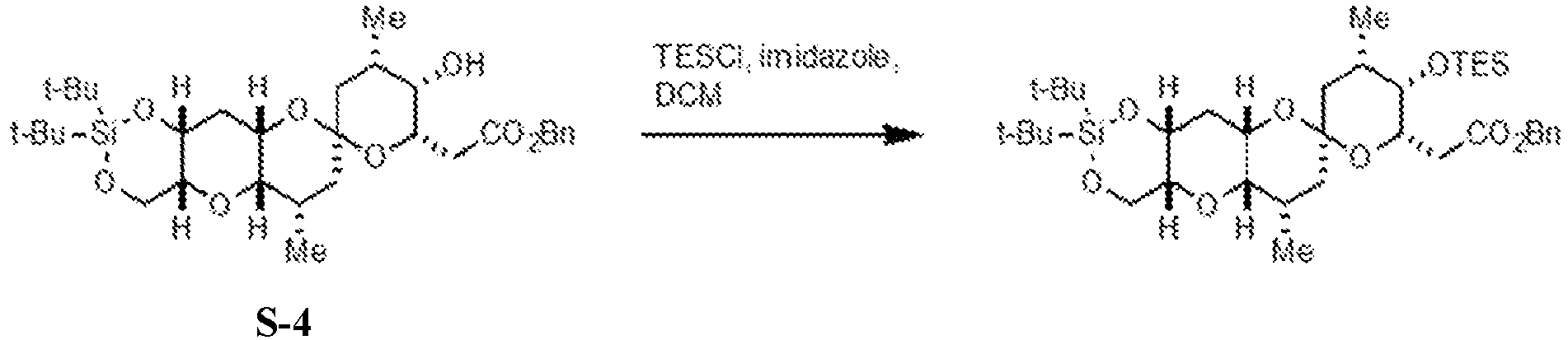
- To a stirred solution of S-4 (141 mg, 0.239 mmol, 1 eq.) in CH2Cl2 (2.4 mL, 0.1 M) were added imidazole (65 mg, 0.96 mmol, 4 eq.) and TESCl (80.2 µL, 0.48 mmol, 2 eq.) at room temperature. After being stirred for 16 h at the same temperature, the reaction was quenched with MeOH. The mixture was concentrated and passed through a pad of silica gel (25% EtOAc in Hexanes), and concentrated under reduced pressure to give a crude TES ether, which was used in the next reaction without further purification.
- To a stirred solution of the crude TES ether (calculated as 0.239 mmol) in EtOAc (3.5 mL) was added wet 10% Pd/C (15 mg). The reaction was stirred under 1 atmosphere of hydrogen for 45 min at room temperature. The mixture was degassed and filled with N2, passed through a pad of silica gel (EtOAc), and concentrated under reduced pressure to give a crude acid, which was used in the next reaction without further purification.
- To a stirred solution of the crude acid (calculated as 0.239 mmol) in CH2Cl2 (2.4 mL, 0.1 M) were added PPh3 (94 mg, 0.389 mmol, 1.2 eq.) and (PyS)2 (73.7 mg, 0.335 mmol, 1.4 eq.) at room temperature. After being stirred for 17 h at the same temperature, the reaction mixture was concentrated under reduced pressure. The residue was purified by flash column chromatography on neutral silica gel (0%, 9%, then 17% EtOAc in Hexanes) to give thioester 8 (162 mg, 0.229 mmol, 96% for 3 steps), which contained 2% of (PyS)2. The disulfide impurity can be removed by additional column chromatography (0%, 1%, 2%, 3%, then 9% EtOAc in CH2Cl2) or HPLC (Column: DuPont Instruments ZORBAL SIL 21.2 mm × 25 cm (880952-101), Solvent: 3% iPrOH in Hexanes, Flow rate: 10.0 mL/min, Detection: UV at 254 nm and 220 nm, tR = 15 min. The product was obtained as pale yellow foam. 8: [α]20 D - 74.3 (c 1.0, CHCl3). 1H NMR (500 MHz, C6D6) δ: 8.33 (1H, m), 7.52 (1H, m), 6.94 (1H, m), 6.47 (1H, m), 4.25-4.16 (2H, m), 3.99 (1H, dd, J = 12.4, 2.7 Hz), 3.97-3.91 (2H, m), 3.27 (1H, m), 3.19 (1H, brs), 2.91 (1H, m), 2.72 (1H, brs), 2.59 (1H, dd, J = 14.9, 2.2 Hz), 2.34 (2H, d, J = 14.6 Hz), 2.24 (1H, m), 1.77-1.60 (4H, m), 1.52 (1H, m), 1.31 (9H, s), 1.13 (9H, s), 1.04-0.96 (12H, m), 0.93 (3H, m), 0.59 (6H, q, J = 7.8 Hz) ppm. 13C NMR (125 MHz, C6D6) δ: 194.7, 152.7, 150.6, 136.5, 128.5, 123.1, 97.4, 77.7, 77.5, 72.5, 70.0, 68.6, 67.3, 63.9, 47.8, 37.5, 36.7, 36.5, 30.5, 29.1, 27.8, 27.7, 23.4, 21.0, 18.5, 17.3, 7.4, 5.9 ppm. IR (film): 2955, 2931, 2874, 2857, 1708, 1132, 1035, 974 cm-1. HRMS (ESI) m/z: [M+H]+ calcd for C36H62O7SSi2, 708.3780; found, 708.3779.
-

- To a solution of (S)-glycidol S6 (6.70 g, 90.0 mmol; AK Scientific) in dichloromethane (250 mL) was added imidazole (7.40 g, 108 mmol) and TBSCl (14.9 g, 99.0 mmol) at 0 °C. The reaction was stirred for 6 hr at room temperature before quenched with water (200 mL), and the resulting two layers were separated. The organic layer was dried over anhydrous Na2SO4, and filtered, concentrated under reduced pressure to give a crude oil. Purification over SiO2 (hexanes/ethyl acetate = 50/1) gave S7 as a clear oil (16.2 g, 95%). S7:


- A solution of trimethylsilyl acetylene (23.8 mL, 167 mmol; Oakwood) in dry THF (76.0 mL) was cooled to -78 °C under Ar atmosphere and treated with n-BuLi (2.50 M in hexane, 61.3 mL, 159 mmol). After 30 min, BF3•OEt2 (18.9 mL, 159 mmol) was added dropwise followed by slow addition of a solution of epoxide S7 (15.0 g, 79.7 mmol) in THF (30.0 mL) at -78 °C. The reaction mixture was stirred for 1 h at the same temperature before addition of sat'd-NaHCO3 (100 mL) and diethyl ether (300 mL). The resulting biphasic solution was warmed up to rt, and the layers was separated. The organic layer was dried over anhydrous Na2SO4, filtered, and concentrated under reduced pressure to give crude oil. Purification over SiO2 (hexanes/ethyl acetate =10/1) gave S8 as a clear oil (20.5 g, 90%). S8:


- To a solution of alcohol S8 (20.5 g, 71.5 mmol) and imidazole (7.3 g, 107 mmol) in dichloromethane (300 mL) was added TBSCl (14.0 g, 92.9 mmol) at 0 °C. The reaction was stirred for 6 hr at rt before addition of water (100 mL). The mixture was extracted with hexanes (200 mL), and the organic layer was dried over anhydrous Na2SO4, filtered, and concentrated under reduced pressure to give the crude product S9 which was used in next step without further purification.
- To a solution of S9 in methanol (240 mL) was treated with potassium carbonate (11.9 g, 85.8 mmol) at rt. After 6 h, the reaction was diluted with hexanes (200 mL) and filtered through a pad of Celite®. Concentration under reduced pressure gave a crude oil, which was subject to purification over SiO2 (hexanes/ethyl acetate = 50/1) to give S10 as a clear oil (21.2 g, 90% for 2 steps). S10:


- Anhydrous indium trichloride (16.4 g, 74.0 mmol; Alfa Aesar 99.99%) was placed in flask and heated with hot gun in vacuo for 3 min.3 The indium salt was dissolved with THF (220 mL) at 0 °C under an argon atmosphere. The solution turned to a white suspension upon cooling to -78 °C. DIBAL (1.0 M in hexane, 71.3 mL, 71.3 mmol) was then added dropwise to suspension at -78 °C. The mixture was stirred for 2.5 hr to prepare dichloroindium hydride. S10 (18.1 g, 54.8 mmol) and triethyborane (1.0 M hexane solution, 11.0 mL, 11.0 mmol; Aldrich) were added to the reaction mixture and the resulting mixture was stirred for 4.5 hr at -78 °C. Iodine (41.8 g, 164 mmol) in THF (80.0 mL) was added to the reaction mixture. After being stirred for 20 min at -78 °C, the reaction was poured into saturated NaHCO3 solution. Na2S2O3 solution was added to consume excess iodine. Then saturated potassium sodium tartrate solution was added and stirring vigorously for 1 hr. The mixture was extracted with hexane and ethyl acetate (4:1, 1000 mL) twice. The organic layer was dried over anhydrous Na2SO4, filtered, and concentrated under reduced pressure to give crude oil. Purification over SiO2 (hexanes/ethyl acetate =100/1) gave 10 as a clear oil (21.3 g, 85%, Z/E > 99:1)2. 10: colorless oil.


- To a solution of vinyl iodide 10 (5.79 g, 12.7 mmol, 1.8 equiv.) in anhydrous Et2O (64 mL) was added n-BuLi (2.52 M in hexane, 4.8 mL, 1.75 equiv.; Aldrich) dropwise at -78 °C under Ar atmosphere, and the clear mixture was stirred for 1 h at the same temperature. Li 2-thienylcyanocuprate (0.25 M in THF, 53.4 mL, 2.0 equiv.; Aldrich) was slowly added over 10 min at -78 °C, which was stirred for 30 min before addition of BF3•Et2O (0.87 mL, 7.04 mmol, 1.6 equiv.). After 20 min, a solution of epoxide 9 (1000 mg, 7.04 mmol, 1.0 equiv.) in anhydrous Et2O (5.0 mL) was added dropwise at -78 °C, and the yellow reaction mixture was stirred for 1 hr at the same temperature. The reaction was quenched by slow addition of a mixture of sat. NH4Cl aq. (90 mL) and 30% aq. NH4OH (10 mL) at 0 °C and stirred 2 hr at rt. The biphasic mixture was diluted with Et2O (200 mL), and layers were separated, and organic layer was dried over Na2SO4 and concentrated under reduced pressure. The residue was purified by flash column chromatography on silica gel (25% EtOAc in Hexanes) to afford 11 as a oil (2.69 g, 81%). 11:


- To a solution of alkene 11 (490 mg, 1.04 mmol, 1.0 equiv.) in toluene (10 mL) was added VO(TMHD)2 (23 mg, 5 mol%) and tert-butylhydrogenperoxide (TBHP) (5.5 M in decane, 380 µL, 2.0 equiv.; Aldrich) to form a reddish solution. The reaction mixture was stirred for 5.5 hr at rt before quenched with sat. Na2S2O3/NaHCO3 solution (v:v = 1:1). The resulting biphasic mixture was diluted with Et2O (10 mL), and the layers were separated. The organic layer was dried over anhydrous Na2SO4, concentrated, and purified by flash column chromatography on silica gel (33% EtOAc in Hexanes) to afford S11 as a colorless oil (450 g, 89 %, dr > 50:1). S11:


- To a solution of S11 (450 mg, 0.92 mmol, 1.0 equiv.) and imidazole (251 mg) in dichloromethane (9.2 mL) was added TESCl (308 µL) at 0 °C. The reaction was stirred for 1 hr at 0 °C before quenched with sat. NaHCO3. The biphasic mixture was diluted with dichloromethane, and the layers were separated. The organic layer was dried over anhydrous Na2SO4, filtered, and concentrated under reduced pressure to give a crude oil. Purification over SiO2 (9% EtOAc in Hexanes) afforded 12 as a clear oil (528 mg, 95%). 12:
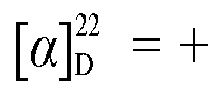

- A solution of 12 (193 mg, 0.32 mmol) and 5 (155 mg, 0.45 mmol, 1.4 eq.) in THF was degassed by bubbling with Ar. To the solution was added t-BuLi solution (0.49 mL of 1.7 M in pentane, 14.6 mmol, 2.6 eq.) dropwise at -78 °C over 10 min. After being stirred for 15 min at the same temperature, the reaction was quenched with sat. NH4Cl aq. The organic layer was separated and the aqueous layer was extracted with EtOAc. The combined organic layer was washed with brine, dried over Na2SO4, filtered, and concentrated under reduced pressure. The residue was purified by flash column chromatography on silica gel (10% then 30% EtOAc in Hexanes) to give 13 (225 mg, 0.27 mmol, 85%) as colorless oil. 13 was obtained as an equilibrium mixture of ketone form and ketal form (ca. 1: 1 ratio).

- To a solution of 13 (500 mg, 0.607 mmol) in 10.1 mL of toluene, (PhO)2P(=O)OH (15.2 mg in 2 mL toluene) was added at 0 °C, The resulting mixture was stirred at room temperature for 12 hr before it was quenched by 5 mL of saturated aqueous NaHCO3. The organic layer was removed, and the aqueous layer was extracted with ethyl acetate (30 mL) three times. The combined organic layers were dried over Na2SO4, filtered and concentrated. The resulting oil was then dissolved in 6 mL of dichloromethane before the addition of imidazole (413 mg, 6.07 mmol) and TESCl (509 µL, 3.04 mmol) at 0 °C. The resulting mixture was stirred at room temperature for 2 hr before it was quenched by 5 mL of saturated aqueous NH4Cl. The organic layer was removed, and the aqueous layer was extracted with ethyl acetate (30 mL) three times. The combined organic layers were dried over MgSO4, filtered and concentrated. The residue was purified by flash column chromatography on silica gel (9% EtOAc in Hexanes) afforded 14 as a clear oil (484 mg, 85% for 2 steps). 14:


- To a solution of 14 (1.80 g, 1.92 mmol, 1.0 equiv.) in acetone (19.2 mL) was added NMMO (449 mg, 3.84 mmol, 2.0 equiv.) and aqueous solution of OsO4 (4.88 mL, 0.096 mmol, 5 mg/mL H2O, 5 mol%). The reaction mixture was stirred for 15 hr, and then quenched with Na2SO3 aq.. The mixture was extracted twice with EtOAc, dried over Na2SO4, filtered, and concentrated. The residue was passed through a pad of SiO2 with EtOAc and concentrated. Without further purification the crude material was used in the next reaction.
- To a solution of diol (estimated as 1.92 mmol, 1.0 equiv.) in DCM (19.2 mL) was added K2CO3 (2.66 g, 19.2 mmol, 10 equiv.) and Pb(OAc)4 (1.36 g, 3.07 mmol, 1.6 equiv.). After being stirred for 1 hr, the reaction mixture was passed through SiO2 pad with EtOAc and concentrated. Without further purification the crude material was used in the next reaction.
- To a solution of aldehyde (estimated as 1.92 mmol, 1.0 equiv.) in toluene (19.2 mL) at room temperature was added (MeO)2P(=O)CH2CO2Bn (2.0 mL, 9.6 mmol, 5.0 equiv.) and K3PO4 (4.08 g, 19.2 mmol, 10 equiv.). After being stirred for additional 12 h, the reaction mixture was passed through a pad of SiO2 with EtOAc/hexanes (1/1), and concentrated to give S12 (1.65 g, 1.51 mmol, 82% for 3 steps, ~8:1 mixture of E/Z isomers). S12:


- To a THF-H2O (4:1, 0.05 M) solution of S12 (1.65 g, 1.51 mmol, 1 eq.), (PhO)2P(=O)OH (113 mg, 0.45 mmol, 0.3 eq.) was added at 0 °C. The resulting mixture was stirred at room temperature for 24 hr before it was quenched by 5 mL of saturated aqueous NaHCO3. The organic layer was removed, and the aqueous layer was extracted with ethyl acetate (30 mL) three times. The combined organic layers were dried over Na2SO4, filtered and concentrated. The resulting oil was then dissolved in 6 mL of dichloromethane before the addition of imidazole (414 mg, 7.55 mol, 5 eq.) and TBSCl (274 mg, 1.81 mmol, 1.2 eq.) at 0 °C. The resulting mixture was stirred at room temperature for 1 hour before it was quenched by 5 mL of saturated aqueous NH4Cl. The organic layer was removed, and the aqueous layer was extracted with ethyl acetate (30 mL) three times. The combined organic layers were dried over MgSO4, filtered and concentrated. Purification over SiO2 (30% EtOAc in Hexanes) afforded 15 as a clear oil (1.02 g, 1.21 mmol, 80% for 2 steps). 15 was obtained as an equilibrium mixture of ketone form and ketal form (ca. 1:1 ratio in C6D6) alone with ~8:1 mixture of E/Z isomers.

- To a solution of 15 (600 mg, 0.711 mmol, 1 eq.), BnOAc (122 µL, 0.711 mmol, 1 eq.), and LiCl (302 mg, 7.11 mmol, 10 eq.) in MeCN (14.2 mL, 0.05 M) was added DBU (2.13 mL, 14.2 mmol, 20 eq.). After being stirred for 12 hr at room temperature, the reaction mixture was loaded to a SiO2 pad and washed by EtOAc. The mixture was concentrated and purified over SiO2 (25% EtOAc in Hexanes) to afford 16 (516 mg, 0.612 mmol, 86%, dr = 22:1) along with byproduct 18 (48 mg, 0.057 mmol, 8%). 16:


- To a solution of 15 (60 mg, 0.071 mmol, 1 eq.), thiourea catalyst M (12.7 mg, 0.036 mmol, 0.5 eq.), BnOAc (12 µL, 0.0710 mmol, 1 eq.), and LiCl (30.2 mg, 0.711 mmol, 10 eq.) in MeCN (1.4 mL, 0.05 M) was added DBU (0.21 mL, 1.42 mmol, 20 eq.). After being stirred for 2 hr at room temperature, the reaction mixture was loaded to a SiO2 pad and washed by 33% EtOAc in Hexanes. The mixture was concentrated and dissolved in 1.4 mL of dichloromethane before the addition of BnOAc (12 µL, 0.0710 mmol, 1 eq.), LiCl (30.2 mg, 0.711 mmol, 10 eq.) and DBU (0.21 mL, 1.42 mmol, 20 eq.). After being stirred for 24 hr at room temperature, the reaction mixture was loaded to a SiO2 pad and washed by EtOAc. The mixture was concentrated and purified over SiO2 (25% EtOAc in Hexanes) to afford 16 (55.8 mg, 0.066 mmol, 93%, dr > 25:1).

- To a solution of 16 (650 mg, 0.77 mmol) in dichloromethane (15 mL) and phosphate buffer (pH=7, 2.5 mL) was added DDQ (437 mg, 1.93 mmol). After being stirred for 40 min, the reaction was quenched with 10% aqueous Na2S2O3 and saturated aqueous NaHCO3. The mixture was extracted twice with DCM, dried over Na2SO4, filtered, and concentrated. The residue was purified by flash column chromatography on neutral silica gel (33% EtOAc in Hexanes) to afford S13 (518 mg, 0.72 mmol, 93%) as a colorless oil. S13:


- To a solution of S13 (495 mg, 0.685 mmol) in dichloromethane (7 mL) was added imidazole (233 mg, 3.43 mmol) and TESCl (0.35 mL, 2.06 mmol). After being for 2 hr at room temperature, the reaction was quenched with MeOH. The mixture was concentrated and purified by flash column chromatography on neutral silica gel (10% EtOAc in Hexanes) to give S14 (632 mg, 0.66 mmol, 96%) as a colorless oil. S14:


- To a solution of S14 (330 mg, 0.347 mmol) in EtOAc (3.5 mL) was added Pd/C (33 mg, 10 wt%). The reaction flask was filled with H2 with lab balloon and stirred for 45 min at room temperature. The mixture was passed through a pad of SiO2 with EtOAc, and concentrated. Without further purification the crude acid S15 was used in the next reaction.

- To a solution of crude acid S15 (estimated as 0.347 mmol) in toluene (3.5 mL) was added PPh3 (118 mg, 0.45 mmol, 1.3 eq.) and (PyS)2 (107 mg, 0.49 mmol, 1.4 eq.).2 After being stirred for 3 hr at room temperature, the reaction mixture was concentrated. Flash column chromatography of the residue (neutral SiO2, hexanes/EtOAc = 1/0, 10/1, 5/1) to give 17 (297 mg, 0.312 mmol, 90% for 2 steps) as a colorless oil. 17:

-

- To a stirred solution of lactone 3 (5.01 g, 14.6 mmol, 1 eq.) in CH2Cl2 (70 mL) was added DIBAL solution (19.0 mL of 1 M in Hexanes, 19.0 mmol, 1.3 eq.) at -78 °C over 15 min. After being stirred for 15 min at the same temperature, MeOH (2.0 mL), sat. Rochelle's salt aq. (70 mL), and EtOAc (70 mL) were added sequentially. The resulting solution was stirred for 2 h at room temperature to give a clear biphasic solution. The organic layer was separated and the aqueous layer was extracted with EtOAc. The combined organic layer was dried over Na2SO4, filtered, and concentrated under reduced pressure to give a crude lactol as a colorless solid, which was used in the next reaction without further purification.
- To a stirred suspension of MePPh3Br (21.0 g, 58.8 mmol, 4 eq.) in THF (50 mL) was added tBuOK (4.9 g, 43.7 mmol, 3 eq.) at 0 °C. After being stirred for 1 h at room temperature, the yellow solution was re-cooled to 0 °C. To this ylide solution was added a solution of the crude lactol (calculated as 14.6 mmol, 1 eq.) in THF (25 mL). After being stirred for 20 min at room temperature, the reaction was quenched with sat. NH4Cl aq. (50 mL) and H2O (20 mL). After adding Et2O (100 mL), the organic layer was separated. The aqueous layer was extracted with Et2O. The combined organic layer was dried over Na2SO4, filtered, and concentrated under reduced pressure. The obtained crude material was dissolved in minimum amount of CH2Cl2 (ca. 5 mL) and passed through a pad of silica gel (20% EtOAc in Hexanes). The filtrate was concentrated under reduced pressure to give a crude alcohol as a colorless solid, which was used in the next reaction without further purification.
- To a stirred solution of the crude alcohol (calculated as 14.6 mmol, 1 eq.) and 2,6-lutidine (3.4 mL, 29.2 mmol, 2 eq.) in CH2Cl2 (70 mL) was added TBSOTf (4.4 mL, 19.2 mmol 1.3 eq.) at 0 °C. After being stirred for 30 min at 0 °C, the ice bath was removed and the reaction mixture was stirred for additional 30 min at room temperature. The reaction was quenched with brine and diluted with Et2O (200 mL). The organic layer was separated and washed with 1N HCl, sat. NaHCO3 aq., and brine, sequentially. The organic layer was dried over Na2SO4, filtered, and concentrated under reduced pressure to give a crude TBS ether as pale yellow oil, which was used in the next reaction without further purification.
- A buffered HF·Py solution was prepared by adding HF Py (3.0 mL of -70% HF in pyridine, ca. 114 mmol, ca. 8 eq.) to a mixture of pyridine (15 mL) and MeCN (20 mL) at 0 °C. To a stirred solution of the crude TBS ether (calculated as 14.6 mmol, 1 eq.) in MeCN (50 mL) and CH2Cl2 (30 mL) was added the buffered HF Py solution at -10 °C over 15 min. After being stirred for 30 min at the same temperature, the reaction was warmed up to room temperature. After being stirred for 1 h at the same temperature, the mixture was cooled to 0 °C and quenched with sat. NaHCO3 aq. carefully. The organic layer was separated and the aqueous layer was extracted with EtOAc. The combined organic layer was dried over Na2SO4, filtered, and concentrated under reduced pressure. The obtained crude material was purified by flash column chromatography on silica gel (25% then 50% EtOAc in Hexanes) to give diol 19 (4.43 g, 14.0 mmol, 96% for 4 steps) as a colorless amorphous solid. 19: [α]20 D - 36.7 (c 1.06, CHCl3).1H NMR (600 MHz, C6D6) δ: 6.01 (1H, ddd, J = 16.9, 10.5, 6.2 Hz), 5.10 (1H, d, J = 16.9 Hz), 5.05 (1H, d, J = 10.5 Hz), 4.04 (1H, ddd, J = 11.1, 7.8, 3.0 Hz), 3.77 (1H, ddd, J = 11.1, 9.2, 4.4 Hz), 3.57 (1H, brs), 3.51-3.46 (2H, m), 3.18 (1H, dd, J = 7.5, 4.5 Hz), 2.68-2.66 (2H, m), 2.01 (1H, dd, J = 8.4, 3.0 Hz), 1.95 (1H, ddd, J = 14.6, 2.7, 2.7 Hz), 1.12 (1H, ddd, J= 14.6, 2.7, 2.7 Hz), 0.90 (9H, S), 0.82 (3H, d, J= 5.4 Hz), 0.07 (3H, s), -0.06 (3H, s) ppm. 13C NMR (125 MHz, C6D6) δ: 141.9, 114.0, 84.2, 81.7, 66.9, 65.7, 63.4, 38.1, 37.1, 25.9, 18.2, 15.7, -3.8, -5.1 ppm. FTIR (film): 3527, 3259, 2960, 2929, 2858, 1256, 1090, 1056, 879, 776 cm-1. HRMS (ESI) m/z: [M+H]+ calcd for C16H33O4Si, 317.2143; found, 317.2145.

- To a stirred solution of diol 19 (7.30 g, 23.1 mmol, 1 eq.) and 2,6-lutidine (10.8 mL, 92.7 mmol, 4 eq.) in CH2Cl2 (150 mL) was added Tf2O (4.7 mL, 27.9 mmol, 1.2 eq.) at -78 °C. After being stirred for 10 min at the same temperature, the reaction was quenched with MeOH (1.0 mL) and brine (100 mL). After adding Et2O (500 mL), the organic layer was separated from the aqueous layer and washed with 1N HCl and brine sequentially. The organic layer was dried over Na2SO4, filtered, and concentrated under reduced pressure to give a crude triflate as wine red oil, which was dissolved in DMSO (150 mL) immediately without further purification.
- To the DMSO solution of crude triflate (calculated as 23.1 mmol, 1 eq.) was added NaCN (11.3 g, 230 mmol, 10 eq.) at room temperature. After being stirred for 1 h at the same temperature, the reaction mixture was filtered through a paper and the filter cake was washed with EtOAc thoroughly. The filtrate was washed with H2O and brine. The organic layer was dried over Na2SO4, filtered, and concentrated under reduced pressure. The residue was passed through a pad of silica gel (20% EtOAc in Hexanes) to give a crude nitrile as a pink oil, which was used in the next step without further purification.
- To a stirred solution of the crude nitrile (calculated as 23.1 mmol, 1 eq.) and pyridine (15.0 mL, 186 mmol, 8 eq.) in DMF (80 mL) were added TBSCl (10.4 g, 69.0 mmol, 3 eq.) and AgNO3 (11.8 g, 69.5 mmol, 3 eq.) at 0 °C. After being stirred for 30 min at 0 °C, the cooling bath was removed and the reaction mixture was stirred for 18 h at room temperature. The reaction mixture was diluted with Et2O (100 mL) and filtered through a bed of Celite. The filter cake was washed thoroughly with Et2O. The filtrate was washed with H2O and brine. The organic layer was dried over Na2SO4, filtered, and concentrated under reduced pressure. The obtained crude material was purified by flash column chromatography on silica gel (0% then 10% EtOAc in Hexanes) to give bis-TBS 20 (8.87 g, 20.2 mmol, 87% for 3 steps) as a colorless solid. 20: [α]20 D -6.7 (c 1.07, CHCl3).MP: 65-67 °C (recrystallized from Et2O). 1H NMR (600 MHz, C6D6) δ: 6.31 (1H, ddd, J = 17.4, 10.8, 6.6 Hz), 5.19 (1H, d, J = 10.8 Hz), 5.15 (1H, d, J= 17.4 Hz), 3.52 (1H, brs), 3.23-3.22 (1H, m), 3.11 (1H, ddd, J= 8.0, 5.9, 2.0 Hz), 2.82-2.77 (1H, m), 2.66 (1H, d, J = 9.6 Hz), 2.40 (1H, dd, J = 16.8, 7.8 Hz), 2.07 (1H, dd, J= 16.8, 5.4 Hz), 1.80 (1H, ddd, J= 15.4, 2.7, 2.7 Hz), 1.32 (1H, ddd, J= 15.4, 4.7, 4.7 Hz), 0.98 (9H, s), 0.93 (3H, d, J= 6.6 Hz), 0.89 (9H, s), 0.10 (3H, s), 0.01 (3H, s), - 0.01 (3H, s), -0.07 (3H, s) ppm. 13C NMR (125 MHz, C6D6) δ: 141.7, 117.9, 113.9, 85.2, 77.1, 65.0, 64.4, 38.3, 37.2, 26.4, 20.6, 18.4, 18.3, 15.9, -2.5, -3.5, -5.00, -5.03 ppm. FTIR (film): 2955, 2930, 2886, 2857, 1473, 1388, 1254, 1139, 1099, 1022, 835, cm-1. HRMS (ESI) m/z: [M+Na]+ calcd for C23H45NO3Si2Na, 462.2830; found, 462.2831.

- To a stirred solution of bis-TBS 20 (8.77 g, 19.9 mmol, 1 eq.) in Hexanes (150 mL) and CH2Cl2 (50 mL) was added DIBAL solution (22.0 mL of 1 M in Hexanes, 22.0 mmol, 1.1 eq.) at -78 °C. After being stirred for 30 min at the same temperature, the reaction was quenched with MeOH (1.0 mL) and sat. Rochelle's salt aq. (200 mL). The mixture was stirred for 1.5 h at room temperature to give a clear biphasic mixture. The organic layer was separated and the aqueous layer was extracted with Et2O. The combined organic layer was dried over Na2SO4, filtered, and concentrated under reduced pressure. The obtained crude material was passed through a pad of silica gel (20% EtOAc in Hexanes) to give a crude aldehyde as a colorless oil, which was used in the next reaction without further purification.
- To a stirred solution of methyl bis(2,2,2-trifluoroethyl) phosphonoacetate (6.3 mL, 29.8 mmol, 1.5 eq.) and 18-cown-6 ether (42.0 g, 159 mmol, 8 eq.) in THF (400 mL) was added KHMDS solution (60 mL of 0.5 M in toluene, 30 mmol, 1.5 eq.) at -78 °C. After being stirred for 30 min at -78 °C, the resulting mixture was added to a solution of the crude aldehyde (calculated as 19.9 mmol, 1 eq.) in THF (100 mL) and stirred for 30 min at the same temperature. The reaction was quenched with sat. NH4Cl aq. and diluted with Hexanes (400 mL). The organic layer was separated and the aqueous layer was extracted with Et2O/Hexanes (1:1). The combined organic layer was dried over Na2SO4, filtered, and concentrated under reduced pressure. The obtained crude material was purified by flash column chromatography on silica gel (0% then 2% EtOAc in Hexanes) to give α,β-unsaturated ester S16 (8.37 g, 16.8 mmol, 84% for 2 steps) as a colorless oil. Only Z-isomer was obtained exclusively. S16: [α]20 D +42.0 (c 1.03, CHCl3).1H NMR (600 MHz, C6D6) δ: 6.67-6.63 (1H, m), 6.16 (1H, ddd, J = 17.6, 10.2, 6.6 Hz), 5.91 (1H, dd, J = 11.1, 1.5 Hz), 5.11 (1H, dd, J= 17.6, 1.5 Hz), 5.09 (1H, dd, J= 10.2, 1.5 Hz). 3.60 (1H, d, 1.8 Hz), 3.454-3.447 (1H, m), 3.34 (3H, s), 3.34-3.30 (1H, m), 3.13 (1H, d, 10.8 Hz), 3.03-2.97 (1H, m), 2.89-2.83 (1H, m), 2.68 (1H, d, 9.0 Hz), 1.92 (1H, d, 14.6 Hz), 1.45 (1H, ddd, 14.6, 4.5, 4.5 Hz), 1.03 (9H, s), 1.01 (9H, s), 0.93 (3H, d, J= 7.2 Hz), 0.19 (3H, s), 0.16 (3H, s), 0.12 (3H, s), 0.04 (3H, s) ppm. 13C NMR (125 MHz, C6D6) δ: 166.6, 149.3, 142.6, 119.9, 113.4, 85.3, 81.0, 66.7, 64.7, 50.5, 39.0, 37.6, 32.5, 26.7, 26.4, 18.6, 18.5, 15.9, -2.3, -3.6, -4.6, -5.0 ppm. FTIR (film): 2951, 2929, 2857, 1723, 1644, 1253, 1091, 951, 836, 771 cm-1. HRMS (ESI) m/z: [M+Na]+ calcd for C26H50O5Si2Na, 521.3089; found, 521.3087.

- To a stirred solution of ester S16 (8.30 g, 16.6 mmol, 1 eq.) in THF (200 mL) was added DIBAL solution (66 mL of 1 M in hexanes, 66.0 mmol, 4 eq.) at -78 °C. After being stirred for 10 min at the same temperature, the reaction mixture was warmed to 0 °C and stirred for additional 30 min. The reaction was quenched with acetone (5.0 mL) and sat. Rochelle's salt aq. (200 mL). The resulting mixture was stirred for 2 h at room temperature to give a clear biphasic solution. The organic layer was separated and the aqueous layer was extracted with EtOAc. The combined organic layer was dried over Na2SO4, filtered, and concentrated under reduced pressure. The obtained crude material was purified by flash column chromatography on silica gel (11% EtOAc in Hexanes) to give allyl alcohol 21 (7.72 g, 16.4 mmol, 99%) as a colorless solid. 21: [α]20 D -16.6 (c 1.00, CHCl3).MP: 60-62 °C (recrystallized from Et2O). 1H NMR (600 MHz, C6D6) δ: 6.24 (1H, ddd, J = 17.4, 10.5, 6.9 Hz), 5.83-5.81 (1H, m), 5.77-5.74 (1H, m), 5.18-5.14 (2H, m), 4.23-4.20 (1H, m), 4.14-4.10 (1H, m), 3.62 (1H, d, J = 1.2 Hz), 3.349-3.345 (1H, m), 3.05 (1H, d, J = 9.6 Hz), 2.89-2.80 (2H, m), 2.72 (1H, d, J = 9.0 Hz), 1.96 (1H, dd, J = 14.4, 6.6 Hz), 1.91 (1H, ddd, J = 14.6, 2.4, 2.4 Hz), 1.78-1.77 (1H, m), 1.49 (1H, ddd, J = 14.6, 4.7, 4.7 Hz), 1.01 (18H, s), 0.95 (3H, d, J = 7.2 Hz), 0.15 (3H, s), 0.08 (3H, s), 0.05 (3H, s), 0.004 (3H, s) ppm. 13C NMR (125 MHz, C6D6) δ: 142.4, 131.4, 129.2, 113.6, 85.1, 80.6, 66.7, 65.0, 58.8, 39.1, 37.5, 30.5, 26.5, 26.4, 18.53, 18.50, 16.0, -2.3, -3.5, -4.7, -5.0 ppm. FTIR (film): 2952, 2929, 2855, 1463, 1252, 1138, 1003, 833, 768 cm-1. HRMS (ESI) m/z: [M+Na]+ calcd for C25H50O4Si2Na, 493.3140; found, 493.3142.

- To a stirred suspension of molecular sieve 4A (1.5 g, activated powder) in CH2Cl2 (50 mL) were added Ti(OiPr)4 (0.72 mL, 2.43 mmol, 15 mol%) and a solution of (+)-DET (0.55 mL, 3.21 mmol, 20 mol%) in CH2Cl2 (5.0 mL) at -20 °C. After being stirred for 15 min at the same temperature, to the reaction mixture was added TBHP solution (4.5 mL of ~5.5 M in decane over molecular sieve 4A, ca. 24.8 mmol, ca. 1.5 eq.) and stirred for 30 min. In a separate flask, a solution of allyl alcohol 21 (7.65 g, 16.2 mmol, 1 eq.) in CH2Cl2 (80 mL) was cooled to -78 °C. To this cooled allyl alcohol solution was added the above catalyst solution via cannula and rinsed with CH2Cl2 (30 mL). After being stirred for 10 min at - 78 °C, the reaction mixture was warmed to -10 °C and stirred for 15 h. The reaction flask was removed from cooling bath, and Et2O (200 mL) was added to the cold reaction mixture with stirring, followed by addition of sat. Na2SO4 aq. (2.5 mL). After being stirred for 2 h at room temperature, the mixture was filtered through a pad of Celite, and the filter cake was washed with EtOAc thoroughly. After removal of solvent under reduced pressure, the obtained crude material was purified by flash column chromatography on silica gel (0%, 5%, 10%, 11%, then 20% EtOAc in Hexanes) to give epoxy alcohol S17 (6.81 g, 14.0 mmol, 86%) as a colorless solid and its undesired diastereomer S18 (862 mg, 1.77 mmol, 11%) as a colorless solid. S17: [α]20 D -26.0 (c 1.08, CHCl3).MP: 78-79 °C (recrystallized from Hexanes/EtOAc). 1H NMR (600 MHz, C6D6) δ: 6.09-6.03 (1H, m), 5.21 (1H, d, J = 18.0 Hz), 5.11 (1H, d, J = 10.8 Hz), 3.92-3.88 (1H, m), 3.65 (1H, ddd, J= 11.4, 7.8, 3.0 Hz), 3.58 (1H, s), 3.239-3.235 (1H, m), 3.17-3.12 (2H, m), 3.08 (1H, J= 4.1, 4.1, 4.1 Hz), 2.78-2.71 (2H, m), 2.64 (1H, d, J = 9.6 Hz), 2.13 (1H, ddd, J= 14.1, 11.4, 8.4 Hz), 1.84 (1H, ddd, J= 15.0, 2.4, 2.4 Hz), 1.57-1.53 (1H, m), 1.41 (1H, ddd, J= 15.0, 4.2, 4.2 Hz), 1.01 (9H, s), 0.98 (9H, s), 0.90 (3H, d, J= 6.6 Hz), 0.13 (3H, s), 0.03 (3H, s), 0.02 (3H, s), -0.06 (3H, s) ppm. 13C NMR (125 MHz, C6D6) δ: 142.1, 114.1, 85.35, 85.33, 78.8, 66.2, 64.5, 60.9, 56.1, 54.7, 38.8, 37.6, 30.3, 26.5, 26.3, 18.4, 16.0, -2.3, -3.7, -4.8, -5.1 ppm. FTIR (film): 2952, 2929, 2856, 1252, 1011, 833, 768 cm-1. HRMS (ESI) m/z: [M+NH4]+ calcd for C25H54NO5Si2, 504.3535; found, 504.3527. Diastereomer S18: [α]20 D +11.9 (c 1.00, CHCl3).MP: 89-91 °C (recrystallized from Et2O). 1H NMR (600 MHz, C6D6) δ: 6.19 (1H, ddd, J= 17.4, 10.7, 6.9 Hz), 5.17 (1H, ddd, J= 17.4, 1.8, 1.8 Hz), 5.12 (1H, d, J = 10.7 Hz), 3.70-3.68 (1H, m), 3.65 (1H, ddd, J = 11.4, 6.0, 6.0 Hz), 3.59 (1H, ddd, J = 11.4, 5.4, 5.4 Hz), 3.49 (1H, dd, J = 8.4, 4.8 Hz), 3.44 (1H, ddd, J = 7.8, 4.2, 4.2 Hz), 3.41 (1H, ddd, J = 8.4, 3.6, 3.6 Hz), 3.02 (1H, dd, J = 10.8, 5.4 Hz), 2.89-2.83 (1H, m), 2.76 (1H, dd, J= 10.2, 2.4 Hz), 2.44 (1H, ddd, J= 13.8, 8.4, 5.1 Hz), 1.95 (1H, ddd, J = 14.4, 4.8, 3.6 Hz), 1.65 (1H, ddd, J = 14.4, 4.8, 4.8 Hz), 1.57 (1H, ddd, J = 14.4, 7.8, 3.6 Hz), 1.59-1.50 (1H, m), 1.04 (9H, s), 0.98-0.97 (12H, m), 0.16 (3H, s), 0.07 (3H, s), 0.06 (3H, s), 0.00 (3H, s) ppm. 13C NMR (125 MHz, C6D6) δ: 142.3, 113.7, 84.4, 79.2, 66.5, 65.3, 60.7, 56.0, 54.5, 39.1, 37.4, 30.9, 26.4, 26.3, 18.5, 18.4, 15.9, -2.5, -3.8, -4.8, -5.0 ppm. FTIR (film): 3448, 2953, 2929, 2857, 1463, 1253, 1128, 1088, 1005, 902, 833, 770, 735 cm-1. HRMS (ESI) m/z: [M+Na]+ calcd for C25H50O5Si2Na, 509.3089; found, 509.3088.

- To a stirred solution of epoxy alcohol S17 (6.73 g, 13.8 mmol, 1 eq.) in THF (20.0 mL) were added molecular sieves 4A (4.0 g, activated pelet) and TBAF solution (80.0 mL of 1 M in THF, 80.0 mmol, 5.8 eq.) at room temperature. After being stirred for 12 h at the same temperature, CaCO3 (20.0 g), DOWEX 50WX8-400 (60.0 g), MeOH (10 mL), and THF (100 mL) were added sequentially. After being stirred for 1.5 h at room temperature, the mixture was filtered through a pad of Celite, and the filtrand was washed with EtOAc thoroughly. After removal of solvent under reduced pressure, the obtained crude material was purified by flash column chromatography on silica gel (CH2Cl2 then EtOAc) to give triol 22 (3.73 g, 13.3 mmol, 96%) as a colorless amorphous solid. 22: [α]20 D -64.8 (c 1.00, CHCl3).1H NMR (600 MHz, CD3OD) δ: 5.96 (1H, ddd, J = 17.5, 10.5, 7.1 Hz), 5.03 (1H, ddd, 17.5, 1.6, 1.6 Hz), 4.97 (1H, ddd, J = 10.5, 1.6, 1.5 Hz), 4.35 (1H, ddd, 9.5, 6.9, 4.1 Hz), 4.05 (1H, d, J = 3.0 Hz), 3.93 (1H, s), 3.73 (1H, dd, J = 3.0, 3.0 Hz), 3.61 (1H, dd, J = 11.1, 5.7 Hz), 3.57 (1H, dd, 11.1, 5.7 Hz), 3.46 (1H, dd, J= 6.0, 6.0, 4.2 Hz), 3.01 (1H, d, J = 9.0 Hz), 2.50-2.44 (1H, m), 2.31 (1H, ddd, J = 15.5, 2.4, 2.4 Hz), 2.09 (1H, ddd, 13.2, 9.2, 3.8 Hz), 2.04 (1H, dd, J = 13.2, 6.6 Hz), 1.89 (1H, ddd, J = 15.5, 3.8, 3.8 Hz), 0.99 (3H, d, J = 7.2 Hz) ppm. 13C NMR (125 MHz, CD3OD) δ: 143.5, 113.8, 82.8, 79.3, 79.0, 77.4, 74.9, 64.8, 64.6, 39.4, 36.6, 33.1, 15.6 ppm. FTIR (film): 3387, 2935, 2886, 1638, 1415, 1093, 1032, 838 cm-1. HRMS (ESI) m/z: [M+Na]+ calcd for C13H22O5Na, 281.1359; found, 281.1359. The stereochemistry of triol 22 was confirmed by X-ray crystallographic analysis on its 3,5-dinitrobenzoate derivative S19.
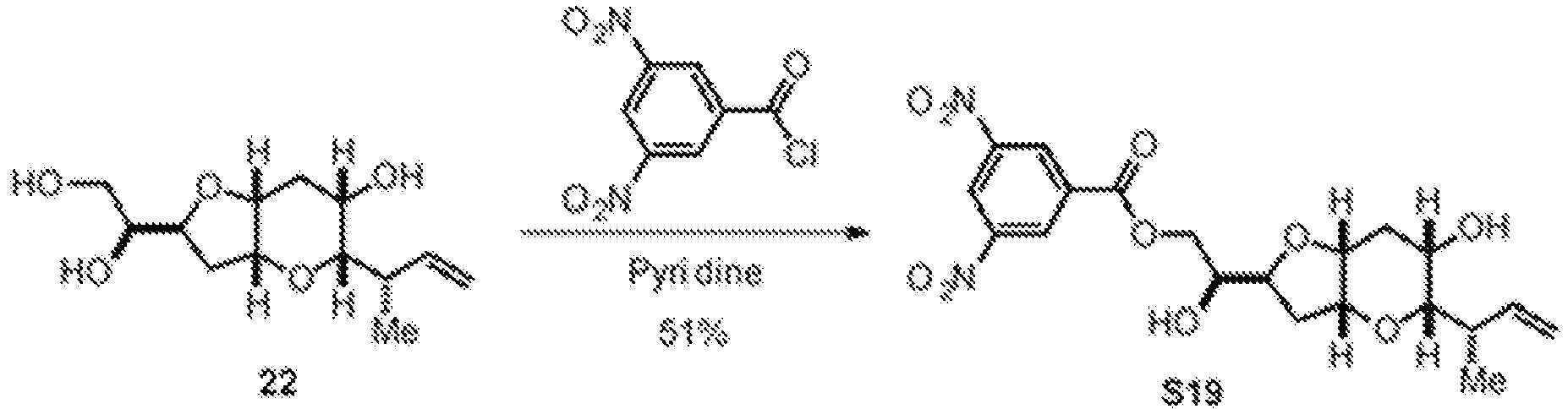
- To a stirred solution of triol 22 (16.4 mg, 0.0635 mmol) in pyridine (0.50 mL) was added 3,5-dinitrobenzoyl chloride (20.0 mg, 0.0867 mmol, 1.4 eq.) at room temperature. After being stirred for 5 h at the same temperature, the resultant reaction mixture was diluted with EtOAc and was washed with 1N HCl, sat. NaHCO3 aq., and brine sequentially. The organic layer was dried over Na2SO4, filtered, and concentrated under reduced pressure. The obtained crude material was purified by PTLC (EtOAc) to give dinitrobenzoate S19 (14.7 mg, 0.0325 mmol, 51%) as a colorless solid. Recrystallization from Hexanes/EtOAc gave a single crystal suitable for X-ray diffraction studies. S19: [α]20 D -51.3 (c 0.735, CHCl3).MP 127-129 °C (recrystallized from Hexanes/EtOAc). 1H NMR (600 MHz, C6D6) δ: 8.70 (2H, d, J = 2.1 Hz), 8.48 (1H, t, J = 2.1 Hz), 6.13 (1H, ddd, J = 16.5, 10.3, 6.9 Hz), 5.18 (1H, d, J = 16.5 Hz), 5.14 (1H, d, J = 10.3 Hz), 4.28 (1H, dd, J = 11.4, 7.2 Hz), 4.00-3.95 (2H, m), 3.55 (1H, ddd, J = 10.2, 3.0, 3.0 Hz), 3.48 (1H, d, J = 3.0 Hz), 3.38 (1H, s), 3.29-3.26 (1H, m), 2.97 (1H, d, J = 10.8 Hz), 2.86-2.82 (1H, m), 2.61 (1H, d, J = 9.0 Hz), 2.22 (1H, d, J = 15.3 Hz), 2.01-1.96 (1H, m), 1.86 (1H, dd, J= 12.8, 6.9 Hz), 1.68 (1H, ddd, J= 12.8, 9.6, 3.6 Hz), 1.20 (1H, ddd, J = 15.3, 3.3, 3.3 Hz), 1.03 (3H, d, J = 7.2 Hz) ppm. 13C NMR (125 MHz, C6D6) δ: 162.7, 148.3, 142.5, 133.0, 128.8, 122.1, 113.8, 82.1, 78.0, 77.6, 77.2, 71.4, 68.4, 63.5, 38.7, 36.1, 32.3, 15.3 ppm. FTIR (film): 3489, 3423, 3100, 2919, 1733, 1545, 1345, 1282, 1170, 1095, 921, 721 cm-1. HRMS (ESI) m/z: [M+NH4]+ calcd for C20H28N3O10, 470.1769; found, 470.1779.

- To a stirred solution of triol 22 (480 mg, 1.71 mmol, 1 eq.) in CH2Cl2 (9.0 mL) were added Et3N (0.95 mL, 6.82 mml, 4 eq.) and TBSCl (385 mg, 2.55 mmol, 1.5 eq.) at room temperature. After being stirred for 5 h, to the reaction mixture was added TBSCl (200 mg, 1.33 mmol, 0.8 eq.) and stirred for an additional 15 h. The reaction was quenched with sat. NaHCO3 aq. The organic layer was separated and the aqueous layer was extracted with EtOAc. The combined organic layer was dried over Na2SO4, filtered, and concentrated under reduced pressure. The obtained crude material was purified by flash column chromatography on silica gel (17% then 25% EtOAc in Hexanes) to give TBS ether S20 (633 mg, 1.70 mmol, 99%) as a colorless solid. S20: [α]20 D -41.6 (c 1.00, CHCl3). MP: 55-58 °C (recrystallized from Et2O). 1H NMR (600 MHz, CD3OD) δ: 5.97 (1H,ddd, J= 17.4, 10.5, 7.5 Hz), 5.04 (1H, d, J= 17.4 Hz), 4.98 (1H, d, J= 10.5 Hz), 4.41-4.38 (1H, m), 4.05 (1H, s), 3.93 (1H, s), 3.73 (1H, s), 3.72-3.66 (2H, m), 3.45 (1H, dd, 9.3, 5.7 Hz), 3.02 (1H, d, J = 9.0 Hz), 2.50-2.44 (1H, m), 2.32 (1H, d, J = 15.2 Hz), 2.13 (1H, ddd, J = 13.1, 9.6, 3.4 Hz), 2.04 (1H, dd, J = 13.1, 7.2 Hz), 1.89 (1H, ddd, J = 15.2, 3.3, 3.3 Hz), 0.99 (3H, d, J = 7.2 Hz), 0.92 (9H, s), 0.09 (6H, s) ppm. 13C NMR (125 MHz, CD3OD) δ: 143.4, 113.9, 82.8, 79.3, 78.6, 77.6, 74.8, 65.7, 65.0, 39.5, 36.5, 33.0, 26.4, 19.2, 15.6, -5.2, -5.3 ppm. FTIR (film): 3504, 2953, 2930, 2886, 2857, 1255, 1095, 837, 755 cm-1. HRMS (ESI) m/z: [M+Na]+ calcd for C19H36O5SiNa, 395.2224; found, 395.2225.

- To a stirred solution of TBS ether S20 (540 mg, 1.45 mmol, 1 eq.) in CH2Cl2 (20 mL) were added imidazole (300 mg, 4.41 mmol, 3 eq.) and TESCl (0.29 mL, 1.73 mmol, 1.2 eq.) at 0 °C. After being stirred for 15 min at 0 °C, the reaction was quenched with brine. After separation of the organic layer, the aqueous layer was extracted with Et2O. The combined organic layer was dried over Na2SO4, filtered, and concentrated under reduced pressure. The residue was dissolved in hexanes and filtered through a plug of silica gel (20% EtOAc in Hexanes) to give a crude TES ether as pale yellow oil, which was used in the next step without further purification.
- The crude TES ether (calculated as 1.45 mmol, 1 eq.) was cooled to 0 °C and dissolved in pre-cooled 9-BBN solution (9.0 mL of 0.5 M in THF, 4.50 mmol, 3 eq., ca. 5 °C). After being stirred for 5 min at 0 °C, the ice bath was removed and the reaction mixture was stirred for 1 h at room temperature. The reaction mixture was cooled to 0 °C and quenched with H2O (10 mL). After adding NaBO3•H2O (2.60 g, 26.0 mmol, 18 eq.) at the same temperature, the resulting mixture was stirred vigorously for 1 h at room temperature. The mixture was diluted with brine (10 mL) and EtOAc (20 mL). The organic layer was separated and the aqueous layer was extracted with EtOAc. The combined organic layer was dried over Na2SO4, filtered, and concentrated under reduced pressure. The obtained crude material was purified by flash column chromatography on neutral silica gel (CH2Cl2 then 0%, 9%, 17%, 20%, 25%, then 33% EtOAc in Hexanes) to give diol S21 (689 mg, 1.36 mmol, 94% for 2 steps) as a colorless oil. S21: [α]20 D +3.27 (c 1.04, CHCl3). 1H NMR (600 MHz, CD3OD) δ: 4.36 (1H, ddd, J = 8.1, 8.1, 3.6 Hz), 4.07 (1H, d, J = 3.0 Hz), 3.90 (1H, s), 3.73 (1H, s), 3.70 (1H, dd, J= 9.9, 6.3 Hz), 3.68-3.59 (4H, m), 2.96 (1H, d, J = 9.6 Hz), 2.29 (1H, d, J = 15.0 Hz), 2.09 (1H, ddd, J = 13.2, 9.0, 4.2 Hz), 2.04 (1H, dd, J = 13.2, 6.6 Hz), 2.03-1.98 (1H, m), 1.91-1.87 (2H, m), 1.40-1.34 (1H, m), 0.98 (9H, t, J= 7.8 Hz), 0.92-0.90 (12H, m), 0.65 (6H, q, J= 7.8 Hz), 0.084 (3H, s), 0.079 (3H, s) ppm. 13C NMR (125 MHz, CD3OD) δ: 83.3, 78.4, 79.2, 77.5, 76.8, 66.2, 65.1, 61.5, 37.4, 36.5, 33.0, 32.3, 26.44, 26.38, 19.2, 15.7, 7.3, 6.0, -5.2 ppm. FTIR (film): 3518, 2952, 2931, 2876, 1252, 1092, 835, 777, 741 cm-1. HRMS (ESI) m/z: [M+Na]+ calcd for C25H52O6Si2Na, 527.3195; found, 527.3194.

- To a stirred solution of diol S21 (202 mg, 0.400 mmol) in CH2Cl2 (5.0 mL) were added TEMPO (12.5 mg, 20 mol%) and PIDA (390 mg, 3 eq.) at room temperature. After being stirred for 36 h, the reaction was quenched with sat. NaHCO3 aq. and sat. Na2S2O3 aq. The organic layer was separated and the aqueous layer was extracted with EtOAc. The combined organic layer was dried over Na2SO4, filtered, and concentrated under reduced pressure. The obtained crude material was purified by flash column chromatography on neutral silica gel (0%, 9%, 20%, 25%, then 33% EtOAc in Hexanes) to give lactone 23 (191 mg, 0.381 mmol, 95%) as a colorless oil. 23: [α]20 D -30.0 (c 1.02, CHCl3). 1H NMR (600 MHz, C6D6) δ: 4.44-4.41 (1H, m), 3.95-3.92 (1H, m), 3.85-3.82 (1H, m), 3.70-3.66 (2H, m), 3.54 (1H, d, J = 1.8 Hz), 3.46 (1H, brs), 2.52 (1H, s), 2.36-2.31 (2H, m), 2.16 (1H, dd, J = 18.0, 6.0 Hz), 2.05-2.00 (1H, m), 1.90 (1H, dd, J = 12.9, 6.6 Hz), 1.34-1.30 (1H, m), 1.17 (1H, ddd, J = 15.8, 3.9, 3.9 Hz), 1.04 (9H, t, J = 7.8 Hz), 1.00 (9H, s), 0.76 (3H, d, J = 6.6 Hz), 0.68 (6H, q, J= 7.8 Hz), 0.18 (3H, s), 0.15 (3H, s) ppm. 13C NMR (125 MHz, C6D6) δ: 168.4, 78.2, 77.9, 75.8, 73.8, 73.0, 71.4, 65.8, 35.6, 33.0, 31.3, 30.9, 26.2, 18.6, 16.7, 7.2, 5.6, -5.2 -5.3 ppm. FTIR (film): 2953, 2929, 2877, 1730, 1461, 1246, 1117, 1085, 1002, 856, 776, 741, 668 cm-1. HRMS (ESI) m/z: [M+H]+ calcd for C25H49O6Si2, 501.3062; found, 501.3063.

- To a stirred solution of lactone 23 (467 mg, 0.932 mmol) and iodide (420 mg, 1.3 eq.) in THF (6.0 mL) was added tBuLi solution (1.3 mL of 1.7 M in pentane, 2.21 mmol, 2.5 eq.) over 20 min at -78 °C. After being stirred for 30 min, the reaction was quenched with sat. NH4Cl aq. and stirred for 10 min at room temperature. The organic layer was separated and the aqueous layer was extracted with EtOAc. The combined organic layer was dried over Na2SO4, filtered, and concentrated under reduced pressure. The obtained crude material was purified by flash column chromatography on neutral silica gel (0%, 5%, 7%, then 17% EtOAc in Hexanes) to give ketone, which contained a small amount of impurity. The pure compound, which exists as an equilibrium mixture of ketone and hemiacetal (ca. 10:1 ratio in C6D6) was obtained for analytical purpose by PTLC (Hexanes/EtOAc = 2:1). Spectral data only for major ketone form of S22 are shown here. S22: [α]20 D -1.4 (c 1.13, CHCl3). 1H NMR (600 MHz, C6D6) δ: 7.28 (2H, d, J = 8.1 Hz), 6.85 (2H, d, J = 8.1 Hz), 5.64 (1H, ddd, J = 16.8, 9.0, 7.5 Hz), 5.13 (1H, d, J= 9.0 Hz), 5.11 (1H, d, J = 16.8 Hz), 4.57 (1H, d, J= 11.4 Hz), 4.49 (1H, ddd, J = 6.3, 6.3, 3.3 Hz), 4.23 (1H, d, J= 10.8 Hz), 3.83 (1H, dd, J = 9.9, 6.3 Hz), 3.75 (1H, dd, J = 10.8, 6.0 Hz), 3.74 (1H, s), 3.63 (1H, d, J = 3.0 Hz), 3.60-3.55 (2H, m), 3.47 (1H, dd, J = 7.5, 7.5 Hz), 3.37 (1H, d, J = 10.8 Hz), 3.33 (3H, s), 2.79 (1H, dd, J = 16.8, 4.2 Hz), 2.77-2.69 (3H, m), 2.52-2.50 (1H, m), 2.30 (1H, d, J = 15.6 Hz), 2.24 (1H, dd, J = 16.8, 7.5 Hz), 2.20 (1H, dd, J = 16.8, 8.7 Hz), 2.04 (1H, dd, J = 12.9, 6.9 Hz), 1.96 (1H, ddd, J = 12.6, 9.0, 4.2 Hz), 1.24 (1H, ddd, J = 15.3, 3.0, 3.0 Hz), 1.12 (1H, dd, J = 8.4, 8.4 Hz), 1.01 (9H, t, J = 7.8 Hz), 10.1-0.95 (6H, m), 0.95 (9H, s), 0.63 (6H, q, J = 7.8 Hz), 0.09 (3H, s), 0.08 (3H, s) ppm. 13C NMR (125 MHz, C6D6) δ: 208.7, 159.6, 137.9, 131.3, 129.5, 119.0, 114.0, 84.1, 82.0, 78.2, 78.1, 76.7, 75.8, 70.2, 65.5, 63.7, 54.8, 47.8, 46.0, 35.6, 34.0, 32.4, 31.4, 26.1, 18.5, 16.6, 16.3, 7.2, 5.5, -5.3 ppm. FTIR (film): 3518, 2953, 2932, 2876, 1709, 1613, 1514, 1463, 1413, 1248, 1092, 1037, 835, 778, 741 cm-1. HRMS (ESI) m/z: [M+Na]+ calcd for C39H68O8Si2Na, 743.4345; found, 743.4414.

- To a stirred solution of the crude ketone (calculated as 0.932 mmol, 1 eq.) in acetone (5.0 mL) were added OsO4 solution (5.0 mL of 0.02 M in H2O, 0.100 mmol, 10 mol%) and NMO (220 mg, 1.89 mmol, 2 eq.) at room temperature. After being stirred for 4 h at the same temperature, the reaction was quenched with Na2SO3 (1.5 g) and diluted with brine. After being stirred for 30 min at room temperature, the organic layer was separated and the aqueous layer was extracted with EtOAc. The combined organic layer was dried over Na2SO4, filtered, and concentrated under reduced pressure to give a crude diol as a brown oil, which was used in the next step without further purification.
- To a solution of the crude diol (calculated as 0.932 mmol, 1 eq.) in CH2Cl2 (19 mL) were added K2CO3 (1.3 g, 9.41 mmol, 10 eq.) and Pb(OAc)4 (620 mg, 1.40mmol, 1.5 eq.) at room temperature. After being stirred for 15 min at the same temperature, the reaction was diluted with Hexanes/EtOAc (2:1) and filtered through a pad of SiO2 (33% EtOAc in Hexanes). After evaporation of organic solvent, the obtained crude material was purified by flash column chromatography on neutral silica gel (0%, 5%, 9%, 13%, then 17% EtOAc in Hexanes) to give hemiacetal S23 (461 mg, 0.638 mmol, 68% for 3 steps) as pale brown oil. The product was obtained as an equilibrium mixture of hemiacetal (ca. 3:7 ratio in C6D6). S23: [α]20 D -35.8 (c 1.04, CHCl3). 1H NMR (600 MHz, C6D6) δ: 7.17-7.15 (2H, m), 6.80-6.74 (2H, m), 5.44 (0.3H, dd, J= 11.7, 1.5 Hz), 4.92 (0.7H, dd, J = 12.6, 1.5 Hz), 4.52 (0.7H, d, J = 11.1 Hz), 4.45-4.39 (1.3H, m), 4.32 (0.7H, d, J = 11.1 Hz), 4.23 (0.3H, d, J = 11.4 Hz), 4.09 (0.3H, d, J= 3.0 Hz), 3.95 (0.3H, d, J= 10.8 Hz), 3.83-3.80 (1H, m), 3.77-3.74 (1H, m), 3.69-3.60 (3H, m), 3.56 (0.7H, d, J= 4.2 Hz), 3.33 (0.3H, s), 3.29-3.27 (4H, m), 3.16 (0.7H, s), 2.74-2.72 (1H, m), 2.62-2.56 (0.3H. m), 2.35-2.25 (1.7H, m), 2.18 (0.7H, d, J= 15.0 Hz), 2.10-2.00 (1.3H, m), 1.92-1.80 (1.3H, m), 1.72-1.59 (1.7H, m), 1.54 (0.7H, dd, J = 12.6, 4.2 Hz), 1.51-1.48 (1H, m), 1.45-1.38 (1H, m), 1.11-1.07 (9.9H, m), 1.04-0.98 (14.1H, m), 0.77-0.72 (6H, m), 0.121-0.09 (6H, m) ppm. 13C NMR (125 MHz, C6D6) δ: 159.9, 159.7, 131.2, 129.7, 129.5, 114.2, 114.0, 98.9, 98.2, 93.8, 91.3, 80.1, 79.1, 79.0, 78.5, 77.8, 77.7, 76.8, 76.0, 74.1, 73.9, 73.4, 73.1, 72.2, 66.1, 64.8, 64.0, 54.7, 38.4, 38.2, 37.7, 37.3, 36.4, 31.5, 31.3, 29.7, 29.2, 26.2, 26.1, 23.2, 18.6, 17.8, 17.5, 17.44, 17.39, 7.3, 7.2, 5.7, 5.5, -5.1, -5.3 ppm. FTIR (film): 3507, 2953, 2928, 2874, 1514, 1462, 1248, 1090, 1035, 1013, 835, 776, 742 cm-1. HRMS (ESI) m/z: [M+NH4]+ calcd for C38H70NO9Si2, 740.4584; found, 740.4608.

- To a stirred solution of hemiacetal S23 (461 mg, 0.638 mmol, 1 eq.) and benzyl dimethylphosphonoacetate (0.67 mL, 3.19 mmol, 5 eq.) in THF (26.0 mL) was added NaH (100 mg of 60% in mineral oil, 2.50 mmol, 4 eq.) at 0 °C. After being stirred for 3 h at the same temperature, the reaction was quenched with sat. NH4Cl aq. The organic layer was separated and the aqueous layer was extracted with Hexanes/EtOAc (1:1). The combined organic layer was dried over Na2SO4, filtered, and concentrated under reduced pressure. The obtained crude material was purified by flash column chromatography on neutral silica gel (0%, 5%, 9%, 13%, then 17% EtOAc in Hexanes) to give unsaturated ester 24 (479 mg, 0.560 mmol, 88%) as colorless oil. 24: [α]20 D -21.7 (c 1.00, CHCl3). 1H NMR (600 MHz, C6D6) δ: 7.24 (2H, d, J = 7.2 Hz), 7.15 (2H, d, J = 8.4 Hz), 7.10 (2H, dd, J = 7.2, 7.2 Hz), 7.05 (1H, t, J= 7.2 Hz), 7.04 (1H, dd, J= 15.5, 6.3 Hz), 6.79 (2H, d, J= 8.4 Hz), 6.20 (1H, d, J= 15.5 Hz), 5.14 (1H, d, J= 12.0 Hz), 5.10 (1H, d, J= 12.0 Hz), 4.48 (1H, ddd, J= 8.1, 8.1, 3.4 Hz), 4.38 (1H, d, J= 12.0 Hz), 4.10 (1H, d, J = 12.0 Hz), 3.83 (1H, dd, J = 9.9, 6.3 Hz), 3.77-3.74 (2H, m), 3.63-3.59 (3H, m), 3.55 (1H, ddd, J = 10.8, 3.0, 3.0 Hz), 3.35-3.32 (4H, m), 2.70-2.64 (3H, m), 2.54 (1H, dd, J = 16.8, 4.8 Hz), 2.47-2.43 (1H, m), 2.29 (1H, d, J = 15.6 Hz), 2.15-2.08 (2H, m), 2.04-1.95 (2H, m), 1.25 (1H, ddd, J = 15.0, 3.6, 3.6 Hz), 1.10 (1H, dd, J = 7.8, 7.8 Hz), 1.01 (9H, t, J = 8.1 Hz), 0.95 (9H, s), 0.92 (3H, d, J = 6.6 Hz), 0.86 (3H, d, J = 6.6 Hz), 0.64 (6H, q, J = 8.1 Hz), 0.08 (3H, s), 0.07 (3H, s) ppm. 13C NMR (150 MHz, C6D6) δ: 208.2, 165.6, 159.8, 147.8, 136.6, 130.6, 129.7, 128.70, 128.66, 128.3, 123.3, 114.1, 81.9, 81.5, 78.2, 78.1, 76.7, 75.9, 71.1, 66.4, 65.5, 63.7, 54.7, 47.6, 45.5, 35.6, 33.6, 32.4, 31.4, 26.1, 18.5, 16.4, 16.3, 7.2, 5.5, -5.3 ppm. FTIR (film): 3526, 2953, 2933, 2876, 1719, 1612, 1513, 1462, 1249, 1160, 1093, 1036, 836, 778, 741, 697 cm-1. HRMS (ESI) m/z: [M+Na]+ calcd for C47H74O10Si2Na, 877.4713; found, 877.4713.

- To a stirred solution of unsaturated ester 24 (132 mg, 0.154 mmol, 1 eq.) in MeCN (3.0 mL) were added LiBr (134 mg, 1.54 mmol, 10 eq.) and DBU (0.46 mL, 3.08 mmol, 20 eq.) at room temperature. After being stirred for 11 h at the same temperature, hexanes (3.0 mL) and H2O (3.0 mL) were added to the reaction mixture. The organic layer was separated and the aqueous layer was extracted with hexanes. The combined organic layer was dried over Na2SO4, filtered, and concentrated under reduced pressure. The obtained crude material was purified by flash column chromatography on neutral silica gel (0%, 5%, 6%, then 9% EtOAc in Hexanes) to give spiro ketal 25 (92.1 mg, 0.108 mmol, 70%) as colorless oil and C-Michael addition product S24 (6.7 mg, 0.00897 mmol, 6%) as colorless oil. 25: [α]20 D -32.5 (c 1.00, CHCl3). 1H NMR (600 MHz, C6D6) δ: 7.23 (2H, d, J = 7.1 Hz), 7.19 (2H, d, J = 8.4 Hz), 7.11 (2H, dd, J = 7.5, 7.1 Hz), 7.06 (1H, dd, J = 7.5, 7.5 Hz), 6.76 (2H, d, J = 8.4 Hz), 5.09 (1H, d, J = 12.0 Hz), 5.00 (1H, d, J = 12.0 Hz), 4.44 (1H, ddd, J = 10.2, 4.8, 4.8 Hz), 4.31 (1H, d, J = 10.2 Hz), 4.23-4.21 (2H, m), 3.83-3.79 (2H, m), 3.75 (dd, J = 10.2, 6.0 Hz), 3.72-3.68 (3H, m), 3.30 (3H, s), 2.96 (1H, dd, J = 15.6, 9.6 Hz), 2.85 (1H, s), 2.80 (1H, d, J = 2.4 Hz), 2.38-2.35 (2H, m), 2.28 (1H, dd, J = 15.6, 3.6 Hz), 2.17-2.13 (1H, m), 2.05 (1H, dd, J= 12.3, 6.3 Hz), 1.85 (1H, ddd, J= 13.2, 9.6, 4.2 Hz), 1.70-1.62 (2H, m), 1.59-1.55 (2H, m), 1.43 (1H, dd, J= 13.2, 4.2 Hz), 1.11 (9H, t, J= 8.1 Hz), 1.01 (3H, d, J = 4.2 Hz), 1.00-0.99 (12H, m), 0.76 (6H, q, J = 8.1 Hz), 0.120 (3H, s), 0.116 (3H, s) ppm. 13C NMR (125 MHz, C6D6) δ: 171.6, 159.7, 136.8, 131.3, 129.7, 128.72, 128.66, 114.0, 97.0, 79.1, 78.5, 77.9, 76.8, 75.3, 74.2, 73.5, 69.6, 66.15, 66.06, 63.7, 54.7, 38.2, 37.7, 37.3, 36.5, 31.5, 30.6, 29.3, 26.2, 18.6, 18.2, 17.6, 7.4, 5.7, -5.1, -5.3 ppm. FTIR (film): 2954, 2928, 2874, 1737, 1514, 1462, 1249, 1088, 1018, 836, 742 cm-1. HRMS (ESI) m/z: [M+Na]+ calcd for C47H74O10Si2Na, 877.4713; found, 877.4712. C-Michael product S25: [α]20 D -79.5 (c 0.855, CHCl3). 1H NMR (600 MHz, C6D6) δ: 7.10 (2H, d, J = 8.7 Hz), 6.79 (2H, d, J = 8.7 Hz), 4.42 (1H, ddd, J = 9.6, 6.2, 3.5 Hz), 4.20 (1H, d, J= 12.0 Hz), 4.11 (1H, d, J= 12.0 Hz), 3.87 (1H, dd, J = 10.2, 6.0 Hz), 3.78 (1H, dd, J = 10.2, 5.4 Hz), 3.69-3.66 (3H, m), 3.61 (1H, dd, J = 2.7, 2.7 Hz), 3.32 (3H, s), 2.86 (1H, dd, J = 3.3, 3.3 Hz), 2.62 (1H, d, J = 2.4 Hz), 2.38 (1H, dd, J = 12.6, 3.0 Hz), 2.30 (1H, d, J = 15.6 Hz), 2.23 (1H, dd, J = 19.2, 7.8 Hz), 2.05 (1H, ddd, J = 13.6, 3.6, 3.6 Hz), 1.99-1.89 (4H, m), 1.81 (1H, d, J= 19.2 Hz), 1.63-1.58 (1H, m), 1.30-1.25 (2H, m), 1.06 (9H, t, J = 7.8 Hz), 0.98 (9H, s), 0.84 (3H, d, J = 6.6 Hz), 0.82 (3H, d, J = 6.0 Hz), 0.70 (6H, q, J = 7.8 Hz), 0.114 (3H, s), 0.112 (3H, s) ppm. 13C NMR (125 MHz, C6D6) δ: 169.7, 159.7, 131.1, 129.4, 114.0, 104.9, 80.6, 78.7, 78.2, 76.1, 74.0, 73.7, 71.1, 65.9, 65.2, 54.7, 40.8, 36.0, 33.1, 30.9, 30.7, 30.5, 29.5, 29.4, 26.2, 18.6, 16.9, 13.9, 7.3, 5.6, -5.1, -5.2 ppm. FTIR (film): 2954, 2931, 2876, 1729, 1612, 1514, 1462, 1302, 1247, 1205, 1157, 1133, 1090,1038, 992, 937, 835, 777, 742 cm-1. HRMS (ESI) m/z: [M+Na]+ calcd for C40H6609Si2Na, 769.4138; found, 769.4146.

- To a stirred solution of MPM ether 25 (248 mg, 0.290 mmol, 1 eq.) in CH2Cl2 (6.0 mL), phosphate buffer (0.60 mL, pH7), and tBuOH (0.60 mL) was added DDQ (200 mg, 0.881 mmol, 3 eq.) at room temperature. After being stirred for 15 min at the same temperature, the reaction was quenched with sat. NaHCO3 aq. The organic layer was separated and the aqueous layer was extracted with CH2Cl2. The combined organic layer was dried over Na2SO4, filtered, and concentrated under reduced pressure. The obtained crude material was purified by flash column chromatography on neutral silica gel (0%, 7%, then 9% EtOAc in Hexanes) to give alcohol S25 (183 mg, 0.249 mmol, 86%) as a colorless oil. S25: [α]20 D -45.6 (c 1.01, CHCl3). 1H NMR (600 MHz, C6D6) δ: 7.21 (2H, d, J = 7.5 Hz), 7.11 (2H, dd, J= 7.5, 7.5 Hz), 7.06 (1H, t, J = 7.5 Hz), 5.07 (1H, d, J = 12.6 Hz), 4.97 (1H, d, J = 12.6 Hz), 4.43 (1H, ddd, J = 10.2, 5.3, 5.3 Hz), 4.14 (1H, dd, J = 9.6, 3.0 Hz), 3.82 (1H, dd, J = 9.6, 5.4 Hz), 3.77-3.74 (2H, m), 3.70-3.67 (3H, m), 2.96 (1H, d, J = 8.4 Hz), 2.86 (1H, dd, J = 15.6, 10.2 Hz), 2.77 (1H, d, J = 1.8 Hz), 2.33-2.28 (2H, m), 2.22-2.17 (1H, m), 2.12-2.04 (2H, m), 1.86 (1H, ddd, J = 12.8, 10.2, 4.2 Hz), 1.61 (1H, dd, J = 12.9, 12.9 Hz), 1.09 (9H, t, J= 7.9 Hz), 1.05 (3H, d, J= 6.6 Hz), 0.99 (9H, s), 0.93 (3H, d, J= 7.2 Hz), 0.75 (6H, q, J = 7.9 Hz), 0.12 (3H, s), 0.12 (3H, s) ppm. 13C NMR (125 MHz, C6D6) δ: 171.5, 136.7, 128.64, 128.57, 97.0, 79.0, 77.9, 76.8, 74.1, 73.3, 70.5, 69.3, 66.09, 66.06, 63.7, 37.4, 37.31, 37.27, 36.4, 30.2, 29.2, 26.2, 18.6, 17.65, 17.62, 7.3, 5.7, -5.1, -5.3 ppm. FTIR (film): 3469, 2953, 2928, 2874, 1736, 1498, 1251, 1128, 1017, 835, 776, 740 cm-1. HRMS (ESI) m/z: [M+Na]+ calcd for C39H66O9Si2Na, 757.4138; found, 757.4135.

- To a stirred solution of alcohol S25 (183 mg, 0.249 mmol, 1 eq.) in CH2Cl2 (3.0 mL) were added imidazole (50.0 mg, 0734 mmol, 3 eq.) and TESCl (60 µL, 0.357 mmol, 1.5 eq.) at room temperature. After being stirred for 4 h at the same temperature, the reaction was quenched with sat. NaHCO3 aq. The organic layer was separated and the aqueous layer was extracted with EtOAc. The combined organic layer was dried over Na2SO4, filtered, and concentrated under reduced pressure. The obtained crude material was purified by flash column chromatography on neutral silica gel (0%, 3%, then 5% EtOAc in Hexanes) to give TES ether S26 (205 mg, 0.241 mmol, 97%) as a colorless oil. S26: [α]20 D -49.1 (c 1.00, CHCl3). 1H NMR (600 MHz, C6D6) δ: 7.26 (2H, d, J = 7.2 Hz), 7.10 (2H, dd, J = 7.2, 7.2 Hz), 7.05 (1H, t, J = 7.2 Hz), 5.14 (1H, d, J = 12.3 Hz), 5.02 (1H, d, J = 12.3 Hz), 4.46 (1H, ddd, J = 9.8, 5.1, 5.1 Hz), 4.17 (1H, dd, J = 10.2, 3.0 Hz), 3.84-3.80 (2H, m), 3.77 (1H, dd, J = 10.2, 5.4 Hz), 3.73 (1H, d, J = 1.8 Hz), 3.71-3.69 (2H, m), 3.22 (1H, s), 2.92 (1H, dd, J = 15.3, 9.1 Hz), 2.80 (1H, s), 2.38 (1H, d, J= 15.6 Hz), 2.30-2.27 (2H, m), 2.16-2.11 (1H, m), 2.06 (1H, dd, J = 12.9, 6.3 Hz), 1.87 (1H, ddd, J = 13.2, 9.6, 4.2 Hz), 1.69-1.61 (2H, m), 1.59 (1H, ddd, J = 15.2, 4.7, 4.7 Hz), 1.53 (1H, dd, J = 12.6, 3.6 Hz), 1.46 (1H, dd, J = 12.3, 3.9 Hz), 1.11 (9H, t, J = 7.9 Hz), 1.00 (9H, s), 1.00-0.95 (12H, m), 0.93 (3H, d, J = 7.2 Hz), 0.76 (6H, q, J = 7.9 Hz), 0.56 (6H, q, J = 7.9 Hz), 0.131 (3H, s), 0.127 (3H, s) ppm. 13C NMR (125 MHz, C6D6) δ: 171.6, 136.8, 128.75, 128.67, 128.3, 96.9, 79.0, 77.9, 76.8, 74.2, 73.6, 72.4, 69.9, 66.2, 66.1, 63.6, 38.3, 37.5, 37.4, 36.4, 31.5, 30.7, 29.3, 26.2, 18.6, 17.5, 7.4, 5.8, 5.7, -5.1, -5.3 ppm. FTIR (film): 2953, 2928, 2875, 1738, 1498, 1240, 1033, 1001, 974, 834, 737, 677 cm-1. HRMS (ESI) m/z: [M+H]+ calcd for C45H81O9Si3, 849.5183; found, 849.5184.

- To a stirred solution of Benzyl ester S26 (230 mg, 0.271 mmol, 1 eq.) in EtOAc (10.0 mL) was added wet 10% Pd/C (23 mg, 10%w/w) at room temperature. The reaction was stirred under 1 atmosphere of hydrogen for 2 h. The resulting mixture was filtered through a pad of Celite (EtOAc). The organic solvent was removed under reduced pressure to give a crude mixture, which was purified by flash column chromatography on neutral silica gel (0%, 5%, then 33% EtOAc in Hexanes) to give carboxylic acid S27 (183 mg, 0.241 mmol, 89%) as a colorless oil. S27: [α]20 D -54.8 (c 1.06, CHCl3). 1H NMR (500 MHz, C6D6) δ: 4.45 (1H, ddd, J = 10.0, 5.0, 5.0 Hz), 4.12 (1H, dd, J = 9.8, 2.8 Hz), 3.89 (1H, d, J = 3.5 Hz), 3.81 (1H, dd, J= 11.0, 5.0 Hz), 3.76-3.73 (2H, m), 3.70-3.67 (2H, m), 3.24 (1H, s), 2.89 (1H, d, J= 1.5 Hz), 2.87 (1H, dd, J= 16.0, 3.0 Hz), 2.40 (1H, d, J= 15.5 Hz), 2.34 (1H, dd, J = 16.0, 3.0 Hz), 2.32-2.21 (2H, m), 2.04 (1H, dd, J = 12.8, 5.8 Hz), 1.87 (1H, ddd, J = 13.5, 9.5, 4.0 Hz), 1.70-1.62 (3H, m), 1.53 (1H, dd, J = 12.5, 4.0 Hz), 1.47 (1H, dd, J = 13.0, 4.0 Hz), 1.09 (9H, t, J = 8.0 Hz), 1.00 (3H, d, J = 7.0 Hz), 0.99 (9H, s), 0.97 (9H, t, J = 8.0 Hz), 0.92 (3H, d, J = 7.0 Hz), 0.75 (6H, q, J = 8.0 Hz), 0.57 (6H, q, J = 8.0 Hz), 0.120 (3H, s), 0.115 (3H, s) ppm. 13C NMR (125 MHz, C6D6) δ: 178.1, 97.1, 79.0, 77.9, 76.7, 74.3, 73.6, 72.3, 69.6, 66.1, 63.8, 38.0, 37.5, 37.4, 36.4, 31.5, 30.7, 29.4, 26.2, 18.6, 17.5, 7.3, 5.8, 5.7, - 5.1, -5.3 ppm. FTIR (film): 3120, 2953, 2928, 2875, 1731, 1713, 1461, 1415, 1309, 1078, 1033, 1004, 833, 776, 724 cm-1. HRMS (ESI) m/z: [M+H]+ calcd for C38H75O9Si3, 759.4713; found, 759.4724.

- To a stirred solution of carboxylic acid S27 (183 mg, 0.241 mmol, 1 eq.) in toluene (1.2 mL) were added PPh3 (190 mg, 0.724 mmol, 3 eq.) and (PyS)2 (64.0 mg, 0.290 mmol, 1.2 eq.) at room temperature. After being stirred for 12 h at the same temperature, the resulting reaction mixture was directly subjected to column chromatography on neutral silica gel (0%, 3%, 5%, then 6% EtOAc in Hexanes) to give pyridinethiol ester 26 (199 mg, 0.233 mmol, 97%) as pale yellow oil. 26: [α]20 D -65.7 (c 1.00, CHCl3). 1H NMR (600 MHz, C6D6) δ: 8.33 (1H, dd, J = 5.0, 1.4 Hz), 7.54 (1H, d, J = 8.1 Hz), 6.96 (1H, ddd, J = 8.1, 7.6, 1.4 Hz), 6.47 (1H, dd, J =7.6, 5.0 Hz), 4.45 (1H, ddd, J = 9.8, 5.1, 5.1 Hz), 4.17 (1H, dd, J = 10.2, 2.4 Hz), 3.88 (1H, d, J = 3.6 Hz), 3.81 (1H, dd, J = 10.5, 5.1 Hz), 3.75 (1H, dd, J = 10.5, 5.7 Hz), 3.71-3.65 (3H, m), 3.25 (1H, dd, J= 15.0, 10.2 Hz), 3.10 (1H, s), 2.82 (1H, d, J = 1.8 Hz), 2.53 (1H, dd, J = 15.0, 2.4 Hz), 2.39-2.34 (2H, m), 2.27-2.23 (1H, m), 2.04 (1H, dd, J = 12.9, 5.7 Hz), 1.85 (1H, ddd, J = 13.4, 9.8, 3.8 Hz), 1.70-1.60 (3H, m), 1.54-1.50 (2H, m), 1.10 (9H, t, J= 7.8 Hz), 0.99-0.97 (21H, m), 0.91 (3H, d, J= 6.0 Hz), 0.75 (6H, q, J= 8.0 Hz), 0.56 (6H, q, J = 7.8 Hz), 0.121 (3H, s), 0.119 (3H, s) ppm. 13C NMR (125 MHz, C6D6) δ: 194.6, 152.8, 150.6, 136.5, 129.8, 123.1, 97.1, 79.0, 77.9, 76.8, 74.2, 73.6, 72.5, 69.9, 66.1, 63.8, 47.8, 37.5, 37.4, 36.4, 31.4, 30.7, 29.3, 26.2, 18.6, 18.5, 17.5, 7.4, 7.3, 5.9, 5.7, -5.1, - 5.3 ppm. FTIR (film): 2953, 2928, 2875, 1708, 1572, 1420, 1250, 1033, 1001, 834, 775, 736, 723 cm-1. HRMS (ESI) m/z: [M+Na]+ calcd for C43H77NO8SSi3Na, 874.4570; found, 874.4573.
-

- To a stirred solution of diol 19 (3.65 g, 11.6 mmol, 1 eq.) and 2,6-lutidine (5.4 mL, 46.4 mmol, 4 eq.) in CH2Cl2 (75 mL) was added Tf2O (2.4 mL, 27.9 mmol, 1.2 eq.) at -78 °C. After being stirred for 10 min at the same temperature, the reaction was quenched with MeOH (0.5 mL) and brine (50 mL). After being added Et2O (250 mL), the organic layer was separated from aqueous layer and washed with 1N HCl and brine sequentially. The organic layer was dried over Na2SO4, filtered, and concentrated under reduced pressure to give a crude triflate as wine red oil, which was dissolved in DMSO (75 mL) immediately without further purification.
- To the DMSO solution of crude triflate (estimated as 11.6 mmol, 1 eq.) was added NaCN (5.7 g, 115 mmol, 10 eq.) at room temperature. After being stirred for 1 hr at the same temperature, the reaction mixture was filtered through a paper and the filter cake was washed with EtOAc thoroughly. The filtrate was washed with H2O and brine. The organic layer was dried over Na2SO4, filtered, and concentrated under reduced pressure. The residue was purified by flash column chromatography on silica gel (0%, 5%, 10%, then 25% EtOAc in Hexanes) to give S15 (3.26 g, 10.1 mmol, 87% for 2 steps) as a colorless oil. S15: [α]20 D -24.0 (c 1.00, CHCl3). 1H NMR (600 MHz, C6D6) δ: 6.18 (1H, m), 5.15 (1H, d, J = 9.6 Hz), 5.11 (1H, d, J= 15.4 Hz), 3,48 (1H, s), 3.39 (1H, d, J= 11.4 Hz), 3.21 (1H, d, J= 11.4 Hz), 2.97 (1H, dd, J = 6.6, 6.4 Hz), 2.61-2.55 (2H, m), 2.33 (1H, dd, J = 16.2, 8.4 Hz), 2.09 (1H, dd, J = 15.0, 7.8 Hz), 1.88 (1H, d, J = 15.2 Hz), 0.99 (1H, d, J = 12.6 Hz), 0.88 (9H, s), 0.80 (3H, d, J = 5.8 Hz), 0.03 (3H, s), -0.09 (3H, s) ppm. 13C NMR (150 MHz, C6D6) δ: 141.2, 117.6, 114.1, 84.7, 76.9, 66.4, 65.8, 37.5, 36.3, 25.8, 20.4, 18.1, 15.3, -4.0, -5.1 ppm. FTIR (film): 3515, 2956, 2930, 2897, 2858, 1473, 1433, 1365, 1255, 1168, 1122, 1082, 1046, 995, 978, 940, 834, 775, 736, 688, 474 cm-1. HRMS (ESI) m/z: [M+Na]+ calcd for C17H31NO3SiNa, 348.1965; found, 348.1969.

- To a stirred solution of S15 (3.25 g, 10.0 mmol, 1 eq.) in CH2Cl2 (150 mL) were added DIBAL solution (45 ml of 1 M in hexanes, 45.0 mmol, 4.5 eq.) at -78 °C under Ar atmosphere. After being stirred for 30 min at the same temperature, 150 mL of sat. Rochelle's salt aq. was added and the temperature was allowed to increase to room temperature. After being stirred for 1 h at the same temperature, the mixture was diluted with EtOAc. The organic layer was separated and the aqueous layer was extracted with EtOAc. The combined organic layer was dried over Na2SO4, filtered, and concentrated under reduced pressure to give a crude aldehyde, which was used in the next reaction without further purification.
- To a stirred solution of the crude aldehyde (calculated as 10.0 mmol, 1 eq.) in CH2Cl2 (150 mL) were added NaBH4 (1.89 g, 50.0 mmol, 5 eq.) at 0 °C. After being stirred for 30 min at room temperature, the reaction was quenched with AcOH (2.8 mL) and the resultant mixture was concentrated under reduced pressure. The residue was passed through a pad of silica gel (5% MeOH in CH2Cl2) to give a crude alcohol, which was used in the next reaction after concentration without further purification.
- To a stirred solution of the crude alcohol (calculated as 10.0 mmol, 1 eq.) in CH2Cl2 (100 mL) were added 2,6-lutidne (3.75 g, 35.0 mmol, 3.5 eq.) and TESOTf (7.93 g, 30.0 mmol, 3 eq.) at 0 °C. After being stirred for 30 min at room temperature, MeOH (1 mL) was added and the resultant mixture was diluted with 200 mL of CH2Cl2. The resultant mixture was washed with 1N HCl and sat. NaHCO3 aq. The organic layer was dried over MgSO4, filtered, and concentrated under reduced pressure. The residue was purified by flash column chromatography on silica gel (0%, 5%, 10%, then 15% EtOAc in Hexanes) to give S28 (5.03 g, 9.00 mmol, 90% for 3 steps) as a colorless oil. S28: [α]20 D +3.4 (c 1.00, CHCl3). 1H NMR (600 MHz, C6D6) δ: 6.27 (1H, m), 5.17 (1H, ddd, J = 17.4, 1.8, 1.6 Hz), 5.16 (1H, dd, J = 10.8, 1.8 Hz), 4.00 (1H, m), 3.82 (1H, m), 3.67 (1H, quin, J = 2.0 Hz), 3.49 (1H, ddd, J = 10.8, 1.8, 1.6 Hz), 2.89 (1H, m), 2.84 (1H, dd, J = 9.0, 1.8 Hz), 2.18 (1H, m), 1.94 (1H, ddd, J = 15.8, 2.3, 2.0 Hz), 1.65 (1H, m), 1.54 (1H, dt, J = 15.6, 4.4 Hz), 1.03 (9H, s), 1.022 (9H, s), 1.020 (9H, s), 0.98 (3H, d, J = 6.6 Hz), 0.17 (3H, s), 0.15 (3H, s), 0.12 (3H, s), 0.08 (3H, s), 0.06 (3H, s), 0.02 (3H, s) ppm. 13C NMR (150 MHz, C6D6) δ: 143.0, 113.4, 85.1, 77.4, 66.3, 65.0, 60.3, 39.3, 37.8, 36.1, 18.6, 18.5, 16.1, -2.2, -3.4, -4.7, -5.00, -5.02, -5.10 ppm. FTIR (film): 2953, 2928, 2844, 2856, 1472, 1462, 1387, 1251, 1020, 958, 938, 886, 808, 768, 705, 674, 662 cm-1. HRMS (ESI) m/z: [M+H]+ calcd for C29H63O4Si3, 559.4034; found, 559.4063.

- To a stirred solution of the S28 (4.9 g, 8.78 mmol, 1 eq.) in THF (16 mL) was added 9-BBN solution (17.6 mL of 0.5 M in THF, 8.8 mmol, 2 eq.) at 0 °C. After being stirred for 1 h at room temperature, 2 N NaOH aq. (21 mL) was added, followed by 9 M H2O2 aq. very slowly at 0 °C. After being stirred for 30 min at room temperature, the resultant mixture was quenched with sat. Na2S2O3 aq. The organic layer was separated and the aqueous layer was extracted with Et2O. The combined organic layer was dried over MgSO4, filtered, and concentrated under reduced pressure. The crude product was purified by flash column chromatography on silica gel (0%, 5%, 10%, then 20% EtOAc in Hexanes) to give S29 (4.61 g, 7.99 mmol, 91%) as a white solid.
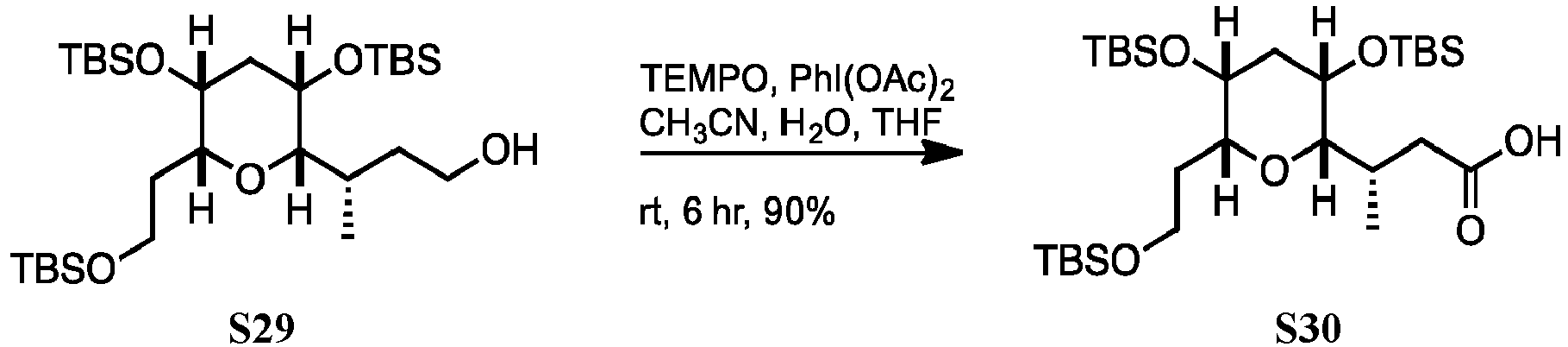
- To a stirred solution of alcohol S29 (1.6 g, 2.81 mmol, 1 eq.) in THF/CH3CN/H2O (3.5 mL/13 mL/13 mL) were added TEMPO (220 mg, 1.41 mmol, 0.5 eq.) and PhI(OAc)2 (4.53 g, 14.1 mmol, 5 eq.) at room temperature. After being stirred for 5 h at the same temperature, the resultant mixture was quenched with sat. Na2S2O3 aq. The organic layer was separated and the aqueous layer was extracted with Et2O. The combined organic layer was dried over MgSO4, filtered, and concentrated under reduced pressure. The crude product was purified by flash column chromatography on silica gel (0%, 5%, 10%, then 25% EtOAc in Hexanes) to give acid S30 (1.49 g, 2.53 mmol, 90%) as an amorphous solid. S30: [α]20 D +34.0 (c 1.00, CHCl3). 1H NMR (600 MHz, C6D6) δ: 3.90 (1H, td, J= 9.6, 4.2 Hz), 3.79 (1H, m), 3.61 (1H, s), 3.46 (1H, d, J = 10.8 Hz), 3.40 (1H, s), 3.01 (1H, dd, J = 16.2, 4.2 Hz), 2.82 (1H, d, J = 4.2 Hz), 2.66 (1H, m), 2.35 (1H, dd, J = 16.2, 7.2 Hz), 2.15 (1H, m), 1.89 (1H, d, J = 14.4 Hz), 1.65 (1H, m), 1.49 (1H, dt, J = 14.4, 4.9 Hz), 1.04 (9H, s), 1.03 (9H, s), 1.02 (9H, s), 0.96 (3H, d, J= 7.2 Hz), 0.15 (3H, s), 0.14 (3H, s), 0.13 (3H, s), 0.08 (3H, s), 0.06 (3H, s), 0.01 (3H, s) ppm. 13C NMR (150 MHz, C6D6) δ: 180.2, 84.1, 77.6, 67.3, 64.9, 60.6, 39.4, 37.8, 36.0, 30.8, 26.7, 26.5, 26.3, 18.6, 18.5, 18.4, 16.8, -2.6, -3.4, -4.8, -5.0, -5.1, -5.2 ppm. FTIR (film): 2953, 2929, 2885, 2857, 1708, 1472, 1463, 1386, 1253, 1098, 1020, 938, 886, 772 cm-1. HRMS (ESI) m/z: [M+H]+ calcd for C29H63O6Si3, 591.3927; found, 591.3921.

- To a stirred solution of acid S30 (2.50 g, 4.23 mmol, 1 eq.) in CH2Cl2 (40 mL) were added p-TsOH•H2O (805 mg, 4.23 mmol, 1 eq.) and H2O (0.76 mL, 42.3 mmol, 10 eq.) at room temperature. After being stirred for 24 h at the same temperature, the resultant mixture was directly concentrated under reduced pressure to give a crude lactone. The crude product was used in the next step without any purification.
- To a stirred solution of the crude lactone (calculated as 4.23 mmol, 1 eq.) in CH2Cl2 (100 mL) were added 2,6-lutidne (5.43 g, 50.8 mmol, 12 eq.) and TESOTf (11.2 g, 42.3 mmol, 10 eq.) at 0 °C. After being stirred for 1 h at room temperature, MeOH (3 mL) was added and the resultant mixture was diluted with 200 mL of CH2Cl2. The resultant mixture was washed with sat. NH4Cl aq. and sat. NaHCO3 aq. The organic layer was dried over Na2SO4, filtered, and concentrated under reduced pressure. The residue was purified by flash column chromatography on silica gel (0%, 5%, 10%, then 15% EtOAc in Hexanes) to give bis-TES 27 (1.46 g, 3.20 mmol, 76% for 2 steps) as a colorless oil. 27: [α]20 D +25.5 (c 1.00, CHCl3). 1H NMR (600 MHz, C6D6) δ: 3.80 (1H, td, J = 9.6, 4.4 Hz), 3.70 (1H, m), 3.61 (1H, s), 3.37 (1H, dd, J = 10.2, 3.0 Hz), 3.33 (1H, s), 2.82 (1H, s), 2.46 (1H, dd, J = 17.2, 12.0 Hz), 2.13 (1H, dd, J = 17.2, 4.6 Hz), 2.09-2.02 (2H, m), 1.67 (1H, m), 1.32 (1H, m), 1.20 (1H, dt, J = 14.4, 4.5 Hz), 1.09-1.01 (18H, m), 0.79 (3H, d, J = 6.6 Hz), 0.75-0.61 (12H, m) ppm. 13C NMR (150 MHz, C6D6) δ: 168.5, 75.6, 74.3, 73.4, 66.2, 59.2, 36.3, 36.0, 33.0, 31.4, 26.2, 16.6, 7.2, 5.3, 4.8 ppm. FTIR (film): 2954, 2934, 2911, 2876, 1734, 1459, 1414, 1376, 1239, 1197, 1097, 1032, 938, 780, 726 cm-1. HRMS (ESI) m/z: [M+H]+ calcd for C23H47O5Si2, 459.2957; found, 459.2946.

- To a stirred solution of the iodide 5 (1.21 g, 3.50 mmol, 1.3 eq.) in Et2O (30 mL, bubbled with Ar gas) were added t-BuLi solution (3.5 mL of 1.7 M in pentane, 5.92 mmol, 2.2 eq.) at -78 °C under Ar atmosphere. After being stirred for 5 min at the same temperature, the resultant mixture was transferred via cannula to a stirred solution of the lactone 27 (1.23 g, 2.69 mmol, 1 eq.) in toluene (30 mL, bubbled with Ar gas) at -78 °C under Ar atmosphere. After being stirred for 10 min at the same temperature, the resultant mixture was quenched with sat. NaHCO3 aq. The organic layer was separated and the aqueous layer was extracted with EtOAc. The combined organic layer was dried over Na2SO4, filtered, and concentrated under reduced pressure. The crude product was purified by flash column chromatography on neutral silica gel (0%, 5%, 10%, then 15% EtOAc in Hexanes) to give ketone/hemiketal mixture S31 (1.48g, 2.19 mmol, 82%) as a colorless oil. S31: [α]20 D +2.8 (c 1.00, CHCl3). 1H NMR (500 MHz, C6D6) δ: 7.27 (2H, d, J = 9.6 Hz), 6.85 (2H, d, J = 9.6 Hz), 5.64 (1H, m), 5.16-5.05 (2H, m), 4.55 (1H, d, J = 13.8 Hz), 4.23 (1H, d, J = 13.8 Hz), 3.94-3.87 (1H, m), 3.84-3.78 (1H, m), 3.70-3.61 (2H, m), 3.49 (1H, t, J = 7.8 Hz), 3.44 (1H, d, J = 11.4 Hz), 3.40 (1H, s), 3.34 (3H, s), 2.98 (1H, dd, J = 18.0, 3.6 Hz), 2.91-2.85 (1H, m), 2.81 (1H, d, J = 10.8 Hz), 2.74 (1H, dd, J = 18.0, 3.6 Hz), 2.55-2.48 (1H, m), 2.30-2.18 (2H, m), 2.13-2.05 (1H, m), 2.02 (1H, dt, J = 17.4, 2.0 Hz), 1.68-1.60 (1H, m), 1.28 (1H, dt, J = 17.4, 2.0 Hz), 1.08 (9H, t, J= 8.4 Hz), 0.99 (3H, d, J= 7.8 Hz), 0.97 (3H, d, J= 7.8 Hz), 0.93 (9H, t, J= 8.4 Hz), 0.70 (6H, q, J = 8.4 Hz), 0.51 (6H, q, J = 8.4 Hz) ppm. 13C NMR (125 MHz, C6D6) δ: 208.9, 159.7, 137.9, 131.4, 129.5, 117.9, 114.0, 84.6, 84.0, 77.0, 70.2, 69.7, 65.0, 59.7, 54.8, 47.9, 46.0, 37.7, 36.5, 34.0, 31.3, 16.5, 16.2, 7.2, 7.0, 5.0, 4.9 ppm. FTIR (film): 3523, 2955, 2935, 2912, 2876, 1711, 1613, 1514, 1459, 1413, 1376, 1301, 1247, 1085, 1003, 819, 743 cm-1. HRMS (ESI) m/z: [M+Na]+ calcd for C37H66O7Si2Na, 701.4245; found, 701.4268.

- To a stirred solution of S31 (1.17 g, 1.73 mmol, 1 eq.) in acetone (17.3 mL) were added NMMO (405 mg, 3.46 mmol, 2 eq.) and OsO4 solution (4.4 mL of 0.02 M in H2O, 0.088 mmol, 5 mol%) at room temperature. After being stirred for 12 h at the same temperature, the mixture was diluted with water. The organic layer was separated and the aqueous layer was extracted with EtOAc. The combined organic layer was dried over Na2SO4, filtered, and concentrated under reduced pressure. The residue was passed through a pad of silica gel (EtOAc) and concentrated under reduced pressure to give a crude diol, which was used in the next reaction without further purification.
- To a stirred solution of diol (calculated as 1.73 mmol, 1 eq.) in CH2Cl2 (17.3 mL) was added K2CO3 (2.39 g, 17.3 mmol, 10 eq.) and Pb(OAc)4 (1.53 g, 3.46 mmol, 2 eq.) at room temperature. After being stirred for 1 h at the same temperature, the reaction mixture was passed through a pad of silica gel (EtOAc). The filtrate was concentrated under reduced pressure. The residue was purified by flash column chromatography on silica gel (0%, 9%, 17%, then 25% EtOAc in Hexanes) to give S32 (1.0 g, 1.48 mmol, 86% for 2 steps) as colorless oil. S32 was obtained as an equilibrium mixture of hemiacetal. S32: [α]20 D -20.0 (c 1.00, CHCl3). 1H NMR (600 MHz, C6D6) δ: 7.16 (2H, d, J = 8.4 Hz), 6.76 (2H, d, J = 8.4 Hz), 5.44 (0.28H, d, J = 9.6 Hz), 4.91 (0.72H, d, J = 9.6 Hz), 4.54 (0.72H, d, J = 9.6 Hz), 4.46 (0.28H, d, J = 9.6 Hz), 4.36 (0.72H, d, J = 9.6 Hz), 4.26 (0.28H, d, J = 9.6 Hz), 4.11 (0.28H, s), 3.98-3.86 (1.28H, m), 3.85-3.76 (1H, m), 3.60 (0.78H, s), 3.46-3.36 (2H, m), 3.30 (0.84H, s), 3.29 (2.16H, s), 3.22 (0.28H, s), 3.20 (0.72H, s), 2.99 (0.28H, s), 2.96 (0.72H, s), 2.64 (0.28H, m), 2.34 (1.72H, m), 2.23-2.11 (1H, m), 1.92-1.76 (1.28H, m), 1.76-1.60 (3.27H, m), 1.54 (1H, m), 1.50-1.40 (2H, m), 1.15-0.98 (24H, m), 0.74-0.54 (12H, m) ppm. 13C NMR (125 MHz, C6D6) δ: 159.9, 131.2, 129.7, 129.6, 114.3, 114.0, 99.0, 98.2, 93.9, 91.3, 80.1, 78.5, 76.4, 76.3, 76.0, 75.9, 75.8, 72.1, 67.0, 66.9, 66.0, 65.2, 59.6, 59.5, 54.7, 38.5, 38.4, 37.8, 37.7, 36.6, 36.4, 30.1, 29.0, 23.5, 17.8, 17.5, 17.3, 7.3, 7.2, 5.5, 5.4, 4.8 ppm. FTIR (film): 2953, 2931, 2910, 2874, 1514, 1459, 1247, 1208, 1192, 1166, 1134, 1095, 1029, 1007, 967, 819, 742, 726 cm-1. HRMS (ESI) m/z: [M+Na]+ calcd for C36H64O8Si2Na, 703.4037; found, 703.4047.

- To a stirred solution of S32 (700 mg, 1.029 mmol, 1 eq.) in toluene (10 mL) were added benzyl dimethylphosphonoacetate (0.86 mL, 4.116 mmol, 4 eq.) and K3PO4 (660 mg, 3.087 mmol, 3 eq.) at room temperature. After being stirred for 36 h at the same temperature, the reaction mixture was passed through a pad of silica gel (50% EtOAc in Hexanes) to give crude 28, which was further purified by flash column chromatography on neutral silica gel (0%, 5%, 6%, then 9% EtOAc in Hexanes) to give a ~8:1 mixture of E/Z isomers 28 (776 mg, 0.956 mmol, 93%) as a colorless oil. Some of the pure E isomer was isolated for characterization purpose by further chromatography. The Mixture of E/Z isomer was directly used in the next step. 28: [α]20 D -2.2 (c 1.00, CHCl3). 1H NMR (600 MHz, C6D6) δ: 7.24 (2H, d, J= 7.8 Hz), 7.15 (2H, d, J= 7.8 Hz), 7.11 (2H, t, J= 7.8 Hz), 7.05 (1H, m), 6.79 (2H, d, J= 7.8 Hz), 6.19 (1H, d, J= 15.6 Hz), 5.12 (2H, q, J = 12.0 Hz), 4.37 (1H, d, J = 12.0 Hz), 4.11 (1H, d, J = 12.0 Hz), 3.92-3.87 (1H, m), 3.83-3.78 (1H, m), 3.68-3.57 (3H, m), 3.46-3.41 (2H, m), 3.33 (3H, s), 2.91 (1H, dd, J= 15.0, 2.0 Hz), 2.85-2.78 (2H, m), 2.52 (1H, dd, J = 17.4, 4.5 Hz), 2.49-2.44 (1H, m), 2.21-2.10 (2H, m), 2.08 (1H, td, J = 10.2, 6.0 Hz), 2.03 (1H, d, J = 14.4 Hz), 1.68-1.61 (1H, m), 1.29 (1H, d, J = 14.4 Hz), 1.07 (9H, t, J = 8.4 Hz), 0.97 (3H, d, J = 7.8 Hz), 0.93 (9H, t, J = 8.4 Hz), 0.86 (3H, d, J = 7.8 Hz), 0.69 (6H, q, J = 8.4 Hz), 0.52 (6H, q, J = 8.4 Hz) ppm. 13C NMR (150 MHz, C6D6) δ: 208.3, 165.6, 159.8, 147.8, 136.7, 130.7, 129.7, 128.7, 128.6, 128.3, 123.3, 114.0, 84.5, 81.6, 76.9, 71,2, 69.6, 66.4, 65.0, 59.6, 54.8, 47.8, 45.6, 37.8, 36.5, 33.7, 31.2, 16.3, 16.2 7.2, 7.0, 5.1, 4.9 ppm. FTIR (film): 3511, 2954, 2912, 2876, 1720, 1514, 1458, 1413, 1376, 1248, 1165, 1085, 1004, 820, 743, 729, 698 cm-1. HRMS (ESI) m/z: [M+Na]+ calcd for C45H72O9Si2Na, 835.4613; found, 835.4622.

- To a stirred solution of unsaturated ester 28 (800 mg, 0.985 mmol, 1 eq.) in MeCN (3.0 mL) were added BnOAc (296 mg, 1.97 mmol, 2 eq.), LiBr (857 mg, 9.85 mmol, 10 eq.), and DBU (0.74 mL, 4.93 mmol, 5 eq.) at room temperature. After being stirred for 12 h at the same temperature, hexanes (3.0 mL) and H2O (3.0 mL) were added to the reaction mixture. The organic layer was separated and the aqueous layer was extracted with hexanes. The combined organic layer was dried over Na2SO4, filtered, and concentrated under reduced pressure. The obtained crude material was purified by flash column chromatography on neutral silica gel (0%, 5%, 6%, then 9% EtOAc in Hexanes) to give spiro ketal 29 (658 mg, 0.810 mmol, 82%) as colorless oil. 29: [α]20 D -28.1 (c 1.00, CHCl3). 1H NMR (600 MHz, C6D6) δ: 7.24 (2H, d, J= 7.8 Hz), 7.20 (2H, d, J= 7.8 Hz), 7.13 (2H, t, J= 7.8 Hz), 7.09 (1H, q, J = 7.8 Hz), 6.77 (2H, d, J = 7.8 Hz), 5.09 (1H, d, J = 14.4 Hz), 5.00 (1H, d, J = 14.4 Hz), 4.33 (1H, d, J= 11.0 Hz), 4.28-4.21 (2H, m), 3.94 (1H, m), 3.88-3.78 (2H, m), 3.48 (1H, d, J = 10.8 Hz), 3.42 (1H, m), 3.30 (3H, s), 3.04 (1H, s), 2.97 (1H, dd, J= 14.4, 10.8 Hz), 2.90 (1H, s), 2.38 (1H, m), 2.31 (1H, dd, J = 17.0, 2.5 Hz), 2.26-2.16 (2H, m), 2.04 (1H, d, J = 15.0 Hz), 1.77-1.64 (3H, m), 1.61-1.55 (2H, m), 1.42 (1H, dd, J = 12.6, 3.1 Hz), 1.12-1.04 (21H, m), 1.02 (3H, d, J = 6.6 Hz), 0.67 (12H, q, J = 8.4 Hz) ppm. 13C NMR (150 MHz, C6D6) δ: 171.7, 159.7, 136.8, 131.3, 129.7, 128.8, 128.6, 128.3, 114.0, 97.0, 78.6, 76.4, 76.2, 75.3, 69.8, 67.2, 66.1, 64.9, 59.6, 54.7, 38.2, 37.7, 37.4, 36.7, 36.4, 30.9, 29.2, 18.2, 17.4, 7.3, 7.2, 5.5, 4.9 ppm. FTIR (film): 2953, 2978, 2911, 2874, 1736, 1613, 1514, 1458, 1414, 1396, 1371, 1303, 1246, 11246, 1207, 1190, 1165, 1128, 1095, 1032, 1010, 974, 822, 741, 727, 698, 671 cm-1. HRMS (ESI) m/z: [M+Na]+ calcd for C45H72O9Si2Na, 835.4613; found, 835.4598.

- To a stirred solution of TES ether 29 (600 mg 0.738 mmol, 1 eq.) in CH2Cl2 (5 mL) was added TBAF (1.107 mL, 1 M solution in THF, 1.107 mmol, 1.5 eq.) at 0 °C. After being stirred for 5 hr at the same temperature, without concentration, the reaction mixture was directly subjected to the flash column chromatography on neutral silica gel (0%, 5%, then 10% EtOAc in Hexanes) to give ester S33 (418 mg, 0.598 mmol, 81%) as a colorless oil. S33: [α]20 D -46.0 (c 1.00, CHCl3). 1H NMR (600 MHz, C6D6) δ: 7.24 (2H, d, J = 7.8 Hz), 7.20 (2H, d, J = 7.8 Hz), 7.13 (2H, t, J = 7.8 Hz), 7.09 (1H, q, J = 7.8 Hz), 6.77 (2H, d, J = 7.8 Hz), 5.09 (1H, d, J= 14.4 Hz), 5.00 (1H, d, J = 14.4 Hz), 4.33 (1H, d, J = 11.0 Hz), 4.28-4.21 (2H, m), 3.85-3.79 (2H, m), 3.77-3.72 (1H, m), 3.29 (3H, s), 3.21 (1H, d, J = 8.4 Hz), 2.99-2.93 (2H, m), 2.88 (1H, s), 2.36 (1H, s), 2.28 (1H, dd, J = 16.2, 3.0 Hz), 2.24 (1H, m), 2.16-2.08 (2H, m), 2.01 (1H, d, J = 13.8 Hz), 1.69-1.54 (3H, m), 1.50 (1H, dt, J = 13.8, 2.1 Hz), 1.36 (2H, dd, J = 12.6, 3.0 Hz), 1.08 (9H, t, J = 8.4 Hz), 1.03 (3H, d, J = 7.2 Hz), 0.97 (3H, d, J = 7.2 Hz), 0.65 (6H, q, J = 8.4 Hz) ppm. 13C NMR (150 MHz, C6D6) δ: 171.7, 159.8, 136.8, 131.2, 129.7, 128.7, 128.6, 128.3, 114.0, 97.0, 80.1, 78.5, 76.6, 75.3, 69.8, 66.9, 66.1, 64.6, 61.3, 54.8, 38.1, 37.7, 37.3, 36.4, 35.1, 30.9, 28.9, 18.2, 17.6, 7.3, 5.5 ppm. FTIR (film): 2954, 2928, 2911, 2874, 1736, 1612, 1514, 1457, 1420, 1304, 1247, 1208, 1163, 1086, 1064, 1038, 1010, 821, 740, 699 cm-1. HRMS (ESI) m/z: [M+H]+ calcd for C39H59O9Si, 699.3923; found, 699.3937.

- To a stirred solution of alcohol S33 (400 mg, 0.573 mmol, 1 eq.) in CH2Cl2 (10 mL) were added NaHCO3 (480 mg, 5.73 mmol, 10 eq.) and Dess-Martin periodinane (486 mg, 1.146 mmol, 2 eq.) subsequently at room temperature. After being stirred for 30 min at the same temperature, the reaction was quenched with sat. NaHCO3 aq. The organic layer was separated and the aqueous layer was extracted with CH2Cl2. The combined organic layer was dried over Na2SO4, filtered, and concentrated under reduced pressure. The obtained crude material was passed through a SiO2 to give the crude aldehyde which was used in the next step without further purification. To a stirred solution of the crude aldehyde (estimated as 0.573 mmol, 1 eq.) in a mixed solvent (9 mL of t-BuOH, 2 mL of water and 2 mL of 2-methyl-2-butene) were added NaH2PO3.H2O (316 mg, 2.292 mmol, 4 eq.) and NaClO2 (156 mg, 1.719 mmol, 3 eq.) subsequently at room temperature. After being stirred for 30 min at the same temperature, the reaction was quenched with sat. NaHCO3 aq. The organic layer was separated and the aqueous layer was extracted with EtOAc. The combined organic layer was dried over Na2SO4, filtered, and concentrated under reduced pressure. The obtained crude acid was used in the next step without further purification. To a stirred solution of the crude acid (estimated as 0.573 mmol, 1 eq.) in a mixed solvent (15 mL of benzene and 3 mL of MeOH) was added TMSCH2N2 solution (0.81 mL of 2 M in Et2O, 1.72 mmol, 3 eq.) at room temperature. After being stirred for 5 min at the same temperature, the reaction was quenched with HOAc (0.1 mL) at 0 °C. After concentration, the obtained crude material was purified by flash column chromatography on neutral silica gel (0%, 3%, then 5% EtOAc in Hexanes) to give ester 30 (362 mg, 0.499 mmol, 87% for 3 steps) as a colorless oil. 30: [α]20 D -35.6 (c 1.00, CHCl3). 1H NMR (600 MHz, C6D6) δ: 7.24 (2H, d, J = 7.8 Hz), 7.20 (2H, d, J = 7.8 Hz), 7.13 (2H, t, J = 7.8 Hz), 7.09 (1H, q, J = 7.8 Hz), 6.77 (2H, d, J = 7.8 Hz), 5.09 (1H, d, J = 14.4 Hz), 5.00 (1H, d, J = 14.4 Hz), 4.33 (1H, d, J = 11.0 Hz), 4.28-4.21 (2H, m), 3.78 (1H, s), 3.74 (1H, d, J= 8.4 Hz), 3.59 (1H, s), 3.38 (3H, s), 3.30 (3H, s), 2.99 (1H, s), 2.95 (1H, dd, J = 12.2, 10.8 Hz), 2.91 (1H, s), 2.83 (1H, dd, J = 16.2, 7.2 Hz), 2.58 (1H, dd, J = 16.2, 6.0 Hz), 2.36 (1H, s), 2.31 (1H, dd, J = 16.2, 3.2 Hz), 2.13 (1H, s), 2.01 (1H, d, J = 15.0 Hz), 1.66 (2H, td, J = 12.6, 2.0 Hz), 1.58-1.51 (2H, m), 1.38 (1H, dd, J = 12.6, 3.2 Hz), 1.06 (9H, t, J = 8.4 Hz), 1.05 (3H, d, J = 6.0 Hz), 1.00 (3H, d, J = 6.0 Hz), 0.64 (6H, q, J = 8.4 Hz) ppm. 13C NMR (150 MHz, C6D6) δ: 171.8, 171.7, 159.7, 136.7, 131.3, 129.7, 128.8, 128.7, 128.3, 114.0, 97.0, 78.5, 77.1, 76.4, 75.3, 69.8, 66.1, 65.7, 64.4, 54.8, 50.9, 38.0, 37.7, 37.3, 37.2, 36.2, 30.9, 28.9, 18.2, 17.6, 7.3, 5.4 ppm. FTIR (film): 2952, 2924, 2874, 2854, 1737, 1613, 1514, 1457, 1436, 1397, 1371, 1302, 1246, 1207, 1163, 1085, 1038, 944, 738, 698 cm-1. HRMS (ESI) m/z: [M+Na]+ calcd for C40H58O10SiNa, 749.3697; found, 749.3720.

- To a stirred solution of MPM ether 30 (350 mg, 0.482 mmol, 1 eq.) in CH2Cl2 (10 mL), phosphate buffer (3 mL, pH7) was added DDQ (219 mg, 0.964 mmol, 2 eq.) at room temperature. After being stirred for 1 h at the same temperature, the reaction was quenched with sat. NaHCO3 aq. The organic layer was separated and the aqueous layer was extracted with CH2Cl2. The combined organic layer was dried over Na2SO4, filtered, and concentrated under reduced pressure. The obtained crude material was passed through a SiO2 to give the crude alcohol, which was used in the next step without further purification.
- To a stirred solution of the crude alcohol (calculated as 0.482 mmol, 1 eq.) in CH2Cl2 (5.0 mL) were added 2,6-lutidine (129 mg, 1.205 mmol, 2.5 eq.) and TESOTf (255 mg, 0.964 mmol, 2 eq.) at room temperature maintained with a water bath. After being stirred for 30 min at the same temperature, the reaction was quenched with sat. NaHCO3 aq. The organic layer was separated and the aqueous layer was extracted with EtOAc. The combined organic layer was dried over Na2SO4, filtered, and concentrated under reduced pressure. The obtained crude material was purified by flash column chromatography on neutral silica gel (0%, 3%, then 5% EtOAc in Hexanes) to give TES ether 31 (288 mg, 0.400 mmol, 97%) as a colorless oil. 31: [α]20 D -52.1 (c 1.00, CHCl3). 1H NMR (600 MHz, C6D6) δ: 7.26 (2H, d, J = 7.8 Hz), 7.11 (2H, t, J = 7.8 Hz), 7.05 (1H, q, J = 7.8 Hz), 5.09 (1H, d, J = 14.4 Hz), 5.00 (1H, d, J = 14.4 Hz), 4.18 (1H, dd, J = 10.2, 4.0 Hz), 3.80 (1H, s), 3.74 (1H, td, J = 6.6, 1.5 Hz), 3.61 (1H, s), 3.38 (3H, s), 3.29 (1H, s), 2.98 (1H, s), 2.91 (1H, dd, J = 13.8, 12.0 Hz), 2.84 (1H, dd, J = 15.0, 8.4 Hz), 2.60 (1H, dd, J = 15.0, 5.5 Hz), 2.35-2.29 (2H, m), 2.15-2.07 (1H, m), 2.03 (1H, dd, J= 15.0, 3.0 Hz), 1.68 (1H, t, J= 13.8 Hz), 1.64 (1H, t, J= 13.8 Hz), 1.58-1.51 (2H, m), 1.40 (1H, dd, J = 13.2, 4.3 Hz), 1.07 (9H, t, J = 8.4 Hz), 0.99 (3H, d, J = 7.2 Hz), 0.96 (3H, d, J = 7.2 Hz), 0.95 (9H, t, J = 8.4 Hz), 0.65 (6H, q, J = 8.4 Hz), 0.56 (6H, q, J = 8.4 Hz) ppm. 13C NMR (150 MHz, C6D6) δ: 171.8, 171.6, 136.7, 128.8, 128.7, 128.3, 96.9, 77.2, 76.4, 72.5, 70.1, 66.2, 65.6, 64.4, 38.3, 37.5, 37.4, 37.2, 36.3, 31.0, 28.9, 18.5, 17.1, 7.3, 7.2, 5.8, 5.4 ppm. FTIR (film): 2955, 2925, 2876, 1739, 1457, 1372, 1304, 1266, 1240, 1208, 1160, 1130, 1086, 1063, 1036, 947, 856, 740, 697 cm-1. HRMS (ESI) m/z: [M+Na]+ calcd for C38H64O9Si2Na, 743.3987; found, 743.4003.

- To a stirred solution of Benzyl ester 31 (250 mg, 0.347 mmol, 1 eq.) in EtOAc (10.0 mL) was added wet 10% Pd/C (25 mg, 10%w/w) at room temperature. The reaction was stirred under 1 atmosphere of hydrogen for 2 h at the same temperature. The resulting mixture was filtered through a pad of Celite (EtOAc). The organic solvent was removed under reduced pressure to give a crude acid, which was used in the next step without further purification.
- To a stirred solution of the crude carboxylic acid (calculated as 0.347 mmol, 1 eq.) in toluene (1.2 mL) were added PPh3 (110 mg, 0.416 mmol, 1.2 eq.) and (PyS)2 (107 mg, 0.486 mmol, 1.4 eq.) at room temperature. After being stirred for 12 h at the same temperature, the resulting reaction mixture was directly subjected to column chromatography on neutral silica gel (0%, 3%, 5%, then 6% EtOAc in Hexanes) to give pyridinethiol ester 5-32 (221 mg, 0.306 mmol, 88% for 2 steps) as colorless oil. 5-32: [α]20 D -62.1 (c 1.0, CHCl3). 1H NMR (600 MHz, C6D6) δ: 8.32 (1H, dd, J = 4.5, 1.3 Hz), 7.52 (1H, d, J = 7.8 Hz), 6.97 (1H, td, J = 7.8, 1.5 Hz), 6.48 (1H, m), 4.19 (1H, dd, J = 9.6, 2.8 Hz), 3.88 (1H, t, J = 1.6 Hz), 3.72 (1H, m), 3.58 (1H, t, J = 1.6 Hz), 3.37 (3H, s), 3.23 (1H, dd, J = 13.8, 10.2 Hz), 3.17 (1H, brs), 3.04 (1H, J =2.4 Hz, 1H), 2.82 (1H, dd, J =13.8, 7.2 Hz), 2.59-2.53 (2H, m), 2.41-2.34 (1H, m), 2.27 (1H, m), 2.03 (1H, dt, J = 14.4, 2.4 Hz), 1.70 (1H, t, J = 13.2 Hz), 1.63 (1H, t, J = 13.2 Hz), 1.59 (1H, dt, J =15.0, 3.5 Hz), 1.53 (1H, dd, J = 13.2, 5.2 Hz), 1.45 (1H, dd, J = 13.2, 5.2 Hz), 1.06 (9H, t, J= 8.4 Hz), 1.00 (3H, d, J= 6.0 Hz), 0.98 (9H, t, J= 8.4 Hz), 0.93 (3H, d, J = 6.6 Hz), 0.64 (6H, q, J = 8.4, 1.1 Hz), 0.56 (6H, q, J = 8.4 Hz) ppm. 13C NMR (150 MHz, C6D6) δ: 194.7, 152.7, 150.6, 136.5, 128.5, 123.1, 97.4, 77.7, 77.5, 72.5, 70.0, 68.6, 67.3, 63.9, 47.8, 37.5, 36.7, 36.5, 30.5, 29.1, 27.8, 27.7, 23.4, 21.0, 18.5, 17.3, 7.4, 5.9 ppm. IR (film): 2955, 2931, 2874, 2857, 1708, 1132, 1035, 974 cm-1. HRMS (ESI) m/z: [M+Na]+ calcd for C36H61NO8SSi2Na, 746.3554; found, 746.3578.
-

- To a stirred solution of (triethylsilyl)acetylene (25.7 g, 183 mmol) in THF (250 mL) was added n-BuLi (2.5 M in hexane, 80.0 mL, 201 mmol) dropwise over 20 min at 0 °C. After stirring for 50 min, DMF (42.0 mL, 549 mmol) was added to a mixture at -78 °C. The reaction mixture was allowed to warm up to room temperature and stirred for 2 h. The reaction was quenched with 3M HCl (185 mL) at 0 °C. The mixture was diluted with EtOAc (260 mL), washed with H2O (190 mL) four times and brine one time. The organic layer was dried over anhydrous sodium sulfate, filtered, and concentrated under reduced pressure. Finally, crude oil was purified by distillation (~63 °C) to afford desired aldehyde (26.9 g, 160 mmol, 87%) as a colorless oil; 1H NMR (400 MHz, CDCl3) δ 9.18 (s, 1H), 1.02 (t, J = 7.6 Hz, 9H), 0.69 (q, J = 7.6 Hz, 6H); 13C NMR (100 MHz, CDCl3) δ 176.8, 103.5, 101.6, 7.2, 3.7; IR (neat) 2958, 2877, 2151, 1667, 995, 723, 677.

- To a stirred mixture of alkynyl aldehyde (25.4 g, 151 mmol), propanal (21.7 mL, 302 mmol), and water (8.20 mL, 453 mmol) in 1,4-dioxane (150 mL) was added diarylprolinol A (7.90 g, 15.1 mmol; Hayashim Y; Itoh, T.; Aratake, S.; Ishikawa, H. Angew, Chem. Int. Ed. 2008, 47, 2082). After stirring for 36 h at room temperature, NaBH4 (11.4 g, 302 mmol) was added to a mixture at 0 °C. After stirring for 1 h at 0 °C, the reaction was quenched with H2O (54 mL), brine (320 mL) and the reaction mixture was extracted with EtOAc five times. The combined organic extracts were dried over anhydrous sodium sulfate, filtered, and concentrated under reduced pressure. The resulting oil was filtered through a pad of silica gel (450 g) and washed with a mixture of hexanes/EtOAc = 10/1, then 1/1. The filtrate was concentrated again under reduced pressure. The residue (27.7 g, ca. 121 mmol, ca. 80%) was subject to the next reaction without further purification.

- To a stirred solution of the crude diol (27.7 g, ca. 121 mmol) in MeOH (400 mL) was added K2CO3 (25.2 g, 182 mmol) at room temperature. The resulting mixture was heated at 50 °C and stirred for 12 h. After cooling to room temperature, the solvent was removed under reduced pressure. The resulting oil was diluted with CH2Cl2 and filtered through a pad of silica gel (130 g) to remove K2CO3. The precipitate was washed with CH2Cl2/MeOH = 10/1 and the filtrate was concentrated under reduced pressure. The resulting oil was filtered through a pad of silica gel (160 g) again and washed with a mixture of hexanes/EtOAc = 5/1, then 1/2. The filtrate was concentrated again under reduced pressure. The residue (11.7 g, ca. 103 mmol, ca. 85%) was subject to the next reaction without further purification.

- To a stirred mixture of the crude diol (11.7 g, ca. 103 mmol) and p-methoxybenzylidenedimethylacetal (22.0 mL, 124 mmol) in MeCN (180 mL) was added a catalytic amount of CSA (0.96 g, 4.12 mmol) at room temperature. After stirring for 2 h, the reaction mixture was quenched with Et3N (2.9 mL, 20.6 mmol), filtered through a pad of silica gel (70 g), washed with CH2Cl2 and concentrated under reduced pressure. The residue was purified by crystallization from hexanes/CH2Cl2 to afford desired anti compound (15.5 g, 66.8 mmol, 44% over 4 steps from alkynyl aldehyde) as a white pure crystal; [α]D 20 +3.00 (c 1.0, MeOH); 1H NMR (400 MHz, CDCl3) δ 7.42 (d, J = 8.4 Hz, 2H), 6.88 (d, J = 8.4 Hz, 2H), 5.43 (s, 1H), 4.21-4.15 (m, 2H), 3.80 (s, 3H), 3.51 (dd, J = 11.2, 11.2 Hz, 1H), 2.53 (d, J = 2.4 Hz, 1H), 2.19-2.17 (m, 1H), 0.95 (d, J = 7.2 Hz, 3H); 13C NMR (100 MHz, CDCl3) δ 160.1, 130.2, 127.6, 113.6, 101.5, 80.7, 74.3, 73.7, 72.7, 55.3, 35.1, 12.5; IR (neat) 3263, 2963, 2838, 1614, 1519, 1247, 1024, 997, 834.

- To a stirred solution of alkyne (15.5 g, 66.8 mmol) in a mixture of acetone (480 mL) and cyclohexene (160 mL) was added quinoline (7.90 mL, 66.8 mmol) and 5wt% Pd/CaCO3 poisoned with Pb (0.775 g, 5wt%) at room temperature. The flask containing a mixture was charged with hydrogen gas (1 atm) at room temperature, vigorously stirred for 1.5 h and filtered through a pad of Celite. The filter cake was washed with EtOAc and the filtrate was concentrated under reduced pressure. The residue was filtered through a pad of silica gel (230 g) and washed with a mixture of hexanes/EtOAc = 20/1. The filtrate was concentrated again under reduced pressure to afford pure alkene (15.6 g, 66.7 mmol, quant.); a white solid; [α]D 20 +65.4 (c 1.0, CHCl3); 1H NMR (400 MHz, CDCl3) δ 7.44 (d, J= 8.8 Hz, 2H), 6.89 (d, J = 8.8 Hz, 2H), 5.94-5.85 (m, 1H), 5.51 (s, 1H), 5.36 (d, J= 17.2 Hz, 1H), 5.26 (d, J= 10.4 Hz, 1H), 4.16 (dd, J = 11.6, 4.8 Hz, 1H), 3.89 (dd, J = 11.4, 4.8 Hz, 1H), 3.80 (s, 3H), 3.54 (dd, J = 11.6, 11.4 Hz, 1H), 1.93-1.87 (m, 1H), 0.79 (d, J = 6.8 Hz, 3H); 13C NMR (100 MHz, CDCl3) δ 159.9, 136.0, 131.0, 127.5, 118.0, 113.6, 101.0, 84.7, 73.0, 55.3, 33.9, 12.3; IR (neat) 2965, 1612, 1516, 1248, 1140, 1034, 815.

- To a stirred solution of the starting material (445g, 1.885mol) in dichloromethane (750mL) under N2 atmosphere was added Et3N (790mL, 5.656mol) at room temperature. To this mixture, a solution of p-bromobenzenesulfonyl chloride (730g, 2.828mol) in dichloromethane (600mL) was added dropwise below 41°C. After being stirred for 2hrs at 35-40°C, the mixture was poured into a mixture of n-heptane (2L) and water (1.5L) and stirred for 5min to give a biphasic mixture. The separated aqueous layer was extracted with a mixture of n-heptane/EtOAc=2/1(v/v) twice. The combined organic layer was washed with 1M HCl aq. and saturated NaHCO3 aq. The organic layer was concentrated under reduced pressure to give a crude material as a solid. To this solid was added MTBE (870mL) and n-heptane (2.6L) and heated to 49°C to dissolve the solid. The mixture was slowly cooled to room temperature and stirred for 16hrs. After further stirred below 3°C for 1hr, the resulting suspension was filtrated and rinsed with cold n-heptane/MTBE=9/1(v/v). The crystals were dried under reduced pressure at 30°C to give the desired compound (740.6g, 1.626mol, 86%). 1H-NMR (500MHz, CDCl3) δ ppm 7.75 (2H, d, J=8.5Hz), 7.67 (2H, d, J=8.5Hz), 7.14 (2H, d, J=8.5Hz), 6.86 (2H, d, J=8.5Hz), 5.60-5.67 (1H, m), 5.33 (1H, dd, J=10.5, 2.0Hz), 5.23 (1H, d, J=17.5Hz), 4.46 (1H, d, J=11.0Hz), 4.14 (1H, d, J=11.0Hz), 4.14 (1H, dd, J=9.0, 4.0Hz), 4.10 (1H, dd, J=9.0, 4.0Hz), 3.82 (3H, s), 3.57 (1H, dd, J=8.0, 8.0Hz), 1.92-2.00 (1H, m), 0.90 (3H, d, J=7.0Hz).

- To a stirred solution of the starting material (730.6g, 1.604mol) in acetone (2.2L) was added NaI (721g, 4.813mol) at room temperature under N2 atmosphere and heated to 45°C. After being stirred for 2.5hrs, the mixture was cooled below 30°C followed by addition of n-heptane (2.2L) and water (2.2L) to give a biphasic mixture. The organic layer was separated and the aqueous layer was extracted with a mixture of n-heptane/EtOAc=4/1 (v/v) twice. The combined organic layer was washed with a mixture of aqueous solution containing 6% NaHCO3 and 3% Na2S2O3 aq. The organic layer was concentrated under reduced pressure and azeotroped with n-heptane. The residue was purified by column chromatography on neutral silica gel (10kg, eluent: 0%, 2% then 5% EtOAc in n-heptane). The collected fractions were concentrated to give the desired product (551g, 1.591mol, 99%). 1H-NMR (500MHz, CDCl3) δ ppm 7.28 (2H, d, J=9.0Hz), 6.88 (2H, d, J=9.0Hz), 5.69-5.76 (1H, m), 5.35 (1H, dd, J=10.0, 1.5Hz), 5.29 (1H, d, J=17.5Hz), 4.51 (1H, d, J=11.0Hz), 4.28 (1H, d, 11.0Hz), 3.82 (3H, s), 3.53 (1H, dd, J=8.0, 8.0Hz), 3.46 (1H, dd, J=9.0, 6.0Hz), 3.34 (1H, dd, J=9.0, 3.5Hz), 1.51-1.59 (1H, m), 0.94 (3H, d, J=7.0Hz).

- To a stirred solution of lactone (500g, 1.46mol) in toluene (5L) was added DIBAL solution (1.83L of 1M in toluene, 1.83mol) at -71 ~ -62°C under N2 atmosphere. After being stirred for 15min, the reaction was quenched with EtOAc (500mL) at -69 ~ -65°C. Then the mixture was warmed up to -23°C and 30% Rochelle's salt aq. (5L) was added at -23 ~ 8°C. The mixture was stirred for 30min at room temperature to give a biphasic mixture. The organic layer was separated and washed sequentially with water and 5% NaCl aq. The combined aqueous layers were extracted with EtOAc. The combined organic layers were concentrated and azeotroped with toluene twice under reduced pressure to give a crude lactol, which was used in the next reaction without further purification.
- To a suspension of Ph3PCH3Br (2086g, 5.84mol) in THF (4L) was added t-BuOK (491.5g, 4.38mol) at 3°C under N2 atmosphere. A solution of the crude lactol (calculated as 1.46mol) in THF (1L) was added into the reaction mixture at 1 ~ 9°C. After being stirred for 20min at 3~7°C, the reaction was quenched with water (125mL) below 14°C. Then iPrOAc (5L) and water (2.4L) were added to give a biphasic mixture. The organic layer was separated and washed with 5% NaCl aq. The organic layer was concentrated under reduced pressure. The residue was added toluene (1L) and n-heptane (1L) and stirred for 16hrs at 0°C. The precipitated solid was removed by filtration and filtrated solution was concentrated under reduced pressure. The residue was purified by column chromatography on neutral silica gel (3.0kg, eluent: 0%, 5%, 7%, 9% then 12% EtOAc in n-heptane) to give the desired compound (440g, 1.28mol, 88% in 2steps). 1H-NMR (500MHz, CDCl3) δ: 5.70-5.77 (1H, ddd, J= 17, 10.5, 8.0Hz), 5.18 (1H, ddd, J= 17, 1.5, 1.5Hz), 5.05 (1H, dd, J= 10.5, 1.5Hz), 4.42 (1H, dd, J= 3.0, 3.0Hz), 4.27 (1H, dd, J= 15, 2.5Hz), 4.23 (1H, dd, J= 15, 1.5Hz), 3.70-3.74 (1H, m), 3.62 (1H, d, J= 10.5Hz), 3.32 (1H, m), 2.97 (1H, dd, J= 9.5, 1.3Hz), 2.72-2.80 (1H, m), 2.33 (1H, ddd, J= 15.0, 3.0, 3.0Hz), 1.67 (1H, ddd, 15.0, 3.0, 3.0Hz), 1.12 (3H, d, J= 6.5Hz), 1.07 (9H, s), 1.06 (9H, s)

- To a stirred solution of the starting material (440g, 1.28mol) in THF (3.7L) was added triethylamine (367mL, 2.63mol) at 20°C under N2 atmosphere and cooled to 3°C. To this mixture, TESOTf (354mL, 1.54mol) was added dropwise below 7°C and stirred for 8min at the same temperature. The reaction was quenched with 3.5% NaHCO3 (4.4L) aq. below 18°C followed by addition of EtOAc (2.2L) and n-heptane (2.2L) to give a biphasic mixture. The organic layer was separated and washed with 5% NaCl aq. The organic layer was dried over Na2SO4, filtered and concentrated under reduced pressure to give a crude material, which was used in the next reaction without further purification.
- A solution of the crude (calculated as 1.28mol) in THF (2.1L) and acetone (2.1L) was added NMO (464g, 3.96mol) followed by addition of water (0.5L) at room temperature. To this mixture, 4% OsO4 aq.(194mL, 32mmol) was added and stirred for 19hrs at room temperature. Then water (2.1L) and NaIO4 (847g, 3.96mol) were added to this mixture and further stirred for 70min at room temperature. To this mixture, n-heptane (2.9L) and water (1.2L) were added and stirred for 5min at room temperature to a give biphasic mixture. The organic layer was separated and aqueous layer was extracted with n-heptane. The combined organic layers were added to 20% Na2SO3 aq. and the resulting biphasic mixture was stirred for 30min at room temperature. The organic layer was separated and washed sequentially with 10% Na2SO3 aq., water, 5% NaCl aq. The organic layer was dried over Na2SO4, filtered, concentrated under reduced pressure. The residue was purified by column chromatography on neutral silica gel (5.9kg, eluent: 0%, 5%, then 10% EtOAc in n-heptane). The collected fractions were concentrated and the resulting aldehyde was solidified by cooling with ice-water bath to give the aldehyde (502.8g, 1.10mol, 86% in 2steps). 1H-NMR (500MHz, CDCl3) δ: 9.84 (1H, s), 4.29-4.31 (1H, m), 4.28 (1H, dd, J=12.5, 3.0Hz), 4.21 (1H, dd, J=12.5, 1.5Hz), 3.86-3.88 (1H, m), 3.57 (1H, dd, J=7.5, 2.5Hz), 3.29-3.32 (1H, m), 2.80-2.86 (1H, dq, J=7.5Hz, 7.5Hz), 2.21-2.25 (1H, ddd, J=15.0, 2.5, 2.5Hz), 1.77-1.81 (1H, ddd, J= 15.0, 4.0, 4.0Hz), 1.16 (3H, d, J= 7.5Hz), 1.07 (9H, s), 1.04 (9H, s), 0.96-1.00 (9H, m), 0.58-0.67 (6H, m).

- In a glove box, CrCl2 (22mg, 0.18mmol), proton sponge (42mg, 0.20mmol), sulfonamide ligand (88mg, 0.20mmol) were added in a well-dried round bottomed flask and added anhydrous MeCN (3.0mL). The mixture was stirred in the glove box at room temperature.
- In another flask, the aldehyde (500mg, 0.90mmol) was added toluene. After azeotropic removal of toluene, the flask was brought in the glove box followed by addition of vinyl iodide (477mg, 2.25mmol), Mn (198mg, 3.60mmol), LiCl (76mg, 1.80mmol), Cp2ZrCl2 (289mg, 0.99mmol) and 2,6-lutidine (0.21mL, 1.80mmol). To this flask, the Cr solution prepared above was added followed by addition of Ni catalyst (3.0mg, 4.5 µ mol). The mixture was stirred vigorously for 145min at 30°C. The flask was taken out of the glove box and Florisil® (1g) was added to this mixture at room temperature. After dilution with n-heptane/EtOAc=1/1(v/v) (5mL), the suspension was stirred vigorously for 35min at room temperature and passed through a neutral silica gel (5g) pad. The desired product was eluted with EtOAc and collected solution was concentrated under reduced pressure. The residue was purified by column chromatography on neutral silica gel (10g, eluent; 0%, 10%, 20%, 33% then 50% EtOAc in n-heptane). The collected fractions were concentrated to give the desired product (462mg, 0.85mmol, 94%).

- To a stirred solution of the starting material (636.6g, 0.957mol) in hexafluoroisopropanol (HFIP) (1.6L) and water (160mL) were added AcOH (55mL, 0.957mol) at 5°C under N2 atmosphere. The mixture was stirred for 30min below 5°C and 3hrs at room temperature. The reaction was quenched with 5% NaHCO3 aq. (5L) followed by addition of n-heptane (5L). After separation of the organic layer, the aqueous and HFIP layer were combined and extracted with n-heptane twice. Three organic layers were combined and washed with 5% NaCl aq. The organic layer was dried over Na2SO4, filtered and concentrated. The residue was purified by column chromatography on neutral silica gel (8.5kg, eluent: 0%, 9.1%, 11% then 17% EtOAc in n-heptane). The collected fractions were concentrated to give the desired alcohol (480g, 0.871mol, 91%).

- The starting material (480.0g, 0.872mol) was azeotroped with toluene (1.4L) twice and added toluene (4.8L). After addition of MeOAc (480mL), the mixture was cooled to 1°C and kept under N2 atmosphere until used. In another flask was added K3PO4 (92.5g, 0.436mol), 18-crown-6 (345.5g, 1.307mol) and MeOH (480mL). This mixture was sonicated for 20min and concentrated under reduced pressure. The resulting mixture was azeotroped with toluene (480mL) three times and toluene (2.4L) was added to the mixture and filtrated. The filtrated solution was added dropwise to the solution of the starting material prepared above below 4°C. After being stirred for 16min below 5°C, the mixture was poured into chilled water (2.4L) followed by addition of iPrOAc (2.4L), water (2.4L) and NaCl (100g) to give a biphasic mixture. The separated organic layer was washed with 5% NaCl aq. The organic layer was dried over Na2SO4, filtered and concentrated. The residue was purified by column chromatography on neutral silica gel (8.6kg, eluent: 0%, 9.1%, 17%, 25% then 33% EtOAc in n-heptane). The pure fractions were concentrated to give the oxy-Michael product (293g, 0.531mol, 61% in 2steps).

- To a stirred solution of the starting material (41.3g, 75.8mmol) in dichloromethane (206mL) was added Et3N (25.4mL, 181.9mmol) at 1°C under N2 atmosphere. To this mixture, TBSOTf (20.9mL, 91.0mmol) was added dropwise below 10°C. After being stirred for 30min at 0°C, the reaction was quenched with 10% NaHCO3 aq. (206mL) below 17°C. The mixture was extracted with n-heptane and the resulting organic phase was washed with water and 5% NaCl aq. The organic layer was dried over Na2SO4, filtered and concentrated to give a crude oil, which was used in the next step without further purification. To this crude material (calculated as 75.8mmol) were added HFIP (124mL) and water (12.5mL). After cooling to 4°C, AcOH (4.4mL) was added and the resulting mixture was stirred for 30min at 0°C and another 1.5hrs at room temperature under N2 atmosphere. The mixture was quenched with 5% NaHCO3 aq. (400mL) followed by addition of n-heptane (400mL) to give a biphasic mixture. The organic phase was separated and washed with 5% NaCl aq. The organic layer was dried over Na2SO4, filtered and concentrated. The residue was purified by column chromatography on neutral silica gel (750g, eluent: 0%, 4.8%, 9.1% then 11% EtOAc in n-heptane). The collected fractions were concentrated to give the desired product (40.5g, 74.2mmol, 98%). 1H-NMR (500MHz, CDCl3) δ: 7.01 (1H, dd, J=16.0, 5.0Hz), 5.98 (1H, dd, J=16.0, 2.5Hz), 4.43-4.45 (1H, m), 4.40 (1H, dd, J=2.5, 2.5Hz), 4.23 (1H, dd, J=13.0, 3.0Hz), 4.16 (1H, dd, J=13.0, 1.0Hz), 3.75 (3H, s), 3.73-3.76 (1H, m), 3.59 (1H, d, J=11.0Hz), 3.28-3.29 (2H, m), 2.33 (1H, ddd, J=14.5, 2.5, 2.5Hz), 2.10-2.18 (1H, m), 1.73 (1H, ddd, J=15.0, 3.5, 3.5Hz), 1.04-1.06 (21H, m), 0.90 (9H, s), 0.03 (3H, s), 0.02 (3H, s).

- In N2 atmosphere, K3PO4 (0.624g, 2.94mmol), 18-crown-6 (2.33g, 8.82mmol) and MeOH (15mL) were added in a flask and sonicated for 6min. After the mixture was concentrated under reduced pressure, the mixture was azeotroped with toluene (20mL) three times. The residue was added toluene (15mL) and kept under N2 atmosphere at room temperature.
- In another flask, the starting material (5.34g, 9.80mmol) was azeotroped with toluene (53mL) twice and the residue was added toluene (53mL) followed by MeOAc (5.3mL). After the mixture was cooled below 3°C, the solution containing K3PO4 prepared above was added dropwise to the solution of the starting material below 3°C over 40min. The mixture was poured into a mixture of cold EtOAc/water=1/1 (v/v) (106mL) to give a biphasic mixture. The organic layer was separated and the aqueous layer was extracted with EtOAc. The combined organic layer was washed with water and 5% NaCl aq. The separated organic layer was dried over Na2SO4, filtrated and concentrated under reduced pressure. The residue was purified by column chromatography on neutral silica gel (80g, eluent: 0%, 5%, 7%, 10% then 15% EtOAc in n-heptane). The collected fractions were concentrated to give the desired product (4.35g, 7.98mmol, 81%). 1H-NMR (500MHz, CDCl3) δ: 4.30 (1H, ddd, J=8.0, 3.5, 3.5Hz), 4.13 (1H, dd, J=12.5, 5.5Hz), 4.09 (1H, dd, J=12.5, 3.0Hz) 3.87 (1H, ddd, J=9.0. 9.0, 3.0Hz), 3.79 (1H, ddd, J=7.5, 4.5, 4.5Hz), 3.70 (3H, s), 3.60 (1H, ddd, J=5.5, 3.5, 3.5Hz), 3.34 (1H, dd, J=8.0, 5.0Hz), 3.30 (1H, dd, J=10.0, 8.5Hz), 2.71 (1H, dd, J=14.5, 3.0Hz), 2.41 (1H, dd, J=14.5, 10.0Hz), 2.11 (1H, ddd, J=13.5, 8.0, 8.0Hz), 1.98 (1H, ddd, J=13.5, 4.5, 4.5Hz), 1.77-1.85 (1H, m), 1.10 (3H, d, J=6.5Hz), 1.06 (9H, s), 1.02 (9H, s), 0.90 (9H, s), 0.09 (3H, s), 0.06 (3H, s).

- In N2 atmosphere, K3PO4 (4.73g, 22.27mmol), 18-crown-6 (17.66g, 66.81mmol) and MeOH (120mL) were added in a flask and sonicated for 8min. After the mixture was concentrated under reduced pressure, the mixture was azeotroped with toluene (120mL) three times. The residue was added toluene (150mL) and kept under N2 atmosphere at room temperature until used.
- In another flask, the starting material (40.45g, 74.24mmol) was azeotroped with toluene (120mL) twice and the residue was added toluene (400mL) followed by MeOAc (40mL). After the mixture was cooled below 3°C, the solution containing K3PO4 prepared above was added dropwise to the solution of the starting material below 3°C over 90min. The mixture was poured into a mixture of cold EtOAc/water=1/1 (v/v) (800mL) to give biphasic mixture. The organic layer was separated and the aqueous layer was extracted with EtOAc (200mL). The combined organic layer was washed with 5wt% NaCl aq. The separated organic layer was dried over Na2SO4, filtrated and concentrated under reduced pressure. The residue was purified by column chromatography on neutral silica gel (600g, eluent: 0%, 9%, 11%, then 14% EtOAc in n-heptane). The collected fractions were concentrated to give the desired product (23.36g, 42.9mmol) as a colorless oil. Then, the inseparable fractions were combined and the solvent was removed under reduced pressure. The residue was re-purified by column chromatography on neutral silica gel (300g, eluent: 0%, 9%, 11%, then 14% EtOAc in n-heptane). The collected fractions were concentrated to give the desired product (9.90g, 18.17mmol) as a colorless oil. Both desired compound were combined to give the desired product (33.26g, 61.04mmol, 82%).
- The desired product (6.13g, 11.25mmol) was added MeOH (50mL) and the mixture was azeotroped under reduced pressure at 40°C. The residual solid was added MeOH (36.8mL) and the slurry was warmed up to 50°C. After the slurry became a clear solution, the solution was cooled to 35°C and seed was added. After a solution became cloudy, the mixture was stirred at room temperature for 30min and then water (7.4mL) was added to the mixture. After being stirred at room temperature for 3hrs, the generated crystal was collected by suction and washed with cold MeOH/water=5/1 (v/v) (40mL). The crystal was dried at 40°C under reduced pressure for 2hrs to give the desired product (5.48g, 10.06mmol, 89%). 1H-NMR (500MHz, CDCl3) δ: 4.30 (1H, ddd, J=8.0, 3.5, 3.5Hz), 4.13 (1H, dd, J=12.5, 5.5Hz), 4.09 (1H, dd, J=12.5, 3.0Hz) 3.87 (1H, ddd, J=9.0. 9.0, 3.0Hz), 3.79 (1H, ddd, J=7.5, 4.5, 4.5Hz), 3.70 (3H, s), 3.60 (1H, ddd, J=5.5, 3.5, 3.5Hz), 3.34 (1H, dd, J=8.0, 5.0Hz), 3.30 (1H, dd, J=10.0, 8.5Hz), 2.71 (1H, dd, J=14.5, 3.0Hz), 2.41 (1H, dd, J=14.5, 10.0Hz), 2.11 (1H, ddd, J=13.5, 8.0, 8.0Hz), 1.98 (1H, ddd, J=13.5, 4.5, 4.5Hz), 1.77-1.85 (1H, m), 1.10 (3H, d, J=6.5Hz), 1.06 (9H, s), 1.02 (9H, s), 0.90 (9H, s), 0.09 (3H, s), 0.06 (3H, s).

- The starting material (12g, 22.02mmol) was azeotroped with toluene (36mL) twice and the residue was added toluene (240mL). After the mixture was cooled below -70°C, DIBAL solution (26.4mL of 1M in toluene, 26.43mmol) was added to the mixture at -73 ~ - 71°C under N2 atmosphere. After being stirred for 32min, the reaction was quenched with acetone (12mL) at -75 ~ -74°C. Then the mixture was warmed up to -30°C and 30wt% Rochelle's salt aq. (180mL) was added at -29 ~ 4°C. The mixture was stirred for 3hrs at room temperature to give a biphasic mixture. The organic layer was separated and washed with 5wt% NaCl aq. The separated organic layer was dried over Na2SO4, filtrated and concentrated under reduced pressure to give a crude aldehyde (14.18g), which was used as 100% yield in the next reaction without further purification.

- In a glove bag, CrCl2 (541mg, 4.41mmol), proton sponge (1.04g, 4.85mmol), sulfonamide ligand (2.15g, 4.85mmol) were added in a well-dried round bottomed flask. After taking flask out from glove bag, anhydrous MeCN (90.7mL) was added under N2 atmosphere. The mixture was stirred at room temperature until used.
- In another flask, the aldehyde (11.34g, 22.03mmol) and vinyl iodide (10.47g, 26.43mmol) were added toluene. After azeotropic removal of toluene (twice), the residual mixtures were added Mn (4.84g, 88.10mmol), LiCl (1.87g, 44.05mmol) and Cp2ZrCl2 (7.08g, 24.23mmol) and then the flask was purged by N2 gas. To this flask, the Cr solution prepared above was added. After the mixture was warmed up to 40°C, solution of Ni catalyst (730uL (prepared as 100mg/mL MeCN in advance), 0.11 mmol) was added. During stirring vigorously for 19hrs at 40°C, additional Ni catalyst (Y. Kishi et.al, Journal of the American Chemical Society (2015), 137(19), 6219-6225) (365uL, 0.06mmol) was added 6 times to complete the reaction. The mixture was added iPrOAc (120mL) followed by a mixture of 5wt% NaHCO3 and 5wt% D,L-serine aqueous solution (120mL) at 40°C. After stirring for 4hrs at 40°C, the mixture was cooled to room temperature and passed through Celite (25g) with iPrOAc (600mL) washing to give biphasic mixture. The organic layer was separated and the organic layer was washed with 5wt% NaHCO3 aq., water and 5% NaCl aq. The separated organic layer was dried over Na2SO4, filtrated and concentrated under reduced pressure to give a crude desired product (25.26g), which was used as 100% yield in the next reaction without further purification.
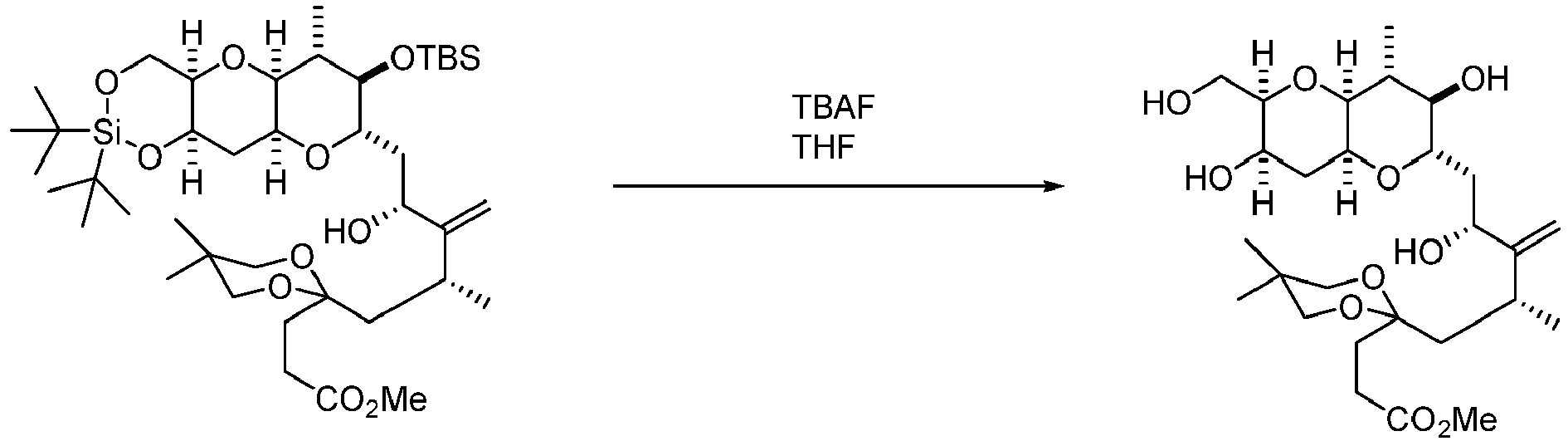
- To a stirred solution of the starting material (17.3g, 22.03mmol) in THF (52ml) was added TBAF (88mL of 1M in THF, 88.13mmol) at 0°C. After stirring for 15hrs at room temperature, the mixture was added EtOAc (180mL) followed by 10wt% NH4Claq. (180mL) to give biphasic mixture. The organic layer was separated and the aqueous layer was extracted with EtOAc (180mL) twice. The combined organic layer was washed with saturated NaCl aq. The separated organic layer was dried over Na2SO4, filtrated and concentrated under reduced pressure. The residue was purified by column chromatography on NH-silica gel (120g, eluent: 0%, 20%, 50%, 100% EtOAc in n-heptane and then 5% MeOH in EtOAc). The collected fractions were concentrated to give the desired product (17.46g, including impurities), which was used as 100% yield in the next reaction without further purification.

- The starting material (11.69g, 22.03mmol) was azeotroped with toluene (35mL) twice and the residue was added CH2Cl2 (117mL) followed by Et3SiH (17.6 mL, 110.14mmol) at rt. After the mixture was cooled below -70°C, TMSOTf (16.0mL, 88.11mmol) was added to the mixture at -72 ~ -70°C under N2 atmosphere. After being stirred for 30min, the reaction mixture was warmed up to 0°C. After being stirred for 27min at 0°C, the reaction mixture was quenched with water (117mL) below 14°C and then the mixture was stirred at room temperature. After being stirred for 25min, saturated NaHCO3 aq. (58mL) was added and the mixture was stirred for 25min at room temperature to give a biphasic mixture. The organic layer was separated and the aqueous layer was extracted with CH2Cl2 (117mL). The combined organic layer was dried over Na2SO4, filtrated and concentrated under reduced pressure to give a crude desired product (18.95g), which was used as 100% yield in the next reaction without further purification.

- The starting material (9.44g, 22.03mmol) was azeotroped with toluene (30mL) twice and the residue was added THF (94mL), 2,2-dimethoxypropane (10.84 mL, 88.13 mmol) and PPTS (277mg, 1.10mmol) at room temperature. After being stirred at 40°C under N2 atmosphere for 4.5hrs, the reaction mixture was cooled to room temperature and then the reaction mixture was diluted with EtOAc (100mL) followed by saturated NaHCO3 aq. (100mL). After being stirred for 15min, a biphasic mixture was obtained. The organic layer was separated and the aqueous layer was extracted with EtOAc (100mL). The combined organic layer was washed with saturated NaCl aq. The separated organic layer was dried over Na2SO4, filtrated and concentrated under reduced pressure to give a crude desired product (18.95g)
- A crude desired product (18.95g) was purified by ODS-column chromatography on YMC-GEL(100g, eluent: 3%, 40% MeCN in water). The collected fractions were extracted by CH2Cl2 (500mL+250mL) and the combined organic layer was dried over Na2SO4, filtrated and concentrated under reduced pressure to give the desired product (12.00g, including impurities).
- A crude desired product (12.00g) was purified by column chromatography on neutral silica gel (150g, eluent: 0%, 20%, 33%, 50%, and 66% EtOAc in n-heptane). The collected fractions were concentrated to give a crude desired product (4.56g, including impurities).
- A crude desired product (4.56g) was added a mixture of n-hexane/EtOAc=9/1 (v/v) (45mL) and the slurry was warmed up to 60°C. After the slurry became a clear solution, the solution was cooled to 45°C and seed was added. After a solution became cloudy, the mixture was stirred at room temperature for 50min and then the mixture was stirred at 0°C for 65min and then stirred at -10°C for 17.5hrs. The generated crystal was collected by suction and washed with cold n-hexane (13.5mL). The crystal was dried at 40°C under reduced pressure to give the desired product (3.57g, 7.62mmol, 35% in 5steps). 1H-NMR (500MHz, CDCl3) δ: 4.88 (1H, s), 4.82 (1H, d, J=2.0Hz), 4.18 (1H, q, J=5.5Hz), 4.03 (1H, dd, J=12.5, 3.0Hz), 4.00-3.95 (2H, m), 3.88 (1H, dd, J=6.0, 4.0Hz), 3.86 (1H, dd, J=12.0, 2.5Hz), 3.67 (3H, s), 3.64-3.57 (1H, m), 3.55 (1H, d, J=8.5Hz), 3.42 (1H, t, J=3.0Hz), 3.36 (1H, dt, J=8.0, 5.5Hz), 3.26 (1H, q, J=2.5Hz), 2.54-2.40 (2H, m), 2.33-2.23 (1H, m), 2.19-2.11 (2H, m), 2.10-2.00 (2H, m), 1.86-1.68 (4H, m), 1.44 (3H, s), 1.43 (3H, s), 1.16 (3H, d, J=8.0Hz), 1.15-1.09 (1H, m), 1.08 (3H, d, J=6.0Hz).

- To a stirred solution of starting material (52.0g, 0.11mol) in dichloromethane (1.04L) was added DIBAL solution (253mL of 1M in toluene, 0.255mol) at -74.3 ~ -71.5°C under N2 atmosphere. After being stirred for 76min, the reaction was quenched with acetone (24.5mL) at -75.2 ~ -73.8°C. After being stirred for additional 9min, MeOH (27.0mL) was added to the reaction at -74.2 ~ -73.5°C, followed by addition of BHT (52.0mg). Then the mixture was warmed up to -20°C and added to 40wt% Rochelle's salt aq. (1.04kg), then EtOAc (936mL) was added to the mixture. The mixture was stirred for 85min at room temperature to give a biphasic mixture. The organic layer was separated and re-extracted with EtOAc (520mL). Combined organic layer was washed with 20wt% NaCl aq. (520g). After addition of BHT (52.0mg), the organic layer was concentrated and azeotroped with toluene (208mL) and MeCN (156mL) under reduced pressure to give a crude aldehyde, which was used in the next reaction without further purification (assumed as 90% yield, 0.1mol).

- To a reactor, CrCl3 (3.16g, 20mmol), proton sponge (4.71g, 22mmol), sulfonamide ligand (9.74g, 22mmol), Mn (11.0g, 200mmol) and Cp2ZrCl2 (75.9g, 260mmol) were charged, then reactor was purged with Argon. To the reactor, anhydrous MeCN (263mL) was added and stirred for 70min at 30°C. To a reaction, Ni-complex (662mg, 1.0mmol) in anhydrous MeCN (6.6mL) was added. Then, a mixture of the aldehyde (43.8g, 100mmol), vinyl iodide (63.2g, 114mmol) and 2,6-di-tert-butyl-2-methyl pyridine (41.0g, 200mmol) in anhydrous MeCN (131mL), which were azeotroped with MeCN (219mL) in advance, was added. After substrates addition, Ni-complex (661mg, 1.0mmol) in anhydrous MeCN (6.57mL) was added twice to complete the reaction. To the reaction, toluene (876mL) was added, then cooled to 0°C. To the mixture, water (788mL) and 20wt% citric acid aq. (87.5g) was added at around 14°C for 20min. After removal of the aqueous layer, the organic layer was passed through hyflo super-cel (35.0g) then washed with toluene (876mL). Combined organic layer was washed with 33% MeCN aq. (876mL) followed by a mixture of 5wt% NaHCO3-10wt% Na2SO4 aqueous solution (438g). Organic layer was concentrated under reduced pressure. The residue was purified by column chromatography on silica gel (1900g, eluent; 10%, 25%, 50%, 67% then 100% EtOAc in n-heptane). The collected fractions were concentrated to give the desired product (79.4g, 92mmol, 82% in two steps).1H-NMR (500MHz, CDCl3) δ: 5.16 (1H, s), 4.97 (1H, s), 4.87 (1H, s), 4.82 (1H, s), 4.70 (1H, t, J= 4.7Hz), 4.63 (1H, t, J= 4.5Hz), 4.43 (1H, d, J= 1.8Hz), 4.18-4.33 (4H, m), 3.93-4.10 (5H, m), 3.78-3.92 (3H, m), 3.68 (3H, s), 3.59 (1H, d, J= 3.0Hz), 3.19-3.48 (3H, m), 2.85-2.98 (2H, m), 2.56-2.71 (2H, m), 2.48 (1H, dd, 15.1, 6.0Hz), 2.41 (1H, dd, J= 15.6, 5.8Hz), 1.93-2.33 (11H, m), 1.51-1.92 (10H, m), 1.36-1.50 (8H, m), 1.14 (3H, d, J= 7.5Hz), 1.08 (3H, d, J= 6.3Hz).
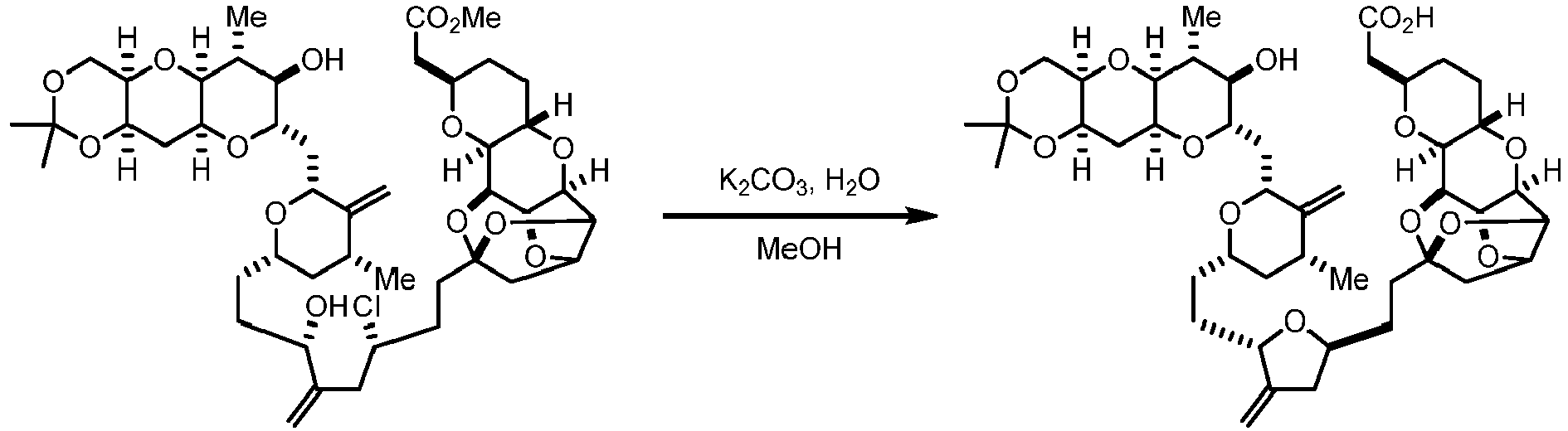
- To a stirred solution of the starting material (79.3g, 91.4mmol) in MeOH (793mL) was added K2CO3 (63.2g, 0.457mol) at room temperature under N2 atmosphere. After heated to 55 °C, the mixture was stirred for 3hr, then water (24.7mL, 1.37mol) was added at same temperature. After being stirred for 20hr, the reaction was cooled to room temperature, then toluene (1.59L) and water (1.59L) was added. Aqueous layer was washed with toluene (1.59L) twice. To the resulted aqueous layer, dichloromethane (1.59L) and 25wt% NH4Cl aq. (2.38kg) were added. After separation of two layers, the aqueous layer was re-extracted with dichloromethane (2.38L). Combined organic layer was concentrated and azeotroped with toluene (397mL) to give a crude seco acid, which was used in the next reaction without further purification.

- To a stirred solution of N,N-dimethylaminopyridine (DMAP, 67.0g, 549mmol) in toluene (5.60L) was added A; A'-di isopropyl ethylamine (DIPEA, 95.6mL, 549mmol) and 2-methyl-6-nitrobenzoic anhydride (MNBA, 94.4g, 274mmol) at 25 °C under N2 atmosphere, then heated to 80 °C. To the mixture, starting material (74.7g, 91.4mmol) in toluene (1.49L) was added dropwise for 6hr. After cooled to 25 °C, the mixture was washed with 50vol% DMF aq. (1.49L) twice. The second 50% DMF aqueous layer was re-extracted with toluene (500mL). Combined organic layer was washed with 20wt% NH4Cl aq. (1.49kg) twice, each aqueous layer was re-extracted with EtOAc (750mL). Combined organic layer was washed with 20wt% NaCl aq. (374g) and re-extracted with EtOAc (750mL). Combined organic layer was concentrated and azeotroped with MeCN (200mL). The residue was dissolved in dichloromethane (448mL) and concentrated. The resulted high concentrated dichloromethane solution was added to MeCN (1.05L) at 0 °C under N2 atmosphere. Resulted precipitation was filtered and washed with MeCN (224mL) followed by drying at 40 °C gave a desired macrolactone (41.5g, 51.9mmol, 56.8% in two steps).

- To a stirred solution of starting material (40.5g, 50.7mmol) in dichloromethane (312mL) and MeOH (579mL) was added p-toluenesulfonic acid monohydrate (194mg, 1.01mmol) at 25°C under N2 atmosphere for 4hr. The reaction was passed through NH-silica gel (40.5g), then rinsed with a mixture of dichloromethane (1.01L) and MeOH (1.01L). Combined filtrate was concentrated and azeotroped with toluene (81mL) twice to give a desired diol, which was used in the next reaction without further purification.

- To a solution of starting material (238mg, 0.313mmol) and 2,4,6-collidine (207□L, 1.57mmol) in anhydrous dichloromethane (2.38mL) was added trifluoromethanesulfonic anhydride (Tf2O, 73.7µL, 0.438mmol) at -78°C under N2 atmosphere. After stirred for 10min, triethylsilyl trifluoromethanesulfonate (TESOTf, 99µL, 0.438mmol) was added to the reaction, then warmed to -40 °C. After stirred for 70min, NaI (235mg, 1.57mmol) and 1,3-dimethyl-2-imidazolidinone (DMI, 4.75mL) was added, then warmed to room temperature. After stirred for 4hr, toluene (7.13mL) and cold water (4.75mL) was added to the reaction. After separated aqueous layer, organic layer was washed with water (4.75mL), 5wt% citric acid aq. (2.38mL) followed by a mixture of 5wt% NaHCO3-10wt% Na2SO4 aqueous solution (1.19mL). The organic layer was concentrated under reduced pressure. The residue was purified by column chromatography on silica gel (6g, eluent; 10%, 20%, then 30% EtOAc in n-heptane). The collected fractions were concentrated. The residue was crystallized from dichloromethane (0.24mL) and 1-propanol (4.75mL) at 0 °C. Resulted precipitation was filtered and washed with 1-propanol to give desired iodide (250mg, 0.254mmol).

- To a mixture of lactone (55g, 154mmol) and iodide (58.75g, 170mmol) was added THF (550ml) and the reaction mixture was cooled in dry ice-EtOH bath. Sec-BuLi (1.03M solution in cyclohexane, 315mL, 324mmol) was gradually added at -73.2 ~ -58.5°C during 33min and stirred for 30min. After addition of sat.NH4Cl (550mL) at -74.2 ~ -11.2°C during 3min, dry ice bath was removed. The reaction mixture was diluted with AcOEt (550mL) and water (220mL) and stirred in water bath for 40min. The resulting layers were separated and the organic layer was washed with sat.NaCl (165mL) and separated organic layer was concentrated in vacuum. The residue was azeotroped with n-heptane (110mL x 3). The residue was purified by column chromatography on neutral silica gel (1.1kg, eluent: 0%, 5%, 10%, 15% then 25% EtOAc in n-heptane) to give desired compound (71.82g, 125mmol, 81%).

- To a solution of starting material (71.72 g, 124mmol) in acetone (215mL) and water (29mL) was added NMO (29.1g, 249mmol) and K2OsO4 • 2H2O (ca.50%content, 0.182 g, 0.247mmol) at room temperature and stirred for 24.5hrs. The reaction mixture was stirred in water bath and diluted with acetone (143mL) and water (103mL), then NaIO4 (53.2g, 249mmol) and water (40mL for rinsing) was added and stirred at room temperature for 3h. The reaction mixture was diluted with AcOEt (215mL), n-heptane (215mL) and water (430mL). The resulting insoluble material was removed by decantation followed by filtration through cotton plug. The filtrate was separated and the aqueous layer was extracted with n-heptane/AcOEt =1/1(v/v) (286mL). The combined organic layer was washed twice with sat.Na2S2O3 (215mL) and washed with sat.NaCl (143mL) and concentrated in vacuum. The residue was passed through a pad of neutral silica gel (143g, eluent: 66% EtOAc in n-heptane) to give desired compound (71.3g, 123mmol, 99%).
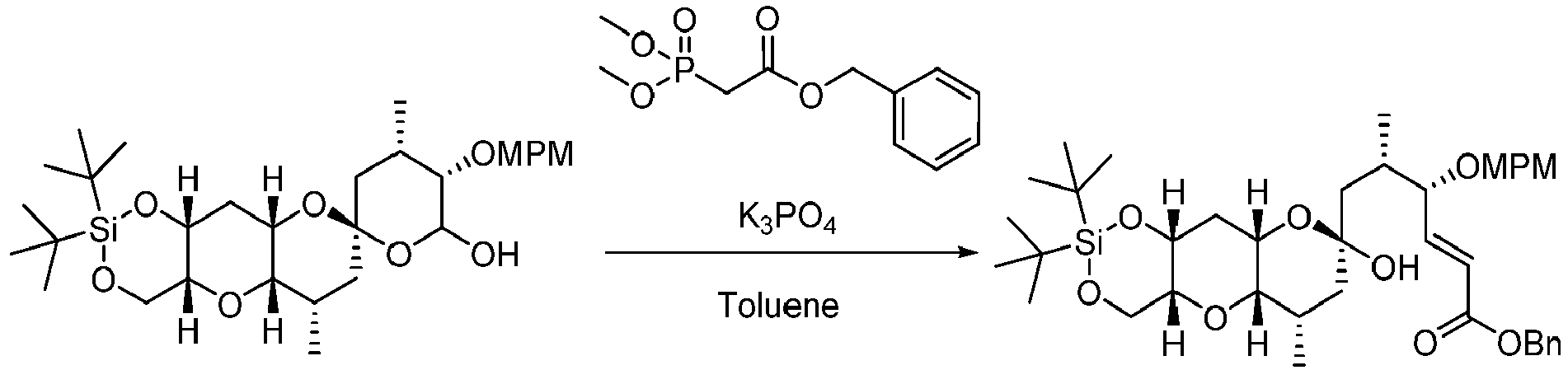
- To a mixture of starting material (71.23 g, 123mmol) and K3PO4 (78.4g, 369mmol) and toluene (214mL) was added dimethyl(benzyloxycarbonyl)methyl phosphonate (127.1g, 492mmol). The reaction mixture was purged by N2(balloon) and stirred at 30°C for 48hrs. Additional K3PO4 (26.13g, 123mmol) and dimethyl(benzyloxycarbonyl)methyl phosphonate (26.1mL, 123mmol) were added and stirred at 30°C for 26hrs. The reaction mixture was cooled in water bath and diluted with MTBE (712mL) and quenched with sat.NH4Cl (50mL) at 21-36 °C. The reaction mixture was cooled in ice-water bath and sat.NH4Cl (662mL) and water (214mL) were successively added. The resulting layers were separated and the aqueous layer was extracted with MTBE (712mL). The combined organic layer was washed with sat.NaCl (356mL) and concentrated in vacuum. The residue was azeotroped with toluene (178mL). The residue was purified by column chromatography on neutral silica gel (1.1kg, eluent: 0%, 8%, 15% then 25% EtOAc in n-heptane) to give desired compound (72.63g, 102mmol, 83%, a mixture of E/Z isomers).1H-NMR (500MHz, CDCl3) δ: 7.30-7.44 (5H, m), 7.23 (2H, d, J=8.6Hz), 6.84-6.92 (3H, m), 6.06 (1H, dd, J=15.9, 1.2Hz), 5.18-5.24 (2H, m), 4.50 (1H, d, J=11.6Hz), 4.39 (1H, t, J=2.8Hz), 4.27 (1H, d, J=11Hz), 4.18-4.24 (1H, m), 4.10-4.16 (1H, m), 3.81 (3H, s), 3.72-3.79 (2H, m), 3.60 (1H, d, J=10.4Hz), 3.26 (1H, m), 3.01-3.06 (1H, m), 2.73 (1H, dd, J= 15.0, 4.6Hz), 2.44-2.59 (2H, m), 2.21-2.39 (4H, m), 1.72 (1H, dt, J=14.7, 3.1Hz), 1.05 (18H, s), 0.91 (6H, dd, J=14.7, 6.7Hz).

- A solution of the starting material (72.5g, 102mmol) and AcOBn (72.9mL, 510mmol) in MeCN (1087mL) was cooled in ice-water bath. LiBr (88.5g, 1019mmol) was added at 10.1 ~ 16.5°C during 3min and DBU (76.1mL, 510mmol) was added at 11.8 ~ 15.4°C The reaction mixture was stirred at room temperature for 2hrs. Then, the reaction mixture was stirred at 30°C for 23hrs. The reaction mixture was cooled in ice-water bath and diluted with MTBE (362mL) and quenched with sat.NH4Cl (362mL) at 7.4 ~ 13.7°C and water (145mL). The resulting layers were separated and the organic layer was washed with sat.NaCl (254mL) and dried over anhydrous Na2SO4. After filtration, the filtrate was concentrated in vacuum. The residue was purified by column chromatography on neutral silica gel (1.1kg, eluent: 0%, 3%, 10%, 20% then 35% MTBE in n-heptane) to give a desired compound (64.07g, 90mmol, 88%). 1H-NMR (500MHz, CDCl3) δ: 7.31-7.40 (5H, m), 7.23-7.27 (2H, m), 6.86 (2H, d, J=8.6Hz), 5.01-5.18 (2H, m), 4.41-4.57 (2H, m), 4.24-4.33 (1H, m), 4.16-4.22 (2H, m), 4.08 (1H, ddd, J=9.3, 4.7, 1.2Hz), 3.80 (3H, s), 3.51-3.54 (1H, m), 3.25 (1H, brs), 3.15-3.20 (1H, m), 2.97 (1H, d, J=2.5Hz), 2.72 (1H, dd, J=15.6, 9.5Hz), 2.28-2.42 (2H, m), 2.07 (1H, dt, J=15.3, 1.8Hz), 1.87-2.00 (1H, m), 1.69 (1H, dt, J=15.3, 4.6Hz), 1.45-1.58 (3H, m), 1.36-1.42 (1H, m), 1.05 (9H, s), 1.03 (9H, s), 0.95 (3H, d, J=6.7Hz), 0.89 (3H, d, J=6.7Hz).

- The starting material (64g, 90mmol) was dissolved in iPrOAc (1280mL) and purged by N2 (balloon). 10% Pd/C (AD, Kawaken Fine Chemicals, 6.4g) was added and purged by H2 (balloon) and stirred at room temperature for 24hrs. The catalyst was filtered through Hyflo Supercel (64g) and washed with iPrOAc (1280 mL). The filtrate was concentrated to ca.half volume. iPrOAc (1280 mL) was added and concentrated to ca.half volume. iPrOAc (1280 mL) was added again and concentrated to ca.half volume. DMF (500mL) was added to the residual solution and concentrated in vacuum for 1hr until removal of iPrOAc to give desired seco acid as DMF solution (ca.500mL). This solution of the seco acid (calculated as 90mmol) was diluted with DMF (140mL) and imidazole (36.77g, 540mmol) was added. The reaction mixture was cooled in ice-water bath and TESCl (45.3mL, 270mmol) was slowly added at 2.1 ~ 4.2°C during 13min, then stirred in water bath for 80min. The reaction mixture was cooled in ice-water bath and quenched with sat.NaHCO3 (384mL) at 4.8 ~ 13.8°C during 24min and stirred in water bath for 1hr. The reaction mixture was diluted with n-heptane (640mL) and water (768mL) and the resulting layers were separated. The organic layer was successively washed with sat.NH4Cl (384mL), water (640mL), 10% NaCl (384mL) and concentrated in vacuum. The residue was purified by column chromatography on neutral silica gel (640g, eluent: 0%, then 67% MTBE in n-heptane) to give the desired compound (61.55g). To this compound was added cyclopentyl methyl ether (32mL) and MeCN (94mL) and heated at 50°C to dissolve the solid. To this solution was slowly added MeCN (514mL) during 1hr. The mixture was slowly cooled to room temperature and stirred for 2hrs. After further stirred at 0°C for 1hr followed by -20°C for 14hrs. The resulting suspension was filtrated and rinsed with cold (ca.-20°C) MeCN (92mL). The crystals were dried under reduced pressure at 40°C to give the desired compound (47.68g, 78mmol, 86%) as a white solid. 1H-NMR (500MHz, CDCl3) δ: 4.13-4.31 (3H, m), 3.96-4.06 (1H, m), 3.49-3.65 (2H, m), 3.12-3.24 (2H, m), 2.69 (1H, dd, J=15.8, 10.0Hz), 2.39 (1H, dd, J=15.8, 3.7Hz), 2.20-2.31 (1H, m), 2.08-2.15 (1H, m), 1.98-2.07 (1H, m), 1.81 (1H, dt, J=15.2, 4.4Hz), 1.47-1.57 (3H, m), 1.39-1.45 (1H, m), 1.03 (9H, s), 1.02 (9H, s), 0.94-0.99 (12H, m), 0.86 (3H, d, J=6.9Hz), 0.59-0.66 (6H, m).

- To a solution of starting material (35.1g, 57.1mmol) and triphenylphosphine (35.8g, 136mmol) in dehydrated acetonitrile (350mL) was added 2,2'-dipyridyldisulfide (15.1g, 68.5mmol) at 0°C (bath) under nitrogen atmosphere. After warmed up to 25°C, the mixture was stirred for 17.5h and the reaction was quenched with n-heptane (1050mL) and water (350mL) to give a biphasic mixture. The organic layer was separated and washed with 5 times 75vol% acetonitrile aqueous solution (351mL) and once with saturated sodium chloride aqueous solution (175mL). Then, the organic layer was concentrated to dryness. The residue was purified by column chromatography on silica-gel (1900g, eluent: 0%, 10% ethyl acetate in n-heptane) to give desired compound (38.6g, 54.5mmol, 96%).

- Preparation of nickel catalyst solution. A solution of nickel(II) bromide (5.00g, 22.9mmol) and 4,4'-di-tert-butyl-2,2'-dipyridyl (6.15g, 22.9mmol) in dehydrated ethanol (100mL) was stirred at 80°C for 18h under argon atmosphere. After the reaction mixture was cooled to room temperature, the reaction mixture was concentrated to dryness. The residue was dried in vacuum at 150°C (bath) for 70h. Then, dehydrated DMI (62mL) was added to give nickel catalyst solution (used as 0.37mol/L). See, e.g., Dr. Daniel J. Weix et.al., Chem. Eur.J.2016, 22,11564 -11567)
- Coupling Reaction. To a solution of iodide (30.1g, 30.6mmol), thioester (30.4g, 42.9mmol), bis(cyclopentadienyl)zirconium(IV) dichloride (31.3g, 107mmol) and manganese (11.7g, 214mmol) in dehydrated DMI (270mL) was added nickel catalyst solution (30mL, 0.37mol/L in DMI, 11. 1mmol) prepared above under argon atmosphere. After being stirred at 30°C (bath) for 4h under argon atmosphere, the reaction was quenched with heptane (600mL), 10wt% citric acid aqueous solution (600mL) below 22°C (0°C bath). Then Celite®545 (15.0g) was added and the mixture was stirred at 0°C for 1h. Then the mixture was passed through short pad of Celite®545 (60.0g) and the Celite®545 pad was washed with heptane (1500mL) to give biphasic mixture. The aqueous layer was separated and extracted with heptane (90mL). The combined organic layer was washed with a mixture of 5wt% sodium bicarbonate and 10wt% sodium sulfate aqueous solution (150mL) and then concentrated to dryness. The residue was purified by column chromatography on silica-gel (1500g, eluent: 10%, then 30% ethyl acetate in heptane) to give desired compound (36.6g, 25.2mmol, 82%).

- To a solution of starting material (35.5g, 24.4mmol) in THF (365mL) was added a mixture of imidazole hydrochloride (12.9g, 123mmol) and tetrabutylammonium fluoride (244mL, 1.0mol/L in THF, 244mmol) at 25°C (bath) under nitrogen atmosphere. After being stirred at 25°C for 19h, the reaction was quenched with toluene (710mL) and 10wt% sodium chloride aqueous solution (710mL) to give a biphasic mixture. The aqueous layer was separated and extracted with toluene (178mL). The combined organic layer was washed with water (71mL) and then concentrated to dryness. The residue was purified by column chromatography on silica gel (1500g, eluent: 10% to 100% ethyl acetate in heptane, then, 10% methanol in ethyl acetate) to give desired compound (25.5g, 23.5mmol, 96%).

- To a solution of desired compound (25.4g, 23.4mmol) in dichloromethane (765mL) was added pyridinium p-toluenesulfonate (29.5g, 117mmol) at 10°C under nitrogen atmosphere. After being stirred at 9-11°C for 3h, the reaction was quenched with water (508mL) to give a biphasic mixture. The aqueous layer was re-extracted with dichloromethane (25mL). The combined organic layer was washed with water (508mL) followed by a mixture of 5wt% sodium bicarbonate and 10wt% sodium sulfate aqueous solution (127mL). Then, the organic layer was concentrated to dryness. The residue was purified by column chromatography on silica gel (1500g, eluent: 10%, 95%, 100% ethyl acetate in heptane) to give the desired compound (23.8g). This compound was purified again by column chromatography on ODS (950g, eluent: 30%, 65%, 100% acetonitrile in water). The fractions containing desired compound were combined and acetonitrile was removed to some extent under reduced pressure. The resulting aqueous solution was extracted with ethyl acetate (1524mL + 762mL) and the combined organic layer was concentrated to dryness to give desired compound (18.1g, 17.0mmol, 73%).
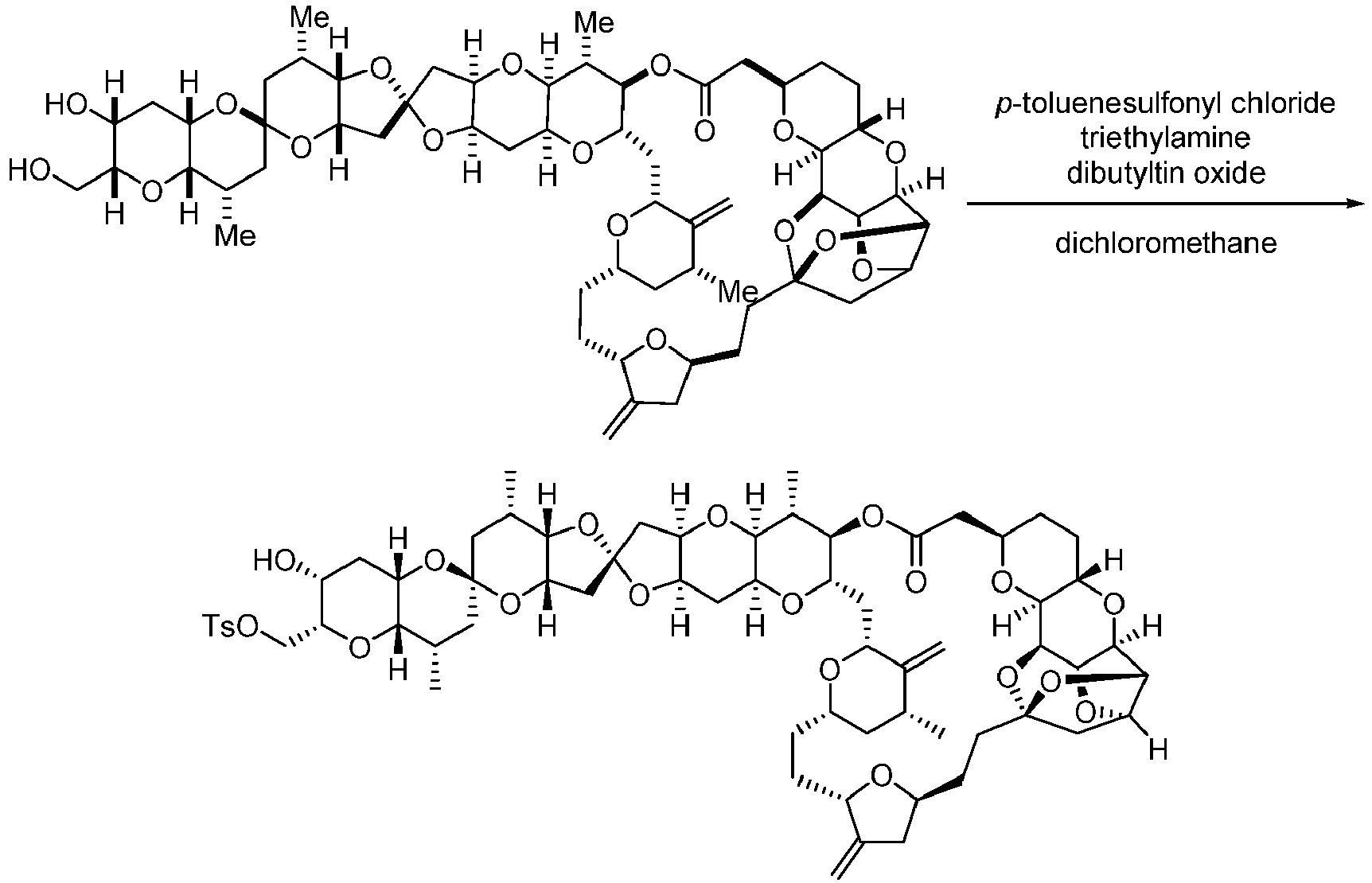
- To a solution of starting material (15.2g, 14.2mmol) in dichloromethane (30mL) was added triethylamine (12.3mL, 88.5mmol), dibutyltin oxide (2.13g, 8.56mmol) and p-toluenesulfonyl chloride (8.16g, 42.8mmol) successively at 25°C. After being stirred at 25°C for 3h, the reaction mixture was passed through glass-filter. The filtrate was directly purified by column chromatography on silica gel (750g, eluent: 10%, 30%, 50%, 70%, 85% ethyl acetate in heptane) to give desired compound (17.4g, 14.2mmol, quant.). 1H NMR (600 MHz, BENZENE-d 6) δ ppm 0.86 (d, J=6.8 Hz, 3 H) 0.95 (d, J =6.8 Hz, 3 H) 1.00 - 1.05 (m, 4 H) 1.07 - 1.17 (m, 4 H) 1.19 (br td, J =14.7, 3.0 Hz, 1 H) 1.26 - 1.49 (m, 8 H) 1.54 (t, J =13.0 Hz, 1 H) 1.61 - 1.67 (m, 2 H) 1.75 - 2.39 (m, 25 H) 2.62 - 2.75 (m, 5 H) 3.25 (br s, 1 H) 3.27 (br s, 1 H) 3.35 (t, J =6.0 Hz, 1 H) 3.39 (dt, J =10.8, 5.6 Hz, 1 H) 3.44 (br d, J=11.0 Hz, 1 H) 3.50 (d, J =11.3 Hz, 1 H) 3.55 (br s, 1 H) 3.62 (dd, J =6.2, 4.3 Hz, 1 H) 3.78 (br t, J =9.6 Hz, 1 H) 3.83 (br t, J =6.0 Hz, 1 H) 3.86 - 3.96 (m, 3 H) 3.99 - 4.11 (m, 3 H) 4.14 (m, 1 H) 4.27 (br s, 1 H) 4.36 - 4.44 (m, 2 H) 4.49 (m, 1 H) 4.55 - 4.61 (m, 2 H) 4.80 (s, 1 H) 4.86 - 4.91 (m, 2 H) 4.95 (br s, 1 H) 5.02 (br s, 1 H) 6.65 (d, J =7.9 Hz, 2 H) 7.80 (d, J =7.9 Hz, 2 H).

- To a solution of starting material (17.3g, 14.2mmol) in toluene (121mL) was added tetrabutylammonium azide (32.2g, 113mmol) at room temperature under nitrogen atmosphere. After being stirred at 100°C (bath) for 5h, the reaction mixture was cooled to room temperature and tetrahydrofuran (52mL) was added to give a homogenous solution. The solution was directly purified by column chromatography on silica gel (750g, eluent: 10%, 50%, 70%, 80% ethyl acetate in heptane) to give desired compound (15.5g, 14.2mmol, quant.). 1H NMR (600 MHz, BENZENE-d6) δ ppm 0.97 - 1.05 (m, 9 H) 1.08 - 1.37 (m, 8 H) 1.39 - 1.55 (m, 5 H) 1.58 - 1.71 (m, 3 H) 1.78 - 1.88 (m, 2 H) 1.91 - 2.08 (m, 8 H) 2.09 - 2.40 (m, 13 H) 2.62 - 2.75 (m, 4 H) 2.78 (d, J=2.3 Hz, 1 H) 2.97 (dd, J=13.0, 4.0 Hz, 1 H) 3.09 (dd, J=8.3, 3.8 Hz, 1 H) 3.26 (br d, J=11.3 Hz, 1 H) 3.30 (t, J=2.6 Hz, 1 H) 3.32 (br s, 1 H) 3.40 (dt, J=10.8, 5.6 Hz, 1 H) 3.56 (d, J=11.0 Hz, 1 H) 3.58 - 3.65 (m, 3 H) 3.78 (br dd, J=10.8, 8.9 Hz, 1 H) 3.83 (br dd, J=7.2, 5.7 Hz, 1 H) 3.86 - 3.99 (m, 3 H) 4.01 - 4.11 (m, 3 H) 4.14 (t, J=4.5 Hz, 1 H) 4.28 (dd, J=3.8, 1.5 Hz, 1 H) 4.50 (m, 1 H) 4.56 - 4.62 (m, 2 H) 4.80 (br s, 1 H) 4.86 - 4.92 (m, 2 H) 4.96 (br d, J=1.9 Hz, 1 H) 5.02 (br d, J=1.5 Hz, 1 H).

- To a solution of starting material (15.4g, 14.1mmol) in a mixture of THF (92mL) and water (10mL) was added polymer-bound triphenylphosphine (20.4g, 2.07mmol/g, 42.2mmol) at 25°C. After being stirred at 25°C for 70h, the reaction mixture was passed through glass-filter. The filtrate was concentrated to dryness. The residue was purified by column chromatography on NH-silica-gel (900g, eluent: 50%, 100% MTBE in heptane, then 3%, 10% methanol MTBE) to give desired compound (14.1g, 13.2mmol, 94%) as a white solid. The desired compound was further purified by column chromatography on ODS (400g, eluent: 1%, 70%, 100% 0.05vol% acetic acid/acetonitrile in 0.05vol% acetic acid/water). The fractions containing desired compound were combined and dichloromethane (3304mL), 20wt% sodium chloride aqueous solution (661mL) and saturated sodium bicarbonate aqueous solution (1322mL) were added to give biphasic mixture. Then, the aqueous layer was extracted with dichloromethane (830mL). The combined organic layer was washed with water (165mL) and concentrated to dryness to give desired compound (12.4g, 11.6mmol, 88%). After the compound was dissolved in dichloromethane (25mL) and pentane (25mL), half of the solution was added to pentane (984mL) at 0°C with stirring to precipitate desired compound. After removal of approximately 271mL of solvent under slightly reduced pressure, pentane (246mL) was added. After removal of approximately 246mL of solvent under slightly reduced pressure, pentane (246mL) was added. To this mixture was added remaining half of the desired compound solution at 0°C with stirring to further precipitate the desired compound. After removal of approximately 271mL of solvent under slightly reduced pressure, pentane (246mL) was added. After removal of approximately 246mL of solvent under slightly reduced pressure, pentane (246mL) was added. The resulting slurry was filtrated, dried at 40°C gave the desired compound (11.5g, 93%).
1H NMR (600 MHz, METHANOL-d 4) δ ppm 0.98 (d, J=7.2 Hz, 3 H) 1.00 (d, J=6.8 Hz, 3 H) 1.02 (m, 1 H) 1.05 (d, J=6.8 Hz, 3 H) 1.09 (d, J=6.4 Hz, 3 H) 1.28 - 1.45 (m, 5 H) 1.46 - 1.59 (m, 4 H) 1.57 - 1.63 (m, 1 H) 1.65 - 1.71 (m, 1 H) 1.70 - 1.75 (m, 2 H) 1.79 - 1.86 (m, 2 H) 1.91 (dt, J=14.9, 3.1 Hz, 1 H) 1.94 - 2.11 (m, 8 H) 2.14 - 2.34 (m, 9 H) 2.39 (dd, J=13.2, 6.0 Hz, 1 H) 2.44 (dd, J=17.4, 1.9 Hz, 1 H) 2.56 (dd, J=17.6, 9.6 Hz, 1 H) 2.69 (dd, J=13.2, 4.2 Hz, 1 H) 2.79 (ddq, J=15.9, 7.6, 2.0 Hz, 1 H) 2.92 (dd, J=13.2, 8.3 Hz, 1 H) 2.97 (dd, J=9.6, 1.7 Hz, 1 H) 3.21 (dd, J=6.4, 4.9 Hz, 1 H) 3.29 (m, 1 H) 3.34 (dd, J=8.3, 4.15 Hz, 1 H) 3.58 (br. s., 1 H) 3.60 (br.d, J=11.3 Hz, 1 H) 3.68 - 3.73 (m, 2 H) 3.80 (br. s., 1 H) 3.84 - 3.90 (m, 2 H) 3.98 (d, J=2.3 Hz, 1 H) 4.03 - 4.13 (m, 4 H) 4.17 (dd, J=6.4, 4.9 Hz, 1 H) 4.24 (ddd, J=11.3, 4.5, 1.5 Hz, 1 H) 4.29 (dd, J=4.0, 1.9 Hz, 1 H) 4.32 (td, J=10.2, 4.2 Hz, 1 H) 4.44 (br. d, J=11.0 Hz, 1 H) 4.59 (t, J=4.5 Hz, 1 H) 4.62 (dd, J=7.4, 4.7 Hz, 1 H) 4.69 (t, J=4.7 Hz, 1 H) 4.80 (br. s., 1 H) 4.87 (s, 1 H) 5.00 (br. s., 1 H) 5.05 (br.d, J=1.1 Hz, 1 H). - In the claims articles such as "a," "an," and "the" may mean one or more than one unless indicated to the contrary or otherwise evident from the context. Claims or descriptions that include "or" between one or more members of a group are considered satisfied if one, more than one, or all of the group members are present in, employed in, or otherwise relevant to a given product or process unless indicated to the contrary or otherwise evident from the context. The invention includes embodiments in which exactly one member of the group is present in, employed in, or otherwise relevant to a given product or process. The invention includes embodiments in which more than one, or all of the group members are present in, employed in, or otherwise relevant to a given product or process.
- Furthermore, the invention encompasses all variations, combinations, and permutations in which one or more limitations, elements, clauses, and descriptive terms from one or more of the listed claims is introduced into another claim. For example, any claim that is dependent on another claim can be modified to include one or more limitations found in any other claim that is dependent on the same base claim. Where elements are presented as lists, e.g., in Markush group format, each subgroup of the elements is also disclosed, and any element(s) can be removed from the group. It should it be understood that, in general, where the invention, or aspects of the invention, is/are referred to as comprising particular elements and/or features, certain embodiments of the invention or aspects of the invention consist, or consist essentially of, such elements and/or features. For purposes of simplicity, those embodiments have not been specifically set forth in haec verba herein.
- It is also noted that the terms "comprising" and "containing" are intended to be open and permits the inclusion of additional elements or steps. Where ranges are given, endpoints are included. Furthermore, unless otherwise indicated or otherwise evident from the context and understanding of one of ordinary skill in the art, values that are expressed as ranges can assume any specific value or sub-range within the stated ranges in different embodiments of the invention, to the tenth of the unit of the lower limit of the range, unless the context clearly dictates otherwise.
- This application refers to various issued patents, published patent applications, journal articles, and other publications, all of which are incorporated herein by reference. If there is a conflict between any of the incorporated references and the instant specification, the specification shall control. In addition, any particular embodiment of the present invention that falls within the prior art may be explicitly excluded from any one or more of the claims. Because such embodiments are deemed to be known to one of ordinary skill in the art, they may be excluded even if the exclusion is not set forth explicitly herein. Any particular embodiment of the invention can be excluded from any claim, for any reason, whether or not related to the existence of prior art.
- Those skilled in the art will recognize or be able to ascertain using no more than routine experimentation many equivalents to the specific embodiments described herein. The scope of the present embodiments described herein is not intended to be limited to the above Description, but rather is as set forth in the appended claims. Those of ordinary skill in the art will appreciate that various changes and modifications to this description may be made without departing from the spirit or scope of the present invention, as defined in the following claims.
- Aspects and features of the present disclosure are set out in the following numbered clauses which contain the subject matter of the clauses of the parent application as filed.
- 1. A method of preparing a compound of Formula (H3-A):


- R1, R2, R3, and R5 are each independently hydrogen, halogen, or optionally substituted alkyl;
- each instance of R4 is independently hydrogen, halogen, or optionally substituted alkyl, or two R4 groups are taken together to form:
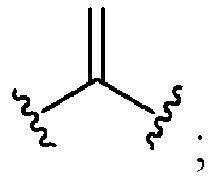
- each instance of R6 is independently hydrogen, halogen, or optionally substituted alkyl, or two R6 groups are taken together to form:

- RP6 is hydrogen, optionally substituted alkyl, optionally substituted acyl, or an oxygen protecting group;
- RX is hydrogen or -ORXa, wherein RXa is hydrogen, optionally substituted alkyl, optionally substituted acyl, or an oxygen protecting group; and
- RY is hydrogen or -ORYa, wherein RYa is hydrogen, optionally substituted alkyl, optionally substituted acyl, or an oxygen protecting group;
- optionally wherein RXa and RYa are joined together with their intervening atoms to form optionally substituted heterocyclyl.
- 2. The method of
clause 1 further comprising a step of reacting a compound of Formula (H3-L):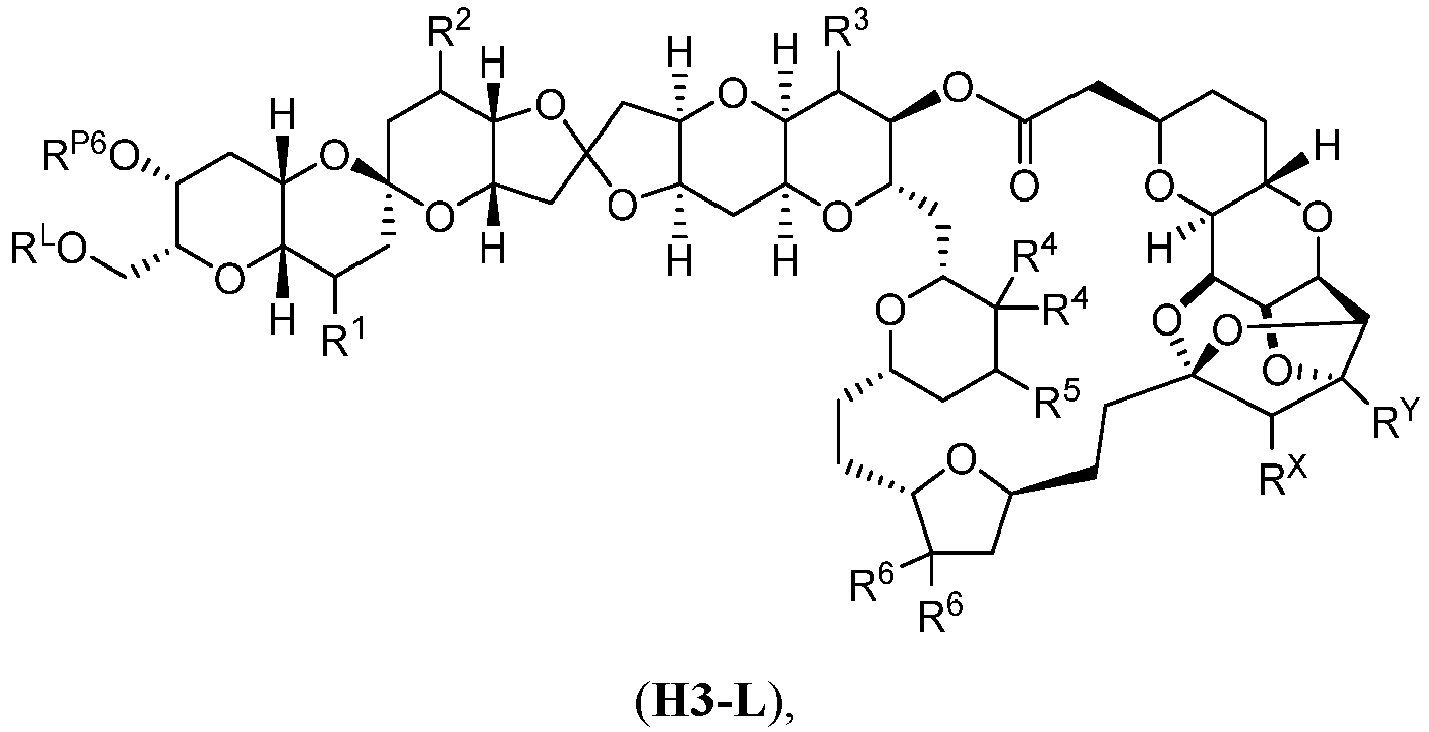

- RL is optionally substituted sulfonyl, optionally substituted sulfinyl, optionally substituted phosphoryl, or optionally substituted acyl;
- R1, R2, R3, and R5 are each independently hydrogen, halogen, or optionally substituted alkyl;
- each instance of R4 is independently hydrogen, halogen, or optionally substituted alkyl, or two R4 groups are taken together to form:

- each instance of R6 is independently hydrogen, halogen, or optionally substituted alkyl, or two R6 groups are taken together to form:

- RRP6 is hydrogen, optionally substituted alkyl, optionally substituted acyl, or an oxygen protecting group;
- RX is hydrogen or -ORXa, wherein RXa is hydrogen, optionally substituted alkyl, optionally substituted acyl, or an oxygen protecting group; and
- RY is hydrogen or -ORYa, wherein RYa is hydrogen, optionally substituted alkyl, optionally substituted acyl, or an oxygen protecting group;
- optionally wherein RXa and RYa are joined together with their intervening atoms to form optionally substituted heterocyclyl.
- 3. The method of
clause 2 further comprising a step of reacting a compound of Formula (H3-OH):

- RL is optionally substituted sulfonyl, optionally substituted sulfinyl, optionally substituted phosphoryl, or optionally substituted acyl;
- XL is halogen or a leaving group;
- R1, R2, R3, and R5 are each independently hydrogen, halogen, or optionally substituted alkyl;
- each instance of R4 is independently hydrogen, halogen, or optionally substituted alkyl, or two R4 groups are taken together to form: ;

- each instance of R6 is independently hydrogen, halogen, or optionally substituted alkyl, or two R6 groups are taken together to form: ;

- RRP6 is hydrogen, optionally substituted alkyl, optionally substituted acyl, or an oxygen protecting group;
- RX is hydrogen or -ORXa, wherein RXa is hydrogen, optionally substituted alkyl, optionally substituted acyl, or an oxygen protecting group; and
- RY is hydrogen or -ORYa, wherein RYa is hydrogen, optionally substituted alkyl, optionally substituted acyl, or an oxygen protecting group;
- optionally wherein RXa and RYa are joined together with their intervening atoms to form optionally substituted heterocyclyl.
- 4. A method of preparing a compound of Formula (H3-2-I):


- R1, R2, R3, and R5 are each independently hydrogen, halogen, or optionally substituted alkyl;
- each instance of R4 is independently hydrogen, halogen, or optionally substituted alkyl, or two R4 groups are taken together to form:

- each instance of R6 is independently hydrogen, halogen, or optionally substituted alkyl, or two R6 groups are taken together to form:

- RP4, RP5, and RP6 are each independently hydrogen, optionally substituted alkyl, optionally substituted acyl, or an oxygen protecting group; optionally wherein two RP6 are joined with the intervening atoms to form optionally substituted heterocyclyl;
- RX is hydrogen or -ORXa, wherein RXa is hydrogen, optionally substituted alkyl, optionally substituted acyl, or an oxygen protecting group; and
- RY is hydrogen or -ORYa, wherein RYa is hydrogen, optionally substituted alkyl, optionally substituted acyl, or an oxygen protecting group;
- optionally wherein RXa and RYa are joined together with their intervening atoms to form optionally substituted heterocyclyl.
- 5. A method of preparing a compound of Formula (H3-2-II):
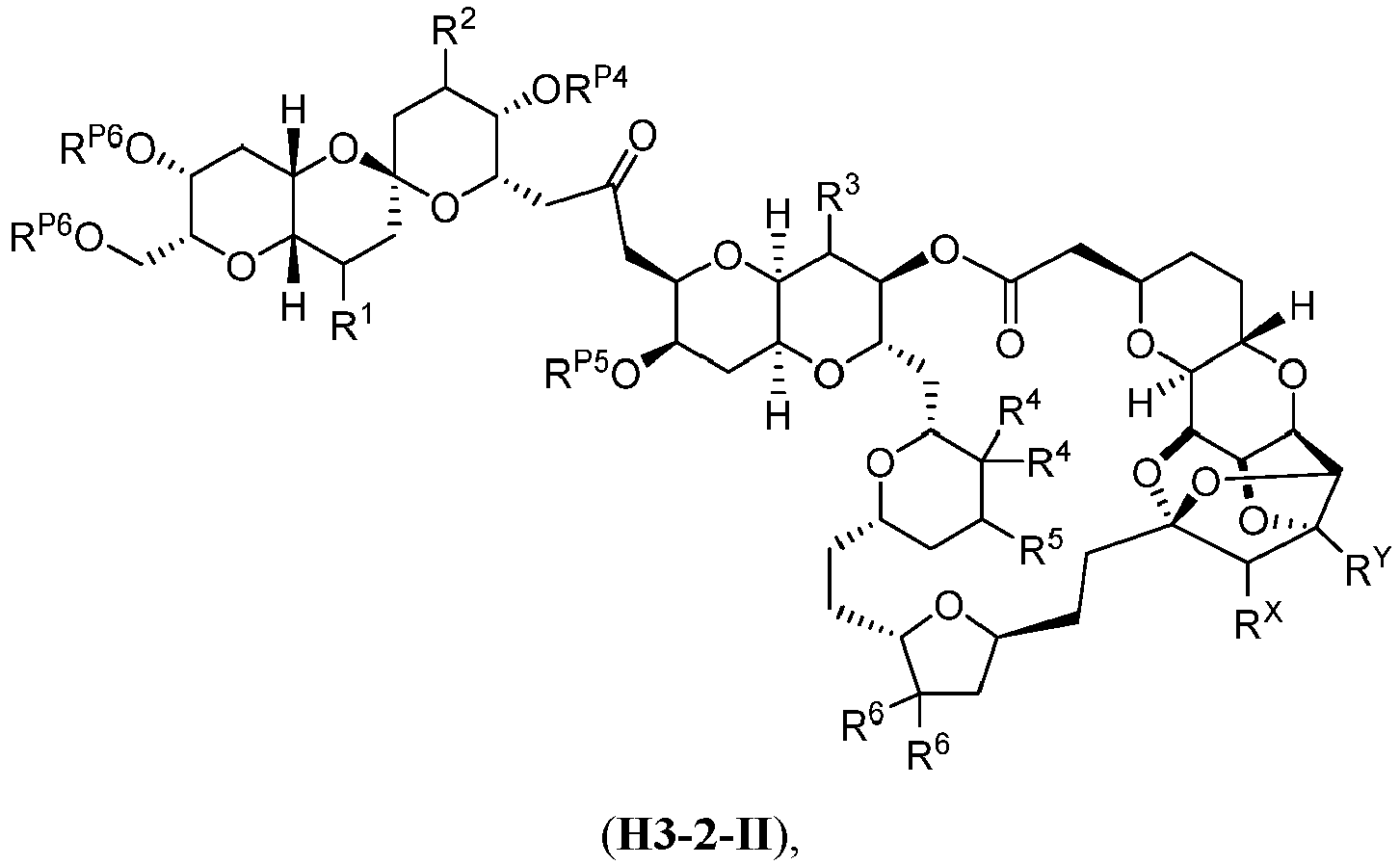


- RS is optionally substituted alkyl, optionally substituted carbocyclyl, optionally substituted aryl, optionally substituted heterocyclyl, or optionally substituted heteroaryl;
- X1 is halogen or a leaving group;
- R1, R2, R3, and R5 are each independently hydrogen, halogen, or optionally substituted alkyl;
- each instance of R4 is independently hydrogen, halogen, or optionally substituted alkyl, or two R4 groups are taken together to form:
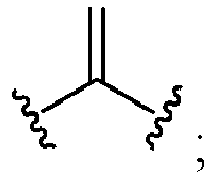
- each instance of R6 is independently hydrogen, halogen, or optionally substituted alkyl, or two R6 groups are taken together to form:

- RP4, RP5, and RP6 are each independently hydrogen, optionally substituted alkyl, optionally substituted acyl, or an oxygen protecting group; optionally wherein two RP6 are joined with the intervening atoms to form optionally substituted heterocyclyl;
- RX is hydrogen or -ORXa, wherein RXa is hydrogen, optionally substituted alkyl, optionally substituted acyl, or an oxygen protecting group; and
- RY is hydrogen or -ORYa, wherein RYa is hydrogen, optionally substituted alkyl, optionally substituted acyl, or an oxygen protecting group;
- optionally wherein RXa and RYa are joined together with their intervening atoms to form optionally substituted heterocyclyl.
- 6. The method of
clause 5, further comprising a step of deprotecting one or more oxygen atoms of the compound of Formula (H3-2-II), or a salt thereof. - 7. A method of preparing a compound of Formula (R-2-1):


- X1 is halogen or a leaving group;
- R3 and R5 are each independently hydrogen, halogen, or optionally substituted alkyl;
- each instance of R4 is independently hydrogen, halogen, or optionally substituted alkyl, or two R4 groups are taken together to form:

- each instance of R6 is independently hydrogen, halogen, or optionally substituted alkyl, or two R6 groups are taken together to form:

- RP5 is hydrogen, optionally substituted alkyl, optionally substituted acyl, or an oxygen protecting group;
- RP7 is optionally substituted sulfonyl, optionally substituted sulfinyl, optionally substituted phosphoryl, optionally substituted acyl, or an oxygen protecting group;
- optionally wherein RP5 and RP7 are joined with the intervening atoms to form optionally substituted heterocyclyl;
- RX is hydrogen or -ORXa, wherein RXa is hydrogen, optionally substituted alkyl, optionally substituted acyl, or an oxygen protecting group; and
- RY is hydrogen or -ORYa, wherein RYa is hydrogen, optionally substituted alkyl, optionally substituted acyl, or an oxygen protecting group;
- optionally wherein RXa and RYa are joined together with their intervening atoms to form optionally substituted heterocyclyl.
- 8. The method of
clause 7 further comprising:- (a) a step of deprotecting a compound of Formula (R-4-11A):


- (b) one or more steps of re-protecting the compound of Formula (R-4-11C), or a salt thereof, to yield a compound of Formula (R-4-11B):

- R3 and R5 are each independently hydrogen, halogen, or optionally substituted alkyl;
- each instance of R4 is independently hydrogen, halogen, optionally substituted alkyl, or two R4 groups are taken together to form:

- each instance of R6 is independently hydrogen, halogen, optionally substituted alkyl, or two R6 groups are taken together to form:

- RP5 is hydrogen, optionally substituted alkyl, optionally substituted acyl, or an oxygen protecting group; optionally wherein two RP5 groups are joined together with the intervening atoms to form an optionally substituted heterocyclyl ring;
- RP7 is optionally substituted sulfonyl, optionally substituted sulfinyl, optionally substituted phosphoryl, optionally substituted acyl, or an oxygen protecting group;
- optionally wherein RP5 and RP7 are joined with the intervening atoms to form optionally substituted heterocyclyl;
- RX is hydrogen or -ORXa, wherein RXa is hydrogen, optionally substituted alkyl, optionally substituted acyl, or an oxygen protecting group; and
- RY is hydrogen or -ORYa, wherein RYa is hydrogen, optionally substituted alkyl, optionally substituted acyl, or an oxygen protecting group;
- optionally wherein RXa and RYa are joined together with their intervening atoms to form optionally substituted heterocyclyl.
- (a) a step of deprotecting a compound of Formula (R-4-11A):
- 9. The method of
clause 8 further comprising a step of cyclizing a compound of Formula (R-4-10):

- R3 and R5 are each independently hydrogen, halogen, or optionally substituted alkyl;
- each instance of R4 is independently hydrogen, halogen, or optionally substituted alkyl, or two R4 groups are taken together to form:

- each instance of R6 is independently hydrogen, halogen, or optionally substituted alkyl, or two R6 groups are taken together to form:

- each instance of RP5 and RP8 is independently hydrogen, optionally substituted alkyl, optionally substituted acyl, or an oxygen protecting group; optionally wherein two RP5 groups are joined together with the intervening atoms to form an optionally substituted heterocyclyl ring;
- R8 is hydrogen, optionally substituted alkyl, optionally substituted carbocyclyl, optionally substituted aryl, optionally substituted heterocyclyl, optionally substituted heteroaryl, optionally substituted acyl, or an oxygen protecting group;
- RX is hydrogen or -ORXa, wherein RXa is hydrogen, optionally substituted alkyl, optionally substituted acyl, or an oxygen protecting group; and
- RY is hydrogen or -ORYa, wherein RYa is hydrogen, optionally substituted alkyl, optionally substituted acyl, or an oxygen protecting group;
- optionally wherein RXa and RYa are joined together with their intervening atoms to form optionally substituted heterocyclyl.
- 10. The method of
clause 9 further comprising:- (a) a step of coupling a compound of Formula (R-4-8):


- (b) a step of cyclizing a compound of Formula (R-4-10B), or a salt thereof, to yield a compound of Formula (R-4-10):

- X3 and X2 are each independently halogen or a leaving group;
- R3 and R5 are each independently hydrogen, halogen, or optionally substituted alkyl;
- each instance of R4 is independently hydrogen, halogen, or optionally substituted alkyl, or two R4 groups are taken together to form:

- each instance of R6 is independently hydrogen, halogen, or optionally substituted alkyl, or two R6 groups are taken together to form:

- each instance of RP5 and RP8 is independently hydrogen, optionally substituted alkyl, optionally substituted acyl, or an oxygen protecting group; optionally wherein two RP5 groups are joined together with the intervening atoms to form an optionally substituted heterocyclyl ring;
- R8 is hydrogen, optionally substituted alkyl, optionally substituted carbocyclyl, optionally substituted aryl, optionally substituted heterocyclyl, optionally substituted heteroaryl, optionally substituted acyl, or an oxygen protecting group;
- RX is hydrogen or -ORXa, wherein RXa is hydrogen, optionally substituted alkyl, optionally substituted acyl, or an oxygen protecting group; and
- RY is hydrogen or -ORYa, wherein RYa is hydrogen, optionally substituted alkyl, optionally substituted acyl, or an oxygen protecting group;
- optionally wherein RXa and RYa are joined together with their intervening atoms to form optionally substituted heterocyclyl.
- (a) a step of coupling a compound of Formula (R-4-8):
- 11. The method of
clause 10, the method further comprising a step of reducing a compound of Formula (R-4-7):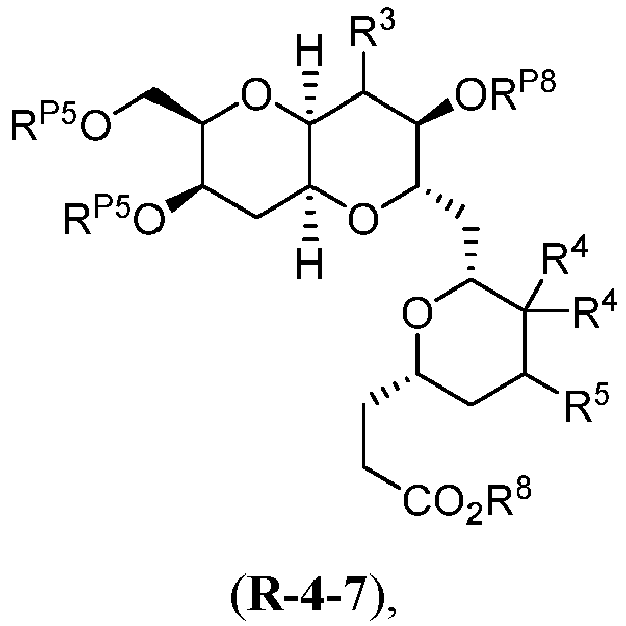

- R3 and R5 are each independently hydrogen, halogen, or optionally substituted alkyl;
- each instance of R4 is independently hydrogen, halogen, or optionally substituted alkyl, or two R4 groups are taken together to form:
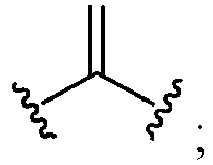
- each instance of RP5 and RP8 is independently hydrogen, optionally substituted alkyl, optionally substituted acyl, or an oxygen protecting group; optionally wherein two RP5 groups are joined together with the intervening atoms to form an optionally substituted heterocyclyl ring; and
- R8 is hydrogen, optionally substituted alkyl, optionally substituted carbocyclyl, optionally substituted aryl, optionally substituted heterocyclyl, optionally substituted heteroaryl, optionally substituted acyl, or an oxygen protecting group.
- 12. The method of
clause 11 further comprising:- (a) a step of coupling a compound of Formula (R-4-5B):


- (a-i) a step of deprotecting and cyclizing a compound of Formula (R-4-7A), or a salt thereof, to yield a compound of Formula (R-4-7):

- R3 and R5 are each independently hydrogen, halogen, or optionally substituted alkyl;
- each instance of R4 is independently hydrogen, halogen, or optionally substituted alkyl, or two R4 groups are taken together to form:

- each instance of RP5, RP8, and RP9 is independently hydrogen, optionally substituted alkyl, optionally substituted acyl, or an oxygen protecting group; optionally wherein two RP5 groups are joined together with the intervening atoms to form an optionally substituted heterocyclyl ring; and optionally wherein two RP9 groups are joined together with the intervening atoms to form an optionally substituted heterocyclyl ring; and
- R8 is hydrogen, optionally substituted alkyl, optionally substituted carbocyclyl, optionally substituted aryl, optionally substituted heterocyclyl, optionally substituted heteroaryl, optionally substituted acyl, or an oxygen protecting group.
- (a) a step of coupling a compound of Formula (R-4-5B):
- 13. The method of
clause 12, wherein the method comprises:- (b) a step of deprotecting a compound of Formula (R-4-7A), or a salt thereof, under conditions sufficient to remove the groups RP5 and RP8, to yield a compound of the formula:

- (c) a step of deprotecting and cyclizing the compound produced in step (b), or salt thereof, to yield a compound of the formula:

- (d) a step of protecting the compound formed in step (c), or a salt thereof, to yield a compound of Formula (R-4-7B):

- each instance of RP5, RP8, and RP9 is independently hydrogen, optionally substituted alkyl, optionally substituted acyl, or an oxygen protecting group; optionally wherein two RP5 groups are joined together with the intervening atoms to form an optionally substituted heterocyclyl ring; and optionally wherein two RP9 groups are joined together with the intervening atoms to form an optionally substituted heterocyclyl ring; and
- R8 is hydrogen, optionally substituted alkyl, optionally substituted carbocyclyl, optionally substituted aryl, optionally substituted heterocyclyl, optionally substituted heteroaryl, optionally substituted acyl, or an oxygen protecting group.
- (b) a step of deprotecting a compound of Formula (R-4-7A), or a salt thereof, under conditions sufficient to remove the groups RP5 and RP8, to yield a compound of the formula:
- 14. The method of
clause 

- R3 is hydrogen, halogen, or optionally substituted alkyl;
- each instance of RP5 and RP8 is independently hydrogen, optionally substituted alkyl, optionally substituted acyl, or an oxygen protecting group; optionally wherein two RP5 groups are joined together with the intervening atoms to form an optionally substituted heterocyclyl ring; and
- R8 is hydrogen, optionally substituted alkyl, optionally substituted carbocyclyl, optionally substituted aryl, optionally substituted heterocyclyl, optionally substituted heteroaryl, optionally substituted acyl, or an oxygen protecting group.
- 15. The method of
clause 14 further comprising a step of cyclizing a compound of Formula (R-4-4):

- R3 is hydrogen, halogen, or optionally substituted alkyl;
- each instance of RP5, RP8, and RP10 is independently hydrogen, optionally substituted alkyl, optionally substituted acyl, or an oxygen protecting group; optionally wherein two RP5 groups are joined together with the intervening atoms to form an optionally substituted heterocyclyl ring; and
- R8 is hydrogen, optionally substituted alkyl, optionally substituted carbocyclyl, optionally substituted aryl, optionally substituted heterocyclyl, optionally substituted heteroaryl, optionally substituted acyl, or an oxygen protecting group.
- 16. The method of
clause 15, the method further comprising a step of coupling a compound of Formula (R-4-2):


- X4 is halogen or a leaving group;
- R3 is hydrogen, halogen, or optionally substituted alkyl;
- each instance of RP5 and RP10 is independently hydrogen, optionally substituted alkyl, optionally substituted acyl, or an oxygen protecting group; optionally wherein two RP5 groups are joined together with the intervening atoms to form an optionally substituted heterocyclyl ring; and
- R8 is hydrogen, optionally substituted alkyl, optionally substituted carbocyclyl, optionally substituted aryl, optionally substituted heterocyclyl, optionally substituted heteroaryl, optionally substituted acyl, or an oxygen protecting group.
- 17. The method of
clause 16 further comprising a step of reducing a compound of Formula (R-4-1):

- R3 is hydrogen, halogen, or optionally substituted alkyl; and
- each instance of RP5 and RP10 is independently hydrogen, optionally substituted alkyl, optionally substituted acyl, or an oxygen protecting group; optionally wherein two RP5 groups are joined together with the intervening atoms to form an optionally substituted heterocyclyl ring.
- 18. The method of
clause 16 further comprising:- (a) a step of reducing a compound of Formula (R-4-1):


- (b) a step of olefinating the compound of Formula (R-4-2A), or a salt thereof, to yield a compound of Formula (R-4-2B):

- (c) a step of protecting the compound of Formula (R-4-2B), or salt thereof, to yield a compound of Formula (R-4-2C):

- (d) a step of oxidizing a compound of Formula (R-4-2C), or a salt thereof, to yield a compound of Formula (R-4-2):

- R3 is hydrogen, halogen, or optionally substituted alkyl; and
- each instance of RP5 and RP10 is independently hydrogen, optionally substituted alkyl, optionally substituted acyl, or an oxygen protecting group; optionally wherein two RP5 groups are joined together with the intervening atoms to form an optionally substituted heterocyclyl ring.
- (a) a step of reducing a compound of Formula (R-4-1):
- 19. A method of preparing a compound of Formula (L-2-6):

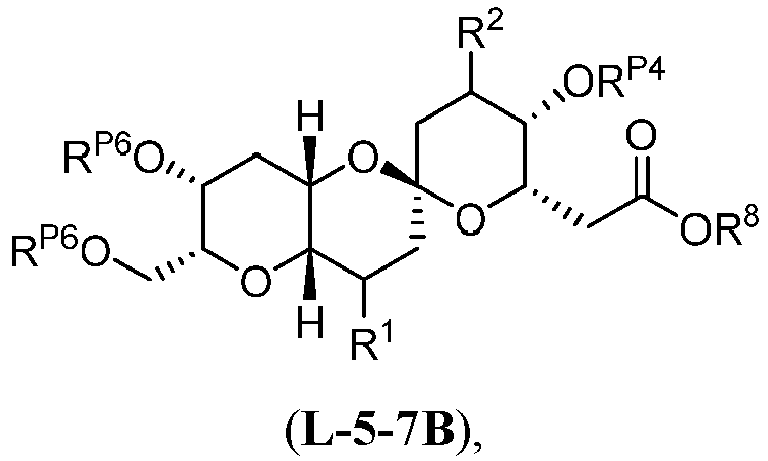
- RS is optionally substituted alkyl, optionally substituted carbocyclyl, optionally substituted aryl, optionally substituted heterocyclyl, or optionally substituted heteroaryl;
- R1 and R2 are independently hydrogen, halogen, or optionally substituted alkyl;
- each instance of RP4 and RP6 are independently hydrogen, optionally substituted alkyl, optionally substituted acyl, or an oxygen protecting group; optionally wherein two RP6 are joined with the intervening atoms to form optionally substituted heterocyclyl; and
- R8 is hydrogen, optionally substituted alkyl, optionally substituted carbocyclyl, optionally substituted aryl, optionally substituted heterocyclyl, optionally substituted heteroaryl, optionally substituted acyl, or an oxygen protecting group.
- 20. The method of
clause 19 further comprising a step of cyclizing a compound of Formula (L-5-7A):

- R1 and R2 are independently hydrogen, halogen, or optionally substituted alkyl;
- each instance of RP4 and RP6 are independently hydrogen, optionally substituted alkyl, optionally substituted acyl, or an oxygen protecting group; optionally wherein two RP6 are joined with the intervening atoms to form optionally substituted heterocyclyl; and
- R8 is hydrogen, optionally substituted alkyl, optionally substituted carbocyclyl, optionally substituted aryl, optionally substituted heterocyclyl, optionally substituted heteroaryl, optionally substituted acyl, or an oxygen protecting group.
- 21. The method of
clause 20 further comprising:- (a) a step of deprotecting a compound of Formula (L-5-7B), or a salt thereof, under conditions sufficient to remove the RP4 and R8 groups, to yield a compound of Formula (L-5-7C):

- (b) a step of protecting a compound of Formula (L-5-7C), or a salt thereof, to yield a compound of Formula (L-5-7D):

- R1 and R2 are independently hydrogen, halogen, or optionally substituted alkyl;
- each instance of RP4 and RP6 are independently hydrogen, optionally substituted alkyl, optionally substituted acyl, or an oxygen protecting group; optionally wherein two RP6 are joined with the intervening atoms to form optionally substituted heterocyclyl.
- (a) a step of deprotecting a compound of Formula (L-5-7B), or a salt thereof, under conditions sufficient to remove the RP4 and R8 groups, to yield a compound of Formula (L-5-7C):
- 22. The method of
clause - (a) oxidizing a compound of Formula (L-5-6A):


- (b) reacting the compound of Formula (L-5-6B), or a salt thereof, in the presence of a olefination reagent, to yield a compound of Formula (L-5-7A):
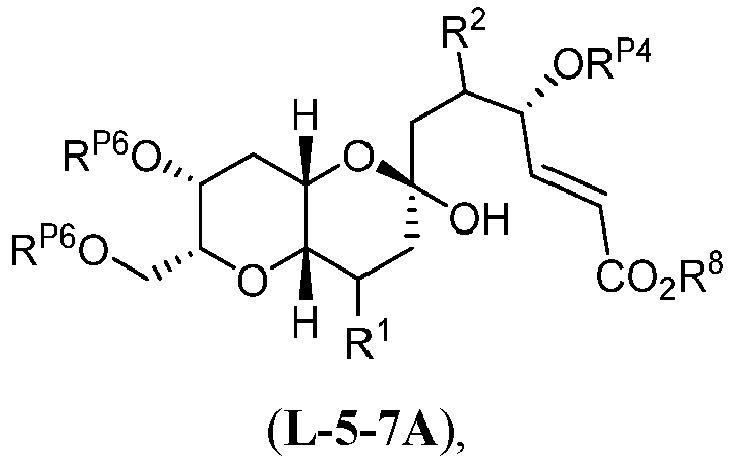
- R1 and R2 are independently hydrogen, halogen, or optionally substituted alkyl;
- each instance of RP4 and RP6 are independently hydrogen, optionally substituted alkyl, optionally substituted acyl, or an oxygen protecting group; optionally wherein two RP6 are joined with the intervening atoms to form optionally substituted heterocyclyl; and
- R8 is hydrogen, optionally substituted alkyl, optionally substituted carbocyclyl, optionally substituted aryl, optionally substituted heterocyclyl, optionally substituted heteroaryl, optionally substituted acyl, or an oxygen protecting group.
- (a) oxidizing a compound of Formula (L-5-6A):
- 23. The method of
clause 22 further comprising a step of coupling a compound of Formula (L-5-4):


- X4 is halogen or a leaving group;
- R1 and R2 are independently hydrogen, halogen, or optionally substituted alkyl; and
- each instance of RP4 and RP6 are independently hydrogen, optionally substituted alkyl, optionally substituted acyl, or an oxygen protecting group; optionally wherein two RP6 are joined with the intervening atoms to form optionally substituted heterocyclyl.
- 24. A method of preparing Compound (1):
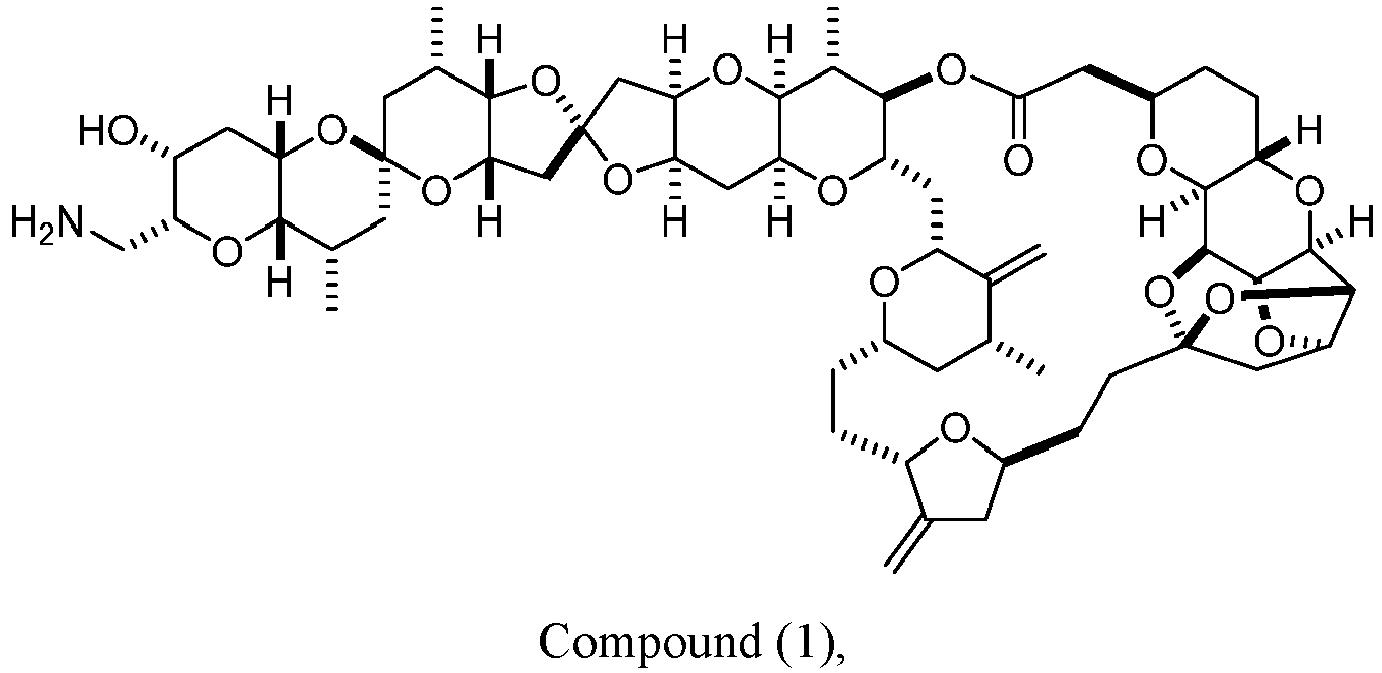

- 25. The method of
clause - 26. The method of
clause 25, wherein the phosphine reagent is triphenylphosphine (Ph3P). - 27. The method of
clause 25, wherein the phosphine reagent is polymer-bound triphenylphosphine. - 28. The method of any one of clauses 25-27, wherein at least one equivalent of the phosphine reagent is present.
- 29. The method of any one of
clauses 1 and 24-28, wherein the reaction is carried out in the presence of THF and water. - 30. The method of any one of
clauses 1 and 24-29, wherein the product, or salt thereof, is purified and isolated by precipitation. - 31. The method of any one of clauses 24-30 further comprising a step of reacting a compound of Formula (A):


RL is optionally substituted sulfonyl, optionally substituted sulfinyl, optionally substituted phosphoryl, or optionally substituted acyl. - 32. The method of
clause - 33. The method of clause 32, wherein the azide is a tetralalkylammonium azide.
- 34. The method of clause 33, wherein the azide is tetrabutylammonium azide ([n-Bu4N]N3).
- 35. The method of any one of clauses 31-34, wherein the reaction is carried out in toluene.
- 36. The method of any one of clauses 31-35 further comprising a step of reacting Compound (2):

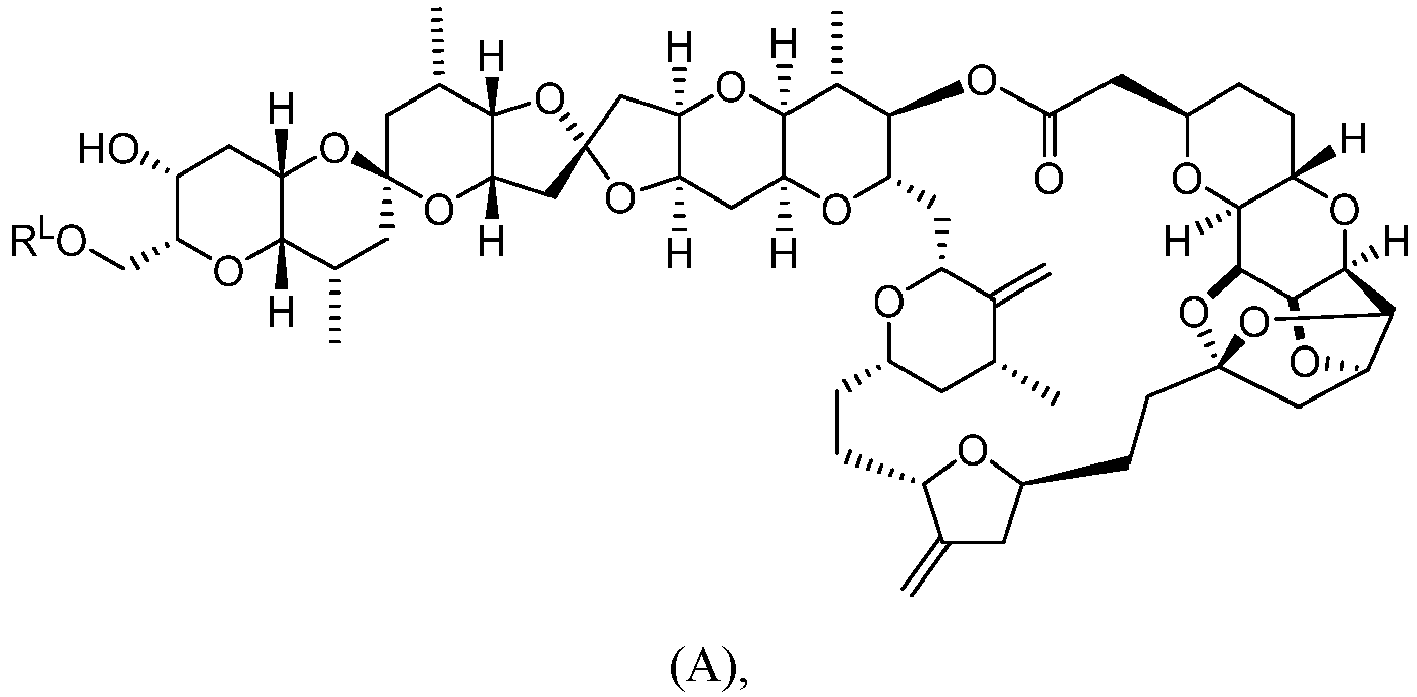
- XL is halogen or a leaving group; and
- RL is optionally substituted sulfonyl, optionally substituted sulfinyl, optionally substituted phosphoryl, or optionally substituted acyl.
- 37. The method of
clause - 38. The method of
clause 37, wherein reagent of the formula XL-RL is a sulfonyl chloride; and RL is optionally substituted sulfonyl. - 39. The method of
clause 38, wherein reagent of the formula XL-RL is tosyl chloride (TsCl); and RL is Ts. - 40. The method of any one of
clauses 3 and 36-39, wherein the reaction is carried out in the presence of a base. - 41. The method of
clause 40, wherein the base is a trialkylamine base, a pyridine base, or an imidazole base. - 42. The method of clause 41, wherein the base is a trialkylamine base.
- 43. The method of clause 42, wherein the base is triethylamine (TEA).
- 44. The method of any one of
clauses 3 and 36-43, wherein the reaction is carried out in the presence of a Lewis acid. - 45. The method of
clause 44, wherein the reaction is carried out in the presence of dibutyltin oxide. - 46. The method of any one of
clauses 3 and 36-45, wherein the reaction is carried out in the presence of TsCl, TEA, and dibutyltin oxide. - 47. The method of any one of
clauses 3 and 36-46, wherein the reaction is carried out in dichloromethane (DCM) - 48. A method of preparing Compound (2):
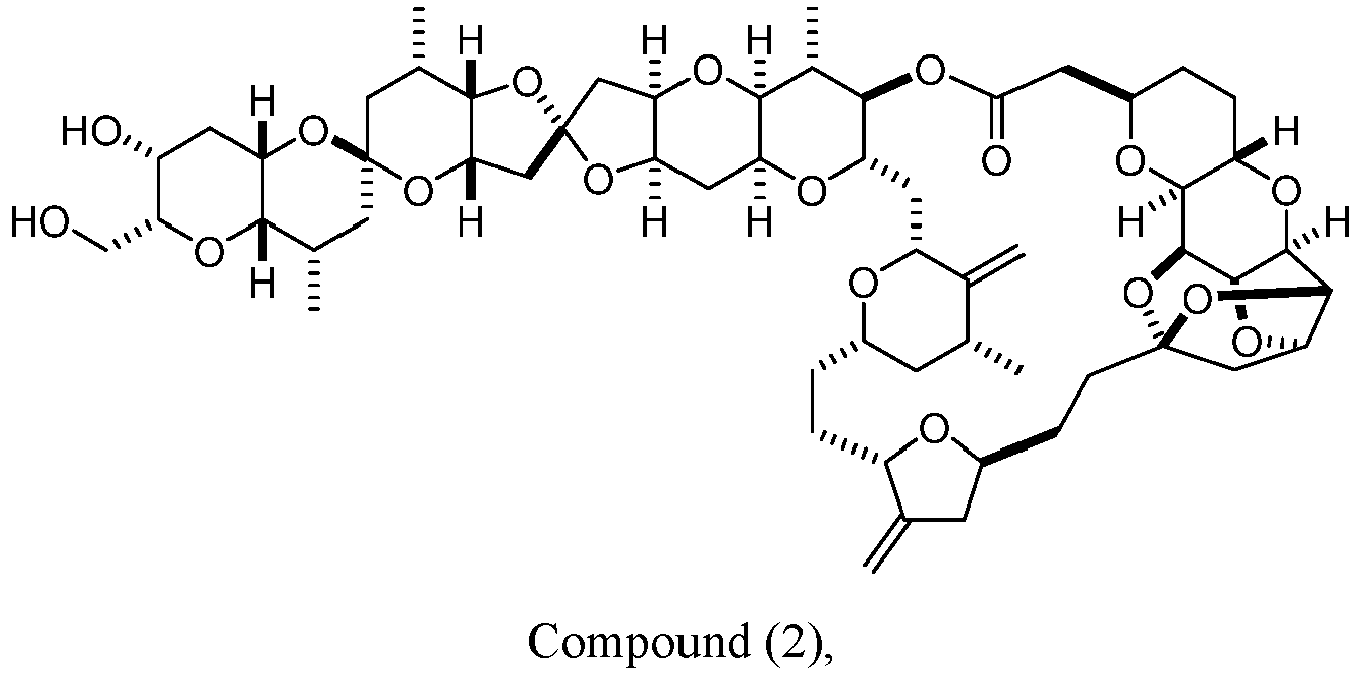

- 49. The method of
clause 4 or 48, wherein the step of cyclizing is carried out in the presence of an acid. - 50. The method of clause 49, wherein the acid is a pyridinium salt.
- 51. The method of
clause 50, wherein the acid is pyridinium p-toluenesulfonate (PPTS). - 52. The method of any one of
clauses 4 and 48-51, wherein the reaction is carried out in dichloromethane (DCM). - 53. The method of any one of clauses 24-52, optionally wherein one or more free hydroxyl groups is substituted with an oxygen protecting group.
- 54. The method of clause 53, wherein the one or more oxygen protecting groups are silyl protecting groups.
- 55. The method of preparing a compound of Formula (E-1):

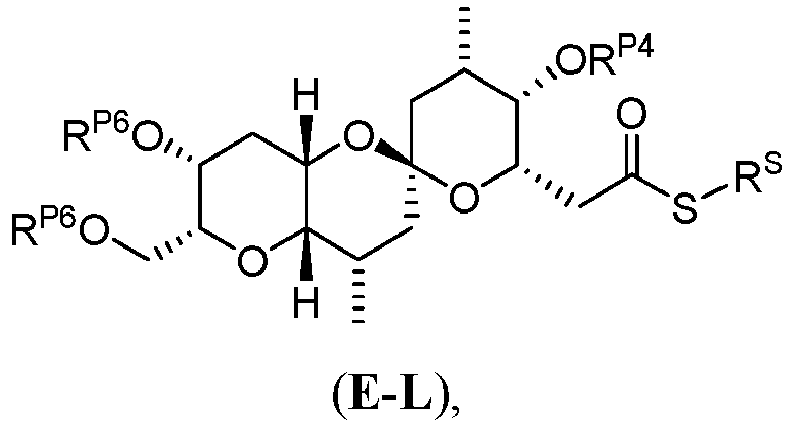


- RS is optionally substituted alkyl, optionally substituted carbocyclyl, optionally substituted aryl, optionally substituted heterocyclyl, or optionally substituted heteroaryl;
- X1 is halogen or a leaving group; and
- RP4, RP5, and RP6 are each independently hydrogen, optionally substituted alkyl, optionally substituted acyl, or an oxygen protecting group; optionally wherein two RP6 are joined with the intervening atoms to form optionally substituted heterocyclyl.
- 56. The method of
clause - 57. The method of
clause 56, wherein the nickel is a nickel complex. - 58. The method of
clause 57, wherein the nickel is a nickel(II) or nickel(0) complex. - 59. The method of
clause - 60. The method of
clause 59, wherein the nickel complex is used after complexation of a nickel source and a "ligand" in solution. - 61. The method of
clause - 62. The method of
clause - 63. The method of any one of clauses 56-62, wherein the nickel is present in a catalytic amount.
- 64. The method of
clause 63, wherein the nickel is present in from 1-50 mol%. - 65. The method of
clause 63, wherein the nickel is present in from 1-10 mol%. - 66. The method of
clause 56, wherein the zirconium is a zirconium complex. - 67. The method of clause 66, wherein the zirconium complex is of the formula: (ligand)nZrX2; wherein
n - 68. The method of
clause 66 or 67, wherein the zirconium complex is Cp2ZrCl2. - 69. The method of any one of clauses 56-68, wherein the zirconium is present in stoichiometric or excess amount.
- 70. The method of clause 69, wherein the zirconium is present in about 1 to about 4 equivalents.
- 71. The method of any one of
clauses 5 and 55-70, wherein the step of coupling is carried out in the presence of zinc or manganese. - 72. The method of
clause 71, wherein the reaction is carried out in the presence of manganese metal. - 73. The method of
clause 72, wherein the manganese is present in an excess amount. - 74. The method of any one of
clauses 5 and 55-73, wherein the step of coupling is carried out in the presence of triethylsilyl chloride (TESCl). - 75. The method of any one of
clauses 5 and 55-74, wherein the step of coupling is carried out in the presence of a base or proton scavenger. - 76. The method of any one of
clauses 5 and 55-75, wherein the reaction is carried out in the presence of NiBr2•(tbbpy), Cp2ZrCl2, and manganese metal. - 76a. The method of
clause 76, wherein the reaction is carried out by mixing a compound of Formula (L-2-6), or a salt thereof, with a compound of Formula (R-2-1), or a salt thereof, Cp2ZrCl2, and manganese metal in solution; followed by addition of NiBr2•(tbbpy). - 76b. The method of
clause 76, wherein the reaction is carried out by mixing a compound of Formula (E-L), or a salt thereof, with a compound of Formula (E-R), or a salt thereof, Cp2ZrCl2, and manganese metal in solution; followed by addition of NiBr2•(tbbpy). - 77. The method of any one of
clauses 5 and 55-76, wherein the step of coupling is carried out in one or more solvents. - 78. The method of
clause 77, wherein the step of coupling is carried out in 1,3-dimethyl-2-imidazolidinone (DMI). - 79. The method of any one of
clauses 5 and 55-78, wherein the reaction is carried out at or around room temperature. - 80. The method of any one of
clauses 5 and 55-78, wherein the reaction is carried out at above room temperature. - 80a. The method of
clause 80, wherein the reaction is carried out at approximately 30 °C. - 80b. The method of any one of
clauses 5 and 55-80a, wherein the reaction is carried out to yield more than 1 g of product. - 80c. The method of clause 80b, wherein the reaction is carried out to yield more than 30 g of product.
- 81. The method of any one of clauses 55-80 further comprising a step of deprotecting a compound of Formula (E-1), or a salt thereof, to yield a compound of the formula:

- 82. The method of
clause 6 or 81, wherein RP6, RP5, and RP4 are silyl protecting groups; and the step of deprotection is carried out in the presence of a fluoride source. - 83. The method of
clauses 82, wherein the fluoride source is tetrabutylammonium fluoride (TBAF). - 84. The method of any one of
clauses 6 and 81-83, wherein the reaction is carried out in the presence of imidazole hydrochloride. - 85. The method of any one of
clauses 6 and 81-84, wherein the reaction is carried out in THF. - 86. A method of preparing a compound of Formula (E-R):


- X1 is halogen or a leaving group;
- RP5 is hydrogen, optionally substituted alkyl, optionally substituted acyl, or an oxygen protecting group; and
- RP7 is optionally substituted sulfonyl, optionally substituted sulfinyl, optionally substituted phosphoryl, optionally substituted acyl, or an oxygen protecting group;
- optionally wherein RP5 and RP7 are joined with the intervening atoms to form optionally substituted heterocyclyl.
- 87. The method of
clause - 88. The method of
clause 87, wherein the iodide salt is sodium iodide (NaI). - 89. The method of any one of
clauses 7 and 86-88, wherein the reaction is carried out in DMI. - 90. The method of any one of clauses 86-89 further comprising:
- (a) a step of deprotecting a compound of Formula (E-R-2):


- (b) one or more steps of re-protecting to yield a compound of Formula (E-R-1):

- RP5 is hydrogen, optionally substituted alkyl, optionally substituted acyl, or an oxygen protecting group; optionally wherein two RP5 groups are joined together with the intervening atoms to form an optionally substituted heterocyclyl ring; and
- RP7 is optionally substituted sulfonyl, optionally substituted sulfinyl, optionally substituted phosphoryl, optionally substituted acyl, or an oxygen protecting group;
- optionally wherein RP5 and RP7 are joined with the intervening atoms to form optionally substituted heterocyclyl.
- (a) a step of deprotecting a compound of Formula (E-R-2):
- 91. The method of
clause 
- 92. The method of
clause 91, wherein the acid is p-toluene sulfonic acid (TsOH). - 93. The method of any one of
clauses 8 and 90-92, wherein step (a) is carried out in the presence of DCM and MeOH. - 94. The method of any one
clauses 8 or 90-93, wherein with respect the compound of Formula (R-4-11B) or (E-R-1), -ORP7 is a sulfonate leaving group and RP5 is a silyl protecting group; and step (b) is carried out in the presence of a sulfonating reagent and a base, followed by a silylating reagent and a base. - 95. The method of
clause 94, wherein -ORP7 is -OTf; and the sulfonating reagent is Tf2O. - 96. The method of
clause - 97. The method of any one of clauses 94-96, wherein the base is an amine or pyridine base.
- 98. The method of clause 97, wherein the base is 2,4,6-collidine.
- 99. The method of any one of clauses 94-98, wherein step (b) is carried out in the presence of Tf2O and 2,4,6-collidine, followed by a TESOTF and 2,4,6-collidine.
- 100. The method of any one of clauses 94-99, wherein step (b) is carried out in DCM.
- 101. The method of any one of clauses 90-100 further comprising a step of cyclizing a compound of Formula (E-R-3):


- each instance of RP5 is independently hydrogen, optionally substituted alkyl, optionally substituted acyl, or an oxygen protecting group; optionally wherein two RP5 groups are joined together with the intervening atoms to form an optionally substituted heterocyclyl ring; and
- R8 is hydrogen, optionally substituted alkyl, optionally substituted carbocyclyl, optionally substituted aryl, optionally substituted heterocyclyl, optionally substituted heteroaryl, optionally substituted acyl, or an oxygen protecting group.
- 102. The method of
clause 9 or 101, wherein the step of cyclizing is carried out in the presence of an anhydride. - 103. The method of clause 102, wherein the anhydride is 2-methyl-6-nitrobenzoic anhydride (MNBA).
- 104. The method of any one of
clauses 9 and 101-103, wherein the step of cyclizing is carried out in the presence of a nucleophilic reagent capable of activating the carboxyl group -CO2R8 or -CO2H. - 105. The method of clause 104, wherein the step of cyclizing is carried out in the presence of 4-dimethylaminopyridine (DMAP).
- 106. The method of any one of
clauses 9 and 101-105, wherein the step of cyclizing is carried out in the presence of a base. - 107. The method of clause 106, wherein the base is an amine base.
- 108. The method of clause 107, wherein the amine base is diisopropyl ethylamine (DIPEA).
- 109. The method of any one of
clauses 9 and 101-108, wherein the step of cyclizing is carried out in the presence of 2-methyl-6-nitrobenzoic anhydride (MNBA), DMAP, and DIPEA. - 110. The method of any one of
clauses 9 and 101-109, wherein the step of cyclizing is carried out in toluene. - 111. The method of any one of clauses 101-110 further comprising:
- (a) a step of coupling a compound of Formula (E-R-4):


- (b) a step of cyclizing a compound of Formula (E-R-6), or a salt thereof, to yield a compound of Formula (E-R-7):

- X3 and X2 are each independently halogen or a leaving group;
- each instance of RP5 and RP8 is independently hydrogen, optionally substituted alkyl, optionally substituted acyl, or an oxygen protecting group; optionally wherein two RP5 groups are joined together with the intervening atoms to form an optionally substituted heterocyclyl ring; and
- R8 is hydrogen, optionally substituted alkyl, optionally substituted carbocyclyl, optionally substituted aryl, optionally substituted heterocyclyl, optionally substituted heteroaryl, optionally substituted acyl, or an oxygen protecting group.
- (a) a step of coupling a compound of Formula (E-R-4):
- 112. The method of
clause 10 or 111, wherein the step of cyclizing is carried out in the presence of an acid. - 113. The method of
clause 10 or 111, wherein the step of cyclizing is carried out in the presence of a base. - 114. The method of clause 113, wherein the base is a carbonate.
- 115. The method of clause 114, wherein the base is potassium carbonate (K2CO3).
- 116. The method of any one of
clauses 10 and 111-115, wherein the step of cyclizing is carried out in the presence of MeOH. - 117. The method any one of clauses 111-116 further comprising a step of reducing a compound of Formula (E-R-8):


- each instance of RP5 and RP8 is independently hydrogen, optionally substituted alkyl, optionally substituted acyl, or an oxygen protecting group; optionally wherein two RP5 groups are joined together with the intervening atoms to form an optionally substituted heterocyclyl ring; and
- R8 is hydrogen, optionally substituted alkyl, optionally substituted carbocyclyl, optionally substituted aryl, optionally substituted heterocyclyl, optionally substituted heteroaryl, optionally substituted acyl, or an oxygen protecting group.
- 118. The method of
clause 11 or 117, wherein the step of reducing is carried out in the presence of a hydride source. - 119. The method of clause 118, wherein the hydride source is diisobutylaluminum hydride (DIBAL).
- 120. The method of any one of
clauses 11 and 117-119, wherein the step of reducing is carried out in DCM. - 121. The method of any one of clauses 117-120 further comprising:
- (a) a step of coupling a compound of Formula (E-R-9):


- (a-i) a step of deprotecting and cyclizing the compound of Formula (E-R-11), or salt thereof, to yield a compound of Formula (E-R-8):


- each instance of RP5, RP8, and RP9 is independently hydrogen, optionally substituted alkyl, optionally substituted acyl, or an oxygen protecting group; optionally wherein two RP5 groups are joined together with the intervening atoms to form an optionally substituted heterocyclyl ring; and optionally wherein two RP9 groups are joined together with the intervening atoms to form an optionally substituted heterocyclyl ring; and
- R8 is hydrogen, optionally substituted alkyl, optionally substituted carbocyclyl, optionally substituted aryl, optionally substituted heterocyclyl, optionally substituted heteroaryl, optionally substituted acyl, or an oxygen protecting group.
- (a) a step of coupling a compound of Formula (E-R-9):
- 122. The method of clause 121, the method comprising:
- (b) a step of deprotecting a compound of Formula (E-R-11), or a salt thereof, under conditions sufficient to remove the groups RP5 and RP8, to yield a compound of Formula (E-R-12):

- (c) a step of deprotecting and cyclizing the compound of Formula (E-R-12), or salt thereof, to yield a compound of Formula (E-R-13):

- (d) a step of protecting the compound of Formula (E-R-13), or a salt thereof, to yield a compound of Formula (E-R-14):

- each instance of RP5, RP8, and RP9 is independently hydrogen, optionally substituted alkyl, optionally substituted acyl, or an oxygen protecting group; optionally wherein two RP5 groups are joined together with the intervening atoms to form an optionally substituted heterocyclyl ring; and optionally wherein two RP9 groups are joined together with the intervening atoms to form an optionally substituted heterocyclyl ring; and
- R8 is hydrogen, optionally substituted alkyl, optionally substituted carbocyclyl, optionally substituted aryl, optionally substituted heterocyclyl, optionally substituted heteroaryl, optionally substituted acyl, or an oxygen protecting group.
- (b) a step of deprotecting a compound of Formula (E-R-11), or a salt thereof, under conditions sufficient to remove the groups RP5 and RP8, to yield a compound of Formula (E-R-12):
- 123. The method of
clause 13 or 122, wherein RP5 and RP8 are silyl protecting groups; and step (b) is carried out in the presence of a fluoride source. - 124. The method of clause 123, wherein the fluoride source is tetrabutylammonium fluoride (TBAF).
- 125. The method of any one of
clauses 13 and 122-124, wherein step (b) is carried out in THF. - 126. The method of any one of
clauses - 127. The method of clause 126, wherein the acid is a Lewis acid;
- 128. The method of clause 127, wherein the Lewis acid is triethylsilyl trifluoromethanesulfonate (TESOTf).
- 129. The method of clause 127, wherein the Lewis acid is trimethylsilyl trifluoromethanesulfonate (TMSOTf).
- 130. The method of any one of
clauses - 131. The method of clause 130, wherein the hydride source is triethylsilane.
- 132. The method of any one of
clauses - 133. The method of any one of
clauses - 134. The method of any one of
clauses 13 and 122-133, wherein with respect to the compound of Formula (E-R-14) or (R-4-7B), or salt thereof, two RP5 are joined together to form:
- 135. The method of clause 134, wherein the ketal is of the formula:

- 136. The method of clause 134, wherein the acid is pyridiniump-toluenesulfonate (PPTS).
- 137. The method of clause 134, wherein step (d) is carried out in the presence of PPTS and a ketal of the formula:

- 138. The method of any one of
clauses 13 and 122-137, wherein step (d) is carried out in THF. - 139. The method of any one of
clauses - 140. The method of any one of clauses 121-139 further comprising a step of reducing a compound of Formula (E-R-15):


- each instance of RP5 and RP8 is independently hydrogen, optionally substituted alkyl, optionally substituted acyl, or an oxygen protecting group; optionally wherein two RP5 groups are joined together with the intervening atoms to form an optionally substituted heterocyclyl ring; and
- R8 is hydrogen, optionally substituted alkyl, optionally substituted carbocyclyl, optionally substituted aryl, optionally substituted heterocyclyl, optionally substituted heteroaryl, optionally substituted acyl, or an oxygen protecting group.
- 141. The method of
clause 14 or 140, wherein the step of reducing is carried out in the presence of a hydride source. - 142. The method of clause 141, wherein the hydride source is diisobutylaluminum hydride (DIBAL).
- 143. The method of any one of
clauses 14 and 140-142, wherein the step of reducing is carried out in DCM. - 144. The method of any one of clauses 140-143 further comprising a step of cyclizing a compound of Formula (E-R-16):


- each instance of RP5 and RP8 is independently hydrogen, optionally substituted alkyl, optionally substituted acyl, or an oxygen protecting group; optionally wherein two RP5 groups are joined together with the intervening atoms to form an optionally substituted heterocyclyl ring; and
- R8 is hydrogen, optionally substituted alkyl, optionally substituted carbocyclyl, optionally substituted aryl, optionally substituted heterocyclyl, optionally substituted heteroaryl, optionally substituted acyl, or an oxygen protecting group.
- 145. The method of
clause 15 or 144, wherein the step of cyclizing is carried out in the presence of a base. - 146. The method of clause 145, wherein the base is a phosphate.
- 147. The method of clause 145, wherein the base is potassium phosphate (K3PO4).
- 148. The method of any one of
clauses 15 and 144-147, wherein the reaction is carried out in the presence of a crown ether. - 149. The method of clause 148, wherein the reaction is carried out in the presence of 18-crown-6.
- 150. The method of any one of
clauses 15 and 144-149, wherein the reaction is carried out in the presence of K3PO4 and 18-crown-6. - 151. The method of any one of
clauses 15 and 144-150, wherein the reaction is carried out in toluene and MeOAc. - 152. The method of any one of
clauses 15 and 144-151, wherein the compound of Formula (R-4-5A) or (E-R-15), or a salt thereof, is purified by silica gel column chromatography and recrystallization. - 153. The method of any one of clauses 144-152 further comprising a step of coupling a compound of Formula (E-R-17):

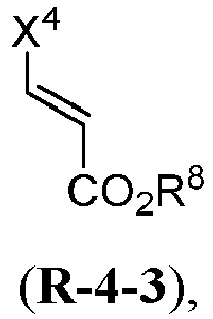

- X4 is halogen or a leaving group;
- each instance of RP5 and RP10 is independently hydrogen, optionally substituted alkyl, optionally substituted acyl, or an oxygen protecting group; optionally wherein two RP5 groups are joined together with the intervening atoms to form an optionally substituted heterocyclyl ring; and
- R8 is hydrogen, optionally substituted alkyl, optionally substituted carbocyclyl, optionally substituted aryl, optionally substituted heterocyclyl, optionally substituted heteroaryl, optionally substituted acyl, or an oxygen protecting group.
- 154. The method of any one of
clauses - 155. The method of clause 154, wherein the nickel source is (Et)2Phen●NiCl2 or (Me)2Phen(OMe)2●NiCl2.
- 156. The method of clause 154, wherein the nickel source is the following:

- 157. The method of any one of clauses 154-156, wherein the sulfonamide ligand is (S)-4-G, (R)-4-F, or (R)-4-E.
- 158. The method of any one of clauses 154-156, wherein the sulfonamide ligand is the following:

- 159. The method of any one of clauses 154-156, wherein the sulfonamide ligand is the following:

- 160. The method of any one of clauses 154-159, wherein the step of coupling is carried out in the presence of the following sulfonamide ligand and nickel source:

- 161. The method of any one of clauses 154-159, wherein the step of coupling is carried out in the presence of the following sulfonamide ligand a nickel source:

- 162. The method of any one of clauses 154-161, wherein the chromium source is CrCl3 or CrCl2.
- 163. The method of any one of
clauses - 164. The method of clause 163, wherein the lithium salt is lithium chloride (LiCl).
- 165. The method of any one of
clauses - 166. The method of any one of
clauses - 167. The method of clause 166, wherein the zirconium source is ZrCp2Cl2.
- 168. The method of any one of
clauses - 169. The method of clause 168, wherein the base or proton scavenger is 2,6-di-tert-butyl-4-methylpyridine, 2,6,-lutidine, and/or proton sponge.
- 170. The method of
clause 10 or 111, wherein the step of coupling is carried out in the presence of the following nickel source

- 171. The method of
clause 12 or 121, wherein the step of coupling is carried out in the presence of the following nickel source:

- 172. The method of
clause 16 or 153, wherein the step of coupling is carried out in the presence of the following nickel source:
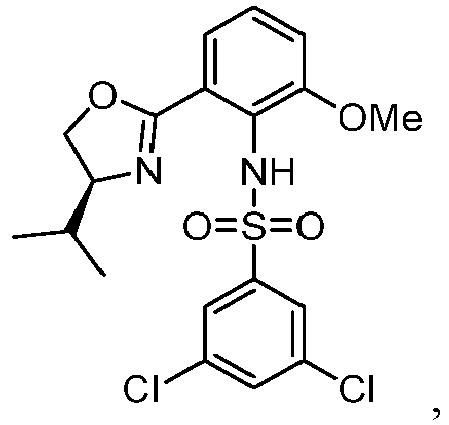
- 173. The method of any one of
clauses - 174. The method of any one of clauses 153-173 further comprising steps of (a) protecting the free hydroxyl group of the compound of Formula (E-R-18), or a salt thereof; and (b) deprotecting the resulting compound to remove the group RP10.
- 175. The method of any one of clauses 163-174 further comprising:
- (a) a step of reducing a compound of Formula (E-R-19):


- (b) a step of olefinating the compound of Formula (E-R-20), or a salt thereof, to yield a compound of Formula (E-R-21): or a salt thereof;

- (c) a step of protecting the compound of Formula (E-R-21), or salt thereof, to yield a compound of Formula (E-R-22): or a salt thereof; and

- (d) a step of oxidizing a compound of Formula (E-R-22), or a salt thereof, to yield a compound of Formula (E-R-17): or a salt thereof, wherein:

- (a) a step of reducing a compound of Formula (E-R-19):
- 176. The method of
clause 18 or 175, wherein the step of reducing is carried out in the presence of a hydride source. - 177. The method of clause 176, wherein the hydride source is lithium borohydride (LiBH4).
- 178. The method of clause 176, wherein the hydride source is diisobutylaluminum hydride (DIBAL).
- 179. The method of any one of
clauses 18 and 175-178, wherein the step of reducing is carried out in toluene. - 180. The method of any one of
clauses 18 and 175-179, wherein the step of olefinating is carried out in the presence of an olefinating reagent and a base. - 181. The method of clause 180, wherein olefinating reagent is Ph3PCH3Br.
- 182. The method of clause 180, wherein the base is t-BuOK.
- 183. The method of clause 180, wherein the step of olefinating is carried out in the presence of Ph3PCH3Br and t-BuOK.
- 184. The method of any one of
clauses 18 and 175-183, wherein the step of olefinating is carried out in THF. - 185. The method of any one of
clauses 18 and 175-184, wherein RP10 is a silyl protecting group; and the step of protecting is carried out in the presence of a silylating reagent and a base. - 186. The method of clause 185, wherein RP10 is TES; and the silylating reagent is TESOTf.
- 187. The method of clause 185, wherein the base is triethylamine (TEA).
- 188. The method of clause 185, wherein RP10 is TES; and the step of protecting is carried out in the presence of TESOTF and TEA.
- 189. The method of any one of
clauses 18 and 175-188, wherein the step of protecting is carried out in THF. - 190. The method of any one of
clauses 18 and 175-189, wherein the step of oxidizing is a Johnson-Lemieux oxidative cleavage. - 191. The method of clause 190, wherein the reaction is carried out in the presence of osmium tetroxide (OsO4) and N-Methylmorpholine N-oxide (NMO), followed by sodium periodate (NaIO4).
- 192. The method of clause 190 or 191, wherein the step of oxidizing is carried out in the presence of THF, acetone, and/or water.
- 193. A method of preparing a compound of Formula (E-L):


- RS is optionally substituted alkyl, optionally substituted carbocyclyl, optionally substituted aryl, optionally substituted heterocyclyl, or optionally substituted heteroaryl;
- each instance of RP4 and RP6 are independently hydrogen, optionally substituted alkyl, optionally substituted acyl, or an oxygen protecting group; optionally wherein two RP6 are joined with the intervening atoms to form optionally substituted heterocyclyl; and
- R8 is hydrogen, optionally substituted alkyl, optionally substituted carbocyclyl, optionally substituted aryl, optionally substituted heterocyclyl, optionally substituted heteroaryl, optionally substituted acyl, or an oxygen protecting group.
- 194. The method of
clause 19 or 193, wherein the thiolating agent is of the formula (RSS)2. - 195. The method of clause 194, wherein the thiolating agent is of the formula (pyridineS)2.
- 196. The method of clause 195, wherein the thiolating agent is:
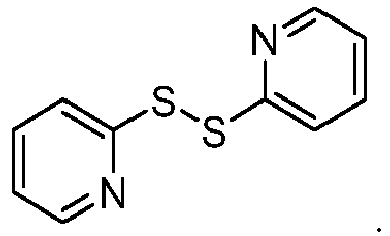
- 197. The method of any one of
clauses 19 and 193-196, wherein the step of thiolating is carried out in the presence of a phosphine reagent. - 198. The method of clause 197, wherein the phosphine is triphenylphosphine (Ph3P).
- 199. The method of any one of
clauses 19 and 193-198, wherein the reaction is carried out in the presence of the thiolating agent:
- 200. The method of any one of
clauses 19 and 193-199, wherein the reaction is carried out in the presence of acetonitrile (MeCN). - 201. The method of any one of clauses 193-200 further comprising a step of cyclizing a compound of Formula (E-L-2):


- each instance of RP4 and RP6 are independently hydrogen, optionally substituted alkyl, optionally substituted acyl, or an oxygen protecting group; optionally wherein two RP6 are joined with the intervening atoms to form optionally substituted heterocyclyl; and
- R8 is hydrogen, optionally substituted alkyl, optionally substituted carbocyclyl, optionally substituted aryl, optionally substituted heterocyclyl, optionally substituted heteroaryl, optionally substituted acyl, or an oxygen protecting group.
- 202. The method of
clause 20 or 201, wherein the step of cyclizing is carried out in the presence of a base. - 203. The method of clause 202, where the base is an amidine or guanidine base.
- 204. The method of clause 202, wherein the base is 1,8-diazabicyclo(5.4.0)undec-7-ene (DBU).
- 205. The method of any one of
clauses 20 and 201-204, wherein the step of cyclizing is carried out in the presence of a lithium salt. - 206. The method of clause 205, wherein the lithium salt is lithium bromide (LiBr).
- 207. The method of any one of
clauses 20 and 201-206, wherein the step of cyclizing is carried out in the presence of R8OAc. - 208. The method of any one of
clauses 20 and 201-207, wherein the step of cyclizing is carried out in the presence of DBU, LiBr, and AcOBn. - 209. The method of any one of
clauses 20 and 201-208, wherein the step of cyclizing is carried out in acetonitrile (MeCN). - 210. The method of any one of clauses 201-209 further comprising:
- (a) a step of deprotecting a compound of Formula (E-L-1), or a salt thereof, under conditions sufficient to remove the RP4 and R8 groups, to yield a compound of Formula (E-L-3):

- (b) a step of protecting a compound of Formula (E-L-3), or a salt thereof, to yield a compound of Formula (E-L-4):

- (a) a step of deprotecting a compound of Formula (E-L-1), or a salt thereof, under conditions sufficient to remove the RP4 and R8 groups, to yield a compound of Formula (E-L-3):
- 211. The method of
clause 21 or 210, wherein RP4 and R8 are optionally substituted benzyl protecting groups; and the step of deprotecting is carried out in the presence of H2 and Pd/C. - 212. The method of any one of
clauses 21, 210, and 211, wherein RP4 is MPM; R8 is Bn; and the step of deprotecting is carried out in the presence of H2 and Pd/C. - 213. The method of any one of
clauses 21, and 210-212, wherein the step of deprotecting is carried out in i-PrOAc. - 214. The method of any one of
clauses 21 and 210-212, wherein with respect to the compounds of Formula (E-L-4) or (L-5-7D), or salt thereof, RP4 is a silyl protecting group; and the step of protecting is carried out in the presence of a silylating agent and base. - 215. The method of clause 214, wherein RP4 is TES; and the silylating reagent is TESCl.
- 216. The method of clause 214 or 215, wherein the base is imidazole.
- 217. The method of any one of
clauses 21 and 210-216, wherein the step of protecting is carried out in DMF. - 218. The method of any one of clauses 210-217 further comprising the steps of:
- (a) oxidizing a compound of Formula (E-L-5):


- (b) reacting the compound of Formula (E-L-6), or a salt thereof, in the presence of a olefination reagent, to yield a compound of Formula (E-L-2):

- each instance of RP4 and RP6 are independently hydrogen, optionally substituted alkyl, optionally substituted acyl, or an oxygen protecting group; optionally wherein two RP6 are joined with the intervening atoms to form optionally substituted heterocyclyl; and
- R8 is hydrogen, optionally substituted alkyl, optionally substituted carbocyclyl, optionally substituted aryl, optionally substituted heterocyclyl, optionally substituted heteroaryl, optionally substituted acyl, or an oxygen protecting group.
- (a) oxidizing a compound of Formula (E-L-5):
- 219. The method of
clause 22 or 218, wherein the step of oxidizing is a Johnson-Lemieux oxidative cleavage. - 220. The method of clause 219, wherein the step of oxidizing is carried out in the presence of (OsO4) or potassium osmate (VI) dehydrate (K2OSO4); and N-Methylmorpholine N-oxide (NMO).
- 221. The method of clause 219 or 220, wherein the step of oxidizing is carried out in the presence of a lead complex.
- 222. The method of clause 221, wherein the lead complex is lead acetate (Pb(OAc)4).
- 223. The method of any one of clauses 219-222, wherein the step of oxidizing is carried out in the presence of sodium periodate (NaIO4).
- 224. The method of any one of
clauses 22 and 218-223, wherein the reaction is carried out in the presence of potassium osmate (VI) dehydrate (K2OSO4) and N-Methylmorpholine N-oxide (NMO), followed by sodium periodate (NaIO4). - 225. The method of any one of
clauses 22 and 218-224, wherein the step of oxidizing is carried out in the presence of acetone and/or water. - 226. The method of any one of
clauses 22 and 218-225, wherein the olefination reagent is of the formula: (RO)2P(O)CH2CO2R8. - 227. The method of clause 226, wherein the olefination reagent is of the formula: (MeO)2P(O)CH2CO2R8.
- 228. The method of any one of
clauses 22 and 218-227, wherein the step of olefinating is carried out in the presence of a base. - 229. The method of clause 228, wherein the base is a phosphate.
- 230. The method of clause 229, wherein the base is potassium phosphate (K3PO4).
- 231. The method of any one of
clauses 22 and 218-230, wherein the step of olefinating is carried out in the presence of (MeO)2P(O)CH2CO2Bn and K3PO4. - 232. The method of any one of
clauses 22 and 218-231, wherein the step of olefinating is carried out in the presence of toluene. - 233. The method of any one of clauses 218-232 further comprising a step of coupling a compound of Formula (E-L-7):


- X4 is halogen or a leaving group; and
- each instance of RP4 and RP6 are independently hydrogen, optionally substituted alkyl, optionally substituted acyl, or an oxygen protecting group; optionally wherein two RP6 are joined with the intervening atoms to form optionally substituted heterocyclyl.
- 234. The method of
clause 23 or 233, wherein the step of coupling is carried out in the presence of a metal. - 235. The method of any one of clauses 234, wherein the step of coupling is carried out in the presence of an organolithium.
- 236. The method of clause 235, wherein the organolithium is tert-butyllithium.
- 237. The method of clause 236, wherein the organolithium is sec-butyllithium.
- 238. The method of any one of
clauses 23 and 233-237, wherein the step of coupling is carried out in THF. - 239. The method of any one of the preceding clauses, wherein the compound of Formula (A) is the following:

- 240. The method of any one of the preceding clauses, wherein the compound of Formula (E-1) is the following:

- 241. The method of any one of the preceding clauses, wherein the compound of the formula (E-R) is the following:

- 242. The method of any one of the preceding clauses, wherein the compound of Formula (E-R-1) is the following:
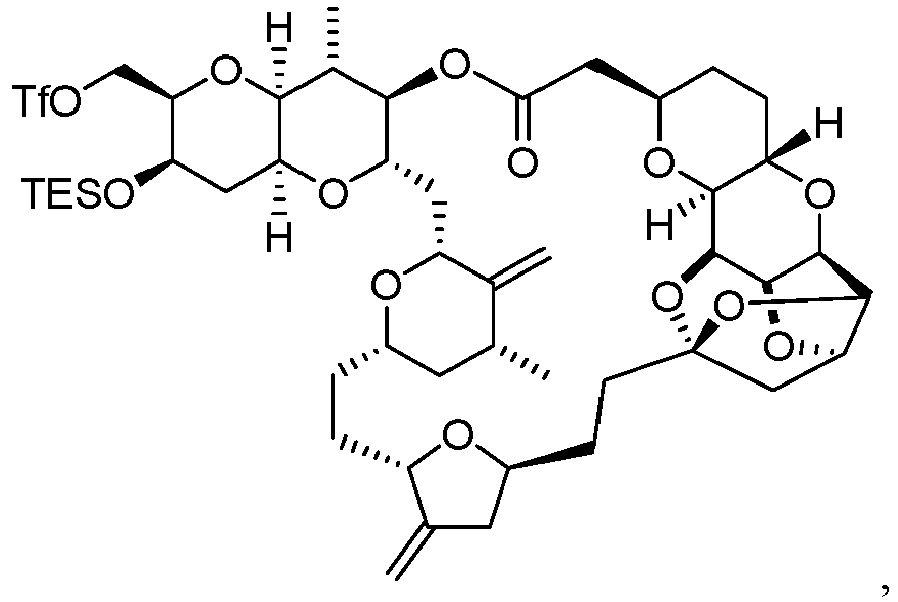
- 243. The method of any one of the preceding clauses, wherein the compound of Formula (E-R-2) is the following:
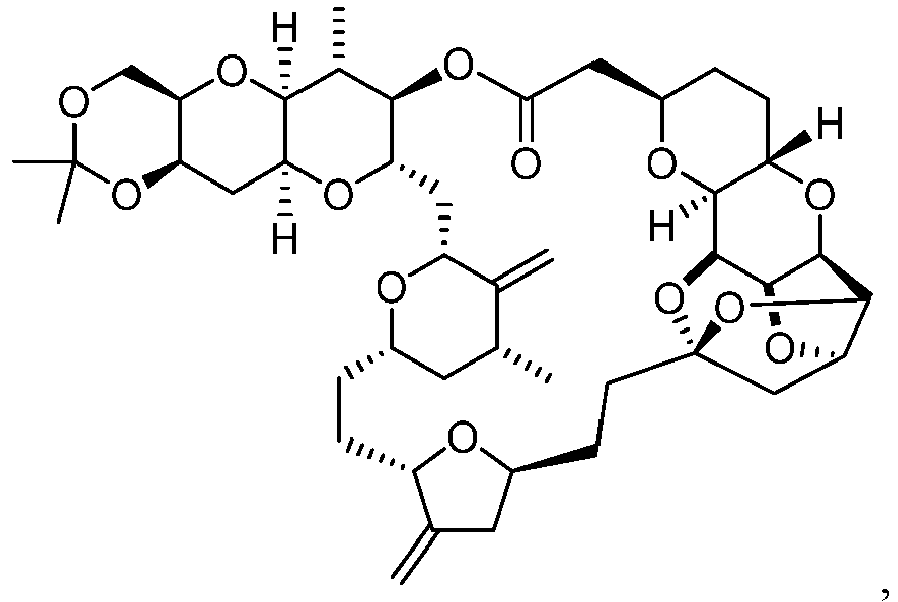
- 244. The method of any one of the preceding clauses, wherein the compound of Formula (E-R-3) is the following:

- 245. The method any one of the preceding clauses, wherein the compound of Formula (E-R-4) is the following:

- 246. The method of any one of the preceding clauses, wherein the compound of Formula (E-R-5) is the following:

- 247. The method of any one of the preceding clauses, wherein the compound of Formula (E-R-6) is the following:

- 248. The method of any one of the preceding clauses, wherein the compound of Formula (E-R-7) is the following:

- 249. The method of any one of the preceding clauses, wherein the compound of Formula (E-R-9) is the following:

- 250. The method of any one of the preceding clauses, wherein the compound of Formula (E-R-10) is the following:
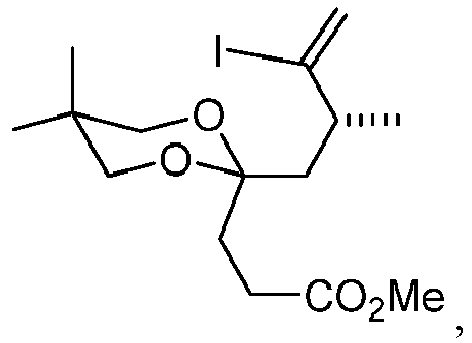
- 251. The method of any one of the preceding clauses, wherein the compound of Formula (E-R-11) is the following:

- 252. The method of any one of the preceding clauses, wherein the compound of Formula (E-R-12) is the following:

- 253. The method of any one of the preceding clauses, wherein the compound of formula of Formula (E-R-13) is the following:

- 254. The method of any one of the preceding clauses, wherein the compound of Formula (E-R-8) or Formula (E-R-14) is the following:

- 255. The method of any one of the preceding clauses, wherein the compound of Formula (E-R-15) is the following:

- 256. The method of any one of the preceding clauses, wherein the compound of Formula (E-R-16) is the following:

- 257. The method of any one of the preceding clauses, wherein the compound of Formula (E-R-17) is the following:

- 258. The method of any one of the preceding clauses, wherein the compound of Formula (R-4-3) is the following:

- 259. The method of any one of the preceding clauses, wherein the compound of Formula (E-R-18) is the following:

- 260. The method of any one of the preceding clauses, wherein the compound of Formula (E-R-19) is the following:

- 261. The method of any one of the preceding clauses, wherein the compound of Formula (E-R-20) is the following:

- 262. The method of any one of the preceding clauses, wherein the compound of Formula (E-R-21) is the following:

- 263. The method of any one of the preceding clauses, wherein the compound of Formula (E-R-22) is the following:

- 264. The method of any one of the preceding clauses, wherein the compound of Formula (E-L) is the following:

- 265. The method of any one of the preceding clauses, wherein the compound of Formula (E-L-1) is the following:

- 266. The method of any one of the preceding clauses, wherein the compound of Formula (E-L-3) is the following:

- 267. The method of any one of the preceding clauses, wherein the compound of Formula (E-L-4) is the following:

- 268. The method of any one of the preceding clauses, wherein the compound of Formula (E-L-5) is the following:

- 269. The method of any one of the preceding clauses, wherein the compound of Formula (E-L-6) is of the formula:

- 270. A method for preparing a compound of Formula (C):


- RA is optionally substituted alkyl;
- RB is optionally substituted alkyl, optionally substituted alkenyl, optionally substituted alkynyl, optionally substituted aryl, optionally substituted carbocyclyl, optionally substituted heteroaryl, or optionally substituted heterocyclyl;
- optionally wherein RA and RB are joined together via a linker, wherein the linker is selected from the group consisting of optionally substituted alkylene, optionally substituted heteroalkylene, optionally substituted alkenylene, optionally substituted heteroalkenylene, optionally substituted alkynylene, optionally substituted heteroalkynylene, optionally substituted arylene, optionally substituted heteroarylene, optionally substituted carbocyclylene, optionally substituted heterocyclylene, optionally substituted acylene, and combinations thereof;
- X1 is halogen or a leaving group; and
- RS is optionally substituted alkyl, optionally substituted carbocyclyl, optionally substituted aryl, optionally substituted heterocyclyl, or optionally substituted heteroaryl.
- 271. A method of preparing a compound of Formula (H-2-I):


- R1, R2, R3, and R5 are each independently hydrogen, halogen, or optionally substituted alkyl;
- each instance of R4 is independently hydrogen, halogen, or optionally substituted alkyl, or two R4 groups are taken together to form:

- each instance of R6 is independently hydrogen, halogen, or optionally substituted alkyl, or two R6 groups are taken together to form:

- RP1, RP2, RP3, RP4, and RP5 are each independently hydrogen, optionally substituted alkyl, optionally substituted acyl, or an oxygen protecting group;
- RX is hydrogen or -ORXa, wherein RXa is hydrogen, optionally substituted alkyl, optionally substituted acyl, or an oxygen protecting group; and
- RY is hydrogen or -ORYa, wherein RYa is hydrogen, optionally substituted alkyl, optionally substituted acyl, or an oxygen protecting group;
- optionally wherein RXa and RYa are joined together with their intervening atoms to form optionally substituted heterocyclyl.
- 272. The method of clause 271, further comprising a step of coupling a compound of Formula (L-2-14):


- RS is optionally substituted alkyl, optionally substituted carbocyclyl, optionally substituted aryl, optionally substituted heterocyclyl, or optionally substituted heteroaryl;
- X1 is halogen or a leaving group;
- R1, R2, R3, and R5 are each independently hydrogen, halogen, or optionally substituted alkyl;
- each instance of R4 is independently hydrogen, halogen, or optionally substituted alkyl, or two R4 groups are taken together to form:

- each instance of R6 is independently hydrogen, halogen, or optionally substituted alkyl, or two R6 groups are taken together to form:

- RP1, RP2, RP3, RP4, and RP5 are each independently hydrogen, optionally substituted alkyl, optionally substituted acyl, or an oxygen protecting group;
- RX is hydrogen or -ORXa, wherein RXa is hydrogen, optionally substituted alkyl, optionally substituted acyl, or an oxygen protecting group; and
- RY is hydrogen or -ORYa, wherein RYa is hydrogen, optionally substituted alkyl, optionally substituted acyl, or an oxygen protecting group;
- optionally wherein RXa and RYa are joined together with their intervening atoms to form optionally substituted heterocyclyl.
- 273. The method of clause 272, further comprising a step of deprotecting one or more oxygen atoms of the compound of Formula (H-2-II), or a salt thereof.
- 274. A method of preparing a compound of Formula (HH-2-I):


- R1, R2, R3, and R5 are each independently hydrogen, halogen, or optionally substituted alkyl;
- each instance of R4 is independently hydrogen, halogen, or optionally substituted alkyl, or two R4 groups are taken together to form:

- each instance of R6 is independently hydrogen, halogen, or optionally substituted alkyl, or two R6 groups are taken together to form:

- RP1, RP3, RP4, and RP5 are each independently hydrogen, optionally substituted alkyl, optionally substituted acyl, or an oxygen protecting group;
- RX is hydrogen or -ORXa, wherein RXa is hydrogen, optionally substituted alkyl, optionally substituted acyl, or an oxygen protecting group; and
- RY is hydrogen or -ORYa, wherein RYa is hydrogen, optionally substituted alkyl, optionally substituted acyl, or an oxygen protecting group;
- optionally wherein RXa and RYa are joined together with their intervening atoms to form optionally substituted heterocyclyl.
- 275. The method of clause 274 further comprising a step of coupling a compound of Formula (L-2-16):


- RS is optionally substituted alkyl, optionally substituted carbocyclyl, optionally substituted aryl, optionally substituted heterocyclyl, or optionally substituted heteroaryl;
- X1 is halogen or a leaving group;
- R1, R2, R3, and R5 are each independently hydrogen, halogen, or optionally substituted alkyl;
- each instance of R4 is independently hydrogen, halogen, or optionally substituted alkyl, or two R4 groups are taken together to form:

- each instance of R6 is independently hydrogen, halogen, or optionally substituted alkyl, or two R6 groups are taken together to form:

- RP1, RP3, RP4, and RP5 are each independently hydrogen, optionally substituted alkyl, optionally substituted acyl, or an oxygen protecting group;
- RX is hydrogen or -ORXa, wherein RXa is hydrogen, optionally substituted alkyl, optionally substituted acyl, or an oxygen protecting group; and
- RY is hydrogen or -ORYa, wherein RYa is hydrogen, optionally substituted alkyl, optionally substituted acyl, or an oxygen protecting group;
- optionally wherein RXa and RYa are joined together with their intervening atoms to form optionally substituted heterocyclyl.
- 276. The method clause 275, further comprising a step of deprotecting one or more oxygen atoms of the compound of Formula (HH-2-II), or a salt thereof.
- 277. A method of preparing a compound of Formula (NH-2-I):


- R1, R2, R3, and R5 are each independently hydrogen, halogen, or optionally substituted alkyl;
- each instance of R4 is independently hydrogen, halogen, or optionally substituted alkyl, or two R4 groups are taken together to form:

- each instance of R6 is independently hydrogen, halogen, or optionally substituted alkyl, or two R6 groups are taken together to form:

- RP3, RP4, and RP5 are each independently hydrogen, optionally substituted alkyl, optionally substituted acyl, or an oxygen protecting group;
- R7 is hydrogen, optionally substituted alkyl, optionally substituted carbocyclyl, optionally substituted aryl, optionally substituted heterocyclyl, optionally substituted heteroaryl, optionally substituted acyl, or an oxygen protecting group;
- RX is hydrogen or -ORXa, wherein RXa is hydrogen, optionally substituted alkyl, optionally substituted acyl, or an oxygen protecting group; and
- RY is hydrogen or -ORYa, wherein RYa is hydrogen, optionally substituted alkyl, optionally substituted acyl, or an oxygen protecting group;
- optionally wherein RXa and RYa are joined together with their intervening atoms to form optionally substituted heterocyclyl.
- 278. The method clause 277, further comprising a step of coupling a compound of Formula (L-2-15):
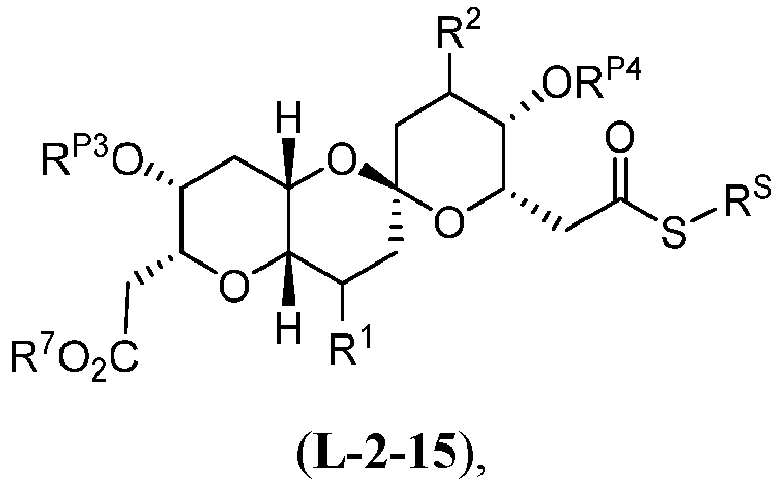


- RS is optionally substituted alkyl, optionally substituted carbocyclyl, optionally substituted aryl, optionally substituted heterocyclyl, or optionally substituted heteroaryl;
- X1 is halogen or a leaving group;
- R1, R2, R3, and R5 are each independently hydrogen, halogen, or optionally substituted alkyl;
- each instance of R4 is independently hydrogen, halogen, or optionally substituted alkyl, or two R4 groups are taken together to form:

- each instance of R6 is independently hydrogen, halogen, or optionally substituted alkyl, or two R6 groups are taken together to form:
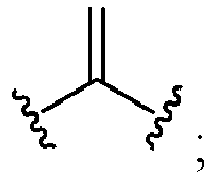
- RP3, RP4, and RP5 are each independently hydrogen, optionally substituted alkyl, optionally substituted acyl, or an oxygen protecting group;
- R7 is hydrogen, optionally substituted alkyl, optionally substituted carbocyclyl, optionally substituted aryl, optionally substituted heterocyclyl, optionally substituted heteroaryl, optionally substituted acyl, or an oxygen protecting group;
- RX is hydrogen or -ORXa, wherein RXa is hydrogen, optionally substituted alkyl, optionally substituted acyl, or an oxygen protecting group; and
- RY is hydrogen or -ORYa, wherein RYa is hydrogen, optionally substituted alkyl, optionally substituted acyl, or an oxygen protecting group;
- optionally wherein RXa and RYa are joined together with their intervening atoms to form optionally substituted heterocyclyl.
- 279. The method clause 278, further comprising a step of deprotecting one or more oxygen atoms of the compound of Formula (NH-2-II), or a salt thereof.
- 280. The method of any one of clauses 270, 272, 275, and 278, wherein the step of coupling is carried out in the presence of nickel and zirconium.
- 281. The method of clause 280, wherein the nickel is a nickel complex.
- 282. The method of clause 280 or 281, wherein the nickel is a nickel(II) or nickel(0) complex.
- 283. The method of any one of clauses 280-282, wherein the nickel source is of the formula: NiX2●(ligand); wherein X is halogen and "ligand" is a bidentate ligand.
- 284. The method of any one of clauses 280-283, wherein the nickel complex is used after complexation of a nickel source and a "ligand" in solution.
- 285. The method of any one of clauses 280-284, wherein the nickel source is NiCh; the "ligand" is 4,4'-di-tert-butyl-2,2'-dipyridyl (tbbpy); and the nickel complex is of the formula NiCl2●(tbbpy).
- 286. The method of any one of clauses 280-284, wherein the nickel source is NiBr2; and the "ligand" is 4,4'-di-tert-butyl-2,2'-dipyridyl (tbbpy); and the nickel complex is of the formula NiBr2●(tbbpy).
- 287. The method of any one of clauses 280-286, wherein the nickel is present in a catalytic amount.
- 288. The method of any one of clauses 280-287, wherein the nickel is present in from 1-50 mol%.
- 289. The method of any one of clauses 280-288, wherein the nickel is present in from 1-10 mol%.
- 290. The method of any one of clauses 280-289, wherein the zirconium a zirconium complex.
- 291. The method of any one of clauses 280-290, wherein the zirconium source is of the formula: (ligand)nZrX2; wherein
n - 292. The method of any one of clauses 280-291, wherein the zirconium source is Cp2ZrCl2.
- 293. The method of any one of clauses 280-292, wherein the zirconium is present in stoichiometric or excess amount.
- 294. The method of any one of clauses 280-293, wherein the zirconium is present in about 1 to about 3 equivalents.
- 295. The method of any one of clauses 270, 272, 275, 278, and 280-294, wherein the step of coupling is carried out in the presence of zinc or manganese.
- 296. The method of clause 295 wherein the reaction is carried out in the presence of zinc, and the zinc source is zinc metal.
- 297. The method of clause 295, wherein the reaction is carried out in the presence of manganese, and the manganese source is manganese metal.
- 298. The method of clause 295 or 296, wherein the zinc or manganese is present in an excess amount.
- 299. The method of any one of clauses 270, 272, 275, 278, and 280-298, wherein the step of coupling is carried out in the presence of triethylsilyl chloride (TESCl).
- 300. The method of any one of clauses 270, 272, 275, 278, and 280-299, wherein the step of coupling is carried out in the presence of a base or proton scavenger.
- 301. The method of clause 300, wherein the base or proton scavenger is 2,6-di-tert-butyl-4-methylpyridine.
- 302. The method of any one of clauses 270, 272, 275, 278, and 280-301, wherein the step of coupling is carried out in one or more solvents.
- 303. The method of clause 302, wherein the step of coupling is carried out in 1,3-dimethyl-2-imidazolidinone (DMI).
- 304. The method of clause 302, wherein the step of coupling is carried out in 1,3-dimethyl-2-imidazolidinone (DMI), tetrahydrofuran (THF) mixture, ethyl acetate (EtOAc), or any combination or mixture thereof.
- 305. The method of any one of clauses 270, 272, 275, 278, and 280-304 wherein the reaction is carried out at or around room temperature.
- 306. The method of any one of clauses 270, 272, 275, 278, and 280-304, wherein the reaction is carried out at above room temperature.
- 307. The method of any one of clauses 271, 274, and 277, wherein the step of cyclizing is carried out in the presence of an acid.
- 308. The method of clause 307, wherein the acid is a pyridinium salt.
- 309. The method of clause 308, wherein the acid is pyridinium p-toluenesulfonate (PPTS).
- 310. A method of preparing a compound of Formula (L-2-14):


- RS is optionally substituted alkyl, optionally substituted carbocyclyl, optionally substituted aryl, optionally substituted heterocyclyl, or optionally substituted heteroaryl;
- R1 and R2 are independently hydrogen, halogen, or optionally substituted alkyl;
- RP1, RP2, RP3, and RP4 are independently hydrogen, optionally substituted alkyl, optionally substituted acyl, or an oxygen protecting group; and
- R8 is hydrogen, optionally substituted alkyl, optionally substituted carbocyclyl, optionally substituted aryl, optionally substituted heterocyclyl, optionally substituted heteroaryl, optionally substituted acyl, or an oxygen protecting group.
- 311. The method of clause 310, the method further comprising:
- (a) a step of cyclizing a compound of Formula (L-5-16A):


- R1 and R2 are independently hydrogen, halogen, or optionally substituted alkyl;
- RP1, RP2, RP3, RP4, and RP10 are independently hydrogen, optionally substituted alkyl, optionally substituted acyl, or an oxygen protecting group; and
- R8 is hydrogen, optionally substituted alkyl, optionally substituted carbocyclyl, optionally substituted aryl, optionally substituted heterocyclyl, optionally substituted heteroaryl, optionally substituted acyl, or an oxygen protecting group.
- (a) a step of cyclizing a compound of Formula (L-5-16A):
- 312. The method of clause 311 further comprising a step of deprotecting a compound of Formula (L-5-17), or a salt thereof, to yield a compound of Formula (L-5-17C):

- 313. The method of clause 311 further comprising the steps of:
- (a) oxidizing a compound of Formula (L-5-15):


- (b) reacting the compound of Formula (L-5-15B), or a salt thereof, in the presence of a olefination reagent, to yield a compound of Formula (L-5-15C):

- R1 and R2 are independently hydrogen, halogen, or optionally substituted alkyl;
- RP1, RP2, RP3, RP4, and RP10 are independently hydrogen, optionally substituted alkyl, optionally substituted acyl, or an oxygen protecting group; and
- R8 is hydrogen, optionally substituted alkyl, optionally substituted carbocyclyl, optionally substituted aryl, optionally substituted heterocyclyl, optionally substituted heteroaryl, optionally substituted acyl, or an oxygen protecting group.
- (a) oxidizing a compound of Formula (L-5-15):
- 314. The method of clause 313 further comprising a step of reacting a compound of Formula (L-5-14):


- R1 and R2 are independently hydrogen, halogen, or optionally substituted alkyl; and
- RP1, RP2, RP3, RP4, and RP10 are independently hydrogen, optionally substituted alkyl, optionally substituted acyl, or an oxygen protecting group.
- 315. The method of clause 314, wherein the acid is diphenylphosphate ((PhO)2P(=O)OH).
- 316. The method of clause 314 or 315 further comprising a step of coupling a compound of Formula (L-5-12):


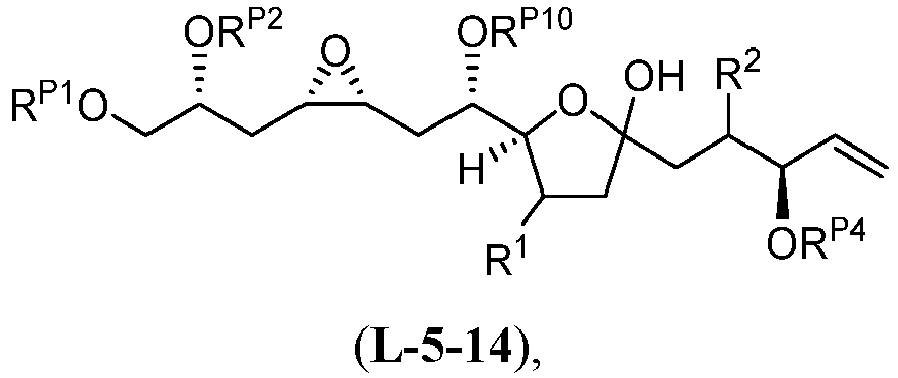
- X4 is halogen or a leaving group;
- R1 and R2 are independently hydrogen, halogen, or optionally substituted alkyl; and
- RP1, RP2, RP4, and RP10 are independently hydrogen, optionally substituted alkyl, optionally substituted acyl, or an oxygen protecting group.
- 317. The method of clause 316, the method further comprising a step of epoxidizing a compound of Formula (L-5-11):

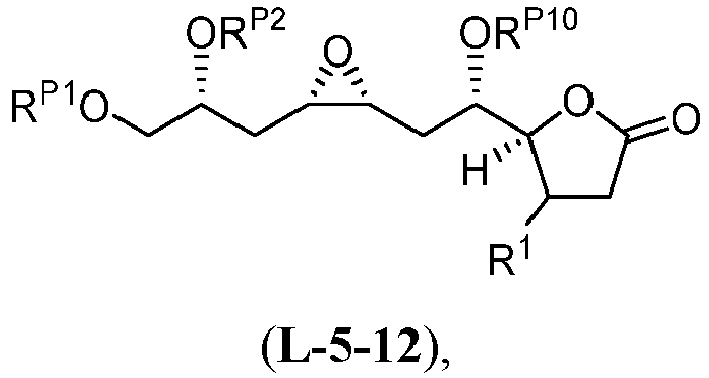
- R1 is hydrogen, halogen, or optionally substituted alkyl; and
- RP1, RP2, and RP10 are independently hydrogen, optionally substituted alkyl, optionally substituted acyl, or an oxygen protecting group.
- 318. The method of clause 317, wherein the step of epoxidizing is carried out in the presence of a Vanadium reagent.
- 319. The method of clause 318, wherein the vanadium reagent is VO(TMHD)2.
- 320. The method of any one of clauses 317-319, wherein the step of epoxidizing was carried out in the presence of a peroxide
- 321. The method of clause 320, wherein the peroxide is t-BuOOH.
- 322. The method of any one of clauses 317-321 further comprising a step of coupling a compound of Formula (L-5-10):
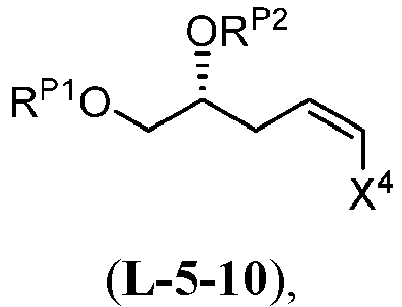


- X4 is halogen or a leaving group;
- R1 is hydrogen, halogen, or optionally substituted alkyl; and
- RP1, RP2, and RP10 are independently hydrogen, optionally substituted alkyl, optionally substituted acyl, or an oxygen protecting group.
- 323. The method of clause 322, wherein the step of coupling is carried out in the presence of copper.
- 324. The method of clause 323, wherein the copper source is Li(thienylCuCN).
- 325. The method of any one of clauses 322-324, wherein the step of coupling is carried out in the presence of an organolithium.
- 326. The method of clause 325, wherein the organolithium is n-butyllithium.
- 327. A method of preparing a compound of Formula (L-2-16):
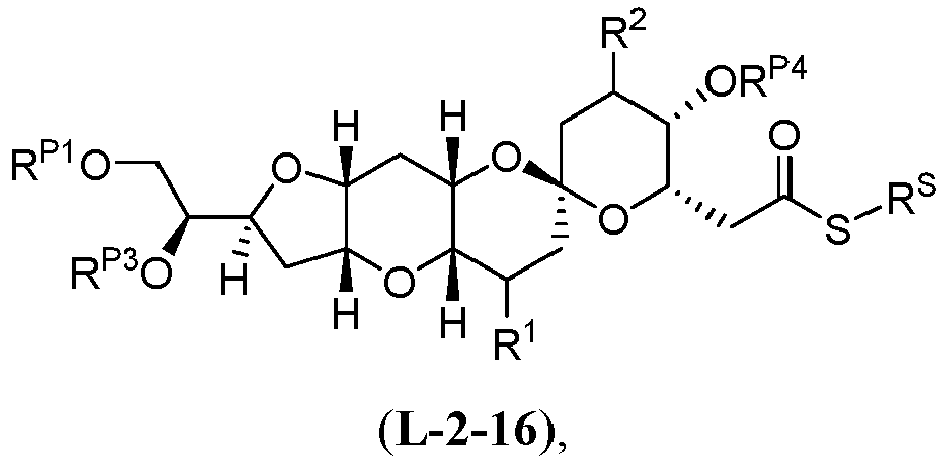

- RS is optionally substituted alkyl, optionally substituted carbocyclyl, optionally substituted aryl, optionally substituted heterocyclyl, or optionally substituted heteroaryl;
- R1 and R2 are independently hydrogen, halogen, or optionally substituted alkyl;
- RP1, RP3, and RP4 are each independently hydrogen, optionally substituted alkyl, optionally substituted acyl, or an oxygen protecting group; and
- R8 is hydrogen, optionally substituted alkyl, optionally substituted carbocyclyl, optionally substituted aryl, optionally substituted heterocyclyl, optionally substituted heteroaryl, optionally substituted acyl, or an oxygen protecting group.
- 328. The method of clause 327 further comprising a step of cyclizing a compound of Formula (L-5-25C):


- R1 and R2 are independently hydrogen, halogen, or optionally substituted alkyl;
- RP1, RP3, and RP4 are each independently hydrogen, optionally substituted alkyl, optionally substituted acyl, or an oxygen protecting group; and
- R8 is hydrogen, optionally substituted alkyl, optionally substituted carbocyclyl, optionally substituted aryl, optionally substituted heterocyclyl, optionally substituted heteroaryl, optionally substituted acyl, or an oxygen protecting group.
- 329. The method of clause 328 further comprising:
- (a) a step of oxidizing a compound of Formula (L-5-25A):


- (b) reacting the compound of Formula (L-5-25B), or a salt thereof, in the presence of a olefination reagent, to yield a compound of Formula (L-5-25C):

- R1 and R2 are independently hydrogen, halogen, or optionally substituted alkyl;
- RP1, RP3, and RP4 are each independently hydrogen, optionally substituted alkyl, optionally substituted acyl, or an oxygen protecting group; and
- R8 is hydrogen, optionally substituted alkyl, optionally substituted carbocyclyl, optionally substituted aryl, optionally substituted heterocyclyl, optionally substituted heteroaryl, optionally substituted acyl, or an oxygen protecting group.
- (a) a step of oxidizing a compound of Formula (L-5-25A):
- 330. The method of clause 329 further comprising a step of coupling a compound of Formula (L-5-5):


- X4 is halogen or a leaving group;
- R1 and R2 are independently hydrogen, halogen, or optionally substituted alkyl;
- RP1, RP3, and RP4 are each independently hydrogen, optionally substituted alkyl, optionally substituted acyl, or an oxygen protecting group; and
- R8 is hydrogen, optionally substituted alkyl, optionally substituted carbocyclyl, optionally substituted aryl, optionally substituted heterocyclyl, optionally substituted heteroaryl, optionally substituted acyl, or an oxygen protecting group.
- 331. The method of clause 330 further comprising:
- (a) a step of oxidizing a compound of Formula (L-5-23B):


- (b) cyclizing a compound of Formula (L-5-23C), or a salt thereof, to yield a compound of Formula (L-5-24):

- R1 is hydrogen, halogen, or optionally substituted alkyl; and
- RP1, RP3, and RP10 are each independently hydrogen, optionally substituted alkyl, optionally substituted acyl, or an oxygen protecting group.
- (a) a step of oxidizing a compound of Formula (L-5-23B):
- 332. The method of clause 331, wherein the step of oxidizing is carried out in the presence of hypervalent iodine.
- 333. The method of clause 332, wherein the hypervalent iodine reagent is (Diacetoxyiodo)benzene (PhI(OAc)2).
- 334. The method of clause 331, wherein the step of oxidizing is carried out in the presence of (2,2,6,6-tetramethylpiperidin-1-yl)oxyl (TEMPO).
- 335. The method of any one of clauses 331-334, the method further comprising a step of hydrating a compound of Formula (L-5-23A):


- R1 is hydrogen, halogen, or optionally substituted alkyl; and
- RP1, RP3, and RP10 are each independently hydrogen, optionally substituted alkyl, optionally substituted acyl, or an oxygen protecting group.
- 336. The method of clause 335, wherein the step of hydrating involves a hydroboration reaction.
- 337. The method of clause 336, wherein the hydroboration reaction is carried out in the presence of 9-BBN.
- 338. The method of clause 336 or 337, wherein the hydroboration reaction is carried out in the presence of NaBO3●H2O.
- 339. The method of any one of clauses 336-338 further comprising:
- (a) a step of epoxidizing a compound of Formula (L-5-22):

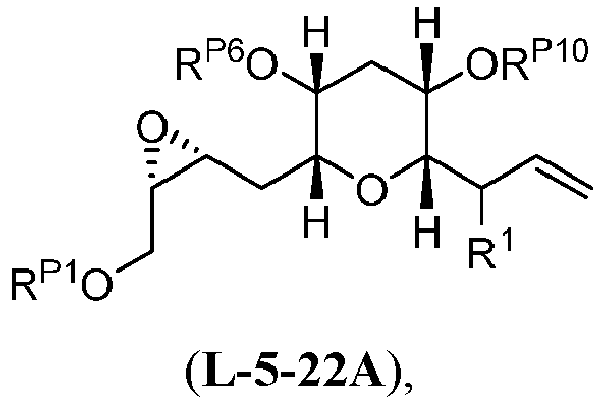
- (b) cyclizing a compound of Formula (L-5-22A), or a salt thereof, to yield a compound of Formula (L-5-23A):

- R1 is hydrogen, halogen, or optionally substituted alkyl; and
- RP1, RP3, and RP10 are each independently hydrogen, optionally substituted alkyl, optionally substituted acyl, or an oxygen protecting group.
- (a) a step of epoxidizing a compound of Formula (L-5-22):
- 340. The method of clause 339, wherein the step of epoxidizing is carried out in the presence of a titanium reagent.
- 341. The method of clause 340, wherein the titanium reagent is titanium isopropoxide Ti(Oi-Pr)4.
- 342. The method of any one of clauses 339-341, wherein the step of epoxidizing is carried out in the presence of (+)-diethyltartrate ((+)-DET).
- 343. The method of any one of clauses 339-342, wherein the step of epoxidizing is carried out in the presence of a peroxide.
- 344. The method of clause 343, wherein the peroxide is t-BuOOH (TBHP).
- 345. The method of any one of clauses 339-344 further comprising a step of reducing a compound of Formula (L-5-21B):


- R1 is hydrogen, halogen, or optionally substituted alkyl;
- RP1, RP6, and RP10 are each independently hydrogen, optionally substituted alkyl, optionally substituted acyl, or an oxygen protecting group; and
- R8 is hydrogen, optionally substituted alkyl, optionally substituted carbocyclyl, optionally substituted aryl, optionally substituted heterocyclyl, optionally substituted heteroaryl, optionally substituted acyl, or an oxygen protecting group.
- 346. The method of clause 345, wherein the step of reducing is carried out in the presence of a hydride source.
- 347. The method of clause 346, wherein the hydride source is diisobutylaluminum hydride (DIBAL).
- 348. The method of any one of clauses 345-347 further comprising:
- (a) a step of reducing a compound of Formula (L-5-21A):


- (b) a step of reacting a compound of Formula (L-5-21C), or a salt thereof, in the presence of an olefinating reagent to yield a compound of Formula (L-5-21B):

- R1 is hydrogen, halogen, or optionally substituted alkyl;
- RP1, RP6, and RP10 are each independently hydrogen, optionally substituted alkyl, optionally substituted acyl, or an oxygen protecting group; and
- R8 is hydrogen, optionally substituted alkyl, optionally substituted carbocyclyl, optionally substituted aryl, optionally substituted heterocyclyl, optionally substituted heteroaryl, optionally substituted acyl, or an oxygen protecting group.
- (a) a step of reducing a compound of Formula (L-5-21A):
- 349. The method of clause 348, wherein the step of reducing is carried out in the presence of a hydride source.
- 350. The method of clause 349, wherein the hydride source is diisobutylaluminum hydride (DIBAL).
- 351. The method of any one of clauses 348-350, wherein the olefinating reagent is of the formula (CF3CH2O)2P(O)CH2CO2R8.
- 352. The method of any one of clauses 348-351, wherein the step of olefinating is carried out in the presence of a base.
- 353. The method of clause 352, wherein the base is potassium hexamethyldisilazide (KHMDS).
- 354. The method of any one of clauses 348-353 further comprising a step of reacting a compound of Formula (L-5-20):


- R1 is hydrogen, halogen, or optionally substituted alkyl;
- RP6, RP7 and RP10 are each independently hydrogen, optionally substituted alkyl, optionally substituted acyl, or an oxygen protecting group; and wherein -ORP7 is a leaving group.
- 355. The method of clause 354, wherein the cyanide source is sodium cyanide (NaCN). 356. A method of preparing a compound of Formula (L-2-15):


- RS is optionally substituted alkyl, optionally substituted carbocyclyl, optionally substituted aryl, optionally substituted heterocyclyl, or optionally substituted heteroaryl;
- R1 and R2 are independently hydrogen, halogen, or optionally substituted alkyl;
- each instance of RP4 and RP6 are independently hydrogen, optionally substituted alkyl, optionally substituted acyl, or an oxygen protecting group; and
- R7 and R8 are independently hydrogen, optionally substituted alkyl, optionally substituted carbocyclyl, optionally substituted aryl, optionally substituted heterocyclyl, or optionally substituted heteroaryl.
- 357. The method of clause 356 further comprising a step of oxidizing a compound of Formula (L-5-31):


- R1 and R2 are independently hydrogen, halogen, or optionally substituted alkyl;
- RP1, RP4, and RP6 are independently hydrogen, optionally substituted alkyl, optionally substituted acyl, or an oxygen protecting group; and
- R8 is hydrogen, optionally substituted alkyl, optionally substituted carbocyclyl, optionally substituted aryl, optionally substituted heterocyclyl, optionally substituted heteroaryl, optionally substituted acyl, or an oxygen protecting group.
- 358. The method of clause 357, wherein the step of oxidizing is carried out in the presence of a periodinane, followed by a chlorite salt.
- 359. The method of clause 358, wherein the periodinane is Dess-Martin periodinane (DMP).
- 360. The method of clause 358, wherein the chlorite salt is sodium chlorite (NaClO2).
- 361. The method of any one of clauses 357-360 further comprising a step of cyclizing a compound of Formula (L-5-32A):


- R1 and R2 are independently hydrogen, halogen, or optionally substituted alkyl;
- RP1, RP4 and RP6 are independently hydrogen, optionally substituted alkyl, optionally substituted acyl, or an oxygen protecting group; optionally wherein two RP6 are joined with the intervening atoms to form optionally substituted heterocyclyl; and
- R8 is hydrogen, optionally substituted alkyl, optionally substituted carbocyclyl, optionally substituted aryl, optionally substituted heterocyclyl, optionally substituted heteroaryl, optionally substituted acyl, or an oxygen protecting group.
- 362. The method of clause 361 further comprising a step of:
- (a) a step of oxidizing a compound of Formula (L-5-28):


- (b) reacting the compound of Formula (L-5-29)), or a salt thereof, in the presence of a olefination reagent, to yield a compound of Formula (L-5-30):

- R1 and R2 are independently hydrogen, halogen, or optionally substituted alkyl;
- RP1, RP4 and RP6 are independently hydrogen, optionally substituted alkyl, optionally substituted acyl, or an oxygen protecting group; optionally wherein two RP6 are joined with the intervening atoms to form optionally substituted heterocyclyl; and
- R8 is hydrogen, optionally substituted alkyl, optionally substituted carbocyclyl, optionally substituted aryl, optionally substituted heterocyclyl, optionally substituted heteroaryl, optionally substituted acyl, or an oxygen protecting group.
- (a) a step of oxidizing a compound of Formula (L-5-28):
- 363. The method of clause 362 further comprising a step of coupling a compound of Formula (L-5-27):


- X4 is halogen or a leaving group;
- R1 and R2 are independently hydrogen, halogen, or optionally substituted alkyl; and
- each instance of RP4 and RP6 are independently hydrogen, optionally substituted alkyl, optionally substituted acyl, or an oxygen protecting group; optionally wherein two RP6 are joined with the intervening atoms to form optionally substituted heterocyclyl.
- 364. The method of any one of clauses 310, 327, and 356, wherein the thiolating agent is of the formula (RSS)2.
- 365. The method of clause 364, wherein the thiolating agent is of the formula (pyridineS)2.
- 366. The method of clause 365, wherein the thiolating agent is:

- 367. The method of any one of clauses 310, 327, 356, and 364-366, wherein the step of thiolating is carried out in the presence of a phosphine reagent.
- 368. The method of clause 367, wherein the phosphine is triphenylphosphine (Ph3P).
- 369. The method of any one of clauses 311, 328, and 361, wherein the step of cyclizing is carried out in the presence of a base.
- 370. The method of clause 369, where the base is an amidine or guanidine base.
- 371. The method of clause 370, wherein the base is 1,8-diazabicyclo(5.4.0)undec-7-ene (DBU).
- 372. The method of any one of clauses 311, 328, 361, and 369-371, wherein the step of cyclizing is carried out in the presence of a lithium salt.
- 373. The method of clause 372, wherein the lithium salt is lithium chloride (LiCl).
- 374. The method of any one of clauses 311, 328, 361, and 369-373, wherein the step of cyclizing is carried out in the presence of R8-OAc.
- 375. The method of any one of clauses 313, 329, and 362, wherein the step of oxidizing is carried out in the presence of a dihydroxylating reagent.
- 376. The method of clause 375, wherein the dihydroxylating reagent is osmium tetroxide (OsO4).
- 377. The method of any one of clauses 313, 329, 362, 375, and 376, wherein the step of oxidizing is carried out in the presence of a lead complex.
- 378. The method of clause 377, wherein the lead complex is lead acetate (Pb(OAc)4).
- 379. The method of any one of clauses 313, 329, 362, 375, and 376, wherein the step of oxidizing is carried out in the presence of sodium periodate.
- 380. The method of any one of clauses 313, 329, and 362, wherein the olefination reagent is of the formula (RO)2P(O)CH2CO2R8.
- 381. The method of clause 380, wherein the olefination reagent is of the formula (MeO)2P(O)CH2CO2R8.
- 382. The method of any one of clauses 313, 329, 362, 380, and 381, wherein the step of olefinating is carried out in the presence of a base.
- 383. The method of clause 382, wherein the base is potassium phosphate (K3PO4).
- 384. The method of any one of clauses 316, 330, and 363, wherein the step of coupling is carried out in the presence of a metal.
- 385. The method of clause 384, wherein the step of coupling is carried out in the presence of an organolithium.
- 386. The method of clause 385, wherein the organolithium is tert-butyllithium.
- 387. The method of any one of the preceding clauses, wherein RL is optionally substituted sulfonyl.
- 388. The method of any one of the preceding clauses, wherein RL is Ms, Ts, Tf, Bs, Nf, Ns, Ds, or -SO2Ph.
- 389. The method of any one of the preceding clauses, wherein RL is Ts.
- 390. The method of any one of the preceding clauses, wherein XL is chlorine.
- 391. The method of any one of the preceding clauses, wherein the group -ORP7 is a sulfonate leaving group.
- 392. The method of any one of the preceding clauses, wherein the group -ORP7 is -OTf.
- 393. The method of any one of the preceding clauses, wherein X1 is a halogen.
- 394. The method of any one of the preceding clauses, wherein X1 is -I.
- 395. The method of any one of the preceding clauses, wherein RS is optionally substituted heteroaryl.
- 396. The method of any one of the preceding clauses, wherein RS is optionally substituted pyridyl.
- 397. The method of any one of the preceding clauses, wherein RS is optionally substituted 2-pyridyl.
- 398. The method of any one of the preceding clauses, wherein RS is of the formula:
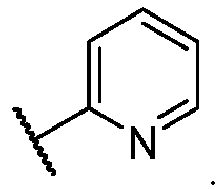
- 399. The method of any one of the preceding clauses, wherein RP1 is a silyl protecting group.
- 400. The method of any one of the preceding clauses, wherein RP1 is TBS.
- 401. The method of any one of the preceding clauses, wherein RP2 is a silyl protecting group.
- 402. The method of any one of the preceding clauses, wherein RP2 is TBS.
- 403. The method of any one of the preceding clauses, wherein RP3 is a silyl protecting group.
- 404. The method of any one of the preceding clauses, wherein RP3 is TES.
- 405. The method of any one of the preceding clauses, wherein RP4 is a silyl or optionally substituted benzyl protecting group.
- 406. The method of any one of the preceding clauses, wherein RP4 is TES.
- 407. The method of any one of the preceding clauses, wherein RP4 is MPM.
- 408. The method of any one of the preceding clauses, wherein RP4 is hydrogen.
- 409. The method of any one of the preceding clauses, wherein RP5 is a silyl protecting group.
- 410. The method of any one of the preceding clauses, wherein RP5 is TES.
- 411. The method of any one of the preceding clauses, wherein RP5 is hydrogen.
- 412. The method of any one of the preceding clauses, wherein RP4 and RP5 are hydrogen.
- 413. The method of any one of the preceding clauses, wherein two RP5 are j oined together with the intervening atoms to form:

- 414. The method of any one of the preceding clauses, wherein two RP5 are joined together with the intervening atoms to form:

- 415. The method of any one of the preceding clauses, wherein two RP6 are joined together with the intervening atoms to form:

- 416. The method of any one of the preceding clauses, wherein two RP6 are joined together with the intervening atoms to form:

- 417. The method of any one of the preceding clauses, wherein RP6 is hydrogen.
- 418. The method of any one of the preceding clauses, wherein RP8 is a benzyl protecting group.
- 419. The method of any one of the preceding clauses, wherein RP8 is MPM.
- 420. The method of any one of the preceding clauses, wherein RP8 is a silyl protecting group.
- 421. The method of any one of the preceding clauses, wherein RP8 is TBS.
- 422. The method of any one of the preceding clauses, wherein two RP9 are taken together with the intervening atoms to form:

- 423. The method of any one of the preceding clauses, wherein two RP9 are taken together with the intervening atoms to form:

- 424. The method of any one of the preceding clauses, wherein RP10 is a silyl protecting group.
- 425. The method of any one of the preceding clauses, wherein RP10 is TES.
- 426. The method of any one of the preceding clauses, wherein X2 is halogen.
- 427. The method of any one of the preceding clauses, wherein X2 is -I.
- 428. The method of any one of the preceding clauses, wherein X3 is halogen.
- 429. The method of any one of the preceding clauses, wherein X3 is -Cl.
- 430. The method of any one of the preceding clauses, wherein X4 is halogen.
- 431. The method of any one of the preceding clauses, wherein X4 is -I.
- 432. The method of any one of the preceding clauses, wherein R1 is optionally substituted C1-6 alkyl.
- 433. The method of any one of the preceding clauses, wherein R1 is methyl.
- 434. The method of any one of the preceding clauses, wherein R2 is optionally substituted C1-6 alkyl.
- 435. The method of any one of the preceding clauses, wherein R2 is methyl.
- 436. The method of any one of the preceding clauses, wherein R3 is optionally substituted C1-6 alkyl.
- 437. The method of any one of the preceding clauses, wherein R3 is methyl.
- 438. The method of any one of the preceding clauses, wherein R5 is optionally substituted C1-6 alkyl.
- 439. The method of any one of the preceding clauses, wherein R5 is methyl.
- 440. The method of any one of the preceding clauses, wherein two R4 groups are taken together to form:

- 441. The method of any one of the preceding clauses, wherein two R6 groups are taken together to form:

- 442. The method of any one of the preceding clauses, wherein R8 is optionally substituted C1-6 alkyl.
- 443. The method of any one of preceding clauses, wherein R8 is methyl.
- 444. The method of any one the preceding clauses, wherein R8 is ethyl.
- 445. The method of any one of the preceding clauses, wherein RX and RY are both hydrogen.
- 446. The method of any one of the preceding clauses, wherein RX is hydrogen; and RY is -OR Ya .
- 447. The method of any one of the preceding clauses, wherein RX is hydrogen; and RY is -OH.
- 448. The method of any one of the preceding clauses, wherein RX is hydrogen; and RY is -O-allyl.
- 449. The method of any one of the preceding clauses, wherein RX is -ORXa; and RY is -ORYa.
- 450. The method of any one of the preceding clauses, wherein RX and RY are both -OH.
- 451. The method of any one of the preceding clauses, wherein RXa and RYa are joined together with their intervening atoms to form the following:

- 452. A compound of the formula:

- 453. A compound of the formula:

R1 is optionally substituted sulfonyl, optionally substituted sulfinyl, optionally substituted phosphoryl, or optionally substituted acyl. - 454. A compound of the formula:

- 455. A compound of Formula (E-1):
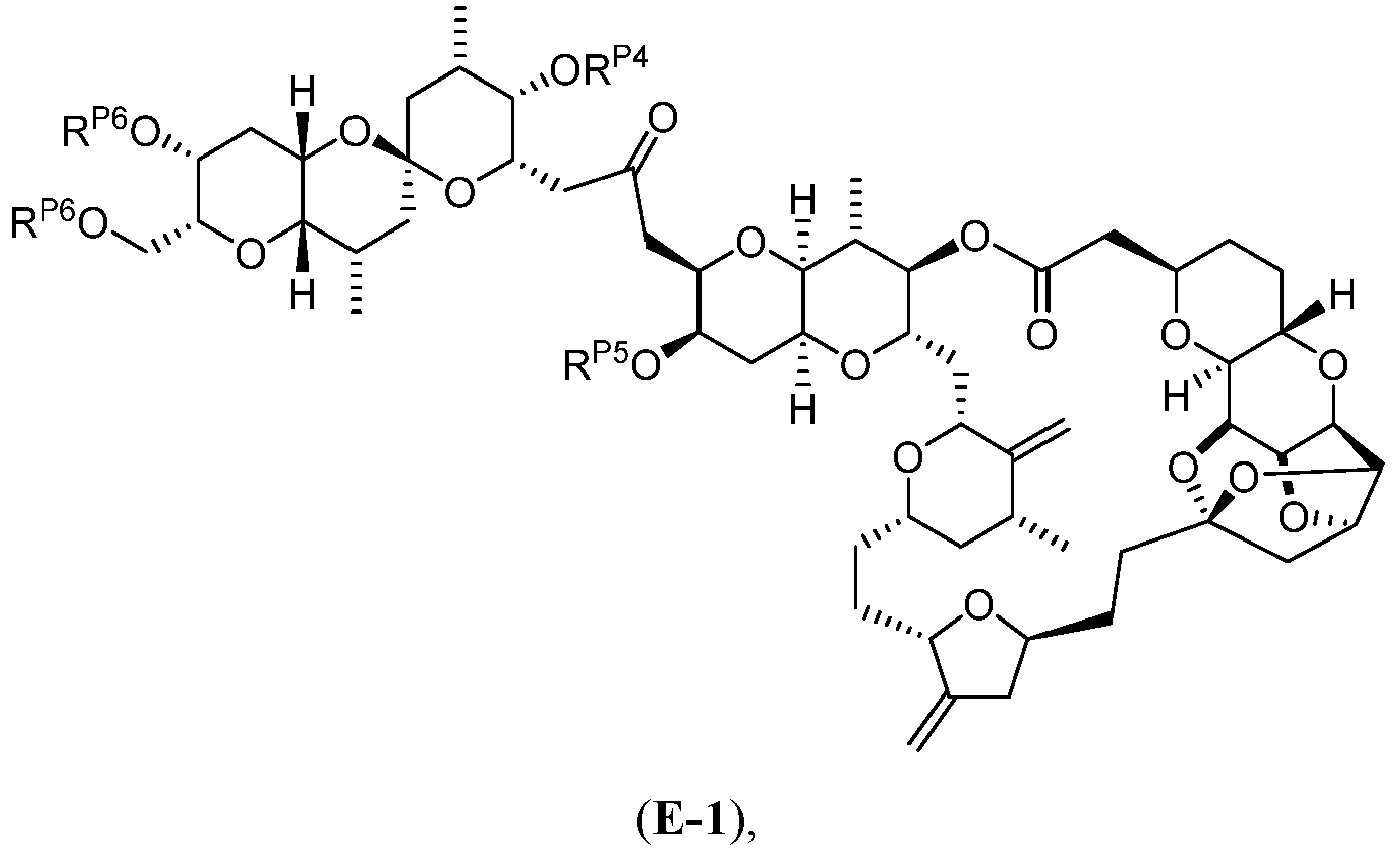
RP4, RP5, and RP6 are each independently hydrogen, optionally substituted alkyl, optionally substituted acyl, or an oxygen protecting group; optionally wherein two RP6 are joined with the intervening atoms to form optionally substituted heterocyclyl. - 456. A compound of clause 455, wherein the compound is of the formula:

- 457. A compound of Formula (E-R):
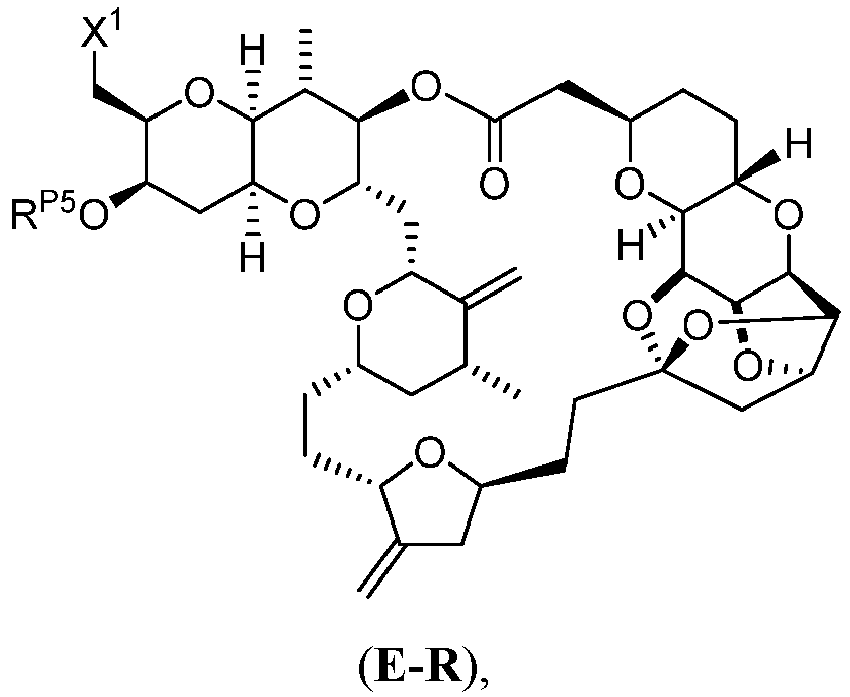
- X1 is halogen or a leaving group; and
- RP5 is hydrogen, optionally substituted alkyl, optionally substituted acyl, or an oxygen protecting group.
- 458. A compound of Formula (E-R-1):
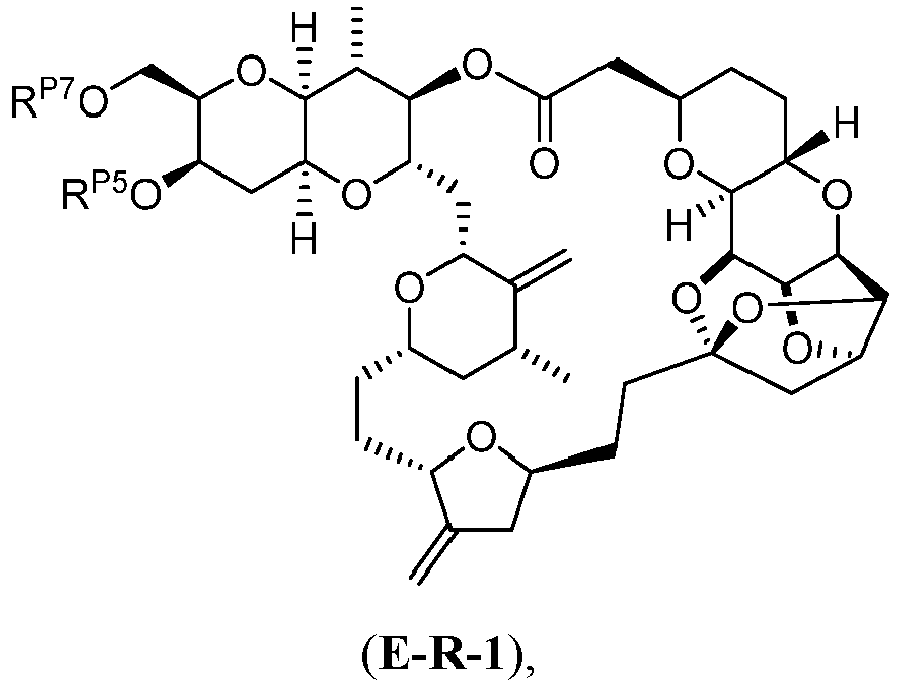
- RP5 is hydrogen, optionally substituted alkyl, optionally substituted acyl, or an oxygen protecting group; and
- RP7 is optionally substituted sulfonyl, optionally substituted sulfinyl, optionally substituted phosphoryl, optionally substituted acyl, or an oxygen protecting group; and
- optionally wherein RP5 and RP7 are joined with the intervening atoms to form optionally substituted heterocyclyl.
- 459. A compound of Formula (E-R-2):
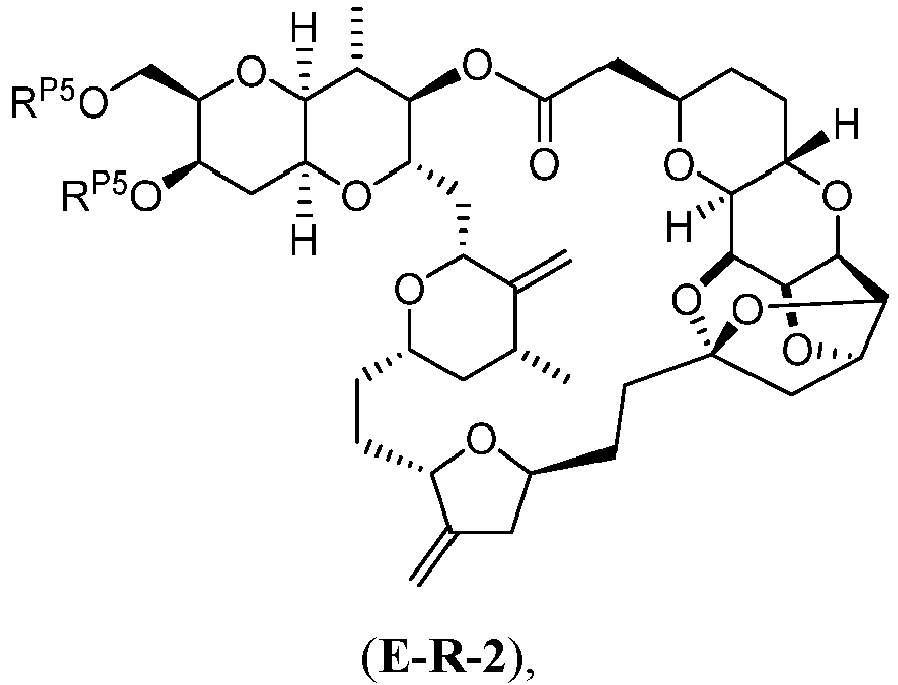
each instance of RP5 is hydrogen, optionally substituted alkyl, optionally substituted acyl, or an oxygen protecting group; optionally wherein two RP5 groups are joined together with the intervening atoms to form optionally substituted heterocyclyl ring. - 460. A compound of Formula (E-R-7):

- each instance of RP5 is independently hydrogen, optionally substituted alkyl, optionally substituted acyl, or an oxygen protecting group; optionally wherein two RP5 groups are joined together with the intervening atoms to form an optionally substituted heterocyclyl ring; and
- R8 is hydrogen, optionally substituted alkyl, optionally substituted carbocyclyl, optionally substituted aryl, optionally substituted heterocyclyl, optionally substituted heteroaryl, optionally substituted acyl, or an oxygen protecting group.
- 461. A compound of Formula (E-R-4):

each instance of RP5 and RP8 is independently hydrogen, optionally substituted alkyl, optionally substituted acyl, or an oxygen protecting group; optionally wherein two RP5 groups are joined together with the intervening atoms to form an optionally substituted heterocyclyl ring. - 462. A compound of Formula (E-R-6):

- X3 is halogen or a leaving group;
- each instance of RP5 and RP8 is independently hydrogen, optionally substituted alkyl, optionally substituted acyl, or an oxygen protecting group; optionally wherein two RP5 groups are joined together with the intervening atoms to form an optionally substituted heterocyclyl ring; and
- R8 is hydrogen, optionally substituted alkyl, optionally substituted carbocyclyl, optionally substituted aryl, optionally substituted heterocyclyl, optionally substituted heteroaryl, optionally substituted acyl, or an oxygen protecting group.
- 463. A compound of Formula (E-R-8):

- each instance of RP5 and RP8 is independently hydrogen, optionally substituted alkyl, optionally substituted acyl, or an oxygen protecting group; optionally wherein two RP5 groups are joined together with the intervening atoms to form an optionally substituted heterocyclyl ring; and
- R8 is hydrogen, optionally substituted alkyl, optionally substituted carbocyclyl, optionally substituted aryl, optionally substituted heterocyclyl, optionally substituted heteroaryl, optionally substituted acyl, or an oxygen protecting group.
- 464. A compound of Formula (E-R-9):

each instance of RP5 and RP8 is independently hydrogen, optionally substituted alkyl, optionally substituted acyl, or an oxygen protecting group; optionally wherein two RP5 groups are joined together with the intervening atoms to form an optionally substituted heterocyclyl ring. - 465. A compound of Formula (E-R-11):

each instance of RP5, RP8, and RP9 is independently hydrogen, optionally substituted alkyl, optionally substituted acyl, or an oxygen protecting group; optionally wherein two RP5 groups are joined together with the intervening atoms to form an optionally substituted heterocyclyl ring; optionally wherein two RP9 groups are joined together with the intervening atoms to form an optionally substituted heterocyclyl ring. - 466. A compound of Formula (E-R-15):

- each instance of RP5 and RP8 is independently hydrogen, optionally substituted alkyl, optionally substituted acyl, or an oxygen protecting group; optionally wherein two RP5 groups are joined together with the intervening atoms to form an optionally substituted heterocyclyl ring; and
- R8 is hydrogen, optionally substituted alkyl, optionally substituted carbocyclyl, optionally substituted aryl, optionally substituted heterocyclyl, optionally substituted heteroaryl, optionally substituted acyl, or an oxygen protecting group.
- 467. A compound of Formula (E-R-16):

- each instance of RP5 and RP8 is independently hydrogen, optionally substituted alkyl, optionally substituted acyl, or an oxygen protecting group; optionally wherein two RP5 groups are joined together with the intervening atoms to form an optionally substituted heterocyclyl ring; and
- R8 is hydrogen, optionally substituted alkyl, optionally substituted carbocyclyl, optionally substituted aryl, optionally substituted heterocyclyl, optionally substituted heteroaryl, optionally substituted acyl, or an oxygen protecting group.
- 468. A compound of Formula (E-R-17):

each instance of RP5 and RP10 is independently hydrogen, optionally substituted alkyl, optionally substituted acyl, or an oxygen protecting group; optionally wherein two RP5 groups are joined together with the intervening atoms to form an optionally substituted heterocyclyl ring. - 469. A compound of Formula (E-R-19):

each instance of RP5 and RP10 is independently hydrogen, optionally substituted alkyl, optionally substituted acyl, or an oxygen protecting group; optionally wherein two RP5 groups are joined together with the intervening atoms to form an optionally substituted heterocyclyl ring. - 470. A compound of Formula (E-R-22):

each instance of RP5 and RP10 is independently hydrogen, optionally substituted alkyl, optionally substituted acyl, or an oxygen protecting group; optionally wherein two RP5 groups are joined together with the intervening atoms to form an optionally substituted heterocyclyl ring. - 471. A compound of the Formula (E-L):

RS is optionally substituted alkyl, optionally substituted carbocyclyl, optionally substituted aryl, optionally substituted heterocyclyl, or optionally substituted heteroaryl; each instance of RP4 and RP6 are independently hydrogen, optionally substituted alkyl, optionally substituted acyl, or an oxygen protecting group; optionally wherein two RP6 are joined with the intervening atoms to form optionally substituted heterocyclyl. - 472. The compound of clause 471, wherein the compound is of the formula:

- 473. A compound of Formula (E-L-1):

- RS is optionally substituted alkyl, optionally substituted carbocyclyl, optionally substituted aryl, optionally substituted heterocyclyl, or optionally substituted heteroaryl;
- each instance of RP4 and RP6 are independently hydrogen, optionally substituted alkyl, optionally substituted acyl, or an oxygen protecting group; optionally wherein two RP6 are joined with the intervening atoms to form optionally substituted heterocyclyl; and
- R8 is hydrogen, optionally substituted alkyl, optionally substituted carbocyclyl, optionally substituted aryl, optionally substituted heterocyclyl, optionally substituted heteroaryl, optionally substituted acyl, or an oxygen protecting group.
- 474. A compound of Formula (E-L-2):

- each instance of RP4 and RP6 are independently hydrogen, optionally substituted alkyl, optionally substituted acyl, or an oxygen protecting group; optionally wherein two RP6 are joined with the intervening atoms to form optionally substituted heterocyclyl; and
- R8 is hydrogen, optionally substituted alkyl, optionally substituted carbocyclyl, optionally substituted aryl, optionally substituted heterocyclyl, optionally substituted heteroaryl, optionally substituted acyl, or an oxygen protecting group.
- 475. A compound of Formula (E-L-5):

each instance of RP4 and RP6 are independently hydrogen, optionally substituted alkyl, optionally substituted acyl, or an oxygen protecting group; optionally wherein two RP6 are joined with the intervening atoms to form optionally substituted heterocyclyl. - 476. A compound of Formula (E-L-6):
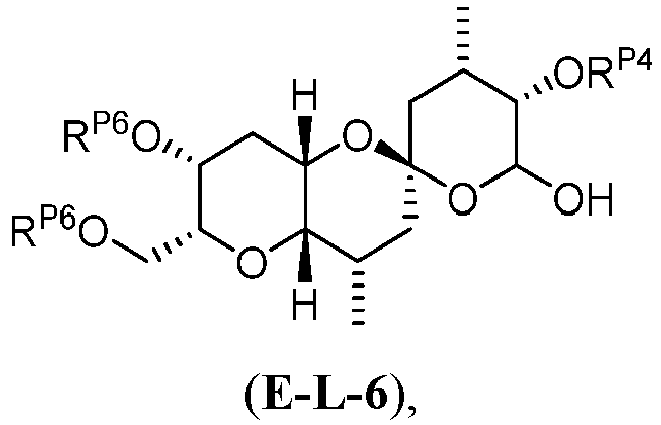
- each instance of RP4 and RP6 are independently hydrogen, optionally substituted alkyl, optionally substituted acyl, or an oxygen protecting group; optionally wherein two RP6 are joined with the intervening atoms to form optionally substituted heterocyclyl; and
- R8 is hydrogen, optionally substituted alkyl, optionally substituted carbocyclyl, optionally substituted aryl, optionally substituted heterocyclyl, optionally substituted heteroaryl, optionally substituted acyl, or an oxygen protecting group.
- 477. A compound of Formula (E-L-7):

each instance of RP4 and RP6 are independently hydrogen, optionally substituted alkyl, optionally substituted acyl, or an oxygen protecting group; optionally wherein two RP6 are joined with the intervening atoms to form optionally substituted heterocyclyl. - 478. A compound of Formula (H3-N3):

- R1, R2, R3, and R5 are each independently hydrogen, halogen, or optionally substituted alkyl;
- each instance of R4 is independently hydrogen, halogen, optionally substituted alkyl, or two R4 groups are taken together to form:

- each instance of R6 is independently hydrogen, halogen, optionally substituted alkyl, or two R6 groups are taken together to form:

- RP4, RP5, and RP6 are each independently hydrogen, optionally substituted alkyl, optionally substituted acyl, or an oxygen protecting group;
- RX is hydrogen or -ORXa, wherein RXa is hydrogen, optionally substituted alkyl, optionally substituted acyl, or an oxygen protecting group; and
- RY is hydrogen or -ORYa, wherein RYa is hydrogen, optionally substituted alkyl, optionally substituted acyl, or an oxygen protecting group;
- optionally wherein RXa and RYa are joined together with their intervening atoms to form optionally substituted heterocyclyl.
- 479. A compound of Formula (H3-L):

- RL is optionally substituted sulfonyl, optionally substituted sulfinyl, optionally substituted phosphoryl, or optionally substituted acyl;
- R1, R2, R3, and R5 are each independently hydrogen, halogen, or optionally substituted alkyl;
- each instance of R4 is independently hydrogen, halogen, or optionally substituted alkyl, or two R4 groups are taken together to form:

- each instance of R6 is independently hydrogen, halogen, or optionally substituted alkyl, or two R6 groups are taken together to form:

- RP4, RP5, and RP6 are each independently hydrogen, optionally substituted alkyl, optionally substituted acyl, or an oxygen protecting group;
- RX is hydrogen or -ORXa, wherein RXa is hydrogen, optionally substituted alkyl, optionally substituted acyl, or an oxygen protecting group; and
- RY is hydrogen or -ORYa, wherein RYa is hydrogen, optionally substituted alkyl, optionally substituted acyl, or an oxygen protecting group;
- optionally wherein RXa and RYa are joined together with their intervening atoms to form optionally substituted heterocyclyl.
- 480. A compound of Formula (H3-2-I):

- R1, R2, R3, and R5 are each independently hydrogen, halogen, or optionally substituted alkyl;
- each instance of R4 is independently hydrogen, halogen, or optionally substituted alkyl, or two R4 groups are taken together to form:

- each instance of R6 is independently hydrogen, halogen, or optionally substituted alkyl, or two R6 groups are taken together to form:

- each instance of RP6 is independently hydrogen, optionally substituted alkyl, optionally substituted acyl, or an oxygen protecting group; optionally wherein two RP6 are joined with the intervening atoms to form optionally substituted heterocyclyl;
- RX is hydrogen or -ORXa, wherein RXa is hydrogen, optionally substituted alkyl, optionally substituted acyl, or an oxygen protecting group; and
- RY is hydrogen or -ORYa, wherein RYa is hydrogen, optionally substituted alkyl, optionally substituted acyl, or an oxygen protecting group;
- optionally wherein RXa and RYa are joined together with their intervening atoms to form optionally substituted heterocyclyl.
- 481. A compound of Formula (H3-2-II):

- R1, R2, R3, and R5 are each independently hydrogen, halogen, or optionally substituted alkyl;
- each instance of R4 is independently hydrogen, halogen, or optionally substituted alkyl, or two R4 groups are taken together to form:

- each instance of R6 is independently hydrogen, halogen, or optionally substituted alkyl, or two R6 groups are taken together to form:

- RP4, RP5, and RP6 are each independently hydrogen, optionally substituted alkyl, optionally substituted acyl, or an oxygen protecting group; optionally wherein two RP6 are joined with the intervening atoms to form optionally substituted heterocyclyl;
- RX is hydrogen or -ORXa, wherein RXa is hydrogen, optionally substituted alkyl, optionally substituted acyl, or an oxygen protecting group; and
- RY is hydrogen or -ORYa, wherein RYa is hydrogen, optionally substituted alkyl, optionally substituted acyl, or an oxygen protecting group;
- optionally wherein RXa and RYa are joined together with their intervening atoms to form optionally substituted heterocyclyl.
- 482. A compound of Formula (R-2-1):

- X1 is halogen or a leaving group;
- R3 and R5 are each independently hydrogen, halogen, or optionally substituted alkyl;
- each instance of R4 is independently hydrogen, halogen, or optionally substituted alkyl, or two R4 groups are taken together to form:

- each instance of R6 is independently hydrogen, halogen, or optionally substituted alkyl, or two R6 groups are taken together to form:

- RP5 is hydrogen, optionally substituted alkyl, optionally substituted acyl, or an oxygen protecting group;
- RX is hydrogen or -ORXa, wherein RXa is hydrogen, optionally substituted alkyl, optionally substituted acyl, or an oxygen protecting group; and
- RY is hydrogen or -ORYa, wherein RYa is hydrogen, optionally substituted alkyl, optionally substituted acyl, or an oxygen protecting group;
- optionally wherein RXa and RYa are joined together with their intervening atoms to form optionally substituted heterocyclyl.
- 483. A compound of Formula (L-2-6):

- RS is optionally substituted alkyl, optionally substituted carbocyclyl, optionally substituted aryl, optionally substituted heterocyclyl, or optionally substituted heteroaryl;
- R1 and R2 are independently hydrogen, halogen, or optionally substituted alkyl; and
- RP4 and RP6 are each independently hydrogen, optionally substituted alkyl, optionally substituted acyl, or an oxygen protecting group; optionally wherein two RP6 are joined with the intervening atoms to form optionally substituted heterocyclyl.
- 484. A compound of Formula (R-4-11B):

- R3 and R5 are each independently hydrogen, halogen, or optionally substituted alkyl;
- each instance of R4 is independently hydrogen, halogen, or optionally substituted alkyl, or two R4 groups are taken together to form:

- each instance of R6 is independently hydrogen, halogen, or optionally substituted alkyl, or two R6 groups are taken together to form:

- RP5 and RP7 are each independently hydrogen, optionally substituted alkyl, optionally substituted acyl, or an oxygen protecting group;
- RP7 is optionally substituted sulfonyl, optionally substituted sulfinyl, optionally substituted phosphoryl, optionally substituted acyl, or an oxygen protecting group;
- optionally wherein RP5 and RP7 are joined with the intervening atoms to form optionally substituted heterocyclyl;
- RX is hydrogen or -ORXa, wherein RXa is hydrogen, optionally substituted alkyl, optionally substituted acyl, or an oxygen protecting group; and
- RY is hydrogen or -ORYa, wherein RYa is hydrogen, optionally substituted alkyl, optionally substituted acyl, or an oxygen protecting group;
- optionally wherein RXa and RYa are joined together with their intervening atoms to form optionally substituted heterocyclyl.
- 485. A compound of Formula (R-4-11A):

- R3 and R5 are each independently hydrogen, halogen, or optionally substituted alkyl;
- each instance of R4 is independently hydrogen, halogen, or optionally substituted alkyl, or two R4 groups are taken together to form:

- each instance of R6 is independently hydrogen, halogen, or optionally substituted alkyl, or two R6 groups are taken together to form:

- each instance of RP5 is independently hydrogen, optionally substituted alkyl, optionally substituted acyl, or an oxygen protecting group; optionally wherein two RP5 groups are joined together with the intervening atoms to form an optionally substituted heterocyclyl ring;
- RX is hydrogen or -ORXa, wherein RXa is hydrogen, optionally substituted alkyl, optionally substituted acyl, or an oxygen protecting group; and
- RY is hydrogen or -ORYa, wherein RYa is hydrogen, optionally substituted alkyl, optionally substituted acyl, or an oxygen protecting group;
- optionally wherein RXa and RYa are joined together with their intervening atoms to form optionally substituted heterocyclyl.
- 486. A compound of Formula (R-4-10):

- R3 and R5 are each independently hydrogen, halogen, or optionally substituted alkyl;
- each instance of R4 is independently hydrogen, halogen, or optionally substituted alkyl, or two R4 groups are taken together to form:

- each instance of R6 is independently hydrogen, halogen, or optionally substituted alkyl, or two R6 groups are taken together to form:

- each instance of RP5 and RP8 is independently hydrogen, optionally substituted alkyl, optionally substituted acyl, or an oxygen protecting group; optionally wherein two RP5 groups are joined together with the intervening atoms to form an optionally substituted heterocyclyl ring;
- R8 is hydrogen, optionally substituted alkyl, optionally substituted carbocyclyl, optionally substituted aryl, optionally substituted heterocyclyl, optionally substituted heteroaryl, optionally substituted acyl, or an oxygen protecting group;
- RX is hydrogen or -ORXa, wherein RXa is hydrogen, optionally substituted alkyl, optionally substituted acyl, or an oxygen protecting group; and
- RY is hydrogen or -ORYa, wherein RYa is hydrogen, optionally substituted alkyl, optionally substituted acyl, or an oxygen protecting group;
- optionally wherein RXa and RYa are joined together with their intervening atoms to form optionally substituted heterocyclyl.
- 487. A compound of Formula (R-4-8):

- R3 and R5 are each independently hydrogen, halogen, or optionally substituted alkyl;
- each instance of R4 is independently hydrogen, halogen, or optionally substituted alkyl, or two R4 groups are taken together to form:

- each instance of RP5 and RP8 is independently hydrogen, optionally substituted alkyl, optionally substituted acyl, or an oxygen protecting group; optionally wherein two RP5 groups are joined together with the intervening atoms to form an optionally substituted heterocyclyl ring.
- 488. A compound of Formula (R-4-9):

- X3 and X2 are each independently halogen or a leaving group;
- R8 is hydrogen, optionally substituted alkyl, optionally substituted carbocyclyl, optionally substituted aryl, optionally substituted heterocyclyl, optionally substituted heteroaryl, optionally substituted acyl, or an oxygen protecting group;
- RX is hydrogen or -ORXa, wherein RXa is hydrogen, optionally substituted alkyl, optionally substituted acyl, or an oxygen protecting group; and
- RY is hydrogen or -ORYa, wherein RYa is hydrogen, optionally substituted alkyl, optionally substituted acyl, or an oxygen protecting group;
- optionally wherein RXa and RYa are joined together with their intervening atoms to form optionally substituted heterocyclyl.
- 489. A compound of Formula (R-4-10B):

- X3 is halogen or a leaving group;
- R3 and R5 are each independently hydrogen, halogen, or optionally substituted alkyl;
- each instance of R4 is independently hydrogen, halogen, optionally substituted alkyl, or two R4 groups are taken together to form:

- each instance of R6 is independently hydrogen, halogen, optionally substituted alkyl, or two R6 groups are taken together to form:

- each instance of RP5 and RP8 is independently hydrogen, optionally substituted alkyl, optionally substituted acyl, or an oxygen protecting group; optionally wherein two RP5 groups are joined together with the intervening atoms to form an optionally substituted heterocyclyl ring;
- R8 is hydrogen, optionally substituted alkyl, optionally substituted carbocyclyl, optionally substituted aryl, optionally substituted heterocyclyl, optionally substituted heteroaryl, optionally substituted acyl, or an oxygen protecting group;
- RX is hydrogen or -ORXa, wherein RXa is hydrogen, optionally substituted alkyl, optionally substituted acyl, or an oxygen protecting group; and
- RY is hydrogen or -ORYa, wherein RYa is hydrogen, optionally substituted alkyl, optionally substituted acyl, or an oxygen protecting group;
- optionally wherein RXa and RYa are joined together with their intervening atoms to form optionally substituted heterocyclyl.
- 490. Provided herein are compounds of Formula (R-4-7):

- R3 and R5 are each independently hydrogen, halogen, or optionally substituted alkyl;
- each instance of R4 is independently hydrogen, halogen, or optionally substituted alkyl, or two R4 groups are taken together to form:

- each instance of RP5 and RP8 is independently hydrogen, optionally substituted alkyl, optionally substituted acyl, or an oxygen protecting group; optionally wherein two RP5 groups are joined together with the intervening atoms to form an optionally substituted heterocyclyl ring; and
- R8 is hydrogen, optionally substituted alkyl, optionally substituted carbocyclyl, optionally substituted aryl, optionally substituted heterocyclyl, optionally substituted heteroaryl, optionally substituted acyl, or an oxygen protecting group.
- 491. A compound of Formula (R-4-5B):

- R3 is hydrogen, halogen, or optionally substituted alkyl;
- each instance of RP5 and RP8 are independently hydrogen, optionally substituted alkyl, optionally substituted acyl, or an oxygen protecting group; optionally wherein two RP5 groups are joined together with the intervening atoms to form an optionally substituted heterocyclyl ring; and
- R8 is hydrogen, optionally substituted alkyl, optionally substituted carbocyclyl, optionally substituted aryl, optionally substituted heterocyclyl, optionally substituted heteroaryl, optionally substituted acyl, or an oxygen protecting group.
- 492. A compound of Formula (R-4-7A):

- R3 and R5 are each independently hydrogen, halogen, or optionally substituted alkyl;
- each instance of R4 is independently hydrogen, halogen, or optionally substituted alkyl, or two R4 groups are taken together to form:

- each instance of RP5, RP8, and RP9 is independently hydrogen, optionally substituted alkyl, optionally substituted acyl, or an oxygen protecting group; optionally wherein two RP5 groups are joined together with the intervening atoms to form an optionally substituted heterocyclyl ring; and optionally wherein two RP9 groups are joined together with the intervening atoms to form an optionally substituted heterocyclyl ring; and
- R8 is hydrogen, optionally substituted alkyl, optionally substituted carbocyclyl, optionally substituted aryl, optionally substituted heterocyclyl, optionally substituted heteroaryl, optionally substituted acyl, or an oxygen protecting group.
- 493. A compound of Formula (R-4-5A):

- R3 is hydrogen, halogen, or optionally substituted alkyl;
- each instance of RP5 and RP8 is independently hydrogen, optionally substituted alkyl, optionally substituted acyl, or an oxygen protecting group; optionally wherein two RP5 groups are joined together with the intervening atoms to form an optionally substituted heterocyclyl ring; and
- R8 is hydrogen, optionally substituted alkyl, optionally substituted carbocyclyl, optionally substituted aryl, optionally substituted heterocyclyl, optionally substituted heteroaryl, optionally substituted acyl, or an oxygen protecting group.
- 494. A compound of Formula (R-4-4):

- R3 is hydrogen, halogen, or optionally substituted alkyl;
- each instance of RP5, RP8, and RP10 is independently hydrogen, optionally substituted alkyl, optionally substituted acyl, or an oxygen protecting group; optionally wherein two RP5 groups are joined together with the intervening atoms to form an optionally substituted heterocyclyl ring; and
- R8 is hydrogen, optionally substituted alkyl, optionally substituted carbocyclyl, optionally substituted aryl, optionally substituted heterocyclyl, optionally substituted heteroaryl, optionally substituted acyl, or an oxygen protecting group.
- 495. A compound of Formula (R-4-2):

- R3 is hydrogen, halogen, or optionally substituted alkyl; and
- each instance of RP5 and RP10 is independently hydrogen, optionally substituted alkyl, optionally substituted acyl, or an oxygen protecting group; optionally wherein two RP5 groups are joined together with the intervening atoms to form an optionally substituted heterocyclyl ring.
- 496. A compound of Formula (R-4-1):

- R3 is hydrogen, halogen, or optionally substituted alkyl; and
- RP5 is independently hydrogen, optionally substituted alkyl, optionally substituted acyl, or an oxygen protecting group; optionally wherein two RP5 groups are joined together with the intervening atoms to form an optionally substituted heterocyclyl ring.
- 497. A compound of Formula (L-5-7B):

- R1 and R2 are independently hydrogen, halogen, or optionally substituted alkyl;
- each instance of RP4 and RP6 are independently hydrogen, optionally substituted alkyl, optionally substituted acyl, or an oxygen protecting group; optionally wherein two RP6 are joined with the intervening atoms to form optionally substituted heterocyclyl; and
- R8 is hydrogen, optionally substituted alkyl, optionally substituted carbocyclyl, optionally substituted aryl, optionally substituted heterocyclyl, optionally substituted heteroaryl, optionally substituted acyl, or an oxygen protecting group.
- 498. A compound of Formula (L-5-7A):

- R1 and R2 are independently hydrogen, halogen, or optionally substituted alkyl;
- each instance of RP4 and RP6 are independently hydrogen, optionally substituted alkyl, optionally substituted acyl, or an oxygen protecting group; optionally wherein two RP6 are joined with the intervening atoms to form optionally substituted heterocyclyl; and
- R8 is hydrogen, optionally substituted alkyl, optionally substituted carbocyclyl, optionally substituted aryl, optionally substituted heterocyclyl, optionally substituted heteroaryl, optionally substituted acyl, or an oxygen protecting group.
- 499. A compound of Formula (L-5-6A):
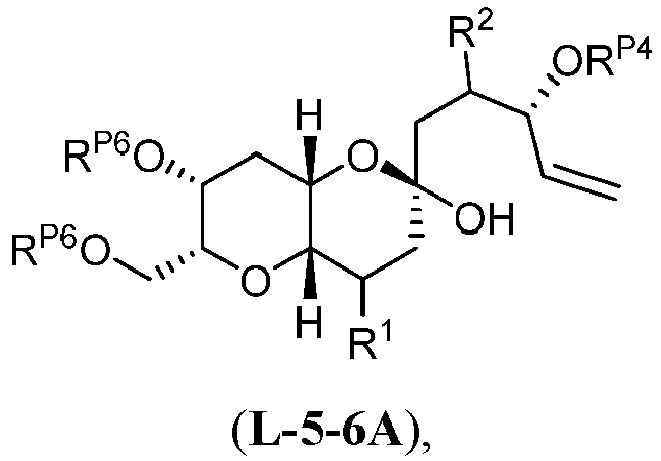
- R1 and R2 are independently hydrogen, halogen, or optionally substituted alkyl; and
- each instance of RP4 and RP6 are independently hydrogen, optionally substituted alkyl, optionally substituted acyl, or an oxygen protecting group; optionally wherein two RP6 are joined with the intervening atoms to form optionally substituted heterocyclyl.
- 500. A compound of Formula (L-5-4):
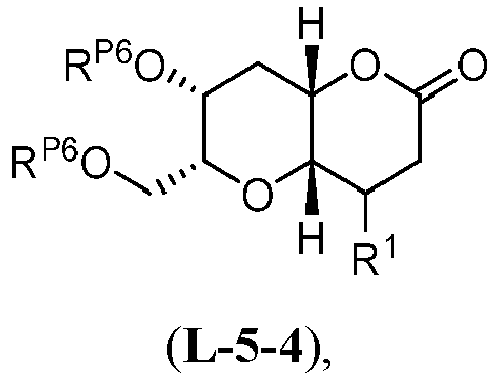
- R1 is independently hydrogen, halogen, or optionally substituted alkyl; and
- each RP6 is independently hydrogen, optionally substituted alkyl, optionally substituted acyl, or an oxygen protecting group; optionally wherein two RP6 are joined with the intervening atoms to form optionally substituted heterocyclyl.
- 501. A compound of Formula (H-2-II):

- R1, R2, R3, and R5 are each independently hydrogen, halogen, or optionally substituted alkyl;
- each instance of R4 is independently hydrogen, halogen, or optionally substituted alkyl, or two R4 groups are taken together to form:

- each instance of R6 is independently hydrogen, halogen, or optionally substituted alkyl, or two R6 groups are taken together to form:
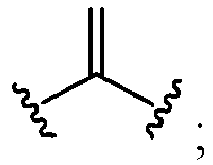
- RP1, RP2, RP3, RP4, and RP5 are each independently hydrogen, optionally substituted alkyl, optionally substituted acyl, or an oxygen protecting group;
- RX is hydrogen or -ORXa, wherein RXa is hydrogen, optionally substituted alkyl, optionally substituted acyl, or an oxygen protecting group; and
- RY is hydrogen or -ORYa, wherein RYa is hydrogen, optionally substituted alkyl, optionally substituted acyl, or an oxygen protecting group;
- optionally wherein RXa and RYa are joined together with their intervening atoms to form optionally substituted heterocyclyl.
- 502. A compound of Formula (L-2-14):

- RS is optionally substituted alkyl, optionally substituted carbocyclyl, optionally substituted aryl, optionally substituted heterocyclyl, or optionally substituted heteroaryl;
- R1 and R2 are each independently hydrogen, halogen, or optionally substituted alkyl; and
- RP1, RP2, RP3, and RP4 are each independently hydrogen, optionally substituted alkyl, optionally substituted acyl, or an oxygen protecting group.
- 503. A compound of Formula (HH-2-II):

- R1, R2, R3, and R5 are each independently hydrogen, halogen, or optionally substituted alkyl;
- each instance of R4 is independently hydrogen, halogen, or optionally substituted alkyl, or two R4 groups are taken together to form:

- each instance of R6 is independently hydrogen, halogen, or optionally substituted alkyl, or two R6 groups are taken together to form:

- RP1, RP3, RP4, and RP5 are each independently hydrogen, optionally substituted alkyl, optionally substituted acyl, or an oxygen protecting group;
- RX is hydrogen or -ORXa, wherein RXa is hydrogen, optionally substituted alkyl, optionally substituted acyl, or an oxygen protecting group; and
- RY is hydrogen or -ORYa, wherein RYa is hydrogen, optionally substituted alkyl, optionally substituted acyl, or an oxygen protecting group;
- optionally wherein RXa and RYa are joined together with their intervening atoms to form optionally substituted heterocyclyl.
- 504. A compound of Formula (L-2-16):

- RS is optionally substituted alkyl, optionally substituted carbocyclyl, optionally substituted aryl, optionally substituted heterocyclyl, or optionally substituted heteroaryl;
- R1 and R2 are independently hydrogen, halogen, or optionally substituted alkyl;
- RP1, RP3 and RP4 are independently hydrogen, optionally substituted alkyl, optionally substituted acyl, or an oxygen protecting group;
- RX is hydrogen or -ORXa, wherein RXa is hydrogen, optionally substituted alkyl, optionally substituted acyl, or an oxygen protecting group; and
- RY is hydrogen or -ORYa, wherein RYa is hydrogen, optionally substituted alkyl, optionally substituted acyl, or an oxygen protecting group;
- optionally wherein RXa and RYa are joined together with their intervening atoms to form optionally substituted heterocyclyl.
- 505. A compound of Formula (NH-2-II):

- R1, R2, R3, and R5 are each independently hydrogen, halogen, or optionally substituted alkyl;
- each instance of R4 is independently hydrogen, halogen, or optionally substituted alkyl, or two R4 groups are taken together to form:

- each instance of R6 is independently hydrogen, halogen, or optionally substituted alkyl, or two R6 groups are taken together to form:

- RP3, RP4, and RP5 are each independently hydrogen, optionally substituted alkyl, optionally substituted acyl, or an oxygen protecting group;
- R7 is hydrogen, optionally substituted alkyl, optionally substituted carbocyclyl, optionally substituted aryl, optionally substituted heterocyclyl, optionally substituted heteroaryl, optionally substituted acyl, or an oxygen protecting group;
- RX is hydrogen or -ORXa, wherein RXa is hydrogen, optionally substituted alkyl, optionally substituted acyl, or an oxygen protecting group; and
- RY is hydrogen or -ORYa, wherein RYa is hydrogen, optionally substituted alkyl, optionally substituted acyl, or an oxygen protecting group;
- optionally wherein RXa and RYa are joined together with their intervening atoms to form optionally substituted heterocyclyl.
- 506. A compound of Formula (L-2-15):

- RS is optionally substituted alkyl, optionally substituted carbocyclyl, optionally substituted aryl, optionally substituted heterocyclyl, or optionally substituted heteroaryl;
- R1 and R2 are independently hydrogen, halogen, or optionally substituted alkyl;
- RP3 and RP4 are independently hydrogen, optionally substituted alkyl, optionally substituted acyl, or an oxygen protecting group;
- R7 is hydrogen, optionally substituted alkyl, optionally substituted carbocyclyl, optionally substituted aryl, optionally substituted heterocyclyl, optionally substituted heteroaryl, optionally substituted acyl, or an oxygen protecting group.
- 507. A compound of Formula (L-5-17):

- R1 and R2 are independently hydrogen, halogen, or optionally substituted alkyl;
- RP1, RP2, RP3, and RP4 are independently hydrogen, optionally substituted alkyl, optionally substituted acyl, or an oxygen protecting group; and
- R8 is hydrogen, optionally substituted alkyl, optionally substituted carbocyclyl, optionally substituted aryl, optionally substituted heterocyclyl, or optionally substituted heteroaryl, optionally substituted acyl, or an oxygen protecting group.
- 508. A compound of Formula (L-5-16B):

- R1 and R2 are independently hydrogen, halogen, or optionally substituted alkyl;
- RP1, RP2, RP3, and RP4 are independently hydrogen, optionally substituted alkyl, optionally substituted acyl, or an oxygen protecting group; and
- R8 is hydrogen, optionally substituted alkyl, optionally substituted carbocyclyl, optionally substituted aryl, optionally substituted heterocyclyl, or optionally substituted heteroaryl, optionally substituted acyl, or an oxygen protecting group.
- 509. A compound of Formula (L-5-16A):

- R1 and R2 are independently hydrogen, halogen, or optionally substituted alkyl;
- RP1, RP2, RP3, RP4, and RP10 are independently hydrogen, optionally substituted alkyl, optionally substituted acyl, or an oxygen protecting group; and
- R8 is hydrogen, optionally substituted alkyl, optionally substituted carbocyclyl, optionally substituted aryl, optionally substituted heterocyclyl, or optionally substituted heteroaryl, optionally substituted acyl, or an oxygen protecting group.
- 510. A compound of Formula (L-5-15):
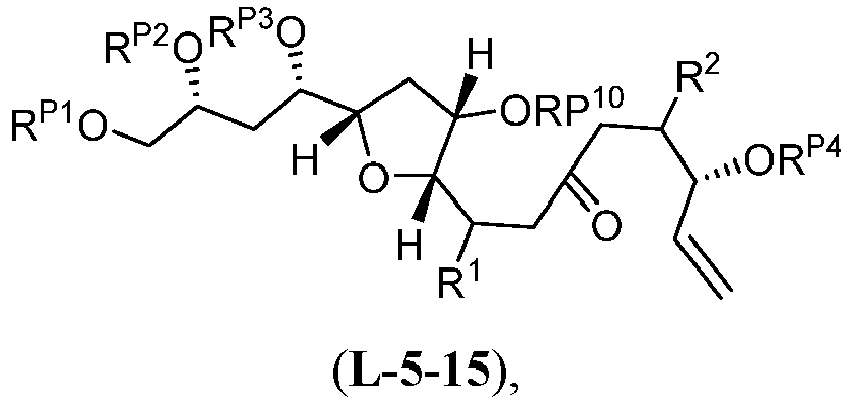
- R1 and R2 are independently hydrogen, halogen, or optionally substituted alkyl; and
- RP1, RP2, RP3, RP4, and RP10 are independently hydrogen, optionally substituted alkyl, optionally substituted acyl, or an oxygen protecting group.
- 511. A compound of Formula (L-5-14):

- R1 and RZ are independently hydrogen, halogen, or optionally substituted alkyl; and
- RP1, RP2, RP4, and RP10 are independently hydrogen, optionally substituted alkyl, optionally substituted acyl, or an oxygen protecting group.
- 512. Provided herein are compounds of Formula (L-5-12):

- R1 and R2 are independently hydrogen, halogen, or optionally substituted alkyl; and
- RP1, RPZ, and RP10 are independently hydrogen, optionally substituted alkyl, optionally substituted acyl, or an oxygen protecting group.
- 513. A compound of Formula (L-5-11):

- R1 is hydrogen, halogen, or optionally substituted alkyl; and
- RP1, RP2, and RP10 are independently hydrogen, optionally substituted alkyl, optionally substituted acyl, or an oxygen protecting group.
- 514. A compound of Formula (L-5-26):

- R1 and R2 are independently hydrogen, halogen, or optionally substituted alkyl;
- RP1, RP3, and RP4 are each independently hydrogen, optionally substituted alkyl, optionally substituted acyl, or an oxygen protecting group; and
- R8 is hydrogen, optionally substituted alkyl, optionally substituted carbocyclyl, optionally substituted aryl, optionally substituted heterocyclyl, or optionally substituted heteroaryl, optionally substituted acyl, or an oxygen protecting group.
- 515. A compound of Formula (L-5-25C):

- R1 and R2 are independently hydrogen, halogen, or optionally substituted alkyl;
- RP1, RP3, and RP4 are each independently hydrogen, optionally substituted alkyl, optionally substituted acyl, or an oxygen protecting group; and
- R8 is hydrogen, optionally substituted alkyl, optionally substituted carbocyclyl, optionally substituted aryl, optionally substituted heterocyclyl, optionally substituted heteroaryl, optionally substituted acyl, or an oxygen protecting group.
- 516. A compound of Formula (L-5-25A):

- R1 and R2 are independently hydrogen, halogen, or optionally substituted alkyl; and
- RP1, RP3, and RP4 are each independently hydrogen, optionally substituted alkyl, optionally substituted acyl, or an oxygen protecting group.
- 517. A compound of Formula (L-5-24):

- R1 is hydrogen, halogen, or optionally substituted alkyl; and
- RP1 and RP3 are each independently hydrogen, optionally substituted alkyl, optionally substituted acyl, or an oxygen protecting group.
- 518. A compound of Formula (L-5-23B):

- R1 is hydrogen, halogen, or optionally substituted alkyl; and
- RP1, RP3, and RP10 are each independently hydrogen, optionally substituted alkyl, optionally substituted acyl, or an oxygen protecting group.
- 519. A compound of Formula (L-5-23C):

- R1 is hydrogen, halogen, or optionally substituted alkyl; and
- RP1, RP3, and RP10 are each independently hydrogen, optionally substituted alkyl, optionally substituted acyl, or an oxygen protecting group.
- 520. A compound of Formula (L-5-23A):

- R1 is hydrogen, halogen, or optionally substituted alkyl; and
- RP1, RP3, and RP10 are each independently hydrogen, optionally substituted alkyl, optionally substituted acyl, or an oxygen protecting group.
- 521. A compound of Formula (L-5-22):

- R1 is hydrogen, halogen, or optionally substituted alkyl; and
- RP1, RP3, and RP10 are each independently hydrogen, optionally substituted alkyl, optionally substituted acyl, or an oxygen protecting group.
- 522. A compound of Formula (L-5-22A):

- R1 is hydrogen, halogen, or optionally substituted alkyl; and
- RP1, RP3, and RP10 are each independently hydrogen, optionally substituted alkyl, optionally substituted acyl, or an oxygen protecting group.
- 523. A compound of Formula (L-5-21B):

- R1 is hydrogen, halogen, or optionally substituted alkyl;
- RP1, RP6, and RP10 are each independently hydrogen, optionally substituted alkyl, optionally substituted acyl, or an oxygen protecting group; and
- R8 is hydrogen, optionally substituted alkyl, optionally substituted carbocyclyl, optionally substituted aryl, optionally substituted heterocyclyl, optionally substituted heteroaryl, optionally substituted acyl, or an oxygen protecting group.
- 524. A compound of Formula (L-5-21A):

- R1 is hydrogen, halogen, or optionally substituted alkyl; and
- RP6 and RP10 are each independently hydrogen, optionally substituted alkyl, optionally substituted acyl, or an oxygen protecting group.
- 525. A compound of Formula (L-5-32):

- R1 and R2 are independently hydrogen, halogen, or optionally substituted alkyl;
- each instance of RP4 and RP6 are independently hydrogen, optionally substituted alkyl, optionally substituted acyl, or an oxygen protecting group; and
- R7 and R8 are independently hydrogen, optionally substituted alkyl, optionally substituted carbocyclyl, optionally substituted aryl, optionally substituted heterocyclyl, optionally substituted heteroaryl, optionally substituted acyl, or an oxygen protecting group.
- 526. A compound of Formula (L-5-31):

- R1 and R2 are independently hydrogen, halogen, or optionally substituted alkyl;
- RP1, RP4, and RP6 are independently hydrogen, optionally substituted alkyl, optionally substituted acyl, or an oxygen protecting group; and
- R8 is hydrogen, optionally substituted alkyl, optionally substituted carbocyclyl, optionally substituted aryl, optionally substituted heterocyclyl, optionally substituted heteroaryl, optionally substituted acyl, or an oxygen protecting group.
- 527. A compound of Formula (L-5-32A):

- R1 and R2 are independently hydrogen, halogen, or optionally substituted alkyl;
- RP1, RP4 and RP6 are independently hydrogen, optionally substituted alkyl, optionally substituted acyl, or an oxygen protecting group; optionally wherein two RP6 are joined with the intervening atoms to form optionally substituted heterocyclyl; and
- R8 is hydrogen, optionally substituted alkyl, optionally substituted carbocyclyl, optionally substituted aryl, optionally substituted heterocyclyl, optionally substituted heteroaryl, optionally substituted acyl, or an oxygen protecting group.
- 528. A compound of Formula (L-5-28):

- R1 and R2 are independently hydrogen, halogen, or optionally substituted alkyl; and
- RP1, RP4 and RP6 are independently hydrogen, optionally substituted alkyl, optionally substituted acyl, or an oxygen protecting group; optionally wherein two RP6 are joined with the intervening atoms to form optionally substituted heterocyclyl.
- 529. A compound of Formula (L-5-27):

- R1 and R2 are independently hydrogen, halogen, or optionally substituted alkyl; and
- each instance of RP4 and RP6 are independently hydrogen, optionally substituted alkyl, optionally substituted acyl, or an oxygen protecting group.
- 530. The compound of any one of the preceding clauses, wherein RL is optionally substituted sulfonyl.
- 531. The compound of any one of the preceding clauses, wherein RL is Ms, Ts, Tf, Bs, Nf, Ns, Ds, or -SO2Ph.
- 532. The compound of any one of the preceding clauses, wherein RL is Ts.
- 533. The compound of any one of the preceding clauses, wherein RP1 is a silyl protecting group.
- 534. The compound of any one of the preceding clauses, wherein RP1 is TBS.
- 535. The compound of any one of the preceding clauses, wherein RP2 is a silyl protecting group.
- 536. The compound of any one of the preceding clauses, wherein RP2 is TBS.
- 537. The compound of any one of the preceding clauses, wherein RP3 is a silyl protecting group.
- 538. The compound of any one of the preceding clauses, wherein RP3 is TES.
- 539. The compound of any one of the preceding clauses, wherein RP4 is a silyl or benzyl protecting group.
- 540. The compound of any one of the preceding clauses, wherein RP4 is TES.
- 541. The compound of any one of the preceding clauses, wherein RP4 is TBS.
- 542. The compound of any one of the preceding clauses, wherein RP4 is MPM.
- 543. The compound of any one of the preceding clauses, wherein RP5 is a silyl protecting group.
- 544. The compound of any one of the preceding clauses, wherein RP5 is TES.
- 545. The compound of any one of the preceding clauses, wherein RP4 and RP5 are hydrogen.
- 546. The compound of any one of the preceding clauses, wherein two RP5 are joined together with the intervening atoms to form:

- 547. The compound of any one of the preceding clauses, wherein two RP5 are joined together with the intervening atoms to form:

- 548. The compound of any one of the preceding clauses, wherein two RP6 are joined together with the intervening atoms to form:

- 549. The compound of any one of the preceding clauses, wherein two RP6 are joined together with the intervening atoms to form:

- 550. The compound of any one of the preceding clauses, wherein RP8 is a benzyl protecting group.
- 551. The compound of any one of the preceding clauses, wherein RP8 is MPM.
- 552. The compound of any one of the preceding clauses, wherein two RP9 are taken together with the intervening atoms to form:

- 553. The compound of any one of the preceding clauses, wherein two RP9 are taken together with the intervening atoms to form:

- 554. The compound of any one of the preceding clauses, wherein RP10 is a silyl protecting group.
- 555. The compound of any one of the preceding clauses, wherein RP10 is TES.
- 556. The compound of any one of the preceding clauses, wherein X2 is halogen.
- 557. The compound of any one of the preceding clauses, wherein X2 is -I.
- 558. The compound of any one of the preceding clauses, wherein X3 is halogen.
- 559. The compound of any one of the preceding clauses, wherein X3 is -Cl.
- 560. The compound of any one of the preceding clauses, wherein X4 is halogen.
- 561. The compound of any one of the preceding clauses, wherein X4 is -I.
- 562. The compound of any one of the preceding clauses, wherein R1 is optionally substituted C1-6 alkyl.
- 563. The compound of any one of the preceding clauses, wherein R1 is methyl.
- 564. The compound of any one of the preceding clauses, wherein R2 is optionally substituted C1-6 alkyl.
- 565. The compound of any one of the preceding clauses, wherein R2 is methyl.
- 566. The compound of any one of the preceding clauses, wherein R3 is optionally substituted C1-6 alkyl.
- 567. The compound of any one of the preceding clauses, wherein R3 is methyl.
- 568. The compound of any one of the preceding clauses, wherein R5 is optionally substituted C1-6 alkyl.
- 569. The compound of any one of the preceding clauses, wherein R5 is methyl.
- 570. The compound of any one of the preceding clauses, wherein two R4 groups are taken together to form:

- 571. The compound of any one of the preceding clauses, wherein two R6 groups are taken together to form:

- 572. The compound of any one of the preceding clauses, wherein R8 is optionally substituted C1-6 alkyl.
- 573. The compound of any one of the preceding clauses, wherein R8 is methyl.
- 574. The compound of any one of the preceding clauses, wherein R8 is ethyl.
- 575. The compound of any one of the preceding clauses, wherein RX and RY are both hydrogen.
- 576. The compound of any one of the preceding clauses, wherein RX is hydrogen; and RY is
-ORYa.
- 577. The compound of any one of the preceding clauses, wherein RX is hydrogen; and RY is -OH.
- 578. The compound of any one of the preceding clauses, wherein RX is hydrogen; and RY is -O-allyl.
- 579. The compound of any one of the preceding clauses, wherein RX is -ORXa; and RY is -ORYa.
- 580. The compound of any one of the preceding clauses, wherein RX and RY are both -OH.
- 581. The compound of any one of the preceding clauses, wherein RXa and RYa are joined together with their intervening atoms to form the following:

Claims (15)
- A compound of Formula (R-2-I):
 X1 is halogen or a leaving group;R3 and R5 are each independently hydrogen, halogen, or optionally substituted alkyl;each instance of R4 is independently hydrogen, halogen, or optionally substituted alkyl, or two R4 groups are taken together to form:
 each instance of R6 is independently hydrogen, halogen, or optionally substituted alkyl, or two R6 groups are taken together to form:
 RP5 is hydrogen, optionally substituted alkyl, optionally substituted acyl, or an oxygen protecting group;RX is hydrogen or -ORXa, wherein RXa is hydrogen, optionally substituted alkyl, optionally substituted acyl, or an oxygen protecting group; andRY is hydrogen or -ORYa, wherein RYa is hydrogen, optionally substituted alkyl, optionally substituted acyl, or an oxygen protecting group;optionally wherein RXa and RYa are joined together with the intervening atoms to form optionally substituted heterocyclyl.
 - The compound of claim 1, wherein:(a) the compound is of Formula (E-R):
 (b) the compound is selected from:

- A compound of Formula (R-4-11B):
 R3 and R5 are each independently hydrogen, halogen, or optionally substituted alkyl;each instance of R4 is independently hydrogen, halogen, or optionally substituted alkyl, or two R4 groups are taken together to form:
 each instance of R6 is independently hydrogen, halogen, or optionally substituted alkyl, or two R6 groups are taken together to form:
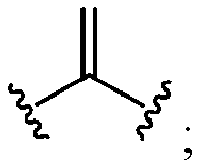 RP5 is hydrogen, optionally substituted alkyl, optionally substituted acyl, or an oxygen protecting group;RP7 is optionally substituted sulfonyl, optionally substituted sulfinyl, optionally substituted phosphoryl, optionally substituted acyl, or an oxygen protecting group;RX is hydrogen or -ORXa, wherein RXa is hydrogen, optionally substituted alkyl, optionally substituted acyl, or an oxygen protecting group; andRY is hydrogen or -ORYa, wherein RYa is hydrogen, optionally substituted alkyl, optionally substituted acyl, or an oxygen protecting group;optionally wherein RXa and RYa are joined together with the intervening atoms to form optionally substituted heterocyclyl.
 - The compound of claim 3, wherein:(a) the compound is of Formula (E-R-1):
 (b) the compound is:
- A compound of Formula (R-4-11A):
 R3 and R5 are each independently hydrogen, halogen, or optionally substituted alkyl;each instance of R4 is independently hydrogen, halogen, or optionally substituted alkyl, or two R4 groups are taken together to form:
 each instance of R6 is independently hydrogen, halogen, or optionally substituted alkyl, or two R6 groups are taken together to form:
 each instance of RP5 is independently hydrogen, optionally substituted alkyl, optionally substituted acyl, or an oxygen protecting group; optionally wherein two RP5 groups are joined together with the intervening atoms to form optionally substituted heterocyclyl;RX is hydrogen or -ORXa, wherein RXa is hydrogen, optionally substituted alkyl, optionally substituted acyl, or an oxygen protecting group; andRY is hydrogen or -ORYa, wherein RYa is hydrogen, optionally substituted alkyl, optionally substituted acyl, or an oxygen protecting group;optionally wherein RXa and RYa are joined together with the intervening atoms to form optionally substituted heterocyclyl.
 - The compound of claim 5, wherein:(a) the compound is of Formula (E-R-2):
 (b) the compound is selected from:
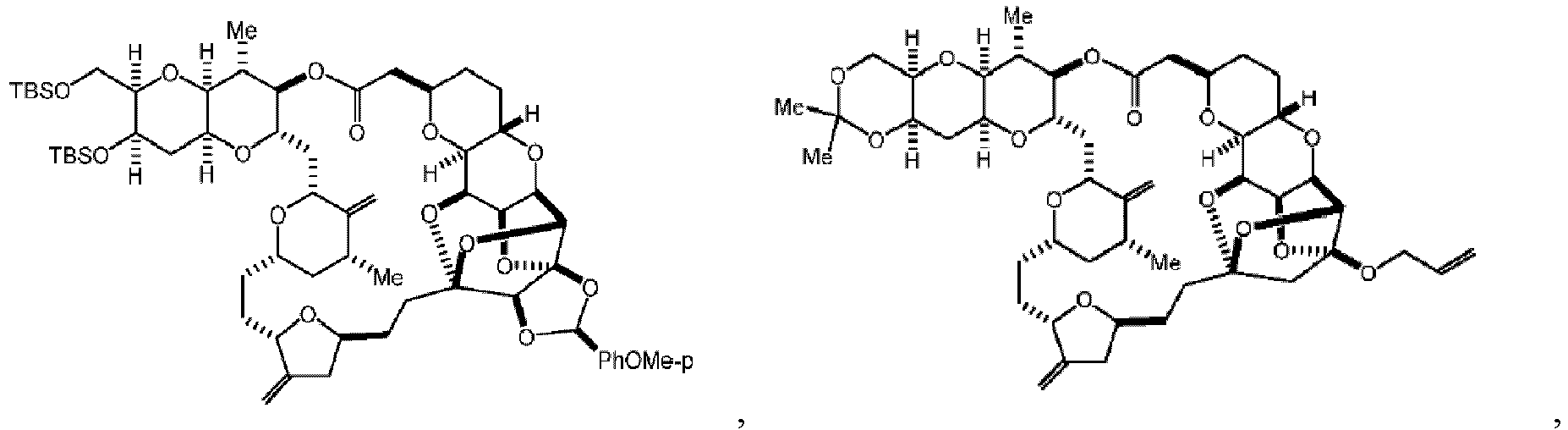
- A compound of:(i) Formula (R-4-10):
 R3 and R5 are each independently hydrogen, halogen, or optionally substituted alkyl;each instance of R4 is independently hydrogen, halogen, or optionally substituted alkyl, or two R4 groups are taken together to form:
 each instance of R6 is independently hydrogen, halogen, or optionally substituted alkyl, or two R6 groups are taken together to form:
 each instance of RP5 and RP8 is independently hydrogen, optionally substituted alkyl, optionally substituted acyl, or an oxygen protecting group; optionally wherein two RP5 groups are joined together with the intervening atoms to form optionally substituted heterocyclyl;R8 is hydrogen, optionally substituted alkyl, optionally substituted carbocyclyl, optionally substituted aryl, optionally substituted heterocyclyl, optionally substituted heteroaryl, optionally substituted acyl, or an oxygen protecting group;RX is hydrogen or -ORXa, wherein RXa is hydrogen, optionally substituted alkyl, optionally substituted acyl, or an oxygen protecting group; andRY is hydrogen or -ORYa, wherein RYa is hydrogen, optionally substituted alkyl, optionally substituted acyl, or an oxygen protecting group;optionally wherein RXa and RYa are joined together with the intervening atoms to form optionally substituted heterocyclyl;optionally wherein the compound is of Formula (E-R-7):
 optionally wherein the compound is selected from:
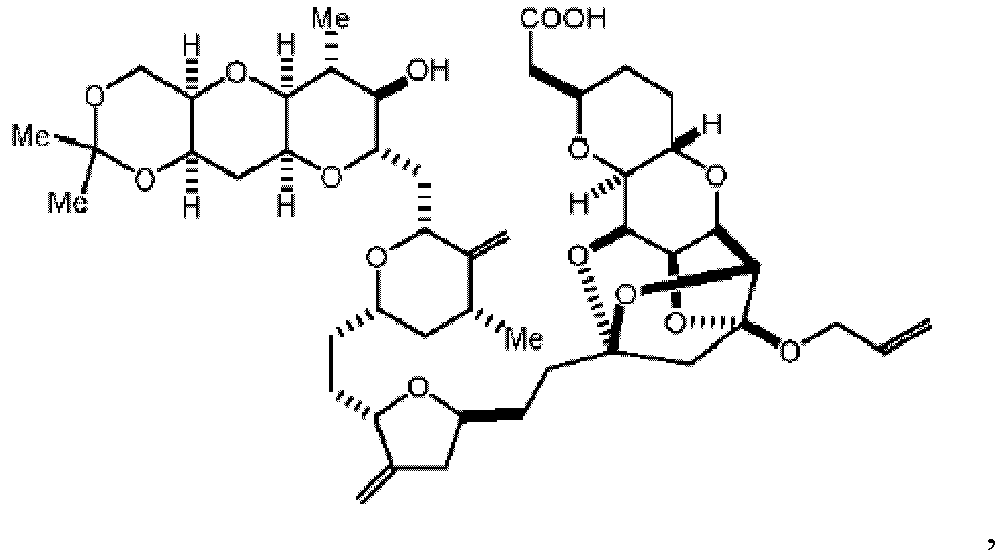 (ii) Formula (R-4-10B):
 X3 is halogen or a leaving group;R3 and R5 are each independently hydrogen, halogen, or optionally substituted alkyl;each instance of R4 is independently hydrogen, halogen, optionally substituted alkyl, or two R4 groups are taken together to form:
 each instance of R6 is independently hydrogen, halogen, optionally substituted alkyl, or two R6 groups are taken together to form:
 each instance of RP5 and RP8 is independently hydrogen, optionally substituted alkyl, optionally substituted acyl, or an oxygen protecting group; optionally wherein two RP5 groups are joined together with the intervening atoms to form optionally substituted heterocyclyl;R8 is hydrogen, optionally substituted alkyl, optionally substituted carbocyclyl, optionally substituted aryl, optionally substituted heterocyclyl, optionally substituted heteroaryl, optionally substituted acyl, or an oxygen protecting group;RX is hydrogen or -ORXa, wherein RXa is hydrogen, optionally substituted alkyl, optionally substituted acyl, or an oxygen protecting group; andRY is hydrogen or -ORYa, wherein RYa is hydrogen, optionally substituted alkyl, optionally substituted acyl, or an oxygen protecting group;optionally wherein RXa and RYa are joined together with the intervening atoms to form optionally substituted heterocyclyl;optionally wherein the compound is of Formula (E-R-6):
 optionally wherein the compound is selected from:

 (iii) Formula (R-4-8):
 R3 and R5 are each independently hydrogen, halogen, or optionally substituted alkyl;each instance of R4 is independently hydrogen, halogen, or optionally substituted alkyl, or two R4 groups are taken together to form:
 each instance of RP5 and RP8 is independently hydrogen, optionally substituted alkyl, optionally substituted acyl, or an oxygen protecting group; optionally wherein two RP5 groups are joined together with the intervening atoms to form optionally substituted heterocyclyl;optionally wherein the compound is of Formula (E-R-4):
 optionally wherein the compound is selected from:
 (iv) Formula (R-4-7):
 R3 and R5 are each independently hydrogen, halogen, or optionally substituted alkyl;each instance of R4 is independently hydrogen, halogen, or optionally substituted alkyl, or two R4 groups are taken together to form:
 each instance of RP5 and RP8 is independently hydrogen, optionally substituted alkyl, optionally substituted acyl, or an oxygen protecting group; optionally wherein two RP5 groups are joined together with the intervening atoms to form optionally substituted heterocyclyl; andR8 is hydrogen, optionally substituted alkyl, optionally substituted carbocyclyl, optionally substituted aryl, optionally substituted heterocyclyl, optionally substituted heteroaryl, optionally substituted acyl, or an oxygen protecting group;optionally wherein the compound is of Formula (E-R-8):
 optionally wherein the compound is selected from:
 (v) Formula (R-4-7A):
 R3 and R5 are each independently hydrogen, halogen, or optionally substituted alkyl;each instance of R4 is independently hydrogen, halogen, or optionally substituted alkyl, or two R4 groups are taken together to form:
 each instance of RP5, RP8, and RP9 is independently hydrogen, optionally substituted alkyl, optionally substituted acyl, or an oxygen protecting group; optionally wherein two RP5 groups are joined together with the intervening atoms to form optionally substituted heterocyclyl; and optionally wherein two RP9 groups are joined together with the intervening atoms to form optionally substituted heterocyclyl; andR8 is hydrogen, optionally substituted alkyl, optionally substituted carbocyclyl, optionally substituted aryl, optionally substituted heterocyclyl, optionally substituted heteroaryl, optionally substituted acyl, or an oxygen protecting group;optionally wherein the compound is of Formula (E-R-11):
 optionally wherein the compound is selected from:
 (vi) Formula (R-4-5B):
 R3 is hydrogen, halogen, or optionally substituted alkyl; andeach instance of RP5 and RP8 is independently hydrogen, optionally substituted alkyl, optionally substituted acyl, or an oxygen protecting group; optionally wherein two RP5 groups are joined together with the intervening atoms to form optionally substituted heterocyclyl;optionally wherein the compound is of Formula (E-R-9):
 optionally wherein the compound is selected from:
 (vii) Formula (R-4-5A):
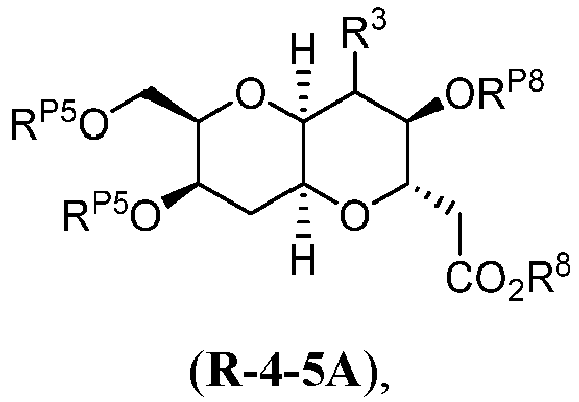 R3 is hydrogen, halogen, or optionally substituted alkyl;each instance of RP5 and RP8 is independently hydrogen, optionally substituted alkyl, optionally substituted acyl, or an oxygen protecting group; optionally wherein two RP5 groups are joined together with the intervening atoms to form optionally substituted heterocyclyl; andR8 is hydrogen, optionally substituted alkyl, optionally substituted carbocyclyl, optionally substituted aryl, optionally substituted heterocyclyl, optionally substituted heteroaryl, optionally substituted acyl, or an oxygen protecting group;optionally wherein the compound is of Formula (E-R-15):
 optionally wherein the compound is selected from:
 (viii) Formula (R-4-4):
 R3 is hydrogen, halogen, or optionally substituted alkyl;each instance of RP5, RP8, and RP10 is independently hydrogen, optionally substituted alkyl, optionally substituted acyl, or an oxygen protecting group; optionally wherein two RP5 groups are joined together with the intervening atoms to form optionally substituted heterocyclyl; andR8 is hydrogen, optionally substituted alkyl, optionally substituted carbocyclyl, optionally substituted aryl, optionally substituted heterocyclyl, optionally substituted heteroaryl, optionally substituted acyl, or an oxygen protecting group;optionally wherein the compound is of Formula (E-R-16):
 optionally wherein the compound is selected from:
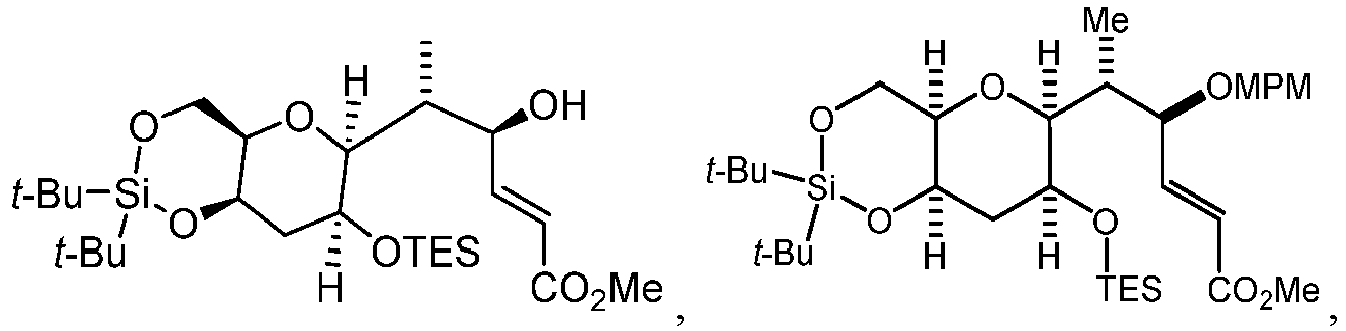 (ix) Formula (R-4-2):
 R3 is hydrogen, halogen, or optionally substituted alkyl; andeach instance of RP5 and RP10 is independently hydrogen, optionally substituted alkyl, optionally substituted acyl, or an oxygen protecting group; optionally wherein two RP5 groups are joined together with the intervening atoms to form optionally substituted heterocyclyl;optionally wherein the compound is of Formula (E-R-17):
 optionally wherein the compound is selected from:
 (x) Formula (R-4-1):
 R3 is hydrogen, halogen, or optionally substituted alkyl; andeach RP5 is independently hydrogen, optionally substituted alkyl, optionally substituted acyl, or an oxygen protecting group; optionally wherein two RP5 groups are joined together with the intervening atoms to form optionally substituted heterocyclyl;optionally wherein the compound is of Formula (E-R-19):
 optionally wherein the compound is:
- A method of preparing a compound of Formula (R-2-I):

 X1 is halogen or a leaving group;R3 and R5 are each independently hydrogen, halogen, or optionally substituted alkyl;each instance of R4 is independently hydrogen, halogen, or optionally substituted alkyl, or two R4 groups are taken together to form:
 each instance of R6 is independently hydrogen, halogen, or optionally substituted alkyl, or two R6 groups are taken together to form:
 RP5 is hydrogen, optionally substituted alkyl, optionally substituted acyl, or an oxygen protecting group;RP7 is optionally substituted sulfonyl, optionally substituted sulfinyl, optionally substituted phosphoryl, optionally substituted acyl, or an oxygen protecting group;RX is hydrogen or -ORXa, wherein RXa is hydrogen, optionally substituted alkyl, optionally substituted acyl, or an oxygen protecting group; andRY is hydrogen or -ORYa, wherein RYa is hydrogen, optionally substituted alkyl, optionally substituted acyl, or an oxygen protecting group;optionally wherein RXa and RYa are joined together with the intervening atoms to form optionally substituted heterocyclyl.
 - The method of claim 8 for preparing a compound of Formula (E-R):


- A method of preparing a compound of Formula (H-2-I):
 (a) coupling a compound of Formula (R-2-I):


 (b) cyclizing a compound of Formula (H-2-II):
 RS is optionally substituted alkyl, optionally substituted carbocyclyl, optionally substituted aryl, optionally substituted heterocyclyl, or optionally substituted heteroaryl;X1 is halogen or a leaving group;R1, R2, R3, and R5 are each independently hydrogen, halogen, or optionally substituted alkyl;each instance of R4 is independently hydrogen, halogen, or optionally substituted alkyl, or two R4 groups are taken together to form:
 each instance of R6 is independently hydrogen, halogen, or optionally substituted alkyl, or two R6 groups are taken together to form:
 RP1, RP2, RP3, RP4, and RP5 are each independently hydrogen, optionally substituted alkyl, optionally substituted acyl, or an oxygen protecting group;RX is hydrogen or -ORXa, wherein RXa is hydrogen, optionally substituted alkyl, optionally substituted acyl, or an oxygen protecting group; andRY is hydrogen or -ORYa, wherein RYa is hydrogen, optionally substituted alkyl, optionally substituted acyl, or an oxygen protecting group;optionally wherein RXa and RYa are joined together with the intervening atoms to form optionally substituted heterocyclyl.
 - A method of preparing a compound of Formula (HH-2-I):

 (a) coupling a compound of Formula (R-2-I):

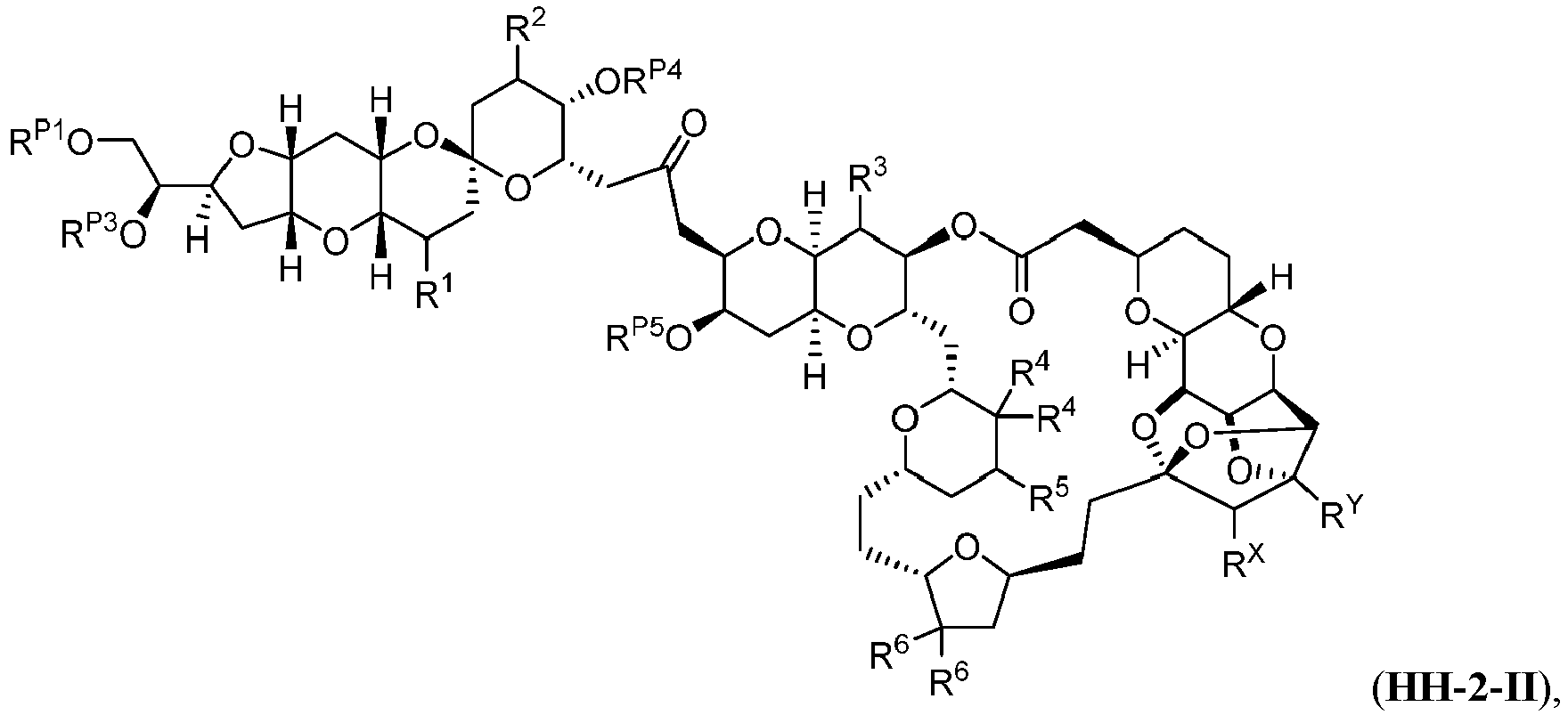 (b) cyclizing a compound of Formula (HH-2-II):
 RS is optionally substituted alkyl, optionally substituted carbocyclyl, optionally substituted aryl, optionally substituted heterocyclyl, or optionally substituted heteroaryl;X1 is halogen or a leaving group;R1, R2, R3, and R5 are each independently hydrogen, halogen, or optionally substituted alkyl;each instance of R4 is independently hydrogen, halogen, or optionally substituted alkyl, or two R4 groups are taken together to form:
 each instance of R6 is independently hydrogen, halogen, or optionally substituted alkyl, or two R6 groups are taken together to form:
 RP1, RP3, RP4, and RP5 are each independently hydrogen, optionally substituted alkyl, optionally substituted acyl, or an oxygen protecting group;RX is hydrogen or -ORXa, wherein RXa is hydrogen, optionally substituted alkyl, optionally substituted acyl, or an oxygen protecting group; andRY is hydrogen or -ORYa, wherein RYa is hydrogen, optionally substituted alkyl, optionally substituted acyl, or an oxygen protecting group;optionally wherein RXa and RYa are joined together with the intervening atoms to form optionally substituted heterocyclyl.
 - A method of preparing a compound of Formula (NH-2-I):
 (a) coupling a compound of Formula (R-2-I):

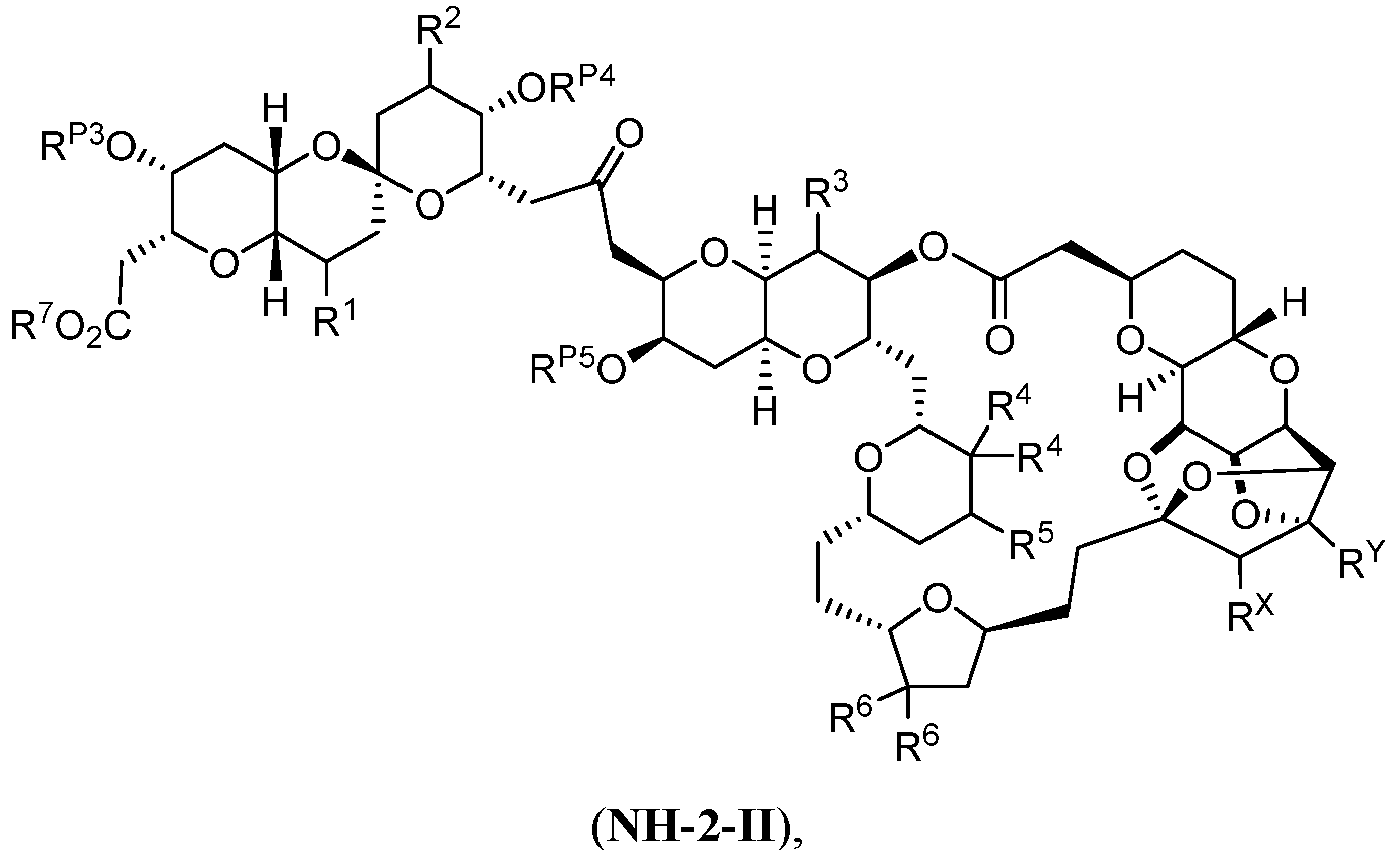 (b) cyclizing a compound of Formula (NH-2-II):
 RS is optionally substituted alkyl, optionally substituted carbocyclyl, optionally substituted aryl, optionally substituted heterocyclyl, or optionally substituted heteroaryl;X1 is halogen or a leaving group;R1, R2, R3, and R5 are each independently hydrogen, halogen, or optionally substituted alkyl;each instance of R4 is independently hydrogen, halogen, or optionally substituted alkyl, or two R4 groups are taken together to form:
 each instance of R6 is independently hydrogen, halogen, or optionally substituted alkyl, or two R6 groups are taken together to form:
 RP3, RP4, and RP5 are each independently hydrogen, optionally substituted alkyl, optionally substituted acyl, or an oxygen protecting group;R7 is hydrogen, optionally substituted alkyl, optionally substituted carbocyclyl, optionally substituted aryl, optionally substituted heterocyclyl, optionally substituted heteroaryl, optionally substituted acyl, or an oxygen protecting group;RX is hydrogen or -ORXa, wherein RXa is hydrogen, optionally substituted alkyl, optionally substituted acyl, or an oxygen protecting group; andRY is hydrogen or -ORYa, wherein RYa is hydrogen, optionally substituted alkyl, optionally substituted acyl, or an oxygen protecting group;optionally wherein RXa and RYa are joined together with the intervening atoms to form optionally substituted heterocyclyl.
 - A compound of:(i) Formula (HH-2-II):
 R1, R2, R3, and R5 are each independently hydrogen, halogen, or optionally substituted alkyl;each instance of R4 is independently hydrogen, halogen, or optionally substituted alkyl, or two R4 groups are taken together to form:
 each instance of R6 is independently hydrogen, halogen, or optionally substituted alkyl, or two R6 groups are taken together to form:
 RP1, RP3, RP4, and RP5 are each independently hydrogen, optionally substituted alkyl, optionally substituted acyl, or an oxygen protecting group;RX is hydrogen or -ORXa, wherein RXa is hydrogen, optionally substituted alkyl, optionally substituted acyl, or an oxygen protecting group; andRY is hydrogen or -ORYa, wherein RYa is hydrogen, optionally substituted alkyl, optionally substituted acyl, or an oxygen protecting group;optionally wherein RXa and RYa are joined together with the intervening atoms to form optionally substituted heterocyclyl;optionally wherein the compound is selected from:

 (ii) Formula (L-2-16):
 RS is optionally substituted alkyl, optionally substituted carbocyclyl, optionally substituted aryl, optionally substituted heterocyclyl, or optionally substituted heteroaryl;R1 and R2 are independently hydrogen, halogen, or optionally substituted alkyl;RP1, RP3, and RP4 are independently hydrogen, optionally substituted alkyl, optionally substituted acyl, or an oxygen protecting group;RX is hydrogen or -ORXa, wherein RXa is hydrogen, optionally substituted alkyl, optionally substituted acyl, or an oxygen protecting group; andRY is hydrogen or -ORYa, wherein RYa is hydrogen, optionally substituted alkyl, optionally substituted acyl, or an oxygen protecting group;optionally wherein RXa and RYa are joined together with the intervening atoms to form optionally substituted heterocyclyl;optionally wherein the compound is:
 (iii) Formula (L-5-26):
 R1 and R2 are independently hydrogen, halogen, or optionally substituted alkyl;RP1, RP3, and RP4 are each independently hydrogen, optionally substituted alkyl, optionally substituted acyl, or an oxygen protecting group; andR8 is hydrogen, optionally substituted alkyl, optionally substituted carbocyclyl, optionally substituted aryl, optionally substituted heterocyclyl, optionally substituted heteroaryl, optionally substituted acyl, or an oxygen protecting group;Optionally wherein the compound is selected from:

- A compound of:(i) Formula (H-2-II):
 R1, R2, R3, and R5 are each independently hydrogen, halogen, or optionally substituted alkyl;each instance of R4 is independently hydrogen, halogen, or optionally substituted alkyl, or two R4 groups are taken together to form:
 each instance of R6 is independently hydrogen, halogen, or optionally substituted alkyl, or two R6 groups are taken together to form:
 RP1, RP2, RP3, RP4, and RP5 are each independently hydrogen, optionally substituted alkyl, optionally substituted acyl, or an oxygen protecting group;RX is hydrogen or -ORXa, wherein RXa is hydrogen, optionally substituted alkyl, optionally substituted acyl, or an oxygen protecting group; andRY is hydrogen or -ORYa, wherein RYa is hydrogen, optionally substituted alkyl, optionally substituted acyl, or an oxygen protecting group;optionally wherein RXa and RYa are joined together with the intervening atoms to form optionally substituted heterocyclyl;optionally wherein the compound is selected from:

 (ii) Formula (L-2-14):
 RS is optionally substituted alkyl, optionally substituted carbocyclyl, optionally substituted aryl, optionally substituted heterocyclyl, or optionally substituted heteroaryl;R1 and R2 are each independently hydrogen, halogen, or optionally substituted alkyl; andRP1, RP2, RP3, and RP4 are each independently hydrogen, optionally substituted alkyl, optionally substituted acyl, or an oxygen protecting group;optionally wherein the compound is:
 (iii) Formula (L-5-17):
 R1 and R2 are independently hydrogen, halogen, or optionally substituted alkyl;RP1, RP2, RP3, and RP4 are independently hydrogen, optionally substituted alkyl, optionally substituted acyl, or an oxygen protecting group; andR8 is hydrogen, optionally substituted alkyl, optionally substituted carbocyclyl, optionally substituted aryl, optionally substituted heterocyclyl, optionally substituted heteroaryl, optionally substituted acyl, or an oxygen protecting group;optionally wherein the compound is selected from:

- A compound of:(i) Formula (NH-2-II):

 R1, R2, R3, and R5 are each independently hydrogen, halogen, or optionally substituted alkyl;each instance of R4 is independently hydrogen, halogen, or optionally substituted alkyl, or two R4 groups are taken together to form:
 each instance of R6 is independently hydrogen, halogen, or optionally substituted alkyl, or two R6 groups are taken together to form:
 RP3, RP4, and RP5 are each independently hydrogen, optionally substituted alkyl, optionally substituted acyl, or an oxygen protecting group;R7 is hydrogen, optionally substituted alkyl, optionally substituted carbocyclyl, optionally substituted aryl, optionally substituted heterocyclyl, optionally substituted heteroaryl, optionally substituted acyl, or an oxygen protecting group;RX is hydrogen or -ORXa, wherein RXa is hydrogen, optionally substituted alkyl, optionally substituted acyl, or an oxygen protecting group; andRY is hydrogen or -ORYa, wherein RYa is hydrogen, optionally substituted alkyl, optionally substituted acyl, or an oxygen protecting group;optionally wherein RXa and RYa are joined together with the intervening atoms to form optionally substituted heterocyclyl;optionally wherein the compound is selected from:

 (ii) Formula (L-2-15):
 RS is optionally substituted alkyl, optionally substituted carbocyclyl, optionally substituted aryl, optionally substituted heterocyclyl, or optionally substituted heteroaryl;R1 and R2 are independently hydrogen, halogen, or optionally substituted alkyl;RP3 and RP4 are independently hydrogen, optionally substituted alkyl, optionally substituted acyl, or an oxygen protecting group; andR7 is hydrogen, optionally substituted alkyl, optionally substituted carbocyclyl, optionally substituted aryl, optionally substituted heterocyclyl, optionally substituted heteroaryl, optionally substituted acyl, or an oxygen protecting group;optionally wherein the compound is:
 (iii) Formula (L-5-32):
 R1 and R2 are independently hydrogen, halogen, or optionally substituted alkyl;each instance of RP4 and RP6 are independently hydrogen, optionally substituted alkyl, optionally substituted acyl, or an oxygen protecting group; andR7 and R8 are independently hydrogen, optionally substituted alkyl, optionally substituted carbocyclyl, optionally substituted aryl, optionally substituted heterocyclyl, optionally substituted heteroaryl, optionally substituted acyl, or an oxygen protecting group;optionally wherein the compound is selected from:
Applications Claiming Priority (4)
| Application Number | Priority Date | Filing Date | Title |
|---|---|---|---|
| US201762529333P | 2017-07-06 | 2017-07-06 | |
| US201762529310P | 2017-07-06 | 2017-07-06 | |
| EP18746401.1A EP3649135B1 (en) | 2017-07-06 | 2018-07-06 | Synthesis of halichondrins |
| PCT/US2018/041005 WO2019010363A1 (en) | 2017-07-06 | 2018-07-06 | Synthesis of halichondrins |
Related Parent Applications (1)
| Application Number | Title | Priority Date | Filing Date |
|---|---|---|---|
| EP18746401.1A Division EP3649135B1 (en) | 2017-07-06 | 2018-07-06 | Synthesis of halichondrins |
Publications (2)
| Publication Number | Publication Date |
|---|---|
| EP4169924A2 true EP4169924A2 (en) | 2023-04-26 |
| EP4169924A3 EP4169924A3 (en) | 2023-07-05 |
Family
ID=63036376
Family Applications (2)
| Application Number | Title | Priority Date | Filing Date |
|---|---|---|---|
| EP18746401.1A Active EP3649135B1 (en) | 2017-07-06 | 2018-07-06 | Synthesis of halichondrins |
| EP22214189.7A Pending EP4169924A3 (en) | 2017-07-06 | 2018-07-06 | Synthesis of halichondrins |
Family Applications Before (1)
| Application Number | Title | Priority Date | Filing Date |
|---|---|---|---|
| EP18746401.1A Active EP3649135B1 (en) | 2017-07-06 | 2018-07-06 | Synthesis of halichondrins |
Country Status (14)
| Country | Link |
|---|---|
| US (2) | US11548898B2 (en) |
| EP (2) | EP3649135B1 (en) |
| JP (2) | JP7370313B2 (en) |
| KR (2) | KR20220124279A (en) |
| CN (2) | CN111433211B (en) |
| AU (2) | AU2018297305B2 (en) |
| BR (1) | BR112020000141A2 (en) |
| CA (2) | CA3069160C (en) |
| ES (1) | ES2940688T3 (en) |
| HU (1) | HUE061306T2 (en) |
| IL (3) | IL271660B (en) |
| MX (1) | MX2020000142A (en) |
| SG (1) | SG11201912342QA (en) |
| WO (1) | WO2019010363A1 (en) |
Families Citing this family (10)
| Publication number | Priority date | Publication date | Assignee | Title |
|---|---|---|---|---|
| EP3160970A4 (en) | 2014-06-30 | 2017-12-27 | President and Fellows of Harvard College | Synthesis of halichondrin analogs and uses thereof |
| WO2016176560A1 (en) | 2015-04-30 | 2016-11-03 | President And Fellows Of Harvard College | Chromium-mediated coupling and application to the synthesis of halichondrins |
| JP6978758B2 (en) | 2016-11-11 | 2021-12-08 | プレジデント アンド フェローズ オブ ハーバード カレッジ | Palladium-mediated ketolization |
| US9938288B1 (en) | 2017-04-05 | 2018-04-10 | President And Fellows Of Harvard College | Macrocyclic compound and uses thereof |
| KR102836514B1 (en) | 2017-04-05 | 2025-07-22 | 프레지던트 앤드 펠로우즈 오브 하바드 칼리지 | Macrocyclic compound and uses thereof |
| HUE061306T2 (en) | 2017-07-06 | 2023-06-28 | Harvard College | Synthesis of halichondrins |
| US11498892B2 (en) | 2017-07-06 | 2022-11-15 | President And Fellows Of Harvard College | Fe/Cu-mediated ketone synthesis |
| ES2974243T3 (en) * | 2017-11-15 | 2024-06-26 | Harvard College | Macrocyclic compounds and their uses |
| CN111484393A (en) * | 2019-01-28 | 2020-08-04 | 上海茂晟康慧科技有限公司 | Preparation method of cis, cis-3, 5-dimethyl-1-cyclohexanol |
| CN117820275A (en) * | 2023-12-29 | 2024-04-05 | 上海科技大学 | A catalytic synthesis method of levitra drugs and intermediates thereof |
Citations (4)
| Publication number | Priority date | Publication date | Assignee | Title |
|---|---|---|---|---|
| WO2016003975A1 (en) | 2014-06-30 | 2016-01-07 | President And Fellows Of Harvard College | Synthesis of halichondrin analogs and uses thereof |
| WO2016176560A1 (en) | 2015-04-30 | 2016-11-03 | President And Fellows Of Harvard College | Chromium-mediated coupling and application to the synthesis of halichondrins |
| US9938288B1 (en) | 2017-04-05 | 2018-04-10 | President And Fellows Of Harvard College | Macrocyclic compound and uses thereof |
| US20180155361A1 (en) | 2016-11-11 | 2018-06-07 | President And Fellows Of Harvard College | Palladium-mediated ketolization |
Family Cites Families (39)
| Publication number | Priority date | Publication date | Assignee | Title |
|---|---|---|---|---|
| JPS61191687A (en) | 1985-02-20 | 1986-08-26 | Fujisawa Pharmaceut Co Ltd | Halichondrin b |
| US5436238A (en) | 1992-03-12 | 1995-07-25 | President And Fellows Of Harvard College | Halichondrins and related compounds |
| US5338865A (en) | 1992-03-12 | 1994-08-16 | President And Fellows Of Harvard College | Synthesis of halichondrin B and norhalichondrin B |
| GB9206244D0 (en) | 1992-03-23 | 1992-05-06 | Pharma Mar Sa | Cytotoxic compound from a marine sponge |
| US5352804A (en) | 1993-01-19 | 1994-10-04 | Arizona Board Of Regents, A Body Corporate, Acting On Behalf Of Arizona State University | Isolation and structure of Halistatin 2 |
| US5426194A (en) | 1993-01-19 | 1995-06-20 | Arizona Board Of Regents, A Body Corporate Acting On Behalf Of Arizona State University | Isolation and structure of Halistatin 1 |
| JP2818381B2 (en) | 1994-01-18 | 1998-10-30 | 帝人株式会社 | 7-Thiaprostaglandins and process for producing the same |
| US8097648B2 (en) | 1998-06-17 | 2012-01-17 | Eisai R&D Management Co., Ltd. | Methods and compositions for use in treating cancer |
| US6653341B1 (en) | 1998-06-17 | 2003-11-25 | Eisai Co., Ltd. | Methods and compositions for use in treating cancer |
| HU227912B1 (en) | 1998-06-17 | 2012-05-29 | Eisai R & D Man Co | Halichondrin analogs and methods of their use and preparation |
| JP2001305734A (en) | 2000-04-20 | 2001-11-02 | Fuji Photo Film Co Ltd | Photopolymerizable composition |
| JP2003261447A (en) | 2002-03-07 | 2003-09-16 | Kyosei Seiyaku Kk | Antitumor agent |
| PL2522663T3 (en) | 2004-06-03 | 2015-08-31 | Eisai R&D Man Co Ltd | Intermediates for the preparation of halichondrin B |
| EP1831697A4 (en) | 2004-12-09 | 2011-01-26 | Eisai R&D Man Co Ltd | SCREENING OF TUBULIN ISOTYPE IN CANCER THERAPY USING ANALOGUES OF HALICHONDRIN B |
| JP2009184924A (en) | 2006-05-31 | 2009-08-20 | Eisai R & D Management Co Ltd | Compound for biological reagent |
| EP2137866B1 (en) | 2007-03-07 | 2014-06-25 | InterDigital Technology Corporation | Method and apparatus for generating and processing a mac-ehs protocol data unit |
| KR20100056438A (en) | 2007-06-18 | 2010-05-27 | 메디뮨 엘엘씨 | Synergistic treatment of cells that express epha2 and erbb2 |
| CN108948039B (en) * | 2007-10-03 | 2021-12-31 | 卫材R&D管理有限公司 | Intermediates and methods for the synthesis of halichondrin B analogs |
| US20090203771A1 (en) | 2007-11-16 | 2009-08-13 | Eisai R&D Management Co., Ltd. | Novel intermediate for halichondrin b analog synthesis and novel desulfonylation reaction used for the intermediate |
| CN105801599A (en) | 2008-04-04 | 2016-07-27 | 卫材R&D管理有限公司 | Halichondrin b analogs |
| CN102803254B (en) | 2010-01-26 | 2016-09-14 | 卫材R&D管理有限公司 | furo [3,2-B ] pyran derivatives for halichondrin B analog synthesis |
| AU2012205772B2 (en) | 2011-01-10 | 2015-10-08 | President And Fellows Of Harvard College | Method for delivering agents into cells using bacterial toxins |
| WO2012147900A1 (en) | 2011-04-28 | 2012-11-01 | Eisai R&D Management Co., Ltd. | Microreactor process for halichondrin b analog synthesis |
| US9174956B2 (en) | 2011-12-16 | 2015-11-03 | Alphora Research Inc. | Process for preparation of 3-((2S,5S)-4-methylene-5-(3-oxopropyl)tetrahydrofuran-2-yl)propanol derivatives and intermediates useful thereof |
| JP6300030B2 (en) | 2011-12-29 | 2018-03-28 | サンド アクツィエンゲゼルシャフト | 2-((2S, 3S, 4R, 5R) -5-((S) -3-Amino-2-hydroxyprop-1-yl) -4-methoxy-3- (phenylsulfonylmethyl) tetrahydrofuran-2-yl ) Acetaldehyde derivatives and processes for preparing them |
| US9278979B2 (en) | 2012-03-30 | 2016-03-08 | Alphora Research Inc. | Synthetic process for preparation of macrocyclic C1-keto analogs of halichondrin B and intermediates useful therein |
| AU2014268086A1 (en) | 2013-05-15 | 2015-11-05 | Alphora Research Inc. | 3-((2S,5S)-4-methylene-5-(3-oxopropyl)tetrahydrofuran-2-yl)propanol derivatives, their preparation and intermediates useful thereof |
| US9850254B2 (en) | 2013-07-03 | 2017-12-26 | Sandoz Ag | Synthetic process for preparation of macrocyclic C1-keto analogs of Halichondrin B and intermediates useful therein including intermediates containing-SO2-(p-tolyl) groups |
| CN105683198B (en) | 2013-11-04 | 2019-03-12 | 卫材R&D管理有限公司 | Macrocyclization reactions and intermediates useful in the synthesis of analogs of halichondrin B |
| HUE043088T2 (en) | 2013-12-06 | 2019-08-28 | Eisai R&D Man Co Ltd | Methods for the synthesis of halicondrin B analogs |
| EP3191479B1 (en) | 2014-09-09 | 2020-04-08 | Cipla Limited | "process for the preparation of macrocyclic ketone analogs of halichondrin b or pharmaceutically acceptable salts and intermediates thereof" |
| RU2020141025A (en) | 2015-05-07 | 2020-12-28 | Эйсай Ар Энд Ди Менеджмент Ко., Лтд. | MACROCYCLIZATION REACTIONS AND INTERMEDIATE COMPOUNDS AND OTHER FRAGMENTS USEFUL IN THE SYNTHESIS OF HALIKHONDRIN MACROLIDES |
| MA45280B1 (en) | 2016-03-02 | 2021-08-31 | Eisai R&D Man Co Ltd | Eribulin-based antibody-drug conjugates and methods of use thereof |
| JP2020508315A (en) | 2017-02-20 | 2020-03-19 | ポリフォー・アクチェンゲゼルシャフトPolyphor Ag | Drug combinations for treating cancer |
| KR102836514B1 (en) * | 2017-04-05 | 2025-07-22 | 프레지던트 앤드 펠로우즈 오브 하바드 칼리지 | Macrocyclic compound and uses thereof |
| HUE061306T2 (en) | 2017-07-06 | 2023-06-28 | Harvard College | Synthesis of halichondrins |
| WO2019009956A1 (en) | 2017-07-06 | 2019-01-10 | President And Fellows Of Harvard College | Fe/cu-mediated ketone synthesis |
| US11498892B2 (en) | 2017-07-06 | 2022-11-15 | President And Fellows Of Harvard College | Fe/Cu-mediated ketone synthesis |
| ES2974243T3 (en) | 2017-11-15 | 2024-06-26 | Harvard College | Macrocyclic compounds and their uses |
-
2018
- 2018-07-06 HU HUE18746401A patent/HUE061306T2/en unknown
- 2018-07-06 JP JP2020500097A patent/JP7370313B2/en active Active
- 2018-07-06 EP EP18746401.1A patent/EP3649135B1/en active Active
- 2018-07-06 KR KR1020227029591A patent/KR20220124279A/en not_active Ceased
- 2018-07-06 BR BR112020000141-4A patent/BR112020000141A2/en active Search and Examination
- 2018-07-06 ES ES18746401T patent/ES2940688T3/en active Active
- 2018-07-06 CA CA3069160A patent/CA3069160C/en active Active
- 2018-07-06 IL IL271660A patent/IL271660B/en unknown
- 2018-07-06 EP EP22214189.7A patent/EP4169924A3/en active Pending
- 2018-07-06 AU AU2018297305A patent/AU2018297305B2/en active Active
- 2018-07-06 SG SG11201912342QA patent/SG11201912342QA/en unknown
- 2018-07-06 CN CN201880058283.1A patent/CN111433211B/en active Active
- 2018-07-06 WO PCT/US2018/041005 patent/WO2019010363A1/en not_active Ceased
- 2018-07-06 IL IL295588A patent/IL295588B2/en unknown
- 2018-07-06 CA CA3211559A patent/CA3211559A1/en active Pending
- 2018-07-06 MX MX2020000142A patent/MX2020000142A/en unknown
- 2018-07-06 KR KR1020207003432A patent/KR102438417B1/en active Active
- 2018-07-06 US US16/628,504 patent/US11548898B2/en active Active
- 2018-07-06 CN CN202410481438.XA patent/CN118515685A/en active Pending
- 2018-07-06 IL IL307273A patent/IL307273B2/en unknown
-
2022
- 2022-11-23 US US18/058,441 patent/US20230128195A1/en active Pending
-
2023
- 2023-05-15 AU AU2023203013A patent/AU2023203013B2/en active Active
- 2023-08-07 JP JP2023128422A patent/JP7764432B2/en active Active
Patent Citations (4)
| Publication number | Priority date | Publication date | Assignee | Title |
|---|---|---|---|---|
| WO2016003975A1 (en) | 2014-06-30 | 2016-01-07 | President And Fellows Of Harvard College | Synthesis of halichondrin analogs and uses thereof |
| WO2016176560A1 (en) | 2015-04-30 | 2016-11-03 | President And Fellows Of Harvard College | Chromium-mediated coupling and application to the synthesis of halichondrins |
| US20180155361A1 (en) | 2016-11-11 | 2018-06-07 | President And Fellows Of Harvard College | Palladium-mediated ketolization |
| US9938288B1 (en) | 2017-04-05 | 2018-04-10 | President And Fellows Of Harvard College | Macrocyclic compound and uses thereof |
Non-Patent Citations (29)
| Title |
|---|
| BERGE ET AL.: "describe pharmaceutically acceptable salts in detail", J. PHARMACEUTICAL SCIENCES, vol. 66, 1977, pages 1 - 19 |
| CARRUTHERS: "Some Modern Methods of Organic Synthesis", 1987, CAMBRIDGE UNIVERSITY PRESS |
| CHEM. REV., vol. 88, no. 2, 1988, pages 297 - 368 |
| CHERNEY, A. H.KADUNCE, N. T.REISMAN, S. E., J. AM. CHEM. SOC., vol. 135, 2013, pages 7442 |
| COREY, E. J.NICOLAOU, K. C. J., J. AM. CHEM. SOC., vol. 96, 1974, pages 5614 |
| COREY, E. J.SEEBACK, D., ANGEW. CHEM., vol. 4, 1965, pages 1077 |
| ELIEL, E.L.: "Stereochemistry of Carbon Compounds", 1962, MCGRAW-HILL |
| GERLACH, H.THALMANN, A., HELV. CHIM. ACTA, vol. 57, 1974, pages 2661 |
| HIRATA, Y.UEMURA, D., PURE APPL. CHEM., vol. 58, 1986, pages 701 |
| LAROCK: "Comprehensive Organic Transformations", 1989, VCH PUBLISHERS, INC. |
| LU, Z.FU, G. C., ANGEW. CHEM., vol. 49, 2010, pages 6676 |
| NEGISHI, E.VAN HORN, D. E., J. AM. CHEM. SOC., vol. 99, 1977, pages 8045 |
| ONAKA, M.MATSUOKA, Y.MUKAIYAMA, T., CHEM. LETT., 1981, pages 531 |
| RODRIGUEZ, A.NOMEN, M.SPUR, B. W.GODFROID, J. J., TETRAHEDRON LETT., vol. 40, 1999, pages 5161 |
| SEEBACH, D., ANGEW. CHEM., vol. 18, 1979, pages 239 |
| SEEBACH, D.COREY, E. J., J. ORG. CHEM., vol. 40, 1975, pages 231 |
| SERRANO, E.MARTIN, R., ANGEW. CHEM., vol. 55, 2016, pages 11207 |
| SMITH, III. A. S.ADAMS, C. M., ACC. CHEM. REV., vol. 37, 2004, pages 365 |
| SMITHMARCH: "March's Advanced Organic Chemistry", 2001, JOHN WILEY & SONS, INC. |
| UEMURA, D.; TAKAHASHI, K.; YAMAMOTO, T.; KATAYAMA, C.; TANAKA, J.; OKUMURA, Y.; HIRATA, Y., CHEM. SOC., vol. 107, 1985, pages 4796 |
| WILEN ET AL., TETRAHEDRON, vol. 33, 1977, pages 2725 |
| WILEN, S.H.: "Tables of Resolving Agents and Optical Resolutions", 1972, UNIV. OF NOTRE DAME PRESS, pages: 268 |
| WILLIAMS, G. M.GELL, K. I.SCHWARTZ, J., J. AM. CHEM. SOC., vol. 102, 1980, pages 3660 |
| WILLIAMS, G. M.SCHWARTZ, J., J. AM. CHEM. SOC., vol. 104, 1982, pages 1122 |
| WOTAL, A. C.RIBSON, R. D.WEIX, D. J., ORGANOMETALLICS, vol. 33, 2014, pages 5874 |
| WU, F.LU, W.QIAN, Q.REN, Q.GONG, H., ORG. LETT., vol. 14, 2012, pages 3044 |
| YUS, M.NAJERA, C.FOUBELO, F., TETRAHEDRON, vol. 59, 2003, pages 6147 |
| ZHANG, X.MACMILLAN, D. W. C., J. AM. CHEM. SOC., vol. 138, 2016, pages 13862 |
| ZHAO, C.JIA, X.WANG, X.GONG, H., J. AM. CHEM. SOC., vol. 136, 2014, pages 17645 |
Also Published As
Similar Documents
| Publication | Publication Date | Title |
|---|---|---|
| EP3649135B1 (en) | Synthesis of halichondrins | |
| US11220513B2 (en) | Chromium-mediated coupling and application to the synthesis of halichondrins | |
| US11498892B2 (en) | Fe/Cu-mediated ketone synthesis | |
| EP3664799A1 (en) | Lincosamide antibiotics and uses thereof | |
| EP3160970A1 (en) | Synthesis of halichondrin analogs and uses thereof | |
| WO2019009956A1 (en) | Fe/cu-mediated ketone synthesis | |
| US20230135188A1 (en) | Fe/cu-mediated ketone synthesis | |
| US20230357286A1 (en) | Ketone synthesis and applications | |
| RU2794176C2 (en) | Synthesis of halichondrins | |
| WO2024050554A2 (en) | Synthesis of cotylenin and analogs thereof for the development of selective modulators of 14-3-3 protein-protein interaction | |
| Feltenberger et al. | Development of an Intramolecular Gassman's [2+ 2] Cycloaddition | |
| WO2026025019A1 (en) | Synthesis of macrobicyclic thiolincosamines | |
| Hoather | Towards the total synthesis of Diaporthichalasin | |
| Lu | Part I: Synthetic studies toward the southern portion of Azaspiracid-1; Part II: Total synthesis of amphidinolide B₁ and the proposed structure of amphidinolide B₂ | |
| Lu | Part I: Synthetic studies toward the southern portion of azaspiracid-1; Part II: Total synthesis of amphidinolide B1and the proposed structure of amphidinolide B2 |
Legal Events
| Date | Code | Title | Description |
|---|---|---|---|
| PUAI | Public reference made under article 153(3) epc to a published international application that has entered the european phase |
Free format text: ORIGINAL CODE: 0009012 |
|
| STAA | Information on the status of an ep patent application or granted ep patent |
Free format text: STATUS: THE APPLICATION HAS BEEN PUBLISHED |
|
| AC | Divisional application: reference to earlier application |
Ref document number: 3649135 Country of ref document: EP Kind code of ref document: P |
|
| AK | Designated contracting states |
Kind code of ref document: A2 Designated state(s): AL AT BE BG CH CY CZ DE DK EE ES FI FR GB GR HR HU IE IS IT LI LT LU LV MC MK MT NL NO PL PT RO RS SE SI SK SM TR |
|
| PUAL | Search report despatched |
Free format text: ORIGINAL CODE: 0009013 |
|
| AK | Designated contracting states |
Kind code of ref document: A3 Designated state(s): AL AT BE BG CH CY CZ DE DK EE ES FI FR GB GR HR HU IE IS IT LI LT LU LV MC MK MT NL NO PL PT RO RS SE SI SK SM TR |
|
| RIC1 | Information provided on ipc code assigned before grant |
Ipc: C07D 493/04 20060101ALI20230530BHEP Ipc: C07D 493/22 20060101AFI20230530BHEP |
|
| STAA | Information on the status of an ep patent application or granted ep patent |
Free format text: STATUS: REQUEST FOR EXAMINATION WAS MADE |
|
| 17P | Request for examination filed |
Effective date: 20240103 |
|
| RBV | Designated contracting states (corrected) |
Designated state(s): AL AT BE BG CH CY CZ DE DK EE ES FI FR GB GR HR HU IE IS IT LI LT LU LV MC MK MT NL NO PL PT RO RS SE SI SK SM TR |