EP4169795B1 - Tire physical information estimation system and arithmetic operation model generation system - Google Patents
Tire physical information estimation system and arithmetic operation model generation system Download PDFInfo
- Publication number
- EP4169795B1 EP4169795B1 EP22201284.1A EP22201284A EP4169795B1 EP 4169795 B1 EP4169795 B1 EP 4169795B1 EP 22201284 A EP22201284 A EP 22201284A EP 4169795 B1 EP4169795 B1 EP 4169795B1
- Authority
- EP
- European Patent Office
- Prior art keywords
- tire
- physical information
- arithmetic operation
- operation model
- information estimation
- Prior art date
- Legal status (The legal status is an assumption and is not a legal conclusion. Google has not performed a legal analysis and makes no representation as to the accuracy of the status listed.)
- Active
Links
Images




Classifications
-
- B—PERFORMING OPERATIONS; TRANSPORTING
- B60—VEHICLES IN GENERAL
- B60T—VEHICLE BRAKE CONTROL SYSTEMS OR PARTS THEREOF; BRAKE CONTROL SYSTEMS OR PARTS THEREOF, IN GENERAL; ARRANGEMENT OF BRAKING ELEMENTS ON VEHICLES IN GENERAL; PORTABLE DEVICES FOR PREVENTING UNWANTED MOVEMENT OF VEHICLES; VEHICLE MODIFICATIONS TO FACILITATE COOLING OF BRAKES
- B60T8/00—Arrangements for adjusting wheel-braking force to meet varying vehicular or ground-surface conditions, e.g. limiting or varying distribution of braking force
- B60T8/17—Using electrical or electronic regulation means to control braking
- B60T8/172—Determining control parameters used in the regulation, e.g. by calculations involving measured or detected parameters
-
- B—PERFORMING OPERATIONS; TRANSPORTING
- B60—VEHICLES IN GENERAL
- B60C—VEHICLE TYRES; TYRE INFLATION; TYRE CHANGING; CONNECTING VALVES TO INFLATABLE ELASTIC BODIES IN GENERAL; DEVICES OR ARRANGEMENTS RELATED TO TYRES
- B60C23/00—Devices for measuring, signalling, controlling, or distributing tyre pressure or temperature, specially adapted for mounting on vehicles; Arrangement of tyre inflating devices on vehicles, e.g. of pumps or of tanks; Tyre cooling arrangements
- B60C23/06—Signalling devices actuated by deformation of the tyre, e.g. tyre mounted deformation sensors or indirect determination of tyre deformation based on wheel speed, wheel-centre to ground distance or inclination of wheel axle
- B60C23/064—Signalling devices actuated by deformation of the tyre, e.g. tyre mounted deformation sensors or indirect determination of tyre deformation based on wheel speed, wheel-centre to ground distance or inclination of wheel axle comprising tyre mounted deformation sensors, e.g. to determine road contact area
-
- B—PERFORMING OPERATIONS; TRANSPORTING
- B60—VEHICLES IN GENERAL
- B60C—VEHICLE TYRES; TYRE INFLATION; TYRE CHANGING; CONNECTING VALVES TO INFLATABLE ELASTIC BODIES IN GENERAL; DEVICES OR ARRANGEMENTS RELATED TO TYRES
- B60C23/00—Devices for measuring, signalling, controlling, or distributing tyre pressure or temperature, specially adapted for mounting on vehicles; Arrangement of tyre inflating devices on vehicles, e.g. of pumps or of tanks; Tyre cooling arrangements
- B60C23/02—Signalling devices actuated by tyre pressure
- B60C23/04—Signalling devices actuated by tyre pressure mounted on the wheel or tyre
- B60C23/0408—Signalling devices actuated by tyre pressure mounted on the wheel or tyre transmitting the signals by non-mechanical means from the wheel or tyre to a vehicle body mounted receiver
- B60C23/0422—Signalling devices actuated by tyre pressure mounted on the wheel or tyre transmitting the signals by non-mechanical means from the wheel or tyre to a vehicle body mounted receiver characterised by the type of signal transmission means
- B60C23/0433—Radio signals
- B60C23/0447—Wheel or tyre mounted circuits
-
- B—PERFORMING OPERATIONS; TRANSPORTING
- B60—VEHICLES IN GENERAL
- B60C—VEHICLE TYRES; TYRE INFLATION; TYRE CHANGING; CONNECTING VALVES TO INFLATABLE ELASTIC BODIES IN GENERAL; DEVICES OR ARRANGEMENTS RELATED TO TYRES
- B60C23/00—Devices for measuring, signalling, controlling, or distributing tyre pressure or temperature, specially adapted for mounting on vehicles; Arrangement of tyre inflating devices on vehicles, e.g. of pumps or of tanks; Tyre cooling arrangements
- B60C23/02—Signalling devices actuated by tyre pressure
- B60C23/04—Signalling devices actuated by tyre pressure mounted on the wheel or tyre
- B60C23/0486—Signalling devices actuated by tyre pressure mounted on the wheel or tyre comprising additional sensors in the wheel or tyre mounted monitoring device, e.g. movement sensors, microphones or earth magnetic field sensors
- B60C23/0488—Movement sensor, e.g. for sensing angular speed, acceleration or centripetal force
-
- B—PERFORMING OPERATIONS; TRANSPORTING
- B60—VEHICLES IN GENERAL
- B60C—VEHICLE TYRES; TYRE INFLATION; TYRE CHANGING; CONNECTING VALVES TO INFLATABLE ELASTIC BODIES IN GENERAL; DEVICES OR ARRANGEMENTS RELATED TO TYRES
- B60C23/00—Devices for measuring, signalling, controlling, or distributing tyre pressure or temperature, specially adapted for mounting on vehicles; Arrangement of tyre inflating devices on vehicles, e.g. of pumps or of tanks; Tyre cooling arrangements
- B60C23/20—Devices for measuring or signalling tyre temperature only
-
- B—PERFORMING OPERATIONS; TRANSPORTING
- B60—VEHICLES IN GENERAL
- B60T—VEHICLE BRAKE CONTROL SYSTEMS OR PARTS THEREOF; BRAKE CONTROL SYSTEMS OR PARTS THEREOF, IN GENERAL; ARRANGEMENT OF BRAKING ELEMENTS ON VEHICLES IN GENERAL; PORTABLE DEVICES FOR PREVENTING UNWANTED MOVEMENT OF VEHICLES; VEHICLE MODIFICATIONS TO FACILITATE COOLING OF BRAKES
- B60T8/00—Arrangements for adjusting wheel-braking force to meet varying vehicular or ground-surface conditions, e.g. limiting or varying distribution of braking force
- B60T8/17—Using electrical or electronic regulation means to control braking
- B60T8/174—Using electrical or electronic regulation means to control braking characterised by using special control logic, e.g. fuzzy logic, neural computing
-
- B—PERFORMING OPERATIONS; TRANSPORTING
- B60—VEHICLES IN GENERAL
- B60W—CONJOINT CONTROL OF VEHICLE SUB-UNITS OF DIFFERENT TYPE OR DIFFERENT FUNCTION; CONTROL SYSTEMS SPECIALLY ADAPTED FOR HYBRID VEHICLES; ROAD VEHICLE DRIVE CONTROL SYSTEMS FOR PURPOSES NOT RELATED TO THE CONTROL OF A PARTICULAR SUB-UNIT
- B60W40/00—Estimation or calculation of non-directly measurable driving parameters for road vehicle drive control systems not related to the control of a particular sub unit, e.g. by using mathematical models
- B60W40/12—Estimation or calculation of non-directly measurable driving parameters for road vehicle drive control systems not related to the control of a particular sub unit, e.g. by using mathematical models related to parameters of the vehicle itself, e.g. tyre models
-
- G—PHYSICS
- G06—COMPUTING OR CALCULATING; COUNTING
- G06N—COMPUTING ARRANGEMENTS BASED ON SPECIFIC COMPUTATIONAL MODELS
- G06N3/00—Computing arrangements based on biological models
- G06N3/02—Neural networks
- G06N3/04—Architecture, e.g. interconnection topology
- G06N3/045—Combinations of networks
-
- G—PHYSICS
- G06—COMPUTING OR CALCULATING; COUNTING
- G06N—COMPUTING ARRANGEMENTS BASED ON SPECIFIC COMPUTATIONAL MODELS
- G06N3/00—Computing arrangements based on biological models
- G06N3/02—Neural networks
- G06N3/04—Architecture, e.g. interconnection topology
- G06N3/0464—Convolutional networks [CNN, ConvNet]
-
- G—PHYSICS
- G06—COMPUTING OR CALCULATING; COUNTING
- G06N—COMPUTING ARRANGEMENTS BASED ON SPECIFIC COMPUTATIONAL MODELS
- G06N3/00—Computing arrangements based on biological models
- G06N3/02—Neural networks
- G06N3/08—Learning methods
-
- G—PHYSICS
- G06—COMPUTING OR CALCULATING; COUNTING
- G06N—COMPUTING ARRANGEMENTS BASED ON SPECIFIC COMPUTATIONAL MODELS
- G06N3/00—Computing arrangements based on biological models
- G06N3/02—Neural networks
- G06N3/08—Learning methods
- G06N3/09—Supervised learning
-
- B—PERFORMING OPERATIONS; TRANSPORTING
- B60—VEHICLES IN GENERAL
- B60C—VEHICLE TYRES; TYRE INFLATION; TYRE CHANGING; CONNECTING VALVES TO INFLATABLE ELASTIC BODIES IN GENERAL; DEVICES OR ARRANGEMENTS RELATED TO TYRES
- B60C2200/00—Tyres specially adapted for particular applications
- B60C2200/04—Tyres specially adapted for particular applications for road vehicles, e.g. passenger cars
-
- B—PERFORMING OPERATIONS; TRANSPORTING
- B60—VEHICLES IN GENERAL
- B60T—VEHICLE BRAKE CONTROL SYSTEMS OR PARTS THEREOF; BRAKE CONTROL SYSTEMS OR PARTS THEREOF, IN GENERAL; ARRANGEMENT OF BRAKING ELEMENTS ON VEHICLES IN GENERAL; PORTABLE DEVICES FOR PREVENTING UNWANTED MOVEMENT OF VEHICLES; VEHICLE MODIFICATIONS TO FACILITATE COOLING OF BRAKES
- B60T2270/00—Further aspects of brake control systems not otherwise provided for
- B60T2270/86—Optimizing braking by using ESP vehicle or tyre model
Definitions
- the present invention relates to a tire physical information estimation system and an arithmetic operation model generation system.
- Patent literature 1 discloses a tire physical information estimation system according to the related art.
- the tire physical information estimation system includes a physical information estimation unit and a data acquisition unit.
- the physical information estimation unit includes a learning type arithmetic operation model including an input layer through an output layer for estimation of physical information related to a tire produced in association with the movement of the tire.
- the data acquisition unit acquires input data input to the input layer.
- the arithmetic operation model includes a feature extraction unit that performs a convolution operation in an operation halfway between the input layer and the output layer to extract a feature amount.
- JP 2021 046080 A describes a tire physical information estimation system capable of estimating physical information related to a tire in real time.
- CN 111 272 334 A describes a multi-dimensional force sensor correction and decoupling method based on a particle swarm optimization BP neural network.
- NAN XU ET AL "Tire Force Estimation in Intelligent Tires Using Machine Learning", ARXIV.ORG, CORNELL UNIVERSITY LIBRARY, 201 OLIN LIBRARY CORNELL UNIVERSITY ITHACA, NY 14853, (20201211), doi:10.1109/TITS.2020.3038155, XP081835300 [A] 1-5 relates to intelligent tires and the application of machine learning techniques to tire force estimation.
- Patent literature 1 Japanese Patent Application Publication No. 2021-46080
- the present invention addresses the aforementioned issue and a purpose thereof is to provide a tire physical information estimation system and an arithmetic operation model generation system capable of estimating physical information related to a tire with a high precision.
- the present invention is defined by the independent claims. Preferred examples are defined in the dependent claims.
- An embodiment of the present invention relates to a tire physical information estimation system.
- the tire physical information estimation system includes: a physical information estimation unit that includes a learning type arithmetic operation model including an input layer through an output layer and estimates tire physical information produced in association with movement of a tire; and a data acquisition unit that acquires input data input to the input layer, wherein the arithmetic operation model includes a feature extraction unit that performs a convolution operation in an operation halfway between the input layer and the output layer, the arithmetic operation model outputting normalized tire physical information in at least two axial directions from the output layer.
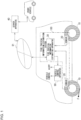
- Fig. 1 is a schematic diagram showing an outline of a tire physical information estimation system 100 according to an embodiment.
- the tire physical information estimation system 100 includes a sensor 20 provided in a tire 10 and a tire physical information estimation apparatus 30. Further, the tire physical information estimation system 100 may include a server apparatus 40 that acquires and collects, via a communication network 91, the tire physical information such as the tire force F, the coefficient of friction on the road surface, and the moment around three axes produced in the tire 10 estimated by the tire physical information estimation apparatus 30.
- the sensor 20 measures the physical quantity of the tire 10 such as the acceleration and strain, tire inflation pressure, and tire temperature of the tire 10 and outputs the measured data to the tire physical information estimation apparatus 30.
- the tire physical information estimation apparatus 30 estimates the tire physical information based on the data measured by the sensor 20.
- the tire physical information estimation apparatus 30 uses the data measured by the sensor 20 for the operation to estimate the tire physical information but may acquire, from a vehicle control apparatus 90, etc., information such as the vehicle acceleration from the vehicle side and use the information for the operation to estimate the tire physical information.
- the tire physical information estimation apparatus 30 outputs the estimated tire physical information such as the tire force F, the coefficient of friction on the road surface, the moment around three axes produced in the tire 10 to, for example, the vehicle control apparatus 90.
- the vehicle control apparatus 90 uses the tire physical information input from the tire physical information estimation apparatus 30 for, for example, estimation of braking distance, application to vehicle control, and notification of the driver of information related to the safe driving of the vehicle.
- the vehicle control apparatus 90 can also use map information, weather information, etc. to provide information related to the future safe driving of the vehicle.
- the tire physical information estimation system 100 provides the estimated tire physical information to the vehicle control apparatus 90 as data used for vehicle speed control, etc. in automatic driving.
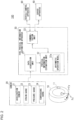
- Fig. 2 is a block diagram showing a functional configuration of the tire physical information estimation system 100 according to the embodiment.
- the sensor 20 of the tire physical information estimation system 100 includes an acceleration sensor 21, a strain gauge 22, a pressure gauge 23, a temperature sensor 24, etc. and measures the physical quantity of the tire 10. These sensors measure, as the physical quantity of the tire 10, the physical quantity related to the deformation and movement of the tire 10.
- the acceleration sensor 21 and the strain gauge 22 move mechanically along with the tire 10 and measure the acceleration and amount of strain produced in the tire 10, respectively.
- the acceleration sensor 21 is provided in, for example, the tread, side, and bead of the tire 10, in the wheel, etc. and measures the acceleration in the three axes, i.e., the circumferential, axial, and radial directions of the tire 10.
- the strain gauge 22 is provided in the tread, side, bead, etc. of the tire 10 and measures the strain at the location of provision. Further, the pressure gauge 23 and the temperature sensor 24 are provided in, for example, the air valve of the tire 10 and measure the tire inflation pressure and tire temperature, respectively. The temperature sensor 24 may be provided directly in the tire 10 to measure the temperature of the tire 10 accurately. An RFID 11, etc. to which unique identification information is assigned may be attached to the tire 10 to identify each tire.
- the tire physical information estimation apparatus 30 includes a data acquisition unit 31, a physical information estimation unit 32, and a communication unit 33.
- the tire physical information estimation apparatus 30 is an information processing apparatus such as a personal computer (PC).
- the units in the tire physical information estimation apparatus 30 can be realized in hardware by an electronic element such as a CPU of a computer, a mechanical component or the like, and in software by a computer program or the like. Functional blocks realized through collaboration among them are depicted here. Accordingly, those skilled in the art will understand that these functional blocks can be realized in various forms by a combination of hardware and software.
- the data acquisition unit 31 acquires, by wireless communication, etc., information on the acceleration, strain, inflation pressure, and temperature measured by the sensor 20.
- the communication unit 33 communicates with an external apparatus such as the vehicle control apparatus 90 and the server apparatus 40 by wire or wirelessly.
- the communication unit 33 transmits the physical quantity of the tire 10 measured by the sensor 20 and the tire physical information etc. estimated for the tire 10, etc. to the external apparatus via a communication line (e.g., a control area network (CAN)), the Internet, etc.).
- a communication line e.g., a control area network (CAN)
- the physical information estimation unit 32 includes an arithmetic operation model 32a, inputs the information from the data acquisition unit 31 to the arithmetic operation model 32a, and estimates the tire physical information such as the tire force F, the coefficient of friction on the road surface, and the moment around three axes produced in the tire 10.
- the tire force F has components in the three axial directions, i.e., a longitudinal force Fx in the longitudinal direction of the tire 10, a lateral force Fy in the lateral direction, and a load Fz in the vertical direction.
- the physical information estimation unit 32 may calculate all of these components in the three axial directions, calculate one of the components, or calculate an arbitrary combination of two components.
- the arithmetic operation model 32a uses a learning type model such as a neural network.
- Fig. 3 is a schematic diagram showing a configuration of the arithmetic operation model 32a.
- the arithmetic operation model 32a is of a convolutional neural network (CNN) type and is a learning type model provided with convolution operation and pooling operation used in the so-called LeNet, which is a prototype of CNN.
- Fig. 3 shows an example in which acceleration data in the three axial directions is used as input data input to the arithmetic operation model 32a, and the normalized tire force in the three axial directions is output.
- CNN convolutional neural network
- the arithmetic operation model 32a includes an input layer 50, a feature extraction unit 51, an intermediate layer 52, a fully-connected unit 53, and an output layer 54.
- the arithmetic operation model 32a is configured as a multitask type in which the feature extraction unit 51 is used commonly for the three axial directions, and the fully-connected unit 53 is provided for each of the three axial directions.
- the output layer 54 outputs the normalized values of the tire forces Fx, Fy, and Fz in the three axial directions.
- the normalized tire forces in the three axial directions output from the output layer 54 are denoted by Fxn, Fyn, and Fzn.
- the normalized tire forces Fxn and Fyn output from the output layer 54 are defined as values derived by dividing the tire forces Fx and Fy by a constant value 5000. This causes the normalized tire forces Fxn and Fyn to vary in a range of -1 or greater and 1 or smaller.
- the normalized tire force Fzn output from the output layer 54 is defined as a value derived by subtracting 5000, the median value, from the tire force Fz and dividing the resultant value by a constant value 3000. This causes the normalized tire force Fzn to vary in a range of -1 or greater and 1 or smaller.
- Normalization of the the tire physical information such as the tire force F in the three axial directions, the coefficient of friction on the road surface, and the moment around the three axes produced in the tire 10 may not be performed as described above and could be configured as appropriate in accordance with the property of the tire physical information, the range of values that could be taken, etc.
- Time series data for acceleration in the three axial directions acquired by the data acquisition unit 31 is input to the input layer 50.
- the acceleration data is measured by the sensor 20 in a time-series manner, and data for a predetermined time segment is extracted by a window function for use as the input data.
- the input data may be 224 items of acceleration data included in a predetermined time segment for each axial direction.
- Acceleration measured in the tire 10 exhibits periodicity per rotation of the tire 10.
- the time segment of input data extracted by the window function may be a period of time corresponding to the period of rotation of the tire 10 to impart the input data itself with a periodicity.
- the window function may extract input data in a time segment shorter or longer than one rotation of the tire 10.
- the arithmetic operation model 32a can be trained so long as the extracted input data at least includes periodical information.
- the feature extraction unit 51 extracts a feature amount by using a convolution operation 51a and a pooling operation 51b and transmits the feature amount to the nodes of the intermediate layer 52.
- 20 filters are used for the input data to perform the first convolution operation.
- the convolution operation 51a performs the convolution operation by moving the filter relative to the time series input data such as acceleration data.
- the convolution operation 51a is performed for the acceleration data (the plurality of items of input data) for each of the three axial directions. By using a common filter in the respective axial directions, the scale of arithmetic operation can be reduced.
- the filter length in the convolution operation 51a is indicated to be 5 but may be set to be 1-5 as appropriate.
- the convolution operation is performed such that, of the time series input data, data as long as the continuous filter length (e.g., A1, A2, A3) is multiplied by the values (f1, f2, f3) in the filters, respectively.
- the values obtained by the multiplication are added up so as to obtain A1 ⁇ f1+A2 ⁇ f2+A3 ⁇ f3.
- Zero padding whereby "0" data is appended to the end of the input data, may be performed to perform the convolution operation.
- the amount of movement of the filter in the convolution operation is, normally, one item of input data but may be modified as appropriate to reduce the scale of the arithmetic operation model 32a.
- the data from the first convolution operation is subjected to the first maximum pooling operation.
- the larger of the two values arranged in a time sequence is selected by way of example.
- a second convolution operation 51c the data from the pooling operation 51b is subjected to a convolution operation by using, for example, 50 filters.
- the filter length in the convolution operation 51c may be equal to or different from that of the convolution operation 51a.
- the scale of arithmetic operation can equally be reduced in the convolution operation 51c by using a common filter in the respective axial directions.
- a pooling operation 51d the data from the convolution operation 51c is subjected to the second maximum pooling operation.
- the pooling operation 51d as in the pooling operation 51b, the larger of the two values arranged in a time sequence is selected by way of example.
- the feature extraction unit 51 acquires 64 items of data in each axial direction, i.e., acquires 64 ⁇ 3 ch data resulting from the convolution operation and the pooling operation and outputs the data to the nodes in the intermediate layer 52.
- the fully-connected unit 53 For each of the three axial directions, the fully-connected unit 53 fully connects the data from the nodes of the intermediate layer 52 in two layers and outputs the normalized tire forces Fxn, Fyn, and Fzn to the nodes of the output layer 54.
- the fully-connected unit 53 performs an operation via fully-connected paths on which weighted liner operation, etc. is performed. In addition to a linear operation, the fully-connected unit 53 may perform a nonlinear operation by using an activating function, etc.
- the physical information estimation unit 32 may restore and estimate the tire forces Fx, Fy, and Fz by subjecting the normalized tire forces Fxn, Fyn, and Fzn output to the output layer 54 to an operation inverse to normalization.
- the tire physical information such as the coefficient of friction on the road surface and the moment around three axes produced in the tire 10 may be output to the nodes of the output layer 54.
- the tire physical information such as the coefficient of friction on the road surface and the moment around three axes produced in the tire 10 output to the output layer 54 may be normalized values.
- the output layer 54 may output one type of tire physical information or an arbitrary combination of plurality of types of tire physical information.
- the output layer 54 may output an estimated value of the coefficient of friction on the road surface.
- the coefficient of friction on the road surface may be grouped into a category such as dry, wet, snowy, or frozen, and the output layer 54 may output which category is applicable.
- the server apparatus 40 acquires, from the tire physical information estimation apparatus 30, the physical quantity of the tire 10 measured by the sensor 20 and the tire physical information such as the tire force F and the coefficient of friction on the road surface estimated for the tire 10.
- the server apparatus 40 may collect, from a plurality of vehicles, the physical quantity measured in the tire 10, the tire physical information estimated by the tire physical information estimation apparatus 30, etc.
- Fig. 4 is a block diagram showing a functional configuration of an arithmetic operation model generation system 110.
- the arithmetic operation model generation system 110 is provided with a tire physical information measurement apparatus 60 and an arithmetic operation model generation apparatus 70 including a learning processing unit 71.
- the arithmetic operation model generation apparatus 70 includes the learning processing unit 71.
- Those features of the arithmetic operation model generation apparatus 70 corresponding to the respective features of the tire physical information estimation apparatus 30 have similar functions as those of the tire physical information estimation apparatus 30, but the arithmetic operation model 32a has not been trained or is being trained.
- the tire physical information measurement apparatus 60 measures the tire physical information such as the tire forces F in the three axial directions, the coefficient of friction on the road surface, and the moment around three axes produced in the tire 10.
- the learning processing unit 71 uses the normalized version of the tire physical information measured by the tire physical information measurement apparatus 60 as training data to train the arithmetic operation model 32a.
- the tire physical information is estimated by the arithmetic operation model 32a based on input information, and the estimated data is compared with the training data.
- the learning processing unit 71 compares the tire physical information estimated by the arithmetic operation model 32a with the training data and newly sets various coefficients in the arithmetic steps such as weighting in the arithmetic operation model 32a.
- the arithmetic operation model 32a is trained by repeatedly being updated.
- the tire physical information estimation system 100 estimates the tire physical information by using the arithmetic operation model 32a that has been trained by the arithmetic operation model generation system 110.
- the configuration (e.g., the number of layers) and weighting in the fully-connected unit 53 of the arithmetic operation model 32a may be changed basically in accordance with the specification of the tire 10.
- the arithmetic operation model 32a can be trained in rotation tests in the tires 10 (including the wheel) with different specifications. It should however be noted that it is not necessary to strictly train the arithmetic operation model 32a for each specification of the tire 10.
- one arithmetic operation model 32a may be shared by the tires 10 encompassed by multiple specifications so that the number of arithmetic operation models is reduced.
- the arithmetic operation model 32a may be trained by mounting the tire 10 to an actual vehicle and test driving the vehicle on road surfaces.
- the specification of the tire 10 includes information related to tire performance such as tire size, tire width, tire profile, tire strength, tire outer diameter, road index, and year/month/date of manufacturing.
- the arithmetic operation model 32a may be trained by conducting rotation tests, changing the coefficient of friction on the ground surface touched by the tire 10. Further, the arithmetic operation model 32a may be trained by mounting the tire 10 to an actual vehicle and test driving the vehicle on road surfaces with different coefficients of friction.
- Fig. 5 is a flowchart showing a sequence of steps of the tire physical information estimation process performed by the tire physical information estimation apparatus 30.
- the tire physical information estimation apparatus 30 acquires the physical quantity such as the acceleration, strain, tire inflation pressure, and tire temperature of the tire 10 measured by the sensor 20 (S1).
- the physical information estimation unit 32 extracts input data in a predetermined time segment from the data acquired by the data acquisition unit 31 (S2). For estimation of tire physical information, acceleration data for at least one axis (e.g., the circumferential direction) is necessary as input data. Further, acceleration data for two axes, i.e., the circumferential direction and axial direction of the tire 10, may be used as input data, or acceleration data for three axes may be used as input data for estimation of tire physical information. Further, the time series data for at least one of the strain, tire inflation pressure, tire temperature of the tire 10 may be included in the input data.
- acceleration data for at least one axis e.g., the circumferential direction
- acceleration data for two axes i.e., the circumferential direction and axial direction of the tire 10
- acceleration data for three axes may be used as input data for estimation of tire physical information.
- the time series data for at least one of the strain, tire inflation pressure, tire temperature of the tire 10 may be included in the
- the feature extraction unit 51 of the arithmetic operation model 32a performs a process of extracting the feature amount by the convolution operation and the pooling operation on the input data (S3).
- the fully-connected unit 53 of the arithmetic operation model 32a performs a fully-connected operation on the feature amount extracted by the feature extraction unit 51 and input to the nodes of the intermediate layer 52 (S4). Parameters for weighting, etc. used in the fully-connected operation are determined as a result of training the arithmetic operation model 32a.
- the fully-connected operation outputs, for example, the normalized tire physical information such as the tire force F, the coefficient of friction on the road surface, and the moment around three axes produced in the tire 10 to the nodes of the output layer 54.
- the physical information estimation unit 32 estimates the tire physical information by subjecting the normalized tire physical information output to the output layer 54 to an operation inverse to normalization (S5) and terminates the process.
- Figs. 6A , 6B and 6C are graphs showing the correlation between estimated values and measured values found by the tire physical information estimation system 100.
- Fig. 6A shows the correlation between estimated values and measured values of the tire force Fx
- Fig. 6B shows the correlation between estimated values and measured values of the tire force Fy
- Fig. 6C shows the correlation between estimated values and measured values of the tire force Fz.
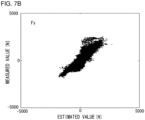
- Figs. 7A , 7B and 7C are graphs showing the correlation between estimated values and measured values found when a learning model according to a comparative example is used.
- the correlation between estimated values and measured values of the tire forces Fx, Fy, and Fz in the comparative example is respectively shown in Fig. 7A , 7B , and 7C .
- a single-task learning model (referred to as "related-art model") is built.
- the related-art model has a high estimation precision but requires a large scale of arithmetic operation and so is not suitable for mounting in a vehicle.
- the correlation of the tire force Fx estimated by the tire physical information estimation system 100 according to the embodiment shown in Fig. 6A shows a distribution substantially identical to the correlation of the tire force Fx according to the comparative example shown in Fig. 7A .
- a comparison between Fig. 6B and Fig. 7B and a comparison between Fig. 6C and Fig. 7C also reveal that the correlation of the tire forces Fy and Fz estimated by the tire physical information estimation system 100 according to the embodiment shows a distribution substantially identical to the correlation of the tire forces Fy and Fz according to the comparative example, respectively.
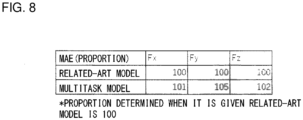
- Fig. 8 shows mean absolute errors of estimated values and measured values.
- the mean absolute values of the tire forces Fx, Fy, and Fz are substantially equal in the multitask model of the embodiment and in the related-art model of the comparative example. In other words, it is demonstrated that the estimation precision of the tire force F commensurate with that of the related-art model of the comparative example can be obtained by the multitask learning model of the embodiment in which the output is normalized.
- the arithmetic operation model 32a of the tire physical information estimation system 100 can increase the estimation precision of the tire physical information by being configured to output the normalized tire physical information in at least two axial directions from the output layer 54.
- the arithmetic operation model 32a can ensure that the normalized tire forces vary within similar ranges and increase the estimation precision, by normalizing the tire force Fz in the vertical direction by an arithmetic operation different from that of the tire forces Fx and Fy in the other two axial directions.
- the tire physical information estimation system 100 can reduce the scale of arithmetic operation by providing the arithmetic operation model 32a with the fully-connected unit 53 for each of the plurality of items of tire physical information output and configuring the arithmetic operation model 32a as a multitasking system accordingly.
- the feature extraction unit 51 of the arithmetic operation model 32a is configured to reduce the scale of arithmetic operation by using a filter common to the convolution operations 51a and 51c.
- the physical information estimation unit 32 uses the arithmetic operation model 32a to estimate the tire force F in at least two axial directions as tire physical information. Further, the physical information estimation unit 32 can provide information necessary to analyze the behavior of the tire 10 such as slip, by estimating all of the tire forces F in the three axial directions.
- the arithmetic operation model generation system 110 can generate the arithmetic operation model 32a having a favorable estimation precision by normalizing the tire physical information measured by the tire physical information measurement apparatus 60 and using the normalized information as training data to train the arithmetic operation model 32a.
- the learning processing unit 71 of the arithmetic operation model generation system 110 can generate an arithmetic operation model with a reduced scale of arithmetic operation by training the arithmetic operation model 32a configured as a multitasking system.
- FIG. 9 is a block diagram showing a functional configuration of the tire physical information estimation system 100 according to a variation.
- data input to the arithmetic operation model 32a is acquired from the vehicle control apparatus 90.
- Data from the vehicle control apparatus 90 and data from the sensor 20 can both be used as data input to the arithmetic operation model 32a.
- the vehicle control apparatus 90 acquires, in the digital tachometer etc. of the vehicle, traveling data such as the traveling speed of the vehicle, acceleration in the three axial directions, and triaxial angular speed, and load data such as the weight of the vehicle and axle load applied to the axle shaft.
- the vehicle control apparatus 90 outputs the traveling data and load data to the tire physical information estimation apparatus 30.
- the tire physical information estimation apparatus 30 estimates, by means of the arithmetic operation model 32a, the tire physical information such as the tire force F, the coefficient of friction on the road surface, and the moment around three axes produced in the tire 10 in response to the data input from the vehicle control apparatus 90.
- the arithmetic operation model 32a is built by, for example, test-driving an actual vehicle to train the arithmetic operation model 32a to learn to estimate the tire physical information in response to the data input from the vehicle control apparatus 90 in advance.
- the tire physical information estimated by the arithmetic operation model 32a is exemplified by the tire force F, the coefficient of friction on the road surface, and the moment around three axes produced in the tire 10.
- the looseness of a fastening component such as a wheel nut used to mount the tire 10 can be estimated.
- the vibration due to the looseness of the fastening component such as a wheel nut is reflected in the acceleration data measured in the tire 10, and so the arithmetic operation model 32a of a CNN type for estimating the looseness of the fastening component by way of comparison between tire forces F is built and trained.
- the tire physical information estimation system 100 can estimate the looseness of the fastening component of the tire 10 in real time by running the operation in the arithmetic operation model 32a based on the input data such as the acceleration data acquired while an actual vehicle is being driven.
- the senor 20 is not limited to the sensors described with reference to Fig. 1 , and a microphone provided in the tire 10 or the neighborhood thereof may be used.
- the arithmetic operation model 32a may estimate the tire physical information by using audio data collected by the microphone.
- the arithmetic operation model 32a of a CNN type built on the LeNet model is used.
- a model structure such as the Dense Net model, Res Net model, Mobile Net model, and Peleel Net Model may be used.
- a module structure such as Dense Block, Residual Block, Stem Block, etc. may be incorporated into the arithmetic operation model 32a to build the model.
- the tire physical information estimation system 100 includes the physical information estimation unit 32 and the data acquisition unit 31.
- the physical information estimation unit 32 includes the learning type arithmetic operation model 32a including the input layer 50 through the output layer 54 and estimates the tire physical information produced in association with the movement of the tire 10.
- the data acquisition unit 31 acquires the input data input to the input layer 50.
- the arithmetic operation model 32a includes the feature extraction unit 51 that performs the convolution operations 51a and 51c in the operation halfway between the input layer 50 and the output layer 54, and the arithmetic operation model 32a outputs the normalized tire physical information in at least two axial directions from the output layer 54. This makes it possible for the tire physical information estimation system 100 to increase the estimation precision of the tire physical information such as the tire force F, the coefficient of friction on the road surface, and the moment around three axes produced in the tire 10.
- the arithmetic operation model 32a has a plurality of fully-connected units 53 corresponding to the respective axial directions, and the output of the feature extraction unit 51 is input to the plurality of fully-connected units 53. This allows the tire physical information estimation system 100 to reduce the scale of arithmetic operation owing to multitasking in the arithmetic operation model 32a.
- the tire physical information comprises tire forces F in the three axial directions. This allows the tire physical information estimation system 100 to provide information necessary to analyze the behavior of the tire 10 such as slip.
- the output layer 54 of the arithmetic operation model 32a outputs tire force Fz in the vertical direction normalized by an arithmetic operation different from that of the tire forces Fx and Fy in the other two axial directions. This allows the tire physical information estimation system 100 to ensure that the normalized tire forces vary within similar ranges and to increase the estimation precision.
- the arithmetic operation model generation system 110 includes the physical information estimation unit 32, the data acquisition unit 31, and the learning processing unit 71.
- the physical information estimation unit 32 includes the learning type arithmetic operation model 32a including the input layer 50 through the output layer 54 and estimates the tire physical information produced in association with movement of the tire 10.
- the data acquisition unit 31 acquires the input data input to the input layer 50.
- the learning processing unit 71 trains the arithmetic operation model 32a based on the training data derived from normalizing the tire physical information measured in the tire 10.
- the arithmetic operation model 32a includes the feature extraction unit 51 that performs the convolution operations 51a and 51c in the operation halfway between the input layer 50 and the output layer 54, and the arithmetic operation model 32a outputs the normalized tire physical information in at least two axial directions from the output layer 54.
- The allows the arithmetic operation model generation system 110 to generate the arithmetic operation model 32a having a favorable estimation precision.
Landscapes
- Engineering & Computer Science (AREA)
- Physics & Mathematics (AREA)
- Theoretical Computer Science (AREA)
- Mechanical Engineering (AREA)
- Mathematical Physics (AREA)
- Software Systems (AREA)
- Data Mining & Analysis (AREA)
- General Engineering & Computer Science (AREA)
- Biophysics (AREA)
- Computational Linguistics (AREA)
- Artificial Intelligence (AREA)
- Evolutionary Computation (AREA)
- General Health & Medical Sciences (AREA)
- Molecular Biology (AREA)
- Computing Systems (AREA)
- Biomedical Technology (AREA)
- General Physics & Mathematics (AREA)
- Life Sciences & Earth Sciences (AREA)
- Health & Medical Sciences (AREA)
- Transportation (AREA)
- Fuzzy Systems (AREA)
- Automation & Control Theory (AREA)
- Tires In General (AREA)
Description
- The present invention relates to a tire physical information estimation system and an arithmetic operation model generation system.
- Recently, studies have been conducted on systems configured to input information measured in a tire, a vehicle, etc. to a learning type arithmetic operation model to estimate tire physical information such as a tire force.
-
Patent literature 1 discloses a tire physical information estimation system according to the related art. The tire physical information estimation system includes a physical information estimation unit and a data acquisition unit. The physical information estimation unit includes a learning type arithmetic operation model including an input layer through an output layer for estimation of physical information related to a tire produced in association with the movement of the tire. The data acquisition unit acquires input data input to the input layer. The arithmetic operation model includes a feature extraction unit that performs a convolution operation in an operation halfway between the input layer and the output layer to extract a feature amount.
JP 2021 046080 A
CN 111 272 334 A describes a multi-dimensional force sensor correction and decoupling method based on a particle swarm optimization BP neural network.
NAN XU ET AL, "Tire Force Estimation in Intelligent Tires Using Machine Learning", ARXIV.ORG, CORNELL UNIVERSITY LIBRARY, 201 OLIN LIBRARY CORNELL UNIVERSITY ITHACA, NY 14853, (20201211), doi:10.1109/TITS.2020.3038155, XP081835300 [A] 1-5 relates to intelligent tires and the application of machine learning techniques to tire force estimation. - [Patent literature 1]
Japanese Patent Application Publication No. 2021-46080 - When a system with a small scale of arithmetic operation is built by using the tire physical information estimation system disclosed in
patent literature 1, the estimation precision might become poor even if the real time performance of estimation is secured. We have come to realize that the technology disclosed inpatent literature 1 leaves a room for improvement in terms of increasing the precision of estimation of tire physical information based on a learning type arithmetic operation model. - The present invention addresses the aforementioned issue and a purpose thereof is to provide a tire physical information estimation system and an arithmetic operation model generation system capable of estimating physical information related to a tire with a high precision.
- The present invention is defined by the independent claims. Preferred examples are defined in the dependent claims. An embodiment of the present invention relates to a tire physical information estimation system. The tire physical information estimation system includes: a physical information estimation unit that includes a learning type arithmetic operation model including an input layer through an output layer and estimates tire physical information produced in association with movement of a tire; and a data acquisition unit that acquires input data input to the input layer, wherein the arithmetic operation model includes a feature extraction unit that performs a convolution operation in an operation halfway between the input layer and the output layer, the arithmetic operation model outputting
normalized tire physical information in at least two axial directions from the output layer. - According to the present invention, physical information related to a tire can be estimated with a high precision.
-
Fig. 1 is a schematic diagram showing an outline of a tire physical information estimation system according to an embodiment; -
Fig. 2 is a block diagram showing a functional configuration of the tire physical information estimation system according to the embodiment; -
Fig. 3 is a schematic diagram showing a configuration of the arithmetic operation model; -
Fig. 4 is a block diagram showing a functional configuration of an arithmetic operation model generation system; -
Fig. 5 is a flowchart showing a sequence of steps of the tire physical information estimation process performed by the tire physical information estimation apparatus; -
Figs. 6A ,6B and6C are graphs showing the correlation between estimated values and measured values found by the tire physical information estimation system; -
Figs. 7A ,7B and7C are graphs showing the correlation between estimated values and measured values found when a learning model according to a comparative example is used; -
Fig. 8 shows mean absolute errors of estimated values and measured values; and -
Fig. 9 is a block diagram showing a functional configuration of the tire physical information estimation system according to a variation. - Hereinafter, the invention will be described based on a preferred embodiment with reference to
Figs. 1 through 9 . Identical or like constituting elements and members shown in the drawings are represented by identical symbols and a duplicate description will be omitted as appropriate. The dimension of members in the drawings shall be enlarged or reduced as appropriate to facilitate understanding. Those of the members that are not important in describing the embodiment are omitted from the drawings. - (Embodiment)
Fig. 1 is a schematic diagram showing an outline of a tire physicalinformation estimation system 100 according to an embodiment. The tire physicalinformation estimation system 100 includes asensor 20 provided in atire 10 and a tire physicalinformation estimation apparatus 30. Further, the tire physicalinformation estimation system 100 may include aserver apparatus 40 that acquires and collects, via acommunication network 91, the tire physical information such as the tire force F, the coefficient of friction on the road surface, and the moment around three axes produced in thetire 10 estimated by the tire physicalinformation estimation apparatus 30. - The
sensor 20 measures the physical quantity of thetire 10 such as the acceleration and strain, tire inflation pressure, and tire temperature of thetire 10 and outputs the measured data to the tire physicalinformation estimation apparatus 30. The tire physicalinformation estimation apparatus 30 estimates the tire physical information based on the data measured by thesensor 20. The tire physicalinformation estimation apparatus 30 uses the data measured by thesensor 20 for the operation to estimate the tire physical information but may acquire, from avehicle control apparatus 90, etc., information such as the vehicle acceleration from the vehicle side and use the information for the operation to estimate the tire physical information. - The tire physical
information estimation apparatus 30 outputs the estimated tire physical information such as the tire force F, the coefficient of friction on the road surface, the moment around three axes produced in thetire 10 to, for example, thevehicle control apparatus 90. Thevehicle control apparatus 90 uses the tire physical information input from the tire physicalinformation estimation apparatus 30 for, for example, estimation of braking distance, application to vehicle control, and notification of the driver of information related to the safe driving of the vehicle. Thevehicle control apparatus 90 can also use map information, weather information, etc. to provide information related to the future safe driving of the vehicle. In the case thevehicle control apparatus 90 has a function of driving the vehicle automatically, the tire physicalinformation estimation system 100 provides the estimated tire physical information to thevehicle control apparatus 90 as data used for vehicle speed control, etc. in automatic driving. -
Fig. 2 is a block diagram showing a functional configuration of the tire physicalinformation estimation system 100 according to the embodiment. Thesensor 20 of the tire physicalinformation estimation system 100 includes anacceleration sensor 21, astrain gauge 22, apressure gauge 23, atemperature sensor 24, etc. and measures the physical quantity of thetire 10. These sensors measure, as the physical quantity of thetire 10, the physical quantity related to the deformation and movement of thetire 10. - The
acceleration sensor 21 and thestrain gauge 22 move mechanically along with thetire 10 and measure the acceleration and amount of strain produced in thetire 10, respectively. Theacceleration sensor 21 is provided in, for example, the tread, side, and bead of thetire 10, in the wheel, etc. and measures the acceleration in the three axes, i.e., the circumferential, axial, and radial directions of thetire 10. - The
strain gauge 22 is provided in the tread, side, bead, etc. of thetire 10 and measures the strain at the location of provision. Further, thepressure gauge 23 and thetemperature sensor 24 are provided in, for example, the air valve of thetire 10 and measure the tire inflation pressure and tire temperature, respectively. Thetemperature sensor 24 may be provided directly in thetire 10 to measure the temperature of thetire 10 accurately. AnRFID 11, etc. to which unique identification information is assigned may be attached to thetire 10 to identify each tire. - The tire physical
information estimation apparatus 30 includes adata acquisition unit 31, a physicalinformation estimation unit 32, and acommunication unit 33. The tire physicalinformation estimation apparatus 30 is an information processing apparatus such as a personal computer (PC). The units in the tire physicalinformation estimation apparatus 30 can be realized in hardware by an electronic element such as a CPU of a computer, a mechanical component or the like, and in software by a computer program or the like. Functional blocks realized through collaboration among them are depicted here. Accordingly, those skilled in the art will understand that these functional blocks can be realized in various forms by a combination of hardware and software. - The
data acquisition unit 31 acquires, by wireless communication, etc., information on the acceleration, strain, inflation pressure, and temperature measured by thesensor 20. Thecommunication unit 33 communicates with an external apparatus such as thevehicle control apparatus 90 and theserver apparatus 40 by wire or wirelessly. Thecommunication unit 33 transmits the physical quantity of thetire 10 measured by thesensor 20 and the tire physical information etc. estimated for thetire 10, etc. to the external apparatus via a communication line (e.g., a control area network (CAN)), the Internet, etc.). - The physical
information estimation unit 32 includes anarithmetic operation model 32a, inputs the information from thedata acquisition unit 31 to thearithmetic operation model 32a, and estimates the tire physical information such as the tire force F, the coefficient of friction on the road surface, and the moment around three axes produced in thetire 10. As shown inFig. 2 , the tire force F has components in the three axial directions, i.e., a longitudinal force Fx in the longitudinal direction of thetire 10, a lateral force Fy in the lateral direction, and a load Fz in the vertical direction. The physicalinformation estimation unit 32 may calculate all of these components in the three axial directions, calculate one of the components, or calculate an arbitrary combination of two components. - The
arithmetic operation model 32a uses a learning type model such as a neural network.Fig. 3 is a schematic diagram showing a configuration of thearithmetic operation model 32a. Thearithmetic operation model 32a is of a convolutional neural network (CNN) type and is a learning type model provided with convolution operation and pooling operation used in the so-called LeNet, which is a prototype of CNN.Fig. 3 shows an example in which acceleration data in the three axial directions is used as input data input to thearithmetic operation model 32a, and the normalized tire force in the three axial directions is output. - The
arithmetic operation model 32a includes aninput layer 50, afeature extraction unit 51, anintermediate layer 52, a fully-connectedunit 53, and anoutput layer 54. Thearithmetic operation model 32a is configured as a multitask type in which thefeature extraction unit 51 is used commonly for the three axial directions, and the fully-connectedunit 53 is provided for each of the three axial directions. Theoutput layer 54 outputs the normalized values of the tire forces Fx, Fy, and Fz in the three axial directions. The normalized tire forces in the three axial directions output from theoutput layer 54 are denoted by Fxn, Fyn, and Fzn. - Given that each of the tire forces Fx and FY generated while the vehicle is being driven is -5000 N or greater and 5000 N or smaller, for example, the normalized tire forces Fxn and Fyn output from the
output layer 54 are defined as values derived by dividing the tire forces Fx and Fy by aconstant value 5000. This causes the normalized tire forces Fxn and Fyn to vary in a range of -1 or greater and 1 or smaller. - Given that the tire force Fz generated while the vehicle is being driven is 2000 N or greater and 8000 N or smaller, for example, the normalized tire force Fzn output from the
output layer 54 is defined as a value derived by subtracting 5000, the median value, from the tire force Fz and dividing the resultant value by a constant value 3000. This causes the normalized tire force Fzn to vary in a range of -1 or greater and 1 or smaller. - Normalization of the the tire physical information such as the tire force F in the three axial directions, the coefficient of friction on the road surface, and the moment around the three axes produced in the
tire 10 may not be performed as described above and could be configured as appropriate in accordance with the property of the tire physical information, the range of values that could be taken, etc. - Time series data for acceleration in the three axial directions acquired by the
data acquisition unit 31 is input to theinput layer 50. The acceleration data is measured by thesensor 20 in a time-series manner, and data for a predetermined time segment is extracted by a window function for use as the input data. For example, the input data may be 224 items of acceleration data included in a predetermined time segment for each axial direction. - Acceleration measured in the
tire 10 exhibits periodicity per rotation of thetire 10. The time segment of input data extracted by the window function may be a period of time corresponding to the period of rotation of thetire 10 to impart the input data itself with a periodicity. The window function may extract input data in a time segment shorter or longer than one rotation of thetire 10. Thearithmetic operation model 32a can be trained so long as the extracted input data at least includes periodical information. - The
feature extraction unit 51 extracts a feature amount by using aconvolution operation 51a and apooling operation 51b and transmits the feature amount to the nodes of theintermediate layer 52. In the example of thefeature extraction unit 51 shown inFig. 3 , 20 filters are used for the input data to perform the first convolution operation. Theconvolution operation 51a performs the convolution operation by moving the filter relative to the time series input data such as acceleration data. Theconvolution operation 51a is performed for the acceleration data (the plurality of items of input data) for each of the three axial directions. By using a common filter in the respective axial directions, the scale of arithmetic operation can be reduced. - The filter length in the
convolution operation 51a is indicated to be 5 but may be set to be 1-5 as appropriate. The convolution operation is performed such that, of the time series input data, data as long as the continuous filter length (e.g., A1, A2, A3) is multiplied by the values (f1, f2, f3) in the filters, respectively. The values obtained by the multiplication are added up so as to obtain A1×f1+A2×f2+A3×f3. Zero padding, whereby "0" data is appended to the end of the input data, may be performed to perform the convolution operation. The amount of movement of the filter in the convolution operation is, normally, one item of input data but may be modified as appropriate to reduce the scale of thearithmetic operation model 32a. - In the
pooling operation 51b, the data from the first convolution operation is subjected to the first maximum pooling operation. In thepooling operation 51b, the larger of the two values arranged in a time sequence is selected by way of example. - In a
second convolution operation 51c, the data from the poolingoperation 51b is subjected to a convolution operation by using, for example, 50 filters. The filter length in theconvolution operation 51c may be equal to or different from that of theconvolution operation 51a. The scale of arithmetic operation can equally be reduced in theconvolution operation 51c by using a common filter in the respective axial directions. - In a
pooling operation 51d, the data from theconvolution operation 51c is subjected to the second maximum pooling operation. In thepooling operation 51d, as in thepooling operation 51b, the larger of the two values arranged in a time sequence is selected by way of example. Thefeature extraction unit 51 acquires 64 items of data in each axial direction, i.e., acquires 64×3 ch data resulting from the convolution operation and the pooling operation and outputs the data to the nodes in theintermediate layer 52. - For each of the three axial directions, the fully-connected
unit 53 fully connects the data from the nodes of theintermediate layer 52 in two layers and outputs the normalized tire forces Fxn, Fyn, and Fzn to the nodes of theoutput layer 54. The fully-connectedunit 53 performs an operation via fully-connected paths on which weighted liner operation, etc. is performed. In addition to a linear operation, the fully-connectedunit 53 may perform a nonlinear operation by using an activating function, etc. - The physical
information estimation unit 32 may restore and estimate the tire forces Fx, Fy, and Fz by subjecting the normalized tire forces Fxn, Fyn, and Fzn output to theoutput layer 54 to an operation inverse to normalization. - In addition to the normalized tire forces in the three axial directions, the tire physical information such as the coefficient of friction on the road surface and the moment around three axes produced in the
tire 10 may be output to the nodes of theoutput layer 54. The tire physical information such as the coefficient of friction on the road surface and the moment around three axes produced in thetire 10 output to theoutput layer 54 may be normalized values. Of the tire physical information such as the tire forces in the three axial directions, the coefficient of friction on the road surface, and the moment around three axes produced in thetire 10, theoutput layer 54 may output one type of tire physical information or an arbitrary combination of plurality of types of tire physical information. - In the estimation of the coefficient of friction on the road surface, the
output layer 54 may output an estimated value of the coefficient of friction on the road surface. Alternatively, the coefficient of friction on the road surface may be grouped into a category such as dry, wet, snowy, or frozen, and theoutput layer 54 may output which category is applicable. - Reference is made back to
Fig. 2 . Theserver apparatus 40 acquires, from the tire physicalinformation estimation apparatus 30, the physical quantity of thetire 10 measured by thesensor 20 and the tire physical information such as the tire force F and the coefficient of friction on the road surface estimated for thetire 10. Theserver apparatus 40 may collect, from a plurality of vehicles, the physical quantity measured in thetire 10, the tire physical information estimated by the tire physicalinformation estimation apparatus 30, etc. -
Fig. 4 is a block diagram showing a functional configuration of an arithmetic operationmodel generation system 110. The arithmetic operationmodel generation system 110 is provided with a tire physicalinformation measurement apparatus 60 and an arithmetic operationmodel generation apparatus 70 including alearning processing unit 71. In addition to the features of the tire physicalinformation estimation apparatus 30, the arithmetic operationmodel generation apparatus 70 includes thelearning processing unit 71. Those features of the arithmetic operationmodel generation apparatus 70 corresponding to the respective features of the tire physicalinformation estimation apparatus 30 have similar functions as those of the tire physicalinformation estimation apparatus 30, but thearithmetic operation model 32a has not been trained or is being trained. - The tire physical
information measurement apparatus 60 measures the tire physical information such as the tire forces F in the three axial directions, the coefficient of friction on the road surface, and the moment around three axes produced in thetire 10. Thelearning processing unit 71 uses the normalized version of the tire physical information measured by the tire physicalinformation measurement apparatus 60 as training data to train thearithmetic operation model 32a. In the process of training thearithmetic operation model 32a, the tire physical information is estimated by thearithmetic operation model 32a based on input information, and the estimated data is compared with the training data. - The
learning processing unit 71 compares the tire physical information estimated by thearithmetic operation model 32a with the training data and newly sets various coefficients in the arithmetic steps such as weighting in thearithmetic operation model 32a. Thearithmetic operation model 32a is trained by repeatedly being updated. The tire physicalinformation estimation system 100 estimates the tire physical information by using thearithmetic operation model 32a that has been trained by the arithmetic operationmodel generation system 110. - The configuration (e.g., the number of layers) and weighting in the fully-connected
unit 53 of thearithmetic operation model 32a may be changed basically in accordance with the specification of thetire 10. Thearithmetic operation model 32a can be trained in rotation tests in the tires 10 (including the wheel) with different specifications. It should however be noted that it is not necessary to strictly train thearithmetic operation model 32a for each specification of thetire 10. By training and building thearithmetic operation model 32a for different types (e.g., tires for passenger vehicles, tires for trucks, etc.) to make it possible to estimate the tire force F within a predetermined margin of error, onearithmetic operation model 32a may be shared by thetires 10 encompassed by multiple specifications so that the number of arithmetic operation models is reduced. - The
arithmetic operation model 32a may be trained by mounting thetire 10 to an actual vehicle and test driving the vehicle on road surfaces. The specification of thetire 10 includes information related to tire performance such as tire size, tire width, tire profile, tire strength, tire outer diameter, road index, and year/month/date of manufacturing. - The
arithmetic operation model 32a may be trained by conducting rotation tests, changing the coefficient of friction on the ground surface touched by thetire 10. Further, thearithmetic operation model 32a may be trained by mounting thetire 10 to an actual vehicle and test driving the vehicle on road surfaces with different coefficients of friction. - A description will now be given of the operation of the tire physical
information estimation system 100.Fig. 5 is a flowchart showing a sequence of steps of the tire physical information estimation process performed by the tire physicalinformation estimation apparatus 30. The tire physicalinformation estimation apparatus 30 acquires the physical quantity such as the acceleration, strain, tire inflation pressure, and tire temperature of thetire 10 measured by the sensor 20 (S1). - The physical
information estimation unit 32 extracts input data in a predetermined time segment from the data acquired by the data acquisition unit 31 (S2). For estimation of tire physical information, acceleration data for at least one axis (e.g., the circumferential direction) is necessary as input data. Further, acceleration data for two axes, i.e., the circumferential direction and axial direction of thetire 10, may be used as input data, or acceleration data for three axes may be used as input data for estimation of tire physical information. Further, the time series data for at least one of the strain, tire inflation pressure, tire temperature of thetire 10 may be included in the input data. - The
feature extraction unit 51 of thearithmetic operation model 32a performs a process of extracting the feature amount by the convolution operation and the pooling operation on the input data (S3). The fully-connectedunit 53 of thearithmetic operation model 32a performs a fully-connected operation on the feature amount extracted by thefeature extraction unit 51 and input to the nodes of the intermediate layer 52 (S4). Parameters for weighting, etc. used in the fully-connected operation are determined as a result of training thearithmetic operation model 32a. The fully-connected operation outputs, for example, the normalized tire physical information such as the tire force F, the coefficient of friction on the road surface, and the moment around three axes produced in thetire 10 to the nodes of theoutput layer 54. - The physical
information estimation unit 32 estimates the tire physical information by subjecting the normalized tire physical information output to theoutput layer 54 to an operation inverse to normalization (S5) and terminates the process. -
Figs. 6A ,6B and6C are graphs showing the correlation between estimated values and measured values found by the tire physicalinformation estimation system 100.Fig. 6A shows the correlation between estimated values and measured values of the tire force Fx,Fig. 6B shows the correlation between estimated values and measured values of the tire force Fy, andFig. 6C shows the correlation between estimated values and measured values of the tire force Fz. -
Figs. 7A ,7B and7C are graphs showing the correlation between estimated values and measured values found when a learning model according to a comparative example is used. The correlation between estimated values and measured values of the tire forces Fx, Fy, and Fz in the comparative example is respectively shown inFig. 7A ,7B , and7C . In the comparative example, a single-task learning model (referred to as "related-art model") is built. The related-art model has a high estimation precision but requires a large scale of arithmetic operation and so is not suitable for mounting in a vehicle. - The correlation of the tire force Fx estimated by the tire physical
information estimation system 100 according to the embodiment shown inFig. 6A shows a distribution substantially identical to the correlation of the tire force Fx according to the comparative example shown inFig. 7A . A comparison betweenFig. 6B andFig. 7B and a comparison betweenFig. 6C andFig. 7C also reveal that the correlation of the tire forces Fy and Fz estimated by the tire physicalinformation estimation system 100 according to the embodiment shows a distribution substantially identical to the correlation of the tire forces Fy and Fz according to the comparative example, respectively. -
Fig. 8 shows mean absolute errors of estimated values and measured values. The mean absolute values of the tire forces Fx, Fy, and Fz are substantially equal in the multitask model of the embodiment and in the related-art model of the comparative example. In other words, it is demonstrated that the estimation precision of the tire force F commensurate with that of the related-art model of the comparative example can be obtained by the multitask learning model of the embodiment in which the output is normalized. - The
arithmetic operation model 32a of the tire physicalinformation estimation system 100 can increase the estimation precision of the tire physical information by being configured to output the normalized tire physical information in at least two axial directions from theoutput layer 54. Thearithmetic operation model 32a can ensure that the normalized tire forces vary within similar ranges and increase the estimation precision, by normalizing the tire force Fz in the vertical direction by an arithmetic operation different from that of the tire forces Fx and Fy in the other two axial directions. - The tire physical
information estimation system 100 can reduce the scale of arithmetic operation by providing thearithmetic operation model 32a with the fully-connectedunit 53 for each of the plurality of items of tire physical information output and configuring thearithmetic operation model 32a as a multitasking system accordingly. Thefeature extraction unit 51 of thearithmetic operation model 32a is configured to reduce the scale of arithmetic operation by using a filter common to theconvolution operations information estimation unit 32 uses thearithmetic operation model 32a to estimate the tire force F in at least two axial directions as tire physical information. Further, the physicalinformation estimation unit 32 can provide information necessary to analyze the behavior of thetire 10 such as slip, by estimating all of the tire forces F in the three axial directions. - The arithmetic operation
model generation system 110 can generate thearithmetic operation model 32a having a favorable estimation precision by normalizing the tire physical information measured by the tire physicalinformation measurement apparatus 60 and using the normalized information as training data to train thearithmetic operation model 32a. Thelearning processing unit 71 of the arithmetic operationmodel generation system 110 can generate an arithmetic operation model with a reduced scale of arithmetic operation by training thearithmetic operation model 32a configured as a multitasking system. - (Variation)
Fig. 9 is a block diagram showing a functional configuration of the tire physicalinformation estimation system 100 according to a variation. In the variation shown inFig. 9 , data input to thearithmetic operation model 32a is acquired from thevehicle control apparatus 90. Data from thevehicle control apparatus 90 and data from the sensor 20 (seeFig. 2 ) can both be used as data input to thearithmetic operation model 32a. - The
vehicle control apparatus 90 acquires, in the digital tachometer etc. of the vehicle, traveling data such as the traveling speed of the vehicle, acceleration in the three axial directions, and triaxial angular speed, and load data such as the weight of the vehicle and axle load applied to the axle shaft. Thevehicle control apparatus 90 outputs the traveling data and load data to the tire physicalinformation estimation apparatus 30. - The tire physical
information estimation apparatus 30 estimates, by means of thearithmetic operation model 32a, the tire physical information such as the tire force F, the coefficient of friction on the road surface, and the moment around three axes produced in thetire 10 in response to the data input from thevehicle control apparatus 90. Thearithmetic operation model 32a is built by, for example, test-driving an actual vehicle to train thearithmetic operation model 32a to learn to estimate the tire physical information in response to the data input from thevehicle control apparatus 90 in advance. - In the embodiment and the variation described above, the tire physical information estimated by the
arithmetic operation model 32a is exemplified by the tire force F, the coefficient of friction on the road surface, and the moment around three axes produced in thetire 10. Alternatively, the looseness of a fastening component such as a wheel nut used to mount thetire 10 can be estimated. The vibration due to the looseness of the fastening component such as a wheel nut is reflected in the acceleration data measured in thetire 10, and so thearithmetic operation model 32a of a CNN type for estimating the looseness of the fastening component by way of comparison between tire forces F is built and trained. The tire physicalinformation estimation system 100 can estimate the looseness of the fastening component of thetire 10 in real time by running the operation in thearithmetic operation model 32a based on the input data such as the acceleration data acquired while an actual vehicle is being driven. - Further, the
sensor 20 is not limited to the sensors described with reference toFig. 1 , and a microphone provided in thetire 10 or the neighborhood thereof may be used. Thearithmetic operation model 32a may estimate the tire physical information by using audio data collected by the microphone. - In the embodiment and the variation described above, the
arithmetic operation model 32a of a CNN type built on the LeNet model is used. Alternatively, a model structure such as the Dense Net model, Res Net model, Mobile Net model, and Peleel Net Model may be used. A module structure such as Dense Block, Residual Block, Stem Block, etc. may be incorporated into thearithmetic operation model 32a to build the model. - A description will now be given of the features of the tire physical
information estimation system 100 and the arithmetic operationmodel generation system 110 according to the embodiment. The tire physicalinformation estimation system 100 according to the embodiment includes the physicalinformation estimation unit 32 and thedata acquisition unit 31. The physicalinformation estimation unit 32 includes the learning typearithmetic operation model 32a including theinput layer 50 through theoutput layer 54 and estimates the tire physical information produced in association with the movement of thetire 10. Thedata acquisition unit 31 acquires the input data input to theinput layer 50. Thearithmetic operation model 32a includes thefeature extraction unit 51 that performs theconvolution operations input layer 50 and theoutput layer 54, and thearithmetic operation model 32a outputs the normalized tire physical information in at least two axial directions from theoutput layer 54. This makes it possible for the tire physicalinformation estimation system 100 to increase the estimation precision of the tire physical information such as the tire force F, the coefficient of friction on the road surface, and the moment around three axes produced in thetire 10. - Further, the
arithmetic operation model 32a has a plurality of fully-connectedunits 53 corresponding to the respective axial directions, and the output of thefeature extraction unit 51 is input to the plurality of fully-connectedunits 53. This allows the tire physicalinformation estimation system 100 to reduce the scale of arithmetic operation owing to multitasking in thearithmetic operation model 32a. - Further, the tire physical information comprises tire forces F in the three axial directions. This allows the tire physical
information estimation system 100 to provide information necessary to analyze the behavior of thetire 10 such as slip. - Further, the
output layer 54 of thearithmetic operation model 32a outputs tire force Fz in the vertical direction normalized by an arithmetic operation different from that of the tire forces Fx and Fy in the other two axial directions. This allows the tire physicalinformation estimation system 100 to ensure that the normalized tire forces vary within similar ranges and to increase the estimation precision. - The arithmetic operation
model generation system 110 includes the physicalinformation estimation unit 32, thedata acquisition unit 31, and thelearning processing unit 71. The physicalinformation estimation unit 32 includes the learning typearithmetic operation model 32a including theinput layer 50 through theoutput layer 54 and estimates the tire physical information produced in association with movement of thetire 10. Thedata acquisition unit 31 acquires the input data input to theinput layer 50. Thelearning processing unit 71 trains thearithmetic operation model 32a based on the training data derived from normalizing the tire physical information measured in thetire 10. Thearithmetic operation model 32a includes thefeature extraction unit 51 that performs theconvolution operations input layer 50 and theoutput layer 54, and thearithmetic operation model 32a outputs the normalized tire physical information in at least two axial directions from theoutput layer 54. The allows the arithmetic operationmodel generation system 110 to generate thearithmetic operation model 32a having a favorable estimation precision. - Described above is an explanation based on an exemplary embodiment. The embodiments are intended to be illustrative only and it will be understood by those skilled in the art that variations and modifications are possible within the scope of the present invention as defined by the appended claims.
- 10 tire, 31 data acquisition unit, 32 physical information estimation unit, 32a arithmetic operation model, 50 input layer, 51 feature extraction unit, 51a and 51c convolution operation, 53 fully-connected unit, 54 output layer, 71 learning processing unit, 100 tire physical information estimation system, 110 arithmetic operation model generation system
Claims (5)
- A tire physical information estimation system (100), comprising:a physical information estimation unit (32) that includes a learning type arithmetic operation model (32a) including an input layer (50) through an output layer (54) and estimates tire physical information produced in association with movement of a tire (10); anda data acquisition unit (31) that acquires input data input to the input layer (50), whereinthe arithmetic operation model (32a) includes a feature extraction unit (51) that performs a convolution operation (51a, 51c) in an operation halfway between the input layer (50) and the output layer (54), the arithmetic operation model (32a) outputting normalized tire physical information in at least two axial directions from the output layer (54),characterized in thatthe arithmetic operation model (32a) includes a plurality of fully-connected units (53) corresponding to respective axial directions and inputs an output of the feature extraction unit (51) to the plurality of fully-connected units (53).
- The tire physical information estimation system (100) according to claim 1, wherein
the tire physical information is a tire force in each of three axial directions. - The tire physical information estimation system (100) according to claim 2, wherein
the output layer (54) outputs a tire force in a vertical direction normalized by an arithmetic operation different from that of tire forces in the other two axial directions. - A tire physical information estimation system (100), comprising:a physical information estimation unit (32) that includes a learning type arithmetic operation model (32a) including an input layer (50) through an output layer (54) and estimates tire physical information produced in association with movement of a tire (10); anda data acquisition unit (31) that acquires input data input to the input layer (50), whereinthe arithmetic operation model (32a) includes a feature extraction unit (51) that performs a convolution operation (51a, 51c) in an operation halfway between the input layer (50) and the output layer (54), the arithmetic operation model (32a) outputting normalized tire physical information in at least two axial directions from the output layer (54), andwhereinthe tire physical information is a tire force in each of three axial directions,characterized in thatthe output layer (54) outputs a tire force in a vertical direction normalized by an arithmetic operation different from that of tire forces in the other two axial directions.
- An arithmetic operation model generation system (110) comprising:a physical information estimation unit (32) that includes a learning type arithmetic operation model (32a) including an input layer (50) through an output layer (54) and estimates tire physical information produced in association with movement of a tire (10);a data acquisition unit (31) that acquires input data input to the input layer (50); anda learning processing unit (71) that trains the arithmetic operation model (32a) based on training data derived from normalizing the tire physical information measured in the tire (10), whereinthe arithmetic operation model (32a) includes a feature extraction unit (51) that performs a convolution operation (51a, 51c) in an operation halfway between the input layer (50) and the output layer (54), the arithmetic operation model (32a) outputting normalized tire physical information in at least two axial directions from the output layer (54),characterized in thatthe arithmetic operation model (32a) includes a plurality of fully-connected units (53) corresponding to respective axial directions and inputs an output of the feature extraction unit (51) to the plurality of fully-connected units (53).
Applications Claiming Priority (1)
| Application Number | Priority Date | Filing Date | Title |
|---|---|---|---|
| JP2021170879A JP7734042B2 (en) | 2021-10-19 | 2021-10-19 | Tire physical information estimation system and computational model generation system |
Publications (2)
| Publication Number | Publication Date |
|---|---|
| EP4169795A1 EP4169795A1 (en) | 2023-04-26 |
| EP4169795B1 true EP4169795B1 (en) | 2025-03-12 |
Family
ID=83691686
Family Applications (1)
| Application Number | Title | Priority Date | Filing Date |
|---|---|---|---|
| EP22201284.1A Active EP4169795B1 (en) | 2021-10-19 | 2022-10-13 | Tire physical information estimation system and arithmetic operation model generation system |
Country Status (3)
| Country | Link |
|---|---|
| US (1) | US20230123850A1 (en) |
| EP (1) | EP4169795B1 (en) |
| JP (1) | JP7734042B2 (en) |
Families Citing this family (2)
| Publication number | Priority date | Publication date | Assignee | Title |
|---|---|---|---|---|
| JP7194066B2 (en) * | 2019-03-29 | 2022-12-21 | Toyo Tire株式会社 | Calculation model generation system, wear amount estimation system, and calculation model generation method |
| US12246700B2 (en) * | 2022-11-21 | 2025-03-11 | GM Global Technology Operations LLC | Machine learning-based tractive limit and wheel stability status estimation |
Family Cites Families (12)
| Publication number | Priority date | Publication date | Assignee | Title |
|---|---|---|---|---|
| JPH07105163A (en) * | 1993-10-01 | 1995-04-21 | Sankyo Seiki Mfg Co Ltd | Neural network system |
| US9168906B2 (en) * | 2011-03-18 | 2015-10-27 | Bridgestone Americas Tire Operations, Llc | Method of analyzing stopping distance performance efficiency |
| JP5937921B2 (en) * | 2012-08-09 | 2016-06-22 | 株式会社ブリヂストン | Road surface condition determination method and apparatus |
| JP6089959B2 (en) * | 2013-05-20 | 2017-03-08 | トヨタ自動車株式会社 | Tire behavior estimation device |
| JP6748619B2 (en) * | 2017-09-20 | 2020-09-02 | 日立オートモティブシステムズ株式会社 | Vehicle control device, vehicle control method, and vehicle control system |
| CN110832596B (en) * | 2017-10-16 | 2021-03-26 | 因美纳有限公司 | Deep Learning-Based Deep Convolutional Neural Network Training Method |
| US11586875B2 (en) * | 2017-11-22 | 2023-02-21 | Massachusetts Institute Of Technology | Systems and methods for optimization of a data model network architecture for target deployment |
| JP6736652B2 (en) * | 2018-12-28 | 2020-08-05 | Toyo Tire株式会社 | Operation model generation system and operation model generation method |
| JP6772351B1 (en) * | 2019-09-18 | 2020-10-21 | Toyo Tire株式会社 | Tire physical information estimation system |
| US11321976B2 (en) * | 2019-11-06 | 2022-05-03 | Schrader Electronics Limited | Adaptively configuring a tire mounted sensor (TMS) with a vehicle-provided parameter |
| JP6803448B1 (en) * | 2019-12-02 | 2020-12-23 | Toyo Tire株式会社 | Maximum friction coefficient estimation system and maximum friction coefficient estimation method |
| CN111272334A (en) * | 2020-02-18 | 2020-06-12 | 金陵科技学院 | Particle swarm optimization BP neural network-based multidimensional force sensor calibration decoupling method |
-
2021
- 2021-10-19 JP JP2021170879A patent/JP7734042B2/en active Active
-
2022
- 2022-10-13 EP EP22201284.1A patent/EP4169795B1/en active Active
- 2022-10-17 US US17/967,611 patent/US20230123850A1/en active Pending
Also Published As
| Publication number | Publication date |
|---|---|
| EP4169795A1 (en) | 2023-04-26 |
| JP2023061096A (en) | 2023-05-01 |
| JP7734042B2 (en) | 2025-09-04 |
| US20230123850A1 (en) | 2023-04-20 |
Similar Documents
| Publication | Publication Date | Title |
|---|---|---|
| US20220274452A1 (en) | Tire physical information estimation system | |
| JP7356958B2 (en) | Tire physical information estimation system and tire physical information estimation method | |
| JP6736652B2 (en) | Operation model generation system and operation model generation method | |
| Garcia-Pozuelo et al. | A real-time physical model for strain-based intelligent tires | |
| EP4169795B1 (en) | Tire physical information estimation system and arithmetic operation model generation system | |
| EP4071459A1 (en) | Maximum friction coefficient estimation system and maximum friction coefficient estimation method | |
| JP6790142B2 (en) | Tire force estimation system and tire force estimation method | |
| Khaleghian et al. | Estimation of the tire contact patch length and normal load using intelligent tires and its application in small ground robot to estimate the tire-road friction | |
| EP2777956A2 (en) | Tire suspension fusion system for estimation of tire deflection and tire load and method of estimating a tire load | |
| Dózsa et al. | Road abnormality detection using piezoresistive force sensors and adaptive signal models | |
| Xiong et al. | The in-plane deformation of a tire carcass: Analysis and measurement | |
| Garcia-Pozuelo et al. | Estimation of tire-road contact forces through a model-based approach employing strain measurements | |
| JP7822782B2 (en) | Tire physical information estimation system, computational model generation system, and tire physical information estimation method | |
| US20240159792A1 (en) | Sensor failure determination apparatus, sensor failure determination method, and tire physical information estimation system | |
| JP7689900B2 (en) | Tire physical information estimation system and tire physical information estimation method | |
| JP2021088226A (en) | Braking distance prediction system and braking distance prediction method | |
| Tordela et al. | A strain-based estimation of tire-road forces through a supervised learning approach | |
| Breglio et al. | Cost-effective wireless sensing system for an intelligent pneumatic tire | |
| US12583462B2 (en) | Driving evaluation method and recording medium for driving evaluation encoded with a program | |
| Urbina et al. | A novel tire contact patch soft sensor via Neural Networks | |
| García-Pozuelo Ramos et al. | A real-time physical model for strain-based intelligent tires | |
| JP2024069896A (en) | Tire physical information estimation device, tire physical information estimation method and data processing device | |
| TR2025003307A2 (en) | A DEEP LEARNING BASED PREDICTION METHOD AND SYSTEM OF RADIAL, LONGITUDINAL AND VERTICAL FORCES IN RACING TIRES |
Legal Events
| Date | Code | Title | Description |
|---|---|---|---|
| PUAI | Public reference made under article 153(3) epc to a published international application that has entered the european phase |
Free format text: ORIGINAL CODE: 0009012 |
|
| STAA | Information on the status of an ep patent application or granted ep patent |
Free format text: STATUS: REQUEST FOR EXAMINATION WAS MADE |
|
| 17P | Request for examination filed |
Effective date: 20221020 |
|
| AK | Designated contracting states |
Kind code of ref document: A1 Designated state(s): AL AT BE BG CH CY CZ DE DK EE ES FI FR GB GR HR HU IE IS IT LI LT LU LV MC ME MK MT NL NO PL PT RO RS SE SI SK SM TR |
|
| RBV | Designated contracting states (corrected) |
Designated state(s): AL AT BE BG CH CY CZ DE DK EE ES FI FR GB GR HR HU IE IS IT LI LT LU LV MC ME MK MT NL NO PL PT RO RS SE SI SK SM TR |
|
| GRAP | Despatch of communication of intention to grant a patent |
Free format text: ORIGINAL CODE: EPIDOSNIGR1 |
|
| STAA | Information on the status of an ep patent application or granted ep patent |
Free format text: STATUS: GRANT OF PATENT IS INTENDED |
|
| RIC1 | Information provided on ipc code assigned before grant |
Ipc: G06N 3/09 20230101ALI20241010BHEP Ipc: G06N 3/0464 20230101ALI20241010BHEP Ipc: B60T 8/174 20060101ALI20241010BHEP Ipc: B60T 8/172 20060101ALI20241010BHEP Ipc: G06N 3/02 20060101ALI20241010BHEP Ipc: B60W 40/12 20120101AFI20241010BHEP |
|
| INTG | Intention to grant announced |
Effective date: 20241023 |
|
| P01 | Opt-out of the competence of the unified patent court (upc) registered |
Free format text: CASE NUMBER: APP_67313/2024 Effective date: 20241219 |
|
| GRAS | Grant fee paid |
Free format text: ORIGINAL CODE: EPIDOSNIGR3 |
|
| GRAA | (expected) grant |
Free format text: ORIGINAL CODE: 0009210 |
|
| STAA | Information on the status of an ep patent application or granted ep patent |
Free format text: STATUS: THE PATENT HAS BEEN GRANTED |
|
| AK | Designated contracting states |
Kind code of ref document: B1 Designated state(s): AL AT BE BG CH CY CZ DE DK EE ES FI FR GB GR HR HU IE IS IT LI LT LU LV MC ME MK MT NL NO PL PT RO RS SE SI SK SM TR |
|
| REG | Reference to a national code |
Ref country code: GB Ref legal event code: FG4D |
|
| REG | Reference to a national code |
Ref country code: CH Ref legal event code: EP |
|
| REG | Reference to a national code |
Ref country code: DE Ref legal event code: R096 Ref document number: 602022011670 Country of ref document: DE |
|
| REG | Reference to a national code |
Ref country code: IE Ref legal event code: FG4D |
|
| PG25 | Lapsed in a contracting state [announced via postgrant information from national office to epo] |
Ref country code: RS Free format text: LAPSE BECAUSE OF FAILURE TO SUBMIT A TRANSLATION OF THE DESCRIPTION OR TO PAY THE FEE WITHIN THE PRESCRIBED TIME-LIMIT Effective date: 20250612 |
|
| PG25 | Lapsed in a contracting state [announced via postgrant information from national office to epo] |
Ref country code: FI Free format text: LAPSE BECAUSE OF FAILURE TO SUBMIT A TRANSLATION OF THE DESCRIPTION OR TO PAY THE FEE WITHIN THE PRESCRIBED TIME-LIMIT Effective date: 20250312 |
|
| PG25 | Lapsed in a contracting state [announced via postgrant information from national office to epo] |
Ref country code: ES Free format text: LAPSE BECAUSE OF FAILURE TO SUBMIT A TRANSLATION OF THE DESCRIPTION OR TO PAY THE FEE WITHIN THE PRESCRIBED TIME-LIMIT Effective date: 20250312 |
|
| REG | Reference to a national code |
Ref country code: LT Ref legal event code: MG9D |
|
| PG25 | Lapsed in a contracting state [announced via postgrant information from national office to epo] |
Ref country code: NO Free format text: LAPSE BECAUSE OF FAILURE TO SUBMIT A TRANSLATION OF THE DESCRIPTION OR TO PAY THE FEE WITHIN THE PRESCRIBED TIME-LIMIT Effective date: 20250612 |
|
| PG25 | Lapsed in a contracting state [announced via postgrant information from national office to epo] |
Ref country code: HR Free format text: LAPSE BECAUSE OF FAILURE TO SUBMIT A TRANSLATION OF THE DESCRIPTION OR TO PAY THE FEE WITHIN THE PRESCRIBED TIME-LIMIT Effective date: 20250312 |
|
| REG | Reference to a national code |
Ref country code: NL Ref legal event code: MP Effective date: 20250312 |
|
| PG25 | Lapsed in a contracting state [announced via postgrant information from national office to epo] |
Ref country code: LV Free format text: LAPSE BECAUSE OF FAILURE TO SUBMIT A TRANSLATION OF THE DESCRIPTION OR TO PAY THE FEE WITHIN THE PRESCRIBED TIME-LIMIT Effective date: 20250312 |
|
| PG25 | Lapsed in a contracting state [announced via postgrant information from national office to epo] |
Ref country code: BG Free format text: LAPSE BECAUSE OF FAILURE TO SUBMIT A TRANSLATION OF THE DESCRIPTION OR TO PAY THE FEE WITHIN THE PRESCRIBED TIME-LIMIT Effective date: 20250312 Ref country code: GR Free format text: LAPSE BECAUSE OF FAILURE TO SUBMIT A TRANSLATION OF THE DESCRIPTION OR TO PAY THE FEE WITHIN THE PRESCRIBED TIME-LIMIT Effective date: 20250613 |
|
| REG | Reference to a national code |
Ref country code: AT Ref legal event code: MK05 Ref document number: 1774803 Country of ref document: AT Kind code of ref document: T Effective date: 20250312 |
|
| PG25 | Lapsed in a contracting state [announced via postgrant information from national office to epo] |
Ref country code: NL Free format text: LAPSE BECAUSE OF FAILURE TO SUBMIT A TRANSLATION OF THE DESCRIPTION OR TO PAY THE FEE WITHIN THE PRESCRIBED TIME-LIMIT Effective date: 20250312 |
|
| PG25 | Lapsed in a contracting state [announced via postgrant information from national office to epo] |
Ref country code: SE Free format text: LAPSE BECAUSE OF FAILURE TO SUBMIT A TRANSLATION OF THE DESCRIPTION OR TO PAY THE FEE WITHIN THE PRESCRIBED TIME-LIMIT Effective date: 20250312 |
|
| PG25 | Lapsed in a contracting state [announced via postgrant information from national office to epo] |
Ref country code: SM Free format text: LAPSE BECAUSE OF FAILURE TO SUBMIT A TRANSLATION OF THE DESCRIPTION OR TO PAY THE FEE WITHIN THE PRESCRIBED TIME-LIMIT Effective date: 20250312 |
|
| PG25 | Lapsed in a contracting state [announced via postgrant information from national office to epo] |
Ref country code: PT Free format text: LAPSE BECAUSE OF FAILURE TO SUBMIT A TRANSLATION OF THE DESCRIPTION OR TO PAY THE FEE WITHIN THE PRESCRIBED TIME-LIMIT Effective date: 20250714 |
|
| PG25 | Lapsed in a contracting state [announced via postgrant information from national office to epo] |
Ref country code: PL Free format text: LAPSE BECAUSE OF FAILURE TO SUBMIT A TRANSLATION OF THE DESCRIPTION OR TO PAY THE FEE WITHIN THE PRESCRIBED TIME-LIMIT Effective date: 20250312 Ref country code: IT Free format text: LAPSE BECAUSE OF FAILURE TO SUBMIT A TRANSLATION OF THE DESCRIPTION OR TO PAY THE FEE WITHIN THE PRESCRIBED TIME-LIMIT Effective date: 20250312 |
|
| PG25 | Lapsed in a contracting state [announced via postgrant information from national office to epo] |
Ref country code: AT Free format text: LAPSE BECAUSE OF FAILURE TO SUBMIT A TRANSLATION OF THE DESCRIPTION OR TO PAY THE FEE WITHIN THE PRESCRIBED TIME-LIMIT Effective date: 20250312 |
|
| PG25 | Lapsed in a contracting state [announced via postgrant information from national office to epo] |
Ref country code: CZ Free format text: LAPSE BECAUSE OF FAILURE TO SUBMIT A TRANSLATION OF THE DESCRIPTION OR TO PAY THE FEE WITHIN THE PRESCRIBED TIME-LIMIT Effective date: 20250312 Ref country code: EE Free format text: LAPSE BECAUSE OF FAILURE TO SUBMIT A TRANSLATION OF THE DESCRIPTION OR TO PAY THE FEE WITHIN THE PRESCRIBED TIME-LIMIT Effective date: 20250312 |
|
| PG25 | Lapsed in a contracting state [announced via postgrant information from national office to epo] |
Ref country code: RO Free format text: LAPSE BECAUSE OF FAILURE TO SUBMIT A TRANSLATION OF THE DESCRIPTION OR TO PAY THE FEE WITHIN THE PRESCRIBED TIME-LIMIT Effective date: 20250312 |
|
| PG25 | Lapsed in a contracting state [announced via postgrant information from national office to epo] |
Ref country code: SK Free format text: LAPSE BECAUSE OF FAILURE TO SUBMIT A TRANSLATION OF THE DESCRIPTION OR TO PAY THE FEE WITHIN THE PRESCRIBED TIME-LIMIT Effective date: 20250312 |
|
| PG25 | Lapsed in a contracting state [announced via postgrant information from national office to epo] |
Ref country code: IS Free format text: LAPSE BECAUSE OF FAILURE TO SUBMIT A TRANSLATION OF THE DESCRIPTION OR TO PAY THE FEE WITHIN THE PRESCRIBED TIME-LIMIT Effective date: 20250712 |
|
| REG | Reference to a national code |
Ref country code: DE Ref legal event code: R097 Ref document number: 602022011670 Country of ref document: DE |
|
| PGFP | Annual fee paid to national office [announced via postgrant information from national office to epo] |
Ref country code: DE Payment date: 20251029 Year of fee payment: 4 |
|
| PG25 | Lapsed in a contracting state [announced via postgrant information from national office to epo] |
Ref country code: DK Free format text: LAPSE BECAUSE OF FAILURE TO SUBMIT A TRANSLATION OF THE DESCRIPTION OR TO PAY THE FEE WITHIN THE PRESCRIBED TIME-LIMIT Effective date: 20250312 |
|
| PLBE | No opposition filed within time limit |
Free format text: ORIGINAL CODE: 0009261 |
|
| STAA | Information on the status of an ep patent application or granted ep patent |
Free format text: STATUS: NO OPPOSITION FILED WITHIN TIME LIMIT |
|
| REG | Reference to a national code |
Ref country code: CH Ref legal event code: L10 Free format text: ST27 STATUS EVENT CODE: U-0-0-L10-L00 (AS PROVIDED BY THE NATIONAL OFFICE) Effective date: 20260121 |
|
| 26N | No opposition filed |
Effective date: 20251215 |