EP4169475A1 - Surgical instrument set for dental implantation - Google Patents
Surgical instrument set for dental implantation Download PDFInfo
- Publication number
- EP4169475A1 EP4169475A1 EP20940769.1A EP20940769A EP4169475A1 EP 4169475 A1 EP4169475 A1 EP 4169475A1 EP 20940769 A EP20940769 A EP 20940769A EP 4169475 A1 EP4169475 A1 EP 4169475A1
- Authority
- EP
- European Patent Office
- Prior art keywords
- drill bits
- drill bit
- final
- final drill
- adapter
- Prior art date
- Legal status (The legal status is an assumption and is not a legal conclusion. Google has not performed a legal analysis and makes no representation as to the accuracy of the status listed.)
- Pending
Links
Images



Classifications
-
- A—HUMAN NECESSITIES
- A61—MEDICAL OR VETERINARY SCIENCE; HYGIENE
- A61C—DENTISTRY; APPARATUS OR METHODS FOR ORAL OR DENTAL HYGIENE
- A61C8/00—Means to be fixed to the jaw-bone for consolidating natural teeth or for fixing dental prostheses thereon; Dental implants; Implanting tools
- A61C8/0089—Implanting tools or instruments
-
- A—HUMAN NECESSITIES
- A61—MEDICAL OR VETERINARY SCIENCE; HYGIENE
- A61B—DIAGNOSIS; SURGERY; IDENTIFICATION
- A61B17/00—Surgical instruments, devices or methods
- A61B17/16—Instruments for performing osteoclasis; Drills or chisels for bones; Trepans
- A61B17/1613—Component parts
- A61B17/1615—Drill bits, i.e. rotating tools extending from a handpiece to contact the worked material
- A61B17/1617—Drill bits, i.e. rotating tools extending from a handpiece to contact the worked material with mobile or detachable parts
-
- A—HUMAN NECESSITIES
- A61—MEDICAL OR VETERINARY SCIENCE; HYGIENE
- A61B—DIAGNOSIS; SURGERY; IDENTIFICATION
- A61B17/00—Surgical instruments, devices or methods
- A61B17/16—Instruments for performing osteoclasis; Drills or chisels for bones; Trepans
- A61B17/1613—Component parts
- A61B17/162—Chucks or tool parts which are to be held in a chuck
-
- A—HUMAN NECESSITIES
- A61—MEDICAL OR VETERINARY SCIENCE; HYGIENE
- A61B—DIAGNOSIS; SURGERY; IDENTIFICATION
- A61B90/00—Instruments, implements or accessories specially adapted for surgery or diagnosis and not covered by any of the groups A61B1/00 - A61B50/00, e.g. for luxation treatment or for protecting wound edges
- A61B90/03—Automatic limiting or abutting means, e.g. for safety
- A61B2090/033—Abutting means, stops, e.g. abutting on tissue or skin
-
- A—HUMAN NECESSITIES
- A61—MEDICAL OR VETERINARY SCIENCE; HYGIENE
- A61C—DENTISTRY; APPARATUS OR METHODS FOR ORAL OR DENTAL HYGIENE
- A61C1/00—Dental machines for boring or cutting ; General features of dental machines or apparatus, e.g. hand-piece design
- A61C1/08—Machine parts specially adapted for dentistry
- A61C1/14—Tool-holders, i.e. operating tool holders, e.g. burr holders
- A61C1/142—Operating tool blocking means
Definitions
- the invention relates to the field of medicine, in particular to tooth implantation, and can be used for implanting teeth with a 3D navigation template.
- Surgical instrument sets for dental implantation by means of using the method of navigational implantation are widely known, for example: https:// alfa-gate.net/product/conical-surgical-kit/
- All of the above known surgical instrument sets include a mucotome, an osteotome, a pilot drill bit, a final drill bit and an implant driver with an implant, with a total number of at least 25 or more drill bits of different lengths and diameters.
- Fig. 8 of this patent shows an instrument set for navigational dental implantation, where number 165 (from this point onward, the numbering of components is indicated in accordance with Fig. 8 of the closest prior art) shows drill bits that have different sizes, in length (rows A, B, C, D and E) and in diametrical dimensions (for example, 2.0 mm, 2.75 mm, 3.0 mm, 3.25 mm, 3.85 mm, 4.25 mm). Each drill bit has a limiter that engages with the upper surface of the guide tubes 190 to control the depth of its insertion.
- the specific series of drill bits 165 is selected for successive use with the surgical guide 110.
- the dental plan may include the use of B-2.0 mm and B-3.25 mm drill bits.
- the dimensions of the osteotomy are determined by means of using the final drill bit (B-3.25 mm), the dimensions of which correspond to the dental implant being installed.
- the surgical set additionally includes mucotomes 202 to remove gingival tissue; moreover, it includes pilot drill bits 204 to create a guide hole and, possibly, countersinks to shape an osteotomy hole.
- a series of drill bits and osteotomes serve to create an osteotomy, that is, a flat surface of the bone.
- the problem addressed by the invention is that of simplifying the surgical instrument set for dental implantation, reducing its prime cost and increasing the ease of use, the speed of operations and the reliability and efficiency of work performed by a dentist.
- the essence of the invention is a surgical instrument set for dental implantation, comprising a mucotome, an osteotome, a pilot drill bit, final drill bits and an implant driver, which, according to the invention, additionally comprises an adapter for removable final drill bits and length limiters for the working part of the final drill bits, configured as rings of different widths.
- the adapter has a shank part and a cylindrical housing, in the cavity of which a locking fastener is disposed for affixing the final drill bits in the form of a spring element for latching to the shank of the final drill bit.
- the inner diameter of the limiters is made on the basis of the tight grip of the cylindrical housing of the adapter by a limiter.
- Fig. 1 shows the mucotome
- Fig. 2 shows the osteotome
- Fig. 3 shows the pilot drill bit
- Fig. 4 shows the final drill bit
- Fig. 5 shows the implant driver with an implant
- Fig. 6 shows a protocol for performing implantation
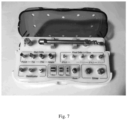
- Fig. 7 shows a photograph of the proposed instrument set.
- the mucotome (1) is a round cylindrical knife that cuts the gingiva while rotating.
- the optimum rotation speed is 200 rpm. This component is available in all surgical sets for dental implantation.
- the next component of the instrument set is the osteotome (2), which is shown in Fig. 2 and the function of which is to align the bone ridge and to create a plateau for 0.5 mm above the level of the future implant, as the relief of the bone ridge is uneven.
- the osteotome (2) is a drill bit with a flat working part.
- the upper part of the drill bit has a limiter (3) to provide control of the height of the bone ridge alignment.
- the optimum rotation speed is 200 rpm.
- An osteotome is available in many surgical sets for dental implantation, including the closest prior art.
- the next component of the instrument set is the pilot drill bit (4), which is shown in Fig. 3 and serves to create a guide hole.
- This is a short drill bit, with a diameter of 2.2 mm, that is placed around the guide sleeve of the surgical template, thereby ensuring the correct drilling direction.
- the upper part of the drill bit has a limiter (5) to provide control of the drilling depth.
- the optimum rotation speed is 300 rpm.
- a pilot drill bit is available in many surgical sets for dental implantation, including the closest prior art.
- the next component of the instrument set is the final drill bit (6), which is shown in Fig. 4 .
- the final drill bit serves to create a recess in the bone, having the size of the implant (7), both in length and in diameter.
- Final drill bits are available in all surgical sets for dental implantation, including the closest prior art, and a large number of them is available in known sets, which is due to the need to select drill bit parameters according to the implant length and diameter.
- the number of the final drill bits is 30, and, as already mentioned above when describing the closest prior art, the set of drill bits has different sizes, in length (rows A, B, C, D and E) and in diameter (2.0 mm, 2.75 mm, 3.0 mm, 3.25 mm, 3.85 mm, 4.25 mm).
- the adapter has a shank part (10) and a cylindrical housing (11), in the cavity of which a locking fastener (12) is disposed for affixing the final drill bits in the form of a spring element for latching to the shank of the final drill bit.
- the limiters (9) are configured as steel rings of different widths, wherein the inner diameter of the limiters is made on the basis of the tight grip of the cylindrical housing (11) of the adapter by the limiter (9).
- the optimum rotation speed is 350 rpm.
- the implant driver (13), which is shown in Fig. 5 (in Fig. 5 , the implant driver is shown with an implant (7)).
- the implant driver consists of a guide part and an insertion limiter (14).
- Fig. 6 shows a protocol for performing implantation with the use of the proposed surgical instrument set.
- the gingiva (15) is cut by means of using the mucotome (1) at a rotation speed of 200 rpm, thus creating a round hole.
- the bone ridge (16) is aligned by means of using the osteotome (2), and a plateau is created for 0.5 mm above the level of the future implant.
- the pilot drill bit (4) which, in this embodiment example, is a short drill bit with a diameter of 2.2 mm, a small and narrow recess is made in the bone (17), thereby ensuring the correct direction for the insertion of the final drill bit.
- the rotation speed of the pilot drill bit in this embodiment example is 300 rpm.
- a recess (18) is made in the bone (17), having the size of the implant (7), both in length and in diameter, while the depth of the recess is regulated by selecting the appropriate limiter (9).
- the implant (7) is inserted into the recess (18) by means of using the implant driver (13).
- the adapter (8) for the removable final drill bits and the limiters (9) are the essential differences of the proposed invention.
- the adapter has a shank part (10) and a cylindrical housing (11), in the cavity of which a locking fastener (12) is disposed for affixing the final drill bits, which can be successively changed during the operation.
- the locking fastener (12) is configured as a spring element for latching to the shank of the final drill bit.
- the limiters (9) are configured as steel rings of different widths, which are put on the cylindrical housing (11) of the adapter. Depending on the selected limiter ring width, the length of the working part of the final drill bit is adjusted, and thus the depth of the recess (18) in the bone for placing the implant (7) is regulated.
- Implant sizes vary from 6 mm to 14 mm in length and from 3 mm to 7 mm in diameter, depending on the implant manufacturer.
- Drill bit length 6 mm, 7.5 mm, 8 mm, 10 mm, 11.5 mm, 13 mm, 14 mm, diameter: 2 mm, 2.4 mm, 2.8 mm, 3 mm, 3.2 mm, 3.4 mm, 3.6 mm, 3.8 mm, 4.2 mm, 4.8 mm etc. (depending on the manufacturer).
- Drilling depth is controlled by means of using limiters of different widths.
- two limiters configured as steel rings with a width of 2 mm and with a width of 4 mm, have been used.
- the proposed invention has a number of advantages, namely:
- the proposed simplified set is not inferior to other existing sets, which are equipped with a large number of instruments, and ensures fully-fledged high-quality implantation.
Landscapes
- Health & Medical Sciences (AREA)
- Oral & Maxillofacial Surgery (AREA)
- Orthopedic Medicine & Surgery (AREA)
- Dentistry (AREA)
- Epidemiology (AREA)
- Life Sciences & Earth Sciences (AREA)
- Animal Behavior & Ethology (AREA)
- General Health & Medical Sciences (AREA)
- Public Health (AREA)
- Veterinary Medicine (AREA)
- Dental Tools And Instruments Or Auxiliary Dental Instruments (AREA)
- Dental Prosthetics (AREA)
Abstract
Description
- The invention relates to the field of medicine, in particular to tooth implantation, and can be used for implanting teeth with a 3D navigation template.
- Surgical instrument sets for dental implantation by means of using the method of navigational implantation are widely known, for example:
https:// alfa-gate.net/product/conical-surgical-kit/ - https://www.cad-ray.com/members/images/stmanual.pdf
- http://www.biotech-dental.com/wp-content/uploads/2019/04/BR ATLAS-SURGERY-2019_EN.pdf
- http://dentiumusa.com/products/kits-and-instrument/digital-guide-surgery-kit-full.htm.
- All of the above known surgical instrument sets include a mucotome, an osteotome, a pilot drill bit, a final drill bit and an implant driver with an implant, with a total number of at least 25 or more drill bits of different lengths and diameters.
- As a closest prior art, we have chosen the instrument set for navigational dental implantation, which is described in the patent (
US2018085072, IPC: A61B6/03, publ. on 29 March 2018 ). Fig. 8 of this patent shows an instrument set for navigational dental implantation, where number 165 (from this point onward, the numbering of components is indicated in accordance with Fig. 8 of the closest prior art) shows drill bits that have different sizes, in length (rows A, B, C, D and E) and in diametrical dimensions (for example, 2.0 mm, 2.75 mm, 3.0 mm, 3.25 mm, 3.85 mm, 4.25 mm). Each drill bit has a limiter that engages with the upper surface of the guide tubes 190 to control the depth of its insertion. - When the dental plan is finalised, the specific series of drill bits 165 is selected for successive use with the surgical guide 110.
- For example, to place a specific dental implant, the dental plan may include the use of B-2.0 mm and B-3.25 mm drill bits. The dimensions of the osteotomy are determined by means of using the final drill bit (B-3.25 mm), the dimensions of which correspond to the dental implant being installed. The surgical set additionally includes mucotomes 202 to remove gingival tissue; moreover, it includes pilot drill bits 204 to create a guide hole and, possibly, countersinks to shape an osteotomy hole. A series of drill bits and osteotomes serve to create an osteotomy, that is, a flat surface of the bone.
- All the known surgical instrument sets, including the closest prior art, have common disadvantages, namely:
- a large number of instruments (25 or more), which complicates a dentist's work, as the probability of an error when choosing an instrument increases, and this also leads to a complication of the set and, accordingly, to an increase in its prime cost;
- the working part of the drill bit, during drilling, causes friction directly affecting the walls of the guide sleeves, which leads to rapid wear of the instrument, as well as to the ingress of sawdust into the bone tissue cavity. To reduce friction and wear of the drill bit, the gap between the drill bit and the guide sleeve is made large, which, in turn, leads to deviations from the correct guidance of the instrument.
- The problem addressed by the invention is that of simplifying the surgical instrument set for dental implantation, reducing its prime cost and increasing the ease of use, the speed of operations and the reliability and efficiency of work performed by a dentist.
- The essence of the invention is a surgical instrument set for dental implantation, comprising a mucotome, an osteotome, a pilot drill bit, final drill bits and an implant driver, which, according to the invention, additionally comprises an adapter for removable final drill bits and length limiters for the working part of the final drill bits, configured as rings of different widths. The adapter has a shank part and a cylindrical housing, in the cavity of which a locking fastener is disposed for affixing the final drill bits in the form of a spring element for latching to the shank of the final drill bit. The inner diameter of the limiters is made on the basis of the tight grip of the cylindrical housing of the adapter by a limiter.
-
Fig. 1 shows the mucotome,Fig. 2 shows the osteotome, andFig. 3 shows the pilot drill bit.Fig. 4 shows the final drill bit, the adapter and the limiters.Fig. 5 shows the implant driver with an implant, andFig. 6 shows a protocol for performing implantation.Fig. 7 shows a photograph of the proposed instrument set. - One of the components of the instrument set is the mucotome (1), which is shown in
Fig. 1 and the function of which is to cut the gingiva, thus creating a round hole. The mucotome (1) is a round cylindrical knife that cuts the gingiva while rotating. The optimum rotation speed is 200 rpm. This component is available in all surgical sets for dental implantation. - The next component of the instrument set is the osteotome (2), which is shown in
Fig. 2 and the function of which is to align the bone ridge and to create a plateau for 0.5 mm above the level of the future implant, as the relief of the bone ridge is uneven. The osteotome (2) is a drill bit with a flat working part. The upper part of the drill bit has a limiter (3) to provide control of the height of the bone ridge alignment. The optimum rotation speed is 200 rpm. An osteotome is available in many surgical sets for dental implantation, including the closest prior art. - The next component of the instrument set is the pilot drill bit (4), which is shown in
Fig. 3 and serves to create a guide hole. This is a short drill bit, with a diameter of 2.2 mm, that is placed around the guide sleeve of the surgical template, thereby ensuring the correct drilling direction. The upper part of the drill bit has a limiter (5) to provide control of the drilling depth. The optimum rotation speed is 300 rpm. A pilot drill bit is available in many surgical sets for dental implantation, including the closest prior art. - The next component of the instrument set is the final drill bit (6), which is shown in
Fig. 4 . The final drill bit serves to create a recess in the bone, having the size of the implant (7), both in length and in diameter. Final drill bits are available in all surgical sets for dental implantation, including the closest prior art, and a large number of them is available in known sets, which is due to the need to select drill bit parameters according to the implant length and diameter. For example, in the closest prior art we have chosen, the number of the final drill bits is 30, and, as already mentioned above when describing the closest prior art, the set of drill bits has different sizes, in length (rows A, B, C, D and E) and in diameter (2.0 mm, 2.75 mm, 3.0 mm, 3.25 mm, 3.85 mm, 4.25 mm). - Shown in the same
Fig. 4 , the following components of the instrument set: the adapter (8) for the removable final drill bits and the limiters (9) are the essential differences of the proposed invention. The adapter has a shank part (10) and a cylindrical housing (11), in the cavity of which a locking fastener (12) is disposed for affixing the final drill bits in the form of a spring element for latching to the shank of the final drill bit. The limiters (9) are configured as steel rings of different widths, wherein the inner diameter of the limiters is made on the basis of the tight grip of the cylindrical housing (11) of the adapter by the limiter (9). The optimum rotation speed is 350 rpm. - And, finally, the next component of the instrument set is the implant driver (13), which is shown in
Fig. 5 (inFig. 5 , the implant driver is shown with an implant (7)). The implant driver consists of a guide part and an insertion limiter (14). -
Fig. 6 shows a protocol for performing implantation with the use of the proposed surgical instrument set. First, the gingiva (15) is cut by means of using the mucotome (1) at a rotation speed of 200 rpm, thus creating a round hole. Further, the bone ridge (16) is aligned by means of using the osteotome (2), and a plateau is created for 0.5 mm above the level of the future implant. Then, with the pilot drill bit (4), which, in this embodiment example, is a short drill bit with a diameter of 2.2 mm, a small and narrow recess is made in the bone (17), thereby ensuring the correct direction for the insertion of the final drill bit. - The rotation speed of the pilot drill bit in this embodiment example is 300 rpm. Further, with the final drill bit (6), by means of using the adapter (8), a recess (18) is made in the bone (17), having the size of the implant (7), both in length and in diameter, while the depth of the recess is regulated by selecting the appropriate limiter (9). And, finally, the implant (7) is inserted into the recess (18) by means of using the implant driver (13).
- The rationale with regard to the advantages of the proposed instrument set is given below. As mentioned above, the adapter (8) for the removable final drill bits and the limiters (9) are the essential differences of the proposed invention. The adapter has a shank part (10) and a cylindrical housing (11), in the cavity of which a locking fastener (12) is disposed for affixing the final drill bits, which can be successively changed during the operation. The locking fastener (12) is configured as a spring element for latching to the shank of the final drill bit.
- The limiters (9) are configured as steel rings of different widths, which are put on the cylindrical housing (11) of the adapter. Depending on the selected limiter ring width, the length of the working part of the final drill bit is adjusted, and thus the depth of the recess (18) in the bone for placing the implant (7) is regulated.
- As already mentioned above, in known sets, a large number of final drill bits is available, which is due to the need to select drill bit parameters according to both the implant length and its diameter.
- Implant sizes vary from 6 mm to 14 mm in length and from 3 mm to 7 mm in diameter, depending on the implant manufacturer. Drill bit length: 6 mm, 7.5 mm, 8 mm, 10 mm, 11.5 mm, 13 mm, 14 mm, diameter: 2 mm, 2.4 mm, 2.8 mm, 3 mm, 3.2 mm, 3.4 mm, 3.6 mm, 3.8 mm, 4.2 mm, 4.8 mm etc. (depending on the manufacturer). Let us randomly take an implant manufacturer that produces implants with a length of 6 mm, 8 mm, 10 mm, and 12 mm and with a diameter of 3 mm, 3.6 mm, 4.2 mm, and 4.8 mm.
- For fully-fledged drilling, it is necessary to have 16 drill bits with different sizes in the set (we multiply the number of drill bits with different lengths by the number of drill bits with different diameters). The availability of an adapter and limiters in the set, which are configured as steel rings of different widths and put on the adapter housing, solves the same problem by means of using 4 drill bits instead of 16.
- Drilling depth is controlled by means of using limiters of different widths. In this embodiment example, two limiters configured as steel rings, with a width of 2 mm and with a width of 4 mm, have been used. For a drilling depth of 12 mm, no limiter is used, and only the drill bit with the appropriate diameter is selected. For a drilling depth of 10 mm, the limiter with a ring width of 2 mm is used, which is put on the adapter housing in advance (12 mm - 2 mm = 10 mm). To ensure a drilling depth of 8 mm, the limiter with a ring width of 4 mm is used (12 mm - 4 mm = 8 mm). To ensure a drilling depth of 6 mm, both limiters, with a ring width of 4 mm and with a ring width of 2 mm, are used (12 mm - 6 mm = 6 mm).
- Therefore, the proposed invention has a number of advantages, namely:
- 1. the dentist initially sets the depth of drilling with the use of the limiters, which is very important for control during the operation so as not to damage anatomically important structures and tissues;
- 2. the surgical set is essentially simplified; in the given specific example, from 16 drill bits to 4. This, in turn, reduces the risk of a dentist's error when selecting drill bits and significantly reduces the time of the operation, as well as reduces the prime cost of the set;
- 3. due to the design feature of the adapter, the working part of the drill bit, during drilling, does not come into contact with the guide sleeve of the surgical template, which prevents wear of the instrument and the introduction of sawdust into the formed bone tissue bed.
- At the same time, we note that the proposed simplified set is not inferior to other existing sets, which are equipped with a large number of instruments, and ensures fully-fledged high-quality implantation.
Claims (1)
- A surgical instrument set for dental implantation, comprising a mucotome, an osteotome, a pilot drill bit, final drill bits and an implant driver, characterised in that the set additionally comprises an adapter for removable final drill bits and limiters for controlling the length of the working part of the final drill bits, configured as rings of different widths; the adapter has a shank part and a cylindrical housing, in the cavity of which a locking fastener is disposed for affixing the final drill bits in the form of a spring element for latching to the shank of the final drill bit.
Applications Claiming Priority (2)
| Application Number | Priority Date | Filing Date | Title |
|---|---|---|---|
| AM20200053 | 2020-06-18 | ||
| PCT/IB2020/061130 WO2021255513A1 (en) | 2020-06-18 | 2020-11-25 | Surgical instrument set for dental implantation |
Publications (2)
| Publication Number | Publication Date |
|---|---|
| EP4169475A1 true EP4169475A1 (en) | 2023-04-26 |
| EP4169475A4 EP4169475A4 (en) | 2024-07-10 |
Family
ID=79268720
Family Applications (1)
| Application Number | Title | Priority Date | Filing Date |
|---|---|---|---|
| EP20940769.1A Pending EP4169475A4 (en) | 2020-06-18 | 2020-11-25 | Surgical instrument set for dental implantation |
Country Status (2)
| Country | Link |
|---|---|
| EP (1) | EP4169475A4 (en) |
| WO (1) | WO2021255513A1 (en) |
Cited By (1)
| Publication number | Priority date | Publication date | Assignee | Title |
|---|---|---|---|---|
| EP4458311A1 (en) * | 2023-05-02 | 2024-11-06 | Nulty, Adam Brian | Dental drill extender |
Family Cites Families (7)
| Publication number | Priority date | Publication date | Assignee | Title |
|---|---|---|---|---|
| EP3000430B1 (en) * | 2008-04-16 | 2017-11-15 | Biomet 3i, LLC | Method of virtually developing a surgical guide for dental implant |
| JP5562963B2 (en) * | 2008-09-10 | 2014-07-30 | ノベル バイオケア サーヴィシィズ アーゲー | Apparatus and procedure for implanting dental implants |
| EA027285B1 (en) * | 2009-02-04 | 2017-07-31 | Мид Корп. | Dental implant |
| EP2347729A1 (en) * | 2010-01-21 | 2011-07-27 | Camlog Biotechnologies AG | Dental implant, abutment for a dental implant, combination of the same and an implantation set |
| KR101135113B1 (en) * | 2011-09-02 | 2012-04-16 | 황적희 | Extention instrument for implant drill |
| KR101516950B1 (en) * | 2013-11-06 | 2015-05-04 | 주식회사 디오 | apparatus for abutment profile drill |
| GB201413344D0 (en) * | 2014-07-28 | 2014-09-10 | Neoss Ltd | Surgical instruments |
-
2020
- 2020-11-25 EP EP20940769.1A patent/EP4169475A4/en active Pending
- 2020-11-25 WO PCT/IB2020/061130 patent/WO2021255513A1/en not_active Ceased
Cited By (1)
| Publication number | Priority date | Publication date | Assignee | Title |
|---|---|---|---|---|
| EP4458311A1 (en) * | 2023-05-02 | 2024-11-06 | Nulty, Adam Brian | Dental drill extender |
Also Published As
| Publication number | Publication date |
|---|---|
| WO2021255513A1 (en) | 2021-12-23 |
| EP4169475A4 (en) | 2024-07-10 |
Similar Documents
| Publication | Publication Date | Title |
|---|---|---|
| JP4495147B2 (en) | Pilot drill, step drill and drill set for dental transplantation technology | |
| US8770974B2 (en) | Set of dental drills | |
| US5791902A (en) | Drill bit for producing bone cavities for dental implants | |
| US20170143351A1 (en) | Implant placement trephine, prepackaged and sized implant / trephine kit, and methods of use | |
| AU2008290807B2 (en) | Drill guide with a limit stop | |
| US20050003327A1 (en) | Drilling system and method for dental implants | |
| KR101005952B1 (en) | Drilling Depth Adjustable Bone Drilling Drill | |
| US20020094508A1 (en) | Rotary osteotome for dental implant | |
| US20130084540A1 (en) | Stopper and stopper set | |
| JP2011125702A (en) | Dental tool for guided surgery | |
| US20120178043A1 (en) | Surgical drills | |
| EP3777750B1 (en) | Drill bit | |
| US20080085488A1 (en) | Universal one-step drill | |
| EP4169475A1 (en) | Surgical instrument set for dental implantation | |
| KR102638863B1 (en) | Drill device for dental implant | |
| RU2758244C1 (en) | Surgical tool kit for dental implantation | |
| US10779860B2 (en) | System and method for dental implant surgery | |
| EP4147668A1 (en) | Implantation kit enabling implant hole preparation on bone in only one drilling with one single osteotome | |
| KR20250103423A (en) | Implant drill | |
| CN210541886U (en) | Planting is equipped with hole and bores system with self-navigation drill bushing | |
| JP6384909B2 (en) | Dental implant drill | |
| US20260041524A1 (en) | Socket shield technique kit | |
| US20180289453A1 (en) | Variable Geometry Osteotome Set with Multiple Modes of Use for Implant Socket Formation | |
| JP2015036006A (en) | Dental implant drilling system | |
| CN110226979B (en) | Planting is equipped with hole system of boring with from navigation drill bushing |
Legal Events
| Date | Code | Title | Description |
|---|---|---|---|
| STAA | Information on the status of an ep patent application or granted ep patent |
Free format text: STATUS: THE INTERNATIONAL PUBLICATION HAS BEEN MADE |
|
| PUAI | Public reference made under article 153(3) epc to a published international application that has entered the european phase |
Free format text: ORIGINAL CODE: 0009012 |
|
| STAA | Information on the status of an ep patent application or granted ep patent |
Free format text: STATUS: REQUEST FOR EXAMINATION WAS MADE |
|
| 17P | Request for examination filed |
Effective date: 20221221 |
|
| AK | Designated contracting states |
Kind code of ref document: A1 Designated state(s): AL AT BE BG CH CY CZ DE DK EE ES FI FR GB GR HR HU IE IS IT LI LT LU LV MC MK MT NL NO PL PT RO RS SE SI SK SM TR |
|
| DAV | Request for validation of the european patent (deleted) | ||
| DAX | Request for extension of the european patent (deleted) | ||
| A4 | Supplementary search report drawn up and despatched |
Effective date: 20240610 |
|
| RIC1 | Information provided on ipc code assigned before grant |
Ipc: A61C 1/14 20060101ALN20240604BHEP Ipc: A61B 17/16 20060101ALI20240604BHEP Ipc: A61C 8/00 20060101AFI20240604BHEP |
|
| STAA | Information on the status of an ep patent application or granted ep patent |
Free format text: STATUS: EXAMINATION IS IN PROGRESS |
|
| 17Q | First examination report despatched |
Effective date: 20250804 |