EP4167646A1 - Method for conducting network selection and/or cell selection of a user equipment with regard to a mobile communication network, user equipment, system or mobile communication network, program and computer-readable medium - Google Patents
Method for conducting network selection and/or cell selection of a user equipment with regard to a mobile communication network, user equipment, system or mobile communication network, program and computer-readable medium Download PDFInfo
- Publication number
- EP4167646A1 EP4167646A1 EP21202264.4A EP21202264A EP4167646A1 EP 4167646 A1 EP4167646 A1 EP 4167646A1 EP 21202264 A EP21202264 A EP 21202264A EP 4167646 A1 EP4167646 A1 EP 4167646A1
- Authority
- EP
- European Patent Office
- Prior art keywords
- user equipment
- base station
- location
- mobile communication
- network
- Prior art date
- Legal status (The legal status is an assumption and is not a legal conclusion. Google has not performed a legal analysis and makes no representation as to the accuracy of the status listed.)
- Granted
Links
Images
Classifications
-
- H—ELECTRICITY
- H04—ELECTRIC COMMUNICATION TECHNIQUE
- H04W—WIRELESS COMMUNICATION NETWORKS
- H04W48/00—Access restriction; Network selection; Access point selection
- H04W48/16—Discovering, processing access restriction or access information
-
- H—ELECTRICITY
- H04—ELECTRIC COMMUNICATION TECHNIQUE
- H04W—WIRELESS COMMUNICATION NETWORKS
- H04W48/00—Access restriction; Network selection; Access point selection
- H04W48/18—Selecting a network or a communication service
-
- H—ELECTRICITY
- H04—ELECTRIC COMMUNICATION TECHNIQUE
- H04W—WIRELESS COMMUNICATION NETWORKS
- H04W48/00—Access restriction; Network selection; Access point selection
- H04W48/02—Access restriction performed under specific conditions
- H04W48/04—Access restriction performed under specific conditions based on user or terminal location or mobility data, e.g. moving direction, speed
-
- H—ELECTRICITY
- H04—ELECTRIC COMMUNICATION TECHNIQUE
- H04W—WIRELESS COMMUNICATION NETWORKS
- H04W48/00—Access restriction; Network selection; Access point selection
- H04W48/20—Selecting an access point
-
- H—ELECTRICITY
- H04—ELECTRIC COMMUNICATION TECHNIQUE
- H04W—WIRELESS COMMUNICATION NETWORKS
- H04W64/00—Locating users or terminals or network equipment for network management purposes, e.g. mobility management
-
- H—ELECTRICITY
- H04—ELECTRIC COMMUNICATION TECHNIQUE
- H04B—TRANSMISSION
- H04B7/00—Radio transmission systems, i.e. using radiation field
- H04B7/14—Relay systems
- H04B7/15—Active relay systems
- H04B7/185—Space-based or airborne stations; Stations for satellite systems
- H04B7/1851—Systems using a satellite or space-based relay
-
- H—ELECTRICITY
- H04—ELECTRIC COMMUNICATION TECHNIQUE
- H04W—WIRELESS COMMUNICATION NETWORKS
- H04W84/00—Network topologies
- H04W84/02—Hierarchically pre-organised networks, e.g. paging networks, cellular networks, WLAN [Wireless Local Area Network] or WLL [Wireless Local Loop]
- H04W84/04—Large scale networks; Deep hierarchical networks
- H04W84/06—Airborne or Satellite Networks
Definitions
- the present invention relates a method for conducting network selection and/or cell selection of a user equipment with regard to a mobile communication network, wherein the mobile communication network comprises or uses or is associated or assigned to a radio access network comprising at least one base station entity being an air-based or a space-based base station entity.
- the present invention relates to a user equipment for conducting network selection and/or cell selection with regard to a mobile communication network, the mobile communication network comprising or using or being associated or assigned to a radio access network comprising at least one base station entity being an air-based or a space-based base station entity.
- the present invention relates to a system or a mobile communication network for conducting network selection and/or cell selection of a user equipment with regard to a mobile communication network, the system especially comprising a global navigation satellite system, wherein the mobile communication network comprises or uses or is associated or assigned to a radio access network comprising at least one base station entity being an air-based or a space-based base station entity.
- the present invention relates to a program and to a computer-readable medium for conducting network selection and/or cell selection according to the inventive method.
- Mobile communication networks such as public land mobile networks are typically realized as cellular mobile communication networks, i.e. comprising (or using or being associated or assigned to a radio access network comprising) radio cells.
- Such cellular systems are known conforming to different mobile communication standards or radio access technologies, like 2G/3G/4G/5G radio access technologies (referring to the different generations of radio access technologies) and typically comprise (or consist of) cells (or radio cells) of one or a plurality of the respective radio access technology/radio access technologies, which are typically organized throughout a country (or a part of or a region within a country) in a repeating pattern of (radio) cells (and associated base station entities) which belong to (or are used by or associated or assigned to) a mobile network operator (MNO).
- MNO mobile network operator
- a network or a public land mobile network
- a radio cell or network cell
- a considered user equipment also referred to as network selection (or public land mobile network selection) and/or cell selection, respectively.
- Network selection or public land mobile network (PLMN) selection typically requires the selection of a network (or PLMN), by the considered user equipment, based on settings of the subscriber identity module or universal integrated circuit card (SIM/UICC, typically as part of or integrated in or connected to the user equipment or corresponding device) and the availability of radio cells of the selected network/PLMN (typically either a home PLMN (or home network) or visited PLMN (or visited network)).
- SIM/UICC subscriber identity module or universal integrated circuit card
- the first step a user equipment is typically performing at switch-on is the PLMN (or network) selection process (cf. 3GPP TS 22.011, 3GPP TS 23.122) followed by the cell selection process of a suitable radio cell belonging to the selected PLMN or network (cf. 3GPP TS 36.304 for LTE and 3GPP TS 38.304 for NR) in order to register to the PLMN or network.
- PLMN or network selection process
- the coverage area of a mobile communication network or PLMN is limited to a country (i.e. its borders) as such: i.e. at the borders of a country the coverage aera typically ends before, at or a bit after the border line.
- another mobile communication network i.e. a new PLMN
- PLMN visited mobile communication network
- MCC+MNC PLMN ID 262-01
- Regulatory requirements define maximum allowed signal strength values (of radio signals) at the borderline, hence there is no completely sharp end of the coverage (and cannot be due to physics; radio waves do not stop at borders).
- new and innovative transmission concepts for cellular networks especially also involve air-based and/or space-based base station entities (i.e. base station entities that are generally not immobile such as terrestrial base station entities).
- air-based and/or space based base station entities include, e.g., mobile satellite connectivity with low earth orbit (LEO) satellites, medium earth orbit (MEO) satellites and/or geostationary earth orbit (GEO) satellites and also so-called high altitude platforms or high altitude pseudo-satellites (HAPS).
- LEO low earth orbit
- MEO medium earth orbit
- GEO geostationary earth orbit
- An object of the present invention is to provide a technically simple, effective and cost-effective solution for conducting network selection and/or cell selection of a user equipment with regard to a mobile communication network, wherein the mobile communication network comprises or uses or is associated or assigned to a radio access network comprising at least one base station entity being an air-based or a space-based base station entity.
- a further object of the present invention is to provide a corresponding user equipment, system or mobile communication network, and a corresponding program and computer-readable medium.
- the object of the present invention is achieved by a method for conducting network selection and/or cell selection of a user equipment with regard to a mobile communication network, wherein the mobile communication network comprises or uses or is associated or assigned to a radio access network comprising at least one base station entity being an air-based or a space-based base station entity, wherein the network selection and/or cell selection of the user equipment is conducted in a location-dependent manner, depending on the location of the user equipment, wherein, in order to conduct the network selection and/or the cell selection in the location-dependent manner, the method comprises the following steps:
- ⁇ by the user equipment receiving at least one radio signal (but typically a plurality of radio signals), the radio signal (or the plurality of radio signals) being related to or indicative of the location of the user equipment, and by the user equipment detecting and/or deriving a location-related information - the network (or public land mobile network) selection and/or the cell selection is able to be performed in a location-dependent manner.
- the user equipment tries to use (or to contact or to camp on) the air-based or space-based base station entity, especially in view of network selection and/or cell selection.
- the coverage of a mobile communication network typically has to conform to regulatory requirements in case two mobile communication networks cover adjacent geographical areas, typically at a border between two countries, i.e. there are maximum allowed signal strength values regarding signal reception that are to be respected at certain locations at or near the border, thus limiting the maximum emission power at the respective base station entities along that border.
- the network selection (or PLMN selection) process as well as the cell selection process is primarily based on signal strength-related information rather than location-related information, i.e. from the perspective of the user equipment, the process is performed in a rather location-agnostic manner.
- Satellite networks might use a network identifier (information) or PLMN ID (even while not being or providing a 'land network', i.e. a terrestrial mobile network) which is not the one over which country the satellite is currently flying (e.g.
- a PLMN ID such as, e.g., a PLMN ID
- MCC Mobile County Code
- the radio signal (or the plurality of radio signals) being related to or indicative of the location of the user equipment, and by the user equipment detecting and/or deriving a location-related information - the network (or public land mobile network) selection and/or the cell selection is able to be performed in a location-dependent manner.
- the user equipment tries to use (or to contact or to camp on) the air-based or space-based base station entity, especially in view of network selection and/or cell selection.
- the radio cell of a HAPS i.e. the base station entity of or connected to the HAPS
- the user equipment is able to decide based on its own location (i.e. based on the location-related information) if this a an allowable radio cell to connect to (i.e. if in the same country as the HAPS PLMN ID (e.g. in Germany) or not (in case the user equipment sees the Germany HAPS cell in a neighbor country (e.g. France)).
- an enhancement is provided compared to the currently applied and conventionally known principle of PLMN (or network) selection and cell selection on 3GPP radio access technologies, which is purely based on a matching of the selected PLMN ID with the availability of a suitable cell of the selected PLMN and is purely based on radio condition criteria to decide which radio cell corresponds to a "suitable cell”.
- the present invention provides a solution to steer the network selection and/or cell selection regarding the satellite cell based on the geographical location of the user equipment, typically (but not necessarily) a user equipment being on the ground (or in a comparably low altitude - compared to the satellite).
- the mobile communication network typically comprises or uses or is associated or assigned to a radio access network.
- the mobile communication network additionally also comprises or uses or is associated or assigned to a core network.
- the radio access network comprises at least one air-based or space-based base station entity but typically comprises a plurality of air-based or space-based radio cells, or both air-based or space-based radio cells and terrestrial (further) radio cells and, correspondingly, a plurality of base station entities (typically gNodeBs (in case of using 5G radio access technology) or eNodeBs (in case of using LTE access technology) or base station entities according to other radio access technologies, such as 6G, etc.) providing these radio cells.
- base station entities typically gNodeBs (in case of using 5G radio access technology) or eNodeBs (in case of using LTE access technology) or base station entities according to other radio access technologies, such as 6G, etc.
- the user equipment is configured such as to receive at least one signal, and that the user equipment is furthermore configured to derive or to detect, from such signal, the location-related information.
- the user equipment comprises or has such location-related information available, and is thus able to use this location-related information in a network (or public land mobile network) selection process and/or in a cell selection process which is modified with respect to the conventionally known network selection and/or cell selection process, namely such that the network selection process and/or cell selection process is performed (or is able to be performed) in a location-dependent manner, i.e. by taking into consideration the location-related information.
- a global navigation satellite system module i.e. a receiver (e.g.
- a GPS module/receiver and/or a GLONASS module/receiver and/or a Galileo module/receiver and/or a Compass module/receiver and/or a BAIDU module/receiver that is able to receive and process radio frequency signals emitted from satellites of the global navigation satellite system, and to derive a more or less accurate geographical position (of the user equipment) from these radio frequency signals.
- a mere geographical location information is typically not sufficient in order to perform the network selection process and/or cell selection process in a location-related manner: What would be required in addition (to the geographical location information, i.e.
- the coordinates is an information of the type whether the user equipment (located at these coordinates) is actually located rather in a country A, or in a country B (especially along a border between countries A and B; and, of course, there might be situations where more than two countries could be involved and/or regions within a country).
- the present invention also relates to using any source of information resulting in the user equipment either being aware of (or being able to derive) or being provided with a suitable or useful location-related information (especially in situations when the user equipment experiences a radio environment such that it would be at least useful (or, such that there is a necessity) to decide whether to consider itself as being in country A or rather in country B, e.g. in case of a satellite radio cell being available only for user equipments located in one of countries A and B).
- An example of such a source of information is certainly the relative signal strengths of radio signals received from base station entities on both sides of a border, typically between two countries: If a user equipment receives a plurality of pieces of network identifier information from different terrestrial base station entities, and more or less all these pieces of network identifier information relate to one country (country A) or to mobile networks within that country, it can be rather safely deduced that the user equipment is very likely located in country A.
- the relative signal strength of radio signals received from base station entities located on the other side of the border will increase, and, at, e.g., a specified, configured or predefined ratio (or difference) of the signal strengths of these radio signals, the user equipment infers that it is not any more located in country A but in country B; hence, the user equipment infers the location-related information based on the respective radio signals.
- a source of information resulting in the user equipment being aware of being located either in country A or in country B
- Such a base station entity may indicate or provide an information of the kind "in case the signal strength of one of 'my' broadcast radio signals is below a certain indicated value (and you do not receive radio signals from other base station entities of the own mobile communication network), you should consider to be located in country B rather than in country A".
- the user equipment proceeds, in a second step, to use the air-based or space-based base station entity in view of network selection and/or cell selection, in dependency of the location-related information detected or derived by the user equipment.
- the user equipment conducts network selection and/or cell selection using one or a plurality of further base station entities of the mobile communication network and/or of a further mobile communication network, the further base station entities especially corresponding to terrestrial base station entities.
- the user equipment is able to find a suitable or at least an acceptable radio cell, even in case the user equipment, based on the determined or detected location-related information, is not allowed to access the air-based or space-based base station entity in question.
- the at least one radio signal corresponds to a radio signal received, by the user equipment, from one or a plurality of further base station entities of the mobile communication network and/or of a further mobile communication network, wherein the user equipment is able to infer the location-related information based on the at least one radio signal or radio signals, especially the signal strength thereof.
- the user equipment is not necessarily required to be able to determine an estimate of its own location based on sources of information external to the mobile communication network (such as a global navigation satellite system): Also one or a plurality of further base station entities of the mobile communication network and/or of a further mobile communication network, especially terrestrial (further) base station entities, are able to provide the user equipment either directly with location-related information or provide, especially via their broadcast signals such as the broadcast control channel, signals such that the user equipment is able to derive whether to consider itself as being in country A or rather in country B (or not in country A).
- sources of information external to the mobile communication network such as a global navigation satellite system
- the at least one radio signal corresponds to a signal received, by the user equipment, from a global navigation satellite system, wherein the user equipment comprises a global navigation satellite system receiver module, and wherein the user equipment is able to detect or calculate, by means of the global navigation satellite system receiver module, its geographical location from the at least one radio signal.
- the user equipment is able to detect or calculate its geographical location.
- the user equipment receives at least one set of geographical configuration information, wherein the user equipment is able to infer the location-related information based on its geographical location and the geographical configuration information.
- the user equipment is able to detect or derive the location-related information from the radio signal of the global navigation satellite system.
- the set or sets of geographical configuration information correspond(s) to at least one piece of reception condition information regarding at least one radio signal or radio signals received, by the user equipment, from at least two of the further base station entities, wherein the user equipment is able to infer the location-related information based on the at least one radio signal or radio signals of the at least two of the further base station entities, wherein especially the at least one piece of reception condition information regarding the at least two further base station entities correspond to signal strength offset values to be applied for inferring the location-related information.
- the user equipment is able to infer the location-related information merely based on determining and/or comparing the signal strengths of readily available radio signals.
- the set or sets of geographical configuration information is/are received by the user equipment and/or stored in the user equipment according to at least one out of the following mechanisms:
- the user equipment is able to provided with the set or sets of geographical configuration information in a comparatively easy and efficient manner.
- the set or sets of geographical configuration information correspond(s) to country polygons and/or region polygons and/or parts thereof, wherein especially the set or sets of geographical configuration information transmitted to the user equipment by the at least one base station entity and/or by at least one further base station entity correspond to a limited geographical area in the vicinity of the at least one base station entity and/or in the vicinity of the user equipment, wherein especially the set or sets of geographical configuration information indicate available base station entities and/or available mobile communication networks in case that the inferred location of the user equipment matches one or a plurality of the set or sets of geographical configuration information.
- the present invention relates to a user equipment for conducting network selection and/or cell selection with regard to a mobile communication network
- the mobile communication network comprising or using or being associated or assigned to a radio access network comprising at least one base station entity being an air-based or a space-based base station entity
- the user equipment is configured to realize network selection and/or cell selection in a location-dependent manner, depending on the location of the user equipment, wherein, in order to conduct the network selection and/or the cell selection in the location-dependent manner, the user equipment is configured:
- the user equipment is further configured to conduct network selection and/or cell selection using one or a plurality of further base station entities of the mobile communication network and/or of a further mobile communication network, the further base station entities especially corresponding to terrestrial base station entities.
- the present invention relates to a system or mobile communication network for conducting network selection and/or cell selection of a user equipment with regard to a mobile communication network, the system especially comprising a global navigation satellite system, wherein the mobile communication network comprises or uses or is associated or assigned to a radio access network comprising at least one base station entity being an air-based or a space-based base station entity, wherein the system or mobile communication network is configured to allow network selection and/or cell selection of the user equipment to be conducted in a location-dependent manner, depending on the location of the user equipment, wherein, in order to conduct the network selection and/or the cell selection in the location-dependent manner, the system or mobile communication network is configured such that:
- the present invention relates to a program comprising a computer readable program code which, when executed on a computer and/or on a user equipment and/or on a network node of a mobile communication network, or in part on a user equipment and/or in part on network node of a mobile communication network, causes the computer and/or the user equipment and/or the network node of the mobile communication network to perform the inventive method.
- the present invention relates to a computer-readable medium comprising instructions which when executed on a computer and/or on a user equipment and/or on a network node of a mobile communication network, or in part on a user equipment and/or in part on network node of a mobile communication network, causes the computer and/or the user equipment and/or the network node of the mobile communication network to perform the inventive method.
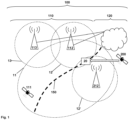
- Figure 1 schematically illustrates the situation of a mobile communication network and an associated user equipment at or near a border, e.g. between two countries.
- a mobile communication network 100 is schematically shown in a situation of an associated user equipment 20 being at or near a border 150, e.g. between two countries or also between two different regions within a country.
- the mobile communication network 100 comprises an access network 110 and a core network 120.
- the mobile communication network 100 is preferably a cellular telecommunications network comprising typically a plurality of network cells (or radio cells).
- the mobile communication network 100 comprises or uses or is associated or assigned to the radio access network 110, and the radio access network 110 (of the mobile communication network 100) comprises at least one base station entity 111 being an air-based or a space-based base station entity 111 - schematically shown, in Figure 1 , by means of a schematically illustrated satellite 111 as well as a dashed line and reference sign 11 indicating the radio coverage area of the air-based or space-based base station entity 111.
- the radio access network 110 of the mobile communication network 100 additionally comprises further base station entities that are especially terrestrial base station entities:
- Figure 1 exemplarily shows two further base station entities 112, 113 (as well as their respective radio coverage areas, indicated by means of reference signs 12 and 13) as part of the radio access network 110 of the mobile communication network 100; additionally, another further base station entity is indicated by means of reference sign 212 (and its radio coverage area 12') ⁇ corresponding likewise especially to a terrestrial base station entity but being part of a further mobile communication network (not specifically represented or indicated in Figure 1 ).
- a method for conducting network selection and/or cell selection of the user equipment 20 with regard to the mobile communication network 100 is proposed, wherein the network selection and/or cell selection of the user equipment 20 is conducted in a location-dependent manner, depending on the location of the user equipment 20.
- the user equipment 20 is configured such as to receive at least one (radio) signal, and furthermore it is configured to derive or to detect, from such (radio) signal, location-related information.
- the location-related information especially corresponds, e.g., to the information - with respect to the exemplarily illustrated example or with respect to the situation shown in Figure 1 - on which side of the border 150 the user equipment 20 is considered to be located; for example, the mobile communication network 100 covers a first country (e.g. country A), and the further mobile communication network (of which the further base station entity 212 is a part of or assigned or associated to) covers a second country (e.g. country B).
- the user equipment comprises or has such location-related information available, and is thus able to use this location-related information in a network (or public land mobile network) selection process and/or in a cell selection process which is modified with respect to the conventionally known network selection and/or cell selection process, namely such that the network selection process and/or cell selection process is performed (or is able to be performed) in a location-dependent manner, i.e. by taking into consideration the location-related information.
- This is performed, according to the present invention, by means of a first step, during which the user equipment 20 receives at least one radio signal being related to or indicative of the location of the user equipment 20, and detects or derives the location-related information from that (at least one) radio signal, and by means of a second step, during which the air-based or space-based base station entity 111 is used, by the user equipment 20 and in view of network selection and/or cell selection, in dependency of the location-related information detected or derived by the user equipment 20.
- the air-based or space-based base station entity 111 is only used or attached to in case such is possible or allowed having regard to the user equipment's 20 location (i.e.
- the user equipment's 20 internal representation of its location - especially regarding its location either on the one or the other side of the border 150 in the most basic situation).
- the location-related information detected or derived by the user equipment 20 indicates that the air-based or space-based base station entity 111 shall not be used by the user equipment 20 (due to, especially, its probable location being on the wrong side of the border 150)
- the user equipment 20 conducts the network selection and/or cell selection using a further base station entity, such as the further base station entities 112, 113 and/or 212 (of the mobile communication network 100 and/or of a further mobile communication network).
- a global navigation satellite system 200 is schematically shown.
- a dashed arrow (or, rather, an arrow drawn using a dashed line) being directed towards the user equipment 20, is shown representing radio signals, received by the user equipment 20, from the global navigation satellite system 200.
- the global navigation satellite system 200 typically comprises a plurality of satellites or other elements transmitting and/or broadcasting radio signals that are able to be used - at or by suitable receiver modules or components - to calculate the geographical position where the respective receiver module is currently located; however, despite this and for the sake of simplicity, only one representation of the global navigation satellite system 200 and only one arrow towards the user equipment 20 is represented in Figure 1 .
- the at least one radio signal corresponds to a signal received from the global navigation satellite system 200 (or from one or, rather, a plurality of its components or elements).
- the user equipment 20 comprises a corresponding global navigation satellite system receiver module (not specifically shown in Figure 1 ) such that the user equipment 20 itself is able to detect or calculate, by means of the global navigation satellite system receiver module, its geographical location from the at least one received radio signal.
- the present invention preferably provides for at least one set of geographical configuration information being received by the user equipment 20, preferably prior to or at least partly during the first step (but in any case prior to the user equipment 20 detecting or deriving the location-related information).
- the geographical configuration information or the at least one set of geographical configuration information
- the user equipment 20 is able to infer the location-related information.
- Different global navigation satellite systems are able to be used according to the present invention, e.g. the GPS system, the GLONASS system, the Galileo system, the Compass system and/or the BAIDU system.
- the user equipment 20 is able to infer the location-related information, and, thus, know whether it is currently located rather in the first country (or country A), or in the second country (country B), especially along the border 150 between both.
- the set or sets of geographical configuration information is or are received by the user equipment 20 and/or stored in the user equipment 20 according to at least one out of the following mechanisms:
- the present invention is not limited to situation where the user equipment 20 is equipped with a global navigation satellite system functionality.
- the present invention relates to any embodiment such that the user equipment is either aware of (or is able to derive) or is provided with a suitable or useful location-related information (especially in situations when the user equipment experiences a radio environment such that it would be at least useful (or, such that there is a necessity) to decide whether to consider itself as being in the first country or rather in the second country, especially in case of a satellite radio cell being available only for user equipments located in one of these countries).
- One such embodiment, situation or example relates to inferring on which side of the border 150 the user equipment 20 is located from the relative signal strengths of radio signals received from base station entities on both sides of the border 150, typically between two countries.
- the user equipment 20 receives a plurality of pieces of network identifier information from different terrestrial base station entities (such as base station entities 112 and 212 in Figure 1 ), and the side of the border 150 is inferred from the relative signal strengths of radio signals received from these base station entities (located on both sides of the border) in case certain specified, configured or predefined situations (e.g. a certain ratio (or difference) of the signal strengths of these radio signals) is measured by the user equipment 20.
- the set or sets of geographical configuration information especially corresponds or correspond to at least one piece of reception condition information regarding at least one radio signal or radio signals received, by the user equipment 20, from at least two of the further base station entities 112, 113, 212 (especially base station entities 112 and 212), wherein the user equipment 20 is able to infer the location-related information based on the at least one radio signal or radio signals of the at least two of the further base station entities 112, 113, 212, and wherein especially the at least one piece of reception condition information regarding the at least two further base station entities 112, 113, 212 correspond to signal strength offset values to be applied for inferring the location-related information.
- HAPS-based or satellite-based base station entities typically provide radio cell spanning potentially over the border 150 between two countries (or even the borders among more than two countries).
- the aim is to only allow a user equipment 20 located, e.g., in Germany to select and eventually connect to the HAPS-based and/or satellite-based radio cell 11 (which in this case might broadcast a PLMN ID information "262-01" for German Industries GmbH).
- the solution according to the present invention aims to provide additional information to the user equipment 20 which makes the cell selection process location dependent in contrast to only base it on the PLMN ID and the radio conditions (as is conventionally known and defined in the current standards).
- the user equipment 20 checks the availability of terrestrial network cells to obtain knowledge if the user equipment 20 is inside a specific coverage, e.g.
- the user equipment 20 sees a "262-01" radio cell (or any "262", i.e. "262+any mobile network code MNC" i.e. Germany-based mobile communication network) radio cell, it knows that it is located in Germany (except in case the user equipment is located at or near the border: It might be located in the neighbor country and still see 262-MNC radio cells of German operators; however, in such a situation (of the user equipment being the neighbor country) probably the non-262-MNC radio cells will probably be stronger than the 262-MNC ones) and selection as well as access to the provided HAPS-based or satellite-based "262-01" radio cell is allowed. In this embodiment, no global navigation satellite system receiver is needed at the user equipment 20 to obtain its current geolocation.
- MNC mobile network code
- the user equipment 20 is equipped with a global navigation satellite system receiver to obtain its geolocation using any global navigation satellite system system (like GPS, Galileo, GLONASS etc.), which is the case of even the cheapest smartphones today.
- a global navigation satellite system system like GPS, Galileo, GLONASS etc.
- the geo-polygon of a country needs to be made available to the user equipment 20 in order allowing the user equipment 20 to evaluate if its own location is inside or outside the country polygons in question; country polygon information is today widely available and can be obtained in standardized data formats such as .json, XML or the like; a full set of country polygons which an accurate enough resolution of all countries of the world is not more than 20 Mbyte of size.
- the present invention to change the network (or public land mobile network) selection process and/or the cell selection process of current 3GPP systems to also use the geographical location of the user equipment 20 as additional suitability criterion.
- the steps of the enhanced network (public land mobile network) selection procedure according to the present invention are shown for the case that country polygons are used as geographical configuration information:
- the user equipment 20 there are several manners to provision the user equipment 20 with the geographical (country-specific) configuration information (especially a country polygon information), especially:
- a pseudo RRC signaling in ASN.1 might be as follows:
Landscapes
- Engineering & Computer Science (AREA)
- Computer Networks & Wireless Communication (AREA)
- Signal Processing (AREA)
- Computer Security & Cryptography (AREA)
- Mobile Radio Communication Systems (AREA)
Abstract
Description
- The present invention relates a method for conducting network selection and/or cell selection of a user equipment with regard to a mobile communication network, wherein the mobile communication network comprises or uses or is associated or assigned to a radio access network comprising at least one base station entity being an air-based or a space-based base station entity.
- Furthermore, the present invention relates to a user equipment for conducting network selection and/or cell selection with regard to a mobile communication network, the mobile communication network comprising or using or being associated or assigned to a radio access network comprising at least one base station entity being an air-based or a space-based base station entity.
- Additionally, the present invention relates to a system or a mobile communication network for conducting network selection and/or cell selection of a user equipment with regard to a mobile communication network, the system especially comprising a global navigation satellite system, wherein the mobile communication network comprises or uses or is associated or assigned to a radio access network comprising at least one base station entity being an air-based or a space-based base station entity.
- Furthermore, the present invention relates to a program and to a computer-readable medium for conducting network selection and/or cell selection according to the inventive method.
- Mobile communication networks such as public land mobile networks are typically realized as cellular mobile communication networks, i.e. comprising (or using or being associated or assigned to a radio access network comprising) radio cells. Such cellular systems are known conforming to different mobile communication standards or radio access technologies, like 2G/3G/4G/5G radio access technologies (referring to the different generations of radio access technologies) and typically comprise (or consist of) cells (or radio cells) of one or a plurality of the respective radio access technology/radio access technologies, which are typically organized throughout a country (or a part of or a region within a country) in a repeating pattern of (radio) cells (and associated base station entities) which belong to (or are used by or associated or assigned to) a mobile network operator (MNO).
- Typically, in such cellular mobile communication networks, and especially in cellular networks according to the 3GPP standard or one of the 3GPP standards, a network (or a public land mobile network) needs to be selected and/or a radio cell (or network cell) needs to be selected by a considered user equipment - also referred to as network selection (or public land mobile network selection) and/or cell selection, respectively.
- Network selection or public land mobile network (PLMN) selection (by a user equipment of the mobile communication network or trying to camp on or register to the mobile communication network) typically requires the selection of a network (or PLMN), by the considered user equipment, based on settings of the subscriber identity module or universal integrated circuit card (SIM/UICC, typically as part of or integrated in or connected to the user equipment or corresponding device) and the availability of radio cells of the selected network/PLMN (typically either a home PLMN (or home network) or visited PLMN (or visited network)).
- In conventional mobile communication networks, the first step a user equipment is typically performing at switch-on, is the PLMN (or network) selection process (cf. 3GPP TS 22.011, 3GPP TS 23.122) followed by the cell selection process of a suitable radio cell belonging to the selected PLMN or network (cf. 3GPP TS 36.304 for LTE and 3GPP TS 38.304 for NR) in order to register to the PLMN or network.
- It is furthermore known that the coverage area of a mobile communication network or PLMN is limited to a country (i.e. its borders) as such: i.e. at the borders of a country the coverage aera typically ends before, at or a bit after the border line. In case of crossing the border another mobile communication network (i.e. a new PLMN) is selected by the user equipment and thus the user equipment roams in a visited mobile communication network (or PLMN) of the visited country (here a neighboring country). For example, in Germany, Telekom Deutschland has been assigned with the PLMN ID 262-01 (MCC+MNC) which is broadcast by every radio cell (on any radio access technology) inside the German territory. Regulatory requirements define maximum allowed signal strength values (of radio signals) at the borderline, hence there is no completely sharp end of the coverage (and cannot be due to physics; radio waves do not stop at borders).
- However, new and innovative transmission concepts for cellular networks especially also involve air-based and/or space-based base station entities (i.e. base station entities that are generally not immobile such as terrestrial base station entities). Examples of such air-based and/or space based base station entities include, e.g., mobile satellite connectivity with low earth orbit (LEO) satellites, medium earth orbit (MEO) satellites and/or geostationary earth orbit (GEO) satellites and also so-called high altitude platforms or high altitude pseudo-satellites (HAPS). With such air-based and/or space-based base station entities, the classical concept of a cellular network on the ground (terrestrial network) - and the corresponding network (or public land mobile network) selection and/or cell selection -, is no longer feasible, as the transmission on the radio cells provided by the satellites and/or high altitude pseudo satellites do not stop at country borders.
- An object of the present invention is to provide a technically simple, effective and cost-effective solution for conducting network selection and/or cell selection of a user equipment with regard to a mobile communication network, wherein the mobile communication network comprises or uses or is associated or assigned to a radio access network comprising at least one base station entity being an air-based or a space-based base station entity. A further object of the present invention is to provide a corresponding user equipment, system or mobile communication network, and a corresponding program and computer-readable medium.
- The object of the present invention is achieved by a method for conducting network selection and/or cell selection of a user equipment with regard to a mobile communication network, wherein the mobile communication network comprises or uses or is associated or assigned to a radio access network comprising at least one base station entity being an air-based or a space-based base station entity, wherein the network selection and/or cell selection of the user equipment is conducted in a location-dependent manner, depending on the location of the user equipment, wherein, in order to conduct the network selection and/or the cell selection in the location-dependent manner, the method comprises the following steps:
- -- in a first step, the user equipment receives at least one radio signal being related to or indicative of the location of the user equipment, and detects or derives a location-related information from the radio signal,
- -- in a second step, the air-based or space-based base station entity is used, by the user equipment and in view of network selection and/or cell selection, in dependency of the location-related information detected or derived by the user equipment.
- It is thereby advantageously possible according to the present invention that ― by the user equipment receiving at least one radio signal (but typically a plurality of radio signals), the radio signal (or the plurality of radio signals) being related to or indicative of the location of the user equipment, and by the user equipment detecting and/or deriving a location-related information - the network (or public land mobile network) selection and/or the cell selection is able to be performed in a location-dependent manner.
Especially in case that the location-related information - deduced, derived or detected, by the user equipment, based on (or from) the at least one radio signal ― indicates that the at least one air-based or space-based base station entity is able to be used by the user equipment, the user equipment tries to use (or to contact or to camp on) the air-based or space-based base station entity, especially in view of network selection and/or cell selection. - As has already been said, it is known that the coverage of a mobile communication network typically has to conform to regulatory requirements in case two mobile communication networks cover adjacent geographical areas, typically at a border between two countries, i.e. there are maximum allowed signal strength values regarding signal reception that are to be respected at certain locations at or near the border, thus limiting the maximum emission power at the respective base station entities along that border. One of the underlaying reasons for such requirements is that the network selection (or PLMN selection) process as well as the cell selection process is primarily based on signal strength-related information rather than location-related information, i.e. from the perspective of the user equipment, the process is performed in a rather location-agnostic manner. However, with air-based or space-based base station entities that are able to cover comparatively large geographical areas, such border-related considerations - i.e. resulting from the classical concept of purely terrestrial cellular communication networks - are no longer adequate, because such air-based or space-based base station entities would in any case need to cover areas on both sides of a border (or even in three countries in case of two borders approaching each other). While for satellites (or satellite-based base station entities) the main aim is to provide a global voice and broadband coverage, especially HAPS (i.e. base station entities based on high altitude pseudo satellites) could primarily help to provide "fill in" (or added) coverage in order to complement the coverage of a terrestrial network (PLMN) regarding challenging areas, e.g. within a country, wherein such challenges might arise, e.g., from a comparatively low population density or from other difficulties, e.g. in problematic areas of a country. A further difference between satellite-based base station entities and base station entities based on high altitude pseudo satellites might relate to the used network identifier (i.e. typically the PLMN ID): Satellite networks might use a network identifier (information) or PLMN ID (even while not being or providing a 'land network', i.e. a terrestrial mobile network) which is not the one over which country the satellite is currently flying (e.g. such satellites might use an identifier (such as, e.g., a PLMN ID) that is not bound to a specific country, such as, e.g., a so-called "none-geo-MNC" which does either not have a country as part of the PLMNs MCC (Mobile County Code) or is associated to the 'country' "international" in the ITU E212 range MCC=901 [https://www.itu.int/net/ITU-T/inrdb/e212_901.aspx]), whereas HAPS (especially HAPS used to fill in coverage) might use a PLMN ID which is also used in the corresponding terrestrial mobile communication network (as for example 262-01 if the HAPS is flying over Germany to provide extension of the Telekom Deutschland network).
- According to the present invention, it is advantageously possible that - by the user equipment receiving at least one radio signal (but typically a plurality of radio signals), the radio signal (or the plurality of radio signals) being related to or indicative of the location of the user equipment, and by the user equipment detecting and/or deriving a location-related information - the network (or public land mobile network) selection and/or the cell selection is able to be performed in a location-dependent manner.
Especially in case that the location-related information - deduced, derived or detected, by the user equipment, based on (or from) the at least one radio signal ― indicates (to the user equipment, or from the perspective of the user equipment) that the at least one air-based or space-based base station entity is able to be used by the user equipment, the user equipment tries to use (or to contact or to camp on) the air-based or space-based base station entity, especially in view of network selection and/or cell selection. - Hence, it is advantageously possible, according to the present invention, that in case the radio cell of a HAPS (i.e. the base station entity of or connected to the HAPS) is providing a cell coverage which spans across a border (e.g. a border between two or more countries or even regions within a country), the user equipment is able to decide based on its own location (i.e. based on the location-related information) if this a an allowable radio cell to connect to (i.e. if in the same country as the HAPS PLMN ID (e.g. in Germany) or not (in case the user equipment sees the Germany HAPS cell in a neighbor country (e.g. France)). Hence, according to the present invention, an enhancement is provided compared to the currently applied and conventionally known principle of PLMN (or network) selection and cell selection on 3GPP radio access technologies, which is purely based on a matching of the selected PLMN ID with the availability of a suitable cell of the selected PLMN and is purely based on radio condition criteria to decide which radio cell corresponds to a "suitable cell".
Similarly for the satellite networks (or radio cells and associated base station entities of or connected to satellites), which typically will provide radio cells which span over country borders: Also with respect to these, the present invention provides a solution to steer the network selection and/or cell selection regarding the satellite cell based on the geographical location of the user equipment, typically (but not necessarily) a user equipment being on the ground (or in a comparably low altitude - compared to the satellite). - According to the present invention, a method for conducting network selection and/or cell selection of a user equipment with regard to a mobile communication network is proposed.
The mobile communication network typically comprises or uses or is associated or assigned to a radio access network. Normally, the mobile communication network additionally also comprises or uses or is associated or assigned to a core network. The radio access network comprises at least one air-based or space-based base station entity but typically comprises a plurality of air-based or space-based radio cells, or both air-based or space-based radio cells and terrestrial (further) radio cells and, correspondingly, a plurality of base station entities (typically gNodeBs (in case of using 5G radio access technology) or eNodeBs (in case of using LTE access technology) or base station entities according to other radio access technologies, such as 6G, etc.) providing these radio cells.
It is proposed according to the present invention that the user equipment is configured such as to receive at least one signal, and that the user equipment is furthermore configured to derive or to detect, from such signal, the location-related information. As a result, the user equipment comprises or has such location-related information available, and is thus able to use this location-related information in a network (or public land mobile network) selection process and/or in a cell selection process which is modified with respect to the conventionally known network selection and/or cell selection process, namely such that the network selection process and/or cell selection process is performed (or is able to be performed) in a location-dependent manner, i.e. by taking into consideration the location-related information.
Generally, one possibility of a solution according to the present invention is that the user equipment comprises a global navigation satellite system module, i.e. a receiver (e.g. a GPS module/receiver and/or a GLONASS module/receiver and/or a Galileo module/receiver and/or a Compass module/receiver and/or a BAIDU module/receiver) that is able to receive and process radio frequency signals emitted from satellites of the global navigation satellite system, and to derive a more or less accurate geographical position (of the user equipment) from these radio frequency signals. However, a mere geographical location information is typically not sufficient in order to perform the network selection process and/or cell selection process in a location-related manner: What would be required in addition (to the geographical location information, i.e. the coordinates) is an information of the type whether the user equipment (located at these coordinates) is actually located rather in a country A, or in a country B (especially along a border between countries A and B; and, of course, there might be situations where more than two countries could be involved and/or regions within a country). Hence, in addition it is proposed to provide the user equipment with geographical configuration information by means of which - together with the geographical location information - it is possible for the user equipment to detect or to derive the location-related information (i.e. whether the user equipment is actually located in country A, or in country B).
However, according to the present invention, there is no strict requirement to necessarily provide for a global navigation satellite system functionality within or as part of the user equipment: The present invention also relates to using any source of information resulting in the user equipment either being aware of (or being able to derive) or being provided with a suitable or useful location-related information (especially in situations when the user equipment experiences a radio environment such that it would be at least useful (or, such that there is a necessity) to decide whether to consider itself as being in country A or rather in country B, e.g. in case of a satellite radio cell being available only for user equipments located in one of countries A and B).
An example of such a source of information (resulting in the user equipment being aware of being located either in country A or in country B) is certainly the relative signal strengths of radio signals received from base station entities on both sides of a border, typically between two countries: If a user equipment receives a plurality of pieces of network identifier information from different terrestrial base station entities, and more or less all these pieces of network identifier information relate to one country (country A) or to mobile networks within that country, it can be rather safely deduced that the user equipment is very likely located in country A. If, however, that user equipment approaches the border (of country A) with country B, the relative signal strength of radio signals received from base station entities located on the other side of the border will increase, and, at, e.g., a specified, configured or predefined ratio (or difference) of the signal strengths of these radio signals, the user equipment infers that it is not any more located in country A but in country B; hence, the user equipment infers the location-related information based on the respective radio signals.
Another example of such a source of information (resulting in the user equipment being aware of being located either in country A or in country B) could alternatively also correspond to the user equipment receiving or being provided the location-related information directly (or a locally applicable manner to infer it), e.g. from a further (terrestrial) base station entity (being located at or near the border between countries A and B): Such a base station entity may indicate or provide an information of the kind "in case the signal strength of one of 'my' broadcast radio signals is below a certain indicated value (and you do not receive radio signals from other base station entities of the own mobile communication network), you should consider to be located in country B rather than in country A".
According to the present invention, after the location-related information has been detected or derived from the received radio signals, the user equipment proceeds, in a second step, to use the air-based or space-based base station entity in view of network selection and/or cell selection, in dependency of the location-related information detected or derived by the user equipment. - According to the present invention, it is advantageously possible and preferred that in case that the location-related information detected or derived by the user equipment indicates that the air-based or space-based base station entity shall not be used by the user equipment, the user equipment conducts network selection and/or cell selection using one or a plurality of further base station entities of the mobile communication network and/or of a further mobile communication network, the further base station entities especially corresponding to terrestrial base station entities.
- It is thereby advantageously possible that the user equipment is able to find a suitable or at least an acceptable radio cell, even in case the user equipment, based on the determined or detected location-related information, is not allowed to access the air-based or space-based base station entity in question.
- According to the present invention, it is advantageously furthermore possible and preferred that the at least one radio signal corresponds to a radio signal received, by the user equipment, from one or a plurality of further base station entities of the mobile communication network and/or of a further mobile communication network, wherein the user equipment is able to infer the location-related information based on the at least one radio signal or radio signals, especially the signal strength thereof.
- It is thereby advantageously possible according to the present invention that the user equipment is not necessarily required to be able to determine an estimate of its own location based on sources of information external to the mobile communication network (such as a global navigation satellite system): Also one or a plurality of further base station entities of the mobile communication network and/or of a further mobile communication network, especially terrestrial (further) base station entities, are able to provide the user equipment either directly with location-related information or provide, especially via their broadcast signals such as the broadcast control channel, signals such that the user equipment is able to derive whether to consider itself as being in country A or rather in country B (or not in country A).
- According to the present invention, it is furthermore advantageously possible and preferred that the at least one radio signal corresponds to a signal received, by the user equipment, from a global navigation satellite system, wherein the user equipment comprises a global navigation satellite system receiver module, and wherein the user equipment is able to detect or calculate, by means of the global navigation satellite system receiver module, its geographical location from the at least one radio signal.
- It is thereby advantageously possible that the user equipment is able to detect or calculate its geographical location.
- Furthermore, it is advantageously possible and preferred according to the present invention that prior to or at least partly during the first step, the user equipment receives at least one set of geographical configuration information, wherein the user equipment is able to infer the location-related information based on its geographical location and the geographical configuration information.
- By means of the geographical configuration information (in addition to its geographical location), the user equipment is able to detect or derive the location-related information from the radio signal of the global navigation satellite system.
- Furthermore, it is advantageously possible and preferred according to the present invention that the set or sets of geographical configuration information correspond(s) to at least one piece of reception condition information regarding at least one radio signal or radio signals received, by the user equipment, from at least two of the further base station entities, wherein the user equipment is able to infer the location-related information based on the at least one radio signal or radio signals of the at least two of the further base station entities,
wherein especially the at least one piece of reception condition information regarding the at least two further base station entities correspond to signal strength offset values to be applied for inferring the location-related information. - Thereby, it is advantageously possible that the user equipment is able to infer the location-related information merely based on determining and/or comparing the signal strengths of readily available radio signals.
- According to a further preferred embodiment of the present invention, the set or sets of geographical configuration information is/are received by the user equipment and/or stored in the user equipment according to at least one out of the following mechanisms:
- -- the set or sets of geographical configuration information, especially country polygons and/or region polygons and/or parts thereof, is/are preconfigured in the software of the user equipment, either at production or by means of a software update, especially over the air,
- -- the set or sets of geographical configuration information, especially country polygons and/or region polygons and/or parts thereof, is/are received, by the user equipment, via a broadcast channel of the at least one base station entity and/or of one or a plurality of the further base station entities of the mobile communication network, especially via the broadcast control channel and/or using one or a plurality of system information blocks, especially a system information block dedicated to transmit geographical configuration information.
- Thereby, it is advantageously possible that the user equipment is able to provided with the set or sets of geographical configuration information in a comparatively easy and efficient manner.
- According to a further preferred embodiment of the present invention, the set or sets of geographical configuration information correspond(s) to country polygons and/or region polygons and/or parts thereof, wherein especially the set or sets of geographical configuration information transmitted to the user equipment by the at least one base station entity and/or by at least one further base station entity correspond to a limited geographical area in the vicinity of the at least one base station entity and/or in the vicinity of the user equipment,
wherein especially the set or sets of geographical configuration information indicate available base station entities and/or available mobile communication networks in case that the inferred location of the user equipment matches one or a plurality of the set or sets of geographical configuration information. - It is thereby advantageously possible to effectively steer the network selection and/or cell selection procedures applied.
- Furthermore, the present invention relates to a user equipment for conducting network selection and/or cell selection with regard to a mobile communication network, the mobile communication network comprising or using or being associated or assigned to a radio access network comprising at least one base station entity being an air-based or a space-based base station entity,
wherein the user equipment is configured to realize network selection and/or cell selection in a location-dependent manner, depending on the location of the user equipment,
wherein, in order to conduct the network selection and/or the cell selection in the location-dependent manner, the user equipment is configured: - -- to receive at least one radio signal being related to or indicative of the location of the user equipment, and to detect or to derive a location-related information from the radio signal,
- -- to use the air-based or space-based base station entity in view of network selection and/or cell selection in dependency of the location-related information detected or derived by the user equipment.
- Especially with respect to the user equipment, it is preferred according to the present invention that in case that the location-related information detected or derived by the user equipment indicates that the air-based or space-based base station entity shall not be used by the user equipment, the user equipment is further configured to conduct network selection and/or cell selection using one or a plurality of further base station entities of the mobile communication network and/or of a further mobile communication network, the further base station entities especially corresponding to terrestrial base station entities.
- Furthermore, the present invention relates to a system or mobile communication network for conducting network selection and/or cell selection of a user equipment with regard to a mobile communication network, the system especially comprising a global navigation satellite system, wherein the mobile communication network comprises or uses or is associated or assigned to a radio access network comprising at least one base station entity being an air-based or a space-based base station entity,
wherein the system or mobile communication network is configured to allow network selection and/or cell selection of the user equipment to be conducted in a location-dependent manner, depending on the location of the user equipment,
wherein, in order to conduct the network selection and/or the cell selection in the location-dependent manner, the system or mobile communication network is configured such that: - -- the system or mobile communication network transmits, to the user equipment, at least one radio signal being related to or indicative of the location of the user equipment in order to the user equipment detecting or deriving a location-related information from the radio signal,
- -- the air-based or space-based base station entity is used, by the user equipment and in view of network selection and/or cell selection, in dependency of the location-related information detected or derived by the user equipment.
- Additionally, the present invention relates to a program comprising a computer readable program code which, when executed on a computer and/or on a user equipment and/or on a network node of a mobile communication network, or in part on a user equipment and/or in part on network node of a mobile communication network, causes the computer and/or the user equipment and/or the network node of the mobile communication network to perform the inventive method.
- Still additionally, the present invention relates to a computer-readable medium comprising instructions which when executed on a computer and/or on a user equipment and/or on a network node of a mobile communication network, or in part on a user equipment and/or in part on network node of a mobile communication network, causes the computer and/or the user equipment and/or the network node of the mobile communication network to perform the inventive method.
- These and other characteristics, features and advantages of the present invention will become apparent from the following detailed description, taken in conjunction with the accompanying drawings, which illustrate, by way of example, the principles of the invention. The description is given for the sake of example only, without limiting the scope of the invention. The reference figures quoted below refer to the attached drawings.
-
Figure 1 schematically illustrates the situation of a mobile communication network and an associated user equipment at or near a border, e.g. between two countries. - The present invention will be described with respect to particular embodiments and with reference to certain drawings, but the invention is not limited thereto but only by the claims. The drawings described are only schematic and are nonlimiting. In the drawings, the size of some of the elements may be exaggerated and not drawn on scale for illustrative purposes.
- Where an indefinite or definite article is used when referring to a singular noun, e.g. "a", "an", "the", this includes a plural of that noun unless something else is specifically stated.
- Furthermore, the terms first, second, third and the like in the description and in the claims are used for distinguishing between similar elements and not necessarily for describing a sequential or chronological order. It is to be understood that the terms so used are interchangeable under appropriate circumstances and that the embodiments of the invention described herein are capable of operation in other sequences than described or illustrated herein.
- In
Figure 1 , amobile communication network 100 is schematically shown in a situation of an associateduser equipment 20 being at or near aborder 150, e.g. between two countries or also between two different regions within a country. In the example, themobile communication network 100 comprises anaccess network 110 and acore network 120. Themobile communication network 100 is preferably a cellular telecommunications network comprising typically a plurality of network cells (or radio cells). According to the present invention, themobile communication network 100 comprises or uses or is associated or assigned to theradio access network 110, and the radio access network 110 (of the mobile communication network 100) comprises at least onebase station entity 111 being an air-based or a space-based base station entity 111 - schematically shown, inFigure 1 , by means of a schematically illustratedsatellite 111 as well as a dashed line andreference sign 11 indicating the radio coverage area of the air-based or space-basedbase station entity 111. Preferably, theradio access network 110 of themobile communication network 100 additionally comprises further base station entities that are especially terrestrial base station entities:Figure 1 exemplarily shows two furtherbase station entities 112, 113 (as well as their respective radio coverage areas, indicated by means ofreference signs 12 and 13) as part of theradio access network 110 of themobile communication network 100; additionally, another further base station entity is indicated by means of reference sign 212 (and its radio coverage area 12') ― corresponding likewise especially to a terrestrial base station entity but being part of a further mobile communication network (not specifically represented or indicated inFigure 1 ). - According to the present invention, a method for conducting network selection and/or cell selection of the
user equipment 20 with regard to themobile communication network 100 is proposed, wherein the network selection and/or cell selection of theuser equipment 20 is conducted in a location-dependent manner, depending on the location of theuser equipment 20. - According to the present invention, the
user equipment 20 is configured such as to receive at least one (radio) signal, and furthermore it is configured to derive or to detect, from such (radio) signal, location-related information. The location-related information especially corresponds, e.g., to the information - with respect to the exemplarily illustrated example or with respect to the situation shown inFigure 1 - on which side of theborder 150 theuser equipment 20 is considered to be located; for example, themobile communication network 100 covers a first country (e.g. country A), and the further mobile communication network (of which the furtherbase station entity 212 is a part of or assigned or associated to) covers a second country (e.g. country B). As a result, the user equipment comprises or has such location-related information available, and is thus able to use this location-related information in a network (or public land mobile network) selection process and/or in a cell selection process which is modified with respect to the conventionally known network selection and/or cell selection process, namely such that the network selection process and/or cell selection process is performed (or is able to be performed) in a location-dependent manner, i.e. by taking into consideration the location-related information. This is performed, according to the present invention, by means of a first step, during which theuser equipment 20 receives at least one radio signal being related to or indicative of the location of theuser equipment 20, and detects or derives the location-related information from that (at least one) radio signal, and by means of a second step, during which the air-based or space-basedbase station entity 111 is used, by theuser equipment 20 and in view of network selection and/or cell selection, in dependency of the location-related information detected or derived by theuser equipment 20. Of course, the air-based or space-basedbase station entity 111 is only used or attached to in case such is possible or allowed having regard to the user equipment's 20 location (i.e. the user equipment's 20 internal representation of its location - especially regarding its location either on the one or the other side of theborder 150 in the most basic situation). Of course, in case that the location-related information detected or derived by theuser equipment 20 indicates that the air-based or space-basedbase station entity 111 shall not be used by the user equipment 20 (due to, especially, its probable location being on the wrong side of the border 150), theuser equipment 20 conducts the network selection and/or cell selection using a further base station entity, such as the furtherbase station entities mobile communication network 100 and/or of a further mobile communication network). - In
Figure 1 , additionally a globalnavigation satellite system 200 is schematically shown. A dashed arrow (or, rather, an arrow drawn using a dashed line) being directed towards theuser equipment 20, is shown representing radio signals, received by theuser equipment 20, from the globalnavigation satellite system 200. Of course, the globalnavigation satellite system 200 typically comprises a plurality of satellites or other elements transmitting and/or broadcasting radio signals that are able to be used - at or by suitable receiver modules or components - to calculate the geographical position where the respective receiver module is currently located; however, despite this and for the sake of simplicity, only one representation of the globalnavigation satellite system 200 and only one arrow towards theuser equipment 20 is represented inFigure 1 . - According to a preferred variant or embodiment of the present invention, the at least one radio signal (received by the user equipment 20) corresponds to a signal received from the global navigation satellite system 200 (or from one or, rather, a plurality of its components or elements). In view of such a preferred variant or embodiment of the present invention, the
user equipment 20 comprises a corresponding global navigation satellite system receiver module (not specifically shown inFigure 1 ) such that theuser equipment 20 itself is able to detect or calculate, by means of the global navigation satellite system receiver module, its geographical location from the at least one received radio signal. - However, typically even a precise information regarding its geographical location (especially being derived from a radio signal (or, rather, a plurality of (radio) signals) global navigation satellite system), does not necessarily provide an answer to the question on which side of the
border 150 the user equipment is located. Therefore, especially with respect to the alternative according to which theuser equipment 20 comprises a global navigation satellite system receiver module, the present invention preferably provides for at least one set of geographical configuration information being received by theuser equipment 20, preferably prior to or at least partly during the first step (but in any case prior to theuser equipment 20 detecting or deriving the location-related information). By means of the geographical configuration information (or the at least one set of geographical configuration information), and, of course, its geographical location, theuser equipment 20 is able to infer the location-related information. - Different global navigation satellite systems are able to be used according to the present invention, e.g. the GPS system, the GLONASS system, the Galileo system, the Compass system and/or the BAIDU system.
- Hence, by means of both the geographical location, and the geographical configuration information, the
user equipment 20 is able to infer the location-related information, and, thus, know whether it is currently located rather in the first country (or country A), or in the second country (country B), especially along theborder 150 between both. - Preferably according to the present invention, the set or sets of geographical configuration information is or are received by the
user equipment 20 and/or stored in theuser equipment 20 according to at least one out of the following mechanisms: - -- the set or sets of geographical configuration information, especially country polygons and/or region polygons and/or parts thereof, is/are preconfigured in the software of the
user equipment 20, either at production or by means of a software update, especially over the air, - -- the set or sets of geographical configuration information, especially country polygons and/or region polygons and/or parts thereof, is/are received, by the
user equipment 20, via a broadcast channel of the at least onebase station entity 111 and/or of one or a plurality of the furtherbase station entities mobile communication network 100, especially via the broadcast control channel and/or using one or a plurality of system information blocks, especially a system information block dedicated to transmit geographical configuration information. - As already said, according to the present invention, the present invention is not limited to situation where the
user equipment 20 is equipped with a global navigation satellite system functionality. The present invention relates to any embodiment such that the user equipment is either aware of (or is able to derive) or is provided with a suitable or useful location-related information (especially in situations when the user equipment experiences a radio environment such that it would be at least useful (or, such that there is a necessity) to decide whether to consider itself as being in the first country or rather in the second country, especially in case of a satellite radio cell being available only for user equipments located in one of these countries). - One such embodiment, situation or example relates to inferring on which side of the
border 150 theuser equipment 20 is located from the relative signal strengths of radio signals received from base station entities on both sides of theborder 150, typically between two countries. Theuser equipment 20 receives a plurality of pieces of network identifier information from different terrestrial base station entities (such asbase station entities Figure 1 ), and the side of theborder 150 is inferred from the relative signal strengths of radio signals received from these base station entities (located on both sides of the border) in case certain specified, configured or predefined situations (e.g. a certain ratio (or difference) of the signal strengths of these radio signals) is measured by theuser equipment 20. In this case, the set or sets of geographical configuration information especially corresponds or correspond to at least one piece of reception condition information regarding at least one radio signal or radio signals received, by theuser equipment 20, from at least two of the furtherbase station entities base station entities 112 and 212), wherein theuser equipment 20 is able to infer the location-related information based on the at least one radio signal or radio signals of the at least two of the furtherbase station entities base station entities - Generally according to the present invention, it is proposed to introduce related signaling to allow the control of the network (or public land mobile network) selection process and/or the cell selection process depending on the geographical location of a
user equipment 20 on the ground for HAPS and satellite networks (i.e. mobile communication networks comprising at least one air-based or space-based base station entity). As illustrated in theFigure 1 , HAPS-based or satellite-based base station entities typically provide radio cell spanning potentially over theborder 150 between two countries (or even the borders among more than two countries). The aim is to only allow auser equipment 20 located, e.g., in Germany to select and eventually connect to the HAPS-based and/or satellite-based radio cell 11 (which in this case might broadcast a PLMN ID information "262-01" for German Telekom Deutschland). It can be clearly seen that the cells coverage area does not stop at the country border to, e.g., Austria in this example. A further user equipment that is geographically located in Austria shall, e.g., not be allowed to select and access that HAPS-based or satellite-basedradio cell 11. The solution according to the present invention aims to provide additional information to theuser equipment 20 which makes the cell selection process location dependent in contrast to only base it on the PLMN ID and the radio conditions (as is conventionally known and defined in the current standards).
According to the present invention, there are at least the two following alternative embodiments to achieve this goal:
Theuser equipment 20 checks the availability of terrestrial network cells to obtain knowledge if theuser equipment 20 is inside a specific coverage, e.g. if theuser equipment 20 sees a "262-01" radio cell (or any "262...", i.e. "262+any mobile network code MNC" i.e. Germany-based mobile communication network) radio cell, it knows that it is located in Germany (except in case the user equipment is located at or near the border: It might be located in the neighbor country and still see 262-MNC radio cells of German operators; however, in such a situation (of the user equipment being the neighbor country) probably the non-262-MNC radio cells will probably be stronger than the 262-MNC ones) and selection as well as access to the provided HAPS-based or satellite-based "262-01" radio cell is allowed. In this embodiment, no global navigation satellite system receiver is needed at theuser equipment 20 to obtain its current geolocation.
Alternatively, theuser equipment 20 is equipped with a global navigation satellite system receiver to obtain its geolocation using any global navigation satellite system system (like GPS, Galileo, GLONASS etc.), which is the case of even the cheapest smartphones today. Under this assumption, e.g. the geo-polygon of a country needs to be made available to theuser equipment 20 in order allowing theuser equipment 20 to evaluate if its own location is inside or outside the country polygons in question; country polygon information is today widely available and can be obtained in standardized data formats such as .json, XML or the like; a full set of country polygons which an accurate enough resolution of all countries of the world is not more than 20 Mbyte of size. - Hence, it is advantageously possible, according to the present invention, to change the network (or public land mobile network) selection process and/or the cell selection process of current 3GPP systems to also use the geographical location of the
user equipment 20 as additional suitability criterion. In the following, the steps of the enhanced network (public land mobile network) selection procedure according to the present invention are shown for the case that country polygons are used as geographical configuration information: - 1) the user equipment is provided with country polygons;
- 2) the user equipment obtains its geo-location;
- 3) check if geo-location is in country of PLMN of HAPS-/satellite-based radio cell; i.e. detect or derive the location-related information;
- 4) PLMN selection (as in 3GPP TS 22.011, 3GPP TS 23.122)
- 5) if check in 3) is positive (i.e. the user equipment is, e.g., inside the country or on the allowed list):
- → perform cell selection (of HAPS-based or satellite-based cell) if check in 3) is negative (i.e. the user equipment is, e.g., outside the country or not in allowed list):
- → continue PLMN selection of a terrestrial radio cell
- According to the present invention, there are several manners to provision the
user equipment 20 with the geographical (country-specific) configuration information (especially a country polygon information), especially: - -- preconfigure country polygons in the user equipment's software (at production or firmware update); full global country polygons typically to ensure global support, can also be based on country specific software version of the user equipment with over the air update possibility if the user equipment is roaming to other parts of the world;.
- -- preconfigure country polygons using the broadcast channel (e.g., BCCH with system information blocks, SIBs) of the terrestrial cellular mobile network (dedicated SIB), perhaps with optimized provisioning (e.g. for the area the network is operating) to minimize the amount of data to transmit the country polygons (e.g. only at the border providing the optimized polygon for that area, or alternatively the entire country border polygon and the one of the neighboring country);
- -- preconfigure country polygons using the broadcast channel (BCCH with SIBs) of the HAPS-based radio cell or the satellite-based radio cell (dedicated SIB), perhaps with optimized provisioning (e.g. for the area the network is operating) to minimize the amount of data to transmit the country polygons (e.g. only at the border providing the optimized polygon for that area.
- E.g., a pseudo RRC signaling in ASN.1 might be as follows:

Claims (13)
- Method for conducting network selection and/or cell selection of a user equipment (20) with regard to a mobile communication network (100), wherein the mobile communication network (100) comprises or uses or is associated or assigned to a radio access network (110) comprising at least one base station entity (111) being an air-based or a space-based base station entity (111), wherein the network selection and/or cell selection of the user equipment (20) is conducted in a location-dependent manner, depending on the location of the user equipment (20),
wherein, in order to conduct the network selection and/or the cell selection in the location-dependent manner, the method comprises the following steps:-- in a first step, the user equipment (20) receives at least one radio signal being related to or indicative of the location of the user equipment (20), and detects or derives a location-related information from the radio signal,-- in a second step, the air-based or space-based base station entity (111) is used, by the user equipment (20) and in view of network selection and/or cell selection, in dependency of the location-related information detected or derived by the user equipment (20). - Method according to claim 1, wherein, in case that the location-related information detected or derived by the user equipment (20) indicates that the air-based or space-based base station entity (111) shall not be used by the user equipment (20), the user equipment (20) conducts network selection and/or cell selection using one or a plurality of further base station entities (112, 113, 212) of the mobile communication network (100) and/or of a further mobile communication network, the further base station entities (112, 113, 212) especially corresponding to terrestrial base station entities (112, 113, 212).
- Method according to one of the preceding claims, wherein the at least one radio signal corresponds to a radio signal received, by the user equipment (20), from one or a plurality of further base station entities (112, 113, 212) of the mobile communication network (100) and/or of a further mobile communication network, wherein the user equipment (20) is able to infer the location-related information based on the at least one radio signal or radio signals, especially the signal strength thereof.
- Method according to one of the preceding claims, wherein the at least one radio signal corresponds to a signal received, by the user equipment (20), from a global navigation satellite system (200), wherein the user equipment (20) comprises a global navigation satellite system receiver module, and wherein the user equipment (20) is able to detect or calculate, by means of the global navigation satellite system receiver module, its geographical location from the at least one radio signal.
- Method according to one of the preceding claims, wherein, prior to or at least partly during the first step, the user equipment (20) receives at least one set of geographical configuration information, wherein the user equipment (20) is able to infer the location-related information based on its geographical location and the geographical configuration information.
- Method according to one of the preceding claims, wherein the set or sets of geographical configuration information correspond(s) to at least one piece of reception condition information regarding at least one radio signal or radio signals received, by the user equipment (20), from at least two of the further base station entities (112, 113, 212), wherein the user equipment (20) is able to infer the location-related information based on the at least one radio signal or radio signals of the at least two of the further base station entities (112, 113, 212),
wherein especially the at least one piece of reception condition information regarding the at least two further base station entities (112, 113, 212) correspond to signal strength offset values to be applied for inferring the location-related information. - Method according to one of the preceding claims, wherein the set or sets of geographical configuration information is/are received by the user equipment (20) and/or stored in the user equipment (20) according to at least one out of the following mechanisms:-- the set or sets of geographical configuration information, especially country polygons and/or region polygons and/or parts thereof, is/are preconfigured in the software of the user equipment (20), either at production or by means of a software update, especially over the air,-- the set or sets of geographical configuration information, especially country polygons and/or region polygons and/or parts thereof, is/are received, by the user equipment (20), via a broadcast channel of the at least one base station entity (111) and/or of one or a plurality of the further base station entities (112, 113, 212) of the mobile communication network (100), especially via the broadcast control channel and/or using one or a plurality of system information blocks, especially a system information block dedicated to transmit geographical configuration information.
- Method according to one of the preceding claims, wherein the set or sets of geographical configuration information correspond(s) to country polygons and/or region polygons and/or parts thereof, wherein especially the set or sets of geographical configuration information transmitted to the user equipment (20) by the at least one base station entity (111) and/or by at least one further base station entity (112, 113, 212) correspond to a limited geographical area in the vicinity of the at least one base station entity (111) or the at least one further base station entity (112, 113, 212), respectively, and/or in the vicinity of the user equipment (20),
wherein especially the set or sets of geographical configuration information indicate available base station entities and/or available mobile communication networks in case that the inferred location of the user equipment (20) matches one or a plurality of the set or sets of geographical configuration information. - User equipment (20) for conducting network selection and/or cell selection with regard to a mobile communication network (100), the mobile communication network (100) comprising or using or being associated or assigned to a radio access network (110) comprising at least one base station entity (111) being an air-based or a space-based base station entity (111), wherein the user equipment (20) is configured to realize network selection and/or cell selection in a location-dependent manner, depending on the location of the user equipment (20),
wherein, in order to conduct the network selection and/or the cell selection in the location-dependent manner, the user equipment (20) is configured:-- to receive at least one radio signal being related to or indicative of the location of the user equipment (20), and to detect or to derive a location-related information from the radio signal,-- to use the air-based or space-based base station entity (111) in view of network selection and/or cell selection in dependency of the location-related information detected or derived by the user equipment (20). - User equipment (20) according to claim 9, wherein, in case that the location-related information detected or derived by the user equipment (20) indicates that the air-based or space-based base station entity (111) shall not be used by the user equipment (20), the user equipment (20) is further configured to conduct network selection and/or cell selection using one or a plurality of further base station entities (112, 113, 212) of the mobile communication network (100) and/or of a further mobile communication network, the further base station entities (112, 113, 212) especially corresponding to terrestrial base station entities (112, 113, 212).
- System or mobile communication network (100) for conducting network selection and/or cell selection of a user equipment (20) with regard to a mobile communication network (100), the system especially comprising a global navigation satellite system (200), wherein the mobile communication network (100) comprises or uses or is associated or assigned to a radio access network (110) comprising at least one base station entity (111) being an air-based or a space-based base station entity (111),wherein the system or mobile communication network (100) is configured to allow network selection and/or cell selection of the user equipment (20) to be conducted in a location-dependent manner, depending on the location of the user equipment (20),wherein, in order to conduct the network selection and/or the cell selection in the location-dependent manner, the system or mobile communication network (100) is configured such that:-- the system or mobile communication network (100) transmits, to the user equipment (20), at least one radio signal being related to or indicative of the location of the user equipment (20) in order to the user equipment (20) detecting or deriving a location-related information from the radio signal,-- the air-based or space-based base station entity (111) is used, by the user equipment (20) and in view of network selection and/or cell selection, in dependency of the location-related information detected or derived by the user equipment (20).
- Program comprising a computer readable program code, which, when executed on a computer and/or on a user equipment (20) and/or on a network node of a mobile communication network (100), or in part on a user equipment (20) and/or in part on network node of a mobile communication network (100), causes the computer and/or the user equipment (20) and/or the network node of the mobile communication network (100) to perform a method according one of claims 1 to 8.
- Computer-readable medium comprising instructions which when executed on a computer and/or on a user equipment (20) and/or on a network node of a mobile communication network (100), or in part on a user equipment (20) and/or in part on network node of a mobile communication network (100), causes the computer and/or the user equipment (20) and/or the network node of the mobile communication network (100) to perform a method according one of claims 1 to 8
Priority Applications (6)
| Application Number | Priority Date | Filing Date | Title |
|---|---|---|---|
| ES21202264T ES3037025T3 (en) | 2021-10-12 | 2021-10-12 | Method for conducting network selection and/or cell selection of a user equipment with regard to a mobile communication network, user equipment, system or mobile communication network, program and computer-readable medium |
| EP21202264.4A EP4167646B1 (en) | 2021-10-12 | 2021-10-12 | Method for conducting network selection and/or cell selection of a user equipment with regard to a mobile communication network, user equipment, system or mobile communication network, program and computer-readable medium |
| PL21202264.4T PL4167646T3 (en) | 2021-10-12 | 2021-10-12 | METHOD OF EXECUTING NETWORK SELECTION AND/OR CELL SELECTION OF A USER'S DEVICE WITH RESPECT TO A MOBILE COMMUNICATIONS NETWORK, A USER'S DEVICE, A MOBILE COMMUNICATIONS SYSTEM OR NETWORK, A PROGRAM AND A COMPUTER-READABLE MEDIUM |
| PCT/EP2022/077892 WO2023061861A1 (en) | 2021-10-12 | 2022-10-07 | Method for conducting network selection and/or cell selection of a user equipment with regard to a mobile communication network, user equipment, system or mobile communication network, program and computer-readable medium |
| US18/699,943 US20250240709A1 (en) | 2021-10-12 | 2022-10-07 | Conducting network selection and/or cell selection of a user equipment with regard to a mobile communication network |
| CN202280068788.2A CN118104309A (en) | 2021-10-12 | 2022-10-07 | Method, user equipment, system or mobile communication network, program and computer-readable medium for network selection and/or cell selection of user equipment with respect to a mobile communication network |
Applications Claiming Priority (1)
| Application Number | Priority Date | Filing Date | Title |
|---|---|---|---|
| EP21202264.4A EP4167646B1 (en) | 2021-10-12 | 2021-10-12 | Method for conducting network selection and/or cell selection of a user equipment with regard to a mobile communication network, user equipment, system or mobile communication network, program and computer-readable medium |
Publications (2)
| Publication Number | Publication Date |
|---|---|
| EP4167646A1 true EP4167646A1 (en) | 2023-04-19 |
| EP4167646B1 EP4167646B1 (en) | 2025-07-09 |
Family
ID=78134870
Family Applications (1)
| Application Number | Title | Priority Date | Filing Date |
|---|---|---|---|
| EP21202264.4A Active EP4167646B1 (en) | 2021-10-12 | 2021-10-12 | Method for conducting network selection and/or cell selection of a user equipment with regard to a mobile communication network, user equipment, system or mobile communication network, program and computer-readable medium |
Country Status (6)
| Country | Link |
|---|---|
| US (1) | US20250240709A1 (en) |
| EP (1) | EP4167646B1 (en) |
| CN (1) | CN118104309A (en) |
| ES (1) | ES3037025T3 (en) |
| PL (1) | PL4167646T3 (en) |
| WO (1) | WO2023061861A1 (en) |
Citations (4)
| Publication number | Priority date | Publication date | Assignee | Title |
|---|---|---|---|---|
| WO2021075884A1 (en) * | 2019-10-15 | 2021-04-22 | 엘지전자 주식회사 | Positioning method in wireless communication system, and device therefor |
| US20210143897A1 (en) * | 2019-11-07 | 2021-05-13 | Qualcomm Incorporated | Systems and methods for support of a 5g satellite radio access technology |
| US20210242933A1 (en) * | 2019-11-07 | 2021-08-05 | Qualcomm Incorporated | Systems and methods for handover of mobile devices, radio cells and space vehicles for mobile satellite wireless access |
| US20210306869A1 (en) * | 2018-08-08 | 2021-09-30 | Sony Corporation | Infrastructure equipment, communications devices and methods |
Family Cites Families (2)
| Publication number | Priority date | Publication date | Assignee | Title |
|---|---|---|---|---|
| US10084579B2 (en) * | 2014-11-17 | 2018-09-25 | Samsung Electronics Co., Ltd. | CSI feedback for MIMO wireless communication systems with polarized active antenna array |
| EP4710629A1 (en) * | 2023-05-11 | 2026-03-18 | Ofinno, LLC | Reference location reporting |
-
2021
- 2021-10-12 EP EP21202264.4A patent/EP4167646B1/en active Active
- 2021-10-12 ES ES21202264T patent/ES3037025T3/en active Active
- 2021-10-12 PL PL21202264.4T patent/PL4167646T3/en unknown
-
2022
- 2022-10-07 US US18/699,943 patent/US20250240709A1/en active Pending
- 2022-10-07 CN CN202280068788.2A patent/CN118104309A/en active Pending
- 2022-10-07 WO PCT/EP2022/077892 patent/WO2023061861A1/en not_active Ceased
Patent Citations (4)
| Publication number | Priority date | Publication date | Assignee | Title |
|---|---|---|---|---|
| US20210306869A1 (en) * | 2018-08-08 | 2021-09-30 | Sony Corporation | Infrastructure equipment, communications devices and methods |
| WO2021075884A1 (en) * | 2019-10-15 | 2021-04-22 | 엘지전자 주식회사 | Positioning method in wireless communication system, and device therefor |
| US20210143897A1 (en) * | 2019-11-07 | 2021-05-13 | Qualcomm Incorporated | Systems and methods for support of a 5g satellite radio access technology |
| US20210242933A1 (en) * | 2019-11-07 | 2021-08-05 | Qualcomm Incorporated | Systems and methods for handover of mobile devices, radio cells and space vehicles for mobile satellite wireless access |
Non-Patent Citations (4)
| Title |
|---|
| 3GPP TS 22.011 |
| 3GPP TS 23.122 |
| 3GPP TS 36.304 |
| 3GPP TS 38.304 |
Also Published As
| Publication number | Publication date |
|---|---|
| EP4167646B1 (en) | 2025-07-09 |
| ES3037025T3 (en) | 2025-09-26 |
| PL4167646T3 (en) | 2025-09-22 |
| CN118104309A (en) | 2024-05-28 |
| US20250240709A1 (en) | 2025-07-24 |
| WO2023061861A1 (en) | 2023-04-20 |
Similar Documents
| Publication | Publication Date | Title |
|---|---|---|
| US11963125B2 (en) | Method and apparatus for measurement of TAI updates in an NTN | |
| US11528644B2 (en) | Method of handling cell selection and related network device and mobile device | |
| CN115348639B (en) | Network selection in non-terrestrial networks | |
| US12495356B2 (en) | Random access in network supporting UEs with different pre-compensation and/or GNSS capabilities | |
| CN113131983B (en) | Indication method and device | |
| EP2422533B1 (en) | Methods and apparatuses for transmission of warning information in a cellular communications network | |
| US6292666B1 (en) | System and method for displaying country on mobile stations within satellite systems | |
| US20220256445A1 (en) | Selecting a non-terrestrial network based public land mobile network | |
| JP6189912B2 (en) | Positioning support method and apparatus in cellular network | |
| US20220264278A1 (en) | Systems and techniques to support cell identification for satellite wireless access | |
| US10775474B2 (en) | Method and apparatus for supporting hybrid mode positioning scheme in wireless communication system | |
| KR101948937B1 (en) | Apparatus and method for decisioning initial position and mobile telecommunication system for the same | |
| KR20190024638A (en) | Method and terminal unit for hybrid location determination | |
| CN115004722A (en) | Cell selection method, device, equipment and storage medium | |
| EP4167646B1 (en) | Method for conducting network selection and/or cell selection of a user equipment with regard to a mobile communication network, user equipment, system or mobile communication network, program and computer-readable medium | |
| US20230045527A1 (en) | Registration request handling in a cellular network | |
| EP4346120B1 (en) | Method for providing communication services to a user equipment using an access network of or associated with a mobile communication network, user equipment, system or mobile communication network, coverage information entity or functionality, program and computer-readable medium | |
| KR102731966B1 (en) | Apparatus and method for beam selection in wireless communication system | |
| EP4701095A1 (en) | Methods, computer programs, and apparatuses for a non-terrestrial base station, a terrestrial base station, and a network node, communication system | |
| KR102915183B1 (en) | Emergency notification processing device, emergency notification processing method, emergency notification processing program |
Legal Events
| Date | Code | Title | Description |
|---|---|---|---|
| PUAI | Public reference made under article 153(3) epc to a published international application that has entered the european phase |
Free format text: ORIGINAL CODE: 0009012 |
|
| STAA | Information on the status of an ep patent application or granted ep patent |
Free format text: STATUS: EXAMINATION IS IN PROGRESS |
|
| 17P | Request for examination filed |
Effective date: 20221020 |
|
| AK | Designated contracting states |
Kind code of ref document: A1 Designated state(s): AL AT BE BG CH CY CZ DE DK EE ES FI FR GB GR HR HU IE IS IT LI LT LU LV MC MK MT NL NO PL PT RO RS SE SI SK SM TR |
|
| GRAP | Despatch of communication of intention to grant a patent |
Free format text: ORIGINAL CODE: EPIDOSNIGR1 |
|
| STAA | Information on the status of an ep patent application or granted ep patent |
Free format text: STATUS: GRANT OF PATENT IS INTENDED |
|
| RIC1 | Information provided on ipc code assigned before grant |
Ipc: H04B 7/185 20060101ALN20250131BHEP Ipc: H04W 84/06 20090101ALN20250131BHEP Ipc: H04W 48/20 20090101ALI20250131BHEP Ipc: H04W 48/16 20090101ALI20250131BHEP Ipc: H04W 48/04 20090101AFI20250131BHEP |
|
| INTG | Intention to grant announced |
Effective date: 20250220 |
|
| RIC1 | Information provided on ipc code assigned before grant |
Ipc: H04B 7/185 20060101ALN20250214BHEP Ipc: H04W 84/06 20090101ALN20250214BHEP Ipc: H04W 48/20 20090101ALI20250214BHEP Ipc: H04W 48/16 20090101ALI20250214BHEP Ipc: H04W 48/04 20090101AFI20250214BHEP |
|
| GRAS | Grant fee paid |
Free format text: ORIGINAL CODE: EPIDOSNIGR3 |
|
| GRAA | (expected) grant |
Free format text: ORIGINAL CODE: 0009210 |
|
| STAA | Information on the status of an ep patent application or granted ep patent |
Free format text: STATUS: THE PATENT HAS BEEN GRANTED |
|
| AK | Designated contracting states |
Kind code of ref document: B1 Designated state(s): AL AT BE BG CH CY CZ DE DK EE ES FI FR GB GR HR HU IE IS IT LI LT LU LV MC MK MT NL NO PL PT RO RS SE SI SK SM TR |
|
| REG | Reference to a national code |
Ref country code: GB Ref legal event code: FG4D |
|
| REG | Reference to a national code |
Ref country code: CH Ref legal event code: EP |
|
| REG | Reference to a national code |
Ref country code: IE Ref legal event code: FG4D |
|
| REG | Reference to a national code |
Ref country code: DE Ref legal event code: R096 Ref document number: 602021033693 Country of ref document: DE |
|
| REG | Reference to a national code |
Ref country code: NL Ref legal event code: FP |
|
| REG | Reference to a national code |
Ref country code: ES Ref legal event code: FG2A Ref document number: 3037025 Country of ref document: ES Kind code of ref document: T3 Effective date: 20250926 |
|
| PGFP | Annual fee paid to national office [announced via postgrant information from national office to epo] |
Ref country code: PL Payment date: 20250929 Year of fee payment: 5 |
|
| PGFP | Annual fee paid to national office [announced via postgrant information from national office to epo] |
Ref country code: NL Payment date: 20251023 Year of fee payment: 5 |
|
| PG25 | Lapsed in a contracting state [announced via postgrant information from national office to epo] |
Ref country code: PT Free format text: LAPSE BECAUSE OF FAILURE TO SUBMIT A TRANSLATION OF THE DESCRIPTION OR TO PAY THE FEE WITHIN THE PRESCRIBED TIME-LIMIT Effective date: 20251110 |
|
| REG | Reference to a national code |
Ref country code: AT Ref legal event code: MK05 Ref document number: 1813045 Country of ref document: AT Kind code of ref document: T Effective date: 20250709 |
|
| PG25 | Lapsed in a contracting state [announced via postgrant information from national office to epo] |
Ref country code: IS Free format text: LAPSE BECAUSE OF FAILURE TO SUBMIT A TRANSLATION OF THE DESCRIPTION OR TO PAY THE FEE WITHIN THE PRESCRIBED TIME-LIMIT Effective date: 20251109 |
|
| PGFP | Annual fee paid to national office [announced via postgrant information from national office to epo] |
Ref country code: DE Payment date: 20251020 Year of fee payment: 5 |
|
| PGFP | Annual fee paid to national office [announced via postgrant information from national office to epo] |
Ref country code: GB Payment date: 20251024 Year of fee payment: 5 |
|
| PG25 | Lapsed in a contracting state [announced via postgrant information from national office to epo] |
Ref country code: NO Free format text: LAPSE BECAUSE OF FAILURE TO SUBMIT A TRANSLATION OF THE DESCRIPTION OR TO PAY THE FEE WITHIN THE PRESCRIBED TIME-LIMIT Effective date: 20251009 |
|
| REG | Reference to a national code |
Ref country code: LT Ref legal event code: MG9D |
|
| PG25 | Lapsed in a contracting state [announced via postgrant information from national office to epo] |
Ref country code: AT Free format text: LAPSE BECAUSE OF FAILURE TO SUBMIT A TRANSLATION OF THE DESCRIPTION OR TO PAY THE FEE WITHIN THE PRESCRIBED TIME-LIMIT Effective date: 20250709 |
|
| PG25 | Lapsed in a contracting state [announced via postgrant information from national office to epo] |
Ref country code: FI Free format text: LAPSE BECAUSE OF FAILURE TO SUBMIT A TRANSLATION OF THE DESCRIPTION OR TO PAY THE FEE WITHIN THE PRESCRIBED TIME-LIMIT Effective date: 20250709 |
|
| PGFP | Annual fee paid to national office [announced via postgrant information from national office to epo] |
Ref country code: IT Payment date: 20251030 Year of fee payment: 5 |
|
| PG25 | Lapsed in a contracting state [announced via postgrant information from national office to epo] |
Ref country code: HR Free format text: LAPSE BECAUSE OF FAILURE TO SUBMIT A TRANSLATION OF THE DESCRIPTION OR TO PAY THE FEE WITHIN THE PRESCRIBED TIME-LIMIT Effective date: 20250709 |
|
| PGFP | Annual fee paid to national office [announced via postgrant information from national office to epo] |
Ref country code: FR Payment date: 20251029 Year of fee payment: 5 |
|
| PG25 | Lapsed in a contracting state [announced via postgrant information from national office to epo] |
Ref country code: GR Free format text: LAPSE BECAUSE OF FAILURE TO SUBMIT A TRANSLATION OF THE DESCRIPTION OR TO PAY THE FEE WITHIN THE PRESCRIBED TIME-LIMIT Effective date: 20251010 |
|
| PGFP | Annual fee paid to national office [announced via postgrant information from national office to epo] |
Ref country code: TR Payment date: 20251003 Year of fee payment: 5 |
|
| PG25 | Lapsed in a contracting state [announced via postgrant information from national office to epo] |
Ref country code: SE Free format text: LAPSE BECAUSE OF FAILURE TO SUBMIT A TRANSLATION OF THE DESCRIPTION OR TO PAY THE FEE WITHIN THE PRESCRIBED TIME-LIMIT Effective date: 20250709 |
|
| PG25 | Lapsed in a contracting state [announced via postgrant information from national office to epo] |
Ref country code: LV Free format text: LAPSE BECAUSE OF FAILURE TO SUBMIT A TRANSLATION OF THE DESCRIPTION OR TO PAY THE FEE WITHIN THE PRESCRIBED TIME-LIMIT Effective date: 20250709 |
|
| PG25 | Lapsed in a contracting state [announced via postgrant information from national office to epo] |
Ref country code: BG Free format text: LAPSE BECAUSE OF FAILURE TO SUBMIT A TRANSLATION OF THE DESCRIPTION OR TO PAY THE FEE WITHIN THE PRESCRIBED TIME-LIMIT Effective date: 20250709 |
|
| PG25 | Lapsed in a contracting state [announced via postgrant information from national office to epo] |
Ref country code: RS Free format text: LAPSE BECAUSE OF FAILURE TO SUBMIT A TRANSLATION OF THE DESCRIPTION OR TO PAY THE FEE WITHIN THE PRESCRIBED TIME-LIMIT Effective date: 20251009 |
|
| PGFP | Annual fee paid to national office [announced via postgrant information from national office to epo] |
Ref country code: ES Payment date: 20251114 Year of fee payment: 5 |
|
| PG25 | Lapsed in a contracting state [announced via postgrant information from national office to epo] |
Ref country code: RO Free format text: LAPSE BECAUSE OF FAILURE TO SUBMIT A TRANSLATION OF THE DESCRIPTION OR TO PAY THE FEE WITHIN THE PRESCRIBED TIME-LIMIT Effective date: 20250709 |
|
| PG25 | Lapsed in a contracting state [announced via postgrant information from national office to epo] |
Ref country code: SM Free format text: LAPSE BECAUSE OF FAILURE TO SUBMIT A TRANSLATION OF THE DESCRIPTION OR TO PAY THE FEE WITHIN THE PRESCRIBED TIME-LIMIT Effective date: 20250709 |
|
| REG | Reference to a national code |
Ref country code: DE Ref legal event code: R097 Ref document number: 602021033693 Country of ref document: DE |
|
| PG25 | Lapsed in a contracting state [announced via postgrant information from national office to epo] |
Ref country code: DK Free format text: LAPSE BECAUSE OF FAILURE TO SUBMIT A TRANSLATION OF THE DESCRIPTION OR TO PAY THE FEE WITHIN THE PRESCRIBED TIME-LIMIT Effective date: 20250709 |
|
| PG25 | Lapsed in a contracting state [announced via postgrant information from national office to epo] |
Ref country code: CZ Free format text: LAPSE BECAUSE OF FAILURE TO SUBMIT A TRANSLATION OF THE DESCRIPTION OR TO PAY THE FEE WITHIN THE PRESCRIBED TIME-LIMIT Effective date: 20250709 |
|
| PG25 | Lapsed in a contracting state [announced via postgrant information from national office to epo] |
Ref country code: SK Free format text: LAPSE BECAUSE OF FAILURE TO SUBMIT A TRANSLATION OF THE DESCRIPTION OR TO PAY THE FEE WITHIN THE PRESCRIBED TIME-LIMIT Effective date: 20250709 Ref country code: EE Free format text: LAPSE BECAUSE OF FAILURE TO SUBMIT A TRANSLATION OF THE DESCRIPTION OR TO PAY THE FEE WITHIN THE PRESCRIBED TIME-LIMIT Effective date: 20250709 |
|
| PLBE | No opposition filed within time limit |
Free format text: ORIGINAL CODE: 0009261 |
|
| STAA | Information on the status of an ep patent application or granted ep patent |
Free format text: STATUS: NO OPPOSITION FILED WITHIN TIME LIMIT |
|
| REG | Reference to a national code |
Ref country code: CH Ref legal event code: L10 Free format text: ST27 STATUS EVENT CODE: U-0-0-L10-L00 (AS PROVIDED BY THE NATIONAL OFFICE) Effective date: 20260521 |
|
| REG | Reference to a national code |
Ref country code: CH Ref legal event code: H13 Free format text: ST27 STATUS EVENT CODE: U-0-0-H10-H13 (AS PROVIDED BY THE NATIONAL OFFICE) Effective date: 20260527 |
|
| PG25 | Lapsed in a contracting state [announced via postgrant information from national office to epo] |
Ref country code: LU Free format text: LAPSE BECAUSE OF NON-PAYMENT OF DUE FEES Effective date: 20251012 |
|
| 26N | No opposition filed |
Effective date: 20260410 |
|
| REG | Reference to a national code |
Ref country code: BE Ref legal event code: MM Effective date: 20251031 |
|
| PG25 | Lapsed in a contracting state [announced via postgrant information from national office to epo] |
Ref country code: LT Free format text: LAPSE BECAUSE OF FAILURE TO SUBMIT A TRANSLATION OF THE DESCRIPTION OR TO PAY THE FEE WITHIN THE PRESCRIBED TIME-LIMIT Effective date: 20250709 Ref country code: MC Free format text: LAPSE BECAUSE OF FAILURE TO SUBMIT A TRANSLATION OF THE DESCRIPTION OR TO PAY THE FEE WITHIN THE PRESCRIBED TIME-LIMIT Effective date: 20250709 |
|
| PG25 | Lapsed in a contracting state [announced via postgrant information from national office to epo] |
Ref country code: BE Free format text: LAPSE BECAUSE OF NON-PAYMENT OF DUE FEES Effective date: 20251031 Ref country code: CH Free format text: LAPSE BECAUSE OF NON-PAYMENT OF DUE FEES Effective date: 20251031 |