EP4167562B1 - Video processing device and video processing system - Google Patents
Video processing device and video processing system Download PDFInfo
- Publication number
- EP4167562B1 EP4167562B1 EP20939957.5A EP20939957A EP4167562B1 EP 4167562 B1 EP4167562 B1 EP 4167562B1 EP 20939957 A EP20939957 A EP 20939957A EP 4167562 B1 EP4167562 B1 EP 4167562B1
- Authority
- EP
- European Patent Office
- Prior art keywords
- sub
- video data
- video
- capturing unit
- main
- Prior art date
- Legal status (The legal status is an assumption and is not a legal conclusion. Google has not performed a legal analysis and makes no representation as to the accuracy of the status listed.)
- Active
Links
Images




Classifications
-
- H—ELECTRICITY
- H04—ELECTRIC COMMUNICATION TECHNIQUE
- H04N—PICTORIAL COMMUNICATION, e.g. TELEVISION
- H04N7/00—Television systems
- H04N7/18—Closed-circuit television [CCTV] systems, i.e. systems in which the video signal is not broadcast
-
- B—PERFORMING OPERATIONS; TRANSPORTING
- B60—VEHICLES IN GENERAL
- B60R—VEHICLES, VEHICLE FITTINGS, OR VEHICLE PARTS, NOT OTHERWISE PROVIDED FOR
- B60R1/00—Optical viewing arrangements; Real-time viewing arrangements for drivers or passengers using optical image capturing systems, e.g. cameras or video systems specially adapted for use in or on vehicles
- B60R1/20—Real-time viewing arrangements for drivers or passengers using optical image capturing systems, e.g. cameras or video systems specially adapted for use in or on vehicles
- B60R1/22—Real-time viewing arrangements for drivers or passengers using optical image capturing systems, e.g. cameras or video systems specially adapted for use in or on vehicles for viewing an area outside the vehicle, e.g. the exterior of the vehicle
- B60R1/23—Real-time viewing arrangements for drivers or passengers using optical image capturing systems, e.g. cameras or video systems specially adapted for use in or on vehicles for viewing an area outside the vehicle, e.g. the exterior of the vehicle with a predetermined field of view
- B60R1/27—Real-time viewing arrangements for drivers or passengers using optical image capturing systems, e.g. cameras or video systems specially adapted for use in or on vehicles for viewing an area outside the vehicle, e.g. the exterior of the vehicle with a predetermined field of view providing all-round vision, e.g. using omnidirectional cameras
-
- H—ELECTRICITY
- H04—ELECTRIC COMMUNICATION TECHNIQUE
- H04N—PICTORIAL COMMUNICATION, e.g. TELEVISION
- H04N23/00—Cameras or camera modules comprising electronic image sensors; Control thereof
- H04N23/60—Control of cameras or camera modules
- H04N23/698—Control of cameras or camera modules for achieving an enlarged field of view, e.g. panoramic image capture
-
- H—ELECTRICITY
- H04—ELECTRIC COMMUNICATION TECHNIQUE
- H04N—PICTORIAL COMMUNICATION, e.g. TELEVISION
- H04N23/00—Cameras or camera modules comprising electronic image sensors; Control thereof
- H04N23/90—Arrangement of cameras or camera modules, e.g. multiple cameras in TV studios or sports stadiums
-
- H—ELECTRICITY
- H04—ELECTRIC COMMUNICATION TECHNIQUE
- H04N—PICTORIAL COMMUNICATION, e.g. TELEVISION
- H04N23/00—Cameras or camera modules comprising electronic image sensors; Control thereof
- H04N23/95—Computational photography systems, e.g. light-field imaging systems
- H04N23/951—Computational photography systems, e.g. light-field imaging systems by using two or more images to influence resolution, frame rate or aspect ratio
-
- H—ELECTRICITY
- H04—ELECTRIC COMMUNICATION TECHNIQUE
- H04N—PICTORIAL COMMUNICATION, e.g. TELEVISION
- H04N5/00—Details of television systems
- H04N5/222—Studio circuitry; Studio devices; Studio equipment
- H04N5/262—Studio circuits, e.g. for mixing, switching-over, change of character of image, other special effects ; Cameras specially adapted for the electronic generation of special effects
- H04N5/2628—Alteration of picture size, shape, position or orientation, e.g. zooming, rotation, rolling, perspective, translation
-
- H—ELECTRICITY
- H04—ELECTRIC COMMUNICATION TECHNIQUE
- H04N—PICTORIAL COMMUNICATION, e.g. TELEVISION
- H04N5/00—Details of television systems
- H04N5/222—Studio circuitry; Studio devices; Studio equipment
- H04N5/262—Studio circuits, e.g. for mixing, switching-over, change of character of image, other special effects ; Cameras specially adapted for the electronic generation of special effects
- H04N5/265—Mixing
Definitions
- the present invention relates to a video processing apparatus and a video processing system that process a video captured using an ultrawide-angle lens.
- Document US 2016/360104 A1 relates to an electronic device.
- the electronic device includes a processor.
- the processor is configured to obtain images from a plurality of cameras.
- the processor is also configured to project each image to a respective 3-dimensional (3D) shape for each camera.
- the processor is further configured to generate a combined view from the images.
- the present embodiment has been made in view of such a situation.
- An object thereof is to provide a technique for efficiently generating a file of video data captured by a plurality of cameras including an ultra-wide angle camera.
- a video processing apparatus includes: a first acquisition unit that acquires main video data including a video area of a shape having a curved portion from a main picture capturing unit installed at a predetermined position in a moving object; a second acquisition unit that acquires sub-video data from a sub-picture capturing unit installed at another position in the moving object; a combiner that combines video data that is generated on the basis of the sub-video data and has a shape fitting to a free area other than the video area of each frame of the main video data, and arranges the video data in the free area; and a generator that generates one moving picture file on the basis of the combined video data.
- Another aspect of the present embodiment is a video processing method.
- This method includes: acquiring main video data including a video area of a shape having a curved portion from a main picture capturing unit installed at a predetermined position in a moving object; acquiring sub-video data from a sub-picture capturing unit installed at another position in the moving object; combining video data that is generated on the basis of the sub-video data and has a shape fitting to a free area other than the video area of each frame of the main video data, and arranges the video data in the free area; and generating one moving picture file on the basis of the combined video data.
- Figs. 1A and 1B are diagrams illustrating an arrangement example of a main picture capturing unit 10 and four sub-picture capturing units 11 to 14 installed on a vehicle 1, constituting a video processing system according to a first embodiment.
- Fig. 1A is a top view of the vehicle 1
- Fig. 1B is a left-side view of the vehicle 1.
- the main picture capturing unit 10 includes a camera having an ultrawide-angle lens.
- the ultrawide-angle lens is a circumferential fisheye lens capable of covering the front, rear, left, and right of the vehicle 1 having an angle of view of 180° and the entire hemispherical periphery of the vehicle interior.
- the main picture capturing unit 10 is installed downward on the ceiling of the vehicle interior so as to look down the vehicle interior, and captures a picture of a scene outside the vehicle interior.
- a plurality of sub-picture capturing units 11-14 is installed outside the vehicle 1 in order to compensate for a blind spot of the main picture capturing unit 10 or insufficient resolution in a neighboring portion. It is assumed that the plurality of sub-picture capturing units 11 to 14 includes a camera having a general wide-angle lens with less distortion of the neighboring picture than the circumferential fisheye lens.
- the first sub-picture capturing unit 11 is installed on the front side of the vehicle 1
- the second sub-picture capturing unit 12 is installed on the rear side of the vehicle 1
- the third sub-picture capturing unit 13 is installed on the left side of the vehicle 1
- the fourth sub-picture capturing unit 14 is installed on the right side of the vehicle 1.
- the first sub-picture capturing unit 11 is attached to the front grille and captures a picture of a scene in front of the vehicle 1.
- the second sub-picture capturing unit 12 is attached to the rear grill and captures a picture of a scene behind the vehicle 1.
- the third sub-picture capturing unit 13 is attached to the left side mirror and captures a picture of a scene on the left side of the vehicle 1.
- the fourth sub-picture capturing unit 14 is attached to the right side mirror and captures a picture of a scene on the right side of the vehicle 1.
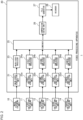
- Fig. 2 is a block diagram illustrating a configuration of a video processing system 5 according to the first embodiment.
- the video processing system 5 according to the first embodiment includes a main picture capturing unit 10, a first sub-picture capturing unit 11, a second sub-picture capturing unit 12, a third sub-picture capturing unit 13, a fourth sub-picture capturing unit 14, and a video processing apparatus 20.
- the main picture capturing unit 10, the first sub-picture capturing unit 11, the second sub-picture capturing unit 12, the third sub-picture capturing unit 13, and the fourth sub-picture capturing unit 14 are connected to the video processing apparatus 20 by cables.
- At least one of the main picture capturing unit 10, the first sub-picture capturing unit 11, the second sub-picture capturing unit 12, the third sub-picture capturing unit 13, and the fourth sub-picture capturing unit 14 may be wirelessly connected to the video processing apparatus 20 as long as requirements for real-time property and noise resistance are satisfied.
- the main picture capturing unit 10 includes an ultrawide-angle lens, a solid-state picture capturing element, and a signal processing circuit.
- the solid-state picture capturing element converts light entered through the ultrawide-angle lens into an electrical video signal and outputs the electrical video signal to the signal processing circuit.
- the solid-state picture capturing element may be a complementary metal oxide semiconductor (CMOS) image sensor or a charge coupled devices (CCD) image sensor, for example.
- CMOS complementary metal oxide semiconductor
- CCD charge coupled devices
- the signal processing circuit performs signal processing such as A/D conversion and noise removal on a video signal input from the solid-state picture capturing element, and outputs the video signal to the video processing apparatus 20.
- the configurations of the first sub-picture capturing unit 11 to the fourth sub-picture capturing unit 14 are also similar to the configuration of the main picture capturing unit 10 except for the shape of the lens and specifications of circuit components.
- the video processing apparatus 20 includes a main video acquisition unit 21, a first sub-video acquisition unit 22a, a second sub-video acquisition unit 22b, a third sub-video acquisition unit 22c, a fourth sub-video acquisition unit 22d, a main video processor 23, a first sub-video processor 24a, a second sub-video processor 24b, a third sub-video processor 24c, a fourth sub-video processor 24d, a combiner 25, a compression coding unit 26, a file generator 27, and a recorder 28.
- the configurations of the main video acquisition unit 21 to the file generator 27 of video processing apparatus 20 can be realized by cooperation of hardware resources and software resources or by only hardware resources.
- a CPU central processing unit
- ROM read-only memory
- RAM random access memory
- DSP digital signal processor
- ASIC application specific integrated circuit
- FPGA field-programmable gate array
- programs such as firmware can be used.
- the main video acquisition unit 21 acquires main video data including a circular video area from the main picture capturing unit 10.
- the main video acquisition unit 21 outputs the acquired main video data to the main video processor 23.
- the circular video area herein is a concept including not only a true circular video area but also an elliptical video area and a distorted circular video area.
- the main video data output from the main picture capturing unit 10 is rectangular data including a circular video area therein.
- an area other than the circular video area is a free area not including video information.
- the free area is displayed as a black background.
- the first sub-video acquisition unit 22a to the fourth sub-video acquisition unit 22d acquire the first sub-video data to the fourth sub-video data from the first sub-picture capturing unit 11 to the fourth sub-picture capturing unit 14, respectively.
- the first sub-video acquisition unit 22a to the fourth sub-video acquisition unit 22d output the acquired first sub-video data to fourth sub-video data to the first sub-video processor 24a to the fourth sub-video processor 24d, respectively.
- the first sub-video processor 24a to the fourth sub-video processor 24d process the first sub-video data to the fourth sub-video data to generate video data having the shape of the free area of each frame of the main video data.
- a specific description will be given with reference to Figs. 3 to 5 .
- Fig. 3 is a diagram for describing a main video 10i and a first sub-video 11i to a fourth sub-video 14i captured by the main picture capturing unit 10 and the first sub-picture capturing unit 11 to the fourth sub-picture capturing unit 14, respectively, according to the first embodiment.
- a hatched area not including the video information in the main video data is indicated as a free area 10e.
- the motions of the scenes seen in the main video 10i, the first sub-video 11i, the second sub-video 12i, the third sub-video 13i, and the fourth sub-video 14i in the state where the vehicle 1 moves forward are indicated by arrows.
- the scenes in the videos are the scenes flowing in a direction opposite to the direction in which the vehicle 1 moves.
- the scene seen in the main video 10i is a scene flowing backward. Specifically, the scene flows from top to bottom. Since the video captured through the ultrawide-angle lens is a round distorted video, in an area close to the circumference, the scene in the video becomes a scene flowing from top to bottom along the circumference.
- the scene seen in the first sub-video 11i is a scene spreading from the center to the periphery.
- the scene seen in the second sub-video 12i is a scene drawn from the periphery to the center.
- the scene seen in the third sub-video 13i is a scene flowing from right to left.
- the scene seen in the fourth sub-video 14i is a scene flowing from left to right.
- the motions of the scene seen in the main video 10i, the first sub-video 11i, the second sub-video 12i, the third sub-video 13i, and the fourth sub-video 14i are the motions in the directions opposite to the directions of the arrows illustrated in Fig. 3 .
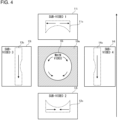
- Fig. 4 is a diagram for describing modified processing of the main video 10i and the first sub-video 11i to the fourth sub-video 14i captured by the main picture capturing unit 10 and the first sub-picture capturing unit 11 to the fourth sub-picture capturing unit 14, respectively, according to the first embodiment.
- the first sub-video 11i is arranged in the free area 10e above the main video 10i
- the second sub-video 12i is arranged in the free area 10e below main video 10i
- the third sub-video 13i is arranged in the free area 10e on the left of the main video 10i
- the fourth sub-video 14i is arranged in the free area 10e on the right of the main video 10i.
- the main video processor 23 and the first sub-video processor 24a to the fourth sub-video processor 24d execute various processes on the main video data and the first sub-video data to the fourth sub-video data as preprocessing before combining the videos. For example, in a case where the resolution of the solid-state picture capturing element of the main picture capturing unit 10 is different from the resolution of the solid-state picture capturing elements of the first sub-picture capturing unit 11 to the fourth sub-picture capturing unit 14, the following process is executed by at least one of the main video processor 23 and the first sub-video processor 24a to the fourth sub-video processor 24d.
- At least one of a thinning or interpolating process of the main video data by the main video processor 23 and a thinning or interpolating process of the first sub-video data to the fourth sub-video data by the first sub-video processor 24a to the fourth sub-video processor 24d is executed so that the resolution of the main video data coincides with the resolution of the first sub-video data to the fourth sub-video data.
- the main video processor 23 may execute enlargement or reduction processing of the video area of the circular main video 10i. For example, when the first sub-video data to the fourth sub-video data are stored separately from the main video data, the main video processor 23 may enlarge the circular video area to the maximum. On the contrary, when the first sub-video data to the fourth sub-video data are discarded without being stored, the main video processor 23 may reduce the circular video area. In this case, more free area 10e can be obtained, and more information of the first sub-video 11i to the fourth sub-video 14i can be left.
- the main video processor 23 may subject the main video data to coordinate transformation by a predetermined projective transform method on the basis of a distortion parameter set according to the viewing angle of the ultrawide-angle lens of the main picture capturing unit 10.
- the first sub-video processor 24a to the fourth sub-video processor 24d deform the first sub-video data to the fourth sub-video data so as to bring motion vectors of the first sub-video 11i to the fourth sub-video 14i closer to the motion vector of the area neighboring to the free area 10e in the main video 10i according to the motion of the vehicle 1.
- the third sub-video processor 24c rotates the third sub-video data counterclockwise by 90°.
- the fourth sub-video processor 24d rotates the fourth sub-video data clockwise by 90°. In the example illustrated in Fig. 4 , it is not necessary to rotate the first sub-video data and the second sub-video data.
- the rotation angles of the sub-video data are set in advance according to the positional relationship between the main picture capturing unit 10 and the first sub-picture capturing unit 11 to the fourth sub-picture capturing unit 14 and the respective view angles. For example, if the angle of view of the third sub-picture capturing unit 13 is inclined in the roll direction, the third sub-video processor 24c rotates the third sub-video data not at 90° but at an angle corresponding to the inclination. For example, if the first sub-picture capturing unit 11 or the second sub-picture capturing unit 12 is inclined in the roll direction, the first sub-video processor 24a or the second sub-video processor 24b rotates the first sub-video data or the second sub-video data at an angle corresponding to the inclination.
- the first sub-video processor 24a cuts out, from first sub-video 11i, partial video data 11c having a shape corresponding to the free area 10e above the main video 10i.
- the position at which the partial video data 11c is cut out from the first sub-video 11i is not limited to the position illustrated in Fig. 4 , and the partial video data can be cut out from an arbitrary position.
- the first sub-video processor 24a may cut out the partial video data 11c with a larger size, and reduce the cut partial video data 11c to a size of the free area 10e above the first sub-video 11i.
- the first sub-video processor 24a may not cut out the partial video data 11c from the first sub-video 11i, but may transform the entire first sub-video 11i into a shape corresponding to the free area 10e above the main video 10i.
- the fourth sub-video processor 24d cuts out, from fourth sub-video 14i, partial video data 14c having a shape corresponding to the free area 10e on the right of the main video 10i.
- the fourth sub-video processor 24d may transform the whole fourth sub-video 14i into a shape corresponding to the free area 10e on the right of the main video 10i.
- the first sub-video processor 24a to the fourth sub-video processor 24d perform coordinate transformation in accordance with the deformation, rotation, or cutout of the first sub-video data to the fourth sub-video data.
- the main video processor 23 and the first sub-video processor 24a to the fourth sub-video processor 24d can also execute processes such as gradation correction, color correction, and contour correction in addition to the processes described above.
- the combiner 25 includes a frame buffer.
- the combiner 25 arranges partial video data 11c to 14c generated by the first sub-video processor 24a to the fourth sub-video processor 24d, in the free areas 10e other than the circular video area of each frame of the main video data.
- Fig. 5 is a diagram illustrating a combined video 15 after the four pieces of partial video data 11c to 14 c are arranged in the main video 10i. As illustrated in Fig. 5 , the directions in which the scenes flow are approximated between the inside and outside of the boundary of the circular video area.
- the compression coding unit 26 compresses and encodes the combined video data.
- the compression coding unit 26 compresses and encodes video data using an MPEG-based compression scheme, for example.
- MPEG-based compression scheme for example, MPEG-2, MPEG-4, H.264/AVC, H.265/HEVC, or the like can be used.
- the file generator 27 generates one moving picture file on the basis of a stream of compressed and coded video data.
- the file generator 27 may multiplex the video data and the audio data to generate one moving picture file with audio.
- the video data and the audio data are stored in one file using the MP4 format.
- the file generator 27 saves the generated moving picture file in the recorder 28.
- the moving picture file to be saved in the recorder 28 is generated by compressing and coding the combined video data.
- the first sub-video data to the fourth sub-video data that are not processed for combination may be compressed and coded, and may be saved separately in the recorder 28.
- the recorder 28 includes a nonvolatile recording medium.
- the nonvolatile recording medium may be a removable recording medium or a fixed recording medium built in the video processing apparatus 20.
- a semiconductor memory card for example, an SD card
- an optical disk for example, DVD
- the fixed recording medium a NAND flash memory chip, an SSD, an HDD, or the like can be used.
- the video processing apparatus 20 may be provided with a display unit for displaying a captured video (for example, a liquid crystal display or an organic EL display).
- a captured video for example, a liquid crystal display or an organic EL display
- the captured video may be displayed on the screen of a car navigation system or a smartphone in cooperation with the car navigation system or the smartphone.
- the removable recording medium may be taken out from the video processing apparatus 20, and the taken out removable recording medium may be loaded into a video reproducing apparatus such as a PC to reproduce a moving picture file stored in the removable recording medium.
- the video processing apparatus 20 may be provided with a wireless communication unit.
- the wireless communication unit can transmit and store the generated moving picture file to a server on a cloud via a wireless network.
- the wireless communication unit can also stream the combined video to a PC or a server in the monitoring center via a wireless network.
- the first embodiment it is possible to efficiently generate a file of video data captured by the main picture capturing unit 10 including the ultrawide-angle lens such as a circumferential fisheye lens and the first sub-picture capturing unit 11 to the fourth sub-picture capturing unit 14. That is, it is possible to efficiently record the videos by arranging the videos acquired from the first sub-picture capturing unit 11 to the fourth sub-picture capturing unit 14 in the area around the circular video area acquired from the main picture capturing unit 10. In the video captured through the circumferential fisheye lens, there is no video information in the area outside the circular video area, and waste occurs in the rectangular recordable area. On the other hand, according to the present embodiment, the outer free area can be effectively used.
- inter-frame prediction coding using motion compensation is used.
- the compression coding unit 26 searches for a prediction area having the smallest error with respect to the macroblock of the current frame in a reference frame neighboring to the current frame in the time direction.
- the compression coding unit 26 obtains a motion vector indicating a difference between the macroblock of the current frame and the prediction area searched in the reference frame.
- the compression coding unit 26 compensates for the motion of the macroblock using the obtained motion vector, and generates a difference image between the motion-compensated macroblock image and the image of the prediction area searched in the reference frame.
- the compression coding unit 26 codes the data obtained by quantizing the orthogonal transform coefficient of the difference image and the motion vector.
- the sub-video data is rotated so as to bring the motion vectors of the scenes seen in the sub videos arranged around the main video close to the motion vector of the scene seen in the outer peripheral portion of the main video. This makes it possible to reduce the variation in the motion vector of the scene seen in the macroblock in the boundary area between the main video and the sub-videos, and reduce the data amount of the difference image. Therefore, the compression efficiency of the video data in the boundary area can be improved as compared with the case where the sub-video data is combined without being rotated.
- Figs. 6A and 6B are diagrams illustrating an arrangement example of a main picture capturing unit 10 and a sub-picture capturing unit 11 installed on a vehicle 1, constituting a video processing system according to a second embodiment.
- Fig. 6A is a top view of the vehicle 1
- Fig. 6B is a left-side view of the vehicle 1.
- the sub-picture capturing unit 11 is one example.
- the sub-picture capturing unit 11 is attached to the front grille and captures a picture of a scene in front of the vehicle 1.
- Fig. 7 is a block diagram illustrating a configuration of a video processing system 5 according to the second embodiment.
- the video processing system 5 according to the second embodiment is structured such that the second sub-picture capturing unit 12, the third sub-picture capturing unit 13, the fourth sub-picture capturing unit 14, the second sub-video acquisition unit 22b, the third sub-video acquisition unit 22c, the fourth sub-video acquisition unit 22d, the second sub-video processor 24b, the third sub-video processor 24c, and the fourth sub-video processor 24d are removed from the video processing system 5 according to the first embodiment illustrated in Fig. 2 .
- Figs. 8 to 10 a specific description will be given with reference to Figs. 8 to 10 .
- Fig. 8 is a diagram for describing a main video 10i and a sub-video 11i captured by the main picture capturing unit 10 and the sub-picture capturing unit 11, respectively, according to the second embodiment.
- the motion of the scenes seen in the main video 10i and the sub-video 11i in a state where the vehicle 1 moves forward is indicated by arrows.
- the scenes in the videos are the scenes flowing in a direction opposite to the direction in which the vehicle 1 moves.
- a sub-video processor 24 quarters the sub-video 11i in a cross shape to generate a first partial video 11A in an upper left area A, a second partial video 11B in an upper right area B, a third partial video 11C in a lower left area C, and a fourth partial video 11D in a lower right area D.
- Fig. 9 is a diagram for describing modified processing of the main video 10i and the sub-video 11i captured by the main picture capturing unit 10 and the sub-picture capturing unit 11, respectively, according to the second embodiment.
- the first partial video 11A of sub-video 11i is arranged in a free area 10e at the upper left corner of the main video 10i
- the second partial video 11B in the sub-video 11i is arranged in a free area 10e at the upper right corner of the main video 10i
- the third partial video 11C of the sub-video 11i is arranged in a free area 10e at the lower left corner of the main video 10i
- the fourth partial video 11D of the sub-video 11i is arranged in a free area 10e at the lower right corner of the main video 10i.
- the sub-video processor 24 deforms the first partial video 11A to the fourth partial video 11D so as to bring the motion vectors of the first partial video 11A to the fourth partial video 11D close to the motion vectors of the areas neighboring to the free area 10e in the main video 10i according to the motion of the vehicle 1.
- the sub-video processor 24 rotates the first partial video 11A counterclockwise by 90°, rotates the second partial video 11B clockwise by 90°, rotates the third partial video 11C counterclockwise by 90°, and rotates the fourth partial video 11D clockwise by 90°.
- the sub-video processor 24 cuts out, from the first partial video 11A, partial video data 11Ac having a shape corresponding to the free area 10e on the upper left corner of the main video 10i. Similarly, the sub-video processor 24 cuts out, from the second partial video 11B, partial video data 11Bc having a shape corresponding to the free area 10e on the upper right corner of the main video 10i. Similarly, the sub-video processor 24 cuts out, from the third partial video 11C, partial video data 11Cc having a shape corresponding to the free area 10e on the lower left corner of the main video 10i.
- the sub-video processor 24 cuts out, from the fourth partial video 11D, partial video data 11Dc having a shape corresponding to the free area 10e at the lower right corner of the main video 10i.
- the sub-video processor 24 executes coordinate transformation in accordance with deformation, rotation, or cutout of the sub-video data.
- a combiner 25 arranges partial video data 11Ac to 11Dc generated by the sub-video processor 24, in the free areas 10e other than the circular video area of each frame of the main video data.
- Fig. 10 is a diagram illustrating a combined video 15 after the four pieces of partial video data 11Ac to 11Dc are arranged in the main video 10i. As illustrated in Fig. 10 , the directions in which the scenes flow are approximated between the inside and the outside of the boundary of the circular video area.
- the second embodiment it is possible to produce the same advantageous effects as those of the first embodiment. Moreover, in the second embodiment, since the number of sub-picture capturing units is smaller than that in the first embodiment, the cost of video processing system 5 can be reduced as compared with the first embodiment.
- the sub-picture capturing unit 11 captures a picture of a scene in front of the vehicle 1.
- the present invention may be applied to a camera attached to the rear part of the vehicle that captures a picture of a scene behind the vehicle.
- the directions of arrows of the sub-video 11i are reversed.
- changing the rotation direction of the sub-video data makes it possible to align the directions in which the scenes flow so as to bring close to each other between the inside and the outside of the boundary of the circular video area.
- the arrangement of the first partial video 11A to the fourth partial video 11D may be exchanged as appropriate.
- the third sub-video processor 24c rotates the third sub-video data counterclockwise by 90°
- the fourth sub-video processor 24d rotates the fourth sub-video data clockwise by 90°
- the third sub-picture capturing unit 13 and the fourth sub-picture capturing unit 14 may be installed with the angles of view rotated in the roll direction in advance.
- the third sub-picture capturing unit 13 and the fourth sub-picture capturing unit 14 are installed in directions in which the front side of the vehicle 1 is seen on the upper side of the captured video and the rear side of the vehicle 1 is seen on the lower side when the vehicle 1 is moving forward.
- the third sub-video processor 24c and the fourth sub-video processor 24d do not need to rotate the third sub-video data and the fourth sub-video data, respectively.
- the arrangements and orientations of the main picture capturing unit 10 and the first sub-picture capturing unit 11 to the fourth sub-picture capturing unit 14 are adjusted in advance such that the motion vector of the scene appearing in the outer peripheral portion of the main video and the motion vectors of the scenes appearing in the sub-videos arranged around the main video are aligned, whereby the compression efficiency of the video data in the vicinity of the boundary area can be improved without the need for advanced video processing.
- the vehicle 1 is assumed as a target in which the video processing system 5 is installed.
- the video processing system 5 may be installed in a moving object other than a vehicle.
- the video processing system 5 may be installed in a motorcycle, a bicycle, a railway vehicle, a ship, an airplane, a multi-copter (drone), or the like.
- the first sub-video processor 24a to the fourth sub-video processor 24d may dynamically derive the motion vectors of first sub-video 11i to the fourth sub-video 14i according to the motion vector of the area neighboring to the free area 10e of the main video 10i according to the motion of the moving object, and adaptively adjust the rotation angles of the first sub-video data to the fourth sub-video data.
- the main video processor 23 derives the motion vectors of individual areas of the main video 10i such that the difference between the areas of frames neighboring to each other in the time direction of the main video 10i is minimized.
- the first sub-video processor 24a derives the motion vector of the first sub-video 11i such that the difference between the frames neighboring to each other in the time direction of the first sub-video 11i is minimized.
- the first sub-video processor 24a rotates the first sub-video 11i such that the motion vector of the first sub-video 11i approximates the motion vector of the area of the main video 10i neighboring to the area where the first sub-video 11i is to be arranged.
- the sub-video processor 24 may dynamically derive the motion vectors of the partial areas A to D of the sub-video 11i according to the motion vector of the area neighboring to the free area 10e of the main video 10i according to the motion of the moving object, and adaptively adjust the rotation angles of the first partial videos 11A to the fourth partial video 11D.
- the main video is located in the circular effective video area, and the sub-videos are located in the rectangular video areas.
- the present invention is not limited thereto.
- the main video may be located in a video area of a shape having a curved portion, which is not limited to a circular shape, such as a barrel shape or a semicircular shape.
- the shape having the curved portion may have a curved portion and a straight portion.
- the curved portion may have a polygonal shape in which straight portions are connected to form a substantially arc shape.
- the present invention can also be carried out in a case where videos of irregular shapes are used as sub-videos.
- the present invention is applicable to a drive recorder.
Landscapes
- Engineering & Computer Science (AREA)
- Multimedia (AREA)
- Signal Processing (AREA)
- Computing Systems (AREA)
- Theoretical Computer Science (AREA)
- Mechanical Engineering (AREA)
- Closed-Circuit Television Systems (AREA)
- Studio Devices (AREA)
- Studio Circuits (AREA)
- Image Processing (AREA)
Description
- The present invention relates to a video processing apparatus and a video processing system that process a video captured using an ultrawide-angle lens.
- In recent years, drive recorders capable of recording a video in all directions of front, rear, left, and right of a vehicle at 360° have become widespread. For example, four cameras may be installed on the front, rear, left, and right of the vehicle, and an ultra-wide angle camera may be installed on the ceiling of the vehicle interior so as to look down the vehicle interior. The video captured by the ultra-wide angle camera using a fisheye lens or the like is a circular video (see, for example, Patent Literature 1). A general video recording format is intended to record a rectangular video on a frame-by-frame basis. Thus, in a case of recording a video captured by the ultra-wide angle camera in a general recording format, useless areas are generated at four corners.
- Attention is also drawn to document
JP 2010 166196 A US 2015/183371 A1 which relates to an image generation apparatus used for a vehicle having side mirrors. An image acquisition unit is configured to acquire a plurality of captured images obtained by a plurality of cameras including side cameras provided in the side mirrors. A generation unit is configured to generate a composite image which indicates a periphery of the vehicle viewed from a virtual viewpoint, by using target areas defined for the respective captured images. A state acquisition unit is configured to acquire a developed or folded state of the side mirrors. The generation unit changes the target areas in accordance with the developed or folded state of the side mirrors. - Document
US 2016/360104 A1 relates to an electronic device. The electronic device includes a processor. The processor is configured to obtain images from a plurality of cameras. The processor is also configured to project each image to a respective 3-dimensional (3D) shape for each camera. The processor is further configured to generate a combined view from the images. - Attention is also drawn to document
US 2009/160940 A1 which relates to an image display method for displaying a combined image by capturing images at areas surrounding a vehicle includes a) calculating a plurality of displacement vectors for a plurality of points taken on images captured by a plurality of cameras upon the application of a load that changes the attitude of a camera on the vehicle, and b) determining each image borderline between two adjacent images such that a difference in the directions of displacement vectors in the neighborhood of each image borderline between two adjacent images does not exceed a predetermined angle. - The present invention is defined by the appended independent claims. Further embodiments of the present invention are defined by the appended dependent claims. As described above, in a case of capturing and recording videos simultaneously by a plurality of cameras installed on a vehicle, a file of video data is generated for each camera. At the time of reproduction, combination and synchronization management of the video data captured by the plurality of cameras tend to be complicated.
- The present embodiment has been made in view of such a situation. An object thereof is to provide a technique for efficiently generating a file of video data captured by a plurality of cameras including an ultra-wide angle camera.
- In order to solve the above issue, a video processing apparatus according to one aspect of the present embodiment includes: a first acquisition unit that acquires main video data including a video area of a shape having a curved portion from a main picture capturing unit installed at a predetermined position in a moving object; a second acquisition unit that acquires sub-video data from a sub-picture capturing unit installed at another position in the moving object; a combiner that combines video data that is generated on the basis of the sub-video data and has a shape fitting to a free area other than the video area of each frame of the main video data, and arranges the video data in the free area; and a generator that generates one moving picture file on the basis of the combined video data.
- Another aspect of the present embodiment is a video processing method. This method includes: acquiring main video data including a video area of a shape having a curved portion from a main picture capturing unit installed at a predetermined position in a moving object; acquiring sub-video data from a sub-picture capturing unit installed at another position in the moving object; combining video data that is generated on the basis of the sub-video data and has a shape fitting to a free area other than the video area of each frame of the main video data, and arranges the video data in the free area; and generating one moving picture file on the basis of the combined video data.
- It should be noted that any combination of the above-described components and mutual exchanges of methods, devices, systems, recording media, computer programs and the like described in relation to the present embodiment are also effective as aspects of the present embodiment.
- According to the present embodiment, it is possible to efficiently generate a file of video data captured by a plurality of cameras including a super-wide angle camera.
-
-
Figs. 1A and 1B are diagrams illustrating an arrangement example of a main picture capturing unit and four sub-picture capturing units installed on a vehicle, constituting a video processing system according to a first embodiment. -
Fig. 2 is a block diagram illustrating a configuration of the video processing system according to the first embodiment. -
Fig. 3 is a diagram for describing a main video and a first sub-video to a fourth sub-video respectively captured by a main picture capturing unit and a first sub-picture capturing unit to a fourth sub-picture capturing unit, respectively, according to the first embodiment. -
Fig. 4 is a diagram for describing modified processing of the main video and the first sub-video to the fourth sub-video respectively captured by the main picture capturing unit and the first sub-picture capturing unit to the fourth sub-picture capturing unit, respectively, according to the first embodiment. -
Fig. 5 is a diagram illustrating a combined video in which four pieces of partial video data are arranged in a main video. -
Figs. 6A and 6B are diagrams illustrating an arrangement example of a main picture capturing unit and a sub-picture capturing unit installed on a vehicle, constituting a video processing system according to a second embodiment. -
Fig. 7 is a block diagram illustrating a configuration of the video processing system according to the second embodiment. -
Fig. 8 is a diagram for describing a main video and a sub-video captured by the main picture capturing unit and the sub-picture capturing unit, respectively, according to the second embodiment. -
Fig. 9 is a diagram for describing modified processing of the main video and the sub-video captured by the main picture capturing unit and the sub-picture capturing unit, respectively, according to the second embodiment. -
Fig. 10 is a diagram illustrating a combined video in which four pieces of partial video data are arranged in a main video. -
Figs. 1A and 1B are diagrams illustrating an arrangement example of a mainpicture capturing unit 10 and four sub-picture capturingunits 11 to 14 installed on avehicle 1, constituting a video processing system according to a first embodiment.Fig. 1A is a top view of thevehicle 1, andFig. 1B is a left-side view of thevehicle 1. The mainpicture capturing unit 10 includes a camera having an ultrawide-angle lens. In the present embodiment, it is assumed that the ultrawide-angle lens is a circumferential fisheye lens capable of covering the front, rear, left, and right of thevehicle 1 having an angle of view of 180° and the entire hemispherical periphery of the vehicle interior. As illustrated inFigs. 1A and 1B , in the present embodiment, the mainpicture capturing unit 10 is installed downward on the ceiling of the vehicle interior so as to look down the vehicle interior, and captures a picture of a scene outside the vehicle interior. - In the first embodiment, a plurality of sub-picture capturing units 11-14 is installed outside the
vehicle 1 in order to compensate for a blind spot of the mainpicture capturing unit 10 or insufficient resolution in a neighboring portion. It is assumed that the plurality of sub-picture capturingunits 11 to 14 includes a camera having a general wide-angle lens with less distortion of the neighboring picture than the circumferential fisheye lens. In the first embodiment, the firstsub-picture capturing unit 11 is installed on the front side of thevehicle 1, the secondsub-picture capturing unit 12 is installed on the rear side of thevehicle 1, the thirdsub-picture capturing unit 13 is installed on the left side of thevehicle 1, and the fourthsub-picture capturing unit 14 is installed on the right side of thevehicle 1. - In the example illustrated in
Figs. 1A and 1B , the firstsub-picture capturing unit 11 is attached to the front grille and captures a picture of a scene in front of thevehicle 1. The secondsub-picture capturing unit 12 is attached to the rear grill and captures a picture of a scene behind thevehicle 1. The thirdsub-picture capturing unit 13 is attached to the left side mirror and captures a picture of a scene on the left side of thevehicle 1. The fourthsub-picture capturing unit 14 is attached to the right side mirror and captures a picture of a scene on the right side of thevehicle 1. -
Fig. 2 is a block diagram illustrating a configuration of avideo processing system 5 according to the first embodiment. Thevideo processing system 5 according to the first embodiment includes a mainpicture capturing unit 10, a firstsub-picture capturing unit 11, a secondsub-picture capturing unit 12, a thirdsub-picture capturing unit 13, a fourthsub-picture capturing unit 14, and avideo processing apparatus 20. The mainpicture capturing unit 10, the firstsub-picture capturing unit 11, the secondsub-picture capturing unit 12, the thirdsub-picture capturing unit 13, and the fourthsub-picture capturing unit 14 are connected to thevideo processing apparatus 20 by cables. At least one of the mainpicture capturing unit 10, the firstsub-picture capturing unit 11, the secondsub-picture capturing unit 12, the thirdsub-picture capturing unit 13, and the fourthsub-picture capturing unit 14 may be wirelessly connected to thevideo processing apparatus 20 as long as requirements for real-time property and noise resistance are satisfied. - The main
picture capturing unit 10 includes an ultrawide-angle lens, a solid-state picture capturing element, and a signal processing circuit. The solid-state picture capturing element converts light entered through the ultrawide-angle lens into an electrical video signal and outputs the electrical video signal to the signal processing circuit. The solid-state picture capturing element may be a complementary metal oxide semiconductor (CMOS) image sensor or a charge coupled devices (CCD) image sensor, for example. The signal processing circuit performs signal processing such as A/D conversion and noise removal on a video signal input from the solid-state picture capturing element, and outputs the video signal to thevideo processing apparatus 20. The configurations of the firstsub-picture capturing unit 11 to the fourthsub-picture capturing unit 14 are also similar to the configuration of the mainpicture capturing unit 10 except for the shape of the lens and specifications of circuit components. - The
video processing apparatus 20 includes a mainvideo acquisition unit 21, a firstsub-video acquisition unit 22a, a secondsub-video acquisition unit 22b, a thirdsub-video acquisition unit 22c, a fourthsub-video acquisition unit 22d, amain video processor 23, a firstsub-video processor 24a, a secondsub-video processor 24b, a thirdsub-video processor 24c, a fourthsub-video processor 24d, acombiner 25, acompression coding unit 26, afile generator 27, and arecorder 28. - The configurations of the main
video acquisition unit 21 to thefile generator 27 ofvideo processing apparatus 20 can be realized by cooperation of hardware resources and software resources or by only hardware resources. As the hardware resources, a CPU, a ROM, a RAM, a graphics processing unit (GPU), a digital signal processor (DSP), an application specific integrated circuit (ASIC), a field-programmable gate array (FPGA), and other LSIs can be used. As the software resources, programs such as firmware can be used. - The main
video acquisition unit 21 acquires main video data including a circular video area from the mainpicture capturing unit 10. The mainvideo acquisition unit 21 outputs the acquired main video data to themain video processor 23. The circular video area herein is a concept including not only a true circular video area but also an elliptical video area and a distorted circular video area. - Normally, since the pixels of the solid-state picture capturing element are arranged in a rectangle, even if the lens is an ultrawide-angle circumferential fisheye lens, the main video data output from the main
picture capturing unit 10 is rectangular data including a circular video area therein. In each frame of the main video data, an area other than the circular video area is a free area not including video information. When the main video data is reproduced without performing view angle conversion, the free area is displayed as a black background. - The first
sub-video acquisition unit 22a to the fourthsub-video acquisition unit 22d acquire the first sub-video data to the fourth sub-video data from the firstsub-picture capturing unit 11 to the fourthsub-picture capturing unit 14, respectively. The firstsub-video acquisition unit 22a to the fourthsub-video acquisition unit 22d output the acquired first sub-video data to fourth sub-video data to the firstsub-video processor 24a to the fourthsub-video processor 24d, respectively. - The first
sub-video processor 24a to the fourthsub-video processor 24d process the first sub-video data to the fourth sub-video data to generate video data having the shape of the free area of each frame of the main video data. Hereinafter, a specific description will be given with reference toFigs. 3 to 5 . -
Fig. 3 is a diagram for describing amain video 10i and a first sub-video 11i to afourth sub-video 14i captured by the mainpicture capturing unit 10 and the firstsub-picture capturing unit 11 to the fourthsub-picture capturing unit 14, respectively, according to the first embodiment. A hatched area not including the video information in the main video data is indicated as afree area 10e. InFig. 3 , the motions of the scenes seen in themain video 10i, thefirst sub-video 11i, thesecond sub-video 12i, thethird sub-video 13i, and thefourth sub-video 14i in the state where thevehicle 1 moves forward are indicated by arrows. The scenes in the videos are the scenes flowing in a direction opposite to the direction in which thevehicle 1 moves. - Since the
vehicle 1 moves forward (InFig. 3 , thevehicle 1 moves from bottom to top), the scene seen in themain video 10i is a scene flowing backward. Specifically, the scene flows from top to bottom. Since the video captured through the ultrawide-angle lens is a round distorted video, in an area close to the circumference, the scene in the video becomes a scene flowing from top to bottom along the circumference. The scene seen in thefirst sub-video 11i is a scene spreading from the center to the periphery. The scene seen in thesecond sub-video 12i is a scene drawn from the periphery to the center. The scene seen in thethird sub-video 13i is a scene flowing from right to left. The scene seen in thefourth sub-video 14i is a scene flowing from left to right. - When the
vehicle 1 moves backward (InFig. 3 , thevehicle 1 moves from top to bottom), the motions of the scene seen in themain video 10i, thefirst sub-video 11i, thesecond sub-video 12i, thethird sub-video 13i, and the fourth sub-video 14i are the motions in the directions opposite to the directions of the arrows illustrated inFig. 3 . -
Fig. 4 is a diagram for describing modified processing of themain video 10i and thefirst sub-video 11i to thefourth sub-video 14i captured by the mainpicture capturing unit 10 and the firstsub-picture capturing unit 11 to the fourthsub-picture capturing unit 14, respectively, according to the first embodiment. In the example ofFigs. 3 to 5 , thefirst sub-video 11i is arranged in thefree area 10e above themain video 10i, thesecond sub-video 12i is arranged in thefree area 10e belowmain video 10i, thethird sub-video 13i is arranged in thefree area 10e on the left of themain video 10i, and thefourth sub-video 14i is arranged in thefree area 10e on the right of themain video 10i. - The
main video processor 23 and the firstsub-video processor 24a to the fourthsub-video processor 24d execute various processes on the main video data and the first sub-video data to the fourth sub-video data as preprocessing before combining the videos. For example, in a case where the resolution of the solid-state picture capturing element of the mainpicture capturing unit 10 is different from the resolution of the solid-state picture capturing elements of the firstsub-picture capturing unit 11 to the fourthsub-picture capturing unit 14, the following process is executed by at least one of themain video processor 23 and the firstsub-video processor 24a to the fourthsub-video processor 24d. At least one of a thinning or interpolating process of the main video data by themain video processor 23 and a thinning or interpolating process of the first sub-video data to the fourth sub-video data by the firstsub-video processor 24a to the fourthsub-video processor 24d is executed so that the resolution of the main video data coincides with the resolution of the first sub-video data to the fourth sub-video data. - The
main video processor 23 may execute enlargement or reduction processing of the video area of the circularmain video 10i. For example, when the first sub-video data to the fourth sub-video data are stored separately from the main video data, themain video processor 23 may enlarge the circular video area to the maximum. On the contrary, when the first sub-video data to the fourth sub-video data are discarded without being stored, themain video processor 23 may reduce the circular video area. In this case, morefree area 10e can be obtained, and more information of thefirst sub-video 11i to thefourth sub-video 14i can be left. - In order to reduce the distortion of the
main video 10i, themain video processor 23 may subject the main video data to coordinate transformation by a predetermined projective transform method on the basis of a distortion parameter set according to the viewing angle of the ultrawide-angle lens of the mainpicture capturing unit 10. - The first
sub-video processor 24a to the fourthsub-video processor 24d deform the first sub-video data to the fourth sub-video data so as to bring motion vectors of thefirst sub-video 11i to thefourth sub-video 14i closer to the motion vector of the area neighboring to thefree area 10e in themain video 10i according to the motion of thevehicle 1. In the example illustrated inFig. 4 , the thirdsub-video processor 24c rotates the third sub-video data counterclockwise by 90°. The fourthsub-video processor 24d rotates the fourth sub-video data clockwise by 90°. In the example illustrated inFig. 4 , it is not necessary to rotate the first sub-video data and the second sub-video data. - The rotation angles of the sub-video data are set in advance according to the positional relationship between the main
picture capturing unit 10 and the firstsub-picture capturing unit 11 to the fourthsub-picture capturing unit 14 and the respective view angles. For example, if the angle of view of the thirdsub-picture capturing unit 13 is inclined in the roll direction, the thirdsub-video processor 24c rotates the third sub-video data not at 90° but at an angle corresponding to the inclination. For example, if the firstsub-picture capturing unit 11 or the secondsub-picture capturing unit 12 is inclined in the roll direction, the firstsub-video processor 24a or the secondsub-video processor 24b rotates the first sub-video data or the second sub-video data at an angle corresponding to the inclination. - The first
sub-video processor 24a cuts out, fromfirst sub-video 11i,partial video data 11c having a shape corresponding to thefree area 10e above themain video 10i. The position at which thepartial video data 11c is cut out from thefirst sub-video 11i is not limited to the position illustrated inFig. 4 , and the partial video data can be cut out from an arbitrary position. The firstsub-video processor 24a may cut out thepartial video data 11c with a larger size, and reduce the cutpartial video data 11c to a size of thefree area 10e above thefirst sub-video 11i. The firstsub-video processor 24a may not cut out thepartial video data 11c from thefirst sub-video 11i, but may transform the entire first sub-video 11i into a shape corresponding to thefree area 10e above themain video 10i. - Similarly, the second
sub-video processor 24b cuts out, from thesecond sub-video 12i,partial video data 12c having a shape corresponding to thefree area 10e under themain video 10i. The secondsub-video processor 24b may transform the whole second sub-video 12i into a shape corresponding to thefree area 10e under themain video 10i. The thirdsub-video processor 24c cuts out, from third sub-video 13i,partial video data 13c having a shape corresponding to thefree area 10e on the left of themain video 10i. The thirdsub-video processor 24c may transform the whole third sub-video 13i into a shape corresponding to thefree area 10e on the left of themain video 10i. The fourthsub-video processor 24d cuts out, fromfourth sub-video 14i,partial video data 14c having a shape corresponding to thefree area 10e on the right of themain video 10i. The fourthsub-video processor 24d may transform the whole fourth sub-video 14i into a shape corresponding to thefree area 10e on the right of themain video 10i. - The first
sub-video processor 24a to the fourthsub-video processor 24d perform coordinate transformation in accordance with the deformation, rotation, or cutout of the first sub-video data to the fourth sub-video data. Themain video processor 23 and the firstsub-video processor 24a to the fourthsub-video processor 24d can also execute processes such as gradation correction, color correction, and contour correction in addition to the processes described above. - The
combiner 25 includes a frame buffer. Thecombiner 25 arrangespartial video data 11c to 14c generated by the firstsub-video processor 24a to the fourthsub-video processor 24d, in thefree areas 10e other than the circular video area of each frame of the main video data. -
Fig. 5 is a diagram illustrating a combinedvideo 15 after the four pieces ofpartial video data 11c to 14 c are arranged in themain video 10i. As illustrated inFig. 5 , the directions in which the scenes flow are approximated between the inside and outside of the boundary of the circular video area. - The
compression coding unit 26 compresses and encodes the combined video data. Thecompression coding unit 26 compresses and encodes video data using an MPEG-based compression scheme, for example. As an MPEG-based compression scheme, for example, MPEG-2, MPEG-4, H.264/AVC, H.265/HEVC, or the like can be used. - The
file generator 27 generates one moving picture file on the basis of a stream of compressed and coded video data. In a case where audio data is acquired by a microphone (not illustrated), thefile generator 27 may multiplex the video data and the audio data to generate one moving picture file with audio. For example, the video data and the audio data are stored in one file using the MP4 format. Thefile generator 27 saves the generated moving picture file in therecorder 28. In this example, the moving picture file to be saved in therecorder 28 is generated by compressing and coding the combined video data. However, if there are no limitations on specifications such as a recording capacity and a processing speed, the first sub-video data to the fourth sub-video data that are not processed for combination may be compressed and coded, and may be saved separately in therecorder 28. - The
recorder 28 includes a nonvolatile recording medium. The nonvolatile recording medium may be a removable recording medium or a fixed recording medium built in thevideo processing apparatus 20. As the removable recording medium, a semiconductor memory card (for example, an SD card), an optical disk (for example, DVD), or the like can be used. As the fixed recording medium, a NAND flash memory chip, an SSD, an HDD, or the like can be used. - Although not illustrated in
Fig. 2 , thevideo processing apparatus 20 may be provided with a display unit for displaying a captured video (for example, a liquid crystal display or an organic EL display). Instead of providing the display unit, the captured video may be displayed on the screen of a car navigation system or a smartphone in cooperation with the car navigation system or the smartphone. The removable recording medium may be taken out from thevideo processing apparatus 20, and the taken out removable recording medium may be loaded into a video reproducing apparatus such as a PC to reproduce a moving picture file stored in the removable recording medium. - Although not illustrated in
Fig. 2 , thevideo processing apparatus 20 may be provided with a wireless communication unit. The wireless communication unit can transmit and store the generated moving picture file to a server on a cloud via a wireless network. The wireless communication unit can also stream the combined video to a PC or a server in the monitoring center via a wireless network. - As described above, according to the first embodiment, it is possible to efficiently generate a file of video data captured by the main
picture capturing unit 10 including the ultrawide-angle lens such as a circumferential fisheye lens and the firstsub-picture capturing unit 11 to the fourthsub-picture capturing unit 14. That is, it is possible to efficiently record the videos by arranging the videos acquired from the firstsub-picture capturing unit 11 to the fourthsub-picture capturing unit 14 in the area around the circular video area acquired from the mainpicture capturing unit 10. In the video captured through the circumferential fisheye lens, there is no video information in the area outside the circular video area, and waste occurs in the rectangular recordable area. On the other hand, according to the present embodiment, the outer free area can be effectively used. - In a case where a video with a wide field of view is to be recorded by simultaneously capturing pictures using a plurality of picture capturing units, video data is separately recorded for each of the picture capturing units, so that synthesis and synchronization management of the plurality of video data tend to be complicated at the time of reproduction. On the other hand, according to the present embodiment, since the videos captured by the plurality of picture capturing units can be collectively recorded in one video area, it is not necessary to be aware of the synchronization of the plurality of video data at the time of reproduction, and the processing at the time of reproduction can be simplified.
- In a case of combining and recording videos captured by a plurality of picture capturing units into one video area, there is no correlation between the motions of the videos, and thus the compression efficiency of the videos is not improved and the data capacity tends to increase in a boundary area between the combined videos.
- For example, in an MPEG-based compression coding scheme, inter-frame prediction coding using motion compensation is used. The
compression coding unit 26 searches for a prediction area having the smallest error with respect to the macroblock of the current frame in a reference frame neighboring to the current frame in the time direction. Thecompression coding unit 26 obtains a motion vector indicating a difference between the macroblock of the current frame and the prediction area searched in the reference frame. Thecompression coding unit 26 compensates for the motion of the macroblock using the obtained motion vector, and generates a difference image between the motion-compensated macroblock image and the image of the prediction area searched in the reference frame. Thecompression coding unit 26 codes the data obtained by quantizing the orthogonal transform coefficient of the difference image and the motion vector. - In the inter-frame prediction coding using motion compensation, the more uniform the motions of the scenes seen in the macroblock, the smaller the data amount of the difference image can be, whereby the compression efficiency can be improved. In the present embodiment, the sub-video data is rotated so as to bring the motion vectors of the scenes seen in the sub videos arranged around the main video close to the motion vector of the scene seen in the outer peripheral portion of the main video. This makes it possible to reduce the variation in the motion vector of the scene seen in the macroblock in the boundary area between the main video and the sub-videos, and reduce the data amount of the difference image. Therefore, the compression efficiency of the video data in the boundary area can be improved as compared with the case where the sub-video data is combined without being rotated.
- Also in a case of searching for a reference area similar to the target area in the same frame and generating and coding a difference image between the image of the target area and the image of the reference area, it is possible to improve the compression efficiency of the video data near the boundary area between the main video and the sub-videos. By rotating the sub-video data so as to bring the motion vectors of the scenes seen in the sub-videos arranged around the main video close to the motion vector of the scene seen in the outer peripheral portion of the main video, it becomes easy to search for a reference area having high similarity with the target area near the boundary, which contributes to reducing the data amount of the difference image. Rotating the sub-video data also contributes to improving the visual continuity of the video near the boundary.
-
Figs. 6A and 6B are diagrams illustrating an arrangement example of a mainpicture capturing unit 10 and asub-picture capturing unit 11 installed on avehicle 1, constituting a video processing system according to a second embodiment.Fig. 6A is a top view of thevehicle 1, andFig. 6B is a left-side view of thevehicle 1. In the second embodiment, thesub-picture capturing unit 11 is one example. Thesub-picture capturing unit 11 is attached to the front grille and captures a picture of a scene in front of thevehicle 1. -
Fig. 7 is a block diagram illustrating a configuration of avideo processing system 5 according to the second embodiment. Thevideo processing system 5 according to the second embodiment is structured such that the secondsub-picture capturing unit 12, the thirdsub-picture capturing unit 13, the fourthsub-picture capturing unit 14, the secondsub-video acquisition unit 22b, the thirdsub-video acquisition unit 22c, the fourthsub-video acquisition unit 22d, the secondsub-video processor 24b, the thirdsub-video processor 24c, and the fourthsub-video processor 24d are removed from thevideo processing system 5 according to the first embodiment illustrated inFig. 2 . Hereinafter, a specific description will be given with reference toFigs. 8 to 10 . -
Fig. 8 is a diagram for describing amain video 10i and asub-video 11i captured by the mainpicture capturing unit 10 and thesub-picture capturing unit 11, respectively, according to the second embodiment. InFig. 8 , the motion of the scenes seen in themain video 10i and thesub-video 11i in a state where thevehicle 1 moves forward is indicated by arrows. The scenes in the videos are the scenes flowing in a direction opposite to the direction in which thevehicle 1 moves. - In the example illustrated in
Fig. 8 , asub-video processor 24 quarters thesub-video 11i in a cross shape to generate a firstpartial video 11A in an upper left area A, a secondpartial video 11B in an upper right area B, a thirdpartial video 11C in a lower left area C, and a fourthpartial video 11D in a lower right area D. -
Fig. 9 is a diagram for describing modified processing of themain video 10i and thesub-video 11i captured by the mainpicture capturing unit 10 and thesub-picture capturing unit 11, respectively, according to the second embodiment. In the example illustrated inFigs. 8 to 10 , the firstpartial video 11A ofsub-video 11i is arranged in afree area 10e at the upper left corner of themain video 10i, the secondpartial video 11B in thesub-video 11i is arranged in afree area 10e at the upper right corner of themain video 10i, the thirdpartial video 11C of thesub-video 11i is arranged in afree area 10e at the lower left corner of themain video 10i, and the fourthpartial video 11D of thesub-video 11i is arranged in afree area 10e at the lower right corner of themain video 10i. - The
sub-video processor 24 deforms the firstpartial video 11A to the fourthpartial video 11D so as to bring the motion vectors of the firstpartial video 11A to the fourthpartial video 11D close to the motion vectors of the areas neighboring to thefree area 10e in themain video 10i according to the motion of thevehicle 1. In the example illustrated inFig. 9 , thesub-video processor 24 rotates the firstpartial video 11A counterclockwise by 90°, rotates the secondpartial video 11B clockwise by 90°, rotates the thirdpartial video 11C counterclockwise by 90°, and rotates the fourthpartial video 11D clockwise by 90°. - The
sub-video processor 24 cuts out, from the firstpartial video 11A, partial video data 11Ac having a shape corresponding to thefree area 10e on the upper left corner of themain video 10i. Similarly, thesub-video processor 24 cuts out, from the secondpartial video 11B, partial video data 11Bc having a shape corresponding to thefree area 10e on the upper right corner of themain video 10i. Similarly, thesub-video processor 24 cuts out, from the thirdpartial video 11C, partial video data 11Cc having a shape corresponding to thefree area 10e on the lower left corner of themain video 10i. Similarly, thesub-video processor 24 cuts out, from the fourthpartial video 11D, partial video data 11Dc having a shape corresponding to thefree area 10e at the lower right corner of themain video 10i. Thesub-video processor 24 executes coordinate transformation in accordance with deformation, rotation, or cutout of the sub-video data. - A
combiner 25 arranges partial video data 11Ac to 11Dc generated by thesub-video processor 24, in thefree areas 10e other than the circular video area of each frame of the main video data. -
Fig. 10 is a diagram illustrating a combinedvideo 15 after the four pieces of partial video data 11Ac to 11Dc are arranged in themain video 10i. As illustrated inFig. 10 , the directions in which the scenes flow are approximated between the inside and the outside of the boundary of the circular video area. - As described above, according to the second embodiment, it is possible to produce the same advantageous effects as those of the first embodiment. Moreover, in the second embodiment, since the number of sub-picture capturing units is smaller than that in the first embodiment, the cost of
video processing system 5 can be reduced as compared with the first embodiment. - The present invention has been described above based on the embodiments. The above-described embodiments have been described merely for exemplary purposes. Rather, it can be readily conceived by those skilled in the art that various modification examples may be made by making various combinations of the above-described components or processes, which are also encompassed in the technical scope of the present invention. In addition, modes in which the expressions in the present invention are replaced with method, apparatus, system, recording medium, computer program, or the like are also effective as modes of the present invention.
- In the second embodiment, the
sub-picture capturing unit 11 captures a picture of a scene in front of thevehicle 1. However, the present invention may be applied to a camera attached to the rear part of the vehicle that captures a picture of a scene behind the vehicle. In this case, when thevehicle 1 moves forward as illustrated inFig. 8 , the directions of arrows of the sub-video 11i are reversed. However, changing the rotation direction of the sub-video data makes it possible to align the directions in which the scenes flow so as to bring close to each other between the inside and the outside of the boundary of the circular video area. Furthermore, the arrangement of the firstpartial video 11A to the fourthpartial video 11D may be exchanged as appropriate. - In the example illustrated in
Figs. 3 to 5 , the thirdsub-video processor 24c rotates the third sub-video data counterclockwise by 90°, and the fourthsub-video processor 24d rotates the fourth sub-video data clockwise by 90°. In this regard, the thirdsub-picture capturing unit 13 and the fourthsub-picture capturing unit 14 may be installed with the angles of view rotated in the roll direction in advance. Specifically, the thirdsub-picture capturing unit 13 and the fourthsub-picture capturing unit 14 are installed in directions in which the front side of thevehicle 1 is seen on the upper side of the captured video and the rear side of thevehicle 1 is seen on the lower side when thevehicle 1 is moving forward. In this case, the thirdsub-video processor 24c and the fourthsub-video processor 24d do not need to rotate the third sub-video data and the fourth sub-video data, respectively. As described above, the arrangements and orientations of the mainpicture capturing unit 10 and the firstsub-picture capturing unit 11 to the fourthsub-picture capturing unit 14 are adjusted in advance such that the motion vector of the scene appearing in the outer peripheral portion of the main video and the motion vectors of the scenes appearing in the sub-videos arranged around the main video are aligned, whereby the compression efficiency of the video data in the vicinity of the boundary area can be improved without the need for advanced video processing. - In the first and second embodiments described above, the
vehicle 1 is assumed as a target in which thevideo processing system 5 is installed. In this regard, thevideo processing system 5 may be installed in a moving object other than a vehicle. For example, thevideo processing system 5 may be installed in a motorcycle, a bicycle, a railway vehicle, a ship, an airplane, a multi-copter (drone), or the like. - In the first embodiment, the first
sub-video processor 24a to the fourthsub-video processor 24d may dynamically derive the motion vectors of first sub-video 11i to thefourth sub-video 14i according to the motion vector of the area neighboring to thefree area 10e of themain video 10i according to the motion of the moving object, and adaptively adjust the rotation angles of the first sub-video data to the fourth sub-video data. For example, themain video processor 23 derives the motion vectors of individual areas of themain video 10i such that the difference between the areas of frames neighboring to each other in the time direction of themain video 10i is minimized. The firstsub-video processor 24a derives the motion vector of thefirst sub-video 11i such that the difference between the frames neighboring to each other in the time direction of thefirst sub-video 11i is minimized. The firstsub-video processor 24a rotates thefirst sub-video 11i such that the motion vector of thefirst sub-video 11i approximates the motion vector of the area of themain video 10i neighboring to the area where thefirst sub-video 11i is to be arranged. - In the second embodiment, similarly, the
sub-video processor 24 may dynamically derive the motion vectors of the partial areas A to D of thesub-video 11i according to the motion vector of the area neighboring to thefree area 10e of themain video 10i according to the motion of the moving object, and adaptively adjust the rotation angles of the firstpartial videos 11A to the fourthpartial video 11D. - In the first and second embodiments described above, the main video is located in the circular effective video area, and the sub-videos are located in the rectangular video areas. However, the present invention is not limited thereto. For example, depending on the shape of the effective pixel area projected onto the fixed picture capturing element through the lens portion or the effective pixel area set in advance, the main video may be located in a video area of a shape having a curved portion, which is not limited to a circular shape, such as a barrel shape or a semicircular shape. The shape having the curved portion may have a curved portion and a straight portion. The curved portion may have a polygonal shape in which straight portions are connected to form a substantially arc shape. Similarly, the present invention can also be carried out in a case where videos of irregular shapes are used as sub-videos.
- The present invention is applicable to a drive recorder.
- 1, vehicle, 5 video processing system, 10 main picture capturing unit, 11 first sub-picture capturing unit, 12 second sub-picture capturing unit, 13 third sub-picture capturing unit, 14 fourth sub-picture capturing unit, 20 video processing apparatus, 21 main video acquisition unit, 22 sub-video acquisition unit, 23 main video processor, 24 sub-video processor, 25 combiner, 26 compression coding unit, 27 file generator, 28 recorder
Claims (6)
- A video processing apparatus (20) comprising:a first acquisition unit (21) structured to acquire main video data including a video area of a shape having a curved portion from a main picture-capturing unit (10) installed at a predetermined position in a moving object;a second acquisition unit (22) structured to acquire sub-video data from a first sub-picture capturing unit (11) installed at another position in the moving object;a combiner (25) structured to combine video data that is generated on the basis of the sub-video data and has a shape fitting to a free area other than the video area of each frame of the main video data, the free area not including video information, and arrange the video data in the free area; anda generator (27) structured to generate one moving picture file on the basis of the combined video data, further comprisinga processor (24) structured to process the sub-video data to generate video data having a shape that fits in the free area, whereinthe processor (24) executes processing including a process of deforming the sub-video data so as to align a motion vector of the sub-video with a motion vector of an area neighboring to the free area in the main video according to a motion of the moving object.
- A video processing system comprising:a main picture-capturing unit (10) installed at a predetermined position in a moving object;a sub-picture capturing unit (11) installed at another position in the moving object; andthe video processing apparatus (20) according to claim 1.
- The video processing system of claim 2, further comprising a second, third, and fourth sub-picture capturing unit (12, 13, 14), whereinthe first, second, third, and fourth sub-picture capturing unit (11, 12, 13, 14) is installed at four positions on a front side, a rear side, a left side, and a right side of the moving object, andthe combiner (25) arranges, above the main video data, video data generated based on sub-video data acquired from the first sub-picture capturing unit (11) installed in front of the moving object,the combiner (25) arranges, below the main video data, video data generated based on the sub-video data acquired from the second sub-picture capturing unit (12) installed behind the moving object; andthe combiner (25) arranges, on a left side of the main video data, video data generated based on the sub-video data acquired from the sub-picture third capturing unit (13) installed on a left side of the moving object,the combiner (25) arranges, on a right side of the main video data, video data generated based on the sub-video data acquired from the fourth sub-picture capturing unit (14) installed on a right side of the moving object,the processor (24) executes processing including a process of rotating the sub-video data acquired from the third sub-picture capturing unit (13) installed on the left side of the moving object, andthe processor (24) executes processing including a process of rotating the sub-video data acquired from the fourth sub-picture capturing unit (14) installed on the right side of the moving object.
- The video processing system of claim 2, whereinthe first sub-picture capturing unit (11) is installed in front of the moving object,the processor (24) processes four pieces of partial video data obtained by dividing the sub-video data acquired from the sub-picture capturing unit (11) into four, and generates four pieces of partial video data having shapes of free areas at four corners, andthe combiner (25) arranges the four pieces of video data in the corresponding free areas at the four corners.
- A video processing method comprising:acquiring main video data including a video area of a shape having a curved portion from a main picture-capturing unit installed at a predetermined position in a moving object;acquiring sub-video data from a sub-picture capturing unit installed at another position in the moving object;processing the sub-video data to generate video data having a shape that fits in a free area other than the video area of each frame of the main video data, the free area not including video information;combining video data that is generated on the basis of the sub-video data and has a shape fitting to the free area other than the video area of each frame of the main video data, and arrange the video data in the free area; andgenerating one moving picture file on the basis of the combined video data,wherein the processing the sub-video data includingexecuting processing including a process of deforming the sub-video data so as to align a motion vector of the sub-video with a motion vector of an area neighboring to the free area in the main video according to a motion of the moving object.
- The video processing method according to claim 5, whereinthe sub-picture capturing unit is installed at four positions on a front side, a rear side, a left side, and a right side of the moving object, andthe combining including:arranging, above the main video data, video data generated based on sub-video data acquired from the sub-picture capturing unit installed in front of the moving object;arranging, below the main video data, video data generated based on the sub-video data acquired from the sub-picture capturing unit installed behind the moving object;arranging, on a left side of the main video data, video data generated based on the sub-video data acquired from the sub-picture capturing unit installed on a left side of the moving object; andarranging, on a right side of the main video data, video data generated based on the sub-video data acquired from the sub-picture capturing unit installed on a right side of the moving object; andthe processing the sub-video data including:executing processing including a process of rotating the sub-video data acquired from the sub-picture capturing unit installed on the left side of the moving object; andexecuting processing including a process of rotating the sub-video data acquired from the sub-picture capturing unit installed on the right side of the moving object.
Applications Claiming Priority (2)
| Application Number | Priority Date | Filing Date | Title |
|---|---|---|---|
| JP2020101177A JP7380435B2 (en) | 2020-06-10 | 2020-06-10 | Video processing device and video processing system |
| PCT/JP2020/047125 WO2021250915A1 (en) | 2020-06-10 | 2020-12-17 | Video processing device and video processing system |
Publications (3)
| Publication Number | Publication Date |
|---|---|
| EP4167562A1 EP4167562A1 (en) | 2023-04-19 |
| EP4167562A4 EP4167562A4 (en) | 2023-11-22 |
| EP4167562B1 true EP4167562B1 (en) | 2024-12-25 |
Family
ID=78847185
Family Applications (1)
| Application Number | Title | Priority Date | Filing Date |
|---|---|---|---|
| EP20939957.5A Active EP4167562B1 (en) | 2020-06-10 | 2020-12-17 | Video processing device and video processing system |
Country Status (5)
| Country | Link |
|---|---|
| US (1) | US12069397B2 (en) |
| EP (1) | EP4167562B1 (en) |
| JP (2) | JP7380435B2 (en) |
| CN (1) | CN115336247B (en) |
| WO (1) | WO2021250915A1 (en) |
Family Cites Families (37)
| Publication number | Priority date | Publication date | Assignee | Title |
|---|---|---|---|---|
| JP2003153080A (en) * | 2001-11-09 | 2003-05-23 | Matsushita Electric Ind Co Ltd | Video synthesis device |
| JP2004179845A (en) * | 2002-11-26 | 2004-06-24 | Matsushita Electric Ind Co Ltd | Image processing method and apparatus |
| JP2005173818A (en) * | 2003-12-09 | 2005-06-30 | Konica Minolta Medical & Graphic Inc | Medical image diagnostic support system |
| WO2006028247A1 (en) * | 2004-09-10 | 2006-03-16 | Pioneer Corporation | Video shooting system, video shooting device and video shooting method |
| JP2008244981A (en) * | 2007-03-28 | 2008-10-09 | Seiko Epson Corp | Video composition device and video output device |
| JP5072576B2 (en) * | 2007-12-20 | 2012-11-14 | アルパイン株式会社 | Image display method and image display apparatus |
| WO2010045736A1 (en) * | 2008-10-22 | 2010-04-29 | Xtranormal Technology Inc. | Reduced-latency rendering for a text-to-movie system |
| JP2010128799A (en) * | 2008-11-27 | 2010-06-10 | Mitsubishi Electric Corp | Composite media synthesizing apparatus, composite media display system, composite media synthesizing method, and composite media synthesizing program |
| JP2010166196A (en) * | 2009-01-14 | 2010-07-29 | Clarion Co Ltd | Vehicle periphery monitoring device |
| JP2010068507A (en) * | 2009-04-03 | 2010-03-25 | Make Softwear:Kk | Photo game machine, photo game method and photo game program |
| JP2009194938A (en) | 2009-06-01 | 2009-08-27 | Equos Research Co Ltd | Vehicle image processing apparatus |
| JP2010283530A (en) * | 2009-06-03 | 2010-12-16 | Sharp Corp | Video equipment |
| JP2011119848A (en) * | 2009-12-01 | 2011-06-16 | Lab:Kk | Stereoscopic image data generating device, stereoscopic image data output device, and three-dimensional coordinate calculation device |
| JP2012015830A (en) * | 2010-07-01 | 2012-01-19 | Nikon Corp | camera |
| JP5578011B2 (en) * | 2010-10-14 | 2014-08-27 | 大日本印刷株式会社 | Method and apparatus for superimposing a wide-angle image |
| US8537201B2 (en) * | 2010-10-18 | 2013-09-17 | Silicon Image, Inc. | Combining video data streams of differing dimensionality for concurrent display |
| JP2013025650A (en) * | 2011-07-23 | 2013-02-04 | Canon Inc | Image processing apparatus, image processing method, and program |
| JP2013232869A (en) * | 2012-05-02 | 2013-11-14 | Olympus Corp | Image pickup device |
| JP6267961B2 (en) * | 2012-08-10 | 2018-01-24 | パナソニック インテレクチュアル プロパティ コーポレーション オブ アメリカPanasonic Intellectual Property Corporation of America | Image providing method and transmitting apparatus |
| JP6099333B2 (en) * | 2012-08-30 | 2017-03-22 | 富士通テン株式会社 | Image generation apparatus, image display system, parameter acquisition apparatus, image generation method, and parameter acquisition method |
| US9834143B2 (en) * | 2013-05-23 | 2017-12-05 | GM Global Technology Operations LLC | Enhanced perspective view generation in a front curb viewing system |
| JP6270111B2 (en) * | 2013-10-17 | 2018-01-31 | 株式会社熊平製作所 | Mobile object display system and mobile object display program |
| WO2015194501A1 (en) * | 2014-06-20 | 2015-12-23 | クラリオン株式会社 | Image synthesis system, image synthesis device therefor, and image synthesis method |
| JP6391356B2 (en) * | 2014-08-11 | 2018-09-19 | キヤノン株式会社 | Image processing apparatus, image processing method, and program |
| US9866752B2 (en) * | 2015-06-02 | 2018-01-09 | Qualcomm Incorporated | Systems and methods for producing a combined view from fisheye cameras |
| JP2017147505A (en) * | 2016-02-15 | 2017-08-24 | トヨタ自動車株式会社 | Ambient image display device for vehicle |
| JP6614042B2 (en) * | 2016-06-15 | 2019-12-04 | 株式会社Jvcケンウッド | Posture change determination device, overhead view video generation device, overhead view video generation system, posture change determination method, and program |
| CN106503093B (en) * | 2016-10-13 | 2019-06-11 | 华东师范大学 | A Large-scale Remote Sensing Image Reconstruction Method Suitable for Distributed Computing Environment |
| JP6840842B2 (en) * | 2017-05-24 | 2021-03-10 | 古野電気株式会社 | Video generator |
| JP7062386B2 (en) | 2017-08-04 | 2022-05-06 | 株式会社カーメイト | Camera and shooting system and image processing method |
| CN108154514B (en) * | 2017-12-06 | 2021-08-13 | Oppo广东移动通信有限公司 | Image processing method, device and equipment |
| CN109993686A (en) * | 2017-12-29 | 2019-07-09 | 爱唯秀股份有限公司 | A six-segment surround view system for assisted driving |
| JP2020031332A (en) * | 2018-08-22 | 2020-02-27 | シャープ株式会社 | Electronic device, control device for electronic device, control program, and control method |
| JP7263731B2 (en) * | 2018-10-26 | 2023-04-25 | 株式会社デンソー | Image processing device |
| JP7034050B2 (en) * | 2018-10-29 | 2022-03-11 | 京セラ株式会社 | Image processing equipment, cameras, moving objects and image processing methods |
| JP7153889B2 (en) * | 2019-03-01 | 2022-10-17 | パナソニックIpマネジメント株式会社 | Image correction device, image generation device, camera system and vehicle |
| TWM590546U (en) * | 2019-10-28 | 2020-02-11 | 秀育企業股份有限公司 | Vehicle surrounding image device |
-
2020
- 2020-06-10 JP JP2020101177A patent/JP7380435B2/en active Active
- 2020-12-17 WO PCT/JP2020/047125 patent/WO2021250915A1/en not_active Ceased
- 2020-12-17 EP EP20939957.5A patent/EP4167562B1/en active Active
- 2020-12-17 CN CN202080098963.3A patent/CN115336247B/en active Active
-
2022
- 2022-09-23 US US17/934,589 patent/US12069397B2/en active Active
-
2023
- 2023-10-27 JP JP2023184570A patent/JP7568033B2/en active Active
Also Published As
| Publication number | Publication date |
|---|---|
| JP7568033B2 (en) | 2024-10-16 |
| EP4167562A1 (en) | 2023-04-19 |
| CN115336247B (en) | 2024-03-08 |
| EP4167562A4 (en) | 2023-11-22 |
| US12069397B2 (en) | 2024-08-20 |
| JP7380435B2 (en) | 2023-11-15 |
| JP2024003031A (en) | 2024-01-11 |
| US20230015232A1 (en) | 2023-01-19 |
| JP2021197589A (en) | 2021-12-27 |
| WO2021250915A1 (en) | 2021-12-16 |
| CN115336247A (en) | 2022-11-11 |
Similar Documents
| Publication | Publication Date | Title |
|---|---|---|
| US11587259B2 (en) | Fixed pattern calibration for multi-view stitching | |
| EP3439306B1 (en) | Reference frame reprojection for video coding | |
| EP3920131B1 (en) | Re-projecting flat projections of pictures of panoramic video for rendering by application | |
| CN109863754B (en) | Virtual reality 360-degree video camera system for live streaming | |
| US8179446B2 (en) | Video stabilization and reduction of rolling shutter distortion | |
| JP5359783B2 (en) | Image processing apparatus and method, and program | |
| CN112204993B (en) | Adaptive panoramic video streaming using overlapping partitioned segments | |
| US20150117540A1 (en) | Coding apparatus, decoding apparatus, coding data, coding method, decoding method, and program | |
| US20090213218A1 (en) | System and method for multi-resolution storage of images | |
| JPWO2016140083A1 (en) | Image processing apparatus and image processing method | |
| US12262115B2 (en) | Methods and apparatus for electronic image stabilization based on a lens polynomial | |
| JPWO2016140060A1 (en) | Image processing apparatus and image processing method | |
| KR20100105351A (en) | Banana codec | |
| JPWO2012111757A1 (en) | Image processing apparatus and image processing method | |
| US9501879B2 (en) | Semiconductor integrated circuit mountable on recording device and method of operating the same | |
| CN202841372U (en) | Distribution type full-view monitoring system | |
| RU2729966C1 (en) | Methods, devices and machine-readable medium for encoding and decoding video signal | |
| US9338429B2 (en) | Video processing apparatus capable of reproducing video content including a plurality of videos and control method therefor | |
| US11044399B2 (en) | Video surveillance system | |
| JP5872171B2 (en) | Camera system | |
| EP4167562B1 (en) | Video processing device and video processing system | |
| CN101755287A (en) | Method and system for processing of images | |
| US20250133226A1 (en) | Video stream encoding both overview and region-of-interest(s) of a scene | |
| JP2008028606A (en) | Imaging device and imaging system for panoramically expanded image | |
| EP3091742A1 (en) | Device and method for encoding a first image of a scene using a second image having a lower resolution and captured at the same instant |
Legal Events
| Date | Code | Title | Description |
|---|---|---|---|
| STAA | Information on the status of an ep patent application or granted ep patent |
Free format text: STATUS: THE INTERNATIONAL PUBLICATION HAS BEEN MADE |
|
| PUAI | Public reference made under article 153(3) epc to a published international application that has entered the european phase |
Free format text: ORIGINAL CODE: 0009012 |
|
| STAA | Information on the status of an ep patent application or granted ep patent |
Free format text: STATUS: REQUEST FOR EXAMINATION WAS MADE |
|
| 17P | Request for examination filed |
Effective date: 20220923 |
|
| AK | Designated contracting states |
Kind code of ref document: A1 Designated state(s): AL AT BE BG CH CY CZ DE DK EE ES FI FR GB GR HR HU IE IS IT LI LT LU LV MC MK MT NL NO PL PT RO RS SE SI SK SM TR |
|
| DAV | Request for validation of the european patent (deleted) | ||
| DAX | Request for extension of the european patent (deleted) | ||
| REG | Reference to a national code |
Ref country code: DE Ref legal event code: R079 Ipc: H04N0023698000 Ref country code: DE Ref legal event code: R079 Ref document number: 602020043871 Country of ref document: DE Free format text: PREVIOUS MAIN CLASS: H04N0005232000 Ipc: H04N0023698000 |
|
| A4 | Supplementary search report drawn up and despatched |
Effective date: 20231020 |
|
| RIC1 | Information provided on ipc code assigned before grant |
Ipc: H04N 5/265 20060101ALI20231016BHEP Ipc: B60R 1/27 20220101ALI20231016BHEP Ipc: H04N 23/951 20230101ALI20231016BHEP Ipc: H04N 5/262 20060101ALI20231016BHEP Ipc: H04N 7/18 20060101ALI20231016BHEP Ipc: H04N 23/90 20230101ALI20231016BHEP Ipc: H04N 23/698 20230101AFI20231016BHEP |
|
| GRAP | Despatch of communication of intention to grant a patent |
Free format text: ORIGINAL CODE: EPIDOSNIGR1 |
|
| STAA | Information on the status of an ep patent application or granted ep patent |
Free format text: STATUS: GRANT OF PATENT IS INTENDED |
|
| RIC1 | Information provided on ipc code assigned before grant |
Ipc: H04N 5/265 20060101ALI20240626BHEP Ipc: B60R 1/27 20220101ALI20240626BHEP Ipc: H04N 23/951 20230101ALI20240626BHEP Ipc: H04N 5/262 20060101ALI20240626BHEP Ipc: H04N 7/18 20060101ALI20240626BHEP Ipc: H04N 23/90 20230101ALI20240626BHEP Ipc: H04N 23/698 20230101AFI20240626BHEP |
|
| INTG | Intention to grant announced |
Effective date: 20240708 |
|
| GRAS | Grant fee paid |
Free format text: ORIGINAL CODE: EPIDOSNIGR3 |
|
| GRAA | (expected) grant |
Free format text: ORIGINAL CODE: 0009210 |
|
| STAA | Information on the status of an ep patent application or granted ep patent |
Free format text: STATUS: THE PATENT HAS BEEN GRANTED |
|
| AK | Designated contracting states |
Kind code of ref document: B1 Designated state(s): AL AT BE BG CH CY CZ DE DK EE ES FI FR GB GR HR HU IE IS IT LI LT LU LV MC MK MT NL NO PL PT RO RS SE SI SK SM TR |
|
| REG | Reference to a national code |
Ref country code: GB Ref legal event code: FG4D |
|
| REG | Reference to a national code |
Ref country code: CH Ref legal event code: EP |
|
| REG | Reference to a national code |
Ref country code: DE Ref legal event code: R096 Ref document number: 602020043871 Country of ref document: DE |
|
| REG | Reference to a national code |
Ref country code: IE Ref legal event code: FG4D |
|
| REG | Reference to a national code |
Ref country code: LT Ref legal event code: MG9D |
|
| PG25 | Lapsed in a contracting state [announced via postgrant information from national office to epo] |
Ref country code: HR Free format text: LAPSE BECAUSE OF FAILURE TO SUBMIT A TRANSLATION OF THE DESCRIPTION OR TO PAY THE FEE WITHIN THE PRESCRIBED TIME-LIMIT Effective date: 20241225 |
|
| PG25 | Lapsed in a contracting state [announced via postgrant information from national office to epo] |
Ref country code: FI Free format text: LAPSE BECAUSE OF FAILURE TO SUBMIT A TRANSLATION OF THE DESCRIPTION OR TO PAY THE FEE WITHIN THE PRESCRIBED TIME-LIMIT Effective date: 20241225 |
|
| PG25 | Lapsed in a contracting state [announced via postgrant information from national office to epo] |
Ref country code: BG Free format text: LAPSE BECAUSE OF FAILURE TO SUBMIT A TRANSLATION OF THE DESCRIPTION OR TO PAY THE FEE WITHIN THE PRESCRIBED TIME-LIMIT Effective date: 20241225 |
|
| PG25 | Lapsed in a contracting state [announced via postgrant information from national office to epo] |
Ref country code: NO Free format text: LAPSE BECAUSE OF FAILURE TO SUBMIT A TRANSLATION OF THE DESCRIPTION OR TO PAY THE FEE WITHIN THE PRESCRIBED TIME-LIMIT Effective date: 20250325 |
|
| PG25 | Lapsed in a contracting state [announced via postgrant information from national office to epo] |
Ref country code: LV Free format text: LAPSE BECAUSE OF FAILURE TO SUBMIT A TRANSLATION OF THE DESCRIPTION OR TO PAY THE FEE WITHIN THE PRESCRIBED TIME-LIMIT Effective date: 20241225 Ref country code: GR Free format text: LAPSE BECAUSE OF FAILURE TO SUBMIT A TRANSLATION OF THE DESCRIPTION OR TO PAY THE FEE WITHIN THE PRESCRIBED TIME-LIMIT Effective date: 20250326 |
|
| PG25 | Lapsed in a contracting state [announced via postgrant information from national office to epo] |
Ref country code: RS Free format text: LAPSE BECAUSE OF FAILURE TO SUBMIT A TRANSLATION OF THE DESCRIPTION OR TO PAY THE FEE WITHIN THE PRESCRIBED TIME-LIMIT Effective date: 20250325 |
|
| REG | Reference to a national code |
Ref country code: NL Ref legal event code: MP Effective date: 20241225 |
|
| PG25 | Lapsed in a contracting state [announced via postgrant information from national office to epo] |
Ref country code: NL Free format text: LAPSE BECAUSE OF FAILURE TO SUBMIT A TRANSLATION OF THE DESCRIPTION OR TO PAY THE FEE WITHIN THE PRESCRIBED TIME-LIMIT Effective date: 20241225 |
|
| REG | Reference to a national code |
Ref country code: AT Ref legal event code: MK05 Ref document number: 1755157 Country of ref document: AT Kind code of ref document: T Effective date: 20241225 |
|
| PG25 | Lapsed in a contracting state [announced via postgrant information from national office to epo] |
Ref country code: SM Free format text: LAPSE BECAUSE OF FAILURE TO SUBMIT A TRANSLATION OF THE DESCRIPTION OR TO PAY THE FEE WITHIN THE PRESCRIBED TIME-LIMIT Effective date: 20241225 |
|
| PG25 | Lapsed in a contracting state [announced via postgrant information from national office to epo] |
Ref country code: PL Free format text: LAPSE BECAUSE OF FAILURE TO SUBMIT A TRANSLATION OF THE DESCRIPTION OR TO PAY THE FEE WITHIN THE PRESCRIBED TIME-LIMIT Effective date: 20241225 |
|
| PG25 | Lapsed in a contracting state [announced via postgrant information from national office to epo] |
Ref country code: ES Free format text: LAPSE BECAUSE OF FAILURE TO SUBMIT A TRANSLATION OF THE DESCRIPTION OR TO PAY THE FEE WITHIN THE PRESCRIBED TIME-LIMIT Effective date: 20241225 |
|
| PG25 | Lapsed in a contracting state [announced via postgrant information from national office to epo] |
Ref country code: IS Free format text: LAPSE BECAUSE OF FAILURE TO SUBMIT A TRANSLATION OF THE DESCRIPTION OR TO PAY THE FEE WITHIN THE PRESCRIBED TIME-LIMIT Effective date: 20250425 |
|
| PG25 | Lapsed in a contracting state [announced via postgrant information from national office to epo] |
Ref country code: PT Free format text: LAPSE BECAUSE OF FAILURE TO SUBMIT A TRANSLATION OF THE DESCRIPTION OR TO PAY THE FEE WITHIN THE PRESCRIBED TIME-LIMIT Effective date: 20250428 |
|
| PG25 | Lapsed in a contracting state [announced via postgrant information from national office to epo] |
Ref country code: EE Free format text: LAPSE BECAUSE OF FAILURE TO SUBMIT A TRANSLATION OF THE DESCRIPTION OR TO PAY THE FEE WITHIN THE PRESCRIBED TIME-LIMIT Effective date: 20241225 |
|
| PG25 | Lapsed in a contracting state [announced via postgrant information from national office to epo] |
Ref country code: AT Free format text: LAPSE BECAUSE OF FAILURE TO SUBMIT A TRANSLATION OF THE DESCRIPTION OR TO PAY THE FEE WITHIN THE PRESCRIBED TIME-LIMIT Effective date: 20241225 Ref country code: RO Free format text: LAPSE BECAUSE OF FAILURE TO SUBMIT A TRANSLATION OF THE DESCRIPTION OR TO PAY THE FEE WITHIN THE PRESCRIBED TIME-LIMIT Effective date: 20241225 |
|
| PG25 | Lapsed in a contracting state [announced via postgrant information from national office to epo] |
Ref country code: SK Free format text: LAPSE BECAUSE OF FAILURE TO SUBMIT A TRANSLATION OF THE DESCRIPTION OR TO PAY THE FEE WITHIN THE PRESCRIBED TIME-LIMIT Effective date: 20241225 |
|
| PG25 | Lapsed in a contracting state [announced via postgrant information from national office to epo] |
Ref country code: CZ Free format text: LAPSE BECAUSE OF FAILURE TO SUBMIT A TRANSLATION OF THE DESCRIPTION OR TO PAY THE FEE WITHIN THE PRESCRIBED TIME-LIMIT Effective date: 20241225 |
|
| PG25 | Lapsed in a contracting state [announced via postgrant information from national office to epo] |
Ref country code: IT Free format text: LAPSE BECAUSE OF FAILURE TO SUBMIT A TRANSLATION OF THE DESCRIPTION OR TO PAY THE FEE WITHIN THE PRESCRIBED TIME-LIMIT Effective date: 20241225 |
|
| PG25 | Lapsed in a contracting state [announced via postgrant information from national office to epo] |
Ref country code: SE Free format text: LAPSE BECAUSE OF FAILURE TO SUBMIT A TRANSLATION OF THE DESCRIPTION OR TO PAY THE FEE WITHIN THE PRESCRIBED TIME-LIMIT Effective date: 20241225 |
|
| REG | Reference to a national code |
Ref country code: DE Ref legal event code: R097 Ref document number: 602020043871 Country of ref document: DE |
|
| PG25 | Lapsed in a contracting state [announced via postgrant information from national office to epo] |
Ref country code: DK Free format text: LAPSE BECAUSE OF FAILURE TO SUBMIT A TRANSLATION OF THE DESCRIPTION OR TO PAY THE FEE WITHIN THE PRESCRIBED TIME-LIMIT Effective date: 20241225 |
|
| PLBE | No opposition filed within time limit |
Free format text: ORIGINAL CODE: 0009261 |
|
| STAA | Information on the status of an ep patent application or granted ep patent |
Free format text: STATUS: NO OPPOSITION FILED WITHIN TIME LIMIT |
|
| 26N | No opposition filed |
Effective date: 20250926 |
|
| PGFP | Annual fee paid to national office [announced via postgrant information from national office to epo] |
Ref country code: DE Payment date: 20251028 Year of fee payment: 6 |
|
| PGFP | Annual fee paid to national office [announced via postgrant information from national office to epo] |
Ref country code: FR Payment date: 20251117 Year of fee payment: 6 |