EP4166130A1 - Scrubbing agent, scrubbing agent-containing composition, and scrubbing agent production method - Google Patents
Scrubbing agent, scrubbing agent-containing composition, and scrubbing agent production method Download PDFInfo
- Publication number
- EP4166130A1 EP4166130A1 EP21820085.5A EP21820085A EP4166130A1 EP 4166130 A1 EP4166130 A1 EP 4166130A1 EP 21820085 A EP21820085 A EP 21820085A EP 4166130 A1 EP4166130 A1 EP 4166130A1
- Authority
- EP
- European Patent Office
- Prior art keywords
- scrub agent
- pair
- scrub
- particle
- agent according
- Prior art date
- Legal status (The legal status is an assumption and is not a legal conclusion. Google has not performed a legal analysis and makes no representation as to the accuracy of the status listed.)
- Pending
Links
Images






Classifications
-
- A—HUMAN NECESSITIES
- A61—MEDICAL OR VETERINARY SCIENCE; HYGIENE
- A61K—PREPARATIONS FOR MEDICAL, DENTAL OR TOILETRY PURPOSES
- A61K8/00—Cosmetics or similar toiletry preparations
- A61K8/18—Cosmetics or similar toiletry preparations characterised by the composition
- A61K8/72—Cosmetics or similar toiletry preparations characterised by the composition containing organic macromolecular compounds
- A61K8/73—Polysaccharides
-
- A—HUMAN NECESSITIES
- A61—MEDICAL OR VETERINARY SCIENCE; HYGIENE
- A61K—PREPARATIONS FOR MEDICAL, DENTAL OR TOILETRY PURPOSES
- A61K8/00—Cosmetics or similar toiletry preparations
- A61K8/02—Cosmetics or similar toiletry preparations characterised by special physical form
- A61K8/0241—Containing particulates characterized by their shape and/or structure
- A61K8/0245—Specific shapes or structures not provided for by any of the groups of A61K8/0241
-
- A—HUMAN NECESSITIES
- A61—MEDICAL OR VETERINARY SCIENCE; HYGIENE
- A61K—PREPARATIONS FOR MEDICAL, DENTAL OR TOILETRY PURPOSES
- A61K8/00—Cosmetics or similar toiletry preparations
- A61K8/18—Cosmetics or similar toiletry preparations characterised by the composition
- A61K8/30—Cosmetics or similar toiletry preparations characterised by the composition containing organic compounds
- A61K8/33—Cosmetics or similar toiletry preparations characterised by the composition containing organic compounds containing oxygen
- A61K8/37—Esters of carboxylic acids
-
- A—HUMAN NECESSITIES
- A61—MEDICAL OR VETERINARY SCIENCE; HYGIENE
- A61K—PREPARATIONS FOR MEDICAL, DENTAL OR TOILETRY PURPOSES
- A61K8/00—Cosmetics or similar toiletry preparations
- A61K8/18—Cosmetics or similar toiletry preparations characterised by the composition
- A61K8/30—Cosmetics or similar toiletry preparations characterised by the composition containing organic compounds
- A61K8/33—Cosmetics or similar toiletry preparations characterised by the composition containing organic compounds containing oxygen
- A61K8/37—Esters of carboxylic acids
- A61K8/375—Esters of carboxylic acids the alcohol moiety containing more than one hydroxy group
-
- A—HUMAN NECESSITIES
- A61—MEDICAL OR VETERINARY SCIENCE; HYGIENE
- A61K—PREPARATIONS FOR MEDICAL, DENTAL OR TOILETRY PURPOSES
- A61K8/00—Cosmetics or similar toiletry preparations
- A61K8/18—Cosmetics or similar toiletry preparations characterised by the composition
- A61K8/72—Cosmetics or similar toiletry preparations characterised by the composition containing organic macromolecular compounds
- A61K8/73—Polysaccharides
- A61K8/731—Cellulose; Quaternized cellulose derivatives
-
- A—HUMAN NECESSITIES
- A61—MEDICAL OR VETERINARY SCIENCE; HYGIENE
- A61Q—SPECIFIC USE OF COSMETICS OR SIMILAR TOILETRY PREPARATIONS
- A61Q19/00—Preparations for care of the skin
-
- A—HUMAN NECESSITIES
- A61—MEDICAL OR VETERINARY SCIENCE; HYGIENE
- A61Q—SPECIFIC USE OF COSMETICS OR SIMILAR TOILETRY PREPARATIONS
- A61Q19/00—Preparations for care of the skin
- A61Q19/10—Washing or bathing preparations
-
- A—HUMAN NECESSITIES
- A61—MEDICAL OR VETERINARY SCIENCE; HYGIENE
- A61K—PREPARATIONS FOR MEDICAL, DENTAL OR TOILETRY PURPOSES
- A61K2800/00—Properties of cosmetic compositions or active ingredients thereof or formulation aids used therein and process related aspects
- A61K2800/20—Chemical, physico-chemical or functional or structural properties of the composition as a whole
- A61K2800/28—Rubbing or scrubbing compositions; Peeling or abrasive compositions; Containing exfoliants
-
- A—HUMAN NECESSITIES
- A61—MEDICAL OR VETERINARY SCIENCE; HYGIENE
- A61K—PREPARATIONS FOR MEDICAL, DENTAL OR TOILETRY PURPOSES
- A61K2800/00—Properties of cosmetic compositions or active ingredients thereof or formulation aids used therein and process related aspects
- A61K2800/40—Chemical, physico-chemical or functional or structural properties of particular ingredients
- A61K2800/41—Particular ingredients further characterized by their size
-
- A—HUMAN NECESSITIES
- A61—MEDICAL OR VETERINARY SCIENCE; HYGIENE
- A61K—PREPARATIONS FOR MEDICAL, DENTAL OR TOILETRY PURPOSES
- A61K2800/00—Properties of cosmetic compositions or active ingredients thereof or formulation aids used therein and process related aspects
- A61K2800/40—Chemical, physico-chemical or functional or structural properties of particular ingredients
- A61K2800/41—Particular ingredients further characterized by their size
- A61K2800/412—Microsized, i.e. having sizes between 0.1 and 100 microns
-
- A—HUMAN NECESSITIES
- A61—MEDICAL OR VETERINARY SCIENCE; HYGIENE
- A61K—PREPARATIONS FOR MEDICAL, DENTAL OR TOILETRY PURPOSES
- A61K2800/00—Properties of cosmetic compositions or active ingredients thereof or formulation aids used therein and process related aspects
- A61K2800/80—Process related aspects concerning the preparation of the cosmetic composition or the storage or application thereof
- A61K2800/805—Corresponding aspects not provided for by any of codes A61K2800/81 - A61K2800/95
Definitions
- the present disclosure relates to a scrub agent, a scrub agent-containing composition, and a method of producing a scrub agent.
- Scrub agent-containing compositions are known as skin cleaning compositions (cleansing agents) for use to clean dirt on skin on the body, or as massaging agents for use to massage skin on the body.
- cleaning agents include particles obtained by processing a natural material such as walnut shell or a synthetic material such as resin, as described in Patent Document 1.
- Patent Document 1 JP 2019-189820 A
- a scrub agent is expected to, for example, stably exhibit the effect obtained by bringing the scrub agent into contact with skin on the body (hereinafter, this effect is also simply referred to as the scrubbing effect).
- this effect is also simply referred to as the scrubbing effect.
- the configuration of the scrub agent such effect may be difficult to obtain.
- an object of the present disclosure is to stably obtain a good scrubbing effect when a scrub agent is used.
- a scrub agent according to one aspect of the present disclosure is in particle form with a plurality of vertices and has a median of particle size distribution set to a value in a range of from 0.1 mm to 1.0 mm.
- the scrub agent is in particle form with a plurality of vertices and has a median of particle size distribution set to a value in a range of from 0.1 mm to 1.0 mm. This allows the particle size of the scrub agent to be made uniform to a certain extent. Accordingly, an even scrubbing effect can be obtained along with a stable user experience when the scrub agent is being used.
- the scrub agent can be in particle form with a plurality of vertices while having a small diameter. As such, the scrub agent can be brought into wide contact with skin on the body, and skin can be easily cleaned or pressed with a small external force. As a result, a good scrubbing effect can be obtained stably.
- a scrub agent-containing composition according to one aspect of the present disclosure includes any of the scrub agents described above. As a result, a scrub agent-containing composition capable of stably achieving a good scrubbing effect can be obtained.
- a method of producing a scrub agent includes: a first step of extrusion-molding a linear material by extruding a molten material containing a cellulose ester from an extrusion hole in which an edge of an opening has a maximum inner diameter set to a value in a range of from 0.4 mm to 3.0 mm; and a second step of cutting the linear material in a direction perpendicular to an extrusion direction from the extrusion hole to obtain a scrub agent in particle form with a plurality of vertices and having a median of particle size distribution set to a value in a range of from 0.1 mm to 1.0 mm.
- the scrub agent having a desired particle shape and particle size can be produced in the second step.
- the scrub agent can be produced efficiently in a high yield without being subjected to a step of classifying the particles obtained by cutting the linear material.
- FIG. 1 is a perspective view of a particle of a scrub agent 1 according to a first embodiment.
- FIG. 2 is a side view perpendicular to an axis X of the particle of the scrub agent 1 of FIG. 1 .
- the scrub agent 1 is in contact with the skin on the body of a user at the time of use. As a result, the scrub agent 1 cleans the skin by removing, for example, build-up on the skin (keratinocytes, sebum, etc.) and dirt such as dust adhering to the skin.
- the scrub agent 1 may be a massaging agent that exerts a blood circulation promoting effect (massaging effect) or the like when it comes into contact with the skin.
- the scrub agent 1 is formed into particles with a plurality of vertices.
- a vertex refers to a point where three or more faces meet in a case in which the particle shape of the scrub agent 1 is a polyhedral shape.
- a vertex refers to a boundary (edge) between an end face and the side face.
- a vertex refers to at least either one of a boundary (edge) between two adjacent faces or a point where three or more faces meet.
- the scrub agent 1 of the present embodiment has a particle shape that is a cylindrical shape or an elliptical cylindrical shape (here, a cylindrical shape).
- a particle shape of the scrub agent 1 for example, the user experience of the scrub agent 1 can be adjusted.
- the median of the particle size distribution (median size) of the scrub agent 1 is set to a value in a range of from 0.1 mm to 1.0 mm. This allows the particle size of the scrub agent 1 to be uniform to a certain extent. By setting the median of particle size distribution of the scrub agent 1 to a value in the range described above, the scrub agent 1 can give an improved user experience. Furthermore, changes in user experience due to the variation in the particle size of the scrub agent 1 are also suppressed.
- the particle size mentioned here refers to the minimum value of the horizontal projected area of a particle of the scrub agent 1.
- the particle shape of the scrub agent 1 described above includes a shape having a slight shape error that may be generated during production.
- the median of particle size distribution of the scrub agent 1 can be measured, for example, based on dynamic light scattering.
- the scrub agent 1 is dispersed in a liquid to prepare a dispersion.
- the dispersion is placed on a measuring device (e.g., "SK Laser Microsizer LMS-2000e" available from Seishin Enterprise Co., Ltd., ultrasonic treatment of 1 minute, refractive index of 1.52), and the volume frequency particle size distribution is measured based on laser diffraction.
- a measuring device e.g., "SK Laser Microsizer LMS-2000e" available from Seishin Enterprise Co., Ltd., ultrasonic treatment of 1 minute, refractive index of 1.52
- the volume frequency particle size distribution is measured based on laser diffraction.
- the median of particle size distribution refers to the value ( ⁇ m) of the particle size corresponding to 50% of the integrated scattering intensity in this particle size distribution.
- the light transmittance of the scrub agent 1 in a wavelength region of from 380 nm to 780 nm is set to a value in a range of from 0.8% to 100%. This gives the scrub agent 1 transparency to visible light in the wavelength region described above. By having such transparency, when mixed with another component, for example, the scrub agent 1 can be unnoticeable and can have an improved degree of freedom of the design.
- the scrub agent 1 also contains greater than 50 wt.% of (in other words, as the main component) a biodegradable component.
- the scrub agent 1 of the present embodiment contains a cellulose ester as the biodegradable component. This imparts biodegradability to the scrub agent 1, reducing the burden to the environment imposed by the scrub agent 1.
- the cellulose ester include cellulose acetates such as cellulose diacetate and cellulose triacetate.
- the equilibrium moisture ratio of the scrub agent 1 can be adjusted by adjusting the degree of acetyl group substitution.
- the biodegradability referred to here is, for example, marine biodegradability.
- the biodegradable component of the scrub agent 1 refers to a component having a marine biodegradation of 40 wt.% or greater in 90 days as measured in accordance with ASTM D6691.
- the scrub agent 1 may include an additive.
- the additive include, for example, a plasticizer, a thermal stabilizer, a foam nucleating agent, and an auxiliary foaming agent. Because cellulose esters are not thermally meltable, a plasticizer is used in combination in a case in which a cellulose ester is used as a material of the scrub agent 1.
- plasticizers examples are found in, for example, "Handbook of Plasticizers," Ed. Wypych, George, ChemTec Publishing (2004).
- the plasticizer include dimethyl phthalate; diethyl phthalate; dibutyl phthalate; dioctyl phthalate; diisononyl phthalate; butyl benzyl phthalate; butyl phthalyl butyl glycolate; tris(2-ethylhexyl)trimellitate; triethyl phosphate, triphenyl phosphate, tricresyl phosphate, p-phenylene bis(diphenyl phosphate), and other phosphate derivatives; diisobutyl adipate; bis(2-ethylhexyl)adipate; triethyl citrate; acetyl triethyl citrate; plasticizers containing citric acid (e.g., Citroflex (trade name)); monoacetin; di
- Examples of the plasticizer also include a glycerin ester.
- Examples of the glycerin ester include a lower fatty acid ester of glycerin, in other words, an ester compound of glycerin and a fatty acid having from 2 to 4 carbons.
- a fatty acid having 2 carbons is acetic acid
- a fatty acid having 3 carbons is propionic acid
- a fatty acid having 4 carbons is butyl acid.
- the glycerin ester may be an ester in which all three hydroxyl groups of glycerin are esterified with the same fatty acids, an ester in which two hydroxyl groups are esterified with the same fatty acids, or an ester in which all three hydroxyl groups of glycerin are esterified with different fatty acids.
- Glycerin esters are non-toxic and easily biodegraded, and thus have a small burden to the environment.
- a cellulose acetate is used as the cellulose ester serving as the main component
- the glass transition temperature of a cellulose triacetate composition for thermoforming obtained by using a glycerin ester can be lowered.
- excellent thermoformability can be imparted to a raw material, for example.
- the scrub agent 1 contains a glycerin ester
- the equilibrium moisture ratio of the scrub agent 1 can be adjusted by adjusting the content of the glycerin ester.
- examples of the glycerin ester include triacetin, in which three hydroxyl groups of glycerin are esterified with acetic acid, and diacetin, in which two hydroxyl groups are esterified with acetic acid.
- triacetin glycerol trisacetate
- acetic acid in other words, acetylated
- Triacetin is a component recognized as safe even if ingested by humans and is easily biodegraded, and thus has a small burden to the environment.
- a cellulose acetate composition for thermoforming obtained by adding triacetin to a cellulose acetate gives the scrub agent 1 an improved biodegradability compared to a case in which cellulose acetate is used alone.
- the use of triacetin together with a cellulose acetate can efficiently lower the glass transition temperature of the cellulose acetate. As such, even better thermoformability can be imparted to a raw material, for example.
- triacetin one that is pure in terms of chemical structure and high in purity is preferred.
- a plasticizer containing 80 wt.% or greater or 90 wt.% or greater of triacetin with the remaining being monoacetin and/or diacetin may be used.
- the scrub agent 1 preferably includes, for example, the glycerin ester in a value in a range of from 10 parts by weight to 30 parts by weight per 100 parts by weight of the total amount of cellulose ester and glycerin ester.
- the thermoformability of the scrub agent 1 can be improved by increasing the content of the glycerin ester.
- the prevention of bleed-out of the glycerin ester can be facilitated by reducing the content of the glycerin ester.
- the scrub agent 1 when viewed from one direction (in the present embodiment, one direction perpendicular to the axis X of the cylindrical particle of the scrub agent 1), has a particle shape having a contour including a pair of sides S 1 and S2 extending in a first direction perpendicular to the one direction, the pair of sides S 1 and S2 being separated in a second direction perpendicular to the first direction, a degree of parallelism of the pair of sides S 1 and S2 being set to a value in a range of from 0 mm to 0.50 mm.
- the scrub agent 1 when viewed from the one direction, has a particle shape having a contour including the pair of sides S 1 and S2 as the first pair of sides and further including a second pair of sides S3 and S4 extending in the second direction, the second pair of sides S3 and S4 being separated in the first direction.
- a degree of parallelism of the second pair of sides S3 and S4 is set to a value in a range of from 0 mm to 0.10 mm.
- the contour of the particle of the scrub agent 1 when viewed from the one direction, is formed into a quadrangular shape.
- the particle of the scrub agent 1 has two pairs of surface regions having different degrees of parallelism corresponding to the two pairs of sides S 1 to S4.
- the scrub agent 1 has a particle shape including a pair of faces 1a and 1b that are arranged separately from each other, a degree of parallelism of one face of the pair of faces 1a and 1b when the other face is serving as a reference plane (datum plane) being set to a value in a range of from greater than 0 mm to 0.20 mm.
- a reference plane dashed plane
- the one face of the particle of the scrub agent 1 is formed with a certain degree of unevenness that is allowed by the range of parallelism.
- the pair of faces 1a and 1b of the scrub agent 1 of the present embodiment correspond to a cut surface at which a linear material 15, which will be described below, is cut.
- a degree of parallelism mentioned here is defined in JIS B 0022 and JIS B 0621:1984. That is, when geometric tolerances are instructed for a related form, a degree of parallelism indicates a magnitude of deviation of a straight line form or a planar form that is supposed to be parallel to a geometric straight line or geometric plane that is parallel to a datum straight line or a datum plane which is a theoretically correct geometric reference set to regulate the tolerance zone.
- the shape, the side length, and the particle size of the scrub agent 1 can be confirmed and measured using, for example, a commercially available digital microscope (e.g., "RH-2000" available from HIROX Co., Ltd.).
- the scrub agent 1 of the present embodiment is in particle form with a plurality of vertices and has a median of particle size distribution set to a value in a range of from 0.1 mm to 1.0 mm. This allows the particle size of the scrub agent 1 to be made uniform to a certain extent. Accordingly, an even scrubbing effect can be obtained along with a stable user experience when the scrub agent is being used.
- the scrub agent 1 can be in particle form with a plurality of vertices while having a small diameter. As such, the scrub agent 1 can be brought into wide contact with skin on the body, and skin can be easily cleaned or pressed with a small external force. As a result, a good scrubbing effect can be obtained stably.
- the light transmittance of the scrub agent 1 in a wavelength region of from 380 nm to 780 nm is set to a value in a range of from 0.8% to 100%. This can, for example, prevent the color of a scrub agent-containing composition 20, which will be described later, from being affected by the scrub agent 1 during the production of the scrub agent-containing composition 20. As such, the scrub agent 1 can give a better scrubbing effect while the scrub agent-containing composition 20 can have an improved degree of freedom in designing the appearance.
- the scrub agent contains greater than 50 wt.% of a biodegradable component. This improves the biodegradability of the scrub agent 1, reducing the burden to the environment imposed by the scrub agent 1.
- the biodegradable component includes a cellulose ester. This can give the scrub agent 1 transparency to visible light and high biodegradability.
- the scrub agent 1 has a particle shape that is a cylindrical shape. Accordingly, a small vertex portion can be formed at a portion corresponding to a portion between an end face (faces 1a or 1b) and the side face of the cylindrical particle of the scrub agent 1. Thus, for example, by lightly bringing the scrub agent 1 into contact with skin or by lightly pressing the scrub agent 1 on skin, a scrubbing effect can be obtained with a small external force.
- the scrub agent 1 of the present embodiment has a particle shape having a contour including the pair of sides S1 and S2 extending in a first direction perpendicular to the one direction, the pair of sides S1 and S2 being separated in a second direction perpendicular to the first direction, a degree of parallelism of the pair of sides S1 and S2 being set to a value in a range of from 0 mm to 0.50 mm.
- the pair of sides S1 and S2 of the scrub agent 1 are kept in parallel with high precision, and thus the particle shape of the scrub agent 1 can be easily made uniform. As a result, an even scrubbing effect can be exerted along with a stable scrubbing effect when the scrub agent 1 is being used.
- the scrub agent 1 of the present embodiment has a particle shape having a contour including the pair of sides S1 and S2 as the first pair of sides and further including the second pair of sides S3 and S4 extending in the second direction, the second pair of sides S3 and S4 being separated in the first direction when viewed from the one direction, a degree of parallelism of the second pair of sides S3 and S4 being set to a value in a range of from 0 mm to 0.10 mm.
- a scrub agent 1 having particle shape with a contour including two pairs of sides S1 to S4 having different degrees of parallelism when viewed from the one direction can be obtained.
- the characteristics of a surface corresponding to the first pair of sides S1 and S2 of the particle and a surface corresponding to the second pair of sides S3 and S4 are different from each other, and thus the scrub agent 1 can be made multifunctional.
- a scrub agent 1 having a particle shape with a contour including two pairs of sides S1 to S4 having similar degrees of parallelism to each other can be obtained. According to the scrub agent 1, a more stable scrubbing effect can be obtained when the scrub agent 1 is being used.
- the scrub agent 1 of the present embodiment has a particle shape including the pair of faces 1a and 1b that are arranged separately from each other, a degree of parallelism of one face of the pair of faces 1a and 1b when the other face is serving as a reference plane being set to a value in a range of from greater than 0 mm to 0.20 mm.
- the pair of faces 1a and 1b can be arranged in a highly parallel manner.
- the scrub agent 1 can exhibit a good scrubbing effect via, for example, a vertex provided on the edge of the pair of faces 1a and 1b.
- the scrub agent 1 includes a glycerin ester. This makes it possible to, for example, form the scrub agent 1 into a desired shape during the production of the scrub agent 1 because the glycerin ester acts as a plasticizer.
- the equilibrium moisture ratio of the scrub agent 1 of the present embodiment can be adjusted by adjusting at least either one of the degree of cellulose ester substitution or the content of glycerol ester. This makes it possible to adjust the user experience of the scrub agent 1 tailored to a skin type of the user, the affinity of the scrub agent 1 to the skin, or a moisture absorption property of the scrub agent 1. As such, the scrub agent 1 can have an improved degree of freedom of the design. Also, when the scrub agent 1 is combined with another component, the combination can be made easy by adjusting the equilibrium moisture ratio of the scrub agent 1 in accordance with a property of the another component such as hydrophilicity or hydrophobicity.
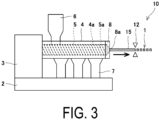
- FIG. 3 is a schematic view of an extruder 10 according to the first embodiment.
- the scrub agent 1 is produced by, for example, the extruder 10.
- the extruder 10 of the present embodiment includes a drive source 2, a transmission 3, a cylindrical unit 4, at least one (here, a pair of) screw(s) 5, a hopper 6, a duct 7, an extrusion die 8, and a cutter (pelletizer) 12.
- the drive source 2 generates a rotational driving force that rotates the screws 5 around its rotation axis.
- the transmission 3 changes the rotation speed of the output from the drive source 2 and transmits the output to the screws 5.
- the cylindrical unit 4 has a cylindrical internal space 4a extending in a horizontal direction.
- the screws 5 are pivotally supported in an internal space 4a.
- a helical groove 5a extending in the axial direction of the screw 5 is formed on the circumferential surface of the screw 5.
- the transmission 3 is disposed on one end side of the internal space 4a in the longitudinal direction, and the other end side in the longitudinal direction is open to the outside.
- the hopper 6 is arranged above the cylindrical unit 4, and the lower end of the hopper 6 is connected to the internal space 4a.
- a raw material of the scrub agent 1 is supplied to the hopper 6.
- the raw material supplied to the hopper 6 is supplied to the internal space 4a.
- the raw material includes a cellulose ester and a plasticizer.
- the duct 7 is provided to supply cooling air from a bottom of the cylindrical unit 4 to the internal space 4a.
- the extrusion die 8 Disposed on the other end side of the internal space 4a in the longitudinal direction, the extrusion die 8 is detachably installed on the cylindrical unit 4 at the edge of the opening of the internal space 4a.
- the extrusion die 8 has an extrusion hole 8a communicating with the internal space 4a.
- the cutter 12 cuts the linear material 15 extruded from the extrusion hole 8a of the extrusion die 8 at predetermined time intervals.
- the extruder 10 described here is a twin-screw extruder with a pair of screws 5
- the extruder 10 may be a single-screw extruder with one screw 5, or may be another type of extruder.
- the molten material is transported by the rotating helical grooves 5a of the screws 5 toward the other end side of the internal space 4a in the longitudinal direction and is pressed to the extrusion die 8.
- the molten material is extruded out of the extrusion hole 8a of the extrusion die 8.
- the molten material is molded by the edge of the opening of the extrusion hole 8a, resulting in the linear material 15 that is solid.
- the linear material 15 has a cross-sectional shape corresponding to the shape of the edge of the opening of the extrusion hole 8a.
- the linear material 15 is cut by the cutter 12 in a direction perpendicular to the extrusion direction from the extrusion hole 8a. This results in the scrub agent 1.
- the particles of the scrub agent 1 are molded particles formed by the extrusion hole 8a.
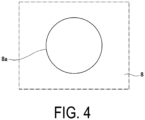
- FIG. 4 is a front view of the extrusion die 8 of FIG. 3 .
- the extrusion hole 8a of the extrusion die 8 of the present embodiment has the edge of the opening that is formed into a circular shape.
- the maximum inner diameter of the extrusion hole 8a is set to a value in a range of from 0.4 mm to 0.6 mm.
- a scrub agent 1 that is formed into a cylindrical shape and has a median of particle size distribution set to a value in a range of from 0.1 mm to 1.0 mm can be obtained by using the extruder 10 provided with the extrusion die 8.
- the production method of the scrub agent 1 includes: a first step of extrusion-molding the linear material 15 by extruding a molten material containing a cellulose ester from the extrusion hole 8a in which the edge of the opening has a maximum inner diameter set to a value in a range of from 0.4 mm to 3.0 mm; and a second step of cutting the linear material 15 in a direction perpendicular to the extrusion direction from the extrusion hole 8a to obtain the scrub agent 1 in particle form with a plurality of vertices and having a median of particle size distribution set to a value in a range of from 0.1 mm to 1.0 mm.
- the scrub agent 1 having a desired particle shape and particle size can be produced in the second step. Accordingly, for example, the scrub agent 1 can be produced efficiently in a high yield without being subjected to a step of classifying the particles obtained by cutting the linear material 15. Note that even when the extrusion hole 8a having an edge of the opening in which the upper limit of the maximum inner diameter of edge of the opening is set to the value above is used, the particle size of the scrub agent 1 can be adjusted to a certain degree by, for example, applying tension to the linear material 15 extruded from the extrusion hole 8a.
- the molten material is extruded from the extrusion hole 8a having the edge of the opening that is circular, thereby producing the scrub agent 1 having a particle shape formed into a cylindrical shape in the second step.
- the scrub agent 1 that is able to stably give a good scrubbing effect and has a desired particle shape can be produced.
- the second step of the present embodiment produces the scrub agent 1 which has, when viewed from the extrusion direction from the edge of the opening of the extrusion hole 8a, a particle shape with a contour including the pair of sides S1 and S2, a degree of parallelism of the pair of sides S1 and S2 being set to a value in a range from 0 mm to 0.50 mm.
- the second step produces the scrub agent 1 which has, when viewed from the extrusion direction, a particle shape with a contour including the pair of sides S3 and S4, a degree of parallelism of the pair of sides S3 and S4 being set to a value in a range from 0 mm to 0.10 mm.
- the second step produces the scrub agent 1 which has a particle shape including the pair of faces 1a and 1b (cut surfaces of the linear material) that are arranged separately from each other, a degree of parallelism of one face of the pair of faces 1a and 1b when the other face is serving as a reference plane being set to a value in a range of from greater than 0 mm to 0.20 mm. Furthermore, in the first step, a molten material including a glycerin ester is used.
- the raw material is obtained by blending a cellulose acetate (cellulose ester serving as the main component) having a degree of acetyl substitution of from 1.4 to 1.8 and a glycerin ester.
- a cellulose acetate cellulose ester serving as the main component
- a glycerin ester examples of the production method for the raw material include a method of directly adding the glycerin ester to the cellulose acetate.
- a mixing time is preferably set to, for example, from 10 minutes to 1 hour in a case in which a Henschel mixer is used.
- the mixture is dried.
- the drying method include, for example, a method in which a temperature is set to 50°C or higher and 105°C or lower and the mixture is left for a period of time from 1 hour to 48 hours and dried.
- the above-described mixing can be performed by a mixer such as a planetary mill, a Henschel mixer, a vibration mill, and a ball mill.
- the mixture may be mixed using a food processor or the like.
- mixing conditions are not limited, it is preferable to add a dispersion or a solution containing the glycerin ester to the cellulose acetate little by little while stirring the mixture.
- a dispersion or a solution containing the glycerin ester may be added in an amount of from 2 parts by weight/min to 20 parts by weight/min per 100 parts by weight of the cellulose acetate.
- a substitution degree of the cellulose acetate can be set to a value in the range from 2.2 to 2.7, for example.
- a substitution degree of the cellulose acetate is, for example, preferably in the range from 2.3 to 2.6, and particularly preferably a value in the range from 2.4 to 2.6.
- the cellulose diacetate having a degree of substitution set to such a value can be easily plasticized by using triacetin as the glycerin ester. As such, for example, by using a raw material containing cellulose diacetate and triacetin, the scrub agent 1 having a desired particle shape can be efficiently produced.
- FIG. 5 is a schematic view illustrating a state in which the scrub agent-containing composition 20 of the first embodiment is spread on the skin surface.
- the scrub agent-containing composition 20 includes the scrub agent 1.
- the form of the scrub agent-containing composition 20 may be any of: a liquid preparation, such as an aqueous solution, an emulsion, and a suspension; a semi-solid preparation, such as a gel and a cream; or a solid preparation, such as a powder, a granule, and a solid.
- the scrub agent-containing composition 20 may be, for example, a skin cleaning composition used for cleaning skin on the body, face, or scalp. Examples of the skin cleaning composition include a facial cleaning composition, a scalp cleaning composition (shampoo), and a body cleaning composition (body wash).
- the content of the scrub agent 1 in the scrub agent-containing composition 20 is preferably from 0.1 wt.% to 50 wt.%, more preferably from 3 wt.% to 15 wt.%, and even more preferably from 5 wt.% to 10 wt.%.
- the content of the scrub agent 1 of the scrub agent-containing composition 20 is preferably in this range, for example, the particles of the scrub agent 1 can be favorably dispersed in the scrub agent-containing composition 20, and sufficient cleaning and user experience can both be achieved at the time of using the scrub agent-containing composition 20.
- the scrub agent-containing composition 20 may include a component used in a known skin cleaning composition.
- the component include: a surfactant (such as an anionic surfactant, a cationic surfactant, an amphoteric surfactant, and a non-ionic surfactant), a polyhydric alcohol such as glycerin, fats and oils such as vegetable oil, a hydrocarbon such as squalane, a higher fatty acid such as lauric acid and myristic acid, a higher alcohol such as lauryl alcohol, a silicone such as dimethylpolysiloxane which is a chain polysiloxane, a preservative, a thickener, a sequestrant, a polymer such as a water-soluble polymer, a UV absorber, a UV blocker, a moisturizer such as hyaluronic acid and an amino acid, a fragrance, a pH regulator, a pearling agent, a des
- a surfactant such as an anionic surfact
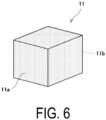
- FIG. 6 is a perspective view of a particle of a scrub agent 11 according to a second embodiment.
- the scrub agent 11 has a particle shape that is a polyhedral shape having a plurality of faces, each being a polygon.
- the plurality of faces include faces having any shape of a triangular, square, pentagonal, and hexagonal shape in plan view.
- the scrub agent 11 of the present embodiment has a hexahedral particle shape.
- the plurality of faces include a quadrangle face in plan view.
- the particle of the scrub agent 11 has a pair of faces 11a and 11b (that is, a cut surface at which the linear material 15 is cut) corresponding to the pair of faces 1a and 1b of the particle of the scrub agent 1.
- the pair of faces 11a and 11b are quadrangular.
- the scrub agent 11 is formed into a particle shape that is a polyhedral shape having a plurality of faces, each being a polygon.
- the plurality of faces include faces having any one of a triangular, square,, and a hexagon in plan view.
- many vertices can be provided in the edge portions of each face of the particle of the scrub agent 11. Accordingly, a scrub agent 11 capable of exhibiting an effective scrubbing effect can be obtained.
- the scrub agent 11 of the present embodiment has a hexahedral particle shape. As such, for example, it is possible to produce the scrub agent 11 by cutting the linear material 15 having a quadrangular cross-section. Thus, the scrub agent 11 having an excellent scrubbing effect can be efficiently produced.
- FIG. 7 is a front view of an extrusion die 18 according to the second embodiment.
- an extrusion hole 18a of the extrusion die 18 of the second embodiment has an edge of the opening formed into a non-circular shape.
- the edge of the opening of the extrusion hole 18a is formed into a polygonal shape that has a plurality of points P, each pair of the adjacent points P being connected with a curved line segment L bending toward the center of the opening.
- a maximum distance D between a curved line segment L and an imaginary line V passing through adjacent points P in the direction perpendicular to the imaginary line V is set to a value in a range of greater than 0% to 25% of the maximum inner diameter of the extrusion die 18.
- the edge of the opening of the extrusion hole 18a is formed into a shape having from 3 to 6 points P.
- the edge of the opening of the extrusion hole 18a is formed into a shape having 4 points P.
- a die swell phenomenon stress relaxation phenomenon
- the cross-sectional shape of the linear material 15 is, for example, a polygonal shape, it becomes difficult to set the cross-sectional shape to a desired shape.
- the edge of the opening of the extrusion hole 18a is formed into a polygonal shape having a plurality of points P in which each pair of the adjacent points P are connected with the curved line segment L; as such, the influence of the die swell phenomenon can be suppressed, and the scrub agent 11 having a desired shape can be formed easily.
- the molten material is extruded from the extrusion hole 18a in which the edge of the opening has a shape having a plurality of points P, thereby producing the scrub agent 11 formed into a particle shape that is a polyhedral shape having a plurality of faces, each being a polygon in a second step.
- the scrub agent 11 that is able to stably give a good scrubbing effect and has a desired particle shape can be produced.
- the molten material is extruded from the extrusion hole 18a in which the edge of the opening has a shape formed by connecting each pair of the adjacent points P with the curved line segment L bending toward the center of the opening. Accordingly, the influence of the die swell phenomenon that can occur when the molten material is extruded from the extrusion hole can be suppressed, and the scrub agent 11 can be formed properly.
- the molten material is extruded from the extrusion hole 18a in which the edge of the opening has a maximum distance D set to a value in a range of from a value greater than 0% to 25% of the maximum inner diameter of the extrusion die 18.
- FIG. 8 is a perspective view of a particle of a scrub agent 21 according to a first variation of the second embodiment.
- the scrub agent 21 is formed into a triangular prism shape.
- the scrub agent 21 has a pair of faces 21a and 21b corresponding to the pair of faces 1a and 1b of the scrub agent 1.
- the pair of faces 21a and 21b have a triangular shape.
- the scrub agent 21 is produced by cutting the linear material 15 extruded from an extrusion hole in which the edge of the opening has three points P.
- FIG. 9 is a perspective view of a particle of a scrub agent 31 according to a second variation of the second embodiment.
- the scrub agent 31 is formed into a pentagonal prism shape.
- the scrub agent 31 has a pair of faces 31a and 31b corresponding to the pair of faces 1a and 1b of the scrub agent 1.
- the pair of faces 31a and 3 1b have a pentagonal shape.
- the scrub agent 31 is produced by cutting the linear material 15 extruded from an extrusion hole in which the edge of the opening has five points P.
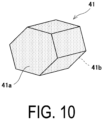
- FIG. 10 is a perspective view of a particle of a scrub agent 41 according to a third variation of the second embodiment.
- the scrub agent 41 is formed into a hexagonal prism shape.
- the scrub agent 41 has a pair of faces 41a and 41b corresponding to the pair of faces 1a and 1b of the scrub agent 1.
- the pair of faces 41a and 41b have a hexagonal shape.
- the scrub agent 41 is produced by cutting the linear material 15 extruded from an extrusion hole in which the edge of the opening has six points P.
- the scrub agents 21, 31, and 41 also have the same effect as the scrub agent 11.
- a cellulose ester As a cellulose ester, a cellulose acetate having an acetyl substitution degree of 2.45 (cellulose acetate produced by Daicel Corporation having a limiting viscosity of 84 mPa s) was used. The cellulose acetate was dried in a granular form for one hour in a dryer set to a temperature of 105°C. Then, the cellulose acetate was allowed to cool in a desiccator at room temperature (25°C) for 1 hour.
- the mixer was stopped to remove the mixture attached to the inner wall, the bottom wall, and the stirring blades of the mixer, and the mixer was operated again for one minute or longer. As a result, a mixture was obtained.
- the mixture was placed in a vat and dried at 80°C for two hours. Then, the size of mass in the mixture was adjusted, and the raw material was prepared.
- the first and second steps were performed using the extruder 10 ("Process 11" available from Thermo Fisher Scientific Inc. with the extrusion die 8 installed), resulting in, as Example 1, the scrub agent 1 including 80 wt.% of cellulose acetate and 20 wt.% of triacetin and having a cylindrical particle shape in which the design dimensions were a length of 0.5 mm in the direction of the axis X and a diameter of 0.5 mm of an end face.
- the extruder 10 was set as follows to produce the scrub agent 1.
- the first and second steps were performed in the same manner as in the first embodiment except that the extrusion die 18, in which the shortest distance between two adjacent points P was set to 0.5 mm, was installed on the extruder 10, resulting in, as Example 2, the scrub agent 11 including 80 wt.% of cellulose acetate and 20 wt.% of triacetin and having a hexahedral particle shape in which the design dimension was a side length of 0.5 mm.
- each of the scrub agents of Example 1, Example 2, and the comparative example was classified using test sieves (JIS standard-compliant plain woven wire mesh sieves with opening sizes set to 0.318 mm, 0.385 mm, 0.5 mm, 0.6 mm, and 0.71 mm) in compliance with JIS Z 8801.
- test sieves JIS standard-compliant plain woven wire mesh sieves with opening sizes set to 0.318 mm, 0.385 mm, 0.5 mm, 0.6 mm, and 0.71 mm
- particles having a particle size of less than 0.318 mm, 0.318 mm or greater and less than 0.385 mm, 0.385 mm or greater and less than 0.5 mm, 0.5 mm or greater and less than 0.6 mm, 0.6 mm or greater and less than 0.71 mm, and 0.71 mm or greater were classified.
- the particles having a value of particle size distribution in the range of from 0.385 mm to 0.6 mm were 96.01 wt.% in Example 1 and 95.02 wt.% in Example 2.
- both Examples 1 and 2 had a relatively uniform particle size.
- the scrub agents 1 and 11 of Examples 1 and 2 had a median of particle size distribution in the range of from 0.1 mm to 1.0 mm (more specifically, from 0.4 mm to 0.6 mm).
- the scrub agent of the comparative example was pulverized particles formed by pulverizing solid cellulose acetate.
- the scrub agent of the comparative example had a much wider particle size distribution than that of Examples 1 and 2, contained a considerable amount of particles of various particle sizes, and had a median different from that of Examples 1 and 2.
- FIG. 11 is a diagram illustrating a state in which a degree of parallelism of a particle of the scrub agent 1 of Example 1 is being measured.
- a particle of the scrub agent 1 or the scrub agent 11 was placed on a top surface of a stage 60 disposed horizontally, and an objective lens 61 of the microscope was brought close to the particle of the scrub agent 1 or the scrub agent 11 from one direction (the vertical direction and the extrusion direction from the extrusion hole 8a), and the particle of the scrub agent 1 or the scrub agent 11 viewed from the one direction was imaged at a predetermined focal length.
- a 3D image of the particle of the scrub agent 1 and 11 was obtained in this way. Based on the 3D image, the cross-sectional shape perpendicular to a horizontal plane of the scrub agent 1 or 11 was calculated.
- the pair of faces 1a and 1b of the particle of the scrub agent 1 of Example 1 and the pair of faces 11a and 11b of the particle of the scrub agent 11 of Example 2 had a higher degree of parallelism, indicating that the particles of the scrub agents 1 and 11 of Examples 1 and 2 had a uniform shape.
- the testers performed a sensory evaluation on the evenness of the sensation (grittiness, smoothness, and resistance) received from the scrub agent on a four-level scale.
- the testers placed the scrub agents of Examples 1, Example 2, and the comparative example (approximately 0.2 g each) in their hands and gave evaluation based on the sensation they felt when they rubbed both hands together as if they were removing dirt from their palms.
- A4 means a tester feels the evenness is at the highest level
- A3 means the level below A4
- A2 means the level below A3
- A1 means the level below A2.
- Example 1 was scored as 4 points, A3 as 3 points, A2 as 2 points, and A1 as 1 point. In this way, each of Example 1, Example 2, and the comparative examples was evaluated. The evaluation results are presented in Table 2. Table 2 Evaluation of Evenness of Sensation Felt from Scrub Agent Total Evaluation Score Evaluator 1 Evaluator 2 Evaluator 3 Evaluator 4 Evaluator 5 Evaluator 6 Evaluator 7 Example 1 A4 A3 A4 A3 A3 A2 A4 23 Example 2 A2 A3 A3 A3 A3 A3 A3 20 Comparative Examples A1 A3 A1 A3 A2 A3 A2 15
- Example 1 As presented in Table 2, the scrub agents of Examples 1 and 2 were evaluated as giving a user an even feeling when being used as compared to the scrub agent of the comparative example. The reason for this evaluation is considered to be that each of Examples 1 and 2 have a relatively uniform particle size and particle shape, as described above. Further, Example 1 was evaluated to give a user a more even feeling when being used as compared to Example 2.
- UV/VIS spectrophotometer Ultra violet-visible spectrophotometer
- Examples 1 and 2 had a transparency of transmittance of at least 0.8% or greater with respect to light having a wavelength within the measured scan range (from 380 nm to 780 nm). Each of the measured values of Examples 1 and 2 within the present test range had an average value of 1.2% or greater. In contrast, the comparative example had a transmittance of zero with respect to light having the wavelength, confirming that the comparative example was opaque.
- scrub agent-containing compositions each including each of the scrub agents of Example 1, Example 2, and the comparative example were prepared, and the coefficient of dynamic friction between each scrub agent-containing composition and an imitation skin was measured.
- the measurement conditions were set as follows. First, each of the scrub agents of Example 1, Example 2, and the comparative example was mixed with a commercially available synthetic household dish detergent ("Mama Lemon" available from Lion Corporation) and water at a weight ratio of 1:1:8, resulting in a scrub agent-containing composition A containing the scrub agent of Example 1, a scrub agent-containing composition B containing the scrub agent of Example 2, and a scrub agent-containing composition C containing the scrub agent of the comparative example.
- a commercially available synthetic household dish detergent (“Mama Lemon" available from Lion Corporation)
- the load of the contact probe was set to 30 g assuming a scenario in which a user uses the scrub agent-containing composition to wash their hands. Further, the load of the contact probe was set to 100 g assuming a scenario in which a user uses the scrub agent-containing composition to wash their feet.
- samples No. 1 to 14 that are scrub agents having a cylindrical shape were produced using the same production method as in Example 1 except for using triacetin as the plasticizer and using a raw material in which the amount of the plasticizer of a scrub agent immediately after production was set to a design value that is one of the values shown in Table 4.
- samples No. 15 to 23 that are scrub agents having a cylindrical shape were produced in the same production method as in Example 1 except for using diacetin as the plasticizer and using a raw material in which the amount of the plasticizer of a scrub agent immediately after production was set to a design value that is one of the values shown in Table 5.
- sample No. 24 that is a scrub agent containing no plasticizer (similar to that of Comparative Example 1) was prepared.
- the scrub agents of the samples No. 1 to 24 were conditioned by being placed in a room, adjusted to a temperature of 23°C and a humidity of 60 RH% by a precision air conditioner, for six hours or more. Thereafter, based on the dry weight method, the equilibrium moisture ratio of each of the scrub agents of samples No. 1 to 24 was measured for three times using a halogen moisture analyzer ("HB43-S" available from Mettler Toledo, LLC). The results are presented in Tables 4 to 6. "n1 to n3" in the tables indicate individually measured values, while “avg.” indicates the average value of the measured values of n1 to n3. [Table 4] Sample of Cylindrical Scrub Agent Plasticized with Plasticizer (Triacetin) Sample No.
- the equilibrium moisture ratio of the scrub agents can be adjusted at least within a certain range by adjusting the type and amount of the glycerin ester to be added.
- the plasticizer amount is set to a range of from 10 wt.% to 30 wt.% as a design value of a scrub agent immediately after production
- the equilibrium moisture ratio of the scrub agent can be set to a value within a range of from 1 wt.% to 5 wt.%.
Landscapes
- Health & Medical Sciences (AREA)
- Life Sciences & Earth Sciences (AREA)
- Veterinary Medicine (AREA)
- Animal Behavior & Ethology (AREA)
- General Health & Medical Sciences (AREA)
- Public Health (AREA)
- Birds (AREA)
- Epidemiology (AREA)
- Geometry (AREA)
- Physics & Mathematics (AREA)
- Dermatology (AREA)
- Emergency Medicine (AREA)
- Cosmetics (AREA)
- Detergent Compositions (AREA)
Abstract
Description
- The present disclosure relates to a scrub agent, a scrub agent-containing composition, and a method of producing a scrub agent.
- Scrub agent-containing compositions are known as skin cleaning compositions (cleansing agents) for use to clean dirt on skin on the body, or as massaging agents for use to massage skin on the body. Examples of a scrub agent include particles obtained by processing a natural material such as walnut shell or a synthetic material such as resin, as described in
Patent Document 1. - Patent Document 1:
JP 2019-189820 A - A scrub agent is expected to, for example, stably exhibit the effect obtained by bringing the scrub agent into contact with skin on the body (hereinafter, this effect is also simply referred to as the scrubbing effect). However, depending on the configuration of the scrub agent, such effect may be difficult to obtain.
- As such, an object of the present disclosure is to stably obtain a good scrubbing effect when a scrub agent is used.
- In order to solve the issue described above, a scrub agent according to one aspect of the present disclosure is in particle form with a plurality of vertices and has a median of particle size distribution set to a value in a range of from 0.1 mm to 1.0 mm.
- According to the configuration described above, the scrub agent is in particle form with a plurality of vertices and has a median of particle size distribution set to a value in a range of from 0.1 mm to 1.0 mm. This allows the particle size of the scrub agent to be made uniform to a certain extent. Accordingly, an even scrubbing effect can be obtained along with a stable user experience when the scrub agent is being used. In addition, by setting the median of particle size distribution of the scrub agent to a value in the range described above, the scrub agent can be in particle form with a plurality of vertices while having a small diameter. As such, the scrub agent can be brought into wide contact with skin on the body, and skin can be easily cleaned or pressed with a small external force. As a result, a good scrubbing effect can be obtained stably.
- A scrub agent-containing composition according to one aspect of the present disclosure includes any of the scrub agents described above. As a result, a scrub agent-containing composition capable of stably achieving a good scrubbing effect can be obtained.
- A method of producing a scrub agent according to one aspect of the present disclosure includes: a first step of extrusion-molding a linear material by extruding a molten material containing a cellulose ester from an extrusion hole in which an edge of an opening has a maximum inner diameter set to a value in a range of from 0.4 mm to 3.0 mm; and a second step of cutting the linear material in a direction perpendicular to an extrusion direction from the extrusion hole to obtain a scrub agent in particle form with a plurality of vertices and having a median of particle size distribution set to a value in a range of from 0.1 mm to 1.0 mm.
- According to the above method, the scrub agent having a desired particle shape and particle size can be produced in the second step. As such, for example, the scrub agent can be produced efficiently in a high yield without being subjected to a step of classifying the particles obtained by cutting the linear material.
- According to each aspect of the present disclosure, when the scrub agent-containing composition is used, a good effect can be obtained evenly by the scrub agent.
-
-
FIG. 1 is a perspective view of a particle of a scrub agent according to a first embodiment. -
FIG. 2 is a side view perpendicular to an axis of the particle of the scrub agent ofFIG. 1 . -
FIG. 3 is a schematic view of an extruder according to the first embodiment. -
FIG. 4 is a front view of an extrusion die ofFIG. 1 . -
FIG. 5 is a schematic view illustrating a state in which a scrub agent-containing composition of the first embodiment is spread on the skin surface. -
FIG. 6 is a perspective view of a particle of a scrub agent according to a second embodiment. -
FIG. 7 is a front view of an extrusion die according to the second embodiment. -
FIG. 8 is a perspective view of a particle of a scrub agent according to a first variation of the second embodiment. -
FIG. 9 is a perspective view of a particle of a scrub agent according to a second variation of the second embodiment. -
FIG. 10 is a perspective view of a particle of a scrub agent according to a third variation of the second embodiment. -
FIG. 11 is a diagram illustrating a state in which a degree of parallelism of a particle of a scrub agent of an example is being measured. - Embodiments of the present invention will be described below with reference to the drawings.
-
FIG. 1 is a perspective view of a particle of ascrub agent 1 according to a first embodiment.FIG. 2 is a side view perpendicular to an axis X of the particle of thescrub agent 1 ofFIG. 1 . Thescrub agent 1 is in contact with the skin on the body of a user at the time of use. As a result, thescrub agent 1 cleans the skin by removing, for example, build-up on the skin (keratinocytes, sebum, etc.) and dirt such as dust adhering to the skin. Thescrub agent 1 may be a massaging agent that exerts a blood circulation promoting effect (massaging effect) or the like when it comes into contact with the skin. - The
scrub agent 1 is formed into particles with a plurality of vertices. A vertex refers to a point where three or more faces meet in a case in which the particle shape of thescrub agent 1 is a polyhedral shape. In a case in which the particle shape of thescrub agent 1 is a cylindrical shape or an elliptical cylindrical shape, a vertex refers to a boundary (edge) between an end face and the side face. In a case in which the particle shape of thescrub agent 1 is neither a polyhedron shape, a cylindrical shape, nor an elliptical cylindrical shape, a vertex refers to at least either one of a boundary (edge) between two adjacent faces or a point where three or more faces meet. As an example, thescrub agent 1 of the present embodiment has a particle shape that is a cylindrical shape or an elliptical cylindrical shape (here, a cylindrical shape). By adjusting the particle shape of thescrub agent 1, for example, the user experience of thescrub agent 1 can be adjusted. - The median of the particle size distribution (median size) of the
scrub agent 1 is set to a value in a range of from 0.1 mm to 1.0 mm. This allows the particle size of thescrub agent 1 to be uniform to a certain extent. By setting the median of particle size distribution of thescrub agent 1 to a value in the range described above, thescrub agent 1 can give an improved user experience. Furthermore, changes in user experience due to the variation in the particle size of thescrub agent 1 are also suppressed. Note that the particle size mentioned here refers to the minimum value of the horizontal projected area of a particle of thescrub agent 1. Also, the particle shape of thescrub agent 1 described above includes a shape having a slight shape error that may be generated during production. - The median of particle size distribution of the
scrub agent 1 can be measured, for example, based on dynamic light scattering. To give an example of this measurement method, first, thescrub agent 1 is dispersed in a liquid to prepare a dispersion. Thereafter, the dispersion is placed on a measuring device (e.g., "SK Laser Microsizer LMS-2000e" available from Seishin Enterprise Co., Ltd., ultrasonic treatment of 1 minute, refractive index of 1.52), and the volume frequency particle size distribution is measured based on laser diffraction. In this way, the median of particle size distribution of thescrub agent 1 can be measured. Note that the median of particle size distribution refers to the value (µm) of the particle size corresponding to 50% of the integrated scattering intensity in this particle size distribution. - The light transmittance of the
scrub agent 1 in a wavelength region of from 380 nm to 780 nm is set to a value in a range of from 0.8% to 100%. This gives thescrub agent 1 transparency to visible light in the wavelength region described above. By having such transparency, when mixed with another component, for example, thescrub agent 1 can be unnoticeable and can have an improved degree of freedom of the design. - The
scrub agent 1 also contains greater than 50 wt.% of (in other words, as the main component) a biodegradable component. Thescrub agent 1 of the present embodiment contains a cellulose ester as the biodegradable component. This imparts biodegradability to thescrub agent 1, reducing the burden to the environment imposed by thescrub agent 1. Examples of the cellulose ester include cellulose acetates such as cellulose diacetate and cellulose triacetate. When a cellulose acetate is used, the equilibrium moisture ratio of thescrub agent 1 can be adjusted by adjusting the degree of acetyl group substitution. The biodegradability referred to here is, for example, marine biodegradability. The biodegradable component of thescrub agent 1 refers to a component having a marine biodegradation of 40 wt.% or greater in 90 days as measured in accordance with ASTM D6691. - The
scrub agent 1 may include an additive. Examples of the additive include, for example, a plasticizer, a thermal stabilizer, a foam nucleating agent, and an auxiliary foaming agent. Because cellulose esters are not thermally meltable, a plasticizer is used in combination in a case in which a cellulose ester is used as a material of thescrub agent 1. - For plasticizers, detailed examples are found in, for example, "Handbook of Plasticizers," Ed. Wypych, George, ChemTec Publishing (2004). Examples of the plasticizer include dimethyl phthalate; diethyl phthalate; dibutyl phthalate; dioctyl phthalate; diisononyl phthalate; butyl benzyl phthalate; butyl phthalyl butyl glycolate; tris(2-ethylhexyl)trimellitate; triethyl phosphate, triphenyl phosphate, tricresyl phosphate, p-phenylene bis(diphenyl phosphate), and other phosphate derivatives; diisobutyl adipate; bis(2-ethylhexyl)adipate; triethyl citrate; acetyl triethyl citrate; plasticizers containing citric acid (e.g., Citroflex (trade name)); monoacetin; diacetin; triacetin; tripropionin; tributyrin; sucrose acetate isobutyrate; glucose pentapropionate; triethylene glycol-2-ethylhexanoate; polyethylene glycol; polypropylene glycol; polypropylene glycol dibenzoate; polyethylene glutarate; polyethylene succinate; polyalkyl glycosides; 2,2,4-trimethyl-1,3-pentanediol isobutyrate; diisobutyrate; phthalate copolymers; 1,3-butanediol; aliphatic epoxide-terminated 1,4-butanediol; bis(2-ethylhexyl)adipate; epoxidized soybean oil; and a substance selected from the group consisting of mixtures of these compounds.
- Examples of the plasticizer also include a glycerin ester. Examples of the glycerin ester include a lower fatty acid ester of glycerin, in other words, an ester compound of glycerin and a fatty acid having from 2 to 4 carbons. A fatty acid having 2 carbons is acetic acid, a fatty acid having 3 carbons is propionic acid, and a fatty acid having 4 carbons is butyl acid. The glycerin ester may be an ester in which all three hydroxyl groups of glycerin are esterified with the same fatty acids, an ester in which two hydroxyl groups are esterified with the same fatty acids, or an ester in which all three hydroxyl groups of glycerin are esterified with different fatty acids.
- Glycerin esters are non-toxic and easily biodegraded, and thus have a small burden to the environment. When a cellulose acetate is used as the cellulose ester serving as the main component, the glass transition temperature of a cellulose triacetate composition for thermoforming obtained by using a glycerin ester can be lowered. As such, excellent thermoformability can be imparted to a raw material, for example. When the
scrub agent 1 contains a glycerin ester, the equilibrium moisture ratio of thescrub agent 1 can be adjusted by adjusting the content of the glycerin ester. - When the fatty acid is acetic acid, examples of the glycerin ester include triacetin, in which three hydroxyl groups of glycerin are esterified with acetic acid, and diacetin, in which two hydroxyl groups are esterified with acetic acid.
- Among the glycerin esters described above, triacetin (glycerol trisacetate), in which three hydroxyl groups of glycerin are esterified with acetic acid (in other words, acetylated), is preferred, for example. Triacetin is a component recognized as safe even if ingested by humans and is easily biodegraded, and thus has a small burden to the environment. In addition, a cellulose acetate composition for thermoforming obtained by adding triacetin to a cellulose acetate gives the
scrub agent 1 an improved biodegradability compared to a case in which cellulose acetate is used alone. Furthermore, the use of triacetin together with a cellulose acetate can efficiently lower the glass transition temperature of the cellulose acetate. As such, even better thermoformability can be imparted to a raw material, for example. - Note that for triacetin, one that is pure in terms of chemical structure and high in purity is preferred. In addition, for example, a plasticizer containing 80 wt.% or greater or 90 wt.% or greater of triacetin with the remaining being monoacetin and/or diacetin may be used.
- The
scrub agent 1 preferably includes, for example, the glycerin ester in a value in a range of from 10 parts by weight to 30 parts by weight per 100 parts by weight of the total amount of cellulose ester and glycerin ester. When a cellulose acetate is used as the cellulose ester, for example, the thermoformability of thescrub agent 1 can be improved by increasing the content of the glycerin ester. In addition, when a cellulose acetate is used as the cellulose ester, the prevention of bleed-out of the glycerin ester can be facilitated by reducing the content of the glycerin ester. - Further, when viewed from one direction (in the present embodiment, one direction perpendicular to the axis X of the cylindrical particle of the scrub agent 1), the
scrub agent 1 has a particle shape having a contour including a pair of sides S 1 and S2 extending in a first direction perpendicular to the one direction, the pair of sides S 1 and S2 being separated in a second direction perpendicular to the first direction, a degree of parallelism of the pair of sides S 1 and S2 being set to a value in a range of from 0 mm to 0.50 mm. - Further, when viewed from the one direction, the
scrub agent 1 has a particle shape having a contour including the pair of sides S 1 and S2 as the first pair of sides and further including a second pair of sides S3 and S4 extending in the second direction, the second pair of sides S3 and S4 being separated in the first direction. A degree of parallelism of the second pair of sides S3 and S4 is set to a value in a range of from 0 mm to 0.10 mm. With the two pairs of sides S 1 to S4 included, the contour of the particle of thescrub agent 1, when viewed from the one direction, is formed into a quadrangular shape. As a result, the particle of thescrub agent 1 has two pairs of surface regions having different degrees of parallelism corresponding to the two pairs of sides S 1 to S4. - In addition, the
scrub agent 1 has a particle shape including a pair offaces faces scrub agent 1 is formed with a certain degree of unevenness that is allowed by the range of parallelism. The pair offaces scrub agent 1 of the present embodiment correspond to a cut surface at which alinear material 15, which will be described below, is cut. - A degree of parallelism mentioned here is defined in JIS B 0022 and JIS B 0621:1984. That is, when geometric tolerances are instructed for a related form, a degree of parallelism indicates a magnitude of deviation of a straight line form or a planar form that is supposed to be parallel to a geometric straight line or geometric plane that is parallel to a datum straight line or a datum plane which is a theoretically correct geometric reference set to regulate the tolerance zone. The shape, the side length, and the particle size of the
scrub agent 1 can be confirmed and measured using, for example, a commercially available digital microscope (e.g., "RH-2000" available from HIROX Co., Ltd.). - As described above, the
scrub agent 1 of the present embodiment is in particle form with a plurality of vertices and has a median of particle size distribution set to a value in a range of from 0.1 mm to 1.0 mm. This allows the particle size of thescrub agent 1 to be made uniform to a certain extent. Accordingly, an even scrubbing effect can be obtained along with a stable user experience when the scrub agent is being used. In addition, by setting the median of particle size distribution of thescrub agent 1 to a value in the range described above, thescrub agent 1 can be in particle form with a plurality of vertices while having a small diameter. As such, thescrub agent 1 can be brought into wide contact with skin on the body, and skin can be easily cleaned or pressed with a small external force. As a result, a good scrubbing effect can be obtained stably. - The light transmittance of the
scrub agent 1 in a wavelength region of from 380 nm to 780 nm is set to a value in a range of from 0.8% to 100%. This can, for example, prevent the color of a scrub agent-containingcomposition 20, which will be described later, from being affected by thescrub agent 1 during the production of the scrub agent-containingcomposition 20. As such, thescrub agent 1 can give a better scrubbing effect while the scrub agent-containingcomposition 20 can have an improved degree of freedom in designing the appearance. - Also, the scrub agent contains greater than 50 wt.% of a biodegradable component. This improves the biodegradability of the
scrub agent 1, reducing the burden to the environment imposed by thescrub agent 1. Also, the biodegradable component includes a cellulose ester. This can give thescrub agent 1 transparency to visible light and high biodegradability. - As an example, the
scrub agent 1 has a particle shape that is a cylindrical shape. Accordingly, a small vertex portion can be formed at a portion corresponding to a portion between an end face (faces 1a or 1b) and the side face of the cylindrical particle of thescrub agent 1. Thus, for example, by lightly bringing thescrub agent 1 into contact with skin or by lightly pressing thescrub agent 1 on skin, a scrubbing effect can be obtained with a small external force. - Further, when viewed from one direction, the
scrub agent 1 of the present embodiment has a particle shape having a contour including the pair of sides S1 and S2 extending in a first direction perpendicular to the one direction, the pair of sides S1 and S2 being separated in a second direction perpendicular to the first direction, a degree of parallelism of the pair of sides S1 and S2 being set to a value in a range of from 0 mm to 0.50 mm. - According to this configuration, the pair of sides S1 and S2 of the
scrub agent 1 are kept in parallel with high precision, and thus the particle shape of thescrub agent 1 can be easily made uniform. As a result, an even scrubbing effect can be exerted along with a stable scrubbing effect when thescrub agent 1 is being used. - Further, the
scrub agent 1 of the present embodiment has a particle shape having a contour including the pair of sides S1 and S2 as the first pair of sides and further including the second pair of sides S3 and S4 extending in the second direction, the second pair of sides S3 and S4 being separated in the first direction when viewed from the one direction, a degree of parallelism of the second pair of sides S3 and S4 being set to a value in a range of from 0 mm to 0.10 mm. - As a result, for example, a
scrub agent 1 having particle shape with a contour including two pairs of sides S1 to S4 having different degrees of parallelism when viewed from the one direction can be obtained. According to thescrub agent 1, for example, the characteristics of a surface corresponding to the first pair of sides S1 and S2 of the particle and a surface corresponding to the second pair of sides S3 and S4 are different from each other, and thus thescrub agent 1 can be made multifunctional. Further, ascrub agent 1 having a particle shape with a contour including two pairs of sides S1 to S4 having similar degrees of parallelism to each other can be obtained. According to thescrub agent 1, a more stable scrubbing effect can be obtained when thescrub agent 1 is being used. - In addition, the
scrub agent 1 of the present embodiment has a particle shape including the pair offaces faces - According to the configuration described above, by setting the degree of parallelism of the one face to the above value, the pair of
faces scrub agent 1 can exhibit a good scrubbing effect via, for example, a vertex provided on the edge of the pair offaces - In an example, the
scrub agent 1 includes a glycerin ester. This makes it possible to, for example, form thescrub agent 1 into a desired shape during the production of thescrub agent 1 because the glycerin ester acts as a plasticizer. - In addition, the equilibrium moisture ratio of the
scrub agent 1 of the present embodiment can be adjusted by adjusting at least either one of the degree of cellulose ester substitution or the content of glycerol ester. This makes it possible to adjust the user experience of thescrub agent 1 tailored to a skin type of the user, the affinity of thescrub agent 1 to the skin, or a moisture absorption property of thescrub agent 1. As such, thescrub agent 1 can have an improved degree of freedom of the design. Also, when thescrub agent 1 is combined with another component, the combination can be made easy by adjusting the equilibrium moisture ratio of thescrub agent 1 in accordance with a property of the another component such as hydrophilicity or hydrophobicity. -
FIG. 3 is a schematic view of anextruder 10 according to the first embodiment. Thescrub agent 1 is produced by, for example, theextruder 10. Theextruder 10 of the present embodiment includes adrive source 2, atransmission 3, acylindrical unit 4, at least one (here, a pair of) screw(s) 5, ahopper 6, aduct 7, anextrusion die 8, and a cutter (pelletizer) 12. - The
drive source 2 generates a rotational driving force that rotates thescrews 5 around its rotation axis. Thetransmission 3 changes the rotation speed of the output from thedrive source 2 and transmits the output to thescrews 5. Thecylindrical unit 4 has a cylindricalinternal space 4a extending in a horizontal direction. Thescrews 5 are pivotally supported in aninternal space 4a. Ahelical groove 5a extending in the axial direction of thescrew 5 is formed on the circumferential surface of thescrew 5. Thetransmission 3 is disposed on one end side of theinternal space 4a in the longitudinal direction, and the other end side in the longitudinal direction is open to the outside. - The
hopper 6 is arranged above thecylindrical unit 4, and the lower end of thehopper 6 is connected to theinternal space 4a. A raw material of thescrub agent 1 is supplied to thehopper 6. The raw material supplied to thehopper 6 is supplied to theinternal space 4a. In an example, the raw material includes a cellulose ester and a plasticizer. - The
duct 7 is provided to supply cooling air from a bottom of thecylindrical unit 4 to theinternal space 4a. Disposed on the other end side of theinternal space 4a in the longitudinal direction, the extrusion die 8 is detachably installed on thecylindrical unit 4 at the edge of the opening of theinternal space 4a. The extrusion die 8 has anextrusion hole 8a communicating with theinternal space 4a. Thecutter 12 cuts thelinear material 15 extruded from theextrusion hole 8a of the extrusion die 8 at predetermined time intervals. Note that, although theextruder 10 described here is a twin-screw extruder with a pair ofscrews 5, theextruder 10 may be a single-screw extruder with onescrew 5, or may be another type of extruder. - When the
extruder 10 is driven, a rotational driving force of thedrive source 2 is transmitted to thescrews 5 via thetransmission 3 to rotate thescrews 5. The raw material supplied to thehopper 6 is supplied to theinternal space 4a and heated. As a result, the raw material becomes a molten material. - The molten material is transported by the rotating
helical grooves 5a of thescrews 5 toward the other end side of theinternal space 4a in the longitudinal direction and is pressed to the extrusion die 8. The molten material is extruded out of theextrusion hole 8a of the extrusion die 8. At this time, the molten material is molded by the edge of the opening of theextrusion hole 8a, resulting in thelinear material 15 that is solid. Thelinear material 15 has a cross-sectional shape corresponding to the shape of the edge of the opening of theextrusion hole 8a. Thelinear material 15 is cut by thecutter 12 in a direction perpendicular to the extrusion direction from theextrusion hole 8a. This results in thescrub agent 1. As such, the particles of thescrub agent 1 are molded particles formed by theextrusion hole 8a. -
FIG. 4 is a front view of the extrusion die 8 ofFIG. 3 . As illustrated inFIG. 4 , theextrusion hole 8a of the extrusion die 8 of the present embodiment has the edge of the opening that is formed into a circular shape. The maximum inner diameter of theextrusion hole 8a is set to a value in a range of from 0.4 mm to 0.6 mm. In the present embodiment, ascrub agent 1 that is formed into a cylindrical shape and has a median of particle size distribution set to a value in a range of from 0.1 mm to 1.0 mm can be obtained by using theextruder 10 provided with the extrusion die 8. - As such, the production method of the
scrub agent 1 according to the first embodiment includes: a first step of extrusion-molding thelinear material 15 by extruding a molten material containing a cellulose ester from theextrusion hole 8a in which the edge of the opening has a maximum inner diameter set to a value in a range of from 0.4 mm to 3.0 mm; and a second step of cutting thelinear material 15 in a direction perpendicular to the extrusion direction from theextrusion hole 8a to obtain thescrub agent 1 in particle form with a plurality of vertices and having a median of particle size distribution set to a value in a range of from 0.1 mm to 1.0 mm. - In this way, the
scrub agent 1 having a desired particle shape and particle size can be produced in the second step. Accordingly, for example, thescrub agent 1 can be produced efficiently in a high yield without being subjected to a step of classifying the particles obtained by cutting thelinear material 15. Note that even when theextrusion hole 8a having an edge of the opening in which the upper limit of the maximum inner diameter of edge of the opening is set to the value above is used, the particle size of thescrub agent 1 can be adjusted to a certain degree by, for example, applying tension to thelinear material 15 extruded from theextrusion hole 8a. - Also, as an example, in the first step, the molten material is extruded from the
extrusion hole 8a having the edge of the opening that is circular, thereby producing thescrub agent 1 having a particle shape formed into a cylindrical shape in the second step. As a result, thescrub agent 1 that is able to stably give a good scrubbing effect and has a desired particle shape can be produced. - Furthermore, the second step of the present embodiment produces the
scrub agent 1 which has, when viewed from the extrusion direction from the edge of the opening of theextrusion hole 8a, a particle shape with a contour including the pair of sides S1 and S2, a degree of parallelism of the pair of sides S1 and S2 being set to a value in a range from 0 mm to 0.50 mm. In addition, the second step produces thescrub agent 1 which has, when viewed from the extrusion direction, a particle shape with a contour including the pair of sides S3 and S4, a degree of parallelism of the pair of sides S3 and S4 being set to a value in a range from 0 mm to 0.10 mm. - Also, the second step produces the
scrub agent 1 which has a particle shape including the pair offaces faces - An example of the preparation of the raw material of the
scrub agent 1 will be given below. As an example, the raw material is obtained by blending a cellulose acetate (cellulose ester serving as the main component) having a degree of acetyl substitution of from 1.4 to 1.8 and a glycerin ester. Examples of the production method for the raw material include a method of directly adding the glycerin ester to the cellulose acetate. - In a case in which the glycerin ester is to be added directly to the cellulose acetate, it is preferable to mix the cellulose acetate with the glycerin ester. This mixing can be performed by a mixer such as a planetary mill, a Henschel mixer, a vibratory mill, a ball mill, or the like. A Henschel mixer is preferable because it enables homogeneous mixing and dispersion in a short period of time. In addition, although the degree of mixing is not limited, a mixing time is preferably set to, for example, from 10 minutes to 1 hour in a case in which a Henschel mixer is used.
- After the cellulose acetate and the glycerin ester are mixed, the mixture is dried. Examples of the drying method include, for example, a method in which a temperature is set to 50°C or higher and 105°C or lower and the mixture is left for a period of time from 1 hour to 48 hours and dried.
- The above-described mixing can be performed by a mixer such as a planetary mill, a Henschel mixer, a vibration mill, and a ball mill. In a case in which the scale of production of the
scrub agent 1 is small, the mixture may be mixed using a food processor or the like. Furthermore, although mixing conditions are not limited, it is preferable to add a dispersion or a solution containing the glycerin ester to the cellulose acetate little by little while stirring the mixture. For example, a dispersion or a solution containing the glycerin ester may be added in an amount of from 2 parts by weight/min to 20 parts by weight/min per 100 parts by weight of the cellulose acetate. - A substitution degree of the cellulose acetate can be set to a value in the range from 2.2 to 2.7, for example. A substitution degree of the cellulose acetate is, for example, preferably in the range from 2.3 to 2.6, and particularly preferably a value in the range from 2.4 to 2.6. The cellulose diacetate having a degree of substitution set to such a value can be easily plasticized by using triacetin as the glycerin ester. As such, for example, by using a raw material containing cellulose diacetate and triacetin, the
scrub agent 1 having a desired particle shape can be efficiently produced. - Next, the scrub agent-containing
composition 20 of the present embodiment will be described.FIG. 5 is a schematic view illustrating a state in which the scrub agent-containingcomposition 20 of the first embodiment is spread on the skin surface. The scrub agent-containingcomposition 20 includes thescrub agent 1. The form of the scrub agent-containingcomposition 20 may be any of: a liquid preparation, such as an aqueous solution, an emulsion, and a suspension; a semi-solid preparation, such as a gel and a cream; or a solid preparation, such as a powder, a granule, and a solid. The scrub agent-containingcomposition 20 may be, for example, a skin cleaning composition used for cleaning skin on the body, face, or scalp. Examples of the skin cleaning composition include a facial cleaning composition, a scalp cleaning composition (shampoo), and a body cleaning composition (body wash). - When the scrub agent-containing
composition 20 is a skin cleaning composition, the content of thescrub agent 1 in the scrub agent-containingcomposition 20 is preferably from 0.1 wt.% to 50 wt.%, more preferably from 3 wt.% to 15 wt.%, and even more preferably from 5 wt.% to 10 wt.%. By setting the content of thescrub agent 1 of the scrub agent-containingcomposition 20 to be in this range, for example, the particles of thescrub agent 1 can be favorably dispersed in the scrub agent-containingcomposition 20, and sufficient cleaning and user experience can both be achieved at the time of using the scrub agent-containingcomposition 20. - When the scrub agent-containing
composition 20 is a skin cleaning composition, the scrub agent-containingcomposition 20 may include a component used in a known skin cleaning composition. Examples of the component include: a surfactant (such as an anionic surfactant, a cationic surfactant, an amphoteric surfactant, and a non-ionic surfactant), a polyhydric alcohol such as glycerin, fats and oils such as vegetable oil, a hydrocarbon such as squalane, a higher fatty acid such as lauric acid and myristic acid, a higher alcohol such as lauryl alcohol, a silicone such as dimethylpolysiloxane which is a chain polysiloxane, a preservative, a thickener, a sequestrant, a polymer such as a water-soluble polymer, a UV absorber, a UV blocker, a moisturizer such as hyaluronic acid and an amino acid, a fragrance, a pH regulator, a pearling agent, a desiccant, a vitamin, a skin activator, a blood circulation promoter, a normal bacteria controlling agent, an active oxygen removing agent, an antiinflammatory agent, a whitening agent, a bactericide, and a bioactive ingredient. Another embodiment will be described below focusing on differences from the first embodiment. -
FIG. 6 is a perspective view of a particle of ascrub agent 11 according to a second embodiment. As shown inFIG. 6 , thescrub agent 11 has a particle shape that is a polyhedral shape having a plurality of faces, each being a polygon. The plurality of faces include faces having any shape of a triangular, square, pentagonal, and hexagonal shape in plan view. As an example, thescrub agent 11 of the present embodiment has a hexahedral particle shape. The plurality of faces include a quadrangle face in plan view. The particle of thescrub agent 11 has a pair offaces linear material 15 is cut) corresponding to the pair offaces scrub agent 1. The pair offaces - As such, according to the present embodiment, the
scrub agent 11 is formed into a particle shape that is a polyhedral shape having a plurality of faces, each being a polygon. In another example, the plurality of faces include faces having any one of a triangular, square,, and a hexagon in plan view. As such, many vertices can be provided in the edge portions of each face of the particle of thescrub agent 11. Accordingly, ascrub agent 11 capable of exhibiting an effective scrubbing effect can be obtained. - In addition, the
scrub agent 11 of the present embodiment has a hexahedral particle shape. As such, for example, it is possible to produce thescrub agent 11 by cutting thelinear material 15 having a quadrangular cross-section. Thus, thescrub agent 11 having an excellent scrubbing effect can be efficiently produced. -
FIG. 7 is a front view of an extrusion die 18 according to the second embodiment. As illustrated inFIG. 7 , anextrusion hole 18a of the extrusion die 18 of the second embodiment has an edge of the opening formed into a non-circular shape. In an example, the edge of the opening of theextrusion hole 18a is formed into a polygonal shape that has a plurality of points P, each pair of the adjacent points P being connected with a curved line segment L bending toward the center of the opening. - In a front view of the
extrusion hole 8a, a maximum distance D between a curved line segment L and an imaginary line V passing through adjacent points P in the direction perpendicular to the imaginary line V is set to a value in a range of greater than 0% to 25% of the maximum inner diameter of the extrusion die 18. The edge of the opening of theextrusion hole 18a is formed into a shape having from 3 to 6 points P. Here, as an example, the edge of the opening of theextrusion hole 18a is formed into a shape having 4 points P. - Here, when the molten material is extruded from the
extrusion hole 18a of the extrusion die 18, a die swell phenomenon (stress relaxation phenomenon), in which the molten material that has been compressed at the edge of theextrusion hole 18a is released and expands in the radial direction of theextrusion hole 18a, may occur. In a case in which the die swell phenomenon occurs, when the cross-sectional shape of thelinear material 15 is, for example, a polygonal shape, it becomes difficult to set the cross-sectional shape to a desired shape. - To solve this issue, in the present embodiment, the edge of the opening of the
extrusion hole 18a is formed into a polygonal shape having a plurality of points P in which each pair of the adjacent points P are connected with the curved line segment L; as such, the influence of the die swell phenomenon can be suppressed, and thescrub agent 11 having a desired shape can be formed easily. - In a first step according to the production method of the
scrub agent 11, the molten material is extruded from theextrusion hole 18a in which the edge of the opening has a shape having a plurality of points P, thereby producing thescrub agent 11 formed into a particle shape that is a polyhedral shape having a plurality of faces, each being a polygon in a second step. As a result, thescrub agent 11 that is able to stably give a good scrubbing effect and has a desired particle shape can be produced. - In another example, in a first step, the molten material is extruded from the
extrusion hole 18a in which the edge of the opening has a shape formed by connecting each pair of the adjacent points P with the curved line segment L bending toward the center of the opening. Accordingly, the influence of the die swell phenomenon that can occur when the molten material is extruded from the extrusion hole can be suppressed, and thescrub agent 11 can be formed properly. - In yet another example, in a first step, the molten material is extruded from the
extrusion hole 18a in which the edge of the opening has a maximum distance D set to a value in a range of from a value greater than 0% to 25% of the maximum inner diameter of the extrusion die 18. This makes it possible to suppress the influence of the die well phenomenon, and the particles of thescrub agent 11 can be formed more easily. Hereinafter, variations of the second embodiment will be described. -
FIG. 8 is a perspective view of a particle of ascrub agent 21 according to a first variation of the second embodiment. Thescrub agent 21 is formed into a triangular prism shape. Thescrub agent 21 has a pair offaces faces scrub agent 1. The pair offaces scrub agent 21 is produced by cutting thelinear material 15 extruded from an extrusion hole in which the edge of the opening has three points P. -
FIG. 9 is a perspective view of a particle of ascrub agent 31 according to a second variation of the second embodiment. Thescrub agent 31 is formed into a pentagonal prism shape. Thescrub agent 31 has a pair offaces faces scrub agent 1. The pair offaces scrub agent 31 is produced by cutting thelinear material 15 extruded from an extrusion hole in which the edge of the opening has five points P. -
FIG. 10 is a perspective view of a particle of ascrub agent 41 according to a third variation of the second embodiment. Thescrub agent 41 is formed into a hexagonal prism shape. Thescrub agent 41 has a pair offaces faces scrub agent 1. The pair offaces scrub agent 41 is produced by cutting thelinear material 15 extruded from an extrusion hole in which the edge of the opening has six points P. Thescrub agents scrub agent 11. - A confirmation test will be described next, but the present disclosure is not limited to each Example described below. The
scrub agents - As a cellulose ester, a cellulose acetate having an acetyl substitution degree of 2.45 (cellulose acetate produced by Daicel Corporation having a limiting viscosity of 84 mPa s) was used. The cellulose acetate was dried in a granular form for one hour in a dryer set to a temperature of 105°C. Then, the cellulose acetate was allowed to cool in a desiccator at room temperature (25°C) for 1 hour.
- Then, 80 parts by weight (400 g) of the cellulose acetate was added to a mixer and stirred. During the stirring, 20 parts by weight (100 g) of triacetin was added as a plasticizer to the mixer at a rate of about 15 g/min using a pipette to be mixed with the cellulose acetate. At the time of the mixing, the mixer was stopped when half of the total amount of the triacetin was put into the mixer, and the mixture attached to the inner wall, the bottom wall, and the stirring blades of the mixer was removed. Thereafter, the remaining amount of the triacetin was added to the mixer and mixed at the above-described rate. Thereafter the mixer was stopped to remove the mixture attached to the inner wall, the bottom wall, and the stirring blades of the mixer, and the mixer was operated again for one minute or longer. As a result, a mixture was obtained. The mixture was placed in a vat and dried at 80°C for two hours. Then, the size of mass in the mixture was adjusted, and the raw material was prepared.
- The first and second steps were performed using the extruder 10 ("
Process 11" available from Thermo Fisher Scientific Inc. with the extrusion die 8 installed), resulting in, as Example 1, thescrub agent 1 including 80 wt.% of cellulose acetate and 20 wt.% of triacetin and having a cylindrical particle shape in which the design dimensions were a length of 0.5 mm in the direction of the axis X and a diameter of 0.5 mm of an end face. Theextruder 10 was set as follows to produce thescrub agent 1. -
- Feed amount of raw material into
internal space 4a: approximately 7 g/min - Heating temperature of raw material: a value in the range from 180°C to 220°C
- Rotation speed of screw 5: 90 rpm
- Formation speed of linear material 15: 2.5 m/min
- Further, the first and second steps were performed in the same manner as in the first embodiment except that the extrusion die 18, in which the shortest distance between two adjacent points P was set to 0.5 mm, was installed on the
extruder 10, resulting in, as Example 2, thescrub agent 11 including 80 wt.% of cellulose acetate and 20 wt.% of triacetin and having a hexahedral particle shape in which the design dimension was a side length of 0.5 mm. - In addition, a scrub agent that is commercially available pulverized particles of cellulose acetate having a median of particle size distribution of 0.5 mm ("CelluloScrub 500" available from ESSENTIAL CRICTERIA) was prepared as a comparative example.
- Next, each of the scrub agents of Example 1, Example 2, and the comparative example was classified using test sieves (JIS standard-compliant plain woven wire mesh sieves with opening sizes set to 0.318 mm, 0.385 mm, 0.5 mm, 0.6 mm, and 0.71 mm) in compliance with JIS Z 8801. As a result, particles having a particle size of less than 0.318 mm, 0.318 mm or greater and less than 0.385 mm, 0.385 mm or greater and less than 0.5 mm, 0.5 mm or greater and less than 0.6 mm, 0.6 mm or greater and less than 0.71 mm, and 0.71 mm or greater were classified. Then, the particle size distribution of each scrub agent was confirmed by measuring the weight of the classified particles of each of the scrub agents of Example 1, Example 2, and the comparative example. The results are presented in Table 1.
[Table 1] Particle Size Distribution Example 1 (Cylindrical scrub agent) Example 2 (Hexahedral scrub agent) Comparative Example (Amorphous scrub agent) Weight (g) Percentage (wt.%) Weight (g) Percentage (wt.%) Weight (g) Percentage (wt.%) Less than 0.318 mm 0.0031 0.03 0.0042 0.041 0.8655 8.68 0. 318 mm or greater and less than 0.385 mm 0.1129 1.12 0.1313 1.275 3.028 30.37 0.385 mm or greater and less than 0.5 mm 1.3134 13.07 2.3519 22.838 5.4418 54.58 0.5 mm or greater and less than 0.6 mm 8.3321 82.94 7.4333 72.182 0.5825 5.84 0.6 mm or greater and less than 0.71 mm 0.2234 2.22 0.2651 2.574 0.0519 0.52 0.71 mm or greater 0.0607 0.60 0.1122 1.090 0.0004 0.00 10.456 (Total) 10.298 (Total) 9.9701 (Total) - As presented in Table 1, the particles having a value of particle size distribution in the range of from 0.385 mm to 0.6 mm were 96.01 wt.% in Example 1 and 95.02 wt.% in Example 2. This confirmed that both Examples 1 and 2 had a relatively uniform particle size. In particular, it was confirmed that Examples 1 and 2 contained a large amount of particles having a particle size of 0.5 mm. Furthermore, the results of the present test confirmed that the
scrub agents - Using a digital microscope ("RH-2000" available from Hirox Co., Ltd.), a 3D image of a particle of each of the scrub agents of Example 1, Example 2, and the comparative example was obtained.
FIG. 11 is a diagram illustrating a state in which a degree of parallelism of a particle of thescrub agent 1 of Example 1 is being measured. - As illustrated in
FIG. 11 , a particle of thescrub agent 1 or thescrub agent 11 was placed on a top surface of a stage 60 disposed horizontally, and anobjective lens 61 of the microscope was brought close to the particle of thescrub agent 1 or thescrub agent 11 from one direction (the vertical direction and the extrusion direction from theextrusion hole 8a), and the particle of thescrub agent 1 or thescrub agent 11 viewed from the one direction was imaged at a predetermined focal length. A 3D image of the particle of thescrub agent scrub agent - The results confirm that the
scrub agent 1 of Example 1 had a pair offaces scrub agent 11 of Example 2 had a pair offaces FIG. 11 ) of each of the pairs of faces when the other face is serving as a reference plane being set to a value in a range of from greater than 0 mm to 0.10 mm. In contrast, the particle of the scrub agent of the comparative example did not have the above-described pair of faces, making it difficult to measure the degree of parallelism of the particle. The pair offaces scrub agent 1 of Example 1 and the pair offaces scrub agent 11 of Example 2 had a higher degree of parallelism, indicating that the particles of thescrub agents - Next, seven testers of a wide range of ages from 20s to 50s performed a sensory evaluation on the evenness of the sensation (grittiness, smoothness, and resistance) received from the scrub agent on a four-level scale. Specifically, the testers placed the scrub agents of Examples 1, Example 2, and the comparative example (approximately 0.2 g each) in their hands and gave evaluation based on the sensation they felt when they rubbed both hands together as if they were removing dirt from their palms. In this evaluation, A4 means a tester feels the evenness is at the highest level, A3 means the level below A4, A2 means the level below A3, and A1 means the level below A2. A4 was scored as 4 points, A3 as 3 points, A2 as 2 points, and A1 as 1 point. In this way, each of Example 1, Example 2, and the comparative examples was evaluated. The evaluation results are presented in Table 2.
Table 2 Evaluation of Evenness of Sensation Felt from Scrub Agent Total Evaluation Score Evaluator 1 Evaluator 2Evaluator 3Evaluator 4Evaluator 5Evaluator 6Evaluator 7Example 1 A4 A3 A4 A3 A3 A2 A4 23 Example 2 A2 A3 A3 A3 A3 A3 A3 20 Comparative Examples A1 A3 A1 A3 A2 A3 A2 15 - As presented in Table 2, the scrub agents of Examples 1 and 2 were evaluated as giving a user an even feeling when being used as compared to the scrub agent of the comparative example. The reason for this evaluation is considered to be that each of Examples 1 and 2 have a relatively uniform particle size and particle shape, as described above. Further, Example 1 was evaluated to give a user a more even feeling when being used as compared to Example 2.
- Next, the light transmittance of the scrub agents of Example 1, Example 2, and the comparative example was measured using a ultra violet-visible spectrophotometer (UV/VIS spectrophotometer) ("UVmini-1230" available from SHIMADZU Co., Ltd.). The measurement conditions were set as follows.
- Measurement mode: T% [(transmittance measurement mode (light transmission)]
- Scan range: From 380 nm to 780 nm (visible light wavelength region)
- Display range: From 0 to 100%
- Integrated time: 0.1 sec
- Scan speed: Medium speed (equivalent to 200 nm/min in the measurement range of visible light wavelength)
- The measurement results are presented in Table 3.
[Table 3] Wavelength (nm) Transmittance (%) Example 1 Example 2 Comparative Examples 780 1.8 1.4 0 570 1.8 1.4 0 560 1.8 1.4 0 480 1.7 1.2 0 470 1.7 1.2 0 440 1.6 1.1 0 410 1.5 1 0 390 1.3 0.9 0 380 1.3 0.8 0 - As presented in Table 3, it was confirmed that Examples 1 and 2 had a transparency of transmittance of at least 0.8% or greater with respect to light having a wavelength within the measured scan range (from 380 nm to 780 nm). Each of the measured values of Examples 1 and 2 within the present test range had an average value of 1.2% or greater. In contrast, the comparative example had a transmittance of zero with respect to light having the wavelength, confirming that the comparative example was opaque.
- Next, scrub agent-containing compositions each including each of the scrub agents of Example 1, Example 2, and the comparative example were prepared, and the coefficient of dynamic friction between each scrub agent-containing composition and an imitation skin was measured. The measurement conditions were set as follows. First, each of the scrub agents of Example 1, Example 2, and the comparative example was mixed with a commercially available synthetic household dish detergent ("Mama Lemon" available from Lion Corporation) and water at a weight ratio of 1:1:8, resulting in a scrub agent-containing composition A containing the scrub agent of Example 1, a scrub agent-containing composition B containing the scrub agent of Example 2, and a scrub agent-containing composition C containing the scrub agent of the comparative example.
- Then, a piece of commercially available imitation skin ("BIOSKIN" available from Beaulax Co., Ltd.) was placed on a sample table of a static and dynamic friction measuring device ("Handy Tribomaster Type TL201Ts" available from Trinity-Lab Inc.). The scrub agent-containing compositions A to C were individually placed between the imitation skin and a contact probe of the measuring device, and the coefficient of dynamic friction was measured for each of the scrub agent-containing compositions. The settings of the static and dynamic friction measuring device at this time were as follows.
- Load of contact probe (vertical load): 30 g or 100 g
- Moving speed: 30 mm/sec
- Moving distance: 60 mm
- Contact probe reciprocating mode: ON
- Operating time: 4 sec
- Note that in this evaluation, the load of the contact probe was set to 30 g assuming a scenario in which a user uses the scrub agent-containing composition to wash their hands. Further, the load of the contact probe was set to 100 g assuming a scenario in which a user uses the scrub agent-containing composition to wash their feet.
- As a result of testing at the above settings, it was confirmed that among the scrub agent-containing compositions A to C, regardless of whether the load of the contact probe was 30 g or 100 g, the fluctuation range of the coefficient of dynamic friction of the composition A containing the
scrub agent 1 of Example 1 was the smallest, and the fluctuation range of the coefficient of dynamic friction of the composition B containing thescrub agent 11 of Example 2 was the second smallest after the scrub agent-containing composition A. Also, it was confirmed that the scrub agent-containing composition C of the comparative example, a composition containing the scrub agent that is amorphous pulverized particles, had a fluctuation range of the coefficient of dynamic friction that is smaller than that of the scrub agent-containing composition A and equal to or larger than that of the scrub agent-containing composition B. - This result confirms that, according to Examples 1 and 2, even when the particle sizes of the scrub agents are the similar, the fluctuation range of the coefficient of dynamic friction can be adjusted by changing the particle shape. As a result, it is conceivable that, for example, by changing the particle shape while maintaining the median of particle size distribution of the scrub agent, the degree to which the scrubbing effect is exhibited can be adjusted, and the degree of freedom in designing the scrub agent can be improved. Note that since the scrub agent of the comparative example is amorphous pulverized particles, it is difficult to change the particle shape while maintaining the median of particle size distribution, and thus it is difficult to achieve such an effect.
- Next, samples No. 1 to 14 (Examples) that are scrub agents having a cylindrical shape were produced using the same production method as in Example 1 except for using triacetin as the plasticizer and using a raw material in which the amount of the plasticizer of a scrub agent immediately after production was set to a design value that is one of the values shown in Table 4. Also, samples No. 15 to 23 (Examples) that are scrub agents having a cylindrical shape were produced in the same production method as in Example 1 except for using diacetin as the plasticizer and using a raw material in which the amount of the plasticizer of a scrub agent immediately after production was set to a design value that is one of the values shown in Table 5. For comparison, sample No. 24 that is a scrub agent containing no plasticizer (similar to that of Comparative Example 1) was prepared.
- The scrub agents of the samples No. 1 to 24 were conditioned by being placed in a room, adjusted to a temperature of 23°C and a humidity of 60 RH% by a precision air conditioner, for six hours or more. Thereafter, based on the dry weight method, the equilibrium moisture ratio of each of the scrub agents of samples No. 1 to 24 was measured for three times using a halogen moisture analyzer ("HB43-S" available from Mettler Toledo, LLC). The results are presented in Tables 4 to 6. "n1 to n3" in the tables indicate individually measured values, while "avg." indicates the average value of the measured values of n1 to n3.
[Table 4] Sample of Cylindrical Scrub Agent Plasticized with Plasticizer (Triacetin) Sample No. 1 2 3 4 5 6 7 8 9 10 11 12 13 14 Equilibrium Moisture Ratio (wt.%) n1 0.93 0.72 0.91 0.94 1.20 1.22 1.68 1.57 1.23 1.74 1.20 1.64 1.78 2.01 n2 1.02 0.78 0.98 0.89 1.09 1.29 1.36 1.61 1.30 1.57 1.35 1.68 2.01 2.16 n3 0.87 0.86 0.90 1.02 1.22 1.14 1.22 1.39 0.98 1.45 1.59 1.61 1.89 2.12 avg. 0.94 0.79 0.93 0.95 1.17 1.22 1.42 1.52 1.17 1.59 1.38 1.64 1.89 2.11 Plasticizer (Triacetin) Content (wt.%) (Design Value) 15 16 16 16 16 16 18 20 21 22 23 27 30 32 [Table 5] Sample of Cylindrical Scrub Agent Plasticized with Plasticizer (Diacetin) Sample No. 15 16 17 18 19 20 21 22 23 Equilibrium Moisture Ratio (wt.%) n1 2.22 2.93 3.24 3.02 3.31 3.46 3.73 3.55 3.77 n2 2.66 3.08 2.99 3.37 2.83 3.64 3.55 3.14 3.76 n3 2.83 3.26 2.87 3.58 3.38 3.01 3.33 3.24 3.55 avg. 2.57 3.09 3.03 3.32 3.17 3.37 3.54 3.31 3.69 Plasticizer (Diacetin) Content (wt.%) (Design Value) 10 12 13 14 15 16 16 18 18 [Table 6] Sample of Scrub Agent of Comparative Example (No Plasticizer) Sample No. 24 Equilibrium Moisture Ratio (wt.%) n1 5.81 n2 5.49 n3 6.01 avg. 5.77 Plasticizer Content (wt.%) 0 - As presented in Tables 4, 5, it was confirmed that, within the test range, the equilibrium moisture ratio of the scrub agents of the samples No. 1 to 23 that are of the Examples increased when the amount of plasticizer increased, and the equilibrium moisture ratio of the scrub agents of the samples No. 1 to 23 that are of the Examples decreased when the amount of plasticizer decreased. In addition, it was confirmed that when diacetin was used as the plasticizer, the equilibrium moisture ratio increased more than when triacetin was used as the plasticizer.
- From the test results, it is conceivable that, when a glycerin ester such as triacetin or diacetin is used as a plasticizer in the raw material in the Examples, the equilibrium moisture ratio of the scrub agents can be adjusted at least within a certain range by adjusting the type and amount of the glycerin ester to be added. In the Examples, in a case in which a glycerin ester such as triacetin and diacetin is used as the plasticizer and the plasticizer amount is set to a range of from 10 wt.% to 30 wt.% as a design value of a scrub agent immediately after production, it is conceivable that the equilibrium moisture ratio of the scrub agent can be set to a value within a range of from 1 wt.% to 5 wt.%. Note that, as presented in Table 6, in a scrub agent that does not contain a plasticizer, it goes without saying that the equilibrium moisture ratio of the scrub agent cannot be adjusted by changing the plasticizer amount. From the above test results, the superiority of each Example was confirmed.
- Note that each of the configurations, combinations thereof, or the like in each of the embodiments are examples, and additions, omissions, replacements, and other changes to the configurations may be made as appropriate without departing from the spirit of the present disclosure. The present disclosure is not limited by the embodiments and is limited only by the claims. Each aspect disclosed in the present specification can be combined with any other feature disclosed herein.
-
- 1, 11, 21, 31, 41 Scrub agent
- 8a, 18a Extrusion hole
- 15 Linear material
- 20 Scrub agent-containing composition
Claims (21)
- A scrub agent in particle form with a plurality of vertices, the scrub agent having a median of particle size distribution set to a value in a range of from 0.1 mm to 1.0 mm.
- The scrub agent according to claim 1, wherein a light transmittance in a wavelength region of from 380 nm to 780 nm is set to a value in a range of from 0.8% to 100%.
- The scrub agent according to claim 1 or 2, comprising greater than 50 wt.% of a biodegradable component.
- The scrub agent according to claim 3, wherein the biodegradable component includes a cellulose ester.
- The scrub agent according to any one of claims 1 to 4, wherein a particle shape is a cylindrical shape.
- The scrub agent according to any one of claims 1 to 4, wherein the particle shape is a polyhedral shape having a plurality of faces, each being a polygon.
- The scrub agent according to claim 6, wherein the plurality of faces include faces having any one of a triangular, square, pentagonal, and hexagonal shape in plan view.
- The scrub agent according to any one of claims 1 to 7, wherein the scrub agent has a particle shape having a contour including a pair of sides extending in a first direction perpendicular to the one direction, the pair of sides being separated in a second direction perpendicular to the first direction when viewed from one direction, a degree of parallelism of the pair of sides being set to a value in a range of from 0 mm to 0.50 mm.
- The scrub agent according to claim 8, wherein the scrub agent has a particle shape having a contour including the pair of sides as the first pair of sides and further including a second pair of sides extending in the second direction, the second pair of sides being separated in the first direction when viewed from the one direction, a degree of parallelism of the second pair of sides being set to a value in a range of from 0 mm to 0.10 mm.
- The scrub agent according to claim 8 or 9, wherein the scrub agent has a particle shape including the pair of faces that are arranged separately from each other, a degree of parallelism of one face of the pair of faces when the other face is serving as a reference plane being set to a value in a range of from greater than 0 mm to 0.20 mm.
- The scrub agent according to any one of claims 1 to 10, wherein the scrub agent comprises a glycerin ester.
- A scrub agent-containing composition comprising the scrub agent according to any one of claims 1 to 11.
- A method of producing a scrub agent, the method comprising:a first step of extrusion-molding a linear material by extruding a molten material containing a cellulose ester from an extrusion hole in which an edge of an opening has a maximum inner diameter set to a value in a range of from 0.4 mm to 3.0 mm; anda second step of cutting the linear material in a direction perpendicular to an extrusion direction from the extrusion hole to obtain a scrub agent in particle form with a plurality of vertices and having a median of particle size distribution set to a value in a range of from 0.1 mm to 1.0 mm.
- The method of producing a scrub agent according to claim 13, wherein in the first step, a molten material is extruded from the extrusion hole having the edge of the opening that is circular, thereby producing the scrub agent having a particle shape formed into a cylindrical shape in the second step.
- The method of producing a scrub agent according to claim 13, wherein in the first step, a molten material is extruded from the extrusion hole in which the edge of the opening has a shape having a plurality of points, thereby producing the scrub agent having a particle shape formed into a polyhedral shape having a plurality of faces, each being a polygon, in the second step.
- The method of producing a scrub agent according to claim 15, wherein in the first step, a molten material is extruded from the extrusion hole in which the edge of the opening has a shape formed by connecting each pair of the adjacent points with a curved line segment bending toward the center of the opening.
- The method of producing a scrub agent according to claim 16, wherein in the first step, a molten material is extruded from the extrusion hole in which the edge of the opening has, in front view of the extrusion hole, a maximum distance between a curved line segment and an imaginary line passing through adjacent points in a direction perpendicular to the imaginary line set to a value in a range of greater than 0% to 25% of the maximum inner diameter.
- The method of producing a scrub agent according to any one of claims 13 to 17, wherein the second step produces the scrub agent in particle form having a contour including, when viewed from an extrusion direction from the edge of the opening, a pair of sides extending in a first direction perpendicular to the extrusion direction, the pair of sides being separated in a second direction perpendicular to the first direction, a degree of parallelism of the pair of sides being set to a value in a range of from 0 mm to 0.50 mm.
- The method of producing a scrub agent according to claim 18, wherein the second step produces the scrub agent in particle form having a contour including the pair of sides as a first pair of sides and further including a second pair of sides extending in the second direction, the second pair of sides being separated in the first direction when viewed from the extrusion direction, a degree of parallelism of the second pair of sides being set to a value in a range of from 0 mm to 0.10 mm.
- The method of producing a scrub agent according to claim 18 or 19, wherein the second step produces the scrub agent in particle form including the pair of faces that are arranged separately from each other, a degree of parallelism of one face of the pair of faces when the other face is serving as a reference plane being set to a value in a range of from greater than 0 mm to 0.20 mm.
- The method of producing a scrub agent according to any one of claims 13 to 20, wherein the molten material comprising a glycerin ester is used in the first step.
Applications Claiming Priority (2)
| Application Number | Priority Date | Filing Date | Title |
|---|---|---|---|
| JP2020100652A JP6966601B1 (en) | 2020-06-10 | 2020-06-10 | A scrubbing agent, a scrubbing agent-containing composition, and a method for producing a scrubbing agent. |
| PCT/JP2021/022083 WO2021251458A1 (en) | 2020-06-10 | 2021-06-10 | Scrubbing agent, scrubbing agent-containing composition, and scrubbing agent production method |
Publications (2)
| Publication Number | Publication Date |
|---|---|
| EP4166130A1 true EP4166130A1 (en) | 2023-04-19 |
| EP4166130A4 EP4166130A4 (en) | 2025-01-01 |
Family
ID=78509596
Family Applications (1)
| Application Number | Title | Priority Date | Filing Date |
|---|---|---|---|
| EP21820085.5A Pending EP4166130A4 (en) | 2020-06-10 | 2021-06-10 | WASHING AGENT, COMPOSITION CONTAINING WASHING AGENT, AND METHOD FOR PRODUCING WASHING AGENT |
Country Status (4)
| Country | Link |
|---|---|
| US (1) | US20230201085A1 (en) |
| EP (1) | EP4166130A4 (en) |
| JP (1) | JP6966601B1 (en) |
| WO (1) | WO2021251458A1 (en) |
Families Citing this family (2)
| Publication number | Priority date | Publication date | Assignee | Title |
|---|---|---|---|---|
| WO2023100261A1 (en) * | 2021-11-30 | 2023-06-08 | 日清紡ホールディングス株式会社 | Marine biodegradable polyol, marine biodegradable polymer compound, and marine biodegradable resin composition |
| JP2024081365A (en) * | 2022-12-06 | 2024-06-18 | 日清紡ホールディングス株式会社 | Marine biodegradable polymer compound, its production method, and marine biodegradable resin composition |
Family Cites Families (12)
| Publication number | Priority date | Publication date | Assignee | Title |
|---|---|---|---|---|
| JPH03106809A (en) * | 1989-09-19 | 1991-05-07 | Asahi Chem Ind Co Ltd | Cellulosic scrubbing material |
| US5681801A (en) * | 1995-04-17 | 1997-10-28 | Colgate-Palmolive Company | Stable particle suspended composition |
| JP5799569B2 (en) * | 2011-04-28 | 2015-10-28 | 鈴木油脂工業株式会社 | Biodegradable scrub and skin cleanser |
| EP2537917A1 (en) * | 2011-06-20 | 2012-12-26 | The Procter & Gamble Company | Liquid detergent composition with abrasive particles |
| US20140352722A1 (en) * | 2013-05-29 | 2014-12-04 | The Procter & Gamble Company | Liquid cleaning and/or cleansing composition |
| US9895305B2 (en) * | 2015-08-12 | 2018-02-20 | The Procter & Gamble Company | Skin cleansing compositions comprising biodegradable abrasive particles |
| KR102114993B1 (en) * | 2015-10-15 | 2020-05-25 | 주식회사 파이안에스테틱스 | Cosmetic composition comprising water soluble scrub particle containing polypeptide and/or cell culture conditioned media |
| KR101811513B1 (en) * | 2015-11-25 | 2017-12-20 | 주식회사 파이안에스테틱스 | Micro spicule, Mold for Producing the Same and Method for Producing the Same |
| JP6609726B1 (en) * | 2018-02-07 | 2019-11-20 | 株式会社ダイセル | Cellulose acetate particles, cosmetic composition and method for producing cellulose acetate particles |
| WO2019194328A1 (en) * | 2018-04-03 | 2019-10-10 | 주식회사 파이안에스테틱스 | Polygonal pyramid-shaped water-soluble microbead scrub particles |
| JP2019189820A (en) | 2018-04-27 | 2019-10-31 | 旭化成アドバンス株式会社 | Detergent and method for producing the same |
| EP3711901A4 (en) * | 2018-10-17 | 2021-11-17 | Daicel Corporation | Treatment granules, compounding unit equipped with treatment granules, and production method for treatment granules |
-
2020
- 2020-06-10 JP JP2020100652A patent/JP6966601B1/en active Active
-
2021
- 2021-06-10 EP EP21820085.5A patent/EP4166130A4/en active Pending
- 2021-06-10 WO PCT/JP2021/022083 patent/WO2021251458A1/en not_active Ceased
- 2021-06-10 US US17/926,635 patent/US20230201085A1/en active Pending
Also Published As
| Publication number | Publication date |
|---|---|
| JP6966601B1 (en) | 2021-11-17 |
| JP2021195307A (en) | 2021-12-27 |
| EP4166130A4 (en) | 2025-01-01 |
| US20230201085A1 (en) | 2023-06-29 |
| WO2021251458A1 (en) | 2021-12-16 |
Similar Documents
| Publication | Publication Date | Title |
|---|---|---|
| JP6609726B1 (en) | Cellulose acetate particles, cosmetic composition and method for producing cellulose acetate particles | |
| TW202100565A (en) | Cellulose derivative particles, cosmetic composition, and method for producing cellulose derivative particles | |
| US20230201085A1 (en) | Scrub agent, scrub agent-containing composition, and scrub agent production method | |
| JP7857323B2 (en) | Biodegradable spherical particles and method for producing the same | |
| JP7288091B2 (en) | Water-soluble personal cleansing products and uses | |
| TW202207987A (en) | Emulsifiable preparation, aqueous cosmetic, food or beverage and pharmaceutical composition | |
| EP4357403A1 (en) | Composition and method for producing same | |
| Andreuccetti et al. | Gelatin-based films containing hydrophobic plasticizers and saponin from Yucca schidigera as the surfactant | |
| JP6611105B2 (en) | Skin cleansing composition comprising biodegradable abrasive particles | |
| US20240261207A1 (en) | Composite particles and production method therefor | |
| JP7853275B2 (en) | Cellulose acylate composition and method for producing the same | |
| JP7781654B2 (en) | Gel-type cosmetic preparation and makeup method | |
| WO2023119927A1 (en) | Porous particle, cosmetic composition, and production method for porous particle | |
| EP3711901A1 (en) | Treatment granules, compounding unit equipped with treatment granules, and production method for treatment granules | |
| US20230331984A1 (en) | Compositions and methods for improving marine biodegradability of polymeric compositions | |
| KR20240167676A (en) | Biodegradable flat particles, cosmetic composition and method for producing biodegradable flat particles | |
| HK40067198A (en) | Water-soluble personal cleansing product and uses | |
| HK40067198B (en) | Water-soluble personal cleansing product and uses | |
| HK40067164A (en) | Water-soluble personal cleansing products comprising fibrous elements comprising natural or modified starch, uses, methods and kit | |
| JP2023183925A (en) | skin cleansing composition |
Legal Events
| Date | Code | Title | Description |
|---|---|---|---|
| STAA | Information on the status of an ep patent application or granted ep patent |
Free format text: STATUS: THE INTERNATIONAL PUBLICATION HAS BEEN MADE |
|
| PUAI | Public reference made under article 153(3) epc to a published international application that has entered the european phase |
Free format text: ORIGINAL CODE: 0009012 |
|
| STAA | Information on the status of an ep patent application or granted ep patent |
Free format text: STATUS: REQUEST FOR EXAMINATION WAS MADE |
|
| 17P | Request for examination filed |
Effective date: 20221215 |
|
| AK | Designated contracting states |
Kind code of ref document: A1 Designated state(s): AL AT BE BG CH CY CZ DE DK EE ES FI FR GB GR HR HU IE IS IT LI LT LU LV MC MK MT NL NO PL PT RO RS SE SI SK SM TR |
|
| DAV | Request for validation of the european patent (deleted) | ||
| DAX | Request for extension of the european patent (deleted) | ||
| A4 | Supplementary search report drawn up and despatched |
Effective date: 20241204 |
|
| RIC1 | Information provided on ipc code assigned before grant |
Ipc: A61Q 19/10 20060101ALI20241128BHEP Ipc: A61Q 1/14 20060101ALI20241128BHEP Ipc: A61K 8/37 20060101ALI20241128BHEP Ipc: A61K 8/02 20060101ALI20241128BHEP Ipc: A61K 8/73 20060101AFI20241128BHEP |
|
| STAA | Information on the status of an ep patent application or granted ep patent |
Free format text: STATUS: EXAMINATION IS IN PROGRESS |
|
| 17Q | First examination report despatched |
Effective date: 20260310 |