EP4163988A1 - Organic light-emitting element - Google Patents
Organic light-emitting element Download PDFInfo
- Publication number
- EP4163988A1 EP4163988A1 EP21842459.6A EP21842459A EP4163988A1 EP 4163988 A1 EP4163988 A1 EP 4163988A1 EP 21842459 A EP21842459 A EP 21842459A EP 4163988 A1 EP4163988 A1 EP 4163988A1
- Authority
- EP
- European Patent Office
- Prior art keywords
- group
- substituted
- unsubstituted
- light emitting
- compound
- Prior art date
- Legal status (The legal status is an assumption and is not a legal conclusion. Google has not performed a legal analysis and makes no representation as to the accuracy of the status listed.)
- Pending
Links
- 150000001875 compounds Chemical class 0.000 claims description 172
- -1 biphenylyl Chemical group 0.000 claims description 103
- 239000000126 substance Substances 0.000 claims description 64
- 125000003118 aryl group Chemical group 0.000 claims description 41
- 229910052760 oxygen Inorganic materials 0.000 claims description 38
- 229910052717 sulfur Inorganic materials 0.000 claims description 33
- 229910052757 nitrogen Inorganic materials 0.000 claims description 28
- YZCKVEUIGOORGS-OUBTZVSYSA-N Deuterium Chemical group [2H] YZCKVEUIGOORGS-OUBTZVSYSA-N 0.000 claims description 22
- 229910052805 deuterium Inorganic materials 0.000 claims description 22
- 229910052799 carbon Inorganic materials 0.000 claims description 19
- 125000001997 phenyl group Chemical group [H]C1=C([H])C([H])=C(*)C([H])=C1[H] 0.000 claims description 18
- 229910052739 hydrogen Inorganic materials 0.000 claims description 17
- 239000001257 hydrogen Substances 0.000 claims description 17
- 125000006819 (C2-60) heteroaryl group Chemical group 0.000 claims description 14
- 125000000217 alkyl group Chemical group 0.000 claims description 14
- 230000005525 hole transport Effects 0.000 claims description 14
- 230000005764 inhibitory process Effects 0.000 claims description 14
- 150000002431 hydrogen Chemical group 0.000 claims description 13
- 125000005509 dibenzothiophenyl group Chemical group 0.000 claims description 10
- 125000000732 arylene group Chemical group 0.000 claims description 7
- 125000005549 heteroarylene group Chemical group 0.000 claims description 7
- 125000004556 carbazol-9-yl group Chemical group C1=CC=CC=2C3=CC=CC=C3N(C12)* 0.000 claims description 6
- 125000001624 naphthyl group Chemical group 0.000 claims description 5
- UFHFLCQGNIYNRP-UHFFFAOYSA-N Hydrogen Chemical compound [H][H] UFHFLCQGNIYNRP-UHFFFAOYSA-N 0.000 claims description 4
- 125000000843 phenylene group Chemical group C1(=C(C=CC=C1)*)* 0.000 claims description 4
- 125000003960 triphenylenyl group Chemical group C1(=CC=CC=2C3=CC=CC=C3C3=CC=CC=C3C12)* 0.000 claims description 4
- IPZJQDSFZGZEOY-UHFFFAOYSA-N dimethylmethylene Chemical compound C[C]C IPZJQDSFZGZEOY-UHFFFAOYSA-N 0.000 claims description 2
- 125000001792 phenanthrenyl group Chemical group C1(=CC=CC=2C3=CC=CC=C3C=CC12)* 0.000 claims description 2
- 238000002360 preparation method Methods 0.000 description 139
- 239000010410 layer Substances 0.000 description 112
- HEDRZPFGACZZDS-UHFFFAOYSA-N Chloroform Chemical compound ClC(Cl)Cl HEDRZPFGACZZDS-UHFFFAOYSA-N 0.000 description 58
- 239000012044 organic layer Substances 0.000 description 36
- 239000007787 solid Substances 0.000 description 34
- XEKOWRVHYACXOJ-UHFFFAOYSA-N Ethyl acetate Chemical compound CCOC(C)=O XEKOWRVHYACXOJ-UHFFFAOYSA-N 0.000 description 33
- 239000000463 material Substances 0.000 description 31
- 239000000203 mixture Substances 0.000 description 30
- XLYOFNOQVPJJNP-UHFFFAOYSA-N water Substances O XLYOFNOQVPJJNP-UHFFFAOYSA-N 0.000 description 28
- 238000006243 chemical reaction Methods 0.000 description 25
- 238000002347 injection Methods 0.000 description 22
- 239000007924 injection Substances 0.000 description 22
- OKTJSMMVPCPJKN-UHFFFAOYSA-N Carbon Chemical compound [C] OKTJSMMVPCPJKN-UHFFFAOYSA-N 0.000 description 18
- CSNNHWWHGAXBCP-UHFFFAOYSA-L Magnesium sulfate Chemical compound [Mg+2].[O-][S+2]([O-])([O-])[O-] CSNNHWWHGAXBCP-UHFFFAOYSA-L 0.000 description 16
- ABRVLXLNVJHDRQ-UHFFFAOYSA-N [2-pyridin-3-yl-6-(trifluoromethyl)pyridin-4-yl]methanamine Chemical compound FC(C1=CC(=CC(=N1)C=1C=NC=CC=1)CN)(F)F ABRVLXLNVJHDRQ-UHFFFAOYSA-N 0.000 description 16
- 239000000706 filtrate Substances 0.000 description 16
- 239000012299 nitrogen atmosphere Substances 0.000 description 16
- 239000011368 organic material Substances 0.000 description 16
- 239000011541 reaction mixture Substances 0.000 description 16
- 230000000052 comparative effect Effects 0.000 description 15
- 125000001424 substituent group Chemical group 0.000 description 15
- JKHCVYDYGWHIFJ-UHFFFAOYSA-N Clc1nc(nc(n1)-c1ccc(cc1)-c1ccccc1)-c1ccccc1 Chemical compound Clc1nc(nc(n1)-c1ccc(cc1)-c1ccccc1)-c1ccccc1 JKHCVYDYGWHIFJ-UHFFFAOYSA-N 0.000 description 14
- MXQOYLRVSVOCQT-UHFFFAOYSA-N palladium;tritert-butylphosphane Chemical compound [Pd].CC(C)(C)P(C(C)(C)C)C(C)(C)C.CC(C)(C)P(C(C)(C)C)C(C)(C)C MXQOYLRVSVOCQT-UHFFFAOYSA-N 0.000 description 14
- 230000032258 transport Effects 0.000 description 14
- QCGWGYFVRUSBRM-UHFFFAOYSA-N 2-bromo-7-chlorodibenzofuran Chemical compound BrC1=CC2=C(OC3=C2C=CC(=C3)Cl)C=C1 QCGWGYFVRUSBRM-UHFFFAOYSA-N 0.000 description 12
- LFQSCWFLJHTTHZ-UHFFFAOYSA-N Ethanol Chemical compound CCO LFQSCWFLJHTTHZ-UHFFFAOYSA-N 0.000 description 12
- BWHMMNNQKKPAPP-UHFFFAOYSA-L potassium carbonate Chemical compound [K+].[K+].[O-]C([O-])=O BWHMMNNQKKPAPP-UHFFFAOYSA-L 0.000 description 12
- VYPSYNLAJGMNEJ-UHFFFAOYSA-N Silicium dioxide Chemical compound O=[Si]=O VYPSYNLAJGMNEJ-UHFFFAOYSA-N 0.000 description 10
- 125000001072 heteroaryl group Chemical group 0.000 description 10
- 239000000758 substrate Substances 0.000 description 9
- IENOQUQIVSMWGP-UHFFFAOYSA-N 12-phenyl-11h-indolo[2,3-a]carbazole Chemical compound C1=CC=CC=C1N1C2=C3NC4=CC=CC=C4C3=CC=C2C2=CC=CC=C21 IENOQUQIVSMWGP-UHFFFAOYSA-N 0.000 description 8
- 238000000034 method Methods 0.000 description 8
- DDGPPAMADXTGTN-UHFFFAOYSA-N 2-chloro-4,6-diphenyl-1,3,5-triazine Chemical compound N=1C(Cl)=NC(C=2C=CC=CC=2)=NC=1C1=CC=CC=C1 DDGPPAMADXTGTN-UHFFFAOYSA-N 0.000 description 7
- KUBSCXXKQGDPPD-UHFFFAOYSA-N 3-bromo-9-phenylcarbazole Chemical compound C12=CC=CC=C2C2=CC(Br)=CC=C2N1C1=CC=CC=C1 KUBSCXXKQGDPPD-UHFFFAOYSA-N 0.000 description 7
- YQYBUJYBXOVWQW-UHFFFAOYSA-N [3-[4-(aminomethyl)-6-(trifluoromethyl)pyridin-2-yl]oxyphenyl]-(3,4-dihydro-1H-isoquinolin-2-yl)methanone Chemical compound NCC1=CC(=NC(=C1)C(F)(F)F)OC=1C=C(C=CC=1)C(=O)N1CC2=CC=CC=C2CC1 YQYBUJYBXOVWQW-UHFFFAOYSA-N 0.000 description 7
- 125000003342 alkenyl group Chemical group 0.000 description 7
- 230000000903 blocking effect Effects 0.000 description 7
- 125000000753 cycloalkyl group Chemical group 0.000 description 7
- 125000000623 heterocyclic group Chemical group 0.000 description 7
- UJOBWOGCFQCDNV-UHFFFAOYSA-N 9H-carbazole Chemical compound C1=CC=C2C3=CC=CC=C3NC2=C1 UJOBWOGCFQCDNV-UHFFFAOYSA-N 0.000 description 6
- KDLHZDBZIXYQEI-UHFFFAOYSA-N Palladium Chemical compound [Pd] KDLHZDBZIXYQEI-UHFFFAOYSA-N 0.000 description 6
- 229910052782 aluminium Inorganic materials 0.000 description 6
- XAGFODPZIPBFFR-UHFFFAOYSA-N aluminium Chemical compound [Al] XAGFODPZIPBFFR-UHFFFAOYSA-N 0.000 description 6
- 150000004982 aromatic amines Chemical class 0.000 description 6
- 229910000027 potassium carbonate Inorganic materials 0.000 description 6
- LWIHDJKSTIGBAC-UHFFFAOYSA-K tripotassium phosphate Chemical compound [K+].[K+].[K+].[O-]P([O-])([O-])=O LWIHDJKSTIGBAC-UHFFFAOYSA-K 0.000 description 6
- 229910000404 tripotassium phosphate Inorganic materials 0.000 description 6
- BQCADISMDOOEFD-UHFFFAOYSA-N Silver Chemical compound [Ag] BQCADISMDOOEFD-UHFFFAOYSA-N 0.000 description 5
- 239000010406 cathode material Substances 0.000 description 5
- 238000000151 deposition Methods 0.000 description 5
- 230000000694 effects Effects 0.000 description 5
- 229910052751 metal Inorganic materials 0.000 description 5
- 239000002184 metal Substances 0.000 description 5
- 239000000377 silicon dioxide Substances 0.000 description 5
- 229910052709 silver Inorganic materials 0.000 description 5
- 239000004332 silver Substances 0.000 description 5
- UKSZBOKPHAQOMP-SVLSSHOZSA-N (1e,4e)-1,5-diphenylpenta-1,4-dien-3-one;palladium Chemical compound [Pd].C=1C=CC=CC=1\C=C\C(=O)\C=C\C1=CC=CC=C1.C=1C=CC=CC=1\C=C\C(=O)\C=C\C1=CC=CC=C1 UKSZBOKPHAQOMP-SVLSSHOZSA-N 0.000 description 4
- RYHBNJHYFVUHQT-UHFFFAOYSA-N 1,4-Dioxane Chemical compound C1COCCO1 RYHBNJHYFVUHQT-UHFFFAOYSA-N 0.000 description 4
- BYPCJJONRMPERB-UHFFFAOYSA-N C1(=CC(=CC=C1)C1=NC(=NC(=N1)Cl)C1=CC=CC=C1)C1=CC=CC=C1 Chemical compound C1(=CC(=CC=C1)C1=NC(=NC(=N1)Cl)C1=CC=CC=C1)C1=CC=CC=C1 BYPCJJONRMPERB-UHFFFAOYSA-N 0.000 description 4
- 238000006069 Suzuki reaction reaction Methods 0.000 description 4
- 239000010405 anode material Substances 0.000 description 4
- 239000012153 distilled water Substances 0.000 description 4
- 125000004185 ester group Chemical group 0.000 description 4
- SCVFZCLFOSHCOH-UHFFFAOYSA-M potassium acetate Chemical compound [K+].CC([O-])=O SCVFZCLFOSHCOH-UHFFFAOYSA-M 0.000 description 4
- 150000003839 salts Chemical class 0.000 description 4
- WLPUWLXVBWGYMZ-UHFFFAOYSA-N tricyclohexylphosphine Chemical compound C1CCCCC1P(C1CCCCC1)C1CCCCC1 WLPUWLXVBWGYMZ-UHFFFAOYSA-N 0.000 description 4
- OCJBOOLMMGQPQU-UHFFFAOYSA-N 1,4-dichlorobenzene Chemical compound ClC1=CC=C(Cl)C=C1 OCJBOOLMMGQPQU-UHFFFAOYSA-N 0.000 description 3
- NSNKTSSANPWFJA-UHFFFAOYSA-N 11,12-dihydroindolo[2,3-a]carbazole Chemical compound C12=CC=CC=C2NC2=C1C=CC1=C2NC2=CC=CC=C12 NSNKTSSANPWFJA-UHFFFAOYSA-N 0.000 description 3
- MPIJGSAWPMMKMU-UHFFFAOYSA-N 2-chloro-4-dibenzofuran-3-yl-6-phenyl-1,3,5-triazine Chemical compound ClC1=NC(=NC(=N1)C=1C=CC2=C(OC3=C2C=CC=C3)C=1)C1=CC=CC=C1 MPIJGSAWPMMKMU-UHFFFAOYSA-N 0.000 description 3
- JDGDLKDQACLMQC-UHFFFAOYSA-N 3-bromo-9-(2-phenylphenyl)carbazole Chemical compound C1(=C(C=CC=C1)N1C2=CC=CC=C2C=2C=C(C=CC1=2)Br)C1=CC=CC=C1 JDGDLKDQACLMQC-UHFFFAOYSA-N 0.000 description 3
- CSCPPACGZOOCGX-UHFFFAOYSA-N Acetone Chemical compound CC(C)=O CSCPPACGZOOCGX-UHFFFAOYSA-N 0.000 description 3
- ZOXJGFHDIHLPTG-UHFFFAOYSA-N Boron Chemical group [B] ZOXJGFHDIHLPTG-UHFFFAOYSA-N 0.000 description 3
- KFZMGEQAYNKOFK-UHFFFAOYSA-N Isopropanol Chemical compound CC(C)O KFZMGEQAYNKOFK-UHFFFAOYSA-N 0.000 description 3
- FYYHWMGAXLPEAU-UHFFFAOYSA-N Magnesium Chemical compound [Mg] FYYHWMGAXLPEAU-UHFFFAOYSA-N 0.000 description 3
- OKKJLVBELUTLKV-UHFFFAOYSA-N Methanol Chemical compound OC OKKJLVBELUTLKV-UHFFFAOYSA-N 0.000 description 3
- YTPLMLYBLZKORZ-UHFFFAOYSA-N Thiophene Chemical group C=1C=CSC=1 YTPLMLYBLZKORZ-UHFFFAOYSA-N 0.000 description 3
- 229910052769 Ytterbium Inorganic materials 0.000 description 3
- ALTSSZFRWDVXPB-UHFFFAOYSA-N [9-(3-phenylphenyl)carbazol-3-yl]boronic acid Chemical compound C12=CC=CC=C2C2=CC(B(O)O)=CC=C2N1C(C=1)=CC=CC=1C1=CC=CC=C1 ALTSSZFRWDVXPB-UHFFFAOYSA-N 0.000 description 3
- HUSSQXMWKXPRRF-UHFFFAOYSA-N [9-(4-phenylphenyl)carbazol-3-yl]boronic acid Chemical compound C12=CC=CC=C2C2=CC(B(O)O)=CC=C2N1C(C=C1)=CC=C1C1=CC=CC=C1 HUSSQXMWKXPRRF-UHFFFAOYSA-N 0.000 description 3
- 125000002877 alkyl aryl group Chemical group 0.000 description 3
- 239000000956 alloy Substances 0.000 description 3
- 229910045601 alloy Inorganic materials 0.000 description 3
- 125000003277 amino group Chemical group 0.000 description 3
- 125000003710 aryl alkyl group Chemical group 0.000 description 3
- 125000001769 aryl amino group Chemical group 0.000 description 3
- 125000006267 biphenyl group Chemical group 0.000 description 3
- 125000001246 bromo group Chemical group Br* 0.000 description 3
- 125000002915 carbonyl group Chemical group [*:2]C([*:1])=O 0.000 description 3
- 239000003054 catalyst Substances 0.000 description 3
- 125000001309 chloro group Chemical group Cl* 0.000 description 3
- 238000000576 coating method Methods 0.000 description 3
- 229920001940 conductive polymer Polymers 0.000 description 3
- 229940117389 dichlorobenzene Drugs 0.000 description 3
- 239000002019 doping agent Substances 0.000 description 3
- 125000003983 fluorenyl group Chemical group C1(=CC=CC=2C3=CC=CC=C3CC12)* 0.000 description 3
- 125000001153 fluoro group Chemical group F* 0.000 description 3
- 229910052736 halogen Inorganic materials 0.000 description 3
- 150000002367 halogens Chemical group 0.000 description 3
- 238000004770 highest occupied molecular orbital Methods 0.000 description 3
- RAXXELZNTBOGNW-UHFFFAOYSA-N imidazole Natural products C1=CNC=N1 RAXXELZNTBOGNW-UHFFFAOYSA-N 0.000 description 3
- 125000005462 imide group Chemical group 0.000 description 3
- 229910052749 magnesium Inorganic materials 0.000 description 3
- 239000011777 magnesium Substances 0.000 description 3
- 238000004519 manufacturing process Methods 0.000 description 3
- 150000002739 metals Chemical class 0.000 description 3
- 229910052763 palladium Inorganic materials 0.000 description 3
- 125000003808 silyl group Chemical group [H][Si]([H])([H])[*] 0.000 description 3
- 239000000243 solution Substances 0.000 description 3
- 239000010409 thin film Substances 0.000 description 3
- NAWDYIZEMPQZHO-UHFFFAOYSA-N ytterbium Chemical compound [Yb] NAWDYIZEMPQZHO-UHFFFAOYSA-N 0.000 description 3
- HXITXNWTGFUOAU-RALIUCGRSA-N (2,3,4,5,6-pentadeuteriophenyl)boronic acid Chemical compound [2H]C1=C([2H])C([2H])=C(B(O)O)C([2H])=C1[2H] HXITXNWTGFUOAU-RALIUCGRSA-N 0.000 description 2
- JYEUMXHLPRZUAT-UHFFFAOYSA-N 1,2,3-triazine Chemical group C1=CN=NN=C1 JYEUMXHLPRZUAT-UHFFFAOYSA-N 0.000 description 2
- LCKGHDLOZMTZHJ-UHFFFAOYSA-N 1-bromo-6-chlorodibenzofuran Chemical compound C12=C(C=CC=C2C2=C(O1)C=CC=C2Br)Cl LCKGHDLOZMTZHJ-UHFFFAOYSA-N 0.000 description 2
- 125000005916 2-methylpentyl group Chemical group 0.000 description 2
- WSNKEJIFARPOSQ-UHFFFAOYSA-N 3-[4-(aminomethyl)-6-(trifluoromethyl)pyridin-2-yl]oxy-N-(1-benzothiophen-2-ylmethyl)benzamide Chemical compound NCC1=CC(=NC(=C1)C(F)(F)F)OC=1C=C(C(=O)NCC2=CC3=C(S2)C=CC=C3)C=CC=1 WSNKEJIFARPOSQ-UHFFFAOYSA-N 0.000 description 2
- VTNULXUEOJMRKZ-UHFFFAOYSA-N 3-[4-(aminomethyl)-6-(trifluoromethyl)pyridin-2-yl]oxy-N-(2H-tetrazol-5-ylmethyl)benzamide Chemical compound N=1NN=NC=1CNC(C1=CC(=CC=C1)OC1=NC(=CC(=C1)CN)C(F)(F)F)=O VTNULXUEOJMRKZ-UHFFFAOYSA-N 0.000 description 2
- GDSLUYKCPYECNN-UHFFFAOYSA-N 3-[4-(aminomethyl)-6-(trifluoromethyl)pyridin-2-yl]oxy-N-[(4-fluorophenyl)methyl]benzamide Chemical compound NCC1=CC(=NC(=C1)C(F)(F)F)OC=1C=C(C(=O)NCC2=CC=C(C=C2)F)C=CC=1 GDSLUYKCPYECNN-UHFFFAOYSA-N 0.000 description 2
- MZSAMHOCTRNOIZ-UHFFFAOYSA-N 3-[4-(aminomethyl)-6-(trifluoromethyl)pyridin-2-yl]oxy-N-phenylaniline Chemical compound NCC1=CC(=NC(=C1)C(F)(F)F)OC=1C=C(NC2=CC=CC=C2)C=CC=1 MZSAMHOCTRNOIZ-UHFFFAOYSA-N 0.000 description 2
- HAEQAUJYNHQVHV-UHFFFAOYSA-N 3-[4-(aminomethyl)-6-(trifluoromethyl)pyridin-2-yl]oxy-N-phenylbenzamide Chemical compound NCC1=CC(=NC(=C1)C(F)(F)F)OC=1C=C(C(=O)NC2=CC=CC=C2)C=CC=1 HAEQAUJYNHQVHV-UHFFFAOYSA-N 0.000 description 2
- BIHIGIKUKSSVCZ-UHFFFAOYSA-N 3-bromo-6-chlorodibenzofuran Chemical compound BrC=1C=CC2=C(OC3=C2C=CC=C3Cl)C=1 BIHIGIKUKSSVCZ-UHFFFAOYSA-N 0.000 description 2
- NSRPRPVECXNOLB-UHFFFAOYSA-N 3-bromo-9-(3-phenylphenyl)carbazole Chemical compound C12=CC=CC=C2C2=CC(Br)=CC=C2N1C(C=1)=CC=CC=1C1=CC=CC=C1 NSRPRPVECXNOLB-UHFFFAOYSA-N 0.000 description 2
- BMCWDXYUTUPDRF-UHFFFAOYSA-N 8-bromo-1-chlorodibenzothiophene Chemical compound Clc1cccc2sc3ccc(Br)cc3c12 BMCWDXYUTUPDRF-UHFFFAOYSA-N 0.000 description 2
- OYPRJOBELJOOCE-UHFFFAOYSA-N Calcium Chemical compound [Ca] OYPRJOBELJOOCE-UHFFFAOYSA-N 0.000 description 2
- GYHNNYVSQQEPJS-UHFFFAOYSA-N Gallium Chemical compound [Ga] GYHNNYVSQQEPJS-UHFFFAOYSA-N 0.000 description 2
- WHXSMMKQMYFTQS-UHFFFAOYSA-N Lithium Chemical compound [Li] WHXSMMKQMYFTQS-UHFFFAOYSA-N 0.000 description 2
- FXHOOIRPVKKKFG-UHFFFAOYSA-N N,N-Dimethylacetamide Chemical compound CN(C)C(C)=O FXHOOIRPVKKKFG-UHFFFAOYSA-N 0.000 description 2
- CTQNGGLPUBDAKN-UHFFFAOYSA-N O-Xylene Chemical compound CC1=CC=CC=C1C CTQNGGLPUBDAKN-UHFFFAOYSA-N 0.000 description 2
- JUJWROOIHBZHMG-UHFFFAOYSA-N Pyridine Chemical group C1=CC=NC=C1 JUJWROOIHBZHMG-UHFFFAOYSA-N 0.000 description 2
- 239000007983 Tris buffer Substances 0.000 description 2
- HCHKCACWOHOZIP-UHFFFAOYSA-N Zinc Chemical compound [Zn] HCHKCACWOHOZIP-UHFFFAOYSA-N 0.000 description 2
- REAYFGLASQTHKB-UHFFFAOYSA-N [2-[3-(1H-pyrazol-4-yl)phenoxy]-6-(trifluoromethyl)pyridin-4-yl]methanamine Chemical compound N1N=CC(=C1)C=1C=C(OC2=NC(=CC(=C2)CN)C(F)(F)F)C=CC=1 REAYFGLASQTHKB-UHFFFAOYSA-N 0.000 description 2
- SAHIZENKTPRYSN-UHFFFAOYSA-N [2-[3-(phenoxymethyl)phenoxy]-6-(trifluoromethyl)pyridin-4-yl]methanamine Chemical compound O(C1=CC=CC=C1)CC=1C=C(OC2=NC(=CC(=C2)CN)C(F)(F)F)C=CC=1 SAHIZENKTPRYSN-UHFFFAOYSA-N 0.000 description 2
- NSNKTSSANPWFJA-MWJWXFQUSA-N [2H]C(C=C12)=CC([2H])=C1NC1=C2C([2H])=C([2H])C2=C1NC1=C([2H])C=C([2H])C=C21 Chemical compound [2H]C(C=C12)=CC([2H])=C1NC1=C2C([2H])=C([2H])C2=C1NC1=C([2H])C=C([2H])C=C21 NSNKTSSANPWFJA-MWJWXFQUSA-N 0.000 description 2
- YKKPYMXANSSQCA-UHFFFAOYSA-N [3-[4-(aminomethyl)-6-(trifluoromethyl)pyridin-2-yl]oxyphenyl]-(3-pyrazol-1-ylazetidin-1-yl)methanone Chemical compound N1(N=CC=C1)C1CN(C1)C(=O)C1=CC(=CC=C1)OC1=NC(=CC(=C1)CN)C(F)(F)F YKKPYMXANSSQCA-UHFFFAOYSA-N 0.000 description 2
- 125000003282 alkyl amino group Chemical group 0.000 description 2
- MWPLVEDNUUSJAV-UHFFFAOYSA-N anthracene Chemical compound C1=CC=CC2=CC3=CC=CC=C3C=C21 MWPLVEDNUUSJAV-UHFFFAOYSA-N 0.000 description 2
- 125000005264 aryl amine group Chemical group 0.000 description 2
- QVGXLLKOCUKJST-UHFFFAOYSA-N atomic oxygen Chemical compound [O] QVGXLLKOCUKJST-UHFFFAOYSA-N 0.000 description 2
- IPWKHHSGDUIRAH-UHFFFAOYSA-N bis(pinacolato)diboron Chemical compound O1C(C)(C)C(C)(C)OB1B1OC(C)(C)C(C)(C)O1 IPWKHHSGDUIRAH-UHFFFAOYSA-N 0.000 description 2
- QARVLSVVCXYDNA-UHFFFAOYSA-N bromobenzene Chemical compound BrC1=CC=CC=C1 QARVLSVVCXYDNA-UHFFFAOYSA-N 0.000 description 2
- 229910052791 calcium Inorganic materials 0.000 description 2
- 239000011575 calcium Substances 0.000 description 2
- 125000004432 carbon atom Chemical group C* 0.000 description 2
- WDECIBYCCFPHNR-UHFFFAOYSA-N chrysene Chemical compound C1=CC=CC2=CC=C3C4=CC=CC=C4C=CC3=C21 WDECIBYCCFPHNR-UHFFFAOYSA-N 0.000 description 2
- 150000004696 coordination complex Chemical class 0.000 description 2
- 230000008021 deposition Effects 0.000 description 2
- 239000003599 detergent Substances 0.000 description 2
- TXCDCPKCNAJMEE-UHFFFAOYSA-N dibenzofuran Chemical group C1=CC=C2C3=CC=CC=C3OC2=C1 TXCDCPKCNAJMEE-UHFFFAOYSA-N 0.000 description 2
- ZXHUJRZYLRVVNP-UHFFFAOYSA-N dibenzofuran-4-ylboronic acid Chemical compound C12=CC=CC=C2OC2=C1C=CC=C2B(O)O ZXHUJRZYLRVVNP-UHFFFAOYSA-N 0.000 description 2
- IYYZUPMFVPLQIF-UHFFFAOYSA-N dibenzothiophene Chemical group C1=CC=C2C3=CC=CC=C3SC2=C1 IYYZUPMFVPLQIF-UHFFFAOYSA-N 0.000 description 2
- GVEPBJHOBDJJJI-UHFFFAOYSA-N fluoranthrene Natural products C1=CC(C2=CC=CC=C22)=C3C2=CC=CC3=C1 GVEPBJHOBDJJJI-UHFFFAOYSA-N 0.000 description 2
- 229910052733 gallium Inorganic materials 0.000 description 2
- 125000005843 halogen group Chemical group 0.000 description 2
- 125000005241 heteroarylamino group Chemical group 0.000 description 2
- AMGQUBHHOARCQH-UHFFFAOYSA-N indium;oxotin Chemical class [In].[Sn]=O AMGQUBHHOARCQH-UHFFFAOYSA-N 0.000 description 2
- 229910052744 lithium Inorganic materials 0.000 description 2
- 229910044991 metal oxide Inorganic materials 0.000 description 2
- 150000004706 metal oxides Chemical class 0.000 description 2
- 125000002950 monocyclic group Chemical group 0.000 description 2
- WCPAKWJPBJAGKN-UHFFFAOYSA-N oxadiazole Chemical group C1=CON=N1 WCPAKWJPBJAGKN-UHFFFAOYSA-N 0.000 description 2
- 239000001301 oxygen Substances 0.000 description 2
- NFHFRUOZVGFOOS-UHFFFAOYSA-N palladium;triphenylphosphane Chemical compound [Pd].C1=CC=CC=C1P(C=1C=CC=CC=1)C1=CC=CC=C1.C1=CC=CC=C1P(C=1C=CC=CC=1)C1=CC=CC=C1.C1=CC=CC=C1P(C=1C=CC=CC=1)C1=CC=CC=C1.C1=CC=CC=C1P(C=1C=CC=CC=1)C1=CC=CC=C1 NFHFRUOZVGFOOS-UHFFFAOYSA-N 0.000 description 2
- 125000002080 perylenyl group Chemical group C1(=CC=C2C=CC=C3C4=CC=CC5=CC=CC(C1=C23)=C45)* 0.000 description 2
- 238000005240 physical vapour deposition Methods 0.000 description 2
- BASFCYQUMIYNBI-UHFFFAOYSA-N platinum Chemical compound [Pt] BASFCYQUMIYNBI-UHFFFAOYSA-N 0.000 description 2
- 229920000767 polyaniline Polymers 0.000 description 2
- 125000003367 polycyclic group Chemical group 0.000 description 2
- 235000011056 potassium acetate Nutrition 0.000 description 2
- BBEAQIROQSPTKN-UHFFFAOYSA-N pyrene Chemical compound C1=CC=C2C=CC3=CC=CC4=CC=C1C2=C43 BBEAQIROQSPTKN-UHFFFAOYSA-N 0.000 description 2
- 230000004044 response Effects 0.000 description 2
- MFRIHAYPQRLWNB-UHFFFAOYSA-N sodium tert-butoxide Chemical compound [Na+].CC(C)(C)[O-] MFRIHAYPQRLWNB-UHFFFAOYSA-N 0.000 description 2
- 238000006467 substitution reaction Methods 0.000 description 2
- 125000001973 tert-pentyl group Chemical group [H]C([H])([H])C([H])([H])C(*)(C([H])([H])[H])C([H])([H])[H] 0.000 description 2
- 150000003852 triazoles Chemical group 0.000 description 2
- 238000005406 washing Methods 0.000 description 2
- 239000008096 xylene Substances 0.000 description 2
- 229910052725 zinc Inorganic materials 0.000 description 2
- 239000011701 zinc Substances 0.000 description 2
- 235000014692 zinc oxide Nutrition 0.000 description 2
- XPEIJWZLPWNNOK-UHFFFAOYSA-N (4-phenylphenyl)boronic acid Chemical compound C1=CC(B(O)O)=CC=C1C1=CC=CC=C1 XPEIJWZLPWNNOK-UHFFFAOYSA-N 0.000 description 1
- UWRZIZXBOLBCON-VOTSOKGWSA-N (e)-2-phenylethenamine Chemical compound N\C=C\C1=CC=CC=C1 UWRZIZXBOLBCON-VOTSOKGWSA-N 0.000 description 1
- YJTKZCDBKVTVBY-UHFFFAOYSA-N 1,3-Diphenylbenzene Chemical group C1=CC=CC=C1C1=CC=CC(C=2C=CC=CC=2)=C1 YJTKZCDBKVTVBY-UHFFFAOYSA-N 0.000 description 1
- 125000000355 1,3-benzoxazolyl group Chemical group O1C(=NC2=C1C=CC=C2)* 0.000 description 1
- YIWGJFPJRAEKMK-UHFFFAOYSA-N 1-(2H-benzotriazol-5-yl)-3-methyl-8-[2-[[3-(trifluoromethoxy)phenyl]methylamino]pyrimidine-5-carbonyl]-1,3,8-triazaspiro[4.5]decane-2,4-dione Chemical compound CN1C(=O)N(c2ccc3n[nH]nc3c2)C2(CCN(CC2)C(=O)c2cnc(NCc3cccc(OC(F)(F)F)c3)nc2)C1=O YIWGJFPJRAEKMK-UHFFFAOYSA-N 0.000 description 1
- HMUNWXXNJPVALC-UHFFFAOYSA-N 1-[4-[2-(2,3-dihydro-1H-inden-2-ylamino)pyrimidin-5-yl]piperazin-1-yl]-2-(2,4,6,7-tetrahydrotriazolo[4,5-c]pyridin-5-yl)ethanone Chemical compound C1C(CC2=CC=CC=C12)NC1=NC=C(C=N1)N1CCN(CC1)C(CN1CC2=C(CC1)NN=N2)=O HMUNWXXNJPVALC-UHFFFAOYSA-N 0.000 description 1
- FCEHBMOGCRZNNI-UHFFFAOYSA-N 1-benzothiophene Chemical group C1=CC=C2SC=CC2=C1 FCEHBMOGCRZNNI-UHFFFAOYSA-N 0.000 description 1
- USYQKCQEVBFJRP-UHFFFAOYSA-N 1-bromo-3-phenylbenzene Chemical group BrC1=CC=CC(C=2C=CC=CC=2)=C1 USYQKCQEVBFJRP-UHFFFAOYSA-N 0.000 description 1
- WXKGFVXGRJHAML-UHFFFAOYSA-N 1-bromo-7-chlorodibenzofuran Chemical compound C1=CC2=C(C(=C1)Br)C1=CC=C(Cl)C=C1O2 WXKGFVXGRJHAML-UHFFFAOYSA-N 0.000 description 1
- 125000004973 1-butenyl group Chemical group C(=CCC)* 0.000 description 1
- 125000006218 1-ethylbutyl group Chemical group [H]C([H])([H])C([H])([H])C([H])([H])C([H])(*)C([H])([H])C([H])([H])[H] 0.000 description 1
- 125000006023 1-pentenyl group Chemical group 0.000 description 1
- 125000006017 1-propenyl group Chemical group 0.000 description 1
- MYKQKWIPLZEVOW-UHFFFAOYSA-N 11h-benzo[a]carbazole Chemical group C1=CC2=CC=CC=C2C2=C1C1=CC=CC=C1N2 MYKQKWIPLZEVOW-UHFFFAOYSA-N 0.000 description 1
- KXDSITDVSDFQIY-UHFFFAOYSA-N 12-(3-phenylphenyl)-11H-indolo[2,3-a]carbazole Chemical compound c1ccc(cc1)-c1cccc(c1)-n1c2ccccc2c2ccc3c4ccccc4[nH]c3c12 KXDSITDVSDFQIY-UHFFFAOYSA-N 0.000 description 1
- QWENRTYMTSOGBR-UHFFFAOYSA-N 1H-1,2,3-Triazole Chemical group C=1C=NNN=1 QWENRTYMTSOGBR-UHFFFAOYSA-N 0.000 description 1
- HYZJCKYKOHLVJF-UHFFFAOYSA-N 1H-benzimidazole Chemical group C1=CC=C2NC=NC2=C1 HYZJCKYKOHLVJF-UHFFFAOYSA-N 0.000 description 1
- VZSRBBMJRBPUNF-UHFFFAOYSA-N 2-(2,3-dihydro-1H-inden-2-ylamino)-N-[3-oxo-3-(2,4,6,7-tetrahydrotriazolo[4,5-c]pyridin-5-yl)propyl]pyrimidine-5-carboxamide Chemical compound C1C(CC2=CC=CC=C12)NC1=NC=C(C=N1)C(=O)NCCC(N1CC2=C(CC1)NN=N2)=O VZSRBBMJRBPUNF-UHFFFAOYSA-N 0.000 description 1
- LDXJRKWFNNFDSA-UHFFFAOYSA-N 2-(2,4,6,7-tetrahydrotriazolo[4,5-c]pyridin-5-yl)-1-[4-[2-[[3-(trifluoromethoxy)phenyl]methylamino]pyrimidin-5-yl]piperazin-1-yl]ethanone Chemical compound C1CN(CC2=NNN=C21)CC(=O)N3CCN(CC3)C4=CN=C(N=C4)NCC5=CC(=CC=C5)OC(F)(F)F LDXJRKWFNNFDSA-UHFFFAOYSA-N 0.000 description 1
- 125000004974 2-butenyl group Chemical group C(C=CC)* 0.000 description 1
- FVQBRDRAILXTMJ-UHFFFAOYSA-N 2-chloro-4,6-bis(4-phenylphenyl)-1,3,5-triazine Chemical compound N=1C(Cl)=NC(C=2C=CC(=CC=2)C=2C=CC=CC=2)=NC=1C(C=C1)=CC=C1C1=CC=CC=C1 FVQBRDRAILXTMJ-UHFFFAOYSA-N 0.000 description 1
- DDGPPAMADXTGTN-DYVTXVBDSA-N 2-chloro-4-(2,3,4,5,6-pentadeuteriophenyl)-6-phenyl-1,3,5-triazine Chemical compound ClC1=NC(=NC(=N1)C1=CC=CC=C1)C1=C(C(=C(C(=C1[2H])[2H])[2H])[2H])[2H] DDGPPAMADXTGTN-DYVTXVBDSA-N 0.000 description 1
- RDCQWOHHFRHQQR-UHFFFAOYSA-N 2-chloro-4-(3,5-diphenylphenyl)-6-phenyl-1,3,5-triazine Chemical compound N=1C(Cl)=NC(C=2C=CC=CC=2)=NC=1C(C=1)=CC(C=2C=CC=CC=2)=CC=1C1=CC=CC=C1 RDCQWOHHFRHQQR-UHFFFAOYSA-N 0.000 description 1
- AOIZQBACFQBULG-UHFFFAOYSA-N 2-chloro-4-(3-chlorophenyl)-6-phenyl-1,3,5-triazine Chemical compound ClC=1C=C(C=CC=1)C1=NC(=NC(=N1)Cl)C1=CC=CC=C1 AOIZQBACFQBULG-UHFFFAOYSA-N 0.000 description 1
- JOPHRPJSVNUHJH-UHFFFAOYSA-N 2-chloro-4-dibenzothiophen-2-yl-6-phenyl-1,3,5-triazine Chemical compound ClC1=NC(=NC(=N1)C1=CC2=C(SC3=C2C=CC=C3)C=C1)C1=CC=CC=C1 JOPHRPJSVNUHJH-UHFFFAOYSA-N 0.000 description 1
- SKNADSBKOSKSNG-UHFFFAOYSA-N 2-chloro-4-dibenzothiophen-4-yl-6-phenyl-1,3,5-triazine Chemical compound ClC1=NC(=NC(=N1)C1=CC=CC2=C1SC1=C2C=CC=C1)C1=CC=CC=C1 SKNADSBKOSKSNG-UHFFFAOYSA-N 0.000 description 1
- 125000006176 2-ethylbutyl group Chemical group [H]C([H])([H])C([H])([H])C([H])(C([H])([H])*)C([H])([H])C([H])([H])[H] 0.000 description 1
- 125000006024 2-pentenyl group Chemical group 0.000 description 1
- YLZOPXRUQYQQID-UHFFFAOYSA-N 3-(2,4,6,7-tetrahydrotriazolo[4,5-c]pyridin-5-yl)-1-[4-[2-[[3-(trifluoromethoxy)phenyl]methylamino]pyrimidin-5-yl]piperazin-1-yl]propan-1-one Chemical compound N1N=NC=2CN(CCC=21)CCC(=O)N1CCN(CC1)C=1C=NC(=NC=1)NCC1=CC(=CC=C1)OC(F)(F)F YLZOPXRUQYQQID-UHFFFAOYSA-N 0.000 description 1
- ZPZKLVBUXHZVAC-UHFFFAOYSA-N 3-bromo-7-chlorodibenzofuran Chemical compound BrC=1C=CC2=C(OC3=C2C=CC(=C3)Cl)C=1 ZPZKLVBUXHZVAC-UHFFFAOYSA-N 0.000 description 1
- MOCNGNGLTRMQQH-UHFFFAOYSA-N 3-bromo-9-(4-phenylphenyl)carbazole Chemical compound C12=CC=CC=C2C2=CC(Br)=CC=C2N1C(C=C1)=CC=C1C1=CC=CC=C1 MOCNGNGLTRMQQH-UHFFFAOYSA-N 0.000 description 1
- 125000004975 3-butenyl group Chemical group C(CC=C)* 0.000 description 1
- 125000006027 3-methyl-1-butenyl group Chemical group 0.000 description 1
- DDTHMESPCBONDT-UHFFFAOYSA-N 4-(4-oxocyclohexa-2,5-dien-1-ylidene)cyclohexa-2,5-dien-1-one Chemical compound C1=CC(=O)C=CC1=C1C=CC(=O)C=C1 DDTHMESPCBONDT-UHFFFAOYSA-N 0.000 description 1
- 125000004920 4-methyl-2-pentyl group Chemical group CC(CC(C)*)C 0.000 description 1
- BFMXBYPBWWMIPN-UHFFFAOYSA-N 5-phenyl-7h-indolo[2,3-b]carbazole Chemical compound C1=CC=CC=C1N1C2=CC(NC=3C4=CC=CC=3)=C4C=C2C2=CC=CC=C21 BFMXBYPBWWMIPN-UHFFFAOYSA-N 0.000 description 1
- DEXFNLNNUZKHNO-UHFFFAOYSA-N 6-[3-[4-[2-(2,3-dihydro-1H-inden-2-ylamino)pyrimidin-5-yl]piperidin-1-yl]-3-oxopropyl]-3H-1,3-benzoxazol-2-one Chemical compound C1C(CC2=CC=CC=C12)NC1=NC=C(C=N1)C1CCN(CC1)C(CCC1=CC2=C(NC(O2)=O)C=C1)=O DEXFNLNNUZKHNO-UHFFFAOYSA-N 0.000 description 1
- GVTFGZISLQBJBK-UHFFFAOYSA-N 6-bromo-3-chlorodibenzofuran Chemical compound BrC1=CC=CC=2C3=C(OC=21)C=C(C=C3)Cl GVTFGZISLQBJBK-UHFFFAOYSA-N 0.000 description 1
- ZCYVEMRRCGMTRW-UHFFFAOYSA-N 7553-56-2 Chemical compound [I] ZCYVEMRRCGMTRW-UHFFFAOYSA-N 0.000 description 1
- 239000005725 8-Hydroxyquinoline Substances 0.000 description 1
- ZYASLTYCYTYKFC-UHFFFAOYSA-N 9-methylidenefluorene Chemical compound C1=CC=C2C(=C)C3=CC=CC=C3C2=C1 ZYASLTYCYTYKFC-UHFFFAOYSA-N 0.000 description 1
- NDGWKRXBXFUTMQ-UHFFFAOYSA-N 9-phenyl-9,14-diazapentacyclo[11.7.0.02,10.03,8.015,20]icosa-1(13),2(10),3,5,7,11,15,17,19-nonaene Chemical compound C1(=CC=CC=C1)N1C2=CC=CC=C2C2=C1C=CC=1NC=3C=CC=CC=3C2=1 NDGWKRXBXFUTMQ-UHFFFAOYSA-N 0.000 description 1
- ROFVEXUMMXZLPA-UHFFFAOYSA-N Bipyridyl Chemical group N1=CC=CC=C1C1=CC=CC=N1 ROFVEXUMMXZLPA-UHFFFAOYSA-N 0.000 description 1
- WKBOTKDWSSQWDR-UHFFFAOYSA-N Bromine atom Chemical compound [Br] WKBOTKDWSSQWDR-UHFFFAOYSA-N 0.000 description 1
- XXWYAZUKOYMCET-UHFFFAOYSA-N C1(=C(C=CC=C1)N1C2=CC=CC=C2C=2C=C(C=CC1=2)B(O)O)C1=CC=CC=C1 Chemical compound C1(=C(C=CC=C1)N1C2=CC=CC=C2C=2C=C(C=CC1=2)B(O)O)C1=CC=CC=C1 XXWYAZUKOYMCET-UHFFFAOYSA-N 0.000 description 1
- UJOBWOGCFQCDNV-LZKVNSRZSA-N C1(=CC(=CC=2C3=CC(=CC(=C3NC1=2)[2H])[2H])[2H])[2H] Chemical compound C1(=CC(=CC=2C3=CC(=CC(=C3NC1=2)[2H])[2H])[2H])[2H] UJOBWOGCFQCDNV-LZKVNSRZSA-N 0.000 description 1
- ZAMOUSCENKQFHK-UHFFFAOYSA-N Chlorine atom Chemical compound [Cl] ZAMOUSCENKQFHK-UHFFFAOYSA-N 0.000 description 1
- VYZAMTAEIAYCRO-UHFFFAOYSA-N Chromium Chemical compound [Cr] VYZAMTAEIAYCRO-UHFFFAOYSA-N 0.000 description 1
- FFPBCWIEFHVKAV-UHFFFAOYSA-N ClC(C=C1)=CC=C1N1C(C=CC(C(C=C2)=CC(C3=CC=CC=C33)=C2N3C2=CC=CC(C3=CC=CC=C3)=C2)=C2)=C2C2=CC=CC=C12 Chemical compound ClC(C=C1)=CC=C1N1C(C=CC(C(C=C2)=CC(C3=CC=CC=C33)=C2N3C2=CC=CC(C3=CC=CC=C3)=C2)=C2)=C2C2=CC=CC=C12 FFPBCWIEFHVKAV-UHFFFAOYSA-N 0.000 description 1
- RYGMFSIKBFXOCR-UHFFFAOYSA-N Copper Chemical compound [Cu] RYGMFSIKBFXOCR-UHFFFAOYSA-N 0.000 description 1
- PXGOKWXKJXAPGV-UHFFFAOYSA-N Fluorine Chemical compound FF PXGOKWXKJXAPGV-UHFFFAOYSA-N 0.000 description 1
- YLQBMQCUIZJEEH-UHFFFAOYSA-N Furan Chemical group C=1C=COC=1 YLQBMQCUIZJEEH-UHFFFAOYSA-N 0.000 description 1
- 229910052688 Gadolinium Inorganic materials 0.000 description 1
- DGAQECJNVWCQMB-PUAWFVPOSA-M Ilexoside XXIX Chemical compound C[C@@H]1CC[C@@]2(CC[C@@]3(C(=CC[C@H]4[C@]3(CC[C@@H]5[C@@]4(CC[C@@H](C5(C)C)OS(=O)(=O)[O-])C)C)[C@@H]2[C@]1(C)O)C)C(=O)O[C@H]6[C@@H]([C@H]([C@@H]([C@H](O6)CO)O)O)O.[Na+] DGAQECJNVWCQMB-PUAWFVPOSA-M 0.000 description 1
- MKYBYDHXWVHEJW-UHFFFAOYSA-N N-[1-oxo-1-(2,4,6,7-tetrahydrotriazolo[4,5-c]pyridin-5-yl)propan-2-yl]-2-[[3-(trifluoromethoxy)phenyl]methylamino]pyrimidine-5-carboxamide Chemical compound O=C(C(C)NC(=O)C=1C=NC(=NC=1)NCC1=CC(=CC=C1)OC(F)(F)F)N1CC2=C(CC1)NN=N2 MKYBYDHXWVHEJW-UHFFFAOYSA-N 0.000 description 1
- NIPNSKYNPDTRPC-UHFFFAOYSA-N N-[2-oxo-2-(2,4,6,7-tetrahydrotriazolo[4,5-c]pyridin-5-yl)ethyl]-2-[[3-(trifluoromethoxy)phenyl]methylamino]pyrimidine-5-carboxamide Chemical compound O=C(CNC(=O)C=1C=NC(=NC=1)NCC1=CC(=CC=C1)OC(F)(F)F)N1CC2=C(CC1)NN=N2 NIPNSKYNPDTRPC-UHFFFAOYSA-N 0.000 description 1
- VCUFZILGIRCDQQ-KRWDZBQOSA-N N-[[(5S)-2-oxo-3-(2-oxo-3H-1,3-benzoxazol-6-yl)-1,3-oxazolidin-5-yl]methyl]-2-[[3-(trifluoromethoxy)phenyl]methylamino]pyrimidine-5-carboxamide Chemical compound O=C1O[C@H](CN1C1=CC2=C(NC(O2)=O)C=C1)CNC(=O)C=1C=NC(=NC=1)NCC1=CC(=CC=C1)OC(F)(F)F VCUFZILGIRCDQQ-KRWDZBQOSA-N 0.000 description 1
- ZCQWOFVYLHDMMC-UHFFFAOYSA-N Oxazole Chemical compound C1=COC=N1 ZCQWOFVYLHDMMC-UHFFFAOYSA-N 0.000 description 1
- YXLXNENXOJSQEI-UHFFFAOYSA-L Oxine-copper Chemical compound [Cu+2].C1=CN=C2C([O-])=CC=CC2=C1.C1=CN=C2C([O-])=CC=CC2=C1 YXLXNENXOJSQEI-UHFFFAOYSA-L 0.000 description 1
- 229920001609 Poly(3,4-ethylenedioxythiophene) Polymers 0.000 description 1
- ZLMJMSJWJFRBEC-UHFFFAOYSA-N Potassium Chemical compound [K] ZLMJMSJWJFRBEC-UHFFFAOYSA-N 0.000 description 1
- CZPWVGJYEJSRLH-UHFFFAOYSA-N Pyrimidine Chemical group C1=CN=CN=C1 CZPWVGJYEJSRLH-UHFFFAOYSA-N 0.000 description 1
- NRCMAYZCPIVABH-UHFFFAOYSA-N Quinacridone Chemical compound N1C2=CC=CC=C2C(=O)C2=C1C=C1C(=O)C3=CC=CC=C3NC1=C2 NRCMAYZCPIVABH-UHFFFAOYSA-N 0.000 description 1
- 229910052772 Samarium Inorganic materials 0.000 description 1
- XOLBLPGZBRYERU-UHFFFAOYSA-N SnO2 Inorganic materials O=[Sn]=O XOLBLPGZBRYERU-UHFFFAOYSA-N 0.000 description 1
- FZWLAAWBMGSTSO-UHFFFAOYSA-N Thiazole Chemical group C1=CSC=N1 FZWLAAWBMGSTSO-UHFFFAOYSA-N 0.000 description 1
- ATJFFYVFTNAWJD-UHFFFAOYSA-N Tin Chemical compound [Sn] ATJFFYVFTNAWJD-UHFFFAOYSA-N 0.000 description 1
- RTAQQCXQSZGOHL-UHFFFAOYSA-N Titanium Chemical compound [Ti] RTAQQCXQSZGOHL-UHFFFAOYSA-N 0.000 description 1
- FHKPLLOSJHHKNU-INIZCTEOSA-N [(3S)-3-[8-(1-ethyl-5-methylpyrazol-4-yl)-9-methylpurin-6-yl]oxypyrrolidin-1-yl]-(oxan-4-yl)methanone Chemical compound C(C)N1N=CC(=C1C)C=1N(C2=NC=NC(=C2N=1)O[C@@H]1CN(CC1)C(=O)C1CCOCC1)C FHKPLLOSJHHKNU-INIZCTEOSA-N 0.000 description 1
- DGEZNRSVGBDHLK-UHFFFAOYSA-N [1,10]phenanthroline Chemical group C1=CN=C2C3=NC=CC=C3C=CC2=C1 DGEZNRSVGBDHLK-UHFFFAOYSA-N 0.000 description 1
- ZEEBGORNQSEQBE-UHFFFAOYSA-N [2-(3-phenylphenoxy)-6-(trifluoromethyl)pyridin-4-yl]methanamine Chemical compound C1(=CC(=CC=C1)OC1=NC(=CC(=C1)CN)C(F)(F)F)C1=CC=CC=C1 ZEEBGORNQSEQBE-UHFFFAOYSA-N 0.000 description 1
- JKHCVYDYGWHIFJ-OUHXUHDZSA-N [2H]C1=C([2H])C([2H])=C(C([2H])=C1[2H])C1=NC(Cl)=NC(=N1)C1=CC=C(C=C1)C1=CC=CC=C1 Chemical compound [2H]C1=C([2H])C([2H])=C(C([2H])=C1[2H])C1=NC(Cl)=NC(=N1)C1=CC=C(C=C1)C1=CC=CC=C1 JKHCVYDYGWHIFJ-OUHXUHDZSA-N 0.000 description 1
- UJOBWOGCFQCDNV-JNKCJCODSA-N [2H]C1=CC(=C2C(=C1[2H])C3=C(C(=CC(=C3N2)[2H])[2H])[2H])[2H] Chemical compound [2H]C1=CC(=C2C(=C1[2H])C3=C(C(=CC(=C3N2)[2H])[2H])[2H])[2H] UJOBWOGCFQCDNV-JNKCJCODSA-N 0.000 description 1
- JAWMENYCRQKKJY-UHFFFAOYSA-N [3-(2,4,6,7-tetrahydrotriazolo[4,5-c]pyridin-5-ylmethyl)-1-oxa-2,8-diazaspiro[4.5]dec-2-en-8-yl]-[2-[[3-(trifluoromethoxy)phenyl]methylamino]pyrimidin-5-yl]methanone Chemical compound N1N=NC=2CN(CCC=21)CC1=NOC2(C1)CCN(CC2)C(=O)C=1C=NC(=NC=1)NCC1=CC(=CC=C1)OC(F)(F)F JAWMENYCRQKKJY-UHFFFAOYSA-N 0.000 description 1
- 125000003545 alkoxy group Chemical group 0.000 description 1
- 125000005332 alkyl sulfoxy group Chemical group 0.000 description 1
- 125000005377 alkyl thioxy group Chemical group 0.000 description 1
- 125000002178 anthracenyl group Chemical group C1(=CC=CC2=CC3=CC=CC=C3C=C12)* 0.000 description 1
- PYKYMHQGRFAEBM-UHFFFAOYSA-N anthraquinone Natural products CCC(=O)c1c(O)c2C(=O)C3C(C=CC=C3O)C(=O)c2cc1CC(=O)OC PYKYMHQGRFAEBM-UHFFFAOYSA-N 0.000 description 1
- 150000004056 anthraquinones Chemical class 0.000 description 1
- RJGDLRCDCYRQOQ-UHFFFAOYSA-N anthrone Chemical compound C1=CC=C2C(=O)C3=CC=CC=C3CC2=C1 RJGDLRCDCYRQOQ-UHFFFAOYSA-N 0.000 description 1
- 150000003974 aralkylamines Chemical group 0.000 description 1
- 125000005165 aryl thioxy group Chemical group 0.000 description 1
- 125000003609 aryl vinyl group Chemical group 0.000 description 1
- 125000004104 aryloxy group Chemical group 0.000 description 1
- 229910052788 barium Inorganic materials 0.000 description 1
- DSAJWYNOEDNPEQ-UHFFFAOYSA-N barium atom Chemical compound [Ba] DSAJWYNOEDNPEQ-UHFFFAOYSA-N 0.000 description 1
- 230000008901 benefit Effects 0.000 description 1
- UHOVQNZJYSORNB-MZWXYZOWSA-N benzene-d6 Chemical compound [2H]C1=C([2H])C([2H])=C([2H])C([2H])=C1[2H] UHOVQNZJYSORNB-MZWXYZOWSA-N 0.000 description 1
- 125000000499 benzofuranyl group Chemical group O1C(=CC2=C1C=CC=C2)* 0.000 description 1
- IOJUPLGTWVMSFF-UHFFFAOYSA-N benzothiazole Chemical group C1=CC=C2SC=NC2=C1 IOJUPLGTWVMSFF-UHFFFAOYSA-N 0.000 description 1
- 125000001164 benzothiazolyl group Chemical group S1C(=NC2=C1C=CC=C2)* 0.000 description 1
- GQVWHWAWLPCBHB-UHFFFAOYSA-L beryllium;benzo[h]quinolin-10-olate Chemical compound [Be+2].C1=CC=NC2=C3C([O-])=CC=CC3=CC=C21.C1=CC=NC2=C3C([O-])=CC=CC3=CC=C21 GQVWHWAWLPCBHB-UHFFFAOYSA-L 0.000 description 1
- 229920001400 block copolymer Polymers 0.000 description 1
- 229910052796 boron Inorganic materials 0.000 description 1
- GDTBXPJZTBHREO-UHFFFAOYSA-N bromine Substances BrBr GDTBXPJZTBHREO-UHFFFAOYSA-N 0.000 description 1
- 229910052794 bromium Inorganic materials 0.000 description 1
- 125000000484 butyl group Chemical group [H]C([*])([H])C([H])([H])C([H])([H])C([H])([H])[H] 0.000 description 1
- 229910052792 caesium Inorganic materials 0.000 description 1
- TVFDJXOCXUVLDH-UHFFFAOYSA-N caesium atom Chemical compound [Cs] TVFDJXOCXUVLDH-UHFFFAOYSA-N 0.000 description 1
- 125000000609 carbazolyl group Chemical group C1(=CC=CC=2C3=CC=CC=C3NC12)* 0.000 description 1
- 239000000460 chlorine Substances 0.000 description 1
- 229910052801 chlorine Inorganic materials 0.000 description 1
- XOYLJNJLGBYDTH-UHFFFAOYSA-M chlorogallium Chemical compound [Ga]Cl XOYLJNJLGBYDTH-UHFFFAOYSA-M 0.000 description 1
- 125000002676 chrysenyl group Chemical group C1(=CC=CC=2C3=CC=C4C=CC=CC4=C3C=CC12)* 0.000 description 1
- 239000011248 coating agent Substances 0.000 description 1
- 238000007796 conventional method Methods 0.000 description 1
- 229910052802 copper Inorganic materials 0.000 description 1
- 239000010949 copper Substances 0.000 description 1
- 125000006165 cyclic alkyl group Chemical group 0.000 description 1
- 125000001995 cyclobutyl group Chemical group [H]C1([H])C([H])([H])C([H])(*)C1([H])[H] 0.000 description 1
- 125000000582 cycloheptyl group Chemical group [H]C1([H])C([H])([H])C([H])([H])C([H])([H])C([H])(*)C([H])([H])C1([H])[H] 0.000 description 1
- 125000000113 cyclohexyl group Chemical group [H]C1([H])C([H])([H])C([H])([H])C([H])(*)C([H])([H])C1([H])[H] 0.000 description 1
- 125000000640 cyclooctyl group Chemical group [H]C1([H])C([H])([H])C([H])([H])C([H])([H])C([H])(*)C([H])([H])C([H])([H])C1([H])[H] 0.000 description 1
- 125000001511 cyclopentyl group Chemical group [H]C1([H])C([H])([H])C([H])([H])C([H])(*)C1([H])[H] 0.000 description 1
- 125000004851 cyclopentylmethyl group Chemical group C1(CCCC1)C* 0.000 description 1
- 125000001559 cyclopropyl group Chemical group [H]C1([H])C([H])([H])C1([H])* 0.000 description 1
- IYYZUPMFVPLQIF-ALWQSETLSA-N dibenzothiophene Chemical group C1=CC=CC=2[34S]C3=C(C=21)C=CC=C3 IYYZUPMFVPLQIF-ALWQSETLSA-N 0.000 description 1
- BKMIWBZIQAAZBD-UHFFFAOYSA-N diindenoperylene Chemical compound C12=C3C4=CC=C2C2=CC=CC=C2C1=CC=C3C1=CC=C2C3=CC=CC=C3C3=CC=C4C1=C32 BKMIWBZIQAAZBD-UHFFFAOYSA-N 0.000 description 1
- 238000003618 dip coating Methods 0.000 description 1
- 125000001495 ethyl group Chemical group [H]C([H])([H])C([H])([H])* 0.000 description 1
- 238000001704 evaporation Methods 0.000 description 1
- YLQWCDOCJODRMT-UHFFFAOYSA-N fluoren-9-one Chemical compound C1=CC=C2C(=O)C3=CC=CC=C3C2=C1 YLQWCDOCJODRMT-UHFFFAOYSA-N 0.000 description 1
- 229910052731 fluorine Inorganic materials 0.000 description 1
- 239000011737 fluorine Substances 0.000 description 1
- UIWYJDYFSGRHKR-UHFFFAOYSA-N gadolinium atom Chemical compound [Gd] UIWYJDYFSGRHKR-UHFFFAOYSA-N 0.000 description 1
- 239000011521 glass Substances 0.000 description 1
- PCHJSUWPFVWCPO-UHFFFAOYSA-N gold Chemical compound [Au] PCHJSUWPFVWCPO-UHFFFAOYSA-N 0.000 description 1
- 229910052737 gold Inorganic materials 0.000 description 1
- 239000010931 gold Substances 0.000 description 1
- 230000005283 ground state Effects 0.000 description 1
- 125000003187 heptyl group Chemical group [H]C([*])([H])C([H])([H])C([H])([H])C([H])([H])C([H])([H])C([H])([H])C([H])([H])[H] 0.000 description 1
- 125000005842 heteroatom Chemical group 0.000 description 1
- 125000004051 hexyl group Chemical group [H]C([H])([H])C([H])([H])C([H])([H])C([H])([H])C([H])([H])C([H])([H])* 0.000 description 1
- 150000002430 hydrocarbons Chemical group 0.000 description 1
- 125000002887 hydroxy group Chemical group [H]O* 0.000 description 1
- 125000002883 imidazolyl group Chemical group 0.000 description 1
- 229910052738 indium Inorganic materials 0.000 description 1
- APFVFJFRJDLVQX-UHFFFAOYSA-N indium atom Chemical compound [In] APFVFJFRJDLVQX-UHFFFAOYSA-N 0.000 description 1
- 229910003437 indium oxide Inorganic materials 0.000 description 1
- PJXISJQVUVHSOJ-UHFFFAOYSA-N indium(iii) oxide Chemical class [O-2].[O-2].[O-2].[In+3].[In+3] PJXISJQVUVHSOJ-UHFFFAOYSA-N 0.000 description 1
- VVVPGLRKXQSQSZ-UHFFFAOYSA-N indolo[3,2-c]carbazole Chemical class C1=CC=CC2=NC3=C4C5=CC=CC=C5N=C4C=CC3=C21 VVVPGLRKXQSQSZ-UHFFFAOYSA-N 0.000 description 1
- 125000001041 indolyl group Chemical group 0.000 description 1
- 238000007641 inkjet printing Methods 0.000 description 1
- 239000011630 iodine Substances 0.000 description 1
- 229910052740 iodine Inorganic materials 0.000 description 1
- 229910052741 iridium Inorganic materials 0.000 description 1
- GKOZUEZYRPOHIO-UHFFFAOYSA-N iridium atom Chemical compound [Ir] GKOZUEZYRPOHIO-UHFFFAOYSA-N 0.000 description 1
- 125000000959 isobutyl group Chemical group [H]C([H])([H])C([H])(C([H])([H])[H])C([H])([H])* 0.000 description 1
- 125000004491 isohexyl group Chemical group C(CCC(C)C)* 0.000 description 1
- 125000001972 isopentyl group Chemical group [H]C([H])([H])C([H])(C([H])([H])[H])C([H])([H])C([H])([H])* 0.000 description 1
- 125000000555 isopropenyl group Chemical group [H]\C([H])=C(\*)C([H])([H])[H] 0.000 description 1
- 125000001449 isopropyl group Chemical group [H]C([H])([H])C([H])(*)C([H])([H])[H] 0.000 description 1
- 125000002183 isoquinolinyl group Chemical group C1(=NC=CC2=CC=CC=C12)* 0.000 description 1
- 125000000842 isoxazolyl group Chemical group 0.000 description 1
- 125000005647 linker group Chemical group 0.000 description 1
- XNUVVHVFAAQPQY-UHFFFAOYSA-L manganese(2+) quinolin-8-olate Chemical compound N1=CC=CC2=CC=CC(=C12)[O-].[Mn+2].N1=CC=CC2=CC=CC(=C12)[O-] XNUVVHVFAAQPQY-UHFFFAOYSA-L 0.000 description 1
- 125000002496 methyl group Chemical group [H]C([H])([H])* 0.000 description 1
- 125000004108 n-butyl group Chemical group [H]C([H])([H])C([H])([H])C([H])([H])C([H])([H])* 0.000 description 1
- 125000003136 n-heptyl group Chemical group [H]C([H])([H])C([H])([H])C([H])([H])C([H])([H])C([H])([H])C([H])([H])C([H])([H])* 0.000 description 1
- 125000001280 n-hexyl group Chemical group C(CCCCC)* 0.000 description 1
- 125000000740 n-pentyl group Chemical group [H]C([H])([H])C([H])([H])C([H])([H])C([H])([H])C([H])([H])* 0.000 description 1
- 125000004123 n-propyl group Chemical group [H]C([H])([H])C([H])([H])C([H])([H])* 0.000 description 1
- 125000001971 neopentyl group Chemical group [H]C([*])([H])C(C([H])([H])[H])(C([H])([H])[H])C([H])([H])[H] 0.000 description 1
- 125000002560 nitrile group Chemical group 0.000 description 1
- 125000000449 nitro group Chemical group [O-][N+](*)=O 0.000 description 1
- 125000004433 nitrogen atom Chemical group N* 0.000 description 1
- QJGQUHMNIGDVPM-UHFFFAOYSA-N nitrogen group Chemical group [N] QJGQUHMNIGDVPM-UHFFFAOYSA-N 0.000 description 1
- 125000002347 octyl group Chemical group [H]C([*])([H])C([H])([H])C([H])([H])C([H])([H])C([H])([H])C([H])([H])C([H])([H])C([H])([H])[H] 0.000 description 1
- 125000001715 oxadiazolyl group Chemical group 0.000 description 1
- 125000002971 oxazolyl group Chemical group 0.000 description 1
- MPQXHAGKBWFSNV-UHFFFAOYSA-N oxidophosphanium Chemical group [PH3]=O MPQXHAGKBWFSNV-UHFFFAOYSA-N 0.000 description 1
- 125000004430 oxygen atom Chemical group O* 0.000 description 1
- 229960003540 oxyquinoline Drugs 0.000 description 1
- 125000003538 pentan-3-yl group Chemical group [H]C([H])([H])C([H])([H])C([H])(*)C([H])([H])C([H])([H])[H] 0.000 description 1
- 125000001147 pentyl group Chemical group C(CCCC)* 0.000 description 1
- 230000002093 peripheral effect Effects 0.000 description 1
- FVDOBFPYBSDRKH-UHFFFAOYSA-N perylene-3,4,9,10-tetracarboxylic acid Chemical compound C=12C3=CC=C(C(O)=O)C2=C(C(O)=O)C=CC=1C1=CC=C(C(O)=O)C2=C1C3=CC=C2C(=O)O FVDOBFPYBSDRKH-UHFFFAOYSA-N 0.000 description 1
- CSHWQDPOILHKBI-UHFFFAOYSA-N peryrene Natural products C1=CC(C2=CC=CC=3C2=C2C=CC=3)=C3C2=CC=CC3=C1 CSHWQDPOILHKBI-UHFFFAOYSA-N 0.000 description 1
- 125000005561 phenanthryl group Chemical group 0.000 description 1
- 125000001484 phenothiazinyl group Chemical group C1(=CC=CC=2SC3=CC=CC=C3NC12)* 0.000 description 1
- XPPWLXNXHSNMKC-UHFFFAOYSA-N phenylboron Chemical group [B]C1=CC=CC=C1 XPPWLXNXHSNMKC-UHFFFAOYSA-N 0.000 description 1
- 125000004592 phthalazinyl group Chemical group C1(=NN=CC2=CC=CC=C12)* 0.000 description 1
- 229910052697 platinum Inorganic materials 0.000 description 1
- 229920000128 polypyrrole Polymers 0.000 description 1
- 229920000123 polythiophene Polymers 0.000 description 1
- 229910052700 potassium Inorganic materials 0.000 description 1
- 239000011591 potassium Substances 0.000 description 1
- 230000008569 process Effects 0.000 description 1
- 239000000047 product Substances 0.000 description 1
- 125000001436 propyl group Chemical group [H]C([*])([H])C([H])([H])C([H])([H])[H] 0.000 description 1
- 125000003373 pyrazinyl group Chemical group 0.000 description 1
- 125000001725 pyrenyl group Chemical group 0.000 description 1
- PBMFSQRYOILNGV-UHFFFAOYSA-N pyridazine Chemical group C1=CC=NN=C1 PBMFSQRYOILNGV-UHFFFAOYSA-N 0.000 description 1
- UMJSCPRVCHMLSP-UHFFFAOYSA-N pyridine Natural products COC1=CC=CN=C1 UMJSCPRVCHMLSP-UHFFFAOYSA-N 0.000 description 1
- 125000004076 pyridyl group Chemical group 0.000 description 1
- 125000000714 pyrimidinyl group Chemical group 0.000 description 1
- 125000000168 pyrrolyl group Chemical group 0.000 description 1
- 125000002294 quinazolinyl group Chemical group N1=C(N=CC2=CC=CC=C12)* 0.000 description 1
- MCJGNVYPOGVAJF-UHFFFAOYSA-N quinolin-8-ol Chemical compound C1=CN=C2C(O)=CC=CC2=C1 MCJGNVYPOGVAJF-UHFFFAOYSA-N 0.000 description 1
- 125000002943 quinolinyl group Chemical group N1=C(C=CC2=CC=CC=C12)* 0.000 description 1
- 125000001567 quinoxalinyl group Chemical group N1=C(C=NC2=CC=CC=C12)* 0.000 description 1
- KZUNJOHGWZRPMI-UHFFFAOYSA-N samarium atom Chemical compound [Sm] KZUNJOHGWZRPMI-UHFFFAOYSA-N 0.000 description 1
- 238000007650 screen-printing Methods 0.000 description 1
- 125000002914 sec-butyl group Chemical group [H]C([H])([H])C([H])([H])C([H])(*)C([H])([H])[H] 0.000 description 1
- 125000003548 sec-pentyl group Chemical group [H]C([H])([H])C([H])([H])C([H])([H])C([H])(*)C([H])([H])[H] 0.000 description 1
- 229910052710 silicon Inorganic materials 0.000 description 1
- 229910052708 sodium Inorganic materials 0.000 description 1
- 239000011734 sodium Substances 0.000 description 1
- 239000002904 solvent Substances 0.000 description 1
- 238000004528 spin coating Methods 0.000 description 1
- 125000003003 spiro group Chemical group 0.000 description 1
- 239000007921 spray Substances 0.000 description 1
- 238000004544 sputter deposition Methods 0.000 description 1
- 125000003011 styrenyl group Chemical group [H]\C(*)=C(/[H])C1=C([H])C([H])=C([H])C([H])=C1[H] 0.000 description 1
- 125000004434 sulfur atom Chemical group 0.000 description 1
- 238000010345 tape casting Methods 0.000 description 1
- 125000000999 tert-butyl group Chemical group [H]C([H])([H])C(*)(C([H])([H])[H])C([H])([H])[H] 0.000 description 1
- JLBRGNFGBDNNSF-UHFFFAOYSA-N tert-butyl(dimethyl)borane Chemical group CB(C)C(C)(C)C JLBRGNFGBDNNSF-UHFFFAOYSA-N 0.000 description 1
- 125000001113 thiadiazolyl group Chemical group 0.000 description 1
- 125000000335 thiazolyl group Chemical group 0.000 description 1
- 229930192474 thiophene Natural products 0.000 description 1
- IBBLKSWSCDAPIF-UHFFFAOYSA-N thiopyran Chemical compound S1C=CC=C=C1 IBBLKSWSCDAPIF-UHFFFAOYSA-N 0.000 description 1
- 229910052718 tin Inorganic materials 0.000 description 1
- 229910052719 titanium Inorganic materials 0.000 description 1
- 239000010936 titanium Substances 0.000 description 1
- TVIVIEFSHFOWTE-UHFFFAOYSA-K tri(quinolin-8-yloxy)alumane Chemical compound [Al+3].C1=CN=C2C([O-])=CC=CC2=C1.C1=CN=C2C([O-])=CC=CC2=C1.C1=CN=C2C([O-])=CC=CC2=C1 TVIVIEFSHFOWTE-UHFFFAOYSA-K 0.000 description 1
- KWQNQSDKCINQQP-UHFFFAOYSA-K tri(quinolin-8-yloxy)gallane Chemical compound C1=CN=C2C(O[Ga](OC=3C4=NC=CC=C4C=CC=3)OC=3C4=NC=CC=C4C=CC=3)=CC=CC2=C1 KWQNQSDKCINQQP-UHFFFAOYSA-K 0.000 description 1
- LALRXNPLTWZJIJ-UHFFFAOYSA-N triethylborane Chemical group CCB(CC)CC LALRXNPLTWZJIJ-UHFFFAOYSA-N 0.000 description 1
- ITMCEJHCFYSIIV-UHFFFAOYSA-N triflic acid Chemical compound OS(=O)(=O)C(F)(F)F ITMCEJHCFYSIIV-UHFFFAOYSA-N 0.000 description 1
- WXRGABKACDFXMG-UHFFFAOYSA-N trimethylborane Chemical group CB(C)C WXRGABKACDFXMG-UHFFFAOYSA-N 0.000 description 1
- 125000000026 trimethylsilyl group Chemical group [H]C([H])([H])[Si]([*])(C([H])([H])[H])C([H])([H])[H] 0.000 description 1
- MXSVLWZRHLXFKH-UHFFFAOYSA-N triphenylborane Chemical group C1=CC=CC=C1B(C=1C=CC=CC=1)C1=CC=CC=C1 MXSVLWZRHLXFKH-UHFFFAOYSA-N 0.000 description 1
- 238000001771 vacuum deposition Methods 0.000 description 1
- 229910052720 vanadium Inorganic materials 0.000 description 1
- GPPXJZIENCGNKB-UHFFFAOYSA-N vanadium Chemical compound [V]#[V] GPPXJZIENCGNKB-UHFFFAOYSA-N 0.000 description 1
- 238000007740 vapor deposition Methods 0.000 description 1
- 125000000391 vinyl group Chemical group [H]C([*])=C([H])[H] 0.000 description 1
- 229920002554 vinyl polymer Polymers 0.000 description 1
- 229910052727 yttrium Inorganic materials 0.000 description 1
- VWQVUPCCIRVNHF-UHFFFAOYSA-N yttrium atom Chemical compound [Y] VWQVUPCCIRVNHF-UHFFFAOYSA-N 0.000 description 1
- YVTHLONGBIQYBO-UHFFFAOYSA-N zinc indium(3+) oxygen(2-) Chemical class [O--].[Zn++].[In+3] YVTHLONGBIQYBO-UHFFFAOYSA-N 0.000 description 1
- RNWHGQJWIACOKP-UHFFFAOYSA-N zinc;oxygen(2-) Chemical class [O-2].[Zn+2] RNWHGQJWIACOKP-UHFFFAOYSA-N 0.000 description 1
- HTPBWAPZAJWXKY-UHFFFAOYSA-L zinc;quinolin-8-olate Chemical compound [Zn+2].C1=CN=C2C([O-])=CC=CC2=C1.C1=CN=C2C([O-])=CC=CC2=C1 HTPBWAPZAJWXKY-UHFFFAOYSA-L 0.000 description 1
Images

Classifications
-
- H—ELECTRICITY
- H10—SEMICONDUCTOR DEVICES; ELECTRIC SOLID-STATE DEVICES NOT OTHERWISE PROVIDED FOR
- H10K—ORGANIC ELECTRIC SOLID-STATE DEVICES
- H10K50/00—Organic light-emitting devices
- H10K50/10—OLEDs or polymer light-emitting diodes [PLED]
- H10K50/11—OLEDs or polymer light-emitting diodes [PLED] characterised by the electroluminescent [EL] layers
-
- H—ELECTRICITY
- H10—SEMICONDUCTOR DEVICES; ELECTRIC SOLID-STATE DEVICES NOT OTHERWISE PROVIDED FOR
- H10K—ORGANIC ELECTRIC SOLID-STATE DEVICES
- H10K85/00—Organic materials used in the body or electrodes of devices covered by this subclass
- H10K85/60—Organic compounds having low molecular weight
- H10K85/649—Aromatic compounds comprising a hetero atom
- H10K85/653—Aromatic compounds comprising a hetero atom comprising only oxygen as heteroatom
-
- H—ELECTRICITY
- H10—SEMICONDUCTOR DEVICES; ELECTRIC SOLID-STATE DEVICES NOT OTHERWISE PROVIDED FOR
- H10K—ORGANIC ELECTRIC SOLID-STATE DEVICES
- H10K85/00—Organic materials used in the body or electrodes of devices covered by this subclass
- H10K85/60—Organic compounds having low molecular weight
- H10K85/649—Aromatic compounds comprising a hetero atom
- H10K85/654—Aromatic compounds comprising a hetero atom comprising only nitrogen as heteroatom
-
- H—ELECTRICITY
- H10—SEMICONDUCTOR DEVICES; ELECTRIC SOLID-STATE DEVICES NOT OTHERWISE PROVIDED FOR
- H10K—ORGANIC ELECTRIC SOLID-STATE DEVICES
- H10K85/00—Organic materials used in the body or electrodes of devices covered by this subclass
- H10K85/60—Organic compounds having low molecular weight
- H10K85/649—Aromatic compounds comprising a hetero atom
- H10K85/655—Aromatic compounds comprising a hetero atom comprising only sulfur as heteroatom
-
- H—ELECTRICITY
- H10—SEMICONDUCTOR DEVICES; ELECTRIC SOLID-STATE DEVICES NOT OTHERWISE PROVIDED FOR
- H10K—ORGANIC ELECTRIC SOLID-STATE DEVICES
- H10K85/00—Organic materials used in the body or electrodes of devices covered by this subclass
- H10K85/60—Organic compounds having low molecular weight
- H10K85/649—Aromatic compounds comprising a hetero atom
- H10K85/657—Polycyclic condensed heteroaromatic hydrocarbons
- H10K85/6572—Polycyclic condensed heteroaromatic hydrocarbons comprising only nitrogen in the heteroaromatic polycondensed ring system, e.g. phenanthroline or carbazole
-
- H—ELECTRICITY
- H10—SEMICONDUCTOR DEVICES; ELECTRIC SOLID-STATE DEVICES NOT OTHERWISE PROVIDED FOR
- H10K—ORGANIC ELECTRIC SOLID-STATE DEVICES
- H10K85/00—Organic materials used in the body or electrodes of devices covered by this subclass
- H10K85/60—Organic compounds having low molecular weight
- H10K85/649—Aromatic compounds comprising a hetero atom
- H10K85/657—Polycyclic condensed heteroaromatic hydrocarbons
- H10K85/6574—Polycyclic condensed heteroaromatic hydrocarbons comprising only oxygen in the heteroaromatic polycondensed ring system, e.g. cumarine dyes
Definitions
- the present disclosure relates to an organic light emitting device having improved driving voltage, efficiency and lifetime.
- an organic light emitting phenomenon refers to a phenomenon where electric energy is converted into light energy by using an organic material.
- the organic light emitting device using the organic light emitting phenomenon has characteristics such as a wide viewing angle, an excellent contrast, a fast response time, an excellent luminance, driving voltage and response speed, and thus many studies have proceeded.
- the organic light emitting device generally has a structure which comprises an anode, a cathode, and an organic material layer interposed between the anode and the cathode.
- the organic material layer frequently has a multilayered structure that comprises different materials in order to enhance efficiency and stability of the organic light emitting device, and for example, the organic material layer may be formed of a hole injection layer, a hole transport layer, a light emitting layer, an electron transport layer, an electron injection layer and the like.
- the holes are injected from an anode into the organic material layer and the electrons are injected from the cathode into the organic material layer, and when the injected holes and electrons meet each other, an exciton is formed, and light is emitted when the exciton falls to a ground state again.
- Patent Literature 1 Korean Unexamined Patent Publication No. 10-2000-0051826
- the present disclosure relates to an organic light emitting device having improved driving voltage, efficiency and lifetime.
- An organic light emitting device comprising:
- the above-mentioned organic light emitting device has excellent driving voltage, efficiency and lifetime.
- substituted or unsubstituted means being unsubstituted or substituted with one or more substituents selected from the group consisting of deuterium; a halogen group; a nitrile group; a nitro group; a hydroxy group; a carbonyl group; an ester group; an imide group; an amino group; a phosphine oxide group; an alkoxy group; an aryloxy group; an alkylthioxy group; an arylthioxy group; an alkylsulfoxy group; an arylsulfoxy group; a silyl group; a boron group; an alkyl group; a cycloalkyl group; an alkenyl group; an aryl group; an aralkyl group; an aralkenyl group; an alkylaryl group; an alkylamine group; an aralkylamine group; a heteroarylamine group; an arylamine group;
- a substituent in which two or more substituents are connected may be a biphenyl group.
- a biphenyl group may be an aryl group, or it may also be interpreted as a substituent in which two phenyl groups are connected.
- the carbon number of a carbonyl group is not particularly limited, but is preferably 1 to 40.
- the carbonyl group may be a compound having the following structural formulas, but is not limited thereto.
- an ester group may have a structure in which oxygen of the ester group may be substituted by a straight-chain, branched, or cyclic alkyl group having 1 to 25 carbon atoms, or an aryl group having 6 to 25 carbon atoms.
- the ester group may be a compound having the following structural formulas, but is not limited thereto.
- the carbon number of an imide group is not particularly limited, but is preferably 1 to 25.
- the imide group may be a compound having the following structural formulas, but is not limited thereto.
- a silyl group specifically includes a trimethylsilyl group, a triethylsilyl group, a t-butyldimethylsilyl group, a vinyldimethylsilyl group, a propyldimethylsilyl group, a triphenylsilyl group, a diphenylsilyl group, a phenylsilyl group and the like, but is not limited thereto.
- a boron group specifically includes a trimethylboron group, a triethylboron group, a t-butyldimethylboron group, a triphenylboron group, and a phenylboron group, but is not limited thereto.
- examples of a halogen group include fluorine, chlorine, bromine, or iodine.
- the alkyl group may be straight-chain or branched-chain, and the carbon number thereof is not particularly limited, but is preferably 1 to 40. According to one embodiment, the carbon number of the alkyl group is 1 to 20. According to another embodiment, the carbon number of the alkyl group is 1 to 10. According to another embodiment, the carbon number of the alkyl group is 1 to 6.
- alkyl group examples include methyl, ethyl, propyl, n-propyl, isopropyl, butyl, n-butyl, isobutyl, tert-butyl, sec-butyl, 1-methyl-butyl, 1-ethyl-butyl, pentyl, n-pentyl, isopentyl, neopentyl, tert-pentyl, hexyl, n-hexyl, 1-methylpentyl, 2-methylpentyl, 4-methyl-2-pentyl, 3,3-dimethylbutyl, 2-ethylbutyl, heptyl, n-heptyl, 1-methylhexyl, cyclopentylmethyl, cyclohectylmethyl, octyl, n-octyl, tert-octyl, 1-methylheptyl, 2-ethylhexyl,
- the alkenyl group may be straight-chain or branched-chain, and the carbon number thereof is not particularly limited, but is preferably 2 to 40. According to one embodiment, the carbon number of the alkenyl group is 2 to 20. According to another embodiment, the carbon number of the alkenyl group is 2 to 10. According to still another embodiment, the carbon number of the alkenyl group is 2 to 6.
- Specific examples thereof include vinyl, 1-propenyl, isopropenyl, 1-butenyl, 2-butenyl, 3-butenyl, 1-pentenyl, 2-pentenyl, 3-pentenyl, 3-methyl-1-butenyl, 1,3-butadienyl, aryl, 1-phenylvinyl-1-yl, 2-phenylvinyl-1-yl, 2,2-diphenylvinyl-1-yl, 2-phenyl-2-(naphthyl-1-yl)vinyl-1-yl, 2,2-bis(diphenyl-1-yl)vinyl-1-yl, a stilbenyl group, a styrenyl group, and the like, but are not limited thereto.
- a cycloalkyl group is not particularly limited, but the carbon number thereof is preferably 3 to 60. According to one embodiment, the carbon number of the cycloalkyl group is 3 to 30. According to another embodiment, the carbon number of the cycloalkyl group is 3 to 20. According to still another embodiment, the carbon number of the cycloalkyl group is 3 to 6.
- cyclopropyl examples thereof include cyclopropyl, cyclobutyl, cyclopentyl, 3-methylcyclopentyl, 2,3-dimethylcyclopentyl, cyclohexyl, 3-methylcyclohexyl, 4-methylcyclohexyl, 2,3-dimethylcyclohexyl, 3,4,5-trimethylcyclohexyl, 4-tert-butylcyclohexyl, cycloheptyl, cyclooctyl, and the like, but are not limited thereto.
- an aryl group is not particularly limited, but the carbon number thereof is preferably 6 to 60, and it may be a monocyclic aryl group or a polycyclic aryl group. According to one embodiment, the carbon number of the aryl group is 6 to 30. According to one embodiment, the carbon number of the aryl group is 6 to 20.
- the aryl group may be a phenyl group, a biphenyl group, a terphenyl group or the like as the monocyclic aryl group, but is not limited thereto.
- the polycyclic aryl group includes a naphthyl group, an anthracenyl group, a phenanthryl group, a pyrenyl group, a perylenyl group, a chrysenyl group, a fluorenyl group, and the like, but is not limited thereto.
- the fluorenyl group may be substituted, and two substituents may be linked with each other to form a spiro structure.
- the fluorenyl group is substituted, and the like can be formed.
- the structure is not limited thereto.
- a heterocyclic group is a heterocyclic group containing one or more of O, N, Si and S as a heteroatom, and the carbon number thereof is not particularly limited, but is preferably 2 to 60.
- the heterocyclic group include a thiophene group, a furan group, a pyrrole group, an imidazole group, a thiazole group, an oxazol group, an oxadiazol group, a triazol group, a pyridyl group, a bipyridyl group, a pyrimidyl group, a triazine group, a triazole group, an acridyl group, a pyridazine group, a pyrazinyl group, a quinolinyl group, a quinazoline group, a quinoxalinyl group, a phthalazinyl group, a pyridopyrimidinyl group, a pyri
- the aryl group in the aralkyl group, the aralkenyl group, the alkylaryl group and the arylamine group is the same as the aforementioned examples of the aryl group.
- the alkyl group in the aralkyl group, the alkylaryl group and the alkylamine group is the same as the aforementioned examples of the alkyl group.
- the heteroaryl in the heteroarylamine can be applied to the aforementioned description of the heterocyclic group.
- the alkenyl group in the aralkenyl group is the same as the aforementioned examples of the alkenyl group.
- the aforementioned description of the aryl group may be applied except that the arylene is a divalent group.
- the aforementioned description of the heteroaryl group can be applied except that the heteroarylene is a divalent group.
- the aforementioned description of the aryl group or cycloalkyl group can be applied except that the hydrocarbon ring is not a monovalent group but formed by combining two substituent groups.
- the aforementioned description of the heterocyclic group can be applied, except that the heterocyclic group is not a monovalent group but formed by combining two substituent groups.
- the anode and cathode used in the present disclosure mean electrodes used in an organic light emitting device.
- anode material generally, a material having a large work function is preferably used so that holes can be smoothly injected into the organic material layer.
- the anode material include metals such as vanadium, chrome, copper, zinc, and gold, or an alloy thereof; metal oxides such as zinc oxides, indium oxides, indium tin oxides (ITO), and indium zinc oxides (IZO); a combination of metals and oxides, such as ZnO:AI or SNO 2 :Sb; conductive polymers such as poly(3-methylthiophene), poly[3,4-(ethylene-1,2-dioxy)thiophene](PEDOT), polypyrrole, and polyaniline, and the like, but are not limited thereto.
- the cathode material generally, a material having a small work function is preferably used so that electrons can be easily injected into the organic material layer.
- the cathode material include metals such as magnesium, calcium, sodium, potassium, titanium, indium, yttrium, lithium, gadolinium, aluminum, silver, tin, and lead, or an alloy thereof; a multilayered structure material such as LiF/AI or LiO 2 /Al, and the like, but are not limited thereto.
- the light emitting layer used in the present disclosure means a layer that can emit light in the visible light region by combining holes and electrons transported from the anode and the cathode.
- the light emitting layer includes a host material and a dopant material.
- the host material may further include a fused aromatic ring derivative, a heterocycle-containing compound or the like.
- a compound represented by the following Chemical Formula 1 a compound represented by the following Chemical Formula 2, and a compound represented by the following Chemical Formula 3 are mixed and used as the host material.
- a host material containing Chemical Formula 1 in which pyridine, pyrimidine, or triazine is bonded to dibenzofuran or dibenzothiophene via a linker; Chemical Formula 2 of the biscarbazole series; and Chemical Formula 3 of the indolocarbazole series can be applied as a green host of the light emitting layer.
- the organic light emitting device to which the above three types of compounds are applied as a host material of the light emitting layer, can exhibit improved driving voltage (low voltage), high efficiency, and long lifetime characteristics, as compared to the case where 3 types of compounds completely different from the above 3 types are mixed and used as a host material (3 types of hosts are applied), the case where any one or two of the above three types of compounds is changed to another compound (3 types of hosts are applied), and the case where only one or two of the above three types of compounds are used as the host material of the light emitting layer (one or two types of hosts are applied).
- the Chemical Formula 1 may be any one of the following Chemical Formulas 1-1 to 1-4: in Chemical Formulas 1-1 to 1-4, Y 1 ,X 1 , L 1 , Ar 1 , Ar 2 , R 1 , and a are as defined above.
- Y 1 is O or S.
- Each X 1 is independently CH or N, provided that at least one of X 1 is N, For example, two of X 1 are N and the rest are CH; or all of X 1 may be N.
- the L 1 is a direct bond, a substituted or unsubstituted C 6-30 arylene, or a substituted or unsubstituted C 2-30 heteroarylene containing any one or more selected from the group consisting of N, O and S.
- L 1 may be a direct bond.
- Ar 1 and Ar 2 may be each independently a substituted or unsubstituted C 6-30 aryl, or a substituted or unsubstituted C 2-30 heteroaryl containing any one or more selected from the group consisting of N, O and S.
- Ar 1 and Ar 2 may be each independently phenyl, biphenylyl, dibenzofuranyl, dibenzothiophenyl, carbazol-9-yl, or (phenyl)carbazol-9-yl, with the Ar 1 and Ar 2 being each independently unsubstituted or substituted with at least one deuterium.
- R 1 may be hydrogen, deuterium, a substituted or unsubstituted C 6-30 alkyl, a substituted or unsubstituted C 6-30 aryl, or a substituted or unsubstituted C 2-30 heteroaryl containing any one or more selected from the group consisting of N, O and S.
- R 1 may be phenyl, biphenylyl, (phenyl)biphenylyl, terphenylyl, naphthyl, phenanthrenyl, triphenylenyl, dimethylfluorenyl, spirobifluorenyl, dibenzofuranyl, dibenzothiophenyl, carbazol-9-yl, (phenyl)carbazol-9-yl, (diphenyl)carbazol-9-yl, 9-phenyl-9H-carbazolyl, 12-phenyl-11,12-dihydroindolo[2,3-a]carbazol-11-yl, or 1,1-dimethyl-1,3-dihydroindeno[2,1-b]carbazol-3-yl, with the R 1 being unsubstituted or substituted with at least one deuterium.
- a may be an integer of 1 to 7, and for example, it may be 1.
- the present disclosure provides a method for preparing the compound represented by Chemical Formula 1 as shown in the following Reaction Scheme 1.
- Reaction Scheme 1 wherein in Reaction Scheme 1, the definition of the remaining substituents except for X' are the same as defined above, and X' is halogen, more preferably fluoro, chloro or bromo.
- the above reaction is a Suzuki coupling reaction which is preferably carried out in the presence of a palladium catalyst and a base, and a reactive group for the Suzuki coupling reaction can be modified as known in the art.
- the above preparation method may be further embodied in Preparation Examples described hereinafter.
- Chemical Formula 2 may be the following Chemical Formula 2-1. wherein in Chemical Formula 2-1, Ar 3 , Ar 4 , R 3 , R 4 , b and c are as defined in claim 1.
- Ar 3 and Ar 4 may be each independently a substituted or unsubstituted C 6-30 aryl, or a substituted or unsubstituted C 2-30 heteroaryl containing any one or more selected from the group consisting of N, O and S.
- Ar 3 and Ar 4 may be each independently phenyl, biphenylyl, terphenylyl, naphthyl, dimethylfluorenyl, dibenzofuranyl, or dibenzothiophenyl.
- R 2 and R 3 may be each independently hydrogen, deuterium, a substituted or unsubstituted C 6-30 aryl, or a substituted or unsubstituted C 2-30 heteroaryl containing any one or more selected from the group consisting of N, O and S.
- R 2 and R 3 may be each independently hydrogen or phenyl.
- one of R 2 and R 3 is phenyl and the rest is hydrogen, or both R 2 and R 3 may be hydrogen.
- b and c may be each independently an integer of 1 to 7, and for example, each may be 1.
- the present disclosure provides a method for preparing the compound represented by Chemical Formula 2 as shown in the following Reaction Scheme 2.
- Reaction Scheme 2 the definition of the remaining substituents except for X' are the same as defined above, and X' is halogen, more preferably fluoro, chloro or bromo.
- the above reaction is a Suzuki coupling reaction which is preferably carried out in the presence of a palladium catalyst and a base, and a reactive group for the Suzuki coupling reaction can be modified as known in the art.
- the above preparation method may be further embodied in Preparation Examples described hereinafter.
- B is a benzene ring fused with two adjacent pentagonal rings
- C is the following Chemical Formula 4-1 or 4-2, in Chemical Formulas 4-1 and 4-2, the dotted line is a bond that is fused with B.
- Chemical Formula 3 may be any one of the following Chemical Formulas 3-1 to 3-6: in Chemical Formulas 3-1 to 3-6, X 2 , L 2 , Ar 5 , Ar 6 , R 4 , Y 2 and d are as defined above.
- X 1 to X 3 are each independently CH or N, provided that at least one of X 1 to X 3 is N.
- L 2 may be a direct bond, a substituted or unsubstituted C 6-30 arylene, or a substituted or unsubstituted C 2-30 heteroarylene containing any one or more selected from the group consisting of N, O and S.
- L 2 is a direct bond or phenylene, provided that when L 2 is phenylene, it is unsubstituted or substituted with at least one deuterium.
- Ar 5 and Ar 6 may be each independently a substituted or unsubstituted C 6-30 aryl; or a substituted or unsubstituted C 2-30 heteroaryl containing any one or more selected from the group consisting of N, O and S.
- Ar 5 and Ar 6 may be each independently phenyl, biphenylyl, (phenyl)biphenylyl, triphenylenyl, dimethylfluorenyl, dibenzofuranyl, dibenzothiophenyl, carbazol-9-yl, or 9-phenyl-9H-carbazolyl; with the Ar 5 and Are being each independently unsubstituted or substituted with at least one deuterium.
- Y 2 may be C(CH 3 ) 2 , C(C 6 C 5 ) 2 , O, S, or NAr 7 , wherein Ar 7 is a substituted or unsubstituted C 6-30 aryl, or a substituted or unsubstituted C 2-30 heteroaryl containing any one or more selected from the group consisting of N, O and S. Specifically, Ar 7 is dibenzofuranyl, or dibenzothiophenyl, with the Ar 7 being unsubstituted or substituted with at least one deuterium.
- R 4 may be hydrogen, deuterium, a substituted or unsubstituted C 6-30 aryl, or a substituted or unsubstituted C 2-30 heteroaryl containing any one or more selected from the group consisting of N, O and S. Specifically, R 4 may be hydrogen or deuterium.
- d is an integer of 1 to 10.
- the present disclosure provides a method for preparing the compound represented by Chemical Formula 3 as shown in the following Reaction Scheme 3.
- Reaction Scheme 3 the definition of the remaining substituents except for X' are the same as defined above, and X' is halogen, more preferably fluoro, chloro or bromo.
- the above reaction is an amine substitution reaction which is preferably carried out in the presence of a palladium catalyst and a base, and a reactive group for the amine substitution reaction can be modified as known in the art.
- the above preparation method may be further embodied in Preparation Examples described hereinafter.
- the dopant material is not particularly limited as long as it is a material used for the organic light emitting device.
- an aromatic amine derivative, a styrylamine compound, a boron complex, a fluoranthene compound, a metal complex, and the like can be mentioned.
- Specific examples of the aromatic amine derivatives include substituted or unsubstituted fused aromatic ring derivatives having an arylamino group, examples thereof include pyrene, anthracene, chrysene, and periflanthene having the arylamino group, and the like.
- the styrylamine compound is a compound where at least one arylvinyl group is substituted in substituted or unsubstituted arylamine, wherein one or two or more substituent groups selected from the group consisting of an aryl group, a silyl group, an alkyl group, a cycloalkyl group and an arylamino group are substituted or unsubstituted.
- substituent groups selected from the group consisting of an aryl group, a silyl group, an alkyl group, a cycloalkyl group and an arylamino group are substituted or unsubstituted.
- Specific examples thereof include styrylamine, styryldiamine, styryltriamine, styryltetramine, and the like, but are not limited thereto.
- the metal complex include an iridium complex, a platinum complex, and the like, but are not limited thereto
- the organic light emitting device may include a hole transport layer between the electron inhibition layer and the anode.
- the hole transport layer is a layer that receives holes from a hole injection layer and transports the holes to the light emitting layer.
- the hole transport material is suitably a material having large mobility to the holes, which may receive holes from the anode or the hole injection layer and transfer the holes to the light emitting layer.
- the hole transport material may include an arylamine-based organic material, a conductive polymer, a block copolymer in which a conjugate portion and a non-conjugate portion are present together, and the like, but are not limited thereto.
- the organic light emitting device includes an electron inhibition layer between the anode and the light emitting layer.
- the electron inhibition layer is included in contact with the anode side of the light emitting layer.
- the electron inhibition layer includes an electron blocking layer and serves to suppress the electrons injected from the cathode from being transmitted toward the anode without being recombined in the light emitting layer.
- the electron inhibition layer includes an electron blocking layer, and examples of the electron blocking layer include an arylamine-based organic material, or the like, but is not limited thereto.
- the organic light emitting device may further include a hole injection layer between the anode and the hole transport layer, if necessary.
- the hole injection layer is a layer injecting holes from an electrode
- the hole injection material is preferably a compound which has a capability of transporting the holes, a hole injection effect in the anode and an excellent hole injection effect to the light emitting layer or the light emitting material, prevents movement of an exciton generated in the light emitting layer to the electron injection layer or the electron injection material, and has an excellent thin film forming ability.
- a HOMO (highest occupied molecular orbital) of the hole injection material is between the work function of the anode material and a HOMO of a peripheral organic material layer.
- the hole injection material examples include metal porphyrine, oligothiophene, an arylamine-based organic material, a hexanitrilehexaazatriphenylene-based organic material, a quinacridone-based organic material, a perylene-based organic material, anthraquinone, polyaniline and polythiophene-based conductive polymer, and the like, but are not limited thereto.
- the organic light emitting device may include an electron transport layer between the light emitting layer and the cathode.
- the electron transport layer is a layer that receives electrons from a cathode and an electron injection layer formed on the cathode and transports the electrons to the light emitting layer, and that suppress the transfer of holes from the light emitting layer
- an electron transport material is suitably a material which may receive electrons well from a cathode and transfer the electrons to a light emitting layer, and has a large mobility for electrons.
- the electron transport material include: an Al complex of 8-hydroxyquinoline; a complex including Alq 3 ; an organic radical compound; a hydroxyflavone-metal complex, and the like, but are not limited thereto.
- the electron transport layer may be used with any desired cathode material, as used according to a conventional technique.
- appropriate examples of the cathode material are a typical material which has a low work function, followed by an aluminum layer or a silver layer.
- Specific examples thereof include cesium, barium, calcium, ytterbium, and samarium, in each case followed by an aluminum layer or a silver layer.
- the organic light emitting device may further include an electron injection layer between the electron transport layer and the cathode, if necessary.
- the electron injection layer is a layer which injects electrons from an electrode, and is preferably a compound which has a capability of transporting electrons, has an effect of injecting electrons from a cathode and an excellent effect of injecting electrons into a light emitting layer or a light emitting material, prevents excitons produced from the light emitting layer from moving to a hole injection layer, and is also excellent in the ability to form a thin film.
- the materials that can be used as the electron injection layer include fluorenone, anthraquinodimethane, diphenoquinone, thiopyran dioxide, oxazole, oxadiazole, triazole, imidazole, perylenetetracarboxylic acid, fluorenylidene methane, anthrone, and the like, and derivatives thereof, a metal complex compound, a nitrogen-containing 5-membered ring derivative, and the like, but are not limited thereto.
- Examples of the metal complex compound include 8-hydroxyquinolinato lithium, bis(8-hydroxyquinolinato)zinc, bis(8-hydroxyquinolinato)copper, bis(8-hydroxyquinolinato)manganese, tris(8-hydroxyquinolinato)aluminum, tris(2-methyl-8-hydroxyquinolinato)aluminum, tris(8-hydroxyquinolinato)gallium, bis(10-hydroxybenzo[h]quinolinato)beryllium, bis(10-hydroxybenzo[h]quinolinato)zinc, bis(2-methyl-8-quinolinato)chlorogallium, bis(2-methyl-8-quinolinato)(o-cresolato)gallium, bis(2-methyl-8-quinolinato)(1-naphtholato)aluminum, bis(2-methyl-8-quinolinato)(2-naphtholato)gallium, and the like, but are not limited thereto.
- Fig. 1 shows an example of an organic light emitting device comprising a substrate 1, an anode 2, an electron inhibition layer 3, a light emitting layer 4, and a cathode 5.
- Fig. 2 shows the structure of the organic light emitting device including the hole transport layer 6 and the electron transport layer 7 .
- the organic light emitting device can be manufactured by sequentially stacking the above-described structures.
- the organic light emitting device may be manufactured by depositing a metal, metal oxides having conductivity, or an alloy thereof on the substrate by using a PVD (physical vapor deposition) method such as a sputtering method or an e-beam evaporation method to form the anode, forming the respective layers described above thereon, and then depositing a material that can be used as the cathode thereon.
- PVD physical vapor deposition
- the organic light emitting device can be manufactured by sequentially depositing from the cathode material to the anode material on a substrate in the reverse order of the above-mentioned configuration ( WO 2003/012890 ).
- the light emitting layer may be formed by subjecting hosts and dopants to a vacuum deposition method and a solution coating method.
- the solution coating method means a spin coating, a dip coating, a doctor blading, an inkjet printing, a screen printing, a spray method, a roll coating, or the like, but is not limited thereto.
- the organic light emitting device may be a front side emission type, a back side emission type, or a double side emission type according to the used material.
- Compound 1-2 (16.7 g, yield: 68%) was prepared in the same manner as in the Preparation of Compound 1-1, except that 3-bromo-7-chlorodibenzo[b,d]furan was used instead of 2-bromo-7-chlorodibenzo[b,d]furan.
- Compound 1-3 (12.8 g, yield: 52%) was prepared in the same manner as in the Preparation of Compound 1-1, except that 1-bromo-7-chlorodibenzo[b,d]furan was used instead of 2-bromo-7-chlorodibenzo[b,d]furan.
- Compound 1-5 (13.8 g, yield: 56%) was prepared in the same manner as in the Preparation of Compound 1-1, except that 3-bromo-6-chlorodibenzo[b,d]furan was used instead of 2-bromo-7-chlorodibenzo[b,d]furan.
- Compound 1-6 (15.7 g, yield: 64%) was prepared in the same manner as in the Preparation of Compound 1-1, except that 6-bromo-3-chlorodibenzo[b,d]furan was used instead of 2-bromo-7-chlorodibenzo[b,d]furan.
- Compound 1-7 (16.4 g, yield: 66%) was prepared in the same manner as in the Preparation of Compound 1-1, except that 9H-carbazole-1,3,4,5,6,8-d6 was used instead of 9H-carbazole.
- Compound 1-8 (16.9 g, yield: 60%) was prepared in the same manner as in the Preparation of Compound 1-1, except that in step 1 of the Preparation of Compound 1-1, 2-bromo-6-chlorodibenzo[b,d]furan-1,3,4,8,9-d5 was used instead of 2-bromo-7-chlorodibenzo[b,d]furan, and in step 3, 2-([1,1'-biphenyl]-3-yl)-4-chloro-6-phenyl-1,3,5-triazine was used instead of 2-chloro-4,6-diphenyl-1,3,5-triazine.
- Compound 1-9 (19.3 g, yield: 78%) was prepared in the same manner as in the Preparation of Compound 1-1, except that in step 1 of the Preparation of Compound 1-1, 1-bromo-6-chlorodibenzo[b,d]furan was used instead of 2-bromo-7-chlorodibenzo[b,d]furan, and 9H-carbazole-1,3,6,8-d4 was used instead of 9H-carbazole.
- Compound 1-10 (18.6 g, yield: 75%) was prepared in the same manner as in the Preparation of Compound 1-1, except that in step 1 of the Preparation of Compound 1-1, 3-bromo-6-chlorodibenzo[b,d]furan was used instead of 2-bromo-7-chlorodibenzo[b,d]furan, and in step 3, 2-chloro-4-phenyl-6-(phenyl-d5)-1,3,5-triazine was used instead of 2-chloro-4,6-diphenyl-1,3,5-triazine.
- Compound 1-12 (16.9 g, yield: 67%) was prepared in the same manner as in the Preparation of Compound 1-11, except that in step 1 of the Preparation of Compound 1-11, 8-bromo-1-chlorodibenzo[b,d]thiophene was used instead of 2-bromo-7-chlorodibenzo[b,d]furan.
- Compound 1-13 (12.9 g, yield: 54%) was prepared in the same manner as in the Preparation of Compound 1-11, except that in step 1 of the Preparation of Compound 1-11, 8-bromo-1-chlorodibenzo[b,d]thiophene was used instead of 2-bromo-7-chlorodibenzo[b,d]furan, and [1,1'-biphenyl]-4-ylboronic acid was used instead of dibenzo[b,d]furan-4-ylboronic acid.
- a white solid compound 2-4 (17.1 g, yield: 65%) was prepared in the same manner as in the Preparation of Compound 2-1, except that (9-([1,1'-biphenyl]-3-yl)-9H-carbazol-3-yl)boronic acid was used instead of (9-([1,1'-biphenyl]-4-yl)-9H-carbazol-3-yl)boronic acid, and 9-([1,1'-biphenyl]-2-yl)-3-bromo-9H-carbazole was used instead of 3-bromo-9-phenyl-9H-carbazole.
- a white solid Compound 2-5 (16 g, yield: 61%) was prepared in the same manner as in the Preparation of Compound 2-1, except that 9-([1,1'-biphenyl]-2-yl)-3-bromo-9H-carbazole was used instead of 3-bromo-9-phenyl-9H-carbazole.
- a white solid Compound 2-6 (15.3 g, yield: 58%) was prepared in the same manner as in the Preparation of Compound 2-1, except that (9-([1,1'-biphenyl]-4-yl)-9H-carbazol-3-yl)boronic acid was used instead of (9-([1,1'-biphenyl]-3-yl) -9H-carbazol-3-yl)boronic acid, and 9-([1,1'-biphenyl]-3-yl)-3-bromo-9H-carbazole was used instead of 3-bromo-9-phenyl-9H-carbazole.
- a white solid Compound 2-7 (17.5 g, yield: 50%) was prepared in the same manner as in the Preparation of Compound 2-1, except that 9-([1,1'-biphenyl]-3-yl)-3-bromo-9H-carbazole was used instead of 3-bromo-9-phenyl-9H-carbazole.
- a white solid Compound 2-8 (24.2 g, yield: 69%) was prepared in the same manner as in the Preparation of Compound 2-1, except that 9-([1,1'-biphenyl]-4-yl)-3-bromo-9H-carbazole was used instead of 3-bromo-9-phenyl-9H-carbazole.
- a white solid Compound 2-10 (12.6 g, yield: 61%) was prepared in the same manner as in the Preparation of Compound 2-9, except that Compound 2-6 was used instead of Compound 2-1.
- Compound 3-2 (19.3 g, yield: 55%) was prepared in the same manner as in the Preparation of Compound 3-1, except that 11-([1,1'-biphenyl]-3-yl)-11,12-dihydroindolo[2,3-a]carbazole was used instead of 11-phenyl-11,12-dihydroindolo[2,3-a]carbazole, and [2-([1,1'-biphenyl]-3-yl)-4-chloro-6-phenyl-1,3,5-triazine was used instead of 2-([1,1'-biphenyl]-4-yl)-4-chloro-6-phenyl-1,3,5-triazine.
- Compound 3-3 (22.4 g, yield: 52%) was prepared in the same manner as in the Preparation of Compound 3-1, except that 2,4-di([1,1'-biphenyl]-4-yl)-6-chloro-1,3,5-triazine was used instead of 2-([1,1'-biphenyl]-4-yl)-4-chloro-6-phenyl-1,3,5-triazine.
- Compound 3-4 (28.4 g, yield: 66%) was prepared in the same manner as in the Preparation of Compound 3-1, except that 2-([1,1':3',1"-terphenyl]-5'-yl)-4-chloro-6-phenyl-1,3,5-triazine was used instead of 2-([1,1'-biphenyl]-4-yl)-4-chloro-6-phenyl-1,3,5-triazine.
- Compound 3-5 (24.4 g, yield: 62%) was prepared in the same manner as in the Preparation of Compound 3-1, except that 2-chloro-4-(dibenzo[b,d]furan-3-yl)-6-phenyl-1,3,5-triazine was used instead of 2-([1,1'-biphenyl]-4-yl)-4-chloro-6-phenyl-1,3,5-triazine.
- Compound 3-6 (23.2 g, yield: 59%) was prepared in the same manner as in the Preparation of Compound 3-1, except that 2-chloro-4-(dibenzo[b,d]furan-3-yl)-6-phenyl-1,3,5-triazine was used instead of 2-([1,1'-biphenyl]-4-yl)-4-chloro-6-phenyl-1,3,5-triazine.
- Compound 3-7 (25 g, yield: 62%) was prepared in the same manner as in the Preparation of Compound 3-1, except that 2-chloro-4-(dibenzo[b,d]thiophen-2-yl)-6-phenyl-1,3,5-triazine was used instead of 2-([1,1'-biphenyl]-4-yl)-4-chloro-6-phenyl-1,3,5-triazine.
- Compound 3-8 (22.6 g, yield: 56%) was prepared in the same manner as in the Preparation of Compound 3-1, except that 2-chloro-4- (dibenzo[b,d] thiophen-4-yl)-6-phenyl-1,3,5-triazine was used instead of 2-([1,1'-biphenyl]-4-yl)-4-chloro-6-phenyl-1,3,5-triazine.
- Compound 3-9 (28.5 g, yield: 74%) was prepared in the same manner as in the Preparation of Compound 3-1, except that 5-phenyl-5,8-dihydroindolo[2,3-c]carbazole was used instead of 11-phenyl-11,12-dihydroindolo[2,3-a]carbazole, and 2-([1,1'-biphenyl]-3-yl)-4-chloro-6-phenyl-1,3,5-triazine was used instead of 2-([1,1'-biphenyl]-4-yl)-4-chloro-6-phenyl-1,3,5-triazine.
- Compound 3-10 (20 g, yield 59%) was prepared in the same manner as in the Preparation of Compound 3-1, except that 5-phenyl-5,7-dihydroindolo[2,3-b]carbazole was used instead of 11-phenyl-11,12-dihydroindolo[2,3-a]carbazole, and 2-chloro-4,6-diphenyl-1,3,5-triazine was used instead of 2-([1,1'-biphenyl]-4-yl)-4-chloro-6-phenyl-1,3,5-triazine.
- Compound 3-11 (23.5 g, yield: 61%) was prepared in the same manner as in the Preparation of Compound 3-1, except that 5-([1,1'-biphenyl]-3-yl)-5,11-dihydroindolo[3,2-b]carbazole was used instead of 11-phenyl-11,12-dihydroindolo[2,3-a]carbazole, and 2-chloro-4,6-diphenyl-1,3,5-triazine was used instead of 2-([1,1'-biphenyl]-4-yl)-4-chloro-6-phenyl-1,3,5-triazine.
- Compound 3-13 (9.5 g, yield: 59%) was prepared in the same manner as in the Preparation of Compound 3-1, except that 2-([1,1'-biphenyl]-4-yl)-4-chloro-6-(phenyl-d5)-1,3,5-triazine was used instead of 2-([1,1'-biphenyl]-4-yl)-4-chloro-6-phenyl-1,3,5-triazine.
- 11,12-dihydroindolo[2,3-a]carbazole (20 g, 78 mmol) and 3-bromo-1,1':3',1"-terphenyl (24.1 g, 78 mmol) were added to xylene (400 ml) under a nitrogen atmosphere, and the mixture was stirred and refluxed. Then, K 3 PO 4 (22.5 g, 234.1 mmol) was added thereto, and the mixture was sufficiently stirred and then bis(tri-tert-butylphosphine)palladium(0) (1.2 g, 2.3 mmol) was added.
- Compound 3-15-A (20.2 g, yield: 64%) was prepared in the same manner as in step 1 of the Preparation of Compound 3-15, except that 11,12-dihydroindolo[2,3-a]carbazole-1,3,5,6,8,10-d6 was used instead of 11,12-dihydroindolo[2,3-a]carbazole, and 3-bromo-1,1'-biphenyl was used instead of 3-bromo-1,1':3',1"-terphenyl.
- Compound 3-15 (29.7 g, yield: 54%) was prepared in the same manner as in the Preparation of Compound 3-1, except that 11-([1,1'-biphenyl]-3-yl)-11,12-dihydroindolo[2,3-a]carbazole-1,3,5,6,8,10-d6 was used instead of 11-phenyl-11,12-dihydroindolo[2,3-a]carbazole, and 2-([1,1'-biphenyl]-3-yl)-4-chloro-6-phenyl-1,3,5-triazine was used instead of 2-([1,1'-biphenyl]-4-yl)-4-chloro-6-phenyl-1,3,5-triazine.
- Compound 3-16-A (14 g, yield: 54%) was prepared in the same manner as in step 1 of the Preparation of Compound 3-14, except that 11,12-dihydroindolo[2,3-a]carbazole-1,3,5,6,8,10-d6 was used instead of 11,12-dihydroindolo[2,3-a]carbazole, and bromobenzene was used instead of 3-bromo-1,1':3',1"-terphenyl.
- Compound 3-16 (14.9 g, yield: 59%) was prepared in the same manner as in the Preparation of Compound 3-16, except that 11-phenyl-11,12-dihydroindolo[2,3-a]carbazole-1,3,5,6,7,8,10-d7 was used instead of 11-phenyl-11,12-dihydroindolo[2,3-a]carbazole, and 2-chloro-4-(dibenzo[b,d]furan-3-yl)-6-phenyl-1,3,5-triazine was used instead of 2-([1,1'-biphenyl]-4-yl)-4-chloro-6-phenyl-1,3,5-triazine.
- Example 1 Manufacture of organic light emitting device
- a glass substrate on which a thin film of ITO (indium tin oxide) was coated in a thickness of 1,400 ⁇ was put into distilled water containing the detergent dissolved therein and washed by the ultrasonic wave.
- the used detergent was a product commercially available from Fisher Co. and the distilled water was one which had been twice filtered by using a filter commercially available from Millipore Co.
- the ITO was washed for 30 minutes, and ultrasonic washing was then repeated twice for 10 minutes by using distilled water. After the washing with distilled water was completed, the substrate was ultrasonically washed with isopropyl alcohol, acetone, and methanol solvent, and dried, after which it was transported to a plasma cleaner. Then, the substrate was cleaned with oxygen plasma for 5 minutes, and then transferred to a vacuum evaporator.
- the following compound HT-A and the following compound PD were thermally vacuum-deposited in a ratio of 95:5 to a thickness of 100 ⁇ , and then only the following compound HT-A was deposited to a thickness of 1150 ⁇ to form a hole transport layer.
- the following compound HT-B was thermally vacuum-deposited to a thickness of 450 ⁇ on the hole transport layer to form an electron blocking layer.
- the following compound ET-B and the following compound Liq were thermally vacuum-deposited in a ratio of 1:1 to a thickness of 300 ⁇ on the hole blocking layer, and Yb(ytterbium) was vacuum-deposited to a thickness of 10 ⁇ on the electron transport layer to form an electron injection layer.
- Magnesium and silver were deposited in a weight ratio of 1: 4 to a thickness of 150 ⁇ on the electron injection layer to form a cathode, thereby completing the manufacture of an organic light emitting device.
- the vapor deposition rate of the organic material was maintained at 0.4 to 0.7 ⁇ /sec
- the deposition rate of ytterbium, magnesium and silver were maintained at 2 ⁇ /sec
- the degree of vacuum during the deposition was maintained at 2 ⁇ 10 -7 to 5 ⁇ 10 -6 torr, thereby manufacturing an organic light emitting device.
- the organic light emitting devices were manufactured in the same manner as in Example 1, except that the host material was changed as shown in Table 1 below. At this time, the ratio means a weight ratio of the first host, the second host, and the third host. Further, the CE1, CE2, CE3 compounds shown in Table 1 are as follows, respectively.
- the organic light emitting devices prepared in Examples and Comparative Examples were heat-treated in an oven at 120°C for 30 minutes, then taken out, and the voltage, efficiency, and lifetime (T95) were measured by applying a current, and the results are shown in Table 1 below.
- the driving voltage and luminous efficiency were measured by applying a current density of 10 mA/cm 2
- the lifetime (T95) means the time (hr) required for the luminance to be reduced to 95% of the initial luminance at a current density of 20 mA/cm 2 .
- the compound represented by Chemical Formula 2 according to the present disclosure has excellent capability of transferring holes and serves as a P-type host.
- the compound represented by Chemical Formula 1 and the compound represented by Chemical Formula 3 according to the present disclosure serve as an N-type host.
- an exciplex is formed, whereby the characteristics of the device can be improved as compared with the case where only one of the P-type host and the N-type host is applied.
- the characteristics of the device can be improved as compared with the case where only one type of N-type host mixed and used (Chemical Formula 2 + Chemical Formula 1; or Chemical Formula 2 + Chemical Formula 3).
- the organic light emitting devices of Examples 1 to 18 have improved voltage, efficiency and lifetime characteristics, as compared with Comparative Examples 4, 5, 7, 9 and 10 in which only one type of N-type host is mixed and used, [Explanation of symbols] 1: substrate 2: anode 3: electron inhibition layer 4: light emitting layer 5: cathode 6: hole transport layer 7: electron transport layer
Landscapes
- Physics & Mathematics (AREA)
- Spectroscopy & Molecular Physics (AREA)
- Chemical & Material Sciences (AREA)
- Engineering & Computer Science (AREA)
- Materials Engineering (AREA)
- Optics & Photonics (AREA)
- Electroluminescent Light Sources (AREA)
Abstract
Description
- This application claims the benefit of
Korean Patent Application No. 10-2020-0087740 filed on July 15, 2020 Korean Patent Application No. 10-2021-0092665 filed on July 15, 2021 - The present disclosure relates to an organic light emitting device having improved driving voltage, efficiency and lifetime.
- In general, an organic light emitting phenomenon refers to a phenomenon where electric energy is converted into light energy by using an organic material. The organic light emitting device using the organic light emitting phenomenon has characteristics such as a wide viewing angle, an excellent contrast, a fast response time, an excellent luminance, driving voltage and response speed, and thus many studies have proceeded.
- The organic light emitting device generally has a structure which comprises an anode, a cathode, and an organic material layer interposed between the anode and the cathode. The organic material layer frequently has a multilayered structure that comprises different materials in order to enhance efficiency and stability of the organic light emitting device, and for example, the organic material layer may be formed of a hole injection layer, a hole transport layer, a light emitting layer, an electron transport layer, an electron injection layer and the like. In the structure of the organic light emitting device, if a voltage is applied between two electrodes, the holes are injected from an anode into the organic material layer and the electrons are injected from the cathode into the organic material layer, and when the injected holes and electrons meet each other, an exciton is formed, and light is emitted when the exciton falls to a ground state again.
- In the organic light emitting devices as described above, there is a continuing need for the development of an organic light emitting device having improved driving voltage, efficiency and lifetime.
- (Patent Literature 1)
Korean Unexamined Patent Publication No. 10-2000-0051826 - The present disclosure relates to an organic light emitting device having improved driving voltage, efficiency and lifetime.
- The present disclosure provides the following organic light emitting device:
An organic light emitting device comprising: - an anode,
- a cathode,
- a light emitting layer between the anode and the cathode,
- an electron inhibition layer between the anode and the light emitting layer, and
- a hole transport layer between the electron inhibition layer and the anode,
- wherein the light emitting layer comprises a compound represented by the following Chemical Formula 1, a compound represented by the following Chemical Formula 2, and a compound represented by the following Chemical Formula 3:

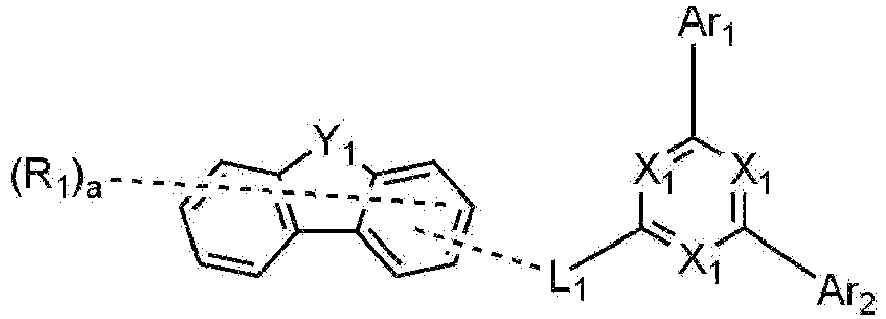
- in Chemical Formula 1,
- Y1 is O, or S,
- each X1 is independently CH or N, provided that at least one of X1 is N,
- L1 is a direct bond, a substituted or unsubstituted C6-60 arylene, or a substituted or unsubstituted C2-60 heteroarylene containing any one or more selected from the group consisting of N, O and S,
- Ar1 and Ar2 are each independently a substituted or unsubstituted C6-60 aryl, or a substituted or unsubstituted C2-60 heteroaryl containing any one or more selected from the group consisting of N, O and S,
- R1 is hydrogen, deuterium, a substituted or unsubstituted C6-60 alkyl, a substituted or unsubstituted C6-60 aryl, or a substituted or unsubstituted C2-60 heteroaryl containing any one or more selected from the group consisting of N, O and S, and
- a is an integer of 1 to 7,

- in Chemical Formula 2,
- Ar3 and Ar4 are each independently a substituted or unsubstituted C6-60 aryl, or a substituted or unsubstituted C2-60 heteroaryl containing any one or more selected from the group consisting of N, O and S,
- R3 and R4 are each independently hydrogen, deuterium, a substituted or unsubstituted C6-60 aryl, or a substituted or unsubstituted C2-60 heteroaryl containing any one or more selected from the group consisting of N, O and S, and
- b and c are each independently an integer of 1 to 7,

- in Chemical Formula 3,
- B is a benzene ring fused with two adjacent pentagonal rings,
- each X2 is independently CH or N, provided that at least one of X2 is N,
- L2 is a direct bond, a substituted or unsubstituted C6-60 arylene, or a substituted or unsubstituted C2-60 heteroarylene containing any one or more selected from the group consisting of N, O and S,
- Ar5 and Ar6 are each independently a substituted or unsubstituted C6-60 aryl, or a substituted or unsubstituted C2-60 heteroaryl containing any one or more selected from the group consisting of N, O and S, and
- C is the following Chemical Formula 4-1 or 4-2,


- in Chemical Formulas 4-1 and 4-2,
- the dotted line is a bond that is fused with B,
- Y2 is CRR', O, S, or NAr7,
- wherein R and R' are each independently a substituted or unsubstituted C6-60 alkyl, or a substituted or unsubstituted C6-60 aryl,
- Ar7 is a substituted or unsubstituted C6-60 aryl, or a substituted or unsubstituted C2-60 heteroaryl containing any one or more selected from the group consisting of N, O and S,
- R4 is hydrogen, deuterium, a substituted or unsubstituted C6-60 aryl, or a substituted or unsubstituted C2-60 heteroaryl containing any one or more selected from the group consisting of N, O and S, and
- d is an integer of 1 to 10.
- The above-mentioned organic light emitting device has excellent driving voltage, efficiency and lifetime.
-
-
Fig. 1 shows an example of an organic light emitting device comprising asubstrate 1, ananode 2, anelectron inhibition layer 3, alight emitting layer 4, and acathode 5. -
Fig. 2 shows an example of an organic light emitting device comprising asubstrate 1, ananode 2, ahole transport layer 6, anelectron inhibition layer 3, alight emitting layer 4, anelectron transport layer 7, and acathode 5. - Hereinafter, embodiments of the present disclosure will be described in more detail to assist in the understanding of the invention.
- As used herein, the notation or means a bond linked to another substituent group.
- As used herein, the term "substituted or unsubstituted" means being unsubstituted or substituted with one or more substituents selected from the group consisting of deuterium; a halogen group; a nitrile group; a nitro group; a hydroxy group; a carbonyl group; an ester group; an imide group; an amino group; a phosphine oxide group; an alkoxy group; an aryloxy group; an alkylthioxy group; an arylthioxy group; an alkylsulfoxy group; an arylsulfoxy group; a silyl group; a boron group; an alkyl group; a cycloalkyl group; an alkenyl group; an aryl group; an aralkyl group; an aralkenyl group; an alkylaryl group; an alkylamine group; an aralkylamine group; a heteroarylamine group; an arylamine group; an arylphosphine group; or a heteroaryl containing at least one of N, O and S atoms, or being unsubstituted or substituted with a substituent to which two or more substituents of the above-exemplified substituents are connected. For example, "a substituent in which two or more substituents are connected" may be a biphenyl group. Namely, a biphenyl group may be an aryl group, or it may also be interpreted as a substituent in which two phenyl groups are connected.
- In the present disclosure, the carbon number of a carbonyl group is not particularly limited, but is preferably 1 to 40. Specifically, the carbonyl group may be a compound having the following structural formulas, but is not limited thereto.


- In the present disclosure, an ester group may have a structure in which oxygen of the ester group may be substituted by a straight-chain, branched, or cyclic alkyl group having 1 to 25 carbon atoms, or an aryl group having 6 to 25 carbon atoms. Specifically, the ester group may be a compound having the following structural formulas, but is not limited thereto.


- In the present disclosure, the carbon number of an imide group is not particularly limited, but is preferably 1 to 25. Specifically, the imide group may be a compound having the following structural formulas, but is not limited thereto.


- In the present disclosure, a silyl group specifically includes a trimethylsilyl group, a triethylsilyl group, a t-butyldimethylsilyl group, a vinyldimethylsilyl group, a propyldimethylsilyl group, a triphenylsilyl group, a diphenylsilyl group, a phenylsilyl group and the like, but is not limited thereto.
- In the present disclosure, a boron group specifically includes a trimethylboron group, a triethylboron group, a t-butyldimethylboron group, a triphenylboron group, and a phenylboron group, but is not limited thereto.
- In the present disclosure, examples of a halogen group include fluorine, chlorine, bromine, or iodine.
- In the present disclosure, the alkyl group may be straight-chain or branched-chain, and the carbon number thereof is not particularly limited, but is preferably 1 to 40. According to one embodiment, the carbon number of the alkyl group is 1 to 20. According to another embodiment, the carbon number of the alkyl group is 1 to 10. According to another embodiment, the carbon number of the alkyl group is 1 to 6. Specific examples of the alkyl group include methyl, ethyl, propyl, n-propyl, isopropyl, butyl, n-butyl, isobutyl, tert-butyl, sec-butyl, 1-methyl-butyl, 1-ethyl-butyl, pentyl, n-pentyl, isopentyl, neopentyl, tert-pentyl, hexyl, n-hexyl, 1-methylpentyl, 2-methylpentyl, 4-methyl-2-pentyl, 3,3-dimethylbutyl, 2-ethylbutyl, heptyl, n-heptyl, 1-methylhexyl, cyclopentylmethyl, cyclohectylmethyl, octyl, n-octyl, tert-octyl, 1-methylheptyl, 2-ethylhexyl, 2-propylpentyl, n-nonyl, 2,2-dimethylheptyl, 1-ethyl-propyl, 1,1-dimethyl-propyl, isohexyl, 2-methylpentyl, 4-methylhexyl, 5-methylhexyl, and the like, but are not limited thereto.
- In the present disclosure, the alkenyl group may be straight-chain or branched-chain, and the carbon number thereof is not particularly limited, but is preferably 2 to 40. According to one embodiment, the carbon number of the alkenyl group is 2 to 20. According to another embodiment, the carbon number of the alkenyl group is 2 to 10. According to still another embodiment, the carbon number of the alkenyl group is 2 to 6. Specific examples thereof include vinyl, 1-propenyl, isopropenyl, 1-butenyl, 2-butenyl, 3-butenyl, 1-pentenyl, 2-pentenyl, 3-pentenyl, 3-methyl-1-butenyl, 1,3-butadienyl, aryl, 1-phenylvinyl-1-yl, 2-phenylvinyl-1-yl, 2,2-diphenylvinyl-1-yl, 2-phenyl-2-(naphthyl-1-yl)vinyl-1-yl, 2,2-bis(diphenyl-1-yl)vinyl-1-yl, a stilbenyl group, a styrenyl group, and the like, but are not limited thereto.
- In the present disclosure, a cycloalkyl group is not particularly limited, but the carbon number thereof is preferably 3 to 60. According to one embodiment, the carbon number of the cycloalkyl group is 3 to 30. According to another embodiment, the carbon number of the cycloalkyl group is 3 to 20. According to still another embodiment, the carbon number of the cycloalkyl group is 3 to 6. Specific examples thereof include cyclopropyl, cyclobutyl, cyclopentyl, 3-methylcyclopentyl, 2,3-dimethylcyclopentyl, cyclohexyl, 3-methylcyclohexyl, 4-methylcyclohexyl, 2,3-dimethylcyclohexyl, 3,4,5-trimethylcyclohexyl, 4-tert-butylcyclohexyl, cycloheptyl, cyclooctyl, and the like, but are not limited thereto.
- In the present disclosure, an aryl group is not particularly limited, but the carbon number thereof is preferably 6 to 60, and it may be a monocyclic aryl group or a polycyclic aryl group. According to one embodiment, the carbon number of the aryl group is 6 to 30. According to one embodiment, the carbon number of the aryl group is 6 to 20. The aryl group may be a phenyl group, a biphenyl group, a terphenyl group or the like as the monocyclic aryl group, but is not limited thereto. The polycyclic aryl group includes a naphthyl group, an anthracenyl group, a phenanthryl group, a pyrenyl group, a perylenyl group, a chrysenyl group, a fluorenyl group, and the like, but is not limited thereto.
- In the present disclosure, the fluorenyl group may be substituted, and two substituents may be linked with each other to form a spiro structure. In the case where the fluorenyl group is substituted,

- In the present disclosure, a heterocyclic group is a heterocyclic group containing one or more of O, N, Si and S as a heteroatom, and the carbon number thereof is not particularly limited, but is preferably 2 to 60. Examples of the heterocyclic group include a thiophene group, a furan group, a pyrrole group, an imidazole group, a thiazole group, an oxazol group, an oxadiazol group, a triazol group, a pyridyl group, a bipyridyl group, a pyrimidyl group, a triazine group, a triazole group, an acridyl group, a pyridazine group, a pyrazinyl group, a quinolinyl group, a quinazoline group, a quinoxalinyl group, a phthalazinyl group, a pyridopyrimidinyl group, a pyridopyrazinyl group, a pyrazinopyrazinyl group, an isoquinoline group, an indole group, a carbazole group, a benzoxazole group, a benzoimidazole group, a benzothiazol group, a benzocarbazole group, a benzothiophene group, a dibenzothiophene group, a benzofuranyl group, a phenanthroline group, a thiazolyl group, an isoxazolyl group, an oxadiazolyl group, a thiadiazolyl group, a benzothiazolyl group, a phenothiazinyl group, a dibenzofuranyl group, and the like, but are not limited thereto.
- In the present disclosure, the aryl group in the aralkyl group, the aralkenyl group, the alkylaryl group and the arylamine group is the same as the aforementioned examples of the aryl group. In the present disclosure, the alkyl group in the aralkyl group, the alkylaryl group and the alkylamine group is the same as the aforementioned examples of the alkyl group. In the present disclosure, the heteroaryl in the heteroarylamine can be applied to the aforementioned description of the heterocyclic group. In the present disclosure, the alkenyl group in the aralkenyl group is the same as the aforementioned examples of the alkenyl group. In the present disclosure, the aforementioned description of the aryl group may be applied except that the arylene is a divalent group. In the present disclosure, the aforementioned description of the heteroaryl group can be applied except that the heteroarylene is a divalent group. In the present disclosure, the aforementioned description of the aryl group or cycloalkyl group can be applied except that the hydrocarbon ring is not a monovalent group but formed by combining two substituent groups. In the present disclosure, the aforementioned description of the heterocyclic group can be applied, except that the heterocyclic group is not a monovalent group but formed by combining two substituent groups.
- Hereinafter, the present disclosure will be described in detail for each configuration.
- The anode and cathode used in the present disclosure mean electrodes used in an organic light emitting device.
- As the anode material, generally, a material having a large work function is preferably used so that holes can be smoothly injected into the organic material layer. Specific examples of the anode material include metals such as vanadium, chrome, copper, zinc, and gold, or an alloy thereof; metal oxides such as zinc oxides, indium oxides, indium tin oxides (ITO), and indium zinc oxides (IZO); a combination of metals and oxides, such as ZnO:AI or SNO2:Sb; conductive polymers such as poly(3-methylthiophene), poly[3,4-(ethylene-1,2-dioxy)thiophene](PEDOT), polypyrrole, and polyaniline, and the like, but are not limited thereto.
- As the cathode material, generally, a material having a small work function is preferably used so that electrons can be easily injected into the organic material layer. Specific examples of the cathode material include metals such as magnesium, calcium, sodium, potassium, titanium, indium, yttrium, lithium, gadolinium, aluminum, silver, tin, and lead, or an alloy thereof; a multilayered structure material such as LiF/AI or LiO2/Al, and the like, but are not limited thereto.
- The light emitting layer used in the present disclosure means a layer that can emit light in the visible light region by combining holes and electrons transported from the anode and the cathode. Generally, the light emitting layer includes a host material and a dopant material.
- The host material may further include a fused aromatic ring derivative, a heterocycle-containing compound or the like. In the present disclosure, a compound represented by the following
Chemical Formula 1, a compound represented by the followingChemical Formula 2, and a compound represented by the followingChemical Formula 3 are mixed and used as the host material. - Specifically, a host material containing
Chemical Formula 1 in which pyridine, pyrimidine, or triazine is bonded to dibenzofuran or dibenzothiophene via a linker;Chemical Formula 2 of the biscarbazole series; andChemical Formula 3 of the indolocarbazole series can be applied as a green host of the light emitting layer. - Furthermore, the organic light emitting device, to which the above three types of compounds are applied as a host material of the light emitting layer, can exhibit improved driving voltage (low voltage), high efficiency, and long lifetime characteristics, as compared to the case where 3 types of compounds completely different from the above 3 types are mixed and used as a host material (3 types of hosts are applied), the case where any one or two of the above three types of compounds is changed to another compound (3 types of hosts are applied), and the case where only one or two of the above three types of compounds are used as the host material of the light emitting layer (one or two types of hosts are applied).
- Hereinafter, the three types of compounds will be described in detail.
- The
Chemical Formula 1 may be any one of the following Chemical Formulas 1-1 to 1-4:


- Y1 is O or S.
- Each X1 is independently CH or N, provided that at least one of X1 is N, For example, two of X1 are N and the rest are CH; or all of X1 may be N.
- The L1 is a direct bond, a substituted or unsubstituted C6-30 arylene, or a substituted or unsubstituted C2-30 heteroarylene containing any one or more selected from the group consisting of N, O and S. For example, L1 may be a direct bond.
- Ar1 and Ar2 may be each independently a substituted or unsubstituted C6-30 aryl, or a substituted or unsubstituted C2-30 heteroaryl containing any one or more selected from the group consisting of N, O and S. For example, Ar1 and Ar2 may be each independently phenyl, biphenylyl, dibenzofuranyl, dibenzothiophenyl, carbazol-9-yl, or (phenyl)carbazol-9-yl, with the Ar1 and Ar2 being each independently unsubstituted or substituted with at least one deuterium.
- R1 may be hydrogen, deuterium, a substituted or unsubstituted C6-30 alkyl, a substituted or unsubstituted C6-30aryl, or a substituted or unsubstituted C2-30 heteroaryl containing any one or more selected from the group consisting of N, O and S. For example, R1 may be phenyl, biphenylyl, (phenyl)biphenylyl, terphenylyl, naphthyl, phenanthrenyl, triphenylenyl, dimethylfluorenyl, spirobifluorenyl, dibenzofuranyl, dibenzothiophenyl, carbazol-9-yl, (phenyl)carbazol-9-yl, (diphenyl)carbazol-9-yl, 9-phenyl-9H-carbazolyl, 12-phenyl-11,12-dihydroindolo[2,3-a]carbazol-11-yl, or 1,1-dimethyl-1,3-dihydroindeno[2,1-b]carbazol-3-yl, with the R1 being unsubstituted or substituted with at least one deuterium.
- a may be an integer of 1 to 7, and for example, it may be 1.
- Representative examples of the compound represented by
Chemical Formula 1 are as follows:


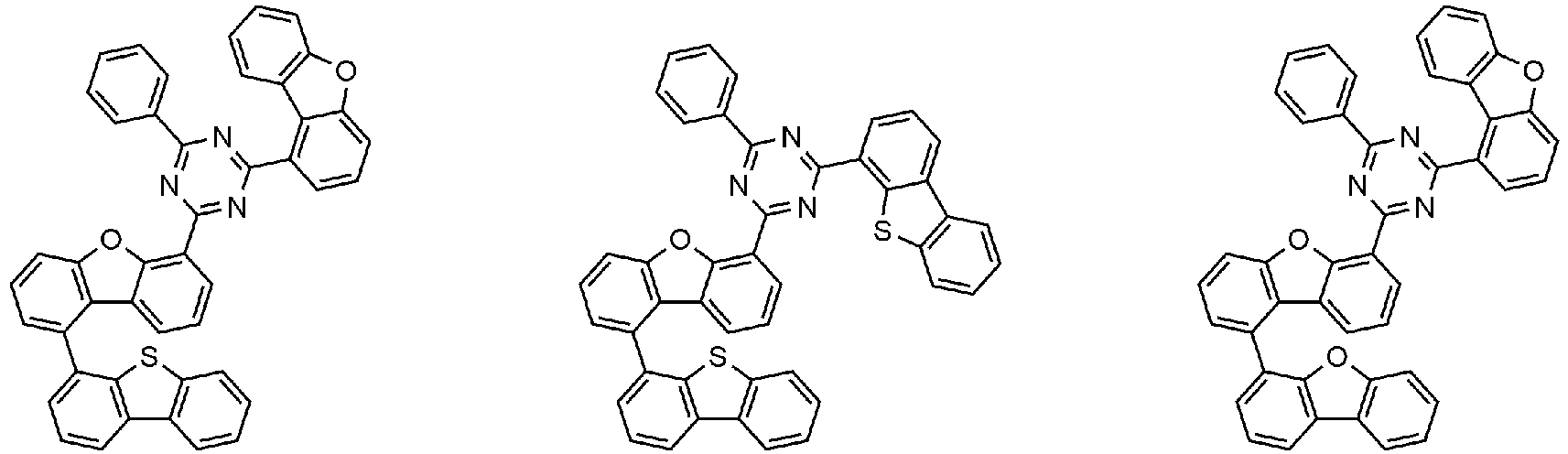

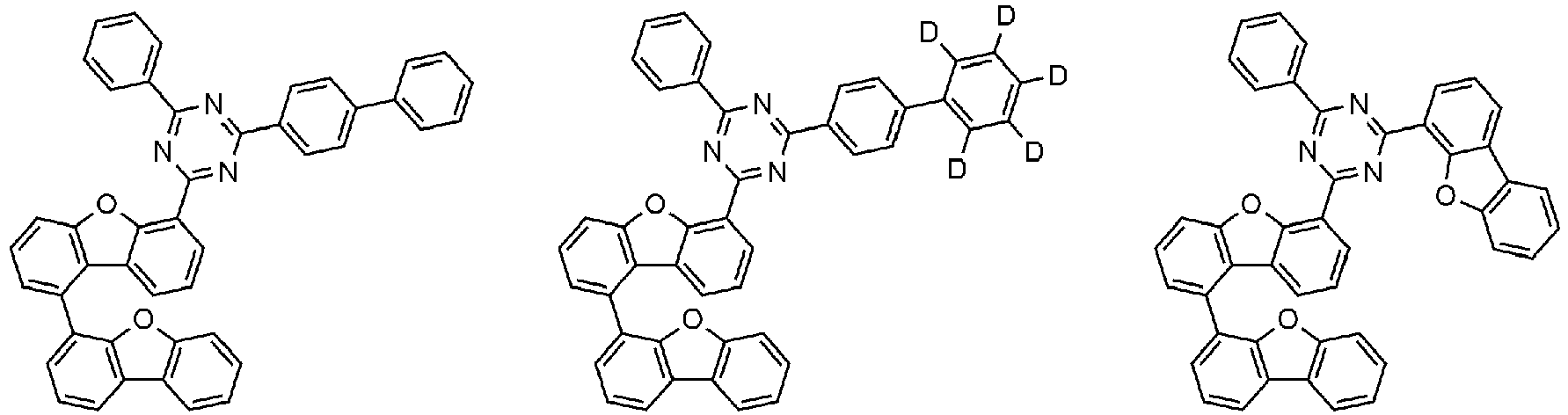
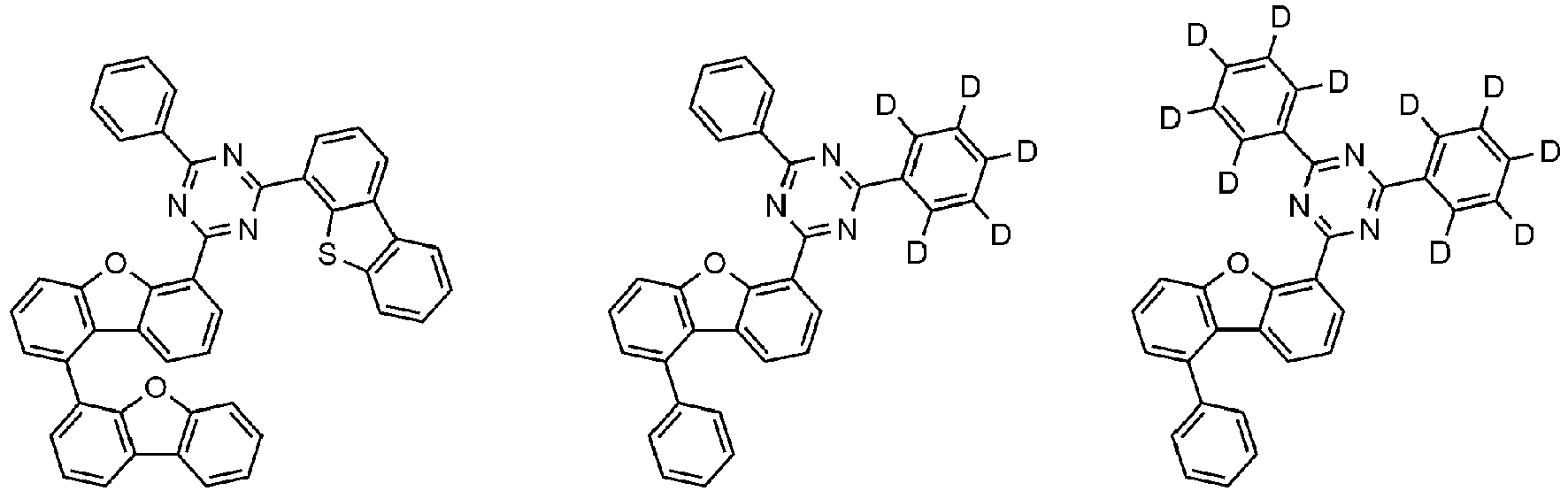


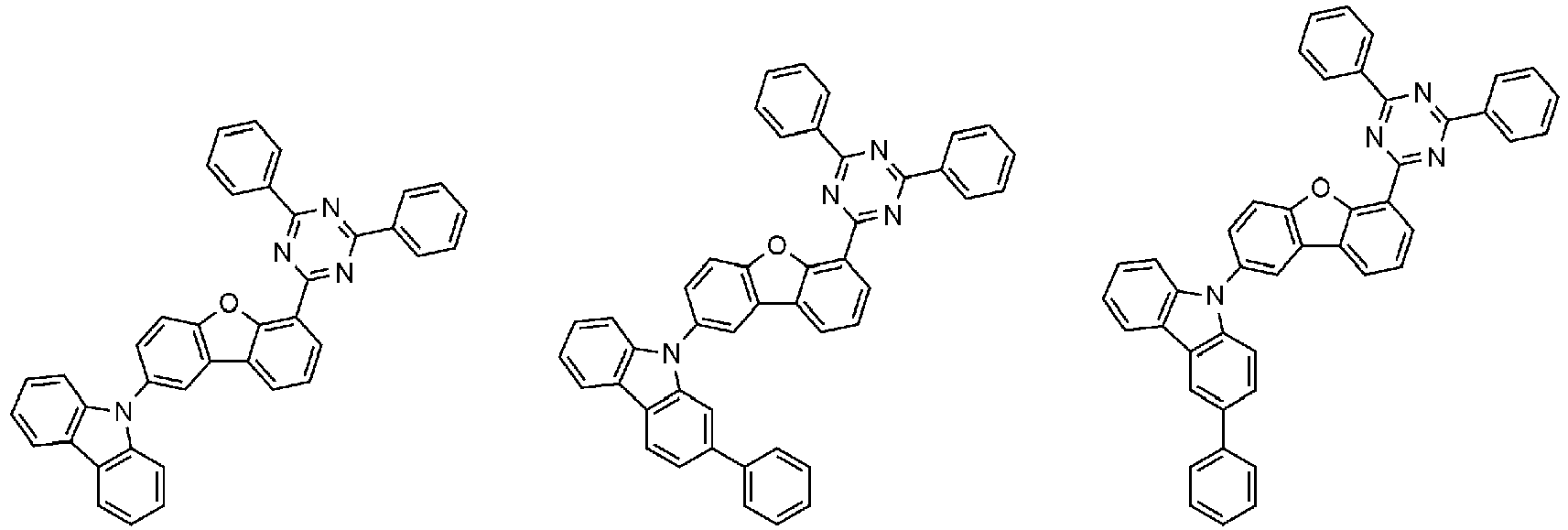


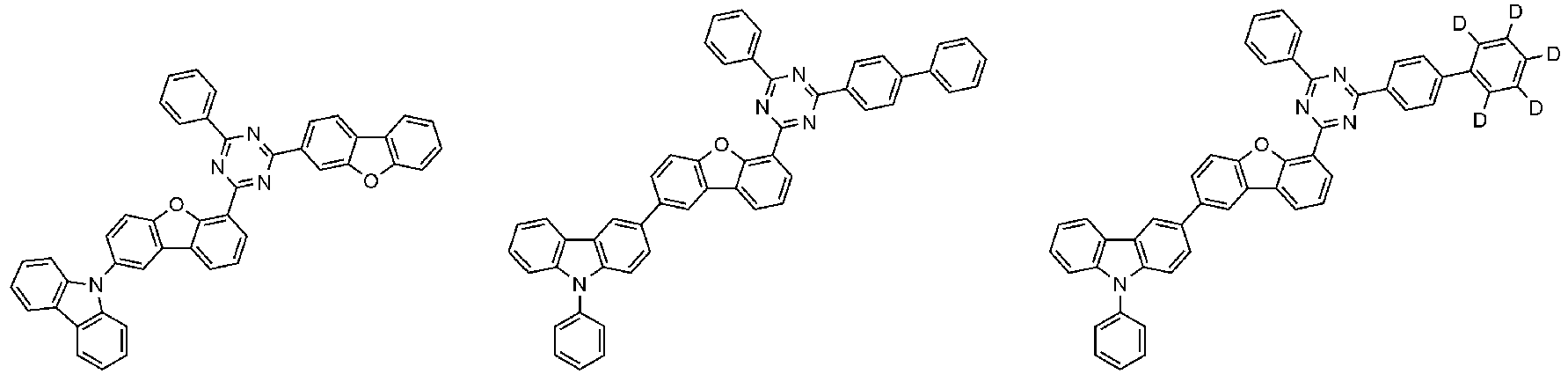


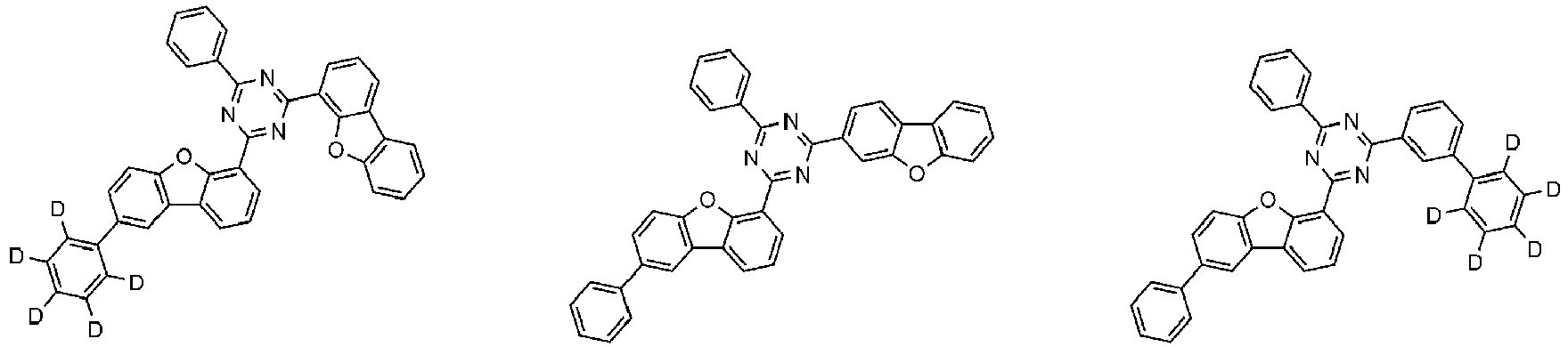


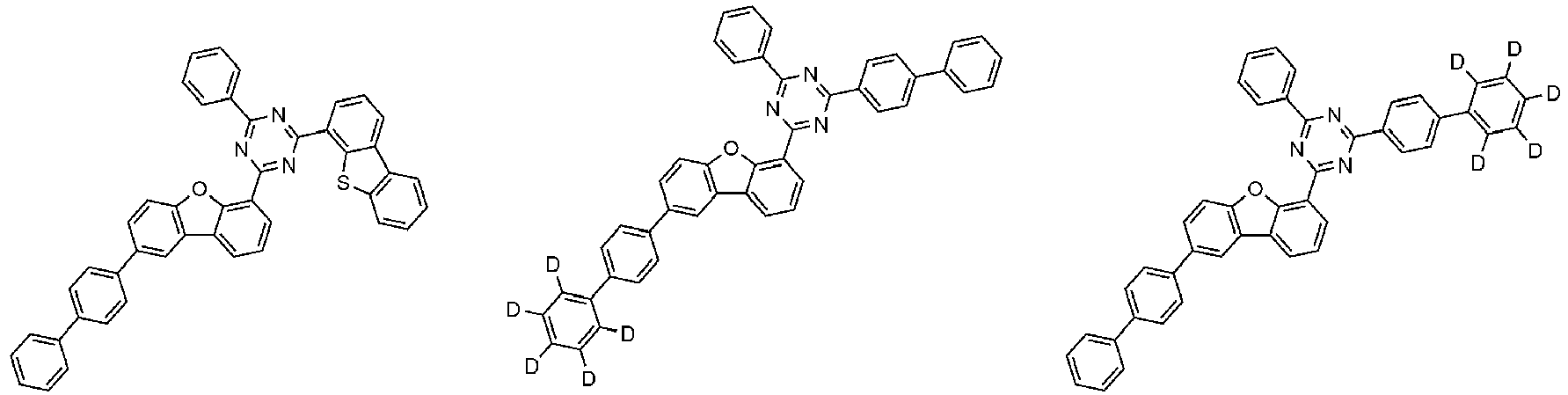


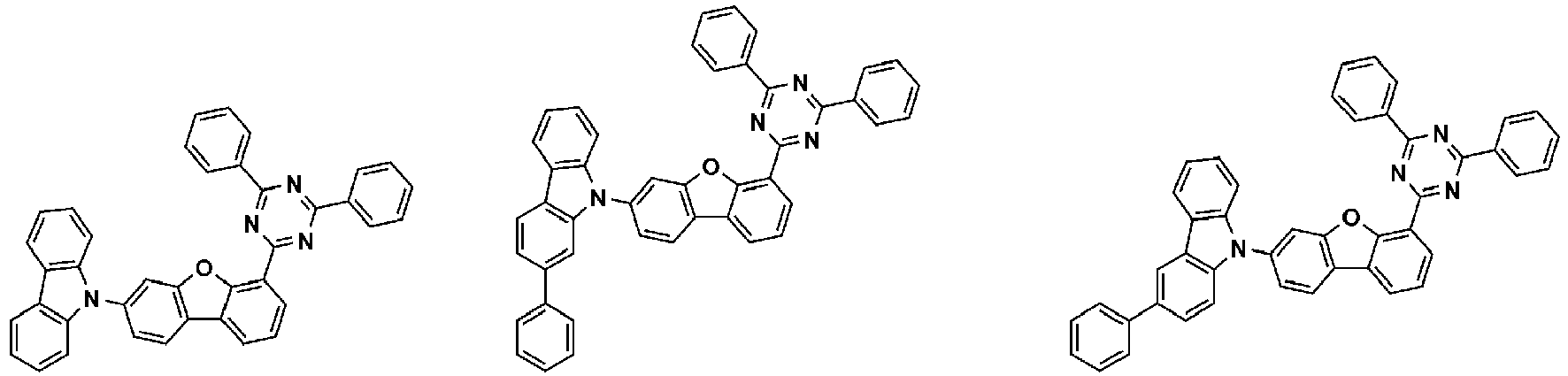















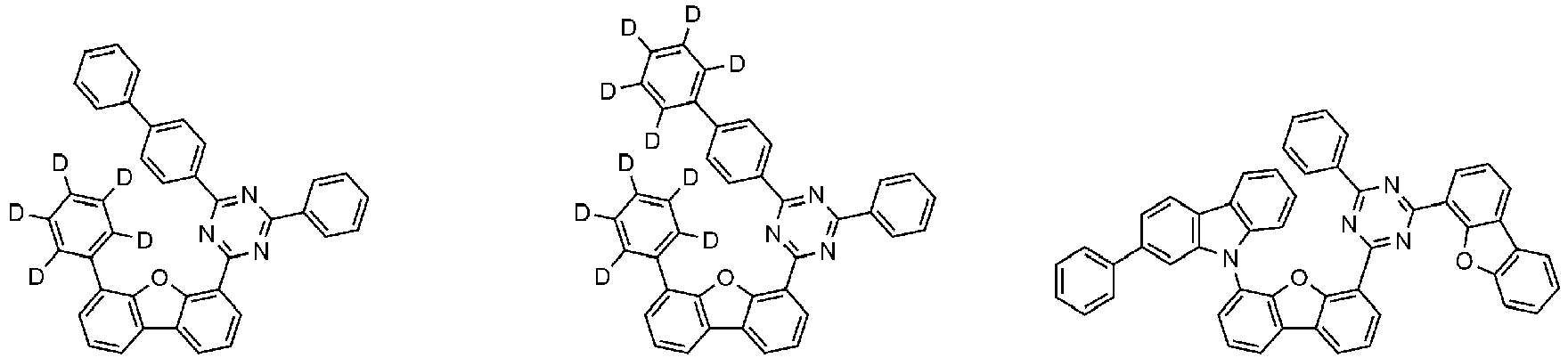


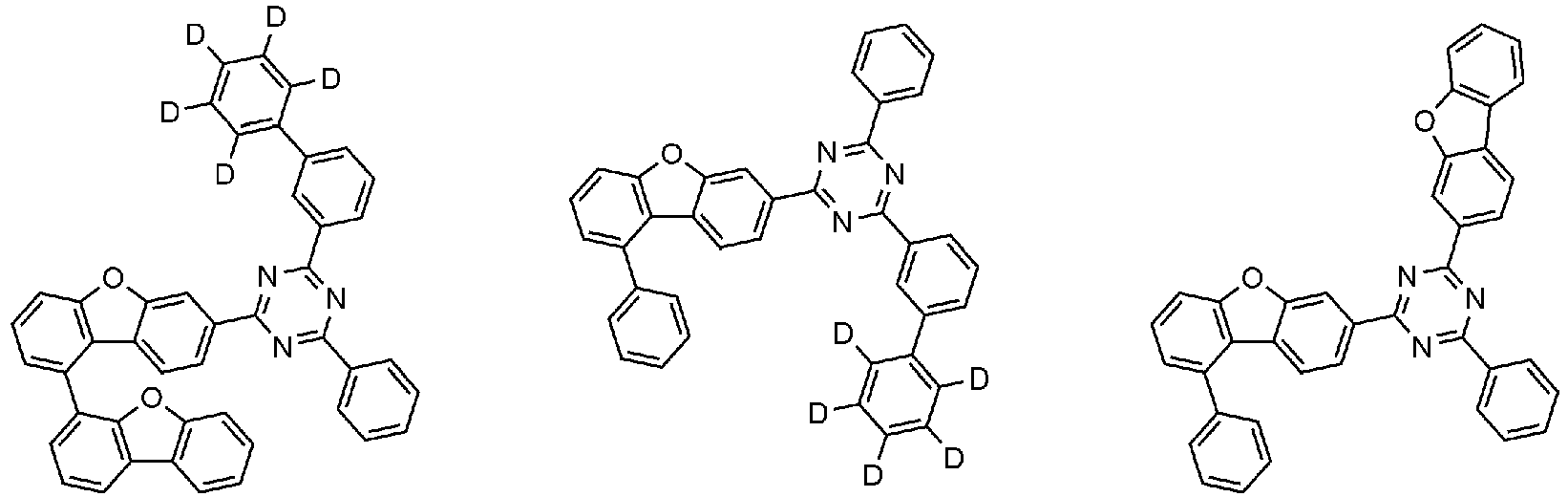


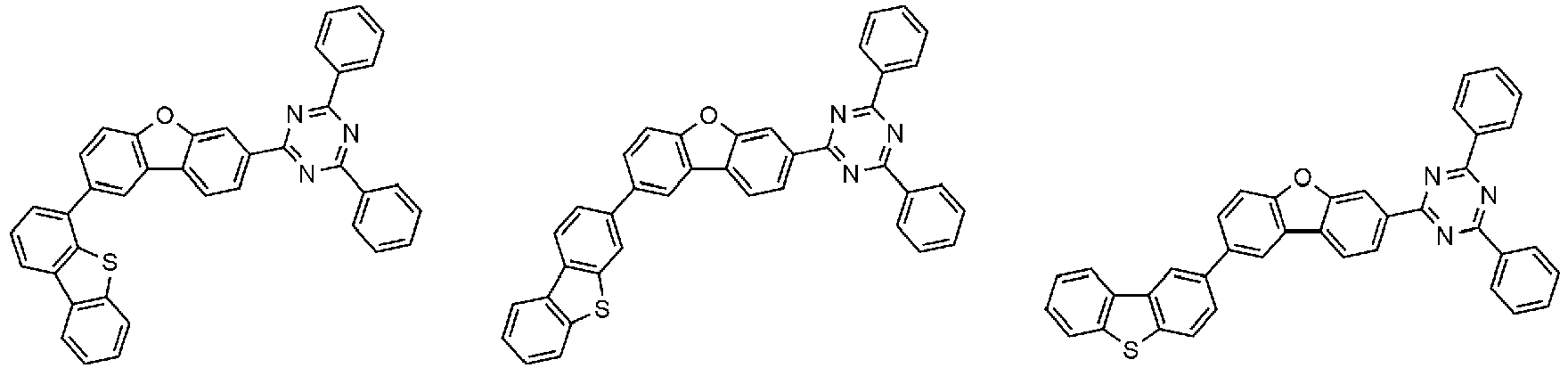


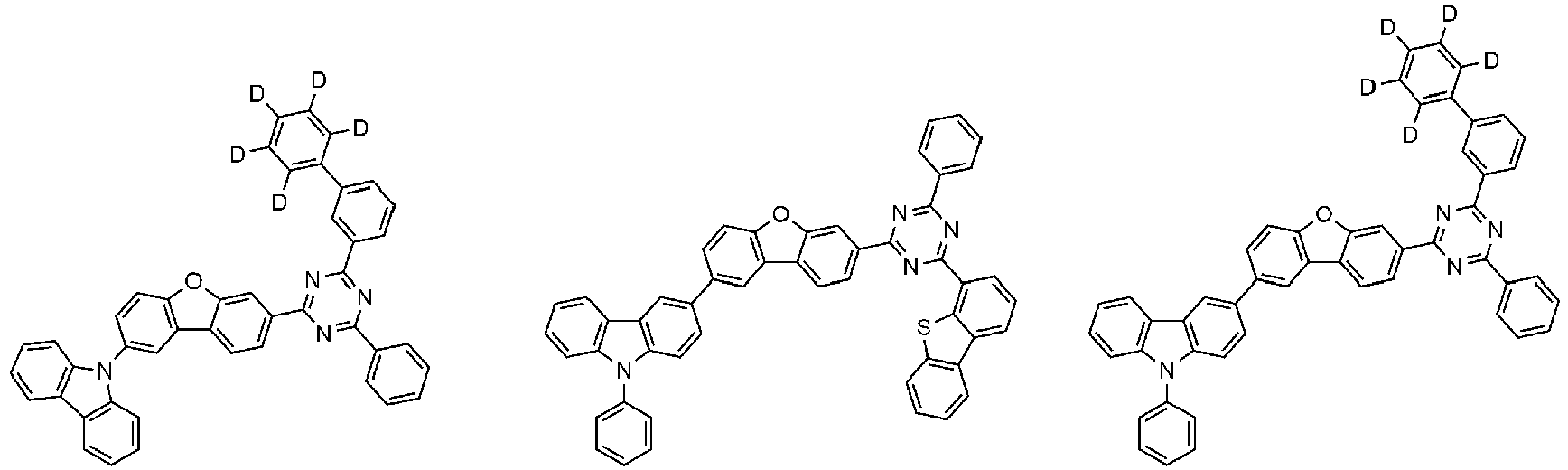


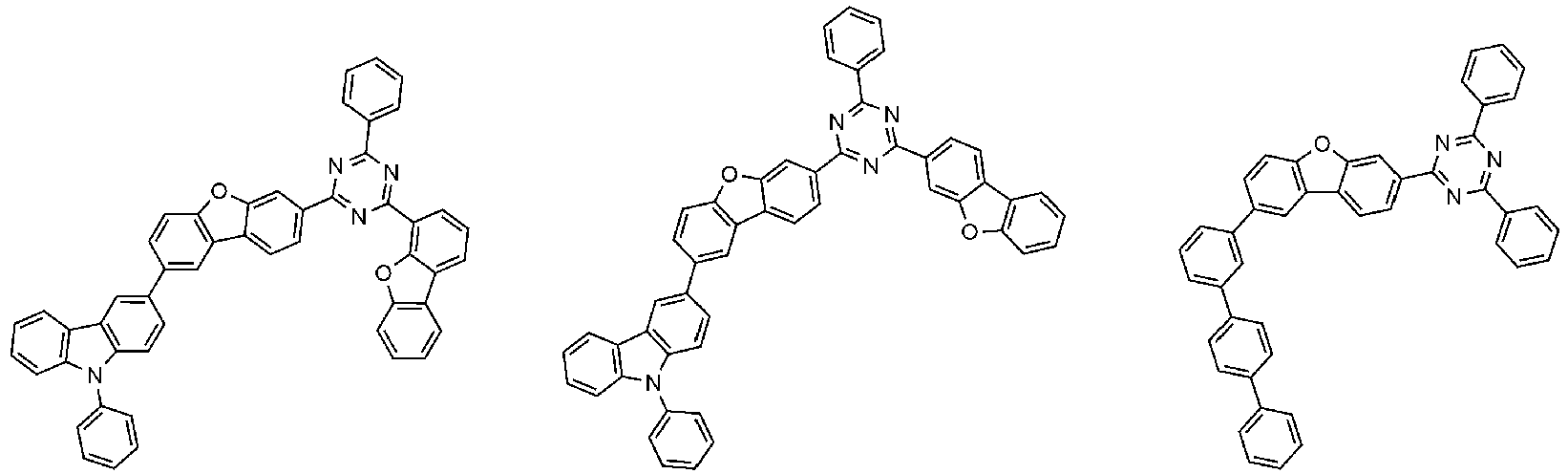


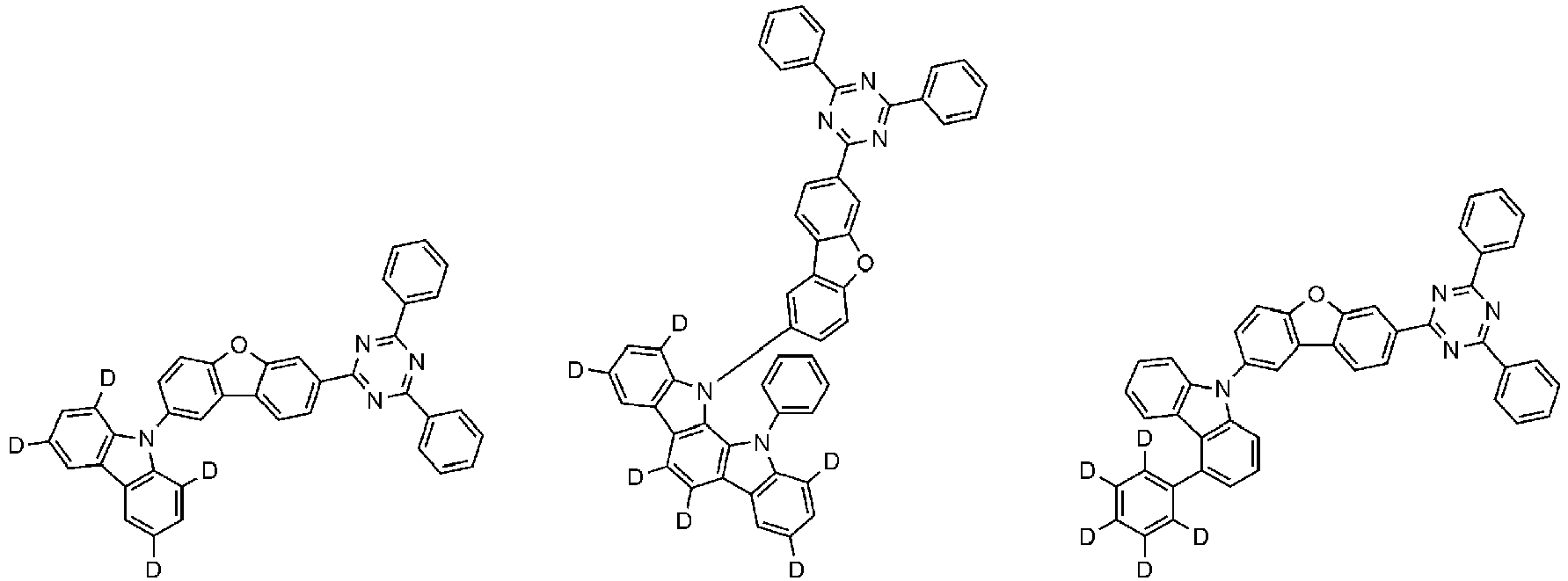


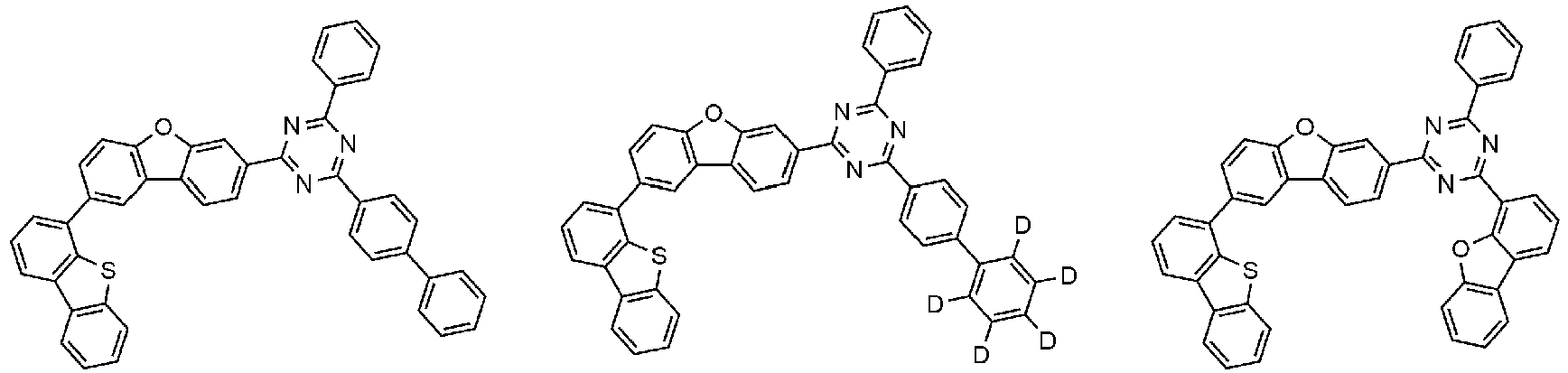


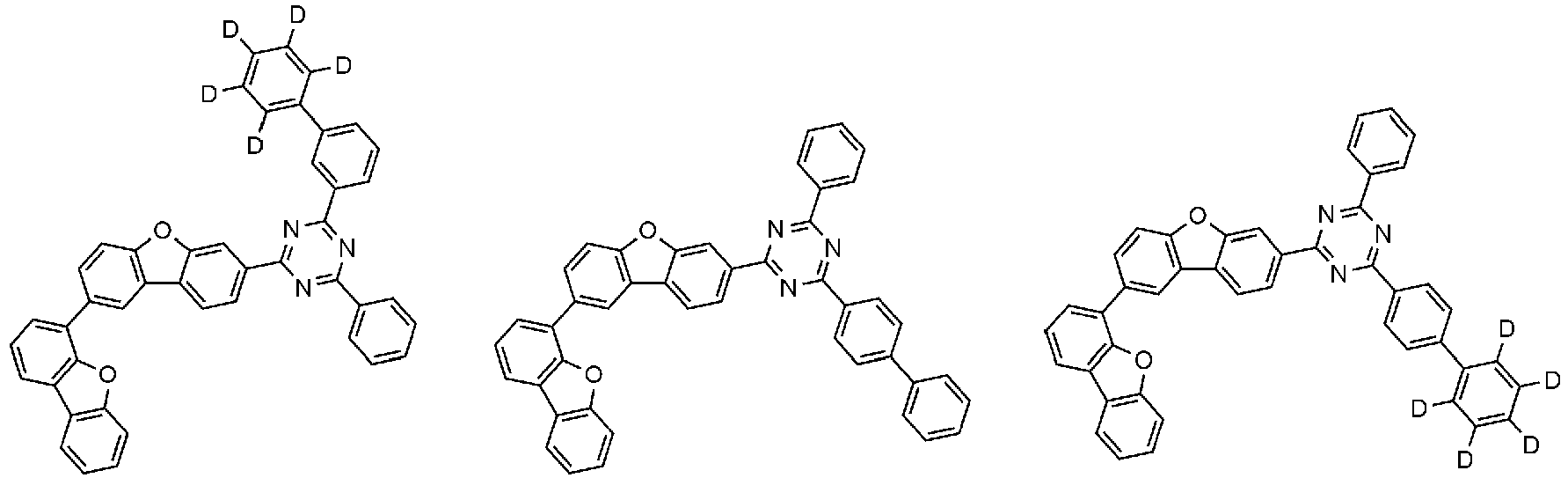








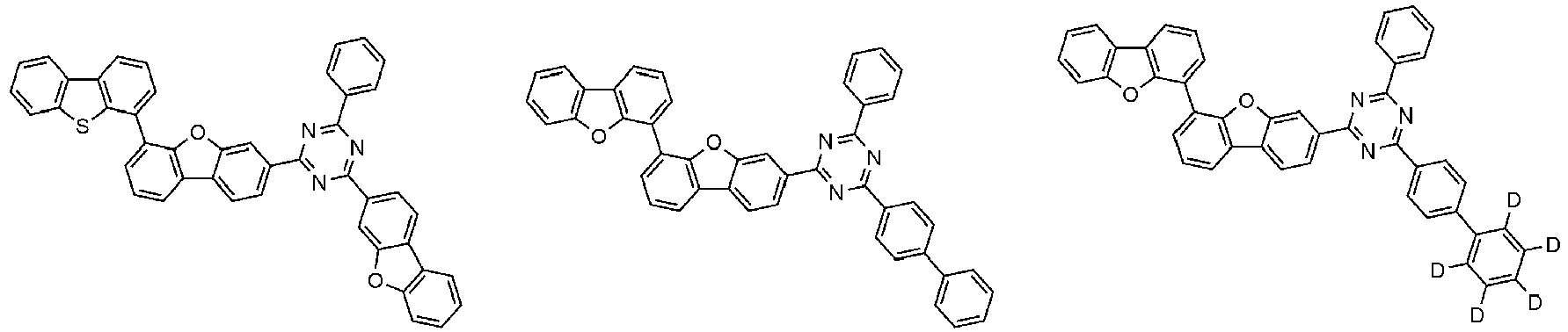


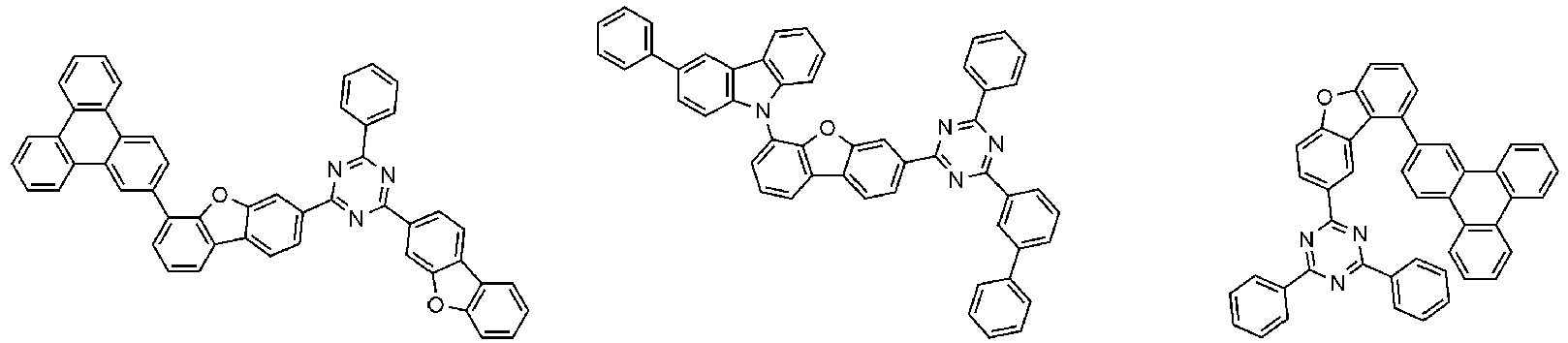


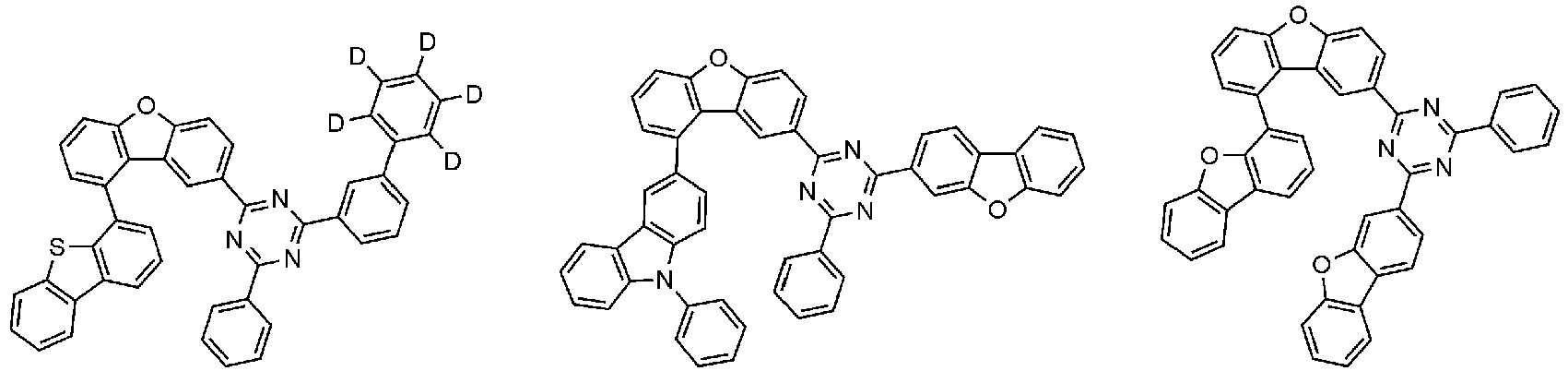


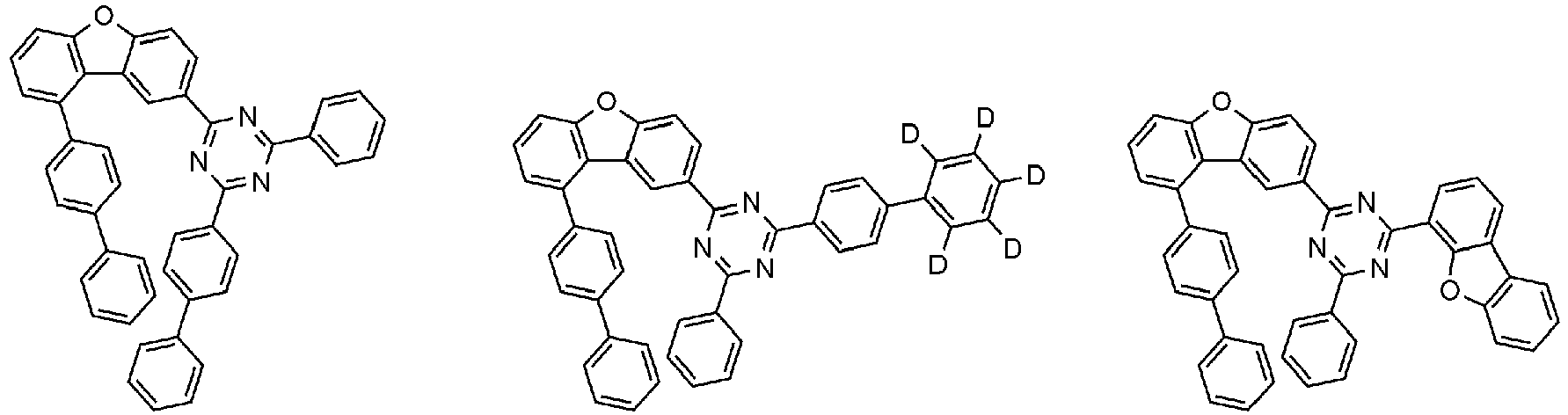


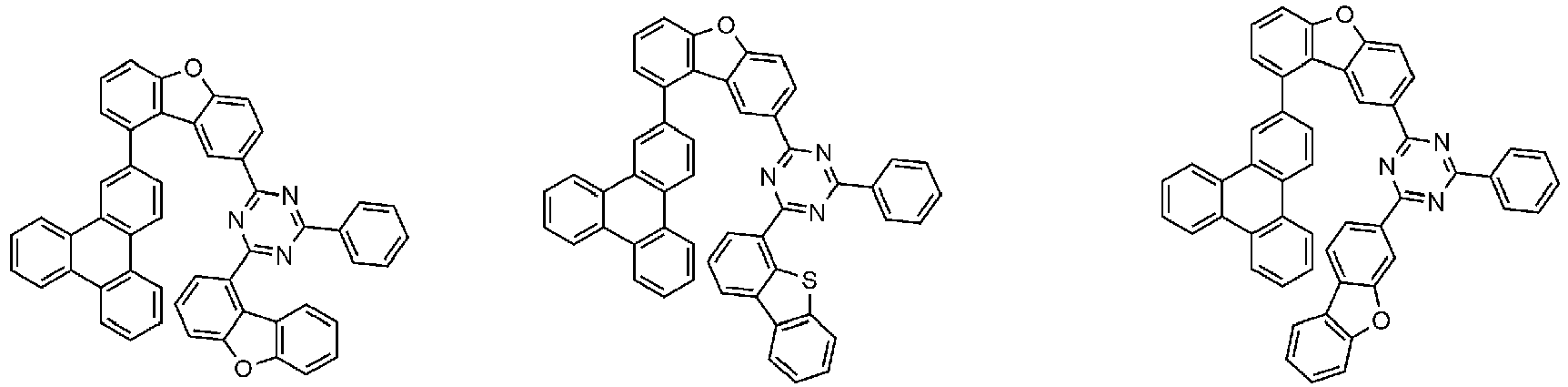








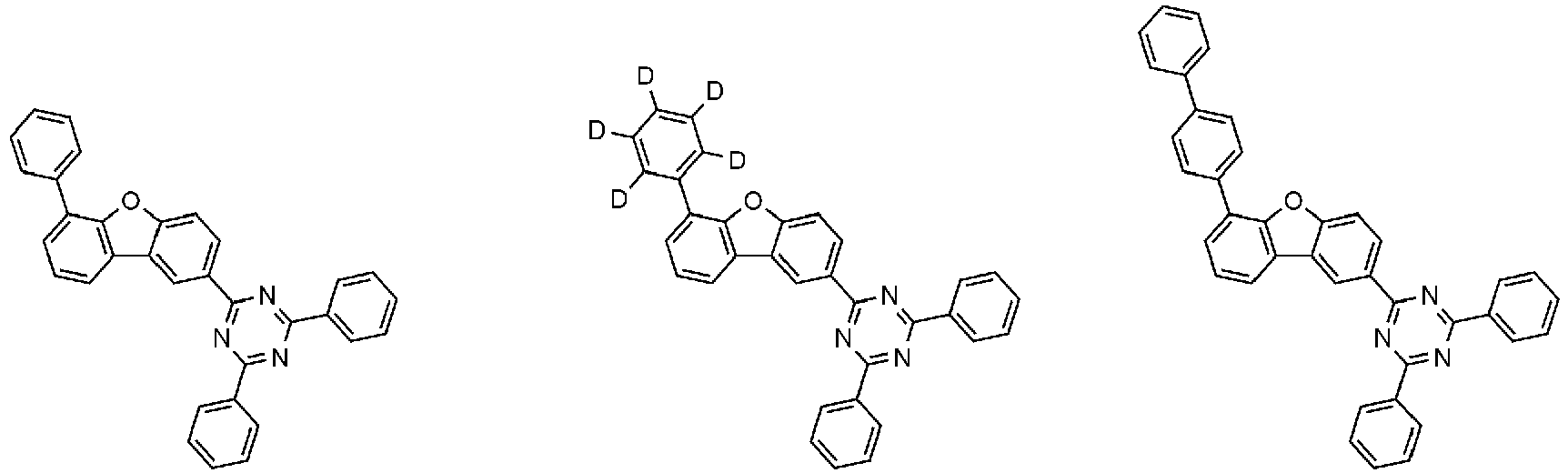


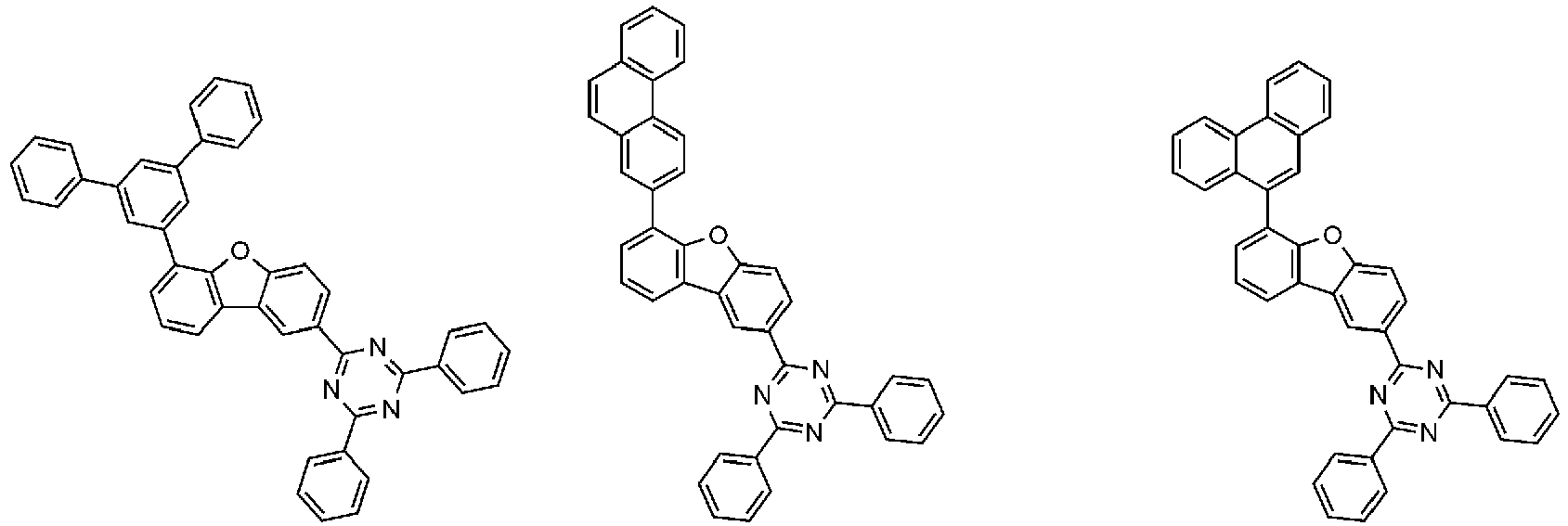


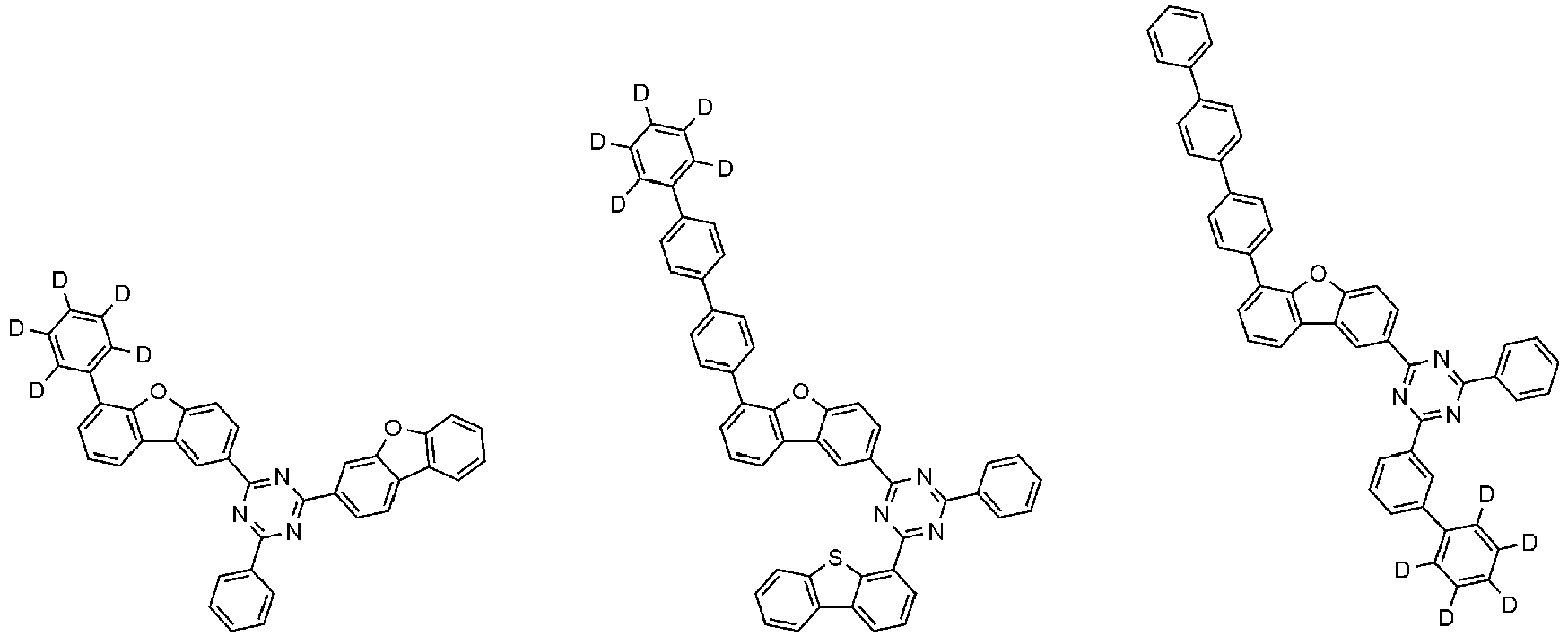


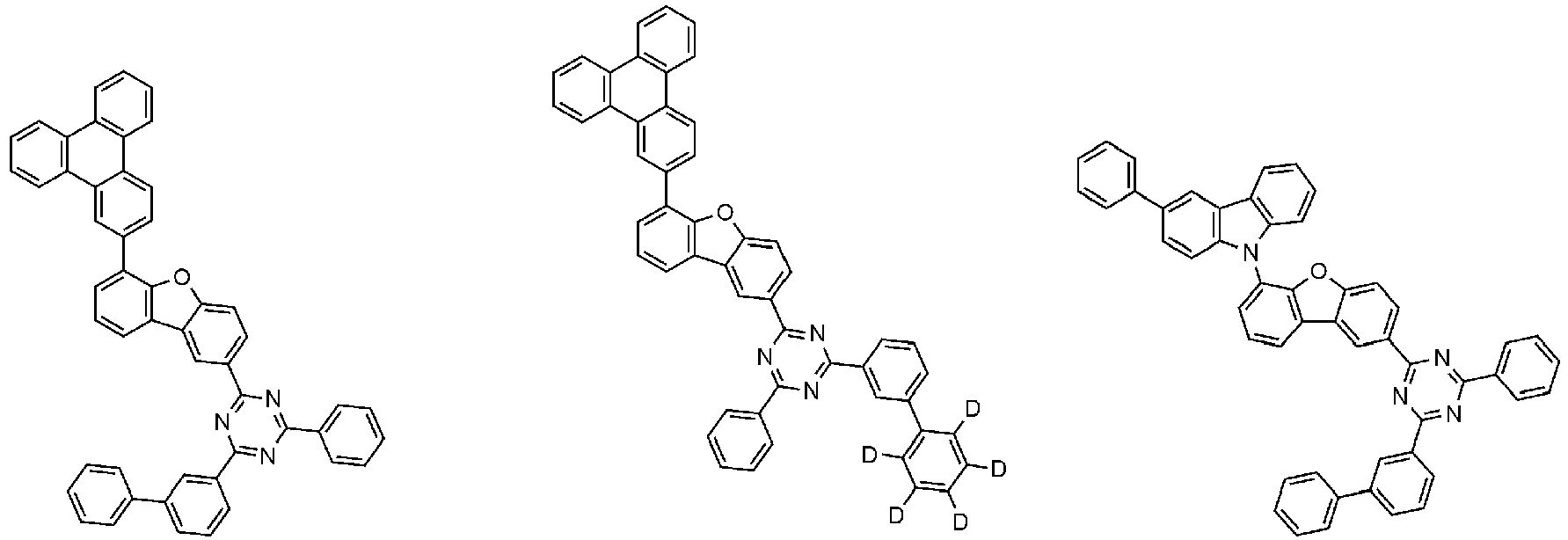


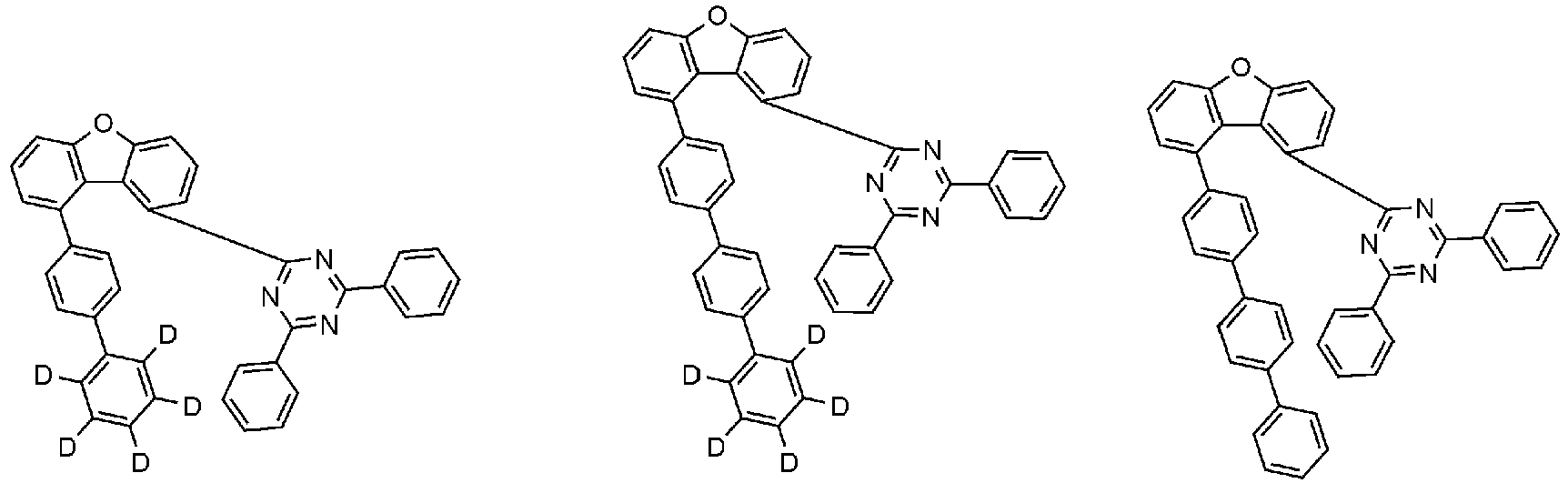


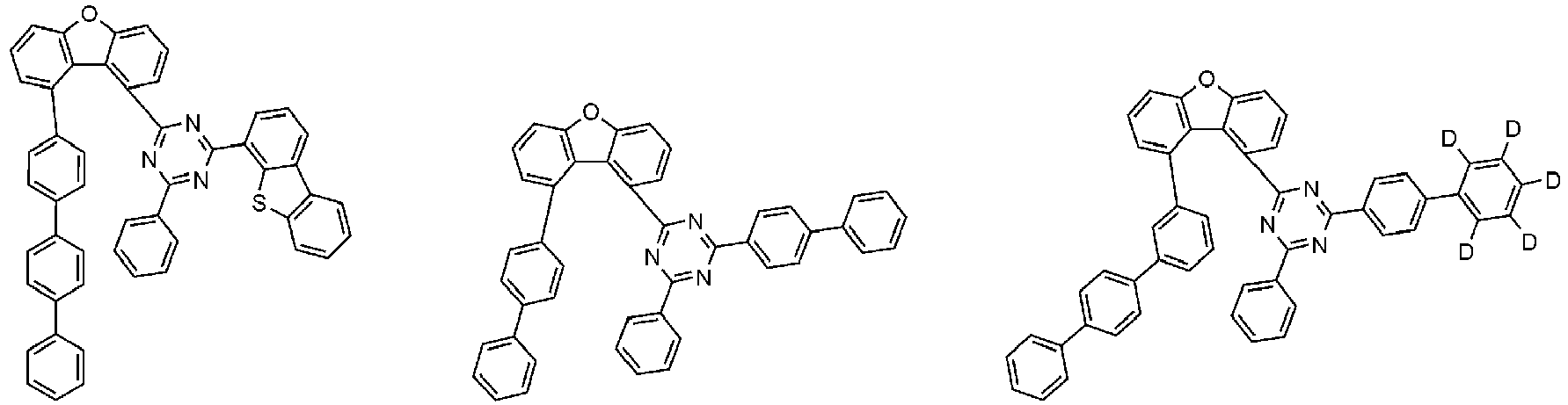





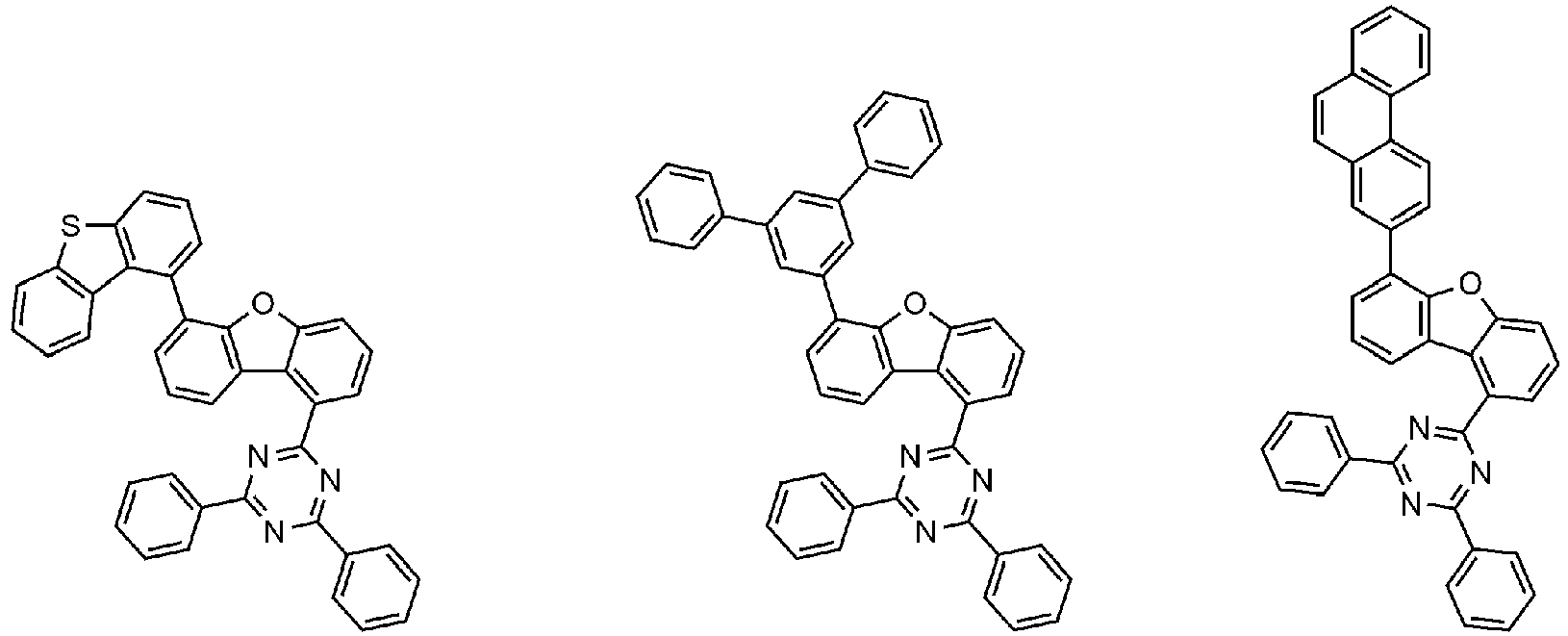


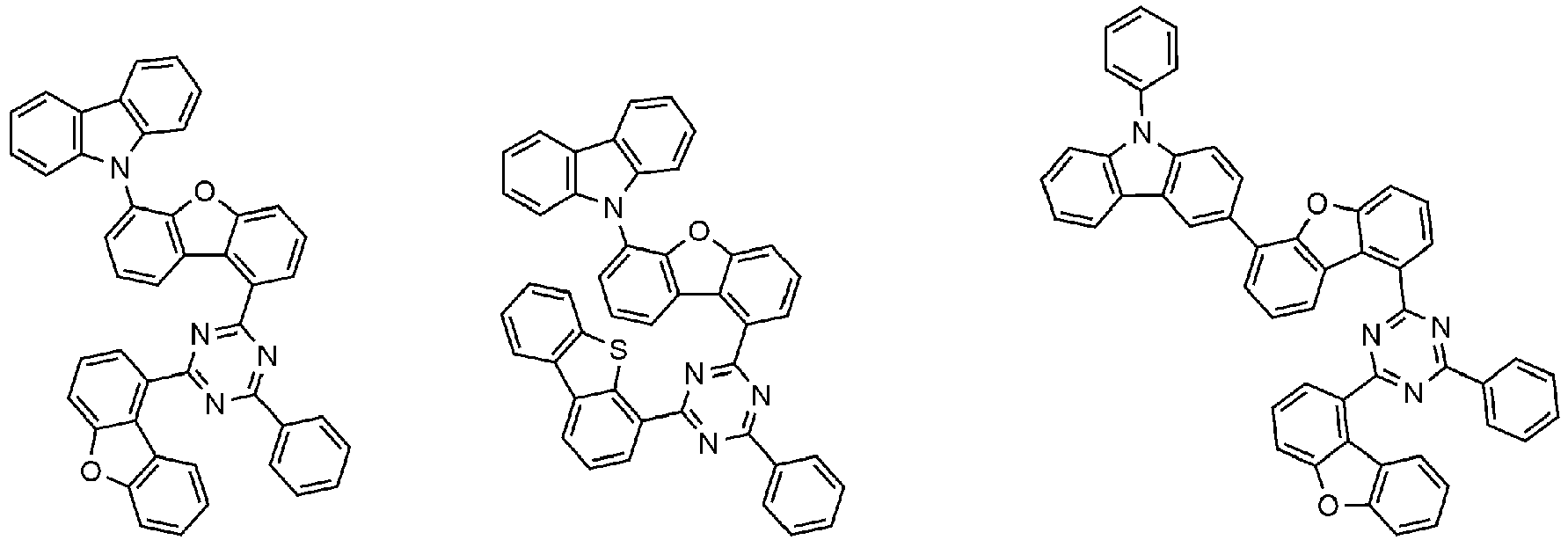


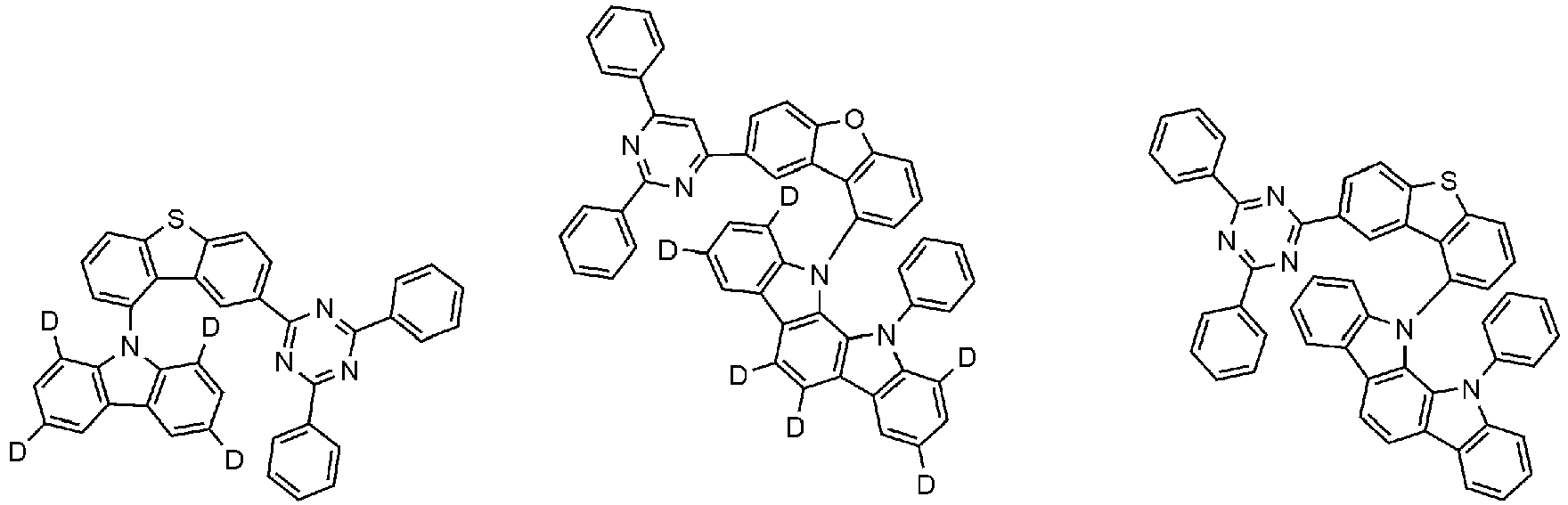


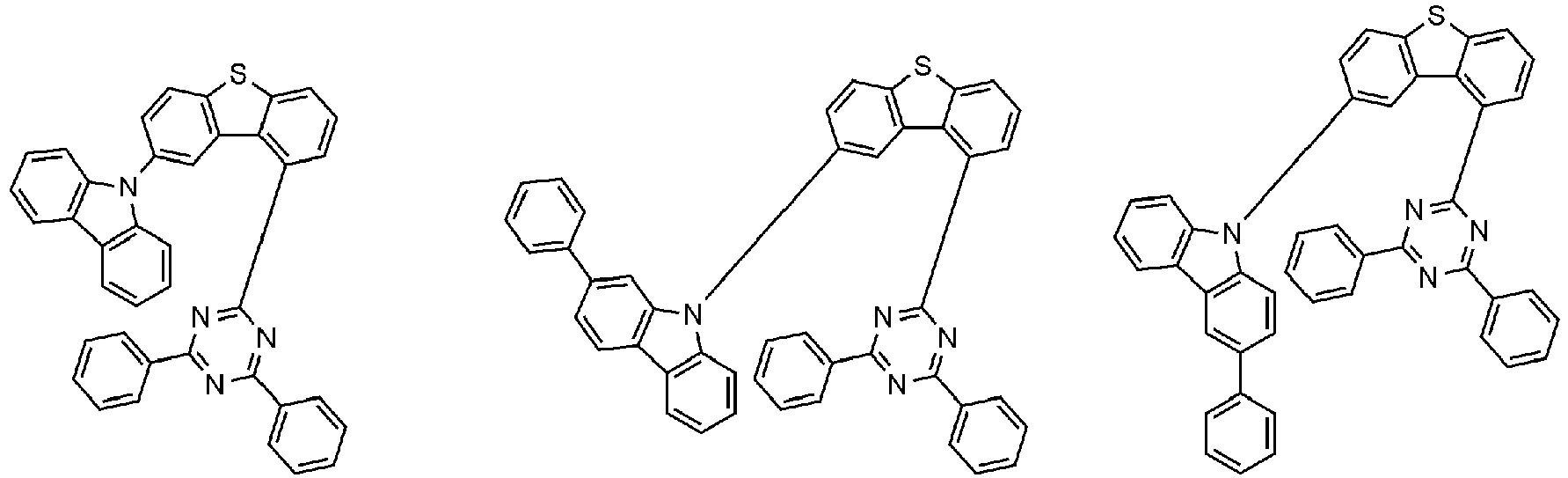


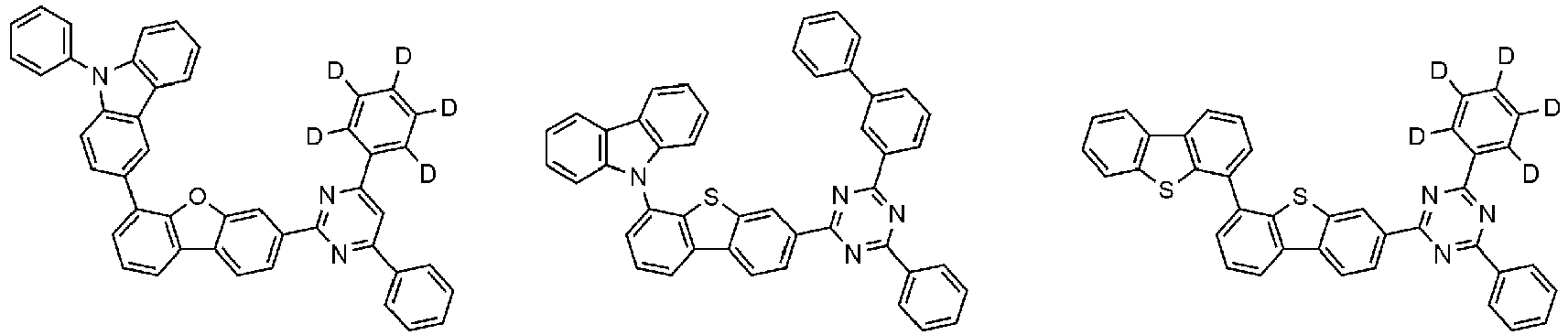


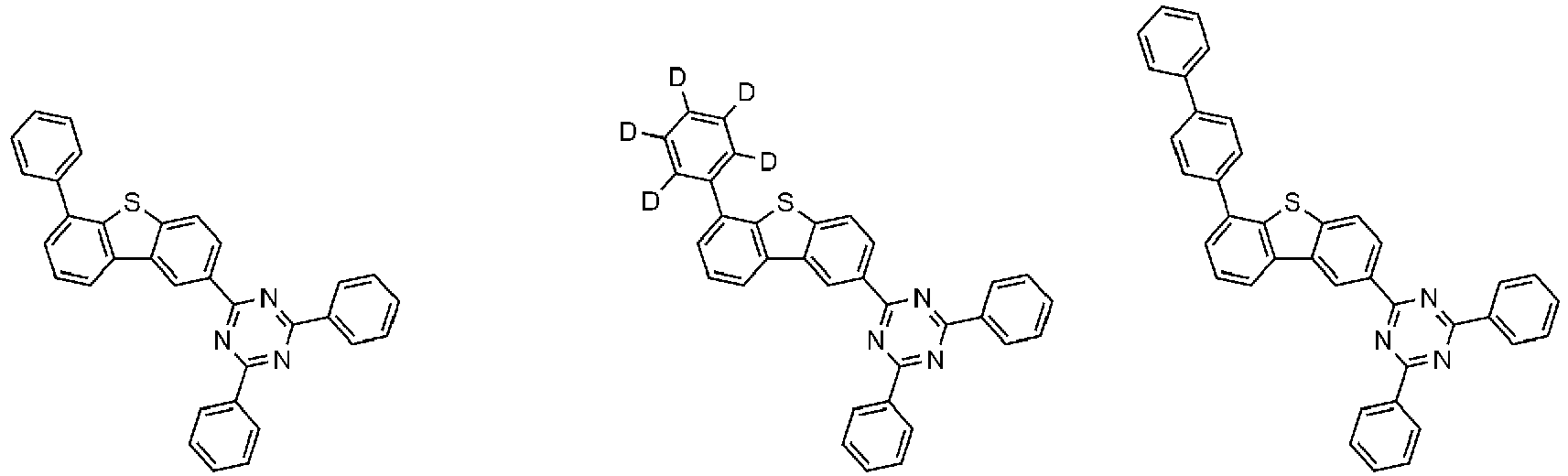


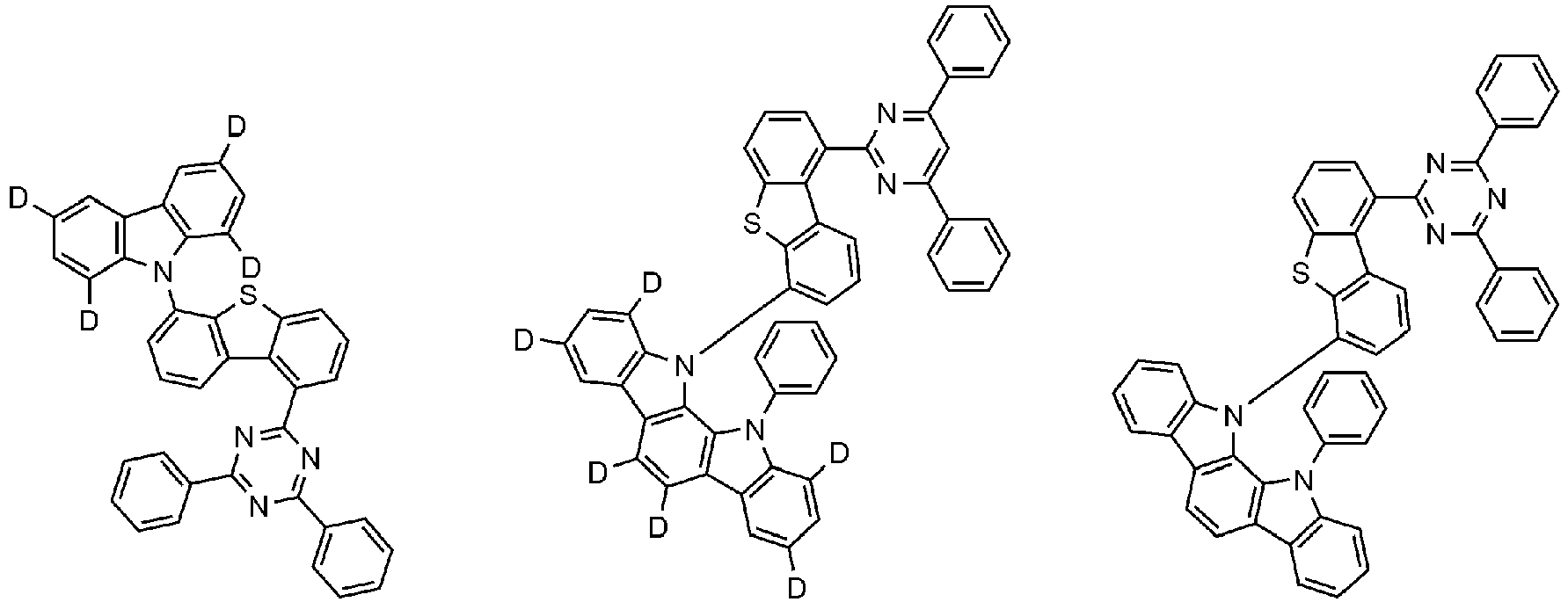


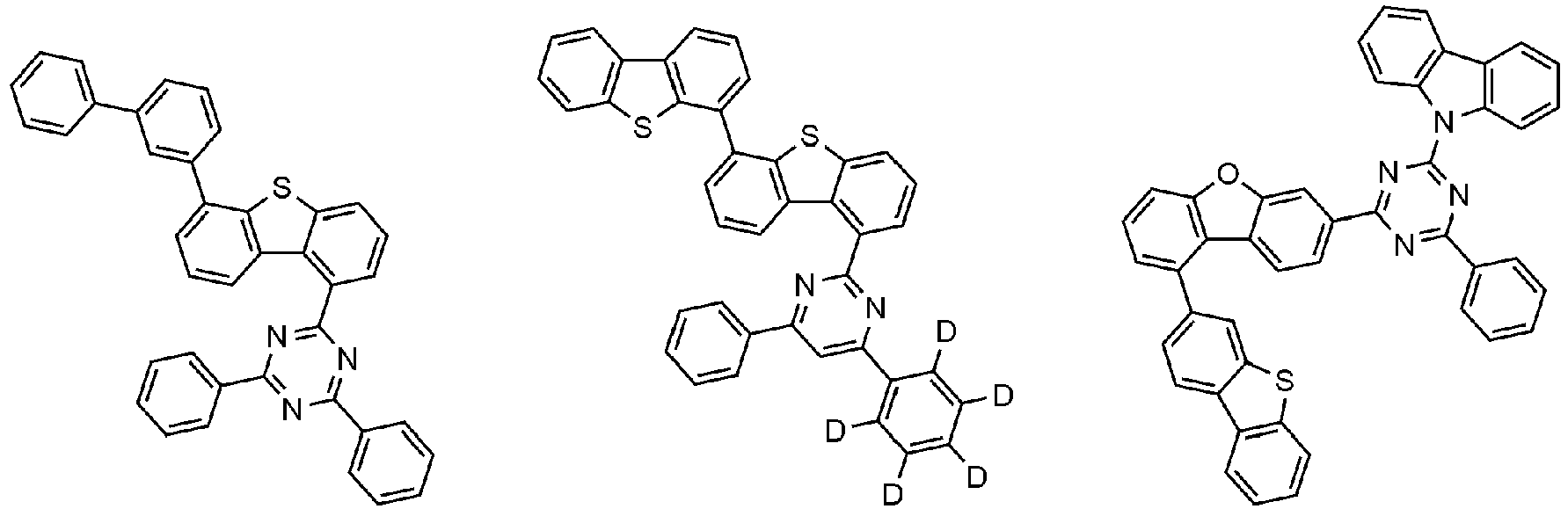

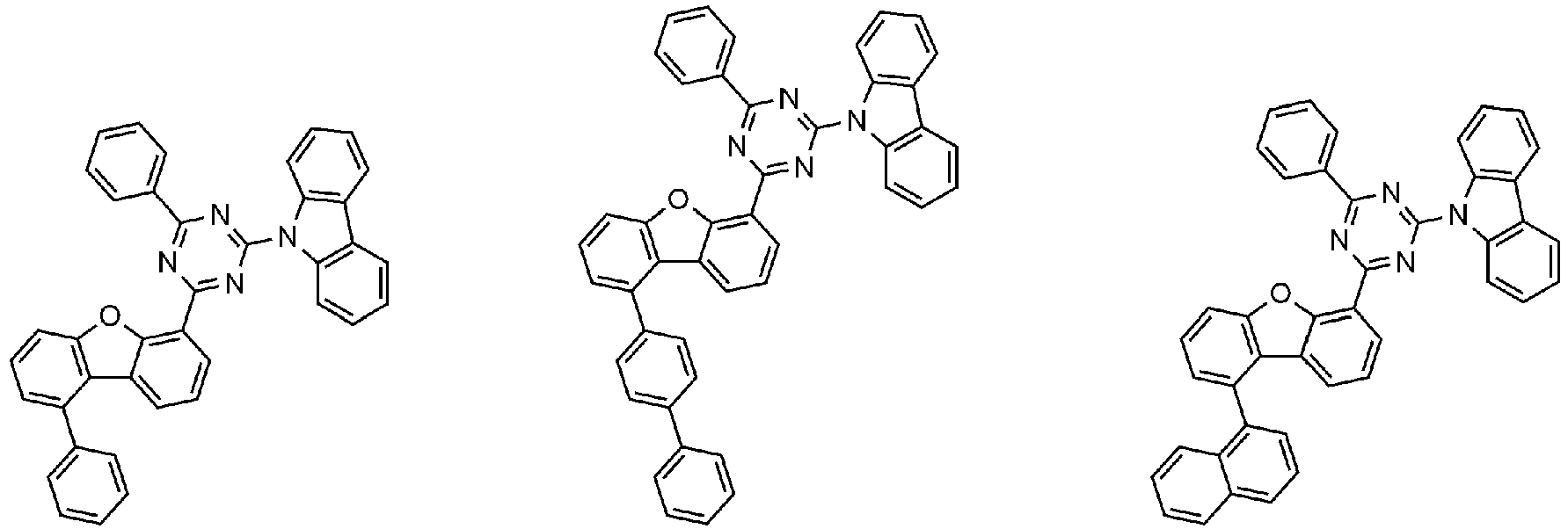


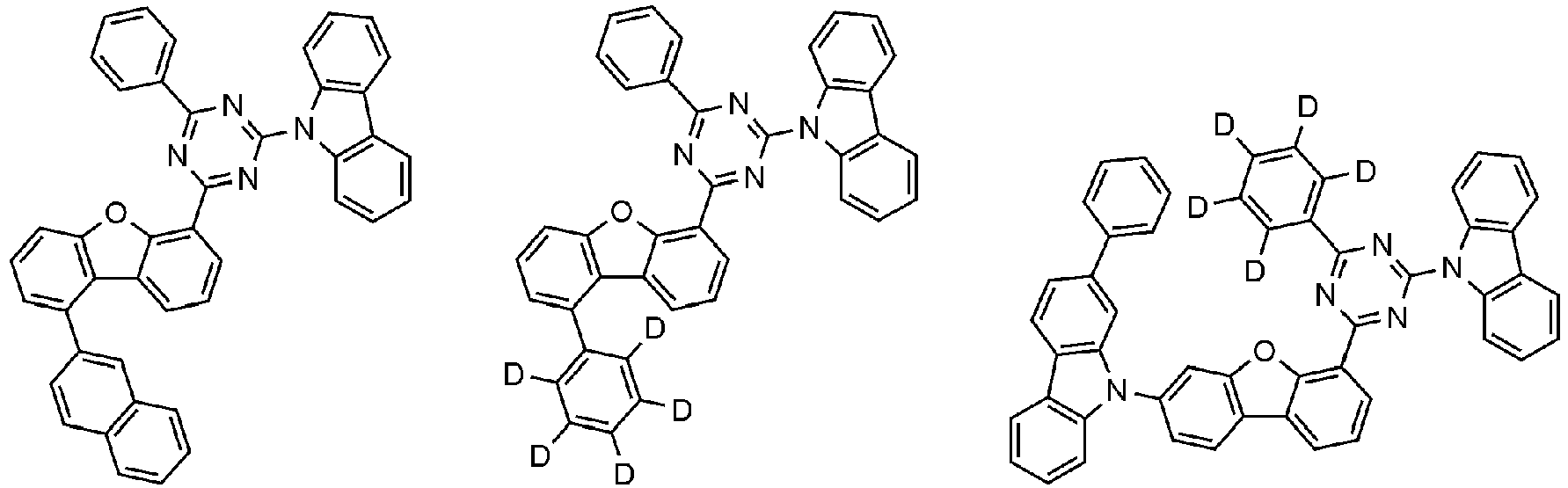


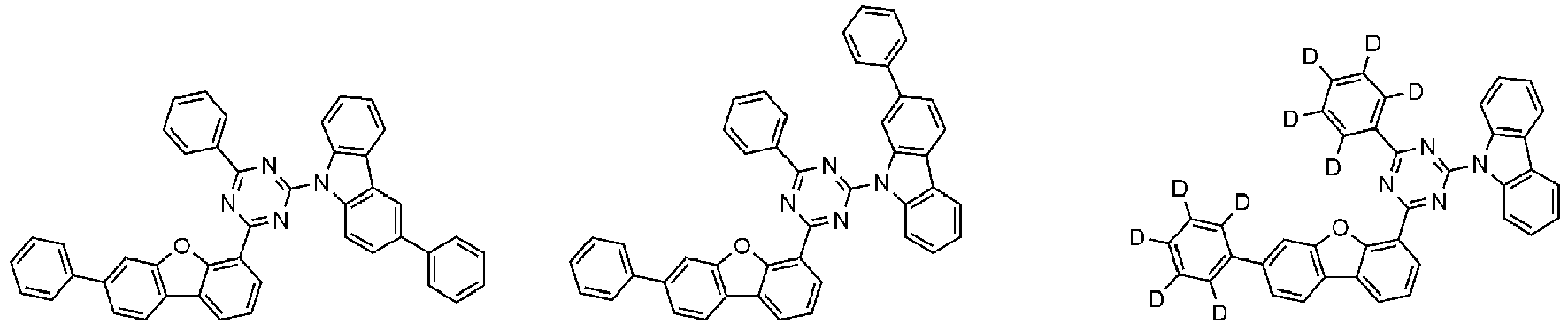


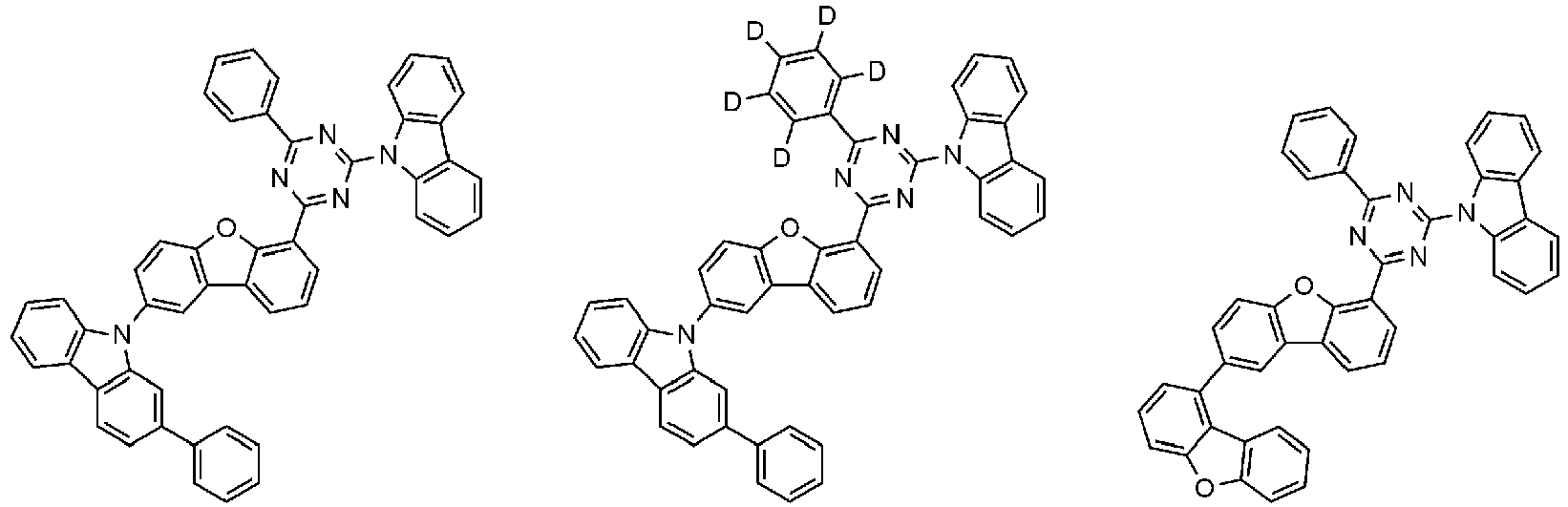


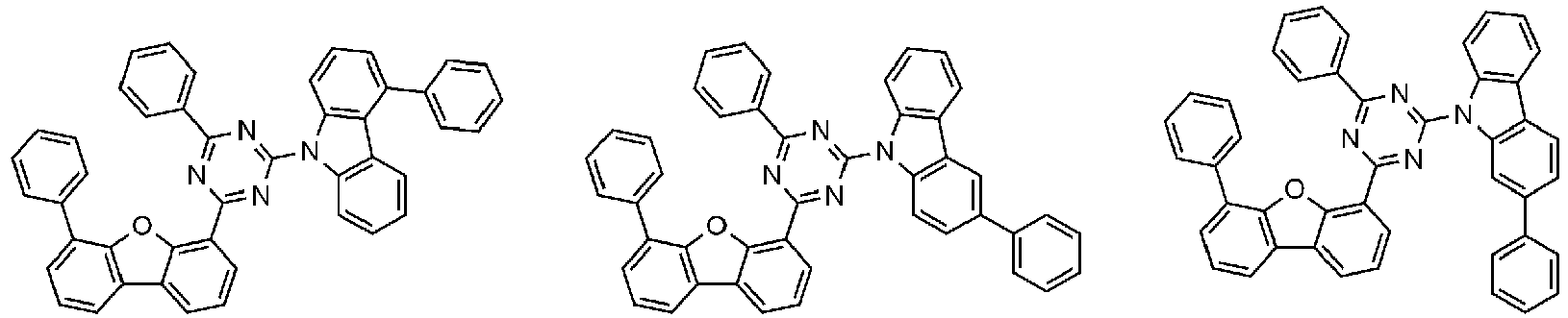


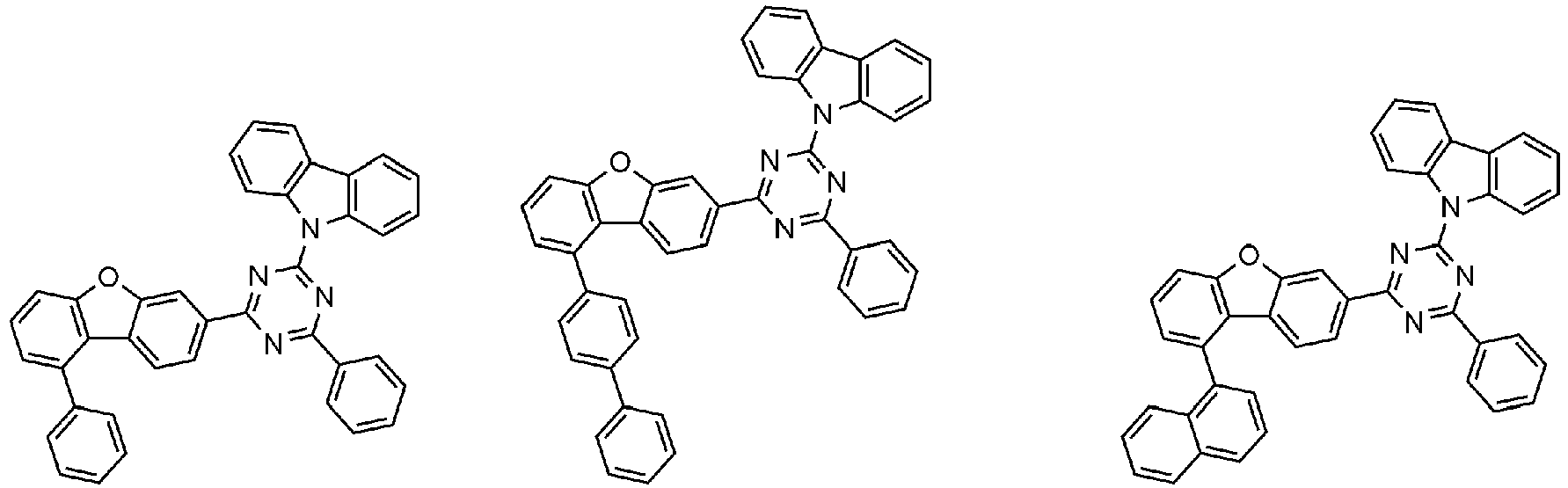


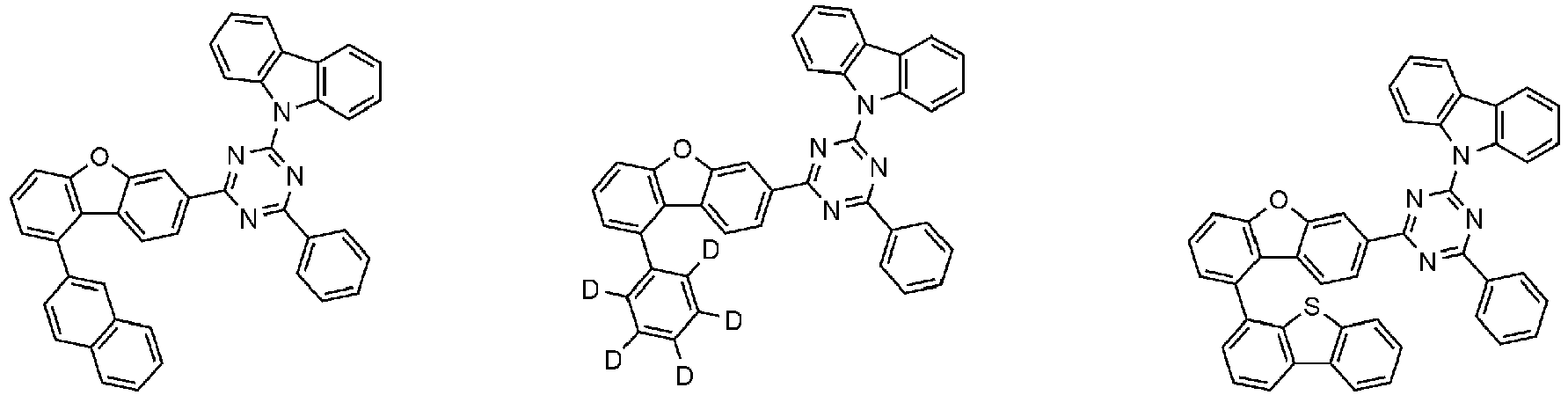


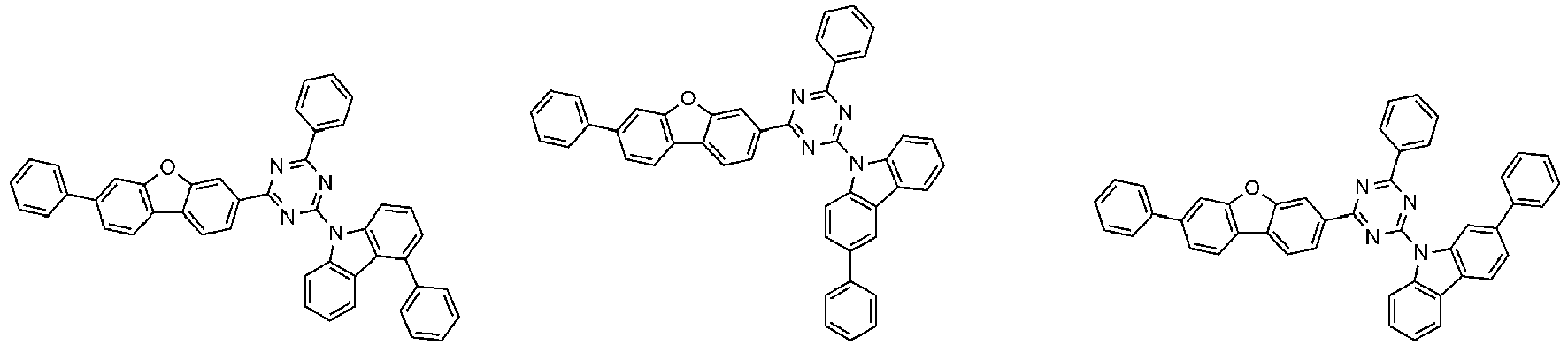


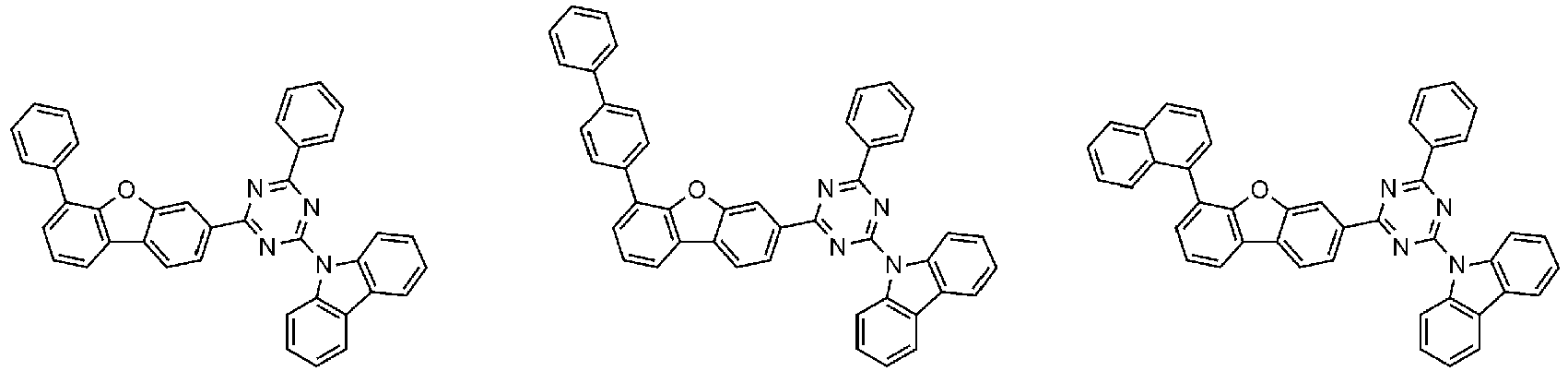


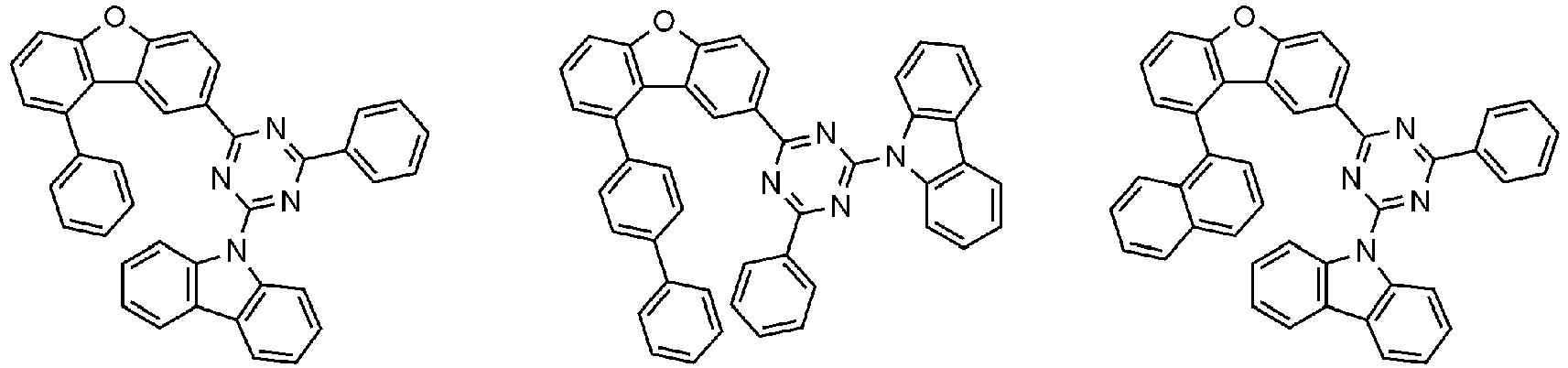





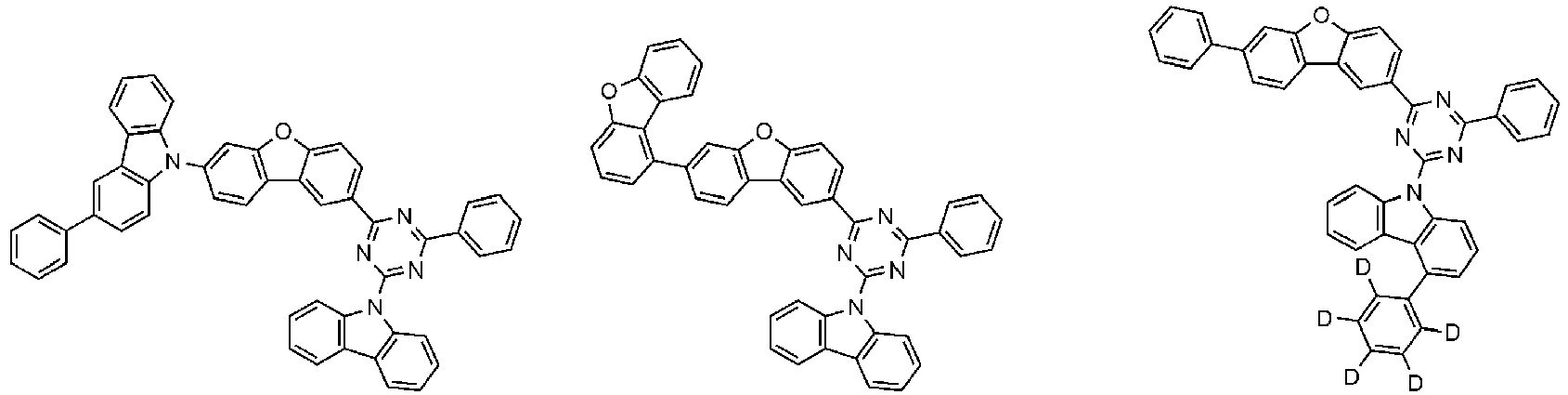


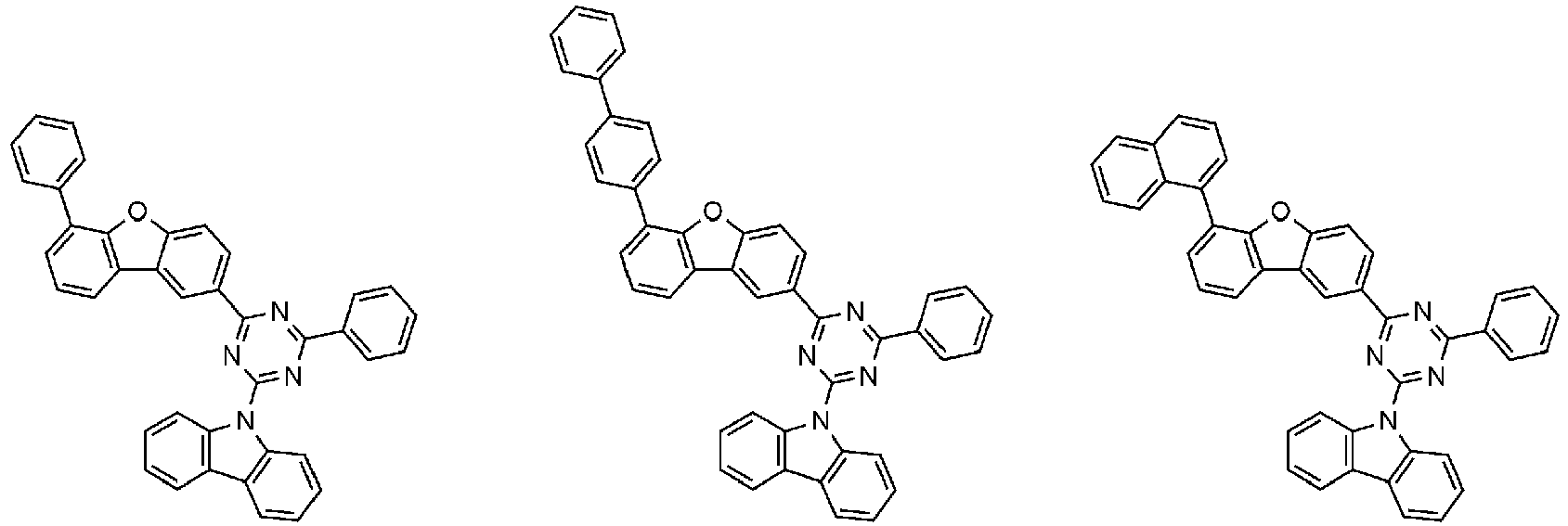


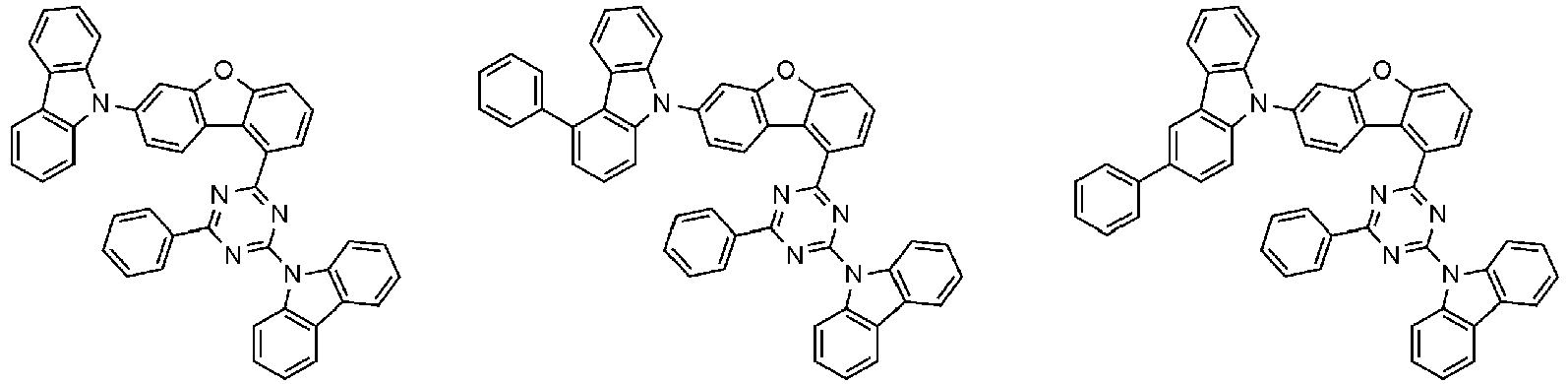


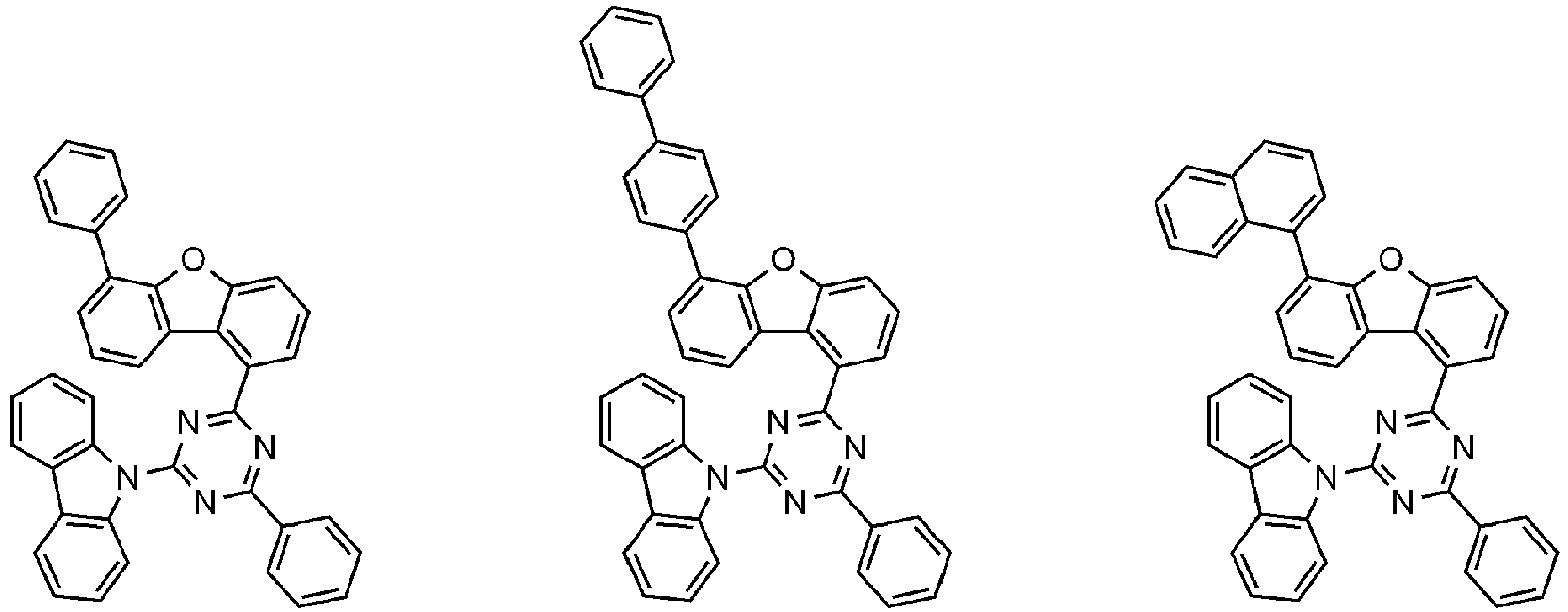


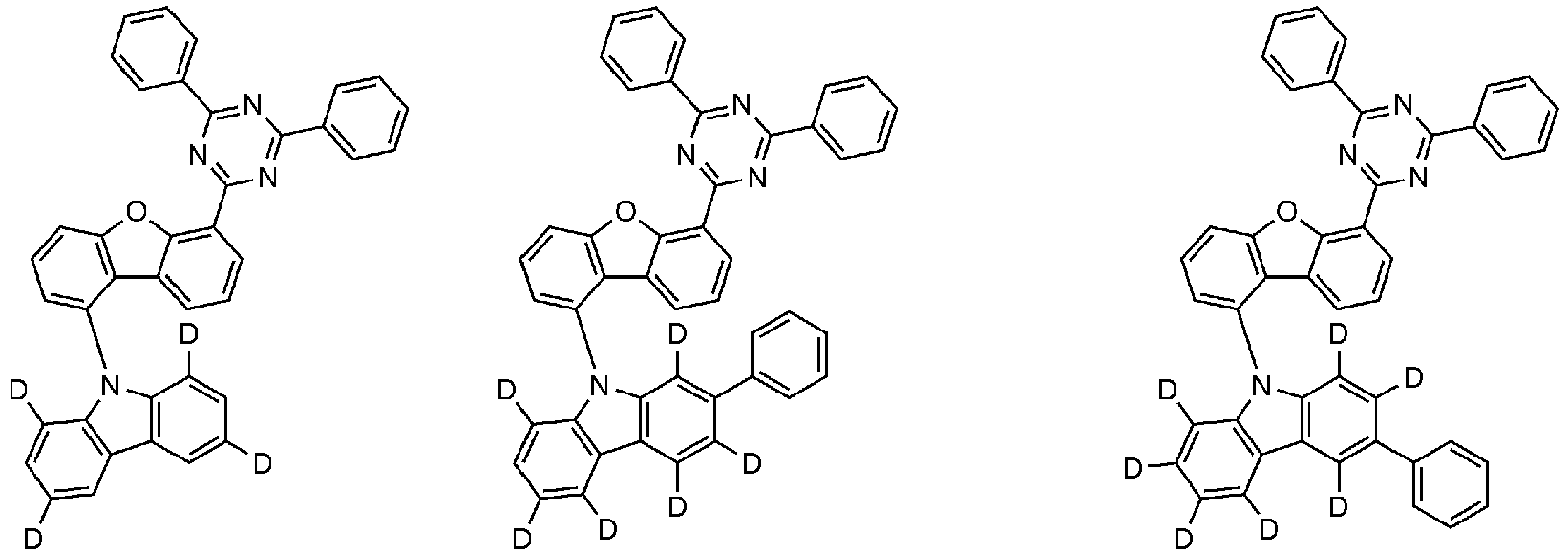


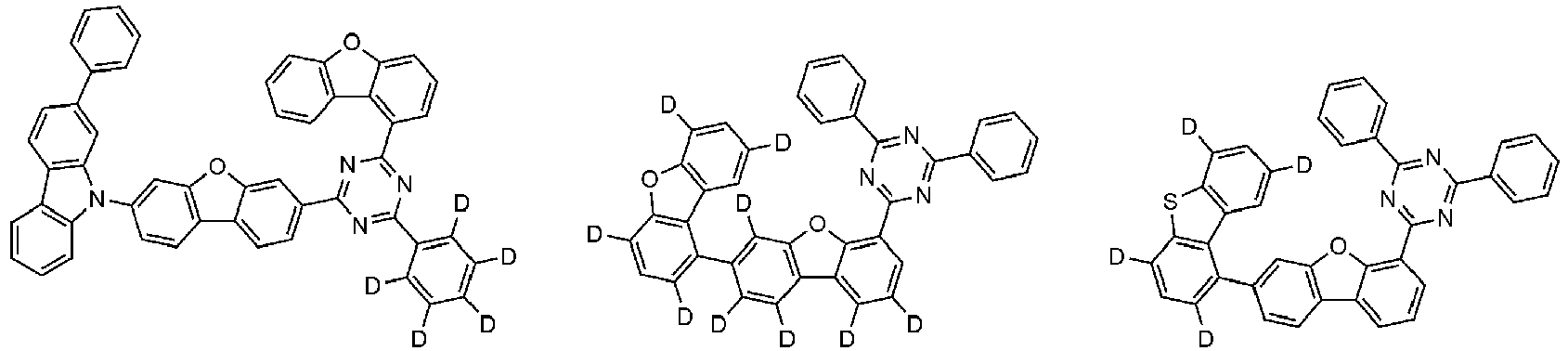

- In addition, the present disclosure provides a method for preparing the compound represented by
Chemical Formula 1 as shown in the followingReaction Scheme 1.
Reaction Scheme 1, the definition of the remaining substituents except for X' are the same as defined above, and X' is halogen, more preferably fluoro, chloro or bromo. - The above reaction is a Suzuki coupling reaction which is preferably carried out in the presence of a palladium catalyst and a base, and a reactive group for the Suzuki coupling reaction can be modified as known in the art. The above preparation method may be further embodied in Preparation Examples described hereinafter.
- Meanwhile, the
Chemical Formula 2 may be the following Chemical Formula 2-1.
claim 1. - Ar3 and Ar4 may be each independently a substituted or unsubstituted C6-30 aryl, or a substituted or unsubstituted C2-30 heteroaryl containing any one or more selected from the group consisting of N, O and S. Specifically, Ar3 and Ar4 may be each independently phenyl, biphenylyl, terphenylyl, naphthyl, dimethylfluorenyl, dibenzofuranyl, or dibenzothiophenyl.
- R2 and R3 may be each independently hydrogen, deuterium, a substituted or unsubstituted C6-30 aryl, or a substituted or unsubstituted C2-30 heteroaryl containing any one or more selected from the group consisting of N, O and S. Specifically, R2 and R3 may be each independently hydrogen or phenyl. For example, one of R2 and R3 is phenyl and the rest is hydrogen, or both R2 and R3 may be hydrogen.
- b and c may be each independently an integer of 1 to 7, and for example, each may be 1.
- Representative examples of the compound represented by
Chemical Formula 2 are as follows:


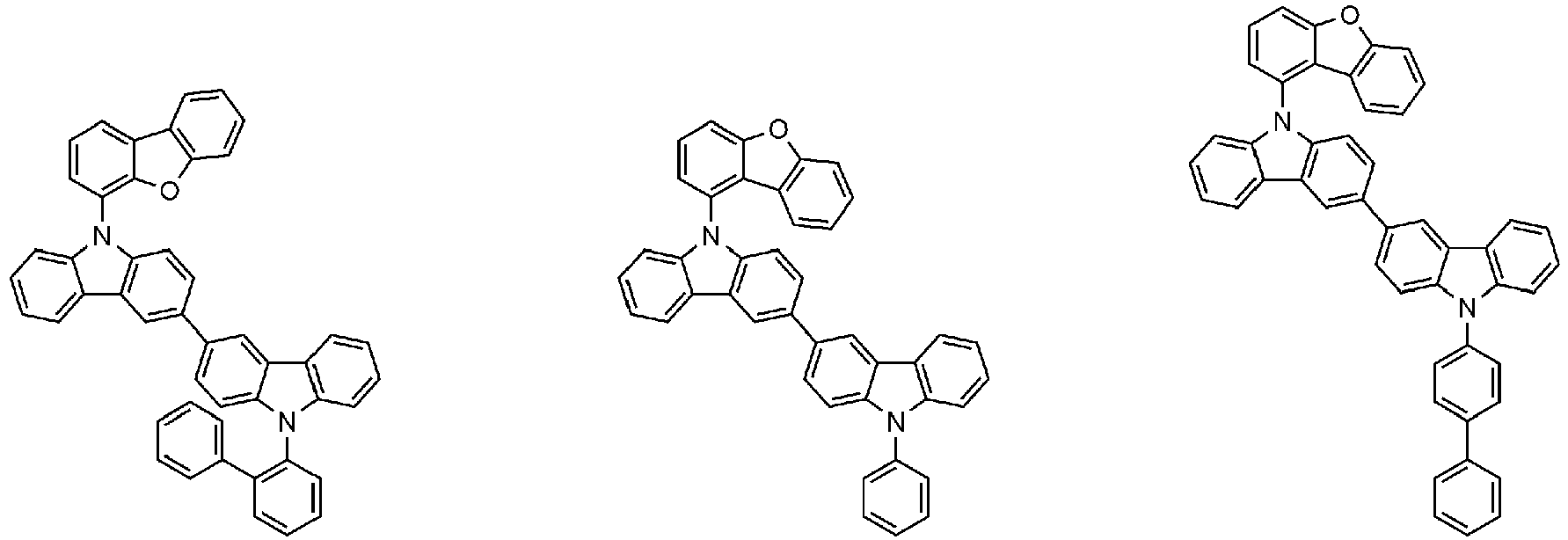


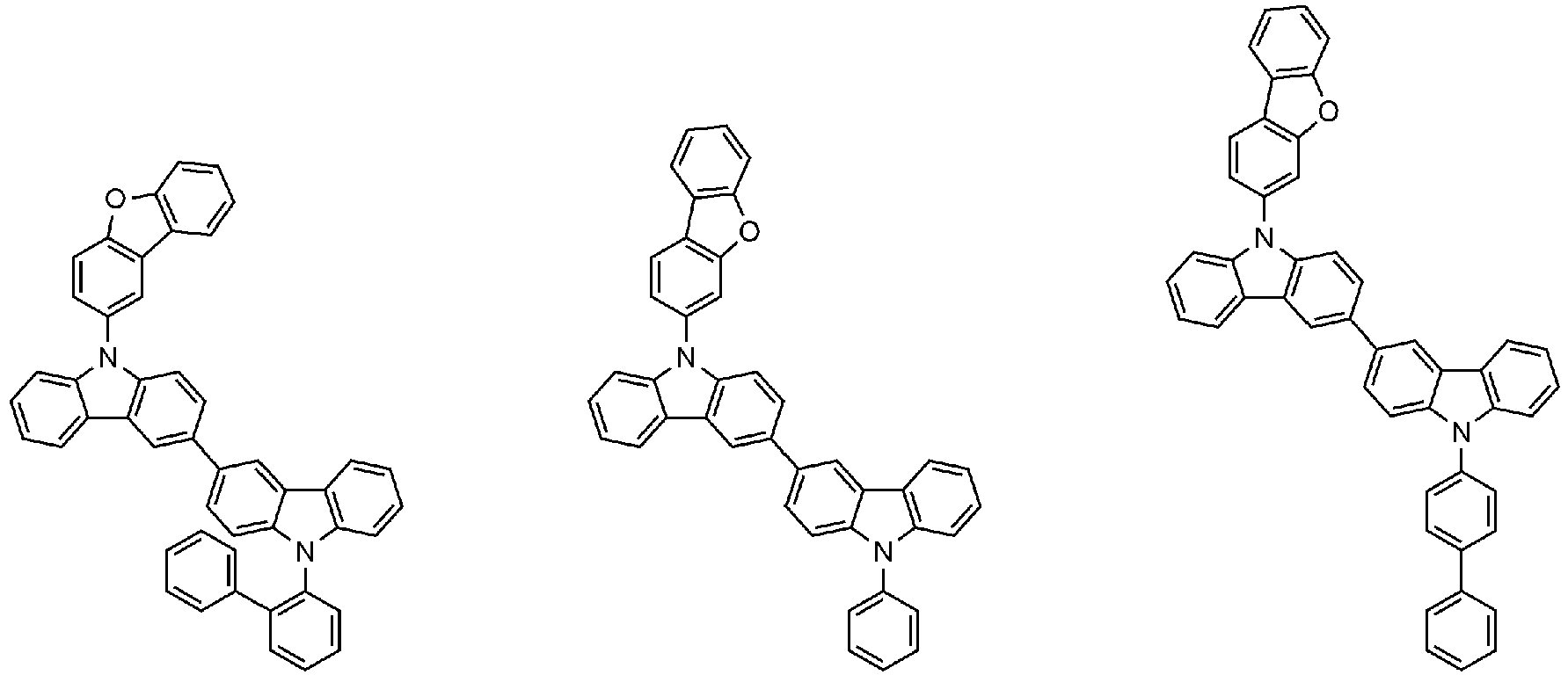


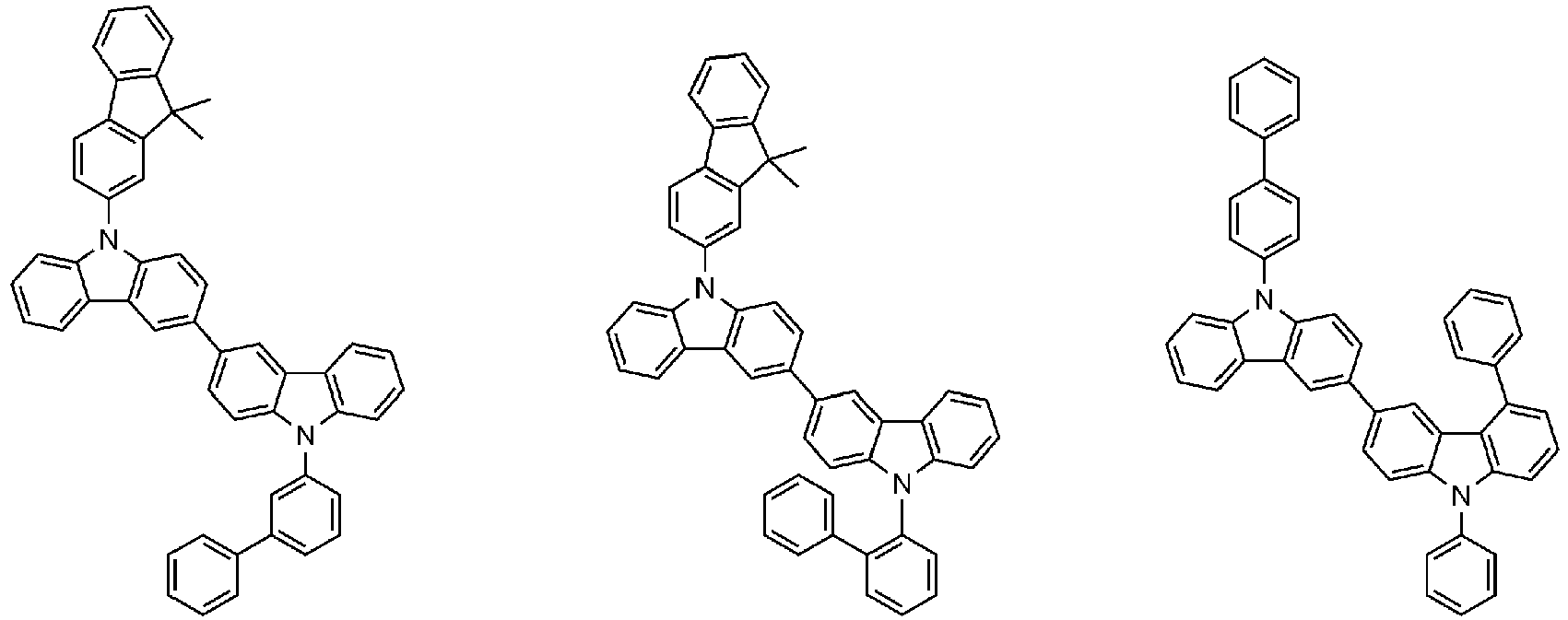


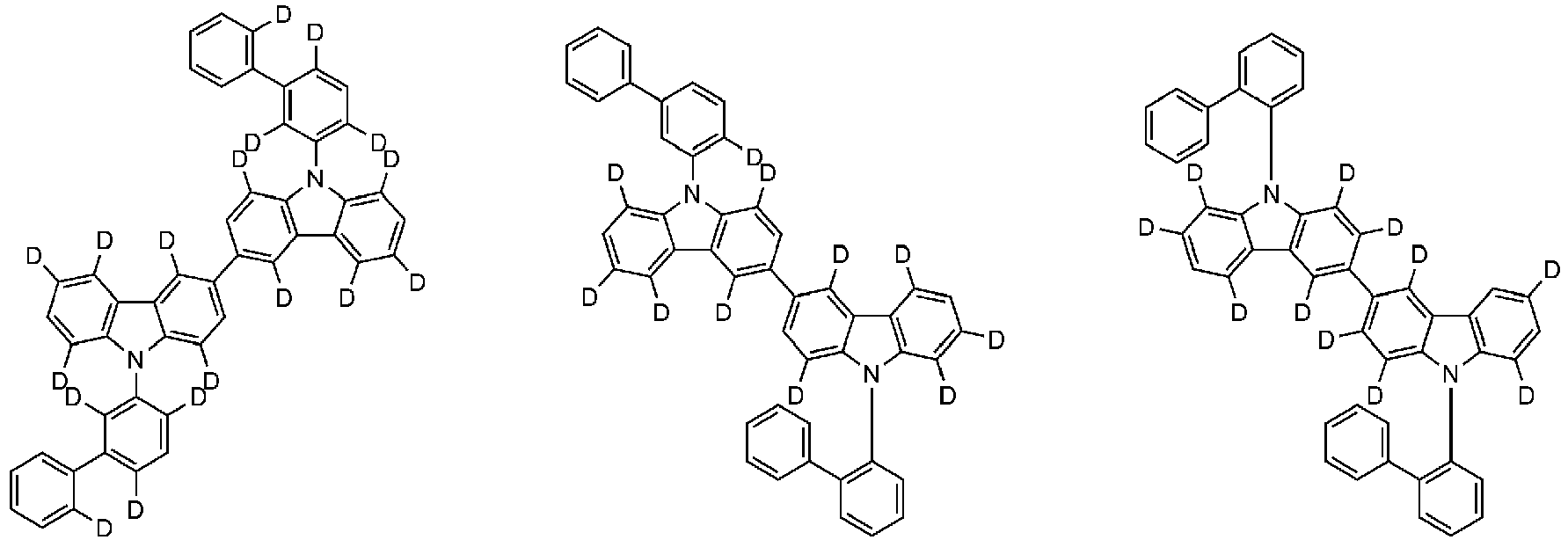


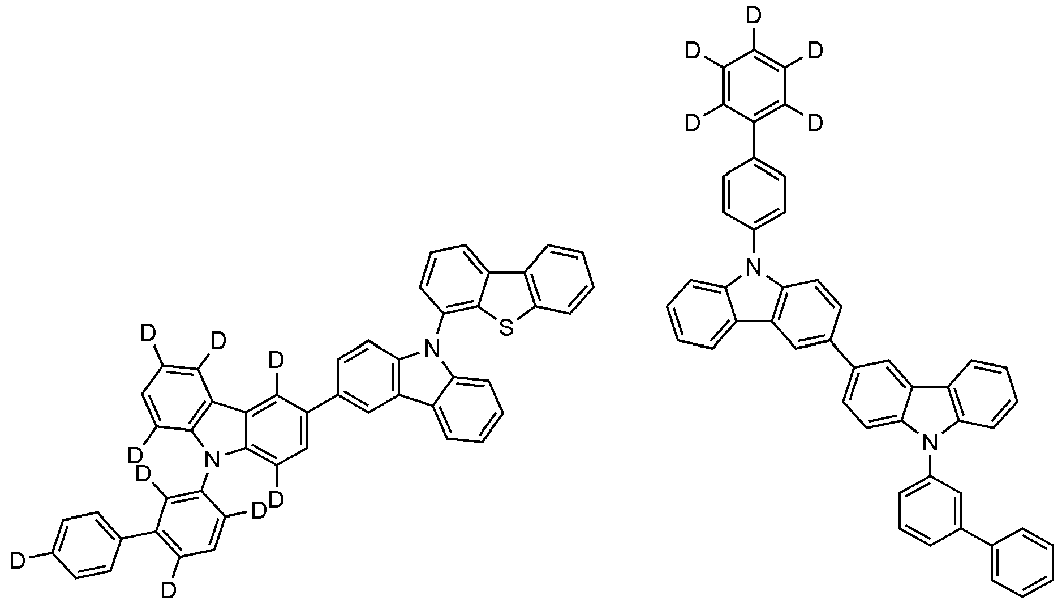
- Further, the present disclosure provides a method for preparing the compound represented by
Chemical Formula 2 as shown in the followingReaction Scheme 2.

Reaction Scheme 2, the definition of the remaining substituents except for X' are the same as defined above, and X' is halogen, more preferably fluoro, chloro or bromo. - The above reaction is a Suzuki coupling reaction which is preferably carried out in the presence of a palladium catalyst and a base, and a reactive group for the Suzuki coupling reaction can be modified as known in the art. The above preparation method may be further embodied in Preparation Examples described hereinafter.
- In
Chemical Formula 3, B is a benzene ring fused with two adjacent pentagonal rings, and C is the following Chemical Formula 4-1 or 4-2,

- Depending on the fused form of B and C, the
Chemical Formula 3 may be any one of the following Chemical Formulas 3-1 to 3-6:


- X1 to X3 are each independently CH or N, provided that at least one of X1 to X3 is N.
- L2 may be a direct bond, a substituted or unsubstituted C6-30 arylene, or a substituted or unsubstituted C2-30 heteroarylene containing any one or more selected from the group consisting of N, O and S. Specifically, L2 is a direct bond or phenylene, provided that when L2 is phenylene, it is unsubstituted or substituted with at least one deuterium.
- Ar5 and Ar6 may be each independently a substituted or unsubstituted C6-30 aryl; or a substituted or unsubstituted C2-30 heteroaryl containing any one or more selected from the group consisting of N, O and S. Specifically, Ar5 and Ar6 may be each independently phenyl, biphenylyl, (phenyl)biphenylyl, triphenylenyl, dimethylfluorenyl, dibenzofuranyl, dibenzothiophenyl, carbazol-9-yl, or 9-phenyl-9H-carbazolyl; with the Ar5 and Are being each independently unsubstituted or substituted with at least one deuterium.
- Y2 may be C(CH3)2, C(C6C5)2, O, S, or NAr7, wherein Ar7 is a substituted or unsubstituted C6-30 aryl, or a substituted or unsubstituted C2-30 heteroaryl containing any one or more selected from the group consisting of N, O and S. Specifically, Ar7 is dibenzofuranyl, or dibenzothiophenyl, with the Ar7 being unsubstituted or substituted with at least one deuterium.
- R4 may be hydrogen, deuterium, a substituted or unsubstituted C6-30 aryl, or a substituted or unsubstituted C2-30 heteroaryl containing any one or more selected from the group consisting of N, O and S. Specifically, R4 may be hydrogen or deuterium.
- d is an integer of 1 to 10.
- Representative examples of the compound represented by
Chemical Formula 3 are as follows:
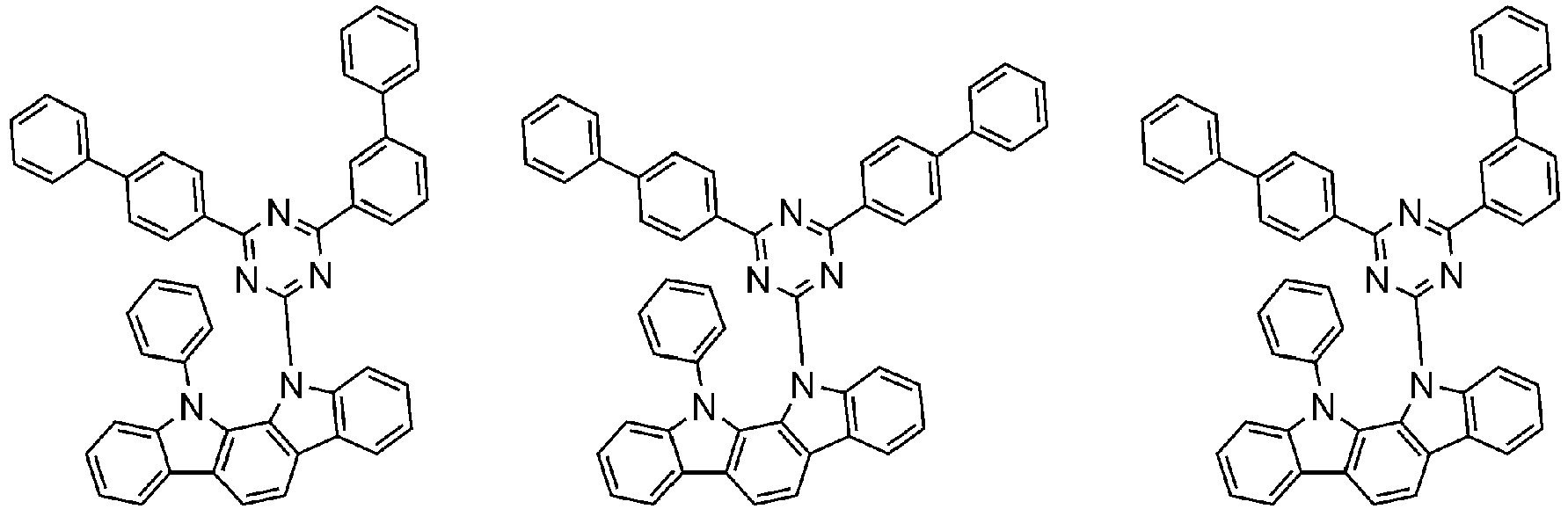


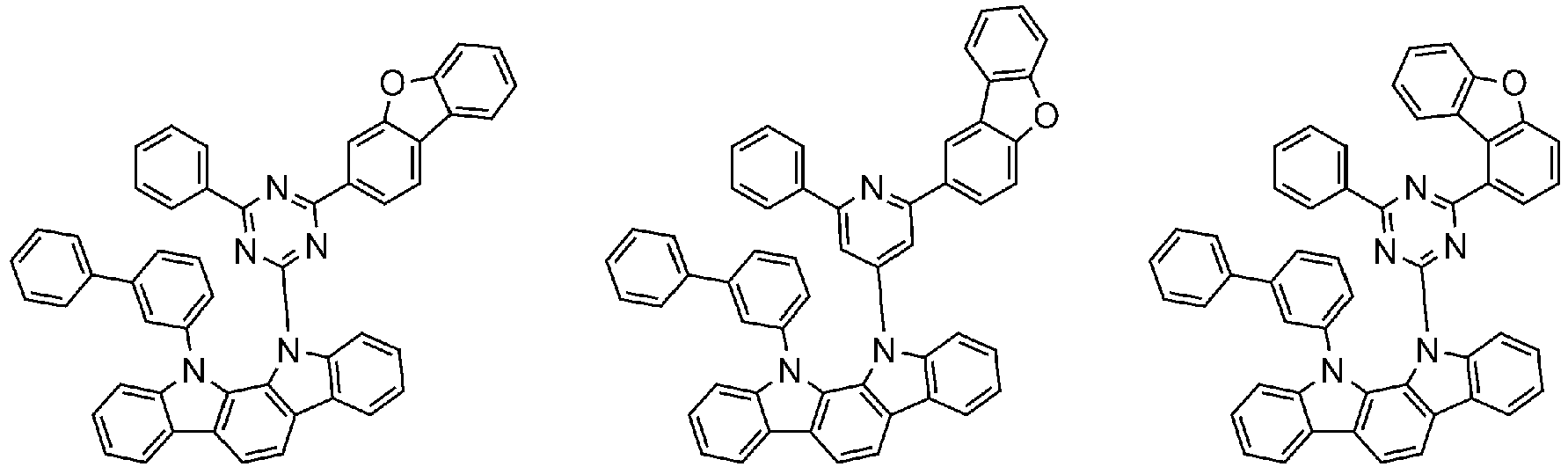

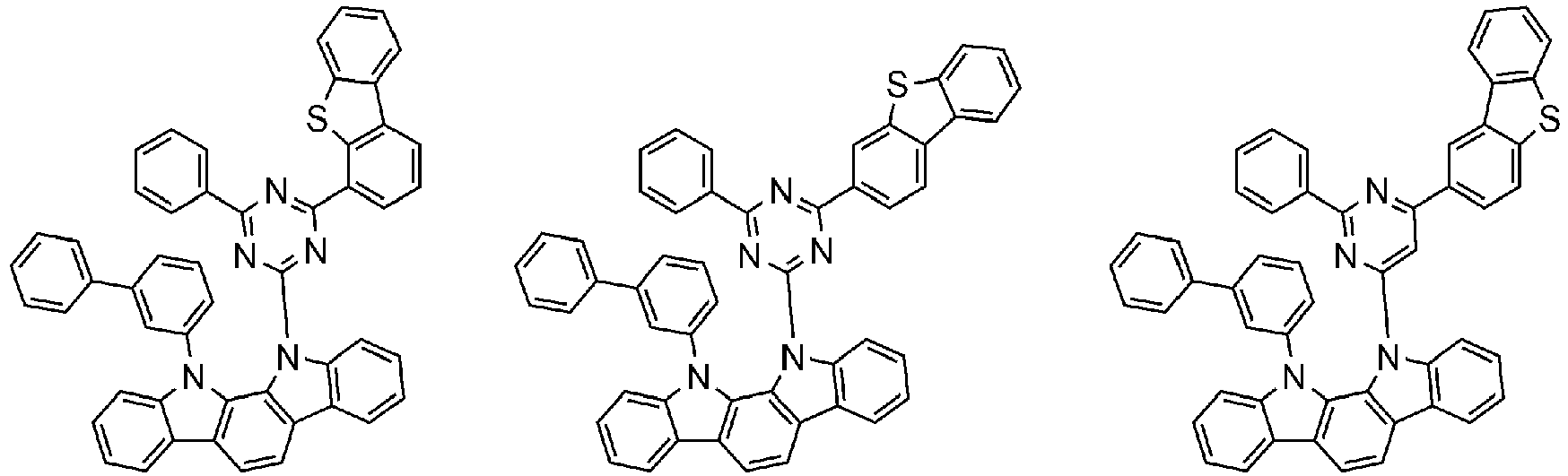


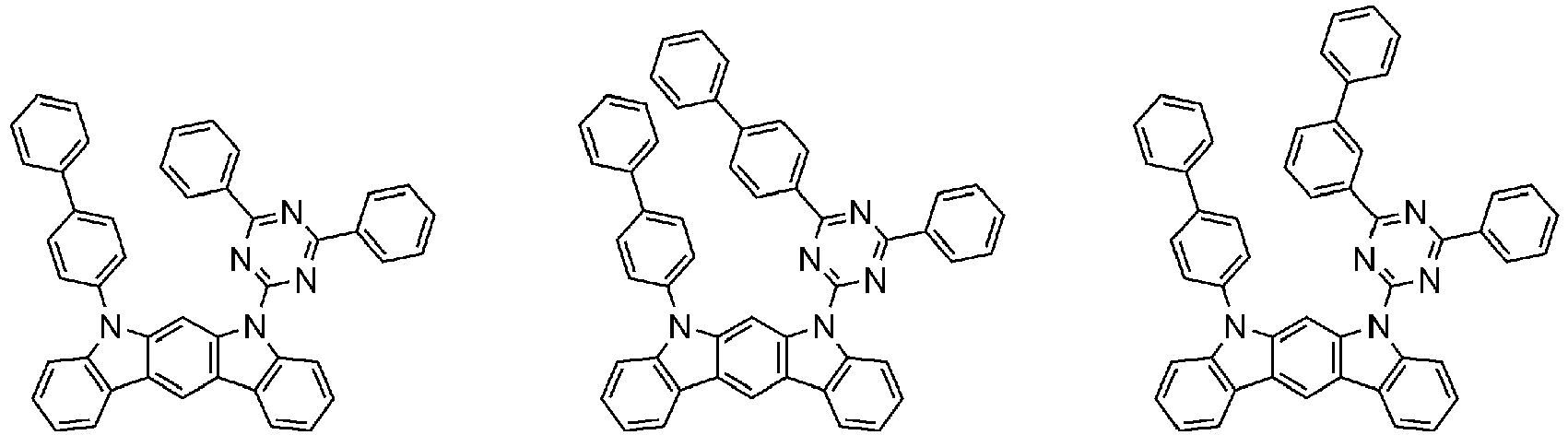


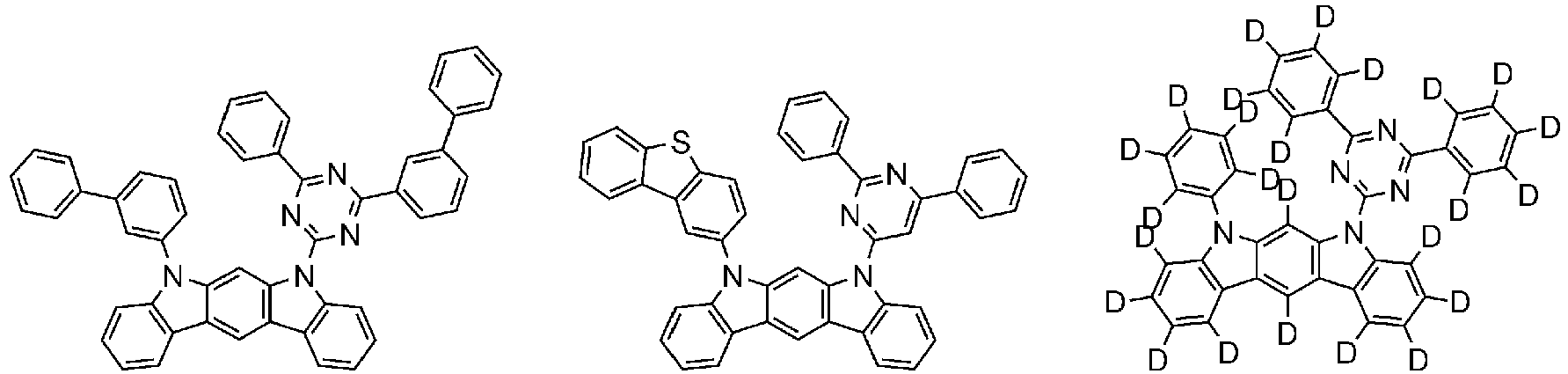


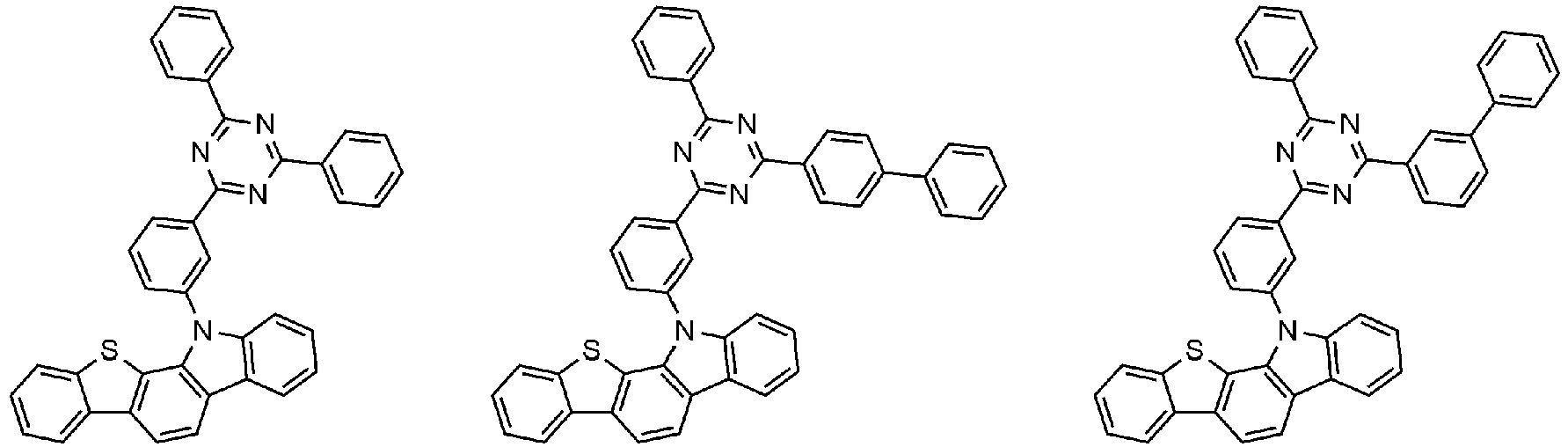


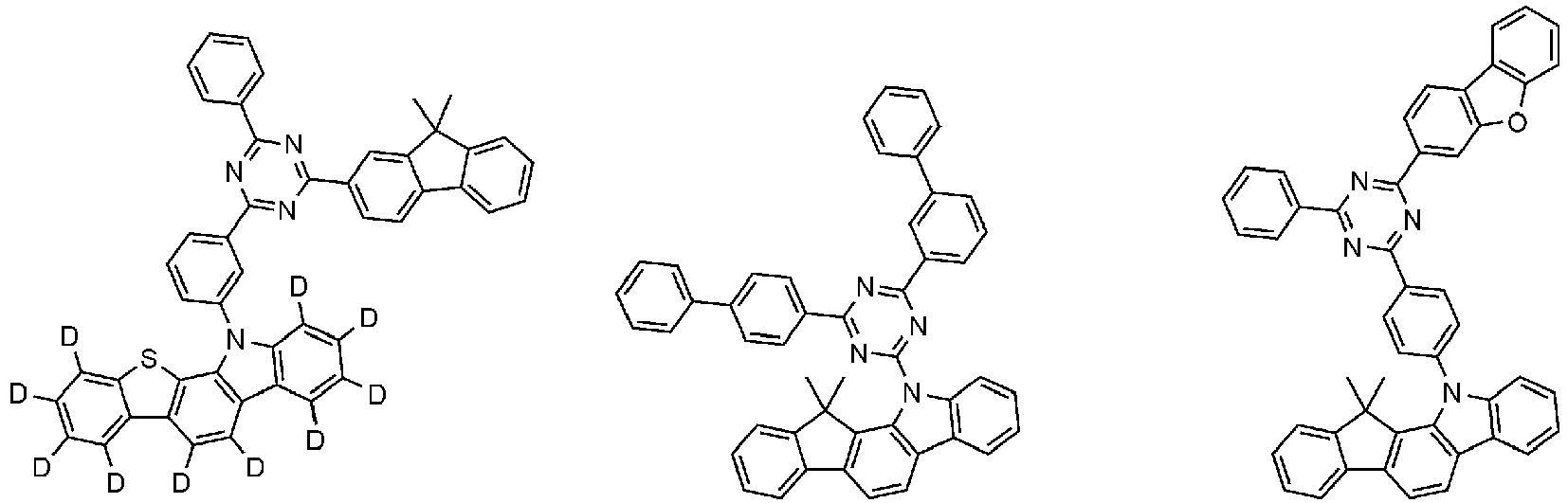


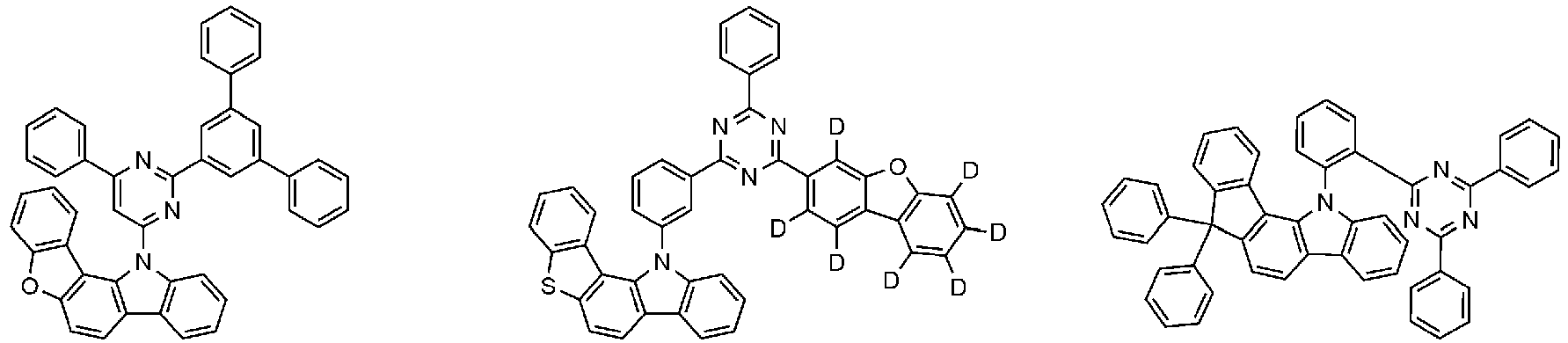
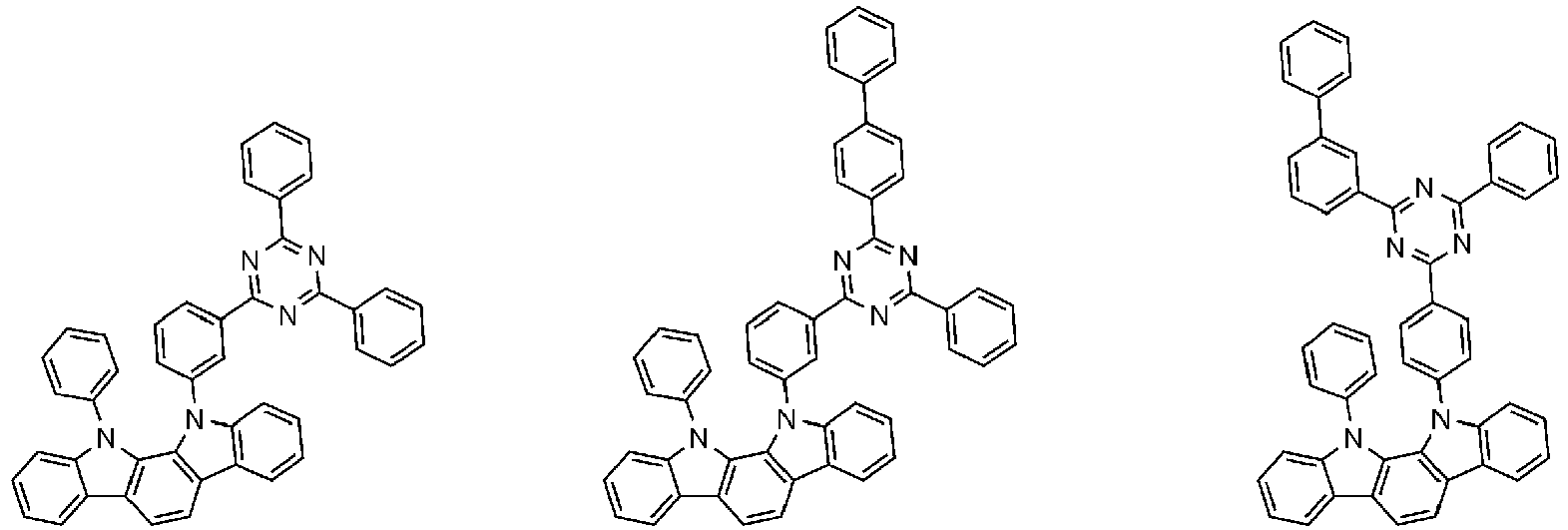


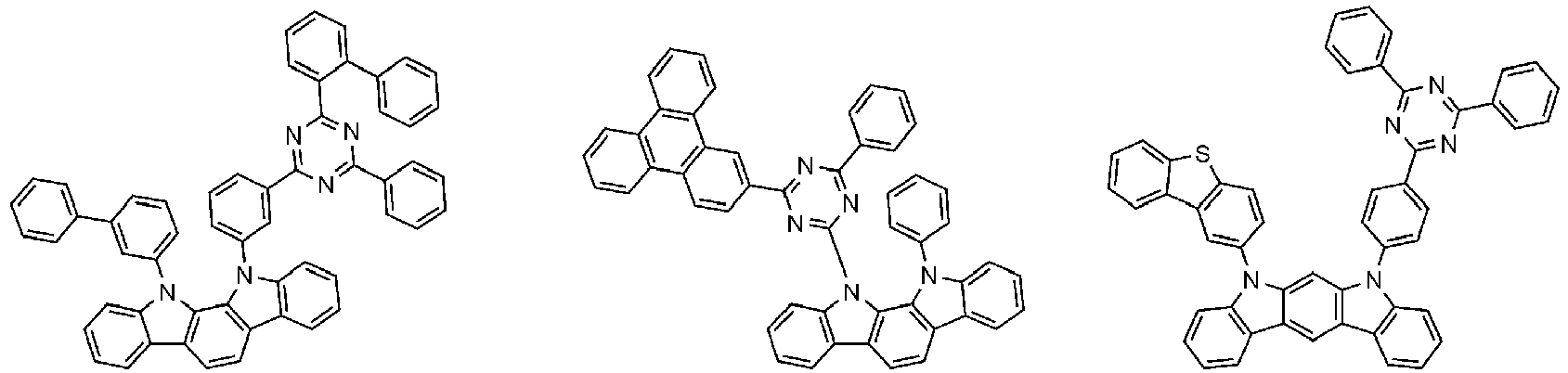


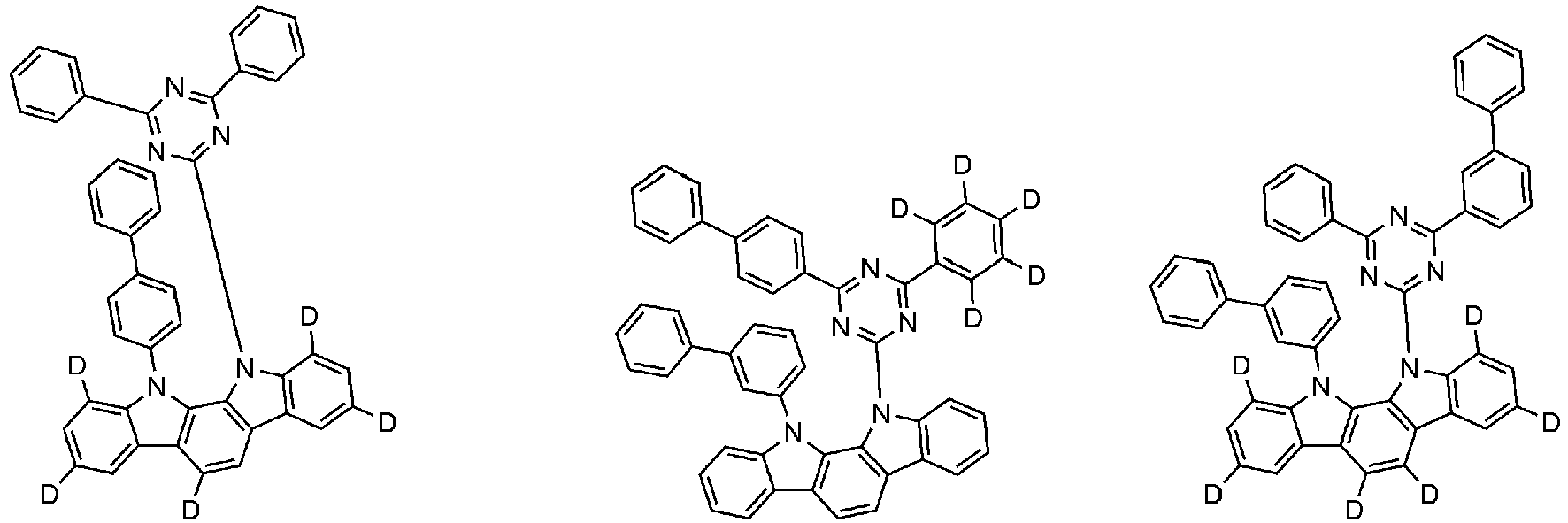


- Further, the present disclosure provides a method for preparing the compound represented by
Chemical Formula 3 as shown in the followingReaction Scheme 3.

Reaction Scheme 3, the definition of the remaining substituents except for X' are the same as defined above, and X' is halogen, more preferably fluoro, chloro or bromo. - The above reaction is an amine substitution reaction which is preferably carried out in the presence of a palladium catalyst and a base, and a reactive group for the amine substitution reaction can be modified as known in the art. The above preparation method may be further embodied in Preparation Examples described hereinafter.
- The dopant material is not particularly limited as long as it is a material used for the organic light emitting device. As an example, an aromatic amine derivative, a styrylamine compound, a boron complex, a fluoranthene compound, a metal complex, and the like can be mentioned. Specific examples of the aromatic amine derivatives include substituted or unsubstituted fused aromatic ring derivatives having an arylamino group, examples thereof include pyrene, anthracene, chrysene, and periflanthene having the arylamino group, and the like. The styrylamine compound is a compound where at least one arylvinyl group is substituted in substituted or unsubstituted arylamine, wherein one or two or more substituent groups selected from the group consisting of an aryl group, a silyl group, an alkyl group, a cycloalkyl group and an arylamino group are substituted or unsubstituted. Specific examples thereof include styrylamine, styryldiamine, styryltriamine, styryltetramine, and the like, but are not limited thereto. Further, examples of the metal complex include an iridium complex, a platinum complex, and the like, but are not limited thereto
- The organic light emitting device according to the present disclosure may include a hole transport layer between the electron inhibition layer and the anode.
- The hole transport layer is a layer that receives holes from a hole injection layer and transports the holes to the light emitting layer. The hole transport material is suitably a material having large mobility to the holes, which may receive holes from the anode or the hole injection layer and transfer the holes to the light emitting layer.
- The hole transport material may include an arylamine-based organic material, a conductive polymer, a block copolymer in which a conjugate portion and a non-conjugate portion are present together, and the like, but are not limited thereto.
- The organic light emitting device according to the present disclosure includes an electron inhibition layer between the anode and the light emitting layer. Preferably, the electron inhibition layer is included in contact with the anode side of the light emitting layer.
- The electron inhibition layer includes an electron blocking layer and serves to suppress the electrons injected from the cathode from being transmitted toward the anode without being recombined in the light emitting layer.
- The electron inhibition layer includes an electron blocking layer, and examples of the electron blocking layer include an arylamine-based organic material, or the like, but is not limited thereto.
- The organic light emitting device according to the present disclosure may further include a hole injection layer between the anode and the hole transport layer, if necessary.
- The hole injection layer is a layer injecting holes from an electrode, and the hole injection material is preferably a compound which has a capability of transporting the holes, a hole injection effect in the anode and an excellent hole injection effect to the light emitting layer or the light emitting material, prevents movement of an exciton generated in the light emitting layer to the electron injection layer or the electron injection material, and has an excellent thin film forming ability. It is preferable that a HOMO (highest occupied molecular orbital) of the hole injection material is between the work function of the anode material and a HOMO of a peripheral organic material layer.
- Specific examples of the hole injection material include metal porphyrine, oligothiophene, an arylamine-based organic material, a hexanitrilehexaazatriphenylene-based organic material, a quinacridone-based organic material, a perylene-based organic material, anthraquinone, polyaniline and polythiophene-based conductive polymer, and the like, but are not limited thereto.
- The organic light emitting device according to the present disclosure may include an electron transport layer between the light emitting layer and the cathode.
- The electron transport layer is a layer that receives electrons from a cathode and an electron injection layer formed on the cathode and transports the electrons to the light emitting layer, and that suppress the transfer of holes from the light emitting layer, and an electron transport material is suitably a material which may receive electrons well from a cathode and transfer the electrons to a light emitting layer, and has a large mobility for electrons.
- Specific examples of the electron transport material include: an Al complex of 8-hydroxyquinoline; a complex including Alq3; an organic radical compound; a hydroxyflavone-metal complex, and the like, but are not limited thereto. The electron transport layer may be used with any desired cathode material, as used according to a conventional technique. In particular, appropriate examples of the cathode material are a typical material which has a low work function, followed by an aluminum layer or a silver layer. Specific examples thereof include cesium, barium, calcium, ytterbium, and samarium, in each case followed by an aluminum layer or a silver layer.
- The organic light emitting device according to the present disclosure may further include an electron injection layer between the electron transport layer and the cathode, if necessary.
- The electron injection layer is a layer which injects electrons from an electrode, and is preferably a compound which has a capability of transporting electrons, has an effect of injecting electrons from a cathode and an excellent effect of injecting electrons into a light emitting layer or a light emitting material, prevents excitons produced from the light emitting layer from moving to a hole injection layer, and is also excellent in the ability to form a thin film.
- Specific examples of the materials that can be used as the electron injection layer include fluorenone, anthraquinodimethane, diphenoquinone, thiopyran dioxide, oxazole, oxadiazole, triazole, imidazole, perylenetetracarboxylic acid, fluorenylidene methane, anthrone, and the like, and derivatives thereof, a metal complex compound, a nitrogen-containing 5-membered ring derivative, and the like, but are not limited thereto.
- Examples of the metal complex compound include 8-hydroxyquinolinato lithium, bis(8-hydroxyquinolinato)zinc, bis(8-hydroxyquinolinato)copper, bis(8-hydroxyquinolinato)manganese, tris(8-hydroxyquinolinato)aluminum, tris(2-methyl-8-hydroxyquinolinato)aluminum, tris(8-hydroxyquinolinato)gallium, bis(10-hydroxybenzo[h]quinolinato)beryllium, bis(10-hydroxybenzo[h]quinolinato)zinc, bis(2-methyl-8-quinolinato)chlorogallium, bis(2-methyl-8-quinolinato)(o-cresolato)gallium, bis(2-methyl-8-quinolinato)(1-naphtholato)aluminum, bis(2-methyl-8-quinolinato)(2-naphtholato)gallium, and the like, but are not limited thereto.
- The structure of the organic light emitting device according to the present disclosure is illustrated in
Fig. 1. Fig. 1 shows an example of an organic light emitting device comprising asubstrate 1, ananode 2, anelectron inhibition layer 3, alight emitting layer 4, and acathode 5. In addition, the structure of the organic light emitting device including thehole transport layer 6 and theelectron transport layer 7 is illustrated inFig. 2 . - The organic light emitting device according to the present disclosure can be manufactured by sequentially stacking the above-described structures. In this case, the organic light emitting device may be manufactured by depositing a metal, metal oxides having conductivity, or an alloy thereof on the substrate by using a PVD (physical vapor deposition) method such as a sputtering method or an e-beam evaporation method to form the anode, forming the respective layers described above thereon, and then depositing a material that can be used as the cathode thereon. In addition to such a method, the organic light emitting device can be manufactured by sequentially depositing from the cathode material to the anode material on a substrate in the reverse order of the above-mentioned configuration (
WO 2003/012890 ). Further, the light emitting layer may be formed by subjecting hosts and dopants to a vacuum deposition method and a solution coating method. Herein, the solution coating method means a spin coating, a dip coating, a doctor blading, an inkjet printing, a screen printing, a spray method, a roll coating, or the like, but is not limited thereto. - On the other hand, the organic light emitting device according to the present disclosure may be a front side emission type, a back side emission type, or a double side emission type according to the used material.
- The preparation of the organic light emitting device according to the present disclosure will be described in detail in the following examples. However, these examples are presented for illustrative purposes only, and are not intended to limit the scope of the present disclosure.
-

- 2-Bromo-7-chlorodibenzo[b,d]furan (20 g, 71 mmol) and 9H-carbazole (11.9 g, 71 mmol) were added to xylene (400 ml) under a nitrogen atmosphere, and the mixture was stirred and refluxed. Then, K3PO4 (20.5 g, 213.1 mmol) was added thereto, and the mixture was sufficiently stirred and then bis(tri-tert-butylphosphine)palladium(0) (1.1 g, 2.1 mmol) was added. After the reaction for 3 hours, the reaction mixture was cooled to room temperature, and the organic layer was filtered to remove salts, and then the filtered organic layer was distilled. This was again added to and dissolved in chloroform (261 ml), washed twice with water, and then the organic layer was separated, anhydrous magnesium sulfate was added thereto, stirred, and then filtered, and the filtrate was distilled under reduced pressure. The concentrated compound was recrystallized using chloroform and ethanol to prepare a beige solid Compound 1-1-A (17.8 g, yield: 68%).
- MS: [M+H]+ = 368.8
- Compound 1-1-A (30 g, 81.6 mmol) and bis(pinacolato)diboron (20.7 g, 81.6 mmol) were added to dioxane (600 ml) under a nitrogen atmosphere, and the mixture was stirred and refluxed. Then, potassium acetate (24 g, 244.7 mmol) was added thereto, and the mixture was sufficiently stirred and then bis(dibenzylideneacetone)palladium(0) (1.4 g, 2.4 mmol) and tricyclohexylphosphine (1.4 g, 4.9 mmol) were added. After the reaction for 5 hours, the reaction mixture was cooled to room temperature, and the organic layer was filtered to remove salts, and then the filtered organic layer was distilled. This was again added to and dissolved in chloroform (375 ml), washed twice with water, and then the organic layer was separated, anhydrous magnesium sulfate was added thereto, stirred, and then filtered, and the filtrate was distilled under reduced pressure. The concentrated compound was recrystallized using chloroform and ethanol to prepare a white solid Compound 1-1-B (19.5 g, yield: 52%).
- MS: [M+H]+ = 460.4
- Compound 1-1-B (20 g, 43.5 mmol) and 2-chloro-4,6-diphenyl-1,3,5-triazine (11.7 g, 43.5 mmol) were added to THF (400 ml) under a nitrogen atmosphere, and the mixture was stirred and refluxed. Then, potassium carbonate (18.1 g, 130.6 mmol) was dissolved in water (54 ml), added thereto, and the mixture was sufficiently stirred and then bis(tri-tert-butylphosphine)palladium(0) (0.7 g, 1.3 mmol) was added. After the reaction for 5 hours, the reaction mixture was cooled to room temperature, and the organic layer and the aqueous layer were separated and then the organic layer was distilled. This was again added to and dissolved in chloroform (1229 ml), washed twice with water, and then the organic layer was separated, anhydrous magnesium sulfate was added thereto, stirred, and then filtered, and the filtrate was distilled under reduced pressure. The concentrated compound was recrystallized using chloroform and ethyl acetate to prepare a fluorescent solid Compound 1-1 (17.5 g, yield: 71%).
- MS: [M+H]+ = 565.7

- Compound 1-2 (16.7 g, yield: 68%) was prepared in the same manner as in the Preparation of Compound 1-1, except that 3-bromo-7-chlorodibenzo[b,d]furan was used instead of 2-bromo-7-chlorodibenzo[b,d]furan.
- MS: [M+H]+ = 565.7
-
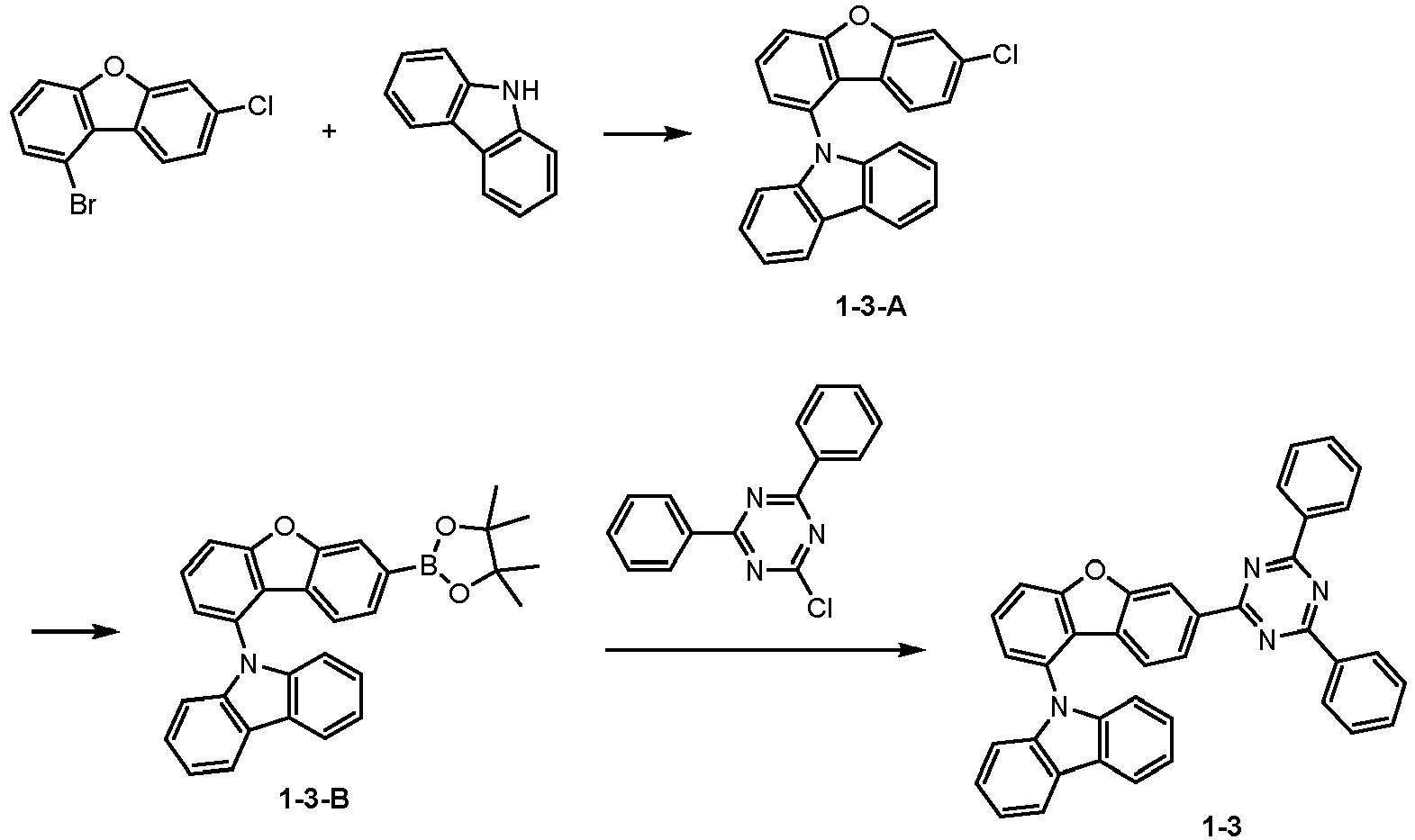
- Compound 1-3 (12.8 g, yield: 52%) was prepared in the same manner as in the Preparation of Compound 1-1, except that 1-bromo-7-chlorodibenzo[b,d]furan was used instead of 2-bromo-7-chlorodibenzo[b,d]furan.
- MS: [M+H]+ = 565.7
-

- Compound 1-4 (17.9 g, yield: 73%) was prepared in the same manner as in the Preparation of Compound 1-1, except that 1-bromo-6-chlorodibenzo[b,d]furan was used instead of 2-bromo-7-chlorodibenzo[b,d]furan.
- MS: [M+H]+ = 565.7
-

- Compound 1-5 (13.8 g, yield: 56%) was prepared in the same manner as in the Preparation of Compound 1-1, except that 3-bromo-6-chlorodibenzo[b,d]furan was used instead of 2-bromo-7-chlorodibenzo[b,d]furan.
- MS: [M+H]+ = 565.7
-

- Compound 1-6 (15.7 g, yield: 64%) was prepared in the same manner as in the Preparation of Compound 1-1, except that 6-bromo-3-chlorodibenzo[b,d]furan was used instead of 2-bromo-7-chlorodibenzo[b,d]furan.
- MS: [M+H]+ = 565.7
-

- Compound 1-7 (16.4 g, yield: 66%) was prepared in the same manner as in the Preparation of Compound 1-1, except that 9H-carbazole-1,3,4,5,6,8-d6 was used instead of 9H-carbazole.
- MS: [M+H]+ = 571.7
-

- Compound 1-8 (16.9 g, yield: 60%) was prepared in the same manner as in the Preparation of Compound 1-1, except that in
step 1 of the Preparation of Compound 1-1, 2-bromo-6-chlorodibenzo[b,d]furan-1,3,4,8,9-d5 was used instead of 2-bromo-7-chlorodibenzo[b,d]furan, and instep 3, 2-([1,1'-biphenyl]-3-yl)-4-chloro-6-phenyl-1,3,5-triazine was used instead of 2-chloro-4,6-diphenyl-1,3,5-triazine. - MS: [M+H]+ = 646.8
-

- Compound 1-9 (19.3 g, yield: 78%) was prepared in the same manner as in the Preparation of Compound 1-1, except that in
step 1 of the Preparation of Compound 1-1, 1-bromo-6-chlorodibenzo[b,d]furan was used instead of 2-bromo-7-chlorodibenzo[b,d]furan, and 9H-carbazole-1,3,6,8-d4 was used instead of 9H-carbazole. - MS: [M+H]+ = 669.7
-

- Compound 1-10 (18.6 g, yield: 75%) was prepared in the same manner as in the Preparation of Compound 1-1, except that in
step 1 of the Preparation of Compound 1-1, 3-bromo-6-chlorodibenzo[b,d]furan was used instead of 2-bromo-7-chlorodibenzo[b,d]furan, and instep 3, 2-chloro-4-phenyl-6-(phenyl-d5)-1,3,5-triazine was used instead of 2-chloro-4,6-diphenyl-1,3,5-triazine. - MS: [M+H]+ = 570.7
-

- 2-Bromo-7-chlorodibenzo[b,d]furan (20 g, 71 mmol) and dibenzo[b,d]furan-4-ylboronic acid (15.1 g, 71 mmol) were added to THF (400 ml) under a nitrogen atmosphere, and the mixture was stirred and refluxed. Then, potassium carbonate (29.5 g, 213.1 mmol) was dissolved in water (88 ml), added thereto, and the mixture was sufficiently stirred and then tetrakis(triphenylphosphine)palladium(0) (1.1 g, 2.1 mmol) was added. After the reaction for 4 hours, the reaction mixture was cooled to room temperature, and the organic layer and the aqueous layer were separated and then the organic layer was distilled. This was again added to and dissolved in chloroform (1310 ml), washed twice with water, and then the organic layer was separated, anhydrous magnesium sulfate was added thereto, stirred, and then filtered, and the filtrate was distilled under reduced pressure. The concentrated compound was recrystallized using chloroform and ethanol to prepare a white solid Compound 1-11-A (14.1 g, yield: 54%).
- MS: [M+H]+ = 369.8
- Compound 1-11-A (30 g, 81.3 mmol) and bis(pinacolato)diboron (20.7 g, 81.3 mmol) were added to dioxane (600 ml) under a nitrogen atmosphere, and the mixture was stirred and refluxed. Then, potassium acetate (24 g, 244 mmol) was added thereto, and the mixture was sufficiently stirred and then bis(dibenzylideneacetone)palladium(0) (1.4 g, 2.4 mmol) and tricyclohexylphosphine (1.4 g, 4.9 mmol) were added. After the reaction for 8 hours, the reaction mixture was cooled to room temperature, and the organic layer was filtered to remove to remove salts, and then the filtered organic layer was distilled. This was again added to and dissolved in chloroform (374 ml), washed twice with water, and then the organic layer was separated, anhydrous magnesium sulfate was added thereto, stirred, and then filtered, and the filtrate was distilled under reduced pressure. The concentrated compound was recrystallized using chloroform and ethanol to prepare a beige solid Compound 1-11-B (26.6 g, yield: 71%).
- MS: [M+H]+ = 461.3
- Compound 1-11-B (20 g, 43.4 mmol) and 2-chloro-4,6-diphenyl-1,3,5-triazine (11.6 g, 43.4 mmol) were added to THF (400 ml) under a nitrogen atmosphere, and the mixture was stirred and refluxed. Then, potassium carbonate (18 g, 130.3 mmol) was dissolved in water (54 ml), added thereto, and the mixture was sufficiently stirred and then bis(tri-tert-butylphosphine)palladium(0) (0.7 g, 1.3 mmol) was added. After the reaction for 5 hours, the reaction mixture was cooled to room temperature, and the organic layer and the aqueous layer were separated and then the organic layer was distilled. This was again added to and dissolved in chloroform (1229 ml), washed twice with water, and then the organic layer was separated, anhydrous magnesium sulfate was added thereto, stirred, and then filtered, and the filtrate was distilled under reduced pressure. The concentrated compound was recrystallized using chloroform and ethyl acetate to prepare a white solid Compound 1-11 (17 g, yield: 69%).
- MS: [M+H]+ = 566.6
-

- Compound 1-12 (16.9 g, yield: 67%) was prepared in the same manner as in the Preparation of Compound 1-11, except that in
step 1 of the Preparation of Compound 1-11, 8-bromo-1-chlorodibenzo[b,d]thiophene was used instead of 2-bromo-7-chlorodibenzo[b,d]furan. - MS: [M+H]+ = 582.7
-

- Compound 1-13 (12.9 g, yield: 54%) was prepared in the same manner as in the Preparation of Compound 1-11, except that in
step 1 of the Preparation of Compound 1-11, 8-bromo-1-chlorodibenzo[b,d]thiophene was used instead of 2-bromo-7-chlorodibenzo[b,d]furan, and [1,1'-biphenyl]-4-ylboronic acid was used instead of dibenzo[b,d]furan-4-ylboronic acid. - MS: [M+H]+ = 552.7
-

- (9-([1,1'-biphenyl]-4-yl)-9H-carbazol-3-yl)boronic acid (15 g, 41.3 mmol) and 3-bromo-9-phenyl-9H-carbazole (13.3 g, 41.3 mmol) were added to THF (300 ml) under a nitrogen atmosphere, and the mixture was stirred and refluxed. Then, potassium carbonate (17.1 g, 123.9 mmol) was dissolved in water (51 ml), added thereto, and the mixture was sufficiently stirred and then bis(tri-tert-butylphosphine)palladium(0) (0.6 g, 1.2 mmol) was added. After the reaction for 3 hours, the reaction mixture was cooled to room temperature, and the organic layer and the aqueous layer were separated and then the organic layer was distilled. This was again added to and dissolved in chloroform (1158 ml), washed twice with water, and then the organic layer was separated, anhydrous magnesium sulfate was added thereto, stirred, and then filtered, and the filtrate was distilled under reduced pressure. The concentrated compound was recrystallized using chloroform and ethyl acetate to prepare a white solid Compound 2-1 (16.2 g, yield: 70%).
- MS: [M+H]+ = 561.7
-

- (9-([1,1'-Biphenyl]-3-yl)-9H-carbazol-3-yl)boronic acid (15 g, 41.3 mmol) and 3-bromo-9-phenyl-9H-carbazole (13.3 g, 41.3 mmol) were added to THF (300 ml) under a nitrogen atmosphere, and the mixture was stirred and refluxed. Then, potassium carbonate (17.1 g, 123.9 mmol) was dissolved in water (51 ml), added thereto, and the mixture was sufficiently stirred and then bis(tri-tert-butylphosphine)palladium(0) (0.6 g, 1.2 mmol) was added. After the reaction for 3 hours, the reaction mixture was cooled to room temperature, and the organic layer and the aqueous layer were separated and then the organic layer was distilled. This was again added to and dissolved in chloroform (1158 ml), washed twice with water, and then the organic layer was separated, anhydrous magnesium sulfate was added thereto, stirred, and then filtered, and the filtrate was distilled under reduced pressure. The concentrated compound was recrystallized using chloroform and ethyl acetate to prepare a white solid Compound 2-2 (18.1 g, yield: 78%).
- MS: [M+H]+ = 561.7
-

- (9-([1,1'-Biphenyl]-2-yl)-9H-carbazol-3-yl)boronic acid (15 g, 41.3 mmol) and 9-([1,1'-biphenyl]-2-yl)-3-bromo-9H-carbazole (16.4 g, 41.3 mmol) were added to THF (300 ml) under a nitrogen atmosphere, and the mixture was stirred and refluxed. Then, potassium carbonate (17.1 g, 123.9 mmol) was dissolved in water (51 ml), added thereto, and the mixture was sufficiently stirred and then bis(tri-tert-butylphosphine)palladium(0) (0.6 g, 1.2 mmol) was added. After the reaction for 4 hours, the reaction mixture was cooled to room temperature, and the organic layer and the aqueous layer were separated and then the organic layer was distilled. This was again added to and dissolved in chloroform (1315 ml), washed twice with water, and then the organic layer was separated, anhydrous magnesium sulfate was added thereto, stirred, and then filtered, and the filtrate was distilled under reduced pressure. The concentrated compound was recrystallized using chloroform and ethyl acetate to prepare a white solid Compound 2-3 (15.3 g, yield: 58%).
- MS: [M+H]+ = 637.8
-

- A white solid compound 2-4 (17.1 g, yield: 65%) was prepared in the same manner as in the Preparation of Compound 2-1, except that (9-([1,1'-biphenyl]-3-yl)-9H-carbazol-3-yl)boronic acid was used instead of (9-([1,1'-biphenyl]-4-yl)-9H-carbazol-3-yl)boronic acid, and 9-([1,1'-biphenyl]-2-yl)-3-bromo-9H-carbazole was used instead of 3-bromo-9-phenyl-9H-carbazole.
- MS: [M+H]+ = 637.8
-

- A white solid Compound 2-5 (16 g, yield: 61%) was prepared in the same manner as in the Preparation of Compound 2-1, except that 9-([1,1'-biphenyl]-2-yl)-3-bromo-9H-carbazole was used instead of 3-bromo-9-phenyl-9H-carbazole.
- MS: [M+H]+ = 637.8
-

- A white solid Compound 2-6 (15.3 g, yield: 58%) was prepared in the same manner as in the Preparation of Compound 2-1, except that (9-([1,1'-biphenyl]-4-yl)-9H-carbazol-3-yl)boronic acid was used instead of (9-([1,1'-biphenyl]-3-yl) -9H-carbazol-3-yl)boronic acid, and 9-([1,1'-biphenyl]-3-yl)-3-bromo-9H-carbazole was used instead of 3-bromo-9-phenyl-9H-carbazole.
- MS: [M+H]+ = 637.8
-

- A white solid Compound 2-7 (17.5 g, yield: 50%) was prepared in the same manner as in the Preparation of Compound 2-1, except that 9-([1,1'-biphenyl]-3-yl)-3-bromo-9H-carbazole was used instead of 3-bromo-9-phenyl-9H-carbazole.
- MS: [M+H]+ = 637.8
-

- A white solid Compound 2-8 (24.2 g, yield: 69%) was prepared in the same manner as in the Preparation of Compound 2-1, except that 9-([1,1'-biphenyl]-4-yl)-3-bromo-9H-carbazole was used instead of 3-bromo-9-phenyl-9H-carbazole.
- MS: [M+H]+ = 637.8
-

- Compound 2-1 (20 g, 31.41 mmol) was added to benzene-D6 (200 ml) under a nitrogen atmosphere, and the mixture was stirred. Then, triflic acid (3.4 g, 22.65 mmol) was added thereto, and the mixture was heated and stirred. After the reaction for 4 hours, the reaction mixture was cooled to room temperature, ethanol was added thereto and the resulting solid was filtered. The solid was added to and dissolved in chloroform (886 ml), washed twice with water, and the organic layer was separated, anhydrous magnesium sulfate was added thereto, stirred, and then filtered, and the filtrate was distilled under reduced pressure. The concentrated compound was purified through a silica column using chloroform and ethyl acetate to prepare a white solid Compound 2-9 (13.2 g, yield: 64%).
- MS: [M+H]+ = 578.8
-

- A white solid Compound 2-10 (12.6 g, yield: 61%) was prepared in the same manner as in the Preparation of Compound 2-9, except that Compound 2-6 was used instead of Compound 2-1.
- MS: [M+H]+ = 655.9
-

- 9-([1,1'-Biphenyl]-3-yl)-9'-(4-chlorophenyl)-9H,9'H-3,3'-bicarbazole (15 g, 25.2 mmol) and (phenyl-d5)boronic acid (3.2 g, 25.2 mmol) were added to dioxane (300 ml) under a nitrogen atmosphere, and the mixture was stirred and refluxed. Then, K3PO4 (16.1 g, 75.6 mmol) was dissolved in water (16 ml), added thereto, and the mixture was sufficiently stirred, and bis(dibenzylideneacetone)palladium(0) (0.4 g, 0.8 mmol) and tricyclohexylphosphine (0.4 g, 1.5 mmol) were added. After the reaction for 9 hours, the reaction mixture was cooled to room temperature, and then the resulting solid was filtered. The solid was added to and dissolved in dichlorobenzene (485 ml), washed twice with water, and the organic layer was separated, anhydrous magnesium sulfate was added thereto, stirred, and then filtered, and the filtrate was distilled under reduced pressure. The concentrated compound was recrystallized using dichlorobenzene and ethyl acetate to prepare a white solid Compound 2-11 (9.9 g, yield: 61%).
- MS: [M+H]+ = 642.8
-

- 11-Phenyl-11,12-dihydroindolo[2,3-a]carbazole (20.7 g, 60.2 mmol) and 2-([1,1'-biphenyl]-4-yl)-4-chloro-6-phenyl-1,3,5-triazine (20.7 g, 60.2 mmol) were added to DMF (400 ml) under a nitrogen atmosphere, and the mixture was stirred and refluxed. Then, sodium tertbutoxide (17.4 g, 180.5 mmol) was added thereto, heated and stirred. After the reaction for 3 hours, the reaction mixture was cooled to room temperature, and then the resulting solid was filtered. The solid was added to and dissolved in chloroform (1155 ml), washed twice with water, and the organic layer was separated, anhydrous magnesium sulfate was added thereto, stirred, and then filtered, and the filtrate was distilled under reduced pressure. The concentrated compound was purified through a silica column using chloroform and ethyl acetate to prepare a yellow solid Compound 3-1 (23.1 g, yield: 60%).
- MS: [M+H]+ = 640.8
-

- Compound 3-2 (19.3 g, yield: 55%) was prepared in the same manner as in the Preparation of Compound 3-1, except that 11-([1,1'-biphenyl]-3-yl)-11,12-dihydroindolo[2,3-a]carbazole was used instead of 11-phenyl-11,12-dihydroindolo[2,3-a]carbazole, and [2-([1,1'-biphenyl]-3-yl)-4-chloro-6-phenyl-1,3,5-triazine was used instead of 2-([1,1'-biphenyl]-4-yl)-4-chloro-6-phenyl-1,3,5-triazine.
- MS: [M+H]+ = 716.9
-
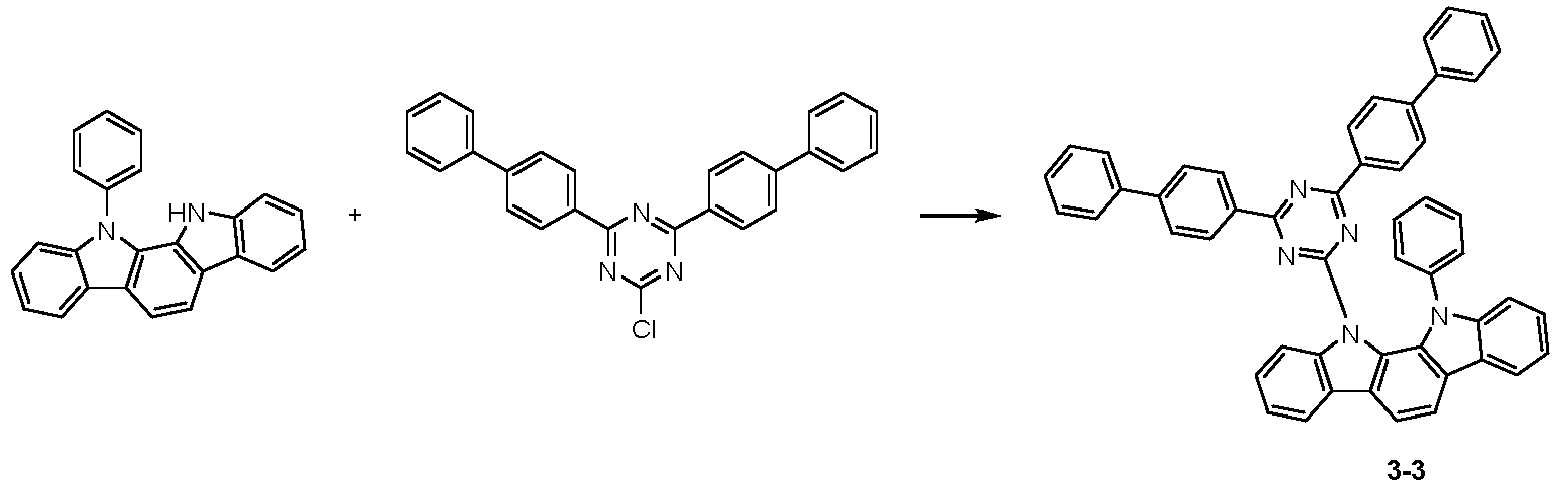
- Compound 3-3 (22.4 g, yield: 52%) was prepared in the same manner as in the Preparation of Compound 3-1, except that 2,4-di([1,1'-biphenyl]-4-yl)-6-chloro-1,3,5-triazine was used instead of 2-([1,1'-biphenyl]-4-yl)-4-chloro-6-phenyl-1,3,5-triazine.
- MS: [M+H]+ = 716.9
-

- Compound 3-4 (28.4 g, yield: 66%) was prepared in the same manner as in the Preparation of Compound 3-1, except that 2-([1,1':3',1"-terphenyl]-5'-yl)-4-chloro-6-phenyl-1,3,5-triazine was used instead of 2-([1,1'-biphenyl]-4-yl)-4-chloro-6-phenyl-1,3,5-triazine.
- MS: [M+H]+ = 716.9
-

- Compound 3-5 (24.4 g, yield: 62%) was prepared in the same manner as in the Preparation of Compound 3-1, except that 2-chloro-4-(dibenzo[b,d]furan-3-yl)-6-phenyl-1,3,5-triazine was used instead of 2-([1,1'-biphenyl]-4-yl)-4-chloro-6-phenyl-1,3,5-triazine.
- MS: [M+H]+ = 654.8
-

- Compound 3-6 (23.2 g, yield: 59%) was prepared in the same manner as in the Preparation of Compound 3-1, except that 2-chloro-4-(dibenzo[b,d]furan-3-yl)-6-phenyl-1,3,5-triazine was used instead of 2-([1,1'-biphenyl]-4-yl)-4-chloro-6-phenyl-1,3,5-triazine.
- MS: [M+H]+ = 654.8
-

- Compound 3-7 (25 g, yield: 62%) was prepared in the same manner as in the Preparation of Compound 3-1, except that 2-chloro-4-(dibenzo[b,d]thiophen-2-yl)-6-phenyl-1,3,5-triazine was used instead of 2-([1,1'-biphenyl]-4-yl)-4-chloro-6-phenyl-1,3,5-triazine.
- MS: [M+H]+ = 670.8
-

- Compound 3-8 (22.6 g, yield: 56%) was prepared in the same manner as in the Preparation of Compound 3-1, except that 2-chloro-4- (dibenzo[b,d] thiophen-4-yl)-6-phenyl-1,3,5-triazine was used instead of 2-([1,1'-biphenyl]-4-yl)-4-chloro-6-phenyl-1,3,5-triazine.
- MS: [M+H]+ = 670.8
-

- Compound 3-9 (28.5 g, yield: 74%) was prepared in the same manner as in the Preparation of Compound 3-1, except that 5-phenyl-5,8-dihydroindolo[2,3-c]carbazole was used instead of 11-phenyl-11,12-dihydroindolo[2,3-a]carbazole, and 2-([1,1'-biphenyl]-3-yl)-4-chloro-6-phenyl-1,3,5-triazine was used instead of 2-([1,1'-biphenyl]-4-yl)-4-chloro-6-phenyl-1,3,5-triazine.
- MS: [M+H]+ = 640.8
-

- Compound 3-10 (20 g, yield 59%) was prepared in the same manner as in the Preparation of Compound 3-1, except that 5-phenyl-5,7-dihydroindolo[2,3-b]carbazole was used instead of 11-phenyl-11,12-dihydroindolo[2,3-a]carbazole, and 2-chloro-4,6-diphenyl-1,3,5-triazine was used instead of 2-([1,1'-biphenyl]-4-yl)-4-chloro-6-phenyl-1,3,5-triazine.
- MS: [M+H]+ = 564.7
-
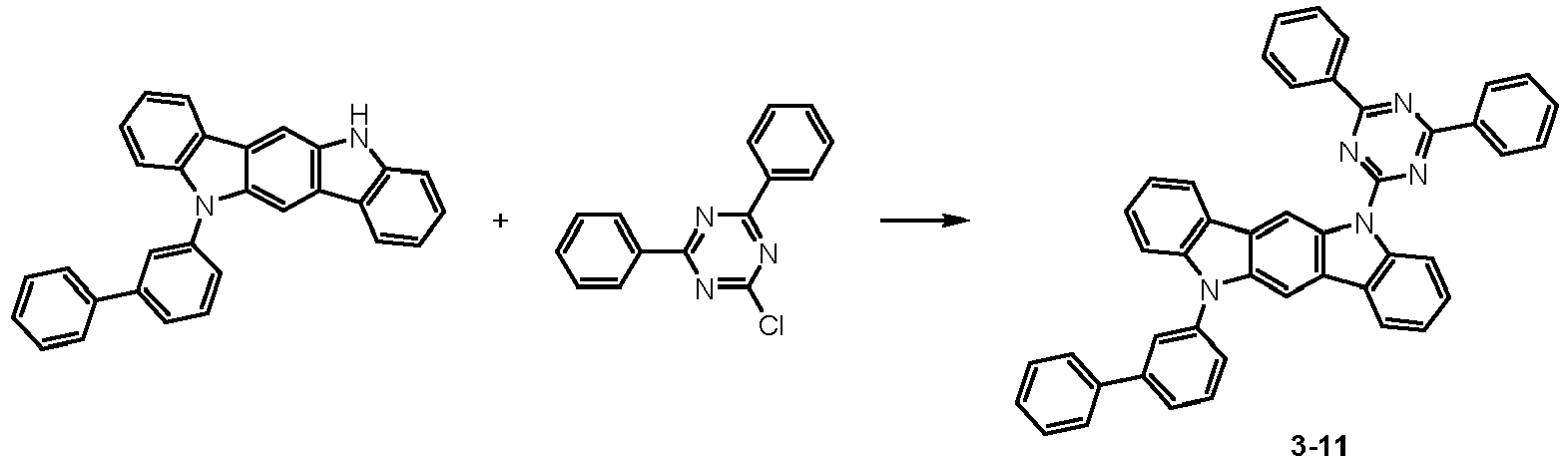
- Compound 3-11 (23.5 g, yield: 61%) was prepared in the same manner as in the Preparation of Compound 3-1, except that 5-([1,1'-biphenyl]-3-yl)-5,11-dihydroindolo[3,2-b]carbazole was used instead of 11-phenyl-11,12-dihydroindolo[2,3-a]carbazole, and 2-chloro-4,6-diphenyl-1,3,5-triazine was used instead of 2-([1,1'-biphenyl]-4-yl)-4-chloro-6-phenyl-1,3,5-triazine.
- MS: [M+H]+ = 640.8
-

- 11-phenyl-11,12-dihydroindolo[2,3-a]carbazole (20 g, 60.2 mmol) and 2-chloro-4-(3-chlorophenyl)-6-phenyl-1,3,5-triazine (18.2 g, 60.2 mmol) were added to dimethylacetamide (200 ml) under a nitrogen atmosphere, and the mixture was stirred and refluxed. Then, K3PO4 (38.3 g, 180.5 mmol) was added thereto, heated and stirred. After the reaction for 3 hours, the reaction mixture was cooled to room temperature, and then the resulting solid was filtered. The solid was added to and dissolved in chloroform (1080 ml), washed twice with water, and the organic layer was separated, anhydrous magnesium sulfate was added thereto, stirred, and then filtered, and the filtrate was distilled under reduced pressure. The concentrated compound was purified through a silica column using chloroform and ethyl acetate to prepare a yellow solid Compound 3-12-A (21.2 g, yield: 59%).
- MS: [M+H]+ = 599.1
- Compound 20-A (15 g, 25.1 mmol) and (phenyl-d5)boronic acid (3.2 g, 25.1 mmol) were added to dioxane (300 ml) under a nitrogen atmosphere, and the mixture was stirred and refluxed. Then, K3PO4 (16 g, 75.2 mmol) was dissolved in water (16 ml), added thereto, and the mixture was sufficiently stirred, and then bis(dibenzylideneacetone)palladium(0) (0.4 g, 0.8 mmol) and tricyclohexylphosphine (0.4 g, 1.5 mmol) were added. After the reaction for 6 hours, the reaction mixture was cooled to room temperature, and then the resulting solid was filtered. The solid was added to and dissolved in chloroform (1080 ml), washed twice with water, and the organic layer was separated, anhydrous magnesium sulfate was added thereto, stirred, and then filtered, and the filtrate was distilled under reduced pressure. The concentrated compound was purified through a silica column using dichlorobenzene and ethyl acetate to prepare a yellow solid Compound 3-12 (10.5 g, yield: 65%).
- MS: [M+H]+ = 645.8
-

- Compound 3-13 (9.5 g, yield: 59%) was prepared in the same manner as in the Preparation of Compound 3-1, except that 2-([1,1'-biphenyl]-4-yl)-4-chloro-6-(phenyl-d5)-1,3,5-triazine was used instead of 2-([1,1'-biphenyl]-4-yl)-4-chloro-6-phenyl-1,3,5-triazine.
- MS: [M+H]+ = 645.8
-

- 11,12-dihydroindolo[2,3-a]carbazole (20 g, 78 mmol) and 3-bromo-1,1':3',1"-terphenyl (24.1 g, 78 mmol) were added to xylene (400 ml) under a nitrogen atmosphere, and the mixture was stirred and refluxed. Then, K3PO4 (22.5 g, 234.1 mmol) was added thereto, and the mixture was sufficiently stirred and then bis(tri-tert-butylphosphine)palladium(0) (1.2 g, 2.3 mmol) was added. After the reaction for 3 hours, the reaction mixture was cooled to room temperature, and the organic layer was filtered to remove salts, and then the filtered organic layer was distilled. This was again added to and dissolved in chloroform (378 ml), washed twice with water, and then the organic layer was separated, anhydrous magnesium sulfate was added thereto, stirred, and then filtered, and the filtrate was distilled under reduced pressure. The concentrated compound was recrystallized using chloroform and ethanol to prepare a beige solid Compound 3-14-A (25.3 g, yield: 67%).
- MS: [M+H]+ = 485.6
- Compound 3-14-A (20 g, 41.3 mmol) and 2-chloro-4,6-diphenyl-1,3,5-triazine (11 g, 41.3 mmol) were added to dimethylacetamide (200 ml) under a nitrogen atmosphere, and the mixture was stirred and refluxed. Then, K3PO4 (26.3 g, 123.8 mmol) was added thereto, and the mixture was heated and stirred. After the reaction for 1 hour, the reaction mixture was cooled to room temperature, and the resulting solid was filtered. The solid was added to and dissolved in chloroform (886 ml), washed twice with water, and the organic layer was separated, anhydrous magnesium sulfate was added thereto, stirred, and then filtered, and the filtrate was distilled under reduced pressure. The concentrated compound was purified through a silica column using chloroform and ethyl acetate to prepare a yellow solid Compound 3-14 (15.1 g, yield: 51%).
- MS: [M+H]+ = 716.9
-

- Compound 3-15-A (20.2 g, yield: 64%) was prepared in the same manner as in
step 1 of the Preparation of Compound 3-15, except that 11,12-dihydroindolo[2,3-a]carbazole-1,3,5,6,8,10-d6 was used instead of 11,12-dihydroindolo[2,3-a]carbazole, and 3-bromo-1,1'-biphenyl was used instead of 3-bromo-1,1':3',1"-terphenyl. - MS: [M+H]+ = 415.5
- Compound 3-15 (29.7 g, yield: 54%) was prepared in the same manner as in the Preparation of Compound 3-1, except that 11-([1,1'-biphenyl]-3-yl)-11,12-dihydroindolo[2,3-a]carbazole-1,3,5,6,8,10-d6 was used instead of 11-phenyl-11,12-dihydroindolo[2,3-a]carbazole, and 2-([1,1'-biphenyl]-3-yl)-4-chloro-6-phenyl-1,3,5-triazine was used instead of 2-([1,1'-biphenyl]-4-yl)-4-chloro-6-phenyl-1,3,5-triazine.
- MS: [M+H]+ = 722.9
-

- Compound 3-16-A (14 g, yield: 54%) was prepared in the same manner as in
step 1 of the Preparation of Compound 3-14, except that 11,12-dihydroindolo[2,3-a]carbazole-1,3,5,6,8,10-d6 was used instead of 11,12-dihydroindolo[2,3-a]carbazole, and bromobenzene was used instead of 3-bromo-1,1':3',1"-terphenyl. - MS: [M+H]+ = 340.5
- Compound 3-16 (14.9 g, yield: 59%) was prepared in the same manner as in the Preparation of Compound 3-16, except that 11-phenyl-11,12-dihydroindolo[2,3-a]carbazole-1,3,5,6,7,8,10-d7 was used instead of 11-phenyl-11,12-dihydroindolo[2,3-a]carbazole, and 2-chloro-4-(dibenzo[b,d]furan-3-yl)-6-phenyl-1,3,5-triazine was used instead of 2-([1,1'-biphenyl]-4-yl)-4-chloro-6-phenyl-1,3,5-triazine.
- MS: [M+H]+ = 661.8
- A glass substrate on which a thin film of ITO (indium tin oxide) was coated in a thickness of 1,400 Å was put into distilled water containing the detergent dissolved therein and washed by the ultrasonic wave. In this case, the used detergent was a product commercially available from Fisher Co. and the distilled water was one which had been twice filtered by using a filter commercially available from Millipore Co. The ITO was washed for 30 minutes, and ultrasonic washing was then repeated twice for 10 minutes by using distilled water. After the washing with distilled water was completed, the substrate was ultrasonically washed with isopropyl alcohol, acetone, and methanol solvent, and dried, after which it was transported to a plasma cleaner. Then, the substrate was cleaned with oxygen plasma for 5 minutes, and then transferred to a vacuum evaporator.
- On the ITO transparent electrode thus prepared, the following compound HT-A and the following compound PD were thermally vacuum-deposited in a ratio of 95:5 to a thickness of 100 Å, and then only the following compound HT-A was deposited to a thickness of 1150 Å to form a hole transport layer. The following compound HT-B was thermally vacuum-deposited to a thickness of 450 Å on the hole transport layer to form an electron blocking layer. Then, 92 wt% of the host in which the compound 1-1 previously prepared as a first host, the compound 2-1 previously prepared as a second host, and the compound 3-1 previously prepared as a third host were mixed in a weight ratio of 30:35:35, and 8 wt% of the following compound GD were vacuum-deposited to a thickness of 350 Å on the electron blocking layer to form a light emitting layer. The following compound ET-A was vacuum-deposited to a thickness of 50 Å on the light emitting layer to form a hole blocking layer. The following compound ET-B and the following compound Liq were thermally vacuum-deposited in a ratio of 1:1 to a thickness of 300 Å on the hole blocking layer, and Yb(ytterbium) was vacuum-deposited to a thickness of 10 Å on the electron transport layer to form an electron injection layer. Magnesium and silver were deposited in a weight ratio of 1: 4 to a thickness of 150 Å on the electron injection layer to form a cathode, thereby completing the manufacture of an organic light emitting device.


- In the above-mentioned process, the vapor deposition rate of the organic material was maintained at 0.4 to 0.7 Å/sec, the deposition rate of ytterbium, magnesium and silver were maintained at 2 Å/sec, and the degree of vacuum during the deposition was maintained at 2×10⁻⁷ to 5×10⁻⁶ torr, thereby manufacturing an organic light emitting device.
- The organic light emitting devices were manufactured in the same manner as in Example 1, except that the host material was changed as shown in Table 1 below. At this time, the ratio means a weight ratio of the first host, the second host, and the third host. Further, the CE1, CE2, CE3 compounds shown in Table 1 are as follows, respectively.

- The organic light emitting devices prepared in Examples and Comparative Examples were heat-treated in an oven at 120°C for 30 minutes, then taken out, and the voltage, efficiency, and lifetime (T95) were measured by applying a current, and the results are shown in Table 1 below. At this time, the driving voltage and luminous efficiency were measured by applying a current density of 10 mA/cm2, and the lifetime (T95) means the time (hr) required for the luminance to be reduced to 95% of the initial luminance at a current density of 20 mA/cm2.
[Table 1] Host @10mA/cm2 @20 mA/c m2 First host Second host Third host Host ratio (weight ratio) Voltage (V) Efficie ncy (cd/A) Lifeti me (T95) (hr) Ex. 1 Com. 1-1 Com. 2-1 Com. 3-1 30:35:35 3.88 79.3 183 Ex. 2 Com. 1-9 Com. 2-1 Com. 3-12 30:35:35 4.61 75.1 213 Ex. 3 Com. 1-3 Com. 2-2 Com. 3-2 30:35:35 3.71 75.3 210 Ex. 4 Com. 1-3 Com. 2-2 Com. 3-15 30:35:35 3.70 75.3 235 Ex. 5 Com. 1-4 Com. 2-3 Com. 3-3 30:35:35 3.67 75.2 196 Ex. 6 Com. 1-5 Com. 2-4 Com. 3-4 30:35:35 3.62 70.7 208 Ex. 7 Com. 1-6 Com. 2-4 Com. 3-13 30:35:35 4.40 75.9 167 Ex. 8 Com. 1-7 Com. 2-5 Com. 3-5 30:35:35 3.68 79.5 172 Ex. 9 Com. 1-8 Com. 2-6 Com. 3-6 30:35:35 4.19 70.2 162 Ex. 10 Com. 1-9 Com. 2-6 Com. 3-14 30:35:35 4.08 73.1 224 Ex. 11 Com. 1-10 Com. 2-7 Com. 3-7 30:35:35 4.16 72.0 161 Ex. 12 Com. 1-11 Com. 2-8 Com. 3-8 30:35:35 4.03 74.7 162 Ex. 13 Com. 1-12 Com. 2-9 Com. 3-9 30:35:35 3.89 79.5 225 Ex. 14 Com. 1-1 Com. 2-9 Com. 3-1 30:35:35 3.68 72.6 234 Ex. 15 Com. 1-7 Com. 2-9 Com. 3-10 30:35:35 3.65 75.9 175 Ex. 16 Com. 1-13 Com. 2-10 Com. 3-15 30:35:35 3.77 70.4 215 Ex. 17 Com. 1-2 Com. 2-10 Com. 3-16 30:35:35 3.81 73.5 239 Ex. 18 Com. 1-6 Com. 2-11 Com. 3-11 30:35:35 3.76 80.3 183 Comp arative Ex. 1 - Com. 2-1 - 0:100:0 7.01 8.9 16 Comp arative Ex. 2 - - Com. 3-1 0:0:100 7.52 9.0 13 Comp arative Ex. 3 Com. 1-1 - - 100:0:0 7.21 14.1 21 Comp arative Ex. 4 - Com. 2-1 Com. 3-1 0:50:50 4.41 56.3 116 Comp arative Ex. 5 Com. 1-1 Com. 2-1 - 30:70:0 4.23 66.7 103 Comp arative Ex. 6 Com. 1-3 - Com. 3-5 30:0:70 7.31 23.5 34 Comp arative Ex. 7 CE-1 Com. 2-1 - 30:70:0 4.35 66.5 103 Comp arative Ex. 8 CE-1 Com. 2-2 Com. 3-2 30:35:35 4.11 67.2 143 Comp arative Ex. 9 CE-2 Com. 2-3 - 30:70:0 4.85 60.3 85 Comp arative Ex. 10 CE-3 Com. 2-4 - 30:70:0 4.97 62.5 117 - As shown in Table 1 above, it was confirmed that the organic light emitting devices of Examples 1 to 18 exhibit low driving voltage and improved efficiency and lifetime, as compared with the organic light emitting devices of Comparative Examples 1 to 10.
- The compound represented by
Chemical Formula 2 according to the present disclosure has excellent capability of transferring holes and serves as a P-type host. The compound represented byChemical Formula 1 and the compound represented byChemical Formula 3 according to the present disclosure serve as an N-type host. In general, when a P-type host and an N-type host are mixed and applied as a host of the light emitting layer, an exciplex is formed, whereby the characteristics of the device can be improved as compared with the case where only one of the P-type host and the N-type host is applied. As shown in Table 1 above, in the case of Examples 1 to 18 in which a P-type host and an N-type host are mixed and applied as a host of the light emitting layer, the driving voltage of the device is significantly lowered, and the efficiency and lifespan are significantly improved, as compared to Comparative Examples 1, 2, 3 and 6 to which only one of the P-type host and the N-type host is applied. - In particular, when the P-type host of
Chemical Formula 2 according to the present disclosure is mixed with the N-type host ofChemical Formulas Chemical Formula 1 +Chemical Formula 2 + Chemical Formula 3), the characteristics of the device can be improved as compared with the case where only one type of N-type host mixed and used (Chemical Formula 2 +Chemical Formula 1; orChemical Formula 2 + Chemical Formula 3). As shown in Table 1 above, the organic light emitting devices of Examples 1 to 18 have improved voltage, efficiency and lifetime characteristics, as compared with Comparative Examples 4, 5, 7, 9 and 10 in which only one type of N-type host is mixed and used,[Explanation of symbols] 1: substrate 2: anode 3: electron inhibition layer 4: light emitting layer 5: cathode 6: hole transport layer 7: electron transport layer
Claims (18)
- An organic light emitting device comprising:an anode,a cathode,a light emitting layer between the anode and the cathode,an electron inhibition layer between the anode and the light emitting layer, anda hole transport layer between the electron inhibition layer and the anode,wherein the light emitting layer comprises a compound represented by the following Chemical Formula 1, a compound represented by the following Chemical Formula 2, and a compound represented by the following Chemical Formula 3:
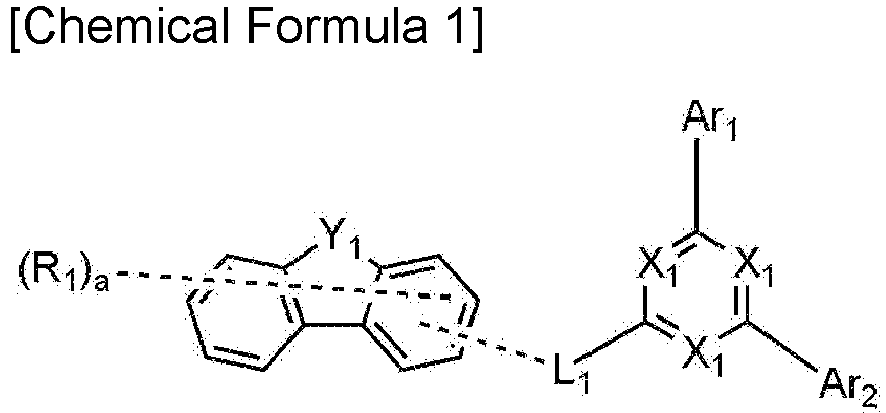 in Chemical Formula 1,Y1 is O, or S,each X1 is independently CH, or N, provided that at least one of X1 is N,L1 is a direct bond, a substituted or unsubstituted C6-60 arylene, or a substituted or unsubstituted C2-60 heteroarylene containing any one or more selected from the group consisting of N, O and S,Ar1 and Ar2 are each independently a substituted or unsubstituted C6-60 aryl, or a substituted or unsubstituted C2-60 heteroaryl containing any one or more selected from the group consisting of N, O and S,R1 is hydrogen, deuterium, a substituted or unsubstituted C6-60 alkyl, a substituted or unsubstituted C6-60 aryl, or a substituted or unsubstituted C2-60 heteroaryl containing any one or more selected from the group consisting of N, O and S, anda is an integer of 1 to 7,
 in Chemical Formula 2,Ar3 and Ar4 are each independently a substituted or unsubstituted C6-60 aryl, or a substituted or unsubstituted C2-60 heteroaryl containing any one or more selected from the group consisting of N, O and S,R3 and R4 are each independently hydrogen, deuterium, a substituted or unsubstituted C6-60 aryl, or a substituted or unsubstituted C2-60 heteroaryl containing any one or more selected from the group consisting of N, O and S, andb and c are each independently an integer of 1 to 7,
 in Chemical Formula 3,B is a benzene ring fused with two adjacent pentagonal rings,each X2 is independently CH or N, provided that at least one of X2 is N,L2 is a direct bond, a substituted or unsubstituted C6-60 arylene, or a substituted or unsubstituted C2-60 heteroarylene containing any one or more selected from the group consisting of N, O and S,Ar5 and Ar6 are each independently a substituted or unsubstituted C6-60 aryl, or a substituted or unsubstituted C2-60 heteroaryl containing any one or more selected from the group consisting of N, O and S, andC is the following Chemical Formula 4-1 or 4-2,
 in Chemical Formulas 4-1 and 4-2,the dotted line is a bond that is fused with B,Y2 is CRR', O, S, or NAr7,wherein R and R' are each independently a substituted or unsubstituted C6-60 alkyl, or a substituted or unsubstituted C6-60 aryl,Ar7 is a substituted or unsubstituted C6-60 aryl, or a substituted or unsubstituted C2-60 heteroaryl containing any one or more selected from the group consisting of N, O and S,R4 is hydrogen, deuterium, a substituted or unsubstituted C6-60 aryl, or a substituted or unsubstituted C2-60 heteroaryl containing any one or more selected from the group consisting of N, O and S, andd is an integer of 1 to 10.
 - The organic light emitting device according to claim 1, wherein:the Chemical Formula 1 is represented by any one of the following Chemical Formulas 1-1 to 1-4:


 in Chemical Formulas 1-1 to 1-4,Y1,X1, L1, Ar1, Ar2, R1, and a are as defined in claim 1.
 - The organic light emitting device according to claim 1, wherein:
two or three of X1 are N. - The organic light emitting device according to claim 1, wherein:
L1 is a direct bond. - The organic light emitting device according to claim 1, wherein:Ar1 and Ar2 are each independently phenyl, biphenylyl, dibenzofuranyl, dibenzothiophenyl, carbazol-9-yl, or (phenyl)carbazol-9-yl, andthe Ar1 and Ar2 are each independently unsubstituted or substituted with at least one deuterium.
- The organic light emitting device according to claim 1, wherein:R1 is phenyl, biphenylyl, (phenyl)biphenylyl, terphenylyl, naphthyl, phenanthrenyl, triphenylenyl, dimethylfluorenyl, spirobifluorenyl, dibenzofuranyl, dibenzothiophenyl, carbazol-9-yl, (phenyl)carbazol-9-yl, (diphenyl)carbazol-9-yl, 9-phenyl-9H-carbazolyl, 12-phenyl-11,12-dihydroindolo[2,3-a]carbazol-11-yl, or 1,1-dimethyl-1,3-dihydroindeno[2,1-b]carbazol-3-yl, andthe R1 is unsubstituted or substituted with at least one deuterium.
- The organic light emitting device according to claim 1, wherein:
the compound represented by Chemical Formula 1 is any one selected from the group consisting of the following compounds:


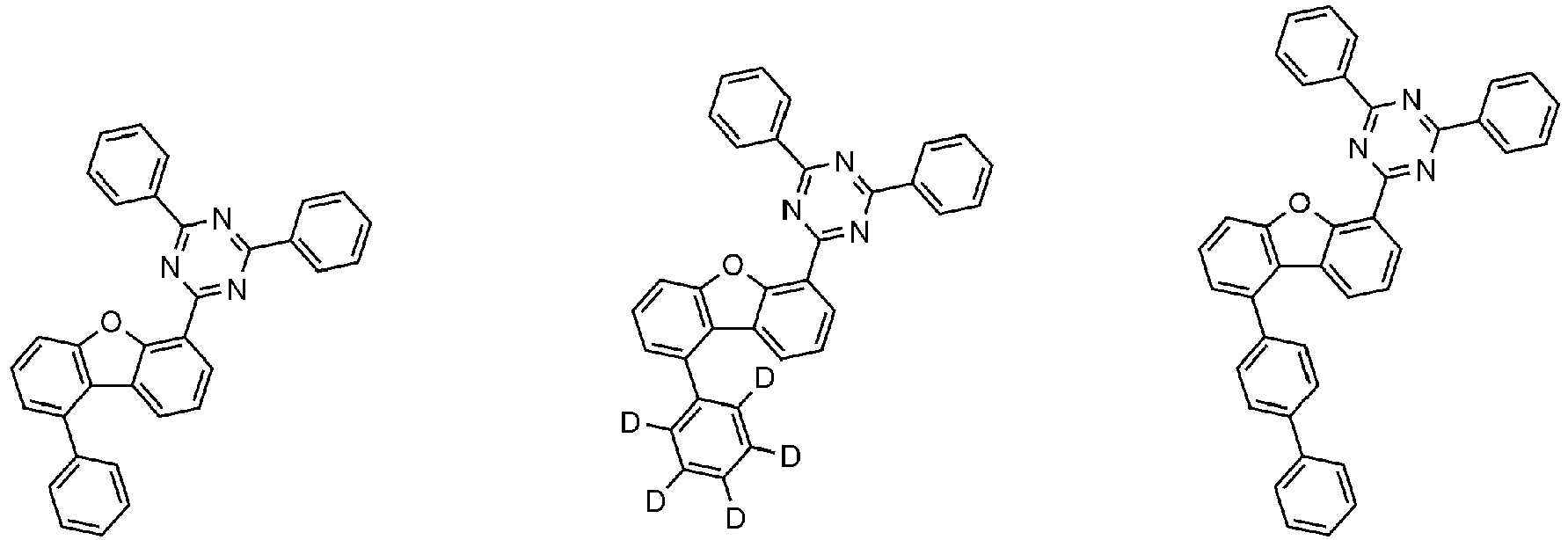


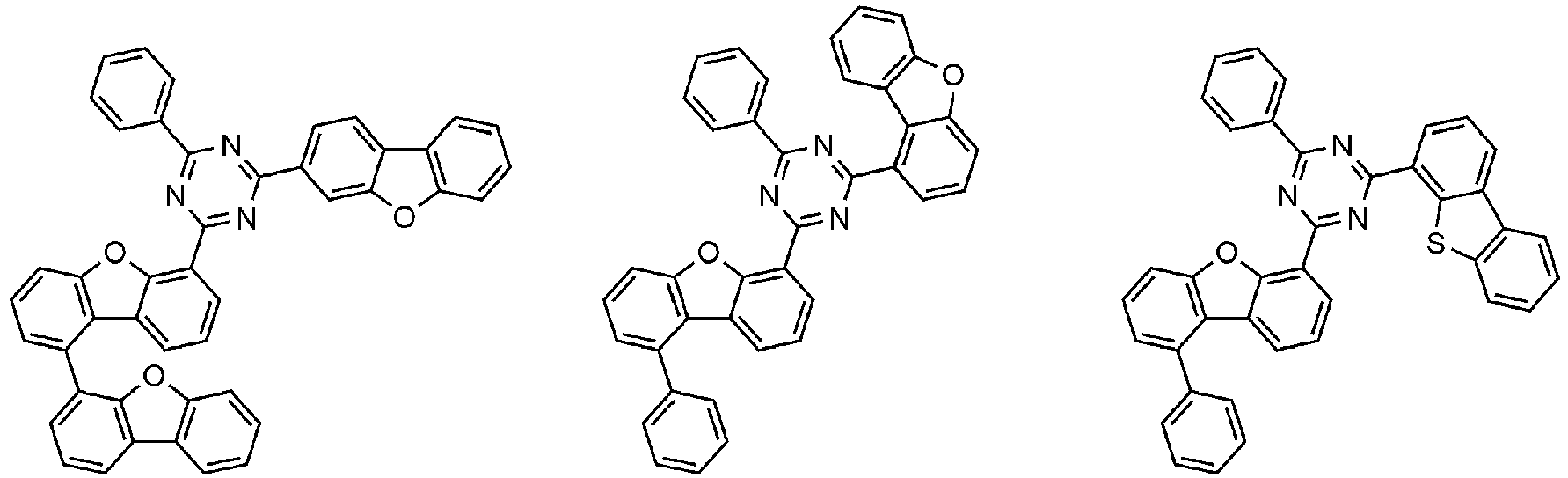


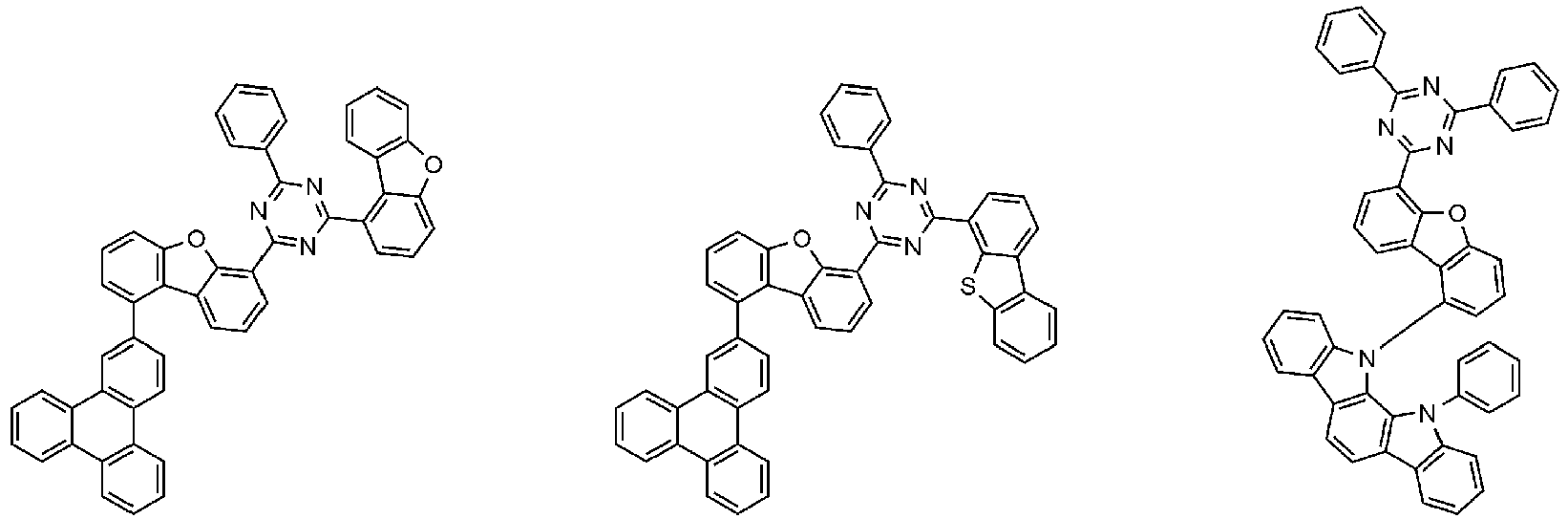


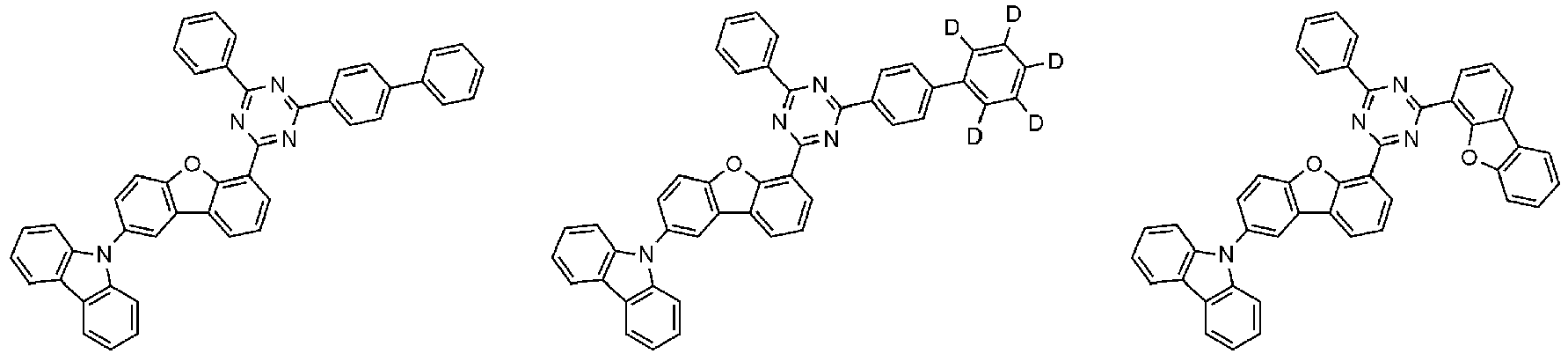





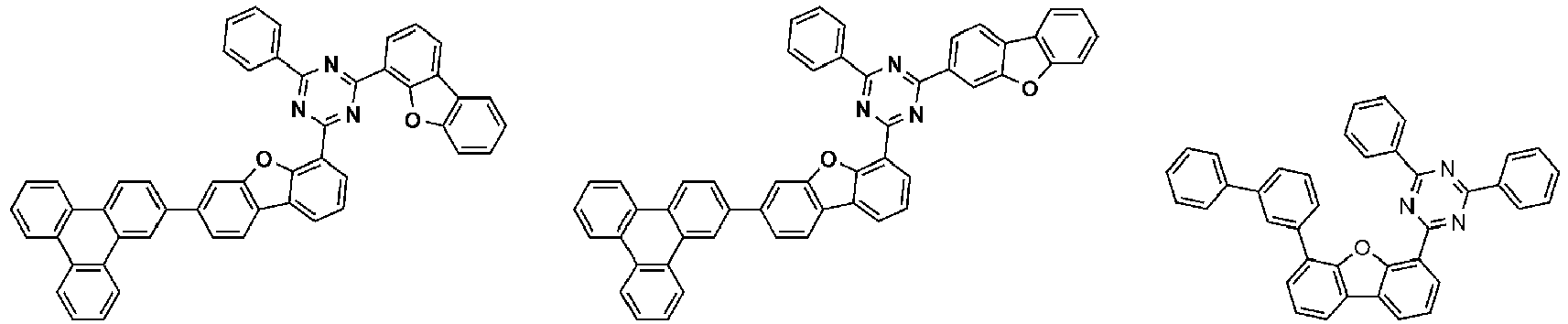


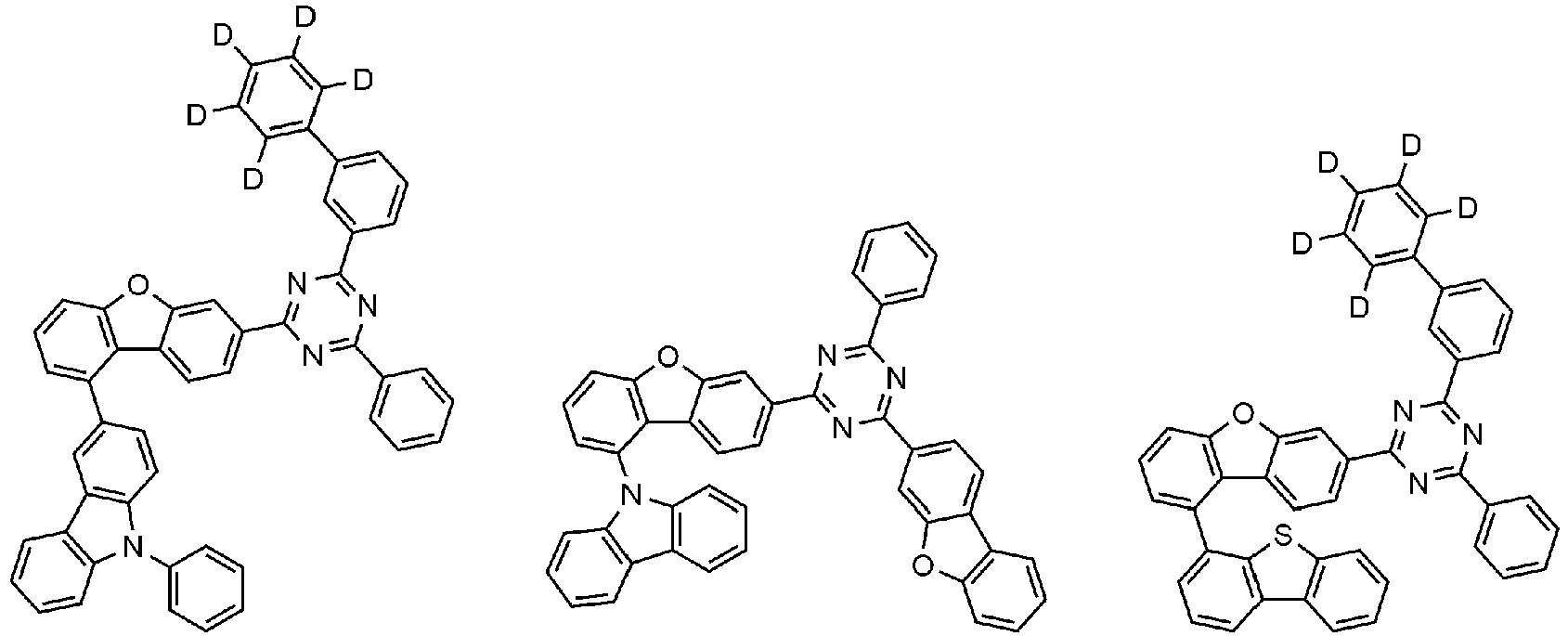


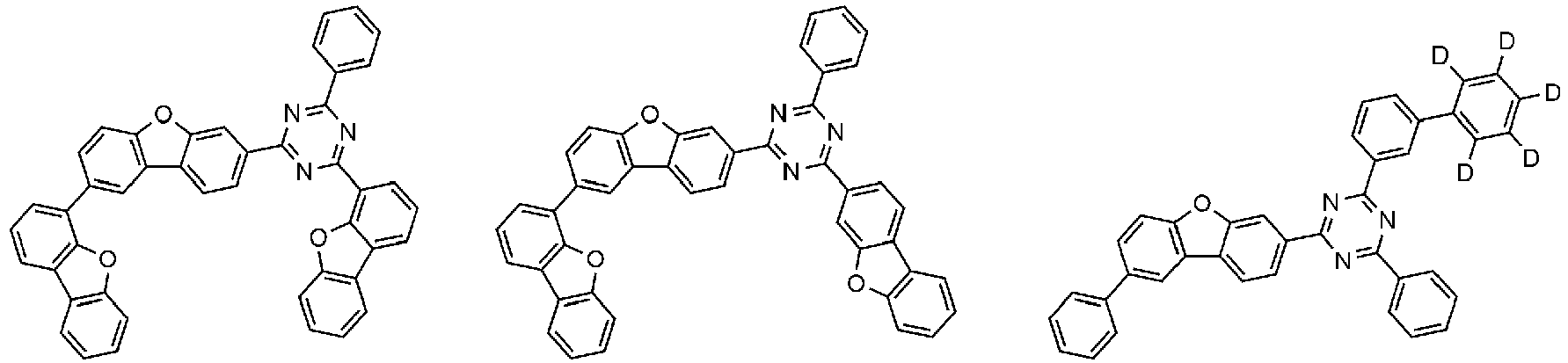
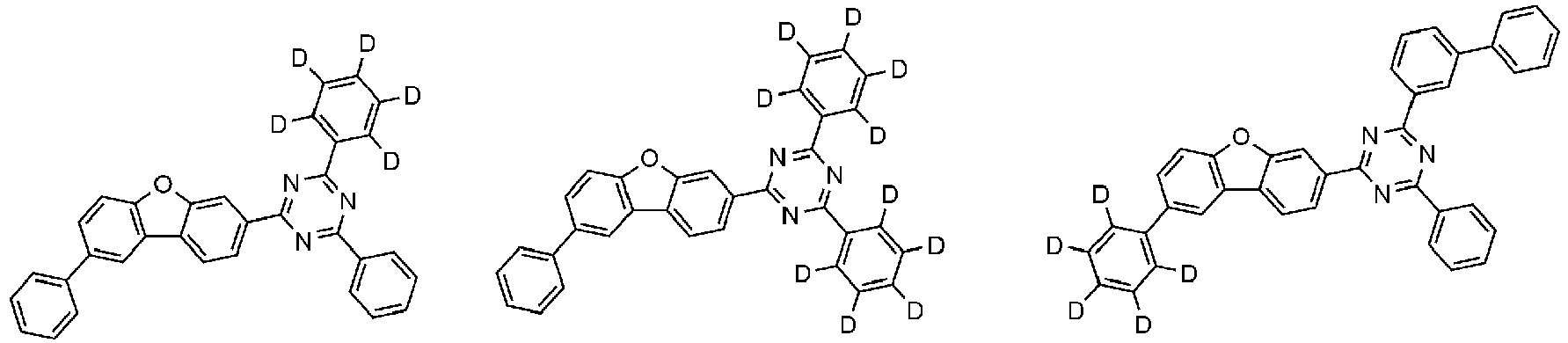





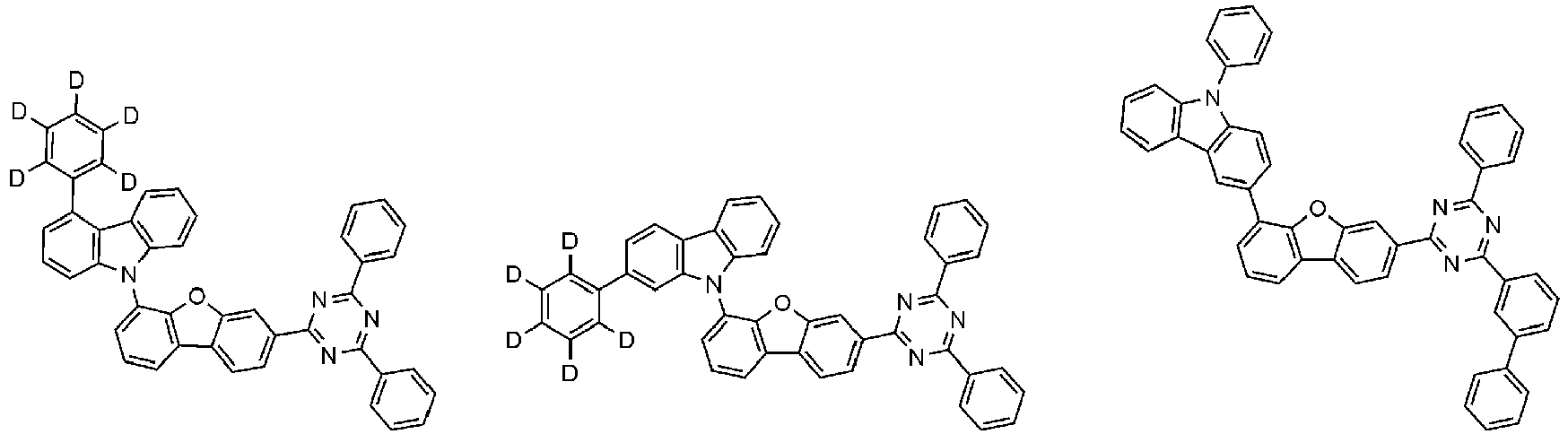


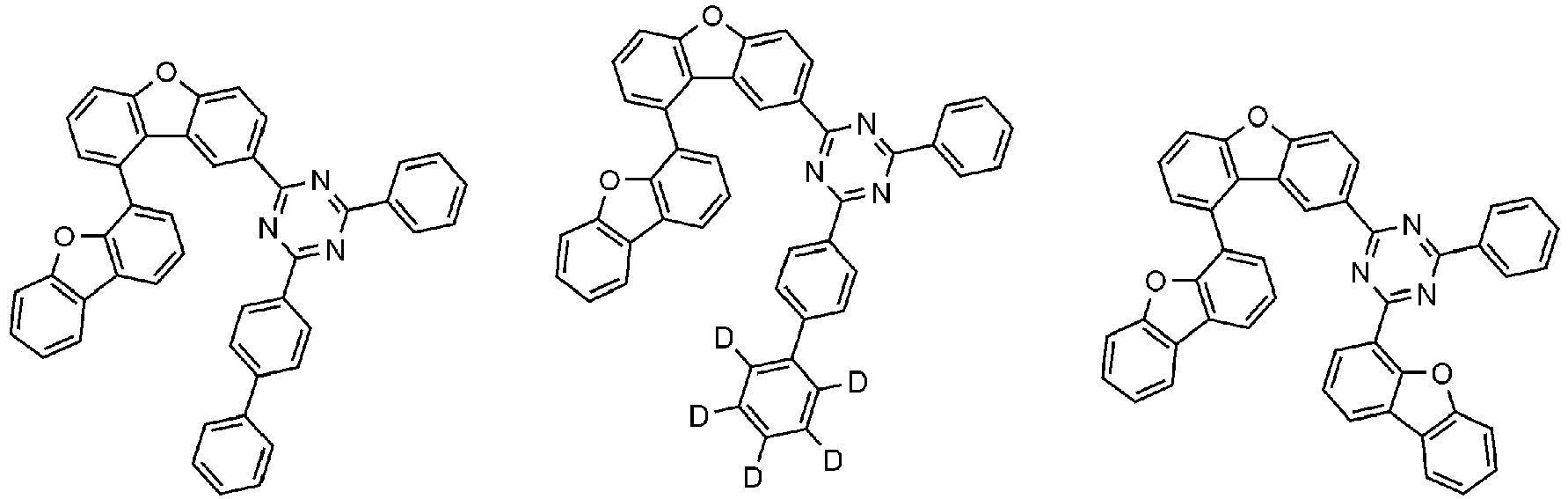
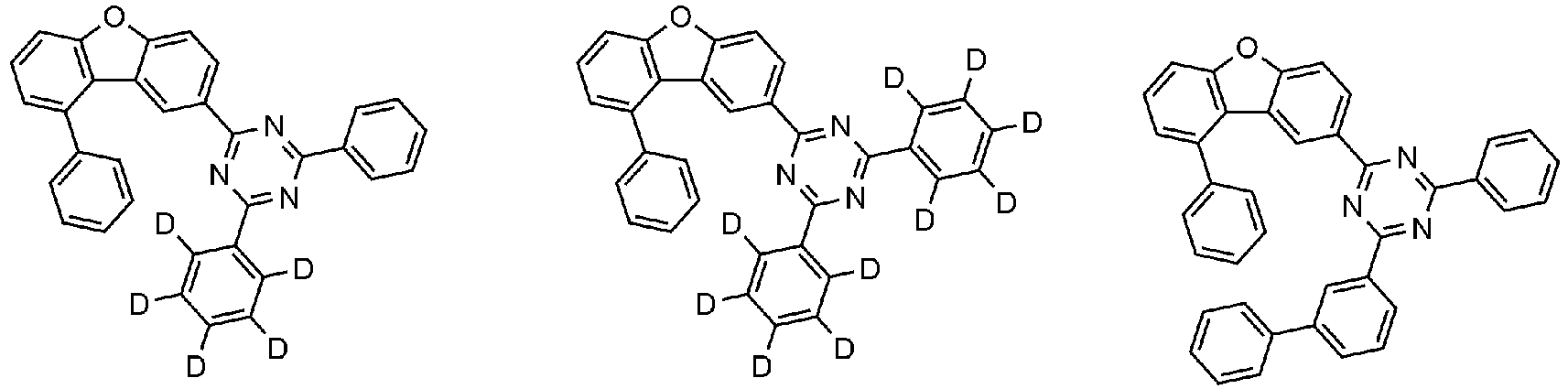











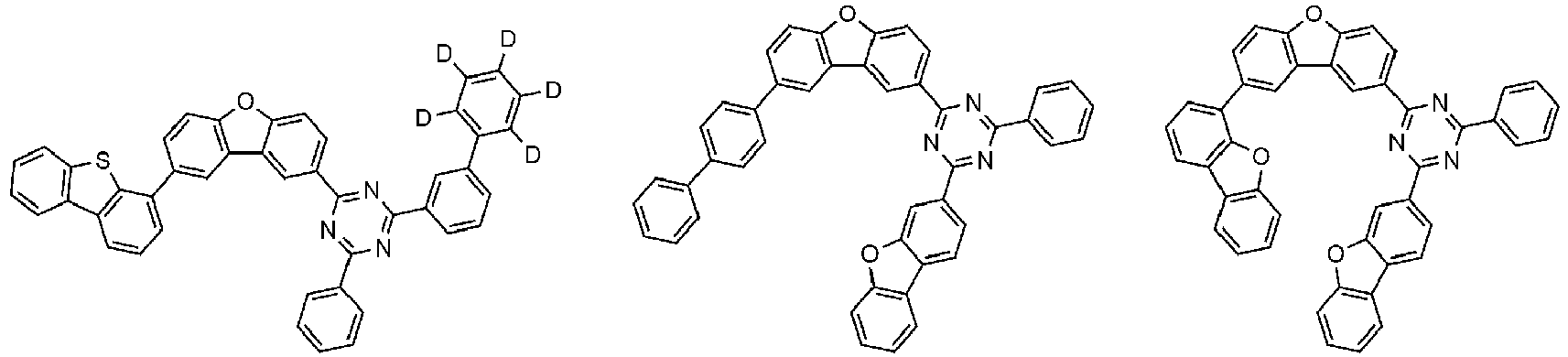





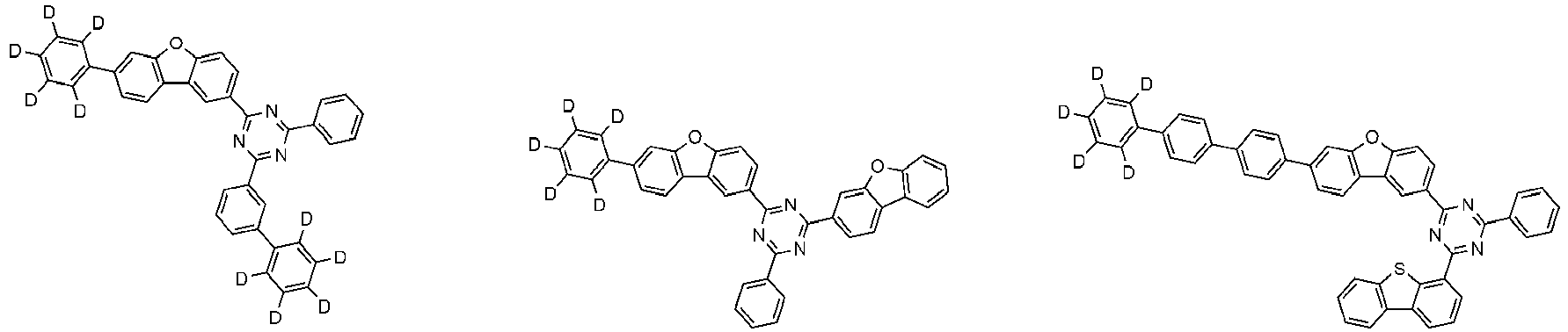





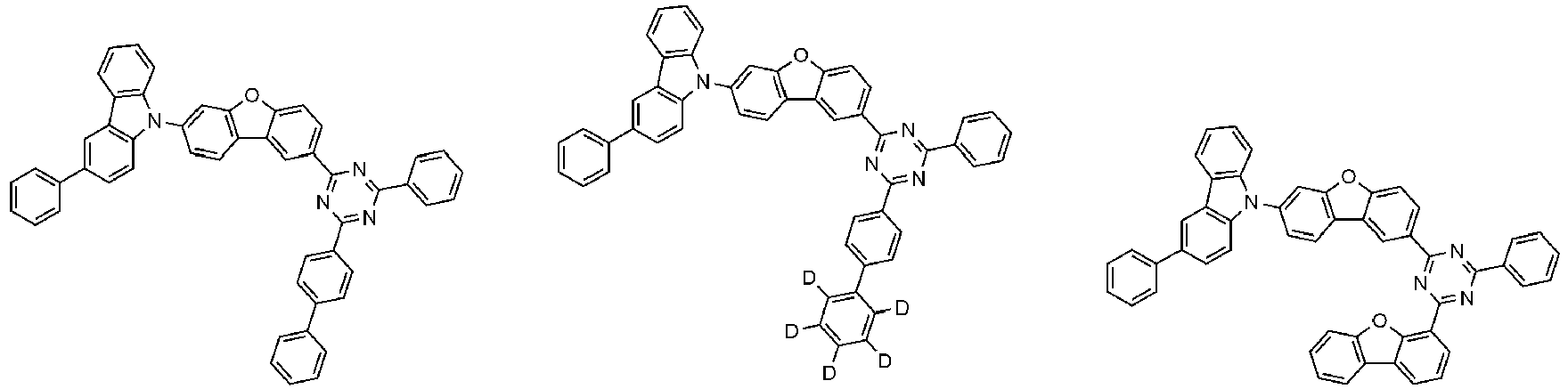


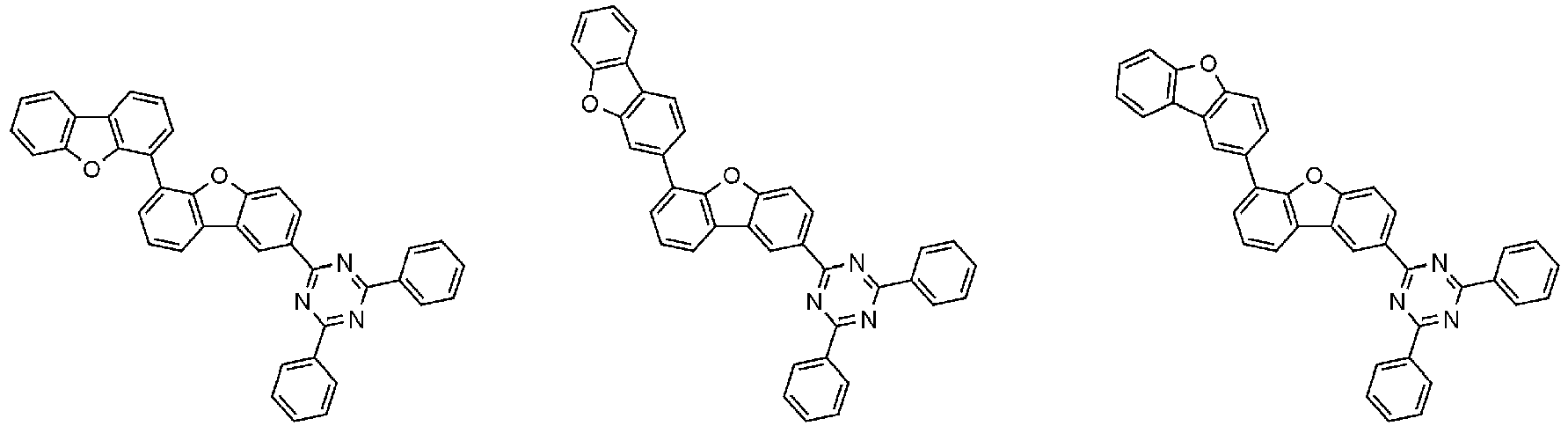


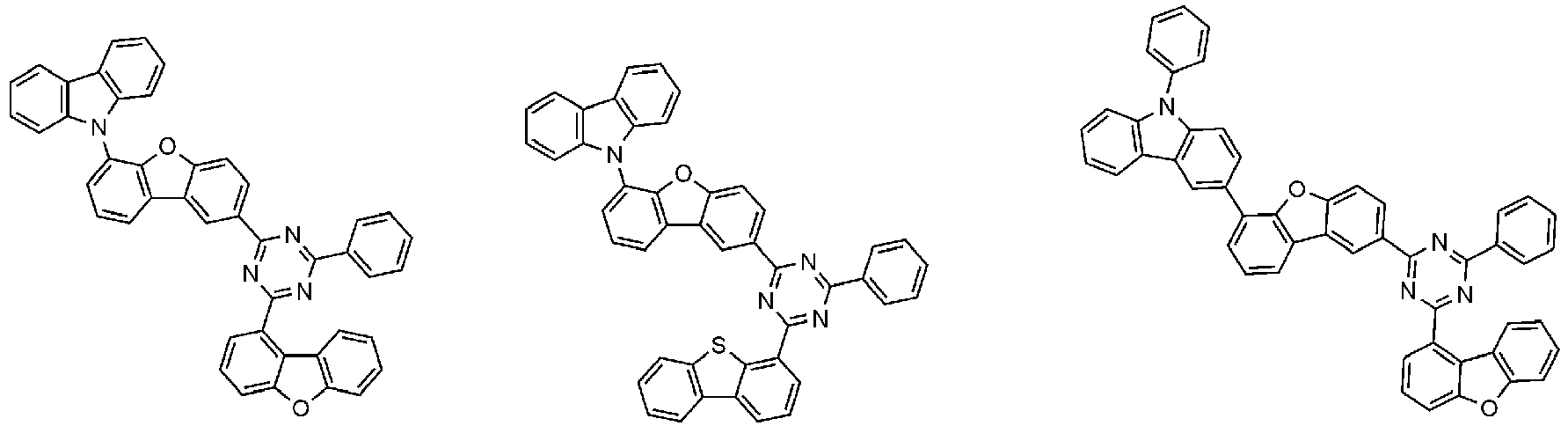


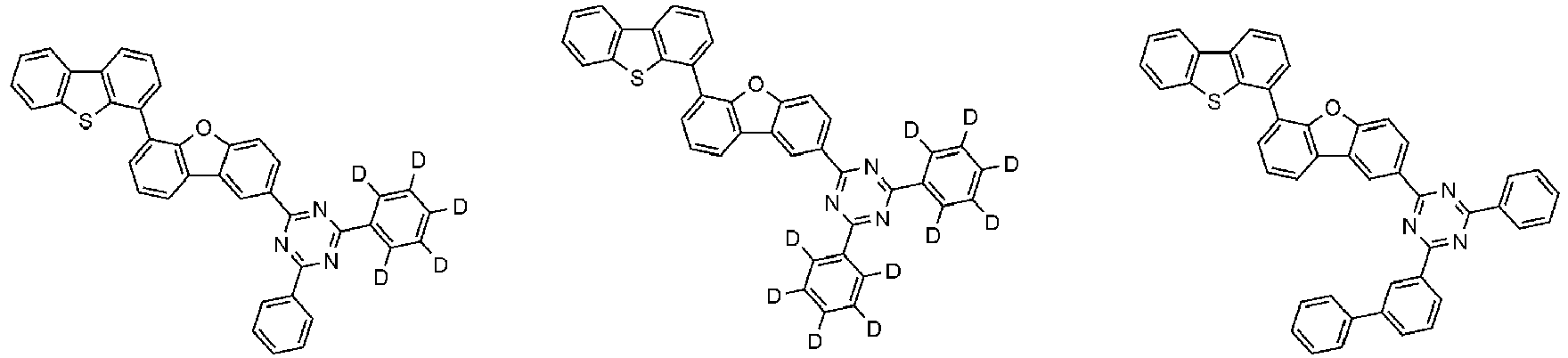


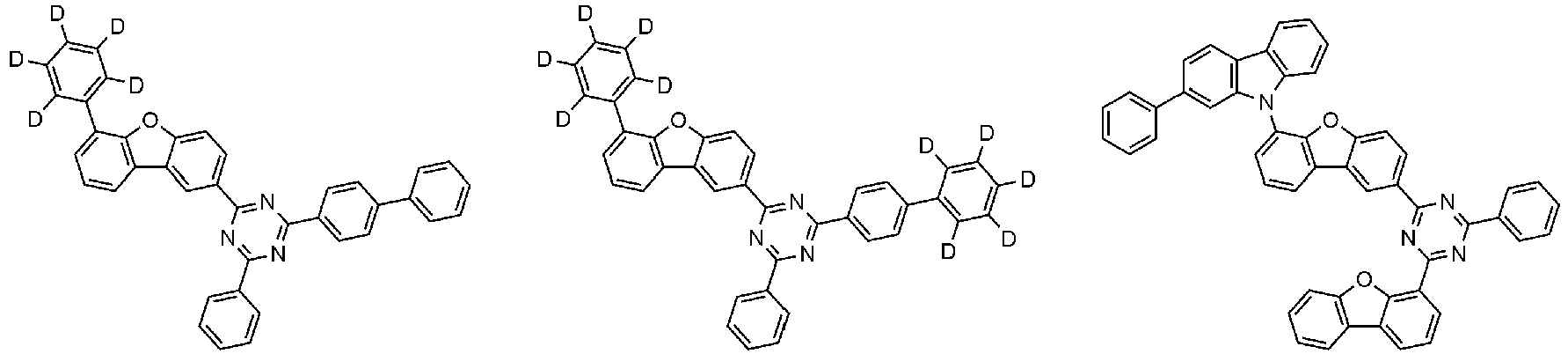


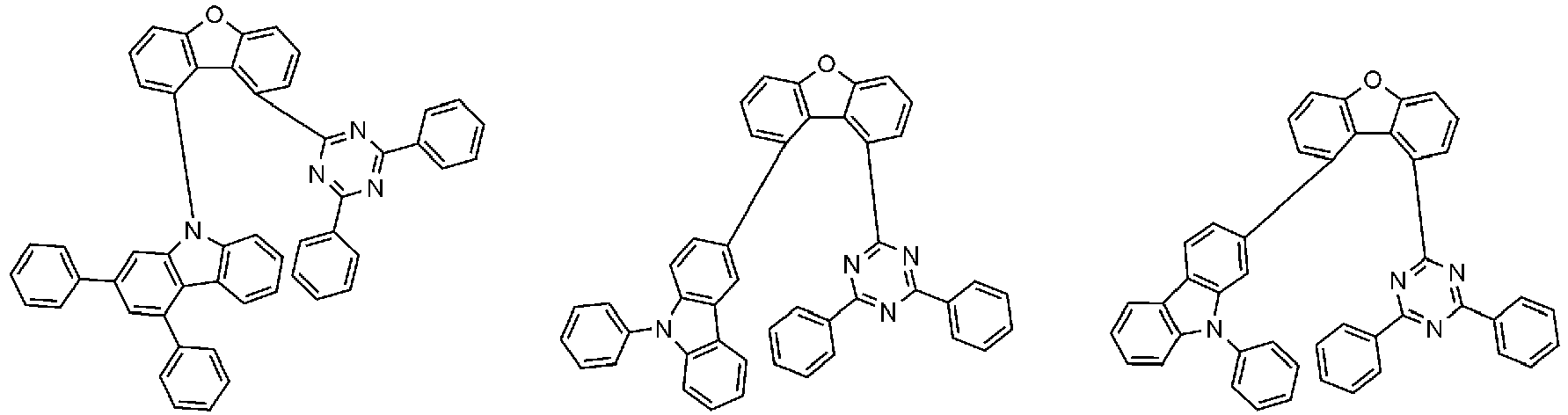


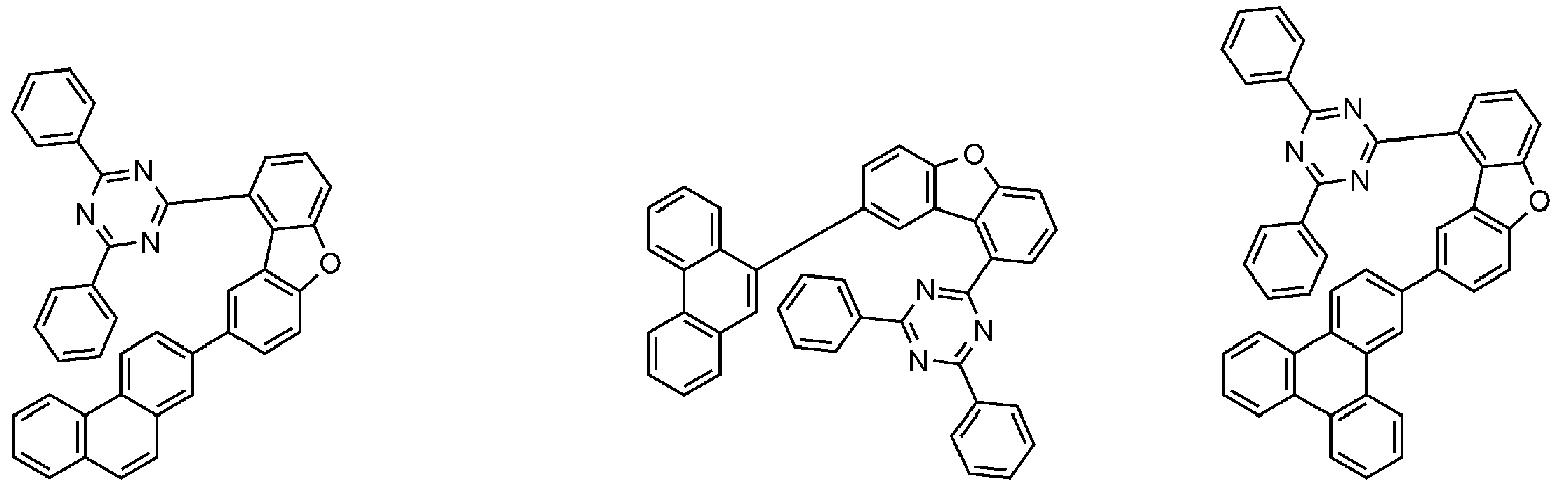


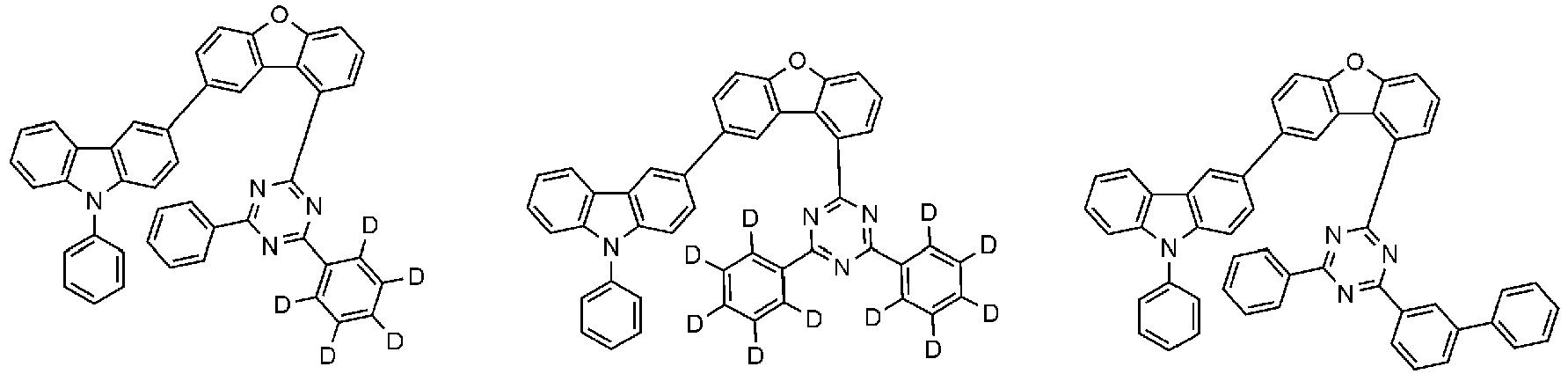
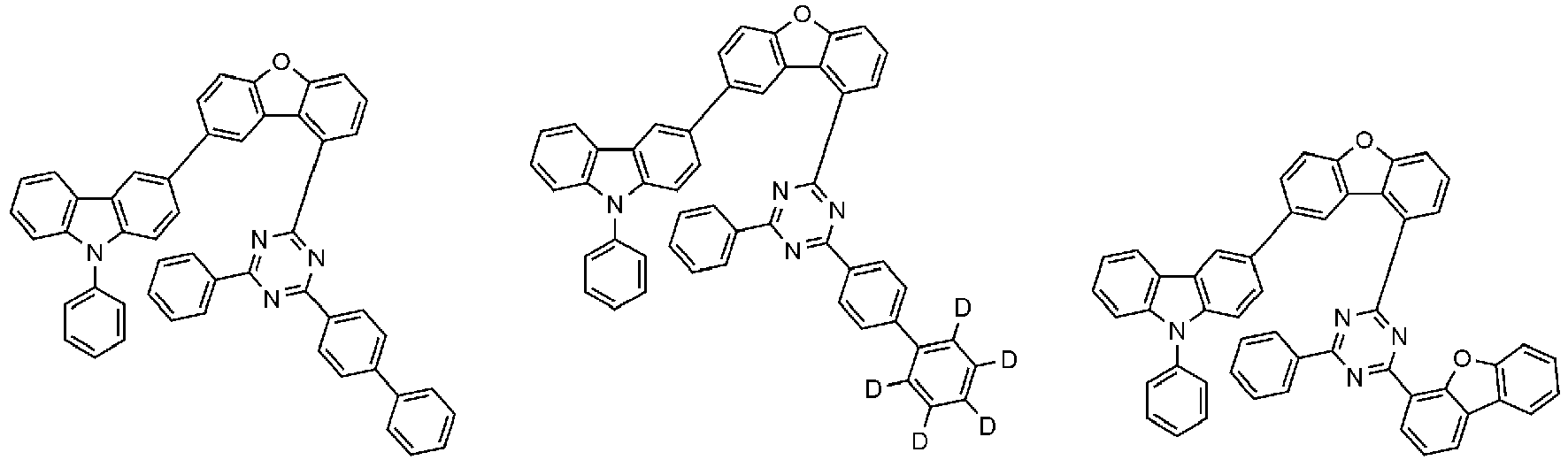


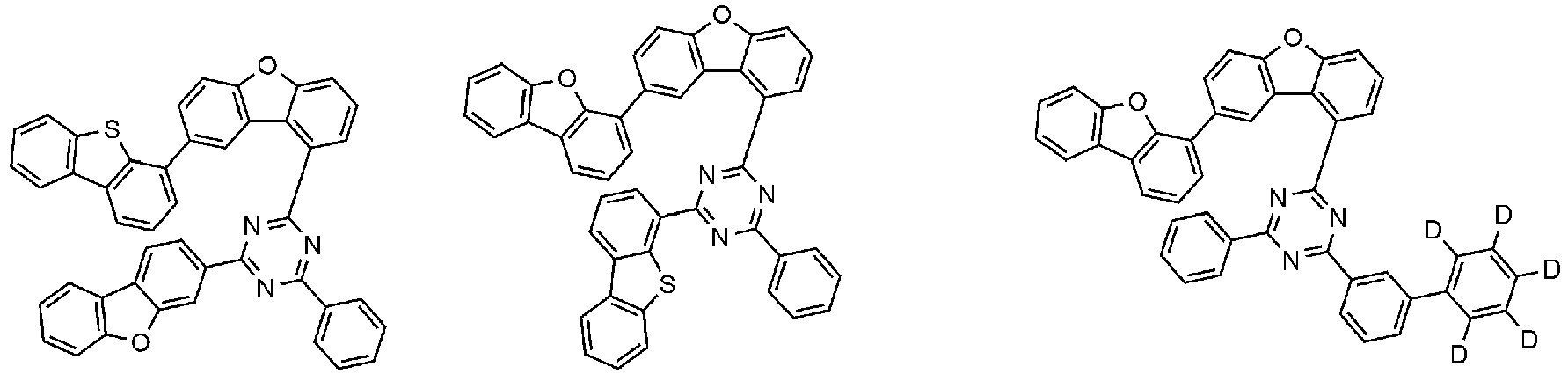


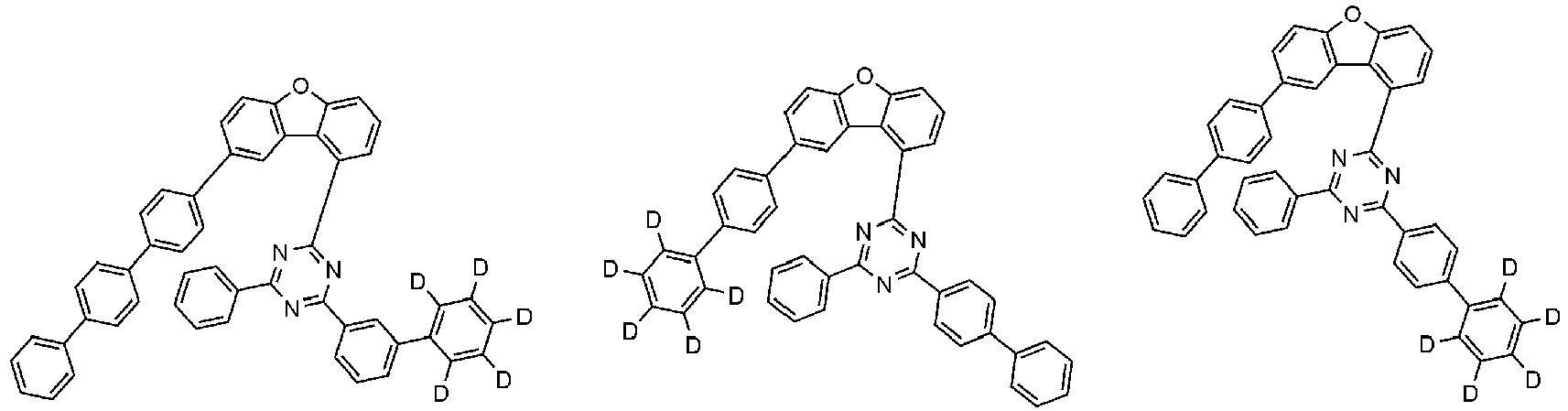


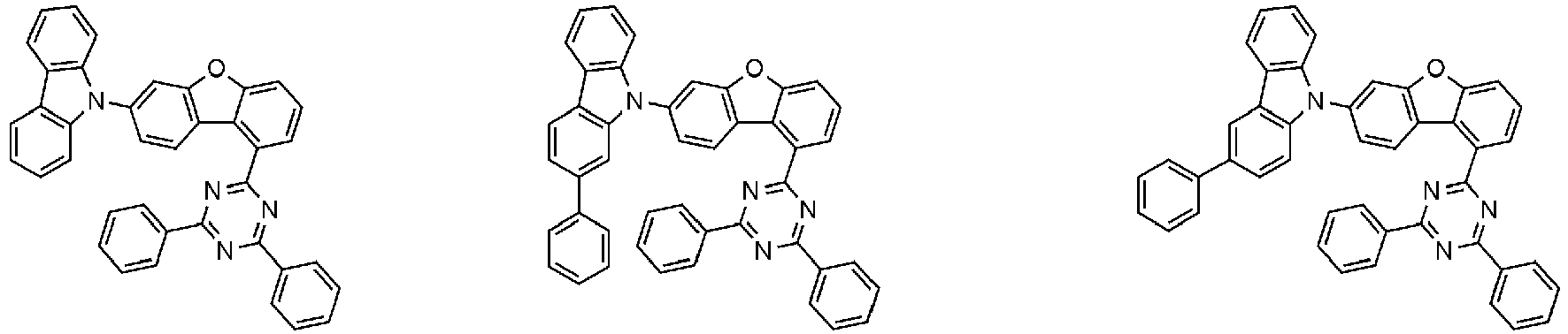


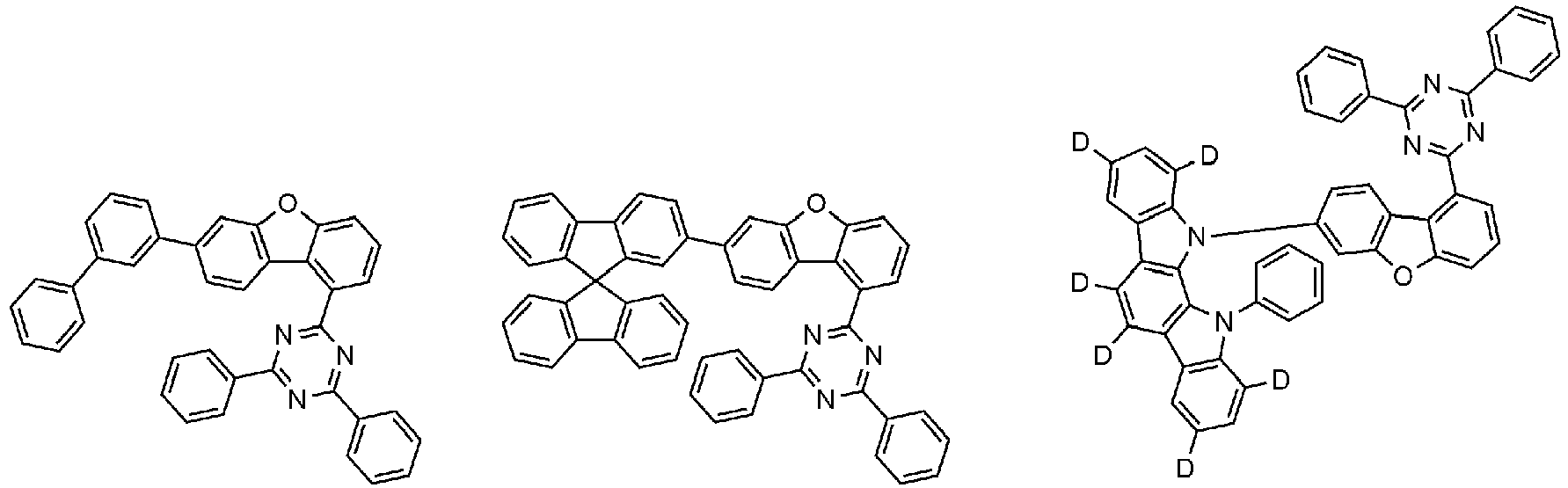


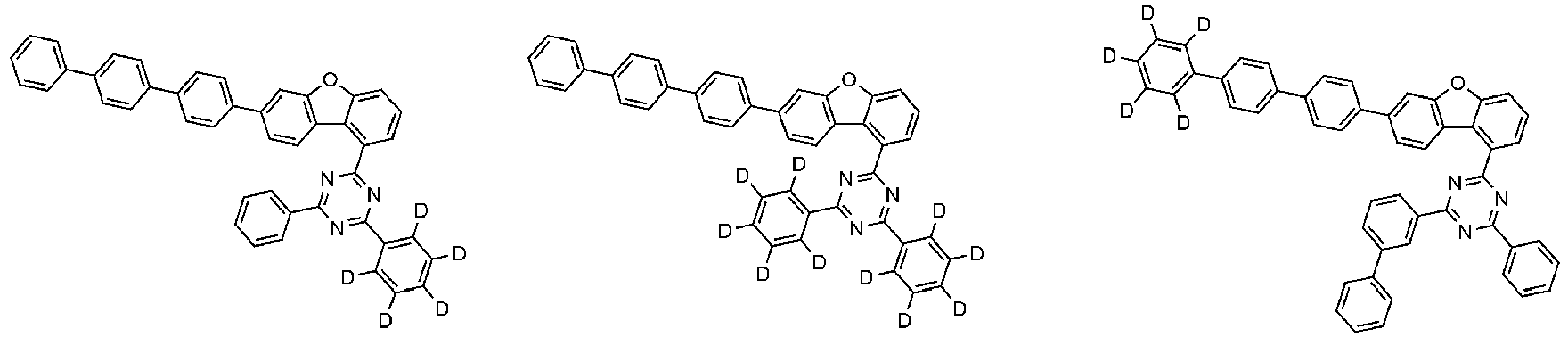


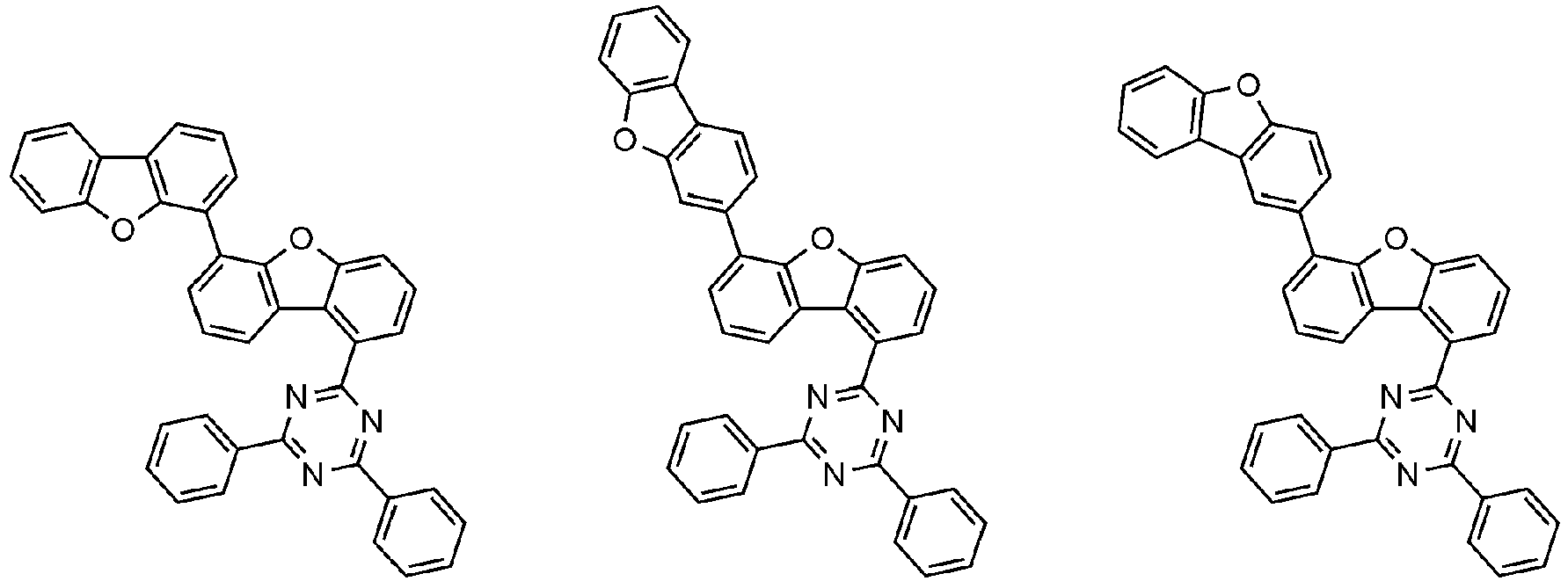


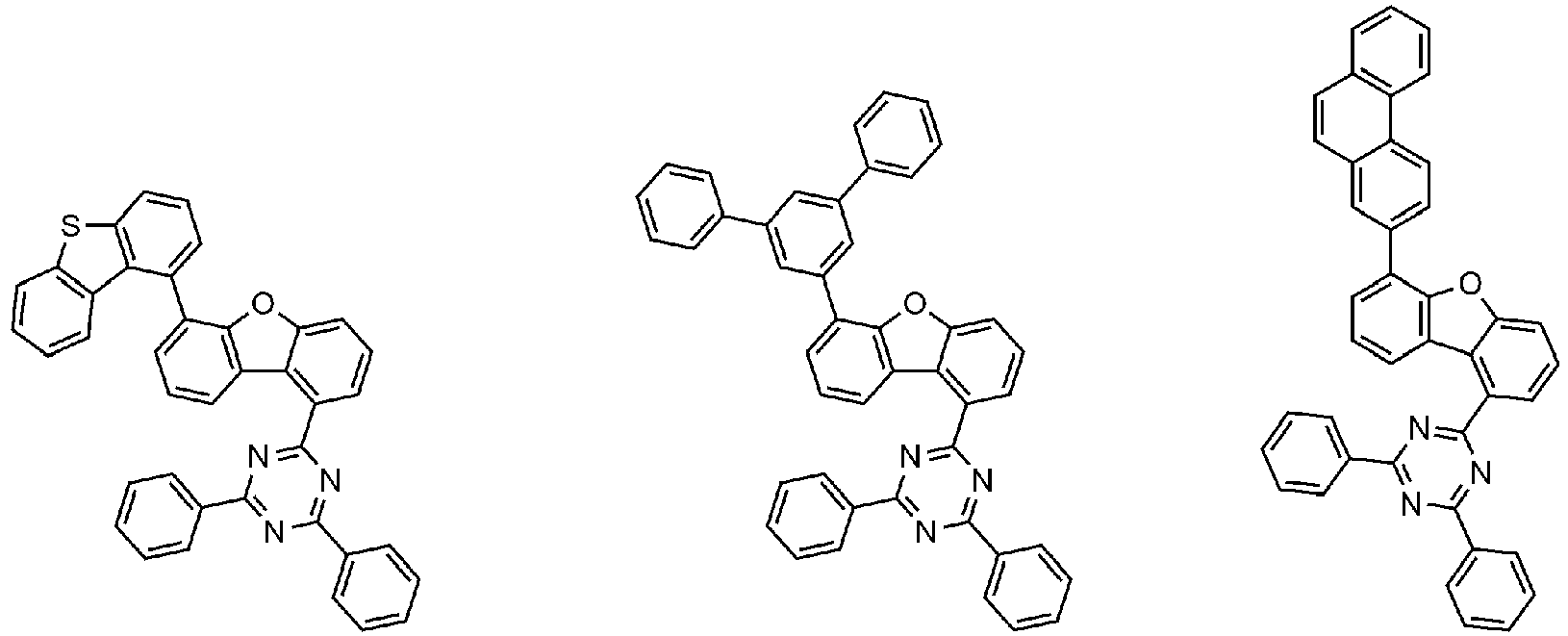


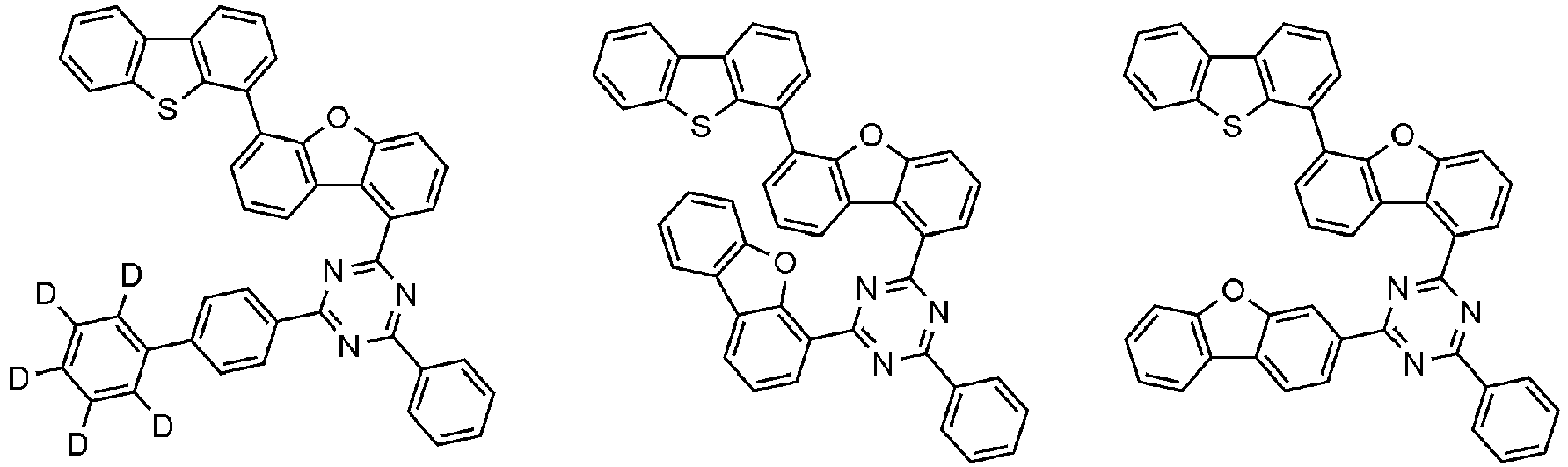


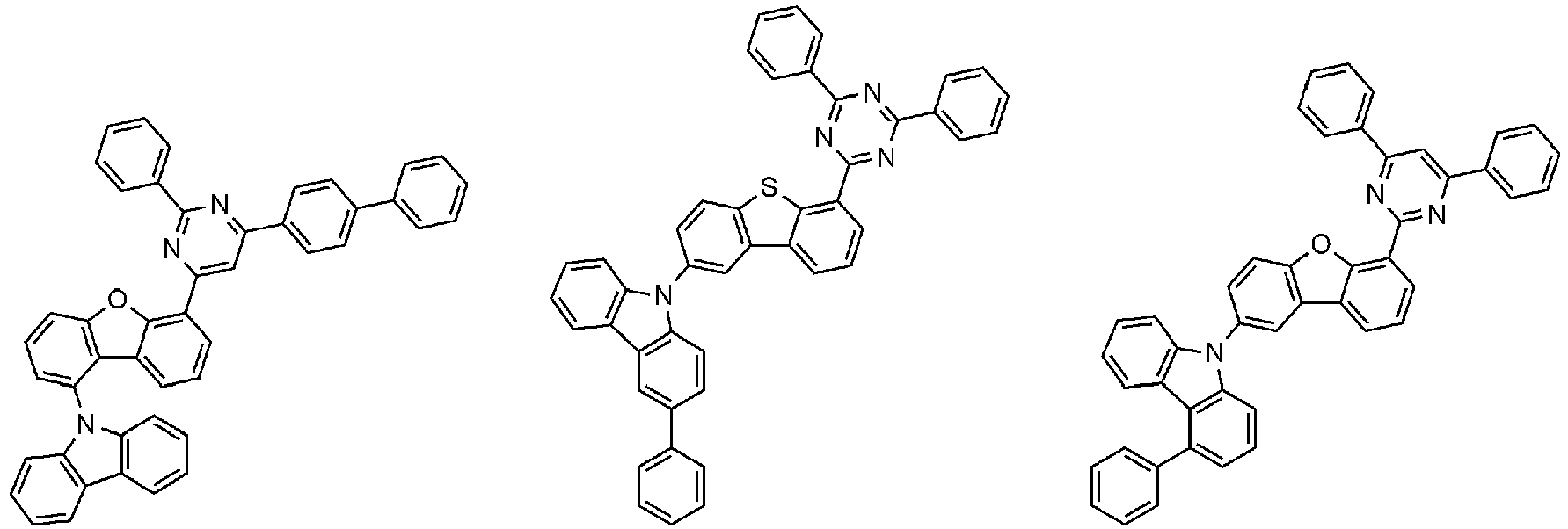


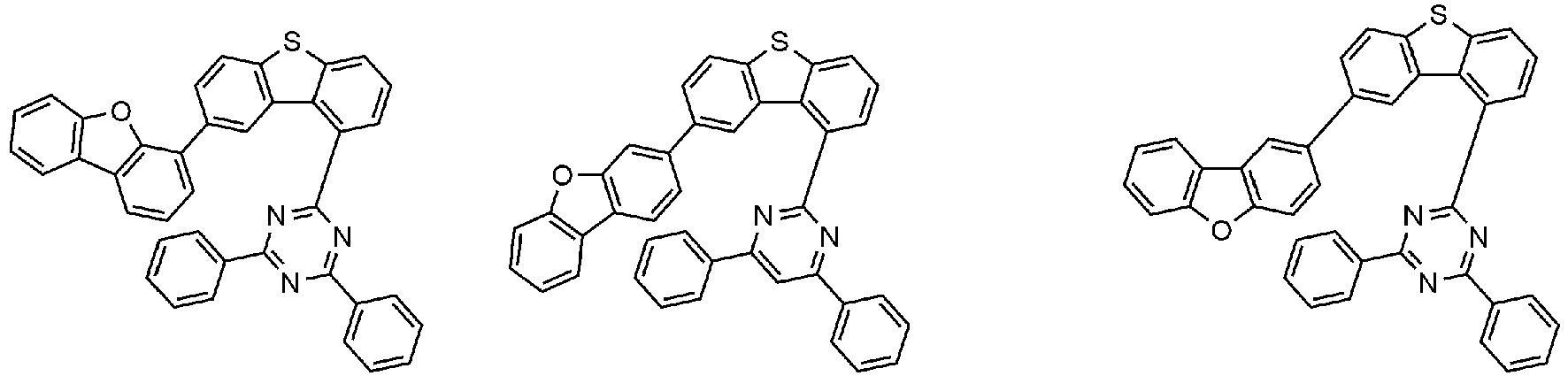


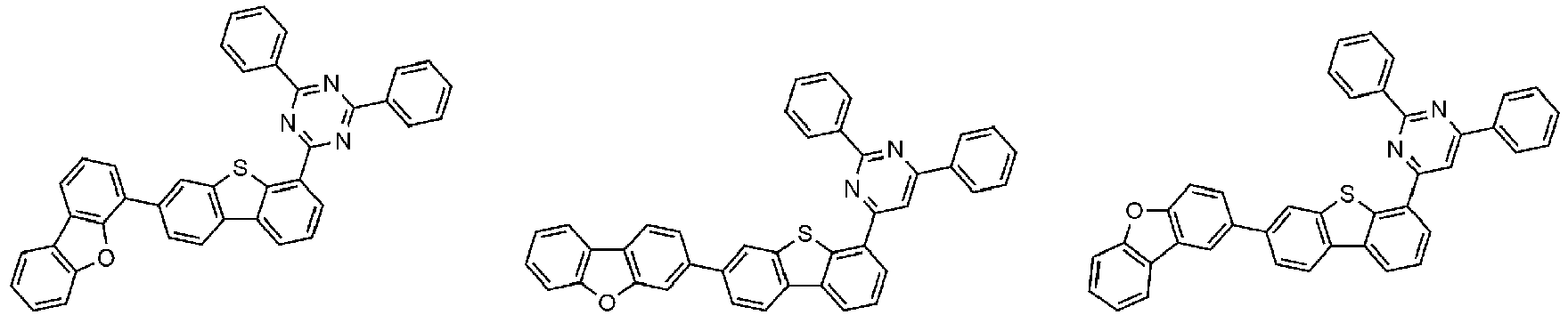





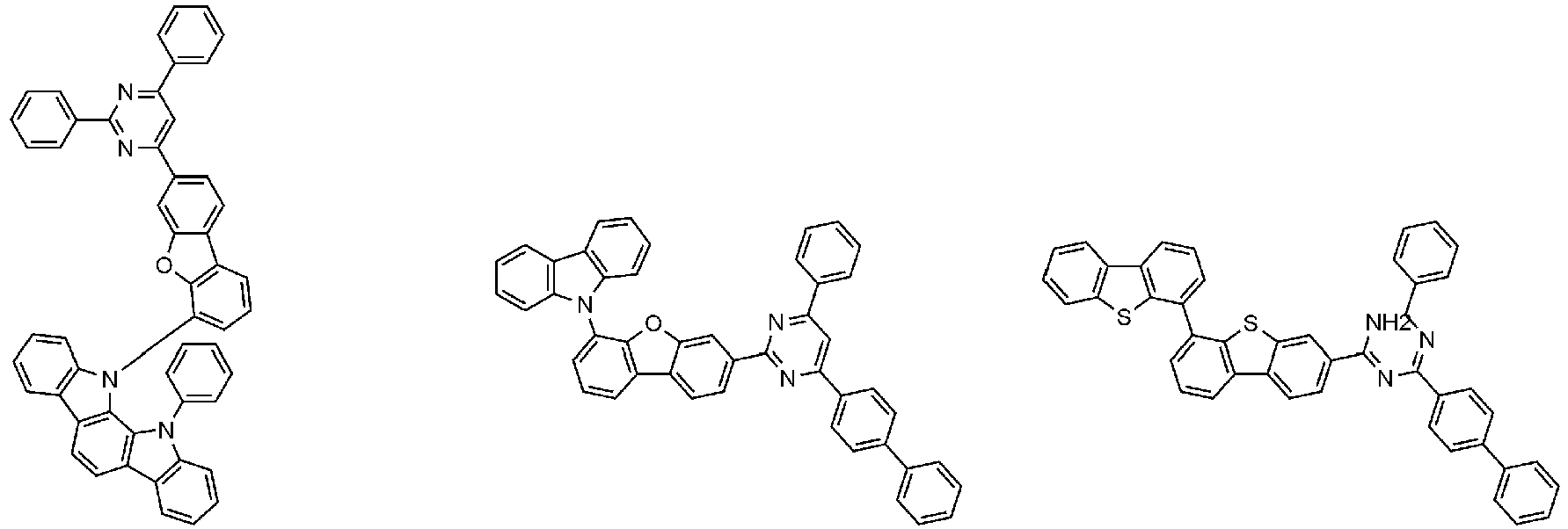





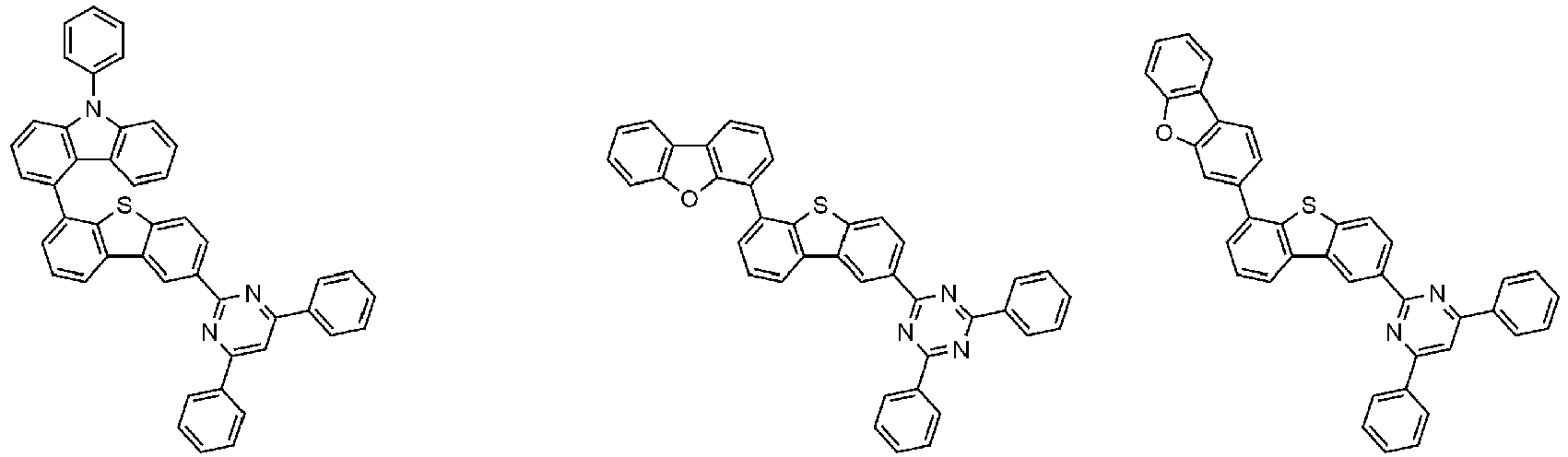


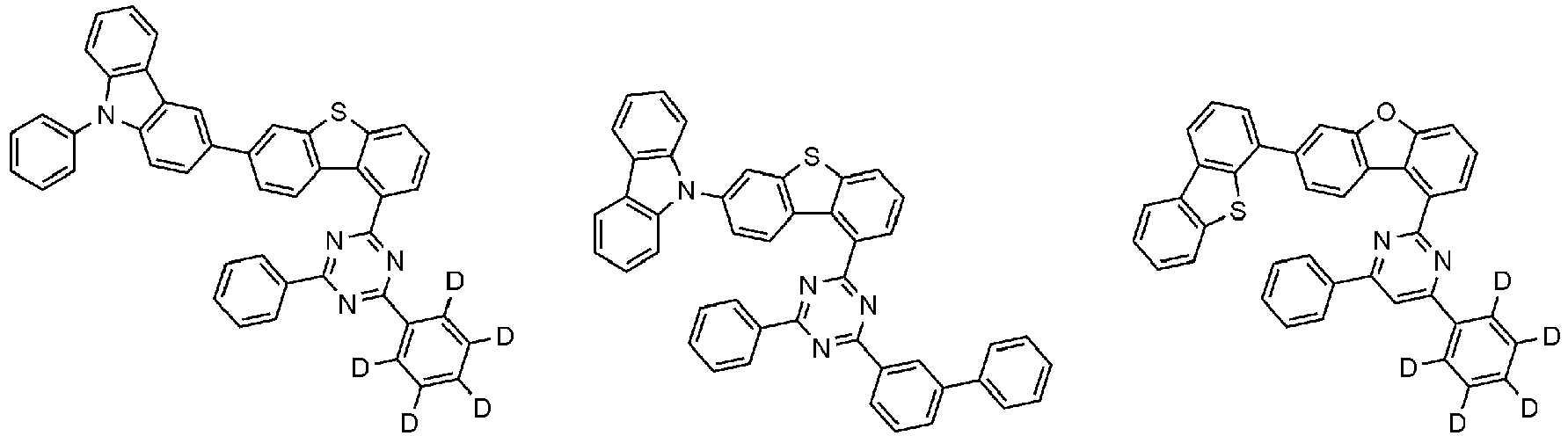


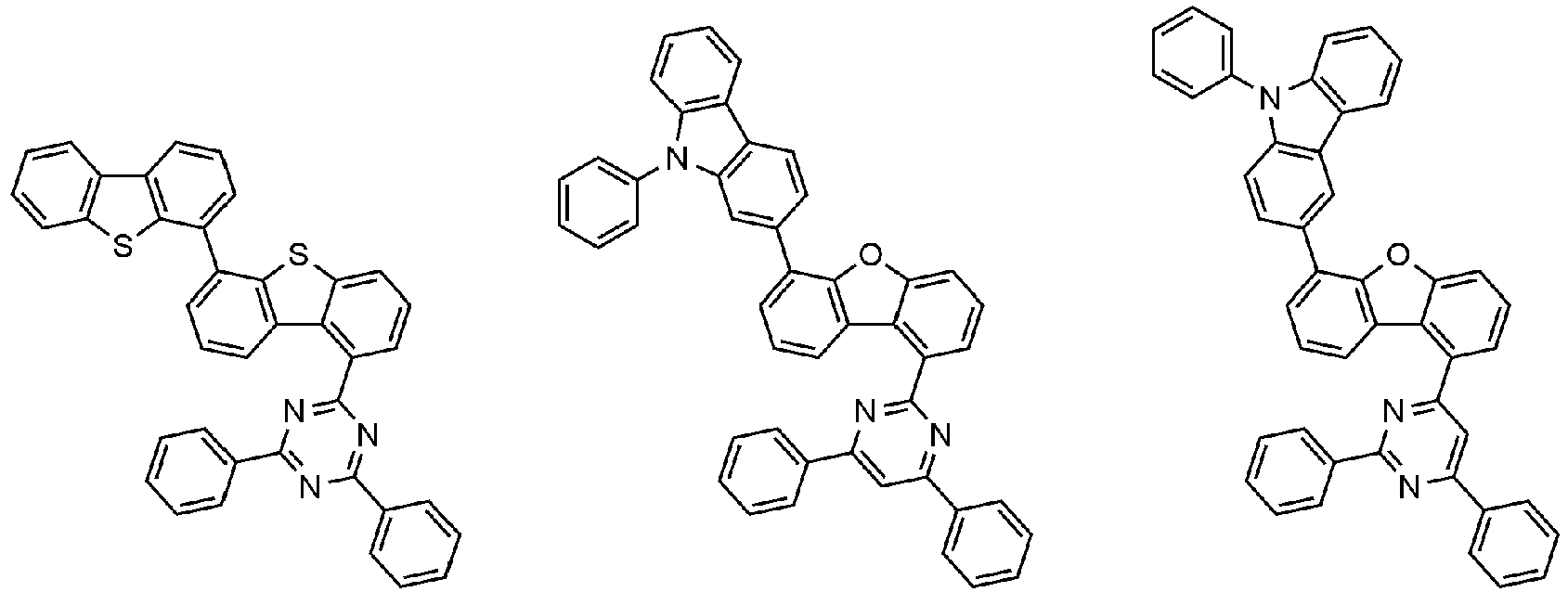


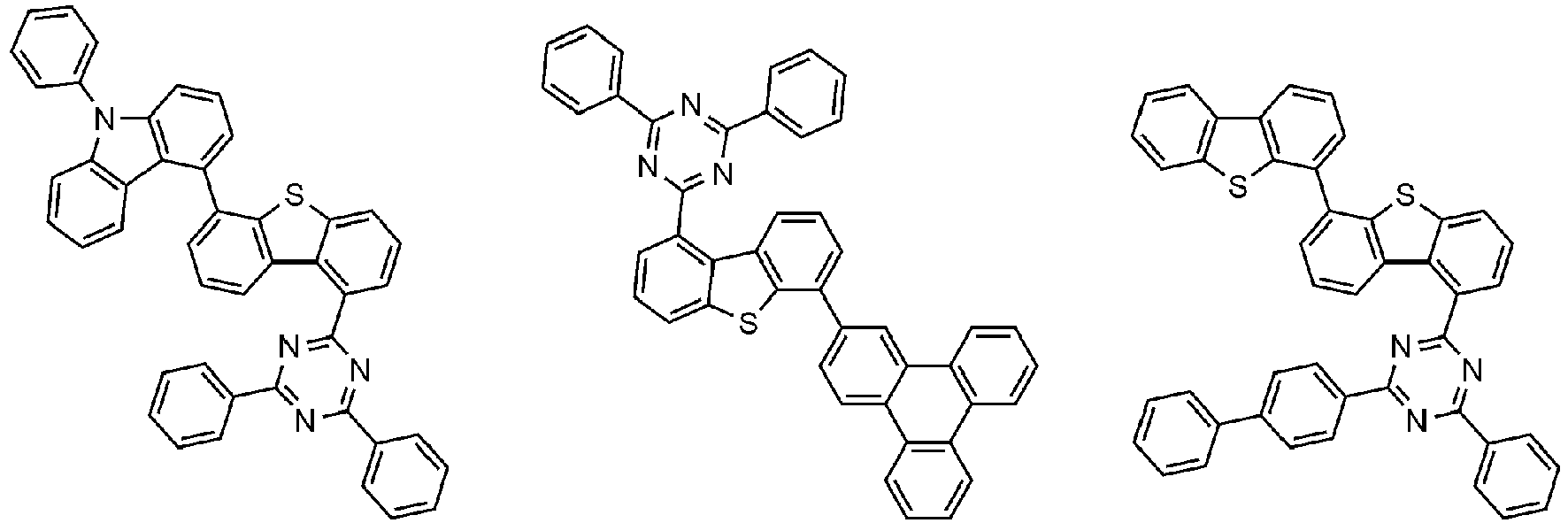





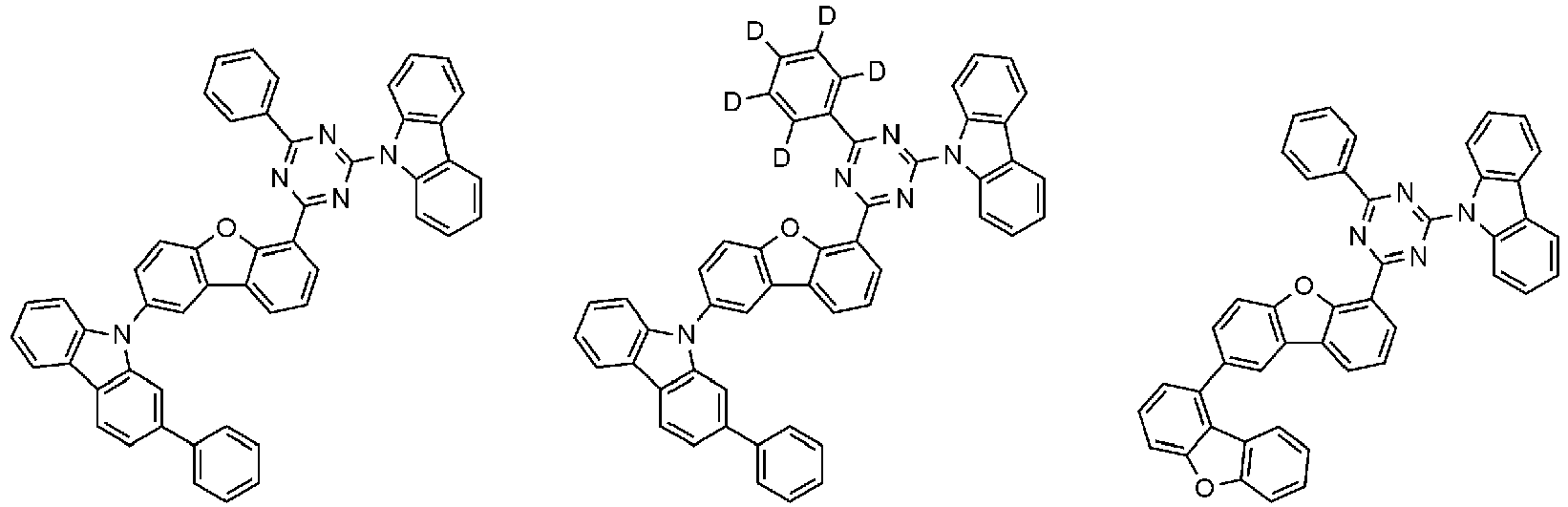


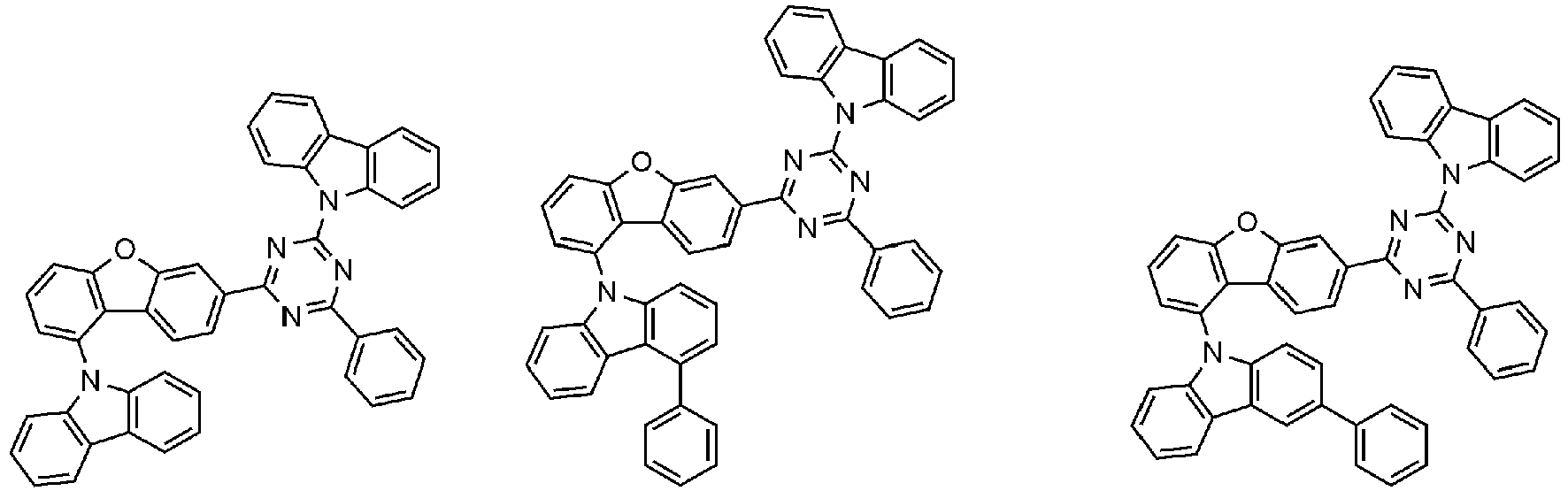





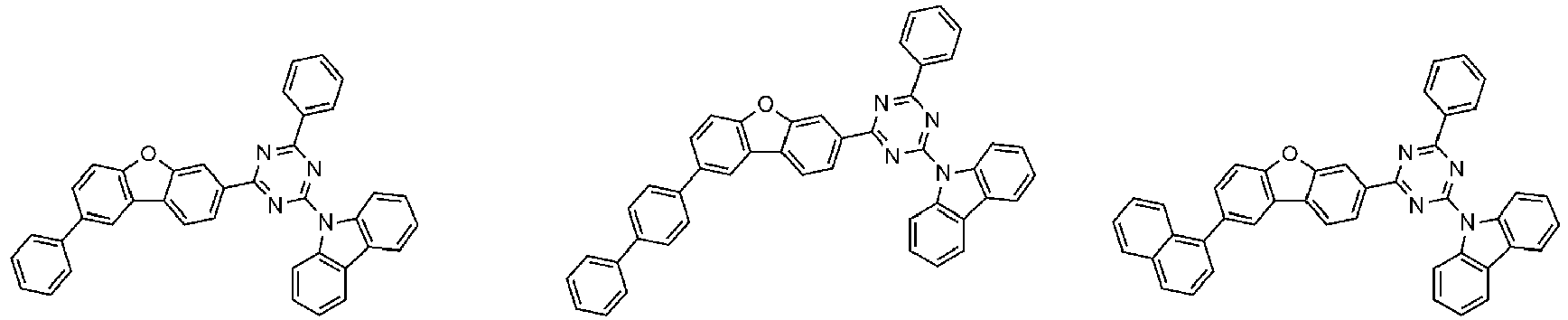


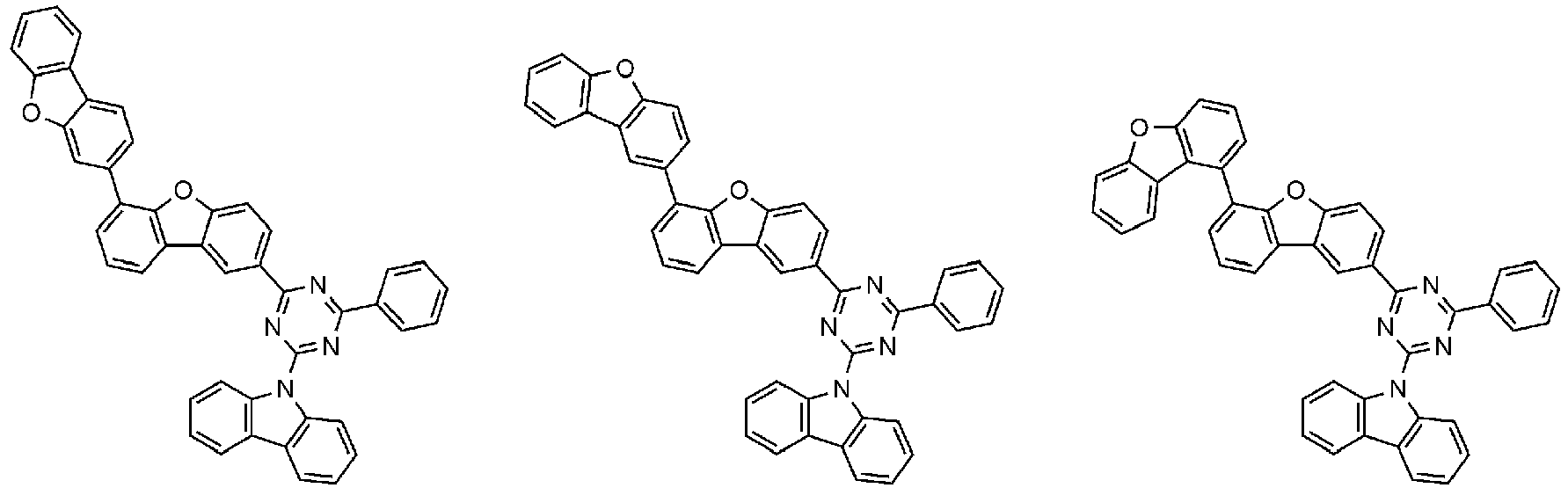


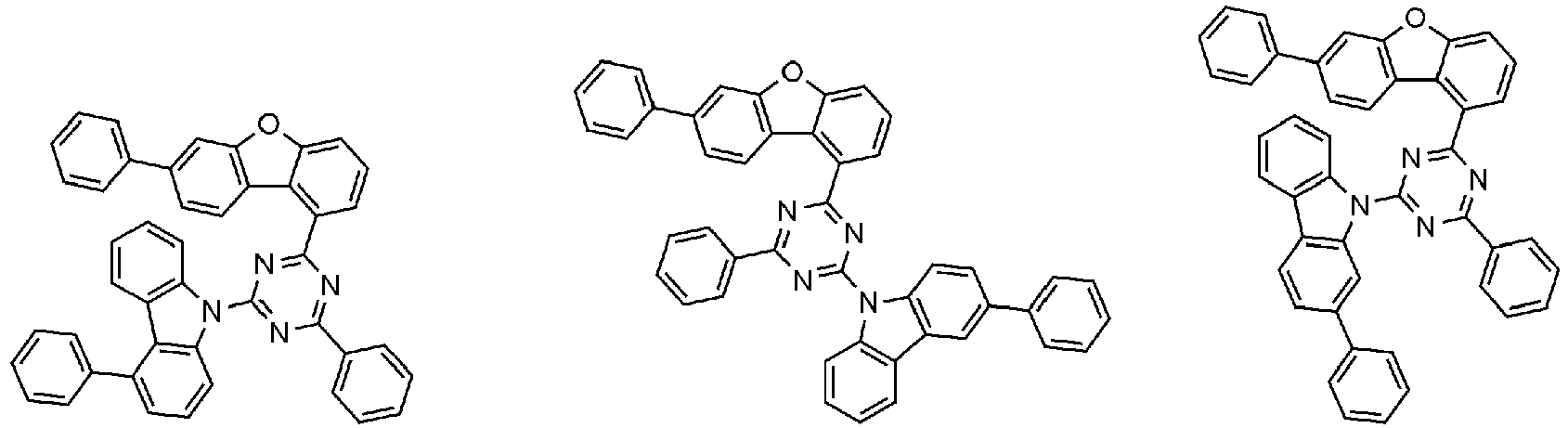


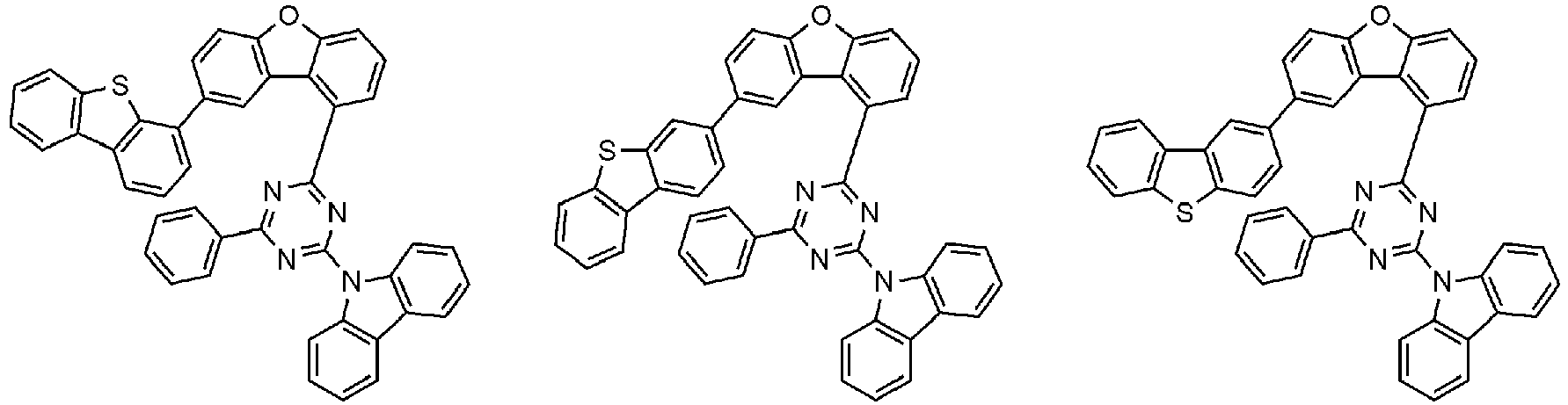


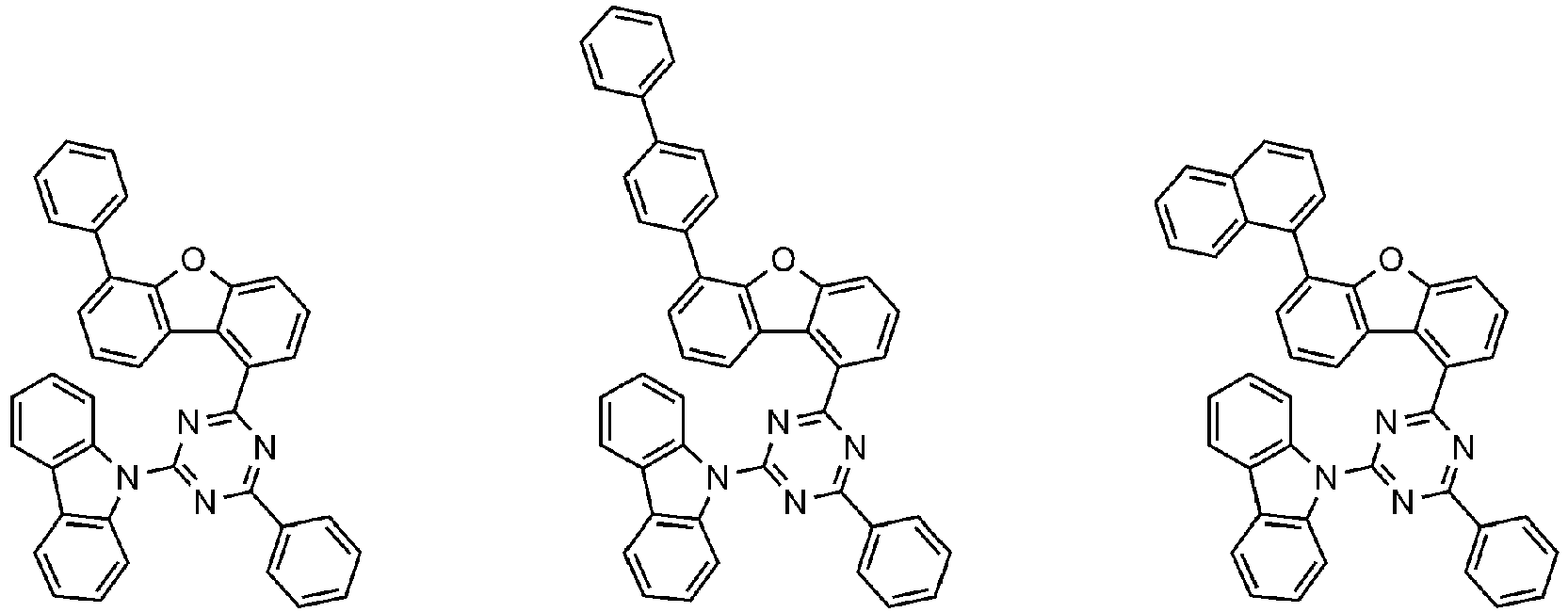
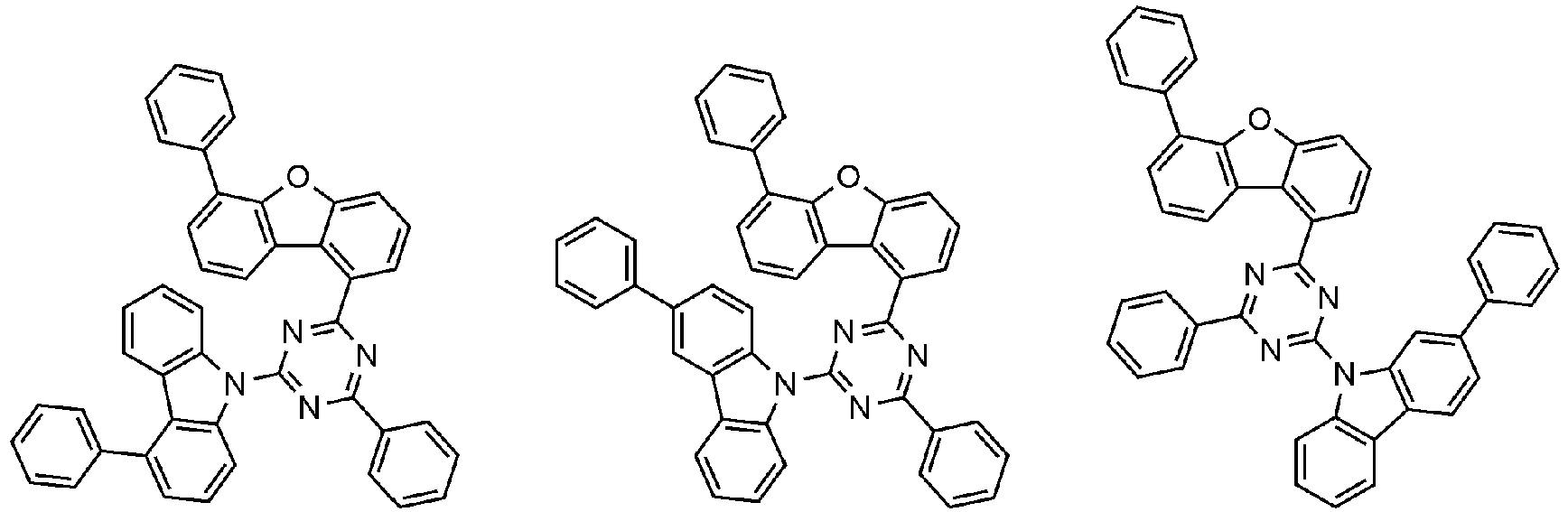


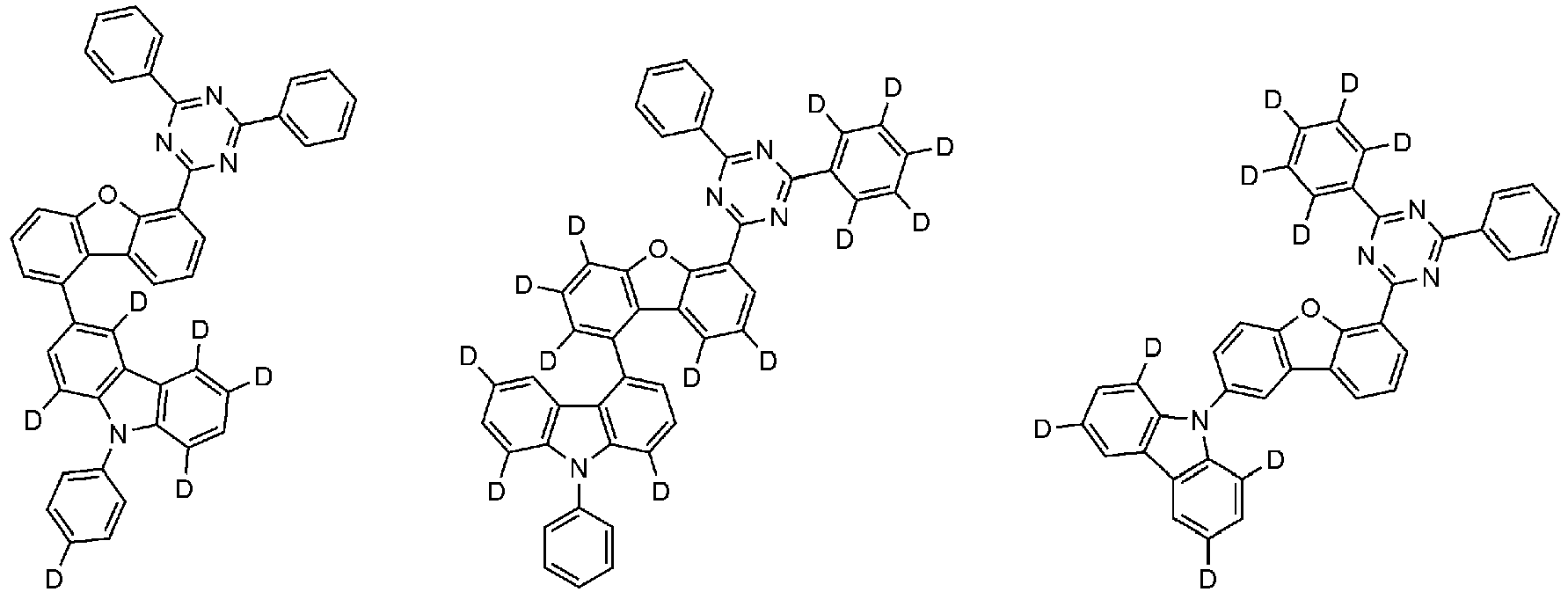


- The organic light emitting device according to claim 1, wherein:the Chemical Formula 2 is represented by the following Chemical Formula 2-1:

 wherein in Chemical Formula 2-1,Ar3, Ar4, R3, R4, b and c are as defined in claim 1.
 - The organic light emitting device according to claim 1, wherein:
Ar3 and Ar4 are each independently phenyl, biphenylyl, terphenylyl, naphthyl, dimethylfluorenyl, dibenzofuranyl, or dibenzothiophenyl. - The organic light emitting device according to claim 1, wherein:
R2 and R3 are each independently hydrogen, or phenyl. - The organic light emitting device according to claim 10, wherein:
one of R2 and R3 is phenyl and the rest is hydrogen, or both R2 and R3 are hydrogen. - The organic light emitting device according to claim 1, wherein:
the compound represented by Chemical Formula 2 is any one selected from the group consisting of the following compounds:


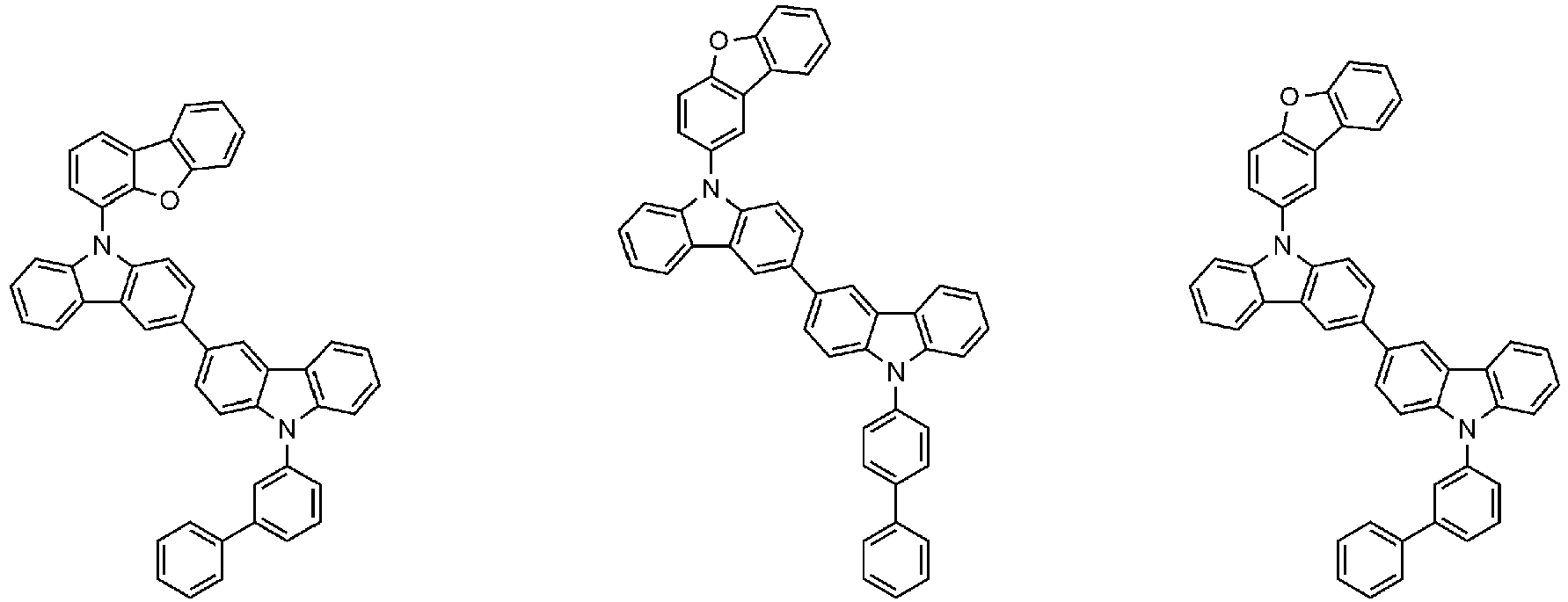


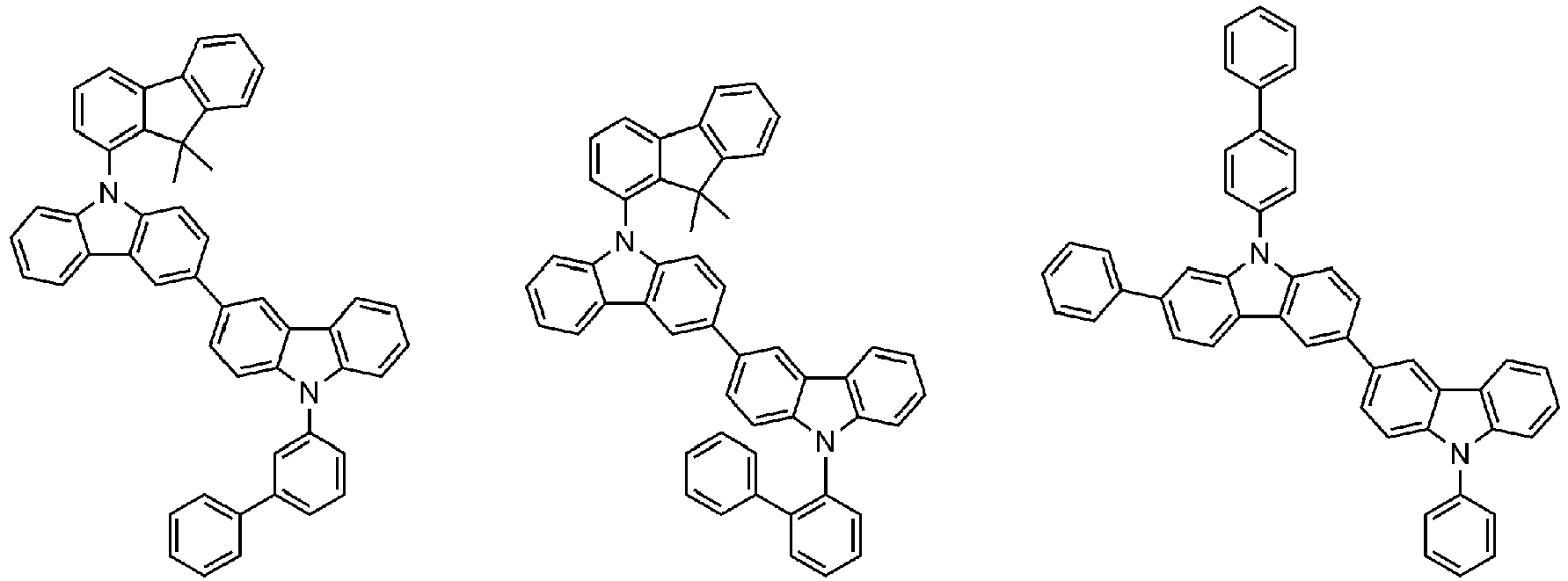


- The organic light emitting device according to claim 1, wherein:the Chemical Formula 3 is represented by any one of the following Chemical Formulas 3-1 to 3-6:


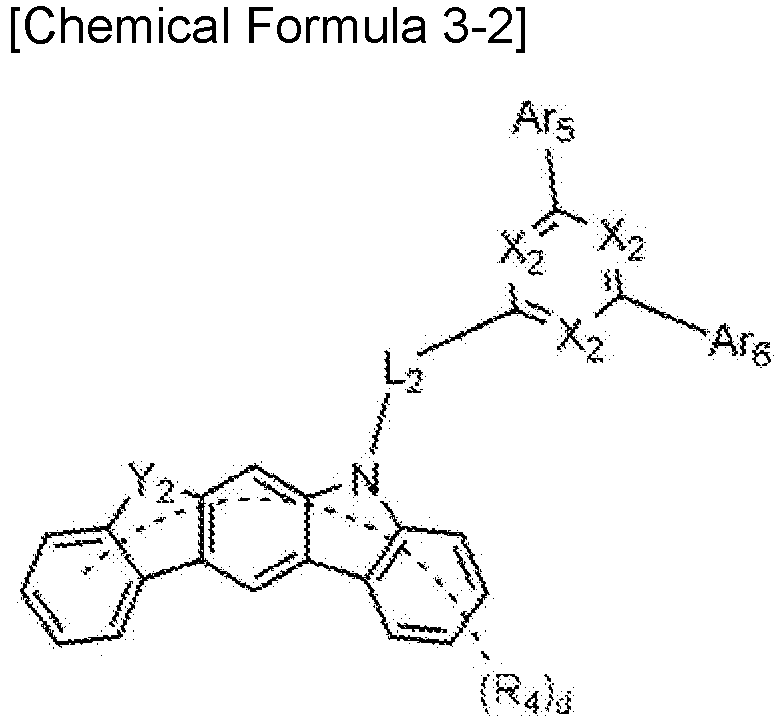


 wherein in Chemical Formulas 3-1 to 3-6,X2, L2, Ar5, Ar6, R4, Y2 and d are as defined in claim 1.
 - The organic light emitting device according to claim 1, wherein:L2 is a direct bond, or phenylene,provided that when L2 is phenylene, it is unsubstituted or substituted with at least one deuterium.
- The organic light emitting device according to claim 1, wherein:Ar5 and Ar6 are each independently phenyl, biphenylyl, (phenyl)biphenylyl, triphenylenyl, dimethylfluorenyl, dibenzofuranyl, dibenzothiophenyl, carbazol-9-yl, or 9-phenyl-9H-carbazolyl, andthe Ars and Ar6 are each independently unsubstituted or substituted with at least one deuterium.
- The organic light emitting device according to claim 1, wherein:Y2 is C(CH3)2, C(C6C5)2, O, S, or NAr7,wherein Ar7 is phenyl, biphenylyl, terphenylyl, dibenzofuranyl, or dibenzothiophenyl, with the Ar7 being unsubstituted or substituted with at least one deuterium.
- The organic light emitting device according to claim 1, wherein:
R4 is hydrogen, or deuterium. - The organic light emitting device according to claim 1, wherein:
the compound represented by Chemical Formula 3 is any one selected from the group consisting of the following compounds:


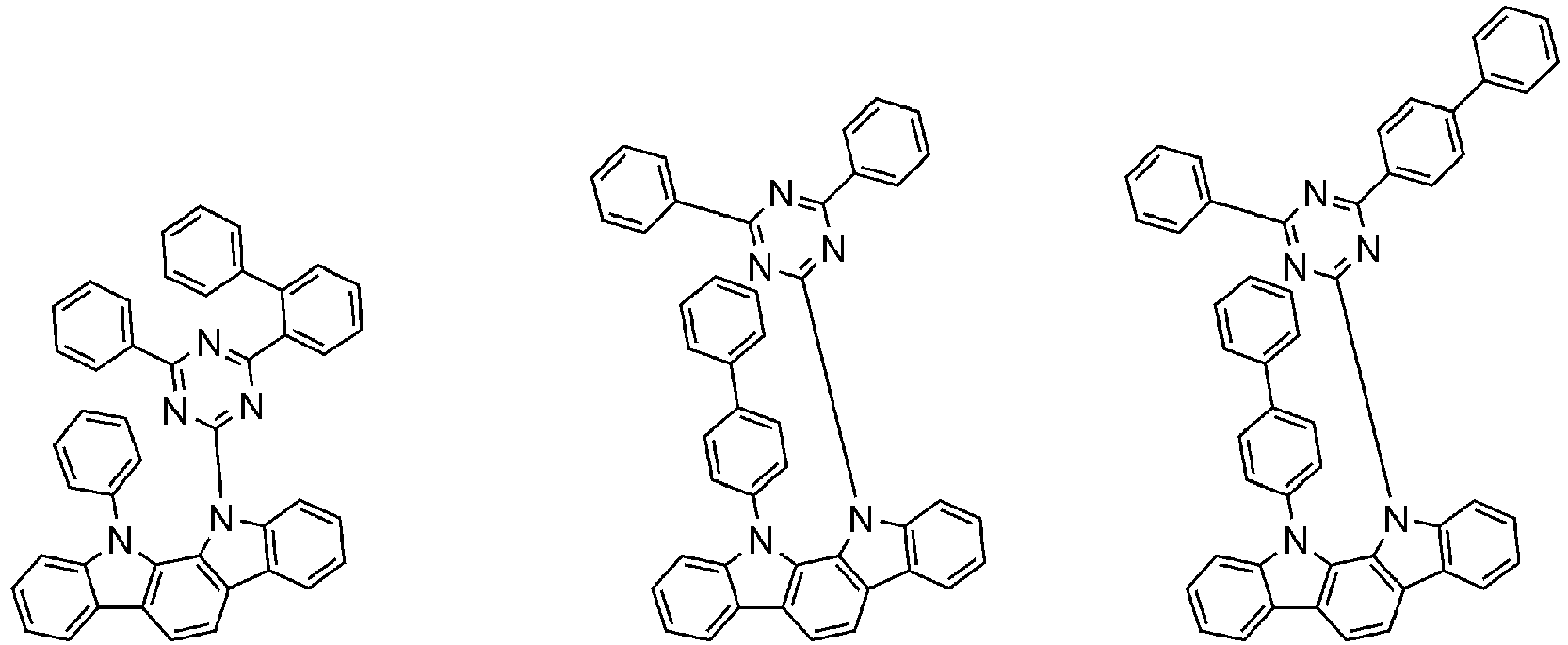


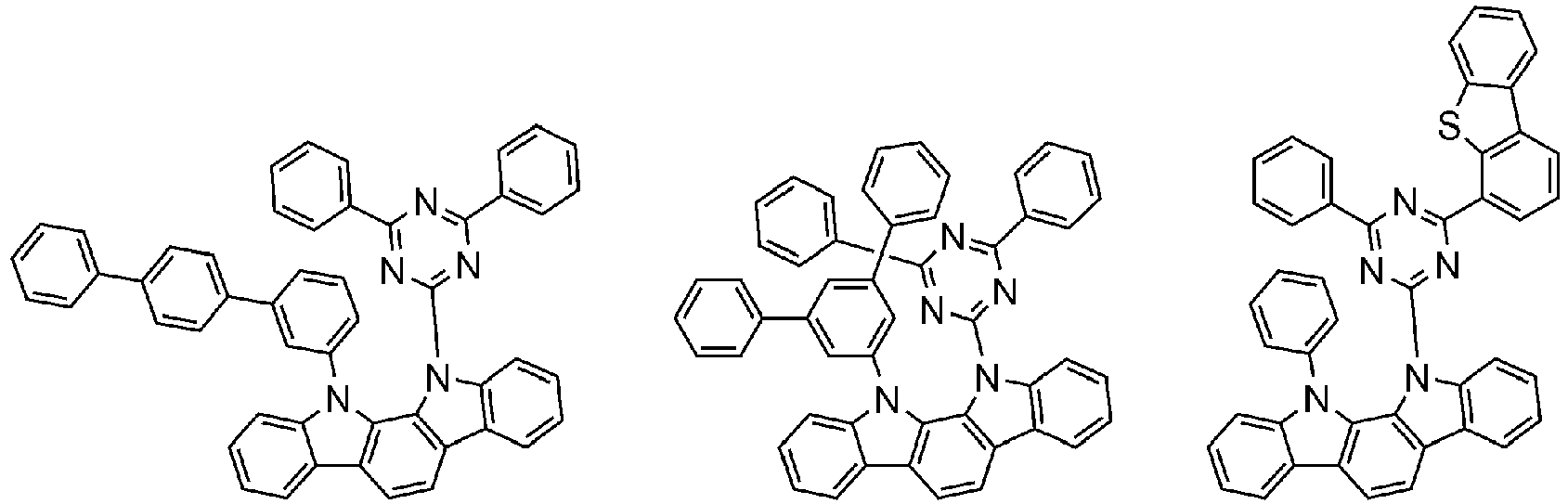


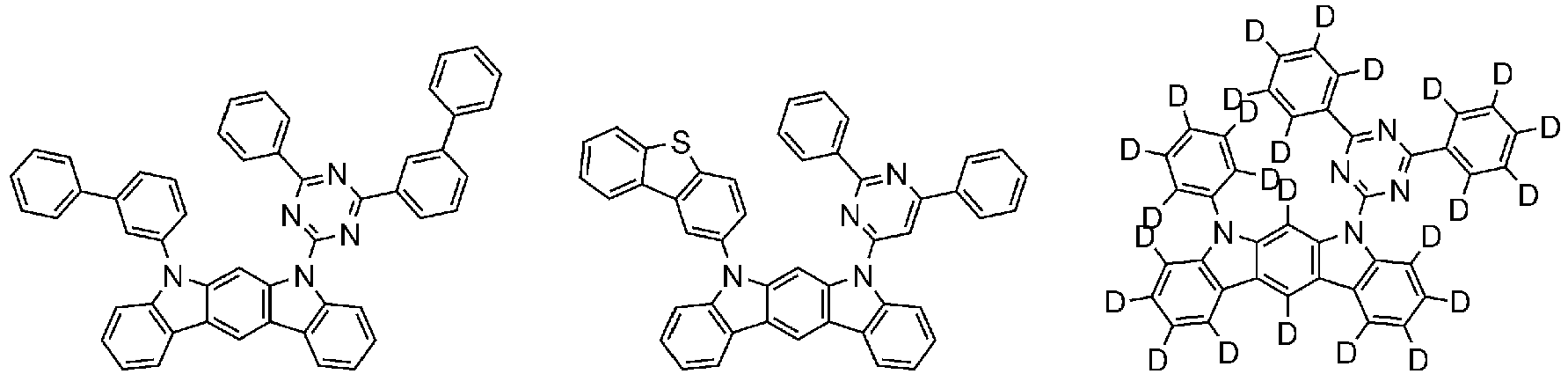

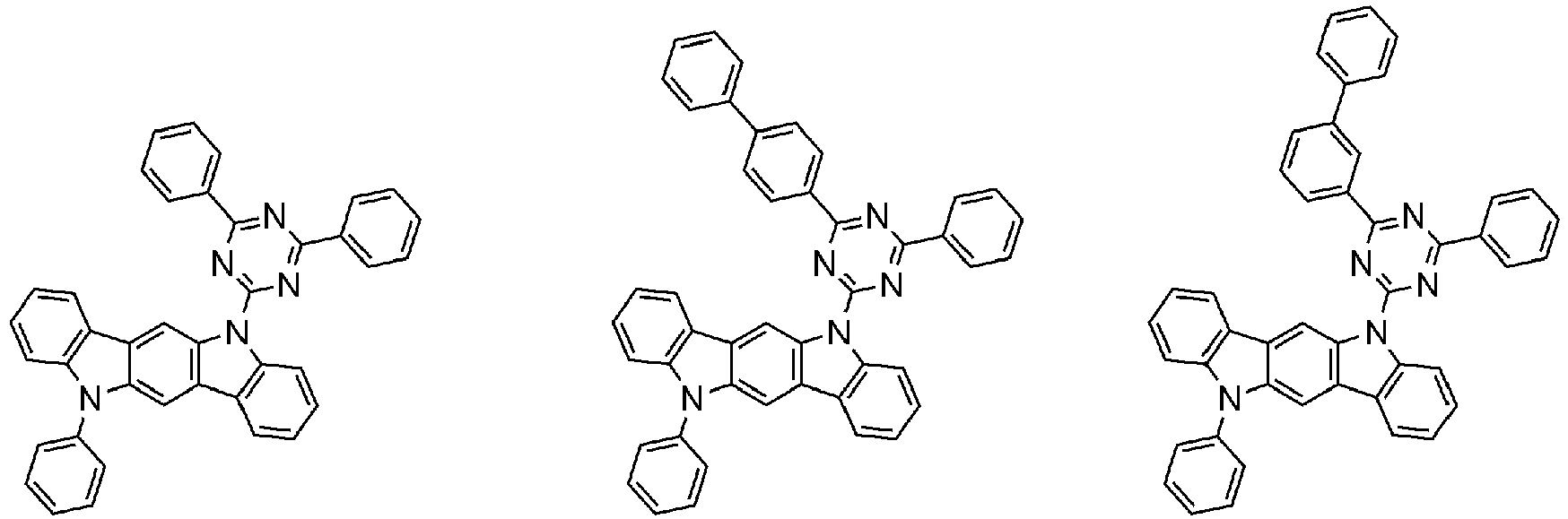


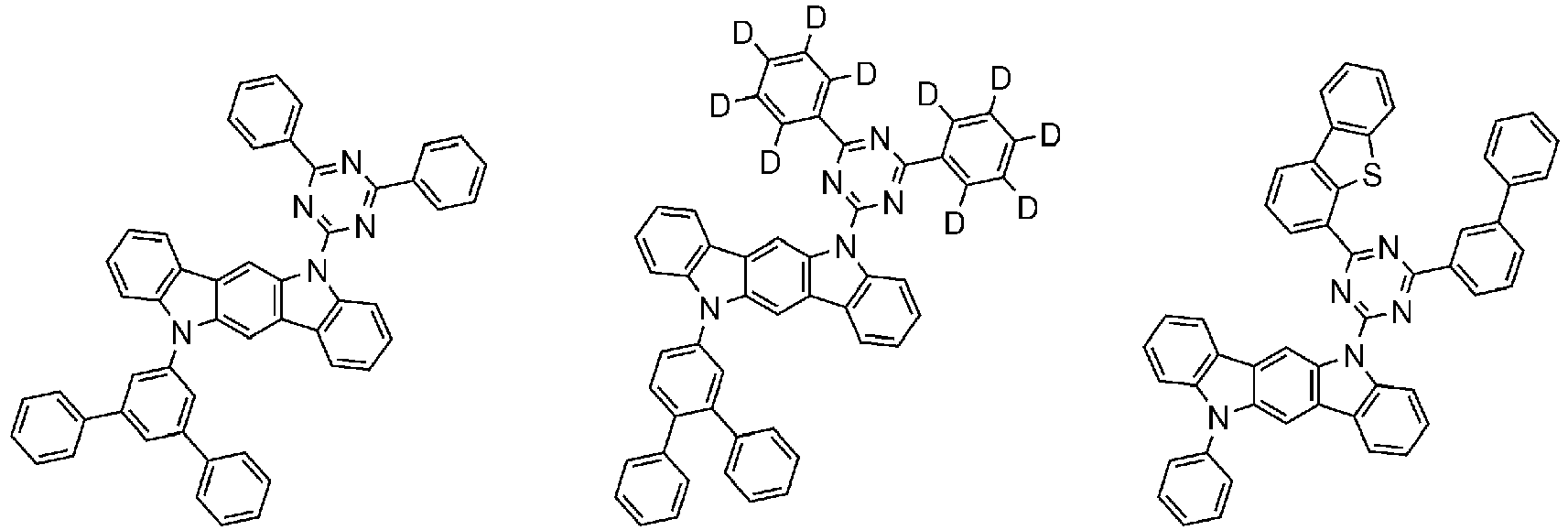


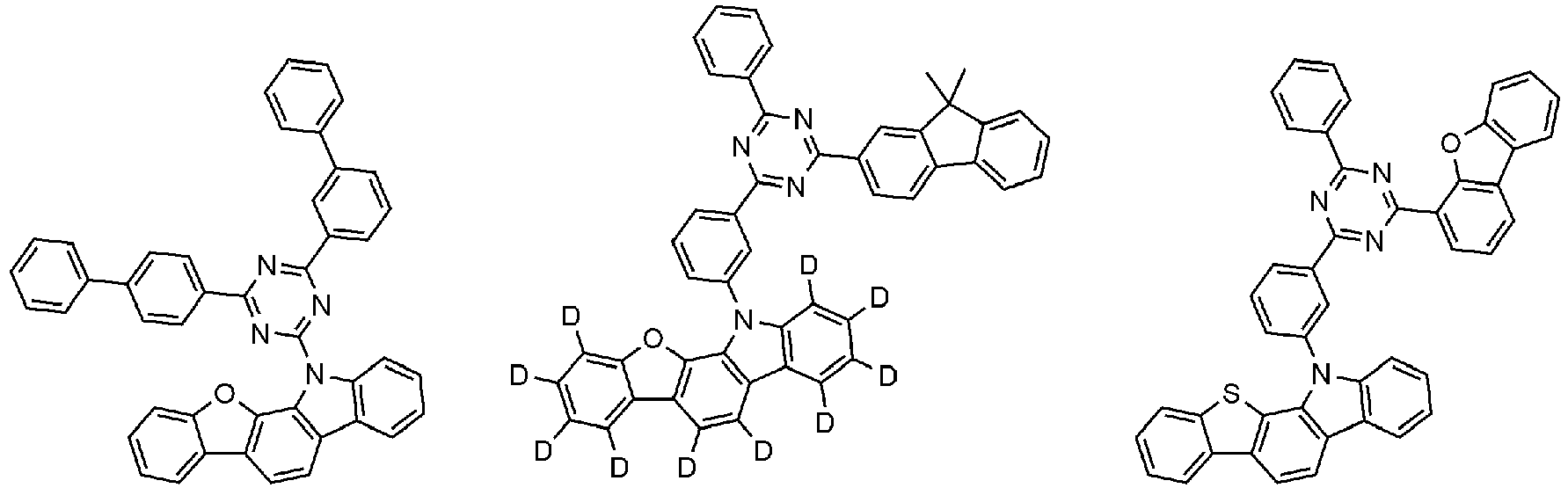


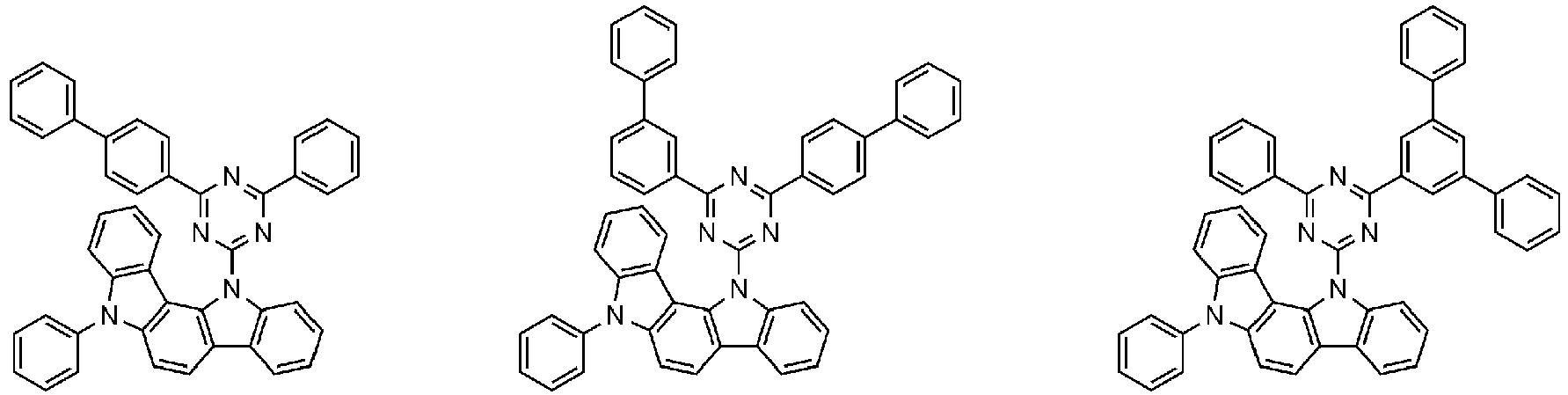


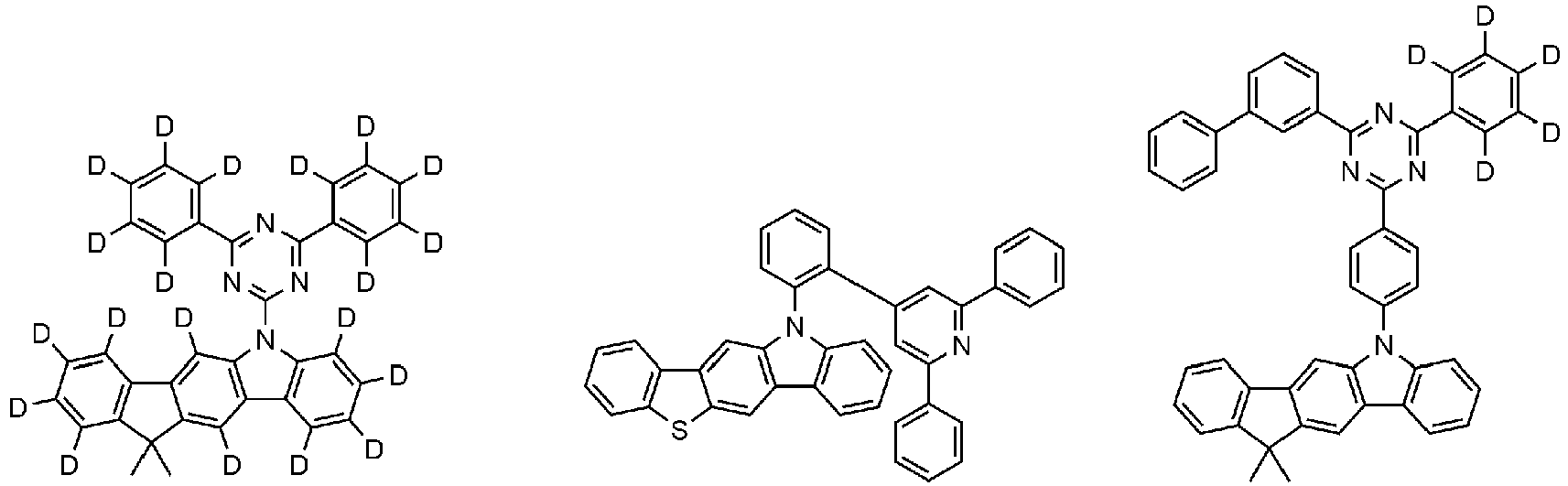


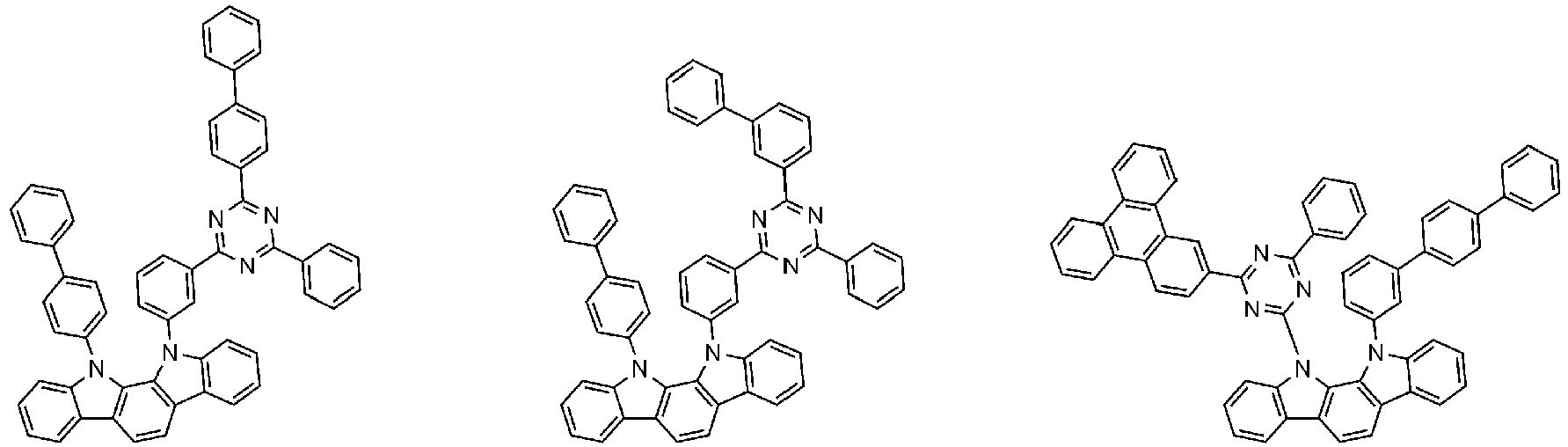
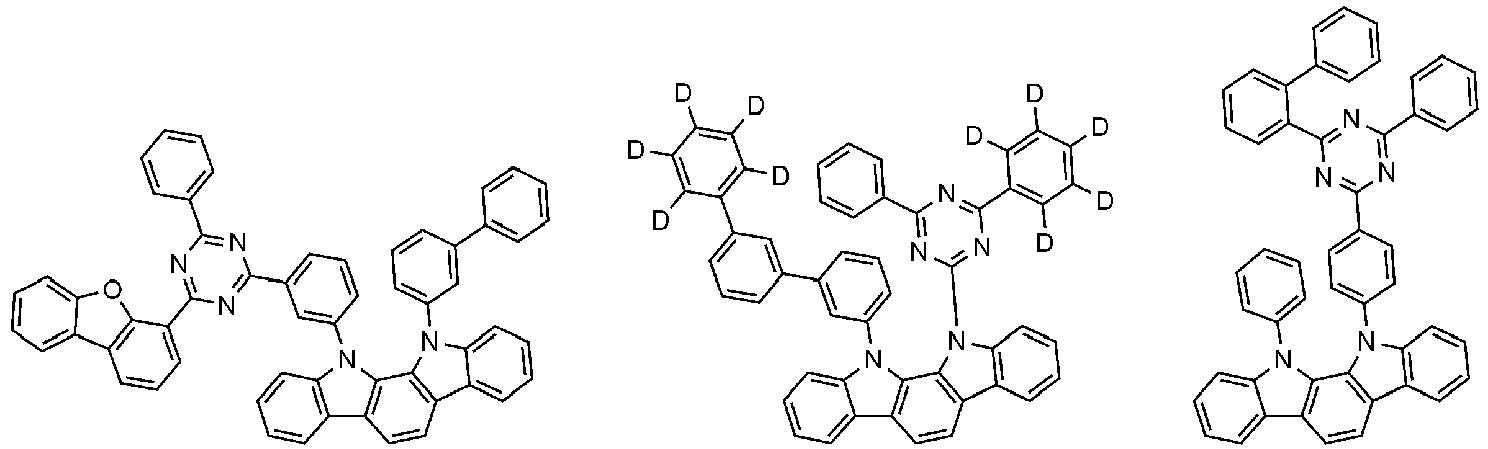
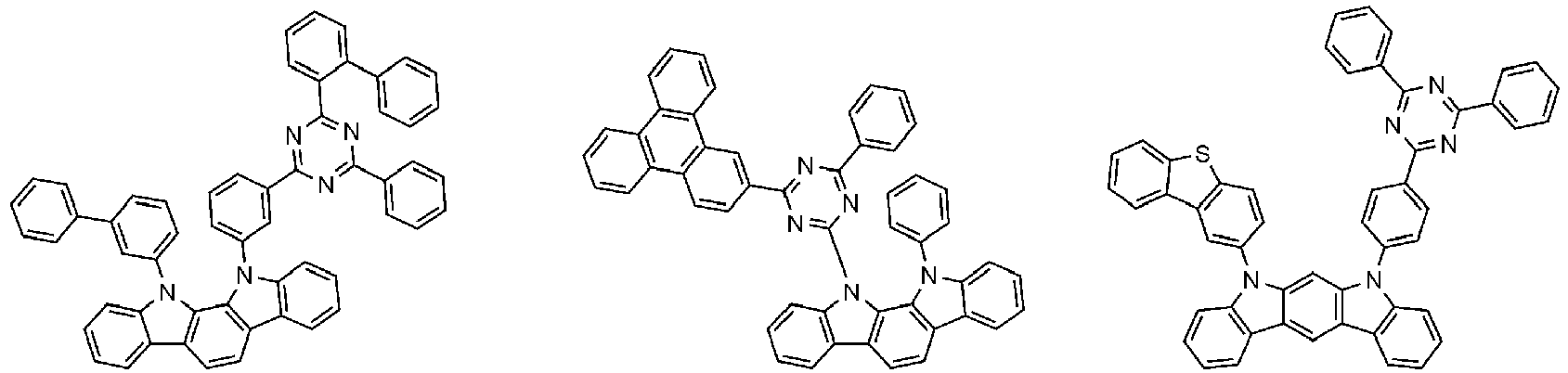


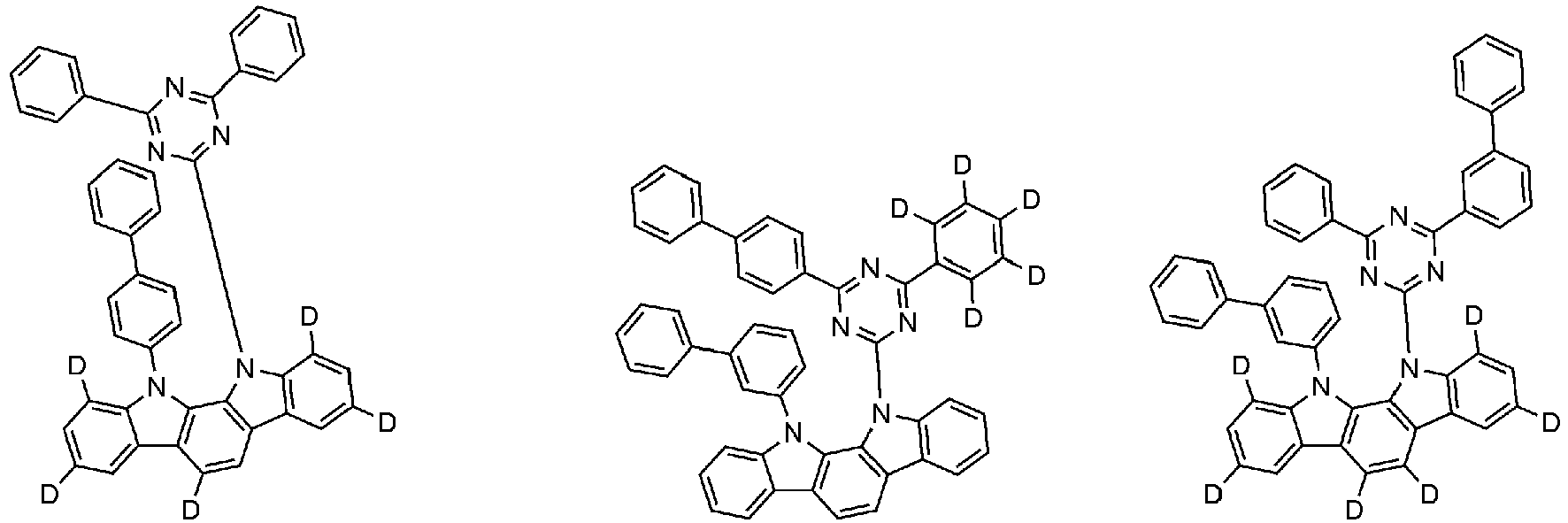


Applications Claiming Priority (2)
| Application Number | Priority Date | Filing Date | Title |
|---|---|---|---|
| KR20200087740 | 2020-07-15 | ||
| PCT/KR2021/009129 WO2022015084A1 (en) | 2020-07-15 | 2021-07-15 | Organic light-emitting element |
Publications (2)
| Publication Number | Publication Date |
|---|---|
| EP4163988A1 true EP4163988A1 (en) | 2023-04-12 |
| EP4163988A4 EP4163988A4 (en) | 2024-01-24 |
Family
ID=80050047
Family Applications (1)
| Application Number | Title | Priority Date | Filing Date |
|---|---|---|---|
| EP21842459.6A Pending EP4163988A4 (en) | 2020-07-15 | 2021-07-15 | Organic light-emitting element |
Country Status (3)
| Country | Link |
|---|---|
| EP (1) | EP4163988A4 (en) |
| KR (1) | KR102675795B1 (en) |
| CN (1) | CN115398661A (en) |
Families Citing this family (22)
| Publication number | Priority date | Publication date | Assignee | Title |
|---|---|---|---|---|
| KR102283849B1 (en) * | 2020-08-21 | 2021-08-02 | 롬엔드하스전자재료코리아유한회사 | Organic electroluminescent compound, a plurality of host materials and organic electroluminescent device comprising the same |
| CN114599647B (en) * | 2020-09-28 | 2024-10-18 | Lt素材株式会社 | Heterocyclic compound, organic light-emitting component comprising same, and composition for organic material layer of organic light-emitting component |
| KR102489726B1 (en) * | 2020-10-30 | 2023-01-17 | 한남대학교 산학협력단 | An organic electroluminescent device comprising deuterated compounds |
| KR102909960B1 (en) * | 2020-11-09 | 2026-01-09 | 주식회사 엘지화학 | Organic light emitting device |
| KR102939101B1 (en) | 2020-12-29 | 2026-03-13 | 엘지디스플레이 주식회사 | Organic light emitting diode and organic light emitting device including the same |
| WO2022177401A1 (en) * | 2021-02-22 | 2022-08-25 | 주식회사 엘지화학 | Novel compound and organic light-emitting device using same |
| KR102908391B1 (en) * | 2021-02-22 | 2026-01-07 | 주식회사 엘지화학 | Novel compound and organic light emitting device comprising the same |
| KR102791026B1 (en) * | 2021-02-22 | 2025-04-08 | 주식회사 엘지화학 | Novel compound and organic light emitting device comprising the same |
| CN116529242A (en) * | 2021-02-22 | 2023-08-01 | 株式会社Lg化学 | Novel compound and organic light emitting device comprising the same |
| JP7646987B2 (en) * | 2021-05-07 | 2025-03-18 | エルジー・ケム・リミテッド | Organic light-emitting device |
| KR20220151981A (en) * | 2021-05-07 | 2022-11-15 | 주식회사 엘지화학 | Organic light emitting device |
| CN117295715A (en) * | 2021-05-31 | 2023-12-26 | 日铁化学材料株式会社 | Deuteride and organic electroluminescent devices |
| EP4349812A1 (en) * | 2021-05-31 | 2024-04-10 | NIPPON STEEL Chemical & Material Co., Ltd. | Deuteride and organic electroluminescent element |
| WO2022255242A1 (en) * | 2021-05-31 | 2022-12-08 | 日鉄ケミカル&マテリアル株式会社 | Deuteride and organic electroluminescent element |
| CN116156984A (en) * | 2021-11-13 | 2023-05-23 | 北京夏禾科技有限公司 | An organic electroluminescent device |
| US20240397737A1 (en) * | 2022-01-26 | 2024-11-28 | Lg Chem, Ltd. | Organic light emitting device |
| CN115353483B (en) * | 2022-07-06 | 2024-04-09 | 南京高光半导体材料有限公司 | A compound containing a bicarbazole structure and an organic electroluminescent device |
| CN115637147B (en) * | 2022-10-27 | 2024-12-10 | 京东方科技集团股份有限公司 | Luminescent materials and luminescent devices |
| KR20260037647A (en) * | 2022-12-13 | 2026-03-18 | 엘티소재주식회사 | Heterocyclic compound, organic light-emitting device and composition for organic material layer of organic light-emitting device comprising same |
| KR102884421B1 (en) * | 2024-10-08 | 2025-11-11 | 솔루스첨단소재 주식회사 | Composition for organic electroluminescent device and organic electroluminescent device comprising the same |
| WO2026095554A1 (en) * | 2024-10-28 | 2026-05-07 | 엘티소재주식회사 | Organic light-emitting element and composition for organic material layer |
| CN120025346B (en) * | 2025-04-22 | 2026-02-27 | 江苏高光新材料科技股份有限公司 | A compound containing a nitrogen heterocyclic structure and an organic electroluminescent device |
Family Cites Families (6)
| Publication number | Priority date | Publication date | Assignee | Title |
|---|---|---|---|---|
| KR100430549B1 (en) | 1999-01-27 | 2004-05-10 | 주식회사 엘지화학 | New organomattalic complex molecule for the fabrication of organic light emitting diodes |
| KR101547410B1 (en) * | 2010-12-20 | 2015-08-25 | 이 아이 듀폰 디 네모아 앤드 캄파니 | Compositions for electronic applications |
| KR101948709B1 (en) * | 2015-09-25 | 2019-02-15 | 삼성에스디아이 주식회사 | Composition for organic optoelectric device, organic optoelectric device and display device |
| WO2017170812A1 (en) * | 2016-03-31 | 2017-10-05 | コニカミノルタ株式会社 | Luminescent thin film and organic electroluminescent element |
| KR102377225B1 (en) * | 2017-07-13 | 2022-03-22 | 에스에프씨주식회사 | organic light-emitting diode with high efficiency and long lifetime |
| WO2019143223A1 (en) * | 2018-01-22 | 2019-07-25 | 주식회사 엘지화학 | Polycyclic compound and organic light-emitting diode comprising same |
-
2021
- 2021-07-15 CN CN202180029054.9A patent/CN115398661A/en active Pending
- 2021-07-15 KR KR1020210092665A patent/KR102675795B1/en active Active
- 2021-07-15 EP EP21842459.6A patent/EP4163988A4/en active Pending
Also Published As
| Publication number | Publication date |
|---|---|
| KR20220009351A (en) | 2022-01-24 |
| CN115398661A (en) | 2022-11-25 |
| EP4163988A4 (en) | 2024-01-24 |
| KR102675795B1 (en) | 2024-06-17 |
Similar Documents
| Publication | Publication Date | Title |
|---|---|---|
| KR102675795B1 (en) | Organic light emitting device | |
| CN112771033B (en) | Novel compound and organic light emitting device comprising the same | |
| KR102447008B1 (en) | organic light emitting device | |
| KR102342781B1 (en) | Novel compound and organic light emitting device comprising the same | |
| KR102446400B1 (en) | organic light emitting device | |
| EP3982434B1 (en) | Organic light-emitting device | |
| US20230172065A1 (en) | Organic light emitting device | |
| EP3862355A1 (en) | Novel compound and organic light emitting device comprising the same | |
| KR102676316B1 (en) | Organic light emitting device | |
| EP3862350B1 (en) | Novel compound and organic light emitting device using same | |
| EP4307402B1 (en) | Organic light emitting device | |
| KR102907314B1 (en) | Organic light emitting device | |
| EP4019513A1 (en) | Novel compound and organic light-emitting diode comprising same | |
| EP4266390B1 (en) | Organic light emitting device | |
| KR102679122B1 (en) | Organic light emitting device | |
| EP4255156A1 (en) | Organic light-emitting device | |
| KR102263106B1 (en) | Novel compound and organic light emitting device comprising the same | |
| EP3730488B1 (en) | Novel heterocyclic compound and organic light emitting device using same | |
| KR20210019949A (en) | Novel compound and organic light emitting device comprising the same | |
| EP4270510A1 (en) | Organic light-emitting device | |
| KR102889048B1 (en) | Novel compound and organic light emitting device comprising the same | |
| KR102430077B1 (en) | Novel compound and organic light emitting device comprising the same | |
| KR102592081B1 (en) | Novel compound and organic light emitting device comprising the same | |
| EP4357341A1 (en) | Novel compound and organic light emitting device comprising same | |
| EP4270508A1 (en) | Organic light emitting device |
Legal Events
| Date | Code | Title | Description |
|---|---|---|---|
| STAA | Information on the status of an ep patent application or granted ep patent |
Free format text: STATUS: THE INTERNATIONAL PUBLICATION HAS BEEN MADE |
|
| PUAI | Public reference made under article 153(3) epc to a published international application that has entered the european phase |
Free format text: ORIGINAL CODE: 0009012 |
|
| STAA | Information on the status of an ep patent application or granted ep patent |
Free format text: STATUS: REQUEST FOR EXAMINATION WAS MADE |
|
| 17P | Request for examination filed |
Effective date: 20230109 |
|
| AK | Designated contracting states |
Kind code of ref document: A1 Designated state(s): AL AT BE BG CH CY CZ DE DK EE ES FI FR GB GR HR HU IE IS IT LI LT LU LV MC MK MT NL NO PL PT RO RS SE SI SK SM TR |
|
| DAV | Request for validation of the european patent (deleted) | ||
| DAX | Request for extension of the european patent (deleted) | ||
| REG | Reference to a national code |
Ref country code: DE Ref legal event code: R079 Free format text: PREVIOUS MAIN CLASS: H01L0051000000 Ipc: H10K0050110000 |
|
| A4 | Supplementary search report drawn up and despatched |
Effective date: 20240104 |
|
| RIC1 | Information provided on ipc code assigned before grant |
Ipc: H10K 85/60 20230101ALI20231221BHEP Ipc: H10K 50/11 20230101AFI20231221BHEP |