EP4163920A1 - Information processing program, information processing method, and information processing device - Google Patents
Information processing program, information processing method, and information processing device Download PDFInfo
- Publication number
- EP4163920A1 EP4163920A1 EP20939180.4A EP20939180A EP4163920A1 EP 4163920 A1 EP4163920 A1 EP 4163920A1 EP 20939180 A EP20939180 A EP 20939180A EP 4163920 A1 EP4163920 A1 EP 4163920A1
- Authority
- EP
- European Patent Office
- Prior art keywords
- group
- compression code
- primary structure
- sequence
- information processing
- Prior art date
- Legal status (The legal status is an assumption and is not a legal conclusion. Google has not performed a legal analysis and makes no representation as to the accuracy of the status listed.)
- Pending
Links
Images








Classifications
-
- H—ELECTRICITY
- H03—ELECTRONIC CIRCUITRY
- H03M—CODING; DECODING; CODE CONVERSION IN GENERAL
- H03M7/00—Conversion of a code where information is represented by a given sequence or number of digits to a code where the same, similar or subset of information is represented by a different sequence or number of digits
- H03M7/30—Compression; Expansion; Suppression of unnecessary data, e.g. redundancy reduction
- H03M7/3084—Compression; Expansion; Suppression of unnecessary data, e.g. redundancy reduction using adaptive string matching, e.g. the Lempel-Ziv method
- H03M7/3088—Compression; Expansion; Suppression of unnecessary data, e.g. redundancy reduction using adaptive string matching, e.g. the Lempel-Ziv method employing the use of a dictionary, e.g. LZ78
-
- H—ELECTRICITY
- H03—ELECTRONIC CIRCUITRY
- H03M—CODING; DECODING; CODE CONVERSION IN GENERAL
- H03M7/00—Conversion of a code where information is represented by a given sequence or number of digits to a code where the same, similar or subset of information is represented by a different sequence or number of digits
- H03M7/30—Compression; Expansion; Suppression of unnecessary data, e.g. redundancy reduction
- H03M7/3082—Vector coding
-
- G—PHYSICS
- G06—COMPUTING OR CALCULATING; COUNTING
- G06F—ELECTRIC DIGITAL DATA PROCESSING
- G06F18/00—Pattern recognition
- G06F18/20—Analysing
- G06F18/22—Matching criteria, e.g. proximity measures
-
- G—PHYSICS
- G16—INFORMATION AND COMMUNICATION TECHNOLOGY [ICT] SPECIALLY ADAPTED FOR SPECIFIC APPLICATION FIELDS
- G16C—COMPUTATIONAL CHEMISTRY; CHEMOINFORMATICS; COMPUTATIONAL MATERIALS SCIENCE
- G16C20/00—Chemoinformatics, i.e. ICT specially adapted for the handling of physicochemical or structural data of chemical particles, elements, compounds or mixtures
- G16C20/30—Prediction of properties of chemical compounds, compositions or mixtures
-
- G—PHYSICS
- G16—INFORMATION AND COMMUNICATION TECHNOLOGY [ICT] SPECIALLY ADAPTED FOR SPECIFIC APPLICATION FIELDS
- G16C—COMPUTATIONAL CHEMISTRY; CHEMOINFORMATICS; COMPUTATIONAL MATERIALS SCIENCE
- G16C20/00—Chemoinformatics, i.e. ICT specially adapted for the handling of physicochemical or structural data of chemical particles, elements, compounds or mixtures
- G16C20/40—Searching chemical structures or physicochemical data
-
- G—PHYSICS
- G16—INFORMATION AND COMMUNICATION TECHNOLOGY [ICT] SPECIALLY ADAPTED FOR SPECIFIC APPLICATION FIELDS
- G16C—COMPUTATIONAL CHEMISTRY; CHEMOINFORMATICS; COMPUTATIONAL MATERIALS SCIENCE
- G16C20/00—Chemoinformatics, i.e. ICT specially adapted for the handling of physicochemical or structural data of chemical particles, elements, compounds or mixtures
- G16C20/50—Molecular design, e.g. of drugs
Definitions
- the embodiment discussed herein is related to an information processing program and the like.
- substances with a molecular weight of more than 1000 such as sugars including starch, cellulose, and the like, proteins, nucleic acids, and natural rubber, and such substances are also called high-molecular compounds.
- the existing technique 1 is a system for searching for an amino acid sequence of a compound such as a protein, which is described by amino acid symbols, using an input character string. Furthermore, in the existing technique 2, a vector is assigned to a descriptive expression such as counting the number of functional groups and atom types of a compound, and the similarity is evaluated with respect to the vector pre-assigned to each compound.
- an object of the present invention is to provide an information processing program, an information processing method, and an information processing device capable of improving evaluation of accuracy of similarity evaluation of high-molecular compounds.
- a computer is caused to execute following processing.
- the computer divides a sequence representing a rational formula of a compound into a character string of a minimum unit of the sequence and a branch symbol representing a branched portion of the compound.
- the computer generates a first coded sequence obtained by encoding the sequence by assigning a compression code to the character string of a minimum unit and assigning the compression code according to a type of the branched portion to the branch symbol on the basis of a group dictionary that indicates a relationship between the sequence of the rational formula of the compound and the compression code.
- the computer generates a second coded sequence obtained by encoding the compression code included in the first coded sequence in units of a group primary structure on the basis of a group primary structure dictionary indicating a relationship between the group primary structure of the sequence of the rational formula of the compound and the compression code.
- FIG. 1 is a diagram (1) for describing processing in which an information processing device according to the present embodiment encodes a compound.
- a case of encoding a compound will be described, but encoding can be similarly performed in a case of encoding a high-molecular compound.
- FIG. 1 a case where a sec-butyl group contained in a certain compound can be further decomposed into a methyl group and an ethyl group, and the methyl group and the ethyl group are encoded will be described.
- a chemical structural formula 10a of the sec-butyl group branches from "CH” into a methyl group "CH 3 " and an ethyl group "CH 2 CH 3 ".
- a rational formula 10b of the chemical structural formula 10a of the sec-butyl group is represented by a sequence such as "-CH(CH 3 )CH 2 CH 3 ".
- the information processing device divides the sequence included in the rational formula 10b into a character string of a minimum unit (meaningful unit) of the sequence and a symbol representing a branched portion of the compound by executing a morphological analysis for the rational formula 10b.
- the character string of the minimum unit of the sequence which is also a code of a meaningful unit, is referred to as a "unit character string”
- the symbol representing a branched portion of the compound is referred to as a "branch symbol”.
- the information processing device divides the rational formula 10b into "CH”, “(", “CH 3 “, ”)”, and “CH 2 CH 3 ".
- “CH”, “CH 3 “, and “CH 2 CH 3 " are unit character strings of groups (or functional groups).
- "(" and ")" are branch symbols.
- the information processing device assigns a compression code to each unit character string on the basis of a group dictionary indicating a relationship between the unit character string of the sequence of the rational formula of the compound and the compression code. For example, the information processing device assigns a compression code A1, a compression code A2, and a compression code A3 to "CH", “CH 3 ", and "CH 2 CH 3 ", respectively.
- the information processing device assigns a compression code to each branch symbol on the basis of a branch code table indicating a relationship between the branch symbol and the compression code. For example, the information processing device assigns a compression code B1 and a compression code B2 to "(" and ")".
- the information processing device generates a compression code sequence 10c obtained by encoding the rational formula 10b by executing the above-described processing.
- the information processing device encodes the compound by executing the above-described processing for a remaining portion of the compound (not illustrated). Furthermore, the information processing device generates group vectors by collecting similar groups such as the butyl group and the sec-butyl group, and collectively embedding the groups in a Poincare space.
- the information processing device further encodes the compression code sequence 10c in units of a group primary structure, focusing on branches.
- the information processing device calculates a vector of the group primary structure of the compound by adding the vectors of the plurality of groups constituting the group primary structure.
- FIG. 2 is a diagram (2) for describing processing in which the information processing device according to the present embodiment encodes a compound.
- FIG. 2 a case of encoding an isobutyl group contained in a certain compound will be described.
- a chemical structural formula 11a of the isobutyl group branches from “CH” to "CH 2 " and two pieces of "CH 3 ".
- a rational formula 11b of the chemical structural formula 11a of the isobutyl group is represented by a sequence such as "-CH 2 CH(CH 3 ) 2 ".
- the information processing device divides the sequence included in the rational formula 11b into a unit character string and a branch symbol by executing a morphological analysis for the rational formula 11b.
- the information processing device divides the rational formula 11b into "CH 2 ", "CH”, “(", “CH 3 ", and ") 2 ".
- "CH 2 ", "CH”, and “CH 3 " are unit character strings.
- "(" and ") 2 " are branch symbols.
- the information processing device assigns a compression code to each unit character string on the basis of a group dictionary indicating a relationship between the unit character string of the sequence of the rational formula of the compound and the compression code. For example, the information processing device assigns a compression code A4, the compression code A1, and the compression code A2 to "CH 2 ", "CH", and “CH 3 ", respectively.
- the information processing device assigns a compression code to each branch symbol on the basis of a branch code table indicating a relationship between the branch symbol and the compression code. For example, the information processing device assigns the compression code B1 and a compression code B3 to "(" and ") 2 ".
- the information processing device generates a compression code sequence 11c obtained by encoding the rational formula 11b by executing the above-described processing.
- the information processing device encodes the compound by executing the above-described processing for a remaining portion of the compound (not illustrated). Furthermore, the information processing device generates group vectors by collecting similar groups and collectively embedding the groups in a Poincare space.
- the information processing device further encodes the compression code sequence 11c in units of a group primary structure.
- the information processing device calculates a vector of the primary structure of the compound by adding the vectors of the plurality of groups constituting the group primary structure.
- FIG. 3 is a diagram (3) for describing processing in which the information processing device according to the present embodiment encodes a compound.
- a chemical structural formula 12a of the tert-butyl group branches from “C” to three pieces of "CH 3 ".
- a rational formula 12b of the chemical structural formula 12a of the tert-butyl group is represented by a sequence such as "-C(CH 3 ) 3 ".
- the information processing device divides the sequence included in the rational formula 12b into a unit character string and a branch symbol by executing a morphological analysis for the rational formula 12b.
- the information processing device divides the rational formula 12b into "C", “(", “CH 3 ", and ") 3 ".
- "CH 2 ", "C”, and “CH 3 " are unit character strings.
- "(" and ") 3 " are branch symbols.
- the information processing device assigns a compression code to each unit character string on the basis of a group dictionary indicating a relationship between the sequence of the rational formula of the compound and the compression code. For example, the information processing device assigns a compression code A5 and the compression code A2 to "C” and “CH 3 ", respectively.
- the information processing device assigns a compression code to each branch symbol on the basis of a branch code table indicating a relationship between the branch symbol and the compression code. For example, the information processing device assigns the compression code B1 and a compression code B4 to "(" and ") 3 ".
- the information processing device generates a compression code sequence 12c obtained by encoding the rational formula 12b by executing the above-described processing.
- the information processing device encodes the compound by executing the above-described processing for a remaining portion of the compound (not illustrated). Furthermore, the information processing device generates group vectors by collecting similar groups and collectively embedding the groups in a Poincare space.
- the information processing device further encodes the compression code sequence 12c in units of a group primary structure.
- the information processing device calculates a vector of the primary structure of the compound by adding the vectors of the plurality of groups constituting the group primary structure.
- the information processing device divides the sequence indicating the rational formula of the compound into the unit character strings and branch symbols, and encodes the rational formula of the compound on the basis of the group dictionary. Furthermore, the information processing device generates group vectors by collecting similar groups and collectively embedding the groups in a Poincare space. The information processing device further encodes the encoded rational formula of the compound in units of the group primary structure, and calculates the vector of the primary structure of the compound by adding the vectors of the plurality of groups constituting the primary structure.
- the rational formula is an example of a chemical structural formula to be encoded.
- the rational formula may be a chemical structural formula expressed by SMILES notation or the like.
- FIG. 4 is a functional block diagram illustrating the configuration of the information processing device according to the present embodiment.
- an information processing device 100 includes a communication unit 110, an input unit 120, a display unit 130, a storage unit 140, and a control unit 150.
- the communication unit 110 is connected to an external device or the like by a wired or wireless means, and transmits and receives information to and from the external device or the like.
- the communication unit 110 is implemented by a network interface card (NIC) or the like.
- the communication unit 110 may be connected to a network (not illustrated).
- the input unit 120 is an input device that inputs various types of information to the information processing device 100.
- the input unit 120 corresponds to a keyboard, a mouse, a touch panel, or the like.
- the display unit 130 is a display device that displays information output from the control unit 150.
- the display unit 130 corresponds to a liquid crystal display, an organic electro luminescence (EL) display, a touch panel, or the like.
- the storage unit 140 has a chemical structural formula file 140a, a branch code table 140b, a group dictionary 140c, a group HMM 140d, a chemical structural formula compressed file 140e, and a first transposed index 140f.
- the storage unit 140 has a group primary structure dictionary 140g, a group primary structure HMM 140h, a group primary structure compressed file 140i, a second transposed index 140j, a property management table 140k, and a transition table 140n.
- the storage unit 140 is implemented by, for example, a semiconductor memory element such as a random access memory (RAM) or a flash memory, or a storage device such as a hard disk or an optical disk.
- the chemical structural formula file 140a is a file including information of the rational formula (chemical structural formula) of the high-molecular compound.
- FIG. 5 is a table illustrating an example of a data structure of the chemical structural formula file. As illustrated in FIG. 5 , this chemical structural formula file 140a associates compound identification information with the rational formula.
- the compound identification information is information that uniquely identifies the high-molecular compound.
- the rational formula is sequence information indicating the rational formula (chemical structural formula) of the high-molecular compound.
- the high-molecular compound corresponds to starch, glycogen, cellulose, amylopectin, or the like, but is not limited thereto, and may be another high-molecular compound.
- the branch code table 140b is a table that defines a code assigned to the branch symbol.
- FIG. 6 is a table illustrating an example of a data structure of the branch code table. As illustrated in FIG. 6 , this branch code table 140b associates the branch symbol with the compression code.
- the branch symbol is a symbol representing the branched portion of the high-molecular compound.
- the compression code is a compression code assigned to the branch symbol. The "h" in the compression code represents hexadecimal.
- the group dictionary 140c is dictionary information indicating the relationship between the sequence of the rational formula of the compound and the compression code.
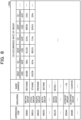
- FIG. 7 is a table illustrating an example of a data structure of the group dictionary. As illustrated in FIG. 7 , this group dictionary 140c associates the compression code, a name, grouping, and the rational formula.
- the compression code indicates a compression code assigned to the rational formula of a corresponding group (or functional group).
- the name is an example of a corresponding name.
- the grouping indicates grouping to which the corresponding group belongs. A name example is an example of the name of the corresponding group.
- the rational formula indicates a sequence that is the rational formula of the corresponding group.
- the group dictionary 140c retains information that defines the relationship between the unit character string and the compression code described in FIGs. 1 to 3 and the like.
- the group hidden Markov model (HMM) 140d is information that associates a certain group with another group that is highly likely to co-occur in the sequence of the high-molecular compound.
- the certain group will be referred to as a "first group” and the another group that co-occurs with the first group will be referred to as a "second group” as appropriate.
- FIG. 8 is a table illustrating an example of a data structure of a group HMM. As illustrated in FIG. 8 , this group HMM 140d associates the compression code, the name example, the grouping, and a co-occurrence rate of the group.
- the compression code indicates a compression code assigned to the rational formula of the first group.
- the name example is an example of the name of the corresponding first group.
- the grouping indicates grouping to which the corresponding first group belongs.
- the compression code of the second group and the co-occurrence rate are given.
- the second groups co-occurring with the first group are a group with the compression code "8028h”, a group with the compression code "8132h”, a group with the compression code "80F5h”, and the like.
- the co-occurrence rate of the first group "compression code: 8000h” and the second group “compression code: 8028h” is "78%".
- the co-occurrence rate of the first group "compression code: 8000h” and the second group “compression code: 8132h” is "63%".
- the co-occurrence rate of the first group "compression code: 8000h” and the second group “compression code: 80F5h” is "33%".
- the chemical structural formula compressed file 140e is a file including information of the encoded rational formula (chemical structural formula) of the high-molecular compound.
- FIG. 9 is a table illustrating an example of a data structure of the chemical structural formula compressed file. As illustrated in FIG. 9 , this chemical structural formula compressed file 140e associates the compound identification information and the compression code sequence.
- the compound identification information is information that uniquely identifies the high-molecular compound.
- the compression code sequence is information obtained by encoding the rational formula in units of the unit character string.
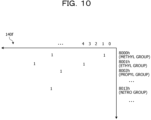
- the first transposed index 140f is index information indicating a relationship between the compression code of the unit character string or the branch symbol included in the chemical structural formula compressed file 140e and an appearance position of the compression code.
- FIG. 10 is a diagram illustrating an example of a data structure of the first transposed index. As illustrated in FIG. 10 , the first transposed index 140f has an offset on the horizontal axis and the compression code on the vertical axis. The offset indicates the appearance position from the lead compression code of the chemical structural formula compressed file 140e to the corresponding compression code. The offset of the lead compression code is set to "0".
- the first transposed index 140f may define a relationship between the compression code and the offset for the compression code sequence for each piece of compound identification information illustrated in FIG. 9 .
- a transposed index of the compression code sequence of the compound identification information "C101" and a transposed index of the compression code sequence of the compound identification information "C102" may be defined.
- the group primary structure dictionary 140g is dictionary information indicating a relationship between the compression code sequence (a plurality of successive compression codes) of the rational formula of the high-molecular compound and the compression code of one group primary structure.
- the group primary structure indicates a structure in which a plurality of groups is combined.
- FIG. 11 is a table illustrating an example of a data structure of the group primary structure dictionary.
- this group primary structure dictionary 140g associates the compression code, the grouping, the name, and the compression code sequence.
- the compression code is a compression code corresponding to the group primary structure.
- the grouping indicates grouping to which the corresponding group primary structure belongs.
- the name is an example of the name of the group primary structure.
- the compression code sequence is a sequence of the compression codes corresponding to a plurality of groups contained in the group primary structure, and the compression codes of groups correspond to the compression codes of groups defined in the group dictionary 140c.
- the group primary structure HMM 140h is information that associates a certain group primary structure with another group primary structure that is highly likely to co-occur in the sequence of the high-molecular compound.
- the certain group primary structure will be referred to as a "first group primary structure”
- the another group primary structure co-occurring with the first group primary structure will be referred to as a "second group primary structure”.
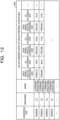
- FIG. 12 is a table illustrating an example of a data structure of the group primary structure HMM. As illustrated in FIG. 12 , this group primary structure HMM 140h associates the compression code, the grouping, the name, and the co-occurrence rate of the group primary structure.
- the compression code indicates a compression code assigned to the first group primary structure.
- the grouping indicates grouping to which the corresponding first group primary structure belongs.
- the name is an example of the name of the corresponding first group primary structure.
- the co-occurrence rate of the group primary structure indicates the compression code of the second group primary structure and the co-occurrence rate for the second group primary structure co-occurring with the first group primary structure.
- the compression codes of the second group primary structure co-occurring with the first group primary structure are "F00011h", “F00101h”, and "F00225h” in the high-molecular compound.
- the co-occurrence rate of the first group primary structure "compression code: F00000h” and the second group “compression code: F00011h” is “78%”.
- the co-occurrence rate of the first group primary structure “compression code: F00000h” and the second group “compression code: F00101h” is “63%”.
- the co-occurrence rate of the first group primary structure “compression code: F00000h” and the second group “compression code: F00225h” is "51%.
- the group primary structure compressed file 140i is a file including information of the rational formula of the high-molecular compound encoded in units of the group primary structure.
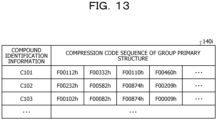
- FIG. 13 is a table illustrating an example of a data structure of the group primary structure compressed file. As illustrated in FIG. 13 , this group primary structure compressed file 140i associates the compound identification information with the compression code sequence of the group primary structure.
- the compound identification information is information that uniquely identifies the high-molecular compound.
- the compression code sequence is information obtained by encoding the rational formula in units of the group primary structure.
- the second transposed index 140j is index information indicating a relationship between the compression code of the group primary structure included in the group primary structure compressed file 140i and the appearance position of the compression code.
- FIG. 14 is a diagram illustrating an example of a data structure of the second transposed index. As illustrated in FIG. 14 , the second transposed index 140j has an offset on the horizontal axis and the compression code on the vertical axis. The offset indicates the appearance position from the lead compression code of the group primary structure compressed file 140i (the compression code in units of the group primary structure) to the corresponding compression code. The offset of the lead compression code is set to "0".
- the second transposed index 140j may define the relationship between the compression code and the offset for the compression code sequence for each piece of compound identification information illustrated in FIG. 13 .
- a transposed index of the compression code sequence of the compound identification information "C101" and a transposed index of the compression code sequence of the compound identification information "C102" may be defined.
- the property management table 140k is a table that defines groups having similar properties.
- FIG. 15 is a table illustrating an example of a data structure of the property management table. As illustrated in FIG. 15 , this property management table 140k associates a property number, the compression code, and the name.
- the property number is a number that identifies the property of the group primary structure, and the same property number is assigned to the compression codes of groups having similar properties.
- the compression code is the compression code of the group.
- the name is the name of the group.
- the same property code "I102" is assigned to the compression code “8004h”, the compression code “8005h”, the compression code “8006h”, and the compression code “8007h”. Therefore, it means that the groups corresponding to the compression code "8004h”, the compression code “8005h”, the compression code “8006h”, and the compression code "8007h” have similar properties.
- the property management table 140k may retain information in which the property number is associated with the compression codes of the groups having similar properties.
- the group vector table 1401 is a table that retains a vector of the compression code assigned to each group included in the high-molecular compound.
- FIG. 16A is a table illustrating an example of a data structure of the group vector table. As illustrated in FIG. 16A , the group vector table 140I associates the compression code of the group with the vector. Note that the group vector table 140I may retain a vector corresponding to the branch symbol defined in the branch code table 140b.
- the group primary structure vector table 140m is a table that retains the vector of the compression code assigned to each group primary structure included in the high-molecular compound.
- FIG. 16B is a table illustrating an example of a data structure of the group primary structure vector table. As illustrated in FIG. 16B , the group primary structure vector table 140m associates the compression code of the group primary structure with the vector.
- the transition table 140n is a table that retains information of the vector of the high-molecular compound.
- FIG. 16C is a table illustrating an example of a data structure of the transition table. As illustrated in FIG. 16C , the transition table 140n has the compound identification information and a plurality of vectors.
- the compound identification information is information that uniquely identifies the high-molecular compound.
- the plurality of vectors represents the vectors of the group primary structures contained in the high-molecular compound.
- a vector (n) is a vector of the group primary structure located in the n-th position from the lead of the high-molecular compound.
- the control unit 150 includes an acquisition unit 151, a first encoding unit 152, a second encoding unit 153, a vector calculation unit 154, and a similarity evaluation unit 155.
- the control unit 150 is implemented by, for example, a central processing unit (CPU) or a micro processing unit (MPU).
- the control unit 150 may be executed by, for example, an integrated circuit such as an application specific integrated circuit (ASIC) or a field programmable gate array (FPGA).
- ASIC application specific integrated circuit
- FPGA field programmable gate array
- the acquisition unit 151 is a processing unit that acquires various types of information from an external device or the like via a network. For example, the acquisition unit 151 acquires the chemical structural formula file 140a and stores the acquired chemical structural formula file 140a in the storage unit 140.
- the acquisition unit 151 may acquire the group dictionary 140c, the group HMM 140d, the group primary structure dictionary 140g, and the group primary structure HMM 140h, and store the acquired information in the storage unit 140.
- the first encoding unit 152 is a processing unit that acquires the rational formula of the high-molecular compound from the chemical structural formula file 140a and encodes the acquired rational formula.
- an example of the processing of the first encoding unit 152 will be described.
- the first encoding unit 152 divides the sequence included in the rational formula into the unit character string or the branch symbol by executing the morphological analysis for the rational formula of the high-molecular compound.
- the processing in which the first encoding unit 152 executes the morphological analysis to divide the sequence into the unit character string or the branch symbol corresponds to the processing described in FIGs. 1 , 2 , and 3 .
- the first encoding unit 152 may perform division by selecting the unit character string having a higher co-occurrence rate on the basis of the group HMM 140d.
- the first encoding unit 152 generates the compression code sequence by encoding the rational formula using the branch code table 140b and the group dictionary 140c after dividing the rational formula of the high-molecular compound into the unit character string or the branch symbol.
- the compression code sequence generated by the first encoding unit 152 corresponds to a "first coded sequence".
- the first encoding unit 152 associates and registers the compound identification information and the compression code sequence in the chemical structural formula compressed file 140e.
- the first encoding unit 152 registers the relationship between the type of the compression code and the offset in the first transposed index 140f in a case of assigning the compression code to the unit character string or the branch symbol of the rational formula of the high-molecular compound. For example, in a case where the offset of the compression code "8000h" is "1" in the compression code sequence (first coded sequence) of the rational formula of the high-molecular compound, the first encoding unit 152 sets "1" at an intersection portion of a column of the offset "1" of the first transposed index 140f and a row of the compression code "8000h".
- the first encoding unit 152 generates the chemical structural formula compressed file 140e by acquiring the information of the rational formula corresponding to unselected compound identification information from the chemical structural formula file 140a and repeatedly executing the above-described processing.
- the second encoding unit 153 is a processing unit that acquires the compression code sequence (first coded sequence) of the high-molecular compound from the chemical structural formula compressed file 140e, and encodes the acquired compression code sequence in units of the group primary structure.
- the relationship between the compression code sequence of the high-molecular compound and the compression code of the group primary structure is defined in the group primary structure dictionary 140g.
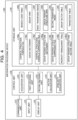
- FIG. 17 is a diagram for describing processing of the second encoding unit.
- a compression code sequence 15 is assumed to be a compression code sequence 15a corresponding to the compound identification information "C101" registered in the chemical structural formula compressed file 140e.
- Each compression code included in the compression code sequence 15a is the compression code of the unit code or the compression code of the branch symbol defined in the group dictionary 140c.
- the second encoding unit 153 assigns the compression code "F00112h" of the group primary structure to each of the compression codes X1, X2,..., and X19.
- the second encoding unit 153 assigns the compression code "F00332h” of the group primary structure to each of the compression codes Y1, Y2,..., and Y38.
- the second encoding unit 153 assigns the compression code "F00110h” of the group primary structure to each of the compression codes Z1, Z2,..., and Z20.
- the second encoding unit 153 generates a compression code sequence 15b obtained by encoding the compression code sequence 15a in units of the group primary structure by repeatedly executing the above-described processing on the basis of the group primary structure dictionary 140g.
- the compression code sequence 15b corresponds to a "second coded sequence”.
- the second encoding unit 153 associates and registers the compound identification information and the compression code sequence in the group primary structure compressed file 140i.
- the second encoding unit 153 may select and assign a compression code with a higher co-occurrence rate on the basis of the group primary structure HMM 140h.
- the second encoding unit 153 registers the relationship between the type of the compression code and the offset in the second transposed index 140j in a case of encoding in units of the group primary structure. For example, in the compression code sequence (second coded sequence) of the rational formula of the high-molecular compound, the offset of the compression code "F00112h" is "0". In this case, the second encoding unit 153 sets "1" at the intersection portion of the column of the offset "0" of the first transposed index 140f and the row of the compression code "F00112h".
- the second encoding unit 153 generates the group primary structure compressed file 140i by acquiring the compression code sequence of the rational formula corresponding to unselected compound identification information from the chemical structural formula compressed file 140e, and repeatedly executing the above-described processing.
- the second encoding unit 153 outputs the relationship among the compression code of the group primary structure, the compression codes of the plurality of groups corresponding to the compression code of the group primary structure, and the compression code of the branch symbol to the vector calculation unit 154.
- the vector calculation unit 154 is a processing unit that acquires the compression code sequence (second coded sequence) of the high-molecular compound from the group primary structure compressed file 140i and calculates the vector of the high-molecular compound.
- the vector calculation unit 154 acquires the compression code of the group primary structure from the group primary structure compressed file 140i, and calculates the vector of the acquired compression code by executing the following processing.
- the vector calculation unit 154 acquires, from the above-described second encoding unit 153, the relationship among the compression code of the group primary structure, the compression codes of the plurality of groups, and the compression code of the branch symbol.
- the vector calculation unit 154 calculates each vector corresponding to the compression code by embedding the compression code for each group in a vector space such as a Poincare space.
- the vector calculation unit 154 may also calculate a vector of the compression code of the branch symbol by embedding the compression code in the Poincare space, or may assign the vector in advance.
- the vector calculation unit 154 associates and registers the compression code of the group with the vector in the group vector table 1401.
- the vector calculation unit 154 calculates the vector of the group primary structure by adding the vectors assigned to the compression code of each group and the compression code of the branch symbol included in the group primary structure.
- the vector calculation unit 154 associates and registers the compression code of the group primary structure with the vector in the group primary structure vector table 140m.
- the high-molecular compound contains a plurality of group primary structures.
- the vector calculation unit 154 associates and registers the compound identification information with the vector for each group primary structure in the transition table 140n.
- the vector calculation unit 154 registers the vectors of the group primary structures in the transition table 140n in the order in which the group primary structures appear.
- the processing in which the vector calculation unit 154 embeds the compression code of the group in the Poincare space to calculate the vector is a technique called Poincare embeddings.
- Poincare embeddings for example, the technique described in non-patent document " Valentin Khrulkov1 et al. "Hyperbolic Image Embeddings” Georgia University, 2019 April 3 ", or the like may be used.
- a vector is assigned according to an embedded position in the Poincare space, and the more similar information is, the closer the information is embedded.
- the vector calculation unit 154 specifies the compression codes for the groups having similar properties on the basis of the property management table 140k.
- FIG. 18 is a diagram illustrating an example of the Poincare space.
- the groups corresponding to the compression code “8004h”, the compression code “8005h”, the compression code “8006h”, and the compression code “8007h” have similar properties. Therefore, the vector calculation unit 154 embeds the compression code "8004h”, the compression code “8005h”, the compression code “8006h”, and the compression code "8007h” at positions close to each other in a Poincare space P, and provides vectors according to the positions.
- the vector calculation unit 154 calculates the vector of the compression code of each group primary structure contained in the compression code sequence of the high-molecular compound in order from the top, and registers the vector in the transition table 140n in order.
- the vector calculation unit 154 generates the transition table 140n by acquiring the compression code sequence of the rational formula corresponding to unselected compound identification information from the group primary structure compressed file 140i, and repeatedly executing the above-described processing.
- the similarity evaluation unit 155 is a processing unit that evaluates the similarity of high-molecular compounds by comparing the vectors corresponding to the pieces of compound identification information registered in the transition table 140n. For example, the similarity evaluation unit 155 calculates a vector distance of the high-molecular compounds, and specifies a set of the high-molecular compounds with the distance that is less than a threshold as mutually similar high-molecular compounds.
- the similarity evaluation unit 155 may calculate the vector distance of the high-molecular compounds, using vectors obtained by accumulating vectors of the group primary structures corresponding to the high-molecular compounds registered in the transition table 140n as the vectors of the high-molecular compounds.
- the similarity evaluation unit 155 may output an evaluation result to the display unit 130 for display, or may notify an external device or the like.
- FIG. 19 is a flowchart illustrating a processing procedure of the information processing device according to the present embodiment.
- the first encoding unit 152 of the information processing device 100 acquires the sequence of the rational formula of the high-molecular compound from the chemical structural formula file 140a (step S101).
- the first encoding unit 152 executes the morphological analysis and divides the sequence of the rational formula into the unit character string or the branch symbol (step S102).
- the first encoding unit 152 assigns the compression code to the unit character string or the branch symbol on the basis of the branch code table 140b, the group dictionary 140c, and the group HMM 140d, and generates the first transposed index 140f and the chemical structural formula compressed file 140e.
- the vector calculation unit 154 of the information processing device 100 generates the vector of the group by embedding the group in the Poincare space (step S103).
- the second encoding unit 153 of the information processing device 100 acquires the compression code sequence of the high-molecular compound from the chemical structural formula compressed file 140e (step S104).
- the second encoding unit 153 generates the compression code sequence in units of the group primary structure on the basis of the group primary structure dictionary 140g and the group primary structure HMM 140h, and generates the second transposed index 140j and the group primary structure compressed file 140i (step S105).
- the vector calculation unit 154 of the information processing device 100 calculates the vector of the group primary structure by adding the vectors of the groups constituting the units of the group primary structure stored in the group primary structure compressed file 140i, and generates the transition table 140n (step S106).
- the similarity evaluation unit 155 of the information processing device 100 executes similarity evaluation on the basis of the transition table 140n (step S107).
- the information processing device 100 divides the rational formula of the high-molecular compound into the unit character string and the branch symbol and assigns the compression code to generate the compression code sequence, and moreover converts the compression code sequence to each compression code of each group primary structure.
- the information processing device collectively embeds the groups having similar properties into the Poincare space on the basis of the compression code for each group to generate the group vector for appropriately expressing the property of the compound.
- the information processing device 100 adds the vectors of the groups to calculate the vector of the group primary structure, using the compression codes constituting the group primary structure, and generates the transition table. Therefore, a highly accurate vector can be assigned to the group primary structures having similar properties.
- the information processing device 100 can accurately evaluate the high-molecular compounds having similar properties by comparing the vectors of the group primary structures corresponding to the high-molecular compounds stored in the transition table 140n.
- the above-described processing of the information processing device 100 according to the present embodiment is an example, and another processing may be executed.
- the information processing device 100 assigns the compression codes according to granularity of the unit character strings and branch symbols included in the group when encoding the rational formula of the high-molecular compound, but the embodiment is not limited to the case.
- the information processing device 100 may perform encoding by regarding a group as the minimum unit and assigning the compression code specific to a branching group to the group located at the branched portion.
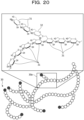
- FIG. 20 is a diagram for describing another processing of the information processing device according to the present embodiment.
- glycogen is used as an example of the high-molecular compound.
- a high-molecular compound 30 illustrated in FIG. 20 is configured by connecting a plurality of groups. A description will be given focusing on a region 30a of the high-molecular compound 30.
- the region 30a includes a plurality of groups 31 and a group 32 of the branched portion.
- the first encoding unit 152 of the information processing device 100 assigns the compression codes to the plurality of groups 31 on the basis of the group dictionary 140c. Furthermore, the first encoding unit 152 assigns the compression code specific to the branched portion to the group 32 of the branched portion.
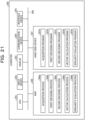
- FIG. 21 is a diagram illustrating an example of a hardware configuration of a computer that implements functions similar to those of the information processing device according to the embodiment.
- a computer 200 includes a CPU 201 that executes various types of arithmetic processing, an input device 202 that receives data input from a user, and a display 203. Furthermore, the computer 200 includes a communication device 204 that exchanges data with an external device or the like via a wired or wireless network, and an interface device 205. Furthermore, the computer 200 includes a RAM 206 that temporarily stores various types of information, and a hard disk device 207. Then, each of the devices 201 to 207 is connected to a bus 208.
- the hard disk device 207 has an acquisition program 207a, a first encoding program 207b, a second encoding program 207c, a vector calculation program 207d, and a similarity evaluation program 207e. Furthermore, the CPU 201 reads each of the programs 207a to 207e, and loads the read program to the RAM 206.
- the acquisition program 207a functions as an acquisition process 206a.
- the first encoding program 207b functions as a first encoding process 206b.
- the second encoding program 207c functions as a second encoding process 206c.
- the vector calculation program 207d functions as a vector calculation process 206d.
- the similarity evaluation program 207e functions as a similarity evaluation process 206e.
- Processing of the acquisition process 206a corresponds to the processing of the acquisition unit 151.
- Processing of the first encoding process 206b corresponds to the processing of the first encoding unit 152.
- Processing of the second encoding process 206c corresponds to the processing of the second encoding unit 153.
- Processing of the vector calculation process 206d corresponds to the processing of the vector calculation unit 154.
- Processing of the similarity evaluation process 206e corresponds to the processing of the similarity evaluation unit 155.
- each of the programs 207a to 207e does not necessarily have to be stored in the hard disk device 307 from the beginning.
- each of the programs may be stored in a "portable physical medium" to be inserted in the computer 200, such as a flexible disk (FD), a compact disc read only memory (CD-ROM), a digital versatile disc (DVD), a magneto-optical disk, or an IC card. Then, the computer 200 may read and execute each of the programs 207a to 207e.
Landscapes
- Engineering & Computer Science (AREA)
- Theoretical Computer Science (AREA)
- Bioinformatics & Cheminformatics (AREA)
- Chemical & Material Sciences (AREA)
- Life Sciences & Earth Sciences (AREA)
- Bioinformatics & Computational Biology (AREA)
- Crystallography & Structural Chemistry (AREA)
- Computing Systems (AREA)
- Physics & Mathematics (AREA)
- Data Mining & Analysis (AREA)
- General Health & Medical Sciences (AREA)
- Medicinal Chemistry (AREA)
- Pharmacology & Pharmacy (AREA)
- Spectroscopy & Molecular Physics (AREA)
- Health & Medical Sciences (AREA)
- Artificial Intelligence (AREA)
- Computer Vision & Pattern Recognition (AREA)
- Evolutionary Biology (AREA)
- Evolutionary Computation (AREA)
- General Engineering & Computer Science (AREA)
- General Physics & Mathematics (AREA)
- Information Retrieval, Db Structures And Fs Structures Therefor (AREA)
- Compression, Expansion, Code Conversion, And Decoders (AREA)
Abstract
Description
- The embodiment discussed herein is related to an information processing program and the like.
- There are substances with a molecular weight of more than 1000, such as sugars including starch, cellulose, and the like, proteins, nucleic acids, and natural rubber, and such substances are also called high-molecular compounds.
- Here, in a case of developing a new drug or a new material, it is required to search for already developed high-molecular compounds and evaluate similarity.
- For example, there are the following
existing techniques existing technique 1 is a system for searching for an amino acid sequence of a compound such as a protein, which is described by amino acid symbols, using an input character string. Furthermore, in theexisting technique 2, a vector is assigned to a descriptive expression such as counting the number of functional groups and atom types of a compound, and the similarity is evaluated with respect to the vector pre-assigned to each compound. - However, the above-described existing techniques have a problem that the accuracy of similarity evaluation of high-molecular compounds is low.
- In one aspect, an object of the present invention is to provide an information processing program, an information processing method, and an information processing device capable of improving evaluation of accuracy of similarity evaluation of high-molecular compounds.
- In a first idea, a computer is caused to execute following processing. The computer divides a sequence representing a rational formula of a compound into a character string of a minimum unit of the sequence and a branch symbol representing a branched portion of the compound. The computer generates a first coded sequence obtained by encoding the sequence by assigning a compression code to the character string of a minimum unit and assigning the compression code according to a type of the branched portion to the branch symbol on the basis of a group dictionary that indicates a relationship between the sequence of the rational formula of the compound and the compression code. The computer generates a second coded sequence obtained by encoding the compression code included in the first coded sequence in units of a group primary structure on the basis of a group primary structure dictionary indicating a relationship between the group primary structure of the sequence of the rational formula of the compound and the compression code.
- It is possible to improve the accuracy of similarity evaluation of high-molecular compounds.
-
-
FIG. 1 is a diagram (1) for describing processing in which an information processing device according to the present embodiment encodes a compound; -
FIG. 2 is a diagram (2) for describing processing in which the information processing device according to the present embodiment encodes a compound; -
FIG. 3 is a diagram (3) for describing processing in which the information processing device according to the present embodiment encodes a compound; -
FIG. 4 is a functional block diagram illustrating a configuration of the information processing device according to the present embodiment; -
FIG. 5 is a table illustrating an example of a data structure of a chemical structural formula file; -
FIG. 6 is a table illustrating an example of a data structure of a branch code table; -
FIG. 7 is a table illustrating an example of a data structure of a group dictionary; -
FIG. 8 is a table illustrating an example of a data structure of a group HMM; -
FIG. 9 is a table illustrating an example of a data structure of a chemical structural formula compressed file; -
FIG. 10 is a diagram illustrating an example of a data structure of a first transposed index; -
FIG. 11 is a table illustrating an example of a data structure of a group primary structure dictionary; -
FIG. 12 is a table illustrating an example of a data structure of a group primary structure HMM; -
FIG. 13 is a table illustrating an example of a data structure of a group primary structure compressed file; -
FIG. 14 is a diagram illustrating an example of a data structure of a second transposed index; -
FIG. 15 is a table illustrating an example of a data structure of a property management table; -
FIG. 16A is a table illustrating an example of a data structure of a group vector table; -
FIG. 16B is a table illustrating an example of a data structure of a group primary structure vector table; -
FIG. 16C is a table illustrating an example of a data structure of a transition table; -
FIG. 17 is a diagram for describing processing of a second encoding unit; -
FIG. 18 is a diagram illustrating an example of a Poincare space; -
FIG. 19 is a flowchart illustrating a processing procedure of the information processing device according to the present embodiment; -
FIG. 20 is a diagram for describing another processing of the information processing device according to the present embodiment; and -
FIG. 21 is a diagram illustrating an example of a hardware configuration of a computer that implements functions similar to those of the information processing device according to the embodiment. - Hereinafter, an embodiment of an information processing program, an information processing method, and an information processing device disclosed in the present application will be described in detail with reference to the drawings. Note that the present embodiment does not limit the present disclosure.
-
FIG. 1 is a diagram (1) for describing processing in which an information processing device according to the present embodiment encodes a compound. Here, a case of encoding a compound will be described, but encoding can be similarly performed in a case of encoding a high-molecular compound. InFIG. 1 , a case where a sec-butyl group contained in a certain compound can be further decomposed into a methyl group and an ethyl group, and the methyl group and the ethyl group are encoded will be described. A chemicalstructural formula 10a of the sec-butyl group branches from "CH" into a methyl group "CH3" and an ethyl group "CH2CH3". Arational formula 10b of the chemicalstructural formula 10a of the sec-butyl group is represented by a sequence such as "-CH(CH3)CH2CH3". - The information processing device divides the sequence included in the
rational formula 10b into a character string of a minimum unit (meaningful unit) of the sequence and a symbol representing a branched portion of the compound by executing a morphological analysis for therational formula 10b. In the following description, the character string of the minimum unit of the sequence, which is also a code of a meaningful unit, is referred to as a "unit character string", and the symbol representing a branched portion of the compound is referred to as a "branch symbol". - In the example illustrated in
FIG. 1 , the information processing device divides therational formula 10b into "CH", "(", "CH3", ")", and "CH2CH3". "CH", "CH3", and "CH2CH3" are unit character strings of groups (or functional groups). "(" and ")" are branch symbols. - The information processing device assigns a compression code to each unit character string on the basis of a group dictionary indicating a relationship between the unit character string of the sequence of the rational formula of the compound and the compression code. For example, the information processing device assigns a compression code A1, a compression code A2, and a compression code A3 to "CH", "CH3", and "CH2CH3", respectively.
- The information processing device assigns a compression code to each branch symbol on the basis of a branch code table indicating a relationship between the branch symbol and the compression code. For example, the information processing device assigns a compression code B1 and a compression code B2 to "(" and ")".
- The information processing device generates a
compression code sequence 10c obtained by encoding therational formula 10b by executing the above-described processing. The information processing device encodes the compound by executing the above-described processing for a remaining portion of the compound (not illustrated). Furthermore, the information processing device generates group vectors by collecting similar groups such as the butyl group and the sec-butyl group, and collectively embedding the groups in a Poincare space. - The information processing device further encodes the
compression code sequence 10c in units of a group primary structure, focusing on branches. The information processing device calculates a vector of the group primary structure of the compound by adding the vectors of the plurality of groups constituting the group primary structure. -
FIG. 2 is a diagram (2) for describing processing in which the information processing device according to the present embodiment encodes a compound. InFIG. 2 , a case of encoding an isobutyl group contained in a certain compound will be described. A chemicalstructural formula 11a of the isobutyl group branches from "CH" to "CH2" and two pieces of "CH3". Arational formula 11b of the chemicalstructural formula 11a of the isobutyl group is represented by a sequence such as "-CH2CH(CH3)2". - The information processing device divides the sequence included in the
rational formula 11b into a unit character string and a branch symbol by executing a morphological analysis for therational formula 11b. In the example illustrated inFIG. 2 , the information processing device divides therational formula 11b into "CH2", "CH", "(", "CH3", and ")2". "CH2", "CH", and "CH3" are unit character strings. "(" and ")2" are branch symbols. - The information processing device assigns a compression code to each unit character string on the basis of a group dictionary indicating a relationship between the unit character string of the sequence of the rational formula of the compound and the compression code. For example, the information processing device assigns a compression code A4, the compression code A1, and the compression code A2 to "CH2", "CH", and "CH3", respectively.
- The information processing device assigns a compression code to each branch symbol on the basis of a branch code table indicating a relationship between the branch symbol and the compression code. For example, the information processing device assigns the compression code B1 and a compression code B3 to "(" and ")2".
- The information processing device generates a
compression code sequence 11c obtained by encoding therational formula 11b by executing the above-described processing. The information processing device encodes the compound by executing the above-described processing for a remaining portion of the compound (not illustrated). Furthermore, the information processing device generates group vectors by collecting similar groups and collectively embedding the groups in a Poincare space. - The information processing device further encodes the
compression code sequence 11c in units of a group primary structure. The information processing device calculates a vector of the primary structure of the compound by adding the vectors of the plurality of groups constituting the group primary structure. -
FIG. 3 is a diagram (3) for describing processing in which the information processing device according to the present embodiment encodes a compound. InFIG. 3 , a case of encoding a tert-butyl group contained in a certain compound will be described. A chemicalstructural formula 12a of the tert-butyl group branches from "C" to three pieces of "CH3". Arational formula 12b of the chemicalstructural formula 12a of the tert-butyl group is represented by a sequence such as "-C(CH3)3". - The information processing device divides the sequence included in the
rational formula 12b into a unit character string and a branch symbol by executing a morphological analysis for therational formula 12b. In the example illustrated inFIG. 3 , the information processing device divides therational formula 12b into "C", "(", "CH3", and ")3". "CH2", "C", and "CH3" are unit character strings. "(" and ")3" are branch symbols. - The information processing device assigns a compression code to each unit character string on the basis of a group dictionary indicating a relationship between the sequence of the rational formula of the compound and the compression code. For example, the information processing device assigns a compression code A5 and the compression code A2 to "C" and "CH3", respectively.
- The information processing device assigns a compression code to each branch symbol on the basis of a branch code table indicating a relationship between the branch symbol and the compression code. For example, the information processing device assigns the compression code B1 and a compression code B4 to "(" and ")3".
- The information processing device generates a
compression code sequence 12c obtained by encoding therational formula 12b by executing the above-described processing. The information processing device encodes the compound by executing the above-described processing for a remaining portion of the compound (not illustrated). Furthermore, the information processing device generates group vectors by collecting similar groups and collectively embedding the groups in a Poincare space. - The information processing device further encodes the
compression code sequence 12c in units of a group primary structure. The information processing device calculates a vector of the primary structure of the compound by adding the vectors of the plurality of groups constituting the group primary structure. - As described above, the information processing device according to the present embodiment divides the sequence indicating the rational formula of the compound into the unit character strings and branch symbols, and encodes the rational formula of the compound on the basis of the group dictionary. Furthermore, the information processing device generates group vectors by collecting similar groups and collectively embedding the groups in a Poincare space. The information processing device further encodes the encoded rational formula of the compound in units of the group primary structure, and calculates the vector of the primary structure of the compound by adding the vectors of the plurality of groups constituting the primary structure. As a result, it is possible to calculate the groups of the compound and the vector of the group primary structure with accuracy, and the accuracy of similarity evaluation is improved by executing similarity evaluation of a high-molecular compound using the groups and the vector of the group primary structure. Note that the rational formula is an example of a chemical structural formula to be encoded. The rational formula may be a chemical structural formula expressed by SMILES notation or the like.
- Next, an example of a configuration of the information processing device according to the present embodiment will be described.
FIG. 4 is a functional block diagram illustrating the configuration of the information processing device according to the present embodiment. As illustrated inFIG. 4 , aninformation processing device 100 includes acommunication unit 110, aninput unit 120, adisplay unit 130, a storage unit 140, and acontrol unit 150. - The
communication unit 110 is connected to an external device or the like by a wired or wireless means, and transmits and receives information to and from the external device or the like. For example, thecommunication unit 110 is implemented by a network interface card (NIC) or the like. Thecommunication unit 110 may be connected to a network (not illustrated). - The
input unit 120 is an input device that inputs various types of information to theinformation processing device 100. Theinput unit 120 corresponds to a keyboard, a mouse, a touch panel, or the like. - The
display unit 130 is a display device that displays information output from thecontrol unit 150. Thedisplay unit 130 corresponds to a liquid crystal display, an organic electro luminescence (EL) display, a touch panel, or the like. - The storage unit 140 has a chemical
structural formula file 140a, a branch code table 140b, agroup dictionary 140c, a group HMM 140d, a chemical structural formula compressedfile 140e, and a first transposedindex 140f. The storage unit 140 has a groupprimary structure dictionary 140g, a group primary structure HMM 140h, a group primary structure compressedfile 140i, a second transposedindex 140j, a property management table 140k, and a transition table 140n. The storage unit 140 is implemented by, for example, a semiconductor memory element such as a random access memory (RAM) or a flash memory, or a storage device such as a hard disk or an optical disk. - The chemical
structural formula file 140a is a file including information of the rational formula (chemical structural formula) of the high-molecular compound.FIG. 5 is a table illustrating an example of a data structure of the chemical structural formula file. As illustrated inFIG. 5 , this chemicalstructural formula file 140a associates compound identification information with the rational formula. The compound identification information is information that uniquely identifies the high-molecular compound. The rational formula is sequence information indicating the rational formula (chemical structural formula) of the high-molecular compound. For example, the high-molecular compound corresponds to starch, glycogen, cellulose, amylopectin, or the like, but is not limited thereto, and may be another high-molecular compound. - The branch code table 140b is a table that defines a code assigned to the branch symbol.
FIG. 6 is a table illustrating an example of a data structure of the branch code table. As illustrated inFIG. 6 , this branch code table 140b associates the branch symbol with the compression code. The branch symbol is a symbol representing the branched portion of the high-molecular compound. The compression code is a compression code assigned to the branch symbol. The "h" in the compression code represents hexadecimal. - The
group dictionary 140c is dictionary information indicating the relationship between the sequence of the rational formula of the compound and the compression code.FIG. 7 is a table illustrating an example of a data structure of the group dictionary. As illustrated inFIG. 7 , thisgroup dictionary 140c associates the compression code, a name, grouping, and the rational formula. The compression code indicates a compression code assigned to the rational formula of a corresponding group (or functional group). The name is an example of a corresponding name. The grouping indicates grouping to which the corresponding group belongs. A name example is an example of the name of the corresponding group. The rational formula indicates a sequence that is the rational formula of the corresponding group. - Furthermore, although not illustrated in
FIG. 7 , thegroup dictionary 140c retains information that defines the relationship between the unit character string and the compression code described inFIGs. 1 to 3 and the like. - The group hidden Markov model (HMM) 140d is information that associates a certain group with another group that is highly likely to co-occur in the sequence of the high-molecular compound. In the following description, the certain group will be referred to as a "first group" and the another group that co-occurs with the first group will be referred to as a "second group" as appropriate.
-
FIG. 8 is a table illustrating an example of a data structure of a group HMM. As illustrated inFIG. 8 , this group HMM 140d associates the compression code, the name example, the grouping, and a co-occurrence rate of the group. The compression code indicates a compression code assigned to the rational formula of the first group. The name example is an example of the name of the corresponding first group. The grouping indicates grouping to which the corresponding first group belongs. - In the co-occurrence rate of the group, for the second group co-occurring with the first group, the compression code of the second group and the co-occurrence rate are given. For example, to describe the first row, in the high-molecular compound, the second groups co-occurring with the first group (compression code: 8000h) are a group with the compression code "8028h", a group with the compression code "8132h", a group with the compression code "80F5h", and the like. Furthermore, the co-occurrence rate of the first group "compression code: 8000h" and the second group "compression code: 8028h" is "78%". The co-occurrence rate of the first group "compression code: 8000h" and the second group "compression code: 8132h" is "63%". The co-occurrence rate of the first group "compression code: 8000h" and the second group "compression code: 80F5h" is "33%".
- The chemical structural formula compressed
file 140e is a file including information of the encoded rational formula (chemical structural formula) of the high-molecular compound.FIG. 9 is a table illustrating an example of a data structure of the chemical structural formula compressed file. As illustrated inFIG. 9 , this chemical structural formula compressedfile 140e associates the compound identification information and the compression code sequence. The compound identification information is information that uniquely identifies the high-molecular compound. The compression code sequence is information obtained by encoding the rational formula in units of the unit character string. - The first transposed
index 140f is index information indicating a relationship between the compression code of the unit character string or the branch symbol included in the chemical structural formula compressedfile 140e and an appearance position of the compression code.FIG. 10 is a diagram illustrating an example of a data structure of the first transposed index. As illustrated inFIG. 10 , the first transposedindex 140f has an offset on the horizontal axis and the compression code on the vertical axis. The offset indicates the appearance position from the lead compression code of the chemical structural formula compressedfile 140e to the corresponding compression code. The offset of the lead compression code is set to "0". - The first transposed
index 140f may define a relationship between the compression code and the offset for the compression code sequence for each piece of compound identification information illustrated inFIG. 9 . For example, a transposed index of the compression code sequence of the compound identification information "C101" and a transposed index of the compression code sequence of the compound identification information "C102" may be defined. - The group
primary structure dictionary 140g is dictionary information indicating a relationship between the compression code sequence (a plurality of successive compression codes) of the rational formula of the high-molecular compound and the compression code of one group primary structure. The group primary structure indicates a structure in which a plurality of groups is combined. -
FIG. 11 is a table illustrating an example of a data structure of the group primary structure dictionary. As illustrated inFIG. 11 , this groupprimary structure dictionary 140g associates the compression code, the grouping, the name, and the compression code sequence. The compression code is a compression code corresponding to the group primary structure. The grouping indicates grouping to which the corresponding group primary structure belongs. The name is an example of the name of the group primary structure. The compression code sequence is a sequence of the compression codes corresponding to a plurality of groups contained in the group primary structure, and the compression codes of groups correspond to the compression codes of groups defined in thegroup dictionary 140c. - The group primary structure HMM 140h is information that associates a certain group primary structure with another group primary structure that is highly likely to co-occur in the sequence of the high-molecular compound. In the following description, the certain group primary structure will be referred to as a "first group primary structure", and the another group primary structure co-occurring with the first group primary structure will be referred to as a "second group primary structure".
-
FIG. 12 is a table illustrating an example of a data structure of the group primary structure HMM. As illustrated inFIG. 12 , this group primary structure HMM 140h associates the compression code, the grouping, the name, and the co-occurrence rate of the group primary structure. The compression code indicates a compression code assigned to the first group primary structure. The grouping indicates grouping to which the corresponding first group primary structure belongs. The name is an example of the name of the corresponding first group primary structure. - The co-occurrence rate of the group primary structure indicates the compression code of the second group primary structure and the co-occurrence rate for the second group primary structure co-occurring with the first group primary structure. For example, to describe the first row, the compression codes of the second group primary structure co-occurring with the first group primary structure (compression code: F00000h) are "F00011h", "F00101h", and "F00225h" in the high-molecular compound.
- Furthermore, the co-occurrence rate of the first group primary structure "compression code: F00000h" and the second group "compression code: F00011h" is "78%". The co-occurrence rate of the first group primary structure "compression code: F00000h" and the second group "compression code: F00101h" is "63%". The co-occurrence rate of the first group primary structure "compression code: F00000h" and the second group "compression code: F00225h" is "51%".
- The group primary structure compressed
file 140i is a file including information of the rational formula of the high-molecular compound encoded in units of the group primary structure.FIG. 13 is a table illustrating an example of a data structure of the group primary structure compressed file. As illustrated inFIG. 13 , this group primary structure compressedfile 140i associates the compound identification information with the compression code sequence of the group primary structure. The compound identification information is information that uniquely identifies the high-molecular compound. The compression code sequence is information obtained by encoding the rational formula in units of the group primary structure. - The second transposed
index 140j is index information indicating a relationship between the compression code of the group primary structure included in the group primary structure compressedfile 140i and the appearance position of the compression code.FIG. 14 is a diagram illustrating an example of a data structure of the second transposed index. As illustrated inFIG. 14 , the second transposedindex 140j has an offset on the horizontal axis and the compression code on the vertical axis. The offset indicates the appearance position from the lead compression code of the group primary structure compressedfile 140i (the compression code in units of the group primary structure) to the corresponding compression code. The offset of the lead compression code is set to "0". - The second transposed
index 140j may define the relationship between the compression code and the offset for the compression code sequence for each piece of compound identification information illustrated inFIG. 13 . For example, a transposed index of the compression code sequence of the compound identification information "C101" and a transposed index of the compression code sequence of the compound identification information "C102" may be defined. - The property management table 140k is a table that defines groups having similar properties.
FIG. 15 is a table illustrating an example of a data structure of the property management table. As illustrated inFIG. 15 , this property management table 140k associates a property number, the compression code, and the name. The property number is a number that identifies the property of the group primary structure, and the same property number is assigned to the compression codes of groups having similar properties. The compression code is the compression code of the group. The name is the name of the group. - In the example illustrated in
FIG. 15 , the same property code "I102" is assigned to the compression code "8004h", the compression code "8005h", the compression code "8006h", and the compression code "8007h". Therefore, it means that the groups corresponding to the compression code "8004h", the compression code "8005h", the compression code "8006h", and the compression code "8007h" have similar properties. - Although not described in
FIG. 15 , the property management table 140k may retain information in which the property number is associated with the compression codes of the groups having similar properties. - The group vector table 1401 is a table that retains a vector of the compression code assigned to each group included in the high-molecular compound.
FIG. 16A is a table illustrating an example of a data structure of the group vector table. As illustrated inFIG. 16A , the group vector table 140I associates the compression code of the group with the vector. Note that the group vector table 140I may retain a vector corresponding to the branch symbol defined in the branch code table 140b. - The group primary structure vector table 140m is a table that retains the vector of the compression code assigned to each group primary structure included in the high-molecular compound.
FIG. 16B is a table illustrating an example of a data structure of the group primary structure vector table. As illustrated inFIG. 16B , the group primary structure vector table 140m associates the compression code of the group primary structure with the vector. - The transition table 140n is a table that retains information of the vector of the high-molecular compound.
FIG. 16C is a table illustrating an example of a data structure of the transition table. As illustrated inFIG. 16C , the transition table 140n has the compound identification information and a plurality of vectors. The compound identification information is information that uniquely identifies the high-molecular compound. The plurality of vectors represents the vectors of the group primary structures contained in the high-molecular compound. For example, a vector (n) is a vector of the group primary structure located in the n-th position from the lead of the high-molecular compound. - The description returns to
FIG. 4 . Thecontrol unit 150 includes an acquisition unit 151, afirst encoding unit 152, asecond encoding unit 153, avector calculation unit 154, and asimilarity evaluation unit 155. Thecontrol unit 150 is implemented by, for example, a central processing unit (CPU) or a micro processing unit (MPU). Furthermore, thecontrol unit 150 may be executed by, for example, an integrated circuit such as an application specific integrated circuit (ASIC) or a field programmable gate array (FPGA). - The acquisition unit 151 is a processing unit that acquires various types of information from an external device or the like via a network. For example, the acquisition unit 151 acquires the chemical
structural formula file 140a and stores the acquired chemicalstructural formula file 140a in the storage unit 140. The acquisition unit 151 may acquire thegroup dictionary 140c, the group HMM 140d, the groupprimary structure dictionary 140g, and the group primary structure HMM 140h, and store the acquired information in the storage unit 140. - The
first encoding unit 152 is a processing unit that acquires the rational formula of the high-molecular compound from the chemicalstructural formula file 140a and encodes the acquired rational formula. Hereinafter, an example of the processing of thefirst encoding unit 152 will be described. - The
first encoding unit 152 divides the sequence included in the rational formula into the unit character string or the branch symbol by executing the morphological analysis for the rational formula of the high-molecular compound. The processing in which thefirst encoding unit 152 executes the morphological analysis to divide the sequence into the unit character string or the branch symbol corresponds to the processing described inFIGs. 1 ,2 , and3 . - In a case where there is a plurality of unit character strings to be division candidates, the
first encoding unit 152 may perform division by selecting the unit character string having a higher co-occurrence rate on the basis of the group HMM 140d. - The
first encoding unit 152 generates the compression code sequence by encoding the rational formula using the branch code table 140b and thegroup dictionary 140c after dividing the rational formula of the high-molecular compound into the unit character string or the branch symbol. The compression code sequence generated by thefirst encoding unit 152 corresponds to a "first coded sequence". Thefirst encoding unit 152 associates and registers the compound identification information and the compression code sequence in the chemical structural formula compressedfile 140e. - The
first encoding unit 152 registers the relationship between the type of the compression code and the offset in the first transposedindex 140f in a case of assigning the compression code to the unit character string or the branch symbol of the rational formula of the high-molecular compound. For example, in a case where the offset of the compression code "8000h" is "1" in the compression code sequence (first coded sequence) of the rational formula of the high-molecular compound, thefirst encoding unit 152 sets "1" at an intersection portion of a column of the offset "1" of the first transposedindex 140f and a row of the compression code "8000h". - The
first encoding unit 152 generates the chemical structural formula compressedfile 140e by acquiring the information of the rational formula corresponding to unselected compound identification information from the chemicalstructural formula file 140a and repeatedly executing the above-described processing. - The
second encoding unit 153 is a processing unit that acquires the compression code sequence (first coded sequence) of the high-molecular compound from the chemical structural formula compressedfile 140e, and encodes the acquired compression code sequence in units of the group primary structure. The relationship between the compression code sequence of the high-molecular compound and the compression code of the group primary structure is defined in the groupprimary structure dictionary 140g. -
FIG. 17 is a diagram for describing processing of the second encoding unit. InFIG. 17 , a compression code sequence 15 is assumed to be acompression code sequence 15a corresponding to the compound identification information "C101" registered in the chemical structural formula compressedfile 140e. Each compression code included in thecompression code sequence 15a is the compression code of the unit code or the compression code of the branch symbol defined in thegroup dictionary 140c. - For example, in the group
primary structure dictionary 140g, it is assumed that the compression codes X1, X2,..., and X19 of thecompression code sequence 15a are associated with the compression code "F00112h" of the group primary structure. In this case, thesecond encoding unit 153 assigns the compression code "F00112h" of the group primary structure to each of the compression codes X1, X2,..., and X19. - In the group
primary structure dictionary 140g, it is assumed that the compression codes Y1, Y2,..., and Y38 of thecompression code sequence 15a are associated with the compression code "F00332h" of the group primary structure. In this case, thesecond encoding unit 153 assigns the compression code "F00332h" of the group primary structure to each of the compression codes Y1, Y2,..., and Y38. - In the group
primary structure dictionary 140g, it is assumed that the compression codes Z1, Z2,..., and Z20 of thecompression code sequence 15a are associated with the compression code "F00110h" of the group primary structure. In this case, thesecond encoding unit 153 assigns the compression code "F00110h" of the group primary structure to each of the compression codes Z1, Z2,..., and Z20. - The
second encoding unit 153 generates acompression code sequence 15b obtained by encoding thecompression code sequence 15a in units of the group primary structure by repeatedly executing the above-described processing on the basis of the groupprimary structure dictionary 140g. Thecompression code sequence 15b corresponds to a "second coded sequence". Thesecond encoding unit 153 associates and registers the compound identification information and the compression code sequence in the group primary structure compressedfile 140i. - In the process of comparing the
compression code sequence 15a with the groupprimary structure dictionary 140g and performing encoding, in a case where a plurality of compression codes in units of the group primary structure becomes candidates for encoding, thesecond encoding unit 153 may select and assign a compression code with a higher co-occurrence rate on the basis of the group primary structure HMM 140h. - The
second encoding unit 153 registers the relationship between the type of the compression code and the offset in the second transposedindex 140j in a case of encoding in units of the group primary structure. For example, in the compression code sequence (second coded sequence) of the rational formula of the high-molecular compound, the offset of the compression code "F00112h" is "0". In this case, thesecond encoding unit 153 sets "1" at the intersection portion of the column of the offset "0" of the first transposedindex 140f and the row of the compression code "F00112h". - The
second encoding unit 153 generates the group primary structure compressedfile 140i by acquiring the compression code sequence of the rational formula corresponding to unselected compound identification information from the chemical structural formula compressedfile 140e, and repeatedly executing the above-described processing. - Furthermore, the
second encoding unit 153 outputs the relationship among the compression code of the group primary structure, the compression codes of the plurality of groups corresponding to the compression code of the group primary structure, and the compression code of the branch symbol to thevector calculation unit 154. - The description returns to
FIG. 4 . Thevector calculation unit 154 is a processing unit that acquires the compression code sequence (second coded sequence) of the high-molecular compound from the group primary structure compressedfile 140i and calculates the vector of the high-molecular compound. Thevector calculation unit 154 acquires the compression code of the group primary structure from the group primary structure compressedfile 140i, and calculates the vector of the acquired compression code by executing the following processing. Thevector calculation unit 154 acquires, from the above-describedsecond encoding unit 153, the relationship among the compression code of the group primary structure, the compression codes of the plurality of groups, and the compression code of the branch symbol. - The
vector calculation unit 154 calculates each vector corresponding to the compression code by embedding the compression code for each group in a vector space such as a Poincare space. Thevector calculation unit 154 may also calculate a vector of the compression code of the branch symbol by embedding the compression code in the Poincare space, or may assign the vector in advance. Thevector calculation unit 154 associates and registers the compression code of the group with the vector in the group vector table 1401. - The
vector calculation unit 154 calculates the vector of the group primary structure by adding the vectors assigned to the compression code of each group and the compression code of the branch symbol included in the group primary structure. Thevector calculation unit 154 associates and registers the compression code of the group primary structure with the vector in the group primary structure vector table 140m. - The high-molecular compound contains a plurality of group primary structures. The
vector calculation unit 154 associates and registers the compound identification information with the vector for each group primary structure in the transition table 140n. Thevector calculation unit 154 registers the vectors of the group primary structures in the transition table 140n in the order in which the group primary structures appear. - Here, the processing in which the
vector calculation unit 154 embeds the compression code of the group in the Poincare space to calculate the vector is a technique called Poincare embeddings. For Poincare embeddings, for example, the technique described in non-patent document "Valentin Khrulkov1 et al. "Hyperbolic Image Embeddings" Cornell University, 2019 April 3", or the like may be used. - In Poincare embeddings, a vector is assigned according to an embedded position in the Poincare space, and the more similar information is, the closer the information is embedded. The
vector calculation unit 154 specifies the compression codes for the groups having similar properties on the basis of the property management table 140k. -
FIG. 18 is a diagram illustrating an example of the Poincare space. As described inFIG. 15 , the groups corresponding to the compression code "8004h", the compression code "8005h", the compression code "8006h", and the compression code "8007h" have similar properties. Therefore, thevector calculation unit 154 embeds the compression code "8004h", the compression code "8005h", the compression code "8006h", and the compression code "8007h" at positions close to each other in a Poincare space P, and provides vectors according to the positions. - The
vector calculation unit 154 calculates the vector of the compression code of each group primary structure contained in the compression code sequence of the high-molecular compound in order from the top, and registers the vector in the transition table 140n in order. Thevector calculation unit 154 generates the transition table 140n by acquiring the compression code sequence of the rational formula corresponding to unselected compound identification information from the group primary structure compressedfile 140i, and repeatedly executing the above-described processing. - The
similarity evaluation unit 155 is a processing unit that evaluates the similarity of high-molecular compounds by comparing the vectors corresponding to the pieces of compound identification information registered in the transition table 140n. For example, thesimilarity evaluation unit 155 calculates a vector distance of the high-molecular compounds, and specifies a set of the high-molecular compounds with the distance that is less than a threshold as mutually similar high-molecular compounds. - For example, the
similarity evaluation unit 155 may calculate the vector distance of the high-molecular compounds, using vectors obtained by accumulating vectors of the group primary structures corresponding to the high-molecular compounds registered in the transition table 140n as the vectors of the high-molecular compounds. Thesimilarity evaluation unit 155 may output an evaluation result to thedisplay unit 130 for display, or may notify an external device or the like. - Next, an example of a processing procedure of the
information processing device 100 according to the present embodiment will be described.FIG. 19 is a flowchart illustrating a processing procedure of the information processing device according to the present embodiment. As illustrated inFIG. 19 , thefirst encoding unit 152 of theinformation processing device 100 acquires the sequence of the rational formula of the high-molecular compound from the chemicalstructural formula file 140a (step S101). - The
first encoding unit 152 executes the morphological analysis and divides the sequence of the rational formula into the unit character string or the branch symbol (step S102). Thefirst encoding unit 152 assigns the compression code to the unit character string or the branch symbol on the basis of the branch code table 140b, thegroup dictionary 140c, and the group HMM 140d, and generates the first transposedindex 140f and the chemical structural formula compressedfile 140e. Furthermore, thevector calculation unit 154 of theinformation processing device 100 generates the vector of the group by embedding the group in the Poincare space (step S103). - The
second encoding unit 153 of theinformation processing device 100 acquires the compression code sequence of the high-molecular compound from the chemical structural formula compressedfile 140e (step S104). Thesecond encoding unit 153 generates the compression code sequence in units of the group primary structure on the basis of the groupprimary structure dictionary 140g and the group primary structure HMM 140h, and generates the second transposedindex 140j and the group primary structure compressedfile 140i (step S105). - The
vector calculation unit 154 of theinformation processing device 100 calculates the vector of the group primary structure by adding the vectors of the groups constituting the units of the group primary structure stored in the group primary structure compressedfile 140i, and generates the transition table 140n (step S106). Thesimilarity evaluation unit 155 of theinformation processing device 100 executes similarity evaluation on the basis of the transition table 140n (step S107). - Next, effects of the
information processing device 100 according to the present embodiment will be described. Theinformation processing device 100 divides the rational formula of the high-molecular compound into the unit character string and the branch symbol and assigns the compression code to generate the compression code sequence, and moreover converts the compression code sequence to each compression code of each group primary structure. The information processing device collectively embeds the groups having similar properties into the Poincare space on the basis of the compression code for each group to generate the group vector for appropriately expressing the property of the compound. By executing the similarity evaluation using the vector generated by the processing of theinformation processing device 100, the accuracy of the similarity evaluation can be improved. - The
information processing device 100 adds the vectors of the groups to calculate the vector of the group primary structure, using the compression codes constituting the group primary structure, and generates the transition table. Therefore, a highly accurate vector can be assigned to the group primary structures having similar properties. - The
information processing device 100 can accurately evaluate the high-molecular compounds having similar properties by comparing the vectors of the group primary structures corresponding to the high-molecular compounds stored in the transition table 140n. - By the way, the above-described processing of the
information processing device 100 according to the present embodiment is an example, and another processing may be executed. As described with reference toFIGs. 1 to 3 , theinformation processing device 100 assigns the compression codes according to granularity of the unit character strings and branch symbols included in the group when encoding the rational formula of the high-molecular compound, but the embodiment is not limited to the case. - The
information processing device 100 may perform encoding by regarding a group as the minimum unit and assigning the compression code specific to a branching group to the group located at the branched portion.FIG. 20 is a diagram for describing another processing of the information processing device according to the present embodiment. InFIG. 20 , glycogen is used as an example of the high-molecular compound. - A high-
molecular compound 30 illustrated inFIG. 20 is configured by connecting a plurality of groups. A description will be given focusing on aregion 30a of the high-molecular compound 30. Theregion 30a includes a plurality ofgroups 31 and agroup 32 of the branched portion. Thefirst encoding unit 152 of theinformation processing device 100 assigns the compression codes to the plurality ofgroups 31 on the basis of thegroup dictionary 140c. Furthermore, thefirst encoding unit 152 assigns the compression code specific to the branched portion to thegroup 32 of the branched portion. - Next, an exemplary hardware configuration of a computer that implements functions similar to those of the
information processing device 100 described in the embodiment above will be described.FIG. 21 is a diagram illustrating an example of a hardware configuration of a computer that implements functions similar to those of the information processing device according to the embodiment. - As illustrated in
FIG. 21 , acomputer 200 includes aCPU 201 that executes various types of arithmetic processing, an input device 202 that receives data input from a user, and a display 203. Furthermore, thecomputer 200 includes a communication device 204 that exchanges data with an external device or the like via a wired or wireless network, and aninterface device 205. Furthermore, thecomputer 200 includes a RAM 206 that temporarily stores various types of information, and ahard disk device 207. Then, each of thedevices 201 to 207 is connected to abus 208. - The
hard disk device 207 has an acquisition program 207a, afirst encoding program 207b, a second encoding program 207c, avector calculation program 207d, and asimilarity evaluation program 207e. Furthermore, theCPU 201 reads each of the programs 207a to 207e, and loads the read program to the RAM 206. - The acquisition program 207a functions as an
acquisition process 206a. Thefirst encoding program 207b functions as afirst encoding process 206b. The second encoding program 207c functions as asecond encoding process 206c. Thevector calculation program 207d functions as avector calculation process 206d. Thesimilarity evaluation program 207e functions as asimilarity evaluation process 206e. - Processing of the
acquisition process 206a corresponds to the processing of the acquisition unit 151. Processing of thefirst encoding process 206b corresponds to the processing of thefirst encoding unit 152. Processing of thesecond encoding process 206c corresponds to the processing of thesecond encoding unit 153. Processing of thevector calculation process 206d corresponds to the processing of thevector calculation unit 154. Processing of thesimilarity evaluation process 206e corresponds to the processing of thesimilarity evaluation unit 155. - Note that each of the programs 207a to 207e does not necessarily have to be stored in the hard disk device 307 from the beginning. For example, each of the programs may be stored in a "portable physical medium" to be inserted in the
computer 200, such as a flexible disk (FD), a compact disc read only memory (CD-ROM), a digital versatile disc (DVD), a magneto-optical disk, or an IC card. Then, thecomputer 200 may read and execute each of the programs 207a to 207e. -
- Patent Document 1:
Japanese Laid-open Patent Publication No. 11-306188 - Patent Document 2: International Publication Pamphlet No.
WO 2007/139037 - Patent Document 3:
Japanese Laid-open Patent Publication No. 2019-204362 -
- 100 Information processing device
- 110 Communication unit
- 120 Input unit
- 130 Display unit
- 140 Storage unit
- 140a Chemical structural formula file
- 140b Branch code table
- 140c Group dictionary
- 140d Group HMM
- 140e Chemical structural formula compressed file
- 140f First transposed index
- 140g Group primary structure dictionary
- 140h Group primary structure HMM
- 140i Group primary structure compressed file
- 140j Second transposed index
- 140k Property management table
- 140I Group vector table
- 140m Group primary structure vector table
- 140n Transition table
- 150 Control unit
- 151 Acquisition unit
- 152 First encoding unit
- 153 Second encoding unit
- 154 Vector calculation unit
- 155 Similarity evaluation unit
Claims (15)
- An information processing program comprising instructions which, when executed by a computer, cause the computer to perform processing comprising:dividing a sequence that indicates a rational formula of a compound, into a character string of a minimum unit of the sequence and a branch symbol that indicates a branched portion of the compound;generating a first coded sequence by using a group dictionary that indicates a relationship between the sequence of the rational formula of the compound and the compression code, the generating of the first coded sequence including assigning, based on the group dictionary, a compression code to the character string of the minimum unit, and assigning, based on the group dictionary, the compression code according to a type of the branched portion to the branch symbol; andgenerating a second coded sequence by using a group primary structure dictionary that indicates a relationship between a group primary structure of the sequence of the rational formula of the compound and the compression code, the generating of the second coded sequence including encoding, based on the group primary structure dictionary, the compression code included in the first coded sequence in units of the group primary structure.
- The information processing program according to claim 1, the processing further comprising
performing vector calculation processing includinggenerating a group vector by embedding the compression code for each group included in the first coded sequence in a Poincare space, andassigning the vector to the group primary structure by adding the group vector that constitutes the group primary structure. - The information processing program according to claim 2, wherein the vector calculation processing further including embedding compression codes of groups that have a similar property to similar positions in the Poincare space to assign the compression codes to compression codes in which vectors according to positions in the Poincare space are embedded.
- The information processing program according to claim 2 or 3, wherein the vector calculation processing further including
executing processing of sequentially registering, in a transition table, the vectors of a plurality of group primary structures included in the second coded sequence. - The information processing program according to claim 4, the processing further comprising
performing similarity evaluation processing including
evaluating similarity of each compound on a basis of the vectors registered in the transition table. - An information processing method implemented by a computer, the information processing method comprising:dividing a sequence that indicates a rational formula of a compound, into a character string of a minimum unit of the sequence and a branch symbol that indicates a branched portion of the compound;generating a first coded sequence by using a group dictionary that indicates a relationship between the sequence of the rational formula of the compound and the compression code, the generating of the first coded sequence including assigning, based on the group dictionary, a compression code to the character string of the minimum unit, and assigning, based on the group dictionary, the compression code according to a type of the branched portion to the branch symbol; andgenerating a second coded sequence by using a group primary structure dictionary that indicates a relationship between a group primary structure of the sequence of the rational formula of the compound and the compression code, the generating of the second coded sequence including encoding, based on the group primary structure dictionary, the compression code included in the first coded sequence in units of the group primary structure.
- The information processing method according to claim 6, the processing further comprising
performing vector calculation processing includinggenerating a group vector by embedding the compression code for each group included in the first coded sequence in a Poincare space, andassigning the vector to the group primary structure by adding the group vector that constitutes the group primary structure. - The information processing method according to claim 7, wherein the vector calculation processing further including embedding compression codes of groups that have a similar property to similar positions in the Poincare space to assign the compression codes to compression codes in which vectors according to positions in the Poincare space are embedded.
- The information processing method according to claim 7 or 8, wherein the vector calculation processing further including
executing processing of sequentially registering, in a transition table, the vectors of a plurality of group primary structures included in the second coded sequence. - The information processing method according to claim 9, the processing further comprising
performing similarity evaluation processing including
evaluating similarity of each compound on a basis of the vectors registered in the transition table. - An information processing device comprising:a first encoding unit configured to generate a first coded sequence obtained by encoding a sequence that indicates a rational formula of a compound by dividing the sequence into a character string of a minimum unit of the sequence and a branch symbol that indicates a branched portion of the compound, and assigning a compression code to the character string of the minimum unit and assigning the compression code according to a type of the branched portion to the branch symbol on a basis of a group dictionary that indicates a relationship between the sequence of the rational formula of the compound and the compression code; anda second encoding unit configured to generate, on a basis of a group primary structure dictionary that indicates a relationship between a group primary structure of the sequence of the rational formula of the compound and the compression code, a second coded sequence obtained by encoding the compression code included in the first coded sequence in units of the group primary structure.
- The information processing device according to claim 11, further comprising a vector calculation unit configured to generate a group vector by embedding the compression code for each group included in the first coded sequence in a Poincare space, and assigns the vector to the group primary structure by adding the group vector that constitutes the group primary structure.
- The information processing device according to claim 12, wherein the vector calculation unit embeds compression codes of groups that have a similar property to similar positions in the Poincare space to assign the compression codes to compression codes in which vectors according to positions in the Poincare space are embedded.
- The information processing device according to claim 12 or 13,
wherein the vector calculation unit further executes processing of sequentially registering, in a transition table, the vectors of a plurality of group primary structures included in the second coded sequence. - The information processing device according to claim 14, further comprising a similarity evaluation unit configured to evaluate similarity of each compound on a basis of the vectors registered in the transition table.
Applications Claiming Priority (1)
| Application Number | Priority Date | Filing Date | Title |
|---|---|---|---|
| PCT/JP2020/022368 WO2021245926A1 (en) | 2020-06-05 | 2020-06-05 | Information processing program, information processing method, and information processing device |
Publications (2)
| Publication Number | Publication Date |
|---|---|
| EP4163920A1 true EP4163920A1 (en) | 2023-04-12 |
| EP4163920A4 EP4163920A4 (en) | 2023-07-19 |
Family
ID=78830766
Family Applications (1)
| Application Number | Title | Priority Date | Filing Date |
|---|---|---|---|
| EP20939180.4A Pending EP4163920A4 (en) | 2020-06-05 | 2020-06-05 | INFORMATION PROCESSING PROGRAM, METHOD AND DEVICE |
Country Status (5)
| Country | Link |
|---|---|
| US (1) | US12126368B2 (en) |
| EP (1) | EP4163920A4 (en) |
| JP (1) | JP7371779B2 (en) |
| CN (1) | CN115668385A (en) |
| WO (1) | WO2021245926A1 (en) |
Families Citing this family (1)
| Publication number | Priority date | Publication date | Assignee | Title |
|---|---|---|---|---|
| CN119298917B (en) * | 2024-11-27 | 2025-03-04 | 昆仑数智科技有限责任公司 | A method, device and equipment for compressing, storing and decompressing crude oil information |
Family Cites Families (12)
| Publication number | Priority date | Publication date | Assignee | Title |
|---|---|---|---|---|
| US5254990A (en) * | 1990-02-26 | 1993-10-19 | Fujitsu Limited | Method and apparatus for compression and decompression of data |
| JPH11306188A (en) | 1998-04-20 | 1999-11-05 | Fujitsu Ltd | Character string search system and recording medium storing program for causing computer to perform processing in the system |
| US6373411B1 (en) * | 2000-08-31 | 2002-04-16 | Agere Systems Guardian Corp. | Method and apparatus for performing variable-size vector entropy coding |
| US7167651B2 (en) * | 2000-09-26 | 2007-01-23 | Celight, Inc. | System and method for code division multiplexed optical communication |
| US7064684B2 (en) * | 2004-06-01 | 2006-06-20 | Peter Lablans | Sequence detection by multi-valued coding and creation of multi-code sequences |
| EP2031528A4 (en) | 2006-05-26 | 2009-06-17 | Univ Kyoto | ESTIMATION OF THE PROTEIN CONNECTION INTERACTION AND RATIONAL DRAFT LABEL ON THE BASIS OF CHEMICAL GENOMIC INFORMATION |
| US8140267B2 (en) * | 2006-06-30 | 2012-03-20 | International Business Machines Corporation | System and method for identifying similar molecules |
| KR101236966B1 (en) * | 2011-11-14 | 2013-02-26 | 숭실대학교산학협력단 | Apparatus and method for string expression of compound distinguishing isomer, apparatus and method for searching compound using the same |
| JP6753401B2 (en) * | 2015-07-24 | 2020-09-09 | 富士通株式会社 | Coding programs, coding devices, and coding methods |
| JP6996091B2 (en) * | 2017-03-08 | 2022-01-17 | 富士通株式会社 | Generation program, generation method, and generation device |
| JP7058556B2 (en) * | 2018-05-24 | 2022-04-22 | ヤフー株式会社 | Judgment device, judgment method, and judgment program |
| CN110265091A (en) * | 2019-06-26 | 2019-09-20 | 王乔健 | Chemical information querying method, device and electron chemistry dictionary |
-
2020
- 2020-06-05 JP JP2022528386A patent/JP7371779B2/en active Active
- 2020-06-05 EP EP20939180.4A patent/EP4163920A4/en active Pending
- 2020-06-05 CN CN202080101632.0A patent/CN115668385A/en active Pending
- 2020-06-05 WO PCT/JP2020/022368 patent/WO2021245926A1/en not_active Ceased
-
2022
- 2022-11-10 US US17/984,396 patent/US12126368B2/en active Active
Also Published As
| Publication number | Publication date |
|---|---|
| US20230066586A1 (en) | 2023-03-02 |
| JPWO2021245926A1 (en) | 2021-12-09 |
| JP7371779B2 (en) | 2023-10-31 |
| EP4163920A4 (en) | 2023-07-19 |
| US12126368B2 (en) | 2024-10-22 |
| CN115668385A (en) | 2023-01-31 |
| WO2021245926A1 (en) | 2021-12-09 |
Similar Documents
| Publication | Publication Date | Title |
|---|---|---|
| US20230357842A1 (en) | Systems and methods for mitochondrial analysis | |
| Chatzou et al. | Multiple sequence alignment modeling: methods and applications | |
| Heyne et al. | GraphClust: alignment-free structural clustering of local RNA secondary structures | |
| Steiner et al. | A pipeline for computational historical linguistics | |
| List | SCA: Phonetic alignment based on sound classes | |
| US12040057B2 (en) | Scaffold-oriented universal line system | |
| CN110502520A (en) | A kind of method of data loading, system, equipment and computer readable storage medium | |
| EP4191434A1 (en) | Identification method, generation method, dimensional compression method, display method, and information processing device | |
| Bejerano | Algorithms for variable length Markov chain modeling | |
| US12126368B2 (en) | Non-transitory computer-readable storage medium for storing information processing program, information processing method, and information processing device | |
| CN117976074A (en) | MHC molecule and antigen epitope affinity determination method, model training method and device | |
| CN114093415A (en) | Peptide Detectability Prediction Methods | |
| Bjerrum et al. | PySMILESUtils–Enabling deep learning with the SMILES chemical language | |
| JP7800692B2 (en) | Information processing program, information processing method, and information processing device | |
| EP3938932A2 (en) | Method and system for mapping read sequences using a pangenome reference | |
| CN116013302A (en) | Idiom recognition method, device, storage medium and electronic equipment | |
| WO2022091359A1 (en) | Information processing program, information processing method, and information processing device | |
| JP2019095603A (en) | Information generation program, word extraction program, information processing device, information generation method and word extraction method | |
| US20240086439A1 (en) | Non-transitory computer-readable recording medium storing information processing program, information processing method, and information processing apparatus | |
| US20230088088A1 (en) | Information processing program, information processing method, and information processing device | |
| CN108694229B (en) | String data analysis device and string data analysis method | |
| WO2021124535A1 (en) | Information processing program, information processing method, and information processing device | |
| Huerta-Cepas et al. | A nested phylogenetic reconstruction approach provides scalable resolution in the eukaryotic Tree Of Life | |
| JP6972653B2 (en) | Analysis program, analysis method and analysis device | |
| Pulova-Mihaylova et al. | Compressing High Throughput Sequencing Data–Models and Software Implementation |
Legal Events
| Date | Code | Title | Description |
|---|---|---|---|
| STAA | Information on the status of an ep patent application or granted ep patent |
Free format text: STATUS: THE INTERNATIONAL PUBLICATION HAS BEEN MADE |
|
| PUAI | Public reference made under article 153(3) epc to a published international application that has entered the european phase |
Free format text: ORIGINAL CODE: 0009012 |
|
| STAA | Information on the status of an ep patent application or granted ep patent |
Free format text: STATUS: REQUEST FOR EXAMINATION WAS MADE |
|
| 17P | Request for examination filed |
Effective date: 20221121 |
|
| AK | Designated contracting states |
Kind code of ref document: A1 Designated state(s): AL AT BE BG CH CY CZ DE DK EE ES FI FR GB GR HR HU IE IS IT LI LT LU LV MC MK MT NL NO PL PT RO RS SE SI SK SM TR |
|
| A4 | Supplementary search report drawn up and despatched |
Effective date: 20230621 |
|
| RIC1 | Information provided on ipc code assigned before grant |
Ipc: H03M 7/30 20060101ALI20230615BHEP Ipc: G16C 20/40 20190101AFI20230615BHEP |
|
| DAV | Request for validation of the european patent (deleted) | ||
| DAX | Request for extension of the european patent (deleted) | ||
| STAA | Information on the status of an ep patent application or granted ep patent |
Free format text: STATUS: EXAMINATION IS IN PROGRESS |
|
| 17Q | First examination report despatched |
Effective date: 20251009 |