EP4163919A1 - System and method for molecular property prediction using edge-conditioned graph attention neural network - Google Patents
System and method for molecular property prediction using edge-conditioned graph attention neural network Download PDFInfo
- Publication number
- EP4163919A1 EP4163919A1 EP22175738.8A EP22175738A EP4163919A1 EP 4163919 A1 EP4163919 A1 EP 4163919A1 EP 22175738 A EP22175738 A EP 22175738A EP 4163919 A1 EP4163919 A1 EP 4163919A1
- Authority
- EP
- European Patent Office
- Prior art keywords
- graph
- node
- molecular
- edge
- sink
- Prior art date
- Legal status (The legal status is an assumption and is not a legal conclusion. Google has not performed a legal analysis and makes no representation as to the accuracy of the status listed.)
- Granted
Links
Images



Classifications
-
- G—PHYSICS
- G16—INFORMATION AND COMMUNICATION TECHNOLOGY [ICT] SPECIALLY ADAPTED FOR SPECIFIC APPLICATION FIELDS
- G16C—COMPUTATIONAL CHEMISTRY; CHEMOINFORMATICS; COMPUTATIONAL MATERIALS SCIENCE
- G16C20/00—Chemoinformatics, i.e. ICT specially adapted for the handling of physicochemical or structural data of chemical particles, elements, compounds or mixtures
- G16C20/30—Prediction of properties of chemical compounds, compositions or mixtures
-
- G—PHYSICS
- G06—COMPUTING OR CALCULATING; COUNTING
- G06N—COMPUTING ARRANGEMENTS BASED ON SPECIFIC COMPUTATIONAL MODELS
- G06N3/00—Computing arrangements based on biological models
- G06N3/02—Neural networks
- G06N3/04—Architecture, e.g. interconnection topology
- G06N3/042—Knowledge-based neural networks; Logical representations of neural networks
-
- G—PHYSICS
- G06—COMPUTING OR CALCULATING; COUNTING
- G06N—COMPUTING ARRANGEMENTS BASED ON SPECIFIC COMPUTATIONAL MODELS
- G06N3/00—Computing arrangements based on biological models
- G06N3/02—Neural networks
- G06N3/04—Architecture, e.g. interconnection topology
- G06N3/044—Recurrent networks, e.g. Hopfield networks
- G06N3/0442—Recurrent networks, e.g. Hopfield networks characterised by memory or gating, e.g. long short-term memory [LSTM] or gated recurrent units [GRU]
-
- G—PHYSICS
- G06—COMPUTING OR CALCULATING; COUNTING
- G06N—COMPUTING ARRANGEMENTS BASED ON SPECIFIC COMPUTATIONAL MODELS
- G06N3/00—Computing arrangements based on biological models
- G06N3/02—Neural networks
- G06N3/04—Architecture, e.g. interconnection topology
- G06N3/0464—Convolutional networks [CNN, ConvNet]
-
- G—PHYSICS
- G06—COMPUTING OR CALCULATING; COUNTING
- G06N—COMPUTING ARRANGEMENTS BASED ON SPECIFIC COMPUTATIONAL MODELS
- G06N3/00—Computing arrangements based on biological models
- G06N3/02—Neural networks
- G06N3/04—Architecture, e.g. interconnection topology
- G06N3/048—Activation functions
-
- G—PHYSICS
- G06—COMPUTING OR CALCULATING; COUNTING
- G06N—COMPUTING ARRANGEMENTS BASED ON SPECIFIC COMPUTATIONAL MODELS
- G06N3/00—Computing arrangements based on biological models
- G06N3/02—Neural networks
- G06N3/08—Learning methods
- G06N3/09—Supervised learning
-
- G—PHYSICS
- G06—COMPUTING OR CALCULATING; COUNTING
- G06N—COMPUTING ARRANGEMENTS BASED ON SPECIFIC COMPUTATIONAL MODELS
- G06N3/00—Computing arrangements based on biological models
- G06N3/02—Neural networks
- G06N3/08—Learning methods
- G06N3/084—Backpropagation, e.g. using gradient descent
-
- G—PHYSICS
- G16—INFORMATION AND COMMUNICATION TECHNOLOGY [ICT] SPECIALLY ADAPTED FOR SPECIFIC APPLICATION FIELDS
- G16C—COMPUTATIONAL CHEMISTRY; CHEMOINFORMATICS; COMPUTATIONAL MATERIALS SCIENCE
- G16C20/00—Chemoinformatics, i.e. ICT specially adapted for the handling of physicochemical or structural data of chemical particles, elements, compounds or mixtures
- G16C20/70—Machine learning, data mining or chemometrics
Definitions
- the disclosure herein generally relates to the field of molecular property prediction, and, more particularly, to system and method for molecular property prediction using Edge-Conditioned Graph Attention Neural Networks.
- Machine learning technique in specific, supervised learning on drug-like potential molecules has remarkable applications for use in more effective drug discovery. It provides substantial prospects in diminishing the computational complexity which is a key desideratum for prognostication of molecular properties and aid in billion price tag cost reduction of developing a potential drug for treatment.
- MPNN's Message Passing Neural Networks
- MPNN's are non-spectral approach of performing convolution on unstructured molecular graphs. It is a graph-based property prediction framework. It leverages a message passing algorithm and a set-pooling aggregation operator to derive a graph-level representation of the complete input low treewidth chemical graphs to assist in inductive learning tasks.
- the MPNN's however suffer from inherent limitation to effectively encapsulate the characteristics of the molecular graph. Moreover, due to its high computational complexity, MPNN in not viable for real-time property prediction.
- a processor-implemented method for molecular property prediction using edge-conditioned graph attention neural networks includes accessing, via one or more hardware processors, a database comprising a plurality of molecular graphs associated with a plurality of molecules and a plurality of labels indicative of chemical properties of the plurality of the molecular graphs, wherein each molecular graph of the plurality of molecular graphs comprises a plurality of sink nodes, each sink node of the plurality of sink nodes connected to a plurality of source nodes for passing neural messages through a plurality of edges.
- the method includes computing, via the one or more hardware processors, attention coefficients indicative of influence of the plurality of source nodes on a sink node of the plurality of sink nodes based on (1) a softmax output of a matrix product of a learnable attention vector and a concatenated matrix of a linearly transformed hidden state of the sink node and (2) a matrix product of a linearly transformed edge-information associated with an edge connecting the source node from amongst the plurality of source nodes with the sink node, relative difference of hidden state vectors of the source node and the sink node by a learnable weight matrix.
- the method includes computing, via the one or more hardware processors a plurality of neural messages sent from the plurality of source nodes to the sink node as a product of the summation of a set of hidden state vectors of the plurality of source node and the linearly transformed edge-information associated with the edge connecting the source node from amongst the plurality of source nodes with the sink node.
- the method includes determining, via the one or more hardware processors, a weighted sum of the plurality of neural messages from the plurality of source nodes perceived by the sink node to obtain an aggregated single-message vector from the plurality of source nodes, the weighted sum determined through the linearly transformed edge-information using the attention coefficients.
- the method includes transforming, via the one or more hardware processors, the hidden state vector of the sink node to obtain a node level embedding of the molecular graph, wherein transforming the hidden state vector of the sink node comprises computing summation of (1) the linearly transformed hidden state vector of the sink node parameterized by the product of the attention coefficients and the learnable weight parameter, and (2) the aggregated single-message vector from the plurality of source nodes.
- the method includes determining, via the one or more hardware processors, graph level embedding of the molecular graph using a read-out function from the node level embedding of the molecular graph.
- the method includes computing, via the one or more hardware processors, the one or more molecular properties by feeding the graph level embedding of the molecular graph to a linear layer.
- a system for molecular property prediction using edge-conditioned graph attention neural networks includes a memory storing instructions; one or more communication interfaces; and one or more hardware processors coupled to the memory via the one or more communication interfaces, wherein the one or more hardware processors are configured by the instructions to access a database comprising a plurality of molecular graphs associated with a plurality of molecules and a plurality of labels indicative of chemical properties of the plurality of the molecular graphs, wherein each molecular graph of the plurality of molecular graphs comprises a plurality of sink nodes, each sink node of the plurality of sink nodes connected to a plurality of source nodes for passing neural messages through a plurality of edges.
- the one or more hardware processors are configured by the instructions to compute attention coefficients indicative of influence of the plurality of source nodes on a sink node of the plurality of sink nodes based on (1) a softmax output of a matrix product of a learnable attention vector and a concatenated matrix of a linearly transformed hidden state of the sink node and (2) a matrix product of a linearly transformed edge-information associated with an edge connecting the source node from amongst the plurality of source nodes with the sink node, relative difference of hidden state vectors of the source node and the sink node by a learnable weight matrix.
- the one or more hardware processors are configured by the instructions to compute a plurality of neural messages sent from the plurality of source nodes to the sink node as a product of the summation of a set of hidden state vectors of the plurality of source node and the linearly transformed edge-information associated with the edge connecting the source node from amongst the plurality of source nodes with the sink node.
- the one or more hardware processors are configured by the instructions to determine a weighted sum of the plurality of neural messages from the plurality of source nodes perceived by the sink node to obtain an aggregated single-message vector from the plurality of source nodes, the weighted sum determined through the linearly transformed edge-information using the attention coefficients.
- the one or more hardware processors are configured by the instructions to transform the hidden state vector of the sink node to obtain a node level embedding of the molecular graph, wherein transforming the hidden state vector of the sink node comprises computing summation of (1) the linearly transformed hidden state vector of the sink node parameterized by the product of the attention coefficients and the learnable weight parameter, and (2) the aggregated single-message vector from the plurality of source nodes.
- the one or more hardware processors are configured by the instructions to determine graph level embedding of the molecular graph using a read-out function from the node level embedding of the molecular graph.
- the one or more hardware processors are configured by the instructions to compute the one or more molecular properties by feeding the graph level embedding of the molecular graph to a linear layer.
- a non-transitory computer readable medium for a executing a method for molecular property prediction using edge-conditioned graph attention neural networks.
- the non-transitory computer readable medium includes a plurality of instructions, which when executed, cause the molecular property prediction via the following method.
- the method steps includes accessing a database comprising a plurality of molecular graphs associated with a plurality of molecules and a plurality of labels indicative of chemical properties of the plurality of the molecular graphs, wherein each molecular graph of the plurality of molecular graphs comprises a plurality of sink nodes, each sink node of the plurality of sink nodes connected to a plurality of source nodes for passing neural messages through a plurality of edges.
- the method steps include computing, via the one or more hardware processors, attention coefficients indicative of influence of the plurality of source nodes on a sink node of the plurality of sink nodes based on (1) a softmax output of a matrix product of a learnable attention vector and a concatenated matrix of a linearly transformed hidden state of the sink node and (2) a matrix product of a linearly transformed edge-information associated with an edge connecting the source node from amongst the plurality of source nodes with the sink node, relative difference of hidden state vectors of the source node and the sink node by a learnable weight matrix.
- the method steps include computing, via the one or more hardware processors a plurality of neural messages sent from the plurality of source nodes to the sink node as a product of the summation of a set of hidden state vectors of the plurality of source node and the linearly transformed edge-information associated with the edge connecting the source node from amongst the plurality of source nodes with the sink node.
- the method steps include determining, via the one or more hardware processors, a weighted sum of the plurality of neural messages from the plurality of source nodes perceived by the sink node to obtain an aggregated single-message vector from the plurality of source nodes, the weighted sum determined through the linearly transformed edge-information using the attention coefficients.
- the method steps include transforming, via the one or more hardware processors, the hidden state vector of the sink node to obtain a node level embedding of the molecular graph, wherein transforming the hidden state vector of the sink node comprises computing summation of (1) the linearly transformed hidden state vector of the sink node parameterized by the product of the attention coefficients and the learnable weight parameter, and (2) the aggregated single-message vector from the plurality of source nodes.
- the method steps include determining graph level embedding of the molecular graph using a read-out function from the node level embedding of the molecular graph.
- the one or more hardware processors are configured by the instructions to compute the one or more molecular properties by feeding the graph level embedding of the molecular graph to a linear layer.
- CNNs Convolution Neural Networks
- the ConvNets input is obliged to, therefore, have a regular and grid-like structure. This restriction hampers the utilization of CNN's to numerous scientific disciplines, where irregular graph structure or manifold data are commonly accessible.
- MPNN Message Passing Neural Networks
- Molecules are represented as annotated undirected chemical graphs.
- the atoms are considered to be the nodes of the chemical graphs.
- the bonds connecting adjacent atoms in the chemical graphs correspond to edges.
- the MPNN framework is leveraged in this particular scientific discipline for mathematical modeling of the drug-like organic molecules. It helps to gain insight and assists in the description of the chemical graph's topology into a characteristic representation of the entire chemical graphs to later aid in the molecular property prediction task.
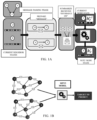
- the MPNNs forward pass consists of two phases - a message passing phase (illustrated in FIG. 1C ) and a readout phase (illustrated in FIG. ID).
- the message passing phase generates neural messages and update node representations by aggregating encoded information of node's embeddings from confined graph neighborhood.
- a permutation invariant readout phase is leveraged to perform graph pooling.
- Readout phase function takes an adjacency matrix as input and satisfies the following property,
- P is a permutation matrix.
- the message propagation utilizes the distinct message generating functions acting on the undirected chemical graph topology M in f and M out f represents the universal function approximator for the generation of neural messages received through a particular edge type and propagated from the same edge-type between the nodes of the chemical graphs, respectively. Based on the direction of the edge under consideration, that particular transformation function is put into operation on the edge, e ji M .
- the MPNNs forward pass communicates messages as described by a computational graph for every target node from the bottom (leaf) node to the top (root) node by iterating for T computational time steps. These outgoing messages are evaluated for every edge by transforming the source node's hidden state according to the edge feature vector.
- Each node in the molecular graph aggregates neural messages (message-pooling operation) from its local T-hop neighbors, as determined from G A M and the received messages are perceived by the target node by performing mathematical computations to update its hidden representation.
- This message-passing scheme assists in learning effective discriminative hidden representations of the nodes in the chemical graphs, by adopting a Back-propagation through time (BPTT) learning algorithm for training the MPNNs framework when solved for graph-based inductive learning tasks.
- BPTT Back-propagation through time
- the MPNNs are synchronous message-passing systems. They update all messages in parallel.
- each edge between the vertices in the chemical graph have messages evaluated in both directions from the source to sink and contrariwise.
- the message passing phase is described by utilizing a message generating function, M f , and node-embedding update neural network function, V f .M f and V f might take possession of diverse in specific to be at variance with function settings.
- ⁇ j ⁇ N i depicts the aggregation of neural-information embedded messages over the local one-hop neighborhood of the node, i ⁇ V M in the chemical graph, G M .
- h i is learned with the MPNN model parameters through a representative function of the entire input graph when solved for addressing supervised graph regression tasks such as molecular graph property prediction.
- M f , V f , and R f are differentiable neural network functions and have learnable parameters. Mini-Batching with an MPNN with batch size as a hyper-parameter results in the faster training and augments performance of the graph-based deep learning algorithm. It is viable here in this context as it initiates and propagates neural messages across several molecular graphs with varying numbers of vertices V M and ⁇ M .
- the feature representation of the vertices in the molecular graph, G M is denoted by, data.x. data.edgeindex describes the edge indices of source and sink vertices of the edge under consideration and vice-versa.
- data. edgeattr represents the static edge attributes.
- ⁇ ⁇ denotes a multilayer perceptron, parameterized by A.
- the vertex update function is described by, V f h i t m i t + 1 : GRU h i t m i t + 1 .
- GRU is a known Gated Recurrent Unit.
- the hidden state of the previous state is given by, V f h i t m i t + 1 : GRU h i t m i t + 1 .
- n denotes the total number of nodes in the chemical graphs in a given batch size.
- d m & d h are the characteristic dimension of neural messages and node attributes respectively.
- the MPNN however leads to over-smoothing of learnable embeddings for vertices with higher valency.
- the MPNN's suffer from inherent limitation to effectively encapsulate the characteristics of the molecular graph.
- MPNNs are not viable for real-time molecular property prediction.
- Various embodiments described herein provides a method and system for molecular property prediction using an edge-conditioned graph attention neural networks.
- the disclosed system is resilient to noise by learning to adapt to kingpin on the task-relevant fragment of the molecular graphs at varying receptive fields, locality, and depth to augment the discriminative power of node and graph-level embeddings.
- the disclosed method learns the expressive/discriminative node and graph level embeddings to aid in molecular property prediction with a reduced computational complexity.
- FIG. 2 through 5 where similar reference characters denote corresponding features consistently throughout the figures, there are shown preferred embodiments and these embodiments are described in the context of the following exemplary system and/or method.
- FIG. 2 illustrates a network implementation 200 of a system for molecular property prediction using edge-conditioned graph attention neural networks according to some embodiments of the present disclosure.
- the disclosed system provides a supervised learning on drug-like potential molecules for use in effective drug discovery. It provides substantial prospects in diminishing the computational complexity which is a key desideratum for prognostication of molecular properties and aid in billion price tag cost reduction of developing a potential drug for treatment.
- the proposed system comprises of message-passing, vertex update and graph-pooling modules which augment the graph-level prediction tasks accuracy by taking into account the structure of the graph.
- the proposed design of message-passing pipeline augments the graph-level prediction tasks accuracy by taking into account the structure of the molecular graph.
- system 202 may also be implemented in a variety of computing systems 204, such as a laptop computer, a desktop computer, a notebook, a workstation, a cloud-based computing environment and the like. It will be understood that the system 202 may be accessed through one or more devices 206-1, 206-2... 206-N, collectively referred to as devices 206 hereinafter, or applications residing on the devices 206. Examples of the devices 206 may include, but are not limited to, a portable computer, a personal digital assistant, a handheld device, a smartphone, a tablet computer, a workstation and the like. The devices 206 are communicatively coupled to the system 202 through a network 208.
- the network 208 may be a wireless or a wired network, or a combination thereof.
- the network 208 can be implemented as a computer network, as one of the different types of networks, such as virtual private network (VPN), intranet, local area network (LAN), wide area network (WAN), the internet, and such.
- the network 206 may either be a dedicated network or a shared network, which represents an association of the different types of networks that use a variety of protocols, for example, Hypertext Transfer Protocol (HTTP), Transmission Control Protocol/Internet Protocol (TCP/IP), and Wireless Application Protocol (WAP), to communicate with each other.
- the network 208 may include a variety of network devices, including routers, bridges, servers, computing devices, storage devices. The network devices within the network 208 may interact with the system 202 through communication links.
- the system 202 may be implemented in a computing device 204, such as a hand-held device, a laptop or other portable computer, a tablet computer, a mobile phone, a PDA, a smartphone, and a desktop computer.
- the system 202 may also be implemented in a workstation, a mainframe computer, a server, and a network server.
- the system 202 may be coupled to a data repository, for example, a repository 212.
- the repository 212 may store data processed, received, and generated by the system 202.
- the system 202 may include the data repository 212.
- the network implementation 200 supports various connectivity options such as BLUETOOTH ® , USB, ZigBee and other cellular services.
- the network environment enables connection of devices 206 such as Smartphone with the server 204, and accordingly with the database 212 using any communication link including Internet, WAN, MAN, and so on.
- the system 202 is implemented to operate as a stand-alone device. In another embodiment, the system 202 may be implemented to work as a loosely coupled device to a smart computing environment.
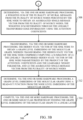
- FIGS. 3A and 3B illustrate a flow chart of a method 300 for method for molecular property prediction using edge-conditioned graph attention neural networks, in accordance with an example embodiment of present disclosure.
- Operations of the flowchart, and combinations of operation in the flowchart may be implemented by various means, such as hardware, firmware, processor, circuitry and/or other device associated with execution of software including one or more computer program instructions.
- one or more of the procedures described in various embodiments may be embodied by computer program instructions.
- the computer program instructions, which embody the procedures, described in various embodiments may be stored by at least one memory device of a system and executed by at least one processor in the system.
- Any such computer program instructions may be loaded onto a computer or other programmable system (for example, hardware) to produce a machine, such that the resulting computer or other programmable system embody means for implementing the operations specified in the flowchart. It will be noted herein that the operations of the method 300 are described with help of system 202. However, the operations of the method 300 can be described and/or practiced by using any other system.
- the edge conditioned graph attention networks allow stacking of layers in which each node in the molecular graph aggregate information over their local-graph neighbors attributes, based on molecular graph's connectivity and adaptively adjust to weight nodes of importance.
- the edge conditioned graph attention network is agnostic to the selection of attention mechanisms and it operates on variable-sized graph structured inputs. It performs self-attention on the nodes of the molecular graph of different sized neighborhood and it also involves a shared attentional mechanism across the nodes of the molecular graphs to compute attention coefficients as depicted by the edge-conditioned graph attentional operator h i ′ in the description below.
- a database comprising a plurality of molecular graphs associated with a plurality of molecules is accessed, via one or more hardware processors.
- the database further includes a plurality of labels indicative of chemical properties of the plurality of the molecular graphs.
- Each molecular graph of the plurality of molecular graphs comprises a plurality of sink nodes, each sink node of the plurality of sink nodes connected to a plurality of source nodes for passing neural messages through a plurality of edges.
- y i M are the associated chemical properties corresponding to the molecular graph, G A M .
- the objective of the graph-based molecular property prediction framework is by operating on the topology of the molecular graphs described by a set of node features, N M ⁇ R v M ⁇ e and static edge features, e ij M ⁇ R ⁇ M ⁇ z , ⁇ i j ⁇ ⁇ M is to learn a novel mapping f : G M ⁇ h k M , ⁇ ⁇ V M ⁇ h G M ⁇ y i M that maps molecular graphs structure to the set of labels.
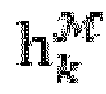
- h k M is the learned hidden representation vector of node k.
- y i M denotes the target molecular properties.
- the method 300 includes computing, via the one or more hardware processors, attention coefficients indicative of influence of the plurality of source nodes ( j ) on a sink node (i) of the plurality of sink nodes.
- LeakyReLU is a non-linear activation function
- the plurality of source nodes sends neural messages to the sink node.
- the neural messages sent from the source node, j to the sink node, i is given by the neural net function, ⁇ ⁇ ' , which is parameterized by ⁇ '.
- the neural-net function takes as input the summation of hidden state vector ( h j ) of the source node j , and the linearly transformed edge-information given by ⁇ 4 e ji M to compute attention weighted neural messages.
- the method 300 includes computing the plurality of neural messages sent from the plurality of source nodes to the sink node as a product of the summation of a set of hidden state vectors of the plurality of source node and the linearly transformed edge-information ⁇ 4 e ji M associated with the edge connecting the source node from amongst the plurality of source nodes with the sink node.
- An attention weighted neural message sent from the source node, j to the sink node, i is given by the product of the attention coefficients, ⁇ i , j , the learnable weight matrix, ⁇ 4 , and the message sent from the source node, j to the sink node, i given ⁇ ⁇ ′ h j + ⁇ 4 e ji M .
- the method 300 includes determining a weighted sum of the plurality of neural messages from the plurality of source nodes perceived by the sink node to obtain an aggregated single-message vector from the plurality of source nodes, the weighted sum determined through the linearly transformed edge-information using the attention coefficients.
- m N i represents the weighted sum of the neural messages from the neighboring nodes, ( i ) perceived by the node, i, and ⁇ 4 is the trainable weight parameter
- the edge information associated with the edge of the molecular graph comprises edge-type characteristics of the edge and a spatial distance between atoms of molecular graph that are represented as nodes.
- the method 300 includes transforming the hidden state vector ( h i ) of the sink node to obtain a node level embedding h i ′ of the molecular graph.
- transforming the hidden state vector of the sink node comprises computing a summation of (1) the linearly transformed hidden state vector ( h i ) of the sink node (i) parameterized by the product of the attention coefficients ( ⁇ i , i ) and the learnable weight parameter ⁇ 1 , and (2) the aggregated single-message vector m N i from the plurality of source nodes.
- h i ′ ⁇ i , i ⁇ 1 h i + ⁇ j ⁇ N i ⁇ i , j ⁇ 3 ⁇ ⁇ ′ h j + ⁇ 4 e ji M
- the method 300 includes determining, via one or more hardware processors, a graph level embedding of the molecular graph using a read-out function from the node level embedding of the molecular graph.
- the read-out function takes as input the node attributes transformed molecular graph and computes the graph-level representation.
- the method at 312 further includes simultaneously operating a spatial-dynamic neighborhood aggregation-based message passing phase on the molecular graph, to exchange the plurality of neural messages resulting in transformation and updating of each node level embedding. Further, a statistical average of the corresponding node level embedding obtained from the edge-conditioned graph attention neural network and the spatial-dynamic neighborhood aggregation-based message passing phase is performed.
- the method at 312 further includes simultaneously operating a spatial Identity Mapping graph Convolution Networks based message passing phase on the molecular graph, to exchange the plurality of neural messages resulting in transformation and updating of each node level embedding. Further, a statistical average is performed on the corresponding node level embedding obtained from the edge-conditioned graph attention neural network and the spatial Identity Mapping graph Convolution Networks based message passing phase.
- the method at 312 further includes simultaneously operating on the molecular graph, a spatial-graph attentional propagation based message passing phase to exchange the plurality of neural messages resulting in transformation and updating of each node level embedding. Further, a statistical average is performed on the corresponding node level embedding obtained from the edge-conditioned graph attention neural network and the spatial-graph attentional propagation based message passing phase.
- the method 300 includes computing, via the one or more hardware processors, the one or more molecular properties by feeding the graph level embedding of the molecular graph to a linear layer.
- FIG. 4 is a block diagram of an exemplary computer system 401 for implementing embodiments consistent with the present disclosure.
- the computer system 401 may be implemented in alone or in combination of components of the system 202 ( FIG. 2 ). Variations of computer system 401 may be used for implementing the devices included in this disclosure.
- Computer system 401 may comprise a central processing unit ("CPU” or "hardware processor” or “processor”) 402.
- the hardware processor 402 may comprise at least one data processor for executing program components for executing user- or system-generated requests.
- the processor may include specialized processing units such as integrated system (bus) controllers, memory management control units, floating point units, graphics processing units, digital signal processing units, etc.
- the processor may include a microprocessor, such as AMD Athlon TM , Duron TM or Opteron TM , ARM's application, embedded or secure processors, IBM PowerPC TM , Intel's Core, Itanium TM , Xeon TM , Celeron TM or other line of processors, etc.
- the processor 402 may be implemented using mainframe, distributed processor, multi-core, parallel, grid, or other architectures. Some embodiments may utilize embedded technologies like application specific integrated circuits (ASICs), digital signal processors (DSPs), Field Programmable Gate Arrays (FPGAs), etc.
- the processor 402 may be a multi-core multi-threaded processor.
- the processor 402 may be disposed in communication with one or more input/output (I/O) devices via I/O interface 403.
- the I/O interface 403 may employ communication protocols/methods such as, without limitation, audio, analog, digital, monoaural, RCA, stereo, IEEE-1394, serial bus, universal serial bus (USB), infrared, PS/2, BNC, coaxial, component, composite, digital visual interface (DVI), high-definition multimedia interface (HDMI), RF antennas, S-Video, VGA, IEEE 802.11 a/b/g/n/x, Bluetooth, cellular (e.g., code-division multiple access (CDMA), high-speed packet access (HSPA+), global system for mobile communications (GSM), long-term evolution (LTE), WiMax, or the like), etc.
- CDMA code-division multiple access
- HSPA+ high-speed packet access
- GSM global system for mobile communications
- LTE long-term evolution
- WiMax wireless wide area network
- the computer system 401 may communicate with one or more I/O devices.
- the input device 404 may be an antenna, keyboard, mouse, joystick, (infrared) remote control, camera, card reader, fax machine, dongle, biometric reader, microphone, touch screen, touchpad, trackball, sensor (e.g., accelerometer, light sensor, GPS, gyroscope, proximity sensor, or the like), stylus, scanner, storage device, transceiver, video device/source, visors, etc.
- Output device 405 may be a printer, fax machine, video display (e.g., cathode ray tube (CRT), liquid crystal display (LCD), light-emitting diode (LED), plasma, or the like), audio speaker, etc.
- video display e.g., cathode ray tube (CRT), liquid crystal display (LCD), light-emitting diode (LED), plasma, or the like
- audio speaker etc.
- a transceiver 406 may be disposed in connection with the processor 402. The transceiver may facilitate various types of wireless transmission or reception.
- the transceiver may include an antenna operatively connected to a transceiver chip (e.g., Texas Instruments WiLink WL1283, Broadcom BCM4750IUB8, Infineon Technologies X-Gold 618-PMB9800, or the like), providing IEEE 802.11a/b/g/n, Bluetooth, FM, global positioning system (GPS), 2G/3G HSDPA/HSUPA communications, etc.
- a transceiver chip e.g., Texas Instruments WiLink WL1283, Broadcom BCM4750IUB8, Infineon Technologies X-Gold 618-PMB9800, or the like
- IEEE 802.11a/b/g/n e.g., Texas Instruments WiLink WL1283, Broadcom BCM4750IUB8, Infineon Technologies X-Gold 618-PMB9800, or the like
- IEEE 802.11a/b/g/n e.g., Bluetooth, FM, global positioning system (GPS), 2G/3G HSDPA/HS
- the processor 402 may be disposed in communication with a communication network 408 via a network interface 507.
- the network interface 407 may communicate with the communication network 508.
- the network interface may employ connection protocols including, without limitation, direct connect, Ethernet (e.g., twisted pair 10/100/1000 Base T), transmission control protocol/internet protocol (TCP/IP), token ring, IEEE 802.1 1a/b/g/n/x, etc.
- the communication network 408 may include, without limitation, a direct interconnection, local area network (LAN), wide area network (WAN), wireless network (e.g., using Wireless Application Protocol), the Internet, etc.
- the computer system 401 may communicate with devices 409 and 410.
- These devices may include, without limitation, personal computer(s), server(s), fax machines, printers, scanners, various mobile devices such as cellular telephones, smartphones (e.g., Apple iPhone, Blackberry, Android-based phones, etc.), tablet computers, eBook readers (Amazon Kindle, Nook, etc.), laptop computers, notebooks, gaming consoles (Microsoft Xbox, Nintendo DS, Sony PlayStation, etc.), or the like.
- the computer system 401 may itself embody one or more of these devices.
- the processor 402 may be disposed in communication with one or more memory devices (e.g., RAM 413, ROM 414, etc.) via a storage interface 412.
- the storage interface may connect to memory devices including, without limitation, memory drives, removable disc drives, etc., employing connection protocols such as serial advanced technology attachment (SATA), integrated drive electronics (IDE), IEEE-1394, universal serial bus (USB), fiber channel, small computer systems interface (SCSI), etc.
- the memory drives may further include a drum, magnetic disc drive, magneto-optical drive, optical drive, redundant array of independent discs (RAID), solid-state memory devices, solid-state drives, etc. Variations of memory devices may be used for implementing, for example, any databases utilized in this disclosure.
- the memory devices may store a collection of programs or database components, including, without limitation, an operating system 416, a user interface application 417, a user/application data 418 (e.g., any data variables or data records discussed in this disclosure), etc.
- the operating system 416 may facilitate resource management and operation of the computer system 401.
- Examples of operating systems include, without limitation, Apple Macintosh OS X, Unix, Unix-like system distributions (e.g., Berkeley Software Distribution (BSD), FreeBSD, NetBSD, OpenBSD, etc.), Linux distributions (e.g., Red Hat, Ubuntu, Kubuntu, etc.), IBM OS/2, Microsoft Windows (XP, Vista/7/8, etc.), Apple iOS, Google Android, Blackberry OS, or the like.
- the user interface 417 may facilitate display, execution, interaction, manipulation, or operation of program components through textual or graphical facilities.
- user interfaces may provide computer interaction interface elements on a display system operatively connected to the computer system 401, such as cursors, icons, check boxes, menus, scrollers, windows, widgets, etc.
- Graphical user interfaces may be employed, including, without limitation, Apple Macintosh operating systems' Aqua, IBM OS/2, Microsoft Windows (e.g., Aero, Metro, etc.), Unix X-Windows, web interface libraries (e.g., ActiveX, Java, Javascript, AJAX, HTML, Adobe Flash, etc.), or the like.
- the computer system 401 may store user/application data 418, such as the data, variables, records, etc. as described in this disclosure.
- databases may be implemented as fault-tolerant, relational, scalable, secure databases such as Oracle or Sybase.
- databases may be implemented using standardized data structures, such as an array, hash, linked list, structured text file (e.g., XML), table, or as hand-oriented databases (e.g., using HandStore, Poet, Zope, etc.).
- hand-oriented databases e.g., using HandStore, Poet, Zope, etc.
- Such databases may be consolidated or distributed, sometimes among various computer systems discussed above. It is to be understood that the structure and operation of any computer or database component may be combined, consolidated, or distributed in any working combination.
- the server, messaging and instructions transmitted or received may emanate from hardware, including operating system, and program code (i.e., application code) residing in a cloud implementation.
- program code i.e., application code
- one or more of the systems and methods provided herein may be suitable for cloud-based implementation.
- some or all of the data used in the disclosed methods may be sourced from or stored on any cloud computing platform.
- the model (as implemented by the disclose system) was trained for graph-level-based regression tasks for the Quantum Chemistry property prediction task. Message passing computational steps, T was constrained to be at 3. The set2set mathematical iterations, M was on par with T.
- the model trained by leveraging a random selection of datasets for stochastic gradient descent optimization with the Adaptive Moment Estimation optimizer algorithm, with batch size 10. The number of iterations(epochs) is 100 cycles through the full training dataset. The beginning learning rate was chosen as 1e -3 .
- the learning rate was decayed at 51st epoch by half and maintained it constant in the span of [51; 75] epochs throughout the training and the beginning step size learning rate 1 decayed to a terminating learning rate 2.5e -4 , using a decay factor by 4 in the range [76; 100] epochs.
- the QM-9 dataset consists of approximately 134K molecules.
- the validation set comprises 10000 samples.
- the test set is composed of 10000 samples and the remaining are for the training set.
- early stopping is implemented on the validation dataset to prevent the model from over-fitting and for model selection.
- the performance of the model was evaluated and the evaluation metric based totally on the test set was published. Feature scaling was performed on the target properties to be predicted.
- Z-score normalization is leveraged to have distribution mean zero and the expectation of the squared deviation to one for each target property.
- the gradient descent (aka back-propagation) algorithm was run in weight space by updating the parameters according to the gradients of the loss function, the mean squared error between the predicted model outputs and the predetermined DFT properties. The results are reported in MAE metric in the table below.
- Such computer-readable storage means contain program-code means for implementation of one or more steps of the method, when the program runs on a server or mobile device or any suitable programmable device.
- the hardware device can be any kind of device which can be programmed including e.g., any kind of computer like a server or a personal computer, or the like, or any combination thereof.
- the device may also include means which could be e.g., hardware means like e.g., an application-specific integrated circuit (ASIC), a field-programmable gate array (FPGA), or a combination of hardware and software means, e.g., an ASIC and an FPGA, or at least one microprocessor and at least one memory with software processing components located therein.
- the means can include both hardware means and software means.
- the method embodiments described herein could be implemented in hardware and software.
- the device may also include software means. Alternatively, the embodiments may be implemented on different hardware devices, e.g., using a plurality of CPUs.
- the embodiments herein can comprise hardware and software elements.
- the embodiments that are implemented in software include but are not limited to, firmware, resident software, microcode, etc.
- the functions performed by various components described herein may be implemented in other components or combinations of other components.
- a computer-usable or computer readable medium can be any apparatus that can comprise, store, communicate, propagate, or transport the program for use by or in connection with the instruction execution system, apparatus, or device.
- a computer-readable storage medium refers to any type of physical memory on which information or data readable by a processor may be stored.
- a computer-readable storage medium may store instructions for execution by one or more processors, including instructions for causing the processor(s) to perform steps or stages consistent with the embodiments described herein.
- the term "computer-readable medium” should be understood to include tangible items and exclude carrier waves and transient signals, i.e., be non-transitory. Examples include random access memory (RAM), read-only memory (ROM), volatile memory, nonvolatile memory, hard drives, CD ROMs, DVDs, flash drives, disks, and any other known physical storage media.
Landscapes
- Engineering & Computer Science (AREA)
- Theoretical Computer Science (AREA)
- Physics & Mathematics (AREA)
- Life Sciences & Earth Sciences (AREA)
- Computing Systems (AREA)
- General Health & Medical Sciences (AREA)
- General Physics & Mathematics (AREA)
- Computational Linguistics (AREA)
- Data Mining & Analysis (AREA)
- Evolutionary Computation (AREA)
- Biomedical Technology (AREA)
- Molecular Biology (AREA)
- Artificial Intelligence (AREA)
- General Engineering & Computer Science (AREA)
- Biophysics (AREA)
- Mathematical Physics (AREA)
- Software Systems (AREA)
- Health & Medical Sciences (AREA)
- Chemical & Material Sciences (AREA)
- Crystallography & Structural Chemistry (AREA)
- Bioinformatics & Cheminformatics (AREA)
- Bioinformatics & Computational Biology (AREA)
- Information Retrieval, Db Structures And Fs Structures Therefor (AREA)
Abstract
Description
- The present application claims priority to
Indian application, Application No. 202121046327, filed in India on October 11, 2021 - The disclosure herein generally relates to the field of molecular property prediction, and, more particularly, to system and method for molecular property prediction using Edge-Conditioned Graph Attention Neural Networks.
- Machine learning technique, in specific, supervised learning on drug-like potential molecules has remarkable applications for use in more effective drug discovery. It provides substantial prospects in diminishing the computational complexity which is a key desideratum for prognostication of molecular properties and aid in billion price tag cost reduction of developing a potential drug for treatment.
- Message Passing Neural Networks (MPNN's) are non-spectral approach of performing convolution on unstructured molecular graphs. It is a graph-based property prediction framework. It leverages a message passing algorithm and a set-pooling aggregation operator to derive a graph-level representation of the complete input low treewidth chemical graphs to assist in inductive learning tasks. The MPNN's however suffer from inherent limitation to effectively encapsulate the characteristics of the molecular graph. Moreover, due to its high computational complexity, MPNN in not viable for real-time property prediction.
- Embodiments of the present disclosure present technological improvements as solutions to one or more of the above-mentioned technical problems recognized by the inventors in conventional systems. For example, in one embodiment, a processor-implemented method for molecular property prediction using edge-conditioned graph attention neural networks is provided. The method includes accessing, via one or more hardware processors, a database comprising a plurality of molecular graphs associated with a plurality of molecules and a plurality of labels indicative of chemical properties of the plurality of the molecular graphs, wherein each molecular graph of the plurality of molecular graphs comprises a plurality of sink nodes, each sink node of the plurality of sink nodes connected to a plurality of source nodes for passing neural messages through a plurality of edges. Further, the method includes computing, via the one or more hardware processors, attention coefficients indicative of influence of the plurality of source nodes on a sink node of the plurality of sink nodes based on (1) a softmax output of a matrix product of a learnable attention vector and a concatenated matrix of a linearly transformed hidden state of the sink node and (2) a matrix product of a linearly transformed edge-information associated with an edge connecting the source node from amongst the plurality of source nodes with the sink node, relative difference of hidden state vectors of the source node and the sink node by a learnable weight matrix. Furthermore, the method includes computing, via the one or more hardware processors a plurality of neural messages sent from the plurality of source nodes to the sink node as a product of the summation of a set of hidden state vectors of the plurality of source node and the linearly transformed edge-information associated with the edge connecting the source node from amongst the plurality of source nodes with the sink node. Moreover, the method includes determining, via the one or more hardware processors, a weighted sum of the plurality of neural messages from the plurality of source nodes perceived by the sink node to obtain an aggregated single-message vector from the plurality of source nodes, the weighted sum determined through the linearly transformed edge-information using the attention coefficients. Also, the method includes transforming, via the one or more hardware processors, the hidden state vector of the sink node to obtain a node level embedding of the molecular graph, wherein transforming the hidden state vector of the sink node comprises computing summation of (1) the linearly transformed hidden state vector of the sink node parameterized by the product of the attention coefficients and the learnable weight parameter, and (2) the aggregated single-message vector from the plurality of source nodes. Moreover, the method includes determining, via the one or more hardware processors, graph level embedding of the molecular graph using a read-out function from the node level embedding of the molecular graph. Also, the method includes computing, via the one or more hardware processors, the one or more molecular properties by feeding the graph level embedding of the molecular graph to a linear layer.
- In another aspect, a system for molecular property prediction using edge-conditioned graph attention neural networks is provided. The system includes a memory storing instructions; one or more communication interfaces; and one or more hardware processors coupled to the memory via the one or more communication interfaces, wherein the one or more hardware processors are configured by the instructions to access a database comprising a plurality of molecular graphs associated with a plurality of molecules and a plurality of labels indicative of chemical properties of the plurality of the molecular graphs, wherein each molecular graph of the plurality of molecular graphs comprises a plurality of sink nodes, each sink node of the plurality of sink nodes connected to a plurality of source nodes for passing neural messages through a plurality of edges. Further, the one or more hardware processors are configured by the instructions to compute attention coefficients indicative of influence of the plurality of source nodes on a sink node of the plurality of sink nodes based on (1) a softmax output of a matrix product of a learnable attention vector and a concatenated matrix of a linearly transformed hidden state of the sink node and (2) a matrix product of a linearly transformed edge-information associated with an edge connecting the source node from amongst the plurality of source nodes with the sink node, relative difference of hidden state vectors of the source node and the sink node by a learnable weight matrix. Furthermore, the one or more hardware processors are configured by the instructions to compute a plurality of neural messages sent from the plurality of source nodes to the sink node as a product of the summation of a set of hidden state vectors of the plurality of source node and the linearly transformed edge-information associated with the edge connecting the source node from amongst the plurality of source nodes with the sink node. Moreover, the one or more hardware processors are configured by the instructions to determine a weighted sum of the plurality of neural messages from the plurality of source nodes perceived by the sink node to obtain an aggregated single-message vector from the plurality of source nodes, the weighted sum determined through the linearly transformed edge-information using the attention coefficients. Also, the one or more hardware processors are configured by the instructions to transform the hidden state vector of the sink node to obtain a node level embedding of the molecular graph, wherein transforming the hidden state vector of the sink node comprises computing summation of (1) the linearly transformed hidden state vector of the sink node parameterized by the product of the attention coefficients and the learnable weight parameter, and (2) the aggregated single-message vector from the plurality of source nodes. Moreover, the one or more hardware processors are configured by the instructions to determine graph level embedding of the molecular graph using a read-out function from the node level embedding of the molecular graph. Also, the one or more hardware processors are configured by the instructions to compute the one or more molecular properties by feeding the graph level embedding of the molecular graph to a linear layer.
- In yet another aspect, a non-transitory computer readable medium for a executing a method for molecular property prediction using edge-conditioned graph attention neural networks is provided. The non-transitory computer readable medium includes a plurality of instructions, which when executed, cause the molecular property prediction via the following method. The method steps includes accessing a database comprising a plurality of molecular graphs associated with a plurality of molecules and a plurality of labels indicative of chemical properties of the plurality of the molecular graphs, wherein each molecular graph of the plurality of molecular graphs comprises a plurality of sink nodes, each sink node of the plurality of sink nodes connected to a plurality of source nodes for passing neural messages through a plurality of edges. Further, the method steps include computing, via the one or more hardware processors, attention coefficients indicative of influence of the plurality of source nodes on a sink node of the plurality of sink nodes based on (1) a softmax output of a matrix product of a learnable attention vector and a concatenated matrix of a linearly transformed hidden state of the sink node and (2) a matrix product of a linearly transformed edge-information associated with an edge connecting the source node from amongst the plurality of source nodes with the sink node, relative difference of hidden state vectors of the source node and the sink node by a learnable weight matrix. Furthermore, the method steps include computing, via the one or more hardware processors a plurality of neural messages sent from the plurality of source nodes to the sink node as a product of the summation of a set of hidden state vectors of the plurality of source node and the linearly transformed edge-information associated with the edge connecting the source node from amongst the plurality of source nodes with the sink node. Moreover, the method steps include determining, via the one or more hardware processors, a weighted sum of the plurality of neural messages from the plurality of source nodes perceived by the sink node to obtain an aggregated single-message vector from the plurality of source nodes, the weighted sum determined through the linearly transformed edge-information using the attention coefficients. Also, the method steps include transforming, via the one or more hardware processors, the hidden state vector of the sink node to obtain a node level embedding of the molecular graph, wherein transforming the hidden state vector of the sink node comprises computing summation of (1) the linearly transformed hidden state vector of the sink node parameterized by the product of the attention coefficients and the learnable weight parameter, and (2) the aggregated single-message vector from the plurality of source nodes. Moreover, the method steps include determining graph level embedding of the molecular graph using a read-out function from the node level embedding of the molecular graph. Also, the one or more hardware processors are configured by the instructions to compute the one or more molecular properties by feeding the graph level embedding of the molecular graph to a linear layer.
- It is to be understood that both the foregoing general description and the following detailed description are exemplary and explanatory only and are not restrictive of the invention, as claimed.
- The accompanying drawings, which are incorporated in and constitute a part of this disclosure, illustrate exemplary embodiments and, together with the description, serve to explain the disclosed principles:
-
FIG. 1A illustrates a representation of message passing phase of a conventional message passing neural network (MPNN). -
FIG. 1B illustrates a representation of readout phase of a conventional message passing neural network (MPNN). -
FIG. 2 illustrates a network implementation of a system for molecular property prediction using edge-conditioned graph attention neural networks according to some embodiments of the present disclosure. -
FIGS. 3A and3B is a flow diagram illustrating a method for molecular property prediction using edge-conditioned graph attention neural networks in accordance with some embodiments of the present disclosure. -
FIG. 4 is a block diagram of an exemplary computer system for implementing embodiments consistent with the present disclosure. - FIG. 5 is a flow diagram illustrating XXX in accordance with some embodiments of the present disclosure.
- Exemplary embodiments are described with reference to the accompanying drawings. In the figures, the left-most digit(s) of a reference number identifies the figure in which the reference number first appears. Wherever convenient, the same reference numbers are used throughout the drawings to refer to the same or like parts. While examples and features of disclosed principles are described herein, modifications, adaptations, and other implementations are possible without departing from the scope of the disclosed embodiments.
- Convolution Neural Networks (CNNs) have contributed to a broad range of scientific breakthroughs, in the fields as deep residual learning for visual recognition, self-driving cars, optical character recognition engine, acoustic modeling in speech recognition, neural machine translation, etc. In view of the inherent methodology, CNN and its variant structured neural network architectures obtain dimensionality reduction and extract dominant features by performing spatial convolutions on Euclidean domains. The ConvNets input is obliged to, therefore, have a regular and grid-like structure. This restriction hampers the utilization of CNN's to numerous scientific disciplines, where irregular graph structure or manifold data are commonly accessible.
- Chemical graph theory treats drug-like organic molecules as non-linear static graphs. Message Passing Neural Networks (MPNN) framework merges several distinct and unique contemporary models that exist in the literature. The MPNNs are an abstraction of a non-spectral approach based Graph Convolution Networks. The MPNNs operate on undirected chemical graphs,

- Let




- Molecules are represented as annotated undirected chemical graphs. The atoms are considered to be the nodes of the chemical graphs. The bonds connecting adjacent atoms in the chemical graphs correspond to edges. The MPNN framework is leveraged in this particular scientific discipline for mathematical modeling of the drug-like organic molecules. It helps to gain insight and assists in the description of the chemical graph's topology into a characteristic representation of the entire chemical graphs to later aid in the molecular property prediction task. Based on the graph's connectivity, an incident edge in between two neighboring atoms in the chemical compound (or nodes in a chemical graph) acts as both arriving and departing edge tagged by the same label (bond type).
- As illustrated in
FIGS. 1B ,1C , and ID, the MPNNs forward pass consists of two phases - a message passing phase (illustrated inFIG. 1C ) and a readout phase (illustrated in FIG. ID). The message passing phase generates neural messages and update node representations by aggregating encoded information of node's embeddings from confined graph neighborhood. A permutation invariant readout phase is leveraged to perform graph pooling. Readout phase function takes an adjacency matrix


- Identical edge-type incident on different node neighbors, which is characterized by distinct edge feature vectors share with the same instance of the message generating neural-network function. Each node in the molecular graph aggregates neural messages (message-pooling operation) from its local T-hop neighbors, as determined from


- Here,




- Here, ΩΛ denotes a multilayer perceptron, parameterized by A. The aggregated vector message perceived by the sink node, i is described by



- Here, n denotes the total number of nodes in the chemical graphs in a given batch size. dm & dh are the characteristic dimension of neural messages and node attributes respectively. Here, the reset gate, Rt, Zt,





- The graph-level global pooling neural network is evaluated as

- The MPNN however leads to over-smoothing of learnable embeddings for vertices with higher valency. In addition, the MPNN's suffer from inherent limitation to effectively encapsulate the characteristics of the molecular graph. Moreover, due to its high computational complexity, MPNNs are not viable for real-time molecular property prediction. Various embodiments described herein provides a method and system for molecular property prediction using an edge-conditioned graph attention neural networks. The disclosed system is resilient to noise by learning to adapt to kingpin on the task-relevant fragment of the molecular graphs at varying receptive fields, locality, and depth to augment the discriminative power of node and graph-level embeddings. The disclosed method learns the expressive/discriminative node and graph level embeddings to aid in molecular property prediction with a reduced computational complexity.
- Exemplary embodiments are described with reference to the accompanying drawings. In the figures, the left-most digit(s) of a reference number identifies the figure in which the reference number first appears. Wherever convenient, the same reference numbers are used throughout the drawings to refer to the same or like parts. While examples and features of disclosed principles are described herein, modifications, adaptations, and other implementations are possible without departing from the scope of the disclosed embodiments. It is intended that the following detailed description be considered as exemplary only, with the true scope being indicated by the following claims.
- Referring now to the drawings, and more particularly to
FIG. 2 through 5, where similar reference characters denote corresponding features consistently throughout the figures, there are shown preferred embodiments and these embodiments are described in the context of the following exemplary system and/or method. -
FIG. 2 illustrates anetwork implementation 200 of a system for molecular property prediction using edge-conditioned graph attention neural networks according to some embodiments of the present disclosure. The disclosed system provides a supervised learning on drug-like potential molecules for use in effective drug discovery. It provides substantial prospects in diminishing the computational complexity which is a key desideratum for prognostication of molecular properties and aid in billion price tag cost reduction of developing a potential drug for treatment. - The proposed system comprises of message-passing, vertex update and graph-pooling modules which augment the graph-level prediction tasks accuracy by taking into account the structure of the graph. The proposed design of message-passing pipeline augments the graph-level prediction tasks accuracy by taking into account the structure of the molecular graph.
- Although the present disclosure is explained considering that the
system 202 is implemented on a server, it may be understood that thesystem 202 may also be implemented in a variety ofcomputing systems 204, such as a laptop computer, a desktop computer, a notebook, a workstation, a cloud-based computing environment and the like. It will be understood that thesystem 202 may be accessed through one or more devices 206-1, 206-2... 206-N, collectively referred to asdevices 206 hereinafter, or applications residing on thedevices 206. Examples of thedevices 206 may include, but are not limited to, a portable computer, a personal digital assistant, a handheld device, a smartphone, a tablet computer, a workstation and the like. Thedevices 206 are communicatively coupled to thesystem 202 through anetwork 208. - In an embodiment, the
network 208 may be a wireless or a wired network, or a combination thereof. In an example, thenetwork 208 can be implemented as a computer network, as one of the different types of networks, such as virtual private network (VPN), intranet, local area network (LAN), wide area network (WAN), the internet, and such. Thenetwork 206 may either be a dedicated network or a shared network, which represents an association of the different types of networks that use a variety of protocols, for example, Hypertext Transfer Protocol (HTTP), Transmission Control Protocol/Internet Protocol (TCP/IP), and Wireless Application Protocol (WAP), to communicate with each other. Further, thenetwork 208 may include a variety of network devices, including routers, bridges, servers, computing devices, storage devices. The network devices within thenetwork 208 may interact with thesystem 202 through communication links. - As discussed above, the
system 202 may be implemented in acomputing device 204, such as a hand-held device, a laptop or other portable computer, a tablet computer, a mobile phone, a PDA, a smartphone, and a desktop computer. Thesystem 202 may also be implemented in a workstation, a mainframe computer, a server, and a network server. In an embodiment, thesystem 202 may be coupled to a data repository, for example, arepository 212. Therepository 212 may store data processed, received, and generated by thesystem 202. In an alternate embodiment, thesystem 202 may include thedata repository 212. - The
network implementation 200 supports various connectivity options such as BLUETOOTH®, USB, ZigBee and other cellular services. The network environment enables connection ofdevices 206 such as Smartphone with theserver 204, and accordingly with thedatabase 212 using any communication link including Internet, WAN, MAN, and so on. In an exemplary embodiment, thesystem 202 is implemented to operate as a stand-alone device. In another embodiment, thesystem 202 may be implemented to work as a loosely coupled device to a smart computing environment. -
FIGS. 3A and3B illustrate a flow chart of amethod 300 for method for molecular property prediction using edge-conditioned graph attention neural networks, in accordance with an example embodiment of present disclosure. Operations of the flowchart, and combinations of operation in the flowchart, may be implemented by various means, such as hardware, firmware, processor, circuitry and/or other device associated with execution of software including one or more computer program instructions. For example, one or more of the procedures described in various embodiments may be embodied by computer program instructions. In an example embodiment, the computer program instructions, which embody the procedures, described in various embodiments may be stored by at least one memory device of a system and executed by at least one processor in the system. Any such computer program instructions may be loaded onto a computer or other programmable system (for example, hardware) to produce a machine, such that the resulting computer or other programmable system embody means for implementing the operations specified in the flowchart. It will be noted herein that the operations of themethod 300 are described with help ofsystem 202. However, the operations of themethod 300 can be described and/or practiced by using any other system. - The edge conditioned graph attention networks allow stacking of layers in which each node in the molecular graph aggregate information over their local-graph neighbors attributes, based on molecular graph's connectivity and adaptively adjust to weight nodes of importance. The edge conditioned graph attention network is agnostic to the selection of attention mechanisms and it operates on variable-sized graph structured inputs. It performs self-attention on the nodes of the molecular graph of different sized neighborhood and it also involves a shared attentional mechanism across the nodes of the molecular graphs to compute attention coefficients as depicted by the edge-conditioned graph attentional operator

- At
step 302 ofmethod 300, a database comprising a plurality of molecular graphs associated with a plurality of molecules is accessed, via one or more hardware processors. The database further includes a plurality of labels indicative of chemical properties of the plurality of the molecular graphs. Each molecular graph of the plurality of molecular graphs comprises a plurality of sink nodes, each sink node of the plurality of sink nodes connected to a plurality of source nodes for passing neural messages through a plurality of edges. For example, the database may include annotated independent and identically distributed molecular graphs,

- Here,



- At 304, the
method 300 includes computing, via the one or more hardware processors, attention coefficients indicative of influence of the plurality of source nodes (j) on a sink node (i) of the plurality of sink nodes. The attention coefficients (α i,j ) are computed based on (1) a softmax output of a matrix product of a learnable attention vector (a) and a concatenated matrix (Θ2hi) of a linearly transformed hidden state of the sink node (i) and (2) a matrix product of a linearly transformed edge-information

- Here, LeakyReLU is a non-linear activation function,
- (i) represents the plurality of neighboring source nodes perceived by the sink node (i).

- a is a learnable attention vector,
- Θ2hi is concatenated matrix of the linearly transformed hidden state of the sink node (i)
-

- .T denotes transposition, and || represents concatenation.
- (h i - h j ) is linearly transformed, relative difference of the hidden state of the source node and the sink node,
- Θ2 is learnable weight matrix.
- The plurality of source nodes sends neural messages to the sink node. The neural messages sent from the source node, j to the sink node, i is given by the neural net function, ΓΘ' , which is parameterized by Θ'. The neural-net function takes as input the summation of hidden state vector (hj ) of the source node j, and the linearly transformed edge-information given by

method 300 includes computing the plurality of neural messages sent from the plurality of source nodes to the sink node as a product of the summation of a set of hidden state vectors of the plurality of source node and the linearly transformed edge-information

- At 308, the
method 300 includes determining a weighted sum of the plurality of neural messages from the plurality of source nodes perceived by the sink node to obtain an aggregated single-message vector from the plurality of source nodes, the weighted sum determined through the linearly transformed edge-information using the attention coefficients. The weighted sum of the plurality of neural messages is given by the equation below:
- Here,
 (i) perceived by the node, i, and
Θ 4 is the trainable weight parameter - Herein, the edge information associated with the edge of the molecular graph comprises edge-type characteristics of the edge and a spatial distance between atoms of molecular graph that are represented as nodes.
- At 310, the
method 300 includes transforming the hidden state vector (h i ) of the sink node to obtain a node level embedding


- At 312, the
method 300 includes determining, via one or more hardware processors, a graph level embedding of the molecular graph using a read-out function from the node level embedding of the molecular graph. In an embodiment, the read-out function takes as input the node attributes transformed molecular graph and computes the graph-level representation. - In another embodiment, the method at 312 further includes simultaneously operating a spatial-dynamic neighborhood aggregation-based message passing phase on the molecular graph, to exchange the plurality of neural messages resulting in transformation and updating of each node level embedding. Further, a statistical average of the corresponding node level embedding obtained from the edge-conditioned graph attention neural network and the spatial-dynamic neighborhood aggregation-based message passing phase is performed.
- In yet another embodiment, the method at 312 further includes simultaneously operating a spatial Identity Mapping graph Convolution Networks based message passing phase on the molecular graph, to exchange the plurality of neural messages resulting in transformation and updating of each node level embedding. Further, a statistical average is performed on the corresponding node level embedding obtained from the edge-conditioned graph attention neural network and the spatial Identity Mapping graph Convolution Networks based message passing phase.
- In still another embodiment, the method at 312 further includes simultaneously operating on the molecular graph, a spatial-graph attentional propagation based message passing phase to exchange the plurality of neural messages resulting in transformation and updating of each node level embedding. Further, a statistical average is performed on the corresponding node level embedding obtained from the edge-conditioned graph attention neural network and the spatial-graph attentional propagation based message passing phase.
- At 314, the
method 300 includes computing, via the one or more hardware processors, the one or more molecular properties by feeding the graph level embedding of the molecular graph to a linear layer. - An example algorithm illustrating steps of the proposed method is presented below:
- Edge-Conditioned Graph Attention driven Message-Passing algorithm

-
FIG. 4 is a block diagram of anexemplary computer system 401 for implementingembodiments consistent with the present disclosure. The
computer system 401 may be implemented in alone or in combination of components of the system 202 (FIG. 2 ). Variations ofcomputer system 401 may be used for implementing the devices included in this disclosure.Computer system 401 may comprise a central processing unit ("CPU" or "hardware processor" or "processor") 402. Thehardware processor 402 may comprise at least one data processor for executing program components for executing user- or system-generated requests. The processor may include specialized processing units such as integrated system (bus) controllers, memory management control units, floating point units, graphics processing units, digital signal processing units, etc. The processor may include a microprocessor, such as AMD Athlon™, Duron™ or Opteron™, ARM's application, embedded or secure processors, IBM PowerPC™, Intel's Core, Itanium™, Xeon™, Celeron™ or other line of processors, etc. Theprocessor 402 may be implemented using mainframe, distributed processor, multi-core, parallel, grid, or other architectures. Some embodiments may utilize embedded technologies like application specific integrated circuits (ASICs), digital signal processors (DSPs), Field Programmable Gate Arrays (FPGAs), etc. Theprocessor 402 may be a multi-core multi-threaded processor. - The
processor 402 may be disposed in communication with one or more input/output (I/O) devices via I/O interface 403. The I/O interface 403 may employ communication protocols/methods such as, without limitation, audio, analog, digital, monoaural, RCA, stereo, IEEE-1394, serial bus, universal serial bus (USB), infrared, PS/2, BNC, coaxial, component, composite, digital visual interface (DVI), high-definition multimedia interface (HDMI), RF antennas, S-Video, VGA, IEEE 802.11 a/b/g/n/x, Bluetooth, cellular (e.g., code-division multiple access (CDMA), high-speed packet access (HSPA+), global system for mobile communications (GSM), long-term evolution (LTE), WiMax, or the like), etc. - Using the I/
O interface 403, thecomputer system 401 may communicate with one or more I/O devices. For example, theinput device 404 may be an antenna, keyboard, mouse, joystick, (infrared) remote control, camera, card reader, fax machine, dongle, biometric reader, microphone, touch screen, touchpad, trackball, sensor (e.g., accelerometer, light sensor, GPS, gyroscope, proximity sensor, or the like), stylus, scanner, storage device, transceiver, video device/source, visors, etc. -
Output device 405 may be a printer, fax machine, video display (e.g., cathode ray tube (CRT), liquid crystal display (LCD), light-emitting diode (LED), plasma, or the like), audio speaker, etc. In some embodiments, atransceiver 406 may be disposed in connection with theprocessor 402. The transceiver may facilitate various types of wireless transmission or reception. For example, the transceiver may include an antenna operatively connected to a transceiver chip (e.g., Texas Instruments WiLink WL1283, Broadcom BCM4750IUB8, Infineon Technologies X-Gold 618-PMB9800, or the like), providing IEEE 802.11a/b/g/n, Bluetooth, FM, global positioning system (GPS), 2G/3G HSDPA/HSUPA communications, etc. - In some embodiments, the
processor 402 may be disposed in communication with acommunication network 408 via a network interface 507. Thenetwork interface 407 may communicate with the communication network 508. The network interface may employ connection protocols including, without limitation, direct connect, Ethernet (e.g., twisted pair 10/100/1000 Base T), transmission control protocol/internet protocol (TCP/IP), token ring, IEEE 802.1 1a/b/g/n/x, etc. Thecommunication network 408 may include, without limitation, a direct interconnection, local area network (LAN), wide area network (WAN), wireless network (e.g., using Wireless Application Protocol), the Internet, etc. Using thenetwork interface 407 and thecommunication network 408, thecomputer system 401 may communicate withdevices computer system 401 may itself embody one or more of these devices. - In some embodiments, the
processor 402 may be disposed in communication with one or more memory devices (e.g.,RAM 413,ROM 414, etc.) via astorage interface 412. The storage interface may connect to memory devices including, without limitation, memory drives, removable disc drives, etc., employing connection protocols such as serial advanced technology attachment (SATA), integrated drive electronics (IDE), IEEE-1394, universal serial bus (USB), fiber channel, small computer systems interface (SCSI), etc. The memory drives may further include a drum, magnetic disc drive, magneto-optical drive, optical drive, redundant array of independent discs (RAID), solid-state memory devices, solid-state drives, etc. Variations of memory devices may be used for implementing, for example, any databases utilized in this disclosure. - The memory devices may store a collection of programs or database components, including, without limitation, an
operating system 416, a user interface application 417, a user/application data 418 (e.g., any data variables or data records discussed in this disclosure), etc. Theoperating system 416 may facilitate resource management and operation of thecomputer system 401. Examples of operating systems include, without limitation, Apple Macintosh OS X, Unix, Unix-like system distributions (e.g., Berkeley Software Distribution (BSD), FreeBSD, NetBSD, OpenBSD, etc.), Linux distributions (e.g., Red Hat, Ubuntu, Kubuntu, etc.), IBM OS/2, Microsoft Windows (XP, Vista/7/8, etc.), Apple iOS, Google Android, Blackberry OS, or the like. The user interface 417 may facilitate display, execution, interaction, manipulation, or operation of program components through textual or graphical facilities. For example, user interfaces may provide computer interaction interface elements on a display system operatively connected to thecomputer system 401, such as cursors, icons, check boxes, menus, scrollers, windows, widgets, etc. Graphical user interfaces (GUIs) may be employed, including, without limitation, Apple Macintosh operating systems' Aqua, IBM OS/2, Microsoft Windows (e.g., Aero, Metro, etc.), Unix X-Windows, web interface libraries (e.g., ActiveX, Java, Javascript, AJAX, HTML, Adobe Flash, etc.), or the like. - In some embodiments, the
computer system 401 may store user/application data 418, such as the data, variables, records, etc. as described in this disclosure. Such databases may be implemented as fault-tolerant, relational, scalable, secure databases such as Oracle or Sybase. Alternatively, such databases may be implemented using standardized data structures, such as an array, hash, linked list, structured text file (e.g., XML), table, or as hand-oriented databases (e.g., using HandStore, Poet, Zope, etc.). Such databases may be consolidated or distributed, sometimes among various computer systems discussed above. It is to be understood that the structure and operation of any computer or database component may be combined, consolidated, or distributed in any working combination. - Additionally, in some embodiments, (the server, messaging and instructions transmitted or received may emanate from hardware, including operating system, and program code (i.e., application code) residing in a cloud implementation. Further, it should be noted that one or more of the systems and methods provided herein may be suitable for cloud-based implementation. For example, in some embodiments, some or all of the data used in the disclosed methods may be sourced from or stored on any cloud computing platform.
- For the purpose of validation, experiments were conducted using QM-9 data set.
- The model (as implemented by the disclose system) was trained for graph-level-based regression tasks for the Quantum Chemistry property prediction task. Message passing computational steps, T was constrained to be at 3. The set2set mathematical iterations, M was on par with T. Here, the model trained by leveraging a random selection of datasets for stochastic gradient descent optimization with the Adaptive Moment Estimation optimizer algorithm, with batch size 10. The number of iterations(epochs) is 100 cycles through the full training dataset. The beginning learning rate was chosen as 1e-3. The learning rate was decayed at 51st epoch by half and maintained it constant in the span of [51; 75] epochs throughout the training and the beginning step
size learning rate 1 decayed to a terminating learning rate 2.5e-4, using a decay factor by 4 in the range [76; 100] epochs. The QM-9 dataset consists of approximately 134K molecules. The validation set comprises 10000 samples. The test set is composed of 10000 samples and the remaining are for the training set. Here, early stopping is implemented on the validation dataset to prevent the model from over-fitting and for model selection. Finally, the performance of the model was evaluated and the evaluation metric based totally on the test set was published. Feature scaling was performed on the target properties to be predicted. Z-score normalization is leveraged to have distribution mean zero and the expectation of the squared deviation to one for each target property. The gradient descent (aka back-propagation) algorithm was run in weight space by updating the parameters according to the gradients of the loss function, the mean squared error between the predicted model outputs and the predetermined DFT properties. The results are reported in MAE metric in the table below.Table 1: Performance comparison of the disclosed method with the baseline algorithms on test dataset Target Unit PPGN SchNet PhysNet MEGNet- s Comorant DimeNet EC-GAT Cv cal/(mol 0.055 0.033 0.0529 0.05 0.13 0.0286 0.0161 K) G meV 36.4 14 9.40 12 - 8.98 0.0457 H meV 36.3 14 8.42 12 - 8.11 0.0085 HOMO meV 40.3 41 32.9 43 36 27.8 0.0043 LUMO meV 32.7 34 24.7 44 36 19.7 0.0083 R2 Bohr2 0.592 0:073 0.765 0:302 0:673 0.331 0.0379 U meV 36.8 14 8.15 12 - 7.89 0.0033 U0 meV 36.8 14 8.15 12 - 8.02 0.0034 ZPVE meV 3.12 1.7 1.39 1:43 1.98 1.29 0.0000537 alpha Bohr3 0.131 0.235 0.0615 0.081 0.092 0.0469 0.0149 gap meV 60.0 63 42.5 66 60 34.8 0.0037 mu D 0.047 0.033 0.0529 0:05 0.13 0:0286 0.0157 - The written description describes the subject matter herein to enable any person skilled in the art to make and use the embodiments. The scope of the subject matter embodiments is defined by the claims and may include other modifications that occur to those skilled in the art. Such other modifications are intended to be within the scope of the claims if they have similar elements that do not differ from the literal language of the claims or if they include equivalent elements with insubstantial differences from the literal language of the claims.
- It is to be understood that the scope of the protection is extended to such a program and in addition to a computer-readable means having a message therein; such computer-readable storage means contain program-code means for implementation of one or more steps of the method, when the program runs on a server or mobile device or any suitable programmable device. The hardware device can be any kind of device which can be programmed including e.g., any kind of computer like a server or a personal computer, or the like, or any combination thereof. The device may also include means which could be e.g., hardware means like e.g., an application-specific integrated circuit (ASIC), a field-programmable gate array (FPGA), or a combination of hardware and software means, e.g., an ASIC and an FPGA, or at least one microprocessor and at least one memory with software processing components located therein. Thus, the means can include both hardware means and software means. The method embodiments described herein could be implemented in hardware and software. The device may also include software means. Alternatively, the embodiments may be implemented on different hardware devices, e.g., using a plurality of CPUs.
- The embodiments herein can comprise hardware and software elements. The embodiments that are implemented in software include but are not limited to, firmware, resident software, microcode, etc. The functions performed by various components described herein may be implemented in other components or combinations of other components. For the purposes of this description, a computer-usable or computer readable medium can be any apparatus that can comprise, store, communicate, propagate, or transport the program for use by or in connection with the instruction execution system, apparatus, or device.
- The illustrated steps are set out to explain the exemplary embodiments shown, and it should be anticipated that ongoing technological development will change the manner in which particular functions are performed. These examples are presented herein for purposes of illustration, and not limitation. Further, the boundaries of the functional building blocks have been arbitrarily defined herein for the convenience of the description. Alternative boundaries can be defined so long as the specified functions and relationships thereof are appropriately performed. Alternatives (including equivalents, extensions, variations, deviations, etc., of those described herein) will be apparent to persons skilled in the relevant art(s) based on the teachings contained herein. Such alternatives fall within the scope of the disclosed embodiments. Also, the words "comprising," "having," "containing," and "including," and other similar forms are intended to be equivalent in meaning and be open ended in that an item or items following any one of these words is not meant to be an exhaustive listing of such item or items, or meant to be limited to only the listed item or items. It must also be noted that as used herein and in the appended claims, the singular forms "a," "an," and "the" include plural references unless the context clearly dictates otherwise.
- Furthermore, one or more computer-readable storage media may be utilized in implementing embodiments consistent with the present disclosure. A computer-readable storage medium refers to any type of physical memory on which information or data readable by a processor may be stored. Thus, a computer-readable storage medium may store instructions for execution by one or more processors, including instructions for causing the processor(s) to perform steps or stages consistent with the embodiments described herein. The term "computer-readable medium" should be understood to include tangible items and exclude carrier waves and transient signals, i.e., be non-transitory. Examples include random access memory (RAM), read-only memory (ROM), volatile memory, nonvolatile memory, hard drives, CD ROMs, DVDs, flash drives, disks, and any other known physical storage media.
- It is intended that the disclosure and examples be considered as exemplary only, with a true scope of disclosed embodiments being indicated by the following claims.
Claims (15)
- A processor implemented method (300), comprising:accessing (302), via one or more hardware processors, a database comprising a plurality of molecular graphs associated with a plurality of molecules and a plurality of labels indicative of chemical properties of the plurality of the molecular graphs, wherein each molecular graph of the plurality of molecular graphs comprises a plurality of sink nodes, each sink node of the plurality of sink nodes connected to a plurality of source nodes for passing neural messages through a plurality of edges;computing (304), via the one or more hardware processors, attention coefficients indicative of influence of the plurality of source nodes on a sink node of the plurality of sink nodes based on (1) a softmax output of a matrix product of a learnable attention vector and a concatenated matrix of a linearly transformed hidden state of the sink node, and (2) a matrix product of a linearly transformed edge-information associated with an edge connecting the source node from amongst the plurality of source nodes with the sink node, relative difference of hidden state vectors of the source node and the sink node by a learnable weight matrix;computing (306), via the one or more hardware processors, a plurality of neural messages sent from the plurality of source nodes to the sink node as a product of summation of a set of hidden state vectors of the plurality of source node and the linearly transformed edge-information associated with the edge connecting the source node from amongst the plurality of source nodes with the sink node;determining (308), via the one or more hardware processors, a weighted sum of the plurality of neural messages from the plurality of source nodes perceived by the sink node to obtain an aggregated single-message vector from the plurality of source nodes, the weighted sum determined through the linearly transformed edge-information using the attention coefficients;transforming (310), via the one or more hardware processors, the hidden state vector of the sink node to obtain a node level embedding of the molecular graph, wherein transforming the hidden state vector of the sink node comprises computing a summation of (1) the linearly transformed hidden state vector of the sink node parameterized by the product of the attention coefficients and the learnable weight parameter, and (2) the aggregated single-message vector from the plurality of source nodes;determining (312), via the one or more hardware processors, graph level embedding of the molecular graph using a read-out function from the node level embedding of the molecular graph; andcomputing (314), via the one or more hardware processors, the one or more molecular properties by feeding the graph level embedding of the molecular graph to a linear layer.
- The processor implemented method of claim 1, further comprising:operating on the molecular graph, a spatial-dynamic neighborhood aggregation-based message passing phase to exchange the plurality of neural messages resulting in transformation and updating of each node level embedding; andperforming statistical average of the corresponding node level embedding obtained from the edge-conditioned graph attention neural network and the spatial-dynamic neighborhood aggregation-based message passing phase.
- The processor implemented method of claim 1, further comprising:operating on the molecular graph, a spatial Identity Mapping graph Convolution Networks based message passing phase to exchange the plurality of neural messages resulting in transformation and updating of each node level embedding; andperforming statistical average of the corresponding node level embedding obtained from the edge-conditioned graph attention neural network and the spatial Identity Mapping graph Convolution Networks based message passing phase.
- The processor implemented method of claim 1, further comprising:operating on the molecular graph, a spatial-graph attentional propagation based message passing phase to exchange the plurality of neural messages resulting in transformation and updating of each node level embedding; andperforming statistical average of the corresponding node level embedding obtained from the edge-conditioned graph attention neural network and the spatial-graph attentional propagation based message passing phase.
- The processor implemented method of claim 1, wherein the edge information associated with the edge of the molecular graph comprises edge-type characteristics of the edge and a spatial distance between atoms of molecular graph that are represented as nodes.
- A system (400) for molecular property prediction, comprising:a memory (415) storing instructions;one or more communication interfaces (403); andone or more hardware processors (402) coupled to the memory (415) via the one or more communication interfaces (403), wherein the one or more hardware processors (402) are configured by the instructions to:access a database comprising a plurality of molecular graphs associated with a plurality of molecules and a plurality of labels indicative of chemical properties of the plurality of the molecular graphs, wherein each molecular graph of the plurality of molecular graphs comprises a plurality of sink nodes, each sink node of the plurality of sink nodes connected to a plurality of source nodes for passing neural messages through a plurality of edges;compute attention coefficients indicative of influence of the plurality of source nodes on a sink node of the plurality of sink nodes based on (1) a softmax output of a matrix product of a learnable attention vector and a concatenated matrix of a linearly transformed hidden state of the sink node and (2) a matrix product of a linearly transformed edge-information associated with an edge connecting the source node from amongst the plurality of source nodes with the sink node, relative difference of hidden state vectors of the source node and the sink node by a learnable weight matrix;compute a plurality of neural messages sent from the plurality of source nodes to the sink node as a product of a summation of a set of hidden state vectors of the plurality of source node and the linearly transformed edge-information associated with the edge connecting the source node from amongst the plurality of source nodes with the sink node;determine a weighted sum of the plurality of neural messages from the plurality of source nodes perceived by the sink node to obtain an aggregated single-message vector from the plurality of source nodes, the weighted sum determined through the linearly transformed edge-information using the attention coefficients;transform the hidden state vector of the sink node to obtain a node level embedding of the molecular graph, wherein to transform the hidden state vector of the sink node, the one or more hardware processors are configured by the instructions to compute a summation of (1) the linearly transformed hidden state vector of the sink node parameterized by the product of the attention coefficients and the learnable weight parameter, and (2) the aggregated single-message vector from the plurality of source nodes;determine a graph level embedding of the molecular graph using a read-out function from the node level embedding of the molecular graph; andcompute the one or more molecular properties by feeding the graph level embedding of the molecular graph to a linear layer.
- The system of claim 6, wherein the one or more hardware processors are further configured by the instructions to:operate on the molecular graph, a spatial-dynamic neighborhood aggregation-based message passing phase to exchange the plurality of neural messages resulting in transformation and updating of each node level embedding; andperform statistical average of the corresponding node level embedding obtained from the edge-conditioned graph attention neural network and the spatial-dynamic neighborhood aggregation-based message passing phase.
- The system of claim 6, wherein the one or more hardware processors are further configured by the instructions to:operate on the molecular graph, a spatial Identity Mapping graph Convolution Networks based message passing phase to exchange the plurality of neural messages resulting in transformation and updating of each node level embedding; andperform statistical average of the corresponding node level embedding obtained from the edge-conditioned graph attention neural network and the spatial Identity Mapping graph Convolution Networks based message passing phase.
- The system of claim 6, wherein the one or more hardware processors are further configured by the instructions to:operate on the molecular graph, a spatial-graph attentional propagation based message passing phase to exchange the plurality of neural messages resulting in transformation and updating of each node level embedding; andperform statistical average of the corresponding node level embedding obtained from the edge-conditioned graph attention neural network and the spatial-graph attentional propagation based message passing phase.
- The system of claim 6, wherein the edge information associated with the edge of the molecular graph comprises edge-type characteristics of the edge and a spatial distance between atoms of molecular graph that are represented as nodes.
- One or more non-transitory machine-readable information storage mediums comprising one or more instructions which when executed by one or more hardware processors cause:accessing a database comprising a plurality of molecular graphs associated with a plurality of molecules and a plurality of labels indicative of chemical properties of the plurality of the molecular graphs, wherein each molecular graph of the plurality of molecular graphs comprises a plurality of sink nodes, each sink node of the plurality of sink nodes connected to a plurality of source nodes for passing neural messages through a plurality of edges;computing attention coefficients indicative of influence of the plurality of source nodes on a sink node of the plurality of sink nodes based on (1) a softmax output of a matrix product of a learnable attention vector and a concatenated matrix of a linearly transformed hidden state of the sink node, and (2) a matrix product of a linearly transformed edge-information associated with an edge connecting the source node from amongst the plurality of source nodes with the sink node, relative difference of hidden state vectors of the source node and the sink node by a learnable weight matrix;computing a plurality of neural messages sent from the plurality of source nodes to the sink node as a product of summation of a set of hidden state vectors of the plurality of source node and the linearly transformed edge-information associated with the edge connecting the source node from amongst the plurality of source nodes with the sink node;determining a weighted sum of the plurality of neural messages from the plurality of source nodes perceived by the sink node to obtain an aggregated single-message vector from the plurality of source nodes, the weighted sum determined through the linearly transformed edge-information using the attention coefficients;transforming the hidden state vector of the sink node to obtain a node level embedding of the molecular graph, wherein transforming the hidden state vector of the sink node comprises computing a summation of (1) the linearly transformed hidden state vector of the sink node parameterized by the product of the attention coefficients and the learnable weight parameter, and (2) the aggregated single-message vector from the plurality of source nodes;determining graph level embedding of the molecular graph using a read-out function from the node level embedding of the molecular graph; and;computing the one or more molecular properties by feeding the graph level embedding of the molecular graph to a linear layer.
- The one or more non-transitory machine readable information storage mediums of claim 11, further comprising:operating on the molecular graph, a spatial-dynamic neighborhood aggregation-based message passing phase to exchange the plurality of neural messages resulting in transformation and updating of each node level embedding; andperforming statistical average of the corresponding node level embedding obtained from the edge-conditioned graph attention neural network and the spatial-dynamic neighborhood aggregation-based message passing phase.
- The one or more non-transitory machine readable information storage mediums of claim 11, further comprising:operating on the molecular graph, a spatial Identity Mapping graph Convolution Networks based message passing phase to exchange the plurality of neural messages resulting in transformation and updating of each node level embedding; andperforming statistical average of the corresponding node level embedding obtained from the edge-conditioned graph attention neural network and the spatial Identity Mapping graph Convolution Networks based message passing phase.
- The one or more non-transitory machine readable information storage mediums of claim 11, further comprising:operating on the molecular graph, a spatial-graph attentional propagation based message passing phase to exchange the plurality of neural messages resulting in transformation and updating of each node level embedding; andperforming statistical average of the corresponding node level embedding obtained from the edge-conditioned graph attention neural network and the spatial-graph attentional propagation based message passing phase.
- The one or more non-transitory machine readable information storage mediums of claim 11, wherein the edge information associated with the edge of the molecular graph comprises edge-type characteristics of the edge and a spatial distance between atoms of molecular graph that are represented as nodes.
Applications Claiming Priority (1)
| Application Number | Priority Date | Filing Date | Title |
|---|---|---|---|
| IN202121046327 | 2021-10-11 |
Publications (3)
| Publication Number | Publication Date |
|---|---|
| EP4163919A1 true EP4163919A1 (en) | 2023-04-12 |
| EP4163919C0 EP4163919C0 (en) | 2026-01-07 |
| EP4163919B1 EP4163919B1 (en) | 2026-01-07 |
Family
ID=81851207
Family Applications (1)
| Application Number | Title | Priority Date | Filing Date |
|---|---|---|---|
| EP22175738.8A Active EP4163919B1 (en) | 2021-10-11 | 2022-05-27 | System and method for molecular property prediction using edge-conditioned graph attention neural network |
Country Status (1)
| Country | Link |
|---|---|
| EP (1) | EP4163919B1 (en) |
Cited By (3)
| Publication number | Priority date | Publication date | Assignee | Title |
|---|---|---|---|---|
| CN116541794A (en) * | 2023-07-06 | 2023-08-04 | 中国科学技术大学 | Sensor data anomaly detection method based on self-adaptive graph annotation network |
| CN118275371A (en) * | 2024-06-03 | 2024-07-02 | 成都益清源科技有限公司 | Full spectrum water index detection method based on neural network model |
| CN119314698A (en) * | 2024-09-29 | 2025-01-14 | 重庆医科大学 | Drug interaction prediction method based on multi-layer attention and elastic message passing |
-
2022
- 2022-05-27 EP EP22175738.8A patent/EP4163919B1/en active Active
Non-Patent Citations (3)
| Title |
|---|
| JUN CHEN ET AL: "Edge-Featured Graph Attention Network", ARXIV.ORG, CORNELL UNIVERSITY LIBRARY, 201 OLIN LIBRARY CORNELL UNIVERSITY ITHACA, NY 14853, 19 January 2021 (2021-01-19), XP081862774 * |
| JUSTIN GILMER ET AL: "Neural Message Passing for Quantum Chemistry", 4 April 2017 (2017-04-04), pages 1 - 14, XP055700744, Retrieved from the Internet <URL:https://arxiv.org/abs/1704.01212> * |
| PETAR VELICKOVIC ET AL: "Graph Attention Networks", ARXIV.ORG, CORNELL UNIVERSITY LIBRARY, 201 OLIN LIBRARY CORNELL UNIVERSITY ITHACA, NY 14853, 30 October 2017 (2017-10-30), XP081319409 * |
Cited By (5)
| Publication number | Priority date | Publication date | Assignee | Title |
|---|---|---|---|---|
| CN116541794A (en) * | 2023-07-06 | 2023-08-04 | 中国科学技术大学 | Sensor data anomaly detection method based on self-adaptive graph annotation network |
| CN116541794B (en) * | 2023-07-06 | 2023-10-20 | 中国科学技术大学 | Sensor data anomaly detection method based on self-adaptive graph annotation network |
| CN118275371A (en) * | 2024-06-03 | 2024-07-02 | 成都益清源科技有限公司 | Full spectrum water index detection method based on neural network model |
| CN118275371B (en) * | 2024-06-03 | 2024-08-13 | 成都益清源科技有限公司 | Full spectrum water index detection method based on neural network model |
| CN119314698A (en) * | 2024-09-29 | 2025-01-14 | 重庆医科大学 | Drug interaction prediction method based on multi-layer attention and elastic message passing |
Also Published As
| Publication number | Publication date |
|---|---|
| EP4163919C0 (en) | 2026-01-07 |
| EP4163919B1 (en) | 2026-01-07 |
Similar Documents
| Publication | Publication Date | Title |
|---|---|---|
| EP4120138B1 (en) | System and method for molecular property prediction using hypergraph message passing neural network (hmpnn) | |
| EP4120137A1 (en) | System and method for molecular property prediction using edge conditioned identity mapping convolution neural network | |
| US12555650B2 (en) | System and method for molecular property prediction using edge-conditioned graph attention neural network | |
| EP4163916A1 (en) | System and method for molecular property prediction using hierarchical layer-wise propagation of graph pooling layer | |
| US12112538B2 (en) | Systems and methods for improved video understanding | |
| US11599455B2 (en) | Natural language processing (NLP)-based cross format pre-compiler for test automation | |
| EP3550568B1 (en) | Graph convolution based gene prioritization on heterogeneous networks | |
| EP4163919B1 (en) | System and method for molecular property prediction using edge-conditioned graph attention neural network | |
| US11947626B2 (en) | Face recognition from unseen domains via learning of semantic features | |
| US12051099B2 (en) | System, method, and non-transitory machine readable information storage medium for handling popularity bias in item recommendations | |
| US20210406468A1 (en) | Method and device for visual question answering, computer apparatus and medium | |
| US12499370B2 (en) | Systems and methods for determining explainability of machine predicted decisions | |
| CN114297475B (en) | Object recommendation method, device, electronic device and storage medium | |
| US20240086736A1 (en) | Fault detection and mitigation for aggregate models using artificial intelligence | |
| US11481602B2 (en) | System and method for hierarchical category classification of products | |
| US20230012264A1 (en) | Natural Language Processing (NLP)-based Cross Format Pre-Compiler for Test Automation | |
| US20210224352A1 (en) | Deep Multi-View Network Embedding on Incomplete Data | |
| EP4163917B1 (en) | Molecular property prediction using edge-information fused global graph-read neural network function | |
| CN110084255A (en) | The detection method and device of abnormal data | |
| US11487765B1 (en) | Generating relaxed synthetic data using adaptive projection | |
| US12561746B2 (en) | Extracting rules and determining risk parameters from an underwriting manual | |
| US20230289605A1 (en) | Neural bregman divergences for distance learning | |
| US20250336001A1 (en) | Identifying inconsistencies in data for underwriting |
Legal Events
| Date | Code | Title | Description |
|---|---|---|---|
| PUAI | Public reference made under article 153(3) epc to a published international application that has entered the european phase |
Free format text: ORIGINAL CODE: 0009012 |
|
| STAA | Information on the status of an ep patent application or granted ep patent |
Free format text: STATUS: REQUEST FOR EXAMINATION WAS MADE |
|
| 17P | Request for examination filed |
Effective date: 20230206 |
|
| AK | Designated contracting states |
Kind code of ref document: A1 Designated state(s): AL AT BE BG CH CY CZ DE DK EE ES FI FR GB GR HR HU IE IS IT LI LT LU LV MC MK MT NL NO PL PT RO RS SE SI SK SM TR |
|
| GRAP | Despatch of communication of intention to grant a patent |
Free format text: ORIGINAL CODE: EPIDOSNIGR1 |
|
| STAA | Information on the status of an ep patent application or granted ep patent |
Free format text: STATUS: GRANT OF PATENT IS INTENDED |
|
| INTG | Intention to grant announced |
Effective date: 20250923 |
|
| GRAS | Grant fee paid |
Free format text: ORIGINAL CODE: EPIDOSNIGR3 |
|
| GRAA | (expected) grant |
Free format text: ORIGINAL CODE: 0009210 |
|
| STAA | Information on the status of an ep patent application or granted ep patent |
Free format text: STATUS: THE PATENT HAS BEEN GRANTED |
|
| AK | Designated contracting states |
Kind code of ref document: B1 Designated state(s): AL AT BE BG CH CY CZ DE DK EE ES FI FR GB GR HR HU IE IS IT LI LT LU LV MC MK MT NL NO PL PT RO RS SE SI SK SM TR |
|
| REG | Reference to a national code |
Ref country code: CH Ref legal event code: F10 Free format text: ST27 STATUS EVENT CODE: U-0-0-F10-F00 (AS PROVIDED BY THE NATIONAL OFFICE) Effective date: 20260107 Ref country code: GB Ref legal event code: FG4D |
|
| REG | Reference to a national code |
Ref country code: CH Ref legal event code: R17 Free format text: ST27 STATUS EVENT CODE: U-0-0-R10-R17 (AS PROVIDED BY THE NATIONAL OFFICE) Effective date: 20260122 |
|
| REG | Reference to a national code |
Ref country code: IE Ref legal event code: FG4D |
|
| U01 | Request for unitary effect filed |
Effective date: 20260107 |
|
| U07 | Unitary effect registered |
Designated state(s): AT BE BG DE DK EE FI FR IT LT LU LV MT NL PT RO SE SI Effective date: 20260112 |
|
| PGFP | Annual fee paid to national office [announced via postgrant information from national office to epo] |
Ref country code: GB Payment date: 20260309 Year of fee payment: 5 |