EP4163838A1 - Learning device, communication device, unmanned vehicle, wireless communication system, learning method, and computer-readable storage medium - Google Patents
Learning device, communication device, unmanned vehicle, wireless communication system, learning method, and computer-readable storage medium Download PDFInfo
- Publication number
- EP4163838A1 EP4163838A1 EP22196318.4A EP22196318A EP4163838A1 EP 4163838 A1 EP4163838 A1 EP 4163838A1 EP 22196318 A EP22196318 A EP 22196318A EP 4163838 A1 EP4163838 A1 EP 4163838A1
- Authority
- EP
- European Patent Office
- Prior art keywords
- model
- learning
- performance
- learned model
- requirement
- Prior art date
- Legal status (The legal status is an assumption and is not a legal conclusion. Google has not performed a legal analysis and makes no representation as to the accuracy of the status listed.)
- Granted
Links
Images


Classifications
-
- G—PHYSICS
- G06—COMPUTING OR CALCULATING; COUNTING
- G06N—COMPUTING ARRANGEMENTS BASED ON SPECIFIC COMPUTATIONAL MODELS
- G06N3/00—Computing arrangements based on biological models
- G06N3/02—Neural networks
- G06N3/08—Learning methods
- G06N3/092—Reinforcement learning
-
- G—PHYSICS
- G06—COMPUTING OR CALCULATING; COUNTING
- G06F—ELECTRIC DIGITAL DATA PROCESSING
- G06F18/00—Pattern recognition
- G06F18/20—Analysing
- G06F18/21—Design or setup of recognition systems or techniques; Extraction of features in feature space; Blind source separation
- G06F18/214—Generating training patterns; Bootstrap methods, e.g. bagging or boosting
- G06F18/2148—Generating training patterns; Bootstrap methods, e.g. bagging or boosting characterised by the process organisation or structure, e.g. boosting cascade
-
- B—PERFORMING OPERATIONS; TRANSPORTING
- B60—VEHICLES IN GENERAL
- B60W—CONJOINT CONTROL OF VEHICLE SUB-UNITS OF DIFFERENT TYPE OR DIFFERENT FUNCTION; CONTROL SYSTEMS SPECIALLY ADAPTED FOR HYBRID VEHICLES; ROAD VEHICLE DRIVE CONTROL SYSTEMS FOR PURPOSES NOT RELATED TO THE CONTROL OF A PARTICULAR SUB-UNIT
- B60W10/00—Conjoint control of vehicle sub-units of different type or different function
-
- G—PHYSICS
- G06—COMPUTING OR CALCULATING; COUNTING
- G06N—COMPUTING ARRANGEMENTS BASED ON SPECIFIC COMPUTATIONAL MODELS
- G06N3/00—Computing arrangements based on biological models
- G06N3/02—Neural networks
- G06N3/08—Learning methods
- G06N3/0985—Hyperparameter optimisation; Meta-learning; Learning-to-learn
-
- H—ELECTRICITY
- H04—ELECTRIC COMMUNICATION TECHNIQUE
- H04L—TRANSMISSION OF DIGITAL INFORMATION, e.g. TELEGRAPHIC COMMUNICATION
- H04L12/00—Data switching networks
Definitions
- the present disclosure relates to a learning device, a communication device, an unmanned vehicle, a wireless communication system, a learning method, and a computer-readable storage medium.
- Patent Literature 1 discloses a technique for broadcasting geolocation (geographic location) information from an unmanned aerial vehicle to inform others of the current geolocation of the unmanned aerial vehicle.
- Patent Literature 1 Japanese Patent No. 6853897
- an unmanned vehicle system including a plurality of unmanned vehicles
- transmitting information at a high rate is desired because the information on each unmanned vehicle is required in real time, in addition to the policies of other unmanned vehicles obtained by reinforcement learning.
- the unmanned vehicle system forms, for example, a time division multiple access (TDMA) network so that collisions of radio waves transmitted by the unmanned vehicles is prevented, in which slots for transmitting information are set depending on the number of unmanned vehicles in the unmanned vehicle system.
- TDMA time division multiple access
- the unmanned vehicle system includes a large number of unmanned vehicles, such as tens or hundreds of unmanned vehicles, slots to be occupied by individual unmanned vehicles are required, and the overhead for reserving the slots may degrade throughput.
- Possible ways to resolve the throughput degradation include increasing the wireless bandwidth, increasing transmission power, and improving receiving sensitivity performance.
- increasing the wireless bandwidth may not be allowed to be licensed due to the possibility of interference of communication with other stations, and increasing transmission power leads to increase of the weight of the radio communication device and therefore is disadvantageous for size reduction. As a result, it may be difficult to establish an unmanned vehicle system.
- An object of the present disclosure is therefore to provide a learning device, a communication device, an unmanned vehicle, a wireless communication system, a learning method, and a computer-readable storage medium, in which reinforcement learning is applied to the design of wireless communication to establish an unmanned vehicle system appropriately, and performance improvement that is difficult to achieve only with conventional wireless communication designs can be achieved.
- a learning device allows a learned model to be installed in a computer to learn.
- the learning device includes: a setting unit configured to set a first requirement value for a predetermined parameter of a communication device controlled by the computer using the learned model; a reinforcement learning unit configured to allow a learning model to learn such that a reward given in a predetermined environment is maximized; a model extraction unit configured to extract, as a learned model, the learning model in which a number of learning steps is equal to or greater than a predetermined number; a model evaluation unit configured to determine whether performance of the learned model extracted by the model extraction unit has reached first performance requirement; an updating unit configured to update the first requirement value to a second requirement value different from the first requirement value when the model evaluation unit determines that performance of the learned model has reached the first performance requirement; and a model selection unit configured to select the learned model to be installed in the computer.
- the model evaluation unit determines whether performance of the learned model updated to the second requirement value satisfies second performance requirement different from the first performance requirement, and when the model evaluation unit determines that performance of the learned model updated to the second requirement value satisfies the second performance requirement, the model selection unit selects the learned model that satisfies the second performance requirement as the learned model to be installed in the computer.
- a communication device is configured to perform communication based on control using the learned model learned by the above-described learning device.
- An unmanned vehicle includes: a computer in which the learned model learned by the above-described learning device is installed; and a communication device.
- the computer performs communication through the communication device using the learned model.
- a wireless communication system includes a plurality of unmanned vehicles each corresponding to the above-described unmanned vehicle.
- a learning method for allowing a learned model to be installed in a computer to learn.
- the learning method includes: setting a first requirement value for a predetermined parameter of a communication device controlled by the computer using the learned model; allowing a learning model to learn such that a reward given in a predetermined environment is maximized; extracting, as a learned model, the learning model in which a number of learning steps is equal to or greater than a predetermined number; determining whether performance of the extracted learned model has reached first performance requirement; updating the first requirement value to a second requirement value different from the first requirement value when performance of the learned model is determined to have reached the first performance requirement; determining whether performance of the learned model updated to the second requirement value satisfies second performance requirement different from the first performance requirement; and selecting the learned model that satisfies the second performance requirement as the learned model to be installed in the computer when performance of the learned model updated to the second requirement value is determined to satisfy the second performance requirement.
- a non-transitory computer-readable storage medium stores a learning program for allowing a learned model to be installed in a computer to learn using a learning device serving as another computer.
- the learning program causes the learning device to perform: setting a first requirement value for a predetermined parameter of a communication device controlled by the computer using the learned model; allowing a learning model to learn such that a reward given in a predetermined environment is maximized; extracting, as a learned model, the learning model in which a number of learning steps is equal to or greater than a predetermined number; determining whether performance of the extracted learned model has reached first performance requirement; updating the first requirement value to a second requirement value different from the first requirement value when performance of the learned model is determined to have reached the first performance requirement; determining whether performance of the learned model updated to the second requirement value satisfies second performance requirement different from the first performance requirement; and selecting the learned model that satisfies the second performance requirement as the learned model to be installed in the computer when performance of the learned model updated to the second
- an unmanned vehicle system can be established appropriately, and performance improvement that is difficult to achieve only with conventional wireless communication designs can be achieved.
- the present invention is not limited by the embodiments.
- the constituent elements in the following embodiments include those easily replaceable by those skilled in the art or those substantially identical.
- the constituent elements described below can be combined as appropriate, and two or more embodiments, if any, can be combined.
- a learning device 10 and a learning method according to the present embodiment are a device and a method for allowing a learning model including hyperparameters to learn.
- FIG. 1 is an illustration of learning using a learning model according to the present embodiment.
- FIG. 2 is a block diagram illustrating a configuration example of a learning device according to the present embodiment.
- the learning model M is installed in an agent 2 that performs an action At.
- a machine capable of performing operation such as robot, vehicle, ship, or aircraft, is applicable as the agent 2.
- the agent 2 performs a predetermined action At under a predetermined environment 4 using the learning model M.
- the learning model M is a neural network having a plurality of nodes.
- the neural network is a network having a plurality of nodes connected to each other and has a plurality of layers each including a plurality of nodes.
- the parameters of the neural network include weights and biases between nodes.
- Other parameters of the neural network include hyperparameters such as the number of layers of a hierarchy, the number of nodes, and the learning rate.
- the weights and the biases between nodes of the learning model M are learned.
- Learning using the learning model M will now be described.
- Learning includes imitation learning and reinforcement learning.
- Imitation learning is supervised learning, in which the hyperparameters of the learning model M are learned so that the agent 2 performs a predetermined action At when a predetermined state St is input under a predetermined environment 4.
- Reinforcement learning is unsupervised learning, in which the hyperparameters of the learning model M are learned so that a reward R t given to the agent 2 under a predetermined environment 4 is maximized.
- the agent 2 acquires a state St from the environment 4 and acquires a reward R t from the environment 4. The agent 2 then selects an action At from the learning model M based on the acquired state St and reward R t .
- the agent 2 performs the selected action A t
- the state St of the agent 2 makes a transition to a state St+i in the environment 4.
- the agent 2 is given a reward Rt+i based on the performed action A t , the state St before the transition, and the state S t+1 after the transition.
- the above learning is repeated for an evaluable predetermined number of steps so that the reward R t given to the agent 2 is maximized.
- the learning device 10 learns a learning model to be installed in a computer in order to appropriately set the performance requirement of the communication device of an unmanned vehicle.
- the information transfer rate is determined for the communication device of an unmanned vehicle, and reinforcement learning for the determined information transfer rate is performed.
- the learning device 10 determines that first performance requirement is satisfied for the determined information transfer rate, the information transfer rate is slowed down, and reinforcement learning is performed to satisfy second performance requirement.
- the unmanned vehicle may be any unmanned vehicle.
- Examples of the unmanned vehicle include aircrafts, ships, and vehicles.
- the learning device 10 includes an environment unit 12, a storage unit 14, and a control unit 16.
- the environment unit 12 provides an environment for performing reinforcement learning for a learned model.
- the environment unit 12 includes a motion model 20, an environment model 22, and a reward model 24.
- the environment unit 12 provides an environment for performing reinforcement learning, based on the motion model 20, the environment model 22, and the reward model 24. Specifically, the environment unit 12 gives a reward to the learned model and derives a state of the learned model that changes with an action.
- the storage unit 14 is a memory that stores various information.
- the storage unit 14 stores, for example, information such as computations of the control unit 16 and computer programs.
- the storage unit 14 includes, for example, at least one of a random access memory (RAM), a main storage device such as a read-only memory (ROM), and an external storage device such as a hard disk drive (HDD).
- the storage unit 14 stores a reinforcement learning model 30.
- the reinforcement learning model 30 includes a plurality of learned models in reinforcement learning.
- the reinforcement learning model 30, for example, stores a plurality of learned models learned at each learning step.
- the control unit 16 controls the operation of each unit of the learning device 10.
- the control unit 16 is implemented by, for example, a central processing unit (CPU) or a micro processing unit (MPU) executing a computer program stored in the storage unit 14 or the like using the RAM or the like as a work area.
- the control unit 16 may be implemented by an integrated circuit such as an application-specific integrated circuit (ASIC) or a field programmable gate array (FPGA).
- ASIC application-specific integrated circuit
- FPGA field programmable gate array
- the control unit 16 may be implemented by a combination of hardware and software.
- the control unit 16 includes a setting unit 40 and a learning unit 42.
- the setting unit 40 sets various conditions for performing reinforcement learning.
- the setting unit 40 sets, for example, a first requirement value for a predetermined parameter of the communication device.
- the setting unit 40 sets, for example, action decision model (state and action), reward function, deep reinforcement learning algorithm, model granularity, and hyperparameters.
- the setting unit 40 constructs an environment for performing reinforcement learning. The details of the setting unit 40 will be described later.
- the learning unit 42 performs learning of a learning model.
- the learning unit 42 includes a reinforcement learning unit 50, a model extraction unit 52, a model evaluation unit 54, an updating unit 56, and a model selection unit 58.
- the reinforcement learning unit 50 performs learning based on rewards given by the environment unit 12. The details of the reinforcement learning unit 50 will be described later.
- the model extraction unit 52 extracts, as a learned model, a learning model in which the number of learning steps of reinforcement learning by the reinforcement learning unit 50 is equal to or greater than a predetermined number. The details of the model extraction unit 52 will be described later.
- the model evaluation unit 54 evaluates the learned model.
- the model evaluation unit 54 determines, for example, whether the performance of the learned model extracted by the model extraction unit 52 has reached first performance requirement. The details of the model evaluation unit 54 will be described later.
- the updating unit 56 updates a requirement value set for a predetermined parameter of the communication device. For example, when the model evaluation unit 54 determines that the performance of the learned model has reached first performance requirement, the updating unit 56 updates the first requirement value to a second requirement value different from the first requirement value. The details of the updating unit 56 will be described later.
- the model selection unit 58 selects a learned model to be installed in the communication device. The details of the model selection unit 58 will be described later.
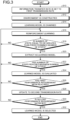
- FIG. 3 is a flowchart illustrating an example of the learning process according to the present embodiment.
- the process of learning the transmission rate of the information transfer rate of the communication device mounted on the unmanned vehicle will be described as an example, but the present disclosure is not limited thereto.
- the setting unit 40 sets the information transfer rate of the communication device of the unmanned vehicle to a first transmission rate (step S10). Specifically, the setting unit 40 sets the first transmission rate that can be said to be sufficiently high as the information transfer rate set for the communication device.
- the first transmission rate is a kind of the first requirement value. The process then proceeds to step S12.
- the setting unit 40 constructs various environments for performing reinforcement learning (step S12). Specifically, the setting unit 40 constructs, for example, a simulation environment for performing reinforcement learning. The process then proceeds to step S14.
- the setting unit 40 examines a learning model to perform reinforcement learning (step S14). Specifically, the setting unit 40 makes various examinations necessary for carrying out reinforcement learning, for example, examines action decision model (state and action), reward function, deep reinforcement learning algorithm, model granularity, and hyperparameters. The process then proceeds to step S16.
- the reinforcement learning unit 50 performs reinforcement learning (step S16). Specifically, the reinforcement learning unit 50, for example, performs learning so that the reward given to the learned model is maximized. The process then proceeds to step S18.
- the reinforcement learning unit 50 determines whether the number of steps of performing reinforcement learning is equal to or greater than a predetermined number of steps (step S18).
- the predetermined number of steps may be set as desired, for example, according to the problem to be handled. If it is determined that the number of steps is equal to or greater than a predetermined number of steps (Yes at step S18), the process proceeds to step S20. If it is determined that the number of steps is not equal to or greater than a predetermined number of steps (No at step S18), the process proceeds to step S16. In other words, in the present embodiment, reinforcement learning is repeated until a predetermined number of steps is reached.
- the model extraction unit 52 extracts a learned model (step S20). Specifically, the model extraction unit 52 extracts all learned models that have been subjected to reinforcement learning for a predetermined number of steps or more. The process then proceeds to step S22.
- the reinforcement learning unit 50 determines whether the number of steps of performing reinforcement learning has reached the maximum number of steps (step S22). The maximum number of steps may be set as desired. If it is determined that the number of steps has reached the maximum number of steps (Yes at step S22), the process proceeds to step S24. If it is not determined that the number of steps has reached the maximum number of steps (No at step S22), the process proceeds to step S16. In other words, in the present embodiment, reinforcement learning is repeated until the number of learning steps has reached the maximum number of steps.
- step S22 the model evaluation unit 54 evaluates the performance of the learned model in which the number of steps has reached the maximum number of steps (step S24). The process then proceeds to step S26.
- the model evaluation unit 54 determines whether the performance of the learned model has reached the first performance requirement (step S26). Specifically, the model evaluation unit 54 determines, for example, whether the learned model set to the first transmission rate set at step S10 has reached the desired first performance requirement. If it is determined that the performance of the learned model has reached the first performance requirement (Yes at step S26), the process proceeds to step S28. If it is not determined that the performance of the learned model has reached the first performance requirement (No at step S26), the process proceeds to step S16. In other words, in the present embodiment, reinforcement learning is repeated until it is determined that the performance of the learned model has reached the first performance requirement.
- the updating unit 56 updates the first transmission rate set at step S10 to a second transmission rate (step S28). Specifically, the updating unit 56 updates the transmission rate to a second transmission rate lower than the first transmission rate.
- the second transmission rate is a kind of the second requirement value. The process then proceeds to step S30.
- the model evaluation unit 54 determines whether the learned model updated from the first transmission rate to the second transmission rate satisfies the desired second performance requirement (step S30).
- the second performance requirement may be the same performance as the first performance requirement or may be inferior to the first performance requirement.
- the second performance requirement may be changed as desired in accordance with the design. For example, the second performance requirement may be changed in accordance with the function to be added to the communication device of the unmanned vehicle. If it is determined that the learned model updated to the second transmission rate satisfies the desired second performance requirement (Yes at step S30), the process proceeds to step S32. If it is not determined that the learned model updated to the second transmission rate satisfies the desired second performance requirement (No at step S30), the process proceeds to step S16. In other words, in the present embodiment, reinforcement learning is repeated until it is determined that the performance of the learned model satisfies the second performance requirement.
- the model selection unit 58 selects a learned model (step S32). Specifically, the model selection unit 58 selects the learned model determined to satisfy the second performance requirement at step S30 as the learned model to be installed in the computer of the unmanned vehicle. The process in FIG. 3 then ends.
- the learned model selected by the learning device 10 is applied to the design of an unmanned vehicle having a communication device, whereby an unmanned vehicle system with a rate lower than the conventional system can be applied.
- the present embodiment can provide an unmanned vehicle system in which the unmanned vehicles can cooperate even in a low-rate communication environment.
- learning is performed in a high-rate state and thereafter learning is carried out at a lower rate, whereby the data rate required by the unmanned vehicle system can be appropriately set.
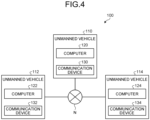
- FIG. 4 is a diagram illustrating a configuration example of the unmanned vehicle system according to embodiments.
- an unmanned vehicle system 100 includes an unmanned vehicle 110, an unmanned vehicle 112, and an unmanned vehicle 114.
- Unmanned vehicles 110 to 114 are, for example, but not limited to, vehicles, ships, or aircrafts.
- the unmanned vehicle system 100 includes three unmanned vehicles, but the present disclosure is not limited thereto.
- the unmanned vehicle 110 includes a computer 120 and a communication device 130.
- the unmanned vehicle 112 includes a computer 122 and a communication device 132.
- the unmanned vehicle 114 includes a computer 124 and a communication device 134.
- the communication device 130, the communication device 132, and the communication device 134 are communicatively connected via a wireless network N.
- the network N is, for example, but not limited to, a TDMA network.
- the computers 120 to 124 are equipped with, for example, a learned model that satisfies the second performance requirement as selected by the learning device 10 in the process illustrated in FIG. 3 .
- the computers 120 to 124 each include, for example, a processing unit such as a CPU and a storage device such as a RAM or a ROM.
- the computers 120 to 124 exchange information with other unmanned vehicles through the communication devices 130 to 134, for example, using a learned model that satisfies the second performance requirement.
- the computers 120 to 124 are equipped with, for example, a learned model, and the computers 120 to 124 communicate through the communication devices using the learned model, whereby the feasibility of the unmanned vehicle system is increased even with a low rate, and performance improvement that is difficult to achieve only with conventional wireless communication designs can be achieved.
- the unmanned vehicles 110 to 114 transmit and receive information on each individual unmanned vehicle, using the computers 120 to 124 and the communication devices 130 to 134, respectively.
- the computers 120 to 124 use the learned model selected by the learning device 10 and exchange information with other unmanned vehicles through the communication devices to transmit and receive information on each individual unmanned vehicle at a low rate.
- This configuration creates a surplus in the resources of the wireless communication line.
- the unmanned vehicle system 100 in the present embodiment can create a surplus in the resources of the wireless communication line and thereby can expand functions, for example, extend the effective communication range, ensure function enhancement in the future, improve encryption strength, and reduce the weight and the power consumption of the communication device, and prevent interference with other stations.
- a learning device, a communication device, an unmanned vehicle, a wireless communication system, a learning method, and a learning program described in the present embodiment are understood, for example, as follows.
- a learning device for allowing a learned model to be installed in a communication device to learn.
- the learning device includes: a setting unit 40 configured to set a first requirement value for a predetermined parameter of the communication device controlled by a computer using the learned model; a reinforcement learning unit 50 configured to allow a learning model to learn such that a reward given in a predetermined environment is maximized; a model extraction unit 52 configured to extract, as a learned model, the learning model in which a number of learning steps is equal to or greater than a predetermined number; a model evaluation unit 54 configured to determine whether performance of the learned model extracted by the model extraction unit 52 has reached first performance requirement; an updating unit 56 configured to update the first requirement value to a second requirement value different from the first requirement value when the model evaluation unit 54 determines that performance of the learned model has reached the first performance requirement; and a model selection unit 58 configured to select a learned model to be installed in the computer.
- the model evaluation unit 54 determines whether performance of the learned model updated to the second requirement value satisfies second performance requirement different from the first performance requirement.
- the model selection unit 58 selects a learned model that satisfies the second performance requirement as the learned model to be installed in the computer.
- the updating unit 56 changes the second requirement value in accordance with the second performance requirement.
- the learning device can set the performance requirement that makes the unmanned vehicle system feasible, as desired.
- the predetermined parameter of the communication device is information transfer rate.
- the setting unit sets a first transmission rate as the first requirement value for the information transfer rate.
- the updating unit updates the first transmission rate to a second transmission rate lower than the first transmission rate.
- a communication device performs communication based on control using the learned model learned by the learning device according to any one of the first to third aspects.
- the communication device can reserve a surplus in the resources of the wireless communication line by slowing down the information transfer rate.
- An unmanned vehicle according to a fifth aspect includes a computer 120 equipped with the learned model learned by the learning device according to any one of the first to third aspects, and a communication device 130.
- the computer 120 performs communication through the communication device 130 using the learned model.
- the communication device can reserve a surplus in the resources of the wireless communication line by slowing down the information transfer rate.
- the unmanned vehicle according to the fifth aspect can transmit information on the unmanned vehicle itself to other vehicles at a lower rate.
- a wireless communication system includes a plurality of unmanned vehicles 110 according to the fifth aspect.
- the unmanned vehicles can cooperate even in a communication environment with a low information transfer rate.
- a learning method is a learning method for allowing a learned model to be installed in a computer to learn.
- the learning method includes: setting a first requirement value for a predetermined parameter of a communication device controlled by the computer using the learned model; allowing a learning model to learn such that a reward given in a predetermined environment is maximized; extracting, as a learned model, the learning model in which a number of learning steps is equal to or greater than a predetermined number; determining whether performance of the extracted learned model has reached first performance requirement; updating the first requirement value to a second requirement value different from the first requirement value when performance of the learned model is determined to have reached the first performance requirement; determining whether performance of the learned model updated to the second requirement value satisfies second performance requirement different from the first performance requirement; and selecting the learned model that satisfies the second performance requirement as the learned model to be installed in the computer when performance of the learned model updated to the second requirement value is determined to satisfy the second performance requirement.
- a learning program is a learning program for allowing a learned model to be installed in a computer to learn using a learning device.
- the learning program causes the learning device to perform: setting a first requirement value for a predetermined parameter of a communication device controlled by the computer using the learned model; allowing a learning model to learn such that a reward given in a predetermined environment is maximized; extracting, as a learned model, the learning model in which a number of learning steps is equal to or greater than a predetermined number; determining whether performance of the extracted learned model has reached first performance requirement; updating the first requirement value to a second requirement value different from the first requirement value when it is determined that performance of the learned model has reached the first performance requirement; determining whether performance of the learned model updated to the second requirement value satisfies second performance requirement different from the first performance requirement; and selecting the learned model that satisfies the second performance requirement as the learned model to be installed in the computer when performance of the learned model updated to the second requirement value is determined to satisfy the second performance requirement.
- the learning device can appropriately select a learned model that satisfies the performance requirement that makes the unmanned vehicle system feasible and can achieve performance improvement that is difficult to achieve only with conventional wireless communication designs.
- the learning device may include a computer including at least a processor and a memory; the learning program may be stored on a (non-transitory) computer-readable storage medium, such as a magnetic disk, an optical disc, or a semiconductor memory, to be executed by the learning device which serves as that computer or the other computer in which the learned model is to be installed.
Landscapes
- Engineering & Computer Science (AREA)
- Theoretical Computer Science (AREA)
- Physics & Mathematics (AREA)
- Data Mining & Analysis (AREA)
- General Physics & Mathematics (AREA)
- Artificial Intelligence (AREA)
- Evolutionary Computation (AREA)
- Life Sciences & Earth Sciences (AREA)
- General Engineering & Computer Science (AREA)
- Health & Medical Sciences (AREA)
- Computational Linguistics (AREA)
- Biomedical Technology (AREA)
- Software Systems (AREA)
- Mathematical Physics (AREA)
- Computing Systems (AREA)
- Molecular Biology (AREA)
- General Health & Medical Sciences (AREA)
- Biophysics (AREA)
- Transportation (AREA)
- Computer Vision & Pattern Recognition (AREA)
- Combustion & Propulsion (AREA)
- Bioinformatics & Computational Biology (AREA)
- Signal Processing (AREA)
- Chemical & Material Sciences (AREA)
- Mechanical Engineering (AREA)
- Bioinformatics & Cheminformatics (AREA)
- Evolutionary Biology (AREA)
- Computer Networks & Wireless Communication (AREA)
- Mobile Radio Communication Systems (AREA)
- Aviation & Aerospace Engineering (AREA)
- Radar, Positioning & Navigation (AREA)
- Remote Sensing (AREA)
- Automation & Control Theory (AREA)
- Control Of Position, Course, Altitude, Or Attitude Of Moving Bodies (AREA)
- Business, Economics & Management (AREA)
- Game Theory and Decision Science (AREA)
- Medical Informatics (AREA)
- Traffic Control Systems (AREA)
Abstract
Description
- The present disclosure relates to a learning device, a communication device, an unmanned vehicle, a wireless communication system, a learning method, and a computer-readable storage medium.
- Technologies for controlling unmanned aerial vehicles are known. For example,
Patent Literature 1 discloses a technique for broadcasting geolocation (geographic location) information from an unmanned aerial vehicle to inform others of the current geolocation of the unmanned aerial vehicle. - Patent Literature 1:
Japanese Patent No. 6853897 - In an unmanned vehicle system including a plurality of unmanned vehicles, in order to allow the unmanned vehicles to act in cooperation with each other, transmitting information at a high rate is desired because the information on each unmanned vehicle is required in real time, in addition to the policies of other unmanned vehicles obtained by reinforcement learning. For this reason, the unmanned vehicle system forms, for example, a time division multiple access (TDMA) network so that collisions of radio waves transmitted by the unmanned vehicles is prevented, in which slots for transmitting information are set depending on the number of unmanned vehicles in the unmanned vehicle system.
- When the unmanned vehicle system includes a large number of unmanned vehicles, such as tens or hundreds of unmanned vehicles, slots to be occupied by individual unmanned vehicles are required, and the overhead for reserving the slots may degrade throughput. Possible ways to resolve the throughput degradation include increasing the wireless bandwidth, increasing transmission power, and improving receiving sensitivity performance. However, increasing the wireless bandwidth may not be allowed to be licensed due to the possibility of interference of communication with other stations, and increasing transmission power leads to increase of the weight of the radio communication device and therefore is disadvantageous for size reduction. As a result, it may be difficult to establish an unmanned vehicle system.
- An object of the present disclosure is therefore to provide a learning device, a communication device, an unmanned vehicle, a wireless communication system, a learning method, and a computer-readable storage medium, in which reinforcement learning is applied to the design of wireless communication to establish an unmanned vehicle system appropriately, and performance improvement that is difficult to achieve only with conventional wireless communication designs can be achieved.
- A learning device according to one aspect of the present disclosure allows a learned model to be installed in a computer to learn. The learning device includes: a setting unit configured to set a first requirement value for a predetermined parameter of a communication device controlled by the computer using the learned model; a reinforcement learning unit configured to allow a learning model to learn such that a reward given in a predetermined environment is maximized; a model extraction unit configured to extract, as a learned model, the learning model in which a number of learning steps is equal to or greater than a predetermined number; a model evaluation unit configured to determine whether performance of the learned model extracted by the model extraction unit has reached first performance requirement; an updating unit configured to update the first requirement value to a second requirement value different from the first requirement value when the model evaluation unit determines that performance of the learned model has reached the first performance requirement; and a model selection unit configured to select the learned model to be installed in the computer. The model evaluation unit determines whether performance of the learned model updated to the second requirement value satisfies second performance requirement different from the first performance requirement, and when the model evaluation unit determines that performance of the learned model updated to the second requirement value satisfies the second performance requirement, the model selection unit selects the learned model that satisfies the second performance requirement as the learned model to be installed in the computer.
- A communication device according to another aspect of the present disclosure is configured to perform communication based on control using the learned model learned by the above-described learning device.
- An unmanned vehicle according to still another aspect of the present disclosure includes: a computer in which the learned model learned by the above-described learning device is installed; and a communication device. The computer performs communication through the communication device using the learned model.
- A wireless communication system according to yet another aspect of the present disclosure includes a plurality of unmanned vehicles each corresponding to the above-described unmanned vehicle.
- A learning method according to yet another aspect of the present disclosure is for allowing a learned model to be installed in a computer to learn. The learning method includes: setting a first requirement value for a predetermined parameter of a communication device controlled by the computer using the learned model; allowing a learning model to learn such that a reward given in a predetermined environment is maximized; extracting, as a learned model, the learning model in which a number of learning steps is equal to or greater than a predetermined number; determining whether performance of the extracted learned model has reached first performance requirement; updating the first requirement value to a second requirement value different from the first requirement value when performance of the learned model is determined to have reached the first performance requirement; determining whether performance of the learned model updated to the second requirement value satisfies second performance requirement different from the first performance requirement; and selecting the learned model that satisfies the second performance requirement as the learned model to be installed in the computer when performance of the learned model updated to the second requirement value is determined to satisfy the second performance requirement.
- A non-transitory computer-readable storage medium according to yet another aspect of the present disclosure stores a learning program for allowing a learned model to be installed in a computer to learn using a learning device serving as another computer. The learning program causes the learning device to perform: setting a first requirement value for a predetermined parameter of a communication device controlled by the computer using the learned model; allowing a learning model to learn such that a reward given in a predetermined environment is maximized; extracting, as a learned model, the learning model in which a number of learning steps is equal to or greater than a predetermined number; determining whether performance of the extracted learned model has reached first performance requirement; updating the first requirement value to a second requirement value different from the first requirement value when performance of the learned model is determined to have reached the first performance requirement; determining whether performance of the learned model updated to the second requirement value satisfies second performance requirement different from the first performance requirement; and selecting the learned model that satisfies the second performance requirement as the learned model to be installed in the computer when performance of the learned model updated to the second requirement value is determined to satisfy the second performance requirement.
- According to the present disclosure, an unmanned vehicle system can be established appropriately, and performance improvement that is difficult to achieve only with conventional wireless communication designs can be achieved.
-
-
FIG. 1 is an illustration of learning using a learning model according to embodiments. -
FIG. 2 is a block diagram illustrating a configuration example of a learning device according to embodiments. -
FIG. 3 is a flowchart illustrating an example of a learning process according to embodiments. -
FIG. 4 is a diagram illustrating a configuration example of an unmanned vehicle system according to embodiments. - Embodiments according to the present invention will be described in detail below based on the drawings.
- It should be noted that the present invention is not limited by the embodiments. The constituent elements in the following embodiments include those easily replaceable by those skilled in the art or those substantially identical. Furthermore, the constituent elements described below can be combined as appropriate, and two or more embodiments, if any, can be combined.
- A learning device 10 and a learning method according to the present embodiment are a device and a method for allowing a learning model including hyperparameters to learn.
FIG. 1 is an illustration of learning using a learning model according to the present embodiment.FIG. 2 is a block diagram illustrating a configuration example of a learning device according to the present embodiment. - First of all, referring to
FIG. 1 , learning using a learning model M will be described. The learning model M is installed in an agent 2 that performs an action At. For example, a machine capable of performing operation, such as robot, vehicle, ship, or aircraft, is applicable as the agent 2. The agent 2 performs a predetermined action At under a predetermined environment 4 using the learning model M. - As illustrated in
FIG. 1 , the learning model M is a neural network having a plurality of nodes. The neural network is a network having a plurality of nodes connected to each other and has a plurality of layers each including a plurality of nodes. The parameters of the neural network include weights and biases between nodes. Other parameters of the neural network include hyperparameters such as the number of layers of a hierarchy, the number of nodes, and the learning rate. In the present embodiment, the weights and the biases between nodes of the learning model M are learned. - Learning using the learning model M will now be described. Learning includes imitation learning and reinforcement learning. Imitation learning is supervised learning, in which the hyperparameters of the learning model M are learned so that the agent 2 performs a predetermined action At when a predetermined state St is input under a predetermined environment 4. Reinforcement learning is unsupervised learning, in which the hyperparameters of the learning model M are learned so that a reward Rt given to the agent 2 under a predetermined environment 4 is maximized.
- In reinforcement learning, the agent 2 acquires a state St from the environment 4 and acquires a reward Rt from the environment 4. The agent 2 then selects an action At from the learning model M based on the acquired state St and reward Rt. When the agent 2 performs the selected action At, the state St of the agent 2 makes a transition to a state St+i in the environment 4. In addition, the agent 2 is given a reward Rt+i based on the performed action At, the state St before the transition, and the state St+1 after the transition. In reinforcement learning, the above learning is repeated for an evaluable predetermined number of steps so that the reward Rt given to the agent 2 is maximized.
- In the present disclosure, the learning device 10 learns a learning model to be installed in a computer in order to appropriately set the performance requirement of the communication device of an unmanned vehicle. The information transfer rate is determined for the communication device of an unmanned vehicle, and reinforcement learning for the determined information transfer rate is performed. When the learning device 10 determines that first performance requirement is satisfied for the determined information transfer rate, the information transfer rate is slowed down, and reinforcement learning is performed to satisfy second performance requirement.
- In the present disclosure, the unmanned vehicle may be any unmanned vehicle. Examples of the unmanned vehicle include aircrafts, ships, and vehicles.
- The description returns to
FIG. 2 . As illustrated inFIG. 2 , the learning device 10 includes an environment unit 12, a storage unit 14, and acontrol unit 16. - The environment unit 12 provides an environment for performing reinforcement learning for a learned model. The environment unit 12 includes a motion model 20, an
environment model 22, and a reward model 24. The environment unit 12 provides an environment for performing reinforcement learning, based on the motion model 20, theenvironment model 22, and the reward model 24. Specifically, the environment unit 12 gives a reward to the learned model and derives a state of the learned model that changes with an action. - The storage unit 14 is a memory that stores various information. The storage unit 14 stores, for example, information such as computations of the
control unit 16 and computer programs. The storage unit 14 includes, for example, at least one of a random access memory (RAM), a main storage device such as a read-only memory (ROM), and an external storage device such as a hard disk drive (HDD). The storage unit 14 stores areinforcement learning model 30. - The
reinforcement learning model 30 includes a plurality of learned models in reinforcement learning. Thereinforcement learning model 30, for example, stores a plurality of learned models learned at each learning step. - The
control unit 16 controls the operation of each unit of the learning device 10. Thecontrol unit 16 is implemented by, for example, a central processing unit (CPU) or a micro processing unit (MPU) executing a computer program stored in the storage unit 14 or the like using the RAM or the like as a work area. Thecontrol unit 16 may be implemented by an integrated circuit such as an application-specific integrated circuit (ASIC) or a field programmable gate array (FPGA). Thecontrol unit 16 may be implemented by a combination of hardware and software. - The
control unit 16 includes asetting unit 40 and alearning unit 42. - The setting
unit 40 sets various conditions for performing reinforcement learning. The settingunit 40 sets, for example, a first requirement value for a predetermined parameter of the communication device. The settingunit 40 sets, for example, action decision model (state and action), reward function, deep reinforcement learning algorithm, model granularity, and hyperparameters. In other words, the settingunit 40 constructs an environment for performing reinforcement learning. The details of thesetting unit 40 will be described later. - The
learning unit 42 performs learning of a learning model. Thelearning unit 42 includes areinforcement learning unit 50, a model extraction unit 52, a model evaluation unit 54, an updatingunit 56, and amodel selection unit 58. - The
reinforcement learning unit 50 performs learning based on rewards given by the environment unit 12. The details of thereinforcement learning unit 50 will be described later. - The model extraction unit 52 extracts, as a learned model, a learning model in which the number of learning steps of reinforcement learning by the
reinforcement learning unit 50 is equal to or greater than a predetermined number. The details of the model extraction unit 52 will be described later. - The model evaluation unit 54 evaluates the learned model. The model evaluation unit 54 determines, for example, whether the performance of the learned model extracted by the model extraction unit 52 has reached first performance requirement. The details of the model evaluation unit 54 will be described later.
- The updating
unit 56 updates a requirement value set for a predetermined parameter of the communication device. For example, when the model evaluation unit 54 determines that the performance of the learned model has reached first performance requirement, the updatingunit 56 updates the first requirement value to a second requirement value different from the first requirement value. The details of the updatingunit 56 will be described later. - The
model selection unit 58 selects a learned model to be installed in the communication device. The details of themodel selection unit 58 will be described later. - Referring to
FIG. 3 , the learning process according to the present embodiment will be described.FIG. 3 is a flowchart illustrating an example of the learning process according to the present embodiment. In the following, the process of learning the transmission rate of the information transfer rate of the communication device mounted on the unmanned vehicle will be described as an example, but the present disclosure is not limited thereto. - The setting
unit 40 sets the information transfer rate of the communication device of the unmanned vehicle to a first transmission rate (step S10). Specifically, the settingunit 40 sets the first transmission rate that can be said to be sufficiently high as the information transfer rate set for the communication device. The first transmission rate is a kind of the first requirement value. The process then proceeds to step S12. - The setting
unit 40 constructs various environments for performing reinforcement learning (step S12). Specifically, the settingunit 40 constructs, for example, a simulation environment for performing reinforcement learning. The process then proceeds to step S14. - The setting
unit 40 examines a learning model to perform reinforcement learning (step S14). Specifically, the settingunit 40 makes various examinations necessary for carrying out reinforcement learning, for example, examines action decision model (state and action), reward function, deep reinforcement learning algorithm, model granularity, and hyperparameters. The process then proceeds to step S16. - The
reinforcement learning unit 50 performs reinforcement learning (step S16). Specifically, thereinforcement learning unit 50, for example, performs learning so that the reward given to the learned model is maximized. The process then proceeds to step S18. - The
reinforcement learning unit 50 determines whether the number of steps of performing reinforcement learning is equal to or greater than a predetermined number of steps (step S18). The predetermined number of steps may be set as desired, for example, according to the problem to be handled. If it is determined that the number of steps is equal to or greater than a predetermined number of steps (Yes at step S18), the process proceeds to step S20. If it is determined that the number of steps is not equal to or greater than a predetermined number of steps (No at step S18), the process proceeds to step S16. In other words, in the present embodiment, reinforcement learning is repeated until a predetermined number of steps is reached. - If the determination is Yes at step S18, the model extraction unit 52 extracts a learned model (step S20). Specifically, the model extraction unit 52 extracts all learned models that have been subjected to reinforcement learning for a predetermined number of steps or more. The process then proceeds to step S22.
- The
reinforcement learning unit 50 determines whether the number of steps of performing reinforcement learning has reached the maximum number of steps (step S22). The maximum number of steps may be set as desired. If it is determined that the number of steps has reached the maximum number of steps (Yes at step S22), the process proceeds to step S24. If it is not determined that the number of steps has reached the maximum number of steps (No at step S22), the process proceeds to step S16. In other words, in the present embodiment, reinforcement learning is repeated until the number of learning steps has reached the maximum number of steps. - If the determination is Yes at step S22, the model evaluation unit 54 evaluates the performance of the learned model in which the number of steps has reached the maximum number of steps (step S24). The process then proceeds to step S26.
- The model evaluation unit 54 determines whether the performance of the learned model has reached the first performance requirement (step S26). Specifically, the model evaluation unit 54 determines, for example, whether the learned model set to the first transmission rate set at step S10 has reached the desired first performance requirement. If it is determined that the performance of the learned model has reached the first performance requirement (Yes at step S26), the process proceeds to step S28. If it is not determined that the performance of the learned model has reached the first performance requirement (No at step S26), the process proceeds to step S16. In other words, in the present embodiment, reinforcement learning is repeated until it is determined that the performance of the learned model has reached the first performance requirement.
- The updating
unit 56 updates the first transmission rate set at step S10 to a second transmission rate (step S28). Specifically, the updatingunit 56 updates the transmission rate to a second transmission rate lower than the first transmission rate. The second transmission rate is a kind of the second requirement value. The process then proceeds to step S30. - The model evaluation unit 54 determines whether the learned model updated from the first transmission rate to the second transmission rate satisfies the desired second performance requirement (step S30). The second performance requirement may be the same performance as the first performance requirement or may be inferior to the first performance requirement. The second performance requirement may be changed as desired in accordance with the design. For example, the second performance requirement may be changed in accordance with the function to be added to the communication device of the unmanned vehicle. If it is determined that the learned model updated to the second transmission rate satisfies the desired second performance requirement (Yes at step S30), the process proceeds to step S32. If it is not determined that the learned model updated to the second transmission rate satisfies the desired second performance requirement (No at step S30), the process proceeds to step S16. In other words, in the present embodiment, reinforcement learning is repeated until it is determined that the performance of the learned model satisfies the second performance requirement.
- If the determination is Yes at step S30, the
model selection unit 58 selects a learned model (step S32). Specifically, themodel selection unit 58 selects the learned model determined to satisfy the second performance requirement at step S30 as the learned model to be installed in the computer of the unmanned vehicle. The process inFIG. 3 then ends. - In the present embodiment, the learned model selected by the learning device 10 is applied to the design of an unmanned vehicle having a communication device, whereby an unmanned vehicle system with a rate lower than the conventional system can be applied. Specifically, the present embodiment can provide an unmanned vehicle system in which the unmanned vehicles can cooperate even in a low-rate communication environment. In other words, in the present embodiment, learning is performed in a high-rate state and thereafter learning is carried out at a lower rate, whereby the data rate required by the unmanned vehicle system can be appropriately set.
- Referring to
FIG. 4 , a configuration example of the unmanned vehicle system according to embodiments will be described.FIG. 4 is a diagram illustrating a configuration example of the unmanned vehicle system according to embodiments. - As illustrated in
FIG. 4 , anunmanned vehicle system 100 includes anunmanned vehicle 110, an unmanned vehicle 112, and an unmanned vehicle 114.Unmanned vehicles 110 to 114 are, for example, but not limited to, vehicles, ships, or aircrafts. In the example illustrated inFIG. 4 , theunmanned vehicle system 100 includes three unmanned vehicles, but the present disclosure is not limited thereto. - The
unmanned vehicle 110 includes a computer 120 and acommunication device 130. The unmanned vehicle 112 includes a computer 122 and a communication device 132. The unmanned vehicle 114 includes a computer 124 and acommunication device 134. Thecommunication device 130, the communication device 132, and thecommunication device 134 are communicatively connected via a wireless network N. The network N is, for example, but not limited to, a TDMA network. - The computers 120 to 124 are equipped with, for example, a learned model that satisfies the second performance requirement as selected by the learning device 10 in the process illustrated in
FIG. 3 . The computers 120 to 124 each include, for example, a processing unit such as a CPU and a storage device such as a RAM or a ROM. The computers 120 to 124 exchange information with other unmanned vehicles through thecommunication devices 130 to 134, for example, using a learned model that satisfies the second performance requirement. In other words, in the present embodiment, the computers 120 to 124 are equipped with, for example, a learned model, and the computers 120 to 124 communicate through the communication devices using the learned model, whereby the feasibility of the unmanned vehicle system is increased even with a low rate, and performance improvement that is difficult to achieve only with conventional wireless communication designs can be achieved. - The
unmanned vehicles 110 to 114 transmit and receive information on each individual unmanned vehicle, using the computers 120 to 124 and thecommunication devices 130 to 134, respectively. In the present embodiment, the computers 120 to 124 use the learned model selected by the learning device 10 and exchange information with other unmanned vehicles through the communication devices to transmit and receive information on each individual unmanned vehicle at a low rate. This configuration creates a surplus in the resources of the wireless communication line. In other words, theunmanned vehicle system 100 in the present embodiment can create a surplus in the resources of the wireless communication line and thereby can expand functions, for example, extend the effective communication range, ensure function enhancement in the future, improve encryption strength, and reduce the weight and the power consumption of the communication device, and prevent interference with other stations. - A learning device, a communication device, an unmanned vehicle, a wireless communication system, a learning method, and a learning program described in the present embodiment are understood, for example, as follows.
- A learning device according to a first aspect is a learning device for allowing a learned model to be installed in a communication device to learn. The learning device includes: a setting
unit 40 configured to set a first requirement value for a predetermined parameter of the communication device controlled by a computer using the learned model; areinforcement learning unit 50 configured to allow a learning model to learn such that a reward given in a predetermined environment is maximized; a model extraction unit 52 configured to extract, as a learned model, the learning model in which a number of learning steps is equal to or greater than a predetermined number; a model evaluation unit 54 configured to determine whether performance of the learned model extracted by the model extraction unit 52 has reached first performance requirement; an updatingunit 56 configured to update the first requirement value to a second requirement value different from the first requirement value when the model evaluation unit 54 determines that performance of the learned model has reached the first performance requirement; and amodel selection unit 58 configured to select a learned model to be installed in the computer. The model evaluation unit 54 determines whether performance of the learned model updated to the second requirement value satisfies second performance requirement different from the first performance requirement. When the model evaluation unit 54 determines that performance of the learned model updated to the second requirement value satisfies the second performance requirement, themodel selection unit 58 selects a learned model that satisfies the second performance requirement as the learned model to be installed in the computer. With this configuration, the learning device according to the first aspect can appropriately select a learned model that satisfies the performance requirement that makes the unmanned vehicle system feasible and can achieve performance improvement that is difficult to achieve only with conventional wireless communication designs. - According to a second aspect, the updating
unit 56 changes the second requirement value in accordance with the second performance requirement. With this configuration, the learning device according to the second aspect can set the performance requirement that makes the unmanned vehicle system feasible, as desired. - According to a third aspect, the predetermined parameter of the communication device is information transfer rate. The setting unit sets a first transmission rate as the first requirement value for the information transfer rate. The updating unit updates the first transmission rate to a second transmission rate lower than the first transmission rate. With this configuration, even when the information transfer rate is low, the learning device according to the third aspect can appropriately select a learned model that satisfies the performance requirement.
- According to a fourth aspect, a communication device performs communication based on control using the learned model learned by the learning device according to any one of the first to third aspects. With this configuration, the communication device can reserve a surplus in the resources of the wireless communication line by slowing down the information transfer rate.
- An unmanned vehicle according to a fifth aspect includes a computer 120 equipped with the learned model learned by the learning device according to any one of the first to third aspects, and a
communication device 130. The computer 120 performs communication through thecommunication device 130 using the learned model. With this configuration, the communication device can reserve a surplus in the resources of the wireless communication line by slowing down the information transfer rate. The unmanned vehicle according to the fifth aspect can transmit information on the unmanned vehicle itself to other vehicles at a lower rate. - A wireless communication system according to a sixth aspect includes a plurality of
unmanned vehicles 110 according to the fifth aspect. With this configuration, in the unmanned vehicle system according to the sixth aspect, the unmanned vehicles can cooperate even in a communication environment with a low information transfer rate. - A learning method according to a seventh aspect is a learning method for allowing a learned model to be installed in a computer to learn. The learning method includes: setting a first requirement value for a predetermined parameter of a communication device controlled by the computer using the learned model; allowing a learning model to learn such that a reward given in a predetermined environment is maximized; extracting, as a learned model, the learning model in which a number of learning steps is equal to or greater than a predetermined number; determining whether performance of the extracted learned model has reached first performance requirement; updating the first requirement value to a second requirement value different from the first requirement value when performance of the learned model is determined to have reached the first performance requirement; determining whether performance of the learned model updated to the second requirement value satisfies second performance requirement different from the first performance requirement; and selecting the learned model that satisfies the second performance requirement as the learned model to be installed in the computer when performance of the learned model updated to the second requirement value is determined to satisfy the second performance requirement. With this configuration, the learning method according to the seventh aspect can appropriately select a learned model that satisfies the performance requirement that makes the unmanned vehicle system feasible and can achieve performance improvement that is difficult to achieve only with conventional wireless communication designs.
- A learning program according to an eighth aspect is a learning program for allowing a learned model to be installed in a computer to learn using a learning device. The learning program causes the learning device to perform: setting a first requirement value for a predetermined parameter of a communication device controlled by the computer using the learned model; allowing a learning model to learn such that a reward given in a predetermined environment is maximized; extracting, as a learned model, the learning model in which a number of learning steps is equal to or greater than a predetermined number; determining whether performance of the extracted learned model has reached first performance requirement; updating the first requirement value to a second requirement value different from the first requirement value when it is determined that performance of the learned model has reached the first performance requirement; determining whether performance of the learned model updated to the second requirement value satisfies second performance requirement different from the first performance requirement; and selecting the learned model that satisfies the second performance requirement as the learned model to be installed in the computer when performance of the learned model updated to the second requirement value is determined to satisfy the second performance requirement. With this configuration, the learning device according to the eighth aspect can appropriately select a learned model that satisfies the performance requirement that makes the unmanned vehicle system feasible and can achieve performance improvement that is difficult to achieve only with conventional wireless communication designs. The learning device may include a computer including at least a processor and a memory; the learning program may be stored on a (non-transitory) computer-readable storage medium, such as a magnetic disk, an optical disc, or a semiconductor memory, to be executed by the learning device which serves as that computer or the other computer in which the learned model is to be installed.
- Although the embodiments of the present invention have been described above, the embodiments are not limited thereto. The constituent elements described above encompass a constituent element that is easily conceivable by those skilled in the art, substantially the same constituent element, and what is called an equivalent. The constituent elements described above can be appropriately combined with each other. Furthermore, some of the constituent elements can be variously omitted, substituted, or modified without departing from the spirit and scope of the embodiments described above.
-
- 10
- Learning device
- 12
- Environment unit
- 14
- Storage unit
- 16
- Control unit
- 20
- Motion model
- 22
- Environment model
- 24
- Reward model
- 30
- Reinforcement learning model
- 40
- Setting unit
- 42
- Learning unit
- 50
- Reinforcement learning unit
- 52
- Model extraction unit
- 54
- Model evaluation unit
- 56
- Updating unit
- 58
- Model selection unit
Claims (8)
- A learning device for allowing a learned model to be installed in a computer to learn, the learning device comprising:a setting unit configured to set a first requirement value for a predetermined parameter of a communication device controlled by the computer using the learned model;a reinforcement learning unit configured to allow a learning model to learn such that a reward given in a predetermined environment is maximized;a model extraction unit configured to extract, as a learned model, the learning model in which a number of learning steps is equal to or greater than a predetermined number;a model evaluation unit configured to determine whether performance of the learned model extracted by the model extraction unit has reached first performance requirement;an updating unit configured to update the first requirement value to a second requirement value different from the first requirement value when the model evaluation unit determines that performance of the learned model has reached the first performance requirement; anda model selection unit configured to select the learned model to be installed in the computer, whereinthe model evaluation unit determines whether performance of the learned model updated to the second requirement value satisfies second performance requirement different from the first performance requirement, andwhen the model evaluation unit determines that performance of the learned model updated to the second requirement value satisfies the second performance requirement, the model selection unit selects the learned model that satisfies the second performance requirement as the learned model to be installed in the computer.
- The learning device according to claim 1, wherein the updating unit changes the second requirement value in accordance with the second performance requirement.
- The learning device according to claim 1, whereinthe predetermined parameter of the communication device is information transfer rate,the setting unit sets a first transmission rate as the first requirement value for the information transfer rate, andthe updating unit updates the first transmission rate to a second transmission rate lower than the first transmission rate.
- A communication device configured to perform communication based on control using the learned model learned by the learning device according to any one of claims 1 to 3.
- An unmanned vehicle comprising:a computer in which the learned model learned by the learning device according to any one of claims 1 to 3 is installed; anda communication device, whereinthe computer performs communication through the communication device using the learned model.
- A wireless communication system comprising a plurality of unmanned vehicles each corresponding to the unmanned vehicle according to claim 5.
- A learning method for allowing a learned model to be installed in a computer to learn, the learning method comprising:setting a first requirement value for a predetermined parameter of a communication device controlled by the computer using the learned model;allowing a learning model to learn such that a reward given in a predetermined environment is maximized;extracting, as a learned model, the learning model in which a number of learning steps is equal to or greater than a predetermined number;determining whether performance of the extracted learned model has reached first performance requirement;updating the first requirement value to a second requirement value different from the first requirement value when performance of the learned model is determined to have reached the first performance requirement;determining whether performance of the learned model updated to the second requirement value satisfies second performance requirement different from the first performance requirement; andselecting the learned model that satisfies the second performance requirement as the learned model to be installed in the computer when performance of the learned model updated to the second requirement value is determined to satisfy the second performance requirement.
- A non-transitory computer-readable storage medium storing a learning program for allowing a learned model to be installed in a computer to learn using a learning device serving as another computer, the learning program causing the learning device to perform:setting a first requirement value for a predetermined parameter of a communication device controlled by the computer using the learned model;allowing a learning model to learn such that a reward given in a predetermined environment is maximized;extracting, as a learned model, the learning model in which a number of learning steps is equal to or greater than a predetermined number;determining whether performance of the extracted learned model has reached first performance requirement;updating the first requirement value to a second requirement value different from the first requirement value when performance of the learned model is determined to have reached the first performance requirement;determining whether performance of the learned model updated to the second requirement value satisfies second performance requirement different from the first performance requirement; andselecting the learned model that satisfies the second performance requirement as the learned model to be installed in the computer when performance of the learned model updated to the second requirement value is determined to satisfy the second performance requirement.
Applications Claiming Priority (1)
| Application Number | Priority Date | Filing Date | Title |
|---|---|---|---|
| JP2021153356A JP7765926B2 (en) | 2021-09-21 | 2021-09-21 | Learning device, communication device, unmanned aerial vehicle, wireless communication system, learning method, and learning program |
Publications (2)
| Publication Number | Publication Date |
|---|---|
| EP4163838A1 true EP4163838A1 (en) | 2023-04-12 |
| EP4163838B1 EP4163838B1 (en) | 2025-12-17 |
Family
ID=83362566
Family Applications (1)
| Application Number | Title | Priority Date | Filing Date |
|---|---|---|---|
| EP22196318.4A Active EP4163838B1 (en) | 2021-09-21 | 2022-09-19 | Learning device, communication device, unmanned vehicle, wireless communication system, learning method, and computer-readable storage medium |
Country Status (3)
| Country | Link |
|---|---|
| US (1) | US20230092726A1 (en) |
| EP (1) | EP4163838B1 (en) |
| JP (1) | JP7765926B2 (en) |
Citations (1)
| Publication number | Priority date | Publication date | Assignee | Title |
|---|---|---|---|---|
| JPH0553897B2 (en) | 1988-02-01 | 1993-08-11 | Shionome Burotsuku Kk |
Family Cites Families (7)
| Publication number | Priority date | Publication date | Assignee | Title |
|---|---|---|---|---|
| JP5279037B2 (en) * | 2010-04-28 | 2013-09-04 | 日本電気株式会社 | Wireless communication apparatus, wireless network system, and data link construction method used therefor |
| WO2018178751A1 (en) * | 2017-03-31 | 2018-10-04 | Telefonaktiebolaget Lm Ericsson (Publ) | Broadcasting geolocation information in a radio frame transmitted from an unmanned aerial vehicle |
| US11510097B2 (en) * | 2017-11-16 | 2022-11-22 | Distech Controls Inc. | Environment control device and method for inferring an optimal wireless data transfer rate using a neural network |
| US11398984B1 (en) * | 2018-09-24 | 2022-07-26 | Reservoir Labs, Inc. | Systems and methods for quality of service (QoS) based management of bottlenecks and flows in networks |
| JP7124655B2 (en) * | 2018-11-14 | 2022-08-24 | 富士通株式会社 | Reinforcement learning method, reinforcement learning program and reinforcement learning device |
| CN110689127B (en) * | 2019-10-15 | 2022-05-06 | 北京小米智能科技有限公司 | Neural network structure model searching method, device and storage medium |
| CN112911648A (en) * | 2021-01-20 | 2021-06-04 | 长春工程学院 | Air-ground combined mobile edge calculation unloading optimization method |
-
2021
- 2021-09-21 JP JP2021153356A patent/JP7765926B2/en active Active
-
2022
- 2022-09-15 US US17/945,549 patent/US20230092726A1/en active Pending
- 2022-09-19 EP EP22196318.4A patent/EP4163838B1/en active Active
Patent Citations (1)
| Publication number | Priority date | Publication date | Assignee | Title |
|---|---|---|---|---|
| JPH0553897B2 (en) | 1988-02-01 | 1993-08-11 | Shionome Burotsuku Kk |
Non-Patent Citations (3)
| Title |
|---|
| AL-SAADI AHMED ET AL: "Multi-rate medium access protocol based on reinforcement learning", 2014 IEEE INTERNATIONAL CONFERENCE ON SYSTEMS, MAN, AND CYBERNETICS (SMC), IEEE, 5 October 2014 (2014-10-05), pages 2875 - 2880, XP032693667, DOI: 10.1109/SMC.2014.6974366 * |
| CHAAB WAFAA AL ET AL: "Efficient rate adaptation algorithm in high-dense vehicular ad hoc network", 2017 IEEE 13TH MALAYSIA INTERNATIONAL CONFERENCE ON COMMUNICATIONS (MICC), IEEE, 28 November 2017 (2017-11-28), pages 23 - 28, XP033328973, DOI: 10.1109/MICC.2017.8311725 * |
| PRASHANTH A K ACHARYA ET AL: "Rate Adaptation in Congested Wireless Networks through Real-Time Measurements", IEEE TRANSACTIONS ON MOBILE COMPUTING, IEEE SERVICE CENTER, LOS ALAMITOS, CA, US, vol. 9, no. 11, 1 November 2010 (2010-11-01), pages 1535 - 1550, XP011311135, ISSN: 1536-1233 * |
Also Published As
| Publication number | Publication date |
|---|---|
| JP7765926B2 (en) | 2025-11-07 |
| US20230092726A1 (en) | 2023-03-23 |
| JP2023045123A (en) | 2023-04-03 |
| EP4163838B1 (en) | 2025-12-17 |
Similar Documents
| Publication | Publication Date | Title |
|---|---|---|
| Kasgari et al. | Experienced deep reinforcement learning with generative adversarial networks (GANs) for model-free ultra reliable low latency communication | |
| EP4387316A1 (en) | Communication method and apparatus | |
| Sandoval et al. | Optimizing and updating lora communication parameters: A machine learning approach | |
| EP3972339A1 (en) | Handover success rate prediction and management using machine learning for 5g networks | |
| Ferreira et al. | Multi-objective reinforcement learning-based deep neural networks for cognitive space communications | |
| US12143832B2 (en) | Neural network circuit remote electrical tilt antenna infrastructure management based on probability of actions | |
| CN111783932B (en) | Method and device for training neural network | |
| CN116406004A (en) | Construction method and resource management method of wireless network resource allocation system | |
| Restuccia et al. | DeepWiERL: Bringing deep reinforcement learning to the internet of self-adaptive things | |
| US12010571B2 (en) | Spectral efficiency prediction with artificial intelligence for enhancing carrier aggregation and proactive radio resource management | |
| Shubyn et al. | Deep learning based adaptive handover optimization for ultra-dense 5G mobile networks | |
| US20220131764A1 (en) | Method of controlling state control parameter for adjusting state of network of base station by using any one of plurality of models and electronic device performing the method | |
| EP4195791A1 (en) | Selection of power control parameters | |
| Bhadauria et al. | QoS based deep reinforcement learning for V2X resource allocation | |
| Song et al. | UAV-assisted heterogeneous multi-server computation offloading with enhanced deep reinforcement learning in vehicular networks | |
| EP4476936B1 (en) | Using machine learning models to generate connectivity graphs between device and network nodes for use in conditional handover procedures | |
| CN115843050A (en) | Network slice configuration method and system, computer storage medium | |
| FI20205565A1 (en) | LEARNING OPTIMIZATION METHOD AND DEVICE FOR ANTENNA BOILER FORMATION | |
| Sun et al. | Hierarchical reinforcement learning for AP duplex mode optimization in network-assisted full-duplex cell-free networks | |
| Mohammadi et al. | Artificial neuronal networks for empowering radio transceivers: Opportunities and challenges | |
| Ding et al. | A novel PODMAI framework enhanced by user demand prediction for resource allocation in spectrum sharing UAV networks | |
| KR102954217B1 (en) | Method and apparatus for assigning frequency resource in non-terrestrial network | |
| US20250094769A1 (en) | Hybrid agent for parameter optimization using prediction and reinforcement learning | |
| EP4163838B1 (en) | Learning device, communication device, unmanned vehicle, wireless communication system, learning method, and computer-readable storage medium | |
| EP4324241B1 (en) | Method and system for multi-batch reinforcement learning via multi-imitation learning |
Legal Events
| Date | Code | Title | Description |
|---|---|---|---|
| PUAI | Public reference made under article 153(3) epc to a published international application that has entered the european phase |
Free format text: ORIGINAL CODE: 0009012 |
|
| STAA | Information on the status of an ep patent application or granted ep patent |
Free format text: STATUS: REQUEST FOR EXAMINATION WAS MADE |
|
| 17P | Request for examination filed |
Effective date: 20220919 |
|
| AK | Designated contracting states |
Kind code of ref document: A1 Designated state(s): AL AT BE BG CH CY CZ DE DK EE ES FI FR GB GR HR HU IE IS IT LI LT LU LV MC MK MT NL NO PL PT RO RS SE SI SK SM TR |
|
| STAA | Information on the status of an ep patent application or granted ep patent |
Free format text: STATUS: EXAMINATION IS IN PROGRESS |
|
| 17Q | First examination report despatched |
Effective date: 20241210 |
|
| GRAP | Despatch of communication of intention to grant a patent |
Free format text: ORIGINAL CODE: EPIDOSNIGR1 |
|
| STAA | Information on the status of an ep patent application or granted ep patent |
Free format text: STATUS: GRANT OF PATENT IS INTENDED |
|
| INTG | Intention to grant announced |
Effective date: 20250827 |
|
| GRAS | Grant fee paid |
Free format text: ORIGINAL CODE: EPIDOSNIGR3 |
|
| GRAA | (expected) grant |
Free format text: ORIGINAL CODE: 0009210 |
|
| STAA | Information on the status of an ep patent application or granted ep patent |
Free format text: STATUS: THE PATENT HAS BEEN GRANTED |
|
| P01 | Opt-out of the competence of the unified patent court (upc) registered |
Free format text: CASE NUMBER: UPC_APP_0011332_4163838/2025 Effective date: 20251028 |
|
| AK | Designated contracting states |
Kind code of ref document: B1 Designated state(s): AL AT BE BG CH CY CZ DE DK EE ES FI FR GB GR HR HU IE IS IT LI LT LU LV MC MK MT NL NO PL PT RO RS SE SI SK SM TR |
|
| REG | Reference to a national code |
Ref country code: CH Ref legal event code: F10 Free format text: ST27 STATUS EVENT CODE: U-0-0-F10-F00 (AS PROVIDED BY THE NATIONAL OFFICE) Effective date: 20251217 Ref country code: GB Ref legal event code: FG4D |
|
| REG | Reference to a national code |
Ref country code: DE Ref legal event code: R096 Ref document number: 602022026925 Country of ref document: DE |
|
| REG | Reference to a national code |
Ref country code: LT Ref legal event code: MG9D |
|
| PG25 | Lapsed in a contracting state [announced via postgrant information from national office to epo] |
Ref country code: NO Free format text: LAPSE BECAUSE OF FAILURE TO SUBMIT A TRANSLATION OF THE DESCRIPTION OR TO PAY THE FEE WITHIN THE PRESCRIBED TIME-LIMIT Effective date: 20260317 |
|
| PG25 | Lapsed in a contracting state [announced via postgrant information from national office to epo] |
Ref country code: FI Free format text: LAPSE BECAUSE OF FAILURE TO SUBMIT A TRANSLATION OF THE DESCRIPTION OR TO PAY THE FEE WITHIN THE PRESCRIBED TIME-LIMIT Effective date: 20251217 Ref country code: HR Free format text: LAPSE BECAUSE OF FAILURE TO SUBMIT A TRANSLATION OF THE DESCRIPTION OR TO PAY THE FEE WITHIN THE PRESCRIBED TIME-LIMIT Effective date: 20251217 |
|
| PG25 | Lapsed in a contracting state [announced via postgrant information from national office to epo] |
Ref country code: RS Free format text: LAPSE BECAUSE OF FAILURE TO SUBMIT A TRANSLATION OF THE DESCRIPTION OR TO PAY THE FEE WITHIN THE PRESCRIBED TIME-LIMIT Effective date: 20260317 |
|
| REG | Reference to a national code |
Ref country code: NL Ref legal event code: MP Effective date: 20251217 |
|
| PG25 | Lapsed in a contracting state [announced via postgrant information from national office to epo] |
Ref country code: LV Free format text: LAPSE BECAUSE OF FAILURE TO SUBMIT A TRANSLATION OF THE DESCRIPTION OR TO PAY THE FEE WITHIN THE PRESCRIBED TIME-LIMIT Effective date: 20251217 |
|
| PG25 | Lapsed in a contracting state [announced via postgrant information from national office to epo] |
Ref country code: BG Free format text: LAPSE BECAUSE OF FAILURE TO SUBMIT A TRANSLATION OF THE DESCRIPTION OR TO PAY THE FEE WITHIN THE PRESCRIBED TIME-LIMIT Effective date: 20251217 |