EP4163837A1 - Methods and systems for determining a driving trajectory as training data for machine learning based adaptive cruise control - Google Patents
Methods and systems for determining a driving trajectory as training data for machine learning based adaptive cruise control Download PDFInfo
- Publication number
- EP4163837A1 EP4163837A1 EP21201664.6A EP21201664A EP4163837A1 EP 4163837 A1 EP4163837 A1 EP 4163837A1 EP 21201664 A EP21201664 A EP 21201664A EP 4163837 A1 EP4163837 A1 EP 4163837A1
- Authority
- EP
- European Patent Office
- Prior art keywords
- implemented method
- computer implemented
- determining
- computer
- training
- Prior art date
- Legal status (The legal status is an assumption and is not a legal conclusion. Google has not performed a legal analysis and makes no representation as to the accuracy of the status listed.)
- Withdrawn
Links
Images



Classifications
-
- G—PHYSICS
- G05—CONTROLLING; REGULATING
- G05D—SYSTEMS FOR CONTROLLING OR REGULATING NON-ELECTRIC VARIABLES
- G05D1/00—Control of position, course, altitude or attitude of land, water, air or space vehicles, e.g. using automatic pilots
- G05D1/0088—Control of position, course, altitude or attitude of land, water, air or space vehicles, e.g. using automatic pilots characterized by the autonomous decision making process, e.g. artificial intelligence, predefined behaviours
-
- G—PHYSICS
- G05—CONTROLLING; REGULATING
- G05D—SYSTEMS FOR CONTROLLING OR REGULATING NON-ELECTRIC VARIABLES
- G05D1/00—Control of position, course, altitude or attitude of land, water, air or space vehicles, e.g. using automatic pilots
- G05D1/02—Control of position or course in two dimensions
- G05D1/021—Control of position or course in two dimensions specially adapted to land vehicles
- G05D1/0212—Control of position or course in two dimensions specially adapted to land vehicles with means for defining a desired trajectory
- G05D1/0221—Control of position or course in two dimensions specially adapted to land vehicles with means for defining a desired trajectory involving a learning process
-
- B—PERFORMING OPERATIONS; TRANSPORTING
- B60—VEHICLES IN GENERAL
- B60W—CONJOINT CONTROL OF VEHICLE SUB-UNITS OF DIFFERENT TYPE OR DIFFERENT FUNCTION; CONTROL SYSTEMS SPECIALLY ADAPTED FOR HYBRID VEHICLES; ROAD VEHICLE DRIVE CONTROL SYSTEMS FOR PURPOSES NOT RELATED TO THE CONTROL OF A PARTICULAR SUB-UNIT
- B60W30/00—Purposes of road vehicle drive control systems not related to the control of a particular sub-unit, e.g. of systems using conjoint control of vehicle sub-units
- B60W30/14—Adaptive cruise control
-
- G—PHYSICS
- G05—CONTROLLING; REGULATING
- G05D—SYSTEMS FOR CONTROLLING OR REGULATING NON-ELECTRIC VARIABLES
- G05D1/00—Control of position, course, altitude or attitude of land, water, air or space vehicles, e.g. using automatic pilots
- G05D1/02—Control of position or course in two dimensions
- G05D1/021—Control of position or course in two dimensions specially adapted to land vehicles
- G05D1/0287—Control of position or course in two dimensions specially adapted to land vehicles involving a plurality of land vehicles, e.g. fleet or convoy travelling
- G05D1/0291—Fleet control
- G05D1/0293—Convoy travelling
-
- G—PHYSICS
- G06—COMPUTING OR CALCULATING; COUNTING
- G06N—COMPUTING ARRANGEMENTS BASED ON SPECIFIC COMPUTATIONAL MODELS
- G06N3/00—Computing arrangements based on biological models
- G06N3/02—Neural networks
- G06N3/08—Learning methods
- G06N3/092—Reinforcement learning
-
- B—PERFORMING OPERATIONS; TRANSPORTING
- B60—VEHICLES IN GENERAL
- B60W—CONJOINT CONTROL OF VEHICLE SUB-UNITS OF DIFFERENT TYPE OR DIFFERENT FUNCTION; CONTROL SYSTEMS SPECIALLY ADAPTED FOR HYBRID VEHICLES; ROAD VEHICLE DRIVE CONTROL SYSTEMS FOR PURPOSES NOT RELATED TO THE CONTROL OF A PARTICULAR SUB-UNIT
- B60W2520/00—Input parameters relating to overall vehicle dynamics
- B60W2520/10—Longitudinal speed
- B60W2520/105—Longitudinal acceleration
Definitions
- the present disclosure relates to methods and systems for determining a driving trajectory as training data for machine learning based adaptive cruise control.
- Imitation learning is a promising decision-making technique based on artificial neural networks.
- training of imitation learning methods may be cumbersome.
- the present disclosure provides a computer implemented method, a computer system and a non-transitory computer readable medium according to the independent claims. Embodiments are given in the subclaims, the description and the drawings.
- the present disclosure is directed at a computer implemented method for determining a driving trajectory as training data for machine learning based adaptive cruise control, the method comprising the following steps performed (in other words: carried out) by computer hardware components: determining a cost function; determining at least one side condition; and determining the driving trajectory based on solving an optimization problem, wherein the optimization problem is based on the cost function and the at least one side condition.
- training data is obtained by solving an optimization problem.
- the cost function comprises at least one of a speed limit execution term, a velocity change term, and a time term related to time in a sensible range to a leading target.
- the cost function comprises a combination of two or more of a speed limit execution term, a velocity change term, and a time term related to time in a sensible range to a leading target.
- the combination may be a weighted sum. It has been found that using a weighted sum may allow considering several cost function terms in a single optimization problem.
- the at least one side condition comprises at least one acceleration threshold and/or at least one velocity threshold and/or at least one distance threshold related to a distance to a leading target.
- the driving trajectory comprises at least one of a position, a velocity, an acceleration or a steering angle.
- the driving trajectory may include a temporal sequence of the respective values of position, velocity, acceleration and/or steering angle.
- the driving trajectory is determined based on an initial trajectory.
- the initial trajectory may be considered as a starting trajectory, based on which the optimization is carried out.
- the optimization may be carried out iteratively, wherein in each iteration, starting from a previous trajectory, an updated trajectory, which may be better in terms of the cost function (while still fulfilling the constraints or side conditions) than the previous trajectory, may be determined.
- the initial trajectory is determined based on a driving simulation.
- the initial trajectory is determined based on a real world driving scenario (for example measurements taken during actual driving on a real road).
- the present disclosure is directed at a computer implemented method for training machine learning based adaptive cruise control, the method comprising the following steps carried out by computer hardware components: determining a driving trajectory as training data based on the computer implemented method as described herein; and training the machine learning based adaptive control based on the training data.
- the training is based on imitation learning. According to an embodiment, the training is based on MARWIL method.
- the present disclosure is directed at a computer implemented method for machine learning based adaptive cruise control, wherein the method is trained according to the computer implemented method as described herein.
- the present disclosure is directed at a computer system, said computer system the method comprising the following steps performed (in other words: carried out) by computer hardware components: configured to carry out several or all steps of the computer implemented method described herein.
- the computer system may comprise a plurality of computer hardware components (for example a processor, for example processing unit or processing network, at least one memory, for example memory unit or memory network, and at least one non-transitory data storage). It will be understood that further computer hardware components may be provided and used for carrying out steps of the computer implemented method in the computer system.
- the non-transitory data storage and/or the memory unit may comprise a computer program for instructing the computer to perform several or all steps or aspects of the computer implemented method described herein, for example using the processing unit and the at least one memory unit.
- the present disclosure is directed at a vehicle comprising the computer system as described herein.
- the present disclosure is directed at a non-transitory computer readable medium comprising instructions for carrying out several or all steps or aspects of the computer implemented method described herein.
- the computer readable medium may be configured as: an optical medium, such as a compact disc (CD) or a digital versatile disk (DVD); a magnetic medium, such as a hard disk drive (HDD); a solid state drive (SSD); a read only memory (ROM), such as a flash memory; or the like.
- the computer readable medium may be configured as a data storage that is accessible via a data connection, such as an internet connection.
- the computer readable medium may, for example, be an online data repository or a cloud storage.
- the present disclosure is also directed at a computer program for instructing a computer to perform several or all steps or aspects of the computer implemented method described herein.
- imitation machine learning may be applied to an adaptive cruise control application.
- An optimization based imitation learning for intelligent adaptive cruise control may be provided.
- Imitation learning is a decision-making technique based on (artificial) neural networks.
- the neural network may state the core of behavior policy and may be trained to select the best possible action from a set of available actions in each state throughout an overall decision-making process.
- Imitation Learning methods may require a dataset that contains the trajectories of state-action tuples ( s t , a t ) for a plurality of consecutive points t in time
- the dataset may usually be collected by experts in the field.
- An example of such data may be a car ride with a human as a driver.
- a state-action pair (in other words, a tuple consisting of a state and an action) may be a description of each situation (in other words: state) and the driver's response (in other words: action) to the situation.
- the neural network may be trained to output a policy which is supposed to be a close imitation of the expert's policy.
- the output policy may be (at least almost) as good as the expert's one.
- each state-action tuple may be rated by a reward function. Utilization of a reward signal may allow to distinguish between actions with respect to their quality and train the network to imitate good actions and avoid bad actions. A training method which exploits the reward signals may result in good performance of outcome policy.
- a problem of IL may be in the quality of the (training) dataset, especially in the imperfection of demonstrated actions. Even for a human expert, it may be hard to always choose the best decision. This may especially be the case when actions depend on the environment state and the human is only aware of the previous states and is not able to predict the future. Moreover, erroneous actions may infer from human factors such as distraction, fatigue, lack of attention or even from the lack of qualifications.
- a solution for the problem of imitation learning which concerns the existence of suboptimal expert's actions in the training dataset, what causes suboptimal results may be provided.
- this issue may be alleviated by optimizing expert's actions, before using them in the training process. Additionally, this improvement may be used in the development of Adaptive Cruise Control (ACC) module.
- ACC Adaptive Cruise Control
- the ACC agent may be trained and it may the advantage of this method over pure imitation learning may be shown empirically.
- Various embodiments may assume that the agent's actions influence only the agent's state and affect the rest of the environment only in a negligible way. It may be assumed that the transition function Ft(s, a ) -> ( S t+1 ) to calculate the next state ( S t+1 ), knowing state ( s t ) in time t and action ( a t ) performed in s t are known.
- Imitation learning may require a demonstration dataset ( D T ) that contains trajectories T which are composed of successive (i.e. successive in time t) states ( s t ), actions taken in each state ( a t ), and a reward ( r t ) granted for each action ( at ) .
- D T demonstration dataset
- trajectories T which are composed of successive (i.e. successive in time t) states ( s t ), actions taken in each state ( a t ), and a reward ( r t ) granted for each action ( at ) .
- the optimal decision may describe the action for each step in the trajectory.
- the set of actions may be parametrized by the vector x that contains n parameters, which are subject to optimization.
- the optimization process may aim to minimize the cost function -f(x), which may be equivalent to maximizing the cost function f(x), concerning the Transition Function Ft(s, x) , for example subject to the transition function being non-negative.
- the transition function may define constraints or side conditions for the optimization problem.
- the cost function and the transition function may be chosen depending on the application of the imitation learning method.
- a training process of an artificial agent responsible for selecting appropriate acceleration during driving may be provided.
- the agent may act as an intelligent adaptive cruise control (AICC), which comes down to taking care of the following factors:
- training the agent may include the following three steps:
- step a) selection the demonstration dataset
- a small dataset with 3 trajectories, each of which consists of 100 seconds of driving may be collected.
- TrafficAl a high-level traffic simulation package
- the expert made his best to fulfill expectations of perfect ACC controller.
- the leading target in given scenarios may be set to behave in an unstable manner and oscillate around the acceleration setpoint, which may result in a large variance of target's speed.
- step b) (optimization process) the optimization may be aimed at selecting optimal acceleration values along the entire driving episode for each trajectory in the dataset.
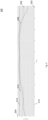
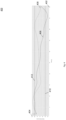
- Fig. 1 to Fig. 4 the course of one of the trajectories is illustrated.
- Fig. 1 to Fig. 4 show the acceleration, speed and jerk of the vehicle controlled by an expert and the target vehicle, as well as the distance between them. Additionally, corresponding plots for optimized acceleration are illustrated.
- Fig. 1 shows an illustration 100 of the acceleration of the leading target (illustrated by dashed line 108), the acceleration of the human driver (in other words, of the ego vehicle; illustrated by solid line 106), and the optimized acceleration (illustrated by dotted line 110).
- Horizontal axis 102 represents time
- vertical axis 104 represents the respective accelerations.
- the dots 112 show the actual value of optimized coefficients which are used to calculate the real value of the spline function.
- the horizontal lines 114 and 116 represent the limit values of acceleration (for example a lower limit of -3.5 m/s 2 and an upper limit of 1.5 m/s 2 ).
- Fig. 2 shows an illustration 200 of the speed of the leading target (illustrated by dashed line 208), the speed of the human driver (in other words, of the ego vehicle; illustrated by solid line 206), and the speed calculated from the optimized spline function which represents the acceleration function (illustrated by dotted line 210).
- Horizontal axis 202 represents time
- vertical axis 204 represents the respective speeds.
- the horizontal lines 212 and 214 represent the limit values of speed (for example a lower limit of 0 and an upper limit of 35 m/s).
- Fig. 3 shows an illustration 200 of the jerk values of the leading target (illustrated by dashed line 308), the jerk values of the human driver (in other words, of the ego vehicle; illustrated by solid line 306), and the jerk calculated from the optimized spline function which represents the acceleration function (illustrated by dotted line 310).
- Horizontal axis 302 represents time
- vertical axis 304 represents the jerk values.
- Fig. 4 shows an illustration 400 of the distance between the human driver and the leading target (illustrated by solid line 406) and the distance between the optimized state and the leading target (illustrated by dashed line 408).
- Horizontal axis 402 represents time
- vertical axis 404 represents the respective distances. It will be noticed that the function optimization contributed to the reduction of the distance, which prevented the cutting of other vehicles in.
- the horizontal lines 410 and 412 represent the limit values of the distance from agent to leading vehicle (for example a range between 40m and 80 m).
- the acceleration in order to ensure differentiability in the optimization process, may be expressed as a continuous spline function.
- the spline function may be parameterized by an integer number n of coefficients, for example one coefficient for every second of the trajectory.
- the spline function may be chosen as a basis for acceleration curvature, and it may allow to represent the solution in a smooth, differentiable form and reduce the nonlinearity of the cost function compared to the polynomial representation.
- optimization may be constrained by an inequality constraint to enforce physical feasibility. Thanks to this function, it may be possible to calculate the changes in agent's state which are caused by the acceleration adjustment. According to various embodiments, the agent's position, velocity, distance to the leading target and a jerk value may be calculated. For example, the optimization process may involve constraints of these values to the following ranges:
- three main cost terms may be incorporated into the cost function to achieve a trajectory that is desired from the perspective of perfect adaptive cruise controller:
- this term may be introduced to achieve optimized actions which make full use of available speed limitation. At the same time, this term and related additional constraints may result in avoiding exceeding the speed limit or stopping a car on the road.
- Minimizing the velocity changes may induce the resulting acceleration function to be as flat as possible, thereby minimizing the acceleration and jerk values over the trajectory. Such minimization may increase the passengers' comfort and reduce fuel consumption.
- the minimal range value may depend on the current speed of traffic participants and their maximal possible values of acceleration and deacceleration.
- a constant value for example 40m
- This value may be dynamically adjusted as described above.
- the maximum range value it shouldn't be too high, to avoid possible cutting in of other cars, nor too small, to leave the space for agent's maneuvers. For example, this value may be set to 80m.
- step c) training agent with MARWIL using demonstration dataset (D T )
- the trajectories may be used those for the training of the artificial neural network which states for behavior policy of our AICC agent.
- the MARWIL method may be used for imitation learning.
- Experimental training may for example use only those 3 trajectories and may last for 1500 iterations.
- a second training may be conducted for which original trajectories as training dataset may be used. All other parameters that could affect the training result may left the same as in the previous case.
- the new behavior policies may be evaluated in the test environment 10 times each. Based on the obtained trajectories, the KPIs may be calculated and compared.
- Table 1 shows the KPIs values from evaluation of the two behavior policies.
- the left column shows the values for agent which was generated with optimized trajectories according to various embodiments, while the right column presents the results of the agent generated with original trajectories.
- Table 1 shows the KPI Policy from optimized dataset Policy from original dataset Average Speed 20.30382 13.78086 Average Acc -0.03676 -0.76344 Average Abs Acc 0.11241 0.88355 Average Jerk 0.34265 2.71903 Distance to Front Target 137.77112 140.35574 Oscillation on Front Target Rate 0.53751 1.33469 Oscillation on Empty Lane Rate 0.11415 1.02436 Loosing Tracking Front Target 0.80000 0.70000 Steps in Sensible Range From Target 0.26783 0.06136 Heavy Braking Events 0.20000 0.60000 Safety Violation 0.40000 1.10000
- the behavior policy which was generated using optimized trajectories according to various embodiments may outperform the second policy obtained from original trajectories.
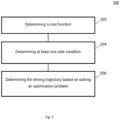
- Fig. 5 shows a flow diagram 500 illustrating a method for determining a driving trajectory as training data for machine learning based adaptive cruise control according to various embodiments.
- a cost function (which may also be referred to as objective function) may be determined.
- at least one side condition (which may also be referred to as constraint) may be determined.
- the driving trajectory may be determined based on solving an optimization problem, wherein the optimization problem is based on the cost function and the at least one side condition.
- the cost function may include at least one of a speed limit execution term, a velocity change term, and a time term related to time in a sensible range to a leading target.
- the cost function may include or may be a combination of two or more of a speed limit execution term, a velocity change term, and a time term related to time in a sensible range to a leading target.
- the at least one side condition may include or may be at least one acceleration threshold and/or at least one velocity threshold and/or at least one distance threshold related to a distance to a leading target.
- the driving trajectory may include or may be at least one of a position, a velocity, an acceleration or a steering angle.
- the driving trajectory may be determined based on an initial trajectory.
- the initial trajectory may be determined based on a driving simulation.
- the initial trajectory may be determined based on a real world driving scenario.
- Fig. 6 shows a computer system 600 with a plurality of computer hardware components configured to carry out steps of a computer implemented method for determining a driving trajectory as training data for machine learning based adaptive cruise control according to various embodiments.
- the computer system 600 may include a processor 602, a memory 604, and a non-transitory data storage 606.
- the processor 602 may carry out instructions provided in the memory 604.
- the non-transitory data storage 606 may store a computer program, including the instructions that may be transferred to the memory 604 and then executed by the processor 602.
- the processor 602, the memory 604, and the non-transitory data storage 606 may be coupled with each other, e.g. via an electrical connection 608, such as e.g. a cable or a computer bus or via any other suitable electrical connection to exchange electrical signals.
- an electrical connection 608 such as e.g. a cable or a computer bus or via any other suitable electrical connection to exchange electrical signals.
- Coupled or “connection” are intended to include a direct “coupling” (for example via a physical link) or direct “connection” as well as an indirect “coupling” or indirect “connection” (for example via a logical link), respectively.
- a solution for a problem of imitation learning methods (which is the vulnerability to the suboptimal actions in the training dataset) may be provided.
- a method for enhancing the dataset by optimization process which fine-tunes the expert's actions may be provided, which improves the result of training.
- Such optimization may be applied to various control problems, as long as they satisfy the requirements of knowing all states in the trajectory and a Transition Function Ft as described above.
- the method may be used for training an effective ACC agent.
Landscapes
- Engineering & Computer Science (AREA)
- Physics & Mathematics (AREA)
- Automation & Control Theory (AREA)
- General Physics & Mathematics (AREA)
- Aviation & Aerospace Engineering (AREA)
- Radar, Positioning & Navigation (AREA)
- Remote Sensing (AREA)
- Theoretical Computer Science (AREA)
- Health & Medical Sciences (AREA)
- Artificial Intelligence (AREA)
- Evolutionary Computation (AREA)
- Mechanical Engineering (AREA)
- Transportation (AREA)
- Medical Informatics (AREA)
- General Health & Medical Sciences (AREA)
- Life Sciences & Earth Sciences (AREA)
- Biomedical Technology (AREA)
- Biophysics (AREA)
- Computational Linguistics (AREA)
- Data Mining & Analysis (AREA)
- Game Theory and Decision Science (AREA)
- Molecular Biology (AREA)
- Computing Systems (AREA)
- General Engineering & Computer Science (AREA)
- Mathematical Physics (AREA)
- Software Systems (AREA)
- Business, Economics & Management (AREA)
- Control Of Driving Devices And Active Controlling Of Vehicle (AREA)
- Control Of Vehicle Engines Or Engines For Specific Uses (AREA)
Abstract
Description
- The present disclosure relates to methods and systems for determining a driving trajectory as training data for machine learning based adaptive cruise control.
- Imitation learning is a promising decision-making technique based on artificial neural networks. However, training of imitation learning methods may be cumbersome.
- Accordingly, there is a need to provide enhancements to training of imitation learning methods.
- The present disclosure provides a computer implemented method, a computer system and a non-transitory computer readable medium according to the independent claims. Embodiments are given in the subclaims, the description and the drawings.
- In one aspect, the present disclosure is directed at a computer implemented method for determining a driving trajectory as training data for machine learning based adaptive cruise control, the method comprising the following steps performed (in other words: carried out) by computer hardware components: determining a cost function; determining at least one side condition; and determining the driving trajectory based on solving an optimization problem, wherein the optimization problem is based on the cost function and the at least one side condition.
- In other words, training data is obtained by solving an optimization problem.
- According to an embodiment, the cost function comprises at least one of a speed limit execution term, a velocity change term, and a time term related to time in a sensible range to a leading target.
- According to an embodiment, the cost function comprises a combination of two or more of a speed limit execution term, a velocity change term, and a time term related to time in a sensible range to a leading target. For example, the combination may be a weighted sum. It has been found that using a weighted sum may allow considering several cost function terms in a single optimization problem.
- According to an embodiment, the at least one side condition comprises at least one acceleration threshold and/or at least one velocity threshold and/or at least one distance threshold related to a distance to a leading target.
- According to an embodiment, the driving trajectory comprises at least one of a position, a velocity, an acceleration or a steering angle. The driving trajectory may include a temporal sequence of the respective values of position, velocity, acceleration and/or steering angle.
- According to an embodiment, the driving trajectory is determined based on an initial trajectory. The initial trajectory may be considered as a starting trajectory, based on which the optimization is carried out. The optimization may be carried out iteratively, wherein in each iteration, starting from a previous trajectory, an updated trajectory, which may be better in terms of the cost function (while still fulfilling the constraints or side conditions) than the previous trajectory, may be determined.
- According to an embodiment, the initial trajectory is determined based on a driving simulation.
- According to an embodiment, the initial trajectory is determined based on a real world driving scenario (for example measurements taken during actual driving on a real road).
- In another aspect, the present disclosure is directed at a computer implemented method for training machine learning based adaptive cruise control, the method comprising the following steps carried out by computer hardware components: determining a driving trajectory as training data based on the computer implemented method as described herein; and training the machine learning based adaptive control based on the training data.
- According to an embodiment, the training is based on imitation learning. According to an embodiment, the training is based on MARWIL method.
- In another aspect, the present disclosure is directed at a computer implemented method for machine learning based adaptive cruise control, wherein the method is trained according to the computer implemented method as described herein.
- In another aspect, the present disclosure is directed at a computer system, said computer system the method comprising the following steps performed (in other words: carried out) by computer hardware components: configured to carry out several or all steps of the computer implemented method described herein.
- The computer system may comprise a plurality of computer hardware components (for example a processor, for example processing unit or processing network, at least one memory, for example memory unit or memory network, and at least one non-transitory data storage). It will be understood that further computer hardware components may be provided and used for carrying out steps of the computer implemented method in the computer system. The non-transitory data storage and/or the memory unit may comprise a computer program for instructing the computer to perform several or all steps or aspects of the computer implemented method described herein, for example using the processing unit and the at least one memory unit.
- In another aspect, the present disclosure is directed at a vehicle comprising the computer system as described herein.
- In another aspect, the present disclosure is directed at a non-transitory computer readable medium comprising instructions for carrying out several or all steps or aspects of the computer implemented method described herein. The computer readable medium may be configured as: an optical medium, such as a compact disc (CD) or a digital versatile disk (DVD); a magnetic medium, such as a hard disk drive (HDD); a solid state drive (SSD); a read only memory (ROM), such as a flash memory; or the like. Furthermore, the computer readable medium may be configured as a data storage that is accessible via a data connection, such as an internet connection. The computer readable medium may, for example, be an online data repository or a cloud storage.
- The present disclosure is also directed at a computer program for instructing a computer to perform several or all steps or aspects of the computer implemented method described herein.
- With the methods and systems as described herein, imitation machine learning may be applied to an adaptive cruise control application. An optimization based imitation learning for intelligent adaptive cruise control may be provided.
- Exemplary embodiments and functions of the present disclosure are described herein in conjunction with the following drawings, showing schematically:
- Fig. 1
- the acceleration of the leading target, human driver and optimized one;
- Fig. 2
- the speed of the leading target, human driver and the speed calculated from the optimized spline function which represents the acceleration function;
- Fig. 3
- the jerk values of the leading target, human driver and the jerk calculated from the optimized spline function which represents the acceleration function;
- Fig. 4
- the distance between the human driver and the leading target and between the optimized state and the leading target;
- Fig. 5
- a flow diagram illustrating a method for determining a driving trajectory as training data for machine learning based adaptive cruise control according to various embodiments; and
- Fig. 6
- a computer system with a plurality of computer hardware components configured to carry out steps of a computer implemented method for determining a driving trajectory as training data for machine learning based adaptive cruise control according to various embodiments.
- Imitation learning (IL) is a decision-making technique based on (artificial) neural networks. The neural network may state the core of behavior policy and may be trained to select the best possible action from a set of available actions in each state throughout an overall decision-making process.
- Imitation Learning methods may require a dataset that contains the trajectories of state-action tuples (st, at ) for a plurality of consecutive points t in time The dataset may usually be collected by experts in the field. An example of such data may be a car ride with a human as a driver. In that case, a state-action pair (in other words, a tuple consisting of a state and an action) may be a description of each situation (in other words: state) and the driver's response (in other words: action) to the situation. Based on that dataset, the neural network may be trained to output a policy which is supposed to be a close imitation of the expert's policy.
- The output policy may be (at least almost) as good as the expert's one. To obtain good results, each state-action tuple may be rated by a reward function. Utilization of a reward signal may allow to distinguish between actions with respect to their quality and train the network to imitate good actions and avoid bad actions. A training method which exploits the reward signals may result in good performance of outcome policy.
- A problem of IL may be in the quality of the (training) dataset, especially in the imperfection of demonstrated actions. Even for a human expert, it may be hard to always choose the best decision. This may especially be the case when actions depend on the environment state and the human is only aware of the previous states and is not able to predict the future. Moreover, erroneous actions may infer from human factors such as distraction, fatigue, lack of attention or even from the lack of qualifications.
- According to various embodiments, a solution for the problem of imitation learning which concerns the existence of suboptimal expert's actions in the training dataset, what causes suboptimal results, may be provided. According to various embodiments, this issue may be alleviated by optimizing expert's actions, before using them in the training process. Additionally, this improvement may be used in the development of Adaptive Cruise Control (ACC) module. The ACC agent may be trained and it may the advantage of this method over pure imitation learning may be shown empirically.
- Various embodiments may assume that the agent's actions influence only the agent's state and affect the rest of the environment only in a negligible way. It may be assumed that the transition function Ft(s, a) -> (S t+1) to calculate the next state (St+1 ), knowing state (st ) in time t and action (at ) performed in st are known.
- Imitation learning may require a demonstration dataset (DT ) that contains trajectories T which are composed of successive (i.e. successive in time t) states (st ), actions taken in each state (at ), and a reward (rt ) granted for each action (at ).
- All states in the trajectory may be known, and a Transition Function (Ft), which approximates the environment state when actions differ from original one, may be known. Thanks to these two assumptions, according to various embodiments, a set of optimal decisions while ensuring fidelity to reality may be calculated.
- The optimal decision may describe the action for each step in the trajectory. The set of actions may be parametrized by the vector x that contains n parameters, which are subject to optimization.
- The optimization process may aim to minimize the cost function -f(x), which may be equivalent to maximizing the cost function f(x), concerning the Transition Function Ft(s, x), for example subject to the transition function being non-negative. According to various embodiments, to obtain the optimal action, the following optimization problem may be solved:


- The transition function may define constraints or side conditions for the optimization problem.
- The cost function and the transition function may be chosen depending on the application of the imitation learning method.
- According to various embodiments, a training process of an artificial agent responsible for selecting appropriate acceleration during driving may be provided. The agent may act as an intelligent adaptive cruise control (AICC), which comes down to taking care of the following factors:
- Maximizing speed;
- Minimizing the sum of the absolute value of acceleration;
- Keeping sensible distance to the leading target; and
- Minimizing jerk concerning the leading target
- According to various embodiments, training the agent may include the following three steps:
- a. Collecting the demonstration dataset (DT ) by a human expert;
- b. Improving actions in trajectories with the optimization process; and
- c. Training agent with MARWIL algorithm using the demonstration dataset (DT ).
- Regarding step a) (collection the demonstration dataset), according to various embodiments, a small dataset with 3 trajectories, each of which consists of 100 seconds of driving may be collected. To have full control over the process, it may be experimented using a high-level traffic simulation package "TrafficAl". The expert made his best to fulfill expectations of perfect ACC controller. As the major function of ACC is to follow the leading target, it may be ensured that most of the time the target was present and tractable. To increase the difficulty of the task, the leading target in given scenarios may be set to behave in an unstable manner and oscillate around the acceleration setpoint, which may result in a large variance of target's speed.
- Regarding step b) (optimization process), the optimization may be aimed at selecting optimal acceleration values along the entire driving episode for each trajectory in the dataset. In
Fig. 1 to Fig. 4 below, the course of one of the trajectories is illustrated.Fig. 1 to Fig. 4 show the acceleration, speed and jerk of the vehicle controlled by an expert and the target vehicle, as well as the distance between them. Additionally, corresponding plots for optimized acceleration are illustrated. -
Fig. 1 shows anillustration 100 of the acceleration of the leading target (illustrated by dashed line 108), the acceleration of the human driver (in other words, of the ego vehicle; illustrated by solid line 106), and the optimized acceleration (illustrated by dotted line 110).Horizontal axis 102 represents time, andvertical axis 104 represents the respective accelerations. Thedots 112 show the actual value of optimized coefficients which are used to calculate the real value of the spline function. Thehorizontal lines -
Fig. 2 shows anillustration 200 of the speed of the leading target (illustrated by dashed line 208), the speed of the human driver (in other words, of the ego vehicle; illustrated by solid line 206), and the speed calculated from the optimized spline function which represents the acceleration function (illustrated by dotted line 210).Horizontal axis 202 represents time, andvertical axis 204 represents the respective speeds. Thehorizontal lines -
Fig. 3 shows anillustration 200 of the jerk values of the leading target (illustrated by dashed line 308), the jerk values of the human driver (in other words, of the ego vehicle; illustrated by solid line 306), and the jerk calculated from the optimized spline function which represents the acceleration function (illustrated by dotted line 310).Horizontal axis 302 represents time, andvertical axis 304 represents the jerk values. -
Fig. 4 shows anillustration 400 of the distance between the human driver and the leading target (illustrated by solid line 406) and the distance between the optimized state and the leading target (illustrated by dashed line 408).Horizontal axis 402 represents time, andvertical axis 404 represents the respective distances. It will be noticed that the function optimization contributed to the reduction of the distance, which prevented the cutting of other vehicles in. Thehorizontal lines - According to various embodiments, in order to ensure differentiability in the optimization process, the acceleration may be expressed as a continuous spline function. The spline function may be parameterized by an integer number n of coefficients, for example one coefficient for every second of the trajectory. The spline function may be chosen as a basis for acceleration curvature, and it may allow to represent the solution in a smooth, differentiable form and reduce the nonlinearity of the cost function compared to the polynomial representation.
- According to various embodiments, optimization may be constrained by an inequality constraint to enforce physical feasibility. Thanks to this function, it may be possible to calculate the changes in agent's state which are caused by the acceleration adjustment. According to various embodiments, the agent's position, velocity, distance to the leading target and a jerk value may be calculated. For example, the optimization process may involve constraints of these values to the following ranges:
- Acceleration: <-3.5,1.5> [m/s2]
- Velocity: <0, 35> [m/s]
- Distance to the leading target: <40-80> [m]
- According to various embodiments, three main cost terms may be incorporated into the cost function to achieve a trajectory that is desired from the perspective of perfect adaptive cruise controller:
- Maximizing speed limit execution;
- Minimizing the velocity changes; and
- Maximizing time in the sensible range to the leading target.
- Regarding maximizing speed limit execution, this term may be introduced to achieve optimized actions which make full use of available speed limitation. At the same time, this term and related additional constraints may result in avoiding exceeding the speed limit or stopping a car on the road.
- Minimizing the velocity changes (which may be represented by a sum of (absolute) accelerations or an integral of (absolute) acceleration) may induce the resulting acceleration function to be as flat as possible, thereby minimizing the acceleration and jerk values over the trajectory. Such minimization may increase the passengers' comfort and reduce fuel consumption.
- Regarding maximizing time in the sensible range to the leading target, it may be assumed that the agent's distance to the leading target should be in an optimal span. The minimal range value may depend on the current speed of traffic participants and their maximal possible values of acceleration and deacceleration. To simplify the calculations, a constant value (for example 40m) may be assumed. This value may be dynamically adjusted as described above. Regarding the maximum range value, it shouldn't be too high, to avoid possible cutting in of other cars, nor too small, to leave the space for agent's maneuvers. For example, this value may be set to 80m.
- Regarding step c) (training agent with MARWIL using demonstration dataset (DT)), after optimizing all trajectories, the trajectories may be used those for the training of the artificial neural network which states for behavior policy of our AICC agent. To do, for example the MARWIL method may be used for imitation learning. Experimental training may for example use only those 3 trajectories and may last for 1500 iterations.
- To compare the method according to various embodiments with a typical imitation learning approach, a second training may be conducted for which original trajectories as training dataset may be used. All other parameters that could affect the training result may left the same as in the previous case.
- After both trainings, the new behavior policies may be evaluated in the
test environment 10 times each. Based on the obtained trajectories, the KPIs may be calculated and compared. - Table 1 shows the KPIs values from evaluation of the two behavior policies. The left column shows the values for agent which was generated with optimized trajectories according to various embodiments, while the right column presents the results of the agent generated with original trajectories.
Table 1. KPI Policy from optimized dataset Policy from original dataset Average Speed 20.30382 13.78086 Average Acc -0.03676 -0.76344 Average Abs Acc 0.11241 0.88355 Average Jerk 0.34265 2.71903 Distance to Front Target 137.77112 140.35574 Oscillation on Front Target Rate 0.53751 1.33469 Oscillation on Empty Lane Rate 0.11415 1.02436 Loosing Tracking Front Target 0.80000 0.70000 Steps in Sensible Range From Target 0.26783 0.06136 Heavy Braking Events 0.20000 0.60000 Safety Violation 0.40000 1.10000 - As can be seen from Table 1, the behavior policy which was generated using optimized trajectories according to various embodiments may outperform the second policy obtained from original trajectories.
-
Fig. 5 shows a flow diagram 500 illustrating a method for determining a driving trajectory as training data for machine learning based adaptive cruise control according to various embodiments. At 502, a cost function (which may also be referred to as objective function) may be determined. At 504, at least one side condition (which may also be referred to as constraint) may be determined. At 506, the driving trajectory may be determined based on solving an optimization problem, wherein the optimization problem is based on the cost function and the at least one side condition. - According to various embodiments, the cost function may include at least one of a speed limit execution term, a velocity change term, and a time term related to time in a sensible range to a leading target.
- According to various embodiments, the cost function may include or may be a combination of two or more of a speed limit execution term, a velocity change term, and a time term related to time in a sensible range to a leading target.
- According to various embodiments, the at least one side condition may include or may be at least one acceleration threshold and/or at least one velocity threshold and/or at least one distance threshold related to a distance to a leading target.
- According to various embodiments, the driving trajectory may include or may be at least one of a position, a velocity, an acceleration or a steering angle.
- According to various embodiments, the driving trajectory may be determined based on an initial trajectory.
- According to various embodiments, the initial trajectory may be determined based on a driving simulation.
- According to various embodiments, the initial trajectory may be determined based on a real world driving scenario.
- Each of the
steps -
Fig. 6 shows acomputer system 600 with a plurality of computer hardware components configured to carry out steps of a computer implemented method for determining a driving trajectory as training data for machine learning based adaptive cruise control according to various embodiments. Thecomputer system 600 may include aprocessor 602, amemory 604, and anon-transitory data storage 606. - The
processor 602 may carry out instructions provided in thememory 604. Thenon-transitory data storage 606 may store a computer program, including the instructions that may be transferred to thememory 604 and then executed by theprocessor 602. - The
processor 602, thememory 604, and thenon-transitory data storage 606 may be coupled with each other, e.g. via anelectrical connection 608, such as e.g. a cable or a computer bus or via any other suitable electrical connection to exchange electrical signals. - The terms "coupling" or "connection" are intended to include a direct "coupling" (for example via a physical link) or direct "connection" as well as an indirect "coupling" or indirect "connection" (for example via a logical link), respectively.
- It will be understood that what has been described for one of the methods above may analogously hold true for the
computer system 600. - With the methods and devices according to various embodiments, a solution for a problem of imitation learning methods (which is the vulnerability to the suboptimal actions in the training dataset) may be provided. According to various embodiments, a method for enhancing the dataset by optimization process which fine-tunes the expert's actions may be provided, which improves the result of training. Such optimization may be applied to various control problems, as long as they satisfy the requirements of knowing all states in the trajectory and a Transition Function Ft as described above. According to various embodiments, the method may be used for training an effective ACC agent.
-
- 100
- illustration of the acceleration of the leading target, human driver and optimized one
- 102
- horizontal axis
- 104
- vertical axis
- 106
- solid line
- 108
- dashed line
- 110
- dotted line
- 112
- dots
- 114
- horizontal line
- 116
- horizontal line
- 200
- illustration of the speed of the leading target, human driver and the speed calculated from the optimized spline function which represents the acceleration function
- 202
- horizontal axis
- 204
- vertical axis
- 206
- solid line
- 208
- dashed line
- 210
- dotted line
- 212
- horizontal line
- 214
- horizontal line
- 300
- illustration of the jerk values of the leading target, human driver and the jerk calculated from the optimized spline function which represents the acceleration function
- 302
- horizontal axis
- 304
- vertical axis
- 306
- solid line
- 308
- dashed line
- 310
- dotted line
- 400
- illustration of the distance between the human driver and the leading target and between the optimized state and the leading target
- 402
- horizontal axis
- 404
- vertical axis
- 406
- solid line
- 408
- dashed line
- 410
- horizontal line
- 412
- horizontal line
- 500
- flow diagram illustrating a method for determining a driving trajectory as training data for machine learning based adaptive cruise control according to various embodiments
- 502
- step of determining a cost function
- 504
- step of determining at least one side condition
- 506
- step of determining the driving trajectory based on solving an optimization problem
- 600
- computer system according to various embodiments
- 602
- processor
- 604
- memory
- 606
- non-transitory data storage
- 608
- connection
Claims (15)
- Computer implemented method for determining a driving trajectory as training data for machine learning based adaptive cruise control,
the method comprising the following steps carried out by computer hardware components:- determining (502) a cost function;- determining (504) at least one side condition; and- determining (506) the driving trajectory based on solving an optimization problem, wherein the optimization problem is based on the cost function and the at least one side condition. - The computer implemented method of claim 1,
wherein the cost function comprises at least one of a speed limit execution term, a velocity change term, and a time term related to time in a sensible range to a leading target. - The computer implemented method of claim 1,
wherein the cost function comprises a combination of two or more of a speed limit execution term, a velocity change term, and a time term related to time in a sensible range to a leading target. - The computer implemented method of at least one of claims 1 to 3,
wherein the at least one side condition comprises at least one acceleration threshold and/or at least one velocity threshold and/or at least one distance threshold related to a distance to a leading target. - The computer implemented method of at least one of claims 1 to 4, wherein the driving trajectory comprises at least one of a position, a velocity, an acceleration or a steering angle.
- The computer implemented method of at least one of claims 1 to 5, wherein the driving trajectory is determined based on an initial trajectory.
- The computer implemented method of claim 6,
wherein the initial trajectory is determined based on a driving simulation. - The computer implemented method of at least one of claims 6 or 7, wherein the initial trajectory is determined based on a real world driving scenario.
- Computer implemented method for training machine learning based adaptive cruise control,
the method comprising the following steps carried out by computer hardware components:- determining a driving trajectory as training data based on the computer implemented method of at least one of claims 1 to 8; and- training the machine learning based adaptive control based on the training data. - The computer implemented method of claim 9,
wherein the training is based on imitation learning. - The computer implemented method of at least one of claims 9 or 10, wherein the training is based on MARWIL method.
- Computer implemented method for machine learning based adaptive cruise control, wherein the method is trained according to the computer implemented method of at least one of claims 9 to 11.
- Computer system (600), the computer system (600) comprising a plurality of computer hardware components configured to carry out steps of the computer implemented method of at least one of claims 1 to 12.
- Vehicle comprising the computer system (600) of claim 13.
- Non-transitory computer readable medium comprising instructions for carrying out the computer implemented method of at least one of claims 1 to 12.
Priority Applications (3)
| Application Number | Priority Date | Filing Date | Title |
|---|---|---|---|
| EP21201664.6A EP4163837A1 (en) | 2021-10-08 | 2021-10-08 | Methods and systems for determining a driving trajectory as training data for machine learning based adaptive cruise control |
| CN202211120145.6A CN115963817A (en) | 2021-10-08 | 2022-09-15 | Computer-implemented method and system for determining driving trajectory as training data |
| US17/938,232 US20230113790A1 (en) | 2021-10-08 | 2022-10-05 | Determining a Driving Trajectory as Training Data for a Machine Learning Based Adaptive Cruise Control |
Applications Claiming Priority (1)
| Application Number | Priority Date | Filing Date | Title |
|---|---|---|---|
| EP21201664.6A EP4163837A1 (en) | 2021-10-08 | 2021-10-08 | Methods and systems for determining a driving trajectory as training data for machine learning based adaptive cruise control |
Publications (1)
| Publication Number | Publication Date |
|---|---|
| EP4163837A1 true EP4163837A1 (en) | 2023-04-12 |
Family
ID=78087042
Family Applications (1)
| Application Number | Title | Priority Date | Filing Date |
|---|---|---|---|
| EP21201664.6A Withdrawn EP4163837A1 (en) | 2021-10-08 | 2021-10-08 | Methods and systems for determining a driving trajectory as training data for machine learning based adaptive cruise control |
Country Status (3)
| Country | Link |
|---|---|
| US (1) | US20230113790A1 (en) |
| EP (1) | EP4163837A1 (en) |
| CN (1) | CN115963817A (en) |
Families Citing this family (2)
| Publication number | Priority date | Publication date | Assignee | Title |
|---|---|---|---|---|
| CN116465426B (en) * | 2023-06-08 | 2025-12-23 | 东南大学 | Method and apparatus for cruise route and speed planning of autonomous taxis |
| US12466405B2 (en) | 2024-02-09 | 2025-11-11 | Toyota Motor Engineering & Manufacturing North America, Inc. | Trigger event personalized adaptive cruise control (P-ACC) |
-
2021
- 2021-10-08 EP EP21201664.6A patent/EP4163837A1/en not_active Withdrawn
-
2022
- 2022-09-15 CN CN202211120145.6A patent/CN115963817A/en active Pending
- 2022-10-05 US US17/938,232 patent/US20230113790A1/en not_active Abandoned
Non-Patent Citations (3)
| Title |
|---|
| PULVER HENRY ET AL: "PILOT: Efficient Planning by Imitation Learning and Optimisation for Safe Autonomous Driving", 2021 IEEE/RSJ INTERNATIONAL CONFERENCE ON INTELLIGENT ROBOTS AND SYSTEMS (IROS), IEEE, 27 September 2021 (2021-09-27), pages 1442 - 1449, XP034050232, DOI: 10.1109/IROS51168.2021.9636862 * |
| WU YUANKAI ET AL: "A Deep Reinforcement Learning Based Car Following Model for Electric Vehicle", vol. 2, no. 5, 12 September 2019 (2019-09-12), XP055899169, Retrieved from the Internet <URL:https://206.189.43.69/index.php/sca/article/viewFile/813/730> [retrieved on 20220309], DOI: 10.33142/sca.v2i5.813 * |
| ZHAOBIN MO ET AL: "A Physics-Informed Deep Learning Paradigm for Car-Following Models", ARXIV.ORG, CORNELL UNIVERSITY LIBRARY, 201 OLIN LIBRARY CORNELL UNIVERSITY ITHACA, NY 14853, 14 July 2021 (2021-07-14), XP091001498, DOI: 10.1016/J.TRC.2021.103240 * |
Also Published As
| Publication number | Publication date |
|---|---|
| CN115963817A (en) | 2023-04-14 |
| US20230113790A1 (en) | 2023-04-13 |
Similar Documents
| Publication | Publication Date | Title |
|---|---|---|
| KR102461831B1 (en) | System and Method for Improving of Advanced Deep Reinforcement Learning Based Traffic in Non signalalized Intersections for the Multiple Self driving Vehicles | |
| KR102166811B1 (en) | Method and Apparatus for Controlling of Autonomous Vehicle using Deep Reinforcement Learning and Driver Assistance System | |
| CN102292752A (en) | Queuing control system and vehicle | |
| US20230113790A1 (en) | Determining a Driving Trajectory as Training Data for a Machine Learning Based Adaptive Cruise Control | |
| CN115092181B (en) | Control method and device for vehicle, storage medium and processor | |
| CN119672981A (en) | A method and system for coordinated control of hard shoulder driving and variable speed limit | |
| Aslam et al. | An AIoT-enabled digital twin CAVs with a DRL-based framework for trajectory planning | |
| KR102549744B1 (en) | Method for controliing traffic flow using deep reinforcement learning based autonomous vehicles in road information system, recording medium and device for performing the method | |
| JP2018203126A (en) | Vehicle motion control device | |
| CN116805445B (en) | Vehicle lane changing driving control method and system | |
| Nageshrao et al. | Robust AI driving strategy for autonomous vehicles | |
| CN119806134B (en) | A Left-Turn Control Method for Signalless Intersections Based on a Two-Layer Attention Mechanism and Discrete SAC Algorithm | |
| Zidek et al. | Optimal driving policies for autonomous vehicles based on stochastic drift counteraction | |
| US20230126696A1 (en) | Lane change method and system, storage medium, and vehicle | |
| WO2025076342A1 (en) | Generating adversarial driving scenarios for autonomous vehicles | |
| CN118597191A (en) | Autonomous driving decision-making method, system and medium based on safety curriculum reinforcement learning | |
| CN118597193A (en) | Vehicle speed smoothness optimization method | |
| Molaie et al. | Auto-driving policies in highway based on distributional deep reinforcement learning | |
| CN117193313A (en) | A network-connected autonomous driving queuing control strategy considering persistent communication failures | |
| CN116985845A (en) | A lane-changing optimization method for autonomous vehicles based on digital twins | |
| Hu et al. | Srd: balancing safety and optimality based on rss and reinforcement learning for autonomous driving | |
| Hu et al. | Game-Theoretic Risk-Shaped Reinforcement Learning for Safe Autonomous Driving | |
| CN110378460B (en) | Decision making method | |
| CN119389205B (en) | A lane-changing method for optimized right-of-way in autonomous driving based on RSS | |
| CN119283890B (en) | An adaptive cruise safety self-evolution method, device, and system based on safety boundaries |
Legal Events
| Date | Code | Title | Description |
|---|---|---|---|
| PUAI | Public reference made under article 153(3) epc to a published international application that has entered the european phase |
Free format text: ORIGINAL CODE: 0009012 |
|
| STAA | Information on the status of an ep patent application or granted ep patent |
Free format text: STATUS: THE APPLICATION HAS BEEN PUBLISHED |
|
| AK | Designated contracting states |
Kind code of ref document: A1 Designated state(s): AL AT BE BG CH CY CZ DE DK EE ES FI FR GB GR HR HU IE IS IT LI LT LU LV MC MK MT NL NO PL PT RO RS SE SI SK SM TR |
|
| STAA | Information on the status of an ep patent application or granted ep patent |
Free format text: STATUS: REQUEST FOR EXAMINATION WAS MADE |
|
| 17P | Request for examination filed |
Effective date: 20231010 |
|
| RBV | Designated contracting states (corrected) |
Designated state(s): AL AT BE BG CH CY CZ DE DK EE ES FI FR GB GR HR HU IE IS IT LI LT LU LV MC MK MT NL NO PL PT RO RS SE SI SK SM TR |
|
| RAP1 | Party data changed (applicant data changed or rights of an application transferred) |
Owner name: APTIV TECHNOLOGIES AG |
|
| RAP3 | Party data changed (applicant data changed or rights of an application transferred) |
Owner name: APTIV TECHNOLOGIES AG |
|
| STAA | Information on the status of an ep patent application or granted ep patent |
Free format text: STATUS: EXAMINATION IS IN PROGRESS |
|
| STAA | Information on the status of an ep patent application or granted ep patent |
Free format text: STATUS: THE APPLICATION HAS BEEN WITHDRAWN |
|
| 17Q | First examination report despatched |
Effective date: 20250813 |
|
| 18W | Application withdrawn |
Effective date: 20250814 |