EP4162994A1 - Information processing device and image sharing method - Google Patents
Information processing device and image sharing method Download PDFInfo
- Publication number
- EP4162994A1 EP4162994A1 EP21821465.8A EP21821465A EP4162994A1 EP 4162994 A1 EP4162994 A1 EP 4162994A1 EP 21821465 A EP21821465 A EP 21821465A EP 4162994 A1 EP4162994 A1 EP 4162994A1
- Authority
- EP
- European Patent Office
- Prior art keywords
- image
- user
- section
- game
- information
- Prior art date
- Legal status (The legal status is an assumption and is not a legal conclusion. Google has not performed a legal analysis and makes no representation as to the accuracy of the status listed.)
- Pending
Links
Images









Classifications
-
- A—HUMAN NECESSITIES
- A63—SPORTS; GAMES; AMUSEMENTS
- A63F—CARD, BOARD, OR ROULETTE GAMES; INDOOR GAMES USING SMALL MOVING PLAYING BODIES; VIDEO GAMES; GAMES NOT OTHERWISE PROVIDED FOR
- A63F13/00—Video games, i.e. games using an electronically generated display having two or more dimensions
- A63F13/30—Interconnection arrangements between game servers and game devices; Interconnection arrangements between game devices; Interconnection arrangements between game servers
- A63F13/35—Details of game servers
-
- A—HUMAN NECESSITIES
- A63—SPORTS; GAMES; AMUSEMENTS
- A63F—CARD, BOARD, OR ROULETTE GAMES; INDOOR GAMES USING SMALL MOVING PLAYING BODIES; VIDEO GAMES; GAMES NOT OTHERWISE PROVIDED FOR
- A63F13/00—Video games, i.e. games using an electronically generated display having two or more dimensions
- A63F13/50—Controlling the output signals based on the game progress
- A63F13/53—Controlling the output signals based on the game progress involving additional visual information provided to the game scene, e.g. by overlay to simulate a head-up display [HUD] or displaying a laser sight in a shooting game
- A63F13/533—Controlling the output signals based on the game progress involving additional visual information provided to the game scene, e.g. by overlay to simulate a head-up display [HUD] or displaying a laser sight in a shooting game for prompting the player, e.g. by displaying a game menu
-
- A—HUMAN NECESSITIES
- A63—SPORTS; GAMES; AMUSEMENTS
- A63F—CARD, BOARD, OR ROULETTE GAMES; INDOOR GAMES USING SMALL MOVING PLAYING BODIES; VIDEO GAMES; GAMES NOT OTHERWISE PROVIDED FOR
- A63F13/00—Video games, i.e. games using an electronically generated display having two or more dimensions
- A63F13/70—Game security or game management aspects
- A63F13/79—Game security or game management aspects involving player-related data, e.g. identities, accounts, preferences or play histories
- A63F13/795—Game security or game management aspects involving player-related data, e.g. identities, accounts, preferences or play histories for finding other players; for building a team; for providing a buddy list
-
- A—HUMAN NECESSITIES
- A63—SPORTS; GAMES; AMUSEMENTS
- A63F—CARD, BOARD, OR ROULETTE GAMES; INDOOR GAMES USING SMALL MOVING PLAYING BODIES; VIDEO GAMES; GAMES NOT OTHERWISE PROVIDED FOR
- A63F13/00—Video games, i.e. games using an electronically generated display having two or more dimensions
- A63F13/80—Special adaptations for executing a specific game genre or game mode
- A63F13/812—Ball games, e.g. soccer or baseball
-
- A—HUMAN NECESSITIES
- A63—SPORTS; GAMES; AMUSEMENTS
- A63F—CARD, BOARD, OR ROULETTE GAMES; INDOOR GAMES USING SMALL MOVING PLAYING BODIES; VIDEO GAMES; GAMES NOT OTHERWISE PROVIDED FOR
- A63F13/00—Video games, i.e. games using an electronically generated display having two or more dimensions
- A63F13/85—Providing additional services to players
- A63F13/86—Watching games played by other players
-
- H—ELECTRICITY
- H04—ELECTRIC COMMUNICATION TECHNIQUE
- H04L—TRANSMISSION OF DIGITAL INFORMATION, e.g. TELEGRAPHIC COMMUNICATION
- H04L65/00—Network arrangements, protocols or services for supporting real-time applications in data packet communication
- H04L65/40—Support for services or applications
- H04L65/401—Support for services or applications wherein the services involve a main real-time session and one or more additional parallel real-time or time sensitive sessions, e.g. white board sharing or spawning of a subconference
- H04L65/4015—Support for services or applications wherein the services involve a main real-time session and one or more additional parallel real-time or time sensitive sessions, e.g. white board sharing or spawning of a subconference where at least one of the additional parallel sessions is real time or time sensitive, e.g. white board sharing, collaboration or spawning of a subconference
Definitions
- the present disclosure relates to a technology for sharing an image among a plurality of users.
- PTL 1 discloses an image sharing system in which, under an environment where a host user's information processing device and a guest user's information processing device are connected not via a server but by P2P (Peer to Peer), an image of a game that the host user is playing is shared with the guest user.
- a sharing mode Share Screen
- a sharing mode Hand over my controller
- a sharing mode Hand over another controller
- a network service for games plays a role as a communication tool. For example, if a plurality of users participating in the same chat room share a game image, it is expected that more active communication can be established. Therefore, it is preferable to realize a mechanism for allowing a user who is playing a game to share an image of the game in progress with other users in a simple manner. Not only in a game but also in a network service such as a conference system to which a plurality of information processing devices connect, if a mechanism for sharing an image in a simple manner is realized, it is expected that smooth communication can be supported.
- an object of the present invention is to provide a technology that is useful to share an image.
- an information processing device connects to a management server that manages states of a plurality of members participating in one room, the information processing device including a state information acquisition section that acquires information indicating the states of the plurality of members from the management server, a room image generation section that, on the basis of the information indicating the states of the plurality of members, generates a member displaying field in which information regarding a member transmitting an image and information regarding a member transmitting no image are included in different regions, a reception section that receives an operation of selecting a member transmitting an image, and a request transmission section that sends a watching request including information for identifying the selected user to the management server or a distribution server that distributes an image.
- Another aspect of the present disclosure is an image sharing method including a step of acquiring, from a management server that manages states of a plurality of members participating in one room, information indicating the states of the plurality of members, a step of displaying, on the basis of the information indicating the states of the plurality of members, a member displaying field in which information regarding a member transmitting an image and information regarding a member transmitting no image are included in different regions, a step of receiving an operation of selecting a member transmitting an image, a step of sending a watching request including information for identifying the selected user to the management server or a distribution server that distributes an image, and a step of acquiring an image from the distribution server that distributes an image.
- FIG. 1 depicts an image sharing system 1 according to an embodiment of the present disclosure.
- the image sharing system 1 includes a plurality of information processing devices 10a, 10b, 10c, and 10d (hereinafter, referred to as an "information processing device 10" in a case in which they are not specifically distinguished from one another), a management server 5, and a distribution server 9, which are connected via a network 3 such as the internet or a LAN (Local Area Network).
- a network 3 such as the internet or a LAN (Local Area Network).
- the information processing devices 10a, 10b, 10c, and 10d are terminal devices that are operated by respective users, and connected to output devices 4a, 4b, 4c, and 4d (hereinafter, referred to as an "output device 4" in a case in which they are not specifically distinguished from one another).
- the output devices 4 may be televisions that have displays for outputting images and loudspeakers for outputting sounds, or may be head mounted displays.
- the output devices 4 may be connected to the respective information processing devices 10 via wired cables or wirelessly.
- An access point (hereinafter, referred to as an "AP") 8 has a wireless access point function and a router function.
- Each information processing device 10 is connected to the corresponding AP 8 wirelessly or wiredly, and thus, is communicably connected to the management server 5, the distribution server 9, and the other information processing devices 10 on the network 3.
- the information processing device 10 wirelessly or wiredly connects with an input device 6 being operated by a user.
- the input device 6 outputs operation information indicating a user operation result to the information processing device 10.
- the information processing device 10 receives the operation information from the input device 6, and reflects the operation information in processes of system software or application software so as to output the processing result through the output device 4.
- the information processing device 10 may be a game device that executes a game, and the input device 6 may be a device such as a game controller for supplying user operation information to the information processing device 10.
- the input device 6 may include a plurality of input parts including a plurality of push-type operation buttons, an analog stick through which an analog quantity can be inputted, and a turnable button.
- An auxiliary storage device 2 is a storage such as an HDD (Hard Disk Drive) or an SSD (Solid-State Drive), and may be a built-in storage, or may be an external storage that is connected to the information processing device 10 through a USB (Universal Serial Bus) or the like.
- a camera 7 which is an image capturing device is disposed near the output device 4, and captures an image of the surrounding area of the output device 4.
- users A, B, C, and D are room members who are in the same chat room.
- the users can have a text chat with one another, and can have a voice chat with one another if the users have headsets.
- the chat room is created and managed by the management server 5.
- the management server 5 receives chat data (text data and/or voice data) transmitted from each user, and transfers the chat data to the other users who are in the room. For example, the management server 5 transfers chat data transmitted from the user A to the users B, C, and D who are in the room.
- chat room each user can share an image of a game in progress with the other users.
- An upper limit may be placed on the number of users joining the chat room, but any limit is not necessarily placed on the number.
- chat room is one example of a virtual room or group where online users gather. Another type of a room or group may be used instead.
- the management server 5 is maintained and managed by a management entity of the image sharing system 1, and provides network services including a chat service to users of the image sharing system 1.
- the management server 5 manages network accounts for identifying the respective users.
- a user signs in to a network service. After signing in to a network service, a user enters a chat room so as to be able to communicate with other room members. It is to be noted that, after signing in, the user can save data on a game in the management server 5, for example.
- the distribution server 9 is maintained and managed by the management entity of the image sharing system 1, and provides a service for distributing streaming data on an image of a game being played by a user, to another user participating in the chat room.
- the streaming data includes game sounds as a matter of course, but an explanation of distribution of the game sounds will be omitted. An explanation of distribution of game images will mainly be given hereinafter.
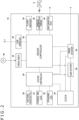
- FIG. 2 depicts a hardware configuration of the information processing device 10.
- the information processing device 10 includes a main power source button 20, a power ON LED (Light-Emitting Diode) 21, a standby LED 22, a system controller 24, a clock 26, a device controller 30, a media drive 32, a USB module 34, a flash memory 36, a wireless communication module 38, a wired communication module 40, a sub-system 50, and a main system 60.
- a main power source button 20 a power ON LED (Light-Emitting Diode) 21, a standby LED 22, a system controller 24, a clock 26, a device controller 30, a media drive 32, a USB module 34, a flash memory 36, a wireless communication module 38, a wired communication module 40, a sub-system 50, and a main system 60.
- a main power source button 20 includes a power ON LED (Light-Emitting Diode) 21, a standby LED 22, a system controller 24, a clock 26, a device controller 30,
- the main system 60 includes a main CPU (Central Processing Unit), a memory which is a main storage and a memory controller, a GPU (Graphics Processing Unit), etc.
- the GPU is mainly used for computation of a game program. These functions may be implemented by a system-on-a-chip, and may be formed on one chip.
- the main CPU has a function for executing a game program recorded in the auxiliary storage device 2 or a ROM (Read-Only Memory) medium 44.
- the sub-system 50 is equipped with a sub-CPU, a memory which is a main storage, and a memory controller, etc., but is not equipped with a GPU, and thus, does not have a function of executing a game program.
- the number of circuit gates in the sub-CPU is less than that in the main CPU. Operation power consumption in the sub-CPU is smaller than that in the main CPU.
- the main power source button 20 is an input part through which a user operation is inputted.
- the main power source button 20 is disposed on a front surface of a casing of the information processing device 10, and is operated to turn on/off a power supply to the main system 60 of the information processing device 10.
- the power ON LED 21 is lit when the main power source button 20 is on.
- the standby LED 22 is lit when the main power source button 20 is off.
- the system controller 24 detects that a user depresses the main power source button 20.
- the system controller 24 regards the depression operation as an "ON instruction.”
- the system controller 24 regards the depression operation as an "OFF instruction.”
- the clock 26, which is a real-time clock, generates current date and time information, and supplies the information to the system controller 24, the sub-system 50, and the main system 60.
- the device controller 30 is formed as an LSI (Large-Scale Integrated Circuit) that, like a south bridge, conducts information exchange between devices. As depicted in the drawing, devices such as the system controller 24, the media drive 32, the USB module 34, the flash memory 36, the wireless communication module 38, the wired communication module 40, the sub-system 50, and the main system 60 are connected to the device controller 30.
- the device controller 30 absorbs the difference in electric characteristics and the difference in data transfer speeds among the devices, and controls data transfer timings.
- the media drive 32 is driven with the ROM medium 44 attached thereto. Application software for games or the like, and license information are recorded in the ROM medium 44.
- the media drive 32 reads out a program and data, etc., from the ROM medium 44.
- the ROM medium 44 may be a read-only recording medium such as an optical disc, a magneto-optical disc, or a Blue-ray disc.
- the USB module 34 is connected to an external device via a USB cable.
- the USB module 34 may be connected to the auxiliary storage device 2 and the camera 7 via USB cables.
- the flash memory 36 is an auxiliary storage constituting an internal storage.
- the wireless communication module 38 wirelessly communicates with the input device 6, for example, according to a communication protocol such as the Bluetooth (registered trademark) protocol or the IEEE (Institute of Electrical and Electronics Engineers)802.11 protocol.
- the wired communication module 40 performs wired communication with an external device to connect to the network 3 via the AP 8.
- chat room members are allowed to use three sharing modes in order to share game images.
- a user who distributes a game image is referred to as a "host” or a "host user”
- a user who receives distribution of a game image is referred to as a "guest” or a “guest user.”
- a guest user watches a game image of a host user.
- This is called "screen sharing.”
- screen sharing a game image of a host user is shared with a guest user via the distribution server 9. That is, the host user's information processing device 10 transmits a game image to the distribution server 9, and the guest user's information processing device 10 receives the game image from the distribution server 9. The guest user is allowed to watch the game image of the host user but is not allowed to perform an operation in the game.
- a guest user plays a game instead of a host user while watching a game image of the host user. This is called "assist play.”
- assist play a game image of a host user is shared with a guest user not via the distribution server 9. That is, P2P connection between the host user's information processing device 10 and the guest user's information processing device 10 is established, so that the game image is shared.
- the host user cannot perform an operation in the game while only the guest user is allowed to perform an operation in the game because the host user gives a game operation authority to the guest user.
- a guest user joins a game as a new player to play the game in collaboration with a host user, while watching a game image of the host user.
- This is called "collaboration play.”
- a game image of a host user is shared with a guest user not via the distribution server 9. That is, P2P connection between the host user's information processing device 10 and the guest user's information processing device 10 is established, so that the game image is shared.
- the guest user also uses a game resource that is on the host user-side, and the host user and the guest user become a player 1 and a player 2, respectively, to participate in the game, so that the host user and the guest user are allowed to perform operations in the game in collaboration with each other.
- the second and third sharing modes P2P connection between the host user's information processing device 10 and the guest user's information processing device 10 is established, so that a game image is shared, and at least the guest user has a gameplay authority. Since the guest user is allowed to play a game in the second and third sharing modes, the second and third sharing modes are collectively called "share play" in some cases.
- one information processing device 10 includes both a transmission-side configuration to become a host user and a reception-side configuration to become a guest user.
- a user A's information processing device 10a has the transmission-side configuration to transmit game images
- a user C's information processing device 10c has the reception-side configuration to receive game images such that game images are shared.
- both the transmission-side configuration and the reception-side configuration are installed in each information processing device 10.
- FIG. 3 depicts functional blocks of the information processing device 10a that transmits an image of a game that the user A is playing.
- the information processing device 10a includes a processing section 100a, a communication section 102a, and a reception section 104a.
- the processing section 100a includes an execution section 110a, a system image generation section 120a, an image processing section 140a, a frame buffer 150a, and a sharing processing section 160a.
- the system image generation section 120a includes a report generation section 122a and a room image generation section 124a.
- the frame buffer 150a includes a game buffer 152a that temporarily stores game image data and a system buffer 154a that temporarily stores system image data.
- the sharing processing section 160a includes a state information transmission section 162a, a state information acquisition section 164a, a transmission processing section 166a, an invitation transmission section 172a, and a connection processing section 174a.
- the transmission processing section 166a includes a first transmission processing section 168a and a second transmission processing section 170a.
- each of the elements which are illustrated as functional blocks for performing various processes can be formed by a circuit block, a memory, and any other LSI in terms of hardware, and can be implemented by system software or a game program loaded in a memory in terms of software. Therefore, a person skilled in the art will understand that these functional blocks can be implemented in various configurations such as a configuration including hardware only, a configuration including software only, and a combination thereof. No particular limitation is placed on implementation of the functional blocks.
- the communication section 102a receives operation information on an operation performed by the user A on an input part of the input device 6. In addition, the communication section 102a receives, from the management server 5, chat data on other room members in the chat room, and further receives information indicating the states of the other room members.
- the communication section 102a transmits information indicating the state of the user A to the management server 5.
- the communication section 102a transmits streaming data on game images and game sounds generated by the processing section 100a, to the distribution server 9 and/or a separate information processing device 10.
- streaming data for reproducing a game image may be simply referred to as a game image.
- the functional block which is the communication section 102a is illustrated as a configuration having both the function of the wireless communication module 38 and the function of the wired communication module 40 in FIG. 2 .
- the reception section 104a is disposed between the communication section 102a and the processing section 100a, and exchanges data or information with the communication section 102a and the processing section 100a.
- the reception section 104a supplies the operation information to a prescribed functional block in the processing section 100a.
- the execution section 110a executes a game program (hereinafter, simply referred to as a "game” in some cases).
- the functional block which is indicated as the execution section 110a herein is implemented by software such as system software or game software, or hardware such as a GPU.
- the execution section 110a executes the game program to generate game image data and game sound data. It is to be noted that a game is one example of an application, and the execution section 110a may execute any application that is not a game.
- the execution section 110a executes the game program, and conducts computation for producing motion of a game character in a virtual space on the basis of operation information inputted to the input device 6 by the user A.
- the GPU After receiving the computation result in the virtual space, the GPU generates game image data based on a viewpoint (virtual camera) in the virtual space.
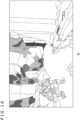
- FIG. 4 depicts one example of a game screen displayed on the output device 4a of the user A.
- the user A is playing a game title "special soccer.”
- the execution section 110a generates game image data, and supplies the game image data to the image processing section 140a.
- the image processing section 140a temporarily stores the game image data in the game buffer 152a, and generates a display image from the image data temporarily stored in the frame buffer 150a, and provides the display image to the output device 4a. Accordingly, the output device 4a outputs the game image.
- the output device 4a additionally outputs a game sound generated by the execution section 110a, and the user A operates the input device 6 to play the game title "special soccer" while watching the game image and listening to the game sound outputted from the output device 4a.
- the state information transmission section 162a transmits information indicating the state of the user A to the management server 5.
- the information indicating the state includes information indicating whether or not the user is playing a game, and further, if the user is playing the game, includes information indicating the title of the game, the on/off state of a microphone, and information regarding image sharing.
- the information regarding image sharing includes information regarding the user A as a host user and information regarding the user A as a guest user.
- the information regarding the user A as a host user includes information indicating that the user A starts screen sharing (first sharing mode), and information indicating that an invitation to assist play (second sharing mode) or collaboration play (third sharing mode) is sent to a room member.
- the information regarding the user A as a guest user includes information regarding the sharing mode of a game image distributed by another room member. Specifically, to allow another room member to watch an image distributed by the distribution server 9, the state information transmission section 162a transmits information indicating that the image is to be watched to the management server 5. To accept an invitation to assist play or collaboration play from another room member, the state information transmission section 162a transmits information indicating acceptance of the invitation to the management server 5.
- the function of the state information transmission section 162a is also installed in each of the information processing devices 10b to 10d of the users B to D. Therefore, the information processing device 10 of each user transmits information indicating the state of the user to the management server 5. It is preferable that, when the state changes, the information processing device 10 immediately transmits information indicating the change to the management server 5.
- the management server 5 acquires information indicating the states of the users from the respective information processing devices 10, and manages the respective current states of the users.
- the management server 5 transmits the information indicating the users to the information processing devices 10 belonging to the same chat group.
- the state information acquisition section 164a of the information processing device 10a acquires the information indicating the respective states of the users.
- the information processing device 10 provides a mechanism for allowing the user A who is playing a game to share an image in a simple manner.
- the reception section 104a receives the button operation, and supplies the operation information to the system image generation section 120a.
- the system image generation section 120a acquires the button operation information as a system-image display request, and calls the state information acquisition section 164a.
- the state information acquisition section 164a acquires the information indicating the states of the users from the management server 5, and provides the information to the system image generation section 120a.
- the room image generation section 124a generates system image data indicating the state of the chat room that the user A is participating in, and supplies the system image data to the image processing section 140a.
- the image processing section 140a temporarily stores the system image data in the system buffer 154a, and generates a display image from the image data temporarily stored in the frame buffer 150a, and provides the display image to the output device 4a.
- the image processing section 140a generates a display image by combining the game image data temporarily stored in the game buffer 152a and the system image data temporarily stored in the system buffer 154a, and provides the generated display image to the output device 4a. Accordingly, the output device 4a outputs the display image in which the system image is superposed on the game image.
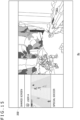
- FIG. 5 depicts an example of a system image 200 superimposed on a game image.
- the room image generation section 124a generates system image data on the basis of the information indicating the states of the users acquired by the state information acquisition section 164a.
- a member displaying field 202 for indicating the states of the members in the chat room that the user A is participating in is provided in the system image 200.
- the room image generation section 124a generates, on the basis of the information indicating the states of a plurality of room members (users), the member displaying field 202 in which information regarding the members is included.
- information indicating icons of the users, the user names, and the title of a game in progress, and whether the microphones are on/off is displayed.
- Information indicating whether or not share play is under execution may be additionally included in the member displaying field 202.
- a sharing start button 204 is an operation element for allowing the user A to start screen sharing which is the first sharing mode.
- the state information transmission section 162a transmits information indicating that the user A starts screen sharing (first sharing mode) to the management server 5 and the distribution server 9.
- the first transmission processing section 168a transmits, to the distribution server 9, streaming data on a game image that the image processing section 140a has read from the game buffer 152a.
- the streaming data includes game sound data.
- the first transmission processing section 168a compresses the streaming data in a prescribed format, and transmits the compressed data to the distribution server 9.
- the image processing section 140a reads out only game image data temporarily stored in the game buffer 152a, and provides the game image data to the first transmission processing section 168a, and thus, refrains from combining system image data temporarily stored in the system buffer 154a with the game image data.
- image data to be distributed does not include the system image data, so that the game image data alone can be distributed.
- the first transmission processing section 168a decides the resolution of game image data to be transmitted to the distribution server 9, according to the quality of the connection state between the communication section 102a and the distribution server 9. That is, if the connection state is poor, the first transmission processing section 168a decides to reduce the resolution of the game image data. It is to be noted that the execution section 110a generates game image data at a frame rate of 60 fps (frame/sec) or 30 fps, but the first transmission processing section 168a may reduce the frame rate as well as the resolution if the connection state with respect to the distribution server 9 is significantly poor.
- the image processing section 140a supplies the game image data having a resolution of 1080p to the first transmission processing section 168a if the connection state is good.
- the image processing section 140a needs to reduce the resolution of the game image if the connection state is not good.
- the image processing section 140a reduces the resolution to 720p when it is difficult to transmit the game image having a resolution of 1080p.
- the image processing section 140a reduces the resolution to 540p when it is difficult to transmit the game image having a resolution of 720p.
- the image processing section 140a reduces the resolution to 360p when it is difficult to transmit the game image having a resolution of 540p.
- the first transmission processing section 168a determines the quality of the connection state between the communication section 102a and the distribution server 9, and gives a request for conversion to a game image resolution that is appropriate for the quality to the image processing section 140a. Accordingly, the image processing section 140a reconfigures the game image data at the requested resolution, and the first transmission processing section 168a transmits the reconfigured game image data to the distribution server 9. It is to be noted that the first transmission processing section 168a may constantly monitor the connection state, and, if the connection state changes, the first transmission processing section 168a may give an instruction on a resolution that is appropriate for the change to the image processing section 140a.
- FIG. 6 depicts functional blocks of the distribution server 9.
- the distribution server 9 includes a control section 300 and a communication section 302.
- the control section 300 includes an image acquisition section 310, a conversion section 312, and a distribution section 314.
- the distribution section 314 holds information on chat room members, and distributes a game image to the information processing devices 10 of a certain member in the same chat room when receiving a watch request from the member.
- each of the elements illustrated as functional blocks for performing various processes can be formed by a circuit block, a memory, and any other LSI in terms of hardware, and can be implemented by system software or a game program loaded in a memory in terms of software. Therefore, a person skilled in the art will understand that these functional blocks can be implemented in various configurations such as a configuration including hardware only, a configuration including software only, and a combination thereof. No particular limitation is placed on implementation of the functional blocks.
- the image acquisition section 310 acquires image data transmitted by streaming from the information processing device 10a.
- the resolution of the image data is dynamically set according to the connection state between the information processing device 10a and the distribution server 9. Here, it is assumed that game image data is transmitted at a resolution of 1080p/60 fps from the information processing device 10.
- the conversion section 312 transcodes the acquired image data into image data at some transcodable resolutions. Specifically, the conversion section 312 transcodes the acquired image data into image data at resolutions that are lower than the resolution of the original image data.
- the conversion section 312 has a function of converting image data to resolutions of 720p, 540p, and 360p.
- the conversion section 312 converts the resolution of image data acquired by the image acquisition section 310 to lower resolutions. Therefore, when the image acquisition section 310 acquires image data of 1080p, the conversion section 312 converts the image data of 1080p to image data of 720p, image data of 540p, and image data of 360p.
- the conversion section 312 converts the image data of 720p to image data of 540p and image data of 360p.
- the conversion section 312 converts the image data of 540p to image data of 360p. Irrespective of whether or not to distribute image data, the conversion section 312 executes this conversion, and waits for a watching request from the other members in the same chat room.
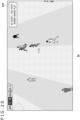
- FIG. 7 depicts an example of the system image 200 superimposed on a game image of the user A.
- the room image generation section 124a generates system image data on the basis of information indicating the states of users acquired by the state information acquisition section 164a.
- the user A himself/herself starts screen sharing in the chat room.
- the state information acquisition section 164a may acquire information indicating the state of the user A as internal information in the sharing processing section 160a.
- the room image generation section 124a generates, on the basis of the information regarding the states of a plurality of users, the member displaying field 202 in which information regarding a user transmitting an image and information regarding a user transmitting no image are included in different regions.
- a host display region 206 where information regarding a user transmitting an image is displayed and a non-host display region 208 where information regarding a user transmitting no image is displayed are provided in the system image 200.
- the host display region 206 and the non-host display region 208 are distinguishably provided as different regions, as depicted in FIG. 7 . Accordingly, the user A can easily discern which member is performing screen sharing and which member is not performing screen sharing. It is preferable that the host display region 206 is positioned above the non-host display region 208 so that the user A can preferentially see information in the host display region 206 because the display region of the system image 200 is limited.
- a watching member display region 212 is a region of displaying room members who are watching a game image under screen sharing by the user A. In the situation depicted in FIG. 7 , none of the members is watching the game image of the user A.
- a share-play start button 210 is an operation element for allowing the user A to start share play which is the second sharing mode or the third sharing mode.
- the room image generation section 124a adds, to the system image 200, the share-play start button 210 for performing an operation to invite a room member to a game in progress and under screen sharing.
- the share-play start button 210 When the user A operates the share-play start button 210, a window for inviting the other room members to share play is displayed, so that the user A can select a room member to be invited.
- FIG. 8 depicts an example of the system image 200 superimposed on a game image of the user A.
- information indicating the user D is placed in the host display region 206. This shows that the user D is performing screen sharing. Since the host display region 206 where information regarding a user transmitting an image is displayed and the non-host display region 208 where information regarding a user transmitting no image is displayed are provided in the system image 200, the user A can easily discern which member is performing screen sharing and which member is not performing screen sharing.
- FIG. 9 depicts functional blocks of the information processing device 10c that receives a game image under screen sharing.
- the information processing device 10c includes a processing section 100c, a communication section 102c, and a reception section 104c.
- the processing section 100c includes an execution section 110c, a system image generation section 120c, an image processing section 140c, a frame buffer 150c, and a sharing processing section 160c.
- the system image generation section 120c includes a report generation section 122c and a room image generation section 124c.
- the frame buffer 150c includes a game buffer 152c that temporarily stores game image data, and a system buffer 154c that temporarily stores system image data.
- the sharing processing section 160c includes a state information transmission section 162c, a state information acquisition section 164c, a request transmission section 180c, an acceptance transmission section 184c, and an image acquisition section 186c.
- the image acquisition section 186c includes a first image acquisition section 188c and a second image acquisition section 190c.
- each of the elements illustrated as functional blocks for performing various processes can be formed by a circuit block, a memory, and any other LSI in terms of hardware, and can be implemented by system software or a game program loaded in a memory in terms of software. Therefore, a person skilled in the art will understand that these functional blocks can be implemented in various configurations such as a configuration including hardware only, a configuration including software only, and a combination thereof. No particular limitation is placed on implementation of the functional blocks.
- a section in FIG. 9 may be identical to that in FIG. 3 if they have the same name.
- the communication section 102c receives operation information regarding an operation that the user C has performed on an input part of the input device 6.
- the communication section 102c receives chat data made by the other room members in the chat room from the management server 5, and further receives information indicating the states of the other room members.
- the communication section 102c receives streaming data on a game image from the distribution server 9 and/or another information processing device 10.
- the communication section 102c transmits information indicating the state of the user C to the management server 5.
- the functional block which is the communication section 102c is illustrated as a configuration having the functions of both the wireless communication module 38 and the wired communication module 40 in FIG. 2 .
- the reception section 104c is provided between the communication section 102c and the processing section 100c, and exchanges data or information between the communication section 102c and the processing section 100c.
- the reception section 104c supplies the operation information to a prescribed functional block of the processing section 100c.
- the execution section 110c executes a game program.
- the functional block which is illustrated as the execution section 110c is implemented by software such as system software or game software, or by hardware such as a GPU.
- the execution section 110c By executing the game program, the execution section 110c generates game image data and game sound data. It is to be noted that a game is one example of an application, and the execution section 110c may execute any application that is not a game.
- the execution section 110c executes the game program, and conducts computation for producing motion of a game character in a virtual space on the basis of operation information inputted to the input device 6 by the user C.
- the GPU After receiving the computation result in the virtual space, the GPU generates game image data based on a viewpoint (virtual camera) in the virtual space.
- FIG. 10 depicts one example of a game screen displayed on the output device 4c of the user C.
- the user C is playing a game title "combat field.”
- the execution section 110c generates game image data, and supplies the game image data to the image processing section 140c.
- the image processing section 140c temporarily stores the game image data in the game buffer 152c, and generates a display image from the image data temporarily stored in the frame buffer 150c, and provides the display image to the output device 4c. Accordingly, the output device 4c outputs the game image.
- the output device 4c further outputs a game sound generated by the execution section 110c, and the user C operates the input device 6 to play the game title "combat field" while watching the game image and listening to the game sound outputted from the output device 4c.
- the state information transmission section 162c transmits information indicating the state of the user C to the management server 5.
- the information indicating the state includes information indicating whether or not the user is playing a game, and further, if the user is playing the game, includes information indicating the title of the game and the on/off state of a microphone, and information regarding image sharing.
- the information regarding image sharing includes information regarding the user C as a host user and information regarding the user C as a guest user.
- the information regarding the user C as a host user includes information indicating that the user C starts screen sharing (first sharing mode), and information indicating that an invitation to assist play (second sharing mode) or collaboration play (third sharing mode) is sent to room members.
- the information regarding the user C as a guest user includes information regarding the sharing mode of a game image distributed by another room member. Specifically, to allow another room member to watch an image distributed by the distribution server 9, the state information transmission section 162c transmits information indicating that the image is to be watched to the management server 5. To accept an invitation to assist play or collaboration play from another room member, the state information transmission section 162c transmits information indicating acceptance of the invitation to the management server 5.
- the state information transmission section 162a of the information processing device 10a transmits information indicating that the user A starts screen sharing (first sharing mode) to the management server 5 and the distribution server 9. Further, the first transmission processing section 168a transmits, to the distribution server 9, streaming data on a game image that the image processing section 140a has read from the game buffer 152a.
- the management server 5 sends a report indicating that the user A has started screen sharing, to the information processing devices 10b, 10c, and 10d of the users B, C, and D who are the other room members in the chat room.
- FIG. 11 depicts an example of a message 220 which is displayed on the output device 4c of the user C.
- the report generation section 122c generates system image data including the message 220 on the basis of a report sent from the management server 5, and supplies the system image data to the image processing section 140c.
- the image processing section 140c temporarily stores the system image data in the system buffer 154c, and generates a display image from the image data temporarily stored in the frame buffer 150c, and provides the display image to the output device 4c.
- the image processing section 140c generates the display image by combining the game image data temporarily stored in the game buffer 152c with the system image data temporarily stored in the system buffer 154c, and provides the display image to the output device 4c.
- the output device 4c outputs a display image in which the system image is superimposed on the game image.
- the user C sees the message 220, and recognizes that the user A has started screen sharing.
- the report generation section 122c may perform a sound output to inform the user C that the user A has started screen sharing.
- the request transmission section 180c sends a watching request including information for identifying the user A to the management server 5. It is to be noted that the request transmission section 180c may send a watching request including information for identifying the user A to the distribution server 9.
- the message 220 is displayed only for five seconds, for example.
- the user C can display a system image to send a request for watching a game image distributed by the user A to the management server 5 or the distribution server 9.
- the reception section 104c receives the button operation, and supplies the operation information to the system image generation section 120c.
- the system image generation section 120c acquires the button operation information as a system-image display request, and calls the state information acquisition section 164c.
- the state information acquisition section 164c acquires information indicating the states of the users from the management server 5, and provides the information to the system image generation section 120c.
- the room image generation section 124c generates system image data indicating the state of the chat room that the user C is participating in, and supplies the system image data to the image processing section 140c.
- the image processing section 140c temporarily stores the system image data in the system buffer 154c, and generates a display image from the image data temporarily stored in the frame buffer 150c, and supplies the display image to the output device 4c.
- the image processing section 140c generates the display image by combining the game image data temporarily stored in the game buffer 152c with the system image data temporarily stored in the system buffer 154c, and provides the display image to the output device 4c. Accordingly, the output device 4c outputs a display image in which the system image is superimposed on the game image.
- FIG. 12 depicts an example of the system image 200 superimposed on a game image.
- the room image generation section 124c generates system image data on the basis of information indicating the states of the users acquired by the state information acquisition section 164c.
- the member displaying field 202 indicating the states of members in a chat room that the user has participated in is provided in the system image 200.
- the room image generation section 124c generates the member displaying field 202 including information regarding a plurality of room members (users) on the basis of the information indicating the states of the members.
- user icons, user names, the title of a game in progress, and information indicating the on/off states of microphones are displayed in the member displaying field 202. Further, information indicating whether share play is under execution, or the like may be included in the member displaying field 202.
- the room image generation section 124c generates, on the basis of the information regarding the states of the plurality of users, the member displaying field 202 in which information regarding a user transmitting an image and information regarding a user transmitting no image are included in different regions.
- the host display region 206 where information regarding a user transmitting an image is displayed and the non-host display region 208 where information regarding a user transmitting no image is displayed are provided in the system image 200.
- the host display region 206 and the non-host display region 208 are distinguishably provided as different regions, as depicted in FIG. 12 . Accordingly, the user C can easily discern which member is performing screen sharing and which member is not performing screen sharing.
- the reception section 104c receives an operation of selecting the user transmitting an image. Then, the request transmission section 180c transmits a watching request including information for identifying the selected user to the management server 5. After receiving the watching request, the management server 5 transmits the watching request to the distribution server 9 in order to report that the user C desires to watch a game image of the user A. It is to be noted that the request transmission section 180c may send the watching request directly to the distribution server 9.
- the first image acquisition section 188c decides a resolution of game image data to be received from the distribution server 9 according to the quality of the connection state between the communication section 102c and the distribution server 9, and adds the resolution of an image to be received to the watching request. That is, if the connection state is poor, the first image acquisition section 188c decides to receive low-resolution game image data.
- the conversion section 312 generates image data at multiple pieces of resolutions, and the distribution section 314 distributes image data having a resolution that is appropriate for the connection state with respect to the information processing device 10c, to the information processing device 10c.
- the conversion section 312 has generated image data having a resolution of 720p, image data having a resolution of 540p, and image data having a resolution of 360p.
- the first image acquisition section 188c requests game image data having a resolution of 1080p
- the distribution section 314 distributes the game image data having a resolution of 1080p to the information processing device 10c.
- the distribution section 314 distributes game image data having a resolution lower than 1080p.
- the first image acquisition section 188c acquires game image data from the distribution server 9.
- a format for displaying a game image under screen sharing is determined.
- the user C previously determines any one of the display formats.
- the image processing section 140c After receiving the image data from the first image acquisition section 188c, the image processing section 140c temporarily stores the image data in the system buffer 154c in accordance with the determined display format, generates a display image from the image data temporarily stored in the frame buffer 150c, and provides the display image to the output device 4c.
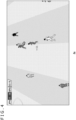
- FIG. 13 depicts a display image in a full-screen display format.
- the image processing section 140c temporarily stores, in the system buffer 154c, image data acquired by the first image acquisition section 188c, generates a display image from the temporarily stored image data, and provides the display image to the output device 4c. Accordingly, the output device 4c performs full-screen display of a game image distributed by the user A.
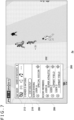
- FIG. 14 depicts a display example in a picture-in-picture display format.
- the image processing section 140c reduces image data acquired by the first image acquisition section 188c and temporarily stores the reduced image data in the system buffer 154c, and generates a display image by combining the user C's game image data temporarily stored in the game buffer 152a with the user A's game image data temporarily stored in the system buffer 154c, and provides the display image to the output device 4c.
- the output device 4c outputs a display image in which a display region 230 for a game image distributed by the user A is superimposed on an image of a game that the user C is playing. It is to be noted that the position and the size of the display region 230 may be freely set by the user C in a picture-in-picture display format.
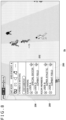
- FIG. 15 depicts a display example in a split-screen display format.
- the image processing section 140c reduces image data acquired by the first image acquisition section 188c, and temporarily stores the reduced image data in the system buffer 154c, and reduces game image data generated by the execution section 110c, and temporarily stores the game image data in the game buffer 152c.
- the image processing section 140c generates a display image by combining the user C's game image data temporarily stored in the game buffer 152a with the user A's game image data temporarily stored in the system buffer 154c, and provides the display image to the output device 4c.
- split-screen display the screen of the output device 4c is split such that an image of a game that the user C is playing and a game image distributed by the user A are displayed side by side. It is to be noted that, in split-screen display, the size of a display region 232 may be freely set by the user C.
- the image processing section 140c displays, on a part of the display, a game image distributed from the distribution server 9.
- a distributed image is displayed on a part of the display, so that the user C can watch a video of the user A's play while playing the title "combat field.”
- the request transmission section 180c may request transmission of game image data having a resolution lower than 1080p.
- the distribution section 314 of the distribution server 9 distributes, to the information processing device 10c, image data at a resolution that is appropriate for the display mode in the information processing device 10c. Accordingly, the communication resources can efficiently be used.
- the reception section 104a receives the button operation, and supplies the operation information to the system image generation section 120a.
- the system image generation section 120a acquires the button operation information as a system-image display request, and calls the state information acquisition section 164a.
- the state information acquisition section 164a acquires information indicating the states of the users from the management server 5, and provides the information to the system image generation section 120a.
- the room image generation section 124a generates system image data indicating the state of a chat room that the user A is participating in, and supplies the system image data to the image processing section 140a.
- the image processing section 140a temporarily stores the system image data in the system buffer 154a, generates a display image from the image data temporarily stored in the frame buffer 150a, and provides the display image to the output device 4a.
- FIG. 16 depicts an example of the system image 200 superimposed on a game image of the user A.
- information indicating that the user C is watching a game image under screen sharing by the user A is displayed in the watching member display region 212.
- the user A sees the watching member display region 212, and can recognize that there is a member who is watching the game image that the user A has distributed.
- the share-play start button 210 is provided for allowing the user A to start share play which is the second sharing mode or the third sharing mode, and is an operation element for performing an operation to invite a member to a game in progress.
- the invitation transmission section 172a transmits, to the management server 5, information indicating that the selected member is invited to share play.
- the management server 5 transmits the invitation to share play, to the information processing device 10 of the selected member.
- the user A invites the user C to share play.
- FIG. 17 depicts an example of a message 222 displayed on the output device 4c of the user C. It is to be noted that the image processing section 140c performs, in the display region 230, picture-in-picture display of a game image distributed by the user A.
- the report generation section 122c generates system image data including the message 222 on the basis of a report sent from the management server 5, and supplies the system image data to the image processing section 140c.
- the image processing section 140c temporarily stores the system image data in the system buffer 154c, generates a display image from game image data and the system image data temporarily stored in the frame buffer 150c, and supplies the display image to the output device 4c.
- the user C sees the message 222, and recognizes that the user A has invited the user C to share play. It is to be noted that the report generation section 122c may perform a voice output to inform the user C that the user A has invited the user C to share play.
- the acceptance transmission section 184c transmits information for identifying the user C, and further, information indicating acceptance of the invitation to the management server 5.
- the message 222 is displayed only for five seconds, for example. After the message 222 disappears, the user C can display the system image to accept the invitation sent by the user A.
- the reception section 104c receives the button operation, and supplies the operation information to the system image generation section 120c.
- the system image generation section 120c acquires the button operation information as a system-image display request, and calls the state information acquisition section 164c.
- the state information acquisition section 164c acquires information indicating the states of the users from the management server 5, and provides the information to the system image generation section 120c.
- the room image generation section 124c generates system image data indicating the state of the chat room that the user C is participating in, and supplies the system image data to the image processing section 140c.
- the image processing section 140c temporarily stores the system image data in the system buffer 154c, generates a display image from the game image data and the system image data temporarily stored in the frame buffer 150c, and provides the display image to the output device 4c.
- FIG. 18 depicts an example of the system image 200 superimposed on a game image of the user C.
- information indicating that the user A has invited the user C to share play is displayed in a share-play host display region 216 since the user C has been invited to the share play.
- the user C sees the share-play host display region 216, and recognizes that the user A has invited the user C to the share play.
- the share-play participation button 214 is provided for allowing the user C to join share play, and is an operation element for the user C to perform an operation of accepting the invitation sent by the user A.
- the acceptance transmission section 184c transmits information indicating acceptance of the invitation to a game play sent by the user A, to the management server 5.
- the management server 5 gives a report indicating that the user C has accepted the invitation to the information processing device 10a of the user A.
- the connection processing section 174a performs a process for establishing P2P connection with the information processing device 10c of the user C.
- the second transmission processing section 170a transmits, to the P2P-connected information processing device 10c, streaming data on a game image that the image processing section 140a has read from the game buffer 152a. That is, the second transmission processing section 170a transmits a game image for a gameplay to the information processing device 10c of the user C having accepted the invitation, not via the distribution server 9.
- the streaming data to be transmitted may be identical to streaming data transmitted to the distribution server 9. It is to be noted that, if the connection state between the communication section 102a and the distribution server 9 is different from the connection state between the communication section 102a and the information processing device 10c, the streaming data may be transmitted at respective resolutions that are appropriate for the connection states.
- FIG. 19 depicts an example of a system image displayed on the output device 4c of the user C.
- the system image 200 in FIG. 18 when the user C operates the share-play participation button 214, a process for establishing P2P connection between the information processing device 10c and the information processing device 10a is executed on a background. Therefore, the system image generation section 120c generates a system image such as that depicted in FIG. 19 , so that the user C recognizes that the connection is established until a gameplay is started.
- the image processing section 140c continuously displays, in the display region 230, a game image acquired from the distribution server 9 until a gameplay is ready. As a result, when waiting for start of a gameplay, the user C can watch the user A's gameplay. It is to be noted that the expression “until a gameplay is ready” means a time period from completion of P2P connection to transmission of streaming data on a game image from the second transmission processing section 170a.
- the image processing section 140c may continuously display, in the display region 232, a game image acquired from the distribution server 9 until a gameplay is ready.
- the image processing section 140c continuously displays the distributed image in this manner, so that the user C can watch an image distributed by the user A even when waiting for establishment of connection.
- the second transmission processing section 170a transmits a game image for gameplay to the information processing device 10c of the user C having accepted the invitation.
- the second image acquisition section 190c acquires a game image for gameplay from the information processing device 10a not via the distribution server 9.
- FIG. 20 depicts an image of a game that the user C is playing. Since a message 224 is superimposed on the game image, the user C recognizes that share play is started.
- the image processing section 140c temporarily stores, in the system buffer 154c, image data acquired by the second image acquisition section 190c, generates a display image from the temporarily stored image data, and provides the display image to the output device 4c. Accordingly, the output device 4c displays the game image distributed by the user A. The user C performs share play while watching the displayed game image.
- the present disclosure is applicable to a technology for sharing an image among a plurality of users.
Landscapes
- Engineering & Computer Science (AREA)
- Multimedia (AREA)
- Business, Economics & Management (AREA)
- Computer Security & Cryptography (AREA)
- General Business, Economics & Management (AREA)
- Physics & Mathematics (AREA)
- Optics & Photonics (AREA)
- Information Transfer Between Computers (AREA)
- Two-Way Televisions, Distribution Of Moving Picture Or The Like (AREA)
- Processing Or Creating Images (AREA)
Abstract
Description
- The present disclosure relates to a technology for sharing an image among a plurality of users.
-
PTL 1 discloses an image sharing system in which, under an environment where a host user's information processing device and a guest user's information processing device are connected not via a server but by P2P (Peer to Peer), an image of a game that the host user is playing is shared with the guest user. In this image sharing system, a sharing mode (Share Screen) for allowing a guest user to watch a game image, a sharing mode (Hand over my controller) for allowing a guest user to play a game in the place of the host user, and a sharing mode (Hand over another controller) for allowing the guest user to participate as a new player in a game, and allowing the host user and the guest user to play the game together are prepared. - [PTL 1]
JP 2017-35298A - A network service for games plays a role as a communication tool. For example, if a plurality of users participating in the same chat room share a game image, it is expected that more active communication can be established. Therefore, it is preferable to realize a mechanism for allowing a user who is playing a game to share an image of the game in progress with other users in a simple manner. Not only in a game but also in a network service such as a conference system to which a plurality of information processing devices connect, if a mechanism for sharing an image in a simple manner is realized, it is expected that smooth communication can be supported.
- Therefore, an object of the present invention is to provide a technology that is useful to share an image.
- In order to solve the abovementioned problems, an information processing device according to a certain aspect of the present disclosure connects to a management server that manages states of a plurality of members participating in one room, the information processing device including a state information acquisition section that acquires information indicating the states of the plurality of members from the management server, a room image generation section that, on the basis of the information indicating the states of the plurality of members, generates a member displaying field in which information regarding a member transmitting an image and information regarding a member transmitting no image are included in different regions, a reception section that receives an operation of selecting a member transmitting an image, and a request transmission section that sends a watching request including information for identifying the selected user to the management server or a distribution server that distributes an image.
- Another aspect of the present disclosure is an image sharing method including a step of acquiring, from a management server that manages states of a plurality of members participating in one room, information indicating the states of the plurality of members, a step of displaying, on the basis of the information indicating the states of the plurality of members, a member displaying field in which information regarding a member transmitting an image and information regarding a member transmitting no image are included in different regions, a step of receiving an operation of selecting a member transmitting an image, a step of sending a watching request including information for identifying the selected user to the management server or a distribution server that distributes an image, and a step of acquiring an image from the distribution server that distributes an image.
- It is to be noted that a method, a device, a system, a recording medium, or a computer program that is obtained by translating any combination of the above constituent elements or an expression in the present disclosure, is also effective as an aspect of the present disclosure.
-
- [
FIG. 1 ]
FIG. 1 is a diagram depicting an image sharing system according to an embodiment of the present disclosure. - [
FIG. 2 ]
FIG. 2 is a diagram depicting a hardware configuration of an information processing device. - [
FIG. 3 ]
FIG. 3 is a diagram depicting functional blocks of an information processing device that transmits a game image. - [
FIG. 4 ]
FIG. 4 is a diagram depicting one example of a game screen. - [
FIG. 5 ]
FIG. 5 is a diagram depicting an example of a system image superimposed on a game image. - [
FIG. 6 ]
FIG. 6 is a diagram depicting functional blocks of a distribution server. - [
FIG. 7 ]
FIG. 7 is a diagram depicting an example of a system image superimposed on a game image. - [
FIG. 8 ]
FIG. 8 is a diagram depicting an example of a system image superimposed on a game image. - [
FIG. 9 ]
FIG. 9 is a diagram depicting functional blocks of an information processing device that receives a game image under screen sharing. - [
FIG. 10 ]
FIG. 10 is a diagram depicting one example of a game screen displayed on an output device. - [
FIG. 11 ]
FIG. 11 is a diagram depicting an example of a message displayed on an output device. - [
FIG. 12 ]
FIG. 12 is a diagram depicting an example of a system image superimposed on a game image. - [
FIG. 13 ]
FIG. 13 is a diagram depicting a display example in a full-screen display format. - [
FIG. 14 ]
FIG. 14 is a diagram depicting a display example in a picture-in-picture display form. - [
FIG. 15 ]
FIG. 15 is a diagram depicting a display example in a split-screen display form. - [
FIG. 16 ]
FIG. 16 is a diagram depicting an example of a system image superimposed on a game image. - [
FIG. 17 ]
FIG. 17 is a diagram depicting an example of a message displayed on an output device. - [
FIG. 18 ]
FIG. 18 is a diagram depicting an example of a system image superimposed on a game image. - [
FIG. 19 ]
FIG. 19 is a diagram depicting an example of a system image displayed on an output device. - [
FIG. 20 ]
FIG. 20 is a diagram depicting an image of a game that a user is playing. -
FIG. 1 depicts animage sharing system 1 according to an embodiment of the present disclosure. Theimage sharing system 1 includes a plurality ofinformation processing devices information processing device 10" in a case in which they are not specifically distinguished from one another), amanagement server 5, and adistribution server 9, which are connected via anetwork 3 such as the internet or a LAN (Local Area Network). - The
information processing devices output devices output device 4" in a case in which they are not specifically distinguished from one another). Theoutput devices 4 may be televisions that have displays for outputting images and loudspeakers for outputting sounds, or may be head mounted displays. Theoutput devices 4 may be connected to the respectiveinformation processing devices 10 via wired cables or wirelessly. - An access point (hereinafter, referred to as an "AP") 8 has a wireless access point function and a router function. Each
information processing device 10 is connected to thecorresponding AP 8 wirelessly or wiredly, and thus, is communicably connected to themanagement server 5, thedistribution server 9, and the otherinformation processing devices 10 on thenetwork 3. - The
information processing device 10 wirelessly or wiredly connects with aninput device 6 being operated by a user. Theinput device 6 outputs operation information indicating a user operation result to theinformation processing device 10. Theinformation processing device 10 receives the operation information from theinput device 6, and reflects the operation information in processes of system software or application software so as to output the processing result through theoutput device 4. In theimage sharing system 1, theinformation processing device 10 may be a game device that executes a game, and theinput device 6 may be a device such as a game controller for supplying user operation information to theinformation processing device 10. Theinput device 6 may include a plurality of input parts including a plurality of push-type operation buttons, an analog stick through which an analog quantity can be inputted, and a turnable button. - An
auxiliary storage device 2 is a storage such as an HDD (Hard Disk Drive) or an SSD (Solid-State Drive), and may be a built-in storage, or may be an external storage that is connected to theinformation processing device 10 through a USB (Universal Serial Bus) or the like. A camera 7 which is an image capturing device is disposed near theoutput device 4, and captures an image of the surrounding area of theoutput device 4. - In the
image sharing system 1, users A, B, C, and D are room members who are in the same chat room. The users can have a text chat with one another, and can have a voice chat with one another if the users have headsets. The chat room is created and managed by themanagement server 5. Themanagement server 5 receives chat data (text data and/or voice data) transmitted from each user, and transfers the chat data to the other users who are in the room. For example, themanagement server 5 transfers chat data transmitted from the user A to the users B, C, and D who are in the room. - In the chat room, each user can share an image of a game in progress with the other users. An upper limit may be placed on the number of users joining the chat room, but any limit is not necessarily placed on the number. It is to be noted that the chat room is one example of a virtual room or group where online users gather. Another type of a room or group may be used instead.
- The
management server 5 is maintained and managed by a management entity of theimage sharing system 1, and provides network services including a chat service to users of theimage sharing system 1. Themanagement server 5 manages network accounts for identifying the respective users. By using a network account, a user signs in to a network service. After signing in to a network service, a user enters a chat room so as to be able to communicate with other room members. It is to be noted that, after signing in, the user can save data on a game in themanagement server 5, for example. - The
distribution server 9 is maintained and managed by the management entity of theimage sharing system 1, and provides a service for distributing streaming data on an image of a game being played by a user, to another user participating in the chat room. It is to be noted that the streaming data includes game sounds as a matter of course, but an explanation of distribution of the game sounds will be omitted. An explanation of distribution of game images will mainly be given hereinafter. -
FIG. 2 depicts a hardware configuration of theinformation processing device 10. Theinformation processing device 10 includes a mainpower source button 20, a power ON LED (Light-Emitting Diode) 21, astandby LED 22, asystem controller 24, aclock 26, adevice controller 30, amedia drive 32, aUSB module 34, aflash memory 36, awireless communication module 38, awired communication module 40, asub-system 50, and amain system 60. - The
main system 60 includes a main CPU (Central Processing Unit), a memory which is a main storage and a memory controller, a GPU (Graphics Processing Unit), etc. The GPU is mainly used for computation of a game program. These functions may be implemented by a system-on-a-chip, and may be formed on one chip. The main CPU has a function for executing a game program recorded in theauxiliary storage device 2 or a ROM (Read-Only Memory)medium 44. - The
sub-system 50 is equipped with a sub-CPU, a memory which is a main storage, and a memory controller, etc., but is not equipped with a GPU, and thus, does not have a function of executing a game program. The number of circuit gates in the sub-CPU is less than that in the main CPU. Operation power consumption in the sub-CPU is smaller than that in the main CPU. - The main
power source button 20 is an input part through which a user operation is inputted. The mainpower source button 20 is disposed on a front surface of a casing of theinformation processing device 10, and is operated to turn on/off a power supply to themain system 60 of theinformation processing device 10. The power ONLED 21 is lit when the mainpower source button 20 is on. The standby LED 22 is lit when the mainpower source button 20 is off. - The
system controller 24 detects that a user depresses the mainpower source button 20. When the mainpower source button 20 is depressed while the main power source is in the OFF state, thesystem controller 24 regards the depression operation as an "ON instruction." On the other hand, when the mainpower source button 20 is depressed while the main power source is in the ON state, thesystem controller 24 regards the depression operation as an "OFF instruction." - The
clock 26, which is a real-time clock, generates current date and time information, and supplies the information to thesystem controller 24, thesub-system 50, and themain system 60. Thedevice controller 30 is formed as an LSI (Large-Scale Integrated Circuit) that, like a south bridge, conducts information exchange between devices. As depicted in the drawing, devices such as thesystem controller 24, themedia drive 32, theUSB module 34, theflash memory 36, thewireless communication module 38, thewired communication module 40, thesub-system 50, and themain system 60 are connected to thedevice controller 30. Thedevice controller 30 absorbs the difference in electric characteristics and the difference in data transfer speeds among the devices, and controls data transfer timings. - The media drive 32 is driven with the
ROM medium 44 attached thereto. Application software for games or the like, and license information are recorded in theROM medium 44. The media drive 32 reads out a program and data, etc., from theROM medium 44. TheROM medium 44 may be a read-only recording medium such as an optical disc, a magneto-optical disc, or a Blue-ray disc. - The
USB module 34 is connected to an external device via a USB cable. TheUSB module 34 may be connected to theauxiliary storage device 2 and the camera 7 via USB cables. Theflash memory 36 is an auxiliary storage constituting an internal storage. Thewireless communication module 38 wirelessly communicates with theinput device 6, for example, according to a communication protocol such as the Bluetooth (registered trademark) protocol or the IEEE (Institute of Electrical and Electronics Engineers)802.11 protocol. Thewired communication module 40 performs wired communication with an external device to connect to thenetwork 3 via theAP 8. - In the
image sharing system 1, chat room members are allowed to use three sharing modes in order to share game images. Hereinafter, a user who distributes a game image is referred to as a "host" or a "host user," and a user who receives distribution of a game image is referred to as a "guest" or a "guest user." - In the first sharing mode, a guest user watches a game image of a host user. This is called "screen sharing." In screen sharing, a game image of a host user is shared with a guest user via the
distribution server 9. That is, the host user'sinformation processing device 10 transmits a game image to thedistribution server 9, and the guest user'sinformation processing device 10 receives the game image from thedistribution server 9. The guest user is allowed to watch the game image of the host user but is not allowed to perform an operation in the game. - In the second sharing mode, a guest user plays a game instead of a host user while watching a game image of the host user. This is called "assist play." In assist play, a game image of a host user is shared with a guest user not via the
distribution server 9. That is, P2P connection between the host user'sinformation processing device 10 and the guest user'sinformation processing device 10 is established, so that the game image is shared. The host user cannot perform an operation in the game while only the guest user is allowed to perform an operation in the game because the host user gives a game operation authority to the guest user. - In the third sharing mode, a guest user joins a game as a new player to play the game in collaboration with a host user, while watching a game image of the host user. This is called "collaboration play." In collaboration play, a game image of a host user is shared with a guest user not via the
distribution server 9. That is, P2P connection between the host user'sinformation processing device 10 and the guest user'sinformation processing device 10 is established, so that the game image is shared. In collaboration play, the guest user also uses a game resource that is on the host user-side, and the host user and the guest user become aplayer 1 and aplayer 2, respectively, to participate in the game, so that the host user and the guest user are allowed to perform operations in the game in collaboration with each other. - In the second and third sharing modes, P2P connection between the host user's
information processing device 10 and the guest user'sinformation processing device 10 is established, so that a game image is shared, and at least the guest user has a gameplay authority. Since the guest user is allowed to play a game in the second and third sharing modes, the second and third sharing modes are collectively called "share play" in some cases. - One user becomes a host user when distributing an image of a game that the user is playing, and further, becomes a guest user when watching an image of a game that another person is playing. Accordingly, one
information processing device 10 includes both a transmission-side configuration to become a host user and a reception-side configuration to become a guest user. Hereinafter, for convenience of explanation, it is assumed that a user A'sinformation processing device 10a has the transmission-side configuration to transmit game images and a user C'sinformation processing device 10c has the reception-side configuration to receive game images such that game images are shared. However, it should be understood that both the transmission-side configuration and the reception-side configuration are installed in eachinformation processing device 10. -
FIG. 3 depicts functional blocks of theinformation processing device 10a that transmits an image of a game that the user A is playing. Theinformation processing device 10a includes aprocessing section 100a, a communication section 102a, and areception section 104a. Theprocessing section 100a includes anexecution section 110a, a systemimage generation section 120a, animage processing section 140a, aframe buffer 150a, and asharing processing section 160a. - The system
image generation section 120a includes areport generation section 122a and a roomimage generation section 124a. Theframe buffer 150a includes agame buffer 152a that temporarily stores game image data and asystem buffer 154a that temporarily stores system image data. Thesharing processing section 160a includes a stateinformation transmission section 162a, a stateinformation acquisition section 164a, atransmission processing section 166a, aninvitation transmission section 172a, and aconnection processing section 174a. Thetransmission processing section 166a includes a firsttransmission processing section 168a and a secondtransmission processing section 170a. - In
FIG. 3 , each of the elements which are illustrated as functional blocks for performing various processes can be formed by a circuit block, a memory, and any other LSI in terms of hardware, and can be implemented by system software or a game program loaded in a memory in terms of software. Therefore, a person skilled in the art will understand that these functional blocks can be implemented in various configurations such as a configuration including hardware only, a configuration including software only, and a combination thereof. No particular limitation is placed on implementation of the functional blocks. - The communication section 102a receives operation information on an operation performed by the user A on an input part of the
input device 6. In addition, the communication section 102a receives, from themanagement server 5, chat data on other room members in the chat room, and further receives information indicating the states of the other room members. - The communication section 102a transmits information indicating the state of the user A to the
management server 5. In addition, the communication section 102a transmits streaming data on game images and game sounds generated by theprocessing section 100a, to thedistribution server 9 and/or a separateinformation processing device 10. Hereinafter, streaming data for reproducing a game image may be simply referred to as a game image. The functional block which is the communication section 102a is illustrated as a configuration having both the function of thewireless communication module 38 and the function of the wiredcommunication module 40 inFIG. 2 . - The
reception section 104a is disposed between the communication section 102a and theprocessing section 100a, and exchanges data or information with the communication section 102a and theprocessing section 100a. When receiving the operation information from theinput device 6 via the communication section 102a, thereception section 104a supplies the operation information to a prescribed functional block in theprocessing section 100a. - The
execution section 110a executes a game program (hereinafter, simply referred to as a "game" in some cases). The functional block which is indicated as theexecution section 110a herein is implemented by software such as system software or game software, or hardware such as a GPU. Theexecution section 110a executes the game program to generate game image data and game sound data. It is to be noted that a game is one example of an application, and theexecution section 110a may execute any application that is not a game. - During a gameplay of the user A, the
execution section 110a executes the game program, and conducts computation for producing motion of a game character in a virtual space on the basis of operation information inputted to theinput device 6 by the user A. After receiving the computation result in the virtual space, the GPU generates game image data based on a viewpoint (virtual camera) in the virtual space. -
FIG. 4 depicts one example of a game screen displayed on theoutput device 4a of the user A. The user A is playing a game title "special soccer." Theexecution section 110a generates game image data, and supplies the game image data to theimage processing section 140a. Then, theimage processing section 140a temporarily stores the game image data in thegame buffer 152a, and generates a display image from the image data temporarily stored in theframe buffer 150a, and provides the display image to theoutput device 4a. Accordingly, theoutput device 4a outputs the game image. It is to be noted that, in actuality, theoutput device 4a additionally outputs a game sound generated by theexecution section 110a, and the user A operates theinput device 6 to play the game title "special soccer" while watching the game image and listening to the game sound outputted from theoutput device 4a. - In the
sharing processing section 160a, the stateinformation transmission section 162a transmits information indicating the state of the user A to themanagement server 5. The information indicating the state includes information indicating whether or not the user is playing a game, and further, if the user is playing the game, includes information indicating the title of the game, the on/off state of a microphone, and information regarding image sharing. The information regarding image sharing includes information regarding the user A as a host user and information regarding the user A as a guest user. The information regarding the user A as a host user includes information indicating that the user A starts screen sharing (first sharing mode), and information indicating that an invitation to assist play (second sharing mode) or collaboration play (third sharing mode) is sent to a room member. The information regarding the user A as a guest user includes information regarding the sharing mode of a game image distributed by another room member. Specifically, to allow another room member to watch an image distributed by thedistribution server 9, the stateinformation transmission section 162a transmits information indicating that the image is to be watched to themanagement server 5. To accept an invitation to assist play or collaboration play from another room member, the stateinformation transmission section 162a transmits information indicating acceptance of the invitation to themanagement server 5. - The function of the state
information transmission section 162a is also installed in each of theinformation processing devices 10b to 10d of the users B to D. Therefore, theinformation processing device 10 of each user transmits information indicating the state of the user to themanagement server 5. It is preferable that, when the state changes, theinformation processing device 10 immediately transmits information indicating the change to themanagement server 5. Themanagement server 5 acquires information indicating the states of the users from the respectiveinformation processing devices 10, and manages the respective current states of the users. Themanagement server 5 transmits the information indicating the users to theinformation processing devices 10 belonging to the same chat group. The stateinformation acquisition section 164a of theinformation processing device 10a acquires the information indicating the respective states of the users. - The
information processing device 10 according to the embodiment provides a mechanism for allowing the user A who is playing a game to share an image in a simple manner. When the user A shortly depresses a prescribed button on theinput device 6 during a gameplay, thereception section 104a receives the button operation, and supplies the operation information to the systemimage generation section 120a. The systemimage generation section 120a acquires the button operation information as a system-image display request, and calls the stateinformation acquisition section 164a. - The state
information acquisition section 164a acquires the information indicating the states of the users from themanagement server 5, and provides the information to the systemimage generation section 120a. In the systemimage generation section 120a, the roomimage generation section 124a generates system image data indicating the state of the chat room that the user A is participating in, and supplies the system image data to theimage processing section 140a. Theimage processing section 140a temporarily stores the system image data in thesystem buffer 154a, and generates a display image from the image data temporarily stored in theframe buffer 150a, and provides the display image to theoutput device 4a. Specifically, theimage processing section 140a generates a display image by combining the game image data temporarily stored in thegame buffer 152a and the system image data temporarily stored in thesystem buffer 154a, and provides the generated display image to theoutput device 4a. Accordingly, theoutput device 4a outputs the display image in which the system image is superposed on the game image. -
FIG. 5 depicts an example of asystem image 200 superimposed on a game image. The roomimage generation section 124a generates system image data on the basis of the information indicating the states of the users acquired by the stateinformation acquisition section 164a. Amember displaying field 202 for indicating the states of the members in the chat room that the user A is participating in is provided in thesystem image 200. The roomimage generation section 124a generates, on the basis of the information indicating the states of a plurality of room members (users), themember displaying field 202 in which information regarding the members is included. In themember displaying field 202 depicted inFIG. 5 , information indicating icons of the users, the user names, and the title of a game in progress, and whether the microphones are on/off is displayed. Information indicating whether or not share play is under execution may be additionally included in themember displaying field 202. - A sharing
start button 204 is an operation element for allowing the user A to start screen sharing which is the first sharing mode. When the user A operates the sharingstart button 204, the stateinformation transmission section 162a transmits information indicating that the user A starts screen sharing (first sharing mode) to themanagement server 5 and thedistribution server 9. Then, the firsttransmission processing section 168a transmits, to thedistribution server 9, streaming data on a game image that theimage processing section 140a has read from thegame buffer 152a. As explained above, the streaming data includes game sound data. The firsttransmission processing section 168a compresses the streaming data in a prescribed format, and transmits the compressed data to thedistribution server 9. - Here, the
image processing section 140a reads out only game image data temporarily stored in thegame buffer 152a, and provides the game image data to the firsttransmission processing section 168a, and thus, refrains from combining system image data temporarily stored in thesystem buffer 154a with the game image data. As a result, image data to be distributed does not include the system image data, so that the game image data alone can be distributed. - The first
transmission processing section 168a decides the resolution of game image data to be transmitted to thedistribution server 9, according to the quality of the connection state between the communication section 102a and thedistribution server 9. That is, if the connection state is poor, the firsttransmission processing section 168a decides to reduce the resolution of the game image data. It is to be noted that theexecution section 110a generates game image data at a frame rate of 60 fps (frame/sec) or 30 fps, but the firsttransmission processing section 168a may reduce the frame rate as well as the resolution if the connection state with respect to thedistribution server 9 is significantly poor. - In a case where game image data having a resolution of 1080p is temporarily stored in the
game buffer 152a, theimage processing section 140a supplies the game image data having a resolution of 1080p to the firsttransmission processing section 168a if the connection state is good. However, theimage processing section 140a needs to reduce the resolution of the game image if the connection state is not good. Theimage processing section 140a reduces the resolution to 720p when it is difficult to transmit the game image having a resolution of 1080p. Theimage processing section 140a reduces the resolution to 540p when it is difficult to transmit the game image having a resolution of 720p. Theimage processing section 140a reduces the resolution to 360p when it is difficult to transmit the game image having a resolution of 540p. - The first
transmission processing section 168a determines the quality of the connection state between the communication section 102a and thedistribution server 9, and gives a request for conversion to a game image resolution that is appropriate for the quality to theimage processing section 140a. Accordingly, theimage processing section 140a reconfigures the game image data at the requested resolution, and the firsttransmission processing section 168a transmits the reconfigured game image data to thedistribution server 9. It is to be noted that the firsttransmission processing section 168a may constantly monitor the connection state, and, if the connection state changes, the firsttransmission processing section 168a may give an instruction on a resolution that is appropriate for the change to theimage processing section 140a. -
FIG. 6 depicts functional blocks of thedistribution server 9. Thedistribution server 9 includes acontrol section 300 and acommunication section 302. Thecontrol section 300 includes animage acquisition section 310, aconversion section 312, and adistribution section 314. Thedistribution section 314 holds information on chat room members, and distributes a game image to theinformation processing devices 10 of a certain member in the same chat room when receiving a watch request from the member. - In
FIG. 6 , each of the elements illustrated as functional blocks for performing various processes can be formed by a circuit block, a memory, and any other LSI in terms of hardware, and can be implemented by system software or a game program loaded in a memory in terms of software. Therefore, a person skilled in the art will understand that these functional blocks can be implemented in various configurations such as a configuration including hardware only, a configuration including software only, and a combination thereof. No particular limitation is placed on implementation of the functional blocks. - The
image acquisition section 310 acquires image data transmitted by streaming from theinformation processing device 10a. The resolution of the image data is dynamically set according to the connection state between theinformation processing device 10a and thedistribution server 9. Here, it is assumed that game image data is transmitted at a resolution of 1080p/60 fps from theinformation processing device 10. Theconversion section 312 transcodes the acquired image data into image data at some transcodable resolutions. Specifically, theconversion section 312 transcodes the acquired image data into image data at resolutions that are lower than the resolution of the original image data. - The
conversion section 312 according to the embodiment has a function of converting image data to resolutions of 720p, 540p, and 360p. Theconversion section 312 converts the resolution of image data acquired by theimage acquisition section 310 to lower resolutions. Therefore, when theimage acquisition section 310 acquires image data of 1080p, theconversion section 312 converts the image data of 1080p to image data of 720p, image data of 540p, and image data of 360p. - It is to be noted that, when the
image acquisition section 310 acquires image data of 720p, theconversion section 312 converts the image data of 720p to image data of 540p and image data of 360p. When theimage acquisition section 310 acquires image data of 540p, theconversion section 312 converts the image data of 540p to image data of 360p. Irrespective of whether or not to distribute image data, theconversion section 312 executes this conversion, and waits for a watching request from the other members in the same chat room. -
FIG. 7 depicts an example of thesystem image 200 superimposed on a game image of the user A. The roomimage generation section 124a generates system image data on the basis of information indicating the states of users acquired by the stateinformation acquisition section 164a. Compared to the situation in which thesystem image 200 is displayed inFIG. 5 , the user A himself/herself starts screen sharing in the chat room. It is to be noted that, since theinformation processing device 10a side can recognize that the user A has started screen sharing, the stateinformation acquisition section 164a may acquire information indicating the state of the user A as internal information in thesharing processing section 160a. - The room
image generation section 124a generates, on the basis of the information regarding the states of a plurality of users, themember displaying field 202 in which information regarding a user transmitting an image and information regarding a user transmitting no image are included in different regions. In an example indicated inFIG. 7 , ahost display region 206 where information regarding a user transmitting an image is displayed and anon-host display region 208 where information regarding a user transmitting no image is displayed are provided in thesystem image 200. Thehost display region 206 and thenon-host display region 208 are distinguishably provided as different regions, as depicted inFIG. 7 . Accordingly, the user A can easily discern which member is performing screen sharing and which member is not performing screen sharing. It is preferable that thehost display region 206 is positioned above thenon-host display region 208 so that the user A can preferentially see information in thehost display region 206 because the display region of thesystem image 200 is limited. - A watching
member display region 212 is a region of displaying room members who are watching a game image under screen sharing by the user A. In the situation depicted inFIG. 7 , none of the members is watching the game image of the user A. - A share-
play start button 210 is an operation element for allowing the user A to start share play which is the second sharing mode or the third sharing mode. The roomimage generation section 124a adds, to thesystem image 200, the share-play start button 210 for performing an operation to invite a room member to a game in progress and under screen sharing. When the user A operates the share-play start button 210, a window for inviting the other room members to share play is displayed, so that the user A can select a room member to be invited. -
FIG. 8 depicts an example of thesystem image 200 superimposed on a game image of the user A. Compared with thesystem image 200 inFIG. 7 , information indicating the user D is placed in thehost display region 206. This shows that the user D is performing screen sharing. Since thehost display region 206 where information regarding a user transmitting an image is displayed and thenon-host display region 208 where information regarding a user transmitting no image is displayed are provided in thesystem image 200, the user A can easily discern which member is performing screen sharing and which member is not performing screen sharing. -
FIG. 9 depicts functional blocks of theinformation processing device 10c that receives a game image under screen sharing. Theinformation processing device 10c includes aprocessing section 100c, acommunication section 102c, and areception section 104c. Theprocessing section 100c includes anexecution section 110c, a systemimage generation section 120c, animage processing section 140c, aframe buffer 150c, and asharing processing section 160c. - The system
image generation section 120c includes areport generation section 122c and a roomimage generation section 124c. Theframe buffer 150c includes agame buffer 152c that temporarily stores game image data, and asystem buffer 154c that temporarily stores system image data. Thesharing processing section 160c includes a stateinformation transmission section 162c, a stateinformation acquisition section 164c, arequest transmission section 180c, anacceptance transmission section 184c, and animage acquisition section 186c. Theimage acquisition section 186c includes a firstimage acquisition section 188c and a secondimage acquisition section 190c. - In
FIG. 9 , each of the elements illustrated as functional blocks for performing various processes can be formed by a circuit block, a memory, and any other LSI in terms of hardware, and can be implemented by system software or a game program loaded in a memory in terms of software. Therefore, a person skilled in the art will understand that these functional blocks can be implemented in various configurations such as a configuration including hardware only, a configuration including software only, and a combination thereof. No particular limitation is placed on implementation of the functional blocks. A section inFIG. 9 may be identical to that inFIG. 3 if they have the same name. - The
communication section 102c receives operation information regarding an operation that the user C has performed on an input part of theinput device 6. In addition, thecommunication section 102c receives chat data made by the other room members in the chat room from themanagement server 5, and further receives information indicating the states of the other room members. In addition, thecommunication section 102c receives streaming data on a game image from thedistribution server 9 and/or anotherinformation processing device 10. In addition, thecommunication section 102c transmits information indicating the state of the user C to themanagement server 5. The functional block which is thecommunication section 102c is illustrated as a configuration having the functions of both thewireless communication module 38 and thewired communication module 40 inFIG. 2 . - The
reception section 104c is provided between thecommunication section 102c and theprocessing section 100c, and exchanges data or information between thecommunication section 102c and theprocessing section 100c. When receiving operation information regarding an operation performed on theinput device 6 via thecommunication section 102c, thereception section 104c supplies the operation information to a prescribed functional block of theprocessing section 100c. - The
execution section 110c executes a game program. Here, the functional block which is illustrated as theexecution section 110c is implemented by software such as system software or game software, or by hardware such as a GPU. By executing the game program, theexecution section 110c generates game image data and game sound data. It is to be noted that a game is one example of an application, and theexecution section 110c may execute any application that is not a game. - During a gameplay of the user C, the
execution section 110c executes the game program, and conducts computation for producing motion of a game character in a virtual space on the basis of operation information inputted to theinput device 6 by the user C. After receiving the computation result in the virtual space, the GPU generates game image data based on a viewpoint (virtual camera) in the virtual space. -
FIG. 10 depicts one example of a game screen displayed on theoutput device 4c of the user C. The user C is playing a game title "combat field." Theexecution section 110c generates game image data, and supplies the game image data to theimage processing section 140c. Then, theimage processing section 140c temporarily stores the game image data in thegame buffer 152c, and generates a display image from the image data temporarily stored in theframe buffer 150c, and provides the display image to theoutput device 4c. Accordingly, theoutput device 4c outputs the game image. It is to be noted that, in actuality, theoutput device 4c further outputs a game sound generated by theexecution section 110c, and the user C operates theinput device 6 to play the game title "combat field" while watching the game image and listening to the game sound outputted from theoutput device 4c. - In the
sharing processing section 160c, the stateinformation transmission section 162c transmits information indicating the state of the user C to themanagement server 5. The information indicating the state includes information indicating whether or not the user is playing a game, and further, if the user is playing the game, includes information indicating the title of the game and the on/off state of a microphone, and information regarding image sharing. The information regarding image sharing includes information regarding the user C as a host user and information regarding the user C as a guest user. The information regarding the user C as a host user includes information indicating that the user C starts screen sharing (first sharing mode), and information indicating that an invitation to assist play (second sharing mode) or collaboration play (third sharing mode) is sent to room members. The information regarding the user C as a guest user includes information regarding the sharing mode of a game image distributed by another room member. Specifically, to allow another room member to watch an image distributed by thedistribution server 9, the stateinformation transmission section 162c transmits information indicating that the image is to be watched to themanagement server 5. To accept an invitation to assist play or collaboration play from another room member, the stateinformation transmission section 162c transmits information indicating acceptance of the invitation to themanagement server 5. - Here, operation of the
information processing device 10c when a room member other than the user C starts screen sharing will be explained. With reference toFIG. 5 , when the user A operates the sharingstart button 204, the stateinformation transmission section 162a of theinformation processing device 10a transmits information indicating that the user A starts screen sharing (first sharing mode) to themanagement server 5 and thedistribution server 9. Further, the firsttransmission processing section 168a transmits, to thedistribution server 9, streaming data on a game image that theimage processing section 140a has read from thegame buffer 152a. After the user A starts screen sharing, themanagement server 5 sends a report indicating that the user A has started screen sharing, to theinformation processing devices -
FIG. 11 depicts an example of amessage 220 which is displayed on theoutput device 4c of the user C. Thereport generation section 122c generates system image data including themessage 220 on the basis of a report sent from themanagement server 5, and supplies the system image data to theimage processing section 140c. Theimage processing section 140c temporarily stores the system image data in thesystem buffer 154c, and generates a display image from the image data temporarily stored in theframe buffer 150c, and provides the display image to theoutput device 4c. Specifically, theimage processing section 140c generates the display image by combining the game image data temporarily stored in thegame buffer 152c with the system image data temporarily stored in thesystem buffer 154c, and provides the display image to theoutput device 4c. Accordingly, theoutput device 4c outputs a display image in which the system image is superimposed on the game image. The user C sees themessage 220, and recognizes that the user A has started screen sharing. It is to be noted that thereport generation section 122c may perform a sound output to inform the user C that the user A has started screen sharing. - When the user C depresses a prescribed button on the
input device 6 while themessage 220 is displayed, therequest transmission section 180c sends a watching request including information for identifying the user A to themanagement server 5. It is to be noted that therequest transmission section 180c may send a watching request including information for identifying the user A to thedistribution server 9. - It is to be noted that the
message 220 is displayed only for five seconds, for example. After themessage 220 disappears, the user C can display a system image to send a request for watching a game image distributed by the user A to themanagement server 5 or thedistribution server 9. When the user C shortly depresses a prescribed button on theinput device 6, thereception section 104c receives the button operation, and supplies the operation information to the systemimage generation section 120c. The systemimage generation section 120c acquires the button operation information as a system-image display request, and calls the stateinformation acquisition section 164c. - The state
information acquisition section 164c acquires information indicating the states of the users from themanagement server 5, and provides the information to the systemimage generation section 120c. In the systemimage generation section 120c, the roomimage generation section 124c generates system image data indicating the state of the chat room that the user C is participating in, and supplies the system image data to theimage processing section 140c. Theimage processing section 140c temporarily stores the system image data in thesystem buffer 154c, and generates a display image from the image data temporarily stored in theframe buffer 150c, and supplies the display image to theoutput device 4c. Specifically, theimage processing section 140c generates the display image by combining the game image data temporarily stored in thegame buffer 152c with the system image data temporarily stored in thesystem buffer 154c, and provides the display image to theoutput device 4c. Accordingly, theoutput device 4c outputs a display image in which the system image is superimposed on the game image. -
FIG. 12 depicts an example of thesystem image 200 superimposed on a game image. The roomimage generation section 124c generates system image data on the basis of information indicating the states of the users acquired by the stateinformation acquisition section 164c. Themember displaying field 202 indicating the states of members in a chat room that the user has participated in is provided in thesystem image 200. The roomimage generation section 124c generates themember displaying field 202 including information regarding a plurality of room members (users) on the basis of the information indicating the states of the members. InFIG. 12 , user icons, user names, the title of a game in progress, and information indicating the on/off states of microphones are displayed in themember displaying field 202. Further, information indicating whether share play is under execution, or the like may be included in themember displaying field 202. - The room
image generation section 124c generates, on the basis of the information regarding the states of the plurality of users, themember displaying field 202 in which information regarding a user transmitting an image and information regarding a user transmitting no image are included in different regions. In an example ofFIG. 12 , thehost display region 206 where information regarding a user transmitting an image is displayed and thenon-host display region 208 where information regarding a user transmitting no image is displayed are provided in thesystem image 200. Thehost display region 206 and thenon-host display region 208 are distinguishably provided as different regions, as depicted inFIG. 12 . Accordingly, the user C can easily discern which member is performing screen sharing and which member is not performing screen sharing. - When the user C selects the display field of the user A by using the
input device 6, thereception section 104c receives an operation of selecting the user transmitting an image. Then, therequest transmission section 180c transmits a watching request including information for identifying the selected user to themanagement server 5. After receiving the watching request, themanagement server 5 transmits the watching request to thedistribution server 9 in order to report that the user C desires to watch a game image of the user A. It is to be noted that therequest transmission section 180c may send the watching request directly to thedistribution server 9. - The first
image acquisition section 188c decides a resolution of game image data to be received from thedistribution server 9 according to the quality of the connection state between thecommunication section 102c and thedistribution server 9, and adds the resolution of an image to be received to the watching request. That is, if the connection state is poor, the firstimage acquisition section 188c decides to receive low-resolution game image data. In thedistribution server 9, theconversion section 312 generates image data at multiple pieces of resolutions, and thedistribution section 314 distributes image data having a resolution that is appropriate for the connection state with respect to theinformation processing device 10c, to theinformation processing device 10c. - Here, it is assumed that game image data having a resolution of 1080p has been transmitted from the
information processing device 10a of the user A, and theconversion section 312 has generated image data having a resolution of 720p, image data having a resolution of 540p, and image data having a resolution of 360p. When the connection state between thedistribution server 9 and theinformation processing device 10c is good, the firstimage acquisition section 188c requests game image data having a resolution of 1080p, and thedistribution section 314 distributes the game image data having a resolution of 1080p to theinformation processing device 10c. However, when the connection state is not good, thedistribution section 314 distributes game image data having a resolution lower than 1080p. - Referring back to
FIG. 9 , the firstimage acquisition section 188c acquires game image data from thedistribution server 9. In theinformation processing device 10c, a format for displaying a game image under screen sharing is determined. In the embodiment, three display formats: (1) full screen display, (2) picture-in-picture display, and (3) split-screen display are prepared. The user C previously determines any one of the display formats. - After receiving the image data from the first
image acquisition section 188c, theimage processing section 140c temporarily stores the image data in thesystem buffer 154c in accordance with the determined display format, generates a display image from the image data temporarily stored in theframe buffer 150c, and provides the display image to theoutput device 4c. -
FIG. 13 depicts a display image in a full-screen display format. In a case where a full-screen display format is set, theimage processing section 140c temporarily stores, in thesystem buffer 154c, image data acquired by the firstimage acquisition section 188c, generates a display image from the temporarily stored image data, and provides the display image to theoutput device 4c. Accordingly, theoutput device 4c performs full-screen display of a game image distributed by the user A. -
FIG. 14 depicts a display example in a picture-in-picture display format. In a case where a picture-in-picture display format is set, theimage processing section 140c reduces image data acquired by the firstimage acquisition section 188c and temporarily stores the reduced image data in thesystem buffer 154c, and generates a display image by combining the user C's game image data temporarily stored in thegame buffer 152a with the user A's game image data temporarily stored in thesystem buffer 154c, and provides the display image to theoutput device 4c. Accordingly, theoutput device 4c outputs a display image in which adisplay region 230 for a game image distributed by the user A is superimposed on an image of a game that the user C is playing. It is to be noted that the position and the size of thedisplay region 230 may be freely set by the user C in a picture-in-picture display format. -
FIG. 15 depicts a display example in a split-screen display format. In a case where a split-screen display format is set, theimage processing section 140c reduces image data acquired by the firstimage acquisition section 188c, and temporarily stores the reduced image data in thesystem buffer 154c, and reduces game image data generated by theexecution section 110c, and temporarily stores the game image data in thegame buffer 152c. Theimage processing section 140c generates a display image by combining the user C's game image data temporarily stored in thegame buffer 152a with the user A's game image data temporarily stored in thesystem buffer 154c, and provides the display image to theoutput device 4c. In split-screen display, the screen of theoutput device 4c is split such that an image of a game that the user C is playing and a game image distributed by the user A are displayed side by side. It is to be noted that, in split-screen display, the size of adisplay region 232 may be freely set by the user C. - In picture-in-picture display or split-screen display, the
image processing section 140c displays, on a part of the display, a game image distributed from thedistribution server 9. A distributed image is displayed on a part of the display, so that the user C can watch a video of the user A's play while playing the title "combat field." - It is to be noted that, in picture-in-picture display or split-screen display, the resolution of the user A's game image does not need to be high because the image is reduced, and then, displayed on a part of the display. For this reason, the
request transmission section 180c may request transmission of game image data having a resolution lower than 1080p. In this case, thedistribution section 314 of thedistribution server 9 distributes, to theinformation processing device 10c, image data at a resolution that is appropriate for the display mode in theinformation processing device 10c. Accordingly, the communication resources can efficiently be used. - Referring back to
FIG. 3 , when the user A shortly depresses a prescribed button on theinput device 6 during a gameplay, thereception section 104a receives the button operation, and supplies the operation information to the systemimage generation section 120a. The systemimage generation section 120a acquires the button operation information as a system-image display request, and calls the stateinformation acquisition section 164a. - The state
information acquisition section 164a acquires information indicating the states of the users from themanagement server 5, and provides the information to the systemimage generation section 120a. The roomimage generation section 124a generates system image data indicating the state of a chat room that the user A is participating in, and supplies the system image data to theimage processing section 140a. Theimage processing section 140a temporarily stores the system image data in thesystem buffer 154a, generates a display image from the image data temporarily stored in theframe buffer 150a, and provides the display image to theoutput device 4a. -
FIG. 16 depicts an example of thesystem image 200 superimposed on a game image of the user A. Compared to thesystem image 200 depicted inFIG. 8 , information indicating that the user C is watching a game image under screen sharing by the user A is displayed in the watchingmember display region 212. The user A sees the watchingmember display region 212, and can recognize that there is a member who is watching the game image that the user A has distributed. - As explained above, the share-
play start button 210 is provided for allowing the user A to start share play which is the second sharing mode or the third sharing mode, and is an operation element for performing an operation to invite a member to a game in progress. When the user A operates the share-play start button 210 to select a member to perform share play with the user A, theinvitation transmission section 172a transmits, to themanagement server 5, information indicating that the selected member is invited to share play. Themanagement server 5 transmits the invitation to share play, to theinformation processing device 10 of the selected member. In the embodiment, the user A invites the user C to share play. -
FIG. 17 depicts an example of amessage 222 displayed on theoutput device 4c of the user C. It is to be noted that theimage processing section 140c performs, in thedisplay region 230, picture-in-picture display of a game image distributed by the user A. - The
report generation section 122c generates system image data including themessage 222 on the basis of a report sent from themanagement server 5, and supplies the system image data to theimage processing section 140c. Theimage processing section 140c temporarily stores the system image data in thesystem buffer 154c, generates a display image from game image data and the system image data temporarily stored in theframe buffer 150c, and supplies the display image to theoutput device 4c. The user C sees themessage 222, and recognizes that the user A has invited the user C to share play. It is to be noted that thereport generation section 122c may perform a voice output to inform the user C that the user A has invited the user C to share play. - When the user C depresses a prescribed button on the
input device 6 while themessage 222 is displayed, theacceptance transmission section 184c transmits information for identifying the user C, and further, information indicating acceptance of the invitation to themanagement server 5. - It is to be noted that the
message 222 is displayed only for five seconds, for example. After themessage 222 disappears, the user C can display the system image to accept the invitation sent by the user A. When the user C shortly depresses a prescribed button on theinput device 6, thereception section 104c receives the button operation, and supplies the operation information to the systemimage generation section 120c. The systemimage generation section 120c acquires the button operation information as a system-image display request, and calls the stateinformation acquisition section 164c. - The state
information acquisition section 164c acquires information indicating the states of the users from themanagement server 5, and provides the information to the systemimage generation section 120c. In the systemimage generation section 120c, the roomimage generation section 124c generates system image data indicating the state of the chat room that the user C is participating in, and supplies the system image data to theimage processing section 140c. Theimage processing section 140c temporarily stores the system image data in thesystem buffer 154c, generates a display image from the game image data and the system image data temporarily stored in theframe buffer 150c, and provides the display image to theoutput device 4c. -
FIG. 18 depicts an example of thesystem image 200 superimposed on a game image of the user C. Compared to thesystem image 200 inFIG. 12 , information indicating that the user A has invited the user C to share play is displayed in a share-playhost display region 216 since the user C has been invited to the share play. The user C sees the share-playhost display region 216, and recognizes that the user A has invited the user C to the share play. - The share-
play participation button 214 is provided for allowing the user C to join share play, and is an operation element for the user C to perform an operation of accepting the invitation sent by the user A. When the user C operates the share-play participation button 214, theacceptance transmission section 184c transmits information indicating acceptance of the invitation to a game play sent by the user A, to themanagement server 5. Themanagement server 5 gives a report indicating that the user C has accepted the invitation to theinformation processing device 10a of the user A. - Referring back to
FIG. 3 , when thereception section 104a receives information indicating that the user C has accepted the invitation, theconnection processing section 174a performs a process for establishing P2P connection with theinformation processing device 10c of the user C. After P2P connection is established, the secondtransmission processing section 170a transmits, to the P2P-connectedinformation processing device 10c, streaming data on a game image that theimage processing section 140a has read from thegame buffer 152a. That is, the secondtransmission processing section 170a transmits a game image for a gameplay to theinformation processing device 10c of the user C having accepted the invitation, not via thedistribution server 9. The streaming data to be transmitted may be identical to streaming data transmitted to thedistribution server 9. It is to be noted that, if the connection state between the communication section 102a and thedistribution server 9 is different from the connection state between the communication section 102a and theinformation processing device 10c, the streaming data may be transmitted at respective resolutions that are appropriate for the connection states. -
FIG. 19 depicts an example of a system image displayed on theoutput device 4c of the user C. In thesystem image 200 inFIG. 18 , when the user C operates the share-play participation button 214, a process for establishing P2P connection between theinformation processing device 10c and theinformation processing device 10a is executed on a background. Therefore, the systemimage generation section 120c generates a system image such as that depicted inFIG. 19 , so that the user C recognizes that the connection is established until a gameplay is started. - It is to be noted that the
image processing section 140c continuously displays, in thedisplay region 230, a game image acquired from thedistribution server 9 until a gameplay is ready. As a result, when waiting for start of a gameplay, the user C can watch the user A's gameplay. It is to be noted that the expression "until a gameplay is ready" means a time period from completion of P2P connection to transmission of streaming data on a game image from the secondtransmission processing section 170a. - It is to be noted that, also in a case where a distributed image is displayed not in a picture-in-picture display format but in a split-screen display, the
image processing section 140c may continuously display, in thedisplay region 232, a game image acquired from thedistribution server 9 until a gameplay is ready. In a case where the user C operates the share-play participation button 214 while a distributed image is displayed on a part of the display, theimage processing section 140c continuously displays the distributed image in this manner, so that the user C can watch an image distributed by the user A even when waiting for establishment of connection. - After P2P connection is established, the second
transmission processing section 170a transmits a game image for gameplay to theinformation processing device 10c of the user C having accepted the invitation. In theinformation processing device 10c, the secondimage acquisition section 190c acquires a game image for gameplay from theinformation processing device 10a not via thedistribution server 9. -
FIG. 20 depicts an image of a game that the user C is playing. Since amessage 224 is superimposed on the game image, the user C recognizes that share play is started. Theimage processing section 140c temporarily stores, in thesystem buffer 154c, image data acquired by the secondimage acquisition section 190c, generates a display image from the temporarily stored image data, and provides the display image to theoutput device 4c. Accordingly, theoutput device 4c displays the game image distributed by the user A. The user C performs share play while watching the displayed game image. - The present disclosure has been explained so far on the basis of the embodiment. This embodiment is illustrative. A person skilled in the art will understand that many modifications can be made to a combination of the constituent elements or a combination of the processes, and that such modifications are also included in the scope of the present disclosure.
- The present disclosure is applicable to a technology for sharing an image among a plurality of users.
-
- 1: Image sharing system
- 4: Output device
- 5: Management server
- 6: Input device
- 9: Distribution server
- 10a, 10b, 10c, 10d: Information processing device
- 20: Main power source button
- 100a, 100c: Processing section
- 102a, 102c: Communication section
- 104a, 104c: Reception section
- 110a, 110c: Execution section
- 120a, 120c: System image generation section
- 122a, 122c: Report generation section
- 124a, 124c: Room image generation section
- 140a, 140c: Image processing section
- 150a, 150c: Frame buffer
- 152a, 152c: Game buffer
- 154a, 154c: System buffer
- 160a, 160c: Sharing processing section
- 162a, 162c: State information transmission section
- 164a, 164c: State information acquisition section
- 166a: Transmission processing section
- 168a: First transmission processing section
- 170a: Second transmission processing section
- 172a: Invitation transmission section
- 174a: Connection processing section
- 180c: Request transmission section
- 182c: Invitation reception section
- 184c: Acceptance transmission section
- 186c: Image acquisition section
- 188c: First image acquisition section
- 190c: Second image acquisition section
- 300: Control section
- 302: Communication section
- 310: Image acquisition section
- 312: Conversion section
- 314: Distribution section
Claims (6)
- An information processing device connecting to a management server that manages states of a plurality of members participating in one room, the information processing device comprising:a state information acquisition section that acquires information indicating the states of the plurality of members from the management server;a room image generation section that, on a basis of the information indicating the states of the plurality of members,generates a member displaying field in which information regarding a member transmitting an image and information regarding a member transmitting no image are included in different regions;a reception section that receives an operation of selecting a member transmitting an image; anda request transmission section that sends a watching request including information for identifying the selected user to the management server or a distribution server that distributes an image.
- The information processing device according to claim 1, further comprising:an image acquisition section that acquires an image from a distribution server that distributes an image; andan image processing section that displays the acquired image on a part of a display.
- The information processing device according to claim 2, further comprising:an acceptance transmission section that transmits, to the management server, information indicating acceptance of an invitation to a gameplay by a member transmitting an image, whereinthe image processing section continuously displays an image acquired from the distribution server until a gameplay is ready.
- The information processing device according to claim 3, wherein
the image acquisition section acquires an image for a gameplay from an information processing device of the member not via the distribution server. - An image sharing method comprising:a step of acquiring, from a management server that manages states of a plurality of members participating in one room, information indicating the states of the plurality of members;a step of displaying, on a basis of the information indicating the states of the plurality of members, a member displaying field in which information regarding a member transmitting an image and information regarding a member transmitting no image are included in different regions;a step of receiving an operation of selecting a member transmitting an image;a step of sending a watching request including information for identifying the selected user to the management server or a distribution server that distributes an image; anda step of acquiring an image from the distribution server that distributes an image.
- A program for causing a computer to implement:a function of acquiring, from a management server that manages states of a plurality of members participating in one room, information indicating the states of the plurality of members;a function of displaying, on a basis of the information indicating the states of the plurality of members, a member displaying field in which information regarding a member transmitting an image and information regarding a member transmitting no image are included in different regions;a function of receiving an operation of selecting a member transmitting an image;a function of sending a watching request including information for identifying the selected user to the management server or a distribution server that distributes an image; anda function of acquiring an image from the distribution server that distributes an image.
Applications Claiming Priority (2)
| Application Number | Priority Date | Filing Date | Title |
|---|---|---|---|
| JP2020099647A JP7069249B2 (en) | 2020-06-08 | 2020-06-08 | Information processing device and image sharing method |
| PCT/JP2021/021159 WO2021251258A1 (en) | 2020-06-08 | 2021-06-03 | Information processing device and image sharing method |
Publications (2)
| Publication Number | Publication Date |
|---|---|
| EP4162994A1 true EP4162994A1 (en) | 2023-04-12 |
| EP4162994A4 EP4162994A4 (en) | 2024-07-17 |
Family
ID=78846040
Family Applications (1)
| Application Number | Title | Priority Date | Filing Date |
|---|---|---|---|
| EP21821465.8A Pending EP4162994A4 (en) | 2020-06-08 | 2021-06-03 | Information processing device and image sharing method |
Country Status (6)
| Country | Link |
|---|---|
| US (2) | US20230158400A1 (en) |
| EP (1) | EP4162994A4 (en) |
| JP (1) | JP7069249B2 (en) |
| CN (1) | CN115397530A (en) |
| TW (1) | TWI778640B (en) |
| WO (1) | WO2021251258A1 (en) |
Families Citing this family (1)
| Publication number | Priority date | Publication date | Assignee | Title |
|---|---|---|---|---|
| JPWO2023286222A1 (en) * | 2021-07-14 | 2023-01-19 |
Family Cites Families (14)
| Publication number | Priority date | Publication date | Assignee | Title |
|---|---|---|---|---|
| US8549574B2 (en) * | 2002-12-10 | 2013-10-01 | Ol2, Inc. | Method of combining linear content and interactive content compressed together as streaming interactive video |
| US10987597B2 (en) * | 2002-12-10 | 2021-04-27 | Sony Interactive Entertainment LLC | System and method for managing audio and video channels for video game players and spectators |
| US20070076245A1 (en) * | 2004-03-25 | 2007-04-05 | Noriko Sugimoto | Information processing device, information processing system, and information processing method |
| US20130268592A1 (en) * | 2012-04-06 | 2013-10-10 | Gface Gmbh | Content-aware persistent user room |
| TWI516104B (en) * | 2012-09-04 | 2016-01-01 | 緯創資通股份有限公司 | Method of playing internet video and related electronic device |
| EP2916558B1 (en) * | 2012-11-05 | 2022-03-09 | Sony Interactive Entertainment Inc. | Information processing device |
| JP6407622B2 (en) * | 2014-08-14 | 2018-10-17 | 株式会社ソニー・インタラクティブエンタテインメント | Information processing apparatus, image data transmission method, and information processing system |
| JP6407624B2 (en) * | 2014-08-14 | 2018-10-17 | 株式会社ソニー・インタラクティブエンタテインメント | Information processing apparatus and user information display method |
| JP6612086B2 (en) * | 2015-08-10 | 2019-11-27 | 株式会社ソニー・インタラクティブエンタテインメント | Information processing apparatus and viewing request transmission method |
| WO2017200512A1 (en) * | 2016-05-17 | 2017-11-23 | Bitlume Inc. | System and method for an interactive live streaming media platform to limited subscribers |
| US10567466B2 (en) * | 2017-04-06 | 2020-02-18 | Microsoft Technology Licensing, Llc | Co-streaming within a live interactive video game streaming service |
| US11103772B2 (en) * | 2018-01-12 | 2021-08-31 | Bunch Live, Inc. | Mediating multiplayer electronic game sessions |
| US11020671B2 (en) * | 2018-07-12 | 2021-06-01 | Microsoft Technology Licensing, Llc | System and method for enhancing participation in online multiplayer sessions |
| US10688390B2 (en) * | 2018-11-05 | 2020-06-23 | Sony Interactive Entertainment LLC | Crowd-sourced cloud gaming using peer-to-peer streaming |
-
2020
- 2020-06-08 JP JP2020099647A patent/JP7069249B2/en active Active
-
2021
- 2021-05-28 TW TW110119449A patent/TWI778640B/en active
- 2021-06-03 CN CN202180028451.4A patent/CN115397530A/en active Pending
- 2021-06-03 WO PCT/JP2021/021159 patent/WO2021251258A1/en not_active Ceased
- 2021-06-03 EP EP21821465.8A patent/EP4162994A4/en active Pending
- 2021-06-03 US US17/921,446 patent/US20230158400A1/en not_active Abandoned
-
2025
- 2025-08-11 US US19/296,755 patent/US20260027458A1/en active Pending
Also Published As
| Publication number | Publication date |
|---|---|
| US20230158400A1 (en) | 2023-05-25 |
| JP7069249B2 (en) | 2022-05-17 |
| EP4162994A4 (en) | 2024-07-17 |
| JP2021192757A (en) | 2021-12-23 |
| WO2021251258A1 (en) | 2021-12-16 |
| CN115397530A (en) | 2022-11-25 |
| US20260027458A1 (en) | 2026-01-29 |
| TWI778640B (en) | 2022-09-21 |
| TW202201956A (en) | 2022-01-01 |
Similar Documents
| Publication | Publication Date | Title |
|---|---|---|
| US9908044B2 (en) | Information processing system and information processing apparatus | |
| CN107847802B (en) | Information processing apparatus and viewing request transmission method | |
| JP6612019B2 (en) | Information processing apparatus, control data transmission method, and information processing system | |
| US10918936B2 (en) | Terminal apparatus, information processing apparatus, and microphone voice transmission method | |
| US10843071B2 (en) | Information processing apparatus, image data distribution method and program | |
| US20260027458A1 (en) | Information processing device and image sharing method | |
| US20260021416A1 (en) | Information processing device and image sharing method | |
| WO2021251257A1 (en) | Delivery server and image delivery method | |
| US12076646B2 (en) | Information processing device and image display method | |
| JP6139481B2 (en) | Information processing apparatus, content image sharing control method, and information processing system | |
| US11904247B2 (en) | Information processing apparatus and image display method for superimposing another image on a content image | |
| US11944909B2 (en) | Information processing device, information processing system, and application screen image displaying method | |
| JP2021090786A (en) | Information processing device and game image display method |
Legal Events
| Date | Code | Title | Description |
|---|---|---|---|
| STAA | Information on the status of an ep patent application or granted ep patent |
Free format text: STATUS: THE INTERNATIONAL PUBLICATION HAS BEEN MADE |
|
| PUAI | Public reference made under article 153(3) epc to a published international application that has entered the european phase |
Free format text: ORIGINAL CODE: 0009012 |
|
| STAA | Information on the status of an ep patent application or granted ep patent |
Free format text: STATUS: REQUEST FOR EXAMINATION WAS MADE |
|
| 17P | Request for examination filed |
Effective date: 20221104 |
|
| AK | Designated contracting states |
Kind code of ref document: A1 Designated state(s): AL AT BE BG CH CY CZ DE DK EE ES FI FR GB GR HR HU IE IS IT LI LT LU LV MC MK MT NL NO PL PT RO RS SE SI SK SM TR |
|
| DAV | Request for validation of the european patent (deleted) | ||
| DAX | Request for extension of the european patent (deleted) | ||
| A4 | Supplementary search report drawn up and despatched |
Effective date: 20240619 |
|
| RIC1 | Information provided on ipc code assigned before grant |
Ipc: G06F 13/00 20060101ALI20240613BHEP Ipc: H04N 7/15 20060101ALI20240613BHEP Ipc: A63F 13/86 20140101ALI20240613BHEP Ipc: A63F 13/795 20140101ALI20240613BHEP Ipc: A63F 13/533 20140101ALI20240613BHEP Ipc: A63F 13/30 20140101AFI20240613BHEP |
|
| STAA | Information on the status of an ep patent application or granted ep patent |
Free format text: STATUS: EXAMINATION IS IN PROGRESS |
|
| 17Q | First examination report despatched |
Effective date: 20251212 |